EP4434970A1 - Method for producing halovinyl imidazole compound - Google Patents
Method for producing halovinyl imidazole compound Download PDFInfo
- Publication number
- EP4434970A1 EP4434970A1 EP22895617.3A EP22895617A EP4434970A1 EP 4434970 A1 EP4434970 A1 EP 4434970A1 EP 22895617 A EP22895617 A EP 22895617A EP 4434970 A1 EP4434970 A1 EP 4434970A1
- Authority
- EP
- European Patent Office
- Prior art keywords
- group
- formula
- compound
- reaction
- groups
- Prior art date
- Legal status (The legal status is an assumption and is not a legal conclusion. Google has not performed a legal analysis and makes no representation as to the accuracy of the status listed.)
- Pending
Links
Classifications
-
- C—CHEMISTRY; METALLURGY
- C07—ORGANIC CHEMISTRY
- C07D—HETEROCYCLIC COMPOUNDS
- C07D233/00—Heterocyclic compounds containing 1,3-diazole or hydrogenated 1,3-diazole rings, not condensed with other rings
- C07D233/54—Heterocyclic compounds containing 1,3-diazole or hydrogenated 1,3-diazole rings, not condensed with other rings having two double bonds between ring members or between ring members and non-ring members
- C07D233/64—Heterocyclic compounds containing 1,3-diazole or hydrogenated 1,3-diazole rings, not condensed with other rings having two double bonds between ring members or between ring members and non-ring members with substituted hydrocarbon radicals attached to ring carbon atoms, e.g. histidine
Definitions
- the present invention relates to a method of producing a halovinyl imidazole compound.
- Patent Document 2 discloses a method characterized by dehydrogenating a compound selected from the group consisting of 2-alkylimidazoles and 2-alkylimidazolines in the presence of a dehydrogenation catalyst to produce 2-alkenylimidazoles.
- Patent Document 3 discloses a method of producing a 1-vinylimidazole derivative, characterized in that a 2-hydroxyethylimidazole derivative is dehydrated in a liquid phase in the presence of an alkali metal hydroxide or alcoholate.
- Patent Document 4 discloses a method of producing a vinylimidazole compound, in which a hydroxyethyl group-containing imidazole compound is subjected to a dehydration reaction in the presence of a dehydrating agent in a solvent having a boiling point at normal pressure higher than the boiling point of the vinylimidazole compound at normal pressure by 30°C or more.
- An object of the present invention is to provide a method of producing a halovinyl imidazole compound, which is one of building blocks.
- the present invention including the following aspects was completed as a result of repeated studies to achieve the above-mentioned objects.
- the compound of formula (2) can be obtained in a high yield.
- the term "unsubstituted” refers to a group consisting of a mother nucleus. In the case where only the name of a group serving as a mother nucleus is provided without accompanying the term “substituted”, this refers to "unsubstituted” unless specifically indicated otherwise.
- substituted means that any hydrogen atom of a group serving as a mother nucleus is substituted with a group (substituent) having a structure that is identical to or different from the mother nucleus.
- a “substituent” is another group bound to a group serving as the mother nucleus.
- the number of substituents may be one or two or more. Two or more substituents may be identical to or different from each other.
- C1-6 indicates that the number of carbon atoms of the group serving as the mother nucleus is 1 to 6.
- the number of carbon atoms does not include the number of carbon atoms present in substituents.
- a butyl group having an ethoxy group as a substituent thereof is classified as a C2 alkoxy C4 alkyl group.
- Any hydrogen atom of the "substituent" may be substituted with a group having a different structure.
- substituents include C1-6 alkyl groups, C1-6 haloalkyl groups, C1-6 alkoxy groups, C1-6 haloalkoxy groups, halogeno groups, a cyano group, and a nitro group.
- the "three- to six-membered heterocyclyl group” is one which contains, as a ring member atom, one to four hetero atoms selected from the group consisting of a nitrogen atom, an oxygen atom and a sulfur atom.
- the heterocyclyl group may be monocyclic or polycyclic. If at least one ring of a polycyclic heterocyclyl group is a hetero ring, the remaining rings thereof may be any of saturated alicyclic rings, unsaturated alicyclic rings and aromatic rings.
- Examples of the "three- to six-membered heterocyclyl group” include three- to six-membered saturated heterocyclyl groups, five- or six-membered heteroaryl groups, and five- or six-membered partially unsaturated heterocyclyl groups.
- Examples of the three- to six-membered saturated heterocyclyl groups include an aziridinyl group, an epoxy group, a pyrrolidinyl group, a tetrahydrofuranyl group, a thiazolidinyl group, a piperidyl group, a piperazinyl group, a morpholinyl group, a dioxolanyl group, and a dioxanyl group.
- Examples of the five-membered heteroaryl groups include a pyrrolyl group, a furyl group, a thienyl group, an imidazolyl group, a pyrazolyl group, an oxazolyl group, an isoxazolyl group, a thiazolyl group, an isothiazolyl group, a triazolyl group, an oxadiazolyl group, a thiadiazolyl group, and a tetrazolyl group.
- Examples of the six-membered heteroaryl groups include a pyridyl group, a pyrazinyl group, a pyrimidinyl group, a pyridazinyl group, and a triazinyl group.
- Examples of the five-membered partially-unsaturated heterocyclyl groups include a pyrrolinyl group, a dihydrofuranyl group, an imidazolinyl group, a pyrazolinyl group, an oxazolinyl group, and an isooxazolinyl group.
- Examples of the six-membered partially-unsaturated heterocyclyl groups include a dihydropyranyl group.
- a method of producing a compound (2) of the present invention includes chemically reacting a compound (1) and a sodium hyposulfite in the presence of a base (hereinafter, may be referred to as a third reaction).
- the compound (1) is represented by the following formula (1).
- R 1 is a C1-6 alkyl group.
- the C1-6 alkyl group as R 1 may be linear or branched.
- Examples of the C1-6 alkyl group as R 1 include a methyl group, an ethyl group, a n-propyl group, a n-butyl group, a n-pentyl group, a n-hexyl group, an i-propyl group, an i-butyl group, a s-butyl group, a t-butyl group, an i-pentyl group, a neopentyl group, a 2-methylbutyl group, a 2,2-dimethylpropyl group, and an i-hexyl group,
- Q is a hydrogen atom, or a substituted or unsubstituted pyridyl group.
- Q is preferably a hydrogen atom.
- Examples of a substituent on the "pyridyl group" as Q include: halogeno groups such a fluoro group, a chloro group, a bromo group, and an iodo group; C1-6 alkyl groups such as a methyl group, an ethyl group, a n-propyl group, an i-propyl group, a n-butyl group, a s-butyl group, an i-butyl group, a t-butyl group, a n-pentyl group, and a n-hexyl group; C1-6 haloalkyl groups such as a difluoromethyl group, a trifluoromethyl group, a perfluoroethyl group, a 1,2,2,3,3,3-hexafluoropropyl group, a perfluoropropyl group, and a 1,2,3,3,3-pentafluoro-2-(trifluoromethyl)
- X is a halogeno group.
- halogeno group examples include a fluoro group, a chloro group, a bromo group, and an iodo group.
- X is preferably a chloro group or a bromo group.
- R a is a C1-6 alkyl group.
- Examples of the "C1-6 alkyl group" as R a include the same groups as those mentioned as R 1 .
- the compound (1) used in the present invention may be one which is synthesized by oneself using a conventionally-known method, or one which is synthesized by another person by any method and commercially available.
- the compound (1) used in the present invention may be obtained by a method including: chemically reacting a compound (3) and a compound (4) in the presence of a base or a metal alkoxide (hereinafter, may be referred to as first reaction); and chemically reacting the reaction product of the first reaction and a compound (5) (hereinafter, may be referred to as second reaction), for example.
- first reaction chemically reacting a compound (3) and a compound (4) in the presence of a base or a metal alkoxide
- second reaction chemically reacting the reaction product of the first reaction and a compound (5)
- R 1 is a C1-6 alkyl group
- Q is a hydrogen atom, or a substituted or unsubstituted pyridyl group.
- Examples of the compound (3) include 1-methyl-1H-imidazole-5-carbaldehyde.
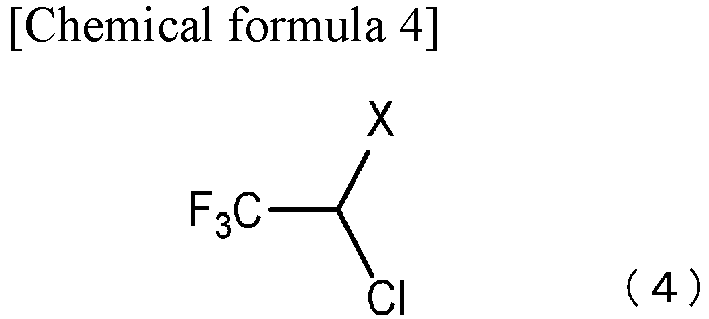
- X is a halogeno group.
- Examples of the compound (4) include 2,2-dichloro-1,1,1-trifluoroethane (HCFC-123), and 2-bromo-2-chloro-1,1,1-trifluoroethane (halothane), and 2-bromo-2-chloro-1,1,1-trifluoroethane is preferable.
- R a is a C1-6 alkyl group.
- Examples of the compound (5) include acetic anhydride and propionic anhydride.
- the compound (3), compound (4) and compound (5) used in the first reaction or the second reaction may be ones which are synthesized by oneself using conventionally-known methods, or ones which are synthesized by another person by any methods and commercially available.
- the amount of the compound (4) relative to one mol of the compound (3) is, for example, 1.0 mol to 5.0 mol, and preferably 1.2 mol to 2.0 mol.
- Examples of the base which is made to be present in the first reaction include: inorganic bases such as sodium carbonate, sodium hydrogen carbonate, potassium carbonate, potassium hydrogen carbonate, sodium hydroxide, potassium hydroxide, sodium hydride, and potassium hydride; and organic bases such as triethylamine, tetramethylethylenediamine, N,N-diisopropylamine, N,N-dimethylaniline, N,N-diethylaniline, 4-methylmorpholine, 1-azabicyclo[2.2.2]octane, 1,4-diazabicyclo[2.2.2] octane (abbreviation: DABCO), 1,8-diazabicyclo[5.4.0]undec-7-ene, 1,5-diazabicyclo[4.3.0]non-5-ene, pyridine, 4-(dimethylamino)pyridine and 2,6-dimethylpyridine.
- inorganic bases such as sodium carbonate, sodium hydrogen carbonate, potassium carbonate,
- the amount of the base used relative to one mole of the compound (3) is, for example, 1.0 mol to 5.0 mol, and preferably 1.5 mol to 2.0 mol.
- Examples of the metal alkoxide which is made to be present in the first reaction include sodium methoxide, sodium ethoxide, and potassium t-butoxide, and potassium t-butoxide is preferably used.
- the amount of the metal alkoxide used relative to one mole of the compound (3) is, for example, 1.0 mol to 5.0 mol, and preferably 1.2 mol to 2.0 mol.
- the first reaction may be carried out in the absence of any solvents or in a solvent.
- the first reaction is preferably carried out in an organic solvent in view of operability.
- organic solvent examples include: ethers such as diethyl ether, diisopropyl ether, diethylene glycol dimethyl ether (product name: diglyme) and tetrahydrofuran (abbreviation: THF); halogenated hydrocarbons such as dichloromethane, chloroform, and 1,2-dichloroethane (abbreviation: DCE); aliphatic hydrocarbons such as pentane, hexane, cyclohexane, heptane and octane; aromatic hydrocarbons such as toluene and xylene; aprotic polar solvents such as N,N- dimethylformamide (abbreviation: DMF), N,N'-dimethylpropyleneurea (abbreviation: DMPU) hexamethylphosphoric triamide (abbreviation: HMPA); and acetonitrile, and ethers such as tetrahydrofuran are preferably used.
- the amount of the organic solvent used relative to one part by weight of the compound (3) is preferably 10 parts by weight to 2000 parts by weight.
- the addition order of the compound (3), the compound (4), and a metal alkoxide or a base, used in the first reaction, and an organic solvent used as necessary, to the reaction site is not particularly limited.
- a solvent be put in a reaction container, and then the compound (3) and the compound (4) be added thereto, followed by adding a metal alkoxide or a base thereto.
- the temperature at which mixing is conducted is preferably -70°C to 0°C, and more preferably -70°C to -50°C.
- mixing is preferably conducted by stirring.
- a metal alkoxide or a base is preferably added gradually by conducting dropwise-addition, or the like.
- the temperature in the first reaction is preferably -70°C to 0°C, and more preferably -70°C to -50°C.
- the pressure in the first reaction is not particularly limited, and is, for example, an ordinary pressure.
- the first reaction is preferably carried out under an inert gas atmosphere.
- a liquid containing the first reaction product may be used directly in the second reaction.
- a liquid containing the first reaction product may be subjected to a post-treatment, and further to a purification, as needed.
- the post-treatment may be an operation of extraction with an organic solvent, followed by drying or concentrating the resultant organic layer.
- the purification may be an operation such as recrystallization or chromatography.
- the amount of the compound (5) relative to one mol of the compound (3) is, for example, 1.0 mol to 5.0 mol, and preferably 1.2 mol to 3.0 mol.
- the temperature in the second reaction is preferably -70°C to 0°C, and more preferably -70°C to -50°C.
- the pressure in the second reaction is not particularly limited, and, for example, an ordinary pressure.
- the reaction time in the second reaction is, for example, 0.5 hours to 24 hours, and preferably 0.5 hours to 2 hours.
- the second reaction is preferably carried out under an inert gas atmosphere.
- a liquid containing the compound (1) may be used directly in the third reaction.
- a liquid containing the compound (1) may be subjected to a post-treatment, and further to a purification, as needed.
- the post-treatment may be an operation of extraction with an organic solvent, followed by drying or concentrating the resultant organic layer.
- the purification may be an operation such as recrystallization or chromatography.
- the sodium hyposulfite can be obtained by electrolytically reducing sodium hydrogen sulfite.
- the sodium hyposulfite can be obtained by reaction of a sulfur dioxide and a sodium salt mediated by a metal zinc and purification.
- the sodium hyposulfite has a strong reducing power.
- the amount of the sodium hyposulfite used relative to one mol of the compound (1) is, for example, 1.0 mol to 5.0 mol, and is preferably 1.1 mol to 3.0 mol.
- Examples of the base which is made to be present in the third reaction include: inorganic bases such as sodium carbonate, sodium hydrogen carbonate, potassium carbonate, potassium hydrogen carbonate, sodium hydroxide, potassium hydroxide, sodium hydride, and potassium hydride; and organic bases such as triethylamine, tetramethylethylenediamine, N,N-diisopropylamine, N,N-dimethylaniline, N,N-diethylaniline, 4-methylmorpholine, 1-azabicyclo[2.2.2]octane, 1,4-diazabicyclo[2.2.2] octane (abbreviation: DABCO), 1,8-diazabicyclo[5.4.0]undec-7-ene, 1,5-diazabicyclo[4.3.0]non-5-ene, pyridine, 4-(dimethylamino)pyridine and 2,6-dimethylpyridine, and inorganic acids such as sodium hydrogen carbonate are preferably used.
- the amount of the base used relative to one mol of the compound (1) is, for example, 1.0 mol to 5.0 mol, and is preferably 1.1 mol to 3.0 mol.
- the third reaction may be carried out in the absence of any solvents or in a solvent.
- the reaction is preferably carried out in a solvent in view of operability.
- a mixed solvent of water and an organic solvent is preferably used.
- the organic solvent include: alcohols such as methanol and ethanol; ketones such as acetone, and methylethylketone; ethers such as diethyl ether, diisopropyl ether, diethylene glycol dimethyl ether (product name: diglyme) and tetrahydrofuran (abbreviation: THF); aromatic hydrocarbons such as toluene and xylene; aprotic polar solvents such as N,N- dimethylformamide (abbreviation: DMF), N,N'-dimethylpropyleneurea (abbreviation: DMPU), and hexamethylphosphoric triamide (abbreviation: HMPA); and acetonitrile; and ketones such as ace
- the amount of the solvent used relative to one part by weight of the compound (1) is preferably 2 parts by weight to 100 parts by weight.
- the addition order of the compound (1), the sodium hyposulfite, and the base, used in the third reaction, and the solvent used as necessary, to the reaction site is not particularly limited.
- One embodiment includes: adding the compound (1) to a solvent in a container or in the absence of a solvent; adding sodium hyposulfite and a base thereto to obtain a mixed liquid, and stirring the mixed liquid to terminate the chemical reaction. It is preferable that mixing be conducted by stirring.
- All of each substance may be added at once or a small amount thereof may be added gradually and separately.
- the temperature in the third reaction is not particularly limited, and is, for example, 0°C to the boiling point of a solvent, and, for example, approximately 20°C to 30°C.
- the pressure in the third reaction is, for example, 0.1 MPa to 1 MPa, and preferably 0.1 MPa to 0.5 MPa.
- the reaction time in the third reaction is not particularly limited, and is, for example, 0.5 hours to 24 hours.
- the third reaction is preferably carried out under an inert gas atmosphere.
- the third reaction is preferably quenched by adding a saturated aqueous solution of sodium hydrogen carbonate.
- extraction may be conducted with an organic solvent, and the resultant organic layer may be subjected to a post-treatment such as drying or concentrating. Furthermore, if necessary, the resultant in the third reaction may be purified by an operation such as recrystallization or chromatography.
- R 1 and Q are the same as those in the formula (1), respectively.
- Stereoisomers may be separated and purified by an operation such as chromatography.
- a compound of the following formula (2a1), formula (2a2), or formula (2a3) is a novel compound and is particularly useful as a production intermediate of a pharmaceutical or agricultural chemical or a monomer to produce a polymer.
- R 1 is a C1-6 alkyl group, and is preferably a methyl group.
- the resultant liquid was quenched by adding a saturated aqueous solution of sodium hydrogen carbonate thereto. Then, the resultant was extracted with ethyl acetate. The obtained organic layer was concentrated under reduced pressure to obtain 107.9 g of a crude product (crude yield 92%).
- a crude product (2-bromo-2-chloro-3,3,3-trifluoro-1-(1-methyl-1H-imidazol-5-yl)propyl acetate (24.3 g) obtained in the step 1, sodium hyposulfite (24.2 g, 2 eq.), and sodium hydrogen carbonate (11.7 g, 2 eq.) were mixed in acetone (140 mL), and stirred at room temperature. Water (27 mL) was added dropwise thereto while conducting stirring. Then, the temperature was raised to 40°C, and stirring was conducted for two hours. After the temperature was returned to room temperature, a saturated aqueous solution of sodium hydrogen carbonate was added to the resultant, and the mixture was extracted with ethyl acetate. The obtained organic layer was concentrated under reduced pressure, and the resultant concentrate was purified by silica gel chromatography, thereby obtaining 12.8 g of the target product (yield 88%, E/Z 20/80).
- the production method of the present invention makes it possible to efficiently obtain a halovinyl imidazole compound, which is the main partial structure that constitutes a compound which serves as a raw material of a pharmaceutical or agricultural chemical.
Landscapes
- Chemical & Material Sciences (AREA)
- Organic Chemistry (AREA)
- Plural Heterocyclic Compounds (AREA)
- Pharmaceuticals Containing Other Organic And Inorganic Compounds (AREA)
- Nitrogen And Oxygen Or Sulfur-Condensed Heterocyclic Ring Systems (AREA)
Abstract
Description
- The present invention relates to a method of producing a halovinyl imidazole compound.
- Priority is claimed on
Japanese Patent Application No. 2021-188984, filed November 19, 2021 - Nitrogen-containing heterocycles are main partial structures (building blocks) that constitute compounds that serve as raw materials of pharmaceuticals or agricultural chemicals. In recent years, the development of harmful arthropod control agents having an imidazole ring, a pyridine ring or the like has been actively carried out. For example, Patent Document 1 discloses a compound of formula (A).

- Vinylimidazole compounds are also useful as monomers to produce polymers. For example, Patent Document 2 discloses a method characterized by dehydrogenating a compound selected from the group consisting of 2-alkylimidazoles and 2-alkylimidazolines in the presence of a dehydrogenation catalyst to produce 2-alkenylimidazoles.
- Patent Document 3 discloses a method of producing a 1-vinylimidazole derivative, characterized in that a 2-hydroxyethylimidazole derivative is dehydrated in a liquid phase in the presence of an alkali metal hydroxide or alcoholate.
- Patent Document 4 discloses a method of producing a vinylimidazole compound, in which a hydroxyethyl group-containing imidazole compound is subjected to a dehydration reaction in the presence of a dehydrating agent in a solvent having a boiling point at normal pressure higher than the boiling point of the vinylimidazole compound at normal pressure by 30°C or more.
-
- [Patent Document 1]
WO 2020/090585 A - [Patent Document 2]
Japanese Unexamined Patent Application Publication No. Sho 58-210067 - [Patent Document 3]
Japanese Unexamined Patent Application Publication No. Hei 4-21672 - [Patent Document 4]
Japanese Unexamined Patent Application Publication No. 2011-121913 - An object of the present invention is to provide a method of producing a halovinyl imidazole compound, which is one of building blocks.
- The present invention including the following aspects was completed as a result of repeated studies to achieve the above-mentioned objects.
- (1) A method of producing a compound of formula (2) (hereinafter, may be referred to as compound (2)), including: chemically reacting a compound of formula (1) (hereinafter, may be referred to as compound (1)) and sodium hyposulfite in the presence of a base,


- (2) The production method according to (1) mentioned above, further including: obtaining the compound of formula (1) by a method including: chemically reacting a compound of formula (3) (hereinafter, may be referred to as compound (3)) and a compound of formula (4) (hereinafter, may be referred to as compound (4)) in the presence of a base or a metal alkoxide; and chemically reacting the reaction product of the above-mentioned chemical reaction and a compound of formula (5) (hereinafter, may be referred to as compound (5)).


- (3) A compound of formula (2a1), formula (2a2), or formula (2a3).

- According to the production method of the present invention, the compound of formula (2) can be obtained in a high yield.
- In the present invention, the term "unsubstituted" refers to a group consisting of a mother nucleus. In the case where only the name of a group serving as a mother nucleus is provided without accompanying the term "substituted", this refers to "unsubstituted" unless specifically indicated otherwise.
- On the other hand, the term "substituted" means that any hydrogen atom of a group serving as a mother nucleus is substituted with a group (substituent) having a structure that is identical to or different from the mother nucleus. Thus, a "substituent" is another group bound to a group serving as the mother nucleus. The number of substituents may be one or two or more. Two or more substituents may be identical to or different from each other.
- The term "C1-6", for example, indicates that the number of carbon atoms of the group serving as the mother nucleus is 1 to 6. The number of carbon atoms does not include the number of carbon atoms present in substituents. For example, a butyl group having an ethoxy group as a substituent thereof is classified as a C2 alkoxy C4 alkyl group.
- There are no particular limitations on "substituents" provided that they are chemically allowed and achieve effects of the present invention.
- Examples of groups that can serve as "substituents" include the following groups:
- C1-6 alkyl groups such as a methyl group, an ethyl group, a n-propyl group, an i-propyl group, a n-butyl group, a s-butyl group, an i-butyl group, a t-butyl group, a n-pentyl group, and a n-hexyl group;
- C2-6 alkenyl groups such as a vinyl group, a 1-propenyl group, a 2-propenyl group (an allyl group), a 1-butenyl group, a 2-butenyl group, a 3-butenyl group, a 1-methyl-2-propenyl group, and a 2-methyl-2-propenyl group;
- C2-6 alkynyl groups such as an ethynyl group, a 1-propynyl group, a 2-propynyl group, a 1-butynyl group, a 2-butynyl group, a 3-butynyl group, and a 1-methyl-2-propynyl group;
- C3-6 cycloalkyl groups such as a cyclopropyl group, a cyclobutyl group, a cyclopentyl group, and a cyclohexyl group;
- a phenyl group;
- three- to six-membered heterocyclyl groups;
- C1-6 alkoxy groups such as a methoxy group, an ethoxy group, a n-propoxy group, an i-propoxy group, a n-butoxy group, a s-butoxy group, an i-butoxy group, and a t-butoxy group;
- C6-10 aryloxy groups such as a phenoxy group, and a naphthoxy group;
- five- or six-membered heteroaryloxy groups such as a thiazolyloxy group, and a pyridyloxy group;
- C1-6 alkoxycarbonyl groups such as a methoxycarbonyl group, an ethoxycarbonyl group, a n-propoxycarbonyl group, an i-propoxycarbonyl group, a n-butoxycarbonyl group, and a t-butoxycarbonyl group;
- halogeno groups such as a fluoro group, a chloro group, a bromo group, and an iodo group;
- C1-6 haloalkyl groups such as a chloromethyl group, a chloroethyl group, a trifluoromethyl group, a 1,2-dichloro-n-propyl group, a 1-fluoro-n-butyl group, and a perfluoro-n-pentyl group;
- C1-6 haloalkoxy groups such as a trifluoromethoxy group, a 2-chloro-n-propoxy group, and a 2,3-dichlorobutoxy group;
- a formylamino group;
- C1-6 alkylcarbonylamino groups such as an acetylamino group, a propanoylamino group, a butyrylamino group, and an i-propylcarbonylamino group;
- C1-6 alkoxycarbonylamino groups such as a methoxycarbonylamino group, an ethoxycarbonylamino group, a n-propoxycarbonylamino group, and an i-propoxycarbonylamino group;
- unsubstituted or substituted aminocarbonyl groups such as an aminocarbonyl group, a dimethylaminocarbonyl group, a phenylaminocarbonyl group, and a N-phenyl-N-methylaminocarbonyl group;
- C1-6 alkylthio groups such as a methylthio group, an ethylthio group, a n-propylthio group, an i-propylthio group, a n-butylthio group, an i-butylthio group, a s-butylthio group, and a t-butylthio group;
- C1-6 haloalkylthio groups such as a trifluoromethylthio group, and a 2,2,2-trifluoroethylthio group;
- C1-6 alkylsulfonyl groups such as a methylsulfonyl group, an ethylsulfonyl group, and a t-butylsulfonyl group;
- C1-6 haloalkylsulfonyl groups such as a trifluoromethylsulfonyl group, and a 2,2,2-trifluoroethylsulfonyl group;
- a cyano group; and a nitro group.
- Any hydrogen atom of the "substituent" may be substituted with a group having a different structure. Examples of such a substituent include C1-6 alkyl groups, C1-6 haloalkyl groups, C1-6 alkoxy groups, C1-6 haloalkoxy groups, halogeno groups, a cyano group, and a nitro group.
- The "three- to six-membered heterocyclyl group" is one which contains, as a ring member atom, one to four hetero atoms selected from the group consisting of a nitrogen atom, an oxygen atom and a sulfur atom. The heterocyclyl group may be monocyclic or polycyclic. If at least one ring of a polycyclic heterocyclyl group is a hetero ring, the remaining rings thereof may be any of saturated alicyclic rings, unsaturated alicyclic rings and aromatic rings. Examples of the "three- to six-membered heterocyclyl group" include three- to six-membered saturated heterocyclyl groups, five- or six-membered heteroaryl groups, and five- or six-membered partially unsaturated heterocyclyl groups.
- Examples of the three- to six-membered saturated heterocyclyl groups include an aziridinyl group, an epoxy group, a pyrrolidinyl group, a tetrahydrofuranyl group, a thiazolidinyl group, a piperidyl group, a piperazinyl group, a morpholinyl group, a dioxolanyl group, and a dioxanyl group.
- Examples of the five-membered heteroaryl groups include a pyrrolyl group, a furyl group, a thienyl group, an imidazolyl group, a pyrazolyl group, an oxazolyl group, an isoxazolyl group, a thiazolyl group, an isothiazolyl group, a triazolyl group, an oxadiazolyl group, a thiadiazolyl group, and a tetrazolyl group.
- Examples of the six-membered heteroaryl groups include a pyridyl group, a pyrazinyl group, a pyrimidinyl group, a pyridazinyl group, and a triazinyl group.
- Examples of the five-membered partially-unsaturated heterocyclyl groups include a pyrrolinyl group, a dihydrofuranyl group, an imidazolinyl group, a pyrazolinyl group, an oxazolinyl group, and an isooxazolinyl group.
- Examples of the six-membered partially-unsaturated heterocyclyl groups include a dihydropyranyl group.
- A method of producing a compound (2) of the present invention includes chemically reacting a compound (1) and a sodium hyposulfite in the presence of a base (hereinafter, may be referred to as a third reaction).
- The compound (1) is represented by the following formula (1).

- In the formula (1), R1 is a C1-6 alkyl group.
- The C1-6 alkyl group as R1 may be linear or branched. Examples of the C1-6 alkyl group as R1 include a methyl group, an ethyl group, a n-propyl group, a n-butyl group, a n-pentyl group, a n-hexyl group, an i-propyl group, an i-butyl group, a s-butyl group, a t-butyl group, an i-pentyl group, a neopentyl group, a 2-methylbutyl group, a 2,2-dimethylpropyl group, and an i-hexyl group,
- In the formula (1), Q is a hydrogen atom, or a substituted or unsubstituted pyridyl group. Q is preferably a hydrogen atom.
- Examples of a substituent on the "pyridyl group" as Q include: halogeno groups such a fluoro group, a chloro group, a bromo group, and an iodo group; C1-6 alkyl groups such as a methyl group, an ethyl group, a n-propyl group, an i-propyl group, a n-butyl group, a s-butyl group, an i-butyl group, a t-butyl group, a n-pentyl group, and a n-hexyl group; C1-6 haloalkyl groups such as a difluoromethyl group, a trifluoromethyl group, a perfluoroethyl group, a 1,2,2,3,3,3-hexafluoropropyl group, a perfluoropropyl group, and a 1,2,3,3,3-pentafluoro-2-(trifluoromethyl)propyl group; C3-6 cycloalkyl groups such as a cyclopropyl group, and a cyclobutyl group; C1-6 alkoxy groups such as a methoxy group, an ethoxy group, a n-propoxy group, an i-propoxy group, a n-butoxy group, a s-butoxy group, an i-butoxy group, and a t-butoxy group; C1-6 haloalkoxy groups such as a difluoromethoxy group, a trifluoromethoxy group, a 2,2-difluoroethyl group, and 2,2,2-trifluoroethyl group; C1-6 alkylthio groups such as a methylthio group, and an ethylthio group; C1-6 alkylsulfinyl groups such as a methylsulfinyl group, and an ethylsulfinyl group; C1-6 alkylsulfonyl groups such as a methylsulfonyl group and an ethylsulfonyl group; a phenyl group; phenyl groups substituted with a halogeno group, a C1-6 alkyl group, a C1-6 haloalkyl group, or a C1-6 haloalkoxy group; five- or six-membered heteroaryl groups such as a triazolyl group, and a pyrimidinyl group; five- or six-membered heteroaryl groups substituted with a halogeno group, a C1-6 alkyl group, a C1-6 haloalkyl group, or a C1-6 haloalkoxy group; and a cyano group.
- In the formula (1), X is a halogeno group.
- Examples of the "halogeno group" as X include a fluoro group, a chloro group, a bromo group, and an iodo group.
- X is preferably a chloro group or a bromo group.
- In the formula (1), Ra is a C1-6 alkyl group.
- Examples of the "C1-6 alkyl group" as Ra include the same groups as those mentioned as R1.
- The compound (1) used in the present invention may be one which is synthesized by oneself using a conventionally-known method, or one which is synthesized by another person by any method and commercially available.
- The compound (1) used in the present invention may be obtained by a method including: chemically reacting a compound (3) and a compound (4) in the presence of a base or a metal alkoxide (hereinafter, may be referred to as first reaction); and chemically reacting the reaction product of the first reaction and a compound (5) (hereinafter, may be referred to as second reaction), for example.

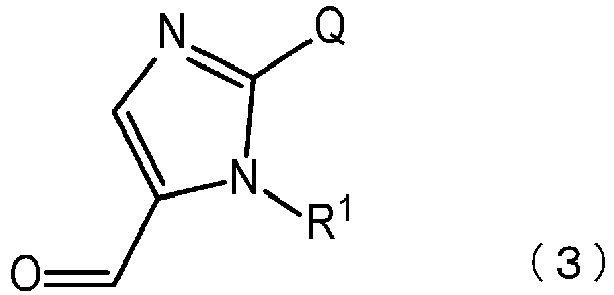
- In the formula (3), R1 is a C1-6 alkyl group, and Q is a hydrogen atom, or a substituted or unsubstituted pyridyl group.
- Examples of the compound (3) include 1-methyl-1H-imidazole-5-carbaldehyde.

- In formula (4), X is a halogeno group.
- Examples of the compound (4) include 2,2-dichloro-1,1,1-trifluoroethane (HCFC-123), and 2-bromo-2-chloro-1,1,1-trifluoroethane (halothane), and 2-bromo-2-chloro-1,1,1-trifluoroethane is preferable.

- In the formula (5), Ra is a C1-6 alkyl group.
- Examples of the compound (5) include acetic anhydride and propionic anhydride.
- The compound (3), compound (4) and compound (5) used in the first reaction or the second reaction may be ones which are synthesized by oneself using conventionally-known methods, or ones which are synthesized by another person by any methods and commercially available.
- In the first reaction, the amount of the compound (4) relative to one mol of the compound (3) is, for example, 1.0 mol to 5.0 mol, and preferably 1.2 mol to 2.0 mol.
- Examples of the base which is made to be present in the first reaction include: inorganic bases such as sodium carbonate, sodium hydrogen carbonate, potassium carbonate, potassium hydrogen carbonate, sodium hydroxide, potassium hydroxide, sodium hydride, and potassium hydride; and organic bases such as triethylamine, tetramethylethylenediamine, N,N-diisopropylamine, N,N-dimethylaniline, N,N-diethylaniline, 4-methylmorpholine, 1-azabicyclo[2.2.2]octane, 1,4-diazabicyclo[2.2.2] octane (abbreviation: DABCO), 1,8-diazabicyclo[5.4.0]undec-7-ene, 1,5-diazabicyclo[4.3.0]non-5-ene, pyridine, 4-(dimethylamino)pyridine and 2,6-dimethylpyridine.
- The amount of the base used relative to one mole of the compound (3) is, for example, 1.0 mol to 5.0 mol, and preferably 1.5 mol to 2.0 mol.
- Examples of the metal alkoxide which is made to be present in the first reaction include sodium methoxide, sodium ethoxide, and potassium t-butoxide, and potassium t-butoxide is preferably used.
- The amount of the metal alkoxide used relative to one mole of the compound (3) is, for example, 1.0 mol to 5.0 mol, and preferably 1.2 mol to 2.0 mol.
- The first reaction may be carried out in the absence of any solvents or in a solvent. The first reaction is preferably carried out in an organic solvent in view of operability.
- Examples of the organic solvent include: ethers such as diethyl ether, diisopropyl ether, diethylene glycol dimethyl ether (product name: diglyme) and tetrahydrofuran (abbreviation: THF); halogenated hydrocarbons such as dichloromethane, chloroform, and 1,2-dichloroethane (abbreviation: DCE); aliphatic hydrocarbons such as pentane, hexane, cyclohexane, heptane and octane; aromatic hydrocarbons such as toluene and xylene; aprotic polar solvents such as N,N- dimethylformamide (abbreviation: DMF), N,N'-dimethylpropyleneurea (abbreviation: DMPU) hexamethylphosphoric triamide (abbreviation: HMPA); and acetonitrile, and ethers such as tetrahydrofuran are preferably used.
- The amount of the organic solvent used relative to one part by weight of the compound (3) is preferably 10 parts by weight to 2000 parts by weight.
- The addition order of the compound (3), the compound (4), and a metal alkoxide or a base, used in the first reaction, and an organic solvent used as necessary, to the reaction site is not particularly limited. For example, it is preferable that a solvent be put in a reaction container, and then the compound (3) and the compound (4) be added thereto, followed by adding a metal alkoxide or a base thereto.
- The temperature at which mixing is conducted is preferably -70°C to 0°C, and more preferably -70°C to -50°C.
- When mixing is conducted, mixing is preferably conducted by stirring.
- A metal alkoxide or a base is preferably added gradually by conducting dropwise-addition, or the like.
- The temperature in the first reaction is preferably -70°C to 0°C, and more preferably -70°C to -50°C.
- The pressure in the first reaction is not particularly limited, and is, for example, an ordinary pressure.
- The reaction time in the first reaction is, for example, five minutes to 24 hours, and more preferably five minutes to one hour.
- The first reaction is preferably carried out under an inert gas atmosphere.
- After the first reaction is completed, a liquid containing the first reaction product may be used directly in the second reaction. Alternatively, after the first reaction is completed, a liquid containing the first reaction product may be subjected to a post-treatment, and further to a purification, as needed. The post-treatment may be an operation of extraction with an organic solvent, followed by drying or concentrating the resultant organic layer. The purification may be an operation such as recrystallization or chromatography.
- In the second reaction, the amount of the compound (5) relative to one mol of the compound (3) is, for example, 1.0 mol to 5.0 mol, and preferably 1.2 mol to 3.0 mol.
- The temperature in the second reaction is preferably -70°C to 0°C, and more preferably -70°C to -50°C.
- The pressure in the second reaction is not particularly limited, and, for example, an ordinary pressure.
- The reaction time in the second reaction is, for example, 0.5 hours to 24 hours, and preferably 0.5 hours to 2 hours.
- The second reaction is preferably carried out under an inert gas atmosphere.
- After the second reaction is completed, a liquid containing the compound (1) may be used directly in the third reaction. Alternatively, after the second reaction is completed, a liquid containing the compound (1) may be subjected to a post-treatment, and further to a purification, as needed. The post-treatment may be an operation of extraction with an organic solvent, followed by drying or concentrating the resultant organic layer. The purification may be an operation such as recrystallization or chromatography.
- The sodium hyposulfite can be obtained by electrolytically reducing sodium hydrogen sulfite. Alternatively, the sodium hyposulfite can be obtained by reaction of a sulfur dioxide and a sodium salt mediated by a metal zinc and purification. The sodium hyposulfite has a strong reducing power.
- The amount of the sodium hyposulfite used relative to one mol of the compound (1) is, for example, 1.0 mol to 5.0 mol, and is preferably 1.1 mol to 3.0 mol.
- Examples of the base which is made to be present in the third reaction include: inorganic bases such as sodium carbonate, sodium hydrogen carbonate, potassium carbonate, potassium hydrogen carbonate, sodium hydroxide, potassium hydroxide, sodium hydride, and potassium hydride; and organic bases such as triethylamine, tetramethylethylenediamine, N,N-diisopropylamine, N,N-dimethylaniline, N,N-diethylaniline, 4-methylmorpholine, 1-azabicyclo[2.2.2]octane, 1,4-diazabicyclo[2.2.2] octane (abbreviation: DABCO), 1,8-diazabicyclo[5.4.0]undec-7-ene, 1,5-diazabicyclo[4.3.0]non-5-ene, pyridine, 4-(dimethylamino)pyridine and 2,6-dimethylpyridine, and inorganic acids such as sodium hydrogen carbonate are preferably used.
- The amount of the base used relative to one mol of the compound (1) is, for example, 1.0 mol to 5.0 mol, and is preferably 1.1 mol to 3.0 mol.
- The third reaction may be carried out in the absence of any solvents or in a solvent. The reaction is preferably carried out in a solvent in view of operability. Since sodium hyposulfite is used, a mixed solvent of water and an organic solvent is preferably used. Examples of the organic solvent include: alcohols such as methanol and ethanol; ketones such as acetone, and methylethylketone; ethers such as diethyl ether, diisopropyl ether, diethylene glycol dimethyl ether (product name: diglyme) and tetrahydrofuran (abbreviation: THF); aromatic hydrocarbons such as toluene and xylene; aprotic polar solvents such as N,N- dimethylformamide (abbreviation: DMF), N,N'-dimethylpropyleneurea (abbreviation: DMPU), and hexamethylphosphoric triamide (abbreviation: HMPA); and acetonitrile; and ketones such as acetone are preferably used.
- The amount of the solvent used relative to one part by weight of the compound (1) is preferably 2 parts by weight to 100 parts by weight.
- The addition order of the compound (1), the sodium hyposulfite, and the base, used in the third reaction, and the solvent used as necessary, to the reaction site is not particularly limited.
- One embodiment includes: adding the compound (1) to a solvent in a container or in the absence of a solvent; adding sodium hyposulfite and a base thereto to obtain a mixed liquid, and stirring the mixed liquid to terminate the chemical reaction. It is preferable that mixing be conducted by stirring.
- All of each substance may be added at once or a small amount thereof may be added gradually and separately.
- The temperature in the third reaction is not particularly limited, and is, for example, 0°C to the boiling point of a solvent, and, for example, approximately 20°C to 30°C.
- The pressure in the third reaction is, for example, 0.1 MPa to 1 MPa, and preferably 0.1 MPa to 0.5 MPa.
- The reaction time in the third reaction is not particularly limited, and is, for example, 0.5 hours to 24 hours.
- The third reaction is preferably carried out under an inert gas atmosphere.
- The third reaction is preferably quenched by adding a saturated aqueous solution of sodium hydrogen carbonate.
- After the third reaction is completed, extraction may be conducted with an organic solvent, and the resultant organic layer may be subjected to a post-treatment such as drying or concentrating. Furthermore, if necessary, the resultant in the third reaction may be purified by an operation such as recrystallization or chromatography.
- The compound (2) obtained by the production method according to the present invention is represented by formula (2).

- In the formula (2), R1 and Q are the same as those in the formula (1), respectively.
- The following notation in the chemical formula indicates a double bond whose steric configuration is not defined (undefined double stereo bond).
- Stereoisomers may be separated and purified by an operation such as chromatography.
- Among the compounds (2) obtained by the production method according to the present invention, a compound of the following formula (2a1), formula (2a2), or formula (2a3) is a novel compound and is particularly useful as a production intermediate of a pharmaceutical or agricultural chemical or a monomer to produce a polymer.
- In the formula (2a1), formula (2a2), or formula (2a3), R1 is a C1-6 alkyl group, and is preferably a methyl group.
- As the compounds of the formula (2a1), formula (2a2), or formula (2a3), the following compounds are preferable.

- The present invention will be described more specifically below with reference to Examples. In addition, the present invention is not limited to the following examples.
-


- 1-Methyl-1H-imidazole-5-carbaldehyde (37 g) and halothane (92.8 g, 1.4 eq.) were dissolved in tetrahydrofuran (1100 mL), and then cooled to -70°C. Potassium t-butoxide (49.0 g, 1.3 eq.) diluted with tetrahydrofuran (700 mL) was added dropwise slowly thereto while conducting stirring, and then stirring was continued for five minutes. Then, acetic acid anhydride (54.8 g, 1.6 eq.) was added thereto, and the mixture was stirred at -70°C for one hour. Then, the temperature was returned to room temperature. The resultant liquid was quenched by adding a saturated aqueous solution of sodium hydrogen carbonate thereto. Then, the resultant was extracted with ethyl acetate. The obtained organic layer was concentrated under reduced pressure to obtain 107.9 g of a crude product (crude yield 92%).
-

- A crude product (2-bromo-2-chloro-3,3,3-trifluoro-1-(1-methyl-1H-imidazol-5-yl)propyl acetate (24.3 g) obtained in the step 1, sodium hyposulfite (24.2 g, 2 eq.), and sodium hydrogen carbonate (11.7 g, 2 eq.) were mixed in acetone (140 mL), and stirred at room temperature. Water (27 mL) was added dropwise thereto while conducting stirring. Then, the temperature was raised to 40°C, and stirring was conducted for two hours. After the temperature was returned to room temperature, a saturated aqueous solution of sodium hydrogen carbonate was added to the resultant, and the mixture was extracted with ethyl acetate. The obtained organic layer was concentrated under reduced pressure, and the resultant concentrate was purified by silica gel chromatography, thereby obtaining 12.8 g of the target product (yield 88%, E/Z=20/80).
- NMR signals of the (EZ)-5-(2-chloro-3,3,3-trifluoroprop-1-en-1-yl)-1-methyl-1H-imidazole are shown below.
- 1H-NMR (400 MHz, CDCl3):
- Z isomer δ 7.97 (s, 1H), 7.58 (s, 1H), 7.10 (s, 1H), 3.70 (s, 3H).
- E isomer δ 7.52 (s, 1H), 7.37 (s, 1H), 6.86 (s, 1H), 3.65 (s, 3H).
- 19F-NMR (376 MHz, CDCl3):
- Z isomer δ -67.9 (s).
- E isomer δ -63.2 (s).
- The production method of the present invention makes it possible to efficiently obtain a halovinyl imidazole compound, which is the main partial structure that constitutes a compound which serves as a raw material of a pharmaceutical or agricultural chemical.
Claims (3)
- A method of producing a compound of formula (2), comprising:
chemically reacting a compound of formula (1) and a sodium hyposulfite in a presence of a base,

- The production method according to claim 1, further comprising: obtaining the compound of formula (1) by a method comprising:chemically reacting a compound of formula (3):

 chemically reacting a reaction product of the chemical reaction and a compound of formula (5):
- A compound of formula (2a1), formula (2a2), or formula (2a3):

Applications Claiming Priority (2)
| Application Number | Priority Date | Filing Date | Title |
|---|---|---|---|
| JP2021188984 | 2021-11-19 | ||
| PCT/JP2022/042473 WO2023090336A1 (en) | 2021-11-19 | 2022-11-16 | Method for producing halovinyl imidazole compound |
Publications (2)
| Publication Number | Publication Date |
|---|---|
| EP4434970A1 true EP4434970A1 (en) | 2024-09-25 |
| EP4434970A4 EP4434970A4 (en) | 2026-03-11 |
Family
ID=86397104
Family Applications (1)
| Application Number | Title | Priority Date | Filing Date |
|---|---|---|---|
| EP22895617.3A Pending EP4434970A4 (en) | 2021-11-19 | 2022-11-16 | METHOD FOR PREPARING A HALOVINYLIMIDAZOLE COMPOUND |
Country Status (7)
| Country | Link |
|---|---|
| US (1) | US20240391879A1 (en) |
| EP (1) | EP4434970A4 (en) |
| JP (1) | JP7855012B2 (en) |
| KR (1) | KR20240108374A (en) |
| CN (1) | CN118103354A (en) |
| TW (1) | TW202334094A (en) |
| WO (1) | WO2023090336A1 (en) |
Families Citing this family (1)
| Publication number | Priority date | Publication date | Assignee | Title |
|---|---|---|---|---|
| EP4680028A1 (en) | 2023-03-14 | 2026-01-21 | Syngenta Crop Protection AG | Control of pests resistant to insecticides |
Family Cites Families (10)
| Publication number | Priority date | Publication date | Assignee | Title |
|---|---|---|---|---|
| US4410706A (en) | 1982-05-19 | 1983-10-18 | American Cyanamid Company | Preparation of 2-vinylimidazoles by dehydrogenation of 2-ethylimidazoles and 2-ethylimidazolines |
| IT1206727B (en) * | 1985-01-11 | 1989-05-03 | Donegani Guido Ist | PROCESS FOR THE PREPARATION OF POLYALOGENATED CARBINOLS. |
| JPH07110816B2 (en) * | 1986-12-20 | 1995-11-29 | 大塚化学株式会社 | Process for producing 1,1-disubstituted ethylene derivative |
| JPH0421672A (en) | 1990-05-14 | 1992-01-24 | Nippon Synthetic Chem Ind Co Ltd:The | Production of 1-vinylimidazole derivative |
| JP2000178247A (en) * | 1998-12-15 | 2000-06-27 | Ishihara Sangyo Kaisha Ltd | Vinyl sulfone derivative or salt, their production, their intermediate and pest controlling agent containing the same as active ingredient |
| JP5523076B2 (en) | 2009-12-11 | 2014-06-18 | 日本合成化学工業株式会社 | Method for producing vinylimidazole compound |
| CN103420783B (en) * | 2012-05-22 | 2015-07-15 | 中化蓝天集团有限公司 | Preparation method of 1,1,1,4,4,4-hexafluoro-2-butyne |
| PL3395801T3 (en) * | 2015-12-16 | 2021-10-18 | Nippon Soda Co., Ltd. | Arylazole compound and pest control agent |
| DK3878842T3 (en) * | 2018-10-29 | 2025-02-03 | Nippon Soda Co | (HETERO)ARYLIMIDAZOLE COMPOUNDS AND AGENTS FOR CONTROLLING HARMFUL ORGANISMS |
| JP7566494B2 (en) | 2020-05-28 | 2024-10-15 | 株式会社日本マイクロニクス | Electrical contact and method for manufacturing the same |
-
2022
- 2022-11-16 EP EP22895617.3A patent/EP4434970A4/en active Pending
- 2022-11-16 JP JP2023562358A patent/JP7855012B2/en active Active
- 2022-11-16 KR KR1020247010852A patent/KR20240108374A/en active Pending
- 2022-11-16 WO PCT/JP2022/042473 patent/WO2023090336A1/en not_active Ceased
- 2022-11-16 TW TW111143659A patent/TW202334094A/en unknown
- 2022-11-16 US US18/693,471 patent/US20240391879A1/en active Pending
- 2022-11-16 CN CN202280068762.8A patent/CN118103354A/en active Pending
Also Published As
| Publication number | Publication date |
|---|---|
| CN118103354A (en) | 2024-05-28 |
| KR20240108374A (en) | 2024-07-09 |
| TW202334094A (en) | 2023-09-01 |
| US20240391879A1 (en) | 2024-11-28 |
| WO2023090336A1 (en) | 2023-05-25 |
| JP7855012B2 (en) | 2026-05-07 |
| JPWO2023090336A1 (en) | 2023-05-25 |
| EP4434970A4 (en) | 2026-03-11 |
Similar Documents
| Publication | Publication Date | Title |
|---|---|---|
| DK2538785T3 (en) | Methods for the synthesis of diarylthiohydantoin and diarylhydantoin compounds | |
| EP4620953A1 (en) | Method for producing 2-heteroarylpyridine compound | |
| JP7855012B2 (en) | Method for producing halovinylimidazole compounds | |
| JP7855014B2 (en) | Method for producing 2-alkylthio-1-imidazoylethanone compounds | |
| EP4434977A1 (en) | Method for producing 2-heteroarylpyridine compound | |
| JP2022038431A (en) | Method for producing 2-heteroaryl pyridine compound | |
| JP2003527381A (en) | Method for producing spirocyclic tetronic acid derivative | |
| JP2022029799A (en) | Production method of 2-pyridone compound | |
| KR20260045783A (en) | Method for preparing amide compounds | |
| JP2025184297A (en) | Method for producing imidazole-2-carbonyl halide or imidazole-2-carbonothioyl halide | |
| CN117551044B (en) | Method for preparing uracil compound containing carboxylic ester fragment | |
| JP2022029798A (en) | Production method of 2-pyridone compound | |
| JP2022029800A (en) | Method for Producing Cyclopropyl Pyridine Compound | |
| JP2022029797A (en) | Production method of 2-aminopyridine compound | |
| JP7802077B2 (en) | Method for producing uracil compounds | |
| JP2022038430A (en) | Method for producing 3-nitro-2-pyridine amine compound | |
| JP2024125078A (en) | Method for producing 1-alkenyl ether compound | |
| WO2002094798A1 (en) | Process for preparation of thiazole compounds | |
| WO2025022915A1 (en) | Method for producing 2-ethylsulfonyl-1-heteroarylethanone compound | |
| JP2001026591A (en) | Azoniaadamantane compound, production of azaadamantane compound from the same and production of the azoniaadamantane compound | |
| JP6621888B2 (en) | Method for producing 3-aryloxyquinoline derivative | |
| WO2025069873A1 (en) | Method for producing 1-alkenyl ether compound | |
| CN117551042A (en) | A method for preparing uracil compounds containing carboxylic acid ester fragments under alkaline conditions | |
| BR112020001396B1 (en) | INTERMEDIATE USEFUL IN THE SYNTHESIS OF AMINOPYRIMIDINE DERIVATIVES, PROCESS FOR PREPARING THE SAME AND PROCESS FOR PREPARING AMINOPYRIMIDINE DERIVATIVES USING THE SAME | |
| EP0614889A1 (en) | Process of preparation of optionally 2-substituted 5-chlorimidazol-4-carbaldehydes |
Legal Events
| Date | Code | Title | Description |
|---|---|---|---|
| STAA | Information on the status of an ep patent application or granted ep patent |
Free format text: STATUS: THE INTERNATIONAL PUBLICATION HAS BEEN MADE |
|
| PUAI | Public reference made under article 153(3) epc to a published international application that has entered the european phase |
Free format text: ORIGINAL CODE: 0009012 |
|
| STAA | Information on the status of an ep patent application or granted ep patent |
Free format text: STATUS: REQUEST FOR EXAMINATION WAS MADE |
|
| 17P | Request for examination filed |
Effective date: 20240304 |
|
| AK | Designated contracting states |
Kind code of ref document: A1 Designated state(s): AL AT BE BG CH CY CZ DE DK EE ES FI FR GB GR HR HU IE IS IT LI LT LU LV MC ME MK MT NL NO PL PT RO RS SE SI SK SM TR |
|
| DAV | Request for validation of the european patent (deleted) | ||
| DAX | Request for extension of the european patent (deleted) | ||
| RIC1 | Information provided on ipc code assigned before grant |
Ipc: C07D 233/64 20060101AFI20251009BHEP |
|
| A4 | Supplementary search report drawn up and despatched |
Effective date: 20260211 |
|
| RIC1 | Information provided on ipc code assigned before grant |
Ipc: C07D 233/64 20060101AFI20260205BHEP |