EP4434846A1 - Device and method for detecting anomalies in overhead wire metal fittings - Google Patents
Device and method for detecting anomalies in overhead wire metal fittings Download PDFInfo
- Publication number
- EP4434846A1 EP4434846A1 EP22895693.4A EP22895693A EP4434846A1 EP 4434846 A1 EP4434846 A1 EP 4434846A1 EP 22895693 A EP22895693 A EP 22895693A EP 4434846 A1 EP4434846 A1 EP 4434846A1
- Authority
- EP
- European Patent Office
- Prior art keywords
- learning
- anomaly detection
- image data
- contact line
- anomaly
- Prior art date
- Legal status (The legal status is an assumption and is not a legal conclusion. Google has not performed a legal analysis and makes no representation as to the accuracy of the status listed.)
- Pending
Links
Images


Classifications
-
- B—PERFORMING OPERATIONS; TRANSPORTING
- B60—VEHICLES IN GENERAL
- B60M—POWER SUPPLY LINES, AND DEVICES ALONG RAILS, FOR ELECTRICALLY- PROPELLED VEHICLES
- B60M1/00—Power supply lines for contact with collector on vehicle
- B60M1/12—Trolley lines; Accessories therefor
- B60M1/28—Manufacturing or repairing trolley lines
-
- B—PERFORMING OPERATIONS; TRANSPORTING
- B61—RAILWAYS
- B61L—GUIDING RAILWAY TRAFFIC; ENSURING THE SAFETY OF RAILWAY TRAFFIC
- B61L23/00—Control, warning or like safety means along the route or between vehicles or trains
- B61L23/04—Control, warning or like safety means along the route or between vehicles or trains for monitoring the mechanical state of the route
-
- G—PHYSICS
- G06—COMPUTING OR CALCULATING; COUNTING
- G06T—IMAGE DATA PROCESSING OR GENERATION, IN GENERAL
- G06T7/00—Image analysis
- G06T7/0002—Inspection of images, e.g. flaw detection
- G06T7/0004—Industrial image inspection
-
- G—PHYSICS
- G06—COMPUTING OR CALCULATING; COUNTING
- G06T—IMAGE DATA PROCESSING OR GENERATION, IN GENERAL
- G06T2207/00—Indexing scheme for image analysis or image enhancement
- G06T2207/20—Special algorithmic details
- G06T2207/20081—Training; Learning
-
- G—PHYSICS
- G06—COMPUTING OR CALCULATING; COUNTING
- G06T—IMAGE DATA PROCESSING OR GENERATION, IN GENERAL
- G06T2207/00—Indexing scheme for image analysis or image enhancement
- G06T2207/20—Special algorithmic details
- G06T2207/20084—Artificial neural networks [ANN]
-
- G—PHYSICS
- G06—COMPUTING OR CALCULATING; COUNTING
- G06T—IMAGE DATA PROCESSING OR GENERATION, IN GENERAL
- G06T2207/00—Indexing scheme for image analysis or image enhancement
- G06T2207/30—Subject of image; Context of image processing
- G06T2207/30108—Industrial image inspection
- G06T2207/30136—Metal
Definitions
- the present invention relates to a device for detecting anomalies in overhead contact line fittings and a method for detecting anomalies in overhead contact line fittings.
- a camera is mounted on a vehicle to capture images of the overhead contact line equipment, and the captured images are analyzed to detect anomalies.
- One method of image analysis is to create an anomaly detection model by machine learning and using this anomaly detection model to detect anomalies.
- a machine learning method for example, a method called DEEP SAD as shown in Non-Patent Document 1 is disclosed.
- Patent Document 1 which is an example of the conventional technology, discloses generating an image using a generative model such as a neural network, determining the difference between the generated image and a captured image, and determining an anomaly when this difference is large.
- Non-patent Document 1 Lukas Ruff, Robert A. Vandermeulen, Nico Gornitz, Alexander Binder, Emmanuel Muller, Klaus-Robert Muller, Marius Kloft, "Deep Semi-Supervised Anomaly Detection", International Conference on Learning Representations 2020(ICLR2020)
- Patent Document 1 JP 2019-133306 A
- an anomaly is determined based on the difference between the input image and the generated image of an image generator that has been trained using only normal data.
- anomaly detection is difficult.
- Anomaly detection methods using deep learning include supervised anomaly detection, semi-supervised anomaly detection, and unsupervised anomaly detection, but the challenges of supervised anomaly detection and unsupervised anomaly detection are shown below. In this specification, a method of learning using only normal data is expressed as unsupervised learning.
- unsupervised learning learning is performed using only normal data, and data that deviate from a normal state or normal data distribution are determined to be anomalies. However, since there are anomaly data with slight distortions and normal data that appear to be anomalies depending on the viewing angle, it may be difficult to identify data near the boundary between normal and anomaly. Solving these problems by adding or changing learning data may also be difficult because there is no indicator of normality and anomaly. In the case of unsupervised learning, it may not be able to identify data that can be identified as anomalies by humans.
- the present invention has been made in view of the above-mentioned circumstances, and the problem to be solved by the present invention is to incorporate a semi-supervised anomaly detection method using normal data and a small amount of anomaly data to provide a device for detecting anomalies in overhead contact line fittings and a method for detecting anomalies in overhead contact line fittings that effectively utilize a small amount of anomaly data acquired in actual operations.
- a device for detecting anomalies in overhead contact line fittings of the present invention is provided with: a camera that is mounted on the roof of a vehicle; a storage device that stores image data output from the camera; a learning processing unit that learns an anomaly detection model by semi-supervised anomaly detection learning using one-hot expression index image data that are obtained by converting the image data; and a data processing unit that performs anomaly determinations by using the anomaly detection model.
- learning of the anomaly detection model by using semi-supervised anomaly detection learning is performed, so the acquired image data can be effectively used to learn a model, and the model can be used to detect anomalies in overhead contact line fittings.
- the learning processing unit is provided with: an overhead contact line fittings detection unit that detects overhead contact line fittings from the image data; a segmentation unit that performs semantic segmentation on the image data of the detected overhead contact line fittings and that converts the image data into one-hot expression index image data; a learning selection unit that selects any of unsupervised anomaly detection learning, semi-supervised anomaly detection learning, and supervised anomaly detection learning on the basis of the amount of anomaly data in image data provided for model learning; an unsupervised learning unit that performs unsupervised anomaly detection learning; a semi-supervised learning unit that performs semi-supervised anomaly detection learning; and a supervised learning unit that performs supervised anomaly detection learning.
- any of unsupervised anomaly detection learning, semi-supervised anomaly detection learning, and supervised anomaly detection learning is selected on the basis of the amount of anomaly data in image data provided for model learning, an appropriate learning method can be selected in accordance with the types of acquired image data.
- an annotation image used when learning a segmentation model for performing the semantic segmentation is used instead of performing the semantic segmentation, so it is possible to efficiently perform model learning.
- the method for detecting anomalies in overhead contact line fittings of the present invention includes: capturing images with a camera that is mounted on the roof of a vehicle; storing image data captured with the camera; learning an anomaly detection model by semi-supervised anomaly detection learning using one-hot expression index image data that are obtained by converting the image data; and performing anomaly determinations by using the anomaly detection model.
- the anomaly detection model is learned by semi-supervised anomaly detection learning, the acquired image data are effectively utilized to perform model learning, and by utilizing said model, it is possible to detect anomalies in the overhead contact line fittings.
- the learning content of the anomaly detection model includes: detecting overhead contact line fittings from the image data; performing semantic segmentation on the image data of the detected overhead contact line fittings to convert the image data into one-hot expression index image data; and performing learning by selecting any of unsupervised anomaly detection learning, semi-supervised anomaly detection learning, and supervised anomaly detection learning on the basis of the amount of anomaly data in the image data provided for model learning.
- an appropriate learning method can be selected in accordance with the type of acquired image data.
- an annotation image is supplied that is used when learning a segmentation model for performing the semantic segmentation.
- an annotation image is used instead of performing the semantic segmentation, so it is possible to efficiently perform model learning.
- the present invention by incorporating a semi-supervised anomaly detection method using normal data and a small amount of anomaly data, it is possible to provide a device for detecting anomalies in overhead contact line fittings and a method for detecting anomalies in overhead contact line fittings that effectively utilize a small amount of anomaly data acquired in actual operations.
- Fig. 1 is diagram showing an example of installation of a device for detecting anomalies in overhead contact line fittings according to an embodiment of the present invention.
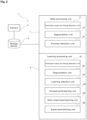
- Fig. 2 is a block diagram showing the structure of the device for detecting anomalies in overhead contact line fittings according to an embodiment.
- the device 1 for detecting anomalies in overhead contact line fittings according to the present embodiment is installed on the vehicle 2 travelling on the rail R and is used in anomaly detection of overhead contact line K.
- the overhead contact line K may include a messenger wire K1 and a contact wire K3 suspended from the messenger wire K1 by a dropper K2.
- the device 1 for detecting anomalies in overhead contact line fittings is provided with: a camera 3 that is mounted on the roof of the vehicle 2; a storage device 5 that stores image data output from the camera 3; a learning processing unit 9 that learns an anomaly detection model by semi-supervised anomaly detection learning using one-hot expression index image data that are obtained by converting the image data; a data processing unit 7 that performs anomaly determinations by using the anomaly detection model; and a user interface (UI) unit 11 that inputs/outputs settings and detection results of the device 1 for detecting anomalies in overhead contact line fittings.
- UI user interface
- the storage device 5 can be configured with, for example, a hard disk (HDD) or a solid state drive (SSD).
- the data processing unit 7 and the learning processing unit 9 may be configured by hardware, or each function may be realized by software.
- the data processing unit 7 and the learning processing unit 9 are, for example, information processing devices such as personal computers. Each of the functional blocks described below may be software or a program executed by a CPU or GPU in the information processing device.
- the data processing unit 7 and the learning processing unit 9 may be software or programs provided on a cloud service.
- the UI unit 11 may include, for example, a keyboard, a mouse, a touch panel, a display, etc. that perform input/output to a personal computer.
- the data processing unit 7 is provided with: an overhead contact line fittings detection unit 71 that detects overhead contact line fittings from the image data captured by the camera 3; a segmentation unit 72 that performs semantic segmentation on the image data of the detected overhead contact line fittings and that converts the image data to one-hot expression index image data; and an anomaly detection unit 73 that detects anomalies of the overhead contact line fittings with an anomaly detection model obtained by anomaly detection learning.
- the learning processing unit 9 is provided with: an overhead contact line fittings detection unit 91 that detects overhead contact line fittings from the image data; a segmentation unit 92 that performs semantic segmentation on the image data of the detected overhead contact line fittings and that converts the image data into one-hot expression index image data; a learning selection unit 93 that selects any of unsupervised anomaly detection learning, semi-supervised anomaly detection learning, and supervised anomaly detection learning on the basis of the amount of anomaly data in image data provided for model learning; an unsupervised learning unit 94 that performs unsupervised anomaly detection learning; a semi-supervised learning unit 95 that performs semi-supervised anomaly detection learning; and a supervised learning unit 96 that performs supervised anomaly detection learning.
- the overhead contact line fittings detection unit 71 of the data processing unit 7 and the overhead contact line fittings detection unit 91 of the learning processing unit 9 may be the same library executed on a CPU.
- the segmentation unit 72 of the data processing unit 7 and the segmentation unit 92 of the learning processing unit 9 may be the same library executed on a CPU.
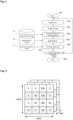
- Fig. 3 is a flow chart showing an anomaly detection process using a learned anomaly detection model 17 performed in the data processing unit 7.
- the anomaly detection process is performed in the data processing unit 7 in Fig. 2 .
- the camera 3 mounted on the vehicle continuously captures images of the overhead contact line K (S02).
- the captured images are sent to the storage device 5 and stored as image data (S03).
- the stored image data are sent to the overhead contact line fittings detection unit 71 of the data processing unit 7, and an overhead contact line fittings detection model 13 called from the storage device 5 is used to detect and extract overhead contact line fittings that are the target of equipment inspection from the captured image data (S04).
- Any method may be used to detect the overhead contact line fittings. Examples of detection methods include simple image processing, pattern matching, and deep learning object detection methods.
- the image data of the overhead contact line fittings detected and extracted at the overhead contact line fittings detection unit 71 are next sent to the segmentation unit 72.
- a segmentation model 15 learned in advance and stored in the storage device 5 is used, and semantic segmentation is performed on the extracted overhead contact line fittings images (S05).
- Fig. 4 is RGB image data before performing the semantic segmentation.
- the RGB image data have quantitative data of [0 to 255] in each of the three RGB channels.
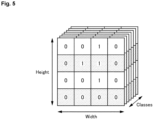
- Fig. 5 shows index image data after performing semantic segmentation.
- the index image data have index values as quantitative data of [0, 1] in each of the multiple classes.
- the image data subjected to semantic segmentation are sent to the anomaly detection unit 73.
- the anomaly detection unit 73 performs anomaly detection using the anomaly detection model 17 learned based on a learning flowchart to be described later and stored in the storage device 5 (S06).
- a check is made to see whether or not the image capturing has ended (S07), and if the image capturing continues, the camera continues capturing images (S07: NO), and if the image capturing has ended (S07: YES), the process is ended (S08).
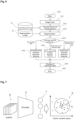
- Fig. 6 is a flowchart illustrating learning processing of an anomaly detection model performed in the learning processing unit 9.
- the overhead contact line fittings detection model 13 and the segmentation model 15 used here may use the same as the models used in the anomaly detection in Fig. 3 .
- Learning the anomaly detection model is performed in the learning processing unit 9 in Fig 2 .
- image data prepared for learning are sent to the overhead contact line fittings detection unit 91 of the learning processing unit 9 from the storage device 5 (S11).
- the overhead contact line fittings detection unit 91 performs a process of detecting and extracting overhead contact line fittings that are the target of equipment inspection from the received image data using the overhead contact line fittings detection model 13 (S12).
- the overhead contact line fittings detection process here may be the same process as the overhead contact line fittings detection (S04) in Fig. 3 , and may be prepared as a library executed by the CPU as described above.
- the image data for which the overhead contact line fittings detection process has been completed at the overhead contact line fittings detection unit 91 are sent to the segmentation unit 92.
- the segmentation unit 92 performs semantic segmentation on the extracted overhead contact line fittings images using the segmentation model 15 learned in advance (S13).
- the semantic segmentation process here may be the same process as the segmentation (S05) in Fig. 3 , and may be prepared as a library executed by the CPU as described above.
- the image data subjected to semantic segmentation in the segmentation unit 92 are sent to the learning selection unit 93.
- the learning selection unit 93 receives the sent image data and after accumulating predetermined learning image data, checks whether or not there is an index of anomaly data as teacher data for these image data.
- the learning selection unit 93 selects a learning method for the anomaly detection model based on the amount of confirmed anomaly data (S14).
- an index (flag) of anomaly data or normal data is attached to arbitrary image data after overhead contact line fittings detection (S12).
- the image data that have been processed and accumulated so far are sent to the unsupervised learning unit 94, where unsupervised anomaly detection learning is performed (S15). If the amount of anomaly data is less than a predetermined threshold, the image data are sent to the semi-supervised learning unit 95, where semi-supervised anomaly detection learning is performed (S16). If the amount of anomaly data is a predetermined threshold anomaly, the image data are sent to the supervised learning unit 96, and supervised anomaly detection learning is performed (S17).
- examples of unsupervised anomaly detection learning methods include Variational Autoencoder (VAE) and Anomaly Generative Adversarial Network (AnoGAN).
- examples of semi-supervised anomaly detection learning methods include Deep Semi-supervised Anomaly Detection (Deep SAD) and Fully Convolutional Data Description (FCDD), which will be described later.
- Examples of supervised anomaly detection learning methods include two-class classification using Support Vector Machine (SVM) and Convolutional Neural Networks (CNNs) such as ResNet.
- SVM Support Vector Machine
- CNNs Convolutional Neural Networks
- the anomaly detection model generated by performing a model learning process with any of the unsupervised learning unit 94, the semi-supervised learning unit 95, and the supervised learning unit 96 is stored in the storage device 5 (S18), and the learning process of a series of anomaly detection models is ended (S19).
- the semi-supervised anomaly detection learning in this embodiment, learning is performed on one-hot expression index image data converted into one-hot expression.
- the semi-supervised learning method used here may be any method as long as it can use normal data and a small amount of anomaly data.
- a case will be described in which the semi-supervised anomaly detection method Deep Semi-supervised Anomaly Detection (Deep SAD) described in Non-Patent Document 1 is used.
- Fig. 7 is a conceptual diagram showing the structure of model learning in Deep SAD.
- a feature amount T is extracted from the input one-hot expression index image data D converted to a one-hot expression using an encoder (E), and distance learning is performed on the latent variable space G using the result of this feature extraction.
- Deep SAD learning is performed by minimizing the objective function shown in [Equation 1] below.
- Deep SAD can utilize all data for learning, including normal data, small amounts of anomaly data, and unlabeled data.
- the distance from the center c of the hypersphere shown in [Equation 2] below is calculated as the anomaly degree (score), and anomaly detection is performed by providing a threshold value for the anomaly degree.
- the anomaly degree (score) is small if it is normal, and large if it is anomaly. Therefore, if it is smaller than the set threshold value, it is judged to be normal, and if it is larger, it is judged to be anomaly.
- the semi-supervised learning of this embodiment data that were difficult to separate in unsupervised learning can be explicitly separated by the supervised learning part of semi-supervised learning. Therefore, it is possible to improve the accuracy of anomaly detection by utilizing a small amount of anomaly data.
- the search space can be kept small and learning processing and anomaly detection processing can be performed easily, thereby enabling stable processing.
- this embodiment can be effectively used during the transition period of data acquisition in actual operations, and by adding anomaly data acquired in actual operations to learning, an anomaly detection device can be improved to be more robust.
- Fig. 8 is a flowchart illustrating learning processing of an anomaly detection model in the present embodiment.
- This embodiment differs from the first embodiment in that the process S13 of performing semantic segmentation in Fig. 6 is changed to a process S23 that uses the annotation image used when learning the segmentation model. Since similar processes are performed concerning the other processes, the same reference numbers are given and the explanations thereof are omitted.
- this embodiment supplies and uses an annotation image used previously to learn the segmentation model during model learning, so the step for learning processing can be shortened, and it is possible to efficiently learn the anomaly detection model.
Landscapes
- Engineering & Computer Science (AREA)
- Mechanical Engineering (AREA)
- Manufacturing & Machinery (AREA)
- Quality & Reliability (AREA)
- Computer Vision & Pattern Recognition (AREA)
- Physics & Mathematics (AREA)
- General Physics & Mathematics (AREA)
- Theoretical Computer Science (AREA)
- Image Analysis (AREA)
- Image Processing (AREA)
- Investigating Materials By The Use Of Optical Means Adapted For Particular Applications (AREA)
Abstract
Description
- The present invention relates to a device for detecting anomalies in overhead contact line fittings and a method for detecting anomalies in overhead contact line fittings.
- In order to inspect overhead contact line equipment for electric railway, a camera is mounted on a vehicle to capture images of the overhead contact line equipment, and the captured images are analyzed to detect anomalies.
- One method of image analysis is to create an anomaly detection model by machine learning and using this anomaly detection model to detect anomalies. As a machine learning method, for example, a method called DEEP SAD as shown in Non-Patent
Document 1 is disclosed. In addition,Patent Document 1, which is an example of the conventional technology, discloses generating an image using a generative model such as a neural network, determining the difference between the generated image and a captured image, and determining an anomaly when this difference is large. - Non-patent Document 1: Lukas Ruff, Robert A. Vandermeulen, Nico Gornitz, Alexander Binder, Emmanuel Muller, Klaus-Robert Muller, Marius Kloft, "Deep Semi-Supervised Anomaly Detection", International Conference on Learning Representations 2020(ICLR2020)
- Patent Document 1:
JP 2019-133306 A - In the anomaly determination described in
Patent Document 1, an anomaly is determined based on the difference between the input image and the generated image of an image generator that has been trained using only normal data. However, there is the problem that, with respect to an anomaly having a small difference from the normal data, anomaly detection is difficult. Anomaly detection methods using deep learning include supervised anomaly detection, semi-supervised anomaly detection, and unsupervised anomaly detection, but the challenges of supervised anomaly detection and unsupervised anomaly detection are shown below. In this specification, a method of learning using only normal data is expressed as unsupervised learning. - There are rare opportunities in which it is possible to obtain anomaly data during railway equipment inspections, and most of the data that can be obtained are normal data, making it difficult to use supervised learning that requires both normal data and anomaly data. Even if supervised learning is performed, if the ratio of the normal data to the amount of anomaly data is not balanced, mainly normal data will be learned, and anomaly detection will often not function. In addition, all data to be learned must be labeled, which is very costly.
- In unsupervised learning, learning is performed using only normal data, and data that deviate from a normal state or normal data distribution are determined to be anomalies. However, since there are anomaly data with slight distortions and normal data that appear to be anomalies depending on the viewing angle, it may be difficult to identify data near the boundary between normal and anomaly. Solving these problems by adding or changing learning data may also be difficult because there is no indicator of normality and anomaly. In the case of unsupervised learning, it may not be able to identify data that can be identified as anomalies by humans.
- The present invention has been made in view of the above-mentioned circumstances, and the problem to be solved by the present invention is to incorporate a semi-supervised anomaly detection method using normal data and a small amount of anomaly data to provide a device for detecting anomalies in overhead contact line fittings and a method for detecting anomalies in overhead contact line fittings that effectively utilize a small amount of anomaly data acquired in actual operations.
- The present invention adopts the following means to solve the abovementioned problem. A device for detecting anomalies in overhead contact line fittings of the present invention is provided with: a camera that is mounted on the roof of a vehicle; a storage device that stores image data output from the camera; a learning processing unit that learns an anomaly detection model by semi-supervised anomaly detection learning using one-hot expression index image data that are obtained by converting the image data; and a data processing unit that performs anomaly determinations by using the anomaly detection model. According to the present invention, learning of the anomaly detection model by using semi-supervised anomaly detection learning is performed, so the acquired image data can be effectively used to learn a model, and the model can be used to detect anomalies in overhead contact line fittings.
- According to one embodiment of the present invention, the learning processing unit is provided with: an overhead contact line fittings detection unit that detects overhead contact line fittings from the image data; a segmentation unit that performs semantic segmentation on the image data of the detected overhead contact line fittings and that converts the image data into one-hot expression index image data; a learning selection unit that selects any of unsupervised anomaly detection learning, semi-supervised anomaly detection learning, and supervised anomaly detection learning on the basis of the amount of anomaly data in image data provided for model learning; an unsupervised learning unit that performs unsupervised anomaly detection learning; a semi-supervised learning unit that performs semi-supervised anomaly detection learning; and a supervised learning unit that performs supervised anomaly detection learning.
In the present embodiment, since any of unsupervised anomaly detection learning, semi-supervised anomaly detection learning, and supervised anomaly detection learning is selected on the basis of the amount of anomaly data in image data provided for model learning, an appropriate learning method can be selected in accordance with the types of acquired image data. - In one embodiment of the present invention, instead of performing the semantic segmentation by the segmentation unit, an annotation image used when learning a segmentation model for performing the semantic segmentation is used. In this embodiment, an annotation image is used instead of performing the semantic segmentation, so it is possible to efficiently perform model learning.
- The method for detecting anomalies in overhead contact line fittings of the present invention includes: capturing images with a camera that is mounted on the roof of a vehicle; storing image data captured with the camera; learning an anomaly detection model by semi-supervised anomaly detection learning using one-hot expression index image data that are obtained by converting the image data; and performing anomaly determinations by using the anomaly detection model. According to the present invention, since the anomaly detection model is learned by semi-supervised anomaly detection learning, the acquired image data are effectively utilized to perform model learning, and by utilizing said model, it is possible to detect anomalies in the overhead contact line fittings.
- In one embodiment of the present invention, the learning content of the anomaly detection model includes: detecting overhead contact line fittings from the image data; performing semantic segmentation on the image data of the detected overhead contact line fittings to convert the image data into one-hot expression index image data; and performing learning by selecting any of unsupervised anomaly detection learning, semi-supervised anomaly detection learning, and supervised anomaly detection learning on the basis of the amount of anomaly data in the image data provided for model learning. In this embodiment, since any of unsupervised anomaly detection learning, semi-supervised anomaly detection learning, and supervised anomaly detection learning is selected on the basis of the amount of anomaly data of the image data provided for model learning, an appropriate learning method can be selected in accordance with the type of acquired image data.
- In one embodiment of the present invention, instead of performing the semantic segmentation, an annotation image is supplied that is used when learning a segmentation model for performing the semantic segmentation. In this embodiment, an annotation image is used instead of performing the semantic segmentation, so it is possible to efficiently perform model learning.
- According to the present invention, by incorporating a semi-supervised anomaly detection method using normal data and a small amount of anomaly data, it is possible to provide a device for detecting anomalies in overhead contact line fittings and a method for detecting anomalies in overhead contact line fittings that effectively utilize a small amount of anomaly data acquired in actual operations.
-
-
Fig. 1 is diagram showing an example of installation of a device for detecting anomalies in overhead contact line fittings according to an embodiment of the present invention. -
Fig. 2 is a block diagram showing the structure of the device for detecting anomalies in overhead contact line fittings according to an embodiment of the present invention. -
Fig. 3 is a flow chart showing an anomaly detection process using a learned anomaly detection model according to an embodiment of the present invention. -
Fig. 4 is a diagram showing 256-gradation, 3-channel RGB image data before being converted by the segmentation unit according to an embodiment of the present invention. -
Fig. 5 is a diagram showing one-hot expression index image data converted by a segmentation unit according to an embodiment of the present invention. -
Fig. 6 is a flowchart illustrating learning processing of an anomaly detection model according to an embodiment of the present invention. -
Fig. 7 is diagram illustrating the concept of an anomaly detection method according to an embodiment of the present invention. -
Fig. 8 is a flowchart illustrating learning processing of an anomaly detection model according to an embodiment of the present invention. - Below, with reference to the drawings, embodiments for practicing the present invention are explained.
-
Fig. 1 is diagram showing an example of installation of a device for detecting anomalies in overhead contact line fittings according to an embodiment of the present invention.Fig. 2 is a block diagram showing the structure of the device for detecting anomalies in overhead contact line fittings according to an embodiment. As shown inFig. 1 , thedevice 1 for detecting anomalies in overhead contact line fittings according to the present embodiment is installed on thevehicle 2 travelling on the rail R and is used in anomaly detection of overhead contact line K. As one example, the overhead contact line K may include a messenger wire K1 and a contact wire K3 suspended from the messenger wire K1 by a dropper K2. Thedevice 1 for detecting anomalies in overhead contact line fittings is provided with: acamera 3 that is mounted on the roof of thevehicle 2; astorage device 5 that stores image data output from thecamera 3; alearning processing unit 9 that learns an anomaly detection model by semi-supervised anomaly detection learning using one-hot expression index image data that are obtained by converting the image data; adata processing unit 7 that performs anomaly determinations by using the anomaly detection model; and a user interface (UI)unit 11 that inputs/outputs settings and detection results of thedevice 1 for detecting anomalies in overhead contact line fittings. - The
camera 3, for example, may use an area sensor camera or a line sensor camera. While lighting and the like may be used as needed, what is required is a means to capture images of the linear overhead contact line fittings, as shown in the monitoring image example shown inFig. 1 , and the configuration thereof does not matter. Thestorage device 5 can be configured with, for example, a hard disk (HDD) or a solid state drive (SSD). Thedata processing unit 7 and thelearning processing unit 9 may be configured by hardware, or each function may be realized by software. Thedata processing unit 7 and thelearning processing unit 9 are, for example, information processing devices such as personal computers. Each of the functional blocks described below may be software or a program executed by a CPU or GPU in the information processing device. In addition, thedata processing unit 7 and thelearning processing unit 9 may be software or programs provided on a cloud service. TheUI unit 11 may include, for example, a keyboard, a mouse, a touch panel, a display, etc. that perform input/output to a personal computer. - As illustrated in
Fig. 2 , thedata processing unit 7 is provided with: an overhead contact linefittings detection unit 71 that detects overhead contact line fittings from the image data captured by thecamera 3; asegmentation unit 72 that performs semantic segmentation on the image data of the detected overhead contact line fittings and that converts the image data to one-hot expression index image data; and ananomaly detection unit 73 that detects anomalies of the overhead contact line fittings with an anomaly detection model obtained by anomaly detection learning. - The
learning processing unit 9 is provided with: an overhead contact linefittings detection unit 91 that detects overhead contact line fittings from the image data; asegmentation unit 92 that performs semantic segmentation on the image data of the detected overhead contact line fittings and that converts the image data into one-hot expression index image data; alearning selection unit 93 that selects any of unsupervised anomaly detection learning, semi-supervised anomaly detection learning, and supervised anomaly detection learning on the basis of the amount of anomaly data in image data provided for model learning; anunsupervised learning unit 94 that performs unsupervised anomaly detection learning; asemi-supervised learning unit 95 that performs semi-supervised anomaly detection learning; and asupervised learning unit 96 that performs supervised anomaly detection learning. - The overhead contact line
fittings detection unit 71 of thedata processing unit 7 and the overhead contact linefittings detection unit 91 of thelearning processing unit 9 may be the same library executed on a CPU. Thesegmentation unit 72 of thedata processing unit 7 and thesegmentation unit 92 of thelearning processing unit 9 may be the same library executed on a CPU. -
Fig. 3 is a flow chart showing an anomaly detection process using a learnedanomaly detection model 17 performed in thedata processing unit 7. With reference to this drawing, the operation of the anomaly detection in the present embodiment is explained. The anomaly detection process is performed in thedata processing unit 7 inFig. 2 . When the anomaly detection process is started (S01), thecamera 3 mounted on the vehicle continuously captures images of the overhead contact line K (S02). The captured images are sent to thestorage device 5 and stored as image data (S03). The stored image data are sent to the overhead contact linefittings detection unit 71 of thedata processing unit 7, and an overhead contact linefittings detection model 13 called from thestorage device 5 is used to detect and extract overhead contact line fittings that are the target of equipment inspection from the captured image data (S04). Any method may be used to detect the overhead contact line fittings. Examples of detection methods include simple image processing, pattern matching, and deep learning object detection methods. - The image data of the overhead contact line fittings detected and extracted at the overhead contact line
fittings detection unit 71 are next sent to thesegmentation unit 72. At thesegmentation unit 72, asegmentation model 15 learned in advance and stored in thestorage device 5 is used, and semantic segmentation is performed on the extracted overhead contact line fittings images (S05).Fig. 4 is RGB image data before performing the semantic segmentation. The RGB image data have quantitative data of [0 to 255] in each of the three RGB channels.Fig. 5 shows index image data after performing semantic segmentation. The index image data have index values as quantitative data of [0, 1] in each of the multiple classes. By performing semantic segmentation in this way, the image shown inFig. 4 is expressed as one-hot and converted into the one-hot expression index image data shown inFig. 5 , thereby reducing the search space and the learning difficulty in anomaly detection. - The image data subjected to semantic segmentation are sent to the
anomaly detection unit 73. Theanomaly detection unit 73 performs anomaly detection using theanomaly detection model 17 learned based on a learning flowchart to be described later and stored in the storage device 5 (S06). Next, a check is made to see whether or not the image capturing has ended (S07), and if the image capturing continues, the camera continues capturing images (S07: NO), and if the image capturing has ended (S07: YES), the process is ended (S08). -
Fig. 6 is a flowchart illustrating learning processing of an anomaly detection model performed in thelearning processing unit 9. With reference to this drawing, learning the anomaly detection model in the present embodiment is explained. The overhead contact linefittings detection model 13 and thesegmentation model 15 used here may use the same as the models used in the anomaly detection inFig. 3 . Learning the anomaly detection model is performed in thelearning processing unit 9 inFig 2 . When learning the anomaly detection model is started (S10), image data prepared for learning are sent to the overhead contact linefittings detection unit 91 of thelearning processing unit 9 from the storage device 5 (S11). - The overhead contact line
fittings detection unit 91 performs a process of detecting and extracting overhead contact line fittings that are the target of equipment inspection from the received image data using the overhead contact line fittings detection model 13 (S12). The overhead contact line fittings detection process here may be the same process as the overhead contact line fittings detection (S04) inFig. 3 , and may be prepared as a library executed by the CPU as described above. The image data for which the overhead contact line fittings detection process has been completed at the overhead contact linefittings detection unit 91 are sent to thesegmentation unit 92. - The
segmentation unit 92 performs semantic segmentation on the extracted overhead contact line fittings images using thesegmentation model 15 learned in advance (S13). The semantic segmentation process here may be the same process as the segmentation (S05) inFig. 3 , and may be prepared as a library executed by the CPU as described above. The image data subjected to semantic segmentation in thesegmentation unit 92 are sent to thelearning selection unit 93. - The
learning selection unit 93 receives the sent image data and after accumulating predetermined learning image data, checks whether or not there is an index of anomaly data as teacher data for these image data. Thelearning selection unit 93 selects a learning method for the anomaly detection model based on the amount of confirmed anomaly data (S14). Here, an index (flag) of anomaly data or normal data is attached to arbitrary image data after overhead contact line fittings detection (S12). - If there are no anomaly data, the image data that have been processed and accumulated so far are sent to the
unsupervised learning unit 94, where unsupervised anomaly detection learning is performed (S15). If the amount of anomaly data is less than a predetermined threshold, the image data are sent to thesemi-supervised learning unit 95, where semi-supervised anomaly detection learning is performed (S16). If the amount of anomaly data is a predetermined threshold anomaly, the image data are sent to thesupervised learning unit 96, and supervised anomaly detection learning is performed (S17). - Here, examples of unsupervised anomaly detection learning methods include Variational Autoencoder (VAE) and Anomaly Generative Adversarial Network (AnoGAN). Examples of semi-supervised anomaly detection learning methods include Deep Semi-supervised Anomaly Detection (Deep SAD) and Fully Convolutional Data Description (FCDD), which will be described later. Examples of supervised anomaly detection learning methods include two-class classification using Support Vector Machine (SVM) and Convolutional Neural Networks (CNNs) such as ResNet.
- The anomaly detection model generated by performing a model learning process with any of the
unsupervised learning unit 94, thesemi-supervised learning unit 95, and thesupervised learning unit 96 is stored in the storage device 5 (S18), and the learning process of a series of anomaly detection models is ended (S19). - In the semi-supervised anomaly detection learning in this embodiment, learning is performed on one-hot expression index image data converted into one-hot expression. The semi-supervised learning method used here may be any method as long as it can use normal data and a small amount of anomaly data. Here, a case will be described in which the semi-supervised anomaly detection method Deep Semi-supervised Anomaly Detection (Deep SAD) described in
Non-Patent Document 1 is used. -
Fig. 7 is a conceptual diagram showing the structure of model learning in Deep SAD. In Deep SAD learning, a feature amount T is extracted from the input one-hot expression index image data D converted to a one-hot expression using an encoder (E), and distance learning is performed on the latent variable space G using the result of this feature extraction. Deep SAD learning is performed by minimizing the objective function shown in [Equation 1] below.
- Here, x is the input data, y is the label information of normal = 1 or anomaly = -1, n is the data number of unlabeled data, m is the data number of labeled data, η is a hyperparameter that weights the learning of labeled data and unlabeled data. , ϕ is the output of the encoder, W is the weight parameter of the network, and c is the center of the hypersphere calculated from the learning data. In [Equation 1], the first term is a calculation for unlabeled data, the second term is a calculation for labeled data, and the third term is a weighting element for normalization. As can be understood from the objective function, Deep SAD can utilize all data for learning, including normal data, small amounts of anomaly data, and unlabeled data. In anomaly detection using Deep SAD, the distance from the center c of the hypersphere shown in [Equation 2] below is calculated as the anomaly degree (score), and anomaly detection is performed by providing a threshold value for the anomaly degree.

- The anomaly degree (score) is small if it is normal, and large if it is anomaly. Therefore, if it is smaller than the set threshold value, it is judged to be normal, and if it is larger, it is judged to be anomaly.
- As described above, in this embodiment, it is possible to perform semi-supervised anomaly detection learning to create an anomaly detection model and perform anomaly detection even with image data for model learning that have a small amount of anomaly data. Therefore, all of the normal data, the anomaly data, and data in which normal and anomaly data are not distinguished can be utilized, and the costs in model learning can be reduced. Since it is based on unsupervised learning that assumes the distribution of normal data, it is possible to separate normal data and anomaly data even if the data set is unbalanced between the normal data and the anomaly data. Therefore, effective learning can be performed on unbalanced data sets.
- In the semi-supervised learning of this embodiment, data that were difficult to separate in unsupervised learning can be explicitly separated by the supervised learning part of semi-supervised learning. Therefore, it is possible to improve the accuracy of anomaly detection by utilizing a small amount of anomaly data. When performing model learning, by generating an index image that expresses image data in a one-hot manner, the search space can be kept small and learning processing and anomaly detection processing can be performed easily, thereby enabling stable processing. In addition, this embodiment can be effectively used during the transition period of data acquisition in actual operations, and by adding anomaly data acquired in actual operations to learning, an anomaly detection device can be improved to be more robust. Furthermore, it is possible to select any of unsupervised anomaly detection learning, semi-supervised anomaly detection learning, or supervised anomaly detection learning based on the amount of anomaly data in the data for anomaly detection model learning, so it is possible to select an optimal learning method according to the characteristics of data for model learning.
-
Fig. 8 is a flowchart illustrating learning processing of an anomaly detection model in the present embodiment. This embodiment differs from the first embodiment in that the process S13 of performing semantic segmentation inFig. 6 is changed to a process S23 that uses the annotation image used when learning the segmentation model. Since similar processes are performed concerning the other processes, the same reference numbers are given and the explanations thereof are omitted. In addition to the same effects as those of the first embodiment, this embodiment supplies and uses an annotation image used previously to learn the segmentation model during model learning, so the step for learning processing can be shortened, and it is possible to efficiently learn the anomaly detection model. -
- 1
- Device for detecting anomalies in overhead contact line fittings
- 3
- Camera
- 5
- Storage device
- 7
- Data processing unit
- 9
- Learning processing unit
91 Overhead contact line fittings detection unit
92 Segmentation unit
93 Learning selection unit
94 Unsupervised learning unit
95 Semi-supervised learning unit
96 Supervised learning unit
Claims (6)
- A device for detecting anomalies in overhead contact line fittings comprising:a camera that is mounted on the roof of a vehicle;a storage device that stores image data output from the camera;a learning processing unit that learns an anomaly detection model by semi-supervised anomaly detection learning using one-hot expression index image data that are obtained by converting the image data; anda data processing unit that performs anomaly determinations by using the anomaly detection model.
- The device for detecting anomalies in overhead contact line fittings according to claim 1, wherein
the learning processing unit comprises:an overhead contact line fittings detection unit that detects overhead contact line fittings from the image data;a segmentation unit that performs semantic segmentation on the image data of the detected overhead contact line fittings and that converts the image data into one-hot expression index image data;a learning selection unit that selects any of unsupervised anomaly detection learning, semi-supervised anomaly detection learning, and supervised anomaly detection learning on the basis of the amount of anomaly data in image data provided for model learning;an unsupervised learning unit that performs unsupervised anomaly detection learning;a semi-supervised learning unit that performs semi-supervised anomaly detection learning; anda supervised learning unit that performs supervised anomaly detection learning. - The device for detecting anomalies in overhead contact line fittings according to claim 2, wherein instead of performing the semantic segmentation by the segmentation unit, an annotation image used when learning a segmentation model for performing the semantic segmentation is used.
- A method for detecting anomalies in overhead contact line fittings comprising:capturing images with a camera that is mounted on the roof of a vehicle;storing image data captured with the camera;learning an anomaly detection model by semi-supervised anomaly detection learning using one-hot expression index image data that are obtained by converting the image data; andperforming anomaly determinations by using the anomaly detection model.
- The method for detecting anomalies in overhead contact line fittings according to claim 4, wherein
the learning content of the anomaly detection model comprises:detecting overhead contact line fittings from the image data;performing semantic segmentation on the image data of the detected overhead contact line fittings to convert the image data into one-hot expression index image data; andperforming learning by selecting any of unsupervised anomaly detection learning, semi-supervised anomaly detection learning, and supervised anomaly detection learning on the basis of the amount of anomaly data in image data provided for model learning. - The method for detecting anomalies in overhead contact line fittings according to claim 5, wherein instead of performing the semantic segmentation, an annotation image is supplied that is used when learning a segmentation model for performing the semantic segmentation.
Applications Claiming Priority (2)
| Application Number | Priority Date | Filing Date | Title |
|---|---|---|---|
| JP2021188701A JP7607546B2 (en) | 2021-11-19 | 2021-11-19 | Overhead wire fitting abnormality detection device and overhead wire fitting abnormality detection method |
| PCT/JP2022/042799 WO2023090412A1 (en) | 2021-11-19 | 2022-11-18 | Device and method for detecting anomalies in overhead wire metal fittings |
Publications (2)
| Publication Number | Publication Date |
|---|---|
| EP4434846A1 true EP4434846A1 (en) | 2024-09-25 |
| EP4434846A4 EP4434846A4 (en) | 2025-12-10 |
Family
ID=86397180
Family Applications (1)
| Application Number | Title | Priority Date | Filing Date |
|---|---|---|---|
| EP22895693.4A Pending EP4434846A4 (en) | 2021-11-19 | 2022-11-18 | DEVICE AND METHOD FOR DETECTING ANOMALIES IN OVERHEAD PIPE METAL ALARM VALVES |
Country Status (3)
| Country | Link |
|---|---|
| EP (1) | EP4434846A4 (en) |
| JP (1) | JP7607546B2 (en) |
| WO (1) | WO2023090412A1 (en) |
Families Citing this family (1)
| Publication number | Priority date | Publication date | Assignee | Title |
|---|---|---|---|---|
| WO2025181989A1 (en) * | 2024-02-29 | 2025-09-04 | 日本電気株式会社 | Information processing device, information processing method, and program |
Family Cites Families (7)
| Publication number | Priority date | Publication date | Assignee | Title |
|---|---|---|---|---|
| CN106919978B (en) * | 2017-01-18 | 2020-05-15 | 西南交通大学 | Method for identifying and detecting parts of high-speed rail contact net supporting device |
| JP2019016209A (en) | 2017-07-07 | 2019-01-31 | 株式会社東芝 | Diagnosis device, diagnosis method, and computer program |
| JP6942649B2 (en) | 2018-01-30 | 2021-09-29 | 株式会社日立製作所 | Image processing device and image processing method |
| JP2020042350A (en) * | 2018-09-06 | 2020-03-19 | 京セラ株式会社 | Image recognition method, and image recognition program |
| JP7299041B2 (en) | 2019-03-13 | 2023-06-27 | 株式会社明電舎 | Overhead wire fitting detection device and overhead wire fitting detection method |
| CN111784656A (en) * | 2020-06-28 | 2020-10-16 | 京东数字科技控股有限公司 | A kind of railway catenary fault detection method, device, electronic equipment and storage medium |
| JP2022159010A (en) | 2021-03-31 | 2022-10-17 | 株式会社明電舎 | Overhead wire fitting abnormality detection device |
-
2021
- 2021-11-19 JP JP2021188701A patent/JP7607546B2/en active Active
-
2022
- 2022-11-18 WO PCT/JP2022/042799 patent/WO2023090412A1/en not_active Ceased
- 2022-11-18 EP EP22895693.4A patent/EP4434846A4/en active Pending
Also Published As
| Publication number | Publication date |
|---|---|
| EP4434846A4 (en) | 2025-12-10 |
| WO2023090412A1 (en) | 2023-05-25 |
| JP7607546B2 (en) | 2024-12-27 |
| JP2023075660A (en) | 2023-05-31 |
Similar Documents
| Publication | Publication Date | Title |
|---|---|---|
| Zhou et al. | Online feature selection for high-dimensional class-imbalanced data | |
| US8873840B2 (en) | Reducing false detection rate using local pattern based post-filter | |
| CN111178456A (en) | Abnormal index detection method and device, computer equipment and storage medium | |
| JP6828807B2 (en) | Data analysis device, data analysis method and data analysis program | |
| CN117192416A (en) | Battery monitoring system and method based on BMS system | |
| CN113900935A (en) | Defect automatic identification method, device, computer equipment and storage medium | |
| EP4434846A1 (en) | Device and method for detecting anomalies in overhead wire metal fittings | |
| JP2017102865A (en) | Information processing device, information processing method and program | |
| CN113420295A (en) | Malicious software detection method and device | |
| JP5905375B2 (en) | Misclassification detection apparatus, method, and program | |
| JP2016224821A (en) | Learning device, control method of learning device, and program | |
| CN114842183A (en) | Convolutional neural network-based switch state identification method and system | |
| JP2022036054A (en) | Inspection device, inspection method, and inspection program for strung wire | |
| WO2022253636A1 (en) | Method for training a classifier and system for classifying blocks | |
| Xia et al. | Malware classification with Markov transition field encoded images | |
| CN113360305A (en) | Computer equipment and abnormal operation detection method, device and storage medium thereof | |
| JP7409731B1 (en) | Event determination method, determination device, and determination program using text video classification model | |
| KR20250016438A (en) | A method of analyzing work process | |
| JP2023178454A (en) | Learning devices, learning methods and programs | |
| JP5283267B2 (en) | Content identification method and apparatus | |
| Mulukutla et al. | Evaluating Open-Source Vision Language Models for Facial Emotion Recognition against Traditional Deep Learning Models | |
| CN115952463B (en) | Industrial anomaly detection methods, devices and equipment | |
| US20220405585A1 (en) | Training device, estimation device, training method, and training program | |
| Seetha et al. | Novel hybrid optimal deep network and optimization approach for human face emotion recognition | |
| Bhardwaj et al. | Improved Weather Prediction Mechanism with Mode Based Approach |
Legal Events
| Date | Code | Title | Description |
|---|---|---|---|
| STAA | Information on the status of an ep patent application or granted ep patent |
Free format text: STATUS: THE INTERNATIONAL PUBLICATION HAS BEEN MADE |
|
| PUAI | Public reference made under article 153(3) epc to a published international application that has entered the european phase |
Free format text: ORIGINAL CODE: 0009012 |
|
| STAA | Information on the status of an ep patent application or granted ep patent |
Free format text: STATUS: REQUEST FOR EXAMINATION WAS MADE |
|
| 17P | Request for examination filed |
Effective date: 20240531 |
|
| AK | Designated contracting states |
Kind code of ref document: A1 Designated state(s): AL AT BE BG CH CY CZ DE DK EE ES FI FR GB GR HR HU IE IS IT LI LT LU LV MC ME MK MT NL NO PL PT RO RS SE SI SK SM TR |
|
| DAV | Request for validation of the european patent (deleted) | ||
| DAX | Request for extension of the european patent (deleted) | ||
| REG | Reference to a national code |
Ref country code: DE Ref legal event code: R079 Free format text: PREVIOUS MAIN CLASS: B61L0023040000 Ipc: B60M0001280000 |
|
| A4 | Supplementary search report drawn up and despatched |
Effective date: 20251106 |
|
| RIC1 | Information provided on ipc code assigned before grant |
Ipc: B60M 1/28 20060101AFI20251031BHEP Ipc: B61L 23/04 20060101ALI20251031BHEP Ipc: G06T 7/00 20170101ALI20251031BHEP |