EP4433532B1 - Devulcanized rubber, process for producing devulcanized rubber, and use thereof - Google Patents
Devulcanized rubber, process for producing devulcanized rubber, and use thereof Download PDFInfo
- Publication number
- EP4433532B1 EP4433532B1 EP23785967.3A EP23785967A EP4433532B1 EP 4433532 B1 EP4433532 B1 EP 4433532B1 EP 23785967 A EP23785967 A EP 23785967A EP 4433532 B1 EP4433532 B1 EP 4433532B1
- Authority
- EP
- European Patent Office
- Prior art keywords
- rubber
- devulcanized
- devulcanized rubber
- producing
- rubber according
- Prior art date
- Legal status (The legal status is an assumption and is not a legal conclusion. Google has not performed a legal analysis and makes no representation as to the accuracy of the status listed.)
- Active
Links
Classifications
-
- C—CHEMISTRY; METALLURGY
- C08—ORGANIC MACROMOLECULAR COMPOUNDS; THEIR PREPARATION OR CHEMICAL WORKING-UP; COMPOSITIONS BASED THEREON
- C08C—TREATMENT OR CHEMICAL MODIFICATION OF RUBBERS
- C08C19/00—Chemical modification of rubber
- C08C19/085—Devulcanisation
-
- C—CHEMISTRY; METALLURGY
- C08—ORGANIC MACROMOLECULAR COMPOUNDS; THEIR PREPARATION OR CHEMICAL WORKING-UP; COMPOSITIONS BASED THEREON
- C08J—WORKING-UP; GENERAL PROCESSES OF COMPOUNDING; AFTER-TREATMENT NOT COVERED BY SUBCLASSES C08B, C08C, C08F, C08G or C08H
- C08J11/00—Recovery or working-up of waste materials
- C08J11/04—Recovery or working-up of waste materials of polymers
- C08J11/10—Recovery or working-up of waste materials of polymers by chemically breaking down the molecular chains of polymers or breaking of crosslinks, e.g. devulcanisation
- C08J11/18—Recovery or working-up of waste materials of polymers by chemically breaking down the molecular chains of polymers or breaking of crosslinks, e.g. devulcanisation by treatment with organic material
- C08J11/28—Recovery or working-up of waste materials of polymers by chemically breaking down the molecular chains of polymers or breaking of crosslinks, e.g. devulcanisation by treatment with organic material by treatment with organic compounds containing nitrogen, sulfur or phosphorus
-
- C—CHEMISTRY; METALLURGY
- C08—ORGANIC MACROMOLECULAR COMPOUNDS; THEIR PREPARATION OR CHEMICAL WORKING-UP; COMPOSITIONS BASED THEREON
- C08C—TREATMENT OR CHEMICAL MODIFICATION OF RUBBERS
- C08C19/00—Chemical modification of rubber
- C08C19/25—Incorporating silicon atoms into the molecule
-
- C—CHEMISTRY; METALLURGY
- C08—ORGANIC MACROMOLECULAR COMPOUNDS; THEIR PREPARATION OR CHEMICAL WORKING-UP; COMPOSITIONS BASED THEREON
- C08J—WORKING-UP; GENERAL PROCESSES OF COMPOUNDING; AFTER-TREATMENT NOT COVERED BY SUBCLASSES C08B, C08C, C08F, C08G or C08H
- C08J11/00—Recovery or working-up of waste materials
- C08J11/04—Recovery or working-up of waste materials of polymers
- C08J11/10—Recovery or working-up of waste materials of polymers by chemically breaking down the molecular chains of polymers or breaking of crosslinks, e.g. devulcanisation
- C08J11/18—Recovery or working-up of waste materials of polymers by chemically breaking down the molecular chains of polymers or breaking of crosslinks, e.g. devulcanisation by treatment with organic material
- C08J11/22—Recovery or working-up of waste materials of polymers by chemically breaking down the molecular chains of polymers or breaking of crosslinks, e.g. devulcanisation by treatment with organic material by treatment with organic oxygen-containing compounds
-
- C—CHEMISTRY; METALLURGY
- C08—ORGANIC MACROMOLECULAR COMPOUNDS; THEIR PREPARATION OR CHEMICAL WORKING-UP; COMPOSITIONS BASED THEREON
- C08L—COMPOSITIONS OF MACROMOLECULAR COMPOUNDS
- C08L17/00—Compositions of reclaimed rubber
-
- C—CHEMISTRY; METALLURGY
- C08—ORGANIC MACROMOLECULAR COMPOUNDS; THEIR PREPARATION OR CHEMICAL WORKING-UP; COMPOSITIONS BASED THEREON
- C08J—WORKING-UP; GENERAL PROCESSES OF COMPOUNDING; AFTER-TREATMENT NOT COVERED BY SUBCLASSES C08B, C08C, C08F, C08G or C08H
- C08J2317/00—Characterised by the use of reclaimed rubber
-
- C—CHEMISTRY; METALLURGY
- C08—ORGANIC MACROMOLECULAR COMPOUNDS; THEIR PREPARATION OR CHEMICAL WORKING-UP; COMPOSITIONS BASED THEREON
- C08J—WORKING-UP; GENERAL PROCESSES OF COMPOUNDING; AFTER-TREATMENT NOT COVERED BY SUBCLASSES C08B, C08C, C08F, C08G or C08H
- C08J2319/00—Characterised by the use of rubbers not provided for in groups C08J2307/00 - C08J2317/00
-
- Y—GENERAL TAGGING OF NEW TECHNOLOGICAL DEVELOPMENTS; GENERAL TAGGING OF CROSS-SECTIONAL TECHNOLOGIES SPANNING OVER SEVERAL SECTIONS OF THE IPC; TECHNICAL SUBJECTS COVERED BY FORMER USPC CROSS-REFERENCE ART COLLECTIONS [XRACs] AND DIGESTS
- Y02—TECHNOLOGIES OR APPLICATIONS FOR MITIGATION OR ADAPTATION AGAINST CLIMATE CHANGE
- Y02W—CLIMATE CHANGE MITIGATION TECHNOLOGIES RELATED TO WASTEWATER TREATMENT OR WASTE MANAGEMENT
- Y02W30/00—Technologies for solid waste management
- Y02W30/50—Reuse, recycling or recovery technologies
- Y02W30/62—Plastics recycling; Rubber recycling
Definitions
- DBDS dibutyl disulfides
- DBD dibenzamidodiphenyl sulfides
- TESPT triethoxysilylpropyl tetrasulfides
- US 5,258,413 discloses continuous devulcanization of vulcanized elastomers by ultrasound.
- US 11,453,758 B2 discloses a process for continuous production of devulcanized rubber by means of a multistage screw extruder.
- a disadvantage affecting the use of the common devulcanizing agents is that the rubber, under thermal load, is additionally degraded by opening of C-C bonds. As a result of the molar mass reduced in this way, rubber particles devulcanized with disulfides, when reused, exhibit significantly lower tensile strain properties than newly produced rubber.
- the value of the total area of visible particles may be employed as a measure of the selectivity of the devulcanization.
- the TAVP is determined by compounding the devulcanized rubber with a so-called white rubber mixture.
- the TAVP here describes the size of the total area of the visible rubber particles after the devulcanization. The more selective the devulcanization has been, the smaller the total area of the visible particles and the smaller, consequently, the resultant TAVP value.
- One subject of the invention is devulcanized rubber which is characterized in that the TAVP is ⁇ 2.7, preferably 0.8-1.8.
- the devulcanized rubber of the invention may comprise butadiene and/or styrene structural units.
- the devulcanized rubber may preferably comprise SSBR and BR structural units, and the SSBR and BR may be unfunctionalized or functionalized, for example with epoxy, silyl or amine groups.
- the devulcanized rubber of the invention may contain 10 - 200 phr, preferably 20 - 120 phr, more preferably 30 - 100 phr of silica.
- the devulcanized rubber of the invention may have a (network breakdown) value NWB of > 50%.
- the devulcanized rubber of the invention may have an f sol of ⁇ 12.0%.
- the devulcanized rubber of the invention may have a tensile strength value TS of > 7.8 MPa.
- a further subject of the invention is a process for producing the devulcanized rubber of the invention, which is characterized in that vulcanized rubber is comminuted and reacted with vinylsilane as devulcanizing agent at temperatures between 140 - 180°C, preferably between 150 - 160°C, for 4 to 7 minutes with a concentration of devulcanizing agent of 4 to 6 wt%, based on the vulcanized rubber, and with an energy input during the reaction of > 130 kNm, preferably 150 - 180 kNm.
- the vulcanized rubber may be comminuted by means of waterjet, cryogenic or ambient-mechanical milling.
- the particle size of the comminuted rubber may be 50 ⁇ m to 5000 ⁇ m, preferably 50 ⁇ m to 2000 ⁇ m, more preferably 75 ⁇ m to 1500 ⁇ m.
- the vulcanized rubber may derive from treads of scrap tyres or from the entire comminuted scrap tyre.
- the comminuted vulcanized rubber may be swollen with oil, preferably distilled aromatic oil.
- the vinylsilane may preferably be a silane of the formula I where R 1 , R 2 and R 3 are C1-C8 alkoxy.
- the vinylsilane may more preferably be a vinyltrialkoxysilane, very preferably vinyltriethoxysilane.
- the vinylsilane may be an oligomer of vinylsilanes and/or cooligomer of vinyl- with alkylsilanes.
- the vinylsilane may be used in amounts of 1-20 wt%, preferably 3-10 wt%, based on the vulcanized rubber used.
- the peroxide may be used in amounts of 1-20 wt%, preferably 1-10 wt%, based on the vinylsilane.
- the reaction may be carried out in a kneader, for example a Brabender mixer, E kneader or N kneader, or in an extruder, for example in a single-screw extruder, twin-screw extruder or planetary roller extruder.
- a kneader for example a Brabender mixer, E kneader or N kneader
- an extruder for example in a single-screw extruder, twin-screw extruder or planetary roller extruder.
- a further subject of the invention is the use of vinylsilanes, optionally with addition of peroxides, for the devulcanization of vulcanizates.
- a further subject of the invention is the use of the devulcanized rubber of the invention as raw material in vulcanized rubber mixtures.
- a further subject of the invention are vulcanized rubber mixtures comprising the devulcanized rubber of the invention.
- the invention is advantageous in that the proportion of degraded polymer chains is significantly reduced by comparison with devulcanizing reagents from the prior art and consequently, when the devulcanized rubber is reused in new rubber mixtures, the tensile strain properties are significantly improved, and so the proportion of devulcanized rubber in new rubber mixtures can be increased.
- the tensile strain properties are carried out after the revulcanization step on a Z010 tensile strength testing machine from Zwich Roell GmbH & Co. KG in accordance with ASTM D412- 16e1.
- Viscosity measurements are carried out on an MV 2000 VS viscometer from Alpha Technologies GmbH in accordance with ASTM D1646-19a.
- the crosslinking density of the devulcanized rubber is determined in accordance with ASTM D6814-02 on the basis of the Flory-Rehner equation. For this the devulcanized rubber is first dried overnight at 80°C in a Heraeus-brand oven and weighed after cooling to give the parameter m1. The rubber sample is then wrapped in a Whatman-brand filter paper and placed in a flask filled with 500 ml of acetone. The flask is subsequently attached to a Soxhlet apparatus and heated at 56°C for 48 hours. After cooling, the rubber sample is again dried overnight in the oven at 80°C, the filter paper is removed, and the dried rubber sample is weighed to give the parameter m2.
- the rubber sample subsequently is again wrapped in filter paper and placed in a flask filled with 500 ml of tetrahydrofuran (THF).
- THF tetrahydrofuran
- the flask is attached to a Soxhlet apparatus and heated at 66°C for 72 hours.
- the rubber sample is again dried overnight in the oven at 80°C, the filter paper is removed, and the dried rubber sample is weighed to give the parameter m3.
- the rubber sample is thereafter placed into a 50 ml vial, 40 ml of toluene are added, and the sample is left to swell for at least 4 days until equilibrium is reached. After swelling, the rubber sample is taken from the toluene solution and weighed again to give the parameter m4.
- ⁇ f p + ⁇ ⁇ f p 2 + ln 1 ⁇ f p V ms ⁇ 0.5 f p ⁇ f p 3 .
- v ms is the molar volume of the swelling agent and ⁇ is the interaction parameter, which here is 0.39.
- ⁇ p is the density of the rubber sample and ⁇ s is the density of the swelling agent.
- the so-called white rubber analysis can be used to determine the total area of visible particles (TAVP). For this it is necessary first to prepare a specimen.
- the TiO 2 and MBTS (mercaptobenzothiazolesulfenamide) substances used for this purpose are obtained from Sigma Aldrich.
- the white rubber mixture is subsequently mixed with the devulcanized rubber in a ratio of 90:10 and masticated at RT for three minutes in a double-roll mill. This rubber mixture is then vulcanized in a Wickert press at 170°C for ten minutes and processed to give discs 5 mm thick with a radius of 50 mm. The vulcanized rubber is subsequently cooled in liquid nitrogen for 15 minutes and the surface is polished with abrasive paper (120 grade).
- the specimen is investigated using the Keyence-brand VHX 5000 3D digital microscope and evaluated with the aid of the on-board ImageJ software.
- the settings made on the digital microscope for this purpose are as follows:
- the devulcanization experiments and characterization of materials below are set out and elucidated using a model compound by way of example.
- the devulcanization experiments and characterization of material were conducted at the University of Twente in the research groups of Prof. Dr Blume and Dr Dierkes.
- the production of the model compound is guided by the standard formulation for car tyre treads according to Table 1.
- the Sprintan SLR 4601 was supplied by Trinseo, the polybutadiene rubber CB 24 by Arlanxeo, ULTRASIL ® 7000 GR by Evonik, the zinc oxide and stearic acid and the sulfur by Merck, the TDAE oil Vivatec 500 by Hansen & Rosenthal; the accelerators Santocure CBS and Perkacit DPG were supplied by Flexsys, and the Si 266 TM by Evonik.
- the model compound was produced using a Brabender-brand 350S internal mixer having a capacity of 390 ml, and a two-roll mill from Schwabenthan.
- This mixture was initially kneaded for one minute at 140°C. The temperature was then increased to 145°C and the mixture was mixed at 70 rpm for a further four minutes. This mixture was then left to stand overnight at room temperature (RT). The next day, the mixture was transferred to the two-roll mill and processed at RT.
- the roll speed of the front roll was set to 20 rpm and that of the rear roll to 25 rpm, with a roll nip of 1.5 - 2.0 mm.
- the crosslinking system consisting of 1.5 phr of sulfur, 1.7 phr of CBS and 2.5 phr of DPG, was added and the mixture was processed for a further seven minutes. The resulting mixture was subsequently pressed to give plates 2 mm thick at a temperature of 160°C with a vulcanization time of t-95 (i.e. 1305 seconds).
- the vulcanized material was initially placed in liquid nitrogen for 3 minutes and then milled in a Fritsch laboratory mill to a mesh size of 0.7 mm.
- the milled material was first swollen with TDAE oil as follows: 400 g of the milled model compound were admixed with 20 g (5 wt%) of TDAE oil and stirred with a spoon for 10 minutes at room temperature. This mixture was left to stand at RT overnight and on the next day was swollen with the devulcanizing agent. For this, 105 g of the swollen compound (containing 100 g of milled model compound + 5 g of TDAE oil) were admixed with the corresponding concentration of the devulcanizing agent (wt% based on the milled model compound).
- the mixture was stirred with a spoon for 10 minutes at RT and then left to stand at room temperature overnight.
- the model compound was subsequently placed into the internal mixer and devulcanized at an internal-mixer temperature T (°C) and a rotor speed R (rpm) for a reaction time t (min).
- T internal-mixer temperature
- R rotor speed
- t reaction time
- the devulcanized rubber was transferred to the double-roll mill and processed at RT.
- the roll speed of the front roll was set at 20 rpm and that of the rear roll at 25 rpm, with a roll nip of 0.2 mm - 1.0 mm being selected.
- the devulcanized rubber was processed in the double-roll mill.
- the roll speed of the front roll was set at 20 rpm, that of the rear roll at 25 rpm, and the roll nips were adjusted to 0.5 mm - 1.0 mm.
- the devulcanized rubber was initially masticated at RT for one minute, after which 4 g of ZnO and 2 g of stearic acid were added. The mixture was again masticated at RT for two minutes. Then 1.5 g of sulfur and 1.7 g of CBS were added and the mixture was masticated for four minutes more. The mixture was left to stand overnight at RT and on the next day was vulcanized at 160°C and pressed to give plates 2 mm thick.
- the devulcanized rubber of the invention is characterized in that it possesses a TAVP of less than 2.7%.
- the TAVP can be controlled through, among others, the operating conditions of temperature (T), dwell time in the internal mixer (DT), devulcanizing agent concentration (C), and the total energy input (TEI) in the internal mixer.
- T temperature
- C devulcanizing agent concentration
- TEI total energy input
- NWB degree of network breakdown
- a low TAVP leads to an improvement in the mechanical properties of the revulcanized material, as may be observed from an increasing tensile strength (TS) and tensile elongation (EAB).
- TS tensile strength
- EAB tensile elongation
- SILFIN DYNASYLAN ® SILFIN 301
- VTEO vinyltriethoxysilane
Landscapes
- Chemical & Material Sciences (AREA)
- Chemical Kinetics & Catalysis (AREA)
- Medicinal Chemistry (AREA)
- Polymers & Plastics (AREA)
- Organic Chemistry (AREA)
- Health & Medical Sciences (AREA)
- Sustainable Development (AREA)
- Life Sciences & Earth Sciences (AREA)
- General Chemical & Material Sciences (AREA)
- Addition Polymer Or Copolymer, Post-Treatments, Or Chemical Modifications (AREA)
- Compositions Of Macromolecular Compounds (AREA)
- Separation, Recovery Or Treatment Of Waste Materials Containing Plastics (AREA)
- Tires In General (AREA)
- Processes Of Treating Macromolecular Substances (AREA)
Description
- The invention relates to devulcanized rubber, to processes for producing it and to its use.
- An objective of tyremakers is to increase the proportion of recycled rubber in tyremaking. Granulated scrap tyres, MRP (micronized rubber powder) and granules from old tyre treads can be reused only conditionally and to a very small extent, in order not to detract significantly from the performance of the tyres. The reuse of granulated scrap tyres is limited, since the rubber particles involved have already been sulfur-crosslinked (vulcanized), whereas re-use requires unvulcanized particles having significantly lower viscosities.
- It is known that disulfides such as diphenyl disulfide (DPDS) (Asaro, L.; Gratton, M.; Seghar, S.; Hocine, N.A. Recycling of rubber wastes by devulcanization. Resour. Conserv. Recycl. 2018, 133, 250-262; Edwards, D.W., Danon, B., van der Gryp, P., Georgens, J.F., 2016. Quantifying and comparing the selectivity for crosslink scission in mechanical and mechanochemical devulcanization processes. J. Appl. Polym. Sci. 133 (37), 1-10), dibutyl disulfides (DBDS), dibenzamidodiphenyl sulfides (DBD) and polysulfides too such as triethoxysilylpropyl tetrasulfides (TESPT) (
US 9,683,088 B2 -
US 5,258,413 discloses continuous devulcanization of vulcanized elastomers by ultrasound. - Furthermore,
US 11,453,758 B2 - A disadvantage affecting the use of the common devulcanizing agents is that the rubber, under thermal load, is additionally degraded by opening of C-C bonds. As a result of the molar mass reduced in this way, rubber particles devulcanized with disulfides, when reused, exhibit significantly lower tensile strain properties than newly produced rubber.
- It is an object of the present invention to provide devulcanized rubber in which as few C-C bonds are possible are destroyed and consequently on re-use in rubber mixtures the tensile strain behaviour is improved relative to the prior art.
- At temperatures below the thermal degradation of the polymers, the value of the total area of visible particles (TAVP) may be employed as a measure of the selectivity of the devulcanization. The TAVP is determined by compounding the devulcanized rubber with a so-called white rubber mixture. The TAVP here describes the size of the total area of the visible rubber particles after the devulcanization. The more selective the devulcanization has been, the smaller the total area of the visible particles and the smaller, consequently, the resultant TAVP value.
- One subject of the invention is devulcanized rubber which is characterized in that the TAVP is < 2.7, preferably 0.8-1.8.
- The devulcanized rubber of the invention may comprise butadiene and/or styrene structural units. The devulcanized rubber may preferably comprise SSBR and BR structural units, and the SSBR and BR may be unfunctionalized or functionalized, for example with epoxy, silyl or amine groups.
- The devulcanized rubber of the invention may contain 10 - 200 phr, preferably 20 - 120 phr, more preferably 30 - 100 phr of silica.
- The devulcanized rubber of the invention may have a (network breakdown) value NWB of > 50%.
- The devulcanized rubber of the invention may have an fsol of ≥ 12.0%.
- The devulcanized rubber of the invention may have a tensile strength value TS of > 7.8 MPa.
- A further subject of the invention is a process for producing the devulcanized rubber of the invention, which is characterized in that vulcanized rubber is comminuted and reacted with vinylsilane as devulcanizing agent at temperatures between 140 - 180°C, preferably between 150 - 160°C, for 4 to 7 minutes with a concentration of devulcanizing agent of 4 to 6 wt%, based on the vulcanized rubber, and with an energy input during the reaction of > 130 kNm, preferably 150 - 180 kNm.
- The vulcanized rubber may be comminuted by means of waterjet, cryogenic or ambient-mechanical milling. The particle size of the comminuted rubber may be 50 µm to 5000 µm, preferably 50 µm to 2000 µm, more preferably 75 µm to 1500 µm.
- The vulcanized rubber may derive from treads of scrap tyres or from the entire comminuted scrap tyre.
- Before the vinylsilane is added, the comminuted vulcanized rubber may be swollen with oil, preferably distilled aromatic oil.
- The vinylsilane may be a silane of the formula I
R1R2R3Si R4-CH=CH2 I),
where R1, R2 and R3 independently of one another are H, C1-C8 alkyl, C1-C8 alkoxy or phenoxy and R4 is a divalent aliphatic and/or aromatic, unbranched or branched hydrocarbon group or a bond. - The vinylsilane may preferably be a silane of the formula I where R1, R2 and R3 are C1-C8 alkoxy.
- The vinylsilane may more preferably be a vinyltrialkoxysilane, very preferably vinyltriethoxysilane.
- The vinylsilane may be an oligomer of vinylsilanes and/or cooligomer of vinyl- with alkylsilanes.
- The vinylsilane may be used in amounts of 1-20 wt%, preferably 3-10 wt%, based on the vulcanized rubber used.
- The vinylsilane may be used together with peroxides. Peroxides used may comprise dicumyl peroxide and/or benzoyl peroxide. Preferably it is possible to use dicumyl peroxide, for example DYNASYLAN® SILFIN 301 (mixture of vinyltriethoxysilane and dicumyl peroxide) from Evonik Industries AG.
- The peroxide may be used in amounts of 1-20 wt%, preferably 1-10 wt%, based on the vinylsilane.
- The reaction (devulcanization) may be carried out in a kneader, for example a Brabender mixer, E kneader or N kneader, or in an extruder, for example in a single-screw extruder, twin-screw extruder or planetary roller extruder.
- In the process of the invention, it is preferably possible to comminute vulcanized rubber and react it with vinyltriethoxysilane and peroxide at temperatures between 140 - 180°C.
- In the process of the invention it is possible more preferably to comminute vulcanized rubber from scrap tyres and react it with vinyltriethoxysilane and dicumyl peroxide at temperatures between 140 - 180°C.
- A further subject of the invention is the use of vinylsilanes, optionally with addition of peroxides, for the devulcanization of vulcanizates.
- A further subject of the invention is the use of the devulcanized rubber of the invention as raw material in vulcanized rubber mixtures.
- A further subject of the invention are vulcanized rubber mixtures comprising the devulcanized rubber of the invention.
- The invention is advantageous in that the proportion of degraded polymer chains is significantly reduced by comparison with devulcanizing reagents from the prior art and consequently, when the devulcanized rubber is reused in new rubber mixtures, the tensile strain properties are significantly improved, and so the proportion of devulcanized rubber in new rubber mixtures can be increased.
- The following methods are employed for characterization:
- The tensile strain properties are carried out after the revulcanization step on a Z010 tensile strength testing machine from Zwich Roell GmbH & Co. KG in accordance with ASTM D412- 16e1.
- Viscosity measurements are carried out on an MV 2000 VS viscometer from Alpha Technologies GmbH in accordance with ASTM D1646-19a.
- The crosslinking density of the devulcanized rubber is determined in accordance with ASTM D6814-02 on the basis of the Flory-Rehner equation. For this the devulcanized rubber is first dried overnight at 80°C in a Heraeus-brand oven and weighed after cooling to give the parameter m1. The rubber sample is then wrapped in a Whatman-brand filter paper and placed in a flask filled with 500 ml of acetone. The flask is subsequently attached to a Soxhlet apparatus and heated at 56°C for 48 hours. After cooling, the rubber sample is again dried overnight in the oven at 80°C, the filter paper is removed, and the dried rubber sample is weighed to give the parameter m2. The rubber sample subsequently is again wrapped in filter paper and placed in a flask filled with 500 ml of tetrahydrofuran (THF). The flask is attached to a Soxhlet apparatus and heated at 66°C for 72 hours. After cooling, the rubber sample is again dried overnight in the oven at 80°C, the filter paper is removed, and the dried rubber sample is weighed to give the parameter m3. The rubber sample is thereafter placed into a 50 ml vial, 40 ml of toluene are added, and the sample is left to swell for at least 4 days until equilibrium is reached. After swelling, the rubber sample is taken from the toluene solution and weighed again to give the parameter m4.
- The proportion of the sol fraction is calculated as follows:

- The network density v is subsequently calculated with the Flory-Rehner equation:
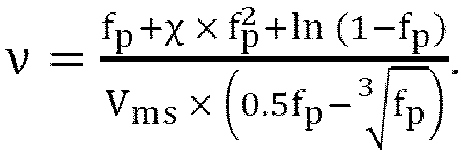
- In this equation, vms is the molar volume of the swelling agent and χ is the interaction parameter, which here is 0.39. The volume fraction fp is calculated as follows:

- In this equation, ρp is the density of the rubber sample and ρs is the density of the swelling agent. The mass of the swelling agent, ms, is determined as follows: ms = m 4 - m 1.
- The proportion of network breakdown, NWB, is calculated as the difference between the network density of the vulcanized rubber (v1) and the network density of the devulcanized rubber sample (v2):

- The so-called white rubber analysis can be used to determine the total area of visible particles (TAVP). For this it is necessary first to prepare a specimen. The TiO2 and MBTS (mercaptobenzothiazolesulfenamide) substances used for this purpose are obtained from Sigma Aldrich.
- To prepare the specimen, in an initial compounding step, 100 phr of the polybutadiene rubber CB24 are mixed with 85 phr of TiO2, 5 phr of ZnO and 1 phr of stearic acid and the mixture is then processed at 60°C for four minutes with a stirring speed of 100 rpm in a Brabender internal mixer. The resultant white rubber mixture is left to stand at room temperature for a day. The next day, 171 phr of the white rubber mixture are mixed with 5 phr of sulfur and 2.5 phr of MBTS and the mixture is vulcanized at 60°C and 100 rpm for two minutes in the Brabender internal mixer.
- The white rubber mixture is subsequently mixed with the devulcanized rubber in a ratio of 90:10 and masticated at RT for three minutes in a double-roll mill. This rubber mixture is then vulcanized in a Wickert press at 170°C for ten minutes and processed to give discs 5 mm thick with a radius of 50 mm. The vulcanized rubber is subsequently cooled in liquid nitrogen for 15 minutes and the surface is polished with abrasive paper (120 grade).
- For determining the TAVP, the specimen is investigated using the Keyence-brand VHX 5000 3D digital microscope and evaluated with the aid of the on-board ImageJ software. The settings made on the digital microscope for this purpose are as follows:
- Parameter: condition
- Imaging mode: 2D stitching
- Stitching: 5X6
- Zoom: 20x-30x
- Light: full-ring
- Cover area: round
- Base to lens angle: 90°
- The devulcanization experiments and characterization of materials below are set out and elucidated using a model compound by way of example. The devulcanization experiments and characterization of material were conducted at the University of Twente in the research groups of Prof. Dr Blume and Dr Dierkes. The production of the model compound is guided by the standard formulation for car tyre treads according to Table 1.
Table 1 Constituents Name Amount (phr) Styrene-butadiene rubber (SBR) Sprintan SLR 4601 70 Polybutadiene rubber (BR) CB 24 30 Silica (SiO2) ULTRASIL® 7000 GR 80 Silane Si 266™ 5.8 Zinc oxide ZnO 3 Stearic acid Stearic acid 2 TDAE oil Vivatec 25 Sulfur Sulfur 1.5 CBS Santocure CBS 1.7 DPG Perkacit DPG 2.5 - The Sprintan SLR 4601 was supplied by Trinseo, the polybutadiene rubber CB 24 by Arlanxeo, ULTRASIL® 7000 GR by Evonik, the zinc oxide and stearic acid and the sulfur by Merck, the TDAE oil Vivatec 500 by Hansen & Rosenthal; the accelerators Santocure CBS and Perkacit DPG were supplied by Flexsys, and the Si 266™ by Evonik.
- The model compound was produced using a Brabender-brand 350S internal mixer having a capacity of 390 ml, and a two-roll mill from Schwabenthan.
- First of all the polymers SBR (70 phr) and BR (30 phr) were placed into the internal mixer and masticated at 80°C at a speed of 70 rpm for one minute. Subsequently ULTRASIL® 7000 GR (40 phr) and Si 266™ (2.9 phr) were added and the mixture was kneaded for a further minute under the reaction conditions above. Thereafter the following constituents were added: 40 phr of ULTRASIL® 7000 GR, 2.9 phr of Si 266™, 3 phr of ZnO, 2 phr of stearic acid and 25 phr of TDAE oil. This mixture was initially kneaded for one minute at 140°C. The temperature was then increased to 145°C and the mixture was mixed at 70 rpm for a further four minutes. This mixture was then left to stand overnight at room temperature (RT). The next day, the mixture was transferred to the two-roll mill and processed at RT. The roll speed of the front roll was set to 20 rpm and that of the rear roll to 25 rpm, with a roll nip of 1.5 - 2.0 mm. After a mastication time of two minutes, the crosslinking system, consisting of 1.5 phr of sulfur, 1.7 phr of CBS and 2.5 phr of DPG, was added and the mixture was processed for a further seven minutes. The resulting mixture was subsequently pressed to give plates 2 mm thick at a temperature of 160°C with a vulcanization time of t-95 (i.e. 1305 seconds).
- In the next step, the vulcanized material was initially placed in liquid nitrogen for 3 minutes and then milled in a Fritsch laboratory mill to a mesh size of 0.7 mm.
- The subsequent devulcanization was carried out in a 50 cm3 internal mixer from Brabender, which is equipped with a tangential and counter-rotating rotor drive. The system in which the vulcanization was carried out included a press from Wickert.
- As a preliminary to the devulcanization of the model compound, the milled material was first swollen with TDAE oil as follows: 400 g of the milled model compound were admixed with 20 g (5 wt%) of TDAE oil and stirred with a spoon for 10 minutes at room temperature. This mixture was left to stand at RT overnight and on the next day was swollen with the devulcanizing agent. For this, 105 g of the swollen compound (containing 100 g of milled model compound + 5 g of TDAE oil) were admixed with the corresponding concentration of the devulcanizing agent (wt% based on the milled model compound). The mixture was stirred with a spoon for 10 minutes at RT and then left to stand at room temperature overnight. The model compound was subsequently placed into the internal mixer and devulcanized at an internal-mixer temperature T (°C) and a rotor speed R (rpm) for a reaction time t (min). After the devulcanization step, the devulcanized rubber was transferred to the double-roll mill and processed at RT. Here, the roll speed of the front roll was set at 20 rpm and that of the rear roll at 25 rpm, with a roll nip of 0.2 mm - 1.0 mm being selected.
- For the revulcanization of the model compound, the devulcanized rubber was processed in the double-roll mill. The roll speed of the front roll was set at 20 rpm, that of the rear roll at 25 rpm, and the roll nips were adjusted to 0.5 mm - 1.0 mm. The devulcanized rubber was initially masticated at RT for one minute, after which 4 g of ZnO and 2 g of stearic acid were added. The mixture was again masticated at RT for two minutes. Then 1.5 g of sulfur and 1.7 g of CBS were added and the mixture was masticated for four minutes more. The mixture was left to stand overnight at RT and on the next day was vulcanized at 160°C and pressed to give plates 2 mm thick.
- In accordance with the protocol stated above, the following devulcanizates (or devulcanized rubber samples) were produced with the various devulcanizing agents (DA) under the following conditions and tested (Table 2).
Table 2 # DA Reaction conditions T (°C) DT (min) C (%) TEI (kNm) TAVP (%) TS (MPa) EAB (%) NWB (%) fsol (%) 1 SILFIN 130 4 5 165 3.22 7.6 91 37 7.6 2 SILFIN 140 4 5 165 2.45 8.6 108 42 8.2 3 SILFIN 150 4 5 165 1.9 9.2 111 46 10.4 4 SILFIN 155 4 5 165 1.72 9.2 110 51 11.3 5 SILFIN 160 4 5 165 1.66 9.3 106 55 12.1 6 SILFIN 170 4 5 165 1.29 9.4 94 59 14.6 7 SILFIN 180 4 5 165 0.93 8.9 88 63 16.7 8 SILFIN 155 5 5 165 1.66 9.3 109 52 12 9 SILFIN 155 6 5 165 1 9.4 113 54 13.6 10 SILFIN 155 7 5 165 0.55 9.1 103 57 15.3 11 SILFIN 155 6 5 45 6.21 5.3 42 22 4.7 12 SILFIN 155 6 5 75 4.99 6.6 67 31 6.4 13 SILFIN 155 6 5 105 3.25 7.9 82 38 8.5 14 SILFIN 155 6 5 135 2.28 8.8 106 45 10.5 15 SILFIN 155 6 4 165 1.14 9.3 106 51 13.5 16 SILFIN 155 6 6 165 0.8 9.4 108 57 11.9 17 VTEO 130 4 5 105 5.3 5.5 41 - - 18 VTEO 130 4 5 135 4.1 6.7 48 - - 19 VTEO 130 4 5 165 3.7 7.2 55 - - 20 VTEO 140 4 5 165 2.4 8.5 88 - - 21 VTEO 140 6 5 165 1.91 9 95 40 8.5 22 VTEO 140 6 3 165 3.28 7.5 63 - - 23 VTEO 140 6 4 165 2.58 8.2 76 - - 24 VTEO 140 6 6 165 1.58 9.0 88 - - 25 VTEO 160 6 5 165 1.94 8.9 91 44 11.4 26 VTEO 170 6 5 165 1.85 8.3 76 - - 27 VTEO 180 6 5 165 1.47 7.9 68 - - 28 TESPT 130 4 5 105 5.64 4.7 33 - - 29 TESPT 130 4 5 135 4.92 5.5 36 - - 30 TESPT 130 4 5 165 4.3 6.5 42 - - 31 TESPT 140 4 5 165 3.83 7.4 72 32 6.6 32 TESPT 140 6 5 165 3.52 7.5 69 38 8.2 33 TESPT 160 4 5 165 3.77 7.4 65 45 10.2 34 TESPT 160 6 5 165 4.17 6.9 63 49 12.5 35 TESPT 170 6 5 165 3.84 7.1 76 - - 36 TESPT 180 6 5 165 2.98 7.7 79 - - 37 TESPT 180 6 3 165 4.38 6.1 43 - - 38 TESPT 180 6 4 165 3.48 7.3 67 - - 39 DPDS 140 4 5 165 5.16 4.7 28 - - 40 DPDS 140 5 5 165 4.52 5.6 31 - - 41 DPDS 140 6 5 165 3.86 6.9 42 - - 42 DPDS 160 6 5 165 3.16 7.1 58 - - 43 DPDS 170 6 5 165 2.96 7.2 62 - - 44 DPDS 180 6 5 165 2.89 6.9 51 - - 45 DPDS 170 6 3 165 3.7 6.5 39 - - 46 DPDS 170 6 4 165 3.35 6.8 54 - - 47 DPDS 170 6 6 165 2.79 7 68 - - T = temperature; DT = dwell time; C = DA concentration; TEI = total energy input; TAVP = total area of visible particles; TS = tensile strength; EAB = elongation at break; NWB = network breakdown; fsol = sol fraction - The devulcanized rubber of the invention is characterized in that it possesses a TAVP of less than 2.7%. The TAVP can be controlled through, among others, the operating conditions of temperature (T), dwell time in the internal mixer (DT), devulcanizing agent concentration (C), and the total energy input (TEI) in the internal mixer. In principle it is the case that the lower the TAVP, the more selective and efficient the devulcanization. As a yardstick for the quality of the devulcanization it is likewise possible to employ the degree of network breakdown (NWB). A higher network breakdown is considered here to be desirable. As the devulcanization temperature goes up, the TAVP drops and the NWB increases. However, the TAVP is meaningful only at temperatures below the thermal degradation of the polymer. Below the degradation temperature of the polymer, a low TAVP leads to an improvement in the mechanical properties of the revulcanized material, as may be observed from an increasing tensile strength (TS) and tensile elongation (EAB). At temperatures above the thermal degradation of the polymer, a low TAVP is attributable to the polymer degradation and not to the selective elimination of sulfur bridges. In this temperature range it is the case that the tensile strength (TS) and tensile elongation (EAB) of the revulcanized materials become poorer, i.e. lower, in spite of low TAVP values.
- From the overview table it is apparent that SILFIN (DYNASYLAN® SILFIN 301) and VTEO (vinyltriethoxysilane), at temperatures between 140-180°C, dwell times between 4-7 min, devulcanizing agent concentrations between 4-6 wt% and energy inputs above 130 kNm, furnish the devulcanized rubber of the invention.
- Temperatures below 140°C (see Table 2, # 1, 17-19) result in high TAVP values, this being attributable to insufficient devulcanization. The opening of sulfur bridges and the radical reactions proceed more effectively beyond 140°C. Beyond a temperature of around 180°C, the tensile strength drops; this may be explained by the onset of the thermal degradation of the polymer (see Table 2, # 7, 27). Above the thermal degradation temperature, the mechanical properties of TS and EAB drop as TAVP values become smaller (see Table 2, # 7). The influence of the total energy input (TEI) on the selectivity of the devulcanization is apparent from entries including Table 2, # 9, 11-14. This indicates that the selectivity of the devulcanization likewise rises with increasing energy input of the internal mixer.
- The devulcanization experiments conducted with the devulcanizing agents TESPT and DPDS, respectively (see Table 2, # 28-47), show that the devulcanized rubber of the invention cannot be achieved with the prior art.
Claims (17)
- Devulcanized rubber obtained by reaction of vulcanized rubber with vinylsilane, characterized in that the Total Area of Visible Particles (TAVP)of the devulcanized rubber is < 2.7 %, the TAVP being measured as described in the description.
- Devulcanized rubber according to Claim 1, characterized in that it comprises butadiene and/or styrene structural units.
- Devulcanized rubber according to Claim 1, characterized in that it contains 10 - 200 phr, preferably 20 - 120 phr, more preferably 30 - 100 phr of silica.
- Devulcanized rubber according to Claim 1, characterized in that it has an NWB of > 50 %, the NWB being measured as described in the description.
- Devulcanized rubber according to Claim 1, characterized in that it has an fsol of ≥ 12.0 %, the fsol being measured as described in the description.
- Process for producing the devulcanized rubber according to Claim 1, characterized in that vulcanized rubber is comminuted and reacted with vinylsilane as devulcanizing agent at temperatures between 140 - 180°C for 4 to 7 minutes with a concentration of devulcanizing agent of 4 to 6 wt%, based on the vulcanized rubber, and with an energy input during the reaction of > 140 kNm.
- Process for producing the devulcanized rubber according to Claim 6, characterized in that the vulcanized rubber is comminuted by means of waterjet, cryogenic or ambient-mechanical milling.
- Process for producing the devulcanized rubber according to Claim 6, characterized in that before the vinylsilane is added, the comminuted vulcanized rubber is swollen with oil.
- Process for producing the devulcanized rubber according to Claim 6, characterized in that the vinylsilane used comprises a vinyltrialkoxysilane, preferably vinyltriethoxysilane.
- Process for producing the devulcanized rubber according to Claim 6, characterized in that the vinylsilane is used in amounts of 1-20 wt%, preferably 3-10 wt%, based on the vulcanized rubber used.
- Process for producing the devulcanized rubber according to Claim 6, characterized in that the vinylsilane is used together with peroxides.
- Process for producing the devulcanized rubber according to Claim 6, characterized in that peroxides used comprise dicumyl peroxide and/or benzoyl peroxide.
- Process for producing the devulcanized rubber according to Claim 6, characterized in that the peroxide is used in amounts of 1-20 wt%, preferably 1-10 wt%, based on the vinylsilane.
- Process for producing the devulcanized rubber according to Claim 6, characterized in that vulcanized rubber from scrap tyres is comminuted and the comminuted rubber is swollen with oil and devulcanized with vinyltriethoxysilane and dicumyl peroxide.
- Use of vinylsilanes, optionally with addition of peroxides, for the devulcanization of vulcanizates.
- Use of the devulcanized rubber according to Claim 1 as raw material in vulcanized rubber mixtures.
- Vulcanized rubber mixtures comprising the devulcanized rubber according to Claim 1.
Priority Applications (3)
| Application Number | Priority Date | Filing Date | Title |
|---|---|---|---|
| RS20250584A RS66911B1 (en) | 2022-10-27 | 2023-10-17 | Devulcanized rubber, process for producing devulcanized rubber, and use thereof |
| SI202330032T SI4433532T1 (en) | 2022-10-27 | 2023-10-17 | Devulcanized rubber, process for producing devulcanized rubber, and use thereof |
| HRP20250588TT HRP20250588T1 (en) | 2022-10-27 | 2023-10-17 | DEVULCANIZED RUBBER, PROCESS FOR MANUFACTURING DEVULCANIZED RUBBER AND ITS USE |
Applications Claiming Priority (2)
| Application Number | Priority Date | Filing Date | Title |
|---|---|---|---|
| EP22204116 | 2022-10-27 | ||
| PCT/EP2023/078721 WO2024088814A1 (en) | 2022-10-27 | 2023-10-17 | Devulcanized rubber, process for producing devulcanized rubber, and use thereof |
Publications (2)
| Publication Number | Publication Date |
|---|---|
| EP4433532A1 EP4433532A1 (en) | 2024-09-25 |
| EP4433532B1 true EP4433532B1 (en) | 2025-04-02 |
Family
ID=84044095
Family Applications (1)
| Application Number | Title | Priority Date | Filing Date |
|---|---|---|---|
| EP23785967.3A Active EP4433532B1 (en) | 2022-10-27 | 2023-10-17 | Devulcanized rubber, process for producing devulcanized rubber, and use thereof |
Country Status (18)
| Country | Link |
|---|---|
| US (1) | US20260109789A1 (en) |
| EP (1) | EP4433532B1 (en) |
| JP (1) | JP2026512772A (en) |
| KR (1) | KR20250099357A (en) |
| CN (1) | CN120112590A (en) |
| DK (1) | DK4433532T3 (en) |
| ES (1) | ES3032224T3 (en) |
| FI (1) | FI4433532T3 (en) |
| HR (1) | HRP20250588T1 (en) |
| HU (1) | HUE071604T2 (en) |
| IL (1) | IL320359A (en) |
| MX (1) | MX2025004749A (en) |
| PL (1) | PL4433532T3 (en) |
| PT (1) | PT4433532T (en) |
| RS (1) | RS66911B1 (en) |
| SI (1) | SI4433532T1 (en) |
| TW (1) | TW202436471A (en) |
| WO (1) | WO2024088814A1 (en) |
Family Cites Families (4)
| Publication number | Priority date | Publication date | Assignee | Title |
|---|---|---|---|---|
| US5258413A (en) | 1992-06-22 | 1993-11-02 | The University Of Akron | Continuous ultrasonic devulcanization of valcanized elastomers |
| DE102012108096A1 (en) | 2012-08-31 | 2014-03-06 | Continental Reifen Deutschland Gmbh | Process for the regeneration of sulfur-vulcanized rubber vulcanizates to regenerates |
| CN107936331B (en) | 2017-11-10 | 2020-10-02 | 北京化工大学 | A method for preparing recycled rubber by continuous desulfurization of multi-stage screw |
| CN110510631B (en) * | 2019-08-29 | 2022-09-27 | 西昌学院 | Application of modified NaY type molecular sieve in desulfurization process of regenerated rubber |
-
2023
- 2023-10-17 KR KR1020257016865A patent/KR20250099357A/en active Pending
- 2023-10-17 US US19/122,790 patent/US20260109789A1/en active Pending
- 2023-10-17 EP EP23785967.3A patent/EP4433532B1/en active Active
- 2023-10-17 WO PCT/EP2023/078721 patent/WO2024088814A1/en not_active Ceased
- 2023-10-17 PL PL23785967.3T patent/PL4433532T3/en unknown
- 2023-10-17 HR HRP20250588TT patent/HRP20250588T1/en unknown
- 2023-10-17 ES ES23785967T patent/ES3032224T3/en active Active
- 2023-10-17 IL IL320359A patent/IL320359A/en unknown
- 2023-10-17 FI FIEP23785967.3T patent/FI4433532T3/en active
- 2023-10-17 RS RS20250584A patent/RS66911B1/en unknown
- 2023-10-17 HU HUE23785967A patent/HUE071604T2/en unknown
- 2023-10-17 CN CN202380074969.0A patent/CN120112590A/en active Pending
- 2023-10-17 JP JP2025524287A patent/JP2026512772A/en active Pending
- 2023-10-17 PT PT237859673T patent/PT4433532T/en unknown
- 2023-10-17 DK DK23785967.3T patent/DK4433532T3/en active
- 2023-10-17 SI SI202330032T patent/SI4433532T1/en unknown
- 2023-10-24 TW TW112140535A patent/TW202436471A/en unknown
-
2025
- 2025-04-24 MX MX2025004749A patent/MX2025004749A/en unknown
Also Published As
| Publication number | Publication date |
|---|---|
| HRP20250588T1 (en) | 2025-07-18 |
| RS66911B1 (en) | 2025-07-31 |
| EP4433532A1 (en) | 2024-09-25 |
| IL320359A (en) | 2025-06-01 |
| PL4433532T3 (en) | 2025-07-21 |
| US20260109789A1 (en) | 2026-04-23 |
| TW202436471A (en) | 2024-09-16 |
| ES3032224T3 (en) | 2025-07-16 |
| JP2026512772A (en) | 2026-04-21 |
| DK4433532T3 (en) | 2025-06-23 |
| CN120112590A (en) | 2025-06-06 |
| WO2024088814A1 (en) | 2024-05-02 |
| KR20250099357A (en) | 2025-07-01 |
| HUE071604T2 (en) | 2025-09-28 |
| SI4433532T1 (en) | 2025-07-31 |
| PT4433532T (en) | 2025-05-13 |
| MX2025004749A (en) | 2025-06-02 |
| FI4433532T3 (en) | 2025-07-04 |
Similar Documents
| Publication | Publication Date | Title |
|---|---|---|
| Kaewsakul et al. | Optimization of mixing conditions for silica-reinforced natural rubber tire tread compounds | |
| EP1362880A2 (en) | Oilcloth and lamp black | |
| Maghami et al. | Functionalized SBRs in silica-reinforced tire tread compounds: evidence for interactions between silica filler and zinc oxide | |
| EP3514200B1 (en) | A method of devulcanizing a rubber vulcanizate | |
| EP2890733B1 (en) | Process for regenerating sulfur-crosslinked rubber vulcanizates to regenerates | |
| EP0051450A1 (en) | Polymer-carbon black mixing | |
| US20240026094A1 (en) | Methods of preparing a composite comprising never-dried natural rubber and filler | |
| Bisschop et al. | Influence of molecular properties of SSBR and BR types on composite performance | |
| EP3180200B1 (en) | Functionalized silica with elastomer binder | |
| Phadke et al. | Use of cryoground reclaimed rubber in natural rubber | |
| Limtrakul et al. | Influence of carbon black/silica hybrid ratio on properties of passenger car tire sidewall | |
| Sattayanurak et al. | Enhancing performance of silica-reinforced natural rubber tire tread compounds by applying organoclay as secondary filler | |
| US20260109789A1 (en) | Devulcanized rubber, process for producing devulcanized rubber, and use thereof | |
| JP5566029B2 (en) | Process for producing a rubber mixture containing silicon dioxide | |
| Thitithammawong et al. | The use of reclaimed rubber from waste tires for production of dynamically cured natural rubber/reclaimed rubber/polypropylene blends: Effect of reclaimed rubber loading | |
| CN108794833B (en) | Rubber composite material and preparation method thereof | |
| WO2025202158A1 (en) | Devulcanized rubber and process for producing thereof | |
| EP3743465B1 (en) | Recycling of vulcanized rubber products | |
| JP5164384B2 (en) | Processed powder rubber, rubber composition and pneumatic tire using the same | |
| Dierkes et al. | Sensitivity of Marching Modulus of silica-filled SBR/BR compounds to filler type and polymer ratio | |
| DE112014003521T5 (en) | A rubber-silica composite and process for producing the same and rubber composition and pneumatic tire | |
| Saiwari et al. | Tires back into tires: devulcanization of tire rubbers | |
| EP4658466A1 (en) | Dry-granulation of particulate carbon material and agglomerates produced thereby | |
| Rakhman | Blends Comprised Waste Tires and Reinforcing Carbon Black: Effect of Mixing Sequence on Processing and Physical Properties | |
| Saiwari et al. | Comparative investigation of the de-vulcanization parameters of tire rubbers |
Legal Events
| Date | Code | Title | Description |
|---|---|---|---|
| REG | Reference to a national code |
Ref country code: HR Ref legal event code: TUEP Ref document number: P20250588T Country of ref document: HR |
|
| STAA | Information on the status of an ep patent application or granted ep patent |
Free format text: STATUS: UNKNOWN |
|
| STAA | Information on the status of an ep patent application or granted ep patent |
Free format text: STATUS: THE INTERNATIONAL PUBLICATION HAS BEEN MADE |
|
| PUAI | Public reference made under article 153(3) epc to a published international application that has entered the european phase |
Free format text: ORIGINAL CODE: 0009012 |
|
| STAA | Information on the status of an ep patent application or granted ep patent |
Free format text: STATUS: REQUEST FOR EXAMINATION WAS MADE |
|
| 17P | Request for examination filed |
Effective date: 20231017 |
|
| AK | Designated contracting states |
Kind code of ref document: A1 Designated state(s): AL AT BE BG CH CY CZ DE DK EE ES FI FR GB GR HR HU IE IS IT LI LT LU LV MC ME MK MT NL NO PL PT RO RS SE SI SK SM TR |
|
| GRAP | Despatch of communication of intention to grant a patent |
Free format text: ORIGINAL CODE: EPIDOSNIGR1 |
|
| STAA | Information on the status of an ep patent application or granted ep patent |
Free format text: STATUS: GRANT OF PATENT IS INTENDED |
|
| INTG | Intention to grant announced |
Effective date: 20241209 |
|
| GRAS | Grant fee paid |
Free format text: ORIGINAL CODE: EPIDOSNIGR3 |
|
| GRAA | (expected) grant |
Free format text: ORIGINAL CODE: 0009210 |
|
| STAA | Information on the status of an ep patent application or granted ep patent |
Free format text: STATUS: THE PATENT HAS BEEN GRANTED |
|
| AK | Designated contracting states |
Kind code of ref document: B1 Designated state(s): AL AT BE BG CH CY CZ DE DK EE ES FI FR GB GR HR HU IE IS IT LI LT LU LV MC ME MK MT NL NO PL PT RO RS SE SI SK SM TR |
|
| DAV | Request for validation of the european patent (deleted) | ||
| DAX | Request for extension of the european patent (deleted) | ||
| REG | Reference to a national code |
Ref country code: GB Ref legal event code: FG4D |
|
| P01 | Opt-out of the competence of the unified patent court (upc) registered |
Free format text: CASE NUMBER: APP_9925/2025 Effective date: 20250227 |
|
| REG | Reference to a national code |
Ref country code: CH Ref legal event code: EP |
|
| REG | Reference to a national code |
Ref country code: IE Ref legal event code: FG4D |
|
| REG | Reference to a national code |
Ref country code: DE Ref legal event code: R096 Ref document number: 602023002740 Country of ref document: DE |
|
| REG | Reference to a national code |
Ref country code: PT Ref legal event code: SC4A Ref document number: 4433532 Country of ref document: PT Date of ref document: 20250513 Kind code of ref document: T Free format text: AVAILABILITY OF NATIONAL TRANSLATION Effective date: 20250507 |
|
| REG | Reference to a national code |
Ref country code: NL Ref legal event code: FP |
|
| REG | Reference to a national code |
Ref country code: DK Ref legal event code: T3 Effective date: 20250618 |
|
| REG | Reference to a national code |
Ref country code: FI Ref legal event code: FGE |
|
| REG | Reference to a national code |
Ref country code: SE Ref legal event code: TRGR |
|
| REG | Reference to a national code |
Ref country code: ES Ref legal event code: FG2A Ref document number: 3032224 Country of ref document: ES Kind code of ref document: T3 Effective date: 20250716 Ref country code: SK Ref legal event code: T3 Ref document number: E 46401 Country of ref document: SK |
|
| REG | Reference to a national code |
Ref country code: HR Ref legal event code: T1PR Ref document number: P20250588 Country of ref document: HR |
|
| REG | Reference to a national code |
Ref country code: HU Ref legal event code: AG4A Ref document number: E071604 Country of ref document: HU |
|
| REG | Reference to a national code |
Ref country code: LT Ref legal event code: MG9D |
|
| PG25 | Lapsed in a contracting state [announced via postgrant information from national office to epo] |
Ref country code: GR Free format text: LAPSE BECAUSE OF FAILURE TO SUBMIT A TRANSLATION OF THE DESCRIPTION OR TO PAY THE FEE WITHIN THE PRESCRIBED TIME-LIMIT Effective date: 20250703 |
|
| PG25 | Lapsed in a contracting state [announced via postgrant information from national office to epo] |
Ref country code: IS Free format text: LAPSE BECAUSE OF FAILURE TO SUBMIT A TRANSLATION OF THE DESCRIPTION OR TO PAY THE FEE WITHIN THE PRESCRIBED TIME-LIMIT Effective date: 20250802 |
|
| PG25 | Lapsed in a contracting state [announced via postgrant information from national office to epo] |
Ref country code: LV Free format text: LAPSE BECAUSE OF FAILURE TO SUBMIT A TRANSLATION OF THE DESCRIPTION OR TO PAY THE FEE WITHIN THE PRESCRIBED TIME-LIMIT Effective date: 20250402 |
|
| PGFP | Annual fee paid to national office [announced via postgrant information from national office to epo] |
Ref country code: SI Payment date: 20251009 Year of fee payment: 3 |
|
| REG | Reference to a national code |
Ref country code: HR Ref legal event code: ODRP Ref document number: P20250588 Country of ref document: HR Payment date: 20251009 Year of fee payment: 3 |
|
| PGFP | Annual fee paid to national office [announced via postgrant information from national office to epo] |
Ref country code: HU Payment date: 20251027 Year of fee payment: 3 |
|
| PGFP | Annual fee paid to national office [announced via postgrant information from national office to epo] |
Ref country code: LU Payment date: 20251022 Year of fee payment: 3 |
|
| PGFP | Annual fee paid to national office [announced via postgrant information from national office to epo] |
Ref country code: PT Payment date: 20251009 Year of fee payment: 3 |
|
| REG | Reference to a national code |
Ref country code: DE Ref legal event code: R097 Ref document number: 602023002740 Country of ref document: DE |
|
| PGFP | Annual fee paid to national office [announced via postgrant information from national office to epo] |
Ref country code: DE Payment date: 20251021 Year of fee payment: 3 |
|
| PGFP | Annual fee paid to national office [announced via postgrant information from national office to epo] |
Ref country code: NO Payment date: 20251024 Year of fee payment: 3 |
|
| PG25 | Lapsed in a contracting state [announced via postgrant information from national office to epo] |
Ref country code: SM Free format text: LAPSE BECAUSE OF FAILURE TO SUBMIT A TRANSLATION OF THE DESCRIPTION OR TO PAY THE FEE WITHIN THE PRESCRIBED TIME-LIMIT Effective date: 20250402 |
|
| PGFP | Annual fee paid to national office [announced via postgrant information from national office to epo] |
Ref country code: AT Payment date: 20260113 Year of fee payment: 3 |
|
| PGFP | Annual fee paid to national office [announced via postgrant information from national office to epo] |
Ref country code: IT Payment date: 20251031 Year of fee payment: 3 Ref country code: FI Payment date: 20251028 Year of fee payment: 3 Ref country code: DK Payment date: 20251027 Year of fee payment: 3 |
|
| PGFP | Annual fee paid to national office [announced via postgrant information from national office to epo] |
Ref country code: HR Payment date: 20251009 Year of fee payment: 3 Ref country code: FR Payment date: 20251030 Year of fee payment: 3 |
|
| PGFP | Annual fee paid to national office [announced via postgrant information from national office to epo] |
Ref country code: TR Payment date: 20251013 Year of fee payment: 3 Ref country code: BE Payment date: 20251021 Year of fee payment: 3 |
|
| PGFP | Annual fee paid to national office [announced via postgrant information from national office to epo] |
Ref country code: SE Payment date: 20251021 Year of fee payment: 3 |
|
| PGFP | Annual fee paid to national office [announced via postgrant information from national office to epo] |
Ref country code: IE Payment date: 20251024 Year of fee payment: 3 Ref country code: CZ Payment date: 20251009 Year of fee payment: 3 |
|
| PGFP | Annual fee paid to national office [announced via postgrant information from national office to epo] |
Ref country code: BG Payment date: 20251023 Year of fee payment: 3 Ref country code: PL Payment date: 20251013 Year of fee payment: 3 |
|
| PG25 | Lapsed in a contracting state [announced via postgrant information from national office to epo] |
Ref country code: EE Free format text: LAPSE BECAUSE OF FAILURE TO SUBMIT A TRANSLATION OF THE DESCRIPTION OR TO PAY THE FEE WITHIN THE PRESCRIBED TIME-LIMIT Effective date: 20250402 |
|
| PGFP | Annual fee paid to national office [announced via postgrant information from national office to epo] |
Ref country code: SK Payment date: 20251013 Year of fee payment: 3 Ref country code: RO Payment date: 20251013 Year of fee payment: 3 |
|
| PGFP | Annual fee paid to national office [announced via postgrant information from national office to epo] |
Ref country code: RS Payment date: 20251009 Year of fee payment: 3 |
|
| PGFP | Annual fee paid to national office [announced via postgrant information from national office to epo] |
Ref country code: ES Payment date: 20251217 Year of fee payment: 3 |
|
| PLBE | No opposition filed within time limit |
Free format text: ORIGINAL CODE: 0009261 |
|
| STAA | Information on the status of an ep patent application or granted ep patent |
Free format text: STATUS: NO OPPOSITION FILED WITHIN TIME LIMIT |
|
| REG | Reference to a national code |
Ref country code: CH Ref legal event code: L10 Free format text: ST27 STATUS EVENT CODE: U-0-0-L10-L00 (AS PROVIDED BY THE NATIONAL OFFICE) Effective date: 20260211 |
|
| 26N | No opposition filed |
Effective date: 20260105 |