EP4432719A1 - Wireless terminal, radio access network node, and methods therefor - Google Patents
Wireless terminal, radio access network node, and methods therefor Download PDFInfo
- Publication number
- EP4432719A1 EP4432719A1 EP22889768.2A EP22889768A EP4432719A1 EP 4432719 A1 EP4432719 A1 EP 4432719A1 EP 22889768 A EP22889768 A EP 22889768A EP 4432719 A1 EP4432719 A1 EP 4432719A1
- Authority
- EP
- European Patent Office
- Prior art keywords
- data
- radio terminal
- machine learning
- access network
- learning model
- Prior art date
- Legal status (The legal status is an assumption and is not a legal conclusion. Google has not performed a legal analysis and makes no representation as to the accuracy of the status listed.)
- Pending
Links
Images



Classifications
-
- H—ELECTRICITY
- H04—ELECTRIC COMMUNICATION TECHNIQUE
- H04W—WIRELESS COMMUNICATION NETWORKS
- H04W24/00—Supervisory, monitoring or testing arrangements
- H04W24/02—Arrangements for optimising operational condition
-
- G—PHYSICS
- G06—COMPUTING OR CALCULATING; COUNTING
- G06N—COMPUTING ARRANGEMENTS BASED ON SPECIFIC COMPUTATIONAL MODELS
- G06N3/00—Computing arrangements based on biological models
- G06N3/02—Neural networks
- G06N3/04—Architecture, e.g. interconnection topology
- G06N3/044—Recurrent networks, e.g. Hopfield networks
-
- H—ELECTRICITY
- H04—ELECTRIC COMMUNICATION TECHNIQUE
- H04L—TRANSMISSION OF DIGITAL INFORMATION, e.g. TELEGRAPHIC COMMUNICATION
- H04L41/00—Arrangements for maintenance, administration or management of data switching networks, e.g. of packet switching networks
- H04L41/08—Configuration management of networks or network elements
- H04L41/0803—Configuration setting
- H04L41/0823—Configuration setting characterised by the purposes of a change of settings, e.g. optimising configuration for enhancing reliability
-
- H—ELECTRICITY
- H04—ELECTRIC COMMUNICATION TECHNIQUE
- H04L—TRANSMISSION OF DIGITAL INFORMATION, e.g. TELEGRAPHIC COMMUNICATION
- H04L41/00—Arrangements for maintenance, administration or management of data switching networks, e.g. of packet switching networks
- H04L41/16—Arrangements for maintenance, administration or management of data switching networks, e.g. of packet switching networks using machine learning or artificial intelligence
-
- H—ELECTRICITY
- H04—ELECTRIC COMMUNICATION TECHNIQUE
- H04L—TRANSMISSION OF DIGITAL INFORMATION, e.g. TELEGRAPHIC COMMUNICATION
- H04L43/00—Arrangements for monitoring or testing data switching networks
- H04L43/06—Generation of reports
-
- H—ELECTRICITY
- H04—ELECTRIC COMMUNICATION TECHNIQUE
- H04L—TRANSMISSION OF DIGITAL INFORMATION, e.g. TELEGRAPHIC COMMUNICATION
- H04L43/00—Arrangements for monitoring or testing data switching networks
- H04L43/08—Monitoring or testing based on specific metrics, e.g. QoS, energy consumption or environmental parameters
- H04L43/0805—Monitoring or testing based on specific metrics, e.g. QoS, energy consumption or environmental parameters by checking availability
- H04L43/0811—Monitoring or testing based on specific metrics, e.g. QoS, energy consumption or environmental parameters by checking availability by checking connectivity
-
- G—PHYSICS
- G06—COMPUTING OR CALCULATING; COUNTING
- G06N—COMPUTING ARRANGEMENTS BASED ON SPECIFIC COMPUTATIONAL MODELS
- G06N20/00—Machine learning
-
- H—ELECTRICITY
- H04—ELECTRIC COMMUNICATION TECHNIQUE
- H04W—WIRELESS COMMUNICATION NETWORKS
- H04W24/00—Supervisory, monitoring or testing arrangements
- H04W24/10—Scheduling measurement reports ; Arrangements for measurement reports
Definitions
- the present disclosure relates to radio communication networks, and in particular to the use of artificial intelligence (AI) in radio communication networks.
- AI artificial intelligence
- AI/ML machine learning
- Uu the Radio Access Network
- RAN3 Radio Access Network
- UE User Equipment
- network-based AI/ML the network performs AI/ML inference.
- AI inference is a prediction or decision based on a trained machine learning model.
- AI/ML inference functionality may be located in the Next Generation Radio Access Network (NG-RAN) (e.g., gNB).
- NG-RAN Next Generation Radio Access Network
- OAM Operation, Administration and Maintenance
- a trained machine learning model i.e., trained parameters
- UE-based AI/ML the UE performs AI/ML inference.
- Possible use cases for AL/ML for air interface include Channel State Information (CSI) feedback compression, beam management, positioning, Reference signal (RS) overhead reduction, and mobility.
- CSI Channel State Information
- RS Reference signal
- the UE-based AI/ML the UE runs an AI model (i.e., a trained machine learning model) and obtains AI inference results locally. For example, the UE can predict a future event or measurement based on past measurements. The UE can feed back a predicted result (e.g., mobility or beam prediction) to the network (e.g., gNB).
- a predicted result e.g., mobility or beam prediction
- the inventor has studied network-based AI/ML and found various problems.
- One of these problems concerns the training of a machine learning model to be used in a network or the inference on a trained machine learning model.
- Data obtained by the UE can be used as training data for a machine learning model to be used in the network. Additionally or alternatively, data obtained by the UE can be used by the network as input data to perform inference on a trained machine learning model.
- One of the objects to be attained by example embodiments disclosed herein is to provide apparatuses, methods, and programs that contribute to solving at least one of a plurality of problems related to network-based AI/ML, including the problems described above. It should be noted that this object is merely one of the objects to be attained by the example embodiments disclosed herein. Other objects or problems and novel features will be made apparent from the following description and the accompanying drawings.
- a radio terminal includes at least one memory and at least one processor coupled to the at least one memory.
- the at least one processor is configured to transmit assistance information to a network.
- the assistance information is used to train a first machine learning model related to radio access network optimization or to perform inference on a first trained machine learning model related to radio access network optimization.
- the assistance information includes one or both of statistical data and predicted data.
- the statistical data indicates a subset of historical data of a given event, extracted by filtering the historical data by one or more conditions.
- the predicted data is generated by the radio terminal by prediction or decision using a second trained machine learning model.
- a method performed by a radio terminal includes transmitting assistance information to a network.
- the assistance information is used to train a first machine learning model related to radio access network optimization or to perform inference on a first trained machine learning model related to radio access network optimization.
- the assistance information includes one or both of statistical data and predicted data.
- the statistical data indicates a subset of historical data of a given event, extracted by filtering the historical data by one or more conditions.
- the predicted data is generated by the radio terminal by prediction or decision using a second trained machine learning model.
- a radio access network (RAN) node includes at least one memory and at least one processor coupled to the at least one memory.
- the at least one processor is configured to receive assistance information from a radio terminal.
- the assistance information is used to train a first machine learning model related to radio access network optimization or to perform inference on a first trained machine learning model related to radio access network optimization.
- the assistance information includes one or both of statistical data and predicted data.
- the statistical data indicates a subset of historical data of a given event, extracted by filtering the historical data by one or more conditions.
- the predicted data is generated by the radio terminal by prediction or decision using a second trained machine learning model.
- a method performed by a RAN node includes receiving assistance information from a radio terminal.
- the assistance information is used to train a first machine learning model related to radio access network optimization or to perform inference on a first trained machine learning model related to radio access network optimization.
- the assistance information includes one or both of statistical data and predicted data.
- the statistical data indicates a subset of historical data of a given event, extracted by filtering the historical data by one or more conditions.
- the predicted data is generated by the radio terminal by prediction or decision using a second trained machine learning model.
- a fifth aspect is directed to a program.
- the program includes a set of instructions (software codes) that, when loaded into a computer, cause the computer to perform the method described in the second or fourth aspect.
- the example embodiments shown below are described primarily for the 3GPP fifth generation mobile communication system (5G system). However, these example embodiments may be applied to other radio communication systems.
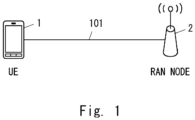
- Fig. 1 illustrates an example of the configuration of a radio communication system related to a plurality of example embodiments.
- the radio communication system includes a radio terminal (i.e., UE) 1 and a radio access network (RAN) node (e.g., gNB) 2.
- RAN radio access network
- Each of the elements (network functions) shown in Fig. 1 can be implemented, for example, as a network element on dedicated hardware, as a software instance running on dedicated hardware, or as a virtualized function instantiated on an application platform.
- the UE 1 has at least one radio transceiver and is configured to communicate wirelessly with the RAN node 2.
- the UE 1 is connected to the RAN node 2 via an air interface 101.
- the RAN node 2 is configured to manage a cell and to communicate wirelessly with multiple UEs, including the UE 1, using a cellular communication technology (e.g., NR Radio Access Technology (RAT)).
- RAT Radio Access Technology
- the UE 1 may be simultaneously connected to multiple RAN nodes for Dual Connectivity (DC).
- DC Dual Connectivity
- the RAN Node 2 may be a Central Unit (e.g., gNB-CU) in a Cloud RAN (C-RAN) deployment, or a combination of a CU and one or more Distributed Units (e.g., gNB-DUs).
- C-RAN is also referred to as CU/DU split.
- a CU may include a Control Plane (CP) unit (e.g., gNB-CU-CP) and one or more User Plane (UP) units (e.g., gNB-CU-UP).
- CP Control Plane
- UP User Plane
- the RAN nodes 2 may be a CU-CP or a combination of a CU-CP and a CU-UP.
- a CU may be a logical node that hosts the Radio Resource Control (RRC), Service Data Adaptation Protocol (SDAP), and Packet Data Convergence Protocol (PDCP) protocols of a gNB (or the RRC and PDCP protocols of a gNB).
- RRC Radio Resource Control
- SDAP Service Data Adaptation Protocol
- PDCP Packet Data Convergence Protocol
- a DU may be a logical node that hosts the Radio Link Control (RLC), Medium Access Control (MAC), and Physical (PHY) layers of a gNB.
- RLC Radio Link Control
- MAC Medium Access Control
- PHY Physical
- the UE 1 may perform AI/ML inference locally. This AI/ML inference may relate to the optimization of a radio access network.
- the UE 1 may perform (or run) AI inference on a trained machine learning model and perform one or more actions according to a prediction or decision based on the AI inference.
- the machine learning model may be any model known in the field of machine learning, including deep learning.
- the machine learning model can be, for example, but not limited to, a neural network model, a support vector machine model, a decision tree model, a random forest model, or a K-nearest neighbor model.
- the prediction or decision based on AI inference by the UE 1 and the one or more actions triggered thereby relate to at least one of beam management, mobility, CSI feedback, or positioning (or location estimation).
- the one or more actions include at least one of cell reselection, sending a measurement report, performing conditional mobility, or downlink beam selection.
- the downlink beam may be a Synchronization Signal (SS)/Physical Broadcast Channel (PBCH) block (SSB) beam.
- SS Synchronization Signal
- PBCH Physical Broadcast Channel
- the machine learning model may output predictions of a candidate cell for cell reselection, a target cell or node for handover, a candidate cell or node for conditional mobility, a candidate beam for beam selection, or a UE trajectory. Additionally or alternatively, the machine learning model may predict or determine when to perform an action for mobility or beam management.
- the cell reselection may be performed when the UE 1 is in RRC_IDLE or RRC_INACTIVE.
- Th mobility can be performed when the UE 1 is in RRC_CONNECTED.
- the mobility in RRC_CONNECTED may be a handover.
- the handover may be a Dual Active Protocol Stack (DAPS) handover.
- DAPS Dual Active Protocol Stack
- the mobility in RRC_CONNECTED can be related to various mobilities in DC.
- the mobility may be a change of the primary cell of a Master Cell Group (MCG) in DC, an inter-Master Node (MN) handover in DC, a secondary node change in DC, or an addition or modification of the primary cell of a secondary cell group in DC.
- MCG Master Cell Group
- MN inter-Master Node
- DC secondary node change in DC
- DC addition or modification of the primary cell of a secondary cell group in DC.
- the conditional mobility can be performed when the UE 1 is in RRC_CONNECTED.
- the conditional mobility may be a conditional handover. Additionally or alternatively, the conditional mobility may be related to various mobility in DC. Specifically, the conditional mobility may be a change of the primary cell of a Master Cell Group (MCG) in DC, an inter-Master Node (MN) handover in DC, a change of a secondary node in DC, or an addition or modification of the primary cell of a secondary cell group in DC.
- MCG Master Cell Group
- MN inter-Master Node
- the downlink beam selection can be done in a Beam Failure Recovery (BFR) procedure.
- BFR Beam Failure Recovery
- Training of the machine learning model for AI/ML inference by the UE 1 may be performed by the UE 1 or by the network (e.g., OAM, RAN node 2).
- the method of this training can be offline training, online training, or a combination of both.
- the RAN node 2 may perform AI/ML inference.
- This AI/ML inference may relate to the optimization of a radio access network.
- the RAN node 2 may perform (or run) AI inference on a trained machine learning model and perform one or more actions according to a prediction or decision based on the AI inference.
- the machine learning model may be any model known in the field of machine learning, including deep learning.
- the machine learning model can be, for example, but not limited to, a neural network model, a support vector machine model, a decision tree model, a random forest model, or a K-nearest neighbor model.
- the prediction or decision based on AI inference by the RAN node 2 and the one or more actions triggered thereby may relate to at least one of energy saving, load balancing, mobility optimization, CSI feedback enhancement, or positioning accuracy enhancement.
- the prediction or decision by the machine learning model may relate to one or both of energy saving strategies and mobility strategies.
- the machine learning model may output predictions of a target cell or node for handover, a candidate cell or node for conditional mobility, or a UE trajectory.
- Training of the machine learning model for AI/ML inference by the RAN node 2 may be performed by the RAN node 2 or by the OAM.
- the method of this training can be offline training, online training, or a combination of both.
- FIG. 2 shows an example of the operation of the UE 1 and RAN node 2 for network-based AI/ML, i.e., for the network (e.g., RAN node 2) to perform AI inference on a machine learning model.
- the UE 1 transmits UE assistance information to the RAN node 2.
- the RAN node 2 may request the UE 1 to transmit the UE assistance information.
- the UE 1 may transmit the UE assistance information in response to the request from the RAN node 2.
- the UE assistance information is used in the network (e.g., RAN node 2, or OAM) to train a machine learning model related to radio access network optimization or to perform inference on a trained machine learning model related to radio access network optimization.
- the RAN node 2 may use the UE assistance information received from the UE 1 to train a machine learning model or to perform inference on a trained machine learning model.
- the UE assistance information may be used as part of the training data for training a machine learning model used in the network (e.g., RAN node 2).
- the UE assistance information may be used to generate the training data.
- the UE assistance information may be used as input data for performing inference on a trained machine learning model in the network (e.g., RAN node 2).
- the UE assistance information may be used to generate input data to be fed into a trained machine learning model.
- the UE assistance information includes one or both of statistical data and predicted data.
- (for) training a machine learning model may be paraphrased as “(for) collecting or updating training data in a machine learning model", “(for) learning (machine learning-based) artificial intelligence", “(for) improving or enhancing the accuracy of inference by artificial intelligence", “(for) machine learning”, or “(for) artificial intelligence”.
- the term “ performing inference on a trained machine learning model” may be paraphrased as "performing inference by artificial intelligence (using a trained machine learning model)", “performing inference by (machine learning-based) artificial intelligence", “performing machine learning”, or “performing artificial intelligence”.
- prediction or decision using a trained machine learning model by a radio terminal may be paraphrased as “prediction or decision based on machine learning by a radio terminal (e.g., UE)", “prediction or result derived by machine learning”, or “prediction or decision by (machine learning-based) artificial intelligence”.
- radio access network optimization may mean, for example, optimization of functions or processing of a radio network (e.g., one or more RAN nodes), or optimization of values or configurations of radio parameters that a radio network configures for a radio terminal (e.g., one or more UEs).
- the statistical data indicates a subset of historical data of a given event, extracted by filtering the historical data by one or more conditions.
- the historical data may indicate a history of success or failure of mobility or beam selection by the UE 1.
- the historical data may indicate a history of beam management.
- the historical data may include one or more of a Beam Failure Detection (BFD) history, a Beam Failure Recovery (BFR) history, and a Radio Link Failure (RLF) history.
- BFD Beam Failure Detection
- BFR Beam Failure Recovery
- RLF Radio Link Failure
- the given event may be mobility or beam selection (or beam management) of the UE 1.
- the mobility may be mobility in RRC_CONNECTED (e.g., handover, conditional handover, primary cell change in the MCG, and conditional primary cell change in the MCG).
- the mobility may be mobility (i.e., cell reselection) in RRC_IDLE or RRC_INACTIVE.
- the one or more conditions for filtering the historical data may include one or more conditions related to one or more of the location, movement speed, serving beam, serving cell, and serving frequency band of the UE 1.
- the one or more conditions for filtering the historical data may include one or more conditions relating to a mobility pattern of the UE 1.
- the UE 1 may extract from the recorded (or archived) historical data a subset of historical data corresponding to the same or similar mobility patterns as those specified in the condition(s).
- the mobility pattern may indicate one or any combination of a pair of source and target cells, a pair of source and target cell frequency bands, UE position, UE speed, and a downlink beam.
- the one or more conditions for filtering the historical data may include one or more conditions relating to a network slice used by the UE 1.
- the UE 1 may extract from the recorded (or archived) historical data a subset of historical data corresponding to the same or similar network slice, slice group, or slice type as that specified in the condition(s).
- the one or more conditions for filtering the historical data may include one or more conditions relating to a radio configuration of the UE 1.
- the UE 1 may extract from the recorded (or archived) historical data a subset of historical data corresponding to the same or similar radio configuration as specified in the condition(s).
- the radio configuration may be a mobility related parameter. More specifically, the radio configuration may be a particular value of a particular offset, a particular frequency priority, or a particular execution condition for conditional mobility.
- the predicted data is generated by a prediction or decision using a machine learning model by the UE 1.
- the predicted data is generated based on an inference result of UE-based AI/ML in the UE 1.
- the predicted data may be real-time data that is sent to the network (e.g., RAN node 2) in response to the predicted data being generated.
- the real-time data may be used as input data for performing network-based AI/ML inference by the network.
- the real-time data may indicate the position or trajectory of the UE 1 as predicted by a machine learning model implemented in the UE 1.
- the real-time data may indicate a candidate target cell or candidate downlink beam predicted by a machine learning model implemented in the UE 1.
- the predicted data generated based on the UE-based AI/ML inference results at the UE 1 may be recorded (or archived) data.
- the recorded data may be used as training data for a machine learning model used in the network. Additionally or alternatively, the recorded data may be used as input data for network-based AI/ML inference runs by the network.
- the recorded data may indicate the position or trajectory of the UE 1 as predicted by a machine learning model implemented in the UE 1.
- the recorded data may indicate a candidate target cell or candidate downlink beam as predicted by a machine learning model implemented in the UE 1.
- the recorded data may indicate a mobility execution timing as predicted by a machine learning model implemented in the UE 1.
- the recorded data may indicate a downlink beam determined by beam selection using a machine learning model implemented in the UE 1.
- Fig. 3 shows an example of the format of the UE assistance information.
- An ai-ML-Assistance Information Element (IE) 302 shown in Fig. 3 corresponds to the UE assistance information regarding AI.
- the ai-ML-Assistance IE 302 may be included in a UEAssistanceInformation IE 301.
- the UEAssistanceInformation IE 301 may be transmitted to the RAN node 2 via an RRC message (e.g., RRC Setup Request, RRC Setup Complete, RRC Resume Request, RRC Resume Complete, RRC Re-establishment Request, RRC Re-establishment Complete).
- RRC message e.g., RRC Setup Request, RRC Setup Complete, RRC Resume Request, RRC Resume Complete, RRC Re-establishment Request, RRC Re-establishment Complete.
- the ai-ML-Assistance IE 302 may include a statisticInfo IE 303 or 305.
- the statisticInfo IE 303 indicates that the UE 1 has statistical data or that the UE 1 can report statistical data.
- the statisticInfo IE 305 specifies specific statistical data that can be sent by the UE 1 to the RAN node 2.
- the ai-ML-Assistance IE 302 may include a predictedInfo IE 304 or 306.
- the predictedInfo IE 304 indicates that the UE 1 has predicted data or that the UE 1 can report predicted data.
- the predictedInfo IE 306 specifies specific predicted data that can be sent by the UE 1 to RAN node 2.
- the UE 1 can provide the network with data suitable for training or inference of network-based
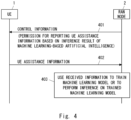
- Fig. 4 shows an example of the operation of the UE 1 and RAN node 2 for network-based AI/ML, i.e., for the network (e.g., RAN node 2) to perform AI inference on a machine learning model.
- the RAN node 2 transmits control information to the UE 1.
- the control information may be transmitted via broadcast (e.g., system information).
- the system information may be any System Information Block.
- the control information may be transmitted via dedicated signaling for the UE 1.
- the dedicated signaling may be dedicated RRC signaling, e.g., RRC Reconfiguration message, RRC Reestablishment message, RRC Resume message, or RRC Setup message.
- the control information may be an information element contained in an SIB or in dedicated RRC signaling. For example, but not limited to, the name of the information element may be "AI configuration".
- the control information indicates whether or not the UE 1 is allowed to send to the network (e.g., RAN node 2) UE assistance information indicating predicted data based on a prediction or decision by the UE 1 using a machine learning model.
- the predicted data in this example embodiment is similar to the predicted data described in the first example embodiment.
- the control information may indicate a condition under which the transmission of the UE assistance information indicating the predicted data is allowed. In this case, only if the indicated condition is met, the UE 1 may transmit the UE assistance information indicating the predicted data to the network. Alternatively, the control information may indicate a condition under which the collection of predicted data is allowed. In this case, only if the indicated condition is met, the UE 1 may collect predicted data based on AI/ML inference results. In other words, the UE 1 may include in the UE assistance information only predicted data obtained while the indicated condition is met.
- the condition may indicate a restriction with respect to at least one of a frequency band, a location, or a time.
- the condition may specify a location (e.g., a geographic area, logical area, cell, or set of cells) where the UE 1 is allowed to collect or report predicted data based on AI/ML inference results.
- the condition may specify a time or time period during which the collection or reporting of predicted data is allowed.
- the condition may specify one or more frequency bands in which predicted data is allowed to be collected or reported.
- the condition may be that a consistent failure has been detected.
- the condition may allow the UE 1 to collect or report predicted data based on AI/ML inference results if a given failure is repeatedly detected under the same or similar circumstances (e.g., location, cell, cell pair, time, frequency band, time).
- the given failure may be, for example, a handover failure or a beam failure.
- the circumstances can be at least one of location, cell, cell pair, time, frequency band, or time.
- the condition may be that the UE 1 has received a signal from the network (e.g., RAN node 2) indicating a predetermined identifier.
- the predetermined identifier may be, for example, but not limited to, a Config Set Number or ID, an AI Set Number or ID, or a Combination Set Number or ID.
- the predetermined identifier may be configured by the network to represent the same or similar situation (e.g., transmit power, antenna tilt, number of downlink beams, or other physical layer settings of the RAN node 2).
- Steps 402 and 403 in Fig. 4 are similar to steps 201 and 202 in Fig. 2 . except that in step 402, the UE 1 transmits the UE assistance information indicating the predicted data to the RAN node 2, if the control information in step 401 allows.
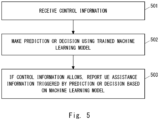
- Fig. 5 shows an example of the operation of the UE 1.
- the UE 1 receives the control information described above.
- the UE 1 makes a prediction or decision using a trained machine learning model.
- the UE 1 transmits to the RAN node 2 the UE assistance information indicating the predicted data obtained by the UE 1 through the inference with the machine learning model.
- the UE 1 reports to the network the UE assistance information triggered by the prediction or decision at the UE 1 based on the machine learning model.
- the RAN node 2 can control whether the UE 1 is allowed to report predicted data obtained based on a prediction or decision by the UE-based AI/ML.
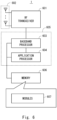
- Fig. 6 is a block diagram showing an example configuration of the UE 1.
- the radio frequency (RF) transceiver 601 performs analog RF signal processing to communicate with a RAN node.
- the RF transceiver 601 may include a plurality of transceivers.
- the analog RF signal processing performed by the RF transceiver 601 includes frequency up-conversion, frequency down-conversion, and amplification.
- the RF transceiver 601 is coupled to the antenna array 602 and the baseband processor 603.
- the RF transceiver 601 receives modulation symbol data (or OFDM symbol data) from the baseband processor 603, generates a transmission RF signal, and supplies the transmission RF signal to the antenna array 602.
- the RF transceiver 601 generates a baseband reception signal based on the reception RF signal received by the antenna array 602 and supplies the baseband reception signal to the baseband processor 603.
- the RF transceiver 601 may include an analog beamformer circuit for beamforming.
- the analog beamformer circuit includes, for example, a plurality of phase shifters and a plurality of power amplifiers.
- the baseband processor 603 performs digital baseband signal processing (data-plane processing) and control-plane processing for wireless communication.
- the digital baseband signal processing includes (a) data compression/decompression, (b) data segmentation/concatenation, (c) transmission format (transmission frame) composition/decomposition, (d) channel encoding/decoding, (e) modulation (i.e., symbol mapping)/demodulation, and (f) Inverse Fast Fourier Transform (IFFT) generation of OFDM symbol data (baseband OFDM signal).
- IFFT Inverse Fast Fourier Transform
- control-plane processing includes communication management of layer 1 (e.g., transmission power control), layer 2 (e.g., radio resource management, and hybrid automatic repeat request (HARQ) processing), and layer 3 (e.g., signaling regarding attachment, mobility, and call management).
- layer 1 e.g., transmission power control
- layer 2 e.g., radio resource management, and hybrid automatic repeat request (HARQ) processing
- layer 3 e.g., signaling regarding attachment, mobility, and call management.
- the digital baseband signal processing performed by the baseband processor 603 may include signal processing in the Service Data Adaptation Protocol (SDAP) layer, Packet Data Convergence Protocol (PDCP) layer, Radio Link Control (RLC) layer, Medium Access Control (MAC) layer, and Physical (PHY) layer.
- SDAP Service Data Adaptation Protocol
- PDCP Packet Data Convergence Protocol
- RLC Radio Link Control
- MAC Medium Access Control
- PHY Physical
- the control-plane processing performed by the baseband processor 603 may also include processing of Non-Access Stratum (NAS) protocols, Radio Resource Control (RRC) protocols, MAC Control Elements (CEs), and Downlink Control Information (DCIs).
- NAS Non-Access Stratum
- RRC Radio Resource Control
- CEs MAC Control Elements
- DCIs Downlink Control Information
- the baseband processor 603 may perform Multiple Input Multiple Output (MIMO) encoding and precoding for beamforming.
- MIMO Multiple Input Multiple Output
- the baseband processor 603 may include a modem processor (e.g., Digital Signal Processor (DSP)) that performs the digital baseband signal processing and a protocol stack processor (e.g., Central Processing Unit (CPU) or Micro Processing Unit (MPU)) that performs the control-plane processing.
- DSP Digital Signal Processor
- protocol stack processor e.g., Central Processing Unit (CPU) or Micro Processing Unit (MPU)
- the protocol stack processor performing the control-plane processing may be integrated with an application processor 604 described later.
- the application processor 604 may also be referred to as a CPU, an MPU, a microprocessor, or a processor core.
- the application processor 604 may include a plurality of processors (processor cores).
- the application processor 604 loads a system software program (Operating System (OS)) and various application programs (e.g., a voice call application, a web browser, a mailer, a camera operation application, a music player application) from a memory 606 or from another memory (not shown) and executes these programs, thereby providing various functions of the UE 1.
- OS Operating System
- the baseband processor 603 and the application processor 604 may be integrated on a single chip.
- the baseband processor 603 and the application processor 604 may be implemented in a single System on Chip (SoC) device 605.
- SoC System on Chip
- a SoC device may be referred to as a system Large Scale Integration (LSI) or a chipset.
- the memory 606 is a volatile memory or a non-volatile memory, or a combination thereof.
- the memory 606 may include a plurality of physically independent memory devices.
- the volatile memory is, for example, Static Random Access Memory (SRAM), Dynamic RAM (DRAM), or a combination thereof.
- the non-volatile memory may be a Mask Read Only Memory (MROM), an Electrically Erasable Programmable ROM (EEPROM), a flash memory, a hard disk drive, or any combination thereof.
- the memory 606 may include, for example, an external memory device that can be accessed by the baseband processor 603, the application processor 604, or the SoC 605.
- the memory 606 may include an internal memory device that is integrated into the baseband processor 603, the application processor 604, or the SoC 605. Further, the memory 606 may include a memory in a Universal Integrated Circuit Card (UICC).
- UICC Universal Integrated Circuit Card
- the memory 606 may store one or more software modules (computer programs) 607 including instructions and data for processing by the UE 1 described in the above example embodiments.
- the baseband processor 603 or the application processor 604 may load the software module(s) 607 from the memory 606 and execute the loaded software module(s) 607, thereby performing the processing of the UE 1 described in the above example embodiments with reference to the drawings.
- control-plane processing and operations performed by the UE 1 described in the above embodiments can be achieved by elements other than the RF transceiver 601 and the antenna array 602, i.e., achieved by the memory 606, which stores the software modules 607, and one or both of the baseband processor 603 and the application processor 604.
- Fig. 7 is a block diagram showing an example configuration of the RAN node 2 according to the above example embodiments.
- the RAN node 2 includes a Radio Frequency transceiver 701, a network interface 703, a processor 704, and a memory 705.
- the RF transceiver 701 performs analog RF signal processing to communicate with UEs including the UE 1.
- the RF transceiver 701 may include a plurality of transceivers.
- the RF transceiver 701 is coupled to an antenna array 702 and the processor 704.
- the RF transceiver 701 receives modulated symbol data from the processor 704, generates a transmission RF signal, and supplies the transmission RF signal to the antenna array 702.
- the RF transceiver 701 generates a baseband reception signal based on a reception RF signal received by the antenna array 702 and supplies the baseband reception signal to the processor 704.
- the RF transceiver 701 may include an analog beamformer circuit for beam forming.
- the analog beamformer circuit includes, for example, a plurality of phase shifters and a plurality of power amplifiers.
- the network interface 703 is used to communicate with network nodes (e.g., SN 2, and control and transfer nodes in the core network).
- the network interface 703 may include, for example, a network interface card (NIC) conforming to the IEEE 802.3 series.
- NIC network interface card
- the processor 704 performs digital baseband signal processing (i.e., data-plane processing) and control-plane processing for radio communication.
- the processor 704 may include a plurality of processors.
- the processor 704 may include, for example, a modem processor (e.g., Digital Signal Processor (DSP)) that performs digital baseband signal processing and a protocol stack processor (e.g., Central Processing Unit (CPU) or Micro Processing Unit (MPU) that performs the control-plane processing.
- DSP Digital Signal Processor
- the processor 704 may include a digital beamformer module for beam forming.
- the digital beamformer module may include a Multiple Input Multiple Output (MIMO) encoder and a precoder.
- MIMO Multiple Input Multiple Output
- the memory 705 is composed of a combination of a volatile memory and a non-volatile memory.
- the volatile memory is, for example, a Static Random Access Memory (SRAM), a Dynamic RAM (DRAM), or a combination thereof.
- the non-volatile memory is, for example, a Mask Read Only Memory (MROM), an Electrically Erasable Programmable ROM (EEPROM), a flash memory, a hard disk drive, or any combination thereof.
- the memory 705 may include a storage located that is separate from the processor 704. In this case, the processor 704 may access the memory 705 through the network interface 703 or an I/O interface not shown.
- the memory 705 may store one or more software modules (computer programs) 706 including instructions and data for performing the processing of the RAN node 2 described in the above example embodiments.
- the processor 704 may be configured to load these software modules 706 from the memory 705 and execute the loaded software modules, thereby performing the processing of the RAN node 2 described in the above example embodiments.
- the RAN node 2 is a CU (e.g., gNB-CU) or CU-CP (e.g., gNB-CU-CP), the RAN node 2 does not need to include the RF transceiver 701 (and antenna array 702).
- CU e.g., gNB-CU
- CU-CP e.g., gNB-CU-CP
- each of the processors in the UE 1 and RAN node 2 can execute one or more programs, containing a set of instructions, for causing a computer to perform an algorithm described with reference to the drawings.
- Each of these programs contains a set of instructions (or software codes) that, when loaded into a computer, causes the computer to perform one or more of the functions described in the example embodiments.
- Each of these programs may be stored in a non-transitory computer readable medium or a tangible storage medium.
- non-transitory computer readable media or tangible storage media can include a random-access memory (RAM), a read-only memory (ROM), a flash memory, a solid-state drive (SSD) or other memory technologies, CD-ROM, digital versatile disk (DVD), Blu-ray (registered mark) disc or other optical disk storage, magnetic cassettes, magnetic tape, magnetic disk storage or other magnetic storage devices.
- RAM random-access memory
- ROM read-only memory
- flash memory a solid-state drive
- SSD solid-state drive
- CD-ROM compact disc
- DVD digital versatile disk
- Blu-ray registered mark
- Each program may be transmitted on a transitory computer readable medium or a communication medium.
- transitory computer readable media or communication media can include electrical, optical, acoustical, or other form of propagated signals.
- NTNs Non-Terrestrial Networks
- V2X vehicle-to-everything
- HCTs high-speed trains
- UAVs unmanned aerial vehicles
- UAVs uncrewed aerial vehicles
- UAM urban air mobility
- the UE 1 may send an AI interest indication (e.g., ai-ML-InterestIndication) during an RRC connection setup, resume, or reestablishment procedure.
- the RAN node 2 may request the UE 1 to send the AI Interest Indication.
- the AI interest indication may indicate that the UE 1 supports the ability to send information (UE assistance information) to the RAN node 2 that is necessary (or useful) for performing AI inference (AI/ML prediction) on a machine learning model in the RAN node 2.
- the AI interest indication may indicate to the RAN node 2 that the UE 1 is interested in transmitting (or providing) UE assistance information.
- the AI interest indication may indicate a category of AI/ML inference that the UE 1 wishes to perform (or contribute to).
- the AI interest indication may indicate an action or category of actions for which the UE 1 wishes to be allowed to provide UE assistance information.
- the AI interest indication may indicate a function or feature (e.g., mobility, power saving) for which the UE 1 wishes to be allowed to provide UE assistance information.
- the AI interest indications may indicate a sub-function or sub-feature (e.g., cell selection, handover, beam management) for which the UE 1 wishes to be allowed to provide UE assistance information.
- the AI interest indication may indicate a procedure (e.g., RRC reestablishment, beam failure recovery (BFR)) for which the UE 1 wishes to be allowed to provide UE assistance information.
- the AI interest indication may indicate an RRC configuration (e.g., the level of information elements or fields in Abstract Syntax Notation One (ASN.1)) for which the UE 1 wishes to be allowed to provide UE assistance information.
- RRC configuration e.g., the level of information elements or fields in Abstract Syntax Notation One (ASN.1)
- the RAN node 2 may be a secondary node (Secondary Node (SN)).
- the SN can send and receive RRC messages to and from the UE 1, directly in the SCG using a signaling radio bearer (SRB3), or via the Master Node (MN).
- SRB3 signaling radio bearer
- MN Master Node
- the RAN node 2 may be a Master Node (MN) and be responsible for forwarding RRC messages between the SN and the UE 1.
- the RAN node 2 in the example embodiments described above may be realized in a C-RAN deployment.
- the RAN node 2 may include a CU (e.g., gNB-CU) and a DU (e.g., gNB-DU).
- the CU may request the UE 1 to send the UE assistance information, and may receive (via the DU) the UE assistance information from the UE 1.
- the CU may perform radio network optimization based on the UE assistance information.
- the CU may send at least part of the UE assistance information, or control information derived from (or in response to receiving) the UE assistance information, to the DU.
- the DU may perform radio network optimization based on the information sent by the CU (i.e., received by the DU).
- the radio network optimization performed by the CU may be the optimization of radio parameters (e.g., Radio Bearer Config) configured by the CU1 for the UE 1.
- the radio network optimization performed by the DU may be the optimization of radio parameters (e.g., Cell Group Config, measurement gap) configured by the DU for the UE 1.
- the above mentioned control by the CU and DU may be selected or combined.
- the RAN node 2 in the example embodiments described above may transmit at least part of the UE assistance information to one or more other network nodes.
- the other network nodes may include, for example, one or both of Operation Administration and Maintenance (OAM) and RAN Intelligent Controller (RIC).
- OAM Operation Administration and Maintenance
- RIC RAN Intelligent Controller
- the RIC may be one that is being considered by a standards body (e.g., the Open RAN (O-RAN) alliance), or it may be another network node that contributes to RAN optimization.
- the other network node may perform radio network optimization based at least in part on the UE assistance information. Additionally or alternatively, the other network node may send a new radio parameter configuration for radio network optimization to the RAN node 2. In this case, the other network node may send the new radio parameter configuration directly to one or both of the CUs or the DU.
- a radio terminal comprising:
- the radio terminal according to any one of Supplementary Notes 1 to 3, wherein the one or more conditions include one or more conditions related to a movement pattern of the radio terminal.
- the radio terminal according to any one of Supplementary Notes 1 to 4, wherein the one or more conditions include one or more conditions related to a network slice used by the radio terminal.
- the radio terminal according to any one of Supplementary Notes 1 to 5, wherein the one or more conditions include one or more conditions related to a radio configuration of the radio terminal.
- the radio terminal according to any one of Supplementary Notes 1 to 6, wherein the predicted data is real-time data that is sent to the network in response to the predicted data being generated, and the predicted data is used to perform inference on the first trained machine learning model.
- the radio terminal according to any one of Supplementary Notes 1 to 6, wherein the predicted data is recorded data.
- radio terminal according to any one of Supplementary Notes 1 to 12, wherein the at least one processor is configured to:
- a method performed by a radio terminal comprising:
- a radio access network node comprising:
- the radio access network node according to Supplementary Note 19, wherein the historical data indicates a history of success or failure of mobility or beam selection by the radio terminal.
- the radio access network node according to Supplementary Note 19 or 20, wherein the one or more conditions include one or more conditions related to one or more of location, movement speed, serving beam, serving cell, and serving frequency band of the radio terminal.
- the radio access network node according to any one of Supplementary Notes 19 to 21, wherein the one or more conditions include one or more conditions related to a movement pattern of the radio terminal.
- the radio access network node according to any one of Supplementary Notes 19 to 22, wherein the one or more conditions include one or more conditions related to a network slice used by the radio terminal.
- the radio access network node according to any one of Supplementary Notes 19 to 23, wherein the one or more conditions include one or more conditions related to a radio configuration of the radio terminal.
- the radio access network node according to any one of Supplementary Notes 19 to 24, wherein the predicted data is real-time data that is sent to the radio access network node in response to the predicted data being generated, and the predicted data is used to perform inference on the first trained machine learning model.
- the radio access network node according to Supplementary Note 25, wherein the real-time data indicates a predicted location or trajectory of the radio terminal.
- the radio access network node according to Supplementary Note 25, wherein the real-time data indicates a predicted candidate target cell or candidate downlink beam.
- the radio access network node according to any one of Supplementary Notes 19 to 24, wherein the predicted data is recorded data and used to train the first machine learning model.
- the radio access network node according to Supplementary Note 28, wherein the recorded data indicates a mobility execution timing as predicted or determined using the second trained machine learning model.
- the radio access network node according to Supplementary Note 28, wherein the recorded data indicates a downlink beam determined by beam selection using the second trained machine learning model.
- the radio access network node according to any one of Supplementary Notes 19 to 30, wherein the at least one processor is configured to transmit control information to the radio terminal. wherein the control information causes the radio terminal to transmit to the radio access network node the assistance information indicating the predicted data based on the results of the prediction or decision using the second trained machine learning model, if the control information allows.
- the radio access network node according to Supplementary Note 32 or 33, wherein the condition indicates a restriction with respect to at least one of a frequency band, a location, or a time.
- a method performed by a radio access network node comprising:
Landscapes
- Engineering & Computer Science (AREA)
- Signal Processing (AREA)
- Computer Networks & Wireless Communication (AREA)
- Evolutionary Computation (AREA)
- Artificial Intelligence (AREA)
- Physics & Mathematics (AREA)
- Theoretical Computer Science (AREA)
- Software Systems (AREA)
- Environmental & Geological Engineering (AREA)
- Biophysics (AREA)
- Data Mining & Analysis (AREA)
- Molecular Biology (AREA)
- Computing Systems (AREA)
- General Engineering & Computer Science (AREA)
- General Physics & Mathematics (AREA)
- Mathematical Physics (AREA)
- General Health & Medical Sciences (AREA)
- Computational Linguistics (AREA)
- Biomedical Technology (AREA)
- Life Sciences & Earth Sciences (AREA)
- Health & Medical Sciences (AREA)
- Computer Vision & Pattern Recognition (AREA)
- Databases & Information Systems (AREA)
- Medical Informatics (AREA)
- Mobile Radio Communication Systems (AREA)
Abstract
Description
- The present disclosure relates to radio communication networks, and in particular to the use of artificial intelligence (AI) in radio communication networks.
- The 3rd Generation Partnership Project (3GPP (registered trademark)) is discussing the application or introduction of AI or machine learning (ML) to 5G. AI/ML can be considered for both network internal functions and air interfaces (i.e., Uu). In 3GPP Release 17, the Radio Access Network (RAN) Working Group #3 (RAN3) is discussing network-based AI/ML without User Equipment (UE) involvement, where examples of targets include energy saving, load balancing, and mobility optimization (see, for example, Non-Patent
Literature 1 and 2). In network-based AI/ML, the network performs AI/ML inference. AI inference is a prediction or decision based on a trained machine learning model. AI/ML inference functionality may be located in the Next Generation Radio Access Network (NG-RAN) (e.g., gNB). The training of a machine learning model can be performed by the NG-RAN. Alternatively, Operation, Administration and Maintenance (OAM) can train a machine learning model and provide a trained machine learning model (i.e., trained parameters) to the NG-RAN (e.g., gNB). - In addition, network-based AI/ML with UE involvement and UE-based AI/ML have been proposed for 3GPP Release 18 (see, for example, Non-Patent Literature 3-5). In UE-based AI/ML, the UE performs AI/ML inference. Possible use cases for AL/ML for air interface include Channel State Information (CSI) feedback compression, beam management, positioning, Reference signal (RS) overhead reduction, and mobility. In UE-based AI/ML, the UE runs an AI model (i.e., a trained machine learning model) and obtains AI inference results locally. For example, the UE can predict a future event or measurement based on past measurements. The UE can feed back a predicted result (e.g., mobility or beam prediction) to the network (e.g., gNB).
-
- [Non-Patent Literature 1] CMCC, "Revised SID: Study on enhancement for data collection for NR and ENDC", RP-201620, 3GPP TSG-RAN Meeting #89e, Electronic meeting, September 14-18, 2020
- [Non-Patent Literature 2] 3GPP TR 37.817 V0.3.0 (2021-08) "3rd Generation Partnership Project; Technical Specification Group RAN; Evolved Universal Terrestrial Radio Access (E-UTRA) and NR; Study on enhancement for Data Collection for NR and EN-DC (Release 17)", September 23, 2021
- [Non-Patent Literature 3] Ericsson, "Views on Rel-18 AI/ML on Air-Interface", RP-212346, 3GPP TSG-RAN Meeting#93e, Electronic meeting, September 13-17, 2021
- [Non-Patent Literature 4] ZTE, "Support of Artificial Intelligence Applications for 5G Advanced", RP-212383, 3GPP TSG-RAN Meeting#93e, Electronic meeting, September 13-17, 2021
- [Non-Patent Literature 5] Xiaomi, "Mobility enhancement by UE based AI", RP-211787, 3GPP TSG-RAN Meeting#93e, Electronic meeting, September 13-17, 2021
- The inventor has studied network-based AI/ML and found various problems. One of these problems concerns the training of a machine learning model to be used in a network or the inference on a trained machine learning model. Data obtained by the UE can be used as training data for a machine learning model to be used in the network. Additionally or alternatively, data obtained by the UE can be used by the network as input data to perform inference on a trained machine learning model. At present, however, there are not sufficient mechanisms for the UE to send data to the network that is suitable for use in network-based AI/ML training or inference.
- One of the objects to be attained by example embodiments disclosed herein is to provide apparatuses, methods, and programs that contribute to solving at least one of a plurality of problems related to network-based AI/ML, including the problems described above. It should be noted that this object is merely one of the objects to be attained by the example embodiments disclosed herein. Other objects or problems and novel features will be made apparent from the following description and the accompanying drawings.
- In a first aspect, a radio terminal includes at least one memory and at least one processor coupled to the at least one memory. The at least one processor is configured to transmit assistance information to a network. The assistance information is used to train a first machine learning model related to radio access network optimization or to perform inference on a first trained machine learning model related to radio access network optimization. The assistance information includes one or both of statistical data and predicted data. The statistical data indicates a subset of historical data of a given event, extracted by filtering the historical data by one or more conditions. The predicted data is generated by the radio terminal by prediction or decision using a second trained machine learning model.
- In a second aspect, a method performed by a radio terminal includes transmitting assistance information to a network. The assistance information is used to train a first machine learning model related to radio access network optimization or to perform inference on a first trained machine learning model related to radio access network optimization. The assistance information includes one or both of statistical data and predicted data. The statistical data indicates a subset of historical data of a given event, extracted by filtering the historical data by one or more conditions. The predicted data is generated by the radio terminal by prediction or decision using a second trained machine learning model.
- In a third aspect, a radio access network (RAN) node includes at least one memory and at least one processor coupled to the at least one memory. The at least one processor is configured to receive assistance information from a radio terminal. The assistance information is used to train a first machine learning model related to radio access network optimization or to perform inference on a first trained machine learning model related to radio access network optimization. The assistance information includes one or both of statistical data and predicted data. The statistical data indicates a subset of historical data of a given event, extracted by filtering the historical data by one or more conditions. The predicted data is generated by the radio terminal by prediction or decision using a second trained machine learning model.
- In a fourth aspect, a method performed by a RAN node includes receiving assistance information from a radio terminal. The assistance information is used to train a first machine learning model related to radio access network optimization or to perform inference on a first trained machine learning model related to radio access network optimization. The assistance information includes one or both of statistical data and predicted data. The statistical data indicates a subset of historical data of a given event, extracted by filtering the historical data by one or more conditions. The predicted data is generated by the radio terminal by prediction or decision using a second trained machine learning model.
- A fifth aspect is directed to a program. The program includes a set of instructions (software codes) that, when loaded into a computer, cause the computer to perform the method described in the second or fourth aspect.
- According to the aspects described above, it is possible to provide apparatuses, methods and programs that contribute to solving at least one of a plurality of problems related to network-based AI/ML.
-
-
Fig. 1 shows an example configuration of a radio communication system according to an example embodiment; -
Fig. 2 is a sequence diagram showing an example of the operation of a radio terminal and a radio access network node according to an example embodiment; -
Fig. 3 shows a specific example of a format of UE assistance information according to an example embodiment; -
Fig. 4 is a sequence diagram showing an example of the operation of a radio terminal and a radio access network node according to an example embodiment; -
Fig. 5 is a flowchart showing an example of the operation of a radio terminal according to an example embodiment; -
Fig. 6 is a block diagram showing an example configuration of a radio terminal according to an example embodiment; and -
Fig. 7 is a block diagram showing an example configuration of a radio access network node according to an example embodiment. - Specific example embodiments will be described hereinafter in detail with reference to the drawings. The same or corresponding elements are denoted by the same symbols throughout the drawings, and duplicated explanations are omitted as necessary for the sake of clarity.
- The multiple example embodiments described below may be implemented independently or in combination, as appropriate. These example embodiments include novel features different from each other. Accordingly, these example embodiments contribute to attaining objects or solving problems different from one another and contribute to obtaining advantages different from one another.
- The example embodiments shown below are described primarily for the 3GPP fifth generation mobile communication system (5G system). However, these example embodiments may be applied to other radio communication systems.
- As used in this specification, "if" can be interpreted to mean "when", "at or around the time", "after", "upon", "in response to determining", "in accordance with a determination", or "in response to detecting", depending on the context. These expressions can be interpreted to mean the same thing, depending on the context.
- First, the configuration and operation of a plurality of network elements common to a plurality of example embodiments will be described.
Fig. 1 illustrates an example of the configuration of a radio communication system related to a plurality of example embodiments. In the example ofFig. 1 , the radio communication system includes a radio terminal (i.e., UE) 1 and a radio access network (RAN) node (e.g., gNB) 2. Each of the elements (network functions) shown inFig. 1 can be implemented, for example, as a network element on dedicated hardware, as a software instance running on dedicated hardware, or as a virtualized function instantiated on an application platform. - The
UE 1 has at least one radio transceiver and is configured to communicate wirelessly with theRAN node 2. TheUE 1 is connected to theRAN node 2 via anair interface 101. TheRAN node 2 is configured to manage a cell and to communicate wirelessly with multiple UEs, including theUE 1, using a cellular communication technology (e.g., NR Radio Access Technology (RAT)). TheUE 1 may be simultaneously connected to multiple RAN nodes for Dual Connectivity (DC). - The
RAN Node 2 may be a Central Unit (e.g., gNB-CU) in a Cloud RAN (C-RAN) deployment, or a combination of a CU and one or more Distributed Units (e.g., gNB-DUs). C-RAN is also referred to as CU/DU split. In addition, a CU may include a Control Plane (CP) unit (e.g., gNB-CU-CP) and one or more User Plane (UP) units (e.g., gNB-CU-UP). Accordingly, theRAN nodes 2 may be a CU-CP or a combination of a CU-CP and a CU-UP. A CU may be a logical node that hosts the Radio Resource Control (RRC), Service Data Adaptation Protocol (SDAP), and Packet Data Convergence Protocol (PDCP) protocols of a gNB (or the RRC and PDCP protocols of a gNB). A DU may be a logical node that hosts the Radio Link Control (RLC), Medium Access Control (MAC), and Physical (PHY) layers of a gNB. - The
UE 1 may perform AI/ML inference locally. This AI/ML inference may relate to the optimization of a radio access network. TheUE 1 may perform (or run) AI inference on a trained machine learning model and perform one or more actions according to a prediction or decision based on the AI inference. The machine learning model may be any model known in the field of machine learning, including deep learning. The machine learning model can be, for example, but not limited to, a neural network model, a support vector machine model, a decision tree model, a random forest model, or a K-nearest neighbor model. - By way of example, but not limitation, the prediction or decision based on AI inference by the
UE 1 and the one or more actions triggered thereby relate to at least one of beam management, mobility, CSI feedback, or positioning (or location estimation). By way of example, but not limitation, the one or more actions include at least one of cell reselection, sending a measurement report, performing conditional mobility, or downlink beam selection. The downlink beam may be a Synchronization Signal (SS)/Physical Broadcast Channel (PBCH) block (SSB) beam. For example, the machine learning model may output predictions of a candidate cell for cell reselection, a target cell or node for handover, a candidate cell or node for conditional mobility, a candidate beam for beam selection, or a UE trajectory. Additionally or alternatively, the machine learning model may predict or determine when to perform an action for mobility or beam management. - The cell reselection may be performed when the
UE 1 is in RRC_IDLE or RRC_INACTIVE. - Th mobility can be performed when the
UE 1 is in RRC_CONNECTED. The mobility in RRC_CONNECTED may be a handover. The handover may be a Dual Active Protocol Stack (DAPS) handover. Additionally or alternatively, the mobility in RRC_CONNECTED can be related to various mobilities in DC. Specifically, the mobility may be a change of the primary cell of a Master Cell Group (MCG) in DC, an inter-Master Node (MN) handover in DC, a secondary node change in DC, or an addition or modification of the primary cell of a secondary cell group in DC. - The conditional mobility can be performed when the
UE 1 is in RRC_CONNECTED. The conditional mobility may be a conditional handover. Additionally or alternatively, the conditional mobility may be related to various mobility in DC. Specifically, the conditional mobility may be a change of the primary cell of a Master Cell Group (MCG) in DC, an inter-Master Node (MN) handover in DC, a change of a secondary node in DC, or an addition or modification of the primary cell of a secondary cell group in DC. - The downlink beam selection can be done in a Beam Failure Recovery (BFR) procedure.
- Training of the machine learning model for AI/ML inference by the
UE 1 may be performed by theUE 1 or by the network (e.g., OAM, RAN node 2). The method of this training can be offline training, online training, or a combination of both. - Similarly, the
RAN node 2 may perform AI/ML inference. This AI/ML inference may relate to the optimization of a radio access network. TheRAN node 2 may perform (or run) AI inference on a trained machine learning model and perform one or more actions according to a prediction or decision based on the AI inference. The machine learning model may be any model known in the field of machine learning, including deep learning. The machine learning model can be, for example, but not limited to, a neural network model, a support vector machine model, a decision tree model, a random forest model, or a K-nearest neighbor model. - By way of example, but not limitation, the prediction or decision based on AI inference by the
RAN node 2 and the one or more actions triggered thereby may relate to at least one of energy saving, load balancing, mobility optimization, CSI feedback enhancement, or positioning accuracy enhancement. For example, the prediction or decision by the machine learning model may relate to one or both of energy saving strategies and mobility strategies. For mobility strategies, the machine learning model may output predictions of a target cell or node for handover, a candidate cell or node for conditional mobility, or a UE trajectory. - Training of the machine learning model for AI/ML inference by the
RAN node 2 may be performed by theRAN node 2 or by the OAM. The method of this training can be offline training, online training, or a combination of both. - An example of the configuration of a radio communication system according to this example embodiment may be similar to the example shown in
Fig. 1 .Fig. 2 shows an example of the operation of theUE 1 andRAN node 2 for network-based AI/ML, i.e., for the network (e.g., RAN node 2) to perform AI inference on a machine learning model. Instep 201, theUE 1 transmits UE assistance information to theRAN node 2. TheRAN node 2 may request theUE 1 to transmit the UE assistance information. TheUE 1 may transmit the UE assistance information in response to the request from theRAN node 2. - The UE assistance information is used in the network (e.g.,
RAN node 2, or OAM) to train a machine learning model related to radio access network optimization or to perform inference on a trained machine learning model related to radio access network optimization. In one example, as shown inFig. 2 , theRAN node 2 may use the UE assistance information received from theUE 1 to train a machine learning model or to perform inference on a trained machine learning model. The UE assistance information may be used as part of the training data for training a machine learning model used in the network (e.g., RAN node 2). The UE assistance information may be used to generate the training data. The UE assistance information may be used as input data for performing inference on a trained machine learning model in the network (e.g., RAN node 2). The UE assistance information may be used to generate input data to be fed into a trained machine learning model. The UE assistance information includes one or both of statistical data and predicted data. - The term "(for) training a machine learning model" may be paraphrased as "(for) collecting or updating training data in a machine learning model", "(for) learning (machine learning-based) artificial intelligence", "(for) improving or enhancing the accuracy of inference by artificial intelligence", "(for) machine learning", or "(for) artificial intelligence". The term " performing inference on a trained machine learning model" may be paraphrased as "performing inference by artificial intelligence (using a trained machine learning model)", "performing inference by (machine learning-based) artificial intelligence", "performing machine learning", or "performing artificial intelligence". The term "prediction or decision using a trained machine learning model by a radio terminal" may be paraphrased as "prediction or decision based on machine learning by a radio terminal (e.g., UE)", "prediction or result derived by machine learning", or "prediction or decision by (machine learning-based) artificial intelligence". The term " radio access network optimization" may mean, for example, optimization of functions or processing of a radio network (e.g., one or more RAN nodes), or optimization of values or configurations of radio parameters that a radio network configures for a radio terminal (e.g., one or more UEs).
- The statistical data indicates a subset of historical data of a given event, extracted by filtering the historical data by one or more conditions. The historical data may indicate a history of success or failure of mobility or beam selection by the
UE 1. The historical data may indicate a history of beam management. The historical data may include one or more of a Beam Failure Detection (BFD) history, a Beam Failure Recovery (BFR) history, and a Radio Link Failure (RLF) history. In other words, the given event may be mobility or beam selection (or beam management) of theUE 1. As described above, the mobility may be mobility in RRC_CONNECTED (e.g., handover, conditional handover, primary cell change in the MCG, and conditional primary cell change in the MCG). Additionally or alternatively, the mobility may be mobility (i.e., cell reselection) in RRC_IDLE or RRC_INACTIVE. The one or more conditions for filtering the historical data may include one or more conditions related to one or more of the location, movement speed, serving beam, serving cell, and serving frequency band of theUE 1. - More specifically, the one or more conditions for filtering the historical data may include one or more conditions relating to a mobility pattern of the
UE 1. TheUE 1 may extract from the recorded (or archived) historical data a subset of historical data corresponding to the same or similar mobility patterns as those specified in the condition(s). The mobility pattern may indicate one or any combination of a pair of source and target cells, a pair of source and target cell frequency bands, UE position, UE speed, and a downlink beam. - Additionally or alternatively, the one or more conditions for filtering the historical data may include one or more conditions relating to a network slice used by the
UE 1. TheUE 1 may extract from the recorded (or archived) historical data a subset of historical data corresponding to the same or similar network slice, slice group, or slice type as that specified in the condition(s). - Additionally or alternatively, the one or more conditions for filtering the historical data may include one or more conditions relating to a radio configuration of the
UE 1. TheUE 1 may extract from the recorded (or archived) historical data a subset of historical data corresponding to the same or similar radio configuration as specified in the condition(s). For example, the radio configuration may be a mobility related parameter. More specifically, the radio configuration may be a particular value of a particular offset, a particular frequency priority, or a particular execution condition for conditional mobility. - On the other hand, the predicted data is generated by a prediction or decision using a machine learning model by the
UE 1. In other words, the predicted data is generated based on an inference result of UE-based AI/ML in theUE 1. The predicted data may be real-time data that is sent to the network (e.g., RAN node 2) in response to the predicted data being generated. The real-time data may be used as input data for performing network-based AI/ML inference by the network. The real-time data may indicate the position or trajectory of theUE 1 as predicted by a machine learning model implemented in theUE 1. The real-time data may indicate a candidate target cell or candidate downlink beam predicted by a machine learning model implemented in theUE 1. - Additionally or alternatively, the predicted data generated based on the UE-based AI/ML inference results at the
UE 1 may be recorded (or archived) data. The recorded data may be used as training data for a machine learning model used in the network. Additionally or alternatively, the recorded data may be used as input data for network-based AI/ML inference runs by the network. - The recorded data may indicate the position or trajectory of the
UE 1 as predicted by a machine learning model implemented in theUE 1. The recorded data may indicate a candidate target cell or candidate downlink beam as predicted by a machine learning model implemented in theUE 1. The recorded data may indicate a mobility execution timing as predicted by a machine learning model implemented in theUE 1. The recorded data may indicate a downlink beam determined by beam selection using a machine learning model implemented in theUE 1. -
Fig. 3 shows an example of the format of the UE assistance information. An ai-ML-Assistance Information Element (IE) 302 shown inFig. 3 corresponds to the UE assistance information regarding AI. The ai-ML-Assistance IE 302 may be included in aUEAssistanceInformation IE 301. TheUEAssistanceInformation IE 301 may be transmitted to theRAN node 2 via an RRC message (e.g., RRC Setup Request, RRC Setup Complete, RRC Resume Request, RRC Resume Complete, RRC Re-establishment Request, RRC Re-establishment Complete). - The ai-ML-
Assistance IE 302 may include astatisticInfo IE statisticInfo IE 303 indicates that theUE 1 has statistical data or that theUE 1 can report statistical data. On the other hand, thestatisticInfo IE 305 specifies specific statistical data that can be sent by theUE 1 to theRAN node 2. - The ai-ML-
Assistance IE 302 may include apredictedInfo IE predictedInfo IE 304 indicates that theUE 1 has predicted data or that theUE 1 can report predicted data. On the other hand, thepredictedInfo IE 306 specifies specific predicted data that can be sent by theUE 1 toRAN node 2. - According to the behavior of the
UE 1 and theRAN node 2 described with reference toFig. 2 andFig. 3 , theUE 1 can provide the network with data suitable for training or inference of network-based - An example of the configuration of a radio communication system according to this example embodiment may be similar to the example shown in
Fig. 1 .Fig. 4 shows an example of the operation of theUE 1 andRAN node 2 for network-based AI/ML, i.e., for the network (e.g., RAN node 2) to perform AI inference on a machine learning model. Instep 401, theRAN node 2 transmits control information to theUE 1. The control information may be transmitted via broadcast (e.g., system information). The system information may be any System Information Block. Alternatively, the control information may be transmitted via dedicated signaling for theUE 1. The dedicated signaling may be dedicated RRC signaling, e.g., RRC Reconfiguration message, RRC Reestablishment message, RRC Resume message, or RRC Setup message. The control information may be an information element contained in an SIB or in dedicated RRC signaling. For example, but not limited to, the name of the information element may be "AI configuration". - The control information indicates whether or not the
UE 1 is allowed to send to the network (e.g., RAN node 2) UE assistance information indicating predicted data based on a prediction or decision by theUE 1 using a machine learning model. The predicted data in this example embodiment is similar to the predicted data described in the first example embodiment. - The control information may indicate a condition under which the transmission of the UE assistance information indicating the predicted data is allowed. In this case, only if the indicated condition is met, the
UE 1 may transmit the UE assistance information indicating the predicted data to the network. Alternatively, the control information may indicate a condition under which the collection of predicted data is allowed. In this case, only if the indicated condition is met, theUE 1 may collect predicted data based on AI/ML inference results. In other words, theUE 1 may include in the UE assistance information only predicted data obtained while the indicated condition is met. The condition may indicate a restriction with respect to at least one of a frequency band, a location, or a time. - For example, the condition may specify a location (e.g., a geographic area, logical area, cell, or set of cells) where the
UE 1 is allowed to collect or report predicted data based on AI/ML inference results. The condition may specify a time or time period during which the collection or reporting of predicted data is allowed. The condition may specify one or more frequency bands in which predicted data is allowed to be collected or reported. - Additionally or alternatively, the condition may be that a consistent failure has been detected. For example, the condition may allow the
UE 1 to collect or report predicted data based on AI/ML inference results if a given failure is repeatedly detected under the same or similar circumstances (e.g., location, cell, cell pair, time, frequency band, time). The given failure may be, for example, a handover failure or a beam failure. The circumstances can be at least one of location, cell, cell pair, time, frequency band, or time. - Additionally or alternatively, the condition may be that the
UE 1 has received a signal from the network (e.g., RAN node 2) indicating a predetermined identifier. The predetermined identifier may be, for example, but not limited to, a Config Set Number or ID, an AI Set Number or ID, or a Combination Set Number or ID. The predetermined identifier may be configured by the network to represent the same or similar situation (e.g., transmit power, antenna tilt, number of downlink beams, or other physical layer settings of the RAN node 2). -
Steps Fig. 4 are similar tosteps Fig. 2 . except that instep 402, theUE 1 transmits the UE assistance information indicating the predicted data to theRAN node 2, if the control information instep 401 allows. -
Fig. 5 shows an example of the operation of theUE 1. Instep 501, theUE 1 receives the control information described above. Instep 502, theUE 1 makes a prediction or decision using a trained machine learning model. Instep 503, if the control information allows, theUE 1 transmits to theRAN node 2 the UE assistance information indicating the predicted data obtained by theUE 1 through the inference with the machine learning model. In other words, if the control information allows, theUE 1 reports to the network the UE assistance information triggered by the prediction or decision at theUE 1 based on the machine learning model. - According to the behavior of the
UE 1 and theRAN node 2 described with reference toFig. 4 andFig. 5 , theRAN node 2 can control whether theUE 1 is allowed to report predicted data obtained based on a prediction or decision by the UE-based AI/ML. - The following provides configuration examples of the
UE 1 and theRAN node 2 according to the above described example embodiments.Fig. 6 is a block diagram showing an example configuration of theUE 1. The radio frequency (RF)transceiver 601 performs analog RF signal processing to communicate with a RAN node. TheRF transceiver 601 may include a plurality of transceivers. The analog RF signal processing performed by theRF transceiver 601 includes frequency up-conversion, frequency down-conversion, and amplification. TheRF transceiver 601 is coupled to theantenna array 602 and thebaseband processor 603. TheRF transceiver 601 receives modulation symbol data (or OFDM symbol data) from thebaseband processor 603, generates a transmission RF signal, and supplies the transmission RF signal to theantenna array 602. TheRF transceiver 601 generates a baseband reception signal based on the reception RF signal received by theantenna array 602 and supplies the baseband reception signal to thebaseband processor 603. TheRF transceiver 601 may include an analog beamformer circuit for beamforming. The analog beamformer circuit includes, for example, a plurality of phase shifters and a plurality of power amplifiers. - The
baseband processor 603 performs digital baseband signal processing (data-plane processing) and control-plane processing for wireless communication. The digital baseband signal processing includes (a) data compression/decompression, (b) data segmentation/concatenation, (c) transmission format (transmission frame) composition/decomposition, (d) channel encoding/decoding, (e) modulation (i.e., symbol mapping)/demodulation, and (f) Inverse Fast Fourier Transform (IFFT) generation of OFDM symbol data (baseband OFDM signal). On the other hand, the control-plane processing includes communication management of layer 1 (e.g., transmission power control), layer 2 (e.g., radio resource management, and hybrid automatic repeat request (HARQ) processing), and layer 3 (e.g., signaling regarding attachment, mobility, and call management). - For example, the digital baseband signal processing performed by the
baseband processor 603 may include signal processing in the Service Data Adaptation Protocol (SDAP) layer, Packet Data Convergence Protocol (PDCP) layer, Radio Link Control (RLC) layer, Medium Access Control (MAC) layer, and Physical (PHY) layer. The control-plane processing performed by thebaseband processor 603 may also include processing of Non-Access Stratum (NAS) protocols, Radio Resource Control (RRC) protocols, MAC Control Elements (CEs), and Downlink Control Information (DCIs). - The
baseband processor 603 may perform Multiple Input Multiple Output (MIMO) encoding and precoding for beamforming. - The
baseband processor 603 may include a modem processor (e.g., Digital Signal Processor (DSP)) that performs the digital baseband signal processing and a protocol stack processor (e.g., Central Processing Unit (CPU) or Micro Processing Unit (MPU)) that performs the control-plane processing. In this case, the protocol stack processor performing the control-plane processing may be integrated with anapplication processor 604 described later. - The
application processor 604 may also be referred to as a CPU, an MPU, a microprocessor, or a processor core. Theapplication processor 604 may include a plurality of processors (processor cores). Theapplication processor 604 loads a system software program (Operating System (OS)) and various application programs (e.g., a voice call application, a web browser, a mailer, a camera operation application, a music player application) from amemory 606 or from another memory (not shown) and executes these programs, thereby providing various functions of theUE 1. - In some implementations, as represented by the dashed line (605) in
Fig. 6 , thebaseband processor 603 and theapplication processor 604 may be integrated on a single chip. In other words, thebaseband processor 603 and theapplication processor 604 may be implemented in a single System on Chip (SoC)device 605. A SoC device may be referred to as a system Large Scale Integration (LSI) or a chipset. - The
memory 606 is a volatile memory or a non-volatile memory, or a combination thereof. Thememory 606 may include a plurality of physically independent memory devices. The volatile memory is, for example, Static Random Access Memory (SRAM), Dynamic RAM (DRAM), or a combination thereof. The non-volatile memory may be a Mask Read Only Memory (MROM), an Electrically Erasable Programmable ROM (EEPROM), a flash memory, a hard disk drive, or any combination thereof. Thememory 606 may include, for example, an external memory device that can be accessed by thebaseband processor 603, theapplication processor 604, or theSoC 605. Thememory 606 may include an internal memory device that is integrated into thebaseband processor 603, theapplication processor 604, or theSoC 605. Further, thememory 606 may include a memory in a Universal Integrated Circuit Card (UICC). - The
memory 606 may store one or more software modules (computer programs) 607 including instructions and data for processing by theUE 1 described in the above example embodiments. In some implementations, thebaseband processor 603 or theapplication processor 604 may load the software module(s) 607 from thememory 606 and execute the loaded software module(s) 607, thereby performing the processing of theUE 1 described in the above example embodiments with reference to the drawings. - The control-plane processing and operations performed by the
UE 1 described in the above embodiments can be achieved by elements other than theRF transceiver 601 and theantenna array 602, i.e., achieved by thememory 606, which stores thesoftware modules 607, and one or both of thebaseband processor 603 and theapplication processor 604. -
Fig. 7 is a block diagram showing an example configuration of theRAN node 2 according to the above example embodiments. Referring toFig. 7 , theRAN node 2 includes aRadio Frequency transceiver 701, anetwork interface 703, aprocessor 704, and amemory 705. TheRF transceiver 701 performs analog RF signal processing to communicate with UEs including theUE 1. TheRF transceiver 701 may include a plurality of transceivers. TheRF transceiver 701 is coupled to anantenna array 702 and theprocessor 704. TheRF transceiver 701 receives modulated symbol data from theprocessor 704, generates a transmission RF signal, and supplies the transmission RF signal to theantenna array 702. Further, theRF transceiver 701 generates a baseband reception signal based on a reception RF signal received by theantenna array 702 and supplies the baseband reception signal to theprocessor 704. TheRF transceiver 701 may include an analog beamformer circuit for beam forming. The analog beamformer circuit includes, for example, a plurality of phase shifters and a plurality of power amplifiers. - The
network interface 703 is used to communicate with network nodes (e.g.,SN 2, and control and transfer nodes in the core network). Thenetwork interface 703 may include, for example, a network interface card (NIC) conforming to the IEEE 802.3 series. - The
processor 704 performs digital baseband signal processing (i.e., data-plane processing) and control-plane processing for radio communication. Theprocessor 704 may include a plurality of processors. Theprocessor 704 may include, for example, a modem processor (e.g., Digital Signal Processor (DSP)) that performs digital baseband signal processing and a protocol stack processor (e.g., Central Processing Unit (CPU) or Micro Processing Unit (MPU) that performs the control-plane processing. Theprocessor 704 may include a digital beamformer module for beam forming. The digital beamformer module may include a Multiple Input Multiple Output (MIMO) encoder and a precoder. - The
memory 705 is composed of a combination of a volatile memory and a non-volatile memory. The volatile memory is, for example, a Static Random Access Memory (SRAM), a Dynamic RAM (DRAM), or a combination thereof. The non-volatile memory is, for example, a Mask Read Only Memory (MROM), an Electrically Erasable Programmable ROM (EEPROM), a flash memory, a hard disk drive, or any combination thereof. Thememory 705 may include a storage located that is separate from theprocessor 704. In this case, theprocessor 704 may access thememory 705 through thenetwork interface 703 or an I/O interface not shown. - The
memory 705 may store one or more software modules (computer programs) 706 including instructions and data for performing the processing of theRAN node 2 described in the above example embodiments. In some implementations, theprocessor 704 may be configured to load thesesoftware modules 706 from thememory 705 and execute the loaded software modules, thereby performing the processing of theRAN node 2 described in the above example embodiments. - If the
RAN node 2 is a CU (e.g., gNB-CU) or CU-CP (e.g., gNB-CU-CP), theRAN node 2 does not need to include the RF transceiver 701 (and antenna array 702). - As described using
Figs. 6 and7 , each of the processors in theUE 1 andRAN node 2 according to the example embodiments described above can execute one or more programs, containing a set of instructions, for causing a computer to perform an algorithm described with reference to the drawings. Each of these programs contains a set of instructions (or software codes) that, when loaded into a computer, causes the computer to perform one or more of the functions described in the example embodiments. Each of these programs may be stored in a non-transitory computer readable medium or a tangible storage medium. By way of example, and not limitation, non-transitory computer readable media or tangible storage media can include a random-access memory (RAM), a read-only memory (ROM), a flash memory, a solid-state drive (SSD) or other memory technologies, CD-ROM, digital versatile disk (DVD), Blu-ray (registered mark) disc or other optical disk storage, magnetic cassettes, magnetic tape, magnetic disk storage or other magnetic storage devices. Each program may be transmitted on a transitory computer readable medium or a communication medium. By way of example, but not limitation, transitory computer readable media or communication media can include electrical, optical, acoustical, or other form of propagated signals. - The example embodiments described above can be applied to Non-Terrestrial Networks (NTNs). The above example embodiments can be applied to various emerging applications, such as vehicle-to-everything (V2X), high-speed trains (HSTs), unmanned aerial vehicles (UAVs), uncrewed aerial vehicles (UAVs), urban air mobility (UAM).
- In the example embodiments described above, the
UE 1 may send an AI interest indication (e.g., ai-ML-InterestIndication) during an RRC connection setup, resume, or reestablishment procedure. TheRAN node 2 may request theUE 1 to send the AI Interest Indication. The AI interest indication may indicate that theUE 1 supports the ability to send information (UE assistance information) to theRAN node 2 that is necessary (or useful) for performing AI inference (AI/ML prediction) on a machine learning model in theRAN node 2. Additionally or alternatively, the AI interest indication may indicate to theRAN node 2 that theUE 1 is interested in transmitting (or providing) UE assistance information. The AI interest indication may indicate a category of AI/ML inference that theUE 1 wishes to perform (or contribute to). In other words, the AI interest indication may indicate an action or category of actions for which theUE 1 wishes to be allowed to provide UE assistance information. The AI interest indication may indicate a function or feature (e.g., mobility, power saving) for which theUE 1 wishes to be allowed to provide UE assistance information. The AI interest indications may indicate a sub-function or sub-feature (e.g., cell selection, handover, beam management) for which theUE 1 wishes to be allowed to provide UE assistance information. The AI interest indication may indicate a procedure (e.g., RRC reestablishment, beam failure recovery (BFR)) for which theUE 1 wishes to be allowed to provide UE assistance information. The AI interest indication may indicate an RRC configuration (e.g., the level of information elements or fields in Abstract Syntax Notation One (ASN.1)) for which theUE 1 wishes to be allowed to provide UE assistance information. - The example embodiments described above can be applied to a Secondary Cell Group (SCG) in Dual Connectivity (e.g., Multi-Radio Dual Connectivity (MR-DC)). In this case, the
RAN node 2 may be a secondary node (Secondary Node (SN)). In this case, the SN can send and receive RRC messages to and from theUE 1, directly in the SCG using a signaling radio bearer (SRB3), or via the Master Node (MN). Additionally or alternatively, theRAN node 2 may be a Master Node (MN) and be responsible for forwarding RRC messages between the SN and theUE 1. - The
RAN node 2 in the example embodiments described above may be realized in a C-RAN deployment. For example, theRAN node 2 may include a CU (e.g., gNB-CU) and a DU (e.g., gNB-DU). The CU may request theUE 1 to send the UE assistance information, and may receive (via the DU) the UE assistance information from theUE 1. The CU may perform radio network optimization based on the UE assistance information. In addition, the CU may send at least part of the UE assistance information, or control information derived from (or in response to receiving) the UE assistance information, to the DU. The DU may perform radio network optimization based on the information sent by the CU (i.e., received by the DU). For example, the radio network optimization performed by the CU may be the optimization of radio parameters (e.g., Radio Bearer Config) configured by the CU1 for theUE 1. The radio network optimization performed by the DU may be the optimization of radio parameters (e.g., Cell Group Config, measurement gap) configured by the DU for theUE 1. Depending on the objective of the radio network optimization or the type and content of the requested UE assistance information, the above mentioned control by the CU and DU may be selected or combined. - The
RAN node 2 in the example embodiments described above may transmit at least part of the UE assistance information to one or more other network nodes. The other network nodes may include, for example, one or both of Operation Administration and Maintenance (OAM) and RAN Intelligent Controller (RIC). The RIC may be one that is being considered by a standards body (e.g., the Open RAN (O-RAN) alliance), or it may be another network node that contributes to RAN optimization. The other network node may perform radio network optimization based at least in part on the UE assistance information. Additionally or alternatively, the other network node may send a new radio parameter configuration for radio network optimization to theRAN node 2. In this case, the other network node may send the new radio parameter configuration directly to one or both of the CUs or the DU. - The above-described example embodiments are merely examples of applications of the technical ideas obtained by the inventor. These technical ideas are not limited to the above-described example embodiments and various modifications can be made thereto.
- For example, the whole or part of the example embodiments disclosed above can be described as, but not limited to, the following supplementary notes.
- A radio terminal comprising:
- at least one memory; and
- at least one processor coupled to the at least one memory and configured to transmit assistance information to a network, wherein
- the assistance information is used to train a first machine learning model related to radio access network optimization or to perform inference on a first trained machine learning model related to radio access network optimization,
- the assistance information includes one or both of statistical data and predicted data,
- the statistical data indicates a subset of historical data of a given event, extracted by filtering the historical data by one or more conditions, and
- the predicted data is generated by the radio terminal by prediction or decision using a second trained machine learning model.
- The radio terminal according to
Supplementary Note 1, wherein the historical data indicates a history of success or failure of mobility or beam selection by the radio terminal. - The radio terminal according to
Supplementary Note - The radio terminal according to any one of
Supplementary Notes 1 to 3, wherein the one or more conditions include one or more conditions related to a movement pattern of the radio terminal. - The radio terminal according to any one of
Supplementary Notes 1 to 4, wherein the one or more conditions include one or more conditions related to a network slice used by the radio terminal. - The radio terminal according to any one of
Supplementary Notes 1 to 5, wherein the one or more conditions include one or more conditions related to a radio configuration of the radio terminal. - The radio terminal according to any one of
Supplementary Notes 1 to 6, wherein the predicted data is real-time data that is sent to the network in response to the predicted data being generated, and the predicted data is used to perform inference on the first trained machine learning model. - The radio terminal according to Supplementary Note 7, wherein the real-time data indicates a predicted location or trajectory of the radio terminal.
- The radio terminal according to Supplementary Note 7, wherein the real-time data indicates a predicted candidate target cell or candidate downlink beam.
- The radio terminal according to any one of
Supplementary Notes 1 to 6, wherein the predicted data is recorded data. - The radio terminal according to Supplementary Note 10, wherein the recorded data indicates a mobility execution timing as predicted or determined using the second trained machine learning model.
- The radio terminal according to Supplementary Note 10, wherein the recorded data indicates a downlink beam determined by beam selection using the second trained machine learning model.
- The radio terminal according to any one of
Supplementary Notes 1 to 12, wherein the at least one processor is configured to: - receive control information from the network; and
- transmit to the network the assistance information indicating the predicted data based on the results of the prediction or decision using the second trained machine learning model, if the control information allows.
- The radio terminal according to Supplementary Note 13, wherein
- the control information indicates a condition under which transmission of the assistance information indicating the predicted data is allowed, and
- the at least one processor is configured to transmit the assistance information indicating the predicted data to the network only if the condition is met.
- The radio terminal according to Supplementary Note 13, wherein
- the control information indicates a condition under which collection of the predicted data is allowed, and
- the at least one processor is configured to include in the assistance information only predicted data obtained when the condition is met.
- The radio terminal according to Supplementary Note 14 or 15, wherein the condition indicates a restriction with respect to at least one of a frequency band, a location, or a time.
- A method performed by a radio terminal, the method comprising:
- transmitting assistance information to a network, wherein
- the assistance information is used to train a first machine learning model related to radio access network optimization or to perform inference on a first trained machine learning model related to radio access network optimization,
- the assistance information includes one or both of statistical data and predicted data,
- the statistical data indicates a subset of historical data of a given event, extracted by filtering the historical data by one or more conditions, and
- the predicted data is generated by the radio terminal by prediction or decision using a second trained machine learning model.
- A program for causing a computer to perform a method for a radio terminal,
- the method comprising transmitting assistance information to a network, wherein
- the assistance information is used to train a first machine learning model related to radio access network optimization or to perform inference on a first trained machine learning model related to radio access network optimization,
- the assistance information includes one or both of statistical data and predicted data,
- the statistical data indicates a subset of historical data of a given event, extracted by filtering the historical data by one or more conditions, and
- the predicted data is generated by the radio terminal by prediction or decision using a second trained machine learning model.
- A radio access network node comprising:
- at least one memory; and
- at least one processor coupled to the at least one memory and configured to receive assistance information from a radio terminal, wherein
- the assistance information is used to train a first machine learning model related to radio access network optimization or to perform inference on a first trained machine learning model related to radio access network optimization,
- the assistance information includes one or both of statistical data and predicted data,
- the statistical data indicates a subset of historical data of a given event, extracted by filtering the historical data by one or more conditions, and
- the predicted data is generated by the radio terminal by prediction or decision using a second trained machine learning model.
- The radio access network node according to Supplementary Note 19, wherein the historical data indicates a history of success or failure of mobility or beam selection by the radio terminal.
- The radio access network node according to Supplementary Note 19 or 20, wherein the one or more conditions include one or more conditions related to one or more of location, movement speed, serving beam, serving cell, and serving frequency band of the radio terminal.
- The radio access network node according to any one of Supplementary Notes 19 to 21, wherein the one or more conditions include one or more conditions related to a movement pattern of the radio terminal.
- The radio access network node according to any one of Supplementary Notes 19 to 22, wherein the one or more conditions include one or more conditions related to a network slice used by the radio terminal.
- The radio access network node according to any one of Supplementary Notes 19 to 23, wherein the one or more conditions include one or more conditions related to a radio configuration of the radio terminal.
- The radio access network node according to any one of Supplementary Notes 19 to 24, wherein the predicted data is real-time data that is sent to the radio access network node in response to the predicted data being generated, and the predicted data is used to perform inference on the first trained machine learning model.
- The radio access network node according to Supplementary Note 25, wherein the real-time data indicates a predicted location or trajectory of the radio terminal.
- The radio access network node according to Supplementary Note 25, wherein the real-time data indicates a predicted candidate target cell or candidate downlink beam.
- The radio access network node according to any one of Supplementary Notes 19 to 24, wherein the predicted data is recorded data and used to train the first machine learning model.
- The radio access network node according to Supplementary Note 28, wherein the recorded data indicates a mobility execution timing as predicted or determined using the second trained machine learning model.
- The radio access network node according to Supplementary Note 28, wherein the recorded data indicates a downlink beam determined by beam selection using the second trained machine learning model.
- The radio access network node according to any one of Supplementary Notes 19 to 30, wherein the at least one processor is configured to transmit control information to the radio terminal.
wherein the control information causes the radio terminal to transmit to the radio access network node the assistance information indicating the predicted data based on the results of the prediction or decision using the second trained machine learning model, if the control information allows. - The radio access network node according to Supplementary Note 31, wherein
- the control information indicates a condition under which transmission of the assistance information indicating the predicted data is allowed, and
- the control information causes the radio terminal to transmit the assistance information indicating the predicted data to the radio access network node only if the condition is met.
- The radio access network node according to Supplementary Note 31, wherein
- the control information indicates a condition under which collection of the predicted data is allowed, and
- the control information causes the radio terminal to include in the assistance information only predicted data obtained when the condition is met.
- The radio access network node according to Supplementary Note 32 or 33, wherein the condition indicates a restriction with respect to at least one of a frequency band, a location, or a time.
- A method performed by a radio access network node, the method comprising:
- receiving assistance information from a radio terminal, wherein
- the assistance information is used to train a first machine learning model related to radio access network optimization or to perform inference on a first trained machine learning model related to radio access network optimization,
- the assistance information includes one or both of statistical data and predicted data,
- the statistical data indicates a subset of historical data of a given event, extracted by filtering the historical data by one or more conditions, and
- the predicted data is generated by the radio terminal by prediction or decision using a second trained machine learning model.
- A program for causing a computer to perform a method for a radio access network node,
- the method comprising receiving assistance information from a radio terminal, wherein
- the assistance information is used to train a first machine learning model related to radio access network optimization or to perform inference on a first trained machine learning model related to radio access network optimization,
- the assistance information includes one or both of statistical data and predicted data,
- the statistical data indicates a subset of historical data of a given event, extracted by filtering the historical data by one or more conditions, and
- the predicted data is generated by the radio terminal by prediction or decision using a second trained machine learning model.
- This application is based upon and claims the benefit of priority from
Japanese Patent Application No. 2021-182105, filed on November 8, 2021 -
- 1
- UE
- 2
- RAN Node
- 603
- Baseband Processor
- 604
- Application Processor
- 606
- Memory
- 607
- Modules
- 704
- Processor
- 705
- Memory
- 706
- Modules
Claims (36)
- A radio terminal comprising:at least one memory; andat least one processor coupled to the at least one memory and configured to transmit assistance information to a network, whereinthe assistance information is used to train a first machine learning model related to radio access network optimization or to perform inference on a first trained machine learning model related to radio access network optimization,the assistance information includes one or both of statistical data and predicted data,the statistical data indicates a subset of historical data of a given event, extracted by filtering the historical data by one or more conditions, andthe predicted data is generated by the radio terminal by prediction or decision using a second trained machine learning model.
- The radio terminal according to claim 1, wherein the historical data indicates a history of success or failure of mobility or beam selection by the radio terminal.
- The radio terminal according to claim 1 or 2, wherein the one or more conditions include one or more conditions related to one or more of location, movement speed, serving beam, serving cell, and serving frequency band of the radio terminal.
- The radio terminal according to any one of claims 1 to 3,
wherein the one or more conditions include one or more conditions related to a movement pattern of the radio terminal. - The radio terminal according to any one of claims 1 to 4,
wherein the one or more conditions include one or more conditions related to a network slice used by the radio terminal. - The radio terminal according to any one of claims 1 to 5,
wherein the one or more conditions include one or more conditions related to a radio configuration of the radio terminal. - The radio terminal according to any one of claims 1 to 6,
wherein the predicted data is real-time data that is sent to the network in response to the predicted data being generated, and the predicted data is used to perform inference on the first trained machine learning model. - The radio terminal according to claim 7, wherein the real-time data indicates a predicted location or trajectory of the radio terminal.
- The radio terminal according to claim 7, wherein the real-time data indicates a predicted candidate target cell or candidate downlink beam.
- The radio terminal according to any one of claims 1 to 6,
wherein the predicted data is recorded data. - The radio terminal according to claim 10, wherein the recorded data indicates a mobility execution timing as predicted or determined using the second trained machine learning model.
- The radio terminal according to claim 10, wherein the recorded data indicates a downlink beam determined by beam selection using the second trained machine learning model.
- The radio terminal according to any one of claims 1 to 12,
wherein the at least one processor is configured to:receive control information from the network; andtransmit to the network the assistance information indicating the predicted data based on the results of the prediction or decision using the second trained machine learning model, if the control information allows. - The radio terminal according to claim 13, whereinthe control information indicates a condition under which transmission of the assistance information indicating the predicted data is allowed, andthe at least one processor is configured to transmit the assistance information indicating the predicted data to the network only if the condition is met.
- The radio terminal according to claim 13, whereinthe control information indicates a condition under which collection of the predicted data is allowed, andthe at least one processor is configured to include in the assistance information only predicted data obtained when the condition is met.
- The radio terminal according to claim 14 or 15, wherein the condition indicates a restriction with respect to at least one of a frequency band, a location, or a time.
- A method performed by a radio terminal, the method comprising:transmitting assistance information to a network, whereinthe assistance information is used to train a first machine learning model related to radio access network optimization or to perform inference on a first trained machine learning model related to radio access network optimization,the assistance information includes one or both of statistical data and predicted data,the statistical data indicates a subset of historical data of a given event, extracted by filtering the historical data by one or more conditions, andthe predicted data is generated by the radio terminal by prediction or decision using a second trained machine learning model.
- A non-transitory computer-readable medium storing a program for causing a computer to perform a method for a radio terminal,the method comprising transmitting assistance information to a network, whereinthe assistance information is used to train a first machine learning model related to radio access network optimization or to perform inference on a first trained machine learning model related to radio access network optimization,the assistance information includes one or both of statistical data and predicted data,the statistical data indicates a subset of historical data of a given event, extracted by filtering the historical data by one or more conditions, andthe predicted data is generated by the radio terminal by prediction or decision using a second trained machine learning model.
- A radio access network node comprising:at least one memory; andat least one processor coupled to the at least one memory and configured to receive assistance information from a radio terminal,whereinthe assistance information is used to train a first machine learning model related to radio access network optimization or to perform inference on a first trained machine learning model related to radio access network optimization,the assistance information includes one or both of statistical data and predicted data,the statistical data indicates a subset of historical data of a given event, extracted by filtering the historical data by one or more conditions, andthe predicted data is generated by the radio terminal by prediction or decision using a second trained machine learning model.
- The radio access network node according to claim 19, wherein the historical data indicates a history of success or failure of mobility or beam selection by the radio terminal.
- The radio access network node according to claim 19 or 20,
wherein the one or more conditions include one or more conditions related to one or more of location, movement speed, serving beam, serving cell, and serving frequency band of the radio terminal. - The radio access network node according to any one of claims 19 to 21, wherein the one or more conditions include one or more conditions related to a movement pattern of the radio terminal.
- The radio access network node according to any one of claims 19 to 22, wherein the one or more conditions include one or more conditions related to a network slice used by the radio terminal.
- The radio access network node according to any one of claims 19 to 23, wherein the one or more conditions include one or more conditions related to a radio configuration of the radio terminal.
- The radio access network node according to any one of claims 19 to 24, wherein the predicted data is real-time data that is sent to the radio access network node in response to the predicted data being generated, and the predicted data is used to perform inference on the first trained machine learning model.
- The radio access network node according to claim 25, wherein the real-time data indicates a predicted location or trajectory of the radio terminal.
- The radio access network node according to claim 25, wherein the real-time data indicates a predicted candidate target cell or candidate downlink beam.
- The radio access network node according to any one of claims 19 to 24, wherein the predicted data is recorded data and used to train the first machine learning model.
- The radio access network node according to claim 28, wherein the recorded data indicates a mobility execution timing as predicted or determined using the second trained machine learning model.
- The radio access network node according to claim 28, wherein the recorded data indicates a downlink beam determined by beam selection using the second trained machine learning model.
- The radio access network node according to any one of claims 19 to 30, wherein the at least one processor is configured to transmit control information to the radio terminal.
wherein the control information causes the radio terminal to transmit to the radio access network node the assistance information indicating the predicted data based on the results of the prediction or decision using the second trained machine learning model, if the control information allows. - The radio access network node according to claim 31, whereinthe control information indicates a condition under which transmission of the assistance information indicating the predicted data is allowed, andthe control information causes the radio terminal to transmit the assistance information indicating the predicted data to the radio access network node only if the condition is met.
- The radio access network node according to claim 31, whereinthe control information indicates a condition under which collection of the predicted data is allowed, andthe control information causes the radio terminal to include in the assistance information only predicted data obtained when the condition is met.
- The radio access network node according to claim 32 or 33,
wherein the condition indicates a restriction with respect to at least one of a frequency band, a location, or a time. - A method performed by a radio access network node, the method comprising:receiving assistance information from a radio terminal, whereinthe assistance information is used to train a first machine learning model related to radio access network optimization or to perform inference on a first trained machine learning model related to radio access network optimization,the assistance information includes one or both of statistical data and predicted data,the statistical data indicates a subset of historical data of a given event, extracted by filtering the historical data by one or more conditions, andthe predicted data is generated by the radio terminal by prediction or decision using a second trained machine learning model.
- A non-transitory computer-readable medium storing a program for causing a computer to perform a method for a radio access network node,the method comprising receiving assistance information from a radio terminal, whereinthe assistance information is used to train a first machine learning model related to radio access network optimization or to perform inference on a first trained machine learning model related to radio access network optimization,the assistance information includes one or both of statistical data and predicted data,the statistical data indicates a subset of historical data of a given event, extracted by filtering the historical data by one or more conditions, andthe predicted data is generated by the radio terminal by prediction or decision using a second trained machine learning model.
Applications Claiming Priority (2)
| Application Number | Priority Date | Filing Date | Title |
|---|---|---|---|
| JP2021182105 | 2021-11-08 | ||
| PCT/JP2022/038759 WO2023079947A1 (en) | 2021-11-08 | 2022-10-18 | Wireless terminal, radio access network node, and methods therefor |
Publications (2)
| Publication Number | Publication Date |
|---|---|
| EP4432719A1 true EP4432719A1 (en) | 2024-09-18 |
| EP4432719A4 EP4432719A4 (en) | 2025-01-29 |
Family
ID=86241485
Family Applications (1)
| Application Number | Title | Priority Date | Filing Date |
|---|---|---|---|
| EP22889768.2A Pending EP4432719A4 (en) | 2021-11-08 | 2022-10-18 | WIRELESS TERMINAL, RADIO ACCESS NETWORK NODE, AND RELATED METHODS |
Country Status (4)
| Country | Link |
|---|---|
| US (1) | US20240414565A1 (en) |
| EP (1) | EP4432719A4 (en) |
| JP (2) | JP7758052B2 (en) |
| WO (1) | WO2023079947A1 (en) |
Families Citing this family (10)
| Publication number | Priority date | Publication date | Assignee | Title |
|---|---|---|---|---|
| US20240089768A1 (en) * | 2022-09-13 | 2024-03-14 | Verizon Patent And Licensing Inc. | Systems and methods for identifying security issues during a network attachment |
| CN121359484A (en) * | 2023-05-15 | 2026-01-16 | 富士通株式会社 | Information transmission methods and devices |
| CN121368906A (en) * | 2023-05-17 | 2026-01-20 | 诺基亚技术有限公司 | Beam selection based on predicted signal condition parameters |
| US20250023621A1 (en) * | 2023-07-12 | 2025-01-16 | Dell Products L.P. | Interaction-aware multiple-user joint spatial-temporal beam management |
| WO2025152085A1 (en) * | 2024-01-17 | 2025-07-24 | Nec Corporation | Devices and methods of communication |
| WO2025160845A1 (en) * | 2024-01-31 | 2025-08-07 | Oppo广东移动通信有限公司 | Wireless communication method and apparatus, and device and storage medium |
| WO2025208411A1 (en) * | 2024-04-03 | 2025-10-09 | Nec Corporation | Devices and methods of communication |
| WO2025222344A1 (en) * | 2024-04-22 | 2025-10-30 | 北京小米移动软件有限公司 | Communication method, terminal, communication device, and storage medium |
| US20250393092A1 (en) * | 2024-04-26 | 2025-12-25 | Samsung Electronics Co., Ltd. | Early radio link failure (rlf) declaration based on experience |
| WO2026075150A1 (en) * | 2024-10-02 | 2026-04-09 | 京セラ株式会社 | Communication method and network node |
Family Cites Families (4)
| Publication number | Priority date | Publication date | Assignee | Title |
|---|---|---|---|---|
| US11696119B2 (en) * | 2019-12-16 | 2023-07-04 | Qualcomm Incorporated | Neural network configuration for wireless communication system assistance |
| WO2021134597A1 (en) * | 2019-12-31 | 2021-07-08 | 华为技术有限公司 | Method and apparatus for reporting measurement information, and method and apparatus for collecting measurement information |
| US11533658B2 (en) * | 2020-02-24 | 2022-12-20 | Qualcomm Incorporated | Compressed measurement feedback using an encoder neural network |
| JP7465721B2 (en) | 2020-05-20 | 2024-04-11 | 東芝テック株式会社 | Image forming device |
-
2022
- 2022-10-18 WO PCT/JP2022/038759 patent/WO2023079947A1/en not_active Ceased
- 2022-10-18 US US18/702,019 patent/US20240414565A1/en active Pending
- 2022-10-18 JP JP2023557931A patent/JP7758052B2/en active Active
- 2022-10-18 EP EP22889768.2A patent/EP4432719A4/en active Pending
-
2025
- 2025-10-07 JP JP2025169318A patent/JP2025188133A/en active Pending
Also Published As
| Publication number | Publication date |
|---|---|
| JP7758052B2 (en) | 2025-10-22 |
| EP4432719A4 (en) | 2025-01-29 |
| US20240414565A1 (en) | 2024-12-12 |
| JPWO2023079947A1 (en) | 2023-05-11 |
| JP2025188133A (en) | 2025-12-25 |
| WO2023079947A1 (en) | 2023-05-11 |
Similar Documents
| Publication | Publication Date | Title |
|---|---|---|
| EP4432719A1 (en) | Wireless terminal, radio access network node, and methods therefor | |
| EP4432738A1 (en) | Wireless terminal, radio access network node, and methods therefor | |
| US11564271B2 (en) | User equipment category signaling in an LTE-5G configuration | |
| EP3567945A1 (en) | Radio access network node, wireless terminal, methods therefor, and non-temporary computer-readable medium | |
| EP3567978B1 (en) | Wireless terminal, base station, methods therefor, and non-temporary computer-readable medium | |
| WO2022209234A1 (en) | Ran node, ue, and method | |
| EP3993478A1 (en) | Pcf device, af device, nef device, and methods for same | |
| US20250062967A1 (en) | Network resource models and technologies for actions executed according to machine learning inference reports | |
| EP4460099A1 (en) | Wireless access network node, user equipment, and methods for same | |
| US20240414523A1 (en) | Terminal device, first network element and second network element | |
| EP4690875A1 (en) | Applicability report for ai/ml for phy models | |
| EP4460086A1 (en) | User equipment, wireless access network node, and methods therefor | |
| US20250274744A1 (en) | User equipment (ue)-side applicable functionality reporting and management | |
| US20260046708A1 (en) | Method and apparatus for report on flight path and measurement information of aerial ue in wireless communication system | |
| EP4708967A2 (en) | Radio access network node and method therefor | |
| WO2025222344A1 (en) | Communication method, terminal, communication device, and storage medium | |
| US20240260122A1 (en) | Inactive state ue context handling in service-based (r)adio access network | |
| US20260032469A1 (en) | Communication control method | |
| WO2025173466A1 (en) | Wireless terminal, wireless access network node, information processing system, and methods thereof | |
| WO2026028819A1 (en) | Wireless terminal and method therefor | |
| KR20260061337A (en) | Sidelink Positioning Reference Signal (PRS) Configuration Modalities | |
| WO2026028679A1 (en) | Radio terminal, radio access network node, and method for same | |
| KR20260057419A (en) | Gapless Inter-Radio Access Technology (RAT) Measurement | |
| JP2026513734A (en) | Discovery and re-selection of anchor UEs for sidelink communication | |
| WO2024224716A1 (en) | Terminal, base station, and communication method |
Legal Events
| Date | Code | Title | Description |
|---|---|---|---|
| STAA | Information on the status of an ep patent application or granted ep patent |
Free format text: STATUS: THE INTERNATIONAL PUBLICATION HAS BEEN MADE |
|
| PUAI | Public reference made under article 153(3) epc to a published international application that has entered the european phase |
Free format text: ORIGINAL CODE: 0009012 |
|
| STAA | Information on the status of an ep patent application or granted ep patent |
Free format text: STATUS: REQUEST FOR EXAMINATION WAS MADE |
|
| 17P | Request for examination filed |
Effective date: 20240502 |
|
| AK | Designated contracting states |
Kind code of ref document: A1 Designated state(s): AL AT BE BG CH CY CZ DE DK EE ES FI FR GB GR HR HU IE IS IT LI LT LU LV MC ME MK MT NL NO PL PT RO RS SE SI SK SM TR |
|
| A4 | Supplementary search report drawn up and despatched |
Effective date: 20250107 |
|
| RIC1 | Information provided on ipc code assigned before grant |
Ipc: H04W 24/10 20090101ALN20241220BHEP Ipc: H04L 41/14 20220101ALN20241220BHEP Ipc: H04W 24/02 20090101AFI20241220BHEP |
|
| DAV | Request for validation of the european patent (deleted) | ||
| DAX | Request for extension of the european patent (deleted) |