EP4432689A1 - Automatic termination of image sensor for analog histogram depth sensing - Google Patents
Automatic termination of image sensor for analog histogram depth sensing Download PDFInfo
- Publication number
- EP4432689A1 EP4432689A1 EP24154389.1A EP24154389A EP4432689A1 EP 4432689 A1 EP4432689 A1 EP 4432689A1 EP 24154389 A EP24154389 A EP 24154389A EP 4432689 A1 EP4432689 A1 EP 4432689A1
- Authority
- EP
- European Patent Office
- Prior art keywords
- exposure
- response
- stop
- memory
- transistor
- Prior art date
- Legal status (The legal status is an assumption and is not a legal conclusion. Google has not performed a legal analysis and makes no representation as to the accuracy of the status listed.)
- Pending
Links
Images





Classifications
-
- H—ELECTRICITY
- H04—ELECTRIC COMMUNICATION TECHNIQUE
- H04N—PICTORIAL COMMUNICATION, e.g. TELEVISION
- H04N25/00—Circuitry of solid-state image sensors [SSIS]; Control thereof
- H04N25/50—Control of the SSIS exposure
- H04N25/57—Control of the dynamic range
-
- H—ELECTRICITY
- H04—ELECTRIC COMMUNICATION TECHNIQUE
- H04N—PICTORIAL COMMUNICATION, e.g. TELEVISION
- H04N25/00—Circuitry of solid-state image sensors [SSIS]; Control thereof
- H04N25/70—SSIS architectures; Circuits associated therewith
- H04N25/703—SSIS architectures incorporating pixels for producing signals other than image signals
- H04N25/705—Pixels for depth measurement, e.g. RGBZ
-
- H—ELECTRICITY
- H04—ELECTRIC COMMUNICATION TECHNIQUE
- H04N—PICTORIAL COMMUNICATION, e.g. TELEVISION
- H04N25/00—Circuitry of solid-state image sensors [SSIS]; Control thereof
- H04N25/50—Control of the SSIS exposure
-
- G—PHYSICS
- G01—MEASURING; TESTING
- G01S—RADIO DIRECTION-FINDING; RADIO NAVIGATION; DETERMINING DISTANCE OR VELOCITY BY USE OF RADIO WAVES; LOCATING OR PRESENCE-DETECTING BY USE OF THE REFLECTION OR RERADIATION OF RADIO WAVES; ANALOGOUS ARRANGEMENTS USING OTHER WAVES
- G01S17/00—Systems using the reflection or reradiation of electromagnetic waves other than radio waves, e.g. lidar systems
- G01S17/88—Lidar systems specially adapted for specific applications
- G01S17/89—Lidar systems specially adapted for specific applications for mapping or imaging
- G01S17/894—Three-dimensional [3D] imaging with simultaneous measurement of time-of-flight at a two-dimensional [2D] array of receiver pixels, e.g. time-of-flight cameras or flash lidar
-
- G—PHYSICS
- G01—MEASURING; TESTING
- G01S—RADIO DIRECTION-FINDING; RADIO NAVIGATION; DETERMINING DISTANCE OR VELOCITY BY USE OF RADIO WAVES; LOCATING OR PRESENCE-DETECTING BY USE OF THE REFLECTION OR RERADIATION OF RADIO WAVES; ANALOGOUS ARRANGEMENTS USING OTHER WAVES
- G01S7/00—Details of systems according to groups G01S13/00, G01S15/00, G01S17/00
- G01S7/48—Details of systems according to groups G01S13/00, G01S15/00, G01S17/00 of systems according to group G01S17/00
- G01S7/483—Details of pulse systems
- G01S7/486—Receivers
- G01S7/4861—Circuits for detection, sampling, integration or read-out
- G01S7/4863—Detector arrays, e.g. charge-transfer gates
-
- G—PHYSICS
- G01—MEASURING; TESTING
- G01S—RADIO DIRECTION-FINDING; RADIO NAVIGATION; DETERMINING DISTANCE OR VELOCITY BY USE OF RADIO WAVES; LOCATING OR PRESENCE-DETECTING BY USE OF THE REFLECTION OR RERADIATION OF RADIO WAVES; ANALOGOUS ARRANGEMENTS USING OTHER WAVES
- G01S7/00—Details of systems according to groups G01S13/00, G01S15/00, G01S17/00
- G01S7/48—Details of systems according to groups G01S13/00, G01S15/00, G01S17/00 of systems according to group G01S17/00
- G01S7/483—Details of pulse systems
- G01S7/486—Receivers
- G01S7/4865—Time delay measurement, e.g. time-of-flight measurement, time of arrival measurement or determining the exact position of a peak
-
- G—PHYSICS
- G02—OPTICS
- G02B—OPTICAL ELEMENTS, SYSTEMS OR APPARATUS
- G02B27/00—Optical systems or apparatus not provided for by any of the groups G02B1/00 - G02B26/00, G02B30/00
- G02B27/01—Head-up displays
- G02B27/017—Head mounted
- G02B27/0172—Head mounted characterised by optical features
-
- H—ELECTRICITY
- H02—GENERATION; CONVERSION OR DISTRIBUTION OF ELECTRIC POWER
- H02J—ELECTRIC POWER NETWORKS; CIRCUIT ARRANGEMENTS OR SYSTEMS FOR SUPPLYING OR DISTRIBUTING ELECTRIC POWER; SYSTEMS FOR STORING ELECTRIC ENERGY
- H02J7/00—Circuit arrangements for charging or discharging batteries or for supplying loads from batteries
- H02J7/34—Parallel operation in networks using both storage and other DC sources, e.g. providing buffering
- H02J7/345—Parallel operation in networks using both storage and other DC sources, e.g. providing buffering using capacitors as storage or buffering devices
-
- H—ELECTRICITY
- H02—GENERATION; CONVERSION OR DISTRIBUTION OF ELECTRIC POWER
- H02J—ELECTRIC POWER NETWORKS; CIRCUIT ARRANGEMENTS OR SYSTEMS FOR SUPPLYING OR DISTRIBUTING ELECTRIC POWER; SYSTEMS FOR STORING ELECTRIC ENERGY
- H02J7/00—Circuit arrangements for charging or discharging batteries or for supplying loads from batteries
- H02J7/855—Circuit arrangements for charging or discharging batteries or for supplying loads from batteries with circuits adapted for supplying loads from the battery
-
- H—ELECTRICITY
- H04—ELECTRIC COMMUNICATION TECHNIQUE
- H04N—PICTORIAL COMMUNICATION, e.g. TELEVISION
- H04N25/00—Circuitry of solid-state image sensors [SSIS]; Control thereof
- H04N25/70—SSIS architectures; Circuits associated therewith
- H04N25/76—Addressed sensors, e.g. MOS or CMOS sensors
- H04N25/77—Pixel circuitry, e.g. memories, A/D converters, pixel amplifiers, shared circuits or shared components
-
- H—ELECTRICITY
- H04—ELECTRIC COMMUNICATION TECHNIQUE
- H04N—PICTORIAL COMMUNICATION, e.g. TELEVISION
- H04N25/00—Circuitry of solid-state image sensors [SSIS]; Control thereof
- H04N25/70—SSIS architectures; Circuits associated therewith
- H04N25/76—Addressed sensors, e.g. MOS or CMOS sensors
- H04N25/77—Pixel circuitry, e.g. memories, A/D converters, pixel amplifiers, shared circuits or shared components
- H04N25/771—Pixel circuitry, e.g. memories, A/D converters, pixel amplifiers, shared circuits or shared components comprising storage means other than floating diffusion
-
- H—ELECTRICITY
- H04—ELECTRIC COMMUNICATION TECHNIQUE
- H04N—PICTORIAL COMMUNICATION, e.g. TELEVISION
- H04N25/00—Circuitry of solid-state image sensors [SSIS]; Control thereof
- H04N25/70—SSIS architectures; Circuits associated therewith
- H04N25/76—Addressed sensors, e.g. MOS or CMOS sensors
- H04N25/78—Readout circuits for addressed sensors, e.g. output amplifiers or A/D converters
-
- G—PHYSICS
- G01—MEASURING; TESTING
- G01S—RADIO DIRECTION-FINDING; RADIO NAVIGATION; DETERMINING DISTANCE OR VELOCITY BY USE OF RADIO WAVES; LOCATING OR PRESENCE-DETECTING BY USE OF THE REFLECTION OR RERADIATION OF RADIO WAVES; ANALOGOUS ARRANGEMENTS USING OTHER WAVES
- G01S17/00—Systems using the reflection or reradiation of electromagnetic waves other than radio waves, e.g. lidar systems
- G01S17/02—Systems using the reflection of electromagnetic waves other than radio waves
- G01S17/06—Systems determining position data of a target
- G01S17/08—Systems determining position data of a target for measuring distance only
-
- G—PHYSICS
- G02—OPTICS
- G02B—OPTICAL ELEMENTS, SYSTEMS OR APPARATUS
- G02B27/00—Optical systems or apparatus not provided for by any of the groups G02B1/00 - G02B26/00, G02B30/00
- G02B27/01—Head-up displays
- G02B27/0101—Head-up displays characterised by optical features
- G02B2027/014—Head-up displays characterised by optical features comprising information/image processing systems
-
- G—PHYSICS
- G02—OPTICS
- G02B—OPTICAL ELEMENTS, SYSTEMS OR APPARATUS
- G02B27/00—Optical systems or apparatus not provided for by any of the groups G02B1/00 - G02B26/00, G02B30/00
- G02B27/01—Head-up displays
- G02B27/017—Head mounted
- G02B2027/0178—Eyeglass type
-
- H—ELECTRICITY
- H04—ELECTRIC COMMUNICATION TECHNIQUE
- H04N—PICTORIAL COMMUNICATION, e.g. TELEVISION
- H04N25/00—Circuitry of solid-state image sensors [SSIS]; Control thereof
- H04N25/70—SSIS architectures; Circuits associated therewith
- H04N25/76—Addressed sensors, e.g. MOS or CMOS sensors
- H04N25/77—Pixel circuitry, e.g. memories, A/D converters, pixel amplifiers, shared circuits or shared components
- H04N25/772—Pixel circuitry, e.g. memories, A/D converters, pixel amplifiers, shared circuits or shared components comprising A/D, V/T, V/F, I/T or I/F converters
- H04N25/773—Pixel circuitry, e.g. memories, A/D converters, pixel amplifiers, shared circuits or shared components comprising A/D, V/T, V/F, I/T or I/F converters comprising photon counting circuits, e.g. single photon detection [SPD] or single photon avalanche diodes [SPAD]
Definitions
- This disclosure generally relates to image sensing, and more particularly, to performing an autoexposure function for an image sensor.
- Artificial reality systems are used in a wide variety of situations and applications.
- artificial reality comprises a presentation of information in a way that creates an artificial or partially artificial view of an environment.
- Artificial reality systems may include, e.g., virtual reality, augmented reality, mixed reality, hybrid reality, or any combination and/or derivatives thereof.
- Artificial reality systems typically include one or more devices for rendering and displaying content to users. Examples of artificial reality systems may incorporate a head-mounted display (HMD) worn by a user and configured to output artificial reality content to the user.
- the HMD may be coupled (e.g., wirelessly or in tethered fashion) to a peripheral device that performs one or more artificial reality-related functions.
- Depth sensing can be used to determine the distance from the HMD to real objects within a physical area. The real objects can then be rendered on the HMD in a way that generally corresponds to the actual location of the real objects in space. Depth sensing can be used to increase the accuracy in placement of real objects rendered by the HMD. For these and other reasons, depth sensing is desirable in artificial reality systems. Depth sensing can also be useful in many other situations and environments.
- this disclosure is directed to techniques for operating a plurality of memory cells associated with an image sensor, as well as systems, devices, and circuits configured to implement such techniques.
- the techniques may help to prevent overexposure of pixels in the sensor.
- the techniques may be applied in the context of a depth sensor for an artificial reality system.
- Analog histogram on pixel is a technique which enables depth sensing by accumulating histogram information in the charge domain, and then producing depth information using the histogram information.
- an analog approach is generally compact and more energy efficient for depth sensing in real time.
- this disclosure provides an analog memory cell circuit for an image sensor that automatically detects saturation and stops further exposure of the image sensor. That is, when any cell in a memory array reaches a maximum or saturation value, a stop exposure function is triggered to stop further exposure of the image sensor, which is desirable.
- the bins of a histogram are participants in a race to the finish line, where the finish line is the saturation value.
- the bins of the histogram begin to "fill up". Once any single bin reaches the finish line, or the saturation value, all participants in the race are frozen at their current position.
- analog circuitry described herein may be configured to automatically stop further exposure functions of the image sensor based on this determination.
- the memory cell that includes the circuit that triggers the stop exposure function can be identified as the memory cell corresponding to a depth measurement.
- the memory cells may be sequentially enabled to detect exposure events according to a time after a corresponding photodetector cell detects light. Therefore, by latching the address of the memory cell where saturation occurred and the stop exposure function was triggered, the depth to the target can be obtained for the corresponding photodetector cell using direct time of flight (dToF) depth sensing techniques.
- dToF direct time of flight
- a memory array circuit associated with an image sensor, the memory array circuit comprising a plurality of memory cells, each memory cell comprising: one or more input lines; a stop exposure output line; a storage capacitor configured to sense a voltage representing an exposure event when the input lines are enabled; and a stop exposure circuit configured to enable the stop exposure output line in response to a charge on the storage capacitor satisfying a charge threshold, wherein the stop exposure output line being enabled causes the image sensor to stop further exposure of the image sensor.
- the one or more input lines include: a row select input line; a column select input line; and an exposure event input line.
- Each of the memory cells may be configured to sense the voltage representing the exposure event on the exposure event input line when the column select input line and the row select input line are enabled.
- the storage capacitor may be configured to incrementally discharge, in response to the exposure event when the input lines are enabled.
- Each memory cell may include a reset transistor coupled to the storage capacitor for resetting the charge on the storage capacitor to a nominal voltage in response to a reset of the memory array circuit.
- the reset transistor may be controlled by one or more switches.
- the stop exposure circuit may comprise a stop exposure transistor coupled to the reset transistor.
- the stop exposure transistor may be configured to turn on when the reset transistor is forced on, in response to a condition where the storage capacitor satisfies the threshold.
- Each memory cell may comprise a readout line and each memory cell includes a readout transistor configured as a buffer of the charge on the capacitor and an output transistor configured to output the charge on readout transistor in response to a readout input signal.
- a logical circuit may latch the address of the first memory cell.
- the memory array circuit may further comprise a logical OR circuit configured to receive the stop exposure output lines of each of the memory cells.
- the image sensor may be configured to stop further exposure of the image sensor in response to an output of the logical OR circuit being enabled, indicating a condition where a given exposure line associated with a given one of the memory circuits is enabled.
- a method of operating an image sensor and a plurality of memory cells associated with the image sensor each memory cell comprising: one or more input lines, a stop exposure output line; a storage capacitor; and a stop exposure circuit, the method comprising: by each of the memory cells, sensing a voltage representing an exposure event in response to the input lines being enabled; by a first one of the memory cells, enabling the stop exposure output line in response to a charge on the storage capacitor satisfying a charge threshold; and stopping further exposure of the image sensor in response to the stop exposure output line being enabled for the first one of the memory cells.
- the one or more input lines may include: a row select input line; a column select input line; and an exposure event input line.
- the method may further comprise: for each of the memory cells, sensing the voltage representing the exposure event enabled on the exposure event input line when the column select input line and the row select input line are enabled.
- Each memory cell may include a reset transistor coupled to the storage capacitor.
- the method may further comprise: controlling the reset transistor to reset the charge on the storage capacitor to a nominal voltage in response to a reset of the memory array circuit.
- the stop exposure circuit may comprise a stop exposure transistor coupled to the reset transistor.
- the stop exposure transistor may be configured to turn on when the reset transistor is forced on, in response to a condition where the storage capacitor satisfies the threshold.
- the method may further comprise incrementally discharging the storage capacitor, in response to the exposure event when the input lines are enabled.
- Each memory cell may comprise a readout line and each memory cell may include a readout transistor configured as a buffer of the charge on the capacitor and an output transistor.
- the method may further comprise: outputting the charge on the on the readout transistor in response to a readout input signal to the output transistor.
- the method may further comprise: latching the address of a first memory cell of the plurality of memory cells, in response to the first memory cell of the plurality of memory cells selecting its stop exposure output line.
- the method may further comprise: stopping further exposure of the image sensor in response to an output of a logical OR circuit being enabled, indicating a condition where a given exposure line associated with a given one of the memory circuits is enabled.
- a system comprising a plurality of circuits, wherein each of the plurality of circuits includes a capacitor and wherein each of the plurality of circuits is configured to: receive control signals, wherein the control signals determine an address associated with one or more of the plurality of circuits and wherein the control signals identify events; incrementally discharge the capacitor for a particular one of the plurality of circuits in response to the control signals when the address identifies the particular circuit during an event; and output a logic signal in response to the capacitor of the particular one of the plurality of circuits reaching a defined level of charge, wherein the defined level of charge corresponds to a pre-defined threshold lower than an initial reset charge level of the capacitor, wherein the system further includes logic configured to: receive the logic signal from the particular one of the plurality of circuits; and identify the particular one of the plurality of circuits as having received the most events from among the plurality of circuits.
- the system may be configured to disable or reset the plurality of circuits in response to the logic receiving the logic signal from the particular one of the plurality of circuits.
- the capacitor of the particular one of the plurality of circuits reaching the defined level of charge may cause a threshold voltage of a transistor to be exceeded, thereby outputting the logic signal.
- the system may comprise an artificial reality (AR) system that includes: a display screen for a head mounted display (HMD); and at least one system on a chip (SoC) connected to the HMD and configured to output artificial reality content on the HMD display screen.
- AR artificial reality
- HMD head mounted display
- SoC system on a chip
- SoC system on a chip integrated circuit
- logic circuity associated with an image sensor
- memory array circuit associated with the image sensor
- the memory array circuit comprising a plurality of memory cells, each memory cell comprising: one or more input lines; a stop exposure output line; a storage capacitor configured to sense a voltage representing an exposure event on the exposure event input line when the input lines are enabled; and a stop exposure circuit configured to enable the stop exposure output line in response to a charge on the storage capacitor satisfying a charge threshold
- the logic circuitry is configured to stop further exposure of the image sensor in response to the stop exposure line being enabled.
- the input lines may include: a row select input line; a column select input line; and an exposure event input line.
- Each of the memory cells may be configured to sense the voltage representing the exposure event on the exposure event input line when the column select input line and the row select input line are enabled.
- the storage capacitor may be configured to incrementally discharge, in response to the exposure event when the one or more input lines are enabled.
- Each memory cell may include a reset transistor coupled to the storage capacitor for resetting the charge on the storage capacitor to a nominal voltage in response to a reset of the memory array circuit.
- the reset transistor may be controlled by one or more switches.
- the stop exposure circuit may comprise a stop exposure transistor coupled to the reset transistor.
- the stop exposure transistor may be configured to turn on when the reset transistor is forced on, in response to a condition where the storage capacitor satisfies the threshold.
- Each memory cell may comprise a readout line and each memory cell includes a readout transistor configured as a buffer of the charge on the capacitor and an output transistor configured to output the charge on readout transistor in response to a readout input signal.
- the logic circuitry may be further configured to latch the address of the first memory cell.
- the logic circuity may include a logical OR circuit configured to receive the stop exposure output lines of each of the memory cells.
- the logic circuitry may be configured to stop further exposure of the image sensor in response to an output of the logical OR circuit being enabled, indicating a condition where a given exposure line associated with a given one of the memory circuits is enabled.
- an AR system comprising: a display screen for a HMD; and at least one SoC connected to the HMD and configured to output artificial reality content on the HMD display screen, wherein the at least one SoC comprises: logic circuity associated with an image sensor; and a memory array circuit associated with the image sensor, the memory array circuit comprising a plurality of memory cells, each memory cell comprising: one or more input lines; a stop exposure output line; a storage capacitor configured to sense a voltage representing an exposure event on the exposure event input line when the input lines are enabled; and a stop exposure circuit configured to enable the stop exposure output line in response to a charge on the storage capacitor satisfying a charge threshold, wherein the logic circuitry is configured to stop further exposure of the image sensor in response to the stop exposure line being enabled.
- the AR system may be provided in combination with the SoC described herein.
- FIG. 1 is an illustration depicting an example artificial reality system, in accordance with techniques disclosed herein.
- artificial reality system 10 includes a wearable device such as a head mounted display (HMD) 112.
- HMD head mounted display
- system 10 includes a peripheral device 136, and may in some examples include one or more external sensors 90 and/or console 106.
- HMD 112 is typically worn by user 110 and comprises an electronic display and optical assembly for presenting artificial reality content 122 to user 110.
- HMD 112 includes one or more sensors (e.g., accelerometers or other types of sensors) for tracking motion of the HMD 112 and may include one or more image capture devices 138 (e.g., cameras, line scanners, or other image capture devices) for capturing image data of the surrounding physical environment.
- sensors e.g., accelerometers or other types of sensors
- image capture devices 138 e.g., cameras, line scanners, or other image capture devices
- AR system 10 may alternatively, or additionally, include glasses or other display devices for presenting artificial reality content 122 to user 110.
- console 106 is shown as a single computing device, such as a gaming console, workstation, a desktop computer, a laptop computer, or another type of console. In other examples, console 106 may be distributed across a plurality of computing devices, such as distributed computing network, a data center, or cloud computing system.
- Console 106, HMD 112, and sensors 90 may, as shown in this example, be communicatively coupled via network 104, which may be a wired or wireless network, such as Wi-Fi, a mesh network or a short-range wireless communication medium, or combination thereof.
- network 104 which may be a wired or wireless network, such as Wi-Fi, a mesh network or a short-range wireless communication medium, or combination thereof.
- HMD 112 is shown in this example as in communication with, e.g., tethered to or in wireless communication with, console 106, in some implementations HMD 112 operates as a stand-alone, mobile artificial reality system.
- artificial reality system 10 uses information captured from a real-world, 3D physical environment to render artificial reality content 122 for display to user 110.
- a user 110 views the artificial reality content 122 constructed and rendered by an artificial reality application executing on HMD 112 and/or console 106.
- artificial reality content 122 may comprise a mixture of real-world imagery (e.g., hand 132, peripheral device 136, walls 121) and virtual objects (e.g., virtual content items 124, 126 and virtual user interface 137) to produce mixed reality and/or augmented reality.
- virtual content items 124, 126 may be mapped (e.g., pinned, locked, placed) to a particular position within artificial reality content 122.
- a position for a virtual content item may be fixed, as relative to one of wall 121 or the earth, for instance.
- a position for a virtual content item may be variable, as relative to peripheral device 136 or a user, for instance.
- the particular position of a virtual content item within artificial reality content 122 is associated with a position within the real-world, physical environment (e.g., on a surface of a physical object).
- peripheral device 136 is a physical, real-world device having a surface on which AR system 10 overlays virtual user interface 137.
- Peripheral device 136 may include one or more presence-sensitive surfaces for detecting user inputs by detecting a presence of one or more objects (e.g., fingers, stylus) touching or hovering over locations of the presence-sensitive surface.
- peripheral device 136 may include an output display, which may be a presence-sensitive display.
- peripheral device 136 may be a smartphone, tablet computer, personal data assistant (PDA), or other hand-held device.
- peripheral device 136 may be a smartwatch, smart ring, or other wearable device.
- Peripheral device 136 may also be part of a kiosk, a handheld device, or other stationary or mobile system. Peripheral device 136 may or may not include a display device for outputting content to a screen.
- virtual content items 124, 126 are mapped to positions on wall 121.
- the example in FIG. 1 also shows that virtual content item 124 partially appears on wall 121 only within artificial reality content 122, illustrating that this virtual content does not exist in the real world, physical environment.
- Virtual user interface 137 is mapped to a surface of peripheral device 136.
- AR system 10 renders, at a user interface position that is locked relative to a position of peripheral device 136 in the artificial reality environment, virtual user interface 137 for display at HMD 112 as part of artificial reality content 122.
- FIG. 1 shows that virtual user interface 137 appears on peripheral device 136 only within artificial reality content 122, illustrating that this virtual content does not exist in the real-world, physical environment.
- the artificial reality system 10 may render one or more virtual content items in response to a determination that at least a portion of the location of virtual content items is in the field of view 130 of user 110. For example, artificial reality system 10 may render a virtual user interface 137 on peripheral device 136 only if peripheral device 136 is within field of view 130 of user 110.
- the artificial reality application constructs artificial reality content 122 for display to user 110 by tracking and computing pose information for a frame of reference, typically a viewing perspective of HMD 112.
- a frame of reference typically a viewing perspective of HMD 112.
- the artificial reality application uses HMD 112 as a frame of reference and, based on a current field of view 130 as determined by a current estimated pose of HMD 112, the artificial reality application renders 3D artificial reality content which, in some examples, may be overlaid, at least in part, upon the real-world, 3D physical environment of user 110.
- the artificial reality application uses sensed data received from HMD 112, such as movement information and user commands, and, in some examples, data from any external sensors 90, such as external cameras, to capture 3D information within the real world, physical environment, such as motion by user 110 and/or feature tracking information with respect to user 110. Based on the sensed data, the artificial reality application determines a current pose for the frame of reference of HMD 112 and, in accordance with the current pose, renders the artificial reality content 122.
- Artificial reality system 10 may trigger generation and rendering of virtual content items based on a current field of view 130 of user 110, as may be determined by real-time gaze tracking of the user, or other conditions. More specifically, image capture devices 138 of HMD 112 capture image data representative of objects in the real-world, physical environment that are within a field of view 130 of image capture devices 138. Field of view 130 typically corresponds with the viewing perspective of HMD 112. In some examples, the artificial reality application presents artificial reality content 122 comprising mixed reality and/or augmented reality. As illustrated in FIG.
- the artificial reality application may render images of real-world objects, such as the portions of peripheral device 136, hand 132, and/or arm 134 of user 110, that are within field of view 130 along the virtual objects, such as within artificial reality content 122.
- the artificial reality application may render virtual representations of the portions of peripheral device 136, hand 132, and/or arm 134 of user 110 that are within field of view 130 (e.g., render real-world objects as virtual objects) within artificial reality content 122.
- user 110 is able to view the portions of their hand 132, arm 134, peripheral device 136 and/or any other real-world objects that are within field of view 130 within artificial reality content 122.
- the artificial reality application might not render representations of the hand 132 or arm 134 of the user.
- artificial reality system 10 performs object recognition within image data captured by image capture devices 138 of HMD 112 to identify peripheral device 136, hand 132, including optionally identifying individual fingers or the thumb, and/or all or portions of arm 134 of user 110. Further, artificial reality system 10 tracks the position, orientation, and configuration of peripheral device 136, hand 132 (optionally including particular digits of the hand), and/or portions of arm 134 over a sliding window of time.
- peripheral device 136 includes one or more sensors (e.g., accelerometers) for tracking motion or orientation of the peripheral device 136.
- multiple devices of artificial reality system 10 may work in conjunction in the AR environment, where each device may be a separate physical electronic device and/or separate integrated circuits (e.g., one or more SoCs) within one or more physical devices.
- peripheral device 136 may be operationally paired with HMD 112 to jointly operate within AR system 10 to provide an artificial reality experience.
- peripheral device 136 and HMD 112 may communicate with each other as co-processing devices.
- the AR system 10 detects the user interface gesture and performs an action that is rendered to HMD 112.
- HMD 112 may be configured to perform imaging and depth sensing functions of this disclosure.
- HMD 112 may include an embedded SoC that is configured to perform the imaging and depth sensing functions.
- the depth sensing by the SoC of HMD 112 may implement a memory array circuit associated with an image sensor.
- the memory array circuit may comprise a plurality of memory cells, e.g., 128 cells, although fewer cells may be desirable for some applications and more cells may be desirable for other applications.
- each memory cell may comprise one or more input lines; a stop exposure output line; a storage capacitor configured to sense a voltage representing an exposure event when the input lines are enabled; and a stop exposure circuit configured to enable the stop exposure output line in response to a charge on the storage capacitor satisfying a charge threshold, wherein the stop exposure output line being enabled causes the image sensor to stop further exposure of the image sensor.
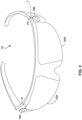
- FIG. 2 is an illustration depicting an example HMD, in accordance with techniques described in this disclosure.
- HMD 112 of FIG. 2 may be an example of HMD 112 of FIG. 1 .
- HMD 112 may be part of an artificial reality system, such as artificial reality system 10 of FIG. 1 , or may operate as a stand-alone, mobile artificial realty system configured to implement the techniques described herein.
- HMD 112 takes the general form factor of glasses.
- HMD 112 includes a front rigid body and two stems to secure HMD 112 to a user, e.g., by resting over the wearer's ears.
- electronic display 203 may be split into multiple segments, such as into two segments, with each segment corresponding to a separate lens disposed on the rigid front body of HMD 112.
- electronic displays 203A-203B may form a contiguous surface that spans both lenses and the lens-connecting bridge (i.e., the over-the-nose portion) of the rigid front body of HMD 112.
- the lens-connecting bridge i.e., the over-the-nose portion
- electronic display 203 may also encompass portions of HMD 112 that connect the lenses of the front rigid body to the stems, or optionally, portions of the stems themselves.
- These various designs of electronic display 203 in the context of the form factor of HMD 112 shown in FIG. 2 improve accessibility for users having different visual capabilities (e.g., with respect to peripheral vision and/or central vision, nearfield vision and/or distance vision, etc.), eye movement idiosyncrasies, etc.
- Electronic display 203 may be any suitable display technology, such as liquid crystal displays (LCD), quantum dot display, dot matrix displays, light emitting diode (LED) displays, organic light-emitting diode (OLED) displays, cathode ray tube (CRT) displays, e-ink, or monochrome, color, or any other type of display capable of generating visual output.
- the electronic display is a stereoscopic display for providing separate images to each eye of the user.
- the known orientation and position of display 203 relative to the front rigid body of HMD 112 is used as a frame of reference, also referred to as a local origin, when tracking the position and orientation of HMD 112 for rendering artificial reality content according to a current viewing perspective of HMD 112 and the user.
- HMD 112 includes integrated image capture devices 138A and 138B (collectively, "image capture devices 138").
- Image capture devices 138 may include still image camera hardware, video camera hardware, laser scanners, Doppler radar scanners, fundus photography hardware, infrared imaging cameras, depth scanners, or other types of image capture devices.
- Image capture devices 138 may include outward-facing and/or inward-facing image capture hardware, and include any hardware configured to capture image data representative of a surrounding physical environment, and optionally, to preprocess and/or post process the captured image data.
- Outward-facing camera hardware of image capture devices 138 may capture image data of the physical environment outside of HMD 112, such as, but not limited to, the real-world environment at which a wearer of HMD 112 is positioned.
- Inward-facing camera hardware of image capture devices 138 may capture image data of the wearer of HMD 112, such as facial images and/or retina scans.
- Other inward-facing sensor hardware of HMD 112 may capture other types of information pertaining to the wearer, such as temperature information or other types of information or metrics.
- one or more of image capture devices 138 of HMD 112 may be configured for depth sensing. That is, in some examples, an image capture device may include a light source for emitting suitable pulses of light (e.g., laser light) to illuminate a target object, as well as a light sensor or detector for capturing an image of the target object.
- suitable pulses of light e.g., laser light
- HMD 112 further includes one or more motion sensors 36, such as one or more accelerometers (also referred to as inertial measurement units or "IMUs") that output data indicative of current acceleration of HMD 112, GPS sensors that output data indicative of a location of HMD 112, radar, or sonar that output data indicative of distances of HMD 112 from various objects, or other sensors that provide indications of a location or orientation of HMD 112 or other objects within a physical environment.
- accelerometers also referred to as inertial measurement units or "IMUs”
- GPS sensors that output data indicative of a location of HMD 112, radar, or sonar that output data indicative of distances of HMD 112 from various objects, or other sensors that provide indications of a location or orientation of HMD 112 or other objects within a physical environment.
- HMD 112 includes HMD SoC 2.
- SoC 2 includes internal control unit 210, which may include an internal power source and one or more printed-circuit boards having one or more processors, memory, and hardware to provide an operating environment for executing programmable operations to process sensed data and present artificial reality content on display 203.
- control unit 210 is configured to, based on the sensed data (e.g., image data captured by image capture devices 138, position information from GPS sensors), generate and render for display on display 203 a virtual surface comprising one or more virtual content items (e.g., virtual content items 124, 126 of FIG. 1 ) associated with a position contained within field of view of image capture devices 138.
- sensed data e.g., image data captured by image capture devices 138, position information from GPS sensors
- virtual content items e.g., virtual content items 124, 126 of FIG. 1
- a virtual content item may be associated with a position within a virtual surface, which may be associated with a physical surface within a real-world environment, and control unit 210 can be configured to render the virtual content item (or portion thereof) for display on display 203 in response to a determination that the position associated with the virtual content (or portion therefore) is within the current field of view.
- a virtual surface is associated with a position on a planar or other surface (e.g., a wall), and control unit 210 will generate and render the portions of any virtual content items contained within that virtual surface when those portions are within the field of view.
- control unit 210 is configured to, based on the sensed data, identify a specific gesture or combination of gestures performed by the user and, in response, perform an action. For example, in response to one identified gesture, control unit 210 may generate and render a specific user interface for display on electronic display 203 at a user interface position locked relative to a position of the peripheral device 136. For example, control unit 210 can generate and render a user interface 137 including one or more UI elements (e.g., virtual buttons) on surface of peripheral device 136 or in proximity to peripheral device 136 (e.g., above, below, or adjacent to peripheral device 136).
- UI elements e.g., virtual buttons
- Control unit 210 may perform object recognition within image data captured by image capture devices 138 to identify peripheral device 136 and/or a hand 132, fingers, thumb, arm or another part of the user, and track movements, positions, configuration, etc., of the peripheral device 136 and/or identified part(s) of the user to identify pre-defined gestures performed by the user.
- control unit 210 In response to identifying a pre-defined gesture, control unit 210 takes some action, such as selecting an option from an option set associated with a user interface (e.g., selecting an option from a UI menu), translating the gesture into input (e.g., characters), launching an application, manipulating virtual content (e.g., moving, rotating a virtual content item), generating and rendering virtual markings, generating and rending a laser pointer, or otherwise displaying content, and the like.
- control unit 210 can dynamically generate and present a user interface, such as a menu, in response to detecting a pre-defined gesture specified as a "trigger" for revealing a user interface (e.g., turning peripheral device to a landscape or horizontal orientation (not shown)).
- control unit 210 detects user input, based on the sensed data, with respect to a rendered user interface (e.g., a tapping gesture performed on a virtual UI element). In some examples, control unit 210 performs such functions in response to direction from an external device, such as console 106, which may perform object recognition, motion tracking and gesture detection, or any part thereof.
- a rendered user interface e.g., a tapping gesture performed on a virtual UI element.
- control unit 210 performs such functions in response to direction from an external device, such as console 106, which may perform object recognition, motion tracking and gesture detection, or any part thereof.
- control unit 210 can utilize image capture devices 138A and 138B to analyze configurations, positions, movements, and/or orientations of peripheral device 136, hand 132 and/or arm 134 to identify a user interface gesture, selection gesture, stamping gesture, translation gesture, rotation gesture, drawing gesture, pointing gesture, etc., that may be performed by users with respect to peripheral device 136.
- the control unit 210 can render a UI menu (including UI elements) and/or a virtual surface (including any virtual content items) and enable the user to interface with that UI menu and/or virtual surface based on detection of a user interface gesture, selection gesture, stamping gesture, translation gesture, rotation gesture, and drawing gesture performed by the user with respect to the peripheral device, as described in further detail below.
- Image capture devices 138 may capture image data representative of various objects, including peripheral device 136 and/or of the hand(s) of user 110 in the physical environment that are within the field of view of image capture devices 138, which may generally correspond to the viewing perspective of HMD 112.
- SoC 2 may implement a memory array circuit associated with an image sensor.
- the memory array circuit may comprise a plurality of memory cells, e.g., 128 cells, although fewer cells may be desirable for some applications and more cells may be desirable for other applications.
- Each memory cell may comprise one or more input lines; a stop exposure output line; a storage capacitor configured to sense a voltage representing an exposure event when the input lines are enabled; and a stop exposure circuit configured to enable the stop exposure output line in response to a charge on the storage capacitor satisfying a charge threshold, wherein the stop exposure output line being enabled causes the image sensor to stop further exposure of the image sensor.
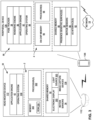
- FIG. 3 is a block diagram showing an example implementation of an HMD and a peripheral device of the multi-device artificial reality system of FIG. 1 , consistent with techniques of this disclosure.
- FIG. 3 illustrates an example of HMD 112 and peripheral device 136 according to aspects of this disclosure.
- the HMD 112 of FIG. 3 may be an example of the HMD 112 described above and illustrated in FIG. 1 and FIG. 22; and the peripheral device 136 may be an example of the peripheral device 136 described above and illustrated in FIG. 1 .
- HMD 112 includes HMD SoC 2.
- SoC 2 which may include an internal power source and one or more printed-circuit boards having one or more processors, memory, and hardware to provide an operating environment for executing programmable operations to process sensed data and present artificial reality content on display 203.
- Surface 38 of peripheral device 136 represents an input component or a combined input/output component of peripheral device 136.
- Surface 38 may include sensing capabilities, such as those of a touchscreen (e.g., a capacitive touchscreen, resistive touchscreen, surface acoustic wave (SAW) touchscreen, infrared touchscreen, optical imaging touchscreen, acoustic pulse recognition touchscreen, or any other touchscreen), touchpad, buttons, trackball, scroll wheel, or other presence-sensitive hardware that uses capacitive, conductive, resistive, acoustic, or other technology to detect touch and/or hover input.
- a touchscreen e.g., a capacitive touchscreen, resistive touchscreen, surface acoustic wave (SAW) touchscreen, infrared touchscreen, optical imaging touchscreen, acoustic pulse recognition touchscreen, or any other touchscreen
- touchpad e.g., a capacitive touchscreen, resistive touchscreen, surface acoustic wave (SAW) touchscreen, infrared touchscreen, optical imaging touchscreen, acoustic pulse recognition touchscreen
- Surface 38 may enable peripheral device 136 to receive touch input or gesture input without direct contact with surface 38.
- User 110 may provide these touch or gesture inputs to peripheral device 136 to provide instructions directly to peripheral device 136, or indirectly to HMD 112 and/or other components of an artificial reality system in which HMD 112 is deployed.
- a processor of HMD 112 may utilize image capture devices 138 to analyze configurations, positions, movements, and/or orientations of peripheral device 136, of the hand(s) or digit(s) thereof of a user of peripheral device 136 to enable to provide input using gestures such as drawing gestures or typing gestures provided via a graphical keyboard.
- Peripheral device 136 can communicate data to HMD 112 (and/or console 16) using wireless communications links (e.g., Wi-Fi TM , near-field communication of short-range wireless communication such as Bluetooth ® , or one or more other communication links), or using wired communication links, or combinations thereof, or using other types of communication links.
- wireless communications links e.g., Wi-Fi TM , near-field communication of short-range wireless communication such as Bluetooth ® , or one or more other communication links
- wired communication links or combinations thereof, or using other types of communication links.
- peripheral device 136 is also communicatively coupled to a network 18 (e.g., network 104 of FIG. 1 ), thereby enabling peripheral device 136 to communicate data to remote devices over the network 18.
- peripheral device 136 may offload various hardware and resource burdens from HMD 112, which enables low-profile form factor designs of HMD 112.
- Peripheral device 136 also serves as a communications intermediary between HMD 112 and devices at remote locations, via network 18. Further details of peripheral device 136 are described in U.S. Patent Application No. 16/506,618 (filed on 9 July 2019 ), the entire content of which is incorporated herein by reference.
- Peripheral device 136 may also include peripheral SoC 4.
- SoC 4 includes internal control unit 220, which may include an internal power source and one or more printed-circuit boards having one or more processors, memory, and hardware to provide an operating environment for executing programmable operations to process sensed data and perform functions offloaded from HMD 112.
- SoC 2 of HMD 112 includes one or more processors 302 and memory 52.
- Shared memory 52 and processor(s) 302 of HMD 112 may, in some examples, provide a computer platform for executing an operating system 338.
- Operating system 338 may represent an embedded, real-time multitasking operating system, for instance, or other type of operating system.
- operating system 338 provides a multitasking operating environment for executing one or more software components 30, including application engine 42.
- Processor(s) 302 may be coupled to one or more of electronic display 203, motion sensors 36, light source 303, and/or image capture devices 138. Processor(s) 302 are included in HMD SoC 2, which also includes on-chip memory 304. On-chip memory 304 is collocated with processor(s) 302 within a single integrated circuit denoted as HMD SoC 2 in the particular example shown in FIG. 3 . Processor(s) 302 may use on-chip memory 304 as a temporary storage location for self-contained data processing performed within HMD SoC 2.
- HMD 112 is communicatively coupled to peripheral device 136, as shown in FIG. 3 .
- peripheral device 136 and HMD 112 function in tandem as co-processing devices to deliver the artificial reality experiences to user 110 as described above with respect to FIGS. 1 , 2 , and 3 .
- Peripheral device 136 may offload portions of the computing tasks otherwise performed by HMD 112, thereby enabling a reduced hardware infrastructure and therefore a lower-profile form factor with respect to the design of HMD 112.
- Peripheral device 136 includes presence-sensitive surface 38 (described above with respect to FIG. 1 ), as well as input/output (I/O) interface(s) 82, and motion sensors 84. Peripheral device 136 may invoke I/O interface(s) 82 to send and receive data over network 18, such as cipher text or plain text (unencrypted) data. I/O interface(s) 82 may also incorporate hardware that enables peripheral device 136 to communicate wirelessly with HMD 112. Peripheral device 136 may invoke motion sensors 84 to detect and track motion by the user of HMD 112 for use in computing updated pose information for a corresponding frame of reference of HMD 112.
- Peripheral SoC 4 of peripheral device 136 includes on-chip memory 66 and one or more processors 68.
- On-chip memory 66 represents memory collocated with processor(s) 68 within a single integrated circuit denoted as peripheral SoC 4 in the particular example shown in FIG. 3 .
- Processor(s) 68 may use on-chip memory 66 as a temporary storage location for self-contained data processing performed within peripheral SoC 4.
- Shared memory 86 and processor(s) 68 of peripheral device 136 provide a computer platform for executing an operating system 88.
- Operating system 88 may represent an embedded, real-time multitasking operating system, for instance, or other type of operating system.
- operating system 88 provides a multitasking operating environment for executing one or more software components 50.
- software components 50 include an application engine 82, a rendering engine 56, and a pose tracker 58.
- software components 50 may not include rendering engine 56, and HMD 112 may perform the rendering functionalities without co-processing with peripheral device 136.
- application engine 82 when invoked, provides functionality to provide and present an artificial reality application, e.g., a teleconference application, a gaming application, a navigation application, an educational application, a training application, a simulation application, or the like, to user 110 via HMD 112.
- Application engine 82 may include, for example, one or more software packages, software libraries, hardware drivers, and/or Application Program Interfaces (APIs) for implementing an artificial reality application. Responsive to control by application engine 82, rendering engine 56 generates artificial reality content 122 (e.g., incorporating 3D artificial reality content) for display to user 110 by application engine 82 of HMD 112.
- artificial reality content 122 e.g., incorporating 3D artificial reality content
- Application engine 82 and rendering engine 56 may construct artificial reality content 122 for display to user 110 in accordance with current pose information for a frame of reference, typically a viewing perspective of HMD 112, as determined by pose tracker 58. Based on the current viewing perspective as determined by pose tracker 58, rendering engine 56 constructs artificial reality content 122 (e.g., 3D artificial content) which may in some cases be overlaid, at least in part, upon the real-world 3D environment of user 110.
- artificial reality content 122 e.g., 3D artificial content
- pose tracker 58 operates on sensed data received from HMD 112, such as movement information and user commands, and, in some examples, data from any external sensors 26 (shown in FIG. 1 ), to capture 3D information within the real-world environment, such as motion by user 110 and/or feature tracking information with respect to user 110. Based on the sensed data, pose tracker 58 determines a current pose for the frame of reference of HMD 112 and, in accordance with the current pose, constructs artificial reality content 122 for communication, via one or more I/O interfaces 72, to HMD 112 for display to user 110.
- processors 302 and 68 may comprise any one or more of a multi-core processor, a controller, a digital signal processor (DSP), an application specific integrated circuit (ASIC), a field-programmable gate array (FPGA), processing circuitry (e.g., fixed-function circuitry or programmable circuitry or any combination thereof) or equivalent discrete or integrated logic circuitry.
- DSP digital signal processor
- ASIC application specific integrated circuit
- FPGA field-programmable gate array
- processing circuitry e.g., fixed-function circuitry or programmable circuitry or any combination thereof
- shared memory 52, shared memory 86, on-chip memory 304, or on-chip memory 66 may comprise any form of memory for storing data and executable software instructions, such as random-access memory (RAM), Static RAM (SRAM), read only memory (ROM), programmable read only memory (PROM), erasable programmable read only memory (EPROM), electronically erasable programmable read only memory (EEPROM), or flash memory.
- RAM random-access memory
- SRAM Static RAM
- ROM read only memory
- PROM programmable read only memory
- EPROM erasable programmable read only memory
- EEPROM electronically erasable programmable read only memory
- memory 304 comprises ROM 350, which is a read-only memory.
- ROM 350 stores instructions for executing operating system 305.
- ROM 350 stores instructions for performing a boot-strapping operation at power-on of HMD 112 (or SoC 2) to initialize and execute operating system 305.
- ROM 350 typically stores a collection of various sub-routines, many of which have a pre-defined deterministic control flow. Other sub-routines stored by ROM 350 may be determined at run-time, such as one-time programming (OTP) write, servicing alarms or interrupts, execution of patches, or other routines.
- OTP one-time programming
- SoC 2 of HMD 112 may be configured to perform depth sensing using analog histogram on pixel techniques.
- image capture devices 138, memory 304, processors 302, light source 303, and/or shared memory 52 may be used.
- memory 304 may include a memory array circuit associated with an image sensor associated with image capture device 138.
- the memory array circuit may comprise a plurality of memory cells, e.g., 128 cells, although again, fewer cells may be desirable for some applications and more cells may be desirable for other applications.
- Each memory cell may comprise one or more input lines; a stop exposure output line; a storage capacitor configured to sense a voltage representing an exposure event when the input lines are enabled; and a stop exposure circuit configured to enable the stop exposure output line in response to a charge on the storage capacitor satisfying a charge threshold, wherein the stop exposure output line being enabled causes the image sensor to stop further exposure of the image sensor.
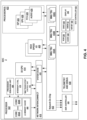
- FIG. 4 is a block diagram illustrating an example SoC 2 that may be integrated within the HMD 112 of FIG. 1 , FIG. 2 , or FIG. 3 in accordance with the techniques of the disclosure.
- SoC 2 includes processor 302, 3D GPU 414, high-speed I/O 420, peripheral processors 422, Network-on-Chip (NoC) integrated circuit 432, DDR controller 436, and controller 452.
- NoC Network-on-Chip
- Processor 302 may comprise one or more microprocessors, DSPs, ASICs, FPGAs, or any other equivalent integrated or discrete logic circuitry, as well as any combinations of such components.
- processor 302 comprises a plurality of processing cores 404A-404N (collectively, "cores 404").
- Processor 302 further comprises L3 memory cache 406.
- L3 memory cache 406 comprises a common memory cache shared by cores 404.
- Processor debugging unit 408 provides debugging capabilities for processor 302.
- Interrupt controller 410 services interrupts generated by processor 302 and/or SoC 2.
- 3D graphic processing unit (GPU) 414 is a graphics processing unit that may be configured to provide 3-dimensional (3D) graphics processing capabilities.
- 3D GPU 414 comprises a plurality of cores or cells configured to provide parallel processing capabilities for rendering 3D images or video.
- High-speed I/O 420 may provide high-speed input and output capabilities to SoC for communicating with components exterior to SoC 2, such as with other components of HMD 112 or peripheral device 136.
- Processors 422 provide dedicated processors for different types of data serviced by SoC 2.
- Processors 422 may include integrated circuitry or hardware configured to process specific types of data.
- processors 422 may include image signal processor (ISP) 424 for processing images, GPU 426, FCV 428, and audio processing unit 430.
- ISP image signal processor
- Network interconnect 416 provides a high-speed interconnection medium between various components of SoC 2, particularly to data transferred between processor 302, 3D GPU 414, memory management unit (MMU) translation control unit (TCU) 412, and MMU translation buffer units (TBUs) 434A-434C of NoC integrated circuit 432, high-speed I/O 420, processors 422, and DDR controller 436.
- Network interconnect 416 may include a system cache 418 for storing and/or buffering data transferred between various components of SoC 2.
- SoC 2 further includes telemetry and debug unit 438.
- Telemetry and debug unit 438 may record and transmit telemetry for SoC 2 to an external device, such as HMD 112 or peripheral device 136. Further, telemetry and debug unit 438 may provide debugging functionalities for SoC 2.
- SoC controller 452 provides various controllers for driving various functionality of SoC 2.
- SoC controller 452 includes ROM 350, shared memory 52, audio controller 448, GNSS 444, WIFI and Bluetooth ® controller 450, and display controller 446.
- image signal processor (ISP) 424 is configured to perform the techniques of this disclosure.
- ISP 424 may be configured to perform depth sensing using analog histogram on pixel techniques.
- ISP 424 may include a memory array circuit associated with an image sensor, and the memory array circuit may comprise a plurality of memory cells, e.g., 128 cells. Each memory cell may comprise one or more input lines; a stop exposure output line; a storage capacitor configured to sense a voltage representing an exposure event when the input lines are enabled; and a stop exposure circuit configured to enable the stop exposure output line in response to a charge on the storage capacitor satisfying a charge threshold, wherein the stop exposure output line being enabled causes the image sensor to stop further exposure of the image sensor.
- An image sensor (e.g., image capture devices 138) of HMD 112 may be configured to stop further exposure of the image sensor in response to the stop exposure line being enabled.
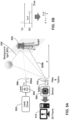
- FIG. 5A is a conceptual diagram to illustrate principles of analog histogram depth sensing.
- An image sensor such as image capture devices 138 ( FIG. 3 ), may include a laser 502, a laser driver 504, transmission optics 506, reception optics and filters 510, and sensors 508 (e.g., an image sensor).
- the image sensor transmits a laser 505A towards the environment.
- Laser light 505B reflects from a target 520, e.g., an object, and the reflected laser light 505C is captured by reception optics and filters 510 and sensed by sensors 508.
- the time between the transmission of the laser light and the reception of the reflected laser light can be used to determine the distance d (also called depth) to the target 520.
- the depth information in turn, can be used in generating an accurate rendition of target 520 in a 3D image frame 512.
- reception optics and filters 510 and sensed by sensors 508 includes background light 525.
- reception optics and filters 510 captures reflected laser light 505C but also captures noise from background light 525.
- pixels of sensors 508 do not measure a single instance of light capture and instead, capture multiple instances to create a histogram of depth signal events over time.
- the histogram includes a plurality of bins-corresponding to times of flight- that are enabled sequentially over time so that each bin represents a different time of flight event.
- the histogram then, can be used to identify actual objects or targets.
- the histogram essentially acts as a filter of background noise, relative to a single lighting, time of flight, event measurement.
- An image processor can use the peak of the histogram curve as the location of an actual depth target.
- FIG. 5B is a graph with a corresponding equation for determining depth based on time of flight (ToF) of a laser signal.
- FIG. 5B shows how depth is calculated based on a single instance, but these principles also apply to the use of a histogram curve, which again, includes a plurality of bins, which correspond to different time of flight measurements.
- FIG. 7 is a conceptual illustration of a time of flight (ToF) histogram indicating sensed light events.
- the peak location (e.g., bin 710) of the ToF histogram 708 may correspond to the actual estimated location of the target.
- an image processor e.g., ISP 424) may be configured to determine the distance or depth (d) to a target by applying the equation and ToF techniques shown in FIG. 5B .
- FIG. 6 is a simplified conceptual diagram to illustrate principles of depth sensing.
- HMD 112 includes a light source 602, such as a laser, driver, and associated optics.
- HMD also includes an image sensor 604 to detect instances of the reflected laser light that reflects from a target.
- the target can be any object.
- ISP 424 forms histograms of instances of reflected light (similar to the description above with the example shown in FIG. 5A ). Using the histograms, ISP 424 may be configured to determine the distance or depth (d) to a target by applying the equation and ToF techniques shown in FIG. 5B .
- ISP 424 may be configured to generate the histograms in a way that improves upon conventional analog histogram on pixel techniques.
- ISP 424 may include an analog memory cell circuit that is configured to automatically detect saturation for any given pixel location. Upon detecting saturation of a pixel, ISP 424 may be configured to stop further exposure of the image sensor 604. That is, when any cell in a memory array reaches a maximum or saturation value, a stop exposure function is triggered to stop further exposure of the image sensor, which is desirable.
- the bins of histogram 708 are participants in a race to the finish line, where the finish line is the saturation value of memory cells, e.g., the point where the memory cells are generally incapable of detecting addition events.
- the bins of the histogram begin to fill up. Once any single bin reaches the finish line, or the saturation value, all participants in the race are frozen at their current position. The fact that a particular bin reached saturation indicates that the maximum desired exposure level or maximum possible exposure level has occurred in that bin, and accordingly, analog circuitry described below triggers a stop exposure function based on this determination.
- the bin 710 of the ToF histogram 708 may correspond to the bin that "won" the race to saturation. In this case, ToF histogram 708 may be considered complete, without capturing any additional events for any of the bins.
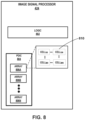
- FIG. 8 is a block diagram of an example image signal processor (ISP) 424, consistent with this disclosure.
- ISP 424 may include multiple interacting circuits or components, such as a photodetector integrated circuit (PDIC) 804 and a logic circuit 802, which may include a read out integrated circuit (ROIC).
- PDIC 804 is one example of an image detector consistent with this disclosure.
- Logic 802 may be configured to perform some aspects of techniques of this disclosure, and logic 802 may include logical OR circuit 942 shown in FIGS. 9A - 9E and described below.
- PDIC circuit 804 may include one or more arrays 806A-806N of single photon avalanche diode (SPAD) photodetectors.
- SPAD single photon avalanche diode
- each SPAD When an exposure event occurs at a SPAD photodetector, each SPAD creates a current, which may be converted into a pulse. The timing of these current pulses can be used to detect the depth to a given target.
- the PDIC 804 or the logic IC 802 may include an array of memory cells 810 associated with each photodetector. Examples of the memory cells are shown and described in FIGS. 9A - 9E below. Each memory cell may act as an accumulator for a given cell. Thus, if there are 128 photodetector cells, there would be a corresponding 128 memory cells for accumulating pulses for each of the photodetector cells.
- Each of the photodetector cells may correspond to a pixel of an image sensor, and since the image sensor pixels are enabled sequentially over time, each event at a pixel of the image sensor and may correspond to a different time of flight event that is detected.
- ISP 424 may scan over the pixels over time, with one time step for each accumulator. That is, when there is an exposure event on the photodetector at the time corresponding to a given accumulator, that accumulator may be incremented by one. In this way, the ISP 424 builds a histogram for each pixel of the photodetector.
- an artificial reality system may include a depth camera.
- a depth camera For inclusion in a head mounted display of an artificial reality system, such a depth camera should have a small form factor and low power consumption.
- HMD 112 may be configured for depth sensing in accordance with some aspects of the disclosure.
- Direct time-of-flight (dToF) depth sensing configurations measure a roundtrip travel time of photons generated by multiple short pulses of light from a light source 602 synchronized with an image sensor 604.
- the light source 602 may be any suitable light source for illuminating a target object with light and may be one example of light source 303 at HMD 112.
- the image sensor e.g., detector
- any suitable photodetector any suitable photodetector, and may be one example of image capture device 138 at HMD 112.
- single-photon detectors are used, such as single-photon avalanche diodes (SPADs).
- SPADs single-photon avalanche diodes
- dToF allows multiple events (e.g., detections of photons) to be acquired in a histogram 708 through a process called time-correlated single-photon counting (TCSPC), where the returning signal is effectively timestamped using cells 810 (each of cells 810 corresponding to a time window within a time period after a light pulse) and accumulated around an accumulation bin coupled to detectors in a location corresponding to a target location, while noise from internal and background illumination noise is uniformly distributed over the measurement range, allowing depth estimation under low signal to noise conditions.
- TCSPC time-correlated single-photon counting
- the HMD 112 may generate a histogram 708 of photon arrival times and then process the histogram to estimate the depth to a target object by identifying the bin 710 with the peak value.
- the depth corresponds to the peak bin 710 in the histogram 708, representing the time ⁇ of the greatest number of exposure events following a sequence of light pulses.
- a depth camera assembly of HMD 112 includes an ISP 424 that is configured to capture, in accordance with receiving instructions from a processor, one or more images of the local area including reflected light including portions of light emitted by the light source 602 of HMD 112 and reflected from target objects in the local area.
- the reflected light captured by image sensor 604 is reflected from the one or more target objects in the local area.
- ISP 424 may comprise a two-dimensional array of pixels.
- the active depth sensor includes a single detector or multiple detectors positioned relative to each other (e.g., a line of detectors).
- each pixel includes a SPAD.
- Pixels of the detector may be grouped into macropixels including a number of rows of pixels and a number of columns of pixels.
- a macropixel includes an equal number of rows of pixels and columns of pixels.
- a macropixel can include 16 rows of pixels and 16 columns of pixels for a total of 256 pixels.
- a macropixel includes any number of rows of pixels and any number of columns of pixels.
- each macropixel of the detector includes a common number of rows of pixels and includes a common number of columns of pixels.
- the ISP 424 includes an array of macropixels.
- Each macropixel comprises a plurality of pixels configured to capture light from the local area surrounding the HMD 112. Based on one or more control signals, a macropixel of the array can be selected.
- the ISP 424 may internally generate the control signals or receive the control signals from an external source, such as a console.
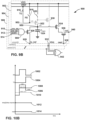
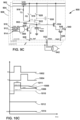
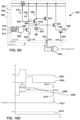
- FIGs. 9A - 9E illustrate a memory array 900 including a plurality of memory cells (e.g., as examples of cells 810 of array 806A of FIG. 8 ) and FIGS. 10A - 10E depicting respective timing diagrams illustrating functional operations of a memory cell according to some aspects of the disclosure.
- a plurality of macropixels may each include one or more pixels having a charge-based memory cell. This allows a pixel to store a count of photon detection events captured by a pixel. Charge-based memory cells in multiple pixels may be arranged into an array that is accessed by a timing reference that is synchronized with emission of light by the light source 802.
- Each cycle of the timing reference addresses a different charge-based memory cell included in a pixel, thus enabling the memory cell to register a photon detection event; each memory cell thus represents a bin for a histogram of photon detection events by the pixel.
- multiple pixels of a macropixel may operate in parallel, with photon detection events stored in arrays of charge-based memory cells included in different pixels used to store values that represent the different bins of a histogram of photon detection events by the pixels of the macropixel, with the timing reference providing timing information for the photon detection events stored in different charge-based memory cells.
- Using a charge-based memory cell in each pixel allows for compact storage of photon detection events by a pixel, enabling overall dimensions of the ISP 424 to remain compact.
- the image signal processor may read out the memory cells and send their signals to an analog to digital convertor, to convert the stored voltages to digital values.
- a digital processor can then create a histogram and perform digital peak detection for each histogram. As described above, the peak bin in the histogram represents the time of flight of the light pulse from the light source to the detector.
- the memory array 900 may be configured to create an analog histogram-on-pixel and stop exposure when a given bin of the histogram reaches a maximum (e.g., saturated) value.
- a maximum e.g., saturated
- Each memory cell of memory array 900 has circuitry that automatically detects when the memory cell has been saturated to a maximum value, and based on this event, sends a stop exposure signal to stop further exposure of the photodetectors.
- a given memory cell reaches its maximum value, e.g., when its storage capacitor 924 is discharged sufficiently such that reset transistor 922 reaches its threshold voltage and automatically turns on.
- the memory cell that first detects it has been saturated represents the peak bin of the histogram of values of all memory cells in memory array 900, for that memory cell received the highest number of detection events while active/selected during an exposure. That memory cell was, in effect, the "first across the finish line" represented by the maximum value and corresponds to the mode of the ToF bins in a ToF histogram of the values of all memory cells in memory array 900.
- the ToF corresponding to that memory cell can be computed using the timing reference, and the ToF can be used to compute distance information.
- a logic circuit associated with memory array 900 may latch the address of the memory cell where the peak value triggered the stop exposure line. In this way, the memory cell address where the peak occurs may be automatically determined and identified from the memory cell.
- a memory array 900 is illustrated as one example.
- Memory array 900 may be one example of a memory array 806A, 806B, or 806N illustrated in FIG. 8 , including a plurality of memory cells 810. Each memory cell has a corresponding memory address.
- FIGs. 9A-9E an array of 128 memory cells is shown with addresses ⁇ amem[0]... amem[127] ⁇ .
- Each memory cell 902, 904, 906 is coupled to an input of a logical OR circuit 942, e.g., an OR gate.
- Logical OR circuit 942 may correspond to a portion of logic 802 shown in FIG. 8 .
- Logic 802 may include analog, digital, and/or logic circuitry.
- Memory array 900 may be of any dimension (e.g., 1D, 2D, or 3D).
- the memory array 900 depicted in FIGs. 9A - 9E is arranged with the memory cells in rows and columns. Accordingly, each memory cell 902, 904, 906 may include row select line 910 and column select line 912, and these row and column addresses are different for different memory cells 902, 904, 906.
- the memory cell is "enabled” or "active” or “selected” to register an exposure event occurring in the time window corresponding to the memory cell.
- Each memory cell 902, 904, 906 further includes an event line 914 coupled to a photodetector such as a SPAD.
- Each memory cell may further include storage capacitor 924, labeled C mem , and a reset transistor 922.
- Reset transistor 922 can be controlled by switches 918, 920, e.g., to force a reset at the beginning of the process.
- switches 918 and 927 are closed to turn on reset transistor 922 and storage capacitor 924 is reset to the voltage VDD-VTH1, where VTH1 is the threshold voltage of the reset transistor 922.
- Reset transistor 922 may comprise an NMOS transistor that defines a threshold voltage, e.g., VTH1.
- NMOS for reset transistor 922 has advantages relative to a PMOS for reset transistor 922 insofar as an NMOS may have reduced leakage relative to a PMOS.
- Storage capacitor 924 is coupled to the gate of a readout transistor 934, which is configured as a buffer of the charge on storage capacitor 924.
- output transistor 936 is used for readout of the charge on storage capacitor 924, which is buffered on readout transistor 934.
- output transistor 936 is configured to output the charge on readout transistor 936 in response to a readout input signal, and this readout does not cause charge leakage from storage capacitor 924 since readout transistor 934 operates as a buffer.
- Reset transistor 922 has a threshold voltage. If the voltage of the storage capacitor 924 goes very low (e.g., many exposure events have occurred and the storage capacitor 924 has substantially discharged), the source voltage of reset transistor 922 falls below this threshold voltage due to the low charge on the capacitor, e.g., at node 950, forcing transistor 922 to turn on. When transistor 922 is forced on, this causes transistor 930 to turn on.
- transistor 930 may comprise a PMOS transistor with an inverted gate that turns on transistor 930 when the gate goes low, which occurs when transistor 922 is forced on, due to low charge on storage capacitor 924. This results in an output signal on stop exposure line 932, which causes the system (e.g., logic 802) stop further exposure of the image sensor.
- any storage capacitor 942 of any of memory cell 902, 904, 906 goes below a threshold, this means that that corresponding memory cell has "won the race.”
- that memory cell that "won the race” is the memory cell at the peak of the histogram, and its address can be latched as being memory cell associated with the peak of the histogram.
- the circuit of the memory cell may be configured to track the voltage of the storage capacitor 942 at node 950.
- transistor 922 When the voltage of the storage capacitor 942 falls below a certain level, transistor 922 is forced on, and the memory cell triggers a stop exposure line 932.
- the stop exposure line 932 from any of the memory cells turns on logical OR circuit 942 and causes the memory array 900 to stop accumulating exposure events.
- Memory array 900 may be one example of a memory array 806A, 806B, or 806N illustrated in FIG. 8 , including a plurality of memory cells 810.
- Logical OR circuit 942 may correspond to logic 802 or a portion thereof.
- Logic 802 may also be referred to as logic circuitry.
- Memory array circuit 900 may comprise a memory array associated with an image sensor, such as described herein.
- the memory array circuit 900 comprises a plurality of cells (shown as 902, 904, 906). In this example, there are 128 cells, although fewer cells may be used, or a greater number of cells may be used.
- Each of the memory cells 902, 904, 906 includes one or more input lines.
- the one or more input lines include a row select input line 910, a column select input line 912, and an exposure event input line 914.
- FIGS. 9A - 9E are merely one example that is useful for image sensors.
- Each of the memory cells 902, 904, 906 also includes a stop exposure output line 932. Moreover, each of the memory cells 902, 904, 906 includes a storage capacitor 924 configured to sense a voltage representing an exposure event on the exposure event input line when the input lines are enabled. For example, each of the memory cells 902, 904, 906 may be configured to sense the voltage representing the exposure event enabled on the exposure event input line 914 when the column select input line 910 and the row select input line 912 are enabled for a particular memory cell. In sensing the voltage representing the exposer event, the storage capacitor is configured to incrementally discharge, in response to the exposure event, i.e., when the one or more input lines are enabled for that particular memory cell.
- Each of the memory cells 902, 904, 906 also includes a stop exposure circuit configured to enable the stop exposure output line in response to a charge on the storage capacitor satisfying a charge threshold.
- a reset transistor 922 is coupled to storage capacitor 924 for resetting the charge on storage capacitor 924 to a nominal voltage in response to a reset of the memory array circuit 900, wherein the reset transistor is controlled by one or more switches 918, 920, which may comprise transistors for resetting the voltage on capacitor 924.
- capacitor 924 has an initial charge of VDD-VTH1, where VTH1 refers to threshold voltage associated with reset transistor 922.
- storage capacitor 924 is configured to incrementally discharge, in response to each exposure event, i.e., when the one or more input lines are enabled for that particular memory cell.
- the stop exposure circuit of memory cell 902 may comprise a stop exposure transistor 930 coupled to the reset transistor 922, wherein the stop exposure transistor 930 is configured to turn on when the reset transistor is forced on, e.g., in response to a condition where the storage capacitor satisfies the threshold.
- the stop exposure transistor 930 is configured to turn on when the reset transistor is forced on, e.g., in response to a condition where the storage capacitor satisfies the threshold.
- the voltage of storage capacitor 924 is incrementally discharged to a level that falls below the gate voltage of reset transistor 922, e.g., below VREF, this forces reset transistor 922 to turn on.
- This automatic "forced" turn on of reset transistor 922 is different than a controlled reset that uses switches 918, 920.
- the "forced" turn on of reset transistor 922 is caused automatically, due to the voltage on capacitor 924 falling below the gate of resent transistor 922. Then, the automatic turn on of reset transistor 922 causes stop exposure transistor 930 to turn on, which in turn sends a logic high signal to enable stop exposure line 932. When stop exposure lines 932 is enabled this causes a logic high to logical OR circuit 942, which sends a stop exposure command to stop further exposure of the image sensor. Accordingly, the first memory cell with the capacitor that discharges a level of VREF may be declared the winner and the peak of the analog histogram.
- Each memory cell 902, 904, 906 comprises a readout line 940 and each memory cell includes a readout transistor 934 configured as a buffer of the charge on storage capacitor 924.
- An output transistor 936 is configured to output the charge on readout transistor 934 in response to a readout input signal 938.
- logic 802 associated with memory array 900 may be further configured to latch the address of the first memory cell so as to identify the winner.
- logical OR circuit 942 is configured to receive the stop exposure lines of each of the memory cells 902, 904, 906, logic circuity (e.g., logic 802) may be configured to stop further exposure of the image sensor in response to an output of the logical OR circuit 942 being enabled, indicating a condition where a given exposure line associated with a given one of the memory circuits is enabled.
- FIGS. 10A - 10E show different signals associated with memory cell 902 over time.
- Line 1002 is a logical reset signal.
- Line 1004 is a logical trigger signal.
- Line 1006 represents the voltage at node 950, e.g., the voltage on capacitor 924 and the voltage on the source of reset transistor 922.
- Line 1008 represents the voltage on node 952, e.g., the gate of reset transistor 922.
- Line 1010 represents the threshold that triggers the end of the race for discharging capacitor 924, and this threshold may be programmable or tunable for different dynamic ranges.
- the dynamic range of discharging capacitor 924 may be on the order of 1 Volt, and this may allow for N incremental discharge events on capacitor 924, where N is on the order of approximately 1000 events. Each incremental discharge, in this example may reduce the voltage on capacitor 924 by approximately 0.001 volts.
- These voltage values for dynamic range and incremental discharge events are merely examples, however, and other voltages and dynamic ranges may be used, consistent with the teaching of this disclosure.
- reset signal 1002 goes to logic low and trigger signal 1004 goes to logic high.
- the voltage on storage capacitor 924 shown by signal 1008 at node 950 is higher than the voltage at the gate of reset transistor 922 at node 952.
- the triggering event of signal 1004 starts the process of tracking discharge events via the charge stored on storage capacitor 924.
- stop exposure signal 1012 remains logic low and readout signal 1014 remains logic low.
- trigger signal 1004 is shown as going low, but in some cases, trigger signal 1004 may remain high to avoid leakage from node 952 to maintain the gate of resent transistor 922 at VREF.
- signal 1008 reduces, e.g., incrementally, due to discharge events.
- Discharge events can be identified by one or more input signals that enable a discharge event and identify a particular one of memory cells 902, 904, or 906.
- each of memory cells 902, 904, 906 may include a selector circuit 908 connected the gate of an enable transistor 926.
- Selector circuit 908 may comprise an AND gate that outputs a gate control signal to turn on the enable transistor 926 when row select line 910, column select line 912, and event line 914 are all logic high. Again, however, other types of addressing or circuit selection schemes could be used.
- the enable transistor 926 is switched on for a brief period to cause an incremental discharge from storage capacitor 924, e.g., to a current reference line 928 (labeled Iref). As these incremental discharges occur, the voltage of signal 1008 falls incrementally. At this point, as shown in FIGS. 9C and 10C , stop exposure signal 1012 remains logic low and readout signal 1014 remains logic low.
- Lines 1010 and 1011 may define the dynamic range of capacitor 924, which is essentially operating as an event sensor and counter of such events. As shown in FIG. 10D this dynamic range may be on the order of approximately 1 volt, although both the upper threshold value 1011 and the lower threshold value 1010 could be modified or changed in various examples, and these values may be programmable by tuning the circuit for different situations or applications. Also, the discharge events may reduce the charge incrementally by approximately 0.001 volt increments, but these increments can also be adjusted, pre-defined, or tuned by controlling the on-time of enable transistor 926 for respective events.
- a readout signal may be enabled 1014.
- a read signal is sent on line 938 causing transistor 936 to output the buffered charge stored on transistor 934, which is indicative of the charge on capacitor 924.
- the memory address of the corresponding sensor circuit that "won the race" can be latched by an associated logical circuit, such as logic 802, as the peak value of the histogram used for analog histogram on pixel depth sensing techniques.
- the ISP 424 may stop the exposure of the SPAD sensor and latch the address of the memory cell (or the corresponding SPAD sensor) where the stop exposure line 932 was set.
- the memory address at the stop exposure transition represents the peak memory address, from which the depth of a sensed target object can be obtained as described above.
- ISP 424 operates by sequentially cycling through memory cells, incrementing each memory cell's stored value (by incrementally discharging the storage capacitor) if there is an event when that memory cell's row and column select lines are selected.
- ISP 424 latches the address of that memory cell, which represents the address of the peak signal.
- various aspects of this disclosure can function for auto-exposure as well as for peak detection for depth sensing.
- the auto exposure function occurs because the sensor is automatically stopped from further exposure when any bin in any pixel's histogram is saturated. Peak detection is accomplished by latching the address of the memory cell that triggered the stop exposure line, providing the address of the memory cell where the peak value occurred.
- circuits of this disclosure e.g. using a discharging capacitors to detect and count other events, and trigger the end of the process when a given circuit has discharged its capacitor to a threshold, could also be applied in other situations or setting.
- this disclosure describes, more broadly, a system comprising a plurality of circuits (such as memory cells or other types of circuits).
- Each of the plurality of circuits includes a capacitor (like the discharge capacitors described herein) and each of the plurality of circuits is configured to: receive control signals (e.g., signals on lines 910, 912, 914 or other types of control signals), wherein the control signals determine an address associated with one or more of the plurality of circuits and wherein the control signals identify events; incrementally discharge the capacitor for a particular one of the plurality of circuits in response to the control signals when the address identifies the particular circuit during an event; and output a logic signal (e.g., signal 1012 or a similar type of signal) in response to the capacitor of the particular one of the plurality of circuits reaching a defined level of charge, wherein the defined level of charge corresponds to a pre-defined threshold lower than an initial reset charge level of the capacitor.
- control signals e.g., signals on lines 910, 912, 9
- the system further includes logic (e.g., logical OR circuit 942 or a similar type of circuit) configured to: receive the logic signal from the particular one of the plurality of circuits; and identify the particular one of the plurality of circuits as having received the most events from among the plurality of circuits.
- the system may be configured to disable or reset the plurality of circuits in response to the logic receiving the logic signal from the particular one of the plurality of circuits.
- the capacitor of the particular one of the plurality of circuits reaching the defined level of charge causes a threshold voltage of a transistor to be exceeded, thereby outputting the logic signal, such as in the examples described herein or in other examples.
- FIG. 11 is a flow diagram illustrating a process consistent with one or more examples of this disclosure.
- reset transistor 922 is turned on via switches 918, 920 to reset a voltage on capacitor 924 to a nominal voltage, e.g., VDD-VTH1 (1104).
- trigger switch 916 is controlled to set a gate voltage of reset transistor 922 to a reference voltage (VREF), which is lower than the nominal voltage.
- VREF reference voltage
- Circuit elements 908, 926 are configured to cause storage capacitor to sense a voltage representing an exposure event, e.g., causing an incremental discharge of storage capacitor 924 at each occurrence of an exposer event at a corresponding photodetector (1106). The process of incrementally discharging the storage capacitor 924 at each occurrence of exposer events continues as long as the sensed capacitor voltage is greater than the threshold (NO branch of 1108). Once the capacitor voltage equals (or falls below) the threshold (NO branch of 1108), memory cell 902 is configured to automatically enable a stop exposer line 932, which causes logical OR gate 942 to issue a stop exposure signal that stops further exposer of the image sensor (1110), which also stops the event counting for memory array 900 (1110). The system latches an address associated with the memory cell that satisfied the threshold (1112). The latched address may comprise the address location of the memory.
- this disclosure describes a method of operating an image senor and a plurality of memory cells associated with the image sensor, each memory cell comprising: one or more input lines, a stop exposure output line; a storage capacitor; and a stop exposure circuit.
- the method may comprise by each of the memory cells, sensing a voltage representing an exposure event in response to the input lines being enabled; by a first one of the memory cells, enabling the stop exposure output line in response to a charge on the storage capacitor satisfying a charge threshold; and stopping further exposure of the image sensor in response to the stop exposure output line being enabled for the first one of the memory cells.
- each memory cell includes a reset transistor coupled to the storage capacitor, the method further comprising: controlling the reset transistor to reset the charge on the storage capacitor to a nominal voltage in response to a reset of the memory array circuit.
- the stop exposure circuit may comprise a stop exposure transistor coupled to the reset transistor, wherein the stop exposure transistor is configured to turn on when the reset transistor is forced on, in response to a condition where the storage capacitor satisfies the threshold. Sensing the voltage representing the exposure event may include incrementally discharging the storage capacitor, in response to the exposure event when the input lines are enabled.
- each memory cell comprises a readout line and each memory cell includes a readout transistor configured as a buffer of the charge on the capacitor and an output transistor, the method further comprising: outputting the charge on the on the readout transistor in response to a readout input signal to the output transistor.
- the method may further comprise latching the address of a first memory cell of the plurality of memory cells, in response to the first memory cell of the plurality of memory cells selecting its stop exposure line. The method may further include stopping further exposure of the image sensor in response to an output of a logical OR circuit being enabled, indicating a condition where a given exposure line associated with a given one of the memory circuits is enabled.
- processors including one or more microprocessors, digital signal processors (DSPs), application specific integrated circuits (ASICs), field programmable gate arrays (FPGAs), or any other equivalent integrated or discrete logic circuitry, as well as any combinations of such components.
- DSPs digital signal processors
- ASICs application specific integrated circuits
- FPGAs field programmable gate arrays
- processors may generally refer to any of the foregoing logic circuitry, alone or in combination with other logic circuitry, or any other equivalent circuitry.
- a control unit comprising hardware may also perform one or more of the techniques of this disclosure.
- Such hardware, software, and firmware may be implemented within the same device or within separate devices to support the various operations and functions described in this disclosure.
- any of the described units, modules or components may be implemented together or separately as discrete but interoperable logic devices. Depiction of different features as modules or units is intended to highlight different functional aspects and does not necessarily imply that such modules or units must be realized by separate hardware or software components. Rather, functionality associated with one or more modules or units may be performed by separate hardware or software components or integrated within common or separate hardware or software components.
- Computer readable storage media may include random access memory (RAM), read only memory (ROM), programmable read only memory (PROM), erasable programmable read only memory (EPROM), electronically erasable programmable read only memory (EEPROM), flash memory, a hard disk, a CD-ROM, a floppy disk, a cassette, magnetic media, optical media, or other computer readable media.
- RAM random access memory
- ROM read only memory
- PROM programmable read only memory
- EPROM erasable programmable read only memory
- EEPROM electronically erasable programmable read only memory
- flash memory a hard disk, a CD-ROM, a floppy disk, a cassette, magnetic media, optical media, or other computer readable media.
- artificial reality is a form of reality that has been adjusted in some manner before presentation to a user, which may include, e.g., a VR, an AR, a MR, a hybrid reality, or some combination and/or derivatives thereof.
- Artificial reality content may include completely generated content or generated content combined with captured content (e.g., real-world photographs).
- the artificial reality content may include video, audio, haptic feedback, or some combination thereof, and any of which may be presented in a single channel or in multiple channels (such as stereo video that produces a three-dimensional effect to the viewer).
- artificial reality may be associated with applications, products, accessories, services, or some combination thereof, that are, e.g., used to create content in an artificial reality and/or used in (e.g., perform activities in) an artificial reality.
- the artificial reality system that provides the artificial reality content may be implemented on various platforms, including a HMD connected to a host computer system, a standalone HMD, a mobile device or computing system, or any other hardware platform capable of providing artificial reality content to one or more viewers.
Landscapes
- Engineering & Computer Science (AREA)
- Multimedia (AREA)
- Signal Processing (AREA)
- Physics & Mathematics (AREA)
- General Physics & Mathematics (AREA)
- Computer Networks & Wireless Communication (AREA)
- Radar, Positioning & Navigation (AREA)
- Remote Sensing (AREA)
- Power Engineering (AREA)
- Optics & Photonics (AREA)
- Electromagnetism (AREA)
- User Interface Of Digital Computer (AREA)
Abstract
Description
- This disclosure generally relates to image sensing, and more particularly, to performing an autoexposure function for an image sensor.
- Artificial reality systems are used in a wide variety of situations and applications. In general, artificial reality comprises a presentation of information in a way that creates an artificial or partially artificial view of an environment. Artificial reality systems may include, e.g., virtual reality, augmented reality, mixed reality, hybrid reality, or any combination and/or derivatives thereof. Artificial reality systems typically include one or more devices for rendering and displaying content to users. Examples of artificial reality systems may incorporate a head-mounted display (HMD) worn by a user and configured to output artificial reality content to the user. In some examples, the HMD may be coupled (e.g., wirelessly or in tethered fashion) to a peripheral device that performs one or more artificial reality-related functions.
- One aspect of artificial reality systems is depth sensing. Depth sensing can be used to determine the distance from the HMD to real objects within a physical area. The real objects can then be rendered on the HMD in a way that generally corresponds to the actual location of the real objects in space. Depth sensing can be used to increase the accuracy in placement of real objects rendered by the HMD. For these and other reasons, depth sensing is desirable in artificial reality systems. Depth sensing can also be useful in many other situations and environments.
- In general, this disclosure is directed to techniques for operating a plurality of memory cells associated with an image sensor, as well as systems, devices, and circuits configured to implement such techniques. The techniques may help to prevent overexposure of pixels in the sensor. As one example, the techniques may be applied in the context of a depth sensor for an artificial reality system. Analog histogram on pixel is a technique which enables depth sensing by accumulating histogram information in the charge domain, and then producing depth information using the histogram information. In contrast to digital approaches, which require larger power as well as an excess amount of storage for data, an analog approach is generally compact and more energy efficient for depth sensing in real time.
- One of the issues of conventional analog histogram techniques is that conventional analog histograms are generally incapable of detecting saturation, which affects the precision of the analog histogram where multiple histogram bins-corresponding to times of flight-reach saturation. Therefore, conventional analog histogram techniques do not limit or eliminate further exposure for pixels of the image sensor when saturation occurs for any of the pixels.
- In some examples, this disclosure provides an analog memory cell circuit for an image sensor that automatically detects saturation and stops further exposure of the image sensor. That is, when any cell in a memory array reaches a maximum or saturation value, a stop exposure function is triggered to stop further exposure of the image sensor, which is desirable.
- An analogy, to aid in a conceptual understanding of some aspects of the disclosure is to imagine the bins of a histogram as being participants in a race to the finish line, where the finish line is the saturation value. As exposure events at an image sensor occur, the bins of the histogram begin to "fill up". Once any single bin reaches the finish line, or the saturation value, all participants in the race are frozen at their current position. The fact that a particular bin reached saturation indicates that the maximum desired exposure level has occurred in that bin, and accordingly analog circuitry described herein may be configured to automatically stop further exposure functions of the image sensor based on this determination. Moreover, in some examples, the memory cell that includes the circuit that triggers the stop exposure function can be identified as the memory cell corresponding to a depth measurement. The memory cells may be sequentially enabled to detect exposure events according to a time after a corresponding photodetector cell detects light. Therefore, by latching the address of the memory cell where saturation occurred and the stop exposure function was triggered, the depth to the target can be obtained for the corresponding photodetector cell using direct time of flight (dToF) depth sensing techniques.
- According to a first aspect, there is provided a memory array circuit associated with an image sensor, the memory array circuit comprising a plurality of memory cells, each memory cell comprising: one or more input lines; a stop exposure output line; a storage capacitor configured to sense a voltage representing an exposure event when the input lines are enabled; and a stop exposure circuit configured to enable the stop exposure output line in response to a charge on the storage capacitor satisfying a charge threshold, wherein the stop exposure output line being enabled causes the image sensor to stop further exposure of the image sensor.
- The one or more input lines include: a row select input line; a column select input line; and an exposure event input line. Each of the memory cells may be configured to sense the voltage representing the exposure event on the exposure event input line when the column select input line and the row select input line are enabled.
- The storage capacitor may be configured to incrementally discharge, in response to the exposure event when the input lines are enabled.
- Each memory cell may include a reset transistor coupled to the storage capacitor for resetting the charge on the storage capacitor to a nominal voltage in response to a reset of the memory array circuit. The reset transistor may be controlled by one or more switches.
- The stop exposure circuit may comprise a stop exposure transistor coupled to the reset transistor. The stop exposure transistor may be configured to turn on when the reset transistor is forced on, in response to a condition where the storage capacitor satisfies the threshold.
- Each memory cell may comprise a readout line and each memory cell includes a readout transistor configured as a buffer of the charge on the capacitor and an output transistor configured to output the charge on readout transistor in response to a readout input signal.
- In response to a first memory cell of the plurality of memory cells selecting its stop exposure output line, a logical circuit may latch the address of the first memory cell.
- The memory array circuit may further comprise a logical OR circuit configured to receive the stop exposure output lines of each of the memory cells. The image sensor may be configured to stop further exposure of the image sensor in response to an output of the logical OR circuit being enabled, indicating a condition where a given exposure line associated with a given one of the memory circuits is enabled.
- According to a second aspect, there is provided a method of operating an image sensor and a plurality of memory cells associated with the image sensor, each memory cell comprising: one or more input lines, a stop exposure output line; a storage capacitor; and a stop exposure circuit, the method comprising: by each of the memory cells, sensing a voltage representing an exposure event in response to the input lines being enabled; by a first one of the memory cells, enabling the stop exposure output line in response to a charge on the storage capacitor satisfying a charge threshold; and stopping further exposure of the image sensor in response to the stop exposure output line being enabled for the first one of the memory cells.
- The one or more input lines may include: a row select input line; a column select input line; and an exposure event input line. The method may further comprise: for each of the memory cells, sensing the voltage representing the exposure event enabled on the exposure event input line when the column select input line and the row select input line are enabled.
- Each memory cell may include a reset transistor coupled to the storage capacitor. The method may further comprise: controlling the reset transistor to reset the charge on the storage capacitor to a nominal voltage in response to a reset of the memory array circuit.
- The stop exposure circuit may comprise a stop exposure transistor coupled to the reset transistor. The stop exposure transistor may be configured to turn on when the reset transistor is forced on, in response to a condition where the storage capacitor satisfies the threshold.
- The method may further comprise incrementally discharging the storage capacitor, in response to the exposure event when the input lines are enabled.
- Each memory cell may comprise a readout line and each memory cell may include a readout transistor configured as a buffer of the charge on the capacitor and an output transistor. The method may further comprise: outputting the charge on the on the readout transistor in response to a readout input signal to the output transistor.
- The method may further comprise: latching the address of a first memory cell of the plurality of memory cells, in response to the first memory cell of the plurality of memory cells selecting its stop exposure output line.
- The method may further comprise: stopping further exposure of the image sensor in response to an output of a logical OR circuit being enabled, indicating a condition where a given exposure line associated with a given one of the memory circuits is enabled.
- According to a third aspect, there is provided a system comprising a plurality of circuits, wherein each of the plurality of circuits includes a capacitor and wherein each of the plurality of circuits is configured to: receive control signals, wherein the control signals determine an address associated with one or more of the plurality of circuits and wherein the control signals identify events; incrementally discharge the capacitor for a particular one of the plurality of circuits in response to the control signals when the address identifies the particular circuit during an event; and output a logic signal in response to the capacitor of the particular one of the plurality of circuits reaching a defined level of charge, wherein the defined level of charge corresponds to a pre-defined threshold lower than an initial reset charge level of the capacitor, wherein the system further includes logic configured to: receive the logic signal from the particular one of the plurality of circuits; and identify the particular one of the plurality of circuits as having received the most events from among the plurality of circuits.
- The system may be configured to disable or reset the plurality of circuits in response to the logic receiving the logic signal from the particular one of the plurality of circuits.
- The capacitor of the particular one of the plurality of circuits reaching the defined level of charge may cause a threshold voltage of a transistor to be exceeded, thereby outputting the logic signal.
- The system may comprise an artificial reality (AR) system that includes: a display screen for a head mounted display (HMD); and at least one system on a chip (SoC) connected to the HMD and configured to output artificial reality content on the HMD display screen.
- Also described is a system on a chip (SoC) integrated circuit comprising: logic circuity associated with an image sensor; and a memory array circuit associated with the image sensor, the memory array circuit comprising a plurality of memory cells, each memory cell comprising: one or more input lines; a stop exposure output line; a storage capacitor configured to sense a voltage representing an exposure event on the exposure event input line when the input lines are enabled; and a stop exposure circuit configured to enable the stop exposure output line in response to a charge on the storage capacitor satisfying a charge threshold, wherein the logic circuitry is configured to stop further exposure of the image sensor in response to the stop exposure line being enabled.
- The input lines may include: a row select input line; a column select input line; and an exposure event input line. Each of the memory cells may be configured to sense the voltage representing the exposure event on the exposure event input line when the column select input line and the row select input line are enabled.
- The storage capacitor may be configured to incrementally discharge, in response to the exposure event when the one or more input lines are enabled.
- Each memory cell may include a reset transistor coupled to the storage capacitor for resetting the charge on the storage capacitor to a nominal voltage in response to a reset of the memory array circuit. The reset transistor may be controlled by one or more switches.
- The stop exposure circuit may comprise a stop exposure transistor coupled to the reset transistor. The stop exposure transistor may be configured to turn on when the reset transistor is forced on, in response to a condition where the storage capacitor satisfies the threshold.
- Each memory cell may comprise a readout line and each memory cell includes a readout transistor configured as a buffer of the charge on the capacitor and an output transistor configured to output the charge on readout transistor in response to a readout input signal.
- In response to a first memory cell of the plurality of memory cells selecting its stop exposure output line, the logic circuitry may be further configured to latch the address of the first memory cell.
- The logic circuity may include a logical OR circuit configured to receive the stop exposure output lines of each of the memory cells. The logic circuitry may be configured to stop further exposure of the image sensor in response to an output of the logical OR circuit being enabled, indicating a condition where a given exposure line associated with a given one of the memory circuits is enabled.
- Also describes is an AR system comprising: a display screen for a HMD; and at least one SoC connected to the HMD and configured to output artificial reality content on the HMD display screen, wherein the at least one SoC comprises: logic circuity associated with an image sensor; and a memory array circuit associated with the image sensor, the memory array circuit comprising a plurality of memory cells, each memory cell comprising: one or more input lines; a stop exposure output line; a storage capacitor configured to sense a voltage representing an exposure event on the exposure event input line when the input lines are enabled; and a stop exposure circuit configured to enable the stop exposure output line in response to a charge on the storage capacitor satisfying a charge threshold, wherein the logic circuitry is configured to stop further exposure of the image sensor in response to the stop exposure line being enabled.
- The AR system may be provided in combination with the SoC described herein.
- The details of one or more examples of the techniques of this disclosure are set forth in the accompanying drawings and the description below. Other features, objects, and advantages of the techniques will be apparent from the description and drawings, and from the claims.
-
-
FIG. 1 is an example depiction of an artificial reality system, in accordance with techniques disclosed herein. -
FIG. 2 is an example depiction of a head mounted display (HMD), consistent with this disclosure. -
FIG. 3 is a block diagram showing an example implementation of an HMD and a peripheral device of the multi-device artificial reality system ofFIG. 1 , consistent with techniques of this disclosure. -
FIG. 4 is a block diagram illustrating an example SoC that may be integrated within the HMD ofFIGS. 1 ,2 , or3 , in accordance with the techniques of the disclosure. -
FIG. 5A is a conceptual diagram to illustrate principles of analog histogram depth sensing. -
FIG. 5B is a graph with a corresponding equation for determining depth based on time of flight (ToF) of a laser signal. -
FIG. 6 is a block diagram illustrating a HMD that may be configured to determine depth of a target located in space. -
FIG. 7 is a conceptual graph illustrating a histogram associated with analog histogram depth sensing for an individual pixel of an image sensor. -
FIG. 8 is a block diagram of an example image signal processor, consistent with this disclosure. -
FIGS. 9A - 9E are combined block and circuit diagrams of a memory array circuit of an image sensor consistent with this disclosure. -
FIGS. 10A - 10E are graphs showing various signals associated with the memory array circuit shown inFIGS. 9A - 9E . -
FIG. 11 is a flow diagram showing an example technique of this disclosure. -
FIG. 1 is an illustration depicting an example artificial reality system, in accordance with techniques disclosed herein. In the example ofFIG. 1 ,artificial reality system 10 includes a wearable device such as a head mounted display (HMD) 112. In addition,system 10 includes aperipheral device 136, and may in some examples include one or moreexternal sensors 90 and/orconsole 106. - As shown in
FIG. 1 ,HMD 112 is typically worn byuser 110 and comprises an electronic display and optical assembly for presentingartificial reality content 122 touser 110. In addition,HMD 112 includes one or more sensors (e.g., accelerometers or other types of sensors) for tracking motion of theHMD 112 and may include one or more image capture devices 138 (e.g., cameras, line scanners, or other image capture devices) for capturing image data of the surrounding physical environment. Although illustrated as a head-mounted display,AR system 10 may alternatively, or additionally, include glasses or other display devices for presentingartificial reality content 122 touser 110. - In this example,
console 106 is shown as a single computing device, such as a gaming console, workstation, a desktop computer, a laptop computer, or another type of console. In other examples,console 106 may be distributed across a plurality of computing devices, such as distributed computing network, a data center, or cloud computing system.Console 106,HMD 112, andsensors 90 may, as shown in this example, be communicatively coupled vianetwork 104, which may be a wired or wireless network, such as Wi-Fi, a mesh network or a short-range wireless communication medium, or combination thereof. AlthoughHMD 112 is shown in this example as in communication with, e.g., tethered to or in wireless communication with,console 106, in someimplementations HMD 112 operates as a stand-alone, mobile artificial reality system. - In general,
artificial reality system 10 uses information captured from a real-world, 3D physical environment to renderartificial reality content 122 for display touser 110. In the example ofFIG. 1 , auser 110 views theartificial reality content 122 constructed and rendered by an artificial reality application executing onHMD 112 and/orconsole 106. In some examples,artificial reality content 122 may comprise a mixture of real-world imagery (e.g.,hand 132,peripheral device 136, walls 121) and virtual objects (e.g.,virtual content items virtual content items artificial reality content 122. A position for a virtual content item may be fixed, as relative to one ofwall 121 or the earth, for instance. A position for a virtual content item may be variable, as relative toperipheral device 136 or a user, for instance. In some examples, the particular position of a virtual content item withinartificial reality content 122 is associated with a position within the real-world, physical environment (e.g., on a surface of a physical object). - In the example shown in
FIG. 1 ,peripheral device 136 is a physical, real-world device having a surface on whichAR system 10 overlaysvirtual user interface 137.Peripheral device 136 may include one or more presence-sensitive surfaces for detecting user inputs by detecting a presence of one or more objects (e.g., fingers, stylus) touching or hovering over locations of the presence-sensitive surface. In some examples,peripheral device 136 may include an output display, which may be a presence-sensitive display. In some examples,peripheral device 136 may be a smartphone, tablet computer, personal data assistant (PDA), or other hand-held device. In some examples,peripheral device 136 may be a smartwatch, smart ring, or other wearable device.Peripheral device 136 may also be part of a kiosk, a handheld device, or other stationary or mobile system.Peripheral device 136 may or may not include a display device for outputting content to a screen. - In the example artificial reality example shown in
FIG. 1 ,virtual content items wall 121. The example inFIG. 1 also shows thatvirtual content item 124 partially appears onwall 121 only withinartificial reality content 122, illustrating that this virtual content does not exist in the real world, physical environment.Virtual user interface 137 is mapped to a surface ofperipheral device 136. As a result,AR system 10 renders, at a user interface position that is locked relative to a position ofperipheral device 136 in the artificial reality environment,virtual user interface 137 for display atHMD 112 as part ofartificial reality content 122.FIG. 1 shows thatvirtual user interface 137 appears onperipheral device 136 only withinartificial reality content 122, illustrating that this virtual content does not exist in the real-world, physical environment. - The
artificial reality system 10 may render one or more virtual content items in response to a determination that at least a portion of the location of virtual content items is in the field ofview 130 ofuser 110. For example,artificial reality system 10 may render avirtual user interface 137 onperipheral device 136 only ifperipheral device 136 is within field ofview 130 ofuser 110. - During operation, the artificial reality application constructs
artificial reality content 122 for display touser 110 by tracking and computing pose information for a frame of reference, typically a viewing perspective ofHMD 112. UsingHMD 112 as a frame of reference and, based on a current field ofview 130 as determined by a current estimated pose ofHMD 112, the artificial reality application renders 3D artificial reality content which, in some examples, may be overlaid, at least in part, upon the real-world, 3D physical environment ofuser 110. During this process, the artificial reality application uses sensed data received fromHMD 112, such as movement information and user commands, and, in some examples, data from anyexternal sensors 90, such as external cameras, to capture 3D information within the real world, physical environment, such as motion byuser 110 and/or feature tracking information with respect touser 110. Based on the sensed data, the artificial reality application determines a current pose for the frame of reference ofHMD 112 and, in accordance with the current pose, renders theartificial reality content 122. -
Artificial reality system 10 may trigger generation and rendering of virtual content items based on a current field ofview 130 ofuser 110, as may be determined by real-time gaze tracking of the user, or other conditions. More specifically,image capture devices 138 ofHMD 112 capture image data representative of objects in the real-world, physical environment that are within a field ofview 130 ofimage capture devices 138. Field ofview 130 typically corresponds with the viewing perspective ofHMD 112. In some examples, the artificial reality application presentsartificial reality content 122 comprising mixed reality and/or augmented reality. As illustrated inFIG. 1 , the artificial reality application may render images of real-world objects, such as the portions ofperipheral device 136,hand 132, and/orarm 134 ofuser 110, that are within field ofview 130 along the virtual objects, such as withinartificial reality content 122. In other examples, the artificial reality application may render virtual representations of the portions ofperipheral device 136,hand 132, and/orarm 134 ofuser 110 that are within field of view 130 (e.g., render real-world objects as virtual objects) withinartificial reality content 122. In either example,user 110 is able to view the portions of theirhand 132,arm 134,peripheral device 136 and/or any other real-world objects that are within field ofview 130 withinartificial reality content 122. In other examples, the artificial reality application might not render representations of thehand 132 orarm 134 of the user. - During operation,
artificial reality system 10 performs object recognition within image data captured byimage capture devices 138 ofHMD 112 to identifyperipheral device 136,hand 132, including optionally identifying individual fingers or the thumb, and/or all or portions ofarm 134 ofuser 110. Further,artificial reality system 10 tracks the position, orientation, and configuration ofperipheral device 136, hand 132 (optionally including particular digits of the hand), and/or portions ofarm 134 over a sliding window of time. In some examples,peripheral device 136 includes one or more sensors (e.g., accelerometers) for tracking motion or orientation of theperipheral device 136. - As described above, in some examples, multiple devices of
artificial reality system 10 may work in conjunction in the AR environment, where each device may be a separate physical electronic device and/or separate integrated circuits (e.g., one or more SoCs) within one or more physical devices. In these examples,peripheral device 136 may be operationally paired withHMD 112 to jointly operate withinAR system 10 to provide an artificial reality experience. For example,peripheral device 136 andHMD 112 may communicate with each other as co-processing devices. As one example, when a user performs a user interface gesture in the virtual environment at a location that corresponds to one of the virtual user interface elements ofvirtual user interface 137 overlaid on theperipheral device 136, theAR system 10 detects the user interface gesture and performs an action that is rendered toHMD 112. - In accordance with the techniques of this disclosure,
HMD 112 may be configured to perform imaging and depth sensing functions of this disclosure. For example,HMD 112 may include an embedded SoC that is configured to perform the imaging and depth sensing functions. As described in greater detail below, the depth sensing by the SoC ofHMD 112 may implement a memory array circuit associated with an image sensor. The memory array circuit may comprise a plurality of memory cells, e.g., 128 cells, although fewer cells may be desirable for some applications and more cells may be desirable for other applications. As described in more detail below, each memory cell may comprise one or more input lines; a stop exposure output line; a storage capacitor configured to sense a voltage representing an exposure event when the input lines are enabled; and a stop exposure circuit configured to enable the stop exposure output line in response to a charge on the storage capacitor satisfying a charge threshold, wherein the stop exposure output line being enabled causes the image sensor to stop further exposure of the image sensor. -
FIG. 2 is an illustration depicting an example HMD, in accordance with techniques described in this disclosure.HMD 112 ofFIG. 2 may be an example ofHMD 112 ofFIG. 1 .HMD 112 may be part of an artificial reality system, such asartificial reality system 10 ofFIG. 1 , or may operate as a stand-alone, mobile artificial realty system configured to implement the techniques described herein. In the example ofFIG. 2 ,HMD 112 takes the general form factor of glasses. - In the example of
FIG. 2 ,HMD 112 includes a front rigid body and two stems to secureHMD 112 to a user, e.g., by resting over the wearer's ears. For example,electronic display 203 may be split into multiple segments, such as into two segments, with each segment corresponding to a separate lens disposed on the rigid front body ofHMD 112. In other examples in accordance withFIG. 2 ,electronic displays 203A-203B (collectively, "electronic displays 203") may form a contiguous surface that spans both lenses and the lens-connecting bridge (i.e., the over-the-nose portion) of the rigid front body ofHMD 112. In some examples in accordance with the form factor illustrated inFIG. 2 ,electronic display 203 may also encompass portions ofHMD 112 that connect the lenses of the front rigid body to the stems, or optionally, portions of the stems themselves. These various designs ofelectronic display 203 in the context of the form factor ofHMD 112 shown inFIG. 2 improve accessibility for users having different visual capabilities (e.g., with respect to peripheral vision and/or central vision, nearfield vision and/or distance vision, etc.), eye movement idiosyncrasies, etc. -
Electronic display 203 may be any suitable display technology, such as liquid crystal displays (LCD), quantum dot display, dot matrix displays, light emitting diode (LED) displays, organic light-emitting diode (OLED) displays, cathode ray tube (CRT) displays, e-ink, or monochrome, color, or any other type of display capable of generating visual output. In some examples, the electronic display is a stereoscopic display for providing separate images to each eye of the user. In some examples, the known orientation and position ofdisplay 203 relative to the front rigid body ofHMD 112 is used as a frame of reference, also referred to as a local origin, when tracking the position and orientation ofHMD 112 for rendering artificial reality content according to a current viewing perspective ofHMD 112 and the user. - In the example illustrated in
FIG. 2 ,HMD 112 includes integratedimage capture devices image capture devices 138").Image capture devices 138 may include still image camera hardware, video camera hardware, laser scanners, Doppler radar scanners, fundus photography hardware, infrared imaging cameras, depth scanners, or other types of image capture devices.Image capture devices 138 may include outward-facing and/or inward-facing image capture hardware, and include any hardware configured to capture image data representative of a surrounding physical environment, and optionally, to preprocess and/or post process the captured image data. Outward-facing camera hardware ofimage capture devices 138 may capture image data of the physical environment outside ofHMD 112, such as, but not limited to, the real-world environment at which a wearer ofHMD 112 is positioned. Inward-facing camera hardware ofimage capture devices 138 may capture image data of the wearer ofHMD 112, such as facial images and/or retina scans. Other inward-facing sensor hardware ofHMD 112 may capture other types of information pertaining to the wearer, such as temperature information or other types of information or metrics. - In some examples, one or more of
image capture devices 138 ofHMD 112 may be configured for depth sensing. That is, in some examples, an image capture device may include a light source for emitting suitable pulses of light (e.g., laser light) to illuminate a target object, as well as a light sensor or detector for capturing an image of the target object. - In the example illustrated in
FIG. 2 ,HMD 112 further includes one ormore motion sensors 36, such as one or more accelerometers (also referred to as inertial measurement units or "IMUs") that output data indicative of current acceleration ofHMD 112, GPS sensors that output data indicative of a location ofHMD 112, radar, or sonar that output data indicative of distances ofHMD 112 from various objects, or other sensors that provide indications of a location or orientation ofHMD 112 or other objects within a physical environment. - In the example illustrated in
FIG. 2 ,HMD 112 includesHMD SoC 2.SoC 2 includesinternal control unit 210, which may include an internal power source and one or more printed-circuit boards having one or more processors, memory, and hardware to provide an operating environment for executing programmable operations to process sensed data and present artificial reality content ondisplay 203. - In some examples,
control unit 210 is configured to, based on the sensed data (e.g., image data captured byimage capture devices 138, position information from GPS sensors), generate and render for display on display 203 a virtual surface comprising one or more virtual content items (e.g.,virtual content items FIG. 1 ) associated with a position contained within field of view ofimage capture devices 138. As explained with reference toFIG. 1 , a virtual content item may be associated with a position within a virtual surface, which may be associated with a physical surface within a real-world environment, andcontrol unit 210 can be configured to render the virtual content item (or portion thereof) for display ondisplay 203 in response to a determination that the position associated with the virtual content (or portion therefore) is within the current field of view. In some examples, a virtual surface is associated with a position on a planar or other surface (e.g., a wall), andcontrol unit 210 will generate and render the portions of any virtual content items contained within that virtual surface when those portions are within the field of view. - In some examples,
control unit 210 is configured to, based on the sensed data, identify a specific gesture or combination of gestures performed by the user and, in response, perform an action. For example, in response to one identified gesture,control unit 210 may generate and render a specific user interface for display onelectronic display 203 at a user interface position locked relative to a position of theperipheral device 136. For example,control unit 210 can generate and render auser interface 137 including one or more UI elements (e.g., virtual buttons) on surface ofperipheral device 136 or in proximity to peripheral device 136 (e.g., above, below, or adjacent to peripheral device 136).Control unit 210 may perform object recognition within image data captured byimage capture devices 138 to identifyperipheral device 136 and/or ahand 132, fingers, thumb, arm or another part of the user, and track movements, positions, configuration, etc., of theperipheral device 136 and/or identified part(s) of the user to identify pre-defined gestures performed by the user. In response to identifying a pre-defined gesture,control unit 210 takes some action, such as selecting an option from an option set associated with a user interface (e.g., selecting an option from a UI menu), translating the gesture into input (e.g., characters), launching an application, manipulating virtual content (e.g., moving, rotating a virtual content item), generating and rendering virtual markings, generating and rending a laser pointer, or otherwise displaying content, and the like. For example,control unit 210 can dynamically generate and present a user interface, such as a menu, in response to detecting a pre-defined gesture specified as a "trigger" for revealing a user interface (e.g., turning peripheral device to a landscape or horizontal orientation (not shown)). In some examples,control unit 210 detects user input, based on the sensed data, with respect to a rendered user interface (e.g., a tapping gesture performed on a virtual UI element). In some examples,control unit 210 performs such functions in response to direction from an external device, such asconsole 106, which may perform object recognition, motion tracking and gesture detection, or any part thereof. - As an example,
control unit 210 can utilizeimage capture devices peripheral device 136,hand 132 and/orarm 134 to identify a user interface gesture, selection gesture, stamping gesture, translation gesture, rotation gesture, drawing gesture, pointing gesture, etc., that may be performed by users with respect toperipheral device 136. Thecontrol unit 210 can render a UI menu (including UI elements) and/or a virtual surface (including any virtual content items) and enable the user to interface with that UI menu and/or virtual surface based on detection of a user interface gesture, selection gesture, stamping gesture, translation gesture, rotation gesture, and drawing gesture performed by the user with respect to the peripheral device, as described in further detail below. -
Image capture devices 138 may capture image data representative of various objects, includingperipheral device 136 and/or of the hand(s) ofuser 110 in the physical environment that are within the field of view ofimage capture devices 138, which may generally correspond to the viewing perspective ofHMD 112. - According to this disclosure,
SoC 2 may implement a memory array circuit associated with an image sensor. The memory array circuit may comprise a plurality of memory cells, e.g., 128 cells, although fewer cells may be desirable for some applications and more cells may be desirable for other applications. Each memory cell may comprise one or more input lines; a stop exposure output line; a storage capacitor configured to sense a voltage representing an exposure event when the input lines are enabled; and a stop exposure circuit configured to enable the stop exposure output line in response to a charge on the storage capacitor satisfying a charge threshold, wherein the stop exposure output line being enabled causes the image sensor to stop further exposure of the image sensor. -
FIG. 3 is a block diagram showing an example implementation of an HMD and a peripheral device of the multi-device artificial reality system ofFIG. 1 , consistent with techniques of this disclosure.FIG. 3 illustrates an example ofHMD 112 andperipheral device 136 according to aspects of this disclosure. TheHMD 112 ofFIG. 3 may be an example of theHMD 112 described above and illustrated inFIG. 1 and FIG. 22; and theperipheral device 136 may be an example of theperipheral device 136 described above and illustrated inFIG. 1 . -
HMD 112 includesHMD SoC 2.SoC 2 which may include an internal power source and one or more printed-circuit boards having one or more processors, memory, and hardware to provide an operating environment for executing programmable operations to process sensed data and present artificial reality content ondisplay 203. -
Surface 38 ofperipheral device 136 represents an input component or a combined input/output component ofperipheral device 136.Surface 38 may include sensing capabilities, such as those of a touchscreen (e.g., a capacitive touchscreen, resistive touchscreen, surface acoustic wave (SAW) touchscreen, infrared touchscreen, optical imaging touchscreen, acoustic pulse recognition touchscreen, or any other touchscreen), touchpad, buttons, trackball, scroll wheel, or other presence-sensitive hardware that uses capacitive, conductive, resistive, acoustic, or other technology to detect touch and/or hover input. -
Surface 38 may enableperipheral device 136 to receive touch input or gesture input without direct contact withsurface 38.User 110 may provide these touch or gesture inputs toperipheral device 136 to provide instructions directly toperipheral device 136, or indirectly toHMD 112 and/or other components of an artificial reality system in whichHMD 112 is deployed. In some examples, a processor ofHMD 112 may utilizeimage capture devices 138 to analyze configurations, positions, movements, and/or orientations ofperipheral device 136, of the hand(s) or digit(s) thereof of a user ofperipheral device 136 to enable to provide input using gestures such as drawing gestures or typing gestures provided via a graphical keyboard. -
Peripheral device 136 can communicate data to HMD 112 (and/or console 16) using wireless communications links (e.g., Wi-Fi™, near-field communication of short-range wireless communication such as Bluetooth®, or one or more other communication links), or using wired communication links, or combinations thereof, or using other types of communication links. In the example ofFIG. 3 ,peripheral device 136 is also communicatively coupled to a network 18 (e.g.,network 104 ofFIG. 1 ), thereby enablingperipheral device 136 to communicate data to remote devices over thenetwork 18. - In this way,
peripheral device 136 may offload various hardware and resource burdens fromHMD 112, which enables low-profile form factor designs ofHMD 112.Peripheral device 136 also serves as a communications intermediary betweenHMD 112 and devices at remote locations, vianetwork 18. Further details ofperipheral device 136 are described inU.S. Patent Application No. 16/506,618 (filed on 9 July 2019 -
Peripheral device 136 may also includeperipheral SoC 4.SoC 4 includes internal control unit 220, which may include an internal power source and one or more printed-circuit boards having one or more processors, memory, and hardware to provide an operating environment for executing programmable operations to process sensed data and perform functions offloaded fromHMD 112. - In the example illustrated in
FIG. 3 ,SoC 2 ofHMD 112 includes one ormore processors 302 andmemory 52. Sharedmemory 52 and processor(s) 302 ofHMD 112 may, in some examples, provide a computer platform for executing anoperating system 338.Operating system 338 may represent an embedded, real-time multitasking operating system, for instance, or other type of operating system. In turn,operating system 338 provides a multitasking operating environment for executing one ormore software components 30, includingapplication engine 42. - Processor(s) 302 may be coupled to one or more of
electronic display 203,motion sensors 36,light source 303, and/orimage capture devices 138. Processor(s) 302 are included inHMD SoC 2, which also includes on-chip memory 304. On-chip memory 304 is collocated with processor(s) 302 within a single integrated circuit denoted asHMD SoC 2 in the particular example shown inFIG. 3 . Processor(s) 302 may use on-chip memory 304 as a temporary storage location for self-contained data processing performed withinHMD SoC 2. -
HMD 112 is communicatively coupled toperipheral device 136, as shown inFIG. 3 . In some examples,peripheral device 136 andHMD 112 function in tandem as co-processing devices to deliver the artificial reality experiences touser 110 as described above with respect toFIGS. 1 ,2 , and3 .Peripheral device 136 may offload portions of the computing tasks otherwise performed byHMD 112, thereby enabling a reduced hardware infrastructure and therefore a lower-profile form factor with respect to the design ofHMD 112. -
Peripheral device 136 includes presence-sensitive surface 38 (described above with respect toFIG. 1 ), as well as input/output (I/O) interface(s) 82, andmotion sensors 84.Peripheral device 136 may invoke I/O interface(s) 82 to send and receive data overnetwork 18, such as cipher text or plain text (unencrypted) data. I/O interface(s) 82 may also incorporate hardware that enablesperipheral device 136 to communicate wirelessly withHMD 112.Peripheral device 136 may invokemotion sensors 84 to detect and track motion by the user ofHMD 112 for use in computing updated pose information for a corresponding frame of reference ofHMD 112. -
Peripheral SoC 4 ofperipheral device 136 includes on-chip memory 66 and one ormore processors 68. On-chip memory 66 represents memory collocated with processor(s) 68 within a single integrated circuit denoted asperipheral SoC 4 in the particular example shown inFIG. 3 . Processor(s) 68 may use on-chip memory 66 as a temporary storage location for self-contained data processing performed withinperipheral SoC 4. - Shared
memory 86 and processor(s) 68 ofperipheral device 136 provide a computer platform for executing anoperating system 88.Operating system 88 may represent an embedded, real-time multitasking operating system, for instance, or other type of operating system. In turn,operating system 88 provides a multitasking operating environment for executing one ormore software components 50. - Apart from operating
system 88,software components 50 include anapplication engine 82, arendering engine 56, and apose tracker 58. In some examples,software components 50 may not includerendering engine 56, andHMD 112 may perform the rendering functionalities without co-processing withperipheral device 136. In general,application engine 82, when invoked, provides functionality to provide and present an artificial reality application, e.g., a teleconference application, a gaming application, a navigation application, an educational application, a training application, a simulation application, or the like, touser 110 viaHMD 112.Application engine 82 may include, for example, one or more software packages, software libraries, hardware drivers, and/or Application Program Interfaces (APIs) for implementing an artificial reality application. Responsive to control byapplication engine 82,rendering engine 56 generates artificial reality content 122 (e.g., incorporating 3D artificial reality content) for display touser 110 byapplication engine 82 ofHMD 112. -
Application engine 82 andrendering engine 56 may constructartificial reality content 122 for display touser 110 in accordance with current pose information for a frame of reference, typically a viewing perspective ofHMD 112, as determined bypose tracker 58. Based on the current viewing perspective as determined bypose tracker 58,rendering engine 56 constructs artificial reality content 122 (e.g., 3D artificial content) which may in some cases be overlaid, at least in part, upon the real-world 3D environment ofuser 110. - During this process, pose
tracker 58 operates on sensed data received fromHMD 112, such as movement information and user commands, and, in some examples, data from any external sensors 26 (shown inFIG. 1 ), to capture 3D information within the real-world environment, such as motion byuser 110 and/or feature tracking information with respect touser 110. Based on the sensed data, posetracker 58 determines a current pose for the frame of reference ofHMD 112 and, in accordance with the current pose, constructsartificial reality content 122 for communication, via one or more I/O interfaces 72, toHMD 112 for display touser 110. - Each of
processors memory 52, sharedmemory 86, on-chip memory 304, or on-chip memory 66 may comprise any form of memory for storing data and executable software instructions, such as random-access memory (RAM), Static RAM (SRAM), read only memory (ROM), programmable read only memory (PROM), erasable programmable read only memory (EPROM), electronically erasable programmable read only memory (EEPROM), or flash memory. - In some examples,
memory 304 comprisesROM 350, which is a read-only memory. In some examples,ROM 350 stores instructions for executing operating system 305. In some examples,ROM 350 stores instructions for performing a boot-strapping operation at power-on of HMD 112 (or SoC 2) to initialize and execute operating system 305.ROM 350 typically stores a collection of various sub-routines, many of which have a pre-defined deterministic control flow. Other sub-routines stored byROM 350 may be determined at run-time, such as one-time programming (OTP) write, servicing alarms or interrupts, execution of patches, or other routines. - According to this disclosure,
SoC 2 ofHMD 112 may be configured to perform depth sensing using analog histogram on pixel techniques. In doing so,image capture devices 138,memory 304,processors 302,light source 303, and/or sharedmemory 52 may be used. For example,memory 304 may include a memory array circuit associated with an image sensor associated withimage capture device 138. The memory array circuit may comprise a plurality of memory cells, e.g., 128 cells, although again, fewer cells may be desirable for some applications and more cells may be desirable for other applications. Each memory cell may comprise one or more input lines; a stop exposure output line; a storage capacitor configured to sense a voltage representing an exposure event when the input lines are enabled; and a stop exposure circuit configured to enable the stop exposure output line in response to a charge on the storage capacitor satisfying a charge threshold, wherein the stop exposure output line being enabled causes the image sensor to stop further exposure of the image sensor. -
FIG. 4 is a block diagram illustrating anexample SoC 2 that may be integrated within theHMD 112 ofFIG. 1 ,FIG. 2 , orFIG. 3 in accordance with the techniques of the disclosure. In some aspects,SoC 2 includesprocessor 3D GPU 414, high-speed I/O 420,peripheral processors 422, Network-on-Chip (NoC)integrated circuit 432,DDR controller 436, andcontroller 452. -
Processor 302 may comprise one or more microprocessors, DSPs, ASICs, FPGAs, or any other equivalent integrated or discrete logic circuitry, as well as any combinations of such components. In some examples,processor 302 comprises a plurality ofprocessing cores 404A-404N (collectively, "cores 404").Processor 302 further comprisesL3 memory cache 406.L3 memory cache 406 comprises a common memory cache shared by cores 404.Processor debugging unit 408 provides debugging capabilities forprocessor 302. Interruptcontroller 410 services interrupts generated byprocessor 302 and/orSoC 2. - 3D graphic processing unit (GPU) 414 is a graphics processing unit that may be configured to provide 3-dimensional (3D) graphics processing capabilities. In some examples,
3D GPU 414 comprises a plurality of cores or cells configured to provide parallel processing capabilities forrendering 3D images or video. - High-speed I/
O 420 may provide high-speed input and output capabilities to SoC for communicating with components exterior toSoC 2, such as with other components ofHMD 112 orperipheral device 136. -
Processors 422 provide dedicated processors for different types of data serviced bySoC 2.Processors 422 may include integrated circuitry or hardware configured to process specific types of data. For example,processors 422 may include image signal processor (ISP) 424 for processing images,GPU 426, FCV 428, andaudio processing unit 430. -
Network interconnect 416 provides a high-speed interconnection medium between various components ofSoC 2, particularly to data transferred betweenprocessor 3D GPU 414, memory management unit (MMU) translation control unit (TCU) 412, and MMU translation buffer units (TBUs) 434A-434C of NoCintegrated circuit 432, high-speed I/O 420,processors 422, andDDR controller 436.Network interconnect 416 may include asystem cache 418 for storing and/or buffering data transferred between various components ofSoC 2. -
SoC 2 further includes telemetry anddebug unit 438. Telemetry anddebug unit 438 may record and transmit telemetry forSoC 2 to an external device, such asHMD 112 orperipheral device 136. Further, telemetry anddebug unit 438 may provide debugging functionalities forSoC 2. -
SoC controller 452 provides various controllers for driving various functionality ofSoC 2. For example,SoC controller 452 includesROM 350, sharedmemory 52,audio controller 448,GNSS 444, WIFI and Bluetooth® controller 450, anddisplay controller 446. - In some examples, image signal processor (ISP) 424 is configured to perform the techniques of this disclosure. In particular,
ISP 424 may be configured to perform depth sensing using analog histogram on pixel techniques.ISP 424 may include a memory array circuit associated with an image sensor, and the memory array circuit may comprise a plurality of memory cells, e.g., 128 cells. Each memory cell may comprise one or more input lines; a stop exposure output line; a storage capacitor configured to sense a voltage representing an exposure event when the input lines are enabled; and a stop exposure circuit configured to enable the stop exposure output line in response to a charge on the storage capacitor satisfying a charge threshold, wherein the stop exposure output line being enabled causes the image sensor to stop further exposure of the image sensor. An image sensor (e.g., image capture devices 138) ofHMD 112 may be configured to stop further exposure of the image sensor in response to the stop exposure line being enabled. -
FIG. 5A is a conceptual diagram to illustrate principles of analog histogram depth sensing. An image sensor, such as image capture devices 138 (FIG. 3 ), may include alaser 502, alaser driver 504,transmission optics 506, reception optics and filters 510, and sensors 508 (e.g., an image sensor). The image sensor transmits alaser 505A towards the environment.Laser light 505B reflects from atarget 520, e.g., an object, and the reflectedlaser light 505C is captured by reception optics and filters 510 and sensed bysensors 508. As shown inFIG. 5B , the time between the transmission of the laser light and the reception of the reflected laser light can be used to determine the distance d (also called depth) to thetarget 520. The depth information, in turn, can be used in generating an accurate rendition oftarget 520 in a3D image frame 512. - Unfortunately, the light captured by reception optics and filters 510 and sensed by
sensors 508 includesbackground light 525. In other words, reception optics and filters 510 captures reflectedlaser light 505C but also captures noise frombackground light 525. For this reason, pixels ofsensors 508 do not measure a single instance of light capture and instead, capture multiple instances to create a histogram of depth signal events over time. The histogram includes a plurality of bins-corresponding to times of flight- that are enabled sequentially over time so that each bin represents a different time of flight event. The histogram, then, can be used to identify actual objects or targets. The histogram essentially acts as a filter of background noise, relative to a single lighting, time of flight, event measurement. An image processor can use the peak of the histogram curve as the location of an actual depth target. -
FIG. 5B is a graph with a corresponding equation for determining depth based on time of flight (ToF) of a laser signal.FIG. 5B shows how depth is calculated based on a single instance, but these principles also apply to the use of a histogram curve, which again, includes a plurality of bins, which correspond to different time of flight measurements.FIG. 7 is a conceptual illustration of a time of flight (ToF) histogram indicating sensed light events. As shown, the peak location (e.g., bin 710) of theToF histogram 708 may correspond to the actual estimated location of the target. Usingbin 710 as determined from ToF histogram, an image processor (e.g., ISP 424) may be configured to determine the distance or depth (d) to a target by applying the equation and ToF techniques shown inFIG. 5B . -
FIG. 6 is a simplified conceptual diagram to illustrate principles of depth sensing. In this example,HMD 112 includes a light source 602, such as a laser, driver, and associated optics. HMD also includes an image sensor 604 to detect instances of the reflected laser light that reflects from a target. The target can be any object.ISP 424 forms histograms of instances of reflected light (similar to the description above with the example shown inFIG. 5A ). Using the histograms,ISP 424 may be configured to determine the distance or depth (d) to a target by applying the equation and ToF techniques shown inFIG. 5B . Moreover, according to this disclosure,ISP 424 may be configured to generate the histograms in a way that improves upon conventional analog histogram on pixel techniques. For example,ISP 424 may include an analog memory cell circuit that is configured to automatically detect saturation for any given pixel location. Upon detecting saturation of a pixel,ISP 424 may be configured to stop further exposure of the image sensor 604. That is, when any cell in a memory array reaches a maximum or saturation value, a stop exposure function is triggered to stop further exposure of the image sensor, which is desirable. - Again, as an analogy, to aid in a conceptual understanding of some aspects of the disclosure is to imagine the bins of
histogram 708 as being participants in a race to the finish line, where the finish line is the saturation value of memory cells, e.g., the point where the memory cells are generally incapable of detecting addition events. As exposure events at an image sensor occur, the bins of the histogram begin to fill up. Once any single bin reaches the finish line, or the saturation value, all participants in the race are frozen at their current position. The fact that a particular bin reached saturation indicates that the maximum desired exposure level or maximum possible exposure level has occurred in that bin, and accordingly, analog circuitry described below triggers a stop exposure function based on this determination. In the example shown inFIG. 7 , thebin 710 of theToF histogram 708 may correspond to the bin that "won" the race to saturation. In this case,ToF histogram 708 may be considered complete, without capturing any additional events for any of the bins. -
FIG. 8 is a block diagram of an example image signal processor (ISP) 424, consistent with this disclosure. In the illustrated example,ISP 424 may include multiple interacting circuits or components, such as a photodetector integrated circuit (PDIC) 804 and alogic circuit 802, which may include a read out integrated circuit (ROIC).PDIC 804 is one example of an image detector consistent with this disclosure.Logic 802 may be configured to perform some aspects of techniques of this disclosure, andlogic 802 may include logical ORcircuit 942 shown inFIGS. 9A - 9E and described below.PDIC circuit 804 may include one ormore arrays 806A-806N of single photon avalanche diode (SPAD) photodetectors. When an exposure event occurs at a SPAD photodetector, each SPAD creates a current, which may be converted into a pulse. The timing of these current pulses can be used to detect the depth to a given target. In various examples, thePDIC 804 or thelogic IC 802 may include an array ofmemory cells 810 associated with each photodetector. Examples of the memory cells are shown and described inFIGS. 9A - 9E below. Each memory cell may act as an accumulator for a given cell. Thus, if there are 128 photodetector cells, there would be a corresponding 128 memory cells for accumulating pulses for each of the photodetector cells. Each of the photodetector cells may correspond to a pixel of an image sensor, and since the image sensor pixels are enabled sequentially over time, each event at a pixel of the image sensor and may correspond to a different time of flight event that is detected.ISP 424 may scan over the pixels over time, with one time step for each accumulator. That is, when there is an exposure event on the photodetector at the time corresponding to a given accumulator, that accumulator may be incremented by one. In this way, theISP 424 builds a histogram for each pixel of the photodetector. - To accurately map an environment surrounding an artificial reality system, an artificial reality system may include a depth camera. For inclusion in a head mounted display of an artificial reality system, such a depth camera should have a small form factor and low power consumption.
- Referring again to
FIG. 6 ,HMD 112 may be configured for depth sensing in accordance with some aspects of the disclosure. Direct time-of-flight (dToF) depth sensing configurations measure a roundtrip travel time of photons generated by multiple short pulses of light from a light source 602 synchronized with an image sensor 604. The light source 602 may be any suitable light source for illuminating a target object with light and may be one example oflight source 303 atHMD 112. The image sensor (e.g., detector) any suitable photodetector, and may be one example ofimage capture device 138 atHMD 112. In many dToF configurations, single-photon detectors are used, such as single-photon avalanche diodes (SPADs). The depth to an object, or half of the travel distance, can then be extracted from the speed of light c, according to d=cτ/2, where τ is the travel time. dToF allows multiple events (e.g., detections of photons) to be acquired in ahistogram 708 through a process called time-correlated single-photon counting (TCSPC), where the returning signal is effectively timestamped using cells 810 (each ofcells 810 corresponding to a time window within a time period after a light pulse) and accumulated around an accumulation bin coupled to detectors in a location corresponding to a target location, while noise from internal and background illumination noise is uniformly distributed over the measurement range, allowing depth estimation under low signal to noise conditions. That is, in some examples, theHMD 112 may generate ahistogram 708 of photon arrival times and then process the histogram to estimate the depth to a target object by identifying thebin 710 with the peak value. The depth corresponds to thepeak bin 710 in thehistogram 708, representing the time τ of the greatest number of exposure events following a sequence of light pulses. - To obtain data more efficiently from a detector of an active depth sensor, a depth camera assembly of
HMD 112 includes anISP 424 that is configured to capture, in accordance with receiving instructions from a processor, one or more images of the local area including reflected light including portions of light emitted by the light source 602 ofHMD 112 and reflected from target objects in the local area. The reflected light captured by image sensor 604 is reflected from the one or more target objects in the local area. In various examples of this disclosure,ISP 424 may comprise a two-dimensional array of pixels. However, in other examples, the active depth sensor includes a single detector or multiple detectors positioned relative to each other (e.g., a line of detectors). In examples, each pixel includes a SPAD. Pixels of the detector may be grouped into macropixels including a number of rows of pixels and a number of columns of pixels. In some examples, a macropixel includes an equal number of rows of pixels and columns of pixels. For example, a macropixel can include 16 rows of pixels and 16 columns of pixels for a total of 256 pixels. However, in other examples, a macropixel includes any number of rows of pixels and any number of columns of pixels. In some examples, each macropixel of the detector includes a common number of rows of pixels and includes a common number of columns of pixels. - Hence, in various examples, the
ISP 424 includes an array of macropixels. Each macropixel comprises a plurality of pixels configured to capture light from the local area surrounding theHMD 112. Based on one or more control signals, a macropixel of the array can be selected. TheISP 424 may internally generate the control signals or receive the control signals from an external source, such as a console. -
FIGs. 9A - 9E illustrate amemory array 900 including a plurality of memory cells (e.g., as examples ofcells 810 ofarray 806A ofFIG. 8 ) andFIGS. 10A - 10E depicting respective timing diagrams illustrating functional operations of a memory cell according to some aspects of the disclosure. Consistent with this disclosure, a plurality of macropixels may each include one or more pixels having a charge-based memory cell. This allows a pixel to store a count of photon detection events captured by a pixel. Charge-based memory cells in multiple pixels may be arranged into an array that is accessed by a timing reference that is synchronized with emission of light by thelight source 802. Each cycle of the timing reference addresses a different charge-based memory cell included in a pixel, thus enabling the memory cell to register a photon detection event; each memory cell thus represents a bin for a histogram of photon detection events by the pixel. In some cases, multiple pixels of a macropixel may operate in parallel, with photon detection events stored in arrays of charge-based memory cells included in different pixels used to store values that represent the different bins of a histogram of photon detection events by the pixels of the macropixel, with the timing reference providing timing information for the photon detection events stored in different charge-based memory cells. Using a charge-based memory cell in each pixel allows for compact storage of photon detection events by a pixel, enabling overall dimensions of theISP 424 to remain compact. - In some detectors, when a memory cell accumulates a set of analog measurements corresponding to a histogram, the image signal processor may read out the memory cells and send their signals to an analog to digital convertor, to convert the stored voltages to digital values. A digital processor can then create a histogram and perform digital peak detection for each histogram. As described above, the peak bin in the histogram represents the time of flight of the light pulse from the light source to the detector.
- According to one or more aspects of the present disclosure, rather than digitizing the values stored in the memory cells and creating digital histograms to determine the peak bins of each histogram, the
memory array 900 may be configured to create an analog histogram-on-pixel and stop exposure when a given bin of the histogram reaches a maximum (e.g., saturated) value. Each memory cell ofmemory array 900 has circuitry that automatically detects when the memory cell has been saturated to a maximum value, and based on this event, sends a stop exposure signal to stop further exposure of the photodetectors. A given memory cell reaches its maximum value, e.g., when itsstorage capacitor 924 is discharged sufficiently such thatreset transistor 922 reaches its threshold voltage and automatically turns on. For a given depth sensing event, the memory cell that first detects it has been saturated represents the peak bin of the histogram of values of all memory cells inmemory array 900, for that memory cell received the highest number of detection events while active/selected during an exposure. That memory cell was, in effect, the "first across the finish line" represented by the maximum value and corresponds to the mode of the ToF bins in a ToF histogram of the values of all memory cells inmemory array 900. The ToF corresponding to that memory cell can be computed using the timing reference, and the ToF can be used to compute distance information. - In a further aspect of the disclosure, a logic circuit (e.g., logic 802) associated with
memory array 900 may latch the address of the memory cell where the peak value triggered the stop exposure line. In this way, the memory cell address where the peak occurs may be automatically determined and identified from the memory cell. - In
FIGs. 9A - 9E , amemory array 900 is illustrated as one example.Memory array 900 may be one example of amemory array FIG. 8 , including a plurality ofmemory cells 810. Each memory cell has a corresponding memory address. InFIGs. 9A-9E , an array of 128 memory cells is shown with addresses {amem[0]... amem[127]}. Eachmemory cell circuit 942, e.g., an OR gate. Logical ORcircuit 942 may correspond to a portion oflogic 802 shown inFIG. 8 .Logic 802 may include analog, digital, and/or logic circuitry. -
Memory array 900 may be of any dimension (e.g., 1D, 2D, or 3D). Thememory array 900 depicted inFIGs. 9A - 9E is arranged with the memory cells in rows and columns. Accordingly, eachmemory cell select line 910 and columnselect line 912, and these row and column addresses are different fordifferent memory cells select line 910 and the columnselect line 912 for a given memory cell are high, the memory cell is "enabled" or "active" or "selected" to register an exposure event occurring in the time window corresponding to the memory cell. Eachmemory cell event line 914 coupled to a photodetector such as a SPAD. Here, theevent line 914 goes high when a corresponding photodetector detects an exposure event (e.g., a photon at the corresponding pixel). Each memory cell may further includestorage capacitor 924, labeled Cmem, and areset transistor 922.Reset transistor 922 can be controlled byswitches memory cell 902, whenstorage capacitor 924 is reset, switches 918 and 927 are closed to turn onreset transistor 922 andstorage capacitor 924 is reset to the voltage VDD-VTH1, where VTH1 is the threshold voltage of thereset transistor 922.Reset transistor 922, for example, may comprise an NMOS transistor that defines a threshold voltage, e.g., VTH1. Using an NMOS forreset transistor 922 has advantages relative to a PMOS forreset transistor 922 insofar as an NMOS may have reduced leakage relative to a PMOS. -
Storage capacitor 924 is coupled to the gate of areadout transistor 934, which is configured as a buffer of the charge onstorage capacitor 924. For readout of the charge onstorage capacitor 924, which is buffered onreadout transistor 934,output transistor 936 is used. In particular,output transistor 936 is configured to output the charge onreadout transistor 936 in response to a readout input signal, and this readout does not cause charge leakage fromstorage capacitor 924 sincereadout transistor 934 operates as a buffer. -
Reset transistor 922 has a threshold voltage. If the voltage of thestorage capacitor 924 goes very low (e.g., many exposure events have occurred and thestorage capacitor 924 has substantially discharged), the source voltage ofreset transistor 922 falls below this threshold voltage due to the low charge on the capacitor, e.g., atnode 950, forcingtransistor 922 to turn on. Whentransistor 922 is forced on, this causestransistor 930 to turn on. In particular,transistor 930 may comprise a PMOS transistor with an inverted gate that turns ontransistor 930 when the gate goes low, which occurs whentransistor 922 is forced on, due to low charge onstorage capacitor 924. This results in an output signal onstop exposure line 932, which causes the system (e.g., logic 802) stop further exposure of the image sensor. According to techniques of this disclosure, if anystorage capacitor 942 of any ofmemory cell - According to aspects of the disclosure, the circuit of the memory cell may be configured to track the voltage of the
storage capacitor 942 atnode 950. When the voltage of thestorage capacitor 942 falls below a certain level,transistor 922 is forced on, and the memory cell triggers astop exposure line 932. Thestop exposure line 932 from any of the memory cells turns on logical ORcircuit 942 and causes thememory array 900 to stop accumulating exposure events. - Operation of the
memory array 900 will now be described in conjunction withFIGs. 9A-9E and corresponding graphs ofFIGS. 10A- 10E .Memory array 900 may be one example of amemory array FIG. 8 , including a plurality ofmemory cells 810. Logical ORcircuit 942 may correspond tologic 802 or a portion thereof.Logic 802 may also be referred to as logic circuitry. -
Memory array circuit 900 may comprise a memory array associated with an image sensor, such as described herein. Thememory array circuit 900 comprises a plurality of cells (shown as 902, 904, 906). In this example, there are 128 cells, although fewer cells may be used, or a greater number of cells may be used. Each of thememory cells select input line 910, a columnselect input line 912, and an exposureevent input line 914. However, other types of addressing schemes could be used to enable individual memory cells, and the input lines ofFIGS. 9A - 9E are merely one example that is useful for image sensors. - Each of the
memory cells exposure output line 932. Moreover, each of thememory cells storage capacitor 924 configured to sense a voltage representing an exposure event on the exposure event input line when the input lines are enabled. For example, each of thememory cells event input line 914 when the columnselect input line 910 and the rowselect input line 912 are enabled for a particular memory cell. In sensing the voltage representing the exposer event, the storage capacitor is configured to incrementally discharge, in response to the exposure event, i.e., when the one or more input lines are enabled for that particular memory cell. - Each of the
memory cells reset transistor 922 is coupled tostorage capacitor 924 for resetting the charge onstorage capacitor 924 to a nominal voltage in response to a reset of thememory array circuit 900, wherein the reset transistor is controlled by one ormore switches capacitor 924. Once reset,capacitor 924 has an initial charge of VDD-VTH1, where VTH1 refers to threshold voltage associated withreset transistor 922. Then, as noted above, in sensing the voltage representing the exposure event,storage capacitor 924 is configured to incrementally discharge, in response to each exposure event, i.e., when the one or more input lines are enabled for that particular memory cell. - The stop exposure circuit of
memory cell 902 may comprise astop exposure transistor 930 coupled to thereset transistor 922, wherein thestop exposure transistor 930 is configured to turn on when the reset transistor is forced on, e.g., in response to a condition where the storage capacitor satisfies the threshold. In other words, as described herein, when the voltage ofstorage capacitor 924 is incrementally discharged to a level that falls below the gate voltage ofreset transistor 922, e.g., below VREF, this forces resettransistor 922 to turn on. This automatic "forced" turn on ofreset transistor 922 is different than a controlled reset that usesswitches reset transistor 922 is caused automatically, due to the voltage oncapacitor 924 falling below the gate of resenttransistor 922. Then, the automatic turn on ofreset transistor 922 causes stopexposure transistor 930 to turn on, which in turn sends a logic high signal to enablestop exposure line 932. When stopexposure lines 932 is enabled this causes a logic high to logical ORcircuit 942, which sends a stop exposure command to stop further exposure of the image sensor. Accordingly, the first memory cell with the capacitor that discharges a level of VREF may be declared the winner and the peak of the analog histogram. - Each
memory cell readout line 940 and each memory cell includes areadout transistor 934 configured as a buffer of the charge onstorage capacitor 924. Anoutput transistor 936 is configured to output the charge onreadout transistor 934 in response to areadout input signal 938. In response to a first memory cell (i.e., the winner) of the plurality ofmemory cells stop exposure line 932,logic 802 associated withmemory array 900 may be further configured to latch the address of the first memory cell so as to identify the winner. Again, logical ORcircuit 942 is configured to receive the stop exposure lines of each of thememory cells circuit 942 being enabled, indicating a condition where a given exposure line associated with a given one of the memory circuits is enabled. -
FIGS. 10A - 10E show different signals associated withmemory cell 902 over time.Line 1002 is a logical reset signal.Line 1004 is a logical trigger signal.Line 1006 represents the voltage atnode 950, e.g., the voltage oncapacitor 924 and the voltage on the source ofreset transistor 922.Line 1008 represents the voltage onnode 952, e.g., the gate ofreset transistor 922.Line 1010 represents the threshold that triggers the end of the race for dischargingcapacitor 924, and this threshold may be programmable or tunable for different dynamic ranges. As an illustrative example, the dynamic range of dischargingcapacitor 924 may be on the order of 1 Volt, and this may allow for N incremental discharge events oncapacitor 924, where N is on the order of approximately 1000 events. Each incremental discharge, in this example may reduce the voltage oncapacitor 924 by approximately 0.001 volts. These voltage values for dynamic range and incremental discharge events are merely examples, however, and other voltages and dynamic ranges may be used, consistent with the teaching of this disclosure. - Referring specifically to
FIG. 9A and 10A , whensignal 1002 is logic high as shown inFIG. 10 , this causes switches 918, 920 to close, which resets the voltage onstorage capacitor 924 to VDD-VTH1 as shown insignal 1008, where VTH1 is the voltage drop overreset transistor 922.Trigger signal 1004 is logic low inFIG. 10A , and the gate of resenttransistor 922 is at VDD, e.g., atnode 952. In this case, stopexposure signal 1012 is logic low andreadout signal 1014 is logic low. - As shown in
FIGS. 9B and 10B , resetsignal 1002 goes to logic low andtrigger signal 1004 goes to logic high. This changes the voltage at the gate ofreset transistor 922 atnode 952 to VREF, which is the threshold for discharge ofstorage capacitor 924 that will trigger a stop exposure event. Thus, the voltage onstorage capacitor 924 shown bysignal 1008 atnode 950 is higher than the voltage at the gate ofreset transistor 922 atnode 952. The triggering event ofsignal 1004 starts the process of tracking discharge events via the charge stored onstorage capacitor 924. At this point shown inFIG. 10B , stopexposure signal 1012 remains logic low andreadout signal 1014 remains logic low. - As shown in
FIGS. 9C and 10C trigger signal 1004 is shown as going low, but in some cases,trigger signal 1004 may remain high to avoid leakage fromnode 952 to maintain the gate of resenttransistor 922 at VREF. As shown inFIG. 10C ,signal 1008 reduces, e.g., incrementally, due to discharge events. Discharge events can be identified by one or more input signals that enable a discharge event and identify a particular one ofmemory cells memory cells selector circuit 908 connected the gate of an enabletransistor 926.Selector circuit 908 may comprise an AND gate that outputs a gate control signal to turn on the enabletransistor 926 when rowselect line 910, columnselect line 912, andevent line 914 are all logic high. Again, however, other types of addressing or circuit selection schemes could be used. The enabletransistor 926 is switched on for a brief period to cause an incremental discharge fromstorage capacitor 924, e.g., to a current reference line 928 (labeled Iref). As these incremental discharges occur, the voltage ofsignal 1008 falls incrementally. At this point, as shown inFIGS. 9C and 10C , stopexposure signal 1012 remains logic low andreadout signal 1014 remains logic low. - As shown in
FIGS. 9D and 10D , when the voltage ofsignal 1008 reaches the threshold defined atline 1010, this causes that corresponding memory cell to enable its stopexposure output line 932. This is shown insignal 1012 moving from logic low to logic high whensignal 1008 reaches the threshold defined byline 1010.Lines capacitor 924, which is essentially operating as an event sensor and counter of such events. As shown inFIG. 10D this dynamic range may be on the order of approximately 1 volt, although both theupper threshold value 1011 and thelower threshold value 1010 could be modified or changed in various examples, and these values may be programmable by tuning the circuit for different situations or applications. Also, the discharge events may reduce the charge incrementally by approximately 0.001 volt increments, but these increments can also be adjusted, pre-defined, or tuned by controlling the on-time of enabletransistor 926 for respective events. - As shown in
FIGS. 9E and 10E , after thestop exposure signal 1012 is enabled, a readout signal may be enabled 1014. For readout, a read signal is sent online 938 causingtransistor 936 to output the buffered charge stored ontransistor 934, which is indicative of the charge oncapacitor 924. Moreover, in some examples, the memory address of the corresponding sensor circuit that "won the race" can be latched by an associated logical circuit, such aslogic 802, as the peak value of the histogram used for analog histogram on pixel depth sensing techniques. - If any of the memory cells turns on its
stop exposure line 932, this means that the memory cell has reached its maximum exposure level. Once one memory cell reaches its maximum exposure level, it can be assumed that other bins in the histogram are getting closer to the saturation level as well. Without a stop exposure mechanism more and more bins will become saturated and it becomes more difficult to accurately detect the bin corresponding to the peak. Thus, as illustrated inFIG. 10E , when thestop exposure line 932 for any memory cell is selected, theISP 424 may stop the exposure of the SPAD sensor and latch the address of the memory cell (or the corresponding SPAD sensor) where thestop exposure line 932 was set. The memory address at the stop exposure transition represents the peak memory address, from which the depth of a sensed target object can be obtained as described above. - As discussed above,
ISP 424 operates by sequentially cycling through memory cells, incrementing each memory cell's stored value (by incrementally discharging the storage capacitor) if there is an event when that memory cell's row and column select lines are selected. Thus, for the first memory cell that reaches the maximum incremental value (represented by thestorage capacitor 924 falling to the voltage VREF-VTH1),ISP 424 latches the address of that memory cell, which represents the address of the peak signal. Thus, various aspects of this disclosure can function for auto-exposure as well as for peak detection for depth sensing. The auto exposure function occurs because the sensor is automatically stopped from further exposure when any bin in any pixel's histogram is saturated. Peak detection is accomplished by latching the address of the memory cell that triggered the stop exposure line, providing the address of the memory cell where the peak value occurred. - Although described in the context of analog histogram on pixel techniques, the circuits of this disclosure, e.g. using a discharging capacitors to detect and count other events, and trigger the end of the process when a given circuit has discharged its capacitor to a threshold, could also be applied in other situations or setting.
- Thus, in some examples, this disclosure describes, more broadly, a system comprising a plurality of circuits (such as memory cells or other types of circuits). Each of the plurality of circuits includes a capacitor (like the discharge capacitors described herein) and each of the plurality of circuits is configured to: receive control signals (e.g., signals on
lines circuit 942 or a similar type of circuit) configured to: receive the logic signal from the particular one of the plurality of circuits; and identify the particular one of the plurality of circuits as having received the most events from among the plurality of circuits. The system may be configured to disable or reset the plurality of circuits in response to the logic receiving the logic signal from the particular one of the plurality of circuits. The capacitor of the particular one of the plurality of circuits reaching the defined level of charge causes a threshold voltage of a transistor to be exceeded, thereby outputting the logic signal, such as in the examples described herein or in other examples. -
FIG. 11 is a flow diagram illustrating a process consistent with one or more examples of this disclosure. As shown inFIG. 11 , for a givenmemory cell 902 of a plurality ofmemory cells reset transistor 922 is turned on viaswitches capacitor 924 to a nominal voltage, e.g., VDD-VTH1 (1104). Then, after reset,trigger switch 916 is controlled to set a gate voltage ofreset transistor 922 to a reference voltage (VREF), which is lower than the nominal voltage.Circuit elements storage capacitor 924 at each occurrence of an exposer event at a corresponding photodetector (1106). The process of incrementally discharging thestorage capacitor 924 at each occurrence of exposer events continues as long as the sensed capacitor voltage is greater than the threshold (NO branch of 1108). Once the capacitor voltage equals (or falls below) the threshold (NO branch of 1108),memory cell 902 is configured to automatically enable astop exposer line 932, which causes logical ORgate 942 to issue a stop exposure signal that stops further exposer of the image sensor (1110), which also stops the event counting for memory array 900 (1110). The system latches an address associated with the memory cell that satisfied the threshold (1112). The latched address may comprise the address location of the memory. - Consistent with the method shown in
FIG. 11 and consistent with the description herein, in some examples, this disclosure describes a method of operating an image senor and a plurality of memory cells associated with the image sensor, each memory cell comprising: one or more input lines, a stop exposure output line; a storage capacitor; and a stop exposure circuit. The method may comprise by each of the memory cells, sensing a voltage representing an exposure event in response to the input lines being enabled; by a first one of the memory cells, enabling the stop exposure output line in response to a charge on the storage capacitor satisfying a charge threshold; and stopping further exposure of the image sensor in response to the stop exposure output line being enabled for the first one of the memory cells. - In some examples, each memory cell includes a reset transistor coupled to the storage capacitor, the method further comprising: controlling the reset transistor to reset the charge on the storage capacitor to a nominal voltage in response to a reset of the memory array circuit. The stop exposure circuit may comprise a stop exposure transistor coupled to the reset transistor, wherein the stop exposure transistor is configured to turn on when the reset transistor is forced on, in response to a condition where the storage capacitor satisfies the threshold. Sensing the voltage representing the exposure event may include incrementally discharging the storage capacitor, in response to the exposure event when the input lines are enabled.
- In some examples, each memory cell comprises a readout line and each memory cell includes a readout transistor configured as a buffer of the charge on the capacitor and an output transistor, the method further comprising: outputting the charge on the on the readout transistor in response to a readout input signal to the output transistor. Moreover, in some examples, the method may further comprise latching the address of a first memory cell of the plurality of memory cells, in response to the first memory cell of the plurality of memory cells selecting its stop exposure line. The method may further include stopping further exposure of the image sensor in response to an output of a logical OR circuit being enabled, indicating a condition where a given exposure line associated with a given one of the memory circuits is enabled.
- For processes, apparatuses, and other examples or illustrations described herein, including in any flowcharts or flow diagrams, certain operations, acts, steps, or events included in any of the techniques described herein can be performed in a different sequence, may be added, merged, or left out altogether (e.g., not all described acts or events are necessary for the practice of the techniques). Moreover, in certain examples, operations, acts, steps, or events may be performed concurrently, e.g., through multi-threaded processing, interrupt processing, or multiple processors, rather than sequentially. Further certain operations, acts, steps, or events may be performed automatically even if not specifically identified as being performed automatically. Also, certain operations, acts, steps, or events described as being performed automatically may be alternatively not performed automatically, but rather, such operations, acts, steps, or events may be, in some examples, performed in response to input or another event.
- One or more aspects of the techniques described in this disclosure may be implemented, at least in part, in hardware, software, firmware or any combination thereof. For example, various aspects of the described techniques may be implemented within one or more processors, including one or more microprocessors, digital signal processors (DSPs), application specific integrated circuits (ASICs), field programmable gate arrays (FPGAs), or any other equivalent integrated or discrete logic circuitry, as well as any combinations of such components. The term "processor" or "processing circuitry" may generally refer to any of the foregoing logic circuitry, alone or in combination with other logic circuitry, or any other equivalent circuitry. A control unit comprising hardware may also perform one or more of the techniques of this disclosure.
- Such hardware, software, and firmware may be implemented within the same device or within separate devices to support the various operations and functions described in this disclosure. In addition, any of the described units, modules or components may be implemented together or separately as discrete but interoperable logic devices. Depiction of different features as modules or units is intended to highlight different functional aspects and does not necessarily imply that such modules or units must be realized by separate hardware or software components. Rather, functionality associated with one or more modules or units may be performed by separate hardware or software components or integrated within common or separate hardware or software components.
- One or more aspects of the techniques described in this disclosure may also be embodied or encoded in a computer-readable medium, such as a computer-readable storage medium, containing instructions. Instructions embedded or encoded in a computer-readable storage medium may cause a programmable processor, or other processor, to perform the method, e.g., when the instructions are executed. Computer readable storage media may include random access memory (RAM), read only memory (ROM), programmable read only memory (PROM), erasable programmable read only memory (EPROM), electronically erasable programmable read only memory (EEPROM), flash memory, a hard disk, a CD-ROM, a floppy disk, a cassette, magnetic media, optical media, or other computer readable media.
- As described by way of various examples herein, the techniques of the disclosure may include or be implemented in conjunction with an artificial reality system. As described, artificial reality is a form of reality that has been adjusted in some manner before presentation to a user, which may include, e.g., a VR, an AR, a MR, a hybrid reality, or some combination and/or derivatives thereof. Artificial reality content may include completely generated content or generated content combined with captured content (e.g., real-world photographs). The artificial reality content may include video, audio, haptic feedback, or some combination thereof, and any of which may be presented in a single channel or in multiple channels (such as stereo video that produces a three-dimensional effect to the viewer). Additionally, in some embodiments, artificial reality may be associated with applications, products, accessories, services, or some combination thereof, that are, e.g., used to create content in an artificial reality and/or used in (e.g., perform activities in) an artificial reality. The artificial reality system that provides the artificial reality content may be implemented on various platforms, including a HMD connected to a host computer system, a standalone HMD, a mobile device or computing system, or any other hardware platform capable of providing artificial reality content to one or more viewers.
Claims (15)
- A memory array circuit associated with an image sensor, the memory array circuit comprising a plurality of memory cells, each memory cell comprising:one or more input lines;a stop exposure output line;a storage capacitor configured to sense a voltage representing an exposure event when the input lines are enabled; anda stop exposure circuit configured to enable the stop exposure output line in response to a charge on the storage capacitor satisfying a charge threshold,wherein the stop exposure output line being enabled causes the image sensor to stop further exposure of the image sensor.
- The memory array circuit of claim 1, wherein the one or more input lines include:a row select input line;a column select input line; andan exposure event input line,wherein each of the memory cells is configured to sense the voltage representing the exposure event on the exposure event input line when the column select input line and the row select input line are enabled;
preferably wherein the storage capacitor is configured to incrementally discharge, in response to the exposure event when the input lines are enabled. - The memory array circuit of claim 1 or 2, wherein each memory cell includes a reset transistor coupled to the storage capacitor for resetting the charge on the storage capacitor to a nominal voltage in response to a reset of the memory array circuit, wherein the reset transistor is controlled by one or more switches;
preferably wherein the stop exposure circuit comprises a stop exposure transistor coupled to the reset transistor, further preferably wherein the stop exposure transistor is configured to turn on when the reset transistor is forced on, in response to a condition where the storage capacitor satisfies the threshold. - The memory array circuit of any preceding claim, wherein each memory cell comprises a readout line and each memory cell includes a readout transistor configured as a buffer of the charge on the capacitor and an output transistor configured to output the charge on readout transistor in response to a readout input signal;
preferably wherein in response to a first memory cell of the plurality of memory cells selecting its stop exposure output line, a logical circuit latches the address of the first memory cell. - The memory array circuit of any preceding claim, further comprising a logical OR circuit configured to receive the stop exposure output lines of each of the memory cells, wherein the image sensor is configured to stop further exposure of the image sensor in response to an output of the logical OR circuit being enabled, indicating a condition where a given exposure line associated with a given one of the memory circuits is enabled.
- A method of operating an image sensor and a plurality of memory cells associated with the image sensor, each memory cell comprising: one or more input lines, a stop exposure output line; a storage capacitor; and a stop exposure circuit, the method comprising:by each of the memory cells, sensing a voltage representing an exposure event in response to the input lines being enabled;by a first one of the memory cells, enabling the stop exposure output line in response to a charge on the storage capacitor satisfying a charge threshold; andstopping further exposure of the image sensor in response to the stop exposure output line being enabled for the first one of the memory cells.
- The method of claim 6, wherein the one or more input lines include: a row select input line; a column select input line; and an exposure event input line, the method further comprising:
for each of the memory cells, sensing the voltage representing the exposure event enabled on the exposure event input line when the column select input line and the row select input line are enabled. - The method of claim 6 or 7, wherein each memory cell includes a reset transistor coupled to the storage capacitor, the method further comprising:
controlling the reset transistor to reset the charge on the storage capacitor to a nominal voltage in response to a reset of the memory array circuit;
preferably wherein the stop exposure circuit comprises a stop exposure transistor coupled to the reset transistor, further preferably wherein the stop exposure transistor is configured to turn on when the reset transistor is forced on, in response to a condition where the storage capacitor satisfies the threshold. - The method of any of claims 6 to 8, further comprising incrementally discharging the storage capacitor, in response to the exposure event when the input lines are enabled.
- The method of any of claims 6 to 9, wherein each memory cell comprises a readout line and each memory cell includes a readout transistor configured as a buffer of the charge on the capacitor and an output transistor, the method further comprising:
outputting the charge on the on the readout transistor in response to a readout input signal to the output transistor. - The method of any of claims 6 to 10, further comprising:
latching the address of a first memory cell of the plurality of memory cells, in response to the first memory cell of the plurality of memory cells selecting its stop exposure output line. - The method of any of claims 6 to 11, the method further comprising:
stopping further exposure of the image sensor in response to an output of a logical OR circuit being enabled, indicating a condition where a given exposure line associated with a given one of the memory circuits is enabled. - A system comprising a plurality of circuits, wherein each of the plurality of circuits includes a capacitor and wherein each of the plurality of circuits is configured to:receive control signals, wherein the control signals determine an address associated with one or more of the plurality of circuits and wherein the control signals identify events;incrementally discharge the capacitor for a particular one of the plurality of circuits in response to the control signals when the address identifies the particular circuit during an event; andoutput a logic signal in response to the capacitor of the particular one of the plurality of circuits reaching a defined level of charge, wherein the defined level of charge corresponds to a pre-defined threshold lower than an initial reset charge level of the capacitor,wherein the system further includes logic configured to:receive the logic signal from the particular one of the plurality of circuits; andidentify the particular one of the plurality of circuits as having received the most events from among the plurality of circuits.
- The system of claim 13, wherein the system is configured to disable or reset the plurality of circuits in response to the logic receiving the logic signal from the particular one of the plurality of circuits;
preferably wherein the capacitor of the particular one of the plurality of circuits reaching the defined level of charge causes a threshold voltage of a transistor to be exceeded, thereby outputting the logic signal. - The system of claim 13 or 14, wherein the system comprises an artificial reality, AR, system that includes:a display screen for a head mounted display, HMD; andat least one system on a chip, SoC, connected to the HMD and configured to output artificial reality content on the HMD display screen.
Applications Claiming Priority (1)
| Application Number | Priority Date | Filing Date | Title |
|---|---|---|---|
| US18/168,360 US12483805B2 (en) | 2023-02-13 | 2023-02-13 | Automatic termination of image sensor for analog histogram depth sensing |
Publications (1)
| Publication Number | Publication Date |
|---|---|
| EP4432689A1 true EP4432689A1 (en) | 2024-09-18 |
Family
ID=89767155
Family Applications (1)
| Application Number | Title | Priority Date | Filing Date |
|---|---|---|---|
| EP24154389.1A Pending EP4432689A1 (en) | 2023-02-13 | 2024-01-29 | Automatic termination of image sensor for analog histogram depth sensing |
Country Status (3)
| Country | Link |
|---|---|
| US (1) | US12483805B2 (en) |
| EP (1) | EP4432689A1 (en) |
| CN (1) | CN118488327A (en) |
Citations (2)
| Publication number | Priority date | Publication date | Assignee | Title |
|---|---|---|---|---|
| US20120057152A1 (en) * | 2010-09-06 | 2012-03-08 | King Abdulaziz City Science And Technology | High-speed analog photon counter and method |
| US20210247502A1 (en) * | 2020-02-07 | 2021-08-12 | Samsung Electronics Co., Ltd. | LiDAR DEVICE |
Family Cites Families (4)
| Publication number | Priority date | Publication date | Assignee | Title |
|---|---|---|---|---|
| US10802117B2 (en) * | 2018-01-24 | 2020-10-13 | Facebook Technologies, Llc | Systems and methods for optical demodulation in a depth-sensing device |
| US20210011556A1 (en) | 2019-07-09 | 2021-01-14 | Facebook Technologies, Llc | Virtual user interface using a peripheral device in artificial reality environments |
| EP4193181A4 (en) * | 2020-09-11 | 2024-08-21 | Sense Photonics, Inc. | CLOCKED ACTIVE ERASE/RECHARGE AND BOOST CELL MEMORY PIXEL |
| US12405376B2 (en) * | 2021-07-27 | 2025-09-02 | Samsung Electronics Co., Ltd. | SPAD image sensor |
-
2023
- 2023-02-13 US US18/168,360 patent/US12483805B2/en active Active
-
2024
- 2024-01-29 EP EP24154389.1A patent/EP4432689A1/en active Pending
- 2024-02-18 CN CN202410181593.XA patent/CN118488327A/en active Pending
Patent Citations (2)
| Publication number | Priority date | Publication date | Assignee | Title |
|---|---|---|---|---|
| US20120057152A1 (en) * | 2010-09-06 | 2012-03-08 | King Abdulaziz City Science And Technology | High-speed analog photon counter and method |
| US20210247502A1 (en) * | 2020-02-07 | 2021-08-12 | Samsung Electronics Co., Ltd. | LiDAR DEVICE |
Also Published As
| Publication number | Publication date |
|---|---|
| US12483805B2 (en) | 2025-11-25 |
| CN118488327A (en) | 2024-08-13 |
| US20240276111A1 (en) | 2024-08-15 |
Similar Documents
| Publication | Publication Date | Title |
|---|---|---|
| JP7850220B2 (en) | Depth-sensing techniques for virtual, augmented, and mixed reality systems | |
| US20250113998A1 (en) | Glint-based gaze tracking using directional light sources | |
| JP7337091B2 (en) | Reduced output behavior of time-of-flight cameras | |
| US11563908B2 (en) | Image acquisition techniques with reduced noise using single photon avalanche diodes | |
| US11886637B2 (en) | Transparent smartphone | |
| US12243450B2 (en) | Systems and methods for adding persistence to single photon avalanche diode imagery | |
| US12309501B2 (en) | SPAD array for intensity image sensing on head-mounted displays | |
| CN116324958A (en) | Artificial reality system including digital and analog control of pixel intensity | |
| US20190045169A1 (en) | Maximizing efficiency of flight optical depth sensors in computing environments | |
| US10554958B2 (en) | Systems and methods for interleaving multiple active camera frames | |
| EP4432689A1 (en) | Automatic termination of image sensor for analog histogram depth sensing | |
| Mora-Martín et al. | High-speed object detection using SPAD sensors | |
| CN113050120A (en) | Imaging method, electronic apparatus, control apparatus, and storage medium | |
| US20220353489A1 (en) | Systems and methods for efficient generation of single photon avalanche diode imagery with persistence |
Legal Events
| Date | Code | Title | Description |
|---|---|---|---|
| PUAI | Public reference made under article 153(3) epc to a published international application that has entered the european phase |
Free format text: ORIGINAL CODE: 0009012 |
|
| STAA | Information on the status of an ep patent application or granted ep patent |
Free format text: STATUS: THE APPLICATION HAS BEEN PUBLISHED |
|
| AK | Designated contracting states |
Kind code of ref document: A1 Designated state(s): AL AT BE BG CH CY CZ DE DK EE ES FI FR GB GR HR HU IE IS IT LI LT LU LV MC ME MK MT NL NO PL PT RO RS SE SI SK SM TR |
|
| STAA | Information on the status of an ep patent application or granted ep patent |
Free format text: STATUS: REQUEST FOR EXAMINATION WAS MADE |
|
| 17P | Request for examination filed |
Effective date: 20250213 |
|
| STAA | Information on the status of an ep patent application or granted ep patent |
Free format text: STATUS: EXAMINATION IS IN PROGRESS |
|
| 17Q | First examination report despatched |
Effective date: 20251110 |