EP4431959A1 - Apparatus for disassembling a pouch type battery - Google Patents
Apparatus for disassembling a pouch type battery Download PDFInfo
- Publication number
- EP4431959A1 EP4431959A1 EP23178655.9A EP23178655A EP4431959A1 EP 4431959 A1 EP4431959 A1 EP 4431959A1 EP 23178655 A EP23178655 A EP 23178655A EP 4431959 A1 EP4431959 A1 EP 4431959A1
- Authority
- EP
- European Patent Office
- Prior art keywords
- battery
- pouch
- disassembling
- pouch type
- separation membrane
- Prior art date
- Legal status (The legal status is an assumption and is not a legal conclusion. Google has not performed a legal analysis and makes no representation as to the accuracy of the status listed.)
- Pending
Links
- 238000000926 separation method Methods 0.000 claims abstract description 116
- 239000012528 membrane Substances 0.000 claims abstract description 81
- 239000010405 anode material Substances 0.000 claims abstract description 35
- 238000000034 method Methods 0.000 claims abstract description 34
- 230000008569 process Effects 0.000 claims abstract description 28
- 239000010406 cathode material Substances 0.000 claims abstract description 27
- 238000012546 transfer Methods 0.000 claims description 62
- 238000005520 cutting process Methods 0.000 claims description 15
- 239000003792 electrolyte Substances 0.000 claims description 15
- 229910052782 aluminium Inorganic materials 0.000 claims description 13
- XAGFODPZIPBFFR-UHFFFAOYSA-N aluminium Chemical compound [Al] XAGFODPZIPBFFR-UHFFFAOYSA-N 0.000 claims description 13
- 238000001514 detection method Methods 0.000 claims description 11
- XLYOFNOQVPJJNP-UHFFFAOYSA-N water Substances O XLYOFNOQVPJJNP-UHFFFAOYSA-N 0.000 claims description 10
- 150000003839 salts Chemical class 0.000 claims description 8
- 238000005259 measurement Methods 0.000 claims description 5
- 239000010410 layer Substances 0.000 description 9
- 239000000463 material Substances 0.000 description 7
- 238000004064 recycling Methods 0.000 description 5
- 239000000428 dust Substances 0.000 description 4
- 238000007599 discharging Methods 0.000 description 3
- 235000015110 jellies Nutrition 0.000 description 3
- 239000008274 jelly Substances 0.000 description 3
- 239000000126 substance Substances 0.000 description 3
- 230000032258 transport Effects 0.000 description 3
- PXHVJJICTQNCMI-UHFFFAOYSA-N Nickel Chemical compound [Ni] PXHVJJICTQNCMI-UHFFFAOYSA-N 0.000 description 2
- 230000005856 abnormality Effects 0.000 description 2
- 230000008901 benefit Effects 0.000 description 2
- 239000000356 contaminant Substances 0.000 description 2
- 238000010586 diagram Methods 0.000 description 2
- 238000001035 drying Methods 0.000 description 2
- 230000005611 electricity Effects 0.000 description 2
- 238000004519 manufacturing process Methods 0.000 description 2
- 238000005096 rolling process Methods 0.000 description 2
- 239000000523 sample Substances 0.000 description 2
- 239000010926 waste battery Substances 0.000 description 2
- 239000002699 waste material Substances 0.000 description 2
- WHXSMMKQMYFTQS-UHFFFAOYSA-N Lithium Chemical compound [Li] WHXSMMKQMYFTQS-UHFFFAOYSA-N 0.000 description 1
- 239000004677 Nylon Substances 0.000 description 1
- 230000004308 accommodation Effects 0.000 description 1
- 230000008859 change Effects 0.000 description 1
- 229910017052 cobalt Inorganic materials 0.000 description 1
- 239000010941 cobalt Substances 0.000 description 1
- GUTLYIVDDKVIGB-UHFFFAOYSA-N cobalt atom Chemical compound [Co] GUTLYIVDDKVIGB-UHFFFAOYSA-N 0.000 description 1
- 238000004146 energy storage Methods 0.000 description 1
- 239000007888 film coating Substances 0.000 description 1
- 238000009501 film coating Methods 0.000 description 1
- 239000011888 foil Substances 0.000 description 1
- 229910052744 lithium Inorganic materials 0.000 description 1
- WPBNNNQJVZRUHP-UHFFFAOYSA-L manganese(2+);methyl n-[[2-(methoxycarbonylcarbamothioylamino)phenyl]carbamothioyl]carbamate;n-[2-(sulfidocarbothioylamino)ethyl]carbamodithioate Chemical compound [Mn+2].[S-]C(=S)NCCNC([S-])=S.COC(=O)NC(=S)NC1=CC=CC=C1NC(=S)NC(=O)OC WPBNNNQJVZRUHP-UHFFFAOYSA-L 0.000 description 1
- 239000007769 metal material Substances 0.000 description 1
- 229910052759 nickel Inorganic materials 0.000 description 1
- 229920001778 nylon Polymers 0.000 description 1
- 230000003287 optical effect Effects 0.000 description 1
- 239000002861 polymer material Substances 0.000 description 1
- 238000012545 processing Methods 0.000 description 1
- 230000001681 protective effect Effects 0.000 description 1
- 239000002994 raw material Substances 0.000 description 1
Images






Classifications
-
- B—PERFORMING OPERATIONS; TRANSPORTING
- B09—DISPOSAL OF SOLID WASTE; RECLAMATION OF CONTAMINATED SOIL
- B09B—DISPOSAL OF SOLID WASTE NOT OTHERWISE PROVIDED FOR
- B09B3/00—Destroying solid waste or transforming solid waste into something useful or harmless
- B09B3/30—Destroying solid waste or transforming solid waste into something useful or harmless involving mechanical treatment
- B09B3/35—Shredding, crushing or cutting
-
- G—PHYSICS
- G01—MEASURING; TESTING
- G01R—MEASURING ELECTRIC VARIABLES; MEASURING MAGNETIC VARIABLES
- G01R31/00—Arrangements for testing electric properties; Arrangements for locating electric faults; Arrangements for electrical testing characterised by what is being tested not provided for elsewhere
- G01R31/36—Arrangements for testing, measuring or monitoring the electrical condition of accumulators or electric batteries, e.g. capacity or state of charge [SoC]
- G01R31/385—Arrangements for measuring battery or accumulator variables
- G01R31/387—Determining ampere-hour charge capacity or SoC
- G01R31/388—Determining ampere-hour charge capacity or SoC involving voltage measurements
-
- H—ELECTRICITY
- H01—ELECTRIC ELEMENTS
- H01M—PROCESSES OR MEANS, e.g. BATTERIES, FOR THE DIRECT CONVERSION OF CHEMICAL ENERGY INTO ELECTRICAL ENERGY
- H01M10/00—Secondary cells; Manufacture thereof
- H01M10/54—Reclaiming serviceable parts of waste accumulators
-
- H—ELECTRICITY
- H01—ELECTRIC ELEMENTS
- H01M—PROCESSES OR MEANS, e.g. BATTERIES, FOR THE DIRECT CONVERSION OF CHEMICAL ENERGY INTO ELECTRICAL ENERGY
- H01M6/00—Primary cells; Manufacture thereof
- H01M6/52—Reclaiming serviceable parts of waste cells or batteries, e.g. recycling
-
- B—PERFORMING OPERATIONS; TRANSPORTING
- B09—DISPOSAL OF SOLID WASTE; RECLAMATION OF CONTAMINATED SOIL
- B09B—DISPOSAL OF SOLID WASTE NOT OTHERWISE PROVIDED FOR
- B09B2101/00—Type of solid waste
- B09B2101/15—Electronic waste
- B09B2101/16—Batteries
-
- G—PHYSICS
- G01—MEASURING; TESTING
- G01R—MEASURING ELECTRIC VARIABLES; MEASURING MAGNETIC VARIABLES
- G01R31/00—Arrangements for testing electric properties; Arrangements for locating electric faults; Arrangements for electrical testing characterised by what is being tested not provided for elsewhere
- G01R31/36—Arrangements for testing, measuring or monitoring the electrical condition of accumulators or electric batteries, e.g. capacity or state of charge [SoC]
- G01R31/392—Determining battery ageing or deterioration, e.g. state of health
-
- G—PHYSICS
- G01—MEASURING; TESTING
- G01R—MEASURING ELECTRIC VARIABLES; MEASURING MAGNETIC VARIABLES
- G01R31/00—Arrangements for testing electric properties; Arrangements for locating electric faults; Arrangements for electrical testing characterised by what is being tested not provided for elsewhere
- G01R31/36—Arrangements for testing, measuring or monitoring the electrical condition of accumulators or electric batteries, e.g. capacity or state of charge [SoC]
- G01R31/396—Acquisition or processing of data for testing or for monitoring individual cells or groups of cells within a battery
-
- Y—GENERAL TAGGING OF NEW TECHNOLOGICAL DEVELOPMENTS; GENERAL TAGGING OF CROSS-SECTIONAL TECHNOLOGIES SPANNING OVER SEVERAL SECTIONS OF THE IPC; TECHNICAL SUBJECTS COVERED BY FORMER USPC CROSS-REFERENCE ART COLLECTIONS [XRACs] AND DIGESTS
- Y02—TECHNOLOGIES OR APPLICATIONS FOR MITIGATION OR ADAPTATION AGAINST CLIMATE CHANGE
- Y02W—CLIMATE CHANGE MITIGATION TECHNOLOGIES RELATED TO WASTEWATER TREATMENT OR WASTE MANAGEMENT
- Y02W30/00—Technologies for solid waste management
- Y02W30/50—Reuse, recycling or recovery technologies
- Y02W30/84—Recycling of batteries or fuel cells
Definitions
- the present invention relates to an apparatus for separating components of a battery, and more particularly, to an apparatus for performing a separation process of a pouch type battery.
- a pouch type battery refers to a battery in which battery cells are packaged in a pouch made of an aluminum foil with nylon and CCP film attached thereto. Although there are various types of battery depending on the type of an electrolyte and the shape of an electrode plate to be used, these batteries are collectively called pouch type batteries.
- the pouch type battery is a secondary battery in which electrodes in the shape of a 'jelly roll' formed by rolling materials such as an anode, a cathode, and a separation membrane, or electrodes in the shape of a 'stack' formed by stacking the materials layer by layer are wrapped in a cell pouch.
- the pouch type battery can be bent or folded freely, thus to be manufactured in an appropriate shape according to the designs of electric vehicles as well as various electronic products.
- Demand for the pouch type battery is rapidly increasing with the growth of the electric vehicle market based on these strengths.
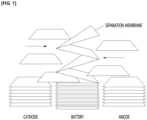
- FIG. 1 is a view illustrating a Z-stacking method used during manufacturing a battery.
- Z-stacking is a method of stacking separation membranes one upon another in a zigzag pattern and inserting cathode materials and anode materials therebetween.
- pouch type batteries do not maintain battery performance after using a certain period, such that they are separated and discharged as waste batteries.
- a method of efficiently disassembling the pouch type battery and recycling the battery for each disassembled component is required.
- Patent Document 1 Korean Patent Registration Publication No. 10-0942410 (entitled a method for disassembling components of a waste battery for recycling, published on February 17, 2010 )
- An object of the present invention is to provide an apparatus for disassembling a pouch type battery which is capable of safely and efficiently disassembling waste pouch type batteries in order to efficiently separate components thereof so that the pouch type batteries can be recycled for each disassembled component.
- an apparatus for disassembling a pouch type battery including: a pouch type battery disassembling unit configured to perform a process of transferring and disassembling the pouch type battery; and a controller configured to monitor an operating state of the pouch type battery disassembling unit and control the process of disassembling the pouch type battery by controlling an operation of the pouch type battery disassembling unit, wherein the pouch type battery disassembling unit includes: a battery input unit configured to check residual voltages of each of a plurality of input batteries, and divide the batteries on which the residual voltages have been checked into disassembly unsuitable batteries whose measured residual voltages are a predetermined allowable value or more and disassembly suitable batteries whose measured residual voltages are less than the predetermined allowable value, then discharge the disassembly unsuitable batteries to an outside; a pouch removal unit configured to remove a pouch of the disassembly suitable battery; and a 3-stage separation unit configured to separate the battery from which the pouch is removed into a
- the battery input unit may include: a first transfer part configured to transfer the input battery; and a voltmeter configured to, when the battery input by the first transfer part reaches a voltage measurement position, measure the residual voltage of the reached battery, wherein the controller receives the residual voltage measured from the voltmeter, and controls the first transfer part so that the input battery is discharged again when the received residual voltage is the predetermined allowable value or more.
- the pouch removal unit may include: a second transfer part configured to transport a plurality of batteries passing through the pouch removal unit so as to be subjected to each process; a terrace cutter configured to cut terraces T1 and T2, which are ends of two portions of the pouch in a direction in which a cathode tab and an anode tab of the battery are located; a side cutter configured to cut sides S1 and S2 in the battery from which the terraces T1 and T2 are removed by cutting, which are ends of two portions of the pouch in which the cathode tab and the anode tab are not located; an upper cover separator configured to adsorb an upper aluminum cover of the battery, from which four sides including the terraces T1 and T2 and the sides S1 and S2 are removed by cutting, using a high pressure, then separate and discharge the adsorbed upper aluminum cover; a first rotator configured to grasp and lift both ends of the battery from which the upper cover is separated, and rotate 180 degrees so that the battery is upside down; a lower cover separator configured to ad
- the pouch removal unit may further include: a fire detection sensor configured to detect whether a fire has occurred in the battery being transferred; and a cell pusher configured to push the battery when the fire is detected thus to discharge it to the outside, wherein the controller controls an operation of the cell pusher so as to discharge the battery of the fire, in which the fire is detected by the fire detection sensor, to the outside, and drop the battery into a separately prepared salt water container.
- a fire detection sensor configured to detect whether a fire has occurred in the battery being transferred
- a cell pusher configured to push the battery when the fire is detected thus to discharge it to the outside, wherein the controller controls an operation of the cell pusher so as to discharge the battery of the fire, in which the fire is detected by the fire detection sensor, to the outside, and drop the battery into a separately prepared salt water container.
- the apparatus may include two 3-stage separation units, and the second transfer part may include two conveyors installed in parallel so as to transfer the plurality of batteries to the two 3-stage separation units.
- the 3-stage separation unit may include: a separation membrane moving part configured to lift and horizontally move one layer of the separation membrane located at a top of the battery, and after moving the one layer of the separation membrane, pneumatically adsorb the first anode material located at the top and remove by moving it to a central outlet; a second rotator configured to rotate the battery from which the first anode material is removed by 180 degrees; a membrane arranger configured to compress one end of the separation membrane with high pressure, and arrange it on a main body of the battery before 3-stage separation; an adsorber configured pneumatically adsorb the arranged separation membrane and lift one end of the separation membrane; a separation membrane rotating and collecting part configured to rotate and wind the lifted separation membrane thus to be separated, then grasp and discharge the separated separation membrane; an electrolyte dryer configured to blow air onto an electrolyte to dry during removing the separation membrane so that the cathode material and the anode material are separated from the separation membrane, thereby allowing the separated cathode material and anode material to be
- an apparatus for disassembling a pouch type battery which is capable of safely and efficiently disassembling waste pouch type batteries in order to efficiently separate the components thereof so that the pouch type batteries can be recycled for each disassembled component.
- a cathode material, an anode material, and a separation membrane, respectively thereby increasing recycling efficiency, protecting workers from chemical contaminants generated during work, and improving work efficiency.
- FIG. 2 is a view illustrating a configuration of an apparatus for disassembling a pouch type battery according to an embodiment of the present invention.
- An apparatus for disassembling a pouch type battery (“pouch type battery disassembling apparatus") 100 is a facility configured to automatically disassemble a bare cell (or electricity generating element) including an aluminum pouch forming a pouch type battery 200, a jelly roll-shaped cathode material, an anode material, and a separation membrane.
- a bare cell or electricity generating element
- the pouch type battery disassembling apparatus 100 the pouch type battery 200 manufactured in a jelly roll method or Z-stacking method may be safely and efficiently disassembled.
- the pouch type battery 200 includes a pouch 210, a bare cell (also referred to as an electricity generating element) 220, a cathode tab 230, and an anode tab 240.
- the pouch 210 is made of a metal material including aluminum, and has a film coating layer of an electrically insulating polymer material.
- the bare cell 220 is accommodated in the pouch 210, and an electrolyte (not illustrated) is filled in a predetermined accommodation space formed therein.
- the bare cell 220 will be described as the same as the battery 200 from which the pouch 210 is removed.
- the bare cell 220 includes a plurality of cathode materials (not illustrated), a plurality of anode materials (not illustrated), and a plurality of separation membranes (not illustrated) disposed between the cathode materials and anode materials.
- the cathode tab 230 is electrically connected to the cathode materials (not illustrated) in the bare cell 220 and a portion thereof is exposed to an outside of the pouch 210
- the anode tab 240 is electrically connected to the anode materials (not illustrated) in the bare cell 220, and a portion thereof is exposed to the outside of the pouch 210.
- the pouch type battery disassembling apparatus 100 may include a battery disassembling unit 110, a controller 120, a user input unit 130, and a display unit 140.
- the battery disassembling unit 110 is configured to perform a process of transferring and disassembling the pouch type battery 200.
- the battery disassembling unit 110 includes a plurality of components for transferring the pouch type battery, disassembling the pouch type battery, and collecting contaminants generated during disassembling the pouch type battery 200.
- the battery disassembling unit 110 is configured to check residual voltages of each of the plurality of input batteries 200, and divide the batteries 200 on which the residual voltages have been checked into disassembly unsuitable batteries whose measured residual voltages are a predetermined allowable value or more and disassembly suitable batteries whose measured residual voltages are less than the predetermined allowable value, then discharge the disassembly unsuitable batteries to the outside.
- the controller 120 configured to monitor an operating state of the battery disassembling unit 110 and control the process of disassembling the pouch type battery 200 by controlling operations of the plurality of components included in the battery disassembling unit 110. Since the battery disassembling unit 110 includes a plurality of driving modules such as a conveyor (not illustrated) for transferring the battery 200, a pick-and-place device (426 in FIG. 4 ) for picking up and placing the battery 200, and a plurality of rotators (424 and 432 in FIG. 4 ) for rotating the battery 200, and pneumatic devices such as a pneumatic adsorber (435 in FIG. 4 ) for lifting up the separation membrane, and an electrolyte dryer (437 in FIG. 4 ) including an air injector for drying the separation membrane, the controller 120 is configured to monitor and control motors included in the plurality of the driving modules and the pneumatic devices.
- driving modules such as a conveyor (not illustrated) for transferring the battery 200, a pick-and-place device (426 in FIG. 4 ) for picking up and placing the battery 200, and
- the user input unit 130 may be configured to receive data and signals input from a user necessary for the controller 120 to control the operation of the battery disassembling unit 110 and transfer them to the controller 120.
- the display unit 140 may be configured as a display device that displays the detailed operating states and control states of the battery disassembling unit 110, the controller 120, and the user input unit 130.
- the facility of the pouch type battery disassembling apparatus 100 may be implemented as follows.
- the power supply may be 400 [V], 3-phase 4-wire, 50 [HZ], 50 [A](R S T N) or 380 [V], 3-phase 4-wire, 60 [Hz] (it may change depending on the countries or areas to be installed), the air consumption may be 668.8 [LITER/MIN], and the size and weight of a main body thereof may be 1900 (W) x 7400 (L) x 2080 (H) and 2,000 [KG].
- the controller 120 may have a size and weight of 1700 (W) x 600 (L) x 2106 (H) and 400 [KG].
- a dust collector employed in the pouch type battery disassembling apparatus 100 may be implemented in a way that a power supply of 400 [V], 3-phase 50 [HZ], 20 [A] (R S T N) is used, and a main body thereof has a size and a weight of 900 (W) x 842 (L) x 1982 (H) and 300 [KG].
- FIG. 3 is a view illustrating a process of disassembling a pouch type battery according to an embodiment of the present invention.
- the process of disassembling a pouch type battery may include a battery input step 310, a pouch cutting step 320, and a battery separation step 330.
- the battery 200 in the battery input step 310 the battery 200 in a state where the residual voltage has been removed through a discharging process is input.
- the residual voltage of the input battery 200 is checked, and if it is determined that the checked residual voltage is the predetermined allowable value or more, the battery is recovered without proceeding to the next step (312).
- the battery may be put into a separately prepared water tank (not illustrated) or manually recovered. Until the battery input step 310, the battery 200 is loaded while the pouch 210 thereof is maintained.
- the pouch cutting step 320 is a process of removing the pouch 210 cover from the battery 200.
- the bare cell 220 in a state of being removed the pouch 210 is loaded (322).
- the cathode material, the anode material, and the separation membrane forming the bare cell may be separated, discharged, and loaded for each material.
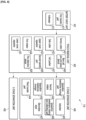
- FIG. 4 is a block diagram illustrating the detailed configuration of the battery disassembling unit 110 included in the pouch type battery disassembling apparatus 100 shown in FIG. 2 .
- FIG. 5 is a view illustrating the detailed configuration of the battery disassembling unit 110 shown in FIG. 2 .
- FIG. 6 is a view illustrating an upper surface of the pouch type battery disassembled by the battery disassembling apparatus 100 shown in FIG. 2 and the state of the bare cell.
- the battery disassembling unit 110 may include a battery input unit 410, a pouch removal unit 420, a 3-stage separation unit 430, and dust collectors 441, 442, 443 and 444.
- the battery input unit 410 performs a process of transferring the battery and discharging a disassembly unsuitable battery (which may be called an NG cell) determined to be unsuitable for disassembly, a process of loading the battery 200 in order to detect a residual voltage (i.e., open-circuit voltage, OCV) of the transferred battery.
- the battery input unit 410 includes a first transfer part 411 and a voltmeter 412.
- the first transfer part 411 is configured to transfer the battery 200 to the conveyor for the process of transferring and discharging the disassembly unsuitable battery (NG cell), and may include various transport modules (e.g., vacuum cylinders, conveyors) for transferring the battery 200.
- the battery input unit 410 measures the voltage of the input battery 200 and transfers only a battery, which is determined as a disassembly suitable battery whose measured residual voltage is less than the allowable value by the controller 120, to the pouch removal unit 420.
- the controller 120 identifies the plurality of input batteries 200, controls the battery input unit 410 so that, when the residual voltage of the identified battery 200 is less than the allowable value, it is classified as a disassembly suitable battery (OK), and if the measured residual voltage of the cells of the identified battery 200 is the allowable value or more, it is classified as a disassembly unsuitable battery (NG cell) to be discharged.
- a disassembly suitable battery OK
- NG cell disassembly unsuitable battery
- the voltmeter 412 measures a voltage of the battery 200, and when the measured voltage is a set voltage (e.g., it may be set and changed to 0.1 [Vdc]) or more, the controller 120 controls the first transfer part 411 so as to discharge the disassembly unsuitable battery (NG cell) to the outside of the apparatus 100 again.
- the first transfer part 411 may include a plurality of conveyor devices for the transferring process.
- the battery input unit 410 includes a pick-and-place device (not illustrated) which is configured to move the input battery 200 in line to the voltmeter 412 for measuring the residual voltage thereof.
- the pick-and-place device may be configured as equipment such as a cylinder connected to a vacuum generator (not illustrated) to pick up the battery 200 with a vacuum.
- the voltmeter 412 measures the residual voltage of the reached battery 200, and transmits the measured residual voltage value to the controller 120.
- the voltmeter 412 may include a first probe (not illustrated) which comes into contact with the cathode tab of the battery 200 and a second probe (not illustrated) which comes into contact with the anode tab thereof to measure the residual voltage of the battery 200. If it is determined that the measured residual voltage is the predetermined allowable value (e.g., 0.1 [V]) or more, the controller 120 may control driving of the battery input unit 410 so that the battery 200 is recovered in the input direction again.
- the predetermined allowable value e.g., 0.1 [V]
- the pouch removal unit 420 performs a process of removing the pouch 210 cover from the battery 200 shown in FIG. 3 .
- the pouch removal unit 420 may include a terrace cutter 421, a side cutter 422, an upper cover separator 423, a first rotator 424, a lower cover separator 425, a bare cell pick-and-place device 426, a cell pusher 427, a second transfer part 428, and a fire detection sensor 429.
- the battery may be input into a separately prepared water tank (not illustrated) or manually recovered.
- a plurality of fire detection sensors 429 may be installed at a plurality of locations to detect whether a fire has occurred in the battery 200 in the process of transferring the battery 200 throughout the battery input unit 410 and the pouch removal unit 420.
- FIG. 6(a) is a view illustrating a state of the battery 200 before being input into the pouch removal unit 420 shown in FIG. 4
- FIG. 6(b) is a view illustrating a state of the battery cell after passing through the pouch removal unit 420.
- the battery 200 is in a state of being wrapped in the pouch 210 before being input into the pouch removal unit 420, and as shown in FIG. 6(b) , after passing through the pouch removal unit 420, the battery comes out as the stat of the bare cell 220 from which the pouch 210 is removed. Referring to FIG. 6(a) , the battery 200 is in a state of being wrapped in the pouch 210 before being input into the pouch removal unit 420, and as shown in FIG. 6(b) , after passing through the pouch removal unit 420, the battery comes out as the stat of the bare cell 220 from which the pouch 210 is removed. Referring to FIG.
- ends of two portions of the pouch 210 surrounding the bare cell 220 in a direction, in which the cathode tab 230 and the anode tab 240 are located are referred to as terraces T1 and T2, and ends of the two portions of the pouch 210 surrounding the bare cell 220 in a direction, in which the cathode tab 230 and the anode tab 240 are not located, are referred to as sides S1 and S2.
- the pouch 210 When cutting four sides including the terraces and sides T1, T2, S1 and S2 of the pouch 210, the pouch 210 will be separated into a pouch portion which covers the upper portion of the bare cell 220 (referred to as an upper cover) and a pouch portion placed on the lower portion of the bare cell 220 (referred to as a lower cover).
- the pouch removal unit 420 moves the battery 200 that has been determined as a disassembly suitable battery to the terrace cutter 421 by the second transfer part 428, and the terrace cutter 421 cuts the terraces T1 and T2 of the transferred battery 200.
- the terrace cutter 421 In order to simultaneously cut two terraces T1 and T2 per one battery 200, two square knives may be used for the terrace cutter 421. The two square knives may cut the terraces T1 and T2 while descending from an upper end of the apparatus 100 to the battery 200.
- the battery 200 from which the terraces T1 and T2 are removed by cutting is moved to the side cutter 422, and the side cutter 422 cuts the sides S1 and S2.
- a circular knife may be used for the side cutter 422.
- two circular knives may be used for the side cutter 421. The two circular knives cut the sides S1 and S2 while rotating and moving by descending from the upper end of the apparatus 100 to the battery 200.
- the upper cover separator 423 adsorbs the upper aluminum cover of the battery, from which the four sides T1, T2, S1 and S2 are removed by cutting, using a high pressure, then separates and discharges the adsorbed upper aluminum cover.
- the upper cover separator 423 may be configured to adsorb the upper cover using pneumatic pressure, lift the adsorbed upper cover, and move it to an upper cover transfer conveyor (not illustrated) which is separately prepared to transfer the separated upper cover.
- the first rotator 424 grasps and lifts both ends of the battery 200, and rotates 180 degrees so that the battery 200 is upside down.
- the lower cover separator 425 adsorbs the lower aluminum cover of the battery 200 rotated 180 degrees by the first rotator 424 using pneumatic pressure, then separates and discharges the adsorbed lower aluminum cover.
- the lower cover separator 425 may be configured to adsorb the lower cover by pneumatic pressure, lift the adsorbed lower cover, and move it to a lower cover transfer conveyor (not illustrated) which is separately prepared to transfer the separated lower cover.
- the bare cell 220 which is a battery in a state where the pouch 210 is removed, is loaded into the 3-stage separation unit 430.
- the 3-stage separation unit 430 may separate the cathode material, the anode material, and the separation membrane forming the bare cell 220 for each material, then discharge and load the separated materials.
- the bare cell pick-and-place device 426 is configured to divide and supply the battery 200 from which all aluminum covers are removed into two 3-stage separation units 430. Specifically, the bare cell pick-and-place device 426 sequentially divides and moves the bare cell type battery 200 from which the cover is removed to the two separation membrane moving parts 431.
- the cell pusher 427 is configured, when it is determined that a fire has occurred in the battery 200 based on a signal detected by the fire detection sensor 429, to push the battery 200 of the fire according to the control of the controller 120 and discharge it to an outside of the battery disassembling unit 110, to drop it into a separately prepared salt water container (not illustrated).
- the cell pusher 427 operates to immerse the battery in salt water by means a cylinder puncher, thereby preventing spread of the fire.
- the second transfer part 428 transports the batteries 200 passing through the pouch removal unit 420 so as to be subjected to each process.
- the second transfer part 428 may include two conveyors (not illustrated) installed in parallel so as to transfer the plurality of batteries 200 to the two 3-stage separation units.
- the 3-stage separation unit 430 may include a separation membrane moving part 431, a second rotator 432, a separation membrane arranger 433, a third transfer part 434, an adsorber 435, a separation membrane rotating and collecting part 436, and an electrolyte dryer 437.
- the third transfer part 434 is configured to transfer the transferred battery 200 to a position for each process of the 3-stage separation unit 430.
- the third transfer part 434 may include a conveyor for transferring the battery 200 to the 3-stage separation unit 430, a driving motor and a cylinder module for performing each process of the 3-stage separation unit 430.
- the separation membrane moving part 431 lifts and horizontally moves one layer of the separation membrane located at the top of the bare cell type battery 200, and after moving the one layer of the separation membrane, pneumatically adsorbs the first anode material located at the top and removes by moving it to a central outlet (not illustrated).
- the second rotator 432 rotates the battery 200 from which the top anode material is removed by 180 degrees so as to be upside down.
- the separation membrane arranger 433 compresses the horizontally moved separation membrane with high pressure, and arranges it on a main body of the battery before 3-stage separation.
- the adsorber 435 pneumatically adsorbs the arranged separation membrane and lifts one end of the separation membrane.
- the separation membrane rotating and collecting part 436 rotates and winds the lifted separation membrane thus to be separated, then grasps and discharges the separated separation membrane.
- the electrolyte dryer 437 blows air onto the electrolyte to dry during removing the separation membrane so that the cathode material and the anode material are separated from the separation membrane, and thereby helping the separated cathode material and anode material to be collected at different locations.
- the third transfer part 434 additionally includes a cathode material transfer conveyor (not illustrated) and an anode material transfer conveyor (not illustrated), such that the separated cathode material and anode material can be respectively discharged through the separate conveyors.
- the dust collectors 441, 442, 443 and 444 adsorb and collect harmful substances using air when disassembling the battery 200, and then purify and discharge the collected substances.
- FIG. 7 is a view illustrating the configuration for measuring the voltage of the battery 200 in the pouch type battery disassembling apparatus 100 shown in FIG. 4 .
- the first transfer part 411 of the battery input unit 410 may include an input conveyor 710 which moves to input the battery 200 into the pouch type battery disassembling apparatus 100 and a discharge conveyor 720 which discharges the disassembly unsuitable battery (NG cell) that has been determined not to be suitable for disassembly after measuring the voltage.
- the OCV is measured by the voltmeter 412 at the voltage measurement position through the input conveyor 710, and the battery that has been determined to be suitable for disassembly according to the control of the controller 120 is transferred to the second transfer part 428, and the disassembly unsuitable battery (NG cell) is discharged to the outside of the apparatus 100 again using the discharge conveyor 720.
- FIG. 8 is a view illustrating some configurations of the first transfer part 411 and the second transfer part 428 of the pouch type battery disassembling apparatus shown in FIG. 4 .
- FIG. 8(a) is a plan view illustrating the configuration
- FIG. 8(b) is a side view illustrating the configuration.
- the battery 200 When the battery 200 is placed at a voltage measurement position 810 by the first transfer part 411, the residual voltage of the battery 200 is measured by the voltmeter 412, and the battery 200 that has been determined to be suitable for disassembly is moved to the terrace cutting position 820 by the second transfer part 428, such that terrace cutting is performed by the terrace cutter 421.
- the cell pusher 427 pushes the battery 200 with a constant strength to move it to the salt water container (not illustrated) containing salt water.
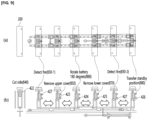
- FIG. 9 is a view illustrating the configuration of the second transfer part 428 of the pouch type battery disassembling apparatus shown in FIG. 4 .
- FIG. 9(a) is a plan view illustrating the configuration
- FIG. 9(b) is a side view illustrating the configuration.
- the side cutter 422 cuts the sides S1 and S2 of the battery 200. If a fire is detected at a fire detection location 830-1 during transferring the battery 200 to the upper cover removal location 850 by the second transfer part 428, the cell pusher 427 pushes the battery 200 with a constant strength or more to move it to the salt water container (not illustrated) according to the control of the controller 120.
- the upper cover of the battery 200 is separated by the upper cover separator 423.
- the battery 200, from which the upper cover is separated is placed at a rotation position 860 by the second transfer part 428, the main body of the battery 200 is rotated 180 degrees by the first rotator 424, such that the battery 200 is upside down and the lower cover of the battery 200 is raised up.
- the battery 200 rotated by the second transfer part 428 is placed at a lower cover removal position 870, the lower cover is separated by the lower cover separator 425.
- the cell pusher 427 may move the battery 200 of the fire to the salt water container (not illustrated) according to the control of the controller 120.
- the fire detection sensor 429 and the cell pusher 427 detect a possibility of fire occurring at least three times at locations where the possibility of fire is increased, such as immediately after terrace cutting, immediately after side cutting, and immediately after removing the lower cover, respectively.
- the bare cell battery 200 from which the cover is removed waits before being input into the 3-stage separation unit 430 by the bare cell pick-and-place device 426.
- FIG. 10 is a view illustrating the configuration of the battery 200 from which the cover is removed from the pouch removal unit 420 shown in FIG. 4 .
- a bare cell 1000 which is a battery 200 whose cover is removed, includes separation membranes 1010, a plurality of anode materials 1020, and a plurality of cathode materials 1030.
- the bare cell pick-and-place device 426 may alternately supply the input bare cells 1000 to two 3-stage separation units 430 in sequence.
- the second transfer part 428 may include two conveyors (not illustrated) so that the bare cells 1000 are sequentially input into the two 3-stage separation units 430.
- the separation membrane moving part 431 lifts and horizontally moves the separation membrane 1010 in a direction of an arrow 1050 using pneumatic pressure.
- FIG. 11 is a view illustrating a state where one layer of the separation membrane is lifted and moved in the bare cell 1000 shown in FIG. 10 .
- the separation membrane moving part 431 when the separation membrane moving part 431 lifts and horizontally moves the separation membrane 1010 in the direction of the arrow 1050 using pneumatic pressure, as shown in FIG. 11 , the position of one end 1110 of the separation membrane 1010 is moved from the top to the bottom of the bare cell 1000. In this state, the separation membrane moving part 431 additionally adsorbs one anode material 1020 located at the top of the bare cell 1000 with pneumatic pressure and removes by moving it to the central outlet.
- FIG. 12 is a view illustrating a state where the bare cell 1000, from which the top anode material 1020 is removed, is rotated 180 degrees and is upside down.
- the bare cell 1000 is rotated 180 degrees by the second rotator 432 and is upside down.
- the position of the one end 1110 of the separation membrane 1010 located at the bottom is changed to the top.
- FIG. 13 is a view illustrating a state where the one end 1110 of the separation membrane 1010 is arranged from FIG. 12 .
- the separation membrane arranger 433 compresses the one end 1110 of the separation membrane with pneumatic pressure, and arranges it so as to be placed on the main body of the bare cell 1000.
- the bare cell 1000 is transferred to the next process position by the third transfer part 434.
- FIG. 14 is a view illustrating a state where the separation membrane 1010 shown in FIG. 13 is wound around a bobbin 1430.
- An adsorber 436 grasps the one end 1110 of the separation membrane 1010, hangs the caught one end 1110 on two tongue posts 1410 and 1420 installed on the bobbin 1430 included in the separation membrane rotating and collecting part 436, and rotates the bobbin 1430. Thereby, it is driven so that the separation membrane 1010 hung on the tongue posts 1410 and 1420 is wound and separated.
- FIG. 15 is view illustrating a process in which the electrolyte is dried when the separation membrane 1010 shown in FIG. 13 is wound up.
- the electrolyte dryer 437 is located at a lower end of the adsorber 436, and dries the electrolyte contained in the separation membrane 1010 so that the anode material 1020 and the cathode material 1030 are smoothly separated from the separation membrane 1010.
- the electrolyte dryer 437 may include a first air injector 1530 configured to inject air between the two rollers 1510 and 1520 which support the separation membrane 1010 when the separation membrane 1010 is lifted, and between the anode material 1020 and the separation membrane 1010, thereby helping the cathode material 1030 and the separation membrane 1010 to be separated, and a second air injector 1540 configured to inject air between the anode material 1020 and the separation membrane 1010, thereby helping the cathode material 1030 and the separation membrane 1010 to be separated
- An aspect of the present invention may be implemented as a computer-readable code in a computer-readable recording medium.
- the codes and code segments, which implement the above program, may be easily deduced by a computer programmer in the art.
- the computer-readable recording medium may include all types of recording devices for storing data that can be read by a computer system. Examples of computer-readable recording medium may include ROM, RAM, CD-ROM, magnetic tape, floppy disk, optical disk and the like. Further, the computer-readable recording medium may be distributed over a computer system connected by a network, and written and implemented in computer-readable code that can be read by the computer in a distributed manner.
Landscapes
- Engineering & Computer Science (AREA)
- Manufacturing & Machinery (AREA)
- Chemical & Material Sciences (AREA)
- Chemical Kinetics & Catalysis (AREA)
- Electrochemistry (AREA)
- General Chemical & Material Sciences (AREA)
- Physics & Mathematics (AREA)
- General Physics & Mathematics (AREA)
- Environmental & Geological Engineering (AREA)
- Life Sciences & Earth Sciences (AREA)
- Sustainable Development (AREA)
- Secondary Cells (AREA)
- Processing Of Solid Wastes (AREA)
Abstract
The present invention discloses an apparatus for disassembling a pouch type battery that performs a pouch type battery separation process. The apparatus for disassembling a pouch type battery includes a pouch type battery disassembling unit configured to perform a process of transferring and disassembling the pouch type battery; and a controller configured to monitor an operating state of the pouch type battery disassembling unit and control the process of disassembling the pouch type battery by controlling an operation of the pouch type battery disassembling unit. The pouch type battery disassembling unit includes a battery input unit configured to check residual voltages of each of a plurality of input batteries, and divide the batteries on which the residual voltages have been checked into disassembly unsuitable batteries whose measured residual voltages are a predetermined allowable value or more and disassembly suitable batteries whose measured residual voltages are less than the predetermined allowable value, then discharge the disassembly unsuitable batteries to an outside; a pouch removal unit configured to remove a pouch of the disassembly suitable battery; and a 3-stage separation unit configured to separate the battery from which the pouch is removed into a separation membrane, an anode material, and a cathode material, respectively.
Description
- This application claims the benefit of
Korean Patent Applications No. 10-2023-0034124 filed on March 15, 2023 No. 10-2023-0053776 filed on April 25, 2023 - The present invention relates to an apparatus for separating components of a battery, and more particularly, to an apparatus for performing a separation process of a pouch type battery.
- A pouch type battery refers to a battery in which battery cells are packaged in a pouch made of an aluminum foil with nylon and CCP film attached thereto. Although there are various types of battery depending on the type of an electrolyte and the shape of an electrode plate to be used, these batteries are collectively called pouch type batteries. The pouch type battery is a secondary battery in which electrodes in the shape of a 'jelly roll' formed by rolling materials such as an anode, a cathode, and a separation membrane, or electrodes in the shape of a 'stack' formed by stacking the materials layer by layer are wrapped in a cell pouch. Compared to cylindrical can or square-shaped batteries, due to a high energy storage density resulted from high internal space efficiency and an flexible exterior, the pouch type battery can be bent or folded freely, thus to be manufactured in an appropriate shape according to the designs of electric vehicles as well as various electronic products. Demand for the pouch type battery is rapidly increasing with the growth of the electric vehicle market based on these strengths.
-
FIG. 1 is a view illustrating a Z-stacking method used during manufacturing a battery. - As shown in
FIG. 1 , Z-stacking is a method of stacking separation membranes one upon another in a zigzag pattern and inserting cathode materials and anode materials therebetween. - These pouch type batteries do not maintain battery performance after using a certain period, such that they are separated and discharged as waste batteries. As the use of the pouch type battery is increased, a method of efficiently disassembling the pouch type battery and recycling the battery for each disassembled component is required.
- (Patent Document 1)
Korean Patent Registration Publication No. 10-0942410 (entitled a method for disassembling components of a waste battery for recycling, published on February 17, 2010 - An object of the present invention is to provide an apparatus for disassembling a pouch type battery which is capable of safely and efficiently disassembling waste pouch type batteries in order to efficiently separate components thereof so that the pouch type batteries can be recycled for each disassembled component.
- To achieve the above objects, according to an aspect of the present invention, there is provided an apparatus for disassembling a pouch type battery including: a pouch type battery disassembling unit configured to perform a process of transferring and disassembling the pouch type battery; and a controller configured to monitor an operating state of the pouch type battery disassembling unit and control the process of disassembling the pouch type battery by controlling an operation of the pouch type battery disassembling unit, wherein the pouch type battery disassembling unit includes: a battery input unit configured to check residual voltages of each of a plurality of input batteries, and divide the batteries on which the residual voltages have been checked into disassembly unsuitable batteries whose measured residual voltages are a predetermined allowable value or more and disassembly suitable batteries whose measured residual voltages are less than the predetermined allowable value, then discharge the disassembly unsuitable batteries to an outside; a pouch removal unit configured to remove a pouch of the disassembly suitable battery; and a 3-stage separation unit configured to separate the battery from which the pouch is removed into a separation membrane, an anode material, and a cathode material, respectively.
- The battery input unit may include: a first transfer part configured to transfer the input battery; and a voltmeter configured to, when the battery input by the first transfer part reaches a voltage measurement position, measure the residual voltage of the reached battery, wherein the controller receives the residual voltage measured from the voltmeter, and controls the first transfer part so that the input battery is discharged again when the received residual voltage is the predetermined allowable value or more.
- The pouch removal unit may include: a second transfer part configured to transport a plurality of batteries passing through the pouch removal unit so as to be subjected to each process; a terrace cutter configured to cut terraces T1 and T2, which are ends of two portions of the pouch in a direction in which a cathode tab and an anode tab of the battery are located; a side cutter configured to cut sides S1 and S2 in the battery from which the terraces T1 and T2 are removed by cutting, which are ends of two portions of the pouch in which the cathode tab and the anode tab are not located; an upper cover separator configured to adsorb an upper aluminum cover of the battery, from which four sides including the terraces T1 and T2 and the sides S1 and S2 are removed by cutting, using a high pressure, then separate and discharge the adsorbed upper aluminum cover; a first rotator configured to grasp and lift both ends of the battery from which the upper cover is separated, and rotate 180 degrees so that the battery is upside down; a lower cover separator configured to adsorb a lower cover of the battery rotated 180 degrees by the first rotator using pneumatic pressure, then separate and discharge the adsorbed lower cover; a bare cell pick-and-place device configured to move the battery from which the pouch is removed to the 3-stage separation unit.
- The pouch removal unit may further include: a fire detection sensor configured to detect whether a fire has occurred in the battery being transferred; and a cell pusher configured to push the battery when the fire is detected thus to discharge it to the outside, wherein the controller controls an operation of the cell pusher so as to discharge the battery of the fire, in which the fire is detected by the fire detection sensor, to the outside, and drop the battery into a separately prepared salt water container.
- The apparatus may include two 3-stage separation units, and the second transfer part may include two conveyors installed in parallel so as to transfer the plurality of batteries to the two 3-stage separation units.
- The 3-stage separation unit may include: a separation membrane moving part configured to lift and horizontally move one layer of the separation membrane located at a top of the battery, and after moving the one layer of the separation membrane, pneumatically adsorb the first anode material located at the top and remove by moving it to a central outlet; a second rotator configured to rotate the battery from which the first anode material is removed by 180 degrees; a membrane arranger configured to compress one end of the separation membrane with high pressure, and arrange it on a main body of the battery before 3-stage separation; an adsorber configured pneumatically adsorb the arranged separation membrane and lift one end of the separation membrane; a separation membrane rotating and collecting part configured to rotate and wind the lifted separation membrane thus to be separated, then grasp and discharge the separated separation membrane; an electrolyte dryer configured to blow air onto an electrolyte to dry during removing the separation membrane so that the cathode material and the anode material are separated from the separation membrane, thereby allowing the separated cathode material and anode material to be collected at different locations; and a third transfer part configured to transfer the battery from which the pouch is removed by the 3-stage separation unit, and transfer the separated cathode material and anode material to separate locations.
- According to the present invention, it is possible to provide an apparatus for disassembling a pouch type battery which is capable of safely and efficiently disassembling waste pouch type batteries in order to efficiently separate the components thereof so that the pouch type batteries can be recycled for each disassembled component. Through this, it is possible to separate materials included in battery cells into a cathode material, an anode material, and a separation membrane, respectively, thereby increasing recycling efficiency, protecting workers from chemical contaminants generated during work, and improving work efficiency. In particular, it is possible to secure a purity of 99% or more of nickel, cobalt, manganese, lithium, etc., which are raw materials for cathode materials, by increasing a separation efficiency of the cathode materials having a high recycling value at present, and inputting the separated materials into the recycling process.
- The above and other objects, features and other advantages of the present invention will be more clearly understood from the following detailed description taken in conjunction with the accompanying drawings, in which:
-
FIG. 1 is a view illustrating a Z-stacking method used during manufacturing a battery; -
FIG. 2 is a view illustrating a configuration of an apparatus for disassembling a pouch type battery according to an embodiment of the present invention; -
FIG. 3 is a view illustrating a process of disassembling the pouch type battery according to an embodiment of the present invention; -
FIG. 4 is a block diagram illustrating the detailed configuration of a battery disassembling unit included in the apparatus for disassembling a pouch type battery shown inFIG. 2 ; -
FIG. 5 is a view illustrating the detailed configuration of the pouch type battery disassembling unit shown inFIG. 2 ; -
FIG. 6 is a view illustrating an upper surface of the pouch type battery disassembled by the battery disassembling apparatus shown inFIG. 2 and a state of a bare cell; -
FIG. 7 is a view illustrating the configuration of measuring a voltage of the battery in the apparatus for disassembling a pouch type battery shown inFIG. 4 ; -
FIG. 8 is a view illustrating some configurations of a first transfer part and a second transfer part of the apparatus for disassembling a pouch type battery shown inFIG. 4 ; -
FIG. 9 is a view illustrating the configuration of the second transfer part of the apparatus for disassembling a pouch type battery shown inFIG. 4 ; -
FIG. 10 is a view illustrating the configuration of the battery from which a cover is removed by a pouch removal unit shown inFIG. 4 ; -
FIG. 11 is a view illustrating a state where one layer of a separation membrane is lifted and moved in the bare cell shown inFIG. 10 ; -
FIG. 12 is a view illustrating a state where the bare cell, from which a top anode material is removed, is rotated 180 degrees and is upside down; -
FIG. 13 is a view illustrating a state where one end of the separation membrane is arranged fromFIG. 12 ; -
FIG. 14 is a view illustrating a state where the separation membrane shown inFIG. 13 is wound around a bobbin; and -
FIG. 15 is a view illustrating a process of drying an electrolyte when the separation membrane shown inFIG. 13 is wound up. - Hereinafter, an embodiment of the present invention will be described in detail with reference to the accompanying drawings. In addition, in description of preferred embodiments of the present invention, the publicly known functions and configurations related to the present invention, which are judged to be able to make the purport of the present invention unnecessarily obscure will not be described in detail. Further, wordings to be described below are defined in consideration of the functions in the present invention, and may differ depending on the intentions of a user or an operator or custom. Accordingly, such wordings should be defined on the basis of the contents of the overall specification.
-
FIG. 2 is a view illustrating a configuration of an apparatus for disassembling a pouch type battery according to an embodiment of the present invention. - An apparatus for disassembling a pouch type battery ("pouch type battery disassembling apparatus") 100 is a facility configured to automatically disassemble a bare cell (or electricity generating element) including an aluminum pouch forming a
pouch type battery 200, a jelly roll-shaped cathode material, an anode material, and a separation membrane. By the pouch typebattery disassembling apparatus 100, thepouch type battery 200 manufactured in a jelly roll method or Z-stacking method may be safely and efficiently disassembled. - The
pouch type battery 200 includes apouch 210, a bare cell (also referred to as an electricity generating element) 220, acathode tab 230, and ananode tab 240. Thepouch 210 is made of a metal material including aluminum, and has a film coating layer of an electrically insulating polymer material. Thebare cell 220 is accommodated in thepouch 210, and an electrolyte (not illustrated) is filled in a predetermined accommodation space formed therein. Here, thebare cell 220 will be described as the same as thebattery 200 from which thepouch 210 is removed. - The
bare cell 220 includes a plurality of cathode materials (not illustrated), a plurality of anode materials (not illustrated), and a plurality of separation membranes (not illustrated) disposed between the cathode materials and anode materials. - The
cathode tab 230 is electrically connected to the cathode materials (not illustrated) in thebare cell 220 and a portion thereof is exposed to an outside of thepouch 210, and theanode tab 240 is electrically connected to the anode materials (not illustrated) in thebare cell 220, and a portion thereof is exposed to the outside of thepouch 210. - The pouch type
battery disassembling apparatus 100 may include a battery disassemblingunit 110, acontroller 120, auser input unit 130, and adisplay unit 140. - The battery disassembling
unit 110 is configured to perform a process of transferring and disassembling thepouch type battery 200. The battery disassemblingunit 110 includes a plurality of components for transferring the pouch type battery, disassembling the pouch type battery, and collecting contaminants generated during disassembling thepouch type battery 200. The battery disassemblingunit 110 is configured to check residual voltages of each of the plurality ofinput batteries 200, and divide thebatteries 200 on which the residual voltages have been checked into disassembly unsuitable batteries whose measured residual voltages are a predetermined allowable value or more and disassembly suitable batteries whose measured residual voltages are less than the predetermined allowable value, then discharge the disassembly unsuitable batteries to the outside. - The
controller 120 configured to monitor an operating state of thebattery disassembling unit 110 and control the process of disassembling thepouch type battery 200 by controlling operations of the plurality of components included in thebattery disassembling unit 110. Since thebattery disassembling unit 110 includes a plurality of driving modules such as a conveyor (not illustrated) for transferring thebattery 200, a pick-and-place device (426 inFIG. 4 ) for picking up and placing thebattery 200, and a plurality of rotators (424 and 432 inFIG. 4 ) for rotating thebattery 200, and pneumatic devices such as a pneumatic adsorber (435 inFIG. 4 ) for lifting up the separation membrane, and an electrolyte dryer (437 inFIG. 4 ) including an air injector for drying the separation membrane, thecontroller 120 is configured to monitor and control motors included in the plurality of the driving modules and the pneumatic devices. - The
user input unit 130 may be configured to receive data and signals input from a user necessary for thecontroller 120 to control the operation of thebattery disassembling unit 110 and transfer them to thecontroller 120. - The
display unit 140 may be configured as a display device that displays the detailed operating states and control states of thebattery disassembling unit 110, thecontroller 120, and theuser input unit 130. - The facility of the pouch type
battery disassembling apparatus 100 may be implemented as follows. For example, the power supply may be 400 [V], 3-phase 4-wire, 50 [HZ], 50 [A](R S T N) or 380 [V], 3-phase 4-wire, 60 [Hz] (it may change depending on the countries or areas to be installed), the air consumption may be 668.8 [LITER/MIN], and the size and weight of a main body thereof may be 1900 (W) x 7400 (L) x 2080 (H) and 2,000 [KG]. Thecontroller 120 may have a size and weight of 1700 (W) x 600 (L) x 2106 (H) and 400 [KG]. - A dust collector employed in the pouch type
battery disassembling apparatus 100 may be implemented in a way that a power supply of 400 [V], 3-phase 50 [HZ], 20 [A] (R S T N) is used, and a main body thereof has a size and a weight of 900 (W) x 842 (L) x 1982 (H) and 300 [KG]. -
FIG. 3 is a view illustrating a process of disassembling a pouch type battery according to an embodiment of the present invention. - The process of disassembling a pouch type battery according to an embodiment of the present invention may include a
battery input step 310, apouch cutting step 320, and abattery separation step 330. - In the
battery input step 310, thebattery 200 in a state where the residual voltage has been removed through a discharging process is input. The residual voltage of theinput battery 200 is checked, and if it is determined that the checked residual voltage is the predetermined allowable value or more, the battery is recovered without proceeding to the next step (312). In addition, even when an abnormality such as a flame is detected in theinput battery 200 by a fire detection sensor (not illustrated), the battery may be put into a separately prepared water tank (not illustrated) or manually recovered. Until thebattery input step 310, thebattery 200 is loaded while thepouch 210 thereof is maintained. - The
pouch cutting step 320 is a process of removing thepouch 210 cover from thebattery 200. Thebare cell 220 in a state of being removed thepouch 210 is loaded (322). - In the battery (i.e., bare cell)
separation step 330, the cathode material, the anode material, and the separation membrane forming the bare cell may be separated, discharged, and loaded for each material. -
FIG. 4 is a block diagram illustrating the detailed configuration of thebattery disassembling unit 110 included in the pouch typebattery disassembling apparatus 100 shown inFIG. 2 .FIG. 5 is a view illustrating the detailed configuration of thebattery disassembling unit 110 shown inFIG. 2 .FIG. 6 is a view illustrating an upper surface of the pouch type battery disassembled by thebattery disassembling apparatus 100 shown inFIG. 2 and the state of the bare cell. - Referring to
FIGS. 4 and5 , thebattery disassembling unit 110 may include abattery input unit 410, apouch removal unit 420, a 3-stage separation unit 430, anddust collectors - The
battery input unit 410 performs a process of transferring the battery and discharging a disassembly unsuitable battery (which may be called an NG cell) determined to be unsuitable for disassembly, a process of loading thebattery 200 in order to detect a residual voltage (i.e., open-circuit voltage, OCV) of the transferred battery. Thebattery input unit 410 includes afirst transfer part 411 and avoltmeter 412. - The
first transfer part 411 is configured to transfer thebattery 200 to the conveyor for the process of transferring and discharging the disassembly unsuitable battery (NG cell), and may include various transport modules (e.g., vacuum cylinders, conveyors) for transferring thebattery 200. Thebattery input unit 410 measures the voltage of theinput battery 200 and transfers only a battery, which is determined as a disassembly suitable battery whose measured residual voltage is less than the allowable value by thecontroller 120, to thepouch removal unit 420. Thecontroller 120 identifies the plurality ofinput batteries 200, controls thebattery input unit 410 so that, when the residual voltage of the identifiedbattery 200 is less than the allowable value, it is classified as a disassembly suitable battery (OK), and if the measured residual voltage of the cells of the identifiedbattery 200 is the allowable value or more, it is classified as a disassembly unsuitable battery (NG cell) to be discharged. - The
voltmeter 412 measures a voltage of thebattery 200, and when the measured voltage is a set voltage (e.g., it may be set and changed to 0.1 [Vdc]) or more, thecontroller 120 controls thefirst transfer part 411 so as to discharge the disassembly unsuitable battery (NG cell) to the outside of theapparatus 100 again. Thefirst transfer part 411 may include a plurality of conveyor devices for the transferring process. - The
battery input unit 410 includes a pick-and-place device (not illustrated) which is configured to move theinput battery 200 in line to thevoltmeter 412 for measuring the residual voltage thereof. The pick-and-place device may be configured as equipment such as a cylinder connected to a vacuum generator (not illustrated) to pick up thebattery 200 with a vacuum. - When the
battery 200 input by thefirst transfer part 411 reaches a voltage measurement position, thevoltmeter 412 measures the residual voltage of the reachedbattery 200, and transmits the measured residual voltage value to thecontroller 120. Thevoltmeter 412 may include a first probe (not illustrated) which comes into contact with the cathode tab of thebattery 200 and a second probe (not illustrated) which comes into contact with the anode tab thereof to measure the residual voltage of thebattery 200. If it is determined that the measured residual voltage is the predetermined allowable value (e.g., 0.1 [V]) or more, thecontroller 120 may control driving of thebattery input unit 410 so that thebattery 200 is recovered in the input direction again. - The
pouch removal unit 420 performs a process of removing thepouch 210 cover from thebattery 200 shown inFIG. 3 . Thepouch removal unit 420 may include aterrace cutter 421, aside cutter 422, anupper cover separator 423, afirst rotator 424, alower cover separator 425, a bare cell pick-and-place device 426, acell pusher 427, asecond transfer part 428, and afire detection sensor 429. - Even when an abnormality such as a spark is detected in the
input battery 200 by thefire detection sensor 429, the battery may be input into a separately prepared water tank (not illustrated) or manually recovered. A plurality offire detection sensors 429 may be installed at a plurality of locations to detect whether a fire has occurred in thebattery 200 in the process of transferring thebattery 200 throughout thebattery input unit 410 and thepouch removal unit 420. - Referring to
FIG. 6, FIG. 6(a) is a view illustrating a state of thebattery 200 before being input into thepouch removal unit 420 shown inFIG. 4 , andFIG. 6(b) is a view illustrating a state of the battery cell after passing through thepouch removal unit 420. - As shown in
FIG. 6(a) , thebattery 200 is in a state of being wrapped in thepouch 210 before being input into thepouch removal unit 420, and as shown inFIG. 6(b) , after passing through thepouch removal unit 420, the battery comes out as the stat of thebare cell 220 from which thepouch 210 is removed. Referring toFIG. 6(a) , ends of two portions of thepouch 210 surrounding thebare cell 220 in a direction, in which thecathode tab 230 and theanode tab 240 are located, are referred to as terraces T1 and T2, and ends of the two portions of thepouch 210 surrounding thebare cell 220 in a direction, in which thecathode tab 230 and theanode tab 240 are not located, are referred to as sides S1 and S2. When cutting four sides including the terraces and sides T1, T2, S1 and S2 of thepouch 210, thepouch 210 will be separated into a pouch portion which covers the upper portion of the bare cell 220 (referred to as an upper cover) and a pouch portion placed on the lower portion of the bare cell 220 (referred to as a lower cover). - Referring to
FIGS. 4 and5 again, according to the control of thecontroller 120, thepouch removal unit 420 moves thebattery 200 that has been determined as a disassembly suitable battery to theterrace cutter 421 by thesecond transfer part 428, and theterrace cutter 421 cuts the terraces T1 and T2 of the transferredbattery 200. In order to simultaneously cut two terraces T1 and T2 per onebattery 200, two square knives may be used for theterrace cutter 421. The two square knives may cut the terraces T1 and T2 while descending from an upper end of theapparatus 100 to thebattery 200. - The
battery 200 from which the terraces T1 and T2 are removed by cutting is moved to theside cutter 422, and theside cutter 422 cuts the sides S1 and S2. A circular knife may be used for theside cutter 422. In order to simultaneously cut two sides S1 and S2 per onebattery 200, two circular knives may be used for theside cutter 421. The two circular knives cut the sides S1 and S2 while rotating and moving by descending from the upper end of theapparatus 100 to thebattery 200. - The
upper cover separator 423 adsorbs the upper aluminum cover of the battery, from which the four sides T1, T2, S1 and S2 are removed by cutting, using a high pressure, then separates and discharges the adsorbed upper aluminum cover. Theupper cover separator 423 may be configured to adsorb the upper cover using pneumatic pressure, lift the adsorbed upper cover, and move it to an upper cover transfer conveyor (not illustrated) which is separately prepared to transfer the separated upper cover. - The
first rotator 424 grasps and lifts both ends of thebattery 200, and rotates 180 degrees so that thebattery 200 is upside down. - The
lower cover separator 425 adsorbs the lower aluminum cover of thebattery 200 rotated 180 degrees by thefirst rotator 424 using pneumatic pressure, then separates and discharges the adsorbed lower aluminum cover. Thelower cover separator 425 may be configured to adsorb the lower cover by pneumatic pressure, lift the adsorbed lower cover, and move it to a lower cover transfer conveyor (not illustrated) which is separately prepared to transfer the separated lower cover. - Thus, the
bare cell 220, which is a battery in a state where thepouch 210 is removed, is loaded into the 3-stage separation unit 430. The 3-stage separation unit 430 may separate the cathode material, the anode material, and the separation membrane forming thebare cell 220 for each material, then discharge and load the separated materials. - The bare cell pick-and-
place device 426 is configured to divide and supply thebattery 200 from which all aluminum covers are removed into two 3-stage separation units 430. Specifically, the bare cell pick-and-place device 426 sequentially divides and moves the barecell type battery 200 from which the cover is removed to the two separationmembrane moving parts 431. - The
cell pusher 427 is configured, when it is determined that a fire has occurred in thebattery 200 based on a signal detected by thefire detection sensor 429, to push thebattery 200 of the fire according to the control of thecontroller 120 and discharge it to an outside of thebattery disassembling unit 110, to drop it into a separately prepared salt water container (not illustrated). Thecell pusher 427 operates to immerse the battery in salt water by means a cylinder puncher, thereby preventing spread of the fire. - The
second transfer part 428 transports thebatteries 200 passing through thepouch removal unit 420 so as to be subjected to each process. In order to improve the battery disassembly processing speed, when two 3-stage separation units 430 are provided, thesecond transfer part 428 may include two conveyors (not illustrated) installed in parallel so as to transfer the plurality ofbatteries 200 to the two 3-stage separation units. - The 3-
stage separation unit 430 may include a separationmembrane moving part 431, asecond rotator 432, aseparation membrane arranger 433, athird transfer part 434, anadsorber 435, a separation membrane rotating and collectingpart 436, and anelectrolyte dryer 437. - The
third transfer part 434 is configured to transfer the transferredbattery 200 to a position for each process of the 3-stage separation unit 430. Thethird transfer part 434 may include a conveyor for transferring thebattery 200 to the 3-stage separation unit 430, a driving motor and a cylinder module for performing each process of the 3-stage separation unit 430. - The separation
membrane moving part 431 lifts and horizontally moves one layer of the separation membrane located at the top of the barecell type battery 200, and after moving the one layer of the separation membrane, pneumatically adsorbs the first anode material located at the top and removes by moving it to a central outlet (not illustrated). - The
second rotator 432 rotates thebattery 200 from which the top anode material is removed by 180 degrees so as to be upside down. - The
separation membrane arranger 433 compresses the horizontally moved separation membrane with high pressure, and arranges it on a main body of the battery before 3-stage separation. - The
adsorber 435 pneumatically adsorbs the arranged separation membrane and lifts one end of the separation membrane. - The separation membrane rotating and collecting
part 436 rotates and winds the lifted separation membrane thus to be separated, then grasps and discharges the separated separation membrane. - The
electrolyte dryer 437 blows air onto the electrolyte to dry during removing the separation membrane so that the cathode material and the anode material are separated from the separation membrane, and thereby helping the separated cathode material and anode material to be collected at different locations. - The
third transfer part 434 additionally includes a cathode material transfer conveyor (not illustrated) and an anode material transfer conveyor (not illustrated), such that the separated cathode material and anode material can be respectively discharged through the separate conveyors. - The
dust collectors battery 200, and then purify and discharge the collected substances. -
FIG. 7 is a view illustrating the configuration for measuring the voltage of thebattery 200 in the pouch typebattery disassembling apparatus 100 shown inFIG. 4 . - The
first transfer part 411 of thebattery input unit 410 may include aninput conveyor 710 which moves to input thebattery 200 into the pouch typebattery disassembling apparatus 100 and adischarge conveyor 720 which discharges the disassembly unsuitable battery (NG cell) that has been determined not to be suitable for disassembly after measuring the voltage. The OCV is measured by thevoltmeter 412 at the voltage measurement position through theinput conveyor 710, and the battery that has been determined to be suitable for disassembly according to the control of thecontroller 120 is transferred to thesecond transfer part 428, and the disassembly unsuitable battery (NG cell) is discharged to the outside of theapparatus 100 again using thedischarge conveyor 720. -
FIG. 8 is a view illustrating some configurations of thefirst transfer part 411 and thesecond transfer part 428 of the pouch type battery disassembling apparatus shown inFIG. 4 . Specifically,FIG. 8(a) is a plan view illustrating the configuration, andFIG. 8(b) is a side view illustrating the configuration. - When the
battery 200 is placed at avoltage measurement position 810 by thefirst transfer part 411, the residual voltage of thebattery 200 is measured by thevoltmeter 412, and thebattery 200 that has been determined to be suitable for disassembly is moved to theterrace cutting position 820 by thesecond transfer part 428, such that terrace cutting is performed by theterrace cutter 421. When a fire is detected at aposition 830 in thebattery 200 where the terrace cutting has been performed, thecell pusher 427 pushes thebattery 200 with a constant strength to move it to the salt water container (not illustrated) containing salt water. -
FIG. 9 is a view illustrating the configuration of thesecond transfer part 428 of the pouch type battery disassembling apparatus shown inFIG. 4 . Specifically,FIG. 9(a) is a plan view illustrating the configuration, andFIG. 9(b) is a side view illustrating the configuration. - When the
battery 200 is placed at theside cutting position 840 by thesecond transfer part 428, theside cutter 422 cuts the sides S1 and S2 of thebattery 200. If a fire is detected at a fire detection location 830-1 during transferring thebattery 200 to the uppercover removal location 850 by thesecond transfer part 428, thecell pusher 427 pushes thebattery 200 with a constant strength or more to move it to the salt water container (not illustrated) according to the control of thecontroller 120. - When the
battery 200 is placed at an uppercover removal position 850, the upper cover of thebattery 200 is separated by theupper cover separator 423. When thebattery 200, from which the upper cover is separated, is placed at arotation position 860 by thesecond transfer part 428, the main body of thebattery 200 is rotated 180 degrees by thefirst rotator 424, such that thebattery 200 is upside down and the lower cover of thebattery 200 is raised up. When thebattery 200 rotated by thesecond transfer part 428 is placed at a lowercover removal position 870, the lower cover is separated by thelower cover separator 425. - If a fire is detected at a position 830-2 during moving the
battery 200, thecell pusher 427 may move thebattery 200 of the fire to the salt water container (not illustrated) according to the control of thecontroller 120. In this way, according to one embodiment of the present invention, it is possible to effectively prevent an occurrence of fire during battery disassembly in such a way that thefire detection sensor 429 and thecell pusher 427 detect a possibility of fire occurring at least three times at locations where the possibility of fire is increased, such as immediately after terrace cutting, immediately after side cutting, and immediately after removing the lower cover, respectively. - When the
battery 200 is placed at atransfer standby position 880 by thesecond transfer part 428, thebare cell battery 200 from which the cover is removed waits before being input into the 3-stage separation unit 430 by the bare cell pick-and-place device 426. -
FIG. 10 is a view illustrating the configuration of thebattery 200 from which the cover is removed from thepouch removal unit 420 shown inFIG. 4 . - A
bare cell 1000, which is abattery 200 whose cover is removed, includesseparation membranes 1010, a plurality ofanode materials 1020, and a plurality ofcathode materials 1030. - Referring to
FIGS. 4 ,9 and10 , the bare cell pick-and-place device 426 may alternately supply the inputbare cells 1000 to two 3-stage separation units 430 in sequence. Thesecond transfer part 428 may include two conveyors (not illustrated) so that thebare cells 1000 are sequentially input into the two 3-stage separation units 430. - In the 3-
stage separation unit 430 shown inFIG. 4 , the separationmembrane moving part 431 lifts and horizontally moves theseparation membrane 1010 in a direction of anarrow 1050 using pneumatic pressure. -
FIG. 11 is a view illustrating a state where one layer of the separation membrane is lifted and moved in thebare cell 1000 shown inFIG. 10 . - As shown in
FIG. 10 , in the 3-stage separation unit 430, when the separationmembrane moving part 431 lifts and horizontally moves theseparation membrane 1010 in the direction of thearrow 1050 using pneumatic pressure, as shown inFIG. 11 , the position of oneend 1110 of theseparation membrane 1010 is moved from the top to the bottom of thebare cell 1000. In this state, the separationmembrane moving part 431 additionally adsorbs oneanode material 1020 located at the top of thebare cell 1000 with pneumatic pressure and removes by moving it to the central outlet. -
FIG. 12 is a view illustrating a state where thebare cell 1000, from which thetop anode material 1020 is removed, is rotated 180 degrees and is upside down. - In
FIG. 11 , after theanode material 1020 located at the top of thebare cell 1000 is removed, thebare cell 1000 is rotated 180 degrees by thesecond rotator 432 and is upside down. When thebare cell 1000 is rotated, the position of the oneend 1110 of theseparation membrane 1010 located at the bottom is changed to the top. -
FIG. 13 is a view illustrating a state where the oneend 1110 of theseparation membrane 1010 is arranged fromFIG. 12 . - From the state of
FIG. 12 , theseparation membrane arranger 433 compresses the oneend 1110 of the separation membrane with pneumatic pressure, and arranges it so as to be placed on the main body of thebare cell 1000. Thebare cell 1000 is transferred to the next process position by thethird transfer part 434. -
FIG. 14 is a view illustrating a state where theseparation membrane 1010 shown inFIG. 13 is wound around abobbin 1430. - An
adsorber 436 grasps the oneend 1110 of theseparation membrane 1010, hangs the caught oneend 1110 on twotongue posts bobbin 1430 included in the separation membrane rotating and collectingpart 436, and rotates thebobbin 1430. Thereby, it is driven so that theseparation membrane 1010 hung on the tongue posts 1410 and 1420 is wound and separated. -
FIG. 15 is view illustrating a process in which the electrolyte is dried when theseparation membrane 1010 shown inFIG. 13 is wound up. - Referring to
FIGS. 4 and15 , theelectrolyte dryer 437 is located at a lower end of theadsorber 436, and dries the electrolyte contained in theseparation membrane 1010 so that theanode material 1020 and thecathode material 1030 are smoothly separated from theseparation membrane 1010. Theelectrolyte dryer 437 may include afirst air injector 1530 configured to inject air between the tworollers separation membrane 1010 when theseparation membrane 1010 is lifted, and between theanode material 1020 and theseparation membrane 1010, thereby helping thecathode material 1030 and theseparation membrane 1010 to be separated, and asecond air injector 1540 configured to inject air between theanode material 1020 and theseparation membrane 1010, thereby helping thecathode material 1030 and theseparation membrane 1010 to be separated - An aspect of the present invention may be implemented as a computer-readable code in a computer-readable recording medium. The codes and code segments, which implement the above program, may be easily deduced by a computer programmer in the art. The computer-readable recording medium may include all types of recording devices for storing data that can be read by a computer system. Examples of computer-readable recording medium may include ROM, RAM, CD-ROM, magnetic tape, floppy disk, optical disk and the like. Further, the computer-readable recording medium may be distributed over a computer system connected by a network, and written and implemented in computer-readable code that can be read by the computer in a distributed manner.
- The above description is merely one embodiment of the present invention, and those skilled art to which the present invention pertains will be able to implement it in a modified form without departing from the essential characteristics of the present invention. Therefore, the protective scope of the present invention is not limited to the above-described embodiment, and should be interpreted to include various embodiments within the scope equivalent to those described in the claims.
-
- 110: Battery disassembling unit
- 120: Controller
- 130: User input unit
- 140: Display unit
- 410: Battery input unit
- 420: Pouch removal unit
- 430: 3-stage separation unit
- 440: Dust collector
Claims (6)
- An apparatus for disassembling a pouch type battery comprising:a pouch type battery disassembling unit configured to perform a process of transferring and disassembling the pouch type battery; anda controller configured to monitor an operating state of the pouch type battery disassembling unit and control the process of disassembling the pouch type battery by controlling an operation of the pouch type battery disassembling unit,wherein the pouch type battery disassembling unit comprises:a battery input unit configured to check residual voltages of each of a plurality of input batteries, and divide the batteries on which the residual voltages have been checked into disassembly unsuitable batteries whose measured residual voltages are a predetermined allowable value or more and disassembly suitable batteries whose measured residual voltages are less than the predetermined allowable value, then discharge the disassembly unsuitable batteries to an outside;a pouch removal unit configured to remove a pouch of the disassembly suitable battery; anda 3-stage separation unit configured to separate the battery from which the pouch is removed into a separation membrane, an anode material, and a cathode material, respectively.
- The apparatus for disassembling a pouch type battery according to claim 1, wherein the battery input unit comprises:a first transfer part configured to transfer the input battery; anda voltmeter configured to, when the battery input by the first transfer part reaches a voltage measurement position, measure the residual voltage of the reached battery,wherein the controller receives the residual voltage measured from the voltmeter, and controls the first transfer part so that the input battery is discharged again when the received residual voltage is the predetermined allowable value or more.
- The apparatus for disassembling a pouch type battery according to claim 1, wherein the pouch removal unit comprises:a second transfer part configured to transport a plurality of batteries passing through the pouch removal unit so as to be subjected to each process;a terrace cutter configured to cut terraces T1 and T2, which are ends of two portions of the pouch in a direction in which a cathode tab and an anode tab of the battery are located;a side cutter configured to cut sides S1 and S2 in the battery from which the terraces T1 and T2 are removed by cutting, which are ends of two portions of the pouch in which the cathode tab and the anode tab are not located;an upper cover separator configured to adsorb an upper aluminum cover of the battery, from which four sides including the terraces T1 and T2 and the sides S1 and S2 are removed by cutting, using a high pressure, then separate and discharge the adsorbed upper aluminum cover;a first rotator configured to grasp and lift both ends of the battery from which the upper cover is separated, and rotate 180 degrees so that the battery is upside down;a lower cover separator configured to adsorb a lower aluminum cover of the battery rotated 180 degrees by the first rotator using pneumatic pressure, then separate and discharge the adsorbed lower cover;a bare cell pick-and-place device configured to move the battery from which the pouch is removed to the 3-stage separation unit.
- The apparatus for disassembling a pouch type battery according to claim 3, wherein the pouch removal unit further comprises:a fire detection sensor configured to detect whether a fire has occurred in the battery being transferred; anda cell pusher configured to push the battery when the fire is detected thus to discharge it to the outside,wherein the controller controls an operation of the cell pusher so as to discharge the battery of the fire, in which the fire is detected by the fire detection sensor, to the outside, and drop the battery into a separately prepared salt water container.
- The apparatus for disassembling a pouch type battery according to claim 3, comprising two 3-stage separation units, and
the second transfer part comprises two conveyors installed in parallel so as to transfer the plurality of batteries to the two 3-stage separation units. - The apparatus for disassembling a pouch type battery according to claim 1, wherein the 3-stage separation unit comprises:a separation membrane moving part configured to lift and horizontally move one layer of the separation membrane located at a top of the battery, and after moving the one layer of the separation membrane, pneumatically adsorb the first anode material located at the top and remove by moving it to a central outlet;a second rotator configured to rotate the battery from which the first anode material is removed by 180 degrees;a membrane arranger configured to compress one end of the separation membrane with high pressure, and arrange it on a main body of the battery before 3-stage separation;an adsorber configured pneumatically adsorb the arranged separation membrane and lift one end of the separation membrane;a separation membrane rotating and collecting part configured to rotate and wind the lifted separation membrane thus to be separated, then grasp and discharge the separated separation membrane;an electrolyte dryer configured to blow air onto an electrolyte to dry during removing the separation membrane so that the cathode material and the anode material are separated from the separation membrane, thereby allowing the separated cathode material and anode material to be collected at different locations; anda third transfer part configured to transfer the battery from which the pouch is removed by the 3-stage separation unit, and transfer the separated cathode material and anode material to separate locations.
Applications Claiming Priority (2)
| Application Number | Priority Date | Filing Date | Title |
|---|---|---|---|
| KR20230034124 | 2023-03-15 | ||
| KR1020230053776A KR102644452B1 (en) | 2023-03-15 | 2023-04-25 | Disassembling apparatus for pouch type battery |
Publications (1)
| Publication Number | Publication Date |
|---|---|
| EP4431959A1 true EP4431959A1 (en) | 2024-09-18 |
Family
ID=86760149
Family Applications (1)
| Application Number | Title | Priority Date | Filing Date |
|---|---|---|---|
| EP23178655.9A Pending EP4431959A1 (en) | 2023-03-15 | 2023-06-12 | Apparatus for disassembling a pouch type battery |
Country Status (3)
| Country | Link |
|---|---|
| US (1) | US20240307932A1 (en) |
| EP (1) | EP4431959A1 (en) |
| WO (1) | WO2024190972A1 (en) |
Citations (4)
| Publication number | Priority date | Publication date | Assignee | Title |
|---|---|---|---|---|
| KR100942410B1 (en) | 2009-08-26 | 2010-02-17 | 박정재 | Disassembling method for waste-battery |
| CN105390764A (en) * | 2015-11-24 | 2016-03-09 | 国联汽车动力电池研究院有限责任公司 | High-pressure liquid cutting system and application thereof as well as dismantling method for waste lithium ion battery |
| CN216903236U (en) * | 2022-01-16 | 2022-07-05 | 江西赣锋锂电科技股份有限公司 | Soft-package battery diaphragm disassembling device |
| CN217726614U (en) * | 2022-06-29 | 2022-11-04 | 河北中化锂电科技有限公司 | Battery cutting device |
Family Cites Families (5)
| Publication number | Priority date | Publication date | Assignee | Title |
|---|---|---|---|---|
| KR100217396B1 (en) * | 1996-11-30 | 1999-09-01 | 전주범 | Short inspection device of lithium battery |
| JP6336227B1 (en) * | 2018-03-06 | 2018-06-06 | 株式会社メタルドゥ | Secondary battery recycling method and system |
| KR102891010B1 (en) * | 2019-10-04 | 2025-12-01 | (주)이티에스 | battery disassembly system |
| KR20210115135A (en) * | 2020-03-12 | 2021-09-27 | 주식회사 나래나노텍 | Apparatus for reversing electrode sheet for battery |
| KR102334865B1 (en) * | 2021-07-16 | 2021-12-03 | 에스아이에스 주식회사 | Batch processing system for waste lithium secondary battery |
-
2023
- 2023-06-09 WO PCT/KR2023/007937 patent/WO2024190972A1/en not_active Ceased
- 2023-06-12 EP EP23178655.9A patent/EP4431959A1/en active Pending
-
2024
- 2024-03-14 US US18/605,761 patent/US20240307932A1/en active Pending
Patent Citations (4)
| Publication number | Priority date | Publication date | Assignee | Title |
|---|---|---|---|---|
| KR100942410B1 (en) | 2009-08-26 | 2010-02-17 | 박정재 | Disassembling method for waste-battery |
| CN105390764A (en) * | 2015-11-24 | 2016-03-09 | 国联汽车动力电池研究院有限责任公司 | High-pressure liquid cutting system and application thereof as well as dismantling method for waste lithium ion battery |
| CN216903236U (en) * | 2022-01-16 | 2022-07-05 | 江西赣锋锂电科技股份有限公司 | Soft-package battery diaphragm disassembling device |
| CN217726614U (en) * | 2022-06-29 | 2022-11-04 | 河北中化锂电科技有限公司 | Battery cutting device |
Also Published As
| Publication number | Publication date |
|---|---|
| US20240307932A1 (en) | 2024-09-19 |
| WO2024190972A1 (en) | 2024-09-19 |
Similar Documents
| Publication | Publication Date | Title |
|---|---|---|
| KR101827824B1 (en) | Apparatus for cutting and discharging battery | |
| KR102644452B1 (en) | Disassembling apparatus for pouch type battery | |
| EP2648263B1 (en) | Device for manufacturing battery cell | |
| KR101077281B1 (en) | Punching apparatus for recycling the waste lithium battery | |
| WO2010077982A2 (en) | Automated battery disassembly for recycling | |
| KR102003728B1 (en) | High-speed stack manufacturing apparatus for prismatic secondary battery | |
| WO2012054312A1 (en) | Continuous prismatic cell stacking system and method | |
| EP4603933A1 (en) | Product remodeling method and system on production line | |
| CN114649557A (en) | Apparatus for manufacturing battery cell | |
| US12034133B1 (en) | Automated battery disassembly system | |
| WO2023008695A1 (en) | In-line manufacturing apparatus for lithium metal battery | |
| EP4431959A1 (en) | Apparatus for disassembling a pouch type battery | |
| JP2013546132A (en) | Method and apparatus for manufacturing an electrochemical energy reservoir | |
| KR20200113297A (en) | High-speed stack manufacturing apparatus for prismatic secondary battery | |
| CN213988966U (en) | Automatic change electricity core and shift equipment | |
| KR20210021780A (en) | Apparatus for stacking of system for producing electrodes of battery | |
| JP2016033870A (en) | Sheet battery test apparatus and sheet battery test method | |
| US20260051553A1 (en) | Material separation device for waste battery recycling and method therefor | |
| KR101106335B1 (en) | Inspection device of electrode current collector | |
| KR102614582B1 (en) | Lithium anode sheet supply unit of cell stack manufacturing equipment | |
| CN111865215A (en) | Detection device and method for solar cell | |
| KR102684374B1 (en) | Used battery cell disassembly and collection method | |
| RU2818025C1 (en) | Automated battery disassembly system | |
| US20250309384A1 (en) | Battery inspection apparatus and inspection method of the same | |
| CN223362069U (en) | Battery detection system |
Legal Events
| Date | Code | Title | Description |
|---|---|---|---|
| PUAI | Public reference made under article 153(3) epc to a published international application that has entered the european phase |
Free format text: ORIGINAL CODE: 0009012 |
|
| STAA | Information on the status of an ep patent application or granted ep patent |
Free format text: STATUS: REQUEST FOR EXAMINATION WAS MADE |
|
| 17P | Request for examination filed |
Effective date: 20230612 |
|
| AK | Designated contracting states |
Kind code of ref document: A1 Designated state(s): AL AT BE BG CH CY CZ DE DK EE ES FI FR GB GR HR HU IE IS IT LI LT LU LV MC ME MK MT NL NO PL PT RO RS SE SI SK SM TR |