EP4431772A1 - Motor-operated valve - Google Patents
Motor-operated valve Download PDFInfo
- Publication number
- EP4431772A1 EP4431772A1 EP22877675.3A EP22877675A EP4431772A1 EP 4431772 A1 EP4431772 A1 EP 4431772A1 EP 22877675 A EP22877675 A EP 22877675A EP 4431772 A1 EP4431772 A1 EP 4431772A1
- Authority
- EP
- European Patent Office
- Prior art keywords
- board
- projection
- case
- electrically operated
- operated valve
- Prior art date
- Legal status (The legal status is an assumption and is not a legal conclusion. Google has not performed a legal analysis and makes no representation as to the accuracy of the status listed.)
- Pending
Links
Images










Classifications
-
- F—MECHANICAL ENGINEERING; LIGHTING; HEATING; WEAPONS; BLASTING
- F16—ENGINEERING ELEMENTS AND UNITS; GENERAL MEASURES FOR PRODUCING AND MAINTAINING EFFECTIVE FUNCTIONING OF MACHINES OR INSTALLATIONS; THERMAL INSULATION IN GENERAL
- F16K—VALVES; TAPS; COCKS; ACTUATING-FLOATS; DEVICES FOR VENTING OR AERATING
- F16K31/00—Actuating devices; Operating means; Releasing devices
- F16K31/02—Actuating devices; Operating means; Releasing devices electric; magnetic
- F16K31/04—Actuating devices; Operating means; Releasing devices electric; magnetic using a motor
-
- F—MECHANICAL ENGINEERING; LIGHTING; HEATING; WEAPONS; BLASTING
- F16—ENGINEERING ELEMENTS AND UNITS; GENERAL MEASURES FOR PRODUCING AND MAINTAINING EFFECTIVE FUNCTIONING OF MACHINES OR INSTALLATIONS; THERMAL INSULATION IN GENERAL
- F16K—VALVES; TAPS; COCKS; ACTUATING-FLOATS; DEVICES FOR VENTING OR AERATING
- F16K31/00—Actuating devices; Operating means; Releasing devices
- F16K31/02—Actuating devices; Operating means; Releasing devices electric; magnetic
- F16K31/04—Actuating devices; Operating means; Releasing devices electric; magnetic using a motor
- F16K31/046—Actuating devices; Operating means; Releasing devices electric; magnetic using a motor with electric means, e.g. electric switches, to control the motor or to control a clutch between the valve and the motor
-
- F—MECHANICAL ENGINEERING; LIGHTING; HEATING; WEAPONS; BLASTING
- F16—ENGINEERING ELEMENTS AND UNITS; GENERAL MEASURES FOR PRODUCING AND MAINTAINING EFFECTIVE FUNCTIONING OF MACHINES OR INSTALLATIONS; THERMAL INSULATION IN GENERAL
- F16K—VALVES; TAPS; COCKS; ACTUATING-FLOATS; DEVICES FOR VENTING OR AERATING
- F16K27/00—Construction of housing; Use of materials therefor
- F16K27/02—Construction of housing; Use of materials therefor of lift valves
-
- F—MECHANICAL ENGINEERING; LIGHTING; HEATING; WEAPONS; BLASTING
- F16—ENGINEERING ELEMENTS AND UNITS; GENERAL MEASURES FOR PRODUCING AND MAINTAINING EFFECTIVE FUNCTIONING OF MACHINES OR INSTALLATIONS; THERMAL INSULATION IN GENERAL
- F16K—VALVES; TAPS; COCKS; ACTUATING-FLOATS; DEVICES FOR VENTING OR AERATING
- F16K27/00—Construction of housing; Use of materials therefor
- F16K27/02—Construction of housing; Use of materials therefor of lift valves
- F16K27/029—Electromagnetically actuated valves
-
- F—MECHANICAL ENGINEERING; LIGHTING; HEATING; WEAPONS; BLASTING
- F16—ENGINEERING ELEMENTS AND UNITS; GENERAL MEASURES FOR PRODUCING AND MAINTAINING EFFECTIVE FUNCTIONING OF MACHINES OR INSTALLATIONS; THERMAL INSULATION IN GENERAL
- F16K—VALVES; TAPS; COCKS; ACTUATING-FLOATS; DEVICES FOR VENTING OR AERATING
- F16K31/00—Actuating devices; Operating means; Releasing devices
- F16K31/02—Actuating devices; Operating means; Releasing devices electric; magnetic
- F16K31/06—Actuating devices; Operating means; Releasing devices electric; magnetic using a magnet, e.g. diaphragm valves, cutting off by means of a liquid
-
- F—MECHANICAL ENGINEERING; LIGHTING; HEATING; WEAPONS; BLASTING
- F25—REFRIGERATION OR COOLING; COMBINED HEATING AND REFRIGERATION SYSTEMS; HEAT PUMP SYSTEMS; MANUFACTURE OR STORAGE OF ICE; LIQUEFACTION SOLIDIFICATION OF GASES
- F25B—REFRIGERATION MACHINES, PLANTS OR SYSTEMS; COMBINED HEATING AND REFRIGERATION SYSTEMS; HEAT PUMP SYSTEMS
- F25B41/00—Fluid-circulation arrangements
- F25B41/20—Disposition of valves, e.g. of on-off valves or flow control valves
-
- F—MECHANICAL ENGINEERING; LIGHTING; HEATING; WEAPONS; BLASTING
- F25—REFRIGERATION OR COOLING; COMBINED HEATING AND REFRIGERATION SYSTEMS; HEAT PUMP SYSTEMS; MANUFACTURE OR STORAGE OF ICE; LIQUEFACTION SOLIDIFICATION OF GASES
- F25B—REFRIGERATION MACHINES, PLANTS OR SYSTEMS; COMBINED HEATING AND REFRIGERATION SYSTEMS; HEAT PUMP SYSTEMS
- F25B41/00—Fluid-circulation arrangements
- F25B41/30—Expansion means; Dispositions thereof
- F25B41/31—Expansion valves
- F25B41/34—Expansion valves with the valve member being actuated by electric means, e.g. by piezoelectric actuators
- F25B41/35—Expansion valves with the valve member being actuated by electric means, e.g. by piezoelectric actuators by rotary motors, e.g. by stepping motors
-
- H—ELECTRICITY
- H02—GENERATION; CONVERSION OR DISTRIBUTION OF ELECTRIC POWER
- H02K—DYNAMO-ELECTRIC MACHINES
- H02K11/00—Structural association of dynamo-electric machines with electric components or with devices for shielding, monitoring or protection
- H02K11/30—Structural association with control circuits or drive circuits
-
- H—ELECTRICITY
- H02—GENERATION; CONVERSION OR DISTRIBUTION OF ELECTRIC POWER
- H02K—DYNAMO-ELECTRIC MACHINES
- H02K15/00—Processes or apparatus specially adapted for manufacturing, assembling, maintaining or repairing of dynamo-electric machines
- H02K15/12—Impregnating, moulding insulation, heating or drying of windings, stators, rotors or machines
-
- H—ELECTRICITY
- H02—GENERATION; CONVERSION OR DISTRIBUTION OF ELECTRIC POWER
- H02K—DYNAMO-ELECTRIC MACHINES
- H02K15/00—Processes or apparatus specially adapted for manufacturing, assembling, maintaining or repairing of dynamo-electric machines
- H02K15/14—Casings; Enclosures; Supports
-
- H—ELECTRICITY
- H02—GENERATION; CONVERSION OR DISTRIBUTION OF ELECTRIC POWER
- H02K—DYNAMO-ELECTRIC MACHINES
- H02K5/00—Casings; Enclosures; Supports
- H02K5/04—Casings or enclosures characterised by the shape, form or construction thereof
- H02K5/08—Insulating casings
-
- H—ELECTRICITY
- H02—GENERATION; CONVERSION OR DISTRIBUTION OF ELECTRIC POWER
- H02K—DYNAMO-ELECTRIC MACHINES
- H02K5/00—Casings; Enclosures; Supports
- H02K5/04—Casings or enclosures characterised by the shape, form or construction thereof
- H02K5/10—Casings or enclosures characterised by the shape, form or construction thereof with arrangements for protection from ingress, e.g. water or fingers
-
- H—ELECTRICITY
- H02—GENERATION; CONVERSION OR DISTRIBUTION OF ELECTRIC POWER
- H02K—DYNAMO-ELECTRIC MACHINES
- H02K5/00—Casings; Enclosures; Supports
- H02K5/04—Casings or enclosures characterised by the shape, form or construction thereof
- H02K5/12—Casings or enclosures characterised by the shape, form or construction thereof specially adapted for operating in liquid or gas
-
- H—ELECTRICITY
- H02—GENERATION; CONVERSION OR DISTRIBUTION OF ELECTRIC POWER
- H02K—DYNAMO-ELECTRIC MACHINES
- H02K5/00—Casings; Enclosures; Supports
- H02K5/04—Casings or enclosures characterised by the shape, form or construction thereof
- H02K5/22—Auxiliary parts of casings not covered by groups H02K5/06-H02K5/20, e.g. shaped to form connection boxes or terminal boxes
- H02K5/225—Terminal boxes or connection arrangements
-
- H—ELECTRICITY
- H02—GENERATION; CONVERSION OR DISTRIBUTION OF ELECTRIC POWER
- H02K—DYNAMO-ELECTRIC MACHINES
- H02K7/00—Arrangements for handling mechanical energy structurally associated with dynamo-electric machines, e.g. structural association with mechanical driving motors or auxiliary dynamo-electric machines
- H02K7/14—Structural association with mechanical loads, e.g. with hand-held machine tools or fans
-
- B—PERFORMING OPERATIONS; TRANSPORTING
- B60—VEHICLES IN GENERAL
- B60T—VEHICLE BRAKE CONTROL SYSTEMS OR PARTS THEREOF; BRAKE CONTROL SYSTEMS OR PARTS THEREOF, IN GENERAL; ARRANGEMENT OF BRAKING ELEMENTS ON VEHICLES IN GENERAL; PORTABLE DEVICES FOR PREVENTING UNWANTED MOVEMENT OF VEHICLES; VEHICLE MODIFICATIONS TO FACILITATE COOLING OF BRAKES
- B60T8/00—Arrangements for adjusting wheel-braking force to meet varying vehicular or ground-surface conditions, e.g. limiting or varying distribution of braking force
- B60T8/32—Arrangements for adjusting wheel-braking force to meet varying vehicular or ground-surface conditions, e.g. limiting or varying distribution of braking force responsive to a speed condition, e.g. acceleration or deceleration
- B60T8/34—Arrangements for adjusting wheel-braking force to meet varying vehicular or ground-surface conditions, e.g. limiting or varying distribution of braking force responsive to a speed condition, e.g. acceleration or deceleration having a fluid pressure regulator responsive to a speed condition
- B60T8/36—Arrangements for adjusting wheel-braking force to meet varying vehicular or ground-surface conditions, e.g. limiting or varying distribution of braking force responsive to a speed condition, e.g. acceleration or deceleration having a fluid pressure regulator responsive to a speed condition including a pilot valve responding to an electromagnetic force
- B60T8/3615—Electromagnetic valves specially adapted for anti-lock brake and traction control systems
- B60T8/3675—Electromagnetic valves specially adapted for anti-lock brake and traction control systems integrated in modulator units
-
- H—ELECTRICITY
- H02—GENERATION; CONVERSION OR DISTRIBUTION OF ELECTRIC POWER
- H02K—DYNAMO-ELECTRIC MACHINES
- H02K2211/00—Specific aspects not provided for in the other groups of this subclass relating to measuring or protective devices or electric components
- H02K2211/03—Machines characterised by circuit boards, e.g. pcb
-
- H—ELECTRICITY
- H02—GENERATION; CONVERSION OR DISTRIBUTION OF ELECTRIC POWER
- H02K—DYNAMO-ELECTRIC MACHINES
- H02K37/00—Motors with rotor rotating step by step and without interrupter or commutator driven by the rotor, e.g. stepping motors
- H02K37/10—Motors with rotor rotating step by step and without interrupter or commutator driven by the rotor, e.g. stepping motors of permanent magnet type
- H02K37/12—Motors with rotor rotating step by step and without interrupter or commutator driven by the rotor, e.g. stepping motors of permanent magnet type with stationary armatures and rotating magnets
- H02K37/14—Motors with rotor rotating step by step and without interrupter or commutator driven by the rotor, e.g. stepping motors of permanent magnet type with stationary armatures and rotating magnets with magnets rotating within the armatures
-
- Y—GENERAL TAGGING OF NEW TECHNOLOGICAL DEVELOPMENTS; GENERAL TAGGING OF CROSS-SECTIONAL TECHNOLOGIES SPANNING OVER SEVERAL SECTIONS OF THE IPC; TECHNICAL SUBJECTS COVERED BY FORMER USPC CROSS-REFERENCE ART COLLECTIONS [XRACs] AND DIGESTS
- Y02—TECHNOLOGIES OR APPLICATIONS FOR MITIGATION OR ADAPTATION AGAINST CLIMATE CHANGE
- Y02B—CLIMATE CHANGE MITIGATION TECHNOLOGIES RELATED TO BUILDINGS, e.g. HOUSING, HOUSE APPLIANCES OR RELATED END-USER APPLICATIONS
- Y02B30/00—Energy efficient heating, ventilation or air conditioning [HVAC]
- Y02B30/70—Efficient control or regulation technologies, e.g. for control of refrigerant flow, motor or heating
Definitions
- the present invention relates to an electrically operated valve, and more particularly to an electrically operated valve including a board which controls an electric motor, and a resin case which stores the board.
- An electrically operated valve controlling an opening degree of a valve with the use of an electric motor such as a stepping motor has been conventionally used for a refrigeration cycle apparatus which is provided with a refrigerant circuit such as an air conditioning machine and a refrigeration/freezing apparatus.
- an electrically operated valve including a controller which controls an exciting current of a coil.
- the controller is mounted to a printed board, and the board (refer to "control board” or simply to “board” in the present application) is stored in a resin case which is disposed near a stator.
- patent literature 1 exists as a publication disclosing the electrically operated valve as described above.
- Patent Literature 1 Japanese Unexamined Patent Publication No. 2021-110409
- the board has been attached by being screwed or caulked to a support portion which is disposed in the resin case, and there is left room for improvement about a structure for supporting the board.
- the attaching work by screwing or caulking can not be always said to have a good work efficiency.
- the structure for supporting the board can be simplified, reduction of a parts number and an assembling step number can be caused. Therefore, it is possible to reduce a manufacturing cost of the electrically operated valve.
- the electric motor (a stator including a coil and a yoke) driving a valve body is covered with a resin cover (refer to "outer shell forming portion" or “outer shell cover” in the present invention).
- the resin case storing the board has been conventionally formed separately from the outer shell cover, and has been fixed to the outer shell cover (refer to the above-described patent literature 1). Therefore, with regard to these resin forming portion (outer shell cover and resin case), there is room for reduction in the manufacturing step number.
- an object of the present invention is to allow a board to be attached to an electrically operated valve with good workability, and to reduce a parts number and a manufacturing step number of the electrically operated valve with board.
- an electrically operated valve including a valve main body having a valve chamber which is communicated with an inflow passage introducing a refrigerant and an outflow passage discharging the refrigerant, a valve body which changes a flow rate of the refrigerant by moving forward and backward with respect to a valve seat formed within the valve chamber between a valve close state seating on the valve seat and a valve open state separating from the valve seat, an electric motor which drives the valve body, a control board on which an electronic component controlling the electric motor is mounted, and a board storage portion which includes a case portion storing the control board, wherein the control board has a fixing hole which fixes the control board to an inner side of the case portion, the case portion has in an internal portion thereof a support projection which supports the control board within the case portion by being inserted into the fixing hole, and the support projection is integrally formed with the case portion.
- the electrically operated valve according to the present invention is structured such that the control board is supported to the inner side of the case portion by inserting the support projection disposed within the case portion into the fixing hole of the control board without screwing or caulking. Therefore, according to the present invention, the board can be installed within the case only by slotting the support projection to the case portion while inserting the support projection into the fixing hole, the screw for supporting the board is not required, and the screwing work or the caulking work is not required. Thus, it is possible to reduce the parts number and the manufacturing step number. Further, a time for forming and attaching the support portion for supporting the board separately from the case portion is not required since the support portion is integrally formed with the case portion.
- the electrically operated valve according to the present invention may be provided with an outer shell forming portion which covers a stator of the electric motor, and the case portion may be integrally formed with the outer shell forming portion. According to the aspect mentioned above, it is possible to omit a work for manufacturing the case portion separately from the outer shell forming portion and fixing.
- a coil coating forming portion covering a coil provided within the stator may be disposed in an inner side of the outer shell forming portion. According to the aspect as mentioned above, by performing two stages of forming steps (that is, constructing as a double coating structure), it is possible to prevent a winding wire of the coil from being damaged when forming, and it is possible to avoid void generation in the outer shell forming portion having a complex shape and reduction of strength.
- the outer shell forming portion is preferably formed by introducing the resin from a gate (introducing port) at one position in such a manner as to prevent a weld line causing the reduction of strength from being generated. This is because of preventing a crack from being generated in the weld line due to the temperature change when aging use and preventing the moisture from infiltrating.
- the double coating structure structure provided with the coil coating forming portion in the inner side of the outer shell forming portion
- the double coating structure is also employed preferably in a case where the connector portion supporting the external portion connecting terminal to the internal portion is integrally formed with the outer shell forming portion and the case portion.
- a severe dimensional accuracy is required in the connector portion since the connector portion generally has a structure of fitting to the mating connection so as to form a sealed state.
- the connector portion can be formed at the high pressure together with the outer shell forming portion and the case portion, and the dimensional accuracy of the connector portion can be enhanced.
- the coil coating forming portion is preferably provided with a concavo-convex portion for positioning the coil coating forming portion within the outer shell forming portion.
- the coil covered with the coil coating forming portion can be precisely arranged within a metal mold forming the outer shell forming portion with the use of the concavo-convex portion when forming the outer shell forming portion.
- a relative positional precision between the outer shell forming portion and the coil (coil forming portion) to be formed can be enhanced.
- concavo-convex portion can be formed by a concave portion, for example, a hole (preferably a plurality of holes), however, may be formed by a convex portion such as a projection (preferably a plurality of projections).
- the present invention may be provided with a connector portion which enables an electrical connection with the external portion by supporting the external portion connecting terminal to an internal portion thereof, and the connector portion may be integrally formed with the outer shell forming portion and the case portion.
- the case portion has an opening which allows the control board to be installed in the internal portion
- the electrically operated valve includes a lid body which occludes the opening, a connector portion including an external portion connecting terminal which enables the electrical connection to the external portion, and a terminal coating forming portion which covers an intermediate portion of the external portion connecting terminal and supports the external portion connecting terminal to the connector portion, and the connector portion and the lid body are integrally formed in such a manner as to cover and support the terminal coating forming portion.
- the terminal coating forming portion is preferably provided with the concavo-convex portion for positioning the terminal coating forming portion within the connector portion.
- the external portion connecting terminal covered with the terminal coating forming portion can be accurately arranged within the metal mold forming the connector portion with the use of the concavo-convex portion and the external portion connecting terminal can be installed with a good positional precision when forming the connector portion.
- the element "concavo-convex portion" can be formed by the concave portion (for example, hole) or the convex portion (for example, projection) in the same manner as mentioned above.
- the case portion has an opening which allows the board to be installed in the internal portion
- the electrically operated valve is provided with a lid body which occludes the opening
- the support projection is provided with a step portion which comes into contact with a back surface of the board when slotting the board in the case portion while inserting the support projection into the fixing hole so as to stop the progress of the board toward a direction of a bottom surface of the case portion
- the lid body is provided in an inner surface thereof with a pressing projection which comes into contact with a surface of the board when occluding the opening, and the board is held between the step portion and the pressing projection.
- the pressing projection is preferably disposed so as to face to the support projection (in particular, the step portion), and the pressing projection is preferably adapted to have a tubular shape which can store a leading end portion of the support projection protruding out of the board.
- the board can be firmly held. More specifically, on the assumption that a direction orthogonal to the board (length direction of the pressing projection and the support projection) is a "vertical direction", and a direction parallel to the board is a "horizontal direction", the pressing projection can be disposed at a position which does not face to the support projection and is deviated in the horizontal direction. In the structure as mentioned above, the board can be held.
- these two or more support projections are preferably adapted to include both the press-in type projection which is pressed in the fixing hole (that is, the support projection is inserted while being exposing to the pressure from the inner peripheral surface of the fixing hole when the support projection is put into from the support projection), and a loose-fit type projection which has a gap with respect to the inner peripheral surface of the fixing hole when being inserted into the fixing hole.
- the support projection may be broken, for example, the support projection is snapped off due to a force applied when the board is attached or a vibration applied from a vehicle when the electrically operated valve is mounted to the vehicle and aging used, if all the support projections are formed by the press-in type projection. Further, if all the support projections are adapted to be pressed in the corresponding fixing holes, a high dimensional accuracy is demanded for a relative positional relationship between all the fixing holes and all the corresponding support projections, and a manufacturing cost is increased. Thus, the aspect as mentioned above is preferably employed.
- the case portion may have an opening which allows the control board to be installed in the internal portion
- the electrically operated valve may be provided with a lid body which occludes the opening
- the lid body may be fixed to the case portion by melding both the case portion and the lid body (for example, by welding by an infrared light) in a contact portion between the case portion and the lid body, and the opening may be occluded by the lid body.
- the case portion may be provided in an internal portion thereof with a terminal which performs an electrical connection to the control board, and a height of the terminal may be higher than a height of the support projection.
- a relative positioning between the terminal and the board for example, a through hole disposed in the board
- the terminal can be fitted to and inserted into the board (through hole) only by fitting and inserting the support projection to the fixing hole formed in the board and thereafter progressing the board toward the bottom surface of the case portion when attaching the board.
- the electrical connection between the board (through hole) and the terminal is preferably achieved by a press-fit connection (terminal is adapted to be pressed in the through hole of the board as a press-fit pin) from the point of view of reducing the manufacturing step number.
- a press-fit connection terminal is adapted to be pressed in the through hole of the board as a press-fit pin
- the board it is possible to attach the board to the electrically operated valve with a good workability, it is possible to reduce the parts number and the manufacturing step number of the electrically operated valve with board, and it is possible to reduce the manufacturing cost of the electrically operated valve.
- FIG. 1 A description will be given of an electrically operated valve according to a first embodiment of the present invention with reference to Figs. 1 to 21 .
- Each of the drawings appropriately shows two-dimensional coordinates or three-dimensional coordinates which represent a longitudinal direction, a horizontal direction and a vertical direction and are orthogonal to each other, and the following description will be given on the basis of these directions (same applies to a second embodiment mentioned later).
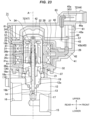
- An electrically operated valve 11 is an electrically operated valve which is preferably used for regulating a flow rate of a refrigerant in a refrigeration cycle apparatus, for example, an air conditioning machine, and is provided with a valve main body 12 having a valve chamber 13 in an internal portion thereof and also having an inflow passage 16 which allows the refrigerant to flow into the valve chamber 13 and an outflow passage 15 which allows the refrigerant to flow out of the valve chamber 13, a valve seat 14 which is formed in an opening portion for the valve chamber 13 in the inflow passage 16, a valve body 17 which changes a passing quantity (flow rate) of the refrigerant by moving forward and backward (moving upward and downward) with respect to the valve seat 14 between a valve close state (refer to Fig.
- a valve open state (refer to Fig. 2 ) being away from the valve seat 14, an electric motor 23 which drives the valve body 17, a coupling member 19 which couples the electric motor 23 to the valve main body 12, a printed board (control board) 46 which mounts a controller (not shown) controlling the electric motor 23 thereon, a case (board storage portion/case portion) 43 which stores the board 46, a lid body 47 which occludes a front opening of the case 43, a connector 44 which has an external portion connecting terminal 45 electrically connecting to the external portion, and a can (sealed container) 22 which covers an upper opening 12a of the valve main body 12 communicating with the valve chamber 13 and forms a sealed space together with the coupling member 19.
- the refrigerant is flowed into from the inflow passage 16 and the refrigerant is flowed out of the outflow passage 15.
- the electrically operated valve 11 can be used in a case where a flowing direction of the refrigerant is an inverse direction.
- the electric motor 23 is constructed by a stepping motor including a stator 25 which is arranged in an outer side of the can 22, and a magnet rotor (hereinafter, refer simply to "rotor") 24 which is arranged in an inner side of the can so as to be rotatable and slidable in a vertical direction.
- the stator 25 includes a yoke 26, a bobbin 27 and a coil 28.
- the stator 25 and the can 22 are covered by an outer shell cover (outer shell forming portion) 42 made of a synthetic resin. Further, the outer shell cover 42 is provided in an inner side thereof with a coil cover (coil coating forming portion) 41 which covers the coil 28 and is made of a synthetic resin, and a terminal cover (terminal coating forming portion) 63 which covers and supports an intermediate portion of the external portion connecting terminal 45.
- an outer shell cover outer shell forming portion
- the outer shell cover 42 is provided in an inner side thereof with a coil cover (coil coating forming portion) 41 which covers the coil 28 and is made of a synthetic resin, and a terminal cover (terminal coating forming portion) 63 which covers and supports an intermediate portion of the external portion connecting terminal 45.
- the external portion connecting terminal 45 has a leading end portion (end portion in the connector side) 45a which protrudes toward an internal space 44a of the connector 44 and allows an electrical connection to the external portion, and a base end portion (end portion in the board side) 45b which is electrically connected to the board 46.
- An intermediate portion corresponding to a portion between the leading end portion 45a and the base end portion 45b is covered by the terminal cover 63.
- each of the covers (coil cover 41, terminal cover 63 and outer shell cover 42) is formed according to an injection molding.
- the coil cover 41 and the terminal cover 63 fine dot pattern is applied to a cross section of each of the covers 41 and 63 in Figs. 1 and 2
- the outer shell cover 42 rough dot pattern is applied to a cross section in Figs. 1 and 2
- this step is called as "secondary molding”
- a positioning concave portion used when performing the secondary molding is formed in each of the coil cover and the terminal cover.
- FIG. 3 shows a state in which the coil after the primary molding is reversed upside down so that a lower surface side of the coil cover 41 is visible.
- a plurality of (four in the present embodiment) notched concave portions 64 are formed as concave portions for positioning in an inner peripheral edge portion of the bottom surface of the coil cover 41.
- Figs. 4 to 6 shows a state in which the coil (which is covered with the coil cover 41) after the primary molding and the external portion connecting terminal 45 (which is covered with the terminal cover 63 in an intermediate portion) are arranged within a metal mold 66 forming the outer shell cover 42.
- a plurality of (three in the present embodiment) holes 65 are formed as concave portions for positioning in the terminal cover 63.
- the metal mold 66 forming the outer shell cover 42 is provided in an internal portion thereof with engagement portions (for example, engagement projection (not shown)) which engage respectively with the notched concave portion and the hole.
- the present embodiment it is possible to accurately arrange the coil 28 covered with the coil cover 41 and the external portion connecting terminal 45 provided with the terminal cover 63 within the metal mold 66 forming the outer shell cover 42 by the use of the concave portions 64 and 65 for positioning. Accordingly, it is possible to install the coil 28 and the external portion connecting terminal 45 within the outer shell cover 42 while accurately keeping a relative positional relationship between the coil 28 and the external portion connecting terminal 45. Further, in the present embodiment, the plurality of concave portions 64 and 65 for positioning are disposed respectively in the coil cover 41 and the term inal cover 63.
- the box-shaped case 43 storing the board 46 and the connector 44 are integrally formed with the outer shell cover 42.
- the resin materials constructing the coil cover 41, the terminal cover 63, the outer shell cover 42 (including the case 43 and the connector 44) and the lid body 47 mentioned later can be set to different kinds of materials, however, preferably employ the same material for enhancing a bondability between the resins.
- the case 43 is disposed in a lateral side (front side) of the stator 25, and the connector 44 is disposed in an upper surface portion of the case 43.
- the board 46 is stored in the internal portion 43a of the case 43 through the front opening of the case 43, and the coil 28 is electrically connected to the external portion connecting terminal 45 via the board 46. This is because of enabling power feeding from an external power supply (not shown) to the coil 28. Further, a controller including a pulse generator and a motor driving circuit is mounted to the board 46.
- a computing apparatus computing an angle of rotation of the rotor 24 and an opening degree of the valve on the basis of an output signal from the magnetic sensor may be mounted to the board 46.
- each of the case 43 and the connector 44 is constructed as a sealable structure. More specifically, in the connector 44, the internal portion 44a of the connector 44 comes to a sealed state by fitting a mating connector to a front end portion thereof.
- the mating connector means a connector having a specific shape which can be fitted and connected to a connector of the electrically operated valve. More specifically, the connector is generally manufactured in such a manner as to have a specific shape (fixed shape which is different for every user and is previously determined) adapted to (conform to) the user side of the electrically operated valve, and the connector comes to the sealed state by fitting the mating connector having the specific shape as mentioned above thereto.
- the sealed state means a state in which any moisture does not infiltrate into the internal portion 44a of the connector 44 in a normal use state of the electrically operated valve 11.
- the internal portion 44a of the connector 44 is cut off from the external space (atmosphere side).
- the case 43 comes to a sealed state by welding the resin lid body 47 to the front opening and closing the front opening.
- the attachment of the lid body to the case will be later described in detail together with a structure for supporting the board.
- the electrically operated valve 11 is provided with a rod-shaped valve stem 18 which extends in a vertical direction from an internal portion of the rotor 24 toward the valve chamber 13 along a central axis line A.
- the valve stem 18 has a columnar barrel portion 18a, and an upper small-diameter portion 18b which is coaxially formed in an upper end portion of the barrel portion 18a in succession to the barrel portion 18a and has a small outer diameter.
- the valve body 17 is integrally provided in a lower end of the valve stem 18 (barrel portion 18a).
- the rotor 24 is arranged in an inner side of the can 22 so as to be rotatable and slidable in the vertical direction, and the valve is opened and closed by the integral movement in the vertical direction of the valve step 18 provided with the valve body 17 in the lower end and the rotor 24.
- a valve stem holder 31 is disposed in an inner side of the rotor 24.
- the valve stem holder 31 has a cylindrical shape which is closed in an upper end, and a support ring 33 is fixed to an upper end portion of the valve stem holder 31 according to a caulking. Further, the rotor 24 and the valve stem holder 31 are integrally connected via the support ring 33.
- a female screw portion 31a is formed on an inner peripheral surface of the valve stem holder 31.
- the female screw portion 31a constructs a transfer mechanism (screw feeding mechanism) which is threadably mounted on a male screw portion 36a of a guide bush 36 mentioned later and converts the rotation of the electric motor 23 into a linear motion to transfer to the valve stem 18.
- the upper small-diameter portion 18b of the valve stem 18 passes through the valve stem holder 31, and a push nut 34 for retaining is attached to an upper end portion of the upper small-diameter portion 18b.
- the valve stem 18 is biased downward by a compression coil spring 35 which is disposed between the valve stem holder 31, and a step portion between the barrel portion 18a and the upper small-diameter portion 18b in the valve stem 18. Therefore, the valve stem 18 is regulated its relative movement in the vertical direction to the valve stem holder 31 by the push nut 34 and the compression coil spring 35, and moves upward and downward together with the valve stem holder 18.
- the coupling member 19 is a tubular member having a large-diameter hole 19a and a small-diameter hole 19b which are through holes communicating with each other.
- the large-diameter hole 19a passes through an upper center portion of the coupling member 19, and has a large diameter so that the guide bush 36 mentioned later can be fitted and inserted from the above.
- the small-diameter hole 19b passes through a lower center portion of the coupling member 19 and has a small diameter.
- the cylindrical can 22 which is covered and not bottomed (in which a bottom surface is opened and a top surface is occluded) is joined to an outer peripheral surface of the upper end portion of the coupling member 19 via a ring-shaped base plate 21.
- the guide bush 36 is fixed to the large-diameter hole 19a in the upper portion of the coupling member 19.
- the guide bush 36 has a large-diameter cylindrical portion 36a which has a large outer diameter, and a small-diameter cylindrical portion 36b which is coaxially formed in an upper end portion of the large-diameter cylindrical portion 36a in succession to the large-diameter cylindrical portion 36a and has a small outer diameter.
- a male screw portion 36c threadably mounted on the female screw portion 31a of the valve stem holder 31 is formed on an outer peripheral surface of the small-diameter cylindrical portion 36b.
- the guide bush 36 is connected to the coupling member 19 by pressing the large-diameter cylindrical portion 36a in an inner side of the coupling member 19. Further, the barrel portion 18a of the valve stem 18 passes through the small-diameter hole 19b of the coupling member 19.
- an upper stopper body 32 is disposed in the valve stem holder 31, and a lower stopper body 37 is disposed in the large-diameter cylindrical portion 36a of the guide bush 36.
- the stopper bodies 32 and 37 are provided for determining a lower limit position of the valve stem holder 31, and when the valve stem holder 31 moves down by rotating to reach the lower limit position, the upper stopper body 32 comes into contact with the lower stopper body 37 and further rotation of the valve stem holder 31 is regulated.
- the mechanism for transferring the drive force of the electric motor 23 to the valve body 17 can employ various mechanisms in addition to the above mechanism, and is not limited to the above structure.
- valve stem holder 31 connected to the rotor 24 turns together with the rotor 24. Since the female screw portion 31a threadably mounted on the male screw portion 36c formed on the outer peripheral surface of the small-diameter cylindrical portion 36b of the guide bush 36 is formed on the inner peripheral surface of the valve stem holder 31, the rotation of the rotor 24 (valve stem holder 31) is converted into the liner motion in the vertical direction on the basis of an interaction of the male screw portion 36c and the female screw portion 31a, and the valve stem holder 31 moves upward.
- the rotor 24 connected to the valve stem holder 31, and the valve stem 18 regulating its relative movement to the valve stem holder 31 also move upward together with the valve stem holder 31.
- the valve body 17 disposed in the lower end of the valve stem 18 is away from the valve seat 14 accompanied with the upward movement of the valve stem 18, so that the refrigerant flowing into from the inflow passage 16 is going to flow out of the outflow passage 15 through the valve chamber 13 (refer to Fig. 2 ).
- a passing quantity (refrigerant flow rate) of the refrigerant can be adjusted on the basis of an amount of rotation of the rotor 24.
- the present embodiment is provided with support projections 51 and 58 which are integrally formed with the case 43, a fixing hole 67 which is pierced in the board 46, and a pressing projection 61 which is formed in a back surface (inner surface) of the lid body 47 occluding the front opening of the case 43, as means for supporting the board 46 in the internal portion of the case 43, and controls the movement of the board 46 in a vertical direction by holding the board 46 by means of a step portion 57 and a pressing projection 61 disposed in the support projections 51 and 58 as well as controlling the movement of the board 46 in a horizontal direction by the support projections 51 and 58 fitted and inserted to the fixing hole 67, thereby supporting the board 46 to the internal portion of the case 43.
- the internal portion of the case 43 is provided with a plurality of (four in the present embodiment) support projections 51 and 58 which rise vertically (forward) from the bottom surface portion of the case 43.
- the board 46 is provided with a plurality of (four in the present embodiment so as to correspond to the support projections) fixing holes 67 to which the support projections 51 and 58 are fitted and inserted.
- a back surface (inner surface) of the lid body 47 occluding the front opening of the case 43 is provided with the pressing projection 61 which comes into contact with the surface of the board 46 when the board 46 is installed within the case 43 and the lid body 47 is joined to the case 43.
- the support projections 51 and 58 are constructed by two press-in projections (press-in type projections) 51 and two loose-fit projections (loose-fit type projections) 58. These support projections 51 and 58 are integrally formed with the case 43 according to the secondary molding which forms the outer shell cover 42. Further, the step portions 57 expanding horizontally toward an outer side from a peripheral edge of the fixing hole 67 are formed in the bottom surface portions of the support projections 51 and 58.
- step portions 57 is adapted to perform a function for stopping the progress of the board 46 (receiving the back surface of the board 46) by the contact of the back surface of the board 46 when inserting the support projections 51 and 58 into the fixing holes 67 and progressing the board 46 to the direction of the bottom surface of the case 43 and holding the board 46 in cooperation with the pressing projections 61 formed in the back surface of the lid body 47.
- the press-in projection 51 has a projection main body 51a which has an approximately columnar shape, and a protruding portion 55 which protrudes outward from an outer peripheral surface of the projection main body 51a.
- the protruding portion 55 extends in a vertical direction (longitudinal direction) which corresponds to a length direction of the press-in projection 51, and has a triangular transverse cross sectional shape (refer to Fig. 11 ) which is sharpened toward an outer direction from an outer peripheral surface of the projection main body 51a.
- a ridge line portion (apex portion of the triangle when viewed from the transverse cross section) of the protruding portion 55 protrudes outward from an inner peripheral surface of the fixing hole 67 in the board 46.
- this portion is called as "press-in portion”
- the ridge line portion (hatched portion in Fig. 11 ) 53 of the protruding portion 55 is crushed within the fixing hole 67.
- the press-in projection 51 is fixed within the fixing hole 67.
- a plurality of (three in the present embodiment) protruding portions 55 are formed in each of the press-in projections 51, and these three protruding portions 55 are arranged in such a manner that the protruding portions 55 are radially arranged with respect to a central axis line B of the press-in projection 51 (angles formed by the adjacent protruding portions 55 are equal, that is, 120 degrees in the present embodiment). This is because of preventing the board 46 from being exposed to the force in the horizontal direction from the protruding portion 55 when pressing the press-in projection 51 in the fixing hole 67 of the board 46 to cause a lateral displacement and stably supporting the board 46 within the case 43.
- the number of the protruding portions 55 can be set to be, for example, four, or two or less or five or more.
- a leading end (front end) portion of the projection main body 51a is formed as a small-diameter portion 52 in which an outer diameter is made small in such a manner as to be easily inserted into the fixing hole 67 of the board 46, and a taper surface 54 is formed from the small-diameter portion 52 to the press-in portion 53, the taper surface having an outer diameter which is increased little by little. This is because the board 46 (fixing hole 67) is smoothly guided to the press-in portion 53.
- a front end portion (leading end portion in the length direction) thereof is formed into a taper shape in such a manner that a height of the ridge line portion 56 is increased little by little toward a rear side in correspondence to the taper surface 54.
- the loose-fit projection 58 is provided in a bottom surface portion with a step portion 57 which performs the same function as the step portion 57 of the press-in projection 51 as shown in Fig. 12 , and has a columnar projection main body 58a which rises vertically (forward) from the step portion 57.
- the projection main body 58a has such an outer diameter that a fixed gap S is formed with respect to an inner peripheral surface of the fixing hole 67 in the board 46.
- the support projections 51 and 58 are arranged in four corners of the case 43 having a rectangular front shape.
- the press-in projections 51 are arranged in both end portions of one diagonal line of the case 43, and the loose-fit projections 58 are arranged I both end portions of the other diagonal line of the case 43, respectively. All the support projections 51 and 58 can be constructed by the press-in projection 51. However, if all the support projections are constructed by the press-in projection 51, a high dimensional accuracy is demanded for the relative positional relationship between the support projection 51 and the fixing hole 67 as mentioned above, and the manufacturing cost is increased.
- the loose-fit projection 58 is included in the present embodiment.
- the pressing projection 61 in the back surface of the lid body 47 has a cylindrical shape which can store the leading end portions of the support projections 51 and 58.
- a height (dimension in a length direction) of the pressing projection 61 is set to a height that a fixed gap is formed from the surface of the board 46 (refer to Fig. 19 mentioned later) when the lid body 47 is put on the front opening of the case 43 and the peripheral edge portion of the lid body 47 is brought into contact with the peripheral edge portion of the front opening, and the pressing projection 61 comes into contact with the surface of the board 46 (refer to Fig. 20 mentioned later) when the lid body 47 is welded (melt joined) to the case 43.
- the reason why the pressing projection 61 is constructed as the above height structure will be later mentioned in detail.
- the relative positioning between the board 46 and the case 43 in the horizontal direction is approximately finished (the board 46 is not positionally displaced in the horizontal direction beyond a smaller gap in the gap between the small-diameter portion 52 in the leading end of the press- in projection and the inner peripheral surface of the fixing hole 67, and the gap S between the loose-fit projection 58 and the fixing hole 67), and it is possible to smoothly insert the terminals 45b and 62 into the through hole 68 (refer to Fig. 16 ). Further, the pressing-in operation of the press-in projection 51 (insertion of the press-in portion 53 into the fixing hole 67) is simultaneously started.
- the electrical connection between the terminals 45b and 62 and the board 46 (through hole 68) may be achieved by a press-fit connection in which the terminals 45b and 62 are formed as the press-fit pin (electrical connection is achieved by pressing in the through hole 68), or may be achieved by soldering after arranging the board 46.
- the lid body 47 is attached to the case 43.
- the lid body 47 is put on the case 43 in such a manner as to close the front opening, and the peripheral edge portion of the back surface in the lid body is brought into contact with the front edge portion of the case 43.
- the lid body 47 is pressed against the bottom surface of the case 43 while irradiating an infrared light onto a contact surface of both the elements (front edge portion of the case and the peripheral edge portion of the lid body) and welding the contact surface between the case 43 and the lid body 47.
- the lid body 47 progresses toward the bottom surface of the case 43 accompanied with the welding of the contact surface.
- the lid body 47 does not progress any more. Further, when the welding is finished in this state, the board 46 is firmly supported within the case 43 in a state in which the board is held by the step portion 57 and the pressing projection 61.
- the weld surface of the lid body 47 and the case 43 is denoted by reference numeral 69 in Fig. 20 .
- the present embodiment it is possible to install the board 46 into the case 43 and attach the lid body 47 only by a comparatively simple operation of pressing the board 46 toward the bottom surface of the case 43 and welding the lid body 47. Further, the welding depth of the case 43 and the lid body 47 (how far the case 43 and the lid body 47 is welded in the vertical direction (longitudinal direction)) can be set by the height (length in the longitudinal direction) of the pressing projection. Therefore, according to the present embodiment, it is possible to prevent the airtightness of the case 43 from being insufficient due to insufficient welding depth or prevent an excessive welding from being generated, by setting the height of the pressing projection 61 appropriately.
- the joining work of the lid body 47 can be evenly finished by the contact of the pressing projection 61 with the surface of the board 46. Therefore, it is possible to efficiently perform the attaching work of the lid body 47.
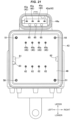
- Fig. 21 shows a structure which prevents the board 46 from being erroneously attached.
- notch portions 81 and 82 having different shapes are respectively formed in a left edge portion and a right edge portion of the board 46, and a projection 83 fitted to one notch portion (wide notch portion in the left side in the present embodiment) 81 when arranging the board 46 correctly is formed in the internal portion of the case 43.
- the narrower notch portion 82 in the right side of Fig. 21 comes to the left side, and the projection 83 can not be fitted to the notch portion 82.
- an electrically operated valve 71 is adapted to move the valve body 17 upward and downward by the electric motor (stepping motor) 23 to regulate the flow rate of the refrigerant in the same manner as the electrically operated valve 11 according to the first embodiment, and is provided with the board 46 which controls the electric motor 23.
- the board 46 is arranged in the upper surface portion of the electric motor 23 (stator 25) so as to horizontally extend, and the case 43 storing the board 46 is formed in the upper surface portion of the electric motor 23.
- the present embodiment is provided with the outer shell cover 42 (to which a rough dot pattern is applied to a cross section in Figs. 7 and 8 ) which covers the stator 25 of the electric motor 23 and the can 22, and the coil cover 41 (to which a fine dot pattern is applied to a cross section in Figs. 7 and 8 ) which is arranged in the inner side of the outer shell cover 42 and covers the coil 28 in the same manner as the electrically operated valve 11 according to the first embodiment.
- the outer shell cover 42 to which a rough dot pattern is applied to a cross section in Figs. 7 and 8
- the coil cover 41 to which a fine dot pattern is applied to a cross section in Figs. 7 and 8
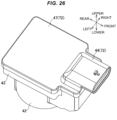
- the connector 44 is not integrally formed with the outer shell cover 42, but is formed as a lid body with connect or (lid body forming portion with connector portion) 72 in a different step and is integrally formed with the lid body 47 which occludes the upper opening of the case 43.
- the lid body 72 with connector is manufactured via two stages of forming steps.
- a first step primary molding
- a successive second step secondary molding
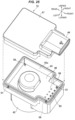
- the lid body 72 with connector is welded to the upper edge portion of the case 43 in such a manner as to occlude the upper opening of the case 43 after installing the board 46 in the case internal portion 43a.
- the electrical connection between the external portion connecting terminal 45 and the board 46 may be achieved by a press fit connection. More specifically, with the use of the base end portion (end portion in the board side) 45a of the eternal portion connecting terminal 45 as a press fit pin, the press-fit pin is adapted to be pressed in the through hole 68 of the board 46 when putting the lid body 72 with connector on the upper surface of the case 43.
- the structure for supporting the board 46 to the case 43 is the same as the first embodiment. More specifically, the press-in projection 51 and the loose-fit projection 58 are provided as the support projection in the case 43 side, and the step portion 57 supporting the board 46 from the lower surface side is formed in the bottom surface portion of each of the support projections 51 and 58.
- the board 46 has the fixing hole 67 to which the support projections 51 and 58 are fitted and inserted.
- the pressing projection 61 is disposed in the back surface (lower surface) in the lid body 72 with connector side.
- the board 46 When installing the board 46 within the case 43 while fitting and inserting the support projections 51 and 58 to the fixing hole 67 (refer to Figs. 24 to 25 ), and thereafter welding the lid body 72 with connect or to the upper surface of the case 43 (refer to Fig. 26 ), the board 46 is controlled by the press-in projection 51 in the movement in the horizontal direction, and is controlled in the movement to the vertical direction by being held by the step portion 57 and the pressing projection 61, thereby being fixed within the case 43.
Landscapes
- Engineering & Computer Science (AREA)
- General Engineering & Computer Science (AREA)
- Mechanical Engineering (AREA)
- Power Engineering (AREA)
- Physics & Mathematics (AREA)
- Thermal Sciences (AREA)
- Manufacturing & Machinery (AREA)
- Electromagnetism (AREA)
- Electrically Driven Valve-Operating Means (AREA)
- Valve Housings (AREA)
Abstract
Description
- The present invention relates to an electrically operated valve, and more particularly to an electrically operated valve including a board which controls an electric motor, and a resin case which stores the board.
- An electrically operated valve controlling an opening degree of a valve with the use of an electric motor such as a stepping motor has been conventionally used for a refrigeration cycle apparatus which is provided with a refrigerant circuit such as an air conditioning machine and a refrigeration/freezing apparatus.
- Further, as the electrically operated valve as described above, there is an electrically operated valve including a controller which controls an exciting current of a coil. The controller is mounted to a printed board, and the board (refer to "control board" or simply to "board" in the present application) is stored in a resin case which is disposed near a stator.
- Further, the following
patent literature 1 exists as a publication disclosing the electrically operated valve as described above. - Patent Literature 1:
Japanese Unexamined Patent Publication No. 2021-110409 - In the meantime, in the electrically operated valve provided with the control board as mentioned above, the board has been attached by being screwed or caulked to a support portion which is disposed in the resin case, and there is left room for improvement about a structure for supporting the board. The attaching work by screwing or caulking can not be always said to have a good work efficiency. On the contrary, if the structure for supporting the board can be simplified, reduction of a parts number and an assembling step number can be caused. Therefore, it is possible to reduce a manufacturing cost of the electrically operated valve.
- Further, in this kind of electrically operated valve, in order to prevent infiltration of moisture, the electric motor (a stator including a coil and a yoke) driving a valve body is covered with a resin cover (refer to "outer shell forming portion" or "outer shell cover" in the present invention). However, the resin case storing the board has been conventionally formed separately from the outer shell cover, and has been fixed to the outer shell cover (refer to the above-described patent literature 1). Therefore, with regard to these resin forming portion (outer shell cover and resin case), there is room for reduction in the manufacturing step number.
- Accordingly, an object of the present invention is to allow a board to be attached to an electrically operated valve with good workability, and to reduce a parts number and a manufacturing step number of the electrically operated valve with board.
- In order to solve the problem mentioned above and achieve the object, an electrically operated valve according to the present invention is an electrically operated valve including a valve main body having a valve chamber which is communicated with an inflow passage introducing a refrigerant and an outflow passage discharging the refrigerant, a valve body which changes a flow rate of the refrigerant by moving forward and backward with respect to a valve seat formed within the valve chamber between a valve close state seating on the valve seat and a valve open state separating from the valve seat, an electric motor which drives the valve body, a control board on which an electronic component controlling the electric motor is mounted, and a board storage portion which includes a case portion storing the control board, wherein the control board has a fixing hole which fixes the control board to an inner side of the case portion, the case portion has in an internal portion thereof a support projection which supports the control board within the case portion by being inserted into the fixing hole, and the support projection is integrally formed with the case portion.
- The electrically operated valve according to the present invention is structured such that the control board is supported to the inner side of the case portion by inserting the support projection disposed within the case portion into the fixing hole of the control board without screwing or caulking. Therefore, according to the present invention, the board can be installed within the case only by slotting the support projection to the case portion while inserting the support projection into the fixing hole, the screw for supporting the board is not required, and the screwing work or the caulking work is not required. Thus, it is possible to reduce the parts number and the manufacturing step number. Further, a time for forming and attaching the support portion for supporting the board separately from the case portion is not required since the support portion is integrally formed with the case portion.
- Further, the electrically operated valve according to the present invention may be provided with an outer shell forming portion which covers a stator of the electric motor, and the case portion may be integrally formed with the outer shell forming portion. According to the aspect mentioned above, it is possible to omit a work for manufacturing the case portion separately from the outer shell forming portion and fixing.
- Further, in the electrically operated valve mentioned above, a coil coating forming portion covering a coil provided within the stator may be disposed in an inner side of the outer shell forming portion. According to the aspect as mentioned above, by performing two stages of forming steps (that is, constructing as a double coating structure), it is possible to prevent a winding wire of the coil from being damaged when forming, and it is possible to avoid void generation in the outer shell forming portion having a complex shape and reduction of strength. More specifically, it is possible to simultaneously achieve the winding wire breakage prevention when forming and the strength securement of the forming portion by forming at a low pressure the coil coating forming portion covering the coil which tends to be generated the breakage such as deformation, insulation failure and breaking of wire due to resin pressure application when forming, and thereafter forming at a high pressure the outer shell forming portion covering the coil coating forming portion.
- In the meantime, the outer shell forming portion is preferably formed by introducing the resin from a gate (introducing port) at one position in such a manner as to prevent a weld line causing the reduction of strength from being generated. This is because of preventing a crack from being generated in the weld line due to the temperature change when aging use and preventing the moisture from infiltrating. On the contrary, when employing the double coating structure (structure provided with the coil coating forming portion in the inner side of the outer shell forming portion) as mentioned above, it is not particularly necessary to take into consideration the strength in the coil coating forming portion in which the strength can be secured by being covered by the outer shell forming portion. Therefore, it is possible to more securely cover the coil having the complex shape by introducing the resin from the gates at plural positions.
- Further, as mentioned later, the double coating structure is also employed preferably in a case where the connector portion supporting the external portion connecting terminal to the internal portion is integrally formed with the outer shell forming portion and the case portion. A severe dimensional accuracy is required in the connector portion since the connector portion generally has a structure of fitting to the mating connection so as to form a sealed state. However, when employing the double coating structure as mentioned above, the connector portion can be formed at the high pressure together with the outer shell forming portion and the case portion, and the dimensional accuracy of the connector portion can be enhanced.
- Further, in a case where the double coating structure as mentioned above is employed, the coil coating forming portion is preferably provided with a concavo-convex portion for positioning the coil coating forming portion within the outer shell forming portion. The coil covered with the coil coating forming portion can be precisely arranged within a metal mold forming the outer shell forming portion with the use of the concavo-convex portion when forming the outer shell forming portion. Thus, a relative positional precision between the outer shell forming portion and the coil (coil forming portion) to be formed can be enhanced.
- The element "concavo-convex portion" mentioned above can be formed by a concave portion, for example, a hole (preferably a plurality of holes), however, may be formed by a convex portion such as a projection (preferably a plurality of projections).
- Further, the present invention may be provided with a connector portion which enables an electrical connection with the external portion by supporting the external portion connecting terminal to an internal portion thereof, and the connector portion may be integrally formed with the outer shell forming portion and the case portion.
- Further, according to an aspect of the present invention, the case portion has an opening which allows the control board to be installed in the internal portion, the electrically operated valve includes a lid body which occludes the opening, a connector portion including an external portion connecting terminal which enables the electrical connection to the external portion, and a terminal coating forming portion which covers an intermediate portion of the external portion connecting terminal and supports the external portion connecting terminal to the connector portion, and the connector portion and the lid body are integrally formed in such a manner as to cover and support the terminal coating forming portion.
- Further, in the aspect mentioned above, the terminal coating forming portion is preferably provided with the concavo-convex portion for positioning the terminal coating forming portion within the connector portion. This is because the external portion connecting terminal covered with the terminal coating forming portion can be accurately arranged within the metal mold forming the connector portion with the use of the concavo-convex portion and the external portion connecting terminal can be installed with a good positional precision when forming the connector portion. The element "concavo-convex portion" can be formed by the concave portion (for example, hole) or the convex portion (for example, projection) in the same manner as mentioned above.
- Further, in the present invention, one or more press-in type projection pressed in a fixing hole is preferably provided as the support projection. This is because the board can be more securely supported within the case portion.
- For the same reason, in the present invention, the support projection may have a rod-shaped projection main body, and a protruding portion which extends in a length direction of the projection main body and protrudes outward from an outer peripheral surface of the projection main body to come into contact with an inner peripheral surface of the fixing hole when the support projection is inserted into the fixing hole. In this case, at least a part of the protruding portion may be adapted to be crushed within the fixing hole when the support projection is inserted into the fixing hole, so that the support projection is pressed in the fixing hole.
- Further, the support projection is preferably provided with two or more protruding portions, and the two or more protruding portions are preferably arranged radially with respect to a central axis line of the projection main body. This is because the support projection can be easily inserted into the fixing hole when attaching the board and the board can be stably supported by the support projection.
- Further, in the present invention, from the both point of view of workability when attaching the board, and certainty for support within the case portion (improvement of strength for supporting the board to the case portion), it is particularly preferably to employ the following aspect.
- The case portion has an opening which allows the board to be installed in the internal portion, the electrically operated valve is provided with a lid body which occludes the opening, the support projection is provided with a step portion which comes into contact with a back surface of the board when slotting the board in the case portion while inserting the support projection into the fixing hole so as to stop the progress of the board toward a direction of a bottom surface of the case portion, the lid body is provided in an inner surface thereof with a pressing projection which comes into contact with a surface of the board when occluding the opening, and the board is held between the step portion and the pressing projection.
- Further, in the aspect mentioned above, the pressing projection is preferably disposed so as to face to the support projection (in particular, the step portion), and the pressing projection is preferably adapted to have a tubular shape which can store a leading end portion of the support projection protruding out of the board. This is because the board can be firmly held. More specifically, on the assumption that a direction orthogonal to the board (length direction of the pressing projection and the support projection) is a "vertical direction", and a direction parallel to the board is a "horizontal direction", the pressing projection can be disposed at a position which does not face to the support projection and is deviated in the horizontal direction. In the structure as mentioned above, the board can be held. According to the aspect mentioned above, the pressing projection is adapted to come into contact with the surface of the board around the fixing hole (portion facing to the step portion and near the fixing hole), and the board can be more firmly held and supported by the pressing projection and the step portion which face to each other (overlap with each other looking from the vertical direction).
- In the present invention, the board is supported within the case portion by the fixing hole which is provided in the board, and the support projection which is provided in the case portion. Plural sets of (for example, four sets of) the combination of the fixing hole and the support projection are preferably provided for securely supporting the board, that is, two or more fixing holes are preferably provided in the board, and two or more support projections are preferably provided in the case portion so as to correspond to the plurality of fixing holes. In this case, these two or more support projections are preferably adapted to include both the press-in type projection which is pressed in the fixing hole (that is, the support projection is inserted while being exposing to the pressure from the inner peripheral surface of the fixing hole when the support projection is put into from the support projection), and a loose-fit type projection which has a gap with respect to the inner peripheral surface of the fixing hole when being inserted into the fixing hole.
- Because the support projection may be broken, for example, the support projection is snapped off due to a force applied when the board is attached or a vibration applied from a vehicle when the electrically operated valve is mounted to the vehicle and aging used, if all the support projections are formed by the press-in type projection. Further, if all the support projections are adapted to be pressed in the corresponding fixing holes, a high dimensional accuracy is demanded for a relative positional relationship between all the fixing holes and all the corresponding support projections, and a manufacturing cost is increased. Thus, the aspect as mentioned above is preferably employed.
- Further, in the present invention, as a more specific structure of the case portion, the case portion may have an opening which allows the control board to be installed in the internal portion, the electrically operated valve may be provided with a lid body which occludes the opening, the lid body may be fixed to the case portion by melding both the case portion and the lid body (for example, by welding by an infrared light) in a contact portion between the case portion and the lid body, and the opening may be occluded by the lid body.
- Further, the case portion may be provided in an internal portion thereof with a terminal which performs an electrical connection to the control board, and a height of the terminal may be higher than a height of the support projection. According to the aspect mentioned above, it is possible to achieve a relative positioning between the terminal and the board (for example, a through hole disposed in the board) by inserting the support projection into the fixing hole of the board, and the terminal can be fitted to and inserted into the board (through hole) only by fitting and inserting the support projection to the fixing hole formed in the board and thereafter progressing the board toward the bottom surface of the case portion when attaching the board.
- The electrical connection between the board (through hole) and the terminal is preferably achieved by a press-fit connection (terminal is adapted to be pressed in the through hole of the board as a press-fit pin) from the point of view of reducing the manufacturing step number. However, it is possible to employ the other methods of installing the board within the case portion and thereafter soldering.
- According to the present invention, it is possible to attach the board to the electrically operated valve with a good workability, it is possible to reduce the parts number and the manufacturing step number of the electrically operated valve with board, and it is possible to reduce the manufacturing cost of the electrically operated valve.
- The other objects, features and advantages of the present invention are clarified by the following description of embodiments according to the present invention described on the basis of the accompanying drawings. It is apparent for a person skilled in the art that the present invention is not limited to the following embodiments, but can be variously modified within the scope of claims. Further, same reference numerals in the drawings denote the same or corresponding portions.
-
-
Fig. 1 is a vertical cross sectional view showing a valve close state of an electrically operated valve according to a first embodiment of the present invention. -
Fig. 2 is a vertical cross sectional view showing a valve open state of the electrically operated valve according to the first embodiment. -
Fig. 3 is a perspective view showing a manufacturing step of the electrically operated valve according to the first embodiment, and shows a state in which a coil cover covering a coil is formed (state after finishing a primary molding). -
Fig. 4 is a perspective view showing the manufacturing step of the electrically operated valve according to the first embodiment, and shows a state in which the coil forming the coil cover and an external portion connecting terminal forming a terminal cover are arranged within a metal mold (not shown) forming an outer shell cover. -
Fig. 5 is a front elevational view showing the manufacturing step of the electrically operated valve according to the first embodiment, and shows the state in which the coil forming the coil cover and the external portion connecting terminal forming the terminal cover are arranged within the metal mold (not shown) forming the outer shell cover. -
Fig. 6 is a vertical cross sectional view showing the manufacturing step of the electrically operated valve according to the first embodiment, and shows the state in which the coil forming the coil cover and the external portion connecting terminal forming the terminal cover are arranged within the metal mold (not shown) forming the outer shell cover, looking from a lateral surface side. -
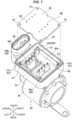
Fig. 7 is a perspective view showing the manufacturing step of the electrically operated valve according to the first embodiment, and shows a state before the board is attached within the case. -
Fig. 8 is a perspective view showing the manufacturing step of the electrically operated valve according to the first embodiment, and shows a state in which the board is attached within the case. -
Fig. 9 is a perspective view showing the manufacturing step of the electrically operated valve according to the first embodiment, and shows a state in which the lid body is welded to the case. -
Fig. 10 is a vertical cross sectional view showing a relationship among a fixing hole of the board, a press-in projection of the case, and a pressing projection of the lid body in an enlarged manner, for the electrically operated valve according to the first embodiment. -
Fig. 11 is a front elevational view showing the relationship between the fixing hole of the board and the press-in projection of the case, for the electrically operated valve according to the first embodiment. -
Fig. 12 is a vertical cross sectional view showing a relationship among the fixing hole of the board, a loose-fit projection of the case, and the pressing projection of the lid body in an enlarged manner, for the electrically operated valve according to the first embodiment. -
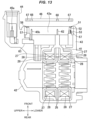
Fig. 13 is a cross sectional view showing the manufacturing step of the electrically operated valve according to the first embodiment, and shows a state before the board is attached within the case. -
Fig. 14 is a cross sectional view showing the manufacturing step of the electrically operated valve according to the first embodiment, and shows a state in which a support projection of the case begins to be inserted into the fixing hole of the board. -
Fig. 15 is a cross sectional view showing the manufacturing step of the electrically operated valve according to the first embodiment, and shows a state in which the support projection is inserted into the fixing hole of the board, and a terminal begins to be inserted into a through hole. -
Fig. 16 is a cross sectional view showing the manufacturing step of the electrically operated valve according to the first embodiment, and shows a state in which the terminal is inserted into the through hole, and the support projection begins to be pressed in the fixing hole. -
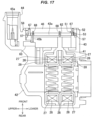
Fig. 17 is a cross sectional view showing the manufacturing step of the electrically operated valve according to the first embodiment, and shows a state in which the pressing operation of the support projection in the fixing hole is finished. -
Fig. 18 is a cross sectional view showing the manufacturing step of the electrically operated valve according to the first embodiment, and shows a state before attaching a lid body. -
Fig. 19 is a cross sectional view showing the manufacturing step of the electrically operated valve according to the first embodiment, and shows a state in which the lid body is brought into contact with a front edge portion of the case. -
Fig. 20 is a cross sectional view showing the manufacturing step of the electrically operated valve according to the first embodiment, and shows a state in which the attachment of the lid body is finished by welding the lid body to the case. -
Fig. 21 is a cross sectional view showing the manufacturing step of the electrically operated valve according to the first embodiment, and shows a state before attaching the lid body to the case. -
Fig. 22 is a vertical cross sectional view showing a valve close state of an electrically operated valve according to a second embodiment of the present invention. -
Fig. 23 is a vertical cross sectional view showing a valve open state of the electrically operated valve according to the second embodiment. -
Fig. 24 is a perspective view showing a manufacturing step of the electrically operated valve according to the second embodiment, and shows a state before attaching a board within a case. -
Fig. 25 is a perspective view showing the manufacturing step of the electrically operated valve according to the second embodiment, and shows a state in which the board is attached within the case. -
Fig. 26 is a perspective view showing the manufacturing step of the electrically operated valve according to the second embodiment, and shows a state in which a lid body is attached to the case. - A description will be given of an electrically operated valve according to a first embodiment of the present invention with reference to
Figs. 1 to 21 . Each of the drawings appropriately shows two-dimensional coordinates or three-dimensional coordinates which represent a longitudinal direction, a horizontal direction and a vertical direction and are orthogonal to each other, and the following description will be given on the basis of these directions (same applies to a second embodiment mentioned later). - An electrically operated valve 11 according to a first embodiment of the present invention is an electrically operated valve which is preferably used for regulating a flow rate of a refrigerant in a refrigeration cycle apparatus, for example, an air conditioning machine, and is provided with a valve main body 12 having a valve chamber 13 in an internal portion thereof and also having an inflow passage 16 which allows the refrigerant to flow into the valve chamber 13 and an outflow passage 15 which allows the refrigerant to flow out of the valve chamber 13, a valve seat 14 which is formed in an opening portion for the valve chamber 13 in the inflow passage 16, a valve body 17 which changes a passing quantity (flow rate) of the refrigerant by moving forward and backward (moving upward and downward) with respect to the valve seat 14 between a valve close state (refer to
Fig. 1 ) coming into contact with the valve seat 14 and a valve open state (refer toFig. 2 ) being away from the valve seat 14, an electric motor 23 which drives the valve body 17, a coupling member 19 which couples the electric motor 23 to the valve main body 12, a printed board (control board) 46 which mounts a controller (not shown) controlling the electric motor 23 thereon, a case (board storage portion/case portion) 43 which stores the board 46, a lid body 47 which occludes a front opening of the case 43, a connector 44 which has an external portion connecting terminal 45 electrically connecting to the external portion, and a can (sealed container) 22 which covers an upper opening 12a of the valve main body 12 communicating with the valve chamber 13 and forms a sealed space together with the coupling member 19. In the present embodiment, the refrigerant is flowed into from theinflow passage 16 and the refrigerant is flowed out of theoutflow passage 15. However, it goes without saying that the electrically operatedvalve 11 can be used in a case where a flowing direction of the refrigerant is an inverse direction. - The
electric motor 23 is constructed by a stepping motor including astator 25 which is arranged in an outer side of thecan 22, and a magnet rotor (hereinafter, refer simply to "rotor") 24 which is arranged in an inner side of the can so as to be rotatable and slidable in a vertical direction. Further, thestator 25 includes ayoke 26, abobbin 27 and acoil 28. - The
stator 25 and thecan 22 are covered by an outer shell cover (outer shell forming portion) 42 made of a synthetic resin. Further, theouter shell cover 42 is provided in an inner side thereof with a coil cover (coil coating forming portion) 41 which covers thecoil 28 and is made of a synthetic resin, and a terminal cover (terminal coating forming portion) 63 which covers and supports an intermediate portion of the externalportion connecting terminal 45. - The external
portion connecting terminal 45 has a leading end portion (end portion in the connector side) 45a which protrudes toward aninternal space 44a of theconnector 44 and allows an electrical connection to the external portion, and a base end portion (end portion in the board side) 45b which is electrically connected to theboard 46. An intermediate portion corresponding to a portion between theleading end portion 45a and thebase end portion 45b is covered by theterminal cover 63. - Further, each of the covers (
coil cover 41,terminal cover 63 and outer shell cover 42) is formed according to an injection molding. In the order of formation, first of all, thecoil cover 41 and the terminal cover 63 (fine dot pattern is applied to a cross section of each of thecovers Figs. 1 and2 ) are independently formed (this step is called as "primary molding"), and the outer shell cover 42 (rough dot pattern is applied to a cross section inFigs. 1 and2 ) is formed in such a manner as to cover each of the covers (coil cover 41 and terminal cover 63) (this step is called as "secondary molding"). - Here, in the primary molding, a positioning concave portion used when performing the secondary molding is formed in each of the coil cover and the terminal cover.
- More specifically,
Fig. 3 shows a state in which the coil after the primary molding is reversed upside down so that a lower surface side of thecoil cover 41 is visible. However, as shown inFig. 3 , in the primary molding, a plurality of (four in the present embodiment) notchedconcave portions 64 are formed as concave portions for positioning in an inner peripheral edge portion of the bottom surface of thecoil cover 41. Further,Figs. 4 to 6 shows a state in which the coil (which is covered with the coil cover 41) after the primary molding and the external portion connecting terminal 45 (which is covered with theterminal cover 63 in an intermediate portion) are arranged within ametal mold 66 forming theouter shell cover 42. A plurality of (three in the present embodiment) holes 65 are formed as concave portions for positioning in theterminal cover 63. Themetal mold 66 forming theouter shell cover 42 is provided in an internal portion thereof with engagement portions (for example, engagement projection (not shown)) which engage respectively with the notched concave portion and the hole. - Therefore, according to the present embodiment, it is possible to accurately arrange the
coil 28 covered with thecoil cover 41 and the externalportion connecting terminal 45 provided with theterminal cover 63 within themetal mold 66 forming theouter shell cover 42 by the use of theconcave portions coil 28 and the externalportion connecting terminal 45 within theouter shell cover 42 while accurately keeping a relative positional relationship between thecoil 28 and the externalportion connecting terminal 45. Further, in the present embodiment, the plurality ofconcave portions coil cover 41 and the term inal cover 63. Thus, it is possible to accurately position thecoil 28 and the externalportion connecting terminal 45 within themetal mold 66 performing the secondary molding, and it is possible to securely prevent a positional displacement from being generated in thecoil 28 and the externalportion connecting terminal 45 by the resin flowing into themetal mold 66 when performing the secondary molding. - When performing the secondary molding, the box-shaped
case 43 storing theboard 46 and theconnector 44 are integrally formed with theouter shell cover 42. The resin materials constructing thecoil cover 41, theterminal cover 63, the outer shell cover 42 (including thecase 43 and the connector 44) and thelid body 47 mentioned later can be set to different kinds of materials, however, preferably employ the same material for enhancing a bondability between the resins. - In the present embodiment, the
case 43 is disposed in a lateral side (front side) of thestator 25, and theconnector 44 is disposed in an upper surface portion of thecase 43. Theboard 46 is stored in theinternal portion 43a of thecase 43 through the front opening of thecase 43, and thecoil 28 is electrically connected to the externalportion connecting terminal 45 via theboard 46. This is because of enabling power feeding from an external power supply (not shown) to thecoil 28. Further, a controller including a pulse generator and a motor driving circuit is mounted to theboard 46. Further, in a case where a magnetic sensor detecting rotation of therotor 24 is provided in the electrically operatedvalve 11, a computing apparatus computing an angle of rotation of therotor 24 and an opening degree of the valve on the basis of an output signal from the magnetic sensor may be mounted to theboard 46. - Each of the
case 43 and theconnector 44 is constructed as a sealable structure. More specifically, in theconnector 44, theinternal portion 44a of theconnector 44 comes to a sealed state by fitting a mating connector to a front end portion thereof. The mating connector means a connector having a specific shape which can be fitted and connected to a connector of the electrically operated valve. More specifically, the connector is generally manufactured in such a manner as to have a specific shape (fixed shape which is different for every user and is previously determined) adapted to (conform to) the user side of the electrically operated valve, and the connector comes to the sealed state by fitting the mating connector having the specific shape as mentioned above thereto. The sealed state means a state in which any moisture does not infiltrate into theinternal portion 44a of theconnector 44 in a normal use state of the electrically operatedvalve 11. In the present embodiment, theinternal portion 44a of theconnector 44 is cut off from the external space (atmosphere side). - In the meantime, the
case 43 comes to a sealed state by welding theresin lid body 47 to the front opening and closing the front opening. The attachment of the lid body to the case will be later described in detail together with a structure for supporting the board. - Further, the electrically operated
valve 11 according to the present embodiment is provided with a rod-shaped valve stem 18 which extends in a vertical direction from an internal portion of therotor 24 toward thevalve chamber 13 along a central axis line A. The valve stem 18 has acolumnar barrel portion 18a, and an upper small-diameter portion 18b which is coaxially formed in an upper end portion of thebarrel portion 18a in succession to thebarrel portion 18a and has a small outer diameter. Further, thevalve body 17 is integrally provided in a lower end of the valve stem 18 (barrel portion 18a). Therotor 24 is arranged in an inner side of thecan 22 so as to be rotatable and slidable in the vertical direction, and the valve is opened and closed by the integral movement in the vertical direction of thevalve step 18 provided with thevalve body 17 in the lower end and therotor 24. - A
valve stem holder 31 is disposed in an inner side of therotor 24. Thevalve stem holder 31 has a cylindrical shape which is closed in an upper end, and asupport ring 33 is fixed to an upper end portion of thevalve stem holder 31 according to a caulking. Further, therotor 24 and thevalve stem holder 31 are integrally connected via thesupport ring 33. Afemale screw portion 31a is formed on an inner peripheral surface of thevalve stem holder 31. Thefemale screw portion 31a constructs a transfer mechanism (screw feeding mechanism) which is threadably mounted on amale screw portion 36a of aguide bush 36 mentioned later and converts the rotation of theelectric motor 23 into a linear motion to transfer to thevalve stem 18. - The upper small-
diameter portion 18b of the valve stem 18 passes through thevalve stem holder 31, and apush nut 34 for retaining is attached to an upper end portion of the upper small-diameter portion 18b. The valve stem 18 is biased downward by acompression coil spring 35 which is disposed between thevalve stem holder 31, and a step portion between thebarrel portion 18a and the upper small-diameter portion 18b in thevalve stem 18. Therefore, thevalve stem 18 is regulated its relative movement in the vertical direction to thevalve stem holder 31 by thepush nut 34 and thecompression coil spring 35, and moves upward and downward together with thevalve stem holder 18. - The
coupling member 19 is a tubular member having a large-diameter hole 19a and a small-diameter hole 19b which are through holes communicating with each other. The large-diameter hole 19a passes through an upper center portion of thecoupling member 19, and has a large diameter so that theguide bush 36 mentioned later can be fitted and inserted from the above. The small-diameter hole 19b passes through a lower center portion of thecoupling member 19 and has a small diameter. Further, the cylindrical can 22 which is covered and not bottomed (in which a bottom surface is opened and a top surface is occluded) is joined to an outer peripheral surface of the upper end portion of thecoupling member 19 via a ring-shapedbase plate 21. - The
guide bush 36 is fixed to the large-diameter hole 19a in the upper portion of thecoupling member 19. Theguide bush 36 has a large-diametercylindrical portion 36a which has a large outer diameter, and a small-diametercylindrical portion 36b which is coaxially formed in an upper end portion of the large-diametercylindrical portion 36a in succession to the large-diametercylindrical portion 36a and has a small outer diameter. Amale screw portion 36c threadably mounted on thefemale screw portion 31a of thevalve stem holder 31 is formed on an outer peripheral surface of the small-diametercylindrical portion 36b. Theguide bush 36 is connected to thecoupling member 19 by pressing the large-diametercylindrical portion 36a in an inner side of thecoupling member 19. Further, thebarrel portion 18a of the valve stem 18 passes through the small-diameter hole 19b of thecoupling member 19. - Further, an
upper stopper body 32 is disposed in thevalve stem holder 31, and alower stopper body 37 is disposed in the large-diametercylindrical portion 36a of theguide bush 36. Thestopper bodies valve stem holder 31, and when thevalve stem holder 31 moves down by rotating to reach the lower limit position, theupper stopper body 32 comes into contact with thelower stopper body 37 and further rotation of thevalve stem holder 31 is regulated. - The mechanism for transferring the drive force of the
electric motor 23 to thevalve body 17 can employ various mechanisms in addition to the above mechanism, and is not limited to the above structure. - A description will be given below of a motion of the electrically operated
valve 11 according to the present embodiment. - When an electric current is supplied to the stator 25 (coil 28) in such a manner that the
rotor 24 turns in one direction from the valve close state shown inFig. 1 , thevalve stem holder 31 connected to therotor 24 turns together with therotor 24. Since thefemale screw portion 31a threadably mounted on themale screw portion 36c formed on the outer peripheral surface of the small-diametercylindrical portion 36b of theguide bush 36 is formed on the inner peripheral surface of thevalve stem holder 31, the rotation of the rotor 24 (valve stem holder 31) is converted into the liner motion in the vertical direction on the basis of an interaction of themale screw portion 36c and thefemale screw portion 31a, and thevalve stem holder 31 moves upward. As a result, therotor 24 connected to thevalve stem holder 31, and thevalve stem 18 regulating its relative movement to thevalve stem holder 31 also move upward together with thevalve stem holder 31. Thevalve body 17 disposed in the lower end of thevalve stem 18 is away from thevalve seat 14 accompanied with the upward movement of thevalve stem 18, so that the refrigerant flowing into from theinflow passage 16 is going to flow out of theoutflow passage 15 through the valve chamber 13 (refer toFig. 2 ). A passing quantity (refrigerant flow rate) of the refrigerant can be adjusted on the basis of an amount of rotation of therotor 24. - On the contrary, when the electric current is supplied to the stator 25 (coil 28) in such a manner that the
rotor 24 turns in a direction opposite to the one direction from the valve open state, the rotation of the rotor 24 (valve stem holder 31) is converted into the linear motion in the vertical direction on the basis of the interaction of thefemale screw portion 31a and themale screw portion 36c. As a result, thevalve stem holder 31 moves downward together with therotor 24 and thevalve stem 18. Thus, thevalve body 17 moves downward toward thevalve seat 14, and a flow passage between theinflow passage 16 and theoutflow passage 15 is cut off when thevalve body 17 comes into contact with thevalve seat 14, thereby coming to the valve close state (refer toFig. 1 ). - A description will be given of the structure for supporting the
board 46 to thecase 43, and the attachment of thelid 47 to thecase 43 with reference toFigs. 7 to 21 . - The present embodiment is provided with
support projections case 43, a fixinghole 67 which is pierced in theboard 46, and apressing projection 61 which is formed in a back surface (inner surface) of thelid body 47 occluding the front opening of thecase 43, as means for supporting theboard 46 in the internal portion of thecase 43, and controls the movement of theboard 46 in a vertical direction by holding theboard 46 by means of astep portion 57 and apressing projection 61 disposed in thesupport projections board 46 in a horizontal direction by thesupport projections hole 67, thereby supporting theboard 46 to the internal portion of thecase 43. - Describing each of the means in particular, the internal portion of the
case 43 is provided with a plurality of (four in the present embodiment)support projections case 43. Further, theboard 46 is provided with a plurality of (four in the present embodiment so as to correspond to the support projections) fixingholes 67 to which thesupport projections lid body 47 occluding the front opening of thecase 43 is provided with thepressing projection 61 which comes into contact with the surface of theboard 46 when theboard 46 is installed within thecase 43 and thelid body 47 is joined to thecase 43. - The
support projections support projections case 43 according to the secondary molding which forms theouter shell cover 42. Further, thestep portions 57 expanding horizontally toward an outer side from a peripheral edge of the fixinghole 67 are formed in the bottom surface portions of thesupport projections step portions 57 is adapted to perform a function for stopping the progress of the board 46 (receiving the back surface of the board 46) by the contact of the back surface of theboard 46 when inserting thesupport projections board 46 to the direction of the bottom surface of thecase 43 and holding theboard 46 in cooperation with thepressing projections 61 formed in the back surface of thelid body 47. - As shown in
Figs. 10 and 11 in an enlarged manner, the press-inprojection 51 has a projectionmain body 51a which has an approximately columnar shape, and a protrudingportion 55 which protrudes outward from an outer peripheral surface of the projectionmain body 51a. The protrudingportion 55 extends in a vertical direction (longitudinal direction) which corresponds to a length direction of the press-inprojection 51, and has a triangular transverse cross sectional shape (refer toFig. 11 ) which is sharpened toward an outer direction from an outer peripheral surface of the projectionmain body 51a. - A ridge line portion (apex portion of the triangle when viewed from the transverse cross section) of the protruding
portion 55 protrudes outward from an inner peripheral surface of the fixinghole 67 in theboard 46. When putting a portion where the protrudingportion 55 is formed (this portion is called as "press-in portion") into the fixinghole 67 in the longitudinal direction of the press-inprojection 51, the ridge line portion (hatched portion inFig. 11 ) 53 of the protrudingportion 55 is crushed within the fixinghole 67. As a result, the press-inprojection 51 is fixed within the fixinghole 67. - Further, a plurality of (three in the present embodiment) protruding
portions 55 are formed in each of the press-inprojections 51, and these three protrudingportions 55 are arranged in such a manner that the protrudingportions 55 are radially arranged with respect to a central axis line B of the press-in projection 51 (angles formed by the adjacent protrudingportions 55 are equal, that is, 120 degrees in the present embodiment). This is because of preventing theboard 46 from being exposed to the force in the horizontal direction from the protrudingportion 55 when pressing the press-inprojection 51 in the fixinghole 67 of theboard 46 to cause a lateral displacement and stably supporting theboard 46 within thecase 43. The number of the protrudingportions 55 can be set to be, for example, four, or two or less or five or more. - Further, a leading end (front end) portion of the projection
main body 51a is formed as a small-diameter portion 52 in which an outer diameter is made small in such a manner as to be easily inserted into the fixinghole 67 of theboard 46, and ataper surface 54 is formed from the small-diameter portion 52 to the press-inportion 53, the taper surface having an outer diameter which is increased little by little. This is because the board 46 (fixing hole 67) is smoothly guided to the press-inportion 53. Further, with regard to the protrudingportion 55, a front end portion (leading end portion in the length direction) thereof is formed into a taper shape in such a manner that a height of theridge line portion 56 is increased little by little toward a rear side in correspondence to thetaper surface 54. - In the meantime, the loose-
fit projection 58 is provided in a bottom surface portion with astep portion 57 which performs the same function as thestep portion 57 of the press-inprojection 51 as shown inFig. 12 , and has a columnar projectionmain body 58a which rises vertically (forward) from thestep portion 57. The projectionmain body 58a has such an outer diameter that a fixed gap S is formed with respect to an inner peripheral surface of the fixinghole 67 in theboard 46. - The
support projections case 43 having a rectangular front shape. In more detail, the press-inprojections 51 are arranged in both end portions of one diagonal line of thecase 43, and the loose-fit projections 58 are arranged I both end portions of the other diagonal line of thecase 43, respectively. All thesupport projections projection 51. However, if all the support projections are constructed by the press-inprojection 51, a high dimensional accuracy is demanded for the relative positional relationship between thesupport projection 51 and the fixinghole 67 as mentioned above, and the manufacturing cost is increased. Further, due to the force application when attaching to the board or the vibration applied when being mounted to the vehicle and aging used, there is a risk that the support portion of theboard 46 is damaged, for example, snapping off of thesupport projection 51. Therefore, the loose-fit projection 58 is included in the present embodiment. - The
pressing projection 61 in the back surface of thelid body 47 has a cylindrical shape which can store the leading end portions of thesupport projections pressing projection 61 is set to a height that a fixed gap is formed from the surface of the board 46 (refer toFig. 19 mentioned later) when thelid body 47 is put on the front opening of thecase 43 and the peripheral edge portion of thelid body 47 is brought into contact with the peripheral edge portion of the front opening, and thepressing projection 61 comes into contact with the surface of the board 46 (refer toFig. 20 mentioned later) when thelid body 47 is welded (melt joined) to thecase 43. The reason why thepressing projection 61 is constructed as the above height structure will be later mentioned in detail. - A description will be given of the installation of the
board 46 to thecase 43 and the attachment of thelid body 47 step by step according to a manufacturing step with reference toFigs. 13 to 20 . - As shown in
Figs. 13 to 14 , when theboard 46 is set horizontally (in parallel to the bottom surface of the case 43) and is slotted in thecase 43 from the front opening, the leading end portions of the support projections (press-inprojection 51 and the loose-fit projection 58) in thecase 43 are first put into the fixinghole 67 of the board 46 (refer toFig. 15 ). - Next, when the
board 46 is going to be progressed toward the bottom surface of thecase 43 from this state, theterminals case 43 are going to be put into a throughhole 68 disposed in theboard 46. Since the leading end portions of thesupport projections Fig. 15 at this time, the relative positioning between theboard 46 and thecase 43 in the horizontal direction is approximately finished (theboard 46 is not positionally displaced in the horizontal direction beyond a smaller gap in the gap between the small-diameter portion 52 in the leading end of the press- in projection and the inner peripheral surface of the fixinghole 67, and the gap S between the loose-fit projection 58 and the fixing hole 67), and it is possible to smoothly insert theterminals Fig. 16 ). Further, the pressing-in operation of the press-in projection 51 (insertion of the press-inportion 53 into the fixing hole 67) is simultaneously started. - Further, when the
board 46 is advanced rearward (toward the bottom surface in the case) until the back surface of theboard 46 runs into thestep portion 57 as shown inFig. 17 , the arrangement of theboard 46 is finished. - The electrical connection between the
terminals terminals board 46. - After the
board 46 is arranged within thecase 43, thelid body 47 is attached to thecase 43. As shown inFigs. 18 to 19 , thelid body 47 is put on thecase 43 in such a manner as to close the front opening, and the peripheral edge portion of the back surface in the lid body is brought into contact with the front edge portion of thecase 43. In this state, thelid body 47 is pressed against the bottom surface of thecase 43 while irradiating an infrared light onto a contact surface of both the elements (front edge portion of the case and the peripheral edge portion of the lid body) and welding the contact surface between thecase 43 and thelid body 47. Thelid body 47 progresses toward the bottom surface of thecase 43 accompanied with the welding of the contact surface. However, when thepressing projection 61 in the back surface of the lid body runs into the surface (front surface) of theboard 46 as shown inFig. 20 , thelid body 47 does not progress any more. Further, when the welding is finished in this state, theboard 46 is firmly supported within thecase 43 in a state in which the board is held by thestep portion 57 and thepressing projection 61. The weld surface of thelid body 47 and thecase 43 is denoted byreference numeral 69 inFig. 20 . - As described above, according to the present embodiment, it is possible to install the
board 46 into thecase 43 and attach thelid body 47 only by a comparatively simple operation of pressing theboard 46 toward the bottom surface of thecase 43 and welding thelid body 47. Further, the welding depth of thecase 43 and the lid body 47 (how far thecase 43 and thelid body 47 is welded in the vertical direction (longitudinal direction)) can be set by the height (length in the longitudinal direction) of the pressing projection. Therefore, according to the present embodiment, it is possible to prevent the airtightness of thecase 43 from being insufficient due to insufficient welding depth or prevent an excessive welding from being generated, by setting the height of thepressing projection 61 appropriately. As a result, it is possible to keep a welding quality of thecase 43 fixed or good when mass producing the electrically operatedvalve 11. Further, the joining work of thelid body 47 can be evenly finished by the contact of thepressing projection 61 with the surface of theboard 46. Therefore, it is possible to efficiently perform the attaching work of thelid body 47. - Further,
Fig. 21 shows a structure which prevents theboard 46 from being erroneously attached. As shown inFig. 21 , in the present embodiment,notch portions board 46, and aprojection 83 fitted to one notch portion (wide notch portion in the left side in the present embodiment) 81 when arranging theboard 46 correctly is formed in the internal portion of thecase 43. In a case where theboard 46 is arranged inside out, thenarrower notch portion 82 in the right side ofFig. 21 comes to the left side, and theprojection 83 can not be fitted to thenotch portion 82. As a result, it is possible to immediately know that theboard 46 is inside out. Thus, it is possible to prevent theboard 46 from being erroneously arranged inside out when attaching the board. - A description will be given of an electrically operated valve according to a second embodiment of the present invention with reference to
Figs. 22 to 26 . In the following description, same reference numerals are attached to the same structures as those of the electrically operatedvalve 11 according to the first embodiment, a redundant description will be omitted, and the description will be given mainly of different points. - As shown in
Figs. 22 to 26 , an electrically operatedvalve 71 according to the present embodiment is adapted to move thevalve body 17 upward and downward by the electric motor (stepping motor) 23 to regulate the flow rate of the refrigerant in the same manner as the electrically operatedvalve 11 according to the first embodiment, and is provided with theboard 46 which controls theelectric motor 23. However, theboard 46 is arranged in the upper surface portion of the electric motor 23 (stator 25) so as to horizontally extend, and thecase 43 storing theboard 46 is formed in the upper surface portion of theelectric motor 23. - The present embodiment is provided with the outer shell cover 42 (to which a rough dot pattern is applied to a cross section in
Figs. 7 and8 ) which covers thestator 25 of theelectric motor 23 and thecan 22, and the coil cover 41 (to which a fine dot pattern is applied to a cross section inFigs. 7 and8 ) which is arranged in the inner side of theouter shell cover 42 and covers thecoil 28 in the same manner as the electrically operatedvalve 11 according to the first embodiment. However, as is different from the electrically operatedvalve 11 according to the first embodiment, theconnector 44 is not integrally formed with theouter shell cover 42, but is formed as a lid body with connect or (lid body forming portion with connector portion) 72 in a different step and is integrally formed with thelid body 47 which occludes the upper opening of thecase 43. - The
lid body 72 with connector is manufactured via two stages of forming steps. First of all, a first step (primary molding) forms the terminal cover (terminal coating forming portion) 63 which covers and supports the intermediate portion of the externalportion connecting terminal 45 and is made of resin, and a successive second step (secondary molding) integrally forms theconnector 44 and thelid body 47 as thelid body 72 with connector in such a manner that theterminal cover 63 is covered, and theterminal cover 63 is supported between theconnector 44 and thelid body 47, in other words, such that one end portion of theterminal cover 63 protrudes to the connectorinternal portion 44a, and the other end portion of theterminal cover 63 protrudes downward from the lower surface of thelid body 47. - The
lid body 72 with connector is welded to the upper edge portion of thecase 43 in such a manner as to occlude the upper opening of thecase 43 after installing theboard 46 in the caseinternal portion 43a. The electrical connection between the externalportion connecting terminal 45 and theboard 46 may be achieved by a press fit connection. More specifically, with the use of the base end portion (end portion in the board side) 45a of the eternalportion connecting terminal 45 as a press fit pin, the press-fit pin is adapted to be pressed in the throughhole 68 of theboard 46 when putting thelid body 72 with connector on the upper surface of thecase 43. - The structure for supporting the
board 46 to thecase 43 is the same as the first embodiment. More specifically, the press-inprojection 51 and the loose-fit projection 58 are provided as the support projection in thecase 43 side, and thestep portion 57 supporting theboard 46 from the lower surface side is formed in the bottom surface portion of each of thesupport projections board 46 has the fixinghole 67 to which thesupport projections projection 61 is disposed in the back surface (lower surface) in thelid body 72 with connector side. - When installing the
board 46 within thecase 43 while fitting and inserting thesupport projections Figs. 24 to 25 ), and thereafter welding thelid body 72 with connect or to the upper surface of the case 43 (refer toFig. 26 ), theboard 46 is controlled by the press-inprojection 51 in the movement in the horizontal direction, and is controlled in the movement to the vertical direction by being held by thestep portion 57 and thepressing projection 61, thereby being fixed within thecase 43. -
- A central axis line of electrically operated valve
- B central axis of press-in projection
- S gap between outer peripheral surface of loose-fit projection and inner peripheral surface of pressing projection
- 11, 71 electrically operated valve
- 12 valve main body
- 12a upper opening
- 13 valve chamber
- 14 valve seat
- 15 outflow passage
- 16 inflow passage
- 17 valve body
- 18 valve stem
- 18a barrel portion
- 18b upper small-diameter portion
- 19 coupling member
- 19a large-diameter hole
- 19b small-diameter hole
- 21 base plate
- 22 can
- 23 stepping motor (electric motor)
- 24 magnet rotor
- 25 stator
- 26 yoke
- 27 bobbin
- 28 coil
- 31 valve stem holder
- 31a female screw portion (screw feeding mechanism)
- 32 upper stopper body
- 33 support ring
- 34 push nut
- 35 compression coil spring
- 36 guide bush
- 36a large-diameter cylindrical portion
- 36b small-diameter cylindrical portion
- 36c male screw portion (screw feeding mechanism)
- 37 lower stopper body
- 41 coil cover
- 42 outer shell cover
- 43 case
- 43a case internal portion (internal space of case)
- 44 connector
- 44a connector internal portion (internal space of connector)
- 45 external portion connecting terminal
- 45a leading end portion of external portion connecting terminal (end portion in connector side)
- 45b base end portion of external portion connecting terminal (end portion in board side)
- 46 board
- 47 lid body
- 51 press-in projection (support projection)
- 51a projection main body of press-in projection
- 52 small-diameter portion
- 53 press-in portion
- 54 taper surface
- 55 protruding portion
- 56 ridge line portion
- 57 step portion
- 58 loose-fit projection (support projection)
- 58a projection main body of loose-fit projection
- 61 pressing projection
- 62 terminal
- 63 terminal cover
- 64 notched concave portion (concave portion for positioning)
- 65 hole (concave portion for positioning)
- 66 metal mold for secondary molding
- 67 fixing hole
- 68 through hole
- 69 weld surface between lid body and case
- 72 lid body with connector
- 81, 82 notch portion
- 83 projection
Claims (16)
- An electrically operated valve comprising:a valve main body having a valve chamber which is communicated with an inflow passage introducing a refrigerant and an outflow passage discharging the refrigerant;a valve body which changes a flow rate of the refrigerant by moving forward and backward with respect to a valve seat formed within the valve chamber between a valve close state seating on the valve seat and a valve open state separating from the valve seat;an electric motor which drives the valve body;a control board on which an electronic component controlling the electric motor is mounted; anda board storage portion which includes a case portion storing the control board,wherein the control board has a fixing hole which fixes the control board to an inner side of the case portion,wherein the case portion has in an internal portion thereof a support projection which supports the control board within the case portion by being inserted into the fixing hole, andwherein the support projection is integrally formed with the case portion.
- The electrically operated valve according to claim 1, further comprising an outer shell forming portion which covers a stator of the electric motor,
wherein the case portion is integrally formed with the outer shell forming portion. - The electrically operated valve according to claim 2, wherein a coil coating forming portion covering a coil provided within the stator is disposed in an inner side of the outer shell forming portion.
- The electrically operated valve according to claim 3, wherein the coil coating forming portion is provided with a concavo-convex portion for positioning the coil coating forming portion within the outer shell forming portion.
- The electrically operated valve according to any one of claims 2 to 4, further comprising a connector portion which enables an electrical connection with the external portion by supporting the external portion connecting terminal to an internal portion thereof,
wherein the connector portion is integrally formed with the outer shell forming portion and the case portion. - The electrically operated valve according to any one of claims 2 to 4, wherein the case portion has an opening which allows the control board to be installed in the internal portion,
wherein the electrically operated valve comprises:a lid body which occludes the opening;a connector portion including an external portion connecting terminal which enables the electrical connection to the external portion; anda terminal coating forming portion which covers an intermediate portion of the external portion connecting terminal and supports the external portion connecting terminal to the connector portion, andwherein the connector portion and the lid body are integrally formed in such a manner as to cover and support the terminal coating forming portion. - The electrically operated valve according to claim 6, wherein the terminal coating forming portion is provided with a concavo-convex portion for positioning the terminal coating forming portion within the connector portion.
- The electrically operated valve according to any one of claims 1 to 7, wherein one or more press-in type projection pressed in a fixing hole is provided as the support projection.
- The electrically operated valve according to claim 8, wherein the press-in type projection comprises:a rod-shaped projection main body; anda protruding portion which extends in a length direction of the projection main body and protrudes outward from an outer peripheral surface of the projection main body to come into contact with an inner peripheral surface of the fixing hole when the press-in type projection is inserted into the fixing hole.
- The electrically operated valve according to claim 9, wherein at least a part of the protruding portion is crushed within the fixing hole when the press-in type projection is inserted into the fixing hole, so that the press-in type projection is pressed in the fixing hole.
- The electrically operated valve according to claim 9 or 10, wherein the press-in type projection is provided with two or more protruding portions, and
wherein the two or more protruding portions are arranged radially with respect to a central axis line of the projection main body. - The electrically operated valve according to any one of claims 1 to 11, wherein the case portion has an opening which allows the board to be installed in the internal portion,wherein the electrically operated valve is provided with a lid body which occludes the opening,wherein the support projection is provided with a step portion which comes into contact with a back surface of the control board when slotting the control board in the case portion while inserting the support projection into the fixing hole so as to stop the progress of the control board toward a direction of a bottom surface of the case portion,wherein the lid body is provided in an inner surface thereof with a pressing projection which comes into contact with a surface of the control board when occluding the opening, andwherein the control board is held between the step portion and the pressing projection.
- The electrically operated valve according to claim 12, wherein the pressing projection is disposed so as to face to the support projection, has a tubular shape which allows a leading end portion of the support projection protruding out of the board to be stored, and comes into contact with a surface of the board around the fixing hole.
- The electrically operated valve according to any one of claims 1 to 13, wherein the control board has two or more fixing holes,wherein the case portion has two or more support projections so as to correspond to the plurality of fixing holes, andwherein the two or more support projections comprise:a press-in type projection which is pressed in the fixing hole; anda loose-fit type projection which has a gap with respect to the inner peripheral surface of the fixing hole and is inserted into the fixing hole.
- The electrically operated valve according to any one of claims 1 to 14, wherein the case portion has an opening which allows the control board to be installed in the internal portion,wherein the electrically operated valve comprises a lid body which occludes the opening, andwherein the lid body is fixed to the case portion by melding both the case portion and the lid body in a contact portion between the case portion and the lid body, and the opening is occluded by the lid body.
- The electrically operated valve according to any one of claims 1 to 15, wherein the case portion is provided in an internal portion thereof with a terminal which performs an electrical connection to the control board, and
wherein the support projection has a height which is higher than a height of the terminal.
Applications Claiming Priority (2)
| Application Number | Priority Date | Filing Date | Title |
|---|---|---|---|
| JP2021183278A JP7360198B2 (en) | 2021-11-10 | 2021-11-10 | electric valve |
| PCT/JP2022/033522 WO2023084893A1 (en) | 2021-11-10 | 2022-09-07 | Motor-operated valve |
Publications (2)
| Publication Number | Publication Date |
|---|---|
| EP4431772A1 true EP4431772A1 (en) | 2024-09-18 |
| EP4431772A4 EP4431772A4 (en) | 2026-01-14 |
Family
ID=86335501
Family Applications (1)
| Application Number | Title | Priority Date | Filing Date |
|---|---|---|---|
| EP22877675.3A Pending EP4431772A4 (en) | 2021-11-10 | 2022-09-07 | MOTORIZED VALVE |
Country Status (6)
| Country | Link |
|---|---|
| US (2) | US12331842B2 (en) |
| EP (1) | EP4431772A4 (en) |
| JP (3) | JP7360198B2 (en) |
| KR (2) | KR102685702B1 (en) |
| CN (1) | CN118140083A (en) |
| WO (1) | WO2023084893A1 (en) |
Families Citing this family (1)
| Publication number | Priority date | Publication date | Assignee | Title |
|---|---|---|---|---|
| USD1018464S1 (en) * | 2021-02-04 | 2024-03-19 | Nidec Motor Corporation | Motor wire connector housing |
Family Cites Families (19)
| Publication number | Priority date | Publication date | Assignee | Title |
|---|---|---|---|---|
| JP3617022B2 (en) * | 1997-03-26 | 2005-02-02 | 日清紡績株式会社 | Hydraulic control device |
| KR20020052824A (en) * | 2000-12-26 | 2002-07-04 | 구자홍 | A coil case mounting apparatus for valve |
| JP2004519196A (en) * | 2001-03-17 | 2004-06-24 | ローベルト ボツシユ ゲゼルシヤフト ミツト ベシユレンクテル ハフツング | Adjustment drive and method for assembling the adjustment drive |
| JP4547682B2 (en) | 2006-01-30 | 2010-09-22 | Smc株式会社 | solenoid valve |
| DE102007055728A1 (en) * | 2006-12-15 | 2008-06-19 | Advics Co., Ltd., Kariya | Fluid pressure control device |
| DE112009000845B4 (en) * | 2008-06-13 | 2016-02-25 | Mitsubishi Electric Corp. | engine assembly |
| JP5972007B2 (en) | 2012-03-29 | 2016-08-17 | 日本電産サンキョー株式会社 | Gear unit |
| DE102013208177A1 (en) * | 2013-05-03 | 2014-11-06 | Robert Bosch Gmbh | Housing assembly with a housing component for an electrical machine and an electrical circuit board |
| JP6681812B2 (en) * | 2016-09-20 | 2020-04-15 | 日立オートモティブシステムズ株式会社 | Hydraulic pressure control device and brake control device |
| JP6518713B2 (en) * | 2017-04-12 | 2019-05-22 | 株式会社不二工機 | Motorized valve |
| JP7049367B2 (en) * | 2017-05-09 | 2022-04-06 | ジャージャン サンフア オートモーティヴ コンポーネンツ カンパニー リミテッド | Manufacturing method of electronic expansion valve, heat management unit, cooling system and electronic expansion valve |
| CN109424777B (en) * | 2017-08-24 | 2025-08-08 | 浙江三花智能控制股份有限公司 | Electric valve |
| US11619317B2 (en) * | 2018-06-15 | 2023-04-04 | Zhejiang Sanhua Intelligent Controls Co., Ltd. | Electrically operated valve |
| JP7273146B2 (en) | 2018-11-28 | 2023-05-12 | 浙江三花智能控制股▲ふん▼有限公司 | Motor operated valves, thermal management units and air conditioning systems |
| EP3951226B1 (en) * | 2019-03-29 | 2025-04-23 | Fujikoki Corporation | Electric valve |
| JP7462282B2 (en) * | 2019-08-22 | 2024-04-05 | 株式会社テージーケー | Motor-operated valve |
| JP7168232B2 (en) * | 2020-01-14 | 2022-11-09 | 株式会社不二工機 | electric valve |
| JP6857273B1 (en) | 2020-08-18 | 2021-04-14 | 太平洋工業株式会社 | IC holder, electric valve, fluid control device and its manufacturing method |
| US12234923B2 (en) * | 2021-02-08 | 2025-02-25 | Fujikoki Corporation | Electric valve |
-
2021
- 2021-11-10 JP JP2021183278A patent/JP7360198B2/en active Active
-
2022
- 2022-09-07 WO PCT/JP2022/033522 patent/WO2023084893A1/en not_active Ceased
- 2022-09-07 US US18/250,820 patent/US12331842B2/en active Active
- 2022-09-07 KR KR1020237013464A patent/KR102685702B1/en active Active
- 2022-09-07 KR KR1020247023296A patent/KR102901346B1/en active Active
- 2022-09-07 CN CN202280007989.1A patent/CN118140083A/en active Pending
- 2022-09-07 EP EP22877675.3A patent/EP4431772A4/en active Pending
-
2023
- 2023-09-21 JP JP2023155670A patent/JP7577374B2/en active Active
-
2024
- 2024-10-16 JP JP2024180645A patent/JP7772414B2/en active Active
-
2025
- 2025-05-23 US US19/216,885 patent/US20250283550A1/en active Pending
Also Published As
| Publication number | Publication date |
|---|---|
| JP2024180585A (en) | 2024-12-26 |
| JP7360198B2 (en) | 2023-10-12 |
| WO2023084893A1 (en) | 2023-05-19 |
| US20240328528A1 (en) | 2024-10-03 |
| KR20230070493A (en) | 2023-05-23 |
| US20250283550A1 (en) | 2025-09-11 |
| KR102685702B1 (en) | 2024-07-19 |
| JP7577374B2 (en) | 2024-11-05 |
| JP2023070877A (en) | 2023-05-22 |
| JP2023165815A (en) | 2023-11-17 |
| EP4431772A4 (en) | 2026-01-14 |
| KR20240112987A (en) | 2024-07-19 |
| JP7772414B2 (en) | 2025-11-18 |
| CN118140083A (en) | 2024-06-04 |
| KR102901346B1 (en) | 2025-12-17 |
| US12331842B2 (en) | 2025-06-17 |
Similar Documents
| Publication | Publication Date | Title |
|---|---|---|
| EP3315835B1 (en) | Electric valve and assembly method thereof | |
| US20250283550A1 (en) | Electrically operated valve | |
| US20160329548A1 (en) | Terminal portion for storage batteries, plastic encapsulated terminal for storage batteries, method for producing the same, storage battery provided with terminal portion, and automobile equipped with storage battery | |
| JP2018179205A (en) | Control valve and manufacturing method of the same | |
| JPWO2018151264A1 (en) | Electric component assembly and vehicle brake fluid pressure control device | |
| CN110383402A (en) | Electric component assembly and brake hydraulic control device for vehicles | |
| JP2007010084A (en) | solenoid valve | |
| JP2009033850A (en) | Brushless motor and manufacturing method thereof | |
| JP2025188265A (en) | Stator unit, motor-operated valve, and motor-operated valve device | |
| US12169031B2 (en) | Electrically operated valve | |
| EP1439304B1 (en) | Wire connecting structure of electromagnetic switch of starter | |
| CN211429070U (en) | Motor and valve element driving device | |
| WO2023190711A1 (en) | Electrical component assembly, electrical component assembly manufacturing method, and vehicle brake hydraulic pressure control device | |
| WO2023190712A1 (en) | Electrical component assembly | |
| JP2011068226A (en) | Method of manufacturing housing device, housing device, and brake fluid pressure control device for vehicle using the same | |
| EP4421367A1 (en) | Electric valve | |
| JP4968251B2 (en) | Electromagnetic drive device and method of manufacturing electromagnetic drive device | |
| JP3624557B2 (en) | Solenoid valve terminal structure | |
| JP2025519964A (en) | Coil unit and motor-operated valve | |
| JPH0842735A (en) | Method of manufacturing solenoid valve unit and solenoid valve unit | |
| JP2018061427A (en) | Stator unit | |
| JPH10329685A (en) | Solenoid valve cover device | |
| JP2008311153A (en) | Electromagnetic relay |
Legal Events
| Date | Code | Title | Description |
|---|---|---|---|
| STAA | Information on the status of an ep patent application or granted ep patent |
Free format text: STATUS: UNKNOWN |
|
| STAA | Information on the status of an ep patent application or granted ep patent |
Free format text: STATUS: THE INTERNATIONAL PUBLICATION HAS BEEN MADE |
|
| PUAI | Public reference made under article 153(3) epc to a published international application that has entered the european phase |
Free format text: ORIGINAL CODE: 0009012 |
|
| STAA | Information on the status of an ep patent application or granted ep patent |
Free format text: STATUS: REQUEST FOR EXAMINATION WAS MADE |
|
| 17P | Request for examination filed |
Effective date: 20230413 |
|
| AK | Designated contracting states |
Kind code of ref document: A1 Designated state(s): AL AT BE BG CH CY CZ DE DK EE ES FI FR GB GR HR HU IE IS IT LI LT LU LV MC MK MT NL NO PL PT RO RS SE SI SK SM TR |
|
| DAV | Request for validation of the european patent (deleted) | ||
| DAX | Request for extension of the european patent (deleted) | ||
| RIC1 | Information provided on ipc code assigned before grant |
Ipc: F16K 31/04 20060101AFI20250905BHEP Ipc: H02K 5/22 20060101ALI20250905BHEP Ipc: H02K 5/08 20060101ALI20250905BHEP Ipc: H02K 11/30 20160101ALI20250905BHEP Ipc: H02K 7/14 20060101ALI20250905BHEP Ipc: F16K 27/02 20060101ALN20250905BHEP Ipc: F16K 31/06 20060101ALN20250905BHEP Ipc: F25B 41/20 20210101ALN20250905BHEP Ipc: F25B 41/35 20210101ALN20250905BHEP Ipc: H02K 5/10 20060101ALN20250905BHEP Ipc: H02K 15/12 20060101ALN20250905BHEP Ipc: H02K 15/14 20060101ALN20250905BHEP Ipc: H02K 37/14 20060101ALN20250905BHEP |
|
| A4 | Supplementary search report drawn up and despatched |
Effective date: 20251215 |
|
| RIC1 | Information provided on ipc code assigned before grant |
Ipc: F16K 31/04 20060101AFI20251210BHEP Ipc: H02K 5/22 20060101ALI20251210BHEP Ipc: H02K 5/08 20060101ALI20251210BHEP Ipc: H02K 11/30 20160101ALI20251210BHEP Ipc: H02K 7/14 20060101ALI20251210BHEP Ipc: F16K 27/02 20060101ALN20251210BHEP Ipc: F16K 31/06 20060101ALN20251210BHEP Ipc: F25B 41/20 20210101ALN20251210BHEP Ipc: F25B 41/35 20210101ALN20251210BHEP Ipc: H02K 5/10 20060101ALN20251210BHEP Ipc: H02K 15/12 20060101ALN20251210BHEP Ipc: H02K 15/14 20060101ALN20251210BHEP Ipc: H02K 37/14 20060101ALN20251210BHEP |