EP4431689A1 - Method for improving flap opening of a vehicle, apparatus, vehicle and computer program - Google Patents
Method for improving flap opening of a vehicle, apparatus, vehicle and computer program Download PDFInfo
- Publication number
- EP4431689A1 EP4431689A1 EP23162573.2A EP23162573A EP4431689A1 EP 4431689 A1 EP4431689 A1 EP 4431689A1 EP 23162573 A EP23162573 A EP 23162573A EP 4431689 A1 EP4431689 A1 EP 4431689A1
- Authority
- EP
- European Patent Office
- Prior art keywords
- user
- movement profile
- vehicle
- profile
- flap
- Prior art date
- Legal status (The legal status is an assumption and is not a legal conclusion. Google has not performed a legal analysis and makes no representation as to the accuracy of the status listed.)
- Pending
Links
Images



Classifications
-
- E—FIXED CONSTRUCTIONS
- E05—LOCKS; KEYS; WINDOW OR DOOR FITTINGS; SAFES
- E05F—DEVICES FOR MOVING WINGS INTO OPEN OR CLOSED POSITION; CHECKS FOR WINGS; WING FITTINGS NOT OTHERWISE PROVIDED FOR, CONCERNED WITH THE FUNCTIONING OF THE WING
- E05F15/00—Power-operated mechanisms for wings
- E05F15/70—Power-operated mechanisms for wings with automatic actuation
- E05F15/73—Power-operated mechanisms for wings with automatic actuation responsive to movement or presence of persons or objects
-
- E—FIXED CONSTRUCTIONS
- E05—LOCKS; KEYS; WINDOW OR DOOR FITTINGS; SAFES
- E05F—DEVICES FOR MOVING WINGS INTO OPEN OR CLOSED POSITION; CHECKS FOR WINGS; WING FITTINGS NOT OTHERWISE PROVIDED FOR, CONCERNED WITH THE FUNCTIONING OF THE WING
- E05F15/00—Power-operated mechanisms for wings
- E05F15/40—Safety devices, e.g. detection of obstructions or end positions
- E05F15/42—Detection using safety edges
- E05F2015/483—Detection using safety edges for detection during opening
-
- E—FIXED CONSTRUCTIONS
- E05—LOCKS; KEYS; WINDOW OR DOOR FITTINGS; SAFES
- E05Y—INDEXING SCHEME ASSOCIATED WITH SUBCLASSES E05D AND E05F, RELATING TO CONSTRUCTION ELEMENTS, ELECTRIC CONTROL, POWER SUPPLY, POWER SIGNAL OR TRANSMISSION, USER INTERFACES, MOUNTING OR COUPLING, DETAILS, ACCESSORIES, AUXILIARY OPERATIONS NOT OTHERWISE PROVIDED FOR, APPLICATION THEREOF
- E05Y2400/00—Electronic control; Electrical power; Power supply; Power or signal transmission; User interfaces
-
- E—FIXED CONSTRUCTIONS
- E05—LOCKS; KEYS; WINDOW OR DOOR FITTINGS; SAFES
- E05Y—INDEXING SCHEME ASSOCIATED WITH SUBCLASSES E05D AND E05F, RELATING TO CONSTRUCTION ELEMENTS, ELECTRIC CONTROL, POWER SUPPLY, POWER SIGNAL OR TRANSMISSION, USER INTERFACES, MOUNTING OR COUPLING, DETAILS, ACCESSORIES, AUXILIARY OPERATIONS NOT OTHERWISE PROVIDED FOR, APPLICATION THEREOF
- E05Y2400/00—Electronic control; Electrical power; Power supply; Power or signal transmission; User interfaces
- E05Y2400/10—Electronic control
- E05Y2400/45—Control modes
- E05Y2400/456—Control modes for programming, e.g. learning or AI [artificial intelligence]
-
- E—FIXED CONSTRUCTIONS
- E05—LOCKS; KEYS; WINDOW OR DOOR FITTINGS; SAFES
- E05Y—INDEXING SCHEME ASSOCIATED WITH SUBCLASSES E05D AND E05F, RELATING TO CONSTRUCTION ELEMENTS, ELECTRIC CONTROL, POWER SUPPLY, POWER SIGNAL OR TRANSMISSION, USER INTERFACES, MOUNTING OR COUPLING, DETAILS, ACCESSORIES, AUXILIARY OPERATIONS NOT OTHERWISE PROVIDED FOR, APPLICATION THEREOF
- E05Y2900/00—Application of doors, windows, wings or fittings thereof
- E05Y2900/50—Application of doors, windows, wings or fittings thereof for vehicles
- E05Y2900/53—Type of wing
- E05Y2900/536—Hoods
-
- E—FIXED CONSTRUCTIONS
- E05—LOCKS; KEYS; WINDOW OR DOOR FITTINGS; SAFES
- E05Y—INDEXING SCHEME ASSOCIATED WITH SUBCLASSES E05D AND E05F, RELATING TO CONSTRUCTION ELEMENTS, ELECTRIC CONTROL, POWER SUPPLY, POWER SIGNAL OR TRANSMISSION, USER INTERFACES, MOUNTING OR COUPLING, DETAILS, ACCESSORIES, AUXILIARY OPERATIONS NOT OTHERWISE PROVIDED FOR, APPLICATION THEREOF
- E05Y2900/00—Application of doors, windows, wings or fittings thereof
- E05Y2900/50—Application of doors, windows, wings or fittings thereof for vehicles
- E05Y2900/53—Type of wing
- E05Y2900/546—Tailboards, tailgates or sideboards opening upwards
-
- E—FIXED CONSTRUCTIONS
- E05—LOCKS; KEYS; WINDOW OR DOOR FITTINGS; SAFES
- E05Y—INDEXING SCHEME ASSOCIATED WITH SUBCLASSES E05D AND E05F, RELATING TO CONSTRUCTION ELEMENTS, ELECTRIC CONTROL, POWER SUPPLY, POWER SIGNAL OR TRANSMISSION, USER INTERFACES, MOUNTING OR COUPLING, DETAILS, ACCESSORIES, AUXILIARY OPERATIONS NOT OTHERWISE PROVIDED FOR, APPLICATION THEREOF
- E05Y2900/00—Application of doors, windows, wings or fittings thereof
- E05Y2900/50—Application of doors, windows, wings or fittings thereof for vehicles
- E05Y2900/53—Type of wing
- E05Y2900/548—Trunk lids
Definitions
- Embodiments relate to the field of digital vehicle access. Embodiments relate to a method for improving a flap opening of a vehicle, an apparatus, a vehicle and a computer program.
- an opening of a flap of a vehicle can be improved by comparing a movement profile of the user with a predefined movement profile.
- the flap can be opened if the movement profile of the user matches the predefined movement profile. In this way, false-positive events can be reduced. Thus, an experience of the user can be increased.
- Examples provide a method for improving flap opening of a vehicle.
- the method comprises determining a movement profile of a user relative to the vehicle.
- the movement profile is indicative of a trajectory and a movement speed of the user of the trajectory.
- the method comprises comparing the movement profile of the user with a predefined movement profile.
- the method further comprises opening the flap of the vehicle if the movement profile of the user matches the predefined movement profile.
- the method may further comprise storing the determined movement profile of the user and using the stored movement profile of the user to train an artificial intelligence to compare the movement profile of the user.
- a comparison of the movement profile of the user with the predefined movement profile can be improved by the artificial intelligence. In this way, a likelihood of a false-positive event can be further reduced.
- the method may further comprise determining a distance of the user to the flap. At least one of determining the movement profile of the user or comparing the movement profile of the user is based on the determined distance.
- the movement profile of the user can be compared with the predefined movement profile in a predefined area.
- the predefined area may be an area next to the vehicle where the movement profile of the user may be more relevant for determining an intended usage of the flap. In this way, a determination of the user intention can be improved. This may allow to improve the flap opening of the vehicle.
- the method may further comprise determining a cancellation parameter indicative of a trigger event to cancel the determination of the movement profile of the user. Further, the method may comprise canceling the determination of the movement profile of the user based on the cancellation parameter. This may allow to determine the situation where a determination of the movement profile of the user is no longer necessary. Thus the determination of the movement profile of the user can be canceled. In this way, an energy consumption for determining the movement profile of the user can be reduced.
- the method may further comprise receiving profile data indicative of a general predefined movement profile and generating custom profile data indicative of a customized predefined movement profile.
- the custom profile data is generated based on the profile data.
- the custom profile data may be customized for the vehicle and/or the user. This may allow to adapt the comparison to the vehicle and/or the user. In this way, a determination of an intention of the user can be further improved.
- the method may further comprise receiving environmental data indicative of an environment of the vehicle and comparing the movement profile of the user based on the environmental data.
- a predefined movement profile which is used for comparison can be adapted and/or opening of the flap of the vehicle can be prevented (for example, if the flap is blocked by an obstruction).
- opening of the flap of the vehicle can be adapted to an environment.
- the method may further comprise obtaining feedback data indicative of a use of the open flap by the user into using the feedback data to train an artificial intelligence to compare the movement profile of the user.
- the training of the artificial intelligence can be improved. In this way, the comparison of the movement profile of the user with the predefined movement profile can be improved.
- Examples relate to an apparatus, comprising interface circuitry and processing circuitry configured to perform a method as described above. Examples relate to a vehicle, comprising an apparatus as described above.
- Examples further relate to a computer program having a program code for performing the method described above, when the computer program is executed on a computer, a processor, or a programmable hardware component.
- the term “or” refers to a non-exclusive or, unless otherwise indicated (e.g., “or else” or “or in the alternative”).
- words used to describe a relationship between elements should be broadly construed to include a direct relationship or the presence of intervening elements unless otherwise indicated. For example, when an element is referred to as being “connected” or “coupled” to another element, the element may be directly connected or coupled to the other element or intervening elements may be present. In contrast, when an element is referred to as being “directly connected” or “directly coupled” to another element, there are no intervening elements present. Similarly, words such as “between”, “adjacent”, and the like should be interpreted in a like fashion.
- Fig. 1 shows an example of a method 100 for improving flap opening of a vehicle.
- the method 100 comprises determining 110 a movement profile of a user relative to the vehicle.
- the movement profile is indicative of a trajectory and a movement speed of the user on the trajectory.
- the movement profile may be determined based on sensor data received from a sensor, e.g., a sensor of the vehicle, a sensor of an infrastructure.
- the method 100 may further comprise receiving sensor data from a sensor.
- the sensor of the vehicle and/or the infrastructure may be an ultra-wide band sensor, a camera, RADAR sensor, for example.
- the movement profile of the user may be determined based on a digital key.
- a digital key for a vehicle is a digital authentication method that allows a user to access and operate their vehicle without using a physical key. It is a form of electronic key that may be stored and transmitted through user equipment. For example, the position or the trajectory of the digital key can be determined based on ultra-wide band sensor data.
- the flap may be a door, a trunk lid, a trunk lid, for example.
- the method 100 comprises comparing the movement profile of the user with a predefined movement profile.
- the predefined profile may be obtained by a control unit performing the method 100, e.g., by processing circuitry of the control unit.
- the predefined movement profile may be, e.g., loaded from a database, received from a communication device such as a network node, determined based on previous movement profiles of the user.
- the predefined movement profile may be a movement profile associated with a user, a vehicle, a vehicle type, a vehicle fleet, for example.
- the predefined movement profile can be associated with the user and/or the vehicle.
- the predefined movement profile can be independent from the user or the vehicle.
- the predefined movement profile may be a general predefined movement profile.
- the predefined movement profile can be determined based on previous movement profiles.
- the predefined movement profile can be determined by an artificial intelligence.
- a machine-learning model can determine the predefined movement profile.
- the machine-learning model is a data structure and/or set of rules representing a statistical model that processing circuitry uses to determine the predefined movement profile without using explicit instructions, instead relying on models and inference.
- the data structure and/or set of rules represents learned knowledge (e.g., based on training performed by a machine-learning algorithm). For example, in machine-learning, instead of a rule-based transformation of data, a transformation of data may be used, that is inferred from an analysis of historical and/or training data.
- the content of movement profiles is analyzed using the machine-learning model (e. g., a data structure and/or set of rules representing the model).
- the machine-learning model is trained by a machine-learning algorithm.
- the term "machine-learning algorithm” denotes a set of instructions that are used to create, train or use a machine-learning model.
- the machine-learning model may be trained using training and/or historical movement profiles as input and training content information as output (e.g., labels of the predefined movement profiles).
- training the machine-learning model with a large set of training movement profiles and associated training content information (e.g., labels or annotations)
- the machine-learning model "learns” to recognize the content of the movement profiles, so the content of movement profiles that are not included in the training data can be recognized using the machine-learning model.
- the machine-learning model By training the machine-learning model using training movement profiles and a desired output, the machine-learning model "learns” a transformation between the movement profiles and the output, which can be used to provide an output based on non-training movement profiles provided to the machine-learning model.
- the machine-learning model may be trained using training input data (e.g., training movement profiles).
- the machine-learning model may be trained using a training method called "supervised learning".
- supervised learning the machine-learning model is trained using a plurality of training samples, wherein each sample may comprise a plurality of input data values, and a plurality of desired output values, e. g., each training sample is associated with a desired output value.
- the machine-learning model "learns" which output value to provide based on an input sample that is similar to the samples provided during the training.
- a training sample may comprise training movement profiles as input data and one or more labels as desired output data. The labels indicate the predefined movement profiles.
- semi-supervised learning may be used.
- semi-supervised learning some of the training samples lack a corresponding desired output value.
- Supervised learning may be based on a supervised learning algorithm (e.g., a classification algorithm or a similarity learning algorithm).
- Classification algorithms may be used as the desired outputs of the trained machine-learning model are restricted to a limited set of values (categorical variables), e. g., the input is classified to one of the limited set of values (type of exercise, execution quality).
- Similarity learning algorithms are similar to classification algorithms but are based on learning from examples using a similarity function that measures how similar or related two objects are.
- unsupervised learning may be used to train the machine-learning model.
- unsupervised learning (only) input data are supplied and an unsupervised learning algorithm is used to find structure in the input data such as training and/or historical movement profiles (e.g., by grouping or clustering the input data, finding commonalities in the data).
- Clustering is the assignment of input data comprising a plurality of input values into subsets (clusters) so that input values within the same cluster are similar according to one or more (predefined) similarity criteria, while being dissimilar to input values that are included in other clusters.
- Reinforcement learning is a third group of machine-learning algorithms.
- reinforcement learning may be used to train the machine-learning model.
- one or more software actors (called “software agents") are trained to take actions in an environment. Based on the taken actions, a reward is calculated.
- Reinforcement learning is based on training the one or more software agents to choose the actions such that the cumulative reward is increased, leading to software agents that become better at the task they are given (as evidenced by increasing rewards).
- Feature learning may be used.
- the machine-learning model may at least partially be trained using feature learning, and/or the machine-learning algorithm may comprise a feature learning component.
- Feature learning algorithms which may be called representation learning algorithms, may preserve the information in their input but also transform it in a way that makes it useful, often as a pre-processing step before performing classification or predictions.
- Feature learning may be based on principal components analysis or cluster analysis, for example.
- anomaly detection e. g., outlier detection
- the machine-learning model may at least partially be trained using anomaly detection, and/or the machine-learning algorithm may comprise an anomaly detection component.
- the machine-learning algorithm may use a decision tree as a predictive model.
- the machine-learning model may be based on a decision tree.
- observations about an item e.g., a set of input movement profiles
- an output value corresponding to the item may be represented by the leaves of the decision tree.
- Decision trees support discrete values and continuous values as output values. If discrete values are used, the decision tree may be denoted a classification tree, if continuous values are used, the decision tree may be denoted a regression tree.
- Association rules are a further technique that may be used in machine-learning algorithms.
- the machine-learning model may be based on one or more association rules.
- Association rules are created by identifying relationships between variables in large amounts of data.
- the machine-learning algorithm may identify and/or utilize one or more relational rules that represent the knowledge that is derived from the data.
- the rules may, e.g., be used to store, manipulate or apply the knowledge.
- the machine-learning model may be an Artificial Neural Network (ANN).
- ANNs are systems that are inspired by biological neural networks, such as can be found in a retina or a brain.
- ANNs comprise a plurality of interconnected nodes and a plurality of connections, so-called edges, between the nodes.
- input nodes that receive input values (e.g., the movement profiles, especially a position or a trajectory and movement speed/velocity of the user), hidden nodes that are (only) connected to other nodes, and output nodes that provide output values (e.g., predefined movement profiles).
- Each node may represent an artificial neuron.
- Each edge may transmit information from one node to another.
- the output of a node may be defined as a (non-linear) function of its inputs (e.g., of the sum of its inputs).
- the inputs of a node may be used in the function based on a "weight" of the edge or of the node that provides the input.
- the weight of nodes and/or of edges may be adjusted in the learning process.
- the training of an ANN may comprise adjusting the weights of the nodes and/or edges of the ANN, e. g., to achieve a desired output for a given input.
- the machine-learning model may be a support vector machine, a random forest model or a gradient boosting model.
- Support vector machines e. g., support vector networks
- Support vector machines are supervised learning models with associated learning algorithms that may be used to analyze data (e.g., in classification or regression analysis).
- Support vector machines may be trained by providing an input with a plurality of training input values (e.g., movement profiles, especially a position or a trajectory and movement speed/velocity of the user) that belong to one of two categories (e.g., predefined movement profiles with a high likelihood and movement profiles with a low likelihood of an intention to access/open the flap).
- the support vector machine may be trained to assign a new input value to one of the two categories.
- the machine-learning model may be a Bayesian network, which is a probabilistic directed acyclic graphical model.
- a Bayesian network may represent a set of random variables and their conditional dependencies using a directed acyclic graph.
- the machine-learning model may be based on a genetic algorithm, which is a search algorithm and heuristic technique that mimics the process of natural selection.
- the machine-learning model may be a combination of the above examples.
- the method 100 further comprises opening the flap of the vehicle if the movement profile of the user matches the predefined movement profile.
- the predefined movement profile may be indicative of an intention of the user to access/open the flap.
- the flap can be opened based on the match of the movement profile of the user and the predefined movement profile. In this way, an intention of the user can be determined in an improved way and thus an opening of the flap can be improved.
- a forecast can be achieved. For example an automation of an action of the vehicle when the user is walking around the vehicle, such like opening the flap, can be provided. In this way, a user experience can be improved. For example, a user's life can be made easier, since no interaction with the flap may be required.
- the comparison can be used to trigger the opening of the flap at the "right" time when the user is on his way and close enough to the flap.
- a reliability of a determination of the intention of the user can be increased. For example, some false-positive opening events may remain when the user follows a typical trajectory towards the flap without intending to open the flap (e.g., because the user passes by the flap). In contrast, by combining the trajectory and the movement speed false-positive opening events can be reduced. Additionally to the trajectory of the user the movement speed of the user is considered. For example, the movement speed may be indicative of a velocity of the user, an acceleration and/or a deceleration. Thus, the movement speed can be used as further indicator for determining an intent of the user to access/open the flap.
- a detecting of an intention of a user to open and/or access a flap of the vehicle can be determined as early as possible. Further, by considering the movement speed of the user a number of false-positive opening events in cases where the user does not intend to open the respective flap, despite approaching it, can be reduced.
- a deceleration of the user during an approach towards the flap, followed by a stop near the flap may be a typical movement profile of the user indicating an intent to access/open the flap.
- the movement speed can help to distinguish use cases with and without an intent of the user to access/open the flap, respectively.
- the machine-learning model used to determine the predefined movement profile can be used to compare the movement profile of the user with the predefined movement profile.
- an artificial intelligence may be used to compare the movement profile of the user with the predefined movement profile.
- an artificial intelligence different from the artificial intelligence determining the predefined movement profile can be used to compare the movement profile the user with the predefined movement profile.
- the method 100 may further comprise storing the determined movement profile of the user and using the stored movement profile of the user to train an artificial intelligence to compare the movement profile of the user.
- the determined movement profile of the user may be stored in a memory device of the control unit performing the method 100. Additionally or alternatively, the determined movement profile of the user may be stored in the database, e.g., of another communication device such as a server, an infrastructure.
- an artificial intelligence can be trained such that the predefined movement profile is associated with the user. In this way, the comparison between movement profile of the user and predefined movement profile can be improved.
- an input value for the machine-learning model may be the stored movement profile of the user.
- the method 100 may further comprise determining a distance of the user to the flap. At least one of determining the movement profile of the user or comparing the movement profile of the user is based on the determined distance.
- the distance of the user to the vehicle may be a start trigger to start determining the movement profile of the user and/or comparing the movement profile the user. This allows to determine the movement profile of the user only if the user is within a certain distance, e.g., closer than 3 m from the flap, for example.
- only input data e.g., sensor data indicative of the movement profile, which are obtained within a certain distance can be used to determine the movement profile of the user. In this way, an energy consumption can be reduced. Further, an accuracy of the comparison can be improved.
- the movement profile determined within a distance of the user to the flap may be stored. This may allow to classify the user's past behavior as soon as the user gets closer than a threshold, e.g., 2 m, to the flap.
- a threshold e.g. 2 m
- the comparison of the movement profile of the user with the predefined movement profile can be performed multiple times during the determination of the movement profile of the user.
- the determination of the movement profile of the user can be adjusted with any new incoming data point, e.g., part of the sensor data received from the sensor.
- the comparison can also be adjusted with any new incoming data point.
- the determination of the movement profile of the user and/or the comparison can be performed until a classification output indicates an intent of the user to access/open the flap or the users goes away from the flap.
- a comparison can be based on an already determined part of the movement profile of the user.
- the flap can be opened as soon as a match of the (part of the) determined movement profile with the (part of the) predefined movement profile is detected. This may allow to open the flap as soon as an intent of the user to access/open the flap is detected.
- the method 100 may further comprise determining a cancellation parameter indicative of a trigger event to cancel the determination of the movement profile of the user. Further, the method may comprise canceling the determination of the movement profile of the user based on the cancellation parameter.
- the cancellation parameter may be a stop trigger to stop tracking the behavior of the user.
- the cancellation parameter may be utilized to cancel the determination of an intent of the user.
- the cancellation parameter may be a distance of the user to the flap, a movement speed of the user (especially if the user is close to the flap), for example. For example, once the user is far enough from the flap, the user may be not tracked any more, until the next start trigger, e.g., the user is again within a certain distance to the flap. Thus, if a distance of the user to the flap is greater than a threshold the determination of the movement profile and the comparison can be canceled. In this way, an energy consumption can be reduced.
- the method 100 may further comprise receiving profile data indicative of a general predefined movement profile of the user and generating custom profile data indicative of a customized predefined movement profile of the user.
- the custom profile data is generated based on the profile data.
- the general predefined movement profile of the user may be determined based on training data of multiple users and/or vehicles. For example, the general predefined movement profile of the user can be used for different users and/or vehicles. This may allow to use a standard predefined movement profile of the user without resource intensive training for every user/vehicle.
- the custom profile data is customized for the vehicle and/or the user.
- a single classification model can be adapted to multiple vehicle models with different dimensions and/or different users. In this way, a determination of the predefined movement provides of the user can be facilitated.
- a trajectory of a general predefined movement profile of the user can be pre-processed specifically to the type of the vehicle. For example, a shift of the trajectory according to a vehicle bounding box can be done. Additionally or alternatively, the flap can be set as the origin of the coordinate system.
- a bounding box of a vehicle may be a rectangular box that is drawn around the outline of the vehicle in an image or video frame. It is used in computer vision and machine learning applications for object detection and tracking, and it is a way to represent the location and size of an object in an image.
- the bounding box is defined by its top-left and bottom-right coordinates, which define the corners of the rectangle.
- the top-left coordinate is the coordinate of the top-left corner of the rectangle
- the bottom-right coordinate is the coordinate of the bottom-right corner of the rectangle.
- the use of the bounding box may allow to adjust a single model to a specific model for type of vehicle. For example, the customized movement profile of the user may be determined based on the general movement profile of the user and the bounding box of the vehicle.
- the method may further comprise receiving environmental data indicative of an environment of the vehicle and comparing the movement profile of the user based on the environmental data.
- a predefined movement profile which is used for comparison can be adapted and/or opening of the flap of the vehicle can be prevented (for example, if the flap is blocked by an obstruction).
- opening of the flap of the vehicle can be adapted to an environment.
- the method may further comprise obtaining feedback data indicative of a use of the open flap by the user into using the feedback data to train an artificial intelligence to compare the movement profile of the user.
- the feedback data can be used as input data for the machine-learning model. In this way, a reliability of the comparison can be improved.
- the method may be performed by a processing circuitry, e.g., part of the vehicle.
- the processing circuitry may be part of a control unit, e.g., a central control unit (such as an engine control unit) of the vehicle.
- the processing circuitry may be communicatively coupled via an interface circuitry to a sensor, e.g., to receive the sensor data, to determine the position of a digital key.
- Fig. 1 may comprise one or more optional additional features corresponding to one or more aspects mentioned in connection with the proposed concept or one or more examples described below (e.g., Fig. 2 - 3 ).
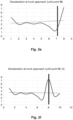
- Figs. 2a-2f show a proof-of-principle.
- Figs. 2a-2c show a use case where the trajectory of the user and the movement speed of the user indicate an intent to access/open a flap, e.g., a trunk lid.
- Fig. 2a shows the vehicle 200 and a trajectory 210a along the rear side of the vehicle 200.
- Figs. 2b and 2c show the movement speed of the user at distinct points on the trajectory 210a.
- the movement speed of the user decreases with the number of points on the trajectory towards the trunk.
- the approach to the trunk may be to access/open the trunk lid. Therefore, for the movement profile shown in Figs. 2a-2c an opening of the trunk should be performed.
- Figs. 2d-2f show a use case with a trajectory 210b which may indicate an intent to access/open the flap, e.g., a trunk lid.
- the movement speed of the user may give no indication for an intent to access/open the trunk lid.
- the movement speed of the user accelerates after a certain point N.
- the movement speed could be decelerated to surround the vehicle 200, but not to access/open the trunk lid.
- the movement speed could be accelerated, since the user may have no intent to access/open the trunk lid.
- the trajectory false-positive events can be reduced.
- Fig. 2 may comprise one or more optional additional features corresponding to one or more aspects mentioned in connection with the proposed concept or one or more examples described above (e.g., Fig. 1 ) and/or described below (e.g., Fig. 3 ).
- Fig. 3 shows a block diagram of an example of an apparatus 30, e.g., for a vehicle 40.
- the apparatus 30 comprises interface circuitry 32 and processing circuitry 34 configured to perform a method as described above, e.g., the method for a vehicle as described with reference to Fig. 1 .
- the apparatus 30 may be part of the vehicle 40, e.g., part of a control unit of the vehicle 40.
- the vehicle 40 may be a land vehicle, such a road vehicle, a car, an automobile, an offroad vehicle, a motor vehicle, a bus, a robo-taxi, a van, a truck or a lorry.
- the vehicle 40 may be any other type of vehicle, such as a train, a subway train, a boat or a ship.
- the proposed concept may be applied to public transportation (trains, bus) and future means of mobility (e.g., robo-taxis).
- the respective interface circuitry 32 is coupled to the respective processing circuitry 34 at the apparatus 30.
- the processing circuitry 34 may be implemented using one or more processing units, one or more processing devices, any means for processing, such as a processor, a computer or a programmable hardware component being operable with accordingly adapted software. Similar, the described functions of the processing circuitry 34 may as well be implemented in software, which is then executed on one or more programmable hardware components. Such hardware components may comprise a general-purpose processor, a Digital Signal Processor (DSP), a micro-controller, etc.
- DSP Digital Signal Processor
- the processing circuitry 34 is capable of controlling the interface circuitry 32, so that any data transfer that occurs over the interface circuitry 32 and/or any interaction in which the interface circuitry 32 may be involved may be controlled by the processing circuitry 34.
- the apparatus 30 may comprise a memory and at least one processing circuitry 34 operably coupled to the memory and configured to perform the method described above.
- the interface circuitry 32 may correspond to any means for obtaining, receiving, transmitting or providing analog or digital signals or information, e.g., any connector, contact, pin, register, input port, output port, conductor, lane, etc. which allows providing or obtaining a signal or information.
- the interface circuitry 32 may be wireless or wireline and it may be configured to communicate, e.g., transmit or receive signals, information with further internal or external components.
- the apparatus 30 may be a computer, processor, control unit, (field) programmable logic array ((F)PLA), (field) programmable gate array ((F)PGA), graphics processor unit (GPU), application-specific integrated circuit (ASICs), integrated circuits (IC) or system-on-a-chip (SoCs) system.
- FPLA field programmable logic array
- F field programmable gate array
- GPU graphics processor unit
- ASICs application-specific integrated circuit
- IC integrated circuits
- SoCs system-on-a-chip
- Fig. 3 may comprise one or more optional additional features corresponding to one or more aspects mentioned in connection with the proposed concept or one or more examples described above (e.g., Fig. 1 - 2 ).
- Examples may further be or relate to a (computer) program including a program code to execute one or more of the above methods when the program is executed on a computer, processor or other programmable hardware component.
- steps, operations or processes of different ones of the methods described above may also be executed by programmed computers, processors or other programmable hardware components.
- Examples may also cover program storage devices, such as digital data storage media, which are machine-, processor- or computer-readable and encode and/or contain machine-executable, processor-executable or computer-executable programs and instructions.
- Program storage devices may include or be digital storage devices, magnetic storage media such as magnetic disks and magnetic tapes, hard disk drives, or optically readable digital data storage media, for example.
- Other examples may also include computers, processors, control units, (field) programmable logic arrays ((F)PLAs), (field) programmable gate arrays ((F)PGAs), graphics processor units (GPU), application-specific integrated circuits (ASICs), integrated circuits (ICs) or system-on-a-chip (SoCs) systems programmed to execute the steps of the methods described above.
- FPLAs field programmable logic arrays
- F field) programmable gate arrays
- GPU graphics processor units
- ASICs application-specific integrated circuits
- ICs integrated circuits
- SoCs system-on-a-chip
- aspects described in relation to a device or system should also be understood as a description of the corresponding method.
- a block, device or functional aspect of the device or system may correspond to a feature, such as a method step, of the corresponding method.
- aspects described in relation to a method shall also be understood as a description of a corresponding block, a corresponding element, a property or a functional feature of a corresponding device or a corresponding system.
- a block, device or functional aspect of the device or system may correspond to a feature, such as a method step, of the corresponding method. Accordingly, aspects described in relation to a method shall also be understood as a description of a corresponding block, a corresponding element, a property or a functional feature of a corresponding device or a corresponding system.
Landscapes
- Traffic Control Systems (AREA)
- Train Traffic Observation, Control, And Security (AREA)
- Power-Operated Mechanisms For Wings (AREA)
- Image Analysis (AREA)
Abstract
Description
- The present disclosure relates to the field of digital vehicle access. Embodiments relate to a method for improving a flap opening of a vehicle, an apparatus, a vehicle and a computer program.
- Existing systems for unlocking/opening a flap of a vehicle, for example a tailgate of a trunk or a front edge of a trunk, use so-called smart openers which, for example, enable opening by means of a gesture executed with a foot. In particular, this allows the flap to be opened without the use of hands. Other methods use detection of the time user equipment is in the immediate vicinity of a door that is to be opened. In this case, the door can be opened after a predefined period of time has elapsed. Both the gesture to be performed with a foot and waiting for a door to open can be perceived as unpleasant by a user. Thus, there may be a need to improve a flap opening of a vehicle.
- It is therefore a finding that an opening of a flap of a vehicle can be improved by comparing a movement profile of the user with a predefined movement profile. The flap can be opened if the movement profile of the user matches the predefined movement profile. In this way, false-positive events can be reduced. Thus, an experience of the user can be increased.
- Examples provide a method for improving flap opening of a vehicle. The method comprises determining a movement profile of a user relative to the vehicle. The movement profile is indicative of a trajectory and a movement speed of the user of the trajectory. Further, the method comprises comparing the movement profile of the user with a predefined movement profile. The method further comprises opening the flap of the vehicle if the movement profile of the user matches the predefined movement profile. By comparing the movement profile of the user with a predefined movement profile an intention of the user can be determined. This may allow to determine an intended usage of the flap by the user in an improved way.
- In an example, the method may further comprise storing the determined movement profile of the user and using the stored movement profile of the user to train an artificial intelligence to compare the movement profile of the user. Thus, a comparison of the movement profile of the user with the predefined movement profile can be improved by the artificial intelligence. In this way, a likelihood of a false-positive event can be further reduced.
- In an example, the method may further comprise determining a distance of the user to the flap. At least one of determining the movement profile of the user or comparing the movement profile of the user is based on the determined distance. Thus, the movement profile of the user can be compared with the predefined movement profile in a predefined area. For example, the predefined area may be an area next to the vehicle where the movement profile of the user may be more relevant for determining an intended usage of the flap. In this way, a determination of the user intention can be improved. This may allow to improve the flap opening of the vehicle.
- In an example, the method may further comprise determining a cancellation parameter indicative of a trigger event to cancel the determination of the movement profile of the user. Further, the method may comprise canceling the determination of the movement profile of the user based on the cancellation parameter. This may allow to determine the situation where a determination of the movement profile of the user is no longer necessary. Thus the determination of the movement profile of the user can be canceled. In this way, an energy consumption for determining the movement profile of the user can be reduced.
- In an example, the method may further comprise receiving profile data indicative of a general predefined movement profile and generating custom profile data indicative of a customized predefined movement profile. The custom profile data is generated based on the profile data. The custom profile data may be customized for the vehicle and/or the user. This may allow to adapt the comparison to the vehicle and/or the user. In this way, a determination of an intention of the user can be further improved.
- In an example, the method may further comprise receiving environmental data indicative of an environment of the vehicle and comparing the movement profile of the user based on the environmental data. In this way, a predefined movement profile which is used for comparison can be adapted and/or opening of the flap of the vehicle can be prevented (for example, if the flap is blocked by an obstruction). Thus, opening of the flap of the vehicle can be adapted to an environment.
- In an example, the method may further comprise obtaining feedback data indicative of a use of the open flap by the user into using the feedback data to train an artificial intelligence to compare the movement profile of the user. By obtaining feedback data the training of the artificial intelligence can be improved. In this way, the comparison of the movement profile of the user with the predefined movement profile can be improved.
- Examples relate to an apparatus, comprising interface circuitry and processing circuitry configured to perform a method as described above. Examples relate to a vehicle, comprising an apparatus as described above.
- Examples further relate to a computer program having a program code for performing the method described above, when the computer program is executed on a computer, a processor, or a programmable hardware component.
- Some examples of apparatuses, methods and/or computer programs will be described in the following by way of example only, and with reference to the accompanying figures, in which
-
Fig. 1 shows an example of a method for improving flap opening of a vehicle; -
Figs. 2a-2f show a proof-of-principle; and -
Fig. 3 shows a block diagram of an example of an apparatus, e.g., part of a vehicle. - As used herein, the term "or" refers to a non-exclusive or, unless otherwise indicated (e.g., "or else" or "or in the alternative"). Furthermore, as used herein, words used to describe a relationship between elements should be broadly construed to include a direct relationship or the presence of intervening elements unless otherwise indicated. For example, when an element is referred to as being "connected" or "coupled" to another element, the element may be directly connected or coupled to the other element or intervening elements may be present. In contrast, when an element is referred to as being "directly connected" or "directly coupled" to another element, there are no intervening elements present. Similarly, words such as "between", "adjacent", and the like should be interpreted in a like fashion.
- The terminology used herein is for the purpose of describing particular embodiments only and is not intended to be limiting of example embodiments. As used herein, the singular forms "a", "an" and "the" are intended to include the plural forms as well, unless the context clearly indicates otherwise. It will be further understood that the terms "comprises", "comprising", "includes", or "including", when used herein, specify the presence of stated features, integers, steps, operations, elements or components, but do not preclude the presence or addition of one or more other features, integers, steps, operations, elements, components or groups thereof.
- Unless otherwise defined, all terms (including technical and scientific terms) used herein have the same meaning as commonly understood by one of ordinary skill in the art to which example embodiments belong. It will be further understood that terms, e.g., those defined in commonly used dictionaries, should be interpreted as having a meaning that is consistent with their meaning in the context of the relevant art and will not be interpreted in an idealized or overly formal sense unless expressly so defined herein.
-
Fig. 1 shows an example of amethod 100 for improving flap opening of a vehicle. Themethod 100 comprises determining 110 a movement profile of a user relative to the vehicle. The movement profile is indicative of a trajectory and a movement speed of the user on the trajectory. The movement profile may be determined based on sensor data received from a sensor, e.g., a sensor of the vehicle, a sensor of an infrastructure. For example, themethod 100 may further comprise receiving sensor data from a sensor. The sensor of the vehicle and/or the infrastructure may be an ultra-wide band sensor, a camera, RADAR sensor, for example. For example the movement profile of the user may be determined based on a digital key. A digital key for a vehicle is a digital authentication method that allows a user to access and operate their vehicle without using a physical key. It is a form of electronic key that may be stored and transmitted through user equipment. For example, the position or the trajectory of the digital key can be determined based on ultra-wide band sensor data. The flap may be a door, a trunk lid, a trunk lid, for example. - Further, the
method 100 comprises comparing the movement profile of the user with a predefined movement profile. The predefined profile may be obtained by a control unit performing themethod 100, e.g., by processing circuitry of the control unit. The predefined movement profile may be, e.g., loaded from a database, received from a communication device such as a network node, determined based on previous movement profiles of the user. - The predefined movement profile may be a movement profile associated with a user, a vehicle, a vehicle type, a vehicle fleet, for example. The predefined movement profile can be associated with the user and/or the vehicle. Alternatively, the predefined movement profile can be independent from the user or the vehicle. For example, the predefined movement profile may be a general predefined movement profile.
- The predefined movement profile can be determined based on previous movement profiles. For example, the predefined movement profile can be determined by an artificial intelligence. For example, a machine-learning model can determine the predefined movement profile.
- The machine-learning model is a data structure and/or set of rules representing a statistical model that processing circuitry uses to determine the predefined movement profile without using explicit instructions, instead relying on models and inference. The data structure and/or set of rules represents learned knowledge (e.g., based on training performed by a machine-learning algorithm). For example, in machine-learning, instead of a rule-based transformation of data, a transformation of data may be used, that is inferred from an analysis of historical and/or training data. In the proposed technique, the content of movement profiles is analyzed using the machine-learning model (e. g., a data structure and/or set of rules representing the model).
- The machine-learning model is trained by a machine-learning algorithm. The term "machine-learning algorithm" denotes a set of instructions that are used to create, train or use a machine-learning model. For the machine-learning model to analyze the content of movement profiles, the machine-learning model may be trained using training and/or historical movement profiles as input and training content information as output (e.g., labels of the predefined movement profiles). By training the machine-learning model with a large set of training movement profiles and associated training content information (e.g., labels or annotations), the machine-learning model "learns" to recognize the content of the movement profiles, so the content of movement profiles that are not included in the training data can be recognized using the machine-learning model. By training the machine-learning model using training movement profiles and a desired output, the machine-learning model "learns" a transformation between the movement profiles and the output, which can be used to provide an output based on non-training movement profiles provided to the machine-learning model.
- The machine-learning model may be trained using training input data (e.g., training movement profiles). For example, the machine-learning model may be trained using a training method called "supervised learning". In supervised learning, the machine-learning model is trained using a plurality of training samples, wherein each sample may comprise a plurality of input data values, and a plurality of desired output values, e. g., each training sample is associated with a desired output value. By specifying both training samples and desired output values, the machine-learning model "learns" which output value to provide based on an input sample that is similar to the samples provided during the training. For example, a training sample may comprise training movement profiles as input data and one or more labels as desired output data. The labels indicate the predefined movement profiles.
- Apart from supervised learning, semi-supervised learning may be used. In semi-supervised learning, some of the training samples lack a corresponding desired output value. Supervised learning may be based on a supervised learning algorithm (e.g., a classification algorithm or a similarity learning algorithm). Classification algorithms may be used as the desired outputs of the trained machine-learning model are restricted to a limited set of values (categorical variables), e. g., the input is classified to one of the limited set of values (type of exercise, execution quality). Similarity learning algorithms are similar to classification algorithms but are based on learning from examples using a similarity function that measures how similar or related two objects are.
- Apart from supervised or semi-supervised learning, unsupervised learning may be used to train the machine-learning model. In unsupervised learning, (only) input data are supplied and an unsupervised learning algorithm is used to find structure in the input data such as training and/or historical movement profiles (e.g., by grouping or clustering the input data, finding commonalities in the data). Clustering is the assignment of input data comprising a plurality of input values into subsets (clusters) so that input values within the same cluster are similar according to one or more (predefined) similarity criteria, while being dissimilar to input values that are included in other clusters.
- Reinforcement learning is a third group of machine-learning algorithms. In other words, reinforcement learning may be used to train the machine-learning model. In reinforcement learning, one or more software actors (called "software agents") are trained to take actions in an environment. Based on the taken actions, a reward is calculated. Reinforcement learning is based on training the one or more software agents to choose the actions such that the cumulative reward is increased, leading to software agents that become better at the task they are given (as evidenced by increasing rewards).
- Furthermore, additional techniques may be applied to some of the machine-learning algorithms. For example, feature learning may be used. In other words, the machine-learning model may at least partially be trained using feature learning, and/or the machine-learning algorithm may comprise a feature learning component. Feature learning algorithms, which may be called representation learning algorithms, may preserve the information in their input but also transform it in a way that makes it useful, often as a pre-processing step before performing classification or predictions. Feature learning may be based on principal components analysis or cluster analysis, for example.
- In some examples, anomaly detection (e. g., outlier detection) may be used, which is aimed at providing an identification of input values that raise suspicions by differing significantly from the majority of input or training data. In other words, the machine-learning model may at least partially be trained using anomaly detection, and/or the machine-learning algorithm may comprise an anomaly detection component.
- In some examples, the machine-learning algorithm may use a decision tree as a predictive model. In other words, the machine-learning model may be based on a decision tree. In a decision tree, observations about an item (e.g., a set of input movement profiles) may be represented by the branches of the decision tree, and an output value corresponding to the item may be represented by the leaves of the decision tree. Decision trees support discrete values and continuous values as output values. If discrete values are used, the decision tree may be denoted a classification tree, if continuous values are used, the decision tree may be denoted a regression tree.
- Association rules are a further technique that may be used in machine-learning algorithms. In other words, the machine-learning model may be based on one or more association rules. Association rules are created by identifying relationships between variables in large amounts of data. The machine-learning algorithm may identify and/or utilize one or more relational rules that represent the knowledge that is derived from the data. The rules may, e.g., be used to store, manipulate or apply the knowledge.
- For example, the machine-learning model may be an Artificial Neural Network (ANN). ANNs are systems that are inspired by biological neural networks, such as can be found in a retina or a brain. ANNs comprise a plurality of interconnected nodes and a plurality of connections, so-called edges, between the nodes. There are usually three types of nodes, input nodes that receive input values (e.g., the movement profiles, especially a position or a trajectory and movement speed/velocity of the user), hidden nodes that are (only) connected to other nodes, and output nodes that provide output values (e.g., predefined movement profiles). Each node may represent an artificial neuron. Each edge may transmit information from one node to another. The output of a node may be defined as a (non-linear) function of its inputs (e.g., of the sum of its inputs). The inputs of a node may be used in the function based on a "weight" of the edge or of the node that provides the input. The weight of nodes and/or of edges may be adjusted in the learning process. In other words, the training of an ANN may comprise adjusting the weights of the nodes and/or edges of the ANN, e. g., to achieve a desired output for a given input.
- Alternatively, the machine-learning model may be a support vector machine, a random forest model or a gradient boosting model. Support vector machines (e. g., support vector networks) are supervised learning models with associated learning algorithms that may be used to analyze data (e.g., in classification or regression analysis). Support vector machines may be trained by providing an input with a plurality of training input values (e.g., movement profiles, especially a position or a trajectory and movement speed/velocity of the user) that belong to one of two categories (e.g., predefined movement profiles with a high likelihood and movement profiles with a low likelihood of an intention to access/open the flap). The support vector machine may be trained to assign a new input value to one of the two categories. Alternatively, the machine-learning model may be a Bayesian network, which is a probabilistic directed acyclic graphical model. A Bayesian network may represent a set of random variables and their conditional dependencies using a directed acyclic graph. Alternatively, the machine-learning model may be based on a genetic algorithm, which is a search algorithm and heuristic technique that mimics the process of natural selection. In some example, the machine-learning model may be a combination of the above examples.
- The
method 100 further comprises opening the flap of the vehicle if the movement profile of the user matches the predefined movement profile. The predefined movement profile may be indicative of an intention of the user to access/open the flap. Thus, if the movement profile of the user matches the predefined movement profile it can be assumed that the user intends to access/open the flap. Therefore, the flap can be opened based on the match of the movement profile of the user and the predefined movement profile. In this way, an intention of the user can be determined in an improved way and thus an opening of the flap can be improved. - By comparing the movement profile of the user based on the predefined movement profile a forecast can be achieved. For example an automation of an action of the vehicle when the user is walking around the vehicle, such like opening the flap, can be provided. In this way, a user experience can be improved. For example, a user's life can be made easier, since no interaction with the flap may be required. The comparison can be used to trigger the opening of the flap at the "right" time when the user is on his way and close enough to the flap.
- By combining a trajectory and a movement speed of the user a reliability of a determination of the intention of the user can be increased. For example, some false-positive opening events may remain when the user follows a typical trajectory towards the flap without intending to open the flap (e.g., because the user passes by the flap). In contrast, by combining the trajectory and the movement speed false-positive opening events can be reduced. Additionally to the trajectory of the user the movement speed of the user is considered. For example, the movement speed may be indicative of a velocity of the user, an acceleration and/or a deceleration. Thus, the movement speed can be used as further indicator for determining an intent of the user to access/open the flap.
- In this way, a detecting of an intention of a user to open and/or access a flap of the vehicle can be determined as early as possible. Further, by considering the movement speed of the user a number of false-positive opening events in cases where the user does not intend to open the respective flap, despite approaching it, can be reduced.
- For example, a deceleration of the user during an approach towards the flap, followed by a stop near the flap may be a typical movement profile of the user indicating an intent to access/open the flap. Thus, the movement speed can help to distinguish use cases with and without an intent of the user to access/open the flap, respectively.
- For example, the machine-learning model used to determine the predefined movement profile can be used to compare the movement profile of the user with the predefined movement profile. For example, an artificial intelligence may be used to compare the movement profile of the user with the predefined movement profile. Alternatively, an artificial intelligence different from the artificial intelligence determining the predefined movement profile can be used to compare the movement profile the user with the predefined movement profile.
- In an example, the
method 100 may further comprise storing the determined movement profile of the user and using the stored movement profile of the user to train an artificial intelligence to compare the movement profile of the user. The determined movement profile of the user may be stored in a memory device of the control unit performing themethod 100. Additionally or alternatively, the determined movement profile of the user may be stored in the database, e.g., of another communication device such as a server, an infrastructure. By using the stored movement profile of the user an artificial intelligence can be trained such that the predefined movement profile is associated with the user. In this way, the comparison between movement profile of the user and predefined movement profile can be improved. For example, an input value for the machine-learning model may be the stored movement profile of the user. By using the stored movement profile a universal approach to determine the intention of the user can be adapted to a user specific approach. Thus, the usual movement speed/velocity and/or a typical approach of the user can be considered. - In an example, the
method 100 may further comprise determining a distance of the user to the flap. At least one of determining the movement profile of the user or comparing the movement profile of the user is based on the determined distance. For example, the distance of the user to the vehicle may be a start trigger to start determining the movement profile of the user and/or comparing the movement profile the user. This allows to determine the movement profile of the user only if the user is within a certain distance, e.g., closer than 3 m from the flap, for example. In this case, only input data, e.g., sensor data indicative of the movement profile, which are obtained within a certain distance can be used to determine the movement profile of the user. In this way, an energy consumption can be reduced. Further, an accuracy of the comparison can be improved. - Further, only the movement profile determined within a distance of the user to the flap may be stored. This may allow to classify the user's past behavior as soon as the user gets closer than a threshold, e.g., 2 m, to the flap.
- The comparison of the movement profile of the user with the predefined movement profile can be performed multiple times during the determination of the movement profile of the user. For example, the determination of the movement profile of the user can be adjusted with any new incoming data point, e.g., part of the sensor data received from the sensor. Thus, the comparison can also be adjusted with any new incoming data point. The determination of the movement profile of the user and/or the comparison can be performed until a classification output indicates an intent of the user to access/open the flap or the users goes away from the flap.
- For example, a comparison can be based on an already determined part of the movement profile of the user. The flap can be opened as soon as a match of the (part of the) determined movement profile with the (part of the) predefined movement profile is detected. This may allow to open the flap as soon as an intent of the user to access/open the flap is detected.
- In an example, the
method 100 may further comprise determining a cancellation parameter indicative of a trigger event to cancel the determination of the movement profile of the user. Further, the method may comprise canceling the determination of the movement profile of the user based on the cancellation parameter. The cancellation parameter may be a stop trigger to stop tracking the behavior of the user. For example the cancellation parameter may be utilized to cancel the determination of an intent of the user. The cancellation parameter may be a distance of the user to the flap, a movement speed of the user (especially if the user is close to the flap), for example. For example, once the user is far enough from the flap, the user may be not tracked any more, until the next start trigger, e.g., the user is again within a certain distance to the flap. Thus, if a distance of the user to the flap is greater than a threshold the determination of the movement profile and the comparison can be canceled. In this way, an energy consumption can be reduced. - In an example, the
method 100 may further comprise receiving profile data indicative of a general predefined movement profile of the user and generating custom profile data indicative of a customized predefined movement profile of the user. The custom profile data is generated based on the profile data. The general predefined movement profile of the user may be determined based on training data of multiple users and/or vehicles. For example, the general predefined movement profile of the user can be used for different users and/or vehicles. This may allow to use a standard predefined movement profile of the user without resource intensive training for every user/vehicle. - The custom profile data is customized for the vehicle and/or the user. By customizing the general predefined movement profile of the user a single classification model can be adapted to multiple vehicle models with different dimensions and/or different users. In this way, a determination of the predefined movement provides of the user can be facilitated.
- For example, to gain a time saving in model development and data generation, e.g., determination or generation of the predefined movement profile of the user, a single model that is applicable to multiple vehicle models with different dimensions can be developed. A trajectory of a general predefined movement profile of the user can be pre-processed specifically to the type of the vehicle. For example, a shift of the trajectory according to a vehicle bounding box can be done. Additionally or alternatively, the flap can be set as the origin of the coordinate system. A bounding box of a vehicle may be a rectangular box that is drawn around the outline of the vehicle in an image or video frame. It is used in computer vision and machine learning applications for object detection and tracking, and it is a way to represent the location and size of an object in an image. The bounding box is defined by its top-left and bottom-right coordinates, which define the corners of the rectangle. The top-left coordinate is the coordinate of the top-left corner of the rectangle, and the bottom-right coordinate is the coordinate of the bottom-right corner of the rectangle. The use of the bounding box may allow to adjust a single model to a specific model for type of vehicle. For example, the customized movement profile of the user may be determined based on the general movement profile of the user and the bounding box of the vehicle.
- In an example, the method may further comprise receiving environmental data indicative of an environment of the vehicle and comparing the movement profile of the user based on the environmental data. In this way, a predefined movement profile which is used for comparison can be adapted and/or opening of the flap of the vehicle can be prevented (for example, if the flap is blocked by an obstruction). Thus, opening of the flap of the vehicle can be adapted to an environment.
- In an example, the method may further comprise obtaining feedback data indicative of a use of the open flap by the user into using the feedback data to train an artificial intelligence to compare the movement profile of the user. For example, the feedback data can be used as input data for the machine-learning model. In this way, a reliability of the comparison can be improved.
- The method may be performed by a processing circuitry, e.g., part of the vehicle. The processing circuitry may be part of a control unit, e.g., a central control unit (such as an engine control unit) of the vehicle. The processing circuitry may be communicatively coupled via an interface circuitry to a sensor, e.g., to receive the sensor data, to determine the position of a digital key.
- More details and aspects are mentioned in connection with the embodiments described below. The example shown in
Fig. 1 may comprise one or more optional additional features corresponding to one or more aspects mentioned in connection with the proposed concept or one or more examples described below (e.g.,Fig. 2 - 3 ). -
Figs. 2a-2f show a proof-of-principle.Figs. 2a-2c show a use case where the trajectory of the user and the movement speed of the user indicate an intent to access/open a flap, e.g., a trunk lid.Fig. 2a shows thevehicle 200 and atrajectory 210a along the rear side of thevehicle 200.Figs. 2b and2c show the movement speed of the user at distinct points on thetrajectory 210a. As can be seen inFigs. 2b and2c the movement speed of the user decreases with the number of points on the trajectory towards the trunk. Thus, the approach to the trunk may be to access/open the trunk lid. Therefore, for the movement profile shown inFigs. 2a-2c an opening of the trunk should be performed. - In contrast
Figs. 2d-2f show a use case with atrajectory 210b which may indicate an intent to access/open the flap, e.g., a trunk lid. However, the movement speed of the user may give no indication for an intent to access/open the trunk lid. As can be seen inFigs. 2e and 2f the movement speed of the user accelerates after a certain point N. Thus, the movement speed could be decelerated to surround thevehicle 200, but not to access/open the trunk lid. Thus, after passing point N the movement speed could be accelerated, since the user may have no intent to access/open the trunk lid. Thus, by combining the movement speed with the trajectory false-positive events can be reduced. - More details and aspects are mentioned in connection with the embodiments described below. The example shown in
Fig. 2 may comprise one or more optional additional features corresponding to one or more aspects mentioned in connection with the proposed concept or one or more examples described above (e.g.,Fig. 1 ) and/or described below (e.g.,Fig. 3 ). -
Fig. 3 shows a block diagram of an example of anapparatus 30, e.g., for avehicle 40. Theapparatus 30 comprisesinterface circuitry 32 andprocessing circuitry 34 configured to perform a method as described above, e.g., the method for a vehicle as described with reference toFig. 1 . For example, theapparatus 30 may be part of thevehicle 40, e.g., part of a control unit of thevehicle 40. - For example, the
vehicle 40 may be a land vehicle, such a road vehicle, a car, an automobile, an offroad vehicle, a motor vehicle, a bus, a robo-taxi, a van, a truck or a lorry. Alternatively, thevehicle 40 may be any other type of vehicle, such as a train, a subway train, a boat or a ship. For example, the proposed concept may be applied to public transportation (trains, bus) and future means of mobility (e.g., robo-taxis). - As shown in
Fig. 3 therespective interface circuitry 32 is coupled to therespective processing circuitry 34 at theapparatus 30. In examples theprocessing circuitry 34 may be implemented using one or more processing units, one or more processing devices, any means for processing, such as a processor, a computer or a programmable hardware component being operable with accordingly adapted software. Similar, the described functions of theprocessing circuitry 34 may as well be implemented in software, which is then executed on one or more programmable hardware components. Such hardware components may comprise a general-purpose processor, a Digital Signal Processor (DSP), a micro-controller, etc. Theprocessing circuitry 34 is capable of controlling theinterface circuitry 32, so that any data transfer that occurs over theinterface circuitry 32 and/or any interaction in which theinterface circuitry 32 may be involved may be controlled by theprocessing circuitry 34. - In an embodiment the
apparatus 30 may comprise a memory and at least oneprocessing circuitry 34 operably coupled to the memory and configured to perform the method described above. - In examples the
interface circuitry 32 may correspond to any means for obtaining, receiving, transmitting or providing analog or digital signals or information, e.g., any connector, contact, pin, register, input port, output port, conductor, lane, etc. which allows providing or obtaining a signal or information. Theinterface circuitry 32 may be wireless or wireline and it may be configured to communicate, e.g., transmit or receive signals, information with further internal or external components. - The
apparatus 30 may be a computer, processor, control unit, (field) programmable logic array ((F)PLA), (field) programmable gate array ((F)PGA), graphics processor unit (GPU), application-specific integrated circuit (ASICs), integrated circuits (IC) or system-on-a-chip (SoCs) system. - More details and aspects are mentioned in connection with the embodiments described. The example shown in
Fig. 3 may comprise one or more optional additional features corresponding to one or more aspects mentioned in connection with the proposed concept or one or more examples described above (e.g.,Fig. 1 - 2 ). - The aspects and features described in relation to a particular one of the previous examples may also be combined with one or more of the further examples to replace an identical or similar feature of that further example or to additionally introduce the features into the further example.
- Examples may further be or relate to a (computer) program including a program code to execute one or more of the above methods when the program is executed on a computer, processor or other programmable hardware component. Thus, steps, operations or processes of different ones of the methods described above may also be executed by programmed computers, processors or other programmable hardware components. Examples may also cover program storage devices, such as digital data storage media, which are machine-, processor- or computer-readable and encode and/or contain machine-executable, processor-executable or computer-executable programs and instructions. Program storage devices may include or be digital storage devices, magnetic storage media such as magnetic disks and magnetic tapes, hard disk drives, or optically readable digital data storage media, for example. Other examples may also include computers, processors, control units, (field) programmable logic arrays ((F)PLAs), (field) programmable gate arrays ((F)PGAs), graphics processor units (GPU), application-specific integrated circuits (ASICs), integrated circuits (ICs) or system-on-a-chip (SoCs) systems programmed to execute the steps of the methods described above.
- It is further understood that the disclosure of several steps, processes, operations or functions disclosed in the description or claims shall not be construed to imply that these operations are necessarily dependent on the order described, unless explicitly stated in the individual case or necessary for technical reasons. Therefore, the previous description does not limit the execution of several steps or functions to a certain order. Furthermore, in further examples, a single step, function, process or operation may include and/or be broken up into several sub-steps, -functions, - processes or -operations.
- If some aspects have been described in relation to a device or system, these aspects should also be understood as a description of the corresponding method. For example, a block, device or functional aspect of the device or system may correspond to a feature, such as a method step, of the corresponding method. Accordingly, aspects described in relation to a method shall also be understood as a description of a corresponding block, a corresponding element, a property or a functional feature of a corresponding device or a corresponding system.
- If some aspects have been described in relation to a device or system, these aspects should also be understood as a description of the corresponding method and vice versa. For example, a block, device or functional aspect of the device or system may correspond to a feature, such as a method step, of the corresponding method. Accordingly, aspects described in relation to a method shall also be understood as a description of a corresponding block, a corresponding element, a property or a functional feature of a corresponding device or a corresponding system.
- The following claims are hereby incorporated in the detailed description, wherein each claim may stand on its own as a separate example. It should also be noted that although in the claims a dependent claim refers to a particular combination with one or more other claims, other examples may also include a combination of the dependent claim with the subject matter of any other dependent or independent claim. Such combinations are hereby explicitly proposed, unless it is stated in the individual case that a particular combination is not intended. Furthermore, features of a claim should also be included for any other independent claim, even if that claim is not directly defined as dependent on that other independent claim.
- The aspects and features described in relation to a particular one of the previous examples may also be combined with one or more of the further examples to replace an identical or similar feature of that further example or to additionally introduce the features into the further example.
-
- 30 apparatus
- 32 processing circuitry
- 34 interface circuitry
- 40 vehicle
- 100 method for improving flap opening
- 110 determining a movement profile
- 120 comparing the movement profile
- 130 opening the flap of the vehicle
- 200 vehicle
- 210a, 210b trajectory
Claims (10)
- A method (100) for improving flap opening of a vehicle, comprising:determining (110) a movement profile of a user relative to the vehicle, the movement profile indicative of a trajectory and a movement speed of the user on the trajectory;comparing (120) the movement profile of the user with a predefined movement profile; andopening (130) the flap of the vehicle if the movement profile of the user matches the predefined movement profile.
- The method (100) according to claim 1, further comprisingstoring the determined movement profile of the user; andusing the stored movement profile of the user to train an artificial intelligence to compare the movement profile of the user.
- The method (100) according to any one of the preceding claims, further comprisingdetermining a distance of the user to the flap; and whereinat least one of determining the movement profile of the user or comparing the movement profile of the user is based on the determined distance.
- The method (100) according to any one of the claims 1 - 2, further comprisingdetermining a cancellation parameter indicative of a trigger event to cancel the determination of the movement profile of the user; andcanceling, based on the cancellation parameter, the determination of the movement profile of the user.
- The method (100) according to any one of the preceding claims, further comprising receiving profile data indicative of a general predefined movement profile of the user; and generating, based on the profile data, custom profile data indicative of a customized predefined movement profile of the user, wherein the custom profile data is customized for at least one of the vehicle or the user.
- The method (100) according to any one of the preceding claims, further comprisingreceiving environmental data indicative of an environment of the vehicle; andcomparing the movement profile of the user based on the environmental data.
- The method (100) according to any one of the preceding claims, further comprisingobtaining feedback data indicative of a use of the opened flap by the user; andusing the feedback data to train an artificial intelligence to compare the movement profile of the user.
- An apparatus (30), comprising:interface circuitry (32); andprocessing circuitry (34) configured to perform a method according to any of the preceding claims.
- A vehicle (40; 200) comprising the apparatus (30) according to claim 8.
- A computer program having a program code for performing the method (100) according to claim 1 - 7, when the computer program is executed on a computer, a processor, or a programmable hardware component.
Priority Applications (6)
| Application Number | Priority Date | Filing Date | Title |
|---|---|---|---|
| EP23162573.2A EP4431689A1 (en) | 2023-03-17 | 2023-03-17 | Method for improving flap opening of a vehicle, apparatus, vehicle and computer program |
| JP2025551973A JP2026510347A (en) | 2023-03-17 | 2024-01-24 | Method, apparatus, vehicle, and computer program for improving the opening of vehicle flaps. |
| CN202480017393.9A CN120826517A (en) | 2023-03-17 | 2024-01-24 | Method, device, vehicle and computer program for improving the opening of a flip portion of a vehicle |
| PCT/EP2024/051584 WO2024193870A1 (en) | 2023-03-17 | 2024-01-24 | Method for improving flap opening of a vehicle, apparatus, vehicle and computer program |
| KR1020257029193A KR20250138810A (en) | 2023-03-17 | 2024-01-24 | Method, device, vehicle and computer program for improving flap opening of a vehicle |
| DE112024001288.4T DE112024001288T5 (en) | 2023-03-17 | 2024-01-24 | Method for improving the opening of a vehicle hatch, device, vehicle and computer program |
Applications Claiming Priority (1)
| Application Number | Priority Date | Filing Date | Title |
|---|---|---|---|
| EP23162573.2A EP4431689A1 (en) | 2023-03-17 | 2023-03-17 | Method for improving flap opening of a vehicle, apparatus, vehicle and computer program |
Publications (1)
| Publication Number | Publication Date |
|---|---|
| EP4431689A1 true EP4431689A1 (en) | 2024-09-18 |
Family
ID=85703676
Family Applications (1)
| Application Number | Title | Priority Date | Filing Date |
|---|---|---|---|
| EP23162573.2A Pending EP4431689A1 (en) | 2023-03-17 | 2023-03-17 | Method for improving flap opening of a vehicle, apparatus, vehicle and computer program |
Country Status (6)
| Country | Link |
|---|---|
| EP (1) | EP4431689A1 (en) |
| JP (1) | JP2026510347A (en) |
| KR (1) | KR20250138810A (en) |
| CN (1) | CN120826517A (en) |
| DE (1) | DE112024001288T5 (en) |
| WO (1) | WO2024193870A1 (en) |
Cited By (2)
| Publication number | Priority date | Publication date | Assignee | Title |
|---|---|---|---|---|
| EP4726161A1 (en) * | 2024-10-08 | 2026-04-15 | Bayerische Motoren Werke Aktiengesellschaft | Method for improving a control of a flap of a vehicle, apparatus, vehicle and computer program |
| EP4733961A1 (en) * | 2024-10-28 | 2026-04-29 | Bayerische Motoren Werke Aktiengesellschaft | Method for improving an opening of a flap of a vehicle, apparatus, vehicle and computer program |
Citations (3)
| Publication number | Priority date | Publication date | Assignee | Title |
|---|---|---|---|---|
| DE102019212532A1 (en) * | 2019-08-21 | 2021-02-25 | Volkswagen Aktiengesellschaft | Portable user device and method for preparing an authorization for access to a means of transport |
| US20220290484A1 (en) * | 2021-03-11 | 2022-09-15 | Ford Global Technologies, Llc | Vehicle door control system |
| DE102021114557A1 (en) * | 2021-06-07 | 2022-12-08 | Brose Fahrzeugteile Se & Co. Kommanditgesellschaft, Bamberg | Method for operating a motorized flap arrangement of a motor vehicle |
-
2023
- 2023-03-17 EP EP23162573.2A patent/EP4431689A1/en active Pending
-
2024
- 2024-01-24 CN CN202480017393.9A patent/CN120826517A/en active Pending
- 2024-01-24 JP JP2025551973A patent/JP2026510347A/en active Pending
- 2024-01-24 WO PCT/EP2024/051584 patent/WO2024193870A1/en not_active Ceased
- 2024-01-24 DE DE112024001288.4T patent/DE112024001288T5/en active Pending
- 2024-01-24 KR KR1020257029193A patent/KR20250138810A/en active Pending
Patent Citations (3)
| Publication number | Priority date | Publication date | Assignee | Title |
|---|---|---|---|---|
| DE102019212532A1 (en) * | 2019-08-21 | 2021-02-25 | Volkswagen Aktiengesellschaft | Portable user device and method for preparing an authorization for access to a means of transport |
| US20220290484A1 (en) * | 2021-03-11 | 2022-09-15 | Ford Global Technologies, Llc | Vehicle door control system |
| DE102021114557A1 (en) * | 2021-06-07 | 2022-12-08 | Brose Fahrzeugteile Se & Co. Kommanditgesellschaft, Bamberg | Method for operating a motorized flap arrangement of a motor vehicle |
Cited By (3)
| Publication number | Priority date | Publication date | Assignee | Title |
|---|---|---|---|---|
| EP4726161A1 (en) * | 2024-10-08 | 2026-04-15 | Bayerische Motoren Werke Aktiengesellschaft | Method for improving a control of a flap of a vehicle, apparatus, vehicle and computer program |
| WO2026077609A1 (en) * | 2024-10-08 | 2026-04-16 | Bayerische Motoren Werke Aktiengesellschaft | Method for improving a control of a flap of a vehicle, apparatus, vehicle and computer program |
| EP4733961A1 (en) * | 2024-10-28 | 2026-04-29 | Bayerische Motoren Werke Aktiengesellschaft | Method for improving an opening of a flap of a vehicle, apparatus, vehicle and computer program |
Also Published As
| Publication number | Publication date |
|---|---|
| WO2024193870A1 (en) | 2024-09-26 |
| JP2026510347A (en) | 2026-04-02 |
| CN120826517A (en) | 2025-10-21 |
| KR20250138810A (en) | 2025-09-22 |
| DE112024001288T5 (en) | 2026-01-08 |
Similar Documents
| Publication | Publication Date | Title |
|---|---|---|
| Sawada et al. | Concept bottleneck model with additional unsupervised concepts | |
| EP3929824B1 (en) | Robust multimodal sensor fusion for autonomous driving vehicles | |
| Watts et al. | A dynamic deep reinforcement learning-Bayesian framework for anomaly detection | |
| US10739773B2 (en) | Generative adversarial inverse trajectory optimization for probabilistic vehicle forecasting | |
| Zhang et al. | SafeDrive: Online driving anomaly detection from large-scale vehicle data | |
| CN110537184B (en) | Semi-supervised regression using generative adversarial networks | |
| KR102532749B1 (en) | Method and apparatus for hierarchical learning of neural networks based on weak supervised learning | |
| Hoai et al. | Max-margin early event detectors | |
| Sillito et al. | Semi-supervised learning for anomalous trajectory detection | |
| US20200285938A1 (en) | Neural network learning method and device for recognizing class | |
| WO2024193870A1 (en) | Method for improving flap opening of a vehicle, apparatus, vehicle and computer program | |
| US11551084B2 (en) | System and method of robust active learning method using noisy labels and domain adaptation | |
| Ding et al. | Driver identification through heterogeneity modeling in car-following sequences | |
| CA3256280A1 (en) | Out-of-distribution detection with generative models | |
| Kim et al. | Anomaly monitoring framework in lane detection with a generative adversarial network | |
| US20240135724A1 (en) | Methods and systems for predicting parking space vacancy | |
| Duman et al. | Distance estimation from a monocular camera using face and body features | |
| CN119990250A (en) | Vehicle fault prediction model training method, device and vehicle fault prediction method | |
| KR20210068993A (en) | Device and method for training a classifier | |
| CN118260658A (en) | Training method, prediction method, device and equipment for driving intention prediction model | |
| Narayanan et al. | Introduction to deep learning | |
| CN111401112A (en) | Face recognition method and device | |
| US20260010835A1 (en) | Slice-based methods for optimizing validation and subsequent retraining procedures of machine learning models | |
| KR20250017685A (en) | Method for training a machine learning model for classifying sensor data | |
| Aguilar et al. | Mining specification parameters for multi-class classification |
Legal Events
| Date | Code | Title | Description |
|---|---|---|---|
| PUAI | Public reference made under article 153(3) epc to a published international application that has entered the european phase |
Free format text: ORIGINAL CODE: 0009012 |
|
| STAA | Information on the status of an ep patent application or granted ep patent |
Free format text: STATUS: THE APPLICATION HAS BEEN PUBLISHED |
|
| AK | Designated contracting states |
Kind code of ref document: A1 Designated state(s): AL AT BE BG CH CY CZ DE DK EE ES FI FR GB GR HR HU IE IS IT LI LT LU LV MC ME MK MT NL NO PL PT RO RS SE SI SK SM TR |
|
| STAA | Information on the status of an ep patent application or granted ep patent |
Free format text: STATUS: REQUEST FOR EXAMINATION WAS MADE |
|
| TPAC | Observations filed by third parties |
Free format text: ORIGINAL CODE: EPIDOSNTIPA |
|
| 17P | Request for examination filed |
Effective date: 20250211 |
|
| STAA | Information on the status of an ep patent application or granted ep patent |
Free format text: STATUS: EXAMINATION IS IN PROGRESS |
|
| 17Q | First examination report despatched |
Effective date: 20250530 |