EP4431545A1 - Thermoplastic resin and optical lens including same - Google Patents
Thermoplastic resin and optical lens including same Download PDFInfo
- Publication number
- EP4431545A1 EP4431545A1 EP22892837.0A EP22892837A EP4431545A1 EP 4431545 A1 EP4431545 A1 EP 4431545A1 EP 22892837 A EP22892837 A EP 22892837A EP 4431545 A1 EP4431545 A1 EP 4431545A1
- Authority
- EP
- European Patent Office
- Prior art keywords
- carbon atoms
- group containing
- substituent
- optionally
- general formula
- Prior art date
- Legal status (The legal status is an assumption and is not a legal conclusion. Google has not performed a legal analysis and makes no representation as to the accuracy of the status listed.)
- Pending
Links
- 229920005992 thermoplastic resin Polymers 0.000 title claims abstract description 78
- 230000003287 optical effect Effects 0.000 title claims description 81
- 239000000470 constituent Substances 0.000 claims abstract description 107
- 229920005989 resin Polymers 0.000 claims abstract description 74
- 239000011347 resin Substances 0.000 claims abstract description 74
- 150000002009 diols Chemical class 0.000 claims abstract description 47
- 125000004432 carbon atom Chemical group C* 0.000 claims description 169
- 229920005668 polycarbonate resin Polymers 0.000 claims description 102
- 239000004431 polycarbonate resin Substances 0.000 claims description 102
- 125000001424 substituent group Chemical group 0.000 claims description 97
- -1 alkylene glycol Chemical compound 0.000 claims description 81
- 125000003118 aryl group Chemical group 0.000 claims description 48
- 125000001072 heteroaryl group Chemical group 0.000 claims description 28
- 125000002947 alkylene group Chemical group 0.000 claims description 26
- 125000004435 hydrogen atom Chemical group [H]* 0.000 claims description 25
- 229910052717 sulfur Inorganic materials 0.000 claims description 24
- 229910052757 nitrogen Inorganic materials 0.000 claims description 23
- 229910052760 oxygen Inorganic materials 0.000 claims description 20
- 125000000217 alkyl group Chemical group 0.000 claims description 18
- 239000000178 monomer Substances 0.000 claims description 17
- 125000003545 alkoxy group Chemical group 0.000 claims description 16
- 125000004104 aryloxy group Chemical group 0.000 claims description 15
- 125000000753 cycloalkyl group Chemical group 0.000 claims description 15
- 239000000155 melt Substances 0.000 claims description 12
- 125000000000 cycloalkoxy group Chemical group 0.000 claims description 11
- 230000009477 glass transition Effects 0.000 claims description 11
- 125000002496 methyl group Chemical group [H]C([H])([H])* 0.000 claims description 10
- 239000012788 optical film Substances 0.000 claims description 10
- 125000001495 ethyl group Chemical group [H]C([H])([H])C([H])([H])* 0.000 claims description 9
- 125000005843 halogen group Chemical group 0.000 claims description 9
- LYCAIKOWRPUZTN-UHFFFAOYSA-N ethylene glycol Natural products OCCO LYCAIKOWRPUZTN-UHFFFAOYSA-N 0.000 claims description 5
- WGCNASOHLSPBMP-UHFFFAOYSA-N hydroxyacetaldehyde Natural products OCC=O WGCNASOHLSPBMP-UHFFFAOYSA-N 0.000 claims description 5
- 229910052702 rhenium Inorganic materials 0.000 claims description 4
- 150000001875 compounds Chemical class 0.000 description 75
- 238000000034 method Methods 0.000 description 38
- 239000011342 resin composition Substances 0.000 description 31
- 239000003054 catalyst Substances 0.000 description 26
- 150000002148 esters Chemical class 0.000 description 26
- 239000003795 chemical substances by application Substances 0.000 description 25
- 125000001997 phenyl group Chemical group [H]C1=C([H])C([H])=C(*)C([H])=C1[H] 0.000 description 24
- 238000000465 moulding Methods 0.000 description 23
- 235000014113 dietary fatty acids Nutrition 0.000 description 22
- 239000000194 fatty acid Substances 0.000 description 22
- 229930195729 fatty acid Natural products 0.000 description 22
- ABLZXFCXXLZCGV-UHFFFAOYSA-N Phosphorous acid Chemical compound OP(O)=O ABLZXFCXXLZCGV-UHFFFAOYSA-N 0.000 description 18
- PEDCQBHIVMGVHV-UHFFFAOYSA-N Glycerol Natural products OCC(O)CO PEDCQBHIVMGVHV-UHFFFAOYSA-N 0.000 description 17
- 238000006243 chemical reaction Methods 0.000 description 17
- 239000006097 ultraviolet radiation absorber Substances 0.000 description 17
- 239000003963 antioxidant agent Substances 0.000 description 16
- 230000003078 antioxidant effect Effects 0.000 description 15
- 230000001476 alcoholic effect Effects 0.000 description 13
- 239000012535 impurity Substances 0.000 description 13
- 239000002994 raw material Substances 0.000 description 13
- NQXNYVAALXGLQT-UHFFFAOYSA-N 2-[4-[9-[4-(2-hydroxyethoxy)phenyl]fluoren-9-yl]phenoxy]ethanol Chemical compound C1=CC(OCCO)=CC=C1C1(C=2C=CC(OCCO)=CC=2)C2=CC=CC=C2C2=CC=CC=C21 NQXNYVAALXGLQT-UHFFFAOYSA-N 0.000 description 12
- 239000000654 additive Substances 0.000 description 12
- IISBACLAFKSPIT-UHFFFAOYSA-N bisphenol A Chemical compound C=1C=C(O)C=CC=1C(C)(C)C1=CC=C(O)C=C1 IISBACLAFKSPIT-UHFFFAOYSA-N 0.000 description 12
- 239000006227 byproduct Substances 0.000 description 12
- ROORDVPLFPIABK-UHFFFAOYSA-N diphenyl carbonate Chemical compound C=1C=CC=CC=1OC(=O)OC1=CC=CC=C1 ROORDVPLFPIABK-UHFFFAOYSA-N 0.000 description 12
- 125000002950 monocyclic group Chemical group 0.000 description 12
- 235000011187 glycerol Nutrition 0.000 description 11
- 150000002989 phenols Chemical class 0.000 description 11
- 229920001577 copolymer Polymers 0.000 description 10
- 238000004519 manufacturing process Methods 0.000 description 10
- 238000005259 measurement Methods 0.000 description 10
- 230000009467 reduction Effects 0.000 description 10
- 239000000126 substance Substances 0.000 description 10
- IJGRMHOSHXDMSA-UHFFFAOYSA-N Atomic nitrogen Chemical compound N#N IJGRMHOSHXDMSA-UHFFFAOYSA-N 0.000 description 9
- BVKZGUZCCUSVTD-UHFFFAOYSA-L Carbonate Chemical compound [O-]C([O-])=O BVKZGUZCCUSVTD-UHFFFAOYSA-L 0.000 description 9
- 150000004665 fatty acids Chemical class 0.000 description 9
- 239000010408 film Substances 0.000 description 9
- NIHNNTQXNPWCJQ-UHFFFAOYSA-N fluorene Chemical group C1=CC=C2CC3=CC=CC=C3C2=C1 NIHNNTQXNPWCJQ-UHFFFAOYSA-N 0.000 description 9
- 238000001746 injection moulding Methods 0.000 description 9
- 125000003367 polycyclic group Chemical group 0.000 description 9
- 238000006116 polymerization reaction Methods 0.000 description 9
- 238000012545 processing Methods 0.000 description 9
- 230000004075 alteration Effects 0.000 description 8
- 150000004650 carbonic acid diesters Chemical class 0.000 description 8
- 230000000694 effects Effects 0.000 description 8
- 239000000463 material Substances 0.000 description 8
- 229920006395 saturated elastomer Polymers 0.000 description 8
- 238000012360 testing method Methods 0.000 description 8
- HVLLSGMXQDNUAL-UHFFFAOYSA-N triphenyl phosphite Chemical compound C=1C=CC=CC=1OP(OC=1C=CC=CC=1)OC1=CC=CC=C1 HVLLSGMXQDNUAL-UHFFFAOYSA-N 0.000 description 8
- 150000002430 hydrocarbons Chemical group 0.000 description 7
- 230000000704 physical effect Effects 0.000 description 7
- 238000006068 polycondensation reaction Methods 0.000 description 7
- LFQSCWFLJHTTHZ-UHFFFAOYSA-N Ethanol Chemical compound CCO LFQSCWFLJHTTHZ-UHFFFAOYSA-N 0.000 description 6
- NBIIXXVUZAFLBC-UHFFFAOYSA-N Phosphoric acid Chemical compound OP(O)(O)=O NBIIXXVUZAFLBC-UHFFFAOYSA-N 0.000 description 6
- UIIMBOGNXHQVGW-UHFFFAOYSA-M Sodium bicarbonate Chemical compound [Na+].OC([O-])=O UIIMBOGNXHQVGW-UHFFFAOYSA-M 0.000 description 6
- 125000002619 bicyclic group Chemical group 0.000 description 6
- ZUOUZKKEUPVFJK-UHFFFAOYSA-N diphenyl Chemical compound C1=CC=CC=C1C1=CC=CC=C1 ZUOUZKKEUPVFJK-UHFFFAOYSA-N 0.000 description 6
- 239000012760 heat stabilizer Substances 0.000 description 6
- 238000002156 mixing Methods 0.000 description 6
- 239000000203 mixture Substances 0.000 description 6
- 229920000642 polymer Polymers 0.000 description 6
- 239000000047 product Substances 0.000 description 6
- 125000006413 ring segment Chemical group 0.000 description 6
- 150000003839 salts Chemical class 0.000 description 6
- 239000000243 solution Substances 0.000 description 6
- 150000005846 sugar alcohols Polymers 0.000 description 6
- JOXIMZWYDAKGHI-UHFFFAOYSA-N toluene-4-sulfonic acid Chemical compound CC1=CC=C(S(O)(=O)=O)C=C1 JOXIMZWYDAKGHI-UHFFFAOYSA-N 0.000 description 6
- 238000005809 transesterification reaction Methods 0.000 description 6
- OVJPYIRGUFWANT-UHFFFAOYSA-N 2-[1-[2-(2-hydroxyethoxy)naphthalen-1-yl]naphthalen-2-yl]oxyethanol Chemical compound C1=CC=C2C(C3=C4C=CC=CC4=CC=C3OCCO)=C(OCCO)C=CC2=C1 OVJPYIRGUFWANT-UHFFFAOYSA-N 0.000 description 5
- HBTONAMIPDVQRI-UHFFFAOYSA-N 2-[4-[9-[4-(2-hydroxyethoxy)-3-phenylphenyl]fluoren-9-yl]-2-phenylphenoxy]ethanol Chemical compound OCCOC1=CC=C(C2(C3=CC=CC=C3C3=CC=CC=C32)C=2C=C(C(OCCO)=CC=2)C=2C=CC=CC=2)C=C1C1=CC=CC=C1 HBTONAMIPDVQRI-UHFFFAOYSA-N 0.000 description 5
- FHZQOYSKWUJKDZ-UHFFFAOYSA-N 2-[6-[9-[6-(2-hydroxyethoxy)naphthalen-2-yl]fluoren-9-yl]naphthalen-2-yl]oxyethanol Chemical compound C1=C(OCCO)C=CC2=CC(C3(C4=CC=CC=C4C4=CC=CC=C43)C3=CC4=CC=C(C=C4C=C3)OCCO)=CC=C21 FHZQOYSKWUJKDZ-UHFFFAOYSA-N 0.000 description 5
- ISWSIDIOOBJBQZ-UHFFFAOYSA-N Phenol Chemical compound OC1=CC=CC=C1 ISWSIDIOOBJBQZ-UHFFFAOYSA-N 0.000 description 5
- NINIDFKCEFEMDL-UHFFFAOYSA-N Sulfur Chemical compound [S] NINIDFKCEFEMDL-UHFFFAOYSA-N 0.000 description 5
- BGYHLZZASRKEJE-UHFFFAOYSA-N [3-[3-(3,5-ditert-butyl-4-hydroxyphenyl)propanoyloxy]-2,2-bis[3-(3,5-ditert-butyl-4-hydroxyphenyl)propanoyloxymethyl]propyl] 3-(3,5-ditert-butyl-4-hydroxyphenyl)propanoate Chemical compound CC(C)(C)C1=C(O)C(C(C)(C)C)=CC(CCC(=O)OCC(COC(=O)CCC=2C=C(C(O)=C(C=2)C(C)(C)C)C(C)(C)C)(COC(=O)CCC=2C=C(C(O)=C(C=2)C(C)(C)C)C(C)(C)C)COC(=O)CCC=2C=C(C(O)=C(C=2)C(C)(C)C)C(C)(C)C)=C1 BGYHLZZASRKEJE-UHFFFAOYSA-N 0.000 description 5
- 230000002378 acidificating effect Effects 0.000 description 5
- 229940105990 diglycerin Drugs 0.000 description 5
- GPLRAVKSCUXZTP-UHFFFAOYSA-N diglycerol Chemical compound OCC(O)COCC(O)CO GPLRAVKSCUXZTP-UHFFFAOYSA-N 0.000 description 5
- YLQWCDOCJODRMT-UHFFFAOYSA-N fluoren-9-one Chemical compound C1=CC=C2C(=O)C3=CC=CC=C3C2=C1 YLQWCDOCJODRMT-UHFFFAOYSA-N 0.000 description 5
- 239000011521 glass Substances 0.000 description 5
- 230000036961 partial effect Effects 0.000 description 5
- 235000011007 phosphoric acid Nutrition 0.000 description 5
- 229920000515 polycarbonate Polymers 0.000 description 5
- 239000004417 polycarbonate Substances 0.000 description 5
- 229920000728 polyester Polymers 0.000 description 5
- 229920001225 polyester resin Polymers 0.000 description 5
- 239000004645 polyester resin Substances 0.000 description 5
- 230000000717 retained effect Effects 0.000 description 5
- 239000000758 substrate Substances 0.000 description 5
- 239000011593 sulfur Substances 0.000 description 5
- VBICKXHEKHSIBG-UHFFFAOYSA-N 1-monostearoylglycerol Chemical compound CCCCCCCCCCCCCCCCCC(=O)OCC(O)CO VBICKXHEKHSIBG-UHFFFAOYSA-N 0.000 description 4
- KJCVRFUGPWSIIH-UHFFFAOYSA-N 1-naphthol Chemical compound C1=CC=C2C(O)=CC=CC2=C1 KJCVRFUGPWSIIH-UHFFFAOYSA-N 0.000 description 4
- SFDGJDBLYNJMFI-UHFFFAOYSA-N 3,1-benzoxazin-4-one Chemical compound C1=CC=C2C(=O)OC=NC2=C1 SFDGJDBLYNJMFI-UHFFFAOYSA-N 0.000 description 4
- SSADPHQCUURWSW-UHFFFAOYSA-N 3,9-bis(2,6-ditert-butyl-4-methylphenoxy)-2,4,8,10-tetraoxa-3,9-diphosphaspiro[5.5]undecane Chemical compound CC(C)(C)C1=CC(C)=CC(C(C)(C)C)=C1OP1OCC2(COP(OC=3C(=CC(C)=CC=3C(C)(C)C)C(C)(C)C)OC2)CO1 SSADPHQCUURWSW-UHFFFAOYSA-N 0.000 description 4
- YYROPELSRYBVMQ-UHFFFAOYSA-N 4-toluenesulfonyl chloride Chemical compound CC1=CC=C(S(Cl)(=O)=O)C=C1 YYROPELSRYBVMQ-UHFFFAOYSA-N 0.000 description 4
- WYURNTSHIVDZCO-UHFFFAOYSA-N Tetrahydrofuran Chemical compound C1CCOC1 WYURNTSHIVDZCO-UHFFFAOYSA-N 0.000 description 4
- 125000001931 aliphatic group Chemical group 0.000 description 4
- 150000001341 alkaline earth metal compounds Chemical class 0.000 description 4
- PXKLMJQFEQBVLD-UHFFFAOYSA-N bisphenol F Chemical compound C1=CC(O)=CC=C1CC1=CC=C(O)C=C1 PXKLMJQFEQBVLD-UHFFFAOYSA-N 0.000 description 4
- 235000010338 boric acid Nutrition 0.000 description 4
- XSIFPSYPOVKYCO-UHFFFAOYSA-N butyl benzoate Chemical compound CCCCOC(=O)C1=CC=CC=C1 XSIFPSYPOVKYCO-UHFFFAOYSA-N 0.000 description 4
- 238000000748 compression moulding Methods 0.000 description 4
- OSPSWZSRKYCQPF-UHFFFAOYSA-N dibutoxy(oxo)phosphanium Chemical compound CCCCO[P+](=O)OCCCC OSPSWZSRKYCQPF-UHFFFAOYSA-N 0.000 description 4
- VBVCYAZECWLFHP-UHFFFAOYSA-N dodecyl benzenesulfonate;tetrabutylphosphanium Chemical compound CCCC[P+](CCCC)(CCCC)CCCC.CCCCCCCCCCCCOS(=O)(=O)C1=CC=CC=C1 VBVCYAZECWLFHP-UHFFFAOYSA-N 0.000 description 4
- 239000000428 dust Substances 0.000 description 4
- 238000001125 extrusion Methods 0.000 description 4
- 229920001519 homopolymer Polymers 0.000 description 4
- 239000004973 liquid crystal related substance Substances 0.000 description 4
- 239000006082 mold release agent Substances 0.000 description 4
- DNIAPMSPPWPWGF-UHFFFAOYSA-N monopropylene glycol Natural products CC(O)CO DNIAPMSPPWPWGF-UHFFFAOYSA-N 0.000 description 4
- QIQXTHQIDYTFRH-UHFFFAOYSA-N octadecanoic acid Chemical compound CCCCCCCCCCCCCCCCCC(O)=O QIQXTHQIDYTFRH-UHFFFAOYSA-N 0.000 description 4
- WRKCIHRWQZQBOL-UHFFFAOYSA-N octyl dihydrogen phosphate Chemical compound CCCCCCCCOP(O)(O)=O WRKCIHRWQZQBOL-UHFFFAOYSA-N 0.000 description 4
- CDXVUROVRIFQMV-UHFFFAOYSA-N oxo(diphenoxy)phosphanium Chemical compound C=1C=CC=CC=1O[P+](=O)OC1=CC=CC=C1 CDXVUROVRIFQMV-UHFFFAOYSA-N 0.000 description 4
- 239000011541 reaction mixture Substances 0.000 description 4
- 230000002829 reductive effect Effects 0.000 description 4
- 150000004671 saturated fatty acids Chemical class 0.000 description 4
- RIOQSEWOXXDEQQ-UHFFFAOYSA-N triphenylphosphine Chemical compound C1=CC=CC=C1P(C=1C=CC=CC=1)C1=CC=CC=C1 RIOQSEWOXXDEQQ-UHFFFAOYSA-N 0.000 description 4
- LDVVTQMJQSCDMK-UHFFFAOYSA-N 1,3-dihydroxypropan-2-yl formate Chemical compound OCC(CO)OC=O LDVVTQMJQSCDMK-UHFFFAOYSA-N 0.000 description 3
- CYHYIIFODCKQNP-UHFFFAOYSA-N 5,7-ditert-butyl-3-(3,4-dimethylphenyl)-3h-1-benzofuran-2-one Chemical compound C1=C(C)C(C)=CC=C1C1C(C=C(C=C2C(C)(C)C)C(C)(C)C)=C2OC1=O CYHYIIFODCKQNP-UHFFFAOYSA-N 0.000 description 3
- JYFHYPJRHGVZDY-UHFFFAOYSA-N Dibutyl phosphate Chemical compound CCCCOP(O)(=O)OCCCC JYFHYPJRHGVZDY-UHFFFAOYSA-N 0.000 description 3
- VEXZGXHMUGYJMC-UHFFFAOYSA-N Hydrochloric acid Chemical compound Cl VEXZGXHMUGYJMC-UHFFFAOYSA-N 0.000 description 3
- WMFOQBRAJBCJND-UHFFFAOYSA-M Lithium hydroxide Chemical compound [Li+].[OH-] WMFOQBRAJBCJND-UHFFFAOYSA-M 0.000 description 3
- OAICVXFJPJFONN-UHFFFAOYSA-N Phosphorus Chemical compound [P] OAICVXFJPJFONN-UHFFFAOYSA-N 0.000 description 3
- 239000004793 Polystyrene Substances 0.000 description 3
- KWYUFKZDYYNOTN-UHFFFAOYSA-M Potassium hydroxide Chemical compound [OH-].[K+] KWYUFKZDYYNOTN-UHFFFAOYSA-M 0.000 description 3
- HEMHJVSKTPXQMS-UHFFFAOYSA-M Sodium hydroxide Chemical compound [OH-].[Na+] HEMHJVSKTPXQMS-UHFFFAOYSA-M 0.000 description 3
- HVUMOYIDDBPOLL-XWVZOOPGSA-N Sorbitan monostearate Chemical compound CCCCCCCCCCCCCCCCCC(=O)OC[C@@H](O)[C@H]1OC[C@H](O)[C@H]1O HVUMOYIDDBPOLL-XWVZOOPGSA-N 0.000 description 3
- ZMANZCXQSJIPKH-UHFFFAOYSA-N Triethylamine Chemical compound CCN(CC)CC ZMANZCXQSJIPKH-UHFFFAOYSA-N 0.000 description 3
- 239000002253 acid Substances 0.000 description 3
- 230000000996 additive effect Effects 0.000 description 3
- 150000001339 alkali metal compounds Chemical class 0.000 description 3
- 229910000147 aluminium phosphate Inorganic materials 0.000 description 3
- 239000007864 aqueous solution Substances 0.000 description 3
- RWCCWEUUXYIKHB-UHFFFAOYSA-N benzophenone Chemical compound C=1C=CC=CC=1C(=O)C1=CC=CC=C1 RWCCWEUUXYIKHB-UHFFFAOYSA-N 0.000 description 3
- 239000012965 benzophenone Substances 0.000 description 3
- QRUDEWIWKLJBPS-UHFFFAOYSA-N benzotriazole Chemical compound C1=CC=C2N[N][N]C2=C1 QRUDEWIWKLJBPS-UHFFFAOYSA-N 0.000 description 3
- 239000012964 benzotriazole Substances 0.000 description 3
- 239000004305 biphenyl Substances 0.000 description 3
- 235000010290 biphenyl Nutrition 0.000 description 3
- QYJXDIUNDMRLAO-UHFFFAOYSA-N butyl 4-methylbenzenesulfonate Chemical compound CCCCOS(=O)(=O)C1=CC=C(C)C=C1 QYJXDIUNDMRLAO-UHFFFAOYSA-N 0.000 description 3
- VTYYLEPIZMXCLO-UHFFFAOYSA-L calcium carbonate Substances [Ca+2].[O-]C([O-])=O VTYYLEPIZMXCLO-UHFFFAOYSA-L 0.000 description 3
- HDFRDWFLWVCOGP-UHFFFAOYSA-N carbonothioic O,S-acid Chemical compound OC(S)=O HDFRDWFLWVCOGP-UHFFFAOYSA-N 0.000 description 3
- KRKNYBCHXYNGOX-UHFFFAOYSA-N citric acid Chemical compound OC(=O)CC(O)(C(O)=O)CC(O)=O KRKNYBCHXYNGOX-UHFFFAOYSA-N 0.000 description 3
- 230000000052 comparative effect Effects 0.000 description 3
- HTDKEJXHILZNPP-UHFFFAOYSA-N dioctyl hydrogen phosphate Chemical compound CCCCCCCCOP(O)(=O)OCCCCCCCC HTDKEJXHILZNPP-UHFFFAOYSA-N 0.000 description 3
- 238000004821 distillation Methods 0.000 description 3
- 125000000816 ethylene group Chemical group [H]C([H])([*:1])C([H])([H])[*:2] 0.000 description 3
- 238000001914 filtration Methods 0.000 description 3
- 125000003983 fluorenyl group Chemical group C1(=CC=CC=2C3=CC=CC=C3CC12)* 0.000 description 3
- 238000004817 gas chromatography Methods 0.000 description 3
- 238000005227 gel permeation chromatography Methods 0.000 description 3
- 238000010438 heat treatment Methods 0.000 description 3
- 230000000977 initiatory effect Effects 0.000 description 3
- 239000010410 layer Substances 0.000 description 3
- 125000001624 naphthyl group Chemical group 0.000 description 3
- 125000004433 nitrogen atom Chemical group N* 0.000 description 3
- 239000005304 optical glass Substances 0.000 description 3
- NFHFRUOZVGFOOS-UHFFFAOYSA-N palladium;triphenylphosphane Chemical compound [Pd].C1=CC=CC=C1P(C=1C=CC=CC=1)C1=CC=CC=C1.C1=CC=CC=C1P(C=1C=CC=CC=1)C1=CC=CC=C1.C1=CC=CC=C1P(C=1C=CC=CC=1)C1=CC=CC=C1.C1=CC=CC=C1P(C=1C=CC=CC=1)C1=CC=CC=C1 NFHFRUOZVGFOOS-UHFFFAOYSA-N 0.000 description 3
- 238000005453 pelletization Methods 0.000 description 3
- 125000005561 phenanthryl group Chemical group 0.000 description 3
- 239000002530 phenolic antioxidant Substances 0.000 description 3
- 229910052698 phosphorus Inorganic materials 0.000 description 3
- 239000011574 phosphorus Substances 0.000 description 3
- 229920002223 polystyrene Polymers 0.000 description 3
- 125000001725 pyrenyl group Chemical group 0.000 description 3
- 229910000030 sodium bicarbonate Inorganic materials 0.000 description 3
- 235000017557 sodium bicarbonate Nutrition 0.000 description 3
- 229940114926 stearate Drugs 0.000 description 3
- ISIJQEHRDSCQIU-UHFFFAOYSA-N tert-butyl 2,7-diazaspiro[4.5]decane-7-carboxylate Chemical compound C1N(C(=O)OC(C)(C)C)CCCC11CNCC1 ISIJQEHRDSCQIU-UHFFFAOYSA-N 0.000 description 3
- XZZNDPSIHUTMOC-UHFFFAOYSA-N triphenyl phosphate Chemical compound C=1C=CC=CC=1OP(OC=1C=CC=CC=1)(=O)OC1=CC=CC=C1 XZZNDPSIHUTMOC-UHFFFAOYSA-N 0.000 description 3
- HCNHNBLSNVSJTJ-UHFFFAOYSA-N 1,1-Bis(4-hydroxyphenyl)ethane Chemical compound C=1C=C(O)C=CC=1C(C)C1=CC=C(O)C=C1 HCNHNBLSNVSJTJ-UHFFFAOYSA-N 0.000 description 2
- JYEUMXHLPRZUAT-UHFFFAOYSA-N 1,2,3-triazine Chemical compound C1=CN=NN=C1 JYEUMXHLPRZUAT-UHFFFAOYSA-N 0.000 description 2
- HPHCUWNVOLOGRP-UHFFFAOYSA-N 1-[9-(2-hydroxynaphthalen-1-yl)fluoren-9-yl]naphthalen-2-ol Chemical compound C1=CC=C2C(C3(C4=CC=CC=C4C4=CC=CC=C43)C3=C4C=CC=CC4=CC=C3O)=C(O)C=CC2=C1 HPHCUWNVOLOGRP-UHFFFAOYSA-N 0.000 description 2
- UAXNXOMKCGKNCI-UHFFFAOYSA-N 1-diphenylphosphanylethyl(diphenyl)phosphane Chemical compound C=1C=CC=CC=1P(C=1C=CC=CC=1)C(C)P(C=1C=CC=CC=1)C1=CC=CC=C1 UAXNXOMKCGKNCI-UHFFFAOYSA-N 0.000 description 2
- RNFJDJUURJAICM-UHFFFAOYSA-N 2,2,4,4,6,6-hexaphenoxy-1,3,5-triaza-2$l^{5},4$l^{5},6$l^{5}-triphosphacyclohexa-1,3,5-triene Chemical compound N=1P(OC=2C=CC=CC=2)(OC=2C=CC=CC=2)=NP(OC=2C=CC=CC=2)(OC=2C=CC=CC=2)=NP=1(OC=1C=CC=CC=1)OC1=CC=CC=C1 RNFJDJUURJAICM-UHFFFAOYSA-N 0.000 description 2
- IYAZLDLPUNDVAG-UHFFFAOYSA-N 2-(benzotriazol-2-yl)-4-(2,4,4-trimethylpentan-2-yl)phenol Chemical compound CC(C)(C)CC(C)(C)C1=CC=C(O)C(N2N=C3C=CC=CC3=N2)=C1 IYAZLDLPUNDVAG-UHFFFAOYSA-N 0.000 description 2
- FKOKUHFZNIUSLW-UHFFFAOYSA-N 2-Hydroxypropyl stearate Chemical compound CCCCCCCCCCCCCCCCCC(=O)OCC(C)O FKOKUHFZNIUSLW-UHFFFAOYSA-N 0.000 description 2
- XOUQAVYLRNOXDO-UHFFFAOYSA-N 2-tert-butyl-5-methylphenol Chemical compound CC1=CC=C(C(C)(C)C)C(O)=C1 XOUQAVYLRNOXDO-UHFFFAOYSA-N 0.000 description 2
- VPWNQTHUCYMVMZ-UHFFFAOYSA-N 4,4'-sulfonyldiphenol Chemical compound C1=CC(O)=CC=C1S(=O)(=O)C1=CC=C(O)C=C1 VPWNQTHUCYMVMZ-UHFFFAOYSA-N 0.000 description 2
- VSAWBBYYMBQKIK-UHFFFAOYSA-N 4-[[3,5-bis[(3,5-ditert-butyl-4-hydroxyphenyl)methyl]-2,4,6-trimethylphenyl]methyl]-2,6-ditert-butylphenol Chemical compound CC1=C(CC=2C=C(C(O)=C(C=2)C(C)(C)C)C(C)(C)C)C(C)=C(CC=2C=C(C(O)=C(C=2)C(C)(C)C)C(C)(C)C)C(C)=C1CC1=CC(C(C)(C)C)=C(O)C(C(C)(C)C)=C1 VSAWBBYYMBQKIK-UHFFFAOYSA-N 0.000 description 2
- ZCYVEMRRCGMTRW-UHFFFAOYSA-N 7553-56-2 Chemical group [I] ZCYVEMRRCGMTRW-UHFFFAOYSA-N 0.000 description 2
- QGZKDVFQNNGYKY-UHFFFAOYSA-N Ammonia Chemical compound N QGZKDVFQNNGYKY-UHFFFAOYSA-N 0.000 description 2
- 229930185605 Bisphenol Natural products 0.000 description 2
- WKBOTKDWSSQWDR-UHFFFAOYSA-N Bromine atom Chemical group [Br] WKBOTKDWSSQWDR-UHFFFAOYSA-N 0.000 description 2
- 229920001651 Cyanoacrylate Polymers 0.000 description 2
- OIFBSDVPJOWBCH-UHFFFAOYSA-N Diethyl carbonate Chemical compound CCOC(=O)OCC OIFBSDVPJOWBCH-UHFFFAOYSA-N 0.000 description 2
- MWCLLHOVUTZFKS-UHFFFAOYSA-N Methyl cyanoacrylate Chemical compound COC(=O)C(=C)C#N MWCLLHOVUTZFKS-UHFFFAOYSA-N 0.000 description 2
- GWFGDXZQZYMSMJ-UHFFFAOYSA-N Octadecansaeure-heptadecylester Natural products CCCCCCCCCCCCCCCCCOC(=O)CCCCCCCCCCCCCCCCC GWFGDXZQZYMSMJ-UHFFFAOYSA-N 0.000 description 2
- JKIJEFPNVSHHEI-UHFFFAOYSA-N Phenol, 2,4-bis(1,1-dimethylethyl)-, phosphite (3:1) Chemical compound CC(C)(C)C1=CC(C(C)(C)C)=CC=C1OP(OC=1C(=CC(=CC=1)C(C)(C)C)C(C)(C)C)OC1=CC=C(C(C)(C)C)C=C1C(C)(C)C JKIJEFPNVSHHEI-UHFFFAOYSA-N 0.000 description 2
- 229930182556 Polyacetal Natural products 0.000 description 2
- ATUOYWHBWRKTHZ-UHFFFAOYSA-N Propane Chemical compound CCC ATUOYWHBWRKTHZ-UHFFFAOYSA-N 0.000 description 2
- CDBYLPFSWZWCQE-UHFFFAOYSA-L Sodium Carbonate Chemical compound [Na+].[Na+].[O-]C([O-])=O CDBYLPFSWZWCQE-UHFFFAOYSA-L 0.000 description 2
- QAOWNCQODCNURD-UHFFFAOYSA-N Sulfuric acid Chemical compound OS(O)(=O)=O QAOWNCQODCNURD-UHFFFAOYSA-N 0.000 description 2
- 239000007983 Tris buffer Substances 0.000 description 2
- 239000006096 absorbing agent Substances 0.000 description 2
- 150000004703 alkoxides Chemical class 0.000 description 2
- 150000008051 alkyl sulfates Chemical class 0.000 description 2
- 235000011114 ammonium hydroxide Nutrition 0.000 description 2
- 125000002178 anthracenyl group Chemical group C1(=CC=CC2=CC3=CC=CC=C3C=C12)* 0.000 description 2
- 239000003242 anti bacterial agent Substances 0.000 description 2
- 239000002216 antistatic agent Substances 0.000 description 2
- QVGXLLKOCUKJST-UHFFFAOYSA-N atomic oxygen Chemical compound [O] QVGXLLKOCUKJST-UHFFFAOYSA-N 0.000 description 2
- 150000007514 bases Chemical class 0.000 description 2
- 125000000499 benzofuranyl group Chemical group O1C(=CC2=C1C=CC=C2)* 0.000 description 2
- PASDCCFISLVPSO-UHFFFAOYSA-N benzoyl chloride Chemical compound ClC(=O)C1=CC=CC=C1 PASDCCFISLVPSO-UHFFFAOYSA-N 0.000 description 2
- KCXMKQUNVWSEMD-UHFFFAOYSA-N benzyl chloride Chemical compound ClCC1=CC=CC=C1 KCXMKQUNVWSEMD-UHFFFAOYSA-N 0.000 description 2
- 229940073608 benzyl chloride Drugs 0.000 description 2
- FQUNFJULCYSSOP-UHFFFAOYSA-N bisoctrizole Chemical compound N1=C2C=CC=CC2=NN1C1=CC(C(C)(C)CC(C)(C)C)=CC(CC=2C(=C(C=C(C=2)C(C)(C)CC(C)(C)C)N2N=C3C=CC=CC3=N2)O)=C1O FQUNFJULCYSSOP-UHFFFAOYSA-N 0.000 description 2
- KGBXLFKZBHKPEV-UHFFFAOYSA-N boric acid Chemical compound OB(O)O KGBXLFKZBHKPEV-UHFFFAOYSA-N 0.000 description 2
- 239000004327 boric acid Substances 0.000 description 2
- 125000005619 boric acid group Chemical class 0.000 description 2
- HQABUPZFAYXKJW-UHFFFAOYSA-N butan-1-amine Chemical compound CCCCN HQABUPZFAYXKJW-UHFFFAOYSA-N 0.000 description 2
- WERYXYBDKMZEQL-UHFFFAOYSA-N butane-1,4-diol Chemical compound OCCCCO WERYXYBDKMZEQL-UHFFFAOYSA-N 0.000 description 2
- 235000010216 calcium carbonate Nutrition 0.000 description 2
- 238000005266 casting Methods 0.000 description 2
- 229910052801 chlorine Inorganic materials 0.000 description 2
- 125000001309 chloro group Chemical group Cl* 0.000 description 2
- 229920006026 co-polymeric resin Polymers 0.000 description 2
- 239000011247 coating layer Substances 0.000 description 2
- 238000013329 compounding Methods 0.000 description 2
- 238000002425 crystallisation Methods 0.000 description 2
- 230000008025 crystallization Effects 0.000 description 2
- 125000004122 cyclic group Chemical group 0.000 description 2
- 230000003247 decreasing effect Effects 0.000 description 2
- JQVDAXLFBXTEQA-UHFFFAOYSA-N dibutylamine Chemical compound CCCCNCCCC JQVDAXLFBXTEQA-UHFFFAOYSA-N 0.000 description 2
- LXCYSACZTOKNNS-UHFFFAOYSA-N diethoxy(oxo)phosphanium Chemical compound CCO[P+](=O)OCC LXCYSACZTOKNNS-UHFFFAOYSA-N 0.000 description 2
- VZEGPPPCKHRYGO-UHFFFAOYSA-N diethoxyphosphorylbenzene Chemical compound CCOP(=O)(OCC)C1=CC=CC=C1 VZEGPPPCKHRYGO-UHFFFAOYSA-N 0.000 description 2
- XFUSKHPBJXJFRA-UHFFFAOYSA-N dihexyl hydrogen phosphite Chemical compound CCCCCCOP(O)OCCCCCC XFUSKHPBJXJFRA-UHFFFAOYSA-N 0.000 description 2
- PLSFNSJUKGEOSL-UHFFFAOYSA-N dioctoxy(oxo)phosphanium Chemical compound CCCCCCCCO[P+](=O)OCCCCCCCC PLSFNSJUKGEOSL-UHFFFAOYSA-N 0.000 description 2
- XMQYIPNJVLNWOE-UHFFFAOYSA-N dioctyl hydrogen phosphite Chemical compound CCCCCCCCOP(O)OCCCCCCCC XMQYIPNJVLNWOE-UHFFFAOYSA-N 0.000 description 2
- ASMQGLCHMVWBQR-UHFFFAOYSA-M diphenyl phosphate Chemical compound C=1C=CC=CC=1OP(=O)([O-])OC1=CC=CC=C1 ASMQGLCHMVWBQR-UHFFFAOYSA-M 0.000 description 2
- POULHZVOKOAJMA-UHFFFAOYSA-M dodecanoate Chemical compound CCCCCCCCCCCC([O-])=O POULHZVOKOAJMA-UHFFFAOYSA-M 0.000 description 2
- 239000003480 eluent Substances 0.000 description 2
- 239000003063 flame retardant Substances 0.000 description 2
- 229910052731 fluorine Inorganic materials 0.000 description 2
- 125000001153 fluoro group Chemical group F* 0.000 description 2
- 150000004820 halides Chemical class 0.000 description 2
- 125000005842 heteroatom Chemical group 0.000 description 2
- IVQOVYWBHRSGJI-UHFFFAOYSA-N hexyl 4-methylbenzenesulfonate Chemical compound CCCCCCOS(=O)(=O)C1=CC=C(C)C=C1 IVQOVYWBHRSGJI-UHFFFAOYSA-N 0.000 description 2
- 150000004678 hydrides Chemical class 0.000 description 2
- 150000004679 hydroxides Chemical class 0.000 description 2
- 230000001771 impaired effect Effects 0.000 description 2
- 230000006872 improvement Effects 0.000 description 2
- 238000002347 injection Methods 0.000 description 2
- 239000007924 injection Substances 0.000 description 2
- 229910052740 iodine Inorganic materials 0.000 description 2
- 229940070765 laurate Drugs 0.000 description 2
- 239000000314 lubricant Substances 0.000 description 2
- HQKMJHAJHXVSDF-UHFFFAOYSA-L magnesium stearate Chemical compound [Mg+2].CCCCCCCCCCCCCCCCCC([O-])=O.CCCCCCCCCCCCCCCCCC([O-])=O HQKMJHAJHXVSDF-UHFFFAOYSA-L 0.000 description 2
- 238000002844 melting Methods 0.000 description 2
- 230000008018 melting Effects 0.000 description 2
- UQDUPQYQJKYHQI-UHFFFAOYSA-N methyl laurate Chemical compound CCCCCCCCCCCC(=O)OC UQDUPQYQJKYHQI-UHFFFAOYSA-N 0.000 description 2
- MBABOKRGFJTBAE-UHFFFAOYSA-N methyl methanesulfonate Chemical compound COS(C)(=O)=O MBABOKRGFJTBAE-UHFFFAOYSA-N 0.000 description 2
- 239000012299 nitrogen atmosphere Substances 0.000 description 2
- NGBBFNQEPSYETA-UHFFFAOYSA-N octadecanoic acid;hydrochloride Chemical compound Cl.CCCCCCCCCCCCCCCCCC(O)=O NGBBFNQEPSYETA-UHFFFAOYSA-N 0.000 description 2
- SSDSCDGVMJFTEQ-UHFFFAOYSA-N octadecyl 3-(3,5-ditert-butyl-4-hydroxyphenyl)propanoate Chemical compound CCCCCCCCCCCCCCCCCCOC(=O)CCC1=CC(C(C)(C)C)=C(O)C(C(C)(C)C)=C1 SSDSCDGVMJFTEQ-UHFFFAOYSA-N 0.000 description 2
- NKBWPOSQERPBFI-UHFFFAOYSA-N octadecyl octadecanoate Chemical compound CCCCCCCCCCCCCCCCCCOC(=O)CCCCCCCCCCCCCCCCC NKBWPOSQERPBFI-UHFFFAOYSA-N 0.000 description 2
- KCRLWVVFAVLSAP-UHFFFAOYSA-N octyl dihydrogen phosphite Chemical compound CCCCCCCCOP(O)O KCRLWVVFAVLSAP-UHFFFAOYSA-N 0.000 description 2
- 235000019645 odor Nutrition 0.000 description 2
- 229940049964 oleate Drugs 0.000 description 2
- ZQPPMHVWECSIRJ-KTKRTIGZSA-N oleic acid Chemical compound CCCCCCCC\C=C/CCCCCCCC(O)=O ZQPPMHVWECSIRJ-KTKRTIGZSA-N 0.000 description 2
- 239000013307 optical fiber Substances 0.000 description 2
- CHJUOCDSZWMLRU-UHFFFAOYSA-N oxo(dipropoxy)phosphanium Chemical compound CCCO[P+](=O)OCCC CHJUOCDSZWMLRU-UHFFFAOYSA-N 0.000 description 2
- 239000001301 oxygen Substances 0.000 description 2
- PXDJXZJSCPSGGI-UHFFFAOYSA-N palmityl palmitate Chemical compound CCCCCCCCCCCCCCCCOC(=O)CCCCCCCCCCCCCCC PXDJXZJSCPSGGI-UHFFFAOYSA-N 0.000 description 2
- VCAFTIGPOYBOIC-UHFFFAOYSA-N phenyl dihydrogen phosphite Chemical compound OP(O)OC1=CC=CC=C1 VCAFTIGPOYBOIC-UHFFFAOYSA-N 0.000 description 2
- CMPQUABWPXYYSH-UHFFFAOYSA-N phenyl phosphate Chemical compound OP(O)(=O)OC1=CC=CC=C1 CMPQUABWPXYYSH-UHFFFAOYSA-N 0.000 description 2
- 150000003003 phosphines Chemical class 0.000 description 2
- 150000003008 phosphonic acid esters Chemical class 0.000 description 2
- 150000003009 phosphonic acids Chemical class 0.000 description 2
- 150000003014 phosphoric acid esters Chemical class 0.000 description 2
- 150000003016 phosphoric acids Chemical class 0.000 description 2
- OJMIONKXNSYLSR-UHFFFAOYSA-N phosphorous acid Chemical class OP(O)O OJMIONKXNSYLSR-UHFFFAOYSA-N 0.000 description 2
- 239000004014 plasticizer Substances 0.000 description 2
- 229920006324 polyoxymethylene Polymers 0.000 description 2
- 229920001955 polyphenylene ether Polymers 0.000 description 2
- SCVFZCLFOSHCOH-UHFFFAOYSA-M potassium acetate Chemical compound [K+].CC([O-])=O SCVFZCLFOSHCOH-UHFFFAOYSA-M 0.000 description 2
- BWHMMNNQKKPAPP-UHFFFAOYSA-L potassium carbonate Chemical compound [K+].[K+].[O-]C([O-])=O BWHMMNNQKKPAPP-UHFFFAOYSA-L 0.000 description 2
- 239000002243 precursor Substances 0.000 description 2
- WGYKZJWCGVVSQN-UHFFFAOYSA-N propylamine Chemical compound CCCN WGYKZJWCGVVSQN-UHFFFAOYSA-N 0.000 description 2
- 229940093625 propylene glycol monostearate Drugs 0.000 description 2
- 125000001453 quaternary ammonium group Chemical group 0.000 description 2
- 230000001105 regulatory effect Effects 0.000 description 2
- 229950011392 sorbitan stearate Drugs 0.000 description 2
- 239000003381 stabilizer Substances 0.000 description 2
- KDYFGRWQOYBRFD-UHFFFAOYSA-N succinic acid Chemical compound OC(=O)CCC(O)=O KDYFGRWQOYBRFD-UHFFFAOYSA-N 0.000 description 2
- VDZOOKBUILJEDG-UHFFFAOYSA-M tetrabutylammonium hydroxide Chemical compound [OH-].CCCC[N+](CCCC)(CCCC)CCCC VDZOOKBUILJEDG-UHFFFAOYSA-M 0.000 description 2
- YLQBMQCUIZJEEH-UHFFFAOYSA-N tetrahydrofuran Natural products C=1C=COC=1 YLQBMQCUIZJEEH-UHFFFAOYSA-N 0.000 description 2
- WGTYBPLFGIVFAS-UHFFFAOYSA-M tetramethylammonium hydroxide Chemical compound [OH-].C[N+](C)(C)C WGTYBPLFGIVFAS-UHFFFAOYSA-M 0.000 description 2
- 150000003573 thiols Chemical class 0.000 description 2
- MDCWDBMBZLORER-UHFFFAOYSA-N triphenyl borate Chemical compound C=1C=CC=CC=1OB(OC=1C=CC=CC=1)OC1=CC=CC=C1 MDCWDBMBZLORER-UHFFFAOYSA-N 0.000 description 2
- WGKLOLBTFWFKOD-UHFFFAOYSA-N tris(2-nonylphenyl) phosphite Chemical compound CCCCCCCCCC1=CC=CC=C1OP(OC=1C(=CC=CC=1)CCCCCCCCC)OC1=CC=CC=C1CCCCCCCCC WGKLOLBTFWFKOD-UHFFFAOYSA-N 0.000 description 2
- DNIAPMSPPWPWGF-VKHMYHEASA-N (+)-propylene glycol Chemical compound C[C@H](O)CO DNIAPMSPPWPWGF-VKHMYHEASA-N 0.000 description 1
- SXJSETSRWNDWPP-UHFFFAOYSA-N (2-hydroxy-4-phenylmethoxyphenyl)-phenylmethanone Chemical compound C=1C=C(C(=O)C=2C=CC=CC=2)C(O)=CC=1OCC1=CC=CC=C1 SXJSETSRWNDWPP-UHFFFAOYSA-N 0.000 description 1
- DNISEZBAYYIQFB-PHDIDXHHSA-N (2r,3r)-2,3-diacetyloxybutanedioic acid Chemical compound CC(=O)O[C@@H](C(O)=O)[C@H](C(O)=O)OC(C)=O DNISEZBAYYIQFB-PHDIDXHHSA-N 0.000 description 1
- JNYAEWCLZODPBN-JGWLITMVSA-N (2r,3r,4s)-2-[(1r)-1,2-dihydroxyethyl]oxolane-3,4-diol Chemical compound OC[C@@H](O)[C@H]1OC[C@H](O)[C@H]1O JNYAEWCLZODPBN-JGWLITMVSA-N 0.000 description 1
- GPFJHNSSBHPYJK-UHFFFAOYSA-N (3-methylphenyl) hydrogen carbonate Chemical compound CC1=CC=CC(OC(O)=O)=C1 GPFJHNSSBHPYJK-UHFFFAOYSA-N 0.000 description 1
- ARVUDIQYNJVQIW-UHFFFAOYSA-N (4-dodecoxy-2-hydroxyphenyl)-phenylmethanone Chemical compound OC1=CC(OCCCCCCCCCCCC)=CC=C1C(=O)C1=CC=CC=C1 ARVUDIQYNJVQIW-UHFFFAOYSA-N 0.000 description 1
- FUAMQXCTIUGPJK-UHFFFAOYSA-N (5-benzoyl-4-hydroxy-2-methoxyphenyl) hydrogen sulfate Chemical compound C1=C(OS(O)(=O)=O)C(OC)=CC(O)=C1C(=O)C1=CC=CC=C1 FUAMQXCTIUGPJK-UHFFFAOYSA-N 0.000 description 1
- UONCERAQKBPLML-UHFFFAOYSA-N (6-ethoxypyridin-3-yl)boronic acid Chemical compound CCOC1=CC=C(B(O)O)C=N1 UONCERAQKBPLML-UHFFFAOYSA-N 0.000 description 1
- YOBOXHGSEJBUPB-MTOQALJVSA-N (z)-4-hydroxypent-3-en-2-one;zirconium Chemical compound [Zr].C\C(O)=C\C(C)=O.C\C(O)=C\C(C)=O.C\C(O)=C\C(C)=O.C\C(O)=C\C(C)=O YOBOXHGSEJBUPB-MTOQALJVSA-N 0.000 description 1
- OWEYKIWAZBBXJK-UHFFFAOYSA-N 1,1-Dichloro-2,2-bis(4-hydroxyphenyl)ethylene Chemical compound C1=CC(O)=CC=C1C(=C(Cl)Cl)C1=CC=C(O)C=C1 OWEYKIWAZBBXJK-UHFFFAOYSA-N 0.000 description 1
- 125000001399 1,2,3-triazolyl group Chemical group N1N=NC(=C1)* 0.000 description 1
- QMMJWQMCMRUYTG-UHFFFAOYSA-N 1,2,4,5-tetrachloro-3-(trifluoromethyl)benzene Chemical compound FC(F)(F)C1=C(Cl)C(Cl)=CC(Cl)=C1Cl QMMJWQMCMRUYTG-UHFFFAOYSA-N 0.000 description 1
- 125000004504 1,2,4-oxadiazolyl group Chemical group 0.000 description 1
- 125000001376 1,2,4-triazolyl group Chemical group N1N=C(N=C1)* 0.000 description 1
- ODDSXTDNXBAVPQ-UHFFFAOYSA-N 1,2-dihydroxypropyl hexadecanoate Chemical compound CCCCCCCCCCCCCCCC(=O)OC(O)C(C)O ODDSXTDNXBAVPQ-UHFFFAOYSA-N 0.000 description 1
- 125000001781 1,3,4-oxadiazolyl group Chemical group 0.000 description 1
- VNQNXQYZMPJLQX-UHFFFAOYSA-N 1,3,5-tris[(3,5-ditert-butyl-4-hydroxyphenyl)methyl]-1,3,5-triazinane-2,4,6-trione Chemical compound CC(C)(C)C1=C(O)C(C(C)(C)C)=CC(CN2C(N(CC=3C=C(C(O)=C(C=3)C(C)(C)C)C(C)(C)C)C(=O)N(CC=3C=C(C(O)=C(C=3)C(C)(C)C)C(C)(C)C)C2=O)=O)=C1 VNQNXQYZMPJLQX-UHFFFAOYSA-N 0.000 description 1
- LOMJGCFEVIUZMW-UHFFFAOYSA-N 1,3,7,9-tetratert-butyl-11-(2-ethylhexoxy)-5h-benzo[d][1,3,2]benzodioxaphosphocine Chemical compound C1C2=CC(C(C)(C)C)=CC(C(C)(C)C)=C2OP(OCC(CC)CCCC)OC2=C1C=C(C(C)(C)C)C=C2C(C)(C)C LOMJGCFEVIUZMW-UHFFFAOYSA-N 0.000 description 1
- DMBUODUULYCPAK-UHFFFAOYSA-N 1,3-bis(docosanoyloxy)propan-2-yl docosanoate Chemical compound CCCCCCCCCCCCCCCCCCCCCC(=O)OCC(OC(=O)CCCCCCCCCCCCCCCCCCCCC)COC(=O)CCCCCCCCCCCCCCCCCCCCC DMBUODUULYCPAK-UHFFFAOYSA-N 0.000 description 1
- YPFDHNVEDLHUCE-UHFFFAOYSA-N 1,3-propanediol Substances OCCCO YPFDHNVEDLHUCE-UHFFFAOYSA-N 0.000 description 1
- DVWQNBIUTWDZMW-UHFFFAOYSA-N 1-naphthalen-1-ylnaphthalen-2-ol Chemical group C1=CC=C2C(C3=C4C=CC=CC4=CC=C3O)=CC=CC2=C1 DVWQNBIUTWDZMW-UHFFFAOYSA-N 0.000 description 1
- 125000001637 1-naphthyl group Chemical group [H]C1=C([H])C([H])=C2C(*)=C([H])C([H])=C([H])C2=C1[H] 0.000 description 1
- RZRNAYUHWVFMIP-KTKRTIGZSA-N 1-oleoylglycerol Chemical compound CCCCCCCC\C=C/CCCCCCCC(=O)OCC(O)CO RZRNAYUHWVFMIP-KTKRTIGZSA-N 0.000 description 1
- 229940114069 12-hydroxystearate Drugs 0.000 description 1
- HYZJCKYKOHLVJF-UHFFFAOYSA-N 1H-benzimidazole Chemical compound C1=CC=C2NC=NC2=C1 HYZJCKYKOHLVJF-UHFFFAOYSA-N 0.000 description 1
- YBYIRNPNPLQARY-UHFFFAOYSA-N 1H-indene Natural products C1=CC=C2CC=CC2=C1 YBYIRNPNPLQARY-UHFFFAOYSA-N 0.000 description 1
- MEZZCSHVIGVWFI-UHFFFAOYSA-N 2,2'-Dihydroxy-4-methoxybenzophenone Chemical compound OC1=CC(OC)=CC=C1C(=O)C1=CC=CC=C1O MEZZCSHVIGVWFI-UHFFFAOYSA-N 0.000 description 1
- WZUNUACWCJJERC-UHFFFAOYSA-N 2,2-bis(hydroxymethyl)butyl octadecanoate Chemical compound CCCCCCCCCCCCCCCCCC(=O)OCC(CC)(CO)CO WZUNUACWCJJERC-UHFFFAOYSA-N 0.000 description 1
- ZXDDPOHVAMWLBH-UHFFFAOYSA-N 2,4-Dihydroxybenzophenone Chemical compound OC1=CC(O)=CC=C1C(=O)C1=CC=CC=C1 ZXDDPOHVAMWLBH-UHFFFAOYSA-N 0.000 description 1
- GJDRKHHGPHLVNI-UHFFFAOYSA-N 2,6-ditert-butyl-4-(diethoxyphosphorylmethyl)phenol Chemical compound CCOP(=O)(OCC)CC1=CC(C(C)(C)C)=C(O)C(C(C)(C)C)=C1 GJDRKHHGPHLVNI-UHFFFAOYSA-N 0.000 description 1
- JLZIIHMTTRXXIN-UHFFFAOYSA-N 2-(2-hydroxy-4-methoxybenzoyl)benzoic acid Chemical compound OC1=CC(OC)=CC=C1C(=O)C1=CC=CC=C1C(O)=O JLZIIHMTTRXXIN-UHFFFAOYSA-N 0.000 description 1
- LEVFXWNQQSSNAC-UHFFFAOYSA-N 2-(4,6-diphenyl-1,3,5-triazin-2-yl)-5-hexoxyphenol Chemical compound OC1=CC(OCCCCCC)=CC=C1C1=NC(C=2C=CC=CC=2)=NC(C=2C=CC=CC=2)=N1 LEVFXWNQQSSNAC-UHFFFAOYSA-N 0.000 description 1
- ZMWRRFHBXARRRT-UHFFFAOYSA-N 2-(benzotriazol-2-yl)-4,6-bis(2-methylbutan-2-yl)phenol Chemical compound CCC(C)(C)C1=CC(C(C)(C)CC)=CC(N2N=C3C=CC=CC3=N2)=C1O ZMWRRFHBXARRRT-UHFFFAOYSA-N 0.000 description 1
- WXHVQMGINBSVAY-UHFFFAOYSA-N 2-(benzotriazol-2-yl)-4-tert-butylphenol Chemical compound CC(C)(C)C1=CC=C(O)C(N2N=C3C=CC=CC3=N2)=C1 WXHVQMGINBSVAY-UHFFFAOYSA-N 0.000 description 1
- ITLDHFORLZTRJI-UHFFFAOYSA-N 2-(benzotriazol-2-yl)-5-octoxyphenol Chemical compound OC1=CC(OCCCCCCCC)=CC=C1N1N=C2C=CC=CC2=N1 ITLDHFORLZTRJI-UHFFFAOYSA-N 0.000 description 1
- ARBJOSNLPIFBTO-UHFFFAOYSA-N 2-[2-(2H-benzotriazol-4-yl)phenyl]-4,6-bis(2-phenylpropan-2-yl)phenol Chemical compound CC(C)(c1ccccc1)c1cc(c(O)c(c1)C(C)(C)c1ccccc1)-c1ccccc1-c1cccc2[nH]nnc12 ARBJOSNLPIFBTO-UHFFFAOYSA-N 0.000 description 1
- QSRJVOOOWGXUDY-UHFFFAOYSA-N 2-[2-[2-[3-(3-tert-butyl-4-hydroxy-5-methylphenyl)propanoyloxy]ethoxy]ethoxy]ethyl 3-(3-tert-butyl-4-hydroxy-5-methylphenyl)propanoate Chemical compound CC(C)(C)C1=C(O)C(C)=CC(CCC(=O)OCCOCCOCCOC(=O)CCC=2C=C(C(O)=C(C)C=2)C(C)(C)C)=C1 QSRJVOOOWGXUDY-UHFFFAOYSA-N 0.000 description 1
- YBHWVDKCKDWQBX-UHFFFAOYSA-N 2-[2-cyclohexyl-4-[9-[3-cyclohexyl-4-(2-hydroxyethoxy)phenyl]fluoren-9-yl]phenoxy]ethanol Chemical compound OCCOC1=CC=C(C2(C3=CC=CC=C3C3=CC=CC=C32)C=2C=C(C(OCCO)=CC=2)C2CCCCC2)C=C1C1CCCCC1 YBHWVDKCKDWQBX-UHFFFAOYSA-N 0.000 description 1
- CUPZWXCTZHAVPP-UHFFFAOYSA-N 2-[2-tert-butyl-4-[9-[3-tert-butyl-4-(2-hydroxyethoxy)phenyl]fluoren-9-yl]phenoxy]ethanol Chemical compound C1=C(OCCO)C(C(C)(C)C)=CC(C2(C3=CC=CC=C3C3=CC=CC=C32)C=2C=C(C(OCCO)=CC=2)C(C)(C)C)=C1 CUPZWXCTZHAVPP-UHFFFAOYSA-N 0.000 description 1
- BPZIYBJCZRUDEG-UHFFFAOYSA-N 2-[3-(1-hydroxy-2-methylpropan-2-yl)-2,4,8,10-tetraoxaspiro[5.5]undecan-9-yl]-2-methylpropan-1-ol Chemical compound C1OC(C(C)(CO)C)OCC21COC(C(C)(C)CO)OC2 BPZIYBJCZRUDEG-UHFFFAOYSA-N 0.000 description 1
- SORNEPWIFZWRMH-UHFFFAOYSA-N 2-[3-(4-oxo-3,1-benzoxazin-2-yl)phenyl]-3,1-benzoxazin-4-one Chemical compound C1=CC=C2C(=O)OC(C=3C=CC=C(C=3)C=3OC(C4=CC=CC=C4N=3)=O)=NC2=C1 SORNEPWIFZWRMH-UHFFFAOYSA-N 0.000 description 1
- JPHVHSYZNRQYKP-UHFFFAOYSA-N 2-[3-chloro-4-(4-oxo-3,1-benzoxazin-2-yl)phenyl]-3,1-benzoxazin-4-one Chemical compound C1=CC=C2C(=O)OC(C=3C=C(C(=CC=3)C=3OC(=O)C4=CC=CC=C4N=3)Cl)=NC2=C1 JPHVHSYZNRQYKP-UHFFFAOYSA-N 0.000 description 1
- MPLFLOQPUPLZHI-UHFFFAOYSA-N 2-[3-methyl-4-(4-oxo-3,1-benzoxazin-2-yl)phenyl]-3,1-benzoxazin-4-one Chemical compound C1=CC=C2C(=O)OC(C=3C=C(C(=CC=3)C=3OC(=O)C4=CC=CC=C4N=3)C)=NC2=C1 MPLFLOQPUPLZHI-UHFFFAOYSA-N 0.000 description 1
- XXKGLWFBWIYJEH-UHFFFAOYSA-N 2-[3-nitro-4-(4-oxo-3,1-benzoxazin-2-yl)phenyl]-3,1-benzoxazin-4-one Chemical compound C1=CC=C2C(=O)OC(C=3C=C(C(=CC=3)C=3OC(=O)C4=CC=CC=C4N=3)[N+](=O)[O-])=NC2=C1 XXKGLWFBWIYJEH-UHFFFAOYSA-N 0.000 description 1
- ZSSVCEUEVMALRD-UHFFFAOYSA-N 2-[4,6-bis(2,4-dimethylphenyl)-1,3,5-triazin-2-yl]-5-(octyloxy)phenol Chemical compound OC1=CC(OCCCCCCCC)=CC=C1C1=NC(C=2C(=CC(C)=CC=2)C)=NC(C=2C(=CC(C)=CC=2)C)=N1 ZSSVCEUEVMALRD-UHFFFAOYSA-N 0.000 description 1
- RGMDGTAYZZQRBC-UHFFFAOYSA-N 2-[4-(4-oxo-1,3-benzoxazin-2-yl)phenyl]-1,3-benzoxazin-4-one Chemical compound C1=CC=C2OC(C3=CC=C(C=C3)C3=NC(C4=CC=CC=C4O3)=O)=NC(=O)C2=C1 RGMDGTAYZZQRBC-UHFFFAOYSA-N 0.000 description 1
- BBITXNWQALLODC-UHFFFAOYSA-N 2-[4-(4-oxo-3,1-benzoxazin-2-yl)phenyl]-3,1-benzoxazin-4-one Chemical compound C1=CC=C2C(=O)OC(C3=CC=C(C=C3)C=3OC(C4=CC=CC=C4N=3)=O)=NC2=C1 BBITXNWQALLODC-UHFFFAOYSA-N 0.000 description 1
- LUXQHIIWBDDUDE-UHFFFAOYSA-N 2-[4-[9-[4-(2-hydroxyethoxy)-3-methylphenyl]fluoren-9-yl]-2-methylphenoxy]ethanol Chemical compound C1=C(OCCO)C(C)=CC(C2(C3=CC=CC=C3C3=CC=CC=C32)C=2C=C(C)C(OCCO)=CC=2)=C1 LUXQHIIWBDDUDE-UHFFFAOYSA-N 0.000 description 1
- WXNRFPMJYZGKSS-UHFFFAOYSA-N 2-[4-[9-[4-(2-hydroxyethoxy)-3-propan-2-ylphenyl]fluoren-9-yl]-2-propan-2-ylphenoxy]ethanol Chemical compound C1=C(OCCO)C(C(C)C)=CC(C2(C3=CC=CC=C3C3=CC=CC=C32)C=2C=C(C(OCCO)=CC=2)C(C)C)=C1 WXNRFPMJYZGKSS-UHFFFAOYSA-N 0.000 description 1
- IVTDTAMDNIMLRJ-UHFFFAOYSA-N 2-[5-[9-[6-(2-hydroxyethoxy)naphthalen-1-yl]fluoren-9-yl]naphthalen-2-yl]oxyethanol Chemical compound OCCOC=1C=C2C=CC=C(C2=CC1)C1(C2=CC=CC=C2C=2C=CC=CC12)C1=CC=CC2=CC(=CC=C12)OCCO IVTDTAMDNIMLRJ-UHFFFAOYSA-N 0.000 description 1
- HXEWWQYSYQOUSD-UHFFFAOYSA-N 2-[5-ethyl-5-(hydroxymethyl)-1,3-dioxan-2-yl]-2-methylpropan-1-ol Chemical compound CCC1(CO)COC(C(C)(C)CO)OC1 HXEWWQYSYQOUSD-UHFFFAOYSA-N 0.000 description 1
- MFGOFGRYDNHJTA-UHFFFAOYSA-N 2-amino-1-(2-fluorophenyl)ethanol Chemical compound NCC(O)C1=CC=CC=C1F MFGOFGRYDNHJTA-UHFFFAOYSA-N 0.000 description 1
- SZIFAVKTNFCBPC-UHFFFAOYSA-N 2-chloroethanol Chemical compound OCCCl SZIFAVKTNFCBPC-UHFFFAOYSA-N 0.000 description 1
- IYVVKFYDGRJWTR-UHFFFAOYSA-N 2-decanoylglycerol Chemical compound CCCCCCCCCC(=O)OC(CO)CO IYVVKFYDGRJWTR-UHFFFAOYSA-N 0.000 description 1
- XKZGIJICHCVXFV-UHFFFAOYSA-N 2-ethylhexyl diphenyl phosphite Chemical compound C=1C=CC=CC=1OP(OCC(CC)CCCC)OC1=CC=CC=C1 XKZGIJICHCVXFV-UHFFFAOYSA-N 0.000 description 1
- OPJWPPVYCOPDCM-UHFFFAOYSA-N 2-ethylhexyl octadecanoate Chemical compound CCCCCCCCCCCCCCCCCC(=O)OCC(CC)CCCC OPJWPPVYCOPDCM-UHFFFAOYSA-N 0.000 description 1
- ZVTDEEBSWIQAFJ-KHPPLWFESA-N 2-hydroxypropyl (z)-octadec-9-enoate Chemical compound CCCCCCCC\C=C/CCCCCCCC(=O)OCC(C)O ZVTDEEBSWIQAFJ-KHPPLWFESA-N 0.000 description 1
- BHIZVZJETFVJMJ-UHFFFAOYSA-N 2-hydroxypropyl dodecanoate Chemical compound CCCCCCCCCCCC(=O)OCC(C)O BHIZVZJETFVJMJ-UHFFFAOYSA-N 0.000 description 1
- LXBGSDVWAMZHDD-UHFFFAOYSA-N 2-methyl-1h-imidazole Chemical compound CC1=NC=CN1 LXBGSDVWAMZHDD-UHFFFAOYSA-N 0.000 description 1
- 125000001622 2-naphthyl group Chemical group [H]C1=C([H])C([H])=C2C([H])=C(*)C([H])=C([H])C2=C1[H] 0.000 description 1
- ZCUJYXPAKHMBAZ-UHFFFAOYSA-N 2-phenyl-1h-imidazole Chemical compound C1=CNC(C=2C=CC=CC=2)=N1 ZCUJYXPAKHMBAZ-UHFFFAOYSA-N 0.000 description 1
- WJQOZHYUIDYNHM-UHFFFAOYSA-N 2-tert-Butylphenol Chemical compound CC(C)(C)C1=CC=CC=C1O WJQOZHYUIDYNHM-UHFFFAOYSA-N 0.000 description 1
- PFANXOISJYKQRP-UHFFFAOYSA-N 2-tert-butyl-4-[1-(5-tert-butyl-4-hydroxy-2-methylphenyl)butyl]-5-methylphenol Chemical compound C=1C(C(C)(C)C)=C(O)C=C(C)C=1C(CCC)C1=CC(C(C)(C)C)=C(O)C=C1C PFANXOISJYKQRP-UHFFFAOYSA-N 0.000 description 1
- DUUKZBGYNMHUHO-UHFFFAOYSA-N 253MC0P0YV Chemical compound CCCCCCCCCCCCCCCCCC(=O)OCC(O)COCC(O)CO DUUKZBGYNMHUHO-UHFFFAOYSA-N 0.000 description 1
- 125000000850 2H-chromenyl group Chemical group O1C(C=CC2=CC=CC=C12)* 0.000 description 1
- OGYNJAOUDVVFMR-UHFFFAOYSA-N 3-[1-[2-(3-hydroxypropoxy)naphthalen-1-yl]naphthalen-2-yl]oxypropan-1-ol Chemical compound OCCCOC1=C(C2=CC=CC=C2C=C1)C1=C(C=CC2=CC=CC=C12)OCCCO OGYNJAOUDVVFMR-UHFFFAOYSA-N 0.000 description 1
- RXNYJUSEXLAVNQ-UHFFFAOYSA-N 4,4'-Dihydroxybenzophenone Chemical compound C1=CC(O)=CC=C1C(=O)C1=CC=C(O)C=C1 RXNYJUSEXLAVNQ-UHFFFAOYSA-N 0.000 description 1
- VWGKEVWFBOUAND-UHFFFAOYSA-N 4,4'-thiodiphenol Chemical compound C1=CC(O)=CC=C1SC1=CC=C(O)C=C1 VWGKEVWFBOUAND-UHFFFAOYSA-N 0.000 description 1
- NZGQHKSLKRFZFL-UHFFFAOYSA-N 4-(4-hydroxyphenoxy)phenol Chemical compound C1=CC(O)=CC=C1OC1=CC=C(O)C=C1 NZGQHKSLKRFZFL-UHFFFAOYSA-N 0.000 description 1
- RQCACQIALULDSK-UHFFFAOYSA-N 4-(4-hydroxyphenyl)sulfinylphenol Chemical compound C1=CC(O)=CC=C1S(=O)C1=CC=C(O)C=C1 RQCACQIALULDSK-UHFFFAOYSA-N 0.000 description 1
- BATCUENAARTUKW-UHFFFAOYSA-N 4-[(4-hydroxyphenyl)-diphenylmethyl]phenol Chemical compound C1=CC(O)=CC=C1C(C=1C=CC(O)=CC=1)(C=1C=CC=CC=1)C1=CC=CC=C1 BATCUENAARTUKW-UHFFFAOYSA-N 0.000 description 1
- UMPGNGRIGSEMTC-UHFFFAOYSA-N 4-[1-(4-hydroxyphenyl)-3,3,5-trimethylcyclohexyl]phenol Chemical compound C1C(C)CC(C)(C)CC1(C=1C=CC(O)=CC=1)C1=CC=C(O)C=C1 UMPGNGRIGSEMTC-UHFFFAOYSA-N 0.000 description 1
- ODJUOZPKKHIEOZ-UHFFFAOYSA-N 4-[2-(4-hydroxy-3,5-dimethylphenyl)propan-2-yl]-2,6-dimethylphenol Chemical compound CC1=C(O)C(C)=CC(C(C)(C)C=2C=C(C)C(O)=C(C)C=2)=C1 ODJUOZPKKHIEOZ-UHFFFAOYSA-N 0.000 description 1
- IJWIRZQYWANBMP-UHFFFAOYSA-N 4-[2-(4-hydroxy-3-propan-2-ylphenyl)propan-2-yl]-2-propan-2-ylphenol Chemical compound C1=C(O)C(C(C)C)=CC(C(C)(C)C=2C=C(C(O)=CC=2)C(C)C)=C1 IJWIRZQYWANBMP-UHFFFAOYSA-N 0.000 description 1
- CDBAMNGURPMUTG-UHFFFAOYSA-N 4-[2-(4-hydroxycyclohexyl)propan-2-yl]cyclohexan-1-ol Chemical compound C1CC(O)CCC1C(C)(C)C1CCC(O)CC1 CDBAMNGURPMUTG-UHFFFAOYSA-N 0.000 description 1
- PVFQHGDIOXNKIC-UHFFFAOYSA-N 4-[2-[3-[2-(4-hydroxyphenyl)propan-2-yl]phenyl]propan-2-yl]phenol Chemical compound C=1C=CC(C(C)(C)C=2C=CC(O)=CC=2)=CC=1C(C)(C)C1=CC=C(O)C=C1 PVFQHGDIOXNKIC-UHFFFAOYSA-N 0.000 description 1
- FUNGASCEZWMVBA-UHFFFAOYSA-N 4-[6-[9-[6-(4-hydroxybutoxy)naphthalen-2-yl]fluoren-9-yl]naphthalen-2-yl]oxybutan-1-ol Chemical compound OCCCCOC=1C=C2C=CC(=CC2=CC=1)C1(C2=CC=CC=C2C=2C=CC=CC1=2)C1=CC2=CC=C(C=C2C=C1)OCCCCO FUNGASCEZWMVBA-UHFFFAOYSA-N 0.000 description 1
- 125000004801 4-cyanophenyl group Chemical group [H]C1=C([H])C(C#N)=C([H])C([H])=C1* 0.000 description 1
- 125000002373 5 membered heterocyclic group Chemical group 0.000 description 1
- UWSMKYBKUPAEJQ-UHFFFAOYSA-N 5-Chloro-2-(3,5-di-tert-butyl-2-hydroxyphenyl)-2H-benzotriazole Chemical compound CC(C)(C)C1=CC(C(C)(C)C)=CC(N2N=C3C=C(Cl)C=CC3=N2)=C1O UWSMKYBKUPAEJQ-UHFFFAOYSA-N 0.000 description 1
- CQPPWLHLNWUIGX-UHFFFAOYSA-N 5-[9-(6-hydroxynaphthalen-1-yl)fluoren-9-yl]naphthalen-2-ol Chemical compound Oc1ccc2c(cccc2c1)C1(c2ccccc2-c2ccccc12)c1cccc2cc(O)ccc12 CQPPWLHLNWUIGX-UHFFFAOYSA-N 0.000 description 1
- 125000004070 6 membered heterocyclic group Chemical group 0.000 description 1
- ZVVFVKJZNVSANF-UHFFFAOYSA-N 6-[3-(3,5-ditert-butyl-4-hydroxyphenyl)propanoyloxy]hexyl 3-(3,5-ditert-butyl-4-hydroxyphenyl)propanoate Chemical compound CC(C)(C)C1=C(O)C(C(C)(C)C)=CC(CCC(=O)OCCCCCCOC(=O)CCC=2C=C(C(O)=C(C=2)C(C)(C)C)C(C)(C)C)=C1 ZVVFVKJZNVSANF-UHFFFAOYSA-N 0.000 description 1
- ADRNSOYXKABLGT-UHFFFAOYSA-N 8-methylnonyl diphenyl phosphite Chemical compound C=1C=CC=CC=1OP(OCCCCCCCC(C)C)OC1=CC=CC=C1 ADRNSOYXKABLGT-UHFFFAOYSA-N 0.000 description 1
- QTBSBXVTEAMEQO-UHFFFAOYSA-M Acetate Chemical compound CC([O-])=O QTBSBXVTEAMEQO-UHFFFAOYSA-M 0.000 description 1
- 229920000178 Acrylic resin Polymers 0.000 description 1
- 239000004925 Acrylic resin Substances 0.000 description 1
- VOWWYDCFAISREI-UHFFFAOYSA-N Bisphenol AP Chemical compound C=1C=C(O)C=CC=1C(C=1C=CC(O)=CC=1)(C)C1=CC=CC=C1 VOWWYDCFAISREI-UHFFFAOYSA-N 0.000 description 1
- HTVITOHKHWFJKO-UHFFFAOYSA-N Bisphenol B Chemical compound C=1C=C(O)C=CC=1C(C)(CC)C1=CC=C(O)C=C1 HTVITOHKHWFJKO-UHFFFAOYSA-N 0.000 description 1
- GIXXQTYGFOHYPT-UHFFFAOYSA-N Bisphenol P Chemical compound C=1C=C(C(C)(C)C=2C=CC(O)=CC=2)C=CC=1C(C)(C)C1=CC=C(O)C=C1 GIXXQTYGFOHYPT-UHFFFAOYSA-N 0.000 description 1
- SDDLEVPIDBLVHC-UHFFFAOYSA-N Bisphenol Z Chemical compound C1=CC(O)=CC=C1C1(C=2C=CC(O)=CC=2)CCCCC1 SDDLEVPIDBLVHC-UHFFFAOYSA-N 0.000 description 1
- GGCDQHOMAXJOTJ-UHFFFAOYSA-N CCCCCCCCCCCCCC(=O)OCC(O)COCC(O)CO Chemical compound CCCCCCCCCCCCCC(=O)OCC(O)COCC(O)CO GGCDQHOMAXJOTJ-UHFFFAOYSA-N 0.000 description 1
- LKUNXBRZDFMZOK-GFCCVEGCSA-N Capric acid monoglyceride Natural products CCCCCCCCCC(=O)OC[C@H](O)CO LKUNXBRZDFMZOK-GFCCVEGCSA-N 0.000 description 1
- 239000004215 Carbon black (E152) Substances 0.000 description 1
- GHKOFFNLGXMVNJ-UHFFFAOYSA-N Didodecyl thiobispropanoate Chemical compound CCCCCCCCCCCCOC(=O)CCSCCC(=O)OCCCCCCCCCCCC GHKOFFNLGXMVNJ-UHFFFAOYSA-N 0.000 description 1
- QXNVGIXVLWOKEQ-UHFFFAOYSA-N Disodium Chemical class [Na][Na] QXNVGIXVLWOKEQ-UHFFFAOYSA-N 0.000 description 1
- DGAQECJNVWCQMB-PUAWFVPOSA-M Ilexoside XXIX Chemical compound C[C@@H]1CC[C@@]2(CC[C@@]3(C(=CC[C@H]4[C@]3(CC[C@@H]5[C@@]4(CC[C@@H](C5(C)C)OS(=O)(=O)[O-])C)C)[C@@H]2[C@]1(C)O)C)C(=O)O[C@H]6[C@@H]([C@H]([C@@H]([C@H](O6)CO)O)O)O.[Na+] DGAQECJNVWCQMB-PUAWFVPOSA-M 0.000 description 1
- KLDXJTOLSGUMSJ-JGWLITMVSA-N Isosorbide Chemical compound O[C@@H]1CO[C@@H]2[C@@H](O)CO[C@@H]21 KLDXJTOLSGUMSJ-JGWLITMVSA-N 0.000 description 1
- ARIWANIATODDMH-UHFFFAOYSA-N Lauric acid monoglyceride Natural products CCCCCCCCCCCC(=O)OCC(O)CO ARIWANIATODDMH-UHFFFAOYSA-N 0.000 description 1
- 235000006679 Mentha X verticillata Nutrition 0.000 description 1
- 235000002899 Mentha suaveolens Nutrition 0.000 description 1
- 235000001636 Mentha x rotundifolia Nutrition 0.000 description 1
- FRZFVJFGJXFYMW-UHFFFAOYSA-N OCCCCOC1=C(C2=CC=CC=C2C=C1)C1=C(C=CC2=CC=CC=C12)OCCCCO Chemical compound OCCCCOC1=C(C2=CC=CC=C2C=C1)C1=C(C=CC2=CC=CC=C12)OCCCCO FRZFVJFGJXFYMW-UHFFFAOYSA-N 0.000 description 1
- LEDVVZDMLGROFI-UHFFFAOYSA-N OCCCOC1=CC2=CC=C(C=C2C=C1)C1(C2=C(C=CC=C2)C2=C1C=CC=C2)C1=CC2=C(C=C1)C=C(OCCCO)C=C2 Chemical compound OCCCOC1=CC2=CC=C(C=C2C=C1)C1(C2=C(C=CC=C2)C2=C1C=CC=C2)C1=CC2=C(C=C1)C=C(OCCCO)C=C2 LEDVVZDMLGROFI-UHFFFAOYSA-N 0.000 description 1
- XAZWSYXCHDYDNQ-UHFFFAOYSA-N OCOC1=C(C2=CC=CC=C2C=C1)C1=C(C=CC2=CC=CC=C12)OCO Chemical compound OCOC1=C(C2=CC=CC=C2C=C1)C1=C(C=CC2=CC=CC=C12)OCO XAZWSYXCHDYDNQ-UHFFFAOYSA-N 0.000 description 1
- 229910019142 PO4 Inorganic materials 0.000 description 1
- 229920002845 Poly(methacrylic acid) Polymers 0.000 description 1
- 239000004952 Polyamide Substances 0.000 description 1
- VYPSYNLAJGMNEJ-UHFFFAOYSA-N Silicium dioxide Chemical compound O=[Si]=O VYPSYNLAJGMNEJ-UHFFFAOYSA-N 0.000 description 1
- VMHLLURERBWHNL-UHFFFAOYSA-M Sodium acetate Chemical compound [Na+].CC([O-])=O VMHLLURERBWHNL-UHFFFAOYSA-M 0.000 description 1
- 229920002125 Sokalan® Polymers 0.000 description 1
- NWGKJDSIEKMTRX-AAZCQSIUSA-N Sorbitan monooleate Chemical compound CCCCCCCC\C=C/CCCCCCCC(=O)OC[C@@H](O)[C@H]1OC[C@H](O)[C@H]1O NWGKJDSIEKMTRX-AAZCQSIUSA-N 0.000 description 1
- 239000004147 Sorbitan trioleate Substances 0.000 description 1
- PRXRUNOAOLTIEF-ADSICKODSA-N Sorbitan trioleate Chemical compound CCCCCCCC\C=C/CCCCCCCC(=O)OC[C@@H](OC(=O)CCCCCCC\C=C/CCCCCCCC)[C@H]1OC[C@H](O)[C@H]1OC(=O)CCCCCCC\C=C/CCCCCCCC PRXRUNOAOLTIEF-ADSICKODSA-N 0.000 description 1
- 235000021355 Stearic acid Nutrition 0.000 description 1
- ATJFFYVFTNAWJD-UHFFFAOYSA-N Tin Chemical class [Sn] ATJFFYVFTNAWJD-UHFFFAOYSA-N 0.000 description 1
- 229910021626 Tin(II) chloride Inorganic materials 0.000 description 1
- 229910021627 Tin(IV) chloride Inorganic materials 0.000 description 1
- GWEVSGVZZGPLCZ-UHFFFAOYSA-N Titan oxide Chemical compound O=[Ti]=O GWEVSGVZZGPLCZ-UHFFFAOYSA-N 0.000 description 1
- BZHJMEDXRYGGRV-UHFFFAOYSA-N Vinyl chloride Chemical compound ClC=C BZHJMEDXRYGGRV-UHFFFAOYSA-N 0.000 description 1
- HCHKCACWOHOZIP-UHFFFAOYSA-N Zinc Chemical class [Zn] HCHKCACWOHOZIP-UHFFFAOYSA-N 0.000 description 1
- QCWXUUIWCKQGHC-UHFFFAOYSA-N Zirconium Chemical class [Zr] QCWXUUIWCKQGHC-UHFFFAOYSA-N 0.000 description 1
- IJCWFDPJFXGQBN-RYNSOKOISA-N [(2R)-2-[(2R,3R,4S)-4-hydroxy-3-octadecanoyloxyoxolan-2-yl]-2-octadecanoyloxyethyl] octadecanoate Chemical compound CCCCCCCCCCCCCCCCCC(=O)OC[C@@H](OC(=O)CCCCCCCCCCCCCCCCC)[C@H]1OC[C@H](O)[C@H]1OC(=O)CCCCCCCCCCCCCCCCC IJCWFDPJFXGQBN-RYNSOKOISA-N 0.000 description 1
- LWZFANDGMFTDAV-BURFUSLBSA-N [(2r)-2-[(2r,3r,4s)-3,4-dihydroxyoxolan-2-yl]-2-hydroxyethyl] dodecanoate Chemical compound CCCCCCCCCCCC(=O)OC[C@@H](O)[C@H]1OC[C@H](O)[C@H]1O LWZFANDGMFTDAV-BURFUSLBSA-N 0.000 description 1
- NENOAJSZZPODGJ-OIMNJJJWSA-N [(2r)-2-[(2r,3r,4s)-3,4-dihydroxyoxolan-2-yl]-2-hydroxyethyl] octanoate Chemical compound CCCCCCCC(=O)OC[C@@H](O)[C@H]1OC[C@H](O)[C@H]1O NENOAJSZZPODGJ-OIMNJJJWSA-N 0.000 description 1
- QNKIKDSICCBUOW-UHFFFAOYSA-N [2,3-bis(2,4-ditert-butylphenyl)-4-phenylphenoxy]phosphinous acid Chemical compound CC(C)(C)C1=CC(C(C)(C)C)=CC=C1C1=C(OPO)C=CC(C=2C=CC=CC=2)=C1C1=CC=C(C(C)(C)C)C=C1C(C)(C)C QNKIKDSICCBUOW-UHFFFAOYSA-N 0.000 description 1
- JZSNQLVXOSJCBF-UHFFFAOYSA-N [2,4-bis(2,4-ditert-butylphenyl)-3-phenylphenoxy]phosphinous acid Chemical compound CC(C)(C)C1=CC(C(C)(C)C)=CC=C1C1=CC=C(OPO)C(C=2C(=CC(=CC=2)C(C)(C)C)C(C)(C)C)=C1C1=CC=CC=C1 JZSNQLVXOSJCBF-UHFFFAOYSA-N 0.000 description 1
- CGRTZESQZZGAAU-UHFFFAOYSA-N [2-[3-[1-[3-(3-tert-butyl-4-hydroxy-5-methylphenyl)propanoyloxy]-2-methylpropan-2-yl]-2,4,8,10-tetraoxaspiro[5.5]undecan-9-yl]-2-methylpropyl] 3-(3-tert-butyl-4-hydroxy-5-methylphenyl)propanoate Chemical compound CC(C)(C)C1=C(O)C(C)=CC(CCC(=O)OCC(C)(C)C2OCC3(CO2)COC(OC3)C(C)(C)COC(=O)CCC=2C=C(C(O)=C(C)C=2)C(C)(C)C)=C1 CGRTZESQZZGAAU-UHFFFAOYSA-N 0.000 description 1
- VMRDZDPECJZUAB-UHFFFAOYSA-N [2-[3-[1-[3-(3-tert-butyl-4-hydroxy-5-methylphenyl)propanoyloxy]-2-methylpropan-2-yl]-2,4,8,10-tetraoxospiro[5.5]undecan-9-yl]-2-methylpropyl] 3-(3-tert-butyl-4-hydroxy-5-methylphenyl)propanoate Chemical compound CC(C)(C)C1=C(O)C(C)=CC(CCC(=O)OCC(C)(C)C2C(CC3(CC2=O)CC(=O)C(C(=O)C3)C(C)(C)COC(=O)CCC=2C=C(C(O)=C(C)C=2)C(C)(C)C)=O)=C1 VMRDZDPECJZUAB-UHFFFAOYSA-N 0.000 description 1
- LZGAFUNRMOUFFI-UHFFFAOYSA-N [3-(2-cyano-3,3-diphenylprop-2-enoyl)oxyphenyl] 2-cyano-3,3-diphenylprop-2-enoate Chemical compound C=1C=CC=CC=1C(C=1C=CC=CC=1)=C(C#N)C(=O)OC(C=1)=CC=CC=1OC(=O)C(C#N)=C(C=1C=CC=CC=1)C1=CC=CC=C1 LZGAFUNRMOUFFI-UHFFFAOYSA-N 0.000 description 1
- VSVVZZQIUJXYQA-UHFFFAOYSA-N [3-(3-dodecylsulfanylpropanoyloxy)-2,2-bis(3-dodecylsulfanylpropanoyloxymethyl)propyl] 3-dodecylsulfanylpropanoate Chemical compound CCCCCCCCCCCCSCCC(=O)OCC(COC(=O)CCSCCCCCCCCCCCC)(COC(=O)CCSCCCCCCCCCCCC)COC(=O)CCSCCCCCCCCCCCC VSVVZZQIUJXYQA-UHFFFAOYSA-N 0.000 description 1
- RABVYVVNRHVXPJ-UHFFFAOYSA-N [3-(hydroxymethyl)-1-adamantyl]methanol Chemical compound C1C(C2)CC3CC1(CO)CC2(CO)C3 RABVYVVNRHVXPJ-UHFFFAOYSA-N 0.000 description 1
- IBKKMFMBXQARGV-UHFFFAOYSA-N [3-nonanoyloxy-2,2-bis(nonanoyloxymethyl)propyl] nonanoate Chemical compound CCCCCCCCC(=O)OCC(COC(=O)CCCCCCCC)(COC(=O)CCCCCCCC)COC(=O)CCCCCCCC IBKKMFMBXQARGV-UHFFFAOYSA-N 0.000 description 1
- OCKWAZCWKSMKNC-UHFFFAOYSA-N [3-octadecanoyloxy-2,2-bis(octadecanoyloxymethyl)propyl] octadecanoate Chemical compound CCCCCCCCCCCCCCCCCC(=O)OCC(COC(=O)CCCCCCCCCCCCCCCCC)(COC(=O)CCCCCCCCCCCCCCCCC)COC(=O)CCCCCCCCCCCCCCCCC OCKWAZCWKSMKNC-UHFFFAOYSA-N 0.000 description 1
- IQXDUKXUDQPOBC-UHFFFAOYSA-N [3-octadecanoyloxy-2-[[3-octadecanoyloxy-2,2-bis(octadecanoyloxymethyl)propoxy]methyl]-2-(octadecanoyloxymethyl)propyl] octadecanoate Chemical compound CCCCCCCCCCCCCCCCCC(=O)OCC(COC(=O)CCCCCCCCCCCCCCCCC)(COC(=O)CCCCCCCCCCCCCCCCC)COCC(COC(=O)CCCCCCCCCCCCCCCCC)(COC(=O)CCCCCCCCCCCCCCCCC)COC(=O)CCCCCCCCCCCCCCCCC IQXDUKXUDQPOBC-UHFFFAOYSA-N 0.000 description 1
- YIMQCDZDWXUDCA-UHFFFAOYSA-N [4-(hydroxymethyl)cyclohexyl]methanol Chemical compound OCC1CCC(CO)CC1 YIMQCDZDWXUDCA-UHFFFAOYSA-N 0.000 description 1
- DCBNMBIOGUANTC-UHFFFAOYSA-N [5-[(5-benzoyl-4-hydroxy-2-methoxyphenyl)methyl]-2-hydroxy-4-methoxyphenyl]-phenylmethanone Chemical compound COC1=CC(O)=C(C(=O)C=2C=CC=CC=2)C=C1CC(C(=CC=1O)OC)=CC=1C(=O)C1=CC=CC=C1 DCBNMBIOGUANTC-UHFFFAOYSA-N 0.000 description 1
- MWLZCJIESXBSHQ-UHFFFAOYSA-N [6-[9-[6-(hydroxymethoxy)naphthalen-2-yl]fluoren-9-yl]naphthalen-2-yl]oxymethanol Chemical compound OCOC=1C=C2C=CC(=CC2=CC=1)C1(C2=CC=CC=C2C=2C=CC=CC1=2)C1=CC2=CC=C(C=C2C=C1)OCO MWLZCJIESXBSHQ-UHFFFAOYSA-N 0.000 description 1
- UKLDJPRMSDWDSL-UHFFFAOYSA-L [dibutyl(dodecanoyloxy)stannyl] dodecanoate Chemical compound CCCCCCCCCCCC(=O)O[Sn](CCCC)(CCCC)OC(=O)CCCCCCCCCCC UKLDJPRMSDWDSL-UHFFFAOYSA-L 0.000 description 1
- ZOIORXHNWRGPMV-UHFFFAOYSA-N acetic acid;zinc Chemical compound [Zn].CC(O)=O.CC(O)=O ZOIORXHNWRGPMV-UHFFFAOYSA-N 0.000 description 1
- 239000003377 acid catalyst Substances 0.000 description 1
- 125000000641 acridinyl group Chemical group C1(=CC=CC2=NC3=CC=CC=C3C=C12)* 0.000 description 1
- XECAHXYUAAWDEL-UHFFFAOYSA-N acrylonitrile butadiene styrene Chemical compound C=CC=C.C=CC#N.C=CC1=CC=CC=C1 XECAHXYUAAWDEL-UHFFFAOYSA-N 0.000 description 1
- 229920000122 acrylonitrile butadiene styrene Polymers 0.000 description 1
- 239000004676 acrylonitrile butadiene styrene Substances 0.000 description 1
- 230000002411 adverse Effects 0.000 description 1
- 229910052783 alkali metal Inorganic materials 0.000 description 1
- 150000001340 alkali metals Chemical class 0.000 description 1
- 150000001447 alkali salts Chemical class 0.000 description 1
- 125000005233 alkylalcohol group Chemical group 0.000 description 1
- 229920005603 alternating copolymer Polymers 0.000 description 1
- 150000001412 amines Chemical class 0.000 description 1
- 229910021529 ammonia Inorganic materials 0.000 description 1
- 239000002518 antifoaming agent Substances 0.000 description 1
- 125000003828 azulenyl group Chemical group 0.000 description 1
- ITHZDDVSAWDQPZ-UHFFFAOYSA-L barium acetate Chemical compound [Ba+2].CC([O-])=O.CC([O-])=O ITHZDDVSAWDQPZ-UHFFFAOYSA-L 0.000 description 1
- RQPZNWPYLFFXCP-UHFFFAOYSA-L barium dihydroxide Chemical compound [OH-].[OH-].[Ba+2] RQPZNWPYLFFXCP-UHFFFAOYSA-L 0.000 description 1
- 229910001863 barium hydroxide Inorganic materials 0.000 description 1
- UCVMQZHZWWEPRC-UHFFFAOYSA-L barium(2+);hydrogen carbonate Chemical compound [Ba+2].OC([O-])=O.OC([O-])=O UCVMQZHZWWEPRC-UHFFFAOYSA-L 0.000 description 1
- AYJRCSIUFZENHW-DEQYMQKBSA-L barium(2+);oxomethanediolate Chemical compound [Ba+2].[O-][14C]([O-])=O AYJRCSIUFZENHW-DEQYMQKBSA-L 0.000 description 1
- 239000002585 base Substances 0.000 description 1
- OGBUMNBNEWYMNJ-UHFFFAOYSA-N batilol Chemical class CCCCCCCCCCCCCCCCCCOCC(O)CO OGBUMNBNEWYMNJ-UHFFFAOYSA-N 0.000 description 1
- 125000003785 benzimidazolyl group Chemical group N1=C(NC2=C1C=CC=C2)* 0.000 description 1
- 125000005605 benzo group Chemical group 0.000 description 1
- 125000004618 benzofuryl group Chemical group O1C(=CC2=C1C=CC=C2)* 0.000 description 1
- 125000004196 benzothienyl group Chemical group S1C(=CC2=C1C=CC=C2)* 0.000 description 1
- 125000004541 benzoxazolyl group Chemical group O1C(=NC2=C1C=CC=C2)* 0.000 description 1
- NDKBVBUGCNGSJJ-UHFFFAOYSA-M benzyltrimethylammonium hydroxide Chemical compound [OH-].C[N+](C)(C)CC1=CC=CC=C1 NDKBVBUGCNGSJJ-UHFFFAOYSA-M 0.000 description 1
- OMFRMAHOUUJSGP-IRHGGOMRSA-N bifenthrin Chemical compound C1=CC=C(C=2C=CC=CC=2)C(C)=C1COC(=O)[C@@H]1[C@H](\C=C(/Cl)C(F)(F)F)C1(C)C OMFRMAHOUUJSGP-IRHGGOMRSA-N 0.000 description 1
- VCCBEIPGXKNHFW-UHFFFAOYSA-N biphenyl-4,4'-diol Chemical group C1=CC(O)=CC=C1C1=CC=C(O)C=C1 VCCBEIPGXKNHFW-UHFFFAOYSA-N 0.000 description 1
- 125000002529 biphenylenyl group Chemical group C1(=CC=CC=2C3=CC=CC=C3C12)* 0.000 description 1
- WXNRYSGJLQFHBR-UHFFFAOYSA-N bis(2,4-dihydroxyphenyl)methanone Chemical compound OC1=CC(O)=CC=C1C(=O)C1=CC=C(O)C=C1O WXNRYSGJLQFHBR-UHFFFAOYSA-N 0.000 description 1
- MUCRFDZUHPMASM-UHFFFAOYSA-N bis(2-chlorophenyl) carbonate Chemical compound ClC1=CC=CC=C1OC(=O)OC1=CC=CC=C1Cl MUCRFDZUHPMASM-UHFFFAOYSA-N 0.000 description 1
- SODJJEXAWOSSON-UHFFFAOYSA-N bis(2-hydroxy-4-methoxyphenyl)methanone Chemical compound OC1=CC(OC)=CC=C1C(=O)C1=CC=C(OC)C=C1O SODJJEXAWOSSON-UHFFFAOYSA-N 0.000 description 1
- ZFVMWEVVKGLCIJ-UHFFFAOYSA-N bisphenol AF Chemical compound C1=CC(O)=CC=C1C(C(F)(F)F)(C(F)(F)F)C1=CC=C(O)C=C1 ZFVMWEVVKGLCIJ-UHFFFAOYSA-N 0.000 description 1
- 229920001400 block copolymer Polymers 0.000 description 1
- FLLNLJJKHKZKMB-UHFFFAOYSA-N boron;tetramethylazanium Chemical compound [B].C[N+](C)(C)C FLLNLJJKHKZKMB-UHFFFAOYSA-N 0.000 description 1
- OCWYEMOEOGEQAN-UHFFFAOYSA-N bumetrizole Chemical compound CC(C)(C)C1=CC(C)=CC(N2N=C3C=C(Cl)C=CC3=N2)=C1O OCWYEMOEOGEQAN-UHFFFAOYSA-N 0.000 description 1
- BSDOQSMQCZQLDV-UHFFFAOYSA-N butan-1-olate;zirconium(4+) Chemical compound [Zr+4].CCCC[O-].CCCC[O-].CCCC[O-].CCCC[O-] BSDOQSMQCZQLDV-UHFFFAOYSA-N 0.000 description 1
- QDHFHIQKOVNCNC-UHFFFAOYSA-N butane-1-sulfonic acid Chemical compound CCCCS(O)(=O)=O QDHFHIQKOVNCNC-UHFFFAOYSA-N 0.000 description 1
- ZOAIGCHJWKDIPJ-UHFFFAOYSA-M caesium acetate Chemical compound [Cs+].CC([O-])=O ZOAIGCHJWKDIPJ-UHFFFAOYSA-M 0.000 description 1
- FJDQFPXHSGXQBY-UHFFFAOYSA-L caesium carbonate Chemical compound [Cs+].[Cs+].[O-]C([O-])=O FJDQFPXHSGXQBY-UHFFFAOYSA-L 0.000 description 1
- 229910000024 caesium carbonate Inorganic materials 0.000 description 1
- HUCVOHYBFXVBRW-UHFFFAOYSA-M caesium hydroxide Inorganic materials [OH-].[Cs+] HUCVOHYBFXVBRW-UHFFFAOYSA-M 0.000 description 1
- VSGNNIFQASZAOI-UHFFFAOYSA-L calcium acetate Chemical compound [Ca+2].CC([O-])=O.CC([O-])=O VSGNNIFQASZAOI-UHFFFAOYSA-L 0.000 description 1
- 239000001639 calcium acetate Substances 0.000 description 1
- 235000011092 calcium acetate Nutrition 0.000 description 1
- 229960005147 calcium acetate Drugs 0.000 description 1
- 239000004301 calcium benzoate Substances 0.000 description 1
- 235000010237 calcium benzoate Nutrition 0.000 description 1
- NKWPZUCBCARRDP-UHFFFAOYSA-L calcium bicarbonate Chemical compound [Ca+2].OC([O-])=O.OC([O-])=O NKWPZUCBCARRDP-UHFFFAOYSA-L 0.000 description 1
- 229910000020 calcium bicarbonate Inorganic materials 0.000 description 1
- 229910000019 calcium carbonate Inorganic materials 0.000 description 1
- AXCZMVOFGPJBDE-UHFFFAOYSA-L calcium dihydroxide Chemical compound [OH-].[OH-].[Ca+2] AXCZMVOFGPJBDE-UHFFFAOYSA-L 0.000 description 1
- 239000000920 calcium hydroxide Substances 0.000 description 1
- 229910001861 calcium hydroxide Inorganic materials 0.000 description 1
- CJZGTCYPCWQAJB-UHFFFAOYSA-L calcium stearate Chemical compound [Ca+2].CCCCCCCCCCCCCCCCCC([O-])=O.CCCCCCCCCCCCCCCCCC([O-])=O CJZGTCYPCWQAJB-UHFFFAOYSA-L 0.000 description 1
- 235000013539 calcium stearate Nutrition 0.000 description 1
- 239000008116 calcium stearate Substances 0.000 description 1
- HZQXCUSDXIKLGS-UHFFFAOYSA-L calcium;dibenzoate;trihydrate Chemical compound O.O.O.[Ca+2].[O-]C(=O)C1=CC=CC=C1.[O-]C(=O)C1=CC=CC=C1 HZQXCUSDXIKLGS-UHFFFAOYSA-L 0.000 description 1
- 125000000609 carbazolyl group Chemical group C1(=CC=CC=2C3=CC=CC=C3NC12)* 0.000 description 1
- 229910000420 cerium oxide Inorganic materials 0.000 description 1
- 159000000006 cesium salts Chemical class 0.000 description 1
- BLUMOBPWAAOPOY-UHFFFAOYSA-M cesium;benzoate Chemical compound [Cs+].[O-]C(=O)C1=CC=CC=C1 BLUMOBPWAAOPOY-UHFFFAOYSA-M 0.000 description 1
- WLZGEDNSZCPRCJ-UHFFFAOYSA-M cesium;octadecanoate Chemical compound [Cs+].CCCCCCCCCCCCCCCCCC([O-])=O WLZGEDNSZCPRCJ-UHFFFAOYSA-M 0.000 description 1
- 239000007795 chemical reaction product Substances 0.000 description 1
- 125000000259 cinnolinyl group Chemical group N1=NC(=CC2=CC=CC=C12)* 0.000 description 1
- 238000003776 cleavage reaction Methods 0.000 description 1
- 238000012937 correction Methods 0.000 description 1
- 239000003484 crystal nucleating agent Substances 0.000 description 1
- 238000005520 cutting process Methods 0.000 description 1
- 125000004093 cyano group Chemical group *C#N 0.000 description 1
- 150000001924 cycloalkanes Chemical class 0.000 description 1
- 150000001925 cycloalkenes Chemical class 0.000 description 1
- 230000009849 deactivation Effects 0.000 description 1
- 238000000354 decomposition reaction Methods 0.000 description 1
- 238000011161 development Methods 0.000 description 1
- 229940099371 diacetylated monoglycerides Drugs 0.000 description 1
- PNOXNTGLSKTMQO-UHFFFAOYSA-L diacetyloxytin Chemical compound CC(=O)O[Sn]OC(C)=O PNOXNTGLSKTMQO-UHFFFAOYSA-L 0.000 description 1
- 125000004988 dibenzothienyl group Chemical group C1(=CC=CC=2SC3=C(C21)C=CC=C3)* 0.000 description 1
- QLVWOKQMDLQXNN-UHFFFAOYSA-N dibutyl carbonate Chemical compound CCCCOC(=O)OCCCC QLVWOKQMDLQXNN-UHFFFAOYSA-N 0.000 description 1
- JGFBRKRYDCGYKD-UHFFFAOYSA-N dibutyl(oxo)tin Chemical compound CCCC[Sn](=O)CCCC JGFBRKRYDCGYKD-UHFFFAOYSA-N 0.000 description 1
- 239000012975 dibutyltin dilaurate Substances 0.000 description 1
- ZXDVQYBUEVYUCG-UHFFFAOYSA-N dibutyltin(2+);methanolate Chemical compound CCCC[Sn](OC)(OC)CCCC ZXDVQYBUEVYUCG-UHFFFAOYSA-N 0.000 description 1
- FYIBPWZEZWVDQB-UHFFFAOYSA-N dicyclohexyl carbonate Chemical compound C1CCCCC1OC(=O)OC1CCCCC1 FYIBPWZEZWVDQB-UHFFFAOYSA-N 0.000 description 1
- HPNMFZURTQLUMO-UHFFFAOYSA-N diethylamine Chemical compound CCNCC HPNMFZURTQLUMO-UHFFFAOYSA-N 0.000 description 1
- WZPMZMCZAGFKOC-UHFFFAOYSA-N diisopropyl hydrogen phosphate Chemical compound CC(C)OP(O)(=O)OC(C)C WZPMZMCZAGFKOC-UHFFFAOYSA-N 0.000 description 1
- SMBQBQBNOXIFSF-UHFFFAOYSA-N dilithium Chemical class [Li][Li] SMBQBQBNOXIFSF-UHFFFAOYSA-N 0.000 description 1
- REKWWOFUJAJBCL-UHFFFAOYSA-L dilithium;hydrogen phosphate Chemical compound [Li+].[Li+].OP([O-])([O-])=O REKWWOFUJAJBCL-UHFFFAOYSA-L 0.000 description 1
- IEJIGPNLZYLLBP-UHFFFAOYSA-N dimethyl carbonate Chemical compound COC(=O)OC IEJIGPNLZYLLBP-UHFFFAOYSA-N 0.000 description 1
- XXBDWLFCJWSEKW-UHFFFAOYSA-N dimethylbenzylamine Chemical compound CN(C)CC1=CC=CC=C1 XXBDWLFCJWSEKW-UHFFFAOYSA-N 0.000 description 1
- ZPWVASYFFYYZEW-UHFFFAOYSA-L dipotassium hydrogen phosphate Chemical compound [K+].[K+].OP([O-])([O-])=O ZPWVASYFFYYZEW-UHFFFAOYSA-L 0.000 description 1
- KCIDZIIHRGYJAE-YGFYJFDDSA-L dipotassium;[(2r,3r,4s,5r,6r)-3,4,5-trihydroxy-6-(hydroxymethyl)oxan-2-yl] phosphate Chemical class [K+].[K+].OC[C@H]1O[C@H](OP([O-])([O-])=O)[C@H](O)[C@@H](O)[C@H]1O KCIDZIIHRGYJAE-YGFYJFDDSA-L 0.000 description 1
- BNIILDVGGAEEIG-UHFFFAOYSA-L disodium hydrogen phosphate Chemical compound [Na+].[Na+].OP([O-])([O-])=O BNIILDVGGAEEIG-UHFFFAOYSA-L 0.000 description 1
- TYJOJLOWRIQYQM-UHFFFAOYSA-L disodium;phenyl phosphate Chemical compound [Na+].[Na+].[O-]P([O-])(=O)OC1=CC=CC=C1 TYJOJLOWRIQYQM-UHFFFAOYSA-L 0.000 description 1
- 239000002270 dispersing agent Substances 0.000 description 1
- 239000006185 dispersion Substances 0.000 description 1
- PWWSSIYVTQUJQQ-UHFFFAOYSA-N distearyl thiodipropionate Chemical compound CCCCCCCCCCCCCCCCCCOC(=O)CCSCCC(=O)OCCCCCCCCCCCCCCCCCC PWWSSIYVTQUJQQ-UHFFFAOYSA-N 0.000 description 1
- BYNVYIUJKRRNNC-UHFFFAOYSA-N docosanoic acid;propane-1,2,3-triol Chemical compound OCC(O)CO.CCCCCCCCCCCCCCCCCCCCCC(O)=O BYNVYIUJKRRNNC-UHFFFAOYSA-N 0.000 description 1
- HJJZFSVYWJHHFE-UHFFFAOYSA-N docosanoic acid;propane-1,2-diol Chemical compound CC(O)CO.CCCCCCCCCCCCCCCCCCCCCC(O)=O HJJZFSVYWJHHFE-UHFFFAOYSA-N 0.000 description 1
- UWLPCYBIJSLGQO-UHFFFAOYSA-N dodecanoic acid;propane-1,2,3-triol Chemical compound OCC(O)CO.CCCCCCCCCCCC(O)=O UWLPCYBIJSLGQO-UHFFFAOYSA-N 0.000 description 1
- MCPKSFINULVDNX-UHFFFAOYSA-N drometrizole Chemical compound CC1=CC=C(O)C(N2N=C3C=CC=CC3=N2)=C1 MCPKSFINULVDNX-UHFFFAOYSA-N 0.000 description 1
- 238000009760 electrical discharge machining Methods 0.000 description 1
- 239000003822 epoxy resin Substances 0.000 description 1
- 238000005530 etching Methods 0.000 description 1
- 230000002349 favourable effect Effects 0.000 description 1
- 239000000945 filler Substances 0.000 description 1
- 150000002220 fluorenes Chemical class 0.000 description 1
- 150000002222 fluorine compounds Chemical class 0.000 description 1
- 125000002541 furyl group Chemical group 0.000 description 1
- 239000007789 gas Substances 0.000 description 1
- 229910052736 halogen Inorganic materials 0.000 description 1
- 150000002367 halogens Chemical class 0.000 description 1
- XXMIOPMDWAUFGU-UHFFFAOYSA-N hexane-1,6-diol Chemical compound OCCCCCCO XXMIOPMDWAUFGU-UHFFFAOYSA-N 0.000 description 1
- 229930195733 hydrocarbon Natural products 0.000 description 1
- IXCSERBJSXMMFS-UHFFFAOYSA-N hydrogen chloride Substances Cl.Cl IXCSERBJSXMMFS-UHFFFAOYSA-N 0.000 description 1
- 229910000041 hydrogen chloride Inorganic materials 0.000 description 1
- 230000007062 hydrolysis Effects 0.000 description 1
- 238000006460 hydrolysis reaction Methods 0.000 description 1
- 230000003301 hydrolyzing effect Effects 0.000 description 1
- 125000004356 hydroxy functional group Chemical group O* 0.000 description 1
- BDAGIHXWWSANSR-NJFSPNSNSA-N hydroxyformaldehyde Chemical compound O[14CH]=O BDAGIHXWWSANSR-NJFSPNSNSA-N 0.000 description 1
- 150000002460 imidazoles Chemical class 0.000 description 1
- 125000002883 imidazolyl group Chemical group 0.000 description 1
- 230000000937 inactivator Effects 0.000 description 1
- 125000003453 indazolyl group Chemical group N1N=C(C2=C1C=CC=C2)* 0.000 description 1
- 125000003454 indenyl group Chemical group C1(C=CC2=CC=CC=C12)* 0.000 description 1
- 125000003406 indolizinyl group Chemical group C=1(C=CN2C=CC=CC12)* 0.000 description 1
- 125000001041 indolyl group Chemical group 0.000 description 1
- 239000003112 inhibitor Substances 0.000 description 1
- JEIPFZHSYJVQDO-UHFFFAOYSA-N iron(III) oxide Inorganic materials O=[Fe]O[Fe]=O JEIPFZHSYJVQDO-UHFFFAOYSA-N 0.000 description 1
- 125000000904 isoindolyl group Chemical group C=1(NC=C2C=CC=CC12)* 0.000 description 1
- XUGNVMKQXJXZCD-UHFFFAOYSA-N isopropyl palmitate Chemical compound CCCCCCCCCCCCCCCC(=O)OC(C)C XUGNVMKQXJXZCD-UHFFFAOYSA-N 0.000 description 1
- 125000002183 isoquinolinyl group Chemical group C1(=NC=CC2=CC=CC=C12)* 0.000 description 1
- 229960002479 isosorbide Drugs 0.000 description 1
- 238000004898 kneading Methods 0.000 description 1
- ACKFDYCQCBEDNU-UHFFFAOYSA-J lead(2+);tetraacetate Chemical compound [Pb+2].CC([O-])=O.CC([O-])=O.CC([O-])=O.CC([O-])=O ACKFDYCQCBEDNU-UHFFFAOYSA-J 0.000 description 1
- 239000004611 light stabiliser Substances 0.000 description 1
- XIXADJRWDQXREU-UHFFFAOYSA-M lithium acetate Chemical compound [Li+].CC([O-])=O XIXADJRWDQXREU-UHFFFAOYSA-M 0.000 description 1
- 229940031993 lithium benzoate Drugs 0.000 description 1
- XGZVUEUWXADBQD-UHFFFAOYSA-L lithium carbonate Chemical compound [Li+].[Li+].[O-]C([O-])=O XGZVUEUWXADBQD-UHFFFAOYSA-L 0.000 description 1
- 229910052808 lithium carbonate Inorganic materials 0.000 description 1
- 229910003002 lithium salt Inorganic materials 0.000 description 1
- 159000000002 lithium salts Chemical class 0.000 description 1
- HGPXWXLYXNVULB-UHFFFAOYSA-M lithium stearate Chemical compound [Li+].CCCCCCCCCCCCCCCCCC([O-])=O HGPXWXLYXNVULB-UHFFFAOYSA-M 0.000 description 1
- LDJNSLOKTFFLSL-UHFFFAOYSA-M lithium;benzoate Chemical compound [Li+].[O-]C(=O)C1=CC=CC=C1 LDJNSLOKTFFLSL-UHFFFAOYSA-M 0.000 description 1
- 238000003754 machining Methods 0.000 description 1
- UEGPKNKPLBYCNK-UHFFFAOYSA-L magnesium acetate Chemical compound [Mg+2].CC([O-])=O.CC([O-])=O UEGPKNKPLBYCNK-UHFFFAOYSA-L 0.000 description 1
- 235000011285 magnesium acetate Nutrition 0.000 description 1
- 239000011654 magnesium acetate Substances 0.000 description 1
- 229940069446 magnesium acetate Drugs 0.000 description 1
- QWDJLDTYWNBUKE-UHFFFAOYSA-L magnesium bicarbonate Chemical compound [Mg+2].OC([O-])=O.OC([O-])=O QWDJLDTYWNBUKE-UHFFFAOYSA-L 0.000 description 1
- 239000002370 magnesium bicarbonate Substances 0.000 description 1
- 229910000022 magnesium bicarbonate Inorganic materials 0.000 description 1
- 235000014824 magnesium bicarbonate Nutrition 0.000 description 1
- ZLNQQNXFFQJAID-UHFFFAOYSA-L magnesium carbonate Chemical compound [Mg+2].[O-]C([O-])=O ZLNQQNXFFQJAID-UHFFFAOYSA-L 0.000 description 1
- 239000001095 magnesium carbonate Substances 0.000 description 1
- 229910000021 magnesium carbonate Inorganic materials 0.000 description 1
- VTHJTEIRLNZDEV-UHFFFAOYSA-L magnesium dihydroxide Chemical compound [OH-].[OH-].[Mg+2] VTHJTEIRLNZDEV-UHFFFAOYSA-L 0.000 description 1
- ORUIBWPALBXDOA-UHFFFAOYSA-L magnesium fluoride Chemical compound [F-].[F-].[Mg+2] ORUIBWPALBXDOA-UHFFFAOYSA-L 0.000 description 1
- 229910001635 magnesium fluoride Inorganic materials 0.000 description 1
- 239000000347 magnesium hydroxide Substances 0.000 description 1
- 229910001862 magnesium hydroxide Inorganic materials 0.000 description 1
- 239000000395 magnesium oxide Substances 0.000 description 1
- CPLXHLVBOLITMK-UHFFFAOYSA-N magnesium oxide Inorganic materials [Mg]=O CPLXHLVBOLITMK-UHFFFAOYSA-N 0.000 description 1
- 235000019359 magnesium stearate Nutrition 0.000 description 1
- AXZKOIWUVFPNLO-UHFFFAOYSA-N magnesium;oxygen(2-) Chemical compound [O-2].[Mg+2] AXZKOIWUVFPNLO-UHFFFAOYSA-N 0.000 description 1
- JGIZKLDQCIOYLH-UHFFFAOYSA-L magnesium;phenyl phosphate Chemical compound [Mg+2].[O-]P([O-])(=O)OC1=CC=CC=C1 JGIZKLDQCIOYLH-UHFFFAOYSA-L 0.000 description 1
- 239000008204 material by function Substances 0.000 description 1
- 230000005499 meniscus Effects 0.000 description 1
- 239000006078 metal deactivator Substances 0.000 description 1
- ADFPJHOAARPYLP-UHFFFAOYSA-N methyl 2-methylprop-2-enoate;styrene Chemical compound COC(=O)C(C)=C.C=CC1=CC=CC=C1 ADFPJHOAARPYLP-UHFFFAOYSA-N 0.000 description 1
- 239000003607 modifier Substances 0.000 description 1
- QJGQUHMNIGDVPM-UHFFFAOYSA-N nitrogen group Chemical group [N] QJGQUHMNIGDVPM-UHFFFAOYSA-N 0.000 description 1
- 239000002667 nucleating agent Substances 0.000 description 1
- YJFCFSVVFTZXBL-UHFFFAOYSA-N o-[3-henicosanethioyloxy-2,2-bis(henicosanethioyloxymethyl)propyl] henicosanethioate Chemical compound CCCCCCCCCCCCCCCCCCCCC(=S)OCC(COC(=S)CCCCCCCCCCCCCCCCCCCC)(COC(=S)CCCCCCCCCCCCCCCCCCCC)COC(=S)CCCCCCCCCCCCCCCCCCCC YJFCFSVVFTZXBL-UHFFFAOYSA-N 0.000 description 1
- QJXZDBOIVBLYSJ-UHFFFAOYSA-N o-[3-heptadecanethioyloxy-2,2-bis(heptadecanethioyloxymethyl)propyl] heptadecanethioate Chemical compound CCCCCCCCCCCCCCCCC(=S)OCC(COC(=S)CCCCCCCCCCCCCCCC)(COC(=S)CCCCCCCCCCCCCCCC)COC(=S)CCCCCCCCCCCCCCCC QJXZDBOIVBLYSJ-UHFFFAOYSA-N 0.000 description 1
- QUAMTGJKVDWJEQ-UHFFFAOYSA-N octabenzone Chemical compound OC1=CC(OCCCCCCCC)=CC=C1C(=O)C1=CC=CC=C1 QUAMTGJKVDWJEQ-UHFFFAOYSA-N 0.000 description 1
- UALFRDIHRIKNPC-UHFFFAOYSA-N octadecaneperoxoic acid;propane-1,2,3-triol Chemical compound OCC(O)CO.CCCCCCCCCCCCCCCCCC(=O)OO UALFRDIHRIKNPC-UHFFFAOYSA-N 0.000 description 1
- OQCDKBAXFALNLD-UHFFFAOYSA-N octadecanoic acid Natural products CCCCCCCC(C)CCCCCCCCC(O)=O OQCDKBAXFALNLD-UHFFFAOYSA-N 0.000 description 1
- OTLDLKLSNZMTTA-UHFFFAOYSA-N octahydro-1h-4,7-methanoindene-1,5-diyldimethanol Chemical compound C1C2C3C(CO)CCC3C1C(CO)C2 OTLDLKLSNZMTTA-UHFFFAOYSA-N 0.000 description 1
- 239000005416 organic matter Substances 0.000 description 1
- 125000002971 oxazolyl group Chemical group 0.000 description 1
- TWNQGVIAIRXVLR-UHFFFAOYSA-N oxo(oxoalumanyloxy)alumane Chemical compound O=[Al]O[Al]=O TWNQGVIAIRXVLR-UHFFFAOYSA-N 0.000 description 1
- BMMGVYCKOGBVEV-UHFFFAOYSA-N oxo(oxoceriooxy)cerium Chemical compound [Ce]=O.O=[Ce]=O BMMGVYCKOGBVEV-UHFFFAOYSA-N 0.000 description 1
- DXGLGDHPHMLXJC-UHFFFAOYSA-N oxybenzone Chemical compound OC1=CC(OC)=CC=C1C(=O)C1=CC=CC=C1 DXGLGDHPHMLXJC-UHFFFAOYSA-N 0.000 description 1
- 125000004430 oxygen atom Chemical group O* 0.000 description 1
- RVTZCBVAJQQJTK-UHFFFAOYSA-N oxygen(2-);zirconium(4+) Chemical compound [O-2].[O-2].[Zr+4] RVTZCBVAJQQJTK-UHFFFAOYSA-N 0.000 description 1
- LYTNHSCLZRMKON-UHFFFAOYSA-L oxygen(2-);zirconium(4+);diacetate Chemical compound [O-2].[Zr+4].CC([O-])=O.CC([O-])=O LYTNHSCLZRMKON-UHFFFAOYSA-L 0.000 description 1
- 239000008188 pellet Substances 0.000 description 1
- 125000004934 phenanthridinyl group Chemical group C1(=CC=CC2=NC=C3C=CC=CC3=C12)* 0.000 description 1
- 125000004625 phenanthrolinyl group Chemical group N1=C(C=CC2=CC=C3C=CC=NC3=C12)* 0.000 description 1
- 125000001791 phenazinyl group Chemical group C1(=CC=CC2=NC3=CC=CC=C3N=C12)* 0.000 description 1
- 125000001644 phenoxazinyl group Chemical group C1(=CC=CC=2OC3=CC=CC=C3NC12)* 0.000 description 1
- 239000010452 phosphate Substances 0.000 description 1
- NBIIXXVUZAFLBC-UHFFFAOYSA-K phosphate Chemical compound [O-]P([O-])([O-])=O NBIIXXVUZAFLBC-UHFFFAOYSA-K 0.000 description 1
- XRBCRPZXSCBRTK-UHFFFAOYSA-N phosphonous acid Chemical compound OPO XRBCRPZXSCBRTK-UHFFFAOYSA-N 0.000 description 1
- 239000000049 pigment Substances 0.000 description 1
- 239000004033 plastic Substances 0.000 description 1
- 229920003023 plastic Polymers 0.000 description 1
- 239000002798 polar solvent Substances 0.000 description 1
- 238000005498 polishing Methods 0.000 description 1
- 229920002492 poly(sulfone) Polymers 0.000 description 1
- 239000004584 polyacrylic acid Substances 0.000 description 1
- 229920002647 polyamide Polymers 0.000 description 1
- 229920006122 polyamide resin Polymers 0.000 description 1
- 229920001707 polybutylene terephthalate Polymers 0.000 description 1
- 229920000647 polyepoxide Polymers 0.000 description 1
- 229920000139 polyethylene terephthalate Polymers 0.000 description 1
- 239000005020 polyethylene terephthalate Substances 0.000 description 1
- 229920005990 polystyrene resin Polymers 0.000 description 1
- 229920000166 polytrimethylene carbonate Polymers 0.000 description 1
- 229920005749 polyurethane resin Polymers 0.000 description 1
- 235000011056 potassium acetate Nutrition 0.000 description 1
- XAEFZNCEHLXOMS-UHFFFAOYSA-M potassium benzoate Chemical compound [K+].[O-]C(=O)C1=CC=CC=C1 XAEFZNCEHLXOMS-UHFFFAOYSA-M 0.000 description 1
- 239000004300 potassium benzoate Substances 0.000 description 1
- 235000010235 potassium benzoate Nutrition 0.000 description 1
- 229940103091 potassium benzoate Drugs 0.000 description 1
- 229910000027 potassium carbonate Inorganic materials 0.000 description 1
- 159000000001 potassium salts Chemical class 0.000 description 1
- 229940114930 potassium stearate Drugs 0.000 description 1
- ANBFRLKBEIFNQU-UHFFFAOYSA-M potassium;octadecanoate Chemical compound [K+].CCCCCCCCCCCCCCCCCC([O-])=O ANBFRLKBEIFNQU-UHFFFAOYSA-M 0.000 description 1
- 150000003141 primary amines Chemical class 0.000 description 1
- 238000003672 processing method Methods 0.000 description 1
- 239000001294 propane Substances 0.000 description 1
- 229940026235 propylene glycol monolaurate Drugs 0.000 description 1
- 125000001042 pteridinyl group Chemical group N1=C(N=CC2=NC=CN=C12)* 0.000 description 1
- 125000000561 purinyl group Chemical group N1=C(N=C2N=CNC2=C1)* 0.000 description 1
- 125000003373 pyrazinyl group Chemical group 0.000 description 1
- 125000003226 pyrazolyl group Chemical group 0.000 description 1
- 125000002098 pyridazinyl group Chemical group 0.000 description 1
- 125000004076 pyridyl group Chemical group 0.000 description 1
- 125000000714 pyrimidinyl group Chemical group 0.000 description 1
- 125000000168 pyrrolyl group Chemical group 0.000 description 1
- 125000002294 quinazolinyl group Chemical group N1=C(N=CC2=CC=CC=C12)* 0.000 description 1
- 125000002943 quinolinyl group Chemical group N1=C(C=CC2=CC=CC=C12)* 0.000 description 1
- 125000001567 quinoxalinyl group Chemical group N1=C(C=NC2=CC=CC=C12)* 0.000 description 1
- GHBFNMLVSPCDGN-UHFFFAOYSA-N rac-1-monooctanoylglycerol Chemical compound CCCCCCCC(=O)OCC(O)CO GHBFNMLVSPCDGN-UHFFFAOYSA-N 0.000 description 1
- 229910052705 radium Inorganic materials 0.000 description 1
- 229920005604 random copolymer Polymers 0.000 description 1
- 230000035484 reaction time Effects 0.000 description 1
- 229910052701 rubidium Inorganic materials 0.000 description 1
- 239000012488 sample solution Substances 0.000 description 1
- 150000003335 secondary amines Chemical class 0.000 description 1
- 230000035945 sensitivity Effects 0.000 description 1
- 229910052814 silicon oxide Inorganic materials 0.000 description 1
- 239000002356 single layer Substances 0.000 description 1
- 229910052708 sodium Inorganic materials 0.000 description 1
- 239000011734 sodium Substances 0.000 description 1
- 239000001632 sodium acetate Substances 0.000 description 1
- 235000017281 sodium acetate Nutrition 0.000 description 1
- WXMKPNITSTVMEF-UHFFFAOYSA-M sodium benzoate Chemical compound [Na+].[O-]C(=O)C1=CC=CC=C1 WXMKPNITSTVMEF-UHFFFAOYSA-M 0.000 description 1
- 239000004299 sodium benzoate Substances 0.000 description 1
- 235000010234 sodium benzoate Nutrition 0.000 description 1
- 229910000033 sodium borohydride Inorganic materials 0.000 description 1
- 239000012279 sodium borohydride Substances 0.000 description 1
- 229910000029 sodium carbonate Inorganic materials 0.000 description 1
- RYYKJJJTJZKILX-UHFFFAOYSA-M sodium octadecanoate Chemical compound [Na+].CCCCCCCCCCCCCCCCCC([O-])=O RYYKJJJTJZKILX-UHFFFAOYSA-M 0.000 description 1
- 159000000000 sodium salts Chemical class 0.000 description 1
- 239000002904 solvent Substances 0.000 description 1
- 229940100515 sorbitan Drugs 0.000 description 1
- 229950006451 sorbitan laurate Drugs 0.000 description 1
- 235000011067 sorbitan monolaureate Nutrition 0.000 description 1
- 239000001587 sorbitan monostearate Substances 0.000 description 1
- 235000011076 sorbitan monostearate Nutrition 0.000 description 1
- 229940035048 sorbitan monostearate Drugs 0.000 description 1
- 229950004959 sorbitan oleate Drugs 0.000 description 1
- 235000019337 sorbitan trioleate Nutrition 0.000 description 1
- 229960000391 sorbitan trioleate Drugs 0.000 description 1
- 239000001589 sorbitan tristearate Substances 0.000 description 1
- 235000011078 sorbitan tristearate Nutrition 0.000 description 1
- 229960004129 sorbitan tristearate Drugs 0.000 description 1
- 235000011150 stannous chloride Nutrition 0.000 description 1
- 239000008117 stearic acid Substances 0.000 description 1
- 238000003756 stirring Methods 0.000 description 1
- 238000005728 strengthening Methods 0.000 description 1
- 229910000018 strontium carbonate Inorganic materials 0.000 description 1
- UUCCCPNEFXQJEL-UHFFFAOYSA-L strontium dihydroxide Chemical compound [OH-].[OH-].[Sr+2] UUCCCPNEFXQJEL-UHFFFAOYSA-L 0.000 description 1
- 229910001866 strontium hydroxide Inorganic materials 0.000 description 1
- WJMMDJOFTZAHHS-UHFFFAOYSA-L strontium;carbonic acid;carbonate Chemical compound [Sr+2].OC([O-])=O.OC([O-])=O WJMMDJOFTZAHHS-UHFFFAOYSA-L 0.000 description 1
- RXSHXLOMRZJCLB-UHFFFAOYSA-L strontium;diacetate Chemical compound [Sr+2].CC([O-])=O.CC([O-])=O RXSHXLOMRZJCLB-UHFFFAOYSA-L 0.000 description 1
- 238000006467 substitution reaction Methods 0.000 description 1
- 239000001384 succinic acid Substances 0.000 description 1
- 125000004434 sulfur atom Chemical group 0.000 description 1
- 239000004094 surface-active agent Substances 0.000 description 1
- 238000010189 synthetic method Methods 0.000 description 1
- 150000003512 tertiary amines Chemical class 0.000 description 1
- DZLFLBLQUQXARW-UHFFFAOYSA-N tetrabutylammonium Chemical compound CCCC[N+](CCCC)(CCCC)CCCC DZLFLBLQUQXARW-UHFFFAOYSA-N 0.000 description 1
- LVEOKSIILWWVEO-UHFFFAOYSA-N tetradecyl 3-(3-oxo-3-tetradecoxypropyl)sulfanylpropanoate Chemical compound CCCCCCCCCCCCCCOC(=O)CCSCCC(=O)OCCCCCCCCCCCCCC LVEOKSIILWWVEO-UHFFFAOYSA-N 0.000 description 1
- 229940073455 tetraethylammonium hydroxide Drugs 0.000 description 1
- LRGJRHZIDJQFCL-UHFFFAOYSA-M tetraethylazanium;hydroxide Chemical compound [OH-].CC[N+](CC)(CC)CC LRGJRHZIDJQFCL-UHFFFAOYSA-M 0.000 description 1
- LPSKDVINWQNWFE-UHFFFAOYSA-M tetrapropylazanium;hydroxide Chemical compound [OH-].CCC[N+](CCC)(CCC)CCC LPSKDVINWQNWFE-UHFFFAOYSA-M 0.000 description 1
- 125000003831 tetrazolyl group Chemical group 0.000 description 1
- 239000003017 thermal stabilizer Substances 0.000 description 1
- 125000001544 thienyl group Chemical group 0.000 description 1
- 239000010409 thin film Substances 0.000 description 1
- 229910052718 tin Inorganic materials 0.000 description 1
- AXZWODMDQAVCJE-UHFFFAOYSA-L tin(II) chloride (anhydrous) Chemical compound [Cl-].[Cl-].[Sn+2] AXZWODMDQAVCJE-UHFFFAOYSA-L 0.000 description 1
- HPGGPRDJHPYFRM-UHFFFAOYSA-J tin(iv) chloride Chemical compound Cl[Sn](Cl)(Cl)Cl HPGGPRDJHPYFRM-UHFFFAOYSA-J 0.000 description 1
- OGIDPMRJRNCKJF-UHFFFAOYSA-N titanium oxide Inorganic materials [Ti]=O OGIDPMRJRNCKJF-UHFFFAOYSA-N 0.000 description 1
- 238000002834 transmittance Methods 0.000 description 1
- YJGJRYWNNHUESM-UHFFFAOYSA-J triacetyloxystannyl acetate Chemical compound [Sn+4].CC([O-])=O.CC([O-])=O.CC([O-])=O.CC([O-])=O YJGJRYWNNHUESM-UHFFFAOYSA-J 0.000 description 1
- 125000004306 triazinyl group Chemical group 0.000 description 1
- STCOOQWBFONSKY-UHFFFAOYSA-N tributyl phosphate Chemical compound CCCCOP(=O)(OCCCC)OCCCC STCOOQWBFONSKY-UHFFFAOYSA-N 0.000 description 1
- DQWPFSLDHJDLRL-UHFFFAOYSA-N triethyl phosphate Chemical compound CCOP(=O)(OCC)OCC DQWPFSLDHJDLRL-UHFFFAOYSA-N 0.000 description 1
- WVLBCYQITXONBZ-UHFFFAOYSA-N trimethyl phosphate Chemical compound COP(=O)(OC)OC WVLBCYQITXONBZ-UHFFFAOYSA-N 0.000 description 1
- CNUJLMSKURPSHE-UHFFFAOYSA-N trioctadecyl phosphite Chemical compound CCCCCCCCCCCCCCCCCCOP(OCCCCCCCCCCCCCCCCCC)OCCCCCCCCCCCCCCCCCC CNUJLMSKURPSHE-UHFFFAOYSA-N 0.000 description 1
- QOQNJVLFFRMJTQ-UHFFFAOYSA-N trioctyl phosphite Chemical compound CCCCCCCCOP(OCCCCCCCC)OCCCCCCCC QOQNJVLFFRMJTQ-UHFFFAOYSA-N 0.000 description 1
- ODHXBMXNKOYIBV-UHFFFAOYSA-N triphenylamine Chemical compound C1=CC=CC=C1N(C=1C=CC=CC=1)C1=CC=CC=C1 ODHXBMXNKOYIBV-UHFFFAOYSA-N 0.000 description 1
- 125000003960 triphenylenyl group Chemical group C1(=CC=CC=2C3=CC=CC=C3C3=CC=CC=C3C12)* 0.000 description 1
- AJHKJOCIGPIJFZ-UHFFFAOYSA-N tris(2,6-ditert-butylphenyl) phosphite Chemical compound CC(C)(C)C1=CC=CC(C(C)(C)C)=C1OP(OC=1C(=CC=CC=1C(C)(C)C)C(C)(C)C)OC1=C(C(C)(C)C)C=CC=C1C(C)(C)C AJHKJOCIGPIJFZ-UHFFFAOYSA-N 0.000 description 1
- QEDNBHNWMHJNAB-UHFFFAOYSA-N tris(8-methylnonyl) phosphite Chemical compound CC(C)CCCCCCCOP(OCCCCCCCC(C)C)OCCCCCCCC(C)C QEDNBHNWMHJNAB-UHFFFAOYSA-N 0.000 description 1
- QQBLOZGVRHAYGT-UHFFFAOYSA-N tris-decyl phosphite Chemical compound CCCCCCCCCCOP(OCCCCCCCCCC)OCCCCCCCCCC QQBLOZGVRHAYGT-UHFFFAOYSA-N 0.000 description 1
- DCXXMTOCNZCJGO-UHFFFAOYSA-N tristearoylglycerol Chemical compound CCCCCCCCCCCCCCCCCC(=O)OCC(OC(=O)CCCCCCCCCCCCCCCCC)COC(=O)CCCCCCCCCCCCCCCCC DCXXMTOCNZCJGO-UHFFFAOYSA-N 0.000 description 1
- XLYOFNOQVPJJNP-UHFFFAOYSA-N water Substances O XLYOFNOQVPJJNP-UHFFFAOYSA-N 0.000 description 1
- 229910052725 zinc Inorganic materials 0.000 description 1
- 239000011701 zinc Substances 0.000 description 1
- 239000004246 zinc acetate Substances 0.000 description 1
- IFNXAMCERSVZCV-UHFFFAOYSA-L zinc;2-ethylhexanoate Chemical compound [Zn+2].CCCCC(CC)C([O-])=O.CCCCC(CC)C([O-])=O IFNXAMCERSVZCV-UHFFFAOYSA-L 0.000 description 1
- JDLYKQWJXAQNNS-UHFFFAOYSA-L zinc;dibenzoate Chemical compound [Zn+2].[O-]C(=O)C1=CC=CC=C1.[O-]C(=O)C1=CC=CC=C1 JDLYKQWJXAQNNS-UHFFFAOYSA-L 0.000 description 1
- 229910052726 zirconium Inorganic materials 0.000 description 1
- 229910001928 zirconium oxide Inorganic materials 0.000 description 1
Classifications
-
- C—CHEMISTRY; METALLURGY
- C08—ORGANIC MACROMOLECULAR COMPOUNDS; THEIR PREPARATION OR CHEMICAL WORKING-UP; COMPOSITIONS BASED THEREON
- C08G—MACROMOLECULAR COMPOUNDS OBTAINED OTHERWISE THAN BY REACTIONS ONLY INVOLVING UNSATURATED CARBON-TO-CARBON BONDS
- C08G64/00—Macromolecular compounds obtained by reactions forming a carbonic ester link in the main chain of the macromolecule
- C08G64/04—Aromatic polycarbonates
- C08G64/06—Aromatic polycarbonates not containing aliphatic unsaturation
-
- C—CHEMISTRY; METALLURGY
- C08—ORGANIC MACROMOLECULAR COMPOUNDS; THEIR PREPARATION OR CHEMICAL WORKING-UP; COMPOSITIONS BASED THEREON
- C08G—MACROMOLECULAR COMPOUNDS OBTAINED OTHERWISE THAN BY REACTIONS ONLY INVOLVING UNSATURATED CARBON-TO-CARBON BONDS
- C08G64/00—Macromolecular compounds obtained by reactions forming a carbonic ester link in the main chain of the macromolecule
- C08G64/20—General preparatory processes
- C08G64/30—General preparatory processes using carbonates
- C08G64/305—General preparatory processes using carbonates and alcohols
-
- C—CHEMISTRY; METALLURGY
- C08—ORGANIC MACROMOLECULAR COMPOUNDS; THEIR PREPARATION OR CHEMICAL WORKING-UP; COMPOSITIONS BASED THEREON
- C08G—MACROMOLECULAR COMPOUNDS OBTAINED OTHERWISE THAN BY REACTIONS ONLY INVOLVING UNSATURATED CARBON-TO-CARBON BONDS
- C08G64/00—Macromolecular compounds obtained by reactions forming a carbonic ester link in the main chain of the macromolecule
- C08G64/20—General preparatory processes
- C08G64/30—General preparatory processes using carbonates
- C08G64/307—General preparatory processes using carbonates and phenols
-
- C—CHEMISTRY; METALLURGY
- C08—ORGANIC MACROMOLECULAR COMPOUNDS; THEIR PREPARATION OR CHEMICAL WORKING-UP; COMPOSITIONS BASED THEREON
- C08J—WORKING-UP; GENERAL PROCESSES OF COMPOUNDING; AFTER-TREATMENT NOT COVERED BY SUBCLASSES C08B, C08C, C08F, C08G or C08H
- C08J5/00—Manufacture of articles or shaped materials containing macromolecular substances
- C08J5/18—Manufacture of films or sheets
-
- G—PHYSICS
- G02—OPTICS
- G02B—OPTICAL ELEMENTS, SYSTEMS OR APPARATUS
- G02B1/00—Optical elements characterised by the material of which they are made; Optical coatings for optical elements
- G02B1/04—Optical elements characterised by the material of which they are made; Optical coatings for optical elements made of organic materials, e.g. plastics
-
- G—PHYSICS
- G02—OPTICS
- G02B—OPTICAL ELEMENTS, SYSTEMS OR APPARATUS
- G02B1/00—Optical elements characterised by the material of which they are made; Optical coatings for optical elements
- G02B1/04—Optical elements characterised by the material of which they are made; Optical coatings for optical elements made of organic materials, e.g. plastics
- G02B1/041—Lenses
-
- C—CHEMISTRY; METALLURGY
- C08—ORGANIC MACROMOLECULAR COMPOUNDS; THEIR PREPARATION OR CHEMICAL WORKING-UP; COMPOSITIONS BASED THEREON
- C08J—WORKING-UP; GENERAL PROCESSES OF COMPOUNDING; AFTER-TREATMENT NOT COVERED BY SUBCLASSES C08B, C08C, C08F, C08G or C08H
- C08J2369/00—Characterised by the use of polycarbonates; Derivatives of polycarbonates
Definitions
- the present invention relates to a thermoplastic resin and an optical lens comprising the same. More specifically, the present invention relates to a polycarbonate resin and an optical lens comprising the same.
- optical glasses or optical resins As materials for optical lenses used in the optical systems of various types of cameras such as a camera, a film-integrated camera and a video camera, optical glasses or optical resins have been used. Such optical glasses are excellent in heat resistance, transparency, dimensional stability, chemical resistance and the like. However, the optical glasses are problematic in terms of high material costs, poor formability and low productivity.
- an optical lens consisting of an optical resin is advantageous in that it can be produced in a large amount by injection molding, and as materials having a high refractive index for use in camera lenses, polycarbonate, polyester carbonate, polyester resins, etc. have been used.
- the used optical resin is required to have heat resistance, transparency, low water absorbability, chemical resistance, low birefringence, moist-heat resistance, etc., in addition to optical properties such as refractive index and Abbe number.
- optical lenses having a high refractive index and high heat resistance have been required, and thus, various resins have been developed (Patent Literatures 1 to 5).
- thermoplastic resin made from 2,2'-bis(2-hydroxyethoxy)-1,1'-binaphthalene as a raw material has excellent optical properties and is useful as a material for various types of optical applications (Patent Literature 6).
- Patent Literature 6 due to various molding processing and the expansion of usage environments, the improvement of a birefringence in the lens surface has been required.
- aberration correction is performed by combining multiple concave lenses and convex lenses. That is to say, the chromatic aberration created by the convex lens is synthetically canceled by combining a concave lens with a chromatic aberration having a sign opposite to that of the convex lens.
- the concave lens is required to have high dispersion (i.e., low Abbe number).
- Patent Literature 7 discloses that a copolymer of a bisphenol A-type polycarbonate constituent unit and a constituent unit represented by the following formula (E) has an improved refractive index.
- a refractive index of 1.62 to 1.64 and an Abbe number of 23 to 26 were achieved. This improvement in the refractive index is considered to be because of the constituent unit represented by the formula (E).
- Patent Literature 8 a copolymer of a polycarbonate resin comprising a constituent unit having a fluorene structure and bisphenol A is disclosed in Patent Literature 8.
- a refractive index of 1.616 to 1.636 was achieved. It is to be noted that the constituent unit disclosed in this literature is different from the formula (E).
- thermoplastic resin that is excellent in optical properties such as refractive index, Abbe number and haze, and is also excellent in birefringence in the lens surface, and an optical lens using the same.
- polycarbonate resin having a high refractive index and a low Abbe number, and also having a small absolute value of birefringence intensity and a small birefringence in the lens surface, and an optical lens using the same.
- thermoplastic resin that is excellent in optical properties such as refractive index, Abbe number and haze, and is also excellent in birefringence in the lens surface, can be obtained by mixing a specific amount of a diol compound having a specific structure into the raw materials of the resin, thereby completing the present invention. Further, the present inventors have also found that the aforementioned object can be achieved by the below-mentioned polycarbonate resin and optical lens, thereby reaching the present invention.
- the present invention includes the following aspects.
- thermoplastic resin that is excellent in optical properties such as refractive index, Abbe number and haze, and is also excellent in birefringence in the lens surface; and an optical lens comprising the same.
- a polycarbonate resin having a high refractive index and a low Abbe number, and also having a small absolute value of birefringence intensity and a small birefringence in the lens surface; and an optical lens comprising the same.
- a first embodiment of the present invention relates to a thermoplastic resin, comprising 22% to 49% by mole of a constituent unit (A) derived from a diol represented by the following general formula (1A), 40% to 75% by mole of a constituent unit (B) derived from a diol represented by the following general formula (2A), and 0% to 15% by mole of a constituent unit (C) derived from a diol represented by the following general formula (3A), with respect to the total amount (100% by mole) of the constituent units in the resin.
- a constituent unit (A) derived from a diol represented by the following general formula (1A) 40% to 75% by mole of a constituent unit (B) derived from a diol represented by the following general formula (2A), and 0% to 15% by mole of a constituent unit (C) derived from a diol represented by the following general formula (3A)
- R a , R b , R aa and R bb are each independently selected from the group consisting of a hydrogen atom, a halogen atom (a fluorine atom, a chlorine atom, a bromine atom, or an iodine atom), an alkyl group containing 1 to 20 carbon atoms and optionally having a substituent (preferably, an alkyl group containing 1 to 6 carbon atoms), an alkoxy group containing 1 to 20 carbon atoms and optionally having a substituent (preferably, an alkoxy group containing 1 to 6 carbon atoms), a cycloalkyl group containing 5 to 20 carbon atoms and optionally having a substituent (preferably, a cycloalkyl group containing 5 to 10 carbon atoms), a cycloalkoxy group containing 5 to 20 carbon atoms and optionally having a substituent (preferably, a cycloalkoxy group containing 5 to 10 carbon atoms and optionally having a
- R a and R b each independently represent a hydrogen atom, a methyl group, an ethyl group, or a phenyl group
- R aa and R bb each independently represent a hydrogen atom or a phenyl group
- R h in the above -C ⁇ C-R h represents an aryl group containing 6 to 20 carbon atoms and optionally having a substituent (preferably, an aryl group containing 6 to 12 carbon atoms), or a heteroaryl group containing 6 to 20 carbon atoms and optionally having a substituent, which comprises one or more heterocyclic atoms selected from O, N and S (preferably, a heteroaryl group containing 6 to 12 carbon atoms).
- X each independently represents an alkylene group containing 1 to 5 carbon atoms and optionally having a substituent (preferably, an alkylene group containing 1 to 3 carbon atoms, and more preferably, an ethylene group).
- a and b each independently represent an integer of 0 to 10, preferably an integer of 1 to 3, and more preferably 1.
- examples of the substituent in the phrase "optionally having a substituent” may include halogen a cyano group, an alkyl group containing 1 to 20 carbon atoms, and an aryl group containing 6 to 12 carbon atoms.
- the constituent unit (A) derived from the diol represented by the general formula (1A) is preferably because the balance between the refractive index and the Abbe number is favorable when the thermoplastic resin is used as an optical lens.
- the above-described constituent units are derived from BPEF (9,9-bis[4-(2-hydroxyethoxy)phenyl]fluorene) represented by the following structural formula and OPPFL (9,9-bis[4-(2-hydroxyethoxy)-3-phenylphenyl]fluorene) represented by the following structural formula, respectively.
- BPEF 9,9-bis[4-(2-hydroxyethoxy)phenyl]fluorene
- OPPFL 9,9-bis[4-(2-hydroxyethoxy)-3-phenylphenyl]fluorene
- R c and R d are each independently selected from the group consisting of a hydrogen atom, a halogen atom, an alkyl group containing 1 to 20 carbon atoms and optionally having a substituent, an alkoxy group containing 1 to 20 carbon atoms and optionally having a substituent, a cycloalkyl group containing 5 to 20 carbon atoms and optionally having a substituent, a cycloalkoxy group containing 5 to 20 carbon atoms and optionally having a substituent, an aryl group containing 6 to 30 carbon atoms and optionally having a substituent, a heteroaryl group containing 6 to 30 carbon atoms and optionally having a substituent, which comprises one or more heterocyclic atoms selected from O, N and S, an aryloxy group containing 6 to 20 carbon atoms and optionally having a substituent, and -C ⁇ C-R h , wherein
- R h represents an aryl group containing 6 to 20 carbon atoms and optionally having a substituent, or a heteroaryl group containing 6 to 20 carbon atoms and optionally having a substituent, which comprises one or more heterocyclic atoms selected from O, N and S,
- X each independently represents an alkylene group containing 1 to 5 carbon atoms and optionally having a substituent
- c and d each independently represent an integer of 0 to 10.
- R c and R d each independently represent, preferably a hydrogen atom, an alkyl group containing 1 to 4 carbon atoms, an alkoxy group containing 1 to 4 carbon atoms, or an aryl group containing 6 to 30 carbon atoms, more preferably an aryl group containing 6 to 20 carbon atoms, and more preferably an aryl group containing 6 to 14 carbon atoms.
- at least one of R c and R d in the general formula (2A) is preferably an aryl group containing 6 to 20 carbon atoms, and more preferably an aryl group containing 6 to 14 carbon atoms.
- the two of R c and R d are further preferably an aryl group containing 6 to 14 carbon atoms, or an aryl group containing 6 to 12 carbon atoms.
- R c and R d may be the same or different, and may be selected from a monocyclic or polycyclic aryl group containing 6 to 30 carbon atoms, or a monocyclic or polycyclic heteroaryl group containing 5 to 36 ring atoms, wherein 1, 2, 3 or 4 ring atoms are selected from nitrogen, sulfur and oxygen, and other ring atoms are carbons.
- the monocyclic or polycyclic aryl group and the monocyclic or polycyclic heteroaryl group may be or may not be substituted.
- R c and R d may each be selected from the following group. That is, it is a group consisting of:
- R c and R d may each be selected from the following group. That is, R c and R d are each preferably selected from the group consisting of:
- R c and R d are preferably selected from the group consisting of phenyl, 2-cyanophenyl, 3-cyanophenyl, 4-cyanophenyl, 2-naphthyl, 1-naphthyl, and 9-naphthyl.
- R c and R d may each be selected from the following group. That is, it is a group consisting of:
- R c and R d may each be selected from the following group. That is, it is a group consisting of furyl, thienyl, pyrrolyl, imidazolyl, pyrazolyl, 1,2,3-triazolyl, 1,2,4-triazolyl, tetrazolyl, oxazolyl, isooxazolyl, 1,3,4-oxadiazolyl, 1,2,4-oxadiazolyl, pyridinyl, pyrazinyl, pyridazinyl, pyrimidinyl, triazinyl, benzofuryl, dibenzofuranyl, benzothienyl, dibenzothienyl, thiantrenyl, naphthofuryl, furo[3,2-b]furanyl, furo[2,3-b]furanyl, furo[3,4-b]furanyl, oxanthrenyl, indolyl, isoindolyl, carb
- X in the above general formula (2A) each independently represents, preferably an alkylene group containing 2 to 4 carbon atoms, more preferably an alkylene group containing 2 or 3 carbon atoms, and particularly preferably an ethylene group.
- c and d in the above general formula (2A) each independently represent, preferably an integer of 1 to 6, more preferably an integer of 1 to 4, and particularly preferably 2 or 3.
- the diol represented by the above general formula (2A) preferably includes at least one of diols represented by the following structural formulae.
- R e and R f are each independently selected from the group consisting of a hydrogen atom, a halogen atom (a fluorine atom, a chlorine atom, a bromine atom, or an iodine atom), an alkyl group containing 1 to 20 carbon atoms and optionally having a substituent (preferably, an alkyl group containing 1 to 6 carbon atoms), an alkoxy group containing 1 to 20 carbon atoms and optionally having a substituent (preferably, an alkoxy group containing 1 to 6 carbon atoms), a cycloalkyl group containing 5 to 20 carbon atoms and optionally having a substituent (preferably, a cycloalkyl group containing 5 to 10 carbon atoms), a cycloalkoxy group containing 5 to 20 carbon atoms and optionally having a substituent (preferably, a cycloalkoxy group containing 5 to 10 carbon atoms), an aryl group containing 6 to 20 carbon
- R e and R f each independently represent a hydrogen atom or a phenyl group.
- R h in the above -C ⁇ C-R h represents an aryl group containing 6 to 20 carbon atoms and optionally having a substituent (preferably, an aryl group containing 6 to 12 carbon atoms), or a heteroaryl group containing 6 to 20 carbon atoms and optionally having a substituent, which comprises one or more heterocyclic atoms selected from O, N and S (preferably, a heteroaryl group containing 6 to 12 carbon atoms).
- X each independently represents an alkylene group containing 1 to 5 carbon atoms and optionally having a substituent (preferably, an alkylene group containing 1 to 3 carbon atoms, and more preferably, an ethylene group).
- e and f each independently represent an integer of 0 to 10, preferably an integer of 1 to 3, and more preferably 1.
- the diol represented by the above general formula (3A) is particularly preferably NOLE (9,9-bis[6-(2-hydroxyethoxy)-2-naphthyl]fluorene) represented by the following structural formula.
- NOLE 9,9-bis[6-(2-hydroxyethoxy)-2-naphthyl]fluorene
- thermoplastic resin comprising 22% to 49% by mole (preferably 24% to 47% by mole, more preferably 26% to 45% by mole) of the constituent unit (A) derived from the diol represented by the above general formula (1A), 40% to 75% by mole (preferably 45% to 70% by mole, more preferably 40% to 65% by mole) of the constituent unit (B) derived from the diol represented by the above general formula (2A), and 0% to 15% by mole (preferably 0% to 8% by mole, more preferably 0% to 6% by mole) of the constituent unit (C) derived from the diol represented by the above general formula (3A), with respect to the total amount (100% by mole) of the constituent units in the resin.
- the thermoplastic resin of one embodiment of the present invention is not particularly limited, and examples thereof may include a polyester resin, a polycarbonate resin, a polyester carbonate resin, an epoxy resin, a polyurethane resin, a polyacrylic acid ester resin, and a polymethacrylic acid ester resin.
- the thermoplastic resin of one embodiment of the present invention is preferably a polycarbonate resin, a polyester resin or a polyester carbonate resin, and is more preferably a polycarbonate resin.
- the total ratio of the constituent units (A), (B) and (C) in all of the constituent units is preferably 80% to 100% by mole, more preferably 90% to 100% by mole, and particularly preferably 100% by mole in all of the constituent units.
- thermoplastic resin of one embodiment of the present invention may comprise the constituent units derived from aliphatic dihydroxy compounds and the constituent units derived from aromatic dihydroxy compounds, which are generally used as constituent units of polycarbonate resins and polyester carbonate resins, as well as the constituent units (A) to (C), within a range in which the effects of the present invention are not impaired.
- various compounds are exemplified as such aliphatic dihydroxy compounds.
- Particular examples thereof may include 1,4-cyclohexane dimethanol, tricyclodecane dimethanol, 1,3-adamantane dimethanol, 2,2-bis(4-hydroxycyclohexyl)-propane, 3,9-bis(2-hydroxy-1,1-dimethylethyl)-2,4,8,10-tetraoxaspiro[5.5]undecane, 2-(5-ethyl-5-hydroxymethyl-1,3-dioxan-2-yl)-2-methylpropan-1-ol, isosorbide, 1,3-propanediol, 1,4-butanediol, and 1,6-hexanediol.
- aromatic dihydroxy compounds may include 2,2-bis(4-hydroxyphenyl)propane [bisphenol A], bis(4-hydroxyphenyl)methane, 1,1-bis(4-hydroxyphenyl)ethane, 2,2-bis(4-hydroxy-3,5-dimethylphenyl)propane, 4,4'-dihydroxydiphenyl, bis(4-hydroxyphenyl)cycloalkane, bis(4-hydroxyphenyl)oxide, bis(4-hydroxyphenyl)sulfide, bis(4-hydroxyphenyl)sulfone, bis(4-hydroxyphenyl)sulfoxide, bis(4-hydroxyphenyl)ketone, and bisphenoxyethanolfluorene.
- bisphenol A 2,2-bis(4-hydroxyphenyl)propane
- bis(4-hydroxyphenyl)methane 1,1-bis(4-hydroxyphenyl)ethane
- 2,2-bis(4-hydroxy-3,5-dimethylphenyl)propane 4,4'-
- thermoplastic resin of one embodiment of the present invention preferably comprises a constituent unit derived from at least one monomer selected from the following monomer group.
- R 1 and R 2 each independently represent a hydrogen atom, a methyl group or an ethyl group
- R 3 and R 4 each independently represent a hydrogen atom, a methyl group, an ethyl group or alkylene glycol containing 2 to 5 carbon atoms.
- the polycarbonate resin of one preferred embodiment of the present invention may comprise, as impurities, an alcoholic compound that may be generated as a by-product upon the production thereof, such as a phenolic compound, or a diol component or a carbonic acid diester that has not reacted and remains, in some cases.
- an alcoholic compound that may be generated as a by-product upon the production thereof, such as a phenolic compound, or a diol component or a carbonic acid diester that has not reacted and remains, in some cases.
- Such an alcoholic compound such as a phenolic compound, and such a carbonic acid diester, which are comprised as impurities, may cause a reduction in the strength of the resulting molded body or generation of odors. Accordingly, the smaller the contents of these compounds, the better.
- the content of the remaining phenolic compound is preferably 3000 ppm by mass or less, more preferably 1000 ppm by mass or less, particularly preferably 300 ppm by mass or less, with respect to 100% by mass of the polycarbonate resin.
- the content of the remaining diol component is preferably 1000 ppm by mass or less, more preferably 100 ppm by mass or less, and particularly preferably 10 ppm by mass or less, with respect to 100% by mass of the polycarbonate resin.
- the content of the remaining carbonic acid diester is preferably 1000 ppm by mass or less, more preferably 100 ppm by mass or less, and particularly preferably 10 ppm by mass or less, with respect to 100% by mass of the polycarbonate resin.
- the contents of compounds such as phenol and t-butyl phenol are small, and it is preferable that the contents of these compounds are within the above-described range.
- the content of a phenolic compound remaining in the polycarbonate resin can be measured by a method of analyzing a phenolic compound extracted from the polycarbonate resin, using gas chromatography.
- the content of an alcoholic compound remaining in the polycarbonate resin can also be measured by a method of analyzing an alcoholic compound extracted from the polycarbonate resin, using gas chromatography.
- the contents of a diol component and a carbonic acid diester remaining in the polycarbonate resin can also be measured by a method of extracting these compounds from the polycarbonate resin, and then analyzing them using gas chromatography.
- a by-product alcoholic compound such as a phenolic compound, a diol component, and a carbonic acid diester may be reduced to such an extent that these compounds are undetectable.
- the polycarbonate resin may comprise very small amounts of these compounds in a range in which the compounds do not impair the effects of the present invention.
- plasticity can be improved upon the melting of the resin, if the resin may comprise very small amounts of the compounds.
- the content of the remaining phenolic compound, diol component or carbonic acid diester may each be, for example, 0.01 ppm by mass or more, 0.1 ppm by mass or more, or 1 ppm by mass or more, with respect to 100% by mass of the polycarbonate resin.
- the content of the remaining alcoholic compound may be, for example, 0.01 ppm by mass or more, 0.1 ppm by mass or more, or 1 ppm by mass or more, with respect to 100% by mass of the polycarbonate resin.
- the contents of the by-product alcoholic compound such as a phenolic compound, the diol component and the carbonic acid diester in the polycarbonate resin can be regulated to be within the above-described ranges by appropriately adjusting conditions for polycondensation or the setting of apparatuses. Otherwise, the contents of these compounds can also be regulated by determining conditions for an extrusion step after completion of the polycondensation.
- the amount of the remaining by-product alcoholic compound such as a phenolic compound is related to the type of carbonic acid diester used in the polymerization of the polycarbonate resin, the temperature applied to the polymerization reaction, the polymerization pressure, etc. By adjusting these conditions, the amount of the remaining by-product alcoholic compound such as a phenolic compound can be reduced.
- the polycarbonate resin is produced using dialkyl carbonate such as diethyl carbonate, the molecular weight is hardly increased, and low-molecular-weight polycarbonate is thereby obtained, so that the content of an alcoholic compound generated as a by-product tends to be increased.
- Such alkyl alcohol has high volatility, and thus, if it remains in the polycarbonate resin, the moldability of the resin tends to be deteriorated.
- the content of the by-product alcoholic compound remaining in the obtained polycarbonate resin is preferably 3000 ppm by mass or less, with respect to the amount of the polycarbonate resin (100% by mass).
- the content of the remaining alcoholic compound is preferably 3000 ppm by mass or less, more preferably 1000 ppm by mass or less, and particularly preferably 300 ppm by mass or less, with respect to 100% by mass of the polycarbonate resin.
- thermoplastic resin ⁇
- the thermoplastic resin is characterized in that it has a high refractive index, and the refractive index is preferably 1.650 to 1.695, more preferably 1.660 to 1.690, and particularly preferably 1.662 to 1.689.
- the refractive index can be measured by the method described in the after-mentioned Examples.
- the Abbe number of the thermoplastic resin is preferably 16.0 to 21.0, more preferably 16.3 to 20.5, and particularly preferably 16.6 to 20.2.
- the Abbe number can be measured by the method described in the after-mentioned Examples.
- the thermoplastic resin is characterized in that it has high heat resistance, and the glass transition temperature (Tg) is preferably 130°C to 190°C, more preferably 135°C to 180°C, and particularly preferably 140°C to 165°C.
- the glass transition temperature can be measured by the method described in the after-mentioned Examples.
- the polystyrene-converted weight average molecular weight of the thermoplastic resin is preferably 10,000 to 100,000, more preferably 20,000 to 70,000, and particularly preferably 30,000 to 60,000.
- the melt volume-flow rate (MVR) of the thermoplastic resin is preferably 20 to 55, more preferably 25 to 50, and particularly preferably 30 to 45.
- the melt volume-flow rate (MVR) can be measured by the method described in the after-mentioned Examples.
- the haze of the thermoplastic resin is preferably 0.01 to 1.00, more preferably 0.05 to 0.50, and particularly preferably 0.10 to 0.30.
- the haze can be measured by the method described in the after-mentioned Examples.
- the birefringence in the lens surface of the thermoplastic resin is preferably 1 to 21, more preferably 2 to 15, and particularly preferably 2 to 13.
- the birefringence in the lens surface can be measured by the method described in the after-mentioned Examples.
- thermoplastic resin composition comprising the aforementioned thermoplastic resin and additives.
- the thermoplastic resin composition of the present embodiment may also comprise a resin other than the thermoplastic resin of the present invention comprising the aforementioned constituent units (A), (B) and (C), in a range in which such a resin does not impair the desired effects of the present embodiment.
- Such a resin is not particularly limited, and it may be, for example, at least one resin selected from the group consisting of a polycarbonate resin, a polyester resin, a polyester carbonate resin, a (meth)acrylic resin, a polyamide resin, a polystyrene resin, a cycloolefin resin, an acrylonitrile-butadiene-styrene copolymer resin, a vinyl chloride resin, a polyphenylene ether resin, a polysulfone resin, a polyacetal resin, and a methyl methacrylate-styrene copolymer resin.
- Various types of known resins can be used as such resins, and one type of such resin alone can be added to, or a combination of two or more types of such resins can be added to the thermoplastic resin composition.
- thermoplastic resin composition preferably comprises an antioxidant as an additive described above.
- the thermoplastic resin composition preferably comprises at least one of a phenolic antioxidant and a phosphite-based antioxidant.
- phenolic antioxidant may include 1,3,5-tris(3,5-di-tert-butyl-4-hydroxyphenylmethyl)-2,4,6-trimethylbenzene, 1,3,5-tris(3,5-di-tert-butyl-4-hydroxybenzyl)-1,3,5-triazine-2,4,6(1H,3H,SH)-trione, 4,4',4"-(1-methylpropanyl-3-ylidene)tris(6-tert-butyl-m-cresol), 6,6'-di-tert-butyl-4,4'-butylidenedi-m-cresol, octadecyl 3-(3,5-di-tert-butyl-4-hydroxyphenyl)propionate, pentaerythritol-tetrakis[3-(3,5-di-tert-butyl-4-hydroxyphenyl)propionate], 3,9-bis ⁇ 2-[3-(3-tert
- phosphite-based antioxidant may include 2-ethylhexyl diphenyl phosphite, isodecyl diphenyl phosphite, triisodecyl phosphite, triphenyl phosphite, 3,9-bis(octadecyloxy)-2,4,8,10-tetraoxy-3,9-diphosphaspiro[5.5]undecane, 3,9-bis(2,6-di-tert-butyl-4-methylphenoxy)-2,4,8,10-tetraoxa-3,9-diphosphaspiro[5.5]undecane, 2,2'-methylenebis(4,6-di-tert-butylphenyl)2-ethylhexyl phosphite, tris(2,4-ditert-butylphenyl) phosphite, tris(nonylphenyl) phosphite, and
- the aforementioned compounds may be used alone as a single type, or may also be used as a mixture of two or more types.
- 5,7-di-tert-butyl-3-(3,4-dimethylphenyl)-3H-benzofuran-2-one may be used as an antioxidant other than a phenolic antioxidant and a phosphite-based antioxidant.
- the antioxidant is preferably comprised in the thermoplastic resin composition in an amount of 1 ppm by weight to 3000 ppm by weight, with respect to the total weight of the resin composition.
- the content of the antioxidant in the thermoplastic resin composition is more preferably 50 ppm by weight to 2500 ppm by weight, further preferably 100 ppm by weight to 2000 ppm by weight, particularly preferably 150 ppm by weight to 1500 ppm by weight, and further particularly preferably 200 ppm by weight to 1500 ppm by weight.
- thermoplastic resin composition preferably comprises a release agent as an additive described above.
- the release agent may include ester compounds including glycerin fatty acid esters such as mono/diglyceride of glycerin fatty acid, glycol fatty acid esters such as propylene glycol fatty acid ester and sorbitan fatty acid ester, higher alcohol fatty acid esters, full esters of aliphatic polyhydric alcohol and aliphatic carboxy acid, and monofatty acid esters.
- ester compounds including glycerin fatty acid esters such as mono/diglyceride of glycerin fatty acid, glycol fatty acid esters such as propylene glycol fatty acid ester and sorbitan fatty acid ester, higher alcohol fatty acid esters, full esters of aliphatic polyhydric alcohol and aliphatic carboxy acid, and monofatty acid esters.
- ester compounds including glycerin fatty acid esters such as mono/diglyceride of glycerin fatty acid, glycol fatty acid esters such as propylene glycol fatty acid
- release agent may include the following substances: namely,
- the release agent is preferably comprised in the thermoplastic resin composition in an amount of 1 ppm by weight to 5000 ppm by weight, with respect to the total weight of the resin composition.
- the content of the release agent in the thermoplastic resin composition is more preferably 50 ppm by weight to 4000 ppm by weight, further preferably 100 ppm by weight to 3500 ppm by weight, particularly preferably 500 ppm by weight to 13000 ppm by weight, and further particularly preferably 1000 ppm by weight to 2500 ppm by weight.
- Additives other than the aforementioned antioxidant and release agent may also be added to the thermoplastic resin composition.
- thermoplastic resin composition examples may include a compounding agent, a catalyst inactivator, a thermal stabilizer, a plasticizer, a filler, an ultraviolet absorber, a rust inhibitor, a dispersant, an antifoaming agent, a leveling agent, a flame retardant, a lubricant, a dye, a pigment, a bluing agent, a nucleating agent, and a clearing agent.
- the content of additives other than the antioxidant and the release agent in the thermoplastic resin composition is preferably 10 ppm by weight to 5.0% by weight, more preferably 100 ppm by weight to 2.0% by weight, and further preferably 1000 ppm by weight to 1.0% by weight, but is not limited thereto.
- the aforementioned additives are likely to adversely affect transmittance.
- the total additive amount is, for example, within the aforementioned range.
- the catalyst may be removed or deactivated in order to retain heat stability and hydrolysis stability. However, it is not always necessary to deactivate the catalyst.
- a method of deactivating the catalyst by addition of a known acidic substance can be preferably carried out.
- esters such as butyl benzoate; aromatic sulfonic acids such as p-toluenesulfonic acid; aromatic sulfonic acid esters, such as butyl p-toluenesulfonate and hexyl p-toluenesulfonate; phosphoric acids, such as phosphorous acid, phosphoric acid, and phosphonic acid; phosphorous acid esters, such as triphenyl phosphite, monophenyl phosphite, diphenyl phosphite, diethyl phosphite, di-n-propyl phosphite, di-n-butyl phosphite, di-n-hexyl phosphite, dioctyl phosphite, and monooctyl phosphite; phosphoric acid esters, such as triphenyl phosphite, monophenyl pho
- p-toluenesulfonic acid, butyl sulfonate, or tetrabutylphosphonium dodecylbenzenesulfonate are particularly preferable.
- Such a deactivating agent is used in an amount of 0.01 to 50 times moles, and preferably 0.3 to 20 times moles, with respect to the amount of the catalyst. If the amount of the deactivating agent is smaller than 0.01 time mole with respect to the amount of the catalyst, deactivating effects unfavorably become insufficient. On the other hand, if the amount of the deactivating agent is larger than 50 times moles with respect to the amount of the catalyst, it is unfavorable that the heat resistance of the resin is decreased and the molded body is easily colored.
- the kneading of the deactivating agent into the reaction product may be carried out immediately after completion of the polymerization reaction, or may also be carried out after the pelletizing of the resin following the polymerization.
- other additives can be added by the same method as that described above.
- thermoplastic resin or the thermoplastic resin composition of the present invention can be preferably used in an optical member.
- an optical member comprising the resin composition of the present invention is provided.
- the optical member may include, but is not limited to, an optical disk, a transparent conductive substrate, an optical card, a sheet, a film, an optical fiber, a lens, a prism, an optical film, a substrate, an optical filter, a hard coat film, and the like.
- the resin composition of the present invention has high fluidity, and can be molded according to a cast method. Hence, the present resin composition is preferably used, in particular, in production of a thin optical member.
- the optical member produced using the resin composition of the present invention may be an optical lens.
- the optical member produced using the resin composition of the present invention may be an optical film.
- the optical member is preferably molded under conditions of a cylinder temperature of 260°C to 350°C and a mold temperature of 90°C to 170°C.
- the optical member is more preferably molded under conditions of a cylinder temperature of 270°C to 320°C and a mold temperature of 100°C to 160°C.
- the cylinder temperature is higher than 350°C, the resin composition is decomposed and colored.
- the melt viscosity becomes high, and it easily becomes difficult to mold the optical member.
- the mold temperature when the mold temperature is higher than 170°C, it easily becomes difficult to remove a molded piece consisting of the resin composition from a mold.
- the mold temperature when the mold temperature is lower than 90°C, the resin is hardened too quickly in a mold upon the molding thereof, and it becomes difficult to control the shape of a molded piece, or it easily becomes difficult to sufficiently transcribe a vehicle placed in a mold.
- the resin composition can be preferably used in an optical lens. Since the optical lens produced using the resin composition of the present invention has a high refractive index and is excellent in terms of heat resistance, it can be used in fields in which expensive glass lenses having a high refractive index have been conventionally used, such as telescopes, binoculars and TV projectors, and thus, the optical lens produced using the present resin composition is extremely useful.
- a lens molded from a thermoplastic resin comprising the constituent units (A), (B) and (C) is overlapped with a lens molded from a resin comprising a constituent unit derived from a monomer represented by any one of the following formulae, so that the lenses can be used as a lens unit: wherein R 1 and R 2 each independently represent a hydrogen atom, a methyl group or an ethyl group, and R 3 and R 4 each independently represent a hydrogen atom, a methyl group, an ethyl group or alkylene glycol containing 2 to 5 carbon atoms.
- the optical lens of the present invention is preferably used in the shape of an aspherical lens, as necessary. Since the aspherical lens can reduce spherical aberration to substantially zero with a single lens thereof, it is not necessary to eliminate the spherical aberration by a combination of a plurality of spherical lenses, and thereby, it becomes possible to achieve weight saving and a reduction in production costs. Therefore, among the optical lenses, the aspherical lens is particularly useful as a camera lens.
- the present optical lens is particularly useful as a material of a thin and small optical lens having a complicated shape.
- the thickness of the central portion is preferably 0.05 to 3.0 mm, more preferably 0.05 to 2.0 mm, and further preferably 0.1 to 2.0 mm.
- the diameter is preferably 1.0 mm to 20.0 mm, more preferably 1.0 to 10.0 mm, and further preferably , 3.0 to 10.0 mm.
- the optical lens of the present invention is preferably a meniscus lens, in which one surface is a convex, and the other surface is a concave.
- the optical lens of the present invention is molded according to any given method such as die molding, cutting, polishing, laser machining, electrical discharge machining, or etching. Among these methods, die molding is more preferable in terms of production costs.
- the resin composition can be preferably used in optical films.
- the optical film produced using the polycarbonate resin of the present invention is excellent in terms of transparency and heat resistance, it can be preferably used for films for use in liquid crystal substrates, optical memory cards, etc.
- the molding environment In order to avoid the mixing of foreign matters into the optical lens, the molding environment must be naturally a low-dust environment, and the class is preferably 6 or less, and more preferably 5 or less.
- a second embodiment of the present invention relates to a polycarbonate resin, comprising a constituent unit represented by the following general formula (1B), a binaphthol derivative unit represented by the following general formula (2B), and a fluorene derivative unit represented by the following general formula (3B):
- the polycarbonate resin of the present invention substantially consists of the constituent units represented by the general formulae (1B) to (3B).
- the phrase "substantially consist of " is used to mean that the polycarbonate resin of the present invention may comprise other constituent units within a range in which the effects of the invention are not impaired.
- the constituent units represented by the general formulae (1B) to (3B) account for preferably 90% or more of, more preferably 95% or more of, and further preferably 98% or more of the constituent units of the present polycarbonate resin.
- the ratio of the constituent unit represented by the general formula (1B) is 1% by mole or more and less than 10% by mole
- the ratio of the constituent unit represented by the general formula (2B) is 10% to 60% by mole
- the ratio of the constituent unit represented by the general formula (3B) is 5% to 80% by mole.
- the ratio of the constituent unit represented by the general formula (1B) is 2% to 9% by mole, the ratio of the constituent unit represented by the general formula (2B) is 20% to 60% by mole, and the ratio of the constituent unit represented by the general formula (3B) is 30% to 70% by mole; and it is particularly preferable that the ratio of the constituent unit represented by the general formula (1B) is 3% to 8% by mole, the ratio of the constituent unit represented by the general formula (2B) is 30% to 60% by mole, and the ratio of the constituent unit represented by the general formula (3B) is 40% to 60% by mole.
- the polycarbonate resin of the present invention how the constituent units represented by the general formulae (1B) to (3B) are comprised in the resin is not particularly limited.
- the polycarbonate resin may comprise a copolymer comprising the constituent units represented by the general formulae (1B) to (3B), or the polycarbonate resin may be a ternary resin comprising homopolymers each consisting of individual constituent units.
- the polycarbonate resin may be formed by blending a copolymer comprising the constituent units represented by the general formulae (1B) and (2B) with a homopolymer comprising the constituent unit represented by the general formula (3B), or may also be formed by blending a copolymer comprising the constituent units represented by the general formulae (1B) and (2B) with a copolymer comprising the constituent units represented by the general formulae (1B) and (3B).
- the polycarbonate resin of the present invention may comprise any of random, block, and alternating copolymer structures.
- the polystyrene-converted weight average molecular weight (Mw) of the polycarbonate resin of the present invention is preferably 20,000 to 200,000.
- the polystyrene-converted weight average molecular weight (Mw) of the present polycarbonate resin is more preferably 25,000 to 120,000, further preferably 28,000 to 55,000, and particularly preferably 30,000 to 45,000.
- Mw is smaller than 20,000, the molded body becomes fragile, which is unfavorable. If Mw is larger than 200,000, the melt viscosity becomes high, and it becomes difficult to remove the resin after the production thereof. Further, the flowability is also deteriorated, and thus, it becomes difficult to perform injection molding in a molten state, which is unfavorable.
- the refractive index (nD) of the polycarbonate resin of the present invention at 23°C at a wavelength of 589 nm is preferably 1.635 to 1.695, more preferably 1.640 to 1.690, further preferably 1.645 to 1.685, and particularly preferably 1.650 to 1.680.
- the polycarbonate resin of the present invention has a high refractive index (nD) and thus, the present polycarbonate resin is suitable as materials for optical lenses.
- the refractive index can be measured by the method of JIS B 7071-2: 2018, using an Abbe's refractometer.
- the Abbe number (v) of the polycarbonate resin of the present invention is preferably 24 or less, more preferably 22 or less, and further preferably 21 or less.
- the melt volume-flow rate (MVR) of the polycarbonate resin of the present invention is preferably 10 to 100, more preferably 30 to 100, and particularly preferably 30 to 50.
- MVR can be measured by the method described in the after-mentioned Examples.
- the birefringence intensity of the polycarbonate resin of the present invention is preferably -0.6 to +0.7, more preferably -0.5 to +0.5, and particularly preferably -0.3 to +0.3.
- the birefringence intensity can be measured by the method described in the after-mentioned Examples.
- the birefringence in the lens surface of the polycarbonate resin of the present invention is preferably 0.1 to 15, more preferably 1 to 10, and particularly preferably 2 to 7.
- the birefringence in the lens surface can be measured by the method described in the after-mentioned Examples.
- the haze of the polycarbonate resin of the present invention is preferably 0.05 to 3.00, and more preferably 0.10 to 2.00.
- the haze can be measured by the method described in the after-mentioned Examples.
- Another resin is blended with the polycarbonate resin of the present invention, and the blended resin can be then subjected to the production of a molded body.
- examples of such other resin may include polyamide, polyacetal, polycarbonate, modified polyphenylene ether, polyethylene terephthalate, and polybutylene terephthalate.
- an antioxidant e.g., an antioxidant, a mold release agent, an ultraviolet absorber, a fluidity modifier, a crystal nucleating agent, a strengthening agent, a dye, an antistatic agent, an antibacterial agent, or the like can be added.
- Examples of the molding method may include injection molding, compression molding, casting, roll forming, extrusion molding, and stretching, but are not limited thereto.
- the glass transition temperature (Tg) is preferably 90°C to 180°C, more preferably 95°C to 175°C, further preferably 100°C to 170°C, still further preferably 130°C to 170°C, and particularly preferably 135°C to 150°C. If Tg is lower than 90°C, the operating temperature range is unfavorably narrowed. On the other hand, if Tg exceeds 180°C, the melting temperature of the resin becomes high, and decomposition of the resin or coloration unfavorably easily occurs. If the glass transition temperature of the resin is too high, it causes a significant difference between a mold temperature and the glass transition temperature of the resin, while using a versatile mold temperature controller.
- the lower limit value of Tg is preferably 130°C, and more preferably 135°C.
- the upper limit value of Tg is preferably 160°C, and more preferably 150°C.
- the residual amount of phenol contained in the polycarbonate resin of the present invention is preferably 500 ppm or less, more preferably 300 ppm or less, and further preferably 50 ppm or less.
- the residual amount of diphenyl carbonate (DPC) contained in the polycarbonate resin of the present invention is preferably 200 ppm or less, more preferably 100 ppm or less, and further preferably 50 ppm or less.
- the polycarbonate resin having the constituent units represented by the general formulae (1B) to (3B) according to the present invention can be produced by using compounds represented by the following general formulae (4B) to (6B) as dihydroxy components, and allowing such a dihydroxy component to react with a carbonate precursor substance such as carbonate diester: wherein X represents an alkylene group containing 1 to 4 carbon atoms, and a and b each independently represent an integer of 1 to 10, wherein Y represents an alkylene group containing 1 to 4 carbon atoms, c and d each independently represent an integer of 1 to 10, or wherein
- the compound represented by the general formula (4B) may include 9,9-bis(hydroxy(poly)alkoxynaphthyl)fluorenes.
- Preferred examples of the compound represented by the general formula (4) may include 9,9-bis[6-(1-hydroxymethoxy)naphthalen-2-yl]fluorene, 9,9-bis[6-(2-hydroxyethoxy)naphthalen-2-yl]fluorene, 9,9-bis[6-(3-hydroxypropoxy)naphthalen-2-yl]fluorene, and 9,9-bis[6-(4-hydroxybutoxy)naphthalen-2-yl]fluorene.
- 9,9-bis[6-(2-hydroxyethoxy)naphthalen-2-yl]fluorene is preferable. These compounds may be used alone, or may also be used in combination of two or more types.
- compounds, in which either a or b is 0, may be by-produced as impurities in some cases.
- the total content of such impurities is preferably 1000 ppm or less, more preferably 500 ppm or less, further preferably 200 ppm or less, and particularly preferably 100 ppm or less, in the monomers comprising the compound represented by the general formula (4B) as a main component.
- fluorenone as one of raw materials may also be comprised as an impurity.
- the content of the fluorenone is preferably 1000 ppm or less, more preferably 100 ppm or less, further preferably 50 ppm or less, and particularly preferably 10 ppm or less, in the monomers comprising the compound represented by the general formula (4B) as a main component.
- the fluorenone comprised in the monomers comprising the compound represented by the general formula (4B) as a main component remains in the resin after polymerization.
- the lower the fluorenone content the better the hue of the resin that can be obtained, and thus, it is preferable.
- a compound, in which a and b are not identical to each other i.e.
- a ⁇ b) in the general formula (4B) is not an impurity, the total content of such a compound is preferably 50 ppm or less, and more preferably 20 ppm or less, in the monomers comprising the compound represented by the general formula (4B) as a main component.
- the compound represented by the general formula (4B) can be produced by various synthetic methods.
- 9,9-bis(hydroxynaphthyl)fluorene is obtained by utilizing (a) a method of reacting fluorene with hydroxynaphthalene in the presence of hydrogen chloride gas and mercaptocarboxylic acid, (b) a method of reacting 9-fluorenone with hydroxynaphthalene in the presence of an acid catalyst (and alkyl mercaptan), (c) a method of reacting fluorene with hydroxynaphthalene in the presence of hydrochloric acid and thiol (mercaptocarboxylic acid, etc.), (d) a method of reacting fluorene with hydroxynaphthalene in the presence of sulfuric acid and thiol (mercaptocarboxylic acid, etc.), followed by crystallization using a crystallization solvent composed of hydrocarbon and a polar solvent to produce
- 9,9-bis[6-(2-hydroxyethoxy)naphthyl]fluorene may be obtained by reacting 9,9-bis[6-hydroxynaphthyl]fluorene with 2-chloroethanol under alkaline conditions.
- Examples of the dihydroxy compound represented by the general formula (5B) may include 2,2'-bis(1-hydroxymethoxy)-1,1'-binaphthalene, 2,2'-bis(2-hydroxyethoxy)-1,1'-binaphthalene, 2,2'-bis(3-hydroxypropyloxy)-1,1'-binaphthalene, and 2,2'-bis(4-hydroxybutoxy)-1,1'-binaphthalene.
- BHEBN 2,2'-bis(2-hydroxyethoxy)-1,1'-binaphthalene
- These compounds may be used alone, or may also be used in combination of two or more types.
- compounds, in which either c or d is 0, may be by-produced as impurities in some cases.
- the total content of such impurities is preferably 1000 ppm or less, more preferably 500 ppm or less, further preferably 200 ppm or less, and particularly preferably 100 ppm or less, in the monomers comprising the compound represented by the general formula (5B) as a main component.
- a compound, in which c and d are not identical to each other i.e.
- c ⁇ d) in the general formula (5B) is not an impurity, the total content of such a compound is preferably 50 ppm or less, and more preferably 20 ppm or less, in the monomers comprising the compound represented by the general formula (5B) as a main component.
- Examples of the dihydroxy compound represented by the general formula (6B) may include 9,9-bis[4-(2-hydroxyethoxy)phenyl]fluorene (hereinafter abbreviated as "BPEF” at times, 9,9-bis[4-(2-hydroxyethoxy)-3-methylphenyl]fluorene, 9,9-bis[4-(2-hydroxyethoxy)-3-tert-butylphenyl]fluorene, 9,9-bis[4-(2-hydroxyethoxy)-3-isopropylphenyl]fluorene, 9,9-bis[4-(2-hydroxyethoxy)-3-cyclohexylphenyl]fluorene, and 9,9-bis[4-(2-hydroxyethoxy)-3-phenylphenyl]fluorene (hereinafter abbreviated as "BPPEF” at times).
- BPEF 9,9-bis[4-(2-hydroxyethoxy)-3-methylphenyl]fluorene
- BPPEF 9,9
- 9,9-bis[4-(2-hydroxyethoxy)phenyl]fluorene and 9,9-bis[4-(2-hydroxyethoxy)-3-phenylphenyl]fluorene are preferable. These compounds may be used alone, or may also be used in combination of two or more types.
- compounds, in which either e or f is 0, may be by-produced as impurities in some cases.
- the total content of such impurities is preferably 1000 ppm or less, more preferably 500 ppm or less, further preferably 200 ppm or less, and particularly preferably 100 ppm or less, in the monomers comprising the compound represented by the general formula (6B) as a main component.
- a compound, in which e and f are not identical to each other i.e.
- the total content of such a compound is preferably 50 ppm or less, and more preferably 20 ppm or less, in the monomers comprising the compound represented by the general formula (6B) as a main component.
- aromatic dihydroxy compound examples include bisphenol A, bisphenol AP, bisphenol AF, bisphenol B, bisphenol BP, bisphenol C, bisphenol E, bisphenol F, bisphenol G, bisphenol M, bisphenol S, bisphenol P, bisphenol PH, bisphenol TMC, and bisphenol Z.
- Examples of the carbonate diester used in the present invention may include diphenyl carbonate, ditolyl carbonate, bis(chlorophenyl) carbonate, m-cresyl carbonate, dimethyl carbonate, diethyl carbonate, dibutyl carbonate, and dicyclohexyl carbonate.
- diphenyl carbonate is particularly preferable.
- Diphenyl carbonate is used preferably at a ratio of 0.97 to 1.20 mole, and more preferably at a ratio of 0.98 to 1.10 mole, with respect to 1 mole of a total of the dihydroxy compounds.
- the basic compound catalyst may include an alkali metal compound, an alkaline-earth metal compound, and a nitrogen-containing compound.
- alkali metal compound used in the invention of the present application may include the organic acid salts, inorganic salts, oxides, hydroxides, hydrides or alkoxides of alkali metals.
- Specific examples of the alkali metal compound used herein may include sodium hydroxide, potassium hydroxide, cesium hydroxide, lithium hydroxide, sodium hydrogen carbonate, sodium carbonate, potassium carbonate, cesium carbonate, lithium carbonate, sodium acetate, potassium acetate, cesium acetate, lithium acetate, sodium stearate, potassium stearate, cesium stearate, lithium stearate, sodium borohydride, sodium borophenylate, sodium benzoate, potassium benzoate, cesium benzoate, lithium benzoate, disodium hydrogen phosphate, dipotassium hydrogen phosphate, dilithium hydrogen phosphate, disodium phenyl phosphate, the disodium salts, dipotassium salts, dicesium salts or dilithium salts of bisphenol A
- alkaline-earth metal compound may include the organic acid salts, inorganic salts, oxides, hydroxides, hydrides or alkoxides of the alkaline-earth metal compounds.
- Specific examples of the alkaline-earth metal compound used herein may include magnesium hydroxide, calcium hydroxide, strontium hydroxide, barium hydroxide, magnesium hydrogen carbonate, calcium hydrogen carbonate, strontium hydrogen carbonate, barium hydrogen carbonate, magnesium carbonate, calcium carbonate, strontium carbonate, barium carbonate, magnesium acetate, calcium acetate, strontium acetate, barium acetate, magnesium stearate, calcium stearate, calcium benzoate, and magnesium phenyl phosphate.
- Examples of the nitrogen-containing compound may include quaternary ammonium hydroxides and salts thereof, and amines.
- Specific examples of the nitrogen-containing compound used herein may include: quaternary ammonium hydroxides having an alkyl group, an aryl group, etc., such as tetramethylammonium hydroxide, tetraethylammonium hydroxide, tetrapropylammonium hydroxide, tetrabutylammonium hydroxide, and trimethylbenzylammonium hydroxide; tertiary amines such as triethylamine, dimethylbenzylamine, and triphenylamine; secondary amines such as diethylamine and dibutylamine; primary amines such as propylamine and butylamine; imidazoles such as 2-methylimidazole, 2-phenylimidazole, and benzoimidazole; and bases or basic salts, such as ammonia, tetramethyl
- salts of zinc, tin, zirconium, lead, etc. are preferably used, and these salts can be used alone or in combination.
- transesterification catalyst used herein may include zinc acetate, zinc benzoate, zinc 2-ethylhexanoate, tin(II) chloride, tin(IV) chloride, tin(II) acetate, tin(IV) acetate, dibutyltin dilaurate, dibutyltin oxide, dibutyltin dimethoxide, zirconium acetylacetonate, zirconium oxyacetate, zirconium tetrabutoxide, lead(II) acetate, and lead(IV) acetate.
- Such a catalyst is used at a ratio of 1 x 10 -9 to 1 x 10 -3 moles, and preferably at a ratio of 1 x 10 -7 to 1 x 10 -4 moles, with respect to 1 mole of a total of dihydroxy compounds.
- melt polycondensation method the above-described raw materials and catalysts are used, and melt polycondensation is carried out under heating, further, under ordinary pressure or reduced pressure, while removing by-products according a transesterification reaction.
- the compounds represented by the general formulae (4B) to (6B) and carbonate diester are melted in a reaction vessel, and thereafter, the reaction is desirably carried out in a state in which monohydroxy compounds generated as by-products are retained.
- pressure can be controlled, for example, by closing the reaction apparatus, or by reducing or increasing the pressure in the reaction apparatus.
- the reaction time necessary for this step is 20 minutes or more and 240 minutes or less, preferably 40 minutes or more and 180 minutes or less, and particularly preferably 60 minutes or more and 150 minutes or less.
- the finally obtained polycarbonate resin has only a low content of polymer. However, if the monohydroxy compounds generated as by-products are retained in the reaction vessel for a certain period of time, the finally obtained polycarbonate resin has a high content of polymer.
- the melt polycondensation reaction may be carried out either in a continuous system or in a batch system.
- the reaction apparatus used to perform the above-described reaction may be a vertical reaction apparatus equipped with an anchor-type impeller, a max-blend impeller, a helical ribbon-type impeller, etc., or a horizontal reaction apparatus equipped with paddle blades, lattice blades, glasses blades, etc., or further, an extruder-type reaction apparatus equipped with a screw, etc.
- a reaction apparatus prepared by appropriately combining the aforementioned reaction apparatuses with one another is preferably used, while taking into consideration the viscosity of a polymer.
- the catalyst may be removed or deactivated.
- a method of deactivating a catalyst by addition of a known acidic substance can be preferably applied.
- acidic substances may include: esters such as butyl benzoate; aromatic sulfonic acids such as p-toluenesulfonic acid; aromatic sulfonic acid esters, such as butyl p-toluenesulfonate and hexyl p-toluenesulfonate; phosphoric acids, such as phosphorous acid, phosphoric acid, and phosphonic acid; phosphorous acid esters, such as triphenyl phosphite, monophenyl phosphite, diphenyl phosphite, diethyl phosphite, di-n-propyl phosphite, di-n-butyl phosphite, di-n-hexyl phosphite, dioctyl phosphite, and monooctyl phosphite; phosphoric acid esters, such as triphenyl phosphite,
- butyl p-toluenesulfonate and tetrabutylphosphonium dodecylbenzenesulfonate are particularly preferably used.
- Such a deactivating agent is used in an amount of 0.01 to 50 times moles, and preferably 0.3 to 20 times moles, with respect to the amount of the catalyst. If the amount of the deactivating agent is smaller than 0.01 time mole with respect to the amount of the catalyst, deactivating effects unfavorably become insufficient. On the other hand, if the amount of the deactivating agent is larger than 50 times moles with respect to the amount of the catalyst, it is unfavorable that the heat resistance of the resin is decreased and the molded body is easily colored.
- a step of removing a low-boiling-point compound from the polymer by devolatilization at a pressure of 0.1 to 1 mmHg and at a temperature of 200°C to 350°C may be established.
- a horizontal apparatus equipped with stirring blades having excellent surface renewal ability, such as paddle blades, lattice blades or glasses blades, or a thin film evaporator is preferably used.
- the polycarbonate resin of the present invention is desired to contain a foreign matter in an amount as small as possible, and thus, filtration of melted raw materials, filtration of a catalyst solution, and the like are preferably carried out.
- the thickness of a filter mesh is preferably 5 ⁇ m or less, and more preferably 1 ⁇ m or less.
- filtration of the generated resin through a polymer filter is preferably carried out.
- the thickness of the polymer filter mesh is preferably 100 ⁇ m or less, and more preferably 30 ⁇ m or less.
- a step of collecting resin pellets must be naturally performed under a low-dust environment, and the class is preferably 6 or less, and more preferably 5 or less.
- a copolymer comprising the constituent units represented by the general formulae (1B) to (3B) may be produced, using the compounds represented by the general formulae (4B) to (6B); or the compounds represented by the general formulae (4B) to (6B) may be polymerized, separately, and a ternary resin comprising homopolymers each consisting of individual constituent units may be produced.
- a copolymer comprising the constituent units represented by the general formulae (1B) and (2B) and a homopolymer comprising the constituent unit represented by the general formula (3B) may be polymerized and may be then blended, or a copolymer comprising the constituent units represented by the general formulae (1B) and (2B) and a copolymer comprising the constituent units represented by the general formulae (1B) and (3B) may be copolymerized and may be then blended.
- an optical molded body can be produced.
- the present polycarbonate resin is molded by any given method, such as, for example, an injection molding method, a compression molding method, an extrusion molding method, or a solution casting method. Since the polycarbonate resin of the present invention is excellent in moldability and heat resistance, it can be particularly advantageously used in optical lenses that require injection molding.
- the polycarbonate resin of the present invention can be mixed with other resins such as another polycarbonate resin or a polyester resin, and can be then used.
- additives such as an antioxidant, a processing stabilizer, a light stabilizer, a polymerized metal-deactivating agent, a flame retardant, a lubricant, an antistatic agent, a surfactant, an antibacterial agent, a mold release agent, an ultraviolet absorber, a plasticizer, and a compatibilizer, may also be mixed with the present polycarbonate resin.
- antioxidants may include triethylene glycol-bis[3-(3-tert-butyl-5-methyl-4-hydroxyphenyl)propionate], 1,6-hexanediol-bis[3-(3,5-di-tert-butyl-4-hydroxyphenyl)propionate], pentaerythritol-tetrakis[3-(3,5-di-tert-butyl-4-hydroxyphenyl)propionate], octadecyl-3-(3,5-di-tert-butyl-4-hydroxyphenyl)propionate, 1,3,5-trimethyl-2,4,6-tris(3,5-di-tert-butyl-4-hydroxybenzyl)benzene, N,N-hexamethylenebis(3,5-di-tert-butyl-4-hydroxy-hydrocynnamide), 3,5-di-tert-butyl-4-hydroxy-benzylphosphonate-diethyl ester,
- the content of the antioxidant in the polycarbonate resin is preferably 0.001 to 0.3 parts by weight, and more preferably 0.05 to 0.2 parts by weight, with respect to 100 parts by weight of the polycarbonate resin.
- processing stabilizer may include a phosphorus-based processing heat stabilizer and a sulfur-based processing heat stabilizer.
- phosphorus-based processing heat stabilizer may include phosphorous acid, phosphoric acid, phosphonous acid, phosphonic acid, and esters thereof.
- triphenyl phosphite tris(nonylphenyl) phosphite, tris(2,4-di-tert-butylphenyl) phosphite, tris(2,6-di-tert-butylphenyl) phosphite, tridecyl phosphite, trioctyl phosphite, trioctadecyl phosphite, didecylmonophenyl phosphite, dioctylmonophenyl phosphite, diisopropylmonophenyl phosphite, monobutyldiphenyl phosphite, monodecyldiphenyl phosphite, monooctyldiphenyl phosphite, bis(2,6-di-tert-butyl-4-methylphenyl)pentaerythritoldi
- sulfur-based processing heat stabilizer may include pentaerythritol-tetrakis(3-laurylthiopropionate), pentaerythritol-tetrakis(3-myristylthiopropionate), pentaerythritol-tetrakis(3-stearylthiopropionate), dilauryl-3,3'-thiodipropionate, dimyristyl-3,3'-thiodipropionate, and distearyl-3,3'-thiodipropionate.
- the content of the sulfur-based processing heat stabilizer in the polycarbonate resin is preferably 0.001 to 0.2 parts by weight with respect to 100 parts by weight of the polycarbonate resin.
- the mold release agent is preferably an agent whose 90% by weight or more consists of an ester of alcohol and fatty acid.
- Specific examples of the ester of alcohol and fatty acid may include an ester of monohydric alcohol and fatty acid, and partial esters or complete esters of polyhydric alcohol and fatty acid.
- the above-described ester of monohydric alcohol and fatty acid is preferably an ester of monohydric alcohol having 1 to 20 carbon atoms and saturated fatty acid having 10 to 30 carbon atoms.
- the above-described partial esters or complete esters of polyhydric alcohol and fatty acid are preferably partial esters or complete esters of polyhydric alcohol having 1 to 25 carbon atoms and saturated fatty acid having 10 to 30 carbon atoms.
- ester of monohydric alcohol and saturated fatty acid may include stearyl stearate, palmityl palmitate, butyl stearate, methyl laurate, and isopropyl palmitate.
- partial esters or complete esters of polyhydric alcohol and saturated fatty acid may include complete esters or partial esters of dipentaerythritols, such as stearic acid monoglyceride, stearic acid monoglyceride, stearic acid diglyceride, stearic acid triglyceride, monosorbitate stearate, behenic acid monoglyceride, capric acid monoglyceride, lauric acid monoglyceride, pentaerythritol monostearate, pentaerythritol tetrastearate, pentaerythritol tetrapelargonate, propylene glycol monostearate, biphenyl biphenate, sorbitan monostearate
- the content of such a mold release agent is preferably in the range of 0.005 to 2.0 parts by weight, more preferably in the range of 0.01 to 0.6 parts by weight, and further preferably 0.02 to 0.5 parts by weight, with respect to 100 parts by weight of the polycarbonate resin.
- an ultraviolet absorber at least one type of ultraviolet absorber selected from the group consisting of a benzotriazole-based ultraviolet absorber, a benzophenone-based ultraviolet absorber, a triazine-based ultraviolet absorber, a cyclic iminoester-based ultraviolet absorber, and a cyanoacrylate-based ultraviolet absorber, is preferable. That is, any one of the following ultraviolet absorbers may be used alone, or the following ultraviolet absorbers may also be used in combination of two or more types.
- benzotriazole-based ultraviolet absorber may include 2-(2-hydroxy-5-methylphenyl)benzotriazole, 2-(2-hydroxy-5-tert-octylphenyl)benzotriazole, 2-(2-hydroxy-3,5-dicumylphenyl)phenylbenzotriazole, 2-(2-hydroxy-3-tert-butyl-5-methylphenyl)-5-chlorobenzotriazole, 2,2'-methylenebis[4-(1,1,3,3-tetramethylbutyl)-6-(2N-benzotriazol-2-yl)phenol], 2-(2-hydroxy-3,5-di-tert-butylphenyl)benzotriazole, 2-(2-hydroxy-3,5-di-tert-butylphenyl)-5-chlorobenzotriazole, 2-(2-hydroxy-3,5-di-tert-amylphenyl)benzotriazole, 2-(2-hydroxy-5-tert-octylphenyl
- benzophenone-based ultraviolet absorber may include 2,4-dihydroxybenzophenone, 2-hydroxy-4-methoxybenzophenone, 2-hydroxy-4-octoxybenzophenone, 2-hydroxy-4-benzyloxybenzophenone, 2-hydroxy-4-methoxy-5-sulfoxybenzophenone, 2-hydroxy-4-methoxy-5-sulfoxy trihydride benzophenone, 2,2'-dihydroxy-4-methoxybenzophenone, 2,2',4,4'-tetrahydroxybenzophenone, 2,2'-dihydroxy-4,4'-dimethoxybenzophenone, 2,2'-dihydroxy-4,4'-dimethoxy-5-sodiumsulfoxybenzophenone, bis(5-benzoyl-4-hydroxy-2-methoxyphenyl)methane, 2-hydroxy-4-n-dodecyloxybenzophenone, and 2-hydroxy-4-methoxy-2'-carboxybenzophenone.
- Examples of the triazine-based ultraviolet absorber may include 2-(4,6-diphenyl-1,3,5-triazin-2-yl)-5-[(hexyl)oxy]-phenol, and 2-(4,6-bis(2,4-dimethylphenyl)-1,3,5-triazin-2-yl)-5-[(octyl)oxy]-phenol.
- Examples of the cyclic iminoester-based ultraviolet absorber may include 2,2'-bis(3,1-benzoxazin-4-one), 2,2'-p-phenylenebis(3,1-benzoxazin-4-one), 2,2'-m-phenylenebis(3,1-benzoxazin-4-one), 2,2'-(4,4'-diphenylene)bis(3,1-benzoxazin-4-one), 2,2'-(2,6-naphthalene)bis(3,1-benzoxazin-4-one), 2,2'-(1,5-naphthalene)bis(3,1-benzoxazin-4-one), 2,2'-(2-methyl-p-phenylene)bis(3,1-benzoxazin-4-one), 2,2'-(2-nitro-p-phenylene)bis(3,1-benzoxazin-4-one), and 2,2'-(2-chloro-p-phenylene)bis(3,1-benzoxazin-4-one).
- Examples of the cyanoacrylate-based ultraviolet absorber may include 1,3-bis-[(2'-cyano-3',3'-diphenylacryloyl)oxy]-2,2-bis[(2-cyano-3,3-diphenylacryloyl)oxy]methyl)propane, and 1,3-bis-[(2-cyano-3,3-diphenylacryloyl)oxy]benzene.
- the content of the ultraviolet absorber is preferably 0.01 to 3.0 parts by weight, more preferably 0.02 to 1.0 parts by weight, and further preferably 0.05 to 0.8 parts by weight, with respect to 100 parts by weight of the polycarbonate resin. If the ultraviolet absorber is used within the range of the aforementioned mixed amount, it is possible to provide sufficient weather resistance to the polycarbonate resin, according to the intended use.
- the polycarbonate resin of the present invention has a high refractive index and a low Abbe number. Moreover, the polycarbonate resin of the present invention can be advantageously used, not only for optical lenses, but also as an optical molded body suitable for the intended uses of transparent conductive substrates used for liquid crystal displays, organic EL displays, solar cells, etc., or structural materials or functional materials of optical components such as optical disks, liquid crystal panels, optical cards, sheets, films, optical fibers, connectors, evaporated plastic reflectors and displays.
- a coating layer such as an antireflection layer or a hard coating layer, may be established on the surface of the optical molded body, as necessary.
- the antireflection layer may be either a single layer or a multilayer, or may also be either an organic matter or an inorganic matter.
- the antireflection layer is preferably an inorganic matter. Specific examples may include oxides or fluorides, such as silicon oxide, aluminum oxide, zirconium oxide, titanium oxide, cerium oxide, magnesium oxide, or magnesium fluoride.
- the optical lens produced using the polycarbonate resin of the present invention has a high refractive index, a low Abbe number, a small absolute value of birefringence intensity, and a small birefringence in the lens surface, it can be used in the field in which expensive high-refractive-index glass lenses have been conventionally used, such as telescopes, binoculars and TV projectors, and thus, the present optical lens is extremely useful.
- the present optical lens is preferably used in the shape of an aspherical lens, as necessary.
- the aspherical lens can reduce spherical aberration to substantially zero with a single lens thereof, it is not necessary to eliminate the spherical aberration by a combination of a plurality of spherical lenses, and thereby, it becomes possible to achieve weight saving and a reduction in production costs. Therefore, among the optical lenses, the aspherical lens is particularly useful as a camera lens.
- the optical lens is molded by any given method, such as, for example, an injection molding method, a compression molding method or an injection compression molding method.
- a high-refractive-index, low-birefringence aspheric lens which is a glass lens that is technically difficult to be processed, can be more easily obtained.
- the molding environment In order to avoid the mixing of foreign matters into the optical lens, the molding environment must be naturally a low-dust environment, and the class is preferably 6 or less, and more preferably 5 or less.
- the optical film produced using the polycarbonate resin of the present invention is excellent in terms of transparency and heat resistance, it can be preferably used for films for use in liquid crystal substrates, optical memory cards, etc.
- the molding environment In order to avoid the mixing of foreign matters into the optical film, the molding environment must be naturally a low-dust environment, and the class is preferably 6 or less, and more preferably 5 or less.
- a polycarbonate resin was molded according to JIS B 7071-2: 2018, to obtain a V block, which was then used as a test piece.
- the refractive index was measured at 23°C using a refractometer (KPR-3000, manufactured by Shimadzu Corporation).
- the obtained resin was subjected to extrusion molding, so as to obtain a film test piece with a thickness of 100 ⁇ n.
- the aforementioned film test piece was stretched, and the birefringence at 450 nm was measured.
- the birefringence intensity is the ratio between the birefringence of the obtained resin at 450 nm and the birefringence of BPEF-derived polycarbonate (homo body) at 450 nm.
- the glass transition temperature (Tg) was measured according to JIS K7121-1987, using a differential scanning calorimeter by a temperature-increasing program of 10°C/min.
- the weight average molecular weight of the obtained resin was measured by applying gel permeation chromatography (GPC) and then calculating the weight average molecular weight in terms of standard polystyrene.
- GPC gel permeation chromatography
- the obtained resin was vacuum-dried at 120°C for 4 hours, and thereafter, the melt volume-flow rate (MVR) was measured according to JIS K7210.
- the obtained resin was subjected to injection molding, so as to obtain a concave lens test piece with a diameter of 4.5 mm and a center thickness of 0.2mm.
- the obtained resin was molded to a thickness of 3 mm, and the haze was measured according to JIS K-7136.
- Measurement apparatus Hazemeter SH7000, manufactured by NIPPON DENSHOKU INDUSTRIES Co., Ltd.
- Raw materials namely, 9391.9 g (15.9 mol) of 9,9-bis[4-(2-hydroxyethoxy)3-phenylphenyl]fluorene (hereinafter abbreviated as "OPPFL” at times) represented by the structural formula as shown below, 1457.7 g (2.7 mol) of 9,9-bis[6-(2-hydroxyethoxy)-2-naphthyl]fluorene (hereinafter abbreviated as "NOLE” at times) represented by the structural formula as shown below, 5700.0 g (15.2 mol) of 2,2'-bis(2-hydroxyethoxy)-1,1'-binaphthyl (hereinafter abbreviated as "BNE” at times) represented by the structural formula as shown below, 7450 g (34.8 mol) of diphenyl carbonate (hereinafter abbreviated as "DPC” at times, and 12 mL of a 2.5 x 10 -2 mol/L sodium hydrogen carbonate aqueous solution
- a polycarbonate resin was obtained in the same manner as that of Example 1A, with the exception that the raw materials shown in Table 1 were used.
- Raw materials namely, 1690 g (3.14 mol) of 9,9-bis(6-(2-hydroxyethoxy)naphthalen-2-yl)fluorene (BNEF), 6170 g (16.5 mol) of 2,2'-bis(2-hydroxyethoxy)-1,1'-binaphthalene (BNE), 4760 g (10.9 mol) of 9,9-bis(4-(2-hydroxyethoxy)phenyl)fluorene (BPEF), 8390 g (14.2 mol) of 9,9-bis(4-(2-hydroxyethoxy)-3-phenylphenyl)fluorene (BPPEF), 10000 g (46.7 mol) of diphenyl carbonate (DPC), and 16 ml of a 2.5 x 10 -2 mol/L sodium hydrogen carbonate aqueous solution (4.0 x 10 -4 mol, namely, 8.9 x 10 -6 mol with respect to a total of 1 mol of dihydroxy compound) were placed in a 50-
- the degree of pressure reduction was adjusted to 20 mmHg, and at the same time, the temperature was increased to 200°C at a rate of 60°C/hr. At this time, initiation of distillation of by-produced phenol was confirmed. Thereafter, while the temperature was retained at 200°C for 20 minutes, the reaction was carried out. Thereafter, the temperature was further increased to 230°C at a rate of 75°C/hr. Ten minutes after completion of the temperature increasing, while the temperature was retained as was, the degree of pressure reduction was set to be 1 mmHg or less over 2 hours.
- a polycarbonate resin was obtained in the same manner as that of Example 1B, with the exception that the raw materials shown in Table 4 were used.
Landscapes
- Chemical & Material Sciences (AREA)
- Medicinal Chemistry (AREA)
- Organic Chemistry (AREA)
- Polymers & Plastics (AREA)
- Health & Medical Sciences (AREA)
- Chemical Kinetics & Catalysis (AREA)
- Physics & Mathematics (AREA)
- General Physics & Mathematics (AREA)
- Optics & Photonics (AREA)
- Engineering & Computer Science (AREA)
- Manufacturing & Machinery (AREA)
- Materials Engineering (AREA)
- Polyesters Or Polycarbonates (AREA)
Abstract
Description
- The present invention relates to a thermoplastic resin and an optical lens comprising the same. More specifically, the present invention relates to a polycarbonate resin and an optical lens comprising the same.
- As materials for optical lenses used in the optical systems of various types of cameras such as a camera, a film-integrated camera and a video camera, optical glasses or optical resins have been used. Such optical glasses are excellent in heat resistance, transparency, dimensional stability, chemical resistance and the like. However, the optical glasses are problematic in terms of high material costs, poor formability and low productivity.
- On the other hand, an optical lens consisting of an optical resin is advantageous in that it can be produced in a large amount by injection molding, and as materials having a high refractive index for use in camera lenses, polycarbonate, polyester carbonate, polyester resins, etc. have been used.
- When such an optical resin is used as an optical lens, the used optical resin is required to have heat resistance, transparency, low water absorbability, chemical resistance, low birefringence, moist-heat resistance, etc., in addition to optical properties such as refractive index and Abbe number. In particular, in recent years, optical lenses having a high refractive index and high heat resistance have been required, and thus, various resins have been developed (Patent Literatures 1 to 5).
- Moreover, a thermoplastic resin made from 2,2'-bis(2-hydroxyethoxy)-1,1'-binaphthalene as a raw material has excellent optical properties and is useful as a material for various types of optical applications (Patent Literature 6). However, due to various molding processing and the expansion of usage environments, the improvement of a birefringence in the lens surface has been required.
- In recent years, the development of a resin with a high refractive index has been demanded due to the trend toward lighter, thinner, and smaller products. In general, when the refractive index of an optical material is high, a lens element with the same refractive index can be realized on a surface with smaller curvature, thereby enabling a reduction in the amount of aberration generated on this surface. As a result, it becomes possible to reduce the number of lenses, to reduce the eccentricity sensitivity of lenses, and to reduce the thickness of a lens thereby reducing the weight of the lens.
- In general, in the optical system of cameras, aberration correction is performed by combining multiple concave lenses and convex lenses. That is to say, the chromatic aberration created by the convex lens is synthetically canceled by combining a concave lens with a chromatic aberration having a sign opposite to that of the convex lens. In this case, the concave lens is required to have high dispersion (i.e., low Abbe number).
- Hence, a resin for optical lenses, which has a high refractive index and a low abbe number, has been developed. For example, Patent Literature 7 discloses that a copolymer of a bisphenol A-type polycarbonate constituent unit and a constituent unit represented by the following formula (E) has an improved refractive index. In the Examples of Patent Literature 7, it is described that a refractive index of 1.62 to 1.64 and an Abbe number of 23 to 26 were achieved. This improvement in the refractive index is considered to be because of the constituent unit represented by the formula (E).

- Moreover, a copolymer of a polycarbonate resin comprising a constituent unit having a fluorene structure and bisphenol A is disclosed in Patent Literature 8. In the Examples of this literature, it is described that a refractive index of 1.616 to 1.636 was achieved. It is to be noted that the constituent unit disclosed in this literature is different from the formula (E).
- As described above, a polycarbonate resin and an optical lens, which have a high refractive index and a low Abbe number, have not yet been provided.
- Furthermore, recently, it has been desired to develop a polycarbonate resin and an optical lens, which have a small absolute value of birefringence intensity and also have a small birefringence in the lens surface.
-
- Patent Literature 1:
JP Patent Publication (Kokai) No. 2018-2893 A - Patent Literature 2:
JP Patent Publication (Kokai) No. 2018-2894 A - Patent Literature 3:
JP Patent Publication (Kokai) No. 2018-2895 A - Patent Literature 4: JP Patent Publication (Kokai) No. 2018-59074 A
- Patent Literature 5:
International Publication WO2017/078073 - Patent Literature 6:
International Publication WO2014/073496 - Patent Literature 7:
International Publication WO2007/142149 - Patent Literature 8:
JP Patent Publication (Kokai) No. 6-25398 A (1994 - It is an object of the present invention to provide a thermoplastic resin that is excellent in optical properties such as refractive index, Abbe number and haze, and is also excellent in birefringence in the lens surface, and an optical lens using the same. Further, it is another object of the present invention to provide a polycarbonate resin having a high refractive index and a low Abbe number, and also having a small absolute value of birefringence intensity and a small birefringence in the lens surface, and an optical lens using the same.
- As a result of intensive studies directed towards solving the conventional problem, the present inventors have found that a thermoplastic resin that is excellent in optical properties such as refractive index, Abbe number and haze, and is also excellent in birefringence in the lens surface, can be obtained by mixing a specific amount of a diol compound having a specific structure into the raw materials of the resin, thereby completing the present invention. Further, the present inventors have also found that the aforementioned object can be achieved by the below-mentioned polycarbonate resin and optical lens, thereby reaching the present invention.
- Specifically, the present invention includes the following aspects.
- < 1 > A thermoplastic resin, comprising 22% to 49% by mole of a constituent unit (A) derived from a diol represented by the following general formula (1A), 40% to 75% by mole of a constituent unit (B) derived from a diol represented by the following general formula (2A), and 0% to 15% by mole of a constituent unit (C) derived from a diol represented by the following general formula (3A), with respect to the total amount (100% by mole) of the constituent units in the resin:

- Ra, Rb, Raa and Rbb are each independently selected from the group consisting of a hydrogen atom, a halogen atom, an alkyl group containing 1 to 20 carbon atoms and optionally having a substituent, an alkoxy group containing 1 to 20 carbon atoms and optionally having a substituent, a cycloalkyl group containing 5 to 20 carbon atoms and optionally having a substituent, a cycloalkoxy group containing 5 to 20 carbon atoms and optionally having a substituent, an aryl group containing 6 to 20 carbon atoms and optionally having a substituent, a heteroaryl group containing 6 to 20 carbon atoms and optionally having a substituent, which comprises one or more heterocyclic atoms selected from O, N and S, an aryloxy group containing 6 to 20 carbon atoms and optionally having a substituent, and -C≡C-Rh, wherein
- Rh represents an aryl group containing 6 to 20 carbon atoms and optionally having a substituent, or a heteroaryl group containing 6 to 20 carbon atoms and optionally having a substituent, which comprises one or more heterocyclic atoms selected from O, N and S,
- X each independently represents an alkylene group containing 1 to 5 carbon atoms and optionally having a substituent, and
- a and b each independently represent an integer of 0 to 10,

- Rc and Rd are each independently selected from the group consisting of a hydrogen atom, a halogen atom, an alkyl group containing 1 to 20 carbon atoms and optionally having a substituent, an alkoxy group containing 1 to 20 carbon atoms and optionally having a substituent, a cycloalkyl group containing 5 to 20 carbon atoms and optionally having a substituent, a cycloalkoxy group containing 5 to 20 carbon atoms and optionally having a substituent, an aryl group containing 6 to 30 carbon atoms and optionally having a substituent, a heteroaryl group containing 6 to 30 carbon atoms and optionally having a substituent, which comprises one or more heterocyclic atoms selected from O, N and S, an aryloxy group containing 6 to 20 carbon atoms and optionally having a substituent, and -C≡C-Rh, wherein
- Rh represents an aryl group containing 6 to 20 carbon atoms and optionally having a substituent, or a heteroaryl group containing 6 to 20 carbon atoms and optionally having a substituent, which comprises one or more heterocyclic atoms selected from O, N and S,
- X each independently represents an alkylene group containing 1 to 5 carbon atoms and optionally having a substituent, and
- c and d each independently represent an integer of 0 to 10, and

- Re and Rf are each independently selected from the group consisting of a hydrogen atom, a halogen atom, an alkyl group containing 1 to 20 carbon atoms and optionally having a substituent, an alkoxy group containing 1 to 20 carbon atoms and optionally having a substituent, a cycloalkyl group containing 5 to 20 carbon atoms and optionally having a substituent, a cycloalkoxy group containing 5 to 20 carbon atoms and optionally having a substituent, an aryl group containing 6 to 20 carbon atoms and optionally having a substituent, a heteroaryl group containing 6 to 20 carbon atoms and optionally having a substituent, which comprises one or more heterocyclic atoms selected from O, N and S, an aryloxy group containing 6 to 20 carbon atoms and optionally having a substituent, and -C≡C-Rh, wherein
- Rh represents an aryl group containing 6 to 20 carbon atoms and optionally having a substituent, or a heteroaryl group containing 6 to 20 carbon atoms and optionally having a substituent, which comprises one or more heterocyclic atoms selected from O, N and S,
- X each independently represents an alkylene group containing 1 to 5 carbon atoms and optionally having a substituent, and
- e and f each independently represent an integer of 0 to 10.
- < 2 > The thermoplastic resin according to the above < 1 >, wherein the ratio of the constituent unit (A) derived from the diol represented by the general formula (1A) is 24% to 47% by mole, the ratio of the constituent unit (B) derived from the diol represented by the general formula (2A) is 45% to 70% by mole, and the ratio of the constituent unit (C) derived from the diol represented by the general formula (3A) is 0% to 8% by mole, with respect to the total amount (100% by mole) of the constituent units in the resin.
- < 3 > The thermoplastic resin according to the above < 1 > or < 2 >, wherein the diol represented by the general formula (1A) includes a diol represented by the following structural formula:

- < 4 > The thermoplastic resin according to any one of the above < 1 > to < 3 >, wherein the diol represented by the general formula (2A) includes at least one of diols represented by the following structural formulae:

- < 5 > The thermoplastic resin according to any one of the above < 1 > to < 4 >, wherein the diol represented by the general formula (3A) includes a diol represented by the following structural formula:

- < 6 > The thermoplastic resin according to any one of the above < 1 > to < 5 >, which is a polycarbonate resin.
- < 7 > The thermoplastic resin according to any one of the above < 1 > to < 6 >, which further comprises a constituent unit derived from at least one monomer selected from the following monomer group:


- < 8 > The thermoplastic resin according to any one of the above < 1 > to < 7 >, which has a birefringence in the lens surface of 1 to 21.
- < 9 > The thermoplastic resin according to any one of the above < 1 > to < 8 >, which has a polystyrene-converted weight average molecular weight (Mw) of 10,000 to 100,000.
- < 10 > The thermoplastic resin according to any one of the above < 1 > to < 9 >, which has a refractive index (nD) of 1.650 to 1.695.
- < 11 > The thermoplastic resin according to any one of the above < 1 > to < 10 >, which has an Abbe number (v) of 16.0 to 21.0.
- < 12 > The thermoplastic resin according to any one of the above < 1 > to < 11 >, which has a glass transition temperature of 130°C to 190°C.
- < 13 > The thermoplastic resin according to any one of the above < 1 > to < 12 >, which has a melt volume-flow rate (MVR) of 20 to 55.
- < 14 > The thermoplastic resin according to any one of the above < 1 > to < 13 >, which has a haze of 0.01 to 1.00.
- < 15 > An optical member, comprising the thermoplastic resin according to any one of the above < 1 > to < 14 >.
- < 16 > An optical lens, comprising the thermoplastic resin according to any one of the above < 1 > to < 14 >.
- < 17 > An optical film, comprising the thermoplastic resin according to any one of the above < 1 > to < 14 >.
- < 18 > A polycarbonate resin, comprising a constituent unit represented by the following general formula (1B), a constituent unit represented by the following general formula (2B), and a constituent unit represented by the following general formula (3B), wherein
- the ratio of the constituent unit represented by the following general formula (1B) is 1% by mole or more and less than 10% by mole,
- the ratio of the constituent unit represented by the following general formula (2B) is 10% to 60% by mole, and
- the ratio of the constituent unit represented by the following general formula (3B) is 5% to 80% by mole:

- wherein X represents an alkylene group containing 1 to 4 carbon atoms, and a and b each independently represent an integer of 1 to 10,

- wherein Y represents an alkylene group containing 1 to 4 carbon atoms, and c and d each independently represent an integer of 1 to 10, and

- Z represents an alkylene group containing 1 to 4 carbon atoms,
- R1 to R6 each independently represent a hydrogen atom, an alkyl group containing 1 to 20 carbon atoms, an alkoxyl group containing 1 to 20 carbon atoms, a cycloalkyl group containing 5 to 20 carbon atoms, a cycloalkoxyl group containing 5 to 20 carbon atoms, an aryl group containing 6 to 20 carbon atoms, or an aryloxy group containing 6 to 20 carbon atoms, and
- e and f each independently represent an integer of 0 to 5.
- < 19 > The polycarbonate resin according to the above < 18 >, wherein
- the ratio of the constituent unit represented by the general formula (1B) is 2% to 9% by mole,
- the ratio of the constituent unit represented by the general formula (2B) is 20% to 60% by mole, and
- the ratio of the constituent unit represented by the general formula (3B) is 30% to 70% by mole.
- < 20 > An optical lens, comprising the polycarbonate resin according to the above < 18 > or < 19 >.
- According to the present invention, there can be provided: a thermoplastic resin that is excellent in optical properties such as refractive index, Abbe number and haze, and is also excellent in birefringence in the lens surface; and an optical lens comprising the same. Furthermore, according to the present invention, there can be provided: a polycarbonate resin having a high refractive index and a low Abbe number, and also having a small absolute value of birefringence intensity and a small birefringence in the lens surface; and an optical lens comprising the same.
- Hereinafter, the present invention will be described in detail by exemplifying synthetic examples, examples, and the like, but the present invention is not limited to the exemplified synthetic examples, examples, and the like. The methods described below can be changed to any methods within a range that does not greatly deviate from the contents of the present invention.
- A first embodiment of the present invention relates to a thermoplastic resin, comprising 22% to 49% by mole of a constituent unit (A) derived from a diol represented by the following general formula (1A), 40% to 75% by mole of a constituent unit (B) derived from a diol represented by the following general formula (2A), and 0% to 15% by mole of a constituent unit (C) derived from a diol represented by the following general formula (3A), with respect to the total amount (100% by mole) of the constituent units in the resin.
-

- In the above general formula (1A), Ra, Rb, Raa and Rbb are each independently selected from the group consisting of a hydrogen atom, a halogen atom (a fluorine atom, a chlorine atom, a bromine atom, or an iodine atom), an alkyl group containing 1 to 20 carbon atoms and optionally having a substituent (preferably, an alkyl group containing 1 to 6 carbon atoms), an alkoxy group containing 1 to 20 carbon atoms and optionally having a substituent (preferably, an alkoxy group containing 1 to 6 carbon atoms), a cycloalkyl group containing 5 to 20 carbon atoms and optionally having a substituent (preferably, a cycloalkyl group containing 5 to 10 carbon atoms), a cycloalkoxy group containing 5 to 20 carbon atoms and optionally having a substituent (preferably, a cycloalkoxy group containing 5 to 10 carbon atoms), an aryl group containing 6 to 20 carbon atoms and optionally having a substituent (preferably, an aryl group containing 6 to 12 carbon atoms), a heteroaryl group containing 6 to 20 carbon atoms and optionally having a substituent, which comprises one or more heterocyclic atoms selected from O, N and S (preferably, a heteroaryl group containing 6 to 12 carbon atoms), an aryloxy group containing 6 to 20 carbon atoms and optionally having a substituent (preferably, an aryloxy group containing 6 to 12 carbon atoms), and -C≡C-Rh.
- Preferably, Ra and Rb each independently represent a hydrogen atom, a methyl group, an ethyl group, or a phenyl group, and Raa and Rbb each independently represent a hydrogen atom or a phenyl group.
- Rh in the above -C≡C-Rh represents an aryl group containing 6 to 20 carbon atoms and optionally having a substituent (preferably, an aryl group containing 6 to 12 carbon atoms), or a heteroaryl group containing 6 to 20 carbon atoms and optionally having a substituent, which comprises one or more heterocyclic atoms selected from O, N and S (preferably, a heteroaryl group containing 6 to 12 carbon atoms).
- X each independently represents an alkylene group containing 1 to 5 carbon atoms and optionally having a substituent (preferably, an alkylene group containing 1 to 3 carbon atoms, and more preferably, an ethylene group).
- a and b each independently represent an integer of 0 to 10, preferably an integer of 1 to 3, and more preferably 1.
- Besides, in the present description, examples of the substituent in the phrase "optionally having a substituent" may include halogen a cyano group, an alkyl group containing 1 to 20 carbon atoms, and an aryl group containing 6 to 12 carbon atoms.
- In one embodiment of the present invention, the constituent unit (A) derived from the diol represented by the general formula (1A) is preferably

- The above-described constituent units are derived from BPEF (9,9-bis[4-(2-hydroxyethoxy)phenyl]fluorene) represented by the following structural formula and OPPFL (9,9-bis[4-(2-hydroxyethoxy)-3-phenylphenyl]fluorene) represented by the following structural formula, respectively. In the present invention, either a commercially available product or a synthesized product may be used.

-

- In the above general formula (2A), Rc and Rd are each independently selected from the group consisting of a hydrogen atom, a halogen atom, an alkyl group containing 1 to 20 carbon atoms and optionally having a substituent, an alkoxy group containing 1 to 20 carbon atoms and optionally having a substituent, a cycloalkyl group containing 5 to 20 carbon atoms and optionally having a substituent, a cycloalkoxy group containing 5 to 20 carbon atoms and optionally having a substituent, an aryl group containing 6 to 30 carbon atoms and optionally having a substituent, a heteroaryl group containing 6 to 30 carbon atoms and optionally having a substituent, which comprises one or more heterocyclic atoms selected from O, N and S, an aryloxy group containing 6 to 20 carbon atoms and optionally having a substituent, and -C≡C-Rh, wherein
- Rh represents an aryl group containing 6 to 20 carbon atoms and optionally having a substituent, or a heteroaryl group containing 6 to 20 carbon atoms and optionally having a substituent, which comprises one or more heterocyclic atoms selected from O, N and S,
- X each independently represents an alkylene group containing 1 to 5 carbon atoms and optionally having a substituent, and
- c and d each independently represent an integer of 0 to 10.
- In the above general formula (2A), Rc and Rd each independently represent, preferably a hydrogen atom, an alkyl group containing 1 to 4 carbon atoms, an alkoxy group containing 1 to 4 carbon atoms, or an aryl group containing 6 to 30 carbon atoms, more preferably an aryl group containing 6 to 20 carbon atoms, and more preferably an aryl group containing 6 to 14 carbon atoms. In addition, at least one of Rc and Rd in the general formula (2A) is preferably an aryl group containing 6 to 20 carbon atoms, and more preferably an aryl group containing 6 to 14 carbon atoms. In particular, the two of Rc and Rd are further preferably an aryl group containing 6 to 14 carbon atoms, or an aryl group containing 6 to 12 carbon atoms.
- Rc and Rd may be the same or different, and may be selected from a monocyclic or polycyclic aryl group containing 6 to 30 carbon atoms, or a monocyclic or polycyclic heteroaryl group containing 5 to 36 ring atoms, wherein 1, 2, 3 or 4 ring atoms are selected from nitrogen, sulfur and oxygen, and other ring atoms are carbons. Herein, the monocyclic or polycyclic aryl group and the monocyclic or polycyclic heteroaryl group may be or may not be substituted.
- Rc and Rd may each be selected from the following group. That is, it is a group consisting of:
- azulenyl,
- indenyl, which may not be substituted, or may be optionally substituted with 2, 3, 4 or 5 substituents selected from the group consisting of phenyl, and a polycyclic aryl group having 2, 3, or 4 phenyl rings, which may bind to each other by a single bond, may be directly condensed with each other, and/or may be condensed into a saturated or unsaturated 4- to 10-membered monocyclic or bicyclic hydrocarbon ring,
- unsubstituted phenyl,
- phenyl substituted with 1 or 2 CN groups,
- phenyl substituted with 2, 3, 4 or 5 substituents selected from phenyl, and a polycyclic aryl group having 2, 3, or 4 phenyl rings, which may bind to each other by a single bond, may be directly condensed with each other, and/or may be condensed into a saturated or unsaturated 4- to 10-membered monocyclic or bicyclic hydrocarbon ring, and
- polycyclic aryl having 2, 3, or 4 phenyl rings, which may be directly condensed with each other, and/or may be condensed into a saturated or unsaturated 4- to 10-membered monocyclic or bicyclic hydrocarbon ring, wherein the polycyclic aryl may not be substituted, or may be substituted with 1 or 2 substituents selected from phenyl, and polycyclic aryl having 2 or 3 phenyl rings, wherein the 2 or 3 phenyl rings may bind to each other by a single bond, may be directly condensed with each other, and/or may be condensed into a saturated or unsaturated 4- to 10-membered monocyclic or bicyclic hydrocarbon ring, and the phenyl ring in the polycyclic aryl is not substituted or has 1 or 2 substituents Ra.
- Moreover, Rc and Rd may each be selected from the following group. That is, Rc and Rd are each preferably selected from the group consisting of:
- phenyl, which may not be substituted, or may be substituted with 1, 2, 3, 4 or 5 phenyl groups,
- phenyl substituted with 1 or 2 CN groups,
- phenyl, which is substituted with 1 or 2 polycyclic aryl groups selected from biphenyl, naphthyl, fluorenyl, anthracenyl, phenanthryl and pyrenyl, and which is further substituted with one phenyl group,
- naphthyl, which is not substituted, or which is substituted with 1 or 2 substituents selected from CN, phenyl, and polycyclic aryl selected from biphenyl, naphthyl, fluorenyl, anthracenyl, phenanthryl and pyrenyl,
- biphenylenyl,
- triphenylenyl,
- tetraphenylenyl,
- phenanthryl,
- pyrenyl,
- 9H-fluorenyl,
- dibenzo[a,e][8]annulenyl,
- perirenyl, and
- 9,9'-spirobi[9H-fluoren]yl.
- Herein, Rc and Rd are preferably selected from the group consisting of phenyl, 2-cyanophenyl, 3-cyanophenyl, 4-cyanophenyl, 2-naphthyl, 1-naphthyl, and 9-naphthyl.
- Furthermore, Rc and Rd may each be selected from the following group. That is, it is a group consisting of:
- a heteroaromatic monocyclic group having 5 or 6 ring atoms, wherein the heteroaromatic monocyclic group has 1, 2, 3 or 4 nitrogen atoms, or 1 oxygen atom and 0, 1, 2 or 3 nitrogen atoms, or 1 sulfur atom and 0, 1, 2 or 3 nitrogen atoms, and other ring atoms are carbon atoms,
- a heteroaromatic polycyclic group having the above-described heteroaromatic monocyclic ring and further, 1, 2, 3, 4 or 5 aromatic rings selected from phenyl and a heteroaromatic monocyclic ring, wherein the (hetero)aromatic rings of the polycyclic heteroaryl may bind to each other by a covalent bond, may be directly condensed with each other, and/or may be condensed into a saturated or unsaturated 4- to 10-membered monocyclic or bicyclic hydrocarbon ring, and
- a heteroaromatic polycyclic group, which has at least one saturated or partially unsaturated 5- or 6-membered heteroring, having, as ring atoms, 1 or 2 heteroatoms selected from oxygen, sulfur and nitrogen, and further, 1, 2, 3, 4 or 5 aromatic rings selected from phenyl and the above-described heteroaromatic monocyclic ring, wherein at least one of the above-described further aromatic rings may be directly condensed with a saturated or partially unsaturated 5- or 6-membered heterocyclic group, and other further aromatic rings of the polycyclic heteroaryl aromatic ring may bind to one another by a covalent bond, may be directly condensed with one another, and/or may be condensed into a saturated or unsaturated 4- to 10-membered monocyclic or bicyclic hydrocarbon ring.
- Further, Rc and Rd may each be selected from the following group. That is, it is a group consisting of furyl, thienyl, pyrrolyl, imidazolyl, pyrazolyl, 1,2,3-triazolyl, 1,2,4-triazolyl, tetrazolyl, oxazolyl, isooxazolyl, 1,3,4-oxadiazolyl, 1,2,4-oxadiazolyl, pyridinyl, pyrazinyl, pyridazinyl, pyrimidinyl, triazinyl, benzofuryl, dibenzofuranyl, benzothienyl, dibenzothienyl, thiantrenyl, naphthofuryl, furo[3,2-b]furanyl, furo[2,3-b]furanyl, furo[3,4-b]furanyl, oxanthrenyl, indolyl, isoindolyl, carbazolyl, indolizinyl, benzopyrazolyl, benzimidazolyl, benzoxazolyl, benzo[cd]indolyl, 1H-benzo[g]indolyl, quinolinyl, isoquinolinyl, acridinyl, phenazinyl, quinazolinyl, quinoxalinyl, phenoxazinyl, benzo[b][1,5]naphthylidinyl, cinnolinyl, 1,5-naphthyridinyl, 1,8-naphthyridinyl, phenylpyrrolyl, naphthylpyrrolyl, dipyridinyl, phenylpyridinyl, naphthylpyridinyl, pyrido[4,3-b]indolyl, pyrido[3,2-b]indolyl, pyrido[3,2-g]quinolinyl, pyrido[2,3-b][1,8]naphthyridinyl, pyrrolo[3,2-b]pyridinyl, pteridinyl, purinyl, 9H-xanthenyl, 2H-chromenyl, phenanthridinyl, phenanthrolinyl, furo[3,2-f][1]benzofuranyl, furo[2,3-f][1]benzofuranyl, furo[3,2-g]quinolinyl, furo[2,3-g]quinolinyl, furo[2,3-g]quinoxalinyl, benzo[g]chromenyl, pyrrolo[3,2,1-hi]indolyl, benzo[g]quinoxalinyl, benzo[f]quinoxalinyl, and benzo[h]isoquinolinyl.
- X in the above general formula (2A) each independently represents, preferably an alkylene group containing 2 to 4 carbon atoms, more preferably an alkylene group containing 2 or 3 carbon atoms, and particularly preferably an ethylene group.
- Moreover, c and d in the above general formula (2A) each independently represent, preferably an integer of 1 to 6, more preferably an integer of 1 to 4, and particularly preferably 2 or 3.
- The diol represented by the above general formula (2A) preferably includes at least one of diols represented by the following structural formulae.

-
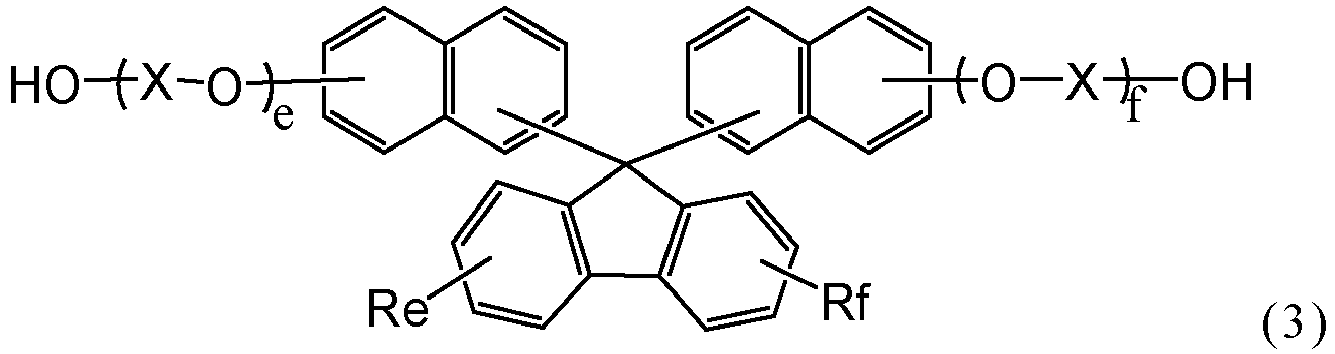
- In the general formula (3A), Re and Rf are each independently selected from the group consisting of a hydrogen atom, a halogen atom (a fluorine atom, a chlorine atom, a bromine atom, or an iodine atom), an alkyl group containing 1 to 20 carbon atoms and optionally having a substituent (preferably, an alkyl group containing 1 to 6 carbon atoms), an alkoxy group containing 1 to 20 carbon atoms and optionally having a substituent (preferably, an alkoxy group containing 1 to 6 carbon atoms), a cycloalkyl group containing 5 to 20 carbon atoms and optionally having a substituent (preferably, a cycloalkyl group containing 5 to 10 carbon atoms), a cycloalkoxy group containing 5 to 20 carbon atoms and optionally having a substituent (preferably, a cycloalkoxy group containing 5 to 10 carbon atoms), an aryl group containing 6 to 20 carbon atoms and optionally having a substituent (preferably, an aryl group containing 6 to 12 carbon atoms), a heteroaryl group containing 6 to 20 carbon atoms and optionally having a substituent, which comprises one or more heterocyclic atoms selected from O, N and S (preferably, a heteroaryl group containing 6 to 12 carbon atoms), an aryloxy group containing 6 to 20 carbon atoms and optionally having a substituent (preferably, an aryloxy group containing 6 to 12 carbon atoms), and -C≡C-Rh.
- Preferably, Re and Rf each independently represent a hydrogen atom or a phenyl group.
- Rh in the above -C≡C-Rh represents an aryl group containing 6 to 20 carbon atoms and optionally having a substituent (preferably, an aryl group containing 6 to 12 carbon atoms), or a heteroaryl group containing 6 to 20 carbon atoms and optionally having a substituent, which comprises one or more heterocyclic atoms selected from O, N and S (preferably, a heteroaryl group containing 6 to 12 carbon atoms).
- X each independently represents an alkylene group containing 1 to 5 carbon atoms and optionally having a substituent (preferably, an alkylene group containing 1 to 3 carbon atoms, and more preferably, an ethylene group).
- e and f each independently represent an integer of 0 to 10, preferably an integer of 1 to 3, and more preferably 1.
- In one embodiment of the present invention, the diol represented by the above general formula (3A) is particularly preferably NOLE (9,9-bis[6-(2-hydroxyethoxy)-2-naphthyl]fluorene) represented by the following structural formula. In the present invention, either a commercially available product or a synthesized product may be used.

- One embodiment of the present invention relates to a thermoplastic resin, comprising 22% to 49% by mole (preferably 24% to 47% by mole, more preferably 26% to 45% by mole) of the constituent unit (A) derived from the diol represented by the above general formula (1A), 40% to 75% by mole (preferably 45% to 70% by mole, more preferably 40% to 65% by mole) of the constituent unit (B) derived from the diol represented by the above general formula (2A), and 0% to 15% by mole (preferably 0% to 8% by mole, more preferably 0% to 6% by mole) of the constituent unit (C) derived from the diol represented by the above general formula (3A), with respect to the total amount (100% by mole) of the constituent units in the resin.
- The thermoplastic resin of one embodiment of the present invention is not particularly limited, and examples thereof may include a polyester resin, a polycarbonate resin, a polyester carbonate resin, an epoxy resin, a polyurethane resin, a polyacrylic acid ester resin, and a polymethacrylic acid ester resin. The thermoplastic resin of one embodiment of the present invention is preferably a polycarbonate resin, a polyester resin or a polyester carbonate resin, and is more preferably a polycarbonate resin.
- In the thermoplastic resin of one embodiment of the present invention, the total ratio of the constituent units (A), (B) and (C) in all of the constituent units is preferably 80% to 100% by mole, more preferably 90% to 100% by mole, and particularly preferably 100% by mole in all of the constituent units.
- That is to say, the thermoplastic resin of one embodiment of the present invention may comprise the constituent units derived from aliphatic dihydroxy compounds and the constituent units derived from aromatic dihydroxy compounds, which are generally used as constituent units of polycarbonate resins and polyester carbonate resins, as well as the constituent units (A) to (C), within a range in which the effects of the present invention are not impaired.
- Specifically, various compounds are exemplified as such aliphatic dihydroxy compounds. Particular examples thereof may include 1,4-cyclohexane dimethanol, tricyclodecane dimethanol, 1,3-adamantane dimethanol, 2,2-bis(4-hydroxycyclohexyl)-propane, 3,9-bis(2-hydroxy-1,1-dimethylethyl)-2,4,8,10-tetraoxaspiro[5.5]undecane, 2-(5-ethyl-5-hydroxymethyl-1,3-dioxan-2-yl)-2-methylpropan-1-ol, isosorbide, 1,3-propanediol, 1,4-butanediol, and 1,6-hexanediol.
- Various compounds are exemplified as such aromatic dihydroxy compounds. Particular examples thereof may include 2,2-bis(4-hydroxyphenyl)propane [bisphenol A], bis(4-hydroxyphenyl)methane, 1,1-bis(4-hydroxyphenyl)ethane, 2,2-bis(4-hydroxy-3,5-dimethylphenyl)propane, 4,4'-dihydroxydiphenyl, bis(4-hydroxyphenyl)cycloalkane, bis(4-hydroxyphenyl)oxide, bis(4-hydroxyphenyl)sulfide, bis(4-hydroxyphenyl)sulfone, bis(4-hydroxyphenyl)sulfoxide, bis(4-hydroxyphenyl)ketone, and bisphenoxyethanolfluorene.
- Further, the thermoplastic resin of one embodiment of the present invention preferably comprises a constituent unit derived from at least one monomer selected from the following monomer group.


- In the above formulae, R1 and R2 each independently represent a hydrogen atom, a methyl group or an ethyl group; and R3 and R4 each independently represent a hydrogen atom, a methyl group, an ethyl group or alkylene glycol containing 2 to 5 carbon atoms.
- The polycarbonate resin of one preferred embodiment of the present invention may comprise, as impurities, an alcoholic compound that may be generated as a by-product upon the production thereof, such as a phenolic compound, or a diol component or a carbonic acid diester that has not reacted and remains, in some cases.
- Such an alcoholic compound such as a phenolic compound, and such a carbonic acid diester, which are comprised as impurities, may cause a reduction in the strength of the resulting molded body or generation of odors. Accordingly, the smaller the contents of these compounds, the better.
- The content of the remaining phenolic compound is preferably 3000 ppm by mass or less, more preferably 1000 ppm by mass or less, particularly preferably 300 ppm by mass or less, with respect to 100% by mass of the polycarbonate resin.
- The content of the remaining diol component is preferably 1000 ppm by mass or less, more preferably 100 ppm by mass or less, and particularly preferably 10 ppm by mass or less, with respect to 100% by mass of the polycarbonate resin.
- The content of the remaining carbonic acid diester is preferably 1000 ppm by mass or less, more preferably 100 ppm by mass or less, and particularly preferably 10 ppm by mass or less, with respect to 100% by mass of the polycarbonate resin.
- In particular, it is preferable that the contents of compounds such as phenol and t-butyl phenol are small, and it is preferable that the contents of these compounds are within the above-described range.
- The content of a phenolic compound remaining in the polycarbonate resin can be measured by a method of analyzing a phenolic compound extracted from the polycarbonate resin, using gas chromatography.
- The content of an alcoholic compound remaining in the polycarbonate resin can also be measured by a method of analyzing an alcoholic compound extracted from the polycarbonate resin, using gas chromatography.
- The contents of a diol component and a carbonic acid diester remaining in the polycarbonate resin can also be measured by a method of extracting these compounds from the polycarbonate resin, and then analyzing them using gas chromatography.
- The contents of a by-product alcoholic compound such as a phenolic compound, a diol component, and a carbonic acid diester may be reduced to such an extent that these compounds are undetectable. However, from the viewpoint of productivity, the polycarbonate resin may comprise very small amounts of these compounds in a range in which the compounds do not impair the effects of the present invention. In addition, plasticity can be improved upon the melting of the resin, if the resin may comprise very small amounts of the compounds.
- The content of the remaining phenolic compound, diol component or carbonic acid diester may each be, for example, 0.01 ppm by mass or more, 0.1 ppm by mass or more, or 1 ppm by mass or more, with respect to 100% by mass of the polycarbonate resin.
- The content of the remaining alcoholic compound may be, for example, 0.01 ppm by mass or more, 0.1 ppm by mass or more, or 1 ppm by mass or more, with respect to 100% by mass of the polycarbonate resin.
- Besides, the contents of the by-product alcoholic compound such as a phenolic compound, the diol component and the carbonic acid diester in the polycarbonate resin can be regulated to be within the above-described ranges by appropriately adjusting conditions for polycondensation or the setting of apparatuses. Otherwise, the contents of these compounds can also be regulated by determining conditions for an extrusion step after completion of the polycondensation.
- For example, the amount of the remaining by-product alcoholic compound such as a phenolic compound is related to the type of carbonic acid diester used in the polymerization of the polycarbonate resin, the temperature applied to the polymerization reaction, the polymerization pressure, etc. By adjusting these conditions, the amount of the remaining by-product alcoholic compound such as a phenolic compound can be reduced.
- For example, when the polycarbonate resin is produced using dialkyl carbonate such as diethyl carbonate, the molecular weight is hardly increased, and low-molecular-weight polycarbonate is thereby obtained, so that the content of an alcoholic compound generated as a by-product tends to be increased. Such alkyl alcohol has high volatility, and thus, if it remains in the polycarbonate resin, the moldability of the resin tends to be deteriorated. In addition, when the amount of the remaining by-product alcoholic compound such as a phenolic compound is large, it is likely that problems regarding odor occur upon the molding of the resin, or it is also likely that the cleavage reaction of a resin skeleton progresses upon compounding, and a reduction in the molecular weight thereby occurs. Therefore, the content of the by-product alcoholic compound remaining in the obtained polycarbonate resin is preferably 3000 ppm by mass or less, with respect to the amount of the polycarbonate resin (100% by mass). The content of the remaining alcoholic compound is preferably 3000 ppm by mass or less, more preferably 1000 ppm by mass or less, and particularly preferably 300 ppm by mass or less, with respect to 100% by mass of the polycarbonate resin.
- In one embodiment of the present invention, the thermoplastic resin is characterized in that it has a high refractive index, and the refractive index is preferably 1.650 to 1.695, more preferably 1.660 to 1.690, and particularly preferably 1.662 to 1.689. In the present invention, the refractive index can be measured by the method described in the after-mentioned Examples.
- In one embodiment of the present invention, the Abbe number of the thermoplastic resin is preferably 16.0 to 21.0, more preferably 16.3 to 20.5, and particularly preferably 16.6 to 20.2. In the present invention, the Abbe number can be measured by the method described in the after-mentioned Examples.
- In one embodiment of the present invention, the thermoplastic resin is characterized in that it has high heat resistance, and the glass transition temperature (Tg) is preferably 130°C to 190°C, more preferably 135°C to 180°C, and particularly preferably 140°C to 165°C. In the present invention, the glass transition temperature can be measured by the method described in the after-mentioned Examples.
- In one embodiment of the present invention, the polystyrene-converted weight average molecular weight of the thermoplastic resin is preferably 10,000 to 100,000, more preferably 20,000 to 70,000, and particularly preferably 30,000 to 60,000.
- In one embodiment of the present invention, the melt volume-flow rate (MVR) of the thermoplastic resin is preferably 20 to 55, more preferably 25 to 50, and particularly preferably 30 to 45. In the present invention, the melt volume-flow rate (MVR) can be measured by the method described in the after-mentioned Examples.
- In one embodiment of the present invention, the haze of the thermoplastic resin is preferably 0.01 to 1.00, more preferably 0.05 to 0.50, and particularly preferably 0.10 to 0.30. In the present invention, the haze can be measured by the method described in the after-mentioned Examples.
- In one embodiment of the present invention, the birefringence in the lens surface of the thermoplastic resin is preferably 1 to 21, more preferably 2 to 15, and particularly preferably 2 to 13. In the present invention, the birefringence in the lens surface can be measured by the method described in the after-mentioned Examples.
- Another embodiment of the present invention relates to a thermoplastic resin composition comprising the aforementioned thermoplastic resin and additives. The thermoplastic resin composition of the present embodiment may also comprise a resin other than the thermoplastic resin of the present invention comprising the aforementioned constituent units (A), (B) and (C), in a range in which such a resin does not impair the desired effects of the present embodiment. Such a resin is not particularly limited, and it may be, for example, at least one resin selected from the group consisting of a polycarbonate resin, a polyester resin, a polyester carbonate resin, a (meth)acrylic resin, a polyamide resin, a polystyrene resin, a cycloolefin resin, an acrylonitrile-butadiene-styrene copolymer resin, a vinyl chloride resin, a polyphenylene ether resin, a polysulfone resin, a polyacetal resin, and a methyl methacrylate-styrene copolymer resin. Various types of known resins can be used as such resins, and one type of such resin alone can be added to, or a combination of two or more types of such resins can be added to the thermoplastic resin composition.
- The thermoplastic resin composition preferably comprises an antioxidant as an additive described above.
- As such an antioxidant, the thermoplastic resin composition preferably comprises at least one of a phenolic antioxidant and a phosphite-based antioxidant.
- Examples of the phenolic antioxidant may include 1,3,5-tris(3,5-di-tert-butyl-4-hydroxyphenylmethyl)-2,4,6-trimethylbenzene, 1,3,5-tris(3,5-di-tert-butyl-4-hydroxybenzyl)-1,3,5-triazine-2,4,6(1H,3H,SH)-trione, 4,4',4"-(1-methylpropanyl-3-ylidene)tris(6-tert-butyl-m-cresol), 6,6'-di-tert-butyl-4,4'-butylidenedi-m-cresol, octadecyl 3-(3,5-di-tert-butyl-4-hydroxyphenyl)propionate, pentaerythritol-tetrakis[3-(3,5-di-tert-butyl-4-hydroxyphenyl)propionate], 3,9-bis{2-[3-(3-tert-butyl-4-hydroxy-5-methylphenyl)propionyloxy]-1,1-dimethylethyl}-2,4,8,10-tetraoxospiro[5.5]undecane, and pentaerythritol-tetrakis[3-(3,5-di-tert-butyl-4-hydroxyphenyl)propionate]. Among these, pentaerythritol-tetrakis[3-(3,5-di-tert-butyl-4-hydroxyphenyl)propionate] is preferable.
- Examples of the phosphite-based antioxidant may include 2-ethylhexyl diphenyl phosphite, isodecyl diphenyl phosphite, triisodecyl phosphite, triphenyl phosphite, 3,9-bis(octadecyloxy)-2,4,8,10-tetraoxy-3,9-diphosphaspiro[5.5]undecane, 3,9-bis(2,6-di-tert-butyl-4-methylphenoxy)-2,4,8,10-tetraoxa-3,9-diphosphaspiro[5.5]undecane, 2,2'-methylenebis(4,6-di-tert-butylphenyl)2-ethylhexyl phosphite, tris(2,4-ditert-butylphenyl) phosphite, tris(nonylphenyl) phosphite, and tetra-C12-15-alkyl(propane-2,2-diylbis(4,1-phenylene)) bis(phosphite). Among these, 3,9-bis(2,6-di-tert-butyl-4-methylphenoxy)-2,4,8,10-tetraoxa-3,9-diphosphaspiro[5.5]undecane is preferable.
- As such antioxidants, the aforementioned compounds may be used alone as a single type, or may also be used as a mixture of two or more types.
- Also, in the present invention, 5,7-di-tert-butyl-3-(3,4-dimethylphenyl)-3H-benzofuran-2-one may be used as an antioxidant other than a phenolic antioxidant and a phosphite-based antioxidant.
- The antioxidant is preferably comprised in the thermoplastic resin composition in an amount of 1 ppm by weight to 3000 ppm by weight, with respect to the total weight of the resin composition. The content of the antioxidant in the thermoplastic resin composition is more preferably 50 ppm by weight to 2500 ppm by weight, further preferably 100 ppm by weight to 2000 ppm by weight, particularly preferably 150 ppm by weight to 1500 ppm by weight, and further particularly preferably 200 ppm by weight to 1500 ppm by weight.
- The thermoplastic resin composition preferably comprises a release agent as an additive described above.
- Examples of the release agent may include ester compounds including glycerin fatty acid esters such as mono/diglyceride of glycerin fatty acid, glycol fatty acid esters such as propylene glycol fatty acid ester and sorbitan fatty acid ester, higher alcohol fatty acid esters, full esters of aliphatic polyhydric alcohol and aliphatic carboxy acid, and monofatty acid esters. When an ester of aliphatic polyhydric alcohol and aliphatic carboxy acid is used as a release agent, any of a monoester, a full ester, and the like can be adopted. For example, those other than full esters, such as a monoester, may be used.
- Specific examples of the release agent may include the following substances: namely,
- sorbitan fatty acid esters, such as sorbitan stearate, sorbitan laurate, sorbitan oleate, sorbitan trioleate, sorbitan tribehenate, sorbitan stearate, sorbitan tristearate, and sorbitan caprylate;
- propylene glycol fatty acid esters, such as propylene glycol monostearate, propylene glycol monooleate, propylene glycol monobehenate, propylene glycol monolaurate, and propylene glycol monopalmitate;
- higher alcohol fatty acid esters, such as stearyl stearate;
- glycerin fatty acid ester monoglycerides, which include: monoglycerides including glycerin monostearate, glycerin monohydroxy stearate such as glycerin mono-12-hydroxy stearate, glycerin monooleate, glycerin monobehenate, glycerin monocaprylate, glycerin monocaprate and glycerin monolaurate; and mono/diglycerides including glycerin mono/distearate, glycerin mono/distearate, glycerin mono/dibehenate, glycerin mono/dioleate;
- acetylated monoglycerides of glycerin fatty acid esters, such as glycerin diacetomonolaurate;
- organic acid monoglycerides of glycerin fatty acid esters, such as citric acid fatty acid monoglyceride, succinic acid fatty acid monoglyceride, and diacetyl tartaric acid fatty acid monoglyceride; and
- polyglycerin fatty acid esters, such as diglycerin stearate, diglycerin laurate, diglycerin oleate, diglycerin monostearate, diglycerin monolaurate, diglycerin monomyristate, diglycerin monooleate, tetraglycerin stearate, decaglycerin laurate, decaglycerin oleate, and polyglycerin polyricinoleate.
- Among these, glycerin monostearate is preferred as a release agent.
- The release agent is preferably comprised in the thermoplastic resin composition in an amount of 1 ppm by weight to 5000 ppm by weight, with respect to the total weight of the resin composition. The content of the release agent in the thermoplastic resin composition is more preferably 50 ppm by weight to 4000 ppm by weight, further preferably 100 ppm by weight to 3500 ppm by weight, particularly preferably 500 ppm by weight to 13000 ppm by weight, and further particularly preferably 1000 ppm by weight to 2500 ppm by weight.
- Additives other than the aforementioned antioxidant and release agent may also be added to the thermoplastic resin composition.
- Examples of the additives that may be comprised in the thermoplastic resin composition may include a compounding agent, a catalyst inactivator, a thermal stabilizer, a plasticizer, a filler, an ultraviolet absorber, a rust inhibitor, a dispersant, an antifoaming agent, a leveling agent, a flame retardant, a lubricant, a dye, a pigment, a bluing agent, a nucleating agent, and a clearing agent.
- The content of additives other than the antioxidant and the release agent in the thermoplastic resin composition is preferably 10 ppm by weight to 5.0% by weight, more preferably 100 ppm by weight to 2.0% by weight, and further preferably 1000 ppm by weight to 1.0% by weight, but is not limited thereto.
- The aforementioned additives are likely to adversely affect transmittance. Thus, it is preferable not to add such additives excessively, and more preferably, the total additive amount is, for example, within the aforementioned range.
- In the method for producing the thermoplastic resin composition of the present invention, after completion of the polymerization reaction, the catalyst may be removed or deactivated in order to retain heat stability and hydrolysis stability. However, it is not always necessary to deactivate the catalyst. When the catalyst is deactivated, a method of deactivating the catalyst by addition of a known acidic substance can be preferably carried out. Specific examples of the acidic substance that is preferably used herein may include: esters such as butyl benzoate; aromatic sulfonic acids such as p-toluenesulfonic acid; aromatic sulfonic acid esters, such as butyl p-toluenesulfonate and hexyl p-toluenesulfonate; phosphoric acids, such as phosphorous acid, phosphoric acid, and phosphonic acid; phosphorous acid esters, such as triphenyl phosphite, monophenyl phosphite, diphenyl phosphite, diethyl phosphite, di-n-propyl phosphite, di-n-butyl phosphite, di-n-hexyl phosphite, dioctyl phosphite, and monooctyl phosphite; phosphoric acid esters, such as triphenyl phosphate, diphenyl phosphate, monophenyl phosphate, dibutyl phosphate, dioctyl phosphate, and monooctyl phosphate; phosphonic acids, such as diphenyl phosphonate, dioctyl phosphonate, and dibutyl phosphonate; phosphonic acid esters such as diethyl phenyl phosphonate; phosphines, such as triphenylphosphine and bis(diphenylphosphino)ethane; boric acids, such as boric acid and phenyl borate; aromatic sulfonates, such as tetrabutylphosphonium dodecylbenzenesulfonate; organic halides, such as chloride stearate, benzoyl chloride, and p-toluenesulfonyl chloride; alkyl sulfates such as dimethyl sulfonate; and organic halogenates such as benzyl chloride. From the viewpoints of the effects of the deactivating agent, stability to the resin, and the like, p-toluenesulfonic acid, butyl sulfonate, or tetrabutylphosphonium dodecylbenzenesulfonate are particularly preferable. Such a deactivating agent is used in an amount of 0.01 to 50 times moles, and preferably 0.3 to 20 times moles, with respect to the amount of the catalyst. If the amount of the deactivating agent is smaller than 0.01 time mole with respect to the amount of the catalyst, deactivating effects unfavorably become insufficient. On the other hand, if the amount of the deactivating agent is larger than 50 times moles with respect to the amount of the catalyst, it is unfavorable that the heat resistance of the resin is decreased and the molded body is easily colored.
- The kneading of the deactivating agent into the reaction product may be carried out immediately after completion of the polymerization reaction, or may also be carried out after the pelletizing of the resin following the polymerization. Moreover, in addition to the deactivating agent, other additives can be added by the same method as that described above.
- The thermoplastic resin or the thermoplastic resin composition of the present invention (hereinafter simply abbreviated as a "resin composition") can be preferably used in an optical member. In one embodiment of the present invention, an optical member comprising the resin composition of the present invention is provided. In one embodiment of the present invention, the optical member may include, but is not limited to, an optical disk, a transparent conductive substrate, an optical card, a sheet, a film, an optical fiber, a lens, a prism, an optical film, a substrate, an optical filter, a hard coat film, and the like. The resin composition of the present invention has high fluidity, and can be molded according to a cast method. Hence, the present resin composition is preferably used, in particular, in production of a thin optical member. In a preferred embodiment of the present invention, the optical member produced using the resin composition of the present invention may be an optical lens. In another preferred embodiment of the present invention, the optical member produced using the resin composition of the present invention may be an optical film.
- When an optical member comprising the resin composition of the present invention is produced according to injection molding, the optical member is preferably molded under conditions of a cylinder temperature of 260°C to 350°C and a mold temperature of 90°C to 170°C. The optical member is more preferably molded under conditions of a cylinder temperature of 270°C to 320°C and a mold temperature of 100°C to 160°C. When the cylinder temperature is higher than 350°C, the resin composition is decomposed and colored. On the other hand, when the cylinder temperature is lower than 260°C, the melt viscosity becomes high, and it easily becomes difficult to mold the optical member. Moreover, when the mold temperature is higher than 170°C, it easily becomes difficult to remove a molded piece consisting of the resin composition from a mold. On the other hand, when the mold temperature is lower than 90°C, the resin is hardened too quickly in a mold upon the molding thereof, and it becomes difficult to control the shape of a molded piece, or it easily becomes difficult to sufficiently transcribe a vehicle placed in a mold.
- In one embodiment of the present invention, the resin composition can be preferably used in an optical lens. Since the optical lens produced using the resin composition of the present invention has a high refractive index and is excellent in terms of heat resistance, it can be used in fields in which expensive glass lenses having a high refractive index have been conventionally used, such as telescopes, binoculars and TV projectors, and thus, the optical lens produced using the present resin composition is extremely useful.
- For instance, regarding a lens used for smart phones, a lens molded from a thermoplastic resin comprising the constituent units (A), (B) and (C) is overlapped with a lens molded from a resin comprising a constituent unit derived from a monomer represented by any one of the following formulae, so that the lenses can be used as a lens unit:
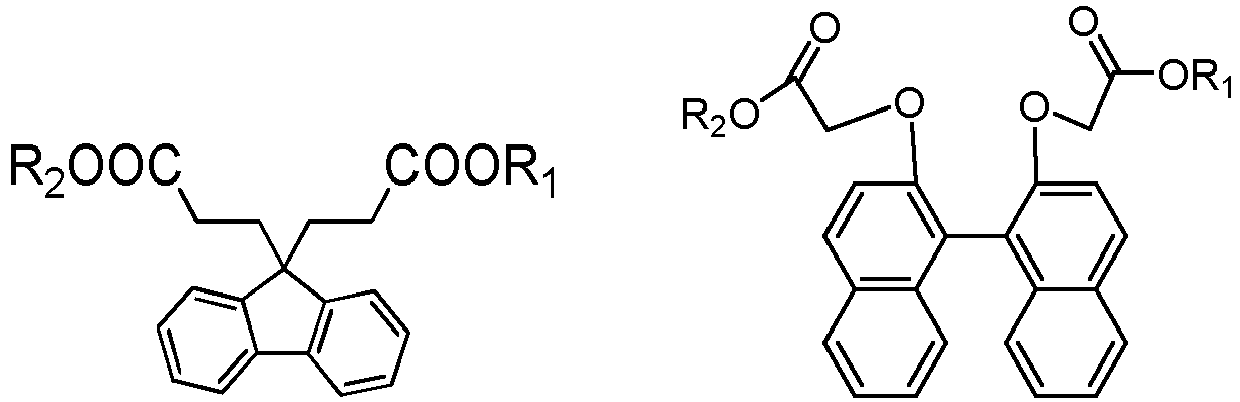

- The optical lens of the present invention is preferably used in the shape of an aspherical lens, as necessary. Since the aspherical lens can reduce spherical aberration to substantially zero with a single lens thereof, it is not necessary to eliminate the spherical aberration by a combination of a plurality of spherical lenses, and thereby, it becomes possible to achieve weight saving and a reduction in production costs. Therefore, among the optical lenses, the aspherical lens is particularly useful as a camera lens.
- Moreover, since the optical lens of the present invention has high molding fluidity, the present optical lens is particularly useful as a material of a thin and small optical lens having a complicated shape. Regarding the specific size of a lens, the thickness of the central portion is preferably 0.05 to 3.0 mm, more preferably 0.05 to 2.0 mm, and further preferably 0.1 to 2.0 mm. In addition, the diameter is preferably 1.0 mm to 20.0 mm, more preferably 1.0 to 10.0 mm, and further preferably , 3.0 to 10.0 mm. Further, regarding the shape thereof, the optical lens of the present invention is preferably a meniscus lens, in which one surface is a convex, and the other surface is a concave.
- The optical lens of the present invention is molded according to any given method such as die molding, cutting, polishing, laser machining, electrical discharge machining, or etching. Among these methods, die molding is more preferable in terms of production costs.
- In one embodiment of the present invention, the resin composition can be preferably used in optical films. In particular, since the optical film produced using the polycarbonate resin of the present invention is excellent in terms of transparency and heat resistance, it can be preferably used for films for use in liquid crystal substrates, optical memory cards, etc.
- In order to avoid the mixing of foreign matters into the optical lens, the molding environment must be naturally a low-dust environment, and the class is preferably 6 or less, and more preferably 5 or less.
- A second embodiment of the present invention relates to a polycarbonate resin, comprising a constituent unit represented by the following general formula (1B), a binaphthol derivative unit represented by the following general formula (2B), and a fluorene derivative unit represented by the following general formula (3B):

- wherein X represents an alkylene group containing 1 to 4 carbon atoms, and a and b each independently represent an integer of 1 to 10,

- wherein Y represents an alkylene group containing 1 to 4 carbon atoms, and c and d each independently represent an integer of 1 to 10, and

- Z represents an alkylene group containing 1 to 4 carbon atoms,
- R1 to R6 each independently represent a hydrogen atom, an alkyl group containing 1 to 20 carbon atoms, an alkoxyl group containing 1 to 20 carbon atoms, a cycloalkyl group containing 5 to 20 carbon atoms, a cycloalkoxyl group containing 5 to 20 carbon atoms, an aryl group containing 6 to 20 carbon atoms, or an aryloxy group containing 6 to 20 carbon atoms, and
- e and f each independently represent an integer of 0 to 5.
- Preferably, the polycarbonate resin of the present invention substantially consists of the constituent units represented by the general formulae (1B) to (3B). In the present description, the phrase "substantially consist of ..." is used to mean that the polycarbonate resin of the present invention may comprise other constituent units within a range in which the effects of the invention are not impaired. For example, among the constituent units of the polycarbonate resin of the present invention, the constituent units represented by the general formulae (1B) to (3B) account for preferably 90% or more of, more preferably 95% or more of, and further preferably 98% or more of the constituent units of the present polycarbonate resin.
- In the polycarbonate resin of the present invention, the ratio of the constituent unit represented by the general formula (1B) is 1% by mole or more and less than 10% by mole, the ratio of the constituent unit represented by the general formula (2B) is 10% to 60% by mole, and the ratio of the constituent unit represented by the general formula (3B) is 5% to 80% by mole. Moreover, in order to obtain a resin having a small absolute value of birefringence intensity and a small birefringence in the lens surface, it is preferable that the ratio of the constituent unit represented by the general formula (1B) is 2% to 9% by mole, the ratio of the constituent unit represented by the general formula (2B) is 20% to 60% by mole, and the ratio of the constituent unit represented by the general formula (3B) is 30% to 70% by mole; and it is particularly preferable that the ratio of the constituent unit represented by the general formula (1B) is 3% to 8% by mole, the ratio of the constituent unit represented by the general formula (2B) is 30% to 60% by mole, and the ratio of the constituent unit represented by the general formula (3B) is 40% to 60% by mole.
- Regarding the polycarbonate resin of the present invention, how the constituent units represented by the general formulae (1B) to (3B) are comprised in the resin is not particularly limited. In one aspect of the present invention, the polycarbonate resin may comprise a copolymer comprising the constituent units represented by the general formulae (1B) to (3B), or the polycarbonate resin may be a ternary resin comprising homopolymers each consisting of individual constituent units. Alternatively, the polycarbonate resin may be formed by blending a copolymer comprising the constituent units represented by the general formulae (1B) and (2B) with a homopolymer comprising the constituent unit represented by the general formula (3B), or may also be formed by blending a copolymer comprising the constituent units represented by the general formulae (1B) and (2B) with a copolymer comprising the constituent units represented by the general formulae (1B) and (3B).
- The polycarbonate resin of the present invention may comprise any of random, block, and alternating copolymer structures.
- The polystyrene-converted weight average molecular weight (Mw) of the polycarbonate resin of the present invention is preferably 20,000 to 200,000. The polystyrene-converted weight average molecular weight (Mw) of the present polycarbonate resin is more preferably 25,000 to 120,000, further preferably 28,000 to 55,000, and particularly preferably 30,000 to 45,000.
- If Mw is smaller than 20,000, the molded body becomes fragile, which is unfavorable. If Mw is larger than 200,000, the melt viscosity becomes high, and it becomes difficult to remove the resin after the production thereof. Further, the flowability is also deteriorated, and thus, it becomes difficult to perform injection molding in a molten state, which is unfavorable.
- The refractive index (nD) of the polycarbonate resin of the present invention at 23°C at a wavelength of 589 nm is preferably 1.635 to 1.695, more preferably 1.640 to 1.690, further preferably 1.645 to 1.685, and particularly preferably 1.650 to 1.680. The polycarbonate resin of the present invention has a high refractive index (nD) and thus, the present polycarbonate resin is suitable as materials for optical lenses. Regarding a film with a thickness of 0.1 mm, the refractive index can be measured by the method of JIS B 7071-2: 2018, using an Abbe's refractometer.
- The Abbe number (v) of the polycarbonate resin of the present invention is preferably 24 or less, more preferably 22 or less, and further preferably 21 or less. The Abbe number can be calculated from the refractive indexes at 23°C at wavelengths of 486 nm, 589 nm and 656 nm, using the following equation:

- nD: Refractive index at wavelength of 589 nm,
- nC: Refractive index at wavelength of 656 nm, and
- nF: Refractive index at wavelength of 486 nm.
- The melt volume-flow rate (MVR) of the polycarbonate resin of the present invention is preferably 10 to 100, more preferably 30 to 100, and particularly preferably 30 to 50. In the present invention, MVR can be measured by the method described in the after-mentioned Examples.
- The birefringence intensity of the polycarbonate resin of the present invention is preferably -0.6 to +0.7, more preferably -0.5 to +0.5, and particularly preferably -0.3 to +0.3. In the present invention, the birefringence intensity can be measured by the method described in the after-mentioned Examples.
- The birefringence in the lens surface of the polycarbonate resin of the present invention is preferably 0.1 to 15, more preferably 1 to 10, and particularly preferably 2 to 7. In the present invention, the birefringence in the lens surface can be measured by the method described in the after-mentioned Examples.
- The haze of the polycarbonate resin of the present invention is preferably 0.05 to 3.00, and more preferably 0.10 to 2.00. In the present invention, the haze can be measured by the method described in the after-mentioned Examples.
- Another resin is blended with the polycarbonate resin of the present invention, and the blended resin can be then subjected to the production of a molded body. Examples of such other resin may include polyamide, polyacetal, polycarbonate, modified polyphenylene ether, polyethylene terephthalate, and polybutylene terephthalate.
- Furthermore, to the polycarbonate resin of the present invention, an antioxidant, a mold release agent, an ultraviolet absorber, a fluidity modifier, a crystal nucleating agent, a strengthening agent, a dye, an antistatic agent, an antibacterial agent, or the like can be added.
- Examples of the molding method may include injection molding, compression molding, casting, roll forming, extrusion molding, and stretching, but are not limited thereto.
- When the polycarbonate resin of the present invention is used in injection molding, the glass transition temperature (Tg) is preferably 90°C to 180°C, more preferably 95°C to 175°C, further preferably 100°C to 170°C, still further preferably 130°C to 170°C, and particularly preferably 135°C to 150°C. If Tg is lower than 90°C, the operating temperature range is unfavorably narrowed. On the other hand, if Tg exceeds 180°C, the melting temperature of the resin becomes high, and decomposition of the resin or coloration unfavorably easily occurs. If the glass transition temperature of the resin is too high, it causes a significant difference between a mold temperature and the glass transition temperature of the resin, while using a versatile mold temperature controller. Thus, in the intended use in which a product is required to have strict surface accuracy, the use of a resin having an excessively high glass transition temperature is difficult and is also unfavorable. Moreover, from the viewpoints of molding fluidity and molding heat resistance, the lower limit value of Tg is preferably 130°C, and more preferably 135°C. The upper limit value of Tg is preferably 160°C, and more preferably 150°C.
- The residual amount of phenol contained in the polycarbonate resin of the present invention is preferably 500 ppm or less, more preferably 300 ppm or less, and further preferably 50 ppm or less.
- The residual amount of diphenyl carbonate (DPC) contained in the polycarbonate resin of the present invention is preferably 200 ppm or less, more preferably 100 ppm or less, and further preferably 50 ppm or less.
- The polycarbonate resin having the constituent units represented by the general formulae (1B) to (3B) according to the present invention can be produced by using compounds represented by the following general formulae (4B) to (6B) as dihydroxy components, and allowing such a dihydroxy component to react with a carbonate precursor substance such as carbonate diester:


- Z represents an alkylene group containing 1 to 4 carbon atoms,
- R1 to R6 each independently represent a hydrogen atom, an alkyl group containing 1 to 20 carbon atoms, an alkoxyl group containing 1 to 20 carbon atoms, a cycloalkyl group containing 5 to 20 carbon atoms, a cycloalkoxyl group containing 5 to 20 carbon atoms, an aryl group containing 6 to 20 carbon atoms, or an aryloxy group containing 6 to 20 carbon atoms, and
- e and f each independently represent an integer of 0 to 5. Specifically, the polycarbonate resin of the present invention can be produced by allowing the compound represented by each of the general formulae (4B) to (6B) to react with a carbonate precursor substance such as carbonate diester, in the presence of a basic compound catalyst, a transesterification catalyst, or a mixed catalyst of them, or in the absence of a catalyst, according to a melt polycondensation method.
- The compound represented by the general formula (4B) may include 9,9-bis(hydroxy(poly)alkoxynaphthyl)fluorenes. Preferred examples of the compound represented by the general formula (4) may include 9,9-bis[6-(1-hydroxymethoxy)naphthalen-2-yl]fluorene, 9,9-bis[6-(2-hydroxyethoxy)naphthalen-2-yl]fluorene, 9,9-bis[6-(3-hydroxypropoxy)naphthalen-2-yl]fluorene, and 9,9-bis[6-(4-hydroxybutoxy)naphthalen-2-yl]fluorene. Among others, 9,9-bis[6-(2-hydroxyethoxy)naphthalen-2-yl]fluorene is preferable. These compounds may be used alone, or may also be used in combination of two or more types.
- When the compound represented by the general formula (4B) is produced, compounds, in which either a or b is 0, may be by-produced as impurities in some cases. The total content of such impurities is preferably 1000 ppm or less, more preferably 500 ppm or less, further preferably 200 ppm or less, and particularly preferably 100 ppm or less, in the monomers comprising the compound represented by the general formula (4B) as a main component. Furthermore, other than such impurities, fluorenone as one of raw materials may also be comprised as an impurity. The content of the fluorenone is preferably 1000 ppm or less, more preferably 100 ppm or less, further preferably 50 ppm or less, and particularly preferably 10 ppm or less, in the monomers comprising the compound represented by the general formula (4B) as a main component. There may be a case where the fluorenone comprised in the monomers comprising the compound represented by the general formula (4B) as a main component remains in the resin after polymerization. The lower the fluorenone content, the better the hue of the resin that can be obtained, and thus, it is preferable. Furthermore, although a compound, in which a and b are not identical to each other (i.e. a ≠ b) in the general formula (4B), is not an impurity, the total content of such a compound is preferably 50 ppm or less, and more preferably 20 ppm or less, in the monomers comprising the compound represented by the general formula (4B) as a main component.
- The compound represented by the general formula (4B) can be produced by various synthetic methods. For example, as described in
Japanese Patent No. 5442800 - Examples of the dihydroxy compound represented by the general formula (5B) may include 2,2'-bis(1-hydroxymethoxy)-1,1'-binaphthalene, 2,2'-bis(2-hydroxyethoxy)-1,1'-binaphthalene, 2,2'-bis(3-hydroxypropyloxy)-1,1'-binaphthalene, and 2,2'-bis(4-hydroxybutoxy)-1,1'-binaphthalene. Among others, 2,2'-bis(2-hydroxyethoxy)-1,1'-binaphthalene (hereinafter abbreviated as "BHEBN" at times) is preferable. These compounds may be used alone, or may also be used in combination of two or more types.
- When the compound represented by the general formula (5B) is produced, compounds, in which either c or d is 0, may be by-produced as impurities in some cases. The total content of such impurities is preferably 1000 ppm or less, more preferably 500 ppm or less, further preferably 200 ppm or less, and particularly preferably 100 ppm or less, in the monomers comprising the compound represented by the general formula (5B) as a main component. Furthermore, although a compound, in which c and d are not identical to each other (i.e. c ≠ d) in the general formula (5B), is not an impurity, the total content of such a compound is preferably 50 ppm or less, and more preferably 20 ppm or less, in the monomers comprising the compound represented by the general formula (5B) as a main component.
- Examples of the dihydroxy compound represented by the general formula (6B) may include 9,9-bis[4-(2-hydroxyethoxy)phenyl]fluorene (hereinafter abbreviated as "BPEF" at times, 9,9-bis[4-(2-hydroxyethoxy)-3-methylphenyl]fluorene, 9,9-bis[4-(2-hydroxyethoxy)-3-tert-butylphenyl]fluorene, 9,9-bis[4-(2-hydroxyethoxy)-3-isopropylphenyl]fluorene, 9,9-bis[4-(2-hydroxyethoxy)-3-cyclohexylphenyl]fluorene, and 9,9-bis[4-(2-hydroxyethoxy)-3-phenylphenyl]fluorene (hereinafter abbreviated as "BPPEF" at times). Among others, 9,9-bis[4-(2-hydroxyethoxy)phenyl]fluorene and 9,9-bis[4-(2-hydroxyethoxy)-3-phenylphenyl]fluorene are preferable. These compounds may be used alone, or may also be used in combination of two or more types.
- When the compound represented by the general formula (6B) is produced, compounds, in which either e or f is 0, may be by-produced as impurities in some cases. The total content of such impurities is preferably 1000 ppm or less, more preferably 500 ppm or less, further preferably 200 ppm or less, and particularly preferably 100 ppm or less, in the monomers comprising the compound represented by the general formula (6B) as a main component. Furthermore, although a compound, in which e and f are not identical to each other (i.e. e ≠ f) in the general formula (6B), is not an impurity, the total content of such a compound is preferably 50 ppm or less, and more preferably 20 ppm or less, in the monomers comprising the compound represented by the general formula (6B) as a main component.
- Examples of the aromatic dihydroxy compound that can be used in combination, other than the above-described compounds, may include bisphenol A, bisphenol AP, bisphenol AF, bisphenol B, bisphenol BP, bisphenol C, bisphenol E, bisphenol F, bisphenol G, bisphenol M, bisphenol S, bisphenol P, bisphenol PH, bisphenol TMC, and bisphenol Z.
- Examples of the carbonate diester used in the present invention may include diphenyl carbonate, ditolyl carbonate, bis(chlorophenyl) carbonate, m-cresyl carbonate, dimethyl carbonate, diethyl carbonate, dibutyl carbonate, and dicyclohexyl carbonate. Among these, diphenyl carbonate is particularly preferable. Diphenyl carbonate is used preferably at a ratio of 0.97 to 1.20 mole, and more preferably at a ratio of 0.98 to 1.10 mole, with respect to 1 mole of a total of the dihydroxy compounds.
- Among the transesterification catalysts, particular examples of the basic compound catalyst may include an alkali metal compound, an alkaline-earth metal compound, and a nitrogen-containing compound.
- Examples of the alkali metal compound used in the invention of the present application may include the organic acid salts, inorganic salts, oxides, hydroxides, hydrides or alkoxides of alkali metals. Specific examples of the alkali metal compound used herein may include sodium hydroxide, potassium hydroxide, cesium hydroxide, lithium hydroxide, sodium hydrogen carbonate, sodium carbonate, potassium carbonate, cesium carbonate, lithium carbonate, sodium acetate, potassium acetate, cesium acetate, lithium acetate, sodium stearate, potassium stearate, cesium stearate, lithium stearate, sodium borohydride, sodium borophenylate, sodium benzoate, potassium benzoate, cesium benzoate, lithium benzoate, disodium hydrogen phosphate, dipotassium hydrogen phosphate, dilithium hydrogen phosphate, disodium phenyl phosphate, the disodium salts, dipotassium salts, dicesium salts or dilithium salts of bisphenol A, and the sodium salts, potassium salts, cesium salts or lithium salts of phenol.
- Examples of the alkaline-earth metal compound may include the organic acid salts, inorganic salts, oxides, hydroxides, hydrides or alkoxides of the alkaline-earth metal compounds. Specific examples of the alkaline-earth metal compound used herein may include magnesium hydroxide, calcium hydroxide, strontium hydroxide, barium hydroxide, magnesium hydrogen carbonate, calcium hydrogen carbonate, strontium hydrogen carbonate, barium hydrogen carbonate, magnesium carbonate, calcium carbonate, strontium carbonate, barium carbonate, magnesium acetate, calcium acetate, strontium acetate, barium acetate, magnesium stearate, calcium stearate, calcium benzoate, and magnesium phenyl phosphate.
- Examples of the nitrogen-containing compound may include quaternary ammonium hydroxides and salts thereof, and amines. Specific examples of the nitrogen-containing compound used herein may include: quaternary ammonium hydroxides having an alkyl group, an aryl group, etc., such as tetramethylammonium hydroxide, tetraethylammonium hydroxide, tetrapropylammonium hydroxide, tetrabutylammonium hydroxide, and trimethylbenzylammonium hydroxide; tertiary amines such as triethylamine, dimethylbenzylamine, and triphenylamine; secondary amines such as diethylamine and dibutylamine; primary amines such as propylamine and butylamine; imidazoles such as 2-methylimidazole, 2-phenylimidazole, and benzoimidazole; and bases or basic salts, such as ammonia, tetramethylammonium borohydride, tetrabutylammonium borohydride, tetrabutylammonium tetraphenylborate, and tetraphenylammonium tetraphenylborate.
- As transesterification catalysts, salts of zinc, tin, zirconium, lead, etc. are preferably used, and these salts can be used alone or in combination.
- Specific examples of the transesterification catalyst used herein may include zinc acetate, zinc benzoate, zinc 2-ethylhexanoate, tin(II) chloride, tin(IV) chloride, tin(II) acetate, tin(IV) acetate, dibutyltin dilaurate, dibutyltin oxide, dibutyltin dimethoxide, zirconium acetylacetonate, zirconium oxyacetate, zirconium tetrabutoxide, lead(II) acetate, and lead(IV) acetate.
- Such a catalyst is used at a ratio of 1 x 10⁻⁹ to 1 x 10⁻³ moles, and preferably at a ratio of 1 x 10⁻⁷ to 1 x 10⁻⁴ moles, with respect to 1 mole of a total of dihydroxy compounds.
- In the melt polycondensation method, the above-described raw materials and catalysts are used, and melt polycondensation is carried out under heating, further, under ordinary pressure or reduced pressure, while removing by-products according a transesterification reaction.
- In the melt polycondensation in the present composition system, the compounds represented by the general formulae (4B) to (6B) and carbonate diester are melted in a reaction vessel, and thereafter, the reaction is desirably carried out in a state in which monohydroxy compounds generated as by-products are retained. In order to allow such monohydroxy compounds to retain, pressure can be controlled, for example, by closing the reaction apparatus, or by reducing or increasing the pressure in the reaction apparatus. The reaction time necessary for this step is 20 minutes or more and 240 minutes or less, preferably 40 minutes or more and 180 minutes or less, and particularly preferably 60 minutes or more and 150 minutes or less. During this step, if the monohydroxy compounds generated as by-products are removed immediately after the generation thereof, the finally obtained polycarbonate resin has only a low content of polymer. However, if the monohydroxy compounds generated as by-products are retained in the reaction vessel for a certain period of time, the finally obtained polycarbonate resin has a high content of polymer.
- The melt polycondensation reaction may be carried out either in a continuous system or in a batch system. The reaction apparatus used to perform the above-described reaction may be a vertical reaction apparatus equipped with an anchor-type impeller, a max-blend impeller, a helical ribbon-type impeller, etc., or a horizontal reaction apparatus equipped with paddle blades, lattice blades, glasses blades, etc., or further, an extruder-type reaction apparatus equipped with a screw, etc. Moreover, a reaction apparatus prepared by appropriately combining the aforementioned reaction apparatuses with one another is preferably used, while taking into consideration the viscosity of a polymer.
- In the method for producing the polycarbonate resin used in the present invention, after completion of the polymerization reaction, in order to maintain heat stability and hydrolytic stability, the catalyst may be removed or deactivated. A method of deactivating a catalyst by addition of a known acidic substance can be preferably applied. Specific examples of the acidic substances that are preferably used herein may include: esters such as butyl benzoate; aromatic sulfonic acids such as p-toluenesulfonic acid; aromatic sulfonic acid esters, such as butyl p-toluenesulfonate and hexyl p-toluenesulfonate; phosphoric acids, such as phosphorous acid, phosphoric acid, and phosphonic acid; phosphorous acid esters, such as triphenyl phosphite, monophenyl phosphite, diphenyl phosphite, diethyl phosphite, di-n-propyl phosphite, di-n-butyl phosphite, di-n-hexyl phosphite, dioctyl phosphite, and monooctyl phosphite; phosphoric acid esters, such as triphenyl phosphate, diphenyl phosphate, monophenyl phosphate, dibutyl phosphate, dioctyl phosphate, and monooctyl phosphate; phosphonic acids, such as diphenyl phosphonate, dioctyl phosphonate, and dibutyl phosphonate; phosphonic acid esters such as diethyl phenyl phosphonate; phosphines, such as triphenylphosphine and bis(diphenylphosphino)ethane; boric acids, such as boric acid and phenyl borate; aromatic sulfonates, such as tetrabutylphosphonium dodecylbenzenesulfonate; organic halides, such as chloride stearate, benzoyl chloride, and p-toluenesulfonyl chloride; alkyl sulfates such as dimethyl sulfonate; and organic halogenates such as benzyl chloride. Among these acidic substances, butyl p-toluenesulfonate and tetrabutylphosphonium dodecylbenzenesulfonate are particularly preferably used. Such a deactivating agent is used in an amount of 0.01 to 50 times moles, and preferably 0.3 to 20 times moles, with respect to the amount of the catalyst. If the amount of the deactivating agent is smaller than 0.01 time mole with respect to the amount of the catalyst, deactivating effects unfavorably become insufficient. On the other hand, if the amount of the deactivating agent is larger than 50 times moles with respect to the amount of the catalyst, it is unfavorable that the heat resistance of the resin is decreased and the molded body is easily colored.
- After deactivation of the catalyst, a step of removing a low-boiling-point compound from the polymer by devolatilization at a pressure of 0.1 to 1 mmHg and at a temperature of 200°C to 350°C may be established. For this step, a horizontal apparatus equipped with stirring blades having excellent surface renewal ability, such as paddle blades, lattice blades or glasses blades, or a thin film evaporator is preferably used.
- The polycarbonate resin of the present invention is desired to contain a foreign matter in an amount as small as possible, and thus, filtration of melted raw materials, filtration of a catalyst solution, and the like are preferably carried out. The thickness of a filter mesh is preferably 5 µm or less, and more preferably 1 µm or less. Moreover, filtration of the generated resin through a polymer filter is preferably carried out. The thickness of the polymer filter mesh is preferably 100 µm or less, and more preferably 30 µm or less. Furthermore, a step of collecting resin pellets must be naturally performed under a low-dust environment, and the class is preferably 6 or less, and more preferably 5 or less.
- When the polycarbonate resin comprising the constituent units represented by the general formulae (1B) to (3B) is produced according to another aspect of the present invention, a copolymer comprising the constituent units represented by the general formulae (1B) to (3B) may be produced, using the compounds represented by the general formulae (4B) to (6B); or the compounds represented by the general formulae (4B) to (6B) may be polymerized, separately, and a ternary resin comprising homopolymers each consisting of individual constituent units may be produced. Otherwise, a copolymer comprising the constituent units represented by the general formulae (1B) and (2B) and a homopolymer comprising the constituent unit represented by the general formula (3B) may be polymerized and may be then blended, or a copolymer comprising the constituent units represented by the general formulae (1B) and (2B) and a copolymer comprising the constituent units represented by the general formulae (1B) and (3B) may be copolymerized and may be then blended.
- Using the polycarbonate resin of the present invention, an optical molded body can be produced. The present polycarbonate resin is molded by any given method, such as, for example, an injection molding method, a compression molding method, an extrusion molding method, or a solution casting method. Since the polycarbonate resin of the present invention is excellent in moldability and heat resistance, it can be particularly advantageously used in optical lenses that require injection molding. Upon the molding, the polycarbonate resin of the present invention can be mixed with other resins such as another polycarbonate resin or a polyester resin, and can be then used. Moreover, additives such as an antioxidant, a processing stabilizer, a light stabilizer, a polymerized metal-deactivating agent, a flame retardant, a lubricant, an antistatic agent, a surfactant, an antibacterial agent, a mold release agent, an ultraviolet absorber, a plasticizer, and a compatibilizer, may also be mixed with the present polycarbonate resin.
- Examples of the antioxidant may include triethylene glycol-bis[3-(3-tert-butyl-5-methyl-4-hydroxyphenyl)propionate], 1,6-hexanediol-bis[3-(3,5-di-tert-butyl-4-hydroxyphenyl)propionate], pentaerythritol-tetrakis[3-(3,5-di-tert-butyl-4-hydroxyphenyl)propionate], octadecyl-3-(3,5-di-tert-butyl-4-hydroxyphenyl)propionate, 1,3,5-trimethyl-2,4,6-tris(3,5-di-tert-butyl-4-hydroxybenzyl)benzene, N,N-hexamethylenebis(3,5-di-tert-butyl-4-hydroxy-hydrocynnamide), 3,5-di-tert-butyl-4-hydroxy-benzylphosphonate-diethyl ester, tris(3,5-di-tert-butyl-4-hydroxybenzyl)isocyanurate, and 3,9-bis{1,1-dimethyl-2-[β-(3-tert-butyl-4-hydroxy-5-methylphenyl)propionyloxy]ethyl}-2,4,8,10-tetraoxaspiro(5,5)undecane, 5,7-di-tert-butyl-3-(3,4-dimethylphenyl)-3H-benzofuran-2-one, and 3,9-bis(2,6-di-tert-butyl-4-methylphenoxy)-2,4,8,10-tetraoxa-3,9-diphosphaspiro[5.5]undecane. Among these, pentaerythritol-tetrakis[3-(3,5-di-tert-butyl-4-hydroxyphenyl)propionate], 5,7-di-tert-butyl-3-(3,4-dimethylphenyl)-3H-benzofuran-2-one, and 3,9-bis(2,6-di-tert-butyl-4-methylphenoxy)-2,4,8,10-tetraoxa-3,9-diphosphaspiro[5.5]undecane are particularly preferably used. The content of the antioxidant in the polycarbonate resin is preferably 0.001 to 0.3 parts by weight, and more preferably 0.05 to 0.2 parts by weight, with respect to 100 parts by weight of the polycarbonate resin.
- Examples of the processing stabilizer may include a phosphorus-based processing heat stabilizer and a sulfur-based processing heat stabilizer. Examples of the phosphorus-based processing heat stabilizer may include phosphorous acid, phosphoric acid, phosphonous acid, phosphonic acid, and esters thereof. Specific examples may include triphenyl phosphite, tris(nonylphenyl) phosphite, tris(2,4-di-tert-butylphenyl) phosphite, tris(2,6-di-tert-butylphenyl) phosphite, tridecyl phosphite, trioctyl phosphite, trioctadecyl phosphite, didecylmonophenyl phosphite, dioctylmonophenyl phosphite, diisopropylmonophenyl phosphite, monobutyldiphenyl phosphite, monodecyldiphenyl phosphite, monooctyldiphenyl phosphite, bis(2,6-di-tert-butyl-4-methylphenyl)pentaerythritoldi phosphite, 2,2-methylenebis(4,6-di-tert-butylphenyl)octyl phosphite, bis(nonylphenyl)pentaerythritoldi phosphite, bis(2,4-dicumylphenyl)pentaerythritoldi phosphite, bis(2,4-di-tert-butylphenyl)pentaerythritoldi phosphite, distearylpentaerythritoldi phosphite, tributyl phosphate, triethyl phosphate, trimethyl phosphate, triphenyl phosphate, diphenylmonoorthoxenyl phosphate, dibutyl phosphate, dioctyl phosphate, diisopropyl phosphate, benzenephosphonate dimethyl, benzenephosphonate diethyl, benzenephosphonate dipropyl, tetrakis(2,4-di-t-butylphenyl)-4,4'-biphenylene diphosphonite, tetrakis(2,4-di-t-butylphenyl)-4,3'-biphenylene diphosphonite, tetrakis(2,4-di-t-butylphenyl)-3,3'-biphenylene diphosphonite, bis(2,4-di-tert-butylphenyl)-4-phenyl-phenyl phosphonite, and bis(2,4-di-tert-butylphenyl)-3-phenyl-phenyl phosphonite. The content of the phosphorus-based processing heat stabilizer in the polycarbonate resin preferably is 0.001 to 0.2 parts by weight with respect to 100 parts by weight of the polycarbonate resin.
- Examples of the sulfur-based processing heat stabilizer may include pentaerythritol-tetrakis(3-laurylthiopropionate), pentaerythritol-tetrakis(3-myristylthiopropionate), pentaerythritol-tetrakis(3-stearylthiopropionate), dilauryl-3,3'-thiodipropionate, dimyristyl-3,3'-thiodipropionate, and distearyl-3,3'-thiodipropionate. The content of the sulfur-based processing heat stabilizer in the polycarbonate resin is preferably 0.001 to 0.2 parts by weight with respect to 100 parts by weight of the polycarbonate resin.
- The mold release agent is preferably an agent whose 90% by weight or more consists of an ester of alcohol and fatty acid. Specific examples of the ester of alcohol and fatty acid may include an ester of monohydric alcohol and fatty acid, and partial esters or complete esters of polyhydric alcohol and fatty acid. The above-described ester of monohydric alcohol and fatty acid is preferably an ester of monohydric alcohol having 1 to 20 carbon atoms and saturated fatty acid having 10 to 30 carbon atoms. On the other hand, the above-described partial esters or complete esters of polyhydric alcohol and fatty acid are preferably partial esters or complete esters of polyhydric alcohol having 1 to 25 carbon atoms and saturated fatty acid having 10 to 30 carbon atoms.
- Specific examples of the ester of monohydric alcohol and saturated fatty acid may include stearyl stearate, palmityl palmitate, butyl stearate, methyl laurate, and isopropyl palmitate. Examples of the partial esters or complete esters of polyhydric alcohol and saturated fatty acid may include complete esters or partial esters of dipentaerythritols, such as stearic acid monoglyceride, stearic acid monoglyceride, stearic acid diglyceride, stearic acid triglyceride, monosorbitate stearate, behenic acid monoglyceride, capric acid monoglyceride, lauric acid monoglyceride, pentaerythritol monostearate, pentaerythritol tetrastearate, pentaerythritol tetrapelargonate, propylene glycol monostearate, biphenyl biphenate, sorbitan monostearate, 2-ethylhexyl stearate, and dipentaerythritol hexastearate. The content of such a mold release agent is preferably in the range of 0.005 to 2.0 parts by weight, more preferably in the range of 0.01 to 0.6 parts by weight, and further preferably 0.02 to 0.5 parts by weight, with respect to 100 parts by weight of the polycarbonate resin.
- As an ultraviolet absorber, at least one type of ultraviolet absorber selected from the group consisting of a benzotriazole-based ultraviolet absorber, a benzophenone-based ultraviolet absorber, a triazine-based ultraviolet absorber, a cyclic iminoester-based ultraviolet absorber, and a cyanoacrylate-based ultraviolet absorber, is preferable. That is, any one of the following ultraviolet absorbers may be used alone, or the following ultraviolet absorbers may also be used in combination of two or more types.
- Examples of the benzotriazole-based ultraviolet absorber may include 2-(2-hydroxy-5-methylphenyl)benzotriazole, 2-(2-hydroxy-5-tert-octylphenyl)benzotriazole, 2-(2-hydroxy-3,5-dicumylphenyl)phenylbenzotriazole, 2-(2-hydroxy-3-tert-butyl-5-methylphenyl)-5-chlorobenzotriazole, 2,2'-methylenebis[4-(1,1,3,3-tetramethylbutyl)-6-(2N-benzotriazol-2-yl)phenol], 2-(2-hydroxy-3,5-di-tert-butylphenyl)benzotriazole, 2-(2-hydroxy-3,5-di-tert-butylphenyl)-5-chlorobenzotriazole, 2-(2-hydroxy-3,5-di-tert-amylphenyl)benzotriazole, 2-(2-hydroxy-5-tert-octylphenyl)benzotriazole, 2-(2-hydroxy-5-tert-butylphenyl)benzotriazole, 2-(2-hydroxy-4-octoxyphenyl)benzotriazole, 2,2'-methylenebis(4-cumyl-6-benzotriazolephenyl), 2,2'-p-phenylenebis(1,3-benzoxazin-4-one), and 2-[2-hydroxy-3-(3,4,5,6-tetrahydrophthalimidemethyl)-5-methylphenyl]benzotriazole.
- Examples of the benzophenone-based ultraviolet absorber may include 2,4-dihydroxybenzophenone, 2-hydroxy-4-methoxybenzophenone, 2-hydroxy-4-octoxybenzophenone, 2-hydroxy-4-benzyloxybenzophenone, 2-hydroxy-4-methoxy-5-sulfoxybenzophenone, 2-hydroxy-4-methoxy-5-sulfoxy trihydride benzophenone, 2,2'-dihydroxy-4-methoxybenzophenone, 2,2',4,4'-tetrahydroxybenzophenone, 2,2'-dihydroxy-4,4'-dimethoxybenzophenone, 2,2'-dihydroxy-4,4'-dimethoxy-5-sodiumsulfoxybenzophenone, bis(5-benzoyl-4-hydroxy-2-methoxyphenyl)methane, 2-hydroxy-4-n-dodecyloxybenzophenone, and 2-hydroxy-4-methoxy-2'-carboxybenzophenone.
- Examples of the triazine-based ultraviolet absorber may include 2-(4,6-diphenyl-1,3,5-triazin-2-yl)-5-[(hexyl)oxy]-phenol, and 2-(4,6-bis(2,4-dimethylphenyl)-1,3,5-triazin-2-yl)-5-[(octyl)oxy]-phenol.
- Examples of the cyclic iminoester-based ultraviolet absorber may include 2,2'-bis(3,1-benzoxazin-4-one), 2,2'-p-phenylenebis(3,1-benzoxazin-4-one), 2,2'-m-phenylenebis(3,1-benzoxazin-4-one), 2,2'-(4,4'-diphenylene)bis(3,1-benzoxazin-4-one), 2,2'-(2,6-naphthalene)bis(3,1-benzoxazin-4-one), 2,2'-(1,5-naphthalene)bis(3,1-benzoxazin-4-one), 2,2'-(2-methyl-p-phenylene)bis(3,1-benzoxazin-4-one), 2,2'-(2-nitro-p-phenylene)bis(3,1-benzoxazin-4-one), and 2,2'-(2-chloro-p-phenylene)bis(3,1-benzoxazin-4-one).
- Examples of the cyanoacrylate-based ultraviolet absorber may include 1,3-bis-[(2'-cyano-3',3'-diphenylacryloyl)oxy]-2,2-bis[(2-cyano-3,3-diphenylacryloyl)oxy]methyl)propane, and 1,3-bis-[(2-cyano-3,3-diphenylacryloyl)oxy]benzene.
- The content of the ultraviolet absorber is preferably 0.01 to 3.0 parts by weight, more preferably 0.02 to 1.0 parts by weight, and further preferably 0.05 to 0.8 parts by weight, with respect to 100 parts by weight of the polycarbonate resin. If the ultraviolet absorber is used within the range of the aforementioned mixed amount, it is possible to provide sufficient weather resistance to the polycarbonate resin, according to the intended use.
- The polycarbonate resin of the present invention has a high refractive index and a low Abbe number. Moreover, the polycarbonate resin of the present invention can be advantageously used, not only for optical lenses, but also as an optical molded body suitable for the intended uses of transparent conductive substrates used for liquid crystal displays, organic EL displays, solar cells, etc., or structural materials or functional materials of optical components such as optical disks, liquid crystal panels, optical cards, sheets, films, optical fibers, connectors, evaporated plastic reflectors and displays.
- A coating layer, such as an antireflection layer or a hard coating layer, may be established on the surface of the optical molded body, as necessary. The antireflection layer may be either a single layer or a multilayer, or may also be either an organic matter or an inorganic matter. The antireflection layer is preferably an inorganic matter. Specific examples may include oxides or fluorides, such as silicon oxide, aluminum oxide, zirconium oxide, titanium oxide, cerium oxide, magnesium oxide, or magnesium fluoride.
- Since the optical lens produced using the polycarbonate resin of the present invention has a high refractive index, a low Abbe number, a small absolute value of birefringence intensity, and a small birefringence in the lens surface, it can be used in the field in which expensive high-refractive-index glass lenses have been conventionally used, such as telescopes, binoculars and TV projectors, and thus, the present optical lens is extremely useful. The present optical lens is preferably used in the shape of an aspherical lens, as necessary. Since the aspherical lens can reduce spherical aberration to substantially zero with a single lens thereof, it is not necessary to eliminate the spherical aberration by a combination of a plurality of spherical lenses, and thereby, it becomes possible to achieve weight saving and a reduction in production costs. Therefore, among the optical lenses, the aspherical lens is particularly useful as a camera lens.
- The optical lens is molded by any given method, such as, for example, an injection molding method, a compression molding method or an injection compression molding method. According to the present invention, a high-refractive-index, low-birefringence aspheric lens, which is a glass lens that is technically difficult to be processed, can be more easily obtained.
- In order to avoid the mixing of foreign matters into the optical lens, the molding environment must be naturally a low-dust environment, and the class is preferably 6 or less, and more preferably 5 or less.
- Since the optical film produced using the polycarbonate resin of the present invention is excellent in terms of transparency and heat resistance, it can be preferably used for films for use in liquid crystal substrates, optical memory cards, etc.
- In order to avoid the mixing of foreign matters into the optical film, the molding environment must be naturally a low-dust environment, and the class is preferably 6 or less, and more preferably 5 or less.
- Hereinafter, the examples of the present invention will be shown together with comparative examples, and the contents of the invention will be described in detail. However, the present invention is not limited to these examples. Besides, the measured values in the Examples were measured using the following methods or devices.
- A polycarbonate resin was molded according to JIS B 7071-2: 2018, to obtain a V block, which was then used as a test piece. The refractive index was measured at 23°C using a refractometer (KPR-3000, manufactured by Shimadzu Corporation).
- The same test piece (V block) as that used in the measurement of a refractive index was used, and the refractive indexes at wavelengths of 486 nm, 589 nm, and 656 nm were measured at 23°C using a refractometer. Thereafter, the Abbe number was calculated according to the following equation:

- nD: refractive index at a wavelength of 589 nm,
- nC: refractive index at a wavelength of 656 nm, and
- nF: refractive index at a wavelength of 486 nm.
- The obtained resin was subjected to extrusion molding, so as to obtain a film test piece with a thickness of 100 µn.
- Molding machine: PULAENG-EXTRUDER
- Molding conditions:
- Cylinder temperature: 260°C; roll temperature: Tg +10°C
- The aforementioned film test piece was stretched, and the birefringence at 450 nm was measured.
- Measurement apparatus: JASCO Spectroellipsometer M-220
- Measurement conditions: The birefringence was measured using a 1.5-fold stretched film.
- The birefringence intensity is the ratio between the birefringence of the obtained resin at 450 nm and the birefringence of BPEF-derived polycarbonate (homo body) at 450 nm.
- The glass transition temperature (Tg) was measured according to JIS K7121-1987, using a differential scanning calorimeter by a temperature-increasing program of 10°C/min.
Differential scanning calorimeter: X-DSC7000, manufactured by Hitachi High-Tech Science Corporation - The weight average molecular weight of the obtained resin was measured by applying gel permeation chromatography (GPC) and then calculating the weight average molecular weight in terms of standard polystyrene. The used apparatus, columns and measurement conditions are as follows.
- GPC apparatus: HLC-8420GPC, manufactured by Tosoh Corporation
- Columns: TSKgel SuperHM-M x 3, manufactured by Tosoh Corporation
- TSKgel guard column SuperH-H x 1, manufactured by Tosoh Corporation
- TSKgel SuperH-RC x 1, manufactured by Tosoh Corporation
- Detector: RI Detector
- Standard polystyrene: Standard Polystyrene Kit PStQuick C, manufactured by Tosoh Corporation
- Sample solution: 0.2 mass % Tetrahydrofuran solution
- Eluent: Tetrahydrofuran
- Eluent flow rate: 0.6 mL/min
- Column temperature: 40°C
- The obtained resin was vacuum-dried at 120°C for 4 hours, and thereafter, the melt volume-flow rate (MVR) was measured according to JIS K7210.
- Measurement apparatus: Melt Indexer T-111, manufactured by TOYO SEIKI SEISAKU-SHO, LTD.
- Measurement conditions: MVR was measured at a temperature of 260°C under a load of 2160 g.
- Operations: MVR (unit: cm3/10 min) was calculated from the amount of a resin extruded per 10 minutes from the standard die installed at the bottom of the cylinder.
- The obtained resin was subjected to injection molding, so as to obtain a concave lens test piece with a diameter of 4.5 mm and a center thickness of 0.2mm.
- Molding machine: SUMITOMO SHI DEMAG SE50EV
- Molding conditions:
- Cylinder temperature: 280°C; mold temperature: Tg -15°C; injection rate: 40 mm/s; VP pressure: 70 MPa (position: 2.3 mm); and holding pressure: 65 MPax1s + 55 MPa x 1.5s
- Measurement of birefringence in lens surface
- Retardation of the thus obtained concave lens test piece was measured.
- Measurement apparatus: WPA-100, manufactured by Photonic Lattice, Inc.
- Data processing method: Using the software "PA/WPA View" manufactured by Photonic Lattice, Inc., the value of the birefringence in the lens surface was obtained from the mean value of retardation.
- The obtained resin was molded to a thickness of 3 mm, and the haze was measured according to JIS K-7136.
Measurement apparatus: Hazemeter SH7000, manufactured by NIPPON DENSHOKU INDUSTRIES Co., Ltd. - Raw materials, namely, 9391.9 g (15.9 mol) of 9,9-bis[4-(2-hydroxyethoxy)3-phenylphenyl]fluorene (hereinafter abbreviated as "OPPFL" at times) represented by the structural formula as shown below, 1457.7 g (2.7 mol) of 9,9-bis[6-(2-hydroxyethoxy)-2-naphthyl]fluorene (hereinafter abbreviated as "NOLE" at times) represented by the structural formula as shown below, 5700.0 g (15.2 mol) of 2,2'-bis(2-hydroxyethoxy)-1,1'-binaphthyl (hereinafter abbreviated as "BNE" at times) represented by the structural formula as shown below, 7450 g (34.8 mol) of diphenyl carbonate (hereinafter abbreviated as "DPC" at times, and 12 mL of a 2.5 x 10⁻² mol/L sodium hydrogen carbonate aqueous solution (3.0 x 10⁻⁴ mol, namely, 10 x 10-6 mol with respect to a total of 1 mol of dihydroxy compound) were placed in a 50-L reactor equipped with a stirrer and a distillation apparatus, followed by nitrogen substitution, and thereafter, the mixture was heated to 200°C under a nitrogen atmosphere of 700 Torr over 1 hour. Twenty minutes after initiation of the heating, it was confirmed that the raw materials were completely dissolved, and the obtained solution was then stirred for 80 minutes under the same conditions as those described above. Thereafter, the degree of pressure reduction was adjusted to 200 Torr over 20 minutes, and the reaction mixture was then retained under conditions of 200°C and 200 Torr for 10 minutes, so that a transesterification reaction was carried out. After that, the temperature was further increased to 215°C and the pressure was reduced to 180 Torr over 30 minutes. Thereafter, the conditions of the reaction mixture were adjusted to 230°C and 150 Torr over 40 minutes. Subsequently, the degree of pressure reduction was adjusted to 120 Torr over 10 minutes. Further, the conditions of the reaction mixture were adjusted to 100 Torr, 240°C over 10 minutes. After that, the degree of pressure reduction was adjusted to 1 Torr over 50 minutes, and polymerization was then carried out at 240°C at 1 Torr for 30 minutes. After completion of the reaction, nitrogen was introduced into the reaction system in the reactor, followed by pressurization. The generated polycarbonate resin was extracted, while pelletizing, so as to obtain a polycarbonate resin. The physical properties of the obtained resin are shown in Table 2.


- A polycarbonate resin was obtained in the same manner as that of Example 1A, with the exception that the raw materials shown in Table 1 were used.
- The physical properties of the obtained resin are shown in Table 2.
[Table 1] Raw materials (dial monomers) Raw materials other than diol monomers Constituent unit (A) Constituent unit (B) Constituen t unit (C) Constituent unit (A) Constituent unit (B) Constituent unit (C) OPPFL BNE DPBHBN A NOLE OPPFL BNE DPBHBNA NOLE DPC Cataysc aqueous solution (mol%) (mol%) (mol%) (mol%) (g) (mol) (g) (mol) (g) (mol) (g) (mol) (9) (mol) (ml) Ex. 1A 47 45 - 8 7414.2 12.6 4499.8 12.0 0.0 0.0 1150.7 2.1 5863.8 27.4 3 Ex. 2A 40 35 20 5 6310.3 10.7 3500.0 9.3 2812.9 5.3 719.3 1.3 5892.7 27.5 2 Ex. 3A 36 10 54 - 5384.1 9.1 948.0 2.5 7200.0 13.7 0.0 0.0 5613.5 26.2 2 Ex. 4A 24 - 70 6 3653.5 6.2 0.0 0.0 9500.0 18.0 832.9 1.5 5708.2 26.6 2 Comp.Ex. 1A - 45 15 40 0.0 0.0 4658.7 12.4 2184.1 4.1 5900.0 11.1 6081.0 28.4 2 Comp.Ex. 2A 20 20 60 - 3260.6 5.5 2070.0 5.5 8742.9 16.6 0.0 0.0 6149.0 28.7 2 Comp.Ex. 3A 75 - 25 - 12227.2 20.7 0.0 0.0 3642.9 6.9 0.0 0.0 6060.3 28.3 2 Comp.Ex. 4A 50 - 50 - 8151.5 13.8 0.0 0.0 7285.7 13.8 0.0 0.0 6072.1 28.3 2 Comp.Ex. 5A 17 50 - 33 2950.1 5.0 5500.0 14.7 0.0 0.0 5221.8 9.7 6469.4 30.2 2 Comp.Ex. 6A 27 42 - 31 4563.7 7.7 4500.0 12.0 0.0 0.0 4777.9 8.9 6301.4 29.4 2 Comp.Ex. 7A 21 52 - 27 2867.0 4.9 4500.0 12.0 0.0 0.0 3361.2 6.2 5089.6 23.8 2 Comp.Ex. 8A 50 - - 50 7000.0 13.0 0.0 0.0 0.0 0.0 7676.7 13.0 5723.8 26.7 2 
[Table 2] Constituent unit (A) Constituent unit (B) Constituent unit (C) Physical properties OPPFL BNE DPBHBN A NOLE nD vd Tg Birefringence intensity Mw MVR Birefringence in lens surface Haze (mol%) (mol%) (mol%) (mol%) - - (°C) - - - Ex. 1A 47 45 - 8 1.664 199 144 0.1 45,000 30 5 0.15 Ex. 2A 40 35 20 5 1.671 18.9 145 0.0 47,000 45 3 0.15 Ex. 3A 36 10 54 - 1.680 17.6 153 -0.3 41,000 45 6 0.15 Ex. 4A 24 - 70 6 1.687 169 158 0.5 33,000 55 10 0.20 Comp.Ex 1A - 45 15 40 1.680 18.1 147 40 33,000 37 53 0.19 Comp.Ex 2A 20 20 60 - 1.683 170 152 0.1 28,000 60 Stable molding inpossible* - Comp.Ex 3A 75 - 25 - 1.665 200 157 -1.3 59,000 20 25 0.23 Comp.Ex 4A 50 - 50 - 1.675 18.4 159 -0.7 51,000 30 20 0.20 Comp.Ex 5A 17 50 - 33 1.670 19.0 145 3.0 34,000 25 50 0.20 Comp.Ex 6A 27 42 - 31 1.670 19.0 142 2.6 32,000 29 47 0.19 Comp.Ex 7A 21 52 - 27 1.670 19.0 140 2.4 32,000 28 51 0.20 Comp.Ex 8A 50 - - 50 1.670 19.8 171 3.54 41,800 5 Stable molding inpossible* - * Molding is possible with 3 mint, but intensity is insufficient for molding thin lenses. - Raw materials, namely, 1690 g (3.14 mol) of 9,9-bis(6-(2-hydroxyethoxy)naphthalen-2-yl)fluorene (BNEF), 6170 g (16.5 mol) of 2,2'-bis(2-hydroxyethoxy)-1,1'-binaphthalene (BNE), 4760 g (10.9 mol) of 9,9-bis(4-(2-hydroxyethoxy)phenyl)fluorene (BPEF), 8390 g (14.2 mol) of 9,9-bis(4-(2-hydroxyethoxy)-3-phenylphenyl)fluorene (BPPEF), 10000 g (46.7 mol) of diphenyl carbonate (DPC), and 16 ml of a 2.5 x 10⁻² mol/L sodium hydrogen carbonate aqueous solution (4.0 x 10⁻⁴ mol, namely, 8.9 x 10⁻⁶ mol with respect to a total of 1 mol of dihydroxy compound) were placed in a 50-L reactor equipped with a stirrer and a distillation apparatus, and thereafter, the mixture was heated to 180°C under a nitrogen atmosphere of 760 mmHg. Thirty minutes after initiation of the heating, it was confirmed that the raw materials were completely dissolved, and the obtained solution was then stirred for 120 minutes under the same conditions as those described above. Thereafter, the degree of pressure reduction was adjusted to 20 mmHg, and at the same time, the temperature was increased to 200°C at a rate of 60°C/hr. At this time, initiation of distillation of by-produced phenol was confirmed. Thereafter, while the temperature was retained at 200°C for 20 minutes, the reaction was carried out. Thereafter, the temperature was further increased to 230°C at a rate of 75°C/hr. Ten minutes after completion of the temperature increasing, while the temperature was retained as was, the degree of pressure reduction was set to be 1 mmHg or less over 2 hours. Thereafter, the temperature was increased to 245°C at a rate of 60°C/hr, and the reaction mixture was further stirred for 30 minutes. After completion of the reaction, nitrogen was introduced into the reaction system in the reactor, followed by pressurization. The generated polycarbonate resin was extracted, while pelletizing, so as to obtain a polycarbonate resin. The physical property values of the obtained resin are shown in Table 3.
[Table 3] Composition ratio Physical properties Formula (1) BNEF Formula (2) BHEBN (BNE) Formula (3) BPEF Formula (3) BPPEF Mw Tg Refractiv e index (nD) Abbe number (v) MVR Birefringence intensity Birefringence in lens surface Haze mol% mol% mol% mol% - °C - - - - - - Ex. 1B 702 36.89 24.30 31.80 35,500 139 1.657 21 35 0.0 4 0.20 Ex. 2B 30 52.60 26.53 1787 35,000 135 1.657 21 40 0.0 4 0.15 Comp.Ex. 1B 15 45 0 40 39,000 142 1.664 20 20 0.9 30 0.20 Comp.Ex. 2B 15 36.89 20.30 27.81 36,000 146 1.661 20 25 0.8 25 0.19 Comp.Ex. 3B 0 36.89 27.80 35.32 35,000 140 1.655 21 35 -0.7 20 0.19 - A polycarbonate resin was obtained in the same manner as that of Example 1B, with the exception that the raw materials shown in Table 4 were used.
- The physical properties of the obtained resin are shown in Table 3.
[Table 4] Formula (1) BNEF Formula (2) BHEBN (BNE) Formula (3) BPEF Formula (3) BPPEF DPC Catalyst Formula (1) BNEF Formula (2) BHEBN (BNE) Formula (3) BPEF Formula (3) BPPEF DPC g g g g g ml mol mol mol mol mol Ex. 1B 1690 6170 4760 8390 10000 16 3.14 16.50 10.90 14.20 46.70 Ex. 2B 721 8800 5200 4720 10000 16 1.34 23.50 11.90 7.98 46.70 Comp.Ex. 1B 3610 7530 0 10600 10000 16 6.70 20.10 0 17.90 46.70 Comp.Ex. 2B 3610 6170 3980 7340 10000 16 6.70 16.50 9.07 12.40 46.70 Comp.Ex. 3B 0 6170 5450 9320 10000 16 0 16.50 12.40 15.80 46.70
Claims (20)
- A thermoplastic resin, comprising 22% to 49% by mole of a constituent unit (A) derived from a diol represented by the following general formula (1A), 40% to 75% by mole of a constituent unit (B) derived from a diol represented by the following general formula (2A), and 0% to 15% by mole of a constituent unit (C) derived from a diol represented by the following general formula (3A), with respect to the total amount (100% by mole) of the constituent units in the resin:
 Ra, Rb, Raa and Rbb are each independently selected from the group consisting of a hydrogen atom, a halogen atom, an alkyl group containing 1 to 20 carbon atoms and optionally having a substituent, an alkoxy group containing 1 to 20 carbon atoms and optionally having a substituent, a cycloalkyl group containing 5 to 20 carbon atoms and optionally having a substituent, a cycloalkoxy group containing 5 to 20 carbon atoms and optionally having a substituent, an aryl group containing 6 to 20 carbon atoms and optionally having a substituent, a heteroaryl group containing 6 to 20 carbon atoms and optionally having a substituent, which comprises one or more heterocyclic atoms selected from O, N and S, an aryloxy group containing 6 to 20 carbon atoms and optionally having a substituent, and -C≡C-Rh, whereinRh represents an aryl group containing 6 to 20 carbon atoms and optionally having a substituent, or a heteroaryl group containing 6 to 20 carbon atoms and optionally having a substituent, which comprises one or more heterocyclic atoms selected from O, N and S,X each independently represents an alkylene group containing 1 to 5 carbon atoms and optionally having a substituent, anda and b each independently represent an integer of 0 to 10,
 Rc and Rd are each independently selected from the group consisting of a hydrogen atom, a halogen atom, an alkyl group containing 1 to 20 carbon atoms and optionally having a substituent, an alkoxy group containing 1 to 20 carbon atoms and optionally having a substituent, a cycloalkyl group containing 5 to 20 carbon atoms and optionally having a substituent, a cycloalkoxy group containing 5 to 20 carbon atoms and optionally having a substituent, an aryl group containing 6 to 30 carbon atoms and optionally having a substituent, a heteroaryl group containing 6 to 30 carbon atoms and optionally having a substituent, which comprises one or more heterocyclic atoms selected from O, N and S, an aryloxy group containing 6 to 20 carbon atoms and optionally having a substituent, and -C≡C-Rh, whereinRh represents an aryl group containing 6 to 20 carbon atoms and optionally having a substituent, or a heteroaryl group containing 6 to 20 carbon atoms and optionally having a substituent, which comprises one or more heterocyclic atoms selected from O, N and S,X each independently represents an alkylene group containing 1 to 5 carbon atoms and optionally having a substituent, andc and d each independently represent an integer of 0 to 10, and
 Re and Rf are each independently selected from the group consisting of a hydrogen atom, a halogen atom, an alkyl group containing 1 to 20 carbon atoms and optionally having a substituent, an alkoxy group containing 1 to 20 carbon atoms and optionally having a substituent, a cycloalkyl group containing 5 to 20 carbon atoms and optionally having a substituent, a cycloalkoxy group containing 5 to 20 carbon atoms and optionally having a substituent, an aryl group containing 6 to 20 carbon atoms and optionally having a substituent, a heteroaryl group containing 6 to 20 carbon atoms and optionally having a substituent, which comprises one or more heterocyclic atoms selected from O, N and S, an aryloxy group containing 6 to 20 carbon atoms and optionally having a substituent, and -C≡C-Rh, whereinRh represents an aryl group containing 6 to 20 carbon atoms and optionally having a substituent, or a heteroaryl group containing 6 to 20 carbon atoms and optionally having a substituent, which comprises one or more heterocyclic atoms selected from O, N and S,X each independently represents an alkylene group containing 1 to 5 carbon atoms and optionally having a substituent, ande and f each independently represent an integer of 0 to 10.
 - The thermoplastic resin according to claim 1, wherein the ratio of the constituent unit (A) derived from the diol represented by the general formula (1A) is 24% to 47% by mole, the ratio of the constituent unit (B) derived from the diol represented by the general formula (2A) is 45% to 70% by mole, and the ratio of the constituent unit (C) derived from the diol represented by the general formula (3A) is 0% to 8% by mole, with respect to the total amount (100% by mole) of the constituent units in the resin.
- The thermoplastic resin according to claim 1 or 2, wherein the diol represented by the general formula (1A) comprises a diol represented by the following structural formula:

- The thermoplastic resin according to any one of claims 1 to 3, wherein the diol represented by the general formula (2A) comprises at least one of diols represented by the following structural formulae:

- The thermoplastic resin according to any one of claims 1 to 4, wherein the diol represented by the general formula (3A) comprises a diol represented by the following structural formula:

- The thermoplastic resin according to any one of claims 1 to 5, which is a polycarbonate resin.
- The thermoplastic resin according to any one of claims 1 to 6, which further comprises a constituent unit derived from at least one monomer selected from the following monomer group:



- The thermoplastic resin according to any one of claims 1 to 7, which has a birefringence in the lens surface of 1 to 21.
- The thermoplastic resin according to any one of claims 1 to 8, which has a polystyrene-converted weight average molecular weight (Mw) of 10,000 to 100,000.
- The thermoplastic resin according to any one of claims 1 to 9, which has a refractive index (nD) of 1.650 to 1.695.
- The thermoplastic resin according to any one of claims 1 to 10, which has an Abbe number (v) of 16.0 to 21.0.
- The thermoplastic resin according to any one of claims 1 to 11, which has a glass transition temperature of 130°C to 190°C.
- The thermoplastic resin according to any one of claims 1 to 12, which has a melt volume-flow rate (MVR) of 20 to 55.
- The thermoplastic resin according to any one of claims 1 to 13, which has a haze of 0.01 to 1.00.
- An optical member, comprising the thermoplastic resin according to any one of claims 1 to 14.
- An optical lens, comprising the thermoplastic resin according to any one of claims 1 to 14.
- An optical film, comprising the thermoplastic resin according to any one of claims 1 to 14.
- A polycarbonate resin, comprising a constituent unit represented by the following general formula (1B), a constituent unit represented by the following general formula (2B), and a constituent unit represented by the following general formula (3B), whereinthe ratio of the constituent unit represented by the following general formula (1B) is 1% by mole or more and less than 10% by mole,the ratio of the constituent unit represented by the following general formula (2B) is 10% to 60% by mole, andthe ratio of the constituent unit represented by the following general formula (3B) is 5% to 80% by mole:
 wherein X represents an alkylene group containing 1 to 4 carbon atoms, and a and b each independently represent an integer of 1 to 10,
 wherein Y represents an alkylene group containing 1 to 4 carbon atoms, and c and d each independently represent an integer of 1 to 10, and
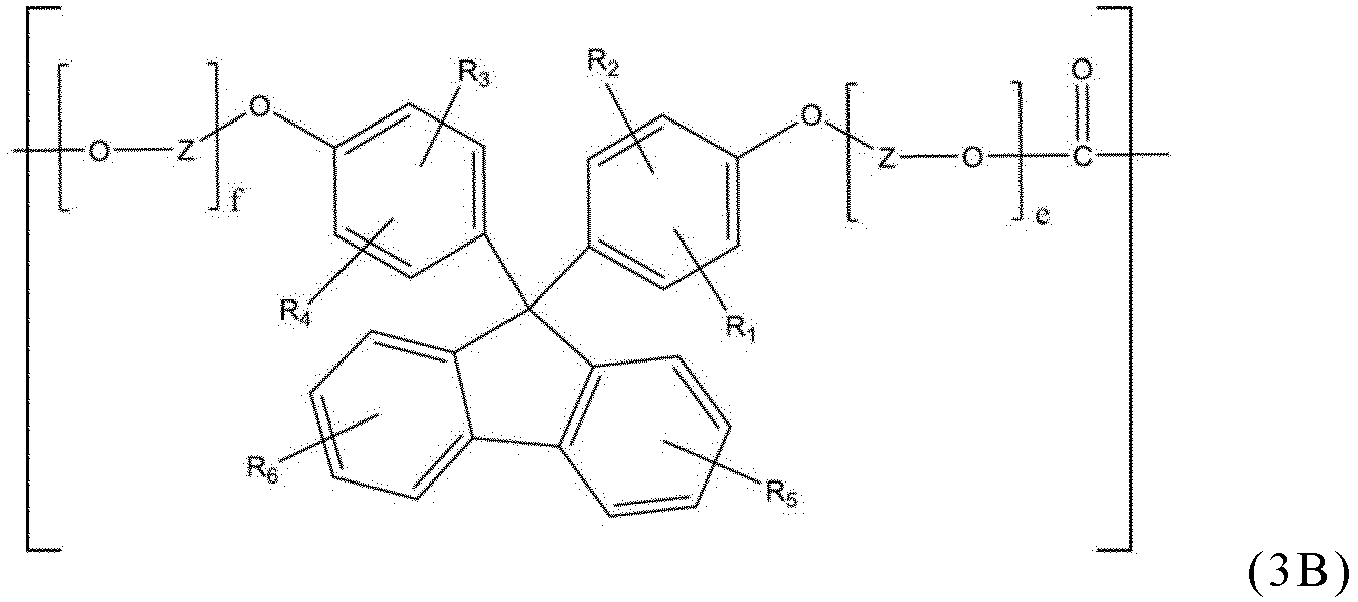 Z represents an alkylene group containing 1 to 4 carbon atoms,R1 to R6 each independently represent a hydrogen atom, an alkyl group containing 1 to 20 carbon atoms, an alkoxyl group containing 1 to 20 carbon atoms, a cycloalkyl group containing 5 to 20 carbon atoms, a cycloalkoxyl group containing 5 to 20 carbon atoms, an aryl group containing 6 to 20 carbon atoms, or an aryloxy group containing 6 to 20 carbon atoms, ande and f each independently represent an integer of 0 to 5.
 - The polycarbonate resin according to claim 18, whereinthe ratio of the constituent unit represented by the general formula (1B) is 2% to 9% by mole,the ratio of the constituent unit represented by the general formula (2B) is 20% to 60% by mole, andthe ratio of the constituent unit represented by the general formula (3B) is 30% to 70% by mole.
- An optical lens, comprising the polycarbonate resin according to claim 18 or 19.
Applications Claiming Priority (3)
| Application Number | Priority Date | Filing Date | Title |
|---|---|---|---|
| JP2021184822 | 2021-11-12 | ||
| JP2022018448 | 2022-02-09 | ||
| PCT/JP2022/041824 WO2023085339A1 (en) | 2021-11-12 | 2022-11-10 | Thermoplastic resin and optical lens including same |
Publications (2)
| Publication Number | Publication Date |
|---|---|
| EP4431545A1 true EP4431545A1 (en) | 2024-09-18 |
| EP4431545A4 EP4431545A4 (en) | 2025-04-09 |
Family
ID=86335770
Family Applications (1)
| Application Number | Title | Priority Date | Filing Date |
|---|---|---|---|
| EP22892837.0A Pending EP4431545A4 (en) | 2021-11-12 | 2022-11-10 | Thermoplastic resin and optical lens including same |
Country Status (6)
| Country | Link |
|---|---|
| US (1) | US20250092193A1 (en) |
| EP (1) | EP4431545A4 (en) |
| JP (1) | JPWO2023085339A1 (en) |
| KR (1) | KR20240095171A (en) |
| TW (1) | TW202328276A (en) |
| WO (1) | WO2023085339A1 (en) |
Families Citing this family (1)
| Publication number | Priority date | Publication date | Assignee | Title |
|---|---|---|---|---|
| US20250011535A1 (en) * | 2022-08-25 | 2025-01-09 | Lg Chem, Ltd. | Polycarbonate Resin and Method for Producing Same |
Family Cites Families (14)
| Publication number | Priority date | Publication date | Assignee | Title |
|---|---|---|---|---|
| JPS5442800A (en) | 1977-09-10 | 1979-04-04 | Masaaki Kusano | Method of producing high lift |
| JP3187142B2 (en) | 1992-07-07 | 2001-07-11 | 帝人化成株式会社 | High refractive index, low birefringence polycarbonate resin |
| WO2007142149A1 (en) | 2006-06-05 | 2007-12-13 | Mitsubishi Gas Chemical Company, Inc. | Optical lens |
| CN104769007B (en) | 2012-11-07 | 2018-04-06 | 三菱瓦斯化学株式会社 | Polycarbonate resin, method for producing same, and optical molded article |
| JPWO2017078073A1 (en) | 2015-11-04 | 2018-08-23 | 三菱瓦斯化学株式会社 | Polycarbonate resin |
| JP6689147B2 (en) | 2016-07-04 | 2020-04-28 | 帝人株式会社 | Thermoplastic resin |
| JP6739255B2 (en) | 2016-07-04 | 2020-08-12 | 帝人株式会社 | Thermoplastic resin |
| JP6689146B2 (en) | 2016-07-04 | 2020-04-28 | 帝人株式会社 | Thermoplastic resin |
| JP6988805B2 (en) * | 2016-07-21 | 2022-01-05 | 三菱瓦斯化学株式会社 | Polycarbonate resin, its manufacturing method and optical lens |
| JP6968642B2 (en) | 2016-10-06 | 2021-11-17 | 大阪ガスケミカル株式会社 | Polyester resin with fluorene skeleton |
| CN114716658B (en) * | 2017-08-30 | 2024-12-31 | 三菱瓦斯化学株式会社 | Polycarbonate resin, method for producing the same, and optical lens |
| CN111630109B (en) * | 2018-01-23 | 2023-03-28 | 三菱瓦斯化学株式会社 | Polycarbonate resin composition, method for producing same, and optical lens |
| JP7342878B2 (en) * | 2018-10-16 | 2023-09-12 | 三菱瓦斯化学株式会社 | Polyester carbonate resin and optical lenses |
| CN114375313A (en) * | 2019-07-19 | 2022-04-19 | 帝人株式会社 | Thermoplastic resin and optical member comprising the same |
-
2022
- 2022-11-09 TW TW111142787A patent/TW202328276A/en unknown
- 2022-11-10 US US18/707,773 patent/US20250092193A1/en active Pending
- 2022-11-10 JP JP2023559879A patent/JPWO2023085339A1/ja active Pending
- 2022-11-10 EP EP22892837.0A patent/EP4431545A4/en active Pending
- 2022-11-10 KR KR1020247009358A patent/KR20240095171A/en active Pending
- 2022-11-10 WO PCT/JP2022/041824 patent/WO2023085339A1/en not_active Ceased
Also Published As
| Publication number | Publication date |
|---|---|
| JPWO2023085339A1 (en) | 2023-05-19 |
| KR20240095171A (en) | 2024-06-25 |
| EP4431545A4 (en) | 2025-04-09 |
| WO2023085339A1 (en) | 2023-05-19 |
| US20250092193A1 (en) | 2025-03-20 |
| TW202328276A (en) | 2023-07-16 |
Similar Documents
| Publication | Publication Date | Title |
|---|---|---|
| JP7683643B2 (en) | Polycarbonate resin, its manufacturing method, and optical lens | |
| JP7533664B2 (en) | Polycarbonate resin, its manufacturing method, and optical lens | |
| EP3372627B1 (en) | Method of producing thermoplastic resin | |
| KR102478201B1 (en) | Polycarbonate resin composition and optical lens using the same | |
| US10711100B2 (en) | Dihydroxy compound | |
| EP3441415B1 (en) | Polycarbonate copolymer, optical lens and film in which said polycarbonate copolymer is used, and method for producing said copolymer | |
| EP4559950A1 (en) | Thermoplastic resin and optical member | |
| US20250092193A1 (en) | Thermoplastic resin and optical lens including same | |
| CN118215702A (en) | Thermoplastic resin and optical lens containing the same | |
| HK40000377B (en) | Polycarbonate copolymer, optical lens and film in which said polycarbonate copolymer is used, and method for producing said copolymer | |
| HK40000377A (en) | Polycarbonate copolymer, optical lens and film in which said polycarbonate copolymer is used, and method for producing said copolymer |
Legal Events
| Date | Code | Title | Description |
|---|---|---|---|
| STAA | Information on the status of an ep patent application or granted ep patent |
Free format text: STATUS: THE INTERNATIONAL PUBLICATION HAS BEEN MADE |
|
| PUAI | Public reference made under article 153(3) epc to a published international application that has entered the european phase |
Free format text: ORIGINAL CODE: 0009012 |
|
| STAA | Information on the status of an ep patent application or granted ep patent |
Free format text: STATUS: REQUEST FOR EXAMINATION WAS MADE |
|
| 17P | Request for examination filed |
Effective date: 20240515 |
|
| AK | Designated contracting states |
Kind code of ref document: A1 Designated state(s): AL AT BE BG CH CY CZ DE DK EE ES FI FR GB GR HR HU IE IS IT LI LT LU LV MC ME MK MT NL NO PL PT RO RS SE SI SK SM TR |
|
| DAV | Request for validation of the european patent (deleted) | ||
| DAX | Request for extension of the european patent (deleted) | ||
| RIC1 | Information provided on ipc code assigned before grant |
Ipc: G02B 1/04 20060101ALI20250123BHEP Ipc: C08G 64/02 20060101ALI20250123BHEP Ipc: C08G 63/00 20060101ALI20250123BHEP Ipc: C08G 64/04 20060101AFI20250123BHEP |
|
| A4 | Supplementary search report drawn up and despatched |
Effective date: 20250311 |
|
| RIC1 | Information provided on ipc code assigned before grant |
Ipc: G02B 1/04 20060101ALI20250305BHEP Ipc: C08G 64/02 20060101ALI20250305BHEP Ipc: C08G 63/00 20060101ALI20250305BHEP Ipc: C08G 64/04 20060101AFI20250305BHEP |