EP4429428A1 - Packaging structure - Google Patents
Packaging structure Download PDFInfo
- Publication number
- EP4429428A1 EP4429428A1 EP23794917.7A EP23794917A EP4429428A1 EP 4429428 A1 EP4429428 A1 EP 4429428A1 EP 23794917 A EP23794917 A EP 23794917A EP 4429428 A1 EP4429428 A1 EP 4429428A1
- Authority
- EP
- European Patent Office
- Prior art keywords
- circuit board
- transfer medium
- heat transfer
- disposed
- channel
- Prior art date
- Legal status (The legal status is an assumption and is not a legal conclusion. Google has not performed a legal analysis and makes no representation as to the accuracy of the status listed.)
- Pending
Links
Images




Classifications
-
- H—ELECTRICITY
- H05—ELECTRIC TECHNIQUES NOT OTHERWISE PROVIDED FOR
- H05K—PRINTED CIRCUITS; CASINGS OR CONSTRUCTIONAL DETAILS OF ELECTRIC APPARATUS; MANUFACTURE OF ASSEMBLAGES OF ELECTRICAL COMPONENTS
- H05K7/00—Constructional details common to different types of electric apparatus
- H05K7/20—Modifications to facilitate cooling, ventilating, or heating
- H05K7/20218—Modifications to facilitate cooling, ventilating, or heating using a liquid coolant without phase change in electronic enclosures
- H05K7/20272—Accessories for moving fluid, for expanding fluid, for connecting fluid conduits, for distributing fluid, for removing gas or for preventing leakage, e.g. pumps, tanks or manifolds
-
- H—ELECTRICITY
- H05—ELECTRIC TECHNIQUES NOT OTHERWISE PROVIDED FOR
- H05K—PRINTED CIRCUITS; CASINGS OR CONSTRUCTIONAL DETAILS OF ELECTRIC APPARATUS; MANUFACTURE OF ASSEMBLAGES OF ELECTRICAL COMPONENTS
- H05K7/00—Constructional details common to different types of electric apparatus
- H05K7/20—Modifications to facilitate cooling, ventilating, or heating
- H05K7/20218—Modifications to facilitate cooling, ventilating, or heating using a liquid coolant without phase change in electronic enclosures
-
- B—PERFORMING OPERATIONS; TRANSPORTING
- B60—VEHICLES IN GENERAL
- B60R—VEHICLES, VEHICLE FITTINGS, OR VEHICLE PARTS, NOT OTHERWISE PROVIDED FOR
- B60R16/00—Electric or fluid circuits specially adapted for vehicles and not otherwise provided for; Arrangement of elements of electric or fluid circuits specially adapted for vehicles and not otherwise provided for
- B60R16/02—Electric or fluid circuits specially adapted for vehicles and not otherwise provided for; Arrangement of elements of electric or fluid circuits specially adapted for vehicles and not otherwise provided for electric constitutive elements
- B60R16/03—Electric or fluid circuits specially adapted for vehicles and not otherwise provided for; Arrangement of elements of electric or fluid circuits specially adapted for vehicles and not otherwise provided for electric constitutive elements for supply of electrical power to vehicle subsystems or for
-
- H—ELECTRICITY
- H02—GENERATION; CONVERSION OR DISTRIBUTION OF ELECTRIC POWER
- H02J—ELECTRIC POWER NETWORKS; CIRCUIT ARRANGEMENTS OR SYSTEMS FOR SUPPLYING OR DISTRIBUTING ELECTRIC POWER; SYSTEMS FOR STORING ELECTRIC ENERGY
- H02J7/00—Circuit arrangements for charging or discharging batteries or for supplying loads from batteries
- H02J7/70—Circuit arrangements for charging or discharging batteries or for supplying loads from batteries characterised by the mechanical construction
-
- H—ELECTRICITY
- H05—ELECTRIC TECHNIQUES NOT OTHERWISE PROVIDED FOR
- H05K—PRINTED CIRCUITS; CASINGS OR CONSTRUCTIONAL DETAILS OF ELECTRIC APPARATUS; MANUFACTURE OF ASSEMBLAGES OF ELECTRICAL COMPONENTS
- H05K1/00—Printed circuits
- H05K1/02—Details
- H05K1/11—Printed elements for providing electric connections to or between printed circuits
-
- H—ELECTRICITY
- H05—ELECTRIC TECHNIQUES NOT OTHERWISE PROVIDED FOR
- H05K—PRINTED CIRCUITS; CASINGS OR CONSTRUCTIONAL DETAILS OF ELECTRIC APPARATUS; MANUFACTURE OF ASSEMBLAGES OF ELECTRICAL COMPONENTS
- H05K1/00—Printed circuits
- H05K1/02—Details
- H05K1/14—Structural association of two or more printed circuits
- H05K1/144—Stacked arrangements of planar printed circuit boards
-
- H—ELECTRICITY
- H05—ELECTRIC TECHNIQUES NOT OTHERWISE PROVIDED FOR
- H05K—PRINTED CIRCUITS; CASINGS OR CONSTRUCTIONAL DETAILS OF ELECTRIC APPARATUS; MANUFACTURE OF ASSEMBLAGES OF ELECTRICAL COMPONENTS
- H05K1/00—Printed circuits
- H05K1/18—Printed circuits structurally associated with non-printed electric components
- H05K1/181—Printed circuits structurally associated with non-printed electric components associated with surface mounted components
-
- H—ELECTRICITY
- H05—ELECTRIC TECHNIQUES NOT OTHERWISE PROVIDED FOR
- H05K—PRINTED CIRCUITS; CASINGS OR CONSTRUCTIONAL DETAILS OF ELECTRIC APPARATUS; MANUFACTURE OF ASSEMBLAGES OF ELECTRICAL COMPONENTS
- H05K7/00—Constructional details common to different types of electric apparatus
- H05K7/14—Mounting supporting structure in casing or on frame or rack
- H05K7/1422—Printed circuit boards receptacles, e.g. stacked structures, electronic circuit modules or box like frames
- H05K7/1427—Housings
-
- H—ELECTRICITY
- H05—ELECTRIC TECHNIQUES NOT OTHERWISE PROVIDED FOR
- H05K—PRINTED CIRCUITS; CASINGS OR CONSTRUCTIONAL DETAILS OF ELECTRIC APPARATUS; MANUFACTURE OF ASSEMBLAGES OF ELECTRICAL COMPONENTS
- H05K7/00—Constructional details common to different types of electric apparatus
- H05K7/20—Modifications to facilitate cooling, ventilating, or heating
- H05K7/20845—Modifications to facilitate cooling, ventilating, or heating for automotive electronic casings
- H05K7/20872—Liquid coolant without phase change
-
- H—ELECTRICITY
- H05—ELECTRIC TECHNIQUES NOT OTHERWISE PROVIDED FOR
- H05K—PRINTED CIRCUITS; CASINGS OR CONSTRUCTIONAL DETAILS OF ELECTRIC APPARATUS; MANUFACTURE OF ASSEMBLAGES OF ELECTRICAL COMPONENTS
- H05K7/00—Constructional details common to different types of electric apparatus
- H05K7/20—Modifications to facilitate cooling, ventilating, or heating
- H05K7/2089—Modifications to facilitate cooling, ventilating, or heating for power electronics, e.g. for inverters for controlling motor
- H05K7/20927—Liquid coolant without phase change
Definitions
- This application relates to the field of electrical device technologies, and in particular, to a packaging structure.
- a developmental trend of packaging structures such as power supply modules is having increasingly large power.
- a common heat dissipation mode cannot meet a heat dissipation requirement, and a water cooling heat dissipation mode is increasingly widely used.
- a die-casting fitting is usually used as a housing of a high-power water-cooled power supply module, and a water channel is usually made on the housing or a dedicated heat sink.
- Heating devices such as an insulated gate bipolar transistor (insulated gate bipolar transistor, IGBT), a magnetic device, and a metal-oxide-semiconductor field-effect transistor (metal-oxide-semiconductor field-effect transistor, MOSFET) are attached to a wall of the water channel to dissipate heat. Only a single circuit board can be disposed on this type of water-cooled power supply module, and power density is low.
- This application provides a packaging structure, to resolve a problem that power density of an existing packaging structure is low.
- the packaging structure may include a housing and a power component.
- the housing may have first accommodation space inside.
- the power component may be disposed in the first accommodation space.
- the housing may include a top cover and a bottom housing. The top cover and the bottom housing are connected to form the housing.
- the top cover may have a first heat transfer medium channel inside.
- the bottom housing may have a second heat transfer medium channel inside.
- the first heat transfer medium channel and the second heat transfer medium channel are separately configured to communicate with an external heat dissipation circulation system.
- the power component may include a first circuit board and a second circuit board.
- the first circuit board and the second circuit board may be disposed opposite to each other.
- the first circuit board may be disposed on the top cover, and the second circuit board may be disposed on the bottom housing.
- At least one first heating device may be disposed on the first circuit board.
- the first heating device may press against an inner wall of the top cover.
- At least one second heating device may be disposed on the second circuit board
- the first circuit board and the second circuit board are disposed inside the housing, so that power density of the packaging structure can be improved.
- the first circuit board and the second circuit board are disposed opposite to each other, and are respectively disposed on the top cover and the bottom housing. In this way, internal space of the housing can be fully utilized, and assembly of the circuit boards is convenient.
- the first heat transfer medium channel and the second heat transfer medium channel are respectively disposed on the top cover and the bottom housing. A heat dissipation area is large and heat dissipation efficiency is high, so that the first heating device on the first circuit board and the second heating device on the second circuit board can effectively dissipate heat. In this way, working reliability of a device is improved.
- a first guide assembly may be disposed between the first circuit board and the second circuit board.
- the first guide assembly may include a guide pin and a guide tube.
- the guide pin may be disposed on the first circuit board, and the guide tube may be disposed on the second circuit board.
- the guide pin and the guide tube may be plug-connected. In this way, the top cover and the bottom housing are preliminarily guided for the connection, so that the top cover and the bottom housing can be accurately connected.
- a second guide assembly may be disposed between the first circuit board and the second circuit board.
- the second guide assembly may include a first signal connection terminal and a second signal connection terminal.
- the first signal connection terminal may be disposed on the first circuit board, and the second signal connection terminal may be disposed on the second circuit board.
- the first signal connection terminal and the second signal connection terminal may be plug-connected. In this way, the top cover and the bottom housing can be precisely guided for the connection, so that the top cover and the bottom housing can be more accurately connected.
- a third heating device may be disposed in the housing.
- the third heating device may press against one or both of the bottom housing and the top cover.
- the third heating device may be a device with a high height. Devices are flexibly arranged inside the housing.
- the first circuit board may have a first avoidance notch.
- the third heating device may pass through the first avoidance notch to press against the inner wall of the top cover.
- the second circuit board may have a second avoidance notch.
- the third heating device may pass through the second avoidance notch to press against the inner wall of the bottom housing.
- the third heating device, the first circuit board, and the second circuit board may be densely arranged. This arrangement does not need to avoid the entire first circuit board and the entire second circuit board. Therefore, devices have a highly flexible layout and occupy small space.
- a connector may be disposed on an outer wall of the bottom housing.
- the connector is configured to communicate with the external heat dissipation circulation system.
- the connector may separately communicate with the first heat transfer medium channel and the second heat transfer medium channel.
- the connector is located outside the housing, to implement water and electricity isolation and improve reliability of the packaging structure.
- a first connection channel, a second connection channel, and a third connection channel may be disposed inside the connector.
- a first end of the first connection channel is configured to communicate with the external heat dissipation circulation system, and a second end of the first connection channel may communicate with a first end of the first heat transfer medium channel.
- a first end of the second connection channel may communicate with a second end of the first heat transfer medium channel, and a second end of the second connection channel may communicate with a first end of the second heat transfer medium channel.
- a first end of the third connection channel may communicate with a second end of the second heat transfer medium channel, and a second end of the third connection channel is configured to communicate with the external heat dissipation circulation system.
- the first heat transfer medium channel and the second heat transfer medium channel may communicate with the external heat dissipation circulation system, and the first heat transfer medium channel and the second heat transfer medium channel are connected in series.
- a fourth connection channel, a fifth connection channel, a sixth connection channel, and a seventh connection channel may be disposed inside the connector.
- a first end of the fourth connection channel may communicate with a first end of the first heat transfer medium channel, and a second end of the fourth connection channel may communicate with a first end of the second heat transfer medium channel.
- a first end of the fifth connection channel may communicate with a second end of the first heat transfer medium channel, and a second end of the fifth connection channel may communicate with a second end of the second heat transfer medium channel.
- a first end of the sixth connection channel is configured to communicate with the external heat dissipation circulation system, and a second end of the sixth connection channel may communicate with the fourth connection channel.
- a first end of the seventh connection channel is configured to communicate with the external heat dissipation circulation system, and a second end of the seventh connection channel may communicate with the fifth connection channel.
- the first heat transfer medium channel and the second heat transfer medium channel may communicate with the external heat dissipation circulation system, and the first heat transfer medium channel and the second heat transfer medium channel are connected in parallel.
- the connector and the bottom housing may be integrally formed. In this way, the connector may directly communicate with the second heat transfer medium channel, and reliability is high.
- a sealing ring may be disposed at a joint between the connector and the first heat transfer medium channel. In this way, airtightness of the connection may be enhanced.
- the first heat transfer medium channel may be U-shaped, and/or the second heat transfer medium channel may be U-shaped. In this way, there may be a large heat dissipation area.
- the bottom housing may include a bottom wall and a plurality of first side walls.
- the plurality of first side walls may be disposed on the bottom wall in a circumferential direction of the bottom wall, and the plurality of first side walls are sequentially connected.
- the second heat transfer medium channel may be disposed on the bottom wall. In this way, heat dissipation of a device on a back side of the second circuit board can be implemented.
- the second heat transfer medium channel may extend from the bottom wall to the first side wall.
- the heat dissipation of the device on the back side of the second circuit board can be implemented.
- heat dissipation of a device close to the first side wall of the bottom housing can also be implemented. The dissipation area is larger, and heat dissipation efficiency can be improved.
- the top cover may have second accommodation space inside.
- a third circuit board may be disposed in the second accommodation space.
- At least one fourth heating device may be disposed on the third circuit board.
- the top cover may have a second side wall facing the bottom housing.
- the first heat transfer medium channel may be disposed in the second side wall.
- the fourth heating device may press against the second side wall.
- the first heating device may press against the second side wall.
- the packaging structure may have three circuit boards as a whole, and the packaging structure can have high power density.
- the packaging structure provided in embodiments of this application is applicable to an electrical device, may be used as a power supply module, and may be applied to the field of vehicle-mounted devices.
- the packaging structure is used as a power supply module of a vehicle-mounted charging device, and is used to implement a function such as vehicle charging.
- a power supply module is used as an example.
- a die-casting fitting is usually used as a housing of an existing high-power water-cooled power supply module, and a water channel is usually made on the housing or a dedicated heat sink.
- Heating devices such as an insulated gate bipolar transistor (insulated gate bipolar transistor, IGBT), a magnetic device, and a metal-oxide-semiconductor field-effect transistor (metal-oxide-semiconductor field-effect transistor, MOSFET) are attached to a wall of the water channel to dissipate heat. Only a single circuit board can be disposed on this type of water-cooled power supply module, and power density is low.
- embodiments of this application provide a packaging structure, to improve power density of a packaging structure.
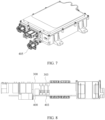
- FIG. 1 is an exploded schematic diagram of a structure of a packaging structure according to an embodiment of this application.
- FIG. 2 is a schematic diagram of a partial structure of a packaging structure according to an embodiment of this application.
- FIG. 3 is a schematic diagram of a partial structure of a packaging structure according to an embodiment of this application.
- the packaging structure provided in embodiments of this application may include a housing and a power component.
- the housing has first accommodating space inside.
- the housing may include a top cover 100 and a bottom housing 200. The top cover 100 and the bottom housing 200 are connected to form the housing having the first accommodating space inside.
- the top cover 100 may have a first heat transfer medium channel inside.
- the bottom housing 200 may have second heat transfer medium channel inside.
- the first heat transfer medium channel and the second heat transfer medium channel may separately communicate with an external heat dissipation circulation system.
- the external heat dissipation circulation system may use water as a heat transfer medium.
- the power component is disposed in the first accommodating space.
- the power component may include a first circuit board 300 and a second circuit board 400.
- the first circuit board 300 and the second circuit board 400 may be disposed opposite to each other. Specifically, a front side of the first circuit board 300 may be disposed opposite to a front side of the second circuit board 400. Aback side of the first circuit board 300 faces the top cover 100.
- the first circuit board 300 may be fastened to the top cover 100 by using a connecting piece such as a screw.
- the back side of the first circuit board 300 is a side on the back of the front side of the first circuit board 300.
- a back side of the second circuit board 400 faces the bottom housing 200.
- the second circuit board 400 may be fastened to the bottom housing 200 by using a connecting piece such as a screw.
- the back side of the second circuit board 400 is a side on the back of the front side of the second circuit board 400.
- a component with a high height on the front side of the first circuit board 300 and a component with a high height on the front side of the second circuit board 400 may be arranged in a staggered manner. In this way, a distance between the first circuit board 300 and the second circuit board 400 may be small, space occupied by the first circuit board 300 and the second circuit board 400 may be small, and a volume of the housing may be small.
- FIG. 4 is a schematic sectional view of a partial structure of a top cover of a packaging structure according to an embodiment of this application.
- FIG. 5 is a schematic sectional view of a partial structure of a bottom housing of a packaging structure according to an embodiment of this application.
- a first heating device 301 may be disposed on the first circuit board 300, and the first heating device 301 presses against an inner wall of the top cover 100.
- the first heating device 301 may be disposed on the back side of the first circuit board 300.
- the gap may be filled with thermal adhesive.
- the first heating device 301 there may be at least one first heating device 301, and there may be at least one type of the first heating device 301.
- the first heating device 301 includes but is not limited to an IGBT, a magnetic device, a MOSFET, a diode, and the like.
- a second heating device 401 may be disposed on the second circuit board 400, and the second heating device 401 presses against an inner wall of the bottom housing 200.
- the second heating device 401 may be disposed on the back side of the second circuit board 400.
- the gap may be filled with the thermal adhesive.
- the first circuit board 300 and the second circuit board 400 are disposed inside the housing, so that power density of the packaging structure can be improved.
- the top cover 100 and the bottom housing 200 are connected to form the housing, and the structure is simple.
- the first circuit board 300 and the second circuit board 400 are disposed opposite to each other, and are respectively disposed on the top cover 100 and the bottom housing 200. In this way, internal space of the housing can be fully utilized, and assembly of the circuit boards is convenient.
- the first heat transfer medium channel and the second heat transfer medium channel are respectively disposed on the top cover 100 and the bottom housing 200.
- a heat dissipation area is large and heat dissipation efficiency is high, so that the first heating device 301 on the first circuit board 300 and the second heating device 401 on the second circuit board 400 can effectively dissipate heat. In this way, working reliability of a device is improved.
- a third heating device 500 is disposed in the housing.
- the third heating device 500 may press against both the bottom housing 200 and the top cover 100, or press against one of the bottom housing 200 and the top cover 100.
- the third heating device 500 may be a device with a high height, such as a magnetic device. Two ends of the third heating device 500 in a height direction respectively press against the bottom housing 200 and the top cover 100 to dissipate heat.
- one end of the third heating device 500 may be fastened to the bottom housing 200 and press against the inner wall of the bottom housing 200, and the other end of the magnetic device presses against the inner wall of the top cover 100. It may be understood that one end of the third heating device 500 may be fastened to the top cover 100 and press against the inner wall of the top cover 100, and the other end presses against the inner wall of the bottom housing 200.
- the first circuit board 300 may have a first avoidance notch 304.
- One end of the third heating device 500 may pass through the first avoidance notch 304 to press against the inner wall of the top cover 100.
- the second circuit board 400 may have a second avoidance notch 404.
- the third heating device 500 may pass through the second avoidance notch 404 to press against the inner wall of the bottom housing 200.
- the third heating device 500, the first circuit board 300, and the second circuit board 400 may be densely arranged. This arrangement does not need to avoid the entire first circuit board 300 and the entire second circuit board 400. Therefore, devices have a highly flexible layout and occupy small space.
- FIG. 6 is a schematic diagram of assembly of circuit boards of a packaging structure according to an embodiment of this application.
- first guide assemblies may be disposed between the first circuit board 300 and the second circuit board 400.
- the first guide assembly may include a guide pin 302 and a guide tube 402.
- the guide pin 302 may be disposed on the first circuit board 300, and may be specifically disposed on the front side of the first circuit board 300.
- the guide tube 402 may be disposed on the second circuit board 400, and may be specifically disposed on the front side of the second circuit board 400.
- the first circuit board 300 may be fastened to the top cover 100
- the second circuit board 400 may be fastened to the bottom housing 200.
- the top cover 100 and the bottom housing 200 are connected.
- the guide pin 302 and the guide tube 402 may be plug-connected, to preliminarily guide the top cover 100 and the bottom housing 200 for the connection. In this way, the top cover 100 and the bottom housing 200 may be accurately connected.
- a second guide assembly may be further disposed between the first circuit board 300 and the second circuit board 400.
- the second guide assembly may include a first signal connection terminal and a second signal connection terminal.
- the first signal connection terminal may be disposed on the first circuit board 300, and may be specifically disposed on the front side of the first circuit board 300.
- the second signal connection terminal may be disposed on the second circuit board 400, and may be specifically disposed on the front side of the second circuit board 400.
- the first signal connection terminal and the second signal connection terminal may be plug-connected. In this way, the top cover 100 and the bottom housing 200 can be precisely guided for the connection, so that the top cover 100 and the bottom housing 200 can be more accurately connected.
- a signal connection between the first circuit board 300 and the second circuit board 400 can be implemented.
- FIG. 7 is a schematic diagram of an external connection of a packaging structure according to an embodiment of this application.
- a third signal connection terminal may be disposed on the first circuit board or the second circuit board.
- the third signal connection terminal may be disposed and located on the front side of the second circuit board.
- an external port may be disposed on the bottom housing at a position corresponding to the third signal connection terminal.
- the second circuit board and the first circuit board may communicate with the outside by using the third signal connection terminal.
- the third signal connection terminal may be used as a connection terminal of a plug-in connector.
- the plug-in connector includes the third signal connection terminal and an external connection terminal 405.
- the third signal connection terminal and the external connection terminal 405 are plug-connected, so that the second circuit board and the first circuit board communicate with the outside.
- FIG. 8 is a schematic diagram of assembly of circuit boards of a packaging structure according to an embodiment of this application.
- power connection assemblies may be disposed between the first circuit board 300 and the second circuit board 400.
- the power connection assembly may include a first power connection terminal 303 and a second power connection terminal 403.
- the first power connection terminal 303 may be disposed on the first circuit board 300, and may be specifically disposed on the front side of the first circuit board 300.
- the second power connection terminal 403 may be disposed on the second circuit board 400, and may be specifically disposed on the front side of the second circuit board 400.
- a power connection between the first circuit board 300 and the second circuit board 400 can be implemented.
- the power connection component may be a blade-type connector, and may absorb a specific assembly tolerance.
- a third power connection terminal may be disposed on the first circuit board 300 or the second circuit board 400.
- the third power connection terminal may be disposed and located on the front side of the second circuit board 400.
- An external port is also disposed on the bottom housing 200 at a position corresponding to the third power connection terminal.
- the second circuit board 400 and the first circuit board 300 may implement power connections to the outside by using the third power connection terminal.
- FIG. 9 is a schematic diagram of a structure of a connector of a packaging structure according to an embodiment of this application.
- FIG. 10 is a partially enlarged view of FIG. 9 .
- a connector 600 may be disposed on an outer wall of the bottom housing 200.
- the connector 600 communicates with the external heat dissipation circulation system.
- the connector 600 separately communicates with the first heat transfer medium channel and the second heat transfer medium channel.
- the connector 600 is located outside the housing, to implement water and electricity isolation. If a heat transfer medium leaks, the leak only occurs outside the housing. Reliability of the packaging structure can be improved.
- FIG. 11 is a schematic diagram of circulation of a heat transfer medium of a packaging structure according to an embodiment of this application.
- a first connection channel 601, a second connection channel 602, and a third connection channel 603 may be disposed inside the connector.
- a first end of the first connection channel 601 may communicate with the external heat dissipation circulation system, and a second end of the first connection channel 601 may communicate with a first end of the first heat transfer medium channel.
- a first end of the second connection channel 602 may communicate with a second end of the first heat transfer medium channel, and a second end of the second connection channel 602 may communicate with a first end of the second heat transfer medium channel.
- a first end of the third connection channel 603 may communicate with a second end of the second heat transfer medium channel, and a second end of the third connection channel 603 may communicate with the external heat dissipation circulation system.
- the first heat transfer medium channel and the second heat transfer medium channel may communicate with the external heat dissipation circulation system, and the first heat transfer medium channel and the second heat transfer medium channel are connected in series.
- a flow path of the heat transfer medium may be as follows: the external heat dissipation circulation system, the first connection channel 601, the first heat transfer medium channel, the second connection channel 602, the second heat transfer medium channel, the third connection channel 603, and the external heat dissipation circulation system.
- FIG. 12 is a schematic diagram of circulation of a heat transfer medium of a packaging structure according to another embodiment of this application.
- a fourth connection channel 604, a fifth connection channel 605, a sixth connection channel 606, and a seventh connection channel 607 may be disposed inside the connector.
- a first end of the fourth connection channel 604 may communicate with a first end of the first heat transfer medium channel, and a second end of the fourth connection channel 604 may communicate with a first end of the second heat transfer medium channel.
- a first end of the fifth connection channel 605 may communicate with a second end of the first heat transfer medium channel, and a second end of the fifth connection channel 605 may communicate with a second end of the second heat transfer medium channel.
- a first end of the sixth connection channel 606 may communicate with the external heat dissipation circulation system, and a second end of the sixth connection channel 606 may communicate with the fourth connection channel 604.
- a first end of the seventh connection channel 607 may communicate with the external heat dissipation circulation system, and a second end of the seventh connection channel 607 may communicate with the fifth connection channel 605.
- the first heat transfer medium channel and the second heat transfer medium channel may also communicate with the external heat dissipation circulation system, and the first heat transfer medium channel and the second heat transfer medium channel are connected in parallel.
- a connection form of the first heat transfer medium channel and the second heat transfer medium channel may be specifically selected based on a device layout inside the housing, a heat generation condition of the device, and the like.
- a flow path of the heat transfer medium may be as follows: the external heat dissipation circulation system, the sixth connection channel 606, the fourth connection channel 604, the first heat transfer medium channel, the fifth connection channel 605, the seventh connection channel 607, and the external heat dissipation circulation system; and the external heat dissipation circulation system, the sixth connection channel 606, the fourth connection channel 604, the second heat transfer medium channel, the fifth connection channel 605, the seventh connection channel 607, and the external heat dissipation circulation system.
- FIG. 13 is a schematic sectional view of a partial structure of a housing of a packaging structure according to an embodiment of this application.
- the connector 600 and the bottom housing 200 may be integrally formed, so that the connector 600 directly communicates with the second heat transfer medium channel 201.
- the connector 600 is connected to the first heat transfer medium channel 101.
- a sealing ring 700 may be disposed at a joint between the connector 600 and the first heat transfer medium channel 101, to enhance airtightness of the connection.
- the sealing ring 700 may be disposed to absorb an assembly tolerance between the top cover 100 and the bottom housing 200 to some extent, thereby ensuring precise positioning between the first circuit board and the second circuit board.
- the first heat transfer medium channel may be U-shaped, and has a large heat dissipation area.
- the first heat transfer medium channel may also be of another shape.
- a shape of the first heat transfer medium channel may be designed based on distribution of first heating devices on the first circuit board. Therefore, it can be ensured that the first heat transfer medium channel passes a distribution position of the first heating device.
- the first heating device may be in contact with a region the first heat transfer medium channel passes, thereby improving heat dissipation effect of the first heating device.
- the second heat transfer medium channel and the first heat transfer medium channel may be of a same shape or different shapes.
- the second heat transfer medium channel may be U-shaped, or may be of another shape.
- a shape of the second heat transfer medium channel may be designed based on distribution of second heating devices on the second circuit board, to ensure heat dissipation effect of the second heating device.
- FIG. 14 is a schematic diagram of distribution of a second heat transfer medium channel of a packaging structure according to an embodiment of this application.
- FIG. 15 is a schematic diagram of distribution of a second heat transfer medium channel of a packaging structure according to another embodiment of this application.
- the bottom housing may include a bottom wall 202 and a plurality of first side walls 203.
- the plurality of first side walls 203 may be disposed on the bottom wall 202 in a circumferential direction of the bottom wall 202, and the plurality of first side walls 203 are sequentially connected. Therefore, the bottom housing may be understood as a groove-shaped structure.
- the back side of the second circuit board may face the bottom wall 202 of the bottom housing.
- the second heat transfer medium channel 201 may be disposed on the bottom wall 202 of the bottom housing.
- the heat transfer medium may pass the bottom wall 202 of the bottom housing, so that heat dissipation of a device on the back side of the second circuit board can be implemented.
- the second heat transfer medium channel 201 may extend from the bottom wall 202 of the bottom housing to the first side wall 203.
- the second heat transfer medium channel 201 may be distributed on both the bottom wall 202 and the first side wall 203 of the bottom housing.
- the heat transfer medium may pass the bottom wall 202 and the first side wall 203 of the bottom housing. In this way, the heat dissipation of the device on the back side of the second circuit board can be implemented.
- the second heat transfer medium channel 201 may be distributed on the bottom wall 202 and the plurality of first side walls 203 of the bottom housing.
- the second heat transfer medium channel 201 is distributed on the bottom wall 202 and two opposite first side walls 203 of the bottom housing.
- the second heat transfer medium channel 201 may be distributed on the bottom wall 202 and one first side wall 203 of the bottom housing. Distribution of the second heat transfer medium channel 201 on the bottom housing may be specifically determined based on an actual layout of devices inside the housing.
- FIG. 16 is a schematic diagram of distribution of a first heat transfer medium channel of a packaging structure according to an embodiment of this application.
- the top cover 100 may have second accommodation space inside.
- a third circuit board 102 may be disposed in the second accommodation space.
- the top cover 100 may have a second side wall 103 facing the bottom housing 200.
- the first heat transfer medium channel 101 may be disposed in the second side wall 103.
- a back side of the third circuit board 102 may face the second side wall 103.
- a fourth heating device 104 may be disposed on the third circuit board 102. Specifically, the fourth heating device 104 may be disposed on the back side of the third circuit board 102, and the fourth heating device 104 may press against the second side wall 103.
- the packaging structure has three circuit boards as a whole, and the packaging structure may have higher power density.
Landscapes
- Engineering & Computer Science (AREA)
- Microelectronics & Electronic Packaging (AREA)
- Physics & Mathematics (AREA)
- Thermal Sciences (AREA)
- Mechanical Engineering (AREA)
- Power Engineering (AREA)
- Cooling Or The Like Of Electrical Apparatus (AREA)
Abstract
Description
- This application claims priority to
Chinese Patent Application No. 202221014984.5, filed with the China National Intellectual Property Administration on April 28, 2022 - This application relates to the field of electrical device technologies, and in particular, to a packaging structure.
- A developmental trend of packaging structures such as power supply modules is having increasingly large power. A common heat dissipation mode cannot meet a heat dissipation requirement, and a water cooling heat dissipation mode is increasingly widely used. A die-casting fitting is usually used as a housing of a high-power water-cooled power supply module, and a water channel is usually made on the housing or a dedicated heat sink. Heating devices such as an insulated gate bipolar transistor (insulated gate bipolar transistor, IGBT), a magnetic device, and a metal-oxide-semiconductor field-effect transistor (metal-oxide-semiconductor field-effect transistor, MOSFET) are attached to a wall of the water channel to dissipate heat. Only a single circuit board can be disposed on this type of water-cooled power supply module, and power density is low.
- This application provides a packaging structure, to resolve a problem that power density of an existing packaging structure is low.
- This application provides a packaging structure. The packaging structure may include a housing and a power component. The housing may have first accommodation space inside. The power component may be disposed in the first accommodation space. The housing may include a top cover and a bottom housing. The top cover and the bottom housing are connected to form the housing. The top cover may have a first heat transfer medium channel inside. The bottom housing may have a second heat transfer medium channel inside. The first heat transfer medium channel and the second heat transfer medium channel are separately configured to communicate with an external heat dissipation circulation system. The power component may include a first circuit board and a second circuit board. The first circuit board and the second circuit board may be disposed opposite to each other. The first circuit board may be disposed on the top cover, and the second circuit board may be disposed on the bottom housing. At least one first heating device may be disposed on the first circuit board. The first heating device may press against an inner wall of the top cover. At least one second heating device may be disposed on the second circuit board, and the second heating device may press against an inner wall of the bottom housing.
- According to the technical solution provided in this application, the first circuit board and the second circuit board are disposed inside the housing, so that power density of the packaging structure can be improved. The first circuit board and the second circuit board are disposed opposite to each other, and are respectively disposed on the top cover and the bottom housing. In this way, internal space of the housing can be fully utilized, and assembly of the circuit boards is convenient. The first heat transfer medium channel and the second heat transfer medium channel are respectively disposed on the top cover and the bottom housing. A heat dissipation area is large and heat dissipation efficiency is high, so that the first heating device on the first circuit board and the second heating device on the second circuit board can effectively dissipate heat. In this way, working reliability of a device is improved.
- In a specific implementation solution, a first guide assembly may be disposed between the first circuit board and the second circuit board. The first guide assembly may include a guide pin and a guide tube. The guide pin may be disposed on the first circuit board, and the guide tube may be disposed on the second circuit board. The guide pin and the guide tube may be plug-connected. In this way, the top cover and the bottom housing are preliminarily guided for the connection, so that the top cover and the bottom housing can be accurately connected.
- In a specific implementation solution, a second guide assembly may be disposed between the first circuit board and the second circuit board. The second guide assembly may include a first signal connection terminal and a second signal connection terminal. The first signal connection terminal may be disposed on the first circuit board, and the second signal connection terminal may be disposed on the second circuit board. The first signal connection terminal and the second signal connection terminal may be plug-connected. In this way, the top cover and the bottom housing can be precisely guided for the connection, so that the top cover and the bottom housing can be more accurately connected.
- In a specific implementation solution, a third heating device may be disposed in the housing. The third heating device may press against one or both of the bottom housing and the top cover. The third heating device may be a device with a high height. Devices are flexibly arranged inside the housing.
- In a specific implementation solution, the first circuit board may have a first avoidance notch. The third heating device may pass through the first avoidance notch to press against the inner wall of the top cover. The second circuit board may have a second avoidance notch. The third heating device may pass through the second avoidance notch to press against the inner wall of the bottom housing. In this way, the third heating device, the first circuit board, and the second circuit board may be densely arranged. This arrangement does not need to avoid the entire first circuit board and the entire second circuit board. Therefore, devices have a highly flexible layout and occupy small space.
- In a specific implementation solution, a connector may be disposed on an outer wall of the bottom housing. The connector is configured to communicate with the external heat dissipation circulation system. The connector may separately communicate with the first heat transfer medium channel and the second heat transfer medium channel. The connector is located outside the housing, to implement water and electricity isolation and improve reliability of the packaging structure.
- In a specific implementation solution, a first connection channel, a second connection channel, and a third connection channel may be disposed inside the connector. A first end of the first connection channel is configured to communicate with the external heat dissipation circulation system, and a second end of the first connection channel may communicate with a first end of the first heat transfer medium channel. A first end of the second connection channel may communicate with a second end of the first heat transfer medium channel, and a second end of the second connection channel may communicate with a first end of the second heat transfer medium channel. A first end of the third connection channel may communicate with a second end of the second heat transfer medium channel, and a second end of the third connection channel is configured to communicate with the external heat dissipation circulation system. In this way, the first heat transfer medium channel and the second heat transfer medium channel may communicate with the external heat dissipation circulation system, and the first heat transfer medium channel and the second heat transfer medium channel are connected in series.
- In a specific implementation solution, a fourth connection channel, a fifth connection channel, a sixth connection channel, and a seventh connection channel may be disposed inside the connector. A first end of the fourth connection channel may communicate with a first end of the first heat transfer medium channel, and a second end of the fourth connection channel may communicate with a first end of the second heat transfer medium channel. A first end of the fifth connection channel may communicate with a second end of the first heat transfer medium channel, and a second end of the fifth connection channel may communicate with a second end of the second heat transfer medium channel. A first end of the sixth connection channel is configured to communicate with the external heat dissipation circulation system, and a second end of the sixth connection channel may communicate with the fourth connection channel. A first end of the seventh connection channel is configured to communicate with the external heat dissipation circulation system, and a second end of the seventh connection channel may communicate with the fifth connection channel. In this way, the first heat transfer medium channel and the second heat transfer medium channel may communicate with the external heat dissipation circulation system, and the first heat transfer medium channel and the second heat transfer medium channel are connected in parallel.
- In a specific implementation solution, the connector and the bottom housing may be integrally formed. In this way, the connector may directly communicate with the second heat transfer medium channel, and reliability is high.
- In a specific implementation solution, a sealing ring may be disposed at a joint between the connector and the first heat transfer medium channel. In this way, airtightness of the connection may be enhanced.
- In a specific implementation solution, the first heat transfer medium channel may be U-shaped, and/or the second heat transfer medium channel may be U-shaped. In this way, there may be a large heat dissipation area.
- In a specific implementation solution, the bottom housing may include a bottom wall and a plurality of first side walls. The plurality of first side walls may be disposed on the bottom wall in a circumferential direction of the bottom wall, and the plurality of first side walls are sequentially connected. The second heat transfer medium channel may be disposed on the bottom wall. In this way, heat dissipation of a device on a back side of the second circuit board can be implemented.
- In a specific implementation solution, the second heat transfer medium channel may extend from the bottom wall to the first side wall. In this way, the heat dissipation of the device on the back side of the second circuit board can be implemented. In addition, heat dissipation of a device close to the first side wall of the bottom housing can also be implemented. The dissipation area is larger, and heat dissipation efficiency can be improved.
- In a specific implementation solution, the top cover may have second accommodation space inside. A third circuit board may be disposed in the second accommodation space. At least one fourth heating device may be disposed on the third circuit board. The top cover may have a second side wall facing the bottom housing. The first heat transfer medium channel may be disposed in the second side wall. The fourth heating device may press against the second side wall. The first heating device may press against the second side wall. In this way, the packaging structure may have three circuit boards as a whole, and the packaging structure can have high power density.
-
-
FIG. 1 is an exploded schematic diagram of a structure of a packaging structure according to an embodiment of this application; -
FIG. 2 is a schematic diagram of a partial structure of a packaging structure according to an embodiment of this application; -
FIG. 3 is a schematic diagram of a partial structure of a packaging structure according to an embodiment of this application; -
FIG. 4 is a schematic sectional view of a partial structure of a top cover of a packaging structure according to an embodiment of this application; -
FIG. 5 is a schematic sectional view of a partial structure of a bottom housing of a packaging structure according to an embodiment of this application; -
FIG. 6 is a schematic diagram of assembly of circuit boards of a packaging structure according to an embodiment of this application; -
FIG. 7 is a schematic diagram of an external connection of a packaging structure according to an embodiment of this application; -
FIG. 8 is a schematic diagram of assembly of circuit boards of a packaging structure according to an embodiment of this application; -
FIG. 9 is a schematic diagram of a structure of a connector of a packaging structure according to an embodiment of this application; -
FIG. 10 is a partially enlarged view ofFIG. 9 ; -
FIG. 11 is a schematic diagram of circulation of a heat transfer medium of a packaging structure according to an embodiment of this application; -
FIG. 12 is a schematic diagram of circulation of a heat transfer medium of a packaging structure according to another embodiment of this application; -
FIG. 13 is a schematic sectional view of a partial structure of a housing of a packaging structure according to an embodiment of this application; -
FIG. 14 is a schematic diagram of distribution of a second heat transfer medium channel of a packaging structure according to an embodiment of this application; -
FIG. 15 is a schematic diagram of distribution of a second heat transfer medium channel of a packaging structure according to another embodiment of this application; and -
FIG. 16 is a schematic diagram of distribution of a first heat transfer medium channel of a packaging structure according to an embodiment of this application. -
- 100: top cover; 200: bottom housing; 300: first circuit board; 400: second circuit board; 500: third heating device;
- 600: connector; 700: sealing ring; 101: first heat transfer medium channel; 102: third circuit board; 103: second side wall;
- 104: fourth heating device; 201: second heat transfer medium channel; 202: bottom wall; 203: first side wall;
- 301: first heating device; 302: guide pin; 303: first power connection terminal; 304: first avoidance notch;
- 401: second heating device; 402: guide tube; 403: second power connection terminal; 404: second avoidance notch;
- 405: external connection terminal; 601: first connection channel; 602: second connection channel; 603: third connection channel;
- 604: fourth connection channel; 605: fifth connection channel; 606: sixth connection channel; and 607: seventh connection channel.
- The following describes in detail embodiments of this application with reference to accompanying drawings.
- For ease of understanding, an application scenario of a packaging structure according to this application is first described. The packaging structure provided in embodiments of this application is applicable to an electrical device, may be used as a power supply module, and may be applied to the field of vehicle-mounted devices. For example, the packaging structure is used as a power supply module of a vehicle-mounted charging device, and is used to implement a function such as vehicle charging.
- A power supply module is used as an example. A die-casting fitting is usually used as a housing of an existing high-power water-cooled power supply module, and a water channel is usually made on the housing or a dedicated heat sink. Heating devices such as an insulated gate bipolar transistor (insulated gate bipolar transistor, IGBT), a magnetic device, and a metal-oxide-semiconductor field-effect transistor (metal-oxide-semiconductor field-effect transistor, MOSFET) are attached to a wall of the water channel to dissipate heat. Only a single circuit board can be disposed on this type of water-cooled power supply module, and power density is low.
- In view of this, embodiments of this application provide a packaging structure, to improve power density of a packaging structure.
- First, refer to
FIG. 1, FIG. 2 , andFIG. 3 .FIG. 1 is an exploded schematic diagram of a structure of a packaging structure according to an embodiment of this application.FIG. 2 is a schematic diagram of a partial structure of a packaging structure according to an embodiment of this application.FIG. 3 is a schematic diagram of a partial structure of a packaging structure according to an embodiment of this application. As shown inFIG. 1, FIG. 2 , andFIG. 3 , the packaging structure provided in embodiments of this application may include a housing and a power component. The housing has first accommodating space inside. The housing may include atop cover 100 and abottom housing 200. Thetop cover 100 and thebottom housing 200 are connected to form the housing having the first accommodating space inside. Thetop cover 100 may have a first heat transfer medium channel inside. Thebottom housing 200 may have second heat transfer medium channel inside. The first heat transfer medium channel and the second heat transfer medium channel may separately communicate with an external heat dissipation circulation system. The external heat dissipation circulation system may use water as a heat transfer medium. - The power component is disposed in the first accommodating space. The power component may include a
first circuit board 300 and asecond circuit board 400. Thefirst circuit board 300 and thesecond circuit board 400 may be disposed opposite to each other. Specifically, a front side of thefirst circuit board 300 may be disposed opposite to a front side of thesecond circuit board 400. Aback side of thefirst circuit board 300 faces thetop cover 100. Thefirst circuit board 300 may be fastened to thetop cover 100 by using a connecting piece such as a screw. The back side of thefirst circuit board 300 is a side on the back of the front side of thefirst circuit board 300. A back side of thesecond circuit board 400 faces thebottom housing 200. Thesecond circuit board 400 may be fastened to thebottom housing 200 by using a connecting piece such as a screw. The back side of thesecond circuit board 400 is a side on the back of the front side of thesecond circuit board 400. In specific application, a component with a high height on the front side of thefirst circuit board 300 and a component with a high height on the front side of thesecond circuit board 400 may be arranged in a staggered manner. In this way, a distance between thefirst circuit board 300 and thesecond circuit board 400 may be small, space occupied by thefirst circuit board 300 and thesecond circuit board 400 may be small, and a volume of the housing may be small. -
FIG. 4 is a schematic sectional view of a partial structure of a top cover of a packaging structure according to an embodiment of this application.FIG. 5 is a schematic sectional view of a partial structure of a bottom housing of a packaging structure according to an embodiment of this application. As shown inFIG. 4 andFIG. 5 , afirst heating device 301 may be disposed on thefirst circuit board 300, and thefirst heating device 301 presses against an inner wall of thetop cover 100. Specifically, thefirst heating device 301 may be disposed on the back side of thefirst circuit board 300. In a specific implementation, if a gap exists between thefirst heating device 301 and the inner wall of thetop cover 100 due to a part tolerance, an assembly tolerance, or the like, the gap may be filled with thermal adhesive. In actual application, there may be at least onefirst heating device 301, and there may be at least one type of thefirst heating device 301. For example, thefirst heating device 301 includes but is not limited to an IGBT, a magnetic device, a MOSFET, a diode, and the like. Asecond heating device 401 may be disposed on thesecond circuit board 400, and thesecond heating device 401 presses against an inner wall of thebottom housing 200. Specifically, thesecond heating device 401 may be disposed on the back side of thesecond circuit board 400. Similarly, if there is a gap between thesecond heating device 401 and the inner wall of thebottom housing 200, the gap may be filled with the thermal adhesive. There may be at least onesecond heating device 401, and there may be at least one type of thesecond heating device 401. - According to the packaging structure provided in embodiments of this application, the
first circuit board 300 and thesecond circuit board 400 are disposed inside the housing, so that power density of the packaging structure can be improved. Thetop cover 100 and thebottom housing 200 are connected to form the housing, and the structure is simple. Thefirst circuit board 300 and thesecond circuit board 400 are disposed opposite to each other, and are respectively disposed on thetop cover 100 and thebottom housing 200. In this way, internal space of the housing can be fully utilized, and assembly of the circuit boards is convenient. The first heat transfer medium channel and the second heat transfer medium channel are respectively disposed on thetop cover 100 and thebottom housing 200. A heat dissipation area is large and heat dissipation efficiency is high, so that thefirst heating device 301 on thefirst circuit board 300 and thesecond heating device 401 on thesecond circuit board 400 can effectively dissipate heat. In this way, working reliability of a device is improved. - Refer to
FIG. 1, FIG. 2 , andFIG. 3 again. In a possible embodiment, athird heating device 500 is disposed in the housing. Thethird heating device 500 may press against both thebottom housing 200 and thetop cover 100, or press against one of thebottom housing 200 and thetop cover 100. For example, thethird heating device 500 may be a device with a high height, such as a magnetic device. Two ends of thethird heating device 500 in a height direction respectively press against thebottom housing 200 and thetop cover 100 to dissipate heat. Specifically, one end of thethird heating device 500 may be fastened to thebottom housing 200 and press against the inner wall of thebottom housing 200, and the other end of the magnetic device presses against the inner wall of thetop cover 100. It may be understood that one end of thethird heating device 500 may be fastened to thetop cover 100 and press against the inner wall of thetop cover 100, and the other end presses against the inner wall of thebottom housing 200. - In a specific implementation, the
first circuit board 300 may have afirst avoidance notch 304. One end of thethird heating device 500 may pass through thefirst avoidance notch 304 to press against the inner wall of thetop cover 100. Thesecond circuit board 400 may have a second avoidance notch 404. Thethird heating device 500 may pass through the second avoidance notch 404 to press against the inner wall of thebottom housing 200. In this way, thethird heating device 500, thefirst circuit board 300, and thesecond circuit board 400 may be densely arranged. This arrangement does not need to avoid the entirefirst circuit board 300 and the entiresecond circuit board 400. Therefore, devices have a highly flexible layout and occupy small space. -
FIG. 6 is a schematic diagram of assembly of circuit boards of a packaging structure according to an embodiment of this application. As shown inFIG. 6 , in a possible embodiment, first guide assemblies may be disposed between thefirst circuit board 300 and thesecond circuit board 400. The first guide assembly may include aguide pin 302 and aguide tube 402. Theguide pin 302 may be disposed on thefirst circuit board 300, and may be specifically disposed on the front side of thefirst circuit board 300. Theguide tube 402 may be disposed on thesecond circuit board 400, and may be specifically disposed on the front side of thesecond circuit board 400. During specific assembly, thefirst circuit board 300 may be fastened to thetop cover 100, and thesecond circuit board 400 may be fastened to thebottom housing 200. Then, thetop cover 100 and thebottom housing 200 are connected. In this case, theguide pin 302 and theguide tube 402 may be plug-connected, to preliminarily guide thetop cover 100 and thebottom housing 200 for the connection. In this way, thetop cover 100 and thebottom housing 200 may be accurately connected. - In a possible embodiment, a second guide assembly may be further disposed between the
first circuit board 300 and thesecond circuit board 400. The second guide assembly may include a first signal connection terminal and a second signal connection terminal. The first signal connection terminal may be disposed on thefirst circuit board 300, and may be specifically disposed on the front side of thefirst circuit board 300. The second signal connection terminal may be disposed on thesecond circuit board 400, and may be specifically disposed on the front side of thesecond circuit board 400. During specific assembly, the first signal connection terminal and the second signal connection terminal may be plug-connected. In this way, thetop cover 100 and thebottom housing 200 can be precisely guided for the connection, so that thetop cover 100 and thebottom housing 200 can be more accurately connected. In addition, after the first signal connection terminal and the second signal connection terminal are plug-connected for engagement, a signal connection between thefirst circuit board 300 and thesecond circuit board 400 can be implemented. -
FIG. 7 is a schematic diagram of an external connection of a packaging structure according to an embodiment of this application. As shown inFIG. 7 , in a specific implementation, a third signal connection terminal may be disposed on the first circuit board or the second circuit board. For example, the third signal connection terminal may be disposed and located on the front side of the second circuit board. During a specific implementation, an external port may be disposed on the bottom housing at a position corresponding to the third signal connection terminal. The second circuit board and the first circuit board may communicate with the outside by using the third signal connection terminal. Specifically, the third signal connection terminal may be used as a connection terminal of a plug-in connector. The plug-in connector includes the third signal connection terminal and anexternal connection terminal 405. The third signal connection terminal and theexternal connection terminal 405 are plug-connected, so that the second circuit board and the first circuit board communicate with the outside. -
FIG. 8 is a schematic diagram of assembly of circuit boards of a packaging structure according to an embodiment of this application. As shown inFIG. 8 , in a specific implementation, power connection assemblies may be disposed between thefirst circuit board 300 and thesecond circuit board 400. The power connection assembly may include a firstpower connection terminal 303 and a secondpower connection terminal 403. The firstpower connection terminal 303 may be disposed on thefirst circuit board 300, and may be specifically disposed on the front side of thefirst circuit board 300. The secondpower connection terminal 403 may be disposed on thesecond circuit board 400, and may be specifically disposed on the front side of thesecond circuit board 400. During specific assembly, after the firstpower connection terminal 303 and the secondpower connection terminal 403 are plug-connected and engage, a power connection between thefirst circuit board 300 and thesecond circuit board 400 can be implemented. Specifically, the power connection component may be a blade-type connector, and may absorb a specific assembly tolerance. Similarly, a third power connection terminal may be disposed on thefirst circuit board 300 or thesecond circuit board 400. For example, the third power connection terminal may be disposed and located on the front side of thesecond circuit board 400. An external port is also disposed on thebottom housing 200 at a position corresponding to the third power connection terminal. Thesecond circuit board 400 and thefirst circuit board 300 may implement power connections to the outside by using the third power connection terminal. -
FIG. 9 is a schematic diagram of a structure of a connector of a packaging structure according to an embodiment of this application.FIG. 10 is a partially enlarged view ofFIG. 9 . As shown inFIG. 9 and FIG. 10 , in a possible embodiment, aconnector 600 may be disposed on an outer wall of thebottom housing 200. Theconnector 600 communicates with the external heat dissipation circulation system. In addition, theconnector 600 separately communicates with the first heat transfer medium channel and the second heat transfer medium channel. Theconnector 600 is located outside the housing, to implement water and electricity isolation. If a heat transfer medium leaks, the leak only occurs outside the housing. Reliability of the packaging structure can be improved. -
FIG. 11 is a schematic diagram of circulation of a heat transfer medium of a packaging structure according to an embodiment of this application. As shown inFIG. 11 , in a specific implementation, afirst connection channel 601, asecond connection channel 602, and athird connection channel 603 may be disposed inside the connector. A first end of thefirst connection channel 601 may communicate with the external heat dissipation circulation system, and a second end of thefirst connection channel 601 may communicate with a first end of the first heat transfer medium channel. A first end of thesecond connection channel 602 may communicate with a second end of the first heat transfer medium channel, and a second end of thesecond connection channel 602 may communicate with a first end of the second heat transfer medium channel. A first end of thethird connection channel 603 may communicate with a second end of the second heat transfer medium channel, and a second end of thethird connection channel 603 may communicate with the external heat dissipation circulation system. In this way, the first heat transfer medium channel and the second heat transfer medium channel may communicate with the external heat dissipation circulation system, and the first heat transfer medium channel and the second heat transfer medium channel are connected in series. As shown by arrows in the figure, a flow path of the heat transfer medium may be as follows: the external heat dissipation circulation system, thefirst connection channel 601, the first heat transfer medium channel, thesecond connection channel 602, the second heat transfer medium channel, thethird connection channel 603, and the external heat dissipation circulation system. -
FIG. 12 is a schematic diagram of circulation of a heat transfer medium of a packaging structure according to another embodiment of this application. As shown inFIG. 12 , in another specific implementation, afourth connection channel 604, afifth connection channel 605, asixth connection channel 606, and aseventh connection channel 607 may be disposed inside the connector. A first end of thefourth connection channel 604 may communicate with a first end of the first heat transfer medium channel, and a second end of thefourth connection channel 604 may communicate with a first end of the second heat transfer medium channel. A first end of thefifth connection channel 605 may communicate with a second end of the first heat transfer medium channel, and a second end of thefifth connection channel 605 may communicate with a second end of the second heat transfer medium channel. A first end of thesixth connection channel 606 may communicate with the external heat dissipation circulation system, and a second end of thesixth connection channel 606 may communicate with thefourth connection channel 604. A first end of theseventh connection channel 607 may communicate with the external heat dissipation circulation system, and a second end of theseventh connection channel 607 may communicate with thefifth connection channel 605. In this way, the first heat transfer medium channel and the second heat transfer medium channel may also communicate with the external heat dissipation circulation system, and the first heat transfer medium channel and the second heat transfer medium channel are connected in parallel. In actual application, a connection form of the first heat transfer medium channel and the second heat transfer medium channel may be specifically selected based on a device layout inside the housing, a heat generation condition of the device, and the like. As shown by the arrows in the figure, a flow path of the heat transfer medium may be as follows: the external heat dissipation circulation system, thesixth connection channel 606, thefourth connection channel 604, the first heat transfer medium channel, thefifth connection channel 605, theseventh connection channel 607, and the external heat dissipation circulation system; and the external heat dissipation circulation system, thesixth connection channel 606, thefourth connection channel 604, the second heat transfer medium channel, thefifth connection channel 605, theseventh connection channel 607, and the external heat dissipation circulation system. -
FIG. 13 is a schematic sectional view of a partial structure of a housing of a packaging structure according to an embodiment of this application. As shown inFIG. 13 , in a possible embodiment, theconnector 600 and thebottom housing 200 may be integrally formed, so that theconnector 600 directly communicates with the second heattransfer medium channel 201. Theconnector 600 is connected to the first heattransfer medium channel 101. A sealingring 700 may be disposed at a joint between theconnector 600 and the first heattransfer medium channel 101, to enhance airtightness of the connection. In addition, the sealingring 700 may be disposed to absorb an assembly tolerance between thetop cover 100 and thebottom housing 200 to some extent, thereby ensuring precise positioning between the first circuit board and the second circuit board. - In a possible embodiment, the first heat transfer medium channel may be U-shaped, and has a large heat dissipation area. The first heat transfer medium channel may also be of another shape. In a specific implementation, a shape of the first heat transfer medium channel may be designed based on distribution of first heating devices on the first circuit board. Therefore, it can be ensured that the first heat transfer medium channel passes a distribution position of the first heating device. The first heating device may be in contact with a region the first heat transfer medium channel passes, thereby improving heat dissipation effect of the first heating device. The second heat transfer medium channel and the first heat transfer medium channel may be of a same shape or different shapes. For example, the second heat transfer medium channel may be U-shaped, or may be of another shape. Similarly, a shape of the second heat transfer medium channel may be designed based on distribution of second heating devices on the second circuit board, to ensure heat dissipation effect of the second heating device.
-
FIG. 14 is a schematic diagram of distribution of a second heat transfer medium channel of a packaging structure according to an embodiment of this application.FIG. 15 is a schematic diagram of distribution of a second heat transfer medium channel of a packaging structure according to another embodiment of this application. In a possible embodiment, the bottom housing may include abottom wall 202 and a plurality offirst side walls 203. The plurality offirst side walls 203 may be disposed on thebottom wall 202 in a circumferential direction of thebottom wall 202, and the plurality offirst side walls 203 are sequentially connected. Therefore, the bottom housing may be understood as a groove-shaped structure. In actual application, the back side of the second circuit board may face thebottom wall 202 of the bottom housing. In some possible embodiments, the second heattransfer medium channel 201 may be disposed on thebottom wall 202 of the bottom housing. The heat transfer medium may pass thebottom wall 202 of the bottom housing, so that heat dissipation of a device on the back side of the second circuit board can be implemented. In some other possible embodiments, the second heattransfer medium channel 201 may extend from thebottom wall 202 of the bottom housing to thefirst side wall 203. In other words, the second heattransfer medium channel 201 may be distributed on both thebottom wall 202 and thefirst side wall 203 of the bottom housing. The heat transfer medium may pass thebottom wall 202 and thefirst side wall 203 of the bottom housing. In this way, the heat dissipation of the device on the back side of the second circuit board can be implemented. In addition, heat dissipation of a device close to thefirst side wall 203 of the bottom housing can also be implemented. The dissipation area is larger, and heat dissipation efficiency can be improved. In specific application, the second heattransfer medium channel 201 may be distributed on thebottom wall 202 and the plurality offirst side walls 203 of the bottom housing. For example, as shown inFIG. 14 , the second heattransfer medium channel 201 is distributed on thebottom wall 202 and two oppositefirst side walls 203 of the bottom housing. Alternatively, as shown inFIG. 15 , the second heattransfer medium channel 201 may be distributed on thebottom wall 202 and onefirst side wall 203 of the bottom housing. Distribution of the second heattransfer medium channel 201 on the bottom housing may be specifically determined based on an actual layout of devices inside the housing. -
FIG. 16 is a schematic diagram of distribution of a first heat transfer medium channel of a packaging structure according to an embodiment of this application. As shown inFIG. 16 , in a possible embodiment, thetop cover 100 may have second accommodation space inside. Athird circuit board 102 may be disposed in the second accommodation space. Thetop cover 100 may have asecond side wall 103 facing thebottom housing 200. The first heattransfer medium channel 101 may be disposed in thesecond side wall 103. A back side of thethird circuit board 102 may face thesecond side wall 103. Afourth heating device 104 may be disposed on thethird circuit board 102. Specifically, thefourth heating device 104 may be disposed on the back side of thethird circuit board 102, and thefourth heating device 104 may press against thesecond side wall 103. There may be at least onefourth heating device 104, and there may be at least one type of thefourth heating device 104. During specific arrangement, the first heating device may press against thesecond side wall 103. Therefore, the first heating device and thefourth heating device 104 may share the first heattransfer medium channel 101. The packaging structure has three circuit boards as a whole, and the packaging structure may have higher power density. - The foregoing descriptions are merely specific implementations of this application, but are not intended to limit the protection scope of this application. Any variation or replacement readily figured out by a person skilled in the art within the technical scope disclosed in this application shall fall within the protection scope of this application.
Claims (14)
- A packaging structure, comprising a housing and a power component, wherein the housing has first accommodation space inside, and the power component is disposed in the first accommodation space;the housing comprises a top cover and a bottom housing, the top cover and the bottom housing are connected to form the housing, the top cover has a first heat transfer medium channel inside, the bottom housing has a second heat transfer medium channel inside, and the first heat transfer medium channel and the second heat transfer medium channel are separately configured to communicate with an external heat dissipation circulation system; andthe power component comprises a first circuit board and a second circuit board, the first circuit board and the second circuit board are disposed opposite to each other, the first circuit board is disposed on the top cover, the second circuit board is disposed on the bottom housing, at least one first heating device is disposed on the first circuit board, the first heating device presses against an inner wall of the top cover, at least one second heating device is disposed on the second circuit board, and the second heating device presses against an inner wall of the bottom housing.
- The packaging structure according to claim 1, wherein a first guide assembly is disposed between the first circuit board and the second circuit board; and
the first guide assembly comprises a guide pin and a guide tube, the guide pin is disposed on the first circuit board, the guide tube is disposed on the second circuit board, and the guide pin and the guide tube are plug-connected. - The packaging structure according to claim 1 or 2, wherein a second guide assembly is disposed between the first circuit board and the second circuit board; and
the second guide assembly comprises a first signal connection terminal and a second signal connection terminal, the first signal connection terminal is disposed on the first circuit board, the second signal connection terminal is disposed on the second circuit board, and the first signal connection terminal and the second signal connection terminal are plug-connected. - The packaging structure according to any one of claims 1 to 3, wherein a third heating device is disposed in the housing, and the third heating device presses against one or both of the bottom housing and the top cover.
- The packaging structure according to claim 4, wherein the first circuit board has a first avoidance notch, and the third heating device passes through the first avoidance notch to press against the inner wall of the top cover; and
the second circuit board has a second avoidance notch, and the third heating device passes through the second avoidance notch to press against the inner wall of the bottom housing. - The packaging structure according to any one of claims 1 to 5, wherein a connector is disposed on an outer wall of the bottom housing, the connector is configured to communicate with the external heat dissipation circulation system, and the connector separately communicates with the first heat transfer medium channel and the second heat transfer medium channel.
- The packaging structure according to claim 6, wherein a first connection channel, a second connection channel, and a third connection channel are disposed inside the connector;a first end of the first connection channel is configured to communicate with the external heat dissipation circulation system, and a second end of the first connection channel communicates with a first end of the first heat transfer medium channel;a first end of the second connection channel communicates with a second end of the first heat transfer medium channel, and a second end of the second connection channel communicates with a first end of the second heat transfer medium channel; anda first end of the third connection channel communicates with a second end of the second heat transfer medium channel, and a second end of the third connection channel is configured to communicate with the external heat dissipation circulation system.
- The packaging structure according to claim 6, wherein a fourth connection channel, a fifth connection channel, a sixth connection channel, and a seventh connection channel are disposed inside the connector;a first end of the fourth connection channel communicates with a first end of the first heat transfer medium channel, and a second end of the fourth connection channel communicates with a first end of the second heat transfer medium channel;a first end of the fifth connection channel communicates with a second end of the first heat transfer medium channel, and a second end of the fifth connection channel communicates with a second end of the second heat transfer medium channel;a first end of the sixth connection channel is configured to communicate with the external heat dissipation circulation system, and a second end of the sixth connection channel communicates with the fourth connection channel; anda first end of the seventh connection channel is configured to communicate with the external heat dissipation circulation system, and a second end of the seventh connection channel communicates with the fifth connection channel.
- The packaging structure according to claim 6, wherein the connector and the bottom housing are integrally formed.
- The packaging structure according to claim 6 or 9, wherein a sealing ring is disposed at a joint between the connector and the first heat transfer medium channel.
- The packaging structure according to any one of claims 1 to 10, wherein the first heat transfer medium channel is U-shaped, and/or the second heat transfer medium channel is U-shaped.
- The packaging structure according to any one of claims 1 to 11, wherein the bottom housing comprises a bottom wall and a plurality of first side walls, the plurality of first side walls are disposed on the bottom wall in a circumferential direction of the bottom wall, and the plurality of first side walls are sequentially connected; and
the second heat transfer medium channel is disposed on the bottom wall. - The packaging structure according to claim 12, wherein the second heat transfer medium channel extends from the bottom wall to the first side wall.
- The packaging structure according to any one of claims 1 to 13, wherein the top cover has second accommodation space inside, a third circuit board is disposed in the second accommodation space, and at least one fourth heating device is disposed on the third circuit board;the top cover has a second side wall facing the bottom housing, the first heat transfer medium channel is disposed in the second side wall, and the fourth heating device presses against the second side wall; andthe first heating device presses against the second side wall.
Applications Claiming Priority (2)
| Application Number | Priority Date | Filing Date | Title |
|---|---|---|---|
| CN202221014984.5U CN217957565U (en) | 2022-04-28 | 2022-04-28 | Packaging structure |
| PCT/CN2023/084491 WO2023207482A1 (en) | 2022-04-28 | 2023-03-28 | Packaging structure |
Publications (2)
| Publication Number | Publication Date |
|---|---|
| EP4429428A1 true EP4429428A1 (en) | 2024-09-11 |
| EP4429428A4 EP4429428A4 (en) | 2025-07-23 |
Family
ID=84215333
Family Applications (1)
| Application Number | Title | Priority Date | Filing Date |
|---|---|---|---|
| EP23794917.7A Pending EP4429428A4 (en) | 2022-04-28 | 2023-03-28 | PACKAGING STRUCTURE |
Country Status (4)
| Country | Link |
|---|---|
| US (1) | US20240324142A1 (en) |
| EP (1) | EP4429428A4 (en) |
| CN (2) | CN217957565U (en) |
| WO (1) | WO2023207482A1 (en) |
Families Citing this family (4)
| Publication number | Priority date | Publication date | Assignee | Title |
|---|---|---|---|---|
| CN217957565U (en) * | 2022-04-28 | 2022-12-02 | 华为数字能源技术有限公司 | Packaging structure |
| CN220548946U (en) * | 2023-01-18 | 2024-03-01 | 华为数字能源技术有限公司 | Vehicle-mounted power supply device and vehicle |
| CN118358398A (en) | 2023-01-18 | 2024-07-19 | 华为数字能源技术有限公司 | On-board power supply device and vehicle |
| DE102024107946A1 (en) * | 2024-03-20 | 2025-09-25 | Connaught Electronics Ltd. | Cooling device with two cooling plates for cooling an electronic component of a motor vehicle, electronic assembly and motor vehicle |
Family Cites Families (34)
| Publication number | Priority date | Publication date | Assignee | Title |
|---|---|---|---|---|
| DE19643717A1 (en) * | 1996-10-23 | 1998-04-30 | Asea Brown Boveri | Liquid cooling device for a high-performance semiconductor module |
| US6031751A (en) * | 1998-01-20 | 2000-02-29 | Reliance Electric Industrial Company | Small volume heat sink/electronic assembly |
| US5914860A (en) * | 1998-01-20 | 1999-06-22 | Reliance Electric Industrial Company | Small volume heat sink/electronic assembly |
| DE19913450A1 (en) * | 1999-03-25 | 2000-09-28 | Mannesmann Sachs Ag | Power electronics for controlling electrical power machine performance/power section with capacitors connecting splint rings and screw joints while the lid connects to the housing with connections to the cooling device |
| US6972957B2 (en) * | 2002-01-16 | 2005-12-06 | Rockwell Automation Technologies, Inc. | Modular power converter having fluid cooled support |
| US6956742B2 (en) * | 2002-09-27 | 2005-10-18 | Rockwell Automation Technologies, Inc. | Compact liquid converter assembly |
| CN100408380C (en) * | 2003-08-01 | 2008-08-06 | 西门子公司 | Electronic unit and method for producing an electronic unit |
| WO2005071824A1 (en) * | 2004-01-26 | 2005-08-04 | Hitachi, Ltd. | Semiconductor device |
| JP4321413B2 (en) * | 2004-09-02 | 2009-08-26 | 株式会社日立製作所 | Disk array device |
| US7463485B1 (en) * | 2005-10-28 | 2008-12-09 | Yamaichi Electronics U.S.A., Inc. | Circuit board housing and circuit board assembly |
| US20070165376A1 (en) * | 2006-01-17 | 2007-07-19 | Norbert Bones | Three phase inverter power stage and assembly |
| JP4848187B2 (en) * | 2006-01-17 | 2011-12-28 | 日立オートモティブシステムズ株式会社 | Power converter |
| WO2008011458A1 (en) * | 2006-07-18 | 2008-01-24 | Liebert Corporation | Integral swivel hydraulic connectors, door hinges, and methods and systems for the use thereof |
| JP4600428B2 (en) * | 2007-05-22 | 2010-12-15 | 株式会社デンソー | Drive unit integrated power converter |
| US7710723B2 (en) * | 2007-07-17 | 2010-05-04 | Gm Global Technology Operations, Inc. | Vehicle inverter assembly with cooling channels |
| US8059404B2 (en) * | 2008-10-09 | 2011-11-15 | GM Global Technology Operations LLC | Power inverters |
| CN101944834B (en) * | 2009-07-03 | 2013-06-26 | 王小云 | Large-power modular power supply and cooling structure thereof |
| KR101275186B1 (en) * | 2011-03-30 | 2013-06-14 | 엘지전자 주식회사 | Inverter device and electric vehicle having the same |
| US9295185B2 (en) * | 2013-03-13 | 2016-03-22 | Transistor Devices, Inc. | Sealed enclosure for power electronics incorporating a heat exchanger |
| JP5991345B2 (en) * | 2013-12-26 | 2016-09-14 | 株式会社デンソー | Power converter |
| US9148946B1 (en) * | 2014-03-28 | 2015-09-29 | Deere & Company | Electronic assembly for an inverter |
| US10696184B2 (en) * | 2018-02-26 | 2020-06-30 | AitronX Inc. | Onboard charger heat dissipation |
| US10645844B2 (en) * | 2018-04-17 | 2020-05-05 | Ge Aviation Systems Llc | Electronics cooling module |
| FR3087617B1 (en) * | 2018-10-17 | 2023-10-27 | Valeo Systemes De Controle Moteur | ELECTRONIC EQUIPMENT FOR VEHICLES |
| CN109413958B (en) * | 2018-12-03 | 2023-11-21 | 浙江富特科技股份有限公司 | Vehicle charger device and automobile |
| CN110022668A (en) * | 2019-05-27 | 2019-07-16 | 重庆力华自动化技术有限责任公司 | A kind of power-type electronic product with multi-panel heat sinking function |
| CN211064004U (en) * | 2019-08-10 | 2020-07-21 | 山东超越数控电子股份有限公司 | Liquid cooling pipeline assembly for reinforcing case to communicate top cover runner and bottom plate runner |
| CN210579859U (en) * | 2019-08-28 | 2020-05-19 | 比亚迪股份有限公司 | Power Control Unit and Electric Assembly |
| CN113286498A (en) * | 2021-05-25 | 2021-08-20 | 深圳市汇川技术股份有限公司 | Integrated heat dissipation module, vehicle-mounted charger and electric automobile |
| CN113260238B (en) * | 2021-07-08 | 2021-12-10 | 北京理工大学深圳汽车研究院(电动车辆国家工程实验室深圳研究院) | Constant temperature system for switching power supply |
| CN113939152B (en) * | 2021-09-30 | 2023-01-06 | 联想(北京)有限公司 | Water-cooling heat dissipation module and electronic equipment |
| CN114096115B (en) * | 2021-10-15 | 2024-11-29 | 华为数字能源技术有限公司 | Power supply housing, power supply conversion device and electronic equipment |
| CN217957565U (en) * | 2022-04-28 | 2022-12-02 | 华为数字能源技术有限公司 | Packaging structure |
| CN220548946U (en) * | 2023-01-18 | 2024-03-01 | 华为数字能源技术有限公司 | Vehicle-mounted power supply device and vehicle |
-
2022
- 2022-04-28 CN CN202221014984.5U patent/CN217957565U/en active Active
-
2023
- 2023-03-28 EP EP23794917.7A patent/EP4429428A4/en active Pending
- 2023-03-28 CN CN202380036801.0A patent/CN119256633A/en active Pending
- 2023-03-28 WO PCT/CN2023/084491 patent/WO2023207482A1/en not_active Ceased
-
2024
- 2024-06-03 US US18/731,522 patent/US20240324142A1/en active Pending
Also Published As
| Publication number | Publication date |
|---|---|
| US20240324142A1 (en) | 2024-09-26 |
| WO2023207482A1 (en) | 2023-11-02 |
| CN119256633A (en) | 2025-01-03 |
| EP4429428A4 (en) | 2025-07-23 |
| CN217957565U (en) | 2022-12-02 |
Similar Documents
| Publication | Publication Date | Title |
|---|---|---|
| EP4429428A1 (en) | Packaging structure | |
| CA3062955C (en) | Power cabinet, grid-connected photovoltaic system and container | |
| EP4642176A1 (en) | Liquid-cooling heat dissipation device, electric motor control unit, power assembly and electric vehicle | |
| KR102894116B1 (en) | Motor controller and vehicle having the motor controller | |
| CN215453694U (en) | Motor controller and vehicle having the same | |
| JP2015144544A (en) | Power converter | |
| US20180174934A1 (en) | Power converting device | |
| CN115250590B (en) | Motor controller and vehicle with same | |
| CN117279258B (en) | Integrated component, motor controller and power assembly | |
| EP4287802A1 (en) | Package structure and photovoltaic optimizer | |
| WO2024198729A1 (en) | Power device | |
| JP6424750B2 (en) | Power converter | |
| EP4654399A1 (en) | Integrated component | |
| US12464687B2 (en) | Vehicle controller and vehicle having same | |
| CN117202586A (en) | Motor Controllers, Powertrains and Vehicles | |
| CN117202585A (en) | Motor controller and powertrain | |
| CN117294217A (en) | A motor controller, powertrain and vehicle | |
| CN208806740U (en) | Anti-vibration, anti-shock power supply slow-start module and electronic equipment | |
| EP4697880A1 (en) | Electronic device | |
| EP4615183A1 (en) | Power module and charging device | |
| CN219042366U (en) | Radiating device for reinforcing terminal | |
| CN223600232U (en) | Electric control box and air conditioner with same | |
| CN223772338U (en) | A power conversion device and a surgical robot | |
| CN219514498U (en) | Driving radiator structure | |
| CN214281944U (en) | A signal acquisition chassis with heat dissipation function |
Legal Events
| Date | Code | Title | Description |
|---|---|---|---|
| STAA | Information on the status of an ep patent application or granted ep patent |
Free format text: STATUS: THE INTERNATIONAL PUBLICATION HAS BEEN MADE |
|
| PUAI | Public reference made under article 153(3) epc to a published international application that has entered the european phase |
Free format text: ORIGINAL CODE: 0009012 |
|
| STAA | Information on the status of an ep patent application or granted ep patent |
Free format text: STATUS: REQUEST FOR EXAMINATION WAS MADE |
|
| 17P | Request for examination filed |
Effective date: 20240604 |
|
| AK | Designated contracting states |
Kind code of ref document: A1 Designated state(s): AL AT BE BG CH CY CZ DE DK EE ES FI FR GB GR HR HU IE IS IT LI LT LU LV MC ME MK MT NL NO PL PT RO RS SE SI SK SM TR |
|
| RIC1 | Information provided on ipc code assigned before grant |
Ipc: H02M 1/00 20060101ALI20250326BHEP Ipc: H05K 7/20 20060101AFI20250326BHEP |
|
| A4 | Supplementary search report drawn up and despatched |
Effective date: 20250624 |
|
| RIC1 | Information provided on ipc code assigned before grant |
Ipc: H05K 7/20 20060101AFI20250617BHEP Ipc: H02M 1/00 20060101ALI20250617BHEP |
|
| DAV | Request for validation of the european patent (deleted) | ||
| DAX | Request for extension of the european patent (deleted) |