EP4429202A1 - Method for providing an efficient communication in a hierarchical network of distributed devices - Google Patents
Method for providing an efficient communication in a hierarchical network of distributed devices Download PDFInfo
- Publication number
- EP4429202A1 EP4429202A1 EP23160980.1A EP23160980A EP4429202A1 EP 4429202 A1 EP4429202 A1 EP 4429202A1 EP 23160980 A EP23160980 A EP 23160980A EP 4429202 A1 EP4429202 A1 EP 4429202A1
- Authority
- EP
- European Patent Office
- Prior art keywords
- data
- client device
- information
- network
- classification information
- Prior art date
- Legal status (The legal status is an assumption and is not a legal conclusion. Google has not performed a legal analysis and makes no representation as to the accuracy of the status listed.)
- Pending
Links
Images
Classifications
-
- H—ELECTRICITY
- H04—ELECTRIC COMMUNICATION TECHNIQUE
- H04L—TRANSMISSION OF DIGITAL INFORMATION, e.g. TELEGRAPHIC COMMUNICATION
- H04L47/00—Traffic control in data switching networks
- H04L47/10—Flow control; Congestion control
- H04L47/24—Traffic characterised by specific attributes, e.g. priority or QoS
- H04L47/2441—Traffic characterised by specific attributes, e.g. priority or QoS relying on flow classification, e.g. using integrated services [IntServ]
-
- H—ELECTRICITY
- H04—ELECTRIC COMMUNICATION TECHNIQUE
- H04L—TRANSMISSION OF DIGITAL INFORMATION, e.g. TELEGRAPHIC COMMUNICATION
- H04L67/00—Network arrangements or protocols for supporting network services or applications
- H04L67/01—Protocols
- H04L67/10—Protocols in which an application is distributed across nodes in the network
- H04L67/1001—Protocols in which an application is distributed across nodes in the network for accessing one among a plurality of replicated servers
- H04L67/1004—Server selection for load balancing
- H04L67/1012—Server selection for load balancing based on compliance of requirements or conditions with available server resources
-
- G—PHYSICS
- G05—CONTROLLING; REGULATING
- G05B—CONTROL OR REGULATING SYSTEMS IN GENERAL; FUNCTIONAL ELEMENTS OF SUCH SYSTEMS; MONITORING OR TESTING ARRANGEMENTS FOR SUCH SYSTEMS OR ELEMENTS
- G05B19/00—Program-control systems
- G05B19/02—Program-control systems electric
- G05B19/04—Program control other than numerical control, i.e. in sequence controllers or logic controllers
- G05B19/042—Program control other than numerical control, i.e. in sequence controllers or logic controllers using digital processors
-
- G—PHYSICS
- G05—CONTROLLING; REGULATING
- G05B—CONTROL OR REGULATING SYSTEMS IN GENERAL; FUNCTIONAL ELEMENTS OF SUCH SYSTEMS; MONITORING OR TESTING ARRANGEMENTS FOR SUCH SYSTEMS OR ELEMENTS
- G05B23/00—Testing or monitoring of control systems or parts thereof
- G05B23/02—Electric testing or monitoring
- G05B23/0205—Electric testing or monitoring by means of a monitoring system capable of detecting and responding to faults
- G05B23/0208—Electric testing or monitoring by means of a monitoring system capable of detecting and responding to faults characterized by the configuration of the monitoring system
- G05B23/0213—Modular or universal configuration of the monitoring system, e.g. monitoring system having modules that may be combined to build monitoring program; monitoring system that can be applied to legacy systems; adaptable monitoring system; using different communication protocols
-
- H—ELECTRICITY
- H04—ELECTRIC COMMUNICATION TECHNIQUE
- H04L—TRANSMISSION OF DIGITAL INFORMATION, e.g. TELEGRAPHIC COMMUNICATION
- H04L67/00—Network arrangements or protocols for supporting network services or applications
- H04L67/01—Protocols
- H04L67/10—Protocols in which an application is distributed across nodes in the network
- H04L67/1001—Protocols in which an application is distributed across nodes in the network for accessing one among a plurality of replicated servers
- H04L67/1004—Server selection for load balancing
- H04L67/1021—Server selection for load balancing based on client or server locations
-
- H—ELECTRICITY
- H04—ELECTRIC COMMUNICATION TECHNIQUE
- H04L—TRANSMISSION OF DIGITAL INFORMATION, e.g. TELEGRAPHIC COMMUNICATION
- H04L67/00—Network arrangements or protocols for supporting network services or applications
- H04L67/01—Protocols
- H04L67/10—Protocols in which an application is distributed across nodes in the network
- H04L67/1095—Replication or mirroring of data, e.g. scheduling or transport for data synchronisation between network nodes
-
- H—ELECTRICITY
- H04—ELECTRIC COMMUNICATION TECHNIQUE
- H04L—TRANSMISSION OF DIGITAL INFORMATION, e.g. TELEGRAPHIC COMMUNICATION
- H04L67/00—Network arrangements or protocols for supporting network services or applications
- H04L67/01—Protocols
- H04L67/10—Protocols in which an application is distributed across nodes in the network
- H04L67/1097—Protocols in which an application is distributed across nodes in the network for distributed storage of data in networks, e.g. transport arrangements for network file system [NFS], storage area networks [SAN] or network attached storage [NAS]
-
- H—ELECTRICITY
- H04—ELECTRIC COMMUNICATION TECHNIQUE
- H04L—TRANSMISSION OF DIGITAL INFORMATION, e.g. TELEGRAPHIC COMMUNICATION
- H04L67/00—Network arrangements or protocols for supporting network services or applications
- H04L67/01—Protocols
- H04L67/12—Protocols specially adapted for proprietary or special-purpose networking environments, e.g. medical networks, sensor networks, networks in vehicles or remote metering networks
-
- H—ELECTRICITY
- H04—ELECTRIC COMMUNICATION TECHNIQUE
- H04L—TRANSMISSION OF DIGITAL INFORMATION, e.g. TELEGRAPHIC COMMUNICATION
- H04L67/00—Network arrangements or protocols for supporting network services or applications
- H04L67/50—Network services
- H04L67/56—Provisioning of proxy services
- H04L67/561—Adding application-functional data or data for application control, e.g. adding metadata
-
- H—ELECTRICITY
- H04—ELECTRIC COMMUNICATION TECHNIQUE
- H04L—TRANSMISSION OF DIGITAL INFORMATION, e.g. TELEGRAPHIC COMMUNICATION
- H04L67/00—Network arrangements or protocols for supporting network services or applications
- H04L67/50—Network services
- H04L67/56—Provisioning of proxy services
- H04L67/565—Conversion or adaptation of application format or content
-
- H—ELECTRICITY
- H04—ELECTRIC COMMUNICATION TECHNIQUE
- H04L—TRANSMISSION OF DIGITAL INFORMATION, e.g. TELEGRAPHIC COMMUNICATION
- H04L67/00—Network arrangements or protocols for supporting network services or applications
- H04L67/50—Network services
- H04L67/56—Provisioning of proxy services
- H04L67/566—Grouping or aggregating service requests, e.g. for unified processing
-
- H—ELECTRICITY
- H04—ELECTRIC COMMUNICATION TECHNIQUE
- H04W—WIRELESS COMMUNICATION NETWORKS
- H04W4/00—Services specially adapted for wireless communication networks; Facilities therefor
- H04W4/30—Services specially adapted for particular environments, situations or purposes
- H04W4/38—Services specially adapted for particular environments, situations or purposes for collecting sensor information
Definitions
- the present invention relates to a method for providing an efficient communication in a hierarchical network of distributed devices.
- edge nodes, client devices or edge devices are used to collect data and to run software applications to be used an industrial network process.
- the collected data are then transferred by the client devices to higher edge devices at a higher level or master devices to be stored in a central storage. Therefore, when specific data is required, one has always to access the central storage to get these data.
- the US 9 525 627 B2 A1 describes a system to transmit packages between a user device and a source network.
- a method of providing an efficient communication in a hierarchical network of distributed devices comprising at least a master device, at least a first client device, wherein the at least first client device is connected via a first communication interface with the master device, comprising the following steps:
- a core idea behind the present invention is to improve a dynamic assignment of data types of data locally generated by a client device or lower edge device more efficiently and to provide an overall data overview in a hierarchical network of distributed devices, as data generated locally is not only but now also shared between client devices of the same hierarchical level. Or to say it in other words, each edge device in the network is now aware where required data is stored and if needed, can be directly enquired from the edge device storing the required data.
- data received by a client device are classified or categorized in terms of the importance of the data by generating a classification information based on meta data indicating whether data should be shared with other devices or stored in a device and a requirement information indicating when and where data is needed at a certain time in the network.
- the meta data may be generated using machine learning or other heuristic methods to decide for each edge the type of data in the edge and for how long data should be stored (change of status of the data) or to which location it should be transferred within the network. In this way, the knowledge of the topology of the edge network can be used to define optimal data handling strategies.
- the hierarchical network or the system or platform comprises a number of client devices that are connected to other client devices and / or to at least one master device.
- the master device or higher-edge device usually executes a data-intensive data handling program, e.g. maschine learning.
- the at least one client device or the lower-edge device usually collects data from a plant device sensoring various types of data, e.g. temperature data, speed data.
- the classification information of data received is generated according to meta data defined by the client device.
- One task of the meta data is to classify the received data to a certain type of data such as raw data, hot data, warm data, cold data or cloud data.
- Hot data or live data means that the latest data must be given as soon as possible when the edge or network infrastructure recovers connectivity from a failure.
- Application requires unprocessed, live telemetry data during training or during operation. Examples may be data for real time monitoring, prediction and actions. Hot data are data with an extremely high data availability requirement.
- Warm data means that applicatrions need the latest data but at a low or medium priority, after connectivity restoration. Applications do not require new data or data is not generated very frequently. Data collected after a long interval is sufficient. Warm data can be used for complex measurements such as misalignment, time-frequency domain conversion, resonance analysis, narrow band envelope analysis, etc. Warm data can be used for retraining a machine learning model. Typical applications can be periodic health monitoring or prediction.
- Cold or offline data means that there is no need to get the latest data in the immediate future.
- Applications require a mix of warm and historical data to build robust machine learning models from scratch or perform periodic retraining if the model performance is unsatisfactory.
- the generated classification information is then distributed and shared by the client device among a master device and / or further client devices in the network. This can happen according to a defined rule information. In this way, even if data is not transmitted, all devices of the network are now aware of the available data which are existing in each of the devices as either as actual data or as virtual data.
- the classification information of the respective local client device is updated, giving all other devices in the network also an immediate update of which data is available in the network and how expensive it is to get it, e.g. by using a distance metric.
- data is telemetry data, alarm data and / or event data that are routed between the devices of the network, but the present invention is not restricted to this field of application.
- a further advantage of the present invention is that data availability, classification and configuration information is shared between local client / edge devices in an efficient manner to ensure consistency, e.g. by using a generalized configuration file.
- a further advantage of the present invention is that detection of similar data becomes easier in a network. This is done by using for example a pattern detection method e.g., from ML to identify "stall" data or other patterns. This includes not only stationary data, but also for example seasonality, oscillations and change points. Using this information helps to avoid unnecessary data transmission.
- a pattern detection method e.g., from ML to identify "stall" data or other patterns. This includes not only stationary data, but also for example seasonality, oscillations and change points. Using this information helps to avoid unnecessary data transmission.
- the classification information comprises at least one of the following: type or category of first data, cost of first data, availability or status of first data, a quality parameter of the first data that defines whether the first data fulfils a predefined quality in order to be usable by other devices in the network.
- the classification information is generated by using a prediction model or a machine learning model. In this way, the classification information can be generated in a more efficient way.
- the rule information is locally stored in the first client device and shared with any other device in the network upon enquiry or in case of an update of the rule information, or the rule information is generated by the master device and globally distributed to any other device in the network. In this way, the advantage of an efficient and standardized data transmission in the network is achieved.
- the step of updating the classification information comprises a change of the at least following: meta data of first data, requirement information of first data, a configuration of the network by installing or removing at least a client device or master device and / or at least a sensor device.
- a data transmission in the network is improved when the classification information depicts any relevant change in the network or of a data availibility.
- the classification information is updated at least partially by the at least one master device.
- the advantage is achieved that a changed classification information can be efficiently distributed among the client devices connected to the master device of the network.
- the updating of the classification information is triggered by at least one of the following: additional first data becomes available, meta data (12) of the first data is changed or the requirement information 14 changes.
- additional first data becomes available
- meta data (12) of the first data is changed or the requirement information 14 changes.
- the requirement information defines a demand and supply of the first data among the distributed network.
- any device in the network is aware of an actual data location and data availability.
- the data storage is at least partially a local data storage in the at least first client device. In this way, security-sensitive data can be efficiently protected in the network.
- a computer comprising a processor configured to perform the method of the preceding aspect.
- a computer program product comprising instructions which, when the program is executed by a processor of a computer, causes the computer to perform the method of any of the first and second aspects.
- a machine-readable data medium and / or download product containing the computer program of the third aspect In a fourth aspect of the present invention, a machine-readable data medium and / or download product containing the computer program of the third aspect.
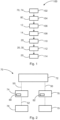
- Fig. 1 illustrates a schematic flow-diagram of a method 100 of the present invention for providing an efficient communication in a hierarchical network 70 of distributed devices 72, 74, 76 comprising at least a master device 72, at least a first client device 74, wherein the at least first client device 74 is connected via a first communication interface 50 with the master device 72.
- first data 10 is collected from the at least first client device 74 sent by at least one sensor device 78, e.g. a motor, a pump, via a second communication interface 52.
- sensor device 78 e.g. a motor, a pump
- a second step 104 the received first data 10 are stored in a data storage 80 of the at least one client device 74.
- meta data 12 of the first data 10 is determined by the at least first client device 74.
- a requirement information 14 of the first data 10 is received by the at least first client device 74.
- a classification information 20 of the received first data 10 is generated by the at least first client device 74 according to the meta data 12 and the requirement information 14 of the first data 10.
- the requirement information 14 defines a demand and supply of the first data 10 among the distributed network 70.
- the classification information 20 comprises at least one of the following: type or category of first data 10, cost of providing first data 10 or cost processing first data 10, availability or status of first data 10, a quality parameter of the first data 10 that defines whether the first data 10 fulfils a predefined quality in order to be usable by other devices in the network 70.
- the classification information 20 is generated by using a prediction model or a machine learning model, e.g. a neuronal network, that is at least partly located in the at least first client device 74. Hence, the classification information 20 is then stored locally in the first client device 74.
- a prediction model or a machine learning model e.g. a neuronal network
- the classification information 20 is updated at least partially by the at least one master device 72.
- the classification information 20 of the first data 10 is provided by the at least first client device 74 to the master device 72 and / or to at least a second client device 76 according to a rule information 30.
- the rule information 30 can be locally stored in the first client device 74 and shared with any other device in the network 70 upon enquiry or in case of an update of the rule information 30.
- the rule information 30 can be generated by the master device 72 and then globally distributed to any other device in the network 70.
- a seventh step 114 the classification information 20 is updated, when the first data 12 is changed.
- the seventh step may also be optional in the present invention.
- the update of the classification information 20 can be triggered when
- the step 114 of updating the classification information 20 comprises a change of the at least following: meta data 12 of first data 10, requirement information 14 of first data 10, a configuration of the network 70 by installing or removing at least a client device or master device and / or at least a sensor device.
- Fig. 2 illustrates a schematic example of a distributed network 70 exchanging data according to a method of the present invention.
- the distributed network 70 is established in a hierarchical manner between the master device 72 and the first client device 74 and the second client device 76 to perform the aforementioned method.
- the first client device 74 is connected via a second communication interface 52 to a sensor device 78 that senses or processes sensed data, e.g. a temperature value, a speed value, as first data 10.
- the second client device 76 is connected via the second communication interface 52 to a sensor device 79. Both client devices 74, 76 are connected via a first communication interface 50 to the master device 72.
- the first client device 74 comprises a data storage 80.
- the second client device 76 comprises a data storage 82.
- the master device 72 can optionally be connected to an external data center, e.g. a cloud, for exchanging the data.
- an external data center e.g. a cloud
- Each application can provide meta data about its data needs. This can be very specific (a single, specific data point is needed) or vague (all data of a specific type is needed). Very often this information is specified using tool specific formats. But there are also more and more standards or guidelines available.
- the meta data provides some more relevant information on the data such as a description, frequency, origin etc.
- the global data manifesto or the requirement information 14 provides information from all other client edges about data demand and supply.
- the method of the present invention uses the global demand information to assign categories for local data.
- the method of the present invention modifies the local data manifesto or classical information 20 based on various input.
- the local data manifesto describes where data is routed to and stored.
- the Prediction Model Learning Module in a device of the network consists of two sub-modules:
- a data issue detection module is used to identify e.g. stall data.
- the data matching module uses application meta data and data source meta data to generate a local data manifesto. Therefore, the current rules, the latest prediction model, the information about data issues and the global data information from the data abstraction layer are used.
- All rules may be stored in a rule storage of a device of the network.
- the data categorization module may implement rules generated by the data matching module in a device of the network. If rules are changed, e.g. because a new application is installed, the data categorization module implements the adaped new rules.
- the data abstraction layer in a device 72, 74, 76 provides information about all globally available data in the network 70.
- edge devices are installed in process plants. In future, more and more edge devices will be installed in production sites, allowing the edge devices to form a network. Such a network can always be seen as a hierarchy with a higher-level (master) edge and a multitude of lower-level (client) edges.
- the higher-level edge takes to role of an aggregator while the lower-level edges are mainly data collector.
- Applications can run in all edges taking into consideration the resource constraints.
- the simplest edge network runs two edges: One higher edge and one lower edge, but can be expanded in principle to an infinite number of devices.
- the ideal scenario data can flow from and to all edges.
- the higher-level edge manages the lower-level edges. According to the method of the present invention, this is also the ideal situation:
Landscapes
- Engineering & Computer Science (AREA)
- Computer Networks & Wireless Communication (AREA)
- Signal Processing (AREA)
- Health & Medical Sciences (AREA)
- Computing Systems (AREA)
- General Health & Medical Sciences (AREA)
- Medical Informatics (AREA)
- Physics & Mathematics (AREA)
- General Physics & Mathematics (AREA)
- Automation & Control Theory (AREA)
- Library & Information Science (AREA)
- Data Exchanges In Wide-Area Networks (AREA)
Abstract
The present invention relates to a method (100) for providing an efficient communication in a hierarchical network (70) of distributed devices (72, 74, 76) comprising at least a master device (72), at least a first client device (74), wherein the at least first client device (74) is connected via a first communication interface (50) with the master device (72), comprising:- collecting (102) first data (10) from the at least first client device (74) sent by at least one sensor device (78) via a second communication interface (52);- storing (104) the received first data (10) in a data storage (80) of the at least one client device (74),- determining (106), by the at least first client device (74), meta data (12) of the first data (10);- receiving (108), by the at least first client device (74), a requirement information (14) of the first data (10);- generating (110) a classification information (20) of the received first data (10), by the at least first client device (74), according to the meta data (12) and the requirement information (14) of the first data (10);- providing (112) the classification information (20) of the first data (10) by the at least first client device (74) to the master device (72) and / or to at least a second client device (76) according to a rule information (30); and- updating (114) the classification information (20), when the first data (12) is changed.
Description
- The present invention relates to a method for providing an efficient communication in a hierarchical network of distributed devices.
- In a modern automation system, edge nodes, client devices or edge devices are used to collect data and to run software applications to be used an industrial network process. The collected data are then transferred by the client devices to higher edge devices at a higher level or master devices to be stored in a central storage. Therefore, when specific data is required, one has always to access the central storage to get these data. The
US 9 525 627 B2 A1 - However, this classical approach to have a centralized data backbone is no longer useful when operating modern industrial processes. This is, as more and more data are made available to applications in the client devices, this data is usually high-frequency data and/or data with only a limited use for non-experts. As a result, a lot of bandwidth is wasted to transfer data which is afterwards not used any more if the classical approach is used by first sending data upward to a master device, e.g. a cloud, or higher edge nodes and then send it back to the lower edge node, where the data is consumed by an application.
- There is a need to address these issues.
- Therefore, it would be advantageous to provide an improved concept for providing an efficient communication and an efficient data processing in a hierarchical network of distributed devices.
- The object of the present invention is solved by the subject matter of the independent claims, wherein further embodiments are incorporated in the dependent claims.
- In a first aspect of the present invention, there is provided a method of providing an efficient communication in a hierarchical network of distributed devices comprising at least a master device, at least a first client device, wherein the at least first client device is connected via a first communication interface with the master device, comprising the following steps:
- collecting first data from the at least first client device sent by at least one sensor device via a second communication interface;
- storing the received first data in a data storage of the at least one client device;
- determining, by the at least first client device, meta data of the first data;
- receiving, by the at least first client device, a requirement information of the first data;
- generating a classification information of the received first data, by the at least first client device, according to the meta data and the requirement information of the first data;
- providing the classification information of the first data by the at least first client device to the master device and / or to at least a second client device according to a rule information; and
- updating the classification information, when the first data is changed.
- In other words, a core idea behind the present invention is to improve a dynamic assignment of data types of data locally generated by a client device or lower edge device more efficiently and to provide an overall data overview in a hierarchical network of distributed devices, as data generated locally is not only but now also shared between client devices of the same hierarchical level. Or to say it in other words, each edge device in the network is now aware where required data is stored and if needed, can be directly enquired from the edge device storing the required data.
- For this, it is crucial that data received by a client device are classified or categorized in terms of the importance of the data by generating a classification information based on meta data indicating whether data should be shared with other devices or stored in a device and a requirement information indicating when and where data is needed at a certain time in the network.
- The meta data may be generated using machine learning or other heuristic methods to decide for each edge the type of data in the edge and for how long data should be stored (change of status of the data) or to which location it should be transferred within the network. In this way, the knowledge of the topology of the edge network can be used to define optimal data handling strategies.
- In this way, the data processing and communication in a hierarchical network of distributed devices becomes more efficient, as communication bandwidth and storage capacity is more efficiently used compared to the centralistic data processing approach.
- For this, the hierarchical network or the system or platform comprises a number of client devices that are connected to other client devices and / or to at least one master device. The master device or higher-edge device usually executes a data-intensive data handling program, e.g. maschine learning. The at least one client device or the lower-edge device usually collects data from a plant device sensoring various types of data, e.g. temperature data, speed data.
- At the client devices or lower edge devices, the classification information of data received is generated according to meta data defined by the client device. One task of the meta data is to classify the received data to a certain type of data such as raw data, hot data, warm data, cold data or cloud data.
- Hot data or live data means that the latest data must be given as soon as possible when the edge or network infrastructure recovers connectivity from a failure. Application requires unprocessed, live telemetry data during training or during operation. Examples may be data for real time monitoring, prediction and actions. Hot data are data with an extremely high data availability requirement.
- Warm data means that applicatrions need the latest data but at a low or medium priority, after connectivity restoration. Applications do not require new data or data is not generated very frequently. Data collected after a long interval is sufficient. Warm data can be used for complex measurements such as misalignment, time-frequency domain conversion, resonance analysis, narrow band envelope analysis, etc. Warm data can be used for retraining a machine learning model. Typical applications can be periodic health monitoring or prediction.
- Cold or offline data means that there is no need to get the latest data in the immediate future. Applications require a mix of warm and historical data to build robust machine learning models from scratch or perform periodic retraining if the model performance is unsatisfactory.
- The generated classification information is then distributed and shared by the client device among a master device and / or further client devices in the network. This can happen according to a defined rule information. In this way, even if data is not transmitted, all devices of the network are now aware of the available data which are existing in each of the devices as either as actual data or as virtual data.
- When the data is changed, e.g. by an update of an installed local device in the network or a change of the network topology, the classification information of the respective local client device is updated, giving all other devices in the network also an immediate update of which data is available in the network and how expensive it is to get it, e.g. by using a distance metric.
- In the context of the present invention, data is telemetry data, alarm data and / or event data that are routed between the devices of the network, but the present invention is not restricted to this field of application.
- A further advantage of the present invention is that data availability, classification and configuration information is shared between local client / edge devices in an efficient manner to ensure consistency, e.g. by using a generalized configuration file.
- A further advantage of the present invention is that detection of similar data becomes easier in a network. This is done by using for example a pattern detection method e.g., from ML to identify "stall" data or other patterns. This includes not only stationary data, but also for example seasonality, oscillations and change points. Using this information helps to avoid unnecessary data transmission.
- According to an example, the classification information comprises at least one of the following: type or category of first data, cost of first data, availability or status of first data, a quality parameter of the first data that defines whether the first data fulfils a predefined quality in order to be usable by other devices in the network. Therein, the advantage is achieved that a more detailed and efficient data handling strategy when exchanging data among devices of the network can be applied.
- According to an example, the classification information is generated by using a prediction model or a machine learning model. In this way, the classification information can be generated in a more efficient way.
- According to an example, the rule information is locally stored in the first client device and shared with any other device in the network upon enquiry or in case of an update of the rule information, or the rule information is generated by the master device and globally distributed to any other device in the network. In this way, the advantage of an efficient and standardized data transmission in the network is achieved.
- According to an example, the step of updating the classification information comprises a change of the at least following: meta data of first data, requirement information of first data, a configuration of the network by installing or removing at least a client device or master device and / or at least a sensor device. In this way, a data transmission in the network is improved when the classification information depicts any relevant change in the network or of a data availibility.
- According to an example, the classification information is updated at least partially by the at least one master device. Therein, the advantage is achieved that a changed classification information can be efficiently distributed among the client devices connected to the master device of the network.
- According to an example, the updating of the classification information is triggered by at least one of the following: additional first data becomes available, meta data (12) of the first data is changed or the
requirement information 14 changes. In this way, a data transmission in the network is improved when the classification information depicts any relevant change in the network or of a data availibility. - According to an example, the requirement information defines a demand and supply of the first data among the distributed network. In this way, any device in the network is aware of an actual data location and data availability.
- According to an example, the data storage is at least partially a local data storage in the at least first client device. In this way, security-sensitive data can be efficiently protected in the network.
- In a second aspect of the present invention, a computer is provided comprising a processor configured to perform the method of the preceding aspect.
- In a third aspect of the present invention, there is provided a computer program product comprising instructions which, when the program is executed by a processor of a computer, causes the computer to perform the method of any of the first and second aspects.
- In a fourth aspect of the present invention, a machine-readable data medium and / or download product containing the computer program of the third aspect.
- Exemplary embodiments will be described in the following with reference to the following drawings:
-
Fig. 1 illustrates a schematic flow-diagram of a method of the present invention; and -
Fig. 2 illustrates a schematic flow-diagram of data processing between a master device and a client device according to an embodiment of the present invention. -
Fig. 1 illustrates a schematic flow-diagram of amethod 100 of the present invention for providing an efficient communication in ahierarchical network 70 of distributeddevices master device 72, at least afirst client device 74, wherein the at leastfirst client device 74 is connected via afirst communication interface 50 with themaster device 72. - In
first step 102, first data 10 is collected from the at leastfirst client device 74 sent by at least onesensor device 78, e.g. a motor, a pump, via asecond communication interface 52. - In a
second step 104, the received first data 10 are stored in adata storage 80 of the at least oneclient device 74. - In a
third step 106,meta data 12 of the first data 10 is determined by the at leastfirst client device 74. - In a
fourth step 108, arequirement information 14 of the first data 10 is received by the at leastfirst client device 74. - In a
fifth step 110, aclassification information 20 of the received first data 10 is generated by the at leastfirst client device 74 according to themeta data 12 and therequirement information 14 of the first data 10. Therequirement information 14 defines a demand and supply of the first data 10 among the distributednetwork 70. - Regarding the
classification information 20, the following can be said: Theclassification information 20 comprises at least one of the following: type or category of first data 10, cost of providing first data 10 or cost processing first data 10, availability or status of first data 10, a quality parameter of the first data 10 that defines whether the first data 10 fulfils a predefined quality in order to be usable by other devices in thenetwork 70. - Further, optionally, the
classification information 20 is generated by using a prediction model or a machine learning model, e.g. a neuronal network, that is at least partly located in the at leastfirst client device 74. Hence, theclassification information 20 is then stored locally in thefirst client device 74. - Further, optionally, the
classification information 20 is updated at least partially by the at least onemaster device 72. - In a
sixth step 112, theclassification information 20 of the first data 10 is provided by the at leastfirst client device 74 to themaster device 72 and / or to at least asecond client device 76 according to a rule information 30. - The rule information 30 can be locally stored in the
first client device 74 and shared with any other device in thenetwork 70 upon enquiry or in case of an update of the rule information 30. Optionally, the rule information 30 can be generated by themaster device 72 and then globally distributed to any other device in thenetwork 70. - In a
seventh step 114, theclassification information 20 is updated, when thefirst data 12 is changed. The seventh step may also be optional in the present invention. The update of theclassification information 20 can be triggered when - a) additional first data 10 becomes available or
- b)
meta data information 12 of the first data is changed or - c) data demand or the
requirement information 14 changes. - Optionally, the
step 114 of updating theclassification information 20 comprises a change of the at least following:meta data 12 of first data 10,requirement information 14 of first data 10, a configuration of thenetwork 70 by installing or removing at least a client device or master device and / or at least a sensor device. -
Fig. 2 illustrates a schematic example of a distributednetwork 70 exchanging data according to a method of the present invention. - The distributed
network 70 is established in a hierarchical manner between themaster device 72 and thefirst client device 74 and thesecond client device 76 to perform the aforementioned method. Thefirst client device 74 is connected via asecond communication interface 52 to asensor device 78 that senses or processes sensed data, e.g. a temperature value, a speed value, as first data 10. Correspondingly, thesecond client device 76 is connected via thesecond communication interface 52 to asensor device 79. Bothclient devices first communication interface 50 to themaster device 72. For reasons of a better visibility data exchange between thefirst client device 74 and thesecond client device 76 is not indicated inFig. 2 , but of course, such a data exchange is present according to the method of the present invention. Thefirst client device 74 comprises adata storage 80. Thesecond client device 76 comprises adata storage 82. - The
master device 72 can optionally be connected to an external data center, e.g. a cloud, for exchanging the data. - In the following, further detailed aspects of the present invention are provided.
- Each application can provide meta data about its data needs. This can be very specific (a single, specific data point is needed) or vague (all data of a specific type is needed). Very often this information is specified using tool specific formats. But there are also more and more standards or guidelines available. The meta data provides some more relevant information on the data such as a description, frequency, origin etc.
- The global data manifesto or the
requirement information 14 provides information from all other client edges about data demand and supply. The method of the present invention uses the global demand information to assign categories for local data. - The method of the present invention modifies the local data manifesto or
classical information 20 based on various input. The local data manifesto describes where data is routed to and stored. - The Prediction Model Learning Module in a device of the network consists of two sub-modules:
- a) The learning sub-module: Machine learning methods or statistical methods are using historical data sets [including information about features (which data source points) and labels (which data sinks)]. The result is a prediction model which can predict the most likely category (and hence data sink) based on the feature information.
- b) The prediction sub-module: The latest prediction model is fed with current feature data to get a recommendation about best category.
- Data Routing only makes sense if the data quality is high enough to generate value in the target application. Hence, a data issue detection module is used to identify e.g. stall data. The information about faulty data is used by the method of the present information to modify the local data manifesto (= the classification information 20).
- The data matching module uses application meta data and data source meta data to generate a local data manifesto. Therefore, the current rules, the latest prediction model, the information about data issues and the global data information from the data abstraction layer are used.
- All rules may be stored in a rule storage of a device of the network.
- The data categorization module may implement rules generated by the data matching module in a device of the network. If rules are changed, e.g. because a new application is installed, the data categorization module implements the adaped new rules.
- The data abstraction layer in a
device network 70. - Today, edge devices are installed in process plants. In future, more and more edge devices will be installed in production sites, allowing the edge devices to form a network. Such a network can always be seen as a hierarchy with a higher-level (master) edge and a multitude of lower-level (client) edges.
- The higher-level edge takes to role of an aggregator while the lower-level edges are mainly data collector. Applications can run in all edges taking into consideration the resource constraints. The simplest edge network runs two edges: One higher edge and one lower edge, but can be expanded in principle to an infinite number of devices.
- An important aspect to take into consideration in such a hierarchical network is the communication in such a hierarchical edge network. To illustrate this, three examples are provided:
- A) Two-way Free Flow Communication
- The ideal scenario: data can flow from and to all edges. The higher-level edge manages the lower-level edges. According to the method of the present invention, this is also the ideal situation:
- A1) Data Connector are used to collect data from devices like motors and pumps or even Distributed Control Systems (DCS). A2) A local Data Manifesto in a client device is created by the Data Matching Module of by assigning data to categories; the local data manifestos (= classification information) are shared with the higher-level edge to create the global data manifesto. A3) Data flows to application according to the data manifesto using the rules implemented by the Data Categorization Module.
- A4) In case of changes in data demand, e.g. a new MES application is installed, the local data manifesto of a client device is updated and implemented by the Data Categorization Module. Changes are shared with the higher (master) edge. At the same time the rules are updated (using heuristics or ML models generated by the Prediction Model Learning Module); new rules are also shared with higher (master) edge.
- A5) The global manifesto in the master device is updated and changes are shared with all edges; new rules are also shared with all edges.
- In a further communication scenario in a hierarchical network data can flow from and to the higher (master) edge device. The higher-level edge manages the lower-level (client) edge devices. For the present invention this means that global updates require manual intervention:
- 1) Data Connector are used to collect data from devices like motors and pumps or Distributed Control Systems
- 2) A local Data Manifesto is created by the Data Matching Module of a client device, assigning data to categories; the local data manifestos are shared with the higher-level edge to create the global data manifesto. The client devices are using initially installed rules.
- 3) Data flows to applications according to the data manifesto using the rules implemented by the Data Categorization Module.
- 4) In case of changes in data demand, e.g. a new MES application is installed, the local data manifesto of a client device is updated and implemented by the Data Categorization Module; changes are shared with the higher edge. At the same time the rules are updated (using heuristics or ML generated by the Prediction Model Learning Module); new rules are also shared with higher master edge device.
- 5) The global manifesto in the master device is updated; changes are shared manually with all client edges, e.g. when updates are made; new rules are also shared with all edges manually.
- Compared to the previous scenario this one is more realistic but requires also the human in the loop to confirm updates.
- In case the lower edges are not always connected to the higher master edge device, data can flow freely from and to all client edge devices. The higher-level master edge device manages the lower-level client edge devices, but has only access to them when they are connected. This scenario represents a flexible scenario where the network is under constant change. In this scenario, global updates are not always available:
- 1) Data Collector is collecting data from devices like motors and pumps
- 2) A local Data Manifesto of the client device is created by the Data Matching Module assigning data to categories. The local data manifestos are shared with the higher-level master edge devics to create the global data manifesto if connected. Initially installed rules in the client devices are used.
- 3) Data flows to applications according to the data manifesto implemented by the Data Categorization Module. Data flows only to the higher master edge device if connected.
- 4) In case of changes in data demand, e.g. a new application is installed, the local data manifesto is updated; changes are shared with the higher master edge device if connected. At the same time the rules are updated (using heuristics or ML generated by the Prediction Model Learning Module); new rules are also shared with higher edge if connected.
- 5) The global manifesto is updated; changes are shared manually with all devices, e.g. when updates are made; new rules are also shared with all edges manually if connected
- In this scenario, the updates of the local manifesto will take significantly longer then with the other scenarios due to the communication limitations.
- Further, there are multiple ways to improve the category assignment.
- First, a simple way is using heuristics:
- 1. A user defines rules to assign status to data. Status can be something like hot, cold, or warm. Another differentiation can be the sink location for the data.
- 2. A generalized configuration file containing all available tags in all edges (client device and master device).
- 3. The expert rules are used to assign status for all tags; expert rules can be supported by statistics, e.g. how often requires a specific application data of a specific type. This helps to assign aspects like storage locations.
- 4. Status information is added to the generalized configuration file.
- 5. Generalized configuration file is shared with other edges.
- 6. Each edge aggregates information to get an overall status for each tag and to decide where to send data and store data.
- Second, another way to improve assignment rules is machine learning if enough historical data is available, as described before.
-
- 100
- Method
- 100
- Method
- 102
- Collecting
- 104
- Storing
- 106
- Determining
- 108
- Determining
- 110
- Generating
- 112
- Providing
- 114
- Updating
- 10
- First data
- 12
- Meta data
- 14
- Requirement information
- 20
- Classification information
- 30
- Rule information
- 50
- First communication interface
- 52
- Second communication interface
- 70
- Hierarchical network
- 72
- Master device
- 74
- First client device
- 76
- Second client device
- 78, 79
- Sensor device
- 80, 82
- Data storage
Claims (11)
- Method (100) for providing an efficient communication in a hierarchical network (70) of distributed devices (72, 74, 76) comprising at least a master device (72), at least a first client device (74), wherein the at least first client device (74) is connected via a first communication interface (50) with the master device (72), comprising:- collecting (102) first data (10) from the at least first client device (74) sent by at least one sensor device (78) via a second communication interface (52);- storing (104) the received first data (10) in a data storage (80) of the at least one client device (74),- determining (106), by the at least first client device (74), meta data (12) of the first data (10);- receiving (108), by the at least first client device (74), a requirement information (14) of the first data (10);- generating (110) a classification information (20) of the received first data (10), by the at least first client device (74), according to the meta data (12) and the requirement information (14) of the first data (10);- providing (112) the classification information (20) of the first data (10) by the at least first client device (74) to the master device (72) and / or to at least a second client device (76) according to a rule information (30); and- updating (114) the classification information (20), when the first data (12) is changed.
- Method (100) according to claim 1, wherein the classification information (20) comprises at least one of the following: type or category of first data (10), cost providing first data (10) or cost of processing of first data (10), availability or status of first data (10), a quality parameter of the first data (10) that defines whether the first data (10) fulfils a predefined quality in order to be usable by other devices in the network (70).
- Method (100) according to claim 2, wherein the classification information (20) is generated by using a prediction model or a machine learning model.
- Method (100) according to any of the preceding claims, wherein the rule information (30) is locally stored in the first client device (74) and shared with any other device in the network (70) upon enquiry or in case of an update of the rule information (30), or the rule information (30) is generated by the master device (72) and globally distributed to any other device in the network (70).
- Method (100) according to any of the preceding claims, wherein the step (114) of updating the classification information (20) comprises a change of the at least following: meta data (12) of first data (10), requirement information (14) of first data (10), a configuration of the network (70) by installing or removing at least a client device or master device and / or at least a sensor device.
- Method (100) according to any of the preceding claims, wherein the classification information (20) is updated at least partially by the at least one master device (72).
- Method (100) according to any of the preceding claims, wherein the requirement information (14) defines a demand and supply of the first data (10) among the distributed network (70).
- Method (100) according to any of the preceding claims, wherein the updating of the classification information (20) is triggered by at least one of the following: additional first data (10) becomes available, meta data (12) of the first data is changed or the requirement information 14 changes.
- A computer comprising a processor configured to perform the method of any preceding claims 1 to 8.
- A computer program product comprising instructions which, when the computer program is executed by a processor of a computer, causes the computer to perform the method of any of claims 1 to 9.
- Machine-readable data medium and / or download product containing the computer program according to claim 10.
Priority Applications (3)
| Application Number | Priority Date | Filing Date | Title |
|---|---|---|---|
| EP23160980.1A EP4429202A1 (en) | 2023-03-09 | 2023-03-09 | Method for providing an efficient communication in a hierarchical network of distributed devices |
| US18/589,535 US12621244B2 (en) | 2023-03-09 | 2024-02-28 | Method for providing an efficient communication in a hierarchical network of distributed devices |
| CN202410262087.3A CN118631811A (en) | 2023-03-09 | 2024-03-07 | Method for providing efficient communication in a hierarchical network of distributed devices |
Applications Claiming Priority (1)
| Application Number | Priority Date | Filing Date | Title |
|---|---|---|---|
| EP23160980.1A EP4429202A1 (en) | 2023-03-09 | 2023-03-09 | Method for providing an efficient communication in a hierarchical network of distributed devices |
Publications (1)
| Publication Number | Publication Date |
|---|---|
| EP4429202A1 true EP4429202A1 (en) | 2024-09-11 |
Family
ID=85570107
Family Applications (1)
| Application Number | Title | Priority Date | Filing Date |
|---|---|---|---|
| EP23160980.1A Pending EP4429202A1 (en) | 2023-03-09 | 2023-03-09 | Method for providing an efficient communication in a hierarchical network of distributed devices |
Country Status (2)
| Country | Link |
|---|---|
| EP (1) | EP4429202A1 (en) |
| CN (1) | CN118631811A (en) |
Citations (3)
| Publication number | Priority date | Publication date | Assignee | Title |
|---|---|---|---|---|
| US9525627B2 (en) | 2014-05-27 | 2016-12-20 | Google Inc. | Network packet encapsulation and routing |
| US11356537B2 (en) * | 2019-03-11 | 2022-06-07 | At&T Intellectual Property I, L.P. | Self-learning connected-device network |
| CN115668084A (en) * | 2020-05-25 | 2023-01-31 | 发那科株式会社 | Diagnostic device, server and diagnostic method |
-
2023
- 2023-03-09 EP EP23160980.1A patent/EP4429202A1/en active Pending
-
2024
- 2024-03-07 CN CN202410262087.3A patent/CN118631811A/en active Pending
Patent Citations (3)
| Publication number | Priority date | Publication date | Assignee | Title |
|---|---|---|---|---|
| US9525627B2 (en) | 2014-05-27 | 2016-12-20 | Google Inc. | Network packet encapsulation and routing |
| US11356537B2 (en) * | 2019-03-11 | 2022-06-07 | At&T Intellectual Property I, L.P. | Self-learning connected-device network |
| CN115668084A (en) * | 2020-05-25 | 2023-01-31 | 发那科株式会社 | Diagnostic device, server and diagnostic method |
Also Published As
| Publication number | Publication date |
|---|---|
| CN118631811A (en) | 2024-09-10 |
| US20240305572A1 (en) | 2024-09-12 |
Similar Documents
| Publication | Publication Date | Title |
|---|---|---|
| Redelinghuys et al. | A six-layer architecture for digital twins with aggregation | |
| US7953842B2 (en) | Open network-based data acquisition, aggregation and optimization for use with process control systems | |
| JP5189724B2 (en) | Data communication method in process control system, process control system and machine-readable medium | |
| Biehl et al. | Remote repair, diagnostics, and maintenance | |
| RU2695052C2 (en) | Constructing hierarchy of devices for remote terminal unit | |
| US10523502B2 (en) | Method and system for configuration of devices of a control system | |
| US20110196528A1 (en) | Historians embedded in industrial units | |
| EP1643325B1 (en) | Directory structure in distributed data driven architecture environment | |
| KR20070037426A (en) | Embedding data to bring the latest control and configuration information to controllers and devices | |
| CN110622477B (en) | Method and equipment for rule-based information exchange in Internet of things | |
| JP7107046B2 (en) | Control system, search device and search program | |
| EP1993016B1 (en) | Embedded historians with data aggregator | |
| CN118981362A (en) | Distributed training scheduling method, system, electronic device and storage medium | |
| CN107729213A (en) | A kind of background task monitoring method and device | |
| US7142929B2 (en) | Process data management | |
| EP4429202A1 (en) | Method for providing an efficient communication in a hierarchical network of distributed devices | |
| US12621244B2 (en) | Method for providing an efficient communication in a hierarchical network of distributed devices | |
| CN112688984A (en) | Method, device and medium for issuing and executing instruction to network node | |
| US11226855B2 (en) | Common gateway platform | |
| Gerali | Real Time Monitoring of Industrial Machines using AWS IoT | |
| US20220253033A1 (en) | Method and System for Implementing Event Rules for Maintenance Relevant Events in a Plurality of Machines | |
| Palmeira et al. | Migrating legacy production lines into an Industry 4.0 ecosystem | |
| JP7107047B2 (en) | Control system, search device and search program | |
| US20110230979A1 (en) | Scalable and flexible control system having symmetrical control units | |
| Holtebo et al. | EXOGEM: Extending OpenAPI Generator for Monitoring of RESTful APIs |
Legal Events
| Date | Code | Title | Description |
|---|---|---|---|
| PUAI | Public reference made under article 153(3) epc to a published international application that has entered the european phase |
Free format text: ORIGINAL CODE: 0009012 |
|
| STAA | Information on the status of an ep patent application or granted ep patent |
Free format text: STATUS: THE APPLICATION HAS BEEN PUBLISHED |
|
| AK | Designated contracting states |
Kind code of ref document: A1 Designated state(s): AL AT BE BG CH CY CZ DE DK EE ES FI FR GB GR HR HU IE IS IT LI LT LU LV MC ME MK MT NL NO PL PT RO RS SE SI SK SM TR |
|
| STAA | Information on the status of an ep patent application or granted ep patent |
Free format text: STATUS: REQUEST FOR EXAMINATION WAS MADE |
|
| 17P | Request for examination filed |
Effective date: 20250212 |