EP4429168A1 - Detection system, detection device, detection method and detection program - Google Patents
Detection system, detection device, detection method and detection program Download PDFInfo
- Publication number
- EP4429168A1 EP4429168A1 EP21967238.3A EP21967238A EP4429168A1 EP 4429168 A1 EP4429168 A1 EP 4429168A1 EP 21967238 A EP21967238 A EP 21967238A EP 4429168 A1 EP4429168 A1 EP 4429168A1
- Authority
- EP
- European Patent Office
- Prior art keywords
- node
- response
- hash
- notification
- challenge
- Prior art date
- Legal status (The legal status is an assumption and is not a legal conclusion. Google has not performed a legal analysis and makes no representation as to the accuracy of the status listed.)
- Pending
Links
Images



Classifications
-
- H—ELECTRICITY
- H04—ELECTRIC COMMUNICATION TECHNIQUE
- H04L—TRANSMISSION OF DIGITAL INFORMATION, e.g. TELEGRAPHIC COMMUNICATION
- H04L9/00—Cryptographic mechanisms or cryptographic arrangements for secret or secure communications; Network security protocols
- H04L9/32—Cryptographic mechanisms or cryptographic arrangements for secret or secure communications; Network security protocols including means for verifying the identity or authority of a user of the system or for message authentication, e.g. authorization, entity authentication, data integrity or data verification, non-repudiation, key authentication or verification of credentials
-
- H—ELECTRICITY
- H04—ELECTRIC COMMUNICATION TECHNIQUE
- H04L—TRANSMISSION OF DIGITAL INFORMATION, e.g. TELEGRAPHIC COMMUNICATION
- H04L9/00—Cryptographic mechanisms or cryptographic arrangements for secret or secure communications; Network security protocols
- H04L9/32—Cryptographic mechanisms or cryptographic arrangements for secret or secure communications; Network security protocols including means for verifying the identity or authority of a user of the system or for message authentication, e.g. authorization, entity authentication, data integrity or data verification, non-repudiation, key authentication or verification of credentials
- H04L9/3236—Cryptographic mechanisms or cryptographic arrangements for secret or secure communications; Network security protocols including means for verifying the identity or authority of a user of the system or for message authentication, e.g. authorization, entity authentication, data integrity or data verification, non-repudiation, key authentication or verification of credentials using cryptographic hash functions
-
- H—ELECTRICITY
- H04—ELECTRIC COMMUNICATION TECHNIQUE
- H04L—TRANSMISSION OF DIGITAL INFORMATION, e.g. TELEGRAPHIC COMMUNICATION
- H04L9/00—Cryptographic mechanisms or cryptographic arrangements for secret or secure communications; Network security protocols
- H04L9/32—Cryptographic mechanisms or cryptographic arrangements for secret or secure communications; Network security protocols including means for verifying the identity or authority of a user of the system or for message authentication, e.g. authorization, entity authentication, data integrity or data verification, non-repudiation, key authentication or verification of credentials
- H04L9/3271—Cryptographic mechanisms or cryptographic arrangements for secret or secure communications; Network security protocols including means for verifying the identity or authority of a user of the system or for message authentication, e.g. authorization, entity authentication, data integrity or data verification, non-repudiation, key authentication or verification of credentials using challenge-response
-
- H—ELECTRICITY
- H04—ELECTRIC COMMUNICATION TECHNIQUE
- H04W—WIRELESS COMMUNICATION NETWORKS
- H04W12/00—Security arrangements; Authentication; Protecting privacy or anonymity
- H04W12/10—Integrity
- H04W12/106—Packet or message integrity
-
- H—ELECTRICITY
- H04—ELECTRIC COMMUNICATION TECHNIQUE
- H04W—WIRELESS COMMUNICATION NETWORKS
- H04W12/00—Security arrangements; Authentication; Protecting privacy or anonymity
- H04W12/12—Detection or prevention of fraud
- H04W12/121—Wireless intrusion detection systems [WIDS]; Wireless intrusion prevention systems [WIPS]
- H04W12/122—Counter-measures against attacks; Protection against rogue devices
Definitions
- the present invention relates to a detection system, a detection device, a detection method, and a detection program.
- Attestation technology for detecting system tampering has attracted attention.
- a digest such as a hash value or a checksum at a certain point in time when the entire storage of a monitoring target node can be regarded as normal is periodically acquired. Then, the integrity of the monitoring target node, that is, whether tampering has occurred in the node is checked by comparing the acquired digest with a digest in the current storage of the monitoring target node.
- Non Patent Literature 1 discloses technology in which confidential information is distributed and majority decision is performed between nodes to eliminate the need for a verification server.
- Non Patent Literature 1 Yi Yang, Xinran Wang, Sencun Zhu, and Guohong Cao, "Distributed Software-based Attestation for Node Compromise Detection in Sensor Networks", 26th IEEE International Symposium on Reliable Distributed Systems
- the present invention has been made in view of the above, and an object thereof is to efficiently check the integrity of all apparatuses present in a network.
- a detection system is a detection system including two or more nodes and a base station that holds information on each of the nodes, wherein the base station includes: a search unit configured to search for a circuit passing through all nodes in a network only once; a calculation unit configured to sequentially calculate as many hash values as a number of nodes in the network; and a notification unit configured to notify each node of an order in the circuit, a hash value according to the order among the calculated hash values, and a node in a subsequent stage in the circuit, and each of the nodes includes: a sending unit configured to send a hash value notification of which is provided and a challenge to a node in a subsequent stage according to the order notification of which is provided from the notification unit; a hash verification unit configured to verify whether or not the sent hash value matches a value calculated from the hash value notification of which is provided through a predetermined method; a return unit configured to return a response to the sent
- Fig. 1 to Fig. 3 are diagrams for describing an overview of a detection system.
- Fig. 1 illustrates one-to-one integrity check of nodes.
- one node is caused to function as a verifier and the other node is caused to function as a prover, and it is found without omission that tampering has occurred in information on the prover in a challenge/response procedure.
- the detection system includes a node 1, a node 2, and a base station, and is configured such that they can safely communicate with each other using common key encryption or the like.
- the node 1 serving as a verifier sends a random value (nonce) as a challenge to the node 2 serving as a prover.
- the node 1 expects that a correct response is returned from the node 2 within a time limit.
- the node 2 sets the random value received as the challenge as a seed of a random number generator thereof.
- the node 2 accesses a storage thereof, performs random scanning using the seed, generates a checksum or a hash digest as a response, and returns the generated checksum or hash digest to the node 1.
- the node 1 verifies the response. If the node 2 is infected, a correct response cannot be generated, and thus the node 1 can detect that the node 2 is infected. Then, as illustrated in Fig. 1(5), the node 1 notifies the base station of the verification result. As a result, the base station can check the integrity of the subordinate node 2.
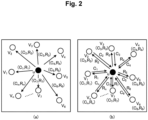
- Fig. 2 illustrates integrity check among three or more nodes.
- each node calculates a plurality of sets of a challenge sent to the node itself and a response to the challenge, and holds the sets in a memory before deployment.
- the node distributes the sets of challenge/response held thereby to neighboring nodes, and deletes the distributed sets of challenge/response from the memory thereof.
- a neighboring node holds a challenge sent to a target node and a corresponding response, and confidential information is shared.
- a node selected as a prover using an appropriate voting algorithm receives challenges from all the neighboring nodes, calculates a responses to each of the challenges, and returns the response.
- Each of the neighboring nodes compares the returned response with an expected response held thereby, and in a case in which there is a discrepancy between the responses, notifies the base station that the node serving as the prover is infected.
- a plurality of neighboring nodes hold different sets of challenges/responses
- integrity check of the node serving as the prover is performed, and presence or absence of tampering is determined by majority decision, for example.
- communication and calculation of challenges/responses as many as the number of neighboring nodes occur.
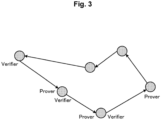
- the detection system of the present embodiment checks whether or not there is even one infected node in a network instead of performing integrity check of one node serving as a prover. Specifically, as illustrated in Fig. 3 , the detection system 1 calculates a Hamiltonian circuit, which is a circuit that goes around all nodes in a network only once, and sequentially performs one-to-one integrity check with a node in the previous stage as a verifier and a node in the subsequent stage as a prover.
- a Hamiltonian circuit which is a circuit that goes around all nodes in a network only once, and sequentially performs one-to-one integrity check with a node in the previous stage as a verifier and a node in the subsequent stage as a prover.
- the detection system can perform integrity check through one-time processing for the entire node group without performing integrity check N times for each of N nodes. As a result, it is possible to greatly reduce a communication overhead and the like, curb the number of communications and the calculation cost, and perform integrity check.
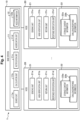
- Fig. 4 is a schematic diagram illustrating a schematic configuration of the detection system.
- the detection system 1 includes a base station 10 and two or more nodes 20, and is configured such that they can safely communicate with each other using common key encryption or the like.
- the base station 10 holds information such as a node having a communication range to which each node 20 in a network belongs and a node having confidential information held by each node 20, and controls one-to-one integrity check between the nodes 20. That is, the base station 10 calculates a Hamiltonian circuit for the nodes 20 in the network and instructs the nodes 20 to perform one-to-one integrity check in the order of the Hamiltonian circuit. Then, each node 20 performs one-to-one integrity check as a detection device. Subsequently, the base station 10 aggregates the results of integrity checks between the nodes 20.
- the base station 10 is realized by a central processing unit (CPU), a network processor (NP), a field programmable gate array (FPGA), or the like, and functions as a control unit 11 by executing a processing program stored in a memory.
- the base station 10 includes a storage unit 12 realized by a semiconductor memory element such as a random access memory or a flash memory.
- the base station 10 includes a communication control unit which is not illustrated and communicates with the nodes 20, other network devices, and the like via the communication control unit.
- a processing program for operating the base station 10, data used during execution of the processing program, and the like are stored in advance, or temporarily stored for each processing.
- the storage unit 12 may be configured to communicate with the control unit 11 via the communication control unit.
- the storage unit 12 stores node information 12a used in detection processing which will be described later.
- the node information 12a includes information such as a node having a communication range to which each node in the network belongs and a node having confidential information held by each node.
- the control unit 11 functions as a search unit 11a, a calculation unit 11b, a notification unit 11c, and an aggregation unit 11d as illustrated in Fig. 4 by executing the processing program stored in the memory.
- these functional units or some thereof may be implemented in different pieces of hardware.
- the search unit 11a and the calculation unit 11b, and the notification unit 11c and the aggregation unit 11d may be implemented in separate devices.
- the control unit 11 may include other functional units.
- the search unit 11a searches for a circuit that passes through all the nodes in the network only once. Specifically, the search unit 11a calculates a Hamiltonian circuit for all the nodes in the network. The search unit 11a calculates the Hamiltonian circuit with reference to communication statuses of the node 20s of the node information 12a and a sharing status of challenges/responses which will be described later.
- the detection system 1 performs one-to-one integrity check with a node 20 in the previous stage as a verifier and a node 20 in the subsequent stage as a prover to make one round in the order of the Hamiltonian circuit in detection processing which will be described later.
- the calculation unit 11b sequentially calculates as many hash values as the number N of nodes 20 in the network. Further, the notification unit 11c notifies each node 20 of the order i in the Hamiltonian circuit, an (N-i)-th hash value corresponding to the order among the calculated hash values, and an (i+1)-th node 20 in the subsequent stage in the Hamiltonian circuit. Specifically, the notification unit 11c notifies the respective nodes 20 of the Hamiltonian circuit of the calculated hash values in descending order of the calculated orders in ascending order in the Hamiltonian circuit. That is, the notification unit 11c notifies the i-th node 20 of the Hamiltonian circuit of the (N-i)-th calculated hash value.
- Fig. 5 is a diagram for describing processing of the base station.
- the calculation unit 11b calculates a hash value X' by applying a hash function to an initial value X. Further, a hash value X'' is calculated by applying the hash function to the hash value X'. As illustrated in Fig. 5(a) , the calculation unit 11b repeats this processing to generate a hash chain including as many hash values as the number of nodes 20 in the network.
- the notification unit 11c turns over the hash chain generated by the calculation unit 11b (reverse hash chain) and rearranges the hash values in descending order of the calculated order. Then, as illustrated in Fig. 5(c) , the notification unit 11c notifies the respective nodes 20 of the hash values such that the order of the Hamiltonian circuit corresponds to the order of rearrangement as illustrated in Fig. 5(b) .
- a hash verification unit 21b of the node 20 which will be described later can verify whether or not the node 20 in the previous stage is a node 20 expected by the base station 10 using a hash value sent from the node 20 in the previous stage and a hash value notification of which is provided by itself. For example, in a case in which a hash value (for example, X'') sent from the node 20 in the previous stage matches a hash value (X'') calculated by applying the hash function to the hash value (for example, X') notification of which is provided by the hash verification unit 12b, the hash verification unit 12b can confirm that the node in the previous stage is the expected node 20.
- a hash value for example, X''
- the hash verification unit 12b can confirm that the node in the previous stage is the expected node 20.
- the aggregation unit 11d aggregates results of verification of the hash verification unit 21b or a response verification unit 21d of the node 20 which will be described later.
- the base station 10 can aggregate verification results which will be described later in each node 20.
- the aggregation unit 11d issues an alert on the assumption that there is an infected node 20 in the network.
- the node 20 is realized by a CPU, an NP, an FPGA, or the like, and functions as the control unit 21 by executing a processing program stored in the memory. Further, the node 20 includes a storage unit 22 realized by a semiconductor memory element such as a RAM or a flash memory. Further, the node 20 includes a communication control unit which is not illustrated, and communicates with the base station 10, other network devices, and the like via the communication control unit.
- a processing program for operating the node 20, data used during execution of the processing program, and the like are stored in advance, or temporarily stored for each processing.
- the storage unit 22 may be configured to communicate with the control unit 21 via the communication control unit.
- the storage unit 22 stores storage content information 22a, challenge/response information 22b, and the like.
- the storage content information 22a is referred to when a return unit 21c generates a response to a challenge sent from the node 20 in the previous stage in detection processing which will be described later.
- the challenge/response information 22b is a combination of a challenge sent to each node in the network and a normal response to the challenge.
- the node 20 calculates a plurality of challenges to be sent thereto and responses to the challenges in advance before being deployed.
- the node 20 when the node 20 is deployed in the network, the node distributes a set of challenges/responses held thereby to neighboring nodes 20 and deletes the distributed set of challenges/responses from the memory thereof.
- each of the neighboring nodes 20 holds the challenge/response information 22b as a response corresponding to a challenge sent to a node serving as a prover. Accordingly, each node in the network shares confidential information.
- the control unit 21 functions as a sending unit 21a, the hash verification unit 21b, the return unit 21c, and the response verification unit 21d as illustrated in Fig. 4 by executing the processing program stored in the memory.
- the control unit 11 may also include other functional units.
- the sending unit 21a sends a hash value notification of which is provided and challenge to the node 20 in the subsequent stage according to the order i notification of which is provided from the notification unit 11c. Specifically, the sending unit 21a of the i-th node 20 sends the (N-i)-th hash value notification of which is provided from the notification unit 11c and a challenge for the (i+1)-th node 20 to the (i+1)-th node 20.
- the sending unit 21a sends, to the (i+1)-th node in the subsequent stage, a challenge corresponding to the (i+1)-th node in the subsequent stage as a challenge with reference to the challenge/response information 22b in the storage unit 22
- the hash verification unit 21b verifies whether or not the hash value sent from the i-th node 20 in the previous stage matches a value calculated from the hash value notification of which is provided using a predetermined method. Specifically, the hash verification unit 21b verifies whether or not the hash value sent from the i-th node 20 in the previous stage matches a hash value calculated from the hash value notification of which is provided.
- the hash verification unit 21b of the (i+1)-th node 20 verifies whether or not the (N-i)-th hash value sent from the i-th node 20 in the previous stage matches a hash value obtained by applying a hash function to the (N-(i+1))-th hash value notification of which is provided thereby. In a case in which they match, it can be confirmed that the node 20 in the previous stage is the i-th node 20 expected by the base station 10.
- the hash verification unit 21b shifts processing to the return unit 12c which will be described below.
- the hash verification unit 21b may notify the aggregation unit 11d of the base station 10 of the verification result, for example.
- the return unit 21c returns a response to the sent challenge. Specifically, the return unit 21c takes out a nonce included in the challenge and sets the nonce as a seed. Then, the return unit 12c generates a response with reference to the storage content information 22a and returns the response to the node 20 in the previous stage.
- the response verification unit 21d verifies the returned response. Specifically, the response verification unit 21d verifies whether or not the returned response matches a normal response with reference to the challenge/response information 22b in the storage unit 22. The response verification unit 21d determines that the node 20 in the subsequent stage is normal in a case in which the responses match and determines that the node 20 in the subsequent stage is infected in a case in which the responses do not match.
- the response verification unit 21d notifies the aggregation unit 11d of the base station 10 of the verification result.
- the base station 10 can aggregate the results of response verification in the respective nodes 20. For example, in a case in which any one of the results of response verification of the respective nodes 20 includes a determination result indicating that the node 20 in the subsequent stage is infected, the aggregation unit 11d issues an alert on the assumption that the infected node 20 is present in the network.
- the aggregation unit 11d issues an alert on the assumption that processing regardless of the order of the Hamiltonian circuit expected by the base station 10 has been executed.
- Fig. 6 is a sequence diagram illustrating a detection processing procedure. The sequence of Fig. 6 is started, for example, at a timing when an operation input instructing the start of the detection processing is applied.
- the notification unit 11c of the base station 10 notifies each node 20 of an order i in a Hamiltonian circuit, an (N-i)-th hash value according to the order among calculated hash values, and an (i+1)-th node 20 in the subsequent stage in the Hamiltonian circuit (step S1).
- the sending unit 21a sends the (N-1)-th hash value notification of which is provided from the notification unit 11c and a challenge for the second node 20 to the second node 20 (step S10).
- the sending unit 21a sends, to the second node in the subsequent stage, a challenge corresponding to the second node as a challenge with reference to the challenge/response information 22b in the storage unit 22.
- the hash verification unit 21b of the second node 20 verifies whether or not the (N-1)-th hash value sent from the first node 20 in the previous stage matches a hash value obtained by applying a hash function to an (N-2)-th hash value notification of which is provided thereby (step S11).
- the return unit 21c of the second node 20 returns a response to the sent challenge (step S12). Specifically, the return unit 21c takes out a nonce included in the challenge and sets the nonce as a seed. Then, the return unit 21c generates a response with reference to the storage content information 22a and returns the response to the first node 20.
- the response verification unit 21d of the first node 20 verifies the returned response (step S13). Specifically, the response verification unit 21d verifies whether or not the returned response matches a normal response with reference to the challenge/response information 22b in the storage unit 22. The response verification unit 21d determines that the second node 20 is normal in a case in which the responses match and determines that the second node 20 is infected in a case in which the responses do not match.
- the response verification unit 21d notifies the aggregation unit 11d of the base station 10 of the verification result (step S14).
- the sending unit 21a sends the (N-2)-th hash value notification of which is provided from the notification unit 11c and a challenge for the third node 20 to the third node 20 (step S20).
- the hash verification unit 21b of the third node 20 verifies whether or not the (N-2)-th hash value sent from the second node 20 in the previous stage matches a hash value obtained by applying the hash function to an (N-3)-th hash value notification of which is provided thereby (step S21).
- the return unit 21c of the third node 20 returns a response to the sent challenge (step S22).
- the response verification unit 21d of the second node 20 verifies whether or not the returned response matches a normal response (step S23).
- the response verification unit 21d determines that the third node 20 is normal in a case in which the responses match and determines that the third node 20 is infected in a case in which the responses do not match.
- the response verification unit 21d notifies the aggregation unit 11d of the base station 10 of the verification result (step S24).
- the sending unit 21a sends the (N-i)-th hash value notification of which is provided from the notification unit 11c and a challenge for the (i+1)-th node 20 to the (i+1)-th node 20.
- the sending unit 21a sends, to the (i+1)-th node in the subsequent stage, a challenge corresponding to the (i+1)-th node in the subsequent stage as a challenge with reference to the challenge/response information 22b in the storage unit 22.
- the hash verification unit 21b of the (i+1)-th node 20 verifies whether or not the (N-i)-th hash value sent from the i-th node 20 in the previous stage matches a hash value obtained by applying the hash function to the (N-(i+1))-th hash value notification of which is provided thereby.
- the return unit 21c of the (i+1)-th node 20 returns a response to the sent challenge.
- the response verification unit 21d verifies whether or not the returned response matches a normal response with reference to the challenge/response information 22b in the storage unit 22.
- the response verification unit 21d determines that the node 20 in the subsequent stage is normal in a case in which the responses match and determines that the node 20 in the subsequent stage is infected in a case in which the responses do not match.
- the response verification unit 21d notifies the aggregation unit 11d of the base station 10 of the verification result.
- the detection system 1 repeats the same processing as described above until processing between the N-th node 20 and the first node 20 is reached.
- the aggregation unit 11d issues an alert on the assumption that the infected node 20 is present in the network, for example. As a result, a series of detection processing ends.
- the search unit 11a in the base station 10 searches for a circuit that passes through all nodes in a network only once.
- the calculation unit 11b sequentially calculates as many hash values as the number of nodes in the network.
- the notification unit 11c notifies each node of the order in the circuit, a hash value according to the order among the calculated hash values, and a node in the subsequent stage in the circuit.
- the sending unit 21a sends a notified hash value and a challenge to a node in the subsequent stage according to the order notification of which is provided from the notification unit 11c.
- the hash verification unit 21b verifies whether or not the hash value sent from the node in the previous stage matches a value calculated from the hash value notification of which is provided using a predetermined method. In addition, in a case in which the hash values match, the return unit 21c returns a response to the sent challenge. In addition, the response verification unit 21d verifies the returned response.
- the detection system 1 can perform integrity check through one-time processing for the entire node group. As a result, it is possible to greatly reduce a communication overhead and the like, curb the number of communications and the calculation cost, and perform integrity check. As described above, it is possible to efficiently perform integrity check for all apparatuses present in a network without requiring a verification server that can safely hold confidential information of each node.
- the storage unit 22 of the node 20 stores a combination of a challenge sent to each node in the network and a normal response to the challenge.
- the sending unit 21a sends a challenge corresponding to the node in the subsequent stage as a challenge to the node in the subsequent stage with reference to the storage unit 22.
- the response verification unit 21d verifies whether or not the returned response matches a normal response with reference to the storage unit 22.
- the node 20 serving as a detection device does not need a verification server that can safely hold confidential information of each node, and thus it is possible to perform integrity check for all nodes 20 present in the network with high accuracy and efficiency.
- the notification unit 11c notifies each node of the circuit of a calculated hash value in descending order of the calculated orders in ascending order in the circuit.
- the hash verification unit 21b verifies whether or not the sent hash value matches the hash value calculated from the hash value notification of which is provided. As a result, it is possible to efficiently perform integrity check for the node 20 according to a predetermined circuit.
- the aggregation unit 11d aggregates the results of verification of the hash verification unit 21b or the response verification unit 21d. As a result, it is possible to determine that even one of nodes 20 in subsequent stages is infected. Therefore, the detection system 1 can easily check whether or not an infected node 20 is present in the network.
- the base station 10 and the node 20 can be implemented by installing a detection program for executing the above detection processing as package software or online software in a desired computer.
- an information processing device can be caused to function as the base station 10 and the node 20 by causing the information processing device to execute the detection program described above.
- the information processing device includes mobile communication terminals such as a smartphone, a mobile phone, and a personal handyphone system (PHS), and further includes a slate terminal such as a personal digital assistant (PDA).
- the functions of the base station 10 and the node 20 may be implemented in a cloud server.
- FIG. 7 is a diagram illustrating an example of a computer that executes the detection program.
- a computer 1000 includes, for example, a memory 1010, a CPU 1020, a hard disk drive interface 1030, a disk drive interface 1040, a serial port interface 1050, a video adapter 1060, and a network interface 1070. These units are connected by a bus 1080.
- the memory 1010 includes a read only memory (ROM) 1011 and a RAM 1012.
- the ROM 1011 stores, for example, a boot program such as a basic input output system (BIOS).
- BIOS basic input output system
- the hard disk drive interface 1030 is connected to a hard disk drive 1031.
- the disk drive interface 1040 is connected to a disk drive 1041.
- a removable storage medium such as a magnetic disk or an optical disc is inserted into the disk drive 1041.
- a mouse 1051 and a keyboard 1052 are connected to the serial port interface 1050.
- a display 1061 is connected to the video adapter 1060.
- the hard disk drive 1031 stores, for example, an OS 1091, an application program 1092, a program module 1093, and program data 1094. Each piece of information described in the above embodiment is stored in, for example, the hard disk drive 1031 or the memory 1010.
- the detection program is stored in the hard disk drive 1031 as the program module 1093 in which commands executed by the computer 1000 have been written, for example.
- the program module 1093 in which each type of processing executed by the base station 10 and the node 20 described in the above embodiment has been written is stored in the hard disk drive 1031.
- data used for information processing performed by the detection program is stored, for example, in the hard disk drive 1031 as the program data 1094. Then, the CPU 1020 reads the program module 1093 and the program data 1094 stored in the hard disk drive 1031 to the RAM 1012 as necessary, and executes each procedure described above.
- program module 1093 and the program data 1094 related to the detection program are not limited to being stored in the hard disk drive 1031, and may be stored in, for example, a removable storage medium and read by the CPU 1020 via the disk drive 1041 or the like.
- the program module 1093 and the program data 1094 related to the detection program may be stored in another computer connected via a network such as a local area network (LAN) or a wide area network (WAN) and read by the CPU 1020 via the network interface 1070.
- LAN local area network
- WAN wide area network
Landscapes
- Engineering & Computer Science (AREA)
- Computer Security & Cryptography (AREA)
- Computer Networks & Wireless Communication (AREA)
- Signal Processing (AREA)
- Mobile Radio Communication Systems (AREA)
Abstract
Description
- The present invention relates to a detection system, a detection device, a detection method, and a detection program.
- Attestation technology for detecting system tampering has attracted attention. In the attestation technology, a digest such as a hash value or a checksum at a certain point in time when the entire storage of a monitoring target node can be regarded as normal is periodically acquired. Then, the integrity of the monitoring target node, that is, whether tampering has occurred in the node is checked by comparing the acquired digest with a digest in the current storage of the monitoring target node.
- Software-based attestation technology in which all such processing is performed by software is premised that confidential information of each node can be always safely held in a reliable verification server. Therefore, when the verification server is infected, tampering cannot be correctly detected, and there are many models that fail.
- Therefore, conventionally, technology in which confidential information is distributed and majority decision is performed between nodes to eliminate the need for a verification server has been disclosed (refer to Non Patent Literature 1).
- Non Patent Literature 1: Yi Yang, Xinran Wang, Sencun Zhu, and Guohong Cao, "Distributed Software-based Attestation for Node Compromise Detection in Sensor Networks", 26th IEEE International Symposium on Reliable Distributed Systems
- However, in the conventional technology, it is difficult to check the integrity of all apparatuses present in a network. For example, a large amount of communication and calculation costs have been incurred to check the integrity of all apparatuses present in a network.
- The present invention has been made in view of the above, and an object thereof is to efficiently check the integrity of all apparatuses present in a network.
- In order to solve the above problem and achieve the object, a detection system according to the present invention is a detection system including two or more nodes and a base station that holds information on each of the nodes, wherein the base station includes: a search unit configured to search for a circuit passing through all nodes in a network only once; a calculation unit configured to sequentially calculate as many hash values as a number of nodes in the network; and a notification unit configured to notify each node of an order in the circuit, a hash value according to the order among the calculated hash values, and a node in a subsequent stage in the circuit, and each of the nodes includes: a sending unit configured to send a hash value notification of which is provided and a challenge to a node in a subsequent stage according to the order notification of which is provided from the notification unit; a hash verification unit configured to verify whether or not the sent hash value matches a value calculated from the hash value notification of which is provided through a predetermined method; a return unit configured to return a response to the sent challenge in a case in which the hash values match; and a response verification unit configured to verify the returned response.
- According to the present invention, it is possible to efficiently perform integrity check of all apparatuses present in a network.
-
-
Fig. 1 is a diagram for describing an overview of a detection system. -
Fig. 2 is a diagram for describing an overview of a detection system. -
Fig. 3 is a diagram for describing an overview of a detection system. -
Fig. 4 is a schematic diagram illustrating a schematic configuration of the detection system. -
Fig. 5 is a diagram for describing processing of a base station. -
Fig. 6 is a sequence diagram illustrating a detection processing procedure. -
Fig. 7 is a diagram illustrating a computer that executes a detection program. - Hereinafter, an embodiment of the present invention will be described in detail with reference to the drawings. Note that the present invention is not limited by this embodiment. In the drawings, the same parts are denoted by the same reference numerals.
- [Overview of Detection System]
Fig. 1 to Fig. 3 are diagrams for describing an overview of a detection system. First,Fig. 1 illustrates one-to-one integrity check of nodes. In one-to-one integrity check, one node is caused to function as a verifier and the other node is caused to function as a prover, and it is found without omission that tampering has occurred in information on the prover in a challenge/response procedure. - In the example illustrated in
Fig. 1 , the detection system includes anode 1, anode 2, and a base station, and is configured such that they can safely communicate with each other using common key encryption or the like. First, as illustrated in Fig. 1(1), thenode 1 serving as a verifier sends a random value (nonce) as a challenge to thenode 2 serving as a prover. At this time, thenode 1 expects that a correct response is returned from thenode 2 within a time limit. Thenode 2 sets the random value received as the challenge as a seed of a random number generator thereof. - In addition, as illustrated in Figs. 1(2) to 1(3), the
node 2 accesses a storage thereof, performs random scanning using the seed, generates a checksum or a hash digest as a response, and returns the generated checksum or hash digest to thenode 1. - As illustrated in Fig. 1(4), the
node 1 verifies the response. If thenode 2 is infected, a correct response cannot be generated, and thus thenode 1 can detect that thenode 2 is infected. Then, as illustrated in Fig. 1(5), thenode 1 notifies the base station of the verification result. As a result, the base station can check the integrity of thesubordinate node 2. - Next,
Fig. 2 illustrates integrity check among three or more nodes. In the example illustrated inFig. 2 , each node calculates a plurality of sets of a challenge sent to the node itself and a response to the challenge, and holds the sets in a memory before deployment. Then, as illustrated inFig. 2(a) , when the node is deployed in a network, the node distributes the sets of challenge/response held thereby to neighboring nodes, and deletes the distributed sets of challenge/response from the memory thereof. As a result, a neighboring node holds a challenge sent to a target node and a corresponding response, and confidential information is shared. - Then, as illustrated in
Fig. 2(b) , for example, a node selected as a prover using an appropriate voting algorithm receives challenges from all the neighboring nodes, calculates a responses to each of the challenges, and returns the response. Each of the neighboring nodes compares the returned response with an expected response held thereby, and in a case in which there is a discrepancy between the responses, notifies the base station that the node serving as the prover is infected. - In the example illustrated in
Fig. 2 , for the node serving as the prover indicated by •, a plurality of neighboring nodes hold different sets of challenges/responses, integrity check of the node serving as the prover is performed, and presence or absence of tampering is determined by majority decision, for example. In this case, for integrity check of one node serving as a prover, communication and calculation of challenges/responses as many as the number of neighboring nodes occur. - Therefore, the detection system of the present embodiment checks whether or not there is even one infected node in a network instead of performing integrity check of one node serving as a prover. Specifically, as illustrated in
Fig. 3 , thedetection system 1 calculates a Hamiltonian circuit, which is a circuit that goes around all nodes in a network only once, and sequentially performs one-to-one integrity check with a node in the previous stage as a verifier and a node in the subsequent stage as a prover. - In this case, all integrity checks are successful only in a case in which all nodes are normal or all nodes are infected. A case in which all the nodes are infected is considered to be rare and negligible. Therefore, the detection system can perform integrity check through one-time processing for the entire node group without performing integrity check N times for each of N nodes. As a result, it is possible to greatly reduce a communication overhead and the like, curb the number of communications and the calculation cost, and perform integrity check.
- [Configuration of Detection System]
Fig. 4 is a schematic diagram illustrating a schematic configuration of the detection system. As illustrated inFig. 4 , thedetection system 1 includes abase station 10 and two ormore nodes 20, and is configured such that they can safely communicate with each other using common key encryption or the like. - The
base station 10 holds information such as a node having a communication range to which eachnode 20 in a network belongs and a node having confidential information held by eachnode 20, and controls one-to-one integrity check between thenodes 20. That is, thebase station 10 calculates a Hamiltonian circuit for thenodes 20 in the network and instructs thenodes 20 to perform one-to-one integrity check in the order of the Hamiltonian circuit. Then, eachnode 20 performs one-to-one integrity check as a detection device. Subsequently, thebase station 10 aggregates the results of integrity checks between thenodes 20. - [Configuration of Base Station] The
base station 10 is realized by a central processing unit (CPU), a network processor (NP), a field programmable gate array (FPGA), or the like, and functions as acontrol unit 11 by executing a processing program stored in a memory. In addition, thebase station 10 includes astorage unit 12 realized by a semiconductor memory element such as a random access memory or a flash memory. Furthermore, thebase station 10 includes a communication control unit which is not illustrated and communicates with thenodes 20, other network devices, and the like via the communication control unit. - In the
storage unit 12, a processing program for operating thebase station 10, data used during execution of the processing program, and the like are stored in advance, or temporarily stored for each processing. Note that thestorage unit 12 may be configured to communicate with thecontrol unit 11 via the communication control unit. - In the present embodiment, the
storage unit 12 stores node information 12a used in detection processing which will be described later. The node information 12a includes information such as a node having a communication range to which each node in the network belongs and a node having confidential information held by each node. - The
control unit 11 functions as asearch unit 11a, acalculation unit 11b, anotification unit 11c, and anaggregation unit 11d as illustrated inFig. 4 by executing the processing program stored in the memory. Note that these functional units or some thereof may be implemented in different pieces of hardware. For example, thesearch unit 11a and thecalculation unit 11b, and thenotification unit 11c and theaggregation unit 11d may be implemented in separate devices. Furthermore, thecontrol unit 11 may include other functional units. - The
search unit 11a searches for a circuit that passes through all the nodes in the network only once. Specifically, thesearch unit 11a calculates a Hamiltonian circuit for all the nodes in the network. Thesearch unit 11a calculates the Hamiltonian circuit with reference to communication statuses of the node 20s of the node information 12a and a sharing status of challenges/responses which will be described later. - The
detection system 1 performs one-to-one integrity check with anode 20 in the previous stage as a verifier and anode 20 in the subsequent stage as a prover to make one round in the order of the Hamiltonian circuit in detection processing which will be described later. - Here, in a case in which a challenge is sent from a
normal node 20 to aninfected node 20, a correct response is not generated. Therefore, success of integrity check for all thenodes 20 in one round is limited to either that all thenodes 20 are normal or that all thenodes 20 are infected. Since a case in which all thenodes 20 are infected is considered to be rare, integrity check for all thenodes 20 can be performed by the detection processing which will be described later. - The
calculation unit 11b sequentially calculates as many hash values as the number N ofnodes 20 in the network. Further, thenotification unit 11c notifies eachnode 20 of the order i in the Hamiltonian circuit, an (N-i)-th hash value corresponding to the order among the calculated hash values, and an (i+1)-th node 20 in the subsequent stage in the Hamiltonian circuit. Specifically, thenotification unit 11c notifies therespective nodes 20 of the Hamiltonian circuit of the calculated hash values in descending order of the calculated orders in ascending order in the Hamiltonian circuit. That is, thenotification unit 11c notifies the i-th node 20 of the Hamiltonian circuit of the (N-i)-th calculated hash value. - Here,
Fig. 5 is a diagram for describing processing of the base station. Thecalculation unit 11b calculates a hash value X' by applying a hash function to an initial value X. Further, a hash value X'' is calculated by applying the hash function to the hash value X'. As illustrated inFig. 5(a) , thecalculation unit 11b repeats this processing to generate a hash chain including as many hash values as the number ofnodes 20 in the network. - Then, as illustrated in
Fig. 5(b) , thenotification unit 11c turns over the hash chain generated by thecalculation unit 11b (reverse hash chain) and rearranges the hash values in descending order of the calculated order. Then, as illustrated inFig. 5(c) , thenotification unit 11c notifies therespective nodes 20 of the hash values such that the order of the Hamiltonian circuit corresponds to the order of rearrangement as illustrated inFig. 5(b) . - As a result, a
hash verification unit 21b of thenode 20 which will be described later can verify whether or not thenode 20 in the previous stage is anode 20 expected by thebase station 10 using a hash value sent from thenode 20 in the previous stage and a hash value notification of which is provided by itself. For example, in a case in which a hash value (for example, X'') sent from thenode 20 in the previous stage matches a hash value (X'') calculated by applying the hash function to the hash value (for example, X') notification of which is provided by the hash verification unit 12b, the hash verification unit 12b can confirm that the node in the previous stage is the expectednode 20. - The description returns to
Fig. 4 . Theaggregation unit 11d aggregates results of verification of thehash verification unit 21b or aresponse verification unit 21d of thenode 20 which will be described later. As a result, thebase station 10 can aggregate verification results which will be described later in eachnode 20. For example, in a case in which the verification results of thenodes 20 include any abnormal result different from an expected value, theaggregation unit 11d issues an alert on the assumption that there is aninfected node 20 in the network. - [Configuration of Node] The
node 20 is realized by a CPU, an NP, an FPGA, or the like, and functions as thecontrol unit 21 by executing a processing program stored in the memory. Further, thenode 20 includes astorage unit 22 realized by a semiconductor memory element such as a RAM or a flash memory. Further, thenode 20 includes a communication control unit which is not illustrated, and communicates with thebase station 10, other network devices, and the like via the communication control unit. - In the
storage unit 22, a processing program for operating thenode 20, data used during execution of the processing program, and the like are stored in advance, or temporarily stored for each processing. Note that thestorage unit 22 may be configured to communicate with thecontrol unit 21 via the communication control unit. - In the present embodiment, the
storage unit 22 storesstorage content information 22a, challenge/response information 22b, and the like. Thestorage content information 22a is referred to when areturn unit 21c generates a response to a challenge sent from thenode 20 in the previous stage in detection processing which will be described later. - In addition, the challenge/
response information 22b is a combination of a challenge sent to each node in the network and a normal response to the challenge. As described above, thenode 20 calculates a plurality of challenges to be sent thereto and responses to the challenges in advance before being deployed. - Then, when the
node 20 is deployed in the network, the node distributes a set of challenges/responses held thereby to neighboringnodes 20 and deletes the distributed set of challenges/responses from the memory thereof. As a result, each of the neighboringnodes 20 holds the challenge/response information 22b as a response corresponding to a challenge sent to a node serving as a prover. Accordingly, each node in the network shares confidential information. - The
control unit 21 functions as a sendingunit 21a, thehash verification unit 21b, thereturn unit 21c, and theresponse verification unit 21d as illustrated inFig. 4 by executing the processing program stored in the memory. In addition, thecontrol unit 11 may also include other functional units. - The sending
unit 21a sends a hash value notification of which is provided and challenge to thenode 20 in the subsequent stage according to the order i notification of which is provided from thenotification unit 11c. Specifically, the sendingunit 21a of the i-th node 20 sends the (N-i)-th hash value notification of which is provided from thenotification unit 11c and a challenge for the (i+1)-th node 20 to the (i+1)-th node 20. - The sending
unit 21a sends, to the (i+1)-th node in the subsequent stage, a challenge corresponding to the (i+1)-th node in the subsequent stage as a challenge with reference to the challenge/response information 22b in thestorage unit 22 - The
hash verification unit 21b verifies whether or not the hash value sent from the i-th node 20 in the previous stage matches a value calculated from the hash value notification of which is provided using a predetermined method. Specifically, thehash verification unit 21b verifies whether or not the hash value sent from the i-th node 20 in the previous stage matches a hash value calculated from the hash value notification of which is provided. - For example, the
hash verification unit 21b of the (i+1)-th node 20 verifies whether or not the (N-i)-th hash value sent from the i-th node 20 in the previous stage matches a hash value obtained by applying a hash function to the (N-(i+1))-th hash value notification of which is provided thereby. In a case in which they match, it can be confirmed that thenode 20 in the previous stage is the i-th node 20 expected by thebase station 10. - Therefore, in a case in which they match, the
hash verification unit 21b shifts processing to the return unit 12c which will be described below. In addition, in a case in which they do not match, thehash verification unit 21b may notify theaggregation unit 11d of thebase station 10 of the verification result, for example. - In a case in which the hash values match in the
hash verification unit 21b, thereturn unit 21c returns a response to the sent challenge. Specifically, thereturn unit 21c takes out a nonce included in the challenge and sets the nonce as a seed. Then, the return unit 12c generates a response with reference to thestorage content information 22a and returns the response to thenode 20 in the previous stage. - The
response verification unit 21d verifies the returned response. Specifically, theresponse verification unit 21d verifies whether or not the returned response matches a normal response with reference to the challenge/response information 22b in thestorage unit 22. Theresponse verification unit 21d determines that thenode 20 in the subsequent stage is normal in a case in which the responses match and determines that thenode 20 in the subsequent stage is infected in a case in which the responses do not match. - In addition, the
response verification unit 21d notifies theaggregation unit 11d of thebase station 10 of the verification result. As a result, as described above, thebase station 10 can aggregate the results of response verification in therespective nodes 20. For example, in a case in which any one of the results of response verification of therespective nodes 20 includes a determination result indicating that thenode 20 in the subsequent stage is infected, theaggregation unit 11d issues an alert on the assumption that theinfected node 20 is present in the network. - Note that, even in a case in which the
hash verification unit 21b has provided notification of the verification result, theaggregation unit 11d issues an alert on the assumption that processing regardless of the order of the Hamiltonian circuit expected by thebase station 10 has been executed. - [Detection Processing] Next, detection processing performed by the
detection system 1 according to the present embodiment will be described with reference toFig. 6. Fig. 6 is a sequence diagram illustrating a detection processing procedure. The sequence ofFig. 6 is started, for example, at a timing when an operation input instructing the start of the detection processing is applied. - First, the
notification unit 11c of thebase station 10 notifies eachnode 20 of an order i in a Hamiltonian circuit, an (N-i)-th hash value according to the order among calculated hash values, and an (i+1)-th node 20 in the subsequent stage in the Hamiltonian circuit (step S1). - First, in the
first node 20, the sendingunit 21a sends the (N-1)-th hash value notification of which is provided from thenotification unit 11c and a challenge for thesecond node 20 to the second node 20 (step S10). - Specifically, the sending
unit 21a sends, to the second node in the subsequent stage, a challenge corresponding to the second node as a challenge with reference to the challenge/response information 22b in thestorage unit 22. - The
hash verification unit 21b of thesecond node 20 verifies whether or not the (N-1)-th hash value sent from thefirst node 20 in the previous stage matches a hash value obtained by applying a hash function to an (N-2)-th hash value notification of which is provided thereby (step S11). - In a case in which the hash values match in the
hash verification unit 21b, thereturn unit 21c of thesecond node 20 returns a response to the sent challenge (step S12). Specifically, thereturn unit 21c takes out a nonce included in the challenge and sets the nonce as a seed. Then, thereturn unit 21c generates a response with reference to thestorage content information 22a and returns the response to thefirst node 20. - The
response verification unit 21d of thefirst node 20 verifies the returned response (step S13). Specifically, theresponse verification unit 21d verifies whether or not the returned response matches a normal response with reference to the challenge/response information 22b in thestorage unit 22. Theresponse verification unit 21d determines that thesecond node 20 is normal in a case in which the responses match and determines that thesecond node 20 is infected in a case in which the responses do not match. - In addition, the
response verification unit 21d notifies theaggregation unit 11d of thebase station 10 of the verification result (step S14). - Similarly, in the
second node 20, the sendingunit 21a sends the (N-2)-th hash value notification of which is provided from thenotification unit 11c and a challenge for thethird node 20 to the third node 20 (step S20). - The
hash verification unit 21b of thethird node 20 verifies whether or not the (N-2)-th hash value sent from thesecond node 20 in the previous stage matches a hash value obtained by applying the hash function to an (N-3)-th hash value notification of which is provided thereby (step S21). - In a case in which the hash values match in the
hash verification unit 21b, thereturn unit 21c of thethird node 20 returns a response to the sent challenge (step S22). - The
response verification unit 21d of thesecond node 20 verifies whether or not the returned response matches a normal response (step S23). Theresponse verification unit 21d determines that thethird node 20 is normal in a case in which the responses match and determines that thethird node 20 is infected in a case in which the responses do not match. - In addition, the
response verification unit 21d notifies theaggregation unit 11d of thebase station 10 of the verification result (step S24). - Similarly, in the i-
th node 20, the sendingunit 21a sends the (N-i)-th hash value notification of which is provided from thenotification unit 11c and a challenge for the (i+1)-th node 20 to the (i+1)-th node 20. - Specifically, the sending
unit 21a sends, to the (i+1)-th node in the subsequent stage, a challenge corresponding to the (i+1)-th node in the subsequent stage as a challenge with reference to the challenge/response information 22b in thestorage unit 22. - The
hash verification unit 21b of the (i+1)-th node 20 verifies whether or not the (N-i)-th hash value sent from the i-th node 20 in the previous stage matches a hash value obtained by applying the hash function to the (N-(i+1))-th hash value notification of which is provided thereby. - In a case in which the hash values match in the
hash verification unit 21b, thereturn unit 21c of the (i+1)-th node 20 returns a response to the sent challenge. - The
response verification unit 21d verifies whether or not the returned response matches a normal response with reference to the challenge/response information 22b in thestorage unit 22. Theresponse verification unit 21d determines that thenode 20 in the subsequent stage is normal in a case in which the responses match and determines that thenode 20 in the subsequent stage is infected in a case in which the responses do not match. In addition, theresponse verification unit 21d notifies theaggregation unit 11d of thebase station 10 of the verification result. - The
detection system 1 repeats the same processing as described above until processing between the N-th node 20 and thefirst node 20 is reached. - Then, in a case in which any one of results of response verification of the
respective nodes 20 includes a determination result indicating that thenode 20 in the subsequent stage is infected, theaggregation unit 11d issues an alert on the assumption that theinfected node 20 is present in the network, for example. As a result, a series of detection processing ends. - [Effects] As described above, in the
detection system 1, thesearch unit 11a in thebase station 10 searches for a circuit that passes through all nodes in a network only once. Thecalculation unit 11b sequentially calculates as many hash values as the number of nodes in the network. In addition, thenotification unit 11c notifies each node of the order in the circuit, a hash value according to the order among the calculated hash values, and a node in the subsequent stage in the circuit. In thenode 20, the sendingunit 21a sends a notified hash value and a challenge to a node in the subsequent stage according to the order notification of which is provided from thenotification unit 11c. In addition, thehash verification unit 21b verifies whether or not the hash value sent from the node in the previous stage matches a value calculated from the hash value notification of which is provided using a predetermined method. In addition, in a case in which the hash values match, thereturn unit 21c returns a response to the sent challenge. In addition, theresponse verification unit 21d verifies the returned response. - As a result, the
detection system 1 can perform integrity check through one-time processing for the entire node group. As a result, it is possible to greatly reduce a communication overhead and the like, curb the number of communications and the calculation cost, and perform integrity check. As described above, it is possible to efficiently perform integrity check for all apparatuses present in a network without requiring a verification server that can safely hold confidential information of each node. - In addition, the
storage unit 22 of thenode 20 stores a combination of a challenge sent to each node in the network and a normal response to the challenge. In this case, the sendingunit 21a sends a challenge corresponding to the node in the subsequent stage as a challenge to the node in the subsequent stage with reference to thestorage unit 22. Further, theresponse verification unit 21d verifies whether or not the returned response matches a normal response with reference to thestorage unit 22. As a result, thenode 20 serving as a detection device does not need a verification server that can safely hold confidential information of each node, and thus it is possible to perform integrity check for allnodes 20 present in the network with high accuracy and efficiency. - In addition, the
notification unit 11c notifies each node of the circuit of a calculated hash value in descending order of the calculated orders in ascending order in the circuit. In this case, thehash verification unit 21b verifies whether or not the sent hash value matches the hash value calculated from the hash value notification of which is provided. As a result, it is possible to efficiently perform integrity check for thenode 20 according to a predetermined circuit. - In addition, in the
base station 10, theaggregation unit 11d aggregates the results of verification of thehash verification unit 21b or theresponse verification unit 21d. As a result, it is possible to determine that even one ofnodes 20 in subsequent stages is infected. Therefore, thedetection system 1 can easily check whether or not aninfected node 20 is present in the network. - [Program] It is also possible to create a program in which processing executed by the
detection system 1 according to the above-described embodiment has been written in a language executable by a computer. As an embodiment, thebase station 10 and thenode 20 can be implemented by installing a detection program for executing the above detection processing as package software or online software in a desired computer. For example, an information processing device can be caused to function as thebase station 10 and thenode 20 by causing the information processing device to execute the detection program described above. In addition, the information processing device includes mobile communication terminals such as a smartphone, a mobile phone, and a personal handyphone system (PHS), and further includes a slate terminal such as a personal digital assistant (PDA). Further, the functions of thebase station 10 and thenode 20 may be implemented in a cloud server. -
Fig. 7 is a diagram illustrating an example of a computer that executes the detection program. Acomputer 1000 includes, for example, amemory 1010, aCPU 1020, a harddisk drive interface 1030, adisk drive interface 1040, aserial port interface 1050, avideo adapter 1060, and anetwork interface 1070. These units are connected by abus 1080. - The
memory 1010 includes a read only memory (ROM) 1011 and aRAM 1012. TheROM 1011 stores, for example, a boot program such as a basic input output system (BIOS). The harddisk drive interface 1030 is connected to ahard disk drive 1031. Thedisk drive interface 1040 is connected to adisk drive 1041. For example, a removable storage medium such as a magnetic disk or an optical disc is inserted into thedisk drive 1041. For example, amouse 1051 and akeyboard 1052 are connected to theserial port interface 1050. For example, adisplay 1061 is connected to thevideo adapter 1060. - Here, the
hard disk drive 1031 stores, for example, anOS 1091, anapplication program 1092, aprogram module 1093, andprogram data 1094. Each piece of information described in the above embodiment is stored in, for example, thehard disk drive 1031 or thememory 1010. - In addition, the detection program is stored in the
hard disk drive 1031 as theprogram module 1093 in which commands executed by thecomputer 1000 have been written, for example. Specifically, theprogram module 1093 in which each type of processing executed by thebase station 10 and thenode 20 described in the above embodiment has been written is stored in thehard disk drive 1031. - In addition, data used for information processing performed by the detection program is stored, for example, in the
hard disk drive 1031 as theprogram data 1094. Then, theCPU 1020 reads theprogram module 1093 and theprogram data 1094 stored in thehard disk drive 1031 to theRAM 1012 as necessary, and executes each procedure described above. - Note that the
program module 1093 and theprogram data 1094 related to the detection program are not limited to being stored in thehard disk drive 1031, and may be stored in, for example, a removable storage medium and read by theCPU 1020 via thedisk drive 1041 or the like. Alternatively, theprogram module 1093 and theprogram data 1094 related to the detection program may be stored in another computer connected via a network such as a local area network (LAN) or a wide area network (WAN) and read by theCPU 1020 via thenetwork interface 1070. - Although the embodiments to which the invention made by the present inventors is applied have been described above, the present invention is not limited by the description and drawings constituting a part of the disclosure of the present invention according to the present embodiments. That is, other embodiments, examples, operation techniques, and the like made by those skilled in the art on the basis of the present embodiment are all included in the scope of the present invention.
-
- 1
- Detection system
- 10
- Base station
- 11, 21
- Control unit
- 11a
- Search unit
- 11b
- Calculation unit
- 11c
- Notification unit
- 11d
- Aggregation unit
- 12, 22
- Storage unit
- 12a
- Node information
- 20
- Node (detection device)
- 21a
- Sending unit
- 21b
- Hash verification unit
- 21c
- Return unit
- 21d
- Response verification unit
- 22a
- Storage content information
- 22b
- Challenge/response information
Claims (7)
- A detection system comprising two or more nodes and a base station that holds information on each of the nodes,
wherein the base station includes:a search unit configured to search for a circuit passing through all nodes in a network only once;a calculation unit configured to sequentially calculate as many hash values as a number of nodes in the network; anda notification unit configured to notify each node of an order in the circuit, a hash value according to the order among the calculated hash values, and a node in a subsequent stage in the circuit, andeach of the nodes includes:a sending unit configured to send a hash value notification of which is provided and a challenge to a node in a subsequent stage according to the order notification of which is provided from the notification unit;a hash verification unit configured to verify whether or not the sent hash value matches a value calculated from the hash value notification of which is provided through a predetermined method;a return unit configured to return a response to the sent challenge in a case in which the hash values match; anda response verification unit configured to verify the returned response. - The detection system according to claim 1, wherein each of the nodes further includes a storage unit configured to store a combination of a challenge sent to each node in the network and a normal response to the challenge,the sending unit sends, to the node in the subsequent stage, a challenge corresponding to the node in the subsequent stage as the challenge with reference to the storage unit, andthe response verification unit verifies whether or not the returned response matches a normal response with reference to the storage unit.
- The detection system according to claim 1, wherein the notification unit notifies each node of the circuit of the calculated hash value in descending order of the calculated hash values in ascending order of the circuit, and
the hash verification unit verifies whether or not the sent hash value matches a hash value calculated from the hash value notification of which is provided. - The detection system according to claim 1, wherein the base station further includes an aggregation unit configured to aggregate results of verification of the hash verification unit or the response verification unit.
- A detection device comprising:a storage unit configured to store a combination of a challenge sent to each detection device in a network and a normal response to the challenge;a sending unit configured to send a challenge corresponding to a detection device in a subsequent stage to the detection device in the subsequent stage according to an order of a predetermined circuit passing through all detection devices in the network only once with reference to the storage unit;a return unit configured to return a response to the sent challenge; anda response verification unit configured to verify whether or not the returned response matches a normal response with reference to the storage unit.
- A detection method executed by a detection system including two or more nodes and a base station that holds information on each of the nodes,
the detection method comprising:a search process of searching for a circuit passing through all nodes in a network only once;a calculation process of sequentially calculating as many hash values as a number of nodes in the network;a notification process of notifying each node of an order in the circuit, a hash value according to the order among the calculated hash values, and a node in a subsequent stage in the circuit;a sending process of sending a hash value notification of which is provided and a challenge to a node in a subsequent stage according to the order notification of which is provided in the notification process;a hash verification process of verifying whether or not the sent hash value matches a value calculated from the hash value notification of which is provided through a predetermined method;a return process of returning a response to the sent challenge in a case in which the hash values match; anda response verification process of verifying the returned response. - A detection program that causes a computer to execute:a search step of searching for a circuit passing through all nodes in a network only once;a calculation step of sequentially calculating as many hash values as a number of nodes in the network;a notification step of notifying each node of an order in the circuit, a hash value according to the order among the calculated hash values, and a node in a subsequent stage in the circuit;a sending step of sending a hash value notification of which is provided and a challenge to a node in a subsequent stage according to the order notification of which is provided in the notification step;a hash verification step of verifying whether or not the sent hash value matches a value calculated from the hash value notification of which is provided through a predetermined method;a return step of returning a response to the sent challenge in a case in which the hash values match; anda response verification step of verifying the returned response.
Applications Claiming Priority (1)
| Application Number | Priority Date | Filing Date | Title |
|---|---|---|---|
| PCT/JP2021/045499 WO2023105744A1 (en) | 2021-12-10 | 2021-12-10 | Detection system, detection device, detection method and detection program |
Publications (2)
| Publication Number | Publication Date |
|---|---|
| EP4429168A1 true EP4429168A1 (en) | 2024-09-11 |
| EP4429168A4 EP4429168A4 (en) | 2025-09-10 |
Family
ID=86729892
Family Applications (1)
| Application Number | Title | Priority Date | Filing Date |
|---|---|---|---|
| EP21967238.3A Pending EP4429168A4 (en) | 2021-12-10 | 2021-12-10 | DETECTION SYSTEM, DETECTION DEVICE, DETECTION METHOD AND DETECTION PROGRAM |
Country Status (6)
| Country | Link |
|---|---|
| US (1) | US12489638B2 (en) |
| EP (1) | EP4429168A4 (en) |
| JP (1) | JP7679891B2 (en) |
| CN (1) | CN118339800A (en) |
| AU (1) | AU2021477492B2 (en) |
| WO (1) | WO2023105744A1 (en) |
Family Cites Families (5)
| Publication number | Priority date | Publication date | Assignee | Title |
|---|---|---|---|---|
| US9177153B1 (en) | 2005-10-07 | 2015-11-03 | Carnegie Mellon University | Verifying integrity and guaranteeing execution of code on untrusted computer platform |
| JP5772692B2 (en) * | 2012-04-12 | 2015-09-02 | トヨタ自動車株式会社 | In-vehicle control device authentication system and in-vehicle control device authentication method |
| ITTO20120462A1 (en) * | 2012-05-28 | 2013-11-29 | Alenia Aermacchi Spa | SYSTEM AND METHOD OF PROTECTION OF INFORMATION DATA |
| EP3259871B1 (en) * | 2015-02-20 | 2020-09-16 | Telefonaktiebolaget LM Ericsson (publ) | Method of providing a hash value for a piece of data, electronic device and computer program |
| KR102522778B1 (en) * | 2016-04-27 | 2023-04-19 | 한국전자통신연구원 | Integrity Verification Device, Integrity Verification System based Distributed Delegator Based and Method thereof |
-
2021
- 2021-12-10 US US18/716,512 patent/US12489638B2/en active Active
- 2021-12-10 WO PCT/JP2021/045499 patent/WO2023105744A1/en not_active Ceased
- 2021-12-10 CN CN202180104657.0A patent/CN118339800A/en active Pending
- 2021-12-10 AU AU2021477492A patent/AU2021477492B2/en active Active
- 2021-12-10 EP EP21967238.3A patent/EP4429168A4/en active Pending
- 2021-12-10 JP JP2023565833A patent/JP7679891B2/en active Active
Also Published As
| Publication number | Publication date |
|---|---|
| JP7679891B2 (en) | 2025-05-20 |
| AU2021477492A1 (en) | 2024-06-06 |
| AU2021477492B2 (en) | 2025-10-16 |
| CN118339800A (en) | 2024-07-12 |
| WO2023105744A1 (en) | 2023-06-15 |
| EP4429168A4 (en) | 2025-09-10 |
| US20250047494A1 (en) | 2025-02-06 |
| JPWO2023105744A1 (en) | 2023-06-15 |
| US12489638B2 (en) | 2025-12-02 |
Similar Documents
| Publication | Publication Date | Title |
|---|---|---|
| JP7398000B2 (en) | Blockchain-based data detection method and device, computer device and program | |
| US9444806B2 (en) | Method, apparatus and server for identity authentication | |
| CN110929259B (en) | Process security verification white list generation method and device | |
| EP3168770A2 (en) | Executing process monitoring | |
| CN112714158A (en) | Transaction processing method, relay network, cross-link gateway, system, medium, and device | |
| US11940888B2 (en) | Technology to provide fault tolerance for elliptic curve digital signature algorithm engines | |
| US11307790B2 (en) | Method, device, and computer program product for managing data placement | |
| CN115964721A (en) | Program verification method and electronic equipment | |
| US12489638B2 (en) | Detection system, detection device, detection method, and detection program | |
| CN113872923B (en) | Transaction method, updating method, device, equipment and storage medium based on blockchain system | |
| KR102827225B1 (en) | BLOCKCHAIN-BASED IoT NETWORK SECURITY MANAGEMENT SYSTEM AND THE OPERATING METHOD THEREOF | |
| US20240354878A1 (en) | Method and Apparatus for Data Verification | |
| CN116611096A (en) | Fault detection method and device, electronic equipment and storage medium | |
| AU2019464433B2 (en) | Verification device, verification system, verification method, and verification program | |
| KR102205779B1 (en) | Integrity mutual verification method and system using few resources | |
| US12340002B2 (en) | Monitoring range determination device, monitoring range determination method, and computer readable medium | |
| CN110889114B (en) | Software trustworthiness method and device based on concept lattice | |
| CN115941184B (en) | Encryption module fault handling method, device, electronic equipment, system and chip | |
| US20260119673A1 (en) | Framework To Actively Scan The Source Code For Evil Regex To Prevent REDOS Attacks | |
| KR20200075725A (en) | Method and apparatus for detecting a device abnormality symptom through comprehensive analysis of a plurality of pieces of device information | |
| US11741225B2 (en) | Zero day attack detection | |
| US11336671B2 (en) | Method and apparatus for detecting anomaly in a plurality of devices by collectively analyzing information on devices | |
| EP4432150A1 (en) | Detection system, detection method, and detection program | |
| CN120512253A (en) | Dynamic updating method and device for encryption algorithm, storage medium and electronic equipment | |
| EP3588350A1 (en) | Method and system for generating a request for information on a file to perform an antivirus scan |
Legal Events
| Date | Code | Title | Description |
|---|---|---|---|
| STAA | Information on the status of an ep patent application or granted ep patent |
Free format text: STATUS: THE INTERNATIONAL PUBLICATION HAS BEEN MADE |
|
| PUAI | Public reference made under article 153(3) epc to a published international application that has entered the european phase |
Free format text: ORIGINAL CODE: 0009012 |
|
| STAA | Information on the status of an ep patent application or granted ep patent |
Free format text: STATUS: REQUEST FOR EXAMINATION WAS MADE |
|
| 17P | Request for examination filed |
Effective date: 20240604 |
|
| AK | Designated contracting states |
Kind code of ref document: A1 Designated state(s): AL AT BE BG CH CY CZ DE DK EE ES FI FR GB GR HR HU IE IS IT LI LT LU LV MC MK MT NL NO PL PT RO RS SE SI SK SM TR |
|
| DAV | Request for validation of the european patent (deleted) | ||
| DAX | Request for extension of the european patent (deleted) | ||
| REG | Reference to a national code |
Ref country code: DE Ref legal event code: R079 Free format text: PREVIOUS MAIN CLASS: H04L0009320000 Ipc: H04W0012122000 |
|
| A4 | Supplementary search report drawn up and despatched |
Effective date: 20250808 |
|
| RIC1 | Information provided on ipc code assigned before grant |
Ipc: H04W 12/122 20210101AFI20250804BHEP Ipc: H04W 12/106 20210101ALI20250804BHEP Ipc: H04L 9/32 20060101ALI20250804BHEP |
|
| RAP3 | Party data changed (applicant data changed or rights of an application transferred) |
Owner name: NTT, INC. |