EP4428958A1 - Separator, having metal coating layer thereon, for fuel cell and manufacturing method therefor - Google Patents
Separator, having metal coating layer thereon, for fuel cell and manufacturing method therefor Download PDFInfo
- Publication number
- EP4428958A1 EP4428958A1 EP22890406.6A EP22890406A EP4428958A1 EP 4428958 A1 EP4428958 A1 EP 4428958A1 EP 22890406 A EP22890406 A EP 22890406A EP 4428958 A1 EP4428958 A1 EP 4428958A1
- Authority
- EP
- European Patent Office
- Prior art keywords
- base material
- fuel cell
- coating layer
- coating
- ptcl
- Prior art date
- Legal status (The legal status is an assumption and is not a legal conclusion. Google has not performed a legal analysis and makes no representation as to the accuracy of the status listed.)
- Pending
Links
Images



Classifications
-
- C—CHEMISTRY; METALLURGY
- C23—COATING METALLIC MATERIAL; COATING MATERIAL WITH METALLIC MATERIAL; CHEMICAL SURFACE TREATMENT; DIFFUSION TREATMENT OF METALLIC MATERIAL; COATING BY VACUUM EVAPORATION, BY SPUTTERING, BY ION IMPLANTATION OR BY CHEMICAL VAPOUR DEPOSITION, IN GENERAL; INHIBITING CORROSION OF METALLIC MATERIAL OR INCRUSTATION IN GENERAL
- C23C—COATING METALLIC MATERIAL; COATING MATERIAL WITH METALLIC MATERIAL; SURFACE TREATMENT OF METALLIC MATERIAL BY DIFFUSION INTO THE SURFACE, BY CHEMICAL CONVERSION OR SUBSTITUTION; COATING BY VACUUM EVAPORATION, BY SPUTTERING, BY ION IMPLANTATION OR BY CHEMICAL VAPOUR DEPOSITION, IN GENERAL
- C23C14/00—Coating by vacuum evaporation, by sputtering or by ion implantation of the coating forming material
- C23C14/58—After-treatment
- C23C14/5806—Thermal treatment
-
- C—CHEMISTRY; METALLURGY
- C25—ELECTROLYTIC OR ELECTROPHORETIC PROCESSES; APPARATUS THEREFOR
- C25D—PROCESSES FOR THE ELECTROLYTIC OR ELECTROPHORETIC PRODUCTION OF COATINGS; ELECTROFORMING; APPARATUS THEREFOR
- C25D3/00—Electroplating: Baths therefor
- C25D3/02—Electroplating: Baths therefor from solutions
- C25D3/50—Electroplating: Baths therefor from solutions of platinum group metals
-
- C—CHEMISTRY; METALLURGY
- C25—ELECTROLYTIC OR ELECTROPHORETIC PROCESSES; APPARATUS THEREFOR
- C25D—PROCESSES FOR THE ELECTROLYTIC OR ELECTROPHORETIC PRODUCTION OF COATINGS; ELECTROFORMING; APPARATUS THEREFOR
- C25D5/00—Electroplating characterised by the process; Pretreatment or after-treatment of workpieces
- C25D5/48—After-treatment of electroplated surfaces
- C25D5/50—After-treatment of electroplated surfaces by heat-treatment
-
- H—ELECTRICITY
- H01—ELECTRIC ELEMENTS
- H01M—PROCESSES OR MEANS, e.g. BATTERIES, FOR THE DIRECT CONVERSION OF CHEMICAL ENERGY INTO ELECTRICAL ENERGY
- H01M8/00—Fuel cells; Manufacture thereof
- H01M8/02—Details
- H01M8/0202—Collectors; Separators, e.g. bipolar separators; Interconnectors
- H01M8/0204—Non-porous and characterised by the material
- H01M8/0206—Metals or alloys
-
- H—ELECTRICITY
- H01—ELECTRIC ELEMENTS
- H01M—PROCESSES OR MEANS, e.g. BATTERIES, FOR THE DIRECT CONVERSION OF CHEMICAL ENERGY INTO ELECTRICAL ENERGY
- H01M8/00—Fuel cells; Manufacture thereof
- H01M8/02—Details
- H01M8/0202—Collectors; Separators, e.g. bipolar separators; Interconnectors
- H01M8/0204—Non-porous and characterised by the material
- H01M8/0223—Composites
- H01M8/0228—Composites in the form of layered or coated products
-
- H—ELECTRICITY
- H01—ELECTRIC ELEMENTS
- H01M—PROCESSES OR MEANS, e.g. BATTERIES, FOR THE DIRECT CONVERSION OF CHEMICAL ENERGY INTO ELECTRICAL ENERGY
- H01M8/00—Fuel cells; Manufacture thereof
- H01M8/02—Details
- H01M8/0202—Collectors; Separators, e.g. bipolar separators; Interconnectors
- H01M8/0258—Collectors; Separators, e.g. bipolar separators; Interconnectors characterised by the configuration of channels, e.g. by the flow field of the reactant or coolant
-
- H—ELECTRICITY
- H01—ELECTRIC ELEMENTS
- H01M—PROCESSES OR MEANS, e.g. BATTERIES, FOR THE DIRECT CONVERSION OF CHEMICAL ENERGY INTO ELECTRICAL ENERGY
- H01M8/00—Fuel cells; Manufacture thereof
- H01M8/02—Details
- H01M8/0202—Collectors; Separators, e.g. bipolar separators; Interconnectors
- H01M8/0267—Collectors; Separators, e.g. bipolar separators; Interconnectors having heating or cooling means, e.g. heaters or coolant flow channels
-
- H—ELECTRICITY
- H01—ELECTRIC ELEMENTS
- H01M—PROCESSES OR MEANS, e.g. BATTERIES, FOR THE DIRECT CONVERSION OF CHEMICAL ENERGY INTO ELECTRICAL ENERGY
- H01M2250/00—Fuel cells for particular applications; Specific features of fuel cell system
- H01M2250/20—Fuel cells in motive systems, e.g. vehicle, ship, plane
-
- Y—GENERAL TAGGING OF NEW TECHNOLOGICAL DEVELOPMENTS; GENERAL TAGGING OF CROSS-SECTIONAL TECHNOLOGIES SPANNING OVER SEVERAL SECTIONS OF THE IPC; TECHNICAL SUBJECTS COVERED BY FORMER USPC CROSS-REFERENCE ART COLLECTIONS [XRACs] AND DIGESTS
- Y02—TECHNOLOGIES OR APPLICATIONS FOR MITIGATION OR ADAPTATION AGAINST CLIMATE CHANGE
- Y02E—REDUCTION OF GREENHOUSE GAS [GHG] EMISSIONS, RELATED TO ENERGY GENERATION, TRANSMISSION OR DISTRIBUTION
- Y02E60/00—Enabling technologies; Technologies with a potential or indirect contribution to GHG emissions mitigation
- Y02E60/30—Hydrogen technology
- Y02E60/50—Fuel cells
-
- Y—GENERAL TAGGING OF NEW TECHNOLOGICAL DEVELOPMENTS; GENERAL TAGGING OF CROSS-SECTIONAL TECHNOLOGIES SPANNING OVER SEVERAL SECTIONS OF THE IPC; TECHNICAL SUBJECTS COVERED BY FORMER USPC CROSS-REFERENCE ART COLLECTIONS [XRACs] AND DIGESTS
- Y02—TECHNOLOGIES OR APPLICATIONS FOR MITIGATION OR ADAPTATION AGAINST CLIMATE CHANGE
- Y02P—CLIMATE CHANGE MITIGATION TECHNOLOGIES IN THE PRODUCTION OR PROCESSING OF GOODS
- Y02P70/00—Climate change mitigation technologies in the production process for final industrial or consumer products
- Y02P70/50—Manufacturing or production processes characterised by the final manufactured product
Definitions
- the present disclosure relates to a separator for a fuel cell with metal coating layer and a manufacturing method therefor, and more particularly, to a separator for a fuel cell on which a discontinuous coating layer is formed, using platinum and precious metals, and a manufacturing method therefor.
- Fuel cells used in hydrogen electricity are utilized as a power source generating electricity through an electrochemical reaction between a reaction gas and a catalyst.
- a cell stack of the fuel cell has a structure in which components such as a membrane electrode assembly (MEA), a separator (or a bipolar plate), a gasket, a current collector, and an end plate are connected to each other.
- the membrane electrode assembly (MEA) has a structure in which gas diffusion electrodes (GDEs) each including a catalyst layer and a gas diffusion layer (GDL) are in contact with both sides of a polymer electrolyte member with the polymer electrolyte membrane interposed therebetween.
- GDEs gas diffusion electrodes
- GDL gas diffusion layer
- a metal separator for a fuel cell is one of the components that constitute the stack of the fuel cell and is in electrical contact with a hydrogen electrode of a unit cell and an air electrode of an adjacent cell, where hydrogen and air are supplied into each electrode through a fluid flow channel on both sides of the separator. Therefore, the metal separator of a fuel cell collects and transmits electricity generated from electrochemical reactions, and plays a key role in conducting electricity, discharging water formed by electrical reactions, and managing heat inside a battery.
- a material with excellent electrical conductivity such as stainless steel, titanium alloy, aluminum alloy, or polymer composite material, is used as the base material of the separator.
- the separator is exposed to an operating environment of the fuel cell for a vehicle in which a temperature and a humidity are high for a long time, due to characteristics of the metal, corrosion is accelerated, and metal oxide formed on a surface of the base material of the separator acts as an electrical insulator to decrease overall performance of the fuel cell due to decrease of conductivity or contamination of the catalyst.
- the problem to be solved by the present disclosure is to provide a metal separator of a fuel cell for a vehicle with excellent corrosion resistance and contact resistance, as well as excellent production efficiency, and a manufacturing method therefor.
- a method for manufacturing a metal separator of a fuel cell for a vehicle may include the steps of: preparing a base material; forming a discontinuous coating layer by applying coating agent that contains platinum (Pt) and further contains at least one of the groups consisting of gold (Au), ruthenium (Ru), iridium (Ir), ruthenium oxide (RuO 2 ), and iridium oxide (IrO 2 ), and an electrolyte to the base material; and thermally treating the base material on which the coating layer is formed.
- coating agent that contains platinum (Pt) and further contains at least one of the groups consisting of gold (Au), ruthenium (Ru), iridium (Ir), ruthenium oxide (RuO 2 ), and iridium oxide (IrO 2 )
- the base material may be a stainless steel plate, titanium, or aluminum.
- the step of forming of the coating layer may be performed through any one of electroplating, electroless plating, or a PVD process.
- chloroplatinic acid H 2 PtCl 6
- potassium chloroplatinate K 2 PtCl 6
- Pt platinum
- the step of thermally treating may be performed in a temperature range of 80 to 600°C and a time range of 10 to 180 minutes.
- the step of thermally treating may be performed under any one of vacuum, air, and oxygen atmosphere.
- the metal separator of a fuel cell for a vehicle may be a metal separator of a fuel cell for a vehicle manufactured by any one of the above-described embodiments.
- a metal separator for a fuel cell with excellent corrosion resistance and contact resistance, as well as excellent production efficiency, and a manufacturing method therefor may be provided.
- FIG. 1 is a flow diagram used in a method for manufacturing of a metal separator of a fuel cell for a vehicle according to an embodiment of the present disclosure.
- the manufacturing method according to the present disclosure includes a step of forming base material (S110), a step of forming coating layer on a surface of base material (S120), and a step of thermal treatment (S130).
- steel of the metal separator of a fuel cell for a vehicle is a metal or non-ferrous metal used for the metal separator, but stainless steel, titanium, aluminum, etc. may be used, and for example, SUS 300-series and 400-series stainless steel or Grade 1 titanium may be preferred due to their superior elongation properties and durability.
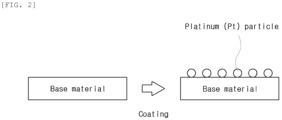
- FIG. 2 schematically illustrates of a step of forming a coating layer containing discontinuous platinum on a surface of the base material.
- a discontinuous coating layer is formed on the surface of the base material to enhance the fuel cell's corrosion resistance and conductivity.
- a coating layer with both excellent corrosion resistance and conductivity a range of precious metals including gold (Au), platinum (Pt), ruthenium (Ru), and iridium (Ir) are typically used.
- the present disclosure may form a coating layer of a metal separator of a fuel cell of for a vehicle with excellent corrosion resistance and conductivity by forming a coating layer containing platinum (Pt) on the surface of the base material, according to the purpose.
- a coating layer is formed by applying a current at a constant coating temperature using a coating material and an electrolyte.
- the coating material may be used without limitation as long as it contains platinum (Pt) and may be used as a coating material, but in particular, chloroplatinic acid (H 2 PtCl 6 ) or potassium chloroplatinate (K 2 PtCl 6 ) is preferred for a stable and efficient process.
- Platinum (Pt) and additional noble metal-based coating materials used as coating materials may be nanoparticles having a size of 10 nm to 1 um, and in the above range, these materials may form a discontinuous coating layer of lower density on the surface of the base material.
- an acidic electrolyte for example, a sulfuric acid-based or hydrochloric acid-based electrolyte may be used, and in particular, H 2 SO 4 or HClO 4 is preferred in terms of efficient chemical reaction during the formation of the platinum coating layer of the process.
- the content of the coating material and electrolyte may vary depending on the amount of Pt deposited and coating density required according to the specific embodiment. However, for example, a mixture of chloroplatinic acid (H 2 PtCl 6 ) or potassium chloroplatinate (K 2 PtCl 6 ) in the rang e of 1 ⁇ 10 -4 to 1 M and perchloric acid (HClO 4 ) or sulfuric acid (H 2 SO 4 ) in the range of 1 ⁇ 10 -2 to 1 M may be used.
- chloroplatinic acid H 2 PtCl 6
- K 2 PtCl 6 potassium chloroplatinate
- H 2 SO 4 perchloric acid
- corrosion performance and contact resistance may be excellent when chloroplatinic acid (H 2 PtCl 6 ) or potassium chloroplatinate (K 2 PtCl 6 ) in the range of 2 mM to 0.1 M and perchloric acid (HClO) or sulfuric acid (H 2 SO 4 ) in the range of 0.1 M to 0.5 M are used. It is more preferable when chloroplatinic acid (H 2 PtCl 6 ) or potassium chloroplatinate (K 2 PtCl 6 ) in the range of 10 mM to 0.05 M and perchloric acid (HClO) or sulfuric acid (H 2 SO 4 ) in the range of 0.2 M to 0.3 M are used.
- the relative content of the coating material and the electrolyte within the above range is 1 to 10 times the unit molar content of the electrolyte, a coating layer with excellent corrosion performance and contact resistance may be formed. If the content is less than the above range, sufficient platinum (Pt) coating may not be achieved. Conversely, exceeding this range could lead to a decrease in the process's efficiency.
- chloroplatinic acid H 2 PtCl 6
- potassium chloroplatinate K 2 PtCl 6
- electrolyte is used in the range of less than 5 ⁇ 10 -3 , it may be difficult to secure sufficient reduction.
- a coating material in addition to chloroplatinic acid or potassium chloroplatinate containing platinum, a coating material composed of precious metal-based components such as gold (Au), ruthenium (Ru), iridium (Ir), ruthenium oxide (RuO 2 ), and iridium oxide (IrO 2 ) may be additionally used.
- a coating material in addition to the sulfuric acid-based or hydrochloric acid-based electrolyte, a hydrofluoric acid-based or sulfuric acid-based electrolyte may be additionally used depending on the chemical properties of the added material.
- the coating step may be performed even in a coating temperature of room temperature, but may be performed in the range of, for example, 25 to 80°C in that reactivity may be improved through heating. Particularly, when the coating step is performed in the range of 40 to 60°C, corrosion performance and contact resistance are excellent while considering efficiency of a process, and particularly when the coating step is performed in the range of 50°C to 60°C, corrosion performance and contact resistance are excellent.
- the applied current during coating in the range of 5 to 60 mA/cm 2 in order to suppress uncoating or overcoating in an amount of platinum (Pt) deposited and to prevent surface oxidation due to overcurrent.
- Pt platinum
- the base material surface coating process method is not particularly limited as long as it is a commonly used method, but may be selected from, for example, electroplating, electroless plating, or a PVD method, and utilizing these methods can enhance the efficiency of the process.
- electroplating is desirable for its ability to produce uniform coating properties and mass production in coating and manufacturing a separator cathode.
- FIG. 3 schematically illustrates a step of thermal treatment of a base material on which the coating layer is formed.
- a step of forming oxide layer (S130) is performed through a thermal treatment process to secure excellent corrosion current and contact resistance throughout the separator.
- the temperature of the thermal treatment process may vary depending on the oxide layer formation characteristics of the base material, but it may be performed, for example, in a temperature range of 80 to 600°C. In particular, in the temperature range of 170 to 230°C for a stainless steel base material and 300 to 500°C for a titanium base material, the oxide layer formation rate and oxide layer efficiency are excellent.
- the time of the thermal treatment process may also vary depending on the characteristics of the base material. However, thermal treatment process may be performed, for example, for 10 to 180 minutes, and particularly, when performed for 30 to 60 minutes, the corrosion current and contact resistance performances of the oxide layer are excellent.
- the thermal treatment process may be performed in a standard atmosphere, but when performed in a low-oxygen, vacuum, or nitrogen atmosphere, the oxide layer formation efficiency and the formed oxide layer performance may be improved. Specifically, performing the thermal treatment in a low-oxygen atmosphere is advantageous as it helps prevent the excessive formation of oxide layers, thereby ensuring optimal contact resistance and maintaining the adhesion quality of the coating.
- the metal separator of the fuel cell may have excellent corrosion resistance and electrical conductivity for an extended period of time even in a high temperature and high humidity operating environment.
- the metal separator of a fuel cell for a vehicle with excellent corrosion resistance and electrical conductivity may be subjected to a base material coating step using a coating material containing platinum (Pt) and an electrolyte and a thermal treatment step to complete the metal separator of a fuel cell for a vehicle in which a base material, a discontinuous coating layer on its surface, and an oxide layer on a part where the coating layer is not formed are formed.
- a base material containing platinum (Pt) and an electrolyte
- a thermal treatment step to complete the metal separator of a fuel cell for a vehicle in which a base material, a discontinuous coating layer on its surface, and an oxide layer on a part where the coating layer is not formed are formed.
- a base material forming step with the base material, coating material and electrolyte compositions, applied currents, and temperatures as shown in Table 1 below and a coating step were performed, and a thermal treatment step was performed on the base material on which the discontinuous coating layer was formed under the conditions in Table 2 to manufacture specimens of Examples and Comparative Examples, respectively.
- metal separator specimens were manufactured by changing the amount of coating material in Comparative Example 1, the amount of electrolyte in Comparative Example 5, and the applied currents in Comparative Examples 2 and 6, respectively, as shown in Table 1, and in the thermal treatment step, by changing the heat treatment time in Comparative Examples 3 and 6, and the heat treatment temperature in Comparative Examples 4 and 8, respectively as shown in Table 2.
- Example 3 0.1 H 2 PtCl 6 0.1 HClO 4 20 50 Comp.
- Example 4 0.1 H 2 PtCl 6 0.1 HClO 4 20 60
- Example 6 Ti grade 1 0.1 H 2 PtCl 6 0.1 HClO 4 10 60
- Example 7 0.1 H 2 PtCl 6 0.1 HClO 4 20 60
- Example 8 0.05 H 2 PtCl 6 0.5 H 2 SO 4 10 60
- Example 9 0.02 K 2 PtCl 6 0.1 HClO 4 20 40
- Example 10 0.02 K 2 PtCl 6 0.5 H 2 SO 4 30 40 Comp.
- Example 5 0.1 H 2 PtCl 6 0.05 HClO 4 20 60
- Example 6 0.1 H 2 PtCl 6 0.1 HClO 4 3 60 Comp.
- Example 7 0.1 H 2 PtCl 6 0.1 HClO 4 20 60 Comp.
- Example 8 0.1 H 2 PtCl 6 0.1 HClO 4 20 60 [Table 2] Category Thermal treatment temperature (°C) Thermal treatment time (min)
- Example 1 190 60
- Example 2 200 60
- Example 3 210 60
- Example 4 220 50 Example 5 230 40 Comp.
- Example 2 220 60 Comp.
- Example 4 150 Example 6 350 60
- Example 8 450 60 Example 9 450 40
- Example 10 350 60 Comp.
- Example 5 350 60 Comp.
- Example 8 250 60
- FIG. 4 is a schematic diagram illustrating a structure of specimens for measuring the contact resistance of a metal separator of a fuel cell for a vehicle according to the present disclosure, and measurement positions of a comparative specimen (dummy).
- two gas diffusion layers (GDL) (120) and one current collector (130) were formed on both sides of the metal separator (bipolar plate: bp) (110) of each Comparative Example and Example to manufacture a specimen, and then the contact resistance between the separator and the gas diffusion layer (GDL) was measured at two points R1 and R2 and calculated according to the following equation to calculate the resistance between the separation and the gas diffusion layer.
- R 1 2 R cc ⁇ GDL + 2 R GDL ⁇ GDL + 2 R bp ⁇ GDL
- R 2 2 R cc ⁇ GDL + 2 R GDL ⁇ GDL
- bp refers to a metal separator
- GDL refers to a gas diffusion layer
- cc refers to a current collector
- S refers to a separator-GDL reaction area.
- Example 4 The results of the interfacial contact resistance and corrosion performance measured as above are shown in Table 4 below.
- Table 4 Category Interfacial contact resistance (m ⁇ cm 2 ) Corrosion performance ( ⁇ A/cm 2 )
- Example 1 8.3 2.5
- Example 2 9.7 1.8
- Example 3 9.9 1.5
- Example 4 8.9 1.9
- Example 5 9.8 1.3
- Example 1 20.1 3.3 Comp.
- Example 3 42.9 0.8 Comp.
- Example 4 7.8 13.1
- Example 6 11.2 2.2
- Example 7 9.3 2.4
- Example 8 12.6 0.8
- Example 9 11.7 1.2
- Example 10 10.6 2.5 Comp.
- Example 5 18.6 4.5
- Example 6 33.2 3.1 Comp.
- Example 7 38.5 0.7 Comp.
- Example 8 9.8 11.1
- each Example was found to be excellent in terms of corrosion performance and interfacial contact resistance compared to the Comparative Examples.
- the thermal treatment temperature and thermal treatment time had an effect on the interfacial contact resistance and corrosion performance, respectively.
- the thermal treatment time had a significant effect in terms of interfacial contact resistance
- the thermal treatment temperature had a significant effect in terms of corrosion performance.
- the present disclosure may be utilized in the field of fuel cells and in the field of separators for a fuel cells, and can improve the reliability and competitiveness of products in these fields.
Landscapes
- Chemical & Material Sciences (AREA)
- Engineering & Computer Science (AREA)
- Chemical Kinetics & Catalysis (AREA)
- Electrochemistry (AREA)
- General Chemical & Material Sciences (AREA)
- Sustainable Energy (AREA)
- Sustainable Development (AREA)
- Manufacturing & Machinery (AREA)
- Life Sciences & Earth Sciences (AREA)
- Materials Engineering (AREA)
- Metallurgy (AREA)
- Organic Chemistry (AREA)
- Composite Materials (AREA)
- Physics & Mathematics (AREA)
- Thermal Sciences (AREA)
- Mechanical Engineering (AREA)
- Fuel Cell (AREA)
Abstract
Description
- The present disclosure relates to a separator for a fuel cell with metal coating layer and a manufacturing method therefor, and more particularly, to a separator for a fuel cell on which a discontinuous coating layer is formed, using platinum and precious metals, and a manufacturing method therefor.
- Fuel cells used in hydrogen electricity are utilized as a power source generating electricity through an electrochemical reaction between a reaction gas and a catalyst. A cell stack of the fuel cell has a structure in which components such as a membrane electrode assembly (MEA), a separator (or a bipolar plate), a gasket, a current collector, and an end plate are connected to each other. Among these components, the membrane electrode assembly (MEA) has a structure in which gas diffusion electrodes (GDEs) each including a catalyst layer and a gas diffusion layer (GDL) are in contact with both sides of a polymer electrolyte member with the polymer electrolyte membrane interposed therebetween.
- A metal separator for a fuel cell is one of the components that constitute the stack of the fuel cell and is in electrical contact with a hydrogen electrode of a unit cell and an air electrode of an adjacent cell, where hydrogen and air are supplied into each electrode through a fluid flow channel on both sides of the separator. Therefore, the metal separator of a fuel cell collects and transmits electricity generated from electrochemical reactions, and plays a key role in conducting electricity, discharging water formed by electrical reactions, and managing heat inside a battery.
- A material with excellent electrical conductivity, such as stainless steel, titanium alloy, aluminum alloy, or polymer composite material, is used as the base material of the separator. However, when the separator is exposed to an operating environment of the fuel cell for a vehicle in which a temperature and a humidity are high for a long time, due to characteristics of the metal, corrosion is accelerated, and metal oxide formed on a surface of the base material of the separator acts as an electrical insulator to decrease overall performance of the fuel cell due to decrease of conductivity or contamination of the catalyst.
- In order to prevent these problems, research into technology of securing corrosion resistance and improving conductivity by forming a discontinuous coating layer containing a polymer, carbon, and various precious metal materials including gold (Au), platinum (Pt), ruthenium (Ru), iridium (Ir), etc., on the surface of the base material of the metal separator has been conducted, but in practice, a coating layer using a gold (Au) nano-coating layer has been mainly used. However, due to a continuous increase in price of gold (Au), the necessity to develop an alternative coating layer has emerged.
- Furthermore, experiments or studies have previously been conducted showing that a discontinuous platinum (Pt) coating layer may be formed on a surface of the base material. However, the results showing process efficiency and clear significance in application of the coating layer using platinum are insufficient.
- When the discontinuous coating layer is applied, a part of the surface of the base material of the separator is directly exposed to the outside. For future fuel cell stacks that require high output and long durability, coating technology with excellent conductivity and chemical stability is required even when used in harsh environments, despite the fact that a lot of resources are required to ensure performance due to coating uniformity of new coating materials and to verify the stability of a plated electrode body.
- Related technology is disclosed in
Korean Patent Laid-Open Publication No. 10-2015-0138105 (published on April 7, 2017 - The problem to be solved by the present disclosure is to provide a metal separator of a fuel cell for a vehicle with excellent corrosion resistance and contact resistance, as well as excellent production efficiency, and a manufacturing method therefor.
- A method for manufacturing a metal separator of a fuel cell for a vehicle according to one embodiment of the present disclosure may include the steps of: preparing a base material; forming a discontinuous coating layer by applying coating agent that contains platinum (Pt) and further contains at least one of the groups consisting of gold (Au), ruthenium (Ru), iridium (Ir), ruthenium oxide (RuO2), and iridium oxide (IrO2), and an electrolyte to the base material; and thermally treating the base material on which the coating layer is formed.
- In an embodiment, the base material may be a stainless steel plate, titanium, or aluminum.
- In an embodiment, the step of forming of the coating layer may be performed through any one of electroplating, electroless plating, or a PVD process.
- In an embodiment, chloroplatinic acid (H2PtCl6) or potassium chloroplatinate (K2PtCl6) may be contained as platinum (Pt) contained in the coating agent.
- In an embodiment, the step of thermally treating may be performed in a temperature range of 80 to 600°C and a time range of 10 to 180 minutes.
- In an embodiment, the step of thermally treating may be performed under any one of vacuum, air, and oxygen atmosphere.
- The metal separator of a fuel cell for a vehicle according to another embodiment of the present disclosure may be a metal separator of a fuel cell for a vehicle manufactured by any one of the above-described embodiments.
- According to the present disclosure, a metal separator for a fuel cell with excellent corrosion resistance and contact resistance, as well as excellent production efficiency, and a manufacturing method therefor may be provided.
-
-
FIG. 1 is a process flow diagram schematically illustrating a method for manufacturing a separator for a fuel cell according to an embodiment of the present disclosure. -
FIG. 2 is a diagram schematically illustrating a step of coating platinum according to an Example of the present disclosure and Comparative Example. -
FIG. 3 is a diagram schematically illustrating a step of thermal treatment according to an Example of the present disclosure and Comparative Example. -
FIG. 4 is a schematic diagram for explaining specimens and measurement positions for measuring contact resistance of Examples and Comparative Examples of the present disclosure. - Hereinafter, the present disclosure will be described in detail to enable those skilled in the art to which the invention belongs to readily practice the invention with reference to the accompanying drawings. The present disclosure may be implemented in many different forms and is not limited to the embodiments described herein. Throughout the specification, identical or similar components are indicated by the same reference numerals. In addition, detailed descriptions of known functions and configurations that may unnecessarily obscure the gist of the present disclosure are omitted.
-
FIG. 1 is a flow diagram used in a method for manufacturing of a metal separator of a fuel cell for a vehicle according to an embodiment of the present disclosure. The manufacturing method according to the present disclosure includes a step of forming base material (S110), a step of forming coating layer on a surface of base material (S120), and a step of thermal treatment (S130). - There is no particular limitation on the steel of the metal separator of a fuel cell for a vehicle as long as it is a metal or non-ferrous metal used for the metal separator, but stainless steel, titanium, aluminum, etc. may be used, and for example, SUS 300-series and 400-series stainless steel or Grade 1 titanium may be preferred due to their superior elongation properties and durability.
-
FIG. 2 schematically illustrates of a step of forming a coating layer containing discontinuous platinum on a surface of the base material. - When the fuel cell for a vehicle is exposed to a high-temperature and humid operating environment for an extended period of time, metal oxides that gradually adversely affect the conductivity of the fuel cell form on the surface of the base material. Therefore, in the present disclosure, a discontinuous coating layer is formed on the surface of the base material to enhance the fuel cell's corrosion resistance and conductivity.
- In order to form a coating layer with both excellent corrosion resistance and conductivity, a range of precious metals including gold (Au), platinum (Pt), ruthenium (Ru), and iridium (Ir) are typically used. The present disclosure may form a coating layer of a metal separator of a fuel cell of for a vehicle with excellent corrosion resistance and conductivity by forming a coating layer containing platinum (Pt) on the surface of the base material, according to the purpose.
- Specifically, in the step of forming a coating layer, a coating layer is formed by applying a current at a constant coating temperature using a coating material and an electrolyte. The coating material may be used without limitation as long as it contains platinum (Pt) and may be used as a coating material, but in particular, chloroplatinic acid (H2PtCl6) or potassium chloroplatinate (K2PtCl6) is preferred for a stable and efficient process.
- Platinum (Pt) and additional noble metal-based coating materials used as coating materials may be nanoparticles having a size of 10 nm to 1 um, and in the above range, these materials may form a discontinuous coating layer of lower density on the surface of the base material.
- As an electrolyte, an acidic electrolyte, for example, a sulfuric acid-based or hydrochloric acid-based electrolyte may be used, and in particular, H2SO4 or HClO4 is preferred in terms of efficient chemical reaction during the formation of the platinum coating layer of the process.
- The content of the coating material and electrolyte may vary depending on the amount of Pt deposited and coating density required according to the specific embodiment. However, for example, a mixture of chloroplatinic acid (H2PtCl6) or potassium chloroplatinate (K2PtCl6) in the rang e of 1 × 10⁻⁴ to 1 M and perchloric acid (HClO4) or sulfuric acid (H2SO4) in the range of 1 × 10⁻² to 1 M may be used. In particular, corrosion performance and contact resistance may be excellent when chloroplatinic acid (H2PtCl6) or potassium chloroplatinate (K2PtCl6) in the range of 2 mM to 0.1 M and perchloric acid (HClO) or sulfuric acid (H2SO4) in the range of 0.1 M to 0.5 M are used. It is more preferable when chloroplatinic acid (H2PtCl6) or potassium chloroplatinate (K2PtCl6) in the range of 10 mM to 0.05 M and perchloric acid (HClO) or sulfuric acid (H2SO4) in the range of 0.2 M to 0.3 M are used.
- If the relative content of the coating material and the electrolyte within the above range is 1 to 10 times the unit molar content of the electrolyte, a coating layer with excellent corrosion performance and contact resistance may be formed. If the content is less than the above range, sufficient platinum (Pt) coating may not be achieved. Conversely, exceeding this range could lead to a decrease in the process's efficiency.
- When chloroplatinic acid (H2PtCl6) or potassium chloroplatinate (K2PtCl6) as a coating material is used in the range of less than 5 × 10⁻³, it may be difficult to secure a sufficient amount of platinum (Pt) deposited. When the electrolyte is used in the range of less than 5 × 10⁻³, it may be difficult to secure sufficient reduction.
- As a coating material, in addition to chloroplatinic acid or potassium chloroplatinate containing platinum, a coating material composed of precious metal-based components such as gold (Au), ruthenium (Ru), iridium (Ir), ruthenium oxide (RuO2), and iridium oxide (IrO2) may be additionally used. When an additional coating material is used, in addition to the sulfuric acid-based or hydrochloric acid-based electrolyte, a hydrofluoric acid-based or sulfuric acid-based electrolyte may be additionally used depending on the chemical properties of the added material.
- The coating step may be performed even in a coating temperature of room temperature, but may be performed in the range of, for example, 25 to 80°C in that reactivity may be improved through heating. Particularly, when the coating step is performed in the range of 40 to 60°C, corrosion performance and contact resistance are excellent while considering efficiency of a process, and particularly when the coating step is performed in the range of 50°C to 60°C, corrosion performance and contact resistance are excellent.
- It is preferably to perform the applied current during coating in the range of 5 to 60 mA/cm2 in order to suppress uncoating or overcoating in an amount of platinum (Pt) deposited and to prevent surface oxidation due to overcurrent. In particular, for optimal surface stability of the base material and superior coating layer performance, it is preferable to perform in the range of 10 to 20 mA/cm2.
- The base material surface coating process method is not particularly limited as long as it is a commonly used method, but may be selected from, for example, electroplating, electroless plating, or a PVD method, and utilizing these methods can enhance the efficiency of the process. Particularly, electroplating is desirable for its ability to produce uniform coating properties and mass production in coating and manufacturing a separator cathode.
-
FIG. 3 schematically illustrates a step of thermal treatment of a base material on which the coating layer is formed. - In the step of coating a surface of a base material, since a discontinuous coating layer of platinum (Pt) and other materials is formed on the surface of the base material to expose part of the surface of the base material to the outside, a step of forming oxide layer (S130) is performed through a thermal treatment process to secure excellent corrosion current and contact resistance throughout the separator.
- Specifically, the temperature of the thermal treatment process may vary depending on the oxide layer formation characteristics of the base material, but it may be performed, for example, in a temperature range of 80 to 600°C. In particular, in the temperature range of 170 to 230°C for a stainless steel base material and 300 to 500°C for a titanium base material, the oxide layer formation rate and oxide layer efficiency are excellent.
- The time of the thermal treatment process may also vary depending on the characteristics of the base material. However, thermal treatment process may be performed, for example, for 10 to 180 minutes, and particularly, when performed for 30 to 60 minutes, the corrosion current and contact resistance performances of the oxide layer are excellent.
- The thermal treatment process may be performed in a standard atmosphere, but when performed in a low-oxygen, vacuum, or nitrogen atmosphere, the oxide layer formation efficiency and the formed oxide layer performance may be improved. Specifically, performing the thermal treatment in a low-oxygen atmosphere is advantageous as it helps prevent the excessive formation of oxide layers, thereby ensuring optimal contact resistance and maintaining the adhesion quality of the coating.
- According to the method of manufacturing the metal separator of a fuel cell for a vehicle, the metal separator of the fuel cell may have excellent corrosion resistance and electrical conductivity for an extended period of time even in a high temperature and high humidity operating environment.
- Therefore, as described above, the metal separator of a fuel cell for a vehicle with excellent corrosion resistance and electrical conductivity may be subjected to a base material coating step using a coating material containing platinum (Pt) and an electrolyte and a thermal treatment step to complete the metal separator of a fuel cell for a vehicle in which a base material, a discontinuous coating layer on its surface, and an oxide layer on a part where the coating layer is not formed are formed.
- A base material forming step with the base material, coating material and electrolyte compositions, applied currents, and temperatures as shown in Table 1 below and a coating step were performed, and a thermal treatment step was performed on the base material on which the discontinuous coating layer was formed under the conditions in Table 2 to manufacture specimens of Examples and Comparative Examples, respectively.
- Specifically, when compared to the Examples according to the present disclosure, in the coating material formation step, metal separator specimens were manufactured by changing the amount of coating material in Comparative Example 1, the amount of electrolyte in Comparative Example 5, and the applied currents in Comparative Examples 2 and 6, respectively, as shown in Table 1, and in the thermal treatment step, by changing the heat treatment time in Comparative Examples 3 and 6, and the heat treatment temperature in Comparative Examples 4 and 8, respectively as shown in Table 2.
[table 1] Category Base material Coating material (M) Electrolyte (M) Applied current (mA/cm2) Temper ature (°C) Example 1 SUS316L 0.1 H2PtCl6 0.1 HClO4 10 60 Example 2 0.1 H2PtCl6 0.1 HClO4 20 60 Example 3 0.05 H2PtCl6 0.5 H2SO4 10 60 Example 4 0.02 K2PtCl6 0.1 HClO4 20 40 Example 5 0.02 K2PtCl6 0.5 H2SO4 30 40 Comp. Example 1 5×10⁻⁵ H2PtCl6 0.5 H2SO4 10 60 Comp. Example 2 0.1 H2PtCl6 0.1 HClO4 3 60 Comp. Example 3 0.1 H2PtCl6 0.1 HClO4 20 50 Comp. Example 4 0.1 H2PtCl6 0.1 HClO4 20 60 Example 6 Ti grade 1 0.1 H2PtCl6 0.1 HClO4 10 60 Example 7 0.1 H2PtCl6 0.1 HClO4 20 60 Example 8 0.05 H2PtCl6 0.5 H2SO4 10 60 Example 9 0.02 K2PtCl6 0.1 HClO4 20 40 Example 10 0.02 K2PtCl6 0.5 H2SO4 30 40 Comp. Example 5 0.1 H2PtCl6 0.05 HClO4 20 60 Comp. Example 6 0.1 H2PtCl6 0.1 HClO4 3 60 Comp. Example 7 0.1 H2PtCl6 0.1 HClO4 20 60 Comp. Example 8 0.1 H2PtCl6 0.1 HClO4 20 60 [Table 2] Category Thermal treatment temperature (°C) Thermal treatment time (min) Example 1 190 60 Example 2 200 60 Example 3 210 60 Example 4 220 50 Example 5 230 40 Comp. Example 1 210 60 Comp. Example 2 220 60 Comp. Example 3 220 120 Comp. Example 4 150 60 Example 6 350 60 Example 7 350 40 Example 8 450 60 Example 9 450 40 Example 10 350 60 Comp. Example 5 350 60 Comp. Example 6 450 60 Comp. Example 7 350 120 Comp. Example 8 250 60 - Interfacial contact resistance (ICR) was measured for Examples and Comparative Examples.
FIG. 4 is a schematic diagram illustrating a structure of specimens for measuring the contact resistance of a metal separator of a fuel cell for a vehicle according to the present disclosure, and measurement positions of a comparative specimen (dummy). Prior to actual measurement, two gas diffusion layers (GDL) (120) and one current collector (130) were formed on both sides of the metal separator (bipolar plate: bp) (110) of each Comparative Example and Example to manufacture a specimen, and then the contact resistance between the separator and the gas diffusion layer (GDL) was measured at two points R1 and R2 and calculated according to the following equation to calculate the resistance between the separation and the gas diffusion layer. For R2 measurement, three gas diffusion layers (120) were stacked except for the metal separator, and a current collector (130) was stacked on both sides to manufacture a dummy specimen, and then, a pressure of 50 to 100 N/cm2 was applied to the dummy using a pressure machine (68SC5, Instron Corporation) when measuring contact resistance.


wherein bp refers to a metal separator, GDL refers to a gas diffusion layer, cc refers to a current collector, and S refers to a separator-GDL reaction area. - Specimens were manufactured from the metal separators of the above Examples and Comparative Examples, and short-term corrosion resistance evaluation of the base material and surface treatment layer was performed on each specimen. A potentiodynamic polarization method was conducted, and the test conditions are shown in Table 3 below. HIOKI's 3541 precision resistance measurement equipment was used as the current application and resistance measurement equipment.
[Table 3] Category Description Corrosive solution 0.1 N H2SO4 + 2 ppm HF Solution temperature Maintained at 80° C Working electrode Exposed area 1.0 cm2 Reference electrode Mercury sulfate electrode (MSE) SCE (@0.6V vs SCE) Counter electrode Carbon electrode rod Scan Rate 1 mV/s Scan Range -0.25 V vs. OCV ∼ 1.0 V Evaluation standard 10 µA/cm2 or less - The results of the interfacial contact resistance and corrosion performance measured as above are shown in Table 4 below.
[Table 4] Category Interfacial contact resistance (mΩ·cm2) Corrosion performance (µA/cm2) Example 1 8.3 2.5 Example 2 9.7 1.8 Example 3 9.9 1.5 Example 4 8.9 1.9 Example 5 9.8 1.3 Comp. Example 1 20.1 3.3 Comp. Example 2 28.2 1.2 Comp. Example 3 42.9 0.8 Comp. Example 4 7.8 13.1 Example 6 11.2 2.2 Example 7 9.3 2.4 Example 8 12.6 0.8 Example 9 11.7 1.2 Example 10 10.6 2.5 Comp. Example 5 18.6 4.5 Comp. Example 6 33.2 3.1 Comp. Example 7 38.5 0.7 Comp. Example 8 9.8 11.1 - For Comparative Examples and Examples, a steering rack bar was manufactured to perform a cold drawing test, and the product was visually observed for cracks occurred and the results are shown in Table 4.
- Referring to Tables 1 to 4, in Examples 1 to 5 and Comparative Examples 1 to 4 using a stainless base material and Examples 6 to 10 and Comparative Examples 5 to 8 using a titanium base material, each Example was found to be excellent in terms of corrosion performance and interfacial contact resistance compared to the Comparative Examples.
- Specifically, it was confirmed that when the amount of electrolyte or coating material was out of the range of the present disclosure, the performance was significantly degraded compared to other Examples using the same base material in terms of both interfacial contact resistance and corrosion performance, and it was confirmed that when the applied current and coating temperature are out of a certain range, the performance of the interfacial contact resistance was degraded, which means that appropriate coating process conditions have a significant impact on achieving the purpose of the present disclosure.
- Even in the step of thermal treatment, it was found that the thermal treatment temperature and thermal treatment time had an effect on the interfacial contact resistance and corrosion performance, respectively. In particular, it was confirmed that the thermal treatment time had a significant effect in terms of interfacial contact resistance, and the thermal treatment temperature had a significant effect in terms of corrosion performance.
- Although the above description focuses on the embodiments of the present disclosure, various changes and modifications can be made at the level of those skilled in the art. It can be said that these changes and modifications belong to the present disclosure as long as they do not depart from the scope of the present disclosure. Therefore, the scope of the present disclosure should be determined by the claims set forth below.
- The present disclosure may be utilized in the field of fuel cells and in the field of separators for a fuel cells, and can improve the reliability and competitiveness of products in these fields.
Claims (8)
- A method for manufacturing a metal separator of a fuel cell for a vehicle_the method comprising steps of:preparing a base material;forming a discontinuous coating layer by applying a platinum (Pt)-containing coating agent and an electrolyte to the base material; andthermally treating the base material on which the coating layer is formed.
- The method of claim 1, wherein the coating agent further contains at least one of the groups consisting of gold (Au), ruthenium (Ru), iridium (Ir), ruthenium oxide (RuO2), and iridium oxide (IrO2).
- The method of claim 1, wherein the base material is stainless steel plate, titanium, or aluminum.
- The method of claim 1, wherein the step of forming the coating layer is performed through any one of electroplating, electroless plating, or a PVD process.
- The method of claim 1, wherein chloroplatinic acid (H2PtCl6) or potassium chloroplatinate (K2PtCl6) is contained as platinum (Pt) contained in the coating agent.
- The method of claim 1, wherein the step of thermally treating is performed in a temperature range of 80 to 600°C and a time range of 10 to 180 minutes.
- The method of claim 1, wherein the step of thermally treating is performed under any one of vacuum, air, and oxygen atmosphere.
- A metal separator of a fuel cell for a vehicle manufactured by the method of any one of claims 1 to 7.
Applications Claiming Priority (2)
| Application Number | Priority Date | Filing Date | Title |
|---|---|---|---|
| KR1020210150245A KR102658181B1 (en) | 2021-11-04 | 2021-11-04 | Separator plate for fuel cell with metal coating layer and manufacturing method thereof |
| PCT/KR2022/017131 WO2023080675A1 (en) | 2021-11-04 | 2022-11-03 | Separator, having metal coating layer thereon, for fuel cell and manufacturing method therefor |
Publications (2)
| Publication Number | Publication Date |
|---|---|
| EP4428958A1 true EP4428958A1 (en) | 2024-09-11 |
| EP4428958A4 EP4428958A4 (en) | 2025-11-19 |
Family
ID=86241898
Family Applications (1)
| Application Number | Title | Priority Date | Filing Date |
|---|---|---|---|
| EP22890406.6A Pending EP4428958A4 (en) | 2021-11-04 | 2022-11-03 | SEPARATOR WITH METAL COATING LAYER FOR FUEL CELL AND MANUFACTURING METHOD FOR IT |
Country Status (7)
| Country | Link |
|---|---|
| US (1) | US20240282979A1 (en) |
| EP (1) | EP4428958A4 (en) |
| JP (1) | JP7830636B2 (en) |
| KR (1) | KR102658181B1 (en) |
| CN (1) | CN118176602A (en) |
| AU (1) | AU2022383696B2 (en) |
| WO (1) | WO2023080675A1 (en) |
Family Cites Families (9)
| Publication number | Priority date | Publication date | Assignee | Title |
|---|---|---|---|---|
| JPWO2003026052A1 (en) * | 2001-09-18 | 2005-01-06 | 株式会社フルヤ金属 | Bipolar plate for fuel cell and manufacturing method thereof |
| CN100472864C (en) * | 2005-05-25 | 2009-03-25 | 日立电线株式会社 | Separator for fuel cell and manufacturing method thereof |
| JP4551429B2 (en) * | 2006-09-29 | 2010-09-29 | 株式会社神戸製鋼所 | Method for manufacturing fuel cell separator, fuel cell separator and fuel cell |
| JP5132224B2 (en) * | 2007-08-27 | 2013-01-30 | 住友軽金属工業株式会社 | Aluminum plate for fuel cell, separator using the same, end plate, fuel cell using them, and repair method thereof. |
| KR101165542B1 (en) * | 2009-08-21 | 2012-07-16 | 현대하이스코 주식회사 | Metal separator for fuel cell having coating film and method for the same |
| KR101491752B1 (en) * | 2012-05-04 | 2015-02-11 | 강원대학교산학협력단 | Bipolar plate for fuel cell and mehtod for manufacturing the same, and fuel cell including the same |
| KR101778359B1 (en) | 2014-05-29 | 2017-09-14 | 주식회사 엘지화학 | Hetero-cyclic compound and organic light emitting device comprising the same |
| JP5880799B1 (en) * | 2014-08-19 | 2016-03-09 | 新日鐵住金株式会社 | Metal material and current-carrying parts using this metal material |
| JP6628122B2 (en) * | 2015-02-03 | 2020-01-08 | 日産自動車株式会社 | Conductive member, manufacturing method thereof, fuel cell separator and polymer electrolyte fuel cell using the same |
-
2021
- 2021-11-04 KR KR1020210150245A patent/KR102658181B1/en active Active
-
2022
- 2022-11-03 CN CN202280073057.7A patent/CN118176602A/en active Pending
- 2022-11-03 AU AU2022383696A patent/AU2022383696B2/en active Active
- 2022-11-03 JP JP2024523788A patent/JP7830636B2/en active Active
- 2022-11-03 EP EP22890406.6A patent/EP4428958A4/en active Pending
- 2022-11-03 WO PCT/KR2022/017131 patent/WO2023080675A1/en not_active Ceased
-
2024
- 2024-05-03 US US18/654,563 patent/US20240282979A1/en active Pending
Also Published As
| Publication number | Publication date |
|---|---|
| AU2022383696B2 (en) | 2025-10-09 |
| JP2024538807A (en) | 2024-10-23 |
| WO2023080675A1 (en) | 2023-05-11 |
| EP4428958A4 (en) | 2025-11-19 |
| AU2022383696A1 (en) | 2024-05-09 |
| US20240282979A1 (en) | 2024-08-22 |
| CN118176602A (en) | 2024-06-11 |
| KR20230064770A (en) | 2023-05-11 |
| JP7830636B2 (en) | 2026-03-16 |
| KR102658181B1 (en) | 2024-04-16 |
Similar Documents
| Publication | Publication Date | Title |
|---|---|---|
| EP2112250B1 (en) | Stainless separator for fuel cell and method of manufacturing the same | |
| EP2168189B1 (en) | Stainless steel separator for fuel cell having m/mnx and moynz layer and method for manufacturing the same | |
| EP2469634B1 (en) | Metal separator plate for fuel cell having coating film formed on surface and method for producing same | |
| KR101597721B1 (en) | Titanium material for solid polymer fuel cell separators, method for producing same, and solid polymer fuel cell using same | |
| CN101578728B (en) | Alloy coating film for metal separator of fuel cell, method for producing same, target material for sputtering, metal separator, and fuel cell | |
| US20030170526A1 (en) | Substrate treatment | |
| JP4901864B2 (en) | Separator for solid polymer fuel cell made of pure titanium or titanium alloy and method for producing the same | |
| JP4926730B2 (en) | Titanium material for polymer electrolyte fuel cell separator and method for producing the same, separator using the titanium material, and polymer electrolyte fuel cell using the separator | |
| JPH11162478A (en) | Fuel cell separator | |
| EP2870649A1 (en) | Platinum and palladium alloys suitable as fuel cell electrodes | |
| CN100472864C (en) | Separator for fuel cell and manufacturing method thereof | |
| JP5573039B2 (en) | Stainless steel for polymer electrolyte fuel cell separator and method for producing the same | |
| EP4428958A1 (en) | Separator, having metal coating layer thereon, for fuel cell and manufacturing method therefor | |
| KR20170038556A (en) | Coating composition for interconnector surface treatment of solide oxide feul cell and preparation method thereof | |
| JP5880799B1 (en) | Metal material and current-carrying parts using this metal material | |
| EP1735865B1 (en) | Fuel cell separator, fuel cell stack, fuel cell vehicle, and method of manufacturing the fuel cell separator | |
| JP2012149314A (en) | Metal plate for polymer electrolyte fuel cell separator and method for producing the same | |
| JP7845157B2 (en) | Anode-side separator and water electrolysis device | |
| JP2012142186A (en) | Stainless steel for solid polymer fuel cell separator and method for manufacturing the same | |
| JP2025123802A (en) | catalytic alloy | |
| JP2004095472A (en) | Solid polymer electrolyte fuel cell materials | |
| JP2020105556A (en) | Metal materials, separators, fuel cells, and fuel cell stacks | |
| Kawamura et al. | Electrochemical study of Pd-coated perovskite anodes in sulfur-based hybrid cycle | |
| JP2010086897A (en) | Fuel cell separator, and method of manufacturing the same |
Legal Events
| Date | Code | Title | Description |
|---|---|---|---|
| STAA | Information on the status of an ep patent application or granted ep patent |
Free format text: STATUS: THE INTERNATIONAL PUBLICATION HAS BEEN MADE |
|
| PUAI | Public reference made under article 153(3) epc to a published international application that has entered the european phase |
Free format text: ORIGINAL CODE: 0009012 |
|
| STAA | Information on the status of an ep patent application or granted ep patent |
Free format text: STATUS: REQUEST FOR EXAMINATION WAS MADE |
|
| 17P | Request for examination filed |
Effective date: 20240424 |
|
| AK | Designated contracting states |
Kind code of ref document: A1 Designated state(s): AL AT BE BG CH CY CZ DE DK EE ES FI FR GB GR HR HU IE IS IT LI LT LU LV MC ME MK MT NL NO PL PT RO RS SE SI SK SM TR |
|
| DAV | Request for validation of the european patent (deleted) | ||
| DAX | Request for extension of the european patent (deleted) | ||
| A4 | Supplementary search report drawn up and despatched |
Effective date: 20251021 |
|
| RIC1 | Information provided on ipc code assigned before grant |
Ipc: H01M 8/0228 20160101AFI20251015BHEP Ipc: H01M 8/0206 20160101ALI20251015BHEP Ipc: H01M 8/0258 20160101ALI20251015BHEP Ipc: C25D 3/50 20060101ALI20251015BHEP Ipc: C25D 5/50 20060101ALI20251015BHEP |