EP4428875A1 - System and method for generating a virtual model of a virtual patient - Google Patents
System and method for generating a virtual model of a virtual patient Download PDFInfo
- Publication number
- EP4428875A1 EP4428875A1 EP23160698.9A EP23160698A EP4428875A1 EP 4428875 A1 EP4428875 A1 EP 4428875A1 EP 23160698 A EP23160698 A EP 23160698A EP 4428875 A1 EP4428875 A1 EP 4428875A1
- Authority
- EP
- European Patent Office
- Prior art keywords
- virtual
- virtual model
- values
- module
- template
- Prior art date
- Legal status (The legal status is an assumption and is not a legal conclusion. Google has not performed a legal analysis and makes no representation as to the accuracy of the status listed.)
- Pending
Links
Images


Classifications
-
- G—PHYSICS
- G06—COMPUTING OR CALCULATING; COUNTING
- G06T—IMAGE DATA PROCESSING OR GENERATION, IN GENERAL
- G06T17/00—Three-dimensional [3D] modelling for computer graphics
- G06T17/20—Finite element generation, e.g. wire-frame surface description, tesselation
-
- G—PHYSICS
- G16—INFORMATION AND COMMUNICATION TECHNOLOGY [ICT] SPECIALLY ADAPTED FOR SPECIFIC APPLICATION FIELDS
- G16H—HEALTHCARE INFORMATICS, i.e. INFORMATION AND COMMUNICATION TECHNOLOGY [ICT] SPECIALLY ADAPTED FOR THE HANDLING OR PROCESSING OF MEDICAL OR HEALTHCARE DATA
- G16H50/00—ICT specially adapted for medical diagnosis, medical simulation or medical data mining; ICT specially adapted for detecting, monitoring or modelling epidemics or pandemics
- G16H50/50—ICT specially adapted for medical diagnosis, medical simulation or medical data mining; ICT specially adapted for detecting, monitoring or modelling epidemics or pandemics for simulation or modelling of medical disorders
-
- A—HUMAN NECESSITIES
- A61—MEDICAL OR VETERINARY SCIENCE; HYGIENE
- A61B—DIAGNOSIS; SURGERY; IDENTIFICATION
- A61B34/00—Computer-aided surgery; Manipulators or robots specially adapted for use in surgery
- A61B34/10—Computer-aided planning, simulation or modelling of surgical operations
-
- A—HUMAN NECESSITIES
- A61—MEDICAL OR VETERINARY SCIENCE; HYGIENE
- A61B—DIAGNOSIS; SURGERY; IDENTIFICATION
- A61B34/00—Computer-aided surgery; Manipulators or robots specially adapted for use in surgery
- A61B34/25—User interfaces for surgical systems
-
- G—PHYSICS
- G06—COMPUTING OR CALCULATING; COUNTING
- G06N—COMPUTING ARRANGEMENTS BASED ON SPECIFIC COMPUTATIONAL MODELS
- G06N20/00—Machine learning
-
- G—PHYSICS
- G06—COMPUTING OR CALCULATING; COUNTING
- G06T—IMAGE DATA PROCESSING OR GENERATION, IN GENERAL
- G06T19/00—Manipulating three-dimensional [3D] models or images for computer graphics
- G06T19/20—Editing of three-dimensional [3D] images, e.g. changing shapes or colours, aligning objects or positioning parts
-
- G—PHYSICS
- G16—INFORMATION AND COMMUNICATION TECHNOLOGY [ICT] SPECIALLY ADAPTED FOR SPECIFIC APPLICATION FIELDS
- G16H—HEALTHCARE INFORMATICS, i.e. INFORMATION AND COMMUNICATION TECHNOLOGY [ICT] SPECIALLY ADAPTED FOR THE HANDLING OR PROCESSING OF MEDICAL OR HEALTHCARE DATA
- G16H50/00—ICT specially adapted for medical diagnosis, medical simulation or medical data mining; ICT specially adapted for detecting, monitoring or modelling epidemics or pandemics
- G16H50/70—ICT specially adapted for medical diagnosis, medical simulation or medical data mining; ICT specially adapted for detecting, monitoring or modelling epidemics or pandemics for mining of medical data, e.g. analysing previous cases of other patients
-
- A—HUMAN NECESSITIES
- A61—MEDICAL OR VETERINARY SCIENCE; HYGIENE
- A61B—DIAGNOSIS; SURGERY; IDENTIFICATION
- A61B34/00—Computer-aided surgery; Manipulators or robots specially adapted for use in surgery
- A61B34/10—Computer-aided planning, simulation or modelling of surgical operations
- A61B2034/101—Computer-aided simulation of surgical operations
-
- A—HUMAN NECESSITIES
- A61—MEDICAL OR VETERINARY SCIENCE; HYGIENE
- A61B—DIAGNOSIS; SURGERY; IDENTIFICATION
- A61B34/00—Computer-aided surgery; Manipulators or robots specially adapted for use in surgery
- A61B34/10—Computer-aided planning, simulation or modelling of surgical operations
- A61B2034/101—Computer-aided simulation of surgical operations
- A61B2034/105—Modelling of the patient, e.g. for ligaments or bones
-
- A—HUMAN NECESSITIES
- A61—MEDICAL OR VETERINARY SCIENCE; HYGIENE
- A61B—DIAGNOSIS; SURGERY; IDENTIFICATION
- A61B34/00—Computer-aided surgery; Manipulators or robots specially adapted for use in surgery
- A61B34/25—User interfaces for surgical systems
- A61B2034/256—User interfaces for surgical systems having a database of accessory information, e.g. including context sensitive help or scientific articles
-
- A—HUMAN NECESSITIES
- A61—MEDICAL OR VETERINARY SCIENCE; HYGIENE
- A61B—DIAGNOSIS; SURGERY; IDENTIFICATION
- A61B90/00—Instruments, implements or accessories specially adapted for surgery or diagnosis and not covered by any of the groups A61B1/00 - A61B50/00, e.g. for luxation treatment or for protecting wound edges
- A61B90/36—Image-producing devices or illumination devices not otherwise provided for
- A61B2090/364—Correlation of different images or relation of image positions in respect to the body
- A61B2090/365—Correlation of different images or relation of image positions in respect to the body augmented reality, i.e. correlating a live optical image with another image
-
- A—HUMAN NECESSITIES
- A61—MEDICAL OR VETERINARY SCIENCE; HYGIENE
- A61B—DIAGNOSIS; SURGERY; IDENTIFICATION
- A61B90/00—Instruments, implements or accessories specially adapted for surgery or diagnosis and not covered by any of the groups A61B1/00 - A61B50/00, e.g. for luxation treatment or for protecting wound edges
- A61B90/36—Image-producing devices or illumination devices not otherwise provided for
- A61B90/37—Surgical systems with images on a monitor during operation
- A61B2090/376—Surgical systems with images on a monitor during operation using X-rays, e.g. fluoroscopy
- A61B2090/3762—Surgical systems with images on a monitor during operation using X-rays, e.g. fluoroscopy using computed tomography systems [CT]
- A61B2090/3764—Surgical systems with images on a monitor during operation using X-rays, e.g. fluoroscopy using computed tomography systems [CT] with a rotating C-arm having a cone beam emitting source
-
- G—PHYSICS
- G06—COMPUTING OR CALCULATING; COUNTING
- G06T—IMAGE DATA PROCESSING OR GENERATION, IN GENERAL
- G06T2200/00—Indexing scheme for image data processing or generation, in general
- G06T2200/24—Indexing scheme for image data processing or generation, in general involving graphical user interfaces [GUIs]
-
- G—PHYSICS
- G06—COMPUTING OR CALCULATING; COUNTING
- G06T—IMAGE DATA PROCESSING OR GENERATION, IN GENERAL
- G06T2210/00—Indexing scheme for image generation or computer graphics
- G06T2210/41—Medical
-
- G—PHYSICS
- G06—COMPUTING OR CALCULATING; COUNTING
- G06T—IMAGE DATA PROCESSING OR GENERATION, IN GENERAL
- G06T2210/00—Indexing scheme for image generation or computer graphics
- G06T2210/44—Morphing
-
- G—PHYSICS
- G06—COMPUTING OR CALCULATING; COUNTING
- G06T—IMAGE DATA PROCESSING OR GENERATION, IN GENERAL
- G06T2219/00—Indexing scheme for manipulating 3D models or images for computer graphics
- G06T2219/20—Indexing scheme for editing of 3D models
- G06T2219/2021—Shape modification
-
- G—PHYSICS
- G16—INFORMATION AND COMMUNICATION TECHNOLOGY [ICT] SPECIALLY ADAPTED FOR SPECIFIC APPLICATION FIELDS
- G16H—HEALTHCARE INFORMATICS, i.e. INFORMATION AND COMMUNICATION TECHNOLOGY [ICT] SPECIALLY ADAPTED FOR THE HANDLING OR PROCESSING OF MEDICAL OR HEALTHCARE DATA
- G16H30/00—ICT specially adapted for the handling or processing of medical images
- G16H30/20—ICT specially adapted for the handling or processing of medical images for handling medical images, e.g. DICOM, HL7 or PACS
-
- G—PHYSICS
- G16—INFORMATION AND COMMUNICATION TECHNOLOGY [ICT] SPECIALLY ADAPTED FOR SPECIFIC APPLICATION FIELDS
- G16H—HEALTHCARE INFORMATICS, i.e. INFORMATION AND COMMUNICATION TECHNOLOGY [ICT] SPECIALLY ADAPTED FOR THE HANDLING OR PROCESSING OF MEDICAL OR HEALTHCARE DATA
- G16H50/00—ICT specially adapted for medical diagnosis, medical simulation or medical data mining; ICT specially adapted for detecting, monitoring or modelling epidemics or pandemics
- G16H50/20—ICT specially adapted for medical diagnosis, medical simulation or medical data mining; ICT specially adapted for detecting, monitoring or modelling epidemics or pandemics for computer-aided diagnosis, e.g. based on medical expert systems
Definitions
- the present invention relates to a computer-implemented system for generating a virtual model of a virtual patient, in particular a virtual model of at least a part of an organ of the virtual patient, and more particular to a virtual model of a heart of the virtual patient.
- the invention also relates to a computer-implemented method for generating such a virtual model, to a computer-implemented method for generating a training data set for machine learning, to a computer program, to a data storage medium, and to a data stream.
- Virtual models displayed in graphical user interfaces, can contribute to training physicians or other medical personnel.
- interventional cardiology procedures e.g. PCI and TAVR
- simulation devices have been introduced that provide virtual patient models. These models are created from real patient datasets to maintain as realistic of an experience as possible.
- physiology engines which simulate physiological processes based on virtual models.
- One such physiology engine is the Pulse Physiology engine 4.1.0 (registered trademark) available under http://pulse.kitware.com/.
- Pulse Physiology engine 4.1.0 registered trademark
- the known physiology engines have only limited use cases in training physicians or other medical specialists.
- a computer-implemented system for generating a virtual model of a virtual patient comprises: a computing device configured to implement:
- the computing device may be realized as any device, or any means, for computing, in particular for executing a software, an App, or an algorithm.
- a computing device may comprise at least one processing unit such as at least one central processing unit, CPU, and/or at least one graphics processing unit, GPU, and/or at least one field-programmable gate array, FPGA, and/or at least one application-specific integrated circuit, ASIC, and/or any combination of the foregoing.
- the computing device may further comprise a working memory operatively connected to the at least one processing unit and/or a non-transitory memory operatively connected to the at least one processing unit and/or the working memory.
- the computing device may be implemented partially and/or completely in a local apparatus (e.g., a personal computer, PC) and/or partially and/or completely in a remote system such as by a cloud computing platform.
- a "virtual 3D mesh” in this context may be understood as a non-physical mesh object that contains information about positions and/or orientations of its constituent parts (e.g., mesh links) in a 3-dimensional space.
- the virtual 3D mesh is preferably made from a healthy patient dataset or an available medical atlas model.
- these 3D models are reconstructed from patient medical images (e.g. CT or MRI scans), through direct or indirect rendering methods.
- patient medical images e.g. CT or MRI scans
- direct or indirect rendering methods e.g. one of two rendering methods is used: surface rendering (3D surface meshes with polygons) or point cloud rendering.
- morphable may mean that any or all constituent parts of the virtual 3D mesh can be non-elastically deformed, i.e. moved from their previous position according to the unmorphed state (or: unmorphed condition, or unmorphed configuration) of the template into a respective new position according to the morphed state (or: morphed condition, or morphed configuration) of the template.
- the at least one relation may be a simply larger/smaller relation between one or more adjustable anatomical parameters, or it may be a function of at least two adjustable anatomical parameters, and/or a combination thereof.
- the plausibility model is configured such as to provide a list of relations that ensure that a template in any morphed state (i.e. a virtual 3D mesh deformed from the "standard" configuration provided by the template module) that fulfills all of the relations of the list of relations (meaning, in other words, that the adjustable anatomical parameters associated with the particular morphed state of the template fulfill all of the relations) is a plausible virtual model of the human organ.
- the generated virtual model advantageously able to pass as a model of an actual specimen of the organ in question.
- the computer-implemented system may further comprise one or more database modules configured to store the morphable virtual 3D mesh, the range of values for each of the plurality of adjustable anatomical parameters and/or the at least one relation to be fulfilled by the template in the at least one morphed state.
- providing said morphable virtual 3D mesh, said range of values for each of the plurality of adjustable anatomical parameters and/or said at least one relation to be fulfilled by the template in the at least one morphed state may comprise receiving those values by the computing device from the at least one or more database modules.
- the system may further comprise an output interface configured to output the generated virtual model to a recipient outside of the computer-implemented system, and may comprise equipment for a wireless or a wired connection to the recipient, such as a transmitter or transceiver or the like.
- modules Although here, in the foregoing and in the following, some functions are described as being performed by modules, it shall be understood that this does not necessarily mean that such modules are provided as entities separate from one another. In cases where one or more modules are provided as software, the modules may be implemented by program code sections or program code snippets, which may be distinct from one another but which may also be interwoven.
- any apparatus, system, method and so on which exhibits all of the features and functions ascribed to a specific module shall be understood to comprise, or implement, said module.
- modules are implemented by program code executed by a computing device, e.g. a server or a cloud-computing platform.
- a large number of devices is connected to a cloud computing system via the Internet.
- the devices may be located in a remote facility connected to the cloud computing system.
- the devices can comprise, or consist of, equipment, sensors, actuators, robots, and/or machinery in an industrial set-up(s).
- the devices can be medical devices and equipment in a healthcare unit.
- the devices can be home appliances or office appliances in a residential/commercial establishment.
- the cloud computing system may enable remote configuring, monitoring, controlling, and maintaining connected devices (also commonly known as 'assets'). Also, the cloud computing system may facilitate storing large amounts of data periodically gathered from the devices, analyzing the large amounts of data, and providing insights (e.g., Key Performance Indicators, Outliers) and alerts to operators, field engineers or owners of the devices via a graphical user interface (e.g., of web applications). The insights and alerts may enable controlling and maintaining the devices, leading to efficient and fail-safe operation of the devices. The cloud computing system may also enable modifying parameters associated with the devices and issues control commands via the graphical user interface based on the insights and alerts.
- insights e.g., Key Performance Indicators, Outliers
- the insights and alerts may enable controlling and maintaining the devices, leading to efficient and fail-safe operation of the devices.
- the cloud computing system may also enable modifying parameters associated with the devices and issues control commands via the graphical user interface based on the insights and alerts.
- the cloud computing system may comprise a plurality of servers or processors (also known as 'cloud infrastructure'), which are geographically distributed and connected to each other via a network.
- a dedicated platform (hereinafter referred to as 'cloud computing platform') is installed on the servers/processors for providing above functionality as a service (hereinafter referred to as 'cloud service').
- the cloud-computing platform may comprise a plurality of software programs executed on one or more servers or processors of the cloud computing system to enable delivery of the requested service to the devices and its users.
- One or more application programming interfaces are deployed in the cloud computing system to deliver various cloud services to the users.
- APIs application programming interfaces
- a computer-implemented method for generating a virtual model of a virtual patient comprising:
- the human organ is a human heart and the plurality of adjustable anatomical parameters, AAP, comprise at least one of:
- the LCA and RCA distance can be measured with respect to a specific other structure within the human heart, e.g., to a specific valve annulus like the tricuspid valve annulus.
- AAP adjustable anatomical parameters
- abbreviations such as "AAP” for "adjustable anatomical parameter", or abbreviations or acronyms for certain of the modules.
- AAP adjustable anatomical parameter
- abbreviations or acronyms for certain of the modules are used.
- the terms will be given followed by the corresponding abbreviations.
- the abbreviation will be used, whereas in other cases only the term itself will be used. In all cases, the term itself and the corresponding abbreviation shall be understood to be equivalent.
- the computing device is further configured to implement a graphics module, GRAM, configured to generate a graphical representation of at least the generated virtual model.
- the graphical representation may be displayed by a display, which may be part of the system or which may be external to the system.
- the graphical representation may, for example, be used for teaching physicians or other medicals professionals. It may also be used, for example, in an automated test, where tested persons (e.g., students of Medicine) are automatically shown graphical representations of pre-generated, or even live-generated, virtual models, and may have to register an assessment or a comment, which can later be analyzed by a professional (e.g., a teacher of Medicine), for example for grading.
- a professional e.g., a teacher of Medicine
- the graphical representation may comprise other graphical elements not part of the virtual model, for example visual indications of a particular disease or other physiological condition, alphanumerical pieces of information, and/or the like.
- the graphical representation further comprises an indication of a value of at least one adjustable anatomical parameter, AAP.
- AAP adjustable anatomical parameter
- the indication of how said value is located within the corresponding range of values for said adjustable anatomical parameter, AAP is realized by the graphical representation depicting a slider graphics object (e.g., a float slider).
- the slider graphics object may comprise a sliding bar and a sliding body movable along within the sliding bar, wherein the extent of the sliding bar represents the range of values, and a position of the sliding body represents the size of the value compared to the range of values.
- system further comprises a graphical user interface, GUI, enabling a user to interact with the generated graphical representation.
- GUI graphical user interface
- the graphical user interface may further enable the user to make manual changes to the value of at least one adjustable anatomical parameter, AAP, wherein the GUI is configured to display a result of the manual changes graphically to the user.
- AAP adjustable anatomical parameter
- the change made (or: requested) by the user may be fed to the generating module, which re-generates the virtual model based on the changed set of parameters.
- the graphics module may generate a new corresponding graphical representation, which is then displayed by the graphical user interface.
- the computing device is further configured to implement a physiology module, PHYM, configured to run a mathematical simulation of the physiology of the virtual patient corresponding to the virtual model.
- PHYM a physiology module
- the adjustable anatomical parameters, AAPs, of the list of adjustable anatomical parameters, AAP, given above can strongly effect the physiological processes simulated by the physiology engine for a human heart and therefore improve its output.
- the graphics module is further configured to generate the graphical representation with a virtual environment comprising the generated virtual model.
- the graphical representation also comprises features indicating at least one physiological property of the virtual patient based on the mathematical simulation of the physiology of the virtual patient.
- the anatomical parameters module, APM is configured to access a medical database and to determine the range of values for at least one of the plurality of adjustable anatomical parameters therefrom automatically.
- the medical database may be, for example, a repository of medical scientific literature, a medical encyclopedia, a Picture Archiving and Communication System, PACS, a hospital patient record system, and/or the like.
- the anatomical parameters module, APM may also be configured to check periodically for updates of the ranges of values, and/or may be configured to receive push messages indicating updates and to re-determine, as a reaction, at least one of the ranges of values. In this way, the ranges of parameter values are kept updated.
- the plausibility module may be configured to automatically access a medical database (the same as the anatomical parameters module, APM, or a different one) in order to look for updates of the at least one relation between the plurality of adjustable anatomical parameters, AAP.
- a medical database the same as the anatomical parameters module, APM, or a different one
- AAP adjustable anatomical parameters
- the morphable virtual 3D mesh is surface-rendered.
- surface rendering first a volume data is gathered, e.g. from a medical imaging dataset or a real patient. Afterwards, using a surface generation algorithm (e.g. "marching cubes" published in the 1987 SIGGRAPH proceedings by Lorensen et al., or tetrahedra) a polygon-based surface is generated that represents the surface of the real patient's volume data. These polygons are representing a surface enclosed by a minimum number of three vertices (a triangle). Each one of these vertices contribute to the shape of the generated polygon and, in turn, the whole surface mesh.
- a surface generation algorithm e.g. "marching cubes" published in the 1987 SIGGRAPH proceedings by Lorensen et al., or tetrahedra
- the morphable virtual 3D mesh may be morphed (i.e. brought into a morphed state) via manipulating these vertices, for example via per-vertex displacement approaches such as the ones described in "Szirmay-Kalo/Umenhoffer” as cited above, which describes "displacement mapping algorithms", and which is hereby incorporated in its entirety by reference.
- per-vertex displacement approaches such as the ones described in "Szirmay-Kalo/Umenhoffer” as cited above, which describes “displacement mapping algorithms”, and which is hereby incorporated in its entirety by reference.
- the morphed state of the template can be determined precisely, which, in turn, may enable a physiology engine to run its simulation especially accurately, for example.
- the morphable virtual 3D mesh is point-cloud rendered, for example according to any of the known methods described in "Kivi et al.”, which is hereby incorporated in its entirety by reference.
- the method according to the second aspect of the present invention may be used with the system according any embodiment of the first aspect of the present invention. Therefore, any variants, options, or refinements described with respect to the system according to the first aspect may be equally applied to the method according to the second aspect of the present invention and vice versa. For the sake of brevity, therefore, mainly the different modules and functions of the system will be described, and it shall be understood that the methods taught herein may be adapted to perform any of the functions described therein.
- the invention provides a computer program product comprising executable program code configured to, when executed by a computing device, perform the method according to any embodiment of the second aspect of the present invention.
- the non-transient computer-readable data storage medium may comprise, or consist of, any type of computer memory, in particular semiconductor memory such as a solid-state memory.
- the data storage medium may also comprise, or consist of, a CD, a DVD, a Blu-Ray-Disc, an USB memory stick or the like.
- the invention provides a data stream comprising, or configured to generate, executable program code configured to, when executed, perform the method according to any embodiment of the second aspect of the present invention.
- Fig. 1 shows a schematic block diagram illustrating a system 1000 for generating a virtual model of a virtual patient according to an embodiment of the present invention.
- the system 1000 comprises a computing device 100 configured to implement several modules.
- the computing device 100 is configured to implement a template module 110 configured to provide a morphable virtual 3D mesh as a template for a virtual model of at least a part of a human organ.
- a template module 110 configured to provide a morphable virtual 3D mesh as a template for a virtual model of at least a part of a human organ.
- Fig. 2 shows a schematic diagram of a morphable virtual 3D mesh 1 of a human heart.
- the morphability of the virtual 3D mesh model 1 used as template may be realized as follows:
- per-vertex animation techniques such as IKA Morph target animation, shape interpolation, shape keys, or blend shapes may be used.
- a pseudo-randomised algorithm would create a new patient anatomy by generating the defined morph values.
- the computing device 100 is further configured to implement an anatomical parameters module, APM 120, configured to provide a range of values for each of a plurality of adjustable anatomical parameters, AAP, of the virtual model, each value associated with a corresponding morphed state of the template, i.e. of the original virtual 3D mesh.
- APM 120 configured to provide a range of values for each of a plurality of adjustable anatomical parameters, AAP, of the virtual model, each value associated with a corresponding morphed state of the template, i.e. of the original virtual 3D mesh.
- the anatomical parameters module, APM 120 is configured to access a medical database 300 and to automatically determine the range of values for at least one of the plurality of adjustable anatomical parameters therefrom, such as by crawling through a repository of scientific medical knowledge.
- the computing device 100 is further configured to implement a plausibility module 130 configured to provide at least one relation to be fulfilled by the template in at least one morphed configuration, the relation being between at least two of the plurality of adjustable anatomical parameters, AAP.
- a plurality of relations (which may include one or more functions) may be provided by the plausibility module 130.
- the relations may be stored in a dedicated data storage of the plausibility module 130, or in a common data storage 190 of the computing device 100 (as shown in Fig. 1 ) or of the system 1000.
- the computing device 100 is further configured to implement an instantiation module 140 configured to provide, using a pseudo-random number generator 141, a parameter set comprising, for each adjustable anatomical parameter of the virtual model, a value of the corresponding provided range of values, while fulfilling the at least one relation.
- the instantiation module 140 may be configured to first evaluate the relations provided by the plausibility module 130 and to determine therefrom a/the adjustable anatomical parameter, AAP, with the fewest restrictions, preferably with no restrictions.
- the value range for that adjustable anatomical parameter, AAP, provided by the anatomical parameters module, APM 120, is then mapped onto a numerical interval, such as from 0 (included) to 1 (included), in which the pseudo-random number generator 141 is configured to generate random numbers.
- each generated random number corresponds to a value of the adjustable anatomical parameter within its allowed value range.
- the value range provided by the anatomical parameters module, APM 120 may amended such that only values that fulfill the restrictions according to the relations, based on the already randomly determined values are allowed.
- the amended value range may be shortened at one end or the other or both, and/or it may comprise disallowed areas in the middle.
- the remaining allowed values are again mapped on the numerical interval, and the process is continued.
- the instantiation module 140 may be configured to go back a specific number of steps (e.g. one step, two steps, three or more steps, or all steps) of randomly determining values, and re-start from there. This may be continued until allowable values have been found for all adjustable anatomical parameters, AAPs.
- the mapping of the range of values onto the numerical interval may be done as a linear 1-to-1 correspondence, or it may be done according to statistical likelihood.
- the anatomical parameters module, APM 120 may not only provide the ranges of the values for the adjustable anatomical parameters, AAPs, but it may also provide an information about the likelihood of the values within the ranges, or, expressed differently, a probability distribution of the values within their respective range.
- the mapping may follow this probability distribution, so that during instantiation by the instantiation module 140, i.e., when the parameter set for one particular virtual model is generated, on average values with a probability value of x% will be selected y times as often as values with a probability value of x/y%.
- This has the effect that the generated virtual models are not only plausible each in their own right in that they could exist in reality, but that the distribution of parameter sets over several virtual models also is plausible.
- virtual models with extreme configurations due to extreme values for the adjustable anatomical parameters, AAPs will be less common than virtual models with more moderate configurations.
- the computing device 100 may allow different settings, for example, one mode in which the range of values is mapped as a linear 1-to-1-correspondence onto the numerical interval, and another mode in which the mapping is performed according to the information about the likelihood of the values within the ranges.
- the former mode may be useful for teaching students how to recognize or deal with extreme cases, whereas the latter mode may be useful for training students on a distribution of virtual models that is more similar to one they might actually encounter in reality. The same is true for using the generated virtual models for the training of artificial intelligence entities.
- the former mode will produce more different training samples, enabling the artificial intelligence entities to deal with all kinds of anatomical situations.
- the latter mode may help dealing with overfitting and may bias the artificial intelligence entities to correctly deal with the larger number of more probable configurations.
- the computing device 100 is further configured to implement a generating module 150 configured to generate the virtual model of the virtual patient based on the template in the morphed state corresponding to the selected values of the adjustable anatomical parameters, AAPs.
- a generating module 150 configured to generate the virtual model of the virtual patient based on the template in the morphed state corresponding to the selected values of the adjustable anatomical parameters, AAPs.
- the computing device 100 is further configured to implement a graphics module, GRAM 170, configured to generate a graphical representation of at least the generated virtual model.
- GRAM 170 a graphics module
- Fig. 3 shows an exemplary depiction of a graphical representation 20.
- the system 1000 may comprise a graphical user interface, GUI 180, displayed by a display device 200, a touch screen, a mobile device screen and/or the like, which may also be part of the system 1000.
- the graphical representation 20 may comprise, apart from the generated virtual model, a control interface 22 and/or indications 24, for at least one adjustable anatomical parameter, of the value used for it to generate the virtual model, and preferably also an indication of how said value is located within the corresponding range of values for said adjustable anatomical parameter, AAP.
- the indications are, as shown in Fig. 3 , realized with slider graphics object (here: floating sliders 26).
- the position of the sliding body within the sliding bar represents the magnitude of the value with respect to the allowed range of values for it.
- the selected value is also display numerically.
- a user 2 viewing the graphical representation 20 may intuitively understand, for example, that the graphical depiction 28 of the virtual model is based on a parameter set wherein the leaflet basal ring diameter is 18.2mm, and will also intuitively understand, from the corresponding slider graphics object 26, that this is among the highest possible values for said diameter.
- the user 2 can objectively faster and easier acquire the information whether the depicted virtual model is rather a typical specimen (in which case the sliding bodies would all be about the center of their sliding bars) or whether a specimen is shown that is atypical in one or more adjustable anatomical parameters, AAPs.
- the instantiation of a particular virtual model may be performed by the instantiation module 140 in real time (or quasi-real time) while the graphical representation 20 is being displayed.
- the graphical representation 20 may first show a depiction of the original template, i.e., the morphable virtual 3D mesh in its unmorphed state, and a user interaction prompt (e.g., a button in the graphical user interface, GUI 180) which triggers an instantiation by the instantiation module 140 and a corresponding morphing of the depicted virtual 3D mesh.
- the user interaction prompt may persist so that the user 2 may repeatedly request new instantiations. In this way, a teacher may show students a large variety of plausible human organs one after the other, discussing possible issue, treatments and so on without any participant having knowledge of the organs that are going to be displayed.
- the graphical user interface, GUI 180 may be configured to allow the user 2 manual changes to any or all adjustable anatomical parameters, AAPs. In preferred embodiments, this is subject to the condition of fulfilment of the relations provided by the plausibility module 130, in other embodiments, the user 2 is free to make any desired changes. In some embodiments, the graphical user interface, GUI 180, may allow a user to switch between a first mode, in which the manual change of AAPs is subject to the condition of fulfilment of the relations provided by the plausibility module 130, and a second mode, in which any change is allowed.
- a user 2 wishing to evaluate whether a particular instrument will be small enough to be used with a large number of patients may introduce a graphical depiction of the instrument into the graphical representation 20, and change one or more values of adjustable anatomical parameters, AAPs, such that the instrument is able to be used, for example, able to enter a particular blood vessel.
- AAPs adjustable anatomical parameters
- the user 2 will then see the corresponding changes to the virtual model according to the relations provided by the plausibility module 130 entail.
- the user 2 will also see how "normal" the chosen values of the AAPs are with respect to their respective range, and so gain an immediate intuitive grasp on how likely it is that said particular instrument will be usable for a large number of patients.
- the system 1000 may comprise an evaluation module 210 configured to receive at least one condition from the user 2, and either a set of virtual models or, preferably, a number of virtual models to be generated by the system 1000 as described in the foregoing.
- the evaluation module 210 may then automatically instruct the computing device 100 to generate said number of virtual models, and may provide the user 2 with a result about the compliance of the virtual models with the at least one condition.
- the evaluation module 210 may inform the user about how many of the generated virtual models fulfil the at least one condition, about a median, a variance and/or other statistical variables of the generated virtual models with respect to the at least one condition. Since the allowable parameters are given by the anatomical parameters module, APM 120, and the plausibility module 130, a large number of generated virtual model may yield similar results as a large and incredibly involved study of the same number of actual human organs would yield.
- the graphical user interface, GUI 180 may be configured to allow the user 2 to make only such manual changes that fulfill all of the relations provided by the plausibility module 130 and/or to automatically adjust other adjustable anatomical parameters, AAPs, so that all of the relations provided by the plausibility module 130 are fulfilled despite the manual changes by the user 2.
- Adjustable anatomical parameters, AAPs, that are automatically adjusted in this way may be displayed to the user in an intuitive way, for example by changing graphical slider objects of the graphical representation accordingly, optionally indicating the changes by differences markers, color changes, and/or the like.
- the computing device 100 may further be configured to implement a physiology module, PHYM 160, configured to run a mathematical simulation of the physiology of the virtual patient corresponding to the virtual model.
- PHYM 160 a physiology module
- the graphics module, GRAM 170 may further be configured to generate the graphical representation 20 with a virtual environment comprising the depiction 28 of the generated virtual model, wherein the graphical representation 20 also comprises features indicating at least one physiological property of the virtual patient based on the mathematical simulation of the physiology of the virtual patient.
- Fig. 4 schematically shows a graphical representation 20 comprising a virtual environment 30 containing a depiction 32 of a virtual patient as well as features 34 indicating physiological properties of the virtual patient such as heartbeat, blood pressure, oxygenation and so on.
- the virtual environment 30 in Fig. 4 is designed as a virtual operating room.
- a user 2 may be able to see the depiction 28 of the generated virtual model within a depiction 32 of the virtual patient, together with the features 34, and may thus experience a situation much as it would be in reality.
- the graphical user interface, GUI 180, the graphical representation 20, the virtual environment 30 and so on may all be used on a display, but also in augmented reality, AR, or virtual reality, VR, applications.
- the graphics module, GRAM 170 may be configured to generate the graphical representation 20 as an AR or a VR graphical representation.
- Fig. 5 shows a schematic flow diagram illustrating a method according to an embodiment of the second aspect of the present invention, i.e., a computer-implemented method for generating a virtual model of a virtual patient.
- Fig. 5 may be used with the system 1000 as explained with respect to Fig. 1 to 4 , but also separately therefrom. Accordingly, all options, variants and refinements described for the system according to the first aspect of the present invention, in particular to the system 1000, are equally applicable to the method of Fig. 5 , and vice versa.
- a morphable virtual 3D mesh is provided as a template for a virtual model of at least a part of a human organ, for example as has been described in the foregoing with respect to the template module 110.
- a range of values for each of a plurality of adjustable anatomical parameters of the virtual model is provided, each value associated with a corresponding morphed state of the template, for example as has been described in the foregoing with respect to the anatomical parameters module 120.
- a step S300 at least one relation to be fulfilled by the template in at least one morphed state is provided, the relation being between at least two of the plurality of adjustable anatomical parameters, for example as has been described in the foregoing with respect to the plausibility module 130.
- a parameter set comprising, for each adjustable anatomical parameter of the virtual model, a value of the corresponding provided range of values, while fulfilling the at least one relation, is provided, for example as has been described in the foregoing with respect to the instantiation module 140.
- a step S500 the virtual model of the virtual patient is generated based on the template in the morphed state corresponding to the selected values of the adjustable anatomical parameters, for example as has been described in the foregoing with respect to the generating module 150.
- the present invention also provides a computer-implemented method for generating a training data set for machine learning, comprising generating N training samples by generating at least N virtual models according to the method of any embodiment of the second aspect of the present invention.
- This method of generating a training data set may also comprise a step of automatically labelling the generated training samples based on the respective parameter set used to generate the virtual model of each training sample.
- the label may simply be the value of one particular adjustable anatomical parameter, AAP.
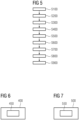
- Fig. 6 shows a schematic block diagram illustrating a computer program product 400 according to an embodiment of the fourth aspect of the present invention.
- the computer program product 400 comprises executable program code 450 configured to, when executed, perform the method according to any embodiment of the second aspect of the present invention in particular as has been described with respect to the preceding figures.
- Fig. 7 shows a schematic block diagram illustrating a non-transitory computer-readable data storage medium 500 according to an embodiment of the fifth aspect of the present invention.
- the data storage medium 500 comprises executable program code 550 configured to, when executed, perform the method according to any embodiment of the second aspect of the present invention, in particular as has been described with respect to the preceding figures.
- the non-transient computer-readable data storage medium may comprise, or consist of, any type of computer memory, in particular semiconductor memory such as a solid-state memory.
- the data storage medium may also comprise, or consist of, a CD, a DVD, a Blu-Ray-Disc, an USB memory stick or the like.
Landscapes
- Engineering & Computer Science (AREA)
- Health & Medical Sciences (AREA)
- Medical Informatics (AREA)
- Public Health (AREA)
- Physics & Mathematics (AREA)
- Theoretical Computer Science (AREA)
- Software Systems (AREA)
- General Physics & Mathematics (AREA)
- General Health & Medical Sciences (AREA)
- Surgery (AREA)
- Biomedical Technology (AREA)
- Data Mining & Analysis (AREA)
- Life Sciences & Earth Sciences (AREA)
- Computer Graphics (AREA)
- General Engineering & Computer Science (AREA)
- Databases & Information Systems (AREA)
- Pathology (AREA)
- Primary Health Care (AREA)
- Epidemiology (AREA)
- Nuclear Medicine, Radiotherapy & Molecular Imaging (AREA)
- Robotics (AREA)
- Veterinary Medicine (AREA)
- Animal Behavior & Ethology (AREA)
- Molecular Biology (AREA)
- Heart & Thoracic Surgery (AREA)
- Architecture (AREA)
- Geometry (AREA)
- Computer Hardware Design (AREA)
- Computer Vision & Pattern Recognition (AREA)
- Evolutionary Computation (AREA)
- Artificial Intelligence (AREA)
- Computing Systems (AREA)
- Mathematical Physics (AREA)
- Human Computer Interaction (AREA)
- Processing Or Creating Images (AREA)
- Measuring And Recording Apparatus For Diagnosis (AREA)
- Apparatus For Radiation Diagnosis (AREA)
Abstract
The invention provides a system and a method for generating a virtual model of a virtual patient, comprising:
a computing device (100) configured to implement:
a template module (110) configured to provide a morphable virtual 3D mesh (1) as a template for a virtual model of at least a part of a human organ;
an anatomical parameters module, APM (120), configured to provide a range of values for each of a plurality of adjustable anatomical parameters, AAP, of the virtual model, each value associated with a corresponding morphed state of the template;
a plausibility module (130) configured to provide at least one relation to be fulfilled by the template in at least one morphed state, the relation being between at least two of the plurality of AAPs;
an instantiation module (140) configured to provide, using a pseudo-random number generator, a parameter set comprising, for each AAP of the virtual model, a value of the corresponding provided range of values, while fulfilling the at least one relation; and
a generating module (150) configured to generate the virtual model based on the template in the morphed state corresponding to the selected values of the AAPs.
a computing device (100) configured to implement:
a template module (110) configured to provide a morphable virtual 3D mesh (1) as a template for a virtual model of at least a part of a human organ;
an anatomical parameters module, APM (120), configured to provide a range of values for each of a plurality of adjustable anatomical parameters, AAP, of the virtual model, each value associated with a corresponding morphed state of the template;
a plausibility module (130) configured to provide at least one relation to be fulfilled by the template in at least one morphed state, the relation being between at least two of the plurality of AAPs;
an instantiation module (140) configured to provide, using a pseudo-random number generator, a parameter set comprising, for each AAP of the virtual model, a value of the corresponding provided range of values, while fulfilling the at least one relation; and
a generating module (150) configured to generate the virtual model based on the template in the morphed state corresponding to the selected values of the AAPs.
Description
- The present invention relates to a computer-implemented system for generating a virtual model of a virtual patient, in particular a virtual model of at least a part of an organ of the virtual patient, and more particular to a virtual model of a heart of the virtual patient. The invention also relates to a computer-implemented method for generating such a virtual model, to a computer-implemented method for generating a training data set for machine learning, to a computer program, to a data storage medium, and to a data stream.
- Virtual models, displayed in graphical user interfaces, can contribute to training physicians or other medical personnel. To fulfil the training goals of interventional cardiology procedures (e.g. PCI and TAVR), simulation devices have been introduced that provide virtual patient models. These models are created from real patient datasets to maintain as realistic of an experience as possible.
- However, due to limited access to complete patient datasets, the number of these virtual models is limited, and the model itself is bound to the physiological properties of the real patient. This, in turn, leads to limited training scenarios and complications that the user of these devices can experience, hence reducing the long-term engagement with the system and achieving the training goals.
- In addition, creating these models one by one is a long and arduous task, which requires a team of specialized experts to accomplish, and adds further costs to the development process. Furthermore, these datasets are in the grace of their providers (i.e. patients) and can be removed on their demand, rendering the development efforts futile. Data privacy regulations such as the European GDPR further limit the ways in which real patient data can be freely used to generate additional virtual patient models.
- Also known are physiology engines, which simulate physiological processes based on virtual models. One such physiology engine is the Pulse Physiology engine 4.1.0 (registered trademark) available under http://pulse.kitware.com/. However, without a large variety of virtual models, and a method for generating such virtual models cost-effectively, the known physiology engines have only limited use cases in training physicians or other medical specialists.
- Known in the prior art are also methods of rendering 3-dimensional virtual models and of changing their shape, for example surface rendering methods as described in the scientific publication by L. Szirmay-Kalo and T. Umenhoffer, "Displacement Mapping on the GPU - State of the Art", https://onlinelibrary.wiley.com/doi/abs/10.1111/j.1467-8659.2007.01108.x (hereafter cited as "Szirmay-Kalo/Umenhoffer") .
- Other methods for generating 3-dimensional virtual models include point-cloud rendering techniques such as described in the scientific publication by P. Kivi et al, "Real-Time Rendering of point Clouds with Photorealistic Effects: A Survey", https://ieeexplore.ieee.org/document/9693528, DOI: 10.1109/ACCESS.2022.3146768, hereafter cited as "Kivi et al.". This publication reviews real-time photorealistic point cloud rendering methods, which directly ray trace or rasterize point cloud models, with an emphasis on ray tracing and real-time performance.
- Further, for the training of artificial intelligence entities such as artificial neural networks or the like, usually training data are of the essence. Access to a large number of virtual patient models therefore enables improved training of artificial intelligence entities.
- It is one of the objectives of the present invention to provide an improved system for generating a virtual model of a patient, and a further objective to provide an improved method for generating such a model. Further objectives are providing an improved method for generating training data for machine learning, and providing a computer program product, a data storage medium and a data stream for implementing any of the improved methods.
- Accordingly, according to a first aspect of the present invention, a computer-implemented system for generating a virtual model of a virtual patient is provided. The system comprises:
a computing device configured to implement: - a template module configured to provide a morphable virtual 3D mesh as a template for a virtual model of at least a part of a human organ;
- an anatomical parameters module, APM, configured to provide a range of values for each of a plurality of adjustable anatomical parameters, AAP, of the virtual model, each value associated with a corresponding morphed state of the template;
- a plausibility module configured to provide at least one relation to be fulfilled by the template in at least one morphed state, the relation being between at least two of the plurality of adjustable anatomical parameters, AAP;
- an instantiation module configured to provide, using a pseudo-random number generator, a parameter set comprising, for each adjustable anatomical parameter of the virtual model, a value of the corresponding provided range of values, while fulfilling the at least one relation; and a generating module configured to generate the virtual model of the virtual patient based on the template in the morphed state corresponding to the selected values of the adjustable anatomical parameters, AAPs.
- The computing device may be realized as any device, or any means, for computing, in particular for executing a software, an App, or an algorithm. For example, a computing device may comprise at least one processing unit such as at least one central processing unit, CPU, and/or at least one graphics processing unit, GPU, and/or at least one field-programmable gate array, FPGA, and/or at least one application-specific integrated circuit, ASIC, and/or any combination of the foregoing. The computing device may further comprise a working memory operatively connected to the at least one processing unit and/or a non-transitory memory operatively connected to the at least one processing unit and/or the working memory. The computing device may be implemented partially and/or completely in a local apparatus (e.g., a personal computer, PC) and/or partially and/or completely in a remote system such as by a cloud computing platform.
- A "virtual 3D mesh" in this context may be understood as a non-physical mesh object that contains information about positions and/or orientations of its constituent parts (e.g., mesh links) in a 3-dimensional space.
- The virtual 3D mesh is preferably made from a healthy patient dataset or an available medical atlas model. In some advantageous embodiments, these 3D models are reconstructed from patient medical images (e.g. CT or MRI scans), through direct or indirect rendering methods. Preferably, one of two rendering methods is used: surface rendering (3D surface meshes with polygons) or point cloud rendering.
- In the present context, "morphable" may mean that any or all constituent parts of the virtual 3D mesh can be non-elastically deformed, i.e. moved from their previous position according to the unmorphed state (or: unmorphed condition, or unmorphed configuration) of the template into a respective new position according to the morphed state (or: morphed condition, or morphed configuration) of the template.
- Although care is taken to properly differentiate between the original morphable 3D mesh model, the template it is used as, the virtual model that is created (including morphing the template) and a graphical depiction of the virtual model, in many respects the differentiation is unnecessary and it will be readily appreciated how these objects are connected to one another.
- The at least one relation may be a simply larger/smaller relation between one or more adjustable anatomical parameters, or it may be a function of at least two adjustable anatomical parameters, and/or a combination thereof. Preferably, the plausibility model is configured such as to provide a list of relations that ensure that a template in any morphed state (i.e. a virtual 3D mesh deformed from the "standard" configuration provided by the template module) that fulfills all of the relations of the list of relations (meaning, in other words, that the adjustable anatomical parameters associated with the particular morphed state of the template fulfill all of the relations) is a plausible virtual model of the human organ. Expressed differently, the generated virtual model advantageously able to pass as a model of an actual specimen of the organ in question.
- The computer-implemented system may further comprise one or more database modules configured to store the morphable virtual 3D mesh, the range of values for each of the plurality of adjustable anatomical parameters and/or the at least one relation to be fulfilled by the template in the at least one morphed state. Advantageously, providing said morphable virtual 3D mesh, said range of values for each of the plurality of adjustable anatomical parameters and/or said at least one relation to be fulfilled by the template in the at least one morphed state may comprise receiving those values by the computing device from the at least one or more database modules.
- The system may further comprise an output interface configured to output the generated virtual model to a recipient outside of the computer-implemented system, and may comprise equipment for a wireless or a wired connection to the recipient, such as a transmitter or transceiver or the like.
- Although here, in the foregoing and in the following, some functions are described as being performed by modules, it shall be understood that this does not necessarily mean that such modules are provided as entities separate from one another. In cases where one or more modules are provided as software, the modules may be implemented by program code sections or program code snippets, which may be distinct from one another but which may also be interwoven.
- Similarly, in case where one or more modules are provided as hardware, they functions of one or more modules may be provided by one and the same hardware component, or the functions of one module or the functions of several modules may be distributed over several hardware components which need not necessarily correspond to the modules one-to-one. Thus, any apparatus, system, method and so on which exhibits all of the features and functions ascribed to a specific module shall be understood to comprise, or implement, said module.
- In particular, it is a possibility that all modules are implemented by program code executed by a computing device, e.g. a server or a cloud-computing platform.
- In systems based on cloud computing technology, a large number of devices is connected to a cloud computing system via the Internet. The devices may be located in a remote facility connected to the cloud computing system. For example, the devices can comprise, or consist of, equipment, sensors, actuators, robots, and/or machinery in an industrial set-up(s). The devices can be medical devices and equipment in a healthcare unit. The devices can be home appliances or office appliances in a residential/commercial establishment.
- The cloud computing system may enable remote configuring, monitoring, controlling, and maintaining connected devices (also commonly known as 'assets'). Also, the cloud computing system may facilitate storing large amounts of data periodically gathered from the devices, analyzing the large amounts of data, and providing insights (e.g., Key Performance Indicators, Outliers) and alerts to operators, field engineers or owners of the devices via a graphical user interface (e.g., of web applications). The insights and alerts may enable controlling and maintaining the devices, leading to efficient and fail-safe operation of the devices. The cloud computing system may also enable modifying parameters associated with the devices and issues control commands via the graphical user interface based on the insights and alerts.
- The cloud computing system may comprise a plurality of servers or processors (also known as 'cloud infrastructure'), which are geographically distributed and connected to each other via a network. A dedicated platform (hereinafter referred to as 'cloud computing platform') is installed on the servers/processors for providing above functionality as a service (hereinafter referred to as 'cloud service'). The cloud-computing platform may comprise a plurality of software programs executed on one or more servers or processors of the cloud computing system to enable delivery of the requested service to the devices and its users.
- One or more application programming interfaces (APIs) are deployed in the cloud computing system to deliver various cloud services to the users.
- According to a second aspect of the present invention, a computer-implemented method for generating a virtual model of a virtual patient, comprising:
- providing a morphable virtual 3D mesh as a template for a virtual model of at least a part of a human organ,
- providing a range of values for each of a plurality of adjustable anatomical parameters of the virtual model, each value associated with a corresponding morphed state of the template,
- providing at least one relation to be fulfilled by the template in at least one morphed state, the relation being between at least two of the plurality of adjustable anatomical parameters; and
- providing, using a pseudo-random number generator, a parameter set comprising, for each adjustable anatomical parameter of the virtual model, a value of the corresponding provided range of values, while fulfilling the at least one relation; and
- generating the virtual model of the virtual patient based on the template in the morphed state corresponding to the selected values of the adjustable anatomical parameters.
- Additional advantageous embodiments, refinements, or variants of embodiments, will be apparent from the dependent claims as well as from the description in combination with the attached drawings.
- In some advantageous embodiments, refinements, or variants of embodiments, the human organ is a human heart and the plurality of adjustable anatomical parameters, AAP, comprise at least one of:
- a left coronary artery (LCA) distance;
- a right coronary artery (RCA) distance;
- an aorta diameter;
- a size of the aortic annulus;
- a sinotubular (ST) junction height;
- a calcification form of a leaflet of a heart valve;
- a pose of a heart valve;
- an opening percentage of a heart valve;
- a heart valve diameter;
- a leaflet effective height;
- a ventriculo-aortic (VA) junction height; and/or
- a leaflet basal ring diameter.
- In particular, the LCA and RCA distance can be measured with respect to a specific other structure within the human heart, e.g., to a specific valve annulus like the tricuspid valve annulus.
- These adjustable anatomical parameters, AAP, have been found by the inventor to be both easily implementable in the morphable virtual 3D mesh as well as impactful on plausibility and usefulness of the virtual model itself.
- Here and in the following, for some (especially longer) terms abbreviations (such as "AAP" for "adjustable anatomical parameter", or abbreviations or acronyms for certain of the modules) are used. Usually, the terms will be given followed by the corresponding abbreviations. In some cases, to improve legibility, only the abbreviation will be used, whereas in other cases only the term itself will be used. In all cases, the term itself and the corresponding abbreviation shall be understood to be equivalent.
- In some advantageous embodiments, refinements, or variants of embodiments, the computing device is further configured to implement a graphics module, GRAM, configured to generate a graphical representation of at least the generated virtual model. The graphical representation may be displayed by a display, which may be part of the system or which may be external to the system. The graphical representation may, for example, be used for teaching physicians or other medicals professionals. It may also be used, for example, in an automated test, where tested persons (e.g., students of Medicine) are automatically shown graphical representations of pre-generated, or even live-generated, virtual models, and may have to register an assessment or a comment, which can later be analyzed by a professional (e.g., a teacher of Medicine), for example for grading.
- The graphical representation may comprise other graphical elements not part of the virtual model, for example visual indications of a particular disease or other physiological condition, alphanumerical pieces of information, and/or the like.
- In some advantageous embodiments, refinements, or variants of embodiments, the graphical representation further comprises an indication of a value of at least one adjustable anatomical parameter, AAP. For example, in the case of a human heart, an opening percentage of a heart valve may be indicated as a number, together with its depicting in the graphical representation. Preferably, the indication of the value is in each case depicted together with a corresponding indication of how said value is located within the corresponding range of values for said adjustable anatomical parameter, AAP.
- In some advantageous embodiments, refinements, or variants of embodiments, the indication of how said value is located within the corresponding range of values for said adjustable anatomical parameter, AAP, is realized by the graphical representation depicting a slider graphics object (e.g., a float slider). The slider graphics object may comprise a sliding bar and a sliding body movable along within the sliding bar, wherein the extent of the sliding bar represents the range of values, and a position of the sliding body represents the size of the value compared to the range of values. This provides an objectively improved display of information to a user, who not only at a glance realizes the impact the value has on the virtual model but also intuitively grasps how large this values is with respect to all other possible values.
- In some advantageous embodiments, refinements, or variants of embodiments, the system further comprises a graphical user interface, GUI, enabling a user to interact with the generated graphical representation.
- In particular, the graphical user interface, GUI, may further enable the user to make manual changes to the value of at least one adjustable anatomical parameter, AAP, wherein the GUI is configured to display a result of the manual changes graphically to the user. To this end, the change made (or: requested) by the user may be fed to the generating module, which re-generates the virtual model based on the changed set of parameters. The graphics module may generate a new corresponding graphical representation, which is then displayed by the graphical user interface.
- In some advantageous embodiments, refinements, or variants of embodiments, the computing device is further configured to implement a physiology module, PHYM, configured to run a mathematical simulation of the physiology of the virtual patient corresponding to the virtual model. The adjustable anatomical parameters, AAPs, of the list of adjustable anatomical parameters, AAP, given above can strongly effect the physiological processes simulated by the physiology engine for a human heart and therefore improve its output.
- In some advantageous embodiments, refinements, or variants of embodiments, the graphics module, GRAM, is further configured to generate the graphical representation with a virtual environment comprising the generated virtual model. Advantageously, the graphical representation also comprises features indicating at least one physiological property of the virtual patient based on the mathematical simulation of the physiology of the virtual patient.
- In some advantageous embodiments, refinements, or variants of embodiments, the anatomical parameters module, APM, is configured to access a medical database and to determine the range of values for at least one of the plurality of adjustable anatomical parameters therefrom automatically. The medical database may be, for example, a repository of medical scientific literature, a medical encyclopedia, a Picture Archiving and Communication System, PACS, a hospital patient record system, and/or the like. The anatomical parameters module, APM, may also be configured to check periodically for updates of the ranges of values, and/or may be configured to receive push messages indicating updates and to re-determine, as a reaction, at least one of the ranges of values. In this way, the ranges of parameter values are kept updated.
- Similarly, the plausibility module may be configured to automatically access a medical database (the same as the anatomical parameters module, APM, or a different one) in order to look for updates of the at least one relation between the plurality of adjustable anatomical parameters, AAP. In this way, for example, new medical findings of relations between different anatomical features, expressed by the adjustable anatomical parameters, AAP, can quickly be incorporated into the system.
- In some advantageous embodiments, refinements, or variants of embodiments, the morphable virtual 3D mesh is surface-rendered. In surface rendering, first a volume data is gathered, e.g. from a medical imaging dataset or a real patient. Afterwards, using a surface generation algorithm (e.g. "marching cubes" published in the 1987 SIGGRAPH proceedings by Lorensen et al., or tetrahedra) a polygon-based surface is generated that represents the surface of the real patient's volume data. These polygons are representing a surface enclosed by a minimum number of three vertices (a triangle). Each one of these vertices contribute to the shape of the generated polygon and, in turn, the whole surface mesh.
- The morphable virtual 3D mesh may be morphed (i.e. brought into a morphed state) via manipulating these vertices, for example via per-vertex displacement approaches such as the ones described in "Szirmay-Kalo/Umenhoffer" as cited above, which describes "displacement mapping algorithms", and which is hereby incorporated in its entirety by reference. In this way, one can change the shape of the originally generated mesh in a highly detailed manner. Accordingly, the morphed state of the template can be determined precisely, which, in turn, may enable a physiology engine to run its simulation especially accurately, for example.
- In some advantageous embodiments, refinements, or variants of embodiments, the morphable virtual 3D mesh is point-cloud rendered, for example according to any of the known methods described in "Kivi et al.", which is hereby incorporated in its entirety by reference.
- In some advantageous embodiments, refinements, or variants of embodiments, of the method for generating a training data set for machine learning, the generated training samples are automatically labelled based on the respective parameter set used to generate the virtual model of each training sample. For example, the label may simply be the value of one particular adjustable anatomical parameter, AAP.
- It shall be understood that the method according to the second aspect of the present invention may be used with the system according any embodiment of the first aspect of the present invention. Therefore, any variants, options, or refinements described with respect to the system according to the first aspect may be equally applied to the method according to the second aspect of the present invention and vice versa. For the sake of brevity, therefore, mainly the different modules and functions of the system will be described, and it shall be understood that the methods taught herein may be adapted to perform any of the functions described therein.
- According to a third aspect, the invention provides a computer program product comprising executable program code configured to, when executed by a computing device, perform the method according to any embodiment of the second aspect of the present invention.
- According to a fourth aspect, the invention provides a non-transient computer-readable data storage medium comprising executable program code configured to, when executed by a computing device, perform the method according to any embodiment of the second aspect of the present invention.
- The non-transient computer-readable data storage medium may comprise, or consist of, any type of computer memory, in particular semiconductor memory such as a solid-state memory.
- The data storage medium may also comprise, or consist of, a CD, a DVD, a Blu-Ray-Disc, an USB memory stick or the like.
- According to a fifth aspect, the invention provides a data stream comprising, or configured to generate, executable program code configured to, when executed, perform the method according to any embodiment of the second aspect of the present invention.
- According to a sixth aspect, the invention provides a computer-readable medium storing data which defines both the virtual model of the virtual patient and operating instructions adapted to control an additive manufacturing device to fabricate a physical model of the virtual patient using the virtual model when said data is relayed to the additive manufacturing device. Thus, the virtual model may be used to produce a physical model that can be used in teaching physicians, in training surgeons and the like.
- The invention will be explained in greater detail with reference to exemplary embodiments depicted in the drawings as appended.
- The accompanying drawings are included to provide a further understanding of the present invention and are incorporated in and constitute a part of this specification. The drawings illustrate the embodiments of the present invention and together with the description serve to explain the principles of the invention. Other embodiments of the present invention and many of the intended advantages of the present invention will be readily appreciated as they become better understood by reference to the following detailed description. The elements of the drawings are not necessarily to scale relative to each other. Like reference numerals designate corresponding similar parts.
- In the figures:
- Fig. 1
- shows a schematic block diagram illustrating a system for generating a virtual model of a virtual patient according to an embodiment of the present invention;
- Fig. 2
- a schematic diagram of a morphable virtual 3D mesh of a human heart for use in the system of
Fig. 1 ; - Fig. 3
- shows an exemplary graphical representation as it may be generated by the system of
Fig. 1 ; - Fig. 4
- schematically shows another exemplary graphical representation as it may be generated by the system of
Fig. 1 ; - Fig. 5
- shows a schematic flow diagram illustrating a method according to an embodiment of the present invention, i.e., a computer-implemented method for generating a virtual model of a virtual patient;
- Fig. 6
- shows a computer program product according to another embodiment of the present invention; and
- Fig. 7
- shows a data storage medium according to yet another embodiment of the present invention.
- Although specific embodiments have been illustrated and described herein, it will be appreciated by those of ordinary skill in the art that a variety of alternate and/or equivalent implementations may be substituted for the specific embodiments shown and described without departing from the scope of the present invention. Generally, this application is intended to cover any adaptations or variations of the specific embodiments discussed herein.
-
Fig. 1 shows a schematic block diagram illustrating asystem 1000 for generating a virtual model of a virtual patient according to an embodiment of the present invention. - The
system 1000 comprises acomputing device 100 configured to implement several modules. - The
computing device 100 is configured to implement atemplate module 110 configured to provide a morphable virtual 3D mesh as a template for a virtual model of at least a part of a human organ. Although in the following the invention will be described with respect to a human heart as the human organ, it shall be understood that the invention may equally be applied to any other kind of organ as well. -
Fig. 2 shows a schematic diagram of a morphable virtual 3D mesh 1 of a human heart. - As has been described in the foregoing, the morphable virtual 3D mesh may be rendered using any known rendering technique, in particular using surface rendering or point-cloud rendering as described in "Szirmay-Kalo/Umenhoffer" and "Kivi et al.".
- The morphability of the virtual 3D mesh model 1 used as template may be realized as follows:
- An originally generated model is imported into a 3D design software with per-vertex animation capability.
- For each determined feature expressible by an adjustable anatomical parameter, AAP, a copy of the original mesh is made.
- On the copied version, the group of vertices that represent the feature, is selected, and manipulated until an extreme end of the range of values for that AAP is reached, for example until (reasonably) maximum observed values reported in the medical literature is achieved.
- Using the per-vertex animation functionality, the vertices position differential between the original and the copy is stored as a value, specific to that vertices group.
- Already at this stage, the values of the AAP may be represented as a float slider, the sliding bar of which indicates the range of values. Each position on the float slider (or, in other words, each value of the AAP) corresponds to an interpolation between the original mesh in the unmorphed state, and the copy mesh in the morphed state. Each point on the float slider thus provides a new variability.
- These steps may be repeated until all the determined key features are implemented in the virtual model.
- In these steps, per-vertex animation techniques such as IKA Morph target animation, shape interpolation, shape keys, or blend shapes may be used. A pseudo-randomised algorithm would create a new patient anatomy by generating the defined morph values.
- The
computing device 100 is further configured to implement an anatomical parameters module,APM 120, configured to provide a range of values for each of a plurality of adjustable anatomical parameters, AAP, of the virtual model, each value associated with a corresponding morphed state of the template, i.e. of the original virtual 3D mesh. - For example, the anatomical parameters module,
APM 120, is configured to access amedical database 300 and to automatically determine the range of values for at least one of the plurality of adjustable anatomical parameters therefrom, such as by crawling through a repository of scientific medical knowledge. - The
computing device 100 is further configured to implement aplausibility module 130 configured to provide at least one relation to be fulfilled by the template in at least one morphed configuration, the relation being between at least two of the plurality of adjustable anatomical parameters, AAP. Preferably, a plurality of relations (which may include one or more functions) may be provided by theplausibility module 130. The relations may be stored in a dedicated data storage of theplausibility module 130, or in acommon data storage 190 of the computing device 100 (as shown inFig. 1 ) or of thesystem 1000. - The
computing device 100 is further configured to implement aninstantiation module 140 configured to provide, using apseudo-random number generator 141, a parameter set comprising, for each adjustable anatomical parameter of the virtual model, a value of the corresponding provided range of values, while fulfilling the at least one relation. For example, theinstantiation module 140 may be configured to first evaluate the relations provided by theplausibility module 130 and to determine therefrom a/the adjustable anatomical parameter, AAP, with the fewest restrictions, preferably with no restrictions. The value range for that adjustable anatomical parameter, AAP, provided by the anatomical parameters module,APM 120, is then mapped onto a numerical interval, such as from 0 (included) to 1 (included), in which thepseudo-random number generator 141 is configured to generate random numbers. Thus, each generated random number corresponds to a value of the adjustable anatomical parameter within its allowed value range. - The same may be done for each other adjustable anatomical parameter as well, preferably following a hierarchy of adjustable anatomical parameters, AAPs, from the ones with the lowest number of restrictions to the ones with the highest number of restrictions. In each case, the value range provided by the anatomical parameters module,
APM 120, may amended such that only values that fulfill the restrictions according to the relations, based on the already randomly determined values are allowed. The amended value range may be shortened at one end or the other or both, and/or it may comprise disallowed areas in the middle. In any case, the remaining allowed values are again mapped on the numerical interval, and the process is continued. Should there be no allowable values left, theinstantiation module 140 may be configured to go back a specific number of steps (e.g. one step, two steps, three or more steps, or all steps) of randomly determining values, and re-start from there. This may be continued until allowable values have been found for all adjustable anatomical parameters, AAPs. - The mapping of the range of values onto the numerical interval may be done as a linear 1-to-1 correspondence, or it may be done according to statistical likelihood. For example, the anatomical parameters module,
APM 120, may not only provide the ranges of the values for the adjustable anatomical parameters, AAPs, but it may also provide an information about the likelihood of the values within the ranges, or, expressed differently, a probability distribution of the values within their respective range. - The mapping may follow this probability distribution, so that during instantiation by the
instantiation module 140, i.e., when the parameter set for one particular virtual model is generated, on average values with a probability value of x% will be selected y times as often as values with a probability value of x/y%. This has the effect that the generated virtual models are not only plausible each in their own right in that they could exist in reality, but that the distribution of parameter sets over several virtual models also is plausible. In other words, virtual models with extreme configurations due to extreme values for the adjustable anatomical parameters, AAPs, will be less common than virtual models with more moderate configurations. - The
computing device 100 may allow different settings, for example, one mode in which the range of values is mapped as a linear 1-to-1-correspondence onto the numerical interval, and another mode in which the mapping is performed according to the information about the likelihood of the values within the ranges. The former mode may be useful for teaching students how to recognize or deal with extreme cases, whereas the latter mode may be useful for training students on a distribution of virtual models that is more similar to one they might actually encounter in reality. The same is true for using the generated virtual models for the training of artificial intelligence entities. The former mode will produce more different training samples, enabling the artificial intelligence entities to deal with all kinds of anatomical situations. The latter mode may help dealing with overfitting and may bias the artificial intelligence entities to correctly deal with the larger number of more probable configurations. - The
computing device 100 is further configured to implement agenerating module 150 configured to generate the virtual model of the virtual patient based on the template in the morphed state corresponding to the selected values of the adjustable anatomical parameters, AAPs. - The
computing device 100 is further configured to implement a graphics module,GRAM 170, configured to generate a graphical representation of at least the generated virtual model. -
Fig. 3 shows an exemplary depiction of agraphical representation 20. Thesystem 1000 may comprise a graphical user interface,GUI 180, displayed by adisplay device 200, a touch screen, a mobile device screen and/or the like, which may also be part of thesystem 1000. - The
graphical representation 20 may comprise, apart from the generated virtual model, acontrol interface 22 and/orindications 24, for at least one adjustable anatomical parameter, of the value used for it to generate the virtual model, and preferably also an indication of how said value is located within the corresponding range of values for said adjustable anatomical parameter, AAP. - Advantageously, the indications are, as shown in
Fig. 3 , realized with slider graphics object (here: floating sliders 26). The position of the sliding body within the sliding bar represents the magnitude of the value with respect to the allowed range of values for it. In addition, the selected value is also display numerically. - In this way, a
user 2 viewing thegraphical representation 20 may intuitively understand, for example, that thegraphical depiction 28 of the virtual model is based on a parameter set wherein the leaflet basal ring diameter is 18.2mm, and will also intuitively understand, from the corresponding slider graphics object 26, that this is among the highest possible values for said diameter. - Moreover, just by briefly glancing at the
graphical representation 20, theuser 2 can objectively faster and easier acquire the information whether the depicted virtual model is rather a typical specimen (in which case the sliding bodies would all be about the center of their sliding bars) or whether a specimen is shown that is atypical in one or more adjustable anatomical parameters, AAPs. - The instantiation of a particular virtual model may be performed by the
instantiation module 140 in real time (or quasi-real time) while thegraphical representation 20 is being displayed. For example, thegraphical representation 20 may first show a depiction of the original template, i.e., the morphable virtual 3D mesh in its unmorphed state, and a user interaction prompt (e.g., a button in the graphical user interface, GUI 180) which triggers an instantiation by theinstantiation module 140 and a corresponding morphing of the depicted virtual 3D mesh. The user interaction prompt may persist so that theuser 2 may repeatedly request new instantiations. In this way, a teacher may show students a large variety of plausible human organs one after the other, discussing possible issue, treatments and so on without any participant having knowledge of the organs that are going to be displayed. - The graphical user interface,
GUI 180, may be configured to allow theuser 2 manual changes to any or all adjustable anatomical parameters, AAPs. In preferred embodiments, this is subject to the condition of fulfilment of the relations provided by theplausibility module 130, in other embodiments, theuser 2 is free to make any desired changes. In some embodiments, the graphical user interface,GUI 180, may allow a user to switch between a first mode, in which the manual change of AAPs is subject to the condition of fulfilment of the relations provided by theplausibility module 130, and a second mode, in which any change is allowed. - As an example, a
user 2 wishing to evaluate whether a particular instrument will be small enough to be used with a large number of patients, may introduce a graphical depiction of the instrument into thegraphical representation 20, and change one or more values of adjustable anatomical parameters, AAPs, such that the instrument is able to be used, for example, able to enter a particular blood vessel. Theuser 2 will then see the corresponding changes to the virtual model according to the relations provided by theplausibility module 130 entail. Theuser 2 will also see how "normal" the chosen values of the AAPs are with respect to their respective range, and so gain an immediate intuitive grasp on how likely it is that said particular instrument will be usable for a large number of patients. - Similarly, the
system 1000 may comprise anevaluation module 210 configured to receive at least one condition from theuser 2, and either a set of virtual models or, preferably, a number of virtual models to be generated by thesystem 1000 as described in the foregoing. Theevaluation module 210 may then automatically instruct thecomputing device 100 to generate said number of virtual models, and may provide theuser 2 with a result about the compliance of the virtual models with the at least one condition. For example, theevaluation module 210 may inform the user about how many of the generated virtual models fulfil the at least one condition, about a median, a variance and/or other statistical variables of the generated virtual models with respect to the at least one condition. Since the allowable parameters are given by the anatomical parameters module,APM 120, and theplausibility module 130, a large number of generated virtual model may yield similar results as a large and incredibly involved study of the same number of actual human organs would yield. - As mentioned above, the graphical user interface,
GUI 180, may be configured to allow theuser 2 to make only such manual changes that fulfill all of the relations provided by theplausibility module 130 and/or to automatically adjust other adjustable anatomical parameters, AAPs, so that all of the relations provided by theplausibility module 130 are fulfilled despite the manual changes by theuser 2. Adjustable anatomical parameters, AAPs, that are automatically adjusted in this way may be displayed to the user in an intuitive way, for example by changing graphical slider objects of the graphical representation accordingly, optionally indicating the changes by differences markers, color changes, and/or the like. - The
computing device 100 may further be configured to implement a physiology module,PHYM 160, configured to run a mathematical simulation of the physiology of the virtual patient corresponding to the virtual model. - The graphics module,
GRAM 170, may further be configured to generate thegraphical representation 20 with a virtual environment comprising thedepiction 28 of the generated virtual model, wherein thegraphical representation 20 also comprises features indicating at least one physiological property of the virtual patient based on the mathematical simulation of the physiology of the virtual patient. -
Fig. 4 schematically shows agraphical representation 20 comprising a virtual environment 30 containing adepiction 32 of a virtual patient as well asfeatures 34 indicating physiological properties of the virtual patient such as heartbeat, blood pressure, oxygenation and so on. The virtual environment 30 inFig. 4 is designed as a virtual operating room. Auser 2 may be able to see thedepiction 28 of the generated virtual model within adepiction 32 of the virtual patient, together with thefeatures 34, and may thus experience a situation much as it would be in reality. The graphical user interface,GUI 180, thegraphical representation 20, the virtual environment 30 and so on may all be used on a display, but also in augmented reality, AR, or virtual reality, VR, applications. Thus, the graphics module,GRAM 170, may be configured to generate thegraphical representation 20 as an AR or a VR graphical representation. -
Fig. 5 shows a schematic flow diagram illustrating a method according to an embodiment of the second aspect of the present invention, i.e., a computer-implemented method for generating a virtual model of a virtual patient. - The method of
Fig. 5 may be used with thesystem 1000 as explained with respect toFig. 1 to 4 , but also separately therefrom. Accordingly, all options, variants and refinements described for the system according to the first aspect of the present invention, in particular to thesystem 1000, are equally applicable to the method ofFig. 5 , and vice versa. - In a step S100, a morphable virtual 3D mesh is provided as a template for a virtual model of at least a part of a human organ, for example as has been described in the foregoing with respect to the
template module 110. - In a step S200, a range of values for each of a plurality of adjustable anatomical parameters of the virtual model is provided, each value associated with a corresponding morphed state of the template, for example as has been described in the foregoing with respect to the
anatomical parameters module 120. - In a step S300, at least one relation to be fulfilled by the template in at least one morphed state is provided, the relation being between at least two of the plurality of adjustable anatomical parameters, for example as has been described in the foregoing with respect to the
plausibility module 130. - In a step S400 (in particular using a pseudo-random number generator), a parameter set comprising, for each adjustable anatomical parameter of the virtual model, a value of the corresponding provided range of values, while fulfilling the at least one relation, is provided, for example as has been described in the foregoing with respect to the
instantiation module 140. - In a step S500, the virtual model of the virtual patient is generated based on the template in the morphed state corresponding to the selected values of the adjustable anatomical parameters, for example as has been described in the foregoing with respect to the
generating module 150. - Further steps may comprise any or all of:
- a step S600 of running a mathematical simulation of the physiology of the virtual patient corresponding to the virtual model, for example as has been described in the foregoing with respect to the physiology module,
PHYM 160; - a step S700 of generating a graphical representation of at least the generated virtual model, i.e. a graphical representation including at least a
graphical depiction 28 of the generated virtual model; - a step S800 of receiving manual changes by a
user 2, for example as has been described with respect to the graphical user interface,GUI 180, in the foregoing, and of adapting the virtual model and/or thegraphical representation 20 in accordance with the received manual changes, preferably together with graphically displaying a result of the manual changes to theuser 2; and/or - a step S900 of automatically accessing a medical database to automatically determine the ranges of values for at least one of the plurality of adjustable anatomical parameters, AAPs, for example as has been described in the foregoing with respect to the anatomical parameters module,
APM 120. - The present invention also provides a computer-implemented method for generating a training data set for machine learning, comprising generating N training samples by generating at least N virtual models according to the method of any embodiment of the second aspect of the present invention. This method of generating a training data set may also comprise a step of automatically labelling the generated training samples based on the respective parameter set used to generate the virtual model of each training sample. For example, the label may simply be the value of one particular adjustable anatomical parameter, AAP.
-
Fig. 6 shows a schematic block diagram illustrating acomputer program product 400 according to an embodiment of the fourth aspect of the present invention. Thecomputer program product 400 comprisesexecutable program code 450 configured to, when executed, perform the method according to any embodiment of the second aspect of the present invention in particular as has been described with respect to the preceding figures. -
Fig. 7 shows a schematic block diagram illustrating a non-transitory computer-readabledata storage medium 500 according to an embodiment of the fifth aspect of the present invention. Thedata storage medium 500 comprisesexecutable program code 550 configured to, when executed, perform the method according to any embodiment of the second aspect of the present invention, in particular as has been described with respect to the preceding figures. - The non-transient computer-readable data storage medium may comprise, or consist of, any type of computer memory, in particular semiconductor memory such as a solid-state memory. The data storage medium may also comprise, or consist of, a CD, a DVD, a Blu-Ray-Disc, an USB memory stick or the like.
- Independent of the grammatical term usage, individuals with male, female or other gender identities are included within the term.
Claims (15)
- A computer-implemented system (1000) for generating a virtual model of a virtual patient, comprising:
a computing device (100) configured to implement:a template module (110) configured to provide a morphable virtual 3D mesh (1) as a template for a virtual model of at least a part of a human organ;an anatomical parameters module, APM (120), configured to provide a range of values for each of a plurality of adjustable anatomical parameters, AAPs, of the virtual model, each value associated with a corresponding morphed state of the template;a plausibility module (130) configured to provide at least one relation to be fulfilled by the template in at least one morphed state, the relation being between at least two of the plurality of adjustable anatomical parameters, AAPs;an instantiation module (140) configured to provide, using a pseudo-random number generator, a parameter set comprising, for each adjustable anatomical parameter, AAP, of the virtual model, a value of the corresponding provided range of values, while fulfilling the at least one relation; anda generating module (150) configured to generate the virtual model of the virtual patient based on the template in the morphed state corresponding to the selected values of the adjustable anatomical parameters, AAPs. - The system (1000) of claim 1, wherein the human organ is a human heart (1) and the plurality of adjustable anatomical parameters, AAPs, comprise at least one of:- a left coronary artery distance;- a right coronary artery distance;- an aorta diameter;- a size of the aortic annulus;- a sinotubular junction height;- a calcification form of a leaflet of a heart valve;- a pose of a heart valve;- an opening percentage of a heart valve;- a heart valve diameter;- a leaflet effective height;- a ventriculo-aortic junction height; and/or- a leaflet basal ring diameter.
- The system (1000) of claim 1 or 2, wherein the computing device (100) is further configured to implement a graphics module, GRAM (170), configured to generate a graphical representation of at least the generated virtual model.
- The system (1000) of claim 3, wherein the graphical representation further comprises an indication of a value of at least one adjustable anatomical parameter, AAP, preferably in each case together with a corresponding indication of how said value is located within the corresponding range of values for said adjustable anatomical parameter, AAP.
- The system (1000) of claim 4, wherein the indication of how said value is located within the corresponding range of values for said adjustable anatomical parameter, AAP, is realized by the graphical representation depicting a slider graphics object (26) comprising a sliding bar and a sliding body movable along within the sliding bar, wherein the extent of the sliding bar represents the range of values, and a position of the sliding body represents the size of the value compared to the range of values.
- The system (1000) of any of claims claim 3 to 5, further comprising a graphical user interface, GUI (180), enabling a user (2) to interact with the generated graphical representation.
- The system (1000) of claim 6, wherein the graphical user interface, GUI (180), further enables the user (2) to make manual changes to the value of at least one adjustable anatomical parameter, AAP, and wherein the graphical user interface, GUI (180) is configured to graphically display a result of the manual changes to the user (2).
- The system (1000) of any of claims 1 to 7, wherein the computing device (100) is further configured to implement a physiology module, PHYM (160), configured to run a mathematical simulation of the physiology of the virtual patient corresponding to the virtual model.
- The system (1000) of claim 8 and any of claims 3 to 7, wherein the graphics module, GRAM (170), is further configured to generate the graphical representation (20) with a virtual environment (30) comprising a depiction (28) of the generated virtual model, wherein the graphical representation (20) also comprises features (34) indicating at least one physiological property of the virtual patient based on the mathematical simulation of the physiology of the virtual patient.
- The system (1000) of any of claims 1 to 9, wherein the anatomical parameters module, APM (120), is configured to access a medical database (300) and to automatically determine the range of values for at least one of the plurality of adjustable anatomical parameters therefrom.
- The system (1000) of any of claims 1 to 10, wherein the morphable virtual 3D mesh (1) is surface rendered or point-cloud rendered.
- A computer-implemented method for generating a virtual model of a virtual patient, comprising:providing (S100) a morphable virtual 3D mesh as a template for a virtual model of at least a part of a human organ,providing (S200) a range of values for each of a plurality of adjustable anatomical parameters, AAPs, of the virtual model, each value associated with a corresponding morphed state of the template,providing (S300) at least one relation to be fulfilled by the template in at least one morphed state, the relation being between at least two of the plurality of adjustable anatomical parameters, AAPs; andproviding (S400), using a pseudo-random number generator, a parameter set comprising, for each adjustable anatomical parameter, AAP, of the virtual model, a value of the corresponding provided range of values, while fulfilling the at least one relation; andgenerating (S500) the virtual model of the virtual patient based on the template in the morphed state corresponding to the selected values of the adjustable anatomical parameters, AAPs.
- A computer-implemented method for generating a training data set for machine learning, comprising generating N training samples by generating at least N virtual models according to the method of claim 12.
- A computer program product (400) comprising executable program code (450) configured to, when executed by a computing device, to perform the method according to any of claims 12 or 13.
- A non-volatile, computer-readable data storage medium (500) comprising executable program code (550) configured to, when executed by a computing device, to perform the method according to any of claims 12 or 13.
Priority Applications (2)
| Application Number | Priority Date | Filing Date | Title |
|---|---|---|---|
| EP23160698.9A EP4428875A1 (en) | 2023-03-08 | 2023-03-08 | System and method for generating a virtual model of a virtual patient |
| US18/608,093 US12626463B2 (en) | 2023-03-08 | 2024-03-18 | System and method for generating a virtual model of a virtual patient |
Applications Claiming Priority (1)
| Application Number | Priority Date | Filing Date | Title |
|---|---|---|---|
| EP23160698.9A EP4428875A1 (en) | 2023-03-08 | 2023-03-08 | System and method for generating a virtual model of a virtual patient |
Publications (1)
| Publication Number | Publication Date |
|---|---|
| EP4428875A1 true EP4428875A1 (en) | 2024-09-11 |
Family
ID=85556576
Family Applications (1)
| Application Number | Title | Priority Date | Filing Date |
|---|---|---|---|
| EP23160698.9A Pending EP4428875A1 (en) | 2023-03-08 | 2023-03-08 | System and method for generating a virtual model of a virtual patient |
Country Status (2)
| Country | Link |
|---|---|
| US (1) | US12626463B2 (en) |
| EP (1) | EP4428875A1 (en) |
Cited By (1)
| Publication number | Priority date | Publication date | Assignee | Title |
|---|---|---|---|---|
| US20250292504A1 (en) * | 2023-03-08 | 2025-09-18 | Siemens Healthineers Ag | System and method for generating a virtual model of a virtual patient |
Citations (1)
| Publication number | Priority date | Publication date | Assignee | Title |
|---|---|---|---|---|
| CN113053194A (en) * | 2021-02-28 | 2021-06-29 | 华中科技大学同济医学院附属协和医院 | Doctor training system and method based on artificial intelligence and VR technology |
Family Cites Families (7)
| Publication number | Priority date | Publication date | Assignee | Title |
|---|---|---|---|---|
| WO2002097735A1 (en) * | 2001-05-31 | 2002-12-05 | Kent Ridge Digital Labs | System and method of anatomical modeling |
| AU2014308590B2 (en) * | 2013-08-22 | 2016-04-28 | Bespoke, Inc. | Method and system to create custom products |
| CN114730101B (en) * | 2019-09-24 | 2024-05-31 | 贝斯普客有限公司D/B/A拓扑眼镜 | System and method for adjusting stock eyeglass frames using 3D scanning of facial features |
| US20230149091A1 (en) * | 2021-11-17 | 2023-05-18 | Atlas Meditech, Inc | Neurosurgical decision support system |
| EP4428875A1 (en) * | 2023-03-08 | 2024-09-11 | Siemens Healthineers AG | System and method for generating a virtual model of a virtual patient |
| US20250117929A1 (en) * | 2023-10-04 | 2025-04-10 | Anumana, Inc. | Apparatus and methods for generating a three-dimensional (3d) model of an anatomical object via machine-learning |
| US12213774B1 (en) * | 2024-01-02 | 2025-02-04 | nference, inc. | Apparatus and method for locating a position of an electrode on an organ model |
-
2023
- 2023-03-08 EP EP23160698.9A patent/EP4428875A1/en active Pending
-
2024
- 2024-03-18 US US18/608,093 patent/US12626463B2/en active Active
Patent Citations (1)
| Publication number | Priority date | Publication date | Assignee | Title |
|---|---|---|---|---|
| CN113053194A (en) * | 2021-02-28 | 2021-06-29 | 华中科技大学同济医学院附属协和医院 | Doctor training system and method based on artificial intelligence and VR technology |
Non-Patent Citations (6)
| Title |
|---|
| DE OLIVEIRA JÚLIA E E ET AL: "Surface mesh to voxel data registration for patient-specific anatomical modeling", PROGRESS IN BIOMEDICAL OPTICS AND IMAGING, SPIE - INTERNATIONAL SOCIETY FOR OPTICAL ENGINEERING, BELLINGHAM, WA, US, vol. 9786, 18 March 2016 (2016-03-18), pages 978625 - 978625, XP060069366, ISSN: 1605-7422, ISBN: 978-1-5106-0027-0, DOI: 10.1117/12.2217491 * |
| IMAI NORIO ET AL: "Evaluation of anatomical pelvic parameters between normal, healthy men and women using three-dimensional computed tomography: a cross-sectional study of sex-specific and age-specific differences", JOURNAL OF ORTHOPAEDIC SURGERY AND RESEARCH, vol. 14, no. 1, 9 May 2019 (2019-05-09), XP93064420, Retrieved from the Internet <URL:http://link.springer.com/article/10.1186/s13018-019-1165-2/fulltext.html> [retrieved on 20230717], DOI: 10.1186/s13018-019-1165-2 * |
| KIVI PETRUS E. J. ET AL: "Real-Time Rendering of Point Clouds With Photorealistic Effects: A Survey", IEEE ACCESS, 26 January 2022 (2022-01-26), pages 13151 - 13173, XP093064467, Retrieved from the Internet <URL:https://ieeexplore.ieee.org/ielx7/6287639/9668973/09693528.pdf?tp=&arnumber=9693528&isnumber=9668973&ref=aHR0cHM6Ly9pZWVleHBsb3JlLmllZWUub3JnL2RvY3VtZW50Lzk2OTM1Mjg=> [retrieved on 20230717], DOI: 10.1109/ACCESS.2022.3146768 * |
| L. SZIRMAY-KALOT. UMENHOFFER, DISPLACEMENT MAPPING ON THE GPU - STATE OF THE ART, Retrieved from the Internet <URL:https://onlinelibrary.wiley.com/doi/abs/10.1111/j.1467-8659.2007.01108.x> |
| P. KIVI ET AL., REAL-TIME RENDERING OF POINT CLOUDS WITH PHOTOREALISTIC EFFECTS: A SURVEY, Retrieved from the Internet <URL:https://ieeexplore.ieee.org/document/9693528> |
| UNKNOWN: "Physiome Project: Home", 5 December 2022 (2022-12-05), pages 1 - 2, XP93064417, Retrieved from the Internet <URL:https%3A%2F%2Fweb.archive.org%2Fweb%2F20221205100857%2Fhttps%3A%2F%2Fphysiomeproject.org%2F> [retrieved on 20230717] * |
Cited By (2)
| Publication number | Priority date | Publication date | Assignee | Title |
|---|---|---|---|---|
| US20250292504A1 (en) * | 2023-03-08 | 2025-09-18 | Siemens Healthineers Ag | System and method for generating a virtual model of a virtual patient |
| US12626463B2 (en) * | 2023-03-08 | 2026-05-12 | Siemens Healthineers Ag | System and method for generating a virtual model of a virtual patient |
Also Published As
| Publication number | Publication date |
|---|---|
| US12626463B2 (en) | 2026-05-12 |
| US20250292504A1 (en) | 2025-09-18 |
Similar Documents
| Publication | Publication Date | Title |
|---|---|---|
| US10580325B2 (en) | System and method for performing a computerized simulation of a medical procedure | |
| Ugwitz et al. | Eye-tracking in interactive virtual environments: implementation and evaluation | |
| John | The impact of Web3D technologies on medical education and training | |
| CN107822690B (en) | Hybrid image/scene renderer with hands-free control | |
| WO2018097880A1 (en) | Systems and methods for an integrated system for visualizing, simulating, modifying and 3d printing 3d objects | |
| WO2002097735A1 (en) | System and method of anatomical modeling | |
| Gotel et al. | On requirements visualization | |
| Meuschke et al. | Glyph‐based comparative stress tensor visualization in cerebral aneurysms | |
| Amara et al. | Augmented reality visualization and interaction for covid-19 ct-scan nn automated segmentation: A validation study | |
| Bergonzi et al. | An augmented reality approach to visualize biomedical images | |
| US12626463B2 (en) | System and method for generating a virtual model of a virtual patient | |
| Mill et al. | Domain expert evaluation of advanced visual computing solutions and 3D printing for the planning of the left atrial appendage occluder interventions | |
| US20230334763A1 (en) | Creating composite drawings using natural language understanding | |
| Urs | AI-Powered 3D Reconstruction from 2D Scans | |
| US20080132781A1 (en) | Workflow of a service provider based CFD business model for the risk assessment of aneurysm and respective clinical interface | |
| De Visser et al. | Developing a next generation colonoscopy simulator | |
| Bartesaghi et al. | Spatial augmented reality and simulations to improve abdominal aortic aneurysm diagnosis and monitoring | |
| CN117237524A (en) | Method and apparatus for providing a three-dimensional model of an object | |
| Gore et al. | Medical Image Visualization using Augmented Reality | |
| US11931109B2 (en) | Interactive planner for repair or replacement surgery | |
| US20240143069A1 (en) | Technique for visualizing interactions with a technical device in an xr scene | |
| US20260094725A1 (en) | Computer system and method for simulation of medical scans | |
| US20230245376A1 (en) | System and method for four-dimensional angiography | |
| Galić et al. | Advancing Medical Education and Planning Through Extended Reality: A Mini Review of XR Applications in Medicine | |
| Galic et al. | Advancing Medical Education and Planning Through Extended Reality: A Mini Review of XR Applications in Medicine |
Legal Events
| Date | Code | Title | Description |
|---|---|---|---|
| PUAI | Public reference made under article 153(3) epc to a published international application that has entered the european phase |
Free format text: ORIGINAL CODE: 0009012 |
|
| STAA | Information on the status of an ep patent application or granted ep patent |
Free format text: STATUS: REQUEST FOR EXAMINATION WAS MADE |
|
| 17P | Request for examination filed |
Effective date: 20240619 |
|
| AK | Designated contracting states |
Kind code of ref document: A1 Designated state(s): AL AT BE BG CH CY CZ DE DK EE ES FI FR GB GR HR HU IE IS IT LI LT LU LV MC ME MK MT NL NO PL PT RO RS SE SI SK SM TR |
|
| GRAP | Despatch of communication of intention to grant a patent |
Free format text: ORIGINAL CODE: EPIDOSNIGR1 |
|
| STAA | Information on the status of an ep patent application or granted ep patent |
Free format text: STATUS: GRANT OF PATENT IS INTENDED |
|
| INTG | Intention to grant announced |
Effective date: 20260407 |