EP4428488A1 - Adapter piece quality inspection method and apparatus, adapter piece production method, adapter piece production device, and medium - Google Patents
Adapter piece quality inspection method and apparatus, adapter piece production method, adapter piece production device, and medium Download PDFInfo
- Publication number
- EP4428488A1 EP4428488A1 EP23805834.1A EP23805834A EP4428488A1 EP 4428488 A1 EP4428488 A1 EP 4428488A1 EP 23805834 A EP23805834 A EP 23805834A EP 4428488 A1 EP4428488 A1 EP 4428488A1
- Authority
- EP
- European Patent Office
- Prior art keywords
- bulge
- connecting piece
- inspection
- contour
- displacement
- Prior art date
- Legal status (The legal status is an assumption and is not a legal conclusion. Google has not performed a legal analysis and makes no representation as to the accuracy of the status listed.)
- Granted
Links
Images



Classifications
-
- B—PERFORMING OPERATIONS; TRANSPORTING
- B60—VEHICLES IN GENERAL
- B60K—ARRANGEMENT OR MOUNTING OF PROPULSION UNITS OR OF TRANSMISSIONS IN VEHICLES; ARRANGEMENT OR MOUNTING OF PLURAL DIVERSE PRIME-MOVERS IN VEHICLES; AUXILIARY DRIVES FOR VEHICLES; INSTRUMENTATION OR DASHBOARDS FOR VEHICLES; ARRANGEMENTS IN CONNECTION WITH COOLING, AIR INTAKE, GAS EXHAUST OR FUEL SUPPLY OF PROPULSION UNITS IN VEHICLES
- B60K1/00—Arrangement or mounting of electrical propulsion units
- B60K1/04—Arrangement or mounting of electrical propulsion units of the electric storage means for propulsion
-
- B—PERFORMING OPERATIONS; TRANSPORTING
- B60—VEHICLES IN GENERAL
- B60L—PROPULSION OF ELECTRICALLY-PROPELLED VEHICLES; SUPPLYING ELECTRIC POWER FOR AUXILIARY EQUIPMENT OF ELECTRICALLY-PROPELLED VEHICLES; ELECTRODYNAMIC BRAKE SYSTEMS FOR VEHICLES IN GENERAL; MAGNETIC SUSPENSION OR LEVITATION FOR VEHICLES; MONITORING OPERATING VARIABLES OF ELECTRICALLY-PROPELLED VEHICLES; ELECTRIC SAFETY DEVICES FOR ELECTRICALLY-PROPELLED VEHICLES
- B60L50/00—Electric propulsion with power supplied within the vehicle
- B60L50/50—Electric propulsion with power supplied within the vehicle using propulsion power supplied by batteries or fuel cells
- B60L50/60—Electric propulsion with power supplied within the vehicle using propulsion power supplied by batteries or fuel cells using power supplied by batteries
- B60L50/64—Constructional details of batteries specially adapted for electric vehicles
-
- G—PHYSICS
- G01—MEASURING; TESTING
- G01B—MEASURING LENGTH, THICKNESS OR SIMILAR LINEAR DIMENSIONS; MEASURING ANGLES; MEASURING AREAS; MEASURING IRREGULARITIES OF SURFACES OR CONTOURS
- G01B11/00—Measuring arrangements characterised by the use of optical techniques
-
- G—PHYSICS
- G01—MEASURING; TESTING
- G01B—MEASURING LENGTH, THICKNESS OR SIMILAR LINEAR DIMENSIONS; MEASURING ANGLES; MEASURING AREAS; MEASURING IRREGULARITIES OF SURFACES OR CONTOURS
- G01B11/00—Measuring arrangements characterised by the use of optical techniques
- G01B11/02—Measuring arrangements characterised by the use of optical techniques for measuring length, width or thickness
- G01B11/06—Measuring arrangements characterised by the use of optical techniques for measuring length, width or thickness for measuring thickness ; e.g. of sheet material
-
- G—PHYSICS
- G01—MEASURING; TESTING
- G01B—MEASURING LENGTH, THICKNESS OR SIMILAR LINEAR DIMENSIONS; MEASURING ANGLES; MEASURING AREAS; MEASURING IRREGULARITIES OF SURFACES OR CONTOURS
- G01B11/00—Measuring arrangements characterised by the use of optical techniques
- G01B11/16—Measuring arrangements characterised by the use of optical techniques for measuring the deformation in a solid, e.g. optical strain gauge
-
- G—PHYSICS
- G01—MEASURING; TESTING
- G01B—MEASURING LENGTH, THICKNESS OR SIMILAR LINEAR DIMENSIONS; MEASURING ANGLES; MEASURING AREAS; MEASURING IRREGULARITIES OF SURFACES OR CONTOURS
- G01B11/00—Measuring arrangements characterised by the use of optical techniques
- G01B11/24—Measuring arrangements characterised by the use of optical techniques for measuring contours or curvatures
-
- G—PHYSICS
- G01—MEASURING; TESTING
- G01B—MEASURING LENGTH, THICKNESS OR SIMILAR LINEAR DIMENSIONS; MEASURING ANGLES; MEASURING AREAS; MEASURING IRREGULARITIES OF SURFACES OR CONTOURS
- G01B11/00—Measuring arrangements characterised by the use of optical techniques
- G01B11/26—Measuring arrangements characterised by the use of optical techniques for measuring angles or tapers; for testing the alignment of axes
-
- G—PHYSICS
- G06—COMPUTING OR CALCULATING; COUNTING
- G06T—IMAGE DATA PROCESSING OR GENERATION, IN GENERAL
- G06T7/00—Image analysis
-
- G—PHYSICS
- G06—COMPUTING OR CALCULATING; COUNTING
- G06T—IMAGE DATA PROCESSING OR GENERATION, IN GENERAL
- G06T7/00—Image analysis
- G06T7/0002—Inspection of images, e.g. flaw detection
- G06T7/0004—Industrial image inspection
-
- G—PHYSICS
- G06—COMPUTING OR CALCULATING; COUNTING
- G06T—IMAGE DATA PROCESSING OR GENERATION, IN GENERAL
- G06T7/00—Image analysis
- G06T7/0002—Inspection of images, e.g. flaw detection
- G06T7/0004—Industrial image inspection
- G06T7/0006—Industrial image inspection using a design-rule based approach
-
- G—PHYSICS
- G06—COMPUTING OR CALCULATING; COUNTING
- G06T—IMAGE DATA PROCESSING OR GENERATION, IN GENERAL
- G06T7/00—Image analysis
- G06T7/60—Analysis of geometric attributes
- G06T7/62—Analysis of geometric attributes of area, perimeter, diameter or volume
-
- G—PHYSICS
- G06—COMPUTING OR CALCULATING; COUNTING
- G06V—IMAGE OR VIDEO RECOGNITION OR UNDERSTANDING
- G06V10/00—Arrangements for image or video recognition or understanding
- G06V10/40—Extraction of image or video features
- G06V10/44—Local feature extraction by analysis of parts of the pattern, e.g. by detecting edges, contours, loops, corners, strokes or intersections; Connectivity analysis, e.g. of connected components
-
- G—PHYSICS
- G06—COMPUTING OR CALCULATING; COUNTING
- G06V—IMAGE OR VIDEO RECOGNITION OR UNDERSTANDING
- G06V10/00—Arrangements for image or video recognition or understanding
- G06V10/40—Extraction of image or video features
- G06V10/46—Descriptors for shape, contour or point-related descriptors, e.g. scale invariant feature transform [SIFT] or bags of words [BoW]; Salient regional features
-
- G—PHYSICS
- G06—COMPUTING OR CALCULATING; COUNTING
- G06T—IMAGE DATA PROCESSING OR GENERATION, IN GENERAL
- G06T2207/00—Indexing scheme for image analysis or image enhancement
- G06T2207/30—Subject of image; Context of image processing
- G06T2207/30108—Industrial image inspection
- G06T2207/30136—Metal
-
- G—PHYSICS
- G06—COMPUTING OR CALCULATING; COUNTING
- G06T—IMAGE DATA PROCESSING OR GENERATION, IN GENERAL
- G06T2207/00—Indexing scheme for image analysis or image enhancement
- G06T2207/30—Subject of image; Context of image processing
- G06T2207/30108—Industrial image inspection
- G06T2207/30164—Workpiece; Machine component
Definitions
- This application relates to the field of battery technologies, and in particular to, a connecting piece quality inspection method and quality inspection apparatus, a connecting piece production method, a connecting piece production device, an electronic device, and a computer readable storage medium.
- a connecting piece plays a critical role in connecting a tab to a pole.
- a connecting piece with a bulge that is formed by stamping is used, so as to improve space utilization of a battery.
- visual sampling inspection is performed manually on the stamping quality of the connecting piece.
- the connecting piece becomes thinner. In this case, stamping is more difficult to obtain a thinner material.
- quality problems such as bulge displacement, uneven wall thickness of the bulge, and even bulge cracking, are more likely to be found.
- a risk of missing exists quantitative inspection cannot be performed on local status of the bulge of the connecting piece, and the bulge quality of the connecting piece cannot be reliably inspected.
- the temperature of the traction battery may rise excessively fast, affecting the quality of the traction battery and even causing safety accidents. Therefore, it is urgent to find a better connecting piece quality inspection solution.
- an object of this application is to propose a connecting piece quality inspection method and quality inspection apparatus, a connecting piece production method, a connecting piece production device, an electronic device, and a computer readable storage medium, so as to inspect the quality of connecting pieces.
- An embodiment of a first aspect of this application provides a connecting piece quality inspection method, and the connecting piece includes a piece body and a bulge protruding from the piece body.
- the method includes: obtaining an inspection image of the connecting piece, where the inspection image covers the bulge; determining, in the inspection image, position information of a reference contour of the bulge and position information of an inspection contour of the bulge, where the reference contour is a contour of a mouth portion of the bulge co-planar with the piece body, and the inspection contour is a contour of a bottom portion of the bulge away from the piece body; and determining a quality inspection result of the connecting piece based on the position information of the reference contour and the position information of the inspection contour.
- the position information of the reference contour and the position information of the inspection contour of the bulge of the connecting piece are determined and used for quantitative analysis of the formation quality of the bulge of the connecting piece. Then, the quality inspection result of the connecting piece is determined, and quantitative inspection and analysis can be performed on the bulge displacement, formed during stamping, of the connecting piece. In this way, an accurate quality inspection result of the connecting piece can be obtained and connecting pieces that have not cracked but are at the risk of cracking are screened out. This prevents non-conforming connecting pieces from being mounted on traction batteries, reducing the risk of battery safety accidents.
- the determining a quality inspection result of the connecting piece based on the position information of the reference contour and the position information of the inspection contour includes: determining, based on the position information of the reference contour and the position information of the inspection contour, displacement information of a projection of the inspection contour in an axial direction of the bulge with respect to a projection of the reference contour in the axial direction of the bulge; and determining the quality inspection result of the connecting piece based on the displacement information.
- the quality inspection result of the connecting piece is determined based on the displacement information, and quantitative inspection and analysis can be performed on the bulge displacement, formed during stamping, of the connecting piece. In this way, an accurate quality inspection result of the connecting piece can be obtained. This prevents non-conforming connecting pieces from being mounted on traction batteries, reducing the risk of battery safety accidents.
- the displacement information includes a distance of displacement of a projection of the center of the reference contour in the axial direction of the bulge with respect to a projection of the center of the inspection contour in the axial direction of the bulge
- the determining the quality inspection result of the connecting piece based on the displacement information includes: determining, based on the distance of displacement, whether displacement of the bulge of the connecting piece is acceptable.
- the distance of displacement of a position of the center of the reference contour with respect to a position of the center of the inspection contour on a plane where the piece body of the connecting piece is located is compared against a preset displacement value. In this way, quantitative inspection and analysis can be performed on the quality of the connecting piece, helping monitor the connecting piece production quality and improving efficiency of connecting piece quality inspection.
- the determining, based on the distance of displacement, whether displacement of the bulge of the connecting piece is acceptable includes: determining, in response to the distance of displacement being greater than a preset displacement value, that the displacement of the bulge of the connecting piece is unacceptable, where the preset displacement value is determined based on a material and/or size of the connecting piece.
- An appropriate preset displacement value is determined based on at least either of the material and the size of the connecting piece, so as to perform quality assessment on the bulge displacement of the connecting piece. In this way, the formation quality of the bulge can be accurately reflected, improving the inspection accuracy.
- the determining the quality inspection result of the connecting piece based on the displacement information further includes: calculating, based on the displacement information, an elongation of a side wall connecting the mouth portion and the bottom portion of the bulge; and determining, based on the elongation, whether quality of the side wall of the connecting piece is acceptable.
- the elongation of the side wall of the bulge is calculated and whether quality of the side wall of the connecting piece is acceptable is determined based on the elongation. In this way, the quality inspection result of the connecting piece can be analyzed in multiple dimensions and connecting pieces that have not cracked but are at the risk of cracking are screened out. This prevents non-conforming connecting pieces from being mounted on traction batteries, reducing the risk of battery safety accidents.
- the calculating, based on the displacement information, an elongation of a side wall connecting the mouth portion and the bottom portion of the bulge includes: calculating a thickness of the side wall based on the displacement information; and calculating the elongation of the side wall based on the thickness of the side wall and a thickness of the piece body.
- the thickness of the side wall is calculated based on the displacement information and the elongation of the side wall is calculated based on the thickness of the side wall and the thickness of the piece body.
- the displacement information includes a distance of displacement of a projection of the center of the reference contour in the axial direction of the bulge with respect to a projection of the center of the inspection contour in the axial direction of the bulge
- the calculating a thickness of the side wall based on the displacement information includes: obtaining a first preset thickness of the side wall, a preset length of a projection of the side wall in the axial direction of the bulge, a second preset thickness of the piece body, and a preset distance between the bottom portion of the bulge and the piece body in the axial direction of the bulge; and calculating the thickness of the side wall based on the first preset thickness, the preset length, the second preset thickness, the preset distance, and the distance of displacement.
- the elongation of the side wall is calculated based on the first preset thickness, the preset length, the second preset thickness, the preset distance, and the distance of displacement. In this way, the degree of tensile deformation of the side wall material before and after formation of the bulge can be properly reflected by the elongation, further helping perform quantitative assessment on the cracking risk of the side wall and the quality of the connecting piece.
- the determining, based on the elongation, whether quality of the side wall of the connecting piece is acceptable includes: determining, in response to the elongation being greater than a preset elongation, that quality of the side wall of the connecting piece is unacceptable, where the preset elongation is determined based on the material and/or the size of the connecting piece.
- An appropriate preset elongation is determined based on at least either of the material and the size of the connecting piece, so as to perform quality assessment on the side wall of the connecting piece. In this way, the formation quality of the side wall can be accurately reflected, improving the inspection accuracy.
- the mouth portion of the bulge includes a first reference feature
- the bottom portion of the bulge includes a second reference feature
- the determining, in the inspection image, position information of a reference contour of the bulge and position information of an inspection contour of the bulge includes: obtaining, from the inspection image, first reference position information of the first reference feature and second reference position information of the second reference feature; determining the position information of the inspection contour of the bulge based on the first reference position information of the first reference feature; and determining the position information of the reference contour of the bulge based on the second reference position information of the second reference feature.
- the first reference feature and the second reference feature are provided at the mouth portion and the bottom portion respectively to assist in identifying the position information of the mouth portion and the bottom portion of the bulge.
- the position information of the mouth portion and the bottom portion in the inspection image of the connecting piece can be identified more easily and accurately. This reduces errors in image identification accuracy, helping accurately determine the positions of the reference contour and the inspection contour and thereby improving the accuracy of connecting piece quality inspection.
- the first reference feature includes at least one reference feature point
- the second reference feature includes at least one inspection feature point, where a position of the at least one inspection feature point is in one-to-one correspondence with a position of the at least one reference feature point.
- the reference feature point and the inspection feature point are provided to assist in identifying the position information of the mouth portion and bottom portion of the bulge. In this way, the position information of the mouth portion and bottom portion in the inspection image of the connecting piece can be determined more easily and accurately, and then the accurate positions of the reference contour and the inspection contour are obtained, improving the accuracy of connecting piece quality inspection.
- the at least one reference feature point includes a plurality of first patterns arranged along a circumference of the reference contour, and the plurality of first patterns are used to indicate the reference contour of the bulge; and the at least one inspection feature point includes a plurality of second patterns arranged along a circumference of the inspection contour, and the plurality of second patterns are used to indicate the inspection contour of the bulge.
- the first pattern is provided for indicating the reference contour of the bulge and the second pattern is provided for indicating the inspection contour of the bulge. This can facilitate the identification and precise positioning of the reference feature point and the inspection feature point.
- the distance of displacement of a projection of the center of the reference contour in the axial direction of the bulge with respect to a projection of the center of the inspection contour in the axial direction of the bulge can be easily calculated, so as to obtain the connecting piece quality inspection result.
- the at least one reference feature point and/or the at least one inspection feature point is provided on a surface of the bulge close to the piece body; and an obtaining direction of the inspection image is parallel to the axial direction of the bulge.
- the reference feature point and/or the inspection feature point is provided on the surface of the bulge close to the piece body. This can assist in identifying the specific positions of the mouth portion and the bottom portion of the bulge, especially for a dark edge position of the bottom portion, so as to prevent obtaining of the inspection image of the connecting piece from being affected by light refraction of the peripheral rounded corners at the bottom portion of the bulge and improve the accuracy of positioning the center of the reference contour and the center of the detection contour.
- the inspection image is obtained along a direction parallel to the axial direction of the bulge. This facilitates subsequent identification of the mouth portion and the bottom portion of the bulge in the inspection image of the connecting piece and calculation of the distance of displacement, improving the inspection accuracy.
- An embodiment of a second aspect of this application provides a quality inspection apparatus for a connecting piece including a piece body and a bulge protruding from a surface of the piece body.
- the apparatus includes: an image obtaining module, configured to obtain an inspection image of the connecting piece, where the inspection image covers the bulge; an image identification module, configured to determine, in the inspection image, position information of a reference contour of the bulge and position information of an inspection contour of the bulge, where the reference contour is a contour of a mouth portion of the bulge co-planar with the piece body of the connecting piece, and the inspection contour is a contour of a bottom portion of the bulge away from the piece body of the connecting piece; and an inspection result determining module, configured to determine a quality inspection result of the connecting piece based on the position information of the reference contour and the position information of the inspection contour.
- the inspection image of the connecting piece is obtained to determine the position information of the reference contour and the inspection contour of the bulge in the inspection image, and the quality inspection result of the connecting piece is determined based on the position information of the reference contour and the position information of the inspection contour.
- quantitative analysis of the formation quality of the bulge of the connecting piece can be performed.
- the quality inspection result of the connecting piece is determined, and quantitative inspection and analysis can be performed on the bulge displacement, formed during stamping, of the connecting piece.
- an accurate quality inspection result of the connecting piece can be obtained. This prevents non-conforming connecting pieces from being mounted on traction batteries, reducing the risk of battery safety accidents.
- An embodiment of a third aspect of this application provides a connecting piece production method, including: stamping a piece body of a connecting piece to form a bulge, where the bulge comprises a mouth portion co-planar with the piece body, a bottom portion protruding from the piece body, and a side wall connecting the mouth portion and the bottom portion; and inspecting the stamped connecting piece by using the inspection method according to the foregoing embodiments to determine a quality inspection result of the connecting piece.
- the stamped connecting piece is inspected by using the inspection method according to the foregoing embodiments.
- quantitative inspection and analysis can be performed on the bulge displacement, formed during stamping, of the connecting piece. Therefore, an accurate quality inspection result of the connecting piece can be obtained. This prevents non-conforming connecting pieces from being mounted on traction batteries, reducing the risk of battery safety accidents.
- the stamping a piece body of a connecting piece to form a bulge further includes: preparing at least one reference feature point and/or at least one inspection feature point on a surface of the connecting piece at the piece body side, where the at least one reference feature point is used to indicate a position of a reference contour of the mouth portion of the bulge, and the at least one inspection feature point is used to indicate a position of an inspection contour of the bottom portion of the bulge.
- the reference feature point and/or the inspection feature point is formed by stamping, so that the positions of the reference contour and the inspection contour can be easily determined.
- the at least one inspection feature point is at least one first pattern formed by stamping, and the first pattern is a pattern of circle, oval, cross, teardrop, or polygon; and the at least one reference feature point is at least one second pattern formed by stamping, and the second pattern is a pattern of circle, oval, cross, teardrop, or polygon.
- the first pattern and the second pattern are formed by stamping, simplifying the preparation process and avoiding increase of cost. Specific design of the first pattern and the second pattern is conducive to identification, so that the positions of the reference contour and the inspection contour can be easily determined.
- the connecting piece production method further includes: rejecting a non-conforming connecting piece in response to the quality inspection result being failed.
- the non-conforming connecting piece is rejected in response to the quality inspection result being failed. In this way, non-conforming connecting pieces can be handled and separated from conforming connecting pieces, helping improve the efficiency of connecting piece production.
- An embodiment of a fourth aspect of this application provides a connecting piece production device, adopting the connecting piece production method according to the foregoing embodiments.
- An embodiment of a fifth aspect of this application provides an electronic device, including at least one processor and a memory communicatively connected with the at least one processor.
- the memory stores instructions capable of being executed by the at least one processor, and the instructions are executed by the at least one processor so that the at least one processor is capable of implementing the quality inspection method according to the foregoing embodiments or the production method according to the foregoing embodiments.
- An embodiment of a sixth aspect of this application provides a computer readable storage medium storing a computer program.
- the computer program is executed by a processor, the quality inspection method according to the foregoing embodiments or the production method according to the foregoing embodiments is implemented.
- the term "and/or" is only an associative relationship for describing associated objects, indicating that three relationships may be present.
- a and/or B may indicate the following three cases: presence of only A, presence of both A and B, and presence of only B.
- the character "/" in this specification generally indicates an "or" relationship between contextually associated objects.
- a plurality of means more than two (inclusive).
- a plurality of groups means more than two (inclusive) groups
- a plurality of pieces means more than two (inclusive) pieces.
- the technical terms “installment”, “link”, “connection”, and “fix” should be understood in their general senses.
- the terms may be a fixed connection, a detachable connection, or an integrated connection; or may be a mechanical connection or an electrical connection; or may be a direct connection, or an indirect connection through an intermediate medium; or may be an internal connection between two components or an interactive relationship between two components.
- install may be a fixed connection, a detachable connection, or an integrated connection; or may be a mechanical connection or an electrical connection; or may be a direct connection, or an indirect connection through an intermediate medium; or may be an internal connection between two components or an interactive relationship between two components.
- Traction batteries have been not only used in energy storage power supply systems such as hydroelectric power plants, thermal power plants, wind power plants, and solar power plants, but also widely used in many other fields including electric transportation tools such as electric bicycles, electric motorcycles, and electric vehicles, military equipment, and aerospace. With continuous expansion of application fields of traction batteries, market demands for the traction batteries are also expanding.
- a connecting piece with a bulge that is formed by stamping is used, so as to improve space utilization of a battery.
- visual sampling inspection is performed manually on the stamping quality of the connecting piece.
- the connecting piece becomes thinner.
- stamping is more difficult to obtain a thinner material.
- quality problems such as bulge displacement, uneven wall thickness of the bulge, and even bulge cracking, are more likely to be found.
- the connecting piece disclosed in some embodiments of this application may be part of a battery cell, and the battery cell may be used in an electric apparatus not limited to a vehicle, a ship, or an aircraft.
- Quality inspection and production of connecting pieces can be performed using the connecting piece quality inspection method and apparatus, the connecting piece production method and device disclosed in this application. This helps perform quantitative inspection and analysis on the bulge displacement, formed during stamping, of the connecting piece. In this way, an accurate quality inspection result of the connecting piece can be obtained. This prevents non-conforming connecting pieces from being mounted on traction batteries, reducing the risk of battery safety accidents.
- the electric apparatus of an embodiment of this application being a vehicle 1000 is used as an example for description of the following embodiments.
- FIG. 1 is a schematic structural diagram of a vehicle 1000 according to some embodiments of this application.
- the vehicle 1000 may be a fossil fuel vehicle, a natural-gas vehicle, or a new energy vehicle, where the new energy vehicle may be a battery electric vehicle, a hybrid electric vehicle, a range-extended vehicle, or the like.
- the vehicle 1000 is provided with a battery 100 inside, and the battery 100 may be disposed at the bottom, front, or rear of the vehicle 1000.
- the battery 100 may be configured to supply power to the vehicle 1000.
- the battery 100 may be used as an operational power supply for the vehicle 1000.
- the vehicle 1000 may further include a controller 200 and a motor 300, where the controller 200 is configured to control the battery 100 to supply power to the motor 300, for example, to satisfy power needs of start, navigation, and driving of the vehicle 1000.
- the battery 100 can be used as not only the operational power source for the vehicle 1000 but also a driving power source for the vehicle 1000, replacing or partially replacing fossil fuel or natural gas to provide driving traction for the vehicle 1000.
- FIG. 2 is an exploded view of a battery cell 100 according to some embodiments of this application.
- the battery 100 includes a box 10 and a battery cell 20, where the battery cell 20 is accommodated in the box 10.
- the box 10 is configured to provide an accommodating space for the battery cell 20.
- the box 10 may be a variety of structures.
- the box 10 may include a first part 11 and a second part 12.
- the first part 11 and the second part 12 fit together so that the first part 11 and the second part 12 jointly define a space for accommodating the battery cell 20.
- the second part 12 may be a hollow structure with one side open, and the first part 11 may be a plate structure.
- the first part 11 covers the open side of the second part 12, so that the first part 11 and the second part 12 jointly delimit an accommodating space.
- both the first part 11 and the second part 12 may be a hollow structure with one side open, and the open side of the first part 11 covers the open side of the second part 12.
- the box 10 formed by the first part 11 and the second part 12 may be in various shapes, such as a cylinder, a cuboid, or the like.
- a plurality of battery cells 20 may be provided, and the plurality of battery cells 20 may be connected in series, parallel, or series-parallel, where being connected in series-parallel means a combination of series and parallel connections of the plurality of battery cells 20.
- the plurality of battery cells 20 may be directly connected in series, parallel, or series-parallel, and then an entirety of the plurality of battery cells 20 is accommodated in the box 10; or certainly, the battery 100 may be formed by a plurality of battery cells 20 connected in series, parallel, or series-parallel first to form a battery module and then a plurality of battery modules being connected in series, parallel, or series-parallel to form an entirety which is accommodated in the box 10.
- the battery 100 may further include other structures.
- the battery 100 may further include a busbar configured to implement electrical connection between the plurality of battery cells 20.
- Each battery cell 20 may be a secondary battery or a primary battery, and may be a lithium-sulfur battery, a sodium-ion battery, or a magnesium-ion battery, without being limited thereto.
- the battery cell 20 may be cylindrical, flat, cuboid, or of other shapes.
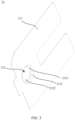
- FIG. 3 is a schematic structural diagram of a connecting piece 21 according to some embodiments of this application.
- the connecting piece 21 may be part of the battery cell 20 illustrated in FIG. 2 .
- the connecting piece 21 may include a piece body 211 and a bulge 212 as shown in FIG. 3 , where the bulge 212 includes a mouth portion 2121, a bottom portion 2122, and a side wall 2123 connecting the mouth portion 2121 and the bottom portion 2122.
- the mouth portion 2121 of the connecting piece 21 and the piece body 211 are co-planar, and the bottom portion 2122 of the connecting piece 21 is in a plane parallel to and away from the piece body 211.
- a material of the connecting piece 21 may be copper or aluminum, or another conductive metal material.
- the bulge 212 of the connecting piece 21 may be formed by stamping, so as to improve space utilization of a battery. After formation, visual sampling inspection is performed manually on the stamping quality of the connecting piece 21. A thickness of the side wall 2123 of the bulge 212 of the connecting piece 21 is negatively correlated with the energy density of the battery cell 20. Specifically, the energy density of the battery cell 20 increases as the side wall 2123 of the bulge 212 of the connecting piece 21 becomes thinner. It can be understood that the thinner the material, the more difficult the stamping. Therefore, in the pursuit of meeting the high energy density requirement of batteries, problems such as cracking of the connecting piece 21 tend to occur during the stamping and forming processes. In this case, higher quality inspection accuracy is required accordingly for the connecting piece.
- FIG. 4 is a flowchart of a connecting piece quality inspection method 400 according to some embodiments of this application. As shown in FIG. 4 , the connecting piece quality inspection method includes steps S401 to S403.
- Step S401 Obtain an inspection image of a connecting piece, where the inspection image covers a bulge.
- the inspection image may be obtained by an image obtaining apparatus, and the inspection image can show complete image characteristics of the bulge of the connecting piece.
- Step S402. Determine, in the inspection image, position information of a reference contour of the bulge and position information of an inspection contour of the bulge, where the reference contour is a contour of a mouth portion of the bulge co-planar with a piece body, and the inspection contour is a contour of a bottom portion of the bulge away from the piece body.
- the reference contour of the mouth portion of the bulge and the inspection contour of the bottom portion of the bulge can be determined separately by identifying the image characteristics of the bulge in the inspection image.
- the position information of the reference contour and the position information of the inspection contour indicate position information of the contour of the mouth portion of the bulge and position information of the contour of the bottom portion of the bulge respectively, which may specifically be the position of the contour or a position parameter associated with the contour based on a specific shape of the contour, for example, position coordinates of the center of the contour.
- Step S403. Determine a quality inspection result of the connecting piece based on the position information of the reference contour and the position information of the inspection contour.
- displacement of the bottom portion of the bulge with respect to the mouth portion of the bulge can be quantitatively determined based on the position information of the reference contour and the position information of the inspection contour, and then the quality inspection result of the connecting piece is determined.
- the quality inspection result of the connecting piece is a determining result obtained based on the difference between the quality of connecting pieces to be inspected.
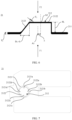
- FIG. 5 is a diagram of a longitudinal section of the connecting piece 21 according to some embodiments of this application. The following further describes the connecting piece quality inspection method with reference to FIG. 5 .
- the connecting piece 21 includes a piece body 211 and a bulge 212, where the bulge 212 includes a mouth portion 2121, a bottom portion 2122, and a side wall 2123 connecting the mouth portion 2121 and the bottom portion 2122.
- the mouth portion 2121 of the connecting piece 21 is in the same plane as the piece body 211, and the bottom portion 2122 of the connecting piece 21 protrudes along one side of the piece body 211 and is parallel to the plane where the piece body 211 is located. In other words, the bottom portion 2122 is parallel to a surface of the piece body 211.
- a reference contour of the bulge 212 refers to a contour of the mouth portion 2121, and an inspection contour of the bulge 212 refers to a contour of the bottom portion 2122.
- the reference contour and the inspection contour may be in the shape of a circle, an oval, or a polygon.
- the reference contour of the mouth portion of the bulge 212 and the inspection contour of the bottom portion 2122 of the bulge 212 are both in the shape of a circle.
- the position information of the reference contour refers to information indicating the position of the reference contour, including at least one of a contour position of the reference contour and the center position of the reference contour.
- the position information of the inspection contour refers to information indicating the position of the inspection contour, including at least one of a contour position of the inspection contour and the center position of the inspection contour.
- the center A1 of the reference contour is the center position of the bulge determined during design of the connecting piece.
- the bottom portion 2122 protruding from the surface of the piece body 211 and the side wall 2123 connecting the bottom portion 2122 and the mouth portion 2121 are formed by using a stamping device to stamp at a position corresponding to the mouth portion
- the center A2 of the inspection contour is the center of the bottom portion 2122 formed by stamping.
- the position information of the reference contour includes the position of the center A1 of the reference contour
- the position information of the inspection contour includes the position of the center A2 of the inspection contour. It can be understood that when both the reference contour and the inspection contour are in the shape of a circle, the center A1 of the reference contour and the center A2 of the inspection contour are centers of the circles respectively.
- the position information of the reference contour and the position information of the inspection contour of the bulge of the connecting piece are determined and used for quantitative analysis of the formation quality of the bulge of the connecting piece. Then, the quality inspection result of the connecting piece is determined, and quantitative inspection and analysis can be performed on the bulge displacement, formed during stamping, of the connecting piece. In this way, an accurate quality inspection result of the connecting piece can be obtained. This prevents non-conforming connecting pieces from being mounted on traction batteries, reducing the risk of battery safety accidents.
- step S403 may include: determining, based on the position information of the reference contour and the position information of the inspection contour, displacement information of a projection of the inspection contour in an axial direction of the bulge with respect to a projection of the reference contour in the axial direction of the bulge; and determining the quality inspection result of the connecting piece based on the displacement information.
- the displacement information is information indicating displacement of the projection of the inspection contour in the axial direction of the bulge with respect to the projection of the reference contour in the axial direction of the bulge.
- the displacement between the inspection contour and the reference contour can be quantitatively determined based on the displacement information, and then the quality inspection result of the connecting piece can be determined.
- FIG. 6 is a schematic structural diagram in which the bulge 212 of the connecting piece 21 according to some embodiments of this application is displaced. The following provides a further description with reference to FIG. 5 and FIG. 6 .
- the center A2 of the inspection contour corresponding to the bottom portion 2122 should theoretically coincide with the center A1 of the reference contour corresponding to the mouth portion 2121. That is, in the design state, the center A2 of the inspection contour coincides with the center A1 of the reference contour, and no displacement exists therebetween.
- FIG. 5 shows a shape of the connecting piece in the design state, without any displacement.
- the position of the center A2 of the inspection contour at the bottom portion formed by stamping may be displaced and misaligned with respect to the center A1 of the reference contour.
- a quality defect present during production of the connecting piece such displacement and misalignment will adversely affect the performance of the connecting piece and may even cause the connecting piece to break if exceeding a certain limit.
- the axial direction of the bulge is parallel to the first direction F 1 and the second direction F2.
- the center A2 of the inspection contour corresponding to the bottom portion 2122 of the bulge 212 formed by stamping no longer coincides with the projection of the center A1 of the reference contour corresponding to the mouth portion 2121 in the axial direction of the bulge, but displacement is present.
- the quality of the connecting piece can be determined based on the displacement therebetween. In other words, displacement information of a projection of the inspection contour in an axial direction of the bulge with respect to a projection of the reference contour in the axial direction of the bulge is determined, and then the quality inspection result of the connecting piece can be determined.
- the quality inspection result of the connecting piece is determined based on the displacement information, and quantitative inspection and analysis can be performed on the bulge displacement, formed during stamping, of the connecting piece. In this way, an accurate quality inspection result of the connecting piece can be obtained. This prevents non-conforming connecting pieces from being mounted on traction batteries, reducing the risk of battery safety accidents.
- the displacement information may include a distance of displacement of a projection of the center of the reference contour in the axial direction of the bulge with respect to a projection of the center of the inspection contour in the axial direction of the bulge
- the determining the quality inspection result of the connecting piece based on the displacement information may include: determining, based on the distance of displacement, whether displacement of the bulge of the connecting piece is acceptable.
- the distance of displacement ⁇ refers to a distance between a projection of the center A1 of the reference contour in the axial direction of the bulge 212 and a projection of the center A2 of the inspection contour in the axial direction of the bulge 212.
- a greater distance of displacement ⁇ indicates that the bottom portion 2122 of the bulge 212 formed by stamping is displaced farther from the design position.
- a great distance of displacement will lead to a large deviation of the position of the bulge from the design position. This hinders connection between the connecting piece and other parts in subsequent battery manufacturing, and may even have adverse impact on the battery quality.
- the distance of displacement of a position of the center of the reference contour with respect to a position of the center of the inspection contour on a plane where the piece body of the connecting piece is located is compared against a preset displacement value. In this way, quantitative inspection and analysis can be performed on the quality of the connecting piece, helping monitor the connecting piece production quality and improving efficiency of connecting piece quality inspection.
- the determining, based on the distance of displacement, whether displacement of the bulge of the connecting piece is acceptable includes: determining, in response to the distance of displacement being greater than a preset displacement value, that the displacement of the bulge of the connecting piece is unacceptable, where the preset displacement value is determined based on a material and/or size of the connecting piece.
- the quality of the connecting piece can be determined by comparing the distance of displacement ⁇ , of the projection of the center A1 of the reference contour in the axial direction of the bulge with respect to a projection of the center A2 of the inspection contour in the axial direction of the bulge, with the preset displacement value.
- the preset displacement value may be determined based on at least one of the material and the size of the connecting piece.
- the size of the connecting piece include the thickness of the piece body, size of the bulge, and the like.
- the preset displacement value may be greater than 0 and less than or equal to 0.2 millimeters (mm). In some embodiments, the preset displacement value may be 0.1 mm.
- An appropriate preset displacement value is determined based on at least either of the material and the size of the connecting piece, so as to perform quality assessment on the bulge displacement of the connecting piece. In this way, the formation quality of the bulge can be accurately reflected, improving the inspection accuracy.
- the determining the quality inspection result of the connecting piece based on the displacement information may further include: calculating, based on the displacement information, an elongation of a side wall connecting the mouth portion and the bottom portion of the bulge; and determining, based on the elongation, whether quality of the side wall of the connecting piece is acceptable.
- the elongation of the side wall refers to a degree of tensile deformation of the side wall portion under external force before and after formation of the bulge, and a greater elongation indicates greater tensile deformation of the side wall.
- the distance of displacement ⁇ of the projection of the center A1 of the reference contour in the axial direction of the bulge 212 with respect to the projection of the center A2 of the inspection contour in the axial direction of the bulge 212 gradually increases, and the tensile deformation of the side wall 2123 increases accordingly.
- the reason is that: during stamping and formation of the bulge 212, when the center A2 of the inspection contour of the bottom portion 2122 of the bulge 212 is displaced, uneven tensile deformation will occur on the side wall 2123 of bulge 212. As shown in FIG. 6 , the side wall 2123 on a side opposite the displacement direction of the bottom portion 2122 of the bulge 212 is deformed greater than in the design state, indicating that the side wall 2123 will become thinner. As a result, the side wall 2123 will crack or is more likely to crack.
- the elongation of the side wall of the bulge is calculated and whether quality of the side wall of the connecting piece is acceptable is determined based on the elongation. In this way, the quality inspection result of the connecting piece can be analyzed in multiple dimensions. This prevents non-conforming connecting pieces from being mounted on traction batteries, reducing the risk of battery safety accidents.
- the calculating, based on the displacement information, an elongation of a side wall connecting the mouth portion and the bottom portion of the bulge includes: calculating a thickness of the side wall based on the displacement information; and calculating the elongation of the side wall based on the thickness of the side wall and a thickness of the piece body.
- the side wall 2123 is stretched from a second preset thickness same as that of the piece body to a first preset thickness T 1 in the design state.
- the thickness of the side wall is calculated based on the displacement information and the elongation of the side wall is calculated based on the thickness of the side wall and the thickness of the piece body. In this way, a degree of tensile deformation of the side wall material before and after formation of the bulge can be reflected by the elongation, further helping perform quantitative assessment on the cracking risk of the side wall and the quality of the connecting piece.
- the displacement information may include the distance of displacement ⁇ of the projection of the center A1 of the reference contour in the axial direction of the bulge 212 with respect to the projection of the center A2 of the inspection contour in the axial direction of the bulge 212
- the calculating a thickness T 2 of the side wall 2123 based on the displacement information may include: obtaining a first preset thickness T 1 of the side wall 2123, a preset length D 1 of a projection of the side wall 2123 in the axial direction of the bulge 212, a second preset thickness T 0 of the piece body 211, and a preset distance H 1 between the bottom portion 2122 of the bulge 212 and the piece body 211 in the axial direction of the bulge 212; and calculating the thickness T 2 of the side wall 2123 based on the first preset thickness T 1 , the preset length D 1 , the second preset thickness T 0 , the preset distance Hi, and the distance of displacement
- the elongation of the side wall is calculated based on the first preset thickness, the preset length, the second preset thickness, the preset distance, and the distance of displacement. In this way, the degree of tensile deformation of the side wall material before and after formation of the bulge can be properly reflected by the elongation, further helping perform quantitative assessment on the cracking risk of the side wall and the quality of the connecting piece.
- the determining, based on the elongation, whether quality of the side wall of the connecting piece is acceptable includes: determining, in response to the elongation being greater than a preset elongation, that quality of the side wall of the connecting piece is unacceptable, where the preset elongation is determined based on the material and/or the size of the connecting piece.
- the elongation of the side wall refers to a change rate of the thickness of the side wall after tensile deformation with respect to the thickness before stamping.
- the elongation of the side wall of the bulge is used to determine whether the quality of the side wall of the connecting piece is acceptable, and whether the quality of the side wall is acceptable can be determined by comparing the calculated elongation of the side wall with the preset elongation. In this way, the cracking risk of the side wall and the quality of the connecting piece can be assessed more accurately.
- the preset elongation is determined based on at least one of the material and the size of the connecting piece.
- the material of the connecting piece may alternatively be other conductive metals. Different materials have different ductility characteristics, and therefore different preset elongations can be set for different materials for the connecting piece.
- the size of the connecting piece include the thickness of the piece body, size of the bulge, and the like. The size of the connecting piece also affect the quality of the side wall after tensile deformation, and different preset elongations can be set for more accurately assessing the quality of the side wall.
- the preset elongation may be set to 22%.
- the preset elongation may be set to 40%.
- An appropriate preset elongation is determined based on at least either of the material and the size of the connecting piece, so as to perform quality assessment on the side wall of the connecting piece. In this way, the formation quality of the side wall can be accurately reflected, improving the inspection accuracy.
- FIG. 7 is a schematic diagram of a first reference feature and second reference feature of a connecting piece 21 according to some embodiments of this application.
- the mouth portion 2121 of the bulge 212 may include a first reference feature
- the bottom portion 2122 of the bulge 212 may include a second reference feature
- the determining, in the inspection image, position information of a reference contour of the bulge 212 and position information of an inspection contour of the bulge 212 in step S402 may include: obtaining, from the inspection image, first reference position information of the first reference feature and second reference position information of the second reference feature; determining the position information of the reference contour of the bulge 212 based on the first reference position information of the first reference feature; and determining the position information of the reference contour of the bulge 212 based on the second reference position information of the second reference feature.
- the first reference feature is a feature set at the mouth portion of the bulge and used to indicate the position of the reference contour
- the second reference feature is a feature set at the bottom portion of the bulge and used to indicate the position of the inspection contour.
- the first reference feature and the second reference feature are patterns in the inspection image that are easy to be displayed and identified.
- the first reference position information is the position information of the first reference feature in the inspection image
- the second reference position information is the position information of the second reference feature in the inspection image.
- the first reference position information and the second reference position information can be used to help determine the position information of the reference contour and the position information of the inspection contour.
- the first reference feature may include reference feature points 2121a, 2121b, 2121c, and 2121d to indicate the position of the mouth portion 2121 of the bulge 212, so that the position of the center of the reference contour of the mouth portion 2121 in the image of the connecting piece can be more easily and accurately identified during subsequent image identification.
- a recess will be formed after the mouth portion 2121 of the bulge 212 is stamped, so the center position of the contour cannot be identified directly.
- the reference feature points 2121a, 2121b, 2121c, and 2121d may be provided along the edge of the mouth portion 2121 so that the position of the center of the reference contour is determined by identifying positions along the edge of the contour of the mouth portion 2121.
- the reference feature points may be provided equidistant from the center of the reference contour, so as to indicate the position of the center of the reference contour.
- the reference feature points 2121a, 2121b, 2121c, and 2121d may be provided on a side of the edge of the mouth portion 2121 close to the side wall, or may be provided on a surface of the piece body close to the mouth portion.
- the reference features located at positions close to both sides of the edge of the mouth portion 2121 and used to identify the position information of the reference contour should all be considered the first reference features of the mouth portion 2121 of the bulge 212 mentioned in this embodiment.
- the second reference feature may include inspection feature points 2122a, 2122b, 2122c, and 2122d to indicate the position of the bottom portion 2122 of the bulge 212, so that the position of the center of the inspection contour of the bottom portion 2122 in the image of the connecting piece can be more easily and accurately identified during subsequent image identification.
- the inspection feature points 2122a, 2122b, 2122c, and 2122d may be provided along the edge of the bottom portion 2122 so that the position of the center of the inspection contour is determined by identifying positions along the edge of the contour of the bottom portion 2122.
- the inspection feature points may be provided equidistant from the center of the inspection contour, so as to indicate the position of the center of the inspection contour.
- the reference features located at positions close to both sides of the edge of the bottom portion 2122 and used to identify the position information of the inspection contour should all be considered the second reference features of the bottom portion 2122 of the bulge 212 mentioned in this embodiment.
- the first reference feature and the second reference feature are provided at the mouth portion and the bottom portion respectively to assist in identifying the position information of the mouth portion and the bottom portion of the bulge.
- the position information of the mouth portion and the bottom portion in the image of the connecting piece can be identified more easily and accurately. This reduces errors in image identification accuracy, helping accurately determine the positions of the reference contour and the inspection contour and thereby improving the accuracy of connecting piece quality inspection.
- the first reference feature includes at least one reference feature point
- the second reference feature includes at least one inspection feature point, where a position of the at least one inspection feature point is in one-to-one correspondence with a position of the at least one reference feature point.
- FIG. 7 shows four reference feature points 2121a, 2121b, 2121c, and 2121d of the mouth portion 2121 of the bulge 212.
- the four reference feature points 2121a, 2121b, 2121c, and 2121d are spaced apart along the edge of the mouth portion 2121 of the bulge 212 to identify the contour position of the mouth portion 2121.
- the specific position of the contour of the mouth portion 2121 can be obtained by means of fitting, and then position information of the reference contour of the mouth portion 2121 is determined, for example, the position of the center of the reference contour.
- the number of reference feature points is not limited to four as illustrated in FIG. 7 . As long as the position of the contour of the mouth portion 2121 and/or the position of the center of the contour can be identified, the number is acceptable.
- the four reference feature points 2121a, 2121b, 2121c, and 2121d may be equally spaced around the center of the reference contour.
- two opposite reference feature points can be connected, that is, the reference feature points 2121a and 2121c are connected and the reference feature points 2121b and 2121d are connected.
- the position of the intersection of the two line segments is determined as the position of the center of the reference contour.
- the position of the center of the reference contour can be calculated by identifying coordinates of the positions of the reference feature points 2121a, 2121b, 2121c, and 2121d in the image of the connecting piece.
- FIG. 7 also shows four inspection feature points 2122a, 2122b, 2122c, and 2122d provided on a surface at the bottom portion 2122 side of the bulge 212, and the four inspection feature points 2122a, 2122b, 2122c, and 2122d are spaced apart along the edge of the bottom portion 2122 to identify the position of the contour of the bottom portion 2122.
- an edge curve of the contour of the bottom portion 2122 can be obtained by means of fitting, and then position information of the inspection contour of the bottom portion 2122 is determined, for example, the position of the center of the inspection contour.
- the number of inspection feature points is not limited to four as illustrated in FIG. 7 . As long as the position of the contour of the bottom portion 2122 and/or the position of the center of the contour can be identified, the number is acceptable. In this way, two opposite inspection feature points can be connected, that is, the inspection feature points 2122a and 2122c are connected and the inspection feature points 2122b and 2122d are connected. Then, the position of the intersection of the two line segments is determined as the position of the center of the inspection contour. Alternatively, the position of the center of the inspection contour can be calculated by identifying coordinates of the positions of the inspection feature points 2122a, 2122b, 2122c, and 2122d.
- the four inspection feature points 2122a, 2122b, 2122c, and 2122d may be in one-to-one correspondence with the four reference feature points 2121a, 2121b, 2121c, and 2121d. In this way, the positions of the mouth portion of the bulge and the bottom portion of the bulge, as well as the displacement, can be determined more intuitively by means of position comparison.
- the inspection feature points may not be in one-to-one correspondence with the reference feature points, as long as the inspection contour and the reference contour can be indicated.
- the reference feature point and the inspection feature point are provided to assist in identifying the position information of the mouth portion and bottom portion of the bulge.
- the position information of the mouth portion and bottom portion in the inspection image of the connecting piece can be determined more easily and accurately, and then the accurate positions of the reference contour and the inspection contour are obtained, improving the accuracy of connecting piece quality inspection.
- the at least one reference feature point includes a plurality of first patterns arranged along a circumference of the reference contour, and the plurality of first patterns are used to indicate the reference contour of the bulge; and the at least one inspection feature point includes a plurality of second patterns arranged along a circumference of the inspection contour, and the plurality of second patterns are used to indicate the inspection contour of the bulge.
- the first pattern and the second pattern may be any of patterns such as circles, ovals, teardrops, polygons, or solid dots, and the first pattern and the second pattern may be the same or different.
- both the first pattern and the second pattern are oval patterns.
- FIG. 7 illustrates one form of providing the reference feature points and the inspection feature points, and other forms of provision satisfying invention objectives of this application should also fall within the scope of protection of this application.
- the first pattern is provided for indicating the reference contour of the bulge and the second pattern is provided for indicating the inspection contour of the bulge.
- This can facilitate the identification and precise positioning of the reference feature point and the inspection feature point.
- the distance of displacement of a projection of the center of the reference contour in the axial direction of the bulge with respect to a projection of the center of the inspection contour in the axial direction of the bulge can be easily calculated, so as to obtain the connecting piece quality inspection result.
- the at least one reference feature point and/or the at least one inspection feature point is provided on a surface of the bulge close to the piece body; and an obtaining direction of the inspection image is parallel to the axial direction of the bulge.
- the image of the connecting piece can be obtained by an image obtaining device, and then the quality of the connecting piece is assessed by means of image identification.
- the image obtaining device may be a CCD camera or other visual inspection apparatuses.
- the image obtaining device may obtain the image of the connecting piece along a direction parallel to the axial direction of the bulge 212, and the obtaining direction may be a first direction F1 perpendicular to the piece body 211 of the connecting piece 21 and same as a protruding direction of the bulge 212, or a second direction F2 perpendicular to the piece body 211 of the connecting piece 21 and opposite the protruding direction of the bulge 212.
- the bulge is also stamped in a direction perpendicular to the plane in which the piece body is located. Therefore, the inspection image of the connecting piece obtained along the obtaining direction perpendicular to the plane in which the piece body is located can better show the positions of the mouth portion and bottom portion of the bulge.
- the image obtaining device may obtain the image of the connecting piece along the first direction F1.
- at least one reference feature point and/or at least one inspection feature point is provided on the surface of the bulge 212 close to the piece body 211, namely, on the surface of the bulge 212 where a recess is formed, for example, a lower surface of the connecting piece 21 shown in FIG. 5 .
- the recess at the bulge affects the light reflection during image obtaining, especially at the corner between the bottom portion of the bulge and the side wall where a chamfered or beveled shape is present. In this case, it is difficult to clearly determine the contour position of the bulge in the obtained inspection image of the connecting piece. As a result, the accuracy of the connecting piece quality inspection is affected.
- FIG. 8 is an inspection image of a connecting piece obtained in some embodiments of this application.
- the mouth portion of the bulge and the bottom portion of the bulge can be observed in the inspection image of the connecting piece because the mouth portion and the bottom portion of the bulge present different pattern characteristics. Therefore, the positions of the mouth portion and the bottom portion of the bulge can be identified by identifying such characteristics, and then the position information of the reference contour and the position information of the inspection contour determined using the method in some embodiments of this application are used to assess the quality of the connecting piece.
- FIG. 8 shows an inspection image of a connecting piece obtained during quality inspection of a reference connecting piece.
- a reference image for the obtained connecting piece image may be in a shape different from that in FIG. 8 , and the position of the center A1 of the reference contour and the position of the center A2 of the inspection contour may also be different.
- the reference feature point and the inspection feature point are provided on a surface of the connecting piece facing the obtaining direction. This can assist in identifying the specific positions of the mouth portion and the bottom portion of the bulge, especially for a dark edge position of the bottom portion, so as to prevent obtaining of the inspection image of the connecting piece from being affected by light refraction of the peripheral rounded corners at the bottom portion of the bulge and improve the accuracy of positioning the center of the reference contour and the center of the detection contour.
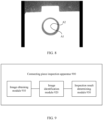
- FIG. 9 is a structural diagram of a connecting piece quality inspection apparatus 900 according to some embodiments of this application.
- a connecting piece quality inspection apparatus 900 where the connecting piece includes a piece body and a bulge protruding from a surface of the piece body.
- the apparatus includes: an image obtaining module 910, configured to obtain an inspection image of the connecting piece, where the inspection image covers the bulge; an image identification module 920, configured to determine, in the inspection image, position information of a reference contour of the bulge and position information of an inspection contour of the bulge, where the reference contour is a contour of a mouth portion of the bulge co-planar with the piece body of the connecting piece, and the inspection contour is a contour of a bottom portion of the bulge away from the piece body of the connecting piece; and an inspection result determining module 930, configured to determine a quality inspection result of the connecting piece based on the position information of the reference contour and the position information of the inspection contour.
- the image obtaining module 910, the image identification module 920, and the inspection result determining module 930 of the connecting piece quality inspection apparatus 900 may correspond to steps S401 to S403 respectively, as shown in FIG. 4 . Therefore, details of various aspects thereof are not repeated herein.
- the inspection image of the connecting piece is obtained to determine the position information of the reference contour and the inspection contour of the bulge in the inspection image, and the quality inspection result of the connecting piece is determined based on the position information of the reference contour and the position information of the inspection contour.
- quantitative analysis of the formation quality of the bulge of the connecting piece can be performed.
- the quality inspection result of the connecting piece is determined, and quantitative inspection and analysis can be performed on the bulge displacement, formed during stamping, of the connecting piece.
- an accurate quality inspection result of the connecting piece can be obtained. This prevents non-conforming connecting pieces from being mounted on traction batteries, reducing the risk of battery safety accidents.
- a connecting piece production method including: stamping a piece body of a connecting piece to form a bulge, where the bulge includes a mouth portion co-planar with the piece body, a bottom portion protruding from the piece body, and a side wall connecting the mouth portion and the bottom portion; and inspecting the stamped connecting piece by using the inspection method according to the foregoing embodiments to determine a quality inspection result of the connecting piece.
- the stamped connecting piece is inspected by using the inspection method according to the foregoing embodiments.
- quantitative inspection and analysis can be performed on the bulge displacement, formed during stamping, of the connecting piece. Therefore, an accurate quality inspection result of the connecting piece can be obtained. This prevents non-conforming connecting pieces from being mounted on traction batteries, reducing the risk of battery safety accidents.
- the stamping a piece body of a connecting piece to form a bulge may further include: preparing at least one reference feature point and/or at least one inspection feature point on a surface of the connecting piece at the piece body side, where the at least one reference feature point is used to indicate a position of a reference contour of the mouth portion of the bulge, and the at least one inspection feature point is used to indicate a position of an inspection contour of the bottom portion of the bulge.
- the reference feature point and the inspection feature point may be prepared during the process of stamping the piece body of the connecting piece to form the bulge.
- a first pattern of the reference feature point and a second pattern of the inspection feature point are formed during stamping of the bulge.
- the reference feature point and/or the inspection feature point is formed by stamping, so that the positions of the reference contour and the inspection contour can be easily determined.
- the at least one inspection feature point is at least one first pattern formed by stamping, and the first pattern is a pattern of circle, oval, cross, teardrop, or polygon; and the at least one reference feature point is at least one second pattern formed by stamping, and the second pattern is a pattern of circle, oval, cross, teardrop, or polygon.
- the polygon may include triangles, quadrilaterals, and other multilateral closed shapes.
- the first pattern may be a hollow pattern with a hollow center or a solid pattern in a set shape.
- the first pattern and the second pattern may be the same for ease of processing, or different for ease of image identification.
- the first pattern and the second pattern are formed by stamping, simplifying the preparation process and avoiding increase of cost. Specific design of the first pattern and the second pattern is conducive to identification, so that the positions of the reference contour and the inspection contour can be easily determined.
- the connecting piece production method further includes: rejecting a non-conforming connecting piece in response to the quality inspection result being failed.
- the produced connecting pieces can be sorted for selecting conforming connecting pieces and rejecting non-conforming connecting pieces, which helps guarantee the quality of subsequent battery manufacturing processes.
- a sorting mechanism may be used to receive a quality inspection result of the connecting piece and sort based on the quality inspection result.
- the non-conforming connecting piece is rejected in response to the quality inspection result being failed. In this way, non-conforming connecting pieces can be handled and separated from conforming connecting pieces, helping improve the efficiency of connecting piece production.
- a connecting piece production device is provided, adopting the connecting piece production method according to the foregoing embodiments.
- an electronic device including at least one processor and a memory communicatively connected with the at least one processor.
- the memory stores instructions capable of being executed by the at least one processor, and the instructions are executed by the at least one processor so that the at least one processor is capable of implementing the methods according to the foregoing embodiments.
- An embodiment of a sixth aspect of this application provides an embodiment of the sixth aspect of this application provides a computer readable storage medium storing a computer program.
- the computer program is executed by a processor, the quality inspection method according to the foregoing embodiments or the production method according to the foregoing embodiments is implemented.
- FIG. 10 is a flowchart of a connecting piece quality inspection method 1100 according to some embodiments of this application.
- the image obtaining device may first be calibrated by using a calibration plate to convert pixels of the image obtaining device into actual distances, so that the bulge of the connecting piece is within an image obtaining range.
- the image obtaining device may be a CCD camera.
- the entire connecting piece can be positioned using a positioning tool of software to ensure that inspection of the bulge of the connecting piece is not affected by the product position.
- the image obtaining device can be used to capture the inspection image of the connecting piece, and then the computer program can be used to identify positions of the mouth portion and the bottom portion of the bulge of the connecting piece in the inspection image of the connecting piece.
- a position of the center of the reference contour can be determined based on the identified position of the mouth portion of the bulge of the connecting piece.
- a position of the center of the inspection contour can be determined based on the identified position of the bottom portion of the bulge of the connecting piece.
- the reference contour is a reference circle
- the inspection contour is an inspection circle
- the position of the center A1 of the reference contour is the position of the center of the reference circle
- the position of the center A2 of the inspection contour is the position of the center of the inspection circle.
- the position of the center A1 of the reference contour may be determined by identifying four reference feature points 2121a, 2121b, 2121c, and 2121d that are equally spaced around the center of the reference contour at the mouth portion of the bulge
- the position of the center A2 of the inspection contour may be determined by identifying four inspection feature points 2122a, 2122b, 2122c, and 2122d that are equally spaced around the center of the inspection contour at the bottom portion of the bulge.
- the distance of displacement ⁇ described in the foregoing embodiments can be calculated, and the elongation ⁇ side wall of the side wall can be calculated based on the position of the center A1 of the reference contour, the position of the center A2 of the inspection contour, and dimensional parameters of the bulge in the design state.
- the distance of displacement ⁇ and the elongation ⁇ side wall can be compared with the preset displacement value and the preset elongation respectively, so as to determine the quality inspection result of the connecting piece. Specifically, this includes:
- the quality inspection result of the connecting piece is further determined. This specifically includes:
Landscapes
- Engineering & Computer Science (AREA)
- Physics & Mathematics (AREA)
- General Physics & Mathematics (AREA)
- Theoretical Computer Science (AREA)
- Computer Vision & Pattern Recognition (AREA)
- Multimedia (AREA)
- Quality & Reliability (AREA)
- Geometry (AREA)
- Transportation (AREA)
- Mechanical Engineering (AREA)
- Power Engineering (AREA)
- Combustion & Propulsion (AREA)
- Chemical & Material Sciences (AREA)
- Life Sciences & Earth Sciences (AREA)
- Sustainable Energy (AREA)
- Sustainable Development (AREA)
- Length Measuring Devices By Optical Means (AREA)
Abstract
Description
- This application refers to
Chinese patent Application No. 202310008419.0 - This application relates to the field of battery technologies, and in particular to, a connecting piece quality inspection method and quality inspection apparatus, a connecting piece production method, a connecting piece production device, an electronic device, and a computer readable storage medium.
- Energy saving and emission reduction are crucial to the sustainable development of the automobile industry. Electric vehicles, with their advantages in energy conservation and emission reduction, have become an important part of sustainable development of the automobile industry. For electric vehicles, battery technology is an important factor in connection with their development.
- As an important component of a traction battery, a connecting piece plays a critical role in connecting a tab to a pole. In response to the market demand for traction batteries with high energy density, generally a connecting piece with a bulge that is formed by stamping is used, so as to improve space utilization of a battery. After formation, visual sampling inspection is performed manually on the stamping quality of the connecting piece. To meet the high energy density requirement of traction batteries, the connecting piece becomes thinner. In this case, stamping is more difficult to obtain a thinner material. As a result, quality problems, such as bulge displacement, uneven wall thickness of the bulge, and even bulge cracking, are more likely to be found. In some cases, regarding a method for visually inspecting the connecting piece, a risk of missing exists, quantitative inspection cannot be performed on local status of the bulge of the connecting piece, and the bulge quality of the connecting piece cannot be reliably inspected. When a non-conforming connecting piece is mounted on a traction battery, the temperature of the traction battery may rise excessively fast, affecting the quality of the traction battery and even causing safety accidents. Therefore, it is urgent to find a better connecting piece quality inspection solution.
- This application is intended to solve at least one of the technical problems in the related art. To this end, an object of this application is to propose a connecting piece quality inspection method and quality inspection apparatus, a connecting piece production method, a connecting piece production device, an electronic device, and a computer readable storage medium, so as to inspect the quality of connecting pieces.
- An embodiment of a first aspect of this application provides a connecting piece quality inspection method, and the connecting piece includes a piece body and a bulge protruding from the piece body. The method includes: obtaining an inspection image of the connecting piece, where the inspection image covers the bulge; determining, in the inspection image, position information of a reference contour of the bulge and position information of an inspection contour of the bulge, where the reference contour is a contour of a mouth portion of the bulge co-planar with the piece body, and the inspection contour is a contour of a bottom portion of the bulge away from the piece body; and determining a quality inspection result of the connecting piece based on the position information of the reference contour and the position information of the inspection contour.
- In the technical solution according to the embodiment of this application, the position information of the reference contour and the position information of the inspection contour of the bulge of the connecting piece are determined and used for quantitative analysis of the formation quality of the bulge of the connecting piece. Then, the quality inspection result of the connecting piece is determined, and quantitative inspection and analysis can be performed on the bulge displacement, formed during stamping, of the connecting piece. In this way, an accurate quality inspection result of the connecting piece can be obtained and connecting pieces that have not cracked but are at the risk of cracking are screened out. This prevents non-conforming connecting pieces from being mounted on traction batteries, reducing the risk of battery safety accidents.
- In some embodiments, the determining a quality inspection result of the connecting piece based on the position information of the reference contour and the position information of the inspection contour includes: determining, based on the position information of the reference contour and the position information of the inspection contour, displacement information of a projection of the inspection contour in an axial direction of the bulge with respect to a projection of the reference contour in the axial direction of the bulge; and determining the quality inspection result of the connecting piece based on the displacement information. In the embodiments, the quality inspection result of the connecting piece is determined based on the displacement information, and quantitative inspection and analysis can be performed on the bulge displacement, formed during stamping, of the connecting piece. In this way, an accurate quality inspection result of the connecting piece can be obtained. This prevents non-conforming connecting pieces from being mounted on traction batteries, reducing the risk of battery safety accidents.
- In some embodiments, the displacement information includes a distance of displacement of a projection of the center of the reference contour in the axial direction of the bulge with respect to a projection of the center of the inspection contour in the axial direction of the bulge, and the determining the quality inspection result of the connecting piece based on the displacement information includes: determining, based on the distance of displacement, whether displacement of the bulge of the connecting piece is acceptable. In the embodiments, the distance of displacement of a position of the center of the reference contour with respect to a position of the center of the inspection contour on a plane where the piece body of the connecting piece is located is compared against a preset displacement value. In this way, quantitative inspection and analysis can be performed on the quality of the connecting piece, helping monitor the connecting piece production quality and improving efficiency of connecting piece quality inspection.
- In some embodiments, the determining, based on the distance of displacement, whether displacement of the bulge of the connecting piece is acceptable includes: determining, in response to the distance of displacement being greater than a preset displacement value, that the displacement of the bulge of the connecting piece is unacceptable, where the preset displacement value is determined based on a material and/or size of the connecting piece. An appropriate preset displacement value is determined based on at least either of the material and the size of the connecting piece, so as to perform quality assessment on the bulge displacement of the connecting piece. In this way, the formation quality of the bulge can be accurately reflected, improving the inspection accuracy.
- In some embodiments, the determining the quality inspection result of the connecting piece based on the displacement information further includes: calculating, based on the displacement information, an elongation of a side wall connecting the mouth portion and the bottom portion of the bulge; and determining, based on the elongation, whether quality of the side wall of the connecting piece is acceptable. In the embodiments, the elongation of the side wall of the bulge is calculated and whether quality of the side wall of the connecting piece is acceptable is determined based on the elongation. In this way, the quality inspection result of the connecting piece can be analyzed in multiple dimensions and connecting pieces that have not cracked but are at the risk of cracking are screened out. This prevents non-conforming connecting pieces from being mounted on traction batteries, reducing the risk of battery safety accidents.
- In some embodiments, the calculating, based on the displacement information, an elongation of a side wall connecting the mouth portion and the bottom portion of the bulge includes: calculating a thickness of the side wall based on the displacement information; and calculating the elongation of the side wall based on the thickness of the side wall and a thickness of the piece body. In the embodiments, the thickness of the side wall is calculated based on the displacement information and the elongation of the side wall is calculated based on the thickness of the side wall and the thickness of the piece body. In this way, a degree of tensile deformation of the side wall material before and after formation of the bulge can be reflected by the elongation, further helping perform quantitative assessment on the cracking risk of the side wall and the quality of the connecting piece.
- In some embodiments, the displacement information includes a distance of displacement of a projection of the center of the reference contour in the axial direction of the bulge with respect to a projection of the center of the inspection contour in the axial direction of the bulge, and the calculating a thickness of the side wall based on the displacement information includes: obtaining a first preset thickness of the side wall, a preset length of a projection of the side wall in the axial direction of the bulge, a second preset thickness of the piece body, and a preset distance between the bottom portion of the bulge and the piece body in the axial direction of the bulge; and calculating the thickness of the side wall based on the first preset thickness, the preset length, the second preset thickness, the preset distance, and the distance of displacement. In the embodiments, the elongation of the side wall is calculated based on the first preset thickness, the preset length, the second preset thickness, the preset distance, and the distance of displacement. In this way, the degree of tensile deformation of the side wall material before and after formation of the bulge can be properly reflected by the elongation, further helping perform quantitative assessment on the cracking risk of the side wall and the quality of the connecting piece.
- In some embodiments, the determining, based on the elongation, whether quality of the side wall of the connecting piece is acceptable includes: determining, in response to the elongation being greater than a preset elongation, that quality of the side wall of the connecting piece is unacceptable, where the preset elongation is determined based on the material and/or the size of the connecting piece. An appropriate preset elongation is determined based on at least either of the material and the size of the connecting piece, so as to perform quality assessment on the side wall of the connecting piece. In this way, the formation quality of the side wall can be accurately reflected, improving the inspection accuracy.
- In some embodiments, the mouth portion of the bulge includes a first reference feature, and the bottom portion of the bulge includes a second reference feature; and the determining, in the inspection image, position information of a reference contour of the bulge and position information of an inspection contour of the bulge includes: obtaining, from the inspection image, first reference position information of the first reference feature and second reference position information of the second reference feature; determining the position information of the inspection contour of the bulge based on the first reference position information of the first reference feature; and determining the position information of the reference contour of the bulge based on the second reference position information of the second reference feature. In the embodiments, the first reference feature and the second reference feature are provided at the mouth portion and the bottom portion respectively to assist in identifying the position information of the mouth portion and the bottom portion of the bulge. In this way, the position information of the mouth portion and the bottom portion in the inspection image of the connecting piece can be identified more easily and accurately. This reduces errors in image identification accuracy, helping accurately determine the positions of the reference contour and the inspection contour and thereby improving the accuracy of connecting piece quality inspection.
- In some embodiments, the first reference feature includes at least one reference feature point, and the second reference feature includes at least one inspection feature point, where a position of the at least one inspection feature point is in one-to-one correspondence with a position of the at least one reference feature point. In the embodiments, the reference feature point and the inspection feature point are provided to assist in identifying the position information of the mouth portion and bottom portion of the bulge. In this way, the position information of the mouth portion and bottom portion in the inspection image of the connecting piece can be determined more easily and accurately, and then the accurate positions of the reference contour and the inspection contour are obtained, improving the accuracy of connecting piece quality inspection.
- In some embodiments, the at least one reference feature point includes a plurality of first patterns arranged along a circumference of the reference contour, and the plurality of first patterns are used to indicate the reference contour of the bulge; and the at least one inspection feature point includes a plurality of second patterns arranged along a circumference of the inspection contour, and the plurality of second patterns are used to indicate the inspection contour of the bulge. In the embodiments, the first pattern is provided for indicating the reference contour of the bulge and the second pattern is provided for indicating the inspection contour of the bulge. This can facilitate the identification and precise positioning of the reference feature point and the inspection feature point. In addition, the distance of displacement of a projection of the center of the reference contour in the axial direction of the bulge with respect to a projection of the center of the inspection contour in the axial direction of the bulge can be easily calculated, so as to obtain the connecting piece quality inspection result.
- In some embodiments, the at least one reference feature point and/or the at least one inspection feature point is provided on a surface of the bulge close to the piece body; and an obtaining direction of the inspection image is parallel to the axial direction of the bulge. In the embodiments, the reference feature point and/or the inspection feature point is provided on the surface of the bulge close to the piece body. This can assist in identifying the specific positions of the mouth portion and the bottom portion of the bulge, especially for a dark edge position of the bottom portion, so as to prevent obtaining of the inspection image of the connecting piece from being affected by light refraction of the peripheral rounded corners at the bottom portion of the bulge and improve the accuracy of positioning the center of the reference contour and the center of the detection contour. The inspection image is obtained along a direction parallel to the axial direction of the bulge. This facilitates subsequent identification of the mouth portion and the bottom portion of the bulge in the inspection image of the connecting piece and calculation of the distance of displacement, improving the inspection accuracy.
- An embodiment of a second aspect of this application provides a quality inspection apparatus for a connecting piece including a piece body and a bulge protruding from a surface of the piece body. The apparatus includes: an image obtaining module, configured to obtain an inspection image of the connecting piece, where the inspection image covers the bulge; an image identification module, configured to determine, in the inspection image, position information of a reference contour of the bulge and position information of an inspection contour of the bulge, where the reference contour is a contour of a mouth portion of the bulge co-planar with the piece body of the connecting piece, and the inspection contour is a contour of a bottom portion of the bulge away from the piece body of the connecting piece; and an inspection result determining module, configured to determine a quality inspection result of the connecting piece based on the position information of the reference contour and the position information of the inspection contour.
- In the technical solution according to the embodiment of this application, the inspection image of the connecting piece is obtained to determine the position information of the reference contour and the inspection contour of the bulge in the inspection image, and the quality inspection result of the connecting piece is determined based on the position information of the reference contour and the position information of the inspection contour. In this way, quantitative analysis of the formation quality of the bulge of the connecting piece can be performed. Then, the quality inspection result of the connecting piece is determined, and quantitative inspection and analysis can be performed on the bulge displacement, formed during stamping, of the connecting piece. In this way, an accurate quality inspection result of the connecting piece can be obtained. This prevents non-conforming connecting pieces from being mounted on traction batteries, reducing the risk of battery safety accidents.
- An embodiment of a third aspect of this application provides a connecting piece production method, including: stamping a piece body of a connecting piece to form a bulge, where the bulge comprises a mouth portion co-planar with the piece body, a bottom portion protruding from the piece body, and a side wall connecting the mouth portion and the bottom portion; and inspecting the stamped connecting piece by using the inspection method according to the foregoing embodiments to determine a quality inspection result of the connecting piece.
- In the technical solution of this embodiment of this application, the stamped connecting piece is inspected by using the inspection method according to the foregoing embodiments. In this way, during production of the connecting piece, quantitative inspection and analysis can be performed on the bulge displacement, formed during stamping, of the connecting piece. Therefore, an accurate quality inspection result of the connecting piece can be obtained. This prevents non-conforming connecting pieces from being mounted on traction batteries, reducing the risk of battery safety accidents.
- In some embodiments, the stamping a piece body of a connecting piece to form a bulge further includes: preparing at least one reference feature point and/or at least one inspection feature point on a surface of the connecting piece at the piece body side, where the at least one reference feature point is used to indicate a position of a reference contour of the mouth portion of the bulge, and the at least one inspection feature point is used to indicate a position of an inspection contour of the bottom portion of the bulge. In the embodiments, the reference feature point and/or the inspection feature point is formed by stamping, so that the positions of the reference contour and the inspection contour can be easily determined.
- In some embodiments, the at least one inspection feature point is at least one first pattern formed by stamping, and the first pattern is a pattern of circle, oval, cross, teardrop, or polygon; and the at least one reference feature point is at least one second pattern formed by stamping, and the second pattern is a pattern of circle, oval, cross, teardrop, or polygon. In the embodiments, the first pattern and the second pattern are formed by stamping, simplifying the preparation process and avoiding increase of cost. Specific design of the first pattern and the second pattern is conducive to identification, so that the positions of the reference contour and the inspection contour can be easily determined.
- In some embodiments, the connecting piece production method further includes: rejecting a non-conforming connecting piece in response to the quality inspection result being failed. In the embodiments, the non-conforming connecting piece is rejected in response to the quality inspection result being failed. In this way, non-conforming connecting pieces can be handled and separated from conforming connecting pieces, helping improve the efficiency of connecting piece production.
- An embodiment of a fourth aspect of this application provides a connecting piece production device, adopting the connecting piece production method according to the foregoing embodiments.
- An embodiment of a fifth aspect of this application provides an electronic device, including at least one processor and a memory communicatively connected with the at least one processor. The memory stores instructions capable of being executed by the at least one processor, and the instructions are executed by the at least one processor so that the at least one processor is capable of implementing the quality inspection method according to the foregoing embodiments or the production method according to the foregoing embodiments.
- An embodiment of a sixth aspect of this application provides a computer readable storage medium storing a computer program. When the computer program is executed by a processor, the quality inspection method according to the foregoing embodiments or the production method according to the foregoing embodiments is implemented.
- The foregoing description is merely an overview of the technical solution of this application. For a better understanding of the technical means in this application such that they can be implemented according to the content of the specification, and to make the above and other objectives, features and advantages of this application more obvious and easier to understand, the following describes specific embodiments of this application.
- In the accompanying drawings, unless otherwise specified, the same reference signs refer to the same or similar parts or elements throughout the several drawings. The accompanying drawings are not necessarily drawn to scale. It should be understood that these accompanying drawings merely describe some embodiments disclosed in this application, and should not be construed as a limitation on the scope of this application. To describe the technical solutions of the embodiments of this application more clearly, the following briefly describes the accompanying drawings required for describing the embodiments of this application. Apparently, the accompanying drawings described below show merely some embodiments of this application, and persons of ordinary skill in the art may still derive other drawings from the accompanying drawings without creative efforts.
-
FIG. 1 is a schematic structural diagram of a vehicle according to some embodiments of this application; -
FIG. 2 is an exploded schematic structural diagram of a battery according to some embodiments of this application; -
FIG. 3 is a schematic structural diagram of a connecting piece according to some embodiments of this application; -
FIG. 4 is a flowchart of a connecting piece quality inspection method according to some embodiments of this application; -
FIG. 5 is a schematic cross-sectional diagram of a connecting piece in a design state according to some embodiments of this application; -
FIG. 6 is a schematic cross-sectional diagram of displacement formed in stamping of a connecting piece according to some embodiments of this application; -
FIG. 7 is a schematic diagram of a first reference feature and second reference feature of a connecting piece according to some embodiments of this application; -
FIG. 8 is an inspection image of a connecting piece obtained in some embodiments of this application; -
FIG. 9 is a block diagram of a structure of a connecting piece quality inspection apparatus according to some embodiments of this application; and -
FIG. 10 is a flowchart of a connecting piece quality inspection method according to some embodiments of this application. - Reference signs:
-
vehicle 1000; -
battery 100,controller 200, andmotor 300; -
box 10,first part 11, andsecond part 12; -
battery cell 20; - connecting
piece 21, andpiece body 211; -
bulge 212,mouth portion 2121,bottom portion 2122, andside wall 2123; - center A1 of a reference contour, and center A2 of an inspection contour;
-
reference feature points -
inspection feature points - first preset thickness T 1;
- second preset thickness T 0;
- thickness of a side wall T 2;
- preset length D 1;
- preset distance Hi;
- distance of displacement δ;
- first direction F1, and second direction F2;
- connecting piece quality inspection apparatus 900; and
- image obtaining module 910, image identification module 920, and inspection result determining
module 930. - The following describes in detail the embodiments of technical solutions of this application with reference to the accompanying drawings. The following embodiments are merely intended for a clearer description of the technical solutions of this application and therefore are used as just examples which do not constitute any limitations on the protection scope of this application.
- Unless otherwise defined, all technical and scientific terms used herein shall have the same meanings as commonly understood by those skilled in the art to which this application relates. The terms used herein are intended to merely describe the specific embodiments rather than to limit this application. The terms "include", "comprise", and "have" and any other variations thereof in the specification, claims and brief description of drawings of this application are intended to cover non-exclusive inclusions.
- In the description of the embodiments of this application, the terms "first", "second" and the like are merely intended to distinguish between different objects, and shall not be understood as any indication or implication of relative importance or any implicit indication of the number, sequence or primary-secondary relationship of the technical features indicated. In the description of this application, "a plurality of" means at least two unless otherwise specifically stated.
- In this specification, reference to "embodiment" means that specific features, structures or characteristics described with reference to the embodiment may be incorporated in at least one embodiment of this application. The word "embodiment" appearing in various places in the specification does not necessarily refer to the same embodiment or an independent or alternative embodiment that is exclusive of other embodiments. It is explicitly or implicitly understood by persons skilled in the art that the embodiments described herein may be combined with other embodiments.
- In the description of the embodiments of this application, the term "and/or" is only an associative relationship for describing associated objects, indicating that three relationships may be present. For example, A and/or B may indicate the following three cases: presence of only A, presence of both A and B, and presence of only B. In addition, the character "/" in this specification generally indicates an "or" relationship between contextually associated objects.
- In the description of the embodiments of this application, the term "a plurality of" means more than two (inclusive). Similarly, "a plurality of groups" means more than two (inclusive) groups, and "a plurality of pieces" means more than two (inclusive) pieces.
- In the description of the embodiments of this application, the orientations or positional relationships indicated by the technical terms "center", "longitudinal" "transverse", "length", "width", "thickness", "upper", "lower", "front", "rear", "left", "right", "perpendicular", "horizontal", "top", "bottom", "inside", "outside", "clockwise", "counterclockwise", "axial", " radial", "circumferential", and the like are based on the orientations or positional relationships as shown in the accompanying drawings. These terms are merely for ease and brevity of the description of the embodiments of this application rather than indicating or implying that the apparatuses or components mentioned must have specific orientations, or must be constructed or manipulated according to specific orientations, and therefore shall not be construed as any limitations on embodiments of this application.
- In the descriptions of embodiments of this application, unless otherwise specified and defined explicitly, the technical terms "installment", "link", "connection", and "fix" should be understood in their general senses. For example, the terms may be a fixed connection, a detachable connection, or an integrated connection; or may be a mechanical connection or an electrical connection; or may be a direct connection, or an indirect connection through an intermediate medium; or may be an internal connection between two components or an interactive relationship between two components. Persons of ordinary skill in the art can understand specific meanings of these terms in this application as appropriate to specific situations.
- Currently, from a perspective of the market development, application of traction batteries is being more extensive. Traction batteries have been not only used in energy storage power supply systems such as hydroelectric power plants, thermal power plants, wind power plants, and solar power plants, but also widely used in many other fields including electric transportation tools such as electric bicycles, electric motorcycles, and electric vehicles, military equipment, and aerospace. With continuous expansion of application fields of traction batteries, market demands for the traction batteries are also expanding.
- The applicant has noted that in response to the market demand for traction batteries with high energy density, generally a connecting piece with a bulge that is formed by stamping is used, so as to improve space utilization of a battery. After formation, visual sampling inspection is performed manually on the stamping quality of the connecting piece. To meet the high energy density requirement of traction batteries, the connecting piece becomes thinner. In this case, stamping is more difficult to obtain a thinner material. As a result, quality problems, such as bulge displacement, uneven wall thickness of the bulge, and even bulge cracking, are more likely to be found. During quality inspection of a connecting piece, a high risk of missing inspection exists for visual inspection, quantitative inspection cannot be performed on local status of the bulge of the connecting piece, and the bulge quality of the connecting piece cannot be reliably inspected. When a non-conforming connecting piece is mounted on a traction battery, the temperature of the traction battery may rise excessively fast, affecting the quality of the traction battery and even causing safety accidents.
- To improve the accuracy of connecting piece quality inspection, the applicant has found that positions of the center of a reference contour and the center of an inspection contour of the bulge of the connecting piece can be determined and used to determine the quality inspection result of the connecting piece, so that quantitative inspection and analysis can be performed on the bulge displacement, formed during stamping, of the connecting piece. Therefore, an accurate quality inspection result of the connecting piece can be obtained. This prevents non-conforming connecting pieces from being mounted on traction batteries, reducing the risk of battery safety accidents.
- The connecting piece disclosed in some embodiments of this application may be part of a battery cell, and the battery cell may be used in an electric apparatus not limited to a vehicle, a ship, or an aircraft. Quality inspection and production of connecting pieces can be performed using the connecting piece quality inspection method and apparatus, the connecting piece production method and device disclosed in this application. This helps perform quantitative inspection and analysis on the bulge displacement, formed during stamping, of the connecting piece. In this way, an accurate quality inspection result of the connecting piece can be obtained. This prevents non-conforming connecting pieces from being mounted on traction batteries, reducing the risk of battery safety accidents.
- For ease of description, the electric apparatus of an embodiment of this application being a
vehicle 1000 is used as an example for description of the following embodiments. - Referring to
FIG. 1, FIG. 1 is a schematic structural diagram of avehicle 1000 according to some embodiments of this application. Thevehicle 1000 may be a fossil fuel vehicle, a natural-gas vehicle, or a new energy vehicle, where the new energy vehicle may be a battery electric vehicle, a hybrid electric vehicle, a range-extended vehicle, or the like. Thevehicle 1000 is provided with abattery 100 inside, and thebattery 100 may be disposed at the bottom, front, or rear of thevehicle 1000. Thebattery 100 may be configured to supply power to thevehicle 1000. For example, thebattery 100 may be used as an operational power supply for thevehicle 1000. Thevehicle 1000 may further include acontroller 200 and amotor 300, where thecontroller 200 is configured to control thebattery 100 to supply power to themotor 300, for example, to satisfy power needs of start, navigation, and driving of thevehicle 1000. - In some embodiments of this application, the
battery 100 can be used as not only the operational power source for thevehicle 1000 but also a driving power source for thevehicle 1000, replacing or partially replacing fossil fuel or natural gas to provide driving traction for thevehicle 1000. - Referring to
FIG. 2, FIG. 2 is an exploded view of abattery cell 100 according to some embodiments of this application. Thebattery 100 includes abox 10 and abattery cell 20, where thebattery cell 20 is accommodated in thebox 10. Thebox 10 is configured to provide an accommodating space for thebattery cell 20. Thebox 10 may be a variety of structures. In some embodiments, thebox 10 may include afirst part 11 and asecond part 12. Thefirst part 11 and thesecond part 12 fit together so that thefirst part 11 and thesecond part 12 jointly define a space for accommodating thebattery cell 20. Thesecond part 12 may be a hollow structure with one side open, and thefirst part 11 may be a plate structure. Thefirst part 11 covers the open side of thesecond part 12, so that thefirst part 11 and thesecond part 12 jointly delimit an accommodating space. Alternatively, both thefirst part 11 and thesecond part 12 may be a hollow structure with one side open, and the open side of thefirst part 11 covers the open side of thesecond part 12. Thebox 10 formed by thefirst part 11 and thesecond part 12 may be in various shapes, such as a cylinder, a cuboid, or the like. - In the
battery 100, a plurality ofbattery cells 20 may be provided, and the plurality ofbattery cells 20 may be connected in series, parallel, or series-parallel, where being connected in series-parallel means a combination of series and parallel connections of the plurality ofbattery cells 20. The plurality ofbattery cells 20 may be directly connected in series, parallel, or series-parallel, and then an entirety of the plurality ofbattery cells 20 is accommodated in thebox 10; or certainly, thebattery 100 may be formed by a plurality ofbattery cells 20 connected in series, parallel, or series-parallel first to form a battery module and then a plurality of battery modules being connected in series, parallel, or series-parallel to form an entirety which is accommodated in thebox 10. Thebattery 100 may further include other structures. For example, thebattery 100 may further include a busbar configured to implement electrical connection between the plurality ofbattery cells 20. - Each
battery cell 20 may be a secondary battery or a primary battery, and may be a lithium-sulfur battery, a sodium-ion battery, or a magnesium-ion battery, without being limited thereto. Thebattery cell 20 may be cylindrical, flat, cuboid, or of other shapes. - Referring to
FIG. 3, FIG. 3 is a schematic structural diagram of a connectingpiece 21 according to some embodiments of this application. The connectingpiece 21 may be part of thebattery cell 20 illustrated inFIG. 2 . - In some embodiments, the connecting
piece 21 may include apiece body 211 and abulge 212 as shown inFIG. 3 , where thebulge 212 includes amouth portion 2121, abottom portion 2122, and aside wall 2123 connecting themouth portion 2121 and thebottom portion 2122. Themouth portion 2121 of the connectingpiece 21 and thepiece body 211 are co-planar, and thebottom portion 2122 of the connectingpiece 21 is in a plane parallel to and away from thepiece body 211. - A material of the connecting
piece 21 may be copper or aluminum, or another conductive metal material. - The
bulge 212 of the connectingpiece 21 may be formed by stamping, so as to improve space utilization of a battery. After formation, visual sampling inspection is performed manually on the stamping quality of the connectingpiece 21. A thickness of theside wall 2123 of thebulge 212 of the connectingpiece 21 is negatively correlated with the energy density of thebattery cell 20. Specifically, the energy density of thebattery cell 20 increases as theside wall 2123 of thebulge 212 of the connectingpiece 21 becomes thinner. It can be understood that the thinner the material, the more difficult the stamping. Therefore, in the pursuit of meeting the high energy density requirement of batteries, problems such as cracking of the connectingpiece 21 tend to occur during the stamping and forming processes. In this case, higher quality inspection accuracy is required accordingly for the connecting piece. - The following describes in detail the connecting piece quality inspection method according to an embodiment of this application.
-
FIG. 4 is a flowchart of a connecting piecequality inspection method 400 according to some embodiments of this application. As shown inFIG. 4 , the connecting piece quality inspection method includes steps S401 to S403. - Step S401. Obtain an inspection image of a connecting piece, where the inspection image covers a bulge.
- The inspection image may be obtained by an image obtaining apparatus, and the inspection image can show complete image characteristics of the bulge of the connecting piece.
- Step S402. Determine, in the inspection image, position information of a reference contour of the bulge and position information of an inspection contour of the bulge, where the reference contour is a contour of a mouth portion of the bulge co-planar with a piece body, and the inspection contour is a contour of a bottom portion of the bulge away from the piece body.
- The reference contour of the mouth portion of the bulge and the inspection contour of the bottom portion of the bulge can be determined separately by identifying the image characteristics of the bulge in the inspection image. The position information of the reference contour and the position information of the inspection contour indicate position information of the contour of the mouth portion of the bulge and position information of the contour of the bottom portion of the bulge respectively, which may specifically be the position of the contour or a position parameter associated with the contour based on a specific shape of the contour, for example, position coordinates of the center of the contour.
- Step S403. Determine a quality inspection result of the connecting piece based on the position information of the reference contour and the position information of the inspection contour.
- After processing and formation of the bulge, displacement of the bottom portion of the bulge with respect to the mouth portion of the bulge can be quantitatively determined based on the position information of the reference contour and the position information of the inspection contour, and then the quality inspection result of the connecting piece is determined. The quality inspection result of the connecting piece is a determining result obtained based on the difference between the quality of connecting pieces to be inspected.
-
FIG. 5 is a diagram of a longitudinal section of the connectingpiece 21 according to some embodiments of this application. The following further describes the connecting piece quality inspection method with reference toFIG. 5 . - As shown in
FIG. 5 , the connectingpiece 21 includes apiece body 211 and abulge 212, where thebulge 212 includes amouth portion 2121, abottom portion 2122, and aside wall 2123 connecting themouth portion 2121 and thebottom portion 2122. Themouth portion 2121 of the connectingpiece 21 is in the same plane as thepiece body 211, and thebottom portion 2122 of the connectingpiece 21 protrudes along one side of thepiece body 211 and is parallel to the plane where thepiece body 211 is located. In other words, thebottom portion 2122 is parallel to a surface of thepiece body 211. A reference contour of thebulge 212 refers to a contour of themouth portion 2121, and an inspection contour of thebulge 212 refers to a contour of thebottom portion 2122. - In one example, the reference contour and the inspection contour may be in the shape of a circle, an oval, or a polygon.
- In another example, as shown in
FIG. 2 , the reference contour of the mouth portion of thebulge 212 and the inspection contour of thebottom portion 2122 of thebulge 212 are both in the shape of a circle. - The position information of the reference contour refers to information indicating the position of the reference contour, including at least one of a contour position of the reference contour and the center position of the reference contour. The position information of the inspection contour refers to information indicating the position of the inspection contour, including at least one of a contour position of the inspection contour and the center position of the inspection contour.
- It can be understood that the center A1 of the reference contour is the center position of the bulge determined during design of the connecting piece. The
bottom portion 2122 protruding from the surface of thepiece body 211 and theside wall 2123 connecting thebottom portion 2122 and themouth portion 2121 are formed by using a stamping device to stamp at a position corresponding to the mouth portion, and the center A2 of the inspection contour is the center of thebottom portion 2122 formed by stamping. In one example, as shown inFIG. 5 , the position information of the reference contour includes the position of the center A1 of the reference contour, and the position information of the inspection contour includes the position of the center A2 of the inspection contour. It can be understood that when both the reference contour and the inspection contour are in the shape of a circle, the center A1 of the reference contour and the center A2 of the inspection contour are centers of the circles respectively. - In the connecting piece quality inspection method according to some embodiments of this application, the position information of the reference contour and the position information of the inspection contour of the bulge of the connecting piece are determined and used for quantitative analysis of the formation quality of the bulge of the connecting piece. Then, the quality inspection result of the connecting piece is determined, and quantitative inspection and analysis can be performed on the bulge displacement, formed during stamping, of the connecting piece. In this way, an accurate quality inspection result of the connecting piece can be obtained. This prevents non-conforming connecting pieces from being mounted on traction batteries, reducing the risk of battery safety accidents.
- The following further describes various aspects of the connecting piece quality inspection method according to some embodiments of this application.
- According to some embodiments of this application, step S403 may include: determining, based on the position information of the reference contour and the position information of the inspection contour, displacement information of a projection of the inspection contour in an axial direction of the bulge with respect to a projection of the reference contour in the axial direction of the bulge; and determining the quality inspection result of the connecting piece based on the displacement information.
- The displacement information is information indicating displacement of the projection of the inspection contour in the axial direction of the bulge with respect to the projection of the reference contour in the axial direction of the bulge. The displacement between the inspection contour and the reference contour can be quantitatively determined based on the displacement information, and then the quality inspection result of the connecting piece can be determined.
-
FIG. 6 is a schematic structural diagram in which thebulge 212 of the connectingpiece 21 according to some embodiments of this application is displaced. The following provides a further description with reference toFIG. 5 andFIG. 6 . - As shown in
FIG. 5 , the center A2 of the inspection contour corresponding to thebottom portion 2122 should theoretically coincide with the center A1 of the reference contour corresponding to themouth portion 2121. That is, in the design state, the center A2 of the inspection contour coincides with the center A1 of the reference contour, and no displacement exists therebetween. In other words,FIG. 5 shows a shape of the connecting piece in the design state, without any displacement. However, during actual stamping, due to a positioning accuracy error or other reasons, the position of the center A2 of the inspection contour at the bottom portion formed by stamping may be displaced and misaligned with respect to the center A1 of the reference contour. As a quality defect present during production of the connecting piece, such displacement and misalignment will adversely affect the performance of the connecting piece and may even cause the connecting piece to break if exceeding a certain limit. - As shown in
FIG. 6 , the axial direction of the bulge is parallel to the first direction F 1 and the second direction F2. The center A2 of the inspection contour corresponding to thebottom portion 2122 of thebulge 212 formed by stamping no longer coincides with the projection of the center A1 of the reference contour corresponding to themouth portion 2121 in the axial direction of the bulge, but displacement is present. In this case, the quality of the connecting piece can be determined based on the displacement therebetween. In other words, displacement information of a projection of the inspection contour in an axial direction of the bulge with respect to a projection of the reference contour in the axial direction of the bulge is determined, and then the quality inspection result of the connecting piece can be determined. - During the process of determining the quality inspection result of the connecting piece according to some embodiments of this application, the quality inspection result of the connecting piece is determined based on the displacement information, and quantitative inspection and analysis can be performed on the bulge displacement, formed during stamping, of the connecting piece. In this way, an accurate quality inspection result of the connecting piece can be obtained. This prevents non-conforming connecting pieces from being mounted on traction batteries, reducing the risk of battery safety accidents.
- According to some embodiments of this application, the displacement information may include a distance of displacement of a projection of the center of the reference contour in the axial direction of the bulge with respect to a projection of the center of the inspection contour in the axial direction of the bulge, and the determining the quality inspection result of the connecting piece based on the displacement information may include: determining, based on the distance of displacement, whether displacement of the bulge of the connecting piece is acceptable.
- In an example, as shown in
FIG. 6 , the distance of displacement Δ refers to a distance between a projection of the center A1 of the reference contour in the axial direction of thebulge 212 and a projection of the center A2 of the inspection contour in the axial direction of thebulge 212. A greater distance of displacement Δ indicates that thebottom portion 2122 of thebulge 212 formed by stamping is displaced farther from the design position. A great distance of displacement will lead to a large deviation of the position of the bulge from the design position. This hinders connection between the connecting piece and other parts in subsequent battery manufacturing, and may even have adverse impact on the battery quality. - During the process of determining the quality inspection result of the connecting piece according to some embodiments of this application, the distance of displacement of a position of the center of the reference contour with respect to a position of the center of the inspection contour on a plane where the piece body of the connecting piece is located is compared against a preset displacement value. In this way, quantitative inspection and analysis can be performed on the quality of the connecting piece, helping monitor the connecting piece production quality and improving efficiency of connecting piece quality inspection.
- In some embodiments, the determining, based on the distance of displacement, whether displacement of the bulge of the connecting piece is acceptable includes: determining, in response to the distance of displacement being greater than a preset displacement value, that the displacement of the bulge of the connecting piece is unacceptable, where the preset displacement value is determined based on a material and/or size of the connecting piece.
- In an example, during quality inspection of the connecting piece, the quality of the connecting piece can be determined by comparing the distance of displacement Δ, of the projection of the center A1 of the reference contour in the axial direction of the bulge with respect to a projection of the center A2 of the inspection contour in the axial direction of the bulge, with the preset displacement value.
- The preset displacement value may be determined based on at least one of the material and the size of the connecting piece. The size of the connecting piece include the thickness of the piece body, size of the bulge, and the like. When the distance of displacement is greater than the preset displacement value, it can be determined that the deviation of the stamping position of the bulge of the connecting piece is excessively large and does not meet the quality requirements, and the quality inspection result is failed. Only when the distance of displacement is less than or equal to the preset displacement value, an error in displacement of the bulge of the connecting piece is considered to be within an acceptable range, and the connecting piece has passed the quality inspection.
- In some embodiments, the preset displacement value may be greater than 0 and less than or equal to 0.2 millimeters (mm). In some embodiments, the preset displacement value may be 0.1 mm.
- An appropriate preset displacement value is determined based on at least either of the material and the size of the connecting piece, so as to perform quality assessment on the bulge displacement of the connecting piece. In this way, the formation quality of the bulge can be accurately reflected, improving the inspection accuracy.
- In some embodiments of this application, the determining the quality inspection result of the connecting piece based on the displacement information may further include: calculating, based on the displacement information, an elongation of a side wall connecting the mouth portion and the bottom portion of the bulge; and determining, based on the elongation, whether quality of the side wall of the connecting piece is acceptable.
- In an example, the elongation of the side wall refers to a degree of tensile deformation of the side wall portion under external force before and after formation of the bulge, and a greater elongation indicates greater tensile deformation of the side wall. As shown in
FIG. 6 , when thebulge 212 of the connectingpiece 21 is displaced, the distance of displacement Δ of the projection of the center A1 of the reference contour in the axial direction of thebulge 212 with respect to the projection of the center A2 of the inspection contour in the axial direction of thebulge 212 gradually increases, and the tensile deformation of theside wall 2123 increases accordingly. The reason is that: during stamping and formation of thebulge 212, when the center A2 of the inspection contour of thebottom portion 2122 of thebulge 212 is displaced, uneven tensile deformation will occur on theside wall 2123 ofbulge 212. As shown inFIG. 6 , theside wall 2123 on a side opposite the displacement direction of thebottom portion 2122 of thebulge 212 is deformed greater than in the design state, indicating that theside wall 2123 will become thinner. As a result, theside wall 2123 will crack or is more likely to crack. - During the process of determining the quality inspection result of the connecting piece according to some embodiments of this application, the elongation of the side wall of the bulge is calculated and whether quality of the side wall of the connecting piece is acceptable is determined based on the elongation. In this way, the quality inspection result of the connecting piece can be analyzed in multiple dimensions. This prevents non-conforming connecting pieces from being mounted on traction batteries, reducing the risk of battery safety accidents.
- According to some embodiments of this application, the calculating, based on the displacement information, an elongation of a side wall connecting the mouth portion and the bottom portion of the bulge includes: calculating a thickness of the side wall based on the displacement information; and calculating the elongation of the side wall based on the thickness of the side wall and a thickness of the piece body.
- As shown in
FIG. 5 , when thebottom portion 2122 of thebulge 212 is not displaced, theside wall 2123 is stretched from a second preset thickness same as that of the piece body to a first preset thickness T 1 in the design state. - When the
bottom portion 2122 of thebulge 212 is displaced, as shown inFIG. 6 , a portion of theside wall 2123 of thebulge 212 opposite the displacement direction is further stretched, and the thickness T 2 of the side wall after being stretched is reduced compared with the first preset thickness T 1 of the side wall in the design state. The tensile deformation of the side wall of the bulge is from the second preset thickness T 0, which is the same as thickness of the piece body, to the thickness T 2. Therefore, the elongation of the side wall can be calculated based on a variation of the thickness T 2 of theside wall 2123 with respect to the second preset thickness T 0 of thepiece body 211. - In an example, the elongation of the side wall δ side wall can be calculated using the following equation:

- According to some embodiments of this application, the thickness of the side wall is calculated based on the displacement information and the elongation of the side wall is calculated based on the thickness of the side wall and the thickness of the piece body. In this way, a degree of tensile deformation of the side wall material before and after formation of the bulge can be reflected by the elongation, further helping perform quantitative assessment on the cracking risk of the side wall and the quality of the connecting piece.
- According to some embodiments of this application, as shown in
FIG. 6 , the displacement information may include the distance of displacement Δ of the projection of the center A1 of the reference contour in the axial direction of thebulge 212 with respect to the projection of the center A2 of the inspection contour in the axial direction of thebulge 212, and the calculating a thickness T 2 of theside wall 2123 based on the displacement information may include: obtaining a first preset thickness T 1 of theside wall 2123, a preset length D 1 of a projection of theside wall 2123 in the axial direction of thebulge 212, a second preset thickness T 0 of thepiece body 211, and a preset distance H 1 between thebottom portion 2122 of thebulge 212 and thepiece body 211 in the axial direction of thebulge 212; and calculating the thickness T 2 of theside wall 2123 based on the first preset thickness T 1, the preset length D 1, the second preset thickness T 0, the preset distance Hi, and the distance of displacement Δ. - In an example, the thickness T 2 of the
side wall 2123 can be calculated based on the following equation:
side wall 2123 in the design state, D 1 is the preset length of the projection of theside wall 2123 in the axial direction of thebulge 212 in the design state, H 1 is the preset distance between thebottom portion 2122 and thepiece body 211 of the connectingpiece 21, and Δ is the distance of displacement of the projection of the center A1 of the reference contour in the axial direction of thebulge 212 with respect to the projection of the center A2 of the inspection contour in the axial direction of thebulge 212. - In this embodiment, the elongation of the side wall is calculated based on the first preset thickness, the preset length, the second preset thickness, the preset distance, and the distance of displacement. In this way, the degree of tensile deformation of the side wall material before and after formation of the bulge can be properly reflected by the elongation, further helping perform quantitative assessment on the cracking risk of the side wall and the quality of the connecting piece.
- In some embodiments, the determining, based on the elongation, whether quality of the side wall of the connecting piece is acceptable includes: determining, in response to the elongation being greater than a preset elongation, that quality of the side wall of the connecting piece is unacceptable, where the preset elongation is determined based on the material and/or the size of the connecting piece.
- In an example, the elongation of the side wall refers to a change rate of the thickness of the side wall after tensile deformation with respect to the thickness before stamping. The elongation of the side wall of the bulge is used to determine whether the quality of the side wall of the connecting piece is acceptable, and whether the quality of the side wall is acceptable can be determined by comparing the calculated elongation of the side wall with the preset elongation. In this way, the cracking risk of the side wall and the quality of the connecting piece can be assessed more accurately.
- The preset elongation is determined based on at least one of the material and the size of the connecting piece. The material of the connecting piece may alternatively be other conductive metals. Different materials have different ductility characteristics, and therefore different preset elongations can be set for different materials for the connecting piece. The size of the connecting piece include the thickness of the piece body, size of the bulge, and the like. The size of the connecting piece also affect the quality of the side wall after tensile deformation, and different preset elongations can be set for more accurately assessing the quality of the side wall. In some examples, when the connecting piece is made of aluminum, the preset elongation may be set to 22%. In some other examples, when the connecting piece is made of copper, the preset elongation may be set to 40%.
- An appropriate preset elongation is determined based on at least either of the material and the size of the connecting piece, so as to perform quality assessment on the side wall of the connecting piece. In this way, the formation quality of the side wall can be accurately reflected, improving the inspection accuracy.
-
FIG. 7 is a schematic diagram of a first reference feature and second reference feature of a connectingpiece 21 according to some embodiments of this application. - In some embodiments of this application, the
mouth portion 2121 of thebulge 212 may include a first reference feature, and thebottom portion 2122 of thebulge 212 may include a second reference feature; and the determining, in the inspection image, position information of a reference contour of thebulge 212 and position information of an inspection contour of thebulge 212 in step S402 may include: obtaining, from the inspection image, first reference position information of the first reference feature and second reference position information of the second reference feature; determining the position information of the reference contour of thebulge 212 based on the first reference position information of the first reference feature; and determining the position information of the reference contour of thebulge 212 based on the second reference position information of the second reference feature. - The first reference feature is a feature set at the mouth portion of the bulge and used to indicate the position of the reference contour, and the second reference feature is a feature set at the bottom portion of the bulge and used to indicate the position of the inspection contour. In some examples, the first reference feature and the second reference feature are patterns in the inspection image that are easy to be displayed and identified. The first reference position information is the position information of the first reference feature in the inspection image, and the second reference position information is the position information of the second reference feature in the inspection image. The first reference position information and the second reference position information can be used to help determine the position information of the reference contour and the position information of the inspection contour.
- In an example, as shown in
FIG. 7 , the first reference feature may includereference feature points mouth portion 2121 of thebulge 212, so that the position of the center of the reference contour of themouth portion 2121 in the image of the connecting piece can be more easily and accurately identified during subsequent image identification. A recess will be formed after themouth portion 2121 of thebulge 212 is stamped, so the center position of the contour cannot be identified directly. Thereference feature points mouth portion 2121 so that the position of the center of the reference contour is determined by identifying positions along the edge of the contour of themouth portion 2121. Alternatively, the reference feature points may be provided equidistant from the center of the reference contour, so as to indicate the position of the center of the reference contour. Specifically, thereference feature points mouth portion 2121 close to the side wall, or may be provided on a surface of the piece body close to the mouth portion. - It can be understood that the reference features located at positions close to both sides of the edge of the
mouth portion 2121 and used to identify the position information of the reference contour should all be considered the first reference features of themouth portion 2121 of thebulge 212 mentioned in this embodiment. - In an example, as shown in
FIG. 7 , the second reference feature may includeinspection feature points bottom portion 2122 of thebulge 212, so that the position of the center of the inspection contour of thebottom portion 2122 in the image of the connecting piece can be more easily and accurately identified during subsequent image identification. Theinspection feature points bottom portion 2122 so that the position of the center of the inspection contour is determined by identifying positions along the edge of the contour of thebottom portion 2122. Alternatively, the inspection feature points may be provided equidistant from the center of the inspection contour, so as to indicate the position of the center of the inspection contour. - It can be understood that the reference features located at positions close to both sides of the edge of the
bottom portion 2122 and used to identify the position information of the inspection contour should all be considered the second reference features of thebottom portion 2122 of thebulge 212 mentioned in this embodiment. - In the embodiments, the first reference feature and the second reference feature are provided at the mouth portion and the bottom portion respectively to assist in identifying the position information of the mouth portion and the bottom portion of the bulge. In this way, the position information of the mouth portion and the bottom portion in the image of the connecting piece can be identified more easily and accurately. This reduces errors in image identification accuracy, helping accurately determine the positions of the reference contour and the inspection contour and thereby improving the accuracy of connecting piece quality inspection.
- According to some embodiments of this application, the first reference feature includes at least one reference feature point, and the second reference feature includes at least one inspection feature point, where a position of the at least one inspection feature point is in one-to-one correspondence with a position of the at least one reference feature point.
- Still referring to
FIG. 7, FIG. 7 shows fourreference feature points mouth portion 2121 of thebulge 212. The fourreference feature points mouth portion 2121 of thebulge 212 to identify the contour position of themouth portion 2121. When the positions of the fourreference feature points mouth portion 2121 can be obtained by means of fitting, and then position information of the reference contour of themouth portion 2121 is determined, for example, the position of the center of the reference contour. It should be noted that the number of reference feature points is not limited to four as illustrated inFIG. 7 . As long as the position of the contour of themouth portion 2121 and/or the position of the center of the contour can be identified, the number is acceptable. - In an example, as shown in
FIG. 7 , the fourreference feature points reference feature points -
FIG. 7 also shows fourinspection feature points bottom portion 2122 side of thebulge 212, and the fourinspection feature points bottom portion 2122 to identify the position of the contour of thebottom portion 2122. When the positions of the fourinspection feature points bottom portion 2122 can be obtained by means of fitting, and then position information of the inspection contour of thebottom portion 2122 is determined, for example, the position of the center of the inspection contour. It should be noted that the number of inspection feature points is not limited to four as illustrated inFIG. 7 . As long as the position of the contour of thebottom portion 2122 and/or the position of the center of the contour can be identified, the number is acceptable. In this way, two opposite inspection feature points can be connected, that is, the inspection feature points 2122a and 2122c are connected and the inspection feature points 2122b and 2122d are connected. Then, the position of the intersection of the two line segments is determined as the position of the center of the inspection contour. Alternatively, the position of the center of the inspection contour can be calculated by identifying coordinates of the positions of theinspection feature points - In an example, as shown in
FIG. 7 , the fourinspection feature points reference feature points - It can be understood that the inspection feature points may not be in one-to-one correspondence with the reference feature points, as long as the inspection contour and the reference contour can be indicated.
- In the connecting piece quality inspection method according to some embodiments of this application, the reference feature point and the inspection feature point are provided to assist in identifying the position information of the mouth portion and bottom portion of the bulge. In this way, the position information of the mouth portion and bottom portion in the inspection image of the connecting piece can be determined more easily and accurately, and then the accurate positions of the reference contour and the inspection contour are obtained, improving the accuracy of connecting piece quality inspection.
- According to some embodiments of this application, the at least one reference feature point includes a plurality of first patterns arranged along a circumference of the reference contour, and the plurality of first patterns are used to indicate the reference contour of the bulge; and the at least one inspection feature point includes a plurality of second patterns arranged along a circumference of the inspection contour, and the plurality of second patterns are used to indicate the inspection contour of the bulge.
- In an example, the first pattern and the second pattern may be any of patterns such as circles, ovals, teardrops, polygons, or solid dots, and the first pattern and the second pattern may be the same or different. For example, as shown in
FIG. 7 , both the first pattern and the second pattern are oval patterns. - It should be understood that
FIG. 7 illustrates one form of providing the reference feature points and the inspection feature points, and other forms of provision satisfying invention objectives of this application should also fall within the scope of protection of this application. - In the connecting piece quality inspection method according to some embodiments of this application, the first pattern is provided for indicating the reference contour of the bulge and the second pattern is provided for indicating the inspection contour of the bulge. This can facilitate the identification and precise positioning of the reference feature point and the inspection feature point. In addition, the distance of displacement of a projection of the center of the reference contour in the axial direction of the bulge with respect to a projection of the center of the inspection contour in the axial direction of the bulge can be easily calculated, so as to obtain the connecting piece quality inspection result.
- According to some embodiments of this application, the at least one reference feature point and/or the at least one inspection feature point is provided on a surface of the bulge close to the piece body; and an obtaining direction of the inspection image is parallel to the axial direction of the bulge.
- In an example, the image of the connecting piece can be obtained by an image obtaining device, and then the quality of the connecting piece is assessed by means of image identification. The image obtaining device may be a CCD camera or other visual inspection apparatuses.
- In some embodiments, as shown in
FIG. 5 andFIG. 6 , the image obtaining device may obtain the image of the connecting piece along a direction parallel to the axial direction of thebulge 212, and the obtaining direction may be a first direction F1 perpendicular to thepiece body 211 of the connectingpiece 21 and same as a protruding direction of thebulge 212, or a second direction F2 perpendicular to thepiece body 211 of the connectingpiece 21 and opposite the protruding direction of thebulge 212. The bulge is also stamped in a direction perpendicular to the plane in which the piece body is located. Therefore, the inspection image of the connecting piece obtained along the obtaining direction perpendicular to the plane in which the piece body is located can better show the positions of the mouth portion and bottom portion of the bulge. - In an example, as shown in
FIG. 5 , the image obtaining device may obtain the image of the connecting piece along the first direction F1. In this case, at least one reference feature point and/or at least one inspection feature point is provided on the surface of thebulge 212 close to thepiece body 211, namely, on the surface of thebulge 212 where a recess is formed, for example, a lower surface of the connectingpiece 21 shown inFIG. 5 . The recess at the bulge affects the light reflection during image obtaining, especially at the corner between the bottom portion of the bulge and the side wall where a chamfered or beveled shape is present. In this case, it is difficult to clearly determine the contour position of the bulge in the obtained inspection image of the connecting piece. As a result, the accuracy of the connecting piece quality inspection is affected. -
FIG. 8 is an inspection image of a connecting piece obtained in some embodiments of this application. - As shown in
FIG. 8 , the mouth portion of the bulge and the bottom portion of the bulge can be observed in the inspection image of the connecting piece because the mouth portion and the bottom portion of the bulge present different pattern characteristics. Therefore, the positions of the mouth portion and the bottom portion of the bulge can be identified by identifying such characteristics, and then the position information of the reference contour and the position information of the inspection contour determined using the method in some embodiments of this application are used to assess the quality of the connecting piece. - It should be understood that
FIG. 8 shows an inspection image of a connecting piece obtained during quality inspection of a reference connecting piece. In actual application, during quality inspection of a different connecting piece, a reference image for the obtained connecting piece image may be in a shape different from that inFIG. 8 , and the position of the center A1 of the reference contour and the position of the center A2 of the inspection contour may also be different. - In the connecting piece quality inspection method according to some embodiments of this application, the reference feature point and the inspection feature point are provided on a surface of the connecting piece facing the obtaining direction. This can assist in identifying the specific positions of the mouth portion and the bottom portion of the bulge, especially for a dark edge position of the bottom portion, so as to prevent obtaining of the inspection image of the connecting piece from being affected by light refraction of the peripheral rounded corners at the bottom portion of the bulge and improve the accuracy of positioning the center of the reference contour and the center of the detection contour.
-
FIG. 9 is a structural diagram of a connecting piece quality inspection apparatus 900 according to some embodiments of this application. - According to a second aspect of this application, a connecting piece quality inspection apparatus 900, where the connecting piece includes a piece body and a bulge protruding from a surface of the piece body, is provided. The apparatus includes: an image obtaining module 910, configured to obtain an inspection image of the connecting piece, where the inspection image covers the bulge; an image identification module 920, configured to determine, in the inspection image, position information of a reference contour of the bulge and position information of an inspection contour of the bulge, where the reference contour is a contour of a mouth portion of the bulge co-planar with the piece body of the connecting piece, and the inspection contour is a contour of a bottom portion of the bulge away from the piece body of the connecting piece; and an inspection
result determining module 930, configured to determine a quality inspection result of the connecting piece based on the position information of the reference contour and the position information of the inspection contour. - The image obtaining module 910, the image identification module 920, and the inspection
result determining module 930 of the connecting piece quality inspection apparatus 900 may correspond to steps S401 to S403 respectively, as shown inFIG. 4 . Therefore, details of various aspects thereof are not repeated herein. - In the connecting piece quality inspection method according to some embodiments of this application, the inspection image of the connecting piece is obtained to determine the position information of the reference contour and the inspection contour of the bulge in the inspection image, and the quality inspection result of the connecting piece is determined based on the position information of the reference contour and the position information of the inspection contour. In this way, quantitative analysis of the formation quality of the bulge of the connecting piece can be performed. Then, the quality inspection result of the connecting piece is determined, and quantitative inspection and analysis can be performed on the bulge displacement, formed during stamping, of the connecting piece. In this way, an accurate quality inspection result of the connecting piece can be obtained. This prevents non-conforming connecting pieces from being mounted on traction batteries, reducing the risk of battery safety accidents.
- According to a third aspect of this application, a connecting piece production method is further provided, including: stamping a piece body of a connecting piece to form a bulge, where the bulge includes a mouth portion co-planar with the piece body, a bottom portion protruding from the piece body, and a side wall connecting the mouth portion and the bottom portion; and inspecting the stamped connecting piece by using the inspection method according to the foregoing embodiments to determine a quality inspection result of the connecting piece.
- In the connecting piece quality inspection method according to some embodiments of this application, the stamped connecting piece is inspected by using the inspection method according to the foregoing embodiments. In this way, during production of the connecting piece, quantitative inspection and analysis can be performed on the bulge displacement, formed during stamping, of the connecting piece. Therefore, an accurate quality inspection result of the connecting piece can be obtained. This prevents non-conforming connecting pieces from being mounted on traction batteries, reducing the risk of battery safety accidents.
- In some embodiments, the stamping a piece body of a connecting piece to form a bulge may further include: preparing at least one reference feature point and/or at least one inspection feature point on a surface of the connecting piece at the piece body side, where the at least one reference feature point is used to indicate a position of a reference contour of the mouth portion of the bulge, and the at least one inspection feature point is used to indicate a position of an inspection contour of the bottom portion of the bulge.
- In an example, the reference feature point and the inspection feature point may be prepared during the process of stamping the piece body of the connecting piece to form the bulge. For example, a first pattern of the reference feature point and a second pattern of the inspection feature point are formed during stamping of the bulge.
- In the connecting piece quality inspection method according to some embodiments of this application, the reference feature point and/or the inspection feature point is formed by stamping, so that the positions of the reference contour and the inspection contour can be easily determined.
- In some embodiments, the at least one inspection feature point is at least one first pattern formed by stamping, and the first pattern is a pattern of circle, oval, cross, teardrop, or polygon; and the at least one reference feature point is at least one second pattern formed by stamping, and the second pattern is a pattern of circle, oval, cross, teardrop, or polygon.
- In an example, the polygon may include triangles, quadrilaterals, and other multilateral closed shapes. The first pattern may be a hollow pattern with a hollow center or a solid pattern in a set shape. The first pattern and the second pattern may be the same for ease of processing, or different for ease of image identification.
- In the connecting piece quality inspection method according to some embodiments of this application, the first pattern and the second pattern are formed by stamping, simplifying the preparation process and avoiding increase of cost. Specific design of the first pattern and the second pattern is conducive to identification, so that the positions of the reference contour and the inspection contour can be easily determined.
- In some embodiments, the connecting piece production method further includes: rejecting a non-conforming connecting piece in response to the quality inspection result being failed.
- Based on the quality inspection result of connecting pieces, the produced connecting pieces can be sorted for selecting conforming connecting pieces and rejecting non-conforming connecting pieces, which helps guarantee the quality of subsequent battery manufacturing processes. For example, a sorting mechanism may be used to receive a quality inspection result of the connecting piece and sort based on the quality inspection result.
- In the connecting piece quality inspection method according to some embodiments of this application, the non-conforming connecting piece is rejected in response to the quality inspection result being failed. In this way, non-conforming connecting pieces can be handled and separated from conforming connecting pieces, helping improve the efficiency of connecting piece production.
- According to a fourth aspect of this application, a connecting piece production device is provided, adopting the connecting piece production method according to the foregoing embodiments.
- According to a fifth aspect of this application, an electronic device is further provided, including at least one processor and a memory communicatively connected with the at least one processor. The memory stores instructions capable of being executed by the at least one processor, and the instructions are executed by the at least one processor so that the at least one processor is capable of implementing the methods according to the foregoing embodiments.
- An embodiment of a sixth aspect of this application provides an embodiment of the sixth aspect of this application provides a computer readable storage medium storing a computer program. When the computer program is executed by a processor, the quality inspection method according to the foregoing embodiments or the production method according to the foregoing embodiments is implemented.
-
FIG. 10 is a flowchart of a connecting piecequality inspection method 1100 according to some embodiments of this application. - As shown in
FIG. 10 , the image obtaining device may first be calibrated by using a calibration plate to convert pixels of the image obtaining device into actual distances, so that the bulge of the connecting piece is within an image obtaining range. In some embodiments, the image obtaining device may be a CCD camera. - After the image obtaining device is calibrated, the entire connecting piece can be positioned using a positioning tool of software to ensure that inspection of the bulge of the connecting piece is not affected by the product position.
- After the connecting piece is positioned, the image obtaining device can be used to capture the inspection image of the connecting piece, and then the computer program can be used to identify positions of the mouth portion and the bottom portion of the bulge of the connecting piece in the inspection image of the connecting piece. A position of the center of the reference contour can be determined based on the identified position of the mouth portion of the bulge of the connecting piece. A position of the center of the inspection contour can be determined based on the identified position of the bottom portion of the bulge of the connecting piece. When the reference contour is a reference circle, and the inspection contour is an inspection circle, the position of the center A1 of the reference contour is the position of the center of the reference circle, and the position of the center A2 of the inspection contour is the position of the center of the inspection circle.
- Referring to
FIG. 7 , the position of the center A1 of the reference contour may be determined by identifying fourreference feature points inspection feature points - After the position of the center A1 of the reference contour and the position of the center A2 of the inspection contour, the distance of displacement Δ described in the foregoing embodiments can be calculated, and the elongation δ side wall of the side wall can be calculated based on the position of the center A1 of the reference contour, the position of the center A2 of the inspection contour, and dimensional parameters of the bulge in the design state.
- After the distance of displacement Δ and the elongation δ side wall are calculated, the distance of displacement Δ and the elongation δ side wall can be compared with the preset displacement value and the preset elongation respectively, so as to determine the quality inspection result of the connecting piece. Specifically, this includes:
- determining whether the distance of displacement Δ is greater than the preset displacement value; where if the determining result is yes, it is determined that the displacement of the bulge of the connecting piece is unacceptable; or if the determining result is no, it is determined that the displacement of the bulge of the connecting piece is acceptable; and
- determining whether the elongation δ side wall is greater than the preset elongation; where if the determining result is yes, it is determined that the quality of the side wall of the connecting piece is unacceptable; or if the determining result is no, it is determined that the quality of the side wall of the connecting piece is acceptable.
- Based on the result of whether the displacement of the bulge and the quality of the side wall are acceptable, the quality inspection result of the connecting piece is further determined. This specifically includes:
- if both the displacement of the bulge and the quality of the side wall are acceptable, determining that the quality inspection result of the connecting piece is pass; or
- if at least either of the displacement of the bulge and the quality of the side wall is unacceptable, determining that the quality inspection result of the connecting piece is failed.
- In conclusion, it should be noted that the foregoing embodiments are for description of the technical solutions of this application only rather than for limiting this application. Although this application has been described in detail with reference to the foregoing embodiments, persons of ordinary skill in the art should appreciate that they can still make modifications to the technical solutions described in the embodiments or make equivalent replacements to some or all technical features thereof without departing from the scope of the technical solutions of the embodiments of this application. All such modifications and equivalent replacements shall fall within the scope of claims and specification of this application. In particular, as long as there is no structural conflict, the various technical features mentioned in the embodiments can be combined in any manner. This application is not limited to the specific embodiments disclosed in this specification but includes all technical solutions falling within the scope of the claims.
Claims (20)
- A connecting piece quality inspection method, wherein the connecting piece comprises a piece body and a bulge protruding from a surface of the piece body, and the method comprises:obtaining an inspection image of the connecting piece, wherein the inspection image covers the bulge;determining, in the inspection image, position information of a reference contour of the bulge and position information of an inspection contour of the bulge, wherein the reference contour is a contour of a mouth portion of the bulge co-planar with the piece body, and the inspection contour is a contour of a bottom portion of the bulge away from the piece body; anddetermining a quality inspection result of the connecting piece based on the position information of the reference contour and the position information of the inspection contour.
- The method according to claim 1, wherein the determining a quality inspection result of the connecting piece based on the position information of the reference contour and the position information of the inspection contour comprises:determining, based on the position information of the reference contour and the position information of the inspection contour, displacement information of a projection of the inspection contour in an axial direction of the bulge with respect to a projection of the reference contour in the axial direction of the bulge; anddetermining the quality inspection result of the connecting piece based on the displacement information.
- The method according to claim 2, wherein the displacement information comprises a distance of displacement of a projection of the center of the reference contour in the axial direction of the bulge with respect to a projection of the center of the inspection contour in the axial direction of the bulge; and
the determining the quality inspection result of the connecting piece based on the displacement information comprises:
determining, based on the distance of displacement, whether displacement of the bulge of the connecting piece is acceptable. - The method according to claim 3, wherein the determining, based on the distance of displacement, whether displacement of the bulge of the connecting piece is acceptable comprises:determining, in response to the distance of displacement being greater than a preset displacement value, that the displacement of the bulge of the connecting piece is unacceptable; whereinthe preset displacement value is determined based on a material and/or size of the connecting piece.
- The method according to any one of claims 2 to 4, wherein the determining the quality inspection result of the connecting piece based on the displacement information further comprises:calculating, based on the displacement information, an elongation of a side wall connecting the mouth portion and the bottom portion of the bulge; anddetermining, based on the elongation, whether quality of the side wall of the connecting piece is acceptable.
- The method according to claim 5, wherein the calculating, based on the displacement information, an elongation of a side wall connecting the mouth portion and the bottom portion of the bulge comprises:calculating a thickness of the side wall based on the displacement information; andcalculating the elongation of the side wall based on the thickness of the side wall and a thickness of the piece body.
- The method according to claim 6, wherein the displacement information comprises the distance of displacement of the projection of the center of the reference contour in the axial direction of the bulge with respect to the projection of the center of the inspection contour in the axial direction of the bulge; and
the calculating a thickness of the side wall based on the displacement information comprises:obtaining a first preset thickness of the side wall, a preset length of a projection of the side wall in the axial direction of the bulge, a second preset thickness of the piece body, and a preset distance between the bottom portion of the bulge and the piece body in the axial direction of the bulge; andcalculating the thickness of the side wall based on the first preset thickness, the preset length, the second preset thickness, the preset distance, and the distance of displacement. - The method according to any one of claims 5 to 7, wherein the determining, based on the elongation, whether quality of the side wall of the connecting piece is acceptable comprises:determining, in response to the elongation being greater than a preset elongation, that quality of the side wall of the connecting piece is unacceptable; whereinthe preset elongation is determined based on the material and/or the size of the connecting piece.
- The method according to any one of claims 1 to 8, wherein the mouth portion of the bulge comprises a first reference feature, and the bottom portion of the bulge comprises a second reference feature; and
the determining, in the inspection image, position information of a reference contour of the bulge and position information of an inspection contour of the bulge comprises:obtaining, from the inspection image, first reference position information of the first reference feature and second reference position information of the second reference feature;determining the position information of the reference contour of the bulge based on the first reference position information of the first reference feature; anddetermining the position information of the inspection contour of the bulge based on the second reference position information of the second reference feature. - The method according to claim 9, wherein the first reference feature comprises at least one reference feature point; and
the second reference feature comprises at least one inspection feature point, wherein a position of the at least one inspection feature point is in one-to-one correspondence with a position of the at least one reference feature point. - The method according to claim 10, wherein the at least one reference feature point comprises a plurality of first patterns arranged along a circumference of the reference contour, and the plurality of first patterns are used to indicate the reference contour of the bulge; and the at least one inspection feature point comprises a plurality of second patterns arranged along a circumference of the inspection contour, and the plurality of second patterns are used to indicate the inspection contour of the bulge.
- The method according to claim 10 or 11, wherein the at least one reference feature point and/or the at least one inspection feature point is provided on a surface of the bulge close to the piece body; and an obtaining direction of the inspection image is parallel to the axial direction of the bulge.
- A connecting piece quality inspection apparatus, wherein the connecting piece comprises a piece body and a bulge protruding from a surface of the piece body, and the apparatus comprises:an image obtaining module, configured to obtain an inspection image of the connecting piece, wherein the inspection image covers the bulge;an image identification module, configured to determine, in the inspection image, position information of a reference contour of the bulge and position information of an inspection contour of the bulge, wherein the reference contour is a contour of a mouth portion of the bulge co-planar with the piece body of the connecting piece, and the inspection contour is a contour of a bottom portion of the bulge away from the piece body of the connecting piece; andan inspection result determining module, configured to determine a quality inspection result of the connecting piece based on the position information of the reference contour and the position information of the inspection contour.
- A connecting piece production method, comprising:stamping a piece body of a connecting piece to form a bulge, wherein the bulge comprises a mouth portion co-planar with the piece body, a bottom portion protruding from the piece body, and a side wall connecting the mouth portion and the bottom portion; andinspecting the stamped connecting piece by using the inspection method according to any one of claims 1 to 12 to determine a quality inspection result of the connecting piece.
- The connecting piece production method according to claim 14, wherein the stamping a piece body of a connecting piece to form a bulge further comprises:
preparing at least one reference feature point and/or at least one inspection feature point on a surface of the connecting piece at the piece body side, wherein the at least one reference feature point is used to indicate a position of a reference contour of the mouth portion of the bulge, and the at least one inspection feature point is used to indicate a position of an inspection contour of the bottom portion of the bulge. - The connecting piece production method according to claim 15, wherein the at least one inspection feature point is at least one first pattern formed by stamping, and the first pattern is a pattern of circle, oval, cross, teardrop, or polygon; and the at least one reference feature point is at least one second pattern formed by stamping, and the second pattern is a pattern of circle, oval, cross, teardrop, or polygon.
- The connecting piece production method according to any one of claims 14 to 16, further comprising:
rejecting a non-conforming connecting piece in response to the quality inspection result being failed. - A connecting piece production device, adopting the connecting piece production method according to any one of claims 14 to 17 in producing connecting pieces.
- An electronic device, comprisingat least one processor; anda memory communicatively connected with the at least one processor; whereinthe memory stores instructions capable of being executed by the at least one processor, and the instructions are executed by the at least one processor so that the at least one processor is capable of implementing the quality inspection method according to any one of claims 1 to 12 or the connecting piece production method according to any one of claims 14 to 17.
- A computer readable storage medium storing a computer program, wherein when the computer program is executed by a processor, the quality inspection method according to any one of claims 1 to 12 or the connecting piece production method according to any one of claims 14 to 17 is implemented.
Applications Claiming Priority (2)
| Application Number | Priority Date | Filing Date | Title |
|---|---|---|---|
| CN202310008419.0A CN118293819A (en) | 2023-01-04 | 2023-01-04 | Adapter quality detection method and device, production method, equipment, medium |
| PCT/CN2023/092346 WO2024146037A1 (en) | 2023-01-04 | 2023-05-05 | Adapter piece quality inspection method and apparatus, adapter piece production method, adapter piece production device, and medium |
Publications (4)
| Publication Number | Publication Date |
|---|---|
| EP4428488A1 true EP4428488A1 (en) | 2024-09-11 |
| EP4428488A4 EP4428488A4 (en) | 2024-10-09 |
| EP4428488B1 EP4428488B1 (en) | 2025-05-14 |
| EP4428488C0 EP4428488C0 (en) | 2025-05-14 |
Family
ID=91665820
Family Applications (1)
| Application Number | Title | Priority Date | Filing Date |
|---|---|---|---|
| EP23805834.1A Active EP4428488B1 (en) | 2023-01-04 | 2023-05-05 | Quality inspection method and apparatus and production method and device for connecting piece, and medium |
Country Status (3)
| Country | Link |
|---|---|
| US (1) | US20240221147A1 (en) |
| EP (1) | EP4428488B1 (en) |
| ES (1) | ES3037245T3 (en) |
Family Cites Families (1)
| Publication number | Priority date | Publication date | Assignee | Title |
|---|---|---|---|---|
| DE102014214201B4 (en) * | 2014-07-22 | 2025-09-18 | Bayerische Motoren Werke Aktiengesellschaft | Press line with camera system for process monitoring and process for the production of sheet metal parts |
-
2023
- 2023-05-05 ES ES23805834T patent/ES3037245T3/en active Active
- 2023-05-05 EP EP23805834.1A patent/EP4428488B1/en active Active
- 2023-11-29 US US18/522,294 patent/US20240221147A1/en active Pending
Also Published As
| Publication number | Publication date |
|---|---|
| EP4428488B1 (en) | 2025-05-14 |
| ES3037245T3 (en) | 2025-09-30 |
| EP4428488C0 (en) | 2025-05-14 |
| US20240221147A1 (en) | 2024-07-04 |
| EP4428488A4 (en) | 2024-10-09 |
Similar Documents
| Publication | Publication Date | Title |
|---|---|---|
| KR102634446B1 (en) | The Pouch Type Battery Case And The Pouch Type Secondary Battery | |
| CN115837541B (en) | Cell pole positioning method and device, welding method and device, equipment and medium | |
| EP3840098A1 (en) | Electrode assembly and inspection method therefor | |
| KR102684759B1 (en) | The Pouch Type Battery Case And The Pouch Type Secondary Battery | |
| KR20220022847A (en) | The Pouch Type Secondary Battery And The Battery Module | |
| KR20220022849A (en) | The Method And The Method For Inspecting Battery Case Or Secondary Battery | |
| JP2025061114A (en) | Pouch-type battery case and pouch-type secondary battery | |
| EP4339887B1 (en) | Method and apparatus for inspecting tab appearance of battery cell assembly, and electronic device | |
| EP4428488A1 (en) | Adapter piece quality inspection method and apparatus, adapter piece production method, adapter piece production device, and medium | |
| KR102569014B1 (en) | The Pouch Type Secondary Battery And The Method For Manufacturing Thereof | |
| KR20220022850A (en) | The Pouch Type Secondary Battery | |
| CN218941186U (en) | Camera verification parts and visual inspection equipment | |
| CN117723551B (en) | Battery testing equipment, inspection method, battery production equipment and testing method | |
| US12374072B2 (en) | Correction method and apparatus for depth image, and method for welding inspection of shell assembly of battery | |
| CN118293819A (en) | Adapter quality detection method and device, production method, equipment, medium | |
| EP4336443B1 (en) | Method and apparatus for detecting defect of battery cell surface | |
| WO2024109396A1 (en) | Adapter piece inspection method and apparatus, and battery cell production method and device | |
| KR102564846B1 (en) | The Pouch Type Battery Case And The Pouch Type Secondary Battery | |
| US20240163418A1 (en) | Visual detection equipment and verification method thereof, and camera verification piece | |
| CN223527363U (en) | An insulating film, a battery cell, and a battery | |
| KR102612330B1 (en) | The Pouch Type Battery Case And The Pouch Type Secondary Battery | |
| US20250329006A1 (en) | Method and system for performing electrode tab folding inspection | |
| CN117890378B (en) | Battery appearance defect detection system and point detection method | |
| CN219678414U (en) | Photovoltaic optimizer sizing assembly | |
| US20250316778A1 (en) | Master jig device for secondary battery foreign matter inspection device |
Legal Events
| Date | Code | Title | Description |
|---|---|---|---|
| STAA | Information on the status of an ep patent application or granted ep patent |
Free format text: STATUS: UNKNOWN |
|
| STAA | Information on the status of an ep patent application or granted ep patent |
Free format text: STATUS: THE INTERNATIONAL PUBLICATION HAS BEEN MADE |
|
| PUAI | Public reference made under article 153(3) epc to a published international application that has entered the european phase |
Free format text: ORIGINAL CODE: 0009012 |
|
| STAA | Information on the status of an ep patent application or granted ep patent |
Free format text: STATUS: REQUEST FOR EXAMINATION WAS MADE |
|
| REG | Reference to a national code |
Ref country code: DE Ref legal event code: R079 Free format text: PREVIOUS MAIN CLASS: G01B0011240000 Ipc: G06T0007000000 Ref country code: DE Ref legal event code: R079 Ref document number: 602023003524 Country of ref document: DE Free format text: PREVIOUS MAIN CLASS: G01B0011240000 Ipc: G06T0007000000 |
|
| 17P | Request for examination filed |
Effective date: 20231122 |
|
| AK | Designated contracting states |
Kind code of ref document: A1 Designated state(s): AL AT BE BG CH CY CZ DE DK EE ES FI FR GB GR HR HU IE IS IT LI LT LU LV MC ME MK MT NL NO PL PT RO RS SE SI SK SM TR |
|
| RAP1 | Party data changed (applicant data changed or rights of an application transferred) |
Owner name: CONTEMPORARY AMPEREX TECHNOLOGY(HONG KONG) LIMITED |
|
| A4 | Supplementary search report drawn up and despatched |
Effective date: 20240911 |
|
| RIC1 | Information provided on ipc code assigned before grant |
Ipc: H01R 43/16 20060101ALI20240905BHEP Ipc: G01B 11/16 20060101ALI20240905BHEP Ipc: G01B 11/06 20060101ALI20240905BHEP Ipc: G01B 11/00 20060101ALI20240905BHEP Ipc: B60L 50/60 20190101ALI20240905BHEP Ipc: B60K 1/04 20190101ALI20240905BHEP Ipc: G01B 11/26 20060101ALI20240905BHEP Ipc: G01B 11/24 20060101ALI20240905BHEP Ipc: G06T 7/00 20170101AFI20240905BHEP |
|
| GRAP | Despatch of communication of intention to grant a patent |
Free format text: ORIGINAL CODE: EPIDOSNIGR1 |
|
| STAA | Information on the status of an ep patent application or granted ep patent |
Free format text: STATUS: GRANT OF PATENT IS INTENDED |
|
| RIC1 | Information provided on ipc code assigned before grant |
Ipc: G06V 10/46 20220101ALI20250217BHEP Ipc: G06V 10/44 20220101ALI20250217BHEP Ipc: B60L 50/64 20190101ALI20250217BHEP Ipc: H01R 43/16 20060101ALI20250217BHEP Ipc: G01B 11/16 20060101ALI20250217BHEP Ipc: G01B 11/06 20060101ALI20250217BHEP Ipc: G01B 11/00 20060101ALI20250217BHEP Ipc: B60L 50/60 20190101ALI20250217BHEP Ipc: B60K 1/04 20190101ALI20250217BHEP Ipc: G01B 11/26 20060101ALI20250217BHEP Ipc: G01B 11/24 20060101ALI20250217BHEP Ipc: G06T 7/62 20170101ALI20250217BHEP Ipc: G06T 7/00 20170101AFI20250217BHEP |
|
| INTG | Intention to grant announced |
Effective date: 20250228 |
|
| GRAS | Grant fee paid |
Free format text: ORIGINAL CODE: EPIDOSNIGR3 |
|
| GRAA | (expected) grant |
Free format text: ORIGINAL CODE: 0009210 |
|
| STAA | Information on the status of an ep patent application or granted ep patent |
Free format text: STATUS: THE PATENT HAS BEEN GRANTED |
|
| AK | Designated contracting states |
Kind code of ref document: B1 Designated state(s): AL AT BE BG CH CY CZ DE DK EE ES FI FR GB GR HR HU IE IS IT LI LT LU LV MC ME MK MT NL NO PL PT RO RS SE SI SK SM TR |
|
| DAV | Request for validation of the european patent (deleted) | ||
| DAX | Request for extension of the european patent (deleted) | ||
| REG | Reference to a national code |
Ref country code: GB Ref legal event code: FG4D |
|
| REG | Reference to a national code |
Ref country code: CH Ref legal event code: EP |
|
| REG | Reference to a national code |
Ref country code: DE Ref legal event code: R096 Ref document number: 602023003524 Country of ref document: DE |
|
| REG | Reference to a national code |
Ref country code: IE Ref legal event code: FG4D |
|
| U01 | Request for unitary effect filed |
Effective date: 20250605 |
|
| U07 | Unitary effect registered |
Designated state(s): AT BE BG DE DK EE FI FR IT LT LU LV MT NL PT RO SE SI Effective date: 20250616 |
|
| REG | Reference to a national code |
Ref country code: ES Ref legal event code: FG2A Ref document number: 3037245 Country of ref document: ES Kind code of ref document: T3 Effective date: 20250930 |
|
| PG25 | Lapsed in a contracting state [announced via postgrant information from national office to epo] |
Ref country code: NO Free format text: LAPSE BECAUSE OF FAILURE TO SUBMIT A TRANSLATION OF THE DESCRIPTION OR TO PAY THE FEE WITHIN THE PRESCRIBED TIME-LIMIT Effective date: 20250814 Ref country code: GR Free format text: LAPSE BECAUSE OF FAILURE TO SUBMIT A TRANSLATION OF THE DESCRIPTION OR TO PAY THE FEE WITHIN THE PRESCRIBED TIME-LIMIT Effective date: 20250815 |
|
| PG25 | Lapsed in a contracting state [announced via postgrant information from national office to epo] |
Ref country code: PL Free format text: LAPSE BECAUSE OF FAILURE TO SUBMIT A TRANSLATION OF THE DESCRIPTION OR TO PAY THE FEE WITHIN THE PRESCRIBED TIME-LIMIT Effective date: 20250514 |
|
| PG25 | Lapsed in a contracting state [announced via postgrant information from national office to epo] |
Ref country code: HR Free format text: LAPSE BECAUSE OF FAILURE TO SUBMIT A TRANSLATION OF THE DESCRIPTION OR TO PAY THE FEE WITHIN THE PRESCRIBED TIME-LIMIT Effective date: 20250514 |
|
| PG25 | Lapsed in a contracting state [announced via postgrant information from national office to epo] |
Ref country code: RS Free format text: LAPSE BECAUSE OF FAILURE TO SUBMIT A TRANSLATION OF THE DESCRIPTION OR TO PAY THE FEE WITHIN THE PRESCRIBED TIME-LIMIT Effective date: 20250814 |
|
| PG25 | Lapsed in a contracting state [announced via postgrant information from national office to epo] |
Ref country code: IS Free format text: LAPSE BECAUSE OF FAILURE TO SUBMIT A TRANSLATION OF THE DESCRIPTION OR TO PAY THE FEE WITHIN THE PRESCRIBED TIME-LIMIT Effective date: 20250914 |
|
| REG | Reference to a national code |
Ref country code: HU Ref legal event code: AG4A Ref document number: E072143 Country of ref document: HU |
|
| PG25 | Lapsed in a contracting state [announced via postgrant information from national office to epo] |
Ref country code: SM Free format text: LAPSE BECAUSE OF FAILURE TO SUBMIT A TRANSLATION OF THE DESCRIPTION OR TO PAY THE FEE WITHIN THE PRESCRIBED TIME-LIMIT Effective date: 20250514 |
|
| PG25 | Lapsed in a contracting state [announced via postgrant information from national office to epo] |
Ref country code: CZ Free format text: LAPSE BECAUSE OF FAILURE TO SUBMIT A TRANSLATION OF THE DESCRIPTION OR TO PAY THE FEE WITHIN THE PRESCRIBED TIME-LIMIT Effective date: 20250514 |
|
| PG25 | Lapsed in a contracting state [announced via postgrant information from national office to epo] |
Ref country code: SK Free format text: LAPSE BECAUSE OF FAILURE TO SUBMIT A TRANSLATION OF THE DESCRIPTION OR TO PAY THE FEE WITHIN THE PRESCRIBED TIME-LIMIT Effective date: 20250514 |
|
| PLBE | No opposition filed within time limit |
Free format text: ORIGINAL CODE: 0009261 |
|
| STAA | Information on the status of an ep patent application or granted ep patent |
Free format text: STATUS: NO OPPOSITION FILED WITHIN TIME LIMIT |
|
| REG | Reference to a national code |
Ref country code: CH Ref legal event code: L10 Free format text: ST27 STATUS EVENT CODE: U-0-0-L10-L00 (AS PROVIDED BY THE NATIONAL OFFICE) Effective date: 20260325 |
|
| 26N | No opposition filed |
Effective date: 20260217 |