EP4428136A2 - Improved synthetic methods of making fused heterocyclic compounds as orexin receptor modulators - Google Patents
Improved synthetic methods of making fused heterocyclic compounds as orexin receptor modulators Download PDFInfo
- Publication number
- EP4428136A2 EP4428136A2 EP24175622.0A EP24175622A EP4428136A2 EP 4428136 A2 EP4428136 A2 EP 4428136A2 EP 24175622 A EP24175622 A EP 24175622A EP 4428136 A2 EP4428136 A2 EP 4428136A2
- Authority
- EP
- European Patent Office
- Prior art keywords
- dimethylpyrimidin
- pyrrole
- compound
- dione
- reaction
- Prior art date
- Legal status (The legal status is an assumption and is not a legal conclusion. Google has not performed a legal analysis and makes no representation as to the accuracy of the status listed.)
- Granted
Links
Classifications
-
- C—CHEMISTRY; METALLURGY
- C07—ORGANIC CHEMISTRY
- C07D—HETEROCYCLIC COMPOUNDS
- C07D487/00—Heterocyclic compounds containing nitrogen atoms as the only ring hetero atoms in the condensed system, not provided for by groups C07D451/00 - C07D477/00
- C07D487/02—Heterocyclic compounds containing nitrogen atoms as the only ring hetero atoms in the condensed system, not provided for by groups C07D451/00 - C07D477/00 in which the condensed system contains two hetero rings
- C07D487/04—Ortho-condensed systems
-
- C—CHEMISTRY; METALLURGY
- C07—ORGANIC CHEMISTRY
- C07D—HETEROCYCLIC COMPOUNDS
- C07D413/00—Heterocyclic compounds containing two or more hetero rings, at least one ring having nitrogen and oxygen atoms as the only ring hetero atoms
- C07D413/02—Heterocyclic compounds containing two or more hetero rings, at least one ring having nitrogen and oxygen atoms as the only ring hetero atoms containing two hetero rings
- C07D413/04—Heterocyclic compounds containing two or more hetero rings, at least one ring having nitrogen and oxygen atoms as the only ring hetero atoms containing two hetero rings directly linked by a ring-member-to-ring-member bond
-
- A—HUMAN NECESSITIES
- A61—MEDICAL OR VETERINARY SCIENCE; HYGIENE
- A61K—PREPARATIONS FOR MEDICAL, DENTAL OR TOILETRY PURPOSES
- A61K31/00—Medicinal preparations containing organic active ingredients
- A61K31/33—Heterocyclic compounds
- A61K31/395—Heterocyclic compounds having nitrogen as a ring hetero atom, e.g. guanethidine or rifamycins
- A61K31/495—Heterocyclic compounds having nitrogen as a ring hetero atom, e.g. guanethidine or rifamycins having six-membered rings with two or more nitrogen atoms as the only ring heteroatoms, e.g. piperazine or tetrazines
- A61K31/505—Pyrimidines; Hydrogenated pyrimidines, e.g. trimethoprim
- A61K31/506—Pyrimidines; Hydrogenated pyrimidines, e.g. trimethoprim not condensed and containing further heterocyclic rings
Definitions
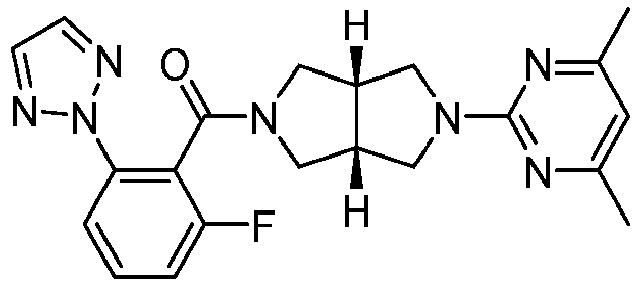
- the present invention relates to the synthesis methods making (((3a R ,6a S )-5-(4,6-dimethylpyrimidin-2-yl)hexahydropyrrolo[3,4-c]pyrrol-2(1 H )-yl)(2-fluoro-6-(2 H- 1,2,3-triazol-2-yl)phenyl)methanone, a compound useful for modulation of the orexin receptor and for the treatment of disease states, disorders, and conditions mediated by orexin receptor activity.
- Orexin (or hypocretin) signaling is mediated by two receptors and two peptide agonists.
- the two orexin peptides herein after referred to as orexins, bind to two high affinity receptors, termed orexin-1 and orexin-2 receptors.
- the orexin-1 receptor is selective in favor of orexin A, while the orexin-2 receptor binds both orexins with similar affinities.
- the orexins are cleavage products of the same gene, prepro orexin.
- neuronal neurosci the precursor from which orexin is produced, are found in the perifornical nucleus, the dorsal hypothalamus and the lateral hypothalamus ( C. Peyron et al., J. Neurosci., 1998, 18(23), 9996-10015 ). Orexinergic cells in these nuclei project to many areas of the brain, extending rostrally to the olfactory bulbs and caudally to the spinal cord ( van den Pol, A.N. et al., J. Neuroscience., 1999, 19(8), 3171-3182 ).
- Substituted diaza-bicyclic compounds have been reported as active central nervous system agents (International Publication No. WO2001081347, November 1, 2001 ; US2002/0019388, February 14, 2002 ), ⁇ 7 acetylcholine receptor modulators ( US2005/101602, May 12, 2005 ; US2005/0065178, March 24, 2005 and Frost et al, Journal of Medicinal Chemistry, 2006, 49(26), 7843-7853 ), proline transporter inhibitors for the treatment of cognitive impairment ( WO2008067121, June 5, 2008 ) and for improving cognition ( WO 2006 124897, November 23, 2006 and US20060258672, November 16, 2006 ), as androgen receptor ligands for the treatment of androgen receptor associated conditions including cancer ( WO2009081197, July 2, 2009 ), and as histone deacetylase inhibitors for the treatment of cancers, neurodegenerative diseases and autoimmune diseases ( WO20060123121, November 23, 2006 ).
- the invention comprises a process of preparing (((3a R ,6a S )-5-(4,6-dimethylpyrimidin-2-yl)hexahydropyrrolo[3,4-c]pyrrol-2(1 H )-yl)(2-fluoro-6-(2 H- 1,2,3-triazol-2-yl)phenyl)methanone
- protecting groups are eliminated altogether, and the linear sequence from commercially available 1 H -pyrrole-2,5-dione is reduced to as few as three steps.
- the invention comprises a process of preparing (((3a R ,6a S )-5-(4,6-dimethylpyrimidin-2-yl)hexahydropyrrolo[3,4-c]pyrrol-2(1 H )-yl)(2-fluoro-6-(2 H -1,2,3-triazol-2-yl)phenyl)methanone said process comprising step described below:
- the invention comprises a process of preparing (((3a R ,6a S )-5-(4,6-dimethylpyrimidin-2-yl)hexahydropyrrolo[3,4-c]pyrrol-2(1 H -yl)(2-fluoro-6-(2 H- 1,2,3-triazol-2-yl)phenyl)methanone said process comprising step described below:
- Another embodiment of the invention is a process of preparing (((3a R ,6a S )-5-(4,6-dimethylpyrimidin-2-yl)hexahydropyrrolo[3,4-c]pyrrol-2(1 H -yl)(2-fluoro-6-(2 H- 1,2,3-triazol-2-yl)phenyl)methanone said process comprising the steps described below:
- Another embodiment of the invention is a process of preparing (((3aR,6aS)-5-(4,6-dimethylpyrimidin-2-yl)hexahydropyrrolo[3,4-c]pyrrol-2(1 H )-yl)(2-fluoro-6-(2 H- 1,2,3-triazol-2-yl)phenyl)methanone said process comprising the steps described below:
- Another embodiment of the invention is a process of preparing (((3aR,6aS)-5-(4,6-dimethylpyrimidin-2-yl)hexahydropyrrolo[3,4-c]pyrrol-2(1 H )-yl)(2-fluoro-6-(2 H- 1,2,3-triazol-2-yl)phenyl)methanone said process comprising the steps described below:
- Another embodiment of the invention is a process of preparing (((3a R ,6a S )-5-(4,6-dimethylpyrimidin-2-yl)hexahydropyrrolo[3,4-c]pyrrol-2(1 H )-yl)(2-fluoro-6-(2 H- 1,2,3-triazol-2-yl)phenyl)methanone said process comprising the steps described below:
- Another embodiment of the invention is a process of preparing (((3a R ,6a S )-5-(4,6-dimethylpyrimidin-2-yl)hexahydropyrrolo[3,4-c]pyrrol-2(1 H )-yl)(2-fluoro-6-(2 H- 1,2,3-triazol-2-yl)phenyl)methanone said process comprising the steps described below:
- Another embodiment of the invention is a process of preparing (((3a R ,6a S )-5-(4,6-dimethylpyrimidin-2-yl)hexahydropyrrolo[3,4-c]pyrrol-2(1 H )-yl)(2-fluoro-6-(2 H- 1,2,3-triazol-2-yl)phenyl)methanone said process comprising the steps described below:
- Another embodiment of the invention is a process of preparing (((3aR,6aS)-5-(4,6-dimethylpyrimidin-2-yl)hexahydropyrrolo[3,4-c]pyrrol-2(1 H )-yl)(2-fluoro-6-(2 H- 1,2,3-triazol-2-yl)phenyl)methanone said process comprising the steps described below:
- Another embodiment of the invention is a process of preparing (((3a R ,6a S )-5-(4,6-dimethylpyrimidin-2-yl)hexahydropyrrolo[3,4-c]pyrrol-2(1 H )-yl)(2-fluoro-6-(2 H- 1,2,3-triazol-2-yl)phenyl)methanone said process comprising the steps described below:
- Another embodiment of the invention is a process of preparing (((3a R ,6a S )-5-(4,6-dimethylpyrimidin-2-yl)hexahydropyrrolo[3,4-c]pyrrol-2(1 H )-yl)(2-fluoro-6-(2 H- 1,2,3-triazol-2-yl)phenyl)methanone said process comprising the steps described below:
- Another embodiment of the invention is a process of preparing (((3a R ,6a S )-5-(4,6-dimethylpyrimidin-2-yl)hexahydropyrrolo[3,4-c]pyrrol-2(1 H )-yl)(2-fluoro-6-(2 H- 1,2,3-triazol-2-yl)phenyl)methanone said process comprising the steps described below:
- Another embodiment of the invention is a process of preparing (((3a R ,6a S )-5-(4,6-dimethylpyrimidin-2-yl)hexahydropyrrolo[3,4-c]pyrrol-2(1 H )-yl)(2-fluoro-6-(2 H- 1,2,3-triazol-2-yl)phenyl)methanone said process comprising the steps described below:
- Another embodiment of the invention is a process of preparing (((3aR,6aS)-5-(4,6-dimethylpyrimidin-2-yl)hexahydropyrrolo[3,4-c]pyrrol-2(1 H )-yl)(2-fluoro-6-(2 H- 1,2,3-triazol-2-yl)phenyl)methanone said process comprising the steps described below:
- Another embodiment of the invention is a process of preparing (((3aR,6aS)-5-(4,6-dimethylpyrimidin-2-yl)hexahydropyrrolo[3,4-c]pyrrol-2(1 H )-yl)(2-fluoro-6-(2 H- 1,2,3-triazol-2-yl)phenyl)methanone said process comprising the steps described below:
- Another embodiment of the invention is a process of preparing (((3a R ,6a S )-5-(4,6-dimethylpyrimidin-2-yl)hexahydropyrrolo[3,4-c]pyrrol-2(1 H )-yl)(2-fluoro-6-(2 H- 1,2,3-triazol-2-yl)phenyl)methanone said process comprising the steps described below::
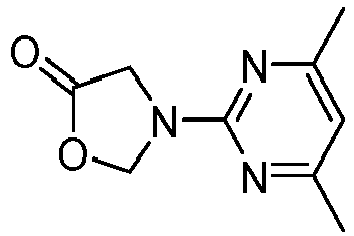
- Another embodiment of the invention is a compound which is 3-(4,6-dimethylpyrimidin-2-yl)oxazolidin-5-one
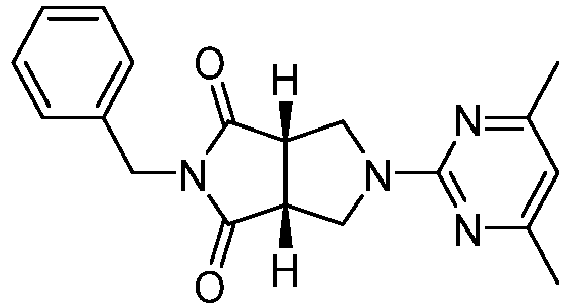
- Another embodiment of the invention is a compound which is (3a R ,6a S )-2-benzyl-5-(4,6-dimethylpyrimidin-2-yl)tetrahydropyrrolo[3,4-c]pyrrole-1,3(2 H ,3a H )-dione
- Another embodiment of the invention is a compound which is (3a R ,6a S )-5-(4,6-dimethylpyrimidin-2-yl)tetrahydropyrrolo[3,4-c]pyrrole-1,3(2 H ,3a H )-dione
- Products of the chemical reactions described in this specification may be reacted directly with additional reagents or may be separated prior to subsequent reaction.
- isolated means the partial or complete separation of a reaction product from other materials in the reaction vessel. These other materials include, but are not limited to solvents, unreacted starting material, reagents used in the reaction, side-products, impurities and the products of reagents used in the reaction.
- preparing means synthesizing by means of chemical processes.
- any formula given herein is intended to refer also to hydrates, solvates, and polymorphs of such compounds, and mixtures thereof, even if such forms are not listed explicitly.
- any formula given herein is also intended to represent unlabeled forms as well as isotopically labeled forms of the compounds.
- Isotopically labeled compounds have structures depicted by the formulas given herein except that one or more atoms are replaced by an atom having a selected atomic mass or mass number.
- isotopes that can be incorporated into compounds of the invention include isotopes of hydrogen, carbon, nitrogen, oxygen, phosphorus, fluorine, and chlorine, such as 2 H, 3 H, 11 C, 13 C, 14 C, 15 N, 18 O, 17 O, respectively.
- Such isotopically labeled compounds are useful in metabolic studies (preferably with 14 C), reaction kinetic studies (with, for example 2 H or 3 H), detection or imaging techniques [such as positron emission tomography (PET) or single-photon emission computed tomography (SPECT)] including drug or substrate tissue distribution assays, or in radioactive treatment of patients.
- detection or imaging techniques such as positron emission tomography (PET) or single-photon emission computed tomography (SPECT)
- PET positron emission tomography
- SPECT single-photon emission computed tomography
- substitution with heavier isotopes such as deuterium (i.e., 2 H) may afford certain therapeutic advantages resulting from greater metabolic stability, for example increased in vivo half-life or reduced dosage requirements.
- Isotopically labeled compounds of this invention and prodrugs thereof can generally be prepared by carrying out the procedures disclosed in the schemes or in the examples and preparations described below by substituting a readily available isotopically labeled reagent for a non-isotopically labeled reagent.
- salts include, without limitation, sulfates, pyrosulfates, bisulfates, sulfites, bisulfites, phosphates, monohydrogen-phosphates, dihydrogenphosphates, metaphosphates, pyrophosphates, chlorides, bromides, iodides, acetates, propionates, decanoates, caprylates, acrylates, formates, isobutyrates, caproates, heptanoates, propiolates, oxalates, malonates, succinates, suberates, sebacates, fumarates, maleates, butyne-1,4-dioates, hexyne-1,6-dioates, benzoates, chlorobenzoates, methylbenzoates, dinitrobenzoates, hydroxybenzoates, methoxybenzoates, phthalates, sulfonates, xylenesulfonates, phenylacetates, phen
- a salt may be prepared by any suitable method available in the art, for example, treatment of the free base with an inorganic acid, such as hydrochloric acid, hydrobromic acid, sulfuric acid, sulfamic acid, nitric acid, boric acid, phosphoric acid, and the like, or with an organic acid, such as acetic acid, phenylacetic acid, propionic acid, stearic acid, lactic acid, ascorbic acid, maleic acid, hydroxymaleic acid, isethionic acid, succinic acid, valeric acid, fumaric acid, malonic acid, pyruvic acid, oxalic acid, glycolic acid, salicylic acid, oleic acid, palmitic acid, lauric acid, a pyranosidyl acid, such as glucuronic acid or galacturonic acid, an alpha-hydroxy acid, such as mandelic acid, citric acid, or tart
- an inorganic acid such as hydrochloric acid, hydrobromic acid, sulfur
- deprotective reagents include, but are not limited to, ammonium formate in the presence of a palladium catalyst, hydrogen gas in the presense of a palladium catalyst, formic acid, formic acid-triethylamine mixture, sodium formate, potassium formate, cyclohexene, or cyclohexadiene.
- reactions may be performed in any suitable solvent.
- reactions may be performed at a wide range of temperatures. Unless otherwise specified, reactions may be performed between the melting point and the reflux temperature of the solvent, and preferably between 0 °C and the reflux temperature of the solvent. Reactions may be heated employing conventional heating or microwave heating. Reactions may also be conducted in sealed pressure vessels above the normal reflux temperature of the solvent.
- reaction mixtures were stirred at room temperature (rt) under a nitrogen atmosphere. Where mixtures, solutions, and extracts were “concentrated”, they were typically concentrated under reduced pressure. Reactions under microwave irradiation conditions were carried out in a Biotage Initiator or CEM Discover instrument.
- Mass spectra were obtained on either Bruker QTOF, Waters QTOF Ultima instruments using electrospray ionization (ESI) in positive mode unless otherwise indicated, or on a Waters GC-TOF using electronic impact (EI). Calculated (calcd.) mass corresponds to the exact mass.
- Nuclear magnetic resonance (NMR) spectra were obtained on Bruker spectrometers.
- the format of the 1 H NMR data below is: chemical shift in ppm downfield of the tetramethylsilane reference (multiplicity, coupling constant J in Hz, integration).
- Example 1a batch mode in toluene using paraformaldehyde with isolation
- Example 1b alternative Synthesis - with aqueous solution of formaldehyde
- Example 2a Screening in toluene under various flow mode conditions
- the solution was preheated in a coil of 1.7 mm id. and the reaction took place in a coil of 4 mm i.d with a length and flow rate to reach a residence time of 5 minutes.
- the reaction temperature was controlled by a heat-exchanger.
- the preheating unit, and reactor coil were all made from stainless steel and placed in the heat-exchanger to obtain a uniform reaction temperature.
- the process pressure was adjusted at 10 bar above vapour pressure of toluene with a back pressure regulator (Swagelock). At the outlet the reaction mixture was cooled in a stainless steel tube in tube (id. of 1.7mm) to 60 °C and depressurized to atmospheric pressure before UPLC analysis.
- a fast temperature screening demonstrates the reaction does not occur before 200 °C and needs a temperature above 250 °C (see chart below).
- the kinetics are very fast at 300 °C ( ⁇ 2min) and the product is stable for at least 5 min. °C % in-situ yield (5b ) or % unconverted ( 3 , 4b ) 3 4b 5b 25 98 2 -- 200 97 2 1 250 74 2 21 300 5 -- 78 350 5 -- 80
- a second series of experiments using the same device than the one described in example 2a shows that the reaction is complete in about 4 minutes at 275 °C, and in less than 2 minutes at 300 °C.
- the compound 5b is stable under these conditions at 300 °C for at least 5 minutes (see charts below).
- Example 2c flow mode in toluene with isolation
- Example 4a one-pot reaction in microwave (MW) vial
- a mixed suspension of compound 2 (1 mole), paraformaldehyde (1.3 mole/mole) and compound 4b (1.4 mole/mole) in toluene (4 L/mole) was delivered to a flow set up by a syringe pump (Isco 250D).
- the suspension was preheated in a coil (1.7 mm id.) and a telescoped reaction took place in a coil (1.7 mm i.d) with a length defined by the desired residence time and flow rates.
- the temperature for the first reaction (formation of compound 3) was controlled by a first heat-exchanger and the temperature for the second reaction formation of compound 5b) was controlled by a second heat-exchanger.
- the preheating unit, and reactor coils were all made from stainless steel and placed in two heated zones to obtain a uniform reaction temperature.
- the process pressure was adjusted at 10 bar above vapour pressure of toluene with a back pressure regulator (Swagelock). At the outlet the reaction mixture was cooled in a stainless steel tube in tube with id. of 1.7mm to 60 °C and depressurized to atmospheric pressure.
- the product was diluted and analyzed by UPLC.
- Step 1 Step 2 % Yield relative to compound 2 T-°C min T-°C min Comp. 3 Comp .2 Comp. 5b 180 8 300 3.4 0 0 54.2 180 6 300 2.6 0.2 0.2 54.9 180 4 300 1.7 1.1 2.9 42.0 160 8 300 3.4 0 0 62.1 160 6 300 2.6 0 0 62.6 160 4 300 1.7 1.1 0.8 53.3 200 4 300 2.6 0.1 0.1 60.8 200 6 300 1.7 1 0.8 50.7
- Example 4c one-pot reaction in batch-flow mode
- the obtained solution of compound 3 was delivered to the flow set up by a syringe pump (Isco 250D).
- the suspension was preheated in a coil (1.7 mm id.) and the reaction took place in a coil (1.7mm i.d) with a length defined by the desired residence time of 3 minutes and flow rates.
- the reactions temperature was controlled at 300 °C by a heat-exchanger.
- the preheating unit, and reactor coil were all made from stainless steel and placed in the heat-exchanger to obtain a uniform reaction temperature.
- the process pressure was adjusted at 10 bar above vapour pressure of toluene with a back pressure regulator (Swagelock). At the outlet the reaction mixture was cooled in a stainless steel tube in tube (id. of 1.7mm) to 60 °C and depressurized to admospheric pressure.
- the compound 5b was obtained in 66% yield.
- Example 6a reduction with NaBH 4 + BF 3 -THF
- a 1-L reactor was charged with compound 5b (75 g), NaBH 4 (19.4 g, 2.25 equiv) and THF (375 mL). The reaction mixture was heated to 50 °C while stirring. To this was added BF 3 ⁇ THF (78.1 mL, 3.1 equiv) over 2h (Caution: very exothermic in the beginning and the intensity is reduced over the time while addition proceeds). After complete addition of BF 3 ⁇ THF, the reaction was continued for 1h. Methanol (108 mL, 12 equiv) was slowly added to the reaction mixture over 2.5h.
- Example 9 Formation of (((3a R ,6a S )-5-(4,6-dimethylpyrimidin-2-yl)hexahydropyrrolo[3,4-c]pyrrol-2(1 H )-yl)(2-fluoro-6-(2 H -1,2,3-triazol-2-yl)phenyl)methanone (1) from compound 6a and compound 7
- the resulting biphasic mixture was stirred at 30 °C for 3.5 hours before being heating to 70 °C.
- the water layer was discarded and the organic one was washed twice with 57 ml of water and concentrated under vacuum to a residual volume of about 64 ml.
- the concentrated mixture was heated to 90 °C to obtain a solution before cooling to room temperature and addition of 64 ml of cyclohexane.
- the resulting suspension was stirred overnight.
Landscapes
- Chemical & Material Sciences (AREA)
- Organic Chemistry (AREA)
- Nitrogen Condensed Heterocyclic Rings (AREA)
- Pharmaceuticals Containing Other Organic And Inorganic Compounds (AREA)
- Health & Medical Sciences (AREA)
- Medicinal Chemistry (AREA)
- Plural Heterocyclic Compounds (AREA)
- Pharmacology & Pharmacy (AREA)
- Epidemiology (AREA)
- Life Sciences & Earth Sciences (AREA)
- Animal Behavior & Ethology (AREA)
- General Health & Medical Sciences (AREA)
- Public Health (AREA)
- Veterinary Medicine (AREA)
- Nitrogen And Oxygen Or Sulfur-Condensed Heterocyclic Ring Systems (AREA)
Abstract
Description
- The present invention relates to the synthesis methods making (((3aR,6aS)-5-(4,6-dimethylpyrimidin-2-yl)hexahydropyrrolo[3,4-c]pyrrol-2(1H)-yl)(2-fluoro-6-(2H-1,2,3-triazol-2-yl)phenyl)methanone, a compound useful for modulation of the orexin receptor and for the treatment of disease states, disorders, and conditions mediated by orexin receptor activity.
- Orexin (or hypocretin) signaling is mediated by two receptors and two peptide agonists. The two orexin peptides (orexin A and orexin B) herein after referred to as orexins, bind to two high affinity receptors, termed orexin-1 and orexin-2 receptors. The orexin-1 receptor is selective in favor of orexin A, while the orexin-2 receptor binds both orexins with similar affinities. The orexins, are cleavage products of the same gene, prepro orexin. In the central nervous system neurons expressing preproorexin, the precursor from which orexin is produced, are found in the perifornical nucleus, the dorsal hypothalamus and the lateral hypothalamus (C. Peyron et al., J. Neurosci., 1998, 18(23), 9996-10015). Orexinergic cells in these nuclei project to many areas of the brain, extending rostrally to the olfactory bulbs and caudally to the spinal cord (van den Pol, A.N. et al., J. Neuroscience., 1999, 19(8), 3171-3182).
- Citation of a reference herein shall not be construed as an admission that such reference is prior art to the present invention. All publications referred to herein are incorporated by reference in their entireties.
- Substituted diaza-bicyclic compounds have been reported as active central nervous system agents (International Publication No.
WO2001081347, November 1, 2001 ;US2002/0019388, February 14, 2002 ), α7 acetylcholine receptor modulators (US2005/101602, May 12, 2005 ;US2005/0065178, March 24, 2005 and Frost et al, Journal of Medicinal Chemistry, 2006, 49(26), 7843-7853), proline transporter inhibitors for the treatment of cognitive impairment (WO2008067121, June 5, 2008 ) and for improving cognition (WO 2006 124897, November 23, 2006 andUS20060258672, November 16, 2006 ), as androgen receptor ligands for the treatment of androgen receptor associated conditions including cancer (WO2009081197, July 2, 2009 ), and as histone deacetylase inhibitors for the treatment of cancers, neurodegenerative diseases and autoimmune diseases (WO20060123121, November 23, 2006 - Among the developed compounds, (((3aR,6aS)-5-(4,6-dimethylpyrimidin-2-yl)hexahydropyrrolo[3,4-c]pyrrol-2(1H)-yl)(2-fluoro-6-(2H-1,2,3-triazol-2-yl)phenyl)methanone was found to act as an inhibitor of the orexin-2 receptor and to be useful for the treatment of sleep disorders and major depressive diseases (
US 8,653,263 B2 ). The original synthesis had a linear sequence of eight steps from commercially available 1-benzyl-1H-pyrrole-2,5-dione, including four protecting group manipulation steps (scheme below).
- Other multi-step efforts to make the (3aR,6aS)-2-benzyloctahydropyrrolo[3,4-c]pyrrole intermediate,

- It is an object of the invention to provide a process for preparing (((3aR,6aS)-5-(4,6-dimethylpyrimidin-2-yl)hexahydropyrrolo[3,4-c]pyrrol-2(1H)-yl)(2-fluoro-6-(2H-1,2,3-triazol-2-yl)phenyl)methanone utilizing fewer protecting group steps and a shorter overall reaction sequence in order to reduce cost of manufacturing.
- The invention comprises a process of preparing (((3aR,6aS)-5-(4,6-dimethylpyrimidin-2-yl)hexahydropyrrolo[3,4-c]pyrrol-2(1H)-yl)(2-fluoro-6-(2H-1,2,3-triazol-2-yl)phenyl)methanone

- Wherein early installation of the 4,6-dimethylpyrimid-2-yl group obviates the need for three protecting group manipulation steps, reducing the linear sequence from commercially available 1-benzyl-1H-pyrrole-2,5-dione to four steps.

- In other embodiments of the invention, protecting groups are eliminated altogether, and the linear sequence from commercially available 1H-pyrrole-2,5-dione is reduced to as few as three steps.

- The invention comprises a process of preparing (((3aR,6aS)-5-(4,6-dimethylpyrimidin-2-yl)hexahydropyrrolo[3,4-c]pyrrol-2(1H)-yl)(2-fluoro-6-(2H-1,2,3-triazol-2-yl)phenyl)methanone

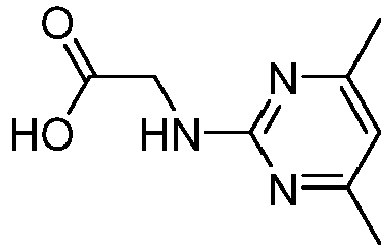
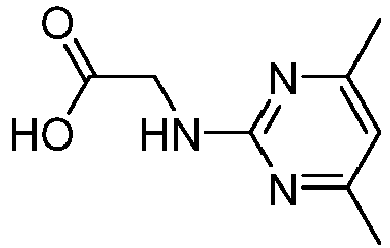
- a) Oxazolidination of (4,6-dimethylpyrimidin-2-yl)glycine,


- The invention comprises a process of preparing (((3aR,6aS)-5-(4,6-dimethylpyrimidin-2-yl)hexahydropyrrolo[3,4-c]pyrrol-2(1H-yl)(2-fluoro-6-(2H-1,2,3-triazol-2-yl)phenyl)methanone

- a) Oxazolidination of (4,6-dimethylpyrimidin-2-yl)glycine,

- Another embodiment of the invention is a process of preparing (((3aR,6aS)-5-(4,6-dimethylpyrimidin-2-yl)hexahydropyrrolo[3,4-c]pyrrol-2(1H-yl)(2-fluoro-6-(2H-1,2,3-triazol-2-yl)phenyl)methanone

- a) Oxazolidination of (4,6-dimethylpyrimidin-2-yl)glycine,


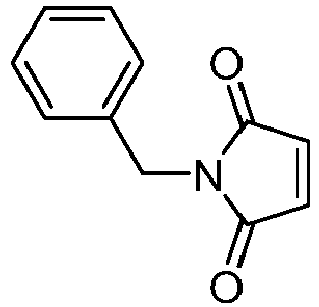
- b) Reaction of 3-(4,6-dimethylpyrimidin-2-yl)oxazolidin-5-one


- Another embodiment of the invention is a process of preparing (((3aR,6aS)-5-(4,6-dimethylpyrimidin-2-yl)hexahydropyrrolo[3,4-c]pyrrol-2(1H)-yl)(2-fluoro-6-(2H-1,2,3-triazol-2-yl)phenyl)methanone

- a) Oxazolidination of (4,6-dimethylpyrimidin-2-yl)glycine,


- b) Reaction of 3-(4,6-dimethylpyrimidin-2-yl)oxazolidin-5-one


- c) reduction of (3aR,6aS)-2-benzyl-5-(4,6-dimethylpyrimidin-2-yl)tetrahydropyrrolo[3,4-c]pyrrole-1,3(2H,3aH)-dione


- Another embodiment of the invention is a process of preparing (((3aR,6aS)-5-(4,6-dimethylpyrimidin-2-yl)hexahydropyrrolo[3,4-c]pyrrol-2(1H)-yl)(2-fluoro-6-(2H-1,2,3-triazol-2-yl)phenyl)methanone

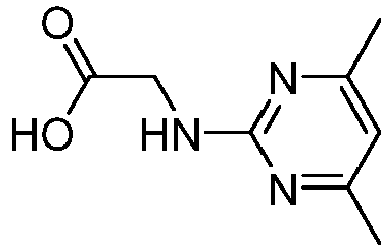
- a) Oxazolidination of (4,6-dimethylpyrimidin-2-yl)glycine,

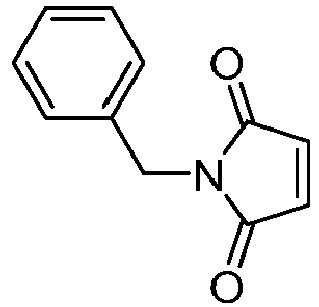
- b) Reaction of 3-(4,6-dimethylpyrimidin-2-yl)oxazolidin-5-one


- c) reduction of (3aR,6aS)-2-benzyl-5-(4,6-dimethylpyrimidin-2-yl)tetrahydropyrrolo[3,4-c]pyrrole-1,3 (2H,3aH)-dione


- d) deprotection of (3aR,6aS)-2-benzyl-5-(4,6-dimethylpyrimidin-2-yl)octahydropyrrolo[3,4-c]pyrrole


- Another embodiment of the invention is a process of preparing (((3aR,6aS)-5-(4,6-dimethylpyrimidin-2-yl)hexahydropyrrolo[3,4-c]pyrrol-2(1H)-yl)(2-fluoro-6-(2H-1,2,3-triazol-2-yl)phenyl)methanone

- a) Oxazolidination of (4,6-dimethylpyrimidin-2-yl)glycine,


- b) Reaction of 3-(4,6-dimethylpyrimidin-2-yl)oxazolidin-5-one


- c) reduction of (3aR,6aS)-2-benzyl-5-(4,6-dimethylpyrimidin-2-yl)tetrahydropyrrolo[3,4-c]pyrrole-1,3(2H,3aH)-dione

- d) deprotection of (3aR,6aS)-2-benzyl-5-(4,6-dimethylpyrimidin-2-yl)octahydropyrrolo[3 ,4-c]pyrrole


- e) Amidation of (3aR,6aS)-2-(4,6-dimethylpyrimidin-2-yl)octahydropyrrolo[3,4-c]pyrrole


- Another embodiment of the invention is a process of preparing (((3aR,6aS)-5-(4,6-dimethylpyrimidin-2-yl)hexahydropyrrolo[3,4-c]pyrrol-2(1H)-yl)(2-fluoro-6-(2H-1,2,3-triazol-2-yl)phenyl)methanone
- a) Oxazolidination of (4,6-dimethylpyrimidin-2-yl)glycine,


- b) Reaction of 3-(4,6-dimethylpyrimidin-2-yl)oxazolidin-5-one


- Another embodiment of the invention is a process of preparing (((3aR,6aS)-5-(4,6-dimethylpyrimidin-2-yl)hexahydropyrrolo[3,4-c]pyrrol-2(1H)-yl)(2-fluoro-6-(2H-1,2,3-triazol-2-yl)phenyl)methanone

- a) Oxazolidination of (4,6-dimethylpyrimidin-2-yl)glycine,


- b) reaction of 3-(4,6-dimethylpyrimidin-2-yl)oxazolidin-5-one


- c) reduction of (3aR,6aS)-5-(4,6-dimethylpyrimidin-2-yl)tetrahydropyrrolo[3,4-c]pyrrole-1,3(2H,3aH)-dione


- Another embodiment of the invention is a process of preparing (((3aR,6aS)-5-(4,6-dimethylpyrimidin-2-yl)hexahydropyrrolo[3,4-c]pyrrol-2(1H)-yl)(2-fluoro-6-(2H-1,2,3-triazol-2-yl)phenyl)methanone

- a) Oxazolidination of (4,6-dimethylpyrimidin-2-yl)glycine,


- b) reaction of 3-(4,6-dimethylpyrimidin-2-yl)oxazolidin-5-one


- c) reduction of (3aR,6aS)-5-(4,6-dimethylpyrimidin-2-yl)tetrahydropyrrolo[3,4-c]pyrrole-1,3(2H,3aH)-dione


- e) Amidation of (3aR,6aS)-2-(4,6-dimethylpyrimidin-2-yl)octahydropyrrolo[3,4-c]pyrrole


- Another embodiment of the invention is a process of preparing (((3aR,6aS)-5-(4,6-dimethylpyrimidin-2-yl)hexahydropyrrolo[3,4-c]pyrrol-2(1H)-yl)(2-fluoro-6-(2H-1,2,3-triazol-2-yl)phenyl)methanone

- a) Oxazolidination of (4,6-dimethylpyrimidin-2-yl)glycine,


- b) Reaction of 3-(4,6-dimethylpyrimidin-2-yl)oxazolidin-5-one


- Another embodiment of the invention is a process of preparing (((3aR,6aS)-5-(4,6-dimethylpyrimidin-2-yl)hexahydropyrrolo[3,4-c]pyrrol-2(1H)-yl)(2-fluoro-6-(2H-1,2,3-triazol-2-yl)phenyl)methanone

- a) Oxazolidination of (4,6-dimethylpyrimidin-2-yl)glycine,

- b) Reaction of 3-(4,6-dimethylpyrimidin-2-yl)oxazolidin-5-one


- Another embodiment of the invention is a process of preparing (((3aR,6aS)-5-(4,6-dimethylpyrimidin-2-yl)hexahydropyrrolo[3,4-c]pyrrol-2(1H)-yl)(2-fluoro-6-(2H-1,2,3-triazol-2-yl)phenyl)methanone

- a) Oxazolidination of (4,6-dimethylpyrimidin-2-yl)glycine,


- b) Reaction of 3-(4,6-dimethylpyrimidin-2-yl)oxazolidin-5-one


- Another embodiment of the invention is a process of preparing (((3aR,6aS)-5-(4,6-dimethylpyrimidin-2-yl)hexahydropyrrolo[3,4-c]pyrrol-2(1H)-yl)(2-fluoro-6-(2H-1,2,3-triazol-2-yl)phenyl)methanone

- a) Oxazolidination of (4,6-dimethylpyrimidin-2-yl)glycine,

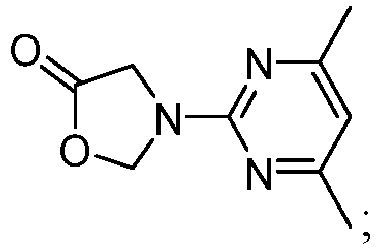
- b) Reaction of 3-(4,6-dimethylpyrimidin-2-yl)oxazolidin-5-one


- Another embodiment of the invention is a process of preparing (((3aR,6aS)-5-(4,6-dimethylpyrimidin-2-yl)hexahydropyrrolo[3,4-c]pyrrol-2(1H)-yl)(2-fluoro-6-(2H-1,2,3-triazol-2-yl)phenyl)methanone

- a) Oxazolidination of (4,6-dimethylpyrimidin-2-yl)glycine,


- b) Reaction of 3-(4,6-dimethylpyrimidin-2-yl)oxazolidin-5-one


- c) reduction of (3aR,6aS)-2-benzyl-5-(4,6-dimethylpyrimidin-2-yl)tetrahydropyrrolo[3,4-c]pyrrole-1,3(2H,3aH)-dione

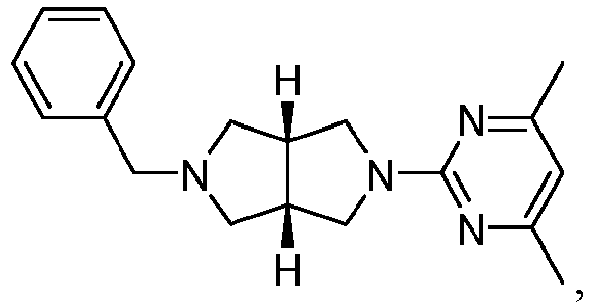
- Another embodiment of the invention is a process of preparing (((3aR,6aS)-5-(4,6-dimethylpyrimidin-2-yl)hexahydropyrrolo[3,4-c]pyrrol-2(1H)-yl)(2-fluoro-6-(2H-1,2,3-triazol-2-yl)phenyl)methanone

- a) Oxazolidination of (4,6-dimethylpyrimidin-2-yl)glycine,


- b) Reaction of 3-(4,6-dimethylpyrimidin-2-yl)oxazolidin-5-one


- c) reduction of (3aR,6aS)-2-benzyl-5-(4,6-dimethylpyrimidin-2-yl)tetrahydropyrrolo[3,4-c]pyrrole-1,3(2H,3aH)-dione


- d) deprotection of (3aR,6aS)-2-benzyl-5-(4,6-dimethylpyrimidin-2-yl)octahydropyrrolo[3,4-c]pyrrole


- Another embodiment of the invention is a process of preparing (((3aR,6aS)-5-(4,6-dimethylpyrimidin-2-yl)hexahydropyrrolo[3,4-c]pyrrol-2(1H)-yl)(2-fluoro-6-(2H-1,2,3-triazol-2-yl)phenyl)methanone

- a) Oxazolidination of (4,6-dimethylpyrimidin-2-yl)glycine,


- b) Reaction of 3-(4,6-dimethylpyrimidin-2-yl)oxazolidin-5-one


- c) reduction of (3aR,6aS)-2-benzyl-5-(4,6-dimethylpyrimidin-2-yl)tetrahydropyrrolo[3,4-c]pyrrole-1,3(2H,3aH)-dione

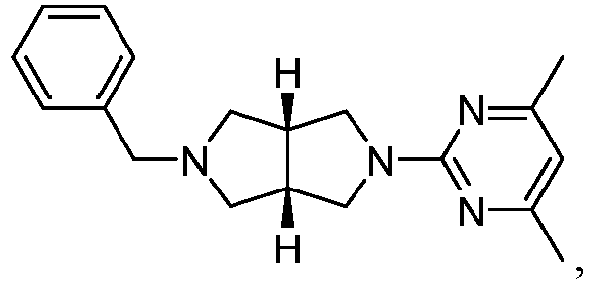
- d) deprotection of (3aR,6aS)-2-benzyl-5-(4,6-dimethylpyrimidin-2-yl)octahydropyrrolo[3,4-c]pyrrole


- e) Amidation of (3aR,6aS)-2-(4,6-dimethylpyrimidin-2-yl)octahydropyrrolo[3,4-c]pyrrole


- Another embodiment of the invention is a process of preparing (((3aR,6aS)-5-(4,6-dimethylpyrimidin-2-yl)hexahydropyrrolo[3,4-c]pyrrol-2(1H)-yl)(2-fluoro-6-(2H-1,2,3-triazol-2-yl)phenyl)methanone

- a) Oxazolidination of (4,6-dimethylpyrimidin-2-yl)glycine,


- b) reaction of 3-(4,6-dimethylpyrimidin-2-yl)oxazolidin-5-one

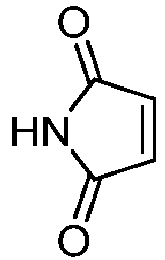

- c) reduction of (3aR,6aS)-5-(4,6-dimethylpyrimidin-2-yl)tetrahydropyrrolo[3,4-c]pyrrole-1,3(2H,3aH)-dione


- Another embodiment of the invention is a process of preparing (((3aR,6aS)-5-(4,6-dimethylpyrimidin-2-yl)hexahydropyrrolo[3,4-c]pyrrol-2(1H)-yl)(2-fluoro-6-(2H-1,2,3-triazol-2-yl)phenyl)methanone

- a) Oxazolidination of (4,6-dimethylpyrimidin-2-yl)glycine,


- b) reaction of 3-(4,6-dimethylpyrimidin-2-yl)oxazolidin-5-one


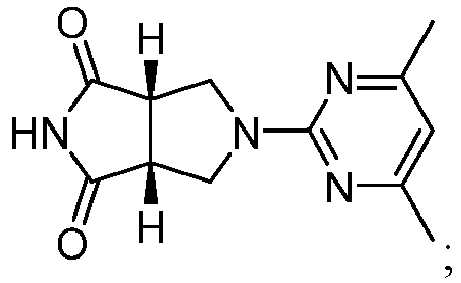
- c) reduction of (3aR,6aS)-5-(4,6-dimethylpyrimidin-2-yl)tetrahydropyrrolo[3,4-c]pyrrole-1,3(2H,3aH)-dione


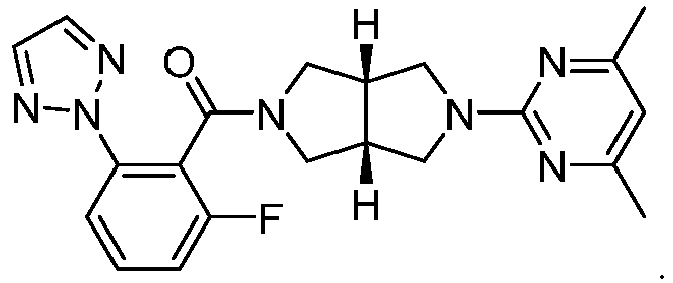
- e) Amidation of (3aR,6aS)-2-(4,6-dimethylpyrimidin-2-yl)octahydropyrrolo[3,4-c]pyrrole


- Another embodiment of the invention is a compound which is 3-(4,6-dimethylpyrimidin-2-yl)oxazolidin-5-one

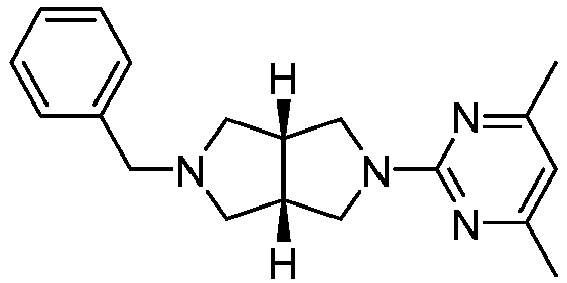
- Another embodiment of the invention is a compound which is (3aR,6aS)-2-benzyl-5-(4,6-dimethylpyrimidin-2-yl)tetrahydropyrrolo[3,4-c]pyrrole-1,3(2H,3aH)-dione

- Another embodiment of the invention is a compound which is (3aR,6aS)-5-(4,6-dimethylpyrimidin-2-yl)tetrahydropyrrolo[3,4-c]pyrrole-1,3(2H,3aH)-dione

- The invention may be more fully appreciated by reference to the following description, including the following glossary of terms and the concluding examples. For the sake of brevity, the disclosures of the publications, including patents, cited in this specification are herein incorporated by reference.
- As used herein, the terms "including", "containing" and "comprising" are used herein in their open, non-limiting sense.
- The term "(((3aR,6aS)-5-(4,6-dimethylpyrimidin-2-yl)hexahydropyrrolo[3,4-c]pyrrol-2(1H)-yl)(2-fluoro-6-(2H-1,2,3-triazol-2-yl)phenyl)methanone" means

- Any formula given herein is intended to represent compounds having structures depicted by the structural formula as well as certain variations or forms.
- Products of the chemical reactions described in this specification may be reacted directly with additional reagents or may be separated prior to subsequent reaction. The term "isolated" means the partial or complete separation of a reaction product from other materials in the reaction vessel. These other materials include, but are not limited to solvents, unreacted starting material, reagents used in the reaction, side-products, impurities and the products of reagents used in the reaction.
- The term "preparing" means synthesizing by means of chemical processes.
- Additionally, any formula given herein is intended to refer also to hydrates, solvates, and polymorphs of such compounds, and mixtures thereof, even if such forms are not listed explicitly.
- Any formula given herein is also intended to represent unlabeled forms as well as isotopically labeled forms of the compounds. Isotopically labeled compounds have structures depicted by the formulas given herein except that one or more atoms are replaced by an atom having a selected atomic mass or mass number. Examples of isotopes that can be incorporated into compounds of the invention include isotopes of hydrogen, carbon, nitrogen, oxygen, phosphorus, fluorine, and chlorine, such as 2H, 3H, 11C, 13C, 14C, 15N, 18O, 17O, respectively. Such isotopically labeled compounds are useful in metabolic studies (preferably with 14C), reaction kinetic studies (with, for example 2H or 3H), detection or imaging techniques [such as positron emission tomography (PET) or single-photon emission computed tomography (SPECT)] including drug or substrate tissue distribution assays, or in radioactive treatment of patients. Further, substitution with heavier isotopes such as deuterium (i.e., 2H) may afford certain therapeutic advantages resulting from greater metabolic stability, for example increased in vivo half-life or reduced dosage requirements. Isotopically labeled compounds of this invention and prodrugs thereof can generally be prepared by carrying out the procedures disclosed in the schemes or in the examples and preparations described below by substituting a readily available isotopically labeled reagent for a non-isotopically labeled reagent.
- Those skilled in the art will recognize that compounds and reagents used in the reactions of the invention may exist as salts. The invention contemplates the use of all salts of any compound used in a reaction exemplified herein.
- Examples of salts include, without limitation, sulfates, pyrosulfates, bisulfates, sulfites, bisulfites, phosphates, monohydrogen-phosphates, dihydrogenphosphates, metaphosphates, pyrophosphates, chlorides, bromides, iodides, acetates, propionates, decanoates, caprylates, acrylates, formates, isobutyrates, caproates, heptanoates, propiolates, oxalates, malonates, succinates, suberates, sebacates, fumarates, maleates, butyne-1,4-dioates, hexyne-1,6-dioates, benzoates, chlorobenzoates, methylbenzoates, dinitrobenzoates, hydroxybenzoates, methoxybenzoates, phthalates, sulfonates, xylenesulfonates, phenylacetates, phenylpropionates, phenylbutyrates, citrates, lactates, γ-hydroxybutyrates, glycolates, tartrates, methane-sulfonates, propanesulfonates, naphthalene-1-sulfonates, naphthalene-2-sulfonates, and mandelates.
- When a compound or reagent used in a reaction of the invention contains a basic nitrogen, a salt may be prepared by any suitable method available in the art, for example, treatment of the free base with an inorganic acid, such as hydrochloric acid, hydrobromic acid, sulfuric acid, sulfamic acid, nitric acid, boric acid, phosphoric acid, and the like, or with an organic acid, such as acetic acid, phenylacetic acid, propionic acid, stearic acid, lactic acid, ascorbic acid, maleic acid, hydroxymaleic acid, isethionic acid, succinic acid, valeric acid, fumaric acid, malonic acid, pyruvic acid, oxalic acid, glycolic acid, salicylic acid, oleic acid, palmitic acid, lauric acid, a pyranosidyl acid, such as glucuronic acid or galacturonic acid, an alpha-hydroxy acid, such as mandelic acid, citric acid, or tartaric acid, an amino acid, such as aspartic acid, glutaric acidor glutamic acid, an aromatic acid, such as benzoic acid, 2-acetoxybenzoic acid, naphthoic acid, or cinnamic acid, a sulfonic acid, such as laurylsulfonic acid, p-toluenesulfonic acid, methanesulfonic acid, ethanesulfonic acid, any compatible mixture of acids such as those given as examples herein, and any other acid and mixture thereof that are regarded as equivalents or acceptable substitutes in light of the ordinary level of skill in this technology.
- Those skilled in the art will recognize many reagents may be used for the removal a benzyl protecting group

- Examples of deprotective reagents include, but are not limited to, ammonium formate in the presence of a palladium catalyst, hydrogen gas in the presense of a palladium catalyst, formic acid, formic acid-triethylamine mixture, sodium formate, potassium formate, cyclohexene, or cyclohexadiene.
- Exemplary reactions useful in methods of the invention will now be described by reference to the illustrative synthetic schemes for their general preparation below and the specific examples that follow. Those skilled in the art will recognize that reactions may be performed in any suitable solvent. Those skilled in the art will also recognize that, except where specifically limited, reactions may be performed at a wide range of temperatures. Unless otherwise specified, reactions may be performed between the melting point and the reflux temperature of the solvent, and preferably between 0 °C and the reflux temperature of the solvent. Reactions may be heated employing conventional heating or microwave heating. Reactions may also be conducted in sealed pressure vessels above the normal reflux temperature of the solvent.
- Herein and throughout the specification, the flowing abbreviations may be used.
Abbreviation Term acac acetylacetonate Bn benzyl BOC tert-Butylcarbamoyl DCM dichloromethane DMSO dimethylsulfoxide EtOAc, or EA ethyl Acetate EtOH ethanol Et3SiH triethylsilane HOAc acetic Acid HPLC high-performance liquid chromatography KHMDS potassium hexamethyldisilylamide MTBE methyl tert-butyl ether MeOH methanol OAc acetate PMHS Poly(methylhydrosiloxane) Red-Al sodium bis(2-methoxyethoxy)aluminium hydride TBAF tetrabutylammonium fluoride TEA triethylamine TFA trifluoroacetic acid THF tetrahydrofuran TMDS 1,1,3,3-tetramethyldisiloxane UPLC ultra-pressure liquid chromatography - In obtaining the compounds described in the examples below and the corresponding analytical data, the following experimental and analytical protocols were followed unless otherwise indicated.
- Unless otherwise stated, reaction mixtures were stirred at room temperature (rt) under a nitrogen atmosphere. Where mixtures, solutions, and extracts were "concentrated", they were typically concentrated under reduced pressure. Reactions under microwave irradiation conditions were carried out in a Biotage Initiator or CEM Discover instrument.
- Normal-phase flash column chromatography (FCC) was performed on silica gel (SiO2) using prepackaged cartridges, eluting with the indicated solvents.
- Mass spectra (MS) were obtained on either Bruker QTOF, Waters QTOF Ultima instruments using electrospray ionization (ESI) in positive mode unless otherwise indicated, or on a Waters GC-TOF using electronic impact (EI). Calculated (calcd.) mass corresponds to the exact mass.
- Nuclear magnetic resonance (NMR) spectra were obtained on Bruker spectrometers. The format of the 1H NMR data below is: chemical shift in ppm downfield of the tetramethylsilane reference (multiplicity, coupling constant J in Hz, integration).
- Chemical names were generated using ChemDraw Ultra 6.0.2 (CambridgeSoft Corp., Cambridge, MA) or ACD/Name Version 9 (Advanced Chemistry Development, Toronto, Ontario, Canada).

-

- To a 10L jacketed reactor were added compound 2 (496.10 g) and toluene (7.44 L). The reaction mixture was heated to 65 °C and subsequently charged with paraformaldehyde (1.2 equiv, 98.65 g). While stirring with a strong nitrogen flow, conversion was followed up by FTIR. After 23 hours reaction stalled. More paraformaldehyde (0.45 equiv, 36.99 g) was charged. After 20 hours reaction was complete according to FTIR. The reaction mixture was filtered to remove unreacted 2 and leftovers of paraformaldehyde. The mother liquor was distilled to dryness to give compound 3 (528.97 g, yield: 99%). 1H NMR (400 MHz, CDCl3) δ 6.48 (s, 1H), 5.64 (s, 2H), 4.27 (s, 2H), 2.33 (s, 6H); 13C NMR (101 MHz, CDCl3) δ 171.5 (C), 167.95 (2 x C), 158.76 (CO), 111.78 (CH), 80.29 (CH2), 45.01 (CH2), 24.0 (2 x CH3). High resolution MS (EI, m/z): calcd for C9H11N3O2 (M)+∘: 193.0851; found: 193.0847. mp.130-135 °C (dec.).
-

- A reactor of 25 mL was charged with compound 2 (500 mg), toluene (5 mL) and aqueous solution of formaldehyde (13.31 mol/L, 4 equiv) at room temperature. To the reactor was attached a Dean-Stark apparatus and the solution was heated to 120 °C. After 1h the reaction mixture became a homogeneous solution from a heterogeneous mixture and it was cooled to 25 °C. The content of the reactor was transferred to a separating funnel and diluted with ethyl acetate (30 mL). The organic layer was washed with water and brine solution followed by drying on MgSO4. Removal of solvent in vacuo provided product 3 in 80% yield.
-

- A solution of compound 3 and compound 4b (1 equiv each) in toluene (4L/mole) was delivered to the flow set up by a syringe pump (Isco 250D).
- The solution was preheated in a coil of 1.7 mm id. and the reaction took place in a coil of 4 mm i.d with a length and flow rate to reach a residence time of 5 minutes. The reaction temperature was controlled by a heat-exchanger. The preheating unit, and reactor coil were all made from stainless steel and placed in the heat-exchanger to obtain a uniform reaction temperature. The process pressure was adjusted at 10 bar above vapour pressure of toluene with a back pressure regulator (Swagelock). At the outlet the reaction mixture was cooled in a stainless steel tube in tube (id. of 1.7mm) to 60 °C and depressurized to atmospheric pressure before UPLC analysis. A fast temperature screening demonstrates the reaction does not occur before 200 °C and needs a temperature above 250 °C (see chart below). The kinetics are very fast at 300 °C (< 2min) and the product is stable for at least 5 min.
°C % in-situ yield (5b) or % unconverted (3, 4b) 3 4b 5b 25 98 2 -- 200 97 2 1 250 74 2 21 300 5 -- 78 350 5 -- 80 - A second series of experiments using the same device than the one described in example 2a shows that the reaction is complete in about 4 minutes at 275 °C, and in less than 2 minutes at 300 °C. The compound 5b is stable under these conditions at 300 °C for at least 5 minutes (see charts below).


- A solution of compound 3 (1 mole) and compound 4b (1.5 or 1.25 equiv) in toluene (4L/mole) was pumped throught the flow system described in the example 2a with a flow such as to reach the desired time at the desired temperature described in the table below. After cooling, the solution was collected, partially evaporated under reduced pressure to a final concentration of 0.8L/mole and crystallized at 0 °C for 5 hours. The solid (compound 5b) was filtered, washed and dried.
Temperature (°C) Residence time (min) Equiv 4b % in-situ yield 5b % isolated yield 5b 275 6 1.5 87.1 82.2 300 3.5 1.5 87.9 73.8 275 6 1.25 92.1 80.7 300 3.5 1.25 89.1 78.2 - 1H NMR (400 MHz, CDCl3) δ 7.27-7.29 (m, 2H), 7.22-7.26 (m, 3H), 6.35 (s, 1H), 4.62 (s, 2H), 4.41-4.44 (m, 2H), 3.56-3.62 (m, 2H), 3.42-3.44 (m, 2H), 2.288 (s, 6H); 13C NMR (101 MHz, CDCl3) δ 178.18 (2 x CO), 167.36 (2 x C), 161.08 (C), 135.58 (C), 128.74 (2 x CH), 128.55 (2 x CH), 127.98 (CH), 110.47 (CH), 48.88(2 x CH2), 44.61 (2 x CH), 42.85 (CH2), 24.08 (2 x CH3). High resolution MS (ES, m/z): calcd for C19H21N4O2 (M + H)+: 337.1665; found: 337.1666. m.p. = 162 °C.
-

- 1.00 g (5.18 mmol) of compound 3, 777 mg (7.76 mmol) of compound 4a and 12 ml of toluene-ds were placed in a microwave vial. The vial was sealed and heated to 250 °C for about an hour before being cooled to room temperature. NMR analysis of the reaction mixture using 1,3,5-trimethoxybenzene as internal standard reveals that the compound 5a was formed in 45% yield. The compound 5a was isolated and purified as a solid by flash chromatography. 1H NMR (400MHz, METHANOL-d4) δ = 6.47 (s, 1H), 4.83 (br s, 1H), 4.29 (d, J=10.1 Hz, 2H), 3.59 - 3.47 (m, 4H), 2.29 (s, 6H). 13C NMR (101MHz, METHANOL-d4) δ = 182.26 (2 x C), 169.15 (2 x C), 162.62 (C), 111.33 (CH), 50.04 (2 x CH2), 47.24 (2 x CH), 23.91 (2 x CH3). High resolution MS (ES, m/z): calcd for C12H15N4O2 (M + H)+: 247.1195; found: 247.1189.
-

- To a microwave vial (10 mL) were added compound 2 (250 mg), compound 4b, paraformaldehyde and toluene-ds and 1,4-dichlorobenzene (51 mg, 0.25 equiv); the amounts of compound 4b, paraformaldehyde and toluene-ds are reported in the table below. The tube was sealed with a cap, placed in a Biotage microwave oven and heated to 250 °C for 1h while stirring. After 1h the reaction vial was cooled to room temperature and a sample was analyzed by 1H NMR to calculate the in-situ yield. Following are the results of different experiments.
S. No Equiv 4b Equiv paraformaldehyde Toluene-d8 (L/kg) % in-situ yield 5b 1 1 1.5 16 81 2 1.25 1.5 16 84 3 1.5 1.5 16 91 4 1 1.5 12 69 5 1 1.5 8 58 6 1 1.2 16 71 -

- A mixed suspension of compound 2 (1 mole), paraformaldehyde (1.3 mole/mole) and compound 4b (1.4 mole/mole) in toluene (4 L/mole) was delivered to a flow set up by a syringe pump (Isco 250D).
- The suspension was preheated in a coil (1.7 mm id.) and a telescoped reaction took place in a coil (1.7 mm i.d) with a length defined by the desired residence time and flow rates. The temperature for the first reaction (formation of compound 3) was controlled by a first heat-exchanger and the temperature for the second reaction formation of compound 5b) was controlled by a second heat-exchanger. The preheating unit, and reactor coils were all made from stainless steel and placed in two heated zones to obtain a uniform reaction temperature. The process pressure was adjusted at 10 bar above vapour pressure of toluene with a back pressure regulator (Swagelock). At the outlet the reaction mixture was cooled in a stainless steel tube in tube with id. of 1.7mm to 60 °C and depressurized to atmospheric pressure. The product was diluted and analyzed by UPLC.
- The conversion of compound 2 into compound 5b is reported in the table.
Step 1 Step 2 % Yield relative to compound 2 T-°C min T-°C min Comp.3 Comp.2 Comp.5b 180 8 300 3.4 0 0 54.2 180 6 300 2.6 0.2 0.2 54.9 180 4 300 1.7 1.1 2.9 42.0 160 8 300 3.4 0 0 62.1 160 6 300 2.6 0 0 62.6 160 4 300 1.7 1.1 0.8 53.3 200 4 300 2.6 0.1 0.1 60.8 200 6 300 1.7 1 0.8 50.7 -

- A suspension of compound 2 (1 mole), paraformaldehyde (1.5 equiv) and compound 4b (1.4 mole/mole) in toluene (4 L/mole) was heated in a closed vessel to 85 °C (0.5 bar overpressure) and stirred for two hours to reach complete conversion of 2 into 3 (see table below). After cooling, the resulting solution (25 °C) was dried over MgSO4. Then used in the next step.
Condition UPLC (mol rel./ in situ Y) Cpd 3 Cpd 2 0 min at 85°C 43 (44) 57 (58.9) 13 min 91.9 (95.2) 5.7 (5.9) 80 min 96.5 (102.2) 1.3 (1.4) 105 min 96.4 (101.4) 12 (1.3) MgSO4 dried solution 91.4 1 - The obtained solution of compound 3 was delivered to the flow set up by a syringe pump (Isco 250D). The suspension was preheated in a coil (1.7 mm id.) and the reaction took place in a coil (1.7mm i.d) with a length defined by the desired residence time of 3 minutes and flow rates. The reactions temperature was controlled at 300 °C by a heat-exchanger. The preheating unit, and reactor coil were all made from stainless steel and placed in the heat-exchanger to obtain a uniform reaction temperature. The process pressure was adjusted at 10 bar above vapour pressure of toluene with a back pressure regulator (Swagelock). At the outlet the reaction mixture was cooled in a stainless steel tube in tube (id. of 1.7mm) to 60 °C and depressurized to admospheric pressure. The compound 5b was obtained in 66% yield.
- Reaction in chlorobenzene gave the compound 5b in similar yield as in toluene.
-
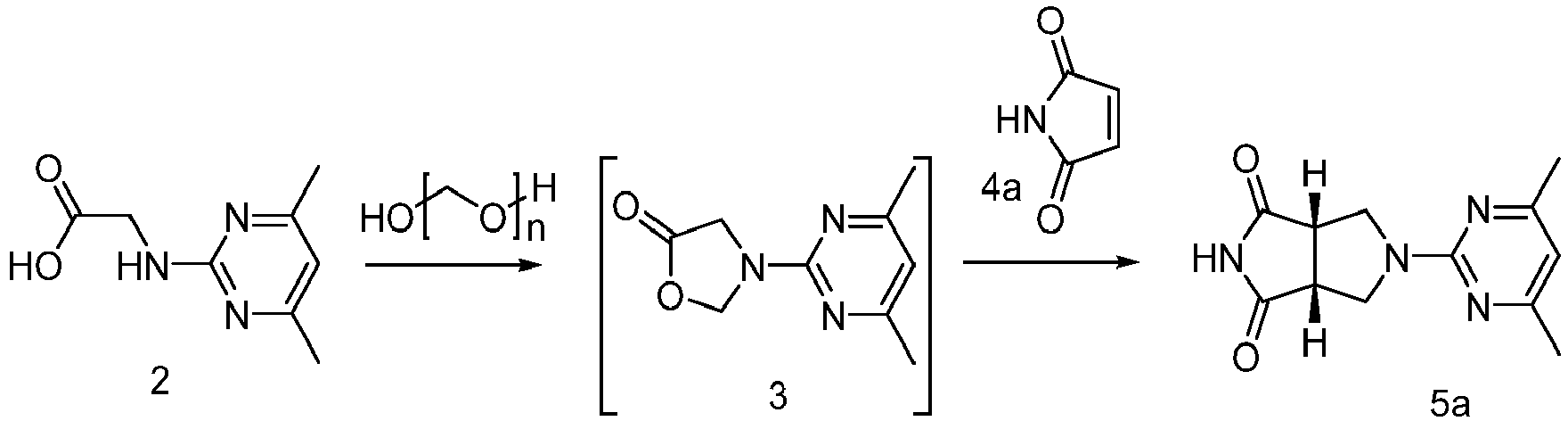
- 250 mg (1.38 mmol) of compound 2, 62 mg (2.07 mmol) of paraformaldehyde, 207 mg (2.07 mmol) of compound 4a and 4 ml of toluene-ds were placed in a microwave vial. The vial was sealed and heated to 250 °C for about an hour before being cooled to room temperature. NMR analysis of the reaction mixture using 1,3,5-trimethoxybenzne as internal standard reveals that the compound 5a was formed in 28% yield. The compound 5a was isolated and purified as a solid by flash chromatography.
-

- A 1-L reactor was charged with compound 5b (75 g), NaBH4 (19.4 g, 2.25 equiv) and THF (375 mL). The reaction mixture was heated to 50 °C while stirring. To this was added BF3·THF (78.1 mL, 3.1 equiv) over 2h (Caution: very exothermic in the beginning and the intensity is reduced over the time while addition proceeds). After complete addition of BF3·THF, the reaction was continued for 1h. Methanol (108 mL, 12 equiv) was slowly added to the reaction mixture over 2.5h. After stirring for additional 12h, solvents (THF and trimethyl borate) were distilled off to reduce the volume to 1/3 and water (560 mL) followed by aqueous NaOH (47.2 mL, 4 equiv, 18.8 M) were slowly added so that pH of the reaction mixture reached ~9.6. To this was added MTBE (225 mL) and aqueous phase was discarded after phase separation. Some MTBE was distilled off (150 mL) and ethanol (203 mL) was charged to the reactor followed by further distillation removed more MTBE. After the distillation, reaction mixture was cooled to 30 °C and was seeded with some product and waited for 30 min to get the crystallization started. Once the crystallization started, water (450 mL) was added over 4h and the reaction mixture was then cooled to 10 °C. After stirring for additional 6h the solids were filtered off using sinter funnel and the wet product was dried in oven at 50 °C for 12h. The product compound 5 (63.3 g, 91% yield) was obtained was as an off white solid. 1H NMR (600MHz, DMSO-d6) δ = 7.32 - 7.25 (m, 4H), 7.24 - 7.19 (m, 1H), 6.37 (s, 1H), 3.67 (dd, J=8.1, 11.5 Hz, 2H), 3.55 (s, 2H), 3.38 (dd, J=3.4, 11.3 Hz, 2H), 2.88 - 2.81 (m, 2H), 2.60 (dd, J=7.0, 9.3 Hz, 2H), 2.43 (dd, J=3.0, 9.4 Hz, 2H), 2.21 (s, 6H). 13C NMR (DMSO-d6) δ: 166.4, 160.3, 139.1, 128.3, 128.1, 126.7, 108.3, 60.0, 58.8, 52.3, 41.0, 23.7. mp: 80°C. High resolution MS (ES, m/z): calcd for C19H25N4 (M + H)+: 309.2079; found: 309.2080.
- A 500-ml reactor was charged with compound 5b (30 g), NaBH4 (14.5 g, 4.2 equiv) and THF (210 mL). The reaction mixture was heated to 50 °C while stirring. To this was added H2SO4 (10.5 mL, 2.1 equiv) over 2 h (Caution: very exothermic in the beginning and the intensity is reduced over the time while addition proceeds). After the addition of H2SO4 complete, the reaction was continued for 0.5 h. Methanol (73 mL, 20 equiv) was slowly added to the reaction mixture over 2 h. After stirring for additional 12 h, solvents (THF and trimethylborate) were distilled off to reduce the volume to 1/3 and water (120 mL) followed by aqueous NaOH (2.4 mL, 0.5 equiv, 18.8 M) were slowly added so that pH of the reaction mixture reached ~9.6. To this was added MTBE (210 mL) and aqueous phase was discarded after phase separation. Some MTBE was distilled off (150 mL) and ethanol (69 mL) was charged to the reactor followed by further distillation removed more MTBE. After the distillation, reaction mixture was cooled to 30 °C and was seeded with some product and waited for 30 min to get the crystallization started. Once the crystallization started, water (207 mL) was added over 4 h and the reaction mixture was then cooled to 10 °C. After stirring for additional 6 h the solids were filtered off using sinter funnel and the wet product was dried in oven at 50 °C for 12 h. The product compound 6b (23.7 g, 82% yield) was obtained was as an off white solid.
- A 100-mL reactor was charged with compound 5b (10 g) and THF (60 mL). The reaction mixture was cooled to 10 °C while stirring. To this was added BH3·THF (89.2 mL, 3 equiv, 1 M in THF) over 1 h. After stirring for 3 days at that temperature, methanol (60 mL) was added over 2 h and then the temperature was raised to 40 °C and stirred for 24 h. All the solvent was removed in vacuo and the crude material was dissolved in ethyl acetate and water. After phase separation, the organic layer was concentrated in vacuo to give the desired product 6b (9 g, 98% yield).
- A 25-ml reactor was charged with compound 5b (500 mg) and toluene (4 mL). The reaction mixture was heated to 60 °C while stirring. In another reactor both Red-Al (1.45 mL, 3 equiv, 60% solution in toluene) and toluene (5 mL) were heated to 60 °C while stirring. The hot Red-Al solution was then added to the above hot solution of compound 5b over 5 min. The reaction temperature was then raised 100 °C and stirred for 2 h. After cooling to 20 °C, aqueous NaOH solution was added dropwise and stirred for 2 h. Phase separation followed by removal of solvent in vacuo afforded compound 6b (480 mg, 56.7 mass% by assay, 59% yield).
- A 50-ml reactor was charged with compound 5b (2 g), 1,1,3,3-tetramethyldisiloxane (TMDS - 6.3 mL, 6 equiv) and toluene (20 mL). The reaction mixture was heated to 60 °C while stirring. To this was added a solution of B(C6F5)3 (152 mg, 5 mol%) in toluene (1 mL) and temperature was raised to 100 °C. After stirring for 1 h, the reaction mixture was cooled to 25 °C and contents were transferred to a round bottom flask. Removal of solvents in vacuo provided crude compound 6b (2.07 g, 88.6% assay, 95% yield).
- Following the above described procedure various catalysts and silane reagents were used to reduce the compound 5b (500 mg) to 6b.
S. No. Catalyst (mol%) Silane (equiv) 6b (LC relative area%) 1 B(C6F5)3 (1) TMDS (5) 0 2 B(C6F5)3 (2) TMDS (5) 42 3 B(C6F5)3 (3) TMDS (5) 89 4 B(C6F5)3 (4) TMDS (5) 99 5 B(C6F5)3 (5) TMDS (5) 99 6 Fe3(CO)12 (5) TMDS (5) 38 7 H2PtCl6 (1) TMDS (5) 25 8 Zn(OAc)2.2H2O (5) TMDS (5) 0 9 TBAF (1M in THF) (5) TMDS (5) 0 10 Fe(acac)3 (5) TMDS (5) 0 11 Ni(acac)2 (5) TMDS (5) 0 12 Co(acac)3 (5) TMDS (5) 0 13 Mn(acac)3 (5) TMDS (5) 0 14 AlCl3 (5) TMDS (5) 0 15 KHMDS (1M in THF) (5) TMDS (5) 0 16 B(C6F5)3 (5) PMHS (6) 55 17 Fe3(CO)12 (5) PMHS (6) 57 18 H2PtCl6 (1) PMHS (6) 64 19 H2PtCl6 (4) PMHS (6) 76 20 Zn(OAc)2.2H2O (5) PMHS (6) 0 21 B(C6F5)3 (5) Et3SiH (8) 60 -

- A 10 mL tube reactor was charged with compound 5a (75 mg) and THF (2 mL). The reaction mixture was cooled to 0 °C while stirring. To this was added BHs THF (0.91 mL, 3 equiv, 1 M in THF) slowly. The reaction mixture was slowly warmed to 50 °C with stirring and left for 4 h at that temperature. To this was slowly added methanol (0.3 mL) and stirred for 2 h. After cooling to room temperature, the crude mixture was concentrated under vacuum and the residue was redissolved in 2-methyltetrahydrofuram (3 mL) and heated to 50 °C, followed by addition of aq.H2SO4 (0.5 mL, 4 eq, 2.28M in water). After 2h, the solution was neutralized by addition of aq. NaOH (0.35 mL, 4.5 eq, 12.5 mass% in water) followed by phase separation and concentration in vacuo provided product 6a (60 mg, 80% assay, 72% yield).
-

- 5.8 g of 10w% Pd/C (wet) was added to a solution of 58 g (188 mmol) of compound 6b in 406 ml of methanol. The resulting suspension was heated to 60 °C before a solution of 13 g (206 mmol) of ammonium formate in 174 ml of methanol was added over an hour. The reaction mixture was then stirred 3 hours at 60 °C before being cooled to room temperature. The catalyst was filtered off and filtrate was concentrated under vacuum to obtain 40.7 g of compound 6a as a slightly yellow solid. Yield: 97%. 1H NMR (DMSO-d6) δ: 6.35 (s, 1H), 3.68 (dd, J=11.3, 7.9 Hz, 2H), 3.32 (dd, J=11.3, 3.4 Hz, 2H), 2.93 (br dd, J=10.2, 6.0 Hz, 2H), 2.76 (br s, 2H), 2.61 (br d, J=9.4 Hz, 2H), 2.21 (s, 6H). 13C NMR (DMSO-d6) δ: 166.1, 160.2, 107.9, 53.1, 51.6, 42.9, 23.4. High resolution MS (ES, m/z): calcd for C12H19N4 (M + H)+: 219.1610; found: 219.1624. m.p.: 99-100 °C.
-

- 4.3 ml (60 mmol) of thionyl chloride was added to a suspension of 9.5 g (46 mmol) of compound 7 in 110 ml of toluene before being heated to 55 °C for 2.5 hours then concentrated under vacuum to a residual volume of about 100 ml (about 20 ml of solvent distilled). The resulting solution of intermediate acyl chloride in toluene was added to a well stirred biphasic mixture of 10.2 g (45.7 mmol) of compound 6a in 44 ml of toluene and 7.26 g (68.5 mmol) of sodium carbonate in 44 ml of water. The resulting biphasic mixture was stirred at 30 °C for 3.5 hours before being heating to 70 °C. The water layer was discarded and the organic one was washed twice with 57 ml of water and concentrated under vacuum to a residual volume of about 64 ml. The concentrated mixture was heated to 90 °C to obtain a solution before cooling to room temperature and addition of 64 ml of cyclohexane. The resulting suspension was stirred overnight. 18.1 g of (((3aR,6aS)-5-(4,6-dimethylpyrimidin-2-yl)hexahydropyrrolo[3,4-c]pyrrol-2(1H)-yl)(2-fluoro-6-(2H-1,2,3-triazol-2-yl)phenyl)methanone (1) was obtained as a solid after filtration, wash with 12 ml of cyclohexane and 11 ml of water and drying under vacuum. Yield: 97%. 1H NMR (400 MHz, pyridine-ds) δ ppm 2.33 (s, 12 H) 2.81 - 2.97 (m, 4 H) 3.27 (dd, J=10.6, 5.0 Hz, 1 H) 3.33 (dd, J=10.5, 4.7 Hz, 1 H) 3.57 (br t, J=7.1 Hz, 1 H) 3.59 (br t, J=7.0 Hz, 1 H) 3.67 (dd, J=11.7, 4.5 Hz, 1 H) 3.70 - 3.75 (m, 1 H) 3.75 - 3.82 (m, 2 H) 3.82 - 3.98 (m, 7 H) 4.11 (dd, J=12.4, 7.6 Hz, 1 H) 6.29 (s, 1 H) 6.29 (s, 1 H) 7.19 (td, J=8.7, 1.0 Hz, 1 H) 7.26 (td, J=8.6, 0.9 Hz, 1 H) 7.46 (td, J=8.3, 6.2 Hz, 1 H) 7.46 (td, J=8.3, 6.0 Hz, 1 H) 7.90 (dt, J=8.2, 0.8 Hz, 1 H) 7.90 (s, 2 H) 7.98 (dt, J=8.2, 0.8 Hz, 1 H) 8.04 (s, 2 H). 13C NMR (101 MHz, pyridine-ds) δ ppm 24.47, 24.48, 41.74, 41.82, 42.71, 42.93, 50.76, 50.82, 50.90, 51.03, 51.43, 51.62, 51.87, 52.06, 109.27, 109.44, 115.88 (br d, J=22.4 Hz), 115.89 (br d, J=22.4 Hz), 118.82 (br d, J=3.3 Hz), 118.97 (br d, J=3.3 Hz), 120.48 (d, J=24.9 Hz), 120.55 (d, J=24.6 Hz), 131.53 (br d, J=9.2 Hz), 131.54 (d, J=9.2 Hz), 137.33, 137.47, 138.04 (d, J=7.0 Hz), 138.07 (br d, J=7.0 Hz), 159.71 (d, J=245.8 Hz), 159.81 (d, J=245.4 Hz), 161.53, 161.61, 162.99 (d, J=7.3 Hz), 162.99 (d, J=7.3 Hz), 167.61, 167.63. High resolution MS (ES, m/z): calcd for C21H23FN7O (M + H)+: 408.1943; found: 408.1946.
- While the foregoing specification teaches the principles of the present invention, with examples provided for the purpose of illustration, it will be understood that the practice of the invention encompasses all of the usual variations, adaptations and/or modifications as come within the scope of the following claims and their equivalents.
- All documents cited herein are incorporated by reference.
-
- 1. A process of preparing (((3aR,6aS)-5-(4,6-dimethylpyrimidin-2-yl)hexahydropyrrolo[3,4-c]pyrrol-2(1H)-yl)(2-fluoro-6-(2H-1,2,3-triazol-2-yl)phenyl)methanone

- a) Oxazolidination of (4,6-dimethylpyrimidin-2-yl)glycine,


- a) Oxazolidination of (4,6-dimethylpyrimidin-2-yl)glycine,
- 2. The process of embodiment 1, said process further comprising reaction of 3-(4,6-dimethylpyrimidin-2-yl)oxazolidin-5-one


- 3. The process of embodiment 2, said process further comprising reduction of (3aR,6aS)-2-benzyl-5-(4,6-dimethylpyrimidin-2-yl)tetrahydropyrrolo[3,4-c]pyrrole-1,3(2H,3aH)-dione


- 4. The process of embodiment 3, said process further comprising deprotection of (3aR,6aS)-2-benzyl-5-(4,6-dimethylpyrimidin-2-yl)octahydropyrrolo[3,4-c]pyrrole


- 5. The process of embodiment 4, said process further comprising amidation of (3aR,6aS)-2-(4,6-dimethylpyrimidin-2-yl)octahydropyrrolo[3,4-c]pyrrole


- 6. The process of embodiment 1, said process further comprising reaction of 3-(4,6-dimethylpyrimidin-2-yl)oxazolidin-5-one


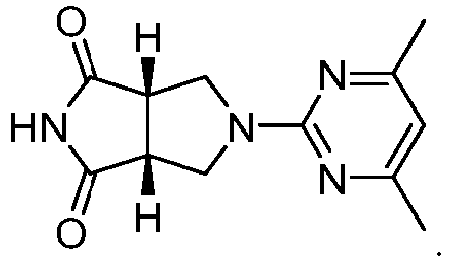
- 7. The process of embodiment 6, said process further comprising reduction of (3aR,6aS)-5-(4,6-dimethylpyrimidin-2-yl)tetrahydropyrrolo[3,4-c]pyrrole-1,3(2H,3aH)-dione
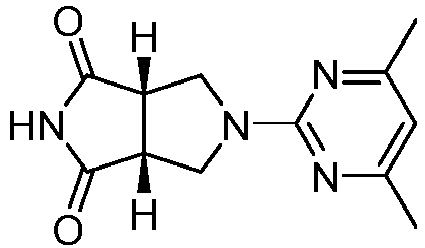

- 8. The process of embodiment 7, said process further comprising amidation of (3aR,6aS)-2-(4,6-dimethylpyrimidin-2-yl)octahydropyrrolo[3,4-c]pyrrole


- 9. The process of embodiment 2, wherein said 3-(4,6-dimethylpyrimidin-2-yl)oxazolidin-5-one is not isolated prior to reaction with said 1-benzyl-1H-pyrrole-2,5-dione.
- 10. The process of embodiment 2, wherein said 3-(4,6-dimethylpyrimidin-2-yl)oxazolidin-5-one is isolated prior to reaction with said 1-benzyl-1H-pyrrole-2,5-dione.
- 11. The process of embodiment 6, wherein said 3-(4,6-dimethylpyrimidin-2-yl)oxazolidin-5-one is not isolated prior to reaction with said 1H-pyrrole-2,5-dione.
- 12. The process of embodiment 6, wherein said 3-(4,6-dimethylpyrimidin-2-yl)oxazolidin-5-one is isolated prior to reaction with said 1H-pyrrole-2,5-dione.
- 13. A compound which is 3-(4,6-dimethylpyrimidin-2-yl)oxazolidin-5-one

- 14. A compound which is (3aR,6aS)-2-benzyl-5-(4,6-dimethylpyrimidin-2-yl)tetrahydropyrrolo[3,4-c]pyrrole-1,3(2H,3aH)-dione

- 15. A compound which is (3aR,6aS)-5-(4,6-dimethylpyrimidin-2-yl)tetrahydropyrrolo[3,4-c]pyrrole-1,3(2H,3aH)-dione

Claims (2)
- A process of preparing (((3aR,6aS)-5-(4,6-dimethylpyrimidin-2-yl)hexahydropyrrolo[3,4-c]pyrrol-2(1H)-yl)(2-fluoro-6-(2H-1,2,3-triazol-2-yl)phenyl)methanone
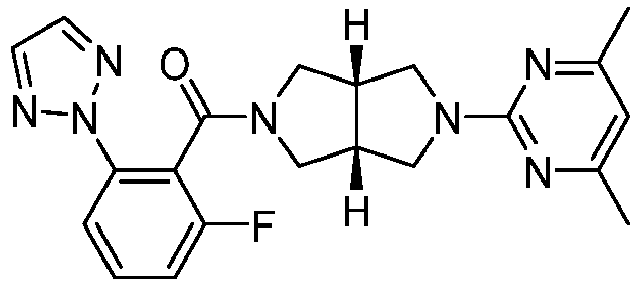 a) reaction of (4,6-dimethylpyrimidin-2-yl)glycine


- The process of claim 1, said process further comprising reduction of (3aR,6aS)-2-benzyl-5-(4,6-dimethylpyrimidin-2-yl)tetrahydropyrrolo[3,4-c]pyrrole-1,3(2H,3aH)-dione

Priority Applications (1)
| Application Number | Priority Date | Filing Date | Title |
|---|---|---|---|
| MA71707A MA71707A (en) | 2018-11-14 | 2019-11-11 | IMPROVED SYNTHETIC METHODS FOR PRODUCING FUSED HETEROCYCLIC COMPOUNDS AS OREXIN RECEPTOR MODULATORS |
Applications Claiming Priority (3)
| Application Number | Priority Date | Filing Date | Title |
|---|---|---|---|
| US201862760995P | 2018-11-14 | 2018-11-14 | |
| EP19885791.4A EP3880204B1 (en) | 2018-11-14 | 2019-11-11 | Improved synthetic methods of making fused heterocyclic compounds as orexin receptor modulators |
| PCT/IB2019/059677 WO2020100011A1 (en) | 2018-11-14 | 2019-11-11 | Improved synthetic methods of making fused heterocyclic compounds as orexin receptor modulators |
Related Parent Applications (1)
| Application Number | Title | Priority Date | Filing Date |
|---|---|---|---|
| EP19885791.4A Division EP3880204B1 (en) | 2018-11-14 | 2019-11-11 | Improved synthetic methods of making fused heterocyclic compounds as orexin receptor modulators |
Publications (4)
| Publication Number | Publication Date |
|---|---|
| EP4428136A2 true EP4428136A2 (en) | 2024-09-11 |
| EP4428136A3 EP4428136A3 (en) | 2024-11-06 |
| EP4428136B1 EP4428136B1 (en) | 2025-11-26 |
| EP4428136C0 EP4428136C0 (en) | 2025-11-26 |
Family
ID=70730771
Family Applications (2)
| Application Number | Title | Priority Date | Filing Date |
|---|---|---|---|
| EP24175622.0A Active EP4428136B1 (en) | 2018-11-14 | 2019-11-11 | Improved synthetic methods of making fused heterocyclic compounds as orexin receptor modulators |
| EP19885791.4A Active EP3880204B1 (en) | 2018-11-14 | 2019-11-11 | Improved synthetic methods of making fused heterocyclic compounds as orexin receptor modulators |
Family Applications After (1)
| Application Number | Title | Priority Date | Filing Date |
|---|---|---|---|
| EP19885791.4A Active EP3880204B1 (en) | 2018-11-14 | 2019-11-11 | Improved synthetic methods of making fused heterocyclic compounds as orexin receptor modulators |
Country Status (26)
| Country | Link |
|---|---|
| US (1) | US12030887B2 (en) |
| EP (2) | EP4428136B1 (en) |
| JP (1) | JP7398452B2 (en) |
| KR (1) | KR102777062B1 (en) |
| CN (1) | CN113038952B (en) |
| AR (1) | AR117074A1 (en) |
| AU (1) | AU2019380072B2 (en) |
| BR (1) | BR112021009211A2 (en) |
| CR (1) | CR20210240A (en) |
| EA (1) | EA202191356A1 (en) |
| EC (1) | ECSP21034253A (en) |
| ES (2) | ES3060483T3 (en) |
| HR (1) | HRP20240743T1 (en) |
| HU (1) | HUE066708T2 (en) |
| IL (1) | IL283067A (en) |
| JO (1) | JOP20210110A1 (en) |
| MA (2) | MA54250A (en) |
| MX (1) | MX2021005698A (en) |
| PE (1) | PE20211470A1 (en) |
| PH (1) | PH12021551054A1 (en) |
| PL (1) | PL3880204T3 (en) |
| RS (1) | RS65638B1 (en) |
| SG (1) | SG11202104886YA (en) |
| SM (1) | SMT202400265T1 (en) |
| TW (1) | TW202039452A (en) |
| WO (1) | WO2020100011A1 (en) |
Families Citing this family (7)
| Publication number | Priority date | Publication date | Assignee | Title |
|---|---|---|---|---|
| WO2022194122A1 (en) * | 2021-03-16 | 2022-09-22 | 上海翰森生物医药科技有限公司 | Nitrogen-containing heterocyclic polycyclic compound, preparation method therefor, and application thereof |
| AU2023340064A1 (en) * | 2022-09-14 | 2025-03-20 | Jiangsu Hansoh Pharmaceutical Group Co., Ltd. | Free base crystal form of polycyclic compound of nitrogen-containing heterocycle, and preparation method therefor |
| EP4635949A4 (en) * | 2022-12-12 | 2026-04-01 | Jiangsu Nhwa Pharmaceutical Co Ltd | SUBSTITUTED TETRAHYDROCYCLOPENTYL[C!PYRROL DERIVATIVE, MANUFACTURING PROCESS, INTERMEDIATE PRODUCT AND USES THEREOF |
| WO2024189472A1 (en) | 2023-03-14 | 2024-09-19 | Janssen Pharmaceutica Nv | Improved synthetic methods of making substituted pyrimidine intermediates for synthesis of orexin receptor modulators |
| EP4734999A1 (en) | 2023-06-29 | 2026-05-06 | Janssen Pharmaceutica NV | Method of treating depression using seltorexant |
| WO2025242852A1 (en) | 2024-05-24 | 2025-11-27 | Janssen Pharmaceutica Nv | Seltorexant for use in treating major depressive disorder with insomnia symptoms |
| CN118598880B (en) * | 2024-08-07 | 2024-11-26 | 艾斯拓康生物医药(天津)有限公司 | A nitrogen-containing bridged ring compound and its preparation method and application |
Citations (10)
| Publication number | Priority date | Publication date | Assignee | Title |
|---|---|---|---|---|
| WO2001081347A2 (en) | 2000-04-27 | 2001-11-01 | Abbott Laboratories | Diazabicyclic central nervous system active agents |
| US20020019388A1 (en) | 2000-04-27 | 2002-02-14 | Schrimpf Michael R. | Diazabicyclic central nervous system active agents |
| US20050065178A1 (en) | 2003-09-19 | 2005-03-24 | Anwer Basha | Substituted diazabicycloakane derivatives |
| US20050101602A1 (en) | 2003-09-19 | 2005-05-12 | Anwer Basha | Substituted diazabicycloalkane derivatives |
| US20060258672A1 (en) | 2005-05-13 | 2006-11-16 | Joseph Barbosa | Multicyclic compounds and methods of their use |
| WO2006124897A2 (en) | 2005-05-13 | 2006-11-23 | Lexicon Genetics Incorporated | Methods and compositions for improving cognition |
| WO2006123121A1 (en) | 2005-05-19 | 2006-11-23 | Chroma Therapeutics Ltd | Histone deacetylase inhibitors |
| WO2008067121A2 (en) | 2006-11-07 | 2008-06-05 | Lexicon Pharmaceuticals, Inc. | Methods of treating cognitive impairment and dementia |
| WO2009081197A1 (en) | 2007-12-21 | 2009-07-02 | Astrazeneca Ab | Bicyclic derivatives for use in the treatment of androgen receptor associated conditions |
| US8653263B2 (en) | 2009-10-23 | 2014-02-18 | Janssen Pharmaceutica | Disubstituted octahydropyrrolo[3,4-c]pyrroles as orexin receptor modulators |
Family Cites Families (8)
| Publication number | Priority date | Publication date | Assignee | Title |
|---|---|---|---|---|
| DE4341403A1 (en) | 1993-12-04 | 1995-06-08 | Basf Ag | N-substituted 3-azabicycloalkane derivatives, their preparation and use |
| WO2011050202A1 (en) | 2009-10-23 | 2011-04-28 | Janssen Pharmaceutica Nv | Fused heterocyclic compounds as orexin receptor modulators |
| WO2012145581A1 (en) | 2011-04-20 | 2012-10-26 | Janssen Pharmaceutica Nv | Disubstituted octahy-dropyrrolo [3,4-c] pyrroles as orexin receptor modulators |
| US10258038B2 (en) | 2014-04-01 | 2019-04-16 | Bayer Cropscience Aktiengesellschaft | Use of heterocyclic compounds for controlling nematodes |
| US9938276B2 (en) * | 2014-12-19 | 2018-04-10 | Merck Sharp & Dohme Corp. | 6,5-bicyclic octahydropyrrolopyridine orexin receptor antagonists |
| US10131653B2 (en) * | 2015-04-24 | 2018-11-20 | Takeda Pharmaceutical Company Limited | Heterocyclic compound |
| HRP20220642T1 (en) | 2016-03-10 | 2022-06-24 | Janssen Pharmaceutica Nv | PROCEDURES FOR TREATMENT OF DEPRESSION USING OREXIN 2 RECEPTOR ANTAGONISTS |
| GB201702174D0 (en) | 2017-02-09 | 2017-03-29 | Benevolentai Bio Ltd | Orexin receptor antagonists |
-
2019
- 2019-11-11 SM SM20240265T patent/SMT202400265T1/en unknown
- 2019-11-11 BR BR112021009211-0A patent/BR112021009211A2/en unknown
- 2019-11-11 EP EP24175622.0A patent/EP4428136B1/en active Active
- 2019-11-11 ES ES24175622T patent/ES3060483T3/en active Active
- 2019-11-11 PL PL19885791.4T patent/PL3880204T3/en unknown
- 2019-11-11 HU HUE19885791A patent/HUE066708T2/en unknown
- 2019-11-11 AU AU2019380072A patent/AU2019380072B2/en not_active Expired - Fee Related
- 2019-11-11 CR CR20210240A patent/CR20210240A/en unknown
- 2019-11-11 WO PCT/IB2019/059677 patent/WO2020100011A1/en not_active Ceased
- 2019-11-11 MX MX2021005698A patent/MX2021005698A/en unknown
- 2019-11-11 PE PE2021000698A patent/PE20211470A1/en unknown
- 2019-11-11 HR HRP20240743TT patent/HRP20240743T1/en unknown
- 2019-11-11 JP JP2021526230A patent/JP7398452B2/en active Active
- 2019-11-11 CN CN201980075378.9A patent/CN113038952B/en active Active
- 2019-11-11 EP EP19885791.4A patent/EP3880204B1/en active Active
- 2019-11-11 EA EA202191356A patent/EA202191356A1/en unknown
- 2019-11-11 ES ES19885791T patent/ES2988132T3/en active Active
- 2019-11-11 MA MA054250A patent/MA54250A/en unknown
- 2019-11-11 US US17/293,291 patent/US12030887B2/en active Active
- 2019-11-11 KR KR1020217016208A patent/KR102777062B1/en active Active
- 2019-11-11 MA MA71707A patent/MA71707A/en unknown
- 2019-11-11 RS RS20240662A patent/RS65638B1/en unknown
- 2019-11-11 SG SG11202104886YA patent/SG11202104886YA/en unknown
- 2019-11-12 TW TW108140931A patent/TW202039452A/en unknown
- 2019-11-14 AR ARP190103344A patent/AR117074A1/en not_active Application Discontinuation
-
2021
- 2021-05-05 PH PH12021551054A patent/PH12021551054A1/en unknown
- 2021-05-10 IL IL283067A patent/IL283067A/en unknown
- 2021-05-14 EC ECSENADI202134253A patent/ECSP21034253A/en unknown
- 2021-05-16 JO JOP/2021/0110A patent/JOP20210110A1/en unknown
Patent Citations (10)
| Publication number | Priority date | Publication date | Assignee | Title |
|---|---|---|---|---|
| WO2001081347A2 (en) | 2000-04-27 | 2001-11-01 | Abbott Laboratories | Diazabicyclic central nervous system active agents |
| US20020019388A1 (en) | 2000-04-27 | 2002-02-14 | Schrimpf Michael R. | Diazabicyclic central nervous system active agents |
| US20050065178A1 (en) | 2003-09-19 | 2005-03-24 | Anwer Basha | Substituted diazabicycloakane derivatives |
| US20050101602A1 (en) | 2003-09-19 | 2005-05-12 | Anwer Basha | Substituted diazabicycloalkane derivatives |
| US20060258672A1 (en) | 2005-05-13 | 2006-11-16 | Joseph Barbosa | Multicyclic compounds and methods of their use |
| WO2006124897A2 (en) | 2005-05-13 | 2006-11-23 | Lexicon Genetics Incorporated | Methods and compositions for improving cognition |
| WO2006123121A1 (en) | 2005-05-19 | 2006-11-23 | Chroma Therapeutics Ltd | Histone deacetylase inhibitors |
| WO2008067121A2 (en) | 2006-11-07 | 2008-06-05 | Lexicon Pharmaceuticals, Inc. | Methods of treating cognitive impairment and dementia |
| WO2009081197A1 (en) | 2007-12-21 | 2009-07-02 | Astrazeneca Ab | Bicyclic derivatives for use in the treatment of androgen receptor associated conditions |
| US8653263B2 (en) | 2009-10-23 | 2014-02-18 | Janssen Pharmaceutica | Disubstituted octahydropyrrolo[3,4-c]pyrroles as orexin receptor modulators |
Non-Patent Citations (6)
| Title |
|---|
| C. PEYRON ET AL., J. NEUROSCI., vol. 18, no. 23, 1998, pages 9996 - 10015 |
| FROST ET AL., JOURNAL OF MEDICINAL CHEMISTRY, vol. 49, no. 26, 2006, pages 7843 - 7853 |
| J. MED. CHEM., vol. 58, 2015, pages 5620 |
| ORG. PROC. RES. DEV, vol. 18, 2010, pages 592 |
| T. W. GREENP. G. M. WUTS: "Protective Groups in Organic Synthesis", 1999, WILEY-INTERSCIENCE, pages: 579 - 580 |
| VAN DEN POL, A.N. ET AL., J. NEUROSCIENCE., vol. 19, no. 8, 1999, pages 3171 - 3182 |
Also Published As
Similar Documents
| Publication | Publication Date | Title |
|---|---|---|
| EP3880204B1 (en) | Improved synthetic methods of making fused heterocyclic compounds as orexin receptor modulators | |
| JP7588622B2 (en) | Crystalline solid forms of BET inhibitors | |
| CN106456643B (en) | Pharmacophores for TRAIL induction | |
| TW201206946A (en) | Compounds for the reduction of beta-amyloid production | |
| WO2014055928A2 (en) | Substituted n-(3-(pyrimidin-4-yl)phenyl)acrylamide analogs as tyrosine receptor kinase btk inhibitors | |
| JP7601911B2 (en) | Methyl 2-(fluoromethyl)-5-oxo-4-phenyl-4,5,6,7-tetrahydro-1H-cyclopenta[B]pyridine-3-carboxylate and methyl 2-(fluoromethyl)-5-oxo-4-phenyl-1,4,5,7-tetrahydrofuro[3,4-B]pyridine-3-carboxylate as CAV1.2 activators | |
| JP7749857B2 (en) | Methods for synthesizing quinazoline compounds | |
| CA3118734C (en) | Improved synthetic methods of making fused heterocyclic compounds as orexin receptor modulators | |
| HK40060444B (en) | Improved synthetic methods of making fused heterocyclic compounds as orexin receptor modulators | |
| HK40060444A (en) | Improved synthetic methods of making fused heterocyclic compounds as orexin receptor modulators | |
| EP3634409B1 (en) | Orexin receptor antagonists | |
| JP7653458B2 (en) | Methyl 2-methyl-5-oxo-1,4,5,7-tetrahydrofuro[3,4-b]pyridine-3-carboxylate compounds as CAV1.2 activators | |
| EA045257B1 (en) | IMPROVED SYNTHESIS METHODS FOR OBTAINING CONDENSED HETEROCYCLIC COMPOUNDS AS OREXIN RECEPTOR MODULATORS | |
| WO2024189472A1 (en) | Improved synthetic methods of making substituted pyrimidine intermediates for synthesis of orexin receptor modulators | |
| WO2020010228A1 (en) | Deconstructive functionalization methods and compounds | |
| JPH02504629A (en) | fused benzazepine | |
| US12570658B2 (en) | Synthetic methods of making (2H-1, 2, 3-triazol-2-yl) phenyl compounds as orexin receptor modulators | |
| EA046399B1 (en) | IMPROVED SYNTHETIC METHODS FOR PRODUCING (2H-1,2,3-TRIAZOL-2-YL)PHENYL COMPOUNDS AS OREXIN RECEPTOR MODULATORS | |
| WO2018206959A1 (en) | Orexin receptor antagonists |
Legal Events
| Date | Code | Title | Description |
|---|---|---|---|
| PUAI | Public reference made under article 153(3) epc to a published international application that has entered the european phase |
Free format text: ORIGINAL CODE: 0009012 |
|
| STAA | Information on the status of an ep patent application or granted ep patent |
Free format text: STATUS: THE APPLICATION HAS BEEN PUBLISHED |
|
| AC | Divisional application: reference to earlier application |
Ref document number: 3880204 Country of ref document: EP Kind code of ref document: P |
|
| AK | Designated contracting states |
Kind code of ref document: A2 Designated state(s): AL AT BE BG CH CY CZ DE DK EE ES FI FR GB GR HR HU IE IS IT LI LT LU LV MC MK MT NL NO PL PT RO RS SE SI SK SM TR |
|
| REG | Reference to a national code |
Ref legal event code: R079 Ipc: A61K0031506000 Ref country code: DE Ref legal event code: R079 Ref document number: 602019078677 Country of ref document: DE Free format text: PREVIOUS MAIN CLASS: C07D0487040000 Ipc: A61K0031506000 |
|
| PUAL | Search report despatched |
Free format text: ORIGINAL CODE: 0009013 |
|
| AK | Designated contracting states |
Kind code of ref document: A3 Designated state(s): AL AT BE BG CH CY CZ DE DK EE ES FI FR GB GR HR HU IE IS IT LI LT LU LV MC MK MT NL NO PL PT RO RS SE SI SK SM TR |
|
| RIC1 | Information provided on ipc code assigned before grant |
Ipc: C07D 487/04 20060101ALI20241001BHEP Ipc: C07D 263/08 20060101ALI20241001BHEP Ipc: A61K 31/506 20060101AFI20241001BHEP |
|
| STAA | Information on the status of an ep patent application or granted ep patent |
Free format text: STATUS: REQUEST FOR EXAMINATION WAS MADE |
|
| 17P | Request for examination filed |
Effective date: 20250506 |
|
| RAV | Requested validation state of the european patent: fee paid |
Extension state: TN Effective date: 20250506 Extension state: MD Effective date: 20250506 Extension state: MA Effective date: 20250506 |
|
| RAX | Requested extension states of the european patent have changed |
Extension state: ME Payment date: 20250506 Extension state: BA Payment date: 20250506 |
|
| GRAP | Despatch of communication of intention to grant a patent |
Free format text: ORIGINAL CODE: EPIDOSNIGR1 |
|
| STAA | Information on the status of an ep patent application or granted ep patent |
Free format text: STATUS: GRANT OF PATENT IS INTENDED |
|
| INTG | Intention to grant announced |
Effective date: 20250627 |
|
| GRAS | Grant fee paid |
Free format text: ORIGINAL CODE: EPIDOSNIGR3 |
|
| GRAA | (expected) grant |
Free format text: ORIGINAL CODE: 0009210 |
|
| STAA | Information on the status of an ep patent application or granted ep patent |
Free format text: STATUS: THE PATENT HAS BEEN GRANTED |
|
| AC | Divisional application: reference to earlier application |
Ref document number: 3880204 Country of ref document: EP Kind code of ref document: P |
|
| AK | Designated contracting states |
Kind code of ref document: B1 Designated state(s): AL AT BE BG CH CY CZ DE DK EE ES FI FR GB GR HR HU IE IS IT LI LT LU LV MC MK MT NL NO PL PT RO RS SE SI SK SM TR |
|
| REG | Reference to a national code |
Ref country code: CH Ref legal event code: F10 Free format text: ST27 STATUS EVENT CODE: U-0-0-F10-F00 (AS PROVIDED BY THE NATIONAL OFFICE) Effective date: 20251126 Ref country code: GB Ref legal event code: FG4D |
|
| REG | Reference to a national code |
Ref country code: DE Ref legal event code: R096 Ref document number: 602019078677 Country of ref document: DE |
|
| REG | Reference to a national code |
Ref country code: IE Ref legal event code: FG4D |
|
| REG | Reference to a national code |
Ref country code: CH Ref legal event code: R17 Free format text: ST27 STATUS EVENT CODE: U-0-0-R10-R17 (AS PROVIDED BY THE NATIONAL OFFICE) Effective date: 20260113 |
|
| U01 | Request for unitary effect filed |
Effective date: 20251224 |
|
| U07 | Unitary effect registered |
Designated state(s): AT BE BG DE DK EE FI FR IT LT LU LV MT NL PT RO SE SI Effective date: 20260121 |
|
| REG | Reference to a national code |
Ref country code: ES Ref legal event code: FG2A Ref document number: 3060483 Country of ref document: ES Kind code of ref document: T3 Effective date: 20260326 |
|
| PG25 | Lapsed in a contracting state [announced via postgrant information from national office to epo] |
Ref country code: NO Free format text: LAPSE BECAUSE OF FAILURE TO SUBMIT A TRANSLATION OF THE DESCRIPTION OR TO PAY THE FEE WITHIN THE PRESCRIBED TIME-LIMIT Effective date: 20260226 |
|
| PG25 | Lapsed in a contracting state [announced via postgrant information from national office to epo] |
Ref country code: HR Free format text: LAPSE BECAUSE OF FAILURE TO SUBMIT A TRANSLATION OF THE DESCRIPTION OR TO PAY THE FEE WITHIN THE PRESCRIBED TIME-LIMIT Effective date: 20251126 |
|
| PG25 | Lapsed in a contracting state [announced via postgrant information from national office to epo] |
Ref country code: RS Free format text: LAPSE BECAUSE OF FAILURE TO SUBMIT A TRANSLATION OF THE DESCRIPTION OR TO PAY THE FEE WITHIN THE PRESCRIBED TIME-LIMIT Effective date: 20260226 |
|
| PG25 | Lapsed in a contracting state [announced via postgrant information from national office to epo] |
Ref country code: IS Free format text: LAPSE BECAUSE OF FAILURE TO SUBMIT A TRANSLATION OF THE DESCRIPTION OR TO PAY THE FEE WITHIN THE PRESCRIBED TIME-LIMIT Effective date: 20260326 |
|
| PG25 | Lapsed in a contracting state [announced via postgrant information from national office to epo] |
Ref country code: PL Free format text: LAPSE BECAUSE OF FAILURE TO SUBMIT A TRANSLATION OF THE DESCRIPTION OR TO PAY THE FEE WITHIN THE PRESCRIBED TIME-LIMIT Effective date: 20251126 |