EP4427881A1 - Processing method for additively manufactured article - Google Patents
Processing method for additively manufactured article Download PDFInfo
- Publication number
- EP4427881A1 EP4427881A1 EP24160452.9A EP24160452A EP4427881A1 EP 4427881 A1 EP4427881 A1 EP 4427881A1 EP 24160452 A EP24160452 A EP 24160452A EP 4427881 A1 EP4427881 A1 EP 4427881A1
- Authority
- EP
- European Patent Office
- Prior art keywords
- additively manufactured
- manufactured article
- medium
- processing method
- polishing device
- Prior art date
- Legal status (The legal status is an assumption and is not a legal conclusion. Google has not performed a legal analysis and makes no representation as to the accuracy of the status listed.)
- Pending
Links
Images



Classifications
-
- C—CHEMISTRY; METALLURGY
- C23—COATING METALLIC MATERIAL; COATING MATERIAL WITH METALLIC MATERIAL; CHEMICAL SURFACE TREATMENT; DIFFUSION TREATMENT OF METALLIC MATERIAL; COATING BY VACUUM EVAPORATION, BY SPUTTERING, BY ION IMPLANTATION OR BY CHEMICAL VAPOUR DEPOSITION, IN GENERAL; INHIBITING CORROSION OF METALLIC MATERIAL OR INCRUSTATION IN GENERAL
- C23C—COATING METALLIC MATERIAL; COATING MATERIAL WITH METALLIC MATERIAL; SURFACE TREATMENT OF METALLIC MATERIAL BY DIFFUSION INTO THE SURFACE, BY CHEMICAL CONVERSION OR SUBSTITUTION; COATING BY VACUUM EVAPORATION, BY SPUTTERING, BY ION IMPLANTATION OR BY CHEMICAL VAPOUR DEPOSITION, IN GENERAL
- C23C24/00—Coating starting from inorganic powder
- C23C24/08—Coating starting from inorganic powder by application of heat or pressure and heat
- C23C24/10—Coating starting from inorganic powder by application of heat or pressure and heat with intermediate formation of a liquid phase in the layer
- C23C24/103—Coating with metallic material, i.e. metals or metal alloys, optionally comprising hard particles, e.g. oxides, carbides or nitrides
-
- B—PERFORMING OPERATIONS; TRANSPORTING
- B22—CASTING; POWDER METALLURGY
- B22F—WORKING METALLIC POWDER; MANUFACTURE OF ARTICLES FROM METALLIC POWDER; MAKING METALLIC POWDER; APPARATUS OR DEVICES SPECIALLY ADAPTED FOR METALLIC POWDER
- B22F10/00—Additive manufacturing of workpieces or articles from metallic powder
- B22F10/60—Treatment of workpieces or articles after build-up
- B22F10/66—Treatment of workpieces or articles after build-up by mechanical means
-
- B—PERFORMING OPERATIONS; TRANSPORTING
- B22—CASTING; POWDER METALLURGY
- B22F—WORKING METALLIC POWDER; MANUFACTURE OF ARTICLES FROM METALLIC POWDER; MAKING METALLIC POWDER; APPARATUS OR DEVICES SPECIALLY ADAPTED FOR METALLIC POWDER
- B22F5/00—Manufacture of workpieces or articles from metallic powder characterised by the special shape of the product
- B22F5/04—Manufacture of workpieces or articles from metallic powder characterised by the special shape of the product of turbine blades
-
- B—PERFORMING OPERATIONS; TRANSPORTING
- B24—GRINDING; POLISHING
- B24B—MACHINES, DEVICES, OR PROCESSES FOR GRINDING OR POLISHING; DRESSING OR CONDITIONING OF ABRADING SURFACES; FEEDING OF GRINDING, POLISHING, OR LAPPING AGENTS
- B24B31/00—Machines or devices designed for polishing or abrading surfaces on work by means of tumbling apparatus or other apparatus in which the work and/or the abrasive material is loose; Accessories therefor
-
- B—PERFORMING OPERATIONS; TRANSPORTING
- B24—GRINDING; POLISHING
- B24B—MACHINES, DEVICES, OR PROCESSES FOR GRINDING OR POLISHING; DRESSING OR CONDITIONING OF ABRADING SURFACES; FEEDING OF GRINDING, POLISHING, OR LAPPING AGENTS
- B24B31/00—Machines or devices designed for polishing or abrading surfaces on work by means of tumbling apparatus or other apparatus in which the work and/or the abrasive material is loose; Accessories therefor
- B24B31/06—Machines or devices designed for polishing or abrading surfaces on work by means of tumbling apparatus or other apparatus in which the work and/or the abrasive material is loose; Accessories therefor involving oscillating or vibrating containers
-
- B—PERFORMING OPERATIONS; TRANSPORTING
- B24—GRINDING; POLISHING
- B24B—MACHINES, DEVICES, OR PROCESSES FOR GRINDING OR POLISHING; DRESSING OR CONDITIONING OF ABRADING SURFACES; FEEDING OF GRINDING, POLISHING, OR LAPPING AGENTS
- B24B31/00—Machines or devices designed for polishing or abrading surfaces on work by means of tumbling apparatus or other apparatus in which the work and/or the abrasive material is loose; Accessories therefor
- B24B31/12—Accessories; Protective equipment or safety devices; Installations for exhaustion of dust or for sound absorption specially adapted for machines covered by group B24B31/00
- B24B31/14—Abrading-bodies specially designed for tumbling apparatus, e.g. abrading-balls
-
- B—PERFORMING OPERATIONS; TRANSPORTING
- B24—GRINDING; POLISHING
- B24B—MACHINES, DEVICES, OR PROCESSES FOR GRINDING OR POLISHING; DRESSING OR CONDITIONING OF ABRADING SURFACES; FEEDING OF GRINDING, POLISHING, OR LAPPING AGENTS
- B24B39/00—Burnishing machines or devices, i.e. requiring pressure members for compacting the surface zone; Accessories therefor
- B24B39/003—Burnishing machines or devices, i.e. requiring pressure members for compacting the surface zone; Accessories therefor the working tool being composed of a plurality of working rolls or balls
-
- B—PERFORMING OPERATIONS; TRANSPORTING
- B24—GRINDING; POLISHING
- B24B—MACHINES, DEVICES, OR PROCESSES FOR GRINDING OR POLISHING; DRESSING OR CONDITIONING OF ABRADING SURFACES; FEEDING OF GRINDING, POLISHING, OR LAPPING AGENTS
- B24B39/00—Burnishing machines or devices, i.e. requiring pressure members for compacting the surface zone; Accessories therefor
- B24B39/04—Burnishing machines or devices, i.e. requiring pressure members for compacting the surface zone; Accessories therefor designed for working external surfaces of revolution
- B24B39/045—Burnishing machines or devices, i.e. requiring pressure members for compacting the surface zone; Accessories therefor designed for working external surfaces of revolution the working tool being composed of a plurality of working rolls or balls
-
- B—PERFORMING OPERATIONS; TRANSPORTING
- B24—GRINDING; POLISHING
- B24C—ABRASIVE OR RELATED BLASTING WITH PARTICULATE MATERIAL
- B24C1/00—Methods for use of abrasive blasting for producing particular effects; Use of auxiliary equipment in connection with such methods
- B24C1/08—Methods for use of abrasive blasting for producing particular effects; Use of auxiliary equipment in connection with such methods for polishing surfaces, e.g. smoothing a surface by making use of liquid-borne abrasives
-
- B—PERFORMING OPERATIONS; TRANSPORTING
- B24—GRINDING; POLISHING
- B24C—ABRASIVE OR RELATED BLASTING WITH PARTICULATE MATERIAL
- B24C1/00—Methods for use of abrasive blasting for producing particular effects; Use of auxiliary equipment in connection with such methods
- B24C1/10—Methods for use of abrasive blasting for producing particular effects; Use of auxiliary equipment in connection with such methods for compacting surfaces, e.g. shot-peening
-
- B—PERFORMING OPERATIONS; TRANSPORTING
- B33—ADDITIVE MANUFACTURING TECHNOLOGY
- B33Y—ADDITIVE MANUFACTURING, i.e. MANUFACTURING OF THREE-DIMENSIONAL [3D] OBJECTS BY ADDITIVE DEPOSITION, ADDITIVE AGGLOMERATION OR ADDITIVE LAYERING, e.g. BY 3D PRINTING, STEREOLITHOGRAPHY OR SELECTIVE LASER SINTERING
- B33Y40/00—Auxiliary operations or equipment, e.g. for material handling
- B33Y40/20—Post-treatment, e.g. curing, coating or polishing
-
- B—PERFORMING OPERATIONS; TRANSPORTING
- B24—GRINDING; POLISHING
- B24B—MACHINES, DEVICES, OR PROCESSES FOR GRINDING OR POLISHING; DRESSING OR CONDITIONING OF ABRADING SURFACES; FEEDING OF GRINDING, POLISHING, OR LAPPING AGENTS
- B24B31/00—Machines or devices designed for polishing or abrading surfaces on work by means of tumbling apparatus or other apparatus in which the work and/or the abrasive material is loose; Accessories therefor
- B24B31/02—Machines or devices designed for polishing or abrading surfaces on work by means of tumbling apparatus or other apparatus in which the work and/or the abrasive material is loose; Accessories therefor involving rotary barrels
Definitions
- the present disclosure relates to a processing method for an additively manufactured article.
- WO 2019/008901 A discloses a shot peening method.
- This method is a method of projecting a shot media onto an object to be processed, which is a structure in which a first member and a second member are joined to each other with a welded portion interposed therebetween, in which the shot media is projected from a nozzle to a welded peripheral portion adjacent to the welded portion on a surface of the object to be processed in a state where a tip of the nozzle is directed.
- an additively manufactured article may have a large surface roughness and a small residual stress immediately after additive manufacturing as compared with a metal member manufactured by another metal processing.
- the residual stress can be applied to the surface of the object, there is no disclosure that the roughness of the surface of the object can be sufficiently reduced. Therefore, in order to appropriately reduce the roughness of the surface of the additively manufactured article, it may be necessary to further execute other processing, and thus the number of man-hours related to the processing of the additively manufactured article may increase. Therefore, there is a demand for a processing method for an additively manufactured article capable of appropriately reducing a roughness of the surface of the additively manufactured article and applying a residual stress to the additively manufactured article.
- a processing method for an additively manufactured article includes: accommodating an additively manufactured article containing metal and a medium made of metal in a barrel polishing device; and reducing a roughness of a surface of the additively manufactured article and applying a residual stress to the additively manufactured article by stirring the additively manufactured article and the medium, in which a surface of the medium includes a curved surface.
- the roughness of the surface of the additively manufactured article containing metal can be appropriately reduced, and the residual stress can be applied to the additively manufactured article.
- a processing method for an additively manufactured article includes accommodating and applying.
- the accommodating includes accommodating an additively manufactured article containing metal and a medium made of metal in a barrel polishing device.
- the applying includes reducing a roughness of a surface of the additively manufactured article and applying a residual stress to the additively manufactured article by stirring the additively manufactured article and the medium.
- a surface of the medium includes a curved surface.
- the applying includes stirring the additively manufactured article and the medium, so that the medium is pressed against the additively manufactured article. Since the medium is made of metal and has a larger specific gravity than other constituent materials such as plastic, the medium is pressed against the additively manufactured article with a larger force. Therefore, this method can easily apply the residual stress to the additively manufactured article. Furthermore, the roughness of the surface of the additively manufactured article containing metal is generally larger than the roughness of the surface of a metal member manufactured by another metal processing. The medium made of metal can be used at the time of surface processing of an object having a small surface roughness.
- this processing method for an additively manufactured article since the additively manufactured article can be deformed (plastically deformed) by stirring the additively manufactured article containing metal and the medium made of metal, the roughness of the surface of the additively manufactured article can be appropriately reduced. Moreover, since the surface of the medium includes the curved surface, the formation of dents on the surface of the additively manufactured article is suppressed as compared with the medium including an acute corner portion, and the increase in the roughness of the surface of the additively manufactured article can be suppressed. Therefore, this processing method for an additively manufactured article can appropriately reduce the roughness of the surface of the additively manufactured article containing metal, and apply the residual stress to the additively manufactured article.
- the applying may include stirring the additively manufactured article and the medium without using abrasive grains.
- a surface layer of the additively manufactured article is suppressed from being scraped.
- the surface layer portion of the additively manufactured article to which the residual stress is applied is suppressed from being scraped by the abrasive grains, so that it is possible to obtain the additively manufactured article to which the residual stress is appropriately applied after execution of the processing method.
- the medium may be a steel ball.
- the contact of the medium with the additively manufactured article becomes uniform, and thus the occurrence of the dents can be further suppressed.
- the additively manufactured article may be a blade of an aircraft engine or a medical component.
- the additively manufactured article has a reduced surface roughness and a reduced air resistance, so that the additively manufactured article can be used for a blade of an engine of an aircraft.
- the surface roughness is reduced, and a function required for the medical component such as cell peelability is improved, and thus the additively manufactured article can be used for the medical component.
- the barrel polishing device may be a centrifugal barrel polishing device, the medium may be spherical, and a diameter of the medium may be 20 mm or less.
- the barrel polishing device is a centrifugal barrel polishing device, it is possible to perform adjustment so that the medium is strongly pressed against the additively manufactured article at the time of stirring as compared with the case of other types of barrel polishing devices.
- the medium is spherical, the contact of the medium with the additively manufactured article becomes uniform, and thus the occurrence of the dents on the surface of the additively manufactured article can be suppressed.
- the diameter of the medium can be set according to a size of the barrel polishing device, a material and a shape of the additively manufactured article, a target value of the residual stress to be applied, and the like.
- FIG. 1 is a flowchart of a processing method for an additively manufactured article according to an embodiment.
- the processing method for an additively manufactured article illustrated in FIG. 1 is a method of stirring an additively manufactured article and a medium to reduce a roughness of a surface of the additively manufactured article and to apply a residual stress to the additively manufactured article.
- the processing method for an additively manufactured article of the present embodiment is applied to, for example, an additively manufactured article used for a blade of an aircraft engine or a medical component.
- the medical component is, for example, an artificial bone or an artificial joint.
- the additively manufactured article is an additively manufactured article containing metal.
- the additively manufactured article is a manufactured article by additive manufacturing.
- at least a part of the surface layer is made of metal.
- a part of the surface layer may be made of metal, and a part of the surface layer may be made of resin.
- the resin may be exposed on the surface of the additively manufactured article.
- the additively manufactured article of the present embodiment is made of, for example, metal.
- the additively manufactured article is formed, for example, layer by layer by melting a metal powder. The metal powder is melted by a laser or the like.
- the surface of the additively manufactured article immediately after being formed by melting the metal powder has, for example, an arithmetic average roughness Ra defined in JIS-B0601:2013 of about 5 ⁇ m or more and 50 ⁇ m or less, and the surface roughness is very large.
- Examples of the material of the metal powder include pure iron and an iron alloy.
- the iron alloy may contain stainless steel and maraging.
- the material of the metal powder may be pure aluminum and an aluminum alloy.
- the material of the metal powder may be pure copper and a copper alloy.
- the material of the metal powder may be pure nickel and a nickel alloy.
- the nickel alloy may contain a nickel-based superalloy.
- the material of the metal powder may be a cobalt alloy.
- the material of the metal powder may be pure titanium and a titanium alloy.
- the material of the metal powder may be pure magnesium and a magnesium alloy.
- the material of the metal powder may be a titanium-based alloy.
- the material of the metal powder may be cemented carbide.
- the cemented carbide may contain tungsten carbide.
- a surface of the medium includes a curved surface.
- the medium includes polyhedrons in which all corners present a rounded shape.
- the medium includes a polyhedron in which all corners are obtuse and in which the corners present a rounded shape.
- the medium includes a sputnik (Saturn shape).
- the Saturn shape includes a shape in which a part of a sphere is enlarged in a radial direction.
- the fluidity in a barrel polishing device described later is high as compared with a case where the medium has another shape.
- the medium of the present embodiment is spherical (sphere).
- all surfaces of the medium include gently curved surfaces. Therefore, in a case where the medium is spherical, the cutting of the surface layer of the additively manufactured article can be further suppressed as compared with the case where the medium has another shape.
- a diameter of the medium is 20 mm or less.
- the diameter of the medium may be changed in accordance with a size of a barrel polishing device 10 described later.
- a medium having a diameter of 20 mm or less is selected from the viewpoint of stirring efficiency at the time of processing.
- the medium is made of metal.
- a hardness of the medium is, for example, greater than a hardness of the additively manufactured article.
- inclusion of a part of the medium in the dust generated by collision between the medium and the additively manufactured article during stirring is reduced.
- the medium of the present embodiment is a steel ball.
- the material of the medium is, for example, SUJ2. In a case where the medium is made of SUJ2, the cost can be kept low and the hardness is high as compared with the case where the medium is made of another steel material or another material, so that the additively manufactured article is easily plastically deformed.
- the medium may be made of, for example, a metal material such as ceramic or a material covered with a resin coating, or may be made of a combination of iron, ceramic, resin, and the like.
- a metal material such as ceramic or a material covered with a resin coating
- impurities other than the additively manufactured article can be suppressed from remaining in the barrel polishing device in the processing method for an additively manufactured article described later.
- the medium is coated with a resin, formation of dents by the medium on the surface of the additively manufactured article can be suppressed in the processing method for an additively manufactured article described later.
- the medium may be made of, for example, the same kind of metal material as the additively manufactured article.
- FIG. 2 is a front view schematically illustrating a barrel polishing device used in a processing method for an additively manufactured article according to an embodiment.
- a barrel polishing device 10 illustrated in FIG. 2 is a horizontal centrifugal barrel polishing device. Note that the horizontal centrifugal barrel polishing device includes a revolution axis and a rotation axis extending in a horizontal direction, and is a device that polishes a workpiece in a barrel tank by revolving the barrel tank about the revolution axis while rotating the barrel tank about the rotation axis.
- the barrel polishing device 10 includes a plurality of barrel tanks 11, a plurality of barrel tank cases 12, a pair of turrets 13 (revolution disks), a revolution shaft 14, a drive mechanism 15, and a driven mechanism 16.
- the barrel polishing device 10 includes four barrel tanks 11.
- FIG. 2 illustrates three barrel tanks 11 out of the four barrel tanks 11.
- An additively manufactured article and a medium are accommodated in each of the barrel tanks 11.
- Each of the barrel tank cases 12 includes a rotation shaft 12a.
- the drive mechanism 15 includes a drive motor 15a, a motor pulley 15b, a revolution pulley 15c, and a drive belt 15d.
- the barrel tank 11 fixed to the barrel tank case 12 turns (revolves) about the revolution shaft 14 as an axis. Furthermore, by the driven mechanism 16, the barrel tank 11 rotates in a direction opposite to a rotation direction of the turret 13 about the rotation shaft 12a as an axis. As described above, the barrel tank 11 rotates about the horizontally extending rotation shaft 12a and revolves about the horizontally extending revolution shaft 14. That is, the barrel tank 11 performs a planetary motion with the rotation shaft extending horizontally as an axis.
- the barrel polishing device used in the processing method for an additively manufactured article is not limited to the barrel polishing device 10 illustrated in FIG. 2 .
- the barrel polishing device used in the processing method for an additively manufactured article may be any of a vibratory barrel polishing device, a fluid barrel polishing device, a rotary barrel polishing device, or a gyro barrel polishing device.
- the barrel polishing device is a vibratory barrel polishing device, even a relatively large additively manufactured article can be appropriately accommodated in the barrel polishing device.
- the processing method for an additively manufactured article includes the accommodating (step S10) and the stirring (step S12).
- the accommodating(step S10) the additively manufactured article and the medium are accommodated in the barrel tank 11 of the barrel polishing device 10.
- the volume of the barrel tank 11 is 8 L
- a total amount of the additively manufactured article and the medium is adjusted to 6 L or less and 15 kg or less.
- the abrasive grains are not accommodated in the barrel tank 11.
- the additively manufactured article and the medium are stirred to reduce a roughness of the surface of the additively manufactured article and apply a residual stress to the additively manufactured article.
- the barrel polishing device 10 rotates the barrel tank 11 about the rotation shaft 12a at a speed of 5 rpm or more and 600 rpm or less.
- the barrel polishing device 10 revolves the barrel tank 11 around the revolution shaft 14 at a speed of 10 rpm or more and 300 rpm or less.
- a rotation-revolution ratio (a ratio of the rotation speed to the revolution speed) is -1 : 1, -2 : 1, or -0.5 : 1.
- a negative value means that a rotation direction is different (opposite) with respect to a positive value.
- the barrel polishing device 10 stirs the additively manufactured article and the medium at the above-described rotation speed and revolution speed for 60 minutes, for example.
- the additively manufactured article and the medium are stirred without using abrasive grains. That is, at least before the stirring (step S12) is performed, the accommodating abrasive grains in the barrel tank 11 of the barrel polishing device 10 accommodating the additively manufactured article is not performed.
- the stirring (step S12) ends the flowchart illustrated in FIG. 1 ends.
- the additively manufactured article and the medium are stirred in the stirring (step S12), whereby the medium is pressed against the additively manufactured article.
- the medium is made of metal and has a larger specific gravity than other constituent materials such as plastic, the medium is pressed against the additively manufactured article with a larger force. Therefore, this method can easily apply the residual stress to the additively manufactured article.
- a residual stress is applied to a metal portion included in the additively manufactured article. Since the residual stress is applied, this method can improve the durability of the additively manufactured article, and can enable long-term use.
- the space can be reduced by pressing the additively manufactured article against the medium, and the additively manufactured article in a densely stacked state can be obtained.
- the roughness of the surface of the additively manufactured article is generally larger than the roughness of the surface of a metal member manufactured by another metal processing.
- the medium made of metal can be used at the time of surface processing of an object having a small surface roughness.
- the roughness of the surface of the additively manufactured article can be appropriately reduced.
- the surface of the medium includes the curved surface, the formation of the dents on the surface of the additively manufactured article is suppressed as compared with the medium including an acute corner portion, and the increase in the roughness of the surface of the additively manufactured article can be suppressed. Therefore, this processing method for an additively manufactured article can appropriately reduce the roughness of the surface of the additively manufactured article and apply the residual stress to the additively manufactured article.
- the additively manufactured article and the medium are stirred without using abrasive grains.
- a surface layer of the additively manufactured article is suppressed from being scraped.
- the medium is a steel ball medium.
- the cost can be kept low, and the hardness of the medium is relatively high, so that the additively manufactured article is easily plastically deformed.
- the additively manufactured article is a blade of an aircraft engine or a medical component.
- the additively manufactured article used as a blade of an aircraft engine has reduced surface roughness, reduced air resistance, and enhanced air flow separation.
- the additively manufactured article used as a medical component since the roughness of the surface is reduced, it is expected that the aesthetic appearance of an artificial bone is improved, the slidability of a sliding portion is improved, the long-term durability is improved, and the cell peelability of a component used in a short term such as a temporary fixing bolt is improved.
- the residual stress is applied by this processing method for an additively manufactured article, the reliability of the fatigue strength of the additively manufactured article is improved.
- the additively manufactured articles are used in the aircraft engine blade or the medical component.
- the barrel polishing device 10 may be a centrifugal barrel polishing device, the medium may be spherical, and the diameter of the medium may be 20 mm or less.
- the barrel polishing device 10 is a centrifugal barrel polishing device, it is possible to perform adjustment so that the medium can be strongly pressed against the additively manufactured article at the time of stirring as compared with the case of other types of barrel polishing devices.
- the medium is spherical, the contact of the medium with the additively manufactured article becomes uniform, and thus the occurrence of dents on the surface of the additively manufactured article can be suppressed.
- the uniform contact means for example, that the spherical surface of the medium formed with the same curvature abuts even if any part of the medium abuts on the additively manufactured article.
- the variation in the roughness of the surface due to the contact portion of the medium is suppressed.
- the diameter of the medium can be set according to a size of the barrel polishing device.
- the preparing an additively manufactured article and a spherical medium was performed.
- an additively manufactured article manufactured by a manufacturing device (3D SYSTEMS) that melts a metal powder by irradiation with a laser and performs additive manufacturing was used.
- the metal powder was austenitic stainless steel powder (SUS316L).
- the additively manufactured article is a cylinder having a diameter of 12 mm and a height of 130 mm.
- a steel ball (SSB-3.8) was used as the medium.
- a diameter of the medium is 3.8 mm.
- the accommodating (step S10) the additively manufactured article and the medium were accommodated in a barrel polishing device.
- the barrel polishing device was a centrifugal barrel polishing device (SKC-32S manufactured by SINTOKOGIO, LTD.).
- the additively manufactured article and the medium were stirred with the rotation-revolution ratio set to -1 : 1, the revolution speed set to 200 rpm, and the operating time set to 30 minutes. After completion of the operation, the additively manufactured article was taken out from the barrel polishing device.
- Comparative Example 1 the processing method for an additively manufactured article according to the above-described embodiment is not performed on the additively manufactured article. That is, the accommodating (step S10) and the stirring (step S12) are not performed. The other conditions were the same as those in Example.
- the device that performed shot peening is a gravity blasting device (MY-30 manufactured by SINTOKOGIO, LTD.).
- a shot media used in the shot peening spherical stainless steel beads (SUS 150B) having a particle size range of 150 nm to 50 ⁇ m were used.
- the projection pressure was 0.5 MPa. After completion of the shot peening, the additively manufactured article was taken out from the gravity blasting device.
- Comparative Example 3 among the conditions according to Example, the medium was replaced with a medium having an acute corner, and the other conditions were the same as those in Example.
- the medium V7-T10 manufactured by SINTOKOGIO, LTD., which is a triangular prism-shaped ceramic medium having a corner portion, was used.
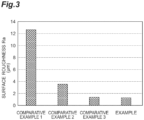
- FIG. 3 is a test result of the roughness of the surface of the additively manufactured article with respect to the processing condition according to Example. As illustrated in FIG. 3 , the arithmetic mean roughness Ra of Example was 1.308 ⁇ m, and the arithmetic mean roughness Ra of Comparative Examples 1 to 3 was 12.687 ⁇ m, 3.546 ⁇ m, and 1.369 ⁇ m, respectively.
- Example with Comparative Example 1 When comparing Example with Comparative Example 1, it was confirmed that the roughness of the surface of the additively manufactured article could be significantly reduced by executing the processing method for an additively manufactured article according to the above-described embodiment.
- a spherical medium made of metal can be generally used during surface processing of an object having a small surface roughness.
- this processing method for an additively manufactured article it is considered that the surface roughness of the additively manufactured article can be appropriately reduced because the additively manufactured article can be deformed by stirring the spherical medium made of metal and the additively manufactured article.
- Example and Comparative Example 3 are compared with each other, it is considered that since the medium is spherical, the contact of the medium with respect to the additively manufactured article becomes uniform, and thus formation of dents on the surface of the additively manufactured article is suppressed, and an increase in the roughness of the surface of the additively manufactured article can be suppressed as compared with a medium including an acute corner.
- the residual stress was measured as the roughness of the surfaces of Example and Comparative Examples 1 to 3 prepared under the above conditions.
- the residual stress was measured by a residual stress measurement device described in Japanese Unexamined Patent Publication No. 2007-009356 .
- the residual stress measurement device includes a first detection element that detects an intensity of a diffracted X-ray of a measuring object at a first detection position and a second detection element that detects an intensity of a diffracted X-ray of the measuring object at a second detection position different from the first detection position by a movement mechanism and a movement control unit.
- FIG. 4 is a test result of the residual stress of the additively manufactured article with respect to the processing condition according to Example.
- Comparing Example with Comparative Example 1 it was confirmed that the residual stress could be applied to the additively manufactured article by executing the processing method for an additively manufactured article according to the above-described embodiment.
- Example with Comparative Example 2 it was confirmed that the residual stress close to the shot peening could be applied to the additively manufactured article even in the processing method for an additively manufactured article according to the above-described embodiment although it was slightly inferior to the shot peening.
- Example with Comparative Example 3 it was confirmed that the residual stress could be significantly applied to the additively manufactured article by using the spherical medium made of metal. That is, it is considered that since the mass of the medium stirred together with the additively manufactured article is larger in Example, a force of pressing the medium against the additively manufactured article becomes stronger, and the residual stress can be largely applied to the additively manufactured article.
Landscapes
- Engineering & Computer Science (AREA)
- Mechanical Engineering (AREA)
- Chemical & Material Sciences (AREA)
- Manufacturing & Machinery (AREA)
- Materials Engineering (AREA)
- Chemical Kinetics & Catalysis (AREA)
- Metallurgy (AREA)
- Organic Chemistry (AREA)
- Powder Metallurgy (AREA)
- Finish Polishing, Edge Sharpening, And Grinding By Specific Grinding Devices (AREA)
- Turbine Rotor Nozzle Sealing (AREA)
- Prostheses (AREA)
Abstract
A processing method for an additively manufactured article, the processing method including: accommodating an additively manufactured article containing metal and a medium made of metal in a barrel polishing device; and reducing a roughness of a surface of the additively manufactured article and applying a residual stress to the additively manufactured article by stirring the additively manufactured article and the medium, in which a surface of the medium includes a curved surface.
Description
- This application is based on and claims the benefit of priority from
Japanese Patent Application No. 2023-037829 filed on March 10, 2023 - The present disclosure relates to a processing method for an additively manufactured article.
-
WO 2019/008901 A discloses a shot peening method. This method is a method of projecting a shot media onto an object to be processed, which is a structure in which a first member and a second member are joined to each other with a welded portion interposed therebetween, in which the shot media is projected from a nozzle to a welded peripheral portion adjacent to the welded portion on a surface of the object to be processed in a state where a tip of the nozzle is directed. - By the way, an additively manufactured article may have a large surface roughness and a small residual stress immediately after additive manufacturing as compared with a metal member manufactured by another metal processing. In the shot peening method described in
WO 2019/008901 A , although the residual stress can be applied to the surface of the object, there is no disclosure that the roughness of the surface of the object can be sufficiently reduced. Therefore, in order to appropriately reduce the roughness of the surface of the additively manufactured article, it may be necessary to further execute other processing, and thus the number of man-hours related to the processing of the additively manufactured article may increase. Therefore, there is a demand for a processing method for an additively manufactured article capable of appropriately reducing a roughness of the surface of the additively manufactured article and applying a residual stress to the additively manufactured article. - A processing method for an additively manufactured article according to the present disclosure includes: accommodating an additively manufactured article containing metal and a medium made of metal in a barrel polishing device; and reducing a roughness of a surface of the additively manufactured article and applying a residual stress to the additively manufactured article by stirring the additively manufactured article and the medium, in which a surface of the medium includes a curved surface.
- According to the present disclosure, the roughness of the surface of the additively manufactured article containing metal can be appropriately reduced, and the residual stress can be applied to the additively manufactured article.
-
-
FIG. 1 is a flowchart of a processing method for an additively manufactured article according to an embodiment; -
FIG. 2 is a front view schematically illustrating a barrel polishing device used in a processing method for an additively manufactured article according to an embodiment; -
FIG. 3 is a test result of a roughness of a surface of an additively manufactured article with respect to a processing condition according to Example; and -
FIG. 4 is a test result of a residual stress of the additively manufactured article with respect to the processing condition according to Example. - First, an outline of an embodiment of the present disclosure will be described.
- (Clause 1) A processing method for an additively manufactured article according to one aspect of the present disclosure includes accommodating and applying. The accommodating includes accommodating an additively manufactured article containing metal and a medium made of metal in a barrel polishing device. The applying includes reducing a roughness of a surface of the additively manufactured article and applying a residual stress to the additively manufactured article by stirring the additively manufactured article and the medium. A surface of the medium includes a curved surface.
- According to this processing method for an additively manufactured article, the applying includes stirring the additively manufactured article and the medium, so that the medium is pressed against the additively manufactured article. Since the medium is made of metal and has a larger specific gravity than other constituent materials such as plastic, the medium is pressed against the additively manufactured article with a larger force. Therefore, this method can easily apply the residual stress to the additively manufactured article. Furthermore, the roughness of the surface of the additively manufactured article containing metal is generally larger than the roughness of the surface of a metal member manufactured by another metal processing. The medium made of metal can be used at the time of surface processing of an object having a small surface roughness. However, in this processing method for an additively manufactured article, since the additively manufactured article can be deformed (plastically deformed) by stirring the additively manufactured article containing metal and the medium made of metal, the roughness of the surface of the additively manufactured article can be appropriately reduced. Moreover, since the surface of the medium includes the curved surface, the formation of dents on the surface of the additively manufactured article is suppressed as compared with the medium including an acute corner portion, and the increase in the roughness of the surface of the additively manufactured article can be suppressed. Therefore, this processing method for an additively manufactured article can appropriately reduce the roughness of the surface of the additively manufactured article containing metal, and apply the residual stress to the additively manufactured article.
- (Clause 2) In the processing method for an additively manufactured article according to
Clause 1, the applying may include stirring the additively manufactured article and the medium without using abrasive grains. In this case, according to the processing method for an additively manufactured article, a surface layer of the additively manufactured article is suppressed from being scraped. According to the processing method for an additively manufactured article, as compared with the case of stirring using the abrasive grains, the surface layer portion of the additively manufactured article to which the residual stress is applied is suppressed from being scraped by the abrasive grains, so that it is possible to obtain the additively manufactured article to which the residual stress is appropriately applied after execution of the processing method. - (Clause 3) In the processing method for an additively manufactured article according to
Clause - (Clause 4) In the processing method for an additively manufactured article of any one of
Clauses 1 to 3, the additively manufactured article may be a blade of an aircraft engine or a medical component. In this case, according to the processing method for an additively manufactured article, the additively manufactured article has a reduced surface roughness and a reduced air resistance, so that the additively manufactured article can be used for a blade of an engine of an aircraft. Furthermore, in the additively manufactured article, the surface roughness is reduced, and a function required for the medical component such as cell peelability is improved, and thus the additively manufactured article can be used for the medical component. - (Clause 5) In the processing method for an additively manufactured article according to any one of
Clauses 1 to 4, the barrel polishing device may be a centrifugal barrel polishing device, the medium may be spherical, and a diameter of the medium may be 20 mm or less. In this case, since the barrel polishing device is a centrifugal barrel polishing device, it is possible to perform adjustment so that the medium is strongly pressed against the additively manufactured article at the time of stirring as compared with the case of other types of barrel polishing devices. Furthermore, since the medium is spherical, the contact of the medium with the additively manufactured article becomes uniform, and thus the occurrence of the dents on the surface of the additively manufactured article can be suppressed. Moreover, the diameter of the medium can be set according to a size of the barrel polishing device, a material and a shape of the additively manufactured article, a target value of the residual stress to be applied, and the like. - Hereinafter, an embodiment of the present disclosure will be described with reference to the drawings. Note that, in the following description, the same or equivalent elements are denoted by the same reference signs, and redundant description will not be repeated. The dimensional ratios in the drawings do not necessarily coincide with those in the description. The words "upper", "lower", "left", and "right" are based on the illustrated state and are used for convenience.
-
FIG. 1 is a flowchart of a processing method for an additively manufactured article according to an embodiment. The processing method for an additively manufactured article illustrated inFIG. 1 is a method of stirring an additively manufactured article and a medium to reduce a roughness of a surface of the additively manufactured article and to apply a residual stress to the additively manufactured article. The processing method for an additively manufactured article of the present embodiment is applied to, for example, an additively manufactured article used for a blade of an aircraft engine or a medical component. The medical component is, for example, an artificial bone or an artificial joint. - The additively manufactured article is an additively manufactured article containing metal. The additively manufactured article is a manufactured article by additive manufacturing. In the additively manufactured article, for example, at least a part of the surface layer is made of metal. In the additively manufactured article, for example, a part of the surface layer may be made of metal, and a part of the surface layer may be made of resin. In this case, the resin may be exposed on the surface of the additively manufactured article. The additively manufactured article of the present embodiment is made of, for example, metal. The additively manufactured article is formed, for example, layer by layer by melting a metal powder. The metal powder is melted by a laser or the like. The surface of the additively manufactured article immediately after being formed by melting the metal powder has, for example, an arithmetic average roughness Ra defined in JIS-B0601:2013 of about 5 µm or more and 50 µm or less, and the surface roughness is very large.
- Examples of the material of the metal powder include pure iron and an iron alloy. The iron alloy may contain stainless steel and maraging. The material of the metal powder may be pure aluminum and an aluminum alloy. The material of the metal powder may be pure copper and a copper alloy. The material of the metal powder may be pure nickel and a nickel alloy. The nickel alloy may contain a nickel-based superalloy. The material of the metal powder may be a cobalt alloy. The material of the metal powder may be pure titanium and a titanium alloy. The material of the metal powder may be pure magnesium and a magnesium alloy. The material of the metal powder may be a titanium-based alloy. The material of the metal powder may be cemented carbide. The cemented carbide may contain tungsten carbide.
- A surface of the medium includes a curved surface. In a case where the medium has corners, the medium includes polyhedrons in which all corners present a rounded shape. The medium includes a polyhedron in which all corners are obtuse and in which the corners present a rounded shape. As an example of the polyhedron, the medium includes a sputnik (Saturn shape). The Saturn shape includes a shape in which a part of a sphere is enlarged in a radial direction. In a case where the medium is a sputnik medium, the fluidity in a barrel polishing device described later is high as compared with a case where the medium has another shape. The medium of the present embodiment is spherical (sphere). In a case where the medium is spherical, all surfaces of the medium include gently curved surfaces. Therefore, in a case where the medium is spherical, the cutting of the surface layer of the additively manufactured article can be further suppressed as compared with the case where the medium has another shape.
- A diameter of the medium is 20 mm or less. The diameter of the medium may be changed in accordance with a size of a
barrel polishing device 10 described later. For example, in a case where a volume of abarrel tank 11 of thebarrel polishing device 10 described later is 8 L, a medium having a diameter of 20 mm or less is selected from the viewpoint of stirring efficiency at the time of processing. - The medium is made of metal. A hardness of the medium is, for example, greater than a hardness of the additively manufactured article. As a result, in the stirring (step S12) to be described later, inclusion of a part of the medium in the dust generated by collision between the medium and the additively manufactured article during stirring is reduced. The medium of the present embodiment is a steel ball. The material of the medium is, for example, SUJ2. In a case where the medium is made of SUJ2, the cost can be kept low and the hardness is high as compared with the case where the medium is made of another steel material or another material, so that the additively manufactured article is easily plastically deformed. The medium may be made of, for example, a metal material such as ceramic or a material covered with a resin coating, or may be made of a combination of iron, ceramic, resin, and the like. In a case where the medium is made of ceramic, impurities other than the additively manufactured article can be suppressed from remaining in the barrel polishing device in the processing method for an additively manufactured article described later. In a case where the medium is coated with a resin, formation of dents by the medium on the surface of the additively manufactured article can be suppressed in the processing method for an additively manufactured article described later. The medium may be made of, for example, the same kind of metal material as the additively manufactured article.
- The processing method for an additively manufactured article of the present embodiment is realized by a barrel polishing device.
FIG. 2 is a front view schematically illustrating a barrel polishing device used in a processing method for an additively manufactured article according to an embodiment. Abarrel polishing device 10 illustrated inFIG. 2 is a horizontal centrifugal barrel polishing device. Note that the horizontal centrifugal barrel polishing device includes a revolution axis and a rotation axis extending in a horizontal direction, and is a device that polishes a workpiece in a barrel tank by revolving the barrel tank about the revolution axis while rotating the barrel tank about the rotation axis. - As illustrated in
FIG. 2 , thebarrel polishing device 10 includes a plurality ofbarrel tanks 11, a plurality ofbarrel tank cases 12, a pair of turrets 13 (revolution disks), arevolution shaft 14, adrive mechanism 15, and a drivenmechanism 16. In one embodiment, thebarrel polishing device 10 includes fourbarrel tanks 11.FIG. 2 illustrates threebarrel tanks 11 out of the fourbarrel tanks 11. An additively manufactured article and a medium are accommodated in each of thebarrel tanks 11. Each of thebarrel tank cases 12 includes arotation shaft 12a. Thedrive mechanism 15 includes adrive motor 15a, amotor pulley 15b, arevolution pulley 15c, and adrive belt 15d. - In the
barrel polishing device 10, when thedrive motor 15a operates, a driving force is transmitted to the turret 13 via themotor pulley 15b, thedrive belt 15d, and therevolution pulley 15c, and the turret 13 rotates about therevolution shaft 14. As the turret 13 rotates, thebarrel tank 11 fixed to thebarrel tank case 12 turns (revolves) about therevolution shaft 14 as an axis. Furthermore, by the drivenmechanism 16, thebarrel tank 11 rotates in a direction opposite to a rotation direction of the turret 13 about therotation shaft 12a as an axis. As described above, thebarrel tank 11 rotates about the horizontally extendingrotation shaft 12a and revolves about the horizontally extendingrevolution shaft 14. That is, thebarrel tank 11 performs a planetary motion with the rotation shaft extending horizontally as an axis. - Note that the barrel polishing device used in the processing method for an additively manufactured article is not limited to the
barrel polishing device 10 illustrated inFIG. 2 . For example, the barrel polishing device used in the processing method for an additively manufactured article may be any of a vibratory barrel polishing device, a fluid barrel polishing device, a rotary barrel polishing device, or a gyro barrel polishing device. For example, in a case where the barrel polishing device is a vibratory barrel polishing device, even a relatively large additively manufactured article can be appropriately accommodated in the barrel polishing device. - Referring back to
FIG. 1 , the description is continued. The processing method for an additively manufactured article includes the accommodating (step S10) and the stirring (step S12). In the accommodating(step S10), the additively manufactured article and the medium are accommodated in thebarrel tank 11 of thebarrel polishing device 10. For example, in a case where the volume of thebarrel tank 11 is 8 L, a total amount of the additively manufactured article and the medium is adjusted to 6 L or less and 15 kg or less. At this time, the abrasive grains are not accommodated in thebarrel tank 11. - Subsequently, in the stirring (an example of the applying: step S12), the additively manufactured article and the medium are stirred to reduce a roughness of the surface of the additively manufactured article and apply a residual stress to the additively manufactured article. For example, the
barrel polishing device 10 rotates thebarrel tank 11 about therotation shaft 12a at a speed of 5 rpm or more and 600 rpm or less. For example, thebarrel polishing device 10 revolves thebarrel tank 11 around therevolution shaft 14 at a speed of 10 rpm or more and 300 rpm or less. A rotation-revolution ratio (a ratio of the rotation speed to the revolution speed) is -1 : 1, -2 : 1, or -0.5 : 1. Note that a negative value means that a rotation direction is different (opposite) with respect to a positive value. Thebarrel polishing device 10 stirs the additively manufactured article and the medium at the above-described rotation speed and revolution speed for 60 minutes, for example. - In the stirring (step S12), the additively manufactured article and the medium are stirred without using abrasive grains. That is, at least before the stirring (step S12) is performed, the accommodating abrasive grains in the
barrel tank 11 of thebarrel polishing device 10 accommodating the additively manufactured article is not performed. When the stirring (step S12) ends, the flowchart illustrated inFIG. 1 ends. - As described above, according to the processing method for an additively manufactured article, the additively manufactured article and the medium are stirred in the stirring (step S12), whereby the medium is pressed against the additively manufactured article. Since the medium is made of metal and has a larger specific gravity than other constituent materials such as plastic, the medium is pressed against the additively manufactured article with a larger force. Therefore, this method can easily apply the residual stress to the additively manufactured article. By this method, for example, a residual stress is applied to a metal portion included in the additively manufactured article. Since the residual stress is applied, this method can improve the durability of the additively manufactured article, and can enable long-term use. Furthermore, even in a case where a space, a gap, or the like is generated inside the additively manufactured article at the time of additive manufacturing, the space can be reduced by pressing the additively manufactured article against the medium, and the additively manufactured article in a densely stacked state can be obtained.
- Moreover, the roughness of the surface of the additively manufactured article is generally larger than the roughness of the surface of a metal member manufactured by another metal processing. The medium made of metal can be used at the time of surface processing of an object having a small surface roughness. However, in this processing method for an additively manufactured article, since the additively manufactured article can be deformed (plastically deformed) by stirring the additively manufactured article containing metal and the medium made of metal, the roughness of the surface of the additively manufactured article can be appropriately reduced. Furthermore, since the surface of the medium includes the curved surface, the formation of the dents on the surface of the additively manufactured article is suppressed as compared with the medium including an acute corner portion, and the increase in the roughness of the surface of the additively manufactured article can be suppressed. Therefore, this processing method for an additively manufactured article can appropriately reduce the roughness of the surface of the additively manufactured article and apply the residual stress to the additively manufactured article.
- Conventionally, in order to apply the residual stress and appropriately reduce the roughness of the surface of the additively manufactured article, for example, it is required to execute polishing by hand or barrel polishing by an operator after executing shot peening. However, in this case, the number of man-hours related to the processing of the additively manufactured article may increase. On the other hand, by executing the processing method for an additively manufactured article of the present embodiment using the
barrel polishing device 10, it is possible to obtain both the effect of reducing the roughness of the surface and the effect of applying the residual stress described above, so that it is possible to reduce the number of man-hours related to the processing of the additively manufactured article and to improve the productivity. - Furthermore, in the applying in the processing method for an additively manufactured article, the additively manufactured article and the medium are stirred without using abrasive grains. In this case, according to the processing method for an additively manufactured article, a surface layer of the additively manufactured article is suppressed from being scraped.
- Furthermore, in the processing method for an additively manufactured article, the medium is a steel ball medium. In this case, in the processing method for an additively manufactured article, for example, the cost can be kept low, and the hardness of the medium is relatively high, so that the additively manufactured article is easily plastically deformed.
- Furthermore, in the processing method for an additively manufactured article, the additively manufactured article is a blade of an aircraft engine or a medical component. In this case, according to this processing method for an additively manufactured article, the additively manufactured article used as a blade of an aircraft engine has reduced surface roughness, reduced air resistance, and enhanced air flow separation. Furthermore, in the additively manufactured article used as a medical component, since the roughness of the surface is reduced, it is expected that the aesthetic appearance of an artificial bone is improved, the slidability of a sliding portion is improved, the long-term durability is improved, and the cell peelability of a component used in a short term such as a temporary fixing bolt is improved. Moreover, since the residual stress is applied by this processing method for an additively manufactured article, the reliability of the fatigue strength of the additively manufactured article is improved. Thus, the additively manufactured articles are used in the aircraft engine blade or the medical component.
- Furthermore, in the processing method for an additively manufactured article, the
barrel polishing device 10 may be a centrifugal barrel polishing device, the medium may be spherical, and the diameter of the medium may be 20 mm or less. In this case, since thebarrel polishing device 10 is a centrifugal barrel polishing device, it is possible to perform adjustment so that the medium can be strongly pressed against the additively manufactured article at the time of stirring as compared with the case of other types of barrel polishing devices. Furthermore, since the medium is spherical, the contact of the medium with the additively manufactured article becomes uniform, and thus the occurrence of dents on the surface of the additively manufactured article can be suppressed. The uniform contact means, for example, that the spherical surface of the medium formed with the same curvature abuts even if any part of the medium abuts on the additively manufactured article. The variation in the roughness of the surface due to the contact portion of the medium is suppressed. Moreover, the diameter of the medium can be set according to a size of the barrel polishing device. - In order to evaluate the effect of the spherical medium made of metal on the additively manufactured article, the processing method of an additively manufactured article was performed on the additively manufactured article.
- The preparing an additively manufactured article and a spherical medium was performed. As the additively manufactured article, an additively manufactured article manufactured by a manufacturing device (3D SYSTEMS) that melts a metal powder by irradiation with a laser and performs additive manufacturing was used. The metal powder was austenitic stainless steel powder (SUS316L). The additively manufactured article is a cylinder having a diameter of 12 mm and a height of 130 mm. A steel ball (SSB-3.8) was used as the medium. A diameter of the medium is 3.8 mm. In the accommodating (step S10), the additively manufactured article and the medium were accommodated in a barrel polishing device. The barrel polishing device was a centrifugal barrel polishing device (SKC-32S manufactured by SINTOKOGIO, LTD.). In the stirring (step S12), the additively manufactured article and the medium were stirred with the rotation-revolution ratio set to -1 : 1, the revolution speed set to 200 rpm, and the operating time set to 30 minutes. After completion of the operation, the additively manufactured article was taken out from the barrel polishing device.
- In Comparative Example 1, the processing method for an additively manufactured article according to the above-described embodiment is not performed on the additively manufactured article. That is, the accommodating (step S10) and the stirring (step S12) are not performed. The other conditions were the same as those in Example.
- In Comparative Example 2, shot peening was performed on the additively manufactured article instead of the processing method for an additively manufactured article according to the above-described embodiment. The device that performed shot peening is a gravity blasting device (MY-30 manufactured by SINTOKOGIO, LTD.). As a shot media used in the shot peening, spherical stainless steel beads (SUS 150B) having a particle size range of 150 nm to 50 µm were used. The projection pressure was 0.5 MPa. After completion of the shot peening, the additively manufactured article was taken out from the gravity blasting device.
- In Comparative Example 3, among the conditions according to Example, the medium was replaced with a medium having an acute corner, and the other conditions were the same as those in Example. As the medium, V7-T10 manufactured by SINTOKOGIO, LTD., which is a triangular prism-shaped ceramic medium having a corner portion, was used.
- An arithmetic mean roughness Ra as the roughness of the surfaces of Example and Comparative Examples 1 to 3 prepared under the above conditions was measured by a contact surface roughness meter (SURFCOM manufactured by TOKYO SEIMITSU CO., LTD.). The arithmetic mean roughness Ra was calculated based on JIS-B0601:2013.
FIG. 3 is a test result of the roughness of the surface of the additively manufactured article with respect to the processing condition according to Example. As illustrated inFIG. 3 , the arithmetic mean roughness Ra of Example was 1.308 µm, and the arithmetic mean roughness Ra of Comparative Examples 1 to 3 was 12.687 µm, 3.546 µm, and 1.369 µm, respectively. - When comparing Example with Comparative Example 1, it was confirmed that the roughness of the surface of the additively manufactured article could be significantly reduced by executing the processing method for an additively manufactured article according to the above-described embodiment. A spherical medium made of metal can be generally used during surface processing of an object having a small surface roughness. However, in this processing method for an additively manufactured article, it is considered that the surface roughness of the additively manufactured article can be appropriately reduced because the additively manufactured article can be deformed by stirring the spherical medium made of metal and the additively manufactured article. By comparing Example with Comparative Example 2, it was confirmed that the processing method for an additively manufactured article according to the above-described embodiment significantly contributed to reduction of the surface roughness of an additively manufactured article as compared with the shot peening. When Example and Comparative Example 3 are compared with each other, it is considered that since the medium is spherical, the contact of the medium with respect to the additively manufactured article becomes uniform, and thus formation of dents on the surface of the additively manufactured article is suppressed, and an increase in the roughness of the surface of the additively manufactured article can be suppressed as compared with a medium including an acute corner.
- The residual stress was measured as the roughness of the surfaces of Example and Comparative Examples 1 to 3 prepared under the above conditions. The residual stress was measured by a residual stress measurement device described in
Japanese Unexamined Patent Publication No. 2007-009356 FIG. 4 is a test result of the residual stress of the additively manufactured article with respect to the processing condition according to Example.FIG. 4 illustrates that the smaller the value, the larger the residual stress applied to the additively manufactured article. As illustrated inFIG. 4 , the residual stress in Example was about -460 MPa, and the residual stresses in Comparative Examples 1 to 3 were about 39 MPa, about -780 MPa, and about -120 MPa, respectively. - Comparing Example with Comparative Example 1, it was confirmed that the residual stress could be applied to the additively manufactured article by executing the processing method for an additively manufactured article according to the above-described embodiment. By comparing Example with Comparative Example 2, it was confirmed that the residual stress close to the shot peening could be applied to the additively manufactured article even in the processing method for an additively manufactured article according to the above-described embodiment although it was slightly inferior to the shot peening. By comparing Example with Comparative Example 3, it was confirmed that the residual stress could be significantly applied to the additively manufactured article by using the spherical medium made of metal. That is, it is considered that since the mass of the medium stirred together with the additively manufactured article is larger in Example, a force of pressing the medium against the additively manufactured article becomes stronger, and the residual stress can be largely applied to the additively manufactured article.
- Comparing Example with Comparative Examples 1 to 3, it was confirmed that the processing method for an additively manufactured article according to the above-described embodiment could appropriately reduce the roughness of the surface of the additively manufactured article, and apply the residual stress to the additively manufactured article.
Claims (5)
- A processing method for an additively manufactured article, the processing method comprising:accommodating an additively manufactured article containing metal and a medium made of metal in a barrel polishing device; andreducing a roughness of a surface of the additively manufactured article and applying a residual stress to the additively manufactured article by stirring the additively manufactured article and the medium,wherein a surface of the medium includes a curved surface.
- The processing method for an additively manufactured article according to claim 1, wherein, the applying, includes stirring the additively manufactured article and the medium without using an abrasive grain.
- The processing method for an additively manufactured article according to claim 1 or 2, wherein the medium includes a steel ball medium.
- The processing method for an additively manufactured article according to any one of claims 1 to 3, wherein the additively manufactured article includes a blade of an aircraft engine or a medical component.
- The processing method for an additively manufactured article according to any one of claims 1 to 4, whereinthe barrel polishing device includes a centrifugal barrel polishing device, andthe medium is spherical, and a diameter of the medium is 20 mm or less.
Applications Claiming Priority (1)
| Application Number | Priority Date | Filing Date | Title |
|---|---|---|---|
| JP2023037829A JP2024128694A (en) | 2023-03-10 | 2023-03-10 | Methods for processing additive manufactured products |
Publications (1)
| Publication Number | Publication Date |
|---|---|
| EP4427881A1 true EP4427881A1 (en) | 2024-09-11 |
Family
ID=90124008
Family Applications (1)
| Application Number | Title | Priority Date | Filing Date |
|---|---|---|---|
| EP24160452.9A Pending EP4427881A1 (en) | 2023-03-10 | 2024-02-29 | Processing method for additively manufactured article |
Country Status (4)
| Country | Link |
|---|---|
| US (1) | US20250073781A1 (en) |
| EP (1) | EP4427881A1 (en) |
| JP (1) | JP2024128694A (en) |
| CN (1) | CN118621314A (en) |
Citations (3)
| Publication number | Priority date | Publication date | Assignee | Title |
|---|---|---|---|---|
| JP2007009356A (en) | 2005-06-29 | 2007-01-18 | Daiwabo Co Ltd | Laminated nonwoven fabric and method for producing the same |
| US20180345457A1 (en) * | 2017-05-31 | 2018-12-06 | Safran Aero Boosters Sa | Peening Method for Turbine Engine Component |
| WO2019008901A1 (en) | 2017-07-07 | 2019-01-10 | 新東工業株式会社 | Shot-peening method |
-
2023
- 2023-03-10 JP JP2023037829A patent/JP2024128694A/en active Pending
-
2024
- 2024-02-29 EP EP24160452.9A patent/EP4427881A1/en active Pending
- 2024-03-01 US US18/593,036 patent/US20250073781A1/en active Pending
- 2024-03-05 CN CN202410247665.6A patent/CN118621314A/en active Pending
Patent Citations (3)
| Publication number | Priority date | Publication date | Assignee | Title |
|---|---|---|---|---|
| JP2007009356A (en) | 2005-06-29 | 2007-01-18 | Daiwabo Co Ltd | Laminated nonwoven fabric and method for producing the same |
| US20180345457A1 (en) * | 2017-05-31 | 2018-12-06 | Safran Aero Boosters Sa | Peening Method for Turbine Engine Component |
| WO2019008901A1 (en) | 2017-07-07 | 2019-01-10 | 新東工業株式会社 | Shot-peening method |
Non-Patent Citations (2)
| Title |
|---|
| HUNG WAYNE: "Postprocessing of Additively Manufactured Metal Parts", JOURNAL OF MATERIALS ENGINEERING AND PERFORMANCE, ASM INTERNATIONAL, MATERIALS PARK, OH, US, vol. 30, no. 9, 16 August 2021 (2021-08-16), pages 6439 - 6460, XP037567304, ISSN: 1059-9495, [retrieved on 20210816], DOI: 10.1007/S11665-021-06037-Z * |
| MALAKIZADI AMIR ET AL: "Post-processing of additively manufactured metallic alloys - A review", INTERNATIONAL JOURNAL OF MACHINE TOOLS AND MANUFACTURE, ELSEVIER, AMSTERDAM, NL, vol. 179, 21 June 2022 (2022-06-21), XP087121006, ISSN: 0890-6955, [retrieved on 20220621], DOI: 10.1016/J.IJMACHTOOLS.2022.103908 * |
Also Published As
| Publication number | Publication date |
|---|---|
| US20250073781A1 (en) | 2025-03-06 |
| JP2024128694A (en) | 2024-09-24 |
| CN118621314A (en) | 2024-09-10 |
Similar Documents
| Publication | Publication Date | Title |
|---|---|---|
| EP3438462B1 (en) | Impeller production method by fused deposition modeling and mechanical polishing | |
| US7118464B2 (en) | Apparatus for smoothing the surface of a gas turbine blade | |
| CA2497731C (en) | Magnetorheological polishing devices and methods | |
| EP1813686B1 (en) | Preparation of an article surface having a surface compressive texture | |
| US7303461B1 (en) | Method of machining airfoils by disc tools | |
| Kartal | A review of the current state of abrasive water-jet turning machining method | |
| KR101788881B1 (en) | High throughput finishing of metal components | |
| WO2005032755A2 (en) | Laser powder fusion repair of z-notches with inconel 713 powder | |
| US7144302B2 (en) | Method for smoothing the surface of a gas turbine blade | |
| US20250073781A1 (en) | Processing method for additively manufactured article | |
| US7144307B2 (en) | Point superabrasive machining of nickel alloys | |
| Guo et al. | Recent advancements in machining with abrasives | |
| CN108581169B (en) | Target assembly and processing method | |
| Kumar et al. | The Study of Assessment Parameters and Performance Measurement of Cold Spray Technique: A Futuristic Approach Towards Additive Manufacturing: S. Kumar and SM Pandey | |
| US20090119920A1 (en) | Method of producing a component | |
| Cheng et al. | Tool design and cutting parameter optimization for side milling blisk | |
| EP3093524A1 (en) | Shaft balancing system and method of balancing a shaft | |
| Hashmi et al. | A critical review of mechanical-based post-processing techniques for additively manufactured parts | |
| EP3838446A1 (en) | Abrasive coating including metal matrix and ceramic particles | |
| US20050155225A1 (en) | Match lapping valve assemblies | |
| Novikov et al. | Finish diamond machining of ceramic femoral heads | |
| US20210094148A1 (en) | Plunge dressing methods and systems for producing a grinding wheel for spiral-bevel and hypoid gear manufacture | |
| JP2024025406A (en) | Smoothing method | |
| WO2005028159A1 (en) | Free curved surface precision machining tool | |
| Gavcar et al. | Mechanical post-processing techniques for metal additive manufacturing |
Legal Events
| Date | Code | Title | Description |
|---|---|---|---|
| PUAI | Public reference made under article 153(3) epc to a published international application that has entered the european phase |
Free format text: ORIGINAL CODE: 0009012 |
|
| STAA | Information on the status of an ep patent application or granted ep patent |
Free format text: STATUS: THE APPLICATION HAS BEEN PUBLISHED |
|
| AK | Designated contracting states |
Kind code of ref document: A1 Designated state(s): AL AT BE BG CH CY CZ DE DK EE ES FI FR GB GR HR HU IE IS IT LI LT LU LV MC ME MK MT NL NO PL PT RO RS SE SI SK SM TR |
|
| STAA | Information on the status of an ep patent application or granted ep patent |
Free format text: STATUS: REQUEST FOR EXAMINATION WAS MADE |
|
| 17P | Request for examination filed |
Effective date: 20250311 |