EP4427664A1 - Alarm method and alarm system - Google Patents
Alarm method and alarm system Download PDFInfo
- Publication number
- EP4427664A1 EP4427664A1 EP21961614.1A EP21961614A EP4427664A1 EP 4427664 A1 EP4427664 A1 EP 4427664A1 EP 21961614 A EP21961614 A EP 21961614A EP 4427664 A1 EP4427664 A1 EP 4427664A1
- Authority
- EP
- European Patent Office
- Prior art keywords
- risk
- warning
- degree
- monitored person
- pertaining
- Prior art date
- Legal status (The legal status is an assumption and is not a legal conclusion. Google has not performed a legal analysis and makes no representation as to the accuracy of the status listed.)
- Pending
Links
Images

Classifications
-
- A—HUMAN NECESSITIES
- A61—MEDICAL OR VETERINARY SCIENCE; HYGIENE
- A61B—DIAGNOSIS; SURGERY; IDENTIFICATION
- A61B5/00—Measuring for diagnostic purposes; Identification of persons
- A61B5/103—Measuring devices for testing the shape, pattern, colour, size or movement of the body or parts thereof, for diagnostic purposes
-
- G—PHYSICS
- G08—SIGNALLING
- G08B—SIGNALLING SYSTEMS, e.g. PERSONAL CALLING SYSTEMS; ORDER TELEGRAPHS; ALARM SYSTEMS
- G08B21/00—Alarms responsive to a single specified undesired or abnormal condition and not otherwise provided for
- G08B21/02—Alarms for ensuring the safety of persons
-
- A—HUMAN NECESSITIES
- A61—MEDICAL OR VETERINARY SCIENCE; HYGIENE
- A61B—DIAGNOSIS; SURGERY; IDENTIFICATION
- A61B5/00—Measuring for diagnostic purposes; Identification of persons
- A61B5/01—Measuring temperature of body parts ; Diagnostic temperature sensing, e.g. for malignant or inflamed tissue
-
- A—HUMAN NECESSITIES
- A61—MEDICAL OR VETERINARY SCIENCE; HYGIENE
- A61B—DIAGNOSIS; SURGERY; IDENTIFICATION
- A61B5/00—Measuring for diagnostic purposes; Identification of persons
- A61B5/74—Details of notification to user or communication with user or patient; User input means
- A61B5/746—Alarms related to a physiological condition, e.g. details of setting alarm thresholds or avoiding false alarms
-
- G—PHYSICS
- G08—SIGNALLING
- G08B—SIGNALLING SYSTEMS, e.g. PERSONAL CALLING SYSTEMS; ORDER TELEGRAPHS; ALARM SYSTEMS
- G08B21/00—Alarms responsive to a single specified undesired or abnormal condition and not otherwise provided for
- G08B21/18—Status alarms
- G08B21/182—Level alarms, e.g. alarms responsive to variables exceeding a threshold
-
- G—PHYSICS
- G08—SIGNALLING
- G08B—SIGNALLING SYSTEMS, e.g. PERSONAL CALLING SYSTEMS; ORDER TELEGRAPHS; ALARM SYSTEMS
- G08B21/00—Alarms responsive to a single specified undesired or abnormal condition and not otherwise provided for
- G08B21/18—Status alarms
- G08B21/22—Status alarms responsive to presence or absence of persons
-
- A—HUMAN NECESSITIES
- A61—MEDICAL OR VETERINARY SCIENCE; HYGIENE
- A61B—DIAGNOSIS; SURGERY; IDENTIFICATION
- A61B2503/00—Evaluating a particular growth phase or type of persons or animals
- A61B2503/20—Workers
-
- A—HUMAN NECESSITIES
- A61—MEDICAL OR VETERINARY SCIENCE; HYGIENE
- A61B—DIAGNOSIS; SURGERY; IDENTIFICATION
- A61B2560/00—Constructional details of operational features of apparatus; Accessories for medical measuring apparatus
- A61B2560/02—Operational features
- A61B2560/0242—Operational features adapted to measure environmental factors, e.g. temperature, pollution
Definitions
- the present invention relates to a warning method and a warning system in which: a degree of risk relating to any poor physical health, illness, or injury of a monitored person is calculated; and a warning is issued based on the degree of risk.
- Patent Document 1 discloses a warning method for issuing a warning relating to poor physical health caused by heatstroke.
- heatstroke in a monitored person is evaluated based on biological information pertaining to the monitored person, who is a worker, and environment information such as humidity; and a warning relating to the heatstroke is issued to the monitored person or to another monitored person who works in the surroundings of the aforementioned monitored person.
- Patent Document 1 no consideration is given whatsoever to the matter of evaluating or reporting illness or injury of the monitored person.
- the present invention is focused on the aforementioned problems, it being an object of the present invention to provide a warning method and a warning system in which an appropriate treatment can be implemented in a suitable period in response to any poor physical health, illness, or injury of a monitored person.
- Patent Document 1 Japanese Laid-Open Patent Application No. 5022506
- the present invention relates to a warning method in which: at least one of biological information pertaining to a monitored person and environment information pertaining to surroundings of the monitored person is acquired as information to be used in evaluating a degree of risk pertaining to any poor physical health, illness, or injury of the monitored person; a degree of risk relating to the poor physical health, illness, or injury of the monitored person is calculated based on the acquired information; and the scope of a warning relating to the poor physical health, illness, or injury of the monitored person is changed based on the extent of the calculated degree of risk.
- an appropriate treatment it is possible for an appropriate treatment to be implemented in a suitable period in response to any poor physical health, illness, or injury of a monitored person.
- Figure 1 shows a warning system in which: calculations are performed in regard to a degree of risk pertaining to heatstroke, which is one symptom of poor physical health, for individual monitored persons P1, who are workers at a factory; and the scope of a warning is changed based on the extent of the calculated degree of risk.
- Heatstroke involves symptoms that are experienced as a result of water in a body being lost through perspiration during exercise or j ob-related work in a high-temperature and high-humidity environment and a balance of water and salt in the body being disturbed, whereby regulatory functions in the body decline. Examples of such symptoms include dizziness, headache, cramps (heat cramps), and fainting (fainting from heat). For example, heat cramps occur as a result of a perspiration action being promoted and the balance of water and salt in the body being disturbed when skin temperature rises during exercise or work in a high-temperature and high-humidity environment.
- This warning system comprises: a wearable watch 1 (referred to below as a "watch 1"), which is a portable terminal that can be worn around a wrist; an information history recording unit 2 that records a history of information transmitted from the watch 1, the information history recording unit 2 being provided to a cloud server; a risk degree calculation unit 3 that calculates a degree of risk of heatstroke based on the information transmitted from the watch 1, the risk degree calculation unit 3 being provided to the cloud server; and an alarm 5, which is a warning-issuing means that issues a warning based on the extent of the degree of risk calculated by the risk degree calculation unit 3.
- a wearable watch 1 referred to below as a "watch 1”
- an information history recording unit 2 that records a history of information transmitted from the watch 1, the information history recording unit 2 being provided to a cloud server
- a risk degree calculation unit 3 that calculates a degree of risk of heatstroke based on the information transmitted from the watch 1, the risk degree calculation unit 3 being provided to the cloud server
- an alarm 5 which is a warning-issuing
- the watch 1 is configured to be provided with a heart rate sensor, a skin temperature sensor, a blood pressure sensor, a perspiration sensor, a temperature sensor, a humidity sensor, and an acceleration sensor.
- the temperature sensor and the humidity sensor may be provided to suitable positions within the factory, e.g., positions near a monitored person P1, rather than being provided to the watch 1.
- the watch 1 has an information acquisition unit 4 that acquires information to be used in evaluating the degree of risk of heatstroke in the monitored person P1.
- the information acquisition unit 4 has: a biological information acquisition unit 4a that acquires biological information pertaining to the monitored person P1, specifically a heart rate (average value of heart rate) and an acceleration in the present example; and an environment information acquisition unit 4b that acquires environment information pertaining to surroundings of the monitored person P1, specifically temperature and humidity in the present example.
- the biological information acquisition unit 4a and the environment information acquisition unit 4b do not need to be built into the watch 1 and may instead be provided to the cloud server.
- the biological information is fundamentally configured from: startup-time biological information that is measured while the watch 1 is starting up, such as heart rate, skin temperature, blood pressure, perspiration amount, and exercise intensity; basic information pertaining to the monitored person P1, such as height, weight, and body fat percentage; and acceleration, which is used in evaluating a workload of the monitored person P1. Any combination of at least one or more of these parameters can be used.
- blood pressure for example, persons with high blood pressure often refrain from consuming salt, and in order for the body to maintain a balance of salt and water, the excess of water relative to the salt deficit is discharged from the body, as a result of which persons with high blood pressure tend to have a lower water content in the body than persons with average blood pressure. Therefore, persons with high blood pressure more readily experience heat cramps, which are one symptom of heatstroke, as a result of water being lost through perspiration during work in a high-temperature and high-humidity environment and the balance of salt and water being disturbed.
- heatstroke can be used as biological information relating to heatstroke.
- Exercise intensity indicates the load and difficulty of exercise and is calculated based on the heart rate.
- the environment information is fundamentally configured from temperature (air temperature), humidity, wind speed, insolation amount, radiant heat amount, and weather. Any combination of at least one or more of these parameters can be used.
- the wind speed, insolation amount, radiant heat amount, and weather are acquired from an application installed in the watch 1.
- the information history recording unit 2 records a history of the heart rate and the acceleration that are transmitted from the biological information acquisition unit 4a, as well as a history of the temperature and the humidity that are transmitted from the environment information acquisition unit 4b, and then transmits the recorded histories to the risk degree calculation unit 3.
- the risk degree calculation unit 3 calculates a degree of risk relating to heatstroke based on the heart rate and the acceleration that are transmitted from the biological information acquisition unit 4a and the temperature and the humidity that are transmitted from the environment information acquisition unit 4b. Specifically, the risk degree calculation unit 3 comprehensively evaluates the heart rate, acceleration, temperature, and humidity to quantify one degree of risk relating to heat stroke as a numeric value within the range of, e.g., 0-100, thereby calculating the degree of risk. The degree of risk increases commensurately with any increase in heart rate, acceleration, temperature, or humidity.
- the heart rate readily increases in high-temperature and high-humidity environments where the temperature and the humidity are comparatively high, and the heart rate also increases along with job-related load when the acceleration increases.
- blood does not readily move to the brain due to a skin vasodilation reaction being promoted, and fainting from heat, which is one symptom of heatstroke, readily occurs.
- the risk degree calculation unit 3 also assesses whether the calculated degree of risk corresponds to any of "none,” “low,” “moderate,” or “high.” Specifically, if the degree of risk is less than a first threshold value, then the risk degree calculation unit 3 assesses that the degree of risk is "none.” If the degree of risk is greater than the first threshold value and equal to or less than a second threshold value that is higher than the first threshold value, then the risk degree calculation unit 3 assesses that the degree of risk is "low.” If the degree of risk is greater than the second threshold value and equal to or less than a third threshold value that is higher than the second threshold value, then the risk degree calculation unit 3 evaluates that the degree of risk is "moderate.” If the degree of risk is greater than the third threshold value, then the risk degree calculation unit 3 assesses that the degree of risk is "high.”
- the risk degree calculation unit 3 modifies the first to third threshold values based on the heart rate, acceleration, temperature, and humidity from the information history recording unit 2. Specifically, in the cases described above, the risk degree calculation unit 3 modifies the first to third threshold values for determining the scope of the warning to values that account for individual differences in heart rate and extent of acclimation to summer heat, i.e., the extent to which the body is accustomed to heat.
- the alarm 5 changes the scope of the warning based on the assessment of the degree of risk made by the risk degree calculation unit 3. More specifically, if the degree of risk is assessed to be “none” by the risk degree calculation unit 3, then the alarm 5 does not activate. If the degree of risk is assessed to be “low” by the risk degree calculation unit 3, then the alarm 5 issues the warning to the watch 1 of the monitored person P1. If the degree of risk is assessed to be "moderate” by the risk degree calculation unit 3, then the alarm 5 issues the warning to a supervisor of the monitored person P1, i.e., a person who is a superior of the monitored person P1, gives instructions to the monitored person P1, and manages processes.
- a supervisor of the monitored person P1 i.e., a person who is a superior of the monitored person P1 gives instructions to the monitored person P1, and manages processes.
- the alarm 5 issues the warning to a medical facility, i.e., a location where medical practice is carried out, or a medical practitioner, i.e., a person who conducts medical practice and has a medical license.
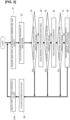
- step S1 the biological information acquisition unit 4a acquires the heart rate and the acceleration, and the environment information acquisition unit 4b acquires the temperature and the humidity.
- step S2 the risk degree calculation unit 3 calculates the degree of risk pertaining to heatstroke based on the heart rate, acceleration, temperature, and humidity.
- step S3 following calculation of the degree of risk, the calculated degree of risk is compared with the first threshold value. If the degree of risk is equal to or less than the first threshold value, then the risk degree calculation unit 3 assesses that the degree of risk is "none," proceeds to step S9 to acquire histories of the heart rate, acceleration, temperature, and humidity from the information history recording unit 2, and then modifies the first to third threshold values based on the histories in step S10 before returning to step S1.
- the risk degree calculation unit 3 assesses that the degree of risk is "low,” and in step S4, the alarm 5 issues the warning to the monitored person P1.
- the monitored person P1 thereby takes measures against heatstroke such as hydrating or resting.
- step S5 the degree of risk is compared with the second threshold value. If the degree of risk is equal to or less than the second threshold value, then the risk degree calculation unit 3 proceeds to step S9 to acquire histories of the heart rate, acceleration, temperature, and humidity from the information history recording unit 2, and then modifies the first to third threshold values based on the histories in step S10 before returning to step S1. If the degree of risk is greater than the second threshold value, then the risk degree calculation unit 3 assesses that the degree of risk is "moderate,” and in step S6, the alarm 5 issues the warning to the supervisor. Specifically, in step S6, the alarm 5 issues the warning to a portable terminal held by the supervisor, the portable terminal being, e.g., a wearable watch or a smartphone. The supervisor thereby gives a heatstroke-related instruction to the monitored person P1.
- step S7 the degree of risk is compared with the third threshold value. If the degree of risk is equal to or less than the third threshold value, then the risk degree calculation unit 3 proceeds to step S9 to acquire histories of the heart rate, acceleration, temperature, and humidity from the information history recording unit 2, and then modifies the first to third threshold values based on the histories in step S10 before returning to step S1.
- the risk degree calculation unit 3 assesses that the degree of risk is "high," and in step S8, the alarm 5 issues the warning to a medical facility or a medical practitioner. Specifically, the alarm 5 issues the warning to a portable terminal located at the medical facility or held by the medical practitioner, the portable terminal being, e.g., a wearable watch or a smartphone. The medical facility or the medical practitioner thereby prepares an ambulance for the factory.
- the risk degree calculation unit 3 comprehensively evaluates the heart rate, acceleration, temperature, and humidity acquired by the information acquisition unit 4 to quantify these items of information, thereby calculating a degree of risk relating to heatstroke; and compares the calculated degree of risk with the first to third threshold values, thereby assessing whether the degree of risk is "low,” “moderate,” or “high.” If the degree of risk is assessed to be “low,” then the alarm 5 issues the warning to the monitored person P1. If the degree of risk is assessed to be "moderate,” then the alarm 5 issues the warning to the supervisor. If the degree of risk is assessed to be "high,” then the alarm 5 issues the warning to the medical facility or the medical practitioner.
- Appropriately applying weighting to the heart rate, acceleration, temperature, and humidity makes it possible to implement measures for the monitored person P1 with even greater efficiency. For example, lowering the weighting for the temperature and raising the weighting for the heart rate with respect to a monitored person P1 who is acclimated to summer heat improves the accuracy of calculating the degree of risk pertaining to heatstroke in the monitored person P1, thus making it possible for the supervisor, the medical facility, or the medical practitioner to more efficiently implement measures for the monitored person P1 while reducing the number of instances of false reports.
- the first to third threshold values account for individual differences in heart rate between monitored persons P1 during work, the degree of risk pertaining to heatstroke in individual monitored persons P1 is more accurately calculated. Therefore, false reports of warnings relating to heatstroke will be fewer, and the burden on the supervisor, the medical facility, or the medical practitioner can be reduced.
- the first to third threshold values for determining the scope of the warning are modified based on the histories pertaining to the temperature and the humidity, which are items of environment information.
- the first to third threshold values are set in consideration of the extent to which the monitored person P1 is acclimated to summer heat, the first to third threshold values are set higher for monitored persons P1 who have a higher tolerance for heat. Therefore, the number of instances in which the supervisor, the medical facility, or the medical practitioner implements measures for a monitored person P1 who is experiencing heatstroke decreases, and the burden on the supervisor or the like can be reduced.
- Figure 3 schematically shows a warning system according to a second example.
- the degree of risk pertaining to heatstroke in the one monitored person P1 is calculated.
- a GPS 6, a position information acquisition unit 7, and a surrounding-person count calculation unit 8 are newly provided.
- the level "moderate” indicating the extent of the degree of risk in the first example is further classified into “moderately low” and “moderately high” according to a fourth threshold value, which shall be described later.
- the GPS 6 detects the positions of the plurality of monitored persons who are working in the factory, i.e., the positions of the one monitored person P1 and the surrounding three monitored persons P2, and transmits the detected positions to the position information acquisition unit 7. It is also permissible to acquire the positions of the monitored persons P1, P2 using Bluetooth ® or a beacon and transmit the acquired positions to the position information acquisition unit 7 in lieu of using the GPS 6.
- the surrounding-person count calculation unit 8 calculates a surrounding-person count, i.e., the number of monitored persons P2 who are located in the surroundings of the one monitored person P1, based on the positions of the four monitored persons P1, P2 in the position information acquisition unit 7.
- the risk degree calculation unit 3 modifies the first to fourth threshold values based on the surrounding-person count acquired from the surrounding-person count calculation unit 8. For example, in cases where there are three surrounding persons, the chance that heatstroke will be overlooked in the one monitored person P1, who is the subject for detection of heatstroke, will be lower than in cases where there are one or two surrounding persons; thus, in the former cases, the first to fourth threshold values are set to comparatively high values. However, in cases where there is one surrounding person, the chance that heatstroke will be overlooked in the one monitored person P1 will be higher than in cases where there are two or three surrounding persons; thus, in the former cases, the first to fourth threshold values are set to comparatively low values.
- the risk degree calculation unit 3 assesses that the degree of risk is "moderately low.” If the degree of risk is greater than the fourth threshold value and equal to or less than the third threshold value, which is lower than the fourth threshold value, then the risk degree calculation unit 3 assesses that the degree of risk is "moderately high.”
- the surrounding-person count calculation unit 8 calculates the surrounding-person count, i.e., the number of monitored persons P2 who are present in the surroundings of the one monitored person P1, based on position information pertaining to the plurality of monitored persons P1, P2.
- the risk degree calculation unit 3 modifies the first to third threshold values for determining the scope of the warning based on the calculated surrounding-person count.
- the first to fourth threshold values are set to high values, thereby making it possible to reduce the burden on the supervisor, the medical facility, or the medical practitioner.
- the risk degree calculation unit comprehensively evaluates the acceleration, heart rate, and blood pressure acquired by the biological information acquisition unit to quantify these items of information, thereby calculating the degree of risk pertaining to heart attack.
- the acceleration, heart rate, and blood pressure are used as parameters in this instance because in cases where, for example, a state of zero acceleration has continued for a prescribed time, there is a possibility that the monitored person has collapsed in a work area within the factory, and if the heart rate and the blood pressure are comparatively high in such circumstances, then there is a concern that the monitored person is experiencing a heart attack.
- the risk degree calculation unit calculates the degree of risk pertaining to lower back pain by using the acceleration acquired by the biological information acquisition unit.
- the acceleration is used as a parameter in this instance due to often being higher for a monitored person who is performing work to lift and lower comparatively heavy goods than for a monitored person who is not associated with this work, and if the state of increased acceleration continues for a prescribed time, then the burden applied to the lower back can be predicted.
- the examples described above illustrate cases where the scope of the warning is changed based on the biological information, including the heart rate and the acceleration, and the environment information, including the temperature and the humidity.
- the scope of the warning it is permissible for the scope of the warning to be changed based on only either one of the biological information or the environment information.
- the heart rate which is an item of biological information
- the environment information including the temperature and the humidity.
- the temperature which is an item of environment information
- suitably setting the threshold values based on information pertaining to the temperature within the factory in consideration of the high temperatures makes it possible to assess the degree of risk pertaining to heatstroke even if only environment information is used.
Landscapes
- Health & Medical Sciences (AREA)
- Life Sciences & Earth Sciences (AREA)
- Physics & Mathematics (AREA)
- Business, Economics & Management (AREA)
- Emergency Management (AREA)
- General Physics & Mathematics (AREA)
- Heart & Thoracic Surgery (AREA)
- Surgery (AREA)
- Engineering & Computer Science (AREA)
- Biomedical Technology (AREA)
- Biophysics (AREA)
- Medical Informatics (AREA)
- Molecular Biology (AREA)
- Pathology (AREA)
- Animal Behavior & Ethology (AREA)
- General Health & Medical Sciences (AREA)
- Public Health (AREA)
- Veterinary Medicine (AREA)
- Physiology (AREA)
- Dentistry (AREA)
- Oral & Maxillofacial Surgery (AREA)
- Measuring And Recording Apparatus For Diagnosis (AREA)
Abstract
Description
- The present invention relates to a warning method and a warning system in which: a degree of risk relating to any poor physical health, illness, or injury of a monitored person is calculated; and a warning is issued based on the degree of risk.
-
Patent Document 1 discloses a warning method for issuing a warning relating to poor physical health caused by heatstroke. In the warning method: heatstroke in a monitored person is evaluated based on biological information pertaining to the monitored person, who is a worker, and environment information such as humidity; and a warning relating to the heatstroke is issued to the monitored person or to another monitored person who works in the surroundings of the aforementioned monitored person. - In such a warning method, although it is possible to reduce heatstroke in the monitored person and in surrounding monitored persons within a work area, there is a concern that a supervisor or a medical practitioner who is present outside of the work area will be unable to implement an appropriate treatment in a suitable period for a monitored person who is experiencing heatstroke.
- Additionally, in
Patent Document 1, no consideration is given whatsoever to the matter of evaluating or reporting illness or injury of the monitored person. - The present invention is focused on the aforementioned problems, it being an object of the present invention to provide a warning method and a warning system in which an appropriate treatment can be implemented in a suitable period in response to any poor physical health, illness, or injury of a monitored person.
- Patent Document 1:
Japanese Laid-Open Patent Application No. 5022506 - The present invention relates to a warning method in which: at least one of biological information pertaining to a monitored person and environment information pertaining to surroundings of the monitored person is acquired as information to be used in evaluating a degree of risk pertaining to any poor physical health, illness, or injury of the monitored person; a degree of risk relating to the poor physical health, illness, or injury of the monitored person is calculated based on the acquired information; and the scope of a warning relating to the poor physical health, illness, or injury of the monitored person is changed based on the extent of the calculated degree of risk.
- According to the present invention, it is possible for an appropriate treatment to be implemented in a suitable period in response to any poor physical health, illness, or injury of a monitored person.
-
-
Figure 1 is a schematic diagram of a warning system according to one example. -
Figure 2 is a flow chart showing a warning method in which the warning system according to the one example is used. -
Figure 3 is a schematic diagram of a warning system according to a second example. - Embodiments of the present invention are described below with reference to the accompanying drawings.
-
Figure 1 shows a warning system in which: calculations are performed in regard to a degree of risk pertaining to heatstroke, which is one symptom of poor physical health, for individual monitored persons P1, who are workers at a factory; and the scope of a warning is changed based on the extent of the calculated degree of risk. - Heatstroke involves symptoms that are experienced as a result of water in a body being lost through perspiration during exercise or j ob-related work in a high-temperature and high-humidity environment and a balance of water and salt in the body being disturbed, whereby regulatory functions in the body decline. Examples of such symptoms include dizziness, headache, cramps (heat cramps), and fainting (fainting from heat). For example, heat cramps occur as a result of a perspiration action being promoted and the balance of water and salt in the body being disturbed when skin temperature rises during exercise or work in a high-temperature and high-humidity environment. Fainting from heat occurs as a result of heart rate increasing, and blood not readily flowing to the brain due to a skin vasodilation reaction being promoted and the flow rate of the blood decreasing in association with the increase in heart rate, when the skin temperature rises during exercise or work in a high-temperature and high-humidity environment in the same manner. Heatstroke that includes heat cramps and fainting from heat is difficult to recognize for a person experiencing these symptoms, and it is difficult to implement an appropriate treatment in a suitable period with respect to such heatstroke.
- This warning system comprises: a wearable watch 1 (referred to below as a "
watch 1"), which is a portable terminal that can be worn around a wrist; an informationhistory recording unit 2 that records a history of information transmitted from thewatch 1, the informationhistory recording unit 2 being provided to a cloud server; a riskdegree calculation unit 3 that calculates a degree of risk of heatstroke based on the information transmitted from thewatch 1, the riskdegree calculation unit 3 being provided to the cloud server; and analarm 5, which is a warning-issuing means that issues a warning based on the extent of the degree of risk calculated by the riskdegree calculation unit 3. - The
watch 1 is configured to be provided with a heart rate sensor, a skin temperature sensor, a blood pressure sensor, a perspiration sensor, a temperature sensor, a humidity sensor, and an acceleration sensor. The temperature sensor and the humidity sensor may be provided to suitable positions within the factory, e.g., positions near a monitored person P1, rather than being provided to thewatch 1. Thewatch 1 has aninformation acquisition unit 4 that acquires information to be used in evaluating the degree of risk of heatstroke in the monitored person P1. Theinformation acquisition unit 4 has: a biologicalinformation acquisition unit 4a that acquires biological information pertaining to the monitored person P1, specifically a heart rate (average value of heart rate) and an acceleration in the present example; and an environmentinformation acquisition unit 4b that acquires environment information pertaining to surroundings of the monitored person P1, specifically temperature and humidity in the present example. The biologicalinformation acquisition unit 4a and the environmentinformation acquisition unit 4b do not need to be built into thewatch 1 and may instead be provided to the cloud server. - The biological information is fundamentally configured from: startup-time biological information that is measured while the
watch 1 is starting up, such as heart rate, skin temperature, blood pressure, perspiration amount, and exercise intensity; basic information pertaining to the monitored person P1, such as height, weight, and body fat percentage; and acceleration, which is used in evaluating a workload of the monitored person P1. Any combination of at least one or more of these parameters can be used. - As pertains to blood pressure, for example, persons with high blood pressure often refrain from consuming salt, and in order for the body to maintain a balance of salt and water, the excess of water relative to the salt deficit is discharged from the body, as a result of which persons with high blood pressure tend to have a lower water content in the body than persons with average blood pressure. Therefore, persons with high blood pressure more readily experience heat cramps, which are one symptom of heatstroke, as a result of water being lost through perspiration during work in a high-temperature and high-humidity environment and the balance of salt and water being disturbed. Thus, blood pressure can be used as biological information relating to heatstroke.
- Exercise intensity indicates the load and difficulty of exercise and is calculated based on the heart rate.
- The environment information is fundamentally configured from temperature (air temperature), humidity, wind speed, insolation amount, radiant heat amount, and weather. Any combination of at least one or more of these parameters can be used. The wind speed, insolation amount, radiant heat amount, and weather are acquired from an application installed in the
watch 1. - The information
history recording unit 2 records a history of the heart rate and the acceleration that are transmitted from the biologicalinformation acquisition unit 4a, as well as a history of the temperature and the humidity that are transmitted from the environmentinformation acquisition unit 4b, and then transmits the recorded histories to the riskdegree calculation unit 3. - The risk
degree calculation unit 3 calculates a degree of risk relating to heatstroke based on the heart rate and the acceleration that are transmitted from the biologicalinformation acquisition unit 4a and the temperature and the humidity that are transmitted from the environmentinformation acquisition unit 4b. Specifically, the riskdegree calculation unit 3 comprehensively evaluates the heart rate, acceleration, temperature, and humidity to quantify one degree of risk relating to heat stroke as a numeric value within the range of, e.g., 0-100, thereby calculating the degree of risk. The degree of risk increases commensurately with any increase in heart rate, acceleration, temperature, or humidity. More specifically, the heart rate readily increases in high-temperature and high-humidity environments where the temperature and the humidity are comparatively high, and the heart rate also increases along with job-related load when the acceleration increases. Thus, as described above, blood does not readily move to the brain due to a skin vasodilation reaction being promoted, and fainting from heat, which is one symptom of heatstroke, readily occurs. - The risk
degree calculation unit 3 also assesses whether the calculated degree of risk corresponds to any of "none," "low," "moderate," or "high." Specifically, if the degree of risk is less than a first threshold value, then the riskdegree calculation unit 3 assesses that the degree of risk is "none." If the degree of risk is greater than the first threshold value and equal to or less than a second threshold value that is higher than the first threshold value, then the riskdegree calculation unit 3 assesses that the degree of risk is "low." If the degree of risk is greater than the second threshold value and equal to or less than a third threshold value that is higher than the second threshold value, then the riskdegree calculation unit 3 evaluates that the degree of risk is "moderate." If the degree of risk is greater than the third threshold value, then the riskdegree calculation unit 3 assesses that the degree of risk is "high." - In cases where the degree of risk is equal to or less than the first threshold value, cases where the degree of risk is equal to or less than the second threshold value after having been assessed to be greater than the first threshold value, and cases where the degree of risk is equal to or less than the third threshold value after having been assessed to be greater than the second threshold value (refer to
Fig. 2 ), the riskdegree calculation unit 3 modifies the first to third threshold values based on the heart rate, acceleration, temperature, and humidity from the informationhistory recording unit 2. Specifically, in the cases described above, the riskdegree calculation unit 3 modifies the first to third threshold values for determining the scope of the warning to values that account for individual differences in heart rate and extent of acclimation to summer heat, i.e., the extent to which the body is accustomed to heat. - The
alarm 5 changes the scope of the warning based on the assessment of the degree of risk made by the riskdegree calculation unit 3. More specifically, if the degree of risk is assessed to be "none" by the riskdegree calculation unit 3, then thealarm 5 does not activate. If the degree of risk is assessed to be "low" by the riskdegree calculation unit 3, then thealarm 5 issues the warning to thewatch 1 of the monitored person P1. If the degree of risk is assessed to be "moderate" by the riskdegree calculation unit 3, then thealarm 5 issues the warning to a supervisor of the monitored person P1, i.e., a person who is a superior of the monitored person P1, gives instructions to the monitored person P1, and manages processes. If the degree of risk is assessed to be "high" by the riskdegree calculation unit 3, then thealarm 5 issues the warning to a medical facility, i.e., a location where medical practice is carried out, or a medical practitioner, i.e., a person who conducts medical practice and has a medical license. - Next, a warning method using the warning system of the present example shall be described with reference to
Fig. 2 . - First, in step S1, the biological
information acquisition unit 4a acquires the heart rate and the acceleration, and the environmentinformation acquisition unit 4b acquires the temperature and the humidity. - Next, in step S2, the risk
degree calculation unit 3 calculates the degree of risk pertaining to heatstroke based on the heart rate, acceleration, temperature, and humidity. - In step S3, following calculation of the degree of risk, the calculated degree of risk is compared with the first threshold value. If the degree of risk is equal to or less than the first threshold value, then the risk
degree calculation unit 3 assesses that the degree of risk is "none," proceeds to step S9 to acquire histories of the heart rate, acceleration, temperature, and humidity from the informationhistory recording unit 2, and then modifies the first to third threshold values based on the histories in step S10 before returning to step S1. - If the degree of risk is greater than the first threshold value, the risk
degree calculation unit 3 assesses that the degree of risk is "low," and in step S4, thealarm 5 issues the warning to the monitored person P1. The monitored person P1 thereby takes measures against heatstroke such as hydrating or resting. - Next, in step S5, the degree of risk is compared with the second threshold value. If the degree of risk is equal to or less than the second threshold value, then the risk
degree calculation unit 3 proceeds to step S9 to acquire histories of the heart rate, acceleration, temperature, and humidity from the informationhistory recording unit 2, and then modifies the first to third threshold values based on the histories in step S10 before returning to step S1. If the degree of risk is greater than the second threshold value, then the riskdegree calculation unit 3 assesses that the degree of risk is "moderate," and in step S6, thealarm 5 issues the warning to the supervisor. Specifically, in step S6, thealarm 5 issues the warning to a portable terminal held by the supervisor, the portable terminal being, e.g., a wearable watch or a smartphone. The supervisor thereby gives a heatstroke-related instruction to the monitored person P1. - Next, in step S7, the degree of risk is compared with the third threshold value. If the degree of risk is equal to or less than the third threshold value, then the risk
degree calculation unit 3 proceeds to step S9 to acquire histories of the heart rate, acceleration, temperature, and humidity from the informationhistory recording unit 2, and then modifies the first to third threshold values based on the histories in step S10 before returning to step S1. - If the degree of risk is greater than the third threshold value, the risk
degree calculation unit 3 assesses that the degree of risk is "high," and in step S8, thealarm 5 issues the warning to a medical facility or a medical practitioner. Specifically, thealarm 5 issues the warning to a portable terminal located at the medical facility or held by the medical practitioner, the portable terminal being, e.g., a wearable watch or a smartphone. The medical facility or the medical practitioner thereby prepares an ambulance for the factory. - In the present example as described above, the risk degree calculation unit 3: comprehensively evaluates the heart rate, acceleration, temperature, and humidity acquired by the
information acquisition unit 4 to quantify these items of information, thereby calculating a degree of risk relating to heatstroke; and compares the calculated degree of risk with the first to third threshold values, thereby assessing whether the degree of risk is "low," "moderate," or "high." If the degree of risk is assessed to be "low," then thealarm 5 issues the warning to the monitored person P1. If the degree of risk is assessed to be "moderate," then thealarm 5 issues the warning to the supervisor. If the degree of risk is assessed to be "high," then thealarm 5 issues the warning to the medical facility or the medical practitioner. - Comprehensively evaluating the heart rate, acceleration, temperature, and humidity to assess the degree of risk pertaining to heatstroke in a manner suited to an individual in this manner makes it possible to take appropriate measures in a suitable period for the monitored person P1. More specifically, if the warning is issued to the supervisor when any one parameter from among the heart rate, acceleration, temperature, or humidity exceeds the second threshold value, then the supervisor will need to visit a work site repeatedly owing to false reports notifying the supervisor about a monitored person P who has not reached a state of heatstroke. However, calculating the degree of risk as described in the present example allows the supervisor to carry out the minimum required confirmation with respect to a monitored person P1 having an abnormally high likelihood of heatstroke. Additionally, if the warning is issued to the medical facility or the medical practitioner when any one parameter from among the heart rate, acceleration, temperature, or humidity exceeds the third threshold value, then ambulances will often be unnecessarily dispatched due to false reports. However, calculating the degree of risk as described in the present example allows emergency personnel to be dispatched only when this measure is necessary. Therefore, it is possible to efficiently implement measures for a monitored person P1 having a high likelihood of heatstroke while reducing the task burden on the supervisor, the medical facility, or the medical practitioner.
- Appropriately applying weighting to the heart rate, acceleration, temperature, and humidity makes it possible to implement measures for the monitored person P1 with even greater efficiency. For example, lowering the weighting for the temperature and raising the weighting for the heart rate with respect to a monitored person P1 who is acclimated to summer heat improves the accuracy of calculating the degree of risk pertaining to heatstroke in the monitored person P1, thus making it possible for the supervisor, the medical facility, or the medical practitioner to more efficiently implement measures for the monitored person P1 while reducing the number of instances of false reports.
- In the present example, the risk
degree calculation unit 3 modifies the first to third threshold values for determining the scope of the warning based on the histories pertaining to the heart rate and the acceleration, which are items of biological information. - Accordingly, because the first to third threshold values account for individual differences in heart rate between monitored persons P1 during work, the degree of risk pertaining to heatstroke in individual monitored persons P1 is more accurately calculated. Therefore, false reports of warnings relating to heatstroke will be fewer, and the burden on the supervisor, the medical facility, or the medical practitioner can be reduced.
- In the present example, the first to third threshold values for determining the scope of the warning are modified based on the histories pertaining to the temperature and the humidity, which are items of environment information.
- Accordingly, because the first to third threshold values are set in consideration of the extent to which the monitored person P1 is acclimated to summer heat, the first to third threshold values are set higher for monitored persons P1 who have a higher tolerance for heat. Therefore, the number of instances in which the supervisor, the medical facility, or the medical practitioner implements measures for a monitored person P1 who is experiencing heatstroke decreases, and the burden on the supervisor or the like can be reduced.
-
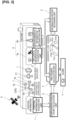
Figure 3 schematically shows a warning system according to a second example. In the second example, in a state in which one monitored person P1 and a plurality of monitored persons P2 (three monitored persons P2 in the present example) who are working in the surroundings of the aforementioned monitored person are present, the degree of risk pertaining to heatstroke in the one monitored person P1 is calculated. Additionally, in the present example, aGPS 6, a positioninformation acquisition unit 7, and a surrounding-personcount calculation unit 8 are newly provided. Furthermore, in the present example, the level "moderate" indicating the extent of the degree of risk in the first example is further classified into "moderately low" and "moderately high" according to a fourth threshold value, which shall be described later. - The
GPS 6 detects the positions of the plurality of monitored persons who are working in the factory, i.e., the positions of the one monitored person P1 and the surrounding three monitored persons P2, and transmits the detected positions to the positioninformation acquisition unit 7. It is also permissible to acquire the positions of the monitored persons P1, P2 using Bluetooth® or a beacon and transmit the acquired positions to the positioninformation acquisition unit 7 in lieu of using theGPS 6. - The position
information acquisition unit 7 is provided to thewatch 1. The positioninformation acquisition unit 7 acquires the positions of the four monitored persons P1, P2 who were detected by theGPS 6. - The surrounding-person
count calculation unit 8 calculates a surrounding-person count, i.e., the number of monitored persons P2 who are located in the surroundings of the one monitored person P1, based on the positions of the four monitored persons P1, P2 in the positioninformation acquisition unit 7. - The risk
degree calculation unit 3 modifies the first to fourth threshold values based on the surrounding-person count acquired from the surrounding-personcount calculation unit 8. For example, in cases where there are three surrounding persons, the chance that heatstroke will be overlooked in the one monitored person P1, who is the subject for detection of heatstroke, will be lower than in cases where there are one or two surrounding persons; thus, in the former cases, the first to fourth threshold values are set to comparatively high values. However, in cases where there is one surrounding person, the chance that heatstroke will be overlooked in the one monitored person P1 will be higher than in cases where there are two or three surrounding persons; thus, in the former cases, the first to fourth threshold values are set to comparatively low values. - If the degree of risk calculated based on the heart rate, acceleration, temperature, and humidity is greater than the second threshold value and equal to or less than the fourth threshold value, which is higher than the second threshold value, then the risk
degree calculation unit 3 assesses that the degree of risk is "moderately low." If the degree of risk is greater than the fourth threshold value and equal to or less than the third threshold value, which is lower than the fourth threshold value, then the riskdegree calculation unit 3 assesses that the degree of risk is "moderately high." - In the present example as described above, the surrounding-person
count calculation unit 8 calculates the surrounding-person count, i.e., the number of monitored persons P2 who are present in the surroundings of the one monitored person P1, based on position information pertaining to the plurality of monitored persons P1, P2. The riskdegree calculation unit 3 modifies the first to third threshold values for determining the scope of the warning based on the calculated surrounding-person count. - Accordingly, in cases where the surrounding-person count is comparatively high, because the surrounding monitored persons P2 will readily discover and address the monitored person P1 who is experiencing heatstroke, the first to fourth threshold values are set to high values, thereby making it possible to reduce the burden on the supervisor, the medical facility, or the medical practitioner.
- In a third example, differently with respect to the examples described above, calculations are performed in regard to a degree of risk pertaining to heart attack, which is one symptom of illness, and the scope of the warning is changed based on the extent of the calculated degree of risk. In the present example, the risk degree calculation unit comprehensively evaluates the acceleration, heart rate, and blood pressure acquired by the biological information acquisition unit to quantify these items of information, thereby calculating the degree of risk pertaining to heart attack. The acceleration, heart rate, and blood pressure are used as parameters in this instance because in cases where, for example, a state of zero acceleration has continued for a prescribed time, there is a possibility that the monitored person has collapsed in a work area within the factory, and if the heart rate and the blood pressure are comparatively high in such circumstances, then there is a concern that the monitored person is experiencing a heart attack.
- The calculation of the degree of risk and the issuance of the warning in the third example are carried out using the same procedure as that in the flow chart shown in
Fig. 2 in the first example. - In a fourth example, differently with respect to the examples described above, calculations are performed in regard to a degree of risk pertaining to lower back pain, which is one symptom of injury, and the scope of the warning is changed based on the extent of the calculated degree of risk. In the present example, the risk degree calculation unit calculates the degree of risk pertaining to lower back pain by using the acceleration acquired by the biological information acquisition unit. The acceleration is used as a parameter in this instance due to often being higher for a monitored person who is performing work to lift and lower comparatively heavy goods than for a monitored person who is not associated with this work, and if the state of increased acceleration continues for a prescribed time, then the burden applied to the lower back can be predicted.
- The calculation of the degree of risk and the issuance of the warning in the fourth example are carried out using the same procedure as that in the flow chart shown in
Fig. 2 in the first example. - The examples described above illustrate cases where the scope of the warning is changed based on the biological information, including the heart rate and the acceleration, and the environment information, including the temperature and the humidity. However, it is permissible for the scope of the warning to be changed based on only either one of the biological information or the environment information. For example, the heart rate, which is an item of biological information, is suited for evaluating fainting from heat, which is one symptom of heatstroke, as described above; thus, it is possible to assess the degree of risk pertaining to heatstroke even if only biological information is used. Moreover, as regards, e.g., the temperature, which is an item of environment information, it is necessary to work in a high-temperature environment to a greater extent in, e.g., a welding area in the factory than in other areas such as an assembly area, and suitably setting the threshold values based on information pertaining to the temperature within the factory in consideration of the high temperatures makes it possible to assess the degree of risk pertaining to heatstroke even if only environment information is used.
Claims (8)
- A warning method comprising:acquiring at least one of biological information pertaining to a monitored person and environment information pertaining to surroundings of the monitored person as acquired information to be used in evaluating a degree of risk pertaining to at least one of poor physical health, illness, and injury of the monitored person;calculating the degree of risk relating to the at least one of poor physical health, illness, and injury of the monitored person based on the acquired information; andchanging a scope of a warning relating to the at least one of poor physical health, illness, and injury of the monitored person based on an extent of the degree of risk that was calculated.
- The warning method according to claim 1, further comprising:acquiring position information pertaining to a plurality of monitored persons;calculating a surrounding-person count corresponding to the monitored persons who are present in the surroundings of each of the monitored persons based on the position information; andmodifying a threshold value pertaining to the scope of the warning based on the surrounding-person count.
- The warning method according to claim 1 or 2, further comprisingrecording a history of the biological information, andmodifying a threshold value pertaining to the scope of the warning based on the history of the biological information.
- The warning method according to any of claims 1 to 3, further comprisingrecording a history of the environment information, andmodifying a threshold value pertaining to the scope of the warning based on the history of the environment information.
- The warning method according to any of claims 1 to 4, wherein the biological information is any one of a heart rate, a skin temperature, a blood pressure, a perspiration amount, an exercise intensity, a height, a weight, or a body fat percentage of the monitored person, or is a combination of any two or more of these.
- The warning method according to any of claims 1 to 5, wherein the environment information is any of one of a temperature, a humidity, a wind speed, an insolation amount, a radiant heat amount, and a weather, or is a combination of any two or more of these.
- The warning method according to any of claims 1 to 6, further comprising transmitting a warning notification to a portable terminal held by the monitored person or by a person included in the scope of the warning.
- A warning system that issues a warning relating to any one of poor physical health, illness, or injury of a monitored person,
the warning system comprising:an information acquisition unit configured to acquire at least one of biological information pertaining to the monitored person and environment information pertaining to surroundings of the monitored person;a risk degree calculation unit configured to calculate a degree of risk relating to the at least one poor physical health, illness, or injury of the monitored person based on the information acquired by the information acquisition unit; anda warning-issuing means that issues the warning based on an extent of the degree of risk calculated by the risk degree calculation unit,the warning-issuing means changing a scope of the warning according to the extent of the degree of risk.
Applications Claiming Priority (1)
| Application Number | Priority Date | Filing Date | Title |
|---|---|---|---|
| PCT/JP2021/040242 WO2023073988A1 (en) | 2021-11-01 | 2021-11-01 | Alarm method and alarm system |
Publications (2)
| Publication Number | Publication Date |
|---|---|
| EP4427664A1 true EP4427664A1 (en) | 2024-09-11 |
| EP4427664A4 EP4427664A4 (en) | 2024-12-25 |
Family
ID=86159666
Family Applications (1)
| Application Number | Title | Priority Date | Filing Date |
|---|---|---|---|
| EP21961614.1A Pending EP4427664A4 (en) | 2021-11-01 | 2021-11-01 | ALARM PROCEDURES AND ALARM SYSTEM |
Country Status (5)
| Country | Link |
|---|---|
| US (1) | US12525109B2 (en) |
| EP (1) | EP4427664A4 (en) |
| JP (1) | JP7586343B2 (en) |
| CN (1) | CN118175953A (en) |
| WO (1) | WO2023073988A1 (en) |
Families Citing this family (1)
| Publication number | Priority date | Publication date | Assignee | Title |
|---|---|---|---|---|
| JPWO2025013276A1 (en) * | 2023-07-13 | 2025-01-16 |
Family Cites Families (26)
| Publication number | Priority date | Publication date | Assignee | Title |
|---|---|---|---|---|
| JP3100676B2 (en) | 1991-07-09 | 2000-10-16 | キヤノン株式会社 | Facsimile apparatus and data processing method |
| US6417774B1 (en) * | 1997-10-30 | 2002-07-09 | Fireeye Development Inc. | System and method for identifying unsafe temperature conditions |
| US8952805B2 (en) * | 2010-09-06 | 2015-02-10 | Aurizon Operations Limited | Worker's personal alarm device |
| US20120165616A1 (en) * | 2010-12-27 | 2012-06-28 | Nir Geva | Portable monitoring unit and a method for monitoring a monitored person |
| JP5022506B1 (en) | 2011-07-21 | 2012-09-12 | 株式会社日立エンジニアリング・アンド・サービス | Heat stroke detection system |
| US9501918B2 (en) * | 2011-08-24 | 2016-11-22 | Safetyminded Holdings, Inc. | Human safety indicator |
| GB2505459B (en) * | 2012-08-30 | 2019-08-28 | Draeger Safety Uk Ltd | Telemetry monitoring apparatus |
| JP6237023B2 (en) * | 2013-09-13 | 2017-11-29 | 富士通株式会社 | Heat stroke determination device, portable terminal device, heat stroke determination method, and heat stroke determination program |
| US10154401B2 (en) * | 2014-06-23 | 2018-12-11 | BeaconWatch, LLC | Safety device utilizing a beacon |
| CA2961371C (en) * | 2014-09-15 | 2023-05-16 | 3M Innovative Properties Company | Impairment detection with biological considerations |
| US20180214028A1 (en) * | 2015-07-23 | 2018-08-02 | Yono Health Inc. | System for body temperature measurement |
| RU2717901C1 (en) * | 2016-03-07 | 2020-03-26 | 3М Инновейтив Пропертиз Компани | Intelligent system for monitoring security and analytical data processing for individual protection means |
| KR20190003532A (en) * | 2016-04-19 | 2019-01-09 | 데이진 가부시키가이샤 | Goods with alarm system |
| EP3242278B1 (en) * | 2016-05-04 | 2018-09-26 | Honeywell International Inc. | Module and method for detecting air quality |
| US11023818B2 (en) * | 2016-06-23 | 2021-06-01 | 3M Innovative Properties Company | Personal protective equipment system having analytics engine with integrated monitoring, alerting, and predictive safety event avoidance |
| CA3040135A1 (en) * | 2016-10-14 | 2018-04-14 | 3M Innovative Properties Company | Context-based programmable safety rules for personal protective equipment |
| EP3600570A4 (en) * | 2017-03-31 | 2020-12-23 | 3M Innovative Properties Company | FALL PROTECTION EQUIPMENT CONNECTION STATUS AND CONTROL |
| IT201700055706A1 (en) * | 2017-05-23 | 2018-11-23 | Milano Politecnico | Wearable method and device for the control of gaseous pollutants |
| JP6939683B2 (en) * | 2018-04-06 | 2021-09-22 | スターライト工業株式会社 | Heat stroke risk calculation system, heat stroke risk calculation program, computer-readable recording medium, and heat stroke risk calculation method |
| AU2018100992A4 (en) * | 2018-04-26 | 2018-08-16 | Acusensus Ip Pty Ltd | A Safety Warning System |
| CN112236788A (en) * | 2018-06-04 | 2021-01-15 | 3M创新有限公司 | Personal protective equipment and safety management systems with active worker sensing and assessment |
| JP2020013493A (en) * | 2018-07-20 | 2020-01-23 | 日本光電工業株式会社 | Alarm information processing device and control program for alarm information processing device |
| US20210386384A1 (en) * | 2018-10-26 | 2021-12-16 | Kyocera Corporation | Monitoring apparatus, monitoring method, and monitoring program |
| US11475751B1 (en) * | 2019-03-26 | 2022-10-18 | Halo Wearables, Llc | Recommendation management for an electronic device |
| WO2021186611A1 (en) * | 2020-03-18 | 2021-09-23 | 日本電気株式会社 | Activity assistance device, activity assistance method, and computer-readable recording medium |
| JP7024025B2 (en) * | 2020-08-26 | 2022-02-22 | 株式会社東芝 | System, program |
-
2021
- 2021-11-01 EP EP21961614.1A patent/EP4427664A4/en active Pending
- 2021-11-01 US US18/699,909 patent/US12525109B2/en active Active
- 2021-11-01 WO PCT/JP2021/040242 patent/WO2023073988A1/en not_active Ceased
- 2021-11-01 JP JP2023556090A patent/JP7586343B2/en active Active
- 2021-11-01 CN CN202180103848.5A patent/CN118175953A/en active Pending
Also Published As
| Publication number | Publication date |
|---|---|
| US20240404385A1 (en) | 2024-12-05 |
| JPWO2023073988A1 (en) | 2023-05-04 |
| EP4427664A4 (en) | 2024-12-25 |
| CN118175953A (en) | 2024-06-11 |
| US12525109B2 (en) | 2026-01-13 |
| JP7586343B2 (en) | 2024-11-19 |
| WO2023073988A1 (en) | 2023-05-04 |
Similar Documents
| Publication | Publication Date | Title |
|---|---|---|
| JP7550410B2 (en) | Physical condition assessment method, heat stroke risk assessment method, and program | |
| JP7264393B2 (en) | Group environment evaluation method and group environment evaluation system | |
| US10349148B2 (en) | Computer-aided dispatch systems and methods utilizing biometrics to assess responder condition and suitability | |
| EP2899658B1 (en) | Controller and method controlling vital data indicating a state of a plant worker | |
| JP7678497B2 (en) | Physical condition evaluation method and physical condition evaluation system | |
| JP2006170751A (en) | Sensing system and method | |
| JP7634257B2 (en) | Healthcare management system using biometric sensors, workload assessment program for healthcare management system, and data structure for healthcare management system | |
| CN119693206B (en) | A construction worker safety management and control method and system for smart safety helmets | |
| CN118512159A (en) | Smart wearable device based on health monitoring and early warning for power workers | |
| EP4362780A1 (en) | Thermoregulatory stress detection from skin temperature complexity | |
| US12525109B2 (en) | Warning method and warning system | |
| CN102549582B (en) | Method for determining operator condition, such device and use thereof in an alarm response system in a facility | |
| CN109944636A (en) | Mine exploitation safety monitoring system | |
| JP2024085509A (en) | Worker management system and worker management method | |
| KR20210038202A (en) | Personalized healthcare service providing system using user classification | |
| JP2021122580A (en) | Physical condition evaluation method and physical condition evaluation system | |
| US11704615B2 (en) | Risk assessment apparatus and related methods | |
| JP6939683B2 (en) | Heat stroke risk calculation system, heat stroke risk calculation program, computer-readable recording medium, and heat stroke risk calculation method | |
| CN120510646A (en) | Digital construction site labor personnel state identification method based on digital twinning | |
| JP2014092946A (en) | Personal information disclosure system and personal information disclosure method | |
| Patnaik et al. | iCAP: An IoT based Wearable For Real-Time Accidental Fall Detection and Health Monitoring of Remote Maintenance Workers | |
| JP2025011722A (en) | Personal characteristic assessment method, environmental load assessment method, health risk assessment method and health risk assessment system | |
| JP2019201888A (en) | Physical condition evaluation system | |
| KR102850749B1 (en) | Heat stress monitoring system and the operation method | |
| KR102927989B1 (en) | Personalized heat stress monitoring system and the operation method |
Legal Events
| Date | Code | Title | Description |
|---|---|---|---|
| STAA | Information on the status of an ep patent application or granted ep patent |
Free format text: STATUS: THE INTERNATIONAL PUBLICATION HAS BEEN MADE |
|
| PUAI | Public reference made under article 153(3) epc to a published international application that has entered the european phase |
Free format text: ORIGINAL CODE: 0009012 |
|
| STAA | Information on the status of an ep patent application or granted ep patent |
Free format text: STATUS: REQUEST FOR EXAMINATION WAS MADE |
|
| 17P | Request for examination filed |
Effective date: 20240531 |
|
| AK | Designated contracting states |
Kind code of ref document: A1 Designated state(s): AL AT BE BG CH CY CZ DE DK EE ES FI FR GB GR HR HU IE IS IT LI LT LU LV MC MK MT NL NO PL PT RO RS SE SI SK SM TR |
|
| A4 | Supplementary search report drawn up and despatched |
Effective date: 20241122 |
|
| RIC1 | Information provided on ipc code assigned before grant |
Ipc: G08B 21/02 20060101ALI20241118BHEP Ipc: A61B 5/01 20060101ALI20241118BHEP Ipc: A61B 5/00 20060101AFI20241118BHEP |
|
| DAV | Request for validation of the european patent (deleted) | ||
| DAX | Request for extension of the european patent (deleted) |