EP4427614A1 - Control device, inhalation device, and control method - Google Patents
Control device, inhalation device, and control method Download PDFInfo
- Publication number
- EP4427614A1 EP4427614A1 EP21968133.5A EP21968133A EP4427614A1 EP 4427614 A1 EP4427614 A1 EP 4427614A1 EP 21968133 A EP21968133 A EP 21968133A EP 4427614 A1 EP4427614 A1 EP 4427614A1
- Authority
- EP
- European Patent Office
- Prior art keywords
- heating
- user
- inhalation
- settings
- aerosol
- Prior art date
- Legal status (The legal status is an assumption and is not a legal conclusion. Google has not performed a legal analysis and makes no representation as to the accuracy of the status listed.)
- Pending
Links
Images


Classifications
-
- A—HUMAN NECESSITIES
- A24—TOBACCO; CIGARS; CIGARETTES; SIMULATED SMOKING DEVICES; SMOKERS' REQUISITES
- A24F—SMOKERS' REQUISITES; MATCH BOXES; SIMULATED SMOKING DEVICES
- A24F40/00—Electrically operated smoking devices; Component parts thereof; Manufacture thereof; Maintenance or testing thereof; Charging means specially adapted therefor
- A24F40/50—Control or monitoring
- A24F40/57—Temperature control
-
- A—HUMAN NECESSITIES
- A24—TOBACCO; CIGARS; CIGARETTES; SIMULATED SMOKING DEVICES; SMOKERS' REQUISITES
- A24F—SMOKERS' REQUISITES; MATCH BOXES; SIMULATED SMOKING DEVICES
- A24F40/00—Electrically operated smoking devices; Component parts thereof; Manufacture thereof; Maintenance or testing thereof; Charging means specially adapted therefor
- A24F40/40—Constructional details, e.g. connection of cartridges and battery parts
- A24F40/46—Shape or structure of electric heating means
-
- A—HUMAN NECESSITIES
- A24—TOBACCO; CIGARS; CIGARETTES; SIMULATED SMOKING DEVICES; SMOKERS' REQUISITES
- A24F—SMOKERS' REQUISITES; MATCH BOXES; SIMULATED SMOKING DEVICES
- A24F40/00—Electrically operated smoking devices; Component parts thereof; Manufacture thereof; Maintenance or testing thereof; Charging means specially adapted therefor
- A24F40/50—Control or monitoring
-
- A—HUMAN NECESSITIES
- A24—TOBACCO; CIGARS; CIGARETTES; SIMULATED SMOKING DEVICES; SMOKERS' REQUISITES
- A24F—SMOKERS' REQUISITES; MATCH BOXES; SIMULATED SMOKING DEVICES
- A24F40/00—Electrically operated smoking devices; Component parts thereof; Manufacture thereof; Maintenance or testing thereof; Charging means specially adapted therefor
- A24F40/50—Control or monitoring
- A24F40/51—Arrangement of sensors
-
- A—HUMAN NECESSITIES
- A24—TOBACCO; CIGARS; CIGARETTES; SIMULATED SMOKING DEVICES; SMOKERS' REQUISITES
- A24F—SMOKERS' REQUISITES; MATCH BOXES; SIMULATED SMOKING DEVICES
- A24F40/00—Electrically operated smoking devices; Component parts thereof; Manufacture thereof; Maintenance or testing thereof; Charging means specially adapted therefor
- A24F40/50—Control or monitoring
- A24F40/53—Monitoring, e.g. fault detection
Definitions
- the present invention relates to a control device, an inhaler device, and a control method.
- Inhaler devices that generate a substance to be inhaled by users, such as electronic cigarettes and nebulizers, are widely used.
- An inhaler device generates an aerosol with a flavor component, for example, using a substrate including an aerosol source for generating an aerosol and a flavor source for imparting a flavor component to the generated aerosol.
- a user can taste a flavor by inhaling the aerosol with the flavor component generated by the inhaler device.
- Inhalation, by the user, of an aerosol will be referred to as a "puff" or a "puff action" hereinafter.
- Patent Literature 1 a technique for enabling a user to select a temperature to which an inhaler device heats a substrate is disclosed.
- Patent Literature 1 WO 2019/061906 A1
- Patent Literature 1 a user is required to select a temperature to which an inhaler device heats a substrate.
- the present invention therefore, has been conceived in view of the above problem and aims to provide a mechanism capable of further improving a user's inhalation experience.
- an aspect of the present invention provides a control device including a controller that selects a set of heating settings to be used by an inhaler device, which generates an aerosol to be inhaled by a user by heating an aerosol source on a basis of the set of heating settings, on a basis of inhalation-related information, which is information relating to at least a state of the user or an environment where the user inhales the aerosol.
- the controller may select the set of heating settings associated with predetermined conditions satisfied by the inhalation-related information.
- the controller may select the set of heating settings on a basis of a number of predetermined conditions satisfied by the inhalation-related information among a plurality of predetermined conditions.
- the controller may select the set of heating settings on a basis of a sum of scores set for predetermined conditions satisfied by the inhalation-related information among a plurality of predetermined conditions.
- the controller may selects, on a basis of an instruction from the user, predetermined conditions used to select the set of heating settings from the plurality of predetermined conditions.
- the controller may select, on a basis of the inhalation-related information, predetermined conditions used to select the set of heating settings from the plurality of predetermined conditions.
- the controller may select the set of heating settings on a basis of the periodically obtained inhalation-related information.
- the controller may select the set of heating settings on a basis of the inhalation-related information obtained when the inhaler device performs the heating based on the heating settings.
- the controller may switch the set of heating settings used by the inhaler device while the inhaler device is not performing the heating based on the heating settings.
- the controller may switch the set of heating settings used by the inhaler device while the inhaler device is performing the heating based on the heating settings.
- the inhalation-related information regarding the state of the user may include at least biological information regarding the user, information indicating an action taken by the user, information indicating an action that is being taken by the user, or information indicating an action that the user plans to take.
- the inhalation-related information regarding the environment where the user inhales the aerosol may include at least information regarding time, information regarding a place, information regarding weather, information regarding a use state of the inhaler device, or information regarding another inhaler device around the user.
- the inhaler device may generate the aerosol using a substrate containing the aerosol source.
- the controller may select the set of heating settings on a basis of a type of substrate used by the inhaler device.
- the controller may select the set of heating settings from a plurality of sets of heating settings that are different from one another in terms of at least a parameter relating to a temperature to which the aerosol source is heated or a parameter relating to a period of time for which the aerosol source is heated.
- an inhaler device that generates an aerosol to be inhaled by a user by heating an aerosol source on a basis of a set of heating settings.
- the inhaler device includes a controller that selects a set of heating settings on a basis of inhalation-related information, which is information relating to at least a state of the user or an environment where the user inhales the aerosol, and that performs control in such a way as to heat the aerosol source on a basis of the selected set of heating settings.
- another aspect of the present invention provides a control method including selecting a set of heating settings to be used by an inhaler device, which generates an aerosol to be inhaled by a user by heating an aerosol source on a basis of the set of heating settings, on a basis of inhalation-related information, which is information relating to at least a state of the user or an environment where the user inhales the aerosol.
- a mechanism capable of further improving a user's inhalation experience is provided.
- An inhaler device generates material to be inhaled by a user.
- the material generated by the inhaler device is an aerosol.
- the material generated by the inhaler device may be gas.
- FIG. 1 is a schematic diagram of an inhaler device according to a first configuration example.
- an inhaler device 100A according to the present configuration example includes a power supply unit 110, a cartridge 120, and a flavor imparting cartridge 130.
- the power supply unit 110 includes a power supply 111A, a sensor 112A, a notifier 113A, a memory 114A, a communicator 115A, and a controller 116A.
- the cartridge 120 includes a heater 121A, a liquid guide 122, and a liquid storage 123.
- the flavor imparting cartridge 130 includes a flavor source 131 and a mouthpiece 124. In the cartridge 120 and the flavor imparting cartridge 130, an airflow path 180 is defined.
- the power supply 111A stores electric power.
- the power supply 111A supplies electric power to the structural elements of the inhaler device 100A under the control of the controller 116A.
- the power supply 111A may be a rechargeable battery such as a lithium ion secondary battery.
- the sensor 112A acquires various items of information regarding the inhaler device 100A.
- the sensor 112A may be a pressure sensor such as a condenser microphone, a flow sensor, or a temperature sensor, and acquire a value generated in accordance with the user's inhalation.
- the sensor 112A may be an input device that receives information input by the user, such as a button or a switch.
- the notifier 113A provides information to the user.
- the notifier 113A may be a light-emitting device that emits light, a display device that displays an image, a sound output device that outputs sound, or a vibration device that vibrates.
- the memory 114A stores various items of information for operation of the inhaler device 100A.
- the memory 114A may be a non-volatile storage medium such as flash memory.
- the communicator 115A is a communication interface capable of communication in conformity with any wired or wireless communication standard.
- a communication standard may be, for example, Wi-Fi (registered trademark), Bluetooth (registered trademark), near-field communication (NFC), or a standard using a low-power wide-area network (LPWAN).
- the controller 116A functions as an arithmetic processing unit and a control circuit, and controls the overall operations of the inhaler device 100A in accordance with various programs.
- the controller 116A includes an electronic circuit such as a central processing unit (CPU) or a microprocessor, for example.
- the liquid storage 123 stores an aerosol source.
- the aerosol source is atomized to generate an aerosol.
- the aerosol source is a liquid such as polyhydric alcohol or water. Examples of the polyhydric alcohol include glycerine and propylene glycol.
- the aerosol source may include a flavor component that is either derived from tobacco or not derived from tobacco.
- the aerosol source may include a medicine.
- the liquid guide 122 guides, from the liquid storage 123, the aerosol source that is the liquid stored in the liquid storage 123, and holds the aerosol source.
- the liquid guide 122 is, for example, a wick formed by twining fiber material such as glass fiber or porous material such as porous ceramic. In this case, the capillary action of the wick guides the aerosol source stored in the liquid storage 123.
- the heater 121A heats the aerosol source to atomize the aerosol source and generate the aerosol.
- the heater 121A includes a coil wound around the liquid guide 122.
- the heater 121A produces heat, the aerosol source held by the liquid guide 122 is heated and atomized to generate the aerosol.
- the heater 121A produces heat when receiving electric power from the power supply 111A.
- the electric power may be supplied in response to the sensor 112A detecting a start of the user's inhalation and/or an input of predetermined information. Subsequently, the supply of the electric power may be stopped in response to the sensor 112A detecting an end of the user's inhalation and/or an input of predetermined information.
- the flavor source 131 is a structural element for imparting a flavor component to the aerosol.
- the flavor source 131 may include a flavor component that is either derived from tobacco or not derived from tobacco.
- the airflow path 180 is a flow path of air to be inhaled by the user.
- the airflow path 180 has a tubular structure having an air inlet hole 181 and an air outlet hole 182 at both ends.
- the air inlet hole 181 is an inlet of air into the airflow path 180
- the air outlet hole 182 is an outlet of the air from the airflow path 180.
- the liquid guide 122 is on the airflow path 180 at an upstream position (closer to the air inlet hole 181)
- the flavor source 131 is on the airflow path 180 at a downstream position (closer to the air outlet hole 182). Air flowing in through the air inlet hole 181 when the user inhales mixes with the aerosol generated by the heater 121A.
- the mixture fluid of the aerosol and the air passes through the flavor source 131 and is conveyed to the air outlet hole 182.
- the flavor component included in the flavor source 131 is imparted to the aerosol.
- the mouthpiece 124 is to be held in a mouth of the user during inhalation.
- the mouthpiece 124 has the air outlet hole 182. When the user inhales with the mouthpiece 124 in his/her mouth, the mixture fluid of the aerosol and the air enters the oral cavity of the user.
- the configuration example of the inhaler device 100A has been described above.
- the inhaler device 100A is not limited to the above configuration, and may be configured in various ways as exemplified below.
- the inhaler device 100A does not have to include the flavor imparting cartridge 130.
- the cartridge 120 includes the mouthpiece 124.
- the inhaler device 100A may include various types of aerosol sources. Still another type of aerosol may be generated by mixing a plurality of types of aerosols generated from the plurality of types of aerosol sources in the airflow path 180 and causing a chemical reaction.
- means for atomizing the aerosol source is not limited to heating by the heater 121A.
- the means for atomizing the aerosol source may be vibration atomization or induction heating.
- FIG. 2 is a schematic diagram of the inhaler device according to the second configuration example.
- an inhaler device 100B according to the present configuration example includes a power supply 111B, a sensor 112B, a notifier 113B, a memory 114B, a communicator 115B, a controller 116B, a heater 121B, a holder 140, and a heat insulator 144.
- the power supply 111B, the sensor 112B, the notifier 113B, the memory 114B, the communicator 115B, and the controller 116B are substantially the same as the respective corresponding structural elements included in the inhaler device 100A according to the first configuration example.
- the holder 140 has an internal space 141, and holds a stick substrate 150 in a manner partially accommodated in the internal space 141.
- the holder 140 has an opening 142 that allows the internal space 141 to communicate with outside.
- the holder 140 accommodates the stick substrate 150 that is inserted into the internal space 141 through the opening 142.
- the holder 140 may be a tubular body having the opening 142 and a bottom 143 on its ends, and may define the pillar-shaped internal space 141.
- the holder 140 connects with an airflow path that supplies air to the internal space 141.
- a side surface of the inhaler device 100 has an air inlet hole that is an inlet of air into the airflow path.
- the bottom 143 has an air outlet hole that is an outlet of the air from the airflow path to the internal space 141.
- the heat insulator 144 prevents heat from transferring from the heater 121B to the other structural elements.
- the heat insulator 144 may be a vacuum heat insulator or an aerogel heat insulator.
- the configuration example of the inhaler device 100B has been described above.
- the inhaler device 100B is not limited to the above configuration, and may be configured in various ways as exemplified below.
- the heater 121B may have a blade-like shape, and may be disposed so that the heater 121B protrudes from the bottom 143 of the holder 140 toward the internal space 141. In this case, the heater 121B having the blade-like shape is inserted into the substrate 151 of the stick substrate 150 and heats the substrate 151 of the stick substrate 150 from its inside. In another example, the heater 121B may be disposed so that the heater 121B covers the bottom 143 of the holder 140. In still another example, the heater 121B may be implemented as a combination of two or more selected from a first heater that covers the outer circumference of the holder 140, a second heater having the blade-like shape, and a third heater that covers the bottom 143 of the holder 140.
- the inhaler device 100B may also include the heater 121A, the liquid guide 122, the liquid storage 123, and the airflow path 180 according to the first configuration example.
- the airflow path 180 may supply air to the internal space 141. In this case, a mixture fluid of the air and an aerosol generated by the heater 121A flows into the internal space 141, mixes further with an aerosol generated by the heater 121B, and then reaches the oral cavity of the user
- the inhaler device 100A and the inhaler device 100B need not particularly be distinguished from each other, these will be generically referred to as the inhaler devices 100 while omitting the alphabets at ends of the reference numerals thereof.
- the structural elements of the inhaler device 100A and the inhaler device 100B need not particularly be distinguished from each other, the alphabets at ends of the reference numerals are omitted.
- the cartridge 120, the flavor imparting cartridge 130, and the stick substrate 150 need not particularly be distinguished from one another, these will be generically referred to as substrates.
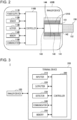
- Fig. 3 is a diagram illustrating an example of configuration of a system 1 according to the embodiment of the present invention.
- the system 1 includes an inhaler device 100 and a terminal device 200.
- the configuration of the inhaler device 100 is as described above.
- the inputter 210 has a function of receiving inputs of various pieces of information.
- the inputter 210 may include an input device that receives inputs of information from the user.
- the input device may be, for example, a button, a keyboard, a touch panel, a microphone, or the like.
- the inputter 210 may also include various sensors including an image sensor.
- the outputter 220 has a function of outputting information.
- the outputter 220 may include an output device that outputs information for the user.
- the output device is, for example, a display device that displays information, a light-emitting device that emits light, a vibration device that vibrates, a sound output device that outputs sound, or the like.
- An example of the display device is a display.
- An example of the light-emitting device is a light-emitting diode (LED).
- An example of the vibration device is an eccentric motor.
- An example of the sound output device is a speaker.
- the outputter 220 notifies the user of information by outputting information input from the controller 260.
- the detector 230 has a function of detecting information regarding the terminal device 200.
- the detector 230 may detect positional information regarding the terminal device 200.
- the detector 230 receives a global navigation satellite system (GNSS) signal from a GNSS satellite (e.g., a global positioning system (GPS) signal from a GPS satellite) and detects positional information including latitude, longitude, and altitude of the device.
- GNSS global navigation satellite system
- GPS global positioning system
- the detector 230 may detect movement of the terminal device 200.
- the detector 230 includes a gyro sensor and an acceleration sensor and detects angular velocity and acceleration.
- the communicator 240 is a communication interface for communicating information with the terminal device 200 and other devices.
- the communicator 240 performs communication in conformity with any wired or wireless communication standard.
- a communication standard may be, for example, universal serial bus (USB), Wi-Fi (registered trademark), Bluetooth (registered trademark), near-field communication (NFC), or a standard using a low-power wide-area network (LPWAN).
- USB universal serial bus
- Wi-Fi registered trademark
- Bluetooth registered trademark
- NFC near-field communication
- LPWAN low-power wide-area network
- the communicator 240 communicates with the inhaler device 100.
- the memory 250 stores various pieces of information.
- the memory 250 is, for example, a nonvolatile storage medium such as a flash memory.
- the controller 260 functions as an arithmetic processing device or a control device and controls overall operations of the terminal device 200 in accordance with various programs.
- the controller 260 is achieved by, for example, an electronic circuit such as a central processing unit (CPU) or a microprocessor.
- the controller 260 may also include a read-only memory (ROM) that stores programs and arithmetic parameters to be used and the like and a random-access memory (RAM) that temporarily stores parameters that change as appropriate and the like.
- ROM read-only memory
- RAM random-access memory
- Processing of information input from the inputter 210, outputting of information by the outputter 220, detection of information by the detector 230, communication of information by the communicator 240, and storing and reading of information by the memory 250 are examples of processing controlled by the controller 260.
- the controller 260 also controls other types of processing performed by the terminal device 200 including inputting of information to each structural element and processing based on information output from each structural element.
- the functions of the controller 260 may be achieved using an application, instead.
- the application may be preinstalled or downloaded.
- the functions of the controller 260 may be achieved by progressive web apps (PWAs).
- the inhaler device 100 generates an aerosol to be inhaled by the user by heating the aerosol source on the basis of heating settings.
- the heating settings are information that specifies a control sequence of the heater 121.
- the heating settings may include a parameter relating to a temperature to which the aerosol source is heated.
- the heating settings may also include a parameter relating to a period of time for which the aerosol source is heated.
- An example of the parameter relating to a temperature to which the aerosol source is heated is a target value of temperature of the heater 121 (hereinafter also referred to as a target temperature).
- the heating settings are typically designed such that a flavor tasted by the user when the user inhales an aerosol generated from a substrate becomes optimal. The flavor tasted by the user, therefore, can be optimized by generating an aerosol on the basis of the heating settings.
- Heating settings used by the inhaler device 100A can include information that specifies a target temperature and a period of time for which the target temperature is maintained. In this case, when a user operation for requesting a start of heating is detected, the inhaler device 100A can maintain temperature of the heater 121A at the target temperature for the period of time specified in the heating settings.
- Heating settings used by the inhaler device 100B can include information that specifies temporal changes in target temperature.
- the inhaler device 100B can start the heating and change temperature of the heater 121B in accordance with the temporal changes in the target temperature specified in the heating settings.
- An example of the user operation for requesting a start of heating is an operation performed on the inhaler device 100, such as use of a switch provided for the inhaler device 100 or the like.
- Another example of the user operation for requesting a start of heating is a puff.
- Another example of the user operation for requesting a start of heating is insertion of the stick substrate 150 into the inhaler device 100B.
- the insertion of the stick substrate 150 into the inhaler device 100B can be detected by a capacitive proximity sensor that detects capacitance in space close to the opening 142, a pressure sensor that detects pressure in the internal space 141, or the like.
- the controller 116 can control the temperature of the heater 121 on the basis of a difference between a current temperature (hereinafter also referred to as an actual temperature) of the heater 121 and a target temperature.
- the temperature control for the heater 121 can be achieved through, for example, known feedback control.
- the feedback control may be, for example, a proportional-integral-differential (PID) controller.
- PID proportional-integral-differential
- the controller 116 can supply power from the power supply 111 to the heater 121 in a form of pulses based on pulse-width modulation (PWM) or pulse-frequency modulation (PFM). In this case, the controller 116 can control the temperature of the heater 121 by adjusting a duty ratio or frequency of the power pulses in feedback control.
- PWM pulse-width modulation
- PFM pulse-frequency modulation
- the controller 116 may perform simple on/off control in the feedback control. For example, the controller 116 may cause the heater 121 to produce heat until the actual temperature reaches the target temperature, cause the heater 121 to stop producing heat when the actual temperature reaches the target temperature, and cause the heater 121 to produce heat again when the actual temperature falls below the target temperature.
- the controller 116 may also adjust voltage in the feedback control.
- the temperature of the heater 121 can be quantified, for example, by measuring or estimating an electrical resistance of the heater 121 (more accurately, a heating resistor included in the heater 121). This is because the electrical resistance of the heating resistor varies depending on the temperature.
- the electrical resistance of the heating resistor can be estimated, for example, by measuring the amount of decrease in voltage of the heating resistor.
- the amount of decrease in the voltage of the heating resistor can be measured by a voltage sensor that measures a potential difference applied to the heating resistor.
- the temperature of the heater 121 can be measured by a temperature sensor, such as a thermistor, provided near the heater 121.
- the parameter that is included in the heating settings and that specifies the temperature to which the aerosol source is heated may be a target value of the electrical resistance of the heater 121, instead of the target temperature.
- the terminal device 200 selects, on the basis of inhalation-related information, a set of heating settings to be used by the inhaler device 100.
- the inhalation-related information is information relating to at least a state of the user or an environment where the user inhales an aerosol (hereinafter also referred to as an inhalation environment).
- the terminal device 200 selects a set of heating settings to be used by the inhaler device 100 automatically, that is, without selection by the user, on the basis of the inhalation-related information.
- a set of heating settings that suits the state of the user or the inhalation environment of the user is automatically selected.
- a comfortable inhalation experience where the user can taste an appropriate aerosol without needing to select a set of heating settings therefore, can be provided for the user
- the inhalation-related information regarding the state of the user may include biological information regarding the user.
- the biological information may include information detected by so-called biosensors, such as pulse, blood pressure, body temperature, blood oxygen saturation, and a respiratory rate. Such information may be detected by biosensors provided for the inhaler device 100, the terminal device 200, or a wearable device worn by the user, such as a smartwatch, instead.
- the biological information may also include information obtained by processing information detected by biosensors, such as a stress level and a relax level estimated from pulse, a respiratory rate, and the like.
- the inhalation-related information regarding the state of the user may include information indicating an action taken by the user, an action that is being taken by the user, or an action that the user plans to take.
- the user's action may be moving, stationary, doing exercise, falling asleep, waking up, or the like.
- the user's action can be estimated on the basis of positional information, acceleration, and angular velocity of the terminal device 200, the biological information regarding the user, or the like.
- the inhalation-related information regarding the inhalation environment of the user may include information regarding time.
- the information regarding time may include information indicating attributes of time, such as weekday/holiday, day, hours of the day, or morning/afternoon/evening.
- the information regarding time may also include information regarding the user's schedule, such as at work/private, during/before/after an event such as a meeting, or the like.
- the information regarding the user's schedule can be obtained by referring to information registered in a schedule application installed on the terminal device 200.
- the inhalation-related information regarding the inhalation environment of the user may include information regarding a place.
- the information regarding a place may include positional information regarding the user.
- the terminal device 200 can detect the positional information regarding the user.
- the information regarding a place may include information indicating a type of location of the user, such as indoor/outdoor, inside/outside a vehicle, or home/office/shop.
- the information indicating the type of location of the user may be obtained by combining the positional information regarding the user with another type of information such as map information or traveling speed of the user.
- the inhalation-related information regarding the inhalation environment of the user may include information regarding weather.
- the information regarding weather may include atmospheric temperature, a weather condition such as sunny/rainy/cloudy, humidity, wind speed, or the like.
- a sensor provided for the inhaler device 100 or the terminal device 200 may detect the information regarding weather.
- the information regarding weather may be obtained from a server on the Internet or the like.
- the inhalation-related information regarding the inhalation environment of the user may include information regarding a use condition of the inhaler device 100.
- the information regarding a use condition of the inhaler device 100 includes a battery level and use frequency of the inhaler device 100, puff intervals, and the amount of inhalation.
- the use frequency of the inhaler device 100 may be the number of stick substrates 150 used or the number of puffs in a past predetermined period of time (e.g., 10 minutes or from a time when the inhaler device 100 was turned on to present time).
- the amount of inhalation may be the amount of inhalation per puff or a total amount of inhalation in a past predetermined period of time.
- the information regarding the use condition of the inhaler device 100 can be stored in the memory 114 each time the inhaler device 100 is used and transmitted to the terminal device 200 as appropriate.
- the inhalation-related information regarding the inhalation environment of the user may include information regarding other inhaler devices 100 around the user.
- the information regarding other inhaler devices 100 around the user may include the number of other inhaler devices 100 around the user, distances to the other inhaler devices 100, or density of the other inhaler devices 100.
- the information regarding other inhaler devices 100 around the user may be obtained through short-distance wireless communication between the inhaler devices 100 or from a server that manages positional information regarding the inhaler devices 100.
- the terminal device 200 selects a heating setting from among a plurality of sets of heating settings that are different from one another in terms of at least the parameter relating to the temperature to which the aerosol source is heated or the parameter relating to the period of time for which the aerosol source is heated.
- the target temperature increases, the amount of the aerosol and the flavor component conveyed to the user in each inhalation action increases.
- a period of time for which the target temperature is maintained at the target temperature increases.
- sets of heating settings for example, there are three sets of heating settings including a high heating mode, where a heating temperature (i.e., target temperature) is high, a normal mode, where the heating temperature is moderate, and a low heating mode, where the heating temperature is low.
- a heating temperature i.e., target temperature
- a normal mode where the heating temperature is moderate
- a low heating mode where the heating temperature is low.
- the terminal device 200 selects a set of heating settings on the basis of the inhalation-related information and predetermined conditions (hereinafter also referred to as selection conditions).
- the terminal device 200 may select a set of heating settings associated with a selection condition satisfied by the inhalation-related information.
- each selection condition is associated with a set of heating settings to be selected when the selection condition is satisfied.
- the high heating mode can be associated with a first selection condition
- the normal mode can be associated with a second selection condition
- the low heating mode can be associated with a third selection condition.
- the terminal device 200 selects the high heating mode if the first selection condition, the normal mode if the second selection condition is satisfied, and the low heating mode if the third selection condition is satisfied.
- the terminal device 200 may select selection conditions to be used to select a set of heating settings from a plurality of selection conditions on the basis of an instruction from the user. For example, the user enables or disables each of the plurality of selection conditions. Enabled selection conditions are then used to select a set of heating settings.
- a user instruction can be obtained through a display screen displayed on the terminal device 200. An example of the display screen will be described with reference to Fig. 4 .
- Fig. 4 is a diagram illustrating an example of the display screen displayed on the terminal device 200 according to the present embodiment.
- a display screen 10 illustrated in Fig. 4 shows selection conditions 11A to 11C associated with the high heating mode and switches 12A to 12C for enabling (on) or disabling (off) the selection conditions 11A to 11C, respectively.
- the user can enable or disable the selection conditions 11A to 11C by selecting the switches 12A to 12C on the display screen 10.
- the selection conditions 11A and 11B are enabled, and the selection condition 11C is disabled.
- “Smoke upon waking” indicated by the selection condition 11A is satisfied when the inhalation-related information indicates that the user has just woken up. That is, when the selection condition 11A is enabled, the high heating mode is selected if the user has just woken up.
- "Smoke for stressful time” indicated by the selection condition 11B is satisfied when the inhalation-related information indicates that the user's stress level is high. That is, when the selection condition 11B is enabled, the high heating mode is selected if the user's stress level is higher than or equal to a predetermined value.
- “First smoke after returning home” indicated by the selection condition 11C is satisfied when the inhalation-related information indicates that the user uses the inhaler device 100 for a first time after returning home.
- the selection condition 11C when the selection condition 11C is enabled, the high heating mode is selected if the user uses the inhaler device 100 for the first time after returning home.
- the selection conditions 11A to 11C may be OR condition for selecting the high heating mode. In this case, if at least one of enabled selection conditions is satisfied, the high heating mode is selected, and if none of the enabled selection conditions is satisfied, the normal mode is selected. The user can enjoy a comfortable inhalation experience by enabling or disabling these selection conditions 11A to 11C in accordance with his/her preference.
- Table 1 Example of selection conditions associated with high heating mode and normal mode Classifications of selection conditions Selection conditions associated with high heating mode Selection conditions associated with normal mode Hours of day Morning, afternoon Evening, night Atmospheric temperature Cold (lower than 25°C) Hot (25°C or higher) Weather condition Snowy, rainy Sunny, cloudy Weekday/holiday Weekday Holiday Indoor/outdoor Outdoor Indoor Inside/outside a vehicle Outside a vehicle Inside a vehicle Home/office/shop Office Home, shop Immediately after waking Immediately after waking Any time other than immediately after waking State of stress High stress Low stress Body temperature and pulse High Low Moving/stationary Moving Stationary Use frequency of inhaler device Low High At work/private At work Private Before/after an event (meeting etc.) Before an event After an event Number of other inhaler devices around the user Many (five or more) Few (less than four)
- the above table 1 shows an example of the selection conditions associated with the high heating mode and the normal mode.
- the high heating mode can be selected in the morning or the afternoon, and the normal mode can be selected in the evening or the night.
- the normal mode can be selected.
- table 1 shows an example where one selection condition is associated with one set of heating settings
- a plurality of selection conditions may be associated with one set of heating settings, instead. For example, a selection condition relating to hours of the day and a selection condition relating to atmospheric temperature may be combined together, and when atmospheric temperature is lower than 25°C in the morning, the high heating mode may be selected. When atmospheric temperature is 20°C or higher in the evening or the night, on the other hand, the low heating mode may be selected.
- the terminal device 200 may select a set of heating settings on the basis of periodically obtained inhalation-related information.
- the inhalation-related information may be obtained at predetermined time intervals.
- the terminal device 200 can select a set of heating settings while constantly tracking the state of the user or the inhalation environment of the user. That is, the terminal device 200 may select a set of heating settings on the basis of temporal changes in the inhalation-related information. As a result, a set of heating settings that suits the state of the user or the inhalation environment of the user can be selected.
- Obtaining surroundings may differ depending on information included in the inhalation-related information, that is, for example, pulse and blood pressure may be obtained at different intervals.
- Obtaining intervals may be different between information obtained by the inhaler device 100, information obtained by the terminal device 200, and information obtained from the outside, such as a server on the Internet.
- the terminal device 200 causes the inhaler device 100 to use a selected set of heating settings. For example, the terminal device 200 transmits information indicating a selected heating settings to the inhaler device 100.
- the inhaler device 100 stores the set of heating settings indicated by the received information and will heat the aerosol source on the basis of the stored set of heating settings thereafter.
- the terminal device 200 may switch a set of heating settings used by the inhaler device 100 in a period when the inhaler device 100 is not performing heating based on the heating settings. For example, the terminal device 200 may transmit the information indicating the selected set of heating settings to the inhaler device 100 in a period when the inhaler device 100 is not performing heating based on the heating settings. The inhaler device 100 may then store the set of heating settings indicated by the received information and heat the aerosol source on the basis of a new set of heating settings from next time. With this configuration, a processing load of the inhaler device 100 can be reduced compared to when a set of heating settings used by the inhaler device 100 is switched while the inhaler device 100 is performing heating based on the heating settings.
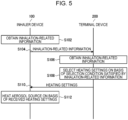
- the inhaler device 100 transmits the inhalation-related information obtained in step S102 to the terminal device 200 (step S104).
- the terminal device 200 obtains inhalation-related information (step S106). For example, the terminal device 200 obtains information regarding time by referring to information registered in a schedule application, obtains information regarding a place on the basis of positional information, and obtains information regarding weather from a server on the Internet.
- the terminal device 200 selects a set of heating settings on the basis of a selection condition satisfied by the inhalation-related information obtained in step S104 or S106 (step S108). If a selection condition associated with the high heating mode is satisfied, for example, the terminal device 200 selects the high heating mode. If not, the terminal device 200 selects the normal mode.
- the terminal device 200 transmits information indicating the selected set of heating settings (step S110).
- the inhaler device 100 then heats the aerosol source on the basis of the received set of heating settings (step S112). For example, the inhaler device 100 stores the set of heating settings indicated by the information received in step S110. The inhaler device 100 then heats the aerosol source on the basis of the stored set of heating settings when a user operation for requesting a start of heating is performed.
- the terminal device 200 may select a set of heating settings on the basis of the number of selection conditions satisfied by the inhalation-related information among a plurality of selection conditions. For example, the terminal device 200 selects a set of heating settings in accordance with the number of selection conditions satisfied by the inhalation-related information among selection conditions associated with the high heating mode shown in the above table 1.
- the following table 2 shows an example of association between the number of selection conditions satisfied by the inhalation-related information and a set of heating settings.
- Table 2 Example of association between number of selection conditions satisfied by inhalation-related information and set of heating settings High heating mode Normal mode Low heating mode Number of selection 6 or more 2 to 5 1 or less conditions satisfied by inhalation-related information
- the terminal device 200 selects the high heating mode if the number of selection conditions satisfied by the inhalation-related information among the selection conditions associated with the high heating mode shown in the above table 1 is six or more, the normal mode if the number is two or five, and the low heating mode if the number is one or less. Relationships between the number of selection conditions satisfied by the inhalation-related information and a set of heating settings, an example of which is shown in table 2, may be set by the user, instead.
- the terminal device 200 may select a set of heating settings on the basis of the sum of scores set for selection conditions satisfied by the inhalation-related information among a plurality of selection conditions.
- the following table 3 shows an example of scores set for the selection conditions.
- Table 4 shows an example of sets of heating settings corresponding to the sum of scores. [Table 3] Table 3.
- Example of scores set for selection conditions Classifications of selection conditions Selection conditions Scores Selection conditions Scores Hours of day Morning, afternoon 5 Evening, night 0 Atmospheric temperature Cold (lower than 25°C) 5 Hot (25°C or higher) 0 Weather condition Snowy, rainy 10 Sunny, cloudy 0 Weekday/holiday Weekday 5 Holiday -5 Indoor/outdoor Outdoor 5 Indoor 0 Inside/outside a vehicle Outside a vehicle 5 Inside a vehicle 0 Home/office/shop Office 10 Home, shop -10 Immediately after waking Immediately after waking 15 Any time other than immediately after waking 0 State of stress High stress 15 Low stress -15 Body temperature and pulse High 5 Low 0 Moving/stationary Moving 5 Stationary 0 Use frequency of inhaler device Low 15 High -10 At work/private At work 10 Private -5 Before/after an event (meeting etc.) Before an event 10 After an event 0 Number of other inhaler devices around Many (five or more) 10 Few (less than four) 0 the user [Table 4] Table 4.
- the terminal device 200 selects the high heating mode if the sum of scores set for selection conditions satisfied by the inhalation-related information is 30 or more, the normal mode if the number is 10 to 29, or the low heating mode if the number is nine or less.
- the scores set for the selection conditions may be set by the user, instead.
- Sets of heating settings corresponding to the sum of scores may be set by the user, instead.
- the terminal device 200 may select a set of heating settings on the basis of inhalation-related information obtained when the inhaler device 100 performs heating based on the heating settings.
- the inhalation-related information may be obtained when a user operation for requesting a start of heating is performed.
- the inhalation-related information may be obtained between the user operation for requesting a start of heating and an actual start of the heating.
- the inhaler device 100 may then start the heating using a set of heating settings selected on the basis of the obtained inhalation-related information. With this configuration, a set of heating settings that suits the state of the user or the inhalation environment of the user immediately before a start of heating can be selected.
- the terminal device 200 may switch a set of heating settings used by the inhaler device 100 while the inhaler device 100 is performing heating based on the heating settings. For example, the terminal device 200 may transmit information indicating a selected set of heating settings to the inhaler device 100 while the inhaler device 100 is performing heating based on the heating settings. The inhaler device 100 may then store the set of heating settings indicated by the received information and switch to the new set of heating settings during the heating. With this configuration, a set of heating settings that suits the user can be immediately applied.
- the terminal device 200 may select a set of heating settings further on the basis of a type of substrate used by the inhaler device 100.
- a type of substrate used by the inhaler device 100A in the first configuration example is a brand of the cartridge 120 and the flavor imparting cartridge 130 attached to the power supply unit 110.
- a type of substrate used by the inhaler device 100B in the second configuration example is a brand of the stick substrate 150 inserted into the inhaler device 100B.
- the type of substrate can be identified by performing image recognition on appearance of the substrate, such as a color of the substrate or a two-dimensional code, which may be a barcode, given to the substrate.
- the terminal device 200 may switch selection conditions used to select a set of heating settings on the basis of the type of substrate used by the inhaler device 100.
- the terminal device 200 may select a set of heating settings according to the type of substrate used by the inhaler device 100 from a plurality of sets of heating settings belonging to the high heating mode. Since an appropriate set of heating settings can differ depending on the type of substrate, the user's inhalation experience can be further improved with this configuration.
- the terminal device 200 may select, on the basis of the inhalation-related information, a selection condition used to select a set of heating settings from a plurality of sets of selection conditions.
- a selection condition used to select a set of heating settings in the morning or the afternoon and a selection condition used to select a set of heating settings in the evening or the night may be different from each other.
- the user's effort can be reduced compared to when the user selects a selection condition used to select a set of heating settings from among a plurality of selection conditions.
- the present invention is not limited to this example.
- the inhaler device 100 may function as a control device that selects a set of heating settings.
- the inhaler device 100 can select a set of heating settings on the basis of inhalation-related information obtained thereby. It is needless to say that the inhaler device 100 may select a set of heating settings on the basis of inhalation-related information received from the terminal device 200 in addition to, or instead of, inhalation-related information obtained thereby.
- the inhaler device 100 may receive, directly from a server on the Internet or indirectly through the terminal device 200, inhalation-related information obtained by the server.
- an external device such as a server on the Internet may function as a control device that selects a set of heating settings.
- each device described herein may be achieved by software, hardware, or a combination of software and hardware.
- a program constituting software is stored in advance, for example, in a storage medium (more specifically, a non-transitory computer-readable storage medium) provided inside or outside each device.
- each program When executed by a computer that controls each device described herein, for example, each program is loaded into a RAM and executed by a processing circuit such as CPU.
- the storage medium is, for example, a magnetic disk, an optical disc, a magneto-optical disk, a flash memory, or the like.
- the computer program may be distributed over a network, instead, without using a storage medium.
- the computer may be an integrated circuit for a specific application such as an ASIC, a general-purpose processor that executes a function by reading a software program, a computer on a server used for cloud computing, or the like.
- ASIC application specific integrated circuit
- the computer may be an integrated circuit for a specific application such as an ASIC, a general-purpose processor that executes a function by reading a software program, a computer on a server used for cloud computing, or the like.
- the process by each device described herein may be performed by a plurality of computers in a distributed manner.
Landscapes
- Thermotherapy And Cooling Therapy Devices (AREA)
- Medicinal Preparation (AREA)
- Telephone Function (AREA)
- Devices For Medical Bathing And Washing (AREA)
Abstract
Description
- The present invention relates to a control device, an inhaler device, and a control method.
- Inhaler devices that generate a substance to be inhaled by users, such as electronic cigarettes and nebulizers, are widely used. An inhaler device generates an aerosol with a flavor component, for example, using a substrate including an aerosol source for generating an aerosol and a flavor source for imparting a flavor component to the generated aerosol. A user can taste a flavor by inhaling the aerosol with the flavor component generated by the inhaler device. Inhalation, by the user, of an aerosol will be referred to as a "puff" or a "puff action" hereinafter.
- In recent years, various techniques relating to inhaler devices have been developed in order to enrich users' inhalation experience. In Patent Literature 1, for example, a technique for enabling a user to select a temperature to which an inhaler device heats a substrate is disclosed.
- Patent Literature 1:
WO 2019/061906 A1 - In the technique disclosed in Patent Literature 1, however, a user is required to select a temperature to which an inhaler device heats a substrate.
- The present invention, therefore, has been conceived in view of the above problem and aims to provide a mechanism capable of further improving a user's inhalation experience.
- In order to solve the above problem, an aspect of the present invention provides a control device including a controller that selects a set of heating settings to be used by an inhaler device, which generates an aerosol to be inhaled by a user by heating an aerosol source on a basis of the set of heating settings, on a basis of inhalation-related information, which is information relating to at least a state of the user or an environment where the user inhales the aerosol.
- The controller may select the set of heating settings associated with predetermined conditions satisfied by the inhalation-related information.
- The controller may select the set of heating settings on a basis of a number of predetermined conditions satisfied by the inhalation-related information among a plurality of predetermined conditions.
- The controller may select the set of heating settings on a basis of a sum of scores set for predetermined conditions satisfied by the inhalation-related information among a plurality of predetermined conditions.
- The controller may selects, on a basis of an instruction from the user, predetermined conditions used to select the set of heating settings from the plurality of predetermined conditions.
- The controller may select, on a basis of the inhalation-related information, predetermined conditions used to select the set of heating settings from the plurality of predetermined conditions.
- The controller may select the set of heating settings on a basis of the periodically obtained inhalation-related information.
- The controller may select the set of heating settings on a basis of the inhalation-related information obtained when the inhaler device performs the heating based on the heating settings.
- The controller may switch the set of heating settings used by the inhaler device while the inhaler device is not performing the heating based on the heating settings.
- The controller may switch the set of heating settings used by the inhaler device while the inhaler device is performing the heating based on the heating settings.
- The inhalation-related information regarding the state of the user may include at least biological information regarding the user, information indicating an action taken by the user, information indicating an action that is being taken by the user, or information indicating an action that the user plans to take.
- The inhalation-related information regarding the environment where the user inhales the aerosol may include at least information regarding time, information regarding a place, information regarding weather, information regarding a use state of the inhaler device, or information regarding another inhaler device around the user.
- The inhaler device may generate the aerosol using a substrate containing the aerosol source. The controller may select the set of heating settings on a basis of a type of substrate used by the inhaler device.
- The controller may select the set of heating settings from a plurality of sets of heating settings that are different from one another in terms of at least a parameter relating to a temperature to which the aerosol source is heated or a parameter relating to a period of time for which the aerosol source is heated.
- In addition, in order to solve the above problem, another aspect of the present invention provides an inhaler device that generates an aerosol to be inhaled by a user by heating an aerosol source on a basis of a set of heating settings. The inhaler device includes a controller that selects a set of heating settings on a basis of inhalation-related information, which is information relating to at least a state of the user or an environment where the user inhales the aerosol, and that performs control in such a way as to heat the aerosol source on a basis of the selected set of heating settings.
- In addition, in order to solve the above problem, another aspect of the present invention provides a control method including selecting a set of heating settings to be used by an inhaler device, which generates an aerosol to be inhaled by a user by heating an aerosol source on a basis of the set of heating settings, on a basis of inhalation-related information, which is information relating to at least a state of the user or an environment where the user inhales the aerosol.
- As described above, according to the present invention, a mechanism capable of further improving a user's inhalation experience is provided.
-
- [
Fig. 1] Fig. 1 is a schematic diagram of an inhaler device according to a first configuration example. - [
Fig. 2] Fig. 2 is a schematic diagram of an inhaler device according to a second configuration example. - [
Fig. 3] Fig. 3 is a diagram illustrating an example of configuration of a system according to an embodiment of the present invention. - [
Fig. 4] Fig. 4 is a diagram illustrating an example of a display screen displayed on a terminal device according to the embodiment. - [
Fig. 5] Fig. 5 is a sequence diagram illustrating an example of a process performed by the system according to the embodiment. - A preferred embodiment of the present invention will be described in detail hereinafter with reference to the accompanying drawings. Structural elements having substantially the same functional configuration will be given the same reference numerals herein and in the drawings, and redundant description thereof is omitted.
- An inhaler device generates material to be inhaled by a user. In the example described below, the material generated by the inhaler device is an aerosol. Alternatively, the material generated by the inhaler device may be gas.
-
Fig. 1 is a schematic diagram of an inhaler device according to a first configuration example. As illustrated inFig. 1 , aninhaler device 100A according to the present configuration example includes apower supply unit 110, acartridge 120, and a flavor impartingcartridge 130. Thepower supply unit 110 includes apower supply 111A, asensor 112A, anotifier 113A, amemory 114A, acommunicator 115A, and acontroller 116A. Thecartridge 120 includes aheater 121A, aliquid guide 122, and aliquid storage 123. The flavor impartingcartridge 130 includes aflavor source 131 and amouthpiece 124. In thecartridge 120 and theflavor imparting cartridge 130, anairflow path 180 is defined. - The
power supply 111A stores electric power. Thepower supply 111A supplies electric power to the structural elements of theinhaler device 100A under the control of thecontroller 116A. Thepower supply 111A may be a rechargeable battery such as a lithium ion secondary battery. - The
sensor 112A acquires various items of information regarding theinhaler device 100A. In an example, thesensor 112A may be a pressure sensor such as a condenser microphone, a flow sensor, or a temperature sensor, and acquire a value generated in accordance with the user's inhalation. In another example, thesensor 112A may be an input device that receives information input by the user, such as a button or a switch. - The
notifier 113A provides information to the user. Thenotifier 113A may be a light-emitting device that emits light, a display device that displays an image, a sound output device that outputs sound, or a vibration device that vibrates. - The
memory 114A stores various items of information for operation of theinhaler device 100A. Thememory 114A may be a non-volatile storage medium such as flash memory. - The
communicator 115A is a communication interface capable of communication in conformity with any wired or wireless communication standard. Such a communication standard may be, for example, Wi-Fi (registered trademark), Bluetooth (registered trademark), near-field communication (NFC), or a standard using a low-power wide-area network (LPWAN). - The
controller 116A functions as an arithmetic processing unit and a control circuit, and controls the overall operations of theinhaler device 100A in accordance with various programs. Thecontroller 116A includes an electronic circuit such as a central processing unit (CPU) or a microprocessor, for example. - The
liquid storage 123 stores an aerosol source. The aerosol source is atomized to generate an aerosol. The aerosol source is a liquid such as polyhydric alcohol or water. Examples of the polyhydric alcohol include glycerine and propylene glycol. The aerosol source may include a flavor component that is either derived from tobacco or not derived from tobacco. For theinhaler device 100A that is a medical inhaler such as a nebulizer, the aerosol source may include a medicine. - The
liquid guide 122 guides, from theliquid storage 123, the aerosol source that is the liquid stored in theliquid storage 123, and holds the aerosol source. Theliquid guide 122 is, for example, a wick formed by twining fiber material such as glass fiber or porous material such as porous ceramic. In this case, the capillary action of the wick guides the aerosol source stored in theliquid storage 123. - The
heater 121A heats the aerosol source to atomize the aerosol source and generate the aerosol. In the example illustrated inFig. 1 , theheater 121A includes a coil wound around theliquid guide 122. When theheater 121A produces heat, the aerosol source held by theliquid guide 122 is heated and atomized to generate the aerosol. Theheater 121A produces heat when receiving electric power from thepower supply 111A. In an example, the electric power may be supplied in response to thesensor 112A detecting a start of the user's inhalation and/or an input of predetermined information. Subsequently, the supply of the electric power may be stopped in response to thesensor 112A detecting an end of the user's inhalation and/or an input of predetermined information. - The
flavor source 131 is a structural element for imparting a flavor component to the aerosol. Theflavor source 131 may include a flavor component that is either derived from tobacco or not derived from tobacco. - The
airflow path 180 is a flow path of air to be inhaled by the user. Theairflow path 180 has a tubular structure having anair inlet hole 181 and anair outlet hole 182 at both ends. Theair inlet hole 181 is an inlet of air into theairflow path 180, and theair outlet hole 182 is an outlet of the air from theairflow path 180. Theliquid guide 122 is on theairflow path 180 at an upstream position (closer to the air inlet hole 181), and theflavor source 131 is on theairflow path 180 at a downstream position (closer to the air outlet hole 182). Air flowing in through theair inlet hole 181 when the user inhales mixes with the aerosol generated by theheater 121A. Subsequently, as indicated by anarrow 190, the mixture fluid of the aerosol and the air passes through theflavor source 131 and is conveyed to theair outlet hole 182. When the mixture fluid of the aerosol and the air passes through theflavor source 131, the flavor component included in theflavor source 131 is imparted to the aerosol. - The
mouthpiece 124 is to be held in a mouth of the user during inhalation. Themouthpiece 124 has theair outlet hole 182. When the user inhales with themouthpiece 124 in his/her mouth, the mixture fluid of the aerosol and the air enters the oral cavity of the user. - The configuration example of the
inhaler device 100A has been described above. Theinhaler device 100A is not limited to the above configuration, and may be configured in various ways as exemplified below. - In an example, the
inhaler device 100A does not have to include theflavor imparting cartridge 130. In this case, thecartridge 120 includes themouthpiece 124. - In another example, the
inhaler device 100A may include various types of aerosol sources. Still another type of aerosol may be generated by mixing a plurality of types of aerosols generated from the plurality of types of aerosol sources in theairflow path 180 and causing a chemical reaction. - In addition, means for atomizing the aerosol source is not limited to heating by the
heater 121A. For example, the means for atomizing the aerosol source may be vibration atomization or induction heating. -
Fig. 2 is a schematic diagram of the inhaler device according to the second configuration example. As illustrated inFig. 2 , aninhaler device 100B according to the present configuration example includes apower supply 111B, asensor 112B, anotifier 113B, amemory 114B, acommunicator 115B, acontroller 116B, aheater 121B, aholder 140, and aheat insulator 144. - The
power supply 111B, thesensor 112B, thenotifier 113B, thememory 114B, thecommunicator 115B, and thecontroller 116B are substantially the same as the respective corresponding structural elements included in theinhaler device 100A according to the first configuration example. - The
holder 140 has aninternal space 141, and holds astick substrate 150 in a manner partially accommodated in theinternal space 141. Theholder 140 has anopening 142 that allows theinternal space 141 to communicate with outside. Theholder 140 accommodates thestick substrate 150 that is inserted into theinternal space 141 through theopening 142. For example, theholder 140 may be a tubular body having theopening 142 and a bottom 143 on its ends, and may define the pillar-shapedinternal space 141. Theholder 140 connects with an airflow path that supplies air to theinternal space 141. For example, a side surface of theinhaler device 100 has an air inlet hole that is an inlet of air into the airflow path. For example, the bottom 143 has an air outlet hole that is an outlet of the air from the airflow path to theinternal space 141. - The
stick substrate 150 includes asubstrate 151 and aninhalation port 152. Thesubstrate 151 includes an aerosol source. In this configuration example, the aerosol source is not limited to a liquid, and may be a solid, instead. Thestick substrate 150 held by theholder 140 includes thesubstrate 151 at least partially accommodated in theinternal space 141 and theinhalation port 152 at least partially protruding from theopening 142. When the user inhales with theinhalation port 152 protruding from theopening 142 in his/her mouth, air flows into theinternal space 141 through the airflow path (not illustrated), and the air and an aerosol generated from thesubstrate 151 reach inside the mouth of the user. - In the example illustrated in
Fig. 2 , theheater 121B has a film-like shape and surrounds the outer circumference of theholder 140. Subsequently, heat produced from theheater 121B heats thesubstrate 151 of thestick substrate 150 from the outer circumference, generating the aerosol. - The
heat insulator 144 prevents heat from transferring from theheater 121B to the other structural elements. For example, theheat insulator 144 may be a vacuum heat insulator or an aerogel heat insulator. - The configuration example of the
inhaler device 100B has been described above. Theinhaler device 100B is not limited to the above configuration, and may be configured in various ways as exemplified below. - In an example, the
heater 121B may have a blade-like shape, and may be disposed so that theheater 121B protrudes from thebottom 143 of theholder 140 toward theinternal space 141. In this case, theheater 121B having the blade-like shape is inserted into thesubstrate 151 of thestick substrate 150 and heats thesubstrate 151 of thestick substrate 150 from its inside. In another example, theheater 121B may be disposed so that theheater 121B covers thebottom 143 of theholder 140. In still another example, theheater 121B may be implemented as a combination of two or more selected from a first heater that covers the outer circumference of theholder 140, a second heater having the blade-like shape, and a third heater that covers thebottom 143 of theholder 140. - In another example, the
holder 140 may include an opening/closing mechanism that at least partially opens and closes an outer shell defining theinternal space 141. Examples of the opening/closing mechanism include a hinge. In addition, theholder 140 may accommodate thestick substrate 150 while sandwiching thestick substrate 150 inserted into theinternal space 141 by opening and closing the outer shell. In this case, theheater 121B may be at the sandwiching position of theholder 140 and may produce heat while pressing thestick substrate 150. - In addition, means for atomizing the aerosol source is not limited to heating by the
heater 121B. For example, the means for atomizing the aerosol source may be induction heating. In this case, theinhaler device 100B includes at least an electromagnetic induction source such as a coil that generates a magnetic field instead of theheater 121B. Theinhaler device 100B may be provided with a susceptor that produces heat by the induction heating, or thestick substrate 150 may include the susceptor. - In addition, the
inhaler device 100B may also include theheater 121A, theliquid guide 122, theliquid storage 123, and theairflow path 180 according to the first configuration example. Theairflow path 180 may supply air to theinternal space 141. In this case, a mixture fluid of the air and an aerosol generated by theheater 121A flows into theinternal space 141, mixes further with an aerosol generated by theheater 121B, and then reaches the oral cavity of the user - In the first configuration example, the
power supply unit 110, thecartridge 120, and theflavor imparting cartridge 130 operate together to generate the aerosol to be inhaled by the user. The combination of thepower supply unit 110, thecartridge 120, and theflavor imparting cartridge 130 may be regarded as an aerosol generation system. Similarly, theinhaler device 100B according to the second configuration example operates together with thestick substrate 150 to generate the aerosol to be inhaled by the user. The combination of theinhaler device 100B and thestick substrate 150, therefore, may be regarded as an aerosol generation system. - When the
inhaler device 100A and theinhaler device 100B need not particularly be distinguished from each other, these will be generically referred to as theinhaler devices 100 while omitting the alphabets at ends of the reference numerals thereof. Similarly, when the structural elements of theinhaler device 100A and theinhaler device 100B need not particularly be distinguished from each other, the alphabets at ends of the reference numerals are omitted. In addition, when thecartridge 120, theflavor imparting cartridge 130, and thestick substrate 150 need not particularly be distinguished from one another, these will be generically referred to as substrates. -
Fig. 3 is a diagram illustrating an example of configuration of a system 1 according to the embodiment of the present invention. As illustrated inFig. 3 , the system 1 includes aninhaler device 100 and aterminal device 200. The configuration of theinhaler device 100 is as described above. - The
terminal device 200 is a device used by a user of theinhaler device 100. For example, theterminal device 200 is any information processing device such as a smartphone, a tablet terminal, or a wearable device. Alternatively, theterminal device 200 may be a charger that accommodates theinhaler device 100 and that charges the accommodatedinhaler device 100. As illustrated inFig. 3 , theterminal device 200 includes aninputter 210, anoutputter 220, adetector 230, acommunicator 240, amemory 250, and acontroller 260. - The
inputter 210 has a function of receiving inputs of various pieces of information. Theinputter 210 may include an input device that receives inputs of information from the user. The input device may be, for example, a button, a keyboard, a touch panel, a microphone, or the like. Theinputter 210 may also include various sensors including an image sensor. - The
outputter 220 has a function of outputting information. Theoutputter 220 may include an output device that outputs information for the user. The output device is, for example, a display device that displays information, a light-emitting device that emits light, a vibration device that vibrates, a sound output device that outputs sound, or the like. An example of the display device is a display. An example of the light-emitting device is a light-emitting diode (LED). An example of the vibration device is an eccentric motor. An example of the sound output device is a speaker. Theoutputter 220 notifies the user of information by outputting information input from thecontroller 260. - The
detector 230 has a function of detecting information regarding theterminal device 200. Thedetector 230 may detect positional information regarding theterminal device 200. For example, thedetector 230 receives a global navigation satellite system (GNSS) signal from a GNSS satellite (e.g., a global positioning system (GPS) signal from a GPS satellite) and detects positional information including latitude, longitude, and altitude of the device. Thedetector 230 may detect movement of theterminal device 200. For example, thedetector 230 includes a gyro sensor and an acceleration sensor and detects angular velocity and acceleration. - The
communicator 240 is a communication interface for communicating information with theterminal device 200 and other devices. Thecommunicator 240 performs communication in conformity with any wired or wireless communication standard. Such a communication standard may be, for example, universal serial bus (USB), Wi-Fi (registered trademark), Bluetooth (registered trademark), near-field communication (NFC), or a standard using a low-power wide-area network (LPWAN). For example, thecommunicator 240 communicates with theinhaler device 100. - The
memory 250 stores various pieces of information. Thememory 250 is, for example, a nonvolatile storage medium such as a flash memory. - The
controller 260 functions as an arithmetic processing device or a control device and controls overall operations of theterminal device 200 in accordance with various programs. Thecontroller 260 is achieved by, for example, an electronic circuit such as a central processing unit (CPU) or a microprocessor. Thecontroller 260 may also include a read-only memory (ROM) that stores programs and arithmetic parameters to be used and the like and a random-access memory (RAM) that temporarily stores parameters that change as appropriate and the like. Theterminal device 200 performs various types of processing under the control of thecontroller 260. Processing of information input from theinputter 210, outputting of information by theoutputter 220, detection of information by thedetector 230, communication of information by thecommunicator 240, and storing and reading of information by thememory 250 are examples of processing controlled by thecontroller 260. Thecontroller 260 also controls other types of processing performed by theterminal device 200 including inputting of information to each structural element and processing based on information output from each structural element. - The functions of the
controller 260 may be achieved using an application, instead. The application may be preinstalled or downloaded. Alternatively, the functions of thecontroller 260 may be achieved by progressive web apps (PWAs). - The
inhaler device 100 generates an aerosol to be inhaled by the user by heating the aerosol source on the basis of heating settings. The heating settings are information that specifies a control sequence of the heater 121. The heating settings may include a parameter relating to a temperature to which the aerosol source is heated. The heating settings may also include a parameter relating to a period of time for which the aerosol source is heated. An example of the parameter relating to a temperature to which the aerosol source is heated is a target value of temperature of the heater 121 (hereinafter also referred to as a target temperature). The heating settings are typically designed such that a flavor tasted by the user when the user inhales an aerosol generated from a substrate becomes optimal. The flavor tasted by the user, therefore, can be optimized by generating an aerosol on the basis of the heating settings. - Heating settings used by the
inhaler device 100A can include information that specifies a target temperature and a period of time for which the target temperature is maintained. In this case, when a user operation for requesting a start of heating is detected, theinhaler device 100A can maintain temperature of theheater 121A at the target temperature for the period of time specified in the heating settings. - Heating settings used by the
inhaler device 100B, on the other hand, can include information that specifies temporal changes in target temperature. In this case, when a user operation for requesting a start of heating is detected, theinhaler device 100B can start the heating and change temperature of theheater 121B in accordance with the temporal changes in the target temperature specified in the heating settings. - An example of the user operation for requesting a start of heating is an operation performed on the
inhaler device 100, such as use of a switch provided for theinhaler device 100 or the like. Another example of the user operation for requesting a start of heating is a puff. Another example of the user operation for requesting a start of heating is insertion of thestick substrate 150 into theinhaler device 100B. The insertion of thestick substrate 150 into theinhaler device 100B can be detected by a capacitive proximity sensor that detects capacitance in space close to theopening 142, a pressure sensor that detects pressure in theinternal space 141, or the like. - The controller 116 can control the temperature of the heater 121 on the basis of a difference between a current temperature (hereinafter also referred to as an actual temperature) of the heater 121 and a target temperature. The temperature control for the heater 121 can be achieved through, for example, known feedback control. The feedback control may be, for example, a proportional-integral-differential (PID) controller. The controller 116 can supply power from the power supply 111 to the heater 121 in a form of pulses based on pulse-width modulation (PWM) or pulse-frequency modulation (PFM). In this case, the controller 116 can control the temperature of the heater 121 by adjusting a duty ratio or frequency of the power pulses in feedback control. Alternatively, the controller 116 may perform simple on/off control in the feedback control. For example, the controller 116 may cause the heater 121 to produce heat until the actual temperature reaches the target temperature, cause the heater 121 to stop producing heat when the actual temperature reaches the target temperature, and cause the heater 121 to produce heat again when the actual temperature falls below the target temperature. The controller 116 may also adjust voltage in the feedback control.
- The temperature of the heater 121 can be quantified, for example, by measuring or estimating an electrical resistance of the heater 121 (more accurately, a heating resistor included in the heater 121). This is because the electrical resistance of the heating resistor varies depending on the temperature. The electrical resistance of the heating resistor can be estimated, for example, by measuring the amount of decrease in voltage of the heating resistor. The amount of decrease in the voltage of the heating resistor can be measured by a voltage sensor that measures a potential difference applied to the heating resistor. In another example, the temperature of the heater 121 can be measured by a temperature sensor, such as a thermistor, provided near the heater 121.
- The parameter that is included in the heating settings and that specifies the temperature to which the aerosol source is heated may be a target value of the electrical resistance of the heater 121, instead of the target temperature.
- The
terminal device 200 selects, on the basis of inhalation-related information, a set of heating settings to be used by theinhaler device 100. The inhalation-related information is information relating to at least a state of the user or an environment where the user inhales an aerosol (hereinafter also referred to as an inhalation environment). In particular, theterminal device 200 selects a set of heating settings to be used by theinhaler device 100 automatically, that is, without selection by the user, on the basis of the inhalation-related information. With this configuration, a set of heating settings that suits the state of the user or the inhalation environment of the user is automatically selected. A comfortable inhalation experience where the user can taste an appropriate aerosol without needing to select a set of heating settings, therefore, can be provided for the user - An example of the inhalation-related information will be described hereinafter.
- The inhalation-related information regarding the state of the user may include biological information regarding the user. The biological information may include information detected by so-called biosensors, such as pulse, blood pressure, body temperature, blood oxygen saturation, and a respiratory rate. Such information may be detected by biosensors provided for the
inhaler device 100, theterminal device 200, or a wearable device worn by the user, such as a smartwatch, instead. The biological information may also include information obtained by processing information detected by biosensors, such as a stress level and a relax level estimated from pulse, a respiratory rate, and the like. - The inhalation-related information regarding the state of the user may include information indicating an action taken by the user, an action that is being taken by the user, or an action that the user plans to take. The user's action may be moving, stationary, doing exercise, falling asleep, waking up, or the like. The user's action can be estimated on the basis of positional information, acceleration, and angular velocity of the
terminal device 200, the biological information regarding the user, or the like. - The inhalation-related information regarding the inhalation environment of the user may include information regarding time. The information regarding time may include information indicating attributes of time, such as weekday/holiday, day, hours of the day, or morning/afternoon/evening. The information regarding time may also include information regarding the user's schedule, such as at work/private, during/before/after an event such as a meeting, or the like. The information regarding the user's schedule can be obtained by referring to information registered in a schedule application installed on the
terminal device 200. - The inhalation-related information regarding the inhalation environment of the user may include information regarding a place. The information regarding a place may include positional information regarding the user. The
terminal device 200 can detect the positional information regarding the user. The information regarding a place may include information indicating a type of location of the user, such as indoor/outdoor, inside/outside a vehicle, or home/office/shop. The information indicating the type of location of the user may be obtained by combining the positional information regarding the user with another type of information such as map information or traveling speed of the user. - The inhalation-related information regarding the inhalation environment of the user may include information regarding weather. The information regarding weather may include atmospheric temperature, a weather condition such as sunny/rainy/cloudy, humidity, wind speed, or the like. A sensor provided for the
inhaler device 100 or theterminal device 200 may detect the information regarding weather. Alternatively, the information regarding weather may be obtained from a server on the Internet or the like. - The inhalation-related information regarding the inhalation environment of the user may include information regarding a use condition of the
inhaler device 100. The information regarding a use condition of theinhaler device 100 includes a battery level and use frequency of theinhaler device 100, puff intervals, and the amount of inhalation. The use frequency of theinhaler device 100 may be the number ofstick substrates 150 used or the number of puffs in a past predetermined period of time (e.g., 10 minutes or from a time when theinhaler device 100 was turned on to present time). The amount of inhalation may be the amount of inhalation per puff or a total amount of inhalation in a past predetermined period of time. The information regarding the use condition of theinhaler device 100 can be stored in the memory 114 each time theinhaler device 100 is used and transmitted to theterminal device 200 as appropriate. - The inhalation-related information regarding the inhalation environment of the user may include information regarding
other inhaler devices 100 around the user. The information regardingother inhaler devices 100 around the user may include the number ofother inhaler devices 100 around the user, distances to theother inhaler devices 100, or density of theother inhaler devices 100. The information regardingother inhaler devices 100 around the user may be obtained through short-distance wireless communication between theinhaler devices 100 or from a server that manages positional information regarding theinhaler devices 100. - Examples of the inhalation-related information have been described.
- The
terminal device 200 selects a heating setting from among a plurality of sets of heating settings that are different from one another in terms of at least the parameter relating to the temperature to which the aerosol source is heated or the parameter relating to the period of time for which the aerosol source is heated. As the target temperature increases, the amount of the aerosol and the flavor component conveyed to the user in each inhalation action increases. In addition, as the period of time for which the target temperature is maintained at the target temperature increases, a period of time for which the user tastes the flavor increases. With this configuration, therefore, an inhalation experience that suits the state of the user or the inhalation environment of the user can be provided. As sets of heating settings, for example, there are three sets of heating settings including a high heating mode, where a heating temperature (i.e., target temperature) is high, a normal mode, where the heating temperature is moderate, and a low heating mode, where the heating temperature is low. - The
terminal device 200 selects a set of heating settings on the basis of the inhalation-related information and predetermined conditions (hereinafter also referred to as selection conditions). - In an example, the
terminal device 200 may select a set of heating settings associated with a selection condition satisfied by the inhalation-related information. In this case, each selection condition is associated with a set of heating settings to be selected when the selection condition is satisfied. In an example, the high heating mode can be associated with a first selection condition, the normal mode can be associated with a second selection condition, and the low heating mode can be associated with a third selection condition. In this case, theterminal device 200 selects the high heating mode if the first selection condition, the normal mode if the second selection condition is satisfied, and the low heating mode if the third selection condition is satisfied. - The
terminal device 200 may select selection conditions to be used to select a set of heating settings from a plurality of selection conditions on the basis of an instruction from the user. For example, the user enables or disables each of the plurality of selection conditions. Enabled selection conditions are then used to select a set of heating settings. A user instruction can be obtained through a display screen displayed on theterminal device 200. An example of the display screen will be described with reference toFig. 4 . -
Fig. 4 is a diagram illustrating an example of the display screen displayed on theterminal device 200 according to the present embodiment. Adisplay screen 10 illustrated inFig. 4 showsselection conditions 11A to 11C associated with the high heating mode and switches 12A to 12C for enabling (on) or disabling (off) theselection conditions 11A to 11C, respectively. The user can enable or disable theselection conditions 11A to 11C by selecting theswitches 12A to 12C on thedisplay screen 10. In the example illustrated inFig. 4 , theselection conditions selection condition 11C is disabled. - "Smoke upon waking" indicated by the
selection condition 11A is satisfied when the inhalation-related information indicates that the user has just woken up. That is, when theselection condition 11A is enabled, the high heating mode is selected if the user has just woken up. "Smoke for stressful time" indicated by theselection condition 11B is satisfied when the inhalation-related information indicates that the user's stress level is high. That is, when theselection condition 11B is enabled, the high heating mode is selected if the user's stress level is higher than or equal to a predetermined value. "First smoke after returning home" indicated by theselection condition 11C is satisfied when the inhalation-related information indicates that the user uses theinhaler device 100 for a first time after returning home. That is, when theselection condition 11C is enabled, the high heating mode is selected if the user uses theinhaler device 100 for the first time after returning home. Theselection conditions 11A to 11C may be OR condition for selecting the high heating mode. In this case, if at least one of enabled selection conditions is satisfied, the high heating mode is selected, and if none of the enabled selection conditions is satisfied, the normal mode is selected. The user can enjoy a comfortable inhalation experience by enabling or disabling theseselection conditions 11A to 11C in accordance with his/her preference. - Association between the selection conditions and the heating settings is not limited to the above example. The following table 1 shows another example.
[Table 1] Table 1. Example of selection conditions associated with high heating mode and normal mode Classifications of selection conditions Selection conditions associated with high heating mode Selection conditions associated with normal mode Hours of day Morning, afternoon Evening, night Atmospheric temperature Cold (lower than 25°C) Hot (25°C or higher) Weather condition Snowy, rainy Sunny, cloudy Weekday/holiday Weekday Holiday Indoor/outdoor Outdoor Indoor Inside/outside a vehicle Outside a vehicle Inside a vehicle Home/office/shop Office Home, shop Immediately after waking Immediately after waking Any time other than immediately after waking State of stress High stress Low stress Body temperature and pulse High Low Moving/stationary Moving Stationary Use frequency of inhaler device Low High At work/private At work Private Before/after an event (meeting etc.) Before an event After an event Number of other inhaler devices around the user Many (five or more) Few (less than four) - The above table 1 shows an example of the selection conditions associated with the high heating mode and the normal mode. In the example shown in table 1, the high heating mode can be selected in the morning or the afternoon, and the normal mode can be selected in the evening or the night. In addition, when the number of
other inhaler devices 100 around theinhaler device 100 is large, the high heating mode can be selected, and when the number is small, the normal mode can be selected. Although table 1 shows an example where one selection condition is associated with one set of heating settings, a plurality of selection conditions may be associated with one set of heating settings, instead. For example, a selection condition relating to hours of the day and a selection condition relating to atmospheric temperature may be combined together, and when atmospheric temperature is lower than 25°C in the morning, the high heating mode may be selected. When atmospheric temperature is 20°C or higher in the evening or the night, on the other hand, the low heating mode may be selected. - The
terminal device 200 may select a set of heating settings on the basis of periodically obtained inhalation-related information. For example, the inhalation-related information may be obtained at predetermined time intervals. With this configuration, theterminal device 200 can select a set of heating settings while constantly tracking the state of the user or the inhalation environment of the user. That is, theterminal device 200 may select a set of heating settings on the basis of temporal changes in the inhalation-related information. As a result, a set of heating settings that suits the state of the user or the inhalation environment of the user can be selected. - Obtaining surroundings may differ depending on information included in the inhalation-related information, that is, for example, pulse and blood pressure may be obtained at different intervals. Obtaining intervals may be different between information obtained by the
inhaler device 100, information obtained by theterminal device 200, and information obtained from the outside, such as a server on the Internet. - The
terminal device 200 causes theinhaler device 100 to use a selected set of heating settings. For example, theterminal device 200 transmits information indicating a selected heating settings to theinhaler device 100. Theinhaler device 100 stores the set of heating settings indicated by the received information and will heat the aerosol source on the basis of the stored set of heating settings thereafter. - The
terminal device 200 may switch a set of heating settings used by theinhaler device 100 in a period when theinhaler device 100 is not performing heating based on the heating settings. For example, theterminal device 200 may transmit the information indicating the selected set of heating settings to theinhaler device 100 in a period when theinhaler device 100 is not performing heating based on the heating settings. Theinhaler device 100 may then store the set of heating settings indicated by the received information and heat the aerosol source on the basis of a new set of heating settings from next time. With this configuration, a processing load of theinhaler device 100 can be reduced compared to when a set of heating settings used by theinhaler device 100 is switched while theinhaler device 100 is performing heating based on the heating settings. -
Fig. 5 is a sequence diagram illustrating an example of a process performed by the system 1 according to the embodiment. This sequence involves theinhaler device 100 and theterminal device 200. - As illustrated in
Fig. 5 , first, theinhaler device 100 obtains inhalation-related information (step S102). For example, theinhaler device 100 detects biological information from the user's fingers holding theinhaler device 100 and reads information regarding a use history of theinhaler device 100 from the memory 114. - Next, the
inhaler device 100 transmits the inhalation-related information obtained in step S102 to the terminal device 200 (step S104). - Next, the
terminal device 200 obtains inhalation-related information (step S106). For example, theterminal device 200 obtains information regarding time by referring to information registered in a schedule application, obtains information regarding a place on the basis of positional information, and obtains information regarding weather from a server on the Internet. - Next, the
terminal device 200 selects a set of heating settings on the basis of a selection condition satisfied by the inhalation-related information obtained in step S104 or S106 (step S108). If a selection condition associated with the high heating mode is satisfied, for example, theterminal device 200 selects the high heating mode. If not, theterminal device 200 selects the normal mode. - Next, the
terminal device 200 transmits information indicating the selected set of heating settings (step S110). - The
inhaler device 100 then heats the aerosol source on the basis of the received set of heating settings (step S112). For example, theinhaler device 100 stores the set of heating settings indicated by the information received in step S110. Theinhaler device 100 then heats the aerosol source on the basis of the stored set of heating settings when a user operation for requesting a start of heating is performed. - The
terminal device 200 may select a set of heating settings on the basis of the number of selection conditions satisfied by the inhalation-related information among a plurality of selection conditions. For example, theterminal device 200 selects a set of heating settings in accordance with the number of selection conditions satisfied by the inhalation-related information among selection conditions associated with the high heating mode shown in the above table 1. The following table 2 shows an example of association between the number of selection conditions satisfied by the inhalation-related information and a set of heating settings.[Table 2] Table 2. Example of association between number of selection conditions satisfied by inhalation-related information and set of heating settings High heating mode Normal mode Low heating mode Number of selection 6 or more 2 to 5 1 or less conditions satisfied by inhalation-related information - In the example shown in table 2, the
terminal device 200 selects the high heating mode if the number of selection conditions satisfied by the inhalation-related information among the selection conditions associated with the high heating mode shown in the above table 1 is six or more, the normal mode if the number is two or five, and the low heating mode if the number is one or less. Relationships between the number of selection conditions satisfied by the inhalation-related information and a set of heating settings, an example of which is shown in table 2, may be set by the user, instead. - The
terminal device 200 may select a set of heating settings on the basis of the sum of scores set for selection conditions satisfied by the inhalation-related information among a plurality of selection conditions. The following table 3 shows an example of scores set for the selection conditions. Table 4 shows an example of sets of heating settings corresponding to the sum of scores.[Table 3] Table 3. Example of scores set for selection conditions Classifications of selection conditions Selection conditions Scores Selection conditions Scores Hours of day Morning, afternoon 5 Evening, night 0 Atmospheric temperature Cold (lower than 25°C) 5 Hot (25°C or higher) 0 Weather condition Snowy, rainy 10 Sunny, cloudy 0 Weekday/holiday Weekday 5 Holiday -5 Indoor/outdoor Outdoor 5 Indoor 0 Inside/outside a vehicle Outside a vehicle 5 Inside a vehicle 0 Home/office/ shop Office 10 Home, shop -10 Immediately after waking Immediately after waking 15 Any time other than immediately after waking 0 State of stress High stress 15 Low stress -15 Body temperature and pulse High 5 Low 0 Moving/stationary Moving 5 Stationary 0 Use frequency of inhaler device Low 15 High -10 At work/private At work 10 Private -5 Before/after an event (meeting etc.) Before an event 10 After an event 0 Number of other inhaler devices around Many (five or more) 10 Few (less than four) 0 the user [Table 4] Table 4. Example of sets of heating settings corresponding to sum of scores High heating mode Normal mode Low heating mode Sum of scores 30 or more 10 to 29 9 or less - In the example shown in tables 3 and 4, the
terminal device 200 selects the high heating mode if the sum of scores set for selection conditions satisfied by the inhalation-related information is 30 or more, the normal mode if the number is 10 to 29, or the low heating mode if the number is nine or less. The scores set for the selection conditions, an example of which is shown in table 3, may be set by the user, instead. Sets of heating settings corresponding to the sum of scores, an example of which is shown in table 4, may be set by the user, instead. - The
terminal device 200 may select a set of heating settings on the basis of inhalation-related information obtained when theinhaler device 100 performs heating based on the heating settings. For example, the inhalation-related information may be obtained when a user operation for requesting a start of heating is performed. Here, the inhalation-related information may be obtained between the user operation for requesting a start of heating and an actual start of the heating. Theinhaler device 100 may then start the heating using a set of heating settings selected on the basis of the obtained inhalation-related information. With this configuration, a set of heating settings that suits the state of the user or the inhalation environment of the user immediately before a start of heating can be selected. - The
terminal device 200 may switch a set of heating settings used by theinhaler device 100 while theinhaler device 100 is performing heating based on the heating settings. For example, theterminal device 200 may transmit information indicating a selected set of heating settings to theinhaler device 100 while theinhaler device 100 is performing heating based on the heating settings. Theinhaler device 100 may then store the set of heating settings indicated by the received information and switch to the new set of heating settings during the heating. With this configuration, a set of heating settings that suits the user can be immediately applied. - The
terminal device 200 may select a set of heating settings further on the basis of a type of substrate used by theinhaler device 100. A type of substrate used by theinhaler device 100A in the first configuration example is a brand of thecartridge 120 and theflavor imparting cartridge 130 attached to thepower supply unit 110. A type of substrate used by theinhaler device 100B in the second configuration example is a brand of thestick substrate 150 inserted into theinhaler device 100B. The type of substrate can be identified by performing image recognition on appearance of the substrate, such as a color of the substrate or a two-dimensional code, which may be a barcode, given to the substrate. In an example, theterminal device 200 may switch selection conditions used to select a set of heating settings on the basis of the type of substrate used by theinhaler device 100. In another example, when the high heating mode is selected, theterminal device 200 may select a set of heating settings according to the type of substrate used by theinhaler device 100 from a plurality of sets of heating settings belonging to the high heating mode. Since an appropriate set of heating settings can differ depending on the type of substrate, the user's inhalation experience can be further improved with this configuration. - The
terminal device 200 may select, on the basis of the inhalation-related information, a selection condition used to select a set of heating settings from a plurality of sets of selection conditions. In an example, a selection condition used to select a set of heating settings in the morning or the afternoon and a selection condition used to select a set of heating settings in the evening or the night may be different from each other. With this configuration, the user's effort can be reduced compared to when the user selects a selection condition used to select a set of heating settings from among a plurality of selection conditions. - Although a preferred embodiment of the present invention has been described in detail with reference to the accompanying drawings, the present invention is not limited to this example. It is clear that those who have ordinary knowledge in a technical field to which the present invention pertains can conceive various examples of changes or modifications within the scope of the technical idea described in the claims, and it is understood that these also naturally belong to the technical scope of the present invention.
- Although an example where the
terminal device 200 functions as a control device that selects a set of heating settings has been described in the above embodiment, for example, the present invention is not limited to this example. In an example, theinhaler device 100 may function as a control device that selects a set of heating settings. In this case, theinhaler device 100 can select a set of heating settings on the basis of inhalation-related information obtained thereby. It is needless to say that theinhaler device 100 may select a set of heating settings on the basis of inhalation-related information received from theterminal device 200 in addition to, or instead of, inhalation-related information obtained thereby. In addition, theinhaler device 100 may receive, directly from a server on the Internet or indirectly through theterminal device 200, inhalation-related information obtained by the server. In another example, an external device such as a server on the Internet may function as a control device that selects a set of heating settings. - It is to be noted that the process by each device described herein may be achieved by software, hardware, or a combination of software and hardware. A program constituting software is stored in advance, for example, in a storage medium (more specifically, a non-transitory computer-readable storage medium) provided inside or outside each device. When executed by a computer that controls each device described herein, for example, each program is loaded into a RAM and executed by a processing circuit such as CPU. The storage medium is, for example, a magnetic disk, an optical disc, a magneto-optical disk, a flash memory, or the like. For example, the computer program may be distributed over a network, instead, without using a storage medium. In addition, the computer may be an integrated circuit for a specific application such as an ASIC, a general-purpose processor that executes a function by reading a software program, a computer on a server used for cloud computing, or the like. The process by each device described herein may be performed by a plurality of computers in a distributed manner.
- In addition, the process described herein with reference to the flowchart and the sequence diagram need not necessarily be performed in the illustrated order. Some processing steps may be performed in parallel with each other, instead. Additional processing steps may also be employed, and some processing steps may be omitted.
- The following configurations also belong to the technical scope of the present invention.
- (1) A control device including:
a controller that selects a set of heating settings to be used by an inhaler device, which generates an aerosol to be inhaled by a user by heating an aerosol source on a basis of the set of heating settings, on a basis of inhalation-related information, which is information relating to at least a state of the user or an environment where the user inhales the aerosol. - (2) The control device according to (1),
in which the controller selects the set of heating settings associated with a predetermined condition satisfied by the inhalation-related information. - (3) The control device according to (1),
in which the controller selects the set of heating settings on a basis of a number of predetermined conditions satisfied by the inhalation-related information among a plurality of predetermined conditions. - (4) The control device according to (1),
in which the controller selects the set of heating settings on a basis of a sum of scores set for predetermined conditions satisfied by the inhalation-related information among a plurality of predetermined conditions. - (5) The control device according to any of (2) to (4),
in which the controller selects, on a basis of an instruction from the user, predetermined conditions used to select the set of heating settings from the plurality of predetermined conditions. - (6) The control device according to any of (2) to (4),
in which the controller selects, on a basis of the inhalation-related information, predetermined conditions used to select the set of heating settings from the plurality of predetermined conditions. - (7) The control device according to any of (1) to (6),
in which the controller selects the set of heating settings on a basis of the periodically obtained inhalation-related information. - (8) The control device according to any of (1) to (6),
in which the controller selects the set of heating settings on a basis of the inhalation-related information obtained when the inhaler device performs the heating based on the heating settings. - (9) The control device according to any of (1) to (8),
in which the controller switches the set of heating settings used by the inhaler device while the inhaler device is not performing the heating based on the heating settings. - (10) The control device according to any of (1) to (8),
in which the controller switches the set of heating settings used by the inhaler device while the inhaler device is performing the heating based on the heating settings. - (11) The control device according to any of (1) to (10),
in which the inhalation-related information regarding the state of the user includes at least biological information regarding the user, information indicating an action taken by the user, information indicating an action that is being taken by the user, or information indicating an action that the user plans to take. - (12) The control device according to any of (1) to (11),
in which the inhalation-related information regarding the environment where the user inhales the aerosol includes at least information regarding time, information regarding a place, information regarding weather, information regarding a use state of the inhaler device, or information regarding another inhaler device around the user - (13) The control device according to any of (1) to (12),
- in which the inhaler device generates the aerosol using a substrate containing the aerosol source, and
- in which the controller selects the set of heating settings on a basis of a type of substrate used by the inhaler device.
- (14) The control device according to any of (1) to (13),
in which the controller selects the set of heating settings from a plurality of sets of heating settings that are different from one another in terms of at least a parameter relating to a temperature to which the aerosol source is heated or a parameter relating to a period of time for which the aerosol source is heated. - (15) An inhaler device that generates an aerosol to be inhaled by a user by heating an aerosol source on a basis of a set of heating settings, the inhaler device including:
a controller that selects the set of heating settings on a basis of inhalation-related information, which is information relating to at least a state of the user or an environment where the user inhales the aerosol, and that performs control in such a way as to heat the aerosol source on a basis of the selected set of heating settings. - (16) A control method including:
selecting a set of heating settings to be used by an inhaler device, which generates an aerosol to be inhaled by a user by heating an aerosol source on a basis of the set of heating settings, on a basis of inhalation-related information, which is information relating to at least a state of the user or an environment where the user inhales the aerosol. -
- 1
- system
- 100
- inhaler device
- 110
- power supply unit
- 111
- power supply
- 112
- sensor
- 113
- notifier
- 114
- memory
- 115
- communicator
- 116
- controller
- 120
- cartridge
- 121
- heater
- 122
- liquid guide
- 123
- liquid storage
- 124
- mouthpiece
- 130
- flavor imparting cartridge
- 131
- flavor source
- 140
- holder
- 141
- internal space
- 142
- opening
- 143
- bottom
- 144
- heat insulator
- 150
- stick substrate
- 151
- substrate
- 152
- inhalation port
- 180
- airflow path
- 181
- air inlet hole
- 182
- air outlet hole
- 200
- terminal device
- 210
- inputter
- 220
- outputter
- 230
- detector
- 240
- communicator
- 250
- memory
- 260
- controller
Claims (16)
- A control device comprising:
a controller that selects a set of heating settings to be used by an inhaler device, which generates an aerosol to be inhaled by a user by heating an aerosol source on a basis of the set of heating settings, on a basis of inhalation-related information, which is information relating to at least a state of the user or an environment where the user inhales the aerosol. - The control device according to claim 1,
wherein the controller selects the set of heating settings associated with a predetermined condition satisfied by the inhalation-related information. - The control device according to claim 1,
wherein the controller selects the set of heating settings on a basis of a number of predetermined conditions satisfied by the inhalation-related information among a plurality of predetermined conditions. - The control device according to claim 1,
wherein the controller selects the set of heating settings on a basis of a sum of scores set for predetermined conditions satisfied by the inhalation-related information among a plurality of predetermined conditions. - The control device according to any of claims 2 to 4,
wherein the controller selects, on a basis of an instruction from the user, predetermined conditions used to select the set of heating settings from the plurality of predetermined conditions. - The control device according to any of claims 2 to 4,
wherein the controller selects, on a basis of the inhalation-related information, predetermined conditions used to select the set of heating settings from the plurality of predetermined conditions. - The control device according to any of claims 1 to 6,
wherein the controller selects the set of heating settings on a basis of the periodically obtained inhalation-related information. - The control device according to any of claims 1 to 6,
wherein the controller selects the set of heating settings on a basis of the inhalation-related information obtained when the inhaler device performs the heating based on the heating settings. - The control device according to any of claims 1 to 8,
wherein the controller switches the set of heating settings used by the inhaler device while the inhaler device is not performing the heating based on the heating settings. - The control device according to any of claims 1 to 8,
wherein the controller switches the set of heating settings used by the inhaler device while the inhaler device is performing the heating based on the heating settings. - The control device according to any of claims 1 to 10,
wherein the inhalation-related information regarding the state of the user includes at least biological information regarding the user, information indicating an action taken by the user, information indicating an action that is being taken by the user, or information indicating an action that the user plans to take. - The control device according to any of claims 1 to 11,
wherein the inhalation-related information regarding the environment where the user inhales the aerosol includes at least information regarding time, information regarding a place, information regarding weather, information regarding a use state of the inhaler device, or information regarding another inhaler device around the user. - The control device according to any of claims 1 to 12,wherein the inhaler device generates the aerosol using a substrate containing the aerosol source, andwherein the controller selects the set of heating settings on a basis of a type of substrate used by the inhaler device.
- The control device according to any of claims 1 to 13,
wherein the controller selects the set of heating settings from a plurality of sets of heating settings that are different from one another in terms of at least a parameter relating to a temperature to which the aerosol source is heated or a parameter relating to a period of time for which the aerosol source is heated. - An inhaler device that generates an aerosol to be inhaled by a user by heating an aerosol source on a basis of a set of heating settings, the inhaler device comprising:
a controller that selects the set of heating settings on a basis of inhalation-related information, which is information relating to at least a state of the user or an environment where the user inhales the aerosol, and that performs control in such a way as to heat the aerosol source on a basis of the selected set of heating settings. - A control method comprising:
selecting a set of heating settings to be used by an inhaler device, which generates an aerosol to be inhaled by a user by heating an aerosol source on a basis of the set of heating settings, on a basis of inhalation-related information, which is information relating to at least a state of the user or an environment where the user inhales the aerosol.
Applications Claiming Priority (1)
| Application Number | Priority Date | Filing Date | Title |
|---|---|---|---|
| PCT/JP2021/046331 WO2023112218A1 (en) | 2021-12-15 | 2021-12-15 | Control device, inhalation device, and control method |
Publications (2)
| Publication Number | Publication Date |
|---|---|
| EP4427614A1 true EP4427614A1 (en) | 2024-09-11 |
| EP4427614A4 EP4427614A4 (en) | 2025-08-27 |
Family
ID=86773852
Family Applications (1)
| Application Number | Title | Priority Date | Filing Date |
|---|---|---|---|
| EP21968133.5A Pending EP4427614A4 (en) | 2021-12-15 | 2021-12-15 | Control device, inhalation device, and control method |
Country Status (5)
| Country | Link |
|---|---|
| US (1) | US20240306731A1 (en) |
| EP (1) | EP4427614A4 (en) |
| JP (1) | JP7689589B2 (en) |
| CN (1) | CN118251147A (en) |
| WO (1) | WO2023112218A1 (en) |
Families Citing this family (2)
| Publication number | Priority date | Publication date | Assignee | Title |
|---|---|---|---|---|
| US12520880B2 (en) | 2021-01-18 | 2026-01-13 | Altria Client Services Llc | Heat-not-burn (HNB) aerosol-generating devices including energy based heater control, and methods of controlling a heater |
| US12550942B2 (en) | 2022-09-19 | 2026-02-17 | Altria Client Services Llc | Session control system |
Family Cites Families (8)
| Publication number | Priority date | Publication date | Assignee | Title |
|---|---|---|---|---|
| CA2970401C (en) * | 2014-12-11 | 2023-06-13 | Michel Thorens | Inhaling device with user recognition based on inhalation behaviour |
| US11583008B2 (en) * | 2017-01-18 | 2023-02-21 | Kt&G Corporation | Fine particle generating device |
| CN107616552A (en) | 2017-09-27 | 2018-01-23 | 绿烟实业(深圳)有限公司 | For adjusting method and device, the electronic cigarette equipment of smoking pattern |
| US11839715B2 (en) | 2018-03-14 | 2023-12-12 | Philip Morris Products S.A. | Aerosol-generating system with biosensor |
| US11986022B2 (en) * | 2019-04-19 | 2024-05-21 | The Kanvas Company Inc. | Electronic vaporizer with automated thermal profile control |
| KR20200144049A (en) * | 2019-06-17 | 2020-12-28 | 주식회사 케이티앤지 | An aerosol generating device and an aerosol generating article |
| JP6811346B1 (en) * | 2020-03-05 | 2021-01-13 | 日本たばこ産業株式会社 | Aerosol aspirator power supply unit and aerosol aspirator |
| EP4094604A4 (en) * | 2020-05-25 | 2023-10-25 | Japan Tobacco Inc. | INHALATION DEVICE, CONTROL METHOD AND PROGRAM |
-
2021
- 2021-12-15 JP JP2023567400A patent/JP7689589B2/en active Active
- 2021-12-15 WO PCT/JP2021/046331 patent/WO2023112218A1/en not_active Ceased
- 2021-12-15 EP EP21968133.5A patent/EP4427614A4/en active Pending
- 2021-12-15 CN CN202180104213.7A patent/CN118251147A/en active Pending
-
2024
- 2024-05-15 US US18/664,333 patent/US20240306731A1/en active Pending
Also Published As
| Publication number | Publication date |
|---|---|
| KR20240090235A (en) | 2024-06-21 |
| US20240306731A1 (en) | 2024-09-19 |
| WO2023112218A1 (en) | 2023-06-22 |
| EP4427614A4 (en) | 2025-08-27 |
| CN118251147A (en) | 2024-06-25 |
| JPWO2023112218A1 (en) | 2023-06-22 |
| JP7689589B2 (en) | 2025-06-06 |
Similar Documents
| Publication | Publication Date | Title |
|---|---|---|
| US20240306731A1 (en) | Control device, inhalation device, and control method | |
| US20230074631A1 (en) | Information processing device, information processing method, and non-transitory computer readable medium | |
| US20230072356A1 (en) | Information processing device, information processing method, and non-transitory computer readable medium | |
| EP4079177A1 (en) | Control device, control method, and program | |
| US20250000170A1 (en) | Information processing device, information processing method, and non-transitory computer readable medium | |
| EP4212045A1 (en) | Control method, inhalation device, terminal device, and program | |
| US20240423288A1 (en) | Information processing device, information processing method, and non-transitory computer readable medium | |
| KR20240137646A (en) | Systems and information processing methods | |
| EP4635339A1 (en) | Information processing device, information processing method, and program | |
| EP4131280A1 (en) | Information processing device, control method, and program | |
| EP4627952A1 (en) | Terminal device, information processing method, and program | |
| EP4039110A1 (en) | Control device, control method, and program | |
| EP4364596A1 (en) | Information processing method, aerosol generation system, and program | |
| EP4230070A1 (en) | Inhalation device, terminal device, and program | |
| JP7729916B2 (en) | Information processing device, information processing method, and program | |
| CN117715557A (en) | Interactive aerosol supply system | |
| EP4623732A1 (en) | Terminal device and information processing device | |
| EP4623734A1 (en) | Terminal device, information processing method, and program | |
| EP4285973A1 (en) | Control device, terminal device, and information processing method | |
| EP4613138A1 (en) | Information processing device, inhalation system, and information presentation method | |
| WO2024127488A1 (en) | Terminal device and control method | |
| WO2025154266A1 (en) | Heating information setting method, heating information setting system, and program | |
| WO2024127487A1 (en) | Terminal device and control method | |
| WO2022219677A1 (en) | Information processing device and information processing method | |
| KR20250108713A (en) | Information processing device, information processing method and program stored on computer-readable medium |
Legal Events
| Date | Code | Title | Description |
|---|---|---|---|
| STAA | Information on the status of an ep patent application or granted ep patent |
Free format text: STATUS: THE INTERNATIONAL PUBLICATION HAS BEEN MADE |
|
| PUAI | Public reference made under article 153(3) epc to a published international application that has entered the european phase |
Free format text: ORIGINAL CODE: 0009012 |
|
| STAA | Information on the status of an ep patent application or granted ep patent |
Free format text: STATUS: REQUEST FOR EXAMINATION WAS MADE |
|
| 17P | Request for examination filed |
Effective date: 20240605 |
|
| AK | Designated contracting states |
Kind code of ref document: A1 Designated state(s): AL AT BE BG CH CY CZ DE DK EE ES FI FR GB GR HR HU IE IS IT LI LT LU LV MC MK MT NL NO PL PT RO RS SE SI SK SM TR |
|
| DAV | Request for validation of the european patent (deleted) | ||
| DAX | Request for extension of the european patent (deleted) | ||
| A4 | Supplementary search report drawn up and despatched |
Effective date: 20250725 |
|
| RIC1 | Information provided on ipc code assigned before grant |
Ipc: A24F 40/57 20200101AFI20250721BHEP Ipc: A24F 40/46 20200101ALI20250721BHEP Ipc: A24F 40/50 20200101ALI20250721BHEP Ipc: A24F 40/53 20200101ALI20250721BHEP |