EP4427575A1 - A harvesting system and method for autonomous harvesting of fruit - Google Patents
A harvesting system and method for autonomous harvesting of fruit Download PDFInfo
- Publication number
- EP4427575A1 EP4427575A1 EP24162341.2A EP24162341A EP4427575A1 EP 4427575 A1 EP4427575 A1 EP 4427575A1 EP 24162341 A EP24162341 A EP 24162341A EP 4427575 A1 EP4427575 A1 EP 4427575A1
- Authority
- EP
- European Patent Office
- Prior art keywords
- harvesting
- fruit
- collecting
- subsystem
- collecting opening
- Prior art date
- Legal status (The legal status is an assumption and is not a legal conclusion. Google has not performed a legal analysis and makes no representation as to the accuracy of the status listed.)
- Pending
Links
- 238000003306 harvesting Methods 0.000 title claims abstract description 138
- 235000013399 edible fruits Nutrition 0.000 title claims abstract description 135
- 238000000034 method Methods 0.000 title claims abstract description 14
- 239000012636 effector Substances 0.000 claims abstract description 35
- 241000220225 Malus Species 0.000 claims abstract description 31
- 235000021016 apples Nutrition 0.000 claims abstract description 18
- 238000001514 detection method Methods 0.000 claims abstract description 17
- 239000004575 stone Substances 0.000 claims abstract description 9
- 241000132456 Haplocarpha Species 0.000 claims description 11
- 235000011430 Malus pumila Nutrition 0.000 description 15
- 235000015103 Malus silvestris Nutrition 0.000 description 15
- 208000034656 Contusions Diseases 0.000 description 2
- 244000141359 Malus pumila Species 0.000 description 2
- 238000010586 diagram Methods 0.000 description 2
- 241000220324 Pyrus Species 0.000 description 1
- 230000004913 activation Effects 0.000 description 1
- 230000003247 decreasing effect Effects 0.000 description 1
- 230000001419 dependent effect Effects 0.000 description 1
- 238000011161 development Methods 0.000 description 1
- 230000018109 developmental process Effects 0.000 description 1
- 238000006073 displacement reaction Methods 0.000 description 1
- 239000006260 foam Substances 0.000 description 1
- 230000005484 gravity Effects 0.000 description 1
- 230000001788 irregular Effects 0.000 description 1
- 235000021017 pears Nutrition 0.000 description 1
- 238000009877 rendering Methods 0.000 description 1
- 230000000630 rising effect Effects 0.000 description 1
- 230000001932 seasonal effect Effects 0.000 description 1
Images
Classifications
-
- A—HUMAN NECESSITIES
- A01—AGRICULTURE; FORESTRY; ANIMAL HUSBANDRY; HUNTING; TRAPPING; FISHING
- A01D—HARVESTING; MOWING
- A01D46/00—Picking of fruits, vegetables, hops, or the like; Devices for shaking trees or shrubs
- A01D46/30—Robotic devices for individually picking crops
Definitions
- the invention relates to a harvesting system for autonomous harvesting of fruit, such as for instance pome fruit such as apples or stone fruit.
- the invention also relates to a method for autonomous harvesting of unharvested fruit, such as for instance pome fruit such as apples or stone fruit, with a system according to the invention.
- a drawback of such a harvesting device is that the cycle time between two successive harvesting operations is relatively long in that the harvested fruit must in the interim in each case be carefully transported to the collecting point and placed or released. This drawback is further emphasized in that the branches of fruit-bearing crops often have an irregular progression, whereby repositioning of the end effector for the subsequent harvesting operation also requires relatively complex displacement in each case.
- a harvesting system for autonomous harvesting of fruit such as for instance pome fruit such as apples or stone fruit, comprising:
- the collecting subsystem is provided with a collecting opening into which harvested fruits can be placed or released.
- the collecting opening can for instance be formed by an upright edge or an opening of a tube.
- the collecting opening preferably extends substantially at right angles to the direction of the force of gravity. Making the collecting opening displaceable enables it to always be positioned close to and/or under the location where the harvesting operation is taking place. Hereby, the harvested fruit need only be displaced over a short distance before the fruit can be placed or released.
- the collecting opening is connected to a collecting reservoir, whereby fruits placed into the collecting opening come to lie in the collecting reservoir.
- a detection subsystem such as for instance a computer vision subsystem, is provided to detect and localize unharvested fruits in the harvesting range of the robotic manipulator with a harvesting end effector.
- the detection subsystem can also be used to detect and localize unharvested fruits outside the harvesting range and/or to map the relevant ambient factors, such as the shape of the crop being harvested.
- the detection system can also be applied to support guiding of the movements of the positionable components of the subsystems.
- a computer-implemented control For coordinated control of the movements of the at least one harvesting subsystem and the at least one collecting subsystem a computer-implemented control is provided.
- the control provides for the guiding of the movements.
- the control is also configured to select a specific fruit to be harvested, for instance depending on a harvesting plan and/or the accessibility of the fruit.
- the control here provides for the positioning of the harvesting end effector for harvesting of the specific fruit, the activation of the harvesting operation, and for the harvested fruit being displaced to the nearby collecting opening and being placed therein. Because the collecting opening has been positioned close to and/or under the location of the harvesting operation by the control, the harvesting end effector need only bridge a short distance in order to place the harvested fruit, this decreasing the cycle time.
- the harvesting end effector is a picking end effector.
- a harvesting system is a harvesting system wherein the collecting opening comprises a net.
- the collecting opening comprises a net.
- Providing a net in the collecting opening enables a fruit being released into the collecting opening to be caught without sustaining damage such as bruising. This enables the releasing to be done even faster.
- the hard surfaces in and/or around the collecting opening can also be provided with for instance a resilient surface, such as for instance a foam layer. Preventing any hard surfaces from being present in the collecting opening prevents the releasing or placing from having to be done very carefully. The chances of bruising or other damage to the fruit is also reduced.
- At least one collecting subsystem comprises a second robotic manipulator wherein the collecting opening is an end effector of the second robotic manipulator.
- a collecting subsystem can be embodied with a robotic manipulator with a collecting opening as end effector. Assigning the collecting subsystem the same degrees of freedom as the harvesting subsystem enables the relative positioning of the two subsystems to be maintained in more different environments.
- At least one collecting subsystem comprises a conveyor belt extending from the collecting opening to the collecting reservoir.
- Providing a conveyor belt between the collecting opening and the collecting reservoir enables transport of the fruits placed or released into the collecting opening to be controlled over a greater distance so that the fruits are not dependent on a height difference being present in the path between the collecting opening and the collecting reservoir.
- control is also configured to identify from the unharvested fruits detected and localized by the detection subsystem at least one fruit with an increased drop probability during harvesting of the specific fruit, and to position the at least one collecting opening in a predicted drop path of the at least one fruit with an increased drop probability.
- control can alternatively predict the drop path of the specific fruit to be harvested and position the collecting opening in this drop path so that, in the event of a harvesting error wherein the harvesting end effector unexpectedly loses the fruit, the fruit ends up in the collecting opening.
- the invention also relates to a method for autonomous harvesting of unharvested fruit, such as for instance pome fruit such as apples or stone fruit, with a system according to any one of the foregoing claims, comprising the steps of:
- the at least one collecting subsystem and the at least one harvesting subsystem of the harvesting system must be brought within the range of the unharvested fruits to be harvested. These steps can optionally also take place autonomously by arranging the harvesting system or the subsystems thereof on a mobile chassis.
- the harvesting range preferably extends in or, optionally partially, above the collecting range. Because fruit hangs from the crop, the harvesting operation often already comprises a downward movement. Arranging the collecting range under or overlapping the harvesting range enables the cycle time to be reduced still further.
- the method comprises as alternative to the step of displacing the at least one collecting opening to a position close to and/or under the specific fruit the steps of:
- Predicting a drop path of a fruit with an increased drop probability enables the collecting opening to be arranged in the predicted drop path so that, when the fruit in question drops, it can be caught in the collecting opening.
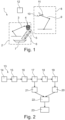
- FIG. 1 shows a harvesting system 1 with a collecting subsystem 2.
- the collecting subsystem 2 has a robotic manipulator 3 on which a collecting opening 4 is arranged as end effector.
- the collecting opening 4 is provided with a net 5 which is connected by means of a conveyor belt 6 to a collecting reservoir 7 for collecting and storing harvested fruit.
- the harvesting subsystem 8 is provided with a robotic manipulator 9 with a harvesting end effector 10.
- a computer vision subsystem 11 is arranged on the robotic manipulator 9 for the purpose of detecting and localizing unharvested fruits in and in the vicinity of the harvesting range.
- a computer-implemented control 12 is configured to control the subsystems in coordinated manner and to process the detections by the detection subsystem 11.
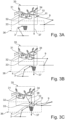
- Figure 2 shows a flow diagram 13 showing the steps of an embodiment of a method according to the invention.
- the at least one collecting subsystem is positioned relative to the unharvested fruits such that the collecting range extends close to and/or under at least a part of the unharvested fruits.
- the at least one harvesting subsystem is also positioned relative to the unharvested fruits, such that at least a part of the unharvested fruits are located in the harvesting range.
- unharvested fruits are detected and localized in at least the harvesting range by the detection subsystem.
- the control selects a specific fruit to be harvested from the detected and localized unharvested fruits in the harvesting range.
- next step 18 at least one fruit with an increased drop probability during harvesting of the specific fruit is identified from the detected and localized unharvested fruits, and a predicted drop path of the at least one fruit with an increased drop probability is then determined in the subsequent step 19.
- the collecting opening is then positioned in the predicted drop path in a subsequent step 20.
- An alternative step 21, wherein the collecting opening is immediately displaced to a position close to and/or under the specific fruit, may also follow after step 17.
- the harvesting end effector is positioned for harvesting the specific fruit, and the specific fruit is harvested.
- the harvested fruit is in the subsequent step 23 placed or released into the collecting opening lying close to and/or under the harvesting end effector.
- the method can be repeated from step 16 until all the detected fruits have been harvested.
- Figures 3A-C show a branch 31 of an apple tree on which hang unharvested apples 32-34.
- a detection subsystem 11 arranged on the robotic manipulator 9 of the harvesting subsystem detects and localizes the unharvested apples 32, 34 in the harvesting range 35.
- the manipulator 9 is positioned so that all unharvested apples 32-34 are located in the harvesting range 35.
- a specific apple 33 to be harvested is selected from the unharvested apples 32-34 detected and localized in the harvesting range 35.
- the collecting range 36 of the robotic manipulator 3 of the collecting subsystem is located close to and under the unharvested apples 32-34.
- An apple 34 with an increased drop probability during harvesting of the specific apple 33 is identified from the unharvested apples 32, 34.
- a drop path 37 of the apple 34 with an increased drop probability is predicted.
- the collecting opening 4 of the robotic manipulator 3 of the collecting subsystem is positioned in the predicted drop path 37 so that, if the apple 34 were to unexpectedly drops during picking of the specific apple 33 to be harvested, it will end up in collecting opening 4.
- the harvesting end effector 10 has been displaced toward the specific apple 33 to be harvested for the purpose of performing the harvesting action.
- the harvested apple 33 has been displaced in the direction of arrow 38, toward collecting opening 4, and is released into it.
- the end effector 10 of robotic manipulator 9 of the harvesting system thus need only move a short distance 38 for the purpose of releasing the harvested apple 38, allowing the cycle time to be reduced.
Landscapes
- Engineering & Computer Science (AREA)
- Robotics (AREA)
- Life Sciences & Earth Sciences (AREA)
- Environmental Sciences (AREA)
- Harvesting Machines For Specific Crops (AREA)
- Manipulator (AREA)
Abstract
The invention relates to a harvesting system for autonomous harvesting of fruit, such as for instance pome fruit such as apples or stone fruit, comprising:- at least one collecting subsystem comprising a collecting opening, which collecting opening is connected to a collecting reservoir for collecting and storing harvested fruits, and wherein the collecting opening is autonomously displaceable in a collecting range;- at least one harvesting subsystem comprising a first robotic manipulator with a harvesting end effector configured to harvest a specific fruit in a harvesting range;- a detection subsystem, such as for instance a computer vision subsystem, configured to detect and localize at least in the harvesting range unharvested fruits;- a computer-implemented control configured to control the movements of the at least one harvesting subsystem and the at least one collecting subsystem in coordinated manner and wherein the control is configured to select from the unharvested fruits detected and localized by the detection subsystem in the harvesting range a specific fruit to be harvested and to position the harvesting end effector for harvesting the specific fruit, and wherein the control is also configured to displace the at least one collecting opening to a position close to the specific fruit so that the harvesting end effector can release the specific fruit into the nearby collecting opening after harvesting thereof.The invention also relates to a method for autonomous harvesting of unharvested fruit, such as for instance pome fruit such as apples or stone fruit, with a system according to the invention.
Description
- The invention relates to a harvesting system for autonomous harvesting of fruit, such as for instance pome fruit such as apples or stone fruit. The invention also relates to a method for autonomous harvesting of unharvested fruit, such as for instance pome fruit such as apples or stone fruit, with a system according to the invention.
- For harvesting of fruit such as pome fruit, such as apples and pears, or stone fruit use is traditionally often made of (seasonal) workers who pick or otherwise harvest manually. Due to the lower availability of such workers and due to rising labour costs, it is desirable if the harvesting can be done by fewer workers.
- Developments are known for autonomous harvesting of fruit, wherein the manual harvesting operation is automated by means of a robotic manipulator. Providing an end effector tailored to the fruit for harvesting on the manipulator enables a part of the operations necessary for harvesting to be performed by a machine. For picking apples use can thus for instance be made of an end effector in the form of a gripper which obtains a grip on the apple by means of for instance a suction cup provided with underpressure, after which it is rotated in order to detach the apple at the natural break-off surface at the attachment. The gripper can then transport the apple to a collecting location and there carefully release it.
- A drawback of such a harvesting device is that the cycle time between two successive harvesting operations is relatively long in that the harvested fruit must in the interim in each case be carefully transported to the collecting point and placed or released. This drawback is further emphasized in that the branches of fruit-bearing crops often have an irregular progression, whereby repositioning of the end effector for the subsequent harvesting operation also requires relatively complex displacement in each case.
- It is now an object of the invention to reduce or even obviate the above stated drawbacks.
- This object is achieved according to the invention with a harvesting system for autonomous harvesting of fruit, such as for instance pome fruit such as apples or stone fruit, comprising:
- at least one collecting subsystem comprising a collecting opening, which collecting opening is connected to a collecting reservoir for collecting and storing harvested fruits, and wherein the collecting opening is autonomously displaceable in a collecting range;
- at least one harvesting subsystem comprising a first robotic manipulator with a harvesting end effector configured to harvest a specific fruit in a harvesting range;
- a detection subsystem, such as for instance a computer vision subsystem, configured to detect and localize at least in the harvesting range unharvested fruits;
- a computer-implemented control configured to control the movements of the at least one harvesting subsystem and the at least one collecting subsystem in coordinated manner and wherein the control is configured to select from the unharvested fruits detected and localized by the detection subsystem in the harvesting range a specific fruit to be harvested and to position the harvesting end effector for harvesting the specific fruit, and wherein the control is also configured to displace the at least one collecting opening to a position close to the specific fruit so that the harvesting end effector can release the specific fruit into the nearby collecting opening after harvesting thereof.
- Providing at least one collecting subsystem and harvesting subsystem which are controlled in coordinated manner relative to each other enables the cycle time between successive harvesting operations to be reduced. For this purpose the collecting subsystem is provided with a collecting opening into which harvested fruits can be placed or released. The collecting opening can for instance be formed by an upright edge or an opening of a tube. The collecting opening preferably extends substantially at right angles to the direction of the force of gravity. Making the collecting opening displaceable enables it to always be positioned close to and/or under the location where the harvesting operation is taking place. Hereby, the harvested fruit need only be displaced over a short distance before the fruit can be placed or released. The collecting opening is connected to a collecting reservoir, whereby fruits placed into the collecting opening come to lie in the collecting reservoir.
- A detection subsystem, such as for instance a computer vision subsystem, is provided to detect and localize unharvested fruits in the harvesting range of the robotic manipulator with a harvesting end effector. The detection subsystem can also be used to detect and localize unharvested fruits outside the harvesting range and/or to map the relevant ambient factors, such as the shape of the crop being harvested. The detection system can also be applied to support guiding of the movements of the positionable components of the subsystems.
- For coordinated control of the movements of the at least one harvesting subsystem and the at least one collecting subsystem a computer-implemented control is provided. The control provides for the guiding of the movements. The control is also configured to select a specific fruit to be harvested, for instance depending on a harvesting plan and/or the accessibility of the fruit. The control here provides for the positioning of the harvesting end effector for harvesting of the specific fruit, the activation of the harvesting operation, and for the harvested fruit being displaced to the nearby collecting opening and being placed therein. Because the collecting opening has been positioned close to and/or under the location of the harvesting operation by the control, the harvesting end effector need only bridge a short distance in order to place the harvested fruit, this decreasing the cycle time.
- In another embodiment of a harvesting system according to the invention the harvesting end effector is a picking end effector.
- For harvesting of for instance apples it is desirable for the apple to detach at the natural break-off surface at the attachment so that the apple tree does not sustain any unnecessary damage. Applying a picking end effector as harvesting end effector enables the apples to be harvested in optimal manner.
- Another embodiment of a harvesting system according to the invention is a harvesting system wherein the collecting opening comprises a net. Providing a net in the collecting opening enables a fruit being released into the collecting opening to be caught without sustaining damage such as bruising. This enables the releasing to be done even faster. Alternatively or additionally, the hard surfaces in and/or around the collecting opening can also be provided with for instance a resilient surface, such as for instance a foam layer. Preventing any hard surfaces from being present in the collecting opening prevents the releasing or placing from having to be done very carefully. The chances of bruising or other damage to the fruit is also reduced.
- Also according to the invention is an embodiment of a harvesting system wherein at least one collecting subsystem comprises a second robotic manipulator wherein the collecting opening is an end effector of the second robotic manipulator.
- A collecting subsystem can be embodied with a robotic manipulator with a collecting opening as end effector. Assigning the collecting subsystem the same degrees of freedom as the harvesting subsystem enables the relative positioning of the two subsystems to be maintained in more different environments.
- In yet another embodiment of a harvesting system according to the invention at least one collecting subsystem comprises a conveyor belt extending from the collecting opening to the collecting reservoir.
- Providing a conveyor belt between the collecting opening and the collecting reservoir enables transport of the fruits placed or released into the collecting opening to be controlled over a greater distance so that the fruits are not dependent on a height difference being present in the path between the collecting opening and the collecting reservoir.
- In a preferred embodiment of a harvesting system according to the invention the control is also configured to identify from the unharvested fruits detected and localized by the detection subsystem at least one fruit with an increased drop probability during harvesting of the specific fruit, and to position the at least one collecting opening in a predicted drop path of the at least one fruit with an increased drop probability.
- When harvesting a specific fruit, there is a possibility of undesired dropping of other, often nearby, fruits due to the touching of the crop necessitated by the harvesting operation. Such fruits often become bruised when they drop, rendering them unsuitable for further sale. Having the control determine a drop probability of unharvested fruits and of at least one fruit with an increased drop probability, preferably in any case of the fruit with the highest drop probability, and also determine a drop path, enables the collecting opening to be positioned in this drop path. If the fruit then drops unexpectedly, it will then end up in the collecting opening if a drop path was predicted correctly. A plurality of drop paths can also be predicted, wherein the collecting opening can then be placed such that it intersects the most or the most likely drop paths. When no fruits with an increased drop probability can be identified, or when such fruits are not located close to the specific fruit to be harvested, the control can alternatively predict the drop path of the specific fruit to be harvested and position the collecting opening in this drop path so that, in the event of a harvesting error wherein the harvesting end effector unexpectedly loses the fruit, the fruit ends up in the collecting opening.
- In a further aspect the invention also relates to a method for autonomous harvesting of unharvested fruit, such as for instance pome fruit such as apples or stone fruit, with a system according to any one of the foregoing claims, comprising the steps of:
- positioning the at least one collecting subsystem relative to the unharvested fruits, wherein the collecting range extends close to and/or under at least a part of the unharvested fruits;
- positioning the at least one harvesting subsystem relative to the unharvested fruits, wherein at least a part of the unharvested fruits are located in the harvesting range;
- detecting and localizing unharvested fruits in at least the harvesting range by means of the detection subsystem;
- selecting a specific fruit to be harvested from the detected and localized unharvested fruits in the harvesting range;
- displacing the at least one collecting opening to a position close to and/or under the specific fruit;
- positioning the harvesting end effector for harvesting the specific fruit, and harvesting the specific fruit;
- releasing the harvested specific fruit into the collecting opening located close to and/or under the harvesting end effector.
- The at least one collecting subsystem and the at least one harvesting subsystem of the harvesting system must be brought within the range of the unharvested fruits to be harvested. These steps can optionally also take place autonomously by arranging the harvesting system or the subsystems thereof on a mobile chassis.
- The harvesting range preferably extends in or, optionally partially, above the collecting range. Because fruit hangs from the crop, the harvesting operation often already comprises a downward movement. Arranging the collecting range under or overlapping the harvesting range enables the cycle time to be reduced still further.
- In a preferred embodiment of a method according to the invention the method comprises as alternative to the step of displacing the at least one collecting opening to a position close to and/or under the specific fruit the steps of:
- identifying from the detected and localized unharvested fruits at least one fruit with an increased drop probability during harvesting of the specific fruit;
- determining a predicted drop path of the at least one fruit with an increased drop probability;
- positioning the at least one collecting opening in the predicted drop path.
- Predicting a drop path of a fruit with an increased drop probability enables the collecting opening to be arranged in the predicted drop path so that, when the fruit in question drops, it can be caught in the collecting opening.
- These and other features of the invention are further elucidated with reference to the accompanying figures.
-
Figure 1 shows a schematic representation of a harvesting system according to the invention. -
Figure 2 shows a flow diagram of a method according to the invention. -
Figures 3A-C show steps of a method according to the invention. -
Figure 1 shows a harvesting system 1 with acollecting subsystem 2. The collectingsubsystem 2 has arobotic manipulator 3 on which acollecting opening 4 is arranged as end effector. The collectingopening 4 is provided with a net 5 which is connected by means of aconveyor belt 6 to a collectingreservoir 7 for collecting and storing harvested fruit. Theharvesting subsystem 8 is provided with arobotic manipulator 9 with aharvesting end effector 10. Acomputer vision subsystem 11 is arranged on therobotic manipulator 9 for the purpose of detecting and localizing unharvested fruits in and in the vicinity of the harvesting range. A computer-implementedcontrol 12 is configured to control the subsystems in coordinated manner and to process the detections by thedetection subsystem 11. -
Figure 2 shows a flow diagram 13 showing the steps of an embodiment of a method according to the invention. In afirst step 14 the at least one collecting subsystem is positioned relative to the unharvested fruits such that the collecting range extends close to and/or under at least a part of the unharvested fruits. In asubsequent step 15 the at least one harvesting subsystem is also positioned relative to the unharvested fruits, such that at least a part of the unharvested fruits are located in the harvesting range. In asubsequent step 16 unharvested fruits are detected and localized in at least the harvesting range by the detection subsystem. In thesubsequent step 17 the control selects a specific fruit to be harvested from the detected and localized unharvested fruits in the harvesting range. In thenext step 18 at least one fruit with an increased drop probability during harvesting of the specific fruit is identified from the detected and localized unharvested fruits, and a predicted drop path of the at least one fruit with an increased drop probability is then determined in thesubsequent step 19. The collecting opening is then positioned in the predicted drop path in asubsequent step 20. Analternative step 21, wherein the collecting opening is immediately displaced to a position close to and/or under the specific fruit, may also follow afterstep 17. Following on from this, in asubsequent step 22 the harvesting end effector is positioned for harvesting the specific fruit, and the specific fruit is harvested. After harvesting, the harvested fruit is in thesubsequent step 23 placed or released into the collecting opening lying close to and/or under the harvesting end effector. The method can be repeated fromstep 16 until all the detected fruits have been harvested. -
Figures 3A-C show abranch 31 of an apple tree on which hang unharvested apples 32-34. Adetection subsystem 11 arranged on therobotic manipulator 9 of the harvesting subsystem detects and localizes theunharvested apples harvesting range 35. Themanipulator 9 is positioned so that all unharvested apples 32-34 are located in theharvesting range 35. - A
specific apple 33 to be harvested is selected from the unharvested apples 32-34 detected and localized in theharvesting range 35. - The
collecting range 36 of therobotic manipulator 3 of the collecting subsystem, the other components of which, such as for instance a conveyor belt and collecting reservoir, are not shown, is located close to and under the unharvested apples 32-34. - An
apple 34 with an increased drop probability during harvesting of thespecific apple 33 is identified from theunharvested apples drop path 37 of theapple 34 with an increased drop probability is predicted. - In
figure 3B the collectingopening 4 of therobotic manipulator 3 of the collecting subsystem is positioned in the predicteddrop path 37 so that, if theapple 34 were to unexpectedly drops during picking of thespecific apple 33 to be harvested, it will end up in collectingopening 4. Theharvesting end effector 10 has been displaced toward thespecific apple 33 to be harvested for the purpose of performing the harvesting action. - In
figure 3C the harvestedapple 33 has been displaced in the direction ofarrow 38, toward collectingopening 4, and is released into it. Theend effector 10 ofrobotic manipulator 9 of the harvesting system thus need only move ashort distance 38 for the purpose of releasing the harvestedapple 38, allowing the cycle time to be reduced.
Claims (8)
- A harvesting system for autonomous harvesting of fruit, such as for instance pome fruit such as apples or stone fruit, comprising:- at least one collecting subsystem comprising a collecting opening, which collecting opening is connected to a collecting reservoir for collecting and storing harvested fruits, and wherein the collecting opening is autonomously displaceable in a collecting range;- at least one harvesting subsystem comprising a first robotic manipulator with a harvesting end effector configured to harvest a specific fruit in a harvesting range;- a detection subsystem, such as for instance a computer vision subsystem, configured to detect and localize at least in the harvesting range unharvested fruits;- a computer-implemented control configured to control the movements of the at least one harvesting subsystem and the at least one collecting subsystem in coordinated manner and wherein the control is configured to select from the unharvested fruits detected and localized by the detection subsystem in the harvesting range a specific fruit to be harvested and to position the harvesting end effector for harvesting the specific fruit, and wherein the control is also configured to displace the at least one collecting opening to a position close to the specific fruit so that the harvesting end effector can release the specific fruit into the nearby collecting opening after harvesting thereof.
- Harvesting system according to claim 1, wherein the harvesting end effector is a picking end effector.
- Harvesting system according to claim 1 or 2,
wherein the collecting opening comprises a net. - Harvesting system according to any one of the foregoing claims, wherein at least one collecting subsystem comprises a second robotic manipulator wherein the collecting opening is an end effector of the second robotic manipulator.
- Harvesting system according to any one of the foregoing claims, wherein at least one collecting subsystem comprises a conveyor belt extending from the collecting opening to the collecting reservoir.
- Harvesting system according to any one of the foregoing claims, wherein the control is also configured to identify from the unharvested fruits detected and localized by the detection subsystem at least one fruit with an increased drop probability during harvesting of the specific fruit, and to position the at least one collecting opening in a predicted drop path of the at least one fruit with an increased drop probability.
- A method for autonomous harvesting of unharvested fruit, such as for instance pome fruit such as apples or stone fruit, with a system according to any one of the foregoing claims, comprising the steps of:- positioning the at least one collecting subsystem relative to the unharvested fruits, wherein the collecting range extends close to and/or under at least a part of the unharvested fruits;- positioning the at least one harvesting subsystem relative to the unharvested fruits, wherein at least a part of the unharvested fruits are located in the harvesting range;- detecting and localizing unharvested fruits in at least the harvesting range by means of the detection subsystem;- selecting a specific fruit to be harvested from the detected and localized unharvested fruits in the harvesting range;- displacing the at least one collecting opening to a position close to and/or under the specific fruit;- positioning the harvesting end effector for harvesting the specific fruit, and harvesting the specific fruit;- releasing the harvested specific fruit into the collecting opening located close to and/or under the harvesting end effector.
- Method according to claim 7, wherein the method comprises as alternative to the step of displacing the at least one collecting opening to a position close to and/or under the specific fruit the steps of:- identifying from the detected and localized unharvested fruits at least one fruit with an increased drop probability during harvesting of the specific fruit;- determining a predicted drop path of the at least one fruit with an increased drop probability;- positioning the at least one collecting opening in the predicted drop path.
Applications Claiming Priority (1)
| Application Number | Priority Date | Filing Date | Title |
|---|---|---|---|
| NL2034281A NL2034281B1 (en) | 2023-03-08 | 2023-03-08 | A harvesting system and method for autonomous harvesting of fruits |
Publications (1)
| Publication Number | Publication Date |
|---|---|
| EP4427575A1 true EP4427575A1 (en) | 2024-09-11 |
Family
ID=85685744
Family Applications (1)
| Application Number | Title | Priority Date | Filing Date |
|---|---|---|---|
| EP24162341.2A Pending EP4427575A1 (en) | 2023-03-08 | 2024-03-08 | A harvesting system and method for autonomous harvesting of fruit |
Country Status (2)
| Country | Link |
|---|---|
| EP (1) | EP4427575A1 (en) |
| NL (1) | NL2034281B1 (en) |
Citations (5)
| Publication number | Priority date | Publication date | Assignee | Title |
|---|---|---|---|---|
| CN205232839U (en) * | 2015-11-02 | 2016-05-18 | 浙江师范大学 | Mobilizable automatic acquisition apple machine people |
| WO2020046625A1 (en) * | 2018-08-31 | 2020-03-05 | Abundant Robotics, Inc. | Swiveling wedge for distribution of picked fruit |
| CN214482307U (en) * | 2021-01-29 | 2021-10-26 | 河南工程学院 | An agricultural cone picking robot with automatic collection function |
| CN114731845A (en) * | 2022-02-24 | 2022-07-12 | 华南农业大学 | Receiving equipment is picked to portable navel orange |
| WO2022243834A1 (en) * | 2021-05-20 | 2022-11-24 | Lanvi Patent B.V. | Vehicle system for processing of a product |
-
2023
- 2023-03-08 NL NL2034281A patent/NL2034281B1/en active
-
2024
- 2024-03-08 EP EP24162341.2A patent/EP4427575A1/en active Pending
Patent Citations (5)
| Publication number | Priority date | Publication date | Assignee | Title |
|---|---|---|---|---|
| CN205232839U (en) * | 2015-11-02 | 2016-05-18 | 浙江师范大学 | Mobilizable automatic acquisition apple machine people |
| WO2020046625A1 (en) * | 2018-08-31 | 2020-03-05 | Abundant Robotics, Inc. | Swiveling wedge for distribution of picked fruit |
| CN214482307U (en) * | 2021-01-29 | 2021-10-26 | 河南工程学院 | An agricultural cone picking robot with automatic collection function |
| WO2022243834A1 (en) * | 2021-05-20 | 2022-11-24 | Lanvi Patent B.V. | Vehicle system for processing of a product |
| CN114731845A (en) * | 2022-02-24 | 2022-07-12 | 华南农业大学 | Receiving equipment is picked to portable navel orange |
Also Published As
| Publication number | Publication date |
|---|---|
| NL2034281B1 (en) | 2024-09-20 |
Similar Documents
| Publication | Publication Date | Title |
|---|---|---|
| Parsa et al. | Modular autonomous strawberry picking robotic system | |
| US12064873B2 (en) | Systems and methods for processing objects including a zone gantry system | |
| TWI851998B (en) | Robotic system and method for identifying items, and computer program product embodied in a non-transitory computer readable medium | |
| Arad et al. | Development of a sweet pepper harvesting robot | |
| US11477942B2 (en) | Robotic fruit harvesting machine with fruit-pair picking and hybrid motorized-pneumatic robot arms | |
| US10602664B1 (en) | Tagging of fruit-producing flowers for robotic selective harvesting | |
| TWI833175B (en) | Robotic singulation system, dynamic singulation method and computer program product embodied in a non-transitory computer readable medium | |
| Park et al. | A novel end-effector for a fruit and vegetable harvesting robot: mechanism and field experiment | |
| JP2017513727A (en) | Automatic gripping method and equipment for target | |
| KR20190122227A (en) | Automatic harvester effector | |
| US20240373787A1 (en) | Robot fruit picking system | |
| WO2020211552A1 (en) | Commodity recognition and grabbing method and device, and storage medium | |
| JP2011206014A (en) | Fruit harvester | |
| US20030056627A1 (en) | Post-harvest vegetable processing process and device | |
| EP4427575A1 (en) | A harvesting system and method for autonomous harvesting of fruit | |
| KR102206303B1 (en) | System and Method for Discriminating Status and Estimating Posture Using Deep Learning | |
| KR20180066527A (en) | Automatic device for harvesting chili | |
| WO2022254203A1 (en) | Apparatus and system for selective crop harvesting | |
| JP5825636B2 (en) | Fruit removal device | |
| JP2019501033A (en) | Method and equipment for composing batches of parts from parts placed in different storage areas | |
| JP7462248B2 (en) | Harvesting robot | |
| de Haan et al. | Geometry-based grasping of vine tomatoes | |
| CN115846219A (en) | Sorting and grabbing method, system and equipment of fresh sorting robot and storage medium | |
| Yamamoto et al. | Study on an automatic packing system for strawberries | |
| JPS5931618A (en) | Fruit harvesting apparatus |
Legal Events
| Date | Code | Title | Description |
|---|---|---|---|
| PUAI | Public reference made under article 153(3) epc to a published international application that has entered the european phase |
Free format text: ORIGINAL CODE: 0009012 |
|
| STAA | Information on the status of an ep patent application or granted ep patent |
Free format text: STATUS: THE APPLICATION HAS BEEN PUBLISHED |
|
| AK | Designated contracting states |
Kind code of ref document: A1 Designated state(s): AL AT BE BG CH CY CZ DE DK EE ES FI FR GB GR HR HU IE IS IT LI LT LU LV MC ME MK MT NL NO PL PT RO RS SE SI SK SM TR |
|
| STAA | Information on the status of an ep patent application or granted ep patent |
Free format text: STATUS: REQUEST FOR EXAMINATION WAS MADE |
|
| 17P | Request for examination filed |
Effective date: 20250225 |