EP4425653A1 - Battery cell, battery and electric apparatus - Google Patents
Battery cell, battery and electric apparatus Download PDFInfo
- Publication number
- EP4425653A1 EP4425653A1 EP22947210.5A EP22947210A EP4425653A1 EP 4425653 A1 EP4425653 A1 EP 4425653A1 EP 22947210 A EP22947210 A EP 22947210A EP 4425653 A1 EP4425653 A1 EP 4425653A1
- Authority
- EP
- European Patent Office
- Prior art keywords
- wall portion
- battery cell
- reinforcement
- electrode assembly
- reinforcement portion
- Prior art date
- Legal status (The legal status is an assumption and is not a legal conclusion. Google has not performed a legal analysis and makes no representation as to the accuracy of the status listed.)
- Pending
Links
Images



Classifications
-
- H—ELECTRICITY
- H01—ELECTRIC ELEMENTS
- H01M—PROCESSES OR MEANS, e.g. BATTERIES, FOR THE DIRECT CONVERSION OF CHEMICAL ENERGY INTO ELECTRICAL ENERGY
- H01M50/00—Constructional details or processes of manufacture of the non-active parts of electrochemical cells other than fuel cells, e.g. hybrid cells
- H01M50/10—Primary casings; Jackets or wrappings
- H01M50/147—Lids or covers
-
- H—ELECTRICITY
- H01—ELECTRIC ELEMENTS
- H01M—PROCESSES OR MEANS, e.g. BATTERIES, FOR THE DIRECT CONVERSION OF CHEMICAL ENERGY INTO ELECTRICAL ENERGY
- H01M50/00—Constructional details or processes of manufacture of the non-active parts of electrochemical cells other than fuel cells, e.g. hybrid cells
- H01M50/30—Arrangements for facilitating escape of gases
- H01M50/342—Non-re-sealable arrangements
- H01M50/3425—Non-re-sealable arrangements in the form of rupturable membranes or weakened parts, e.g. pierced with the aid of a sharp member
-
- H—ELECTRICITY
- H01—ELECTRIC ELEMENTS
- H01M—PROCESSES OR MEANS, e.g. BATTERIES, FOR THE DIRECT CONVERSION OF CHEMICAL ENERGY INTO ELECTRICAL ENERGY
- H01M10/00—Secondary cells; Manufacture thereof
- H01M10/05—Accumulators with non-aqueous electrolyte
- H01M10/052—Li-accumulators
-
- H—ELECTRICITY
- H01—ELECTRIC ELEMENTS
- H01M—PROCESSES OR MEANS, e.g. BATTERIES, FOR THE DIRECT CONVERSION OF CHEMICAL ENERGY INTO ELECTRICAL ENERGY
- H01M10/00—Secondary cells; Manufacture thereof
- H01M10/05—Accumulators with non-aqueous electrolyte
- H01M10/052—Li-accumulators
- H01M10/0525—Rocking-chair batteries, i.e. batteries with lithium insertion or intercalation in both electrodes; Lithium-ion batteries
-
- H—ELECTRICITY
- H01—ELECTRIC ELEMENTS
- H01M—PROCESSES OR MEANS, e.g. BATTERIES, FOR THE DIRECT CONVERSION OF CHEMICAL ENERGY INTO ELECTRICAL ENERGY
- H01M10/00—Secondary cells; Manufacture thereof
- H01M10/05—Accumulators with non-aqueous electrolyte
- H01M10/054—Accumulators with insertion or intercalation of metals other than lithium, e.g. with magnesium or aluminium
-
- H—ELECTRICITY
- H01—ELECTRIC ELEMENTS
- H01M—PROCESSES OR MEANS, e.g. BATTERIES, FOR THE DIRECT CONVERSION OF CHEMICAL ENERGY INTO ELECTRICAL ENERGY
- H01M50/00—Constructional details or processes of manufacture of the non-active parts of electrochemical cells other than fuel cells, e.g. hybrid cells
- H01M50/10—Primary casings; Jackets or wrappings
- H01M50/102—Primary casings; Jackets or wrappings characterised by their shape or physical structure
- H01M50/107—Primary casings; Jackets or wrappings characterised by their shape or physical structure having curved cross-section, e.g. round or elliptic
-
- H—ELECTRICITY
- H01—ELECTRIC ELEMENTS
- H01M—PROCESSES OR MEANS, e.g. BATTERIES, FOR THE DIRECT CONVERSION OF CHEMICAL ENERGY INTO ELECTRICAL ENERGY
- H01M50/00—Constructional details or processes of manufacture of the non-active parts of electrochemical cells other than fuel cells, e.g. hybrid cells
- H01M50/10—Primary casings; Jackets or wrappings
- H01M50/147—Lids or covers
- H01M50/148—Lids or covers characterised by their shape
- H01M50/152—Lids or covers characterised by their shape for cells having curved cross-section, e.g. round or elliptic
-
- H—ELECTRICITY
- H01—ELECTRIC ELEMENTS
- H01M—PROCESSES OR MEANS, e.g. BATTERIES, FOR THE DIRECT CONVERSION OF CHEMICAL ENERGY INTO ELECTRICAL ENERGY
- H01M50/00—Constructional details or processes of manufacture of the non-active parts of electrochemical cells other than fuel cells, e.g. hybrid cells
- H01M50/50—Current conducting connections for cells or batteries
- H01M50/543—Terminals
- H01M50/545—Terminals formed by the casing of the cells
-
- H—ELECTRICITY
- H01—ELECTRIC ELEMENTS
- H01M—PROCESSES OR MEANS, e.g. BATTERIES, FOR THE DIRECT CONVERSION OF CHEMICAL ENERGY INTO ELECTRICAL ENERGY
- H01M50/00—Constructional details or processes of manufacture of the non-active parts of electrochemical cells other than fuel cells, e.g. hybrid cells
- H01M50/50—Current conducting connections for cells or batteries
- H01M50/543—Terminals
- H01M50/547—Terminals characterised by the disposition of the terminals on the cells
- H01M50/548—Terminals characterised by the disposition of the terminals on the cells on opposite sides of the cell
-
- H—ELECTRICITY
- H01—ELECTRIC ELEMENTS
- H01M—PROCESSES OR MEANS, e.g. BATTERIES, FOR THE DIRECT CONVERSION OF CHEMICAL ENERGY INTO ELECTRICAL ENERGY
- H01M50/00—Constructional details or processes of manufacture of the non-active parts of electrochemical cells other than fuel cells, e.g. hybrid cells
- H01M50/50—Current conducting connections for cells or batteries
- H01M50/543—Terminals
- H01M50/552—Terminals characterised by their shape
- H01M50/559—Terminals adapted for cells having curved cross-section, e.g. round, elliptic or button cells
-
- H—ELECTRICITY
- H01—ELECTRIC ELEMENTS
- H01M—PROCESSES OR MEANS, e.g. BATTERIES, FOR THE DIRECT CONVERSION OF CHEMICAL ENERGY INTO ELECTRICAL ENERGY
- H01M50/00—Constructional details or processes of manufacture of the non-active parts of electrochemical cells other than fuel cells, e.g. hybrid cells
- H01M50/50—Current conducting connections for cells or batteries
- H01M50/543—Terminals
- H01M50/564—Terminals characterised by their manufacturing process
- H01M50/566—Terminals characterised by their manufacturing process by welding, soldering or brazing
-
- H—ELECTRICITY
- H01—ELECTRIC ELEMENTS
- H01M—PROCESSES OR MEANS, e.g. BATTERIES, FOR THE DIRECT CONVERSION OF CHEMICAL ENERGY INTO ELECTRICAL ENERGY
- H01M50/00—Constructional details or processes of manufacture of the non-active parts of electrochemical cells other than fuel cells, e.g. hybrid cells
- H01M50/60—Arrangements or processes for filling or topping-up with liquids; Arrangements or processes for draining liquids from casings
- H01M50/609—Arrangements or processes for filling with liquid, e.g. electrolytes
- H01M50/627—Filling ports
-
- H—ELECTRICITY
- H01—ELECTRIC ELEMENTS
- H01M—PROCESSES OR MEANS, e.g. BATTERIES, FOR THE DIRECT CONVERSION OF CHEMICAL ENERGY INTO ELECTRICAL ENERGY
- H01M2200/00—Safety devices for primary or secondary batteries
- H01M2200/20—Pressure-sensitive devices
-
- H—ELECTRICITY
- H01—ELECTRIC ELEMENTS
- H01M—PROCESSES OR MEANS, e.g. BATTERIES, FOR THE DIRECT CONVERSION OF CHEMICAL ENERGY INTO ELECTRICAL ENERGY
- H01M2220/00—Batteries for particular applications
- H01M2220/20—Batteries in motive systems, e.g. vehicle, ship, plane
-
- Y—GENERAL TAGGING OF NEW TECHNOLOGICAL DEVELOPMENTS; GENERAL TAGGING OF CROSS-SECTIONAL TECHNOLOGIES SPANNING OVER SEVERAL SECTIONS OF THE IPC; TECHNICAL SUBJECTS COVERED BY FORMER USPC CROSS-REFERENCE ART COLLECTIONS [XRACs] AND DIGESTS
- Y02—TECHNOLOGIES OR APPLICATIONS FOR MITIGATION OR ADAPTATION AGAINST CLIMATE CHANGE
- Y02E—REDUCTION OF GREENHOUSE GAS [GHG] EMISSIONS, RELATED TO ENERGY GENERATION, TRANSMISSION OR DISTRIBUTION
- Y02E60/00—Enabling technologies; Technologies with a potential or indirect contribution to GHG emissions mitigation
- Y02E60/10—Energy storage using batteries
Definitions
- the present application relates to the technical field of batteries, and in particular to a battery cell, a battery and a power consuming device.
- batteries are becoming more and more widely used, for example, in mobile phones, notebook computers, electric mopeds, electric vehicles, electric aircrafts, electric ships, electric toy cars, electric toy ships, electric toy aircrafts, electric tools, etc.
- a battery cell as an energy storage element, generally outputs electric energy through a chemical reaction between an electrode assembly and an electrolyte.
- it is necessary to consider not only the safety of the battery cell, but also the service life of the battery cell. Therefore, how to prolong the service life of the battery cell is an urgent problem to be solved in the battery technology.
- the embodiments of the present application provide a battery cell, a battery and a power consuming device, which can effectively prolong the service life of the battery cell.
- the embodiments of the present application provide a battery cell, including an electrode assembly and a shell, the shell accommodating the electrode assembly, and including a wall portion that is arranged opposite the electrode assembly in a thickness direction of the wall portion, wherein the wall portion is provided with a first reinforcement portion in a protruding manner, the first reinforcement portion extends in a circumferential direction of the wall portion, the wall portion includes a first region located on an outer circumferential side of the first reinforcement portion, and a weak portion is formed in the first region and is configured to rupture during pressure relief of the battery cell.
- the wall portion is provided with the first reinforcement portion in a protruding manner, and the first reinforcement portion has an effect of reinforcing the wall portion to strengthen the weak portion. Since the weak portion is formed in the first region located on the outer circumferential side of the first reinforcement portion, when the wall portion is subjected to an external force to cause deformation of the portion located on an inner circumferential side of the first reinforcement portion, the first reinforcement portion can reduce the impact of the external force on the weak portion to reduce the deformation of the weak portion to ensure the normal initiation pressure of the battery cell, thereby prolonging the service life of the battery cell.
- the wall portion further includes a second region located on the inner circumferential side of the first reinforcement portion, and the second region is provided with a filling port.
- the filling port is arranged in the second region of the wall portion to facilitate the filling of an electrolyte into the battery cell.
- the second region is easy to deform toward the inside of the battery cell when being subjected to a compressing force exerted by a filling apparatus, and the first reinforcement portion can reduce the impact of deformation of the second region on the weak portion, so as to reduce the deformation of the weak portion to reduce the risk of rupture of the weak portion before reaching the initiation pressure due to the deformation of the weak portion during the process of filling the electrolyte into the battery cell through the filling port.
- the filling port is coaxially arranged with the first reinforcement portion. In this way, when the electrolyte is filled into the battery cell through the filling port, the force acting on the first reinforcement portion is uniform, which can further reduce the deformation of the weak portion.
- the first reinforcement portion in the thickness direction of the wall portion, is arranged, in a protruding manner, on a side of the wall portion facing the electrode assembly. In this way, the first reinforcement portion faces the inside of the battery cell, which reduces the excessive external space occupied by the first reinforcement portion to reduce the volume of the battery cell.
- the first reinforcement portion abuts on the electrode assembly in the thickness direction of the wall portion.
- the electrode assembly has an effect of restricting the first reinforcement portion to reduce the risk of deformation of the weak portion.
- the wall portion in the thickness direction of the wall portion, is provided with a first recess on a side facing away from the electrode assembly and at a position corresponding to the first reinforcement portion.
- the first reinforcement portion has a good buffering capacity, so that when the wall portion is subjected to an external force to cause deformation of the portion located on the inner circumferential side of the first reinforcement portion, the first reinforcement portion has a good buffering effect to prevent the transfer of the external force to the weak portion and thus further reduce the deformation of the weak portion.
- the width of the first reinforcement portion in a radial direction of the wall portion is represented by a 1
- the inner diameter of the first reinforcement portion is represented by r 1
- the radius of the wall portion is represented by R, which satisfy 0.05 ⁇ a 1 /R ⁇ 0.8 and/or 0.05 ⁇ r 1 /R ⁇ 0.8.
- the first region is provided with a second reinforcement portion in a protruding manner, the second reinforcement portion extending in a circumferential direction of the wall portion; and the first region includes a first connection portion that connects the first reinforcement portion with the second reinforcement portion, the first connection portion being located on the outer circumferential side of the first reinforcement portion, and the second reinforcement portion being located on an outer circumferential side of the first connection portion, wherein the weak portion is formed at the first connection portion.
- the weak portion is formed at the first connection portion connected between the first reinforcement portion and the second reinforcement portion, and the second reinforcement portion can also strengthen the weak portion.
- the second reinforcement portion is arranged, in a protruding manner, on a side of the first region facing the electrode assembly, and in the thickness direction of the wall portion, the second reinforcement portion has a first surface facing the electrode assembly, the first surface abutting on the electrode assembly to achieve electrical connection between the wall portion and the electrode assembly.
- the first surface abuts on the electrode assembly, which on the one hand achieves the electrical connection between the wall portion and the electrode assembly to facilitate the output of electric energy of the battery cell by means of the wall portion, and on the other hand allows the electrode assembly to be supported by the second reinforcement portion to improve the stability of the electrode assembly inside the shell.
- the first reinforcement portion does not extend beyond the first surface in a direction of the wall portion pointing toward the electrode assembly. This ensures that the first surface can effectively abut on the electrode assembly.
- the first reinforcement portion in the thickness direction of the wall portion, includes a second surface facing the electrode assembly, the second surface being flush with the first surface. In this way, both the second surface and the first surface can abut on the electrode assembly, which on the one hand increases the current-passing area, and on the other hand allows the first reinforcement portion to abut on the electrode assembly to reduce the impact on the weak portion when the portion of the wall portion located on the inner circumferential side of the first reinforcement portion is subjected to a force.
- the wall portion in the thickness direction of the wall portion, includes a third surface that faces away from the electrode assembly and is farthest from the first surface, and the first connection portion is located between the first surface and the third surface in the thickness direction of the wall portion. In this way, the first connection portion is located between the first surface and the third surface in the thickness direction of the wall portion, making it difficult for an external force to directly act on the first connection portion, so as to effectively reduce the impact of the external force on the weak portion during the production and use of the battery cell.
- the first region further includes an edge portion, which is connected to the second reinforcement portion and located on an outer circumferential side of the second reinforcement portion; and a surface of the edge portion facing away from the electrode assembly in the thickness direction of the wall portion is a third surface.
- the edge portion has an effect of protecting the first connection portion, making it difficult for an external force to directly act on the first connection portion.
- a distance between the third surface and the first surface is represented by H
- the height of the first reinforcement portion protruding from the wall portion is represented by hi
- the height of the second reinforcement portion protruding from the wall portion is represented by h 2 , which satisfy 0.1 ⁇ h 1 /H ⁇ 0.9 and/or 0.1 ⁇ h 2 /H ⁇ 0.9.
- the first region in the thickness direction of the wall portion, is provided with a second recess on a side away from the electrode assembly and at a position corresponding to the second reinforcement portion.
- the second reinforcement portion has a good buffering capacity, so that when the region of the wall portion located on the outer circumferential side of the second reinforcement portion is subjected to an external force, the second reinforcement portion has a good buffering effect to prevent the transfer of the external force to the weak portion and thus further reduce the deformation of the weak portion.
- the second reinforcement portion is welded to the electrode assembly to achieve electrical connection between the wall portion and the electrode assembly; or the battery cell further includes a current collecting member, which is arranged between the wall portion and the electrode assembly in the thickness direction of the wall portion and is connected to the electrode assembly, and the second reinforcement portion is welded to the current collecting member, so as to achieve the electrical connection between the wall portion and the electrode assembly.
- the second reinforcement portion is welded to the electrode assembly or to the current collecting member, the stability of the electrical connection between the wall portion and the electrode assembly can be improved.
- the width of the second reinforcement portion is represented by a 2
- the radius of the wall portion is represented by R
- a distance from an outer edge of the second reinforcement portion to an outer edge of the wall portion is represented by Li
- a distance between the first reinforcement portion and the second reinforcement portion is represented by L 2 , which satisfy 0.05 ⁇ a 2 /R ⁇ 0.8, and/or 0.02 ⁇ L 1 /R ⁇ 0.8, and/or 0.05 ⁇ L 2 /R ⁇ 0.8.
- a part of the first connection portion protrudes to form a third reinforcement portion
- the third reinforcement portion extends in the circumferential direction of the wall portion
- the weak portion is formed at the third reinforcement portion.
- the third reinforcement portion can strengthen the first connection portion and thus further reduce the impact on the weak portion due to the deformation of the wall portion by force.
- the width of the third reinforcement portion in the radial direction of the wall portion is represented by a 3
- the radius of the wall portion is represented by R, which satisfy 0.05 ⁇ a 3 /R ⁇ 0.8.
- the first region is provided with an indentation, and a weak portion is formed in the first region at a position where the indentation is provided.
- the weak portion is correspondingly formed by means of providing the indentation in the first region, so that the weak portion is thinner than other regions and is more likely to rupture, and the weak portion is formed by a simple forming method.
- the indentation is arranged around the first reinforcement portion; and the indentation is of a non-closed structure with a distance between two ends, or the indentation is of a closed structure connected end-to-end.
- the wall portion can be opened in a region defined by the indentation during pressure relief of the battery cell, so that the battery cell has a large pressure relief area, improving the pressure relief efficiency.
- the shell includes a shell body and an end cap; an opening is formed at one end of the shell body, and the shell body includes a bottom wall opposite the opening; and the end cap is connected to the shell body and closes the opening, wherein one of the bottom wall and the end cap is the wall portion.
- the bottom wall of the shell body may serve as the wall portion, so that the bottom wall of the shell body has a pressure relief capability; or the end cap of the shell may serve as the wall portion, so that the end cap has a pressure relief capability.
- the battery cell further includes an electrode terminal, which is arranged at an end of the shell opposite the wall portion in the thickness direction of the wall portion and is electrically connected to the electrode assembly.
- the electric energy of the battery cell can be conveniently output by means of the electrode terminal.
- the electrode terminal includes a first outer surface facing away from the electrode assembly in the thickness direction of the wall portion, the electrode terminal is provided with a groove that is recessed from the first outer surface toward the electrode assembly, a second connection portion is formed in the electrode terminal at a position where the groove is provided, and the second connection portion is connected to the electrode assembly.
- Providing the groove in the electrode terminal reduces the weight of the electrode terminal and reduces the production cost.
- the second connection portion of the electrode terminal is thinner, which can achieve the external welding for the electrode terminal, improving the stability of the electrical connection between the electrode terminal and the electrode assembly.
- the battery cell further includes a blocking member, which is connected to the electrode terminal and blocks the groove; and in the thickness direction of the wall portion, the blocking member includes a second outer surface facing away from the electrode assembly, the second outer surface being flush with the first outer surface.
- the second outer surface of the blocking member and the first outer surface of the electrode terminal can jointly form a flat interface, which is conducive to welding with other components to achieve large current-passing area.
- the embodiments of the present application provide a battery, including a case and a battery cell provided in any one of the embodiments in the first aspect, the battery cell being accommodated in the case.
- the embodiments of the present application further provide a power consuming device, including a battery provided in any one of the embodiments in the second aspect.
- the terms “mount”, “connected”, “connect”, or “attach” should be interpreted in a broad sense unless explicitly defined and limited otherwise. For example, they may be a fixed connection, a detachable connection, or an integral connection; or may be a direct connection, an indirect connection by means of an intermediate medium, or internal communication between two elements.
- the specific meanings of the foregoing terms in the present application may be understood according to specific circumstances.
- a battery cell may include a lithium-ion secondary battery, a lithium-ion primary battery, a lithium-sulfur battery, a sodium/lithium- ion battery, a sodium-ion battery or a magnesium-ion battery, etc., which is not limited by the embodiments of the present application.
- the battery cell may be cylindrical, flat, cuboid or in other shapes, which will also not be limited in the embodiments of the present application.
- the battery cells are generally classified into three types depending on the way of package: cylindrical battery cells, prismatic battery cells and pouch battery cells, which will also not be limited in the embodiments of the present application.
- a battery mentioned in the embodiments of the present application refers to a single physical module including one or more battery cells to provide a higher voltage and capacity.
- the battery mentioned in the present application may include a battery module, a battery pack, etc.
- the battery generally includes a case for packaging one or more battery cells. The case can prevent liquid or other foreign matters from affecting charging or discharging of the battery cell(s).
- the battery cell includes an electrode assembly and an electrolyte.
- the electrode assembly is composed of a positive electrode plate, a negative electrode plate, and a separator.
- the operation of the battery cell mainly relies on the movement of metal ions between the positive electrode plate and the negative electrode plate.
- the positive electrode plate includes a positive current collector and a positive active material layer. A surface of the positive current collector is coated with the positive active material layer, the positive current collector not coated with the positive active material layer protrudes from the positive current collector coated with the positive active material layer, and the positive current collector not coated with the positive active material layer serves as a positive tab.
- the positive electrode current collector may be made of aluminum, and the positive electrode active material may be lithium cobalt oxide, lithium iron phosphate, ternary lithium, lithium manganate, etc.
- the negative electrode plate includes a negative current collector and a negative active material layer. A surface of the negative current collector is coated with the negative active material layer, the negative current collector that is not coated with the negative active material layer protrudes from the negative current collector coated with the negative active material layer, and the negative current collector that is not coated with the negative active material layer is used as a negative tab.
- the negative electrode current collector may be made of copper, and the negative electrode active material may be carbon, silicon, etc.
- the separator may be made of polypropylene (PP) or polyethylene (PE), etc.
- the electrode assembly may be of a wound structure or a laminated structure, which will not be limited in the embodiments of the present application.
- a pressure relief mechanism may be provided in the battery cell, and when the internal pressure of the battery cell reaches an initiation pressure, the internal pressure of the battery cell is released by means of the pressure relief mechanism.
- a part of a wall portion of a shell may form a weak portion, so as to form a pressure relief mechanism, and when the internal pressure of the battery cell reaches the initiation pressure, the weak portion is ruptured to achieve the purpose of pressure relief.
- the inventors have noticed that, for the battery cell in which the pressure relief mechanism is formed by the weak portion of the wall portion, it is easy for the weak portion to rupture abnormally when the internal pressure of the battery cell does not reach the initiation pressure, shortening the service life of the battery cell.
- the wall portion is easy to deform by an external force during normal use of the battery cell to cause deformation of the weak portion, so that the strength of the weak portion is reduced to result in the abnormal rupture of the weak portion.
- the wall portion is subjected to a force exerted by other components outside the battery cell to cause a central region of the wall portion to deform toward the inside of the battery cell, so that the strength of the weak portion is reduced.
- the internal pressure of the battery cell increases as the temperature rises, and the wall portion is subjected to a force exerted by the gas inside the battery cell to cause the central region of the wall portion to deform toward the outside of the battery cell, so that the strength of the weak portion is reduced.
- a wall portion of a shell is provided with a first reinforcement portion in a protruding manner that extends in a circumferential direction of the wall portion, a first region is formed in the wall portion on an outer circumferential side of the first reinforcement portion, and a weak portion is formed in the first region.
- the wall portion is provided with the first reinforcement portion in a protruding manner, and the first reinforcement portion has an effect of reinforcing the wall portion to strengthen the weak portion. Since the weak portion is formed in the first region located on the outer circumferential side of the first reinforcement portion, when the wall portion is subjected to an external force to cause deformation of the portion located on an inner circumferential side of the first reinforcement portion, the first reinforcement portion can reduce the impact of the external force on the weak portion to reduce the deformation of the weak portion to ensure the normal initiation pressure of the battery cell, thereby prolonging the service life of the battery cell.
- the power consuming device may be a vehicle, a mobile phone, a portable device, a notebook computer, a ship, a spacecraft, an electric toy, a power tool, etc.
- the vehicle may be a fuel vehicle, a gas vehicle or a new energy vehicle.
- the new energy vehicle may be a battery electric vehicle, a hybrid vehicle, an extended range vehicle, etc.
- the spacecraft includes an airplane, a rocket, an aerospace plane, a spaceship, etc.
- the electric toy includes a stationary or mobile electric toy, such as a game machine, an electric toy car, an electric toy ship, and an electric toy airplane.
- the electric tool includes a metal cutting electric tool, a grinding electric tool, an assembly electric tool, and a railway electric tool, such as an electric drill, an electric grinder, an electric wrench, an electric screwdriver, an electric hammer, an electric impact drill, a concrete vibrator, and an electric planer.
- a metal cutting electric tool such as an electric drill, an electric grinder, an electric wrench, an electric screwdriver, an electric hammer, an electric impact drill, a concrete vibrator, and an electric planer.
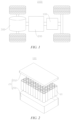
- FIG. 1 is a schematic structure diagram of a vehicle 1000 according to some embodiments of the present application.
- a battery 100 is provided inside the vehicle 1000, and the battery 100 may be arranged at the bottom, the head or the tail of the vehicle 1000.
- the battery 100 may be configured to supply power to the vehicle 1000.
- the battery 100 may serve as an operation power supply for the vehicle 1000.
- the vehicle 1000 may further include a controller 200 and a motor 300.
- the controller 200 is configured to control the battery 100 to supply power to the motor 300, for example, to meet working power requirements during starting, navigation and traveling of the vehicle 1000.
- the battery 100 can not only serve as an operation power supply for the vehicle 1000, but can also serve as a driving power supply for the vehicle 1000, in place of or partially in place of fuel or natural gas, to provide driving power for the vehicle 1000.
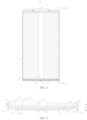
- FIG. 2 is an exploded view of a battery 100 according to some embodiments of the present application.
- the battery 100 includes a battery cell 10 and a case 20.
- the battery cell 10 is accommodated in the case 20.
- the case 20 herein is a component for accommodating the battery cells 10, the case 20 provides an accommodating space for the battery cells 10, and the case 20 may be of various structures.
- the case 20 may include a first portion 201 and a second portion 202.
- the first portion 201 and the second portion 202 fit to each other in a covering manner to define the accommodating space for accommodating the battery cells 10.
- the first portion 201 and the second portion 202 may be in various shapes, such as cuboid or cylindrical.
- the first portion 201 may be of a hollow structure with an open side
- the second portion 202 may also be of a hollow structure with an open side
- the open side of the second portion 202 covers the open side of the first portion 201 to form the case 20 having the accommodating space.
- the first portion 201 is of a hollow structure with an open side
- the second portion 202 is of a plate-like structure
- the second portion 202 covers the open side of the first portion 201 to form the case 20 having the accommodating space.
- the first portion 201 and the second portion 202 may be sealed by a sealing element which may be a seal ring, a sealant, etc.
- one or more battery cells 10 may be provided. If multiple battery cells 10 are provided, the multiple battery cells 10 may be connected in series, in parallel, or in series-parallel.
- the series-parallel connection refers that some of the multiple battery cells 10 are connected in series and the rest are connected in parallel.
- the multiple battery cells 10 may be connected in series, in parallel or in series-parallel to form a battery module, and then multiple battery modules are connected in series, in parallel or in series-parallel to form a unit and are accommodated in the case 20.
- all the battery cells 10 are directly connected in series, in parallel, or in series-parallel, and then a unit composed of all the battery cells 10 is accommodated in the case 20.
- the battery 100 may further include a busbar component, and the multiple battery cells 10 may be electrically connected to each other by means of the busbar component, so that the multiple battery cells 10 are connected in series, in parallel or in series-parallel.
- the busbar component may be a conductor made of metal, such as copper, iron, aluminum, stainless steel, or aluminum alloy.
- FIG. 3 is an exploded view of the battery cell 10 according to some embodiments of the present application
- FIG. 4 is a cross-sectional view of the battery cell 10 shown in FIG. 3
- the battery cell 10 may include a shell 1 and an electrode assembly 2.
- the shell 1 is a component for accommodating the electrode assembly 2.
- the shell 1 may be in various shapes, such as cylindrical or cuboid.
- the shell 1 may include a shell body 11 and an end cap 12.
- the shell body 11 may be of a hollow structure with an opening formed at one end.
- the shell body 11 may be made of various materials, such as copper, iron, aluminum, steel, or aluminum alloy.
- the end cap 12 is a component that closes the opening of the shell body 11 to isolate the internal environment of the battery cell 10 from the external environment.
- the end cap 12 and the shell body 11 jointly define a sealed space for accommodating the electrode assembly 2, an electrolyte and other components.
- the end cap 12 may be connected to the shell body 11 by means of welding or crimping to close the opening of the shell body 11.
- the end cap 12 may have a shape adapted to that of the shell 1.
- the shell body 11 is of a cuboid structure, and the end cap 12 is of a rectangular plate-like structure adapted to the shell 1.
- the shell body 11 is a cylinder, and the end cap 12 is of a circular plate-like structure adapted to the shell body 11.
- the end cap 12 may be made of various materials, such as copper, iron, aluminum, steel, or aluminum alloy.
- the electrode assembly 2 is a component in the battery cell 10 where an electrochemical reaction occurs.
- the electrode assembly 2 may include a positive electrode plate, a negative electrode plate, and a separator.
- the electrode assembly 2 may be of a wound structure formed by winding the positive electrode plate, the separator and the negative electrode plate, or may be a stacked structure formed by stacking the positive electrode plate, the separator and the negative electrode plate.
- the electrode assembly 2 is provided with tabs 21.
- the tabs 21 include a positive tab 21a and a negative tab 21b.
- the positive tab 21a may be a portion of the positive electrode plate that is not coated with a positive electrode active material layer
- the negative tab 21b may be a portion of the negative electrode plate that is not coated with a negative electrode active material layer.
- the battery cell 10 may further include an electrode terminal 3.
- the electrode terminal 3 is configured to be electrically connected to the tab 21 of the electrode assembly 2 to output the electric energy of the battery cell 10.
- the electrode terminal 3 may be arranged on the end cap 12 or on the shell 1.
- the electrode terminal 3 may be directly connected to the tab 21, for example, the electrode terminal 3 is directly welded to the tab 21.
- the electrode terminal 3 may also be indirectly connected to the tab 21, for example, the electrode terminal 3 may be indirectly connected to the tab 21 by means of a current collecting member 4.
- the current collecting member 4 may be a conductor made of metal such as copper, iron, aluminum, steel, or aluminum alloy.
- the positive tab 21a is electrically connected to the electrode terminal 3 by means of one current collecting member 4
- the negative tab 21b is electrically connected to the shell body 11 by means of another current collecting member 4.
- FIG. 5 is a partial enlarged view of the battery cell 10 shown in FIG. 4 .
- the embodiments of the present application provide a battery cell 10, including a shell 1 and an electrode assembly 2.
- the shell 1 accommodates the electrode assembly 2, the shell 1 includes a wall portion 13, and the wall portion 13 is arranged opposite the electrode assembly 2 in a thickness direction Z of the wall portion 13.
- the wall portion 13 is provided with a first reinforcement portion 131 in a protruding manner, the first reinforcement portion 131 extends in a circumferential direction of the wall portion 13, the wall portion 13 includes a first region 132 located on an outer circumferential side of the first reinforcement portion 131, a weak portion 1321 is formed in the first region 132, and the weak portion 1321 is configured to rupture during pressure relief of the battery cell 10.
- the wall portion 13 may be the end cap 12 of the shell 1, or may be a wall of the shell body 11 opposite the end cap 12.
- the wall portion 13 may be circular or rectangular. If the shell 1 is cylindrical, the wall portion 13 is circular; and if the shell 1 is cuboid, the wall portion 13 is rectangular. Taking an example in which the shell 1 is cylindrical, an axial direction of the shell 1 is a thickness direction Z of the wall portion 13.
- the wall portion 13 can serve as an electric energy output component of the battery cell 10, and the wall portion 13 is electrically connected to the electrode assembly 2 to output the electric energy of the battery cell 10.
- the wall portion 13 is the end cap 12, and the end cap 12 is electrically connected to the tab 21 of the electrode assembly 2 by means of the current collecting member 4.
- the wall portion 13 is provided with a first reinforcement portion 131 in a protruding manner, that is, the first reinforcement portion 131 is arranged on the wall portion 13 and protrudes from the wall portion 13.
- the first reinforcement portion 131 may be arranged, in a protruding manner, on a side of the wall portion 13 facing the electrode assembly 2, so that the first reinforcement portion 131 faces the inside of the battery cell 10, and the first reinforcement portion 131 may also be arranged, in a protruding manner, on a side of the wall portion 13 facing away from the electrode assembly 2, so that the first reinforcement portion 131 faces the outside of the battery cell 10.
- the first reinforcement portion 131 may be of a ring structure, such as a circular ring or a square ring. Taking an example in which the wall portion 13 is circular, a circular ring structure may be formed by the first reinforcement portion 131 extending in the circumferential direction of the wall portion 13.
- the first region 132 is a portion of the wall portion 13 located on the outer circumferential side of the first reinforcement portion 131.
- the outer circumferential side of the first reinforcement portion 131 is an outer side of the first reinforcement portion 131 in the thickness direction Z perpendicular to the wall portion 13. Taking an example in which the wall portion 13 is circular, the outer circumferential side of the first reinforcement portion 131 is an outer side of the first reinforcement portion 131 in a radial direction of the wall portion 13, and the first region 132 is a ring portion of the wall portion 13 surrounding the outer side of the first reinforcement portion 131.
- the weak portion 1321 is a weaker portion of the wall portion 13. In the wall portion 13, the weak portion 1321 is more likely to rupture than other regions. When the internal pressure of the battery cell 10 reaches the initiation pressure and needs to be released, the weak portion 1321 can rupture to discharge emissions inside the battery cell 10, so as to achieve the purpose of internal pressure relief of the battery cell 10.
- the wall portion 13 is provided with the first reinforcement portion 131 in a protruding manner, and the first reinforcement portion 131 has an effect of reinforcing the wall portion 13 to strengthen the weak portion 1321. Since the weak portion 1321 is formed in the first region 132 located on the outer circumferential side of the first reinforcement portion 131, when the wall portion 13 is subjected to an external force to cause deformation of the portion located on the inner circumferential side of the first reinforcement portion 131, the first reinforcement portion 131 can reduce the impact of the external force on the weak portion 1321 to reduce the deformation of the weak portion 1321 to ensure the normal initiation pressure of the battery cell 10, thereby prolonging the service life of the battery cell 10.
- the wall portion 13 further includes a second region 133 located on the inner circumferential side of the first reinforcement portion 131, and the second region 133 is provided with a filling port 1331.
- the filling port 1331 is arranged in the second region 133 of the wall portion 13 to facilitate the filling of the electrolyte into the battery cell 10.
- the second region 133 is a portion of the wall portion 13 located on the inner circumferential side of the first reinforcement portion 131.
- the first reinforcement portion 131 divides the wall portion 13 into two regions, one of which is the first region 132 located on the outer circumferential side of the first reinforcement portion 131, and the other is the second region 133 located on the inner circumferential side of the first reinforcement portion 131, the second region 133 being a central region of the wall portion 13.
- the inner circumferential side of the first reinforcement portion 131 is an inner side of the first reinforcement portion 131 in the thickness direction Z perpendicular to the wall portion 13.
- the inner circumferential side of the first reinforcement portion 131 is an inner side of the first reinforcement portion 131 in the radial direction of the wall portion 13, and the second region 133 is a portion of the wall portion 13 located on an inner side of the first reinforcement portion 131.
- the filling port 1331 is a channel provided in the second region 133 for the electrolyte to enter the battery cell 10.
- the filling port 1331 may be arranged at the center of the second region 133, or may be off the center of the second region 133. After the electrolyte is filled into the battery cell 10 through the filling port 1331, the filling port 1331 may be blocked by a sealing pin.
- the second region 133 is easy to deform toward the inside of the battery cell 10 when being subjected to a compressing force exerted by a filling apparatus (such as a filling needle), and the first reinforcement portion 131 can reduce the impact of deformation of the second region 133 on the weak portion 1321, so as to reduce the deformation of the weak portion 1321 to reduce the risk of rupture of the weak portion 1321 before reaching the initiation pressure due to the deformation of the weak portion 1321 during the process of filling the electrolyte into the battery cell 10 through the filling port 1331.
- a filling apparatus such as a filling needle
- the filling port 1331 is coaxially arranged with the first reinforcement portion 131.
- the filling port 1331 is arranged at the center of the second region 133.
- the filling port 1331 is configured such that the second region 133 is of a ring structure surrounding the inner side of the first reinforcement portion 131.
- the center line of the filling port 1331 coincides with the central axis of the first reinforcement portion 131.
- the diameter of the filling port 1331 may be 0.05-10 mm.
- the filling port 1331 is coaxially arranged with the first reinforcement portion 131, so that when the electrolyte is filled into the battery cell 10 through the filling port 1331, the second region 133 is subjected to a force and deformed toward the inside of the battery cell 10, and the force acting on the first reinforcement portion 131 is uniform, which reduces the risk of deformation of the weak portion 1321 due to the excessive force acting on a part of the first reinforcement portion 131 and thus can further reduce the deformation of the weak portion 1321.
- the first reinforcement portion 131 is arranged, in a protruding manner, on the side of the wall portion 13 facing the electrode assembly 2. In this way, the first reinforcement portion 131 faces the inside of the battery cell 10, which reduces the excessive external space occupied by the first reinforcement portion 131 to reduce the volume of the battery cell 10.
- the first reinforcement portion 131 abuts on the electrode assembly 2 in the thickness direction Z of the wall portion 13.
- first reinforcement portion 131 may directly abut on the electrode assembly 2, for example, the first reinforcement portion 131 directly abuts on the tab 21 of the electrode assembly 2; and the first reinforcement portion 131 may also indirectly abut on the electrode assembly 2, for example, as shown in FIG. 5 , the first reinforcement portion 131 indirectly abuts on the tab 21 of the electrode assembly 2 by means of the current collecting member 4.
- the electrode assembly 2 When the wall portion 13 is subjected to an external force to cause the portion located on the inner circumferential side of the first reinforcement portion 131 to deform toward the inside of the battery cell 10, since the first reinforcement portion 131 abuts on the electrode assembly 2, the electrode assembly 2 has an effect of restricting the first reinforcement portion 131 to reduce the risk of deformation of the weak portion 1321.
- the wall portion 13 in the thickness direction Z of the wall portion 13, is provided with a first recess 134 on a side facing away from the electrode assembly 2 and at a position corresponding to the first reinforcement portion 131.
- the first recess 134 has the same shape as the first reinforcement portion 131.
- the first recess 134 is also in the shape of a circular ring.
- the first recess 134 may be formed by stamping. After the first recess 134 is formed by stamping, the first reinforcement portion 131 may be formed correspondingly on the side of the wall portion 13 facing the electrode assembly 2.
- the first reinforcement portion 131 has a good buffering capacity, so that when the wall portion 13 is subjected to an external force to cause deformation of the portion located on the inner circumferential side of the first reinforcement portion 131, the first reinforcement portion 131 has a good buffering effect to prevent the transfer of the external force to the weak portion 1321 and thus further reduce the deformation of the weak portion 1321.
- FIG. 6 is a schematic structure diagram of the wall portion 13 shown in FIG. 5 .
- the width of the first reinforcement portion 131 in the radial direction of the wall portion 13 is represented by a 1
- the inner diameter of the first reinforcement portion 131 is represented by r 1
- the radius of the wall portion 13 is represented by R, which satisfy 0.05 ⁇ a 1 /R ⁇ 0.8 and/or 0.05 ⁇ r 1 /R ⁇ 0.8.
- the wall portion 13 is circular, and the first reinforcement portion 131 is in the shape of a circular ring. Half of the difference between the outer diameter and the inner diameter of the first reinforcement portion 131 is the width of the first reinforcement portion 131 in the radial direction of the wall portion 13.
- a 1 /R may be any value in the range of 0.05-0.8, for example, 0.05, 0.1, 0.2, 0.3, 0.4, 0.5, 0.6, 0.7, 0.8, etc.
- r 1 /R may also be any value in the range of 0.05-0.8, for example, 0.05, 0.1, 0.2, 0.3, 0.4, 0.5, 0.6, 0.7, 0.8, etc.
- the first region 132 is provided with a second reinforcement portion 135 in a protruding manner, and the second reinforcement portion 135 extends in the circumferential direction of the wall portion 13.
- the first region 132 includes a first connection portion 1322, the first connection portion 1322 connects the first reinforcement portion 131 with the second reinforcement portion 135, the first connection portion 1322 is located on the outer circumferential side of the first reinforcement portion 131, and the second reinforcement portion 135 is located on the outer circumferential side of the first connection portion 1322.
- the weak portion 1321 is formed at the first connection portion 1322.
- the second reinforcement portion 135 is arranged in the first region 132 and protrudes from the first region 132.
- the second reinforcement portion 135 may be arranged, in a protruding manner, on a side of the first region 132 facing the electrode assembly 2, so that the second reinforcement portion 135 faces the inside of the battery cell 10, and the second reinforcement portion 135 may also be arranged, in a protruding manner, on a side of the wall portion 13 facing away from the electrode assembly 2, so that the second reinforcement portion 135 faces the outside of the battery cell 10.
- the second reinforcement portion 135 surrounds the outer side of the first reinforcement portion 131, the second reinforcement portion 135 may be of a ring structure, such as a circular ring or a square ring, and the second reinforcement portion 135 is coaxially arranged with the first reinforcement portion 131.
- the wall portion 13 is circular, and the second reinforcement portion 135 and the first reinforcement portion 131 are both in the shape of a circular ring.
- the second reinforcement portion 135 is coaxially arranged with the first reinforcement portion 131.
- the first connection portion 1322 is a portion of the first region 132 connected to the first reinforcement portion 131 and the second reinforcement portion 135 in the thickness direction Z perpendicular to the wall portion 13.
- the first connection portion 1322 is connected to the second region 133 by means of the first reinforcement portion 131.
- the first connection portion 1322 is of a ring structure connected between the first reinforcement portion 131 and the second reinforcement portion 135.
- the first connection portion 1322 and the second region 133 are both of a flat plate structure, and the first connection portion 1322 is substantially flush with the second region 133 in the thickness direction Z of the wall portion 13.
- the weak portion 1321 is formed at the first connection portion 1322 connected between the first reinforcement portion 131 and the second reinforcement portion 135, and the second reinforcement portion 135 may also strengthen the weak portion 1321.
- the second reinforcement portion 135 is arranged, in a protruding manner, on the side of the first region 132 facing the electrode assembly 2, and in the thickness direction Z of the wall portion 13, the second reinforcement portion 135 includes a first surface 1351 facing the electrode assembly 2, the first surface 1351 abutting on the electrode assembly 2 to achieve electrical connection between the wall portion 13 and the electrode assembly 2.
- the first surface 1351 is an end surface of the second reinforcement portion 135 facing the electrode assembly 2 in the thickness direction Z of the wall portion 13.
- the first surface 1351 may directly abut on the electrode assembly 2, for example, the first surface 1351 directly abuts on the tab 21 of the electrode assembly 2 to achieve the electrical connection between the wall portion 13 and the electrode assembly 2; and the first surface 1351 may also indirectly abut on the electrode assembly 2, for example, as shown in FIG. 5 , the first surface 1351 directly abuts on the current collecting member 4, and the current collecting member 4 directly abuts on the tab 21 of the electrode assembly 2, so as to achieve the electrical connection between the wall portion 13 and the electrode assembly 2.
- the first surface 1351 of the second reinforcement portion 135 abuts on the electrode assembly 2, which on the one hand achieves the electrical connection between the wall portion 13 and the electrode assembly 2 to facilitate the output of electric energy of the battery cell 10 by means of the wall portion 13, and on the other hand allows the electrode assembly 2 to be supported by the second reinforcement portion 135 to improve the stability of the electrode assembly 2 inside the shell 1.
- the first reinforcement portion 131 does not extend beyond the first surface 1351 in a direction of the wall portion 13 pointing toward the electrode assembly 2.
- the direction of the wall portion 13 pointing toward the electrode assembly 2 is a direction of the wall portion 13 facing the electrode assembly 2 in the thickness direction Z.
- the first reinforcement portion 131 does not exceed the first surface 1351 to ensure that the first surface 1351 can effectively abut on the electrode assembly 2.
- the first reinforcement portion 131 in the thickness direction Z of the wall portion 13, includes a second surface 1311 facing the electrode assembly 2, the second surface 1311 being flush with the first surface 1351.
- the second surface 1311 is an end surface of the first reinforcement portion 131 facing the electrode assembly 2 in the thickness direction Z of the wall portion 13.
- the second surface 1311 is flush with the first surface 1351, so that the second surface 1311 and the first surface 1351 are in the same plane, and both the second surface 1311 and the first surface 1351 can abut on the electrode assembly 2.
- the current-passing area is increased. Taking an example in which both the second surface 1311 and the first surface 1351 directly abut on the current collecting member 4, and the current collecting member 4 directly abuts on the tab 21 of the electrode assembly 2, both the second surface 1311 and the first surface 1351 come into contact with the current collecting member 4, increasing the current-passing area between the current collecting member 4 and the wall portion 13.
- the first reinforcement portion 131 can abut on the electrode assembly 2, reducing the impact on the weak portion 1321 when the portion of the wall portion 13 located on the inner circumferential side of the first reinforcement portion 131 is subjected to a force.
- the second surface 1311 may also be farther away from the electrode assembly 2 than the first surface 1351.
- the wall portion 13 in the thickness direction Z of the wall portion 13, includes a third surface 1324 that faces away from the electrode assembly 2 and is farthest from the first surface 1351, and the first connection portion 1322 is located between the first surface 1351 and the third surface 1324 in the thickness direction Z of the wall portion 13.
- the third surface 1324 may be formed in the first region 132 or in the second region 133.
- the first connection portion 1322 is located between the first surface 1351 and the third surface 1324 in the thickness direction Z of the wall portion 13, making it difficult for the external force to directly act on the first connection portion 1322, so as to effectively reduce the impact of the external force on the weak portion 1321 during the production and use of the battery cell 10.
- the third surface 1324 of the wall portion 13 comes into contact with the object, and the first connection portion 1322 is in a suspended state and does not directly come into contact with the object to receive force, achieving the purpose of protecting the weak portion 1321.
- the first region 132 further includes an edge portion 1323.
- the edge portion 1323 is connected to the second reinforcement portion 135 and located on an outer circumferential side of the second reinforcement portion 135.
- a surface of the edge portion 1323 facing away from the electrode assembly 2 is the third surface 1324.
- the edge portion 1323 may be of a circular ring structure surrounding the second reinforcement portion 135, and the outer diameter of the edge portion 1323 is the diameter of the wall portion 13.
- the edge portion 1323 may be connected to the shell body 11 of the shell 1, for example, by welding, so that the end cap 12 blocks the opening of the shell body 11.
- the edge portion 1323 has an effect of protecting the first connection portion 1322, so that when the shell 1 is placed on the object, the edge portion 1323 comes into contact with the object, and the first connection portion 1322 is in a suspended state and does not directly come into contact with the object to receive force, making it difficult for the external force to directly act on the first connection portion 1322.
- a distance between the third surface 1324 and the first surface 1351 is represented by H
- the height of the first reinforcement portion 131 protruding from the wall portion 13 is represented by hi
- the height of the second reinforcement portion 135 protruding from the wall portion 13 is represented by h 2 , which satisfy 0.1 ⁇ h/H ⁇ 0.9 and/or 0.1 ⁇ h 2 /H ⁇ 0.9.
- h 1 /H may be any value in the range of 0.1-0.9, for example, 0.1, 0.2, 0.3, 0.4, 0.5, 0.6, 0.7, 0.8, 0.9, etc.
- h 2 /H may also be any value in the range of 0.1-0.9, for example, 0.1, 0.2, 0.3, 0.4, 0.5, 0.6, 0.7, 0.8, 0.9, etc.
- the first region 132 is provided with a second recess 136 on a side facing away from the electrode assembly 2 and at a position corresponding to the second reinforcement portion 135.
- the second recess 136 has the same shape as the second reinforcement portion 135.
- the second recess 136 is also in the shape of a circular ring.
- the second recess 136 may be formed by stamping. After the second recess 136 is formed by stamping, the second reinforcement portion 135 may be formed correspondingly on the side of the first region 132 facing the electrode assembly 2.
- the second reinforcement portion 135 has a good buffering capacity, so that when a region of the wall portion 13 located on the outer circumferential side of the second reinforcement portion 135 is subjected to an external force, the second reinforcement portion 135 has a good buffering effect to prevent the transfer of the external force to the weak portion 1321 and thus further reduce the deformation of the weak portion 1321.
- the wall portion 13 serves as the end cap 12 of the shell 1
- the edge portion 1323 of the wall portion 13 is subjected to the force exerted by the shell body 11, and the buffering effect of the second reinforcement portion 135 can reduce the deformation of the weak portion 1321 during this process.
- the second reinforcement portion 135 is welded to the electrode assembly 2 to achieve electrical connection between the wall portion 13 and the electrode assembly 2.
- the first surface 1351 of the second reinforcement portion 135 directly abuts on the tab 21 of the electrode assembly 2, and the second reinforcement portion 135 is welded to the tab 21 of the electrode assembly 2.
- welding the second reinforcement portion 135 to the electrode assembly 2 can effectively improve the stability of the electrical connection between the wall portion 13 and the electrode assembly 2.
- the second recess 136 may be regarded as a welding groove. Providing the second recess 136 may reduce the thickness of the second reinforcement portion 135, and can improve the firmness of welding between the second reinforcement portion 135 and the tab 21.
- the filling port 1331 is far away from the second protrusion, so that after the electrolyte is filled into the battery cell 10 through the filling port 1331, it is difficult for the residual electrolyte near the filling port 1331 to flow into the second recess 136, and thus it is less likely to affect the firmness of welding between the second reinforcement portion 135 and the tab 21.
- the first recess 134 can block the electrolyte from flowing into a second groove 32, which further reduces the risk of affecting the firmness of welding between the second reinforcement portion 135 and the tab 21 due to the residual electrolyte near the filling port 1331 flowing to the second recess 136.
- the battery cell 10 further includes a current collecting member 4, the current collecting member 4 is arranged between the wall portion 13 and the electrode assembly 2 in the thickness direction Z of the wall portion 13, the current collecting member 4 is connected to the electrode assembly 2, and the second reinforcement portion 135 is welded to the current collecting member 4, so as to achieve the electrical connection between the wall portion 13 and the electrode assembly 2.
- the current collecting member 4 may have the same shape as the wall portion 13. For example, both the wall portion 13 and the current collecting member 4 are circular.
- the current collecting member 4 is arranged between the tab 21 of the electrode assembly 2 and the wall portion 13, and the current collecting member 4 is connected to the tab 21.
- the current collecting member 4 is welded to the tab 21.
- the second reinforcement portion 135 is welded to the current collecting member 4, improving the stability of the electrical connection between the wall portion 13 and the electrode assembly 2.
- providing the second recess 136 may reduce the thickness of the second reinforcement portion 135, and can improve the firmness of welding between the second reinforcement portion 135 and the current collecting member 4.
- the filling port 1331 is arranged in the second region 133, since the filling port 1331 is arranged in the second region 133 while the second protrusion is arranged in the first region 132, the filling port 1331 is far away from the second protrusion, so that after the electrolyte is filled into the battery cell 10 through the filling port 1331, it is difficult for the residual electrolyte near the filling port 1331 to flow into the second recess 136, and thus it is less likely to affect the firmness of welding between the second reinforcement portion 135 and the current collecting member 4.
- the first recess 134 can block the electrolyte from flowing into the second groove 32, which further reduces the risk of affecting the firmness of welding between the second reinforcement portion 135 and the current collecting member 4 due to the residual electrolyte near the filling port 1331 flowing to the second recess 136.
- the width of the second reinforcement portion 135 is represented by a 2
- the radius of the wall portion 13 is represented by R
- a distance from an outer edge of the second reinforcement portion 135 to an outer edge of the wall portion 13 is represented by Li
- a distance between the first reinforcement portion 131 and the second reinforcement portion 135 is represented by L 2 , which satisfy 0.05 ⁇ a 2 /R ⁇ 0.8, and/or 0.02 ⁇ L 1 /R ⁇ 0.8, and/or 0.05 ⁇ L 2 /R ⁇ 0.8.
- the wall portion 13 is circular, and the second reinforcement portion 135 is in the shape of a circular ring.
- Half of the difference between the outer diameter and the inner diameter of the second reinforcement portion 135 is the width of the second reinforcement portion 135 in the radial direction of the wall portion 13.
- the distance between the outer edge of the first reinforcement portion 131 and the inner edge of the second reinforcement portion 135 is the distance between the first reinforcement portion 131 and the second reinforcement portion 135.
- an outer edge of the edge portion 1323 is the outer edge of the wall portion 13.
- a 2 /R may be any value in the range of 0.05-0.8, for example, 0.05, 0.1, 0.2, 0.3, 0.4, 0.5, 0.6, 0.7, 0.8, etc.
- L 1 /R may also be any value in a range of 0.02-0.8, for example, 0.02, 0.05, 0.1, 0.2, 0.3, 0.4, 0.5, 0.6, 0.7, 0.8, etc.
- L 2 /R may also be any value in a range of 0.05-0.8, for example, 0.05, 0.1, 0.2, 0.3, 0.4, 0.5, 0.6, 0.7, 0.8, etc.
- FIG. 7 is a schematic structure diagram of the wall portion 13 according to some other embodiments of the present application.
- a part of the first connection portion 1322 protrudes to form a third reinforcement portion 1325
- the third reinforcement portion 1325 extends in the circumferential direction of the wall portion 13
- the weak portion 1321 is formed at the third reinforcement portion 1325.
- the third reinforcement portion 1325 may be of a ring structure, such as a circular ring or a square ring. Taking an example in which the wall portion 13 is circular, a circular ring structure may be formed by the third reinforcement portion 1325 extending in the circumferential direction of the wall portion 13. The third reinforcement portion 1325 may be coaxially arranged with the first reinforcement portion 131. The first connection portion 1322 may form one or more third reinforcement portions 1325.
- a third recess 1326 is formed in the first connection portion 1322 at a position corresponding to the third reinforcement portion 1325, and the third recess 1326 has the same shape as the third reinforcement portion 1325.
- the third recess 1326 may be formed by stamping. In the thickness direction Z of the wall portion 13, after the second recess 136 is formed by stamping on one side of the first connection portion 1322, the third reinforcement portion 1325 may be correspondingly formed on the other side of the first connection portion 1322.
- the first reinforcement portion 131, the second reinforcement portion 135 and the third reinforcement portion 1325 may be located on the same side or different sides of the wall portion 13.
- the first reinforcement portion 131, the second reinforcement portion 135 and the third reinforcement portion 1325 are located on the same side of the wall portion 13, and all face the electrode assembly 2 (not shown in FIG. 7 ).
- the third reinforcement portion 1325 is also located between the first surface 1351 and the third surface 1324 in the thickness direction Z of the wall portion 13.
- the third reinforcement portion 1325 can strengthen the first connection portion 1322 and thus further reduce the impact on the weak portion 1321 due to the deformation of the wall portion 13 by force.
- the weak portion 1321 may also be formed in other regions of the first connection portion 1322 except for the third reinforcement portion 1325.
- the width of the third reinforcement portion 1325 in the radial direction of the wall portion 13 is represented by a 3
- the radius of the wall portion 13 is represented by R, which satisfy 0.05 ⁇ a 3 /R ⁇ 0.8.
- the wall portion 13 is circular, and the third reinforcement portion 1325 is in the shape of a circular ring. Half of the difference between the outer diameter and the inner diameter of the third reinforcement portion 1325 is the width of the third reinforcement portion 1325 in the radial direction of the wall portion 13.
- a 3 /R may be any value in the range of 0.05-0.8, for example, 0.05, 0.1, 0.2, 0.3, 0.4, 0.5, 0.6, 0.7, 0.8, etc.
- the first region 132 is provided with an indentation 1327, and a weak portion 1321 is formed in the first region 132 at a position where the indentation 1327 is provided.
- the weak portion 1321 has the same shape as the indentation 1327.
- the indentation 1327 may be in various shapes, for example, be rectangular, circular, oval, ring-shaped, U-shaped, C-shaped, H-shaped, etc.
- the indentation 1327 may be formed in various ways, such as stamping or milling.
- the weak portion 1321 is correspondingly formed by means of providing the indentation 1327 in the first region 132, so that the weak portion 1321 is thinner than other regions and is more likely to rupture, and the weak portion 1321 is formed by a simple forming method.
- FIG. 8 is a top view of the wall portion 13 shown in FIG. 6 .
- the indentation 1327 is arranged around the first reinforcement portion 131, and the indentation 1327 is of a non-closed structure with a distance between two ends.
- the indentation 1327 is C-shaped.
- the wall portion 13 can be turned outward to open in a region defined by the indentation 1327 during pressure relief of the battery cell 10, so that the battery cell 10 has a large pressure relief area, improving the pressure relief efficiency.
- the indentation 1327 is arranged around the first reinforcement portion 131, and the indentation 1327 is of a closed structure connected end-to-end.
- the indentation 1327 is in the shape of a circular ring.
- the wall portion 13 can be separated outward to open in the region defined by the indentation 1327 during pressure relief of the battery cell 10, so that the battery cell 10 has a large pressure relief area, improving the pressure relief efficiency.
- FIG. 9 is a cross-sectional view of a battery cell 10 according to some other embodiments of the present application.
- the shell 1 includes a shell body 11 and an end cap 12, an opening is formed at one end of the shell body 11, the shell body 11 includes a bottom wall 111 opposite the opening, and the end cap 12 is connected to the shell body 11 and closes the opening.
- One of the bottom wall 111 and the end cap 12 is the wall portion 13. If the bottom wall 111 of the shell body 11 serves as the wall portion 13, the bottom wall 111 of the shell body 11 has a pressure relief capability; and if the end cap 12 of the shell 1 serves as the wall portion 13, the end cap 12 has a pressure relief capability.
- the end cap 12 serves as the wall portion 13.
- the battery cell 10 further includes an electrode terminal 3, and in the thickness direction Z of the wall portion 13, the electrode terminal 3 is arranged at an end of the shell 1 opposite the wall portion 13, and the electrode terminal 3 is electrically connected to the electrode assembly 2.
- the electrode terminal 3 may be directly connected to the electrode assembly 2, for example, the electrode terminal 3 is welded to the tab 21 of the electrode assembly 2. As shown in FIG. 9 , the electrode terminal 3 may also be indirectly connected to the electrode assembly 2 by means of the current collecting member 4.
- the electrode terminal 3 is arranged on the end cap 12, and the electrode terminal 3 is riveted to the end cap 12 and remains insulated from the end cap 12.
- the electrode terminal 3 is arranged on the bottom wall 111 of the shell body 11, and the electrode terminal 3 is riveted to the bottom wall 111 of the shell body 11 and remains insulated from the bottom wall 111.
- the electric energy of the battery cell 10 can be conveniently output by means of the electrode terminal 3.
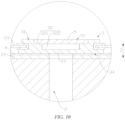
- FIG. 10 is a partial enlarged view of part A of the battery cell 10 shown in FIG. 9 .
- the electrode terminal 3 includes a first outer surface 31 facing away from the electrode assembly 2 in the thickness direction Z of the wall portion 13, the electrode terminal 3 is provided with a groove 32 that is recessed from the first outer surface 31 toward the electrode assembly 2, a second connection portion 33 is formed in the electrode terminal 3 at a position where the groove 32 is provided, and the second connection portion 33 is connected to the electrode assembly 2.
- the first outer surface 31 is an end surface of an end of the electrode terminal 3 facing away from the electrode assembly 2 in the thickness direction Z of the wall portion 13.
- the electrode terminal 3 further includes a first inner surface 34 opposite the first outer surface 31, and a portion of the electrode terminal 3 located between a bottom surface of the groove 32 and the first inner surface 34 is the second connection portion 33.
- the second connection portion 33 is indirectly connected to the tab 21 of the electrode assembly 2 by means of the current collecting member 4, the second connection portion 33 is welded to the current collecting member 4, and the current collecting member 4 is welded to the tab 21 of the electrode assembly 2.
- the filling port 1331 is provided in the second region 133 of the wall portion 13
- providing the filling port 1331 in the electrode terminal 3 prevents insufficient soldering on the electrode terminal 3 caused by the residual electrolyte near the filling port 1331 when the filling port 1331 is arranged in the electrode terminal 3.
- providing the groove 32 in the electrode terminal 3 reduces the weight of the electrode terminal 3 and reduces the production cost.
- the second connection portion 33 of the electrode terminal 3 is thinner, which can achieve the external welding for the electrode terminal 3, improving the stability of the electrical connection between the electrode terminal 3 and the electrode assembly 2.
- the battery cell 10 further includes a blocking member 5, and the blocking member 5 is connected to the electrode terminal 3 and blocks the groove 32.
- the blocking member 5 includes a second outer surface 51 facing away from the electrode assembly 2, and the second outer surface 51 is flush with the first outer surface 31.
- the blocking member 5 may be made of metal, such as copper, iron, aluminum, stainless steel, or aluminum alloy.
- the blocking member 5 may be welded and fixed to the electrode terminal 3.
- the groove 32 includes a first groove 321 and a second groove 322.
- the first groove 321 and the second groove 322 are arranged in a depth direction of the groove 32, the first groove 321 is recessed from the first outer surface 31 in the depth direction of the groove 32, the second groove 322 is recessed from a bottom surface of the first groove 321 in the depth direction of the groove 32, a bottom surface of the second groove 322 is the bottom surface of the groove 32, and the blocking member 5 abuts against the bottom surface of the first groove 321 to block the groove 32.
- the second outer surface 51 of the blocking member 5 and the first outer surface 31 of the electrode terminal 3 can jointly form a flat interface, which is conducive to welding with other components (such as a busbar component) to achieve a large current-passing area.
- the second outer surface 51 is flush with the first outer surface 31, which facilitates butt-welding between the blocking member 5 and the electrode terminal 3.
- the embodiments of the present application provide a battery 100, including a case 20 and a battery cell 10 according to any one of the embodiments described above.
- the battery cell 10 is accommodated in the case 20.
- the embodiments of the present application further provide a power consuming device, including the battery 100 according to any one of the embodiments described above.
- the embodiments of the present application further provide a cylindrical battery 100, including a shell 1, an electrode assembly 2, an electrode terminal 3 and a current collecting member 4.
- the electrode assembly 2 is accommodated in the shell 1.
- the shell 1 includes a shell body 11 and an end cap 12.
- the shell body 11 is provided with an opening, and the end cap 12 closes the opening of the shell body 11.
- the end cap 12 is provided with a first reinforcement portion 131 in a protruding manner.
- the end cap 12 includes a first region 132 located on an outer circumferential side of the first reinforcement portion 131 and a second region 133 located on an inner circumferential side of the first reinforcement portion 131.
- the first region 132 is provided with a second reinforcement portion 135 in a protruding manner, and both the first reinforcement portion 131 and the second reinforcement portion 135 extend in a circumferential direction of the end cap 12.
- the second region 133 includes a first connection portion 1322 that connects the first reinforcement portion 131 with the second reinforcement portion 135.
- the first connection portion 1322 is located on the outer circumferential side of the first reinforcement portion 131, and the second reinforcement portion 135 is located on an outer circumferential side of the first connection portion 1322.
- a weak portion 1321 is formed in the first connection portion 1322, and the weak portion 1321 is configured to rupture during pressure relief of the battery cell 10.
- the second region 133 is provided with a filling port 1331.
- the electrode terminal 3 is arranged on an end of the shell 1 opposite the end cap 12.
- a positive tab 21a of the electrode assembly 2 is electrically connected to the electrode terminal 3 by means of a current collecting member 4, and a negative tab 21b of the electrode assembly 2 is electrically connected to the second reinforcement portion 135 by means of another current collecting member 4.
- the second region 133 is easy to deform toward the inside of the battery cell 10 when being subjected to a compressing force exerted by a filling apparatus, and the first reinforcement portion 131 can reduce the impact of deformation of the second region 133 on the weak portion 1321, so as to reduce the deformation of the weak portion 1321 to reduce the risk of rupture of the weak portion 1321 before reaching the initiation pressure due to the deformation of the weak portion 1321 during the process of filling the electrolyte into the battery cell 10 through the filling port 1331, thereby prolonging the service life of the battery cell 10.
Landscapes
- Chemical & Material Sciences (AREA)
- Chemical Kinetics & Catalysis (AREA)
- Electrochemistry (AREA)
- General Chemical & Material Sciences (AREA)
- Engineering & Computer Science (AREA)
- Manufacturing & Machinery (AREA)
- Materials Engineering (AREA)
- Sealing Battery Cases Or Jackets (AREA)
Abstract
Description
- The present application relates to the technical field of batteries, and in particular to a battery cell, a battery and a power consuming device.
- At present, with the development of new energy technology, batteries are becoming more and more widely used, for example, in mobile phones, notebook computers, electric mopeds, electric vehicles, electric aircrafts, electric ships, electric toy cars, electric toy ships, electric toy aircrafts, electric tools, etc.
- A battery cell, as an energy storage element, generally outputs electric energy through a chemical reaction between an electrode assembly and an electrolyte. In the battery technology, it is necessary to consider not only the safety of the battery cell, but also the service life of the battery cell. Therefore, how to prolong the service life of the battery cell is an urgent problem to be solved in the battery technology.
- The embodiments of the present application provide a battery cell, a battery and a power consuming device, which can effectively prolong the service life of the battery cell.
- In a first aspect, the embodiments of the present application provide a battery cell, including an electrode assembly and a shell, the shell accommodating the electrode assembly, and including a wall portion that is arranged opposite the electrode assembly in a thickness direction of the wall portion, wherein the wall portion is provided with a first reinforcement portion in a protruding manner, the first reinforcement portion extends in a circumferential direction of the wall portion, the wall portion includes a first region located on an outer circumferential side of the first reinforcement portion, and a weak portion is formed in the first region and is configured to rupture during pressure relief of the battery cell.
- In the technical solution described above, the wall portion is provided with the first reinforcement portion in a protruding manner, and the first reinforcement portion has an effect of reinforcing the wall portion to strengthen the weak portion. Since the weak portion is formed in the first region located on the outer circumferential side of the first reinforcement portion, when the wall portion is subjected to an external force to cause deformation of the portion located on an inner circumferential side of the first reinforcement portion, the first reinforcement portion can reduce the impact of the external force on the weak portion to reduce the deformation of the weak portion to ensure the normal initiation pressure of the battery cell, thereby prolonging the service life of the battery cell.
- In some embodiments, the wall portion further includes a second region located on the inner circumferential side of the first reinforcement portion, and the second region is provided with a filling port. The filling port is arranged in the second region of the wall portion to facilitate the filling of an electrolyte into the battery cell. When the electrolyte is filled into the battery cell through the filling port, the second region is easy to deform toward the inside of the battery cell when being subjected to a compressing force exerted by a filling apparatus, and the first reinforcement portion can reduce the impact of deformation of the second region on the weak portion, so as to reduce the deformation of the weak portion to reduce the risk of rupture of the weak portion before reaching the initiation pressure due to the deformation of the weak portion during the process of filling the electrolyte into the battery cell through the filling port.
- In some embodiments, the filling port is coaxially arranged with the first reinforcement portion. In this way, when the electrolyte is filled into the battery cell through the filling port, the force acting on the first reinforcement portion is uniform, which can further reduce the deformation of the weak portion.
- In some embodiments, in the thickness direction of the wall portion, the first reinforcement portion is arranged, in a protruding manner, on a side of the wall portion facing the electrode assembly. In this way, the first reinforcement portion faces the inside of the battery cell, which reduces the excessive external space occupied by the first reinforcement portion to reduce the volume of the battery cell.
- In some embodiments, the first reinforcement portion abuts on the electrode assembly in the thickness direction of the wall portion. When the wall portion is subjected to the external force to cause the portion located on the inner circumferential side of the first reinforcement portion to deform toward the inside of the battery cell, since the first reinforcement portion abuts on the electrode assembly, the electrode assembly has an effect of restricting the first reinforcement portion to reduce the risk of deformation of the weak portion.
- In some embodiments, in the thickness direction of the wall portion, the wall portion is provided with a first recess on a side facing away from the electrode assembly and at a position corresponding to the first reinforcement portion. With the first recess, the first reinforcement portion has a good buffering capacity, so that when the wall portion is subjected to an external force to cause deformation of the portion located on the inner circumferential side of the first reinforcement portion, the first reinforcement portion has a good buffering effect to prevent the transfer of the external force to the weak portion and thus further reduce the deformation of the weak portion.
- In some embodiments, the width of the first reinforcement portion in a radial direction of the wall portion is represented by a1, the inner diameter of the first reinforcement portion is represented by r1, and the radius of the wall portion is represented by R, which satisfy 0.05 ≤ a1/R ≤ 0.8 and/or 0.05 ≤ r1/R ≤ 0.8.
- In some embodiments, the first region is provided with a second reinforcement portion in a protruding manner, the second reinforcement portion extending in a circumferential direction of the wall portion; and the first region includes a first connection portion that connects the first reinforcement portion with the second reinforcement portion, the first connection portion being located on the outer circumferential side of the first reinforcement portion, and the second reinforcement portion being located on an outer circumferential side of the first connection portion, wherein the weak portion is formed at the first connection portion. The weak portion is formed at the first connection portion connected between the first reinforcement portion and the second reinforcement portion, and the second reinforcement portion can also strengthen the weak portion.
- In some embodiments, the second reinforcement portion is arranged, in a protruding manner, on a side of the first region facing the electrode assembly, and in the thickness direction of the wall portion, the second reinforcement portion has a first surface facing the electrode assembly, the first surface abutting on the electrode assembly to achieve electrical connection between the wall portion and the electrode assembly. The first surface abuts on the electrode assembly, which on the one hand achieves the electrical connection between the wall portion and the electrode assembly to facilitate the output of electric energy of the battery cell by means of the wall portion, and on the other hand allows the electrode assembly to be supported by the second reinforcement portion to improve the stability of the electrode assembly inside the shell.
- In some embodiments, the first reinforcement portion does not extend beyond the first surface in a direction of the wall portion pointing toward the electrode assembly. This ensures that the first surface can effectively abut on the electrode assembly.
- In some embodiments, in the thickness direction of the wall portion, the first reinforcement portion includes a second surface facing the electrode assembly, the second surface being flush with the first surface. In this way, both the second surface and the first surface can abut on the electrode assembly, which on the one hand increases the current-passing area, and on the other hand allows the first reinforcement portion to abut on the electrode assembly to reduce the impact on the weak portion when the portion of the wall portion located on the inner circumferential side of the first reinforcement portion is subjected to a force.
- In some embodiments, in the thickness direction of the wall portion, the wall portion includes a third surface that faces away from the electrode assembly and is farthest from the first surface, and the first connection portion is located between the first surface and the third surface in the thickness direction of the wall portion. In this way, the first connection portion is located between the first surface and the third surface in the thickness direction of the wall portion, making it difficult for an external force to directly act on the first connection portion, so as to effectively reduce the impact of the external force on the weak portion during the production and use of the battery cell.
- In some embodiments, the first region further includes an edge portion, which is connected to the second reinforcement portion and located on an outer circumferential side of the second reinforcement portion; and a surface of the edge portion facing away from the electrode assembly in the thickness direction of the wall portion is a third surface. The edge portion has an effect of protecting the first connection portion, making it difficult for an external force to directly act on the first connection portion.
- In some embodiments, in the thickness direction of the wall portion, a distance between the third surface and the first surface is represented by H, the height of the first reinforcement portion protruding from the wall portion is represented by hi, and the height of the second reinforcement portion protruding from the wall portion is represented by h2, which satisfy 0.1 ≤ h1/H ≤ 0.9 and/or 0.1 ≤ h2/H ≤ 0.9.
- In some embodiments, in the thickness direction of the wall portion, the first region is provided with a second recess on a side away from the electrode assembly and at a position corresponding to the second reinforcement portion. With the second recess, the second reinforcement portion has a good buffering capacity, so that when the region of the wall portion located on the outer circumferential side of the second reinforcement portion is subjected to an external force, the second reinforcement portion has a good buffering effect to prevent the transfer of the external force to the weak portion and thus further reduce the deformation of the weak portion.
- In some embodiments, the second reinforcement portion is welded to the electrode assembly to achieve electrical connection between the wall portion and the electrode assembly; or the battery cell further includes a current collecting member, which is arranged between the wall portion and the electrode assembly in the thickness direction of the wall portion and is connected to the electrode assembly, and the second reinforcement portion is welded to the current collecting member, so as to achieve the electrical connection between the wall portion and the electrode assembly. Whether the second reinforcement portion is welded to the electrode assembly or to the current collecting member, the stability of the electrical connection between the wall portion and the electrode assembly can be improved.
- In some embodiments, in the radial direction of the wall portion, the width of the second reinforcement portion is represented by a2, the radius of the wall portion is represented by R, a distance from an outer edge of the second reinforcement portion to an outer edge of the wall portion is represented by Li, and a distance between the first reinforcement portion and the second reinforcement portion is represented by L2, which satisfy 0.05 ≤ a2/R ≤ 0.8, and/or 0.02 ≤ L1/R ≤ 0.8, and/or 0.05 ≤ L2/R ≤ 0.8.
- In some embodiments, in the thickness direction of the wall portion, a part of the first connection portion protrudes to form a third reinforcement portion, the third reinforcement portion extends in the circumferential direction of the wall portion, and the weak portion is formed at the third reinforcement portion. The third reinforcement portion can strengthen the first connection portion and thus further reduce the impact on the weak portion due to the deformation of the wall portion by force.
- In some embodiments, the width of the third reinforcement portion in the radial direction of the wall portion is represented by a3, and the radius of the wall portion is represented by R, which satisfy 0.05 ≤ a3/R ≤ 0.8.
- In some embodiments, the first region is provided with an indentation, and a weak portion is formed in the first region at a position where the indentation is provided. The weak portion is correspondingly formed by means of providing the indentation in the first region, so that the weak portion is thinner than other regions and is more likely to rupture, and the weak portion is formed by a simple forming method.
- In some embodiments, the indentation is arranged around the first reinforcement portion; and the indentation is of a non-closed structure with a distance between two ends, or the indentation is of a closed structure connected end-to-end. In this way, the wall portion can be opened in a region defined by the indentation during pressure relief of the battery cell, so that the battery cell has a large pressure relief area, improving the pressure relief efficiency.
- In some embodiments, the shell includes a shell body and an end cap; an opening is formed at one end of the shell body, and the shell body includes a bottom wall opposite the opening; and the end cap is connected to the shell body and closes the opening, wherein one of the bottom wall and the end cap is the wall portion. The bottom wall of the shell body may serve as the wall portion, so that the bottom wall of the shell body has a pressure relief capability; or the end cap of the shell may serve as the wall portion, so that the end cap has a pressure relief capability.
- In some embodiments, the battery cell further includes an electrode terminal, which is arranged at an end of the shell opposite the wall portion in the thickness direction of the wall portion and is electrically connected to the electrode assembly. The electric energy of the battery cell can be conveniently output by means of the electrode terminal.
- In some embodiments, the electrode terminal includes a first outer surface facing away from the electrode assembly in the thickness direction of the wall portion, the electrode terminal is provided with a groove that is recessed from the first outer surface toward the electrode assembly, a second connection portion is formed in the electrode terminal at a position where the groove is provided, and the second connection portion is connected to the electrode assembly. Providing the groove in the electrode terminal reduces the weight of the electrode terminal and reduces the production cost. In addition, since the electrode terminal is provided with the groove, the second connection portion of the electrode terminal is thinner, which can achieve the external welding for the electrode terminal, improving the stability of the electrical connection between the electrode terminal and the electrode assembly.
- In some embodiments, the battery cell further includes a blocking member, which is connected to the electrode terminal and blocks the groove; and in the thickness direction of the wall portion, the blocking member includes a second outer surface facing away from the electrode assembly, the second outer surface being flush with the first outer surface. The second outer surface of the blocking member and the first outer surface of the electrode terminal can jointly form a flat interface, which is conducive to welding with other components to achieve large current-passing area.
- In a second aspect, the embodiments of the present application provide a battery, including a case and a battery cell provided in any one of the embodiments in the first aspect, the battery cell being accommodated in the case.
- In a third aspect, the embodiments of the present application further provide a power consuming device, including a battery provided in any one of the embodiments in the second aspect.
- In order to more clearly describe the technical solutions of embodiments of the present application, the accompanying drawings required in the embodiments will be described briefly below. It should be understood that the following drawings illustrate only some embodiments of the present application and thus should not be construed as a limitation on the scope thereof. For those of ordinary skill in the art, other relevant drawings can also be obtained from these drawings without involving any inventive effort.
-
FIG. 1 is a schematic structure diagram of a vehicle according to some embodiments of the present application; -
FIG. 2 is an exploded view of a battery according to some embodiments of the present application; -
FIG. 3 is an exploded view of a battery cell according to some embodiments of the present application; -
FIG. 4 is a cross-sectional view of the battery cell shown inFIG. 3 ; -
FIG. 5 is a partial enlarged view of the battery cell shown inFIG. 4 ; -
FIG. 6 is a schematic structure diagram of a wall portion shown inFIG. 5 ; -
FIG. 7 is a schematic structure diagram of a wall portion according to some other embodiments of the present application; -
FIG. 8 is a top view of the wall portion shown inFIG. 6 ; -
FIG. 9 is a cross-sectional view of a battery cell according to some other embodiments of the present application; and -
FIG. 10 is a partial enlarged view of part A of the battery cell shown inFIG. 9 . - List of reference signs: 1 - shell; 11 - shell body; 111 - bottom wall; 12 - end cap; 13 - wall portion; 131 - first reinforcement portion; 1311 - second surface; 132 - first region; 1321 - weak portion; 1322 - first connection portion; 1323 - edge portion; 1324 - third surface; 1325 - third reinforcement portion; 1326 - third recess; 1327 - indentation; 133 - second region; 1331 - filling port; 134 - first recess; 135 - second reinforcement portion; 1351 - first surface; 136 - second recess; 2 - electrode assembly; 21 - tab; 21a - positive tab; 21b - negative tab; 3 - electrode terminal; 31 - first outer surface; 32 - groove; 321 - first groove; 322 - second groove; 33 - second connection portion; 34 - first inner surface; 4 - current collecting member; 5 - blocking member; 51 - second outer surface; 10 - battery cell; 20 - case; 201 - first portion; 202 - second portion; 100 - battery; 200 - controller; 300 - motor; 1000 - vehicle; Z - thickness direction.
- In order to make the objectives, technical solutions and advantages of the embodiments of the present application clearer, the technical solutions in the embodiments of the present application will be described clearly below with reference to the drawings in the embodiments of the present application. Apparently, the embodiments described are some of, but not all, the embodiments of the present application. All other embodiments obtained by those of ordinary skill in the art based on the embodiments of the present application without involving any inventive effort shall fall within the scope of protection of the present application.
- Unless otherwise defined, all technical and scientific terms used in the present application have the same meanings as those commonly understood by those skilled in the art to which the present application belongs. The terms used in the description of the present application are merely for the purpose of describing specific embodiments, but are not intended to limit the present application. The terms "comprising" and "including" and any variations thereof in the description and the claims of the present application as well as the brief description of the accompanying drawings described above are intended to cover non-exclusive inclusion. The terms "first", "second", etc. in the description and the claims of the present application as well as the foregoing accompanying drawings are used to distinguish between different objects, rather than describing a specific order or a primary-secondary relationship.
- In the present application, the phrase "embodiment" mentioned means that the specific features, structures and characteristics described with reference to the embodiments may be included in at least one embodiment of the present application. The phrase at various locations in the description does not necessarily refer to the same embodiment, or an independent or alternative embodiment exclusive of another embodiment.
- In the description of the present application, it should be noted that, the terms "mount", "connected", "connect", or "attach" should be interpreted in a broad sense unless explicitly defined and limited otherwise. For example, they may be a fixed connection, a detachable connection, or an integral connection; or may be a direct connection, an indirect connection by means of an intermediate medium, or internal communication between two elements. For those of ordinary skill in the art, the specific meanings of the foregoing terms in the present application may be understood according to specific circumstances.
- The term "and/or" in the present application is merely a description of the associated relationship of associated objects, representing that three relationships may exist, for example, A and/or B, may be expressed as: only A exists, both A and B exist, and only B exists. In addition, the character "/" in the present application generally indicates that the associated objects before and after the character are in a relationship of "or".
- In the embodiments of the present application, the same reference numerals denote the same components, and for the sake of brevity, the detailed description of the same components is omitted in different embodiments. It should be understood that the dimensions, such as thickness, length and width, of the various components in the embodiments of the present application illustrated in the accompanying drawings, as well as the dimensions, such as an overall thickness, length and width, of an integrated apparatus are merely illustrative and should not be construed to limit the present application in any way.
- The phrase "multiple" appearing in the present application means two or more (including two).
- In the present application, a battery cell may include a lithium-ion secondary battery, a lithium-ion primary battery, a lithium-sulfur battery, a sodium/lithium- ion battery, a sodium-ion battery or a magnesium-ion battery, etc., which is not limited by the embodiments of the present application. The battery cell may be cylindrical, flat, cuboid or in other shapes, which will also not be limited in the embodiments of the present application. The battery cells are generally classified into three types depending on the way of package: cylindrical battery cells, prismatic battery cells and pouch battery cells, which will also not be limited in the embodiments of the present application.
- A battery mentioned in the embodiments of the present application refers to a single physical module including one or more battery cells to provide a higher voltage and capacity. For example, the battery mentioned in the present application may include a battery module, a battery pack, etc. The battery generally includes a case for packaging one or more battery cells. The case can prevent liquid or other foreign matters from affecting charging or discharging of the battery cell(s).
- The battery cell includes an electrode assembly and an electrolyte. The electrode assembly is composed of a positive electrode plate, a negative electrode plate, and a separator. The operation of the battery cell mainly relies on the movement of metal ions between the positive electrode plate and the negative electrode plate. The positive electrode plate includes a positive current collector and a positive active material layer. A surface of the positive current collector is coated with the positive active material layer, the positive current collector not coated with the positive active material layer protrudes from the positive current collector coated with the positive active material layer, and the positive current collector not coated with the positive active material layer serves as a positive tab. Taking a lithium ion battery as an example, the positive electrode current collector may be made of aluminum, and the positive electrode active material may be lithium cobalt oxide, lithium iron phosphate, ternary lithium, lithium manganate, etc. The negative electrode plate includes a negative current collector and a negative active material layer. A surface of the negative current collector is coated with the negative active material layer, the negative current collector that is not coated with the negative active material layer protrudes from the negative current collector coated with the negative active material layer, and the negative current collector that is not coated with the negative active material layer is used as a negative tab. The negative electrode current collector may be made of copper, and the negative electrode active material may be carbon, silicon, etc. In order to ensure that no fusing occurs when a large current passes, multiple positive tabs are provided and are stacked together, and multiple negative tabs are provided and are stacked together. The separator may be made of polypropylene (PP) or polyethylene (PE), etc. In addition, the electrode assembly may be of a wound structure or a laminated structure, which will not be limited in the embodiments of the present application.
- Design factors on many aspects need to be simultaneously considered for the development of the battery technology, such as energy density, cycling life, discharge capacity, charge-discharge rate, and other performance parameters. In addition, the safety of the battery needs to be considered.
- With regard to the battery cell, in order to improve the safety of the battery cell, a pressure relief mechanism may be provided in the battery cell, and when the internal pressure of the battery cell reaches an initiation pressure, the internal pressure of the battery cell is released by means of the pressure relief mechanism.
- In order to reduce the manufacturing cost of the pressure relief mechanism, a part of a wall portion of a shell may form a weak portion, so as to form a pressure relief mechanism, and when the internal pressure of the battery cell reaches the initiation pressure, the weak portion is ruptured to achieve the purpose of pressure relief.
- The inventors have noticed that, for the battery cell in which the pressure relief mechanism is formed by the weak portion of the wall portion, it is easy for the weak portion to rupture abnormally when the internal pressure of the battery cell does not reach the initiation pressure, shortening the service life of the battery cell.
- The inventors have found through further research that the wall portion is easy to deform by an external force during normal use of the battery cell to cause deformation of the weak portion, so that the strength of the weak portion is reduced to result in the abnormal rupture of the weak portion. For example, the wall portion is subjected to a force exerted by other components outside the battery cell to cause a central region of the wall portion to deform toward the inside of the battery cell, so that the strength of the weak portion is reduced. For another example, the internal pressure of the battery cell increases as the temperature rises, and the wall portion is subjected to a force exerted by the gas inside the battery cell to cause the central region of the wall portion to deform toward the outside of the battery cell, so that the strength of the weak portion is reduced. These finally affect the service life of the battery cell.
- In view of this, the embodiments of the present application provide a battery cell. A wall portion of a shell is provided with a first reinforcement portion in a protruding manner that extends in a circumferential direction of the wall portion, a first region is formed in the wall portion on an outer circumferential side of the first reinforcement portion, and a weak portion is formed in the first region.
- In such a battery cell, the wall portion is provided with the first reinforcement portion in a protruding manner, and the first reinforcement portion has an effect of reinforcing the wall portion to strengthen the weak portion. Since the weak portion is formed in the first region located on the outer circumferential side of the first reinforcement portion, when the wall portion is subjected to an external force to cause deformation of the portion located on an inner circumferential side of the first reinforcement portion, the first reinforcement portion can reduce the impact of the external force on the weak portion to reduce the deformation of the weak portion to ensure the normal initiation pressure of the battery cell, thereby prolonging the service life of the battery cell.
- The technical solutions described in the embodiments of the present application are applicable to a battery and a power consuming device using the battery.
- The power consuming device may be a vehicle, a mobile phone, a portable device, a notebook computer, a ship, a spacecraft, an electric toy, a power tool, etc. The vehicle may be a fuel vehicle, a gas vehicle or a new energy vehicle. The new energy vehicle may be a battery electric vehicle, a hybrid vehicle, an extended range vehicle, etc. The spacecraft includes an airplane, a rocket, an aerospace plane, a spaceship, etc. The electric toy includes a stationary or mobile electric toy, such as a game machine, an electric toy car, an electric toy ship, and an electric toy airplane. The electric tool includes a metal cutting electric tool, a grinding electric tool, an assembly electric tool, and a railway electric tool, such as an electric drill, an electric grinder, an electric wrench, an electric screwdriver, an electric hammer, an electric impact drill, a concrete vibrator, and an electric planer. The power consuming devices described above are not specially limited in the embodiments of the present application.
- For ease of description, an example in which the power consuming device refers to a vehicle is used for description in the following embodiments.
- Referring to
FIG. 1, FIG. 1 is a schematic structure diagram of avehicle 1000 according to some embodiments of the present application. Abattery 100 is provided inside thevehicle 1000, and thebattery 100 may be arranged at the bottom, the head or the tail of thevehicle 1000. Thebattery 100 may be configured to supply power to thevehicle 1000. For example, thebattery 100 may serve as an operation power supply for thevehicle 1000. - The
vehicle 1000 may further include acontroller 200 and amotor 300. Thecontroller 200 is configured to control thebattery 100 to supply power to themotor 300, for example, to meet working power requirements during starting, navigation and traveling of thevehicle 1000. - In some embodiments of the present application, the
battery 100 can not only serve as an operation power supply for thevehicle 1000, but can also serve as a driving power supply for thevehicle 1000, in place of or partially in place of fuel or natural gas, to provide driving power for thevehicle 1000. - Referring to
FIG. 2, FIG. 2 is an exploded view of abattery 100 according to some embodiments of the present application. Thebattery 100 includes abattery cell 10 and acase 20. Thebattery cell 10 is accommodated in thecase 20. - The
case 20 herein is a component for accommodating thebattery cells 10, thecase 20 provides an accommodating space for thebattery cells 10, and thecase 20 may be of various structures. In some embodiments, thecase 20 may include afirst portion 201 and a second portion 202. Thefirst portion 201 and the second portion 202 fit to each other in a covering manner to define the accommodating space for accommodating thebattery cells 10. Thefirst portion 201 and the second portion 202 may be in various shapes, such as cuboid or cylindrical. Thefirst portion 201 may be of a hollow structure with an open side, the second portion 202 may also be of a hollow structure with an open side, and the open side of the second portion 202 covers the open side of thefirst portion 201 to form thecase 20 having the accommodating space. Alternatively, thefirst portion 201 is of a hollow structure with an open side, the second portion 202 is of a plate-like structure, and the second portion 202 covers the open side of thefirst portion 201 to form thecase 20 having the accommodating space. Thefirst portion 201 and the second portion 202 may be sealed by a sealing element which may be a seal ring, a sealant, etc. - In the
battery 100, one ormore battery cells 10 may be provided. Ifmultiple battery cells 10 are provided, themultiple battery cells 10 may be connected in series, in parallel, or in series-parallel. The series-parallel connection refers that some of themultiple battery cells 10 are connected in series and the rest are connected in parallel. Themultiple battery cells 10 may be connected in series, in parallel or in series-parallel to form a battery module, and then multiple battery modules are connected in series, in parallel or in series-parallel to form a unit and are accommodated in thecase 20. Alternatively, all thebattery cells 10 are directly connected in series, in parallel, or in series-parallel, and then a unit composed of all thebattery cells 10 is accommodated in thecase 20. - In some embodiments, the
battery 100 may further include a busbar component, and themultiple battery cells 10 may be electrically connected to each other by means of the busbar component, so that themultiple battery cells 10 are connected in series, in parallel or in series-parallel. The busbar component may be a conductor made of metal, such as copper, iron, aluminum, stainless steel, or aluminum alloy. - Referring to
FIGS. 3 and4 ,FIG. 3 is an exploded view of thebattery cell 10 according to some embodiments of the present application, andFIG. 4 is a cross-sectional view of thebattery cell 10 shown inFIG. 3 . Thebattery cell 10 may include a shell 1 and anelectrode assembly 2. - The shell 1 is a component for accommodating the
electrode assembly 2. The shell 1 may be in various shapes, such as cylindrical or cuboid. The shell 1 may include ashell body 11 and anend cap 12. - The
shell body 11 may be of a hollow structure with an opening formed at one end. Theshell body 11 may be made of various materials, such as copper, iron, aluminum, steel, or aluminum alloy. - The
end cap 12 is a component that closes the opening of theshell body 11 to isolate the internal environment of thebattery cell 10 from the external environment. Theend cap 12 and theshell body 11 jointly define a sealed space for accommodating theelectrode assembly 2, an electrolyte and other components. Theend cap 12 may be connected to theshell body 11 by means of welding or crimping to close the opening of theshell body 11. Theend cap 12 may have a shape adapted to that of the shell 1. For example, theshell body 11 is of a cuboid structure, and theend cap 12 is of a rectangular plate-like structure adapted to the shell 1. For another example, theshell body 11 is a cylinder, and theend cap 12 is of a circular plate-like structure adapted to theshell body 11. Theend cap 12 may be made of various materials, such as copper, iron, aluminum, steel, or aluminum alloy. - The
electrode assembly 2 is a component in thebattery cell 10 where an electrochemical reaction occurs. Theelectrode assembly 2 may include a positive electrode plate, a negative electrode plate, and a separator. Theelectrode assembly 2 may be of a wound structure formed by winding the positive electrode plate, the separator and the negative electrode plate, or may be a stacked structure formed by stacking the positive electrode plate, the separator and the negative electrode plate. Theelectrode assembly 2 is provided withtabs 21. Thetabs 21 include a positive tab 21a and a negative tab 21b. The positive tab 21a may be a portion of the positive electrode plate that is not coated with a positive electrode active material layer, and the negative tab 21b may be a portion of the negative electrode plate that is not coated with a negative electrode active material layer. - The
battery cell 10 may further include an electrode terminal 3. The electrode terminal 3 is configured to be electrically connected to thetab 21 of theelectrode assembly 2 to output the electric energy of thebattery cell 10. The electrode terminal 3 may be arranged on theend cap 12 or on the shell 1. The electrode terminal 3 may be directly connected to thetab 21, for example, the electrode terminal 3 is directly welded to thetab 21. The electrode terminal 3 may also be indirectly connected to thetab 21, for example, the electrode terminal 3 may be indirectly connected to thetab 21 by means of a current collecting member 4. The current collecting member 4 may be a conductor made of metal such as copper, iron, aluminum, steel, or aluminum alloy. - As shown in
FIGS. 3 and4 , taking an example in which the electrode terminal 3 is arranged at an end of the shell 1 opposite theend cap 12, the positive tab 21a is electrically connected to the electrode terminal 3 by means of one current collecting member 4, and the negative tab 21b is electrically connected to theshell body 11 by means of another current collecting member 4. - Referring to
FIG. 5, FIG. 5 is a partial enlarged view of thebattery cell 10 shown inFIG. 4 . The embodiments of the present application provide abattery cell 10, including a shell 1 and anelectrode assembly 2. The shell 1 accommodates theelectrode assembly 2, the shell 1 includes awall portion 13, and thewall portion 13 is arranged opposite theelectrode assembly 2 in a thickness direction Z of thewall portion 13. Thewall portion 13 is provided with afirst reinforcement portion 131 in a protruding manner, thefirst reinforcement portion 131 extends in a circumferential direction of thewall portion 13, thewall portion 13 includes afirst region 132 located on an outer circumferential side of thefirst reinforcement portion 131, aweak portion 1321 is formed in thefirst region 132, and theweak portion 1321 is configured to rupture during pressure relief of thebattery cell 10. - The
wall portion 13 may be theend cap 12 of the shell 1, or may be a wall of theshell body 11 opposite theend cap 12. Thewall portion 13 may be circular or rectangular. If the shell 1 is cylindrical, thewall portion 13 is circular; and if the shell 1 is cuboid, thewall portion 13 is rectangular. Taking an example in which the shell 1 is cylindrical, an axial direction of the shell 1 is a thickness direction Z of thewall portion 13. - The
wall portion 13 can serve as an electric energy output component of thebattery cell 10, and thewall portion 13 is electrically connected to theelectrode assembly 2 to output the electric energy of thebattery cell 10. Illustratively, inFIGS. 4 and 5 , thewall portion 13 is theend cap 12, and theend cap 12 is electrically connected to thetab 21 of theelectrode assembly 2 by means of the current collecting member 4. - The
wall portion 13 is provided with afirst reinforcement portion 131 in a protruding manner, that is, thefirst reinforcement portion 131 is arranged on thewall portion 13 and protrudes from thewall portion 13. In the thickness direction Z of thewall portion 13, thefirst reinforcement portion 131 may be arranged, in a protruding manner, on a side of thewall portion 13 facing theelectrode assembly 2, so that thefirst reinforcement portion 131 faces the inside of thebattery cell 10, and thefirst reinforcement portion 131 may also be arranged, in a protruding manner, on a side of thewall portion 13 facing away from theelectrode assembly 2, so that thefirst reinforcement portion 131 faces the outside of thebattery cell 10. - The
first reinforcement portion 131 may be of a ring structure, such as a circular ring or a square ring. Taking an example in which thewall portion 13 is circular, a circular ring structure may be formed by thefirst reinforcement portion 131 extending in the circumferential direction of thewall portion 13. - The
first region 132 is a portion of thewall portion 13 located on the outer circumferential side of thefirst reinforcement portion 131. The outer circumferential side of thefirst reinforcement portion 131 is an outer side of thefirst reinforcement portion 131 in the thickness direction Z perpendicular to thewall portion 13. Taking an example in which thewall portion 13 is circular, the outer circumferential side of thefirst reinforcement portion 131 is an outer side of thefirst reinforcement portion 131 in a radial direction of thewall portion 13, and thefirst region 132 is a ring portion of thewall portion 13 surrounding the outer side of thefirst reinforcement portion 131. - The
weak portion 1321 is a weaker portion of thewall portion 13. In thewall portion 13, theweak portion 1321 is more likely to rupture than other regions. When the internal pressure of thebattery cell 10 reaches the initiation pressure and needs to be released, theweak portion 1321 can rupture to discharge emissions inside thebattery cell 10, so as to achieve the purpose of internal pressure relief of thebattery cell 10. - In this embodiment of the present application, the
wall portion 13 is provided with thefirst reinforcement portion 131 in a protruding manner, and thefirst reinforcement portion 131 has an effect of reinforcing thewall portion 13 to strengthen theweak portion 1321. Since theweak portion 1321 is formed in thefirst region 132 located on the outer circumferential side of thefirst reinforcement portion 131, when thewall portion 13 is subjected to an external force to cause deformation of the portion located on the inner circumferential side of thefirst reinforcement portion 131, thefirst reinforcement portion 131 can reduce the impact of the external force on theweak portion 1321 to reduce the deformation of theweak portion 1321 to ensure the normal initiation pressure of thebattery cell 10, thereby prolonging the service life of thebattery cell 10. - In some embodiments, continuing to refer to
FIG. 5 , thewall portion 13 further includes asecond region 133 located on the inner circumferential side of thefirst reinforcement portion 131, and thesecond region 133 is provided with a fillingport 1331. The fillingport 1331 is arranged in thesecond region 133 of thewall portion 13 to facilitate the filling of the electrolyte into thebattery cell 10. - The
second region 133 is a portion of thewall portion 13 located on the inner circumferential side of thefirst reinforcement portion 131. Thefirst reinforcement portion 131 divides thewall portion 13 into two regions, one of which is thefirst region 132 located on the outer circumferential side of thefirst reinforcement portion 131, and the other is thesecond region 133 located on the inner circumferential side of thefirst reinforcement portion 131, thesecond region 133 being a central region of thewall portion 13. The inner circumferential side of thefirst reinforcement portion 131 is an inner side of thefirst reinforcement portion 131 in the thickness direction Z perpendicular to thewall portion 13. Taking an example in which thewall portion 13 is circular, the inner circumferential side of thefirst reinforcement portion 131 is an inner side of thefirst reinforcement portion 131 in the radial direction of thewall portion 13, and thesecond region 133 is a portion of thewall portion 13 located on an inner side of thefirst reinforcement portion 131. - The filling
port 1331 is a channel provided in thesecond region 133 for the electrolyte to enter thebattery cell 10. The fillingport 1331 may be arranged at the center of thesecond region 133, or may be off the center of thesecond region 133. After the electrolyte is filled into thebattery cell 10 through the fillingport 1331, the fillingport 1331 may be blocked by a sealing pin. - When the electrolyte is filled into the
battery cell 10 through the fillingport 1331, thesecond region 133 is easy to deform toward the inside of thebattery cell 10 when being subjected to a compressing force exerted by a filling apparatus (such as a filling needle), and thefirst reinforcement portion 131 can reduce the impact of deformation of thesecond region 133 on theweak portion 1321, so as to reduce the deformation of theweak portion 1321 to reduce the risk of rupture of theweak portion 1321 before reaching the initiation pressure due to the deformation of theweak portion 1321 during the process of filling the electrolyte into thebattery cell 10 through the fillingport 1331. - In some embodiments, the filling
port 1331 is coaxially arranged with thefirst reinforcement portion 131. - It can be understood that the filling
port 1331 is arranged at the center of thesecond region 133. The fillingport 1331 is configured such that thesecond region 133 is of a ring structure surrounding the inner side of thefirst reinforcement portion 131. - Taking an example in which the filling
port 1331 is a circular hole and thefirst reinforcement portion 131 is in the shape of a circular ring, the center line of the fillingport 1331 coincides with the central axis of thefirst reinforcement portion 131. The diameter of the fillingport 1331 may be 0.05-10 mm. - In this embodiment, the filling
port 1331 is coaxially arranged with thefirst reinforcement portion 131, so that when the electrolyte is filled into thebattery cell 10 through the fillingport 1331, thesecond region 133 is subjected to a force and deformed toward the inside of thebattery cell 10, and the force acting on thefirst reinforcement portion 131 is uniform, which reduces the risk of deformation of theweak portion 1321 due to the excessive force acting on a part of thefirst reinforcement portion 131 and thus can further reduce the deformation of theweak portion 1321. - In some embodiments, continuing to refer to
FIG. 5 , in the thickness direction Z of thewall portion 13, thefirst reinforcement portion 131 is arranged, in a protruding manner, on the side of thewall portion 13 facing theelectrode assembly 2. In this way, thefirst reinforcement portion 131 faces the inside of thebattery cell 10, which reduces the excessive external space occupied by thefirst reinforcement portion 131 to reduce the volume of thebattery cell 10. - In some embodiments, continuing to refer to
FIG. 5 , thefirst reinforcement portion 131 abuts on theelectrode assembly 2 in the thickness direction Z of thewall portion 13. - It should be noted that the
first reinforcement portion 131 may directly abut on theelectrode assembly 2, for example, thefirst reinforcement portion 131 directly abuts on thetab 21 of theelectrode assembly 2; and thefirst reinforcement portion 131 may also indirectly abut on theelectrode assembly 2, for example, as shown inFIG. 5 , thefirst reinforcement portion 131 indirectly abuts on thetab 21 of theelectrode assembly 2 by means of the current collecting member 4. - When the
wall portion 13 is subjected to an external force to cause the portion located on the inner circumferential side of thefirst reinforcement portion 131 to deform toward the inside of thebattery cell 10, since thefirst reinforcement portion 131 abuts on theelectrode assembly 2, theelectrode assembly 2 has an effect of restricting thefirst reinforcement portion 131 to reduce the risk of deformation of theweak portion 1321. - In some embodiments, continuing to refer to
FIG. 5 , in the thickness direction Z of thewall portion 13, thewall portion 13 is provided with afirst recess 134 on a side facing away from theelectrode assembly 2 and at a position corresponding to thefirst reinforcement portion 131. - The
first recess 134 has the same shape as thefirst reinforcement portion 131. For example, if thefirst reinforcement portion 131 is in the shape of a circular ring, thefirst recess 134 is also in the shape of a circular ring. Thefirst recess 134 may be formed by stamping. After thefirst recess 134 is formed by stamping, thefirst reinforcement portion 131 may be formed correspondingly on the side of thewall portion 13 facing theelectrode assembly 2. - In this embodiment, with the
first recess 134, thefirst reinforcement portion 131 has a good buffering capacity, so that when thewall portion 13 is subjected to an external force to cause deformation of the portion located on the inner circumferential side of thefirst reinforcement portion 131, thefirst reinforcement portion 131 has a good buffering effect to prevent the transfer of the external force to theweak portion 1321 and thus further reduce the deformation of theweak portion 1321. - In some embodiments, referring to
FIG. 6, FIG. 6 is a schematic structure diagram of thewall portion 13 shown inFIG. 5 . The width of thefirst reinforcement portion 131 in the radial direction of thewall portion 13 is represented by a1, the inner diameter of thefirst reinforcement portion 131 is represented by r1, and the radius of thewall portion 13 is represented by R, which satisfy 0.05 ≤ a1/R ≤ 0.8 and/or 0.05 ≤ r1/R ≤ 0.8. - In this embodiment, the
wall portion 13 is circular, and thefirst reinforcement portion 131 is in the shape of a circular ring. Half of the difference between the outer diameter and the inner diameter of thefirst reinforcement portion 131 is the width of thefirst reinforcement portion 131 in the radial direction of thewall portion 13. - a1/R may be any value in the range of 0.05-0.8, for example, 0.05, 0.1, 0.2, 0.3, 0.4, 0.5, 0.6, 0.7, 0.8, etc. r1/R may also be any value in the range of 0.05-0.8, for example, 0.05, 0.1, 0.2, 0.3, 0.4, 0.5, 0.6, 0.7, 0.8, etc.
- In some embodiments, continuing to refer to
FIGS. 5 and6 , thefirst region 132 is provided with asecond reinforcement portion 135 in a protruding manner, and thesecond reinforcement portion 135 extends in the circumferential direction of thewall portion 13. Thefirst region 132 includes afirst connection portion 1322, thefirst connection portion 1322 connects thefirst reinforcement portion 131 with thesecond reinforcement portion 135, thefirst connection portion 1322 is located on the outer circumferential side of thefirst reinforcement portion 131, and thesecond reinforcement portion 135 is located on the outer circumferential side of thefirst connection portion 1322. Theweak portion 1321 is formed at thefirst connection portion 1322. - The
second reinforcement portion 135 is arranged in thefirst region 132 and protrudes from thefirst region 132. In the thickness direction Z of thewall portion 13, thesecond reinforcement portion 135 may be arranged, in a protruding manner, on a side of thefirst region 132 facing theelectrode assembly 2, so that thesecond reinforcement portion 135 faces the inside of thebattery cell 10, and thesecond reinforcement portion 135 may also be arranged, in a protruding manner, on a side of thewall portion 13 facing away from theelectrode assembly 2, so that thesecond reinforcement portion 135 faces the outside of thebattery cell 10. - The
second reinforcement portion 135 surrounds the outer side of thefirst reinforcement portion 131, thesecond reinforcement portion 135 may be of a ring structure, such as a circular ring or a square ring, and thesecond reinforcement portion 135 is coaxially arranged with thefirst reinforcement portion 131. Illustratively, as shown inFIGS. 5 and6 , thewall portion 13 is circular, and thesecond reinforcement portion 135 and thefirst reinforcement portion 131 are both in the shape of a circular ring. Thesecond reinforcement portion 135 is coaxially arranged with thefirst reinforcement portion 131. - The
first connection portion 1322 is a portion of thefirst region 132 connected to thefirst reinforcement portion 131 and thesecond reinforcement portion 135 in the thickness direction Z perpendicular to thewall portion 13. Thefirst connection portion 1322 is connected to thesecond region 133 by means of thefirst reinforcement portion 131. Taking an example in which thefirst reinforcement portion 131 and thesecond reinforcement portion 135 are both in the shape of a circular ring, thefirst connection portion 1322 is of a ring structure connected between thefirst reinforcement portion 131 and thesecond reinforcement portion 135. - Illustratively, as shown in
FIGS. 5 and6 , thefirst connection portion 1322 and thesecond region 133 are both of a flat plate structure, and thefirst connection portion 1322 is substantially flush with thesecond region 133 in the thickness direction Z of thewall portion 13. - In this embodiment, the
weak portion 1321 is formed at thefirst connection portion 1322 connected between thefirst reinforcement portion 131 and thesecond reinforcement portion 135, and thesecond reinforcement portion 135 may also strengthen theweak portion 1321. - In some embodiments, continuing to refer to
FIGS. 5 and6 , thesecond reinforcement portion 135 is arranged, in a protruding manner, on the side of thefirst region 132 facing theelectrode assembly 2, and in the thickness direction Z of thewall portion 13, thesecond reinforcement portion 135 includes afirst surface 1351 facing theelectrode assembly 2, thefirst surface 1351 abutting on theelectrode assembly 2 to achieve electrical connection between thewall portion 13 and theelectrode assembly 2. - The
first surface 1351 is an end surface of thesecond reinforcement portion 135 facing theelectrode assembly 2 in the thickness direction Z of thewall portion 13. Thefirst surface 1351 may directly abut on theelectrode assembly 2, for example, thefirst surface 1351 directly abuts on thetab 21 of theelectrode assembly 2 to achieve the electrical connection between thewall portion 13 and theelectrode assembly 2; and thefirst surface 1351 may also indirectly abut on theelectrode assembly 2, for example, as shown inFIG. 5 , thefirst surface 1351 directly abuts on the current collecting member 4, and the current collecting member 4 directly abuts on thetab 21 of theelectrode assembly 2, so as to achieve the electrical connection between thewall portion 13 and theelectrode assembly 2. - The
first surface 1351 of thesecond reinforcement portion 135 abuts on theelectrode assembly 2, which on the one hand achieves the electrical connection between thewall portion 13 and theelectrode assembly 2 to facilitate the output of electric energy of thebattery cell 10 by means of thewall portion 13, and on the other hand allows theelectrode assembly 2 to be supported by thesecond reinforcement portion 135 to improve the stability of theelectrode assembly 2 inside the shell 1. - In some embodiments, continuing to refer to
FIGS. 5 and6 , thefirst reinforcement portion 131 does not extend beyond thefirst surface 1351 in a direction of thewall portion 13 pointing toward theelectrode assembly 2. - The direction of the
wall portion 13 pointing toward theelectrode assembly 2 is a direction of thewall portion 13 facing theelectrode assembly 2 in the thickness direction Z. - In this embodiment, the
first reinforcement portion 131 does not exceed thefirst surface 1351 to ensure that thefirst surface 1351 can effectively abut on theelectrode assembly 2. - In some embodiments, in the thickness direction Z of the
wall portion 13, thefirst reinforcement portion 131 includes asecond surface 1311 facing theelectrode assembly 2, thesecond surface 1311 being flush with thefirst surface 1351. - The
second surface 1311 is an end surface of thefirst reinforcement portion 131 facing theelectrode assembly 2 in the thickness direction Z of thewall portion 13. Thesecond surface 1311 is flush with thefirst surface 1351, so that thesecond surface 1311 and thefirst surface 1351 are in the same plane, and both thesecond surface 1311 and thefirst surface 1351 can abut on theelectrode assembly 2. On the one hand, the current-passing area is increased. Taking an example in which both thesecond surface 1311 and thefirst surface 1351 directly abut on the current collecting member 4, and the current collecting member 4 directly abuts on thetab 21 of theelectrode assembly 2, both thesecond surface 1311 and thefirst surface 1351 come into contact with the current collecting member 4, increasing the current-passing area between the current collecting member 4 and thewall portion 13. On the other hand, thefirst reinforcement portion 131 can abut on theelectrode assembly 2, reducing the impact on theweak portion 1321 when the portion of thewall portion 13 located on the inner circumferential side of thefirst reinforcement portion 131 is subjected to a force. - In other embodiments, in the thickness direction Z of the
wall portion 13, thesecond surface 1311 may also be farther away from theelectrode assembly 2 than thefirst surface 1351. - In some embodiments, continuing to refer to
FIGS. 5 and6 , in the thickness direction Z of thewall portion 13, thewall portion 13 includes athird surface 1324 that faces away from theelectrode assembly 2 and is farthest from thefirst surface 1351, and thefirst connection portion 1322 is located between thefirst surface 1351 and thethird surface 1324 in the thickness direction Z of thewall portion 13. - The
third surface 1324 may be formed in thefirst region 132 or in thesecond region 133. - In this embodiment, the
first connection portion 1322 is located between thefirst surface 1351 and thethird surface 1324 in the thickness direction Z of thewall portion 13, making it difficult for the external force to directly act on thefirst connection portion 1322, so as to effectively reduce the impact of the external force on theweak portion 1321 during the production and use of thebattery cell 10. For example, when the shell 1 is placed on an object, thethird surface 1324 of thewall portion 13 comes into contact with the object, and thefirst connection portion 1322 is in a suspended state and does not directly come into contact with the object to receive force, achieving the purpose of protecting theweak portion 1321. - In some embodiments, continuing to refer to
FIGS. 5 and6 , thefirst region 132 further includes anedge portion 1323. Theedge portion 1323 is connected to thesecond reinforcement portion 135 and located on an outer circumferential side of thesecond reinforcement portion 135. In the thickness direction Z of thewall portion 13, a surface of theedge portion 1323 facing away from theelectrode assembly 2 is thethird surface 1324. - The
edge portion 1323 may be of a circular ring structure surrounding thesecond reinforcement portion 135, and the outer diameter of theedge portion 1323 is the diameter of thewall portion 13. Taking an example in which thewall portion 13 is theend cap 12 of the shell 1, theedge portion 1323 may be connected to theshell body 11 of the shell 1, for example, by welding, so that theend cap 12 blocks the opening of theshell body 11. - The
edge portion 1323 has an effect of protecting thefirst connection portion 1322, so that when the shell 1 is placed on the object, theedge portion 1323 comes into contact with the object, and thefirst connection portion 1322 is in a suspended state and does not directly come into contact with the object to receive force, making it difficult for the external force to directly act on thefirst connection portion 1322. - In some embodiments, continuing to refer to
FIG. 6 , in the thickness direction Z of thewall portion 13, a distance between thethird surface 1324 and thefirst surface 1351 is represented by H, the height of thefirst reinforcement portion 131 protruding from thewall portion 13 is represented by hi, and the height of thesecond reinforcement portion 135 protruding from thewall portion 13 is represented by h2, which satisfy 0.1 ≤ h/H ≤ 0.9 and/or 0.1 ≤ h2/H ≤ 0.9. - h1/H may be any value in the range of 0.1-0.9, for example, 0.1, 0.2, 0.3, 0.4, 0.5, 0.6, 0.7, 0.8, 0.9, etc. h2/H may also be any value in the range of 0.1-0.9, for example, 0.1, 0.2, 0.3, 0.4, 0.5, 0.6, 0.7, 0.8, 0.9, etc.
- h1 and h2 may be equal or not. In the embodiment in which the
first surface 1351 is flush with thesecond surface 1311, h1 = h2. - In some embodiments, continuing to refer to
FIGS. 5 and6 , in the thickness direction Z of thewall portion 13, thefirst region 132 is provided with asecond recess 136 on a side facing away from theelectrode assembly 2 and at a position corresponding to thesecond reinforcement portion 135. - The
second recess 136 has the same shape as thesecond reinforcement portion 135. For example, if thesecond reinforcement portion 135 is in the shape of a circular ring, thesecond recess 136 is also in the shape of a circular ring. Thesecond recess 136 may be formed by stamping. After thesecond recess 136 is formed by stamping, thesecond reinforcement portion 135 may be formed correspondingly on the side of thefirst region 132 facing theelectrode assembly 2. - With the
second recess 136, thesecond reinforcement portion 135 has a good buffering capacity, so that when a region of thewall portion 13 located on the outer circumferential side of thesecond reinforcement portion 135 is subjected to an external force, thesecond reinforcement portion 135 has a good buffering effect to prevent the transfer of the external force to theweak portion 1321 and thus further reduce the deformation of theweak portion 1321. For example, taking an example in which thewall portion 13 serves as theend cap 12 of the shell 1, when thewall portion 13 is assembled with theshell body 11, theedge portion 1323 of thewall portion 13 is subjected to the force exerted by theshell body 11, and the buffering effect of thesecond reinforcement portion 135 can reduce the deformation of theweak portion 1321 during this process. - In some embodiments, the
second reinforcement portion 135 is welded to theelectrode assembly 2 to achieve electrical connection between thewall portion 13 and theelectrode assembly 2. - Specifically, the
first surface 1351 of thesecond reinforcement portion 135 directly abuts on thetab 21 of theelectrode assembly 2, and thesecond reinforcement portion 135 is welded to thetab 21 of theelectrode assembly 2. - In this embodiment, welding the
second reinforcement portion 135 to theelectrode assembly 2 can effectively improve the stability of the electrical connection between thewall portion 13 and theelectrode assembly 2. - In the embodiment in which the
first region 132 is provided with thesecond recess 136, thesecond recess 136 may be regarded as a welding groove. Providing thesecond recess 136 may reduce the thickness of thesecond reinforcement portion 135, and can improve the firmness of welding between thesecond reinforcement portion 135 and thetab 21. - In the embodiment in which the
second region 133 is provided with the fillingport 1331, since the fillingport 1331 is arranged in thesecond region 133 while a second protrusion is arranged in thefirst region 132, the fillingport 1331 is far away from the second protrusion, so that after the electrolyte is filled into thebattery cell 10 through the fillingport 1331, it is difficult for the residual electrolyte near the fillingport 1331 to flow into thesecond recess 136, and thus it is less likely to affect the firmness of welding between thesecond reinforcement portion 135 and thetab 21. In the embodiment in which thewall portion 13 is provided with thefirst recess 134, thefirst recess 134 can block the electrolyte from flowing into asecond groove 32, which further reduces the risk of affecting the firmness of welding between thesecond reinforcement portion 135 and thetab 21 due to the residual electrolyte near the fillingport 1331 flowing to thesecond recess 136. - In some other embodiments, continuing to refer to
FIG. 5 , thebattery cell 10 further includes a current collecting member 4, the current collecting member 4 is arranged between thewall portion 13 and theelectrode assembly 2 in the thickness direction Z of thewall portion 13, the current collecting member 4 is connected to theelectrode assembly 2, and thesecond reinforcement portion 135 is welded to the current collecting member 4, so as to achieve the electrical connection between thewall portion 13 and theelectrode assembly 2. - The current collecting member 4 may have the same shape as the
wall portion 13. For example, both thewall portion 13 and the current collecting member 4 are circular. - Specifically, the current collecting member 4 is arranged between the
tab 21 of theelectrode assembly 2 and thewall portion 13, and the current collecting member 4 is connected to thetab 21. Illustratively, the current collecting member 4 is welded to thetab 21. - In this embodiment, the
second reinforcement portion 135 is welded to the current collecting member 4, improving the stability of the electrical connection between thewall portion 13 and theelectrode assembly 2. - In the embodiment in which the
second recess 136 is arranged in thefirst region 132, providing thesecond recess 136 may reduce the thickness of thesecond reinforcement portion 135, and can improve the firmness of welding between thesecond reinforcement portion 135 and the current collecting member 4. - In the embodiment in which the filling
port 1331 is arranged in thesecond region 133, since the fillingport 1331 is arranged in thesecond region 133 while the second protrusion is arranged in thefirst region 132, the fillingport 1331 is far away from the second protrusion, so that after the electrolyte is filled into thebattery cell 10 through the fillingport 1331, it is difficult for the residual electrolyte near the fillingport 1331 to flow into thesecond recess 136, and thus it is less likely to affect the firmness of welding between thesecond reinforcement portion 135 and the current collecting member 4. In the embodiment in which thefirst recess 134 is arranged in thewall portion 13, thefirst recess 134 can block the electrolyte from flowing into thesecond groove 32, which further reduces the risk of affecting the firmness of welding between thesecond reinforcement portion 135 and the current collecting member 4 due to the residual electrolyte near the fillingport 1331 flowing to thesecond recess 136. - In some embodiments, in the radial direction of the
wall portion 13, the width of thesecond reinforcement portion 135 is represented by a2, the radius of thewall portion 13 is represented by R, a distance from an outer edge of thesecond reinforcement portion 135 to an outer edge of thewall portion 13 is represented by Li, and a distance between thefirst reinforcement portion 131 and thesecond reinforcement portion 135 is represented by L2, which satisfy 0.05 ≤ a2/R ≤ 0.8, and/or 0.02 ≤ L1/R ≤ 0.8, and/or 0.05 ≤ L2/R ≤ 0.8. - In this embodiment, the
wall portion 13 is circular, and thesecond reinforcement portion 135 is in the shape of a circular ring. Half of the difference between the outer diameter and the inner diameter of thesecond reinforcement portion 135 is the width of thesecond reinforcement portion 135 in the radial direction of thewall portion 13. The distance between the outer edge of thefirst reinforcement portion 131 and the inner edge of thesecond reinforcement portion 135 is the distance between thefirst reinforcement portion 131 and thesecond reinforcement portion 135. In the embodiment in which thefirst region 132 includes theedge portion 1323, an outer edge of theedge portion 1323 is the outer edge of thewall portion 13. - a2/R may be any value in the range of 0.05-0.8, for example, 0.05, 0.1, 0.2, 0.3, 0.4, 0.5, 0.6, 0.7, 0.8, etc. L1/R may also be any value in a range of 0.02-0.8, for example, 0.02, 0.05, 0.1, 0.2, 0.3, 0.4, 0.5, 0.6, 0.7, 0.8, etc. L2/R may also be any value in a range of 0.05-0.8, for example, 0.05, 0.1, 0.2, 0.3, 0.4, 0.5, 0.6, 0.7, 0.8, etc.
- In some embodiments, referring to
FIG. 7, FIG. 7 is a schematic structure diagram of thewall portion 13 according to some other embodiments of the present application. In the thickness direction Z of thewall portion 13, a part of thefirst connection portion 1322 protrudes to form athird reinforcement portion 1325, thethird reinforcement portion 1325 extends in the circumferential direction of thewall portion 13, and theweak portion 1321 is formed at thethird reinforcement portion 1325. - The
third reinforcement portion 1325 may be of a ring structure, such as a circular ring or a square ring. Taking an example in which thewall portion 13 is circular, a circular ring structure may be formed by thethird reinforcement portion 1325 extending in the circumferential direction of thewall portion 13. Thethird reinforcement portion 1325 may be coaxially arranged with thefirst reinforcement portion 131. Thefirst connection portion 1322 may form one or morethird reinforcement portions 1325. - A
third recess 1326 is formed in thefirst connection portion 1322 at a position corresponding to thethird reinforcement portion 1325, and thethird recess 1326 has the same shape as thethird reinforcement portion 1325. Thethird recess 1326 may be formed by stamping. In the thickness direction Z of thewall portion 13, after thesecond recess 136 is formed by stamping on one side of thefirst connection portion 1322, thethird reinforcement portion 1325 may be correspondingly formed on the other side of thefirst connection portion 1322. - In the thickness direction Z of the
wall portion 13, thefirst reinforcement portion 131, thesecond reinforcement portion 135 and thethird reinforcement portion 1325 may be located on the same side or different sides of thewall portion 13. Illustratively, inFIG. 7 , thefirst reinforcement portion 131, thesecond reinforcement portion 135 and thethird reinforcement portion 1325 are located on the same side of thewall portion 13, and all face the electrode assembly 2 (not shown inFIG. 7 ). - In the embodiment in which the
first connection portion 1322 is located between thefirst surface 1351 and thethird surface 1324 in the thickness direction Z of thewall portion 13, since thethird reinforcement portion 1325 is a portion of thefirst connection portion 1322, thethird reinforcement portion 1325 is also located between thefirst surface 1351 and thethird surface 1324 in the thickness direction Z of thewall portion 13. - In this embodiment, the
third reinforcement portion 1325 can strengthen thefirst connection portion 1322 and thus further reduce the impact on theweak portion 1321 due to the deformation of thewall portion 13 by force. - In other embodiments, the
weak portion 1321 may also be formed in other regions of thefirst connection portion 1322 except for thethird reinforcement portion 1325. - In some embodiments, continuing to refer to
FIG. 7 , the width of thethird reinforcement portion 1325 in the radial direction of thewall portion 13 is represented by a3, and the radius of thewall portion 13 is represented by R, which satisfy 0.05 ≤ a3/R ≤ 0.8. - In this embodiment, the
wall portion 13 is circular, and thethird reinforcement portion 1325 is in the shape of a circular ring. Half of the difference between the outer diameter and the inner diameter of thethird reinforcement portion 1325 is the width of thethird reinforcement portion 1325 in the radial direction of thewall portion 13. - a3/R may be any value in the range of 0.05-0.8, for example, 0.05, 0.1, 0.2, 0.3, 0.4, 0.5, 0.6, 0.7, 0.8, etc.
- In some embodiments, referring to
FIGS. 6 and 7 , thefirst region 132 is provided with anindentation 1327, and aweak portion 1321 is formed in thefirst region 132 at a position where theindentation 1327 is provided. - After the
indentation 1327 is formed in thefirst region 132, the remaining portion of thefirst region 132 at theindentation 1327 is theweak portion 1321. Theweak portion 1321 has the same shape as theindentation 1327. Theindentation 1327 may be in various shapes, for example, be rectangular, circular, oval, ring-shaped, U-shaped, C-shaped, H-shaped, etc. Theindentation 1327 may be formed in various ways, such as stamping or milling. - The
weak portion 1321 is correspondingly formed by means of providing theindentation 1327 in thefirst region 132, so that theweak portion 1321 is thinner than other regions and is more likely to rupture, and theweak portion 1321 is formed by a simple forming method. - In some embodiments, referring to
FIG. 8, FIG. 8 is a top view of thewall portion 13 shown inFIG. 6 . Theindentation 1327 is arranged around thefirst reinforcement portion 131, and theindentation 1327 is of a non-closed structure with a distance between two ends. - Illustratively, the
indentation 1327 is C-shaped. - The
wall portion 13 can be turned outward to open in a region defined by theindentation 1327 during pressure relief of thebattery cell 10, so that thebattery cell 10 has a large pressure relief area, improving the pressure relief efficiency. - In some other embodiments, the
indentation 1327 is arranged around thefirst reinforcement portion 131, and theindentation 1327 is of a closed structure connected end-to-end. - Illustratively, the
indentation 1327 is in the shape of a circular ring. - The
wall portion 13 can be separated outward to open in the region defined by theindentation 1327 during pressure relief of thebattery cell 10, so that thebattery cell 10 has a large pressure relief area, improving the pressure relief efficiency. - In some embodiments, referring to
FIG. 9, FIG. 9 is a cross-sectional view of abattery cell 10 according to some other embodiments of the present application. The shell 1 includes ashell body 11 and anend cap 12, an opening is formed at one end of theshell body 11, theshell body 11 includes abottom wall 111 opposite the opening, and theend cap 12 is connected to theshell body 11 and closes the opening. One of thebottom wall 111 and theend cap 12 is thewall portion 13. If thebottom wall 111 of theshell body 11 serves as thewall portion 13, thebottom wall 111 of theshell body 11 has a pressure relief capability; and if theend cap 12 of the shell 1 serves as thewall portion 13, theend cap 12 has a pressure relief capability. - Illustratively, in
FIG. 9 , theend cap 12 serves as thewall portion 13. - In some embodiments, continuing to refer to
FIG. 9 , thebattery cell 10 further includes an electrode terminal 3, and in the thickness direction Z of thewall portion 13, the electrode terminal 3 is arranged at an end of the shell 1 opposite thewall portion 13, and the electrode terminal 3 is electrically connected to theelectrode assembly 2. - The electrode terminal 3 may be directly connected to the
electrode assembly 2, for example, the electrode terminal 3 is welded to thetab 21 of theelectrode assembly 2. As shown inFIG. 9 , the electrode terminal 3 may also be indirectly connected to theelectrode assembly 2 by means of the current collecting member 4. - In the embodiment in which the
bottom wall 111 of theshell body 11 serves as thewall portion 13, the electrode terminal 3 is arranged on theend cap 12, and the electrode terminal 3 is riveted to theend cap 12 and remains insulated from theend cap 12. As shown inFIG. 9 , in the embodiment in which theend cap 12 serves as thewall portion 13, the electrode terminal 3 is arranged on thebottom wall 111 of theshell body 11, and the electrode terminal 3 is riveted to thebottom wall 111 of theshell body 11 and remains insulated from thebottom wall 111. - In this embodiment, the electric energy of the
battery cell 10 can be conveniently output by means of the electrode terminal 3. - In some embodiments, referring to
FIG. 10, FIG. 10 is a partial enlarged view of part A of thebattery cell 10 shown inFIG. 9 . The electrode terminal 3 includes a firstouter surface 31 facing away from theelectrode assembly 2 in the thickness direction Z of thewall portion 13, the electrode terminal 3 is provided with agroove 32 that is recessed from the firstouter surface 31 toward theelectrode assembly 2, asecond connection portion 33 is formed in the electrode terminal 3 at a position where thegroove 32 is provided, and thesecond connection portion 33 is connected to theelectrode assembly 2. - The first
outer surface 31 is an end surface of an end of the electrode terminal 3 facing away from theelectrode assembly 2 in the thickness direction Z of thewall portion 13. In the thickness direction Z of thewall portion 13, the electrode terminal 3 further includes a firstinner surface 34 opposite the firstouter surface 31, and a portion of the electrode terminal 3 located between a bottom surface of thegroove 32 and the firstinner surface 34 is thesecond connection portion 33. - Illustratively, the
second connection portion 33 is indirectly connected to thetab 21 of theelectrode assembly 2 by means of the current collecting member 4, thesecond connection portion 33 is welded to the current collecting member 4, and the current collecting member 4 is welded to thetab 21 of theelectrode assembly 2. In the embodiment in which the fillingport 1331 is provided in thesecond region 133 of thewall portion 13, providing the fillingport 1331 in the electrode terminal 3 prevents insufficient soldering on the electrode terminal 3 caused by the residual electrolyte near the fillingport 1331 when the fillingport 1331 is arranged in the electrode terminal 3. - In this embodiment, providing the
groove 32 in the electrode terminal 3 reduces the weight of the electrode terminal 3 and reduces the production cost. In addition, since the electrode terminal 3 is provided with thegroove 32, thesecond connection portion 33 of the electrode terminal 3 is thinner, which can achieve the external welding for the electrode terminal 3, improving the stability of the electrical connection between the electrode terminal 3 and theelectrode assembly 2. - In some embodiments, continuing to refer to
FIG. 10 , thebattery cell 10 further includes a blocking member 5, and the blocking member 5 is connected to the electrode terminal 3 and blocks thegroove 32. In the thickness direction Z of thewall portion 13, the blocking member 5 includes a secondouter surface 51 facing away from theelectrode assembly 2, and the secondouter surface 51 is flush with the firstouter surface 31. - The blocking member 5 may be made of metal, such as copper, iron, aluminum, stainless steel, or aluminum alloy. The blocking member 5 may be welded and fixed to the electrode terminal 3.
- Illustratively, the
groove 32 includes afirst groove 321 and asecond groove 322. Thefirst groove 321 and thesecond groove 322 are arranged in a depth direction of thegroove 32, thefirst groove 321 is recessed from the firstouter surface 31 in the depth direction of thegroove 32, thesecond groove 322 is recessed from a bottom surface of thefirst groove 321 in the depth direction of thegroove 32, a bottom surface of thesecond groove 322 is the bottom surface of thegroove 32, and the blocking member 5 abuts against the bottom surface of thefirst groove 321 to block thegroove 32. - The second
outer surface 51 of the blocking member 5 and the firstouter surface 31 of the electrode terminal 3 can jointly form a flat interface, which is conducive to welding with other components (such as a busbar component) to achieve a large current-passing area. In addition, the secondouter surface 51 is flush with the firstouter surface 31, which facilitates butt-welding between the blocking member 5 and the electrode terminal 3. - The embodiments of the present application provide a
battery 100, including acase 20 and abattery cell 10 according to any one of the embodiments described above. Thebattery cell 10 is accommodated in thecase 20. - The embodiments of the present application further provide a power consuming device, including the
battery 100 according to any one of the embodiments described above. - In addition, as shown in
FIGS. 4 to 6 , the embodiments of the present application further provide acylindrical battery 100, including a shell 1, anelectrode assembly 2, an electrode terminal 3 and a current collecting member 4. Theelectrode assembly 2 is accommodated in the shell 1. The shell 1 includes ashell body 11 and anend cap 12. Theshell body 11 is provided with an opening, and theend cap 12 closes the opening of theshell body 11. Theend cap 12 is provided with afirst reinforcement portion 131 in a protruding manner. Theend cap 12 includes afirst region 132 located on an outer circumferential side of thefirst reinforcement portion 131 and asecond region 133 located on an inner circumferential side of thefirst reinforcement portion 131. Thefirst region 132 is provided with asecond reinforcement portion 135 in a protruding manner, and both thefirst reinforcement portion 131 and thesecond reinforcement portion 135 extend in a circumferential direction of theend cap 12. Thesecond region 133 includes afirst connection portion 1322 that connects thefirst reinforcement portion 131 with thesecond reinforcement portion 135. Thefirst connection portion 1322 is located on the outer circumferential side of thefirst reinforcement portion 131, and thesecond reinforcement portion 135 is located on an outer circumferential side of thefirst connection portion 1322. Aweak portion 1321 is formed in thefirst connection portion 1322, and theweak portion 1321 is configured to rupture during pressure relief of thebattery cell 10. Thesecond region 133 is provided with a fillingport 1331. The electrode terminal 3 is arranged on an end of the shell 1 opposite theend cap 12. A positive tab 21a of theelectrode assembly 2 is electrically connected to the electrode terminal 3 by means of a current collecting member 4, and a negative tab 21b of theelectrode assembly 2 is electrically connected to thesecond reinforcement portion 135 by means of another current collecting member 4. - In such a
battery cell 10, when an electrolyte is filled into thebattery cell 10 through the fillingport 1331, thesecond region 133 is easy to deform toward the inside of thebattery cell 10 when being subjected to a compressing force exerted by a filling apparatus, and thefirst reinforcement portion 131 can reduce the impact of deformation of thesecond region 133 on theweak portion 1321, so as to reduce the deformation of theweak portion 1321 to reduce the risk of rupture of theweak portion 1321 before reaching the initiation pressure due to the deformation of theweak portion 1321 during the process of filling the electrolyte into thebattery cell 10 through the fillingport 1331, thereby prolonging the service life of thebattery cell 10. - It should be noted that the embodiments and the features in the embodiments in the present application may be combined with each other without conflicts.
- The foregoing embodiments are merely used to explain the technical solutions of the present application, and are not intended to limit the present application, and various modifications and changes of the present application can be made by those skilled in the art. Any modifications, equivalent substitutions, improvements and the like made within the spirit and principle of the present application should fall within the scope of protection of the present application.
Claims (27)
- A battery cell, comprising:an electrode assembly; anda shell, which accommodates the electrode assembly and comprises a wall portion arranged opposite the electrode assembly in a thickness direction of the wall portion,wherein the wall portion is provided with a first reinforcement portion in a protruding manner, the first reinforcement portion extends in a circumferential direction of the wall portion, the wall portion comprises a first region located on an outer circumferential side of the first reinforcement portion, and a weak portion is formed in the first region and is configured to rupture during pressure relief of the battery cell.
- The battery cell according to claim 1, wherein the wall portion further comprises a second region located on an inner circumferential side of the first reinforcement portion, the second region being provided with a filling port.
- The battery cell according to claim 2, wherein the filling port is coaxially arranged with the first reinforcement portion.
- The battery cell according to any one of claims 1-3, wherein in the thickness direction of the wall portion, the first reinforcement portion is arranged, in a protruding manner, on a side of the wall portion facing the electrode assembly.
- The battery cell according to claim 4, wherein the first reinforcement portion abuts on the electrode assembly in the thickness direction of the wall portion.
- The battery cell according to claim 4 or 5, wherein in the thickness direction of the wall portion, the wall portion is provided with a first recess on a side facing away from the electrode assembly and at a position corresponding to the first reinforcement portion.
- The battery cell according to any one of claims 1-6, wherein the width of the first reinforcement portion in a radial direction of the wall portion is represented by a1, the inner diameter of the first reinforcement portion is represented by r1, and the radius of the wall portion is represented by R, which satisfy 0.05 ≤ a1/R ≤ 0.8 and/or 0.05 ≤ r1/R ≤ 0.8.
- The battery cell according to any one of claims 1-7, wherein the first region is provided with a second reinforcement portion in a protruding manner, and the second reinforcement portion extends in a circumferential direction of the wall portion; andthe first region comprises a first connection portion that connects the first reinforcement portion with the second reinforcement portion, the first connection portion being located on the outer circumferential side of the first reinforcement portion, and the second reinforcement portion being located on an outer circumferential side of the first connection portion,wherein the weak portion is formed at the first connection portion.
- The battery cell according to claim 8, wherein the second reinforcement portion is arranged, in a protruding manner, on a side of the first region facing the electrode assembly, and in the thickness direction of the wall portion, the second reinforcement portion comprises a first surface facing the electrode assembly, the first surface abutting on the electrode assembly to achieve electrical connection between the wall portion and the electrode assembly.
- The battery cell according to claim 9, wherein the first reinforcement portion does not extend beyond the first surface in a direction of the wall portion pointing toward the electrode assembly.
- The battery cell according to claim 9 or 10, wherein in the thickness direction of the wall portion, the first reinforcement portion comprises a second surface facing the electrode assembly, the second surface being flush with the first surface.
- The battery cell according to any one of claims 9-11, wherein in the thickness direction of the wall portion, the wall portion comprises a third surface that faces away from the electrode assembly and is farthest from the first surface, and the first connection portion is located between the first surface and the third surface in the thickness direction of the wall portion.
- The battery cell according to claim 12, wherein the first region further comprises an edge portion, which is connected to the second reinforcement portion and located on an outer circumferential side of the second reinforcement portion; and
in the thickness direction of the wall portion, a surface of the edge portion facing away from the electrode assembly is a third surface. - The battery cell according to claim 12 or 13, wherein in the thickness direction of the wall portion, a distance between the third surface and the first surface is represented by H, the height of the first reinforcement portion protruding from the wall portion is represented by hi, and the height of the second reinforcement portion protruding from the wall portion is represented by h2, which satisfy 0.1 ≤ h1/H ≤ 0.9 and/or 0.1 ≤ h2/H ≤ 0.9.
- The battery cell according to any one of claims 9-14, wherein in the thickness direction of the wall portion, the first region is provided with a second recess on a side away from the electrode assembly and at a position corresponding to the second reinforcement portion.
- The battery cell according to any one of claims 9-15, wherein the second reinforcement portion is welded to the electrode assembly to achieve electrical connection between the wall portion and the electrode assembly; or
the battery cell further comprises a current collecting member, which is arranged between the wall portion and the electrode assembly in the thickness direction of the wall portion and is connected to the electrode assembly, and the second reinforcement portion is welded to the current collecting member to achieve the electrical connection between the wall portion and the electrode assembly. - The battery cell according to any one of claims 8-16, wherein in the radial direction of the wall portion, the width of the second reinforcement portion is represented by a2, the radius of the wall portion is represented by R, a distance from an outer edge of the second reinforcement portion to an outer edge of the wall portion is represented by Li, and a distance between the first reinforcement portion and the second reinforcement portion is represented by L2, which satisfy 0.05 ≤ a2/R ≤ 0.8, and/or 0.02 ≤ L1/R ≤ 0.8, and/or 0.05 ≤ L2/R ≤ 0.8.
- The battery cell according to any one of claims 8-17, wherein in the thickness direction of the wall portion, a part of the first connection portion protrudes to form a third reinforcement portion, the third reinforcement portion extends in the circumferential direction of the wall portion, and the weak portion is formed at the third reinforcement portion.
- The battery cell according to claim 18, wherein the width of the third reinforcement portion in the radial direction of the wall portion is represented by a3, and the radius of the wall portion is represented by R, which satisfy 0.05 ≤ a3/R ≤ 0.8.
- The battery cell according to any one of claims 1-19, wherein the first region is provided with an indentation, and a weak portion is formed in the first region at a position where the indentation is provided.
- The battery cell according to claim 20, wherein the indentation is arranged around the first reinforcement portion; andthe indentation is of a non-closed structure with a distance between two ends; orthe indentation is of a closed structure connected end-to-end.
- The battery cell according to any one of claims 1-21, wherein the shell comprises:a shell body, which is provided with an opening at one end and comprises a bottom wall opposite the opening; andan end cap, which is connected to the shell body and closes the opening,wherein one of the bottom wall and the end cap is the wall portion.
- The battery cell according to any one of claims 1-22, wherein the battery cell further comprises an electrode terminal, which is arranged at an end of the shell opposite the wall portion in the thickness direction of the wall portion and is electrically connected to the electrode assembly.
- The battery cell according to claim 23, wherein the electrode terminal comprises a first outer surface facing away from the electrode assembly in the thickness direction of the wall portion, the electrode terminal is provided with a groove that is recessed from the first outer surface toward the electrode assembly, a second connection portion is formed in the electrode terminal at a position where the groove is provided, and the second connection portion is connected to the electrode assembly.
- The battery cell according to claim 24, wherein the battery cell further comprises a blocking member, which is connected to the electrode terminal and blocks the groove; and in the thickness direction of the wall portion, the blocking member comprises a second outer surface facing away from the electrode assembly, the second outer surface being flush with the first outer surface.
- A battery, comprising:a case; anda battery cell according to any one of claims 1-25 accommodated in the case.
- A power consuming device, comprising a battery according to claim 26.
Applications Claiming Priority (1)
| Application Number | Priority Date | Filing Date | Title |
|---|---|---|---|
| PCT/CN2022/100173 WO2023245430A1 (en) | 2022-06-21 | 2022-06-21 | Battery cell, battery and electric apparatus |
Publications (2)
| Publication Number | Publication Date |
|---|---|
| EP4425653A1 true EP4425653A1 (en) | 2024-09-04 |
| EP4425653A4 EP4425653A4 (en) | 2025-07-23 |
Family
ID=89378692
Family Applications (1)
| Application Number | Title | Priority Date | Filing Date |
|---|---|---|---|
| EP22947210.5A Pending EP4425653A4 (en) | 2022-06-21 | 2022-06-21 | BATTERY CELL, BATTERY AND ELECTRICAL DEVICE |
Country Status (4)
| Country | Link |
|---|---|
| US (1) | US20240363963A1 (en) |
| EP (1) | EP4425653A4 (en) |
| CN (2) | CN120810166A (en) |
| WO (1) | WO2023245430A1 (en) |
Cited By (1)
| Publication number | Priority date | Publication date | Assignee | Title |
|---|---|---|---|---|
| EP4723268A1 (en) * | 2024-10-07 | 2026-04-08 | SK On Co., Ltd. | Battery cell, battery cell manufacturing device and battery cell manufacturing method |
Families Citing this family (1)
| Publication number | Priority date | Publication date | Assignee | Title |
|---|---|---|---|---|
| CN121942092A (en) * | 2024-05-14 | 2026-04-28 | 宁德时代新能源科技股份有限公司 | Cylindrical battery cells, batteries and electrical devices |
Family Cites Families (13)
| Publication number | Priority date | Publication date | Assignee | Title |
|---|---|---|---|---|
| CN101459230A (en) * | 2008-12-19 | 2009-06-17 | 惠州亿纬锂能股份有限公司 | Explosion prevention coiling type power lithium battery |
| KR101062685B1 (en) * | 2009-09-30 | 2011-09-06 | 주식회사 엘지화학 | Double sealed cap assembly, and cylindrical secondary battery having the same |
| JP6171581B2 (en) * | 2013-05-31 | 2017-08-02 | 株式会社豊田自動織機 | Power storage module |
| KR101593530B1 (en) * | 2014-03-13 | 2016-02-15 | 엘에스엠트론 주식회사 | Energy storage device and Housing for the same |
| JP2016091653A (en) * | 2014-10-30 | 2016-05-23 | 日立オートモティブシステムズ株式会社 | Battery pack and secondary battery cell |
| KR102335696B1 (en) * | 2017-11-01 | 2021-12-07 | 주식회사 엘지에너지솔루션 | The Current Interrupt Device And The Cap Assembly |
| CN111933833B (en) * | 2020-09-21 | 2021-01-01 | 江苏时代新能源科技有限公司 | End cover assembly, battery monomer, battery and power consumption device |
| CN215342864U (en) * | 2021-03-31 | 2021-12-28 | 蜂巢能源科技(无锡)有限公司 | Battery Explosion-Proof Valves and Lithium-Ion Batteries |
| CN216250924U (en) * | 2021-05-21 | 2022-04-08 | 湖北亿纬动力有限公司 | A negative electrode cover plate and battery |
| CN216085200U (en) * | 2021-09-30 | 2022-03-18 | 宁德时代新能源科技股份有限公司 | Battery cell, battery and power consumption device |
| CN216354620U (en) * | 2021-11-30 | 2022-04-19 | 宁德时代新能源科技股份有限公司 | Battery cells, batteries and electrical devices |
| CN216354617U (en) * | 2021-11-30 | 2022-04-19 | 宁德时代新能源科技股份有限公司 | Battery cells, batteries and electrical devices |
| CN217788606U (en) * | 2022-06-21 | 2022-11-11 | 宁德时代新能源科技股份有限公司 | Battery monomer, battery and consumer |
-
2022
- 2022-06-21 EP EP22947210.5A patent/EP4425653A4/en active Pending
- 2022-06-21 CN CN202511018541.1A patent/CN120810166A/en active Pending
- 2022-06-21 CN CN202280060387.2A patent/CN117941133B/en active Active
- 2022-06-21 WO PCT/CN2022/100173 patent/WO2023245430A1/en not_active Ceased
-
2024
- 2024-07-10 US US18/768,016 patent/US20240363963A1/en active Pending
Cited By (1)
| Publication number | Priority date | Publication date | Assignee | Title |
|---|---|---|---|---|
| EP4723268A1 (en) * | 2024-10-07 | 2026-04-08 | SK On Co., Ltd. | Battery cell, battery cell manufacturing device and battery cell manufacturing method |
Also Published As
| Publication number | Publication date |
|---|---|
| EP4425653A4 (en) | 2025-07-23 |
| CN120810166A (en) | 2025-10-17 |
| WO2023245430A1 (en) | 2023-12-28 |
| CN117941133B (en) | 2025-08-19 |
| US20240363963A1 (en) | 2024-10-31 |
| CN117941133A (en) | 2024-04-26 |
Similar Documents
| Publication | Publication Date | Title |
|---|---|---|
| US20250105410A1 (en) | End cover assembly, battery cell, battery, and electric apparatus | |
| EP4439838A1 (en) | Battery cell, battery, and electric device | |
| EP4287380A1 (en) | Pressure relief device, battery cell, battery, and power consumption apparatus | |
| US20230344068A1 (en) | End cap, battery cell, battery, and power consuming device | |
| CN217788606U (en) | Battery monomer, battery and consumer | |
| US20250015426A1 (en) | Housing, battery cell, battery, and power consuming device | |
| US20240363963A1 (en) | Battery cell, battery, and power consuming device | |
| US20240363958A1 (en) | Pressure relief apparatus, housing, battery cell, battery, and electrical device | |
| CN219534796U (en) | Battery monomer, battery and electric equipment | |
| US20240313338A1 (en) | Battery cell, method and system for manufacture same, battery, and power consuming device | |
| US20240162558A1 (en) | Battery cell, battery, electrical apparatus, and method and apparatus for manufacturing battery cell | |
| US20230369711A1 (en) | End cap, battery cell, battery and power consuming device | |
| US20230155233A1 (en) | Battery cell, manufacturing method and manufacturing system thereof, battery, and powered device | |
| CN218602564U (en) | Battery cells, batteries and electrical equipment | |
| US20240222782A1 (en) | Pressure Relief Apparatus, Battery Cell, Battery, and Power Consumption Device | |
| US20230395906A1 (en) | End cap, battery cell, battery and power consuming device | |
| US20240055705A1 (en) | Battery cell, battery, power consuming apparatus, and method and apparatus for manufacturing battery cell | |
| US20250070328A1 (en) | Housing, battery cell, battery and power consuming device | |
| US20240356172A1 (en) | Battery cell, battery and power consuming device | |
| US20240313337A1 (en) | End Cover, Battery Cell, Battery, and Electrical Device | |
| US20230369712A1 (en) | End cap, battery cell, battery and power consuming device | |
| EP4576395A1 (en) | Battery cell, battery, and electric device | |
| US20240396127A1 (en) | End cover assembly, battery cell, battery, and electrical device | |
| EP4376194A1 (en) | Shell, cell, battery, and electrical device |
Legal Events
| Date | Code | Title | Description |
|---|---|---|---|
| STAA | Information on the status of an ep patent application or granted ep patent |
Free format text: STATUS: THE INTERNATIONAL PUBLICATION HAS BEEN MADE |
|
| PUAI | Public reference made under article 153(3) epc to a published international application that has entered the european phase |
Free format text: ORIGINAL CODE: 0009012 |
|
| STAA | Information on the status of an ep patent application or granted ep patent |
Free format text: STATUS: REQUEST FOR EXAMINATION WAS MADE |
|
| 17P | Request for examination filed |
Effective date: 20240528 |
|
| AK | Designated contracting states |
Kind code of ref document: A1 Designated state(s): AL AT BE BG CH CY CZ DE DK EE ES FI FR GB GR HR HU IE IS IT LI LT LU LV MC MK MT NL NO PL PT RO RS SE SI SK SM TR |
|
| RAP1 | Party data changed (applicant data changed or rights of an application transferred) |
Owner name: CONTEMPORARY AMPEREX TECHNOLOGY(HONG KONG) LIMITED |
|
| A4 | Supplementary search report drawn up and despatched |
Effective date: 20250623 |
|
| RIC1 | Information provided on ipc code assigned before grant |
Ipc: H01M 50/147 20210101AFI20250616BHEP Ipc: H01M 50/152 20210101ALI20250616BHEP Ipc: H01M 50/342 20210101ALI20250616BHEP Ipc: H01M 50/107 20210101ALI20250616BHEP |
|
| DAV | Request for validation of the european patent (deleted) | ||
| DAX | Request for extension of the european patent (deleted) | ||
| STAA | Information on the status of an ep patent application or granted ep patent |
Free format text: STATUS: EXAMINATION IS IN PROGRESS |
|
| 17Q | First examination report despatched |
Effective date: 20260128 |