EP4425650A1 - Double-layer thermal interface material structure, manufacturing method therefor, and battery device having same - Google Patents
Double-layer thermal interface material structure, manufacturing method therefor, and battery device having same Download PDFInfo
- Publication number
- EP4425650A1 EP4425650A1 EP21961646.3A EP21961646A EP4425650A1 EP 4425650 A1 EP4425650 A1 EP 4425650A1 EP 21961646 A EP21961646 A EP 21961646A EP 4425650 A1 EP4425650 A1 EP 4425650A1
- Authority
- EP
- European Patent Office
- Prior art keywords
- thermal interface
- interface material
- double
- layered
- battery
- Prior art date
- Legal status (The legal status is an assumption and is not a legal conclusion. Google has not performed a legal analysis and makes no representation as to the accuracy of the status listed.)
- Pending
Links
Images





Classifications
-
- H—ELECTRICITY
- H01—ELECTRIC ELEMENTS
- H01M—PROCESSES OR MEANS, e.g. BATTERIES, FOR THE DIRECT CONVERSION OF CHEMICAL ENERGY INTO ELECTRICAL ENERGY
- H01M10/00—Secondary cells; Manufacture thereof
- H01M10/60—Heating or cooling; Temperature control
- H01M10/61—Types of temperature control
- H01M10/613—Cooling or keeping cold
-
- H—ELECTRICITY
- H01—ELECTRIC ELEMENTS
- H01M—PROCESSES OR MEANS, e.g. BATTERIES, FOR THE DIRECT CONVERSION OF CHEMICAL ENERGY INTO ELECTRICAL ENERGY
- H01M10/00—Secondary cells; Manufacture thereof
- H01M10/60—Heating or cooling; Temperature control
- H01M10/62—Heating or cooling; Temperature control specially adapted for specific applications
- H01M10/625—Vehicles
-
- H—ELECTRICITY
- H01—ELECTRIC ELEMENTS
- H01M—PROCESSES OR MEANS, e.g. BATTERIES, FOR THE DIRECT CONVERSION OF CHEMICAL ENERGY INTO ELECTRICAL ENERGY
- H01M10/00—Secondary cells; Manufacture thereof
- H01M10/60—Heating or cooling; Temperature control
- H01M10/65—Means for temperature control structurally associated with the cells
- H01M10/653—Means for temperature control structurally associated with the cells characterised by electrically insulating or thermally conductive materials
-
- H—ELECTRICITY
- H01—ELECTRIC ELEMENTS
- H01M—PROCESSES OR MEANS, e.g. BATTERIES, FOR THE DIRECT CONVERSION OF CHEMICAL ENERGY INTO ELECTRICAL ENERGY
- H01M10/00—Secondary cells; Manufacture thereof
- H01M10/60—Heating or cooling; Temperature control
- H01M10/65—Means for temperature control structurally associated with the cells
- H01M10/655—Solid structures for heat exchange or heat conduction
- H01M10/6551—Surfaces specially adapted for heat dissipation or radiation, e.g. fins or coatings
-
- H—ELECTRICITY
- H01—ELECTRIC ELEMENTS
- H01M—PROCESSES OR MEANS, e.g. BATTERIES, FOR THE DIRECT CONVERSION OF CHEMICAL ENERGY INTO ELECTRICAL ENERGY
- H01M10/00—Secondary cells; Manufacture thereof
- H01M10/60—Heating or cooling; Temperature control
- H01M10/65—Means for temperature control structurally associated with the cells
- H01M10/655—Solid structures for heat exchange or heat conduction
- H01M10/6554—Rods or plates
-
- H—ELECTRICITY
- H01—ELECTRIC ELEMENTS
- H01M—PROCESSES OR MEANS, e.g. BATTERIES, FOR THE DIRECT CONVERSION OF CHEMICAL ENERGY INTO ELECTRICAL ENERGY
- H01M10/00—Secondary cells; Manufacture thereof
- H01M10/60—Heating or cooling; Temperature control
- H01M10/65—Means for temperature control structurally associated with the cells
- H01M10/655—Solid structures for heat exchange or heat conduction
- H01M10/6554—Rods or plates
- H01M10/6555—Rods or plates arranged between the cells
-
- Y—GENERAL TAGGING OF NEW TECHNOLOGICAL DEVELOPMENTS; GENERAL TAGGING OF CROSS-SECTIONAL TECHNOLOGIES SPANNING OVER SEVERAL SECTIONS OF THE IPC; TECHNICAL SUBJECTS COVERED BY FORMER USPC CROSS-REFERENCE ART COLLECTIONS [XRACs] AND DIGESTS
- Y02—TECHNOLOGIES OR APPLICATIONS FOR MITIGATION OR ADAPTATION AGAINST CLIMATE CHANGE
- Y02E—REDUCTION OF GREENHOUSE GAS [GHG] EMISSIONS, RELATED TO ENERGY GENERATION, TRANSMISSION OR DISTRIBUTION
- Y02E60/00—Enabling technologies; Technologies with a potential or indirect contribution to GHG emissions mitigation
- Y02E60/10—Energy storage using batteries
Definitions
- the present invention relates to the technology field of battery device of electric vehicle, and more particularly to a double-layered thermal interface material structure applied to the manufacture of a battery module or a battery pack.
- All-electric vehicles also referred to as battery electric vehicles, have an electric motor instead of an internal combustion engine.
- the vehicle uses a large traction battery pack to power the electric motor and must be plugged in to a wall outlet or charging equipment, also called electric vehicle supply equipment (EVSE).
- EVSE electric vehicle supply equipment
- electric vehicle battery is the foregoing traction battery pack used to power the electric motor of a battery electric vehicle (BEV) or a hybrid electric vehicle (HEV), and the electric vehicle battery (EVB) typically designed to be a battery pack comprising a plurality of battery cells and a battery management circuit.
- FIG. 1 shows a perspective view of a conventional battery pack. As FIG.
- the conventional battery pack also called multi-cell battery pack, principally comprises: a plurality of battery cells, a plurality of battery holders and a battery management circuit.
- the battery pack is accommodated in a housing so as to form a rechargeable battery device.
- the battery manufacturer commonly fills the heat conductive material in the gaps between the plurality of battery cells, or disposes a heat conductive member between two adjacent battery cells.
- the China patent, publication No. CN111799405A comprises disclosed a battery pack.
- the disclosed battery module comprises a plurality of cylindrical battery cells arranged into a plurality of columns and a plurality of rows.
- there is a spacing region between two adjacent cylindrical battery cells comprises, and there is a thermally conductive rod disposed for a plurality of spacing regions, and furthermore, the conductive fillers are filled in the rest of the spacing regions.
- the primary objective of the present invention is to disclose a double-layered thermal interface material (TIM) structure for the application of the battery module, wherein the double-layered TIM structure is sandwiched between two adjacent rows of the battery cells in the battery module.
- a layer structure comprising a top surface and a bottom surface is manufactured for fitting in the gap between two adjacent rows of battery cells, therefore the top surface and the bottom surface both comprise a plurality of concave portions.
- the layer structure comprises all the advantages of softness, good malleability and good support capability.
- this novel double-layered TIM structure is adopted in assembling N rows of battery cells to become a battery module, the double-layered TIM structure is firstly stacked on a first row of battery cells, and then a second row of battery cells is tacked on the double-layered TIM structure. Subsequently, another double-layered TIM structure is firstly stacked on the second row of battery cells, and then the third row of battery cells is tacked on the second double-layered TIM structure. At last, (N-1) layers of the double-layered TIM structure and N rows of the battery cells are therefore assembled to form one battery module.
- the present invention provides an embodiment of the double-layered thermal interface material structure, comprising:
- the body thickness is in a range between 0.2 mm and 30 mm, and the plate thickness being in a range between 0.01 mm and 20 mm.
- the porous sheet is made of at least one material selected from a group consisting of fiberglass, carbon fiber, polyvinylamine, carbon steel, stainless steel, copper alloy, and aluminum alloy, and the pore comprises a sieve size in a range between 10 mesh and 200 mesh.
- the double-layered thermal interface material comprises a polymer matrix and a plurality of thermal conductive fillers distributed in the polymer matrix, and the thermal conductive filler comprises at least one selected from a group consisting of metal oxide particles, nitride particles, carbide particles, diboride particles, graphite particles, and metal particles.
- the top surface and the bottom surface are both provided with a heat conductive protection layer thereon, and the heat conductive protection layer is made of a material selected from a group consisting of paraffin, epoxy resin, polyurethane, silicone, rubber, polypropylene, and thermally conductive phase change material.
- the layer structure comprises a first hardness
- the heat conductive protection layer comprises a second hardness that is greater than the first hardness
- the present invention also provides a double-layered thermal interface material structure manufacturing method, comprising the steps of:
- the first thermal interface material and the second thermal interface material both comprise a polymer matrix and a plurality of thermal conductive filler spread in the polymer matrix, and the thermal conductive filler comprising at least one selected from a group consisting of metal oxide particles, nitride particles, carbide particles, diboride particles, graphite particles, and metal particles.
- the polymer matrix is selected from a group consisting of thermosetting polymer, photo cure able polymer and mixture of polymer and curing agent.
- the convex surface has a curvature radius selected from a group consisting of 2mm, 4mm, 16mm, 18mm, 21mm, 26mm, 32mm, and 50mm.
- the top surface and the bottom surface are both provided with a heat conductive protection layer thereon, and the heat conductive protection layer being made of a material selected from a group consisting of paraffin, epoxy resin, polyurethane, silicone, rubber, polypropylene, and thermally conductive phase change material.
- the layer structure comprises a first hardness
- the heat conductive protection layer comprises a second hardness that is greater than the first hardness.
- the present invention also provides a battery device, which is a battery pack or a battery module, and is characterized in that: comprising the foregoing double-layered thermal interface material structure.
- Double-layered thermal interface material structure and battery device 1 comprising the same are provided.
- FIG. 2 shows a perspective view of a battery device 1 comprising a double-layered thermal interface material structure according to the present invention.
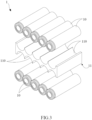
- FIG. 3 shows an exploded view of the battery device 1.
- the present invention discloses a double-layered thermal interface material (TIM) structure 11 for application in a battery device 1, so as to make the double-layered TIM structure 11 be sandwiched between two adjacent rows of battery cells 10 of the battery device 1.
- TIM thermal interface material
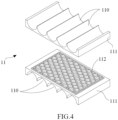
- FIG. 4 shows an exploded view of the double-layered thermal interface material structure according to the present invention.
- FIG. 5 shows a sectional view of the double-layered thermal interface material structure according to the present invention.
- the double-layered TIM structure 11 comprises a layer structure 111 and a porous sheet 112 buried in the layer structure 111.
- the layer structure 111 is made of a thermal interface material, and comprises a body thickness d.
- the porous sheet 112 comprises a plurality of pores, and comprises a plate thickness that is smaller than the body thickness d.
- the mesh count of the pores ranges from 10 to 200 meshes.
- the mentioned mesh count refers to the number of pores within an area of 1 inch by 1 inch.
- the wire diameter and pore size can be adjusted according to the requirements of the mesh count.
- the body thickness d is in range between 0.2 mm and 30 mm, and the plate thickness is in range between 0.01 mm and 20 mm.
- the layer structure 111 comprises a top surface and a bottom surface, and the top surface and the bottom surface both have a plurality of concave portions 110.
- the concave portion 110 is designed to have a curvature radius so as to match the cylindrical battery cell 10.
- the porous sheet 112 can be made of fiberglass, carbon fiber, polyvinylamine, carbon steel, stainless steel, copper alloy, aluminum alloy, or a combination of any two or more of the foregoing.
- the thermal interface material comprises a polymer matrix and a plurality of thermal conductive filler spread in the polymer matrix.
- the thermal conductive filler can be metal oxide particles, nitride particles, carbide particles, diboride particles, graphite particles, or metal particles.
- the top surface and the bottom surface are both provided with a heat conductive protection layer thereon (not illustrated), and the heat conductive protection layer is made of paraffin, epoxy resin, polyurethane, silicone, rubber, polypropylene, thermally conductive phase change material, or a combination of any two or more of the foregoing.
- the layer structure 111 comprises a first hardness
- the heat conductive protection layer comprises a second hardness that is greater than the first hardness.
- it can be further mixed a with ceramic filler within the heat conductive protection layer, and the ceramic filler can be alumina, magnesium oxide, zinc oxide, zirconium oxide, aluminum nitride, boron nitride, or silicon nitride.
- the carbon-based filler can be graphite, graphene, silicon carbide, tungsten carbide, carbon nanotubes, graphite, carbon black.
- a battery device 1 (such as a battery module or battery pack) comprising a plurality of battery cells 10 can incorporate a double-layered thermal interface material structure 11 according to the present invention.
- the plurality of battery cells 10 are arranged in N rows, wherein, N is an integer greater than or equal to 2, and each pair of adjacent rows of battery cells 10 is sandwiched with a double-layered thermal interface material structure 11 as described herein.
- a layer structure 111 can be pre-formed, with an upper wavy surface and a lower wavy surface.
- a porous sheet 112 can be embedded inside the structure to enhance its support while maintaining its flexibility.
- the double-layered thermal interface material structure 11 of the present invention can be directly stacked on top of one row of battery cells 10, followed by stacking another row of battery cells 10 on the double-layered thermal interface material structure 11. This process continues until N rows of battery cells 10 are stacked to form a battery module or battery pack. It is worth further explaining that between any two adjacent rows of battery cells 10, the double-layered thermal interface material structure 11 of the present invention is sandwiched. After appropriately adjusting the surface curvature of the concave portions 110 of the double-layered thermal interface material structure 11 to match a plane formed by battery cells 10, the connection point between two adjacent concave portions 110 become a protrusion, which corresponds to the gap between two adjacent battery cells 10. Therefore, there are no gaps between the double-layered thermal interface material structure 11 of the present invention and the two adjacent rows of battery cells 10. the method for manufacturing double-layered thermal interface material structure is provided.
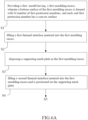
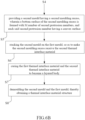
- FIG. 6A and FIG. 6B they are flowcharts of a double-layered thermal interface material structure manufacturing method according to the present invention.
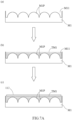
- FIG. 7A and FIG. 7B show diagrams for describing manufacturing processes of the double-layered thermal interface material structure.
- the method firstly proceeds to step S1, so as to provide a first mould M1 comprising a first moulding recess M11.
- a bottom surface of the first moulding recess is formed with M units of first protrusion member M1P, M is an integer, and each of the first protrusion member M1P comprises a convex surface.
- step S2 a first thermal interface material TM1 is filled in the first moulding recess.
- step S3 a porous sheet 112 is disposed in the first moulding recess M11 after step S3 is completed.
- step S4 the method subsequently proceeds to step S4, so as to fill a second thermal interface material TM2 into the first moulding recess M11, therefore the second thermal interface material TM2 is positioned on the porous sheet 112.
- step S5 the method is then proceeded to step S5, so as to provide a second mould M2 comprising a second moulding recess M21.
- a bottom surface of the second moulding recess M21 is formed with M units of second protrusion member M2P, and each of the second protrusion member M2P comprises a convex surface.
- the second mould M2 is stacked on the first mould M1 in step S6, therefore the second moulding recess M21 receives the second thermal interface material TM2.
- the first thermal interface material TM1 and the second thermal interface material TM2 to become a layer structure 111 by completing step S7, it is able to obtain a double-layered thermal interface material structure 11 by demoulding the second mould M2 and the first mould M1 (i.e., completing step S8).
- the first thermal interface material TM1 and the second thermal interface material TM2 both comprise a polymer matrix and a plurality of thermal conductive filler spread in the polymer matrix, and the thermal conductive filler comprises a plurality of particles.
- the particles can be metal oxide particles, nitride particles, carbide particles, diboride particles, graphite particles, metal particles, or a combination of any two or more of the foregoing.
- the polymer matrix is a curable polymer, and the curable polymer can be thermosetting polymer, photo cure able polymer, or a mixture of polymer and curing agent.
- the first mould M1 and the second mould M2 are used to build up an upper part and a lower part of the layer structure 111. Therefore, it can be extrapolated that, the convex surface of the first protrusion member M1P and the convex surface of the second protrusion member M2P both have a curvature radius, wherein, the curvature radius is 14mm, 16mm, 18mm, 21mm, 26mm, or 32mm.
- the porous sheet 112 used in the step S3 can be made of fiberglass, carbon fiber, polyvinylamine, carbon steel, stainless steel, copper alloy, aluminum alloy, or a combination of any two or more of the foregoing.
- the porous sheet 112 has a plurality of pores ranging from 10 to 200 meshes, and each pore is fully filled with the thermal interface material during the manufacturing processes of the double-layered thermal interface material structure 11 shown as FIG. 7A and FIG. 7B .
- the heat conductive protection layer is made of a material, and the material can be paraffin, epoxy resin, polyurethane, silicone, rubber, polypropylene, thermally conductive phase change material, or a combination of any two or more of the foregoing.
- the layer structure 111 comprises a first hardness
- the heat conductive protection layer comprises a second hardness that is greater than the first hardness.
- the method for manufacturing battery device 1 is provided.
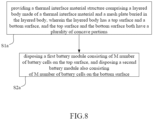
- FIG. 8 shows a flowchart of a battery device 1 manufacturing method according to the present invention.
- FIG. 9 shows a diagram for describing manufacturing processes of a battery device 1.
- the method firstly proceeds to step S1a, so as to provide a double-layered thermal interface material structure 11 comprising a layer structure 111 made of a thermal interface material and a porous sheet 112 buried in the layer structure 111, wherein the layer structure 111 comprises a top surface and a bottom surface, and the top surface and the bottom surface both comprising a plurality of concave portions 110.
- step S2a the method subsequently proceeds to step S2a, so as to dispose a first battery module BM1 consisting of M pieces of battery cell 10 on the top surface, and to dispose a second battery module BM2 also consisting of M pieces of battery cell 10 on the bottom surface, wherein M is an integer.
- FIG. 9 shows, two adjacent battery cells 10 are spaced by a gap S, and two adjacent concave portions 110 are connected by a protuberance spacing P, therefore the protuberance spacing p is embedded into the gap S after the M pieces of battery cell 10 are disposed on the plurality of concave portions 110.
- the top surface and the bottom surface are both provided with a heat conductive protection layer thereon, the layer structure comprises a first hardness, and the heat conductive protection layer comprises a second hardness. Therefore, in the manufacturing process, any battery module can be used as a heat source to heat the thermal conductive layer, thereby changing the second hardness of the thermal conductive layer to approximate the first hardness of the layer structure 111.
- an external heating device can also be used as a heat source to heat the thermal conductive layer.
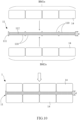
- FIG. 10 shows a diagram for describing how to assembly a battery device 1.
- the battery device 1 manufacturing method can also be adopted for manufacturing a specific battery device 1 comprising two battery modules and one double-layered thermal interface material structure, of which the battery module consists of M pieces of prismatic battery cell.
- the method firstly proceeds to step S1a, so as to provide a double-layered thermal interface material structure 11 comprising a layer structure 111 made of a thermal interface material and a porous sheet 112 buried in the layer structure 111, wherein the layer structure 111 comprises a top surface and a bottom surface, and the top surface and the bottom surface both comprising a plurality of concave portions 110.
- step S2a so as to dispose a first battery module BMla consisting of M pieces of prismatic battery cell 14 on the top surface, and to dispose a second battery module BM2a also consisting of M pieces of prismatic battery cell 14 on the bottom surface, wherein M is an integer.
- a first battery module BMla consisting of M pieces of prismatic battery cell 14 on the top surface
- a second battery module BM2a also consisting of M pieces of prismatic battery cell 14 on the bottom surface, wherein M is an integer.
Landscapes
- Engineering & Computer Science (AREA)
- Manufacturing & Machinery (AREA)
- Chemical & Material Sciences (AREA)
- Chemical Kinetics & Catalysis (AREA)
- Electrochemistry (AREA)
- General Chemical & Material Sciences (AREA)
- Secondary Cells (AREA)
Abstract
Description
- The present invention relates to the technology field of battery device of electric vehicle, and more particularly to a double-layered thermal interface material structure applied to the manufacture of a battery module or a battery pack.
- All-electric vehicles (EVs), also referred to as battery electric vehicles, have an electric motor instead of an internal combustion engine. The vehicle uses a large traction battery pack to power the electric motor and must be plugged in to a wall outlet or charging equipment, also called electric vehicle supply equipment (EVSE). As explained in more detail, electric vehicle battery (EVB) is the foregoing traction battery pack used to power the electric motor of a battery electric vehicle (BEV) or a hybrid electric vehicle (HEV), and the electric vehicle battery (EVB) typically designed to be a battery pack comprising a plurality of battery cells and a battery management circuit.
FIG. 1 shows a perspective view of a conventional battery pack. AsFIG. 1 shows, the conventional battery pack, also called multi-cell battery pack, principally comprises: a plurality of battery cells, a plurality of battery holders and a battery management circuit. In practical use, the battery pack is accommodated in a housing so as to form a rechargeable battery device. - For enhancing the heat dissipation efficiency of the battery pack, the battery manufacturer commonly fills the heat conductive material in the gaps between the plurality of battery cells, or disposes a heat conductive member between two adjacent battery cells. For example, the China patent, publication No.
CN111799405A , comprises disclosed a battery pack. The disclosed battery module comprises a plurality of cylindrical battery cells arranged into a plurality of columns and a plurality of rows. According to the disclosures of the China patent, publication No.CN111799405A , there is a spacing region between two adjacent cylindrical battery cells comprises, and there is a thermally conductive rod disposed for a plurality of spacing regions, and furthermore, the conductive fillers are filled in the rest of the spacing regions. - Therefore, it is understood that the conventional battery pack disclosed by China patent, publication No.
CN111799405A , comprises some drawbacks summarized in follows. - (1) When manufacturing the battery pack, it needs to dispose the multiple battery cells in an accommodating base and place them evenly. After that, it also needs to dispose multiple heat conductive rods into the spacing regions, and to fill the conductive fillers in the remaining spacing regions. In a word, the conventional battery pack needs a complicated procedure.
- (2) The manufacturing process error of the battery cells and/or the heat conductive rods causes some heat conductive rods fail to be embedded into the corresponding spacing regions, resulting in the manufacture failure of the battery pack.
- According to the above descriptions, it is understood that there are rooms for improvement in the conventional heat dissipation solution applied to the manufacturing of battery packs. In view of that, the inventors of the present application have made great efforts to make inventive research and eventually provided a double-layered thermal interface material structure applied to the manufacture of a battery module or a battery pack.
- The primary objective of the present invention is to disclose a double-layered thermal interface material (TIM) structure for the application of the battery module, wherein the double-layered TIM structure is sandwiched between two adjacent rows of the battery cells in the battery module. According to the present invention, a layer structure comprising a top surface and a bottom surface is manufactured for fitting in the gap between two adjacent rows of battery cells, therefore the top surface and the bottom surface both comprise a plurality of concave portions. Particularly, there is a porous sheet buried in the layer structure, therefore the layer structure comprises all the advantages of softness, good malleability and good support capability. Therefore, when this novel double-layered TIM structure is adopted in assembling N rows of battery cells to become a battery module, the double-layered TIM structure is firstly stacked on a first row of battery cells, and then a second row of battery cells is tacked on the double-layered TIM structure. Subsequently, another double-layered TIM structure is firstly stacked on the second row of battery cells, and then the third row of battery cells is tacked on the second double-layered TIM structure. At last, (N-1) layers of the double-layered TIM structure and N rows of the battery cells are therefore assembled to form one battery module.
- For achieving the primary objective mentioned above, the present invention provides an embodiment of the double-layered thermal interface material structure, comprising:
- a layer structure, being made of a thermal interface material, and comprising a body thickness; and
- a porous sheet, being buried in the layer structure, and comprising a plate thickness that is smaller than the body thickness;
- wherein the layer structure comprises a top surface and a bottom surface, and the top surface and the bottom surface both comprise a plurality of concave portions;
- wherein the porous sheet comprises a plurality of pores, and each of the pores is fulfilled with the thermal interface material.
- In one embodiment, the body thickness is in a range between 0.2 mm and 30 mm, and the plate thickness being in a range between 0.01 mm and 20 mm.
- In one embodiment, the porous sheet is made of at least one material selected from a group consisting of fiberglass, carbon fiber, polyvinylamine, carbon steel, stainless steel, copper alloy, and aluminum alloy, and the pore comprises a sieve size in a range between 10 mesh and 200 mesh.
- In one embodiment, the double-layered thermal interface material comprises a polymer matrix and a plurality of thermal conductive fillers distributed in the polymer matrix, and the thermal conductive filler comprises at least one selected from a group consisting of metal oxide particles, nitride particles, carbide particles, diboride particles, graphite particles, and metal particles.
- In one embodiment, the top surface and the bottom surface are both provided with a heat conductive protection layer thereon, and the heat conductive protection layer is made of a material selected from a group consisting of paraffin, epoxy resin, polyurethane, silicone, rubber, polypropylene, and thermally conductive phase change material.
- In one embodiment, the layer structure comprises a first hardness, and the heat conductive protection layer comprises a second hardness that is greater than the first hardness.
- Moreover, the present invention also provides a double-layered thermal interface material structure manufacturing method, comprising the steps of:
- (1) providing a first mould comprising a first moulding recess, wherein a bottom surface of the first moulding recess is formed with M units of first protrusion member, M being an integer, and each of the first protrusion members comprising a convex surface;
- (2) filling a first thermal interface material into the first moulding recess;
- (3) disposing a porous sheet in the first moulding recess;
- (4) filling a second thermal interface material into the first moulding recess, and being positioned on the porous sheet;
- (5) providing a second mould comprising a second moulding recess, wherein a bottom surface of the second moulding recess is formed with M units of second protrusion member, and each of the second protrusion members comprising a convex surface;
- (6) stacking the second mould on the first mould, so as to make the second moulding recess receive the second thermal interface material;
- (7) curing the first thermal interface material and the second thermal interface material to become a layer structure; and
- (8) demoulding the second mould and the first mould, thereby obtaining a double-layered thermal interface material structure.
- In one embodiment, the first thermal interface material and the second thermal interface material both comprise a polymer matrix and a plurality of thermal conductive filler spread in the polymer matrix, and the thermal conductive filler comprising at least one selected from a group consisting of metal oxide particles, nitride particles, carbide particles, diboride particles, graphite particles, and metal particles.
- In one embodiment, the polymer matrix is selected from a group consisting of thermosetting polymer, photo cure able polymer and mixture of polymer and curing agent.
- In one embodiment, the convex surface has a curvature radius selected from a group consisting of 2mm, 4mm, 16mm, 18mm, 21mm, 26mm, 32mm, and 50mm.
- In one embodiment, the top surface and the bottom surface are both provided with a heat conductive protection layer thereon, and the heat conductive protection layer being made of a material selected from a group consisting of paraffin, epoxy resin, polyurethane, silicone, rubber, polypropylene, and thermally conductive phase change material. The layer structure comprises a first hardness, and the heat conductive protection layer comprises a second hardness that is greater than the first hardness.
- Furthermore, the present invention also provides a battery device, which is a battery pack or a battery module, and is characterized in that: comprising the foregoing double-layered thermal interface material structure.
- The invention as well as a preferred mode of use and advantages thereof will be best understood by referring to the following detailed description of an illustrative embodiment in conjunction with the accompanying drawings, wherein:
- FIG. 1
- shows a perspective view of a conventional battery pack;
- FIG. 2
- shows a perspective view of a battery device comprising a double-layered thermal interface material structure according to the present invention;
- FIG. 3
- shows an exploded view of the battery device;
- FIG. 4
- shows an exploded view of the double-layered thermal interface material structure according to the present invention;
- FIG. 5
- shows a sectional view of the double-layered thermal interface material structure according to the present invention;
- FIG. 6A and FIG. 6B
- show flowcharts of a double-layered thermal interface material structure manufacturing method according to the present invention;
- FIG. 7A and FIG. 7B
- show diagrams for describing manufacturing processes of the double-layered thermal interface material structure;
- FIG. 8
- shows a flowchart of a battery device manufacturing method according to the present invention;
- FIG. 9
- shows a diagram for describing manufacturing processes of a battery device; and
- FIG. 10
- shows a diagram for describing how to assembly a battery device.
- To more clearly describe a double-layered thermal interface material structure applied to the manufacture of a battery module or a battery pack according to the present invention, embodiments of the present invention will be described in detail with reference to the attached drawings hereinafter.
- Double-layered thermal interface material structure and
battery device 1 comprising the same are provided. - With reference to
FIG. 2 , it shows a perspective view of abattery device 1 comprising a double-layered thermal interface material structure according to the present invention. Moreover,FIG. 3 shows an exploded view of thebattery device 1. AsFIG. 2 andFIG. 3 show, the present invention discloses a double-layered thermal interface material (TIM)structure 11 for application in abattery device 1, so as to make the double-layered TIM structure 11 be sandwiched between two adjacent rows ofbattery cells 10 of thebattery device 1. As explained in more detail below, when manufacturing thebattery device 1,multiple battery cells 10 are firstly assembled to be a battery module (i.e. a row of battery cells 10), and then at least one battery module and a battery management circuit are integrated to become thebattery device 1. -
FIG. 4 shows an exploded view of the double-layered thermal interface material structure according to the present invention. Moreover,FIG. 5 shows a sectional view of the double-layered thermal interface material structure according to the present invention. AsFIG. 3 ,FIG. 4 andFIG. 5 show, the double-layered TIM structure 11 comprises alayer structure 111 and aporous sheet 112 buried in thelayer structure 111. In which, thelayer structure 111 is made of a thermal interface material, and comprises a body thickness d. On the other hand, theporous sheet 112 comprises a plurality of pores, and comprises a plate thickness that is smaller than the body thickness d. In one embodiment, the mesh count of the pores ranges from 10 to 200 meshes. Here, the mentioned mesh count refers to the number of pores within an area of 1 inch by 1 inch. Of course, the wire diameter and pore size can be adjusted according to the requirements of the mesh count. In addition, the body thickness d is in range between 0.2 mm and 30 mm, and the plate thickness is in range between 0.01 mm and 20 mm. - According to the present invention, the
layer structure 111 comprises a top surface and a bottom surface, and the top surface and the bottom surface both have a plurality ofconcave portions 110. Moreover, because thebattery cell 10 is a cylindrical battery cell, therefore theconcave portion 110 is designed to have a curvature radius so as to match thecylindrical battery cell 10. - In one embodiment, the
porous sheet 112 can be made of fiberglass, carbon fiber, polyvinylamine, carbon steel, stainless steel, copper alloy, aluminum alloy, or a combination of any two or more of the foregoing. On the other hand, the thermal interface material comprises a polymer matrix and a plurality of thermal conductive filler spread in the polymer matrix. According to the disclosures of China patent publication No.CN101351755A , the thermal conductive filler can be metal oxide particles, nitride particles, carbide particles, diboride particles, graphite particles, or metal particles. - Furthermore, in a practicable embodiment, the top surface and the bottom surface are both provided with a heat conductive protection layer thereon (not illustrated), and the heat conductive protection layer is made of paraffin, epoxy resin, polyurethane, silicone, rubber, polypropylene, thermally conductive phase change material, or a combination of any two or more of the foregoing. As such, the
layer structure 111 comprises a first hardness, and the heat conductive protection layer comprises a second hardness that is greater than the first hardness. In addition, it can be further mixed a with ceramic filler within the heat conductive protection layer, and the ceramic filler can be alumina, magnesium oxide, zinc oxide, zirconium oxide, aluminum nitride, boron nitride, or silicon nitride. Moreover, it can also be further mixed with a carbon-based filler within the heat conductive protection layer, and the carbon-based filler can be graphite, graphene, silicon carbide, tungsten carbide, carbon nanotubes, graphite, carbon black. - In brief, as shown in
Figures 1 and2 , a battery device 1 (such as a battery module or battery pack) comprising a plurality ofbattery cells 10 can incorporate a double-layered thermalinterface material structure 11 according to the present invention. The plurality ofbattery cells 10 are arranged in N rows, wherein, N is an integer greater than or equal to 2, and each pair of adjacent rows ofbattery cells 10 is sandwiched with a double-layered thermalinterface material structure 11 as described herein. To elaborate further, as depicted inFigures 3 ,4 , and5 , based on the assembly gaps between the two rows of cylindrical battery cells, alayer structure 111 can be pre-formed, with an upper wavy surface and a lower wavy surface. Additionally, during the formation of thelayer structure 111, aporous sheet 112 can be embedded inside the structure to enhance its support while maintaining its flexibility. - Therefore, as shown in
Figure 3 , during the assembly process of incorporating N rows ofbattery cells 10, the double-layered thermalinterface material structure 11 of the present invention can be directly stacked on top of one row ofbattery cells 10, followed by stacking another row ofbattery cells 10 on the double-layered thermalinterface material structure 11. This process continues until N rows ofbattery cells 10 are stacked to form a battery module or battery pack. It is worth further explaining that between any two adjacent rows ofbattery cells 10, the double-layered thermalinterface material structure 11 of the present invention is sandwiched. After appropriately adjusting the surface curvature of theconcave portions 110 of the double-layered thermalinterface material structure 11 to match a plane formed bybattery cells 10, the connection point between two adjacentconcave portions 110 become a protrusion, which corresponds to the gap between twoadjacent battery cells 10. Therefore, there are no gaps between the double-layered thermalinterface material structure 11 of the present invention and the two adjacent rows ofbattery cells 10.
the method for manufacturing double-layered thermal interface material structure is provided. - With reference to
FIG. 6A andFIG. 6B , they are flowcharts of a double-layered thermal interface material structure manufacturing method according to the present invention. Moreover,FIG. 7A andFIG. 7B show diagrams for describing manufacturing processes of the double-layered thermal interface material structure. According toFIG .6A and the manufacturing process diagram (a) shown inFIG. 7A , the method firstly proceeds to step S1, so as to provide a first mould M1 comprising a first moulding recess M11. In which, a bottom surface of the first moulding recess is formed with M units of first protrusion member M1P, M is an integer, and each of the first protrusion member M1P comprises a convex surface. According toFIG .6A and the manufacturing process diagram (b) shown inFIG. 7A , the method subsequently proceeds to step S2. In step S2, a first thermal interface material TM1 is filled in the first moulding recess. Moreover, according toFIG .6A and the manufacturing process diagram (c) shown inFIG. 7A , aporous sheet 112 is disposed in the first moulding recess M11 after step S3 is completed. - According to
FIG .6A and the manufacturing process diagram (a) shown inFIG. 7B , the method subsequently proceeds to step S4, so as to fill a second thermal interface material TM2 into the first moulding recess M11, therefore the second thermal interface material TM2 is positioned on theporous sheet 112. Moreover, according toFIG .6B and the manufacturing process diagram (b) shown inFIG. 7B , the method is then proceeded to step S5, so as to provide a second mould M2 comprising a second moulding recess M21. In which, a bottom surface of the second moulding recess M21 is formed with M units of second protrusion member M2P, and each of the second protrusion member M2P comprises a convex surface. Furthermore, according toFIG .6B and the manufacturing process diagram (c) shown inFIG. 7B , the second mould M2 is stacked on the first mould M1 in step S6, therefore the second moulding recess M21 receives the second thermal interface material TM2. As a result, after curing the first thermal interface material TM1 and the second thermal interface material TM2 to become alayer structure 111 by completing step S7, it is able to obtain a double-layered thermalinterface material structure 11 by demoulding the second mould M2 and the first mould M1 (i.e., completing step S8). - It is worth further explaining that, the first thermal interface material TM1 and the second thermal interface material TM2 both comprise a polymer matrix and a plurality of thermal conductive filler spread in the polymer matrix, and the thermal conductive filler comprises a plurality of particles. The particles can be metal oxide particles, nitride particles, carbide particles, diboride particles, graphite particles, metal particles, or a combination of any two or more of the foregoing. Moreover, the polymer matrix is a curable polymer, and the curable polymer can be thermosetting polymer, photo cure able polymer, or a mixture of polymer and curing agent.
- According to
FIG. 7A andFIG. 7B , it should be understood that, the first mould M1 and the second mould M2 are used to build up an upper part and a lower part of thelayer structure 111. Therefore, it can be extrapolated that, the convex surface of the first protrusion member M1P and the convex surface of the second protrusion member M2P both have a curvature radius, wherein, the curvature radius is 14mm, 16mm, 18mm, 21mm, 26mm, or 32mm. - As explained in more detail below, the
porous sheet 112 used in the step S3 can be made of fiberglass, carbon fiber, polyvinylamine, carbon steel, stainless steel, copper alloy, aluminum alloy, or a combination of any two or more of the foregoing. Moreover, theporous sheet 112 has a plurality of pores ranging from 10 to 200 meshes, and each pore is fully filled with the thermal interface material during the manufacturing processes of the double-layered thermalinterface material structure 11 shown asFIG. 7A andFIG. 7B . - Furthermore, it is able to form the top surface and the bottom surface of the
layer structure 111 with a heat conductive protection layer thereon. In one embodiment, the heat conductive protection layer is made of a material, and the material can be paraffin, epoxy resin, polyurethane, silicone, rubber, polypropylene, thermally conductive phase change material, or a combination of any two or more of the foregoing. As such, thelayer structure 111 comprises a first hardness, and the heat conductive protection layer comprises a second hardness that is greater than the first hardness. - The method for manufacturing
battery device 1 is provided. - With reference to
FIG. 8 , it shows a flowchart of abattery device 1 manufacturing method according to the present invention. Moreover,FIG. 9 shows a diagram for describing manufacturing processes of abattery device 1. AsFIG. 8 andFIG. 9 show, the method firstly proceeds to step S1a, so as to provide a double-layered thermalinterface material structure 11 comprising alayer structure 111 made of a thermal interface material and aporous sheet 112 buried in thelayer structure 111, wherein thelayer structure 111 comprises a top surface and a bottom surface, and the top surface and the bottom surface both comprising a plurality ofconcave portions 110. Then, the method subsequently proceeds to step S2a, so as to dispose a first battery module BM1 consisting of M pieces ofbattery cell 10 on the top surface, and to dispose a second battery module BM2 also consisting of M pieces ofbattery cell 10 on the bottom surface, wherein M is an integer. - As
FIG. 9 shows, twoadjacent battery cells 10 are spaced by a gap S, and two adjacentconcave portions 110 are connected by a protuberance spacing P, therefore the protuberance spacing p is embedded into the gap S after the M pieces ofbattery cell 10 are disposed on the plurality ofconcave portions 110. According to above descriptions, it is known that the top surface and the bottom surface are both provided with a heat conductive protection layer thereon, the layer structure comprises a first hardness, and the heat conductive protection layer comprises a second hardness. Therefore, in the manufacturing process, any battery module can be used as a heat source to heat the thermal conductive layer, thereby changing the second hardness of the thermal conductive layer to approximate the first hardness of thelayer structure 111. Of course, in the manufacturing process, an external heating device can also be used as a heat source to heat the thermal conductive layer. - On the other hand,
FIG. 10 shows a diagram for describing how to assembly abattery device 1. AsFIG. 8 andFIG. 10 show, thebattery device 1 manufacturing method can also be adopted for manufacturing aspecific battery device 1 comprising two battery modules and one double-layered thermal interface material structure, of which the battery module consists of M pieces of prismatic battery cell. The method firstly proceeds to step S1a, so as to provide a double-layered thermalinterface material structure 11 comprising alayer structure 111 made of a thermal interface material and aporous sheet 112 buried in thelayer structure 111, wherein thelayer structure 111 comprises a top surface and a bottom surface, and the top surface and the bottom surface both comprising a plurality ofconcave portions 110. Then, the method subsequently proceeds to step S2a, so as to dispose a first battery module BMla consisting of M pieces ofprismatic battery cell 14 on the top surface, and to dispose a second battery module BM2a also consisting of M pieces ofprismatic battery cell 14 on the bottom surface, wherein M is an integer. AsFIG. 10 shows, two adjacentprismatic battery cells 14 are spaced by a gap S, and two adjacentconcave portions 110 are connected by a protuberance spacer P, therefore the protuberance spacer p is embedded into the gap S after the M pieces ofprismatic battery cell 10 are disposed on the plurality ofconcave portions 110. - Therefore, through the above descriptions, all embodiments of the double-layered thermal interface material structure according to the present invention have been introduced completely and clearly. Moreover, the above description is made on embodiments of the present invention. However, the embodiments are not intended to limit the scope of the present invention, and all equivalent implementations or alterations within the spirit of the present invention still fall within the scope of the present invention.
Claims (27)
- A double-layered thermal interface material structure, comprising:a layer structure, being made of a thermal interface material, and comprising a body thickness; anda porous sheet, being buried in the layer structure, and comprising a plate thickness that is smaller than the body thickness;wherein the layer structure comprises a top surface and a bottom surface, and the top surface and the bottom surface both comprising a plurality of concave portions;wherein the porous sheet comprises a plurality of pores, and each of the pores being fully filled with the thermal interface material.
- The double-layered thermal interface material structure of claim 1, wherein, the plurality of concave portions has a curvature radius selected from a group consisting of 2mm, 4mm, 16mm, 18mm, 21mm, 26mm, 32mm, and 50mm.
- The double-layered thermal interface material structure of claim 1, wherein the body thickness is in range between 0.2 mm and 30 mm, and the plate thickness being in range between 0.01 mm and 20 mm.
- The double-layered thermal interface material structure of claim 1, wherein the porous sheet is made of at least one material selected from a group consisting of fiberglass, carbon fiber, polyvinylamine, carbon steel, stainless steel, copper alloy, and aluminum alloy
- The double-layered thermal interface material structure of claim 1, wherein the count of the pores ranges from 10 to 200 meshes
- The double-layered thermal interface material structure of claim 1, wherein the thermal interface material comprises a polymer matrix and a plurality of thermal conductive filler spread in the polymer matrix, and the thermal conductive filler comprising at least one selected from a group consisting of metal oxide particles, nitride particles, carbide particles, diboride particles, graphite particles, and metal particles.
- The double-layered thermal interface material structure of claim 1, wherein the top surface and the bottom surface are both provided with a heat conductive protection layer thereon, and the heat conductive protection layer being made of a material selected from a group consisting of paraffin, epoxy resin, polyurethane, silicone, rubber, polypropylene, and thermally conductive phase change material.
- The double-layered thermal interface material structure of claim 7, wherein the layer structure comprises a first hardness, and the heat conductive protection layer comprising a second hardness that is greater than the first hardness.
- A battery device, being selected from a group consisting of battery pack and battery module, and being characterized in that the battery device comprises a double-layered thermal interface material structure, comprising:a layer structure, being made of a thermal interface material, and comprising a body thickness; anda porous sheet, being buried in the layer structure, and comprising a plate thickness that is smaller than the body thickness;wherein the layer structure comprises a top surface and a bottom surface, and the top surface and the bottom surface both comprising a plurality of concave portions;wherein the supporting mesh plate comprises a plurality of pores, and each of the pores being fully filled with the thermal interface material.
- A double-layered thermal interface material structure manufacturing method, comprising the steps of:(1) providing a first mould comprising a first moulding recess, wherein a bottom surface of the first moulding recess is formed with M units of first protrusion member, M being an integer, and each of the first protrusion member comprising a convex surface;(2) filling a first thermal interface material into the first moulding recess;(3) disposing a s porous sheet in the first moulding recess;(4) filling a second thermal interface material into the first moulding recess, and being positioned on the porous sheet;(5) providing a second mould comprising a second moulding recess, wherein a bottom surface of the second moulding recess is formed with M units of second protrusion member, and each of the second protrusion members comprising a convex surface;(6) stacking the second mould on the first mould, so as to make the second moulding recess receive the second thermal interface material;(7) curing the first thermal interface material and the second thermal interface material to become a layer structure; and(8) demoulding the second mould and the first mould, thereby obtaining a double-layered thermal interface material structure.
- The double-layered thermal interface material structure manufacturing method of claim 10, wherein the first thermal interface material and the second thermal interface material both comprise a polymer matrix and a plurality of thermal conductive filler spread in the polymer matrix, and the thermal conductive filler comprising at least one selected from a group consisting of metal oxide particles, nitride particles, carbide particles, diboride particles, graphite particles, and metal particles.
- The double-layered thermal interface material structure manufacturing method of claim 11, wherein the polymer matrix is selected from a group consisting of thermosetting polymer, photo cure able polymer and mixture of polymer and curing agent.
- The double-layered thermal interface material structure manufacturing method of claim 7, wherein each of the convex surface has a curvature radius selected from a group consisting of 2mm, 4mm, 16mm, 18mm, 21mm, 26mm, 32mm, and 50mm.
- The double-layered thermal interface material structure manufacturing method of claim 10, wherein the layer structure comprises a body thickness in range between 0.2 mm and 30 mm, and the porous sheet comprising a plate thickness in range between 0.01 mm and 20 mm.
- The double-layered thermal interface material structure manufacturing method of claim 10, wherein the porous sheet is made of at least one material selected from a group consisting of fiberglass, carbon fiber, polyvinylamine, carbon steel, stainless steel, copper alloy, and aluminum alloy.
- The double-layered thermal interface material structure manufacturing method of claim 10, wherein the porous sheet has a plurality of pores ranging from 10 to 200 meshes.
- The double-layered thermal interface material structure manufacturing method of claim 10, wherein the top surface and the bottom surface are both provided with a heat conductive protection layer thereon, and the heat conductive protection layer being made of a material selected from a group consisting of paraffin, epoxy resin, polyurethane, silicone, rubber, polypropylene, and thermally conductive phase change material.
- The double-layered thermal interface material structure manufacturing method of claim 17, wherein the layer structure comprises a first hardness, and the heat conductive protection layer comprising a second hardness that is greater than the first hardness.
- A battery device manufacturing method, comprising the steps of:providing a double-layered thermal interface material structure comprising a layer structure made of a thermal interface material and a porous sheet buried in the layer structure, wherein the layer structure comprises a top surface and a bottom surface, and the top surface and the bottom surface both comprising a plurality of concave portions; anddisposing a first battery module consisting of M pieces of battery cell on the top surface, and disposing a second battery module also consisting of M pieces of battery cell on the bottom surface, wherein M is an integer.
- The battery device manufacturing method of claim 19, wherein two adjacent battery cells are spaced by a gap, and two adjacent concave portions being connected by a protuberance spacer, therefore the protuberance spacer is embedded into the gap after the M pieces of battery cell are disposed on the plurality of concave portions.
- The battery device manufacturing method of claim 19, wherein each of the concave portion has a curvature radius selected from a group consisting of 2mm, 4mm, 16mm, 18mm, 21mm, 26mm, 32mm, and 50mm.
- The battery device manufacturing method of claim 19, wherein the top surface and the bottom surface are both provided with a heat conductive protection layer thereon, the layer structure comprising a first hardness, and the heat conductive protection layer comprising a second hardness that is greater than the first hardness.
- The battery device manufacturing method of claim 22, wherein any of the battery modules can serve as a heat source to heat the thermal conductive layer, thereby altering the second hardness to approach the first hardness.
- The battery device manufacturing method of claim 22, wherein using a heat source to heat the thermal conductive layer can alter its second hardness to approximate the first hardness.
- The battery device manufacturing method of claim 22, wherein the dual-layer thermal interface material structure is preformed using the manufacturing method of the dual-layer thermal interface material structure as claimed in claim 10.
- The battery device manufacturing method of claim 19, wherein the layer structure comprises a body thickness in range between 0.2 mm and 30 mm, and the porous sheet comprising a plate thickness in range between 0.01 mm and 20 mm.
- The battery device manufacturing method of claim 19, wherein the porous sheet has a plurality of pores ranging from 10 to 200 meshes.
Applications Claiming Priority (1)
| Application Number | Priority Date | Filing Date | Title |
|---|---|---|---|
| PCT/CN2021/126038 WO2023070254A1 (en) | 2021-10-25 | 2021-10-25 | Double-layer thermal interface material structure, manufacturing method therefor, and battery device having same |
Publications (2)
| Publication Number | Publication Date |
|---|---|
| EP4425650A1 true EP4425650A1 (en) | 2024-09-04 |
| EP4425650A4 EP4425650A4 (en) | 2025-12-10 |
Family
ID=86159887
Family Applications (1)
| Application Number | Title | Priority Date | Filing Date |
|---|---|---|---|
| EP21961646.3A Pending EP4425650A4 (en) | 2021-10-25 | 2021-10-25 | Two-layer material structure for thermal interface, manufacturing process therefor and battery device therewith |
Country Status (3)
| Country | Link |
|---|---|
| EP (1) | EP4425650A4 (en) |
| CN (1) | CN118339702A (en) |
| WO (1) | WO2023070254A1 (en) |
Family Cites Families (5)
| Publication number | Priority date | Publication date | Assignee | Title |
|---|---|---|---|---|
| CN101351755B (en) | 2006-03-28 | 2013-08-14 | 派克汉尼芬公司 | Dispensable Curing Resin |
| JP2011000884A (en) * | 2009-06-17 | 2011-01-06 | Laird Technologies Inc | Suitable multilayer heat conductive intermediate structure, and memory module equipped with the same |
| CN104993188A (en) * | 2015-07-17 | 2015-10-21 | 广东万锦科技股份有限公司 | Highly-safe cylindrical battery temperature homogenizing module |
| KR102256103B1 (en) * | 2018-09-12 | 2021-05-25 | 주식회사 엘지에너지솔루션 | Battery module and battery pack including the same |
| CN111799405A (en) | 2019-04-09 | 2020-10-20 | 太普动力新能源(常熟)股份有限公司 | Battery module |
-
2021
- 2021-10-25 CN CN202180103730.2A patent/CN118339702A/en active Pending
- 2021-10-25 EP EP21961646.3A patent/EP4425650A4/en active Pending
- 2021-10-25 WO PCT/CN2021/126038 patent/WO2023070254A1/en not_active Ceased
Also Published As
| Publication number | Publication date |
|---|---|
| CN118339702A (en) | 2024-07-12 |
| EP4425650A4 (en) | 2025-12-10 |
| WO2023070254A1 (en) | 2023-05-04 |
Similar Documents
| Publication | Publication Date | Title |
|---|---|---|
| EP2054958B1 (en) | Electrode for a power storing apparatus and power storing apparatus provided with that electrode | |
| US8304103B2 (en) | Battery structure | |
| JP2024075604A (en) | Battery packs and electric vehicles | |
| JP6490105B2 (en) | Battery module including cartridge provided with gripping section | |
| JP4617098B2 (en) | Case for battery cell | |
| CN109478620B (en) | Battery | |
| US10396410B2 (en) | Battery system housing with internal busbar | |
| US6849357B1 (en) | Battery, a process for producing the battery, a process for producing a battery case, and a battery pack | |
| US8518574B1 (en) | Heat control pouch for battery cell module and battery cell module having the same | |
| KR101748645B1 (en) | Battery Module | |
| JP3972885B2 (en) | Assembled battery | |
| US9065160B2 (en) | Radiant heat plate for battery cell module and battery cell module having the same | |
| CN1178034A (en) | Storage battery container, storage battery and laminated storage battery | |
| CN101569030A (en) | Electrical storage device | |
| CN103928730A (en) | Stackable bushing module design | |
| CN214124026U (en) | Protective structure and battery module | |
| KR20190024709A (en) | Pouch-Type Secondary Battery Having Heat Transfer Member | |
| CN116998046A (en) | Battery modules, battery packs and vehicles including the battery packs | |
| CN102825881B (en) | Composite material for battery case and method of manufacturing the same | |
| US20230395892A1 (en) | Multi-layered thermal interface material structure, manufacturing method thereof, and battery device having the same | |
| EP4425650A1 (en) | Double-layer thermal interface material structure, manufacturing method therefor, and battery device having same | |
| US20230387500A1 (en) | Double-layered thermal interface material structure, manufacturing method thereof, and battery device having the same | |
| CN118872126A (en) | Easily removable battery pack | |
| US12113189B2 (en) | Battery including thermally conductive filler material with thermal runaway containment function | |
| CN114930616A (en) | Battery module and method for manufacturing same |
Legal Events
| Date | Code | Title | Description |
|---|---|---|---|
| STAA | Information on the status of an ep patent application or granted ep patent |
Free format text: STATUS: THE INTERNATIONAL PUBLICATION HAS BEEN MADE |
|
| PUAI | Public reference made under article 153(3) epc to a published international application that has entered the european phase |
Free format text: ORIGINAL CODE: 0009012 |
|
| STAA | Information on the status of an ep patent application or granted ep patent |
Free format text: STATUS: REQUEST FOR EXAMINATION WAS MADE |
|
| 17P | Request for examination filed |
Effective date: 20240523 |
|
| AK | Designated contracting states |
Kind code of ref document: A1 Designated state(s): AL AT BE BG CH CY CZ DE DK EE ES FI FR GB GR HR HU IE IS IT LI LT LU LV MC MK MT NL NO PL PT RO RS SE SI SK SM TR |
|
| DAV | Request for validation of the european patent (deleted) | ||
| DAX | Request for extension of the european patent (deleted) | ||
| A4 | Supplementary search report drawn up and despatched |
Effective date: 20251106 |
|
| RIC1 | Information provided on ipc code assigned before grant |
Ipc: H01M 10/653 20140101AFI20251031BHEP Ipc: H01M 10/643 20140101ALI20251031BHEP Ipc: H01M 10/613 20140101ALI20251031BHEP Ipc: H01M 10/65 20140101ALI20251031BHEP Ipc: H01M 10/625 20140101ALI20251031BHEP Ipc: H01M 10/6551 20140101ALI20251031BHEP Ipc: H01M 10/6554 20140101ALI20251031BHEP Ipc: H01M 10/6555 20140101ALI20251031BHEP |