EP4425501A1 - Search method for thermosetting epoxy resin composition, information processing device, and program - Google Patents
Search method for thermosetting epoxy resin composition, information processing device, and program Download PDFInfo
- Publication number
- EP4425501A1 EP4425501A1 EP23823834.9A EP23823834A EP4425501A1 EP 4425501 A1 EP4425501 A1 EP 4425501A1 EP 23823834 A EP23823834 A EP 23823834A EP 4425501 A1 EP4425501 A1 EP 4425501A1
- Authority
- EP
- European Patent Office
- Prior art keywords
- epoxy resin
- thermosetting epoxy
- resin composition
- actual data
- predictive models
- Prior art date
- Legal status (The legal status is an assumption and is not a legal conclusion. Google has not performed a legal analysis and makes no representation as to the accuracy of the status listed.)
- Granted
Links
Images



Classifications
-
- G—PHYSICS
- G06—COMPUTING OR CALCULATING; COUNTING
- G06F—ELECTRIC DIGITAL DATA PROCESSING
- G06F30/00—Computer-aided design [CAD]
- G06F30/20—Design optimisation, verification or simulation
- G06F30/27—Design optimisation, verification or simulation using machine learning, e.g. artificial intelligence, neural networks, support vector machines [SVM] or training a model
-
- G—PHYSICS
- G16—INFORMATION AND COMMUNICATION TECHNOLOGY [ICT] SPECIALLY ADAPTED FOR SPECIFIC APPLICATION FIELDS
- G16C—COMPUTATIONAL CHEMISTRY; CHEMOINFORMATICS; COMPUTATIONAL MATERIALS SCIENCE
- G16C20/00—Chemoinformatics, i.e. ICT specially adapted for the handling of physicochemical or structural data of chemical particles, elements, compounds or mixtures
- G16C20/40—Searching chemical structures or physicochemical data
-
- C—CHEMISTRY; METALLURGY
- C08—ORGANIC MACROMOLECULAR COMPOUNDS; THEIR PREPARATION OR CHEMICAL WORKING-UP; COMPOSITIONS BASED THEREON
- C08G—MACROMOLECULAR COMPOUNDS OBTAINED OTHERWISE THAN BY REACTIONS ONLY INVOLVING UNSATURATED CARBON-TO-CARBON BONDS
- C08G59/00—Polycondensates containing more than one epoxy group per molecule; Macromolecules obtained by polymerising compounds containing more than one epoxy group per molecule using curing agents or catalysts which react with the epoxy groups
- C08G59/18—Macromolecules obtained by polymerising compounds containing more than one epoxy group per molecule using curing agents or catalysts which react with the epoxy groups ; e.g. general methods of curing
-
- G—PHYSICS
- G16—INFORMATION AND COMMUNICATION TECHNOLOGY [ICT] SPECIALLY ADAPTED FOR SPECIFIC APPLICATION FIELDS
- G16C—COMPUTATIONAL CHEMISTRY; CHEMOINFORMATICS; COMPUTATIONAL MATERIALS SCIENCE
- G16C20/00—Chemoinformatics, i.e. ICT specially adapted for the handling of physicochemical or structural data of chemical particles, elements, compounds or mixtures
- G16C20/30—Prediction of properties of chemical compounds, compositions or mixtures
-
- G—PHYSICS
- G16—INFORMATION AND COMMUNICATION TECHNOLOGY [ICT] SPECIALLY ADAPTED FOR SPECIFIC APPLICATION FIELDS
- G16C—COMPUTATIONAL CHEMISTRY; CHEMOINFORMATICS; COMPUTATIONAL MATERIALS SCIENCE
- G16C20/00—Chemoinformatics, i.e. ICT specially adapted for the handling of physicochemical or structural data of chemical particles, elements, compounds or mixtures
- G16C20/70—Machine learning, data mining or chemometrics
Definitions
- the present disclosure relates to a method of searching for a thermosetting epoxy resin composition, an information processor, and a program.
- the present application claims the priority of Japanese Patent Application No. 2022-096816 filed on June 15, 2022 in Japan, which is incorporated herein by reference in its entirety.
- CFRP carbon fiber reinforced plastics
- CFRP carbon fiber reinforced plastics
- a composition containing a thermosetting epoxy resin or the like hereinafter also referred to as a thermosetting epoxy resin composition
- CFRP is a fiber-reinforced composite material containing a plastic as a base material and carbon fibers as reinforcing fibers.
- CFRP is a high-performance material that is lighter in weight than general structural metallic materials, has high specific strength and specific rigidity, and has good electrical characteristics and high corrosion resistance.
- CFRP has been used as a material replacing metallic materials in a wide range of applications, such as structural members of aerospace structures, automobiles, two-wheeled vehicles, and ships, large-sized industrial machine parts, and sporting goods.
- Thermosetting epoxy resin compositions used as raw materials for composite materials, such as CFRP are required to have characteristics, such as strength and heat resistance, depending on the use of the composite materials.
- characteristics of thermosetting epoxy resin compositions may be contradictory to each other, and it is not necessarily easy to search for a thermosetting epoxy resin composition with required characteristics in a well-balanced manner.
- only limited specific thermosetting epoxy resin compositions have been used as raw materials of composite materials, such as CFRP, and a search for a novel thermosetting epoxy resin has been desired.
- Patent Literature 1 there is a known technique of modeling a material model, learning the material model by machine learning, and then using the learned material model to search for a structure of a novel material from target physical property information (for example, Patent Literature 1).
- Patent Literature 1 The technique of searching for a material described in Patent Literature 1 is directed to a general material model, and searching for a thermosetting epoxy resin composition has not been particularly considered in the related art.
- An object of the present disclosure made in view of such circumstances is to improve a technique of searching for a thermosetting epoxy resin composition.
- a method of searching for a thermosetting epoxy resin composition is a method of searching for a thermosetting epoxy resin composition executed by an information processor, the method including the steps of:
- a feature value is calculated on the basis of the actual data and is used as an explanatory variable of the plurality of predictive models.
- the feature value includes at least one of a molecular fingerprint and a molecular descriptor.
- the feature value further includes a distance between oxygen atoms related to a thermosetting epoxy resin.
- a method of searching for a thermosetting epoxy resin composition, an information processor, and a program according to an embodiment of the present disclosure can improve a technique of searching for a thermosetting epoxy resin composition.
- thermosetting epoxy resin composition A method of searching for a thermosetting epoxy resin composition according to an embodiment of the present disclosure is described below with reference to the accompanying drawings.
- thermosetting epoxy resin composition A method of searching for a thermosetting epoxy resin composition according to the present embodiment is outlined below with reference to Figs. 1 and 2 .
- the present embodiment is outlined below.
- Actual data 100 shown in Fig. 1 are used in the method of searching for a thermosetting epoxy resin composition according to the present embodiment.
- An information processor 10 shown in Fig. 2 executes the method of searching for a thermosetting epoxy resin composition according to the present embodiment.
- the information processor 10 trains a plurality of predictive models 400 each corresponding to a target variable using the actual data 100 related to a thermosetting epoxy resin composition.
- the actual data 100 include actual data 110 for another application and actual data 120 for a predetermined application.
- the actual data 120 for the predetermined application are, for example, actual data related to a thermosetting epoxy resin composition for a composite material. More specifically, the actual data 120 include, for example, actual data related to a thermosetting epoxy resin composition used for CFRP.
- the actual data 110 for another application are actual data of a thermosetting epoxy resin composition used for an application other than the predetermined application (here, an application other than the composite material).
- Each of the actual data 110 for another application and the actual data 120 for the predetermined application includes a polymer composition, a structural formula, an epoxy equivalent, a blending condition, a test piece thickness, and first to N-th physical properties related to a thermosetting epoxy resin composition.
- the blending condition is a condition related to the blend ratio of a thermosetting epoxy resin to a curing agent (for example, an amine).
- the test piece thickness is the thickness of a test piece in a physical property measurement and is, for example, 2 mm or 4 mm.
- the first to N-th physical properties correspond to a plurality of target variables.
- N is a positive integer.
- the information processor 10 trains first to N-th predictive models, each corresponding to one of N target variables.
- the plurality of target variables include contradictory characteristics.
- the plurality of target variables include a bending modulus, a bending strength, a bending strain, and heat resistance.
- the bending modulus and the bending strain are contradictory to each other.
- An example of the heat resistance may be a glass transition temperature (a temperature with the maximum change in elastic modulus in measurement with a viscoelastometer). In the present embodiment, a glass transition temperature is used as a measure of heat resistance in an example described below.
- the information processor 10 performs a learning process 310 of the predictive models 400 using the actual data 110 for another application.
- the information processor 10 calculates a feature value 210 from the actual data 110 for another application.
- the information processor 10 trains the predictive models 400 using the feature value 210 as an explanatory variable and each physical property as a target variable. More specifically, the information processor 10 trains a first predictive model using the feature value 210 as an explanatory variable and a first physical property as a target variable.
- the information processor 10 trains a second predictive model using the feature value 210 as an explanatory variable and a second physical property as a target variable.
- the information processor 10 trains the N-th predictive model using the feature value 210 as an explanatory variable and an N-th physical property as a target variable.
- the feature value 210 used for the learning process of the first to N-th predictive models may be appropriately selected according to the relationship between each feature value and the target variable. In other words, the feature value 210 used for learning of the first to N-th predictive models may be different from each other.
- the information processor 10 performs a relearning process 320 of the predictive models 400 using the actual data 110 for another application.
- the information processor 10 calculates a feature value 220 from the actual data 110 for another application.
- the information processor 10 performs a relearning process of each predictive model using the feature value 220 as an explanatory variable and each physical property as a target variable. More specifically, the information processor 10 performs a relearning process of the first predictive model using the feature value 220 as an explanatory variable and the first physical property as a target variable.
- the information processor 10 performs a relearning process of the second predictive model using the feature value 220 as an explanatory variable and the second physical property as a target variable.
- the information processor 10 performs a relearning process of the N-th predictive model using the feature value 220 as an explanatory variable and the N-th physical property as a target variable.
- the feature value 220 used for the relearning process of the first to N-th predictive models may be appropriately selected according to the relationship between each feature value and the target variable. In other words, the feature value 220 used for learning of the first to N-th predictive models may be different from each other.
- the information processor 10 searches for a thermosetting epoxy resin composition with a desired balance of physical properties by inverse analysis using the first to N-th predictive models learned in this manner.
- thermosetting epoxy resin composition with a desired balance of physical properties is searched for by inverse analysis using the plurality of predictive models.
- search technique is improved in that a thermosetting epoxy resin composition with a desired balance of characteristics can be searched for.
- the information processor 10 is an apparatus used by a user.
- a personal computer, a server computer, a general-purpose electronic device, or a dedicated electronic device can be adopted as the information processor 10.
- the information processor 10 includes a control unit 11, a storage unit 12, an input unit 13, and an output unit 14.
- the control unit 11 includes at least one processor, at least one dedicated circuit, or a combination thereof.
- the processor is a general-purpose processor, such as a central processing unit (CPU) or a graphics processing unit (GPU), or a dedicated processor specialized for specific processing.
- the dedicated circuit is, for example, a field-programmable gate array (FPGA) or an application specific integrated circuit (ASIC).
- the control unit 11 executes processing related to the operation of the information processor 10 while controlling each unit of the information processor 10.
- the storage unit 12 includes at least one semiconductor memory, at least one magnetic memory, at least one optical memory, or a combination of at least two of these memories.
- the semiconductor memory is, for example, a random access memory (RAM) or a read only memory (ROM).
- the RAM is, for example, a static random access memory (SRAM) or a dynamic random access memory (DRAM).
- the ROM is, for example, an electrically erasable programmable read only memory (EEPROM).
- the storage unit 12 functions as, for example, a main storage, an auxiliary storage, or a cache memory.
- the storage unit 12 stores data used for the operation of the information processor 10 and data obtained by the operation of the information processor 10.
- the input unit 13 includes at least one input interface.
- the input interface is, for example, a physical key, a capacitance key, a pointing device, or a touch screen integrated with a display.
- the input interface may be, for example, a microphone that receives voice input or a camera that receives gesture input.
- the input unit 13 receives an operation of inputting data used for the operation of the information processor 10.
- the input unit 13 may be connected to the information processor 10 as an external input device.
- the connection method can be, for example, a universal serial bus (USB), a high-definition multimedia interface (HDMI) (registered trademark), Bluetooth (registered trademark), or the like.
- USB universal serial bus
- HDMI high-definition multimedia interface
- Bluetooth registered trademark
- the output unit 14 includes at least one output interface.
- the output interface is, for example, a display that outputs information in the form of an image.
- the display is, for example, a liquid crystal display (LCD) or an organic electro luminescence (EL) display.
- the output unit 14 displays and outputs data obtained by the operation of the information processor 10.
- the output unit 14 may be connected to the information processor 10 as an external output device.
- the connection method can be, for example, USB, HDMI (registered trademark), Bluetooth (registered trademark), or the like.
- the functions of the information processor 10 are implemented by a processor corresponding to the information processor 10 executing a program according to the present embodiment. That is, the functions of the information processor 10 are implemented by software.
- the program causes a computer to execute the operation of the information processor 10 and thereby causes the computer to function as the information processor 10. In other words, a computer executes the operation of the information processor 10 in accordance with the program and thereby functions as the information processor 10.
- the program can be recorded in a computer-readable recording medium.
- the computer-readable recording medium includes a non-transitory computer-readable medium, for example, a magnetic recording apparatus, an optical disk, a magneto-optical recording medium, or a semiconductor memory.
- the program is distributed, for example, by selling, transferring, or lending a portable recording medium, such as a digital versatile disc (DVD) or a compact disc read only memory (CD-ROM), in which the program is recorded.
- the program may also be distributed by storing the program in a storage of an external server and transmitting the program from the external server to another computer.
- the program may also be provided as a program product.
- a part or all of the functions of the information processor 10 may be realized by a dedicated circuit corresponding to the control unit 11. In other words, a part or all of the functions of the information processor 10 may be realized by hardware.
- the storage unit 12 stores the actual data 100, the feature values 210 and 220, and the predictive models 400.
- the feature values 210 and 220 are calculated on the basis of the actual data 100.
- the feature values can be calculated by various methods.
- the feature values 210 and 220 may be calculated by computer processing based on at least one characteristic data among the actual data 100.
- the feature values 210 and 220 may also be determined by selecting characteristic data from the actual data 100.
- the phrase "calculating a feature value based on actual data” refers to at least one of calculation based on the actual data and determination based on the actual data.
- the feature value 210 may include any data that represent a feature of a thermosetting epoxy resin composition.
- the feature value 210 may include an epoxy equivalent and a blending condition related to a thermosetting epoxy resin.
- the feature value 210 may include at least one of a molecular fingerprint and a molecular descriptor.
- the molecular descriptor can be obtained from the information of a thermosetting epoxy resin represented by SMILES notation using RDKit, which is a publicly known molecular descriptor generation library, alvaDesc, which is commercially available software, or the like.
- RDKit which is a publicly known molecular descriptor generation library, alvaDesc, which is commercially available software, or the like.
- Such a molecular descriptor may be a zero-dimensional descriptor, such as the molecular weight, the number of atoms in a molecule, or the number of bonds.
- It may be a one-dimensional descriptor, such as the number of functional groups in a molecule, the number of alicyclic structures, or the number of aromatic rings. It may be a two-dimensional descriptor, such as a topological descriptor representing a molecule based on a graph theory, such as a Wiener index, a Chi connectivity index, a Balaban index, or a BCUT descriptor. It may be a three-dimensional descriptor, such as a descriptor calculated on the basis of the three-dimensional structure of a molecule, such as 3D-MoRSE, WHIM, CoMFA, or CoMSIA.
- a descriptor calculated in consideration of interaction such as Hopfinger
- the feature value 210 may include the distance between oxygen atoms related to a thermosetting epoxy resin.
- the distance between oxygen atoms related to a thermosetting epoxy resin is the distance between oxygen atoms of a glycidyl group and an ether moiety forming a bond of the main backbone in the thermosetting epoxy resin.
- Such a distance can be an average value measured using a conventional three-dimensional molecular structure model or can be determined on a computer by measuring the distance between target oxygen atoms in a thermosetting epoxy resin in a stable state of a three-dimensional molecular structure drawn using molecular drawing software.
- the software used to draw a three-dimensional molecular structure may be Chem3D, Gaussian, or the like.
- the molecular structure of the thermosetting epoxy resin in the stable state can be determined, for example, by a publicly known computational science method, such as a molecular mechanics method, a molecular dynamics method, a semi-empirical molecular orbital method, a non-empirical molecular orbital method (an ab initio method), a density functional theory, or an ab initio molecular dynamics method (a classical molecular dynamics method or the Monte Carlo method) based on the structural formula of the thermosetting epoxy resin.
- a publicly known computational science method such as a molecular mechanics method, a molecular dynamics method, a semi-empirical molecular orbital method, a non-empirical molecular orbital method (an ab initio method), a density functional theory, or an ab initio molecular dynamics method (a classical molecular dynamics method or the Monte Carlo method) based on the structural formula of the thermosetting epoxy resin.
- the feature value 220 may include any data that represent a feature of a thermosetting epoxy resin composition.
- the feature value 220 may include an epoxy equivalent and a blending condition related to a thermosetting epoxy resin.
- the feature value 220 may include at least one of a molecular fingerprint and a molecular descriptor.
- Such a molecular descriptor is, for example, MaxPartialCharge, MinPartialCharge, MaxEStateIndex, MinEStateIndex, QED, MolMR, MolWt, ExactMolWt, HeavyAtomCount, HeavyAtomMolWt, NHOHCount, NOCount, NumHAcceptors, NumHDonors, NumHeteroatoms, NumRotatableBonds, NumValenceElectrons, NumAmideBonds, NumAromaticRings, NumSaturatedRings, NumAliphaticRings, NumAromaticHeterocycles, NumSaturatedHeterocycles, NumAliphaticHeterocycles, NumAromaticCarbocycles, NumSaturatedCarbocycles, NumAliphaticCarbocycles, RingCount, FractionCSP3, NumSpiroAtoms, NumBridgeheadAtoms
- the actual data 100, the feature values 210 and 220, and the predictive models 400 may be stored in an external device different from the information processor 10.
- the information processor 10 may have an external communication interface.
- the communication interface may be an interface for wired communication or wireless communication.
- the communication interface is, for example, a LAN interface or USB.
- the communication interface is, for example, an interface according to mobile communication standards, such as LTE, 4G, or 5G, or an interface according to near field communication, such as Bluetooth (registered trademark).
- the communication interface can receive data used for the operation of the information processor 10 and can transmit data obtained by the operation of the information processor 10.
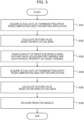
- Fig. 3 is a flow chart of an example of the learning process and the relearning process executed by the information processor 10 according to the present embodiment.
- Fig. 4 is a flow chart of the search process executed by the information processor 10 according to the present embodiment. First, an example of the learning process and the relearning process executed by the information processor 10 is described with reference to Fig. 3 .
- Step S101 The control unit 11 of the information processor 10 acquires actual data 110 of a thermosetting epoxy resin composition used for another application.
- the actual data 110 can be acquired by any method.
- the control unit 11 may receive an input of actual data from the user through the input unit 13 to acquire the actual data 110.
- the control unit 11 may also acquire the actual data 110 from an external device storing the actual data 110 via a communication interface.
- Step S102 The control unit 11 calculates the feature value 210 on the basis of the input actual data 110. More specifically, the control unit 11 calculates the feature value 210 on the basis of a polymer composition, a structural formula, an epoxy equivalent, and a blending condition included in the actual data 110. To calculate the feature value 210, the control unit 11 may appropriately refer to a database, a library, or the like. In such a case, the database, the library, and the like may be stored in the storage unit 12.
- Step S103 The control unit 11 trains a plurality of predictive models 400 (first to N-th predictive models) using the calculated feature value 210 as an explanatory variable and each physical property as a target variable.
- Each predictive model is, for example, but not limited to, a support vector machine, a linear model, or a nonlinear model.
- each predictive model 400 may be a model trained on the basis of a multilayer perceptron consisting of an input layer, a hidden layer, and an output layer.
- each predictive model 400 may be a model trained on the basis of a machine learning algorithm, such as a convolutional neural network (CNN), a recurrent neural network (RNN), or another deep learning.
- CNN convolutional neural network
- RNN recurrent neural network
- Step S104 The control unit 11 acquires the actual data 120 of a thermosetting epoxy resin composition used for this application.
- the actual data 120 can be acquired by any method.
- the control unit 11 may receive an input of actual data from the user through the input unit 13 to acquire the actual data 120.
- the control unit 11 may also acquire the actual data 120 from an external device storing the actual data 120 via a communication interface.
- the actual data 120 may be smaller in amount than the actual data 110.
- Step S105 The control unit 11 calculates the feature value 220 on the basis of the input actual data 120. More specifically, the control unit 11 calculates the feature value 220 on the basis of a polymer composition, a structural formula, an epoxy equivalent, and a blending condition included in the actual data 120. To calculate the feature value 210, the control unit 11 may appropriately refer to a database, a library, or the like. In such a case, the database, the library, and the like may be stored in the storage unit 12.
- Step S106 The control unit 11 relearns the predictive models 400 (the first to N-th predictive models) trained in the step S103 using the calculated feature value 220 as an explanatory variable and each physical property as a target variable. In this manner, the predictive models 400 according to the present embodiment are constructed.
- the accuracy of the predictive models 400 constructed by these processes may be verified on the basis of known data.
- a search process of a thermosetting epoxy resin composition may be performed using the predictive models 400.
- thermosetting epoxy resin composition executed by the information processor 10 is described with reference to Fig. 4 .
- the information processor 10 searches for a thermosetting epoxy resin composition with a desired balance of physical properties by inverse analysis using a plurality of predictive models 400.
- Step S201 The control unit 11 of the information processor 10 acquires a physical property (hereinafter referred to as a target property) related to a desired thermosetting epoxy resin composition and inputs the target property to each of the predictive models 400 (first to N-th predictive models). For example, the control unit 11 receives an input of the target property from the user through the input unit 13 to acquire the target property.
- a target property a physical property related to a desired thermosetting epoxy resin composition
- Step S202 The control unit 11 predicts, by each predictive model 400, the feature value of a thermosetting epoxy resin composition capable of having the target property acquired in the step S201.
- Step S203 The control unit 11 optimizes the result predicted in the step S202 and outputs search results from the output unit 14. For example, the control unit 11 outputs as search results from the output unit 14 a polymer composition, a structural formula, an epoxy equivalent, and a blending condition related to a thermosetting epoxy resin composition with a desired balance of physical properties. Alternatively, the control unit 11 may output as a search result from the output unit 14 a feature value related to at least one thermosetting epoxy resin composition with a desired balance of physical properties.
- the evaluation function can be maximized or minimized by optimization processing, a steepest descent method, Bayesian optimization, Gaussian process optimization, a Python library, such as GPyOpt, Optuna, or HyperOpt, using a mechanism thereof, a genetic algorithm, or the like.
- a steepest descent method Bayesian optimization
- Gaussian process optimization a Python library, such as GPyOpt, Optuna, or HyperOpt
- the present invention is not limited to these methods, and one or a plurality of methods suitable for an objective to be optimized can be selected.
- the predictive models 400 are trained on the basis of the actual data 100 related to a thermosetting epoxy resin composition.
- a thermosetting epoxy resin composition with a desired balance of physical properties can be searched for by inverse analysis using these predictive models 400.
- a thermosetting epoxy resin composition with desired strength and heat resistance can be easily searched.
- thermosetting epoxy resin composition A method of searching for a thermosetting epoxy resin composition on the basis of the experience and intuition of a person in charge without using the search method according to the present embodiment is also conceivable.
- a preliminary experiment related to a known thermosetting epoxy resin composition and an unknown thermosetting epoxy resin composition is performed, and the experimental results are subjected to least-squares regression calculation to find correlations of given conditions and physical properties on the basis of the experience and intuition of a person in charge.
- a synthetic experiment of several thermosetting epoxy resin compositions related to search candidates is performed.
- the experimental results are further subjected to least-squares regression calculation. These can also be repeated to search for a desired thermosetting epoxy resin composition.
- thermosetting epoxy resin compositions in parallel and in a short time in the information processor 10 on the basis of the predictive models 400. This can greatly reduce the number of development steps.
- the actual data 100 include the actual data 110 for another application and the actual data 120 for the predetermined application, which are used for the learning process and the relearning process of the predictive models 400.
- teaching data in the learning process are in a wider range than in the predetermined application, which can prevent the accuracy from being lowered by extrapolation.
- teaching data in the relearning process are limited for the present application. This allows a highly accurate predictive model to be trained in the search for a thermosetting epoxy resin composition for the predetermined application.
- the learning process and the relearning process are performed in the present embodiment, if the accuracy is in a practical range, only the learning process may be performed, and the relearning process may be omitted. Without the relearning process, either actual data for the predetermined application or actual data for another application may be used in the learning process. This allows a predictive model to be trained in a shorter time.
- the predetermined application is for a composite material in the present embodiment, the present invention is not limited thereto.
- the predetermined application may be an electronic material, a paint, a civil engineering and building material, an adhesive agent, a flame retardant, or a composite material.
- the feature value may include at least one of a molecular fingerprint and a molecular descriptor. Since the molecular fingerprint or the molecular descriptor can indicate a feature of a thermosetting epoxy resin composition, the feature value can be used as an explanatory variable to improve the accuracy of the predictive models 400.
- the feature value may include the distance between oxygen atoms related to a thermosetting epoxy resin.
- the distance between oxygen atoms is highly correlated with the bending modulus, the bending strain, the bending strength, and the glass transition temperature of a thermosetting epoxy resin composition, and the distance between oxygen atoms can be used as an explanatory variable to improve the accuracy of the predictive models 400.
- Tables 1 and 2 show results obtained when the distance between oxygen atoms was not used as an explanatory variable and when the distance between oxygen atoms was used as an explanatory variable in the learning of the predictive models 400.
- eXtreme Gradient Boosting XGBoost
- R 2 denotes a coefficient of determination
- R 2 closer to 1 indicates a model with higher accuracy
- RMSE is a measure obtained by summing the root mean square of prediction errors, and RMSE closer to 0 indicates a model with higher performance.
- R 2 and RMSE of the learning model are better when the distance between oxygen atoms is used as an explanatory variable than when the distance between oxygen atoms is not used as an explanatory variable.
- the distance between oxygen atoms can be used as an explanatory variable to improve the accuracy of the predictive models 400.
- the learning model can have R 2 of more than 0.50 in all the target variables, and a thermosetting epoxy resin composition with a desired balance of physical properties can be designed.
Landscapes
- Engineering & Computer Science (AREA)
- Chemical & Material Sciences (AREA)
- Crystallography & Structural Chemistry (AREA)
- Theoretical Computer Science (AREA)
- Bioinformatics & Cheminformatics (AREA)
- Bioinformatics & Computational Biology (AREA)
- Computing Systems (AREA)
- Life Sciences & Earth Sciences (AREA)
- Evolutionary Computation (AREA)
- Computer Vision & Pattern Recognition (AREA)
- Software Systems (AREA)
- Medical Informatics (AREA)
- Health & Medical Sciences (AREA)
- Artificial Intelligence (AREA)
- General Health & Medical Sciences (AREA)
- Databases & Information Systems (AREA)
- Data Mining & Analysis (AREA)
- Physics & Mathematics (AREA)
- Medicinal Chemistry (AREA)
- Polymers & Plastics (AREA)
- Organic Chemistry (AREA)
- Chemical Kinetics & Catalysis (AREA)
- Computer Hardware Design (AREA)
- Geometry (AREA)
- General Engineering & Computer Science (AREA)
- General Physics & Mathematics (AREA)
- Management, Administration, Business Operations System, And Electronic Commerce (AREA)
- Epoxy Resins (AREA)
Abstract
Description
- The present disclosure relates to a method of searching for a thermosetting epoxy resin composition, an information processor, and a program. The present application claims the priority of
Japanese Patent Application No. 2022-096816 filed on June 15, 2022 - There have been known composite materials, such as carbon fiber reinforced plastics (hereinafter also referred to as CFRP) produced by impregnating carbon fibers with a composition containing a thermosetting epoxy resin or the like (hereinafter also referred to as a thermosetting epoxy resin composition) and heat-curing the composition. CFRP is a fiber-reinforced composite material containing a plastic as a base material and carbon fibers as reinforcing fibers. CFRP is a high-performance material that is lighter in weight than general structural metallic materials, has high specific strength and specific rigidity, and has good electrical characteristics and high corrosion resistance. Thus, in recent years, CFRP has been used as a material replacing metallic materials in a wide range of applications, such as structural members of aerospace structures, automobiles, two-wheeled vehicles, and ships, large-sized industrial machine parts, and sporting goods. Thermosetting epoxy resin compositions used as raw materials for composite materials, such as CFRP, are required to have characteristics, such as strength and heat resistance, depending on the use of the composite materials. However, some of these characteristics of thermosetting epoxy resin compositions may be contradictory to each other, and it is not necessarily easy to search for a thermosetting epoxy resin composition with required characteristics in a well-balanced manner. Furthermore, only limited specific thermosetting epoxy resin compositions have been used as raw materials of composite materials, such as CFRP, and a search for a novel thermosetting epoxy resin has been desired.
- On the other hand, there is a known technique of modeling a material model, learning the material model by machine learning, and then using the learned material model to search for a structure of a novel material from target physical property information (for example, Patent Literature 1).
- PTL 1:
Japanese Patent No. 6832678 - The technique of searching for a material described in Patent Literature 1 is directed to a general material model, and searching for a thermosetting epoxy resin composition has not been particularly considered in the related art.
- An object of the present disclosure made in view of such circumstances is to improve a technique of searching for a thermosetting epoxy resin composition.
- A method of searching for a thermosetting epoxy resin composition according to an embodiment of the present disclosure is
a method of searching for a thermosetting epoxy resin composition executed by an information processor, the method including the steps of: - training a plurality of predictive models each corresponding to a target variable using actual data related to a thermosetting epoxy resin composition; and
- searching for a thermosetting epoxy resin composition with a desired balance of physical properties by inverse analysis using the plurality of predictive models,
- wherein the actual data include a polymer composition, a structural formula, an epoxy equivalent, and a blending condition related to a thermosetting epoxy resin, and
- the target variable includes a bending modulus, a bending strain, a bending strength, and a glass transition temperature.
- In a search method according to an embodiment of the present disclosure, in the step of training the plurality of predictive models, a feature value is calculated on the basis of the actual data and is used as an explanatory variable of the plurality of predictive models.
- In a search method according to an embodiment of the present disclosure, the feature value includes at least one of a molecular fingerprint and a molecular descriptor.
- In a search method according to an embodiment of the present disclosure, the feature value further includes a distance between oxygen atoms related to a thermosetting epoxy resin.
- In a search method according to an embodiment of the present disclosure,
- the actual data include actual data of a thermosetting epoxy resin composition used for a predetermined application and actual data of a thermosetting epoxy resin composition used for an application other than the predetermined application, and
- the step of training the plurality of predictive models includes
- training the plurality of predictive models using the actual data of the thermosetting epoxy resin composition used for the application other than the predetermined application and then relearning the plurality of predictive models using the actual data of the thermosetting epoxy resin composition used for the predetermined application.
- An information processor according to an embodiment of the present disclosure is
- an information processor that includes a control unit and searches for a thermosetting epoxy resin composition, wherein
- the control unit
- trains a plurality of predictive models each corresponding to a target variable using actual data related to a thermosetting epoxy resin composition, and
- searches for a thermosetting epoxy resin composition with a desired balance of physical properties by inverse analysis using the plurality of predictive models,
- wherein the actual data include a polymer composition, a structural formula, an epoxy equivalent, and a blending condition related to a thermosetting epoxy resin, and
- the target variable includes a bending modulus, a bending strain, a bending strength, and a glass transition temperature.
- A non-transitory computer-readable recording medium according to an embodiment of the present disclosure is
- a non-transitory computer-readable recording medium storing an instruction that, when executed by a processor, causes the processor
- to train a plurality of predictive models each corresponding to a target variable using actual data related to a thermosetting epoxy resin composition, and
- to search for a thermosetting epoxy resin composition with a desired balance of physical properties by inverse analysis using the plurality of predictive models,
- wherein the actual data include a polymer composition, a structural formula, an epoxy equivalent, and a blending condition related to a thermosetting epoxy resin, and
- the target variable includes a bending modulus, a bending strain, a bending strength, and a glass transition temperature.
- A method of searching for a thermosetting epoxy resin composition, an information processor, and a program according to an embodiment of the present disclosure can improve a technique of searching for a thermosetting epoxy resin composition.
-
- [
Fig. 1] Fig. 1 is a diagram of an overview of an embodiment of the present disclosure. - [
Fig. 2] Fig. 2 is a block diagram of a schematic configuration of an information processor that searches for a thermosetting epoxy resin composition according to an embodiment of the present disclosure. - [
Fig. 3] Fig. 3 is a flow chart of an operation of a learning process of an information processor that searches for a thermosetting epoxy resin composition according to an embodiment of the present disclosure. - [
Fig. 4] Fig. 4 is a flow chart of an operation of a search process of an information processor that searches for a thermosetting epoxy resin composition according to an embodiment of the present disclosure. - A method of searching for a thermosetting epoxy resin composition according to an embodiment of the present disclosure is described below with reference to the accompanying drawings.
- In the drawings, the same or equivalent parts are denoted by the same reference numerals and letters. In the description of the present embodiment, description of the same or equivalent parts is omitted or simplified as appropriate.
- A method of searching for a thermosetting epoxy resin composition according to the present embodiment is outlined below with reference to
Figs. 1 and2 . - First, the present embodiment is outlined below.
Actual data 100 shown inFig. 1 are used in the method of searching for a thermosetting epoxy resin composition according to the present embodiment. Aninformation processor 10 shown inFig. 2 executes the method of searching for a thermosetting epoxy resin composition according to the present embodiment. Theinformation processor 10 trains a plurality ofpredictive models 400 each corresponding to a target variable using theactual data 100 related to a thermosetting epoxy resin composition. - The
actual data 100 includeactual data 110 for another application andactual data 120 for a predetermined application. Theactual data 120 for the predetermined application are, for example, actual data related to a thermosetting epoxy resin composition for a composite material. More specifically, theactual data 120 include, for example, actual data related to a thermosetting epoxy resin composition used for CFRP. Theactual data 110 for another application are actual data of a thermosetting epoxy resin composition used for an application other than the predetermined application (here, an application other than the composite material). Each of theactual data 110 for another application and theactual data 120 for the predetermined application includes a polymer composition, a structural formula, an epoxy equivalent, a blending condition, a test piece thickness, and first to N-th physical properties related to a thermosetting epoxy resin composition. The blending condition is a condition related to the blend ratio of a thermosetting epoxy resin to a curing agent (for example, an amine). The test piece thickness is the thickness of a test piece in a physical property measurement and is, for example, 2 mm or 4 mm. - The first to N-th physical properties correspond to a plurality of target variables. N is a positive integer. The
information processor 10 trains first to N-th predictive models, each corresponding to one of N target variables. The plurality of target variables include contradictory characteristics. For example, the plurality of target variables include a bending modulus, a bending strength, a bending strain, and heat resistance. Among these, the bending modulus and the bending strain are contradictory to each other. An example of the heat resistance may be a glass transition temperature (a temperature with the maximum change in elastic modulus in measurement with a viscoelastometer). In the present embodiment, a glass transition temperature is used as a measure of heat resistance in an example described below. - First, the
information processor 10 performs alearning process 310 of thepredictive models 400 using theactual data 110 for another application. Theinformation processor 10 calculates afeature value 210 from theactual data 110 for another application. Theinformation processor 10 trains thepredictive models 400 using thefeature value 210 as an explanatory variable and each physical property as a target variable. More specifically, theinformation processor 10 trains a first predictive model using thefeature value 210 as an explanatory variable and a first physical property as a target variable. Theinformation processor 10 trains a second predictive model using thefeature value 210 as an explanatory variable and a second physical property as a target variable. Likewise, theinformation processor 10 trains the N-th predictive model using thefeature value 210 as an explanatory variable and an N-th physical property as a target variable. Thefeature value 210 used for the learning process of the first to N-th predictive models may be appropriately selected according to the relationship between each feature value and the target variable. In other words, thefeature value 210 used for learning of the first to N-th predictive models may be different from each other. - Next, the
information processor 10 performs arelearning process 320 of thepredictive models 400 using theactual data 110 for another application. First, theinformation processor 10 calculates afeature value 220 from theactual data 110 for another application. Theinformation processor 10 performs a relearning process of each predictive model using thefeature value 220 as an explanatory variable and each physical property as a target variable. More specifically, theinformation processor 10 performs a relearning process of the first predictive model using thefeature value 220 as an explanatory variable and the first physical property as a target variable. Theinformation processor 10 performs a relearning process of the second predictive model using thefeature value 220 as an explanatory variable and the second physical property as a target variable. Theinformation processor 10 performs a relearning process of the N-th predictive model using thefeature value 220 as an explanatory variable and the N-th physical property as a target variable. Thefeature value 220 used for the relearning process of the first to N-th predictive models may be appropriately selected according to the relationship between each feature value and the target variable. In other words, thefeature value 220 used for learning of the first to N-th predictive models may be different from each other. Theinformation processor 10 searches for a thermosetting epoxy resin composition with a desired balance of physical properties by inverse analysis using the first to N-th predictive models learned in this manner. - As described above, in the present embodiment, a plurality of predictive models are trained on the basis of actual data related to a thermosetting epoxy resin composition. A thermosetting epoxy resin composition with a desired balance of physical properties is searched for by inverse analysis using the plurality of predictive models. Thus, the search technique is improved in that a thermosetting epoxy resin composition with a desired balance of characteristics can be searched for.
- Next, each component of the
information processor 10 is described in detail below. Theinformation processor 10 is an apparatus used by a user. For example, a personal computer, a server computer, a general-purpose electronic device, or a dedicated electronic device can be adopted as theinformation processor 10. - As shown in
Fig. 2 , theinformation processor 10 includes acontrol unit 11, astorage unit 12, aninput unit 13, and anoutput unit 14. - The
control unit 11 includes at least one processor, at least one dedicated circuit, or a combination thereof. The processor is a general-purpose processor, such as a central processing unit (CPU) or a graphics processing unit (GPU), or a dedicated processor specialized for specific processing. The dedicated circuit is, for example, a field-programmable gate array (FPGA) or an application specific integrated circuit (ASIC). Thecontrol unit 11 executes processing related to the operation of theinformation processor 10 while controlling each unit of theinformation processor 10. - The
storage unit 12 includes at least one semiconductor memory, at least one magnetic memory, at least one optical memory, or a combination of at least two of these memories. The semiconductor memory is, for example, a random access memory (RAM) or a read only memory (ROM). The RAM is, for example, a static random access memory (SRAM) or a dynamic random access memory (DRAM). The ROM is, for example, an electrically erasable programmable read only memory (EEPROM). Thestorage unit 12 functions as, for example, a main storage, an auxiliary storage, or a cache memory. Thestorage unit 12 stores data used for the operation of theinformation processor 10 and data obtained by the operation of theinformation processor 10. - The
input unit 13 includes at least one input interface. The input interface is, for example, a physical key, a capacitance key, a pointing device, or a touch screen integrated with a display. The input interface may be, for example, a microphone that receives voice input or a camera that receives gesture input. Theinput unit 13 receives an operation of inputting data used for the operation of theinformation processor 10. Instead of being included in theinformation processor 10, theinput unit 13 may be connected to theinformation processor 10 as an external input device. The connection method can be, for example, a universal serial bus (USB), a high-definition multimedia interface (HDMI) (registered trademark), Bluetooth (registered trademark), or the like. - The
output unit 14 includes at least one output interface. The output interface is, for example, a display that outputs information in the form of an image. The display is, for example, a liquid crystal display (LCD) or an organic electro luminescence (EL) display. Theoutput unit 14 displays and outputs data obtained by the operation of theinformation processor 10. Instead of being included in theinformation processor 10, theoutput unit 14 may be connected to theinformation processor 10 as an external output device. The connection method can be, for example, USB, HDMI (registered trademark), Bluetooth (registered trademark), or the like. - The functions of the
information processor 10 are implemented by a processor corresponding to theinformation processor 10 executing a program according to the present embodiment. That is, the functions of theinformation processor 10 are implemented by software. The program causes a computer to execute the operation of theinformation processor 10 and thereby causes the computer to function as theinformation processor 10. In other words, a computer executes the operation of theinformation processor 10 in accordance with the program and thereby functions as theinformation processor 10. - In the present embodiment, the program can be recorded in a computer-readable recording medium. The computer-readable recording medium includes a non-transitory computer-readable medium, for example, a magnetic recording apparatus, an optical disk, a magneto-optical recording medium, or a semiconductor memory. The program is distributed, for example, by selling, transferring, or lending a portable recording medium, such as a digital versatile disc (DVD) or a compact disc read only memory (CD-ROM), in which the program is recorded. The program may also be distributed by storing the program in a storage of an external server and transmitting the program from the external server to another computer. The program may also be provided as a program product.
- A part or all of the functions of the
information processor 10 may be realized by a dedicated circuit corresponding to thecontrol unit 11. In other words, a part or all of the functions of theinformation processor 10 may be realized by hardware. - In the present embodiment, the
storage unit 12 stores theactual data 100, the feature values 210 and 220, and thepredictive models 400. The feature values 210 and 220 are calculated on the basis of theactual data 100. In the present embodiment, the feature values can be calculated by various methods. For example, the feature values 210 and 220 may be calculated by computer processing based on at least one characteristic data among theactual data 100. The feature values 210 and 220 may also be determined by selecting characteristic data from theactual data 100. In other words, the phrase "calculating a feature value based on actual data", as used herein, refers to at least one of calculation based on the actual data and determination based on the actual data. - The
feature value 210 may include any data that represent a feature of a thermosetting epoxy resin composition. For example, thefeature value 210 may include an epoxy equivalent and a blending condition related to a thermosetting epoxy resin. For example, thefeature value 210 may include at least one of a molecular fingerprint and a molecular descriptor. The molecular descriptor can be obtained from the information of a thermosetting epoxy resin represented by SMILES notation using RDKit, which is a publicly known molecular descriptor generation library, alvaDesc, which is commercially available software, or the like. Such a molecular descriptor may be a zero-dimensional descriptor, such as the molecular weight, the number of atoms in a molecule, or the number of bonds. It may be a one-dimensional descriptor, such as the number of functional groups in a molecule, the number of alicyclic structures, or the number of aromatic rings. It may be a two-dimensional descriptor, such as a topological descriptor representing a molecule based on a graph theory, such as a Wiener index, a Chi connectivity index, a Balaban index, or a BCUT descriptor. It may be a three-dimensional descriptor, such as a descriptor calculated on the basis of the three-dimensional structure of a molecule, such as 3D-MoRSE, WHIM, CoMFA, or CoMSIA. It may be a four-dimensional descriptor, such as a descriptor calculated in consideration of interaction, such as Hopfinger, which can be appropriately selected and used. Among them, it is, for example, MaxPartialCharge, MinPartialCharge, MaxEStateIndex, MinEStateIndex, QED, MolMR, MolWt, ExactMolWt, HeavyAtomCount, HeavyAtomMolWt, NHOHCount, NOCount, NumHAcceptors, NumHDonors, NumHeteroatoms, NumRotatableBonds, NumValenceElectrons, NumAmideBonds, NumAromaticRings, NumSaturatedRings, NumAliphaticRings, NumAromaticHeterocycles, NumSaturatedHeterocycles, NumAliphaticHeterocycles, NumAromaticCarbocycles, NumSaturatedCarbocycles, NumAliphaticCarbocycles, RingCount, FractionCSP3, NumSpiroAtoms, NumBridgeheadAtoms, TPSA, LabuteASA, PEOE_VSA1 to PEOE_VSA14, SMR_VSA1 to SMR_VSA10, SlogP_VSA1 to SlogP_VSA12, EState_VSA1 to EState_VSA11, VSA_EState1 to VSA_EState10, BCUT2D, BalabanJ, BertzCT, Ipc, HallKierAlpha, Kappa1-Kappa3, Phi, Chi0, Chi1, Chi0n to Chi4n, or Chi0v to Chi4v. Other useful descriptors generated can be appropriately used. - The
feature value 210 may include the distance between oxygen atoms related to a thermosetting epoxy resin. The distance between oxygen atoms related to a thermosetting epoxy resin is the distance between oxygen atoms of a glycidyl group and an ether moiety forming a bond of the main backbone in the thermosetting epoxy resin. Such a distance can be an average value measured using a conventional three-dimensional molecular structure model or can be determined on a computer by measuring the distance between target oxygen atoms in a thermosetting epoxy resin in a stable state of a three-dimensional molecular structure drawn using molecular drawing software. The software used to draw a three-dimensional molecular structure may be Chem3D, Gaussian, or the like. The molecular structure of the thermosetting epoxy resin in the stable state can be determined, for example, by a publicly known computational science method, such as a molecular mechanics method, a molecular dynamics method, a semi-empirical molecular orbital method, a non-empirical molecular orbital method (an ab initio method), a density functional theory, or an ab initio molecular dynamics method (a classical molecular dynamics method or the Monte Carlo method) based on the structural formula of the thermosetting epoxy resin. - The
feature value 220 may include any data that represent a feature of a thermosetting epoxy resin composition. For example, thefeature value 220 may include an epoxy equivalent and a blending condition related to a thermosetting epoxy resin. For example, thefeature value 220 may include at least one of a molecular fingerprint and a molecular descriptor. Such a molecular descriptor is, for example, MaxPartialCharge, MinPartialCharge, MaxEStateIndex, MinEStateIndex, QED, MolMR, MolWt, ExactMolWt, HeavyAtomCount, HeavyAtomMolWt, NHOHCount, NOCount, NumHAcceptors, NumHDonors, NumHeteroatoms, NumRotatableBonds, NumValenceElectrons, NumAmideBonds, NumAromaticRings, NumSaturatedRings, NumAliphaticRings, NumAromaticHeterocycles, NumSaturatedHeterocycles, NumAliphaticHeterocycles, NumAromaticCarbocycles, NumSaturatedCarbocycles, NumAliphaticCarbocycles, RingCount, FractionCSP3, NumSpiroAtoms, NumBridgeheadAtoms, TPSA, LabuteASA, PEOE_VSA1 to PEOE_VSA14, SMR_VSA1 to SMR_VSA10, SlogP_VSA1 to SlogP_VSA12, EState_VSA1 to EState_VSA11, VSA_EState1 to VSA_EState10, BCUT2D, BalabanJ, BertzCT, Ipc, HallKierAlpha, Kappa1-Kappa3, Phi, Chi0, Chi1, Chi0n to Chi4n, or Chi0v to Chi4v. Other useful descriptors generated can be appropriately used. Thefeature value 220 may include the distance between oxygen atoms related to a thermosetting epoxy resin. - The
actual data 100, the feature values 210 and 220, and thepredictive models 400 may be stored in an external device different from theinformation processor 10. In such a case, theinformation processor 10 may have an external communication interface. The communication interface may be an interface for wired communication or wireless communication. For wired communication, the communication interface is, for example, a LAN interface or USB. For wireless communication, the communication interface is, for example, an interface according to mobile communication standards, such as LTE, 4G, or 5G, or an interface according to near field communication, such as Bluetooth (registered trademark). The communication interface can receive data used for the operation of theinformation processor 10 and can transmit data obtained by the operation of theinformation processor 10. - The operation of the
information processor 10 according to the present embodiment is described below with reference toFigs. 3 and4 .Fig. 3 is a flow chart of an example of the learning process and the relearning process executed by theinformation processor 10 according to the present embodiment.Fig. 4 is a flow chart of the search process executed by theinformation processor 10 according to the present embodiment. First, an example of the learning process and the relearning process executed by theinformation processor 10 is described with reference toFig. 3 . - Step S101: The
control unit 11 of theinformation processor 10 acquiresactual data 110 of a thermosetting epoxy resin composition used for another application. Theactual data 110 can be acquired by any method. For example, thecontrol unit 11 may receive an input of actual data from the user through theinput unit 13 to acquire theactual data 110. For example, thecontrol unit 11 may also acquire theactual data 110 from an external device storing theactual data 110 via a communication interface. - Step S102: The
control unit 11 calculates thefeature value 210 on the basis of the inputactual data 110. More specifically, thecontrol unit 11 calculates thefeature value 210 on the basis of a polymer composition, a structural formula, an epoxy equivalent, and a blending condition included in theactual data 110. To calculate thefeature value 210, thecontrol unit 11 may appropriately refer to a database, a library, or the like. In such a case, the database, the library, and the like may be stored in thestorage unit 12. - Step S103: The
control unit 11 trains a plurality of predictive models 400 (first to N-th predictive models) using the calculatedfeature value 210 as an explanatory variable and each physical property as a target variable. Each predictive model is, for example, but not limited to, a support vector machine, a linear model, or a nonlinear model. For example, eachpredictive model 400 may be a model trained on the basis of a multilayer perceptron consisting of an input layer, a hidden layer, and an output layer. Alternatively, eachpredictive model 400 may be a model trained on the basis of a machine learning algorithm, such as a convolutional neural network (CNN), a recurrent neural network (RNN), or another deep learning. - Step S104: The
control unit 11 acquires theactual data 120 of a thermosetting epoxy resin composition used for this application. Theactual data 120 can be acquired by any method. For example, thecontrol unit 11 may receive an input of actual data from the user through theinput unit 13 to acquire theactual data 120. For example, thecontrol unit 11 may also acquire theactual data 120 from an external device storing theactual data 120 via a communication interface. Theactual data 120 may be smaller in amount than theactual data 110. - Step S105: The
control unit 11 calculates thefeature value 220 on the basis of the inputactual data 120. More specifically, thecontrol unit 11 calculates thefeature value 220 on the basis of a polymer composition, a structural formula, an epoxy equivalent, and a blending condition included in theactual data 120. To calculate thefeature value 210, thecontrol unit 11 may appropriately refer to a database, a library, or the like. In such a case, the database, the library, and the like may be stored in thestorage unit 12. - Step S106: The
control unit 11 relearns the predictive models 400 (the first to N-th predictive models) trained in the step S103 using the calculatedfeature value 220 as an explanatory variable and each physical property as a target variable. In this manner, thepredictive models 400 according to the present embodiment are constructed. - The accuracy of the
predictive models 400 constructed by these processes may be verified on the basis of known data. When the accuracy has been verified in a practical range, a search process of a thermosetting epoxy resin composition may be performed using thepredictive models 400. - Next, an example of a search process for a thermosetting epoxy resin composition executed by the
information processor 10 is described with reference toFig. 4 . As an overview, theinformation processor 10 searches for a thermosetting epoxy resin composition with a desired balance of physical properties by inverse analysis using a plurality ofpredictive models 400. - Step S201: The
control unit 11 of theinformation processor 10 acquires a physical property (hereinafter referred to as a target property) related to a desired thermosetting epoxy resin composition and inputs the target property to each of the predictive models 400 (first to N-th predictive models). For example, thecontrol unit 11 receives an input of the target property from the user through theinput unit 13 to acquire the target property. - Step S202: The
control unit 11 predicts, by eachpredictive model 400, the feature value of a thermosetting epoxy resin composition capable of having the target property acquired in the step S201. - Step S203: The
control unit 11 optimizes the result predicted in the step S202 and outputs search results from theoutput unit 14. For example, thecontrol unit 11 outputs as search results from the output unit 14 a polymer composition, a structural formula, an epoxy equivalent, and a blending condition related to a thermosetting epoxy resin composition with a desired balance of physical properties. Alternatively, thecontrol unit 11 may output as a search result from the output unit 14 a feature value related to at least one thermosetting epoxy resin composition with a desired balance of physical properties. - Here, the evaluation function can be maximized or minimized by optimization processing, a steepest descent method, Bayesian optimization, Gaussian process optimization, a Python library, such as GPyOpt, Optuna, or HyperOpt, using a mechanism thereof, a genetic algorithm, or the like. However, the present invention is not limited to these methods, and one or a plurality of methods suitable for an objective to be optimized can be selected.
- As described above, in the present embodiment, the
predictive models 400 are trained on the basis of theactual data 100 related to a thermosetting epoxy resin composition. A thermosetting epoxy resin composition with a desired balance of physical properties can be searched for by inverse analysis using thesepredictive models 400. For example, a thermosetting epoxy resin composition with desired strength and heat resistance can be easily searched. - A method of searching for a thermosetting epoxy resin composition on the basis of the experience and intuition of a person in charge without using the search method according to the present embodiment is also conceivable. In such a case, a preliminary experiment related to a known thermosetting epoxy resin composition and an unknown thermosetting epoxy resin composition is performed, and the experimental results are subjected to least-squares regression calculation to find correlations of given conditions and physical properties on the basis of the experience and intuition of a person in charge. After finding the correlations, a synthetic experiment of several thermosetting epoxy resin compositions related to search candidates is performed. The experimental results are further subjected to least-squares regression calculation. These can also be repeated to search for a desired thermosetting epoxy resin composition. However, such a method depends on the experience and intuition of a person in charge, requires enormous number of man-hours for the preliminary experiment and experiment, and typically requires several months to perform one optimal composition search. In contrast, the present embodiment can search for desired thermosetting epoxy resin compositions in parallel and in a short time in the
information processor 10 on the basis of thepredictive models 400. This can greatly reduce the number of development steps. - In the present embodiment, the
actual data 100 include theactual data 110 for another application and theactual data 120 for the predetermined application, which are used for the learning process and the relearning process of thepredictive models 400. Thus, teaching data in the learning process are in a wider range than in the predetermined application, which can prevent the accuracy from being lowered by extrapolation. Furthermore, teaching data in the relearning process are limited for the present application. This allows a highly accurate predictive model to be trained in the search for a thermosetting epoxy resin composition for the predetermined application. Although the learning process and the relearning process are performed in the present embodiment, if the accuracy is in a practical range, only the learning process may be performed, and the relearning process may be omitted. Without the relearning process, either actual data for the predetermined application or actual data for another application may be used in the learning process. This allows a predictive model to be trained in a shorter time. - Although the predetermined application is for a composite material in the present embodiment, the present invention is not limited thereto. For example, the predetermined application may be an electronic material, a paint, a civil engineering and building material, an adhesive agent, a flame retardant, or a composite material.
- In the present embodiment, the feature value may include at least one of a molecular fingerprint and a molecular descriptor. Since the molecular fingerprint or the molecular descriptor can indicate a feature of a thermosetting epoxy resin composition, the feature value can be used as an explanatory variable to improve the accuracy of the
predictive models 400. - In the present embodiment, the feature value may include the distance between oxygen atoms related to a thermosetting epoxy resin. The distance between oxygen atoms is highly correlated with the bending modulus, the bending strain, the bending strength, and the glass transition temperature of a thermosetting epoxy resin composition, and the distance between oxygen atoms can be used as an explanatory variable to improve the accuracy of the
predictive models 400. - Tables 1 and 2 show results obtained when the distance between oxygen atoms was not used as an explanatory variable and when the distance between oxygen atoms was used as an explanatory variable in the learning of the
predictive models 400. Here, eXtreme Gradient Boosting (XGBoost) was employed as a learning model related to the bending modulus, the glass transition temperature, the bending strain, and the bending strength. In Tables 1 and 2, R2 denotes a coefficient of determination, and R2 closer to 1 indicates a model with higher accuracy. In Tables 1 and 2, RMSE is a measure obtained by summing the root mean square of prediction errors, and RMSE closer to 0 indicates a model with higher performance.[Table 1] Prediction accuracy results when the distance between oxygen atoms was not used as an explanatory variable Model R2 RMSE Bending modulus XGBoost 0.70 240 Glass transition temperature (Tg E') XGBoost 0.64 36 Bending strain XGBoost 0.49 2.1 Bending strength XGBoost 0.49 23 [Table 2] Prediction accuracy results when the distance between oxygen atoms was used as an explanatory variable Model R2 RMSE Bending modulus XGBoost 0.74 222 Glass transition temperature (Tg E') XGBoost 0.70 33 Bending strain XGBoost 0.55 2.0 Bending strength XGBoost 0.55 21 - As shown in Tables 1 and 2, R2 and RMSE of the learning model are better when the distance between oxygen atoms is used as an explanatory variable than when the distance between oxygen atoms is not used as an explanatory variable. Thus, the distance between oxygen atoms can be used as an explanatory variable to improve the accuracy of the
predictive models 400. As a result, the learning model can have R2 of more than 0.50 in all the target variables, and a thermosetting epoxy resin composition with a desired balance of physical properties can be designed. - Although the present disclosure has been described on the basis of the drawings and the examples, it should be noted that a person skilled in the art can easily make various changes and modifications on the basis of the present disclosure. Thus, it should be noted that these changes and modifications fall within the scope of the present disclosure. For example, functions or the like included in each means, each step, or the like can be rearranged so as not to be logically inconsistent, and a plurality of means, steps, or the like can be combined into one or divided.
-
- 10
- information processor
- 11
- control unit
- 12
- storage unit
- 13
- input unit
- 14
- output unit
- 100
- actual data
- 110
- actual data for another application
- 120
- actual data for predetermined application
- 210, 220
- feature value
- 310
- learning process
- 320
- relearning process
- 400
- predictive model
Claims (7)
- A method of searching for a thermosetting epoxy resin composition executed by an information processor, the method comprising the steps of:training a plurality of predictive models each corresponding to a target variable using actual data related to a thermosetting epoxy resin composition; andsearching for a thermosetting epoxy resin composition with a desired balance of physical properties by inverse analysis using the plurality of predictive models,wherein the actual data include a polymer composition, a structural formula, an epoxy equivalent, and a blending condition related to a thermosetting epoxy resin, andthe target variable includes a bending modulus, a bending strain, a bending strength, and a glass transition temperature.
- The method of searching for a thermosetting epoxy resin composition according to Claim 1, wherein
in the step of training the plurality of predictive models, a feature value is calculated on the basis of the actual data and is used as an explanatory variable of the plurality of predictive models. - The method of searching for a thermosetting epoxy resin composition according to Claim 2, wherein the feature value includes at least one of a molecular fingerprint and a molecular descriptor.
- The method of searching for a thermosetting epoxy resin composition according to Claim 3, wherein
the feature value further includes a distance between oxygen atoms related to a thermosetting epoxy resin. - The method of searching for a thermosetting epoxy resin composition according to any one of Claims 1 to 4, whereinthe actual data include actual data of a thermosetting epoxy resin composition used for a predetermined application and actual data of a thermosetting epoxy resin composition used for an application other than the predetermined application, andthe step of training the plurality of predictive models includestraining the plurality of predictive models using the actual data of the thermosetting epoxy resin composition used for the application other than the predetermined application and then relearning the plurality of predictive models using the actual data of the thermosetting epoxy resin composition used for the predetermined application.
- An information processor that includes a control unit and searches for a thermosetting epoxy resin composition, whereinthe control unittrains a plurality of predictive models each corresponding to a target variable using actual data related to a thermosetting epoxy resin composition, andsearches for a thermosetting epoxy resin composition with a desired balance of physical properties by inverse analysis using the plurality of predictive models,wherein the actual data include a polymer composition, a structural formula, an epoxy equivalent, and a blending condition related to a thermosetting epoxy resin, andthe target variable includes a bending modulus, a bending strain, a bending strength, and a glass transition temperature.
- A program of searching for a thermosetting epoxy resin composition, comprising:causing a computerto train a plurality of predictive models each corresponding to a target variable using actual data related to a thermosetting epoxy resin composition, andto search for a thermosetting epoxy resin composition with a desired balance of physical properties by inverse analysis using the plurality of predictive models,wherein the actual data include a polymer composition, a structural formula, an epoxy equivalent, and a blending condition related to a thermosetting epoxy resin, andthe target variable includes a bending modulus, a bending strain, a bending strength, and a glass transition temperature.
Applications Claiming Priority (2)
| Application Number | Priority Date | Filing Date | Title |
|---|---|---|---|
| JP2022096816A JP7248174B1 (en) | 2022-06-15 | 2022-06-15 | Search method for thermosetting epoxy resin composition, information processing device, and program |
| PCT/JP2023/021420 WO2023243543A1 (en) | 2022-06-15 | 2023-06-08 | Search method for thermosetting epoxy resin composition, information processing device, and program |
Publications (3)
| Publication Number | Publication Date |
|---|---|
| EP4425501A1 true EP4425501A1 (en) | 2024-09-04 |
| EP4425501A4 EP4425501A4 (en) | 2025-03-12 |
| EP4425501B1 EP4425501B1 (en) | 2025-11-12 |
Family
ID=85726014
Family Applications (1)
| Application Number | Title | Priority Date | Filing Date |
|---|---|---|---|
| EP23823834.9A Active EP4425501B1 (en) | 2022-06-15 | 2023-06-08 | Search method for thermosetting epoxy resin composition, information processing device, and program |
Country Status (5)
| Country | Link |
|---|---|
| US (1) | US20250037804A1 (en) |
| EP (1) | EP4425501B1 (en) |
| JP (1) | JP7248174B1 (en) |
| CN (1) | CN118202421A (en) |
| WO (1) | WO2023243543A1 (en) |
Families Citing this family (1)
| Publication number | Priority date | Publication date | Assignee | Title |
|---|---|---|---|---|
| JP7816627B1 (en) * | 2025-01-15 | 2026-02-18 | Dic株式会社 | Method for searching for aromatic maleimide resin, information processing device, and program |
Family Cites Families (9)
| Publication number | Priority date | Publication date | Assignee | Title |
|---|---|---|---|---|
| KR102457974B1 (en) | 2015-11-04 | 2022-10-21 | 삼성전자주식회사 | Method and apparatus for searching new material |
| JP2021004933A (en) * | 2019-06-25 | 2021-01-14 | 旭化成株式会社 | Device, method, program, method for producing photosensitive resin composition and method for producing photosensitive resin laminate |
| JP7302134B2 (en) * | 2019-08-05 | 2023-07-04 | 三井化学株式会社 | Physical property information estimation method, physical property information estimation model generation method, physical property information estimation device, physical property information estimation model generation device, physical property information estimation program, and physical property information estimation model generation program |
| JP7450905B2 (en) * | 2019-09-05 | 2024-03-18 | 国立研究開発法人物質・材料研究機構 | Curable composition search method and curable composition search device |
| JP2021051141A (en) * | 2019-09-24 | 2021-04-01 | 旭化成株式会社 | Device, method, program, method for producing photosensitive resin composition and method for producing photosensitive resin laminate |
| JP2021149449A (en) * | 2020-03-18 | 2021-09-27 | 株式会社豊田中央研究所 | Material search device, method and program |
| WO2021200281A1 (en) * | 2020-03-31 | 2021-10-07 | Mi-6株式会社 | Test evaluation system, program, and test evaluation method |
| JP2022013215A (en) * | 2020-07-03 | 2022-01-18 | 横浜ゴム株式会社 | Polymer raw material data analysis device and polymer raw material data analysis method |
| JP7564537B2 (en) | 2020-12-18 | 2024-10-09 | 株式会社M―Sfc | Laser processing method and laser processing device |
-
2022
- 2022-06-15 JP JP2022096816A patent/JP7248174B1/en active Active
-
2023
- 2023-06-08 EP EP23823834.9A patent/EP4425501B1/en active Active
- 2023-06-08 US US18/713,180 patent/US20250037804A1/en active Pending
- 2023-06-08 CN CN202380014278.1A patent/CN118202421A/en active Pending
- 2023-06-08 WO PCT/JP2023/021420 patent/WO2023243543A1/en not_active Ceased
Also Published As
| Publication number | Publication date |
|---|---|
| EP4425501A4 (en) | 2025-03-12 |
| US20250037804A1 (en) | 2025-01-30 |
| CN118202421A (en) | 2024-06-14 |
| JP7248174B1 (en) | 2023-03-29 |
| JP2023183283A (en) | 2023-12-27 |
| EP4425501B1 (en) | 2025-11-12 |
| WO2023243543A1 (en) | 2023-12-21 |
Similar Documents
| Publication | Publication Date | Title |
|---|---|---|
| EP4425502A1 (en) | Thermosetting epoxy resin composition search method, information processing device, and program | |
| Ma et al. | Multi-objective optimization of crash box filled with three-dimensional cellular structure under multi-angle impact loading | |
| KR101982674B1 (en) | Alternative training distribution based on density modification | |
| Zhang et al. | An optimized cross-linked network model to simulate the linear elastic material response of a smart polymer | |
| EP4425501B1 (en) | Search method for thermosetting epoxy resin composition, information processing device, and program | |
| Sarina et al. | Transmission system accuracy optimum allocation for multiaxis machine tools’ scheme design | |
| EP4381515A1 (en) | Machine learning-based polymer surface energy prediction system | |
| Zhang et al. | Efficient pneumatic actuation modeling using hybrid physics-based and data-driven framework | |
| Lan et al. | Molecular dynamics simulation on the binder of ethylene oxide–tetrahydrofuran copolyether cross-linked with N100 | |
| US20230420070A1 (en) | Protein Structure Prediction | |
| Moore et al. | Temperature-curvature relationships in asymmetric angle ply laminates by considering the effects of resin layers and temperature dependency of material properties | |
| Lovo et al. | Mechanical structural design based on additive manufacturing and internal reinforcement | |
| Xu et al. | WHISTLE: A Functionally Annotated High-Accuracy Map of Human m6A Epitranscriptome | |
| Jiang et al. | A general hyperelastic model for rubber-like materials incorporating strain-rate and temperature | |
| Hwan et al. | Predicting the elastic moduli of three-dimensional (four-step) braided tubes using a spatial spring model | |
| Huang et al. | Molecular Simulation Study on the Impact of a Cross-Linked Network Structure on the Tensile Mechanical Properties of PBT Substrates | |
| Benedini et al. | Universal machine learning potentials for systems with reduced dimensionality | |
| Zong et al. | Efficient characterization of double-cross-linked networks in hydrogels using data-inspired coarse-grained molecular dynamics model | |
| Liao et al. | Calculation of solvation force in molecular dynamics simulation by deep-learning method | |
| Tian et al. | Data-Driven Optimization and Mechanical Assessment of Perovskite Solar Cells via Stacking Ensemble and SHAP Interpretability | |
| JP7816627B1 (en) | Method for searching for aromatic maleimide resin, information processing device, and program | |
| CN115963405A (en) | Training method and device for battery charging time prediction model and computer equipment | |
| Zhang et al. | The calibration of force offset for rocket engine based on deep belief network | |
| Cheng et al. | De Novo Inverse Design Superhard C–N Compounds via Global Machine Learning Interatomic Potentials and Multiobjective Optimization Algorithm | |
| US20250054583A1 (en) | Learning device, learning method, screening device, and screening method |
Legal Events
| Date | Code | Title | Description |
|---|---|---|---|
| STAA | Information on the status of an ep patent application or granted ep patent |
Free format text: STATUS: THE INTERNATIONAL PUBLICATION HAS BEEN MADE |
|
| PUAI | Public reference made under article 153(3) epc to a published international application that has entered the european phase |
Free format text: ORIGINAL CODE: 0009012 |
|
| STAA | Information on the status of an ep patent application or granted ep patent |
Free format text: STATUS: REQUEST FOR EXAMINATION WAS MADE |
|
| 17P | Request for examination filed |
Effective date: 20240530 |
|
| AK | Designated contracting states |
Kind code of ref document: A1 Designated state(s): AL AT BE BG CH CY CZ DE DK EE ES FI FR GB GR HR HU IE IS IT LI LT LU LV MC ME MK MT NL NO PL PT RO RS SE SI SK SM TR |
|
| A4 | Supplementary search report drawn up and despatched |
Effective date: 20250211 |
|
| RIC1 | Information provided on ipc code assigned before grant |
Ipc: G16C 20/70 20190101ALI20250206BHEP Ipc: G06F 30/27 20200101ALI20250206BHEP Ipc: C08G 59/18 20060101ALI20250206BHEP Ipc: G16C 20/30 20190101ALI20250206BHEP Ipc: G16C 20/40 20190101AFI20250206BHEP |
|
| GRAP | Despatch of communication of intention to grant a patent |
Free format text: ORIGINAL CODE: EPIDOSNIGR1 |
|
| STAA | Information on the status of an ep patent application or granted ep patent |
Free format text: STATUS: GRANT OF PATENT IS INTENDED |
|
| RIC1 | Information provided on ipc code assigned before grant |
Ipc: G16C 20/40 20190101AFI20250711BHEP Ipc: G16C 20/30 20190101ALI20250711BHEP Ipc: C08G 59/18 20060101ALI20250711BHEP Ipc: G06F 30/27 20200101ALI20250711BHEP Ipc: G16C 20/70 20190101ALI20250711BHEP |
|
| DAV | Request for validation of the european patent (deleted) | ||
| DAX | Request for extension of the european patent (deleted) | ||
| INTG | Intention to grant announced |
Effective date: 20250804 |
|
| GRAS | Grant fee paid |
Free format text: ORIGINAL CODE: EPIDOSNIGR3 |
|
| GRAA | (expected) grant |
Free format text: ORIGINAL CODE: 0009210 |
|
| STAA | Information on the status of an ep patent application or granted ep patent |
Free format text: STATUS: THE PATENT HAS BEEN GRANTED |
|
| AK | Designated contracting states |
Kind code of ref document: B1 Designated state(s): AL AT BE BG CH CY CZ DE DK EE ES FI FR GB GR HR HU IE IS IT LI LT LU LV MC ME MK MT NL NO PL PT RO RS SE SI SK SM TR |
|
| P01 | Opt-out of the competence of the unified patent court (upc) registered |
Free format text: CASE NUMBER: UPC_APP_8967_4425501/2025 Effective date: 20251006 |
|
| REG | Reference to a national code |
Ref country code: CH Ref legal event code: F10 Free format text: ST27 STATUS EVENT CODE: U-0-0-F10-F00 (AS PROVIDED BY THE NATIONAL OFFICE) Effective date: 20251112 Ref country code: GB Ref legal event code: FG4D |
|
| REG | Reference to a national code |
Ref country code: IE Ref legal event code: FG4D |
|
| REG | Reference to a national code |
Ref country code: DE Ref legal event code: R096 Ref document number: 602023008609 Country of ref document: DE |
|
| REG | Reference to a national code |
Ref country code: NL Ref legal event code: MP Effective date: 20251112 |
|
| PG25 | Lapsed in a contracting state [announced via postgrant information from national office to epo] |
Ref country code: ES Free format text: LAPSE BECAUSE OF FAILURE TO SUBMIT A TRANSLATION OF THE DESCRIPTION OR TO PAY THE FEE WITHIN THE PRESCRIBED TIME-LIMIT Effective date: 20251112 |
|
| REG | Reference to a national code |
Ref country code: LT Ref legal event code: MG9D |
|
| PG25 | Lapsed in a contracting state [announced via postgrant information from national office to epo] |
Ref country code: NO Free format text: LAPSE BECAUSE OF FAILURE TO SUBMIT A TRANSLATION OF THE DESCRIPTION OR TO PAY THE FEE WITHIN THE PRESCRIBED TIME-LIMIT Effective date: 20260212 |
|
| PG25 | Lapsed in a contracting state [announced via postgrant information from national office to epo] |
Ref country code: FI Free format text: LAPSE BECAUSE OF FAILURE TO SUBMIT A TRANSLATION OF THE DESCRIPTION OR TO PAY THE FEE WITHIN THE PRESCRIBED TIME-LIMIT Effective date: 20251112 Ref country code: HR Free format text: LAPSE BECAUSE OF FAILURE TO SUBMIT A TRANSLATION OF THE DESCRIPTION OR TO PAY THE FEE WITHIN THE PRESCRIBED TIME-LIMIT Effective date: 20251112 Ref country code: AT Free format text: LAPSE BECAUSE OF FAILURE TO SUBMIT A TRANSLATION OF THE DESCRIPTION OR TO PAY THE FEE WITHIN THE PRESCRIBED TIME-LIMIT Effective date: 20251112 |
|
| REG | Reference to a national code |
Ref country code: AT Ref legal event code: MK05 Ref document number: 1857519 Country of ref document: AT Kind code of ref document: T Effective date: 20251112 |
|
| PG25 | Lapsed in a contracting state [announced via postgrant information from national office to epo] |
Ref country code: NL Free format text: LAPSE BECAUSE OF FAILURE TO SUBMIT A TRANSLATION OF THE DESCRIPTION OR TO PAY THE FEE WITHIN THE PRESCRIBED TIME-LIMIT Effective date: 20251112 |
|
| PG25 | Lapsed in a contracting state [announced via postgrant information from national office to epo] |
Ref country code: RS Free format text: LAPSE BECAUSE OF FAILURE TO SUBMIT A TRANSLATION OF THE DESCRIPTION OR TO PAY THE FEE WITHIN THE PRESCRIBED TIME-LIMIT Effective date: 20260212 |
|
| PG25 | Lapsed in a contracting state [announced via postgrant information from national office to epo] |
Ref country code: IS Free format text: LAPSE BECAUSE OF FAILURE TO SUBMIT A TRANSLATION OF THE DESCRIPTION OR TO PAY THE FEE WITHIN THE PRESCRIBED TIME-LIMIT Effective date: 20260312 |
|
| PG25 | Lapsed in a contracting state [announced via postgrant information from national office to epo] |
Ref country code: PT Free format text: LAPSE BECAUSE OF FAILURE TO SUBMIT A TRANSLATION OF THE DESCRIPTION OR TO PAY THE FEE WITHIN THE PRESCRIBED TIME-LIMIT Effective date: 20260312 |
|
| PG25 | Lapsed in a contracting state [announced via postgrant information from national office to epo] |
Ref country code: PL Free format text: LAPSE BECAUSE OF FAILURE TO SUBMIT A TRANSLATION OF THE DESCRIPTION OR TO PAY THE FEE WITHIN THE PRESCRIBED TIME-LIMIT Effective date: 20251112 |
|
| PG25 | Lapsed in a contracting state [announced via postgrant information from national office to epo] |
Ref country code: LV Free format text: LAPSE BECAUSE OF FAILURE TO SUBMIT A TRANSLATION OF THE DESCRIPTION OR TO PAY THE FEE WITHIN THE PRESCRIBED TIME-LIMIT Effective date: 20251112 |
|
| PG25 | Lapsed in a contracting state [announced via postgrant information from national office to epo] |
Ref country code: BG Free format text: LAPSE BECAUSE OF FAILURE TO SUBMIT A TRANSLATION OF THE DESCRIPTION OR TO PAY THE FEE WITHIN THE PRESCRIBED TIME-LIMIT Effective date: 20251112 |