EP4425417A1 - Carbon emissions accounting boundary definition method and apparatus for power battery recycling - Google Patents
Carbon emissions accounting boundary definition method and apparatus for power battery recycling Download PDFInfo
- Publication number
- EP4425417A1 EP4425417A1 EP22885239.8A EP22885239A EP4425417A1 EP 4425417 A1 EP4425417 A1 EP 4425417A1 EP 22885239 A EP22885239 A EP 22885239A EP 4425417 A1 EP4425417 A1 EP 4425417A1
- Authority
- EP
- European Patent Office
- Prior art keywords
- boundary
- treatment process
- plant
- information
- traction battery
- Prior art date
- Legal status (The legal status is an assumption and is not a legal conclusion. Google has not performed a legal analysis and makes no representation as to the accuracy of the status listed.)
- Pending
Links
Images
Classifications
-
- G—PHYSICS
- G06—COMPUTING OR CALCULATING; COUNTING
- G06Q—INFORMATION AND COMMUNICATION TECHNOLOGY [ICT] SPECIALLY ADAPTED FOR ADMINISTRATIVE, COMMERCIAL, FINANCIAL, MANAGERIAL OR SUPERVISORY PURPOSES; SYSTEMS OR METHODS SPECIALLY ADAPTED FOR ADMINISTRATIVE, COMMERCIAL, FINANCIAL, MANAGERIAL OR SUPERVISORY PURPOSES, NOT OTHERWISE PROVIDED FOR
- G06Q10/00—Administration; Management
- G06Q10/06—Resources, workflows, human or project management; Enterprise or organisation planning; Enterprise or organisation modelling
- G06Q10/063—Operations research, analysis or management
-
- G—PHYSICS
- G06—COMPUTING OR CALCULATING; COUNTING
- G06Q—INFORMATION AND COMMUNICATION TECHNOLOGY [ICT] SPECIALLY ADAPTED FOR ADMINISTRATIVE, COMMERCIAL, FINANCIAL, MANAGERIAL OR SUPERVISORY PURPOSES; SYSTEMS OR METHODS SPECIALLY ADAPTED FOR ADMINISTRATIVE, COMMERCIAL, FINANCIAL, MANAGERIAL OR SUPERVISORY PURPOSES, NOT OTHERWISE PROVIDED FOR
- G06Q30/00—Commerce
- G06Q30/018—Certifying business or products
-
- G—PHYSICS
- G06—COMPUTING OR CALCULATING; COUNTING
- G06Q—INFORMATION AND COMMUNICATION TECHNOLOGY [ICT] SPECIALLY ADAPTED FOR ADMINISTRATIVE, COMMERCIAL, FINANCIAL, MANAGERIAL OR SUPERVISORY PURPOSES; SYSTEMS OR METHODS SPECIALLY ADAPTED FOR ADMINISTRATIVE, COMMERCIAL, FINANCIAL, MANAGERIAL OR SUPERVISORY PURPOSES, NOT OTHERWISE PROVIDED FOR
- G06Q10/00—Administration; Management
- G06Q10/06—Resources, workflows, human or project management; Enterprise or organisation planning; Enterprise or organisation modelling
- G06Q10/063—Operations research, analysis or management
- G06Q10/0631—Resource planning, allocation, distributing or scheduling for enterprises or organisations
- G06Q10/06315—Needs-based resource requirements planning or analysis
-
- G—PHYSICS
- G06—COMPUTING OR CALCULATING; COUNTING
- G06Q—INFORMATION AND COMMUNICATION TECHNOLOGY [ICT] SPECIALLY ADAPTED FOR ADMINISTRATIVE, COMMERCIAL, FINANCIAL, MANAGERIAL OR SUPERVISORY PURPOSES; SYSTEMS OR METHODS SPECIALLY ADAPTED FOR ADMINISTRATIVE, COMMERCIAL, FINANCIAL, MANAGERIAL OR SUPERVISORY PURPOSES, NOT OTHERWISE PROVIDED FOR
- G06Q10/00—Administration; Management
- G06Q10/06—Resources, workflows, human or project management; Enterprise or organisation planning; Enterprise or organisation modelling
- G06Q10/063—Operations research, analysis or management
- G06Q10/0633—Workflow analysis
-
- G—PHYSICS
- G06—COMPUTING OR CALCULATING; COUNTING
- G06Q—INFORMATION AND COMMUNICATION TECHNOLOGY [ICT] SPECIALLY ADAPTED FOR ADMINISTRATIVE, COMMERCIAL, FINANCIAL, MANAGERIAL OR SUPERVISORY PURPOSES; SYSTEMS OR METHODS SPECIALLY ADAPTED FOR ADMINISTRATIVE, COMMERCIAL, FINANCIAL, MANAGERIAL OR SUPERVISORY PURPOSES, NOT OTHERWISE PROVIDED FOR
- G06Q10/00—Administration; Management
- G06Q10/06—Resources, workflows, human or project management; Enterprise or organisation planning; Enterprise or organisation modelling
- G06Q10/063—Operations research, analysis or management
- G06Q10/0635—Risk analysis of enterprise or organisation activities
-
- G—PHYSICS
- G06—COMPUTING OR CALCULATING; COUNTING
- G06Q—INFORMATION AND COMMUNICATION TECHNOLOGY [ICT] SPECIALLY ADAPTED FOR ADMINISTRATIVE, COMMERCIAL, FINANCIAL, MANAGERIAL OR SUPERVISORY PURPOSES; SYSTEMS OR METHODS SPECIALLY ADAPTED FOR ADMINISTRATIVE, COMMERCIAL, FINANCIAL, MANAGERIAL OR SUPERVISORY PURPOSES, NOT OTHERWISE PROVIDED FOR
- G06Q10/00—Administration; Management
- G06Q10/06—Resources, workflows, human or project management; Enterprise or organisation planning; Enterprise or organisation modelling
- G06Q10/063—Operations research, analysis or management
- G06Q10/0639—Performance analysis of employees; Performance analysis of enterprise or organisation operations
-
- G—PHYSICS
- G06—COMPUTING OR CALCULATING; COUNTING
- G06Q—INFORMATION AND COMMUNICATION TECHNOLOGY [ICT] SPECIALLY ADAPTED FOR ADMINISTRATIVE, COMMERCIAL, FINANCIAL, MANAGERIAL OR SUPERVISORY PURPOSES; SYSTEMS OR METHODS SPECIALLY ADAPTED FOR ADMINISTRATIVE, COMMERCIAL, FINANCIAL, MANAGERIAL OR SUPERVISORY PURPOSES, NOT OTHERWISE PROVIDED FOR
- G06Q10/00—Administration; Management
- G06Q10/08—Logistics, e.g. warehousing, loading or distribution; Inventory or stock management
-
- G—PHYSICS
- G06—COMPUTING OR CALCULATING; COUNTING
- G06Q—INFORMATION AND COMMUNICATION TECHNOLOGY [ICT] SPECIALLY ADAPTED FOR ADMINISTRATIVE, COMMERCIAL, FINANCIAL, MANAGERIAL OR SUPERVISORY PURPOSES; SYSTEMS OR METHODS SPECIALLY ADAPTED FOR ADMINISTRATIVE, COMMERCIAL, FINANCIAL, MANAGERIAL OR SUPERVISORY PURPOSES, NOT OTHERWISE PROVIDED FOR
- G06Q10/00—Administration; Management
- G06Q10/08—Logistics, e.g. warehousing, loading or distribution; Inventory or stock management
- G06Q10/083—Shipping
- G06Q10/0832—Special goods or special handling procedures, e.g. handling of hazardous or fragile goods
-
- G—PHYSICS
- G06—COMPUTING OR CALCULATING; COUNTING
- G06Q—INFORMATION AND COMMUNICATION TECHNOLOGY [ICT] SPECIALLY ADAPTED FOR ADMINISTRATIVE, COMMERCIAL, FINANCIAL, MANAGERIAL OR SUPERVISORY PURPOSES; SYSTEMS OR METHODS SPECIALLY ADAPTED FOR ADMINISTRATIVE, COMMERCIAL, FINANCIAL, MANAGERIAL OR SUPERVISORY PURPOSES, NOT OTHERWISE PROVIDED FOR
- G06Q10/00—Administration; Management
- G06Q10/30—Administration of product recycling or disposal
-
- G—PHYSICS
- G06—COMPUTING OR CALCULATING; COUNTING
- G06Q—INFORMATION AND COMMUNICATION TECHNOLOGY [ICT] SPECIALLY ADAPTED FOR ADMINISTRATIVE, COMMERCIAL, FINANCIAL, MANAGERIAL OR SUPERVISORY PURPOSES; SYSTEMS OR METHODS SPECIALLY ADAPTED FOR ADMINISTRATIVE, COMMERCIAL, FINANCIAL, MANAGERIAL OR SUPERVISORY PURPOSES, NOT OTHERWISE PROVIDED FOR
- G06Q50/00—Information and communication technology [ICT] specially adapted for implementation of business processes of specific business sectors, e.g. utilities or tourism
- G06Q50/04—Manufacturing
-
- G—PHYSICS
- G06—COMPUTING OR CALCULATING; COUNTING
- G06Q—INFORMATION AND COMMUNICATION TECHNOLOGY [ICT] SPECIALLY ADAPTED FOR ADMINISTRATIVE, COMMERCIAL, FINANCIAL, MANAGERIAL OR SUPERVISORY PURPOSES; SYSTEMS OR METHODS SPECIALLY ADAPTED FOR ADMINISTRATIVE, COMMERCIAL, FINANCIAL, MANAGERIAL OR SUPERVISORY PURPOSES, NOT OTHERWISE PROVIDED FOR
- G06Q50/00—Information and communication technology [ICT] specially adapted for implementation of business processes of specific business sectors, e.g. utilities or tourism
- G06Q50/10—Services
- G06Q50/26—Government or public services
-
- G—PHYSICS
- G06—COMPUTING OR CALCULATING; COUNTING
- G06Q—INFORMATION AND COMMUNICATION TECHNOLOGY [ICT] SPECIALLY ADAPTED FOR ADMINISTRATIVE, COMMERCIAL, FINANCIAL, MANAGERIAL OR SUPERVISORY PURPOSES; SYSTEMS OR METHODS SPECIALLY ADAPTED FOR ADMINISTRATIVE, COMMERCIAL, FINANCIAL, MANAGERIAL OR SUPERVISORY PURPOSES, NOT OTHERWISE PROVIDED FOR
- G06Q50/00—Information and communication technology [ICT] specially adapted for implementation of business processes of specific business sectors, e.g. utilities or tourism
- G06Q50/40—Business processes related to the transportation industry
-
- H—ELECTRICITY
- H01—ELECTRIC ELEMENTS
- H01M—PROCESSES OR MEANS, e.g. BATTERIES, FOR THE DIRECT CONVERSION OF CHEMICAL ENERGY INTO ELECTRICAL ENERGY
- H01M10/00—Secondary cells; Manufacture thereof
- H01M10/54—Reclaiming serviceable parts of waste accumulators
-
- H—ELECTRICITY
- H01—ELECTRIC ELEMENTS
- H01M—PROCESSES OR MEANS, e.g. BATTERIES, FOR THE DIRECT CONVERSION OF CHEMICAL ENERGY INTO ELECTRICAL ENERGY
- H01M6/00—Primary cells; Manufacture thereof
- H01M6/52—Reclaiming serviceable parts of waste cells or batteries, e.g. recycling
-
- Y—GENERAL TAGGING OF NEW TECHNOLOGICAL DEVELOPMENTS; GENERAL TAGGING OF CROSS-SECTIONAL TECHNOLOGIES SPANNING OVER SEVERAL SECTIONS OF THE IPC; TECHNICAL SUBJECTS COVERED BY FORMER USPC CROSS-REFERENCE ART COLLECTIONS [XRACs] AND DIGESTS
- Y02—TECHNOLOGIES OR APPLICATIONS FOR MITIGATION OR ADAPTATION AGAINST CLIMATE CHANGE
- Y02P—CLIMATE CHANGE MITIGATION TECHNOLOGIES IN THE PRODUCTION OR PROCESSING OF GOODS
- Y02P90/00—Enabling technologies with a potential contribution to greenhouse gas [GHG] emissions mitigation
- Y02P90/30—Computing systems specially adapted for manufacturing
-
- Y—GENERAL TAGGING OF NEW TECHNOLOGICAL DEVELOPMENTS; GENERAL TAGGING OF CROSS-SECTIONAL TECHNOLOGIES SPANNING OVER SEVERAL SECTIONS OF THE IPC; TECHNICAL SUBJECTS COVERED BY FORMER USPC CROSS-REFERENCE ART COLLECTIONS [XRACs] AND DIGESTS
- Y02—TECHNOLOGIES OR APPLICATIONS FOR MITIGATION OR ADAPTATION AGAINST CLIMATE CHANGE
- Y02P—CLIMATE CHANGE MITIGATION TECHNOLOGIES IN THE PRODUCTION OR PROCESSING OF GOODS
- Y02P90/00—Enabling technologies with a potential contribution to greenhouse gas [GHG] emissions mitigation
- Y02P90/80—Management or planning
- Y02P90/84—Greenhouse gas [GHG] management systems
-
- Y—GENERAL TAGGING OF NEW TECHNOLOGICAL DEVELOPMENTS; GENERAL TAGGING OF CROSS-SECTIONAL TECHNOLOGIES SPANNING OVER SEVERAL SECTIONS OF THE IPC; TECHNICAL SUBJECTS COVERED BY FORMER USPC CROSS-REFERENCE ART COLLECTIONS [XRACs] AND DIGESTS
- Y02—TECHNOLOGIES OR APPLICATIONS FOR MITIGATION OR ADAPTATION AGAINST CLIMATE CHANGE
- Y02P—CLIMATE CHANGE MITIGATION TECHNOLOGIES IN THE PRODUCTION OR PROCESSING OF GOODS
- Y02P90/00—Enabling technologies with a potential contribution to greenhouse gas [GHG] emissions mitigation
- Y02P90/80—Management or planning
- Y02P90/84—Greenhouse gas [GHG] management systems
- Y02P90/845—Inventory and reporting systems for greenhouse gases [GHG]
-
- Y—GENERAL TAGGING OF NEW TECHNOLOGICAL DEVELOPMENTS; GENERAL TAGGING OF CROSS-SECTIONAL TECHNOLOGIES SPANNING OVER SEVERAL SECTIONS OF THE IPC; TECHNICAL SUBJECTS COVERED BY FORMER USPC CROSS-REFERENCE ART COLLECTIONS [XRACs] AND DIGESTS
- Y02—TECHNOLOGIES OR APPLICATIONS FOR MITIGATION OR ADAPTATION AGAINST CLIMATE CHANGE
- Y02W—CLIMATE CHANGE MITIGATION TECHNOLOGIES RELATED TO WASTEWATER TREATMENT OR WASTE MANAGEMENT
- Y02W90/00—Enabling technologies or technologies with a potential or indirect contribution to greenhouse gas [GHG] emissions mitigation
Definitions
- the invention relates to the field of recycling traction battery, and in particular to a method and a device for defining carbon emission accounting boundary of recycling traction battery.
- the invention provides a method and a device for defining the carbon emission accounting boundary of recycling traction battery to solve the technical problem of ambiguous system boundaries and improve the accuracy of life cycle assessment and carbon emission accounting of decommissioned traction batteries.
- embodiments of the present invention provide a method for defining carbon emission accounting boundary of recycling traction battery, including:
- the overall process flowing range is a range formed by one or combination of more of the following processes: pre-plant treatment process, transportation process, waste treatment process, in-plant physical treatment process, in-plant chemical treatment process, product formation process, and distributing-using process.
- generating the boundary includes:
- outputting the unit processes and inventory structure corresponding to the recycling of the decommissioned traction battery includes:
- the transportation process information corresponding to the decommissioned traction battery includes: within and outside the plant, scope of transportation, transportation means, fuel type, and fuel consumption per 100 kilometers; and the waste treatment process information corresponding to the decommissioned traction battery includes: a waste treatment method, a waste recycling method, a standardized waste discharge method, parameter information of required equipment and input-output logistics information.
- the in-plant physical treatment process information corresponding to the decommissioned traction battery includes information of equipment for discharge, heat treatment, shredding, sorting, and mechanical disassembly processes; and input-output data of materials and first energy for a first functional unit.
- the in-plant chemical treatment process information corresponding to the decommissioned traction battery includes information of equipment for leaching, chemical purification, extraction purification, crystallization, liquid preparation, reaction, filtration and washing, drying, foreign matter separation, and high-temperature calcination processes; and input-output data of materials and second energy for a second functional unit.
- the product formation process information corresponding to the decommissioned traction battery includes product package materials, product packing materials, and program information of pelletizing.
- the distributing-using process information corresponding to the decommissioned traction battery includes logistics information of product distributing-using, and information of carbon emissions caused by loading weight of the traction battery.
- an embodiment of the present invention also provides a device for defining carbon emission accounting boundary of recycling traction battery, including a range setting unit, a boundary determination unit, and an information output unit
- the range setting unit sets the overall process flowing range for a recycling of the decommissioned traction battery;
- the overall process flowing range is a range formed by one or combination of more of the following processes: a pre-processing process, a transportation process, a waste treatment process, an in-plant physical treatment process, an in-plant chemical treatment process, a product formation process and a distributing-using process.
- the boundary determination unit is configured to generate a corresponding boundary according to the overall process flowing range in combination with an assessment need corresponding to carbon emission accounting.
- the information output unit is configured to output unit processes and inventory structure corresponding to the recycling of the decommissioned traction battery according to the boundary.
- the embodiments of the present invention have the following beneficial effects:
- the present invention provides a method and a device for defining carbon emission accounting boundary of recycling traction battery.
- the method includes: setting an overall process flowing range for the recycling of decommissioned traction battery; according to the overall process flowing range in combination with an assessment need corresponding to carbon emission accounting, a boundary is generated; according to the boundary, unit process and inventory structure corresponding to the recycling of the decommissioned traction battery are output.
- the present invention determines a clear and standardized system boundary, improves the accuracy of the carbon emission accounting and the full life cycle assessment of decommissioned traction batteries, and is more suitable for practical applications.
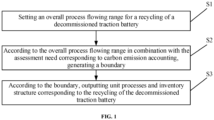
- FIG. 1 which illustrates a method for defining carbon emission accounting boundary of recycling traction battery according to an embodiment of the present invention, including steps S1 to S3 as follows.
- Step S 1 setting an overall process flowing range for a recycling of a decommissioned traction battery
- the overall process flowing range is formed by one or combination of more of the following processes: pre-plant treatment process, transportation process, waste treatment process, in-plant physical treatment process, and in-plant chemical treatment process, product formation process and distributing-using process.
- the pre-plant treatment process includes the following steps:
- the transportation process includes the following steps:
- the in-plant physical treatment process includes the following steps:
- the in-plant chemical treatment process is mainly to obtain valuable metals such as cobalt, nickel, lithium, and manganese through wet method or fire method.
- the product formation process includes: preparing cathode and anode electrodes materials, coating of the cathode and anode electrodes, sheeting of the cathode and anode electrodes, oven drying with the separator, winding, short circuit testing, shelling, rolling groove, filling electrolyte, formation, capacity grading and packaging to obtain a final battery product.
- the distributing-using process includes delivering battery products to consumers or downstream customers through different logistics methods and sales channels.
- the waste treatment process includes the following step: disposing solid, liquid and gaseous waste generated by each process in accordance with relevant waste treatment requirements and standards.
- Step S2 according to the overall process flowing range in combination with the assessment need corresponding to carbon emission accounting, generating a boundary.
- the boundary is generated according to the overall process flowing range in combination with the assessment need corresponding to carbon emission accounting, including:
- Step S3 according to the boundary, outputting unit processes and inventory structure corresponding to the recycling of the decommissioned traction battery.
- the transportation process information corresponding to the decommissioned traction battery includes: scope of transportation inside and outside the plant, transportation means, fuel type, and fuel consumption per 100 kilometers; and the waste treatment process information corresponding to the decommissioned traction battery includes: waste treatment method and waste recycling method, standardized waste discharge method, parameter information of the required equipment and input-output logistics information.
- the in-plant physical processing information corresponding to the decommissioned traction battery includes: information of equipment for discharge, heat treatment, shredding, sorting, and mechanical disassembly processes; and input-output data of materials and first energy for a first functional unit.
- the in-plant chemical treatment process information corresponding to the decommissioned traction battery includes: information of equipment for leaching, chemical purification, extraction purification, crystallization, liquid preparation, reaction, filtration and washing, drying, foreign matter separation, high-temperature calcination processes; and input-output data of materials and second energy for a second functional unit.
- the boundary is the fourth boundary, outputting a fourth transportation process information, a fourth waste treatment process information, a fourth in-plant physical treatment process information, a fourth in-plant chemical treatment process information, and a fourth product formation process information.
- the product formation process information corresponding to the decommissioned traction battery includes product packaging materials, product packing materials, and program information of pelletizing.
- the distributing-using process information corresponding to the decommissioned traction battery includes product distributing-using logistics information (this information is mainly determined based on the logistics model of new energy vehicles, such as the national standard " Building Carbon Emission Calculation Standard" issued by the Ministry of Housing and Urban-Rural Development (No. GB /T51366-2019) on the calculation method of transportation distribution, to determine the average transportation distance and average transportation weight of the product produced, that is, to determine the average ton*km value of the product, in addition to determine the vehicles types for the transportation, including 2 ton, 5 ton light vehicles, 10 ton heavy vehicles, 15 ton heavy vehicles, etc.), and information of carbon emission caused by loading weight of the traction battery.
- product distributing-using logistics information this information is mainly determined based on the logistics model of new energy vehicles, such as the national standard " Building Carbon Emission Calculation Standard" issued by the Ministry of Housing and Urban-Rural Development (No. GB /T51366-2019) on the calculation method of transportation distribution, to determine the average transportation distance and
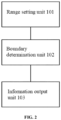
- FIG. 2 illustrates a schematic structural diagram of a device for defining carbon emission accounting boundary for traction battery recycling according to an embodiment of the present invention, including a range setting unit 101, a boundary determination unit 102, and an information output unit 103.
- the range setting unit 101 sets an overall process flowing range for the recycling of decommissioned traction batteries;
- the overall process flowing range is a range formed by one or combination of more of the following processes: a pre-plant treatment process, a transportation process, a waste treatment process, an in-plant physical treatment process, an in-plant chemical treatment process, a product formation process and a distributing-using process;
- the boundary determination unit 102 is to generate a corresponding boundary according to the overall process flowing range in combination with the assessment need corresponding to carbon emission accounting;
- the information output unit 103 is to output unit processes and inventory structure corresponding to the recycling of the decommissioned traction battery according to the boundary.
- the embodiments of the present invention have the following beneficial effects:
- the present invention provides a method and a device for defining carbon emission accounting boundary for recycling of traction batteries.
- the defining method includes: setting an overall process flowing range for the recycling of decommissioned traction battery; according to the overall process flowing range in combination with the assessment need corresponding to carbon emission accounting, a boundary is generated; according to the boundary, the unit processes and inventory structure corresponding to the recycling of the decommissioned traction battery are output.
- the present invention determines a clear and standardized system boundary, improves the accuracy of carbon emission accounting and full life cycle assessment of decommissioned traction batteries, and is more suitable for practical applications.
- an embodiment (embodiment 2) is also provided, which includes the following steps:
- Step S1 setting an overall process flowing range for a recycling of a decommissioned traction battery
- the scope of the overall process flowing includes seven processes in the full life cycle of a recycling technology of decommissioned traction battery, namely: a pre-plant treatment process, a transportation process, a waste treatment process, an in-plant physical treatment process, an in-plant chemical treatment process, a product formation process and a distributing-using process.
- Step S2 according to the overall process flowing range in combination with an assessment need corresponding to carbon emission accounting, a boundary is generated;
- a fourth boundary is selected, which includes: a pre-plant treatment process, a transportation process, a waste treatment process, an in-plant physical treatment process, an in-plant chemical treatment process and a product formation process.
- the purpose corresponding to this boundary is to use recycled metal raw materials to prepare lithium iron phosphate cathode material products.
- Step S3 according to the boundary, unit processes and inventory structure corresponding to the recycling of the decommissioned traction battery are output.
- the transportation process within the boundary range only includes the transportation range outside the factory. Assuming that the average transportation distance of the decommissioned batteries is 500 km, and a Xichai 4110 diesel vehicle is used for transportation, the average fuel consumption per 100 kilometers of this vehicle is 12-14 liters.
- the waste treatment process includes treating, mixing, calcinating and other processes of the waste liquid, waste gas and solid waste. These processes will produce carbon-containing organic compounds mainly comprising Li element, CO 2 , CO, ammonia, sulfide, ammonium hydrogen phosphate and sucrose, etc.
- the carbon-containing organic compounds are mainly discharged in the form of gas, after being treated for harmless disposal according to environmental protection requirements. Wastewater is processed by a third-party service provider.
- the in-plant physical treatment process information of the waste batteries such as the information of equipment for processes of discharging, heat treatment, shredding, sorting, mechanical disassembly, etc., and input-output data of materials and energy for each functional unit.
- the in-plant chemical treatment process information including leaching, chemical purification, extraction purification, crystallization, liquid preparation, reaction, filter washing, drying, foreign matter separation, high temperature calcination, etc., and input-output of materials and energy for each functional unit, etc.;
- the materials that need to be input include: Material Unit Dosage Sodium chloride g 67.5 Water kg 83.1 Sulfuric acid kg 1.27 Bis(2-ethylhexyl) hydrogen phosphate kg 0.00394 2-ethylhexyl phosphonic acid-mono-2-ethylhexylester kg 0.00145 Sulfonated kerosene kg 0.0137 Sodium sulfide kg 0.0133 Liquid alkali kg 0.884 Aqueous Ammonia kg 0.0417
- the energy input required is 0.0186 kWh of electricity and 12 kg of steam.
- Discharge type Discharge pollutant name Unit Discharge amount Air pollutant Dust g 0.238 Hydrogen Fluoride g 0.0438 Sulfuric acid mist g 0.0375 Hydrogen sulfide g 0.0229 Ammonia g 0.0859 Water pollutant Chemical Oxygen Demand g 10.3 Suspended solids g 124 Biological oxygen demand g 3.64 Nickel g 0.0475 Cobalt g 0.0438 Manganese g 0.0475 Lithium g 3.98 Ammonia nitrogen g 0.596
- the embodiments of the present invention have the following beneficial effects:
- the embodiment of the present invention provides a method for defining the carbon emission accounting boundary of recycling traction battery.
- the method includes: setting an overall process flowing range for a recycling of a decommissioned traction battery; according to the overall process flowing range in combination with the assessment need corresponding to carbon emission accounting, a boundary is generated; according to the boundary, the unit processes and inventory structure corresponding to the recycling of the decommissioned traction battery are output.
- the present invention determines a clear and standardized system boundary, improves the accuracy of carbon emission accounting and full life cycle assessment of decommissioned traction batteries, and is more suitable for practical applications.
Landscapes
- Business, Economics & Management (AREA)
- Engineering & Computer Science (AREA)
- Human Resources & Organizations (AREA)
- Economics (AREA)
- Strategic Management (AREA)
- Entrepreneurship & Innovation (AREA)
- Theoretical Computer Science (AREA)
- General Physics & Mathematics (AREA)
- General Business, Economics & Management (AREA)
- Physics & Mathematics (AREA)
- Marketing (AREA)
- Tourism & Hospitality (AREA)
- Development Economics (AREA)
- Operations Research (AREA)
- Quality & Reliability (AREA)
- Educational Administration (AREA)
- Game Theory and Decision Science (AREA)
- Life Sciences & Earth Sciences (AREA)
- Sustainable Development (AREA)
- Health & Medical Sciences (AREA)
- General Health & Medical Sciences (AREA)
- Primary Health Care (AREA)
- Manufacturing & Machinery (AREA)
- Accounting & Taxation (AREA)
- Finance (AREA)
- Chemical & Material Sciences (AREA)
- General Chemical & Material Sciences (AREA)
- Chemical Kinetics & Catalysis (AREA)
- Electrochemistry (AREA)
- Processing Of Solid Wastes (AREA)
- Secondary Cells (AREA)
- Management, Administration, Business Operations System, And Electronic Commerce (AREA)
Abstract
Description
- The invention relates to the field of recycling traction battery, and in particular to a method and a device for defining carbon emission accounting boundary of recycling traction battery.
- With the development of science and technology, the application of traction batteries has become more and more extensive. The traction battery contains a variety of metal elements, if improperly handled, which may cause safety hazards and environmental pollution, and thus the traction battery is difficult to be recycled. The current life cycle assessment (LCA) of traction batteries generally defines that the recycling of traction batteries is included in the entire life cycle. However, in the existing technology, when assessing the life cycle of decommissioned traction batteries or accounting for their carbon emissions, there is often a problem of ambiguous system boundaries. The output results obtained for the same assessment need may be quite different, which has also led to errors in conclusions of some researches, and these conclusions are not realistic in the process of carbon emission accounting.
- The invention provides a method and a device for defining the carbon emission accounting boundary of recycling traction battery to solve the technical problem of ambiguous system boundaries and improve the accuracy of life cycle assessment and carbon emission accounting of decommissioned traction batteries.
- In order to solve the above technical problems, embodiments of the present invention provide a method for defining carbon emission accounting boundary of recycling traction battery, including:
- setting an overall process flowing range for a recycling of decommissioned traction b attery;
- according to the overall process flowing range in combination with an assessment need corresponding to carbon emission accounting, generating a boundary;
- according to the boundary, outputting unit processes and inventory structure corresponding to the recycling of decommissioned traction battery.
- Further, the overall process flowing range is a range formed by one or combination of more of the following processes: pre-plant treatment process, transportation process, waste treatment process, in-plant physical treatment process, in-plant chemical treatment process, product formation process, and distributing-using process.
- Further, according to the overall process flowing range in combination with the assessment need corresponding to carbon emission accounting, generating the boundary includes:
- when the assessment need corresponding to carbon emission accounting covers only waste treatment, generating a first boundary corresponding to the assessment need by combining the pre-plant treatment process, the transportation process, and the waste treatment process in the overall process flowing range;
- when the assessment need corresponding to carbon emission accounting covers copper and aluminum metals obtainment, plastic casings obtainment, or raw materials preparation for chemical extraction, generating a second boundary corresponding to the assessment need by combining the pre-plant treatment process, the transportation process, the waste treatment process and the in-plant physical process in the overall process flowing range;
- when the assessment need corresponding to carbon emission accounting covers metal elements recycling, supply of raw materials for preparation of precursors, or supply of raw materials for preparing cathode materials, generating a third boundary corresponding to the assessment need by combining the pre-plant treatment process, the transportation process, the waste treatment process, the in-plant physical treatment process and the in-plant chemical treatment process in the overall process flowing range ;
- when the assessment need corresponding to carbon emission accounting covers manufacture of regenerated batteries, generating a fourth boundary corresponding to the assessment need by combining the pre-plant treatment process, the transportation process, the waste treatment process, the in-plant physical treatment process, the in-plant chemical treatment process, and the product formation process in the overall process flowing range;
- when the assessment need corresponding to carbon emission accounting covers manufacture of regenerated batteries and putting them on market, generating a fifth boundary corresponding to the assessment need by combining the pre-plant treatment process, the transportation process, the waste treatment process, the in-plant physical treatment process, the in-plant chemical treatment process, the product formation process and the distributing-using process in the overall process flowing range.
- Further, according to the boundary, outputting the unit processes and inventory structure corresponding to the recycling of the decommissioned traction battery includes:
- when the boundary is the first boundary, outputting a first transportation process information and a waste treatment process information;
- when the boundary is the second boundary, outputting a second transportation process information, a second waste treatment process information, and a second in-plant physical treatment process information;
- when the boundary is the third boundary, outputting a third transportation process information, a third waste treatment process information, a third in-plant physical treatment process information, and a third in-plant chemical treatment process information;
- when the boundary is the fourth boundary, outputting a fourth transportation process information, a fourth waste treatment process information, a fourth in-plant physical treatment process information, a fourth in-plant chemical treatment process information, and a fourth product formation process information;
- when the boundary is the fifth boundary, outputting a fifth transportation process information, a fifth waste treatment process information, a fifth in-plant physical treatment process information, a fifth in-plant chemical treatment process information, a fifth product formation process information, and a fifth distributing-using process information.
- Further, the transportation process information corresponding to the decommissioned traction battery includes: within and outside the plant, scope of transportation, transportation means, fuel type, and fuel consumption per 100 kilometers; and the waste treatment process information corresponding to the decommissioned traction battery includes: a waste treatment method, a waste recycling method, a standardized waste discharge method, parameter information of required equipment and input-output logistics information.
- Further, the in-plant physical treatment process information corresponding to the decommissioned traction battery includes information of equipment for discharge, heat treatment, shredding, sorting, and mechanical disassembly processes; and input-output data of materials and first energy for a first functional unit.
- Further, the in-plant chemical treatment process information corresponding to the decommissioned traction battery includes information of equipment for leaching, chemical purification, extraction purification, crystallization, liquid preparation, reaction, filtration and washing, drying, foreign matter separation, and high-temperature calcination processes; and input-output data of materials and second energy for a second functional unit.
- Further, the product formation process information corresponding to the decommissioned traction battery includes product package materials, product packing materials, and program information of pelletizing.
- Further, the distributing-using process information corresponding to the decommissioned traction battery includes logistics information of product distributing-using, and information of carbon emissions caused by loading weight of the traction battery.
- Correspondingly, an embodiment of the present invention also provides a device for defining carbon emission accounting boundary of recycling traction battery, including a range setting unit, a boundary determination unit, and an information output unit
- The range setting unit sets the overall process flowing range for a recycling of the decommissioned traction battery; the overall process flowing range is a range formed by one or combination of more of the following processes: a pre-processing process, a transportation process, a waste treatment process, an in-plant physical treatment process, an in-plant chemical treatment process, a product formation process and a distributing-using process.
- The boundary determination unit is configured to generate a corresponding boundary according to the overall process flowing range in combination with an assessment need corresponding to carbon emission accounting.
- The information output unit is configured to output unit processes and inventory structure corresponding to the recycling of the decommissioned traction battery according to the boundary.
- Compared with the existing technology, the embodiments of the present invention have the following beneficial effects:
- The present invention provides a method and a device for defining carbon emission accounting boundary of recycling traction battery. The method includes: setting an overall process flowing range for the recycling of decommissioned traction battery; according to the overall process flowing range in combination with an assessment need corresponding to carbon emission accounting, a boundary is generated; according to the boundary, unit process and inventory structure corresponding to the recycling of the decommissioned traction battery are output. As compared to the existing technology, by defining the carbon emission accounting boundary, the present invention determines a clear and standardized system boundary, improves the accuracy of the carbon emission accounting and the full life cycle assessment of decommissioned traction batteries, and is more suitable for practical applications.
-
-
Fig. 1 is a schematic flow chart of an embodiment of the method for defining the carbon emission accounting boundary of recycling traction battery provided by the present invention. -
Fig. 2 is a schematic structural diagram of an embodiment of the device for calculating the carbon emission accounting boundary for the traction battery recycling provided by the present invention. - The technical solutions in the embodiments of the present invention will be clearly and completely described below in conjunction with the accompanying drawings in the embodiments of the present invention. Obviously, the described embodiments are only part of the embodiments of the present invention, rather than all the embodiments. Based on the disclosed embodiments, all other embodiments obtained by those of ordinary skill in the art without creative work shall fall within the protection scope of the present invention.
- Referring to
Fig. 1 , which illustrates a method for defining carbon emission accounting boundary of recycling traction battery according to an embodiment of the present invention, including steps S1 to S3 as follows. - Step S 1, setting an overall process flowing range for a recycling of a decommissioned traction battery;
- In this embodiment, the overall process flowing range is formed by one or combination of more of the following processes: pre-plant treatment process, transportation process, waste treatment process, in-plant physical treatment process, and in-plant chemical treatment process, product formation process and distributing-using process.
- In this embodiment, the pre-plant treatment process includes the following steps:
- confirming, registering, archiving, and back-upping accordingly the type of the decommissioned traction battery product to be picked up and the type of a corresponding vehicle loaded with the battery;
- checking whether there is leakage of electricity or insulation failure, if yes, performing insulation treatment or safe discharging until the voltage is lower than 1.5V;
- checking whether the electrolyte is leaking, if yes, cutting off a leaking source, collecting the electrolyte and eliminating risk of leakage by using a special anti-leakage packaging box or adopting effective anti-leakage measures;
- checking whether there is a trace of fire or smoke, if yes, placing the batteries in isolation; carrying out packing and transportation after the danger is lifted, or unpacking inspection to eliminate the risk;
- checking whether there are any signs of water immersion, if yes, determining the degree of safety risk of immersion, and performing air-dry or eliminating the risk;
- checking the battery parameters such as battery temperature and voltage to determine whether they exceed the safety limit conditions specified by the manufacturer; if yes, placing the battery in isolation and subjecting it to packing and transportation after the danger is removed.
- In this embodiment, the transportation process includes the following steps:
- determining the transportation time, location, docking information, handover method and transportation plan;
- adopting a transportation company with qualifications and rich experience in the transportation of dangerous goods;
- installing fire and smoke detectors (a wireless connector is installed in the cab to monitor the condition inside the vehicle), and turning on GPS to remotely monitor the condition of the vehicle;
- developing emergency plans, strictly controlling vehicle loads, and communicating with vehicle transportation personnel at predetermined intervals.
- In this embodiment, the in-plant physical treatment process includes the following steps:
- after picking up, storing, dismantling, and reusing the decommissioned traction battery according to specific needs or business requirements; where the reusing includes echelon utilization and recycling;
- after discharging, cutting the shell of battery, and then wet shredding and sorting to obtain iron, copper, aluminum, carbon powder and a mixture of cathode and anode electrodes;
- recycling the iron, copper, aluminum, and carbon powder, and pyrolyzing the mixture of cathode and anode electrodes;
- according to different degrees of pyrolyzing, carrying out the process of shredding, screening, magnetic separation, dehydration or secondary combustion, preliminary dust removal, cooling, deacidification, bag dust removal and re-acid removal respectively to obtain a pyrolysis slag.
- In this embodiment, the in-plant chemical treatment process is mainly to obtain valuable metals such as cobalt, nickel, lithium, and manganese through wet method or fire method.
- In this embodiment, the product formation process includes: preparing cathode and anode electrodes materials, coating of the cathode and anode electrodes, sheeting of the cathode and anode electrodes, oven drying with the separator, winding, short circuit testing, shelling, rolling groove, filling electrolyte, formation, capacity grading and packaging to obtain a final battery product.
- The distributing-using process includes delivering battery products to consumers or downstream customers through different logistics methods and sales channels.
- In this embodiment, the waste treatment process includes the following step:
disposing solid, liquid and gaseous waste generated by each process in accordance with relevant waste treatment requirements and standards. - Step S2, according to the overall process flowing range in combination with the assessment need corresponding to carbon emission accounting, generating a boundary.
- In this embodiment, the boundary is generated according to the overall process flowing range in combination with the assessment need corresponding to carbon emission accounting, including:
- when the assessment need corresponding to carbon emission accounting covers only waste treatment, generating a first boundary corresponding to the assessment need by combining the pre-plant treatment process, the transportation process, and the waste treatment process in the overall process flowing range;
- when the assessment need corresponding to carbon emission accounting covers copper and aluminum metals obtainment, plastic casings obtainment, preparation of raw materials for chemical extraction, generating a second boundary corresponding to the assessment need by combining the pre-plant treatment process, the transportation process, the waste treatment process and the in-plant physics in the overall process flowing range;
- when the assessment need corresponding to carbon emission accounting covers metal elements recycling, supply of raw materials for preparing precursors, or supply of raw materials for preparing cathode materials, generating a third boundary corresponding to the assessment need by combining the pre-plant treatment process, the transportation process, the waste treatment process, the in-plant physical treatment process and the in-plant chemical treatment process in the overall process flowing range;
- when the assessment need corresponding to carbon emission accounting is manufacture of regenerated batteries, generating a fourth boundary corresponding to the assessment need by combining the pre-plant treatment process, the transportation process, the waste treatment process, the in-plant physical treatment process, the in-plant chemical treatment process, and the product formation process in the overall process;
- when the assessment need corresponding to carbon emission accounting covers manufacture of regenerated batteries and putting them on market, generating a fifth boundary corresponding to the assessment need by combining the pre-plant treatment process, the transportation process, the waste treatment process, the in-plant physical treatment process, the in-plant chemical treatment process, the product formation process and the distributing-using process in the overall process flowing range.
- Step S3, according to the boundary, outputting unit processes and inventory structure corresponding to the recycling of the decommissioned traction battery.
- In this embodiment, when the boundary is the first boundary, outputting a first transportation process information and a waste treatment process information.
- The transportation process information corresponding to the decommissioned traction battery includes: scope of transportation inside and outside the plant, transportation means, fuel type, and fuel consumption per 100 kilometers; and the waste treatment process information corresponding to the decommissioned traction battery includes: waste treatment method and waste recycling method, standardized waste discharge method, parameter information of the required equipment and input-output logistics information.
- When the boundary is the second boundary, outputting a second transportation process information, a second waste treatment process information, and a second in-plant physical treatment process information are output.
- The in-plant physical processing information corresponding to the decommissioned traction battery includes: information of equipment for discharge, heat treatment, shredding, sorting, and mechanical disassembly processes; and input-output data of materials and first energy for a first functional unit.
- When the boundary is the third boundary, outputting a third transportation process information, a third waste treatment process information, a third in-plant physical treatment process information, and a third in-plant chemical treatment process information.
- The in-plant chemical treatment process information corresponding to the decommissioned traction battery includes: information of equipment for leaching, chemical purification, extraction purification, crystallization, liquid preparation, reaction, filtration and washing, drying, foreign matter separation, high-temperature calcination processes; and input-output data of materials and second energy for a second functional unit.
- When the boundary is the fourth boundary, outputting a fourth transportation process information, a fourth waste treatment process information, a fourth in-plant physical treatment process information, a fourth in-plant chemical treatment process information, and a fourth product formation process information.
- The product formation process information corresponding to the decommissioned traction battery includes product packaging materials, product packing materials, and program information of pelletizing.
- When the boundary is the fifth boundary, outputting a fifth transportation process information, a fifth waste treatment process information, a fifth in-plant physical treatment process information, a fifth in-plant chemical treatment process information, a fifth product formation process information, and a fifth distributing-using process information.
- The distributing-using process information corresponding to the decommissioned traction battery includes product distributing-using logistics information (this information is mainly determined based on the logistics model of new energy vehicles, such as the national standard "Building Carbon Emission Calculation Standard" issued by the Ministry of Housing and Urban-Rural Development (No. GB /T51366-2019) on the calculation method of transportation distribution, to determine the average transportation distance and average transportation weight of the product produced, that is, to determine the average ton*km value of the product, in addition to determine the vehicles types for the transportation, including 2 ton, 5 ton light vehicles, 10 ton heavy vehicles, 15 ton heavy vehicles, etc.), and information of carbon emission caused by loading weight of the traction battery.
- Correspondingly, referring to
Fig. 2 , which illustrates a schematic structural diagram of a device for defining carbon emission accounting boundary for traction battery recycling according to an embodiment of the present invention, including arange setting unit 101, aboundary determination unit 102, and aninformation output unit 103. - The
range setting unit 101 sets an overall process flowing range for the recycling of decommissioned traction batteries; the overall process flowing range is a range formed by one or combination of more of the following processes: a pre-plant treatment process, a transportation process, a waste treatment process, an in-plant physical treatment process, an in-plant chemical treatment process, a product formation process and a distributing-using process; - The
boundary determination unit 102 is to generate a corresponding boundary according to the overall process flowing range in combination with the assessment need corresponding to carbon emission accounting; - The
information output unit 103 is to output unit processes and inventory structure corresponding to the recycling of the decommissioned traction battery according to the boundary. - Compared with the existing technology, the embodiments of the present invention have the following beneficial effects:
- The present invention provides a method and a device for defining carbon emission accounting boundary for recycling of traction batteries. The defining method includes: setting an overall process flowing range for the recycling of decommissioned traction battery; according to the overall process flowing range in combination with the assessment need corresponding to carbon emission accounting, a boundary is generated; according to the boundary, the unit processes and inventory structure corresponding to the recycling of the decommissioned traction battery are output. As compared to the existing technology, by defining the carbon emission accounting boundary, the present invention determines a clear and standardized system boundary, improves the accuracy of carbon emission accounting and full life cycle assessment of decommissioned traction batteries, and is more suitable for practical applications.
- According to the method for defining the carbon emission accounting boundary of recycling traction battery according to the present invention, an embodiment (embodiment 2) is also provided, which includes the following steps:
- Step S1, setting an overall process flowing range for a recycling of a decommissioned traction battery;
- In this embodiment, the scope of the overall process flowing includes seven processes in the full life cycle of a recycling technology of decommissioned traction battery, namely: a pre-plant treatment process, a transportation process, a waste treatment process, an in-plant physical treatment process, an in-plant chemical treatment process, a product formation process and a distributing-using process.
- Step S2, according to the overall process flowing range in combination with an assessment need corresponding to carbon emission accounting, a boundary is generated;
- In this embodiment, because it is for the assessment of lithium iron phosphate cathode material products, a fourth boundary is selected, which includes: a pre-plant treatment process, a transportation process, a waste treatment process, an in-plant physical treatment process, an in-plant chemical treatment process and a product formation process. The purpose corresponding to this boundary is to use recycled metal raw materials to prepare lithium iron phosphate cathode material products.
- Step S3, according to the boundary, unit processes and inventory structure corresponding to the recycling of the decommissioned traction battery are output.
- In this embodiment, the transportation process within the boundary range only includes the transportation range outside the factory. Assuming that the average transportation distance of the decommissioned batteries is 500 km, and a Xichai 4110 diesel vehicle is used for transportation, the average fuel consumption per 100 kilometers of this vehicle is 12-14 liters. The waste treatment process includes treating, mixing, calcinating and other processes of the waste liquid, waste gas and solid waste. These processes will produce carbon-containing organic compounds mainly comprising Li element, CO2, CO, ammonia, sulfide, ammonium hydrogen phosphate and sucrose, etc. The carbon-containing organic compounds are mainly discharged in the form of gas, after being treated for harmless disposal according to environmental protection requirements. Wastewater is processed by a third-party service provider.
- At the same time, it is also necessary to consider the in-plant physical treatment process information of the waste batteries, such as the information of equipment for processes of discharging, heat treatment, shredding, sorting, mechanical disassembly, etc., and input-output data of materials and energy for each functional unit. It is also necessary to consider the in-plant chemical treatment process information including leaching, chemical purification, extraction purification, crystallization, liquid preparation, reaction, filter washing, drying, foreign matter separation, high temperature calcination, etc., and input-output of materials and energy for each functional unit, etc.;
- According to statistics, on average, for every kWh of the recycling of waste ternary lithium battery, the materials that need to be input include:
Material Unit Dosage Sodium chloride g 67.5 Water kg 83.1 Sulfuric acid kg 1.27 Bis(2-ethylhexyl) hydrogen phosphate kg 0.00394 2-ethylhexyl phosphonic acid-mono-2-ethylhexylester kg 0.00145 Sulfonated kerosene kg 0.0137 Sodium sulfide kg 0.0133 Liquid alkali kg 0.884 Aqueous Ammonia kg 0.0417 - According to statistics, on average, for every kWh of the recycling of waste ternary lithium battery, the energy input required is 0.0186 kWh of electricity and 12 kg of steam.
- According to statistics, on average, for every kWh of the recycling of waste ternary lithium battery, the produced emission inventory is shown in the following table:
Discharge type Discharge pollutant name Unit Discharge amount Air pollutant Dust g 0.238 Hydrogen Fluoride g 0.0438 Sulfuric acid mist g 0.0375 Hydrogen sulfide g 0.0229 Ammonia g 0.0859 Water pollutant Chemical Oxygen Demand g 10.3 Suspended solids g 124 Biological oxygen demand g 3.64 Nickel g 0.0475 Cobalt g 0.0438 Manganese g 0.0475 Lithium g 3.98 Ammonia nitrogen g 0.596 - Compared with the existing technology, the embodiments of the present invention have the following beneficial effects:
- the embodiment of the present invention provides a method for defining the carbon emission accounting boundary of recycling traction battery. The method includes: setting an overall process flowing range for a recycling of a decommissioned traction battery; according to the overall process flowing range in combination with the assessment need corresponding to carbon emission accounting, a boundary is generated; according to the boundary, the unit processes and inventory structure corresponding to the recycling of the decommissioned traction battery are output. As compared to the existing technology, by defining the carbon emission accounting boundary, the present invention determines a clear and standardized system boundary, improves the accuracy of carbon emission accounting and full life cycle assessment of decommissioned traction batteries, and is more suitable for practical applications.
- The specific embodiments described above provide a further detailed description of the purpose, technical solutions and beneficial effects of the present invention. It should be understood that the above are only specific embodiments of the present invention and are not intended to limit the protection scope of the present invention. In particular, for those skilled in the art, any modification, equivalent replacement, improvement, etc. made within the spirit and principle of the present invention should be included in the protection scope of the present invention.
Claims (10)
- A method for defining carbon emission accounting boundary of recycling traction battery, comprising:setting an overall process flowing range for a recycling of a decommissioned traction b attery;according to the overall process flowing range in combination with an assessment need corresponding to carbon emission accounting, generating a boundary;according to the boundary, outputting unit processes and inventory structure corresponding to the recycling of the decommissioned traction battery.
- The method for defining the carbon emission accounting boundary of recycling traction battery according to claim 1, wherein the overall process flowing range is a range formed by one or combination of more of the following processes: a pre-plant treatment process, a transportation process, a waste treatment process, an in-plant physical treatment process, an in-plant chemical treatment process, a product formation process, and a distributing-using process.
- The method for defining the carbon emission accounting boundary of recycling traction battery according to claim 2, wherein, according to the overall process flowing range in combination with the assessment need corresponding to carbon emission accounting, generating the boundary comprises:when the assessment need corresponding to carbon emission accounting covers only waste treatment, generating a first boundary corresponding to the assessment need by combining the pre-plant treatment process, the transportation process and the waste treatment process in the overall process flowing range;when the assessment need corresponding to carbon emission accounting covers copper and aluminum metals obtainment, plastic casings obtainment, or preparation of raw materials for chemical extraction, generating a second boundary corresponding to the assessment need by combining the pre-plant treatment process, the transportation process, the waste treatment process and the in-plant physical treatment process in the overall process flowing range;when the assessment need corresponding to carbon emission accounting covers recycling of metal elements, supply of raw materials for preparing precursors, or supply of raw materials for preparing cathode materials, generating a third boundary corresponding to the assessment need by combining the pre-plant treatment process, the transportation process, the waste treatment process, the in-plant physical treatment process and the in-plant chemical treatment process in the overall process flowing range;when the assessment need corresponding to carbon emission accounting covers manufacture of regenerated batteries, generating a fourth boundary corresponding to the assessment need by combining the pre-plant treatment process, the transportation process, the waste treatment process, the in-plant physical treatment process, the in-plant chemical treatment process and the product formation process in the overall process flowing range; andwhen the assessment need corresponding to carbon emission accounting covers manufacture of regenerated batteries and putting them on market, generating a fifth boundary corresponding to the assessment need by combining the pre-plant treatment process, the transportation process, the waste treatment process, the in-plant physical treatment process, the in-plant chemical treatment process, the product formation process and the distributing-using process in the overall process flowing range.
- The method for defining the carbon emission accounting boundary of recycling traction battery according to claim 3, wherein, according to the boundary, outputting the unit processes and inventory structure corresponding to the recycling of the decommissioned traction battery comprises:when the boundary is the first boundary, outputting a first transportation process information and a waste treatment process information;when the boundary is the second boundary, outputting a second transportation process information, a second waste treatment process information, and a second in-plant physical treatment process information;when the boundary is the third boundary, outputting a third transportation process information, a third waste treatment process information, a third in-plant physical treatment process information, and a third in-plant chemical treatment process information;when the boundary is the fourth boundary, outputting a fourth transportation process information, a fourth waste treatment process information, a fourth in-plant physical treatment process information, a fourth in-plant chemical treatment process information, and a fourth product formation process information; andwhen the boundary is the fifth boundary, outputting a fifth transportation process information, a fifth waste treatment process information, a fifth in-plant physical treatment process information, a fifth in-plant chemical treatment process information, a fifth product formation process information, and a fifth distributing-using process information.
- The method for defining the carbon emission accounting boundary of recycling traction battery according to claim 4, wherein the transportation process information corresponding to the decommissioned traction battery comprises: within and outside the plant, scope of transportation, transportation means, fuel type, and fuel consumption per hundred kilometers; and the waste treatment process information corresponding to the decommissioned traction battery comprises: a waste treatment method, a waste recycling method, a standardized waste discharge method, parameter information of required equipment and input-output logistics information.
- The method for defining the carbon emission accounting boundary of recycling traction battery according to claim 4, wherein the in-plant physical treatment process information corresponding to the decommissioned traction battery comprises:information of equipment for discharge, heat treatment, shredding, sorting, mechanical disassembly processes; andinput-output data of materials and first energy for a first functional unit.
- The method for defining the carbon emission accounting boundary of recycling traction battery according to claim 4, wherein the in-plant chemical treatment process information corresponding to the decommissioned traction battery comprises:information of equipment for leaching, chemical purification, extraction purification, crystallization, liquid preparation, reaction, filtration and washing, drying, foreign matter separation, calcination processes; andinput-output data of materials and second energy for a second functional unit.
- The method for defining the carbon emission accounting boundary of recycling traction battery according to claim 4, wherein the product formation process information corresponding to the decommissioned traction battery comprises product packaging materials, product packing materials, and program information of pelletizing.
- The method for defining the carbon emission accounting boundary of recycling traction battery according to claim 4, wherein the distributing-using process information corresponding to the decommissioned traction battery comprises logistics information of product distributing-using, and information of carbon emissions caused by loading weight of the traction battery.
- A device for defining carbon emission accounting boundary of recycling traction battery, comprising a range setting unit, a boundary determination unit and an information output unit,wherein the range setting unit is configured to set an overall process flowing range for a recycling of decommissioned traction battery; the overall process flowing range is a range formed by one or combination of more of the following processes: a pre-plant treatment process, a transportation process, a waste treatment process, an in-plant physical treatment process, an in-plant chemical treatment process, a product formation process and a distributing-using process;the boundary determination unit is configured to generate a boundary according to the overall process flowing range in combination with an assessment need corresponding to carbon emission accounting; andthe information output unit is configured to output unit processes and inventory structure corresponding to the recycling of decommissioned traction battery according to the boundary.
Applications Claiming Priority (2)
| Application Number | Priority Date | Filing Date | Title |
|---|---|---|---|
| CN202111259413.8A CN114004375B (en) | 2021-10-27 | 2021-10-27 | A method and device for defining carbon emission accounting boundaries for power battery recycling |
| PCT/CN2022/108659 WO2023071339A1 (en) | 2021-10-27 | 2022-07-28 | Carbon emissions accounting boundary definition method and apparatus for power battery recycling |
Publications (2)
| Publication Number | Publication Date |
|---|---|
| EP4425417A1 true EP4425417A1 (en) | 2024-09-04 |
| EP4425417A4 EP4425417A4 (en) | 2026-03-18 |
Family
ID=79924429
Family Applications (1)
| Application Number | Title | Priority Date | Filing Date |
|---|---|---|---|
| EP22885239.8A Pending EP4425417A4 (en) | 2021-10-27 | 2022-07-28 | METHOD AND DEVICE FOR DEFINING CARBON EMISSIONS FOR BATTERIES REUSE |
Country Status (5)
| Country | Link |
|---|---|
| US (1) | US20240420160A1 (en) |
| EP (1) | EP4425417A4 (en) |
| CN (1) | CN114004375B (en) |
| MX (1) | MX2024005217A (en) |
| WO (1) | WO2023071339A1 (en) |
Families Citing this family (7)
| Publication number | Priority date | Publication date | Assignee | Title |
|---|---|---|---|---|
| CN114004375B (en) * | 2021-10-27 | 2025-02-07 | 广东邦普循环科技有限公司 | A method and device for defining carbon emission accounting boundaries for power battery recycling |
| CN114139877A (en) * | 2021-11-05 | 2022-03-04 | 广东邦普循环科技有限公司 | Carbon emission accounting method, device and system for waste battery recovery |
| CN115618998A (en) * | 2022-09-16 | 2023-01-17 | 广东邦普循环科技有限公司 | A method and device for predicting the recovery amount of power batteries based on carbon emissions |
| CN116266243B (en) * | 2022-09-27 | 2023-10-10 | 上海易碳数字科技有限公司 | Accounting method and system for life cycle carbon footprint of power battery of electric automobile |
| CN115760078A (en) * | 2022-11-07 | 2023-03-07 | 广东邦普循环科技有限公司 | Battery recycling mode determining method and device, electronic equipment and storage medium |
| CN116663781B (en) * | 2023-07-28 | 2023-10-20 | 中国环境科学研究院 | Method for accounting greenhouse gas emission of steel slag, electronic equipment and storage medium |
| CN117745130A (en) * | 2023-12-08 | 2024-03-22 | 贵州电网有限责任公司 | Power transmission network carbon emission accounting method based on full life cycle theory |
Family Cites Families (14)
| Publication number | Priority date | Publication date | Assignee | Title |
|---|---|---|---|---|
| US6275768B1 (en) * | 2000-04-28 | 2001-08-14 | Grant A. Zobell | Fuel pump with fuel mileage calculation option |
| US20020161700A1 (en) * | 2001-02-22 | 2002-10-31 | International Business Machines Corporation | Mechanism to provide regression test packages for fulfillment systems |
| WO2004083973A1 (en) * | 2003-03-18 | 2004-09-30 | Universiteit Leiden | System and method for optimizing industrial processes to minimize environmental interventions |
| US10013666B2 (en) * | 2009-04-24 | 2018-07-03 | Rockwell Automation Technologies, Inc. | Product lifecycle sustainability score tracking and indicia |
| WO2012019202A2 (en) * | 2010-08-06 | 2012-02-09 | Green Halo Systems Inc. | Waste management and recycling tracking system |
| US9156038B2 (en) * | 2012-03-30 | 2015-10-13 | Rsr Technologies, Inc. | Magnetic separation of electrochemical cell materials |
| JP6615762B2 (en) * | 2013-12-23 | 2019-12-04 | ユミコア | Lithium-ion battery recycling process |
| CA2966348C (en) * | 2014-10-31 | 2019-11-12 | ecoATM, Inc. | Systems and methods for recycling consumer electronic devices |
| CN105550417B (en) * | 2015-12-07 | 2018-11-06 | 南瑞(武汉)电气设备与工程能效测评中心 | A kind of electric vehicle Life cycle greenhouse gas emission assessment measuring method |
| CN106709265A (en) * | 2017-01-13 | 2017-05-24 | 上海理工大学 | Photovoltaic system carbon emission calculation method based on full life circle ideology |
| AU2018276326B2 (en) * | 2017-05-30 | 2021-07-15 | 1001297676 Ontario Inc. | A process, apparatus, and system for recovering materials from batteries |
| CN108717599A (en) * | 2018-04-26 | 2018-10-30 | 中冶赛迪重庆环境咨询有限公司 | A kind of automobile manufacturing enterprise carbon emission accounting system and its method |
| CN113505916A (en) * | 2021-06-17 | 2021-10-15 | 中国电力科学研究院有限公司 | Method and system for counting carbon emission in whole life cycle of power transformer |
| CN114004375B (en) * | 2021-10-27 | 2025-02-07 | 广东邦普循环科技有限公司 | A method and device for defining carbon emission accounting boundaries for power battery recycling |
-
2021
- 2021-10-27 CN CN202111259413.8A patent/CN114004375B/en active Active
-
2022
- 2022-07-28 MX MX2024005217A patent/MX2024005217A/en unknown
- 2022-07-28 US US18/704,976 patent/US20240420160A1/en active Pending
- 2022-07-28 WO PCT/CN2022/108659 patent/WO2023071339A1/en not_active Ceased
- 2022-07-28 EP EP22885239.8A patent/EP4425417A4/en active Pending
Also Published As
| Publication number | Publication date |
|---|---|
| CN114004375A (en) | 2022-02-01 |
| EP4425417A4 (en) | 2026-03-18 |
| WO2023071339A1 (en) | 2023-05-04 |
| US20240420160A1 (en) | 2024-12-19 |
| CN114004375B (en) | 2025-02-07 |
| MX2024005217A (en) | 2024-07-19 |
Similar Documents
| Publication | Publication Date | Title |
|---|---|---|
| US20240420160A1 (en) | Method and device for defining carbon emission accounting boundary of power battery recycling | |
| Hantanasirisakul et al. | Sustainable reuse and recycling of spent Li‐ion batteries from electric vehicles: chemical, environmental, and economical perspectives | |
| Yu et al. | Current Challenges in Efficient Lithium‐Ion Batteries’ Recycling: A Perspective | |
| Harper et al. | Recycling lithium-ion batteries from electric vehicles | |
| Gaines et al. | Life-cycle analysis for lithium-ion battery production and recycling | |
| Standridge et al. | Remanufacturing, repurposing, and recycling of post-vehicle-application lithium-ion batteries. | |
| Melin | Analysis of the climate impact of lithium-ion batteries and how to measure it | |
| Gaines et al. | Lithium-ion battery environmental impacts | |
| CN108110367A (en) | A kind of electrokinetic cell system Dismantlement producing line based on step recycling | |
| KR102492363B1 (en) | Management module device for lithium ion secondary battery | |
| CN118536990A (en) | A waste battery recycling system and method with high recycling efficiency | |
| Cong et al. | End-of-use management of spent lithium-ion batteries from sustainability perspective: a review | |
| Hossain et al. | Technological options and design evolution for recycling spent lithium‐ion batteries: impact, challenges, and opportunities | |
| Gaines et al. | Life-cycle analysis of production and recycling of lithium ion batteries | |
| CN107946685A (en) | A kind of intelligent processing method of old and useless battery | |
| von Drachenfels et al. | Life cycle assessment of the battery cell production: using a modular material and energy flow model to assess product and process innovations | |
| Zhang et al. | A generic framework for recycling of battery module for electric vehicle by combining the mechanical and chemical procedures | |
| CN114090939A (en) | Method for determining carbon emission coefficient of energy storage battery in full life cycle | |
| Zhou et al. | A novel metaheuristic approach for AGVs resilient scheduling problem with battery constraints in automated container terminal | |
| Marashli et al. | Numerical life cycle assessment of lithium ion battery, Li-NMC type, integrated with PV system | |
| CN108448194A (en) | A kind of waste and old power battery pack dismantling recycling Gradient utilization method | |
| Liu et al. | Recycling and echelon utilization of used lithium-ion batteries from electric vehicles in China | |
| Anuradha et al. | Challenges in recycling lead acid battery and lithium-ion battery: A comprehensive review | |
| CN107017442B (en) | Processing method in power battery recovery process | |
| Zackrisson et al. | Toxicity of lithium ion battery chemicals-overview with focus on recycling |
Legal Events
| Date | Code | Title | Description |
|---|---|---|---|
| STAA | Information on the status of an ep patent application or granted ep patent |
Free format text: STATUS: THE INTERNATIONAL PUBLICATION HAS BEEN MADE |
|
| PUAI | Public reference made under article 153(3) epc to a published international application that has entered the european phase |
Free format text: ORIGINAL CODE: 0009012 |
|
| STAA | Information on the status of an ep patent application or granted ep patent |
Free format text: STATUS: REQUEST FOR EXAMINATION WAS MADE |
|
| 17P | Request for examination filed |
Effective date: 20240516 |
|
| AK | Designated contracting states |
Kind code of ref document: A1 Designated state(s): AL AT BE BG CH CY CZ DE DK EE ES FI FR GB GR HR HU IE IS IT LI LT LU LV MC MK MT NL NO PL PT RO RS SE SI SK SM TR |
|
| DAV | Request for validation of the european patent (deleted) | ||
| DAX | Request for extension of the european patent (deleted) | ||
| A4 | Supplementary search report drawn up and despatched |
Effective date: 20260217 |
|
| RIC1 | Information provided on ipc code assigned before grant |
Ipc: G06Q 50/26 20240101AFI20260211BHEP Ipc: G06Q 10/00 20230101ALI20260211BHEP Ipc: G06Q 10/06 20230101ALI20260211BHEP Ipc: G06Q 50/04 20120101ALI20260211BHEP Ipc: G06Q 10/08 20240101ALI20260211BHEP Ipc: G06Q 10/04 20230101ALI20260211BHEP Ipc: G06Q 10/0631 20230101ALI20260211BHEP Ipc: G06Q 10/0633 20230101ALI20260211BHEP Ipc: G06Q 10/0637 20230101ALI20260211BHEP Ipc: G06Q 10/067 20230101ALI20260211BHEP Ipc: G06Q 10/0832 20230101ALI20260211BHEP Ipc: G06Q 10/0834 20230101ALI20260211BHEP Ipc: G06Q 10/083 20240101ALI20260211BHEP Ipc: G06Q 10/087 20230101ALI20260211BHEP Ipc: G06Q 10/0875 20230101ALI20260211BHEP Ipc: H01M 10/54 20060101ALI20260211BHEP Ipc: G06Q 10/063 20230101ALI20260211BHEP Ipc: G06Q 10/30 20230101ALI20260211BHEP Ipc: G06Q 50/40 20240101ALI20260211BHEP Ipc: G06Q 10/0635 20230101ALN20260211BHEP Ipc: G06Q 10/0639 20230101ALN20260211BHEP Ipc: H01M 6/52 20060101ALN20260211BHEP |