EP4425395A1 - Accounting system for carbon emissions of lithium battery positive electrode material sintering - Google Patents
Accounting system for carbon emissions of lithium battery positive electrode material sintering Download PDFInfo
- Publication number
- EP4425395A1 EP4425395A1 EP22885322.2A EP22885322A EP4425395A1 EP 4425395 A1 EP4425395 A1 EP 4425395A1 EP 22885322 A EP22885322 A EP 22885322A EP 4425395 A1 EP4425395 A1 EP 4425395A1
- Authority
- EP
- European Patent Office
- Prior art keywords
- sintering
- module
- data
- carbon emission
- loss
- Prior art date
- Legal status (The legal status is an assumption and is not a legal conclusion. Google has not performed a legal analysis and makes no representation as to the accuracy of the status listed.)
- Pending
Links
Images


Classifications
-
- G—PHYSICS
- G16—INFORMATION AND COMMUNICATION TECHNOLOGY [ICT] SPECIALLY ADAPTED FOR SPECIFIC APPLICATION FIELDS
- G16C—COMPUTATIONAL CHEMISTRY; CHEMOINFORMATICS; COMPUTATIONAL MATERIALS SCIENCE
- G16C20/00—Chemoinformatics, i.e. ICT specially adapted for the handling of physicochemical or structural data of chemical particles, elements, compounds or mixtures
- G16C20/10—Analysis or design of chemical reactions, syntheses or processes
-
- G—PHYSICS
- G06—COMPUTING OR CALCULATING; COUNTING
- G06Q—INFORMATION AND COMMUNICATION TECHNOLOGY [ICT] SPECIALLY ADAPTED FOR ADMINISTRATIVE, COMMERCIAL, FINANCIAL, MANAGERIAL OR SUPERVISORY PURPOSES; SYSTEMS OR METHODS SPECIALLY ADAPTED FOR ADMINISTRATIVE, COMMERCIAL, FINANCIAL, MANAGERIAL OR SUPERVISORY PURPOSES, NOT OTHERWISE PROVIDED FOR
- G06Q10/00—Administration; Management
- G06Q10/06—Resources, workflows, human or project management; Enterprise or organisation planning; Enterprise or organisation modelling
- G06Q10/063—Operations research, analysis or management
- G06Q10/0639—Performance analysis of employees; Performance analysis of enterprise or organisation operations
- G06Q10/06393—Score-carding, benchmarking or key performance indicator [KPI] analysis
-
- G—PHYSICS
- G06—COMPUTING OR CALCULATING; COUNTING
- G06Q—INFORMATION AND COMMUNICATION TECHNOLOGY [ICT] SPECIALLY ADAPTED FOR ADMINISTRATIVE, COMMERCIAL, FINANCIAL, MANAGERIAL OR SUPERVISORY PURPOSES; SYSTEMS OR METHODS SPECIALLY ADAPTED FOR ADMINISTRATIVE, COMMERCIAL, FINANCIAL, MANAGERIAL OR SUPERVISORY PURPOSES, NOT OTHERWISE PROVIDED FOR
- G06Q10/00—Administration; Management
- G06Q10/06—Resources, workflows, human or project management; Enterprise or organisation planning; Enterprise or organisation modelling
- G06Q10/063—Operations research, analysis or management
- G06Q10/0639—Performance analysis of employees; Performance analysis of enterprise or organisation operations
-
- G—PHYSICS
- G06—COMPUTING OR CALCULATING; COUNTING
- G06Q—INFORMATION AND COMMUNICATION TECHNOLOGY [ICT] SPECIALLY ADAPTED FOR ADMINISTRATIVE, COMMERCIAL, FINANCIAL, MANAGERIAL OR SUPERVISORY PURPOSES; SYSTEMS OR METHODS SPECIALLY ADAPTED FOR ADMINISTRATIVE, COMMERCIAL, FINANCIAL, MANAGERIAL OR SUPERVISORY PURPOSES, NOT OTHERWISE PROVIDED FOR
- G06Q50/00—Information and communication technology [ICT] specially adapted for implementation of business processes of specific business sectors, e.g. utilities or tourism
- G06Q50/04—Manufacturing
-
- G—PHYSICS
- G06—COMPUTING OR CALCULATING; COUNTING
- G06Q—INFORMATION AND COMMUNICATION TECHNOLOGY [ICT] SPECIALLY ADAPTED FOR ADMINISTRATIVE, COMMERCIAL, FINANCIAL, MANAGERIAL OR SUPERVISORY PURPOSES; SYSTEMS OR METHODS SPECIALLY ADAPTED FOR ADMINISTRATIVE, COMMERCIAL, FINANCIAL, MANAGERIAL OR SUPERVISORY PURPOSES, NOT OTHERWISE PROVIDED FOR
- G06Q50/00—Information and communication technology [ICT] specially adapted for implementation of business processes of specific business sectors, e.g. utilities or tourism
- G06Q50/10—Services
- G06Q50/26—Government or public services
-
- H—ELECTRICITY
- H01—ELECTRIC ELEMENTS
- H01M—PROCESSES OR MEANS, e.g. BATTERIES, FOR THE DIRECT CONVERSION OF CHEMICAL ENERGY INTO ELECTRICAL ENERGY
- H01M10/00—Secondary cells; Manufacture thereof
- H01M10/05—Accumulators with non-aqueous electrolyte
- H01M10/052—Li-accumulators
-
- H—ELECTRICITY
- H01—ELECTRIC ELEMENTS
- H01M—PROCESSES OR MEANS, e.g. BATTERIES, FOR THE DIRECT CONVERSION OF CHEMICAL ENERGY INTO ELECTRICAL ENERGY
- H01M4/00—Electrodes
- H01M4/02—Electrodes composed of, or comprising, active material
- H01M4/04—Processes of manufacture in general
- H01M4/0471—Processes of manufacture in general involving thermal treatment, e.g. firing, sintering, backing particulate active material, thermal decomposition, pyrolysis
-
- Y—GENERAL TAGGING OF NEW TECHNOLOGICAL DEVELOPMENTS; GENERAL TAGGING OF CROSS-SECTIONAL TECHNOLOGIES SPANNING OVER SEVERAL SECTIONS OF THE IPC; TECHNICAL SUBJECTS COVERED BY FORMER USPC CROSS-REFERENCE ART COLLECTIONS [XRACs] AND DIGESTS
- Y02—TECHNOLOGIES OR APPLICATIONS FOR MITIGATION OR ADAPTATION AGAINST CLIMATE CHANGE
- Y02P—CLIMATE CHANGE MITIGATION TECHNOLOGIES IN THE PRODUCTION OR PROCESSING OF GOODS
- Y02P90/00—Enabling technologies with a potential contribution to greenhouse gas [GHG] emissions mitigation
- Y02P90/80—Management or planning
- Y02P90/84—Greenhouse gas [GHG] management systems
- Y02P90/845—Inventory and reporting systems for greenhouse gases [GHG]
Definitions
- the present invention relates to the technical field of carbon emission accounting, in particular to a carbon emission accounting system for sintering of lithium battery cathode materials.
- the carbon emissions of traction batteries cannot be underestimated, and are mainly concentrated in two processes, where one of them is the production of battery cells, and the other is the production of key materials such as upstream positive electrodes and negative electrodes. Furthermore, in the production of key materials for lithium batteries, the production of cathode materials consumes the most energy. In order to achieve the goal of carbon neutrality, an accounting system for carbon emissions from the sintering of lithium battery cathode materials is needed to account the carbon emissions during the preparation process of lithium battery cathode materials.
- the purpose of the present invention is to provide a carbon emission accounting system for sintering of a lithium battery cathode material to account carbon emission during preparation of lithium battery cathode material.
- the present invention provides a carbon emission accounting system for sintering of lithium battery cathode materials, including: a material balance module, an energy balance module, a carbon emission accounting module, a data module, and a knowledge module, where the material balance module is used to read a first formula from the knowledge module and a first data from the data module to account loss of lithium element during the sintering process of the lithium battery cathode material; the energy balance module is used to read a second formula from the knowledge module and a second data from the data module to account an energy loss during the sintering process of the lithium battery cathode material; the carbon emission accounting module is used to read a third formula from the knowledge module, and a third data, the loss of lithium element and the energy loss from the data module to account carbon emissions during the sintering process of the lithium battery cathode material; the data module is used to store the first data, the second data, the third data and an intermediate data generated in the accounting system; and the knowledge module is used to store the first
- the third data includes: types and quantities of raw materials, water vapor directly discharged from the sintering process, carbon dioxide directly discharged from the sintering process, and carbon emission conversion coefficients corresponding to different substances.
- C total represents the total carbon emission
- C yc represents carbon emission from raw material manufacturing
- C electricity represents carbon emission converted from total electrical energy consumed
- C water represents carbon emission converted from water vapor directly discharged from the sintering process
- C carbon represents the carbon dioxide directly emitted during the sintering process
- C Li loss represents carbon emission converted from the lithium loss.
- the carbon emission converted from the total electric energy consumed is specifically: carbon emission caused by the consumed electric energy, as calculated based on a global warming potential value of greenhouse gases.
- the accounting system further includes a data input module; and the data input module is used to input the first data, the second data, the third data, the first formula, the second formula, and the third formula.
- the accounting system further includes a data output and display module; and the data output and display module is used to output and display the accounting result.
- the accounting system further includes an energy loss accounting module; and the energy loss accounting module is used to read a fourth formula from the knowledge module and a fourth data from the data module to account an energy loss during the sintering process.
- the fourth data includes: start time for sintering, end time for sintering, a heat exchange coefficient between a kiln and external environment, temperature of the roller kiln, temperature of the external environment, and total electric energy consumed by the roller kiln during the sintering process.
- E loss ⁇ t 1 t 2 ⁇ ⁇ T 1 ⁇ T 2 ⁇ E klin dt
- E loss represents the energy lost during the sintering process
- t1 represents the start time for sintering
- t2 represents the end time for sintering
- ⁇ represents the heat transfer coefficient between the kiln and the external environment
- T 1 represents the temperature of the roller kiln
- T 2 represents the external ambient temperature
- E kiln represents the total electric energy consumed by the roller kiln during the sintering process.
- the accounting system includes an analysis module that is used to obtain an energy loss calculated by the energy loss accounting module and loss of lithium element calculated by the material balance module, establish an analysis model based on the energy loss and the loss of lithium element, and determine a correlation coefficient between the energy loss and the loss of lithium element.
- a carbon emission accounting system for sintering of a lithium battery cathode materials of the present invention has the following beneficial effect: the present invention fully considers the carbon emissions involved in an entire sintering process of cathode material by adopting a material balance module, an energy balance module, and a carbon emission accounting module. A total carbon emission can be accounted quickly and efficiently through inputted data and pre-stored calculation formulas.
- the present invention discloses an carbon emission accounting system for sintering process of lithium battery cathode material, including: a material balance module, an energy balance module, a carbon emission accounting module, a data module, and a knowledge module;
- the material balance module is used to read a first formula from the knowledge module, and a first data from the data module to account loss of lithium element during the sintering of the lithium battery cathode material;
- the energy balance module is used to read a second formula from the knowledge module and a second data from the data module to account an energy loss during the sintering of the lithium battery cathode material;
- the carbon emission accounting module is used to read a third formula from the knowledge module, and a third data, the loss of lithium element and the energy loss from the data module to account a carbon emission in the sintering of the lithium battery cathode material;
- the data module is used to store the first data, the second data, the third data and an intermediate data generated in the accounting system;
- the knowledge module is used to store
- the carbon emissions involved in the entire sintering process of cathode material is fully considered by means of the material balance module, the energy balance module and the carbon emission accounting module.
- the accounting can be carried out quickly and efficiently to obtain overall carbon emission.
- an NCM523 type cathode material which involves a nickel cobalt manganese oxide having a chemical formula of Ni 0.5 Co 0.2 Mn 0.3 (OH) 2 and in a Ni: Co: Mn molar ratio of 5: 2: 3, and lithium carbonate as a lithium source.
- the first data includes: the mass of the loaded saggar before sintering, the mass of crystal water in the precursor (Ni 0.5 Co 0.2 Mn 0.3 (OH) 2 ), and a saggar mass after sintering, the molar amount of precursor (Ni 0.5 Co 0.2 Mn 0.3 (OH) 2 ) in a raw material before sintering and a molar amount of lithium carbonate in a raw material before sintering.
- the material change in the sintering process are as follows: at 100-200°C, the precursor decrystallizes water; at 400°C, the precursor hydroxide is dehydrated to form oxide; at 500°C, lithium carbonate is decomposed to form lithium oxide; and at 700°C, the precursor oxide reacts with lithium oxide to form lithium nickel cobalt manganese oxide.
- a mol of nickel cobalt manganese hydroxide precursor and b mol of lithium carbonate are weighed and mixed. Sintering is performed to a resulting mixture in an oxygen atmosphere.
- the precursor and lithium carbonate will react in a ratio of 1: 1 to form a lithium nickel cobalt manganese oxide cathode material. Part of an excess lithium remains on the surface of cathode material in a form of lithium oxide, and the other part enters the external environment with airflow in a form of lithium oxide, thereby causing carbon emissions.
- Me is Ni, Co, Mn.
- M before represents the sagger mass before sintering, which is a total mass of the sagger and the mixture
- M after represents the sagger mass after sintering, which is a total mass of the sagger, lithium nickel cobalt manganese oxide, and residual lithium.
- the third data includes: types and quantities of raw materials, water vapor directly discharged from the sintering process, carbon dioxide directly discharged from the sintering process, and carbon emission conversion coefficients corresponding to different substances;
- C total represents the total carbon emission
- C yc represents carbon emission from raw material manufacturing
- C electricity represents carbon emission converted from the total electrical energy consumed
- C water represents carbon emission converted from water vapor directly discharged from the sintering process
- C carbon represents the carbon dioxide directly emitted during the sintering process
- C Li loss represents carbon emission converted from the lithium loss.
- the raw materials include precursors, lithium carbonate, and oxygen.
- the amount of lithium loss can be measured by the molar mass of the precursor and lithium carbonate (which can be obtained by weighing before mixing) and the mass of the loaded sagger before and after sintering.
- the oxygen consumption can be obtained through an oxygen flowmeter. By looking up the carbon emission factor, you can convert the carbon emissions from the precursor, lithium carbonate, oxygen and other raw materials, as well as the total electricity energy consumption, water vapor emission, carbon dioxide emission, lithium loss emission, etc.; and finally get a total carbon emission.
- the carbon emission converted from the total electric energy consumed is specifically: A carbon emission caused by the consumed electric energy, as calculated based on a global warming potential value of greenhouse gases.
- the accounting system further includes a data input module; the data input module is used to input the first data, the second data, the third data, the first formula, the second formula, and the third formula.
- the data inputted by the data input module includes: x kg of the precursor with a water content of 0.5% which is accurately weighed, that is, a mol Ni 0.5 Co 0.2 Mn 0.3 (OH) 2 and 0.005x kg of crystal water; y kg of lithium carbonate, that is, b mol of lithium carbonate; electrical energy E1 consumed by mixing, electrical energy E2 consumed by transportation, electrical energy E3 consumed by sintering..., which are derived from electric meters for input; the mass of the filled sagger before sintering denoted as M1; the mass of the sagger discharged after sintering denoted as M2; oxygen used in the sintering process derived from a flowmeter for input; the carbon emission factor of Ni 0.5 Co 0.2 Mn 0.3 (OH) 2 with 0.5% water content; the carbon emission factor of lithium carbonate, the carbon emission factor of oxygen, the carbon emission factor of electric energy conversion, the carbon emission factor of water vapor, and the carbon emission factor of lithium oxide.
- the accounting system further includes a data output and display module; and the data output and display module is used to output and display the accounting result.
- the accounting system further includes an energy loss accounting module; the energy loss accounting module is used to read a fourth formula from the knowledge module and a fourth data from the data module to account the energy loss during the sintering process.
- the fourth data includes: start time for sintering, end time for sintering, a heat exchange coefficient between a kiln and external environment, temperature of the roller kiln, temperature of the external environment, and total electric energy consumed by the roller kiln during the sintering process.
- E loss represents the energy lost during the sintering process
- t1 represents the start time for sintering
- t2 represents the end time for sintering
- ⁇ represents the heat transfer coefficient between the kiln and the external environment
- T 1 represents the temperature of the roller kiln
- T 2 represents the external ambient temperature
- E kiln represents the total electric energy consumed by the roller kiln during the sintering process.
- the accounting system further includes an analysis module that is used to obtain an energy loss calculated by the energy loss accounting module and loss of lithium element calculated by the material balance module, establish an analysis model based on the energy loss and the loss of lithium element, and determine a correlation coefficient between the energy loss and the loss of lithium element.
- a system for calculating carbon emissions from sintering of lithium battery cathode materials in an embodiment example of the present invention has the following beneficial effect: the present invention fully considers the carbon emissions involved in the entire sintering process of cathode material by adopting a material balance module, an energy balance module, and a carbon emission accounting module. A total carbon emission can be accounted quickly and efficiently through inputted data and pre-stored calculation formulas.
- the invention additionally adds an accounting module for the energy loss in the sintering process, to study the influence of the roller kiln temperature change during a heating stage and a heat preservation stage on the lithium loss, thereby exploring an optimal sintering process for further reducing lithium loss and decreasing carbon emissions.
Landscapes
- Business, Economics & Management (AREA)
- Human Resources & Organizations (AREA)
- Engineering & Computer Science (AREA)
- Strategic Management (AREA)
- Economics (AREA)
- Educational Administration (AREA)
- Development Economics (AREA)
- Theoretical Computer Science (AREA)
- Tourism & Hospitality (AREA)
- Marketing (AREA)
- Entrepreneurship & Innovation (AREA)
- Physics & Mathematics (AREA)
- General Business, Economics & Management (AREA)
- General Physics & Mathematics (AREA)
- Quality & Reliability (AREA)
- Chemical & Material Sciences (AREA)
- Health & Medical Sciences (AREA)
- General Health & Medical Sciences (AREA)
- Game Theory and Decision Science (AREA)
- Operations Research (AREA)
- Primary Health Care (AREA)
- Manufacturing & Machinery (AREA)
- Analytical Chemistry (AREA)
- Chemical Kinetics & Catalysis (AREA)
- Crystallography & Structural Chemistry (AREA)
- Life Sciences & Earth Sciences (AREA)
- Bioinformatics & Cheminformatics (AREA)
- Bioinformatics & Computational Biology (AREA)
- Computing Systems (AREA)
- Battery Electrode And Active Subsutance (AREA)
Abstract
Description
- The present invention relates to the technical field of carbon emission accounting, in particular to a carbon emission accounting system for sintering of lithium battery cathode materials.
- At present, with the goal of carbon neutrality, the power system is undergoing transformation. In a newly formed power system, an energy storage system with a main part consisting of traction batteries needs to be deeply involved in the transformation. However, with the rapid growth of scale and volume of production capacity for traction batteries, a large amount of carbon emissions will be generated in the production process of traction batteries as well as the upstream and downstream industrial chain. Moreover, traction batteries plays important part in the carbon emissions of the entire life cycle of electric vehicles, and the carbon emissions of traction batteries have become a core concern in the transportation field.
- The carbon emissions of traction batteries cannot be underestimated, and are mainly concentrated in two processes, where one of them is the production of battery cells, and the other is the production of key materials such as upstream positive electrodes and negative electrodes. Furthermore, in the production of key materials for lithium batteries, the production of cathode materials consumes the most energy. In order to achieve the goal of carbon neutrality, an accounting system for carbon emissions from the sintering of lithium battery cathode materials is needed to account the carbon emissions during the preparation process of lithium battery cathode materials.
- The purpose of the present invention is to provide a carbon emission accounting system for sintering of a lithium battery cathode material to account carbon emission during preparation of lithium battery cathode material.
- In order to achieve the above objective, the present invention provides a carbon emission accounting system for sintering of lithium battery cathode materials, including: a material balance module, an energy balance module, a carbon emission accounting module, a data module, and a knowledge module, where the material balance module is used to read a first formula from the knowledge module and a first data from the data module to account loss of lithium element during the sintering process of the lithium battery cathode material; the energy balance module is used to read a second formula from the knowledge module and a second data from the data module to account an energy loss during the sintering process of the lithium battery cathode material; the carbon emission accounting module is used to read a third formula from the knowledge module, and a third data, the loss of lithium element and the energy loss from the data module to account carbon emissions during the sintering process of the lithium battery cathode material; the data module is used to store the first data, the second data, the third data and an intermediate data generated in the accounting system; and the knowledge module is used to store the first formula, the second formula, the third formula and parameter values in the accounting process.
- Further, the first data includes: a mass of a loaded sagger before sintering, a mass of crystal water in a precursor, a mass of a sagger discharged after sintering, a molar amount of the precursor in a raw material before sintering, and a molar amount of lithium carbonate in the raw material before sintering; and the first formula is specifically:

where, M Li loss represents the loss of lithium, M before represents the mass of a loaded sagger before sintering, M water represents the mass of crystal water in the precursor, M after represents the mass of the sagger discharged after sintering, and a represents the molar amount of the precursor in the raw material before sintering; and b represents the molar amount of lithium carbonate in the raw material before sintering. - Further, the second data includes: electrical energy consumed in mixing, transportation, sintering, crushing, sieving, iron removal, and packaging of materials; and the second formula is specifically:
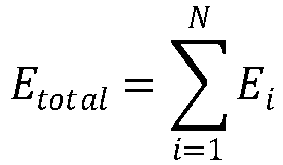
where, E total represents total electrical energy consumed, and Ei represents the electrical energy consumed in mixing, transportation, sintering, crushing, sieving, iron removal, and packaging processes of the materials, respectively. - Further, the third data includes: types and quantities of raw materials, water vapor directly discharged from the sintering process, carbon dioxide directly discharged from the sintering process, and carbon emission conversion coefficients corresponding to different substances.
- The third formula is specifically:

where, C total represents the total carbon emission, Cyc represents carbon emission from raw material manufacturing, C electricity represents carbon emission converted from total electrical energy consumed, and C water represents carbon emission converted from water vapor directly discharged from the sintering process; C carbon represents the carbon dioxide directly emitted during the sintering process, and C Li loss represents carbon emission converted from the lithium loss. - Further, the carbon emission converted from the total electric energy consumed is specifically:
carbon emission caused by the consumed electric energy, as calculated based on a global warming potential value of greenhouse gases. - Further, the accounting system further includes a data input module; and the data input module is used to input the first data, the second data, the third data, the first formula, the second formula, and the third formula.
- Further, the accounting system further includes a data output and display module; and the data output and display module is used to output and display the accounting result.
- Further, the accounting system further includes an energy loss accounting module; and the energy loss accounting module is used to read a fourth formula from the knowledge module and a fourth data from the data module to account an energy loss during the sintering process.
- Further, the fourth data includes: start time for sintering, end time for sintering, a heat exchange coefficient between a kiln and external environment, temperature of the roller kiln, temperature of the external environment, and total electric energy consumed by the roller kiln during the sintering process.
- The fourth formula is specifically:

where, E loss represents the energy lost during the sintering process; t1 represents the start time for sintering; t2 represents the end time for sintering; ε represents the heat transfer coefficient between the kiln and the external environment; T1 represents the temperature of the roller kiln; T2 represents the external ambient temperature; and E kiln represents the total electric energy consumed by the roller kiln during the sintering process. - Further, the accounting system includes an analysis module that is used to obtain an energy loss calculated by the energy loss accounting module and loss of lithium element calculated by the material balance module, establish an analysis model based on the energy loss and the loss of lithium element, and determine a correlation coefficient between the energy loss and the loss of lithium element.
- In comparison with prior art, a carbon emission accounting system for sintering of a lithium battery cathode materials of the present invention has the following beneficial effect: the present invention fully considers the carbon emissions involved in an entire sintering process of cathode material by adopting a material balance module, an energy balance module, and a carbon emission accounting module. A total carbon emission can be accounted quickly and efficiently through inputted data and pre-stored calculation formulas.
-
-
FIG 1 is a schematic diagram of the overall structure of a carbon emission accounting system for sintering of a lithium battery cathode material according to the present invention; -
FIG. 2 is a schematic diagram of sintering process of a lithium battery cathode material according to the present invention. - The specific implementation of the present invention will be described in further detail below in conjunction with the accompanying drawings and embodiment examples. The following embodiment examples are used to illustrate the present invention, but not to limit the scope of the present invention.
- As shown in
Figure 1 , the present invention discloses an carbon emission accounting system for sintering process of lithium battery cathode material, including: a material balance module, an energy balance module, a carbon emission accounting module, a data module, and a knowledge module; the material balance module is used to read a first formula from the knowledge module, and a first data from the data module to account loss of lithium element during the sintering of the lithium battery cathode material; the energy balance module is used to read a second formula from the knowledge module and a second data from the data module to account an energy loss during the sintering of the lithium battery cathode material; the carbon emission accounting module is used to read a third formula from the knowledge module, and a third data, the loss of lithium element and the energy loss from the data module to account a carbon emission in the sintering of the lithium battery cathode material; the data module is used to store the first data, the second data, the third data and an intermediate data generated in the accounting system; the knowledge module is used to store the first formula, the second formula, the third formula and parameter values in the accounting process. - In the present invention, the carbon emissions involved in the entire sintering process of cathode material is fully considered by means of the material balance module, the energy balance module and the carbon emission accounting module. Through an input data and pre-stored accounting formulas, the accounting can be carried out quickly and efficiently to obtain overall carbon emission.
- In order to better describe the technical solution of the present invention, referring to
FIG. 2 , taking the sintering of an NCM523 type cathode material as an example, which involves a nickel cobalt manganese oxide having a chemical formula of Ni0.5Co0.2Mn0.3(OH)2 and in a Ni: Co: Mn molar ratio of 5: 2: 3, and lithium carbonate as a lithium source. - In this embodiment example, the first data includes: a mass of a loaded sagger before sintering, a mass of crystal water in the precursor, a mass of a sagger discharged after sintering, a molar amount of the precursor in the raw material before sintering, and a molar amount of lithium carbonate in the raw material before sintering; and the first formula is specifically:

where, M Li loss represents the loss of lithium, M before represents the mass of the loaded sagger before sintering, M water represents the mass of crystal water in the precursor, M after represents the mass of the sagger discharged after sintering, and a represents the molar amount of the precursor in the raw material before sintering; and b represents the molar amount of lithium carbonate in the raw material before sintering. - In this embodiment example, the first data includes: the mass of the loaded saggar before sintering, the mass of crystal water in the precursor (Ni0.5Co0.2Mn0.3(OH)2), and a saggar mass after sintering, the molar amount of precursor (Ni0.5Co0.2Mn0.3(OH)2) in a raw material before sintering and a molar amount of lithium carbonate in a raw material before sintering.
- In this embodiment example, the material change in the sintering process are as follows: at 100-200°C, the precursor decrystallizes water; at 400°C, the precursor hydroxide is dehydrated to form oxide; at 500°C, lithium carbonate is decomposed to form lithium oxide; and at 700°C, the precursor oxide reacts with lithium oxide to form lithium nickel cobalt manganese oxide.
- a mol of nickel cobalt manganese hydroxide precursor and b mol of lithium carbonate are weighed and mixed. Sintering is performed to a resulting mixture in an oxygen atmosphere. The precursor and lithium carbonate will react in a ratio of 1: 1 to form a lithium nickel cobalt manganese oxide cathode material. Part of an excess lithium remains on the surface of cathode material in a form of lithium oxide, and the other part enters the external environment with airflow in a form of lithium oxide, thereby causing carbon emissions. The reaction equation is as follows:
O2+4Me(OH)2+2Li2CO3==4LiMeO2+4H2O+2CO2;
- Me is Ni, Co, Mn. M before represents the sagger mass before sintering, which is a total mass of the sagger and the mixture, and M after represents the sagger mass after sintering, which is a total mass of the sagger, lithium nickel cobalt manganese oxide, and residual lithium.
- During the sintering process, the mass of water discharged is the mass of crystal water plus the mass of water produced by the reaction, that is, M water + a mol water, carbon dioxide is b mol, and oxygen participating in the reaction is a/4 mol. Therefore, the lithium loss mass (accounted as LizO) is M before-M after-M water-a mol water-b mol carbon dioxide + a/4 mol oxygen, and the following formula is obtained:

- In this embodiment example, a second data includes: electrical energy consumed in the mixing, transportation, sintering, crushing, sieving, iron removal, and packaging of materials; and the second formula is specifically:

where, E total represents total electrical energy consumed, and Ei represents the electrical energy consumed in the mixing, transportation, sintering, crushing, sieving, iron removal, and packaging processes of the materials respectively. - In this embodiment example, the third data includes: types and quantities of raw materials, water vapor directly discharged from the sintering process, carbon dioxide directly discharged from the sintering process, and carbon emission conversion coefficients corresponding to different substances;
- The third formula is specifically:

where, C total represents the total carbon emission, Cyc represents carbon emission from raw material manufacturing, C electricity represents carbon emission converted from the total electrical energy consumed, and C water represents carbon emission converted from water vapor directly discharged from the sintering process; C carbon represents the carbon dioxide directly emitted during the sintering process, and C Li loss represents carbon emission converted from the lithium loss. - In this embodiment example, the raw materials include precursors, lithium carbonate, and oxygen.
- In this embodiment example, the amount of lithium loss can be measured by the molar mass of the precursor and lithium carbonate (which can be obtained by weighing before mixing) and the mass of the loaded sagger before and after sintering. The oxygen consumption can be obtained through an oxygen flowmeter. By looking up the carbon emission factor, you can convert the carbon emissions from the precursor, lithium carbonate, oxygen and other raw materials, as well as the total electricity energy consumption, water vapor emission, carbon dioxide emission, lithium loss emission, etc.; and finally get a total carbon emission.
- In this embodiment example, the carbon emission converted from the total electric energy consumed is specifically:
A carbon emission caused by the consumed electric energy, as calculated based on a global warming potential value of greenhouse gases. - In this embodiment example, the accounting system further includes a data input module; the data input module is used to input the first data, the second data, the third data, the first formula, the second formula, and the third formula.
- In this embodiment example, the data inputted by the data input module includes: x kg of the precursor with a water content of 0.5% which is accurately weighed, that is, a mol Ni0.5Co0.2Mn0.3(OH)2 and 0.005x kg of crystal water; y kg of lithium carbonate, that is, b mol of lithium carbonate; electrical energy E1 consumed by mixing, electrical energy E2 consumed by transportation, electrical energy E3 consumed by sintering..., which are derived from electric meters for input; the mass of the filled sagger before sintering denoted as M1; the mass of the sagger discharged after sintering denoted as M2; oxygen used in the sintering process derived from a flowmeter for input; the carbon emission factor of Ni0.5Co0.2Mn0.3(OH)2 with 0.5% water content; the carbon emission factor of lithium carbonate, the carbon emission factor of oxygen, the carbon emission factor of electric energy conversion, the carbon emission factor of water vapor, and the carbon emission factor of lithium oxide.
- In this embodiment example, the accounting system further includes a data output and display module; and the data output and display module is used to output and display the accounting result.
- In this embodiment example, the output and display content includes:




- In this embodiment example, the accounting system further includes an energy loss accounting module; the energy loss accounting module is used to read a fourth formula from the knowledge module and a fourth data from the data module to account the energy loss during the sintering process.
- In this embodiment example, the fourth data includes: start time for sintering, end time for sintering, a heat exchange coefficient between a kiln and external environment, temperature of the roller kiln, temperature of the external environment, and total electric energy consumed by the roller kiln during the sintering process.
- The fourth formula is specifically:

- Among them, E loss represents the energy lost during the sintering process; t1 represents the start time for sintering; t2 represents the end time for sintering; ε represents the heat transfer coefficient between the kiln and the external environment; T1 represents the temperature of the roller kiln; T2 represents the external ambient temperature; and E kiln represents the total electric energy consumed by the roller kiln during the sintering process.
- In this embodiment example, the accounting system further includes an analysis module that is used to obtain an energy loss calculated by the energy loss accounting module and loss of lithium element calculated by the material balance module, establish an analysis model based on the energy loss and the loss of lithium element, and determine a correlation coefficient between the energy loss and the loss of lithium element.
- To sum up, compared with the prior art, a system for calculating carbon emissions from sintering of lithium battery cathode materials in an embodiment example of the present invention has the following beneficial effect: the present invention fully considers the carbon emissions involved in the entire sintering process of cathode material by adopting a material balance module, an energy balance module, and a carbon emission accounting module. A total carbon emission can be accounted quickly and efficiently through inputted data and pre-stored calculation formulas.
- The invention additionally adds an accounting module for the energy loss in the sintering process, to study the influence of the roller kiln temperature change during a heating stage and a heat preservation stage on the lithium loss, thereby exploring an optimal sintering process for further reducing lithium loss and decreasing carbon emissions.
- The above are only the preferred embodiment examples of the present invention. It should be pointed out that, for those ordinary skilled in the art, several improvements and substitutions can be made without departing from the technical principles of the present invention. These improvements and substitutions should also be regarded as within the protection scope of the present invention.
Claims (10)
- A carbon emission accounting system for sintering of a lithium battery cathode material, comprising: a material balance module, an energy balance module, a carbon emission accounting module, a data module, and a knowledge module, wherein the material balance module is used to read a first formula from the knowledge module and a first data from the data module to account loss of lithium element during the sintering process of the lithium battery cathode material; the energy balance module is used to read a second formula from the knowledge module and a second data from the data module to account an energy loss during the sintering process of the lithium battery cathode material; the carbon emission accounting module is used to read a third formula from the knowledge module, and a third data, the loss of lithium element and the energy loss from the data module to account carbon emission during the sintering process of the lithium battery cathode material; the data module is used to store the first data, the second data, the third data and an intermediate data generated in the accounting system; and the knowledge module is used to store the first formula, the second formula, the third formula and parameter values in the accounting process.
- The carbon emission accounting system for sintering of the lithium battery cathode material according to claim 1, wherein the first data includes: a mass of a loaded sagger before sintering, a mass of crystal water in a precursor, a mass of a sagger discharged after sintering, a molar amount of the precursor in the raw material before sintering, and a molar amount of lithium carbonate in the raw material before sintering; and the first formula is specifically:

- The carbon emission accounting system for sintering of the lithium battery cathode material according to claim 1, wherein the second data includes: electrical energy consumed in mixing, transportation, sintering, crushing, sieving, iron removal, and packaging of materials; and the second formula is specifically:

- The carbon emission accounting system for sintering of the lithium battery cathode material according to claim 1, wherein the third data includes: type and quantity of raw materials, water vapor directly discharged from the sintering process, carbon dioxide directly discharged from the sintering process, and carbon emission conversion coefficients corresponding to different substances; and
the third formula is specifically:
- The carbon emission accounting system for sintering of the lithium battery cathode material according to claim 4, wherein the carbon emission converted from the total electric energy consumed is specifically:
carbon emission caused by the consumed electric energy, as calculated based on a global warming potential value of greenhouse gases. - The carbon emission accounting system for sintering of the lithium battery cathode material according to claim 1, wherein the accounting system further includes a data input module; and the data input module is used to input the first data, the second data, the third data, the first formula, the second formula, and the third formula.
- The carbon emission accounting system for sintering of the lithium battery cathode material according to claim 1, wherein the accounting system further includes a data output and display module; and the data output and display module is used to output and display an accounting result.
- The carbon emission accounting system for sintering of the lithium battery cathode material according to claim 1, wherein the accounting system further includes an energy loss accounting module; and the energy loss accounting module is used to read a fourth formula from the knowledge module and a fourth data from the data module to account an energy loss during the sintering process.
- The carbon emission accounting system for sintering of the lithium battery cathode material according to claim 8, wherein the fourth data includes: start time for sintering, end time for sintering, a heat exchange coefficient between a kiln and external environment, temperature of the roller kiln, temperature of the external environment, and total electric energy consumed by the roller kiln during the sintering process; and
the fourth formula is specifically:
- The carbon emission accounting system for sintering of the lithium battery cathode material according to claim 8, wherein the accounting system further includes an analysis module that is used to obtain an energy loss calculated by the energy loss accounting module and loss of lithium element calculated by the material balance module, establish an analysis model based on the energy loss and the loss of lithium element, and determine a correlation coefficient between the energy loss and the loss of lithium element.
Applications Claiming Priority (2)
| Application Number | Priority Date | Filing Date | Title |
|---|---|---|---|
| CN202111267061.0A CN114067922B (en) | 2021-10-28 | 2021-10-28 | A carbon emission accounting system for sintering positive electrode materials of lithium batteries |
| PCT/CN2022/112575 WO2023071422A1 (en) | 2021-10-28 | 2022-08-15 | Accounting system for carbon emissions of lithium battery positive electrode material sintering |
Publications (2)
| Publication Number | Publication Date |
|---|---|
| EP4425395A1 true EP4425395A1 (en) | 2024-09-04 |
| EP4425395A4 EP4425395A4 (en) | 2025-10-29 |
Family
ID=80235979
Family Applications (1)
| Application Number | Title | Priority Date | Filing Date |
|---|---|---|---|
| EP22885322.2A Pending EP4425395A4 (en) | 2021-10-28 | 2022-08-15 | Accounting system for carbon emissions for sintering positive electrode material for lithium batteries |
Country Status (3)
| Country | Link |
|---|---|
| EP (1) | EP4425395A4 (en) |
| CN (1) | CN114067922B (en) |
| WO (1) | WO2023071422A1 (en) |
Families Citing this family (6)
| Publication number | Priority date | Publication date | Assignee | Title |
|---|---|---|---|---|
| CN114067922B (en) * | 2021-10-28 | 2025-02-07 | 广东邦普循环科技有限公司 | A carbon emission accounting system for sintering positive electrode materials of lithium batteries |
| WO2024259638A1 (en) * | 2023-06-21 | 2024-12-26 | 广东邦普循环科技有限公司 | Method for full-chain integrated low-carbon production of positive electrode material |
| CN117010106B (en) * | 2023-07-28 | 2024-09-17 | 江苏盐电阀门有限公司 | Carbon emission accounting method and system in ball valve production process |
| CN117057516B (en) * | 2023-10-12 | 2024-04-09 | 浙江大有实业有限公司配电工程分公司 | A method for analyzing and predicting carbon accounting parameters based on system dynamics |
| CN117836791B (en) * | 2023-11-24 | 2025-11-14 | 广东邦普循环科技有限公司 | Methods, apparatus, equipment and storage media for RMS-based accounting and traceability of recycled materials |
| CN119901868A (en) * | 2025-01-06 | 2025-04-29 | 合肥国轩高科动力能源有限公司 | Method, device and electronic equipment for determining carbon emissions in battery production process |
Family Cites Families (12)
| Publication number | Priority date | Publication date | Assignee | Title |
|---|---|---|---|---|
| US20110045363A1 (en) * | 2006-08-31 | 2011-02-24 | Contained Energy, Inc. | Process and equipment to significantly reduce co2 emissions from direct carbon fuel cells without materially increasing the cost of generating electricity |
| US9385531B2 (en) * | 2010-08-24 | 2016-07-05 | Bennett Hill Branscomb | System and method for optimizing returns of power feedstock producers |
| CN104251726A (en) * | 2014-07-29 | 2014-12-31 | 浙江吉利罗佑发动机有限公司 | Energy consumption testing method of non-plugin hybrid vehicle |
| CN106467929A (en) * | 2015-08-23 | 2017-03-01 | 张桂春 | Multiple target blast furnace process operation carbon emission optimization method |
| US11081694B2 (en) * | 2015-11-30 | 2021-08-03 | Lg Chem, Ltd. | Positive electrode active material for secondary battery, and secondary battery comprising the same |
| CN106709265A (en) * | 2017-01-13 | 2017-05-24 | 上海理工大学 | Photovoltaic system carbon emission calculation method based on full life circle ideology |
| KR102481574B1 (en) * | 2018-03-29 | 2022-12-26 | 유미코아 | Manufacturing method of positive electrode material for rechargeable lithium ion battery |
| CN112613699B (en) * | 2020-12-01 | 2022-04-05 | 吉林大学 | Initial carbon emission right distribution method based on automobile big data |
| CN112670514B (en) * | 2020-12-28 | 2022-05-06 | 天津巴莫科技有限责任公司 | A kind of double-coated lithium battery positive electrode material and preparation method thereof |
| CN113240275A (en) * | 2021-05-13 | 2021-08-10 | 浙江中蓝环境科技有限公司 | Carbon emission evaluation system for industrial enterprises |
| CN113516371A (en) * | 2021-06-16 | 2021-10-19 | 杭州慧源智谷科技有限责任公司 | A method for measuring full-caliber carbon emission intensity and carbon source structure |
| CN114067922B (en) * | 2021-10-28 | 2025-02-07 | 广东邦普循环科技有限公司 | A carbon emission accounting system for sintering positive electrode materials of lithium batteries |
-
2021
- 2021-10-28 CN CN202111267061.0A patent/CN114067922B/en active Active
-
2022
- 2022-08-15 WO PCT/CN2022/112575 patent/WO2023071422A1/en not_active Ceased
- 2022-08-15 EP EP22885322.2A patent/EP4425395A4/en active Pending
Also Published As
| Publication number | Publication date |
|---|---|
| CN114067922B (en) | 2025-02-07 |
| WO2023071422A1 (en) | 2023-05-04 |
| CN114067922A (en) | 2022-02-18 |
| EP4425395A4 (en) | 2025-10-29 |
Similar Documents
| Publication | Publication Date | Title |
|---|---|---|
| CN114067922B (en) | A carbon emission accounting system for sintering positive electrode materials of lithium batteries | |
| Akhilash et al. | A journey through layered cathode materials for lithium ion cells–from lithium cobalt oxide to lithium-rich transition metal oxides | |
| CN104201378B (en) | Method for preparing high-nickel ternary cathode material of lithium ion battery | |
| Alcántara et al. | Changes in oxidation state and magnetic order of iron atoms during the electrochemical reaction of lithium with NiFe2O4 | |
| Qiao et al. | Direct evidence of gradient Mn (II) evolution at charged states in LiNi0. 5Mn1. 5O4 electrodes with capacity fading | |
| Lanz et al. | Oxygen release from high-energy xLi2MnO3·(1− x) LiMO2 (M= Mn, Ni, Co): Electrochemical, differential electrochemical mass spectrometric, in situ pressure, and in situ temperature characterization | |
| Jana et al. | Physical, on the fly, capacity degradation prediction of LiNiMnCoO2-graphite cells | |
| CN101339994A (en) | Preparation method and application of multi-site doped lithium iron phosphate cathode material | |
| CN106328911A (en) | Material with mixture of ions with sodium vanadium phosphate cathode material coated by carbon and preparing method thereof | |
| CN114361437B (en) | A NASICON-type structured sodium ion positive electrode material and its preparation method and application | |
| CN105895887A (en) | Multi-element-doped phosphate positive electrode material and preparation method thereof and lithium-ion battery | |
| Liu et al. | Are solid-state batteries absolutely more environmentally friendly compared to traditional batteries-analyzing from the footprint family viewpoint | |
| CN101424608B (en) | Analysis method of Co3O4 and CoO content in lithium cobalt oxide | |
| Fröhlich et al. | Determining phase transitions of layered oxides via electrochemical and crystallographic analysis | |
| CN103825022A (en) | Preparation method and application of lithium vanadium phosphate/carbon composite | |
| Thakur et al. | Non-rechargeable batteries: a review of primary battery technology and future trends | |
| CN106025182B (en) | A titanium-chromium-doped iron fluoride-carbon nanocomposite cathode material and its preparation method and application | |
| US20230420734A1 (en) | Solid electrolyte, method of producing solid electrolyte, and battery | |
| CN108321381A (en) | A kind of nickel cobalt aluminium ternary anode material for lithium-ion batteries, the Preparation method and use of Ti doping | |
| CN105036104A (en) | Preparation method of lithium vanadium phosphate by high-energy ball milling | |
| CN119976783A (en) | A kind of lithium iron manganese phosphate and its preparation method and application | |
| CN115676792A (en) | Method for preparing iron-based phosphate lithium battery material by using phosphorus iron slag as raw material | |
| CN104638271A (en) | Preparation method of fluorine ion doped type lithium ion battery anode material | |
| CN108565445A (en) | A kind of high-performance cladded type positive electrode and preparation method thereof | |
| CN102544506A (en) | Method for preparing lithium battery anode material |
Legal Events
| Date | Code | Title | Description |
|---|---|---|---|
| STAA | Information on the status of an ep patent application or granted ep patent |
Free format text: STATUS: THE INTERNATIONAL PUBLICATION HAS BEEN MADE |
|
| PUAI | Public reference made under article 153(3) epc to a published international application that has entered the european phase |
Free format text: ORIGINAL CODE: 0009012 |
|
| STAA | Information on the status of an ep patent application or granted ep patent |
Free format text: STATUS: REQUEST FOR EXAMINATION WAS MADE |
|
| 17P | Request for examination filed |
Effective date: 20240513 |
|
| AK | Designated contracting states |
Kind code of ref document: A1 Designated state(s): AL AT BE BG CH CY CZ DE DK EE ES FI FR GB GR HR HU IE IS IT LI LT LU LV MC MK MT NL NO PL PT RO RS SE SI SK SM TR |
|
| DAV | Request for validation of the european patent (deleted) | ||
| DAX | Request for extension of the european patent (deleted) | ||
| REG | Reference to a national code |
Ref country code: DE Ref legal event code: R079 Free format text: PREVIOUS MAIN CLASS: G06Q0010060000 Ipc: G06Q0010063900 |
|
| A4 | Supplementary search report drawn up and despatched |
Effective date: 20250925 |
|
| RIC1 | Information provided on ipc code assigned before grant |
Ipc: G06Q 10/0639 20230101AFI20250919BHEP Ipc: G06Q 50/04 20120101ALI20250919BHEP Ipc: G16C 20/10 20190101ALI20250919BHEP Ipc: H01M 10/052 20100101ALN20250919BHEP |