EP4425375A1 - Inference device, calculation device, setting method, calculation method, and calculation program - Google Patents
Inference device, calculation device, setting method, calculation method, and calculation program Download PDFInfo
- Publication number
- EP4425375A1 EP4425375A1 EP21967192.2A EP21967192A EP4425375A1 EP 4425375 A1 EP4425375 A1 EP 4425375A1 EP 21967192 A EP21967192 A EP 21967192A EP 4425375 A1 EP4425375 A1 EP 4425375A1
- Authority
- EP
- European Patent Office
- Prior art keywords
- inference
- layer
- layer integration
- calculation
- external memory
- Prior art date
- Legal status (The legal status is an assumption and is not a legal conclusion. Google has not performed a legal analysis and makes no representation as to the accuracy of the status listed.)
- Pending
Links
Images




Classifications
-
- G—PHYSICS
- G06—COMPUTING OR CALCULATING; COUNTING
- G06N—COMPUTING ARRANGEMENTS BASED ON SPECIFIC COMPUTATIONAL MODELS
- G06N3/00—Computing arrangements based on biological models
- G06N3/02—Neural networks
-
- G—PHYSICS
- G06—COMPUTING OR CALCULATING; COUNTING
- G06N—COMPUTING ARRANGEMENTS BASED ON SPECIFIC COMPUTATIONAL MODELS
- G06N3/00—Computing arrangements based on biological models
- G06N3/02—Neural networks
- G06N3/04—Architecture, e.g. interconnection topology
- G06N3/0464—Convolutional networks [CNN, ConvNet]
-
- G—PHYSICS
- G06—COMPUTING OR CALCULATING; COUNTING
- G06N—COMPUTING ARRANGEMENTS BASED ON SPECIFIC COMPUTATIONAL MODELS
- G06N3/00—Computing arrangements based on biological models
- G06N3/02—Neural networks
- G06N3/04—Architecture, e.g. interconnection topology
- G06N3/045—Combinations of networks
-
- G—PHYSICS
- G06—COMPUTING OR CALCULATING; COUNTING
- G06N—COMPUTING ARRANGEMENTS BASED ON SPECIFIC COMPUTATIONAL MODELS
- G06N3/00—Computing arrangements based on biological models
- G06N3/02—Neural networks
- G06N3/06—Physical realisation, i.e. hardware implementation of neural networks, neurons or parts of neurons
- G06N3/063—Physical realisation, i.e. hardware implementation of neural networks, neurons or parts of neurons using electronic means
Definitions
- the disclosed technology relates to an inference device, a calculation device, a setting method, a calculation method, and a calculation program.
- CNN inference processing accelerators have been actively conducted in order to apply image recognition or object recognition using a convolutional neural network (CNN) to use cases such as surveillance cameras and drones for which real-time property, power saving, and area saving are required. Furthermore, there is also an approach to enable inference processing using a 4K or 8K high-definition video as an input. Since the input image size of a CNN model is limited, a method of processing divided input images in parallel by a plurality of inference cores is common. However, parallelization of the inference cores causes an increase in the external memory band, and thus the external memory band tends to be a bottleneck of processing performance.
- Non Patent Literature 1 As a method of reducing the external memory band in CNN inference processing, a layer fusion (layer integration) method is proposed (Non Patent Literature 1).
- a layer fusion (layer integration) method is proposed (Non Patent Literature 1).
- a plurality of layers are continuously processed in units of tiles obtained by dividing input data into grids.
- the amount of output data of each layer can be reduced to such an extent as to be stored in an internal memory.
- the data that had been transferred to the external memory can be held in the internal memory, and the external memory band can be reduced.
- a section of layers to be continuously processed is referred to as a "layer integration section".
- processing is performed by partitioning the CNN model into several layer integration sections. In the start and end layers of the layer integration section, data transfer to the external memory occurs.
- Non Patent Literature 1 Fabrizio Indirli, Ahmet Erdem, andcinalo, "A Tile-based Fused-layer CNN Accelerator for FPGAs", 2020 27th IEEE International Conference on Electronics, Circuits and Systems (ICECS) .
- the external memory band per inference core can be reduced.
- the inference cores are parallelized for high-definition video processing or the like, there is still a problem that the external memory band increases in proportion to the number of inference cores.
- the disclosed technology has been made in view of the above points, and an object thereof is to reduce an external memory band in a case where inference cores are parallelized by a CNN inference processing accelerator.
- a first aspect of the present disclosure is an inference device including a plurality of inference units that performs convolution processing by a layer integration scheme on input data for each of a plurality of layer integration sections in which a plurality of layers of a convolutional neural network is integrated, and a setting unit that sets, for each of the plurality of inference units, a partition of the layer integration sections that differs among the inference units.
- a second aspect of the present disclosure is a calculation device including a calculation unit that calculates a partitioning method set for each of a plurality of inference units that performs convolution processing by a layer integration scheme on input data for each of a plurality of layer integration sections in which a plurality of layers of a convolutional neural network is integrated, the partitioning method partitioning the layer integration section and differing among the inference units, and an output unit that outputs the partition of the layer integration sections calculated by the calculation unit to an inference device including the plurality of inference units.
- a third aspect of the present disclosure is a setting method including setting, by a setting unit, for each of a plurality of inference units that performs convolution processing by a layer integration scheme on input data for each of a plurality of layer integration sections in which a plurality of layers of a convolutional neural network is integrated, a different partition of the layer integration sections for each of the inference units.
- a fourth aspect of the present disclosure is a calculation method including calculating, by a calculation unit, a partitioning method set in each of a plurality of inference units that performs convolution processing by a layer integration scheme on input data for each of a plurality of layer integration sections in which a plurality of layers of a convolutional neural network is integrated, the partitioning method partitioning the layer integration sections and differing among the inference units, and outputting, by an output unit, the partition of the layer integration section calculated by the calculation unit to an inference device including the plurality of inference units.
- a fifth aspect of the present disclosure is a calculation program for causing a computer to function as each unit of the above-described calculation device.
- Fig. 2 is a block diagram illustrating a hardware configuration of an inference device 10 according to a first embodiment.
- the inference device 10 includes a central processing unit (CPU) 11, an external memory 12, a storage 13, an input/output interface (I/F) 14, a communication I/F 15, and a plurality of inference cores 16.
- the components are communicatively connected to each other via a bus 20.
- the CPU 11 is a central processing unit, which executes various programs and controls each unit. That is, the CPU 11 reads a program from the storage 13 and executes the program using the external memory 12 as a work area. The CPU 11 performs control of each of the components described above and various types of arithmetic processing according to a program stored in the storage 13. In the present embodiment, the storage 13 stores a setting program for executing setting processing to be described later.
- the external memory 12 temporarily stores a program or data as a work area.
- the external memory 12 is implemented by, for example, a double-data-rate synchronous dynamic random access memory (DDR SDRAM), or the like.
- the storage 13 stores various programs and various types of data.
- the storage 13 is implemented by, for example, a hard disk drive (HDD), a solid state drive (SSD), or the like.
- the input/output I/F 14 is an interface for connecting to an external device such as an input device including a mouse and a keyboard, or an output device including a display and a printer.
- the communication I/F 15 is an interface for communicating with other devices.
- a wired communication standard such as Ethernet (registered trademark) or FDDI
- a wireless communication standard such as 4G, 5G, or Wi-Fi (registered trademark) is used.
- the plurality of inference cores 16 has the same configuration.
- the inference device 10 includes N + 1 inference cores 16, and numbers 0, 1, ..., and N are assigned to the inference cores 16.
- the number of inference cores 16 included in the inference device 10 may be an arbitrary number.
- each inference core will be denoted as an "inference core 16" in a case where the inference cores are described without distinction, and will be denoted as an "inference core #m" in a case where the inference cores are described with distinction.
- m is a number of the inference core 16.
- the inference core 16 is an integrated circuit that performs inference processing in the CNN.
- the inference core 16 is implemented by, for example, a field-programmable gate array (FPGA) or the like.
- the inference core 16 includes a setting holding unit 17, an internal memory 18, and a multiply accumulation (MAC) circuit 19.
- FPGA field-programmable gate array
- MAC multiply accumulation
- the setting holding unit 17 holds settings necessary for inference processing executed by the corresponding inference core 16.
- the setting holding unit 17 is implemented by, for example, a register or the like.
- the internal memory 18 is a memory that holds data necessary for various arithmetic operations and arithmetic operation results, and is an on-chip memory module mounted inside the inference core 16. Specifically, input data of CNN inference processing stored in the external memory 12 is temporarily transferred to the internal memory 18 in order to be processed by the inference core 16. Furthermore, the internal memory 18 temporarily holds input/output data of an intermediate layer of a layer integration section (details will be described later) when processing is performed by the layer integration scheme.
- the MAC circuit 19 is an arithmetic circuit designed to perform convolution processing in CNN inference processing.
- the inference device 10 has an architecture in which the internal memory 18 is provided for each inference core 16 as described above, and the external memory 12 is shared among the inference cores 16. Note that although not illustrated in Fig. 2 , in a case where the CNN model includes a layer other than the convolution layer such as the Maxpooling layer or the Residual layer, an arithmetic operation unit for performing arithmetic processing of the layer is separately provided in the inference core 16.
- Fig. 3 is a block diagram illustrating an example of the functional configuration of the inference device 10.
- the inference device 10 includes, as functional configurations, a calculation unit 31, a setting unit 32, and a plurality of inference units 330, 331, ..., and 33N.
- the inference unit 330 is implemented by the inference core #0 illustrated in Fig. 2
- the inference unit 331 is implemented by the inference core #1
- the inference unit 33N is implemented by the inference core #N.
- each of the inference units 330, 331, ..., and 33N will be referred to as an "inference unit 33" when described without distinction.
- the calculation unit 31 calculates a different partitioning method of the layer integration section for each inference unit 33.
- the layer integration section is obtained by integrating a plurality of layers of CNN.
- Fig. 4 illustrates an example of partitioning of the layer integration section.
- the CNN model includes a total of seven layers of layer 0 to layer 6. This is an example of a case where the inference cores 16 corresponding to the inference units 33 are three inference cores #0, #1, and #2. As illustrated in Fig.
- the timing of data transfer to the external memory 12 is shifted by providing a different partitioning method of the layer integration section for each inference unit 33, that is, by setting the layer integration section so that the start layer and the end layer of the layer integration sections of the inference cores 16 do not overlap.
- the band of the external memory 12 in a case where the inference cores 16 are parallelized is smoothed, and as a result, the band of the external memory 12 can be reduced.
- the calculation unit 31 calculates the band of the external memory 12 to be used for each layer integration section set for each inference unit 33. More specifically, the calculation unit 31 acquires a band used for reading input data of the first layer in the layer integration section from the external memory 12 and writing output data of the last layer in the layer integration section to the external memory 12. Then, the calculation unit 31 calculates the band of the external memory 12 to be used for each layer integration section on the basis of each acquired band. Furthermore, the calculation unit 31 calculates the partitioning method of the layer integration section in which the maximum value of a band total obtained by adding the bands of the external memory 12 calculated for each inference unit 33 for each layer is equal to or less than a predetermined target value. The calculation unit 31 notifies the setting unit 32 of the calculated partition of the layer integration section that differs among the inference units 33.
- the setting unit 32 sets, for each of the plurality of inference units 33, the partition of the layer integration section different for each of the inference units 33 notified from the calculation unit 31.
- the inference unit 33 performs convolution processing on the input data by a layer integration method on the basis of the partition of the layer integration section set by the setting unit 32.
- Fig. 5 is a flowchart illustrating a flow of setting processing performed by the inference device 10.
- the CPU 11 reads a setting program from the storage 13, develops the setting program in the external memory 12, and executes the setting program, thereby performing the setting processing.
- the setting processing is an example of a setting method of the disclosed technology.
- step S11 the CPU 11, as the calculation unit 31, sets an initial value of the partitioning method of the layer integration section in each inference core 16 (inference unit 33).
- the initial value may be given from the outside, or an initial value stored in advance in a predetermined storage area of the inference device 10 may be read and used.
- step S12 the CPU 11, as the calculation unit 31, calculates the external memory band per inference core 16 on the basis of the currently set partitioning method of the layer integration section for all the inference cores 16. Specifically, the CPU 11, as the calculation unit 31, calculates an external memory read band that is a band of the external memory 12 in which data is read from the inference core 16 and an external memory write band that is a band of the external memory 12 in which data is written from the inference core 16.
- Fig. 6 is an example of the partitioning method of the layer integration section in the CNN model.
- n of a layer integration section #n is the number of the layer integration section.
- the CNN model includes seven layers, and layer 0 and layer 1 are partitioned into a layer integration section #0, layer 2, layer 3, and layer 4 are partitioned into a layer integration section #1, and layer 5 and layer 6 are partitioned into a layer integration section #2.
- the number of convolution arithmetic processing cycles, the input data capacity, and the output data capacity in each layer are given from the outside in advance.
- the upper diagram of Fig. 7 illustrates a processing image in the case of the example of Fig. 6 .
- the processing of each layer integration section is roughly divided into the following three processing. The first is reading of input data of the first layer in the layer integration section from the external memory 12, the second is convolution arithmetic processing of all layers in the layer integration section, and the third is writing of output data of the last layer in the layer integration interval to the external memory 12.
- the processing of each layer integration section is based on the premise that pipeline processing is performed by overlapping the above three processing.
- the calculation unit 31 calculates the number of cycles required for the convolution arithmetic processing among the three processing by adding the number of convolution arithmetic processing cycles in each layer given in advance from the outside.
- the number of cycles that can be used to read input data of the first layer in the layer integration section from the external memory 12 and write output data of the last layer in the layer integration section to the external memory 12 is the same as the number of cycles required for the overlapping convolution arithmetic processing.
- the calculation unit 31 determines the transfer data capacity required to be transferred in each of the read from the external memory 12 and the write to the external memory 12 on the basis of the input data capacity and the output data capacity of each layer given from the outside in advance. As illustrated in the lower diagram of Fig. 7 , the calculation unit 31 calculates a value obtained by dividing the determined transfer data capacity by the number of cycles that can be used for each of reading from the external memory 12 and writing to the external memory 12 as the external memory read band and the external memory write band.
- the band with "-" in the lower diagram of Fig. 7 depends on processing before and after the processing range illustrated in this example, and thus it means that the band is omitted, but in reality, the band needs to be calculated. Note, however, that since the number of cycles that can be used for each processing cannot be obtained from the number of other processing cycles for the first input read and the last output write of the entire processing, the number of cycles that can be used for each processing is given in advance.
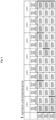
- step S13 the CPU 11, as the calculation unit 31, adds the external memory read band and the external memory write band calculated for all the inference cores 16 for each layer and calculates the band total of the external memory 12 for each layer.
- FIG. 8 A specific example of calculating the band total of the external memory 12 in the plurality of inference cores 16 will be described with reference to Fig. 8 .
- the external memory read band and the external memory write band for each layer integration section of each inference core 16 calculated as illustrated in Fig. 7 are denoted as R mn and W mn , respectively.
- m represents the number of the inference core 16
- n represents the number of the layer integration section.
- This example is a case including three inference cores 16 of the inference core #0, the inference core #1, and the inference core #2.
- each of the inference cores 16 has a different partitioning method of the layer integration section.
- step S14 the CPU 11, as the calculation unit 31, determines whether or not the maximum value of the band total for each layer is equal to or less than a target value given from the outside in advance.
- the processing proceeds to step S16, and when the value exceeds the target value, the processing proceeds to step S15. Furthermore, when the above processing loop is repeated a specified number of times, too, the processing proceeds to step S16.
- step S15 the CPU 11, as the calculation unit 31, changes the partitioning method of the layer integration section.
- the way of changing the partitioning method is not particularly specified. As an example, it is conceivable to change the method randomly. Then, the processing returns to step S12.
- step S16 the CPU 11, as the calculation unit 31, notifies the setting unit 32 of the current partitioning method of the layer integration section, notifies each inference core 16 of the setting necessary for the operation via the setting unit 32, and ends the setting processing.
- the second embodiment is different from the first embodiment in that a method of partitioning a layer integration section is calculated outside the device. Note that in the second embodiment, components similar to those of the first embodiment are denoted by the same reference numerals, and detailed description thereof will be omitted.
- a partitioning method of the layer integration section calculated by a calculation device 40 is set in each inference unit 33 of an inference device 210, that is, each inference core 16.
- Fig. 10 is a block diagram illustrating a hardware configuration of the calculation device 40 according to the second embodiment.
- the calculation device 40 includes a CPU 51, a memory 52 implemented by a RAM or the like, a storage 53, an input/output I/F 54, and a communication I/F 55.
- the components are communicatively connected to each other via a bus 60. Details of each component are similar to the corresponding component of the hardware configuration of the inference device 10 illustrated in Fig. 2 , and thus detailed description thereof will be omitted.
- the hardware configuration of the inference device 210 according to the second embodiment is similar to the hardware configuration of the inference device 10 according to the first embodiment illustrated in Fig. 2 , the description thereof will be omitted.
- the calculation device 40 includes a calculation unit 41 and an output unit 42 as functional configurations.
- the function of the calculation unit 41 is similar to that of the calculation unit 31 of the inference device 10 according to the first embodiment.
- the output unit 42 outputs the partitioning method of the layer integration section calculated by the calculation unit 41 to the inference device 210.
- the inference device 210 includes, as functional configurations, a setting unit 32 and a plurality of inference units 330, 331, ..., and 33N.
- the functional configuration of the inference device 210 according to the second embodiment is similar to that of the inference device 10 according to the first embodiment except that the calculation unit 31 is not provided.
- the calculation device 40 executes calculation processing similar to the setting processing illustrated in Fig. 5 . Note, however, that in step S16, the CPU 11, as the output unit 42, executes processing of outputting the calculated current partitioning method of the layer integration section to the inference device 210. Note that the calculation processing is an example of a calculation method of the disclosed technology.
- the inference device 210 Upon receiving the partitioning method of the layer integration section from the calculation device 40, the inference device 210 sets the partitioning method of the layer integration section in each inference core 16 similarly to the processing of step S16 of the setting processing illustrated in Fig. 5 .
- the calculation device calculates, for each of the plurality of inference units that performs convolution processing on input data by the layer integration scheme for each layer integration section in which a plurality of layers of the CNN is integrated, a different partitioning method of the layer integration section for each inference unit. Then, the calculation device outputs the calculated partitioning method of the layer integration section to the inference device.
- the inference device sets the partitioning method of the layer integration section received from the calculation device in each inference unit.
- the setting processing or the calculation processing executed by the CPU reading software (program) in each of the above embodiments may be executed by various processors other than the CPU.
- the processors in this case include a programmable logic device (PLD) whose circuit configuration can be changed after manufacturing, such as an FPGA, and a dedicated electric circuit that is a processor having a circuit configuration exclusively designed for executing specific processing, such as an application specific integrated circuit (ASIC).
- the setting processing or the calculation processing may be executed by one of these various processors, or may be executed by a combination of two or more processors of the same type or different types (e.g., a plurality of FPGAs, a combination of a CPU and an FPGA, and the like).
- a hardware structure of the various processors is an electric circuit in which circuit elements such as semiconductor elements are combined.
- the program may be provided in the form of a program stored in a non-transitory storage medium such as a compact disk read only memory (CD-ROM), a digital versatile disk read only memory (DVD-ROM), or a universal serial bus (USB) memory.
- a program stored in a non-transitory storage medium such as a compact disk read only memory (CD-ROM), a digital versatile disk read only memory (DVD-ROM), or a universal serial bus (USB) memory.
- the program may be downloaded from an external device via a network.
- An inference device including:
- a non-transitory recording medium storing a program that can be executed by a computer to execute calculation processing, in which
Landscapes
- Engineering & Computer Science (AREA)
- Physics & Mathematics (AREA)
- Theoretical Computer Science (AREA)
- Health & Medical Sciences (AREA)
- Life Sciences & Earth Sciences (AREA)
- Biomedical Technology (AREA)
- Biophysics (AREA)
- Evolutionary Computation (AREA)
- General Engineering & Computer Science (AREA)
- Data Mining & Analysis (AREA)
- Artificial Intelligence (AREA)
- General Health & Medical Sciences (AREA)
- Molecular Biology (AREA)
- Computing Systems (AREA)
- Computational Linguistics (AREA)
- General Physics & Mathematics (AREA)
- Mathematical Physics (AREA)
- Software Systems (AREA)
- Neurology (AREA)
- Complex Calculations (AREA)
- Image Analysis (AREA)
Abstract
Description
- The disclosed technology relates to an inference device, a calculation device, a setting method, a calculation method, and a calculation program.
- In recent years, research and development related to CNN inference processing accelerators have been actively conducted in order to apply image recognition or object recognition using a convolutional neural network (CNN) to use cases such as surveillance cameras and drones for which real-time property, power saving, and area saving are required. Furthermore, there is also an approach to enable inference processing using a 4K or 8K high-definition video as an input. Since the input image size of a CNN model is limited, a method of processing divided input images in parallel by a plurality of inference cores is common. However, parallelization of the inference cores causes an increase in the external memory band, and thus the external memory band tends to be a bottleneck of processing performance.
- As a method of reducing the external memory band in CNN inference processing, a layer fusion (layer integration) method is proposed (Non Patent Literature 1). In the method described in
Non Patent Literature 1, as illustrated inFig. 1 , a plurality of layers are continuously processed in units of tiles obtained by dividing input data into grids. As a result, the amount of output data of each layer can be reduced to such an extent as to be stored in an internal memory. As a result, the data that had been transferred to the external memory can be held in the internal memory, and the external memory band can be reduced. Here, a section of layers to be continuously processed is referred to as a "layer integration section". In general, processing is performed by partitioning the CNN model into several layer integration sections. In the start and end layers of the layer integration section, data transfer to the external memory occurs. - Non Patent Literature 1: Fabrizio Indirli, Ahmet Erdem, and Cristina Silvano, "A Tile-based Fused-layer CNN Accelerator for FPGAs", 2020 27th IEEE International Conference on Electronics, Circuits and Systems (ICECS).
- By the method described in
Non Patent Literature 1, the external memory band per inference core can be reduced. However, when the inference cores are parallelized for high-definition video processing or the like, there is still a problem that the external memory band increases in proportion to the number of inference cores. - The disclosed technology has been made in view of the above points, and an object thereof is to reduce an external memory band in a case where inference cores are parallelized by a CNN inference processing accelerator.
- A first aspect of the present disclosure is an inference device including a plurality of inference units that performs convolution processing by a layer integration scheme on input data for each of a plurality of layer integration sections in which a plurality of layers of a convolutional neural network is integrated, and a setting unit that sets, for each of the plurality of inference units, a partition of the layer integration sections that differs among the inference units.
- A second aspect of the present disclosure is a calculation device including a calculation unit that calculates a partitioning method set for each of a plurality of inference units that performs convolution processing by a layer integration scheme on input data for each of a plurality of layer integration sections in which a plurality of layers of a convolutional neural network is integrated, the partitioning method partitioning the layer integration section and differing among the inference units, and an output unit that outputs the partition of the layer integration sections calculated by the calculation unit to an inference device including the plurality of inference units.
- A third aspect of the present disclosure is a setting method including setting, by a setting unit, for each of a plurality of inference units that performs convolution processing by a layer integration scheme on input data for each of a plurality of layer integration sections in which a plurality of layers of a convolutional neural network is integrated, a different partition of the layer integration sections for each of the inference units.
- A fourth aspect of the present disclosure is a calculation method including calculating, by a calculation unit, a partitioning method set in each of a plurality of inference units that performs convolution processing by a layer integration scheme on input data for each of a plurality of layer integration sections in which a plurality of layers of a convolutional neural network is integrated, the partitioning method partitioning the layer integration sections and differing among the inference units, and outputting, by an output unit, the partition of the layer integration section calculated by the calculation unit to an inference device including the plurality of inference units.
- A fifth aspect of the present disclosure is a calculation program for causing a computer to function as each unit of the above-described calculation device.
- According to the disclosed technology, it is possible to reduce an external memory band in a case where inference cores are parallelized by a CNN inference processing accelerator.
-
-
Fig. 1 is a diagram for describing a conventional layer integration method. -
Fig. 2 is a block diagram illustrating a hardware configuration of an inference device. -
Fig. 3 is a functional block diagram of an inference device according to a first embodiment. -
Fig. 4 is a diagram illustrating an example of partitioning of layer integration sections. -
Fig. 5 is a flowchart illustrating a flow of setting processing. -
Fig. 6 is a diagram for describing a specific example of calculation of an external memory band. -
Fig. 7 is a diagram for describing a specific example of calculation of an external memory band. -
Fig. 8 is a diagram for describing a specific example of calculating a band total of an external memory. -
Fig. 9 is a functional block diagram of a calculation device and an inference device according to a second embodiment. -
Fig. 10 is a block diagram illustrating a hardware configuration of a calculation device. - Hereinafter, an example of embodiments of the disclosed technology will be described with reference to the drawings. Note that same or equivalent components and parts are denoted by the same reference numerals in the drawings. Furthermore, dimensional ratios in the drawings are exaggerated for convenience of description and thus may be different from actual ratios.
-
Fig. 2 is a block diagram illustrating a hardware configuration of aninference device 10 according to a first embodiment. As illustrated inFig. 2 , theinference device 10 includes a central processing unit (CPU) 11, anexternal memory 12, astorage 13, an input/output interface (I/F) 14, a communication I/F 15, and a plurality ofinference cores 16. The components are communicatively connected to each other via abus 20. - The
CPU 11 is a central processing unit, which executes various programs and controls each unit. That is, theCPU 11 reads a program from thestorage 13 and executes the program using theexternal memory 12 as a work area. TheCPU 11 performs control of each of the components described above and various types of arithmetic processing according to a program stored in thestorage 13. In the present embodiment, thestorage 13 stores a setting program for executing setting processing to be described later. - The
external memory 12 temporarily stores a program or data as a work area. Theexternal memory 12 is implemented by, for example, a double-data-rate synchronous dynamic random access memory (DDR SDRAM), or the like. Thestorage 13 stores various programs and various types of data. Thestorage 13 is implemented by, for example, a hard disk drive (HDD), a solid state drive (SSD), or the like. - The input/output I/
F 14 is an interface for connecting to an external device such as an input device including a mouse and a keyboard, or an output device including a display and a printer. The communication I/F 15 is an interface for communicating with other devices. For the communication, for example, a wired communication standard such as Ethernet (registered trademark) or FDDI, or a wireless communication standard such as 4G, 5G, or Wi-Fi (registered trademark) is used. - The plurality of
inference cores 16 has the same configuration. In the example ofFig. 2 , theinference device 10 includes N + 1inference cores 16, andnumbers inference cores 16. The number ofinference cores 16 included in theinference device 10 may be an arbitrary number. Hereinafter, each inference core will be denoted as an "inference core 16" in a case where the inference cores are described without distinction, and will be denoted as an "inference core #m" in a case where the inference cores are described with distinction. Here, m is a number of theinference core 16. - The
inference core 16 is an integrated circuit that performs inference processing in the CNN. Theinference core 16 is implemented by, for example, a field-programmable gate array (FPGA) or the like. Theinference core 16 includes asetting holding unit 17, aninternal memory 18, and a multiply accumulation (MAC)circuit 19. - The
setting holding unit 17 holds settings necessary for inference processing executed by thecorresponding inference core 16. Thesetting holding unit 17 is implemented by, for example, a register or the like. Theinternal memory 18 is a memory that holds data necessary for various arithmetic operations and arithmetic operation results, and is an on-chip memory module mounted inside theinference core 16. Specifically, input data of CNN inference processing stored in theexternal memory 12 is temporarily transferred to theinternal memory 18 in order to be processed by theinference core 16. Furthermore, theinternal memory 18 temporarily holds input/output data of an intermediate layer of a layer integration section (details will be described later) when processing is performed by the layer integration scheme. TheMAC circuit 19 is an arithmetic circuit designed to perform convolution processing in CNN inference processing. - The
inference device 10 has an architecture in which theinternal memory 18 is provided for eachinference core 16 as described above, and theexternal memory 12 is shared among theinference cores 16. Note that although not illustrated inFig. 2 , in a case where the CNN model includes a layer other than the convolution layer such as the Maxpooling layer or the Residual layer, an arithmetic operation unit for performing arithmetic processing of the layer is separately provided in theinference core 16. - Next, a functional configuration of the
inference device 10 will be described. -
Fig. 3 is a block diagram illustrating an example of the functional configuration of theinference device 10. As illustrated inFig. 3 , theinference device 10 includes, as functional configurations, acalculation unit 31, asetting unit 32, and a plurality ofinference units inference unit 330 is implemented by theinference core # 0 illustrated inFig. 2 , theinference unit 331 is implemented by theinference core # 1, and theinference unit 33N is implemented by the inference core #N. Hereinafter, each of theinference units - The
calculation unit 31 calculates a different partitioning method of the layer integration section for each inference unit 33. The layer integration section is obtained by integrating a plurality of layers of CNN.Fig. 4 illustrates an example of partitioning of the layer integration section. In the example ofFig. 4 , the CNN model includes a total of seven layers oflayer 0 tolayer 6. This is an example of a case where theinference cores 16 corresponding to the inference units 33 are threeinference cores # 0, #1, and #2. As illustrated inFig. 4 , the timing of data transfer to theexternal memory 12 is shifted by providing a different partitioning method of the layer integration section for each inference unit 33, that is, by setting the layer integration section so that the start layer and the end layer of the layer integration sections of theinference cores 16 do not overlap. As a result, the band of theexternal memory 12 in a case where theinference cores 16 are parallelized is smoothed, and as a result, the band of theexternal memory 12 can be reduced. - Specifically, the
calculation unit 31 calculates the band of theexternal memory 12 to be used for each layer integration section set for each inference unit 33. More specifically, thecalculation unit 31 acquires a band used for reading input data of the first layer in the layer integration section from theexternal memory 12 and writing output data of the last layer in the layer integration section to theexternal memory 12. Then, thecalculation unit 31 calculates the band of theexternal memory 12 to be used for each layer integration section on the basis of each acquired band. Furthermore, thecalculation unit 31 calculates the partitioning method of the layer integration section in which the maximum value of a band total obtained by adding the bands of theexternal memory 12 calculated for each inference unit 33 for each layer is equal to or less than a predetermined target value. Thecalculation unit 31 notifies the settingunit 32 of the calculated partition of the layer integration section that differs among the inference units 33. - The setting
unit 32 sets, for each of the plurality of inference units 33, the partition of the layer integration section different for each of the inference units 33 notified from thecalculation unit 31. - The inference unit 33 performs convolution processing on the input data by a layer integration method on the basis of the partition of the layer integration section set by the setting
unit 32. - Next, an operation of the
inference device 10 according to the first embodiment will be described. -
Fig. 5 is a flowchart illustrating a flow of setting processing performed by theinference device 10. TheCPU 11 reads a setting program from thestorage 13, develops the setting program in theexternal memory 12, and executes the setting program, thereby performing the setting processing. Note that the setting processing is an example of a setting method of the disclosed technology. - In step S11, the
CPU 11, as thecalculation unit 31, sets an initial value of the partitioning method of the layer integration section in each inference core 16 (inference unit 33). The initial value may be given from the outside, or an initial value stored in advance in a predetermined storage area of theinference device 10 may be read and used. - Next, in step S12, the
CPU 11, as thecalculation unit 31, calculates the external memory band perinference core 16 on the basis of the currently set partitioning method of the layer integration section for all theinference cores 16. Specifically, theCPU 11, as thecalculation unit 31, calculates an external memory read band that is a band of theexternal memory 12 in which data is read from theinference core 16 and an external memory write band that is a band of theexternal memory 12 in which data is written from theinference core 16. - A specific example of calculation of the external memory band will be described with reference to
Figs. 6 and7 .Fig. 6 is an example of the partitioning method of the layer integration section in the CNN model. InFig. 6 , n of a layer integration section #n is the number of the layer integration section. The same applies to the following drawings. In the example ofFig. 6 , the CNN model includes seven layers, andlayer 0 andlayer 1 are partitioned into a layerintegration section # 0,layer 2,layer 3, andlayer 4 are partitioned into a layerintegration section # 1, andlayer 5 andlayer 6 are partitioned into a layerintegration section # 2. Furthermore, it is assumed that the number of convolution arithmetic processing cycles, the input data capacity, and the output data capacity in each layer are given from the outside in advance. - The upper diagram of
Fig. 7 illustrates a processing image in the case of the example ofFig. 6 . Here, only a processing image for oneinference core 16 is illustrated. The processing of each layer integration section is roughly divided into the following three processing. The first is reading of input data of the first layer in the layer integration section from theexternal memory 12, the second is convolution arithmetic processing of all layers in the layer integration section, and the third is writing of output data of the last layer in the layer integration interval to theexternal memory 12. The processing of each layer integration section is based on the premise that pipeline processing is performed by overlapping the above three processing. - The
calculation unit 31 calculates the number of cycles required for the convolution arithmetic processing among the three processing by adding the number of convolution arithmetic processing cycles in each layer given in advance from the outside. The number of cycles that can be used to read input data of the first layer in the layer integration section from theexternal memory 12 and write output data of the last layer in the layer integration section to theexternal memory 12 is the same as the number of cycles required for the overlapping convolution arithmetic processing. Furthermore, thecalculation unit 31 determines the transfer data capacity required to be transferred in each of the read from theexternal memory 12 and the write to theexternal memory 12 on the basis of the input data capacity and the output data capacity of each layer given from the outside in advance. As illustrated in the lower diagram ofFig. 7 , thecalculation unit 31 calculates a value obtained by dividing the determined transfer data capacity by the number of cycles that can be used for each of reading from theexternal memory 12 and writing to theexternal memory 12 as the external memory read band and the external memory write band. - Note that the band with "-" in the lower diagram of
Fig. 7 depends on processing before and after the processing range illustrated in this example, and thus it means that the band is omitted, but in reality, the band needs to be calculated. Note, however, that since the number of cycles that can be used for each processing cannot be obtained from the number of other processing cycles for the first input read and the last output write of the entire processing, the number of cycles that can be used for each processing is given in advance. - Next, in step S13, the
CPU 11, as thecalculation unit 31, adds the external memory read band and the external memory write band calculated for all theinference cores 16 for each layer and calculates the band total of theexternal memory 12 for each layer. - A specific example of calculating the band total of the
external memory 12 in the plurality ofinference cores 16 will be described with reference toFig. 8 . Here, the external memory read band and the external memory write band for each layer integration section of eachinference core 16 calculated as illustrated inFig. 7 are denoted as Rmn and Wmn, respectively. Here, m represents the number of theinference core 16, and n represents the number of the layer integration section. This example is a case including threeinference cores 16 of theinference core # 0, theinference core # 1, and theinference core # 2. As illustrated inFig. 8 , each of theinference cores 16 has a different partitioning method of the layer integration section. Thecalculation unit 31 calculates a sum of the external memory read band Rmn and the external memory write band Wmn calculated for eachinference core 16 for each layer (vertical direction inFig. 8 ) as a band total of each layer. Note that in the example ofFig. 8 , the band total of each layer is the same forlayer 2 andlayer 3, and the same forlayer 5 andlayer 6. - Next, in step S14, the
CPU 11, as thecalculation unit 31, determines whether or not the maximum value of the band total for each layer is equal to or less than a target value given from the outside in advance. When the value is equal to or less than the target value, the processing proceeds to step S16, and when the value exceeds the target value, the processing proceeds to step S15. Furthermore, when the above processing loop is repeated a specified number of times, too, the processing proceeds to step S16. - In step S15, the
CPU 11, as thecalculation unit 31, changes the partitioning method of the layer integration section. The way of changing the partitioning method is not particularly specified. As an example, it is conceivable to change the method randomly. Then, the processing returns to step S12. - On the other hand, in step S16, the
CPU 11, as thecalculation unit 31, notifies the settingunit 32 of the current partitioning method of the layer integration section, notifies eachinference core 16 of the setting necessary for the operation via thesetting unit 32, and ends the setting processing. - As described above, the inference device according to the first embodiment calculates, for each of the plurality of inference units that performs convolution processing on input data by the layer integration scheme for each layer integration section in which a plurality of layers of the CNN is integrated, a different partitioning method of the layer integration section for each inference unit. Then, the inference device sets the calculated partitioning method of the layer integration section in each inference unit. As a result, in a case where the inference cores are parallelized by the CNN inference processing accelerator, timings of data transfer to the external memory occurring in the start layer and the end layer of the layer integration section of each inference core are shifted, and the external memory band is smoothed. Therefore, the total external memory band can be reduced.
- Next, a second embodiment will be described. The second embodiment is different from the first embodiment in that a method of partitioning a layer integration section is calculated outside the device. Note that in the second embodiment, components similar to those of the first embodiment are denoted by the same reference numerals, and detailed description thereof will be omitted.
- As illustrated in
Fig. 9 , in the second embodiment, a partitioning method of the layer integration section calculated by acalculation device 40 is set in each inference unit 33 of aninference device 210, that is, eachinference core 16. -
Fig. 10 is a block diagram illustrating a hardware configuration of thecalculation device 40 according to the second embodiment. As illustrated inFig. 10 , thecalculation device 40 includes aCPU 51, amemory 52 implemented by a RAM or the like, astorage 53, an input/output I/F 54, and a communication I/F 55. The components are communicatively connected to each other via abus 60. Details of each component are similar to the corresponding component of the hardware configuration of theinference device 10 illustrated inFig. 2 , and thus detailed description thereof will be omitted. Furthermore, since the hardware configuration of theinference device 210 according to the second embodiment is similar to the hardware configuration of theinference device 10 according to the first embodiment illustrated inFig. 2 , the description thereof will be omitted. - Next, a functional configuration of the
calculation device 40 will be described. As illustrated inFig. 9 , thecalculation device 40 includes acalculation unit 41 and anoutput unit 42 as functional configurations. The function of thecalculation unit 41 is similar to that of thecalculation unit 31 of theinference device 10 according to the first embodiment. Theoutput unit 42 outputs the partitioning method of the layer integration section calculated by thecalculation unit 41 to theinference device 210. - Next, a functional configuration of the
inference device 210 will be described. As illustrated inFig. 9 , theinference device 210 includes, as functional configurations, asetting unit 32 and a plurality ofinference units inference device 210 according to the second embodiment is similar to that of theinference device 10 according to the first embodiment except that thecalculation unit 31 is not provided. - Next, an operation of the
calculation device 40 according to the second embodiment will be described. Thecalculation device 40 executes calculation processing similar to the setting processing illustrated inFig. 5 . Note, however, that in step S16, theCPU 11, as theoutput unit 42, executes processing of outputting the calculated current partitioning method of the layer integration section to theinference device 210. Note that the calculation processing is an example of a calculation method of the disclosed technology. - Next, an operation of the
inference device 210 according to the second embodiment will be described. Upon receiving the partitioning method of the layer integration section from thecalculation device 40, theinference device 210 sets the partitioning method of the layer integration section in eachinference core 16 similarly to the processing of step S16 of the setting processing illustrated inFig. 5 . - As described above, the calculation device according to the second embodiment calculates, for each of the plurality of inference units that performs convolution processing on input data by the layer integration scheme for each layer integration section in which a plurality of layers of the CNN is integrated, a different partitioning method of the layer integration section for each inference unit. Then, the calculation device outputs the calculated partitioning method of the layer integration section to the inference device. The inference device sets the partitioning method of the layer integration section received from the calculation device in each inference unit. As a result, in a case where the inference cores are parallelized by the CNN inference processing accelerator, timings of data transfer to the external memory occurring in the start layer and the end layer of the layer integration section of each inference core are shifted, and the external memory band is smoothed. Therefore, the total external memory band can be reduced.
- Note that the setting processing or the calculation processing executed by the CPU reading software (program) in each of the above embodiments may be executed by various processors other than the CPU. Examples of the processors in this case include a programmable logic device (PLD) whose circuit configuration can be changed after manufacturing, such as an FPGA, and a dedicated electric circuit that is a processor having a circuit configuration exclusively designed for executing specific processing, such as an application specific integrated circuit (ASIC). Furthermore, the setting processing or the calculation processing may be executed by one of these various processors, or may be executed by a combination of two or more processors of the same type or different types (e.g., a plurality of FPGAs, a combination of a CPU and an FPGA, and the like). More specifically, a hardware structure of the various processors is an electric circuit in which circuit elements such as semiconductor elements are combined.
- Furthermore, in the above embodiments, the aspect in which the setting program and the calculation program are stored (installed) in advance in the
storage 13 has been described, but the present invention is not limited thereto. The program may be provided in the form of a program stored in a non-transitory storage medium such as a compact disk read only memory (CD-ROM), a digital versatile disk read only memory (DVD-ROM), or a universal serial bus (USB) memory. Furthermore, the program may be downloaded from an external device via a network. - With regard to the embodiments described above, the following supplementary notes are further disclosed.
- An inference device including:
- a memory; and
- at least one processor connected to the memory,
- in which the processor is configured to set, for each of a plurality of inference units that performs convolution processing by a layer integration scheme on input data for each layer integration section in which a plurality of layers of a convolutional neural network is integrated, a different partition of the layer integration section for each inference unit.
- A non-transitory recording medium storing a program that can be executed by a computer to execute calculation processing, in which
- the calculation processing includes
- calculating, for each of a plurality of inference units that performs convolution processing by a layer integration scheme on input data for each layer integration section in which a plurality of layers of a convolutional neural network is integrated, a different partitioning method of the layer integration section for each inference unit, and
- outputting the partition of the layer integration section calculated by the calculation processing to an inference device including the plurality of inference units.
-
- 10, 210
- Inference device
- 11,51
- CPU
- 12
- External memory
- 52
- Memory
- 13, 53
- Storage
- 14, 54
- Input/output I/F
- 15, 55
- Communication I/F
- 16
- Inference core
- 17
- Setting holding unit
- 18
- Internal memory
- 19
- MAC circuit
- 20,60
- Bus
- 31
- Calculation unit
- 32
- Setting unit
- 330, 331, 33N
- Inference unit
- 40
- Calculation device
- 41
- Calculation unit
- 42
- Output unit
Claims (8)
- An inference device comprising:a plurality of inference units that performs convolution processing by a layer integration scheme on input data for each of a plurality of layer integration sections in which a plurality of layers of a convolutional neural network is integrated; anda setting unit that sets, for each of the plurality of inference units, a partition of the layer integration sections that differs among the inference units.
- The inference device according to claim 1 further comprising a calculation unit that calculates a partitioning method of the layer integration section for each of the inference units.
- The inference device according to claim 2, wherein the calculation unit calculates a band of an external memory used for each of the layer integration sections set for each of the inference units, and calculates a partitioning method of the layer integration sections, in which a maximum value of a band total obtained by adding the bands of the external memory calculated for each of the inference units for each layer is equal to or less than a predetermined target value.
- The inference device according to claim 3, wherein the calculation unit calculates a band of the external memory used for reading input data of a first layer in the layer integration section from the external memory and writing output data of a last layer in the layer integration section to the external memory as a band of the external memory used for each of the layer integration sections.
- A calculation device comprising:a calculation unit that calculates a partitioning method set for each of a plurality of inference units that performs convolution processing by a layer integration scheme on input data for each of a plurality of layer integration sections in which a plurality of layers of a convolutional neural network is integrated, the partitioning method partitioning the layer integration sections and differing among the inference units; andan output unit that outputs the partition of the layer integration section calculated by the calculation unit to an inference device including the plurality of inference units.
- A setting method comprising setting, by a setting unit, for each of a plurality of inference units that performs convolution processing by a layer integration scheme on input data for each of a plurality of layer integration sections in which a plurality of layers of a convolutional neural network is integrated, a different partition of the layer integration sections for each of the inference units.
- A calculation method comprising:calculating, by a calculation unit, a partitioning method set in each of a plurality of inference units that performs convolution processing by a layer integration scheme on input data for each layer of a plurality of integration sections in which a plurality of layers of a convolutional neural network is integrated, the partitioning method partitioning the layer integration sections and differing among the inference units; andoutputting, by an output unit, the partition of the layer integration section calculated by the calculation unit to an inference device including the plurality of inference units.
- A calculation program for causing a computer to function as each unit according to claim 5.
Applications Claiming Priority (1)
| Application Number | Priority Date | Filing Date | Title |
|---|---|---|---|
| PCT/JP2021/045207 WO2023105694A1 (en) | 2021-12-08 | 2021-12-08 | Inference device, calculation device, setting method, calculation method, and calculation program |
Publications (2)
| Publication Number | Publication Date |
|---|---|
| EP4425375A1 true EP4425375A1 (en) | 2024-09-04 |
| EP4425375A4 EP4425375A4 (en) | 2025-07-02 |
Family
ID=86729995
Family Applications (1)
| Application Number | Title | Priority Date | Filing Date |
|---|---|---|---|
| EP21967192.2A Pending EP4425375A4 (en) | 2021-12-08 | 2021-12-08 | Inference device, calculation device, adjustment method, calculation method and calculation program |
Country Status (4)
| Country | Link |
|---|---|
| US (1) | US20250190766A1 (en) |
| EP (1) | EP4425375A4 (en) |
| JP (1) | JP7713145B2 (en) |
| WO (1) | WO2023105694A1 (en) |
Family Cites Families (2)
| Publication number | Priority date | Publication date | Assignee | Title |
|---|---|---|---|---|
| WO2018071546A1 (en) * | 2016-10-11 | 2018-04-19 | The Research Foundation For The State University Of New York | System, method, and accelerator to process convolutional neural network layers |
| US11468338B2 (en) * | 2018-09-11 | 2022-10-11 | Apple Inc. | Compiling models for dedicated hardware |
-
2021
- 2021-12-08 EP EP21967192.2A patent/EP4425375A4/en active Pending
- 2021-12-08 WO PCT/JP2021/045207 patent/WO2023105694A1/en not_active Ceased
- 2021-12-08 US US18/714,510 patent/US20250190766A1/en active Pending
- 2021-12-08 JP JP2023565788A patent/JP7713145B2/en active Active
Also Published As
| Publication number | Publication date |
|---|---|
| US20250190766A1 (en) | 2025-06-12 |
| JPWO2023105694A1 (en) | 2023-06-15 |
| JP7713145B2 (en) | 2025-07-25 |
| WO2023105694A1 (en) | 2023-06-15 |
| EP4425375A4 (en) | 2025-07-02 |
Similar Documents
| Publication | Publication Date | Title |
|---|---|---|
| KR101687081B1 (en) | Processing method and apparatus for single-channel convolution layer, and processing method and apparatus for multi-channel convolution layer | |
| US11989638B2 (en) | Convolutional neural network accelerating device and method with input data conversion | |
| US10140123B2 (en) | SIMD processing lanes storing input pixel operand data in local register file for thread execution of image processing operations | |
| US11734554B2 (en) | Pooling processing method and system applied to convolutional neural network | |
| EP4071619B1 (en) | Address generation method, related device and storage medium | |
| US20210373895A1 (en) | Method and tensor traversal engine for strided memory access during execution of neural networks | |
| WO2018077295A1 (en) | Data processing method and apparatus for convolutional neural network | |
| WO2020199476A1 (en) | Neural network acceleration method and apparatus based on pulsation array, and computer device and storage medium | |
| CN114995782B (en) | Data processing method, apparatus, device and readable storage medium | |
| US20220138563A1 (en) | Method and device with deep learning operations | |
| CN118349778B (en) | Memory access computing method, computing system and storage medium for 4-bit quantization | |
| CN111125628A (en) | Method and apparatus for processing two-dimensional data matrix by artificial intelligence processor | |
| US20250131701A1 (en) | Image processing apparatus, image capturing apparatus, control method, and recording medium | |
| CN110414672A (en) | Convolution algorithm method, apparatus and system | |
| EP4634787A1 (en) | Fused data generation and associated communication | |
| CN111028136B (en) | Method and equipment for processing two-dimensional complex matrix by artificial intelligence processor | |
| US20190324909A1 (en) | Information processing apparatus and information processing method | |
| CN110377874A (en) | Convolution algorithm method and system | |
| US20250190766A1 (en) | Inference device, calculation device, setting method, calculation method, and calculation program | |
| CN111832714B (en) | Computing methods and devices | |
| EP4343633A1 (en) | Convolutional neural network inference processing device and convolutional neural network inference processing method | |
| CN117687787A (en) | Software and hardware collaborative acceleration method and device that efficiently support sparse attention mechanism | |
| CN111813449A (en) | Computing method, device and related products | |
| JP7827149B2 (en) | Convolutional neural network inference processing device, convolutional neural network inference processing method, and convolutional neural network inference processing program | |
| US20240303295A1 (en) | Operation apparatus and related product |
Legal Events
| Date | Code | Title | Description |
|---|---|---|---|
| STAA | Information on the status of an ep patent application or granted ep patent |
Free format text: STATUS: THE INTERNATIONAL PUBLICATION HAS BEEN MADE |
|
| PUAI | Public reference made under article 153(3) epc to a published international application that has entered the european phase |
Free format text: ORIGINAL CODE: 0009012 |
|
| STAA | Information on the status of an ep patent application or granted ep patent |
Free format text: STATUS: REQUEST FOR EXAMINATION WAS MADE |
|
| 17P | Request for examination filed |
Effective date: 20240527 |
|
| AK | Designated contracting states |
Kind code of ref document: A1 Designated state(s): AL AT BE BG CH CY CZ DE DK EE ES FI FR GB GR HR HU IE IS IT LI LT LU LV MC MK MT NL NO PL PT RO RS SE SI SK SM TR |
|
| DAV | Request for validation of the european patent (deleted) | ||
| DAX | Request for extension of the european patent (deleted) | ||
| A4 | Supplementary search report drawn up and despatched |
Effective date: 20250530 |
|
| RIC1 | Information provided on ipc code assigned before grant |
Ipc: G06N 3/063 20230101ALI20250523BHEP Ipc: G06N 3/045 20230101ALI20250523BHEP Ipc: G06N 3/02 20060101AFI20250523BHEP |
|
| RAP3 | Party data changed (applicant data changed or rights of an application transferred) |
Owner name: NTT, INC. |
|
| GRAP | Despatch of communication of intention to grant a patent |
Free format text: ORIGINAL CODE: EPIDOSNIGR1 |
|
| STAA | Information on the status of an ep patent application or granted ep patent |
Free format text: STATUS: GRANT OF PATENT IS INTENDED |
|
| RIC1 | Information provided on ipc code assigned before grant |
Ipc: G06N 3/02 20060101AFI20260319BHEP Ipc: G06N 3/045 20230101ALI20260319BHEP Ipc: G06N 3/063 20230101ALI20260319BHEP |
|
| INTG | Intention to grant announced |
Effective date: 20260414 |