EP4425175A1 - Method for predicting critical caking period of crystal particle - Google Patents
Method for predicting critical caking period of crystal particle Download PDFInfo
- Publication number
- EP4425175A1 EP4425175A1 EP23878716.2A EP23878716A EP4425175A1 EP 4425175 A1 EP4425175 A1 EP 4425175A1 EP 23878716 A EP23878716 A EP 23878716A EP 4425175 A1 EP4425175 A1 EP 4425175A1
- Authority
- EP
- European Patent Office
- Prior art keywords
- crystal
- cycle
- particle
- low humidity
- crystal particle
- Prior art date
- Legal status (The legal status is an assumption and is not a legal conclusion. Google has not performed a legal analysis and makes no representation as to the accuracy of the status listed.)
- Granted
Links
Images



Classifications
-
- G—PHYSICS
- G06—COMPUTING OR CALCULATING; COUNTING
- G06F—ELECTRIC DIGITAL DATA PROCESSING
- G06F30/00—Computer-aided design [CAD]
- G06F30/20—Design optimisation, verification or simulation
-
- G—PHYSICS
- G01—MEASURING; TESTING
- G01N—INVESTIGATING OR ANALYSING MATERIALS BY DETERMINING THEIR CHEMICAL OR PHYSICAL PROPERTIES
- G01N15/00—Investigating characteristics of particles; Investigating permeability, pore-volume or surface-area of porous materials
- G01N15/06—Investigating concentration of particle suspensions
-
- G—PHYSICS
- G06—COMPUTING OR CALCULATING; COUNTING
- G06F—ELECTRIC DIGITAL DATA PROCESSING
- G06F30/00—Computer-aided design [CAD]
- G06F30/20—Design optimisation, verification or simulation
- G06F30/25—Design optimisation, verification or simulation using particle-based methods
-
- G—PHYSICS
- G16—INFORMATION AND COMMUNICATION TECHNOLOGY [ICT] SPECIALLY ADAPTED FOR SPECIFIC APPLICATION FIELDS
- G16C—COMPUTATIONAL CHEMISTRY; CHEMOINFORMATICS; COMPUTATIONAL MATERIALS SCIENCE
- G16C60/00—Computational materials science, i.e. ICT specially adapted for investigating the physical or chemical properties of materials or phenomena associated with their design, synthesis, processing, characterisation or utilisation
-
- G—PHYSICS
- G06—COMPUTING OR CALCULATING; COUNTING
- G06F—ELECTRIC DIGITAL DATA PROCESSING
- G06F2111/00—Details relating to CAD techniques
- G06F2111/10—Numerical modelling
-
- G—PHYSICS
- G16—INFORMATION AND COMMUNICATION TECHNOLOGY [ICT] SPECIALLY ADAPTED FOR SPECIFIC APPLICATION FIELDS
- G16C—COMPUTATIONAL CHEMISTRY; CHEMOINFORMATICS; COMPUTATIONAL MATERIALS SCIENCE
- G16C20/00—Chemoinformatics, i.e. ICT specially adapted for the handling of physicochemical or structural data of chemical particles, elements, compounds or mixtures
- G16C20/10—Analysis or design of chemical reactions, syntheses or processes
-
- Y—GENERAL TAGGING OF NEW TECHNOLOGICAL DEVELOPMENTS; GENERAL TAGGING OF CROSS-SECTIONAL TECHNOLOGIES SPANNING OVER SEVERAL SECTIONS OF THE IPC; TECHNICAL SUBJECTS COVERED BY FORMER USPC CROSS-REFERENCE ART COLLECTIONS [XRACs] AND DIGESTS
- Y02—TECHNOLOGIES OR APPLICATIONS FOR MITIGATION OR ADAPTATION AGAINST CLIMATE CHANGE
- Y02P—CLIMATE CHANGE MITIGATION TECHNOLOGIES IN THE PRODUCTION OR PROCESSING OF GOODS
- Y02P90/00—Enabling technologies with a potential contribution to greenhouse gas [GHG] emissions mitigation
- Y02P90/30—Computing systems specially adapted for manufacturing
Definitions
- the present disclosure relates to a technology field of agglomeration of crystal particles, and in particular relates to a method for predicting a critical agglomeration cycle of a crystal particle.
- the agglomeration of crystal particles refers to a process in which the crystal particles with good fluidity and dispersibility originally, aggregate with each other to form an irregular agglomerate.
- An agglomeration phenomenon of the crystal particles is easy to occur in a post-processing (i.e., a transportation, storage, and drying of the crystal particles) for crystal particle products, resulting in degradation of performance of the crystal particle products. Therefore, operations of determining critical agglomeration cycles of the crystal particle under different temperature and humidity storage conditions and realizing a prediction of the critical agglomeration cycle are crucial for guiding growth, storage, and transportation of the crystal particle products.
- the prediction of the critical agglomeration cycle of the crystal particle is realized mainly based on a correspondence relationship between an accelerated agglomeration experimental process under a high temperature and high humidity in the laboratory and an agglomeration rate under an actual storage environment, which results in a long experimental period (e.g., months or even a year) and a large experimental quantity, and a single experiment can only determine a critical agglomeration cycle under a specific humidity cycle condition, which can not achieve fast and accurate prediction for particle groups under different temperature and humidity conditions.
- the critical agglomeration cycle of the crystal particle shows a high correlation with a size of the crystal particle, and the current general knowledge is that the larger the size of the crystal particle, the longer the critical agglomeration cycle is, while a quantitative mathematical relationship has not been established to realize a theoretical guidance of the agglomeration process yet.
- the technical problem solved by the present invention is to provide a method for predicting the critical agglomeration cycle of the crystal particle to overcome defects of long testing time, large measurement workload, difficult prediction, and high cost of the critical agglomeration cycles for existed crystal particle products, which can realize fast and accurate prediction of the critical agglomeration cycle of the crystal particle product with small experimental quantity and low overall cost and satisfy actual growth needs.
- the present disclosure is realized by providing method for predicting a critical agglomeration cycle of a crystal particle, wherein the method is executed by a processor, the method comprises: establishing a CHS crystal bridge growth model database of a crystal particle with a same type of a crystal particle to be predicted firstly, wherein the CHS crystal bridge growth model database includes: data of equivalent particle radius corresponding to different particle size standards of the same type of crystal particle, data of a moisture absorption capacity of crystal particles with different equivalent particle radiuses under multiple ambient temperatures and multiple ambient humidity conditions, respectively, and data of critical agglomeration cycles of the crystal particles with different equivalent particle radiuses under the multiple ambient temperatures and multiple environmental high and low humidity cycle conditions, respectively; then selecting existed data in the corresponding CHS crystal bridge growth model database based on an equivalent particle radius, a stored ambient temperature, and an environmental high and low humidity cycle condition of the crystal particle to be predicted, respectively, and calculating the critical agglomeration cycle according to following calculation equations, wherein a result obtained by calculation is a predicted critical a
- the equivalent particle radius of the crystal particle and the equivalent particle radius of the crystal particle to be predicted in the CHS crystal bridge growth model database are obtained by following operations: weighing a mass of each particle size interval of the crystal particles after performing particle size screening on crystal particles to be measured, obtaining data m 1 , m 2 , ...
- the critical agglomeration cycle of the crystal particles with different equivalent particle radiuses under the multiple ambient temperatures and multiple environmental high and low humidity cycle conditions is obtained by: loading a crystal particle to be measured into an agglomeration mold and placing the agglomeration mold in a box with set temperature, setting a high humidity and low humidity in a high and low humidity cycle within the both being the same with a high and low humidity cycle of the crystal particles to be measured, wherein a period of the high and low humidity cycle is 12-24 hours; counting a time of the high and low humidity cycle, and performing a de-molding operation for an agglomerate in the agglomeration mold; during the de-molding operation, in response to the agglomerate falls apart, determining that the agglomerate of the crystal particle to be measured is not agglomerated, and continuing to perform above operations to a next cycle until the agglomerate of the crystal particle does not fall apart, and recording a count of cycles completed to prevent the agglomeration from falling
- the critical agglomeration cycle when determining the critical agglomeration cycle, if the critical agglomeration cycle repeatedly determines for three times, calculating an average of the reference critical agglomeration cycles determined by three times as a critical agglomeration cycle after averaging treatment.
- V RH1 , V RH2 , and V RH3 in the equation (c) and equation (d) are calculated by:
- a determination of the moisture absorption capacity is performed by a dynamic steam adsorption instrument, before the determination, performing an initial drying treatment for the crystal particle to be measured in advance, and a mass of the crystal particle to be measured does not exceed 10 mg.
- the crystal particle includes a xylitol crystal particle, and a high humidity condition of the environmental high and low humidity cycle for the xylitol crystal particle is 65% and a low humidity condition of the environmental high and low humidity cycle for the xylitol crystal particle is 30%.
- the method for predicting the critical agglomeration cycle of the crystal particle in the present disclosure includes following operations: stablishing a CHS crystal bridge growth model database of a crystal particle with a same type of a crystal particle to be predicted firstly, then selecting existed data in the corresponding CHS crystal bridge growth model database based on an equivalent particle radius, a stored ambient temperature, and an environmental high and low humidity cycle condition of the crystal particle to be predicted, respectively, and calculating the critical agglomeration cycle according to an experience calculation equation, wherein a result obtained by calculation is a predicted critical agglomeration cycle of the crystal particle to be predicted.
- the present disclosure has characteristics of time-saving, convenience, good universality, and high prediction accuracy, which can quickly predict the critical agglomeration cycle of multi-particle crystal particle products under different humidity storage conditions within a week, resulting in greatly reducing time costs and providing guidance for storage of industrial crystal particle products.
- the method may include following operation: establishing a CHS crystal bridge growth model database of a crystal particle with a same type of a crystal particle to be predicted firstly, wherein the CHS crystal bridge growth model database includes: data of equivalent particle radius corresponding to different particle size standards of the same type of crystal particle, data of a moisture absorption capacity of crystal particles with different equivalent particle radiuses under multiple ambient temperatures and multiple ambient humidity conditions, respectively, and data of critical agglomeration cycles of the crystal particles with different equivalent particle radiuses under the multiple ambient temperatures and multiple environmental high and low humidity cycle conditions, respectively; then selecting existed data in the corresponding CHS crystal bridge growth model database based on an equivalent particle radius, a stored ambient temperature, and an environmental high and low humidity cycle condition of the crystal particle to be predicted, respectively, and calculating the critical agglomeration cycle according to following calculation equations, wherein a result obtained by calculation is a predicted critical agglomeration cycle of
- the box is a constant temperature and humidity box during actual use.
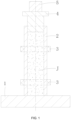
- FIG. 1 is a schematic diagram illustrating a structure profile of an agglomeration mold used for determining a critical agglomeration cycle according to some embodiments of the present disclosure.
- the agglomeration mold may include a base 1, a cylindrical container placed vertically on the base 1, a positioning sleeve 3 set around container 2 which is easy to disassemble, the container 2 may include a left housing and a right housing which is easy to demold, and the positioning sleeve 3 may fit the left housing and right housiniig together to form the container 2.
- a crystal particle product J to be measured is filled within the container 2, and multiple breathable small holes may be arranged on a side wall of the container 2 (not shown in the figure).
- An inner diameter of each breathable small hole may be smaller than a particle size of the crystal particle.
- a top of the crystal particle product may be provided with a presssing block 4, and a top of the pressing block 4 may be provided with a gravity weight 5.
- the pressing block 4 and the gravity weight 5 may simultaneously compress and compact the crystal particles in the container 2, making the crystal particles an agglomerate.
- a determination of the moisture absorption capacity is performed by a dynamic steam adsorption instrument, before the determination, performing an initial drying treatment for the crystal particle to be measured in advance, and a mass of the crystal particle to be measured does not exceed 10 mg.
- a certain quality of xylitol crystal particle products may be taked, a metallic screen ranging from 500 microns to 600 microns may be selected based on the particle size and particle distribution characteristics of the xylitol crystal particle products for measuring a mass of each particle size interval and counting a count of crystal particles in each particle size interval, and the equivalent particle radius R e may be calculated to be 550 microns according to the equations (e) and (f).
- Moisture absorption characteristics of the crystal particle products may be measured by a dynamic steam adsorption instrument to obtain a moisture absorption characteristic file of the crystal particle products at a temperature of 25 °C as shown in FIG. 2(a) . as shown in FIG.
- a deliquescence point of the xylitol crystal particle may be around 75%. Therefore, the high humidity condition for a critical agglomeration cycle experiment of the xylitol crystal particle may be set below 75%.
- the embodiments takes an equivalent particle radius of 550 microns, temperature of 25 °C, and a stored environmental high and low humidity cycle condition of 65%-30% as an example to illustrate how to obtain and predict other equivalent particle radiuses, such as critical agglomeration cycles of crystal particles of 312 microns, 404 microns, 507 microns, and 550 microns under different environmental high and low humidity cycle condition such as 65%-30%, 60%-30%, 55%-30%, and 50%-30%, and the critical agglomeration cycles may be compared with measured results of the critical agglomeration cycle to demonstrate the prediction accuracy of the process of the present disclosure.
- a prediction process of the critical agglomeration cycle in the embodiments includes: Firstly, a dynamic vapor adsorption instrument may be used to measure a moisture absorption capacity V RH of an equivalent particle radius of 550 microns under different humidity conditions.
- the crystal particles may be sieved through a metal sieve ranging from 500 microns to 600 microns.
- the moisture absorption V RH is 0.02000%, at 50% humidity condition, the moisture absorption V RH is 0.02740%, at 55% humidity condition, the moisture absorption V RH is 0.03266%, at 60% humidity condition, the moisture absorption V RH is 0.03747%, and at 65% humidity condition, the moisture absorption V RH is 0.04595%.
- the crystal particle product may be loaded into an agglomeration mold and the agglomeration mold may be placed in the constant temperature and humidity box, an humidity condition of the constant temperature and humidity box may be set to 65%-30% alternating high and low humidity cycle, and a critical agglomeration cycle N may be determined to be 7 times.
- a calculation eaquation may be used to calculate and predict the critical agglomeration cycle.
- the moisture absorption capacity V RH is 0.01135%
- the moisture absorption capacity V RH is 0.01554%
- the moisture absorption capacity V RH is 0.01853%
- the moisture absorption capacity V RH is 0.02126%
- the moisture absorption capacity V RH is 0.02607%.
- a moisture absorption capacity difference Vi of crystal particles under single environmental high and low humidity cycle condition may be caclulated, and a moisture absorption capacity difference Vi of crystal particles with an equivalent particle radius of 550 microns may be calculated.
- moisture absorption capacity differences Vi of crystal particles with other equivalent particle radiuses under different environmental high and low humidity cycle conditions may be obtained, and calculation results are shown in Table 2.
- a moisture absorption capacity difference Vi (65% -30%) of crystal particles with an equivalent particle radius of 550 microns is 0.02595
- the critical agglomeration cycle N 2 under a environmental high and low humidity cycle condition of 65% -30% is 7 times, according to the Table 2
- data of V l ' (60% -30%) is 0.01747
- a critical agglomeration cycle N 2 " of crystal particles under a environmental high and low humidity cycle condition of 60% -30% is calculated to be 10 times.
- critical agglomeration cycles N 2 " under other conditions may be calculated.
- FIG. 3 a fitting diagram of predicted results of critical agglomeration cycles of xylitol multi-particle crystal particle products under different environmental high and low humidity cyclic storage conditions may be shown as shown in FIG. 3 .
- the measured results of the critical agglomeration cycle may be verified with the predicted values.
- a certain quality of xylitol crystal particle products may be taken, and based on the particle size and distribution characteristics of the crystal particle products, select metal sieves of 200 ⁇ m-300 ⁇ m, 300 ⁇ m-400 ⁇ m, and 400 ⁇ m-500 ⁇ m for screening, median radius values corresponding to the particle size intervals are 250 microns, 350 microns, and 450 microns, respectively.
- the mass of crystal particles in each particle size interval may be weighed, and a mass ratio may be approximately 1:1:1, and the equivalent particle radius R e may be calculated from the mass ratio of crystal particles in each particle size interval, which is 312 microns.
- the dynamic vapor adsorption instrument may be used to measure the moisture absorption capacity of the crystal particle products at humidity of 50%, 55%, 60%, and 65%, respectively.
- the critical agglomeration cycle experiment may be conducted to set the environmental high and low humidity cycle conditions to 65%-30%, 60%-30%, 55%-30%, and 50%-30%, respectively, to determine the critical agglomeration cycle.
- the measured critical agglomeration cycle may be recorded.
- crystal particles with equivalent particle radiuses of 404 microns and 507 microns may be screened separately, and the dynamic vapor adsorption instrument may be used to measure the moisture absorption capacity of the crystal particle products at humidity of 50%, 55%, 60%, and 65%, respectively.
- the critical agglomeration cycle experiment may be conducted to set the environmental high and low humidity cycle conditions to 65% -30%, 60% -30%, 55% -30%, and 50% -30%, respectively, to determine the critical agglomeration cycle.
- N 2 N 2 " V l ′ V l
- fitted correlation coefficients of equivalent particle sizes of 311 ⁇ m, 404 ⁇ m, 507 ⁇ m, and 550 ⁇ m may be 0.9052, 0.9703, 0.9619, and 0.9578, which is not less than 0.90, indicating a good fitting effect.
- tted correlation coefficients may be 0.9767, 0.9679, 0.9035, and 0.9011, which is not less than 0.90, indicating a good fitting effect.
- the present disclosure uses the CHS crystal bridge growth model database to predict the critical agglomeration cycle of multi-particle crystal product under different environmental high and low humidity cycle conditions has a relatively accurate prediction effect, small experimental quantity, and fast prediction speed.
Landscapes
- Engineering & Computer Science (AREA)
- Theoretical Computer Science (AREA)
- Physics & Mathematics (AREA)
- General Physics & Mathematics (AREA)
- Chemical & Material Sciences (AREA)
- Life Sciences & Earth Sciences (AREA)
- Computing Systems (AREA)
- Computer Hardware Design (AREA)
- Evolutionary Computation (AREA)
- Geometry (AREA)
- General Engineering & Computer Science (AREA)
- Analytical Chemistry (AREA)
- Dispersion Chemistry (AREA)
- Health & Medical Sciences (AREA)
- Biochemistry (AREA)
- General Health & Medical Sciences (AREA)
- Immunology (AREA)
- Pathology (AREA)
- Bioinformatics & Computational Biology (AREA)
- Bioinformatics & Cheminformatics (AREA)
- Analysing Materials By The Use Of Radiation (AREA)
- Testing Resistance To Weather, Investigating Materials By Mechanical Methods (AREA)
Abstract
Description
- The present disclosure relates to a technology field of agglomeration of crystal particles, and in particular relates to a method for predicting a critical agglomeration cycle of a crystal particle.
- The agglomeration of crystal particles refers to a process in which the crystal particles with good fluidity and dispersibility originally, aggregate with each other to form an irregular agglomerate. An agglomeration phenomenon of the crystal particles is easy to occur in a post-processing (i.e., a transportation, storage, and drying of the crystal particles) for crystal particle products, resulting in degradation of performance of the crystal particle products. Therefore, operations of determining critical agglomeration cycles of the crystal particle under different temperature and humidity storage conditions and realizing a prediction of the critical agglomeration cycle are crucial for guiding growth, storage, and transportation of the crystal particle products.
- However, the prediction of the critical agglomeration cycle of the crystal particle is realized mainly based on a correspondence relationship between an accelerated agglomeration experimental process under a high temperature and high humidity in the laboratory and an agglomeration rate under an actual storage environment, which results in a long experimental period (e.g., months or even a year) and a large experimental quantity, and a single experiment can only determine a critical agglomeration cycle under a specific humidity cycle condition, which can not achieve fast and accurate prediction for particle groups under different temperature and humidity conditions. In addition, the critical agglomeration cycle of the crystal particle shows a high correlation with a size of the crystal particle, and the current general knowledge is that the larger the size of the crystal particle, the longer the critical agglomeration cycle is, while a quantitative mathematical relationship has not been established to realize a theoretical guidance of the agglomeration process yet.
- Therefore, it is desired to provide a method for predicting the critical agglomeration cycle of the crystal particle, to realize fast and accurate prediction of the critical agglomeration cycle of the crystal particle product with small experimental quantity and low overall cost.
- The technical problem solved by the present invention is to provide a method for predicting the critical agglomeration cycle of the crystal particle to overcome defects of long testing time, large measurement workload, difficult prediction, and high cost of the critical agglomeration cycles for existed crystal particle products, which can realize fast and accurate prediction of the critical agglomeration cycle of the crystal particle product with small experimental quantity and low overall cost and satisfy actual growth needs.
- The present disclosure is realized by providing method for predicting a critical agglomeration cycle of a crystal particle, wherein the method is executed by a processor, the method comprises: establishing a CHS crystal bridge growth model database of a crystal particle with a same type of a crystal particle to be predicted firstly, wherein the CHS crystal bridge growth model database includes: data of equivalent particle radius corresponding to different particle size standards of the same type of crystal particle, data of a moisture absorption capacity of crystal particles with different equivalent particle radiuses under multiple ambient temperatures and multiple ambient humidity conditions, respectively, and data of critical agglomeration cycles of the crystal particles with different equivalent particle radiuses under the multiple ambient temperatures and multiple environmental high and low humidity cycle conditions, respectively; then selecting existed data in the corresponding CHS crystal bridge growth model database based on an equivalent particle radius, a stored ambient temperature, and an environmental high and low humidity cycle condition of the crystal particle to be predicted, respectively, and calculating the critical agglomeration cycle according to following calculation equations, wherein a result obtained by calculation is a predicted critical agglomeration cycle of the crystal particle to be predicted;
- the calculation equations include:
- (1) in response to an ambient temperature and an environmental high and low humidity cycle condition of the crystal particle to be predicted being the same with data in the CHS crystal bridge growth model database and merely the equivalent particle radius of the crystal particle to be predicted being different from data in the CHS crystal bridge growth model database, a critical agglomeration cycle N 1 ' of the crystal particle to be predicted under the ambient temperature and the environmental high and low humidity cycle condition according to equation (a):

in the above equation, R 1e represents an equivalent particle radius of an existed crystal particle in the CHS crystal bridge growth model database, R 1 e' represents the equivalent particle radius of the crystal particle to be predicted, N 1 represents a critical agglomeration cycle of existed crystal particles with equivalent particle radius R 1e in the CHS crystal bridge growth model under the ambient temperature and the environmental high and low humidity cycle condition, N 1 ' represents the critical agglomeration cycle of the crystal particle to be predicted, and N 1 and N 1 ' are an integer not less than 1 , respectively; - (2) in response to the ambient temperature and the equivalent particle radius of the crystal particle to be predicted are the same with the data in the CHS crystal bridge growth model database and merely the environmental high and low humidity cycle condition of the crystal particle to be predicted being different from data in the CHS crystal bridge growth model database, a critical agglomeration cycle N 2 " of the crystal particle to be predicted under the ambient temperature and the environmental high and low humidity cycle condition according to equation (b):

wherein,

- (1) in response to an ambient temperature and an environmental high and low humidity cycle condition of the crystal particle to be predicted being the same with data in the CHS crystal bridge growth model database and merely the equivalent particle radius of the crystal particle to be predicted being different from data in the CHS crystal bridge growth model database, a critical agglomeration cycle N 1 ' of the crystal particle to be predicted under the ambient temperature and the environmental high and low humidity cycle condition according to equation (a):
- in the above equations, VRH2 represents a moisture absorption capacity of the existed crystal particle in the CHS crystal bridge growth model database under a high humidity condition in a first environmental high and low humidity cycle; VRH3 represents a moisture absorption capacity of the existed crystal particle in the CHS crystal bridge growth model database under a high humidity condition in a second environmental high and low humidity cycle, wherein a low humidity condition in the first environmental high and low humidity cycle is the same with a low humidity condition in the second environmental high and low humidity cycle; VRH1 represents a moisture absorption capacity of the existed crystal particle in the CHS crystal bridge growth model database under a low humidity condition in the first environmental high and low humidity cycle; Vl represents a moisture absorption capacity difference between the high humidity condition and the low humidity condition in the first environmental high and low humidity cycle; Vl' represents a moisture absorption capacity difference between the high humidity condition and the low humidity condition in the second environmental high and low humidity cycle; N 2 represents a critical agglomeration cycle of the existed crystal particle in the CHS crystal bridge growth model database under the high humidity condition and the low humidity condition in the first environmental high and low humidity cycle; N2" represents a critical agglomeration cycle of the crystal particle to be predicted under the high humidity condition and the low humidity condition in the second environmental high and low humidity cycle, and N 2 and N2" are an integer not less than 1, respectively;
- wherein the high humidity condition in the environmental high and low humidity cycle is lower than a deliquescence point of the same type of crystal particles, such that the critical agglomeration cycle is greater than one when a particle size of the crystal particle is less than 100 microns, the low humidity condition is less than the high humidity condition, and a humidity difference between the low humidity condition and the high humidity condition is greater than 20%.
- Further, the equivalent particle radius of the crystal particle and the equivalent particle radius of the crystal particle to be predicted in the CHS crystal bridge growth model database are obtained by following operations:
weighing a mass of each particle size interval of the crystal particles after performing particle size screening on crystal particles to be measured, obtaining data m1 , m2 , ... , mn , sequentially, counting a count of crystal particles for each particle size interval, obtaining data P1 , P2 , ..., Pn , sequentially, and calculating an equivalent particle radius Re of the crystal particle to be predicted according to following equations (e) and (f):

- Further, the critical agglomeration cycle of the crystal particles with different equivalent particle radiuses under the multiple ambient temperatures and multiple environmental high and low humidity cycle conditions is obtained by:
loading a crystal particle to be measured into an agglomeration mold and placing the agglomeration mold in a box with set temperature, setting a high humidity and low humidity in a high and low humidity cycle within the both being the same with a high and low humidity cycle of the crystal particles to be measured, wherein a period of the high and low humidity cycle is 12-24 hours; counting a time of the high and low humidity cycle, and performing a de-molding operation for an agglomerate in the agglomeration mold; during the de-molding operation, in response to the agglomerate falls apart, determining that the agglomerate of the crystal particle to be measured is not agglomerated, and continuing to perform above operations to a next cycle until the agglomerate of the crystal particle does not fall apart, and recording a count of cycles completed to prevent the agglomeration from falling apart, and determining the count of cycles as a critical agglomeration cycle of the crystal particle to be measured under a corresponding ambient temperature and environmental high and low humidity cycle condition. - Further, when determining the critical agglomeration cycle, if the critical agglomeration cycle repeatedly determines for three times, calculating an average of the reference critical agglomeration cycles determined by three times as a critical agglomeration cycle after averaging treatment.
- Further, VRH1 , VRH2 , and VRH3 in the equation (c) and equation (d) are calculated by:
- under a same ambient temperature, a same environmental humidity, and different equivalent particle radiuses, calculating a moisture absorption capacity VRH' of a crystal particle with an equivalent particle radius Re' under an environmental humidity condition RH based on following equation (g):

- wherein VRH represents a moisture absorption capacity of existed crystal particles with the equivalent particle radius Re under the environmental humidity condition RH in the CHS crystal bridge growth model database, and VRH' is one of VRH1 , VRH2 , and VRH3.
- Further, a determination of the moisture absorption capacity is performed by a dynamic steam adsorption instrument, before the determination, performing an initial drying treatment for the crystal particle to be measured in advance, and a mass of the crystal particle to be measured does not exceed 10 mg.
- Further, the crystal particle includes a xylitol crystal particle, and a high humidity condition of the environmental high and low humidity cycle for the xylitol crystal particle is 65% and a low humidity condition of the environmental high and low humidity cycle for the xylitol crystal particle is 30%.
- Compared with prior art, the method for predicting the critical agglomeration cycle of the crystal particle in the present disclosure includes following operations: stablishing a CHS crystal bridge growth model database of a crystal particle with a same type of a crystal particle to be predicted firstly, then selecting existed data in the corresponding CHS crystal bridge growth model database based on an equivalent particle radius, a stored ambient temperature, and an environmental high and low humidity cycle condition of the crystal particle to be predicted, respectively, and calculating the critical agglomeration cycle according to an experience calculation equation, wherein a result obtained by calculation is a predicted critical agglomeration cycle of the crystal particle to be predicted. The present disclosure has characteristics of time-saving, convenience, good universality, and high prediction accuracy, which can quickly predict the critical agglomeration cycle of multi-particle crystal particle products under different humidity storage conditions within a week, resulting in greatly reducing time costs and providing guidance for storage of industrial crystal particle products.
-
-
FIG. 1 is a schematic diagram illustrating a structure profile of an agglomeration mold used for determining a critical agglomeration cycle according to some embodiments of the present disclosure; -
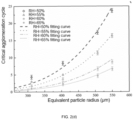
FIG. 2 is a schematic diagram illustrating a comparison between a measured result and a prediceted result obtained by a CHS crystal bridge growth model database and a moisture absorption document of a xylitol crystal particle product in anembodiment 1, wherein (a) is a moisture absorption curve of the xylitol crystal particle at a temperature of 25 °C, (b) is a comparison diagram between a measured result and a predicted result of a moisture absorption capacity and an equivalent particle radius of the xylitol crystal particle, (c) is a comparison diagram between a measured result and a predicted result of a critical agglomeration cycle and a moisture absorption capacity difference of the xylitol crystal particle, and (d) is a comparison diagram between a measured result and a predicted result of a critical agglomeration cycle and an equivalent particle radius of the xylitol crystal particle; -
FIG. 3 is a schematic diagram illustrating a fitting of predicted results of critical agglomeration cycles of a multi-particle crystal product of a xylitol crystal particle inembodiment 1 under different humidity storage conditions according to some embodiments of the present disclosure. - In order to make the objects, technical solutions, and advantages of the present disclosure clearer and more understandable, the present disclosure is described in further detail hereinafter in conjunction with the accompanying drawings and embodiments. It should be understood that the specific embodiments described herein are only for explaining the present disclosure and are not intended to limit the present disclosure.
- The present disclosure provides a relatively great embodiment of the method for predicting a critical agglomeration cycle of a crystal particle, the method may include following operation: establishing a CHS crystal bridge growth model database of a crystal particle with a same type of a crystal particle to be predicted firstly, wherein the CHS crystal bridge growth model database includes: data of equivalent particle radius corresponding to different particle size standards of the same type of crystal particle, data of a moisture absorption capacity of crystal particles with different equivalent particle radiuses under multiple ambient temperatures and multiple ambient humidity conditions, respectively, and data of critical agglomeration cycles of the crystal particles with different equivalent particle radiuses under the multiple ambient temperatures and multiple environmental high and low humidity cycle conditions, respectively; then selecting existed data in the corresponding CHS crystal bridge growth model database based on an equivalent particle radius, a stored ambient temperature, and an environmental high and low humidity cycle condition of the crystal particle to be predicted, respectively, and calculating the critical agglomeration cycle according to following calculation equations, wherein a result obtained by calculation is a predicted critical agglomeration cycle of the crystal particle to be predicted.
the calculation equations include: - (1) in response to an ambient temperature and an environmental high and low humidity cycle condition of the crystal particle to be predicted being the same with data in the CHS crystal bridge growth model database and merely the equivalent particle radius of the crystal particle to be predicted being different from data in the CHS crystal bridge growth model database, a critical agglomeration cycle N 1 ' of the crystal particle to be predicted under the ambient temperature and the environmental high and low humidity cycle condition according to equation (a):

in the above equation, R 1e represents an equivalent particle radius of an existed crystal particle in the CHS crystal bridge growth model database, R 1 e' represents the equivalent particle radius of the crystal particle to be predicted, N 1 represents a critical agglomeration cycle of existed crystal particles with equivalent particle radius R 1e in the CHS crystal bridge growth model under the ambient temperature and the environmental high and low humidity cycle condition, N 1 ' represents the critical agglomeration cycle of the crystal particle to be predicted, and N 1 and N 1 ' are an integer not less than 1 , respectively; - (2) in response to the ambient temperature and the equivalent particle radius of the crystal particle to be predicted are the same with the data in the CHS crystal bridge growth model database and merely the environmental high and low humidity cycle condition of the crystal particle to be predicted being different from data in the CHS crystal bridge growth model database, a critical agglomeration cycle N 2 " of the crystal particle to be predicted under the ambient temperature and the environmental high and low humidity cycle condition according to equation (b):

wherein,

- in the above equations, VRH2 represents a moisture absorption capacity of the existed crystal particle in the CHS crystal bridge growth model database under a high humidity condition in a first environmental high and low humidity cycle; VRH3 represents a moisture absorption capacity of the existed crystal particle in the CHS crystal bridge growth model database under a high humidity condition in a second environmental high and low humidity cycle, wherein a low humidity condition in the first environmental high and low humidity cycle is the same with a low humidity condition in the second environmental high and low humidity cycle; VRH1 represents a moisture absorption capacity of the existed crystal particle in the CHS crystal bridge growth model database under a low humidity condition in the first environmental high and low humidity cycle; Vl represents a moisture absorption capacity difference between the high humidity condition and the low humidity condition in the first environmental high and low humidity cycle; Vl' represents a moisture absorption capacity difference between the high humidity condition and the low humidity condition in the second environmental high and low humidity cycle; N 2 represents a critical agglomeration cycle of the existed crystal particle in the CHS crystal bridge growth model database under the high humidity condition and the low humidity condition in the first environmental high and low humidity cycle; N2" represents a critical agglomeration cycle of the crystal particle to be predicted under the high humidity condition and the low humidity condition in the second environmental high and low humidity cycle, and N 2 and N2" are an integer not less than 1, respectively;
- wherein the high humidity condition in the environmental high and low humidity cycle is lower than a deliquescence point of the same type of crystal particles, such that the critical agglomeration cycle is greater than one when a particle size of the crystal particle is less than 100 microns, the low humidity condition is less than the high humidity condition, and a humidity difference between the low humidity condition and the high humidity condition is greater than 20%. For example, if the deliquescence point of the xylitol crystal particle is 75%, the most suitable high humidity condition of the high and low humidity cycle of the xylitol crystal particles is 65%, and the most suitable low humidity condition is 30%.
- The equivalent particle radius of the crystal particle and the equivalent particle radius of the crystal particle to be predicted in the CHS crystal bridge growth model database are obtained by following operations:
weighing a mass of each particle size interval of the crystal particles after performing particle size screening on crystal particles to be measured, obtaining data m1 , m2 , ..., mn , sequentially, counting a count of crystal particles for each particle size interval, obtaining data P1 , P2 , ..., Pn , sequentially, and calculating an equivalent particle radius Re of the crystal particle to be predicted according to following equations (e) and (f):

- Specifically, the critical agglomeration cycle of the crystal particles with different equivalent particle radiuses under the multiple ambient temperatures and multiple environmental high and low humidity cycle conditions is obtained by:
loading a crystal particle to be measured into an agglomeration mold and placing the agglomeration mold in a box with set temperature, setting a high humidity and low humidity in a high and low humidity cycle within the both being the same with a high and low humidity cycle of the crystal particles to be measured, wherein a period of the high and low humidity cycle is 12-24 hours; counting a time of the high and low humidity cycle, and performing a de-molding operation for an agglomerate in the agglomeration mold; during the de-molding operation, in response to the agglomerate falls apart, determining that the agglomerate of the crystal particle to be measured is not agglomerated, and continuing to perform above operations to a next cycle until the agglomerate of the crystal particle does not fall apart, and recording a count of cycles completed to prevent the agglomeration from falling apart, and determining the count of cycles as a critical agglomeration cycle of the crystal particle to be measured under a corresponding ambient temperature and environmental high and low humidity cycle condition. - The box is a constant temperature and humidity box during actual use.
- The processes above is not only suitable for determining the critical agglomeration cycle in the CHS crystal bridge growth model database, but also for verifying the predicted critical agglomeration cycle.
- When determining the ritical agglomeration cycle, if the critical agglomeration cycle repeatedly determines for three times, calculating an average of the reference critical agglomeration cycles determined by three times as a critical agglomeration cycle after averaging treatment.
- Specifically,
FIG. 1 is a schematic diagram illustrating a structure profile of an agglomeration mold used for determining a critical agglomeration cycle according to some embodiments of the present disclosure. The agglomeration mold may include abase 1, a cylindrical container placed vertically on thebase 1, apositioning sleeve 3 set aroundcontainer 2 which is easy to disassemble, thecontainer 2 may include a left housing and a right housing which is easy to demold, and thepositioning sleeve 3 may fit the left housing and right housiniig together to form thecontainer 2. A crystal particle product J to be measured is filled within thecontainer 2, and multiple breathable small holes may be arranged on a side wall of the container 2 (not shown in the figure). An inner diameter of each breathable small hole may be smaller than a particle size of the crystal particle. A top of the crystal particle product may be provided with apresssing block 4, and a top of thepressing block 4 may be provided with agravity weight 5. Thepressing block 4 and thegravity weight 5 may simultaneously compress and compact the crystal particles in thecontainer 2, making the crystal particles an agglomerate. When performing demolding operations on the agglomerate in thecontainer 2, it is important to avoid applying additional stress to the agglomerate, which can cause the agglomerate to break and scatter, leading to misjudgment of the agglomeration cycle. - VRH1 , VRH2 , and VRH3 in the equation (c) and equation (d) are calculated by:
under a same ambient temperature, a same environmental humidity, and different equivalent particle radiuses, calculating a moisture absorption capacity VRH' of a crystal particle with an equivalent particle radius Re' under an environmental humidity condition RH based on following equation (g):
wherein VRH represents a moisture absorption capacity of existed crystal particles with the equivalent particle radius Re under the environmental humidity condition RH in the CHS crystal bridge growth model database, and VRH' is one of VRH1 , VRH2 , and VRH3. - A determination of the moisture absorption capacity is performed by a dynamic steam adsorption instrument, before the determination, performing an initial drying treatment for the crystal particle to be measured in advance, and a mass of the crystal particle to be measured does not exceed 10 mg.
- The following further illustrates the method for predicting a critical agglomeration cycl of a crystal particle in the present disclosure through specific embodiments.
- A first embodiment of the method for predicting a critical agglomeration cycle of a crystal particle provided in the present disclosure includes following operations:
- A certain quality of xylitol crystal particle products may be taked, a metallic screen ranging from 500 microns to 600 microns may be selected based on the particle size and particle distribution characteristics of the xylitol crystal particle products for measuring a mass of each particle size interval and counting a count of crystal particles in each particle size interval, and the equivalent particle radius Re may be calculated to be 550 microns according to the equations (e) and (f). Moisture absorption characteristics of the crystal particle products may be measured by a dynamic steam adsorption instrument to obtain a moisture absorption characteristic file of the crystal particle products at a temperature of 25 °C as shown in
FIG. 2(a) . as shown inFIG. 2(a) , a deliquescence point of the xylitol crystal particle may be around 75%. Therefore, the high humidity condition for a critical agglomeration cycle experiment of the xylitol crystal particle may be set below 75%. The embodiments takes an equivalent particle radius of 550 microns, temperature of 25 °C, and a stored environmental high and low humidity cycle condition of 65%-30% as an example to illustrate how to obtain and predict other equivalent particle radiuses, such as critical agglomeration cycles of crystal particles of 312 microns, 404 microns, 507 microns, and 550 microns under different environmental high and low humidity cycle condition such as 65%-30%, 60%-30%, 55%-30%, and 50%-30%, and the critical agglomeration cycles may be compared with measured results of the critical agglomeration cycle to demonstrate the prediction accuracy of the process of the present disclosure. - A prediction process of the critical agglomeration cycle in the embodiments includes: Firstly, a dynamic vapor adsorption instrument may be used to measure a moisture absorption capacity VRH of an equivalent particle radius of 550 microns under different humidity conditions. The crystal particles may be sieved through a metal sieve ranging from 500 microns to 600 microns. As shown in
FIG. 2(a) , at 30% humidity condition, the moisture absorption VRH is 0.02000%, at 50% humidity condition, the moisture absorption VRH is 0.02740%, at 55% humidity condition, the moisture absorption VRH is 0.03266%, at 60% humidity condition, the moisture absorption VRH is 0.03747%, and at 65% humidity condition, the moisture absorption VRH is 0.04595%. Subsequently, the crystal particle product may be loaded into an agglomeration mold and the agglomeration mold may be placed in the constant temperature and humidity box, an humidity condition of the constant temperature and humidity box may be set to 65%-30% alternating high and low humidity cycle, and a critical agglomeration cycle N may be determined to be 7 times. - Then, a calculation eaquation may be used to calculate and predict the critical agglomeration cycle. The obtained parameters may be input into the CHS crystal bridge growth model database, according to an equation (g):

Table 1 moisture absorption capacities of crystal particles with different equivalent particle radiuses Re /(microns) V RH-30% V RH-50% V RH-55% V RH-60% V RH-65% 550 0.02000 0.02740 0.03266 0.03747 0.04595 312 0.01135 0.01554 0.01853 0.02126 0.02607 404 0.01469 0.02013 0.02399 0.02752 0.03375 507 0.01844 0.02526 0.03011 0.03454 0.04236 - In addition, it is now known that a critical agglomeration cycle N1 of crystal particles with an equivalent particle radius R 1e of 550 microns under a environmental high and low humidity cycle condition of 65%-30% is 7 times, obtained paramters may be input into the CHS crystal bridge growth model database, according to the equation

- According to the H-S file and the eaquation

Table 2 moisture absorption capacity differences Vi of crystal particles with different equivalent particle radiuses under an environmental high and low humidity cycle condition Re /( microns) Vl (50%-30%) Vl (55%-30%) Vl(60%-30%) Vl(65%-30%) 550 0.00740 0.01266 0.01747 0.02595 312 0.00419 0.00718 0.00991 0.01472 404 0.00544 0.00930 0.01283 0.01906 507 0.00682 0.01167 0.01610 0.02392 - The moisture absorption capacity difference Vi and the C-S file of crystal particles with different equivalent particle radiuses under the environmental high and low humidity cycling condition may be integrated, according to formula (b):

Table 3 predicted results of critical agglomeration cycles N2" of crystal particles with different equivalent particle radiuses under different environmental high and low humidity cycles conditions Re /( microns) N2"(50%-30%) N2"(55%-30%) N2"(60%-30%) N2"(65%-30%) 550 24 15 10 7 312 4 3 2 1 404 8 5 3 2 507 17 11 7 5 - By integrating the data from the above files, a fitting diagram of predicted results of critical agglomeration cycles of xylitol multi-particle crystal particle products under different environmental high and low humidity cyclic storage conditions may be shown as shown in
FIG. 3 . - Next, the measured results of the critical agglomeration cycle may be verified with the predicted values. A certain quality of xylitol crystal particle products may be taken, and based on the particle size and distribution characteristics of the crystal particle products, select metal sieves of 200 µm-300 µm, 300 µm-400 µm, and 400 µm-500 µm for screening, median radius values corresponding to the particle size intervals are 250 microns, 350 microns, and 450 microns, respectively. After sieving, the mass of crystal particles in each particle size interval may be weighed, and a mass ratio may be approximately 1:1:1, and the equivalent particle radius Re may be calculated from the mass ratio of crystal particles in each particle size interval, which is 312 microns. Then, the dynamic vapor adsorption instrument may be used to measure the moisture absorption capacity of the crystal particle products at humidity of 50%, 55%, 60%, and 65%, respectively. The critical agglomeration cycle experiment may be conducted to set the environmental high and low humidity cycle conditions to 65%-30%, 60%-30%, 55%-30%, and 50%-30%, respectively, to determine the critical agglomeration cycle. The measured critical agglomeration cycle may be recorded. Similarly, crystal particles with equivalent particle radiuses of 404 microns and 507 microns may be screened separately, and the dynamic vapor adsorption instrument may be used to measure the moisture absorption capacity of the crystal particle products at humidity of 50%, 55%, 60%, and 65%, respectively. The critical agglomeration cycle experiment may be conducted to set the environmental high and low humidity cycle conditions to 65% -30%, 60% -30%, 55% -30%, and 50% -30%, respectively, to determine the critical agglomeration cycle.
- As shown in
FIG. 2(b) , the moisture absorption capacity of crystal particles may increase linearly with equivalent particle radiuses of 312 microns, 404 microns, 507 microns, and 550 microns at humidity of 50%, 55%, 60%, and 65%, respectively, which can fit well with the predicted result according to the equation (g):
- As shown in
FIG. 2(c) , an inverse proportional relationship is between the moisture absorption capacity and the critical agglomeration cycle, which has good consistency with the predicted result of the equation (b):
- As shown in
FIG. 2(d) , a fourth power function relationship is between the crystal particle size and the critical agglomeration cycle, which can fit well with the predicted result according to the equation (a):
- Therefore, the present disclosure uses the CHS crystal bridge growth model database to predict the critical agglomeration cycle of multi-particle crystal product under different environmental high and low humidity cycle conditions has a relatively accurate prediction effect, small experimental quantity, and fast prediction speed.
- The above descriptions are only a preferred embodiment of the present disclosure, which are not intended to limit herein. Any modifications, equivalent substitutions, and improvements made within the spirit and principles of the present disclosure may be included within the scope of protection of the present disclosure.
Claims (7)
- A method for predicting a critical agglomeration cycle of a crystal particle, wherein the method comprises:establishing a CHS crystal bridge growth model database of a crystal particle with a same type of a crystal particle to be predicted firstly, wherein the CHS crystal bridge growth model database includes: data of equivalent particle radius corresponding to different particle size standards of the same type of crystal particle, data of a moisture absorption capacity of crystal particles with different equivalent particle radiuses under multiple ambient temperatures and multiple ambient humidity conditions, respectively, and data of critical agglomeration cycles of the crystal particles with different equivalent particle radiuses under the multiple ambient temperatures and multiple environmental high and low humidity cycle conditions, respectively; then selecting existed data in the corresponding CHS crystal bridge growth model database based on an equivalent particle radius, a stored ambient temperature, and an environmental high and low humidity cycle condition of the crystal particle to be predicted, respectively, and calculating the critical agglomeration cycle according to following calculation equations, wherein a result obtained by calculation is a predicted critical agglomeration cycle of the crystal particle to be predicted;the calculation equations include:(1) in response to an ambient temperature and an environmental high and low humidity cycle condition of the crystal particle to be predicted being the same with data in the CHS crystal bridge growth model database and merely the equivalent particle radius of the crystal particle to be predicted being different from data in the CHS crystal bridge growth model database, a critical agglomeration cycle N 1 ' of the crystal particle to be predicted under the ambient temperature and the environmental high and low humidity cycle condition according to equation (a):
 (2) in response to the ambient temperature and the equivalent particle radius of the crystal particle to be predicted are the same with the data in the CHS crystal bridge growth model database and merely the environmental high and low humidity cycle condition of the crystal particle to be predicted being different from data in the CHS crystal bridge growth model database, a critical agglomeration cycle N 2 " of the crystal particle to be predicted under the ambient temperature and the environmental high and low humidity cycle condition according to equation (b):

 in the above equations, VRH2 represents a moisture absorption capacity of the existed crystal particle in the CHS crystal bridge growth model database under a high humidity condition in a first environmental high and low humidity cycle; VRH3 represents a moisture absorption capacity of the existed crystal particle in the CHS crystal bridge growth model database under a high humidity condition in a second environmental high and low humidity cycle, wherein a low humidity condition in the first environmental high and low humidity cycle is the same with a low humidity condition in the second environmental high and low humidity cycle; VRH1 represents a moisture absorption capacity of the existed crystal particle in the CHS crystal bridge growth model database under a low humidity condition in the first environmental high and low humidity cycle; Vl represents a moisture absorption capacity difference between the high humidity condition and the low humidity condition in the first environmental high and low humidity cycle; Vl' represents a moisture absorption capacity difference between the high humidity condition and the low humidity condition in the second environmental high and low humidity cycle; N 2 represents a critical agglomeration cycle of the existed crystal particle in the CHS crystal bridge growth model database under the high humidity condition and the low humidity condition in the first environmental high and low humidity cycle; N2" represents a critical agglomeration cycle of the crystal particle to be predicted under the high humidity condition and the low humidity condition in the second environmental high and low humidity cycle, and N 2 and N2" are an integer not less than 1, respectively;wherein the high humidity condition in the environmental high and low humidity cycle is lower than a deliquescence point of the same type of crystal particles, such that the critical agglomeration cycle is greater than once when a particle size of the crystal particle is less than 100 microns, the low humidity condition is less than the high humidity condition, and a humidity difference between the low humidity condition and the high humidity condition is greater than 20%.
 - The method for predicting the critical agglomeration cycle of the crystal particle of claim 1, wherein the equivalent particle radius of the crystal particle and the equivalent particle radius of the crystal particle to be predicted in the CHS crystal bridge growth model database are obtained by following operations:
weighing a mass of each particle size interval of the crystal particles after performing particle size screening on crystal particles to be measured, obtaining data m1 , m2 , ... , mn , sequentially, counting a count of crystal particles for each particle size interval, obtaining data P1 , P2 , ..., Pn , sequentially, and calculating an equivalent particle radius Re of the crystal particles to be measured according to following equations, the equations include:

- The method for predicting the critical agglomeration cycle of the crystal particle of claim 1, wherein the critical agglomeration cycle of the crystal particles with different equivalent particle radiuses under the multiple ambient temperatures and multiple environmental high and low humidity cycle conditions is obtained by:loading a crystal particle to be measured into an agglomeration mold and placing the agglomeration mold in a box with set temperature, setting a high humidity and low humidity in a high and low humidity cycle within the box being the same with a high and low humidity cycle of the crystal particles to be measured, wherein a period of the high and low humidity cycle is 12-24 hours; counting a time of the high and low humidity cycle, and performing a de-molding operation for an agglomerate in the agglomeration mold;during the de-molding operation, in response to the agglomerate falls apart, determining that the agglomerate of the crystal particle to be measured is not agglomerated, and continuing to perform above operations to a next cycle until the agglomerate of the crystal particle does not fall apart, and recording a count of cycles completed to prevent the agglomeration from falling apart, and determining the count of cycles as a critical agglomeration cycle of the crystal particle to be measured under a corresponding ambient temperature and environmental high and low humidity cycle condition.
- The method for predicting the critical agglomeration cycle of the crystal particle of claim 3, when determining the critical agglomeration cycle, if the critical agglomeration cycle repeatedly determines for three times, calculating an average of the reference critical agglomeration cycles determined by three times as a critical agglomeration cycle after averaging treatment.
- The method for predicting the critical agglomeration cycle of the crystal particle of claim 1, wherein VRH1 , VRH2 , and VRH3 in the equation (c) and equation (d) are calculated by:under a same ambient temperature, a same environmental humidity, and different equivalent particle radiuses, calculating a moisture absorption capacity VRH' of a crystal particle with an equivalent particle radius Re' under an environmental humidity condition RH based on following equation (g):
 wherein VRH represents a moisture absorption capacity of existed crystal particles with the equivalent particle radius Re under the environmental humidity condition RH in the CHS crystal bridge growth model database, and VRH' is one of VRH1 , VRH2 , and VRH3.
 - The method for predicting the critical agglomeration cycle of the crystal particle of claim 1, wherein a determination of the moisture absorption capacity is performed by a dynamic steam adsorption instrument, before the determination, performing an initial drying treatment for the crystal particle to be measured in advance, and a mass of the crystal particle to be measured does not exceed 10 mg.
- The method for predicting the critical agglomeration cycle of the crystal particle of claim 1, wherein a high humidity condition of the environmental high and low humidity cycle for a xylitol crystal particle is 65% and a low humidity condition of the environmental high and low humidity cycle for the xylitol crystal particle is 30%.
Applications Claiming Priority (2)
| Application Number | Priority Date | Filing Date | Title |
|---|---|---|---|
| CN202211289850.9A CN115684484B (en) | 2022-10-20 | 2022-10-20 | A method for predicting the critical agglomeration period of crystal particles |
| PCT/CN2023/106203 WO2024082719A1 (en) | 2022-10-20 | 2023-07-06 | Method for predicting critical caking period of crystal particle |
Publications (4)
| Publication Number | Publication Date |
|---|---|
| EP4425175A1 true EP4425175A1 (en) | 2024-09-04 |
| EP4425175A4 EP4425175A4 (en) | 2025-03-26 |
| EP4425175B1 EP4425175B1 (en) | 2026-02-11 |
| EP4425175C0 EP4425175C0 (en) | 2026-02-11 |
Family
ID=85066834
Family Applications (1)
| Application Number | Title | Priority Date | Filing Date |
|---|---|---|---|
| EP23878716.2A Active EP4425175B1 (en) | 2022-10-20 | 2023-07-06 | Method for predicting critical caking period of crystal particle |
Country Status (5)
| Country | Link |
|---|---|
| US (1) | US12241823B2 (en) |
| EP (1) | EP4425175B1 (en) |
| JP (1) | JP7669002B2 (en) |
| CN (1) | CN115684484B (en) |
| WO (1) | WO2024082719A1 (en) |
Families Citing this family (3)
| Publication number | Priority date | Publication date | Assignee | Title |
|---|---|---|---|---|
| CN115684484B (en) | 2022-10-20 | 2024-11-12 | 天津大学 | A method for predicting the critical agglomeration period of crystal particles |
| CN121031251B (en) * | 2025-08-05 | 2026-04-24 | 大连理工大学盘锦产业技术研究院 | Wet particle adhesion aggregation criterion model construction method based on critical aggregation speed |
| CN121641304B (en) * | 2026-02-04 | 2026-04-03 | 上海车仪田科技有限公司 | Inversion methods, systems, equipment, and storage media for semiconductor epitaxial layer growth parameters |
Family Cites Families (18)
| Publication number | Priority date | Publication date | Assignee | Title |
|---|---|---|---|---|
| WO1998020323A1 (en) * | 1996-11-08 | 1998-05-14 | Purdue Research Foundation | Particle analysis system and method |
| ATE340762T1 (en) * | 2002-03-29 | 2006-10-15 | Asahi Glass Co Ltd | METHOD FOR PRODUCING CRYSTALLINE PARTICLES FROM SODIUM HYDROGEN CARBONATE WITH LOW ADHESIVE PROPERTIES, AND SUCH PARTICLES |
| JP2004157086A (en) * | 2002-11-08 | 2004-06-03 | Japan Synthetic Textile Inspection Inst Foundation | Apparatus and method for measuring moisture absorption and release characteristics |
| AU2005258469B2 (en) * | 2004-06-30 | 2011-02-24 | Asahi Glass Company, Limited | Method of estimating caking tendency of sodium hydrogen carbonate crystal grain |
| JP5045102B2 (en) | 2004-06-30 | 2012-10-10 | 旭硝子株式会社 | Method for producing sodium hydrogencarbonate crystal particles having low caking properties |
| JP2008197852A (en) * | 2007-02-10 | 2008-08-28 | Phifit Kk | Analysis device, analysis system and recording medium for structure evolution of workpiece in plastic working |
| CN105466835A (en) * | 2015-12-23 | 2016-04-06 | 华东交通大学 | Method for clay inter-particle pore equivalent pore size |
| CN105784480A (en) * | 2016-03-08 | 2016-07-20 | 中盐金坛盐化有限责任公司 | Rapid caking and measuring method for salt sample |
| CN106202675B (en) * | 2016-07-04 | 2019-06-21 | 西北工业大学 | A Method for Predicting the Coupling Response of Isothermal Forming and Dynamic Recrystallization Evolution of Titanium Alloys |
| CN106503397B (en) * | 2016-11-16 | 2019-06-04 | 中国航空工业集团公司北京航空材料研究院 | A method of obtaining metal material recrystallized structure evolution crystal boundary mobility parameter |
| CN107063906B (en) * | 2016-12-16 | 2020-01-07 | 中国农业科学院农产品加工研究所 | Quantitative characterization method of powder hygroscopic agglomeration degree |
| CN107121363A (en) * | 2017-03-22 | 2017-09-01 | 华南理工大学 | A kind of method of crystallization processes process particle size distribution prediction |
| CN108959817B (en) * | 2018-07-27 | 2023-07-11 | 天津大学 | A method for predicting the coalescence rate and coalescence strength of crystals under the action of moisture absorption |
| JP2020166706A (en) * | 2019-03-29 | 2020-10-08 | 株式会社クロスアビリティ | Crystal shape predictor, crystal shape prediction method, neural network manufacturing method, and program |
| CN111157408B (en) * | 2020-01-05 | 2022-08-09 | 天津大学 | Method and device for measuring caking strength parameter of granular material through single solid bridge |
| CN111661856B (en) * | 2020-05-12 | 2024-06-04 | 云南省盐业有限公司 | Preparation method of large-particle spherical sodium sulfate crystal |
| CN114965186A (en) * | 2022-05-13 | 2022-08-30 | 西南交通大学 | Synchronous measurement system and method for grain size and mass moisture absorption growth of atmospheric particulates |
| CN115684484B (en) * | 2022-10-20 | 2024-11-12 | 天津大学 | A method for predicting the critical agglomeration period of crystal particles |
-
2022
- 2022-10-20 CN CN202211289850.9A patent/CN115684484B/en active Active
-
2023
- 2023-07-06 EP EP23878716.2A patent/EP4425175B1/en active Active
- 2023-07-06 JP JP2024539443A patent/JP7669002B2/en active Active
- 2023-07-06 WO PCT/CN2023/106203 patent/WO2024082719A1/en not_active Ceased
-
2024
- 2024-05-07 US US18/657,771 patent/US12241823B2/en active Active
Also Published As
| Publication number | Publication date |
|---|---|
| CN115684484B (en) | 2024-11-12 |
| EP4425175B1 (en) | 2026-02-11 |
| EP4425175A4 (en) | 2025-03-26 |
| JP7669002B2 (en) | 2025-04-28 |
| US12241823B2 (en) | 2025-03-04 |
| JP2024544350A (en) | 2024-11-28 |
| EP4425175C0 (en) | 2026-02-11 |
| US20240344954A1 (en) | 2024-10-17 |
| CN115684484A (en) | 2023-02-03 |
| WO2024082719A1 (en) | 2024-04-25 |
Similar Documents
| Publication | Publication Date | Title |
|---|---|---|
| EP4425175B1 (en) | Method for predicting critical caking period of crystal particle | |
| US11959934B2 (en) | High precision weighing system and weighing method, thermogravimetric analyser and storage medium | |
| US5151601A (en) | Nuclear gauge with compensation for sample of insufficient neutron moderating activity | |
| CN103674659A (en) | Preparation method of standard sample of free carbon of tungsten carbide powder | |
| CN104760714A (en) | Material product packaging weight control method and control system | |
| CN113159562B (en) | A method to evaluate the particle size of sinter by using the porosity of the multi-component bulk material layer | |
| CN108959817B (en) | A method for predicting the coalescence rate and coalescence strength of crystals under the action of moisture absorption | |
| US20060248943A1 (en) | Method of Measuring Density of a Grain Sample | |
| Prowell et al. | Evaluation of the Internal Angle of Gyration of Superpave Gyratory Compactors in Alabama | |
| CN205719399U (en) | A kind of assay device of piston gage piston effective area | |
| CN116297104A (en) | A method for testing the specific surface area of lithium-ion battery raw materials | |
| CN108955850B (en) | Method for Automatically Obtaining Metering Preset Value Used in Measuring Machine | |
| CN118817524A (en) | A device and method for testing the anti-caking performance of powder and fiber materials | |
| CN119224060A (en) | A method for detecting the integrity of carbon coating of lithium iron phosphate material | |
| CN113447392B (en) | Calibration and calibration method of sintering mixture moisture measuring device | |
| CN105698746B (en) | A kind of measuring method of strain in metal material plastic processing | |
| CN113219148A (en) | Carbon-containing standard substance and preparation method and application thereof | |
| JPH07159306A (en) | Carbon black inspection method | |
| CN113189295A (en) | Sulfur-containing standard substance and preparation method and application thereof | |
| CN102759499A (en) | Method for determining shape factors of blast furnace burden particles | |
| CN103091168A (en) | Corn kernel Poisson's ratio determining method | |
| CN120948311A (en) | A method for calibrating an iron measuring instrument | |
| Lin et al. | A combine calibration method for total weighing-in-motion systems based on load-meter according to OIML R76-1 and R134-1 | |
| CN116559008A (en) | An Aluminum Frame Filling and Coating Quality Inspection System | |
| Rogers Jr et al. | Effects of particle characteristics on performance of RR5K PETN |
Legal Events
| Date | Code | Title | Description |
|---|---|---|---|
| STAA | Information on the status of an ep patent application or granted ep patent |
Free format text: STATUS: THE INTERNATIONAL PUBLICATION HAS BEEN MADE |
|
| PUAI | Public reference made under article 153(3) epc to a published international application that has entered the european phase |
Free format text: ORIGINAL CODE: 0009012 |
|
| STAA | Information on the status of an ep patent application or granted ep patent |
Free format text: STATUS: REQUEST FOR EXAMINATION WAS MADE |
|
| 17P | Request for examination filed |
Effective date: 20240527 |
|
| AK | Designated contracting states |
Kind code of ref document: A1 Designated state(s): AL AT BE BG CH CY CZ DE DK EE ES FI FR GB GR HR HU IE IS IT LI LT LU LV MC ME MK MT NL NO PL PT RO RS SE SI SK SM TR |
|
| A4 | Supplementary search report drawn up and despatched |
Effective date: 20250224 |
|
| RIC1 | Information provided on ipc code assigned before grant |
Ipc: G16C 60/00 20190101ALI20250219BHEP Ipc: G06F 30/25 20200101ALI20250219BHEP Ipc: G06F 30/20 20200101ALI20250219BHEP Ipc: G06F 17/00 20190101ALI20250219BHEP Ipc: G01N 33/00 20060101AFI20250219BHEP |
|
| GRAP | Despatch of communication of intention to grant a patent |
Free format text: ORIGINAL CODE: EPIDOSNIGR1 |
|
| STAA | Information on the status of an ep patent application or granted ep patent |
Free format text: STATUS: GRANT OF PATENT IS INTENDED |
|
| RIC1 | Information provided on ipc code assigned before grant |
Ipc: G01N 33/00 20060101AFI20250902BHEP Ipc: G06F 17/00 20190101ALI20250902BHEP Ipc: G06F 30/20 20200101ALI20250902BHEP Ipc: G06F 30/25 20200101ALI20250902BHEP Ipc: G16C 60/00 20190101ALI20250902BHEP |
|
| DAV | Request for validation of the european patent (deleted) | ||
| DAX | Request for extension of the european patent (deleted) | ||
| INTG | Intention to grant announced |
Effective date: 20250911 |
|
| GRAS | Grant fee paid |
Free format text: ORIGINAL CODE: EPIDOSNIGR3 |
|
| GRAA | (expected) grant |
Free format text: ORIGINAL CODE: 0009210 |
|
| STAA | Information on the status of an ep patent application or granted ep patent |
Free format text: STATUS: THE PATENT HAS BEEN GRANTED |
|
| AK | Designated contracting states |
Kind code of ref document: B1 Designated state(s): AL AT BE BG CH CY CZ DE DK EE ES FI FR GB GR HR HU IE IS IT LI LT LU LV MC ME MK MT NL NO PL PT RO RS SE SI SK SM TR |
|
| REG | Reference to a national code |
Ref country code: CH Ref legal event code: F10 Free format text: ST27 STATUS EVENT CODE: U-0-0-F10-F00 (AS PROVIDED BY THE NATIONAL OFFICE) Effective date: 20260211 Ref country code: GB Ref legal event code: FG4D |
|
| REG | Reference to a national code |
Ref country code: DE Ref legal event code: R096 Ref document number: 602023012016 Country of ref document: DE |
|
| REG | Reference to a national code |
Ref country code: IE Ref legal event code: FG4D |
|
| U01 | Request for unitary effect filed |
Effective date: 20260311 |
|
| U07 | Unitary effect registered |
Designated state(s): AT BE BG DE DK EE FI FR IT LT LU LV MT NL PT RO SE SI Effective date: 20260316 |