EP4425173A1 - Methods and systems for control and optimization of continuous chromatography process - Google Patents
Methods and systems for control and optimization of continuous chromatography process Download PDFInfo
- Publication number
- EP4425173A1 EP4425173A1 EP24159942.2A EP24159942A EP4425173A1 EP 4425173 A1 EP4425173 A1 EP 4425173A1 EP 24159942 A EP24159942 A EP 24159942A EP 4425173 A1 EP4425173 A1 EP 4425173A1
- Authority
- EP
- European Patent Office
- Prior art keywords
- data
- optimization
- chromatography
- control
- charge variants
- Prior art date
- Legal status (The legal status is an assumption and is not a legal conclusion. Google has not performed a legal analysis and makes no representation as to the accuracy of the status listed.)
- Granted
Links
Images




Classifications
-
- G—PHYSICS
- G01—MEASURING; TESTING
- G01N—INVESTIGATING OR ANALYSING MATERIALS BY DETERMINING THEIR CHEMICAL OR PHYSICAL PROPERTIES
- G01N30/00—Investigating or analysing materials by separation into components using adsorption, absorption or similar phenomena or using ion-exchange, e.g. chromatography or field flow fractionation
- G01N30/02—Column chromatography
- G01N30/86—Signal analysis
- G01N30/8658—Optimising operation parameters
-
- B—PERFORMING OPERATIONS; TRANSPORTING
- B01—PHYSICAL OR CHEMICAL PROCESSES OR APPARATUS IN GENERAL
- B01D—SEPARATION
- B01D15/00—Separating processes involving the treatment of liquids with solid sorbents; Apparatus therefor
- B01D15/08—Selective adsorption, e.g. chromatography
- B01D15/26—Selective adsorption, e.g. chromatography characterised by the separation mechanism
- B01D15/36—Selective adsorption, e.g. chromatography characterised by the separation mechanism involving ionic interaction, e.g. ion-exchange, ion-pair, ion-suppression or ion-exclusion
- B01D15/361—Ion-exchange
- B01D15/362—Cation-exchange
-
- B—PERFORMING OPERATIONS; TRANSPORTING
- B01—PHYSICAL OR CHEMICAL PROCESSES OR APPARATUS IN GENERAL
- B01D—SEPARATION
- B01D15/00—Separating processes involving the treatment of liquids with solid sorbents; Apparatus therefor
- B01D15/08—Selective adsorption, e.g. chromatography
- B01D15/26—Selective adsorption, e.g. chromatography characterised by the separation mechanism
- B01D15/38—Selective adsorption, e.g. chromatography characterised by the separation mechanism involving specific interaction not covered by one or more of groups B01D15/265 and B01D15/30 - B01D15/36, e.g. affinity, ligand exchange or chiral chromatography
- B01D15/3804—Affinity chromatography
- B01D15/3809—Affinity chromatography of the antigen-antibody type, e.g. protein A, G or L chromatography
-
- G—PHYSICS
- G01—MEASURING; TESTING
- G01N—INVESTIGATING OR ANALYSING MATERIALS BY DETERMINING THEIR CHEMICAL OR PHYSICAL PROPERTIES
- G01N30/00—Investigating or analysing materials by separation into components using adsorption, absorption or similar phenomena or using ion-exchange, e.g. chromatography or field flow fractionation
- G01N30/02—Column chromatography
- G01N30/86—Signal analysis
- G01N30/8693—Models, e.g. prediction of retention times, method development and validation
-
- G—PHYSICS
- G01—MEASURING; TESTING
- G01N—INVESTIGATING OR ANALYSING MATERIALS BY DETERMINING THEIR CHEMICAL OR PHYSICAL PROPERTIES
- G01N30/00—Investigating or analysing materials by separation into components using adsorption, absorption or similar phenomena or using ion-exchange, e.g. chromatography or field flow fractionation
- G01N30/02—Column chromatography
- G01N2030/022—Column chromatography characterised by the kind of separation mechanism
- G01N2030/027—Liquid chromatography
-
- G—PHYSICS
- G01—MEASURING; TESTING
- G01N—INVESTIGATING OR ANALYSING MATERIALS BY DETERMINING THEIR CHEMICAL OR PHYSICAL PROPERTIES
- G01N30/00—Investigating or analysing materials by separation into components using adsorption, absorption or similar phenomena or using ion-exchange, e.g. chromatography or field flow fractionation
- G01N30/02—Column chromatography
- G01N30/88—Integrated analysis systems specially adapted therefor, not covered by a single one of the groups G01N30/04 - G01N30/86
- G01N2030/8809—Integrated analysis systems specially adapted therefor, not covered by a single one of the groups G01N30/04 - G01N30/86 analysis specially adapted for the sample
- G01N2030/8813—Integrated analysis systems specially adapted therefor, not covered by a single one of the groups G01N30/04 - G01N30/86 analysis specially adapted for the sample biological materials
Definitions
- the disclosure herein generally relates to the field of chromatography, and, more particularly, to control and optimization of continuous chromatography process.
- mAbs monoclonal antibodies
- a final monoclonal antibody (mAb) product is a mixture of its charge variants.
- these charge variants are known to impact biological activity of the product. Therefore, continuous monitoring of concentrations of charge variants is on high priority.
- these charge variants in general, are separated by ion-exchange chromatography. However, difference in charges among these charge variants is so small that the separation of these charge variants from the product is non-trivial. Further, ensuring that the composition of these charge variants in commercial grade product are within stated product specifications is also a challenging task. In case of continuous biopharmaceutical manufacturing, there is an additional challenge to achieve charge variant composition in elute for an entire duration of continuous chromatography campaign.
- a method for control and optimization of a continuous chromatography process comprising: receiving, via one or more hardware processors, a plurality of data pertaining to a chromatography process at a pre-determined frequency from one or more sub-systems and a plurality of data sources as input, wherein the plurality of data comprises a plurality of real time data and a plurality of non-real time data; preprocessing, via the one or more hardware processors, the received plurality of data using one or more pre-processing techniques, wherein the one or more preprocessing techniques perform at least one of (i) identification and removal of outliers, (ii) imputation of missing data, and (iii) synchronization and integration of a subset of the plurality of data obtained from one or more physical sensors using their frequency; obtaining, via one or more models executed by
- an apparatus for control and optimization of a continuous chromatography process comprising a memory storing instructions; one or more communication interfaces; one or more sub-systems; and one or more hardware processors coupled to the memory via the one or more communication interfaces, wherein the one or more hardware processors are configured by the instructions to: a memory storing instructions; one or more Input/Output (I/O) interfaces; one more sub-systems; and one or more hardware processors coupled to the memory via the one or more I/O interfaces, wherein the one or more hardware processors are configured by the instructions to: receive, a plurality of data pertaining to a chromatography process at a pre-determined frequency from the one or more sub-systems and a plurality of data sources as input, wherein the plurality of data comprises a plurality of real time data and a plurality of non-real time data; preprocess, the received plurality of data using one or more pre-processing techniques, wherein the one or more preprocessing techniques perform at least
- a non-transitory computer readable medium for control and optimization of a continuous chromatography process.
- the non-transitory computer readable medium are configured by instructions for receiving, a plurality of data pertaining to a chromatography process at a pre-determined frequency from one or more sub-systems and a plurality of data sources as input, wherein the plurality of data comprises a plurality of real time data and a plurality of non-real time data; preprocessing, the received plurality of data using one or more preprocessing techniques, wherein the one or more preprocessing techniques perform at least one of (i) identification and removal of outliers, (ii) imputation of missing data, and (iii) synchronization and integration of a subset of the plurality of data obtained from one or more physical sensors using their frequency; obtaining, a set of data associated with one or more variables of a plurality of charge variants of a plurality of components from the plurality of preprocessed data using one or more soft sensors; predicting
- the one or more hardware processors are configured to optimize, a set of manipulated variables from a set of optimization input data in accordance with a targeted specification of the plurality of charge variants of the plurality of components using a control and optimization model, wherein the set of optimization input data comprises (i) the predicted value of the one or more quality attributes, and (ii) the plurality of preprocessed data; and dynamically modify, the control and optimization model when a deviation between an estimated trajectory of the set of manipulated variables and a reference trajectory exceeds a second predefined threshold.
- the plurality of real time data is obtained from one or more online analytical instruments.
- optimized set of manipulated variables is recommended to the continuous chromatography system to optimize the chromatography process for achieving the targeted specification of the plurality of charge variants of the plurality of components.
- the optimized set of manipulated variables are obtained by performing at least one of (i) a static optimization and (ii) a dynamic optimization.
- the trajectory of the set of manipulated variables is estimated for a time period of a control and prediction horizon.
- control and optimization model is dynamically modified by performing at least one of (i) modifying an objective function, (ii) changing values of one or more constraints, (iii) re-estimating one or more tolerances, convergence criteria and one or more relevant parameters of optimization algorithm, and (iv) choosing a different optimization algorithm.
- the one or more hardware processors are configured to monitor, one or more properties of a chromatography column using a material condition tracking module; and determine a remaining lifetime of one or more materials in the chromatography column and recommending one or more corrective actions to the continuous chromatography system based on the monitored one or more properties.
- a continuous chromatography campaign consists of continuous capture chromatography and continuous polishing chromatography.
- Objective of continuous capture chromatography is to separate required protein from cell debris and unwanted impurities of a product (e.g., biotherapeutic product).
- product related impurities such as charge variants.
- charge related impurities are closely related to main product and hence they co-elute along with the main product during continuous capture chromatography (alternative referred as Protein A Chromatography) stage. Therefore, this product is subjected to further purification using continuous polishing chromatography (alternatively referred as Cation Exchange chromatography or CEX).
- Surge tanks are used to feed feed-solution to the continuous capture chromatography and to store the product from continuous capture chromatography before feeding it to continuous polishing chromatography.
- KPIs key performance indicators
- the profitability of the continuous chromatography campaign depends on key performance indicators (KPIs) such as product yield, purity, productivity, capacity utilization and time of operation.
- KPIs in the continuous chromatography campaign depend on various key process parameters such as feed composition, superficial velocities maintained during load, wash, elute operations and durations of the distinct stages present in multi-column operations.
- levels in surge tanks add further complexity in scheduling various distinct stages in multicolumn operations.
- the mode of operation at continuous polishing chromatography depends on the product obtained from continuous capture chromatography and hence there is a complex play of interdependency among these two operations.
- Embodiments of the present disclosure provide control and optimization of continuous chromatography process.
- the continuous chromatography campaign is optimized by considering the complex interplay among the two chromatography operations and surge tanks.
- productivity is considered as a key performance indicator for this operation as the separation of charge variants is not considered in the continuous capture chromatography.
- the purity or composition of continuous capture chromatography elute affects the purity, yield and time of operation at continuous polishing chromatography. Therefore, the present disclosure optimizes (i) the superficial velocities maintained during load, wash, and elute operations, and (ii) the durations of the distinct stages at continuous capture chromatography operations and continuous polishing chromatography operations.
- the optimization is performed so that overall productivity and capacity utilization is maximized, and time of operations is minimized. This leads to maintaining a target purity and yield while maintaining the practical levels of solutions in the surge tanks.
- the method of the present disclosure helps controlling the composition of charge variants in the product.
- the presents disclosure comprises a data-preprocessing step followed by prediction of process parameters using soft sensor and prediction models.
- the chromatography process is optimized to achieve targeted purity and yield by recommending optimal values of manipulated variables.
- FIGS. 1 through 6 where similar reference characters denote corresponding features consistently throughout the figures, there are shown preferred embodiments and these embodiments are described in the context of the following exemplary system and/or method.
- FIG. 1 illustrates a block diagram of an apparatus 100 implementing a control unit 104 of a continuous chromatography system 102 for control and optimization of continuous chromatography process, in accordance with an embodiment of present disclosure.
- the apparatus 100 includes one or more hardware processors 112, communication interface device(s) or input/output (I/O) interface(s) 108 (also referred as interface(s)), one or more sub-systems 110, and one or more data storage devices or memory 106 operatively coupled to the one or more hardware processors 112.
- the one or more sub-systems 110 may include chromatography unit automation systems.
- the chromatography unit automation systems control pool start time, pool end time and sample loading of chromatography columns.
- the one or more processors 112 may be one or more software processing components and/or hardware processors.
- the hardware processors can be implemented as one or more microprocessors, microcomputers, microcontrollers, digital signal processors, central processing units, state machines, logic circuitries, and/or any devices that manipulate signals based on operational instructions.
- the processor(s) is/are configured to fetch and execute computer-readable instructions stored in the memory.
- the apparatus 100 can be implemented in a variety of computing systems, such as laptop computers, notebooks, hand-held devices, workstations, mainframe computers, servers, a network cloud and the like.
- the I/O interface device(s) 108 can include a variety of software and hardware interfaces, for example, a web interface, a graphical user interface, and the like and can facilitate multiple communications within a wide variety of networks N/W 5 and protocol types, including wired networks, for example, advanced DCS, PLCs, LAN network setup, Python layer with user interface, cable, etc., and wireless networks, such as WLAN, cellular, or satellite. Interfacing is accomplished through PYTHON middleware that passes information from one module to another.
- the I/O interface device(s) can include one or more ports for connecting a number of devices to one another or to another server.
- the server could be an Open Platform Communications (OPC) server which communicates between the one or more sub-systems 110 and the chromatography control unit 104.
- OPC Open Platform Communications
- the memory 106 may include any computer-readable medium known in the art including, for example, volatile memory, such as static random access memory (SRAM) and dynamic random access memory (DRAM), and/or non-volatile memory, such as read only memory (ROM), erasable programmable ROM, flash memories, hard disks, optical disks, and magnetic tapes.
- a system database 114 is comprised in the memory 106, wherein the system database 114 further comprises a chromatography knowledge database, a chromatography model repository, and a plurality of sub-databases.
- the memory 106 further comprises (or may further comprise) information pertaining to input(s)/output(s) of each step performed by the systems and methods of the present disclosure. In other words, input(s) fed at each step and output(s) generated at each step are comprised in the memory 106 and can be utilized in further processing and analysis.
- FIG. 2 is a detailed functional block diagram elaborating architecture of the apparatus 100 of FIG. 1 implementing a control unit of a continuous chromatography system for control and optimization of continuous chromatography process according to some embodiments of the present disclosure.
- the continuous chromatography system 102 as shown in FIG. 1 and FIG. 2 comprises of a capture chromatography, surge tank, polishing chromatography, and pumping equipment.
- the capture chromatography and the polishing chromatography works under a principle of affinity and ion exchange chromatography respectively.
- the control unit 104 (interchangeably referred as chromatography control unit throughout the description) is configured to process and analyze the acquired data in accordance with one or more modules 202 such as a receiving module 202A, a data preprocessing module 202B, a capture chromatography module (interchangeably referred as soft sensor module throughout the description) 202C, a polishing chromatography module (interchangeably referred as prediction module throughout the description) 202D, a control and optimization module 202E, a monitoring module 202F, a self-learning module 202G, a self-optimization module 202H, a user defined simulation module 202I, and a material condition tracker (interchangeably referred as a resin health and aging monitoring module) 202J, further explained in conjunction with FIG.
- modules 202 such as a receiving module 202A, a data preprocessing module 202B, a capture chromatography module (interchangeably referred as soft sensor module throughout the description) 202C, a polishing chromatography
- the chromatography knowledge database comprises reference data of a set of manipulated variables such as pool start time and end time, data related to calibration profile for detectors, and prediction horizon values for the self-optimization module 202H.
- the chromatography model repository comprises one or more models such as physics based and data-based models used by the soft sensing module 202C, and the prediction module 202D.
- the chromatography model repository comprises data regarding various control and optimization models used by the control and optimization module 202E.
- the plurality of sub-databases comprise historical data related to chromatography process and information regarding chromatography column design, material properties and/or the like.
- FIG. 3 with reference to FIGS. 1-2 , an exemplary flow diagram illustrating a method 300 for control and optimization of continuous chromatography process, using the apparatus 100 of FIG. 1 , in accordance with an embodiment of the present disclosure.
- the apparatus(s) 100 comprises one or more data storage devices or the memory 106 operatively coupled to the one or more hardware processors 112 and is configured to store instructions for execution of steps of the method by the one or more processors 112.
- the steps of the method 300 of the present disclosure will now be explained with reference to components of the apparatus 100 of FIG. 1 , the block diagram of FIG. 2 , the flow diagram as depicted in FIG. 3 and one or more examples.
- the one or more hardware processors 112 are configured to receive a plurality of data pertaining to a chromatography process at a pre-determined frequency from one or more sub-systems and a plurality of data sources as input.
- the plurality of data comprises a plurality of real time data and a plurality of non-real time data.
- the plurality of data sources include chromatography unit data sources that transmits real time and non-real time data from the continuous chromatography system, one or more physical sensors, the chromatography knowledge database, the chromatography model repository, and the plurality of sub-databases.
- the one or more sub-systems provide real time data obtained from the continuous chromatography system 102 to the chromatography control unit 104 via the server.
- the received plurality of data may comprise but not limited to real time values from online analytical instruments such as online high-performance liquid chromatography (HPLC), UV detector, pH detector and conductivity detector or non-real time data from laboratory experiments, operating conditions such as column dimensions, buffer properties, resin properties, breakthrough or elution profiles, pressure drop in the chromatography column, s, feed properties, and/or the like.
- the one or more hardware processors 112 are configured to preprocess the received plurality of data using one or more pre-processing techniques in real time.
- the one or more preprocessing techniques perform at least one of (i) identification and removal of outliers, (ii) imputation of missing data, and (iii) synchronization and integration of a subset of the plurality of data obtained from the one or more physical sensors using their frequency.
- the identification and removal of outliers is performed using distance and density of data points and a statistical model is used to predict the probability of data distribution.
- the imputation of missing data is performed using mean, median, most-frequent, KNN algorithm or a constant value.
- the step 304 is further illustrated and better understood by way of following exemplary explanation.
- data from sensors in a manufacturing plant is noisy and may contain outliers and anomalies. In some cases, malfunctioning sensors may provide impractical values too. These measurements require pre-processing to utilize them for practical utilization such as soft-sensor predictions, and/or the like.
- the pre-processing of data comprises identification and removal of outliers, imputation of missing data, and synchronization and integration of the data obtained from various sensors using their frequency. Complexity in frequency of measurement and integration of data from sensors with different frequency arrives due to data being collected from various data sources such as Enterprise Resource Planning (ERP), Laboratory Information Management Systems (LIMS), and/or the like.
- ERP Enterprise Resource Planning
- LIMS Laboratory Information Management Systems
- Sampling frequency of real-time and non-real-time data may be unified to, for example, once every 1 min, where the real-time data is averaged as necessary, and the non-real-time data is interpolated or replicated as necessary.
- the data pre-processing module 204A identifies variation in incoming data by comparing it with the reference data or historical data available in the plurality of sub-databases. For example, the data coming from Ultraviolet, pH or conductivity detectors at column effluent is verified for noise. The noise in the data is estimated by calculating a signal to noise ratio and comparing it with the historical data.
- the data pre-processing module 202A uses smoothing filters such as Gaussian and Savitzky-Golay filters for noise reduction.
- Noise reduction is performed until the signal to noise ratio is reduced to an acceptable limit.
- Parameter for smoothing filter is selected based on the historical data or pilot experiment data available in the plurality of sub-databases. Similarly, missing data points are interpolated using suitable profiles such as cubic splines.
- the one or more hardware processors 112 are configured to obtain a set of data associated with one or more variables of a plurality of charge variants of a plurality of components from the plurality of preprocessed data using one or more soft sensors using one or more models.
- the one or models are stored in the model repository.
- the plurality of simulated data is the data that is not generated by the one or more physical sensors of the manufacturing plant.
- the plurality of components include biotherapeutic products such as monoclonal antibodies and their byproducts obtained after the Cation Exchange chromatography (CEX).
- CEX Cation Exchange chromatography
- the set of data associate with the one or more variables of the plurality of charge variants of the plurality of components may include but not limited to breakthrough curve of capture chromatography and concentration of components.
- the one or more soft sensors are comprised in the soft-sensing module 202C and obtain simulated data that is not generated by the one or more physical sensors of the manufacturing plant.
- the plurality of simulated data is used along with the plurality of preprocessed data for control and monitoring purposes.
- the continuous chromatography process is combined with the online high performance liquid chromatography (HPLC) for monitoring of the plurality of charge variants such as acidic, main and basic of protein load.
- HPLC high performance liquid chromatography
- Specificity and detailed information about composition of each charge variant from the plurality of charge variants is converted to a concentration data which is used for predicting breakthrough curve for Periodic counter-current chromatography (PCC) protein chromatography.
- PCC Periodic counter-current chromatography
- the breakthrough curve is used to determine a variation in concentration of charge variants of a capture chromatography elute.
- the one or more soft sensors also have a capability of calculating concentration from the UV detector if required. For example, if protein A chromatography uses the UV detector for determining the breakthrough point, the signal from the UV detector is converted to concertation value of the components using a calibration curve.
- the one or more soft sensors select an appropriate calibration curve from the chromatography knowledge database. Similarly, if conductivity detector is connected to the chromatography column for detecting salt ions such as Na+, the signal from conductivity detector is converted to corresponding concentration value.
- the one or more hardware processors 112 are configured to predict a value of one or more quality attributes from the set of data associated with the one or more parameters of the plurality of charge variants of the plurality of components using a prediction model.
- the one or more quality attributes may include but not limited to column efficiency, peak asymmetry, resolution and tailing factor of elution profile of each charge variant from the plurality of charge variants of the plurality of components. From the breakthrough curve of the capture chromatography, composition of different charge components at the capture chromatography elute (i.e., CEX load) is determined. This concentration data of components in CEX load are used as input to the prediction model.
- the prediction model is obtained using the prediction module 202D which is configured to use a selected model (i.e. prediction model) from the model repository for prediction of the one or more quality attributes (also referred as critical quality attributes (CQA)).
- the prediction model receives inputs from the data preprocessing module 202 B and the soft-sensing module 202C.
- the input data received by the prediction model may include but not limited to concentration data of CEX load from soft-sensor, chromatography column dimensions, resin properties, superficial velocity and/or the like.
- the prediction model is further better understood by way of the following description provided as exemplary explanation.
- u (m/s) denotes the interstitial velocity, D ax,i (m 2 /s) the axial dispersion coefficient, k f,i (m/s) the film diffusion coefficient, and D P,i (m 2 /s) the pore diffusion coefficient, respectively.
- D ax,i (m 2 /s) the axial dispersion coefficient
- k f,i (m/s) the film diffusion coefficient
- D P,i (m 2 /s) the pore diffusion coefficient
- ⁇ C and ⁇ P external and internal porosity
- t (s) and z (m) denote co-ordinates of time and column axis, respectively.
- the concentration profiles of elute are obtained using above mentioned general rate model.
- the parameters used in the model such as D ax,i , k f,i (m/s), D P,i , ⁇ C and ⁇ P are obtained by using parameter estimation techniques utilizing historical data.
- models such as general rate model explains the physics behind the chromatography operations
- empirical models are used for real-time predictions. Therefore, other simple models such as empirical or data-based models are also used as the prediction models to estimate the elution profiles. These data-based models are trained using historical data.
- the one or more hardware processors 112 are configured to monitor a deviation between an experimental value and predicted value of the one or more quality attributes.
- a comparison of the predicted values of the one or more quality attributes and values of the one or more quality attributes obtained using experiments is performed using the monitoring module.
- the monitoring module verifies accuracy with which the prediction model determined the elution profile by comparing the determined elution profile with an experimental elution profile.
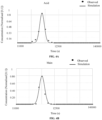
- FIGS. 4A through 4D depict graphical representations illustrating a comparison of simulated elution charge variants profiles of Acid, Main, Base 1 and Base 2 species respectively with an experimental value in accordance with some embodiments of the present disclosure.
- the graphical representations are time-based plots which show the rate of material being carried out of the chromatography column by an eluent or buffer agent. As shown in FIGS. 4A through 4D , the comparison between the predicted concentration profiles and experimental concentration profiles for a fixed flow rate are provided. The experimental and predicted values show a satisfactory agreement.
- the one or more hardware are configured to adaptively update, the prediction model when the monitored deviation between the experimental value and the predicted value of the one or more quality attributes exceeds a first predefined threshold.
- a first predefined threshold This mean if difference or deviation between the determined value and experimental profile of elution is exceeding the first predefined threshold, then self-learning of the prediction model is performed.
- the first threshold value is obtained from the knowledge database and threshold deviation is expressed in percentage, like 5%.
- accurate models are required. These models require tuning whenever the accuracy is compromised due to change in operating conditions or aging of the equipment resulting in self-learning of the prediction model.
- the parameters obtained from the one or more soft sensors are used to convert UV measurements to concentration needs calibration whenever there is a change in feed material and size ranges.
- the parameters associated with the physics-based or data based models are used to predict elution profiles also need tuning when there is a change in feed material or CEX column design.
- design of experiments DoE is performed and experiments are conducted to collect the data for new process conditions and the parameters associated with the physics-based models are tuned with these experimental observations.
- data-based models the validity of the models is limited by various elements like input conditions (such as feed material and size ranges), regime (from which the data is collected).
- the real-time data from new operating conditions is stored in the system database 114 and is later extracted for training these data-based models.
- the self-learning step of the prediction model involves training existing physics-based models to new operating conditions with the collected experimental data. Operator further performs offline simulations using the user defined simulation module with the help of tuned physics-based models to generate synthetic data. The generated synthetic data is used to create or tune empirical or data-based models for further use.
- the apparatus 100 is further configured by the one or more hardware processors 112 to optimize, a set of manipulated variables from a set of optimization input data in accordance with a targeted specification of the plurality of charge variants of the plurality of components using a control and optimization model.
- the set of optimization input data comprises (i) the predicted value of the one or more quality attributes, and (ii) the plurality of preprocessed data.
- the optimized set of manipulated variables is recommended to the continuous chromatography system to optimize the chromatography process for achieving the targeted specification of the plurality of charge variants of the plurality of components.
- the optimized set of manipulated variables are obtained by performing at least one of (i) a static optimization and (ii) a dynamic optimization.
- the step of optimizing the set of manipulated variables is performed with the help of the control and optimization model and further better understood by way of following exemplary explanation.
- the control and optimization model is used to predict the pool start time, end time and velocity of mobile phase according to targeted specification (i.e., yield and purity) of charge variants composition in the CEX pool. Using the prediction model, elution profiles are obtained for each variant.
- the yield and the purity of the product depends on pool start and end times and hence they depend on the time at which valve is switched from product to waste. Therefore, this type of problem is formulated as an optimization problem and the control and optimization model is solved using the control and optimization module to obtain the pool start and end time that helps in obtaining the targeted yield and purity. Therefore, pool start and end times are considered as manipulated variables that are recommended by the control and optimization module.
- Charge variant composition in protein load is considered as disturbance variables as the CEX operations do not have control over the feed from the upstream.
- the yield and purity are considered as process variables that are monitored and maintained at their target values using the control and optimization module.
- the control and optimization module uses at least one of (i) the static optimization and (ii) the dynamic optimization to optimize the yield and purity. Optimization aims at improving the purity and yield by suggesting corresponding optimal trajectories of pool start time and end time such that by optimizing/controlling the pool start time and end time, the elution profile determined by the prediction model can be improved further.
- An optimization problem is created dynamically as a function of the pool start time and end time measured from the continuous chromatography system.
- At least one of (i) the static optimization, and (ii) the dynamic optimization is determined using an optimization technique.
- dynamic optimization a trajectory of optimal set-points of pool start time and end time is obtained dynamically when the chromatography process is running/operating, and the pool start time and end time may be controlled/adjusted during the working.
- static optimization the set-point of the manipulated variables (i.e., the pool start time and end time) are determined for a run, till next implementation is obtained.
- the control and optimization model is further dynamically modified when a deviation between an estimated trajectory of the set of manipulated variables and a reference trajectory exceeds a second predefined threshold.
- the second predefined threshold is selected from the knowledge database based on the chromatography process. Impurities in the medium depends on type of cell line, buffer, surfactants, antifoam, or protease inhibitor used in the chromatography process. Based on the type of aforesaid components used in the chromatography process, appropriate value of the second predefined threshold is chosen.
- the trajectory of the set of manipulated variables is estimated for a time period of a control and prediction horizon.
- the control and optimization model is dynamically modified by performing at least one of (i) modifying an objective function, (ii) changing values of one or more constraints, (iii) re-estimating one or more tolerances, convergence criteria and one or more relevant parameters of optimization algorithm, and (iv) choosing a different optimization algorithm.
- optimum set points of the pool start time and end time, as determined by the control and optimization model may not match values in corresponding reference profiles.
- the reference profiles may be predefined and configured with the system, preferably based on historical performance data of the chromatography operation.
- the system may trigger a self-pupation of the control and optimization model.
- the system 100 may perform one or more of a) modifying an objective function, b) changing values of the constraints, c) re-estimating tolerances, convergence criteria and other relevant parameters of optimization algorithm, and d) choosing a different optimization algorithm, as part of the self-updating.
- the dynamic optimization first identifies a plurality of constraints affecting the optimization from the generated optimization problem.
- the plurality of constraints may be defined by an authorized user, based on requirements.
- constraints are, limiting the maximum allowed throughput which in turn is limited by the efficiency of the adsorbent or the pressure drop, capacity limit, limiting cost of operation and/or the like.
- a control horizon and prediction horizon are identified for the optimization problem, using the plurality of constraints.
- the control and prediction horizon values are obtained from the knowledge database.
- the prediction horizon is the duration for which the control and optimization model predicts future values of manipulated variables
- control horizon is the duration for which the set of optimized manipulated variables is implemented for control.
- a trajectory of optimal set points of the pool start time and end time is obtained based on the identified control horizon and prediction horizon. Based on the obtained trajectory of optimal set points, recommendations are generated to improve the determined elution profile.
- the plurality of simulated data is obtained using the user defined simulation module.
- This module is configured to perform simulation tasks on the CEX process that are, in general, not required or not possible in real-time owing to the complexity of the system but are useful to be performed at regular intervals.
- the user defined simulation module (Also referred as offline simulation module) helps gain knowledge about the chromatography process using the available one or more soft-sensors or models. Operator performing an CEX operation can study effect of various input conditions alongside real-time operations without actually changing real-time operations. It helps in performing a what-if analysis in which effect of change in input parameters such as elute composition, pool start time, and end times and mobile phase velocity on yield and purity of product is determined.
- the user defined simulation module also helps in performing Design of Experiments (DoE). During a change in operating conditions such as feed material or CEX column design, it helps the operator in deciding the number of experiments to perform a design space study. By performing these experiments, operator can generate data that is be stored in the system database 114.
- DoE Design of Experiments
- the apparatus 100 is further configured by the one or more hardware processors 112 to monitor one or more properties of the capture chromatography column and polishing chromatography column using a material condition tracker 202J and determine a remaining lifetime of one or more materials in the capture chromatography column and polishing chromatography column.
- the one or more properties may include but not limited to a health status of the one or more materials in the chromatography column, a performance related factor such as performance decay, an/or the like.
- the one or more materials in the chromatography column may include but not limited to a resin. Due to persistent exposure to bioprocess conditions, there could be a degradation of resin which leads to reduction of resin lifetime.
- FIG. 6 illustrates an exemplary block diagram showing inputs and outputs of the material condition tracker in accordance with some embodiments of the present disclosure.
- the material condition tracker 202J receives input from the data-processing module and the state estimator.
- the input data may comprises but not limited to a flowrate, a pressure, a loading profile, the one or more quality attributes, one or more material properties (e.g., resin properties), and/or the like.
- the one or more material properties may include but not limited to an adsorbent particle diameter, a void fraction of a bed, a molecular diffusion coefficient and the like.
- the resin health monitor module material condition tracker 202J predicts a dynamic binding capacity (DBC) and estimates the remaining lifetime (i.e., remaining purification cycles) of the resin for a given flowrate.
- the material condition tracker 202J fetches an appropriate model from the chromatography model repository to predict the DBC.
- the model used for prediction may include but not limited to one or more machine learning models such as support vector machines, random forest, neural networks, and/or the like.
- the knowledge database comprises information regarding the one or quality attributes that are expected and pressure drop using a particular resin and bed height for a given operating condition. For every purification cycle, based on the operating condition, the material condition tracker 202J compares the predicted value of the one or more quality attributes and the pressure drop with a reference data available in the chromatography knowledge database. If the difference between the predicted values of the one or more quality attributes and pressure drop and the reference values exceeds a pre-defined threshold, then the material condition tracker 202J raises an alarm indicating fouling.
- the pre-defined threshold can be provided as a user or operator input.
- the material condition tracker 202J constantly monitors the pressure drop in each purification cycle and look for any patterns in the pressure drop in successive cycles. The patterns are detected using neural network algorithms. If an increase in the pressure drop is identified over successive cycles, a new cleaning-in-place (CIP) protocol is suggested.
- the material condition tracker 202J fetches an appropriate model from the chromatography model repository and further predicts a decay in DBC with respect to variations observed in the pressure drop.
- the chromatography model repository comprises a machine learning model which can predict the decay in DBC with respect to variation in pressure drop.
- the machine learning model uses a predicted DBC of a newly packed bed as a base line and predicts an expected decay from it based on pressure drop variation.
- the embodiments of present disclosure provide control and optimization of continuous chromatography process by allowing integration of control strategies with advanced monitoring sensors via PYTHON middleware and PLC that requires an in-depth process understanding.
- the present disclosure utilizes in-line concentration values obtained from HPLC data using one or more soft-sensors to control the valve switch time obtained via optimization.
- mechanistic model/data-based models are to obtain the elution profiles for a concentration of charge variants and perform monitoring, controlling and dynamic optimization of the chromatography process in real time.
- a multicolumn chromatography continuous train is operating with multiple automated pumps, valves and monitored surge tanks to determine an overall scheduling and control of chromatography unit switching time to achieve targeted charge variant composition in the CEX elute for entire duration of continuous chromatography campaign.
- the hardware device can be any kind of device which can be programmed including e.g. any kind of computer like a server or a personal computer, or the like, or any combination thereof.
- the device may also include means which could be e.g., hardware means like e.g. an applicationspecific integrated circuit (ASIC), a field-programmable gate array (FPGA), or a combination of hardware and software means, e.g.
- ASIC applicationspecific integrated circuit
- FPGA field-programmable gate array
- the means can include both hardware means and software means.
- the method embodiments described herein could be implemented in hardware and software.
- the device may also include software means.
- the embodiments may be implemented on different hardware devices, e.g. using a plurality of CPUs.
- the embodiments herein can comprise hardware and software elements.
- the embodiments that are implemented in software include but are not limited to, firmware, resident software, microcode, etc.
- the functions performed by various components described herein may be implemented in other components or combinations of other components.
- a computerusable or computer readable medium can be any apparatus that can comprise, store, communicate, propagate, or transport the program for use by or in connection with the instruction execution system, apparatus, or device.
- a computer-readable storage medium refers to any type of physical memory on which information or data readable by a processor may be stored.
- a computer-readable storage medium may store instructions for execution by one or more processors, including instructions for causing the processor(s) to perform steps or stages consistent with the embodiments described herein.
- the term "computer-readable medium” should be understood to include tangible items and exclude carrier waves and transient signals, i.e., be non-transitory. Examples include random access memory (RAM), read-only memory (ROM), volatile memory, nonvolatile memory, hard drives, CD ROMs, DVDs, flash drives, disks, and any other known physical storage media.
Landscapes
- Chemical & Material Sciences (AREA)
- Analytical Chemistry (AREA)
- Immunology (AREA)
- Health & Medical Sciences (AREA)
- Life Sciences & Earth Sciences (AREA)
- General Health & Medical Sciences (AREA)
- Physics & Mathematics (AREA)
- General Physics & Mathematics (AREA)
- Biochemistry (AREA)
- Pathology (AREA)
- Chemical Kinetics & Catalysis (AREA)
- Molecular Biology (AREA)
- Treatment Of Liquids With Adsorbents In General (AREA)
Abstract
Description
- The present application claims priority from
Indian patent application, Application No. 202321014227, filed in India on March 02, 2023 - The disclosure herein generally relates to the field of chromatography, and, more particularly, to control and optimization of continuous chromatography process.
- In present scenario, biotherapeutic industry has been gaining momentum with increased use of biotherapeutic products in multiple industries. One of the major biotherapeutic product is monoclonal antibodies (mAbs). In general, a final monoclonal antibody (mAb) product is a mixture of its charge variants. However, these charge variants are known to impact biological activity of the product. Therefore, continuous monitoring of concentrations of charge variants is on high priority. Conventionally, these charge variants, in general, are separated by ion-exchange chromatography. However, difference in charges among these charge variants is so small that the separation of these charge variants from the product is non-trivial. Further, ensuring that the composition of these charge variants in commercial grade product are within stated product specifications is also a challenging task. In case of continuous biopharmaceutical manufacturing, there is an additional challenge to achieve charge variant composition in elute for an entire duration of continuous chromatography campaign.
- Embodiments of the present disclosure present technological improvements as solutions to one or more of the above-mentioned technical problems recognized by the inventors in conventional systems. For example, in one embodiment, a method for control and optimization of a continuous chromatography process is provided. The method, comprising: receiving, via one or more hardware processors, a plurality of data pertaining to a chromatography process at a pre-determined frequency from one or more sub-systems and a plurality of data sources as input, wherein the plurality of data comprises a plurality of real time data and a plurality of non-real time data; preprocessing, via the one or more hardware processors, the received plurality of data using one or more pre-processing techniques, wherein the one or more preprocessing techniques perform at least one of (i) identification and removal of outliers, (ii) imputation of missing data, and (iii) synchronization and integration of a subset of the plurality of data obtained from one or more physical sensors using their frequency; obtaining, via one or more models executed by the one or more hardware processors, a set of data associated with one or more variables of a plurality of charge variants of a plurality of components from the plurality of preprocessed data using one or more soft sensors; predicting, via a prediction model executed by the one or more hardware processors, value of one or more quality attributes from the set of data associated with the one or more variables of the plurality of charge variants of the plurality of components; monitoring, via the one or more hardware processors, a deviation between an experimental value and predicted value of the one or more quality attributes; and adaptively updating, via the one or more hardware processors, the prediction model when the monitored deviation between the experimental value and the predicted value of the one or more quality attributes exceeds a first predefined threshold.
- In another aspect, an apparatus for control and optimization of a continuous chromatography process is provided. The apparatus comprising a memory storing instructions; one or more communication interfaces; one or more sub-systems; and one or more hardware processors coupled to the memory via the one or more communication interfaces, wherein the one or more hardware processors are configured by the instructions to: a memory storing instructions; one or more Input/Output (I/O) interfaces; one more sub-systems; and one or more hardware processors coupled to the memory via the one or more I/O interfaces, wherein the one or more hardware processors are configured by the instructions to: receive, a plurality of data pertaining to a chromatography process at a pre-determined frequency from the one or more sub-systems and a plurality of data sources as input, wherein the plurality of data comprises a plurality of real time data and a plurality of non-real time data; preprocess, the received plurality of data using one or more pre-processing techniques, wherein the one or more preprocessing techniques perform at least one of (i) identification and removal of outliers, (ii) imputation of missing data, and (iii) synchronization and integration of a subset of the plurality of data obtained from one or more physical sensors using their frequency; obtain, one or more parameters of a plurality of charge variants of a plurality of components from a plurality of simulated data and the plurality of preprocessed data using one or more soft sensors; predict, a value of one or more quality attributes from the one or more parameters of the plurality of charge variants of the plurality of components using a prediction model; monitoring, a deviation between a simulated value and predicted value of the one or more quality attributes; and adaptively update, the prediction model when the monitored deviation between the simulated value and the predicted value of the one or more quality attributes exceeds a first predefined threshold.
- In yet another aspect, a non-transitory computer readable medium for control and optimization of a continuous chromatography process is provided. The non-transitory computer readable medium are configured by instructions for receiving, a plurality of data pertaining to a chromatography process at a pre-determined frequency from one or more sub-systems and a plurality of data sources as input, wherein the plurality of data comprises a plurality of real time data and a plurality of non-real time data; preprocessing, the received plurality of data using one or more preprocessing techniques, wherein the one or more preprocessing techniques perform at least one of (i) identification and removal of outliers, (ii) imputation of missing data, and (iii) synchronization and integration of a subset of the plurality of data obtained from one or more physical sensors using their frequency; obtaining, a set of data associated with one or more variables of a plurality of charge variants of a plurality of components from the plurality of preprocessed data using one or more soft sensors; predicting, value of one or more quality attributes from the set of data associated with the one or more variables of the plurality of charge variants of the plurality of components; monitoring, a deviation between an experimental value and predicted value of the one or more quality attributes; and adaptively updating, the prediction model when the monitored deviation between the experimental value and the predicted value of the one or more quality attributes exceeds a first predefined threshold.
- In accordance with an embodiment of the present disclosure, the one or more hardware processors are configured to optimize, a set of manipulated variables from a set of optimization input data in accordance with a targeted specification of the plurality of charge variants of the plurality of components using a control and optimization model, wherein the set of optimization input data comprises (i) the predicted value of the one or more quality attributes, and (ii) the plurality of preprocessed data; and dynamically modify, the control and optimization model when a deviation between an estimated trajectory of the set of manipulated variables and a reference trajectory exceeds a second predefined threshold.
- In accordance with an embodiment of the present disclosure, the plurality of real time data is obtained from one or more online analytical instruments.
- In accordance with an embodiment of the present disclosure, optimized set of manipulated variables is recommended to the continuous chromatography system to optimize the chromatography process for achieving the targeted specification of the plurality of charge variants of the plurality of components.
- In accordance with an embodiment of the present disclosure, the optimized set of manipulated variables are obtained by performing at least one of (i) a static optimization and (ii) a dynamic optimization.
- In accordance with an embodiment of the present disclosure, the trajectory of the set of manipulated variables is estimated for a time period of a control and prediction horizon.
- In accordance with an embodiment of the present disclosure, the control and optimization model is dynamically modified by performing at least one of (i) modifying an objective function, (ii) changing values of one or more constraints, (iii) re-estimating one or more tolerances, convergence criteria and one or more relevant parameters of optimization algorithm, and (iv) choosing a different optimization algorithm.
- In accordance with an embodiment of the present disclosure, the one or more hardware processors are configured to monitor, one or more properties of a chromatography column using a material condition tracking module; and determine a remaining lifetime of one or more materials in the chromatography column and recommending one or more corrective actions to the continuous chromatography system based on the monitored one or more properties.
- It is to be understood that both the foregoing general description and the following detailed description are exemplary and explanatory only and are not restrictive of the invention, as claimed.
- The accompanying drawings, which are incorporated in and constitute a part of this disclosure, illustrate exemplary embodiments and, together with the description, serve to explain the disclosed principles:
-
FIG. 1 illustrates a block diagram of an apparatus implementing a control unit of a continuous chromatography system for control and optimization of continuous chromatography process, in accordance with an embodiment of present disclosure. -
FIG. 2 is a detailed functional block diagram elaborating architecture of of the apparatus ofFIG. 1 implementing a control unit of a continuous chromatography system for control and optimization of continuous chromatography process according to some embodiments of the present disclosure. -
FIG. 3 illustrates an exemplary flow diagram illustrating a method for control and optimization of continuous chromatography process in accordance with some embodiments of the present disclosure. -
FIGS. 4A through 4D depict graphical representations illustrating a comparison of simulated elution charge variants profiles of Acid, Main,Base 1 andBase 2 species respectively with an experimental value in accordance with some embodiments of the present disclosure. -
FIG. 5 illustrates an exemplary block diagram showing inputs and outputs of prediction model and control and optimization model respectively in accordance with some embodiments of the present disclosure. -
FIG. 6 illustrates an exemplary block diagram showing inputs and outputs of a material condition tracker in accordance with some embodiments of the present disclosure. - Exemplary embodiments are described with reference to the accompanying drawings. In the figures, the left-most digit(s) of a reference number identifies the figure in which the reference number first appears. Wherever convenient, the same reference numbers are used throughout the drawings to refer to the same or like parts. While examples and features of disclosed principles are described herein, modifications, adaptations, and other implementations are possible without departing from the scope of the disclosed embodiments. It is intended that the following detailed description be considered as exemplary only, with the true scope being indicated by the following embodiments described herein.
- A continuous chromatography campaign consists of continuous capture chromatography and continuous polishing chromatography. Objective of continuous capture chromatography is to separate required protein from cell debris and unwanted impurities of a product (e.g., biotherapeutic product). However, the product from continuous capture chromatography still needs further purification from product related impurities such as charge variants. These charge related impurities are closely related to main product and hence they co-elute along with the main product during continuous capture chromatography (alternative referred as Protein A Chromatography) stage. Therefore, this product is subjected to further purification using continuous polishing chromatography (alternatively referred as Cation Exchange chromatography or CEX). Surge tanks are used to feed feed-solution to the continuous capture chromatography and to store the product from continuous capture chromatography before feeding it to continuous polishing chromatography.
- The profitability of the continuous chromatography campaign depends on key performance indicators (KPIs) such as product yield, purity, productivity, capacity utilization and time of operation. The KPIs in the continuous chromatography campaign depend on various key process parameters such as feed composition, superficial velocities maintained during load, wash, elute operations and durations of the distinct stages present in multi-column operations. On the other hand, levels in surge tanks add further complexity in scheduling various distinct stages in multicolumn operations. The mode of operation at continuous polishing chromatography depends on the product obtained from continuous capture chromatography and hence there is a complex play of interdependency among these two operations.
- Embodiments of the present disclosure provide control and optimization of continuous chromatography process. In the present disclosure, the continuous chromatography campaign is optimized by considering the complex interplay among the two chromatography operations and surge tanks. In general, productivity is considered as a key performance indicator for this operation as the separation of charge variants is not considered in the continuous capture chromatography. However, the purity or composition of continuous capture chromatography elute affects the purity, yield and time of operation at continuous polishing chromatography. Therefore, the present disclosure optimizes (i) the superficial velocities maintained during load, wash, and elute operations, and (ii) the durations of the distinct stages at continuous capture chromatography operations and continuous polishing chromatography operations. The optimization is performed so that overall productivity and capacity utilization is maximized, and time of operations is minimized. This leads to maintaining a target purity and yield while maintaining the practical levels of solutions in the surge tanks. In other words, the method of the present disclosure helps controlling the composition of charge variants in the product. The presents disclosure comprises a data-preprocessing step followed by prediction of process parameters using soft sensor and prediction models. The chromatography process is optimized to achieve targeted purity and yield by recommending optimal values of manipulated variables.
- Referring now to the drawings, and more particularly to
FIGS. 1 through 6 , where similar reference characters denote corresponding features consistently throughout the figures, there are shown preferred embodiments and these embodiments are described in the context of the following exemplary system and/or method. -
FIG. 1 illustrates a block diagram of an apparatus 100 implementing acontrol unit 104 of a continuous chromatography system 102 for control and optimization of continuous chromatography process, in accordance with an embodiment of present disclosure. - In an embodiment, the apparatus 100 includes one or
more hardware processors 112, communication interface device(s) or input/output (I/O) interface(s) 108 (also referred as interface(s)), one ormore sub-systems 110, and one or more data storage devices ormemory 106 operatively coupled to the one ormore hardware processors 112. The one ormore sub-systems 110 may include chromatography unit automation systems. The chromatography unit automation systems control pool start time, pool end time and sample loading of chromatography columns. - The one or
more processors 112 may be one or more software processing components and/or hardware processors. In an embodiment, the hardware processors can be implemented as one or more microprocessors, microcomputers, microcontrollers, digital signal processors, central processing units, state machines, logic circuitries, and/or any devices that manipulate signals based on operational instructions. Among other capabilities, the processor(s) is/are configured to fetch and execute computer-readable instructions stored in the memory. In an embodiment, the apparatus 100 can be implemented in a variety of computing systems, such as laptop computers, notebooks, hand-held devices, workstations, mainframe computers, servers, a network cloud and the like. - The I/O interface device(s) 108 can include a variety of software and hardware interfaces, for example, a web interface, a graphical user interface, and the like and can facilitate multiple communications within a wide variety of networks N/W 5 and protocol types, including wired networks, for example, advanced DCS, PLCs, LAN network setup, Python layer with user interface, cable, etc., and wireless networks, such as WLAN, cellular, or satellite. Interfacing is accomplished through PYTHON middleware that passes information from one module to another. In an embodiment, the I/O interface device(s) can include one or more ports for connecting a number of devices to one another or to another server. In an embodiment, the server could be an Open Platform Communications (OPC) server which communicates between the one or
more sub-systems 110 and thechromatography control unit 104. - The
memory 106 may include any computer-readable medium known in the art including, for example, volatile memory, such as static random access memory (SRAM) and dynamic random access memory (DRAM), and/or non-volatile memory, such as read only memory (ROM), erasable programmable ROM, flash memories, hard disks, optical disks, and magnetic tapes. In an embodiment, asystem database 114 is comprised in thememory 106, wherein thesystem database 114 further comprises a chromatography knowledge database, a chromatography model repository, and a plurality of sub-databases. Thememory 106 further comprises (or may further comprise) information pertaining to input(s)/output(s) of each step performed by the systems and methods of the present disclosure. In other words, input(s) fed at each step and output(s) generated at each step are comprised in thememory 106 and can be utilized in further processing and analysis. -
FIG. 2 , with reference toFIG. 1 , is a detailed functional block diagram elaborating architecture of the apparatus 100 ofFIG. 1 implementing a control unit of a continuous chromatography system for control and optimization of continuous chromatography process according to some embodiments of the present disclosure. The continuous chromatography system 102 as shown inFIG. 1 andFIG. 2 comprises of a capture chromatography, surge tank, polishing chromatography, and pumping equipment. The capture chromatography and the polishing chromatography works under a principle of affinity and ion exchange chromatography respectively. The control unit 104 (interchangeably referred as chromatography control unit throughout the description) is configured to process and analyze the acquired data in accordance with one or more modules 202 such as a receiving module 202A, adata preprocessing module 202B, a capture chromatography module (interchangeably referred as soft sensor module throughout the description) 202C, a polishing chromatography module (interchangeably referred as prediction module throughout the description) 202D, a control andoptimization module 202E, amonitoring module 202F, a self-learning module 202G, a self-optimization module 202H, a user defined simulation module 202I, and a material condition tracker (interchangeably referred as a resin health and aging monitoring module) 202J, further explained in conjunction withFIG. 2 andFIG 3 . The chromatography knowledge database comprises reference data of a set of manipulated variables such as pool start time and end time, data related to calibration profile for detectors, and prediction horizon values for the self-optimization module 202H. The chromatography model repository comprises one or more models such as physics based and data-based models used by thesoft sensing module 202C, and the prediction module 202D. Also, the chromatography model repository comprises data regarding various control and optimization models used by the control andoptimization module 202E. The plurality of sub-databases comprise historical data related to chromatography process and information regarding chromatography column design, material properties and/or the like. -
FIG. 3 , with reference toFIGS. 1-2 , an exemplary flow diagram illustrating amethod 300 for control and optimization of continuous chromatography process, using the apparatus 100 ofFIG. 1 , in accordance with an embodiment of the present disclosure. - Referring to
FIG. 3 , in an embodiment, the apparatus(s) 100 comprises one or more data storage devices or thememory 106 operatively coupled to the one ormore hardware processors 112 and is configured to store instructions for execution of steps of the method by the one ormore processors 112. The steps of themethod 300 of the present disclosure will now be explained with reference to components of the apparatus 100 ofFIG. 1 , the block diagram ofFIG. 2 , the flow diagram as depicted inFIG. 3 and one or more examples. In an embodiment, atstep 302 of the present disclosure, the one ormore hardware processors 112 are configured to receive a plurality of data pertaining to a chromatography process at a pre-determined frequency from one or more sub-systems and a plurality of data sources as input. The plurality of data comprises a plurality of real time data and a plurality of non-real time data. - The plurality of data sources include chromatography unit data sources that transmits real time and non-real time data from the continuous chromatography system, one or more physical sensors, the chromatography knowledge database, the chromatography model repository, and the plurality of sub-databases. The one or more sub-systems provide real time data obtained from the continuous chromatography system 102 to the
chromatography control unit 104 via the server. The received plurality of data may comprise but not limited to real time values from online analytical instruments such as online high-performance liquid chromatography (HPLC), UV detector, pH detector and conductivity detector or non-real time data from laboratory experiments, operating conditions such as column dimensions, buffer properties, resin properties, breakthrough or elution profiles, pressure drop in the chromatography column, s, feed properties, and/or the like. - In an embodiment, at
step 304 of the present disclosure, the one ormore hardware processors 112 are configured to preprocess the received plurality of data using one or more pre-processing techniques in real time. The one or more preprocessing techniques perform at least one of (i) identification and removal of outliers, (ii) imputation of missing data, and (iii) synchronization and integration of a subset of the plurality of data obtained from the one or more physical sensors using their frequency. The identification and removal of outliers is performed using distance and density of data points and a statistical model is used to predict the probability of data distribution. The imputation of missing data is performed using mean, median, most-frequent, KNN algorithm or a constant value. - The
step 304 is further illustrated and better understood by way of following exemplary explanation. - Generally, data from sensors in a manufacturing plant, is noisy and may contain outliers and anomalies. In some cases, malfunctioning sensors may provide impractical values too. These measurements require pre-processing to utilize them for practical utilization such as soft-sensor predictions, and/or the like. The pre-processing of data comprises identification and removal of outliers, imputation of missing data, and synchronization and integration of the data obtained from various sensors using their frequency. Complexity in frequency of measurement and integration of data from sensors with different frequency arrives due to data being collected from various data sources such as Enterprise Resource Planning (ERP), Laboratory Information Management Systems (LIMS), and/or the like. Sampling frequency of real-time and non-real-time data may be unified to, for example, once every 1 min, where the real-time data is averaged as necessary, and the non-real-time data is interpolated or replicated as necessary. The data pre-processing module 204A identifies variation in incoming data by comparing it with the reference data or historical data available in the plurality of sub-databases. For example, the data coming from Ultraviolet, pH or conductivity detectors at column effluent is verified for noise. The noise in the data is estimated by calculating a signal to noise ratio and comparing it with the historical data. The data pre-processing module 202A uses smoothing filters such as Gaussian and Savitzky-Golay filters for noise reduction. Noise reduction is performed until the signal to noise ratio is reduced to an acceptable limit. Parameter for smoothing filter is selected based on the historical data or pilot experiment data available in the plurality of sub-databases. Similarly, missing data points are interpolated using suitable profiles such as cubic splines.
- Further, at
step 306 of the present disclosure, the one ormore hardware processors 112 are configured to obtain a set of data associated with one or more variables of a plurality of charge variants of a plurality of components from the plurality of preprocessed data using one or more soft sensors using one or more models. The one or models are stored in the model repository. The plurality of simulated data is the data that is not generated by the one or more physical sensors of the manufacturing plant. - In the context of the present disclosure, the plurality of components include biotherapeutic products such as monoclonal antibodies and their byproducts obtained after the Cation Exchange chromatography (CEX). The set of data associate with the one or more variables of the plurality of charge variants of the plurality of components may include but not limited to breakthrough curve of capture chromatography and concentration of components. In other words, the one or more soft sensors are comprised in the soft-sensing
module 202C and obtain simulated data that is not generated by the one or more physical sensors of the manufacturing plant. The plurality of simulated data is used along with the plurality of preprocessed data for control and monitoring purposes. The continuous chromatography process is combined with the online high performance liquid chromatography (HPLC) for monitoring of the plurality of charge variants such as acidic, main and basic of protein load. Specificity and detailed information about composition of each charge variant from the plurality of charge variants is converted to a concentration data which is used for predicting breakthrough curve for Periodic counter-current chromatography (PCC) protein chromatography. The breakthrough curve is used to determine a variation in concentration of charge variants of a capture chromatography elute. The one or more soft sensors also have a capability of calculating concentration from the UV detector if required. For example, if protein A chromatography uses the UV detector for determining the breakthrough point, the signal from the UV detector is converted to concertation value of the components using a calibration curve. Based on the type of detector used, the one or more soft sensors select an appropriate calibration curve from the chromatography knowledge database. Similarly, if conductivity detector is connected to the chromatography column for detecting salt ions such as Na+, the signal from conductivity detector is converted to corresponding concentration value. - Referring to
FIG. 3 , atstep 308 of the present disclosure, the one ormore hardware processors 112 are configured to predict a value of one or more quality attributes from the set of data associated with the one or more parameters of the plurality of charge variants of the plurality of components using a prediction model. The one or more quality attributes may include but not limited to column efficiency, peak asymmetry, resolution and tailing factor of elution profile of each charge variant from the plurality of charge variants of the plurality of components. From the breakthrough curve of the capture chromatography, composition of different charge components at the capture chromatography elute (i.e., CEX load) is determined. This concentration data of components in CEX load are used as input to the prediction model. The prediction model is obtained using the prediction module 202D which is configured to use a selected model (i.e. prediction model) from the model repository for prediction of the one or more quality attributes (also referred as critical quality attributes (CQA)). The prediction model receives inputs from thedata preprocessing module 202 B and the soft-sensingmodule 202C. The input data received by the prediction model may include but not limited to concentration data of CEX load from soft-sensor, chromatography column dimensions, resin properties, superficial velocity and/or the like. - The prediction model is further better understood by way of the following description provided as exemplary explanation.
- Mass transfer dynamics in ion-exchange chromatography column is modelled using a comprehensive general rate model. This model accounts for transport of solute molecules via convection and axial dispersion in column interstitial and via film and pore diffusion across stagnant film around the resin particles and within the packed spherical porous resin particles, respectively as shown in equation (1) and equation (2 below:


- Further, at
step 310 of the present disclosure, the one ormore hardware processors 112 are configured to monitor a deviation between an experimental value and predicted value of the one or more quality attributes. In an embodiment, a comparison of the predicted values of the one or more quality attributes and values of the one or more quality attributes obtained using experiments is performed using the monitoring module. The monitoring module verifies accuracy with which the prediction model determined the elution profile by comparing the determined elution profile with an experimental elution profile.FIGS. 4A through 4D depict graphical representations illustrating a comparison of simulated elution charge variants profiles of Acid, Main,Base 1 andBase 2 species respectively with an experimental value in accordance with some embodiments of the present disclosure. The graphical representations are time-based plots which show the rate of material being carried out of the chromatography column by an eluent or buffer agent. As shown inFIGS. 4A through 4D , the comparison between the predicted concentration profiles and experimental concentration profiles for a fixed flow rate are provided. The experimental and predicted values show a satisfactory agreement. - At
step 312 of the present disclosure, the one or more hardware are configured to adaptively update, the prediction model when the monitored deviation between the experimental value and the predicted value of the one or more quality attributes exceeds a first predefined threshold. This mean if difference or deviation between the determined value and experimental profile of elution is exceeding the first predefined threshold, then self-learning of the prediction model is performed. The first threshold value is obtained from the knowledge database and threshold deviation is expressed in percentage, like 5%. For monitoring and control, accurate models are required. These models require tuning whenever the accuracy is compromised due to change in operating conditions or aging of the equipment resulting in self-learning of the prediction model. The parameters obtained from the one or more soft sensors are used to convert UV measurements to concentration needs calibration whenever there is a change in feed material and size ranges. Similarly, the parameters associated with the physics-based or data based models are used to predict elution profiles also need tuning when there is a change in feed material or CEX column design. design of experiments (DoE) is performed and experiments are conducted to collect the data for new process conditions and the parameters associated with the physics-based models are tuned with these experimental observations. In case of data-based models, the validity of the models is limited by various elements like input conditions (such as feed material and size ranges), regime (from which the data is collected). Whenever there is change in input conditions or regime of CEX operations, the real-time data from new operating conditions is stored in thesystem database 114 and is later extracted for training these data-based models. The self-learning step of the prediction model involves training existing physics-based models to new operating conditions with the collected experimental data. Operator further performs offline simulations using the user defined simulation module with the help of tuned physics-based models to generate synthetic data. The generated synthetic data is used to create or tune empirical or data-based models for further use. - In an embodiment, the apparatus 100 is further configured by the one or
more hardware processors 112 to optimize, a set of manipulated variables from a set of optimization input data in accordance with a targeted specification of the plurality of charge variants of the plurality of components using a control and optimization model. The set of optimization input data comprises (i) the predicted value of the one or more quality attributes, and (ii) the plurality of preprocessed data. The optimized set of manipulated variables is recommended to the continuous chromatography system to optimize the chromatography process for achieving the targeted specification of the plurality of charge variants of the plurality of components. In an embodiment, the optimized set of manipulated variables are obtained by performing at least one of (i) a static optimization and (ii) a dynamic optimization. - The step of optimizing the set of manipulated variables is performed with the help of the control and optimization model and further better understood by way of following exemplary explanation.
- The control and optimization model is used to predict the pool start time, end time and velocity of mobile phase according to targeted specification (i.e., yield and purity) of charge variants composition in the CEX pool. Using the prediction model, elution profiles are obtained for each variant. In CEX operations, for given operating conditions, the yield and the purity of the product depends on pool start and end times and hence they depend on the time at which valve is switched from product to waste. Therefore, this type of problem is formulated as an optimization problem and the control and optimization model is solved using the control and optimization module to obtain the pool start and end time that helps in obtaining the targeted yield and purity. Therefore, pool start and end times are considered as manipulated variables that are recommended by the control and optimization module. Charge variant composition in protein load is considered as disturbance variables as the CEX operations do not have control over the feed from the upstream. The yield and purity are considered as process variables that are monitored and maintained at their target values using the control and optimization module. The control and optimization module uses at least one of (i) the static optimization and (ii) the dynamic optimization to optimize the yield and purity. Optimization aims at improving the purity and yield by suggesting corresponding optimal trajectories of pool start time and end time such that by optimizing/controlling the pool start time and end time, the elution profile determined by the prediction model can be improved further. An optimization problem is created dynamically as a function of the pool start time and end time measured from the continuous chromatography system. Subsequently, at least one of (i) the static optimization, and (ii) the dynamic optimization is determined using an optimization technique. In case of dynamic optimization, a trajectory of optimal set-points of pool start time and end time is obtained dynamically when the chromatography process is running/operating, and the pool start time and end time may be controlled/adjusted during the working. However, in case of static optimization, the set-point of the manipulated variables (i.e., the pool start time and end time) are determined for a run, till next implementation is obtained.
- The control and optimization model is further dynamically modified when a deviation between an estimated trajectory of the set of manipulated variables and a reference trajectory exceeds a second predefined threshold. The second predefined threshold is selected from the knowledge database based on the chromatography process. Impurities in the medium depends on type of cell line, buffer, surfactants, antifoam, or protease inhibitor used in the chromatography process. Based on the type of aforesaid components used in the chromatography process, appropriate value of the second predefined threshold is chosen. In an embodiment, the trajectory of the set of manipulated variables is estimated for a time period of a control and prediction horizon. The control and optimization model is dynamically modified by performing at least one of (i) modifying an objective function, (ii) changing values of one or more constraints, (iii) re-estimating one or more tolerances, convergence criteria and one or more relevant parameters of optimization algorithm, and (iv) choosing a different optimization algorithm. In other words, optimum set points of the pool start time and end time, as determined by the control and optimization model may not match values in corresponding reference profiles. Here, the reference profiles may be predefined and configured with the system, preferably based on historical performance data of the chromatography operation. If the difference between the determined optimum set points of the pool start time and/or the pool end time and the corresponding reference profile is exceeding the second predefined threshold, then the system may trigger a self-pupation of the control and optimization model. The system 100 may perform one or more of a) modifying an objective function, b) changing values of the constraints, c) re-estimating tolerances, convergence criteria and other relevant parameters of optimization algorithm, and d) choosing a different optimization algorithm, as part of the self-updating. The dynamic optimization first identifies a plurality of constraints affecting the optimization from the generated optimization problem. The plurality of constraints may be defined by an authorized user, based on requirements. Some of the examples of constraints are, limiting the maximum allowed throughput which in turn is limited by the efficiency of the adsorbent or the pressure drop, capacity limit, limiting cost of operation and/or the like. Further, a control horizon and prediction horizon are identified for the optimization problem, using the plurality of constraints. In case of dynamic optimization, the control and prediction horizon values are obtained from the knowledge database. The prediction horizon is the duration for which the control and optimization model predicts future values of manipulated variables and control horizon is the duration for which the set of optimized manipulated variables is implemented for control. Furthermore, a trajectory of optimal set points of the pool start time and end time is obtained based on the identified control horizon and prediction horizon. Based on the obtained trajectory of optimal set points, recommendations are generated to improve the determined elution profile.
- Mathematical formulation of two optimization uses cases for maintaining yield and purity at their target values are as mentioned below:
- Case 1: In this case, values of pool start and end times are optimized in their practical limits such that targeted yield is achieved in accordance with equation (3) provided below:

- Case 2: In this case, the values of pool start and end times are optimized in their practical limits such that targeted purity is achieved in accordance with equation (4) provided below:

- Case 3: In this case, the values of pool start and end times are optimized in their practical limits such that targeted capacity utilization is achieved in accordance with equation (5) provided below:

For solving these optimization problems, various existing optimization algorithms are utilized. These optimization algorithms may include but not limited to genetic algorithm, particle swarm optimization algorithm, sequential quadratic optimization, and/or the like.FIG. 5 depicts illustrates an exemplary block diagram showing inputs and outputs of prediction model and control and optimization model respectively in accordance with some embodiments of the present disclosure. - In an embodiment, the plurality of simulated data is obtained using the user defined simulation module. This module is configured to perform simulation tasks on the CEX process that are, in general, not required or not possible in real-time owing to the complexity of the system but are useful to be performed at regular intervals. The user defined simulation module (Also referred as offline simulation module) helps gain knowledge about the chromatography process using the available one or more soft-sensors or models. Operator performing an CEX operation can study effect of various input conditions alongside real-time operations without actually changing real-time operations. It helps in performing a what-if analysis in which effect of change in input parameters such as elute composition, pool start time, and end times and mobile phase velocity on yield and purity of product is determined. For example, operator can vary the load composition to CEX and understand its effect on yield. He then further changes the parameters related to the pool start and end time and perform the same exercise again. He can now understand the change in yield with change in these parameters. The user defined simulation module also helps in performing Design of Experiments (DoE). During a change in operating conditions such as feed material or CEX column design, it helps the operator in deciding the number of experiments to perform a design space study. By performing these experiments, operator can generate data that is be stored in the
system database 114. - In an embodiment, the apparatus 100 is further configured by the one or
more hardware processors 112 to monitor one or more properties of the capture chromatography column and polishing chromatography column using amaterial condition tracker 202J and determine a remaining lifetime of one or more materials in the capture chromatography column and polishing chromatography column. The one or more properties may include but not limited to a health status of the one or more materials in the chromatography column, a performance related factor such as performance decay, an/or the like. The one or more materials in the chromatography column may include but not limited to a resin. Due to persistent exposure to bioprocess conditions, there could be a degradation of resin which leads to reduction of resin lifetime. Further, aging of the resin leads to reduction in yield and low lifetime of the resin increases cost of the chromatography process. The reduction in efficiency and poor performance of the chromatography process further increases load in a process downstream and fails to meet regulatory norms. Thus, the health and aging of the resin is monitored by thematerial condition tracker 202J (interchangeably referred as a resin health and aging monitoring module).FIG. 6 illustrates an exemplary block diagram showing inputs and outputs of the material condition tracker in accordance with some embodiments of the present disclosure. - As shown in
FIG. 2 , thematerial condition tracker 202J receives input from the data-processing module and the state estimator. The input data, as shown inFIG. 6 , may comprises but not limited to a flowrate, a pressure, a loading profile, the one or more quality attributes, one or more material properties (e.g., resin properties), and/or the like. The one or more material properties may include but not limited to an adsorbent particle diameter, a void fraction of a bed, a molecular diffusion coefficient and the like. For a newly packed bed, the resin health monitor modulematerial condition tracker 202J predicts a dynamic binding capacity (DBC) and estimates the remaining lifetime (i.e., remaining purification cycles) of the resin for a given flowrate. Thematerial condition tracker 202J fetches an appropriate model from the chromatography model repository to predict the DBC. The model used for prediction may include but not limited to one or more machine learning models such as support vector machines, random forest, neural networks, and/or the like. - Further, based on the monitored one or more properties, one or more corrective actions are recommended to the continuous chromatography system 102. The knowledge database comprises information regarding the one or quality attributes that are expected and pressure drop using a particular resin and bed height for a given operating condition. For every purification cycle, based on the operating condition, the
material condition tracker 202J compares the predicted value of the one or more quality attributes and the pressure drop with a reference data available in the chromatography knowledge database. If the difference between the predicted values of the one or more quality attributes and pressure drop and the reference values exceeds a pre-defined threshold, then thematerial condition tracker 202J raises an alarm indicating fouling. The pre-defined threshold can be provided as a user or operator input. Thematerial condition tracker 202J constantly monitors the pressure drop in each purification cycle and look for any patterns in the pressure drop in successive cycles. The patterns are detected using neural network algorithms. If an increase in the pressure drop is identified over successive cycles, a new cleaning-in-place (CIP) protocol is suggested. Thematerial condition tracker 202J fetches an appropriate model from the chromatography model repository and further predicts a decay in DBC with respect to variations observed in the pressure drop. The chromatography model repository comprises a machine learning model which can predict the decay in DBC with respect to variation in pressure drop. The machine learning model uses a predicted DBC of a newly packed bed as a base line and predicts an expected decay from it based on pressure drop variation. - The written description describes the subject matter herein to enable any person skilled in the art to make and use the embodiments. The scope of the subject matter embodiments is defined herein and may include other modifications that occur to those skilled in the art. Such other modifications are intended to be within the scope of the present disclosure if they have similar elements that do not differ from the literal language of the embodiments or if they include equivalent elements with insubstantial differences from the literal language of the embodiments described herein.
- The embodiments of present disclosure provide control and optimization of continuous chromatography process by allowing integration of control strategies with advanced monitoring sensors via PYTHON middleware and PLC that requires an in-depth process understanding. The present disclosure utilizes in-line concentration values obtained from HPLC data using one or more soft-sensors to control the valve switch time obtained via optimization. In the present disclosure, mechanistic model/data-based models are to obtain the elution profiles for a concentration of charge variants and perform monitoring, controlling and dynamic optimization of the chromatography process in real time. In the present disclosure a multicolumn chromatography continuous train is operating with multiple automated pumps, valves and monitored surge tanks to determine an overall scheduling and control of chromatography unit switching time to achieve targeted charge variant composition in the CEX elute for entire duration of continuous chromatography campaign.
- It is to be understood that the scope of the protection is extended to such a program and in addition to a computer-readable means having a message therein; such computer-readable storage means contain program-code means for implementation of one or more steps of the method, when the program runs on a server or mobile device or any suitable programmable device. The hardware device can be any kind of device which can be programmed including e.g. any kind of computer like a server or a personal computer, or the like, or any combination thereof. The device may also include means which could be e.g., hardware means like e.g. an applicationspecific integrated circuit (ASIC), a field-programmable gate array (FPGA), or a combination of hardware and software means, e.g. an ASIC and an FPGA, or at least one microprocessor and at least one memory with software processing components located therein. Thus, the means can include both hardware means and software means. The method embodiments described herein could be implemented in hardware and software. The device may also include software means. Alternatively, the embodiments may be implemented on different hardware devices, e.g. using a plurality of CPUs.
- The embodiments herein can comprise hardware and software elements. The embodiments that are implemented in software include but are not limited to, firmware, resident software, microcode, etc. The functions performed by various components described herein may be implemented in other components or combinations of other components. For the purposes of this description, a computerusable or computer readable medium can be any apparatus that can comprise, store, communicate, propagate, or transport the program for use by or in connection with the instruction execution system, apparatus, or device.
- The illustrated steps are set out to explain the exemplary embodiments shown, and it should be anticipated that ongoing technological development will change the manner in which particular functions are performed. These examples are presented herein for purposes of illustration, and not limitation. Further, the boundaries of the functional building blocks have been arbitrarily defined herein for the convenience of the description. Alternative boundaries can be defined so long as the specified functions and relationships thereof are appropriately performed. Alternatives (including equivalents, extensions, variations, deviations, etc., of those described herein) will be apparent to persons skilled in the relevant art(s) based on the teachings contained herein. Such alternatives fall within the scope of the disclosed embodiments. Also, the words "comprising," "having," "containing," and "including," and other similar forms are intended to be equivalent in meaning and be open ended in that an item or items following any one of these words is not meant to be an exhaustive listing of such item or items, or meant to be limited to only the listed item or items. It must also be noted that as used herein, the singular forms "a," "an," and "the" include plural references unless the context clearly dictates otherwise.
- Furthermore, one or more computer-readable storage media may be utilized in implementing embodiments consistent with the present disclosure. A computer-readable storage medium refers to any type of physical memory on which information or data readable by a processor may be stored. Thus, a computer-readable storage medium may store instructions for execution by one or more processors, including instructions for causing the processor(s) to perform steps or stages consistent with the embodiments described herein. The term "computer-readable medium" should be understood to include tangible items and exclude carrier waves and transient signals, i.e., be non-transitory. Examples include random access memory (RAM), read-only memory (ROM), volatile memory, nonvolatile memory, hard drives, CD ROMs, DVDs, flash drives, disks, and any other known physical storage media.
- It is intended that the disclosure and examples be considered as exemplary only, with a true scope of disclosed embodiments being indicated herein by the following claims.
Claims (15)
- A method for control and optimization of a continuous chromatography process, comprising:receiving (302), via one or more hardware processors, a plurality of data pertaining to a chromatography process at a pre-determined frequency from one or more sub-systems and a plurality of data sources as input; wherein the plurality of data comprises a plurality of real time data and a plurality of non-real time data;preprocessing (304), via the one or more hardware processors, the received plurality of data using one or more pre-processing techniques, wherein the one or more preprocessing techniques perform at least one of (i) identification and removal of outliers, (ii) imputation of missing data, and (iii) synchronization and integration of a subset of the plurality of data obtained from one or more physical sensors using their frequency;obtaining (306), via one or more models executed by the one or more hardware processors, a set of data associated with one or more variables of a plurality of charge variants of a plurality of components from the plurality of preprocessed data using one or more soft sensors;predicting (308), via a prediction model executed by the one or more hardware processors, value of one or more quality attributes from the set of data associated with the one or more variables of the plurality of charge variants of the plurality of components;monitoring (310), via the one or more hardware processors, a deviation between an experimental value and predicted value of the one or more quality attributes; andadaptively updating (312), via the one or more hardware processors, the prediction model when the monitored deviation between the experimental value and the predicted value of the one or more quality attributes exceeds a first predefined threshold.
- The method as claimed in claim 1, comprising:optimizing, a set of manipulated variables from a set of optimization input data in accordance with a targeted specification of the plurality of charge variants of the plurality of components using a control and optimization model, wherein the set of optimization input data comprises (i) the predicted value of the one or more quality attributes, and (ii) the plurality of preprocessed data; anddynamically modifying the control and optimization model when a deviation between an estimated trajectory of the set of manipulated variables and a reference trajectory exceeds a second predefined threshold.
- The method as claimed in claim 1, wherein the plurality of real time data is obtained from one or more online analytical instruments.
- The method as claimed in claim 2, wherein optimized set of manipulated variables is recommended to the continuous chromatography system to optimize the chromatography process for achieving the targeted specification of the plurality of charge variants of the plurality of components, and wherein the optimized set of manipulated variables are obtained by performing at least one of (i) a static optimization and (ii) a dynamic optimization.
- The method as claimed in claim 2, wherein the trajectory of the set of manipulated variables is estimated for a time period of a control and prediction horizon.
- The method as claimed in claim 2, wherein the control and optimization model is dynamically modified by performing at least one of (i) modifying an objective function, (ii) changing values of one or more constraints, (iii) re-estimating one or more tolerances, convergence criteria and one or more relevant parameters of optimization algorithm, and (iv) choosing a different optimization algorithm.
- The method as claimed in claim 1, comprising:monitoring one or more properties of a chromatography column using a material condition tracker; anddetermining a remaining lifetime of one or more materials in the chromatography column and recommending one or more corrective actions to the continuous chromatography system based on the monitored one or more properties.
- An apparatus (100) for control and optimization of a continuous chromatography process, comprisinga memory (106) storing instructions;one or more Input/Output (I/O) interfaces (108);one more sub-systems (110); andone or more hardware processors (112) coupled to the memory (106) via the one or more I/O interfaces (108), wherein the one or more hardware processors (112) are configured by the instructions to:receive, a plurality of data pertaining to a chromatography process at a pre-determined frequency from the one or more sub-systems and a plurality of data sources as input; wherein the plurality of data comprises a plurality of real time data and a plurality of non-real time data;preprocess, the received plurality of data using one or more preprocessing techniques, wherein the one or more preprocessing techniques perform at least one of (i) identification and removal of outliers, (ii) imputation of missing data, and (iii) synchronization and integration of a subset of the plurality of data obtained from one or more physical sensors using their frequency;obtain, one or more parameters of a plurality of charge variants of a plurality of components from a plurality of simulated data and the plurality of preprocessed data using one or more soft sensors;predict, a value of one or more quality attributes from the one or more parameters of the plurality of charge variants of the plurality of components using a prediction model;monitoring, a deviation between a simulated value and predicted value of the one or more quality attributes; andadaptively update, the prediction model when the monitored deviation between the simulated value and the predicted value of the one or more quality attributes exceeds a first predefined threshold.
- The apparatus as claimed in claim 8, configured by the one or more hardware processors to:optimize, a set of manipulated variables from a set of optimization input data in accordance with a targeted specification of the plurality of charge variants of the plurality of components using a control and optimization model, wherein the set of optimization input data comprises (i) the predicted value of the one or more quality attributes, and (ii) the plurality of preprocessed data; anddynamically modify, the control and optimization model when a deviation between an estimated trajectory of the set of manipulated variables and a reference trajectory exceeds a second predefined threshold.
- The apparatus as claimed in claim 9, wherein the plurality of real time data is obtained from one or more online analytical instruments.
- The apparatus as claimed in claim 9, wherein optimized set of manipulated variables is recommended to the continuous chromatography system to optimize the chromatography process for achieving the targeted specification of the plurality of charge variants of the plurality of components, and wherein the optimized set of manipulated variables are obtained by performing at least one of (i) a static optimization and (ii) a dynamic optimization.
- The apparatus as claimed in claim 9, wherein the trajectory of the set of manipulated variables is estimated for a time period of a control and prediction horizon.
- The apparatus as claimed in claim 9, wherein the control and optimization model is dynamically modified by performing at least one of (i) modifying an objective function, (ii) changing values of one or more constraints, (iii) re-estimating one or more tolerances, convergence criteria and one or more relevant parameters of optimization algorithm, and (iv) choosing a different optimization algorithm.
- The apparatus as claimed in claim 8, configured by the one or more hardware processors to:monitor one or more properties of a chromatography column using a material condition tracking module; anddetermine a remaining lifetime of one or more materials in the chromatography column and recommending one or more corrective actions to the continuous chromatography system based on the monitored one or more properties.
- One or more non-transitory computer readable mediums comprising one or more instructions which when executed by one or more hardware processors cause:receiving a plurality of data pertaining to a chromatography process at a pre-determined frequency from one or more sub-systems and a plurality of data sources as input, wherein the plurality of data comprises a plurality of real time data and a plurality of non-real time data;preprocessing the received plurality of data using one or more preprocessing techniques, wherein the one or more preprocessing techniques perform at least one of (i) identification and removal of outliers, (ii) imputation of missing data, and (iii) synchronization and integration of a subset of the plurality of data obtained from one or more physical sensors using their frequency;obtaining a set of data associated with one or more variables of a plurality of charge variants of a plurality of components from the plurality of preprocessed data using one or more soft sensors;predicting value of one or more quality attributes from the set of data associated with the one or more variables of the plurality of charge variants of the plurality of components;monitoring a deviation between an experimental value and predicted value of the one or more quality attributes; andadaptively updating the prediction model when the monitored deviation between the experimental value and the predicted value of the one or more quality attributes exceeds a first predefined threshold.
Applications Claiming Priority (1)
| Application Number | Priority Date | Filing Date | Title |
|---|---|---|---|
| IN202321014227 | 2023-03-02 |
Publications (3)
| Publication Number | Publication Date |
|---|---|
| EP4425173A1 true EP4425173A1 (en) | 2024-09-04 |
| EP4425173C0 EP4425173C0 (en) | 2026-02-11 |
| EP4425173B1 EP4425173B1 (en) | 2026-02-11 |
Family
ID=90097473
Family Applications (1)
| Application Number | Title | Priority Date | Filing Date |
|---|---|---|---|
| EP24159942.2A Active EP4425173B1 (en) | 2023-03-02 | 2024-02-27 | Methods and systems for control and optimization of continuous chromatography process |
Country Status (2)
| Country | Link |
|---|---|
| US (1) | US20240295533A1 (en) |
| EP (1) | EP4425173B1 (en) |
Families Citing this family (2)
| Publication number | Priority date | Publication date | Assignee | Title |
|---|---|---|---|---|
| WO2026131356A1 (en) * | 2024-12-19 | 2026-06-25 | Cytiva Sweden Ab | Method and system for determining anomalies in a bioprocess |
| WO2026131354A1 (en) * | 2024-12-19 | 2026-06-25 | Cytiva Sweden Ab | Method and system for determining anomalies in a bioprocess |
Family Cites Families (5)
| Publication number | Priority date | Publication date | Assignee | Title |
|---|---|---|---|---|
| US11938418B2 (en) * | 2014-12-18 | 2024-03-26 | Cytiva Sweden Ab | Automated chromatography column switching control based on pressure detection |
| KR102759512B1 (en) * | 2016-10-25 | 2025-02-03 | 리제너론 파아마슈티컬스, 인크. | Methods and systems for chromatography data analysis |
| KR20220069053A (en) * | 2019-09-23 | 2022-05-26 | 젠자임 코포레이션 | Measurement of product quality characteristics |
| CN111650540A (en) * | 2020-06-18 | 2020-09-11 | 国网湖南省电力有限公司 | An intelligent state monitoring device and method for main transformer based on multi-source data |
| US20260056171A1 (en) * | 2022-08-19 | 2026-02-26 | Indian Institute Of Technology Delhi | System and method for monitoring of charge variants of monoclonal antibodies using raman spectroscopy |
-
2024
- 2024-02-27 EP EP24159942.2A patent/EP4425173B1/en active Active
- 2024-02-29 US US18/592,087 patent/US20240295533A1/en active Pending
Non-Patent Citations (2)
| Title |
|---|
| NIKITA SAXENA ET AL: "AI-ML applications in bioprocessing: ML as an enabler of real time quality prediction in continuous manufacturing of mAbs", COMPUTERS & CHEMICAL ENGINEERING, PERGAMON PRESS, OXFORD, GB, vol. 164, 3 July 2022 (2022-07-03), XP087129131, ISSN: 0098-1354, [retrieved on 20220703], DOI: 10.1016/J.COMPCHEMENG.2022.107896 * |
| NIKITA SAXENA ET AL: "Reinforcement learning based optimization of process chromatography for continuous processing of biopharmaceuticals", CHEMICAL ENGINEERING SCIENCE, OXFORD, GB, vol. 230, 26 September 2020 (2020-09-26), XP086398851, ISSN: 0009-2509, [retrieved on 20200926], DOI: 10.1016/J.CES.2020.116171 * |
Also Published As
| Publication number | Publication date |
|---|---|
| EP4425173C0 (en) | 2026-02-11 |
| EP4425173B1 (en) | 2026-02-11 |
| US20240295533A1 (en) | 2024-09-05 |
Similar Documents
| Publication | Publication Date | Title |
|---|---|---|
| US20240295533A1 (en) | Control and optimization of continuous chromatography process | |
| Lee et al. | Predictive manufacturing system-Trends of next-generation production systems | |
| US12050448B2 (en) | Method and system to control a continuous bioprocessing | |
| Krumeich et al. | Big data analytics for predictive manufacturing control-a case study from process industry | |
| Khodabakhsh et al. | Forecasting multivariate time-series data using LSTM and mini-batches | |
| Liu et al. | Development of a novel adaptive soft-sensor using variational Bayesian PLS with accounting for online identification of key variables | |
| EP3289415B1 (en) | Formulating steady-state targets using prioritized objective functions | |
| US20190279132A1 (en) | Analytics core and aggregation | |
| JP7304698B2 (en) | Water demand forecasting method and system | |
| EP3304222B1 (en) | Method and apparatus for real time model predictive control operator support in industrial process control and automation systems | |
| Masuda et al. | Multivariate statistical process control method including soft sensors for both early and accurate fault detection | |
| CN120561560B (en) | A method and system for predicting the life cycle of an FFU chemical filter | |
| Zhdaneev et al. | Opportunities and challenges to deploy industry 4.0 technologies in the Russian oil refining and petrochemical industries | |
| Yaqiong et al. | Dynamic predictive maintenance strategy for multi‐component system based on LSTM and hierarchical clustering | |
| Gyulai et al. | Analysis of asset location data to support decisions in production management and control | |
| Wang et al. | Soft-transition sub-PCA fault monitoring of batch processes | |
| Wang et al. | Deep learning based self-adaptive modeling of multimode continuous manufacturing processes and its application to rotary drying process | |
| Carnero et al. | An evolutionary approach for the design of nonredundant sensor networks | |
| Archana | IoT and AI integration for real-time supply chain monitoring | |
| Bauer et al. | Specifying the directionality of fault propagation paths using transfer entropy | |
| CN115485632B (en) | Contextual data modeling and dynamic process intervention for industrial plants | |
| Pitarch et al. | Optimal operation of an evaporation process | |
| Poland et al. | Industrial machines health prognosis using a transformer-based framework | |
| Xu et al. | Dual updating strategy for moving-window partial least-squares based on model performance assessment | |
| Obut et al. | Online identification and control of pH in a neutralization system |
Legal Events
| Date | Code | Title | Description |
|---|---|---|---|
| PUAI | Public reference made under article 153(3) epc to a published international application that has entered the european phase |
Free format text: ORIGINAL CODE: 0009012 |
|
| STAA | Information on the status of an ep patent application or granted ep patent |
Free format text: STATUS: THE APPLICATION HAS BEEN PUBLISHED |
|
| AK | Designated contracting states |
Kind code of ref document: A1 Designated state(s): AL AT BE BG CH CY CZ DE DK EE ES FI FR GB GR HR HU IE IS IT LI LT LU LV MC ME MK MT NL NO PL PT RO RS SE SI SK SM TR |
|
| STAA | Information on the status of an ep patent application or granted ep patent |
Free format text: STATUS: REQUEST FOR EXAMINATION WAS MADE |
|
| 17P | Request for examination filed |
Effective date: 20241125 |
|
| RBV | Designated contracting states (corrected) |
Designated state(s): AL AT BE BG CH CY CZ DE DK EE ES FI FR GB GR HR HU IE IS IT LI LT LU LV MC ME MK MT NL NO PL PT RO RS SE SI SK SM TR |
|
| GRAP | Despatch of communication of intention to grant a patent |
Free format text: ORIGINAL CODE: EPIDOSNIGR1 |
|
| STAA | Information on the status of an ep patent application or granted ep patent |
Free format text: STATUS: GRANT OF PATENT IS INTENDED |
|
| GRAS | Grant fee paid |
Free format text: ORIGINAL CODE: EPIDOSNIGR3 |
|
| INTG | Intention to grant announced |
Effective date: 20251208 |
|
| GRAA | (expected) grant |
Free format text: ORIGINAL CODE: 0009210 |
|
| STAA | Information on the status of an ep patent application or granted ep patent |
Free format text: STATUS: THE PATENT HAS BEEN GRANTED |
|
| AK | Designated contracting states |
Kind code of ref document: B1 Designated state(s): AL AT BE BG CH CY CZ DE DK EE ES FI FR GB GR HR HU IE IS IT LI LT LU LV MC ME MK MT NL NO PL PT RO RS SE SI SK SM TR |
|
| REG | Reference to a national code |
Ref country code: CH Ref legal event code: F10 Free format text: ST27 STATUS EVENT CODE: U-0-0-F10-F00 (AS PROVIDED BY THE NATIONAL OFFICE) Effective date: 20260211 Ref country code: GB Ref legal event code: FG4D |
|
| REG | Reference to a national code |
Ref country code: CH Ref legal event code: R17 Free format text: ST27 STATUS EVENT CODE: U-0-0-R10-R17 (AS PROVIDED BY THE NATIONAL OFFICE) Effective date: 20260304 |
|
| REG | Reference to a national code |
Ref country code: DE Ref legal event code: R096 Ref document number: 602024002442 Country of ref document: DE |
|
| REG | Reference to a national code |
Ref country code: IE Ref legal event code: FG4D |
|
| U01 | Request for unitary effect filed |
Effective date: 20260304 |
|
| PGFP | Annual fee paid to national office [announced via postgrant information from national office to epo] |
Ref country code: AT Payment date: 20260301 Year of fee payment: 3 |
|
| U07 | Unitary effect registered |
Designated state(s): AT BE BG DE DK EE FI FR IT LT LU LV MT NL PT RO SE SI Effective date: 20260311 |
|
| U20 | Renewal fee for the european patent with unitary effect paid |
Year of fee payment: 3 Effective date: 20260323 |
|
| PG25 | Lapsed in a contracting state [announced via postgrant information from national office to epo] |
Ref country code: RS Free format text: LAPSE BECAUSE OF FAILURE TO SUBMIT A TRANSLATION OF THE DESCRIPTION OR TO PAY THE FEE WITHIN THE PRESCRIBED TIME-LIMIT Effective date: 20260511 |
|
| PG25 | Lapsed in a contracting state [announced via postgrant information from national office to epo] |
Ref country code: ES Free format text: LAPSE BECAUSE OF FAILURE TO SUBMIT A TRANSLATION OF THE DESCRIPTION OR TO PAY THE FEE WITHIN THE PRESCRIBED TIME-LIMIT Effective date: 20260211 |
|
| PG25 | Lapsed in a contracting state [announced via postgrant information from national office to epo] |
Ref country code: PL Free format text: LAPSE BECAUSE OF FAILURE TO SUBMIT A TRANSLATION OF THE DESCRIPTION OR TO PAY THE FEE WITHIN THE PRESCRIBED TIME-LIMIT Effective date: 20260211 |
|
| PG25 | Lapsed in a contracting state [announced via postgrant information from national office to epo] |
Ref country code: GR Free format text: LAPSE BECAUSE OF FAILURE TO SUBMIT A TRANSLATION OF THE DESCRIPTION OR TO PAY THE FEE WITHIN THE PRESCRIBED TIME-LIMIT Effective date: 20260512 |
|
| PG25 | Lapsed in a contracting state [announced via postgrant information from national office to epo] |
Ref country code: NO Free format text: LAPSE BECAUSE OF FAILURE TO SUBMIT A TRANSLATION OF THE DESCRIPTION OR TO PAY THE FEE WITHIN THE PRESCRIBED TIME-LIMIT Effective date: 20260511 |
|
| PG25 | Lapsed in a contracting state [announced via postgrant information from national office to epo] |
Ref country code: HR Free format text: LAPSE BECAUSE OF FAILURE TO SUBMIT A TRANSLATION OF THE DESCRIPTION OR TO PAY THE FEE WITHIN THE PRESCRIBED TIME-LIMIT Effective date: 20260211 |
|
| PG25 | Lapsed in a contracting state [announced via postgrant information from national office to epo] |
Ref country code: IS Free format text: LAPSE BECAUSE OF FAILURE TO SUBMIT A TRANSLATION OF THE DESCRIPTION OR TO PAY THE FEE WITHIN THE PRESCRIBED TIME-LIMIT Effective date: 20260611 |