EP4424893A1 - Knitted fabric knitting method and knitted fabric - Google Patents
Knitted fabric knitting method and knitted fabric Download PDFInfo
- Publication number
- EP4424893A1 EP4424893A1 EP24160149.1A EP24160149A EP4424893A1 EP 4424893 A1 EP4424893 A1 EP 4424893A1 EP 24160149 A EP24160149 A EP 24160149A EP 4424893 A1 EP4424893 A1 EP 4424893A1
- Authority
- EP
- European Patent Office
- Prior art keywords
- knitted fabric
- fabric portion
- knitted
- side end
- stitches
- Prior art date
- Legal status (The legal status is an assumption and is not a legal conclusion. Google has not performed a legal analysis and makes no representation as to the accuracy of the status listed.)
- Granted
Links
Images



Classifications
-
- D—TEXTILES; PAPER
- D04—BRAIDING; LACE-MAKING; KNITTING; TRIMMINGS; NON-WOVEN FABRICS
- D04B—KNITTING
- D04B1/00—Weft knitting processes for the production of fabrics or articles not dependent on the use of particular machines; Fabrics or articles defined by such processes
- D04B1/22—Weft knitting processes for the production of fabrics or articles not dependent on the use of particular machines; Fabrics or articles defined by such processes specially adapted for knitting goods of particular configuration
- D04B1/24—Weft knitting processes for the production of fabrics or articles not dependent on the use of particular machines; Fabrics or articles defined by such processes specially adapted for knitting goods of particular configuration wearing apparel
- D04B1/243—Weft knitting processes for the production of fabrics or articles not dependent on the use of particular machines; Fabrics or articles defined by such processes specially adapted for knitting goods of particular configuration wearing apparel upper parts of panties; pants
-
- D—TEXTILES; PAPER
- D04—BRAIDING; LACE-MAKING; KNITTING; TRIMMINGS; NON-WOVEN FABRICS
- D04B—KNITTING
- D04B1/00—Weft knitting processes for the production of fabrics or articles not dependent on the use of particular machines; Fabrics or articles defined by such processes
- D04B1/10—Patterned fabrics or articles
- D04B1/102—Patterned fabrics or articles with stitch pattern
-
- D—TEXTILES; PAPER
- D04—BRAIDING; LACE-MAKING; KNITTING; TRIMMINGS; NON-WOVEN FABRICS
- D04B—KNITTING
- D04B1/00—Weft knitting processes for the production of fabrics or articles not dependent on the use of particular machines; Fabrics or articles defined by such processes
- D04B1/10—Patterned fabrics or articles
-
- D—TEXTILES; PAPER
- D04—BRAIDING; LACE-MAKING; KNITTING; TRIMMINGS; NON-WOVEN FABRICS
- D04B—KNITTING
- D04B1/00—Weft knitting processes for the production of fabrics or articles not dependent on the use of particular machines; Fabrics or articles defined by such processes
- D04B1/22—Weft knitting processes for the production of fabrics or articles not dependent on the use of particular machines; Fabrics or articles defined by such processes specially adapted for knitting goods of particular configuration
- D04B1/24—Weft knitting processes for the production of fabrics or articles not dependent on the use of particular machines; Fabrics or articles defined by such processes specially adapted for knitting goods of particular configuration wearing apparel
-
- D—TEXTILES; PAPER
- D04—BRAIDING; LACE-MAKING; KNITTING; TRIMMINGS; NON-WOVEN FABRICS
- D04B—KNITTING
- D04B9/00—Circular knitting machines with independently-movable needles
- D04B9/26—Circular knitting machines with independently-movable needles for producing patterned fabrics
-
- D—TEXTILES; PAPER
- D04—BRAIDING; LACE-MAKING; KNITTING; TRIMMINGS; NON-WOVEN FABRICS
- D04B—KNITTING
- D04B9/00—Circular knitting machines with independently-movable needles
- D04B9/42—Circular knitting machines with independently-movable needles specially adapted for producing goods of particular configuration
-
- D—TEXTILES; PAPER
- D10—INDEXING SCHEME ASSOCIATED WITH SUBLASSES OF SECTION D, RELATING TO TEXTILES
- D10B—INDEXING SCHEME ASSOCIATED WITH SUBLASSES OF SECTION D, RELATING TO TEXTILES
- D10B2403/00—Details of fabric structure established in the fabric forming process
- D10B2403/02—Cross-sectional features
-
- D—TEXTILES; PAPER
- D10—INDEXING SCHEME ASSOCIATED WITH SUBLASSES OF SECTION D, RELATING TO TEXTILES
- D10B—INDEXING SCHEME ASSOCIATED WITH SUBLASSES OF SECTION D, RELATING TO TEXTILES
- D10B2403/00—Details of fabric structure established in the fabric forming process
- D10B2403/03—Shape features
- D10B2403/032—Flat fabric of variable width, e.g. including one or more fashioned panels
-
- D—TEXTILES; PAPER
- D10—INDEXING SCHEME ASSOCIATED WITH SUBLASSES OF SECTION D, RELATING TO TEXTILES
- D10B—INDEXING SCHEME ASSOCIATED WITH SUBLASSES OF SECTION D, RELATING TO TEXTILES
- D10B2403/00—Details of fabric structure established in the fabric forming process
- D10B2403/03—Shape features
- D10B2403/033—Three dimensional fabric, e.g. forming or comprising cavities in or protrusions from the basic planar configuration, or deviations from the cylindrical shape as generally imposed by the fabric forming process
- D10B2403/0332—Three dimensional fabric, e.g. forming or comprising cavities in or protrusions from the basic planar configuration, or deviations from the cylindrical shape as generally imposed by the fabric forming process with gussets folding into three dimensional shape, e.g. seat covers
-
- D—TEXTILES; PAPER
- D10—INDEXING SCHEME ASSOCIATED WITH SUBLASSES OF SECTION D, RELATING TO TEXTILES
- D10B—INDEXING SCHEME ASSOCIATED WITH SUBLASSES OF SECTION D, RELATING TO TEXTILES
- D10B2403/00—Details of fabric structure established in the fabric forming process
- D10B2403/03—Shape features
- D10B2403/033—Three dimensional fabric, e.g. forming or comprising cavities in or protrusions from the basic planar configuration, or deviations from the cylindrical shape as generally imposed by the fabric forming process
- D10B2403/0333—Three dimensional fabric, e.g. forming or comprising cavities in or protrusions from the basic planar configuration, or deviations from the cylindrical shape as generally imposed by the fabric forming process with tubular portions of variable diameter or distinct axial orientation
-
- D—TEXTILES; PAPER
- D10—INDEXING SCHEME ASSOCIATED WITH SUBLASSES OF SECTION D, RELATING TO TEXTILES
- D10B—INDEXING SCHEME ASSOCIATED WITH SUBLASSES OF SECTION D, RELATING TO TEXTILES
- D10B2501/00—Wearing apparel
- D10B2501/04—Outerwear; Protective garments
Definitions
- the present invention relates to a knitted fabric knitting method and a knitted fabric.
- Patent Literature 1 discloses a technique for forming a pleat by first knitting a large tubular knitted fabric and thereafter folding a portion of the tubular knitted fabric in an S shape or a Z shape and joining it.
- a pleat is a layered portion in which three knitted fabric portions are stacked in layers.
- Patent Literature 1 JP 2014-189925A
- Patent Literature 1 when the width of the layered portion or the number of layers in the layered portion in the knitted fabric is increased, the diameter of the tube of the tubular knitted fabric initially formed becomes too large, and there is a risk of a shortage of needles for knitting.
- An object of the present invention is to provide a knitted fabric knitting method that makes it possible to knit a knitted fabric without causing a shortage of needles for knitting.
- An object of the present invention is to provide a knitted fabric having a layered portion.
- the third knitted fabric portion is knitted continuously with the second knitted fabric portion in the wale direction thereof, the third knitted fabric portion is knitted so as to overlap the second knitted fabric portion. That is to say, the third knitted fabric portion is knitted in the area in which the second knitted fabric portion is knitted on the first needle bed of the flat knitting machine. Therefore, it is possible to knit a knitted fabric regardless of the width of the layered portion where the second knitted fabric portion and the third knitted fabric portion overlap each other, i.e., the length of the area where the second knitted fabric portion and the third knitted fabric portion overlap each other, and the number of layers in the layered portion of the knitted fabric.
- the third knitted fabric portion is knitted so as to overlap the back surface of the second knitted fabric portion.
- the back surface of the second knitted fabric portion is the surface that faces the second needle bed when the second knitted fabric portion is knitted on the first needle bed.
- the third knitted fabric portion is knitted so as to overlap the front surface of the second knitted fabric portion.
- the front surface of the second knitted fabric portion is the surface that is opposite to the surface that faces the second needle bed when the second knitted fabric portion is knitted on the first needle bed.
- the knitted fabric described in the above aspect ⁇ 5> includes a portion where the second knitted fabric portion and the third knitted fabric portion overlap each other, and a portion where the first knitted fabric portion is parallel to or stacked on the second knitted fabric portion.
- the knitted fabric with such portions may have a variety of external appearances.
- the design of knitted fabric varies greatly depending on the number and arrangement of the portions where the second knitted fabric portion and the third knitted fabric portion are stacked, and the number and arrangement of the portions where the first knitted fabric portion is parallel to or stacked on the second knitted fabric portion.
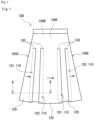
- FIG. 1 shows a pleated skirt, which is an example of a knitted fabric 100 according to an embodiment.
- An upper portion of the skirt has an opening through which the wearer's torso passes, and a lower portion of the skirt has an opening through which the wearer's legs pass.
- a knitting start portion 100S is formed on one side of the skirt, and a knitting end portion 100E is formed on the other side. That is to say, the skirt in the present example is knitted in the direction indicated by the bold arrow, i.e., horizontally.
- Such a skirt is knitted in the following manner.
- a front portion 100F and a back portion 100B of the skirt are knitted using the front needle bed and the back needle bed.
- the front portion 100F and the back portion 100B are joined together by bind off processing or the like.
- the portion subjected to bind off processing is the knitting end portion 100E.
- the front body and the back body are closed at the shoulders. Therefore, the front body and the back body, except for the area around the neck line, may be knitted in a C-shape using a single yarn feeder.
- the skirt in the present example has first pleats 101 and second pleats 102.
- Each first pleat 101 is a layered portion 110 formed by folding a portion of the knitted fabric 100 from the outside to the inside of the skirt.
- Each second pleat 102 is a layered portion 110 formed by folding a portion of the knitted fabric 100 from the inside to the outside of the skirt.
- joints 103 at each of which folded knitted fabric portions are joined together, are arranged.
- first pleats 101 and second pleats 102 are also formed in the back portion 100B of the skirt.
- only the knitting of the back portion 100B of the skirt will be described.
- the knitting start portion 100S is knitted first, and thereafter a first base knitted fabric portion 5 continuing from the knitting start portion 100S in the wale direction thereof is knitted.
- the first base knitted fabric portion 5 is a portion other than the pleats 101 and 102, i.e., a non-layered portion 120 in the knitted fabric 100.
- Each non-layered portion 120 is a portion where the knitted fabric 100 is not folded.
- FIG. 3 is a figure showing a first pleat 101 seen from the inside of the skirt.
- the first knitted fabric portion 1 and the second knitted fabric portion 2 are arranged in parallel in the knitting width direction, and the second knitted fabric portion 2, the third knitted fabric portion 3, and the fourth knitted fabric portion 4 are stacked in the thickness direction.
- the first pleat 101 is constituted by the layered portion 110 in which the second knitted fabric portion 2, the third knitted fabric portion 3, and the fourth knitted fabric portion 4 are stacked.
- the second base knitted fabric portion 6 (see also FIG. 2 ) is formed continuously from the first pleat 101 in the wale direction thereof.
- the flat knitting machine in the present example is a four-bed flat knitting machine including a lower front needle bed, a lower back needle bed, an upper front needle bed, and an upper back needle bed.
- the needles provided in each needle bed may be latch needles or compound needles.
- the lower front needle bed, the lower back needle bed, the upper front needle bed, and the upper back needle bed are referred to as FD, BD, FU, and BU, respectively.
- FD and BD face each other.
- FU and BU face each other above FD and BD.
- FD and FU, and BD and BU are configured so that racking can be performed relative to each other.
- Racking means that a needle bed moves in the lengthwise direction of the needle bed.
- BD and BU serve as the first needle beds and FD and FU serve as the second needle beds. Stitches can be transferred between FD and BD, between FD and BU, and between BD and FU.
- the knitting process diagrams only show the knitting of the back portion 100B of the knitted fabric 100, and the illustration of FD is omitted. Although the knitting process diagrams do not specifically show the knitting of the front portion 100F, the front portion 100F is formed by knitting the back portion 100B upside down. In the knitting of the front portion 100F, FD and FU serve as the first needle beds, and BD and BU serve as the second needle beds.
- the front portion 100F is mainly knitted using FD.
- the knitted fabric knitting method in the present example can also be carried out using a two-bed flat knitting machine.
- each portion of the knitted fabric 100 may be knitted by half gauge knitting.
- Half gauge knitting refers to knitting with an empty needle placed between adjacent stitches.
- Step S0 in FIG. 5 shows a state in which the stitch of the last course of the first base knitted fabric portion 5 is held on BD.
- the first knitted fabric portion 1 is knitted using BD, continuously from a stitch of a portion of the first base knitted fabric portion 5 in the wale direction thereof (Step A).
- the first knitted fabric portion 1 is knitted continuously from a portion of the first base knitted fabric portion 5 held on BD, in the wale direction thereof, and the first knitted fabric portion 1 is moved to FU.
- step S 1 furthermore, BD and BU are racked to the right by one pitch.
- step S2 the first knitted fabric portion 1 held on FU is moved to BD, the yarn feeder 9 is moved to the left, one course of the first knitted fabric portion 1 is knitted, and a first widening stitch 11 connected with an end portion stitch constituting a first side end 1E of the first knitted fabric portion 1 is knitted.
- the first side end 1E is an end portion of the first knitted fabric portion 1 in the knitting width direction. That is to say, the first widening stitch 11 is connected with the first side end 1E.
- the first widening stitch 11 in the present example is a pick up stitch. Unlike in the present example, the first widening stitch 11 may be knitted by split knit.
- Step S3 shows a state when the repetition of step S 1 and step S2 is completed.
- a plurality of first widening stitches 11 that are respectively connected with a plurality of stitches constituting the first side end 1E of the first knitted fabric portion 1 are knitted.
- the number of courses in the first knitted fabric portion 1 is smaller than the number of courses in the first knitted fabric portion 1 shown in FIG. 3 .
- the first widening stitch 11 is knitted for each course of the first knitted fabric portion 1 in the present example, it is unnecessary to knit the first widening stitch 11 when knitting some of the courses.
- Such knitting is equivalent to knitting a plurality of first widening stitches 11 connected with some stitches constituting the first side end 1E of the first knitted fabric portion 1.
- step S3 From the state in step S3, the second knitted fabric portion 2 is knitted at a position adjacent to the first knitted fabric portion 1 on BD in the knitting width direction (step B). Specifically, as shown in step S4 in FIG. 6 , the yarn feeder 9 is moved to the right, the last course of the first knitted fabric portion 1 held on BD is knitted, and the second knitted fabric portion 2 continuing from the first base knitted fabric portion 5 in the wale direction thereof is knitted. This knitting is performed to make it easier to transfer the first widening stitches 11, which are constituted by pick up stitches. The stitches continuing from the first widening stitch 11 in the wale direction thereof in step S3 are regarded as first widening stitches 11. In step S4, furthermore, the stitches of the first knitted fabric portion 1 and the first widening stitches 11 held on BD are moved to FU.
- step S5 the yarn feeder 9 is moved to the left, one course of the second knitted fabric portion 2 is knitted, and BD and BU are racked to the left by one pitch.
- the second knitted fabric portion 2 moves so that a second side end 2E of the second knitted fabric portion 2 near the first side end 1E relatively approaches the first side end 1E.
- step S5 furthermore, the first widening stitch 11 closest to the second side end 2E among the first widening stitches 11 held on FU is transferred so as to overlap the end portion stitch constituting the second side end 2E.
- step S6 the yarn feeder 9 is moved to the right, a second widening stitch 21 is knitted on a needle of FU which has become an empty needle in step S5, and one course of the second knitted fabric portion 2 is knitted on BD.
- a double stitch formed in step S5 is fixed, and the second side end 2E and the first widening stitches 11 are joined together.
- the second knitted fabric portion 2 is knitted in parallel to the first knitted fabric portion 1, and therefore the wale direction of the second knitted fabric portion 2 is the same as the wale direction of the first knitted fabric portion 1 (see the bold arrows in FIG. 3 ). That is to say, the orientation of the stitches of the second knitted fabric portion 2 in the knitted fabric 100 and the orientation of the stitches of the first knitted fabric portion 1 are the same.
- Step S6 shows a state when the repetition of step S5 and step S6 is completed.
- Step S7 shows a state when the repetition of step S5 and step S6 is completed.
- the second widening stitches 21 in the present example are pick up stitches formed on FU. If there is an empty needle on FD, the second widening stitches 21 may be formed on FD.
- the range within which the second widening stitches 21 are knitted overlaps the range within which the second knitted fabric portion 2 is knitted.
- step S7 the third knitted fabric portion 3 is knitted so as to overlap the range within which the second knitted fabric portion 2 is knitted on BD (step C). Specifically, as shown in step S8 in FIG. 7 , the yarn feeder 9 is moved to the left, and one course of the third knitted fabric portion 3 continuing from the second knitted fabric portion 2 in the wale direction thereof is knitted on BD. In step S8, furthermore, the second widening stitch 21 formed last among the second widening stitches 21 held on FU is transferred so as to overlap the end portion stitch constituting a third side end 3E.
- step S9 BD and BU are racked to the right by one pitch.
- the third knitted fabric portion 3 moves so that the third side end 3E of the third knitted fabric portion 3 near the second side end 2E relatively approaches the second side end 2E.
- step S9 furthermore, the yarn feeder 9 is moved to the right, a third widening stitch 31 is knitted on the needle of FU which has become an empty needle in step S8, and one course of the third knitted fabric portion 3 is knitted on BD.
- a double stitch formed in step S8 is fixed, and the third side end 3E and the second widening stitches 21 are joined together.
- Step S10 shows a state when the repetition of step S8 and step S9 is completed.
- the third widening stitches 31 in the present example are pick up stitches formed on FU.
- the range within which the third widening stitches 31 are knitted is located outside the range within which the third knitted fabric portion 3 is knitted.
- step S7 in FIG. 6 the plurality of second widening stitches 21 are knitted on the side of the second knitted fabric portion 2 to which the second knitted fabric portion 2 is relatively moved (on the left side in the present example).
- the second widening stitches 21 are held on FU, which is the second needle bed, and overlap the range within which the second knitted fabric portion 2 held on BD, which is the first needle bed, is knitted.
- the third knitted fabric portion 3 continuing from the second knitted fabric portion 2 in the wale direction thereof is knitted so as to overlap the back surface of the second knitted fabric portion 2.
- the back surface of the second knitted fabric portion 2 is the surface that faces inward of the tubular shape when the second knitted fabric portion 2 is knitted.
- the third knitted fabric portion 3 in the knitted fabric 100 is folded so as to be located inside the skirt compared to the second knitted fabric portion 2.
- the wale direction of the third knitted fabric portion 3 folded back with respect to the second knitted fabric portion 2 is opposite to the wale direction of the second knitted fabric portion 2. That is to say, the orientation of the stitches of the third knitted fabric portion 3 in the knitted fabric 100 and the orientation of the stitches of the second knitted fabric portion 2 are opposite.
- step S10 the fourth knitted fabric portion 4 is knitted so as to overlap the range within which the third knitted fabric portion 3 is knitted (step D). Specifically, as shown in step S11 in FIG. 8 , the yarn feeder 9 is moved to the left, and one course of the fourth knitted fabric portion 4 continuing from the third knitted fabric portion 3 in the wale direction thereof is knitted on BD. In step S11, furthermore, BD and BU are racked to the left by one pitch. As a result, the fourth knitted fabric portion 4 moves so that a fourth side end 4E of the fourth knitted fabric portion 4 near the third side end 3E relatively approaches the third side end 3E. Thereafter, the third widening stitch 31 formed last among the third widening stitches 31 held on FU is moved so as to overlap the end portion stitch constituting the fourth side end 4E.
- step S12 the yarn feeder 9 is moved to the right, and one course of the fourth knitted fabric portion 4 is knitted. Through this step S12, a double stitch formed in step S11 is fixed, and the fourth side end 4E and the third widening stitch 31 are joined together.
- Step S12 the knitting in step S11 and the knitting in step S12 are repeated.
- Step S13 shows a state in which the last third widening stitch 31 overlaps the fourth side end 4E.
- step S14 the yarn feeder 9 is moved to the right, and after the last knitted course of the fourth knitted fabric portion 4 is knitted, the first knitted fabric portion 1 held on FU is moved to BD.
- step S14 the second base knitted fabric portion 6 is knitted continuously from the first knitted fabric portion 1 and the fourth knitted fabric portion 4 held on BD in the wale direction thereof.
- step S10 in FIG. 7 the plurality of third widening stitches 31 are knitted near the left end portion of the third knitted fabric portion 3, which is opposite to the side to which the third knitted fabric portion 3 is relatively moved (to the right side in the present example).
- the third widening stitches 31 are held on FU, which is the second needle bed, and are located outside the range within which the third knitted fabric portion 3 held on BD, which is the first needle bed, is knitted.
- the fourth knitted fabric portion 4 continuing from the third knitted fabric portion 3 in the wale direction thereof is knitted so as to overlap the front surface of the third knitted fabric portion 3.
- the front surface of the third knitted fabric portion 3 is the surface that faces outward of the tubular shape when the third knitted fabric portion 3 is knitted.
- the fourth knitted fabric portion 4 is folded so as to be located inside the skirt compared to the third knitted fabric portion 3.
- the wale direction of the fourth knitted fabric portion 4 folded back with respect to the third knitted fabric portion 3 is opposite to the wale direction of the third knitted fabric portion 3. That is to say, the orientation of the stitches of the fourth knitted fabric portion 4 in the knitted fabric 100 and the orientation of the stitches of the third knitted fabric portion 3 are opposite.
- the orientation of the stitches of the fourth knitted fabric portion 4 is the same as the orientation of the stitches of the first knitted fabric portion 1 and the orientation of the stitches of the second knitted fabric portion 2.
- the first knitted fabric portion 1 and the second knitted fabric portion 2 are parallel to each other, and the second knitted fabric portion 2, the third knitted fabric portion 3, and the fourth knitted fabric portion 4 are stacked in the thickness direction.
- the orientation of the stitches of the first knitted fabric portion 1, the orientation of the stitches of the second knitted fabric portion 2, and the orientation of the stitches of the fourth knitted fabric portion 4 are the same, and the orientation of the stitches of the third knitted fabric portion 3 is opposite to the orientation of the stitches of the other first, second, and fourth knitted fabric portions.
- the first side end 1E and the second side end 2E are seamlessly joined together by the first widening stitches 11, the second side end 2E and the third side end 3E are seamlessly joined together by the second widening stitches 21, and the third side end 3E and the fourth side end 4E are seamlessly joined together by the third widening stitches 31.
- the joints 103 of the first pleats 101 are formed in the knitted fabric 100.
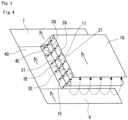
- FIG. 4 is a figure showing a second pleat 102 seen from the inside of the skirt.
- the first knitted fabric portion 1Q, the second knitted fabric portion 2Q, and the third knitted fabric portion 3Q are stacked in the thickness direction, and the third knitted fabric portion 3Q and the fourth knitted fabric portion 4Q are arranged in parallel in the knitting width direction.
- Each second pleat 102 is constituted by the layered portion 110 in which the first knitted fabric portion 1Q, the second knitted fabric portion 2Q, and the third knitted fabric portion 3Q are stacked.
- the third base knitted fabric portion 7 is formed continuously from the second pleats 102 in the wale direction thereof.
- the first knitted fabric portion 1Q is knitted continuously from a portion of the second base knitted fabric portion 6 in the wale direction thereof.
- the arcuate arrows in FIG. 4 indicate that the first knitted fabric portion 1Q is continuous with the second base knitted fabric portion 6 in the wale direction thereof.
- the first knitted fabric portion 1Q in FIG. 4 is knitted in a similar manner to the third knitted fabric portion 3 shown in FIG. 7 . That is to say, while the first knitted fabric portion 1Q in FIG. 4 is moved to the right, the first widening stitches 11 are knitted on the outer left side of the range within which the first knitted fabric portion 1 ⁇ a is knitted.
- the second knitted fabric portion 2Q is knitted so as to overlap the range within which the first knitted fabric portion 1Q is knitted.
- the second knitted fabric portion 2Q is knitted continuously from the first knitted fabric portion 1Q in the wale direction thereof.
- the second knitted fabric portion 2Q in FIG. 4 is knitted in a similar manner to the second knitted fabric portion 2 shown in FIG. 6 . That is to say, while the second knitted fabric portion 2Q in FIG. 4 is moved to the left, the second widening stitches 21 are knitted so as to overlap the range within which the second knitted fabric portion 2Q is knitted, on the left side of the second knitted fabric portion 2Q.
- the second knitted fabric portion 2Q is arranged on the outer side of the knitted fabric 100 than the first knitted fabric portion 1Q in the knitted fabric 100.
- the third knitted fabric portion 3Q is knitted so as to overlap the range within which the second knitted fabric portion 2Q is knitted.
- the third knitted fabric portion 3Q is knitted continuously from the second knitted fabric portion 2Q in the wale direction thereof.
- the third knitted fabric portion 3Q is knitted in a similar manner to the first knitted fabric portion 1Q. That is to say, while the third knitted fabric portion 3Q is moved to the right, the third widening stitches 31 are knitted on the outer left side of the third knitted fabric portion 3Q.
- the third knitted fabric portion 3Q is arranged on the outer side of the knitted fabric 100 than the second knitted fabric portion 2Q in the knitted fabric 100.
- the fourth knitted fabric portion 4Q is knitted adjacent to the range within which the third knitted fabric portion 3Q is knitted.
- the fourth knitted fabric portion 4Q is knitted continuously from the area of the second base knitted fabric portion 6 in which the first knitted fabric portion 1 ⁇ a is not knitted, in the wale direction.
- the fourth knitted fabric portion 4Q is knitted while moving the fourth knitted fabric portion 4Q such that the fourth side end 4E of the fourth knitted fabric portion 4Q near the third side end 3E approaches the third side end 3E, and thus the fourth side end 4E of the fourth knitted fabric portion 4Q is joined to the third widening stitches 31.
- the third base knitted fabric portion 7 is knitted continuously from the third knitted fabric portion 3Q and the fourth knitted fabric portion 4Q in the wale direction thereof. As a result, a second pleat 102 is formed in the knitted fabric 100.
- the first knitted fabric portion 1Q, the second knitted fabric portion 2Q, and the third knitted fabric portion 3Q are stacked in the thickness direction, and the third knitted fabric portion 3Q and the fourth knitted fabric portion 4Q are arranged in parallel in the knitting width direction.
- the orientation of the stitches of the first knitted fabric portion 1Q, the orientation of the stitches of the third knitted fabric portion 3Q, and the orientation of the stitches of the fourth knitted fabric portion 4Q are the same, and the orientation of the stitches of the second knitted fabric portion 2Q is opposite to the orientation of the stitches of the knitted fabric portions 1Q, 3Q, and 4Q.
- the first side end 1E and the second side end 2E are seamlessly joined together by the first widening stitches 11, the second side end 2E and the third side end 3E are seamlessly joined together by the second widening stitches 21, and the third side end 3E and the fourth side end 4E are seamlessly joined together by the third widening stitches 31.
- the joints 103 of the second pleats 102 are formed in the knitted fabric 100.
- the knitted fabric knitting method in the present example if the length of the skirt is within the range that can be knitted with the needles of the flat knitting machine, it is possible to knit the skirt regardless of the length or number of the first pleats 101 and the second pleats 102 in the knitting width direction.
- it is possible to freely select the combination of the first pleats 101 and the second pleats 102 in the knitted fabric 100 For example, it is possible to only provide the first pleats 101 or the second pleats 102 in the knitted fabric 100.
- Embodiment 1 describes a tubular knitted fabric 100 that includes a layered portion 110 in which three knitted fabric portions are stacked
- the number of knitted fabric portions stacked in the layered portion 110 is not particularly limited.
- the number of knitted portions stacked in the layered portion 110 may be two or four or more.
- the knitted fabric 100 need not be tubular.
- at least one of the first base knitted fabric portion 5, the second base knitted fabric portion 6, the third base knitted fabric portion 7, and the fourth knitted fabric portions 4 and 4Q may not be present.
- Each knitted fabric portion according to Embodiment 1 has a plain structure, but may have a pattern structure such as a rib structure or a mesh structure. In the knitting of a pattern structure, a first needle bed and a second needle bed facing the first needle bed are used.
- the second knitted fabric portion 2 and the third knitted fabric portion 3 are knitted by connecting them in the wale direction, but the end portion of the second knitted fabric portion 2 in the wale direction may be subjected to bind off processing so that the second knitted fabric portion 2 and the third knitted fabric portion 3 are prevented from being connected with each other in the wale direction.
- the end portion of the third knitted fabric portion 3 in the wale direction may be subjected to bind off processing so that the third knitted fabric portion 3 and the fourth knitted fabric portion 4 are prevented from being connected with each other in the wale direction.
Landscapes
- Engineering & Computer Science (AREA)
- Textile Engineering (AREA)
- Knitting Of Fabric (AREA)
Abstract
Description
- The present invention relates to a knitted fabric knitting method and a knitted fabric.
- A flat knitting machine is used to knit a knitted fabric having a layered portion in which a plurality of knitted fabric portions are stacked in layers. For example,
Patent Literature 1 discloses a technique for forming a pleat by first knitting a large tubular knitted fabric and thereafter folding a portion of the tubular knitted fabric in an S shape or a Z shape and joining it. A pleat is a layered portion in which three knitted fabric portions are stacked in layers. - Patent Literature 1:
JP 2014-189925A - In
Patent Literature 1, when the width of the layered portion or the number of layers in the layered portion in the knitted fabric is increased, the diameter of the tube of the tubular knitted fabric initially formed becomes too large, and there is a risk of a shortage of needles for knitting. - An object of the present invention is to provide a knitted fabric knitting method that makes it possible to knit a knitted fabric without causing a shortage of needles for knitting. An object of the present invention is to provide a knitted fabric having a layered portion.
-
- <1> A knitted fabric knitting method according to an aspect of the present invention is
a knitted fabric knitting method for knitting a knitted fabric having a layered portion in which a plurality of knitted fabric portions are stacked in layers, using a flat knitting machine that includes a first needle bed and a second needle bed, and in which the first needle bed and the second needle bed can be racked relative to each other, and in which stitches can be transferred between the first needle bed and the second needle bed, the method including:- a step A of knitting a first knitted fabric portion that serves as a base portion of the layered portion;
- a step B of knitting a second knitted fabric portion so as to be adjacent to the first knitted fabric portion in a knitting width direction or so as to overlap a range within which the first knitted fabric portion is knitted; and
- a step C of knitting a third knitted fabric portion so as to overlap a range within which the second knitted fabric portion is knitted on the first needle bed, wherein
- in the step A, first widening stitches are knitted, the first widening stitches being respectively connected with at least some of stitches constituting a first side end of the first knitted fabric portion,
- in the step B, the second knitted fabric portion is moved through racking so that a second side end of the second knitted fabric portion near the first side end relatively approaches the first side end and the second knitted fabric portion is knitted, thereby at least some of stitches constituting the second side end and the first widening stitches are sequentially overlapped and joined together through transferring, and second widening stitches that are respectively connected with at least some of stitches constituting the second side end are knitted, and
- in the step C, the third knitted fabric portion is moved through racking so that a third side end of the third knitted fabric portion near the second side end relatively approaches the second side end and the third knitted fabric portion is knitted, thereby at least some of stitches constituting the third side end and the second widening stitches are sequentially overlapped and joined together through transferring.
Here, the relative movement of the knitted fabric portions through racking will be described using the first knitted fabric portion and the second knitted fabric portion as examples. First, when the second knitted fabric portion is knitted in parallel with the first knitted fabric portion on the right side thereof on the needle bed, the right side end of the first knitted fabric portion is the first side end and the left side end of the second knitted fabric portion is the second side end. In this case, the first side end and the second side end will approach each other both when the first knitted fabric portion is moved to the right through racking and when the second knitted fabric portion is moved to the left through racking. In addition, when the second knitted fabric portion is knitted so as to overlap the first knitted fabric portion whose left side end is the first side end, the left side end of the second knitted fabric portion is the second side end. In this case, the first side end and the second side end will approach each other both when the first knitted fabric portion is moved to the right through racking and when the second knitted fabric portion is moved to the left through racking. In this way, both when the first knitted fabric portion moves through racking and when the second knitted fabric portion moves through racking, the second knitted fabric portion moves relative to the first knitted fabric portion such that the second side end approaches the first side end.
- <2>An embodiment of the knitted fabric knitting method according to the above <1> may further include
- a step D of knitting a fourth knitted fabric portion so as to be adjacent to the third knitted fabric portion in a knitting width direction thereof or so as to overlap a range within which the third knitted fabric portion is knitted, wherein
- in the step C, third widening stitches that are respectively connected with at least some of stitches constituting the third side end may be knitted, and
- in the step D, the fourth knitted fabric portion may be moved through racking so that a fourth side end of the fourth knitted fabric portion near the third side end relatively approaches the third side end and the fourth knitted fabric portion is knitted, thereby at least some of stitches constituting the fourth side end and the third widening stitches may be sequentially overlapped and joined together through transferring.
- <3> In an embodiment of the knitted fabric knitting method according to the above <1> or <2>,
in the step B, the second widening stitches may be knitted on a side of the second knitted fabric portion to which the second knitted fabric portion is relatively moved.
Here, the side to which the second knitted fabric portion is relatively moved is the side to which the second knitted fabric portion is moved relative to the first knitted fabric portion. The same applies to the configuration according to <4> described below. - <4> In an embodiment of the knitted fabric knitting method according to the above <1> or <2>,
in the step B, the second widening stitches may be knitted on a side of the second knitted fabric portion opposite to a side to which the second knitted fabric portion is relatively moved. - <5> A knitted fabric according to an aspect of the present invention includes:
- a first knitted fabric portion;
- a second knitted fabric portion arranged in parallel to the first knitted fabric portion in a knitting width direction thereof, or stacked on the first knitted fabric portion in a thickness direction thereof
- a third knitted fabric portion stacked on the second knitted fabric portion in a thickness direction thereof and
- a joint at which a first side end of the first knitted fabric portion, a second side end of the second knitted fabric portion, and a third side end of the third knitted fabric portion are seamlessly joined together,
- wherein an orientation of stitches of the first knitted fabric portion and an orientation of stitches of the second knitted fabric portion are the same or opposite to each other, and
- the orientation of stitches of the second knitted fabric portion and an orientation of stitches of the third knitted fabric portion are opposite to each other.
- With the knitted fabric knitting method described in the above aspect <1>, when the third knitted fabric portion is knitted continuously with the second knitted fabric portion in the wale direction thereof, the third knitted fabric portion is knitted so as to overlap the second knitted fabric portion. That is to say, the third knitted fabric portion is knitted in the area in which the second knitted fabric portion is knitted on the first needle bed of the flat knitting machine. Therefore, it is possible to knit a knitted fabric regardless of the width of the layered portion where the second knitted fabric portion and the third knitted fabric portion overlap each other, i.e., the length of the area where the second knitted fabric portion and the third knitted fabric portion overlap each other, and the number of layers in the layered portion of the knitted fabric.
- With the knitted fabric knitting method described in the above aspect <2>, it is possible to knit a knitted fabric that has a layered portion where the first knitted fabric portion, the second knitted fabric portion, and the third knitted fabric portion are stacked, or a layered portion where the second knitted fabric portion, the third knitted fabric portion, and the fourth knitted fabric portion are stacked.
- With the knitted fabric knitting method described in the above aspect <3>, the third knitted fabric portion is knitted so as to overlap the back surface of the second knitted fabric portion. The back surface of the second knitted fabric portion is the surface that faces the second needle bed when the second knitted fabric portion is knitted on the first needle bed.
- With the knitted fabric knitting method described in the above aspect <4>, the third knitted fabric portion is knitted so as to overlap the front surface of the second knitted fabric portion. The front surface of the second knitted fabric portion is the surface that is opposite to the surface that faces the second needle bed when the second knitted fabric portion is knitted on the first needle bed.
- The knitted fabric described in the above aspect <5> includes a portion where the second knitted fabric portion and the third knitted fabric portion overlap each other, and a portion where the first knitted fabric portion is parallel to or stacked on the second knitted fabric portion. The knitted fabric with such portions may have a variety of external appearances. The design of knitted fabric varies greatly depending on the number and arrangement of the portions where the second knitted fabric portion and the third knitted fabric portion are stacked, and the number and arrangement of the portions where the first knitted fabric portion is parallel to or stacked on the second knitted fabric portion.
-
-
FIG. 1 is a schematic diagram showing a skirt that is a knitted fabric according to an embodiment. -
FIG. 2 is a schematic diagram showing a cross section taken along II-II inFIG. 1 . -
FIG. 3 is a knitting image diagram for first pleats shown inFIG. 1 . -
FIG. 4 is a knitting image diagram for second pleats shown inFIG. 1 . -
FIG. 5 is a first diagram for a knitting process of knitting the first pleats shown inFIG. 1 . -
FIG. 6 is a second diagram for the knitting process, continuing fromFIG. 5 . -
FIG. 7 is a third diagram for the knitting process, continuing fromFIG. 6 . -
FIG. 8 is a fourth diagram for the knitting process, continuing fromFIG. 7 . - Hereinafter, a knitted fabric knitting method and a knitted fabric according to an embodiment will be described based on the drawings.
-
FIG. 1 shows a pleated skirt, which is an example of aknitted fabric 100 according to an embodiment. An upper portion of the skirt has an opening through which the wearer's torso passes, and a lower portion of the skirt has an opening through which the wearer's legs pass. In this skirt, aknitting start portion 100S is formed on one side of the skirt, and aknitting end portion 100E is formed on the other side. That is to say, the skirt in the present example is knitted in the direction indicated by the bold arrow, i.e., horizontally. Such a skirt is knitted in the following manner. After knitting theknitting start portion 100S formed on a front needle bed and a back needle bed of a flat knitting machine, afront portion 100F and aback portion 100B of the skirt are knitted using the front needle bed and the back needle bed. Finally, thefront portion 100F and theback portion 100B are joined together by bind off processing or the like. The portion subjected to bind off processing is theknitting end portion 100E. Unlike in the present example, when the knitted fabric knitting method according to the embodiment is to be applied to the knitting of the body, the front body and the back body are closed at the shoulders. Therefore, the front body and the back body, except for the area around the neck line, may be knitted in a C-shape using a single yarn feeder. - The skirt in the present example has first pleats 101 and second pleats 102. Each first pleat 101 is a layered portion 110 formed by folding a portion of the knitted
fabric 100 from the outside to the inside of the skirt. Each second pleat 102 is a layered portion 110 formed by folding a portion of the knittedfabric 100 from the inside to the outside of the skirt. In an upper portion of the skirt, joints 103, at each of which folded knitted fabric portions are joined together, are arranged. As shown in the II-II cross-sectional view inFIG. 2 , first pleats 101 and second pleats 102 are also formed in theback portion 100B of the skirt. Hereinafter, only the knitting of theback portion 100B of the skirt will be described. - In the knitting of the skirt in the present example, the
knitting start portion 100S is knitted first, and thereafter a first base knittedfabric portion 5 continuing from theknitting start portion 100S in the wale direction thereof is knitted. The first base knittedfabric portion 5 is a portion other than the pleats 101 and 102, i.e., anon-layered portion 120 in theknitted fabric 100. Eachnon-layered portion 120 is a portion where theknitted fabric 100 is not folded. - After the knitting of the first base knitted
fabric portion 5 has been completed, a first knittedfabric portion 1, a second knittedfabric portion 2, a thirdknitted fabric portion 3, a fourth knittedfabric portion 4, and a second base knittedfabric portion 6 are knitted in this order as shown in the knitting image diagram inFIG. 3. FIG. 3 is a figure showing a first pleat 101 seen from the inside of the skirt. The first knittedfabric portion 1 and the second knittedfabric portion 2 are arranged in parallel in the knitting width direction, and the second knittedfabric portion 2, the thirdknitted fabric portion 3, and the fourth knittedfabric portion 4 are stacked in the thickness direction. The first pleat 101 is constituted by the layered portion 110 in which the second knittedfabric portion 2, the thirdknitted fabric portion 3, and the fourth knittedfabric portion 4 are stacked. The second base knitted fabric portion 6 (see alsoFIG. 2 ) is formed continuously from the first pleat 101 in the wale direction thereof. - Specific procedures for knitting the first knitted
fabric portion 1, the second knittedfabric portion 2, the thirdknitted fabric portion 3, and the fourth knittedfabric portion 4 will be described based on the knitting process diagrams inFIGS. 5 to 8 . "S + number" in the left column of each knitting process diagram indicates the knitting process number thereof. The right column shows the state of the stitches on the needle bed of the flat knitting machine. The black dots in the right column indicate needles, the circle marks indicate stitches, the double circle marks indicate double stitches, the V marks indicate pick up stitches, and the inverted triangle marks indicate ayarn feeder 9. The portions where knitting has actually been performed are indicated by thick lines in each knitting process. The filled circle marks are the stitches actually knitted in each knitting process. - The flat knitting machine in the present example is a four-bed flat knitting machine including a lower front needle bed, a lower back needle bed, an upper front needle bed, and an upper back needle bed. The needles provided in each needle bed may be latch needles or compound needles. Hereinafter, the lower front needle bed, the lower back needle bed, the upper front needle bed, and the upper back needle bed are referred to as FD, BD, FU, and BU, respectively. FD and BD face each other. FU and BU face each other above FD and BD. FD and FU, and BD and BU, are configured so that racking can be performed relative to each other. Racking means that a needle bed moves in the lengthwise direction of the needle bed. In the present example, BD and BU serve as the first needle beds and FD and FU serve as the second needle beds. Stitches can be transferred between FD and BD, between FD and BU, and between BD and FU. The knitting process diagrams only show the knitting of the
back portion 100B of the knittedfabric 100, and the illustration of FD is omitted. Although the knitting process diagrams do not specifically show the knitting of thefront portion 100F, thefront portion 100F is formed by knitting theback portion 100B upside down. In the knitting of thefront portion 100F, FD and FU serve as the first needle beds, and BD and BU serve as the second needle beds. Thefront portion 100F is mainly knitted using FD. The knitted fabric knitting method in the present example can also be carried out using a two-bed flat knitting machine. In such a case, each portion of the knittedfabric 100 may be knitted by half gauge knitting. Half gauge knitting refers to knitting with an empty needle placed between adjacent stitches. - Step S0 in
FIG. 5 shows a state in which the stitch of the last course of the first base knittedfabric portion 5 is held on BD. From this state in step S0, the first knittedfabric portion 1 is knitted using BD, continuously from a stitch of a portion of the first base knittedfabric portion 5 in the wale direction thereof (Step A). Specifically, in step S1, the first knittedfabric portion 1 is knitted continuously from a portion of the first base knittedfabric portion 5 held on BD, in the wale direction thereof, and the first knittedfabric portion 1 is moved to FU. Instep S 1, furthermore, BD and BU are racked to the right by one pitch. - In step S2, the first knitted
fabric portion 1 held on FU is moved to BD, theyarn feeder 9 is moved to the left, one course of the first knittedfabric portion 1 is knitted, and a first wideningstitch 11 connected with an end portion stitch constituting afirst side end 1E of the first knittedfabric portion 1 is knitted. Thefirst side end 1E is an end portion of the first knittedfabric portion 1 in the knitting width direction. That is to say, the first wideningstitch 11 is connected with thefirst side end 1E. The first wideningstitch 11 in the present example is a pick up stitch. Unlike in the present example, the first wideningstitch 11 may be knitted by split knit. - After step S2, the knitting in step S1 and the knitting in step S2 are repeated. Step S3 shows a state when the repetition of
step S 1 and step S2 is completed. In this case, a plurality of first widening stitches 11 that are respectively connected with a plurality of stitches constituting thefirst side end 1E of the first knittedfabric portion 1 are knitted. InFIG. 5 , for the sake of description, the number of courses in the first knittedfabric portion 1 is smaller than the number of courses in the first knittedfabric portion 1 shown inFIG. 3 . Although the first wideningstitch 11 is knitted for each course of the first knittedfabric portion 1 in the present example, it is unnecessary to knit the first wideningstitch 11 when knitting some of the courses. Such knitting is equivalent to knitting a plurality of first widening stitches 11 connected with some stitches constituting thefirst side end 1E of the first knittedfabric portion 1. - From the state in step S3, the second knitted
fabric portion 2 is knitted at a position adjacent to the first knittedfabric portion 1 on BD in the knitting width direction (step B). Specifically, as shown in step S4 inFIG. 6 , theyarn feeder 9 is moved to the right, the last course of the first knittedfabric portion 1 held on BD is knitted, and the second knittedfabric portion 2 continuing from the first base knittedfabric portion 5 in the wale direction thereof is knitted. This knitting is performed to make it easier to transfer the first widening stitches 11, which are constituted by pick up stitches. The stitches continuing from the first wideningstitch 11 in the wale direction thereof in step S3 are regarded as first widening stitches 11. In step S4, furthermore, the stitches of the first knittedfabric portion 1 and the first widening stitches 11 held on BD are moved to FU. - In step S5, the
yarn feeder 9 is moved to the left, one course of the second knittedfabric portion 2 is knitted, and BD and BU are racked to the left by one pitch. As a result, the second knittedfabric portion 2 moves so that asecond side end 2E of the second knittedfabric portion 2 near the first side end 1E relatively approaches thefirst side end 1E. In step S5, furthermore, the first wideningstitch 11 closest to the second side end 2E among the first widening stitches 11 held on FU is transferred so as to overlap the end portion stitch constituting thesecond side end 2E. - In step S6, the
yarn feeder 9 is moved to the right, a second wideningstitch 21 is knitted on a needle of FU which has become an empty needle in step S5, and one course of the second knittedfabric portion 2 is knitted on BD. Through this step S6, a double stitch formed in step S5 is fixed, and the second side end 2E and the first widening stitches 11 are joined together. The second knittedfabric portion 2 is knitted in parallel to the first knittedfabric portion 1, and therefore the wale direction of the second knittedfabric portion 2 is the same as the wale direction of the first knitted fabric portion 1 (see the bold arrows inFIG. 3 ). That is to say, the orientation of the stitches of the second knittedfabric portion 2 in theknitted fabric 100 and the orientation of the stitches of the first knittedfabric portion 1 are the same. - After step S6, the knitting in step S5 and the knitting in step S6 are repeated. Step S7 shows a state when the repetition of step S5 and step S6 is completed. Through the process shown in
FIG. 6 , at least some of the stitches constituting thesecond side end 2E and a plurality of first widening stitches 11 are joined together, and a plurality of second widening stitches 21 that are respectively connected with at least some of the stitches of the second side end 2E are knitted. The second widening stitches 21 in the present example are pick up stitches formed on FU. If there is an empty needle on FD, the second widening stitches 21 may be formed on FD. The range within which the second widening stitches 21 are knitted overlaps the range within which the second knittedfabric portion 2 is knitted. - From the state shown in step S7, the third
knitted fabric portion 3 is knitted so as to overlap the range within which the second knittedfabric portion 2 is knitted on BD (step C). Specifically, as shown in step S8 inFIG. 7 , theyarn feeder 9 is moved to the left, and one course of the thirdknitted fabric portion 3 continuing from the second knittedfabric portion 2 in the wale direction thereof is knitted on BD. In step S8, furthermore, the second wideningstitch 21 formed last among the second widening stitches 21 held on FU is transferred so as to overlap the end portion stitch constituting athird side end 3E. - In step S9, BD and BU are racked to the right by one pitch. As a result, the third
knitted fabric portion 3 moves so that thethird side end 3E of the thirdknitted fabric portion 3 near the second side end 2E relatively approaches thesecond side end 2E. In step S9, furthermore, theyarn feeder 9 is moved to the right, a third wideningstitch 31 is knitted on the needle of FU which has become an empty needle in step S8, and one course of the thirdknitted fabric portion 3 is knitted on BD. Through this step S9, a double stitch formed in step S8 is fixed, and thethird side end 3E and the second widening stitches 21 are joined together. - After step S9, the knitting in step S8 and the knitting in step S9 are repeated. Step S10 shows a state when the repetition of step S8 and step S9 is completed. Through the process shown in
FIG. 7 , at least some of the stitches constituting thethird side end 3E and a plurality of second widening stitches 21 are joined together, and a plurality of third widening stitches 31 that are respectively connected with at least some of the stitches of thethird side end 3E are knitted. The third widening stitches 31 in the present example are pick up stitches formed on FU. The range within which the third widening stitches 31 are knitted is located outside the range within which the thirdknitted fabric portion 3 is knitted. - Here, in step S7 in
FIG. 6 , the plurality of second widening stitches 21 are knitted on the side of the second knittedfabric portion 2 to which the second knittedfabric portion 2 is relatively moved (on the left side in the present example). In addition, the second widening stitches 21 are held on FU, which is the second needle bed, and overlap the range within which the second knittedfabric portion 2 held on BD, which is the first needle bed, is knitted. In this case, the thirdknitted fabric portion 3 continuing from the second knittedfabric portion 2 in the wale direction thereof is knitted so as to overlap the back surface of the second knittedfabric portion 2. The back surface of the second knittedfabric portion 2 is the surface that faces inward of the tubular shape when the second knittedfabric portion 2 is knitted. As a result, as shown inFIGS. 2 and 3 , the thirdknitted fabric portion 3 in theknitted fabric 100 is folded so as to be located inside the skirt compared to the second knittedfabric portion 2. The wale direction of the thirdknitted fabric portion 3 folded back with respect to the second knittedfabric portion 2 is opposite to the wale direction of the second knittedfabric portion 2. That is to say, the orientation of the stitches of the thirdknitted fabric portion 3 in theknitted fabric 100 and the orientation of the stitches of the second knittedfabric portion 2 are opposite. - From the state shown in step S10, the fourth knitted
fabric portion 4 is knitted so as to overlap the range within which the thirdknitted fabric portion 3 is knitted (step D). Specifically, as shown in step S11 inFIG. 8 , theyarn feeder 9 is moved to the left, and one course of the fourth knittedfabric portion 4 continuing from the thirdknitted fabric portion 3 in the wale direction thereof is knitted on BD. In step S11, furthermore, BD and BU are racked to the left by one pitch. As a result, the fourth knittedfabric portion 4 moves so that afourth side end 4E of the fourth knittedfabric portion 4 near thethird side end 3E relatively approaches thethird side end 3E. Thereafter, the third wideningstitch 31 formed last among the third widening stitches 31 held on FU is moved so as to overlap the end portion stitch constituting thefourth side end 4E. - In step S12, the
yarn feeder 9 is moved to the right, and one course of the fourth knittedfabric portion 4 is knitted. Through this step S12, a double stitch formed in step S11 is fixed, and the fourth side end 4E and the third wideningstitch 31 are joined together. - After step S12, the knitting in step S11 and the knitting in step S12 are repeated. Step S13 shows a state in which the last third widening
stitch 31 overlaps thefourth side end 4E. In step S14, theyarn feeder 9 is moved to the right, and after the last knitted course of the fourth knittedfabric portion 4 is knitted, the first knittedfabric portion 1 held on FU is moved to BD. After step S14, the second base knittedfabric portion 6 is knitted continuously from the first knittedfabric portion 1 and the fourth knittedfabric portion 4 held on BD in the wale direction thereof. - Here, in step S10 in
FIG. 7 , the plurality of third widening stitches 31 are knitted near the left end portion of the thirdknitted fabric portion 3, which is opposite to the side to which the thirdknitted fabric portion 3 is relatively moved (to the right side in the present example). The third widening stitches 31 are held on FU, which is the second needle bed, and are located outside the range within which the thirdknitted fabric portion 3 held on BD, which is the first needle bed, is knitted. In this case, the fourth knittedfabric portion 4 continuing from the thirdknitted fabric portion 3 in the wale direction thereof is knitted so as to overlap the front surface of the thirdknitted fabric portion 3. The front surface of the thirdknitted fabric portion 3 is the surface that faces outward of the tubular shape when the thirdknitted fabric portion 3 is knitted. As a result, as shown inFIGS. 2 and 3 , the fourth knittedfabric portion 4 is folded so as to be located inside the skirt compared to the thirdknitted fabric portion 3. The wale direction of the fourth knittedfabric portion 4 folded back with respect to the thirdknitted fabric portion 3 is opposite to the wale direction of the thirdknitted fabric portion 3. That is to say, the orientation of the stitches of the fourth knittedfabric portion 4 in theknitted fabric 100 and the orientation of the stitches of the thirdknitted fabric portion 3 are opposite. The orientation of the stitches of the fourth knittedfabric portion 4 is the same as the orientation of the stitches of the first knittedfabric portion 1 and the orientation of the stitches of the second knittedfabric portion 2. - In the
knitted fabric 100 knitted according to the knitting process diagram described above, as shown inFIG. 3 , the first knittedfabric portion 1 and the second knittedfabric portion 2 are parallel to each other, and the second knittedfabric portion 2, the thirdknitted fabric portion 3, and the fourth knittedfabric portion 4 are stacked in the thickness direction. The orientation of the stitches of the first knittedfabric portion 1, the orientation of the stitches of the second knittedfabric portion 2, and the orientation of the stitches of the fourth knittedfabric portion 4 are the same, and the orientation of the stitches of the thirdknitted fabric portion 3 is opposite to the orientation of the stitches of the other first, second, and fourth knitted fabric portions. The first side end 1E and the second side end 2E are seamlessly joined together by the first widening stitches 11, the second side end 2E and thethird side end 3E are seamlessly joined together by the second widening stitches 21, and thethird side end 3E and the fourth side end 4E are seamlessly joined together by the third widening stitches 31. As a result, thejoints 103 of the first pleats 101 (seeFIG. 1 ), at each of which the first side end 1E, the second side end 2E, thethird side end 3E, and the fourth side end 4E are seamlessly joined together, are formed in theknitted fabric 100. - After the knitting of the second base knitted
fabric portion 6 shown inFIG. 2 has been completed, a first knittedfabric portion 1Q, a second knittedfabric portion 2Q, a thirdknitted fabric portion 3Q, a fourth knittedfabric portion 4Q, and a third base knittedfabric portion 7 are knitted in this order as shown in the knitted image diagram inFIG. 4. FIG. 4 is a figure showing a second pleat 102 seen from the inside of the skirt. The first knittedfabric portion 1Q, the second knittedfabric portion 2Q, and the thirdknitted fabric portion 3Q are stacked in the thickness direction, and the thirdknitted fabric portion 3Q and the fourth knittedfabric portion 4Q are arranged in parallel in the knitting width direction. Each second pleat 102 is constituted by the layered portion 110 in which the first knittedfabric portion 1Q, the second knittedfabric portion 2Q, and the thirdknitted fabric portion 3Q are stacked. The third base knittedfabric portion 7 is formed continuously from the second pleats 102 in the wale direction thereof. - Specific procedures for knitting each second pleat 102 will be described. First, the first knitted
fabric portion 1Q is knitted continuously from a portion of the second base knittedfabric portion 6 in the wale direction thereof. The arcuate arrows inFIG. 4 indicate that the first knittedfabric portion 1Q is continuous with the second base knittedfabric portion 6 in the wale direction thereof. - The first knitted
fabric portion 1Q inFIG. 4 is knitted in a similar manner to the thirdknitted fabric portion 3 shown inFIG. 7 . That is to say, while the first knittedfabric portion 1Q inFIG. 4 is moved to the right, the first widening stitches 11 are knitted on the outer left side of the range within which the first knitted fabric portion 1Γa is knitted. - The second knitted
fabric portion 2Q is knitted so as to overlap the range within which the first knittedfabric portion 1Q is knitted. In the present example, the second knittedfabric portion 2Q is knitted continuously from the first knittedfabric portion 1Q in the wale direction thereof. The second knittedfabric portion 2Q inFIG. 4 is knitted in a similar manner to the second knittedfabric portion 2 shown inFIG. 6 . That is to say, while the second knittedfabric portion 2Q inFIG. 4 is moved to the left, the second widening stitches 21 are knitted so as to overlap the range within which the second knittedfabric portion 2Q is knitted, on the left side of the second knittedfabric portion 2Q. The second knittedfabric portion 2Q is arranged on the outer side of the knittedfabric 100 than the first knittedfabric portion 1Q in theknitted fabric 100. - The third
knitted fabric portion 3Q is knitted so as to overlap the range within which the second knittedfabric portion 2Q is knitted. In the present example, the thirdknitted fabric portion 3Q is knitted continuously from the second knittedfabric portion 2Q in the wale direction thereof. The thirdknitted fabric portion 3Q is knitted in a similar manner to the first knittedfabric portion 1Q. That is to say, while the thirdknitted fabric portion 3Q is moved to the right, the third widening stitches 31 are knitted on the outer left side of the thirdknitted fabric portion 3Q. The thirdknitted fabric portion 3Q is arranged on the outer side of the knittedfabric 100 than the second knittedfabric portion 2Q in theknitted fabric 100. - The fourth knitted
fabric portion 4Q is knitted adjacent to the range within which the thirdknitted fabric portion 3Q is knitted. In the present example, the fourth knittedfabric portion 4Q is knitted continuously from the area of the second base knittedfabric portion 6 in which the first knitted fabric portion 1Γa is not knitted, in the wale direction. The fourth knittedfabric portion 4Q is knitted while moving the fourth knittedfabric portion 4Q such that thefourth side end 4E of the fourth knittedfabric portion 4Q near thethird side end 3E approaches thethird side end 3E, and thus thefourth side end 4E of the fourth knittedfabric portion 4Q is joined to the third widening stitches 31. - Finally, the third base knitted
fabric portion 7 is knitted continuously from the thirdknitted fabric portion 3Q and the fourth knittedfabric portion 4Q in the wale direction thereof. As a result, a second pleat 102 is formed in theknitted fabric 100. - In the
knitted fabric 100 knitted based onFIG. 4 , the first knittedfabric portion 1Q, the second knittedfabric portion 2Q, and the thirdknitted fabric portion 3Q are stacked in the thickness direction, and the thirdknitted fabric portion 3Q and the fourth knittedfabric portion 4Q are arranged in parallel in the knitting width direction. The orientation of the stitches of the first knittedfabric portion 1Q, the orientation of the stitches of the thirdknitted fabric portion 3Q, and the orientation of the stitches of the fourth knittedfabric portion 4Q are the same, and the orientation of the stitches of the second knittedfabric portion 2Q is opposite to the orientation of the stitches of the knittedfabric portions third side end 3E are seamlessly joined together by the second widening stitches 21, and thethird side end 3E and the fourth side end 4E are seamlessly joined together by the third widening stitches 31. As a result, thejoints 103 of the second pleats 102 (seeFIG. 1 ), at each of which the first side end 1E, the second side end 2E, thethird side end 3E, and the fourth side end 4E are seamlessly joined together, are formed in theknitted fabric 100. - With the knitted fabric knitting method in the present example, if the length of the skirt is within the range that can be knitted with the needles of the flat knitting machine, it is possible to knit the skirt regardless of the length or number of the first pleats 101 and the second pleats 102 in the knitting width direction. In addition, with the knitted fabric knitting method in the present example, it is possible to freely change the positions of the plurality of
joints 103 in the direction along the length of the skirt. For example, it is possible to place the positions of thejoints 103 of the second pleats 102 closer to the body or closer to the hem than the first pleats 101 are. This is because the second pleats 102 are knitted independent of the first pleats 101 after the first pleats 101 have been completed. In addition, it is possible to freely select the combination of the first pleats 101 and the second pleats 102 in theknitted fabric 100. For example, it is possible to only provide the first pleats 101 or the second pleats 102 in theknitted fabric 100. - Although
Embodiment 1 describes a tubular knittedfabric 100 that includes a layered portion 110 in which three knitted fabric portions are stacked, the number of knitted fabric portions stacked in the layered portion 110 is not particularly limited. The number of knitted portions stacked in the layered portion 110 may be two or four or more. For example, it is possible to increase the number of knitted portions stacked in the layered portion 110 by repeating the knitting processes shown inFIGS. 5 to 7 . Theknitted fabric 100 need not be tubular. Depending on the state of the layered portion 110, at least one of the first base knittedfabric portion 5, the second base knittedfabric portion 6, the third base knittedfabric portion 7, and the fourth knittedfabric portions - Each knitted fabric portion according to
Embodiment 1 has a plain structure, but may have a pattern structure such as a rib structure or a mesh structure. In the knitting of a pattern structure, a first needle bed and a second needle bed facing the first needle bed are used. - In addition, in each first pleat 101 according to
Embodiment 1, the second knittedfabric portion 2 and the thirdknitted fabric portion 3 are knitted by connecting them in the wale direction, but the end portion of the second knittedfabric portion 2 in the wale direction may be subjected to bind off processing so that the second knittedfabric portion 2 and the thirdknitted fabric portion 3 are prevented from being connected with each other in the wale direction. Similarly, the end portion of the thirdknitted fabric portion 3 in the wale direction may be subjected to bind off processing so that the thirdknitted fabric portion 3 and the fourth knittedfabric portion 4 are prevented from being connected with each other in the wale direction. -
- 1, 1Γa First knitted fabric portion, 1E First side end, 11 First widening stitch
- 2, 2Q Second knitted fabric portion, 2E Second side end, 21 Second widening stitch
- 3, 3Q Third knitted fabric portion, 3E Third side end, 31 Third widening stitch
- 4, 4Q Fourth knitted fabric portion, 4E Fourth side end
- 5 First base knitted fabric portion
- 6 Second base knitted fabric portion
- 7 Third base knitted fabric portion
- 9 Yarn feeder
- 100 Knitted fabric
- 100S Knitting start portion, 100E Knitting end portion
- 100F Front portion, 100B Back portion
- 101 First pleat
- 102 Second pleat
- 103 Joint
- 110 Layered portion
- 120 Non-layered portion
Claims (5)
- A knitted fabric knitting method for knitting a knitted fabric (100) having a layered portion (110) in which a plurality of knitted fabric portions are stacked in layers, using a flat knitting machine that includes a first needle bed (BD, BU) and a second needle bed (FD, FU), and in which the first needle bed (BD, BU) and the second needle bed (FD, FU) can be racked relative to each other, and in which stitches can be transferred between the first needle bed (BD, BU) and the second needle bed (FD, FU), characterized by comprising:a step A of knitting a first knitted fabric portion (1) that serves as a base portion of the layered portion (110);a step B of knitting a second knitted fabric portion (2, 2Q) so as to be adjacent to the first knitted fabric portion (1, 1Q) in a knitting width direction thereof or so as to overlap a range within which the first knitted fabric portion (1, 1Γa) is knitted; anda step C of knitting a third knitted fabric portion (3, 3Q) so as to overlap a range within which the second knitted fabric portion (2, 2Q) is knitted on the first needle bed (BD), whereinin the step A, first widening stitches (11) are knitted, the first widening stitches (11) being respectively connected with at least some of stitches constituting a first side end (1E) of the first knitted fabric portion (1, 1Q),in the step B, the second knitted fabric portion (2, 2Q) is moved through racking so that a second side end (2E) of the second knitted fabric portion (2, 2Q) near the first side end (1E) relatively approaches the first side end (1E) and the second knitted fabric portion (2, 2Q) is knitted, thereby at least some of stitches constituting the second side end (2E) and the first widening stitches (11) are sequentially overlapped and joined together through transferring, and second widening stitches (21) that are respectively connected with at least some of stitches constituting the second side end (2E) are knitted, andin the step C, the third knitted fabric portion (3, 3Q) is moved through racking so that a third side end (3E) of the third knitted fabric portion (3, 3Q) near the second side end (2E) relatively approaches the second side end (2E) and the third knitted fabric portion (3, 3Q) is knitted, thereby at least some of stitches constituting the third side end (3E) and the second widening stitches (21) are sequentially overlapped and joined together through transferring.
- The knitted fabric knitting method according to claim 1, further comprising:a step D of knitting a fourth knitted fabric portion (4, 4Q) so as to be adjacent to the third knitted fabric portion (3, 3Q) in a knitting width direction thereof or so as to overlap a range within which the third knitted fabric portion (3, 3Q) is knitted, whereinin the step C, third widening stitches (31) that are respectively connected with at least some of stitches constituting the third side end (3E) are knitted, andin the step D, the fourth knitted fabric portion (4, 4Q) is moved through racking so that a fourth side end (4E) of the fourth knitted fabric portion (4, 4Q) near the third side end (3E) relatively approaches the third side end (3E) and the fourth knitted fabric portion (4, 4Q) is knitted, thereby at least some of stitches constituting the fourth side end (4E) and the third widening stitches (31) are sequentially overlapped and joined together through transferring.
- The knitted fabric knitting method according to claim 1 or 2, wherein
in the step B, the second widening stitches (21) are knitted on a side of the second knitted fabric portion (2) to which the second knitted fabric portion (2) is relatively moved. - The knitted fabric knitting method according to claim 1 or 2, wherein
in the step B, the second widening stitches (21) are knitted on a side of the second knitted fabric portion (2Q) opposite to a side to which the second knitted fabric portion (2Q) is relatively moved. - A knitted fabric (100) characterized by comprising:a first knitted fabric portion (1);a second knitted fabric portion (2, 2Q) arranged in parallel to the first knitted fabric portion (1, 1Q) in a knitting width direction thereof, or stacked on the first knitted fabric portion (1, 1Q) in a thickness direction thereofa third knitted fabric portion (3, 3Q) stacked on the second knitted fabric portion (2, 2Q) in a thickness direction thereof anda joint (103) at which a first side end (1E) of the first knitted fabric portion (1, 1Q), a second side end (2E) of the second knitted fabric portion (2, 2Q), and a third side end (3E) of the third knitted fabric portion (3, 3Q) are seamlessly joined together,wherein an orientation of stitches of the first knitted fabric portion (1, 1Γa) and an orientation of stitches of the second knitted fabric portion (2, 2Q) are the same or opposite to each other, andthe orientation of stitches of the second knitted fabric portion (2, 2Q) and an orientation of stitches of the third knitted fabric portion (3, 3Q) are opposite to each other.
Applications Claiming Priority (1)
| Application Number | Priority Date | Filing Date | Title |
|---|---|---|---|
| JP2023032558A JP7843725B2 (en) | 2023-03-03 | 2023-03-03 | Method of knitting fabric, and knitted fabric |
Publications (2)
| Publication Number | Publication Date |
|---|---|
| EP4424893A1 true EP4424893A1 (en) | 2024-09-04 |
| EP4424893B1 EP4424893B1 (en) | 2025-10-15 |
Family
ID=90105204
Family Applications (1)
| Application Number | Title | Priority Date | Filing Date |
|---|---|---|---|
| EP24160149.1A Active EP4424893B1 (en) | 2023-03-03 | 2024-02-28 | Knitted fabric knitting method and knitted fabric |
Country Status (4)
| Country | Link |
|---|---|
| EP (1) | EP4424893B1 (en) |
| JP (1) | JP7843725B2 (en) |
| KR (1) | KR20240135357A (en) |
| CN (1) | CN118581629B (en) |
Citations (4)
| Publication number | Priority date | Publication date | Assignee | Title |
|---|---|---|---|---|
| US5253492A (en) * | 1990-05-02 | 1993-10-19 | Shima Seiki Mfg., Ltd. | Method of knitting in pleats and knitted texture having knitted pleats |
| EP1004695B1 (en) * | 1998-11-26 | 2003-11-12 | Shima Seiki Manufacturing Limited | Method of knitting a knitwear forming therein a connecting part |
| CN103668737A (en) * | 2012-08-30 | 2014-03-26 | 江苏景盟针织企业有限公司 | Fabric with wrinkles, knitting machine for knitting fabric with wrinkles and knitting method |
| JP2014189925A (en) | 2013-03-27 | 2014-10-06 | Shima Seiki Mfg Ltd | Method for knitting pleat in cylindrical knitted fabric |
Family Cites Families (3)
| Publication number | Priority date | Publication date | Assignee | Title |
|---|---|---|---|---|
| JP7217600B2 (en) * | 2017-11-15 | 2023-02-03 | 株式会社島精機製作所 | Knitted fabric with pocket and method of knitting knitted fabric with pocket |
| JP7217731B2 (en) * | 2020-12-03 | 2023-02-03 | 株式会社島精機製作所 | Knitting method |
| CN115418783B (en) * | 2022-08-16 | 2024-06-18 | 信泰(福建)科技有限公司 | Knitted component with pleated structure, knitting method thereof and shoe upper |
-
2023
- 2023-03-03 JP JP2023032558A patent/JP7843725B2/en active Active
-
2024
- 2024-02-21 KR KR1020240024761A patent/KR20240135357A/en active Pending
- 2024-02-28 EP EP24160149.1A patent/EP4424893B1/en active Active
- 2024-03-01 CN CN202410233994.5A patent/CN118581629B/en active Active
Patent Citations (4)
| Publication number | Priority date | Publication date | Assignee | Title |
|---|---|---|---|---|
| US5253492A (en) * | 1990-05-02 | 1993-10-19 | Shima Seiki Mfg., Ltd. | Method of knitting in pleats and knitted texture having knitted pleats |
| EP1004695B1 (en) * | 1998-11-26 | 2003-11-12 | Shima Seiki Manufacturing Limited | Method of knitting a knitwear forming therein a connecting part |
| CN103668737A (en) * | 2012-08-30 | 2014-03-26 | 江苏景盟针织企业有限公司 | Fabric with wrinkles, knitting machine for knitting fabric with wrinkles and knitting method |
| JP2014189925A (en) | 2013-03-27 | 2014-10-06 | Shima Seiki Mfg Ltd | Method for knitting pleat in cylindrical knitted fabric |
Also Published As
| Publication number | Publication date |
|---|---|
| CN118581629B (en) | 2026-04-28 |
| JP7843725B2 (en) | 2026-04-10 |
| JP2024124694A (en) | 2024-09-13 |
| KR20240135357A (en) | 2024-09-10 |
| EP4424893B1 (en) | 2025-10-15 |
| CN118581629A (en) | 2024-09-03 |
Similar Documents
| Publication | Publication Date | Title |
|---|---|---|
| EP1375718B1 (en) | Knitted fabric having opening portion and knitting method therefor | |
| EP1842948B1 (en) | Method for knitting double tubular fabric | |
| KR100975531B1 (en) | How to knit a cylindrical fabric | |
| JP5980098B2 (en) | Method for knitting tubular knitted fabric, and tubular knitted fabric | |
| EP2468934B1 (en) | Knitting method of knitted fabric having multilayered structure | |
| KR100872367B1 (en) | How to knit a cylindrical fabric | |
| EP1829995B1 (en) | Knitwear knitted by weft knitting machine and method of knitting the same | |
| KR102554111B1 (en) | Knitting method | |
| EP2642005B1 (en) | Knitting method of fabric by flatbed knitting machine | |
| EP4424893B1 (en) | Knitted fabric knitting method and knitted fabric | |
| JP7251995B2 (en) | Knitting method for tubular knitted fabric, and tubular knitted fabric | |
| EP2281933B1 (en) | Method for knitting knitted fabric with overlapped stitches, and knitted fabric | |
| KR20200102368A (en) | Tubular knitted fabric knitting method and tubular knitted fabric | |
| EP2623651B1 (en) | Knitwear | |
| JP7357506B2 (en) | How to knit tubular knitted fabric | |
| KR20250120197A (en) | Knitted fabric knitting method and knitted fabric | |
| JP2011226003A (en) | Joining method of knitting fabric | |
| JP2014189925A (en) | Method for knitting pleat in cylindrical knitted fabric |
Legal Events
| Date | Code | Title | Description |
|---|---|---|---|
| PUAI | Public reference made under article 153(3) epc to a published international application that has entered the european phase |
Free format text: ORIGINAL CODE: 0009012 |
|
| STAA | Information on the status of an ep patent application or granted ep patent |
Free format text: STATUS: THE APPLICATION HAS BEEN PUBLISHED |
|
| AK | Designated contracting states |
Kind code of ref document: A1 Designated state(s): AL AT BE BG CH CY CZ DE DK EE ES FI FR GB GR HR HU IE IS IT LI LT LU LV MC ME MK MT NL NO PL PT RO RS SE SI SK SM TR |
|
| STAA | Information on the status of an ep patent application or granted ep patent |
Free format text: STATUS: REQUEST FOR EXAMINATION WAS MADE |
|
| 17P | Request for examination filed |
Effective date: 20250220 |
|
| GRAP | Despatch of communication of intention to grant a patent |
Free format text: ORIGINAL CODE: EPIDOSNIGR1 |
|
| STAA | Information on the status of an ep patent application or granted ep patent |
Free format text: STATUS: GRANT OF PATENT IS INTENDED |
|
| RIC1 | Information provided on ipc code assigned before grant |
Ipc: D04B 15/02 20060101ALN20250426BHEP Ipc: D04B 7/10 20060101ALN20250426BHEP Ipc: D04B 1/10 20060101ALI20250426BHEP Ipc: D04B 1/24 20060101AFI20250426BHEP |
|
| INTG | Intention to grant announced |
Effective date: 20250509 |
|
| GRAS | Grant fee paid |
Free format text: ORIGINAL CODE: EPIDOSNIGR3 |
|
| GRAA | (expected) grant |
Free format text: ORIGINAL CODE: 0009210 |
|
| STAA | Information on the status of an ep patent application or granted ep patent |
Free format text: STATUS: THE PATENT HAS BEEN GRANTED |
|
| AK | Designated contracting states |
Kind code of ref document: B1 Designated state(s): AL AT BE BG CH CY CZ DE DK EE ES FI FR GB GR HR HU IE IS IT LI LT LU LV MC ME MK MT NL NO PL PT RO RS SE SI SK SM TR |
|
| REG | Reference to a national code |
Ref country code: GB Ref legal event code: FG4D Ref country code: CH Ref legal event code: F10 Free format text: ST27 STATUS EVENT CODE: U-0-0-F10-F00 (AS PROVIDED BY THE NATIONAL OFFICE) Effective date: 20251015 |
|
| REG | Reference to a national code |
Ref country code: IE Ref legal event code: FG4D |
|
| REG | Reference to a national code |
Ref country code: DE Ref legal event code: R096 Ref document number: 602024000891 Country of ref document: DE |
|
| REG | Reference to a national code |
Ref country code: NL Ref legal event code: MP Effective date: 20251015 |
|
| REG | Reference to a national code |
Ref country code: AT Ref legal event code: MK05 Ref document number: 1847026 Country of ref document: AT Kind code of ref document: T Effective date: 20251015 |
|
| PG25 | Lapsed in a contracting state [announced via postgrant information from national office to epo] |
Ref country code: NL Free format text: LAPSE BECAUSE OF FAILURE TO SUBMIT A TRANSLATION OF THE DESCRIPTION OR TO PAY THE FEE WITHIN THE PRESCRIBED TIME-LIMIT Effective date: 20251015 |
|
| PG25 | Lapsed in a contracting state [announced via postgrant information from national office to epo] |
Ref country code: ES Free format text: LAPSE BECAUSE OF FAILURE TO SUBMIT A TRANSLATION OF THE DESCRIPTION OR TO PAY THE FEE WITHIN THE PRESCRIBED TIME-LIMIT Effective date: 20251015 |
|
| REG | Reference to a national code |
Ref country code: LT Ref legal event code: MG9D |
|
| PG25 | Lapsed in a contracting state [announced via postgrant information from national office to epo] |
Ref country code: NO Free format text: LAPSE BECAUSE OF FAILURE TO SUBMIT A TRANSLATION OF THE DESCRIPTION OR TO PAY THE FEE WITHIN THE PRESCRIBED TIME-LIMIT Effective date: 20260115 |
|
| PG25 | Lapsed in a contracting state [announced via postgrant information from national office to epo] |
Ref country code: FI Free format text: LAPSE BECAUSE OF FAILURE TO SUBMIT A TRANSLATION OF THE DESCRIPTION OR TO PAY THE FEE WITHIN THE PRESCRIBED TIME-LIMIT Effective date: 20251015 Ref country code: AT Free format text: LAPSE BECAUSE OF FAILURE TO SUBMIT A TRANSLATION OF THE DESCRIPTION OR TO PAY THE FEE WITHIN THE PRESCRIBED TIME-LIMIT Effective date: 20251015 Ref country code: HR Free format text: LAPSE BECAUSE OF FAILURE TO SUBMIT A TRANSLATION OF THE DESCRIPTION OR TO PAY THE FEE WITHIN THE PRESCRIBED TIME-LIMIT Effective date: 20251015 |
|
| PGFP | Annual fee paid to national office [announced via postgrant information from national office to epo] |
Ref country code: IT Payment date: 20260228 Year of fee payment: 3 |
|
| PG25 | Lapsed in a contracting state [announced via postgrant information from national office to epo] |
Ref country code: RS Free format text: LAPSE BECAUSE OF FAILURE TO SUBMIT A TRANSLATION OF THE DESCRIPTION OR TO PAY THE FEE WITHIN THE PRESCRIBED TIME-LIMIT Effective date: 20260115 |
|
| PG25 | Lapsed in a contracting state [announced via postgrant information from national office to epo] |
Ref country code: IS Free format text: LAPSE BECAUSE OF FAILURE TO SUBMIT A TRANSLATION OF THE DESCRIPTION OR TO PAY THE FEE WITHIN THE PRESCRIBED TIME-LIMIT Effective date: 20260215 |
|
| PGFP | Annual fee paid to national office [announced via postgrant information from national office to epo] |
Ref country code: TR Payment date: 20260225 Year of fee payment: 3 |
|
| PG25 | Lapsed in a contracting state [announced via postgrant information from national office to epo] |
Ref country code: PT Free format text: LAPSE BECAUSE OF FAILURE TO SUBMIT A TRANSLATION OF THE DESCRIPTION OR TO PAY THE FEE WITHIN THE PRESCRIBED TIME-LIMIT Effective date: 20260216 |
|
| PG25 | Lapsed in a contracting state [announced via postgrant information from national office to epo] |
Ref country code: PL Free format text: LAPSE BECAUSE OF FAILURE TO SUBMIT A TRANSLATION OF THE DESCRIPTION OR TO PAY THE FEE WITHIN THE PRESCRIBED TIME-LIMIT Effective date: 20251015 |
|
| PG25 | Lapsed in a contracting state [announced via postgrant information from national office to epo] |
Ref country code: LV Free format text: LAPSE BECAUSE OF FAILURE TO SUBMIT A TRANSLATION OF THE DESCRIPTION OR TO PAY THE FEE WITHIN THE PRESCRIBED TIME-LIMIT Effective date: 20251015 |
|
| PG25 | Lapsed in a contracting state [announced via postgrant information from national office to epo] |
Ref country code: BG Free format text: LAPSE BECAUSE OF FAILURE TO SUBMIT A TRANSLATION OF THE DESCRIPTION OR TO PAY THE FEE WITHIN THE PRESCRIBED TIME-LIMIT Effective date: 20251015 |