EP4424738A1 - Polyorganosiloxane and method for producing same - Google Patents
Polyorganosiloxane and method for producing same Download PDFInfo
- Publication number
- EP4424738A1 EP4424738A1 EP22886568.9A EP22886568A EP4424738A1 EP 4424738 A1 EP4424738 A1 EP 4424738A1 EP 22886568 A EP22886568 A EP 22886568A EP 4424738 A1 EP4424738 A1 EP 4424738A1
- Authority
- EP
- European Patent Office
- Prior art keywords
- group
- carbon atoms
- polyorganosiloxane
- independently represents
- represented
- Prior art date
- Legal status (The legal status is an assumption and is not a legal conclusion. Google has not performed a legal analysis and makes no representation as to the accuracy of the status listed.)
- Pending
Links
Classifications
-
- C—CHEMISTRY; METALLURGY
- C08—ORGANIC MACROMOLECULAR COMPOUNDS; THEIR PREPARATION OR CHEMICAL WORKING-UP; COMPOSITIONS BASED THEREON
- C08G—MACROMOLECULAR COMPOUNDS OBTAINED OTHERWISE THAN BY REACTIONS ONLY INVOLVING UNSATURATED CARBON-TO-CARBON BONDS
- C08G18/00—Polymeric products of isocyanates or isothiocyanates
- C08G18/06—Polymeric products of isocyanates or isothiocyanates with compounds having active hydrogen
- C08G18/28—Polymeric products of isocyanates or isothiocyanates with compounds having active hydrogen characterised by the compounds used containing active hydrogen
- C08G18/40—High-molecular-weight compounds
- C08G18/61—Polysiloxanes
-
- C—CHEMISTRY; METALLURGY
- C08—ORGANIC MACROMOLECULAR COMPOUNDS; THEIR PREPARATION OR CHEMICAL WORKING-UP; COMPOSITIONS BASED THEREON
- C08G—MACROMOLECULAR COMPOUNDS OBTAINED OTHERWISE THAN BY REACTIONS ONLY INVOLVING UNSATURATED CARBON-TO-CARBON BONDS
- C08G18/00—Polymeric products of isocyanates or isothiocyanates
- C08G18/06—Polymeric products of isocyanates or isothiocyanates with compounds having active hydrogen
- C08G18/08—Processes
- C08G18/10—Prepolymer processes involving reaction of isocyanates or isothiocyanates with compounds having active hydrogen in a first reaction step
-
- C—CHEMISTRY; METALLURGY
- C08—ORGANIC MACROMOLECULAR COMPOUNDS; THEIR PREPARATION OR CHEMICAL WORKING-UP; COMPOSITIONS BASED THEREON
- C08G—MACROMOLECULAR COMPOUNDS OBTAINED OTHERWISE THAN BY REACTIONS ONLY INVOLVING UNSATURATED CARBON-TO-CARBON BONDS
- C08G18/00—Polymeric products of isocyanates or isothiocyanates
- C08G18/06—Polymeric products of isocyanates or isothiocyanates with compounds having active hydrogen
- C08G18/08—Processes
- C08G18/16—Catalysts
- C08G18/22—Catalysts containing metal compounds
- C08G18/227—Catalysts containing metal compounds of antimony, bismuth or arsenic
-
- C—CHEMISTRY; METALLURGY
- C08—ORGANIC MACROMOLECULAR COMPOUNDS; THEIR PREPARATION OR CHEMICAL WORKING-UP; COMPOSITIONS BASED THEREON
- C08G—MACROMOLECULAR COMPOUNDS OBTAINED OTHERWISE THAN BY REACTIONS ONLY INVOLVING UNSATURATED CARBON-TO-CARBON BONDS
- C08G18/00—Polymeric products of isocyanates or isothiocyanates
- C08G18/06—Polymeric products of isocyanates or isothiocyanates with compounds having active hydrogen
- C08G18/28—Polymeric products of isocyanates or isothiocyanates with compounds having active hydrogen characterised by the compounds used containing active hydrogen
- C08G18/2805—Compounds having only one group containing active hydrogen
- C08G18/2815—Monohydroxy compounds
- C08G18/2845—Monohydroxy epoxy compounds
-
- C—CHEMISTRY; METALLURGY
- C08—ORGANIC MACROMOLECULAR COMPOUNDS; THEIR PREPARATION OR CHEMICAL WORKING-UP; COMPOSITIONS BASED THEREON
- C08G—MACROMOLECULAR COMPOUNDS OBTAINED OTHERWISE THAN BY REACTIONS ONLY INVOLVING UNSATURATED CARBON-TO-CARBON BONDS
- C08G18/00—Polymeric products of isocyanates or isothiocyanates
- C08G18/06—Polymeric products of isocyanates or isothiocyanates with compounds having active hydrogen
- C08G18/70—Polymeric products of isocyanates or isothiocyanates with compounds having active hydrogen characterised by the isocyanates or isothiocyanates used
- C08G18/72—Polyisocyanates or polyisothiocyanates
- C08G18/73—Polyisocyanates or polyisothiocyanates acyclic
-
- C—CHEMISTRY; METALLURGY
- C08—ORGANIC MACROMOLECULAR COMPOUNDS; THEIR PREPARATION OR CHEMICAL WORKING-UP; COMPOSITIONS BASED THEREON
- C08G—MACROMOLECULAR COMPOUNDS OBTAINED OTHERWISE THAN BY REACTIONS ONLY INVOLVING UNSATURATED CARBON-TO-CARBON BONDS
- C08G18/00—Polymeric products of isocyanates or isothiocyanates
- C08G18/06—Polymeric products of isocyanates or isothiocyanates with compounds having active hydrogen
- C08G18/70—Polymeric products of isocyanates or isothiocyanates with compounds having active hydrogen characterised by the isocyanates or isothiocyanates used
- C08G18/72—Polyisocyanates or polyisothiocyanates
- C08G18/74—Polyisocyanates or polyisothiocyanates cyclic
- C08G18/75—Polyisocyanates or polyisothiocyanates cyclic cycloaliphatic
- C08G18/751—Polyisocyanates or polyisothiocyanates cyclic cycloaliphatic containing only one cycloaliphatic ring
- C08G18/752—Polyisocyanates or polyisothiocyanates cyclic cycloaliphatic containing only one cycloaliphatic ring containing at least one isocyanate or isothiocyanate group linked to the cycloaliphatic ring by means of an aliphatic group
- C08G18/753—Polyisocyanates or polyisothiocyanates cyclic cycloaliphatic containing only one cycloaliphatic ring containing at least one isocyanate or isothiocyanate group linked to the cycloaliphatic ring by means of an aliphatic group containing one isocyanate or isothiocyanate group linked to the cycloaliphatic ring by means of an aliphatic group having a primary carbon atom next to the isocyanate or isothiocyanate group
- C08G18/755—Polyisocyanates or polyisothiocyanates cyclic cycloaliphatic containing only one cycloaliphatic ring containing at least one isocyanate or isothiocyanate group linked to the cycloaliphatic ring by means of an aliphatic group containing one isocyanate or isothiocyanate group linked to the cycloaliphatic ring by means of an aliphatic group having a primary carbon atom next to the isocyanate or isothiocyanate group and at least one isocyanate or isothiocyanate group linked to a secondary carbon atom of the cycloaliphatic ring, e.g. isophorone diisocyanate
-
- C—CHEMISTRY; METALLURGY
- C08—ORGANIC MACROMOLECULAR COMPOUNDS; THEIR PREPARATION OR CHEMICAL WORKING-UP; COMPOSITIONS BASED THEREON
- C08G—MACROMOLECULAR COMPOUNDS OBTAINED OTHERWISE THAN BY REACTIONS ONLY INVOLVING UNSATURATED CARBON-TO-CARBON BONDS
- C08G18/00—Polymeric products of isocyanates or isothiocyanates
- C08G18/06—Polymeric products of isocyanates or isothiocyanates with compounds having active hydrogen
- C08G18/70—Polymeric products of isocyanates or isothiocyanates with compounds having active hydrogen characterised by the isocyanates or isothiocyanates used
- C08G18/72—Polyisocyanates or polyisothiocyanates
- C08G18/74—Polyisocyanates or polyisothiocyanates cyclic
- C08G18/75—Polyisocyanates or polyisothiocyanates cyclic cycloaliphatic
- C08G18/751—Polyisocyanates or polyisothiocyanates cyclic cycloaliphatic containing only one cycloaliphatic ring
- C08G18/752—Polyisocyanates or polyisothiocyanates cyclic cycloaliphatic containing only one cycloaliphatic ring containing at least one isocyanate or isothiocyanate group linked to the cycloaliphatic ring by means of an aliphatic group
- C08G18/757—Polyisocyanates or polyisothiocyanates cyclic cycloaliphatic containing only one cycloaliphatic ring containing at least one isocyanate or isothiocyanate group linked to the cycloaliphatic ring by means of an aliphatic group containing at least two isocyanate or isothiocyanate groups linked to the cycloaliphatic ring by means of an aliphatic group
-
- C—CHEMISTRY; METALLURGY
- C08—ORGANIC MACROMOLECULAR COMPOUNDS; THEIR PREPARATION OR CHEMICAL WORKING-UP; COMPOSITIONS BASED THEREON
- C08G—MACROMOLECULAR COMPOUNDS OBTAINED OTHERWISE THAN BY REACTIONS ONLY INVOLVING UNSATURATED CARBON-TO-CARBON BONDS
- C08G18/00—Polymeric products of isocyanates or isothiocyanates
- C08G18/06—Polymeric products of isocyanates or isothiocyanates with compounds having active hydrogen
- C08G18/70—Polymeric products of isocyanates or isothiocyanates with compounds having active hydrogen characterised by the isocyanates or isothiocyanates used
- C08G18/72—Polyisocyanates or polyisothiocyanates
- C08G18/74—Polyisocyanates or polyisothiocyanates cyclic
- C08G18/75—Polyisocyanates or polyisothiocyanates cyclic cycloaliphatic
- C08G18/758—Polyisocyanates or polyisothiocyanates cyclic cycloaliphatic containing two or more cycloaliphatic rings
-
- C—CHEMISTRY; METALLURGY
- C08—ORGANIC MACROMOLECULAR COMPOUNDS; THEIR PREPARATION OR CHEMICAL WORKING-UP; COMPOSITIONS BASED THEREON
- C08G—MACROMOLECULAR COMPOUNDS OBTAINED OTHERWISE THAN BY REACTIONS ONLY INVOLVING UNSATURATED CARBON-TO-CARBON BONDS
- C08G18/00—Polymeric products of isocyanates or isothiocyanates
- C08G18/06—Polymeric products of isocyanates or isothiocyanates with compounds having active hydrogen
- C08G18/70—Polymeric products of isocyanates or isothiocyanates with compounds having active hydrogen characterised by the isocyanates or isothiocyanates used
- C08G18/72—Polyisocyanates or polyisothiocyanates
- C08G18/74—Polyisocyanates or polyisothiocyanates cyclic
- C08G18/76—Polyisocyanates or polyisothiocyanates cyclic aromatic
- C08G18/7614—Polyisocyanates or polyisothiocyanates cyclic aromatic containing only one aromatic ring
- C08G18/7621—Polyisocyanates or polyisothiocyanates cyclic aromatic containing only one aromatic ring being toluene diisocyanate including isomer mixtures
-
- C—CHEMISTRY; METALLURGY
- C08—ORGANIC MACROMOLECULAR COMPOUNDS; THEIR PREPARATION OR CHEMICAL WORKING-UP; COMPOSITIONS BASED THEREON
- C08G—MACROMOLECULAR COMPOUNDS OBTAINED OTHERWISE THAN BY REACTIONS ONLY INVOLVING UNSATURATED CARBON-TO-CARBON BONDS
- C08G18/00—Polymeric products of isocyanates or isothiocyanates
- C08G18/06—Polymeric products of isocyanates or isothiocyanates with compounds having active hydrogen
- C08G18/70—Polymeric products of isocyanates or isothiocyanates with compounds having active hydrogen characterised by the isocyanates or isothiocyanates used
- C08G18/72—Polyisocyanates or polyisothiocyanates
- C08G18/74—Polyisocyanates or polyisothiocyanates cyclic
- C08G18/76—Polyisocyanates or polyisothiocyanates cyclic aromatic
- C08G18/7614—Polyisocyanates or polyisothiocyanates cyclic aromatic containing only one aromatic ring
- C08G18/7628—Polyisocyanates or polyisothiocyanates cyclic aromatic containing only one aromatic ring containing at least one isocyanate or isothiocyanate group linked to the aromatic ring by means of an aliphatic group
- C08G18/7642—Polyisocyanates or polyisothiocyanates cyclic aromatic containing only one aromatic ring containing at least one isocyanate or isothiocyanate group linked to the aromatic ring by means of an aliphatic group containing at least two isocyanate or isothiocyanate groups linked to the aromatic ring by means of an aliphatic group having a primary carbon atom next to the isocyanate or isothiocyanate groups, e.g. xylylene diisocyanate or homologues substituted on the aromatic ring
-
- C—CHEMISTRY; METALLURGY
- C08—ORGANIC MACROMOLECULAR COMPOUNDS; THEIR PREPARATION OR CHEMICAL WORKING-UP; COMPOSITIONS BASED THEREON
- C08G—MACROMOLECULAR COMPOUNDS OBTAINED OTHERWISE THAN BY REACTIONS ONLY INVOLVING UNSATURATED CARBON-TO-CARBON BONDS
- C08G18/00—Polymeric products of isocyanates or isothiocyanates
- C08G18/06—Polymeric products of isocyanates or isothiocyanates with compounds having active hydrogen
- C08G18/70—Polymeric products of isocyanates or isothiocyanates with compounds having active hydrogen characterised by the isocyanates or isothiocyanates used
- C08G18/72—Polyisocyanates or polyisothiocyanates
- C08G18/74—Polyisocyanates or polyisothiocyanates cyclic
- C08G18/76—Polyisocyanates or polyisothiocyanates cyclic aromatic
- C08G18/7657—Polyisocyanates or polyisothiocyanates cyclic aromatic containing two or more aromatic rings
- C08G18/7664—Polyisocyanates or polyisothiocyanates cyclic aromatic containing two or more aromatic rings containing alkylene polyphenyl groups
- C08G18/7671—Polyisocyanates or polyisothiocyanates cyclic aromatic containing two or more aromatic rings containing alkylene polyphenyl groups containing only one alkylene bisphenyl group
-
- C—CHEMISTRY; METALLURGY
- C08—ORGANIC MACROMOLECULAR COMPOUNDS; THEIR PREPARATION OR CHEMICAL WORKING-UP; COMPOSITIONS BASED THEREON
- C08G—MACROMOLECULAR COMPOUNDS OBTAINED OTHERWISE THAN BY REACTIONS ONLY INVOLVING UNSATURATED CARBON-TO-CARBON BONDS
- C08G77/00—Macromolecular compounds obtained by reactions forming a linkage containing silicon with or without sulfur, nitrogen, oxygen or carbon in the main chain of the macromolecule
- C08G77/04—Polysiloxanes
- C08G77/14—Polysiloxanes containing silicon bound to oxygen-containing groups
- C08G77/16—Polysiloxanes containing silicon bound to oxygen-containing groups to hydroxy groups
-
- C—CHEMISTRY; METALLURGY
- C08—ORGANIC MACROMOLECULAR COMPOUNDS; THEIR PREPARATION OR CHEMICAL WORKING-UP; COMPOSITIONS BASED THEREON
- C08G—MACROMOLECULAR COMPOUNDS OBTAINED OTHERWISE THAN BY REACTIONS ONLY INVOLVING UNSATURATED CARBON-TO-CARBON BONDS
- C08G77/00—Macromolecular compounds obtained by reactions forming a linkage containing silicon with or without sulfur, nitrogen, oxygen or carbon in the main chain of the macromolecule
- C08G77/04—Polysiloxanes
- C08G77/38—Polysiloxanes modified by chemical after-treatment
- C08G77/382—Polysiloxanes modified by chemical after-treatment containing atoms other than carbon, hydrogen, oxygen or silicon
- C08G77/388—Polysiloxanes modified by chemical after-treatment containing atoms other than carbon, hydrogen, oxygen or silicon containing nitrogen
-
- C—CHEMISTRY; METALLURGY
- C08—ORGANIC MACROMOLECULAR COMPOUNDS; THEIR PREPARATION OR CHEMICAL WORKING-UP; COMPOSITIONS BASED THEREON
- C08G—MACROMOLECULAR COMPOUNDS OBTAINED OTHERWISE THAN BY REACTIONS ONLY INVOLVING UNSATURATED CARBON-TO-CARBON BONDS
- C08G77/00—Macromolecular compounds obtained by reactions forming a linkage containing silicon with or without sulfur, nitrogen, oxygen or carbon in the main chain of the macromolecule
- C08G77/42—Block-or graft-polymers containing polysiloxane sequences
- C08G77/452—Block-or graft-polymers containing polysiloxane sequences containing nitrogen-containing sequences
- C08G77/458—Block-or graft-polymers containing polysiloxane sequences containing nitrogen-containing sequences containing polyurethane sequences
Definitions
- the present invention relates to a polyorganosiloxane and a method for producing the same.
- An epoxy-modified silicone is a polyorganosiloxane having an epoxy group which is a reactive group.
- the epoxy-modified silicone has been used in applications such as a resin modifier, a fiber treating agent, and a coating additive using its reactivity (Patent Documents 1 to 3).
- an amine-based curing agent that is known as a curing agent for an epoxy resin
- polydimethylsiloxane having glycidyl groups at both ends a phase separation often occurs without a solvent.
- the polydimethylsiloxane is not compatible with the curing agent, it is difficult to obtain a cured product.
- the present invention has been made in consideration of such circumstances, and has for its object to provide a polyorganosiloxane which is compatible with other polar compounds without problems even under conditions where a conventional epoxy-modified silicone is not very compatible with the compounds.
- the present invention provides a polyorganosiloxane represented by the following formula (1): wherein R 1 each independently represents a group selected from an alkyl group having 1 to 12 carbon atoms, an aryl group having 6 to 12 carbon atoms, and an aralkyl group having 7 to 12 carbon atoms, or a hydroxyl group; X each independently represents a divalent alkylene group having 1 to 10 carbon atoms; Y each independently represents a group selected from an alkylene group having 5 to 30 carbon atoms which may have an ether bond, an arylene group having 6 to 30 carbon atoms, and an aralkylene group having 7 to 30 carbon atoms; Z each independently represents an alkylene group having 1 to 20 carbon atoms which may have an ether bond; "n” represents an integer of 0 to 100; and "m” is 1 to 2.
- Such a polyorganosiloxane is compatible with other polar compounds without problems even under conditions where a conventional epoxy-modified silicone is not very compatible with the compounds.
- the polyorganosiloxane represented by the formula (1) preferably has a number average molecular weight of 500 to 100,000 in terms of standard polystyrene.
- Such a polyorganosiloxane has a molecular weight sufficient to cause the epoxy groups at both ends to react with a curing agent to obtain a cured product.
- the polyorganosiloxane represented by the formula (1) preferably has an epoxy equivalent (g/mol) of 300 to 5,000 g/mol.
- Such a polyorganosiloxane has the epoxy equivalent sufficient to cause the epoxy groups at both ends to react with the curing agent to obtain a cured product having excellent physical properties.
- the polyorganosiloxane represented by the formula (1) preferably includes hexamethylcyclotrisiloxane (D3), octamethylcyclotetrasiloxane (D4), decamethylcyclopentasiloxane (D5), and dodecamethylcyclohexasiloxane (D6) in a total amount equal to or less than 3,000 ppm.
- Such a polyorganosiloxane is preferable because there is only a small possibility that various problems occur due to a low molecular cyclic siloxane.
- the present invention also provides a method for producing a polyorganosiloxane represented by the following formula (1):
- Such a method for producing a polyorganosiloxane can efficiently produce polyorganosiloxane which is compatible with other polar compounds without problems even under conditions where a conventional epoxy-modified silicone is not very compatible with the compounds.
- a both-end carbinol-modified silicone having a hydroxyl value (OH value) of 10 to 500 mg KOH/g is preferably used as the both-end carbinol-modified silicone represented by the formula (2) .
- Such a method for producing a polyorganosiloxane allows a polyorganosiloxane to be more efficiently produced.
- the both-end carbinol-modified silicone represented by the formula (2) preferably includes hexamethylcyclotrisiloxane (D3), octamethylcyclotetrasiloxane (D4), decamethylcyclopentasiloxane (D5), and dodecamethylcyclohexasiloxane (D6) in a total amount equal to or less than 3,000 ppm.
- Such a method for producing a polyorganosiloxane can efficiently produce a polyorganosiloxane in which there is only a small possibility that various problems occur due to a low molecular cyclic siloxane.
- the reaction is preferably performed such that a ratio of a number of moles of a hydroxyl group (OH) (mol OH) in the both-end carbinol-modified silicone represented by the formula (2) to a number of moles of an isocyanate group (NCO) (mol NCO) in the diisocyanate compound represented by the formula (3) (NCO/OH ratio) is 1.5 to 2.0.
- a ratio of a number of moles of a hydroxyl group (OH) (mol OH) in the both-end carbinol-modified silicone represented by the formula (2) to a number of moles of an isocyanate group (NCO) (mol NCO) in the diisocyanate compound represented by the formula (3) (NCO/OH ratio) is 1.5 to 2.0.
- Such a method for producing a polyorganosiloxane allows a polyorganosiloxane to be further more efficiently produced.
- the present invention relates to a polyorganosiloxane and a method for producing the same, and more specifically, to a polyorganosiloxane having epoxy groups at both ends and having a urethane bond in a main chain, and a method for producing the same.
- the polyorganosiloxane of the present invention has epoxy groups, and thus can be used for various applications by using its reactivity.
- the polyorganosiloxane is compatible with an amine-based curing agent, a cured product can be obtained by reacting with epoxy groups.
- the thus obtained cured product has excellent in adhesion and bonding properties to a substrate by a hydrogen bonding with a hydroxyl group and a urethane group remaining after the reaction.
- the polyorganosiloxane of the present invention is highly useful because of having properties which have not been seen in the conventional epoxy-modified silicone.
- By reducing amount of low molecular cyclic siloxanes, when producing the cured product, deposition in a device, problems of equipment, and the like due to volatilization and diffusion of the low molecular cyclic siloxanes can be prevented in advance.
- the present invention is a polyorganosiloxane represented by the following formula (1) : wherein R 1 each independently represents a group selected from an alkyl group having 1 to 12 carbon atoms, an aryl group having 6 to 12 carbon atoms, and an aralkyl group having 7 to 12 carbon atoms, or a hydroxyl group; X each independently represents a divalent alkylene group having 1 to 10 carbon atoms; Y each independently represents a group selected from an alkylene group having 5 to 30 carbon atoms which may have an ether bond, an arylene group having 6 to 30 carbon atoms, and an aralkylene group having 7 to 30 carbon atoms; Z each independently represents an alkylene group having 1 to 20 carbon atoms which may have an ether bond; "n” represents an integer of 0 to 100; and "m” is 1 to 2.
- the present invention is a polyorganosiloxane represented by the following formula (1).
- R 1 each independently represents a group selected from an alkyl group having 1 to 12 carbon atoms, an aryl group having 6 to 12 carbon atoms, and an aralkyl group having 7 to 12 carbon atoms, or a hydroxyl group;
- X each independently represents a divalent alkylene group having 1 to 10 carbon atoms;
- Y each independently represents a group selected from an alkylene group having 5 to 30 carbon atoms which may have an ether bond, an arylene group having 6 to 30 carbon atoms, and an aralkylene group having 7 to 30 carbon atoms;
- Z each independently represents an alkylene group having 1 to 20 carbon atoms which may have an ether bond;
- "n" represents an integer of 0 to 100; and
- m is 1 to 2.
- R 1 each independently includes a group selected from an alkyl group having 1 to 12 carbon atoms and preferably 1 to 8 carbon atoms, an aryl group having 6 to 12 carbon atoms and preferably 6 to 9 carbon atoms, and an aralkyl group having 7 to 12 carbon atoms and preferably 7 to 10 carbon atoms, or a hydroxyl group.
- R 1 examples include a linear or branched alkyl group such as a methyl group, an ethyl group, an n-propyl group, an isopropyl group, an n-butyl group, an isobutyl group, an s-butyl group, a t-butyl group, an n-pentyl group, an n-hexyl group, an n-heptyl group, an n-octyl group, a 2-ethylhexyl group, an n-nonyl group, and an n-decyl group; a cycloalkyl group such as a cyclohexyl group; an aryl group such as a phenyl group and a naphthyl group; and an aralkyl group such as a benzyl group.
- a methyl group or a phenyl group is preferable.
- X each independently represents a divalent alkylene group having 1 to 10 carbon atoms and preferably 1 to 8 carbon atoms.
- alkylene group having 1 to 10 carbon atoms include a methylene group, an ethylene group, a propylene group, an n-hexylene group, and an n-octylene group.
- a methylene group is preferable.
- Y each independently represents a group selected from an alkylene group having 5 to 30 carbon atoms, an arylene group having 6 to 30 carbon atoms, and an aralkylene group having 7 to 30 carbon atoms.
- the alkylene group having 5 to 30 carbon atoms may be any of linear, branched, or cyclic, and specific examples thereof include a linear or branched alkylene group such as an n-pentylene group, an n-hexylene group, an n-heptylene group, an n-octylene group, a 2-ethylhexylene group, an n-decylene group, an n-undecylene group, an n-dodecylene group, an n-tridecylene group, an n-tetradecylene group, an n-pentadecylene group, an n-hexadecylene group, an n-heptadecylene group, an n-octadecylene group, an n-nonadecylene group, and an n-eicosanylene group.
- a linear or branched alkylene group such as an n-p
- the alkylene group may have equal to or more than one ether bond in the middle of a molecular chain.
- Specific examples include a group having an ether bond such as an ethyleneoxy group, a propyleneoxy group, and a butyleneoxy group, and there may be a plurality of ether bonds.
- Examples of the arylene group having 6 to 30 carbon atoms include an o-phenylene group, an m-phenylene group, a p-phenylene group, a 3,5-tolylene group, a 2,4-tolylene group, a 2,6-tolylene group, a 1,2-naphthylene group, a 1,8-naphthylene group, a 2,3-naphthylene group, a 4,4'-biphenylene group, and a 4,4'-methylenebisphenyl group.
- Examples of the aralkylene group having 7 to 30 carbon atoms include an o-xylylene group, an m-xylylene group, a p-xylylene group, and a 1,3-phenylenebis(2-propyl) group.
- Examples of the Y preferably include the following groups.
- the dotted line indicates a bonding point with a nitrogen atom in a urethane bond in the formula (1), and a hydrogen atom is omitted by convention.
- Z each independently represents an alkylene group having 1 to 20 carbon atoms, and preferably 3 to 10 carbon atoms. Equal to or more than one ether bond may be interposed in an alkylene chain having 1 to 20 carbon atoms.
- a propylene group (-CH 2 CH 2 CH 2 -) and an ethylene oxypropylene group (*-CH 2 CH 2 OCH 2 CH 2 CH 2 -) are preferable. Note that "*" indicates a bond with an oxygen atom in a urethane bond in the formula (1).
- n represents an integer of 0 to 100.
- n is an integer from 0 to 60.
- m represents an average degree of polymerization, and “m” is 1 to 2 and preferably 1 or 2. When “m” exceeds 2, a uniform cured product cannot be obtained, which is therefore not preferable.
- the polyorganosiloxane of the present invention has a number average molecular weight of preferably 500 to 100,000, more preferably 500 to 50,000, and even more preferably 500 to 20,000. Within this range, the polyorganosiloxane has a molecular weight sufficient to cause the epoxy groups at both ends to react with the curing agent to obtain a cured product.
- the number average molecular weight refers to a number average molecular weight in terms of standard polystyrene in a gel permeation chromatography (GPC) measurement under the following measurement conditions.
- the polyorganosiloxane of the present invention has an epoxy equivalent (g/mol) of preferably 300 to 5,000 g/mol, and more preferably 500 to 2,500 g/mol. Within this range, the polyorganosiloxane has the epoxy equivalent sufficient to cause the epoxy groups at both ends to react with the curing agent to obtain a cured product having excellent physical properties.
- the epoxy equivalent (g/mol) can be calculated by adding hydrochloric acid to a sample having a predetermined mass dissolved in 1,4-dioxane and performing a back titration with a sodium hydroxide aqueous solution.
- the polyorganosiloxane represented by the formula (1) preferably contains hexamethylcyclotrisiloxane (D3), octamethylcyclotetrasiloxane (D4), decamethylcyclopentasiloxane (D5), and dodecamethylcyclohexasiloxane (D6) in a total amount equal to or less than 3,000 ppm, more preferably equal to or less than 2,000 ppm, and even more preferably equal to or less than 1,000 ppm.
- the lower the amount of low molecular cyclic siloxanes (D3 to D6), the better, and the lower limit value is not particularly limited, and may be, for example, equal to or more than 0 ppm.
- the amount of the low molecular cyclic siloxanes (D3 to D6) can be determined by gas chromatography (GC) using a sample obtained by extracting and diluting the polyorganosiloxane of the present invention with an organic solvent.
- GC gas chromatography
- the present invention also provides a method for producing a polyorganosiloxane represented by the following formula (1):
- the known method for producing a urethane compound may be used, but the aforementioned production method allows the polyorganosiloxane of the present invention to be efficiently obtained.
- a polyol used as a raw material and catalysts and solvents are added if necessary, and the temperature is raised under an inert gas atmosphere.
- a polyisocyanate used as a raw material is added thereto collectively, dividedly, or dropwise to produce an isocyanate prepolymer.
- a compound having equal to or more than one epoxy group and one hydroxyl group in one molecule is added and matured, and thereby, the target polyorganosiloxane can be obtained.
- catalysts and solvents are firstly added to the polyisocyanate used as a raw material if necessary, and the mixture is reacted with a compound having equal to or more than one epoxy group and one hydroxyl group in one molecule added dropwise and matured, and then a polyol used as a raw material is added to the mixture and matured, and thereby the target polyorganosiloxane can also obtained.
- examples of a polyol used as a raw material include a both-end carbinol-modified silicone represented by the following formula (2) or (5):
- R 2 each independently represents a group selected from an alkyl group having 1 to 12 carbon atoms and an aralkyl group having 7 to 12 carbon atoms, or a hydroxyl group
- R 3 each independently represents an aryl group having 6 to 12 carbon atoms
- "a” represents an integer of 0 to 100
- "b” represents an integer of 1 to 100
- a+b represents an integer of 1 to 100
- the structural unit in parentheses may be block or random
- Z is same as the above.
- a method for producing a both-end carbinol-modified silicone includes, for example, reacting a polyorganosiloxane having silicone-hydrogen bonds at both ends obtained by synthesis using 1,1,3,3-tetramethyldisiloxane and a cyclic siloxane such as 1,1,3,3,5,5,7,7-octamethylcyclotetrasiloxane in presence of an acid catalyst with a compound having a hydroxyl group and a carbon-carbon unsaturated bond group at the end in presence of a platinum catalyst such as Karstedt's catalyst.
- a compound having a hydroxyl group and a carbon-carbon unsaturated bond group at the end a compound having a hydroxyl group protected by a trimethylsilyl group may be used.
- deprotection of the trimethylsilyl group by an alcohol compound such as methanol after the reaction allows a desired compound to be obtained.
- Specific examples of the compound having a hydroxyl group protected by a trimethylsilyl group include allyloxytrimethylsilane (manufactured by FUJIFILM Wako Pure Chemical Corporation).
- a both-end carbinol-modified silicone having a hydroxyl value (OH value) of preferably 10 to 500 mg KOH/g, and more preferably 20 to 200 mg KOH/g is used as the both-end carbinol-modified silicone represented by the formula (2) or (5) .
- m can be calculated from a ratio of a number of moles of a hydroxyl group (OH) (mol OH) in the both-end carbinol-modified silicone represented by the formula (2) to a number of moles of an isocyanate group (NCO) (mol NCO) in the diisocyanate compound represented by the formula (3) (NCO/OH ratio).
- the reaction is preferably performed such that an NCO/OH ratio is 1.5 to 2.0, and more preferably 1.67 to 2.0.
- a compound which is used as a terminal-blocking raw material and has equal to or more than one epoxy group and one hydroxyl group in a molecule includes a compound represented by the formula (4) : wherein X is same as the above.
- glycidol which is available as a commercial product.
- the amount of the compound having an epoxy group and a hydroxyl group may be any amount as long as all remaining NCO is reacted in the reaction between a polyol and a polyisocyanate, and is preferably 1.0 to 1.1 mol and more preferably 1.0 to 1.05 mol based on 1 mol of the remaining NCO.
- the remaining NCO can be confirmed by measuring an isocyanate equivalent.
- the isocyanate equivalent (g/mol) can be determined by adding a solution prepared by adding dibutylamine to dehydrated toluene so that the concentration of dibutylamine is 0.1 mol% to a sample having a predetermined mass, diluting the mixture with isopropanol, and then performing a back titration using hydrochloric acid.
- solvents are not preferably used, but in a case where viscosity increases significantly, and the like, a reaction solvent is preferably used.
- a reaction solvent is preferably used.
- an organic solvent that does not react with an isocyanate group and an epoxy group is preferably used.
- organic solvent examples include an aromatic compound such as toluene and xylene; an aliphatic compound such as hexane, heptane, and cyclohexane; an ether compound such as tetrahydrofuran; a ketone compound such as acetone, methyl ethyl ketone, methyl isobutyl ketone, and cyclohexanone; an ester compound such as methyl acetate, ethyl acetate, and butyl acetate; and an amide compound such as N,N-dimethylformamide, N,N-dimethylacetamide, and N-methylpyrrolidone.
- aromatic compound such as toluene and xylene
- an aliphatic compound such as hexane, heptane, and cyclohexane
- an ether compound such as tetrahydrofuran
- a ketone compound such as acetone, methyl e
- catalysts may not be used, catalysts may be added to accelerate the reaction.
- the catalyst examples include an amine catalyst such as triethylamine, 1,8-diazabicyclo[5.4.0]undeca-7-en, and 1,4-diazabicicyclo[2.2.2]octane; a tin catalyst such as dibutyltin dilaurate and dioctyltin dilaurate; a bismuth catalyst such as bismuth 2-ethylhexanoate and bismuth octoate; a titanium catalyst such as tetrabutyl orthotitanate, tetra(2-ethylhexyl)orthotitanate, and titanium diisopropoxide bis(acetylacetonate); and a zirconium catalyst such as zirconium tetrabutoxide and zirconium tetraacetylacetonate.
- an amine catalyst such as triethylamine, 1,8-diazabicyclo[5.4.0]undeca-7-en
- the reaction is preferably performed in an atmosphere of an inert gas such as nitrogen or argon to prevent moisture from being mixed.
- the reaction temperature is preferably from room temperature (20°C) to 150°C, and more preferably from room temperature (20°C) to 120°C.
- the reaction time is preferably from 0.5 hours to 60 hours, and more preferably from 0.5 hours and 24 hours.
- the both-end carbinol-modified silicone represented by the formula (2) and the polyorganosiloxane which is used as a raw material thereof and has silicon-hydrogen bonds at both ends are purified, for example, by stripping under heating and reduced pressure in advance, and a total amount of the low molecular cyclic siloxanes (D3 to D6) is set to equal to or less than 3,000 ppm.
- the lower limit value is not particularly limited, and may be, for example, equal to or higher than 0 ppm.
- Viscosity was measured with a type B viscometer (TVB-10, manufactured by Toki Sangyo Co., Ltd.). About 1.5 g of a sample was accurately weighed in an aluminum petri dish, the sample was heated at 105°C for 3 hours in a hot air circulation-type dryer, and volatile content was calculated by weight change before and after heating. Hydrochloric acid was added to a sample having a predetermined mass that is dissolved in 1,4-dioxane, and a back titration was performed with sodium hydroxide using COM-1760S manufactured by HIRANUMA Co., Ltd.
- GPC measurement was performed using HLC-8320 GPC manufactured by Tosoh Corporation and tetrahydrofuran as a solvent to determine a number average molecular weight Mn and a weight average molecular weight Mw.
- a 500 mL separable flask was charged with 70.15 g (0.631 mol NCO) of isophorone diisocyanate (Desmodur I, manufactured by Covestro AG), and a mechanical stirrer, a stirring blade, a dimroth reflux tube, a nitrogen gas inlet, and a thermometer were attached to the flask to flow nitrogen gas.
- 0.25 g (0.1 mass%) of K-KAT XK-640 manufactured by Kusumoto Chemicals, Ltd., bismuth carboxylate, containing 18% bismuth
- the low molecular cyclic siloxanes were extracted with 10 mL of hexane containing tetradecane as an internal standard for 1 g of a sample, and measured by GC. As a result, the total amount of D3 to D6 was 201 ppm (D3: 15 ppm, D4: 20 ppm, D5: 16 ppm, and D6: 150 ppm) .
- a 500 mL separable flask was charged with 35.71 g (0.321 mol NCO) of isophorone diisocyanate, and a mechanical stirrer, a stirring blade, a dimroth reflux tube, a nitrogen gas inlet, and a thermometer were attached to the flask to flow nitrogen gas.
- a mechanical stirrer, a stirring blade, a dimroth reflux tube, a nitrogen gas inlet, and a thermometer were attached to the flask to flow nitrogen gas.
- 0.25 g (0.1 mass%) of K-KAT XK-640 as a catalyst was added, and the temperature was raised until the internal temperature reached 60°C.
- the low molecular cyclic siloxanes were diluted with 10 mL of acetone containing tetradecane as an internal standard for 1 g of a sample, and measured by GC. As a result, the total amount of D3 to D6 was ⁇ 20 ppm (D3: ⁇ 5 ppm, D4: ⁇ 5 ppm, D5: ⁇ 5 ppm, and D6: ⁇ 5 ppm).
- a 500 mL separable flask was charged with 20.80 g (0.187 mol NCO) of isophorone diisocyanate, and a mechanical stirrer, a stirring blade, a dimroth reflux tube, a nitrogen gas inlet, and a thermometer were attached to the flask to flow nitrogen gas.
- a mechanical stirrer, a stirring blade, a dimroth reflux tube, a nitrogen gas inlet, and a thermometer were attached to the flask to flow nitrogen gas.
- 0.23 g (0.1 mass%) of K-KAT XK-640 as a catalyst was added, and the temperature was raised until the internal temperature reached 60°C.
- the low molecular cyclic siloxanes were diluted with 10 mL of acetone containing tetradecane as an internal standard for 1 g of a sample, and measured by GC. As a result, the total amount of D3 to D6 was ⁇ 320 ppm (D3: ⁇ 5 ppm, D4: ⁇ 5 ppm, D5: ⁇ 5 ppm, and D6: 305 ppm) .
- a 500 mL separable flask was charged with 91.95 g (0.827 mol NCO) of isophorone diisocyanate, and a mechanical stirrer, a stirring blade, a dimroth reflux tube, a nitrogen gas inlet, and a thermometer were attached to the flask to flow nitrogen gas.
- 0.32 g (0.1 mass%) of K-KAT XK-640 as a catalyst was added, and the temperature was raised until the internal temperature reached 60°C.
- the low molecular cyclic siloxanes were extracted with 10 mL of hexane containing tetradecane as an internal standard for 1 g of a sample, and measured by GC. As a result, the total amount of D3 to D6 was 305 ppm (D3: 54 ppm, D4: 52 ppm, D5: 16 ppm, and D6: 183 ppm) .
- a 500 mL separable flask was charged with 26.22 g (0.236 mol NCO) of isophorone diisocyanate, and a mechanical stirrer, a stirring blade, a dimroth reflux tube, a nitrogen gas inlet, and a thermometer were attached to the flask to flow nitrogen gas.
- a mechanical stirrer, a stirring blade, a dimroth reflux tube, a nitrogen gas inlet, and a thermometer were attached to the flask to flow nitrogen gas.
- 0.24 g (0.1 mass%) of K-KAT XK-640 as a catalyst was added, and the temperature was raised until the internal temperature reached 60°C.
- the low molecular cyclic siloxanes were diluted with 10 mL of acetone containing tetradecane as an internal standard for 1 g of a sample to measure by GC.
- the total amount of D3 to D6 was ⁇ 353 ppm (D3: ⁇ 5 ppm, D4: ⁇ 5 ppm, D5: ⁇ 5 ppm, and D6: 338 ppm).
- a 500 mL separable flask was charged with 61.25 g (0.551 mol NCO) of isophorone diisocyanate, and a mechanical stirrer, a stirring blade, a dimroth reflux tube, a nitrogen gas inlet, and a thermometer were attached to the flask to flow nitrogen gas.
- a mechanical stirrer, a stirring blade, a dimroth reflux tube, a nitrogen gas inlet, and a thermometer were attached to the flask to flow nitrogen gas.
- 0.26 g (0.1 mass%) of K-KAT XK-640 as a catalyst was added, and the temperature was raised until the internal temperature reached 60°C.
- a 500 mL separable flask was charged with 9.90 g (0.118 mol NCO) of hexamethylene diisocyanate (manufactured by Tokyo Chemical Industry Co., Ltd.), and a mechanical stirrer, a stirring blade, a dimroth reflux tube, a nitrogen gas inlet, and a thermometer were attached to the flask to flow nitrogen gas.
- hexamethylene diisocyanate manufactured by Tokyo Chemical Industry Co., Ltd.
- 0.11 g (0.1 mass%) of K-KAT XK-640 as a catalyst was added, and the temperature was raised until the internal temperature reached 60°C.
- a 500 mL separable flask was charged with 15.43 g (0.118 mol NCO) of dicyclohexylmethane diisocyanate (manufactured by Tokyo Chemical Industry Co., Ltd., mixture of isomers), and a mechanical stirrer, a stirring blade, a dimroth reflux tube, a nitrogen gas inlet, and a thermometer were attached to the flask to flow nitrogen gas.
- a mechanical stirrer, a stirring blade, a dimroth reflux tube, a nitrogen gas inlet, and a thermometer were attached to the flask to flow nitrogen gas.
- 0.11 g (0.1 mass%) of K-KAT XK-640 as a catalyst was added, and the temperature was raised until the internal temperature reached 60°C.
- a 500 mL separable flask was charged with 11.07 g (0.118 mol NCO) of xylylene diisocyanate (manufactured by Tokyo Chemical Industry Co., Ltd.), and a mechanical stirrer, a stirring blade, a dimroth reflux tube, a nitrogen gas inlet, and a thermometer were attached to the flask to flow nitrogen gas.
- xylylene diisocyanate manufactured by Tokyo Chemical Industry Co., Ltd.
- a mechanical stirrer, a stirring blade, a dimroth reflux tube, a nitrogen gas inlet, and a thermometer were attached to the flask to flow nitrogen gas.
- 0.11 g (0.1 mass%) of K-KAT XK-640 as a catalyst was added, and the temperature was raised until the internal temperature reached 60°C.
- a 500 mL separable flask was charged with 22.87 g (0.235 mol NCO) of di(isocyanatomethyl)cyclohexane (manufactured by Tokyo Chemical Industry Co., Ltd.), and a mechanical stirrer, a stirring blade, a dimroth reflux tube, a nitrogen gas inlet, and a thermometer were attached to the flask to flow nitrogen gas.
- a mechanical stirrer, a stirring blade, a dimroth reflux tube, a nitrogen gas inlet, and a thermometer were attached to the flask to flow nitrogen gas.
- 0.22 g (0.1 mass%) of K-KAT XK-640 as a catalyst was added, and the temperature was raised until the internal temperature reached 60°C.
- a 500 mL separable flask was charged with 20.50 g (0.235 mol NCO) of 2,4-toluene diisocyanate (manufactured by Tokyo Chemical Industry Co., Ltd.), and a mechanical stirrer, a stirring blade, a dimroth reflux tube, a nitrogen gas inlet, and a thermometer were attached to the flask to flow nitrogen gas.
- 100.00 g of dehydrated toluene manufactured by KANTO CHEMICAL CO., INC. was added, and the temperature was raised until the internal temperature reached 70°C.
- a 500 mL separable flask was charged with 24.95 g (0.199 mol NCO) of 4,4'-bis(phenyl isocyanate)methane (manufactured by Tokyo Chemical Industry Co., Ltd.), and a mechanical stirrer, a stirring blade, a dimroth reflux tube, a nitrogen gas inlet, and a thermometer were attached to the flask to flow nitrogen gas.
- a mechanical stirrer, a stirring blade, a dimroth reflux tube, a nitrogen gas inlet, and a thermometer were attached to the flask to flow nitrogen gas.
- 67.73 g of dehydrated toluene manufactured by KANTO CHEMICAL CO., INC.
- a 500 mL separable flask was charged with 49.30 g (0.443 mol NCO) of isophorone diisocyanate, and a mechanical stirrer, a stirring blade, a dimroth reflux tube, a nitrogen gas inlet, and a thermometer were attached to the flask to flow nitrogen gas.
- a mechanical stirrer, a stirring blade, a dimroth reflux tube, a nitrogen gas inlet, and a thermometer were attached to the flask to flow nitrogen gas.
- 0.25 g (0.1 mass%) of K-KAT XK-640 as a catalyst was added, and the temperature was raised until the internal temperature reached 60°C.
- Examples 1 to 5 and 7 to 12 and Comparative Example 1 with diphenyldiaminomethane (DDM) (manufactured by manufactured by Tokyo Chemical Industry Co., Ltd.) as an amine curing agent were used to produce cured products (Examples 18 to 28, and Comparative Example 5).
- the amount of DDM added was an amount such that an amount of N-H in DDM is 1 equivalent based on mole of each epoxy group.
- KF-105 and X-22-163A were used to prepare cured products in the same manner (Comparative Examples 6 and 7).
- the samples and DDM were mixed at 100°C, the mixtures were poured into a mold having a size of 170 ⁇ 130 ⁇ 2 mm, and a lid was put on the mold to cure the mixture at 150°C for 3 hours.
- solvents were removed with an evaporator, and the mixture was then poured into the mold to produce cured products.
- the polyorganosiloxane of the present invention was very compatible with the amine curing agent (tetraethylene pentamine) at room temperature and did not separate after the lapse of one week. On the other hand, the separation of the epoxy-modified silicones in Comparative Examples 3 and 4 and the amine curing agent was highly noticeable.
- the polyorganosiloxane of the present invention having good compatibility with the amine curing agent allowed a cured product to be obtained without problems regardless of the values of the epoxy equivalent (Examples 18 to 28). In addition, for both the breaking strength and the breaking elongation, excellent values were obtained.
Landscapes
- Chemical & Material Sciences (AREA)
- Health & Medical Sciences (AREA)
- Chemical Kinetics & Catalysis (AREA)
- Medicinal Chemistry (AREA)
- Polymers & Plastics (AREA)
- Organic Chemistry (AREA)
- General Chemical & Material Sciences (AREA)
- Silicon Polymers (AREA)
Abstract

Description
- The present invention relates to a polyorganosiloxane and a method for producing the same.
- An epoxy-modified silicone is a polyorganosiloxane having an epoxy group which is a reactive group. The epoxy-modified silicone has been used in applications such as a resin modifier, a fiber treating agent, and a coating additive using its reactivity (Patent Documents 1 to 3).
- However, there has been a problem in the epoxy-modified silicone that, as the chain length of a polyorganosiloxane increases, the compatibility with other polar compounds is deteriorated, resulting in separation.
- For example, although an amine-based curing agent that is known as a curing agent for an epoxy resin, is mixed with polydimethylsiloxane having glycidyl groups at both ends, a phase separation often occurs without a solvent. When the polydimethylsiloxane is not compatible with the curing agent, it is difficult to obtain a cured product.
-
- Patent Document 1:
JP 2019-059958 A - Patent Document 2:
JP 2016-028426 A - Patent Document 3:
WO 2019/176074 A1 - The present invention has been made in consideration of such circumstances, and has for its object to provide a polyorganosiloxane which is compatible with other polar compounds without problems even under conditions where a conventional epoxy-modified silicone is not very compatible with the compounds.
- To solve the above problem, the present invention provides a polyorganosiloxane represented by the following formula (1):

- Such a polyorganosiloxane is compatible with other polar compounds without problems even under conditions where a conventional epoxy-modified silicone is not very compatible with the compounds.
- In the present invention, the polyorganosiloxane represented by the formula (1) preferably has a number average molecular weight of 500 to 100,000 in terms of standard polystyrene.
- Such a polyorganosiloxane has a molecular weight sufficient to cause the epoxy groups at both ends to react with a curing agent to obtain a cured product.
- In the present invention, the polyorganosiloxane represented by the formula (1) preferably has an epoxy equivalent (g/mol) of 300 to 5,000 g/mol.
- Such a polyorganosiloxane has the epoxy equivalent sufficient to cause the epoxy groups at both ends to react with the curing agent to obtain a cured product having excellent physical properties.
- In the present invention, the polyorganosiloxane represented by the formula (1) preferably includes hexamethylcyclotrisiloxane (D3), octamethylcyclotetrasiloxane (D4), decamethylcyclopentasiloxane (D5), and dodecamethylcyclohexasiloxane (D6) in a total amount equal to or less than 3,000 ppm.
- Such a polyorganosiloxane is preferable because there is only a small possibility that various problems occur due to a low molecular cyclic siloxane.
- The present invention also provides a method for producing a polyorganosiloxane represented by the following formula (1):

- wherein R1 each independently represents a group selected from an alkyl group having 1 to 12 carbon atoms, an aryl group having 6 to 12 carbon atoms, and an aralkyl group having 7 to 12 carbon atoms, or a hydroxyl group; X each independently represents a divalent alkylene group having 1 to 10 carbon atoms; Y each independently represents a group selected from an alkylene group having 5 to 30 carbon atoms which may have an ether bond, an arylene group having 6 to 30 carbon atoms, and an aralkylene group having 7 to 30 carbon atoms; Z each independently represents an alkylene group having 1 to 20 carbon atoms which may have an ether bond; "n" represents an integer of 0 to 100; and "m" is 1 to 2,
- the method comprising,
- reacting a both-end carbinol-modified silicone represented by the following formula (2), a diisocyanate compound represented by the following formula (3), and a compound having an epoxy group and a hydroxyl group represented by the following formula (4) in presence or absence of a catalyst, and in presence or absence of a solvent:

O=C=N-Y-N=C=O (3)

- wherein each of R1, X, Y, Z, and "n" is same as the above.
- Such a method for producing a polyorganosiloxane can efficiently produce polyorganosiloxane which is compatible with other polar compounds without problems even under conditions where a conventional epoxy-modified silicone is not very compatible with the compounds.
- In the present invention, a both-end carbinol-modified silicone having a hydroxyl value (OH value) of 10 to 500 mg KOH/g is preferably used as the both-end carbinol-modified silicone represented by the formula (2) .
- Such a method for producing a polyorganosiloxane allows a polyorganosiloxane to be more efficiently produced.
- In the present invention, the both-end carbinol-modified silicone represented by the formula (2) preferably includes hexamethylcyclotrisiloxane (D3), octamethylcyclotetrasiloxane (D4), decamethylcyclopentasiloxane (D5), and dodecamethylcyclohexasiloxane (D6) in a total amount equal to or less than 3,000 ppm.
- Such a method for producing a polyorganosiloxane can efficiently produce a polyorganosiloxane in which there is only a small possibility that various problems occur due to a low molecular cyclic siloxane.
- In the present invention, the reaction is preferably performed such that a ratio of a number of moles of a hydroxyl group (OH) (mol OH) in the both-end carbinol-modified silicone represented by the formula (2) to a number of moles of an isocyanate group (NCO) (mol NCO) in the diisocyanate compound represented by the formula (3) (NCO/OH ratio) is 1.5 to 2.0.
- Such a method for producing a polyorganosiloxane allows a polyorganosiloxane to be further more efficiently produced.
- The present invention relates to a polyorganosiloxane and a method for producing the same, and more specifically, to a polyorganosiloxane having epoxy groups at both ends and having a urethane bond in a main chain, and a method for producing the same. Since the polyorganosiloxane of the present invention has epoxy groups, and thus can be used for various applications by using its reactivity. For example, since the polyorganosiloxane is compatible with an amine-based curing agent, a cured product can be obtained by reacting with epoxy groups. The thus obtained cured product has excellent in adhesion and bonding properties to a substrate by a hydrogen bonding with a hydroxyl group and a urethane group remaining after the reaction. Furthermore, a flexible and high-strength cured product such as a polyurethane resin can be obtained. Thus, the polyorganosiloxane of the present invention is highly useful because of having properties which have not been seen in the conventional epoxy-modified silicone. By reducing amount of low molecular cyclic siloxanes, when producing the cured product, deposition in a device, problems of equipment, and the like due to volatilization and diffusion of the low molecular cyclic siloxanes can be prevented in advance.
- As noted above, there has been a demand for development of a polyorganosiloxane which can be compatible with other polar compounds without problems even under conditions where a conventional epoxy-modified silicone is not very compatible with the compounds.
- As a result of extensive study to achieve the above object, the present inventors have found that a polyorganosiloxane having epoxy groups at both ends and a urethane bond in a main chain, could achieve the above object. This finding has led to the completion of the present invention.
- Specifically, the present invention is a polyorganosiloxane represented by the following formula (1) :

- Hereinafter, the present invention will be described in detail, but the present invention is not limited thereto.
- The present invention is a polyorganosiloxane represented by the following formula (1).

- In the formula (1), R1 each independently represents a group selected from an alkyl group having 1 to 12 carbon atoms, an aryl group having 6 to 12 carbon atoms, and an aralkyl group having 7 to 12 carbon atoms, or a hydroxyl group; X each independently represents a divalent alkylene group having 1 to 10 carbon atoms; Y each independently represents a group selected from an alkylene group having 5 to 30 carbon atoms which may have an ether bond, an arylene group having 6 to 30 carbon atoms, and an aralkylene group having 7 to 30 carbon atoms; Z each independently represents an alkylene group having 1 to 20 carbon atoms which may have an ether bond; "n" represents an integer of 0 to 100; and "m" is 1 to 2.
- In the formula (1), R1 each independently includes a group selected from an alkyl group having 1 to 12 carbon atoms and preferably 1 to 8 carbon atoms, an aryl group having 6 to 12 carbon atoms and preferably 6 to 9 carbon atoms, and an aralkyl group having 7 to 12 carbon atoms and preferably 7 to 10 carbon atoms, or a hydroxyl group. Specific examples of R1 include a linear or branched alkyl group such as a methyl group, an ethyl group, an n-propyl group, an isopropyl group, an n-butyl group, an isobutyl group, an s-butyl group, a t-butyl group, an n-pentyl group, an n-hexyl group, an n-heptyl group, an n-octyl group, a 2-ethylhexyl group, an n-nonyl group, and an n-decyl group; a cycloalkyl group such as a cyclohexyl group; an aryl group such as a phenyl group and a naphthyl group; and an aralkyl group such as a benzyl group. Among them, a methyl group or a phenyl group is preferable.
- In the formula (1), X each independently represents a divalent alkylene group having 1 to 10 carbon atoms and preferably 1 to 8 carbon atoms.
- Specific examples of the alkylene group having 1 to 10 carbon atoms include a methylene group, an ethylene group, a propylene group, an n-hexylene group, and an n-octylene group. A methylene group is preferable.
- In the formula (1), Y each independently represents a group selected from an alkylene group having 5 to 30 carbon atoms, an arylene group having 6 to 30 carbon atoms, and an aralkylene group having 7 to 30 carbon atoms.
- The alkylene group having 5 to 30 carbon atoms may be any of linear, branched, or cyclic, and specific examples thereof include a linear or branched alkylene group such as an n-pentylene group, an n-hexylene group, an n-heptylene group, an n-octylene group, a 2-ethylhexylene group, an n-decylene group, an n-undecylene group, an n-dodecylene group, an n-tridecylene group, an n-tetradecylene group, an n-pentadecylene group, an n-hexadecylene group, an n-heptadecylene group, an n-octadecylene group, an n-nonadecylene group, and an n-eicosanylene group.
- The alkylene group may have equal to or more than one ether bond in the middle of a molecular chain. Specific examples include a group having an ether bond such as an ethyleneoxy group, a propyleneoxy group, and a butyleneoxy group, and there may be a plurality of ether bonds.
- Examples of the arylene group having 6 to 30 carbon atoms include an o-phenylene group, an m-phenylene group, a p-phenylene group, a 3,5-tolylene group, a 2,4-tolylene group, a 2,6-tolylene group, a 1,2-naphthylene group, a 1,8-naphthylene group, a 2,3-naphthylene group, a 4,4'-biphenylene group, and a 4,4'-methylenebisphenyl group.
- Examples of the aralkylene group having 7 to 30 carbon atoms include an o-xylylene group, an m-xylylene group, a p-xylylene group, and a 1,3-phenylenebis(2-propyl) group.
- Examples of the Y preferably include the following groups. The dotted line indicates a bonding point with a nitrogen atom in a urethane bond in the formula (1), and a hydrogen atom is omitted by
convention.


- In the formula (1), Z each independently represents an alkylene group having 1 to 20 carbon atoms, and preferably 3 to 10 carbon atoms. Equal to or more than one ether bond may be interposed in an alkylene chain having 1 to 20 carbon atoms. A propylene group (-CH2CH2CH2-) and an ethylene oxypropylene group (*-CH2CH2OCH2CH2CH2-) are preferable. Note that "*" indicates a bond with an oxygen atom in a urethane bond in the formula (1).
- In the formula (1), "n" represents an integer of 0 to 100. Preferably, "n" is an integer from 0 to 60.
- In the formula (1), "m" represents an average degree of polymerization, and "m" is 1 to 2 and preferably 1 or 2. When "m" exceeds 2, a uniform cured product cannot be obtained, which is therefore not preferable.
- The polyorganosiloxane of the present invention has a number average molecular weight of preferably 500 to 100,000, more preferably 500 to 50,000, and even more preferably 500 to 20,000. Within this range, the polyorganosiloxane has a molecular weight sufficient to cause the epoxy groups at both ends to react with the curing agent to obtain a cured product. The number average molecular weight refers to a number average molecular weight in terms of standard polystyrene in a gel permeation chromatography (GPC) measurement under the following measurement conditions.
-
- Developing solvent: Tetrahydrofuran (THF)
- Flow rate: 0.6 mL/min
- Detector: Refractive index detector (RI)
- Column: TSK Guardcolumn SuperH-H
- TSKgel SuperHM-N (6.0 mmI.D. × 15 cm × 1)
- TSKgel SuperH2500 (6.0 mmI.D. × 15 cm × 1)
- (both manufactured by Tosoh Corporation)
- Column temperature: 40°C
- Sample injection volume: 50 µL (THF solution with 0.3 mass% of concentration)
- The polyorganosiloxane of the present invention has an epoxy equivalent (g/mol) of preferably 300 to 5,000 g/mol, and more preferably 500 to 2,500 g/mol. Within this range, the polyorganosiloxane has the epoxy equivalent sufficient to cause the epoxy groups at both ends to react with the curing agent to obtain a cured product having excellent physical properties. The epoxy equivalent (g/mol) can be calculated by adding hydrochloric acid to a sample having a predetermined mass dissolved in 1,4-dioxane and performing a back titration with a sodium hydroxide aqueous solution.
- As described in
WO 2016/111104 A1 and the like, there is a possibility that various problems occur due to low molecular cyclic siloxanes, and therefore the amount thereof is preferably reduced. The polyorganosiloxane represented by the formula (1) preferably contains hexamethylcyclotrisiloxane (D3), octamethylcyclotetrasiloxane (D4), decamethylcyclopentasiloxane (D5), and dodecamethylcyclohexasiloxane (D6) in a total amount equal to or less than 3,000 ppm, more preferably equal to or less than 2,000 ppm, and even more preferably equal to or less than 1,000 ppm. The lower the amount of low molecular cyclic siloxanes (D3 to D6), the better, and the lower limit value is not particularly limited, and may be, for example, equal to or more than 0 ppm. - The amount of the low molecular cyclic siloxanes (D3 to D6) can be determined by gas chromatography (GC) using a sample obtained by extracting and diluting the polyorganosiloxane of the present invention with an organic solvent.
- The present invention also provides a method for producing a polyorganosiloxane represented by the following formula (1):

- wherein R1 each independently represents a group selected from an alkyl group having 1 to 12 carbon atoms, an aryl group having 6 to 12 carbon atoms, and an aralkyl group having 7 to 12 carbon atoms, or a hydroxyl group; X each independently represents a divalent alkylene group having 1 to 10 carbon atoms; Y each independently represents a group selected from an alkylene group having 5 to 30 carbon atoms which may have an ether bond, an arylene group having 6 to 30 carbon atoms, and an aralkylene group having 7 to 30 carbon atoms; Z each independently represents an alkylene group having 1 to 20 carbon atoms which may have an ether bond; "n" represents an integer of 0 to 100; and "m" is 1 to 2,
- the method including,
- reacting a both-end carbinol-modified silicone represented by the following formula (2), a diisocyanate compound represented by the following formula (3), and a compound having an epoxy group and a hydroxyl group represented by the following formula (4) in presence or absence of a catalyst, and in presence or absence of a solvent:

O=C=N-Y-N=C=O (3)

- wherein each of R1, X, Y, Z, and "n" is same as the above.
- As for the method for producing a polyorganosiloxane of the present invention, the known method for producing a urethane compound may be used, but the aforementioned production method allows the polyorganosiloxane of the present invention to be efficiently obtained.
- For example, a polyol used as a raw material, and catalysts and solvents are added if necessary, and the temperature is raised under an inert gas atmosphere. A polyisocyanate used as a raw material is added thereto collectively, dividedly, or dropwise to produce an isocyanate prepolymer. Subsequently, as a terminal-blocking raw material, a compound having equal to or more than one epoxy group and one hydroxyl group in one molecule is added and matured, and thereby, the target polyorganosiloxane can be obtained.
- In addition, catalysts and solvents are firstly added to the polyisocyanate used as a raw material if necessary, and the mixture is reacted with a compound having equal to or more than one epoxy group and one hydroxyl group in one molecule added dropwise and matured, and then a polyol used as a raw material is added to the mixture and matured, and thereby the target polyorganosiloxane can also obtained.
- In the method for producing the polyorganosiloxane of the formula (1), examples of a polyol used as a raw material include a both-end carbinol-modified silicone represented by the following formula (2) or (5):

- wherein R1, Z, "n" are same as the above; and

- wherein R2 each independently represents a group selected from an alkyl group having 1 to 12 carbon atoms and an aralkyl group having 7 to 12 carbon atoms, or a hydroxyl group, R3 each independently represents an aryl group having 6 to 12 carbon atoms, "a" represents an integer of 0 to 100, "b" represents an integer of 1 to 100, a+b represents an integer of 1 to 100, the structural unit in parentheses may be block or random, and Z is same as the above.
- In the formula (5), R2 each independently represents a group selected from an alkyl group having 1 to 12 carbon atoms and an aralkyl group having 7 to 12 carbon atoms, or a hydroxyl group, R3 each independently represents an aryl group having 6 to 12 carbon atoms, "a" represents an integer of 0 to 100, "b" represents an integer of 1 to 100, a+b represents an integer of 1 to 100, the structural unit in parentheses may be block or random, and Z is same as the above.
- A method for producing a both-end carbinol-modified silicone includes, for example, reacting a polyorganosiloxane having silicone-hydrogen bonds at both ends obtained by synthesis using 1,1,3,3-tetramethyldisiloxane and a cyclic siloxane such as 1,1,3,3,5,5,7,7-octamethylcyclotetrasiloxane in presence of an acid catalyst with a compound having a hydroxyl group and a carbon-carbon unsaturated bond group at the end in presence of a platinum catalyst such as Karstedt's catalyst.
- In addition, as a compound having a hydroxyl group and a carbon-carbon unsaturated bond group at the end, a compound having a hydroxyl group protected by a trimethylsilyl group may be used. In this case, deprotection of the trimethylsilyl group by an alcohol compound such as methanol after the reaction allows a desired compound to be obtained. Specific examples of the compound having a hydroxyl group protected by a trimethylsilyl group include allyloxytrimethylsilane (manufactured by FUJIFILM Wako Pure Chemical Corporation).
- A both-end carbinol-modified silicone having a hydroxyl value (OH value) of preferably 10 to 500 mg KOH/g, and more preferably 20 to 200 mg KOH/g is used as the both-end carbinol-modified silicone represented by the formula (2) or (5) .
- In the method for producing the polyorganosiloxane of the formula (1), examples of the polyisocyanate used as another raw material include a diisocyanate compound represented by the following formula (3):
O=C=N-Y-N=C=O (3)
wherein Y is same as the above. - Specific examples include the following compounds, which are also available as commercial products. A hydrogen atom is omitted by convention and stereoisomers in the following structures are also included.


- In the formula (1), "m" can be calculated from a ratio of a number of moles of a hydroxyl group (OH) (mol OH) in the both-end carbinol-modified silicone represented by the formula (2) to a number of moles of an isocyanate group (NCO) (mol NCO) in the diisocyanate compound represented by the formula (3) (NCO/OH ratio). The reaction is preferably performed such that an NCO/OH ratio is 1.5 to 2.0, and more preferably 1.67 to 2.0.
- In the method for producing the polyorganosiloxane of the formula (1), a compound which is used as a terminal-blocking raw material and has equal to or more than one epoxy group and one hydroxyl group in a molecule includes a compound represented by the formula (4) :

- Specific examples include glycidol, which is available as a commercial product.
- The amount of the compound having an epoxy group and a hydroxyl group may be any amount as long as all remaining NCO is reacted in the reaction between a polyol and a polyisocyanate, and is preferably 1.0 to 1.1 mol and more preferably 1.0 to 1.05 mol based on 1 mol of the remaining NCO. The remaining NCO can be confirmed by measuring an isocyanate equivalent.
- The isocyanate equivalent (g/mol) can be determined by adding a solution prepared by adding dibutylamine to dehydrated toluene so that the concentration of dibutylamine is 0.1 mol% to a sample having a predetermined mass, diluting the mixture with isopropanol, and then performing a back titration using hydrochloric acid.
- In the method for producing a polyorganosiloxane of the present invention, solvents are not preferably used, but in a case where viscosity increases significantly, and the like, a reaction solvent is preferably used. In this case, an organic solvent that does not react with an isocyanate group and an epoxy group is preferably used.
- Examples of the organic solvent include an aromatic compound such as toluene and xylene; an aliphatic compound such as hexane, heptane, and cyclohexane; an ether compound such as tetrahydrofuran; a ketone compound such as acetone, methyl ethyl ketone, methyl isobutyl ketone, and cyclohexanone; an ester compound such as methyl acetate, ethyl acetate, and butyl acetate; and an amide compound such as N,N-dimethylformamide, N,N-dimethylacetamide, and N-methylpyrrolidone.
- In the method for producing a polyorganosiloxane of the present invention, although catalysts may not be used, catalysts may be added to accelerate the reaction.
- Examples of the catalyst include an amine catalyst such as triethylamine, 1,8-diazabicyclo[5.4.0]undeca-7-en, and 1,4-diazabicicyclo[2.2.2]octane; a tin catalyst such as dibutyltin dilaurate and dioctyltin dilaurate; a bismuth catalyst such as bismuth 2-ethylhexanoate and bismuth octoate; a titanium catalyst such as tetrabutyl orthotitanate, tetra(2-ethylhexyl)orthotitanate, and titanium diisopropoxide bis(acetylacetonate); and a zirconium catalyst such as zirconium tetrabutoxide and zirconium tetraacetylacetonate.
- As the reaction conditions in the method for producing a polyorganosiloxane of the present invention, the reaction is preferably performed in an atmosphere of an inert gas such as nitrogen or argon to prevent moisture from being mixed. The reaction temperature is preferably from room temperature (20°C) to 150°C, and more preferably from room temperature (20°C) to 120°C. The reaction time is preferably from 0.5 hours to 60 hours, and more preferably from 0.5 hours and 24 hours.
- In the method for producing a polyorganosiloxane of the present invention, it is preferable that the both-end carbinol-modified silicone represented by the formula (2) and the polyorganosiloxane which is used as a raw material thereof and has silicon-hydrogen bonds at both ends are purified, for example, by stripping under heating and reduced pressure in advance, and a total amount of the low molecular cyclic siloxanes (D3 to D6) is set to equal to or less than 3,000 ppm.
- That is, in the method for producing a polyorganosiloxane of the present invention, it is preferable to use the both-end carbinol-modified silicone represented by the formula (2) including hexamethylcyclotrisiloxane (D3), octamethylcyclotetrasiloxane(D4), decamethylcyclopentasiloxane (D5), and dodecamethylcyclohexasiloxane (D6) in a total amount equal to or less than 3,000 ppm. The lower the amount of the low molecular cyclic siloxanes (D3 to D6), the better. The lower limit value is not particularly limited, and may be, for example, equal to or higher than 0 ppm.
- Hereinafter, the present invention will be specifically described with reference to Examples and Comparative Examples. However, the present invention is not limited thereto. Viscosity was measured with a type B viscometer (TVB-10, manufactured by Toki Sangyo Co., Ltd.). About 1.5 g of a sample was accurately weighed in an aluminum petri dish, the sample was heated at 105°C for 3 hours in a hot air circulation-type dryer, and volatile content was calculated by weight change before and after heating. Hydrochloric acid was added to a sample having a predetermined mass that is dissolved in 1,4-dioxane, and a back titration was performed with sodium hydroxide using COM-1760S manufactured by HIRANUMA Co., Ltd. as a titrator to measure an epoxy equivalent. GPC measurement was performed using HLC-8320 GPC manufactured by Tosoh Corporation and tetrahydrofuran as a solvent to determine a number average molecular weight Mn and a weight average molecular weight Mw.
- A 500 mL separable flask was charged with 70.15 g (0.631 mol NCO) of isophorone diisocyanate (Desmodur I, manufactured by Covestro AG), and a mechanical stirrer, a stirring blade, a dimroth reflux tube, a nitrogen gas inlet, and a thermometer were attached to the flask to flow nitrogen gas. Next, 0.25 g (0.1 mass%) of K-KAT XK-640 (manufactured by Kusumoto Chemicals, Ltd., bismuth carboxylate, containing 18% bismuth) as a catalyst was added, and the temperature was raised until the internal temperature reached 60°C. Using a 300 mL dropping funnel, 200.00 g (0.421 mol OH, NCO/OH = 1.5) of 3-(2-hydroxyethoxy)propyldimethylsiloxy-terminated polydimethylsiloxane containing D3 of 64 ppm, D4 of 59 ppm, D5 of 23 ppm, and D6 of 226 ppm (n = 8, OH value was 118 mg KOH/g) was added thereto by a quarter of a liquid amount at a time over 1 hour, and the mixture was then matured at 70°C for 3 hours. Thereafter, 15.72 g (0.211 mol) of glycidol (manufactured by FUJIFILM Wako Pure Chemical Corporation) was added and the mixture was matured at 70°C for 2 hours to obtain 240.00 g of a colorless, slightly turbid, viscous liquid. Because of NCO/OH = 1.5, "m" is 2. The physical properties are shown in Table 1.
- The low molecular cyclic siloxanes were extracted with 10 mL of hexane containing tetradecane as an internal standard for 1 g of a sample, and measured by GC. As a result, the total amount of D3 to D6 was 201 ppm (D3: 15 ppm, D4: 20 ppm, D5: 16 ppm, and D6: 150 ppm) .
- A 500 mL separable flask was charged with 35.71 g (0.321 mol NCO) of isophorone diisocyanate, and a mechanical stirrer, a stirring blade, a dimroth reflux tube, a nitrogen gas inlet, and a thermometer were attached to the flask to flow nitrogen gas. Next, 0.25 g (0.1 mass%) of K-KAT XK-640 as a catalyst was added, and the temperature was raised until the internal temperature reached 60°C. Using a 300 mL dropping funnel, 200.00 g (0.214 mol OH, NCO/OH = 1.5) of 3-(2-hydroxyethoxy)propyldimethylsiloxy-terminated polydimethylsiloxane containing D3 of <5 ppm, D4 of 24 ppm, D5 of 24 ppm, and D6 of 107 ppm (n = 20, OH value was 60 mg KOH/g) was added thereto by a quarter of a liquid amount at a time over 1 hour, and the mixture was then matured at 70°C for 3 hours. Thereafter, 8.05 g (0.108 mol) of glycidol was added and the mixture was matured at 70°C for 2 hours to obtain 277.05 g of a colorless, slightly turbid, viscous liquid. Because of NCO/OH = 1.5, "m" is 2. The physical properties are shown in Table 1.
- The low molecular cyclic siloxanes were diluted with 10 mL of acetone containing tetradecane as an internal standard for 1 g of a sample, and measured by GC. As a result, the total amount of D3 to D6 was <20 ppm (D3: <5 ppm, D4: <5 ppm, D5: <5 ppm, and D6: <5 ppm).
- A 500 mL separable flask was charged with 20.80 g (0.187 mol NCO) of isophorone diisocyanate, and a mechanical stirrer, a stirring blade, a dimroth reflux tube, a nitrogen gas inlet, and a thermometer were attached to the flask to flow nitrogen gas. Next, 0.23 g (0.1 mass%) of K-KAT XK-640 as a catalyst was added, and the temperature was raised until the internal temperature reached 60°C. Using a 300 mL dropping funnel, 200.00 g (0.124 mol OH, NCO/OH = 1.5) of 3-(2-hydroxyethoxy)propyldimethylsiloxy-terminated polydimethylsiloxane containing D3 of <5 ppm, D4 of 15 ppm, D5 of 22 ppm, and D6 of 439 ppm (n = 40, OH value was 35 mg KOH/g) was added thereto over 40 minutes, and the mixture was then matured at 70°C for 3 hours. Thereafter, 4.70 g (0.063 mol) of glycidol was added and the mixture was matured at 70°C for 2.5 hours to obtain 214.09 g of a colorless, slightly turbid, viscous liquid. Because of NCO/OH = 1.5, "m" is 2. The physical properties are shown in Table 1.
- The low molecular cyclic siloxanes were diluted with 10 mL of acetone containing tetradecane as an internal standard for 1 g of a sample, and measured by GC. As a result, the total amount of D3 to D6 was <320 ppm (D3: <5 ppm, D4: <5 ppm, D5: <5 ppm, and D6: 305 ppm) .
- A 500 mL separable flask was charged with 91.95 g (0.827 mol NCO) of isophorone diisocyanate, and a mechanical stirrer, a stirring blade, a dimroth reflux tube, a nitrogen gas inlet, and a thermometer were attached to the flask to flow nitrogen gas. Next, 0.32 g (0.1 mass%) of K-KAT XK-640 as a catalyst was added, and the temperature was raised until the internal temperature reached 60°C. Using a 300 mL dropping funnel, 200.00 g (0.413 mol OH, NCO/OH = 2.0) of 3-(2-hydroxyethoxy)propyldimethylsiloxy-terminated polydimethylsiloxane containing D3 of 64 ppm, D4 of 59 ppm, D5 of 23 ppm, and D6 of 226 ppm (n = 8, OH value was 116 mg KOH/g) was added thereto over 30 minutes, and the mixture was then matured at 70°C for 3 hours. Thereafter, 30.80 g (0.415 mol) of glycidol was added and the mixture was matured at 70 C for 2 hours to obtain 319.17 g of a colorless, slightly turbid, viscous liquid. Because of NCO/OH = 2.0, "m" is 1. The physical properties are shown in Table 1.
- The low molecular cyclic siloxanes were extracted with 10 mL of hexane containing tetradecane as an internal standard for 1 g of a sample, and measured by GC. As a result, the total amount of D3 to D6 was 305 ppm (D3: 54 ppm, D4: 52 ppm, D5: 16 ppm, and D6: 183 ppm) .
- A 500 mL separable flask was charged with 26.22 g (0.236 mol NCO) of isophorone diisocyanate, and a mechanical stirrer, a stirring blade, a dimroth reflux tube, a nitrogen gas inlet, and a thermometer were attached to the flask to flow nitrogen gas. Next, 0.24 g (0.1 mass%) of K-KAT XK-640 as a catalyst was added, and the temperature was raised until the internal temperature reached 60°C. Using a 300 mL dropping funnel, 200.00 g (0.118 mol OH, NCO/OH = 2.0) of 3-(2-hydroxyethoxy)propyldimethylsiloxy-terminated polydimethylsiloxane containing D3 of <5 ppm, D4 of 15 ppm, D5 of 22 ppm, and D6 of 439 ppm (n = 40, OH value was 33 mg KOH/g) was added thereto by a quarter of a liquid amount at a time over 1 hour, and the mixture was then matured at 70°C for 3.5 hours. Thereafter, 8.87 g (0.120 mol) of glycidol was added and the mixture was matured at 70 C for 3 hours to obtain 233.30 g of a colorless, slightly turbid, viscous liquid. Because of NCO/OH = 2.0, "m" is 1. The physical properties are shown in Table 1.
- The low molecular cyclic siloxanes were diluted with 10 mL of acetone containing tetradecane as an internal standard for 1 g of a sample to measure by GC. As a result, the total amount of D3 to D6 was <353 ppm (D3: <5 ppm, D4: <5 ppm, D5: <5 ppm, and D6: 338 ppm).
- A 500 mL separable flask was charged with 61.25 g (0.551 mol NCO) of isophorone diisocyanate, and a mechanical stirrer, a stirring blade, a dimroth reflux tube, a nitrogen gas inlet, and a thermometer were attached to the flask to flow nitrogen gas. Next, 0.26 g (0.1 mass%) of K-KAT XK-640 as a catalyst was added, and the temperature was raised until the internal temperature reached 60°C. Using a 300 mL dropping funnel, 200.00 g (0.413 mol OH, NCO/OH = 1.33) of 3-(2-hydroxyethoxy)propyldimethylsiloxy-terminated polydimethylsiloxane containing D3 of 64 ppm, D4 of 59 ppm, D5 of 23 ppm, and D6 of 226 ppm (n = 8, OH value was 116 mg KOH/g) was added thereto over 30 minutes, and the mixture was then matured at 70°C for 3 hours. Thereafter, 10.46 g (0.141 mol) of glycidol was added and the mixture was matured at 70°C for 2 hours to obtain 266.50 g of a colorless, slightly turbid, viscous liquid. Because of NCO/OH = 1.33, "m" is 3.
- The low molecular cyclic siloxanes were extracted with 10 mL of hexane containing tetradecane as an internal standard for 1 g of a sample, and measured by GC. As a result, the total amount of D3 to D6 was 348 ppm (D3: 62 ppm, D4: 58 ppm, D5: 18 ppm, and D6: 210 ppm) .
[Table 1] Ex. 1 Ex. 2 Ex. 3 Ex. 4 Ex. 5 Comp Ex. 1 Appearance Colorless, slightly turbid Colorless, slightly turbid Colorless, slightly turbid Colorless, slightly turbid Colorless, slightly turbid Colorless, slightly turbid Viscosity (Pa-s) 374.0 71.2 41.3 572.0 63.3 331.0 Volatile content at 105°C for 3 hours (%) 0.2 0.3 1.6 0.7 2.1 0.7 Epoxy equivalent (g/mol) 1090 1830 4490 830 2060 2180 GPC Mn 3,540 5,800 8,300 2,850 5,200 4,670 Mw 6, 900 11,920 19,020 4,650 12,010 10,070 Mw/Mn 1.95 2.06 2.28 1.63 2.31 2.15 Amount of low molecular cyclic siloxane (ppm) 201 < 20 < 320 305 < 353 348 - A 500 mL separable flask was charged with 9.90 g (0.118 mol NCO) of hexamethylene diisocyanate (manufactured by Tokyo Chemical Industry Co., Ltd.), and a mechanical stirrer, a stirring blade, a dimroth reflux tube, a nitrogen gas inlet, and a thermometer were attached to the flask to flow nitrogen gas. Next, 0.11 g (0.1 mass%) of K-KAT XK-640 as a catalyst was added, and the temperature was raised until the internal temperature reached 60°C. Using a 300 mL dropping funnel, 100.00 g (0.059 mol OH, NCO/OH = 2.0) of 3-(2-hydroxyethoxy)propyldimethylsiloxy-terminated polydimethylsiloxane (n = 40, OH value was 33 mg KOH/g) was added thereto by a quarter of a liquid amount at a time over 40 minutes, and the mixture was then matured at 70°C for 3 hours. Thereafter, 4.38 g (0.059 mol) of glycidol was added and the mixture was matured at 70°C for 2 hours to obtain 111.98 g of a white solid. Because of NCO/OH = 2.0, "m" is 1. The physical properties are shown in Table 2.
- A 500 mL separable flask was charged with 15.43 g (0.118 mol NCO) of dicyclohexylmethane diisocyanate (manufactured by Tokyo Chemical Industry Co., Ltd., mixture of isomers), and a mechanical stirrer, a stirring blade, a dimroth reflux tube, a nitrogen gas inlet, and a thermometer were attached to the flask to flow nitrogen gas. Next, 0.11 g (0.1 mass%) of K-KAT XK-640 as a catalyst was added, and the temperature was raised until the internal temperature reached 60°C. Using a 300 mL dropping funnel, 100.00 g (0.059 mol OH, NCO/OH = 2.0) of 3-(2-hydroxyethoxy)propyldimethylsiloxy-terminated polydimethylsiloxane (n = 40, OH value was 33 mg KOH/g) was added thereto by a quarter of a liquid amount at a time over 40 minutes, and the mixture was then matured at 70°C for 3 hours. Thereafter, 4.40 g (0.059 mol) of glycidol was added and the mixture was matured at 70°C for 2 hours to obtain 117.59 g of a white solid. Because of NCO/OH = 2.0, "m" is 1. The physical properties are shown in Table 2.
- A 500 mL separable flask was charged with 11.07 g (0.118 mol NCO) of xylylene diisocyanate (manufactured by Tokyo Chemical Industry Co., Ltd.), and a mechanical stirrer, a stirring blade, a dimroth reflux tube, a nitrogen gas inlet, and a thermometer were attached to the flask to flow nitrogen gas. Next, 0.11 g (0.1 mass%) of K-KAT XK-640 as a catalyst was added, and the temperature was raised until the internal temperature reached 60°C. Using a 300 mL dropping funnel, 100.00 g (0.059 mol OH, NCO/OH = 2.0) of 3-(2-hydroxyethoxy)propyldimethylsiloxy-terminated polydimethylsiloxane (n = 40, OH value was 33 mg KOH/g) was added thereto by a quarter of a liquid amount at a time over 40 minutes, and the mixture was then matured at 70°C for 3.5 hours. Thereafter, 4.40 g (0.059 mol) of glycidol was added and the mixture was matured at 70°C for 2.5 hours to obtain 113.19 g of a white gel. Because of NCO/OH = 2.0, "m" is 1. The physical properties are shown in Table 2.
- A 500 mL separable flask was charged with 22.87 g (0.235 mol NCO) of di(isocyanatomethyl)cyclohexane (manufactured by Tokyo Chemical Industry Co., Ltd.), and a mechanical stirrer, a stirring blade, a dimroth reflux tube, a nitrogen gas inlet, and a thermometer were attached to the flask to flow nitrogen gas. Next, 0.22 g (0.1 mass%) of K-KAT XK-640 as a catalyst was added, and the temperature was raised until the internal temperature reached 60°C. Using a 300 mL dropping funnel, 200.00 g (0.118 mol OH, NCO/OH = 2.0) of 3-(2-hydroxyethoxy)propyldimethylsiloxy-terminated polydimethylsiloxane (n = 40, OH value was 33 mg KOH/g) was added thereto by a quarter of a liquid amount at a time over 40 minutes, and the mixture was then matured at 70°C for 3.5 hours. Thereafter, 8.78 g (0.118 mol) of glycidol was added and the mixture was matured at 70°C for 2.5 hours to obtain 228.22 g of a colorless, slightly turbid, viscous liquid. Because of NCO/OH = 2.0, "m" is 1. The physical properties are shown in Table 2.
- A 500 mL separable flask was charged with 20.50 g (0.235 mol NCO) of 2,4-toluene diisocyanate (manufactured by Tokyo Chemical Industry Co., Ltd.), and a mechanical stirrer, a stirring blade, a dimroth reflux tube, a nitrogen gas inlet, and a thermometer were attached to the flask to flow nitrogen gas. Next, 100.00 g of dehydrated toluene (manufactured by KANTO CHEMICAL CO., INC.) was added, and the temperature was raised until the internal temperature reached 70°C. Using a 300 mL dropping funnel, 200.00 g (0.118 mol OH, NCO/OH = 2.0) of 3-(2-hydroxyethoxy)propyldimethylsiloxy-terminated polydimethylsiloxane (n = 40, OH value was 33 mg KOH/g) was added thereto over 1 hour 15 minutes, and the mixture was matured at 70°C for 6 hours. Thereafter, 9.23 g (0.124 mol) of glycidol was added and the mixture was matured at 70°C for 4 hours, 80°C for 28 hours, and 90°C for 19 hours to obtain 134.40 g of a colorless, transparent liquid. Because of NCO/OH = 2.0, "m" is 1. The physical properties are shown in Table 2.
- A 500 mL separable flask was charged with 24.95 g (0.199 mol NCO) of 4,4'-bis(phenyl isocyanate)methane (manufactured by Tokyo Chemical Industry Co., Ltd.), and a mechanical stirrer, a stirring blade, a dimroth reflux tube, a nitrogen gas inlet, and a thermometer were attached to the flask to flow nitrogen gas. Next, 67.73 g of dehydrated toluene (manufactured by KANTO CHEMICAL CO., INC.) was added, and the temperature was raised until the internal temperature reached 70°C. Using a 300 mL dropping funnel, 169.50 g (0.100 mol OH, NCO/OH = 2.0) of 3-(2-hydroxyethoxy)propyldimethylsiloxy-terminated polydimethylsiloxane (n = 40, OH value was 33 mg KOH/g) was added thereto over 40 minutes, and the mixture was matured at 70°C for 8 hours. Thereafter, 7.50 g (0.101 mol) of glycidol was added, and the mixture was matured at 70°C for 11 hours, 80°C for 8.5 hours, and 90°C for 5 hours to obtain 232.64 g of a white gel. Because of NCO/OH = 2.0, "m" is 1. The physical properties are shown in Table 2.
- A 500 mL separable flask was charged with 49.30 g (0.443 mol NCO) of isophorone diisocyanate, and a mechanical stirrer, a stirring blade, a dimroth reflux tube, a nitrogen gas inlet, and a thermometer were attached to the flask to flow nitrogen gas. Next, 0.25 g (0.1 mass%) of K-KAT XK-640 as a catalyst was added, and the temperature was raised until the internal temperature reached 60°C. Using a 300 mL dropping funnel, 200.30 g (0.222 mol OH, NCO/OH = 2.0) of 3-(2-hydroxyethoxy)propyldimethylsiloxy-terminated poly(dimethylsiloxane-diphenylsiloxane) copolymer containing a total amount of D3 to D6 of 0 ppm (n = 12 (dimethylsiloxy unit: 8, diphenylsiloxy unit: 4), OH value was 62 mg KOH/g) was added thereto over 1 hour, and the mixture was then matured at 70°C for 2 hours. Thereafter, 16.61 g (0.224 mol) of glycidol was added and the mixture was matured at 70°C for 2 hours to obtain 259.70 g of a colorless, slightly turbid, viscous liquid. Because of NCO/OH = 2.0, "m" is 1. The physical properties are shown in Table 2.
- The low molecular cyclic siloxanes were extracted with 10 mL of hexane containing tetradecane as an internal standard for 1 g of a sample, and measured by GC. As a result, the total amount of D3 to D6 was 0 ppm.
[Table 2] Ex. 6 Ex. 7 Ex. 8 Ex. 9 Ex. 10 Ex. 11 Ex. 12 Appearance White solid White solid White gel Colorless, slightly turbid liquid Colorless, transparen t liquid White gel Colorless, slightly turbid, viscous liquid Viscosity (Pa·s) - - - 45.7 2 9.4 - 39.5 Volatile content at 105°C for 3 hours (%) 2.2 2.0 1.9 1.9 10.0 13.4 1.2 Epoxy equivalent (g/mol) 2050 2210 2105 1980 2335 2350 1386 GPC Mn 5,800 5,800 5,610 5,240 6,210 6,190 4,060 Mw 14,420 12,760 15,040 13,690 15,170 15,680 6,850 Mw/Mn 2.49 2.17 2.68 2.61 2.44 2.53 1.69 - One gram of tetraethylene pentamine (manufactured by Tokyo Chemical Industry Co., Ltd.) was added to 5 g of samples obtained from Examples 1, 2, 4, 5, and 12, and Comparative Example 1. Mixing (2,000 rpm) and deforming (2,200 rpm) were repeatedly performed 1 to 4 times using ARE-310, manufactured by THINKY CORPORATION to check the appearances of the samples (Examples 13 to 17 and Comparative Example 2).
- As an epoxy-modified silicone, KF-105 (an epoxy equivalent was 510 g/mol) and X-22-163A (an epoxy equivalent was 1,000 g/mol), both manufactured by Shin-Etsu Chemical Co., Ltd. were prepared in the same manner, and the appearances thereof (immediately after mixing, and one week after mixing) were compared (Comparative Examples 3 and 4). The results are shown in Table 3 below.
[Table 3] Ex. 13 Ex. 14 Ex. 15 Ex. 16 Ex. 17 Comp Ex. 2 Comp Ex. 3 Comp Ex. 4 Sample Ex. 1 Ex. 2 Ex. 4 Ex. 5 Ex. 12 Comp Ex. 1 KF-105 X-22-163A Appearance (Immediately after mixing) Colorless, slightly turbid Colorless, slightly turbid Colorless, slightly turbid Colorless, transparent Colorless, slightly turbid Colorless, slightly turbid Colorless, cloudy Colorless, cloudy Appearance (at 25°C, after 1 week) Colorless, slightly turbid Colorless, slightly turbid Colorless, slightly turbid Colorless, transparent Colorless, slightly turbid Colorless, slightly turbid Two-phase separa -tion Two-phase separa -tion - Forty grams of samples obtained from Examples 1 to 5 and 7 to 12, and Comparative Example 1 with diphenyldiaminomethane (DDM) (manufactured by manufactured by Tokyo Chemical Industry Co., Ltd.) as an amine curing agent were used to produce cured products (Examples 18 to 28, and Comparative Example 5). The amount of DDM added was an amount such that an amount of N-H in DDM is 1 equivalent based on mole of each epoxy group. As a comparison, KF-105 and X-22-163A were used to prepare cured products in the same manner (Comparative Examples 6 and 7).
- The samples and DDM were mixed at 100°C, the mixtures were poured into a mold having a size of 170 × 130 × 2 mm, and a lid was put on the mold to cure the mixture at 150°C for 3 hours. In Examples 10 and 11, solvents were removed with an evaporator, and the mixture was then poured into the mold to produce cured products.
- The hardness was measured five times using Digi Test manufactured by BAREISS to obtain the average value. A breaking strength and a breaking elongation were measured three time using AGS-X, manufactured by Shimazu Corporation (at a tensile speed of 500 mm/min) after punching the cured products with a No. 2 dumbbell cutter to obtain the average values. The results are shown in Tables 4 and 5.
[Table 4] Ex. 18 Ex. 19 Ex. 20 Ex. 21 Ex. 22 Ex. 23 Ex. 24 Sample Ex. 1 Ex. 2 Ex. 3 Ex. 4 Ex. 5 Ex. 7 Ex. 12 Appearance Light yellow, transparent Light yellow, translucent Light yellow, opaque Light yellow, transparent Light yellow, opaque Light yellow, transparent Light yellow, transparent Hardness (Shore A) 53 36 19 81 35 43 58 Breaking strength (MPa) 7.77 3.63 0.86 17.69 1.75 3.14 8.68 Breaking elongation (%) 298 292 273 181 182 237 235 [Table 5] Ex. 25 Ex. 26 Ex. 27 Ex. 28 Comp Ex. 5 Comp Ex. 6 Comp Ex. 7 Sample Ex. 8 Ex. 9 Ex. 10 Ex. 11 Comp Ex. 1 KF-105 X-22-163A Appearan ce Light yellow, transparent Light yellow, transparent Light yellow, transparent Light yellow, translucent Non-uniformly cured Light yellow, transparent Not cured Hardness (Shore A) 21 22 47 55 - 30 - Breaking strength (MPa) 1.50 2.15 4.04 2.37 - 0.56 - Breaking elongation (%) 451 510 291 100 - 43 - - As shown in Examples 13 to 17, the polyorganosiloxane of the present invention was very compatible with the amine curing agent (tetraethylene pentamine) at room temperature and did not separate after the lapse of one week. On the other hand, the separation of the epoxy-modified silicones in Comparative Examples 3 and 4 and the amine curing agent was highly noticeable.
- When heat-curing was performed at a high temperature with the addition of the amine curing agent, the polyorganosiloxane of the present invention having good compatibility with the amine curing agent allowed a cured product to be obtained without problems regardless of the values of the epoxy equivalent (Examples 18 to 28). In addition, for both the breaking strength and the breaking elongation, excellent values were obtained.
- On the other hand, for the epoxy-modified silicones in Comparative Examples 6 and 7, the epoxy-modified silicone having a high epoxy equivalent (Comparative Example 7) had a problem of separation and remained uncured. In addition, the epoxy-modified silicone having a low epoxy equivalent (Comparative Example 6) was cured by heating at a high temperature to produce a light yellow, transparent cured product, but the product showed low breaking strength and low breaking elongation values. In addition, for the polyorganosiloxane (Comparative Example 1) having a degree of polymerization highly deviated from the scope of the present invention, the result of Comparative Example 5 showed a deterioration in the dispersion to an epoxy resin. Therefore, the results showed that the polyorganosiloxane of the present invention had excellent performance.
- It should be noted that the present invention is not limited to the above-described embodiments. The embodiments are just examples, and any examples that substantially have the same feature and demonstrate the same functions and effects as those in the technical concept disclosed in claims of the present invention are included in the technical scope of the present invention.
Claims (8)
- A polyorganosiloxane represented by the following formula (1):

- The polyorganosiloxane according to claim 1, wherein the polyorganosiloxane represented by the formula (1) has a number average molecular weight of 500 to 100,000 in terms of standard polystyrene.
- The polyorganosiloxane according to claim 1 or 2, wherein the polyorganosiloxane represented by the formula (1) has an epoxy equivalent (g/mol) of 300 to 5,000 g/mol.
- The polyorganosiloxane according to any one of claims 1 to 3, wherein the polyorganosiloxane represented by the formula (1) comprises hexamethylcyclotrisiloxane (D3), octamethylcyclotetrasiloxane (D4), decamethylcyclopentasiloxane (D5), and dodecamethylcyclohexasiloxane (D6) in a total amount equal to or less than 3,000 ppm.
- A method for producing a polyorganosiloxane represented by the following formula (1):
 wherein R1 each independently represents a group selected from an alkyl group having 1 to 12 carbon atoms, an aryl group having 6 to 12 carbon atoms, and an aralkyl group having 7 to 12 carbon atoms, or a hydroxyl group; X each independently represents a divalent alkylene group having 1 to 10 carbon atoms; Y each independently represents a group selected from an alkylene group having 5 to 30 carbon atoms which may have an ether bond, an arylene group having 6 to 30 carbon atoms, and an aralkylene group having 7 to 30 carbon atoms; Z each independently represents an alkylene group having 1 to 20 carbon atoms which may have an ether bond; "n" represents an integer of 0 to 100; and "m" is 1 to 2,the method comprising,reacting a both-end carbinol-modified silicone represented by the following formula (2), a diisocyanate compound represented by the following formula (3), and a compound having an epoxy group and a hydroxyl group represented by the following formula (4) in presence or absence of a catalyst, and in presence or absence of a solvent: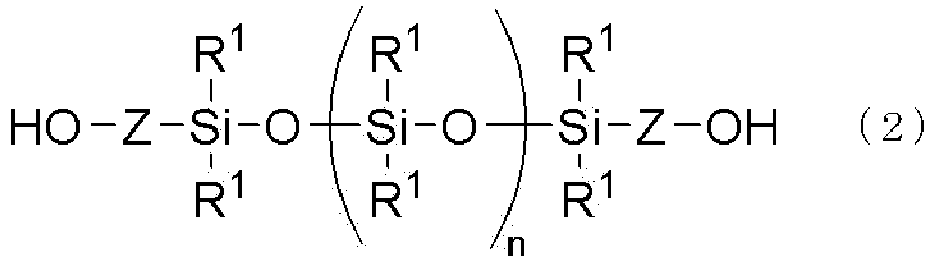
O=C=N-Y-N=C=O (3)
 wherein each of R1, X, Y, Z, and "n" is same as the above.
 - The method for producing the polyorganosiloxane according to claim 5, wherein a both-end carbinol-modified silicone having a hydroxyl value (OH value) of 10 to 500 mg KOH/g is used as the both-end carbinol-modified silicone represented by the formula (2).
- The method for producing the polyorganosiloxane according to claim 5 or 6, wherein the both-end carbinol-modified silicone represented by the formula (2) comprises hexamethylcyclotrisiloxane (D3), octamethylcyclotetrasiloxane (D4), decamethylcyclopentasiloxane (D5), and dodecamethylcyclohexasiloxane (D6) in a total amount equal to or less than 3,000 ppm.
- The method for producing the polyorganosiloxane according to any one of claims 5 to 7, wherein the reaction is performed such that a ratio of a number of moles of a hydroxyl group (OH) (mol OH) in the both-end carbinol-modified silicone represented by the formula (2) to a number of moles of an isocyanate group (NCO) (mol NCO) in the diisocyanate compound represented by the formula (3) (NCO/OH ratio) is 1.5 to 2.0.
Applications Claiming Priority (2)
| Application Number | Priority Date | Filing Date | Title |
|---|---|---|---|
| JP2021177863 | 2021-10-29 | ||
| PCT/JP2022/036187 WO2023074236A1 (en) | 2021-10-29 | 2022-09-28 | Polyorganosiloxane and method for producing same |
Publications (2)
| Publication Number | Publication Date |
|---|---|
| EP4424738A1 true EP4424738A1 (en) | 2024-09-04 |
| EP4424738A4 EP4424738A4 (en) | 2025-11-05 |
Family
ID=86159786
Family Applications (1)
| Application Number | Title | Priority Date | Filing Date |
|---|---|---|---|
| EP22886568.9A Pending EP4424738A4 (en) | 2021-10-29 | 2022-09-28 | POLYORGANOSILOXANE AND METHOD FOR PRODUCING IT |
Country Status (6)
| Country | Link |
|---|---|
| US (1) | US20250243318A1 (en) |
| EP (1) | EP4424738A4 (en) |
| JP (1) | JP7700256B2 (en) |
| KR (1) | KR20240089068A (en) |
| CN (1) | CN118215699A (en) |
| WO (1) | WO2023074236A1 (en) |
Families Citing this family (2)
| Publication number | Priority date | Publication date | Assignee | Title |
|---|---|---|---|---|
| JP7827273B2 (en) * | 2022-07-22 | 2026-03-10 | 信越化学工業株式会社 | Epoxy resin composition, epoxy resin cured product, and epoxy adhesive |
| JP2024075032A (en) * | 2022-11-22 | 2024-06-03 | 信越化学工業株式会社 | Epoxy resin composition |
Family Cites Families (11)
| Publication number | Priority date | Publication date | Assignee | Title |
|---|---|---|---|---|
| JPS63132931A (en) * | 1986-11-25 | 1988-06-04 | Toshiba Corp | Epoxy resin composition for sealing semiconductor |
| JP4288671B2 (en) * | 2004-03-31 | 2009-07-01 | 荒川化学工業株式会社 | Polyamideimide resin, methoxysilyl group-containing silane-modified polyamideimide resin, polyamideimide resin composition, cured film and metal foil laminate |
| JP2006265529A (en) * | 2005-02-28 | 2006-10-05 | Shin Etsu Chem Co Ltd | Room temperature curable organopolysiloxane composition |
| US8097741B2 (en) * | 2007-03-30 | 2012-01-17 | Ndsu Research Foundation | Hybrid coatings prepared from glycidyl carbamate resins |
| JP6554796B2 (en) | 2015-01-08 | 2019-08-07 | 信越化学工業株式会社 | Antifoam composition |
| JP2016028426A (en) | 2015-08-12 | 2016-02-25 | 日立化成株式会社 | Thermosetting resin composition for light reflection, optical semiconductor element mounting substrate using the same, manufacturing method thereof, and optical semiconductor device |
| JP6675847B2 (en) * | 2015-09-28 | 2020-04-08 | 理研ビタミン株式会社 | Water repellent for thermoplastic resin |
| WO2017151621A1 (en) * | 2016-02-29 | 2017-09-08 | Ndsu Research Foundation | Novel non-isocyanate siloxane-modified glycidyl carbamate resins and coatings containing them |
| WO2019176074A1 (en) | 2018-03-15 | 2019-09-19 | 日立化成株式会社 | Epoxy resin, epoxy resin composition, resin sheet, b-stage sheet, c-stage sheet, cured product, metal foil with resin, metal substrate, and power semiconductor device |
| JP2019059958A (en) | 2018-12-25 | 2019-04-18 | 三菱瓦斯化学株式会社 | Resin composition for printed wiring board, prepreg, laminate and printed wiring board |
| JP7092733B2 (en) * | 2019-10-30 | 2022-06-28 | 信越化学工業株式会社 | Amino-modified silicone emulsions, hair cosmetics and textile treatments |
-
2022
- 2022-09-28 KR KR1020247013723A patent/KR20240089068A/en active Pending
- 2022-09-28 JP JP2023556223A patent/JP7700256B2/en active Active
- 2022-09-28 CN CN202280071664.XA patent/CN118215699A/en active Pending
- 2022-09-28 US US18/702,880 patent/US20250243318A1/en active Pending
- 2022-09-28 WO PCT/JP2022/036187 patent/WO2023074236A1/en not_active Ceased
- 2022-09-28 EP EP22886568.9A patent/EP4424738A4/en active Pending
Also Published As
| Publication number | Publication date |
|---|---|
| JP7700256B2 (en) | 2025-06-30 |
| EP4424738A4 (en) | 2025-11-05 |
| CN118215699A (en) | 2024-06-18 |
| JPWO2023074236A1 (en) | 2023-05-04 |
| WO2023074236A1 (en) | 2023-05-04 |
| KR20240089068A (en) | 2024-06-20 |
| US20250243318A1 (en) | 2025-07-31 |
Similar Documents
| Publication | Publication Date | Title |
|---|---|---|
| US7026424B2 (en) | Organopolysiloxane/polyurea/polyurethane block copolymers | |
| US7153924B2 (en) | Organopolysiloxane/polyurea/polyurethane block copolymers | |
| KR101519459B1 (en) | Cross-linkable materials based on organyl oxysilane-terminated polymers | |
| US4476292A (en) | Castable polyurethane systems | |
| JP4221301B2 (en) | Crosslinkable polymer blends containing alkoxysilane-terminated polymers | |
| BR112012033615B1 (en) | method for producing a composition comprising a crosslinkable silane-terminated polymer, article and film | |
| JP7700256B2 (en) | Polyorganosiloxane and its manufacturing method | |
| US20200277445A1 (en) | Polysiloxane Urethane Compounds and Optically Transparent Adhesive Compositions | |
| JP2007217673A (en) | Thermosetting resin composition, the cured product, and various articles derived therefrom | |
| JP2024059565A (en) | Siloxane-modified polyurethane resin coating composition | |
| TW202449032A (en) | Polymers containing fluorene skeleton | |
| TW202112914A (en) | Dual curable silicone-organic hybrid resins | |
| EP1178069B1 (en) | A process for preparation of organosilicon compositions | |
| US8440770B2 (en) | Compositions comprising siloxane copolymers | |
| CN103797041A (en) | Improved process for making low viscosity, fast curing silane terminated polymers | |
| KR100945300B1 (en) | Additives for improving hydrolysis of polyurethane compounds, preparation methods thereof and polyurethane compositions using the same | |
| EP4357383B1 (en) | Siloxane-modified polyurethane resin coating composition | |
| JP2021130749A (en) | Terminal polymerizable polyorganosiloxane and manufacturing method thereof | |
| CN117903671A (en) | Siloxane-modified polyurethane resin coating composition | |
| JP7778167B2 (en) | Prepolymer composition, polyurethane resin, elastic molded article, and method for producing prepolymer composition | |
| CN114790293A (en) | Poly (siloxane-hetero thioether) dihydric alcohol, waterborne polyurethane and polyurethane elastomer and preparation method thereof | |
| EP3636677A1 (en) | Organic silicon compound-modified copolymer and urethane composition including same | |
| CN119775567A (en) | Polymers containing fluorene skeleton | |
| EP4624508A1 (en) | Epoxy resin composition | |
| CN120554646A (en) | A structurally controllable polydimethylsiloxane poly-ɛ-caprolactone block polymer diol and its preparation method |
Legal Events
| Date | Code | Title | Description |
|---|---|---|---|
| STAA | Information on the status of an ep patent application or granted ep patent |
Free format text: STATUS: THE INTERNATIONAL PUBLICATION HAS BEEN MADE |
|
| PUAI | Public reference made under article 153(3) epc to a published international application that has entered the european phase |
Free format text: ORIGINAL CODE: 0009012 |
|
| STAA | Information on the status of an ep patent application or granted ep patent |
Free format text: STATUS: REQUEST FOR EXAMINATION WAS MADE |
|
| 17P | Request for examination filed |
Effective date: 20240418 |
|
| AK | Designated contracting states |
Kind code of ref document: A1 Designated state(s): AL AT BE BG CH CY CZ DE DK EE ES FI FR GB GR HR HU IE IS IT LI LT LU LV MC MK MT NL NO PL PT RO RS SE SI SK SM TR |
|
| DAV | Request for validation of the european patent (deleted) | ||
| DAX | Request for extension of the european patent (deleted) | ||
| A4 | Supplementary search report drawn up and despatched |
Effective date: 20251006 |
|
| RIC1 | Information provided on ipc code assigned before grant |
Ipc: C08G 18/61 20060101AFI20250929BHEP Ipc: C08G 18/10 20060101ALI20250929BHEP Ipc: C08G 18/28 20060101ALI20250929BHEP |