EP4424567A1 - Motor vehicle and method for the reconfiguration of a passenger compartment of the motor vehicle - Google Patents
Motor vehicle and method for the reconfiguration of a passenger compartment of the motor vehicle Download PDFInfo
- Publication number
- EP4424567A1 EP4424567A1 EP24160666.4A EP24160666A EP4424567A1 EP 4424567 A1 EP4424567 A1 EP 4424567A1 EP 24160666 A EP24160666 A EP 24160666A EP 4424567 A1 EP4424567 A1 EP 4424567A1
- Authority
- EP
- European Patent Office
- Prior art keywords
- axis
- motor vehicle
- seat
- along
- passenger compartment
- Prior art date
- Legal status (The legal status is an assumption and is not a legal conclusion. Google has not performed a legal analysis and makes no representation as to the accuracy of the status listed.)
- Pending
Links
Images


Classifications
-
- G—PHYSICS
- G05—CONTROLLING; REGULATING
- G05G—CONTROL DEVICES OR SYSTEMS INSOFAR AS CHARACTERISED BY MECHANICAL FEATURES ONLY
- G05G1/00—Controlling members, e.g. knobs or handles; Assemblies or arrangements thereof; Indicating position of controlling members
- G05G1/30—Controlling members actuated by foot
- G05G1/36—Mounting units comprising an assembly of two or more pedals, e.g. for facilitating mounting
-
- B—PERFORMING OPERATIONS; TRANSPORTING
- B60—VEHICLES IN GENERAL
- B60K—ARRANGEMENT OR MOUNTING OF PROPULSION UNITS OR OF TRANSMISSIONS IN VEHICLES; ARRANGEMENT OR MOUNTING OF PLURAL DIVERSE PRIME-MOVERS IN VEHICLES; AUXILIARY DRIVES FOR VEHICLES; INSTRUMENTATION OR DASHBOARDS FOR VEHICLES; ARRANGEMENTS IN CONNECTION WITH COOLING, AIR INTAKE, GAS EXHAUST OR FUEL SUPPLY OF PROPULSION UNITS IN VEHICLES
- B60K26/00—Arrangement or mounting of propulsion-unit control devices in vehicles
- B60K26/02—Arrangement or mounting of propulsion-unit control devices in vehicles of initiating means or elements
-
- B—PERFORMING OPERATIONS; TRANSPORTING
- B60—VEHICLES IN GENERAL
- B60T—VEHICLE BRAKE CONTROL SYSTEMS OR PARTS THEREOF; BRAKE CONTROL SYSTEMS OR PARTS THEREOF, IN GENERAL; ARRANGEMENT OF BRAKING ELEMENTS ON VEHICLES IN GENERAL; PORTABLE DEVICES FOR PREVENTING UNWANTED MOVEMENT OF VEHICLES; VEHICLE MODIFICATIONS TO FACILITATE COOLING OF BRAKES
- B60T7/00—Brake-action initiating means
- B60T7/02—Brake-action initiating means for personal initiation
- B60T7/04—Brake-action initiating means for personal initiation foot actuated
- B60T7/06—Disposition of pedal
-
- B—PERFORMING OPERATIONS; TRANSPORTING
- B62—LAND VEHICLES FOR TRAVELLING OTHERWISE THAN ON RAILS
- B62D—MOTOR VEHICLES; TRAILERS
- B62D1/00—Steering controls, i.e. means for initiating a change of direction of the vehicle
- B62D1/02—Steering controls, i.e. means for initiating a change of direction of the vehicle vehicle-mounted
- B62D1/16—Steering columns
- B62D1/18—Steering columns yieldable or adjustable, e.g. tiltable
-
- B—PERFORMING OPERATIONS; TRANSPORTING
- B60—VEHICLES IN GENERAL
- B60K—ARRANGEMENT OR MOUNTING OF PROPULSION UNITS OR OF TRANSMISSIONS IN VEHICLES; ARRANGEMENT OR MOUNTING OF PLURAL DIVERSE PRIME-MOVERS IN VEHICLES; AUXILIARY DRIVES FOR VEHICLES; INSTRUMENTATION OR DASHBOARDS FOR VEHICLES; ARRANGEMENTS IN CONNECTION WITH COOLING, AIR INTAKE, GAS EXHAUST OR FUEL SUPPLY OF PROPULSION UNITS IN VEHICLES
- B60K26/00—Arrangement or mounting of propulsion-unit control devices in vehicles
- B60K26/02—Arrangement or mounting of propulsion-unit control devices in vehicles of initiating means or elements
- B60K2026/026—Adjusting of accelerator pedal positions
-
- B—PERFORMING OPERATIONS; TRANSPORTING
- B60—VEHICLES IN GENERAL
- B60Y—INDEXING SCHEME RELATING TO ASPECTS CROSS-CUTTING VEHICLE TECHNOLOGY
- B60Y2400/00—Special features of vehicle units
- B60Y2400/40—Actuators for moving a controlled member
- B60Y2400/41—Mechanical transmissions for actuators
- B60Y2400/412—Screw-nut mechanisms
Definitions
- the present invention relates to a motor vehicle and a method for the reconfiguration of a passenger compartment of the motor vehicle.
- motor vehicles comprise:
- the passenger compartment comprises a pair of front seats intended to be occupied by a driver and a passenger, respectively, and arranged side-by-side along a transverse direction of the motor vehicle orthogonal to a longitudinal direction defining a normal driving direction of the motor vehicle.
- the steering wheel and set of pedals are located in front of the driver's seat and substantially at a front left or right corner of the motor vehicle.
- passenger compartments are known to have the so-called 'single-seater' configuration.
- the passenger compartment comprises a single front seat positioned centrally in front of the steering wheel and the set of pedals.
- EP-A-3712035 discloses a steering assembly for a motor vehicle, in which a steering wheel can be moved to multiple positions for manual operation, in both manufacturing and use contexts.
- the object of the present invention is to provide a motor vehicle which allows the above-mentioned need to be met.
- the present invention also relates to a method for the reconfiguration of a passenger compartment of the motor vehicle as defined in claim 7.
- the numeral 1 indicates a motor vehicle comprising a body 2 defining a passenger compartment 3.
- the motor vehicle 1 further comprises ( Figure 6 ):
- the motor vehicle 1 further comprises ( Figure 1 ):
- the body 2 also comprises a pair of longitudinal, end door sills 23, 24, opposite each other.
- the door sills 23, 24 delimit the passenger compartment 3 and are adjacent to respective doors 8a, 8b when the doors 8a, 8b are in their closed positions.
- the motor vehicle 1 comprises control members 10 arranged in the passenger compartment 2 which can be operated by the driver to set a forward trajectory of the motor vehicle 1 at a desired speed.
- control members 10 comprise:
- the set of pedals 12 comprises ( Figures 2 to 5 ) :
- the base 13 defines a rectangular area 31 delimited at the rear by the edge 14b, at the front by an edge 32 parallel to the axis Y, and at the sides by a pair of portions of respective edges 15a, 15b extending between the edges 14b and 32.
- the edge 32 is interposed along the axis X between the edges 14a, 14b.
- the accelerator pedal 17 and the brake pedal 18 protrude cantilevered from the edge 32 of the base 13 upwards and into the passenger compartment 3.
- the gearbox 20 and the clutch pedal are not present.
- gearbox 20 is semi-automatic or automatic, the clutch pedal is not present.
- the control members 10 are connected to the engine and wheels 6 and/or 7 through a drive-by-wire mode, thus producing a technology known in the industry as ⁇ drive by wire' .
- ⁇ drive by wire' in the present description is intended to mean that the steering wheel 11 has no physical or mechanical connection to the wheels 6, 7.
- the accelerator pedal 17 has no physical or mechanical connection to the engine 9, and the brake pedal 18 has no mechanical connection to the braking system 21.
- the motor vehicle 1 also comprises a control unit 45 ( Figure 6 ) programmed to receive, as input, the operations requested from the steering wheel 11 and set of pedals 12 and to generate, as output, appropriate control signals for the engine 9 and the braking system 21.
- the passenger compartment 3 further comprises a front location 25 which defines a driver's seat.
- the location 25 is only schematically shown in Figure 1 .
- the passenger compartment 3 of the motor vehicle 1 is selectively movable, in a manner not described in detail because it is not necessary for the understanding of the present invention, between:
- the first seat is beside the door sill 23 and the second seat is beside the door sill 24, thus achieving a left-hand driving mode of the motor vehicle 1.
- the first seat faces the steering wheel 11 and the set of pedals 12 to allow the driver to operate the steering wheel 11 and the set of pedals 12.
- the third seat is arranged in a central position between the door sills 23, 24 and faces the steering wheel 11 and the set of pedals 12.
- the set of pedals 12 can be moved along the axis Y to enable the transformation of the motor vehicle 1 between the first and the second configuration.
- the set of pedals 12 is adjacent to the door sill 23 when it is in the first position. In this first position, a first distance between the set of pedals 12 and the door sill 23 is smaller than a second distance between the set of pedals 12 and the door sill 24. Said first and second distances are measured along the axis Y.
- the set of pedals 12 is in a central position between the door sills 23, 24 when it is in the second position. In this second position, the set of pedals 12 is equally spaced apart from the door sills 23, 24 along the axis Y.
- the passenger compartment 3 comprises a connection assembly 30 interposed between the set of pedals 12 and the body 3 and designed to enable the translation of the set of pedals 12 parallel to the axis Y between the first and the second position.
- connection assembly 30 in turn, comprises:
- the guide 50 is arranged in front of the guide 51.
- the slide 52 is arranged in front of the slide 53.
- the guides 50, 51 comprise:
- the slides 51, 52 are arranged at a bottom face 54 of the base 13.
- the accelerator pedal 17 and the brake pedal 18 are connected to the base 13 in a position interposed between the slides 51, 52 along the axis Y.
- the accelerator pedal 17 and the brake pedal 18 protrude outwards from a top face 65 of the base 13 opposite the face 54.
- the accelerator pedal 17 and the brake pedal 18 protrude outwards from the edge 32 of the base 13.
- the transmission assembly 56 in turn, comprises:
- the motor vehicle 1 further comprises a system for moving the steering wheel 11 parallel to the axis Y, which is not described in detail as it is not part of the present invention.
- the above-mentioned movement system is operable to cause the movement of the steering wheel 11 parallel to the axis Y between:
- the steering wheel 11 is adjacent to the door sill 23 when it is in the third position.
- the steering wheel 11 is in a central position between the door sills 23, 24 when it is in the fourth position.
- the operation of the motor vehicle 1 is described starting from a condition in which the passenger compartment 3 is in the 'two-seater' configuration.
- the location 25 defines the first seat for the driver and the second seat for a passenger arranged side-by-side parallel to the axis Y.
- the first seat is beside the door sill 23, and the second seat is beside the door sill 24 parallel to the axis Y.
- the set of pedals 12 and the steering wheel 11 are also arranged in the first and the third position, respectively, in which they face the first seat defined by the location 25 along the axis X.
- the first seat faces the steering wheel 11 and the set of pedals 12 along the axis X to allow the driver to operate the steering wheel 11 and the set of pedals 12 and thus control the forward trajectory and the speed of the motor vehicle 1.
- the operation of the electric motor 55 in the first direction causes the screw 60 to rotate around the axis Y and the consequent translation of the nut screw 61 parallel to the axis Y and in a direction from the door sill 23 to the door sill 24.
- the translation of the nut screw 61 causes the sliding of the slides 52, 53 on the respective guides 50, 51 and of the base 13 parallel to the axis Y and in a direction from the door sill 23 to the door sill 24.
- the set of pedals 12 is in a central position between the door sills 23, 24 when it is in the second position.
- the system for moving the steering wheel 11 is operated to cause the movement of the steering wheel 11 parallel to the axis Y until it reaches the fourth position.
- the steering wheel 11 is in a central position between the door sills 23, 24 and faces the third position defined by the location 25 when it is in the fourth position.
- the location 25 is reconfigured so as to only define the third seat for the driver, which is not necessary for the understanding of the present invention.
- the single third seat is arranged in a central position between the door sills 23, 24 and faces the steering wheel 11 and the set of pedals 12.
- the passenger compartment 3 is repositioned from the 'single-seater' configuration to the 'two-seater' configuration by simply operating the electric motor 55 in a second direction opposite the first direction, so as to return the set of pedals 12 to the first position.
- the steering wheel 11 is arranged into the third position and the location 25 is reconfigured to define the first seat for the driver and the second seat.
- the set of pedals 12 can be moved along the axis Y between the first and the second position, so that the passenger compartment 3 can be moved between the 'two-seater' configuration and the 'single-seater' configuration.
- the set of pedals 12 in the first position faces, along the axis X, the first seat for the driver defined by the location 25 adjacent to the door sill 23.
- the set of pedals 12 in the second position faces, along the axis X, the single third seat for the driver defined by the location 25 in a central position between the door sills 23, 24 along the axis Y.
- the motor 55 and the transmission assembly 56 formed by the screw 60 and the nut screw 61 ensure a fast and precise movement of the set of pedals 12 between the above-mentioned first and second positions.
- the first seat could be positioned facing the door sill 24 and the second seat could be positioned facing the door sill 24, thus achieving a right-hand driving mode of the motor vehicle 1.
Landscapes
- Engineering & Computer Science (AREA)
- Transportation (AREA)
- Mechanical Engineering (AREA)
- Chemical & Material Sciences (AREA)
- Combustion & Propulsion (AREA)
- Physics & Mathematics (AREA)
- General Physics & Mathematics (AREA)
- Automation & Control Theory (AREA)
- Auxiliary Drives, Propulsion Controls, And Safety Devices (AREA)
Abstract
Description
- This patent application claims priority from
Italian patent application no. 102023000003843 filed on March 3, 2023 - The present invention relates to a motor vehicle and a method for the reconfiguration of a passenger compartment of the motor vehicle.
- As is known, motor vehicles comprise:
- a passenger compartment defining a body;
- a plurality of wheels;
- a steering wheel arranged inside the passenger compartment and operable by a driver to steer the front wheels and therefore allow the vehicle to travel a curved trajectory; and
- a set of pedals comprising an accelerator and a brake which can be operated by the driver to increase the driving torque or to exert a braking torque, respectively, on the wheels in order to control the speed of the motor vehicle.
- Passenger compartments of motor vehicles normally intended for road use have the so-called 'two-seater' configuration.
- In this 'two-seater' configuration, the passenger compartment comprises a pair of front seats intended to be occupied by a driver and a passenger, respectively, and arranged side-by-side along a transverse direction of the motor vehicle orthogonal to a longitudinal direction defining a normal driving direction of the motor vehicle.
- The steering wheel and set of pedals are located in front of the driver's seat and substantially at a front left or right corner of the motor vehicle.
- With particular reference to sports cars, passenger compartments are known to have the so-called 'single-seater' configuration.
- In this 'single-seater' configuration, the passenger compartment comprises a single front seat positioned centrally in front of the steering wheel and the set of pedals.
- There is a need in the field for motor vehicles which allow easy and convenient reconfiguration between the above-mentioned 'single-seater' and 'two-seater' configurations.
-
EP-A-3712035 discloses a steering assembly for a motor vehicle, in which a steering wheel can be moved to multiple positions for manual operation, in both manufacturing and use contexts. - The object of the present invention is to provide a motor vehicle which allows the above-mentioned need to be met.
- Said object is achieved by the present invention, insofar as it relates to a motor vehicle as defined in claim 1.
- The present invention also relates to a method for the reconfiguration of a passenger compartment of the motor vehicle as defined in
claim 7. - In order to better understand the present invention, a non-limiting preferred embodiment thereof will now be described by way of example with reference to the accompanying drawings, in which:
-
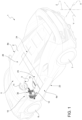
Figure 1 is a perspective view of a motor vehicle made according to the teachings of the present invention, with parts removed for clarity; -
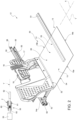
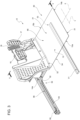
Figures 2 and3 are perspective views, according to a first visual angle, of a set of pedals of the motor vehicle shown inFigure 1 in a first and in a second operating position, respectively; -
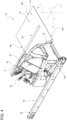
Figure 4 is a perspective view, according to a second visual angle, of a set of pedals of the motor vehicle shown inFigure 1 in the first operating position; -
Figure 5 is a section along the line V-V inFigure 3 ;
and -
Figure 6 is a functional diagram of some components of the motor vehicle shown inFigures 1 to 5 . - With reference to
Figure 1 , the numeral 1 indicates a motor vehicle comprising abody 2 defining apassenger compartment 3. - It should be specified that, below in this description, expressions such as "above", "below", "in front of", "behind" and the like are used with reference to the normal movement of the motor vehicle 1.
- The motor vehicle 1 further comprises (
Figure 6 ): - one pair of front wheels 6 and one pair of
rear wheels 7; - an
engine 9 of a known type, not shown in detail and operatively connected to the wheels 6 and/or 7 to exert a driving torque on the wheels 6 and/or 7; - a
gearbox 20 interposed between theengine 9 and the wheels 6 and/or 7, which can be operated to vary the transmission ratio between an output member of theengine 9 and thewheels 6, 7; and - a
braking system 21 which can be operated to exert a braking torque on thewheels 6, 7. - The motor vehicle 1 further comprises (
Figure 1 ): - a
windscreen 5 delimiting thepassenger compartment 3 at the front; - a backrest (not shown) delimiting the
passenger compartment 3 at the rear; - a
roof 26 delimiting thepassenger compartment 3 at the top; and - a pair of
doors body 2 and movable between a closed position, in which they delimit thepassenger compartment 3 at the sides and prevent entry into/exit from thepassenger compartment 3, and an open position, in which they allow entry into/exit from thepassenger compartment 3. - It is also possible to define:
- a longitudinal axis X integral with the motor vehicle 1, arranged, in use, horizontal and parallel to a normal forward moving direction of the motor vehicle 1;
- a transversal axis Y integral with the motor vehicle 1, arranged, in use, horizontal and orthogonal to the axis X; and
- an axis Z integral with the motor vehicle 1, arranged, in use, vertical and orthogonal to the axes X, Y.
- The
body 2 also comprises a pair of longitudinal,end door sills passenger compartment 3 and are adjacent torespective doors doors - In addition, the motor vehicle 1 comprises
control members 10 arranged in thepassenger compartment 2 which can be operated by the driver to set a forward trajectory of the motor vehicle 1 at a desired speed. - As is well known, the
control members 10 comprise: - a
steering wheel 11 arranged inside thepassenger compartment 2 and operable by the driver; and - a set of
pedals 12 also arranged inside thepassenger compartment 2 and operable by the driver. - The set of
pedals 12, in turn, comprises (Figures 2 to 5 ) : - a
support base 13 fixed to thebody 2 and having twoedges edges edges - an
accelerator pedal 17 protruding outwards from thebase 13 and operable from a released position to afull stroke position 16 in order to adjust the value of the driving torque generated by theengine 9; and - a
brake pedal 18 also protruding from thebase 13 and operable to exert an adjustable braking torque value generated by thebraking system 21 on the wheels 6 and/or 7. - In particular, the
base 13 defines arectangular area 31 delimited at the rear by theedge 14b, at the front by anedge 32 parallel to the axis Y, and at the sides by a pair of portions ofrespective edges edges - The
edge 32 is interposed along the axis X between theedges - In the case illustrated herein, the
accelerator pedal 17 and thebrake pedal 18 protrude cantilevered from theedge 32 of thebase 13 upwards and into thepassenger compartment 3. - If the
engine 9 is an electric engine, thegearbox 20 and the clutch pedal are not present. - If the
gearbox 20 is semi-automatic or automatic, the clutch pedal is not present. - The
control members 10 are connected to the engine and wheels 6 and/or 7 through a drive-by-wire mode, thus producing a technology known in the industry as `drive by wire' . - The term `drive by wire' in the present description is intended to mean that the
steering wheel 11 has no physical or mechanical connection to thewheels 6, 7. - Similarly, the
accelerator pedal 17 has no physical or mechanical connection to theengine 9, and thebrake pedal 18 has no mechanical connection to thebraking system 21. - The motor vehicle 1 also comprises a control unit 45 (
Figure 6 ) programmed to receive, as input, the operations requested from thesteering wheel 11 and set ofpedals 12 and to generate, as output, appropriate control signals for theengine 9 and thebraking system 21. - The
passenger compartment 3 further comprises afront location 25 which defines a driver's seat. - The
location 25 is only schematically shown inFigure 1 . - The
passenger compartment 3 of the motor vehicle 1 is selectively movable, in a manner not described in detail because it is not necessary for the understanding of the present invention, between: - a 'two-seater' configuration, in which the
location 25 defines a first seat for a driver and a second seat for a passenger arranged side-by-side along the axis Y; and - a 'single-seater' configuration, in which the
location 25 defines a single third seat for the driver. - In the 'two-seater' configuration, the first seat is beside the
door sill 23 and the second seat is beside thedoor sill 24, thus achieving a left-hand driving mode of the motor vehicle 1. In addition, the first seat faces thesteering wheel 11 and the set ofpedals 12 to allow the driver to operate thesteering wheel 11 and the set ofpedals 12. - In this 'single-seater' configuration, the third seat is arranged in a central position between the
door sills steering wheel 11 and the set ofpedals 12. - Advantageously, the set of
pedals 12 can be moved along the axis Y to enable the transformation of the motor vehicle 1 between the first and the second configuration. - In this way, the set of
pedals 12 can be moved parallel to the axis Y between: - a first position (
Figures 1 ,2 and4 ) taken on when thepassenger compartment 3 is in the first configuration, facing the first seat defined by thelocation 25; - a second position (
Figures 3 and5 ) taken on when thepassenger compartment 3 is in the second configuration, facing the third seat defined by the driving position. - The set of
pedals 12 is adjacent to thedoor sill 23 when it is in the first position. In this first position, a first distance between the set ofpedals 12 and thedoor sill 23 is smaller than a second distance between the set ofpedals 12 and thedoor sill 24. Said first and second distances are measured along the axis Y. - In greater detail, the set of
pedals 12 is in a central position between thedoor sills pedals 12 is equally spaced apart from thedoor sills - In addition, the
passenger compartment 3 comprises aconnection assembly 30 interposed between the set ofpedals 12 and thebody 3 and designed to enable the translation of the set ofpedals 12 parallel to the axis Y between the first and the second position. - The
connection assembly 30, in turn, comprises: - a pair of
guides body 3; - a pair of
slides base 13 of the set ofpedals 12 and slidable onrespective guides - an
electric motor 55 carried by theslide 52 and operable to convert, via atransmission assembly 56, the rotation of an output member of theelectric motor 55 around the axis Y into the sliding of theslides pedals 12 between the first and the second position. - The
guide 50 is arranged in front of theguide 51. - Similarly, the
slide 52 is arranged in front of theslide 53. - The
guides - respective first ends adjacent to the longitudinal
end door sill 23 of thebody 2; and - respective second ends opposite to corresponding first ends and arranged in a central position between the
door sills body 2. - The
slides bottom face 54 of thebase 13. - The
accelerator pedal 17 and thebrake pedal 18 are connected to the base 13 in a position interposed between theslides - The
accelerator pedal 17 and thebrake pedal 18 protrude outwards from atop face 65 of the base 13 opposite theface 54. - In particular, the
accelerator pedal 17 and thebrake pedal 18 protrude outwards from theedge 32 of thebase 13. - The
transmission assembly 56, in turn, comprises: - a
screw 60 carried by anoutput member 63 of themotor 55 and capable of rotating around the axis Y; and - a
nut screw 61 carried by theslide 52, constrained to thebody 3 so as to be angularly fixed around the axis Y and screwed onto thescrew 60 so as to be able to slide around the axis Y following the rotation of thescrew 60 around the axis Y. - The motor vehicle 1 further comprises a system for moving the
steering wheel 11 parallel to the axis Y, which is not described in detail as it is not part of the present invention. - In a nutshell, the above-mentioned movement system is operable to cause the movement of the
steering wheel 11 parallel to the axis Y between: - a third position (
Figures 1 ,2 and4 ) taken on when thepassenger compartment 3 is in the first configuration and the set ofpedals 12 is in the first position, facing the first seat defined by thelocation 25; and - a fourth position (
Figures 3 and5 ) taken on when thepassenger compartment 3 is in the second configuration and the set ofpedals 12 is in the second position, facing the third seat defined by thelocation 25. - The
steering wheel 11 is adjacent to thedoor sill 23 when it is in the third position. - The
steering wheel 11 is in a central position between thedoor sills - The operation of the motor vehicle 1 is described starting from a condition in which the
passenger compartment 3 is in the 'two-seater' configuration. - In this 'two-seater' configuration, the
location 25 defines the first seat for the driver and the second seat for a passenger arranged side-by-side parallel to the axis Y. - More precisely, the first seat is beside the
door sill 23, and the second seat is beside thedoor sill 24 parallel to the axis Y. - As shown in
Figures 1 ,2 and4 , the set ofpedals 12 and thesteering wheel 11 are also arranged in the first and the third position, respectively, in which they face the first seat defined by thelocation 25 along the axis X. - In addition, the first seat faces the
steering wheel 11 and the set ofpedals 12 along the axis X to allow the driver to operate thesteering wheel 11 and the set ofpedals 12 and thus control the forward trajectory and the speed of the motor vehicle 1. - If it is desired to reconfigure the motor vehicle 1 so as to arrange the
passenger compartment 3 into the `single-seater' configuration, it is sufficient to operate theelectric motor 55 in a first direction via a dedicated control and under certain operating conditions of the motor vehicle 1. - The operation of the
electric motor 55 in the first direction causes thescrew 60 to rotate around the axis Y and the consequent translation of thenut screw 61 parallel to the axis Y and in a direction from thedoor sill 23 to thedoor sill 24. - The translation of the
nut screw 61 causes the sliding of theslides door sill 23 to thedoor sill 24. - As a result, the set of
pedals 12 reaches the second position shown inFigure 3 in which it faces the third seat defined by the driving position. - More precisely, the set of
pedals 12 is in a central position between thedoor sills - The system for moving the
steering wheel 11 is operated to cause the movement of thesteering wheel 11 parallel to the axis Y until it reaches the fourth position. - The
steering wheel 11 is in a central position between thedoor sills location 25 when it is in the fourth position. - The
location 25 is reconfigured so as to only define the third seat for the driver, which is not necessary for the understanding of the present invention. - The single third seat is arranged in a central position between the
door sills steering wheel 11 and the set ofpedals 12. - At this point, the
passenger compartment 3 has taken on the 'single-seater' configuration. - The
passenger compartment 3 is repositioned from the 'single-seater' configuration to the 'two-seater' configuration by simply operating theelectric motor 55 in a second direction opposite the first direction, so as to return the set ofpedals 12 to the first position. - Subsequently or simultaneously, the
steering wheel 11 is arranged into the third position and thelocation 25 is reconfigured to define the first seat for the driver and the second seat. - The advantages enabled by the present invention will be apparent from an examination thereof.
- In greater detail, the set of
pedals 12 can be moved along the axis Y between the first and the second position, so that thepassenger compartment 3 can be moved between the 'two-seater' configuration and the 'single-seater' configuration. - In fact, the set of
pedals 12 in the first position faces, along the axis X, the first seat for the driver defined by thelocation 25 adjacent to thedoor sill 23. - Similarly, the set of
pedals 12 in the second position faces, along the axis X, the single third seat for the driver defined by thelocation 25 in a central position between thedoor sills - The
motor 55 and thetransmission assembly 56 formed by thescrew 60 and thenut screw 61 ensure a fast and precise movement of the set ofpedals 12 between the above-mentioned first and second positions. - Lastly, it is clear that modifications and variations may be made to the motor vehicle 1 and the reconfiguration method according to the present invention, without however departing from the scope of protection defined by the claims.
- In particular, in the 'two-seater' configuration, the first seat could be positioned facing the
door sill 24 and the second seat could be positioned facing thedoor sill 24, thus achieving a right-hand driving mode of the motor vehicle 1.
Claims (8)
- A motor vehicle (1) comprising:- a passenger compartment (3);- a plurality of driving members (10; 11, 12), which are housed inside said passenger compartment (3) and can be operated by a driver in order to control the trajectory and the speed of said motor vehicle (1);- at least one control member (6, 7, 9, 20, 21) connected to at least one driving member (10; 11, 12) through a drive by wire mode;said motor vehicle (1) being selectively available in:- a first configuration, wherein said passenger compartment (3) defines a first seat for a driver facing said control member (10; 11, 12) and a second seat for a passenger beside said first seat along a first axis (Y); and- a second configuration, wherein said passenger compartment (3) only defines a third seat for said driver;said first seat being arranged, in said first configuration, in a first position and the third seat being arranged, in said second configuration, in a second position spaced apart from said first position along said first axis (Y) ;characterized by the fact that said driving member (10; 11, 12) can be moved along said first axis (Y) in order to enable the transformation of said motor vehicle (1) between said first and second configurations;said driving member (10; 11, 12) being a set (12) of pedals comprising at least:- a first accelerator pedal (17); and- a second brake pedal (18).
- The motor vehicle according to claim 1, characterized by the fact that it comprises:- a body (2);- a first guide (50; 51) fixed to said body (2); and- a second slide (52; 53) fixed to said set (12) of pedals and coupled to said guide (50; 51) so as to slide relative to said first axis (Y).
- The motor vehicle according to claim 2, characterized by the fact that said set (12) of pedals comprises a base (13), to which said first brake pedal (18), said second accelerator pedal (17) and said first slide (52) are fixed;said motor vehicle (1) comprising:- a second guide (51; 50) fixed to said body (2) in a position spaced apart from said first guide (50; 51) along a second axis (X) orthogonal to said first axis (Y); and- a second slide (52; 53) fixed to said base (13) in a position spaced apart from said first slide (50; 51) along said second axis (X);said first brake pedal and said second accelerator pedal (18, 17) being fixed to said base (13) in a position interposed between said first and second slides (50; 51) along said second axis (X).
- The motor vehicle according to claim 3, characterized by the fact that it comprises:- a motor member (55) fixed to said second slide (52, 53) and comprising, in turn, an output shaft (63), which can rotate around an axis that is parallel to or coincident with said first axis (Y);- a first threaded element (60), which is angularly integral with said output shaft (63); and- a second threaded element (61), which is screwed onto said first threaded element (60) and is constrained so as to be capable of sliding together with said first slide (50; 51) on said first guide (52; 53), following the rotation of said first threaded element (60).
- The motor vehicle according to claim 4, characterized by the fact that said motor (55) is an electric motor.
- The motor vehicle according to any one of the preceding claims, characterized by the fact that said driving member (10; 11, 12) can be moved between a first position and a second position, which are spaced apart from one another along said first axis (Y);said body (2) comprising a first door sill (23) and a second door sill (24) extending along said second axis (X), which is parallel, in use, to a normal driving direction of said motor vehicle and is transversal to said first axis (Y) ;said first door sill (23) and said second door sill (24) being spaced apart from one another along said first axis (Y);said driving member (10; 11, 12) being arranged, in said first position, adjacent to said first door sill (23) and at a first distance from said first door sill (23) which is smaller than a second distance from said second door sill (24); said first and second distances being measured along said first axis (Y);said driving member (10; 11, 12) being arranged, in said second position, in a position equally spaced apart from said first and second door sills (23, 24) along said first axis (Y).
- A method for the reconfiguration of a passenger compartment (3) of a motor vehicle (1);said motor vehicle (1) comprising:- a passenger compartment (3);- a plurality of driving members (10; 11, 12), which are housed inside said passenger compartment (3) and can be operated by a driver in order to control the trajectory and the speed of said motor vehicle (1);- at least one control member (6, 7, 9, 20, 21) connected to at least one driving member (10; 11, 12) through a drive by wire mode;said method comprising the step i) of selectively putting said motor vehicle (1) in:- a first configuration, wherein said passenger compartment (3) defines a first seat for a driver facing said control member (10; 11, 12) and a second seat for a passenger beside said first seat along said first axis (Y); and- a second configuration, wherein said passenger compartment (3) only defines a third seat for said driver;said first seat being arranged, in said first configuration, in a first position and said third seat being arranged, in said second configuration, in a second position spaced apart from said first position along said first axis (Y) ;characterized by the fact that said step i) comprises the step ii) of moving said driving member (10; 11, 12) along said first axis (Y);said step ii) comprising the step iii) of moving a set (12) of pedals comprising at least:- a first accelerator pedal (17); and- a second brake pedal (18).
- The method according to claim 7, characterized by the fact that it comprises the steps of:iv) moving said driving member (10; 11, 12) between a first position and a second position, which are spaced apart from one another along said first axis (Y); said body (2) comprising a first door sill (23) and a second door sill (24) extending along a second axis (X), which is parallel, in use, to a normal driving direction of said motor vehicle and is transversal to said first axis (Y); said first door sill (23) and said second door sill being spaced apart from one another along said first axis (Y);v) placing said driving member (10; 11, 12), in said first position, adjacent to said first door sill (23) and at a first distance from said first door sill (23) which is smaller than a second distance from said second door sill (24); said first and second distances being measured along said first axis (Y);vi) placing said driving member (10; 11, 12), in said second position, in a position equally spaced apart from said first and second door sills (23, 24) along said first axis (Y).
Applications Claiming Priority (1)
| Application Number | Priority Date | Filing Date | Title |
|---|---|---|---|
| IT202300003843 | 2023-03-03 |
Publications (1)
| Publication Number | Publication Date |
|---|---|
| EP4424567A1 true EP4424567A1 (en) | 2024-09-04 |
Family
ID=86604130
Family Applications (1)
| Application Number | Title | Priority Date | Filing Date |
|---|---|---|---|
| EP24160666.4A Pending EP4424567A1 (en) | 2023-03-03 | 2024-02-29 | Motor vehicle and method for the reconfiguration of a passenger compartment of the motor vehicle |
Country Status (3)
| Country | Link |
|---|---|
| US (1) | US12391115B2 (en) |
| EP (1) | EP4424567A1 (en) |
| CN (1) | CN118578867A (en) |
Families Citing this family (1)
| Publication number | Priority date | Publication date | Assignee | Title |
|---|---|---|---|---|
| US20260086594A1 (en) * | 2024-09-26 | 2026-03-26 | Ford Global Technologies, Llc | Vehicle pedal assembly for left foot braking |
Citations (6)
| Publication number | Priority date | Publication date | Assignee | Title |
|---|---|---|---|---|
| US5218920A (en) * | 1988-12-28 | 1993-06-15 | Yamaha Hatsudoki Kabushiki Kaisha | Steering arrangement for small watercraft |
| CN107521548A (en) * | 2017-09-28 | 2017-12-29 | 鄂尔多斯市普渡科技有限公司 | A kind of movable direction disk of vehicle |
| US20200254906A1 (en) * | 2019-02-11 | 2020-08-13 | Byton North America Corporation | Sliding center module system for vehicle |
| EP3712035A2 (en) | 2019-03-20 | 2020-09-23 | Volvo Car Corporation | Vehicle having multiple driving positions |
| US20210078625A1 (en) * | 2019-09-17 | 2021-03-18 | Honda Motor Co., Ltd. | Vehicle control system |
| GB2598584A (en) * | 2020-09-02 | 2022-03-09 | Jaguar Land Rover Ltd | Adjustable user input system |
Family Cites Families (6)
| Publication number | Priority date | Publication date | Assignee | Title |
|---|---|---|---|---|
| US6450061B1 (en) * | 1999-09-23 | 2002-09-17 | Delphi Technologies, Inc. | Adjustable pedal system with misalignment sensor |
| US6364047B1 (en) * | 2000-09-27 | 2002-04-02 | Teleflex Incorporated | Adjustable pedal assembly—floating floor |
| US6431304B1 (en) * | 2001-01-31 | 2002-08-13 | International Truck Intellectual Property Company, L.L.C. | Three axis adjustable automotive foot controls |
| ITTO20040130A1 (en) * | 2004-03-02 | 2004-06-02 | Italdesign Giugiaro Spa | ADJUSTABLE CONTROL GROUP AND ADAPTABLE SEAT FOR VEHICLE |
| DE102005005511A1 (en) * | 2005-02-04 | 2006-08-10 | Jens Schauring | A vehicle for travel on road or rail has transversely adjustable and lockable driver's seat, possibly alongside another seat |
| KR20230028854A (en) * | 2021-08-23 | 2023-03-03 | 현대자동차주식회사 | Foldable pedal apparatus for vehicle |
-
2024
- 2024-02-29 EP EP24160666.4A patent/EP4424567A1/en active Pending
- 2024-02-29 US US18/591,602 patent/US12391115B2/en active Active
- 2024-03-04 CN CN202410244449.6A patent/CN118578867A/en active Pending
Patent Citations (6)
| Publication number | Priority date | Publication date | Assignee | Title |
|---|---|---|---|---|
| US5218920A (en) * | 1988-12-28 | 1993-06-15 | Yamaha Hatsudoki Kabushiki Kaisha | Steering arrangement for small watercraft |
| CN107521548A (en) * | 2017-09-28 | 2017-12-29 | 鄂尔多斯市普渡科技有限公司 | A kind of movable direction disk of vehicle |
| US20200254906A1 (en) * | 2019-02-11 | 2020-08-13 | Byton North America Corporation | Sliding center module system for vehicle |
| EP3712035A2 (en) | 2019-03-20 | 2020-09-23 | Volvo Car Corporation | Vehicle having multiple driving positions |
| US20210078625A1 (en) * | 2019-09-17 | 2021-03-18 | Honda Motor Co., Ltd. | Vehicle control system |
| GB2598584A (en) * | 2020-09-02 | 2022-03-09 | Jaguar Land Rover Ltd | Adjustable user input system |
Also Published As
| Publication number | Publication date |
|---|---|
| CN118578867A (en) | 2024-09-03 |
| US12391115B2 (en) | 2025-08-19 |
| US20240294067A1 (en) | 2024-09-05 |
Similar Documents
| Publication | Publication Date | Title |
|---|---|---|
| EP4424566A1 (en) | Motor vehicle and method for the reconfiguration of the motor vehicle | |
| DE102010023709B4 (en) | Vehicle training to improve low speed maneuverability | |
| EP4424567A1 (en) | Motor vehicle and method for the reconfiguration of a passenger compartment of the motor vehicle | |
| DE102019114702A1 (en) | Active body panels for rear pillars of a vehicle | |
| CN116902057A (en) | Steering column assembly with external translation and internal telescoping | |
| US11554647B1 (en) | Bars movable across vehicle door opening | |
| EP4276571A1 (en) | Control system for a road vehicle and relative control method | |
| US20030126941A1 (en) | Clutch pedal designed to equip a motor vehicle | |
| US11607936B1 (en) | Moveable crossmembers adjacent vehicle doors | |
| CN116890899A (en) | External translation and internal telescopic steering column assembly | |
| EP4516542A1 (en) | Car provided with an air conditioning system arranged behind the passenger compartment | |
| EP4494933A1 (en) | Cockpit for a motor vehicle and method for the reconfiguration of a cockpit | |
| EP4494931A1 (en) | Cockpit for a motor vehicle and method for the reconfiguration of a cockpit | |
| US20170291633A1 (en) | Adaptive front steering system for vehicle | |
| EP4335678A1 (en) | Road vehicle provided with a central aerodynamic channel and proper powertrain system | |
| EP4494932A1 (en) | Cockpit for a motor vehicle and method for the reconfiguration of a cockpit | |
| DE10207912A1 (en) | Steering for multi-axle vehicle, has actuation units with steering arrangements, steering wheel modules associated with driver, passenger seats; one actuation device can be prioritized | |
| EP4494930A1 (en) | Cockpit for a motor vehicle and method for the reconfiguration of a cockpit | |
| US20030146040A1 (en) | Dual-mode drive-by-wire steering system | |
| DE102016218035B3 (en) | snowcat | |
| US20050224272A1 (en) | Ergonomic vehicle control system | |
| CN120863730A (en) | Shan Zhidong device translation and telescopic steering column assembly | |
| EP4194238A1 (en) | Motor vehicle | |
| DE102011003259A1 (en) | Method for controlling braking operation of motor vehicle, involves controlling brake control unit of continuous braking device of motor vehicle | |
| KR0148666B1 (en) | Steering control mechanism that combines acceleration / deceleration and brake pedal |
Legal Events
| Date | Code | Title | Description |
|---|---|---|---|
| PUAI | Public reference made under article 153(3) epc to a published international application that has entered the european phase |
Free format text: ORIGINAL CODE: 0009012 |
|
| STAA | Information on the status of an ep patent application or granted ep patent |
Free format text: STATUS: THE APPLICATION HAS BEEN PUBLISHED |
|
| AK | Designated contracting states |
Kind code of ref document: A1 Designated state(s): AL AT BE BG CH CY CZ DE DK EE ES FI FR GB GR HR HU IE IS IT LI LT LU LV MC ME MK MT NL NO PL PT RO RS SE SI SK SM TR |
|
| STAA | Information on the status of an ep patent application or granted ep patent |
Free format text: STATUS: REQUEST FOR EXAMINATION WAS MADE |
|
| 17P | Request for examination filed |
Effective date: 20250123 |
|
| STAA | Information on the status of an ep patent application or granted ep patent |
Free format text: STATUS: EXAMINATION IS IN PROGRESS |
|
| 17Q | First examination report despatched |
Effective date: 20251027 |