EP4424180A1 - Odor-reducing aerosol generating article and aerosol generation system including same - Google Patents
Odor-reducing aerosol generating article and aerosol generation system including same Download PDFInfo
- Publication number
- EP4424180A1 EP4424180A1 EP23892787.5A EP23892787A EP4424180A1 EP 4424180 A1 EP4424180 A1 EP 4424180A1 EP 23892787 A EP23892787 A EP 23892787A EP 4424180 A1 EP4424180 A1 EP 4424180A1
- Authority
- EP
- European Patent Office
- Prior art keywords
- aerosol generating
- tobacco
- filter
- generating article
- total nitrogen
- Prior art date
- Legal status (The legal status is an assumption and is not a legal conclusion. Google has not performed a legal analysis and makes no representation as to the accuracy of the status listed.)
- Pending
Links
Images




Classifications
-
- A—HUMAN NECESSITIES
- A24—TOBACCO; CIGARS; CIGARETTES; SIMULATED SMOKING DEVICES; SMOKERS' REQUISITES
- A24B—MANUFACTURE OR PREPARATION OF TOBACCO FOR SMOKING OR CHEWING; TOBACCO; SNUFF
- A24B15/00—Chemical features or treatment of tobacco; Tobacco substitutes, e.g. in liquid form
- A24B15/10—Chemical features of tobacco products or tobacco substitutes
- A24B15/12—Chemical features of tobacco products or tobacco substitutes of reconstituted tobacco
-
- A—HUMAN NECESSITIES
- A24—TOBACCO; CIGARS; CIGARETTES; SIMULATED SMOKING DEVICES; SMOKERS' REQUISITES
- A24B—MANUFACTURE OR PREPARATION OF TOBACCO FOR SMOKING OR CHEWING; TOBACCO; SNUFF
- A24B15/00—Chemical features or treatment of tobacco; Tobacco substitutes, e.g. in liquid form
- A24B15/10—Chemical features of tobacco products or tobacco substitutes
- A24B15/16—Chemical features of tobacco products or tobacco substitutes of tobacco substitutes
-
- A—HUMAN NECESSITIES
- A24—TOBACCO; CIGARS; CIGARETTES; SIMULATED SMOKING DEVICES; SMOKERS' REQUISITES
- A24B—MANUFACTURE OR PREPARATION OF TOBACCO FOR SMOKING OR CHEWING; TOBACCO; SNUFF
- A24B15/00—Chemical features or treatment of tobacco; Tobacco substitutes, e.g. in liquid form
- A24B15/10—Chemical features of tobacco products or tobacco substitutes
- A24B15/16—Chemical features of tobacco products or tobacco substitutes of tobacco substitutes
- A24B15/167—Chemical features of tobacco products or tobacco substitutes of tobacco substitutes in liquid or vaporisable form, e.g. liquid compositions for electronic cigarettes
-
- A—HUMAN NECESSITIES
- A24—TOBACCO; CIGARS; CIGARETTES; SIMULATED SMOKING DEVICES; SMOKERS' REQUISITES
- A24D—CIGARS; CIGARETTES; TOBACCO SMOKE FILTERS; MOUTHPIECES OF CIGARS OR CIGARETTES; MANUFACTURE OF TOBACCO SMOKE FILTERS OR MOUTHPIECES
- A24D1/00—Cigars; Cigarettes
- A24D1/20—Cigarettes specially adapted for simulated smoking devices
-
- A—HUMAN NECESSITIES
- A24—TOBACCO; CIGARS; CIGARETTES; SIMULATED SMOKING DEVICES; SMOKERS' REQUISITES
- A24D—CIGARS; CIGARETTES; TOBACCO SMOKE FILTERS; MOUTHPIECES OF CIGARS OR CIGARETTES; MANUFACTURE OF TOBACCO SMOKE FILTERS OR MOUTHPIECES
- A24D3/00—Tobacco smoke filters, e.g. filter tips or filtering inserts; Filters specially adapted for simulated smoking devices; Mouthpieces of cigars or cigarettes
- A24D3/04—Tobacco smoke filters characterised by their shape or structure
- A24D3/048—Tobacco smoke filters characterised by their shape or structure containing additives
-
- A—HUMAN NECESSITIES
- A24—TOBACCO; CIGARS; CIGARETTES; SIMULATED SMOKING DEVICES; SMOKERS' REQUISITES
- A24D—CIGARS; CIGARETTES; TOBACCO SMOKE FILTERS; MOUTHPIECES OF CIGARS OR CIGARETTES; MANUFACTURE OF TOBACCO SMOKE FILTERS OR MOUTHPIECES
- A24D3/00—Tobacco smoke filters, e.g. filter tips or filtering inserts; Filters specially adapted for simulated smoking devices; Mouthpieces of cigars or cigarettes
- A24D3/06—Use of materials for tobacco smoke filters
Definitions
- the present disclosure relates to an aerosol generating article with a reduced odor and an aerosol generating system including the same.
- an aerosol generating device uses a method of electrically heating (so-called electrically steaming) a tobacco medium. Therefore, unpleasant odor not desired by a user, such as steam smell, not often recognized in the traditional cigarettes is generated.
- An object according to an embodiment of the present disclosure is to provide a blending combination of a tobacco medium for an aerosol generating article with a low total nitrogen content.
- Another object according to an embodiment of the present disclosure is to provide a filter for an aerosol generating article capable of reducing a transfer amount of an odor component.
- Another object according to an embodiment of the present disclosure is to provide an aerosol generating article including a tobacco medium for an aerosol generating article with a low total nitrogen content, and a filter for an aerosol generating article, and an aerosol generating system including the same.
- an aerosol generating article including a tobacco medium portion, and one or more filter portions,
- the tobacco medium portion includes a tobacco medium obtained by blending two or more types of leaf tobacco having a total nitrogen content of 2.5 wt% or less.
- an aerosol generating system including:
- the aerosol generating article and the aerosol generating system including the same may effectively reduce a transfer amount of total nitrogen compared to components in leaves such as nicotine or glycerin to reduce steam smell, thereby allowing a user to feel satisfaction of smoking more.
- a component which has the same common function as a component included in any one embodiment, will be described by using the same name in other embodiments. Unless disclosed to the contrary, the description of any one embodiment may be applied to other embodiments, and the specific description of the repeated configuration will be omitted.
- the "moisturizing agent” may refer to a substance capable of facilitating the formation of visible smoke and/or an aerosol.
- the moisturizing agent may include, for example, glycerin (GLY), propylene glycol (PG), ethylene glycol, dipropylene glycol, diethylene glycol, triethylene glycol, tetraethylene glycol, and oleyl alcohol, but is not limited thereto.
- GLY glycerin
- PG propylene glycol
- ethylene glycol dipropylene glycol
- diethylene glycol diethylene glycol
- triethylene glycol tetraethylene glycol
- oleyl alcohol oleyl alcohol
- an "aerosol forming material” may refer to a material that forms an aerosol.
- the aerosol may include a volatile compound.
- the aerosol forming material may be solid or liquid.
- the solid aerosol forming material may include, for example, solid materials based on tobacco raw materials such as cut tobacco leaves, tobacco granules, or reconstituted tobacco raw materials.
- the reconstituted tobacco may be divided into slurry-type reconstituted tobacco sheets and paper-like reconstituted tobacco sheets according to its manufacturing method.
- the liquid aerosol forming material may include a liquid composition based on nicotine, tobacco extracts, and/or various flavoring agents.
- the scope of the disclosure is not limited to these examples.
- the term "aerosol generating article” may refer to an aerosol forming material, that is, an article that accommodates a medium, in which an aerosol passes through the article and nicotine contained in the medium is transferred.
- a representative example of the aerosol generating article may be a cigarette.
- the scope of the disclosure is not limited thereto.
- the term "aerosol generating device” may refer to a device that generates an aerosol using an aerosol forming material to generate an aerosol that may be inhaled through the mouth of a user directly to the lungs of the user.
- upstream or “upstream direction” may refer to a direction away from the mouth of a user (smoker), and the term “downstream” or “downstream direction” may refer to a direction approaching the mouth of the user.
- upstream and downstream may be used to describe relative positions of components of an aerosol generating article.
- the term "puff” refers to inhalation by a user, and the inhalation refers to a situation in which a user draws in an aerosol into his or her oral cavity, nasal cavity, or lungs through the mouth or nose.
- FIG. 1 illustrates an aerosol generating system including an aerosol generating article and an aerosol generating device according to various embodiments of the present disclosure.
- the aerosol generating device may include at least one of a power source 11, a controller 12, a sensor 13, and a heater 14. At least one of the power source 11, the controller 12, the sensor 13, and the heater 14 may be disposed inside a body 10 of the aerosol generating device.
- the body 10 may provide an upward-opening space into which an aerosol generating article (stick) S is inserted.
- the upward-opening space may be referred to as an insertion space.
- the insertion space may be recessed by a predetermined depth toward the inside of the body 10 such that at least a portion of the aerosol generating article S may be inserted into the insertion space.
- the depth of the insertion space may correspond to a length of an area of the aerosol generating article S in which an aerosol generating material and/or a tobacco medium is included.
- a lower end of the aerosol generating article S may be inserted into the body 10, and an upper end of the aerosol generating article S may protrude outward from the body 10.
- a user may hold the upper end of the aerosol generating article S, which is exposed to the outside, in the mouth of the user and inhale air.
- the heater 14 may heat the aerosol generating article S.
- the heater 14 may be elongated upward in the space into which the aerosol generating article S is inserted.
- the heater 14 may include a tubular heating element, a plate-shaped heating element, a needle-shaped heating element, or a rod-shaped heating element.
- the heater 14 may be inserted into a lower portion of the aerosol generating article S.
- the heater 14 may include an electrically resistive heater and/or an induction heater.
- the heater 14 may be a resistive heater.
- the heater 14 may include an electrically conductive track, and the heater 14 may be heated as a current flows through the electrically conductive track.
- the heater 14 may be electrically connected to the power source 11.
- the heater 14 may directly generate heat by receiving a current from the power source 11.
- the heater 14 may be a multi-heater.
- the heater 14 may include a first heater 14A and a second heater 14B.
- the first and second heaters 14A and 14B may be disposed side by side in a longitudinal direction.
- the first and second heaters 14A and 14B may be heated sequentially or simultaneously.
- the aerosol generating device may include an induction coil surrounding the heater.
- the induction coil may heat the heater.
- the heater 14 may be heated by a magnetic field generated by an AC flowing through the induction coil.
- the magnetic field may pass through the heater and generate an eddy current in the heater.
- a current may generate heat in the heater.
- a susceptor may be included in the aerosol generating article, and the susceptor inside the aerosol generating article may be heated by the magnetic field generated by the AC flowing through the induction coil.
- the susceptor may be disposed inside the aerosol generating article and may not be electrically connected to the aerosol generating device.
- the susceptor may be inserted into the insertion space together with the aerosol generating article and may be removed from the insertion space together with the aerosol generating article.
- the aerosol generating article may be heated by the susceptor inside the aerosol generating article. At this time, the aerosol generating device may not include a heater.
- the power source 11 may supply power to operate the components of the aerosol generating device.
- the power source 11 may be referred to as a battery.
- the power source 11 may supply power to at least one of the controller 12, the sensor 13, or the heater 14.
- the power source 11 may supply power to the induction coil.
- the controller 12 may control the overall operation of the aerosol generating device.
- the controller may be mounted on a printed circuit board (PCB).
- the controller 12 may control the operation of at least one of the power source 11, the sensor 13, or the heater 14.
- the controller 12 may control the operation of the induction coil.
- the controller 12 may control the operation of a display, a motor, or the like installed in the aerosol generating device.
- the controller 12 may verify a state of each of the components of the aerosol generating device to determine whether the aerosol generating device is in an operable state.
- the controller 12 may analyze a sensing result obtained by the sensor 13 and may control processes to be performed thereafter. For example, based on the sensing result obtained by the sensor 13, the controller 12 may control the power supplied to the heater 14 to initiate or terminate the operation of the heater 14. For example, based on the sensing result obtained by the sensor 13, the controller 12 may control the amount of power supplied to the heater 14 and a time for which the power is supplied, such that the heater 14 may be heated to a predetermined temperature or maintained at an appropriate temperature.
- the sensor 13 may include at least one of a temperature sensor, a puff sensor, an insertion detection sensor, or an acceleration sensor.
- the sensor 13 may sense at least one of the temperature of the heater 14, the temperature of the power source 11, or the temperature inside and outside the body 10.
- the sensor 13 may sense a puff of the user.
- the sensor 13 may sense whether the aerosol generating article S is inserted into the insertion space.
- the sensor 13 may sense a motion of the aerosol generating device.
- FIG. 2 is a diagram schematically illustrating a structure of an aerosol generating article including a double composite filter containing activated carbon according to an embodiment of the present disclosure.
- an aerosol generating article may include a tobacco medium portion and a filter portion, and the filter portion may correspond to a double composite filter including a filter containing activated carbon and a filter containing cellulose acetate.
- the filter portion may further include a tube filter and a paper tube filter.
- the filter containing activated carbon may contain 6 to 12 mg of activated carbon, desirably 8 to 12 mg of activated carbon, more desirably 10 to 12 mg of activated carbon, most desirably 12 mg of activated carbon, particularly, super activated carbon (SAC).
- the filter according to an embodiment of the present disclosure contains the activated carbon in the range described above, it is possible to effectively reduce a transfer amount of a nitrogen compound that may cause odor, such as pyridine, pyrrole, 3-picoline, 3-vinylpyridine, 2-picoline, or 4-picoline, and the specific effects thereof will be described in detail with reference to the following embodiments.
- a nitrogen compound that may cause odor such as pyridine, pyrrole, 3-picoline, 3-vinylpyridine, 2-picoline, or 4-picoline
- the double composite filter may be divided into a filter containing activated carbon and a filter containing cellulose acetate. From a viewpoint of effectively reducing the transfer amount of total nitrogen, it is desirable that the filter portion is disposed on a lower end of the tobacco medium portion, and specifically, the filter containing activated carbon is disposed on an upper end of the filter containing cellulose acetate in the double composite filter.
- a length of the double composite filter may be 5 to 14 millimeters (mm), and desirably 12 mm.
- a length of each of the filter containing activated carbon and the filter containing cellulose acetate may be 5 to 7 mm, and desirably 6 mm.
- the filter portion may further include a paper filter treated with medium chain triglyceride (MCTG), and MCTG may be added and applied to an existing filter such as the double composite filter described above.
- MCTG medium chain triglyceride
- the aerosol generating article may be wrapped with at least one wrapper.
- the wrapper may have at least one hole (perforation) through which external air is introduced or internal gas flows out.
- the wrapper may include a material with high thermal conductivity.
- the tobacco medium portion may be wrapped with medium portion wrapping paper (tobacco plug wrapper), the double composite filter may be wrapped with acetate filter portion wrapping paper (filter plug wrapper), and the double composite filter and the tube filter may be additionally wrapped with tipping paper.
- the entire aerosol generating article may be wrapped again with a final outer cover (multi final wrapper).
- the at least one wrapper may be formed of porous wrapping paper, polylactic acid (PLA) laminated paper, sterilized paper, or the like.
- a porosity of the wrapper may be 35000 CU, but is not limited thereto.
- a thickness of the wrapper may be in a range of 60 ⁇ m to 100 ⁇ m.
- a basis weight of the wrapper may be in a range of 40 g/m 2 to 80 g/m 2 .
- the wrapper may include an aluminum component.
- the wrapper may be a combination of general filter wrapping paper and a metal foil such as aluminum foil.
- the tobacco medium portion may include a cavity, and the cavity may be filled with a tobacco medium.
- the tobacco medium may include leaf tobacco and an auxiliary material, and the auxiliary material may be a material formed of one or more of guar gum, pulp, glycerin, and casing.
- the casing may correspond to a type of fragrance commonly used in the industry.
- a content of the leaf tobacco and the auxiliary material constituting the tobacco medium may include 60 to 65 wt% of the leaf tobacco and 35 to 40 wt% of the auxiliary material with respect to a total weight of the tobacco medium.
- the tobacco medium filled in the tobacco medium portion may include leaf tobacco having a low total nitrogen content of 2.5 wt% or less, in order to reduce the transfer amount of total nitrogen in an aerosol, and the tobacco medium may be obtained by blending two or more types of the leaf tobacco having a low total nitrogen content described above.
- the leaf tobacco includes 15 to 20 parts by weight of Philippine flue-cured tobacco having a nicotine content in leaves of 2.40 to 2.60 wt% and a total nitrogen content of 2.20 to 2.40 wt%, 5 to 20 parts by weight of Philippine flue-cured tobacco having a nicotine content in leaves of 2.05 to 2.25 wt% and a total nitrogen content of 1.60 to 1.80 wt%, 0 to 20 parts by weight of Korean flue-cured tobacco having a nicotine content in leaves of 0.01 to 0.20 wt% and a total nitrogen content of 1.70 to 1.90 wt%, 5 to 15 parts by weight of Malawin flue-cured tobacco having a nicotine content in leaves of 2.05 to 2.25 wt% and a total nitrogen content of 2.05 to 2.25 wt%, and 0 to 20 parts by weight of Malawian flue-cured tobacco having a nicotine content in leaves of 2.80 to 3.00 wt% and a total nitrogen content of 2.15 to 2.35 wt%.
- the blending combination of the leaf tobacco described above may be considered as a combination effective for reducing the transfer amount of the total nitrogen.
- an average particle size of the tobacco medium may be 30 to 40 ⁇ m, and a proportion of particles having a particle size of 80 ⁇ m or less may be 90% or more of the total number of particles.
- Leaf tobacco shown in Table 1 below were selected as types of leaf tobacco having a total nitrogen content of 2.5 wt% or less, and they were blended according to a mixing ratio shown in Table 2 below to manufacture a tobacco medium. Meanwhile, Comparative Example 1 relates to currently used tobacco medium blending.
- a particle size distribution above represents a proportion of particles having a particle size of 80 ⁇ m or less.
- Example 2-1 Manufacture of aerosol generating article including filter containing activated carbon
- an acetate filter was manufactured using 6 mm of a filter containing 12 mg of activated carbon (SAC) and 6 mm of a cellulose acetate filter, and 12 mm of a tobacco medium portion containing the blended tobacco medium that is manufactured in Manufacturing Example 1 above, 10 mm of a tube filter, and 14 mm of a paper tube filter were included to manufacture an aerosol generating article using a wrapper.
- SAC activated carbon
- Example 2-2 Manufacture of aerosol generating article including filter not containing activated carbon
- An aerosol generating article was manufactured in the same manner as in Manufacturing Example 2-1, except that 12 mm of a cellulose acetate filter was manufactured without activated carbon.
- the aerosol components in each blending were analyzed by applying the tobacco medium manufactured in Manufacturing Example 1 to the aerosol generating article manufactured in each of Manufacturing Examples 2-1 and 2-2, and the results thereof were shown in Table 4 below.
- the results regarding nicotine and glycerin were shown in FIGS. 4A and 4B .
- Example 2-2 Classification Aerosol Collected Matter (ACM) Nicotine propylene glycol (PG) glycerin Triacetin (TA) Water Current Comparative Example 1 + Manufacturing Example 2-2 39.1 0.95 - 5.44 0.43 19.9 Comparative Example 1 + Manufacturing Example 2-1 35.7 0.69 - 4.81 - 18.2 Odor reduction blending Example 1 + Manufacturing Example 2-2 34.9 0.66 0.27 5.39 0.41 18.2 Example 1 + Manufacturing Example 2-1 34.8 0.51 0.21 4.75 0.03 17.2 Example 2 + Manufacturing Example 2-2 35.9 0.64 0.39 5.07 0.42 17.9 Example 2 + Manufacturing Example 2-1 36.2 0.49 0.28 5.00 0.05 19.1 Example 3 + Manufacturing Example 2-2 37.5 0.86 0.51 5.21 0.47 18.7 Example 3 + Manufacturing Example 2-1 37.0 0.62 0.38 5.16 0.06 18.9
- Example 2-1 Pyridine 4.56 2.55 1.79 2.40 1.63 3.30 2.07 Pyrrole 2.78 2.63 1.77 2.20 1.60 2.42 1.71 3-Picoline 0.36 0.27 - 0.25 - 0.34 - 2,4-Lutidine 0.12 - - 0.16 - 0.11 - 3-Vinylpyridin e 0.18 - - - - 0.21 0.12 Total 8.00 5.45 3.56 5.01 3.23 6.38 3.90 Reduction rate(%) - 31.9 55.5 37.5 59.7 20.3 51.3 • The unit of the transfer amount is ⁇ g.
- the transfer amount of total nitrogen decreases up to 38% in Examples 1 to 3 in which low-total nitrogen leaf tobacco having a total nitrogen content of 2.5 wt% or less. Accordingly, it is found that an odor reduction blended tobacco medium according to an embodiment of the present disclosure has an excellent effect of reducing steam smell.
- the transfer amount of total nitrogen may be reduced by 50% to 60%, and a significantly excellent effect of reducing the odor component (nitrogen compound) may be obtained.
- the tobacco medium of Example 2 and the double composite filter are applied, the harmony and balance are excellent, allowing the user to feel the satisfaction of smoking more.
- Aerosol generating system 23 Paper tube filter 10: Body of aerosol generating device 24: Acetate filter 11: Power source 241: Double composite filter 12: Controller 242: Activated carbon (12 mg) 13: Sensor 243: Acetate filter 14: Heater 25: Medium portion wrapping paper (Tobacco plug wrapper) 14A: First heater 14B: Second heater 26: Final outer cover (multi final wrapper) S: Aerosol generating article (stick) 27: Perforation 21: Medium (Tobacco) 28: Tipping paper 22: Tube filter (Hollow Tube) 29: Acetate filter portion wrapping paper (Filter plug wrapper)
Landscapes
- Chemical & Material Sciences (AREA)
- Chemical Kinetics & Catalysis (AREA)
- General Chemical & Material Sciences (AREA)
- Engineering & Computer Science (AREA)
- Materials Engineering (AREA)
- Cigarettes, Filters, And Manufacturing Of Filters (AREA)
- Manufacture Of Tobacco Products (AREA)
Abstract
The present disclosure relates to an aerosol generating article including a tobacco medium portion, and one or more filter portions, in which the tobacco medium portion includes a tobacco medium obtained by blending two or more types of leaf tobacco having a total nitrogen content of 2.5 wt% or less.
Description
- The present disclosure relates to an aerosol generating article with a reduced odor and an aerosol generating system including the same.
- Recently, demands for alternative articles to traditional cigarettes have increased. For example, there is an increasing demand for a device (e.g., a cigarette-type electronic cigarette) that generates an aerosol by electrically heating a cigarette stick. Accordingly, research on an electrically heated aerosol generating device and a cigarette stick (or an aerosol generating article) applied thereto is being conducted.
- However, unlike traditional cigarettes, an aerosol generating device uses a method of electrically heating (so-called electrically steaming) a tobacco medium. Therefore, unpleasant odor not desired by a user, such as steam smell, not often recognized in the traditional cigarettes is generated.
- Therefore, there is a need for a method of reducing odors such as steam smell, in an aerosol generating article and an aerosol generating system including the same.
- An object according to an embodiment of the present disclosure is to provide a blending combination of a tobacco medium for an aerosol generating article with a low total nitrogen content.
- Another object according to an embodiment of the present disclosure is to provide a filter for an aerosol generating article capable of reducing a transfer amount of an odor component.
- Another object according to an embodiment of the present disclosure is to provide an aerosol generating article including a tobacco medium for an aerosol generating article with a low total nitrogen content, and a filter for an aerosol generating article, and an aerosol generating system including the same.
- However, technical goals to be achieved are not limited to those described above, and other goals not mentioned above may be clearly understood by one of ordinary skill in the art from the following description.
- According to an embodiment of the present disclosure, there is provided an aerosol generating article including a tobacco medium portion, and one or more filter portions,
- wherein the tobacco medium portion includes a tobacco medium obtained by blending two or more types of leaf tobacco having a total nitrogen content of 2.5 wt% or less.
- According to another embodiment of the present disclosure, there is provided an aerosol generating system including:
- an aerosol generating article; and
- an aerosol generating device including a controller including at least one processor, a battery, a heater, and an elongated cavity accommodating the aerosol generating article,
- wherein the aerosol generating article includes a tobacco medium obtained by blending two or more types of leaf tobacco having a total nitrogen content of 2.5 wt% or less.
- The aerosol generating article and the aerosol generating system including the same according to an embodiment may effectively reduce a transfer amount of total nitrogen compared to components in leaves such as nicotine or glycerin to reduce steam smell, thereby allowing a user to feel satisfaction of smoking more.
- It should be understood that the effects of the present disclosure are not limited to the above-described effects, but are construed as including all effects that may be inferred from the configurations and features described in the following description or claims of the present disclosure.
- The accompanying drawings illustrate desired embodiments of the present disclosure and are provided together with the detailed description for better understanding of the technical idea of the present disclosure. Therefore, the present disclosure should not be construed as being limited to the embodiments set forth in the drawings.
-
FIG. 1 is diagram schematically illustrating an aerosol generating system in which an aerosol generating article is coupled to an aerosol generating device of an embodiment of the disclosure. -
FIG. 2 is a diagram schematically illustrating a structure of an aerosol generating article including a double composite filter containing activated carbon of an embodiment of the present disclosure. -
FIG. 3 illustrates contents of nicotine and total nitrogen components for each blending of a tobacco medium according to an embodiment of the present disclosure. -
FIG. 4A illustrates a total content of nicotine present in an aerosol for each aerosol generating article. -
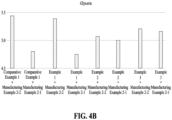
FIG. 4B illustrates a total content of glycerin present in an aerosol for each aerosol generating article. -
FIG. 5A illustrates a transfer amount reduction rate of a nitrogen compound for each aerosol generating article in each example compared to V1 (Comparative Example 1). -
FIG. 5B illustrates contents of nicotine and total nitrogen components in leaves and a content of an odor component (total nitrogen) in an aerosol for each aerosol generating article. - Hereinafter, embodiments will be described in detail with reference to the accompanying drawings. However, various alterations and modifications may be made to the embodiments and thus, the scope of the disclosure is not limited or restricted to the embodiments. The equivalents should be understood to include all changes, equivalents, and replacements within the idea and the technical scope of the disclosure.
- The terminology used herein is for the purpose of describing particular embodiments only and is not to be limiting of the embodiments. The singular forms "a," "an," and "the" are intended to include the plural forms as well, unless the context clearly indicates otherwise. It will be further understood that the terms "comprises/comprising" and/or "includes/including" when used herein, specify the presence of stated features, integers, steps, operations, elements, and/or components, but do not preclude the presence or addition of one or more other features, integers, steps, operations, elements, components and/or groups thereof.
- Unless otherwise defined, all terms including technical and scientific terms used herein have the same meaning as commonly understood by one of ordinary skill in the art to which the embodiments belong. It will be further understood that terms, such as those defined in commonly-used dictionaries, should be interpreted as having a meaning that is consistent with their meaning in the context of the relevant art and will not be interpreted in an idealized or overly formal sense unless expressly so defined herein.
- When describing the embodiments with reference to the accompanying drawings, like reference numerals refer to like components and a repeated description related thereto will be omitted. In the description of embodiments, detailed description of well-known related structures or functions will be omitted when it is deemed that such description will cause ambiguous interpretation of the present disclosure.
- Also, in the description of the components, terms such as first, second, A, B, (a), (b) or the like may be used herein when describing components of the present disclosure. These terms are used only for the purpose of discriminating one component from another component, and the nature, the sequences, or the orders of the components are not limited by the terms. It should be noted that if one component is described as being "connected," "coupled" or "joined" to another component, the former may be directly "connected," "coupled," and "joined" to the latter or "connected", "coupled", and "joined" to the latter via another component.
- A component, which has the same common function as a component included in any one embodiment, will be described by using the same name in other embodiments. Unless disclosed to the contrary, the description of any one embodiment may be applied to other embodiments, and the specific description of the repeated configuration will be omitted.
- It will be understood that when a certain part "includes" a certain component, the part does not exclude another component but may further include another component.
- In the following embodiments, the "moisturizing agent" may refer to a substance capable of facilitating the formation of visible smoke and/or an aerosol. The moisturizing agent may include, for example, glycerin (GLY), propylene glycol (PG), ethylene glycol, dipropylene glycol, diethylene glycol, triethylene glycol, tetraethylene glycol, and oleyl alcohol, but is not limited thereto. In the art, a moisturizing agent may be used interchangeably with a term such as an aerosol former, a humectant, or the like.
- In the following embodiments, an "aerosol forming material" may refer to a material that forms an aerosol. The aerosol may include a volatile compound. The aerosol forming material may be solid or liquid. The solid aerosol forming material may include, for example, solid materials based on tobacco raw materials such as cut tobacco leaves, tobacco granules, or reconstituted tobacco raw materials. The reconstituted tobacco may be divided into slurry-type reconstituted tobacco sheets and paper-like reconstituted tobacco sheets according to its manufacturing method. The liquid aerosol forming material may include a liquid composition based on nicotine, tobacco extracts, and/or various flavoring agents. However, the scope of the disclosure is not limited to these examples.
- In the following embodiments, the term "aerosol generating article" may refer to an aerosol forming material, that is, an article that accommodates a medium, in which an aerosol passes through the article and nicotine contained in the medium is transferred. A representative example of the aerosol generating article may be a cigarette. However, the scope of the disclosure is not limited thereto.
- In the following embodiments, the term "aerosol generating device" may refer to a device that generates an aerosol using an aerosol forming material to generate an aerosol that may be inhaled through the mouth of a user directly to the lungs of the user.
- In the following embodiments, the term "upstream" or "upstream direction" may refer to a direction away from the mouth of a user (smoker), and the term "downstream" or "downstream direction" may refer to a direction approaching the mouth of the user. The terms "upstream" and "downstream" may be used to describe relative positions of components of an aerosol generating article.
- In the following embodiments, the term "puff" refers to inhalation by a user, and the inhalation refers to a situation in which a user draws in an aerosol into his or her oral cavity, nasal cavity, or lungs through the mouth or nose.
-
FIG. 1 illustrates an aerosol generating system including an aerosol generating article and an aerosol generating device according to various embodiments of the present disclosure. - Referring to
FIG. 1 , according to embodiments of the present disclosure, the aerosol generating device may include at least one of apower source 11, acontroller 12, asensor 13, and aheater 14. At least one of thepower source 11, thecontroller 12, thesensor 13, and theheater 14 may be disposed inside abody 10 of the aerosol generating device. Thebody 10 may provide an upward-opening space into which an aerosol generating article (stick) S is inserted. The upward-opening space may be referred to as an insertion space. The insertion space may be recessed by a predetermined depth toward the inside of thebody 10 such that at least a portion of the aerosol generating article S may be inserted into the insertion space. The depth of the insertion space may correspond to a length of an area of the aerosol generating article S in which an aerosol generating material and/or a tobacco medium is included. A lower end of the aerosol generating article S may be inserted into thebody 10, and an upper end of the aerosol generating article S may protrude outward from thebody 10. A user may hold the upper end of the aerosol generating article S, which is exposed to the outside, in the mouth of the user and inhale air. - The
heater 14 may heat the aerosol generating article S. Theheater 14 may be elongated upward in the space into which the aerosol generating article S is inserted. For example, theheater 14 may include a tubular heating element, a plate-shaped heating element, a needle-shaped heating element, or a rod-shaped heating element. Theheater 14 may be inserted into a lower portion of the aerosol generating article S. Theheater 14 may include an electrically resistive heater and/or an induction heater. - For example, referring to
FIG. 1 , theheater 14 may be a resistive heater. For example, theheater 14 may include an electrically conductive track, and theheater 14 may be heated as a current flows through the electrically conductive track. Theheater 14 may be electrically connected to thepower source 11. Theheater 14 may directly generate heat by receiving a current from thepower source 11. - For example, the
heater 14 may be a multi-heater. Theheater 14 may include afirst heater 14A and asecond heater 14B. The first andsecond heaters second heaters - In another example, the aerosol generating device may include an induction coil surrounding the heater. The induction coil may heat the heater. As a susceptor, the
heater 14 may be heated by a magnetic field generated by an AC flowing through the induction coil. The magnetic field may pass through the heater and generate an eddy current in the heater. A current may generate heat in the heater. - In still another example, a susceptor may be included in the aerosol generating article, and the susceptor inside the aerosol generating article may be heated by the magnetic field generated by the AC flowing through the induction coil. The susceptor may be disposed inside the aerosol generating article and may not be electrically connected to the aerosol generating device. The susceptor may be inserted into the insertion space together with the aerosol generating article and may be removed from the insertion space together with the aerosol generating article. The aerosol generating article may be heated by the susceptor inside the aerosol generating article. At this time, the aerosol generating device may not include a heater.
- The
power source 11 may supply power to operate the components of the aerosol generating device. Thepower source 11 may be referred to as a battery. Thepower source 11 may supply power to at least one of thecontroller 12, thesensor 13, or theheater 14. Thepower source 11 may supply power to the induction coil. - The
controller 12 may control the overall operation of the aerosol generating device. The controller may be mounted on a printed circuit board (PCB). Thecontroller 12 may control the operation of at least one of thepower source 11, thesensor 13, or theheater 14. Thecontroller 12 may control the operation of the induction coil. Thecontroller 12 may control the operation of a display, a motor, or the like installed in the aerosol generating device. Thecontroller 12 may verify a state of each of the components of the aerosol generating device to determine whether the aerosol generating device is in an operable state. - The
controller 12 may analyze a sensing result obtained by thesensor 13 and may control processes to be performed thereafter. For example, based on the sensing result obtained by thesensor 13, thecontroller 12 may control the power supplied to theheater 14 to initiate or terminate the operation of theheater 14. For example, based on the sensing result obtained by thesensor 13, thecontroller 12 may control the amount of power supplied to theheater 14 and a time for which the power is supplied, such that theheater 14 may be heated to a predetermined temperature or maintained at an appropriate temperature. - The
sensor 13 may include at least one of a temperature sensor, a puff sensor, an insertion detection sensor, or an acceleration sensor. For example, thesensor 13 may sense at least one of the temperature of theheater 14, the temperature of thepower source 11, or the temperature inside and outside thebody 10. For example, thesensor 13 may sense a puff of the user. For example, thesensor 13 may sense whether the aerosol generating article S is inserted into the insertion space. For example, thesensor 13 may sense a motion of the aerosol generating device. -
FIG. 2 is a diagram schematically illustrating a structure of an aerosol generating article including a double composite filter containing activated carbon according to an embodiment of the present disclosure. - Referring to
FIG. 2 , an aerosol generating article according to an embodiment may include a tobacco medium portion and a filter portion, and the filter portion may correspond to a double composite filter including a filter containing activated carbon and a filter containing cellulose acetate. The filter portion may further include a tube filter and a paper tube filter. The filter containing activated carbon may contain 6 to 12 mg of activated carbon, desirably 8 to 12 mg of activated carbon, more desirably 10 to 12 mg of activated carbon, most desirably 12 mg of activated carbon, particularly, super activated carbon (SAC). When the filter according to an embodiment of the present disclosure contains the activated carbon in the range described above, it is possible to effectively reduce a transfer amount of a nitrogen compound that may cause odor, such as pyridine, pyrrole, 3-picoline, 3-vinylpyridine, 2-picoline, or 4-picoline, and the specific effects thereof will be described in detail with reference to the following embodiments. - The double composite filter may be divided into a filter containing activated carbon and a filter containing cellulose acetate. From a viewpoint of effectively reducing the transfer amount of total nitrogen, it is desirable that the filter portion is disposed on a lower end of the tobacco medium portion, and specifically, the filter containing activated carbon is disposed on an upper end of the filter containing cellulose acetate in the double composite filter.
- Meanwhile, a length of the double composite filter may be 5 to 14 millimeters (mm), and desirably 12 mm. A length of each of the filter containing activated carbon and the filter containing cellulose acetate may be 5 to 7 mm, and desirably 6 mm.
- In addition, the filter portion may further include a paper filter treated with medium chain triglyceride (MCTG), and MCTG may be added and applied to an existing filter such as the double composite filter described above.
- In an embodiment, the aerosol generating article may be wrapped with at least one wrapper. The wrapper may have at least one hole (perforation) through which external air is introduced or internal gas flows out. The wrapper may include a material with high thermal conductivity.
- For example, the tobacco medium portion may be wrapped with medium portion wrapping paper (tobacco plug wrapper), the double composite filter may be wrapped with acetate filter portion wrapping paper (filter plug wrapper), and the double composite filter and the tube filter may be additionally wrapped with tipping paper. In addition, the entire aerosol generating article may be wrapped again with a final outer cover (multi final wrapper).
- In an embodiment, the at least one wrapper may be formed of porous wrapping paper, polylactic acid (PLA) laminated paper, sterilized paper, or the like. For example, a porosity of the wrapper may be 35000 CU, but is not limited thereto. Also, a thickness of the wrapper may be in a range of 60 µm to 100 µm. Addion, a basis weight of the wrapper may be in a range of 40 g/m2 to 80 g/m2.
- For example, the wrapper may include an aluminum component. For example, the wrapper may be a combination of general filter wrapping paper and a metal foil such as aluminum foil.
- In an embodiment, the tobacco medium portion may include a cavity, and the cavity may be filled with a tobacco medium. The tobacco medium may include leaf tobacco and an auxiliary material, and the auxiliary material may be a material formed of one or more of guar gum, pulp, glycerin, and casing. The casing may correspond to a type of fragrance commonly used in the industry.
- A content of the leaf tobacco and the auxiliary material constituting the tobacco medium may include 60 to 65 wt% of the leaf tobacco and 35 to 40 wt% of the auxiliary material with respect to a total weight of the tobacco medium.
- Meanwhile, the tobacco medium filled in the tobacco medium portion may include leaf tobacco having a low total nitrogen content of 2.5 wt% or less, in order to reduce the transfer amount of total nitrogen in an aerosol, and the tobacco medium may be obtained by blending two or more types of the leaf tobacco having a low total nitrogen content described above. For example, the leaf tobacco includes 15 to 20 parts by weight of Philippine flue-cured tobacco having a nicotine content in leaves of 2.40 to 2.60 wt% and a total nitrogen content of 2.20 to 2.40 wt%, 5 to 20 parts by weight of Philippine flue-cured tobacco having a nicotine content in leaves of 2.05 to 2.25 wt% and a total nitrogen content of 1.60 to 1.80 wt%, 0 to 20 parts by weight of Korean flue-cured tobacco having a nicotine content in leaves of 0.01 to 0.20 wt% and a total nitrogen content of 1.70 to 1.90 wt%, 5 to 15 parts by weight of Tanzanian flue-cured tobacco having a nicotine content in leaves of 2.05 to 2.25 wt% and a total nitrogen content of 2.05 to 2.25 wt%, and 0 to 20 parts by weight of Malawian flue-cured tobacco having a nicotine content in leaves of 2.80 to 3.00 wt% and a total nitrogen content of 2.15 to 2.35 wt%.
- In general, even when the leaf tobacco has a low total nitrogen content, the transfer amount of the total nitrogen is not low. Accordingly, the blending combination of the leaf tobacco described above may be considered as a combination effective for reducing the transfer amount of the total nitrogen.
- In addition, in an embodiment, an average particle size of the tobacco medium may be 30 to 40 µm, and a proportion of particles having a particle size of 80 µm or less may be 90% or more of the total number of particles.
- Hereinafter, the configuration of the present disclosure and effects thereof will be described in more detail through examples and comparative examples. However, the examples are merely intended for the purpose of describing the disclosure in more detail, and thus, the scope of the disclosure is not limited to the examples.
- Leaf tobacco shown in Table 1 below were selected as types of leaf tobacco having a total nitrogen content of 2.5 wt% or less, and they were blended according to a mixing ratio shown in Table 2 below to manufacture a tobacco medium. Meanwhile, Comparative Example 1 relates to currently used tobacco medium blending.
[Table 1] Classification Leaf tobacco 1 Leaf tobacco 2Leaf tobacco 3Leaf tobacco 4Leaf tobacco 5 Country Philippines Philippines South Korea Tanzania Malawi Type Flue-cured tobacco Flue-cured tobacco Flue-cured tobacco Flue-cured tobacco Flue-cured tobacco Components in leaves (wt%) Nicotine 2.49 2.16 0.06 2.14 2.89 Total nitrogen 2.31 1.71 1.79 2.17 2.23 [Table 2] Classification Current Odor reduction blending Comparative Example 1 Example 1 Example 2 Example 3 Particle size (µm) (particle distribution %) 26 (97%) 34 (93%) 34 (93%) 34 (93%) Leaf tobacco (wt%) Leaf tobacco 123 16 20 20 Leaf tobacco 2 - 16 12 8 Leaf tobacco 3 - 20 16 - Leaf tobacco 4 - 8 10 15 Leaf tobacco 5 - - - 17 Expanded tobacco stem 10 - - - Other leaf tobacco 30 - - - Total 63 60 60 60 Auxiliary Guar gum, 5 5 5 5 material (wt%) Pulp 5 5 5 5 Glycerin 25 25 25 25 Casing 2 5 5 5 Total 100 100 100 100 - A particle size distribution above represents a proportion of particles having a particle size of 80 µm or less.
- As shown in
FIG. 2 below, an acetate filter was manufactured using 6 mm of a filter containing 12 mg of activated carbon (SAC) and 6 mm of a cellulose acetate filter, and 12 mm of a tobacco medium portion containing the blended tobacco medium that is manufactured in Manufacturing Example 1 above, 10 mm of a tube filter, and 14 mm of a paper tube filter were included to manufacture an aerosol generating article using a wrapper. - An aerosol generating article was manufactured in the same manner as in Manufacturing Example 2-1, except that 12 mm of a cellulose acetate filter was manufactured without activated carbon.
- The components in leaves in each blending (Comparative Example 1 and Examples 1 to 3) manufactured in Manufacturing Example 1 were analyzed and results thereof were shown in Table 3 below and
FIG. 3 .Table 3] Classification Nicotine Total sugar NO3 Chlorine Ammonia Total nitrogen Current Comparative Example 1 1.75 11.35 0.13 0.55 0.07 1.52 Odor reduction blending Example 1 1.12 12.24 0.11 0.40 0.08 1.34 Example 2 1.14 13.03 0.09 0.36 0.07 1.31 Example 3 1.58 12.44 0.09 0.42 0.07 1.47 • Unit is wt%. - Referring to Table 3 above, it is found that a total nitrogen content tends to increase as a content of nicotine in leaves increases.
- The aerosol components in each blending were analyzed by applying the tobacco medium manufactured in Manufacturing Example 1 to the aerosol generating article manufactured in each of Manufacturing Examples 2-1 and 2-2, and the results thereof were shown in Table 4 below. The results regarding nicotine and glycerin were shown in
FIGS. 4A and4B .Table 4] Classification Aerosol Collected Matter (ACM) Nicotine propylene glycol (PG) glycerin Triacetin (TA) Water Current Comparative Example 1 + Manufacturing Example 2-2 39.1 0.95 - 5.44 0.43 19.9 Comparative Example 1 + Manufacturing Example 2-1 35.7 0.69 - 4.81 - 18.2 Odor reduction blending Example 1 + Manufacturing Example 2-2 34.9 0.66 0.27 5.39 0.41 18.2 Example 1 + Manufacturing Example 2-1 34.8 0.51 0.21 4.75 0.03 17.2 Example 2 + Manufacturing Example 2-2 35.9 0.64 0.39 5.07 0.42 17.9 Example 2 + Manufacturing Example 2-1 36.2 0.49 0.28 5.00 0.05 19.1 Example 3 + Manufacturing Example 2-2 37.5 0.86 0.51 5.21 0.47 18.7 Example 3 + Manufacturing Example 2-1 37.0 0.62 0.38 5.16 0.06 18.9 - Referring to Table 4 and
FIGS. 4A and4B , it is found that, compared to a case of using only the cellulose acetate filter without the activated carbon double composite filter (Manufacturing Example 2-2), when an activated carbon double composite filter is used (Manufacturing Example 2-1), the contents of aerosol components such as nicotine and glycerin slightly decrease, and decrease of the content of glycerin is relatively smaller the decrease of the content of nicotine. - In addition, when comparing by blending, it is found that, when the blended tobacco media of Examples 1 to 3 are used, the content of nicotine decreases compared to the currently used blended tobacco medium of Comparative Example 1. It is found that the content of nicotine of Examples 1 and 2 shows a greater decrease, but the decrease of glycerin is greater in Example 1 than that in Example 2.
- In the same manner as in Experimental Example 4, the transfer amount of nitrogen components generated from the aerosol generating article was analyzed for each blending and filter, a reduction rate of total nitrogen content compared to Comparative Example 1 was calculated, and results thereof were shown in Table 5 below and
FIGS. 5A a and5B .[Table 51 Current Odor reduction blending Comparative Example 1 + Manufacturin g Example 2-2 Example 1 + Manufacturin g Example 2-2 Example 1 + Manufacturin g Example 2-1 Example 2 + Manufacturin g Example 2-2 Example 2 + Manufacturin g Example 2-1 Example 3 + Manufacturin g Example 2-2 Example 3 + Manufacturin g Example 2-1 Pyridine 4.56 2.55 1.79 2.40 1.63 3.30 2.07 Pyrrole 2.78 2.63 1.77 2.20 1.60 2.42 1.71 3-Picoline 0.36 0.27 - 0.25 - 0.34 - 2,4-Lutidine 0.12 - - 0.16 - 0.11 - 3-Vinylpyridin e 0.18 - - - - 0.21 0.12 Total 8.00 5.45 3.56 5.01 3.23 6.38 3.90 Reduction rate(%) - 31.9 55.5 37.5 59.7 20.3 51.3 • The unit of the transfer amount is µg. - Referring to Table 5 and
FIGS. 5A and5B , it is found that the transfer amount of total nitrogen decreases up to 38% in Examples 1 to 3 in which low-total nitrogen leaf tobacco having a total nitrogen content of 2.5 wt% or less. Accordingly, it is found that an odor reduction blended tobacco medium according to an embodiment of the present disclosure has an excellent effect of reducing steam smell. In addition, when a double composite filter containing 12 mg of activated carbon is applied to an aerosol generating article together with the tobacco medium described above, the transfer amount of total nitrogen may be reduced by 50% to 60%, and a significantly excellent effect of reducing the odor component (nitrogen compound) may be obtained. In particular, when the tobacco medium of Example 2 and the double composite filter are applied, the harmony and balance are excellent, allowing the user to feel the satisfaction of smoking more. - The descriptions of the above-described embodiments are merely examples, and it will be understood by one of ordinary skill in the art that various changes and equivalents may be made thereto. Therefore, the scope of the disclosure should be defined by the appended claims, and all differences within the scope equivalent to those described in the claims will be construed as being included in the scope of protection defined by the claims.
- The features and aspects of any embodiment(s) described above may be combined with features and aspects of any other embodiment(s) without resulting in apparent technical conflicts.
-
1: Aerosol generating system 23: Paper tube filter 10: Body of aerosol generating device 24: Acetate filter 11: Power source 241: Double composite filter 12: Controller 242: Activated carbon (12 mg) 13: Sensor 243: Acetate filter 14: Heater 25: Medium portion wrapping paper (Tobacco plug wrapper) 14A: First heater 14B: Second heater 26: Final outer cover (multi final wrapper) S: Aerosol generating article (stick) 27: Perforation 21: Medium (Tobacco) 28: Tipping paper 22: Tube filter (Hollow Tube) 29: Acetate filter portion wrapping paper (Filter plug wrapper)
Claims (15)
- An aerosol generating article comprising:a tobacco medium portion; andone or more filter portions,wherein the tobacco medium portion comprises a tobacco medium obtained by blending two or more types of leaf tobacco having a total nitrogen content of 2.5 wt% or less.
- The aerosol generating article of claim 1, wherein the tobacco medium is formed of:60 to 65 wt% of leaf tobacco; and35 wt% to 40 wt% of an auxiliary material consisting of one or more of guar gum, pulp, glycerin, and casing, with respect to a total weight of the tobacco medium.
- The aerosol generating article of claim 2, wherein the leaf tobacco is obtained by blending:15 to 20 parts by weight of Philippine flue-cured tobacco having a nicotine content in leaves of 2.40 to 2.60 wt% and a total nitrogen content of 2.20 to 2.40 wt%;5 to 20 parts by weight of Philippine flue-cured tobacco having a nicotine content in leaves of 2.05 to 2.25 wt% and a total nitrogen content of 1.60 to 1.80 wt%;0 to 20 parts by weight of Korean flue-cured tobacco having a nicotine content in leaves of 0.01 to 0.20 wt% and a total nitrogen content of 1.70 to 1.90 wt%;5 to 15 parts by weight of Tanzanian flue-cured tobacco having a nicotine content in leaves of 2.05 to 2.25 wt% and a total nitrogen content of 2.05 to 2.25 wt%; and0 to 20 parts by weight of Malawian flue-cured tobacco having a nicotine content in leaves of 2.80 to 3.00 wt% and a total nitrogen content of 2.15 to 2.35 wt%.
- The aerosol generating article of claim 1, whereinan average particle size of the tobacco medium is 30 to 40 µm, anda proportion of particles having a particle size of 80 µm or less is 90% or more.
- The aerosol generating article of claim 1, wherein the filter portion comprises a filter comprising cellulose acetate.
- The aerosol generating article of claim 5, wherein the filter portion further comprises activated carbon.
- The aerosol generating article of claim 6, wherein the filter portion is a double composite filter divided into a filter comprising activated carbon and a filter comprising cellulose acetate.
- The aerosol generating article of claim 7, wherein the double composite filter comprises 6 to 12 mg of activated carbon.
- The aerosol generating article of claim 8, whereinthe double composite filter has a length of 10 to 14 mm,the filter comprising the activated carbon has a length of 5 to 7 mm, andthe filter comprising cellulose acetate has a length of 5 to 7 mm.
- The aerosol generating article of claim 5, wherein the filter portion further comprises medium chain triglyceride (MCTG).
- The aerosol generating article of claim 1, wherein the filter portion further comprises one or more of a tube filter or a paper tube filter.
- An aerosol generating system comprising:an aerosol generating article; andan aerosol generating device comprising a controller comprising at least one processor, a battery, a heater, and an elongated cavity accommodating the aerosol generating article,
wherein the aerosol generating article comprises a tobacco medium obtained by blending two or more types of leaf tobacco having a total nitrogen content of 2.5 wt% or less. - The aerosol generating system of claim 12, wherein the tobacco medium portion is formed of:60 wt% of leaf tobacco obtained by blending 20 parts by weight of Philippine flue-cured tobacco having a nicotine content in leaves of 2.40 to 2.60 wt% and a total nitrogen content of 2.20 to 2.40 wt%; 16 parts by weight of Korean flue-cured tobacco having a nicotine content in leaves of 0.01 to 0.20 wt% and a total nitrogen content of 1.70 to 1.90 wt%; 12 parts by weight of Philippine flue-cured tobacco having a nicotine content in leaves of 2.05 to 2.25 wt% and a total nitrogen content of 1.60 to 1.80 wt%; and 10 parts by weight of Tanzanian flue-cured tobacco having a nicotine content in leaves of 2.05 to 2.25 wt% and a total nitrogen content of 2.05 to 2.25 wt%; and40 wt% of an auxiliary material consisting of one or more of guar gum, pulp, glycerin, and casing.
- The aerosol generating system of claim 12, whereinthe filter portion comprises a double composite filter formed of a filter comprising activated carbon and cellulose acetate, a paper tube filter, and a tube filter, andthe filter portion is disposed downstream of the tobacco medium portion.
- The aerosol generating system of claim 12, wherein the heater is a direct heating type, external heating type, or induction heating type heater.
Applications Claiming Priority (3)
| Application Number | Priority Date | Filing Date | Title |
|---|---|---|---|
| KR20220185773 | 2022-12-27 | ||
| KR1020230191294A KR20240105280A (en) | 2022-12-27 | 2023-12-26 | Aerosol generating article with reduced odor and aerosol generating system comprising thereof |
| PCT/KR2023/021636 WO2024144232A1 (en) | 2022-12-27 | 2023-12-27 | Odor-reducing aerosol generating article and aerosol generation system including same |
Publications (1)
| Publication Number | Publication Date |
|---|---|
| EP4424180A1 true EP4424180A1 (en) | 2024-09-04 |
Family
ID=91331106
Family Applications (1)
| Application Number | Title | Priority Date | Filing Date |
|---|---|---|---|
| EP23892787.5A Pending EP4424180A1 (en) | 2022-12-27 | 2023-12-27 | Odor-reducing aerosol generating article and aerosol generation system including same |
Country Status (3)
| Country | Link |
|---|---|
| EP (1) | EP4424180A1 (en) |
| JP (1) | JP7725790B2 (en) |
| WO (1) | WO2024144232A1 (en) |
Family Cites Families (12)
| Publication number | Priority date | Publication date | Assignee | Title |
|---|---|---|---|---|
| US6209547B1 (en) * | 1998-10-29 | 2001-04-03 | Philip Morris Incorporated | Cigarette filter |
| JP5570753B2 (en) * | 2008-07-08 | 2014-08-13 | 株式会社ダイセル | Filter material made of porous silica and cigarette filter using the same |
| JP5766934B2 (en) * | 2010-11-01 | 2015-08-19 | 株式会社ダイセル | Tobacco filter, method for producing the same, and tobacco |
| GB201110863D0 (en) * | 2011-06-27 | 2011-08-10 | British American Tobacco Co | Smoking article filter and insertable filter unit thereof |
| CN104223357B (en) * | 2013-06-18 | 2016-06-08 | 贝尔香精香料(上海)有限公司 | Green Tea Extract tobacco mellowing agent and preparation thereof, application in beating and double roasting leaves moisting |
| US20210244076A1 (en) * | 2018-10-29 | 2021-08-12 | Nerudia Limited | Smoking Substitute Consumable |
| KR20220076472A (en) * | 2019-10-08 | 2022-06-08 | 제이티 인터내셔널 소시에떼 아노님 | Aerosol-generating device with battery monitoring device |
| EP4076016B1 (en) * | 2019-12-18 | 2024-02-21 | Philip Morris Products S.A. | Sheet of a material containing alkaloids |
| KR102567135B1 (en) * | 2020-07-01 | 2023-08-18 | 주식회사 케이티앤지 | Reconstituted tobacco sheet including expanded tobacco stems and manufacturing method thereof, and a non-combustible type smoking article including the reconstituted tobacco sheet |
| KR102786560B1 (en) * | 2021-04-23 | 2025-03-26 | 주식회사 케이티앤지 | Filter, an aerosol-generating article comrising the same, and a method of manufacturing the filter |
| KR20240002243A (en) * | 2021-04-27 | 2024-01-04 | 니뽄 다바코 산교 가부시키가이샤 | Tobacco sheet for non-combustion heating type flavor inhaler, non-combustion heating type flavor inhaler, and non-combustion heating type flavor inhalation system |
| KR102640562B1 (en) * | 2021-05-20 | 2024-02-23 | 주식회사 케이티앤지 | Smoking article with reduced tobacco odor and manufacturing method thereof |
-
2023
- 2023-12-27 JP JP2024517434A patent/JP7725790B2/en active Active
- 2023-12-27 WO PCT/KR2023/021636 patent/WO2024144232A1/en not_active Ceased
- 2023-12-27 EP EP23892787.5A patent/EP4424180A1/en active Pending
Also Published As
| Publication number | Publication date |
|---|---|
| WO2024144232A1 (en) | 2024-07-04 |
| JP2025502912A (en) | 2025-01-30 |
| JP7725790B2 (en) | 2025-08-20 |
Similar Documents
| Publication | Publication Date | Title |
|---|---|---|
| RU2769811C2 (en) | Consumable product containing tobacco for aerosol-forming devices | |
| JP2023545973A (en) | Aerosol-generating articles with low density substrates | |
| JP2023164825A (en) | Articles for use in non-flammable aerosol delivery systems | |
| CN112739225B (en) | Externally heated aerosol generating device and cigarette for aerosol generating device | |
| JP7829325B2 (en) | Articles for use in non-flammable aerosol supply systems | |
| JP7280376B2 (en) | Aerosol delivery system | |
| JP2023162193A (en) | Aerosol delivery system | |
| CN111741689A (en) | Cigarettes and aerosol generating devices for cigarettes | |
| JP2023164824A (en) | Articles for use in non-flammable aerosol delivery systems | |
| CN111655050A (en) | Aerosol Generation System | |
| US20220256914A1 (en) | Aerosol-generating article including tobacco sheet and aerosol-generating system using the same | |
| JP2023153979A (en) | Aerosol delivery system | |
| JP7440194B2 (en) | Mouthpieces and articles for use in aerosol delivery systems | |
| WO2022074156A1 (en) | Aerosol-generating system with low resistance to draw and improved flavour delivery | |
| EP4226782A1 (en) | Aerosol-generating article and aerosol-generating device used therewith | |
| JP7856229B2 (en) | Aerosol generator with multiple cartridges | |
| JP7725790B2 (en) | Odor-reducing aerosol-generating article and aerosol-generating system including the same | |
| JP2022525091A (en) | Aerosol outbreak | |
| KR20240105280A (en) | Aerosol generating article with reduced odor and aerosol generating system comprising thereof | |
| CN118574523A (en) | Reduced odor aerosol-generating article and aerosol-generating system comprising same | |
| EP4585062A1 (en) | Smoking article including lyocell tow | |
| KR102716768B1 (en) | Aerosol generating article | |
| EP4585069A1 (en) | Smoking article including lyocell tow | |
| EP4585072A1 (en) | Smoking article including lyocell tow | |
| EP4173495A1 (en) | Tobacco rod, aerosol-generating article including same, and aerosol-generating device used therewith |
Legal Events
| Date | Code | Title | Description |
|---|---|---|---|
| STAA | Information on the status of an ep patent application or granted ep patent |
Free format text: STATUS: UNKNOWN |
|
| STAA | Information on the status of an ep patent application or granted ep patent |
Free format text: STATUS: THE INTERNATIONAL PUBLICATION HAS BEEN MADE |
|
| PUAI | Public reference made under article 153(3) epc to a published international application that has entered the european phase |
Free format text: ORIGINAL CODE: 0009012 |
|
| STAA | Information on the status of an ep patent application or granted ep patent |
Free format text: STATUS: REQUEST FOR EXAMINATION WAS MADE |
|
| 17P | Request for examination filed |
Effective date: 20240531 |
|
| AK | Designated contracting states |
Kind code of ref document: A1 Designated state(s): AL AT BE BG CH CY CZ DE DK EE ES FI FR GB GR HR HU IE IS IT LI LT LU LV MC ME MK MT NL NO PL PT RO RS SE SI SK SM TR |
|
| DAV | Request for validation of the european patent (deleted) | ||
| DAX | Request for extension of the european patent (deleted) |