EP4422127A1 - Network anomaly detection - Google Patents
Network anomaly detection Download PDFInfo
- Publication number
- EP4422127A1 EP4422127A1 EP23157824.6A EP23157824A EP4422127A1 EP 4422127 A1 EP4422127 A1 EP 4422127A1 EP 23157824 A EP23157824 A EP 23157824A EP 4422127 A1 EP4422127 A1 EP 4422127A1
- Authority
- EP
- European Patent Office
- Prior art keywords
- network data
- anomaly detection
- anomalous
- synthetic
- network
- Prior art date
- Legal status (The legal status is an assumption and is not a legal conclusion. Google has not performed a legal analysis and makes no representation as to the accuracy of the status listed.)
- Granted
Links
Images


Classifications
-
- H—ELECTRICITY
- H04—ELECTRIC COMMUNICATION TECHNIQUE
- H04L—TRANSMISSION OF DIGITAL INFORMATION, e.g. TELEGRAPHIC COMMUNICATION
- H04L63/00—Network architectures or network communication protocols for network security
- H04L63/14—Network architectures or network communication protocols for network security for detecting or protecting against malicious traffic
- H04L63/1408—Network architectures or network communication protocols for network security for detecting or protecting against malicious traffic by monitoring network traffic
- H04L63/1425—Traffic logging, e.g. anomaly detection
-
- H—ELECTRICITY
- H04—ELECTRIC COMMUNICATION TECHNIQUE
- H04L—TRANSMISSION OF DIGITAL INFORMATION, e.g. TELEGRAPHIC COMMUNICATION
- H04L63/00—Network architectures or network communication protocols for network security
- H04L63/14—Network architectures or network communication protocols for network security for detecting or protecting against malicious traffic
- H04L63/1441—Countermeasures against malicious traffic
-
- H—ELECTRICITY
- H04—ELECTRIC COMMUNICATION TECHNIQUE
- H04L—TRANSMISSION OF DIGITAL INFORMATION, e.g. TELEGRAPHIC COMMUNICATION
- H04L63/00—Network architectures or network communication protocols for network security
- H04L63/20—Network architectures or network communication protocols for network security for managing network security; network security policies in general
Definitions
- the present disclosure relates to network anomaly detection systems and methods of training network anomaly detection systems.
- Network anomaly detection systems such as Intrusion Detection Systems (IDSs) and Intrusion Prevention Systems (IPSs) are physical or virtual systems that monitor network traffic in computer networks in order to detect anomalous network activity such as network faults or malicious behaviour.
- IDSs Intrusion Detection Systems
- IPSs Intrusion Prevention Systems
- Anomalous patterns in network data can often be drowned out by normal, benign network traffic.
- traditional IDSs and IPSs work around heuristic rules that identify malicious behaviours based on identifying particular types of network traffic behaviour.
- such systems are susceptible to missing attacks that use stealthy techniques to evade detection.
- heuristic systems rely on knowledge of previously observed attacks in order to detect new attacks, which makes them ineffective at detecting attacks that exploit unknown vulnerabilities.
- a network anomaly detection system configured to: (i) generate synthetic benign network data and synthetic anomalous network data; (ii) combine the synthetic benign network data and synthetic anomalous network data to generate combined synthetic network data having a predetermined density of anomalous network data; (iii) provide the combined synthetic network data to a trained anomaly detection model; (iv) determine an accuracy score representative of how accurately the trained anomaly detection model recognises anomalous activity in the combined synthetic network data; and (v) responsive to determining that the accuracy score is less than a threshold value, train the anomaly detection model with additional network data and then repeat steps (iii)-(v), otherwise reduce the predetermined density of anomalous network data and repeat steps (ii)-(iv) until a predetermined stopping criterion is met.
- the network anomaly detection system of the first aspect is capable of detecting even the sparsest of anomalous traffic patterns.
- the anomaly could be any type of atypical network behaviour, such as a cyberattack/intrusion, hardware/software fault, excessive network load etc.
- the network anomaly detection system may be an intrusion detection system or an intrusion prevention system, and the anomalous network data may be malicious network data.
- Synthetic data refers to data that has been artificially generated rather than collected by observing real-world events.
- Benign network data (or network traffic data) refers to network traffic data in the absence of any anomalous or malicious activity.
- Anomalous network data refers to network traffic data in which a network is experiencing/undergoing an abnormal/anomalous behaviour, e.g. a network fault or cyberattack.
- the accuracy score may be any quantity capable of representing how accurately the trained anomaly detection model recognises anomalous activity in the combined synthetic network data.
- Various techniques could be used to determine the accuracy score, including a ratio of correct to total predictions, precision, recall or F1-score values.
- stopping criteria include reaching a predetermined minimum density of anomalous network data, reaching a predetermined number of iterations of the method, and reaching a predetermined time limit.
- Alternative stopping criteria could also be used, and multiple stopping criteria could be used simultaneously (e.g. the method could terminate when one or all of multiple stopping criteria are satisfied).
- Compliance with the stopping criterion could be assessed at any stage - for example it could be assessed prior to reducing the predetermined density of anomalous network data, or it could be assessed throughout the process.
- the anomaly detection model may be any suitable machine learning model.
- Various machine learning models could be used as the anomaly detection model, and the choice of model may depend upon factors such as cost/performance requirements and the type of anomaly or malware being detected.
- suitable models include logistical regression models, random forest models and deep learning models.
- the model may be trained using any suitable training technique, including supervised and/or unsupervised training methods using previously obtained network data, which may contain both benign and anomalous network data, optionally at varying densities.
- the synthetic benign network data may optionally be generated using a generative data model with real-world benign network data.
- suitable generative data models include variational autoencoders (VAEs) and generative adversarial networks (GANs).
- the predetermined stopping criterion may optionally be a predetermined minimum density of anomalous network data.
- the predetermined minimum density may be chosen based on the minimum expected density of anomalous network data in real-world network faults or cyberattacks.
- the additional network data preferably comprises anomalous network data.
- the additional network data may be real-world network data, synthetic network data, or a combination thereof.
- Training the anomaly detection model with additional network data may optionally comprise training the anomaly detection model with training data having the predetermined density of anomalous network data.
- the density of anomalous network data in the additional network data may optionally be equal to the predetermined density of anomalous network data in the combined synthetic network data. Training the training the anomaly detection model with training data having the predetermined density of anomalous network data ensures that the anomaly detection model becomes more effective at detecting anomalies (e.g. cyberattacks) having the predetermined density of anomalous network data.
- the network anomaly detection system may be further configured to use the anomaly detection model to detect anomalous activity in real network data subsequent to step (v).
- Real network data refers to real-world network traffic data (i.e. non-synthetic network data).
- the network anomaly detection system may further comprise an anomaly response system (such as an intrusion response system) configured to perform a mitigative action in response to detection of the anomalous activity.
- an anomaly response system such as an intrusion response system
- the mitigative action in question will depend upon the nature of the detected anomalous activity. Selection of an appropriate mitigation action could use any suitable technique, such as rule-based methods (e.g. using a lookup table), heuristic methods, or machine learning methods (e.g. using a machine learning intrusion response system).
- a computer-implemented method of training a network anomaly detection system comprising: (i) generating synthetic benign network data and synthetic anomalous network data; (ii) combining the synthetic benign network data and synthetic anomalous network data to generate combined synthetic network data having a predetermined density of anomalous network data; (iii) providing the combined synthetic network data to a trained anomaly detection model; (iv) determining an accuracy score representative of how accurately the trained anomaly detection model recognises anomalous activity in the combined synthetic network data; and (v) responsive to determining that the accuracy score is less than a threshold value, training the anomaly detection model with additional network data and then repeating steps (iii)-(v), otherwise reducing the predetermined density of anomalous network data and repeating steps (ii)-(iv) until a predetermined stopping criterion is met.
- the method of the second aspect corresponds to the method performed by the anomaly detection system (e.g. intrusion detection system) of the first aspect and provides corresponding benefits.
- the anomaly detection system e.g. intrusion detection system
- the synthetic benign network data may be generated by a generative data model using real-world benign network data.
- the predetermined stopping criterion may be a predetermined minimum density of anomalous network data.
- Training the anomaly detection model with additional network data may comprise training the anomaly detection model with training data having the predetermined density of anomalous network data.
- a computer-implemented anomaly detection method comprising: training an anomaly detection system (e.g. an intrusion detection system) using the method of any preceding method claim; and subsequent to training the anomaly detection system, using the anomaly detection system to detect anomalous activity in real network data.
- an anomaly detection system e.g. an intrusion detection system
- the method may further comprise performing a mitigative action in response to detecting the anomalous activity.
- the anomaly detection system of the first, second or third aspects may an intrusion detection system.
- the anomalous network data will be malicious network data (i.e. network traffic data when the network is experiencing a cyberattack)
- the anomalous activity will be malicious activity
- the anomaly detection model will be an intrusion detection model
- the anomaly response system will be an intrusion response system.
- a computer program comprising instructions which, when executed by a computer, cause the computer to carry out the steps of the second aspect.
- a computer readable carrier medium comprising the computer program of the fourth aspect.
- Cyber attackers are adopting increasingly stealthy approaches to gain access to networks in a highly covert manner. Attackers often achieve their goal by using behaviours (e.g. irregular network traffic patterns) that are neither obvious to a human analysing network logs nor effectively detected or prevented by intrusion detection systems (IDSs) and intrusion prevention systems (IPSs).
- IDSs intrusion detection systems
- IPSs intrusion prevention systems
- An existing method for creating an IDS is to apply machine learning (ML) on historical network traffic data that includes traffic data corresponding to malicious attacks. Whilst this technique can lead to accurate detection, it relies upon identifying similar patterns in live data, which rarely occurs in real-world attacks (especially when attackers employ stealthy tactics). In addition, such machine learning techniques also rely upon having an ample supply of training data containing examples of such malicious behaviour.
- ML machine learning
- the present invention improves the robustness of network anomaly detection systems, such as machine learning IDSs, by dynamically adjusting the density of anomalous behaviour in the training and test data.
- the training and test data are obtained from a combination of data generators and sources of real-world data from actual network anomalies (e.g. attacks), and the density is adjusted based on the performance of the ML model (i.e. how well the ML model detects anomalous behaviour from different test sets containing different densities of anomalous behaviour).
- This performance (represented by an accuracy score) provides an indication of how effective an ML model is depending at detecting varying densities of anomalous data such that additional training can be provided where necessary.
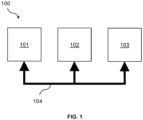
- FIG. 1 schematically illustrates an exemplary data processing apparatus 100 capable of performing any of the methods described herein.
- the data processing apparatus 100 may be an anomaly detection system (e.g. an intrusion detection/prevention system), or it may be another computing system on which an anomaly detection system (e.g. an intrusion detection/prevention system) is installed.
- the data processing apparatus 100 comprises a processor 101 operably coupled to both a memory 102 and an interface (I/O) 103 via a bus 104.
- I/O interface
- the memory 102 may optionally comprise computer program instructions which, when the program is executed by the processor 101, cause the data processing apparatus 100 to carry out any of the methods described herein.
- the interface 103 can optionally comprise one or both of a physical interface configured to receive a data carrier having such instructions stored thereon and a receiver configured to receive a data carrier signal carrying such instructions.
- the receiver when present, can be configured to receive messages. It can comprise one or more wireless receiver modules and/or one or more wired receiver modules.
- the interface 103 can optionally comprise a transmitter configured to transmit messages.
- the transmitter when present, can comprise one or more wireless transmitter modules and/or one or more wired transmitter modules.
- Generative data model 201 takes input from real-world network logs and generates synthetic (and preferably non-confidential) benign network data (i.e. data representative of normal/non-anomalous network traffic).
- the generative data model 201 could optionally be a variational autoencoder (VAE) or a generative adversarial network (GAN) or a combination therefore that learns what benign background traffic patterns look like in real-world traffic and then use this knowledge to generate similar synthetic benign network data mimicking the real-world benign network traffic.
- VAE variational autoencoder
- GAN generative adversarial network
- a subset of real-world network logs may optionally be part of the output from the generative data model 201.
- An attack simulation component 202 (such as the Keysight BreakingPoint System) is used generate synthetic malicious network data.
- the knowledge of these attack patterns may be derived from open-source or closed-source intelligence or a combination thereof.
- Open-source and closed-source intelligence sources provide not just network packet-level details of real-world attacks, but these sources also provide information regarding techniques or traffic patterns that attackers try and use to evade detection from heuristic or rule-based intrusion detection/prevention systems. While Figure 2 generates synthetic anomalous network data in the form of synthetic malicious network data, it should be understood that the same techniques apply more generally to all types of anomalous network data. Accordingly, the attack simulation component 202 could be replaced with a more general anomaly simulation component.
- Different attack variants ranging from high density to low density can then be generated by combining the synthetic benign network data generated by the generative data model 201 with the synthetic malicious network data generated by the attack simulation component 202.
- the varying density of malicious data in the generated combined synthetic network data facilitates the generation of a rich dataset with different possible scenarios that an attacker might make use of to penetrate into secure networks.
- the data generated by the generative data model 201 and the attack simulation component 202 could be combined in an iterative fashion starting from a very high density of attack data that might constitute a 9:1 attack to benign traffic ratio for instance to a very low density of attack data that might constitute 1:9 attack to benign traffic ratio for instance.
- the combined synthetic network data is fed into an anomaly detection model 203 (e.g. an intrusion detection model) that is initially trained on real-world network logs.
- an anomaly detection model 203 e.g. an intrusion detection model
- the type of anomaly detection model 203 used will depend upon the desired sophistication and the details of the type of malicious behaviour being detected, but the anomaly detection model 203 will generally be a machine learning model.
- the type of model used could range from logistical regression and random forests to models based on deep learning techniques.
- the performance of the anomaly detection model 203 is assessed using varying densities of attack data: the density of attack data in the combined synthetic network data is varied dynamically depending upon how the anomaly detection model 203 performs with progressively lower attack densities in the generated datasets.
- An accuracy score is determined for each synthetic dataset processed by the anomaly detection model 203, and the accuracy score is used to determine if there is a need for additional training/retraining the model before it is deployed in a real-world scenario.
- the accuracy score can be any suitable metric that represents the accuracy of the anomaly detection model 203 at detecting threats in the synthetic attack data.
- the accuracy score could be a ratio of correct to total predictions, or it may be based on precision, recall or F1-score values.
- the iterative training of the model with progressively lower density of attacks and monitoring the accuracy score allows the anomaly detection model 203 to be trained and tested in parallel until performance reaches the required threshold.
- a TCP SYN port scan attack is a common technique that is used by attackers to perform reconnaissance of a target network. This reconnaissance can help attackers obtain information about the target network, including details about hosts, operating systems, open ports and active services.
- a common technique to block such port scan attacks is using traditional intrusion detection/prevention systems to detect and block traffic patterns when a rule is triggered.
- Such traditional methods can fail when attackers use sufficiently stealthy evasion strategies or different variations of port scans like Fin Scan, Null scan or Xmas scan.
- the anomaly detection model 203 of the present invention can detect even the stealthiest of port scan attacks.
- the attack simulation component 202 When training the anomaly detection model 203 to detect TCP SYN port scan attacks, the attack simulation component 202 generates synthetic attack data based on gathered intelligence of different variants and evasion techniques that adversaries use to launch TCP SYN port scan attacks.
- the anomaly detection model 203 is initially trained on the real-world data, and it is then tested against TCP SYN port scan data generated by the generative data model 201 and the attack simulation component 202.
- synthetic data may be generated with an attack data packet rate (density) ranging from 0.1 pps (packets per second) to 1000 pps.
- the anomaly detection model 203 is then tested with successively sparser attack data.
- the test proceeds to the next densest dataset. Otherwise (e.g. if the accuracy score is below a predetermined threshold value) the anomaly detection model 203 will be retrained/provided with additional training (e.g. with real or synthetic training data having an attack data density equal to the density of the data which resulted in the insufficient accuracy score) and subsequently retested with new synthetic test data until the desired performance is achieved.
- additional training e.g. with real or synthetic training data having an attack data density equal to the density of the data which resulted in the insufficient accuracy score
- FIG. 3 shows a method for training a network anomaly detection system (e.g. the method performed using the intrusion detection framework shown in Figure 3 and described above).
- synthetic benign network data and synthetic anomalous network data are generated.
- the synthetic benign network data may be generated by a generative data model as described above, and it may be generated based on real-world (i.e. non synthetic) benign network data. Any suitable synthetic data generation technique may be used, such as a variational autoencoder (VAE) or a generative adversarial network (GAN) or a combination of the two.
- VAE variational autoencoder
- GAN generative adversarial network
- the synthetic anomalous network data may likewise be generated by any suitable technique, such as an attack simulation component as described above.
- the synthetic benign network data and synthetic anomalous network data are combined to generate combined synthetic network data having a predetermined density of anomalous network data.
- the predetermined density may be selected based on various factors such as an anticipated and/or desired performance of the network anomaly detection system.
- the combined synthetic network data is provided to a trained anomaly detection model (e.g. an intrusion detection model).
- a trained anomaly detection model e.g. an intrusion detection model
- Various machine learning models could be used as the anomaly detection model, and the choice of model may depend upon factors such as cost/performance requirements and the type of anomaly/malware being detected. Examples of suitable models include logistical regression models, random forest models and deep learning models.
- the model may be trained using any suitable training technique, including supervised and/or unsupervised training methods using previously obtained network data, which may contain both benign and anomalous network data, optionally at varying densities.
- an accuracy score is determined that is representative of how accurately the trained anomaly detection model recognises anomalous activity in the combined synthetic network data.
- Various techniques could be used to determine the accuracy score, including a ratio of correct to total predictions, precision, recall or F1-score values.
- the accuracy score can be any quantity capable of representing how accurately the trained anomaly detection model recognises anomalous activity in the combined synthetic network data.
- step 305 additional training is provided to the anomaly detection model in step 305.
- the training data used to provide the additional training may be real-world data or synthetic data, and it may optionally have an anomalous network data density equal to the predetermined density of anomalous network data (the model could optionally be trained using the combined synthetic network data generated in step 302).
- the method returns to step 303 so that an updated accuracy score can be determined for the anomaly detection model.
- Steps 301 and 302 may optionally be repeated prior to determining the updated accuracy score; this is especially important if the model has been trained using the previously generated synthetic data, because the model should not be tested using the same data used to train it.
- the predetermined density is reduced, and the method returns to step 302 in order to generate new combined synthetic network data having the updated (reduced) predetermined density of anomalous network data.
- the level of reduction may be predetermined (i.e. the method may iterate through a predetermined list of density values), or it may be reduced by a predetermined proportion (e.g. reduced by 10%, 50%, 90% etc.).
- Step 301 may optionally be repeated prior to generating the new combined synthetic data, although it is also possible to combine the previously generated synthetic network data at a new ratio.
- the method terminates when a predetermined stopping criterion is satisfied.
- stopping criteria include reaching a predetermined minimum density of anomalous network data, reaching a predetermined number of iterations of the method, and reaching a predetermined time limit.
- Alternative stopping criteria could also be used, and multiple stopping criteria could be used simultaneously (e.g. the method could terminate when one or all of multiple stopping criteria are satisfied).
- FIG 4 shows an anomaly detection method.
- an anomaly detection system e.g. an intrusion detection system
- the anomaly detection system is used to detect anomalous activity (e.g. malicious activity) in real-world network data.
- a mitigative action may be performed in response to detection of the anomalous activity.
- the mitigative action in question will depend upon the nature of the detected anomalous activity. Selection of an appropriate mitigation action could use any suitable technique, such as rule-based methods (e.g. using a lookup table), heuristic methods, or machine learning methods (e.g. using a machine learning intrusion response system).
- a software-controlled programmable processing device such as a microprocessor, digital signal processor or other processing device, data processing apparatus or system
- a computer program for configuring a programmable device, apparatus or system to implement the foregoing described methods is envisaged as an aspect of the present invention.
- Such a computer program may be embodied as source code or undergo compilation for implementation on a processing device, apparatus or system or may be embodied as object code, for example.
- Such a computer program may be encoded as executable instructions embodied in a carrier medium, non-transitory computer-readable storage device and/or a memory device in machine or device readable form, for example in volatile memory, non-volatile memory, solid-state memory, magnetic memory such as disk or tape, optically or magneto-optically readable memory such as magnetic tape, compact disk (CD), digital versatile disk (DVD) or other media that are capable of storing code and/or data.
- a computer program may alternatively or additionally be supplied from a remote source embodied in a communications medium such as an electronic signal, radio frequency carrier wave or optical carrier wave.
- a communications medium such as an electronic signal, radio frequency carrier wave or optical carrier wave.
- carrier media are also envisaged as aspects of the present invention.
- Such instructions when executed by a processor (or one or more computers, processors, and/or other devices) may cause the processor (the one or more computers, processors, and/or other devices) to perform at least a portion of the methods described herein.
- processor is referred to herein, this is to be understood to refer to a single processor or multiple processors operably connected to one another.
- memory is referred to herein, this is to be understood to refer to a single memory or multiple memories operably connected to one another.
- the methods and processes can also be partially or fully embodied in hardware modules or apparatuses or firmware, so that when the hardware modules or apparatuses are activated, they perform the associated methods and processes.
- the methods and processes can be embodied using a combination of code, data, and hardware modules or apparatuses.
- processing systems, environments, and/or configurations that may be suitable for use with the embodiments described herein include, but are not limited to, embedded computer devices, personal computers, server computers (specific or cloud (virtual) servers), hand-held or laptop devices, multiprocessor systems, microprocessor-based systems, set top boxes, programmable consumer electronics, mobile telephones, smartphones, tablets, network personal computers (PCs), minicomputers, mainframe computers, distributed computing environments that include any of the above systems or devices, and the like.
- Hardware modules or apparatuses described in this disclosure include, but are not limited to, application-specific integrated circuits (ASICs), field-programmable gate arrays (FPGAs), dedicated or shared processors, and/or other hardware modules or apparatuses.
- ASICs application-specific integrated circuits
- FPGAs field-programmable gate arrays
- dedicated or shared processors and/or other hardware modules or apparatuses.
- User devices can include, without limitation, static user devices such as PCs and mobile user devices such as smartphones, tablets, laptops and smartwatches.
- Receivers and transmitters as described herein may be standalone or may be comprised in transceivers.
- a communication link as described herein comprises at least one transmitter capable of transmitting data to at least one receiver over one or more wired or wireless communication channels. Wired communication channels can be arranged for electrical or optical transmission. Such a communication link can optionally further comprise one or more relaying transceivers.
- User input devices can include, without limitation, microphones, buttons, keypads, touchscreens, touchpads, trackballs, joysticks, mice, gesture control devices and brain control (e.g. electroencephalography, EEG) devices.
- User output devices can include, without limitation, speakers, buzzers, display screens, projectors, indicator lights, haptic feedback devices and refreshable braille displays.
- User interface devices can comprise one or more user input devices, one or more user output devices, or both.
Landscapes
- Engineering & Computer Science (AREA)
- Computer Security & Cryptography (AREA)
- Computer Hardware Design (AREA)
- Computing Systems (AREA)
- General Engineering & Computer Science (AREA)
- Computer Networks & Wireless Communication (AREA)
- Signal Processing (AREA)
- Data Exchanges In Wide-Area Networks (AREA)
Abstract
Description
- The present disclosure relates to network anomaly detection systems and methods of training network anomaly detection systems.
- Network anomaly detection systems, such as Intrusion Detection Systems (IDSs) and Intrusion Prevention Systems (IPSs), are physical or virtual systems that monitor network traffic in computer networks in order to detect anomalous network activity such as network faults or malicious behaviour.
- Anomalous patterns in network data can often be drowned out by normal, benign network traffic. For examples, traditional IDSs and IPSs work around heuristic rules that identify malicious behaviours based on identifying particular types of network traffic behaviour. However, such systems are susceptible to missing attacks that use stealthy techniques to evade detection. In addition, heuristic systems rely on knowledge of previously observed attacks in order to detect new attacks, which makes them ineffective at detecting attacks that exploit unknown vulnerabilities.
- There is a need for improved anomaly detection systems that are resilient to both stealthy attacks and attacks that exploit new vulnerabilities.
- According to a first aspect, there is provided a network anomaly detection system configured to: (i) generate synthetic benign network data and synthetic anomalous network data; (ii) combine the synthetic benign network data and synthetic anomalous network data to generate combined synthetic network data having a predetermined density of anomalous network data; (iii) provide the combined synthetic network data to a trained anomaly detection model; (iv) determine an accuracy score representative of how accurately the trained anomaly detection model recognises anomalous activity in the combined synthetic network data; and (v) responsive to determining that the accuracy score is less than a threshold value, train the anomaly detection model with additional network data and then repeat steps (iii)-(v), otherwise reduce the predetermined density of anomalous network data and repeat steps (ii)-(iv) until a predetermined stopping criterion is met.
- By training the anomaly detection model with a range of densities of anomalous network data, the network anomaly detection system of the first aspect is capable of detecting even the sparsest of anomalous traffic patterns.
- The anomaly could be any type of atypical network behaviour, such as a cyberattack/intrusion, hardware/software fault, excessive network load etc.
- The network anomaly detection system may be an intrusion detection system or an intrusion prevention system, and the anomalous network data may be malicious network data. Synthetic data refers to data that has been artificially generated rather than collected by observing real-world events. Benign network data (or network traffic data) refers to network traffic data in the absence of any anomalous or malicious activity. Anomalous network data (or network traffic data) refers to network traffic data in which a network is experiencing/undergoing an abnormal/anomalous behaviour, e.g. a network fault or cyberattack.
- The accuracy score may be any quantity capable of representing how accurately the trained anomaly detection model recognises anomalous activity in the combined synthetic network data. Various techniques could be used to determine the accuracy score, including a ratio of correct to total predictions, precision, recall or F1-score values.
- Any suitable stopping criterion may be used. Non-limiting examples of stopping criteria include reaching a predetermined minimum density of anomalous network data, reaching a predetermined number of iterations of the method, and reaching a predetermined time limit. Alternative stopping criteria could also be used, and multiple stopping criteria could be used simultaneously (e.g. the method could terminate when one or all of multiple stopping criteria are satisfied). Compliance with the stopping criterion could be assessed at any stage - for example it could be assessed prior to reducing the predetermined density of anomalous network data, or it could be assessed throughout the process.
- The anomaly detection model may be any suitable machine learning model. Various machine learning models could be used as the anomaly detection model, and the choice of model may depend upon factors such as cost/performance requirements and the type of anomaly or malware being detected. Examples of suitable models include logistical regression models, random forest models and deep learning models. The model may be trained using any suitable training technique, including supervised and/or unsupervised training methods using previously obtained network data, which may contain both benign and anomalous network data, optionally at varying densities.
- The synthetic benign network data may optionally be generated using a generative data model with real-world benign network data. Examples of suitable generative data models include variational autoencoders (VAEs) and generative adversarial networks (GANs).
- The predetermined stopping criterion may optionally be a predetermined minimum density of anomalous network data. For example, the predetermined minimum density may be chosen based on the minimum expected density of anomalous network data in real-world network faults or cyberattacks.
- The additional network data preferably comprises anomalous network data. The additional network data may be real-world network data, synthetic network data, or a combination thereof.
- Training the anomaly detection model with additional network data may optionally comprise training the anomaly detection model with training data having the predetermined density of anomalous network data. In other words, the density of anomalous network data in the additional network data may optionally be equal to the predetermined density of anomalous network data in the combined synthetic network data. Training the training the anomaly detection model with training data having the predetermined density of anomalous network data ensures that the anomaly detection model becomes more effective at detecting anomalies (e.g. cyberattacks) having the predetermined density of anomalous network data.
- The network anomaly detection system may be further configured to use the anomaly detection model to detect anomalous activity in real network data subsequent to step (v). Real network data refers to real-world network traffic data (i.e. non-synthetic network data).
- The network anomaly detection system may further comprise an anomaly response system (such as an intrusion response system) configured to perform a mitigative action in response to detection of the anomalous activity. The mitigative action in question will depend upon the nature of the detected anomalous activity. Selection of an appropriate mitigation action could use any suitable technique, such as rule-based methods (e.g. using a lookup table), heuristic methods, or machine learning methods (e.g. using a machine learning intrusion response system).
- According to a second aspect, there is provided a computer-implemented method of training a network anomaly detection system, the method comprising: (i) generating synthetic benign network data and synthetic anomalous network data; (ii) combining the synthetic benign network data and synthetic anomalous network data to generate combined synthetic network data having a predetermined density of anomalous network data; (iii) providing the combined synthetic network data to a trained anomaly detection model; (iv) determining an accuracy score representative of how accurately the trained anomaly detection model recognises anomalous activity in the combined synthetic network data; and (v) responsive to determining that the accuracy score is less than a threshold value, training the anomaly detection model with additional network data and then repeating steps (iii)-(v), otherwise reducing the predetermined density of anomalous network data and repeating steps (ii)-(iv) until a predetermined stopping criterion is met.
- The method of the second aspect corresponds to the method performed by the anomaly detection system (e.g. intrusion detection system) of the first aspect and provides corresponding benefits.
- The synthetic benign network data may be generated by a generative data model using real-world benign network data.
- The predetermined stopping criterion may be a predetermined minimum density of anomalous network data.
- Training the anomaly detection model with additional network data may comprise training the anomaly detection model with training data having the predetermined density of anomalous network data.
- According to a third aspect, there is provided a computer-implemented anomaly detection method comprising: training an anomaly detection system (e.g. an intrusion detection system) using the method of any preceding method claim; and subsequent to training the anomaly detection system, using the anomaly detection system to detect anomalous activity in real network data.
- The method may further comprise performing a mitigative action in response to detecting the anomalous activity.
- The anomaly detection system of the first, second or third aspects may an intrusion detection system. When the anomaly detection system is an intrusion detection system, the anomalous network data will be malicious network data (i.e. network traffic data when the network is experiencing a cyberattack), the anomalous activity will be malicious activity, the anomaly detection model will be an intrusion detection model, and the anomaly response system will be an intrusion response system.
- According to a fourth aspect, there is provided a computer program comprising instructions which, when executed by a computer, cause the computer to carry out the steps of the second aspect.
- A computer readable carrier medium comprising the computer program of the fourth aspect.
- Aspects of the present disclosure will now be described by way of example with reference to the accompanying figures, in which:
-
Figure 1 is a schematic of a data processing apparatus; -
Figure 2 is a schematic of an anomaly detection framework; -
Figure 3 is a flowchart of a method for training an anomaly detection system; and -
Figure 4 is a flowchart of a method for detecting anomalous network activity. - Network faults and cyberattacks can be difficult to detect. Cyber attackers are adopting increasingly stealthy approaches to gain access to networks in a highly covert manner. Attackers often achieve their goal by using behaviours (e.g. irregular network traffic patterns) that are neither obvious to a human analysing network logs nor effectively detected or prevented by intrusion detection systems (IDSs) and intrusion prevention systems (IPSs).
- An existing method for creating an IDS is to apply machine learning (ML) on historical network traffic data that includes traffic data corresponding to malicious attacks. Whilst this technique can lead to accurate detection, it relies upon identifying similar patterns in live data, which rarely occurs in real-world attacks (especially when attackers employ stealthy tactics). In addition, such machine learning techniques also rely upon having an ample supply of training data containing examples of such malicious behaviour.
- The present invention improves the robustness of network anomaly detection systems, such as machine learning IDSs, by dynamically adjusting the density of anomalous behaviour in the training and test data. The training and test data are obtained from a combination of data generators and sources of real-world data from actual network anomalies (e.g. attacks), and the density is adjusted based on the performance of the ML model (i.e. how well the ML model detects anomalous behaviour from different test sets containing different densities of anomalous behaviour). This performance (represented by an accuracy score) provides an indication of how effective an ML model is depending at detecting varying densities of anomalous data such that additional training can be provided where necessary.
-
Figure 1 schematically illustrates an exemplarydata processing apparatus 100 capable of performing any of the methods described herein. Thedata processing apparatus 100 may be an anomaly detection system (e.g. an intrusion detection/prevention system), or it may be another computing system on which an anomaly detection system (e.g. an intrusion detection/prevention system) is installed. Thedata processing apparatus 100 comprises aprocessor 101 operably coupled to both amemory 102 and an interface (I/O) 103 via abus 104. - The
memory 102 may optionally comprise computer program instructions which, when the program is executed by theprocessor 101, cause thedata processing apparatus 100 to carry out any of the methods described herein. Alternatively or additionally, theinterface 103 can optionally comprise one or both of a physical interface configured to receive a data carrier having such instructions stored thereon and a receiver configured to receive a data carrier signal carrying such instructions. - The receiver, when present, can be configured to receive messages. It can comprise one or more wireless receiver modules and/or one or more wired receiver modules. The
interface 103 can optionally comprise a transmitter configured to transmit messages. The transmitter, when present, can comprise one or more wireless transmitter modules and/or one or more wired transmitter modules. - A schematic of an exemplary anomalous detection framework is illustrated in
Figure 2 .Generative data model 201 takes input from real-world network logs and generates synthetic (and preferably non-confidential) benign network data (i.e. data representative of normal/non-anomalous network traffic). Thegenerative data model 201 could optionally be a variational autoencoder (VAE) or a generative adversarial network (GAN) or a combination therefore that learns what benign background traffic patterns look like in real-world traffic and then use this knowledge to generate similar synthetic benign network data mimicking the real-world benign network traffic. To ensure that the model is based on the real-world, a subset of real-world network logs may optionally be part of the output from thegenerative data model 201. - An attack simulation component 202 (such as the Keysight BreakingPoint System) is used generate synthetic malicious network data. The knowledge of these attack patterns may be derived from open-source or closed-source intelligence or a combination thereof. Open-source and closed-source intelligence sources provide not just network packet-level details of real-world attacks, but these sources also provide information regarding techniques or traffic patterns that attackers try and use to evade detection from heuristic or rule-based intrusion detection/prevention systems. While
Figure 2 generates synthetic anomalous network data in the form of synthetic malicious network data, it should be understood that the same techniques apply more generally to all types of anomalous network data. Accordingly, theattack simulation component 202 could be replaced with a more general anomaly simulation component. - Different attack variants ranging from high density to low density can then be generated by combining the synthetic benign network data generated by the
generative data model 201 with the synthetic malicious network data generated by theattack simulation component 202. The varying density of malicious data in the generated combined synthetic network data facilitates the generation of a rich dataset with different possible scenarios that an attacker might make use of to penetrate into secure networks. The data generated by thegenerative data model 201 and theattack simulation component 202 could be combined in an iterative fashion starting from a very high density of attack data that might constitute a 9:1 attack to benign traffic ratio for instance to a very low density of attack data that might constitute 1:9 attack to benign traffic ratio for instance. - The combined synthetic network data is fed into an anomaly detection model 203 (e.g. an intrusion detection model) that is initially trained on real-world network logs. The type of
anomaly detection model 203 used will depend upon the desired sophistication and the details of the type of malicious behaviour being detected, but theanomaly detection model 203 will generally be a machine learning model. The type of model used could range from logistical regression and random forests to models based on deep learning techniques. - The performance of the
anomaly detection model 203 is assessed using varying densities of attack data: the density of attack data in the combined synthetic network data is varied dynamically depending upon how theanomaly detection model 203 performs with progressively lower attack densities in the generated datasets. An accuracy score is determined for each synthetic dataset processed by theanomaly detection model 203, and the accuracy score is used to determine if there is a need for additional training/retraining the model before it is deployed in a real-world scenario. The accuracy score can be any suitable metric that represents the accuracy of theanomaly detection model 203 at detecting threats in the synthetic attack data. For example, the accuracy score could be a ratio of correct to total predictions, or it may be based on precision, recall or F1-score values. The iterative training of the model with progressively lower density of attacks and monitoring the accuracy score allows theanomaly detection model 203 to be trained and tested in parallel until performance reaches the required threshold. - An example will now be given in the context of a TCP SYN port scan attack. A TCP SYN port scan attack is a common technique that is used by attackers to perform reconnaissance of a target network. This reconnaissance can help attackers obtain information about the target network, including details about hosts, operating systems, open ports and active services.
- A common technique to block such port scan attacks is using traditional intrusion detection/prevention systems to detect and block traffic patterns when a rule is triggered. Such traditional methods can fail when attackers use sufficiently stealthy evasion strategies or different variations of port scans like Fin Scan, Null scan or Xmas scan. By training an anomaly detection model with varying densities of attack data using the framework described above, the
anomaly detection model 203 of the present invention can detect even the stealthiest of port scan attacks. - When training the
anomaly detection model 203 to detect TCP SYN port scan attacks, theattack simulation component 202 generates synthetic attack data based on gathered intelligence of different variants and evasion techniques that adversaries use to launch TCP SYN port scan attacks. Theanomaly detection model 203 is initially trained on the real-world data, and it is then tested against TCP SYN port scan data generated by thegenerative data model 201 and theattack simulation component 202. For example, synthetic data may be generated with an attack data packet rate (density) ranging from 0.1 pps (packets per second) to 1000 pps. Theanomaly detection model 203 is then tested with successively sparser attack data. If the resulting accuracy score for a given attack data density (rate) is sufficiently high (e.g. if it exceeds a predetermined threshold value), then the test proceeds to the next densest dataset. Otherwise (e.g. if the accuracy score is below a predetermined threshold value) theanomaly detection model 203 will be retrained/provided with additional training (e.g. with real or synthetic training data having an attack data density equal to the density of the data which resulted in the insufficient accuracy score) and subsequently retested with new synthetic test data until the desired performance is achieved. -
Figure 3 shows a method for training a network anomaly detection system (e.g. the method performed using the intrusion detection framework shown inFigure 3 and described above). Instep 301, synthetic benign network data and synthetic anomalous network data are generated. The synthetic benign network data may be generated by a generative data model as described above, and it may be generated based on real-world (i.e. non synthetic) benign network data. Any suitable synthetic data generation technique may be used, such as a variational autoencoder (VAE) or a generative adversarial network (GAN) or a combination of the two. The synthetic anomalous network data may likewise be generated by any suitable technique, such as an attack simulation component as described above. - In
step 302, the synthetic benign network data and synthetic anomalous network data are combined to generate combined synthetic network data having a predetermined density of anomalous network data. The predetermined density may be selected based on various factors such as an anticipated and/or desired performance of the network anomaly detection system. - In
step 303, the combined synthetic network data is provided to a trained anomaly detection model (e.g. an intrusion detection model). Various machine learning models could be used as the anomaly detection model, and the choice of model may depend upon factors such as cost/performance requirements and the type of anomaly/malware being detected. Examples of suitable models include logistical regression models, random forest models and deep learning models. The model may be trained using any suitable training technique, including supervised and/or unsupervised training methods using previously obtained network data, which may contain both benign and anomalous network data, optionally at varying densities. - In
step 304, an accuracy score is determined that is representative of how accurately the trained anomaly detection model recognises anomalous activity in the combined synthetic network data. Various techniques could be used to determine the accuracy score, including a ratio of correct to total predictions, precision, recall or F1-score values. The accuracy score can be any quantity capable of representing how accurately the trained anomaly detection model recognises anomalous activity in the combined synthetic network data. - If the accuracy score is less than a predetermined threshold value (which may be set based on e.g. a desired performance of the model), additional training is provided to the anomaly detection model in
step 305. The training data used to provide the additional training may be real-world data or synthetic data, and it may optionally have an anomalous network data density equal to the predetermined density of anomalous network data (the model could optionally be trained using the combined synthetic network data generated in step 302). Followingstep 305, the method returns to step 303 so that an updated accuracy score can be determined for the anomaly detection model.Steps - If it is determined that the accuracy score is greater than a predetermined threshold value, the predetermined density is reduced, and the method returns to step 302 in order to generate new combined synthetic network data having the updated (reduced) predetermined density of anomalous network data. The level of reduction may be predetermined (i.e. the method may iterate through a predetermined list of density values), or it may be reduced by a predetermined proportion (e.g. reduced by 10%, 50%, 90% etc.). Step 301 may optionally be repeated prior to generating the new combined synthetic data, although it is also possible to combine the previously generated synthetic network data at a new ratio.
- The method terminates when a predetermined stopping criterion is satisfied. Non-limiting examples of stopping criteria include reaching a predetermined minimum density of anomalous network data, reaching a predetermined number of iterations of the method, and reaching a predetermined time limit. Alternative stopping criteria could also be used, and multiple stopping criteria could be used simultaneously (e.g. the method could terminate when one or all of multiple stopping criteria are satisfied).
-
Figure 4 shows an anomaly detection method. Instep 401, an anomaly detection system (e.g. an intrusion detection system) is trained using the method ofFigure 3 . Instep 402, the anomaly detection system is used to detect anomalous activity (e.g. malicious activity) in real-world network data. Inoptional step 403, a mitigative action may be performed in response to detection of the anomalous activity. The mitigative action in question will depend upon the nature of the detected anomalous activity. Selection of an appropriate mitigation action could use any suitable technique, such as rule-based methods (e.g. using a lookup table), heuristic methods, or machine learning methods (e.g. using a machine learning intrusion response system). - The preceding description is presented to enable any person skilled in the art to make and use the system and/or perform the method of the invention and is provided in the context of a particular application. Various modifications to the disclosed examples will be readily apparent to those skilled in the art. It is intended that the specification be considered as exemplary only.
- Where this application lists one or more method steps, the presence of precursor, follow-on and intervening method steps is not excluded unless such exclusion is explicitly indicated. Similarly, where this application lists one or more components of a device or system, the presence of additional components, whether separate or intervening, is not excluded unless such exclusion is explicitly indicated.
- In addition, where this application has listed the steps of a method or procedure in a specific order, it could be possible, or even expedient in certain circumstances, to change the order in which some steps are performed, and it is intended that the particular steps of the method or procedure claims set forth herein not be construed as being order-specific unless such order specificity is expressly stated in the claims. That is, the operations/steps may be performed in any technically feasible order, unless otherwise specified, and embodiments may include additional or fewer operations/steps than those disclosed herein. It is further contemplated that executing or performing a particular operation/step before, partially or entirely contemporaneously with, or after another operation is in accordance with the described embodiments.
- Insofar as embodiments of the invention described are implementable, at least in part, using a software-controlled programmable processing device, such as a microprocessor, digital signal processor or other processing device, data processing apparatus or system, it will be appreciated that a computer program for configuring a programmable device, apparatus or system to implement the foregoing described methods is envisaged as an aspect of the present invention. Such a computer program may be embodied as source code or undergo compilation for implementation on a processing device, apparatus or system or may be embodied as object code, for example.
- Such a computer program may be encoded as executable instructions embodied in a carrier medium, non-transitory computer-readable storage device and/or a memory device in machine or device readable form, for example in volatile memory, non-volatile memory, solid-state memory, magnetic memory such as disk or tape, optically or magneto-optically readable memory such as magnetic tape, compact disk (CD), digital versatile disk (DVD) or other media that are capable of storing code and/or data. Such a computer program may alternatively or additionally be supplied from a remote source embodied in a communications medium such as an electronic signal, radio frequency carrier wave or optical carrier wave. Such carrier media are also envisaged as aspects of the present invention.
- Such instructions, when executed by a processor (or one or more computers, processors, and/or other devices) may cause the processor (the one or more computers, processors, and/or other devices) to perform at least a portion of the methods described herein.
- Where a processor is referred to herein, this is to be understood to refer to a single processor or multiple processors operably connected to one another. Similarly, where a memory is referred to herein, this is to be understood to refer to a single memory or multiple memories operably connected to one another.
- The methods and processes can also be partially or fully embodied in hardware modules or apparatuses or firmware, so that when the hardware modules or apparatuses are activated, they perform the associated methods and processes. The methods and processes can be embodied using a combination of code, data, and hardware modules or apparatuses.
- Examples of processing systems, environments, and/or configurations that may be suitable for use with the embodiments described herein include, but are not limited to, embedded computer devices, personal computers, server computers (specific or cloud (virtual) servers), hand-held or laptop devices, multiprocessor systems, microprocessor-based systems, set top boxes, programmable consumer electronics, mobile telephones, smartphones, tablets, network personal computers (PCs), minicomputers, mainframe computers, distributed computing environments that include any of the above systems or devices, and the like. Hardware modules or apparatuses described in this disclosure include, but are not limited to, application-specific integrated circuits (ASICs), field-programmable gate arrays (FPGAs), dedicated or shared processors, and/or other hardware modules or apparatuses.
- User devices can include, without limitation, static user devices such as PCs and mobile user devices such as smartphones, tablets, laptops and smartwatches.
- Receivers and transmitters as described herein may be standalone or may be comprised in transceivers. A communication link as described herein comprises at least one transmitter capable of transmitting data to at least one receiver over one or more wired or wireless communication channels. Wired communication channels can be arranged for electrical or optical transmission. Such a communication link can optionally further comprise one or more relaying transceivers.
- User input devices can include, without limitation, microphones, buttons, keypads, touchscreens, touchpads, trackballs, joysticks, mice, gesture control devices and brain control (e.g. electroencephalography, EEG) devices. User output devices can include, without limitation, speakers, buzzers, display screens, projectors, indicator lights, haptic feedback devices and refreshable braille displays. User interface devices can comprise one or more user input devices, one or more user output devices, or both.
Claims (15)
- A network anomaly detection system configured to:(i) generate synthetic benign network data and synthetic anomalous network data;(ii) combine the synthetic benign network data and synthetic anomalous network data to generate combined synthetic network data having a predetermined density of anomalous network data;(iii) provide the combined synthetic network data to a trained anomaly detection model;(iv) determine an accuracy score representative of how accurately the trained anomaly detection model recognises anomalous activity in the combined synthetic network data; and(v) responsive to determining that the accuracy score is less than a threshold value, train the anomaly detection model with additional network data and then repeat steps (iii)-(v), otherwise reduce the predetermined density of anomalous network data and repeat steps (ii)-(iv) until a predetermined stopping criterion is met.
- The network anomaly detection system of claim 1, wherein the synthetic benign network data is generated using a generative data model with real-world benign network data.
- The network anomaly detection system of any preceding claim, wherein the predetermined stopping criterion is a predetermined minimum density of anomalous network data.
- The network anomaly detection system of any preceding claim, wherein training the anomaly detection model with additional network data comprises training the anomaly detection model with training data having the predetermined density of anomalous network data.
- The network anomaly detection system of any preceding claim, further configured to use the anomaly detection model to detect anomalous activity in real network data subsequent to step (v).
- The network anomaly detection system of claim 5, further comprising an anomaly response system configured to perform a mitigative action in response to detection of the anomalous activity.
- A computer-implemented method of training a network anomaly detection system, the method comprising:(i) generating synthetic benign network data and synthetic anomalous network data;(ii) combining the synthetic benign network data and synthetic anomalous network data to generate combined synthetic network data having a predetermined density of anomalous network data;(iii) providing the combined synthetic network data to a trained anomaly detection model;(iv) determining an accuracy score representative of how accurately the trained anomaly detection model recognises anomalous activity in the combined synthetic network data; and(v) responsive to determining that the accuracy score is less than a threshold value, training the anomaly detection model with additional network data and then repeating steps (iii)-(v), otherwise reducing the predetermined density of anomalous network data and repeating steps (ii)-(iv) until a predetermined stopping criterion is met.
- The method of claim 7, wherein the synthetic benign network data is generated by a generative data model using real-world benign network data.
- The method of claim 7 or claim 8, wherein the predetermined stopping criterion is a predetermined minimum density of anomalous network data.
- The method of any of claims 7 to 9, wherein training the anomaly detection model with additional network data comprises training the anomaly detection model with training data having the predetermined density of anomalous network data.
- A computer-implemented anomaly detection method comprising:training a network anomaly detection system using the method of any of claims 7 to 10; andsubsequent to training the network anomaly detection system, using the network anomaly detection system to detect anomalous activity in real network data.
- The method of claim 11, further comprising performing a mitigative action in response to detecting the anomalous activity.
- The network anomaly detection system or method of any preceding claim, wherein the network anomaly detection system is an intrusion detection system.
- A computer program comprising instructions which, when executed by a computer, cause the computer to carry out the steps of any of claims 7 to 13.
- A computer readable carrier medium comprising the computer program of claim 14.
Priority Applications (2)
| Application Number | Priority Date | Filing Date | Title |
|---|---|---|---|
| EP23157824.6A EP4422127B1 (en) | 2023-02-21 | 2023-02-21 | Network anomaly detection |
| US18/581,779 US12568101B2 (en) | 2023-02-21 | 2024-02-20 | Network anomaly detection |
Applications Claiming Priority (1)
| Application Number | Priority Date | Filing Date | Title |
|---|---|---|---|
| EP23157824.6A EP4422127B1 (en) | 2023-02-21 | 2023-02-21 | Network anomaly detection |
Publications (2)
| Publication Number | Publication Date |
|---|---|
| EP4422127A1 true EP4422127A1 (en) | 2024-08-28 |
| EP4422127B1 EP4422127B1 (en) | 2025-12-17 |
Family
ID=85321051
Family Applications (1)
| Application Number | Title | Priority Date | Filing Date |
|---|---|---|---|
| EP23157824.6A Active EP4422127B1 (en) | 2023-02-21 | 2023-02-21 | Network anomaly detection |
Country Status (2)
| Country | Link |
|---|---|
| US (1) | US12568101B2 (en) |
| EP (1) | EP4422127B1 (en) |
Families Citing this family (4)
| Publication number | Priority date | Publication date | Assignee | Title |
|---|---|---|---|---|
| US12665804B2 (en) * | 2023-10-19 | 2026-06-23 | Cisco Technology, Inc. | Testing framework for language model-based computer network troubleshooting agents |
| US12701054B2 (en) | 2023-11-09 | 2026-08-04 | Cisco Technology, Inc. | Teaching LLM-based agents to troubleshoot networks using reinforcement learning |
| WO2026072133A1 (en) * | 2024-09-25 | 2026-04-02 | Microsoft Technology Licensing, Llc | Large language model generated endpoint detection and response system |
| US20260222428A1 (en) * | 2025-01-27 | 2026-07-30 | Honeywell International Inc. | Methods and systems for detecting cyber-attacks in operational technology (ot) networks |
Citations (2)
| Publication number | Priority date | Publication date | Assignee | Title |
|---|---|---|---|---|
| US20180159871A1 (en) * | 2016-12-02 | 2018-06-07 | F-Secure Corporation | Machine Learning Based Malware Detection System |
| US20220060491A1 (en) * | 2020-08-21 | 2022-02-24 | Palo Alto Networks, Inc. | Malicious traffic detection with anomaly detection modeling |
Family Cites Families (13)
| Publication number | Priority date | Publication date | Assignee | Title |
|---|---|---|---|---|
| US20150326600A1 (en) * | 2013-12-17 | 2015-11-12 | George KARABATIS | Flow-based system and method for detecting cyber-attacks utilizing contextual information |
| US9686312B2 (en) | 2014-07-23 | 2017-06-20 | Cisco Technology, Inc. | Verifying network attack detector effectiveness |
| CA3016392C (en) * | 2017-09-06 | 2023-04-11 | Rank Software Inc. | Systems and methods for cyber intrusion detection and prevention |
| CN110430183A (en) | 2019-07-31 | 2019-11-08 | 福建师范大学 | The MH-LSTM method for detecting abnormality of dialogue-based characteristic similarity |
| US11509674B1 (en) * | 2019-09-18 | 2022-11-22 | Rapid7, Inc. | Generating machine learning data in salient regions of a feature space |
| US11374952B1 (en) * | 2019-09-27 | 2022-06-28 | Amazon Technologies, Inc. | Detecting anomalous events using autoencoders |
| US20210287071A1 (en) * | 2020-03-12 | 2021-09-16 | Morgan State University | Method and Apparatus for Augmented Data Anomaly Detection |
| US11611588B2 (en) * | 2020-07-10 | 2023-03-21 | Kyndryl, Inc. | Deep learning network intrusion detection |
| US12292971B2 (en) * | 2020-11-13 | 2025-05-06 | Sophos Limited | Cybersecurity system evaluation and configuration |
| US20230024796A1 (en) * | 2021-07-09 | 2023-01-26 | Diveplane Corporation | Regional Model Residuals in Synthetic Data Generation in Computer-Based Reasoning Systems |
| US12111919B2 (en) * | 2021-08-23 | 2024-10-08 | Fortinet, Inc. | Systems and methods for quantifying file access risk exposure by an endpoint in a network environment |
| US20230164156A1 (en) * | 2021-11-19 | 2023-05-25 | IronNet Cybersecurity, Inc. | Detection of abnormal events |
| US12149550B2 (en) * | 2021-12-08 | 2024-11-19 | L3Harris Technologies, Inc. | Systems and methods of network security anomaly detection |
-
2023
- 2023-02-21 EP EP23157824.6A patent/EP4422127B1/en active Active
-
2024
- 2024-02-20 US US18/581,779 patent/US12568101B2/en active Active
Patent Citations (2)
| Publication number | Priority date | Publication date | Assignee | Title |
|---|---|---|---|---|
| US20180159871A1 (en) * | 2016-12-02 | 2018-06-07 | F-Secure Corporation | Machine Learning Based Malware Detection System |
| US20220060491A1 (en) * | 2020-08-21 | 2022-02-24 | Palo Alto Networks, Inc. | Malicious traffic detection with anomaly detection modeling |
Non-Patent Citations (1)
| Title |
|---|
| KK SABARI ET AL: "Anomaly-based Intrusion Detection using GAN for Industrial Control Systems", 2022 10TH INTERNATIONAL CONFERENCE ON RELIABILITY, INFOCOM TECHNOLOGIES AND OPTIMIZATION (TRENDS AND FUTURE DIRECTIONS) (ICRITO), IEEE, 13 October 2022 (2022-10-13), pages 1 - 6, XP034242480, DOI: 10.1109/ICRITO56286.2022.9964997 * |
Also Published As
| Publication number | Publication date |
|---|---|
| US12568101B2 (en) | 2026-03-03 |
| EP4422127B1 (en) | 2025-12-17 |
| US20240283806A1 (en) | 2024-08-22 |
Similar Documents
| Publication | Publication Date | Title |
|---|---|---|
| US12568101B2 (en) | Network anomaly detection | |
| US12549569B2 (en) | Automated sandbox generator for a cyber-attack exercise on a mimic network in a cloud environment | |
| US20240406206A1 (en) | Synthetic cyberattack tool that uses a generative artificial intelligence component | |
| US20230351027A1 (en) | Intelligent adversary simulator | |
| US20240031380A1 (en) | Unifying of the network device entity and the user entity for better cyber security modeling along with ingesting firewall rules to determine pathways through a network | |
| US20230164158A1 (en) | Interactive artificial intelligence-based response loop to a cyberattack | |
| US10812504B2 (en) | Systems and methods for cyber intrusion detection and prevention | |
| US20220182412A1 (en) | Systems and methods of evaluating probe attributes for securing a network | |
| US20250030730A1 (en) | Modification of connections | |
| US12081580B2 (en) | System and method for emulating a multi-stage attack on a node within a target network | |
| US10805340B1 (en) | Infection vector and malware tracking with an interactive user display | |
| US20200137098A1 (en) | Malware detection system attack prevention | |
| CN113329029B (en) | Situation awareness node defense method and system for APT attack | |
| AU2015203088A1 (en) | Method and system for automated incident response | |
| US20250267154A1 (en) | Machine learning analyzing non-standard configurations for cyber security purposes | |
| Manickam et al. | Labelled Dataset on Distributed Denial‐of‐Service (DDoS) Attacks Based on Internet Control Message Protocol Version 6 (ICMPv6) | |
| CN118740522B (en) | Network attack and defense training method, equipment and storage medium based on multi-agent collaboration | |
| Kumari et al. | Securing vulnerabilities: Fuzzer detection with machine learning classification | |
| Huang | Human-centric training and assessment for cyber situation awareness | |
| Hu et al. | A Novel Attack‐and‐Defense Signaling Game for Optimal Deceptive Defense Strategy Choice | |
| Rasheed et al. | Detection of botnet attacks on iot using ai | |
| Darius et al. | An OMNeT++-based approach to Narrowband-IoT traffic generation for machine learning-based anomaly detection | |
| EP4415311A1 (en) | Malware attack vector identification | |
| GB2626942A (en) | Malware attack vector identification | |
| Benedict | Detecting Security Anomalies Using Machine Learning for Smart Homes |
Legal Events
| Date | Code | Title | Description |
|---|---|---|---|
| PUAI | Public reference made under article 153(3) epc to a published international application that has entered the european phase |
Free format text: ORIGINAL CODE: 0009012 |
|
| STAA | Information on the status of an ep patent application or granted ep patent |
Free format text: STATUS: THE APPLICATION HAS BEEN PUBLISHED |
|
| AK | Designated contracting states |
Kind code of ref document: A1 Designated state(s): AL AT BE BG CH CY CZ DE DK EE ES FI FR GB GR HR HU IE IS IT LI LT LU LV MC ME MK MT NL NO PL PT RO RS SE SI SK SM TR |
|
| STAA | Information on the status of an ep patent application or granted ep patent |
Free format text: STATUS: REQUEST FOR EXAMINATION WAS MADE |
|
| P01 | Opt-out of the competence of the unified patent court (upc) registered |
Free format text: CASE NUMBER: APP_5588/2025 Effective date: 20250203 |
|
| 17P | Request for examination filed |
Effective date: 20250207 |
|
| GRAP | Despatch of communication of intention to grant a patent |
Free format text: ORIGINAL CODE: EPIDOSNIGR1 |
|
| STAA | Information on the status of an ep patent application or granted ep patent |
Free format text: STATUS: GRANT OF PATENT IS INTENDED |
|
| INTG | Intention to grant announced |
Effective date: 20250709 |
|
| GRAS | Grant fee paid |
Free format text: ORIGINAL CODE: EPIDOSNIGR3 |
|
| GRAA | (expected) grant |
Free format text: ORIGINAL CODE: 0009210 |
|
| STAA | Information on the status of an ep patent application or granted ep patent |
Free format text: STATUS: THE PATENT HAS BEEN GRANTED |
|
| AK | Designated contracting states |
Kind code of ref document: B1 Designated state(s): AL AT BE BG CH CY CZ DE DK EE ES FI FR GB GR HR HU IE IS IT LI LT LU LV MC ME MK MT NL NO PL PT RO RS SE SI SK SM TR |
|
| REG | Reference to a national code |
Ref country code: CH Ref legal event code: F10 Free format text: ST27 STATUS EVENT CODE: U-0-0-F10-F00 (AS PROVIDED BY THE NATIONAL OFFICE) Effective date: 20251217 Ref country code: GB Ref legal event code: FG4D |
|
| REG | Reference to a national code |
Ref country code: DE Ref legal event code: R096 Ref document number: 602023009681 Country of ref document: DE |
|
| REG | Reference to a national code |
Ref country code: LT Ref legal event code: MG9D |
|
| PG25 | Lapsed in a contracting state [announced via postgrant information from national office to epo] |
Ref country code: NO Free format text: LAPSE BECAUSE OF FAILURE TO SUBMIT A TRANSLATION OF THE DESCRIPTION OR TO PAY THE FEE WITHIN THE PRESCRIBED TIME-LIMIT Effective date: 20260317 |
|
| PGFP | Annual fee paid to national office [announced via postgrant information from national office to epo] |
Ref country code: DE Payment date: 20260121 Year of fee payment: 4 |
|
| PG25 | Lapsed in a contracting state [announced via postgrant information from national office to epo] |
Ref country code: FI Free format text: LAPSE BECAUSE OF FAILURE TO SUBMIT A TRANSLATION OF THE DESCRIPTION OR TO PAY THE FEE WITHIN THE PRESCRIBED TIME-LIMIT Effective date: 20251217 Ref country code: HR Free format text: LAPSE BECAUSE OF FAILURE TO SUBMIT A TRANSLATION OF THE DESCRIPTION OR TO PAY THE FEE WITHIN THE PRESCRIBED TIME-LIMIT Effective date: 20251217 |
|
| PGFP | Annual fee paid to national office [announced via postgrant information from national office to epo] |
Ref country code: AT Payment date: 20260301 Year of fee payment: 4 |
|
| PG25 | Lapsed in a contracting state [announced via postgrant information from national office to epo] |
Ref country code: RS Free format text: LAPSE BECAUSE OF FAILURE TO SUBMIT A TRANSLATION OF THE DESCRIPTION OR TO PAY THE FEE WITHIN THE PRESCRIBED TIME-LIMIT Effective date: 20260317 |
|
| PGFP | Annual fee paid to national office [announced via postgrant information from national office to epo] |
Ref country code: FR Payment date: 20260121 Year of fee payment: 4 |
|
| REG | Reference to a national code |
Ref country code: NL Ref legal event code: MP Effective date: 20251217 |
|
| PG25 | Lapsed in a contracting state [announced via postgrant information from national office to epo] |
Ref country code: LV Free format text: LAPSE BECAUSE OF FAILURE TO SUBMIT A TRANSLATION OF THE DESCRIPTION OR TO PAY THE FEE WITHIN THE PRESCRIBED TIME-LIMIT Effective date: 20251217 |
|
| PG25 | Lapsed in a contracting state [announced via postgrant information from national office to epo] |
Ref country code: BG Free format text: LAPSE BECAUSE OF FAILURE TO SUBMIT A TRANSLATION OF THE DESCRIPTION OR TO PAY THE FEE WITHIN THE PRESCRIBED TIME-LIMIT Effective date: 20251217 |
|
| REG | Reference to a national code |
Ref country code: AT Ref legal event code: MK05 Ref document number: 1869584 Country of ref document: AT Kind code of ref document: T Effective date: 20251217 |
|
| PG25 | Lapsed in a contracting state [announced via postgrant information from national office to epo] |
Ref country code: NL Free format text: LAPSE BECAUSE OF FAILURE TO SUBMIT A TRANSLATION OF THE DESCRIPTION OR TO PAY THE FEE WITHIN THE PRESCRIBED TIME-LIMIT Effective date: 20251217 |
|
| PG25 | Lapsed in a contracting state [announced via postgrant information from national office to epo] |
Ref country code: LT Free format text: LAPSE BECAUSE OF FAILURE TO SUBMIT A TRANSLATION OF THE DESCRIPTION OR TO PAY THE FEE WITHIN THE PRESCRIBED TIME-LIMIT Effective date: 20251217 |
|
| PG25 | Lapsed in a contracting state [announced via postgrant information from national office to epo] |
Ref country code: SM Free format text: LAPSE BECAUSE OF FAILURE TO SUBMIT A TRANSLATION OF THE DESCRIPTION OR TO PAY THE FEE WITHIN THE PRESCRIBED TIME-LIMIT Effective date: 20251217 |
|
| PG25 | Lapsed in a contracting state [announced via postgrant information from national office to epo] |
Ref country code: ES Free format text: LAPSE BECAUSE OF FAILURE TO SUBMIT A TRANSLATION OF THE DESCRIPTION OR TO PAY THE FEE WITHIN THE PRESCRIBED TIME-LIMIT Effective date: 20251217 |
|
| PG25 | Lapsed in a contracting state [announced via postgrant information from national office to epo] |
Ref country code: PL Free format text: LAPSE BECAUSE OF FAILURE TO SUBMIT A TRANSLATION OF THE DESCRIPTION OR TO PAY THE FEE WITHIN THE PRESCRIBED TIME-LIMIT Effective date: 20251217 |
|
| PG25 | Lapsed in a contracting state [announced via postgrant information from national office to epo] |
Ref country code: IT Free format text: LAPSE BECAUSE OF FAILURE TO SUBMIT A TRANSLATION OF THE DESCRIPTION OR TO PAY THE FEE WITHIN THE PRESCRIBED TIME-LIMIT Effective date: 20251217 |
|
| PG25 | Lapsed in a contracting state [announced via postgrant information from national office to epo] |
Ref country code: AT Free format text: LAPSE BECAUSE OF FAILURE TO SUBMIT A TRANSLATION OF THE DESCRIPTION OR TO PAY THE FEE WITHIN THE PRESCRIBED TIME-LIMIT Effective date: 20251217 |
|
| PG25 | Lapsed in a contracting state [announced via postgrant information from national office to epo] |
Ref country code: EE Free format text: LAPSE BECAUSE OF FAILURE TO SUBMIT A TRANSLATION OF THE DESCRIPTION OR TO PAY THE FEE WITHIN THE PRESCRIBED TIME-LIMIT Effective date: 20251217 |
|
| PG25 | Lapsed in a contracting state [announced via postgrant information from national office to epo] |
Ref country code: PT Free format text: LAPSE BECAUSE OF FAILURE TO SUBMIT A TRANSLATION OF THE DESCRIPTION OR TO PAY THE FEE WITHIN THE PRESCRIBED TIME-LIMIT Effective date: 20260417 Ref country code: IS Free format text: LAPSE BECAUSE OF FAILURE TO SUBMIT A TRANSLATION OF THE DESCRIPTION OR TO PAY THE FEE WITHIN THE PRESCRIBED TIME-LIMIT Effective date: 20260417 |
|
| PG25 | Lapsed in a contracting state [announced via postgrant information from national office to epo] |
Ref country code: CZ Free format text: LAPSE BECAUSE OF FAILURE TO SUBMIT A TRANSLATION OF THE DESCRIPTION OR TO PAY THE FEE WITHIN THE PRESCRIBED TIME-LIMIT Effective date: 20251217 |
|
| PG25 | Lapsed in a contracting state [announced via postgrant information from national office to epo] |
Ref country code: SK Free format text: LAPSE BECAUSE OF FAILURE TO SUBMIT A TRANSLATION OF THE DESCRIPTION OR TO PAY THE FEE WITHIN THE PRESCRIBED TIME-LIMIT Effective date: 20251217 |
|
| PG25 | Lapsed in a contracting state [announced via postgrant information from national office to epo] |
Ref country code: SE Free format text: LAPSE BECAUSE OF FAILURE TO SUBMIT A TRANSLATION OF THE DESCRIPTION OR TO PAY THE FEE WITHIN THE PRESCRIBED TIME-LIMIT Effective date: 20251217 |