EP4421931A1 - Battery and battery with spring plate - Google Patents
Battery and battery with spring plate Download PDFInfo
- Publication number
- EP4421931A1 EP4421931A1 EP24155936.8A EP24155936A EP4421931A1 EP 4421931 A1 EP4421931 A1 EP 4421931A1 EP 24155936 A EP24155936 A EP 24155936A EP 4421931 A1 EP4421931 A1 EP 4421931A1
- Authority
- EP
- European Patent Office
- Prior art keywords
- spring plate
- battery
- housing
- battery cells
- curvature
- Prior art date
- Legal status (The legal status is an assumption and is not a legal conclusion. Google has not performed a legal analysis and makes no representation as to the accuracy of the status listed.)
- Pending
Links
- 238000000034 method Methods 0.000 claims description 11
- 238000007599 discharging Methods 0.000 claims description 10
- 229920000049 Carbon (fiber) Polymers 0.000 claims description 8
- 239000004917 carbon fiber Substances 0.000 claims description 8
- VNWKTOKETHGBQD-UHFFFAOYSA-N methane Chemical compound C VNWKTOKETHGBQD-UHFFFAOYSA-N 0.000 claims description 7
- 210000004027 cell Anatomy 0.000 description 127
- 230000006835 compression Effects 0.000 description 41
- 238000007906 compression Methods 0.000 description 41
- 239000000463 material Substances 0.000 description 10
- WHXSMMKQMYFTQS-UHFFFAOYSA-N Lithium Chemical compound [Li] WHXSMMKQMYFTQS-UHFFFAOYSA-N 0.000 description 5
- 229910052744 lithium Inorganic materials 0.000 description 5
- 238000010276 construction Methods 0.000 description 4
- 230000007423 decrease Effects 0.000 description 4
- 230000008859 change Effects 0.000 description 3
- 210000001787 dendrite Anatomy 0.000 description 3
- 238000003780 insertion Methods 0.000 description 3
- 230000037431 insertion Effects 0.000 description 3
- 238000007747 plating Methods 0.000 description 3
- HBBGRARXTFLTSG-UHFFFAOYSA-N Lithium ion Chemical compound [Li+] HBBGRARXTFLTSG-UHFFFAOYSA-N 0.000 description 2
- 229910000831 Steel Inorganic materials 0.000 description 2
- -1 for example Substances 0.000 description 2
- 230000014509 gene expression Effects 0.000 description 2
- 229910001416 lithium ion Inorganic materials 0.000 description 2
- 229910052751 metal Inorganic materials 0.000 description 2
- 239000002184 metal Substances 0.000 description 2
- 230000008569 process Effects 0.000 description 2
- 239000010959 steel Substances 0.000 description 2
- 230000006978 adaptation Effects 0.000 description 1
- 230000009286 beneficial effect Effects 0.000 description 1
- 230000008901 benefit Effects 0.000 description 1
- 230000015556 catabolic process Effects 0.000 description 1
- 238000006731 degradation reaction Methods 0.000 description 1
- 238000013461 design Methods 0.000 description 1
- 238000011161 development Methods 0.000 description 1
- 230000018109 developmental process Effects 0.000 description 1
- 238000005516 engineering process Methods 0.000 description 1
- 230000002349 favourable effect Effects 0.000 description 1
- 230000007166 healthy aging Effects 0.000 description 1
- 230000007246 mechanism Effects 0.000 description 1
- 238000012986 modification Methods 0.000 description 1
- 230000004048 modification Effects 0.000 description 1
- 230000036316 preload Effects 0.000 description 1
Images




Classifications
-
- H—ELECTRICITY
- H01—ELECTRIC ELEMENTS
- H01M—PROCESSES OR MEANS, e.g. BATTERIES, FOR THE DIRECT CONVERSION OF CHEMICAL ENERGY INTO ELECTRICAL ENERGY
- H01M10/00—Secondary cells; Manufacture thereof
- H01M10/04—Construction or manufacture in general
- H01M10/049—Processes for forming or storing electrodes in the battery container
-
- H—ELECTRICITY
- H01—ELECTRIC ELEMENTS
- H01M—PROCESSES OR MEANS, e.g. BATTERIES, FOR THE DIRECT CONVERSION OF CHEMICAL ENERGY INTO ELECTRICAL ENERGY
- H01M10/00—Secondary cells; Manufacture thereof
- H01M10/04—Construction or manufacture in general
- H01M10/0481—Compression means other than compression means for stacks of electrodes and separators
-
- H—ELECTRICITY
- H01—ELECTRIC ELEMENTS
- H01M—PROCESSES OR MEANS, e.g. BATTERIES, FOR THE DIRECT CONVERSION OF CHEMICAL ENERGY INTO ELECTRICAL ENERGY
- H01M50/00—Constructional details or processes of manufacture of the non-active parts of electrochemical cells other than fuel cells, e.g. hybrid cells
- H01M50/20—Mountings; Secondary casings or frames; Racks, modules or packs; Suspension devices; Shock absorbers; Transport or carrying devices; Holders
- H01M50/204—Racks, modules or packs for multiple batteries or multiple cells
- H01M50/207—Racks, modules or packs for multiple batteries or multiple cells characterised by their shape
- H01M50/211—Racks, modules or packs for multiple batteries or multiple cells characterised by their shape adapted for pouch cells
-
- H—ELECTRICITY
- H01—ELECTRIC ELEMENTS
- H01M—PROCESSES OR MEANS, e.g. BATTERIES, FOR THE DIRECT CONVERSION OF CHEMICAL ENERGY INTO ELECTRICAL ENERGY
- H01M50/00—Constructional details or processes of manufacture of the non-active parts of electrochemical cells other than fuel cells, e.g. hybrid cells
- H01M50/20—Mountings; Secondary casings or frames; Racks, modules or packs; Suspension devices; Shock absorbers; Transport or carrying devices; Holders
- H01M50/271—Lids or covers for the racks or secondary casings
-
- Y—GENERAL TAGGING OF NEW TECHNOLOGICAL DEVELOPMENTS; GENERAL TAGGING OF CROSS-SECTIONAL TECHNOLOGIES SPANNING OVER SEVERAL SECTIONS OF THE IPC; TECHNICAL SUBJECTS COVERED BY FORMER USPC CROSS-REFERENCE ART COLLECTIONS [XRACs] AND DIGESTS
- Y02—TECHNOLOGIES OR APPLICATIONS FOR MITIGATION OR ADAPTATION AGAINST CLIMATE CHANGE
- Y02E—REDUCTION OF GREENHOUSE GAS [GHG] EMISSIONS, RELATED TO ENERGY GENERATION, TRANSMISSION OR DISTRIBUTION
- Y02E60/00—Enabling technologies; Technologies with a potential or indirect contribution to GHG emissions mitigation
- Y02E60/10—Energy storage using batteries
Definitions
- the present disclosure relates to a battery and, more particularly, to a battery in which a compressive force is applied to one or more battery cells by a spring plate.
- a battery may include one or more battery cells. It may be useful to apply a compressive force to the battery cells. In particular, if the battery cells are pouch battery cells or include a lithium chemistry, it may be useful to apply a compressive force to the battery cells.
- U.S. Patent Application Publication No. 2019/0027997 discloses an array plate assembly including a spring plate adapted to exert a compressive spring force against the at least one cell.
- U.S. Patent Application Publication No. 2021/0151830 discloses batteries with components including carbon fiber and applying a force to electrochemical cells in the battery.
- Example embodiments of the present application are related to a battery with an improved construction that may aid in assembly of the battery and provide for a simplified construction that provides a compressive force as a state of charge of battery cells of the battery changes.
- a battery may include a housing and a spring plate within the housing.
- the housing and spring plate may be configured such that tension of the spring plate may be adjustable from outside the housing. Adjusting a tension of the spring plate from outside the housing may allow a user to create space in the battery housing to allow for easy insertion and assembly of battery cells.
- the battery may have a spring plate with a radius of curvature that varies along with a state of charge of the battery cells.
- the spring plate may provide a compressive force throughout a charging and discharging cycle as the battery cells shrink and expand.
- the spring plate of example embodiments of the present application may provide a compressive force through another component such as a top plate.
- a battery may have an improved construction that aids in assembly and provides a simple and efficient design for providing a compressive force even as a state of charge of battery cells change.
- aspects of example embodiments relate to a battery, and more particularly, to a battery including battery cells that are compressed by a force applied by a spring plate. Aspects of example embodiments also relate to a spring plate that is adjustable from outside of a housing and assembly of battery cells into a housing.
- a battery includes: a housing; a plurality of battery cells in the housing; a spring plate providing a biasing force against the plurality of battery cells; wherein the spring plate is configured such that a tension of the spring plate may be adjusted from outside of the housing.
- a top plate may be disposed in the housing.
- the spring plate may provide a biasing force against the plurality of battery cells through the top plate.
- the spring plate may include carbon fibers.
- the top plate may include an engagement portion configured to be engaged by a tensioner.
- the engagement portion may be configured to allow a radius of curvature of the spring plate to be changed from outside of the housing via the tensioner.
- the spring plate may be curved.
- a radius of curvature of the spring plate may vary as a state of charge of one or more of the plurality of battery cells changes.
- the radius of curvature of the spring plate may increase as one or more of the plurality of battery cells is discharging.
- the radius of curvature may be configured to vary such that a maximum of the radius of curvature is 50% or more greater than a minimum of the radius of curvature.
- the top plate may be substantially flat.
- the plurality of battery cells may include pouch battery cells.
- the housing may be rigid.
- a battery assembly includes: a housing having a top and a bottom; a plurality of battery cells disposed in the housing; a bottom plate below the plurality of battery cells and adjacent to the bottom of the housing; a top plate above the plurality of battery cells; a spring plate between the top plate and the top of the housing; wherein the spring plate is curved and has a radius of curvature; wherein the spring plate is configured to provide a biasing force to the plurality of battery cells through the top plate.
- the top of the housing may have an opening through which the spring plate is configured to be engaged.
- the spring plate may have an engagement portion.
- the engagement portion may be accessible through the opening in the housing.
- the engagement portion may be configured to be engaged by a tensioner.
- a radius of curvature of the spring plate may vary as a state of charge of one or more of the plurality of battery cells changes.
- the radius of curvature of the spring plate may increase as one or more of the plurality of battery cells is discharging.
- the radius of curvature may be configured to vary such that a maximum of the radius of curvature is 50% or more greater than a minimum of the radius of curvature.
- a method of assembling includes: providing a housing; providing a spring plate in the housing; tensioning the spring plate from outside the housing through an opening in the housing by a tensioner; inserting a plurality of battery cells into the housing; and releasing the tensioning of the spring plate by the tensioner.
- the method may further include assembling a lid on the housing to enclose the plurality of battery cells and the spring plate in the housing.
- the method may further include the spring plate being curved.
- a radius of curvature of the spring plate may vary as the plurality of battery cells are discharging.
- the expression, "at least one of a, b, and c,” should be understood as including only a, only b, only c, both a and b, both a and c, both b and c, or all of a, b, and c.
- Figs. 1 and 2 illustrate an embodiment of a battery 10.
- Fig. 1 is an exploded view of the battery 10 and
- Fig. 2 is a view of the battery 10 with a housing in shadow to illustrate internal components.
- the battery 10 includes a housing 100.
- the housing 100 may have a generally rectangular box shape. Additionally, the housing 100 may be rigid and may be made out of a rigid material such as a metal, for example, steel.
- the housing 100 has a front opening 110 through which battery cells 150 and other components may be inserted.
- the battery 10 may also include a lid 120 for closing the front opening 110.
- the lid 120 may cover the front opening 110 to enclose the battery cells 150 and other components in the housing 100.
- the lid 120 may be shaped generally to correspond to the shape of the front opening 110 and may be attached to the housing 100 by fasteners such as, for example, screws or rivets.
- the housing 100 also includes an opening 101 in a top surface thereof.
- the battery 10 includes a bottom plate 300.
- the bottom plate 300 is situated adjacent to a bottom of the housing 100.
- the bottom plate 300 may be substantially flat and rectangular and has a size and shape roughly corresponding to an inside bottom surface of the housing 100.
- the bottom plate 300 also has a size and shape that roughly corresponds to a size and shape of a bottom surface of the plurality of battery cells 150.
- the bottom plate 300 may be rigid and may include a rigid material such as a metal, for example, steel, though the material is not limited thereto.
- a plurality of battery cells 150 sit on the bottom plate 300.
- the number of battery cells 150 is not particularly limited and there may be one, two, three or more battery cells 150.
- the plurality of battery cells 150 may be stacked on top of one another so that the plurality of battery cells 150 are a plurality of stacked battery cells 150.
- the battery cells 150 may be pouch type battery cells 150.
- the battery cells 150 may include lithium.
- the battery cells can be secondary battery cells or primary battery cells.
- the battery cells can be for example Lithium-ion battery cells or primary lithium battery cells.
- the battery 10 may include electrical tabs connected to the battery cells 150 through which electrical power from the battery cells 150 may be transmitted to power a device.
- a top plate 250 is disposed on a top surface of the plurality of battery cells 150.
- the top plate 250 is generally rectangular in shape and has a shape that roughly correspond to a top surface of the plurality of battery cells 150.
- the top plate 250 may be substantially flat.
- the top plate 250 has an engagement portion in the form of connector 255 at a central location thereof.
- the connector 255 may be a threaded connector such as a mounting nut.
- the engagement portion 255 may be engaged by a tensioner 500, as described further below, so change a position of the top plate 250 and compress the spring plate 200 so as to adjust a tension of the spring plate 200.
- a spring plate 200 is disposed between the top plate 250 and an inner top surface of the housing 100.
- the spring plate 200 has a curved shape such that a central portion of the spring plate 200 contacts the top plate 250 and edges 210 of the spring plate contact an inner top surface of the housing 100, as shown in more detail in Figs. 3 and 4 .
- the spring plate 200 is resilient and serves as a dynamic compression force mechanism that provides a compressive force to the battery cells 150 through the top plate 250.
- the spring plate 200 may include a carbon fiber material.
- the spring plate may be a carbon fiber reinforced spring plate 200.
- the spring plate 200 may also have favorable tensile properties such as a high tensile property and customized layups and configurations may be possible. That is, a layup direction of the battery may be customized or adjusted depending on a performance desired for a particular battery and application of a particular battery.
- the spring plate 200 includes an opening 220 that may be referred to as spring plate opening 220.
- Figs. 3 and 4 illustrate cross sectional views of the battery 10.
- the battery cells 150 may each be at various states of charge (SOC) from a 0% SOC to a 100% SOC and the battery cells 150 collectively may be at various SOCs ranging from 100% SOC where all of the plurality of cells 150 are fully charged 150 to 0% SOC where all of the plurality of cells 150 are fully discharged.
- SOC states of charge
- Fig. 3 illustrates the battery 10 in a state where all of the plurality of battery cells 150 are fully charged (i.e., a 100% state of charge (SOC)).
- Fig. 4 illustrates the battery cells 150 in a fully discharged state in which all of the plurality of battery cells 150 are fully discharged (i.e., a 0% state of charge (SOC).
- a height H of battery cells 150 decreases when the battery cells have a lower state of charge. That is, when the battery cells 150 are fully charged (100% SOC) as shown in Fig. 3 , the battery cells 150 have a larger height H than when the battery cells 150 are less than fully charged (e.g., 50% SOC) or fully discharged (0% SOC) as shown in Fig. 4 .
- the spring plate 200 of the example embodiment provides a compressive force against the plurality of battery cells 150 regardless of the particular SOC.
- the spring plate 200 provides a downward biasing force against the top plate 250.
- the top plate 250 then provides a biasing force to compress the plurality of battery cells 150.
- the spring plate 200 provides a biasing force to the plurality of battery cells 150 through the top plate 250.
- the biasing force serves as a compressive force that acts in a direction of compressing the battery cells 150.
- the top plate 250 is flat and has a size and shape that is generally the same as a top surface of the battery cells 150, the compressive force may be substantially uniform.
- the spring plate 200 may provide a biasing force to the battery cells 150 without a top plate therebetween.
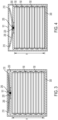
- Figs. 5 and 6 illustrate front views of the spring plate 200.
- Fig. 5 illustrates a front view of the spring plate 200 corresponding to Fig. 3 in which the battery cells 150 are fully charged (100% SOC).
- Fig. 6 illustrates a front view of the spring plate 200 corresponding to Fig. 4 in which the battery cells 150 are fully discharged (0% SOC).
- the plate has a thickness T1, an extension thickness T2, a width W and a radius of curvature R.
- Thickness T1 is a thickness of the spring plate 200 measured from a top surface of the spring plate 200 to a bottom surface of the spring plate 200.
- the thickness T1 may be, for example, 0.4 inches or greater or 0.5 inches or greater.
- the width W is an arc length of the spring plate 200 measured from one edge 210 of the spring plate 200 to the opposite edge 210 along the arc path of the spring plate 200.
- the width W may be, for example, 2.0 inches or larger or 2.5 inches or larger.
- the thickness T1 and width W are constant values of the spring plate 200 that do not vary with the state of charge (SOC). That is, the thickness T1 is the same in the state of the spring plate 200 in Fig. 5 and Fig. 6 . Similarly, the width W that is an arc length is the same in the state of the spring plate 200 in Fig. 5 and Fig. 6 .
- the radius of curvature R is a radius of curvature of the spring plate 200 and the extension thickness T2 is a vertical span of the spring plate 200.
- the thickness T2 is measured from an edge 210 of the spring plate 200 to a central portion of the spring plate 200.
- edges 210 of the spring plate 200 contact a top inner surface of the housing 100 and a central portion of the spring plate 200 contacts the top plate 250. Accordingly, the thickness T2 is also commensurate with the distance that the spring plate 200 spans from the housing 100 to the top plate 250. Additionally, when the battery housing 100 is placed on a flat horizontal surface, the distance T2 is a vertical span of the spring plate 200.
- both the radius of curvature R and the extension thickness T2 vary with a state of charge (SOC) of the battery cells 150.
- SOC state of charge
- a vertical height of the battery cells 150 is at a maximum.
- the radius of curvature R is also at a maximum while the extension thickness T2 is at a minimum. That is, since the battery cells 150 have a large vertical height when at a full state of charge (SOC) as shown in Fig. 3 , the space occupied by the spring plate 200 is relatively small and the relative flatness of the spring plate 200 results in a large radius of curvature R. Since the spring plate 200 is more compressed in Fig. 3 than in Fig. 4 , it provides a larger compressive force against the battery cells 150 in the state shown in Fig. 3 than in the state shown in Fig. 4 .
- the battery cells 150 may shrink as the battery cells 150 are discharged and expand as they are charged. As the battery cells 150 are discharged and the SOC of the battery cells 150 decreases, a vertical height H of the battery cells 150 decreases.
- the spring plate 200 expands its extension thickness T2 and the radius of curvature R of the spring plate decreases. Accordingly, a radius of curvature R of the spring plate 200 varies as a SOC of one or more of the plurality of battery cells 150 changes. In particular, the radius of curvature R of the spring plate 200 increases as one or more of the plurality of battery cells 150 is discharging.
- the spring plate 200 provides a dynamic compression force for the stacked plurality of battery cells 150. That is, the spring plate 200 provides a compression force to the stacked plurality of battery cells 150 in the maximum SOC shown in Fig. 3 and also at the minimum SOC shown in Fig. 4 . Additionally, the compression force changes as the SOC of one or more of the plurality of battery cells 150 changes and one or more of the plurality of battery cells 150 shrink or expand so that the height H of the stacked plurality of battery cells 150 changes. In particular, a compression force provided by the spring plate 200 in Fig. 3 when the battery cells 150 have a maximum state of charge is larger than the compression force provided by the spring plate 200 when the battery cells are at a minimum state of charge as shown in Fig. 4 .
- the spring plate 200 may be designed and configured such that it provides an appropriate amount of compression force as the state of charge of the plurality of battery cells 150 changes.
- the spring plate 200 may be configured to provide a targeted compression force at a 100% SOC ( Fig. 3 ) .
- Various attributes of the spring plate 200 may be altered to achieve the targeted compression force. For example, a size, material, thickness, or radius of curvature of the spring plate 200 may be chosen to provide a targeted compression force.
- the spring plate 200 may also be designed and configured to provide a targeted compression force when the plurality of battery cells 150 are at a minimum state of charge (e.g., 0% SOC). That ensures that the plurality of battery cells 150 receive a compression force from the spring plate 200 through the top plate 250 even as the plurality of battery cells 150 are discharged and meet a minimum state of charge.
- the spring plate 200 may be configured to provide a targeted compression force throughout the charging and discharging cycles of the battery cells 150.
- the plurality of battery cells 150 may include lithium.
- the spring plate 200 provides a compression force regardless of the SOC of plurality of battery cells 150. That is the spring plate 200 provides a compression force when the plurality of battery cells 150 are fully charged (100% SOC) as shown in Fig. 3 , when the plurality of battery cells 150 are fully discharged (0% SOC) as shown in Fig. 4 and at all states of charge in between.
- the example embodiment may help prevent the development of plating/dendrites.
- the battery 10 of the example embodiment may also help to resolve active area cell compression distribution issues and ensure healthy aging of the battery cells 150 so as to minimize degradation as the battery cells 150 are charged and discharged through many cycles.
- a maximum radius of curvature R may be at least 50% greater than a minimum radius of curvature (i.e., the maximum radius of curvature may be at least 1.5 times a minimum radius of curvature), at least 2.0 times a minimum radius of curvature R, at least 3 times a minimum radius of curvature or at least 4 times a minimum radius of curvature.
- a maximum extension thickness T2 may be at least 1.5 times a minimum extension thickness T2, at least 2.0 times a minimum extension thickness T2 or at least 2.5 times a minimum extension thickness.
- a maximum compression force provided by the spring plate 200 may be at least 2.0 times a minimum compression force, at least 3.0 times a minimum compression force, at least 4.0 times a minimum compression force or at least 5.0 times a minimum compression force. In some embodiments, a maximum compression force provided by the spring plate 200 may be less than 10 times a minimum compression force, less than 8 times a minimum compression force or less than 6 times a minimum compression force.
- the minimum compression force provided by the spring plate 200 may be at least 20 lbs of compression force or at least 25 lbs of compression force. This may ensure that the plurality of battery cells 150 are always provided with a sufficient compression force. In the example embodiment, the minimum compression force is provided when the plurality of battery cells 150 are at a 0% SOC as shown in Fig. 4 .
- the maximum compression force provided by the spring plate 200 may be between 200 and 300 lbs. In the example embodiment, the minimum compression force is provided when the plurality of battery cells 150 are at a 100% SOC as shown in Fig. 3 .
- the minimum and maximum compression forces provided by the spring plate 200 of example embodiments are not limited thereto. A minimum and maximum compression force may be varied in various example embodiments. For example, a higher or lower maximum compression force may be chosen depending on the size, number, type, chemistry, shrinkage percentage or shape of the battery cells 150 or the application of usage of the battery 10.
- the plurality of battery cells 150 may include one or both of primary battery cells and secondary battery cells.
- the configuration of the example embodiment of the battery 10 may also aid in assembly of the battery 10 and, in particular, insertion of the battery cells 150 into the housing 100.
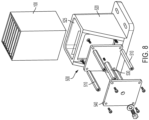
- Figs. 7 and 8 illustrates a tensioner that may be used for assembly of the battery 10.
- the tensioner 500 includes a base 520.
- the base includes an opening 525 sized to receive the housing 100 of the battery 10.
- the tensioner 500 further includes a base plate 540 and support rods 510 between the base plate 540 and the opening 525.
- the tensioner also includes an adjustment rod 530 between the base plate 540 and the opening 525.
- the housing 100 includes a top opening 101 on a top surface and the spring plate 200 includes an opening 220.
- the housing top opening 101 and the spring plate opening 220 align with each other and with the connector 255 of the top plate 250.
- These engagement portions allow access from outside of the housing 100 and allow for the tension of the spring plate 200 to be changed from outside of the housing 100. This can be seen, for example, in Figs. 2-4 .
- the connector 255 of the top plate 250 may be accessed from outside of the housing 100 through the top opening 101 and the spring plate opening 220.
- a tensioner such as tensioner 500 shown in Figs. 7 and 8 , may connect to the connector 255 of the top plate 250.
- the tensioner 500 may then pull upwardly on the connector 255 to pull the top plate 250 upward towards a top of the housing 100 and compress the spring plate 200 between the top plate 250 and the housing 100.
- the tensioner 500 may be configured such that the top plate 250 can be pulled upwardly or released to a certain height. That is, the tensioner 500 may adjust the top plate 250 to a particular position and, thus, may be used to adjust the spring plate 200 to a certain position and compression.
- the tensioner 500 may aid in assembly of the battery 10.
- the battery housing 100 may be placed in the opening 525 of the tensioner 500.
- the spring plate 200 and the top plate 250 may be provided in the housing 100.
- An attachment thread 531 of the adjustment rod 530 may be engaged with the connector 255 of the top plate 250.
- the attachment thread 531 may project through the housing opening 101 and the spring plate opening 220 to reach the connector 255.
- the connector may be a mounting nut, but embodiments are not limited thereto.
- the tensioner 500 may be used to adjust the position of the top plate 250 and thus the tension of the spring plate 200.
- the adjustment rod 530 may be rotated in a first direction to pull the top plate 250 upward and increase compression of the spring plate 200.
- the top plate 250 is moved upwardly, there is a larger open space in the housing 100 making it easier to insert other components into the housing 100, particularly the battery cells 150.
- the bottom plate 300 may be inserted before the battery cells 150 or after the battery cells 150 and may be inserted before or after the top plate 250 is moved upwardly by the tensioner 500.
- the tensioner 500 may release the top plate 250 to allow the compression force of the spring plate 200 to act on the stack of battery cells 150.
- the adjustment rod 530 may be rotated in a second direction, opposite the first direction, to allow the top plate 250 to move downwardly and the attachment thread 531 may be removed from the connector 255 to separate the tensioner 500 from the top plate 250.
- the housing 100 may be removed from the opening 525 and so from the tensioner.
- the lid 120 may be attached onto the housing 100 after the battery cells 150 and spring plate 200 and other components are assembled into the housing 100. The lid 120 may be attached while the housing 100 is still in the opening 525 or after the housing 100 is removed from the opening. Using the tensioner 500 to preload the spring plate 200 may allow for easy insertion of the battery cells 150 and avoids any unnecessary battery level components or weight.
- Example embodiments are provided so that this disclosure will be thorough, and will fully convey the scope to those who are skilled in the art. Numerous specific details are set forth such as examples of specific components, devices, and methods, to provide a thorough understanding of embodiments of the present disclosure. It will be apparent to those skilled in the art that specific details need not be employed, that example embodiments may be embodied in many different forms and that neither should be construed to limit the scope of the disclosure. In some example embodiments, well-known processes, well-known device structures, and well-known technologies are not described in detail.
Landscapes
- Chemical & Material Sciences (AREA)
- Chemical Kinetics & Catalysis (AREA)
- Electrochemistry (AREA)
- General Chemical & Material Sciences (AREA)
- Engineering & Computer Science (AREA)
- Manufacturing & Machinery (AREA)
- Battery Mounting, Suspending (AREA)
Abstract
Description
- The present disclosure relates to a battery and, more particularly, to a battery in which a compressive force is applied to one or more battery cells by a spring plate.
- A battery may include one or more battery cells. It may be useful to apply a compressive force to the battery cells. In particular, if the battery cells are pouch battery cells or include a lithium chemistry, it may be useful to apply a compressive force to the battery cells.
- Various attempts have been made to provide a force against battery cells. For example,
U.S. Patent Application Publication No. 2019/0027997 discloses an array plate assembly including a spring plate adapted to exert a compressive spring force against the at least one cell.U.S. Patent Application Publication No. 2021/0151830 discloses batteries with components including carbon fiber and applying a force to electrochemical cells in the battery. - Example embodiments of the present application are related to a battery with an improved construction that may aid in assembly of the battery and provide for a simplified construction that provides a compressive force as a state of charge of battery cells of the battery changes. For example, according to examples of the present application, a battery may include a housing and a spring plate within the housing. The housing and spring plate may be configured such that tension of the spring plate may be adjustable from outside the housing. Adjusting a tension of the spring plate from outside the housing may allow a user to create space in the battery housing to allow for easy insertion and assembly of battery cells. Additionally, in an example embodiment, the battery may have a spring plate with a radius of curvature that varies along with a state of charge of the battery cells. Due to the changing radius of curvature, the spring plate may provide a compressive force throughout a charging and discharging cycle as the battery cells shrink and expand. The spring plate of example embodiments of the present application may provide a compressive force through another component such as a top plate. Thus, according to example embodiment, a battery may have an improved construction that aids in assembly and provides a simple and efficient design for providing a compressive force even as a state of charge of battery cells change.
- Aspects of example embodiments relate to a battery, and more particularly, to a battery including battery cells that are compressed by a force applied by a spring plate. Aspects of example embodiments also relate to a spring plate that is adjustable from outside of a housing and assembly of battery cells into a housing.
- According to an aspect of an example embodiment, a battery includes: a housing; a plurality of battery cells in the housing; a spring plate providing a biasing force against the plurality of battery cells; wherein the spring plate is configured such that a tension of the spring plate may be adjusted from outside of the housing.
- A top plate may be disposed in the housing.
- The spring plate may provide a biasing force against the plurality of battery cells through the top plate.
- The spring plate may include carbon fibers.
- The top plate may include an engagement portion configured to be engaged by a tensioner.
- The engagement portion may be configured to allow a radius of curvature of the spring plate to be changed from outside of the housing via the tensioner.
- The spring plate may be curved.
- A radius of curvature of the spring plate may vary as a state of charge of one or more of the plurality of battery cells changes.
- The radius of curvature of the spring plate may increase as one or more of the plurality of battery cells is discharging.
- The radius of curvature may be configured to vary such that a maximum of the radius of curvature is 50% or more greater than a minimum of the radius of curvature.
- The top plate may be substantially flat.
- The plurality of battery cells may include pouch battery cells.
- The housing may be rigid.
- According to an aspect of an example embodiment, a battery assembly, includes: a housing having a top and a bottom; a plurality of battery cells disposed in the housing; a bottom plate below the plurality of battery cells and adjacent to the bottom of the housing; a top plate above the plurality of battery cells; a spring plate between the top plate and the top of the housing; wherein the spring plate is curved and has a radius of curvature; wherein the spring plate is configured to provide a biasing force to the plurality of battery cells through the top plate.
- The top of the housing may have an opening through which the spring plate is configured to be engaged.
- The spring plate may have an engagement portion.
- The engagement portion may be accessible through the opening in the housing.
- The engagement portion may be configured to be engaged by a tensioner.
- A radius of curvature of the spring plate may vary as a state of charge of one or more of the plurality of battery cells changes.
- The radius of curvature of the spring plate may increase as one or more of the plurality of battery cells is discharging.
- The radius of curvature may be configured to vary such that a maximum of the radius of curvature is 50% or more greater than a minimum of the radius of curvature.
- According to an aspect of an example embodiment, a method of assembling includes: providing a housing; providing a spring plate in the housing; tensioning the spring plate from outside the housing through an opening in the housing by a tensioner; inserting a plurality of battery cells into the housing; and releasing the tensioning of the spring plate by the tensioner.
- The method may further include assembling a lid on the housing to enclose the plurality of battery cells and the spring plate in the housing.
- The method may further include the spring plate being curved.
- A radius of curvature of the spring plate may vary as the plurality of battery cells are discharging.
- The above and other aspects and features will be more apparent from the following description of example embodiments, taken in conjunction with the accompanying drawings, in which:
-
Fig. 1 illustrates an exploded view of a battery according to an example embodiment; -
Fig. 2 illustrates an assembled view of a battery according to an example embodiment; -
Fig. 3 illustrates a cross-sectional view of a battery according to an example embodiment; -
Fig. 4 illustrates another cross-sectional view of a battery according to an example embodiment; -
Fig. 5 illustrates a front view of a spring plate according to an example embodiment; -
Fig. 6 illustrates another front view of a spring plate according to an example embodiment; -
Fig. 7 illustrates a tensioner and a battery according to an example embodiment; and -
Fig. 8 illustrates an exploded view of a tensioner and a battery according to an example embodiment. - The following description illustrates the claimed invention by way of example and not by way of limitation. The description clearly enables one skilled in the art to make and use the disclosure, describes several embodiments, adaptations, variations, alternatives, and uses of the disclosure, including what is presently believed to be the best mode of carrying out the claimed invention. Additionally, it is to be understood that the disclosure is not limited in its application to the details of construction and the arrangements of components set forth in the following description or illustrated in the drawings. The disclosure is capable of other embodiments and of being practiced or being carried out in various ways. Also, it is to be understood that the phraseology and terminology used herein is for the purpose of description and should not be regarded as limiting. Expressions such as "at least one of," when preceding a list of elements, modify the entire list of elements and do not modify the individual elements of the list. For example, the expression, "at least one of a, b, and c," should be understood as including only a, only b, only c, both a and b, both a and c, both b and c, or all of a, b, and c.
-
Figs. 1 and2 illustrate an embodiment of abattery 10.Fig. 1 is an exploded view of thebattery 10 andFig. 2 is a view of thebattery 10 with a housing in shadow to illustrate internal components. - As shown in
Figs. 1 and2 , thebattery 10 includes ahousing 100. Thehousing 100 may have a generally rectangular box shape. Additionally, thehousing 100 may be rigid and may be made out of a rigid material such as a metal, for example, steel. Thehousing 100 has afront opening 110 through whichbattery cells 150 and other components may be inserted. Thebattery 10 may also include alid 120 for closing thefront opening 110. Thelid 120 may cover thefront opening 110 to enclose thebattery cells 150 and other components in thehousing 100. Thelid 120 may be shaped generally to correspond to the shape of thefront opening 110 and may be attached to thehousing 100 by fasteners such as, for example, screws or rivets. Thehousing 100 also includes anopening 101 in a top surface thereof. - As shown in
Figs. 1 and2 , thebattery 10 includes abottom plate 300. Thebottom plate 300 is situated adjacent to a bottom of thehousing 100. Thebottom plate 300 may be substantially flat and rectangular and has a size and shape roughly corresponding to an inside bottom surface of thehousing 100. Thebottom plate 300 also has a size and shape that roughly corresponds to a size and shape of a bottom surface of the plurality ofbattery cells 150. Thebottom plate 300 may be rigid and may include a rigid material such as a metal, for example, steel, though the material is not limited thereto. - A plurality of
battery cells 150 sit on thebottom plate 300. The number ofbattery cells 150 is not particularly limited and there may be one, two, three ormore battery cells 150. The plurality ofbattery cells 150 may be stacked on top of one another so that the plurality ofbattery cells 150 are a plurality of stackedbattery cells 150. Thebattery cells 150 may be pouchtype battery cells 150. Thebattery cells 150 may include lithium. The battery cells can be secondary battery cells or primary battery cells. The battery cells can be for example Lithium-ion battery cells or primary lithium battery cells. Thebattery 10 may include electrical tabs connected to thebattery cells 150 through which electrical power from thebattery cells 150 may be transmitted to power a device. - A
top plate 250 is disposed on a top surface of the plurality ofbattery cells 150. Thetop plate 250 is generally rectangular in shape and has a shape that roughly correspond to a top surface of the plurality ofbattery cells 150. Thetop plate 250 may be substantially flat. Thetop plate 250 has an engagement portion in the form ofconnector 255 at a central location thereof. Theconnector 255 may be a threaded connector such as a mounting nut. Theengagement portion 255 may be engaged by atensioner 500, as described further below, so change a position of thetop plate 250 and compress thespring plate 200 so as to adjust a tension of thespring plate 200. - A
spring plate 200 is disposed between thetop plate 250 and an inner top surface of thehousing 100. Thespring plate 200 has a curved shape such that a central portion of thespring plate 200 contacts thetop plate 250 andedges 210 of the spring plate contact an inner top surface of thehousing 100, as shown in more detail inFigs. 3 and 4 . - The
spring plate 200 is resilient and serves as a dynamic compression force mechanism that provides a compressive force to thebattery cells 150 through thetop plate 250. Thespring plate 200 may include a carbon fiber material. For example, the spring plate may be a carbon fiber reinforcedspring plate 200. In an example embodiment in which thespring plate 200 includes carbon fiber material, there may be an advantage with weight savings. That is, a weight of thespring plate 200 and thus thebattery 10 may be reduced as compared to using other materials not including a carbon fiber material. Additionally, a material strength per weight may be beneficial. That is, thespring plate 200 may have a high material strength for its weight. Thespring plate 200 may also have favorable tensile properties such as a high tensile property and customized layups and configurations may be possible. That is, a layup direction of the battery may be customized or adjusted depending on a performance desired for a particular battery and application of a particular battery. Thespring plate 200 includes anopening 220 that may be referred to asspring plate opening 220. -
Figs. 3 and 4 illustrate cross sectional views of thebattery 10. Thebattery cells 150 may each be at various states of charge (SOC) from a 0% SOC to a 100% SOC and thebattery cells 150 collectively may be at various SOCs ranging from 100% SOC where all of the plurality ofcells 150 are fully charged 150 to 0% SOC where all of the plurality ofcells 150 are fully discharged. -
Fig. 3 illustrates thebattery 10 in a state where all of the plurality ofbattery cells 150 are fully charged (i.e., a 100% state of charge (SOC)).Fig. 4 illustrates thebattery cells 150 in a fully discharged state in which all of the plurality ofbattery cells 150 are fully discharged (i.e., a 0% state of charge (SOC). As shown, a height H ofbattery cells 150 decreases when the battery cells have a lower state of charge. That is, when thebattery cells 150 are fully charged (100% SOC) as shown inFig. 3 , thebattery cells 150 have a larger height H than when thebattery cells 150 are less than fully charged (e.g., 50% SOC) or fully discharged (0% SOC) as shown inFig. 4 . - As shown in
Figs. 3 and 4 , thespring plate 200 of the example embodiment provides a compressive force against the plurality ofbattery cells 150 regardless of the particular SOC. In particular, thespring plate 200 provides a downward biasing force against thetop plate 250. Thetop plate 250 then provides a biasing force to compress the plurality ofbattery cells 150. Thus, thespring plate 200 provides a biasing force to the plurality ofbattery cells 150 through thetop plate 250. The biasing force serves as a compressive force that acts in a direction of compressing thebattery cells 150. Because thetop plate 250 is flat and has a size and shape that is generally the same as a top surface of thebattery cells 150, the compressive force may be substantially uniform. In other embodiments, thespring plate 200 may provide a biasing force to thebattery cells 150 without a top plate therebetween. -
Figs. 5 and 6 illustrate front views of thespring plate 200.Fig. 5 illustrates a front view of thespring plate 200 corresponding toFig. 3 in which thebattery cells 150 are fully charged (100% SOC).Fig. 6 illustrates a front view of thespring plate 200 corresponding toFig. 4 in which thebattery cells 150 are fully discharged (0% SOC). As shown inFigs. 5 and 6 , the plate has a thickness T1, an extension thickness T2, a width W and a radius of curvature R. - Thickness T1 is a thickness of the
spring plate 200 measured from a top surface of thespring plate 200 to a bottom surface of thespring plate 200. The thickness T1 may be, for example, 0.4 inches or greater or 0.5 inches or greater. The width W is an arc length of thespring plate 200 measured from oneedge 210 of thespring plate 200 to theopposite edge 210 along the arc path of thespring plate 200. The width W may be, for example, 2.0 inches or larger or 2.5 inches or larger. The thickness T1 and width W are constant values of thespring plate 200 that do not vary with the state of charge (SOC). That is, the thickness T1 is the same in the state of thespring plate 200 inFig. 5 and Fig. 6 . Similarly, the width W that is an arc length is the same in the state of thespring plate 200 inFig. 5 and Fig. 6 . - The radius of curvature R is a radius of curvature of the
spring plate 200 and the extension thickness T2 is a vertical span of thespring plate 200. As shown inFigs. 4 ,5 and 6 , the thickness T2 is measured from anedge 210 of thespring plate 200 to a central portion of thespring plate 200. As shown inFig. 4 , edges 210 of thespring plate 200 contact a top inner surface of thehousing 100 and a central portion of thespring plate 200 contacts thetop plate 250. Accordingly, the thickness T2 is also commensurate with the distance that thespring plate 200 spans from thehousing 100 to thetop plate 250. Additionally, when thebattery housing 100 is placed on a flat horizontal surface, the distance T2 is a vertical span of thespring plate 200. - As shown in
Figs. 3-6 , both the radius of curvature R and the extension thickness T2 vary with a state of charge (SOC) of thebattery cells 150. In particular, as shown inFigs. 3 and5 , when thebattery cells 150 are fully charged, a vertical height of thebattery cells 150 is at a maximum. The radius of curvature R is also at a maximum while the extension thickness T2 is at a minimum. That is, since thebattery cells 150 have a large vertical height when at a full state of charge (SOC) as shown inFig. 3 , the space occupied by thespring plate 200 is relatively small and the relative flatness of thespring plate 200 results in a large radius of curvature R. Since thespring plate 200 is more compressed inFig. 3 than inFig. 4 , it provides a larger compressive force against thebattery cells 150 in the state shown inFig. 3 than in the state shown inFig. 4 . - The
battery cells 150 may shrink as thebattery cells 150 are discharged and expand as they are charged. As thebattery cells 150 are discharged and the SOC of thebattery cells 150 decreases, a vertical height H of thebattery cells 150 decreases. Thespring plate 200 expands its extension thickness T2 and the radius of curvature R of the spring plate decreases. Accordingly, a radius of curvature R of thespring plate 200 varies as a SOC of one or more of the plurality ofbattery cells 150 changes. In particular, the radius of curvature R of thespring plate 200 increases as one or more of the plurality ofbattery cells 150 is discharging. - As discussed above, the
spring plate 200 provides a dynamic compression force for the stacked plurality ofbattery cells 150. That is, thespring plate 200 provides a compression force to the stacked plurality ofbattery cells 150 in the maximum SOC shown inFig. 3 and also at the minimum SOC shown inFig. 4 . Additionally, the compression force changes as the SOC of one or more of the plurality ofbattery cells 150 changes and one or more of the plurality ofbattery cells 150 shrink or expand so that the height H of the stacked plurality ofbattery cells 150 changes. In particular, a compression force provided by thespring plate 200 inFig. 3 when thebattery cells 150 have a maximum state of charge is larger than the compression force provided by thespring plate 200 when the battery cells are at a minimum state of charge as shown inFig. 4 . - The
spring plate 200 may be designed and configured such that it provides an appropriate amount of compression force as the state of charge of the plurality ofbattery cells 150 changes. For example, thespring plate 200 may be configured to provide a targeted compression force at a 100% SOC (Fig. 3 ) . Various attributes of thespring plate 200 may be altered to achieve the targeted compression force. For example, a size, material, thickness, or radius of curvature of thespring plate 200 may be chosen to provide a targeted compression force. - The
spring plate 200 may also be designed and configured to provide a targeted compression force when the plurality ofbattery cells 150 are at a minimum state of charge (e.g., 0% SOC). That ensures that the plurality ofbattery cells 150 receive a compression force from thespring plate 200 through thetop plate 250 even as the plurality ofbattery cells 150 are discharged and meet a minimum state of charge. Thespring plate 200 may be configured to provide a targeted compression force throughout the charging and discharging cycles of thebattery cells 150. - The plurality of
battery cells 150 may include lithium. In lithium-ion battery cells, there is a risk of developing lithium plating/dendrites. In particular, there may be a risk of developing plating/dendrites if there is a large change in a compression distribution on one or more of the plurality ofbattery cells 150. According to the example embodiment, thespring plate 200 provides a compression force regardless of the SOC of plurality ofbattery cells 150. That is thespring plate 200 provides a compression force when the plurality ofbattery cells 150 are fully charged (100% SOC) as shown inFig. 3 , when the plurality ofbattery cells 150 are fully discharged (0% SOC) as shown inFig. 4 and at all states of charge in between. Since thespring plate 200 provides a compression force regardless of the SOC of the plurality ofbattery cells 150, thebattery cells 150 are subject to a compressive force throughout their SOC charging and discharging cycles. Thus, the example embodiment may help prevent the development of plating/dendrites. Thebattery 10 of the example embodiment may also help to resolve active area cell compression distribution issues and ensure healthy aging of thebattery cells 150 so as to minimize degradation as thebattery cells 150 are charged and discharged through many cycles. - The radius of curvature R, extension thickness T2 and compression force of the
spring plate 200 all vary according to the SOC of the plurality of battery cells. A maximum radius of curvature R may be at least 50% greater than a minimum radius of curvature (i.e., the maximum radius of curvature may be at least 1.5 times a minimum radius of curvature), at least 2.0 times a minimum radius of curvature R, at least 3 times a minimum radius of curvature or at least 4 times a minimum radius of curvature. A maximum extension thickness T2 may be at least 1.5 times a minimum extension thickness T2, at least 2.0 times a minimum extension thickness T2 or at least 2.5 times a minimum extension thickness. A maximum compression force provided by thespring plate 200 may be at least 2.0 times a minimum compression force, at least 3.0 times a minimum compression force, at least 4.0 times a minimum compression force or at least 5.0 times a minimum compression force. In some embodiments, a maximum compression force provided by thespring plate 200 may be less than 10 times a minimum compression force, less than 8 times a minimum compression force or less than 6 times a minimum compression force. - In an example embodiment, the minimum compression force provided by the
spring plate 200 may be at least 20 lbs of compression force or at least 25 lbs of compression force. This may ensure that the plurality ofbattery cells 150 are always provided with a sufficient compression force. In the example embodiment, the minimum compression force is provided when the plurality ofbattery cells 150 are at a 0% SOC as shown inFig. 4 . The maximum compression force provided by thespring plate 200 may be between 200 and 300 lbs. In the example embodiment, the minimum compression force is provided when the plurality ofbattery cells 150 are at a 100% SOC as shown inFig. 3 . However, the minimum and maximum compression forces provided by thespring plate 200 of example embodiments are not limited thereto. A minimum and maximum compression force may be varied in various example embodiments. For example, a higher or lower maximum compression force may be chosen depending on the size, number, type, chemistry, shrinkage percentage or shape of thebattery cells 150 or the application of usage of thebattery 10. - The plurality of
battery cells 150 may include one or both of primary battery cells and secondary battery cells. - The configuration of the example embodiment of the
battery 10 may also aid in assembly of thebattery 10 and, in particular, insertion of thebattery cells 150 into thehousing 100.Figs. 7 and8 illustrates a tensioner that may be used for assembly of thebattery 10. - As shown in
Figs. 7 and8 , thetensioner 500 includes abase 520. The base includes anopening 525 sized to receive thehousing 100 of thebattery 10. Thetensioner 500 further includes abase plate 540 andsupport rods 510 between thebase plate 540 and theopening 525. The tensioner also includes anadjustment rod 530 between thebase plate 540 and theopening 525. - As discussed above and shown in, for example,
Fig. 1 , thehousing 100 includes atop opening 101 on a top surface and thespring plate 200 includes anopening 220. Thehousing top opening 101 and the spring plate opening 220 align with each other and with theconnector 255 of thetop plate 250. These engagement portions allow access from outside of thehousing 100 and allow for the tension of thespring plate 200 to be changed from outside of thehousing 100. This can be seen, for example, inFigs. 2-4 . - As shown, the
connector 255 of thetop plate 250 may be accessed from outside of thehousing 100 through thetop opening 101 and thespring plate opening 220. For example, a tensioner, such astensioner 500 shown inFigs. 7 and8 , may connect to theconnector 255 of thetop plate 250. Thetensioner 500 may then pull upwardly on theconnector 255 to pull thetop plate 250 upward towards a top of thehousing 100 and compress thespring plate 200 between thetop plate 250 and thehousing 100. Thetensioner 500 may be configured such that thetop plate 250 can be pulled upwardly or released to a certain height. That is, thetensioner 500 may adjust thetop plate 250 to a particular position and, thus, may be used to adjust thespring plate 200 to a certain position and compression. - The
tensioner 500 may aid in assembly of thebattery 10. In particular, thebattery housing 100 may be placed in theopening 525 of thetensioner 500. Thespring plate 200 and thetop plate 250 may be provided in thehousing 100. Anattachment thread 531 of theadjustment rod 530 may be engaged with theconnector 255 of thetop plate 250. Theattachment thread 531 may project through thehousing opening 101 and the spring plate opening 220 to reach theconnector 255. As discussed above, the connector may be a mounting nut, but embodiments are not limited thereto. - After the
attachment thread 531 of theadjustment rod 530 is attached to theconnector 255 of thetop plate 250, thetensioner 500 may be used to adjust the position of thetop plate 250 and thus the tension of thespring plate 200. In particular, theadjustment rod 530 may be rotated in a first direction to pull thetop plate 250 upward and increase compression of thespring plate 200. As thetop plate 250 is moved upwardly, there is a larger open space in thehousing 100 making it easier to insert other components into thehousing 100, particularly thebattery cells 150. After thetop plate 250 has been moved sufficiently upwardly, sufficient space is created that one ormore battery cells 150 may easily be inserted into thehousing 100. Thebottom plate 300 may be inserted before thebattery cells 150 or after thebattery cells 150 and may be inserted before or after thetop plate 250 is moved upwardly by thetensioner 500. - Once the
bottom plate 300 and thebattery cells 150 are inserted into thehousing 100, thetensioner 500 may release thetop plate 250 to allow the compression force of thespring plate 200 to act on the stack ofbattery cells 150. Theadjustment rod 530 may be rotated in a second direction, opposite the first direction, to allow thetop plate 250 to move downwardly and theattachment thread 531 may be removed from theconnector 255 to separate the tensioner 500 from thetop plate 250. Thereafter, thehousing 100 may be removed from theopening 525 and so from the tensioner. Thelid 120 may be attached onto thehousing 100 after thebattery cells 150 andspring plate 200 and other components are assembled into thehousing 100. Thelid 120 may be attached while thehousing 100 is still in theopening 525 or after thehousing 100 is removed from the opening. Using thetensioner 500 to preload thespring plate 200 may allow for easy insertion of thebattery cells 150 and avoids any unnecessary battery level components or weight. - The foregoing description of the embodiments has been provided for purposes of illustration and description. It is not intended to be exhaustive or to limit the disclosure. Individual elements or features of a particular embodiment are generally not limited to that particular embodiment, but, where applicable, are interchangeable and can be used in a selected embodiment, even if not specifically shown or described. The same may also be varied in many ways. Such variations are not to be regarded as a departure from the disclosure, and all such modifications are intended to be included within the scope of the disclosure.
- Example embodiments are provided so that this disclosure will be thorough, and will fully convey the scope to those who are skilled in the art. Numerous specific details are set forth such as examples of specific components, devices, and methods, to provide a thorough understanding of embodiments of the present disclosure. It will be apparent to those skilled in the art that specific details need not be employed, that example embodiments may be embodied in many different forms and that neither should be construed to limit the scope of the disclosure. In some example embodiments, well-known processes, well-known device structures, and well-known technologies are not described in detail.
- The terminology used herein is for the purpose of describing particular example embodiments only and is not intended to be limiting. As used herein, the singular forms "a," "an," and "the" may be intended to include the plural forms as well, unless the context clearly indicates otherwise. The terms "comprises," "comprising," "including," and "having," are inclusive and therefore specify the presence of stated features, integers, steps, operations, elements, and/or components, but do not preclude the presence or addition of one or more other features, integers, steps, operations, elements, components, and/or groups thereof. The method steps, processes, and operations described herein are not to be construed as necessarily requiring their performance in the particular order discussed or illustrated, unless specifically identified as an order of performance. It is also to be understood that additional or alternative steps may be employed.
Claims (20)
- A battery, comprising:a housing;a plurality of battery cells in the housing;a spring plate providing a biasing force against the plurality of battery cells;wherein the spring plate is configured such that a tension of the spring plate may be adjusted from outside of the housing.
- The battery of claim 1, further comprising a top plate disposed in the housing, and
wherein the spring plate provides a biasing force against the plurality of battery cells through the top plate. - The battery of claim 1, wherein the spring plate comprises carbon fiber.
- The battery of claim 2, wherein the spring plate comprises carbon fiber.
- The battery of claim 3, wherein the top plate includes an engagement portion configured to be engaged by a tensioner, and
wherein the engagement portion is configured to allow a radius of curvature of the spring plate to be changed from outside of the housing via the tensioner. - The battery of claim 1, wherein the spring plate is curved; and
wherein a radius of curvature of the spring plate varies as a state of charge of one or more of the plurality of battery cells changes. - The battery of claim 6, wherein the radius of curvature of the spring plate increases as one or more of the plurality of battery cells is discharging.
- The battery of claim 7, wherein the radius of curvature is configured to vary such that a maximum of the radius of curvature is 50% or more greater than a minimum of the radius of curvature.
- The battery of claim 2, wherein the top plate is substantially flat.
- The battery of claim 1, wherein the plurality of battery cells comprise pouch battery cells.
- The battery of claim 2, wherein the spring plate is configured such that the tension of the spring plate may be adjusted from outside of the housing by a tensioner;wherein the housing comprises a top opening;wherein the top plate comprises a connector;wherein the tensioner is configured to project through the top opening of the housing to connect with the connector of the top plate; andwherein the tensioner is configured to adjust a position of the top plate so as to adjust the tension of the spring plate.
- A battery assembly, comprising:a housing having a top and a bottom;a plurality of battery cells disposed in the housing;a bottom plate below the plurality of battery cells and adjacent to the bottom of the housing;a top plate above the plurality of battery cells;a spring plate between the top plate and the top of the housing;wherein the spring plate is curved and has a radius of curvature;wherein the spring plate is configured to provide a biasing force to the plurality of battery cells through the top plate.
- The battery assembly of claim 12, wherein the top of the housing has an opening through which the spring plate is configured to be engaged.
- The battery assembly of claim 13, wherein the spring plate has an engagement portion;wherein the engagement portion is accessible through the opening in the housing; andwherein the engagement portion is configured to be engaged by a tensioner.
- The battery assembly of claim 12, wherein a radius of curvature of the spring plate varies as a state of charge of one or more of the plurality of battery cells changes.
- The battery assembly of claim 15, wherein the radius of curvature of the spring plate increases as one or more of the plurality of battery cells is discharging.
- The battery assembly of claim 16, wherein the radius of curvature is configured to vary such that a maximum of the radius of curvature is 50% or more greater than a minimum of the radius of curvature.
- A method of assembling a battery, the method comprising:providing a housing;providing a spring plate in the housing;tensioning the spring plate from outside the housing through an opening in the housing by a tensioner;inserting a plurality of battery cells into the housing; andreleasing the tensioning of the spring plate by the tensioner.
- The method of claim 18, further comprising assembling a lid on the housing to enclose the plurality of battery cells and the spring plate in the housing.
- The method of claim 19, wherein the spring plate is curved; and
wherein a radius of curvature of the spring plate varies as the plurality of battery cells are discharging.
Applications Claiming Priority (1)
| Application Number | Priority Date | Filing Date | Title |
|---|---|---|---|
| US18/174,206 US20240291017A1 (en) | 2023-02-24 | 2023-02-24 | Battery and battery with spring plate |
Publications (1)
| Publication Number | Publication Date |
|---|---|
| EP4421931A1 true EP4421931A1 (en) | 2024-08-28 |
Family
ID=89853624
Family Applications (1)
| Application Number | Title | Priority Date | Filing Date |
|---|---|---|---|
| EP24155936.8A Pending EP4421931A1 (en) | 2023-02-24 | 2024-02-06 | Battery and battery with spring plate |
Country Status (2)
| Country | Link |
|---|---|
| US (1) | US20240291017A1 (en) |
| EP (1) | EP4421931A1 (en) |
Citations (5)
| Publication number | Priority date | Publication date | Assignee | Title |
|---|---|---|---|---|
| US20190027997A1 (en) | 2015-08-24 | 2019-01-24 | Siemens Aktiengesellschaft | Synchronous reluctance machine |
| US20190372147A1 (en) * | 2016-09-23 | 2019-12-05 | Nissan Motor Co., Ltd. | Method for manufacturing film-covered battery |
| US20210151830A1 (en) | 2019-11-19 | 2021-05-20 | Sion Power Corporation | Batteries with components including carbon fiber, and associated systems and methods |
| WO2022108279A1 (en) * | 2020-11-23 | 2022-05-27 | 주식회사 엘지에너지솔루션 | Battery module, battery pack including battery module, and vehicle including battery pack |
| US20220359902A1 (en) * | 2019-06-21 | 2022-11-10 | Sion Power Corporation | Methods, systems, and devices for applying forces to electrochemical devices |
-
2023
- 2023-02-24 US US18/174,206 patent/US20240291017A1/en active Pending
-
2024
- 2024-02-06 EP EP24155936.8A patent/EP4421931A1/en active Pending
Patent Citations (5)
| Publication number | Priority date | Publication date | Assignee | Title |
|---|---|---|---|---|
| US20190027997A1 (en) | 2015-08-24 | 2019-01-24 | Siemens Aktiengesellschaft | Synchronous reluctance machine |
| US20190372147A1 (en) * | 2016-09-23 | 2019-12-05 | Nissan Motor Co., Ltd. | Method for manufacturing film-covered battery |
| US20220359902A1 (en) * | 2019-06-21 | 2022-11-10 | Sion Power Corporation | Methods, systems, and devices for applying forces to electrochemical devices |
| US20210151830A1 (en) | 2019-11-19 | 2021-05-20 | Sion Power Corporation | Batteries with components including carbon fiber, and associated systems and methods |
| WO2022108279A1 (en) * | 2020-11-23 | 2022-05-27 | 주식회사 엘지에너지솔루션 | Battery module, battery pack including battery module, and vehicle including battery pack |
Also Published As
| Publication number | Publication date |
|---|---|
| US20240291017A1 (en) | 2024-08-29 |
Similar Documents
| Publication | Publication Date | Title |
|---|---|---|
| US20200411916A1 (en) | Rechargeable Battery | |
| KR101705308B1 (en) | Zig for fixing electrode and apparatus for charging and discharging secondary battery including the same | |
| KR100614390B1 (en) | Wound electrode assembly, lithium ion secondary battery comprising same and method for manufacturing same | |
| JP6680145B2 (en) | Battery module | |
| KR101806995B1 (en) | Battery pack | |
| EP1766704B1 (en) | Retaining apparatus for electrochemical generator | |
| KR20180087041A (en) | Apparatus for predicting deformation of battery module | |
| JP6852308B2 (en) | Batteries | |
| US7642744B2 (en) | Charger and battery combination with retention arms and mating members | |
| US20220388266A1 (en) | Pressure device, battery module manufacturing device, and manufacturing method | |
| DE102015202894A1 (en) | battery cell | |
| CN108604655A (en) | Straps for battery modules, battery modules including straps and clamps for compressing the straps | |
| US12244034B2 (en) | Buffer member and electrical storage module | |
| EP4683017A1 (en) | Battery cell and battery pack | |
| US5366826A (en) | Battery pack retention system and apparatus therefor | |
| EP4421931A1 (en) | Battery and battery with spring plate | |
| EP3306700A1 (en) | Battery case, battery module, and battery module manufacturing method | |
| WO2005074053A1 (en) | Pressure producing apparatus for an electrochemical generator | |
| US20230299328A1 (en) | Compression Means for Li-Metal Anode Electrochemical Cells | |
| US20260051617A1 (en) | Battery cell, battery, and electric apparatus | |
| Nagarajan et al. | Characterization of the performance of commercial Ni/MH batteries | |
| EP4618261A1 (en) | Battery and electric device | |
| KR102948871B1 (en) | Secondary battery Module | |
| KR102942726B1 (en) | Battery module, battery pack comprising the battery module and vehicle comprising the battery pack | |
| CN108054312A (en) | Split type zinc-manganese battery size adjusting converter |
Legal Events
| Date | Code | Title | Description |
|---|---|---|---|
| PUAI | Public reference made under article 153(3) epc to a published international application that has entered the european phase |
Free format text: ORIGINAL CODE: 0009012 |
|
| STAA | Information on the status of an ep patent application or granted ep patent |
Free format text: STATUS: THE APPLICATION HAS BEEN PUBLISHED |
|
| AK | Designated contracting states |
Kind code of ref document: A1 Designated state(s): AL AT BE BG CH CY CZ DE DK EE ES FI FR GB GR HR HU IE IS IT LI LT LU LV MC ME MK MT NL NO PL PT RO RS SE SI SK SM TR |
|
| STAA | Information on the status of an ep patent application or granted ep patent |
Free format text: STATUS: REQUEST FOR EXAMINATION WAS MADE |
|
| P01 | Opt-out of the competence of the unified patent court (upc) registered |
Free format text: CASE NUMBER: APP_8026/2025 Effective date: 20250218 |
|
| 17P | Request for examination filed |
Effective date: 20250228 |