EP4421913A1 - Preparation method for high-nickel ternary positive electrode material - Google Patents
Preparation method for high-nickel ternary positive electrode material Download PDFInfo
- Publication number
- EP4421913A1 EP4421913A1 EP22891547.6A EP22891547A EP4421913A1 EP 4421913 A1 EP4421913 A1 EP 4421913A1 EP 22891547 A EP22891547 A EP 22891547A EP 4421913 A1 EP4421913 A1 EP 4421913A1
- Authority
- EP
- European Patent Office
- Prior art keywords
- sub
- preparation
- primary
- nickel ternary
- sintering
- Prior art date
- Legal status (The legal status is an assumption and is not a legal conclusion. Google has not performed a legal analysis and makes no representation as to the accuracy of the status listed.)
- Pending
Links
- PXHVJJICTQNCMI-UHFFFAOYSA-N nickel Substances [Ni] PXHVJJICTQNCMI-UHFFFAOYSA-N 0.000 title claims abstract description 48
- 229910052759 nickel Inorganic materials 0.000 title claims abstract description 45
- 238000002360 preparation method Methods 0.000 title claims abstract description 17
- 239000007774 positive electrode material Substances 0.000 title abstract 3
- 239000000463 material Substances 0.000 claims abstract description 105
- WMFOQBRAJBCJND-UHFFFAOYSA-M Lithium hydroxide Chemical compound [Li+].[OH-] WMFOQBRAJBCJND-UHFFFAOYSA-M 0.000 claims abstract description 42
- 239000011164 primary particle Substances 0.000 claims abstract description 32
- 238000005245 sintering Methods 0.000 claims abstract description 32
- 239000000243 solution Substances 0.000 claims abstract description 32
- 239000011259 mixed solution Substances 0.000 claims abstract description 24
- KGBXLFKZBHKPEV-UHFFFAOYSA-N boric acid Chemical compound OB(O)O KGBXLFKZBHKPEV-UHFFFAOYSA-N 0.000 claims abstract description 23
- QVGXLLKOCUKJST-UHFFFAOYSA-N atomic oxygen Chemical compound [O] QVGXLLKOCUKJST-UHFFFAOYSA-N 0.000 claims abstract description 21
- 238000002156 mixing Methods 0.000 claims abstract description 21
- 239000001301 oxygen Substances 0.000 claims abstract description 21
- 229910052760 oxygen Inorganic materials 0.000 claims abstract description 21
- 239000004327 boric acid Substances 0.000 claims abstract description 18
- LFQSCWFLJHTTHZ-UHFFFAOYSA-N Ethanol Chemical compound CCO LFQSCWFLJHTTHZ-UHFFFAOYSA-N 0.000 claims abstract description 16
- 239000010416 ion conductor Substances 0.000 claims abstract description 14
- 238000005496 tempering Methods 0.000 claims abstract description 14
- 239000000843 powder Substances 0.000 claims abstract description 12
- 239000002243 precursor Substances 0.000 claims abstract description 10
- 238000005507 spraying Methods 0.000 claims abstract description 10
- 229910044991 metal oxide Inorganic materials 0.000 claims abstract description 5
- 150000004706 metal oxides Chemical class 0.000 claims abstract description 5
- 230000001681 protective effect Effects 0.000 claims abstract description 5
- 238000001035 drying Methods 0.000 claims abstract description 4
- 239000010406 cathode material Substances 0.000 claims description 31
- 238000000576 coating method Methods 0.000 claims description 18
- 239000011248 coating agent Substances 0.000 claims description 17
- XLYOFNOQVPJJNP-UHFFFAOYSA-N water Substances O XLYOFNOQVPJJNP-UHFFFAOYSA-N 0.000 claims description 11
- 229910007626 Li2SnO3 Inorganic materials 0.000 claims description 9
- 238000010438 heat treatment Methods 0.000 claims description 9
- IJGRMHOSHXDMSA-UHFFFAOYSA-N nitrogen Substances N#N IJGRMHOSHXDMSA-UHFFFAOYSA-N 0.000 claims description 8
- 239000007787 solid Substances 0.000 claims description 8
- 229910010171 Li2MoO4 Inorganic materials 0.000 claims description 7
- 229910007786 Li2WO4 Inorganic materials 0.000 claims description 7
- 239000000203 mixture Substances 0.000 claims description 7
- 229910052757 nitrogen Inorganic materials 0.000 claims description 5
- XKRFYHLGVUSROY-UHFFFAOYSA-N Argon Chemical compound [Ar] XKRFYHLGVUSROY-UHFFFAOYSA-N 0.000 claims description 4
- 229910052750 molybdenum Inorganic materials 0.000 claims description 4
- 229910052718 tin Inorganic materials 0.000 claims description 4
- 229910052721 tungsten Inorganic materials 0.000 claims description 4
- ZOXJGFHDIHLPTG-UHFFFAOYSA-N Boron Chemical compound [B] ZOXJGFHDIHLPTG-UHFFFAOYSA-N 0.000 claims description 2
- 229910052786 argon Inorganic materials 0.000 claims description 2
- 229910052796 boron Inorganic materials 0.000 claims description 2
- QJGQUHMNIGDVPM-UHFFFAOYSA-N nitrogen group Chemical group [N] QJGQUHMNIGDVPM-UHFFFAOYSA-N 0.000 claims description 2
- 239000011247 coating layer Substances 0.000 abstract description 9
- 239000004020 conductor Substances 0.000 abstract 1
- WHXSMMKQMYFTQS-UHFFFAOYSA-N Lithium Chemical compound [Li] WHXSMMKQMYFTQS-UHFFFAOYSA-N 0.000 description 13
- 229910052744 lithium Inorganic materials 0.000 description 13
- 238000000034 method Methods 0.000 description 12
- AWZXLSSFNBRFCI-UHFFFAOYSA-N boric acid ethanol Chemical compound B(O)(O)O.C(C)O.C(C)O.C(C)O AWZXLSSFNBRFCI-UHFFFAOYSA-N 0.000 description 9
- 230000000052 comparative effect Effects 0.000 description 7
- 235000019441 ethanol Nutrition 0.000 description 6
- 238000003756 stirring Methods 0.000 description 6
- RIUWBIIVUYSTCN-UHFFFAOYSA-N trilithium borate Chemical compound [Li+].[Li+].[Li+].[O-]B([O-])[O-] RIUWBIIVUYSTCN-UHFFFAOYSA-N 0.000 description 6
- 229910017223 Ni0.8Co0.1Mn0.1(OH)2 Inorganic materials 0.000 description 5
- 230000009469 supplementation Effects 0.000 description 5
- 229910015872 LiNi0.8Co0.1Mn0.1O2 Inorganic materials 0.000 description 4
- 238000007599 discharging Methods 0.000 description 4
- 238000001704 evaporation Methods 0.000 description 4
- 239000011148 porous material Substances 0.000 description 4
- 238000012360 testing method Methods 0.000 description 4
- 238000001291 vacuum drying Methods 0.000 description 4
- 239000007791 liquid phase Substances 0.000 description 3
- 238000010907 mechanical stirring Methods 0.000 description 3
- 239000002245 particle Substances 0.000 description 3
- 238000007873 sieving Methods 0.000 description 3
- 239000007921 spray Substances 0.000 description 3
- 229910010177 Li2MoO3 Inorganic materials 0.000 description 2
- 238000010586 diagram Methods 0.000 description 2
- 230000000694 effects Effects 0.000 description 2
- 230000014759 maintenance of location Effects 0.000 description 2
- 238000012986 modification Methods 0.000 description 2
- 230000004048 modification Effects 0.000 description 2
- 239000000758 substrate Substances 0.000 description 2
- XOLBLPGZBRYERU-UHFFFAOYSA-N tin dioxide Chemical compound O=[Sn]=O XOLBLPGZBRYERU-UHFFFAOYSA-N 0.000 description 2
- HBBGRARXTFLTSG-UHFFFAOYSA-N Lithium ion Chemical compound [Li+] HBBGRARXTFLTSG-UHFFFAOYSA-N 0.000 description 1
- 230000002378 acidificating effect Effects 0.000 description 1
- 230000009286 beneficial effect Effects 0.000 description 1
- 230000007547 defect Effects 0.000 description 1
- 230000007812 deficiency Effects 0.000 description 1
- 238000011161 development Methods 0.000 description 1
- 239000008151 electrolyte solution Substances 0.000 description 1
- 238000005516 engineering process Methods 0.000 description 1
- 238000002474 experimental method Methods 0.000 description 1
- 230000009545 invasion Effects 0.000 description 1
- XGZVUEUWXADBQD-UHFFFAOYSA-L lithium carbonate Chemical compound [Li+].[Li+].[O-]C([O-])=O XGZVUEUWXADBQD-UHFFFAOYSA-L 0.000 description 1
- 229910052808 lithium carbonate Inorganic materials 0.000 description 1
- 229910001416 lithium ion Inorganic materials 0.000 description 1
- 238000005297 material degradation process Methods 0.000 description 1
- 239000007790 solid phase Substances 0.000 description 1
- 238000012546 transfer Methods 0.000 description 1
- 229910052723 transition metal Inorganic materials 0.000 description 1
Images


Classifications
-
- H—ELECTRICITY
- H01—ELECTRIC ELEMENTS
- H01M—PROCESSES OR MEANS, e.g. BATTERIES, FOR THE DIRECT CONVERSION OF CHEMICAL ENERGY INTO ELECTRICAL ENERGY
- H01M4/00—Electrodes
- H01M4/02—Electrodes composed of, or comprising, active material
- H01M4/36—Selection of substances as active materials, active masses, active liquids
- H01M4/48—Selection of substances as active materials, active masses, active liquids of inorganic oxides or hydroxides
- H01M4/52—Selection of substances as active materials, active masses, active liquids of inorganic oxides or hydroxides of nickel, cobalt or iron
- H01M4/525—Selection of substances as active materials, active masses, active liquids of inorganic oxides or hydroxides of nickel, cobalt or iron of mixed oxides or hydroxides containing iron, cobalt or nickel for inserting or intercalating light metals, e.g. LiNiO2, LiCoO2 or LiCoOxFy
-
- C—CHEMISTRY; METALLURGY
- C01—INORGANIC CHEMISTRY
- C01G—COMPOUNDS CONTAINING METALS NOT COVERED BY SUBCLASSES C01D OR C01F
- C01G53/00—Compounds of nickel
- C01G53/40—Complex oxides containing nickel and at least one other metal element
- C01G53/42—Complex oxides containing nickel and at least one other metal element containing alkali metals, e.g. LiNiO2
- C01G53/44—Complex oxides containing nickel and at least one other metal element containing alkali metals, e.g. LiNiO2 containing manganese
- C01G53/50—Complex oxides containing nickel and at least one other metal element containing alkali metals, e.g. LiNiO2 containing manganese of the type (MnO2)n-, e.g. Li(NixMn1-x)O2 or Li(MyNixMn1-x-y)O2
-
- H—ELECTRICITY
- H01—ELECTRIC ELEMENTS
- H01M—PROCESSES OR MEANS, e.g. BATTERIES, FOR THE DIRECT CONVERSION OF CHEMICAL ENERGY INTO ELECTRICAL ENERGY
- H01M4/00—Electrodes
- H01M4/02—Electrodes composed of, or comprising, active material
- H01M4/04—Processes of manufacture in general
- H01M4/0471—Processes of manufacture in general involving thermal treatment, e.g. firing, sintering, backing particulate active material, thermal decomposition, pyrolysis
-
- H—ELECTRICITY
- H01—ELECTRIC ELEMENTS
- H01M—PROCESSES OR MEANS, e.g. BATTERIES, FOR THE DIRECT CONVERSION OF CHEMICAL ENERGY INTO ELECTRICAL ENERGY
- H01M4/00—Electrodes
- H01M4/02—Electrodes composed of, or comprising, active material
- H01M4/13—Electrodes for accumulators with non-aqueous electrolyte, e.g. for lithium-accumulators; Processes of manufacture thereof
- H01M4/139—Processes of manufacture
- H01M4/1391—Processes of manufacture of electrodes based on mixed oxides or hydroxides, or on mixtures of oxides or hydroxides, e.g. LiCoOx
-
- H—ELECTRICITY
- H01—ELECTRIC ELEMENTS
- H01M—PROCESSES OR MEANS, e.g. BATTERIES, FOR THE DIRECT CONVERSION OF CHEMICAL ENERGY INTO ELECTRICAL ENERGY
- H01M4/00—Electrodes
- H01M4/02—Electrodes composed of, or comprising, active material
- H01M4/36—Selection of substances as active materials, active masses, active liquids
-
- H—ELECTRICITY
- H01—ELECTRIC ELEMENTS
- H01M—PROCESSES OR MEANS, e.g. BATTERIES, FOR THE DIRECT CONVERSION OF CHEMICAL ENERGY INTO ELECTRICAL ENERGY
- H01M4/00—Electrodes
- H01M4/02—Electrodes composed of, or comprising, active material
- H01M4/36—Selection of substances as active materials, active masses, active liquids
- H01M4/362—Composites
- H01M4/366—Composites as layered products
-
- C—CHEMISTRY; METALLURGY
- C01—INORGANIC CHEMISTRY
- C01P—INDEXING SCHEME RELATING TO STRUCTURAL AND PHYSICAL ASPECTS OF SOLID INORGANIC COMPOUNDS
- C01P2004/00—Particle morphology
- C01P2004/01—Particle morphology depicted by an image
- C01P2004/03—Particle morphology depicted by an image obtained by SEM
-
- C—CHEMISTRY; METALLURGY
- C01—INORGANIC CHEMISTRY
- C01P—INDEXING SCHEME RELATING TO STRUCTURAL AND PHYSICAL ASPECTS OF SOLID INORGANIC COMPOUNDS
- C01P2004/00—Particle morphology
- C01P2004/80—Particles consisting of a mixture of two or more inorganic phases
- C01P2004/82—Particles consisting of a mixture of two or more inorganic phases two phases having the same anion, e.g. both oxidic phases
- C01P2004/84—Particles consisting of a mixture of two or more inorganic phases two phases having the same anion, e.g. both oxidic phases one phase coated with the other
-
- C—CHEMISTRY; METALLURGY
- C01—INORGANIC CHEMISTRY
- C01P—INDEXING SCHEME RELATING TO STRUCTURAL AND PHYSICAL ASPECTS OF SOLID INORGANIC COMPOUNDS
- C01P2006/00—Physical properties of inorganic compounds
- C01P2006/40—Electric properties
-
- H—ELECTRICITY
- H01—ELECTRIC ELEMENTS
- H01M—PROCESSES OR MEANS, e.g. BATTERIES, FOR THE DIRECT CONVERSION OF CHEMICAL ENERGY INTO ELECTRICAL ENERGY
- H01M4/00—Electrodes
- H01M4/02—Electrodes composed of, or comprising, active material
- H01M2004/026—Electrodes composed of, or comprising, active material characterised by the polarity
- H01M2004/028—Positive electrodes
-
- Y—GENERAL TAGGING OF NEW TECHNOLOGICAL DEVELOPMENTS; GENERAL TAGGING OF CROSS-SECTIONAL TECHNOLOGIES SPANNING OVER SEVERAL SECTIONS OF THE IPC; TECHNICAL SUBJECTS COVERED BY FORMER USPC CROSS-REFERENCE ART COLLECTIONS [XRACs] AND DIGESTS
- Y02—TECHNOLOGIES OR APPLICATIONS FOR MITIGATION OR ADAPTATION AGAINST CLIMATE CHANGE
- Y02E—REDUCTION OF GREENHOUSE GAS [GHG] EMISSIONS, RELATED TO ENERGY GENERATION, TRANSMISSION OR DISTRIBUTION
- Y02E60/00—Enabling technologies; Technologies with a potential or indirect contribution to GHG emissions mitigation
- Y02E60/10—Energy storage using batteries
Definitions
- the present invention belongs to the technical field of lithium ion batteries, and particularly relates to a preparation method for a high-nickel ternary cathode material.
- High nickel ternary cathode materials mainly refer to NCM ternary materials with Ni content greater than 60%. With the increase of the Ni content, a specific capacity of the NCM ternary materials will also increase.
- High-nickel ternary material is one of the future development orientations of the cathode materials. Although the high-nickel ternary material has a high specific capacity, the high-nickel ternary material still has some shortcomings, while being used, such as microcracks easily caused by volume changes in a cycle process, difficulty in mass transfer caused by large pores between primary particles, material degradation caused by invasion of electrolytic solution, and the like. All these shortcomings will lead to poor cycle performance of the high-nickel ternary material.
- a method for solid-phase mixing and high-temperature sintering is generally adopted for substrate sintering and coating modification of commercial high-nickel ternary materials.
- this method is simple and feasible, the method still has the following defects: (1) for the substrate sintering, it is difficult to ensure that a precursor and a lithium source are thoroughly mixed, resulting in uneven growth of the primary particles; and (2) for the coating modification, it is difficult to ensure the uniformity of the coating layer, and it is easy to cause partial over-thick coating or no coating, and the coating layer basically only exists on surfaces of secondary ball materials.
- the present invention aims at solving at least one of the above-mentioned technical problems in the existing technology. Therefore, the present invention provides a preparation method for a high-nickel ternary cathode material.
- a preparation method for a high-nickel ternary cathode material including the following steps of:
- the primary sintering is performed at a temperature of 500 °C to 650 °C; and the primary sintering lasts for 2 hours to 8 hours.
- a concentration of Li in the mixed solution ranges from 10 g/L to 37 g/L.
- a liquid-solid ratio of the mixed solution to the primary-sintered material is 0.25 mL/g to 1 mL/g.
- the stirring lasts for 3 minutes to 120 minutes.
- the drying is performed by means of vacuum drying.
- the mixing is performed by means of mechanical stirring, ultrasonic vibration or a combination of the two.
- the secondary sintering is performed at a temperature of 700 °C to 1,000 °C; the secondary sintering lasts for 8 hours to 24 hours; and the secondary sintering is performed in an oxygen atmosphere.
- the protective atmosphere is nitrogen, oxygen, argon or compressed air with CO 2 removed.
- the secondary-sintered material is a cathode material with a primary particle coated with an ionic conductor
- the ionic conductor is at least one of Li 2 MoO 4 , Li 2 WO 4 or Li 2 SnO 3
- a coating amount of the ionic conductor is 0.05wt% to 0.8wt% of the secondary-sintered material in terms of a total amount of Mo, W and Sn in the ionic conductor.
- a preparation process of the boric acid alcohol solution includes: adding a boric acid into an alcohol solution to obtain a mixture and heating the mixture in water bath to obtain the boric acid alcohol solution, wherein the heating in the water bath is performed at a temperature of 50 °C to 70 °C.
- the alcohol solution is absolute ethyl alcohol.
- a concentration of B in the boric acid alcohol solution ranges from 15 g/L to 25 g/L.
- a content of boron in the high-nickel ternary cathode material ranges from 0.02wt% to 0.5wt%.
- the tempering is performed in an oxygen atmosphere; the tempering is performed at a temperature of 200 °C to 350 °C; and the tempering lasts for 4 hours to 12 hours.
- the present invention has at least the following beneficial effects.
- FIG. 1 is an SEM graph of the primary-sintered material of this Example. It can be clearly seen from the figure that the primary particles of the primary-sintered material are not full, there are large pores between the primary particles, and the surfaces of the whole secondary ball particles are uneven.
- FIG. 2 is an SEM graph of the secondary-sintered material of this Example. It can be seen from the figure that after the liquid-phase secondary lithium supplementation and sintering, the primary particles of the secondary-sintered material obtained grow up obviously, the pores between the primary particles are obviously reduced, and the surface smoothness of the whole secondary ball particles is greatly improved.
- FIG. 3 is an SEM graph of the finished product of the high-nickel ternary cathode material in this Example. It can be seen from the figure that the primary particles of the finished product coated by H 3 BO 3 and sintered are tightly combined, and the surfaces of the whole secondary ball particles are relatively smooth.
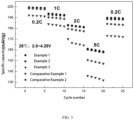
- Examples 1 to 3 and Comparative Examples 1 to 2 were made into coin cells, and the first-cycle specific capacities, initial efficiencies and retention rates after 100 cycles were tested at 25 °C.
- the test conditions were: 2.8 V to 4.25 V, charging and discharging at 0.5 C, and tests were conducted on a LAND battery testing system.
- the test results were shown in Table 1 and Figs. 4 and 5 .
Landscapes
- Chemical & Material Sciences (AREA)
- Chemical Kinetics & Catalysis (AREA)
- Electrochemistry (AREA)
- General Chemical & Material Sciences (AREA)
- Organic Chemistry (AREA)
- Inorganic Chemistry (AREA)
- Engineering & Computer Science (AREA)
- Composite Materials (AREA)
- Manufacturing & Machinery (AREA)
- Materials Engineering (AREA)
- Battery Electrode And Active Subsutance (AREA)
Abstract
Description
- The present invention belongs to the technical field of lithium ion batteries, and particularly relates to a preparation method for a high-nickel ternary cathode material.
- High nickel ternary cathode materials mainly refer to NCM ternary materials with Ni content greater than 60%. With the increase of the Ni content, a specific capacity of the NCM ternary materials will also increase. High-nickel ternary material is one of the future development orientations of the cathode materials. Although the high-nickel ternary material has a high specific capacity, the high-nickel ternary material still has some shortcomings, while being used, such as microcracks easily caused by volume changes in a cycle process, difficulty in mass transfer caused by large pores between primary particles, material degradation caused by invasion of electrolytic solution, and the like. All these shortcomings will lead to poor cycle performance of the high-nickel ternary material.
- At present, a method for solid-phase mixing and high-temperature sintering is generally adopted for substrate sintering and coating modification of commercial high-nickel ternary materials. Although this method is simple and feasible, the method still has the following defects: (1) for the substrate sintering, it is difficult to ensure that a precursor and a lithium source are thoroughly mixed, resulting in uneven growth of the primary particles; and (2) for the coating modification, it is difficult to ensure the uniformity of the coating layer, and it is easy to cause partial over-thick coating or no coating, and the coating layer basically only exists on surfaces of secondary ball materials.
- The present invention aims at solving at least one of the above-mentioned technical problems in the existing technology. Therefore, the present invention provides a preparation method for a high-nickel ternary cathode material.
- According to one aspect of the present invention, a preparation method for a high-nickel ternary cathode material is provided, including the following steps of:
- mixing a LiOH powder with a high-nickel ternary precursor according to a molar ratio of (0.6 to 0.95): 1, and performing primary sintering in an oxygen atmosphere to obtain a primary-sintered material, wherein the high-nickel ternary precursor has a morphology of a secondary ball composed of primary particles;
- adding a metal oxide into a LiOH solution to obtain a mixed solution, wherein the metal oxide is at least one of oxides of Mo, W or Sn; and the mixed solution is a mixed solution of Li2MoO4, Li2WO4 or Li2SnO3 with LiOH;
- mixing the mixed solution with the primary-sintered material in a protective atmosphere to obtain a mixed material, drying and crushing the mixed material to obtain a power material, and performing secondary sintering on the powder material to obtain a secondary-sintered material; and
- spraying an atomized boric acid alcohol solution onto the secondary-sintered material, and then tempering to obtain the high-nickel ternary cathode material.
- In some embodiments of the present invention, the primary sintering is performed at a temperature of 500 °C to 650 °C; and the primary sintering lasts for 2 hours to 8 hours.
- In some embodiments of the present invention, a concentration of Li in the mixed solution ranges from 10 g/L to 37 g/L.
- In some embodiments of the present invention, a liquid-solid ratio of the mixed solution to the primary-sintered material is 0.25 mL/g to 1 mL/g.
- In some embodiments of the present invention, the stirring lasts for 3 minutes to 120 minutes.
- In some embodiments of the present invention, the drying is performed by means of vacuum drying.
- In some embodiments of the present invention, the mixing is performed by means of mechanical stirring, ultrasonic vibration or a combination of the two.
- In some embodiments of the present invention, the secondary sintering is performed at a temperature of 700 °C to 1,000 °C; the secondary sintering lasts for 8 hours to 24 hours; and the secondary sintering is performed in an oxygen atmosphere.
- In some embodiments of the present invention, the protective atmosphere is nitrogen, oxygen, argon or compressed air with CO2 removed.
- In some embodiments of the present invention, the secondary-sintered material is a cathode material with a primary particle coated with an ionic conductor, the ionic conductor is at least one of Li2MoO4, Li2WO4 or Li2SnO3, and a coating amount of the ionic conductor is 0.05wt% to 0.8wt% of the secondary-sintered material in terms of a total amount of Mo, W and Sn in the ionic conductor.
- In some embodiments of the present invention, a preparation process of the boric acid alcohol solution includes: adding a boric acid into an alcohol solution to obtain a mixture and heating the mixture in water bath to obtain the boric acid alcohol solution, wherein the heating in the water bath is performed at a temperature of 50 °C to 70 °C. Preferably, the alcohol solution is absolute ethyl alcohol.
- In some embodiments of the present invention, a concentration of B in the boric acid alcohol solution ranges from 15 g/L to 25 g/L.
- In some embodiments of the present invention, a content of boron in the high-nickel ternary cathode material ranges from 0.02wt% to 0.5wt%.
- In some embodiments of the present invention, the tempering is performed in an oxygen atmosphere; the tempering is performed at a temperature of 200 °C to 350 °C; and the tempering lasts for 4 hours to 12 hours.
- According to a preferred embodiment of the present invention, the present invention has at least the following beneficial effects.
- 1. The primary sintering of the present invention is performed at lithium deficiency and lower temperature, and the primary particles are initially formed but grow incompletely, thus forming a porous primary-sintered material with incomplete growth of primary particles, which provides good conditions for subsequent liquid-phase secondary lithium supplementation and coating the primary particle.
- 2. According to the present invention, the primary-sintered material is placed in the LiOH solution containing one or more components of Li2MoO4, Li2WO4 or Li2SnO3 for liquid-phase lithium supplementation and coating the primary particle, and water is evaporated. On one hand, the residual lithium unevenly distributed on the surface of the primary-sintered material can be dissolved to enter the solution; on the other hand, LiOH, Li2MoO4, Li2WO4 or Li2SnO3, and the like, will enter the pores of the primary-sintered material and be deposited in the evaporating process, so as to realize uniform lithium supplementation and coat one or more of the ionic conductors Li2MoO4, Li2WO4 or Li2SnO3 on the surfaces of the primary particles.
- 3. In the present invention, the secondary-sintered material is coated with boric acid through spraying and then tempered. H3BO3 will be decomposed into B2O3, while B2O3 is an acidic oxide which will react with LiOH and Li2CO3 to generate Li3BO3. The excess lithium source is due to the fact that a molar ratio Li/Me of a sum of lithium sources added by primary lithium blending and secondary lithium supplementation to transition metal elements is greater than 1, and the high-nickel ternary cathode material itself also has residual lithium on the surface thereof, so that the residual lithium on the surface can react with H3BO3 to obtain a finished product with the ionic conductor Li3BO3 coated on the surface of the secondary ball, thus obtaining a finished product with coating on both the surface of the primary particle and the surface of the secondary ball.
- 4. The size of the primary particles of the high-nickel ternary cathode material prepared according to the present invention is relatively uniform, and the primary particles are tightly combined with each other. An ionic conductor coating layer of Li2MoO4, Li2WO4 or Li2SnO3 etc. is formed on the surfaces of the primary particles, which can protect the material. Moreover, even if the material forms microcracks or cracks along gaps between the primary particles in the cycle process, the coating layer on the surfaces of the primary particles can continue to protect the material, thereby improving the cycle performance of the material. Meanwhile, an ionic conductor coating layer of Li3BO3 is also formed on the surfaces of the secondary balls of the material, which also protects the material. That is, both the primary particles and the secondary balls of the material have coating layers and the coatings are all ionic conductors, which can greatly enhance an electrical conductivity of the material, thus improving capacity, cycle and rate performances of the material.
- The present invention will be further explained with reference to the accompanying drawings and examples hereinafter, wherein:
-
FIG. 1 is an SEM graph of a primary-sintered material in Example 1 of the present invention; -
FIG. 2 is an SEM graph of a secondary-sintered material in Example 1 of the present invention. -
FIG. 3 is an SEM graph of a finished product of a high-nickel ternary cathode material in Example 1 of the present invention. -
FIG. 4 is a 0.5 C cycle comparison diagram of materials according to different schemes of the present invention; and -
FIG. 5 is a rate performance comparison diagram of materials according to different schemes of the present invention. - The concepts and the produced technical effects of the present invention will be clearly and completely described in conjunction with the Examples, so as to sufficiently understand the objects, the features and the effects of the present invention. Obviously, the described Examples are merely some Examples of the present invention, rather than all the Examples. Based on Examples of the present invention, other Examples obtained by those skilled in the art without going through any creative effort shall all fall within the protection scope of the present invention.
- In this Example, a high-nickel ternary cathode material was prepared, and the specific process was as follows:
- (1) evenly mixing LiOH with a high-nickel ternary precursor Ni0.8Co0.1Mn0.1(OH)2 according to a molar ratio that Li: Me = 0.8;
- (2) placing the mixture above in an oxygen atmosphere, and performing primary sintering at 500 °C for 6 hours to obtain a porous primary-sintered material with incompletely grew primary particles;
- (3) dissolving a certain amount of LiOH into pure water to prepare a LiOH solution, then adding a certain amount of SnO2, and fully stirring to prepare a mixed solution A, wherein a concentration of Li in the mixed solution A was 32 g/L and a concentration of Sn in the mixed solution A was 7.62 g/L;
- (4) placing the primary-sintered material in a closed container filled with nitrogen;
- (5) pouring the mixed solution A into the primary-sintered material according to a liquid-solid ratio of 0.5 mL/g, and performing ultrasonic vibration for 60 minutes to obtain a mixed material B;
- (6) placing the mixed material B in a vacuum drying oven at 70 °C and evaporating the same to dryness;
- (7) crushing and sieving the above material evaporated to dryness to obtain a powder material C;
- (8) performing secondary sintering on the powder material C in a sintering atmosphere of oxygen at a sintering temperature of 800 °C for 16 hours, so as to obtain a secondary-sintered material with primary particles coated with Li2SnO3, wherein a coating amount of Li2SnO3 was calculated as 0.38wt% of the secondary-sintered material in terms of Sn;
- (9) adding a certain amount of boric acid into absolute ethyl alcohol, heating in a water bath at 70 °C to completely dissolve the boric acid to prepare a boric acid ethanol solution, wherein a content of B in the solution was 20 g/L;
- (10) mixing the secondary-sintered material in a high-efficiency mixer for mixing, and then uniformly spraying the boric acid ethanol solution on the secondary-sintered material through an atomizer, wherein a liquid-solid ratio of the boric acid ethanol solution to the secondary-sintered material was 0.05 mL/g, and the spraying lasted for 20 minutes; and
- (11) tempering the spray-coated secondary-sintered material in an atmosphere of oxygen at a tempering temperature of 250 °C for 10 hours to obtain a finished product of the high-nickel ternary cathode material, wherein a coating amount of Li3BO3 in the finished product was calculated as 0.1wt% of the high-nickel ternary cathode material in terms of B.
-
FIG. 1 is an SEM graph of the primary-sintered material of this Example. It can be clearly seen from the figure that the primary particles of the primary-sintered material are not full, there are large pores between the primary particles, and the surfaces of the whole secondary ball particles are uneven. -
FIG. 2 is an SEM graph of the secondary-sintered material of this Example. It can be seen from the figure that after the liquid-phase secondary lithium supplementation and sintering, the primary particles of the secondary-sintered material obtained grow up obviously, the pores between the primary particles are obviously reduced, and the surface smoothness of the whole secondary ball particles is greatly improved. -
FIG. 3 is an SEM graph of the finished product of the high-nickel ternary cathode material in this Example. It can be seen from the figure that the primary particles of the finished product coated by H3BO3 and sintered are tightly combined, and the surfaces of the whole secondary ball particles are relatively smooth. - In this Example, a high-nickel ternary cathode material was prepared, and the specific process was as follows:
- (1) evenly mixing LiOH with a high-nickel ternary precursor Ni0.8Co0.1Mn0.1(OH)2 according to a molar ratio that Li: Me = 0.9;
- (2) placing the mixture above in an oxygen atmosphere, and performing primary sintering at 550 °C for 4 hours to obtain a porous primary-sintered material with incompletely grew primary particles;
- (3) dissolving a certain amount of LiOH into pure water to prepare a LiOH solution, then adding a certain amount of MoOs, and fully stirring to prepare a mixed solution A, wherein a concentration of Li in the mixed solution A was 30 g/L and a concentration of Mo in the mixed solution A was 15 g/L;
- (4) placing the primary-sintered material in a closed container filled with nitrogen;
- (5) pouring the mixed solution A into the primary-sintered material according to a liquid-solid ratio of 0.3 mL/g, and stirring for 30 minutes by a mechanical stirring method to obtain a mixed material B;
- (6) placing the mixed material B in a vacuum drying oven at 90 °C and evaporating the same to dryness;
- (7) crushing and sieving the above material evaporated to dryness to obtain a powder material C;
- (8) performing secondary sintering on the powder material C in a sintering atmosphere of oxygen at a sintering temperature of 830 °C for 14 hours, so as to obtain a secondary-sintered material with primary particles coated with Li2MoO3, wherein a coating amount of Li2MoO3 was calculated as 0.45wt% of the secondary-sintered material in terms of Mo;
- (9) adding a certain amount of boric acid into absolute ethyl alcohol, heating in a water bath at 70 °C to completely dissolve the boric acid to prepare a boric acid ethanol solution, wherein a content of B in the solution was 20 g/L;
- (10) mixing the secondary-sintered material in a high-efficiency mixer for mixing, and then uniformly spraying the boric acid ethanol solution on the secondary-sintered material through an atomizer, wherein a liquid-solid ratio of the boric acid ethanol solution to the secondary-sintered material was 0.04 mL/g, and the spraying lasted for 15 minutes; and
- (11) tempering the spray-coated secondary-sintered material in an atmosphere of oxygen at a tempering temperature of 275 °C for 8 hours to obtain a finished product of the high-nickel ternary cathode material, wherein a coating amount of Li3BO3 in the finished product was calculated as 0.1wt% of the high-nickel ternary cathode material in terms of B.
- In this Example, a high-nickel ternary cathode material was prepared, and the specific process was as follows:
- (1) evenly mixing LiOH with a high-nickel ternary precursor Ni0.8Co0.1Mn0.1(OH)2 according to a molar ratio that Li: Me = 0.95;
- (2) placing the mixture above in an oxygen atmosphere, and performing primary sintering at 600 °C for 3 hours to obtain a porous primary-sintered material with incompletely grew primary particles;
- (3) dissolving a certain amount of LiOH into pure water to prepare a LiOH solution, then adding a certain amount of WO3, and fully stirring to prepare a mixed solution A, wherein a concentration of Li in the mixed solution A was 21 g/L and a concentration of W in the mixed solution A was 6.31 g/L;
- (4) placing the primary-sintered material in a closed container filled with nitrogen;
- (5) pouring the mixed solution A into the primary-sintered material according to a liquid-solid ratio of 0.6 mL/g, and stirring for 10 minutes by means of mechanical stirring and ultrasonic vibration to obtain a mixed material B;
- (6) placing the mixed material B in a vacuum drying oven at 110 °C and evaporating the same to dryness;
- (7) crushing and sieving the above material evaporated to dryness to obtain a powder material C;
- (8) performing secondary sintering on the powder material C in a sintering atmosphere of oxygen at a sintering temperature of 850 °C for 12 hours, so as to obtain a secondary-sintered material with primary particles coated with Li2WO3, wherein a coating amount of Li2WO3 was calculated as 0.38wt% of the secondary-sintered material in terms of W;
- (9) adding a certain amount of boric acid into absolute ethyl alcohol, heating in a water bath at 70 °C to completely dissolve the boric acid to prepare a boric acid ethanol solution, wherein a content of B in the solution was 20 g/L;
- (10) mixing the secondary-sintered material in a high-efficiency mixer for mixing, and then uniformly spraying the boric acid ethanol solution on the secondary-sintered material through an atomizer, wherein a liquid-solid ratio of the boric acid ethanol solution to the secondary-sintered material was 0.05 mL/g, and the spraying lasted for 30 minutes; and
- (11) tempering the spray-coated secondary-sintered material in an atmosphere of oxygen at a tempering temperature of 325 °C for 6 hours to obtain a finished product of the high-nickel ternary cathode material, wherein a coating amount of Li3BO3 in the finished product was calculated as 0.1wt% of the high-nickel ternary cathode material in terms of B.
- In this comparative example, a high-nickel ternary cathode material was prepared, and the specific process was as follows:
evenly mixing LiOH with a high-nickel ternary precursor Ni0.8Co0.1Mn0.1(OH)2 according to a molar ratio that Li: Me = 1.03, then keeping the temperature at 550 °C for 6 hours in an oxygen atmosphere, and then heating to 810 °C and keeping the temperature for 16 hours, thus obtaining an uncoated high-nickel ternary cathode material LiNi0.8Co0.1Mn0.1O2. - In this Example, a high-nickel ternary cathode material was prepared, and the specific process was as follows:
evenly mixing LiOH with a high-nickel ternary precursor Ni0.8Co0.1Mn0.1(OH)2 according to a molar ratio that Li: Me = 1.03, then keeping the temperature at 550 °C for 6 hours in an oxygen atmosphere, and then heating to 810 °C and keeping the temperature for 16 hours, thus obtaining a high-nickel ternary cathode material LiNi0.8Co0.1Mn0.1O2; and then, fully and evenly mixing LiNi0.8Co0.1Mn0.1O2 with H3BO3 according to a coating amount of B as 0.1wt%, and then keeping the temperature at 325 °C for 6 hours in an oxygen atmosphere, thus obtaining the high-nickel ternary cathode material LiNi0.8Co0.1Mn0.1O2 with surfaces of secondary balls coated by H3BO3. - Examples 1 to 3 and Comparative Examples 1 to 2 were made into coin cells, and the first-cycle specific capacities, initial efficiencies and retention rates after 100 cycles were tested at 25 °C. The test conditions were: 2.8 V to 4.25 V, charging and discharging at 0.5 C, and tests were conducted on a LAND battery testing system. The test results were shown in Table 1 and
Figs. 4 and5 .Table 1 Comparison of electrochemical performance of different schemes Electrochemical performance Example 1 Example 2 Example 3 Comparative Example 1 Comparative Example 2 First charging and discharging specific capacity (mAh/g) 203.6 202.9 204.4 196.5 202.8 First charging and discharging efficiency (%) 89.5 89.4 89.4 89.2 89.3 Discharging capacity retention rate after 100 cycles at 0.5 C (%) 92.4 92.8 93.1 77.5 85.9 - It can be seen from Table 1 and
Figs. 4 and5 that the electrochemical performances of the high-nickel ternary cathode materials prepared in Examples with double coating of primary particles and secondary balls are obviously better than those of Comparative Examples 1 and 2. - The Examples of the present invention are described in detail with reference to the drawings above, but the present invention is not limited to the above Examples, and various changes may also be made within the knowledge scope of those of ordinary skills in the art without departing from the purpose of the present invention. In addition, in case of no conflict, the Examples in the present invention and the features in the Examples may be combined with each other.
Claims (10)
- A preparation method for a high-nickel ternary cathode material, comprising the following steps of:mixing a LiOH powder with a high-nickel ternary precursor according to a molar ratio of (0.6 to 0.95): 1, and performing primary sintering in an oxygen atmosphere to obtain a primary-sintered material;adding a metal oxide into a LiOH solution to obtain a mixed solution, wherein the metal oxide is at least one of oxides of Mo, W or Sn;mixing the mixed solution with the primary-sintered material in a protective atmosphere to obtain a mixed material, drying and crushing the mixed material to obtain a power material, and performing secondary sintering on the powder material to obtain a secondary-sintered material; andspraying an atomized boric acid alcohol solution onto the secondary-sintered material, and then tempering to obtain the high-nickel ternary cathode material.
- The preparation method according to claim 1, wherein the primary sintering is performed at a temperature of 500 °C to 650 °C.
- The preparation method according to claim 1, wherein a concentration of Li in the mixed solution ranges from 10 g/L to 37 g/L; and a liquid-solid ratio of the mixed solution to the primary-sintered material is 0.25 mL/g to 1 mL/g.
- The preparation method according to claim 1, wherein the secondary sintering is performed at a temperature of 700 °C to 1,000 °C; and the secondary sintering is performed in an oxygen atmosphere.
- The preparation method according to claim 1, wherein the protective atmosphere is nitrogen, oxygen, argon or compressed air with CO2 removed.
- The preparation method according to claim 1, wherein the secondary-sintered material is a cathode material with a primary particle coated with an ionic conductor, the ionic conductor is at least one of Li2MoO4, Li2WO4 or Li2SnO3, and a coating amount of the ionic conductor is 0.05wt% to 0.8wt% of the secondary-sintered material in terms of a total amount of Mo, W and Sn in the ionic conductor.
- The preparation method according to claim 1, wherein a preparation process of the boric acid alcohol solution comprises: adding a boric acid into an alcohol solution to obtain a mixture and heating the mixture in water bath to obtain the boric acid alcohol solution; and the heating in water bath is performed at a temperature of 50 °C to 70 °C.
- The preparation method according to claim 1, wherein a concentration of B in the boric acid alcohol solution ranges from 15 g/L to 25 g/L.
- The preparation method according to claim 1, wherein a content of boron in the high-nickel ternary cathode material ranges from 0.02wt% to 0.5wt%.
- The preparation method according to claim 1, wherein the tempering is performed in an oxygen atmosphere; and the tempering is performed at a temperature of 200 °C to 350 °C.
Applications Claiming Priority (2)
| Application Number | Priority Date | Filing Date | Title |
|---|---|---|---|
| CN202111317910.9A CN114220965B (en) | 2021-11-09 | 2021-11-09 | Preparation method of high nickel ternary positive electrode material |
| PCT/CN2022/111811 WO2023082739A1 (en) | 2021-11-09 | 2022-08-11 | Preparation method for high-nickel ternary positive electrode material |
Publications (2)
| Publication Number | Publication Date |
|---|---|
| EP4421913A1 true EP4421913A1 (en) | 2024-08-28 |
| EP4421913A4 EP4421913A4 (en) | 2025-02-19 |
Family
ID=80696727
Family Applications (1)
| Application Number | Title | Priority Date | Filing Date |
|---|---|---|---|
| EP22891547.6A Pending EP4421913A4 (en) | 2021-11-09 | 2022-08-11 | METHOD FOR PREPARING HIGH NICKEL TERNARY POSITIVE ELECTRODE MATERIAL |
Country Status (4)
| Country | Link |
|---|---|
| US (1) | US20250026662A1 (en) |
| EP (1) | EP4421913A4 (en) |
| CN (1) | CN114220965B (en) |
| WO (1) | WO2023082739A1 (en) |
Families Citing this family (8)
| Publication number | Priority date | Publication date | Assignee | Title |
|---|---|---|---|---|
| CN114220965B (en) * | 2021-11-09 | 2025-01-10 | 广东邦普循环科技有限公司 | Preparation method of high nickel ternary positive electrode material |
| CN114784278B (en) * | 2022-04-22 | 2024-05-31 | 天津巴莫科技有限责任公司 | Surface modification method of high nickel cathode material |
| CN114914434A (en) * | 2022-06-30 | 2022-08-16 | 广州博粤新材料科技有限公司 | Positive electrode material containing lithium supplement agent and preparation method thereof |
| CN115092977B (en) * | 2022-07-07 | 2023-05-05 | 楚能新能源股份有限公司 | Preparation method of ternary positive electrode material |
| JP2024066002A (en) * | 2022-10-31 | 2024-05-15 | 住友金属鉱山株式会社 | Method for producing positive electrode active material for lithium ion secondary battery |
| JP2024066004A (en) * | 2022-10-31 | 2024-05-15 | 住友金属鉱山株式会社 | Method for producing positive electrode active material for lithium ion secondary battery |
| CN115763684B (en) * | 2022-11-04 | 2025-07-29 | 广东邦普循环科技有限公司 | Coated positive electrode material, preparation method thereof and lithium ion battery |
| CN119542373B (en) * | 2024-09-24 | 2025-11-07 | 华鼎国联四川电池材料有限公司 | Composite ternary material and preparation method thereof |
Family Cites Families (7)
| Publication number | Priority date | Publication date | Assignee | Title |
|---|---|---|---|---|
| CN105375010B (en) * | 2015-11-26 | 2018-09-18 | 长沙矿冶研究院有限责任公司 | A kind of preparation method of high compacted density lithium ion positive electrode |
| WO2017095134A1 (en) * | 2015-11-30 | 2017-06-08 | 주식회사 엘지화학 | Cathode active material for secondary battery, and secondary battery comprising same |
| CN110247045B (en) * | 2019-07-15 | 2020-09-15 | 中南大学 | Nickel-cobalt-manganese ternary cathode material and preparation method and application thereof |
| CN112952049B (en) * | 2019-12-11 | 2026-04-07 | 深圳市贝特瑞纳米科技有限公司 | A method for repairing the surface structure of high-nickel cathode materials, the high-nickel cathode materials obtained therefrom, and lithium-ion batteries. |
| CN112133904A (en) * | 2020-09-24 | 2020-12-25 | 江西普瑞美新材料科技有限公司 | High-nickel ternary cathode material of lithium ion battery and preparation method thereof |
| CN112499695B (en) * | 2020-11-26 | 2023-03-28 | 湖南海利锂电科技有限公司 | Nickel-cobalt-manganese ternary cathode material and preparation method and application thereof |
| CN114220965B (en) * | 2021-11-09 | 2025-01-10 | 广东邦普循环科技有限公司 | Preparation method of high nickel ternary positive electrode material |
-
2021
- 2021-11-09 CN CN202111317910.9A patent/CN114220965B/en active Active
-
2022
- 2022-08-11 US US18/708,268 patent/US20250026662A1/en active Pending
- 2022-08-11 WO PCT/CN2022/111811 patent/WO2023082739A1/en not_active Ceased
- 2022-08-11 EP EP22891547.6A patent/EP4421913A4/en active Pending
Also Published As
| Publication number | Publication date |
|---|---|
| US20250026662A1 (en) | 2025-01-23 |
| EP4421913A4 (en) | 2025-02-19 |
| WO2023082739A1 (en) | 2023-05-19 |
| CN114220965A (en) | 2022-03-22 |
| CN114220965B (en) | 2025-01-10 |
Similar Documents
| Publication | Publication Date | Title |
|---|---|---|
| US20250026662A1 (en) | Preparation method for high-nickel ternary positive electrode material | |
| CN113161550B (en) | Lithium transition metal oxide material coated by fast ion conductor and preparation method thereof | |
| CN112864385A (en) | Ternary cathode material, preparation method thereof and lithium ion battery | |
| CN111463411A (en) | High-nickel ternary cathode material with single crystal morphology and preparation method thereof | |
| CN109950496B (en) | Double-coated lithium nickel cobalt aluminate ternary positive electrode material and preparation method thereof | |
| CN114843497B (en) | A modified high-nickel ternary positive electrode material and preparation method thereof | |
| CN103904305B (en) | Negative active core-shell material of a kind of lithium ion battery and preparation method thereof and a kind of lithium ion battery | |
| US20230187616A1 (en) | The usage of fatty acid in the preparation of lithium-ion batteries and the method for manufacturing electrode materials | |
| CN115763684B (en) | Coated positive electrode material, preparation method thereof and lithium ion battery | |
| CN115377485A (en) | Phosphate material and lithium ion battery | |
| CN114512710A (en) | Coated sulfide solid electrolyte material and preparation method and application thereof | |
| CN111261851A (en) | Ternary cathode material of lithium ion battery and preparation method thereof | |
| CN117976884A (en) | Core-shell structure sodium ion battery anode material and preparation method and application thereof | |
| CN116014142A (en) | Solid electrolyte coated modified cathode material and preparation method and application thereof | |
| CN106252614A (en) | A kind of double carbon source coated lithium ion cathode material Li3V2(PO4)3 and preparation method thereof | |
| CN110148712A (en) | A kind of rich lithium manganese anode material and preparation method thereof that compound coating is modified | |
| CN108987731A (en) | All-solid-state lithium battery cathode material, preparation method and all-solid-state lithium battery | |
| CN116924371A (en) | Preparation method of core-shell structure ferric manganese sodium phosphate anode material | |
| CN115241446A (en) | Sodium ion battery positive electrode material, preparation method and battery | |
| CN116826161A (en) | Solid electrolyte and preparation method thereof, lithium-ion battery | |
| CN114243096B (en) | Surface-modified sulfide solid electrolyte materials, preparation methods and apparatus, and applications | |
| EP4682102A1 (en) | Preparation method for injected lithium manganese iron phosphate cathode material, electrode and lithium battery | |
| CN115911311A (en) | Quick-charging graphite composite material for lithium ion battery and preparation method thereof | |
| CN114864897A (en) | Quick-charging graphite composite material and preparation method thereof | |
| CN110492172A (en) | A kind of lithium battery NASICON type solid electrolyte material and preparation method |
Legal Events
| Date | Code | Title | Description |
|---|---|---|---|
| STAA | Information on the status of an ep patent application or granted ep patent |
Free format text: STATUS: THE INTERNATIONAL PUBLICATION HAS BEEN MADE |
|
| PUAI | Public reference made under article 153(3) epc to a published international application that has entered the european phase |
Free format text: ORIGINAL CODE: 0009012 |
|
| STAA | Information on the status of an ep patent application or granted ep patent |
Free format text: STATUS: REQUEST FOR EXAMINATION WAS MADE |
|
| 17P | Request for examination filed |
Effective date: 20240520 |
|
| AK | Designated contracting states |
Kind code of ref document: A1 Designated state(s): AL AT BE BG CH CY CZ DE DK EE ES FI FR GB GR HR HU IE IS IT LI LT LU LV MC MK MT NL NO PL PT RO RS SE SI SK SM TR |
|
| REG | Reference to a national code |
Ref country code: DE Ref legal event code: R079 Free format text: PREVIOUS MAIN CLASS: H01M0004525000 Ipc: C01G0053500000 |
|
| DAX | Request for extension of the european patent (deleted) | ||
| RAV | Requested validation state of the european patent: fee paid |
Extension state: MA Effective date: 20240520 |
|
| A4 | Supplementary search report drawn up and despatched |
Effective date: 20250122 |
|
| RIC1 | Information provided on ipc code assigned before grant |
Ipc: H01M 4/525 20100101ALI20250116BHEP Ipc: C01G 53/50 20250101AFI20250116BHEP |