EP4421774A1 - Vehicle and server for quality measurement of a road side unit - Google Patents
Vehicle and server for quality measurement of a road side unit Download PDFInfo
- Publication number
- EP4421774A1 EP4421774A1 EP23157860.0A EP23157860A EP4421774A1 EP 4421774 A1 EP4421774 A1 EP 4421774A1 EP 23157860 A EP23157860 A EP 23157860A EP 4421774 A1 EP4421774 A1 EP 4421774A1
- Authority
- EP
- European Patent Office
- Prior art keywords
- sensor
- message
- vehicle
- rsu
- server
- Prior art date
- Legal status (The legal status is an assumption and is not a legal conclusion. Google has not performed a legal analysis and makes no representation as to the accuracy of the status listed.)
- Pending
Links
Images


Classifications
-
- G—PHYSICS
- G08—SIGNALLING
- G08G—TRAFFIC CONTROL SYSTEMS
- G08G1/00—Traffic control systems for road vehicles
- G08G1/01—Detecting movement of traffic to be counted or controlled
- G08G1/0104—Measuring and analyzing of parameters relative to traffic conditions
- G08G1/0108—Measuring and analyzing of parameters relative to traffic conditions based on the source of data
- G08G1/0112—Measuring and analyzing of parameters relative to traffic conditions based on the source of data from the vehicle, e.g. floating car data [FCD]
-
- H—ELECTRICITY
- H04—ELECTRIC COMMUNICATION TECHNIQUE
- H04W—WIRELESS COMMUNICATION NETWORKS
- H04W4/00—Services specially adapted for wireless communication networks; Facilities therefor
- H04W4/30—Services specially adapted for particular environments, situations or purposes
- H04W4/40—Services specially adapted for particular environments, situations or purposes for vehicles, e.g. vehicle-to-pedestrians [V2P]
- H04W4/44—Services specially adapted for particular environments, situations or purposes for vehicles, e.g. vehicle-to-pedestrians [V2P] for communication between vehicles and infrastructures, e.g. vehicle-to-cloud [V2C] or vehicle-to-home [V2H]
-
- G—PHYSICS
- G01—MEASURING; TESTING
- G01D—MEASURING NOT SPECIALLY ADAPTED FOR A SPECIFIC VARIABLE; ARRANGEMENTS FOR MEASURING TWO OR MORE VARIABLES NOT COVERED IN A SINGLE OTHER SUBCLASS; TARIFF METERING APPARATUS; MEASURING OR TESTING NOT OTHERWISE PROVIDED FOR
- G01D21/00—Measuring or testing not otherwise provided for
- G01D21/02—Measuring two or more variables by means not covered by a single other subclass
-
- G—PHYSICS
- G01—MEASURING; TESTING
- G01R—MEASURING ELECTRIC VARIABLES; MEASURING MAGNETIC VARIABLES
- G01R31/00—Arrangements for testing electric properties; Arrangements for locating electric faults; Arrangements for electrical testing characterised by what is being tested not provided for elsewhere
-
- G—PHYSICS
- G01—MEASURING; TESTING
- G01S—RADIO DIRECTION-FINDING; RADIO NAVIGATION; DETERMINING DISTANCE OR VELOCITY BY USE OF RADIO WAVES; LOCATING OR PRESENCE-DETECTING BY USE OF THE REFLECTION OR RERADIATION OF RADIO WAVES; ANALOGOUS ARRANGEMENTS USING OTHER WAVES
- G01S5/00—Position-fixing by co-ordinating two or more direction or position line determinations; Position-fixing by co-ordinating two or more distance determinations
- G01S5/0009—Transmission of position information to remote stations
-
- G—PHYSICS
- G01—MEASURING; TESTING
- G01S—RADIO DIRECTION-FINDING; RADIO NAVIGATION; DETERMINING DISTANCE OR VELOCITY BY USE OF RADIO WAVES; LOCATING OR PRESENCE-DETECTING BY USE OF THE REFLECTION OR RERADIATION OF RADIO WAVES; ANALOGOUS ARRANGEMENTS USING OTHER WAVES
- G01S5/00—Position-fixing by co-ordinating two or more direction or position line determinations; Position-fixing by co-ordinating two or more distance determinations
- G01S5/02—Position-fixing by co-ordinating two or more direction or position line determinations; Position-fixing by co-ordinating two or more distance determinations using radio waves
- G01S5/0205—Details
- G01S5/021—Calibration, monitoring or correction
-
- G—PHYSICS
- G08—SIGNALLING
- G08G—TRAFFIC CONTROL SYSTEMS
- G08G1/00—Traffic control systems for road vehicles
- G08G1/01—Detecting movement of traffic to be counted or controlled
- G08G1/0104—Measuring and analyzing of parameters relative to traffic conditions
- G08G1/0108—Measuring and analyzing of parameters relative to traffic conditions based on the source of data
- G08G1/0116—Measuring and analyzing of parameters relative to traffic conditions based on the source of data from roadside infrastructure, e.g. beacons
-
- G—PHYSICS
- G08—SIGNALLING
- G08G—TRAFFIC CONTROL SYSTEMS
- G08G1/00—Traffic control systems for road vehicles
- G08G1/01—Detecting movement of traffic to be counted or controlled
- G08G1/0104—Measuring and analyzing of parameters relative to traffic conditions
- G08G1/0137—Measuring and analyzing of parameters relative to traffic conditions for specific applications
- G08G1/0141—Measuring and analyzing of parameters relative to traffic conditions for specific applications for traffic information dissemination
-
- G—PHYSICS
- G08—SIGNALLING
- G08G—TRAFFIC CONTROL SYSTEMS
- G08G1/00—Traffic control systems for road vehicles
- G08G1/01—Detecting movement of traffic to be counted or controlled
- G08G1/04—Detecting movement of traffic to be counted or controlled using optical or ultrasonic detectors
-
- H—ELECTRICITY
- H04—ELECTRIC COMMUNICATION TECHNIQUE
- H04W—WIRELESS COMMUNICATION NETWORKS
- H04W4/00—Services specially adapted for wireless communication networks; Facilities therefor
- H04W4/30—Services specially adapted for particular environments, situations or purposes
- H04W4/38—Services specially adapted for particular environments, situations or purposes for collecting sensor information
-
- H—ELECTRICITY
- H04—ELECTRIC COMMUNICATION TECHNIQUE
- H04W—WIRELESS COMMUNICATION NETWORKS
- H04W4/00—Services specially adapted for wireless communication networks; Facilities therefor
- H04W4/30—Services specially adapted for particular environments, situations or purposes
- H04W4/40—Services specially adapted for particular environments, situations or purposes for vehicles, e.g. vehicle-to-pedestrians [V2P]
-
- G—PHYSICS
- G01—MEASURING; TESTING
- G01S—RADIO DIRECTION-FINDING; RADIO NAVIGATION; DETERMINING DISTANCE OR VELOCITY BY USE OF RADIO WAVES; LOCATING OR PRESENCE-DETECTING BY USE OF THE REFLECTION OR RERADIATION OF RADIO WAVES; ANALOGOUS ARRANGEMENTS USING OTHER WAVES
- G01S2205/00—Position-fixing by co-ordinating two or more direction or position line determinations; Position-fixing by co-ordinating two or more distance determinations
- G01S2205/01—Position-fixing by co-ordinating two or more direction or position line determinations; Position-fixing by co-ordinating two or more distance determinations specially adapted for specific applications
Definitions
- the invention refers to a vehicle, particularly a vehicle for quality measurement of a road side unit, the vehicle comprising at least one sensor, a communication module and a controller. Further the invention relates to a server, particularly a server for quality measurement of a road side unit, wherein the server is configured for wireless communication with the vehicle.
- RSUs Car2X Road Side Units
- Calibration errors can occur during the installation or operation of RSUs, for example due to a shift or inclination of the sensor used relative to the set position. This can result in the transmitted object data no longer accurately reflecting reality, but instead in a difference between a transmitted object and its real-world counterpart.
- the quality of RSU data can vary depending on the sensors and algorithm used.
- Manufacturer A for example, may provide better data quality than manufacturer B, even if the sensor is set correctly.
- statements about the sensors used may also be more or less accurate to reality (e.g., information about sensor range, update frequency, etc.).
- the receiving vehicle can thus only insufficiently assess how well the data of an RSU can be trusted.
- the controller is further configured for evaluating further first messages only if the score exceeds a predefined threshold.
- the controller is preferably configured for evaluating all further messages send by the RSU only if the score exceeds a predefined threshold. In this way, messages from an RSU that is known to be particularly faulty are advantageously not processed, which leads to a higher level of vehicle safety.
- Each of the messages is based on a first sensor value detected by a sensor of the RSU.
- the first sensor value is preferably received by the respective vehicle from the RSU and obtained by a sensor of the RSU.
- the respective vehicle is preferably one vehicle of the plurality of vehicles transmitting a respective second message of such kind.
- Each of the messages is further based on a corresponding second sensor value detected by a sensor of the respective vehicle.
- Preferred embodiments of the method of a server according to the present disclosure correspond to preferred embodiments of the server according to the disclosure as described above.
- Advantages of the method of a server correspond to advantages of the server as described above.
- the vehicle and the server are also applicable to a quality measurement of another participant in a system for autonomous driving, just as they are for a quality measurement of an RSU.
- a participant is preferably an intelligent traffic device or another vehicle.
- Another aspect of the disclosure relates to a computer program comprising instructions that, when the program is executed by a computer, such as a controller of a vehicle, cause the computer to execute the method of a vehicle as described above.
- Another aspect of the disclosure relates to a computer program comprising instructions that, when the program is executed by a computer, such as a control unit of a server, cause the computer to execute the method of a server as described above.
- these quantities take the form of electrical or magnetic signals capable of being stored, transferred, combined, compared, and otherwise manipulated in a computer system.
- these signals are referred to as bits, packets, messages, values, elements, symbols, characters, terms, numbers, or the like.
- example means serving as a non-limiting example, instance, or illustration.
- terms "for example” and “e.g.” introduce a list of one or more non-limiting examples, instances, or illustrations.
- first and second are used to describe various elements, these elements should not be limited by these terms. These terms are only used to distinguish one element from another element. For example, a first element may be named a second element and, similarly, a second element may be named a first element, without departing from the scope of the present invention.
- the term “and/or” includes any and all combinations of one or more of the associated listed items and expressions such as "at least one of” when preceding a list of elements, modify the entire list of elements.
- Figure 1 illustrates a vehicle 1, in particular a passenger vehicle with an internal combustion engine, an electric engine, or a hybrid engine, a server 2 and an RSU 3 according to preferred embodiments of the present disclosure.
- the vehicle 1 comprises a plurality of sensors, in particular a first sensor 11, a second sensor 12, and a third sensor 13.
- the sensors 11, 12, 13 are arranged for detecting ambient data of the vehicle 1 and comprise, for example, a camera for detecting an image of a traffic scenario located in front of the vehicle 1, distance sensors, such as ultrasonic sensors, for detecting distances to objects or further vehicles surrounding the vehicle 1.
- the sensors 11, 12, 13 transmit the ambient data they detect to a controller 40 of the vehicle 1.
- the controller 40 is configured to carry out the method of a vehicle according to the present disclosure, as explained in detail below.
- the controller 40 has an internal memory 41 and a CPU 42, which communicate with one another, for example via a suitable data bus.
- the controller 40 is in communication connection with at least the sensors 11, 12, 13 and a communication module 30, for example via one or more respective CAN connections, one or more respective SPI connections or other suitable data connections.
- the communication module 30 comprises a memory 31 and one or more transponders or transceivers 32.
- the transceiver 32 is a radio, WLAN, GPS or Bluetooth transceiver or the like, in particular a transceiver configured for communication in a communication network.
- the transceiver 32 communicates with the internal memory 31 of the communication module 30, for example via a suitable data bus.
- the communication module 30 also communicates with the controller 40, in particular transmitting data received therefrom and/or receiving data to be sent therefrom.
- the communication module 30 is adapted to communicate with a communication unit 50 of a server 2 via V2I communication, preferably via a communication network.
- the communication module 30 may also be arranged to communicate with one or more RSUs 3.
- the communication network is preferably a network according to 3GPP standard, for example an LTE, LTE-A (4G) or 5G communication network.
- the communication network may further be configured for the following operations or according to the following standards: High Speed Packet Access (HSPA), a Universal Mobile Telecommunication System (UMTS), UMTS Terrestrial Radio Access Network (UTRAN), evolved-UTRAN (e-UTRAN), Global System for Mobile communication (GSM), Enhanced Data rates for GSM Evolution (EDGE), GSM/EDGE Radio Access Network (GERAN).
- HSPA High Speed Packet Access
- UMTS Universal Mobile Telecommunication System
- UTRAN Universal Mobile Telecommunication System
- e-UTRAN evolved-UTRAN
- GSM Global System for Mobile communication
- EDGE Enhanced Data rates for GSM Evolution
- GSM/EDGE Radio Access Network GERAN
- the communication network can also be designed according to one of the following standards: Worldwide Inter-operability for Microwave Access (WIMAX) network IEEE 802.16, Wireless Local Area Network (WLAN) IEEE
- the communication network uses one of the following coding schemes: Orthogonal Frequency Division Multiple Access (OFDMA), Time Division Multiple Access (TDMA), Code Division Multiple Access (CDMA), a Wideband CDMA (WCDMA), Frequency Division Multiple Access (FDMA), or Spatial Division Multiple Access (SDMA), etc.
- OFDMA Orthogonal Frequency Division Multiple Access
- TDMA Time Division Multiple Access
- CDMA Code Division Multiple Access
- WCDMA Wideband CDMA
- FDMA Frequency Division Multiple Access
- SDMA Spatial Division Multiple Access
- the communication unit 50 of the server 2 comprises a memory 51 and one or more transponders or transceivers 52.
- the transceiver 52 is a radio, WLAN, GPS or Bluetooth transceiver or the like, in particular a transceiver configured for communication in a communication network.
- the transceiver 52 communicates with the internal memory 51 of the communication unit 50, for example via a suitable data bus.
- the communication unit 50 also communicates with a control unit 60 of the server 2, for example via one or more respective CAN connections, one or more respective SPI connections or other suitable data connections, in particular transmitting data received therefrom and/or receiving data to be sent therefrom.
- the control unit 60 is configured to carry out the method of a server according to the present disclosure, as explained in detail below.
- the control unit 60 has a database 61 and a CPU 62, which communicate with one another, for example via a suitable data bus.
- FIG. 2 illustrates an exemplary use case of the vehicle and the server according to preferred embodiments of the present disclosure.
- the RSU 3 is detecting a first sensor value 101, in particular a position 101 of the vehicle 1.
- the RSU 3 is further sending a first message 111 to the vehicle 1.
- the first message 111 is based on the first sensor value 101 and the ID 103 of the RSU.
- the vehicle 1 is also detecting its position as a second sensor value 102 and determining a deviation 104 based on the first and second sensor values 101, 102.
- the vehicle 1 is further sending a second message 112 to the server 2.
- the second message 112 comprises the ID 103 and the deviation 104.
- the server 2 is aggregating all received deviations 104 and IDs 103 as deviation data 105 in the database 61.
- the server 2 is determining a score 107 and a mean deviation 106 associated with the RSU 3 with the ID 103.
- the server is then sending a third message 113 to two other vehicles 4, 5.
- the third message 113 comprises the ID n, the score 107 and the mean deviation 106.
- Figure 3 illustrates a method of a vehicle 1 according to a preferred embodiment of the present disclosure.
- the method comprises as a first step S101 a receiving of a first message 111 from an RSU 3.
- the first message 111 is based on a first sensor value 101 obtained by a sensor of the RSU 3.
- the method further comprises the second step S102 of detecting a second sensor value 102.
- the second sensor value 102 corresponds to the first sensor value 101 received in the first step S101.
- the second sensor value 102 is for example a sensor value of a radar, lidar, sonar, GPS, odometry, inertial and/or camera sensor.
- the method further comprises the third step S103 of transmitting a second message 112 to a server 2.
- the second message 112 is based on the first sensor value 101 and the second sensor value 102 detected in the second step S102.
- FIG. 4 illustrates a method of a server 2 according to a preferred embodiment of the present disclosure.
- the server 2 is particularly a server 2 as described above.
- the method comprises the step S201 of receiving messages from a plurality of vehicles.
- the messages are particularly second messages 112 send by the vehicle as described above.
- Each of the messages is based on a first sensor value 101 detected by a sensor of the RSU 3.
- Each of the messages is further based on a corresponding second sensor value 102 detected by a sensor 11, 12, 13 of the respective vehicle 1.
- the respective vehicle 1 is the one vehicle 1 of the plurality of vehicles transmitting the respective message.
- the method according to a preferred embodiment further comprises as a step S202 a determining of deviations 104 based on the second messages 112.
- the server 2 is determining first sensor values 101 and second sensor values 102 based on the second messages 112 and determining the deviations 104 based on the first sensor values 101 and the second sensor values 102.
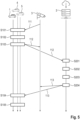
- Figure 5 illustrates another exemplary use case of the method of a vehicle 1 and the method of a server 2 according to preferred embodiments of the present disclosure.
- the methods are performed by a system for quality measurement of an RSU 3 comprising the vehicle 1, the other vehicles 4, 5, the RSU 3 and the server 2.
- the first message 111 from the RSU 3 is received by the vehicle 1 and exemplarily by the other vehicles 4, 5 as well.
- the first message 111 is based on the first sensor value 101 obtained by the sensor of the RSU 3.
- the first message 111 is received directly or indirectly.
- the first message 111 is received via direct communication according to the ITS-G5 and/or the C-V2X standard and/or via indirect communication via a backend.
- the first message 111 is, for example, a collective perception message, CPM, according to the ETSI TR 103 562 or ETSI TS 103 324 standard.
- the vehicle 1 and the other vehicles 4, 5 are detecting second sensor values 102.
- the second sensor values 102 correspond to the first sensor value 101 of the first message 111.
- the second message 112 is transmitted to the server 1 by the vehicles 1, 4, 5.
- the second message 112 is based on the first sensor value 101 of the first message 111 and the second sensor value 102 detected in the second step S102.
- the second message 112 is also transmitted to the RSU 3.
- the second message 112 is transmitted via a different form of communication than the first message 111.
- step S201 second messages 112 from the vehicles 1, 4, 5 are received by the server 2.
- the server 2 is determining deviations 104 based on the second messages 112.
- the server 2 is determining first sensor values 101 and second sensor values 102 based on the second messages 112 and determining the deviations 104 based on the first sensor values 101 and the second sensor values 102.
- the server 2 is aggregating the deviations 104 as deviation data 105 in the database 61.
- the RSU 3 associated with the respective deviation 104 is identified by an ID 103 in the deviation data 105.
- the server 2 is further determining a mean deviation 106 and a score 107 associated with the RSU 3 based on the deviation data 105 in the sixth step S203.
- the score 107 relates to an estimation of the reliability of the RSU 3.
- the mean deviation 106 is exemplarily determined as a mean value of the deviations 104.
- the server 2 is transmitting a third message 113 to the vehicles 1, 4, 5 and the RSU 3.
- the message 113 is based on the deviation data 105.
- the message 113 comprises the ID 103 of the RSU 3, the mean deviation 106 and the score 107 associated with the RSU 3.
- the RSU 3 may then perform a recalibration, offset correction or the like based on the mean deviation 106 and the score 107.
- the vehicles 1, 4, 5 are receiving the third message 113 from the server 2.
- the vehicles 1, 4, 5 are performing a correction of sensor values received from the RSU 3 based on the mean deviation 106 and the score 107 received with the third message 113 in the eighth step S104.
Landscapes
- Engineering & Computer Science (AREA)
- Physics & Mathematics (AREA)
- General Physics & Mathematics (AREA)
- Computer Networks & Wireless Communication (AREA)
- Signal Processing (AREA)
- Chemical & Material Sciences (AREA)
- Analytical Chemistry (AREA)
- Radar, Positioning & Navigation (AREA)
- Remote Sensing (AREA)
- Traffic Control Systems (AREA)
Abstract
Description
- The invention refers to a vehicle, particularly a vehicle for quality measurement of a road side unit, the vehicle comprising at least one sensor, a communication module and a controller. Further the invention relates to a server, particularly a server for quality measurement of a road side unit, wherein the server is configured for wireless communication with the vehicle.
- Car2X Road Side Units (RSUs) use sensor technology to record the traffic situation and transmit the determined data to surrounding traffic participants. Calibration errors can occur during the installation or operation of RSUs, for example due to a shift or inclination of the sensor used relative to the set position. This can result in the transmitted object data no longer accurately reflecting reality, but instead in a difference between a transmitted object and its real-world counterpart.
- In order to detect these errors, the RSUs operated must be regularly checked for correct calibration. For this purpose, drives with a reference vehicle at the RSU can be undertaken. This procedure, in which the RSUs in operation are checked regularly, is time-consuming and requires the presence of a reference vehicle with a driver and, if necessary, a technician on site.
- Furthermore, the quality of RSU data can vary depending on the sensors and algorithm used. Manufacturer A, for example, may provide better data quality than manufacturer B, even if the sensor is set correctly. In addition, statements about the sensors used may also be more or less accurate to reality (e.g., information about sensor range, update frequency, etc.).
- Without a certification process of the sending RSU, the receiving vehicle can thus only insufficiently assess how well the data of an RSU can be trusted.
- It is thus an object of the present disclosure to overcome or reduce at least some of the drawbacks of the prior art and to provide a vehicle and a server for improved quality measurement of a road side unit.
- The given task is solved by the subject-matter of the independent claims. Advantageous embodiments of the invention can further be gained from the dependent claims.
- A first aspect of the present disclosure relates to a vehicle, preferably an automated passenger car with internal combustion engine, electric motor or hybrid engine, comprising at least one sensor configured for detecting sensor values, a communication module configured for wireless communication with an RSU and a server, and a controller of the vehicle.
- The at least one sensor is preferably configured to detect sensor signals relating to the environment of the vehicle. Preferably the at least one sensor is a radar, lidar, sonar, GPS, odometry, inertial and/or camera sensor.
- The communication module is preferably configured to receive and send information directly or indirectly via vehicle-to-vehicle, V2V, communication, vehicle to everything, V2X, communication or via vehicle to infrastructure, V2I, communication. Preferably, the communication module is configured for direct communication according to the ITS-G5 and/or the C-V2X standard and/or for indirect communication via a backend.
- The controller is configured for receiving a first message from the RSU via the communication module. Preferably, the first message is a collective perception message, CPM, according to the ETSI TR 103 562 or ETSI
TS 103 324 standard. The first message is based on a first sensor value obtained by a sensor of the RSU. - The controller is further configured for detecting a second sensor value via the at least one sensor. The second sensor value corresponds to the first sensor value.
- The controller is further configured for transmitting a second message to the server via the communication module. The second message is based on the first sensor value and the second sensor value. Preferably, the second message comprises the first sensor value and the second sensor value. Preferably, the second message is transmitted via a different form of communication than the first message.
- The vehicle according to the present disclosure is advantageously designed in such a way that it is capable of determining and transmitting corresponding sensor values to designated sensor values in order to enable verification of the designated sensor values.
- According to a preferred embodiment, the controller is further configured for determining a deviation based on the first sensor value and the second sensor value. Preferably, the controller is configured to detect an offset between the first and second sensor values and/or to detect an overestimation or underestimation of confidence values based on the first and second sensor values. Preferably, the detection of the offset and/or overestimation or underestimation is based on a plurality of first and second sensor values. Especially preferred, the controller is configured to determine the deviation based on the detected offset and/or the detected overestimation or underestimation. Further preferred, the first message comprises the first sensor value and the controller is configured for determining the deviation as the difference between the first sensor value and the second sensor value. The deviation is thus advantageously calculated in a particularly convenient way. In the preferred embodiment, the second message comprises the deviation. The vehicle can thus advantageously check questionable sensor values of the RSU by itself and a computational effort for determining the deviation is provided by the vehicle. Further advantageous, when the second message comprises the deviation, the first sensor value and/or the second sensor value is not be transmitted via the second message, thus resources are saved.
- According to another preferred embodiment, the first message comprises a first derivative value based on the first sensor value. For example, the first derivative value is a position of the vehicle calculated from at least one first sensor value determined by at least one distance sensor of the RSU. The controller is preferably further configured for determining a second derivative value based on the second sensor value. Preferably, the first derivative value and the first sensor value are related in the same way as the second derivative value and the second sensor value. Alternatively preferred, the first derivative value and the first sensor value are related in a different way than the second derivative value and the second sensor value. For example, the second derivative value is a position calculated from a second sensor value obtained from a GPS sensor. Further preferred, the controller is configured for determining the deviation as the difference between the first derivative value and the second derivative value. In this embodiment, the first and/or second message preferably comprises information on the derivative values, e.g., the method of determination of the values. Further preferred, the second message may comprise the first derivative value and the second derivative value. This preferred embodiment advantageously leads to a larger number of different sensor types of the RSU being able to be checked by the vehicle. It is also particularly advantageous that sensors of the RSU can be checked whose type is not installed in the vehicle.
- In another preferred embodiment, the first message comprises sensor-based information related to a plurality of vehicles. This sensor-based information can comprise first sensor values and/or first derivative values derived based on first sensor values. For example, the first message comprises a current traffic scenario, i.e. information on all vehicles that are situated in the area surrounding the RSU. The controller is preferably further configured for retrieving information related to the vehicle from the first message and determining the deviation based on the information related to the vehicle and the second sensor value. In this preferred embodiment, the vehicle is advantageously configured to pick out the relevant information for a check of the RSU from a multitude of information on its own. In particular, the information can advantageously also be obtained from messages that were not created and sent for the purpose of verification, such as CPMs that are regularly exchanged between different participants of a system for autonomous driving.
- According to a further preferred embodiment, the controller is further configured for determining an ID of the RSU based on the first message. Throughout the present disclosure the ID is preferably an information that clearly and unambiguously identifies the RSU. Particularly preferred, the ID is a number, a name and/or a geographical position. The controller of the vehicle according to the preferred embodiment is further configured for transmitting the second message to the server, the second message comprising the deviation and the ID of the RSU. This is an advantageous way of informing the server of the identity of the RSU to be checked.
- In another preferred embodiment, the controller is further configured for receiving a third message from the server via the communication module. The third message preferably comprises the ID of the RSU. Further preferred, the third message comprises a mean deviation and/or score associated with the RSU. Advantageously, the vehicle is thus provided with information on the RSU, wherein such information may be determined based on swarm data.
- Preferably, the score relates to an estimation of the reliability of the RSU. Based on the mean deviation or the score, the vehicle can thus advantageously assess whether information from the RSU can be trusted.
- According to another preferred embodiment, the controller is further configured for performing a correction of further sensor values and/or further derivative values received from the RSU based on the mean deviation. Thus, the vehicle can advantageously process data received from the RSU even if it is known to be erroneous, especially by correcting the error itself.
- In another preferred embodiment, the controller is further configured for evaluating further first messages only if the score exceeds a predefined threshold. The controller is preferably configured for evaluating all further messages send by the RSU only if the score exceeds a predefined threshold. In this way, messages from an RSU that is known to be particularly faulty are advantageously not processed, which leads to a higher level of vehicle safety.
- Another aspect of the present disclosure is a server, preferably a server for measuring a quality of an RSU. The server is preferably operated by an Original Equipment Manufacturer, OEM, and/or a public authority.
- The server comprises a communication unit configured for wireless communication with an RSU and a vehicle. The communication unit is preferably configured to receive and send information directly or indirectly. Preferably, the communication unit is configured for direct communication according to the ITS-G5 and/or the C-V2X standard and/or for indirect communication via another server. The server further comprises a database configured for storing a variety of data.
- Further, the server comprises a control unit. The control unit is configured for receiving messages from a plurality of vehicles via the communication unit. The messages are preferably second messages send by the vehicle as described above. Each of the messages is based on a first sensor value detected by a sensor of the RSU. The first sensor value is preferably received by the respective vehicle from the RSU and obtained by a sensor of the RSU. The respective vehicle is preferably one vehicle of the plurality of vehicles transmitting a respective second message of such kind. Each of the received messages is further based on a corresponding second sensor value detected by a sensor of the respective vehicle.
- The first sensor value is preferably detected by the same kind of sensor as the second sensor value. Alternatively preferred, the first sensor value is detected by a different kind of sensor as the second sensor value. Preferably the first sensor value and/or the second sensor value are obtained by a radar, lidar, sonar, GPS, odometry, inertial and/or camera sensor.
- The server according to the present disclosure is advantageously designed in such a way that it is capable of receiving messages related to corresponding sensor values of vehicles and an RSU which can be used to evaluate the quality of the RSU. The messages received may also advantageously be used to assess the quality of the vehicles.
- In a preferred embodiment of the server according to the present disclosure, the control unit is further configured for determining deviations based on the messages. Preferably, each of the messages is comprising a deviation and the control unit is configured for determining the deviations by retrieving them from the messages.
- Further preferred, the control unit is configured for determining first sensor values and second sensor values based on the messages and determining the deviations based on the first sensor values and the second sensor values. Particularly preferred, the control unit is configured for determining first sensor values and second sensor values based on derivative values retrieved from the messages and determining the deviations based on the first sensor values and the second sensor values. Preferably, the control unit is configured to detect an offset between the first and second sensor values and/or to detect an overestimation or underestimation of confidence values based on the first and second sensor values. Preferably, the detection of the offset and/or overestimation or underestimation is based on a plurality of first and second sensor values. Especially preferred, the control unit is configured to determine the deviations based on the detected offset and/or the detected overestimation or underestimation. Further preferred, the control unit is configured for determining the deviations as differences between the first sensor values and the corresponding second sensor values. The deviations are thus advantageously calculated in a particularly convenient way.
- Preferably, the control unit is further configured for aggregating the deviations as deviation data in the database. Preferably, the RSU associated with the respective deviation is identified by an ID in the deviation data.
- The control unit is preferably further configured for determining a mean deviation and/or score associated with the RSU based on the deviation data. Preferably, the score relates to an estimation of the reliability of the RSU. Preferably, the score is calculated as a first fixed value when the mean deviation exceeds a first predefined threshold and as a second fixed value when the mean deviation exceeds a second predefined threshold. the first predefined threshold and the second predefined threshold are preferably determined based on mean values of the first and second sensor values. The mean deviation is preferably determined as a mean value and/or a median of the deviations.
- In a further preferred embodiment, the control unit is further configured for transmitting a message to at least one of the plurality of vehicles and/or the RSU via the communication unit. The message is preferably based on the deviation data. The message preferably corresponds to the third message received by the vehicle as described above. The message preferably comprises the ID of the RSU. Further preferred, the third message comprises the mean deviation and/or score associated with the RSU.
- The server can thus advantageously inform the number of vehicles and/or the RSU about the quality of the RSU by means of the message. The vehicle may then advantageously respond to the quality data as described above. The RSU may advantageously perform a recalibration, offset correction or the like based on the mean deviation and/or score.
- In another preferred embodiment, the control unit is further configured for triggering a maintenance of the RSU based on the deviation data. Preferably, the control unit is configured for comparing the mean deviation with a predefined first threshold. The control unit is preferably further configured for triggering a maintenance of the RSU if the mean deviation exceeds the predetermined first threshold. Preferably, the control unit is further configured for comparing the score with a predefined second threshold. The control unit is preferably further configured for triggering a maintenance of the RSU if the score falls below the predetermined second threshold.
- The server can thus ensure that particularly faulty RSUs are removed from service and repaired. This has the advantage of increasing the safety of the autonomous driving system.
- Another aspect of the present disclosure relates to a method of a vehicle, preferably of a vehicle as described above. The method comprises the step of receiving a first message from an RSU. The first message is preferably received directly or indirectly via vehicle-to-vehicle, V2V, communication, vehicle to everything, V2X, communication or via vehicle to infrastructure, V2I, communication. Preferably, the first message is received via direct communication according to the ITS-G5 and/or the C-V2X standard and/or via indirect communication via a backend. Particularly preferred, the first message is a collective perception message, CPM, according to the
ETSI TR 103 562 orETSI TS 103 324 standard. The first message is based on a first sensor value obtained by a sensor of the RSU. - The method further comprises the step of detecting a second sensor value. The second sensor value corresponds to the first sensor value. The second sensor value is preferably a sensor value relating to the environment of the vehicle. Preferably the second sensor value is the sensor value of a radar, lidar, sonar, GPS, odometry, inertial and/or camera sensor.
- The method further comprises the step of transmitting a second message to a server. The second message is based on the first sensor value and the second sensor value. Preferably, the second message is transmitted via a different form of communication than the first message.
- Preferred embodiments of the method of a vehicle according to the present disclosure correspond to preferred embodiments of the vehicle according to the disclosure as described above. Advantages of the method of a vehicle correspond to advantages of the vehicle as described above.
- A further aspect of the present disclosure relates to a method of a server, preferably of a server as described above. The method comprises the step of receiving messages from a plurality of vehicles. The messages are preferably second messages send by the vehicle as described above. The messages are preferably received directly or indirectly. Preferably, the messages are received via direct communication according to the ITS-G5 and/or the C-V2X standard and/ or via indirect communication via another server.
- Each of the messages is based on a first sensor value detected by a sensor of the RSU. The first sensor value is preferably received by the respective vehicle from the RSU and obtained by a sensor of the RSU. The respective vehicle is preferably one vehicle of the plurality of vehicles transmitting a respective second message of such kind. Each of the messages is further based on a corresponding second sensor value detected by a sensor of the respective vehicle.
- The first sensor value is preferably detected by the same kind of sensor as the second sensor value. Alternatively preferred, the first sensor value is detected by a different kind of sensor as the second sensor value. Preferably the first sensor value and/or the second sensor value are obtained by a radar, lidar, sonar, GPS, odometry, inertial and/or camera sensor.
- Preferred embodiments of the method of a server according to the present disclosure correspond to preferred embodiments of the server according to the disclosure as described above. Advantages of the method of a server correspond to advantages of the server as described above.
- In further preferred embodiments, the vehicle and the server, as well as the methods for a vehicle and a server according to the present disclosure, are also applicable to a quality measurement of another participant in a system for autonomous driving, just as they are for a quality measurement of an RSU. Such a participant is preferably an intelligent traffic device or another vehicle.
- Another aspect of the disclosure relates to a computer program comprising instructions that, when the program is executed by a computer, such as a controller of a vehicle, cause the computer to execute the method of a vehicle as described above.
- Another aspect of the disclosure relates to a computer program comprising instructions that, when the program is executed by a computer, such as a control unit of a server, cause the computer to execute the method of a server as described above.
- The different embodiments of the invention described herein may be advantageously combined unless the contrary is indicated herein.
- Reference is now made to the following figures, in order to describe preferred embodiments of the invention in more detail.
- Figure 1
- illustrates a vehicle, a server and an RSU according to preferred embodiments of the present disclosure;
- Figure 2
- illustrates an exemplary use case of the vehicle and the server according to preferred embodiments of the present disclosure;
- Figure 3
- illustrates a method of a vehicle according to a preferred embodiment of the present disclosure;
- Figure 4
- illustrates a method of a server according to a preferred embodiment of the present disclosure; and
- Figure 5
- illustrates another exemplary use case of the method of a vehicle and the method of a server according to preferred embodiments of the present disclosure.
- Some portions of the detailed description which follows are presented in terms of data processing procedures, steps or other symbolic representations of operations on data bits that can be performed on computer memory. Therefore, a computer executes such logical steps thus requiring physical manipulations of physical quantities.
- Usually these quantities take the form of electrical or magnetic signals capable of being stored, transferred, combined, compared, and otherwise manipulated in a computer system. For reasons of common usage, these signals are referred to as bits, packets, messages, values, elements, symbols, characters, terms, numbers, or the like.
- Additionally, all of these and similar terms are to be associated with the appropriate physical quantities and are merely convenient labels applied to these quantities. Terms such as "processing" or "creating" or "transferring" or "executing" or "determining" or "detecting" or "obtaining" or "selecting" or "calculating" or "generating" or the like, refer to the action and processes of a computer system that manipulates and transforms data represented as physical (electronic) quantities within the computer's registers and memories into other data similarly represented as physical quantities within the memories or registers or other such information storage.
- As utilized herein, the term "example" means serving as a non-limiting example, instance, or illustration. As utilized herein, the terms "for example" and "e.g." introduce a list of one or more non-limiting examples, instances, or illustrations.
- As used herein, the term "and/or" includes any and all combinations of one or more of the associated listed items. Further, the use of "may" when describing embodiments of the present invention refers to "one or more embodiments of the present invention." Further, in the following description of embodiments of the present invention, the terms of a singular form may include plural forms unless the presented context clearly indicates otherwise.
- It will be understood that although the terms "first" and "second" are used to describe various elements, these elements should not be limited by these terms. These terms are only used to distinguish one element from another element. For example, a first element may be named a second element and, similarly, a second element may be named a first element, without departing from the scope of the present invention. As used herein, the term "and/or" includes any and all combinations of one or more of the associated listed items and expressions such as "at least one of" when preceding a list of elements, modify the entire list of elements.
- Reference will now be made in detail to embodiments which are illustrated in the drawings. Effects and features of the exemplary embodiments will be described with reference to the accompanying drawings. Therein, like reference numerals denote like elements, and redundant descriptions are omitted. The present invention, however, may be embodied in various different forms, and should not be construed as being limited to only the illustrated embodiments herein. Rather, these embodiments are provided solely as examples for fully conveying the aspects and features of the present invention to those skilled in the art.
-
Figure 1 illustrates avehicle 1, in particular a passenger vehicle with an internal combustion engine, an electric engine, or a hybrid engine, aserver 2 and anRSU 3 according to preferred embodiments of the present disclosure. - The
vehicle 1 comprises a plurality of sensors, in particular afirst sensor 11, asecond sensor 12, and athird sensor 13. Thesensors vehicle 1 and comprise, for example, a camera for detecting an image of a traffic scenario located in front of thevehicle 1, distance sensors, such as ultrasonic sensors, for detecting distances to objects or further vehicles surrounding thevehicle 1. Thesensors controller 40 of thevehicle 1. - The
controller 40 according to the present disclosure is configured to carry out the method of a vehicle according to the present disclosure, as explained in detail below. For this purpose, thecontroller 40 has aninternal memory 41 and aCPU 42, which communicate with one another, for example via a suitable data bus. Furthermore, thecontroller 40 is in communication connection with at least thesensors communication module 30, for example via one or more respective CAN connections, one or more respective SPI connections or other suitable data connections. - The
communication module 30 comprises amemory 31 and one or more transponders ortransceivers 32. Thetransceiver 32 is a radio, WLAN, GPS or Bluetooth transceiver or the like, in particular a transceiver configured for communication in a communication network. Thetransceiver 32 communicates with theinternal memory 31 of thecommunication module 30, for example via a suitable data bus. Thecommunication module 30 also communicates with thecontroller 40, in particular transmitting data received therefrom and/or receiving data to be sent therefrom. Furthermore, thecommunication module 30 is adapted to communicate with acommunication unit 50 of aserver 2 via V2I communication, preferably via a communication network. Furthermore, thecommunication module 30 may also be arranged to communicate with one ormore RSUs 3. - The communication network is preferably a network according to 3GPP standard, for example an LTE, LTE-A (4G) or 5G communication network. The communication network may further be configured for the following operations or according to the following standards: High Speed Packet Access (HSPA), a Universal Mobile Telecommunication System (UMTS), UMTS Terrestrial Radio Access Network (UTRAN), evolved-UTRAN (e-UTRAN), Global System for Mobile communication (GSM), Enhanced Data rates for GSM Evolution (EDGE), GSM/EDGE Radio Access Network (GERAN). Alternatively or additionally, the communication network can also be designed according to one of the following standards: Worldwide Inter-operability for Microwave Access (WIMAX) network IEEE 802.16, Wireless Local Area Network (WLAN) IEEE 802.11. Also preferably, the communication network uses one of the following coding schemes: Orthogonal Frequency Division Multiple Access (OFDMA), Time Division Multiple Access (TDMA), Code Division Multiple Access (CDMA), a Wideband CDMA (WCDMA), Frequency Division Multiple Access (FDMA), or Spatial Division Multiple Access (SDMA), etc.
- The
communication unit 50 of theserver 2 comprises amemory 51 and one or more transponders ortransceivers 52. Thetransceiver 52 is a radio, WLAN, GPS or Bluetooth transceiver or the like, in particular a transceiver configured for communication in a communication network. Thetransceiver 52 communicates with theinternal memory 51 of thecommunication unit 50, for example via a suitable data bus. Thecommunication unit 50 also communicates with acontrol unit 60 of theserver 2, for example via one or more respective CAN connections, one or more respective SPI connections or other suitable data connections, in particular transmitting data received therefrom and/or receiving data to be sent therefrom. - The
control unit 60 according to the present disclosure is configured to carry out the method of a server according to the present disclosure, as explained in detail below. For this purpose, thecontrol unit 60 has adatabase 61 and aCPU 62, which communicate with one another, for example via a suitable data bus. -
Figure 2 illustrates an exemplary use case of the vehicle and the server according to preferred embodiments of the present disclosure. TheRSU 3 is detecting afirst sensor value 101, in particular aposition 101 of thevehicle 1. TheRSU 3 is further sending afirst message 111 to thevehicle 1. Thefirst message 111 is based on thefirst sensor value 101 and theID 103 of the RSU. Thevehicle 1 is also detecting its position as asecond sensor value 102 and determining adeviation 104 based on the first and second sensor values 101, 102. Thevehicle 1 is further sending asecond message 112 to theserver 2. Thesecond message 112 comprises theID 103 and thedeviation 104. Theserver 2 is aggregating all receiveddeviations 104 andIDs 103 asdeviation data 105 in thedatabase 61. Based on thedeviation data 105, theserver 2 is determining ascore 107 and amean deviation 106 associated with theRSU 3 with theID 103. The server is then sending athird message 113 to twoother vehicles 4, 5. Thethird message 113 comprises the ID n, thescore 107 and themean deviation 106. -
Figure 3 illustrates a method of avehicle 1 according to a preferred embodiment of the present disclosure. The method comprises as a first step S101 a receiving of afirst message 111 from anRSU 3. Thefirst message 111 is based on afirst sensor value 101 obtained by a sensor of theRSU 3. - The method further comprises the second step S102 of detecting a
second sensor value 102. Thesecond sensor value 102 corresponds to thefirst sensor value 101 received in the first step S101. Thesecond sensor value 102 is for example a sensor value of a radar, lidar, sonar, GPS, odometry, inertial and/or camera sensor. - The method further comprises the third step S103 of transmitting a
second message 112 to aserver 2. Thesecond message 112 is based on thefirst sensor value 101 and thesecond sensor value 102 detected in the second step S102. -
Figure 4 illustrates a method of aserver 2 according to a preferred embodiment of the present disclosure. Theserver 2 is particularly aserver 2 as described above. The method comprises the step S201 of receiving messages from a plurality of vehicles. The messages are particularlysecond messages 112 send by the vehicle as described above. - Each of the messages is based on a
first sensor value 101 detected by a sensor of theRSU 3. Each of the messages is further based on a correspondingsecond sensor value 102 detected by asensor respective vehicle 1. Therespective vehicle 1 is the onevehicle 1 of the plurality of vehicles transmitting the respective message. - The method according to a preferred embodiment further comprises as a step S202 a determining of
deviations 104 based on thesecond messages 112. In particular, theserver 2 is determining first sensor values 101 and second sensor values 102 based on thesecond messages 112 and determining thedeviations 104 based on the first sensor values 101 and the second sensor values 102. -
Figure 5 illustrates another exemplary use case of the method of avehicle 1 and the method of aserver 2 according to preferred embodiments of the present disclosure. The methods are performed by a system for quality measurement of anRSU 3 comprising thevehicle 1, theother vehicles 4, 5, theRSU 3 and theserver 2. - In the first step S101 the
first message 111 from theRSU 3 is received by thevehicle 1 and exemplarily by theother vehicles 4, 5 as well. Thefirst message 111, as described above, is based on thefirst sensor value 101 obtained by the sensor of theRSU 3. Thefirst message 111 is received directly or indirectly. In particular, thefirst message 111 is received via direct communication according to the ITS-G5 and/or the C-V2X standard and/or via indirect communication via a backend. Thefirst message 111 is, for example, a collective perception message, CPM, according to theETSI TR 103 562 orETSI TS 103 324 standard. - In the second step S102, the
vehicle 1 and theother vehicles 4, 5 are detecting second sensor values 102. The second sensor values 102 correspond to thefirst sensor value 101 of thefirst message 111. - In the third step S103 the
second message 112 is transmitted to theserver 1 by thevehicles second message 112 is based on thefirst sensor value 101 of thefirst message 111 and thesecond sensor value 102 detected in the second step S102. Thesecond message 112 is also transmitted to theRSU 3. In particular, thesecond message 112 is transmitted via a different form of communication than thefirst message 111. - In the forth step S201,
second messages 112 from thevehicles server 2. - In the fifth step S202, the
server 2 is determiningdeviations 104 based on thesecond messages 112. In particular, theserver 2 is determining first sensor values 101 and second sensor values 102 based on thesecond messages 112 and determining thedeviations 104 based on the first sensor values 101 and the second sensor values 102. - In a sixth step S203, the
server 2 is aggregating thedeviations 104 asdeviation data 105 in thedatabase 61. TheRSU 3 associated with therespective deviation 104 is identified by anID 103 in thedeviation data 105. Theserver 2 is further determining amean deviation 106 and ascore 107 associated with theRSU 3 based on thedeviation data 105 in the sixth step S203. Thescore 107 relates to an estimation of the reliability of theRSU 3. Themean deviation 106 is exemplarily determined as a mean value of thedeviations 104. - In the seventh step S204, the
server 2 is transmitting athird message 113 to thevehicles RSU 3. Themessage 113 is based on thedeviation data 105. In particular, themessage 113 comprises theID 103 of theRSU 3, themean deviation 106 and thescore 107 associated with theRSU 3. TheRSU 3 may then perform a recalibration, offset correction or the like based on themean deviation 106 and thescore 107. - In the eighth step S104, the
vehicles third message 113 from theserver 2. - In the ninth step S105, the
vehicles RSU 3 based on themean deviation 106 and thescore 107 received with thethird message 113 in the eighth step S104. -
- 1
- Vehicle
- 2
- Server
- 3
- Road Side Unit, RSU
- 4
- second Vehicle
- 5
- third Vehicle
- 11
- first Sensor
- 12
- second Sensor
- 13
- third Sensor
- 101
- first sensor value
- 102
- second sensor value
- 103
- ID
- 104
- deviation
- 105
- deviation data
- 106
- mean deviation
- 107
- Score
- 111
- first Message
- 112
- second Message
- 113
- third Message
- 30
- Communication Module
- 31
- Memory
- 32
- Transceiver
- 40
- Controller
- 41
- Memory
- 42
- CPU
- 50
- Communication Unit
- 51
- Memory
- 52
- Transceiver
- 60
- Control unit
- 61
- Database
- 62
- CPU
- S101
- first Step
- S102
- second Step
- S103
- third Step
- S201
- forth Step
- S202
- fifth Step
- S203
- sixth Step
- S204
- seventh Step
- S104
- eighth Step
- S105
- ninth Step
Claims (15)
- Vehicle (1, 4, 5), comprising:at least one sensor (11, 12, 13) configured for detecting sensor values,a communication module (30) configured for wireless communication with a road side unit, RSU (3) and a server (2), anda controller (40) configured for:receiving a first message (111) from the RSU (3) via the communication module (30), the first message (111) being based on a first sensor value (101) obtained by a sensor of the RSU (3);detecting a second sensor value (102) via the at least one sensor (11, 12, 13), the second sensor value (102) corresponding to the first sensor value (101); andtransmitting a second message (112) to the server (2) via the communication module (30), the second message (112) being based on the first sensor value (101) and the second sensor value (102).
- Vehicle (1, 4, 5) according to claim 1, wherein the controller (40) is further configured for determining a deviation (104) based on the first sensor value (101) and the second sensor value (102) and the second message (112) comprises the deviation (104).
- Vehicle (1, 4, 5) according to claim 2, wherein the first message (111) comprises a first derivative value based on the first sensor value (101) and the controller (40) is further configured for:determining a second derivative value based on the second sensor value (102); anddetermining the deviation (104) as the difference between the first derivative value and the second derivative value.
- Vehicle (1, 4, 5) according to claim 2 or 3, wherein the first message (111) comprises sensor-based information related to a plurality of vehicles (1, 4, 5) and the controller (40) is further configured for:retrieving information related to the vehicle (1, 4, 5) from the first message (111); anddetermining the deviation (104) based on the information related to the vehicle (1, 4, 5) and the second sensor value (102).
- Vehicle (1, 4, 5) according to any one of the claims 2 to 4, wherein the controller (40) is further configured for:determining an ID (103) of the RSU (3) based on the first message (111); andtransmitting the second message (112) to the server (2), the second message (112) comprising the deviation (104) and the ID (103) of the RSU (3).
- Vehicle (1, 4, 5) according to claim 5, wherein the controller (40) is further configured for:receiving a third message (113) from the server via the communication module (30),wherein the third message (113) comprises the ID (103) of the RSU (3) and a mean deviation (106) and/or score (107) associated with the RSU (3).
- Vehicle (1, 4, 5) according to claim 6, wherein the score (107) relates to an estimation of the reliability of the RSU (3).
- Vehicle (1, 4, 5) according to claim 6 or 7, wherein the controller (40) is further configured for performing a correction of further sensor values and/or further derivative values received from the RSU (3) based on the mean deviation (106).
- Vehicle (1, 4, 5) according to any one of the claims 6 to 8, wherein the controller (40) is further configured for evaluating further first messages (111) only if the score (107) exceeds a predefined threshold.
- Server (2), comprising:a communication unit (50) configured for wireless communication with an RSU (3) and a vehicle (1, 4, 5),a database (61) configured for storing a variety of data, anda control unit (60) configured for:
receiving messages from a plurality of vehicles (1, 4, 5) via the communication unit (50), each of the messages being based on a first sensor value (101) detected by a sensor of the RSU (3) and a corresponding second sensor value (102) detected by a sensor (11, 12, 13) of the respective vehicle (1, 4, 5). - Server (2) according to claim 10, wherein the control unit (60) is further configured for:Determining deviations (104) based on the messages; andaggregating the deviations (104) as deviation data (105) in the database (61).
- Server (2) according to claim 11, wherein the control unit (60) is further configured for:transmitting a message to at least one of the plurality of vehicles (1, 4, 5) and/or the RSU (3) via the communication unit (50),wherein the message is based on the deviation data.
- Server (2) according to claim 11 or 12, wherein the control unit (60) is further configured for triggering a maintenance of the RSU (3) based on the deviation data (105).
- Method of a vehicle (1, 4, 5) comprising the steps of:receiving (S101) a first message (111) from an RSU (3), the first message (111) being based on a first sensor value (101) obtained by a sensor of the RSU (3);detecting (S102) a second sensor value (102) corresponding to the first sensor value (101); andtransmitting (S103) a second message (112) to a server (2), the second message (112) being based on the first sensor value (101) and the second sensor value (102).
- Method of a server (2) comprising the steps of:
Receiving (S201) messages from a plurality of vehicles (1, 4, 5), each of the messages being based on a first sensor value (101) detected by a sensor of an RSU (3) and a corresponding second sensor value (102) detected by a sensor (11, 12, 13) of the respective vehicle (1, 4, 5).
Priority Applications (3)
| Application Number | Priority Date | Filing Date | Title |
|---|---|---|---|
| EP23157860.0A EP4421774A1 (en) | 2023-02-21 | 2023-02-21 | Vehicle and server for quality measurement of a road side unit |
| CN202410177151.8A CN118534211A (en) | 2023-02-21 | 2024-02-08 | Vehicle and server for quality measurement of roadside units |
| US18/442,863 US20240284152A1 (en) | 2023-02-21 | 2024-02-15 | Vehicle and Server for Quality Measurement of a Road Side Unit |
Applications Claiming Priority (1)
| Application Number | Priority Date | Filing Date | Title |
|---|---|---|---|
| EP23157860.0A EP4421774A1 (en) | 2023-02-21 | 2023-02-21 | Vehicle and server for quality measurement of a road side unit |
Publications (1)
| Publication Number | Publication Date |
|---|---|
| EP4421774A1 true EP4421774A1 (en) | 2024-08-28 |
Family
ID=85321244
Family Applications (1)
| Application Number | Title | Priority Date | Filing Date |
|---|---|---|---|
| EP23157860.0A Pending EP4421774A1 (en) | 2023-02-21 | 2023-02-21 | Vehicle and server for quality measurement of a road side unit |
Country Status (3)
| Country | Link |
|---|---|
| US (1) | US20240284152A1 (en) |
| EP (1) | EP4421774A1 (en) |
| CN (1) | CN118534211A (en) |
Cited By (1)
| Publication number | Priority date | Publication date | Assignee | Title |
|---|---|---|---|---|
| US20240284152A1 (en) * | 2023-02-21 | 2024-08-22 | Volkswagen Aktiengesellschaft | Vehicle and Server for Quality Measurement of a Road Side Unit |
Families Citing this family (1)
| Publication number | Priority date | Publication date | Assignee | Title |
|---|---|---|---|---|
| DE102020206702A1 (en) * | 2020-05-28 | 2021-12-02 | Continental Automotive Gmbh | Method and system for assessing the correctness of information transmitted by a vehicle |
Citations (6)
| Publication number | Priority date | Publication date | Assignee | Title |
|---|---|---|---|---|
| US20210118304A1 (en) * | 2019-10-16 | 2021-04-22 | Audi Ag | Method for determining the position of a non-motorized road user and traffic device |
| US20220103986A1 (en) * | 2019-01-10 | 2022-03-31 | Lg Electronics Inc. | Device and method for v2x communication |
| US20220264270A1 (en) * | 2021-02-17 | 2022-08-18 | Qualcomm Incorporated | Evaluating Vehicle-To-Everything (V2X) Information |
| US20220301428A1 (en) * | 2021-03-19 | 2022-09-22 | Qualcomm Incorporated | Signaling techniques for sensor fusion systems |
| US20220317312A1 (en) * | 2021-04-05 | 2022-10-06 | Qualcomm Incorporated | Gnss spoofing detection and recovery |
| US20220338012A1 (en) * | 2021-03-25 | 2022-10-20 | Qualcomm Incorporated | Detecting misbehavior conditions in vehicle-to-everything (v2x) messages |
Family Cites Families (37)
| Publication number | Priority date | Publication date | Assignee | Title |
|---|---|---|---|---|
| US8923147B2 (en) * | 2011-10-03 | 2014-12-30 | Qualcomm Incorporated | Method and apparatus for filtering and processing received vehicle peer transmissions based on reliability information |
| KR101231534B1 (en) * | 2011-10-17 | 2013-02-07 | 현대자동차주식회사 | A method and system to improve accuracy in differential global positioning system using vehicle to vehicle |
| US9840254B2 (en) * | 2015-12-31 | 2017-12-12 | Sony Corporation | Method and system for adaptive detection and application of horn for an autonomous vehicle |
| DE102016217081A1 (en) * | 2016-09-08 | 2018-03-08 | Robert Bosch Gmbh | Method and device for receiving, processing and transmitting data |
| KR101896783B1 (en) * | 2016-10-17 | 2018-10-18 | 현대자동차주식회사 | V2x communication apparatus for verifying reliability of v2x data, system having the same and method thereof |
| JP6872959B2 (en) * | 2017-04-20 | 2021-05-19 | パナソニック インテレクチュアル プロパティ コーポレーション オブ アメリカPanasonic Intellectual Property Corporation of America | Communication systems, vehicle mounts and programs |
| US10843703B2 (en) * | 2018-01-31 | 2020-11-24 | Toyota Jidosha Kabushiki Kaisha | Accuracy system for connected vehicles |
| KR102085917B1 (en) * | 2018-09-28 | 2020-03-06 | 현대오트론 주식회사 | Vehicle system and vehicle control method using sensor data of another vehicle |
| JP7138188B2 (en) * | 2018-10-12 | 2022-09-15 | 京セラ株式会社 | Base station, traffic communication system, and method |
| EP3640665A1 (en) * | 2018-10-16 | 2020-04-22 | Aptiv Technologies Limited | Method to improve the determination of a position of a roadside unit, roadside unit and system to provide position information |
| WO2020145437A1 (en) * | 2019-01-10 | 2020-07-16 | 엘지전자 주식회사 | Device and method for v2x communication |
| US11796654B2 (en) * | 2019-09-04 | 2023-10-24 | Qualcomm Incorporated | Distributed sensor calibration and sensor sharing using cellular vehicle-to-everything (CV2X) communication |
| US20220324488A1 (en) * | 2019-10-11 | 2022-10-13 | Sony Group Corporation | Information processing system, information processing apparatus, and information processing method |
| CN111121849B (en) * | 2020-01-02 | 2021-08-20 | 大陆投资(中国)有限公司 | Automatic calibration method of sensor's orientation parameter, edge computing unit and roadside sensing system |
| KR102841665B1 (en) * | 2020-02-13 | 2025-08-04 | 엘지전자 주식회사 | Methods for comparing traffic signal information on a vehicle in autonomous driving system |
| US12169237B2 (en) * | 2020-04-01 | 2024-12-17 | Qualcomm Incorporated | Vehicle request for sensor data with sensor data filtering condition |
| KR102811279B1 (en) * | 2020-04-29 | 2025-05-23 | 엘지전자 주식회사 | Method of operation of RSU in relation to VRU location in wireless communication system |
| WO2022098147A1 (en) * | 2020-11-05 | 2022-05-12 | 엘지전자 주식회사 | Method for processing image on basis of v2x message in wireless communication system and apparatus therefor |
| US11671857B2 (en) * | 2020-12-03 | 2023-06-06 | Mitsubishi Electric Corporation | Roadside communication system for monitoring and maintaining sensor data transmission |
| US11640172B2 (en) * | 2020-12-03 | 2023-05-02 | Mitsubishi Electric Cornoration | Vehicle controls based on reliability values calculated from infrastructure information |
| US12008895B2 (en) * | 2021-01-19 | 2024-06-11 | Qualcomm Incorporated | Vehicle-to-everything (V2X) misbehavior detection using a local dynamic map data model |
| JP7539498B2 (en) * | 2021-01-29 | 2024-08-23 | Agc株式会社 | Information processing system and automated driving assistance method |
| US12126993B2 (en) * | 2021-02-09 | 2024-10-22 | Qualcomm Incorporated | Method and system for protecting proprietary information used to determine a misbehavior condition for vehicle-to-everything (V2X) reporting |
| CN112995899B (en) * | 2021-05-08 | 2021-08-10 | 北京大唐高鸿数据网络技术有限公司 | Vehicle-road cooperative positioning method and device, vehicle-mounted positioning system and road side equipment |
| EP4170389A1 (en) * | 2021-10-22 | 2023-04-26 | Aptiv Services Poland S.A. | Methods and apparatuses for supporting vehicle-to-infrastructure, v2i, communication |
| EP4170622B1 (en) * | 2021-10-25 | 2025-04-23 | Volkswagen Ag | Method for storing and evaluating status information detected within a v2x network |
| US11940544B2 (en) * | 2021-10-25 | 2024-03-26 | Ford Global Technologies, Llc | Vehicle positioning using V2X RSU messaging and vehicular sensors |
| JP7308900B2 (en) * | 2021-10-27 | 2023-07-14 | 三菱電機株式会社 | Vehicle cruise control processing system |
| US12205417B2 (en) * | 2021-11-17 | 2025-01-21 | Qualcomm Incorporated | Misbehavior detection using sensor sharing and collective perception |
| US12055640B2 (en) * | 2021-11-17 | 2024-08-06 | Qualcomm Incorporated | Erroneous time and location detection and correction |
| US12408039B2 (en) * | 2022-03-17 | 2025-09-02 | Qualcomm Incorporated | Reputation score assignment for vehicle-based communications |
| US12245038B2 (en) * | 2022-09-09 | 2025-03-04 | Qualcomm Incorporated | Sensor misbehavior detection system utilizing communications |
| US11828861B1 (en) * | 2022-10-27 | 2023-11-28 | Integrity Security Services Llc | Systems and methods for establishing a confidence level for device operational data |
| EP4670148A1 (en) * | 2023-02-21 | 2025-12-31 | Volkswagen Aktiengesellschaft | METHOD AND VEHICLE FOR QUALITY MEASUREMENT OF A TRANSPORT INFRASTRUCTURE ELEMENT |
| EP4421774A1 (en) * | 2023-02-21 | 2024-08-28 | Volkswagen Ag | Vehicle and server for quality measurement of a road side unit |
| US20240321096A1 (en) * | 2023-03-23 | 2024-09-26 | Qualcomm Incorporated | Localization using position coordination of road signs |
| US12565230B2 (en) * | 2023-08-22 | 2026-03-03 | Qualcomm Incorporated | Vehicle environment sensor reliability determination |
-
2023
- 2023-02-21 EP EP23157860.0A patent/EP4421774A1/en active Pending
-
2024
- 2024-02-08 CN CN202410177151.8A patent/CN118534211A/en active Pending
- 2024-02-15 US US18/442,863 patent/US20240284152A1/en active Pending
Patent Citations (6)
| Publication number | Priority date | Publication date | Assignee | Title |
|---|---|---|---|---|
| US20220103986A1 (en) * | 2019-01-10 | 2022-03-31 | Lg Electronics Inc. | Device and method for v2x communication |
| US20210118304A1 (en) * | 2019-10-16 | 2021-04-22 | Audi Ag | Method for determining the position of a non-motorized road user and traffic device |
| US20220264270A1 (en) * | 2021-02-17 | 2022-08-18 | Qualcomm Incorporated | Evaluating Vehicle-To-Everything (V2X) Information |
| US20220301428A1 (en) * | 2021-03-19 | 2022-09-22 | Qualcomm Incorporated | Signaling techniques for sensor fusion systems |
| US20220338012A1 (en) * | 2021-03-25 | 2022-10-20 | Qualcomm Incorporated | Detecting misbehavior conditions in vehicle-to-everything (v2x) messages |
| US20220317312A1 (en) * | 2021-04-05 | 2022-10-06 | Qualcomm Incorporated | Gnss spoofing detection and recovery |
Cited By (1)
| Publication number | Priority date | Publication date | Assignee | Title |
|---|---|---|---|---|
| US20240284152A1 (en) * | 2023-02-21 | 2024-08-22 | Volkswagen Aktiengesellschaft | Vehicle and Server for Quality Measurement of a Road Side Unit |
Also Published As
| Publication number | Publication date |
|---|---|
| CN118534211A (en) | 2024-08-23 |
| US20240284152A1 (en) | 2024-08-22 |
Similar Documents
| Publication | Publication Date | Title |
|---|---|---|
| US20240284152A1 (en) | Vehicle and Server for Quality Measurement of a Road Side Unit | |
| US11338817B2 (en) | Detection of a decreasing performance of a sensor | |
| US11170585B2 (en) | Vehicle fault diagnosis and analysis based on augmented design failure mode and effect analysis (DFMEA) data | |
| JP2020119509A (en) | Modification of vehicle components based on vehicle accident reproduction data | |
| US20130093618A1 (en) | Method and system for improving accuracy of position correction data in differential global positioning system using vehicle to vehicle communication | |
| US11670091B2 (en) | Method and arrangement for validating speed limit information for a road vehicle | |
| CN104680798B (en) | Method and control and detection device for reliability test of wrong driving of motor vehicle | |
| CN111634160B (en) | Method for establishing communication connection with tire pressure monitoring system, device and electronic equipment thereof | |
| CN115708142A (en) | Method and device for verifying vehicle-to-outside interaction information for controlling traffic flow | |
| JP2019008618A (en) | Information processing apparatus, information processing method, and program | |
| CN105774729A (en) | V2V active safety system and control method thereof | |
| JP2022543591A (en) | Method and device for locating a vehicle within a surrounding area | |
| US10311732B2 (en) | Concept for checking a sensor system for detecting an occupancy state of a parking space for errors | |
| US20240153377A1 (en) | Method and unit for securing the content of object data for collective perception | |
| CN110926481A (en) | Vehicle positioning navigation method and device thereof | |
| EP3547058B1 (en) | Diagnosis device and diagnosis method | |
| WO2019203712A1 (en) | Methods and control arrangements for diagnosing short-range wireless transmission functionality of vehicles | |
| US20200363214A1 (en) | Method for using a feature-based localization map for a vehicle | |
| CN120712595A (en) | Method and vehicle for quality measurement of traffic infrastructure elements | |
| WO2021019635A1 (en) | Security device, attack response processing method, computer program, and storage medium | |
| US11961398B2 (en) | Quality determining method, quality determining device, and motor vehicle | |
| CN115712290B (en) | Vehicle TBOX fault identification method and device | |
| KR102242228B1 (en) | System and method for collecting vehicle accident-related information using vehicle gateway device | |
| US10395443B2 (en) | Testing for errors of a sensor system for acquiring a state of occupancy of a parking space | |
| US12499754B2 (en) | Vehicle, computer program, apparatus and method for a vehicle |
Legal Events
| Date | Code | Title | Description |
|---|---|---|---|
| PUAI | Public reference made under article 153(3) epc to a published international application that has entered the european phase |
Free format text: ORIGINAL CODE: 0009012 |
|
| STAA | Information on the status of an ep patent application or granted ep patent |
Free format text: STATUS: THE APPLICATION HAS BEEN PUBLISHED |
|
| AK | Designated contracting states |
Kind code of ref document: A1 Designated state(s): AL AT BE BG CH CY CZ DE DK EE ES FI FR GB GR HR HU IE IS IT LI LT LU LV MC ME MK MT NL NO PL PT RO RS SE SI SK SM TR |
|
| STAA | Information on the status of an ep patent application or granted ep patent |
Free format text: STATUS: REQUEST FOR EXAMINATION WAS MADE |
|
| 17P | Request for examination filed |
Effective date: 20250228 |
|
| STAA | Information on the status of an ep patent application or granted ep patent |
Free format text: STATUS: EXAMINATION IS IN PROGRESS |
|
| 17Q | First examination report despatched |
Effective date: 20250626 |