EP4421757A1 - Audio-visual pilot activity recognition system and method - Google Patents
Audio-visual pilot activity recognition system and method Download PDFInfo
- Publication number
- EP4421757A1 EP4421757A1 EP23158547.2A EP23158547A EP4421757A1 EP 4421757 A1 EP4421757 A1 EP 4421757A1 EP 23158547 A EP23158547 A EP 23158547A EP 4421757 A1 EP4421757 A1 EP 4421757A1
- Authority
- EP
- European Patent Office
- Prior art keywords
- audio
- pilot
- module
- image
- activity recognition
- Prior art date
- Legal status (The legal status is an assumption and is not a legal conclusion. Google has not performed a legal analysis and makes no representation as to the accuracy of the status listed.)
- Pending
Links
Images

Classifications
-
- G—PHYSICS
- G06—COMPUTING OR CALCULATING; COUNTING
- G06V—IMAGE OR VIDEO RECOGNITION OR UNDERSTANDING
- G06V20/00—Scenes; Scene-specific elements
- G06V20/50—Context or environment of the image
- G06V20/59—Context or environment of the image inside of a vehicle, e.g. relating to seat occupancy, driver state or inner lighting conditions
- G06V20/597—Recognising the driver's state or behaviour, e.g. attention or drowsiness
-
- G—PHYSICS
- G06—COMPUTING OR CALCULATING; COUNTING
- G06T—IMAGE DATA PROCESSING OR GENERATION, IN GENERAL
- G06T17/00—Three-dimensional [3D] modelling for computer graphics
-
- G—PHYSICS
- G06—COMPUTING OR CALCULATING; COUNTING
- G06T—IMAGE DATA PROCESSING OR GENERATION, IN GENERAL
- G06T7/00—Image analysis
- G06T7/50—Depth or shape recovery
-
- G—PHYSICS
- G06—COMPUTING OR CALCULATING; COUNTING
- G06T—IMAGE DATA PROCESSING OR GENERATION, IN GENERAL
- G06T7/00—Image analysis
- G06T7/70—Determining position or orientation of objects or cameras
-
- G—PHYSICS
- G06—COMPUTING OR CALCULATING; COUNTING
- G06V—IMAGE OR VIDEO RECOGNITION OR UNDERSTANDING
- G06V10/00—Arrangements for image or video recognition or understanding
- G06V10/70—Arrangements for image or video recognition or understanding using pattern recognition or machine learning
- G06V10/77—Processing image or video features in feature spaces; using data integration or data reduction, e.g. principal component analysis [PCA] or independent component analysis [ICA] or self-organising maps [SOM]; Blind source separation
- G06V10/80—Fusion, i.e. combining data from various sources at the sensor level, preprocessing level, feature extraction level or classification level
- G06V10/803—Fusion, i.e. combining data from various sources at the sensor level, preprocessing level, feature extraction level or classification level of input or preprocessed data
-
- G—PHYSICS
- G06—COMPUTING OR CALCULATING; COUNTING
- G06V—IMAGE OR VIDEO RECOGNITION OR UNDERSTANDING
- G06V10/00—Arrangements for image or video recognition or understanding
- G06V10/70—Arrangements for image or video recognition or understanding using pattern recognition or machine learning
- G06V10/82—Arrangements for image or video recognition or understanding using pattern recognition or machine learning using neural networks
-
- G—PHYSICS
- G10—MUSICAL INSTRUMENTS; ACOUSTICS
- G10L—SPEECH ANALYSIS TECHNIQUES OR SPEECH SYNTHESIS; SPEECH RECOGNITION; SPEECH OR VOICE PROCESSING TECHNIQUES; SPEECH OR AUDIO CODING OR DECODING
- G10L21/00—Speech or voice signal processing techniques to produce another audible or non-audible signal, e.g. visual or tactile, in order to modify its quality or its intelligibility
- G10L21/02—Speech enhancement, e.g. noise reduction or echo cancellation
- G10L21/0272—Voice signal separating
-
- G—PHYSICS
- G10—MUSICAL INSTRUMENTS; ACOUSTICS
- G10L—SPEECH ANALYSIS TECHNIQUES OR SPEECH SYNTHESIS; SPEECH RECOGNITION; SPEECH OR VOICE PROCESSING TECHNIQUES; SPEECH OR AUDIO CODING OR DECODING
- G10L25/00—Speech or voice analysis techniques not restricted to a single one of groups G10L15/00 - G10L21/00
- G10L25/78—Detection of presence or absence of voice signals
- G10L25/84—Detection of presence or absence of voice signals for discriminating voice from noise
Definitions
- the present disclosure relates to an audio-visual pilot activity recognition system, e.g. in a cockpit of an aircraft.
- Pilot state assessment systems may be used to assess the alertness state of a pilot and/or co-pilot during operation of an aircraft. Many systems utilise facial recognition and facial recognition to determine the alertness state of the pilot and/or co-pilot during flight. Such systems may create false alarms of a pilot alertness state. Therefore, there is a need for an improved pilot monitoring system.
- an audio-visual pilot activity recognition system that includes one or more image collectors, one or more audio collectors, and a processor configured to carry out the following steps: collect at least one image signal from the one or more image collectors, collect at least one audio signal from the one of more audio collectors, and determine a pilot activity based on the collected image signals and the collected audio signals.
- the processor may include a data buffer to temporarily store the at least one image signal and the at least one audio signal.
- the at least one image signal may be provided through a video feed of the processor to a frame buffer.
- the at least one image signal may be provided, by the processor, to a first image module that extracts depth information from the image signals; and/or the at least one image signal may be provided, by the processor, to a second image module to determine an image of one or more pilots in a cockpit. If an image of one of more pilots is determined, the at least one image signal may be passed to a third image module to estimate the posture positions of the one or more pilots, wherein the posture positions are detected as two-dimensional keypoints of the one or more pilots joints.
- the at least one image signal of the first image module and the third image module may be combined in a fourth image module to create a three-dimensional reconstruction of the scene.
- the at least one image signal from the fourth image module may be passed to a fifth image module for pre-processing the data.
- the at least one audio signal may be provided through an audio feed of the processor to a speaker recognition to identify audio signals from the one or more audio collectors, and the system may be configured to detect and isolate pilot speech in the audio signals, and wherein the system is configured to extrapolate the isolated audio signals to be pre-processed in a first audio module.
- the at least one image signal and isolated audio signals may be configured to pass to a network architecture module, after pre-processing.
- the network architecture module may include a first subnetwork module and a second subnetwork module.
- the at least one image signal may be configured to pass to the first subnetwork module and the isolated audio signals are configured to pass to the second subnetwork module.
- the network architecture module may be configured to determine if the image signals at the first subnetwork module correspond to the isolated audio signals at the second subnetwork module.
- the network architecture module may include a fusion layer module that is configured to retrieve corresponding pairs of the at least one image signal and the isolated audio signals.
- the corresponding pairs of the at least one image signal and the isolated audio signals may be configured to pass to a pilot activity recognition module.
- the pilot activity recognition module may be configured to determine the pilot activity.
- the pilot activity includes one or more, but not limited to, of the following: pilot is seated and manoeuvring; pilot is leaving for a break; pilot is resuming main operation; pilot is inoperative or idle; pilot is interacting with another person and/or pilot; pilot is talking to ground control or Air Traffic Control; pilot is reading or consulting a document; pilot is drinking or eating; pilot is falling; pilot is entering after a break.
- the determined pilot activity from the pilot activity recognition module may be configured to pass to a fusion module.
- the fusion module may be configured to receive information from one or more sensors or modalities to determine a final pilot state.
- the fusion module may be configured to determine if an alert is needed.
- a method that includes collecting, via a processor, at least one image signal from one or more image collectors, collecting, via the processor, at least one audio signal from one or more audio collectors, and determining, via the processor, pilot activity based on the collected image signals and the collected audio signals.
- FIG 1 generally shows an example of an audio-visual pilot activity recognition system 100.
- the audio-visual pilot activity recognition system 100 may be configured to monitor the activity of one or more pilots (e.g. P1 and P2) during flight.
- the audio-visual pilot activity recognition system 100 may include an image collector 101 (e.g. a camera), an infrared/depth device 102 (e.g. a depth camera or an infrared camera) and an audio collector 103 (e.g. a microphone). Although only one image collector 101, one infrared/depth device 102 and one audio collector '103 are shown in Figure 1 , it is to be understood that any number of image collectors, infrared/depth devices and audio collectors may be used.
- the infrared/depth device 102 may assist in extracting and reconstructing a three dimensional scene of the cockpit where the one or more pilots P1/P2 are situated.
- data from at least one of the image collector 101, the infrared/depth device 102 and the audio collector 103 may be forwarded to be processed through a data buffer 110 to temporarily store data before it is processed.
- the data buffer 110 can buffer the data from at least one of the image collector 101, the infrared/depth device 102, and the audio collector 103. The data may then be extrapolated from the data buffer 110 to determine the pilot state 130.
- data may be used by a processor to determine one of the following: a) audio-visual activity of the one or more pilots in step 112a, b) determine drowsiness, state of sleep, workload and attention state of the one or more pilots in step 112b, c) determine and recognise posture state of the one or more pilots in step 112c, d) determine facial expressions of the one or more pilots and detect pain suffered by the one or more pilots based on the determined facial expressions in step 112d, and e) determine and recognise emotion based on speech/voice of the one or more pilots in step 112e.
- signals are sent through the processor to a decision module 120 where the data is analysed to determine the pilot state 130.
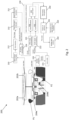
- FIG. 2 shows further detail of an audio-visual pilot activity recognition system 200.
- a cockpit area may include one or more pilots (e.g. P1 and P2). Further, the cockpit area may also include one or more image collectors (e.g. 202a and 202b) and one or more audio collectors (e.g. 204a and 204b).
- the one or more image collectors 202a and 202b may be and RGB camera and/or an infrared camera.
- the one or more audio collectors 204a and 204b may be a microphone.
- the one or more image collectors 202a, 202b are located to face the front side of the one or more pilots P1 and/or P2.
- the one of more audio collectors 204a, 204b are located in proximity to the voice of the one or more pilots P1 and/or P2.
- the cockpit area may also include one or more infrared/depth devices (as described above in conjunction with Figure 1 ).
- the one or more image collectors 202a, 202b collect image signals from the cockpit area to provide images of the one or more pilots P1, P2.
- the one or more audio collectors 204a, 204b collect audio from the cockpit area to provide audio signals from the cockpit area. The images and audio signals may be taken during flight.
- the image signals are provided through a 'video feed' of a processor.
- the image signals move through the video feed to a frame buffer 210 where the image signals are temporarily stored for processing.
- the image signals provided to the frame buffer 210 are transposed to two different branches.
- the image signals may be provided from the frame buffer 210 to a 'Depth Information Extraction' module 211 that extracts depth information from the image signals.
- the image signals may also, or alternatively, be provided to a 'Pilot Detection' module 212 to determine an image of one or more of the pilots P1, P2.
- the processor moves the signal to a 'Pose Estimation' module 213 to estimate the posture of the one or more pilots P1, P2.
- the posture positions are detected as two-dimensional keypoints of the one or more pilots P1, P2 joints.
- the image signals from the 'Depth Information Extraction' module 211 and the 'Pose Estimation' module 213 are then combined to create a three-dimensional reconstruction of the scene in the ⁇ 3D Scene Reconstruction' module 214.
- the image signals from the ⁇ 3D Scene Reconstruction' module 214 are then sent to a 'Video Image Pre-processing' module 215 for pre-processing.
- the 'Video Image Pre-processing' module 215 may, for example, remove noise from the image signals, such as noise caused by the one or more image collectors 202a, 202b, and/or noise caused by the one or more infrared/depth devices. As another example, and in addition or alternatively, the 'Video Image Pre-processing module 215 may reduce the dimensionality of the image signals by, for example, using a Principle Component Analysis technique. The 'Video Image Pre-processing' module 215 may also, additionally or alternatively, synchronize the image signals with the audio signals by, for example, using timestamps or a common reference signal.
- the audio signals are provided through an 'audio feed' of the processor.
- the audio signals move through the audio feed to a speaker recognition 220 to identify that the one or more audio collectors 204a, 204b is retrieving audio signals. If there is more than one audio collector (204a, 204b), the speaker recognition 220 can identify which audio collector is retrieving audio signals and select that audio collector as the primary audio collector for processing the selected audio signals.
- the speaker recognition 220 can identify which audio collector is retrieving audio signals and select that audio collector as the primary audio collector for processing the selected audio signals.
- any number of audio collectors could be selected as primary and auxiliary audio collectors for processing selected audio signals.
- the selected audio signals then move to an audio buffer which temporarily stores the audio signals for processing and selection.
- the system 200 can detect and isolate pilot speech in the audio signals, and extrapolate the isolated audio signals to an 'Audio Signal Pre-processing' module 222 where the audio signals are pre-processed.
- the 'Audio Signal Pre-processing' module 222 may, for example, remove noise from the image signals, such as noise caused by the one or more audio collectors 204a, 204b.
- the 'Audio Signal Pre-processing' module 222 may normalize the volume of the audio.
- the 'Audio Signal Pre-processing' module 222 may also, additionally or alternatively, convert the audio signals into a formal that can be easily processed.
- the system 200 may also include an 'Audio-visual Correspondence Network Architecture' module 230.
- the image signals and audio signals are pre-processed in the 'Video Image Pre-processing' module 215 and the 'Audio Signal Pre-processing' module 222.
- the image signals and the audio signals are then passed to the 'Audio-visual Correspondence Network Architecture' module 230 for further processing.
- the image signals are passed to a 'Vision Subnetwork' module 231 and the audio signals are passed to an 'Audio Subnetwork' module 232.
- the 'Audio-visual Correspondence Network Architecture' module 230 determines if the image signals of the 'Vision Subnetwork' module 231 and the audio signals of the 'Audio Subnetwork' module 232 correspond to each other. Corresponding pairs of signals are those image signals and audio signals that are taken at the same time. Mismatched pairs are those image signals and audio signals that are not taken at the same time. At the 'Fusion Layer' module 233, the corresponding pairs are forwarded through the 'Audio-visual Correspondence Network Architecture' module 230. The mismatched pairs of signals are extracted and discarded by the 'Fusion Layer' module 233.
- Pilot activity can be one or more of the following non-exhaustive list:
- the information is sent to a 'Fusion of Decisions' module 241 which may be additionally provided with information from other sensors and modalities in the system (e.g. from module 250).
- the 'Fusion of Decisions' module 241 can then determine a final pilot state and determine if an alert needs to be raised in a 'Multiple Alert Systems' module 242.
Landscapes
- Engineering & Computer Science (AREA)
- Physics & Mathematics (AREA)
- Theoretical Computer Science (AREA)
- General Physics & Mathematics (AREA)
- Multimedia (AREA)
- Computer Vision & Pattern Recognition (AREA)
- Health & Medical Sciences (AREA)
- Software Systems (AREA)
- Signal Processing (AREA)
- Acoustics & Sound (AREA)
- Computational Linguistics (AREA)
- Human Computer Interaction (AREA)
- Audiology, Speech & Language Pathology (AREA)
- Evolutionary Computation (AREA)
- Artificial Intelligence (AREA)
- Computing Systems (AREA)
- Databases & Information Systems (AREA)
- General Health & Medical Sciences (AREA)
- Medical Informatics (AREA)
- Geometry (AREA)
- Computer Graphics (AREA)
- Quality & Reliability (AREA)
- Image Analysis (AREA)
- Traffic Control Systems (AREA)
Abstract
Description
- The present disclosure relates to an audio-visual pilot activity recognition system, e.g. in a cockpit of an aircraft.
- Pilot state assessment systems may be used to assess the alertness state of a pilot and/or co-pilot during operation of an aircraft. Many systems utilise facial recognition and facial recognition to determine the alertness state of the pilot and/or co-pilot during flight. Such systems may create false alarms of a pilot alertness state. Therefore, there is a need for an improved pilot monitoring system.
- In one aspect, there is provided an audio-visual pilot activity recognition system that includes one or more image collectors, one or more audio collectors, and a processor configured to carry out the following steps: collect at least one image signal from the one or more image collectors, collect at least one audio signal from the one of more audio collectors, and determine a pilot activity based on the collected image signals and the collected audio signals.
- The processor may include a data buffer to temporarily store the at least one image signal and the at least one audio signal.
- The at least one image signal may be provided through a video feed of the processor to a frame buffer. The at least one image signal may be provided, by the processor, to a first image module that extracts depth information from the image signals; and/or the at least one image signal may be provided, by the processor, to a second image module to determine an image of one or more pilots in a cockpit. If an image of one of more pilots is determined, the at least one image signal may be passed to a third image module to estimate the posture positions of the one or more pilots, wherein the posture positions are detected as two-dimensional keypoints of the one or more pilots joints. The at least one image signal of the first image module and the third image module may be combined in a fourth image module to create a three-dimensional reconstruction of the scene. The at least one image signal from the fourth image module may be passed to a fifth image module for pre-processing the data.
- The at least one audio signal may be provided through an audio feed of the processor to a speaker recognition to identify audio signals from the one or more audio collectors, and the system may be configured to detect and isolate pilot speech in the audio signals, and wherein the system is configured to extrapolate the isolated audio signals to be pre-processed in a first audio module.
- The at least one image signal and isolated audio signals may be configured to pass to a network architecture module, after pre-processing. The network architecture module may include a first subnetwork module and a second subnetwork module. The at least one image signal may be configured to pass to the first subnetwork module and the isolated audio signals are configured to pass to the second subnetwork module. The network architecture module may be configured to determine if the image signals at the first subnetwork module correspond to the isolated audio signals at the second subnetwork module. The network architecture module may include a fusion layer module that is configured to retrieve corresponding pairs of the at least one image signal and the isolated audio signals. The corresponding pairs of the at least one image signal and the isolated audio signals may be configured to pass to a pilot activity recognition module. The pilot activity recognition module may be configured to determine the pilot activity.
- The pilot activity includes one or more, but not limited to, of the following: pilot is seated and manoeuvring; pilot is leaving for a break; pilot is resuming main operation; pilot is inoperative or idle; pilot is interacting with another person and/or pilot; pilot is talking to ground control or Air Traffic Control; pilot is reading or consulting a document; pilot is drinking or eating; pilot is falling; pilot is entering after a break.
- The determined pilot activity from the pilot activity recognition module may be configured to pass to a fusion module. The fusion module may be configured to receive information from one or more sensors or modalities to determine a final pilot state. The fusion module may be configured to determine if an alert is needed.
- In another aspect, there is provided a method that includes collecting, via a processor, at least one image signal from one or more image collectors, collecting, via the processor, at least one audio signal from one or more audio collectors, and determining, via the processor, pilot activity based on the collected image signals and the collected audio signals.
-
- Fig. 1
- shows an example of an audio-visual pilot activity recognition system.
- Fig. 2
- shows another example of an audio-visual pilot activity recognition system.
-
Figure 1 generally shows an example of an audio-visual pilotactivity recognition system 100. The audio-visual pilotactivity recognition system 100 may be configured to monitor the activity of one or more pilots (e.g. P1 and P2) during flight. The audio-visual pilotactivity recognition system 100 may include an image collector 101 (e.g. a camera), an infrared/depth device 102 (e.g. a depth camera or an infrared camera) and an audio collector 103 (e.g. a microphone). Although only oneimage collector 101, one infrared/depth device 102 and one audio collector '103 are shown inFigure 1 , it is to be understood that any number of image collectors, infrared/depth devices and audio collectors may be used. The infrared/depth device 102 may assist in extracting and reconstructing a three dimensional scene of the cockpit where the one or more pilots P1/P2 are situated. - As shown in
Figure 1 , data from at least one of theimage collector 101, the infrared/depth device 102 and theaudio collector 103 may be forwarded to be processed through adata buffer 110 to temporarily store data before it is processed. Thedata buffer 110 can buffer the data from at least one of theimage collector 101, the infrared/depth device 102, and theaudio collector 103. The data may then be extrapolated from thedata buffer 110 to determine thepilot state 130. For example, data may be used by a processor to determine one of the following: a) audio-visual activity of the one or more pilots instep 112a, b) determine drowsiness, state of sleep, workload and attention state of the one or more pilots instep 112b, c) determine and recognise posture state of the one or more pilots instep 112c, d) determine facial expressions of the one or more pilots and detect pain suffered by the one or more pilots based on the determined facial expressions instep 112d, and e) determine and recognise emotion based on speech/voice of the one or more pilots instep 112e. After one or more of these parameters has been determined, signals are sent through the processor to adecision module 120 where the data is analysed to determine thepilot state 130. -
Figure 2 shows further detail of an audio-visual pilotactivity recognition system 200. As shown inFigure 2 , a cockpit area may include one or more pilots (e.g. P1 and P2). Further, the cockpit area may also include one or more image collectors (e.g. 202a and 202b) and one or more audio collectors (e.g. 204a and 204b). The one ormore image collectors more audio collectors more image collectors audio collectors Figure 2 , it is envisaged that the cockpit area may also include one or more infrared/depth devices (as described above in conjunction withFigure 1 ). The one ormore image collectors more audio collectors - As can be seen in
Figure 2 , the image signals are provided through a 'video feed' of a processor. The image signals move through the video feed to aframe buffer 210 where the image signals are temporarily stored for processing. The image signals provided to theframe buffer 210 are transposed to two different branches. The image signals may be provided from theframe buffer 210 to a 'Depth Information Extraction'module 211 that extracts depth information from the image signals. The image signals may also, or alternatively, be provided to a 'Pilot Detection'module 212 to determine an image of one or more of the pilots P1, P2. If an image of one or more of the pilots P1, P2 is detected, the processor moves the signal to a 'Pose Estimation'module 213 to estimate the posture of the one or more pilots P1, P2. The posture positions are detected as two-dimensional keypoints of the one or more pilots P1, P2 joints. The image signals from the 'Depth Information Extraction'module 211 and the 'Pose Estimation'module 213 are then combined to create a three-dimensional reconstruction of the scene in the `3D Scene Reconstruction'module 214. The image signals from the `3D Scene Reconstruction'module 214 are then sent to a 'Video Image Pre-processing'module 215 for pre-processing. The 'Video Image Pre-processing'module 215 may, for example, remove noise from the image signals, such as noise caused by the one ormore image collectors Image Pre-processing module 215 may reduce the dimensionality of the image signals by, for example, using a Principle Component Analysis technique. The 'Video Image Pre-processing'module 215 may also, additionally or alternatively, synchronize the image signals with the audio signals by, for example, using timestamps or a common reference signal. - Also, as shown in
Figure 2 , the audio signals are provided through an 'audio feed' of the processor. The audio signals move through the audio feed to aspeaker recognition 220 to identify that the one or moreaudio collectors speaker recognition 220 can identify which audio collector is retrieving audio signals and select that audio collector as the primary audio collector for processing the selected audio signals. Of course, if more than oneaudio collector system 200 can detect and isolate pilot speech in the audio signals, and extrapolate the isolated audio signals to an 'Audio Signal Pre-processing'module 222 where the audio signals are pre-processed. The 'Audio Signal Pre-processing'module 222 may, for example, remove noise from the image signals, such as noise caused by the one or moreaudio collectors module 222 may normalize the volume of the audio. - The 'Audio Signal Pre-processing'
module 222 may also, additionally or alternatively, convert the audio signals into a formal that can be easily processed. - The
system 200 may also include an 'Audio-visual Correspondence Network Architecture'module 230. As shown inFigure 2 , the image signals and audio signals are pre-processed in the 'Video Image Pre-processing'module 215 and the 'Audio Signal Pre-processing'module 222. The image signals and the audio signals are then passed to the 'Audio-visual Correspondence Network Architecture'module 230 for further processing. As an example shown inFigure 2 , the image signals are passed to a 'Vision Subnetwork'module 231 and the audio signals are passed to an 'Audio Subnetwork'module 232. The 'Audio-visual Correspondence Network Architecture'module 230 determines if the image signals of the 'Vision Subnetwork'module 231 and the audio signals of the 'Audio Subnetwork'module 232 correspond to each other. Corresponding pairs of signals are those image signals and audio signals that are taken at the same time. Mismatched pairs are those image signals and audio signals that are not taken at the same time. At the 'Fusion Layer' module 233, the corresponding pairs are forwarded through the 'Audio-visual Correspondence Network Architecture'module 230. The mismatched pairs of signals are extracted and discarded by the 'Fusion Layer' module 233. - The 'Pilot Activity Recognition'
module 240 then determines pilot activity based on the signals provided by the 'Audio-visual Correspondence Network Architecture'module 230. Pilot activity can be one or more of the following non-exhaustive list: - Pilot is seated and manoeuvring;
- Pilot is leaving for a break;
- Pilot is resuming main operation;
- Pilot is inoperative or idle in their seat;
- Pilot is interacting with another person/pilot;
- Pilot is talking to ground control or Air Traffic Control;
- Pilot is reading or consulting a document;
- Pilot is drinking or eating;
- Pilot is falling;
- Pilot is entering after a break.
- Once the pilot activity has been determined by the 'Pilot Activity Recognition'
module 240, the information is sent to a 'Fusion of Decisions'module 241 which may be additionally provided with information from other sensors and modalities in the system (e.g. from module 250). The 'Fusion of Decisions'module 241 can then determine a final pilot state and determine if an alert needs to be raised in a 'Multiple Alert Systems'module 242. - Although this disclosure has been described in terms of preferred examples, it should be understood that these examples are illustrative only and that the claims are not limited to those examples. Those skilled in the art will be able to make modifications and alternatives in view of the disclosure which are contemplated as falling within the scope of the appended claims.
Claims (15)
- An audio-visual pilot activity recognition system, comprising:one or more image collectors (202a, 202b);one or more audio collectors (204a, 204b);a processor configured to carry out the following steps:collect at least one image signal from the one or more image collectors (202a, 202b);collect at least one audio signal from the one of more audio collectors (204a, 204b);determine a pilot activity based on the collected image signals and the collected audio signals.
- The audio-visual pilot activity recognition system of claim 1, wherein the processor comprises a data buffer (110) to temporarily store the at least one image signal and the at least one audio signal.
- The audio-visual pilot activity recognition system of claim 1 or 2, wherein the at least one image signal is provided through a video feed of the processor to a frame buffer (210).
- The audio-visual pilot activity recognition system of claim 3, wherein the at least one image signal is provided, by the processor, to a first image module (211) that extracts depth information from the image signals; and/or
wherein the at least one image signal is provided, by the processor, to a second image module (212) to determine an image of one or more pilots in a cockpit. - The audio-visual pilot activity recognition system of claim 4, wherein, if an image of one of more pilots is determined, the at least one image signal is passed to a third image module (213) to estimate the posture positions of the one or more pilots, wherein the posture positions are detected as two-dimensional keypoints of the one or more pilots joints.
- The audio-visual pilot activity recognition system of claim 5, wherein the at least one image signal of the first image module (211) and the third image module (213) are combined in a fourth image module (214) to create a three-dimensional reconstruction of the scene.
- The audio-visual pilot activity recognition system of claim 6, wherein the at least one image signal from the fourth image module (214) is passed to a fifth image module (215) for pre-processing the data.
- The audio-visual pilot activity recognition system of any preceding claim, wherein the at least one audio signal is provided through an audio feed of the processor to a speaker recognition (220) to identify audio signals from the one or more audio collectors (204a, 204b), and wherein the system is configured to detect and isolate pilot speech in the audio signals, and wherein the system is configured to extrapolate the isolated audio signals to be pre-processed in a first audio module (222).
- The audio-visual pilot activity recognition system of claim 8, when dependent on claim 7, wherein the at least one image signal and isolated audio signals are configured to pass to a network architecture module (230), after pre-processing.
- The audio-visual pilot activity recognition system of claim 9, wherein the network architecture module (230) includes a first subnetwork module (231) and a second subnetwork module (232), wherein the at least one image signal is configured to pass to the first subnetwork module (231) and the isolated audio signals are configured to pass to the second subnetwork module (232), and wherein the network architecture module (230) is configured to determine if the image signals at the first subnetwork module (231) correspond to the isolated audio signals at the second subnetwork module (232), and wherein the network architecture module (230) includes a fusion layer module (233) that is configured to retrieve corresponding pairs of the at least one image signal and the isolated audio signals.
- The audio-visual pilot activity recognition system of claim 10, wherein the corresponding pairs of the at least one image signal and the isolated audio signals are configured to pass to a pilot activity recognition module (240), and wherein the pilot activity recognition module (240) is configured to determine the pilot activity.
- The audio-visual pilot activity recognition system of any preceding claim, wherein the pilot activity includes one or more of the following:pilot is seated and manoeuvring;pilot is leaving for a break;pilot is resuming main operation;pilot is inoperative or idle;pilot is interacting with another person and/or pilot;pilot is talking to ground control or Air Traffic Control;pilot is reading or consulting a document;pilot is drinking or eating;pilot is falling;pilot is entering after a break.
- The audio-visual pilot activity recognition system of claim 12, when dependent on claim 11, wherein the determined pilot activity from the pilot activity recognition module (240) is configured to pass to a fusion module (241), wherein the fusion module (241) is configured to receive information from one or more sensors or modalities to determine a final pilot state.
- The audio-visual pilot activity recognition system of claim 13, wherein the fusion module (241) is configured to determine if an alert is needed.
- A method, comprising:collecting, via a processor, at least one image signal from one or more image collectors;collecting, via the processor, at least one audio signal from one or more audio collectors;determining, via the processor, pilot activity based on the collected image signals and the collected audio signals.
Priority Applications (2)
| Application Number | Priority Date | Filing Date | Title |
|---|---|---|---|
| EP23158547.2A EP4421757A1 (en) | 2023-02-24 | 2023-02-24 | Audio-visual pilot activity recognition system and method |
| US18/587,484 US12536817B2 (en) | 2023-02-24 | 2024-02-26 | Audio-visual pilot activity recognition system and method |
Applications Claiming Priority (1)
| Application Number | Priority Date | Filing Date | Title |
|---|---|---|---|
| EP23158547.2A EP4421757A1 (en) | 2023-02-24 | 2023-02-24 | Audio-visual pilot activity recognition system and method |
Publications (1)
| Publication Number | Publication Date |
|---|---|
| EP4421757A1 true EP4421757A1 (en) | 2024-08-28 |
Family
ID=85382948
Family Applications (1)
| Application Number | Title | Priority Date | Filing Date |
|---|---|---|---|
| EP23158547.2A Pending EP4421757A1 (en) | 2023-02-24 | 2023-02-24 | Audio-visual pilot activity recognition system and method |
Country Status (2)
| Country | Link |
|---|---|
| US (1) | US12536817B2 (en) |
| EP (1) | EP4421757A1 (en) |
Citations (3)
| Publication number | Priority date | Publication date | Assignee | Title |
|---|---|---|---|---|
| US10322728B1 (en) * | 2018-02-22 | 2019-06-18 | Futurewei Technologies, Inc. | Method for distress and road rage detection |
| US20220230522A1 (en) * | 2021-01-18 | 2022-07-21 | Seeing Machines Limited | Flight Crew Fatigue And Controlled Rest Management System |
| US20230001872A1 (en) * | 2020-06-29 | 2023-01-05 | Nvidia Corporation | In-cabin hazard prevention and safety control system for autonomous machine applications |
Family Cites Families (4)
| Publication number | Priority date | Publication date | Assignee | Title |
|---|---|---|---|---|
| US10672385B2 (en) * | 2015-09-04 | 2020-06-02 | Honeywell International Inc. | Method and system for remotely training and commanding the speech recognition system on a cockpit via a carry-on-device in a connected aircraft |
| US10628667B2 (en) | 2018-01-11 | 2020-04-21 | Futurewei Technologies, Inc. | Activity recognition method using videotubes |
| GB202004765D0 (en) | 2020-03-31 | 2020-05-13 | Be Aerospace Inc | Person activity recognition |
| US11640723B2 (en) | 2020-10-20 | 2023-05-02 | Rosemount Aerospace Inc. | System and method for enhanced surveillance using video analytics |
-
2023
- 2023-02-24 EP EP23158547.2A patent/EP4421757A1/en active Pending
-
2024
- 2024-02-26 US US18/587,484 patent/US12536817B2/en active Active
Patent Citations (3)
| Publication number | Priority date | Publication date | Assignee | Title |
|---|---|---|---|---|
| US10322728B1 (en) * | 2018-02-22 | 2019-06-18 | Futurewei Technologies, Inc. | Method for distress and road rage detection |
| US20230001872A1 (en) * | 2020-06-29 | 2023-01-05 | Nvidia Corporation | In-cabin hazard prevention and safety control system for autonomous machine applications |
| US20220230522A1 (en) * | 2021-01-18 | 2022-07-21 | Seeing Machines Limited | Flight Crew Fatigue And Controlled Rest Management System |
Also Published As
| Publication number | Publication date |
|---|---|
| US12536817B2 (en) | 2026-01-27 |
| US20240290113A1 (en) | 2024-08-29 |
Similar Documents
| Publication | Publication Date | Title |
|---|---|---|
| US10565455B2 (en) | Methods and systems for audiovisual communication | |
| Popescu et al. | An acoustic fall detector system that uses sound height information to reduce the false alarm rate | |
| EP2887697B1 (en) | Method of audio signal processing and hearing aid system for implementing the same | |
| EP4105101A1 (en) | Monitoring system, monitoring method, and monitoring device for railway train | |
| US8866931B2 (en) | Apparatus and method for image recognition of facial areas in photographic images from a digital camera | |
| EP4102833A1 (en) | Intelligent multi-camera switching with machine learning | |
| US6462773B1 (en) | Video monitoring system | |
| CN118887734B (en) | Old man safety monitoring method and system | |
| CN116453530B (en) | Method and device for reconstructing out-of-vehicle sound for in-vehicle partition sensing and electronic equipment | |
| Poonsri et al. | Fall detection using Gaussian mixture model and principle component analysis | |
| US12536817B2 (en) | Audio-visual pilot activity recognition system and method | |
| US10922048B2 (en) | Sound input/output device for vehicle | |
| EP4213481B1 (en) | Information output device and information output method | |
| KR20210066774A (en) | Method and Apparatus for Distinguishing User based on Multimodal | |
| CN110933254B (en) | Sound filtering system based on image analysis and sound filtering method thereof | |
| US20230132041A1 (en) | Response to sounds in an environment based on correlated audio and user events | |
| US12555409B2 (en) | Extracting information about people from sensor signals | |
| CN107368816B (en) | Biometric identification method, biometric identification device and detection system | |
| JPWO2019181479A1 (en) | Face matching system | |
| EP4439477B1 (en) | Pilot posture recognition system and method | |
| KR102656084B1 (en) | Method and apparatus for mapping objects besed on movement path | |
| CN119741508A (en) | System and method for identifying events in a video stream | |
| CN114580913B (en) | An intelligent management platform for public transportation services | |
| KR100886345B1 (en) | Digital video recorder and its operation method and video control system using same | |
| LU500080B1 (en) | Method for Monitoring Online Live Teaching |
Legal Events
| Date | Code | Title | Description |
|---|---|---|---|
| PUAI | Public reference made under article 153(3) epc to a published international application that has entered the european phase |
Free format text: ORIGINAL CODE: 0009012 |
|
| STAA | Information on the status of an ep patent application or granted ep patent |
Free format text: STATUS: THE APPLICATION HAS BEEN PUBLISHED |
|
| AK | Designated contracting states |
Kind code of ref document: A1 Designated state(s): AL AT BE BG CH CY CZ DE DK EE ES FI FR GB GR HR HU IE IS IT LI LT LU LV MC ME MK MT NL NO PL PT RO RS SE SI SK SM TR |
|
| STAA | Information on the status of an ep patent application or granted ep patent |
Free format text: STATUS: REQUEST FOR EXAMINATION WAS MADE |
|
| 17P | Request for examination filed |
Effective date: 20250228 |
|
| STAA | Information on the status of an ep patent application or granted ep patent |
Free format text: STATUS: EXAMINATION IS IN PROGRESS |
|
| 17Q | First examination report despatched |
Effective date: 20251107 |