EP4421691A1 - Encoder, calculating device, and encoding method - Google Patents
Encoder, calculating device, and encoding method Download PDFInfo
- Publication number
- EP4421691A1 EP4421691A1 EP23192528.0A EP23192528A EP4421691A1 EP 4421691 A1 EP4421691 A1 EP 4421691A1 EP 23192528 A EP23192528 A EP 23192528A EP 4421691 A1 EP4421691 A1 EP 4421691A1
- Authority
- EP
- European Patent Office
- Prior art keywords
- qubit
- encoded
- qubits
- gate
- control
- Prior art date
- Legal status (The legal status is an assumption and is not a legal conclusion. Google has not performed a legal analysis and makes no representation as to the accuracy of the status listed.)
- Pending
Links
Images


Classifications
-
- G—PHYSICS
- G06—COMPUTING OR CALCULATING; COUNTING
- G06N—COMPUTING ARRANGEMENTS BASED ON SPECIFIC COMPUTATIONAL MODELS
- G06N10/00—Quantum computing, i.e. information processing based on quantum-mechanical phenomena
- G06N10/70—Quantum error correction, detection or prevention, e.g. surface codes or magic state distillation
-
- G—PHYSICS
- G06—COMPUTING OR CALCULATING; COUNTING
- G06N—COMPUTING ARRANGEMENTS BASED ON SPECIFIC COMPUTATIONAL MODELS
- G06N10/00—Quantum computing, i.e. information processing based on quantum-mechanical phenomena
- G06N10/20—Models of quantum computing, e.g. quantum circuits or universal quantum computers
-
- H—ELECTRICITY
- H03—ELECTRONIC CIRCUITRY
- H03M—CODING; DECODING; CODE CONVERSION IN GENERAL
- H03M13/00—Coding, decoding or code conversion, for error detection or error correction; Coding theory basic assumptions; Coding bounds; Error probability evaluation methods; Channel models; Simulation or testing of codes
- H03M13/31—Coding, decoding or code conversion, for error detection or error correction; Coding theory basic assumptions; Coding bounds; Error probability evaluation methods; Channel models; Simulation or testing of codes combining coding for error detection or correction and efficient use of the spectrum
-
- G—PHYSICS
- G06—COMPUTING OR CALCULATING; COUNTING
- G06N—COMPUTING ARRANGEMENTS BASED ON SPECIFIC COMPUTATIONAL MODELS
- G06N10/00—Quantum computing, i.e. information processing based on quantum-mechanical phenomena
- G06N10/40—Physical realisations or architectures of quantum processors or components for manipulating qubits, e.g. qubit coupling or qubit control
Definitions
- Embodiments described herein relate generally to an encoder, a calculating device, and an encoding method.
- a qubit is encoded in a calculating device or the like. Higher efficiency of the encoding is desirable.
- an encoder includes a first element part and a controller.
- the first element part includes a first qubit, a second qubit couplable with the first qubit, a third qubit couplable with the second qubit, a fourth qubit couplable with the third qubit, a fifth qubit couplable with the fourth qubit, a sixth qubit couplable with the fifth qubit, a seventh qubit couplable with the sixth qubit, an eighth qubit couplable with the seventh qubit, and a ninth qubit couplable with the eighth qubit.
- the controller is configured to perform a first control.
- the first control includes encoding a surface code having a code distance of 3 by performing a two-qubit gate on the second and first qubits, performing a two-qubit gate on the third and second qubits, performing a two-qubit gate on the fourth and third qubits, performing a two-qubit gate on the fourth and fifth qubits, performing a two-qubit gate on the sixth and fifth qubits, performing a two-qubit gate on the sixth and seventh qubits, performing a two-qubit gate on the seventh and eighth qubits, and performing a two-qubit gate on the eighth and ninth qubits.
- the controller performs the two-qubit gate on the third and second qubits after the two-qubit gate for the second and first qubits and the two-qubit gate for the fourth and third qubits.
- the controller performs the two-qubit gate on the seventh and eighth qubits after the two-qubit gate for the sixth and seventh qubits and the two-qubit gate for the eighth and ninth qubits.
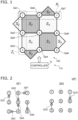
- FIG. 1 is a schematic view illustrating an encoder according to a first embodiment.
- FIG. 2 is a schematic view illustrating a control in the encoder according to the first embodiment.
- FIG. 1 illustrates a concept of a surface code having a code distance of 3.
- a first element part 10E includes a first qubit Qa1, a second qubit Qa2, a third qubit Qa3, a fourth qubit Qa4, a fifth qubit Qa5, a sixth qubit Qa6, a seventh qubit Qa7, an eighth qubit Qa8, and a ninth qubit Qa9.
- the second qubit Qa2 is couplable with the first qubit Qa1.
- the third qubit Qa3 is couplable with the second qubit Qa2.
- the fourth qubit Qa4 is couplable with the third qubit Qa3.
- the fifth qubit Qa5 is couplable with the fourth qubit Qa4.
- the sixth qubit Qa6 is couplable with the fifth qubit Qa5.
- the seventh qubit Qa7 is couplable with the sixth qubit Qa6.
- the eighth qubit Qa8 is couplable with the seventh qubit Qa7.
- the ninth qubit Qa9 is couplable with the eighth qubit Qa8.
- the encoder 110 includes the first element part 10E and a controller 70.
- the controller 70 is configured to perform a first control OP1 (see FIG. 2 ) on the first element part 10E.
- the first control OP1 is configured to perform multiple two-qubit gates.
- FIG. 2 illustrates multiple two-qubit gates.
- the multiple two-qubit gates include a two-qubit gate G21 for the second and first qubits Qa2 and Qa1, a two-qubit gate G32 for the third and second qubits Qa3 and Qa2, a two-qubit gate G43 for the fourth and third qubits Qa4 and Qa3, a two-qubit gate G45 for the fourth and fifth qubits Qa4 and Qa5, a two-qubit gate G65 for the sixth and fifth qubits Qa6 and Qa5, a two-qubit gate G67 for the sixth and seventh qubits Qa6 and Qa7, a two-qubit gate G78 for the seventh and eighth qubits Qa7 and Qa8, and a two-qubit gate G89 for the eighth and ninth qubits Qa8 and Qa9.
- the first control OP1 includes encoding a surface code having a code distance of 3 by performing the two-qubit gate G21, performing the two-qubit gate G21, performing the two-qubit gate G32, performing the two-qubit gate G43, performing the two-qubit gate G45, performing the two-qubit gate G65, performing the two-qubit gate G67, performing the two-qubit gate G78, and performing the two-qubit gate G89.
- the sequence of these two-qubit gates is set as follows.
- the controller 70 performs the two-qubit gate G32 on the third and second qubits Qa3 and Qa2 after the two-qubit gate G21 for the second and first qubits Qa2 and Qa1 and the two-qubit gate G43 for the fourth and third qubits Qa4 and Qa3.
- the controller 70 performs the two-qubit gate G78 on the seventh and eighth qubits Qa7 and Qa8 after the two-qubit gate G67 for the sixth and seventh qubits Qa6 and Qa7 and the two-qubit gate G89 for the eighth and ninth qubits Qa8 and Qa9.
- the first control OP1 includes a first partial control SP1 and a second partial control SP2. These partial controls correspond to steps of the processing.
- the second partial control SP2 is performed after the first partial control SP1.
- the two-qubit gate G21, the two-qubit gate G43, the two-qubit gate G67, and the two-qubit gate G89 are performed in the first partial control SP1.
- the two-qubit gate G45 and the two-qubit gate G65 may be performed in the first partial control SP1.
- the two-qubit gate G32 and the two-qubit gate G78 are performed in the second partial control SP2.
- Efficient encoding is possible by performing the multiple two-qubit gates in such a sequence.
- the encoding can be performed by performing a controlled-NOT gate (hereinbelow, CNOT gate) 8 times.
- CNOT gate controlled-NOT gate
- an encoder can be provided in which the efficiency can be increased.
- FIG. 3 is a schematic view illustrating the encoder according to the first embodiment.
- FIG. 4 is a schematic view illustrating a control of the encoder according to the first embodiment.
- the quantum states of atoms trapped by light are used as qubits (see Dolev Bluvstein et al., Nature 604, 451 (2022 )).
- the first to ninth qubits Qa1 to Qa9 are included. These qubits each are, for example, one atom.
- the atoms are, for example, rubidium- 87 Rb.
- the controller 70 irradiates an excitation light 71 (e.g., a laser) onto multiple atoms (the first to ninth qubits Qa1 to Qa9).
- the controller 70 can perform a controlled-Z gate (hereinbelow, a CZ-gate) by irradiating an operation light 72 (e.g., a laser) on two adjacent atoms.
- an operation on the third and fourth qubits Qa3 and Qa4 is illustrated.
- the operation light 72 is irradiated on the third and fourth qubits Qa3 and Qa4.
- the CZ-gate is an example of a two-qubit gate.
- the phase is inverted when both of the two qubits are in the "1 state".
- a CZ-gate interposed between two Hadamard gate Hs is the equivalent of a CNOT gate.
- the operation on the two qubits is symmetric (vertically in FIG. 4 ).
- Two successive Hadamard gates H are equivalent to the state before the operation, and are therefore omitted.
- a CNOT gate is another example of a two-qubit gate.
- the CNOT gate nothing is performed when the controlled qubit is in the "0 state", and the previous state is maintained; on the other hand, when the controlled qubit is in the "1 state", the "0 state” of the target qubit is flipped to the "1 state", or the "1 state” of the target qubit is flipped to the "0 state”.
- nine qubits include four X-stabilizer operators S x and four Z-stabilizer operators S z .
- the four X-stabilizer operators S x include the X 1 X 2 operator, the X 2 X 3 X 4 X 5 operator, the X 5 X 6 X 7 X 8 operator, and the X 8 X 9 operator.
- the four Z-stabilizer operators S z include the Z 6 Z 7 operator, the Z 1 Z 2 Z 5 Z 6 operator, the Z 4 Z 5 Z 8 Z 9 operator, and the Z 3 Z 4 operator.
- the nine qubits are in simultaneous eigenstates for which the eigenvalues of the eight stabilizer operators are "1".
- an encoded Z-operator Z L corresponds to the Z 1 Z 2 Z 3 operator.
- An encoded X-operator X L corresponds to the X 1 X 6 X 7 operator.
- the nine qubits are in eigenstates for which the eigenvalue of the encoded Z-operator Z L is "1".
- the nine qubits are set to the "0 state" as a preparatory control.
- the qubits are in eigenstates for which the eigenvalues of the Z-operators are "1".
- measurements for the four X-stabilizer operators S x are repeated 3 times to measure the error.
- Such a first reference example requires a CNOT gate performed 36 times, four ancilla qubits, and readout performed 12 times.
- the stabilizer measurements are, for example, syndrome measurements.
- the encoding can be performed by performing a CNOT gate 8 times.
- FIGS. 5 and 6 are schematic views illustrating a control of the encoder according to the first embodiment.
- the calculations of the first partial control SP1 and the second partial control SP2 are performed on the first qubit Qa1, the second qubit Qa2, the third qubit Qa3, the fourth qubit Qa4, the fifth qubit Qa5, the sixth qubit Qa6, the seventh qubit Qa7, the eighth qubit Qa8, and the ninth qubit Qa9 (see FIG. 6 ).
- a pre-partial control SP0 may be performed before the first partial control SP1.
- the nine qubits are set to the
- the Hadamard gate H may be performed on the second qubit Qa2, the fourth qubit Qa4, the sixth qubit Qa6, and the eighth qubit Qa8.
- FIG. 4 illustrates the changes of the stabilizers.
- the two-qubit gate G32 is performed after the two-qubit gates G43 and G21.
- the two-qubit gate G78 is performed after the two-qubit gates G67 and G89.
- These two-qubit gates are, for example, CNOT gates.
- a two-qubit gate G ij is performed on the ith and j th qubits Qa i and Qa j .
- i is an integer of 1 to 9.
- j is ( i ⁇ 1) and is a positive integer.
- Performing the two-qubit gate G ij includes causing the state of the j th qubit Qa j to transition to another state when the state of the i th qubit Qa i is one of a first state or a second state (e.g., the first state), and maintaining the state of the j th qubit Qa j when the state of the i th qubit Qa i is the other of the first state or the second state (e.g., the second state).
- performing the two-qubit gate G43 on the fourth and third qubits Qa4 and Qa3 includes causing the state of the third qubit Qa3 to transition to another state when the state of the fourth qubit Qa4 is the one state (e.g., the first state), and maintaining the state of the third qubit Qa3 when the state of the fourth qubit Qa4 is the other state (e.g., the second state).
- the "weights" of the stabilizers are not more than 3. Therefore, the number of errors can be considered to be not more than 1. Errors having a "weight" of 2 that occur in the CNOT gate in the second partial control SP2 are correctable and are practically not problematic.
- the "weight” corresponds to the number of Pauli operators other than the identity operator.
- the first control OP1 includes the first partial control SP1, and the second partial control SP2 after the first partial control SP1.
- the first partial control SP1 includes performing the two-qubit gate G21, performing the two-qubit gate G43, performing the two-qubit gate G45, performing the two-qubit gate G65, performing the two-qubit gate G67, and performing the two-qubit gate G89.
- the second partial control SP2 includes performing the two-qubit gate G32 and performing the two-qubit gate G78.
- FIGS. 7 and 8 are schematic views illustrating controls of the encoder according to the first embodiment.
- the first control OP1 includes the first partial control SP1, the second partial control SP2 after the first partial control SP1, and a third partial control SP3 after the second partial control SP2.
- the first partial control SP1 includes performing the two-qubit gate G21, performing the two-qubit gate G43, performing the two-qubit gate G67, and performing the two-qubit gate G89.
- the second partial control SP2 includes performing the two-qubit gate G32 and performing the two-qubit gate G45.
- the third partial control SP3 includes performing the two-qubit gate G65 and performing the two-qubit gate G78. Efficient encoding is possible in the example of FIG. 5 as well.
- the first partial control SP1 includes performing the two-qubit gate G21, performing the two-qubit gate G43, performing the two-qubit gate G65, and performing the two-qubit gate G89.
- the second partial control SP2 includes performing the two-qubit gate G45 and performing the two-qubit gate G67.
- the third partial control SP3 includes performing the two-qubit gate G32 and performing the two-qubit gate G78. Efficient encoding is possible in the example of FIG. 8 as well.
- FIG. 9 is a schematic view illustrating an encoder according to a second embodiment.
- the encoder 120 includes an encoded element part 20E and the controller 70.
- FIG. 9 illustrates a concept of a code in which two surface codes having code distances of 3 are concatenated.
- FIG. 10 is a schematic view illustrating the encoder according to the second embodiment.
- FIG. 10 illustrates when the code distance is 3 (i.e., the code distance N is 3).
- the encoded element part 20E includes a first encoded qubit Qc1 having the code distance of N, a second encoded qubit Qc2 having the code distance of N, a third encoded qubit Qc3 having the code distance of N , a fourth encoded qubit Qc4 having the code distance of N, a fifth encoded qubit Qc5 having the code distance of N, a sixth encoded qubit Qc6 having the code distance of N, a seventh encoded qubit Qc7 having the code distance of N , an eighth encoded qubit Qc8 having the code distance of N , and a ninth encoded qubit Qc9 having the code distance of N .
- the second encoded qubit Qc2 is couplable with the first encoded qubit Qc1.
- the third encoded qubit Qc3 is couplable with the second encoded qubit Qc2.
- the fourth encoded qubit Qc4 is couplable with the third encoded qubit Qc3.
- the fifth encoded qubit Qc5 is couplable with the fourth encoded qubit Qc4.
- the sixth encoded qubit Qc6 is couplable with the fifth encoded qubit Qc5.
- the seventh encoded qubit Qc7 is couplable with the sixth encoded qubit Qc6.
- the eighth encoded qubit Qc8 is couplable with the seventh encoded qubit Qc7.
- the ninth encoded qubit Qc9 is couplable with the eighth encoded qubit Qc8.
- the first to ninth encoded qubits Qc1 to Qc9 included in the encoded element part 20E each include the first element part 10E (see FIG. 1 ).
- the code of level 1 corresponds to the code of the first element part 10E (the first to ninth qubits Qa1 to Qa9).
- the code of level 2 corresponds to the code of the encoded element part 20E (the first to ninth encoded qubits Qc1 to Qc9).
- the code of level 1 of the concatenated code is taken to be a surface code having a code distance of 3.
- any code having a code distance of N may be utilized.
- N is an integer not less than 2.
- the code of level 2 of the concatenated code is a surface code having a code distance of 3.
- FIG. 11 is a flowchart illustrating a control of the encoder according to the second embodiment.
- the controller 70 is configured to perform a second control OP2 and a third control OP3.
- the second control OP2 corresponds to the encoding of level 2.
- the third control OP3 corresponds to an error detection control.
- the controller 70 is configured to perform a first level encoding control OL1 before the second control OP2.
- FIG. 12 is a schematic view illustrating a portion of the control of the encoder according to the second embodiment.
- FIG. 12 illustrates the first level encoding control OL1.
- FIG. 12 illustrates the first level encoding control OL1 on the third and fourth encoded qubits Qc3 and Qc4.
- the third encoded qubit Qc3 includes the first to ninth qubits Qa1 to Qa9 of the third encoded qubit Qc3.
- the fourth encoded qubit Qc4 includes the first to ninth qubits Qa1 to Qa9 of the fourth encoded qubit Qc4.
- the encoded CNOT gate of level 1 is performed between the first to ninth qubits Qa1 to Qa9 included in the third encoded qubit Qc3 and the first to ninth qubits Qa1 to Qa9 included in the fourth encoded qubit Qc4.
- the encoded CNOT gate of level 1 corresponds to a "transversal CNOT".
- encoded CZ-gates may be similarly performed to FIG. 12 .
- the encoding illustrated in FIG. 12 is performed on two other encoded qubits.
- the controller 70 performs the two-qubit gate G32 after the two-qubit gates G21 and G43.
- the controller 70 performs the two-qubit gate G78 after the two-qubit gates G67 and G89.
- Such a first level encoding control OL1 is performed on all nine level-1 encoded qubits.
- the code of level 1 is a surface code having a code distance of 3.
- the first level encoding control OL1 is modified and performed according to the code distance of N.
- the controller 70 performs the second control OP2 after the first level encoding control OL1.
- FIGS. 13A and 13B are schematic views illustrating the control of the encoder according to the second embodiment.
- the second control OP2 includes performing an encoded two-qubit gate Gc21 on the second and first encoded qubits Qc2 and Qc1 (see FIG. 13A ).
- the second control OP2 includes performing an encoded two-qubit gate Gc32 on the third and second encoded qubits Qc3 and Qc2 (see FIG. 13B ).
- the second control OP2 includes performing an encoded two-qubit gate Gc43 on the fourth and third encoded qubits Qc4 and Qc3 (see FIG. 13A ).
- the second control OP2 includes performing an encoded two-qubit gate Gc45 on the fourth and fifth encoded qubits Qc4 and Qc5 (see FIG. 13A ).
- the second control OP2 includes performing an encoded two-qubit gate Gc65 on the sixth and fifth encoded qubits Qc6 and Qc5 (see FIG. 13A ).
- the second control OP2 includes performing an encoded two-qubit gate Gc67 on the sixth and seventh encoded qubits Qc6 and Qc7 (see FIG. 13A ).
- the second control OP2 includes performing an encoded two-qubit gate Gc78 on the seventh and eighth encoded qubits Qc7 and Qc8 (see FIG. 13B ).
- the second control OP2 includes performing an encoded two-qubit gate Gc89 on the eighth and ninth encoded qubits Qc8 and Qc9 (see FIG. 13A ).
- the second control OP2 includes encoding the code having the code distance of N and the surface code having the code distance of 3 into a concatenated code having a code distance of 3 N .
- FIG. 10 illustrates a portion of the second control OP2.
- the controller 70 irradiates the excitation light 71 on the first to ninth qubits Qa1 to Qa9 (see FIG. 2 , etc.) included in each of the first to ninth encoded qubits Qc1 to Qc9.
- the controller 70 can perform a CZ-gate by irradiating the operation light 72 (e.g., the laser) on two adjacent atoms.
- FIG. 10 illustrates operations on the third and fourth encoded qubits Qc3 and Qc4.
- the operation light 72 is irradiated on the third and fourth encoded qubits Qc3 and Qc4.
- Encoded CZ-gates are performed on the third and fourth encoded qubits Qc3 and Qc4.
- the controller 70 performs the encoded two-qubit gate Gc32 after the encoded two-qubit gates Gc21 and Gc43.
- the controller 70 performs the encoded two-qubit gate Gc78 after the encoded two-qubit gates Gc67 and Gc89.
- the controller 70 performs the third control OP3 after the second control OP2.
- the third control OP3 includes detecting an error in at least one of the second encoded qubit Qc2, the third encoded qubit Qc3, or the fourth encoded qubit Qc4 and in at least one of the sixth encoded qubit Qc6, the seventh encoded qubit Qc7, or the eighth encoded qubit Qc8.
- the controller 70 determines the existence or absence of an error (a fourth control OP4). When an error exists, the flow returns to the first level encoding control OL1 (or the second control OP2). When no error exists, the encoding ends. The controller 70 repeats the second control OP2 and the third control OP3 until an error is not detected.
- FIG. 14 is a schematic view illustrating an encoder of a reference example.
- the eighty-one qubits Qax are set to the "0 state" as a preparatory control.
- the qubits Qax are in eigenstates in which the eigenvalue of the Z-operator is "1".
- the measurements of the forty X-stabilizer operators S x are repeated 9 times each, and the error is estimated.
- the measurements of the forty X-stabilizer operators S x require a CNOT gate performed 1242 times, forty ancilla qubits, and readout performed 360 times.
- the encoding can be performed efficiently by the second and third controls OP2 and OP3.
- the first to ninth encoded qubits Qc1 to Qc9 each include the first element part 10E (see FIG. 1 ).
- the first element part 10E includes the first qubit Qa1, the second qubit Qa2 couplable with the first qubit Qa1, the third qubit Qa3 couplable with the second qubit Qa2, the fourth qubit Qa4 couplable with the third qubit Qa3, the fifth qubit Qa5 couplable with the fourth qubit Qa4, the sixth qubit Qa6 couplable with the fifth qubit Qa5, the seventh qubit Qa7 couplable with the sixth qubit Qa6, the eighth qubit Qa8 couplable with the seventh qubit Qa7, and the ninth qubit Qa9 couplable with the eighth qubit Qa8 (see FIG. 1 ).
- the first level encoding control OL1 that is performed by the controller 70 corresponds to the first control OP1 described with reference to the first embodiment.
- the first control OP1 includes the two-qubit gate G21 for the second and first qubits Qa2 and Qa1, the two-qubit gate G32 for the third and second qubits Qa3 and Qa2, the two-qubit gate G43 for the fourth and third qubits Qa4 and Qa3, the two-qubit gate G45 for the fourth and fifth qubits Qa4 and Qa5, the two-qubit gate G65 for the sixth and fifth qubits Qa6 and Qa5, the two-qubit gate G67 for the sixth and seventh qubits Qa6 and Qa7, the two-qubit gate G78 for the seventh and eighth qubits Qa7 and Qa8, and the two-qubit gate G89 for the eighth and ninth qubits Qa8 and Qa9.
- the first control OP1 includes encoding a surface code having a code distance of 3 by performing the two-qubit gate G21, performing the two-qubit gate G32, performing the two-qubit gate G43, performing the two-qubit gate G45, performing the two-qubit gate G65, performing the two-qubit gate G67, performing the two-qubit gate G78, and performing the two-qubit gate G89.
- the code that has a code distance of N is a surface code having a code distance of 3.
- the controller 70 performs the two-qubit gate G32 after the two-qubit gates G21 and G43. In the first control OP1, the controller 70 performs the two-qubit gate G78 after the two-qubit gates G67 and G89.
- the third control OP3 may further include detecting an error in the fifth encoded qubit Qc5. More efficient encoding can be performed.
- an error detection may be performed for the second encoded qubit Qc2, the fifth encoded qubit Qc5, and the eighth encoded qubit Qc8. More efficient encoding can be performed.
- the second control OP2 includes encoding a code having a code distance of 3 N formed by concatenating a code having a code distance of N and the surface code having a code distance of 3.
- the controller 70 performs the encoded two-qubit gate Gc32 after the encoded two-qubit gates Gc21 and Gc43.
- the controller 70 performs the encoded two-qubit gate Gc78 after the encoded two-qubit gates Gc67 and Gc89.
- the controller 70 performs the third control OP3 after the second control OP2.
- the third control OP3 includes detecting an error in the second encoded qubit Qc2, the fifth encoded qubit Qc5, and the eighth encoded qubit Qc8. In such a case as well, the controller 70 determines whether or not an error exists (the fourth control OP4). When an error exists, the flow returns to the second control OP2.
- the controller 70 repeats the first level encoding control OL1 (or the second control OP2) and the third control OP3 until an error is not detected. Efficient encoding can be performed.
- FIG. 15 is a graph illustrating characteristics of the encoder.
- FIG. 15 illustrates simulation results of the decoding error probability for four types of conditions.
- a first condition CD1 error detection is performed for the second encoded qubit Qc2, the fifth encoded qubit Qc5, and the eighth encoded qubit Qc8 (see Error-detecting teleportation: EDT, H. Goto and H. Uchikawa, Scientific Reports 3, 2044 (2013) Fault-tolerant quantum computation with a soft-decision decoder for error correction and detection by teleportation
- FIG. 15 illustrates function formulas calculated for the four conditions.
- a low decoding error probability Pc is obtained for the third condition CD3.
- the exponent of the function formula is 5.3954.
- the exponent of the function formula is 4.7145.
- the exponent of the function formula is 3.5085.
- the exponent of the function formula is 3.4921.
- the exponent of the second condition CD2 is improved compared to the third condition CD3.
- the exponent of the first condition CD1 is improved compared to the second condition CD2.
- a lower decoding error probability Pc is obtained for the second condition CD2 than for the third condition CD3.
- a lower decoding error probability Pc is obtained for the first condition CD1 than for the second condition CD2.
- FIG. 16 is a schematic view illustrating a calculating device according to a third embodiment.
- the calculating device 310 includes the encoder (e.g., the encoder 110) according to the embodiment.
- the calculating device 310 includes, for example, the first element part 10E.
- the states of the first to ninth qubits Qa1 to Qa9 correspond to quantum states of atoms trapped by light.
- the calculating device 310 may include, for example, the encoded element part 20E.
- the encoded qubits obtained by the second and third controls OP2 and OP3 are used in the calculation.
- a fourth embodiment relates to an encoding method.
- the encoding method according to the embodiment may include the control of the controller 70 described with reference to the first and second embodiments.
- the first control OP1 that encodes a surface code having a code distance of 3 is performed on the first element part 10E.
- the first element part 10E includes the first to ninth qubits Qa1 to Qa9.
- the two-qubit gate G32 is performed after the two-qubit gates G21 and G43 (see FIG. 2 ).
- the two-qubit gate G78 is performed after the two-qubit gates G67 and G89 (see FIG. 2 ).
- the control described with reference to FIG. 11 may be performed.
- an encoding method can be provided in which the efficiency can be increased.
- Embodiments may include the following configurations (e.g., technological proposals).
- An encoder comprising:
- An encoder comprising:
- An encoder comprising:
- a calculating device comprising: the encoder according to any one of Configurations 1 to 4.
- a calculating device comprising:
- An encoding method comprising:
- an encoder, a calculating device, and an encoding method can be provided in which the efficiency can be increased.
Landscapes
- Engineering & Computer Science (AREA)
- Theoretical Computer Science (AREA)
- Physics & Mathematics (AREA)
- General Physics & Mathematics (AREA)
- Mathematical Analysis (AREA)
- Computing Systems (AREA)
- Evolutionary Computation (AREA)
- Condensed Matter Physics & Semiconductors (AREA)
- Computational Mathematics (AREA)
- Mathematical Optimization (AREA)
- Pure & Applied Mathematics (AREA)
- Data Mining & Analysis (AREA)
- General Engineering & Computer Science (AREA)
- Mathematical Physics (AREA)
- Software Systems (AREA)
- Artificial Intelligence (AREA)
- Probability & Statistics with Applications (AREA)
- Compression, Expansion, Code Conversion, And Decoders (AREA)
Abstract
According to one embodiment, an encoder includes a first element part and a controller. The first element part includes a first qubit, a second qubit couplable with the first qubit, a third qubit couplable with the second qubit, a fourth qubit couplable with the third qubit, a fifth qubit couplable with the fourth qubit, a sixth qubit couplable with the fifth qubit, a seventh qubit couplable with the sixth qubit, an eighth qubit couplable with the seventh qubit, and a ninth qubit couplable with the eighth qubit. The controller is configured to perform a first control. The first control includes encoding a surface code having a code distance of 3.
Description
- Embodiments described herein relate generally to an encoder, a calculating device, and an encoding method.
- For example, a qubit is encoded in a calculating device or the like. Higher efficiency of the encoding is desirable.
-
-
FIG. 1 is a schematic view illustrating an encoder according to a first embodiment; -
FIG. 2 is a schematic view illustrating a control in the encoder according to the first embodiment; -
FIG. 3 is a schematic view illustrating the encoder according to the first embodiment; -
FIG. 4 is a schematic view illustrating a control of the encoder according to the first embodiment; -
FIG. 5 is a schematic view illustrating a control of the encoder according to the first embodiment; -
FIG. 6 is a schematic view illustrating a control of the encoder according to the first embodiment; -
FIG. 7 is a schematic view illustrating controls of the encoder according to the first embodiment; -
FIG. 8 is a schematic view illustrating controls of the encoder according to the first embodiment; -
FIG. 9 is a schematic view illustrating an encoder according to a second embodiment; -
FIG. 10 is a schematic view illustrating the encoder according to the second embodiment; -
FIG. 11 is a flowchart illustrating a control of the encoder according to the second embodiment; -
FIG. 12 is a schematic view illustrating a portion of the control of the encoder according to the second embodiment; -
FIG. 13A and FIG. 13B are schematic views illustrating the control of the encoder according to the second embodiment; -
FIG. 14 is a schematic view illustrating an encoder of a reference example; -
FIG. 15 is a graph illustrating characteristics of the encoder; and -
FIG. 16 is a schematic view illustrating a calculating device according to a third embodiment. - According to one embodiment, an encoder includes a first element part and a controller. The first element part includes a first qubit, a second qubit couplable with the first qubit, a third qubit couplable with the second qubit, a fourth qubit couplable with the third qubit, a fifth qubit couplable with the fourth qubit, a sixth qubit couplable with the fifth qubit, a seventh qubit couplable with the sixth qubit, an eighth qubit couplable with the seventh qubit, and a ninth qubit couplable with the eighth qubit. The controller is configured to perform a first control. The first control includes encoding a surface code having a code distance of 3 by performing a two-qubit gate on the second and first qubits, performing a two-qubit gate on the third and second qubits, performing a two-qubit gate on the fourth and third qubits, performing a two-qubit gate on the fourth and fifth qubits, performing a two-qubit gate on the sixth and fifth qubits, performing a two-qubit gate on the sixth and seventh qubits, performing a two-qubit gate on the seventh and eighth qubits, and performing a two-qubit gate on the eighth and ninth qubits. In the first control, the controller performs the two-qubit gate on the third and second qubits after the two-qubit gate for the second and first qubits and the two-qubit gate for the fourth and third qubits. In the first control, the controller performs the two-qubit gate on the seventh and eighth qubits after the two-qubit gate for the sixth and seventh qubits and the two-qubit gate for the eighth and ninth qubits.
- Various embodiments are described below with reference to the accompanying drawings.
- The drawings are schematic and conceptual; and the relationships between the thickness and width of portions, the proportions of sizes among portions, etc., are not necessarily the same as the actual values. The dimensions and proportions may be illustrated differently among drawings, even for identical portions.
- In the specification and drawings, components similar to those described previously or illustrated in an antecedent drawing are marked with like reference numerals, and a detailed description is omitted as appropriate.
-
FIG. 1 is a schematic view illustrating an encoder according to a first embodiment. -
FIG. 2 is a schematic view illustrating a control in the encoder according to the first embodiment. -
FIG. 1 illustrates a concept of a surface code having a code distance of 3. - As shown in
FIG. 1 , afirst element part 10E includes a first qubit Qa1, a second qubit Qa2, a third qubit Qa3, a fourth qubit Qa4, a fifth qubit Qa5, a sixth qubit Qa6, a seventh qubit Qa7, an eighth qubit Qa8, and a ninth qubit Qa9. - The second qubit Qa2 is couplable with the first qubit Qa1. The third qubit Qa3 is couplable with the second qubit Qa2. The fourth qubit Qa4 is couplable with the third qubit Qa3. The fifth qubit Qa5 is couplable with the fourth qubit Qa4. The sixth qubit Qa6 is couplable with the fifth qubit Qa5. The seventh qubit Qa7 is couplable with the sixth qubit Qa6. The eighth qubit Qa8 is couplable with the seventh qubit Qa7. The ninth qubit Qa9 is couplable with the eighth qubit Qa8.
- As shown in
FIG. 1 , theencoder 110 according to the embodiment includes thefirst element part 10E and acontroller 70. Thecontroller 70 is configured to perform a first control OP1 (seeFIG. 2 ) on thefirst element part 10E. The first control OP1 is configured to perform multiple two-qubit gates. -
FIG. 2 illustrates multiple two-qubit gates. For example, the multiple two-qubit gates include a two-qubit gate G21 for the second and first qubits Qa2 and Qa1, a two-qubit gate G32 for the third and second qubits Qa3 and Qa2, a two-qubit gate G43 for the fourth and third qubits Qa4 and Qa3, a two-qubit gate G45 for the fourth and fifth qubits Qa4 and Qa5, a two-qubit gate G65 for the sixth and fifth qubits Qa6 and Qa5, a two-qubit gate G67 for the sixth and seventh qubits Qa6 and Qa7, a two-qubit gate G78 for the seventh and eighth qubits Qa7 and Qa8, and a two-qubit gate G89 for the eighth and ninth qubits Qa8 and Qa9. - The first control OP1 includes encoding a surface code having a code distance of 3 by performing the two-qubit gate G21, performing the two-qubit gate G21, performing the two-qubit gate G32, performing the two-qubit gate G43, performing the two-qubit gate G45, performing the two-qubit gate G65, performing the two-qubit gate G67, performing the two-qubit gate G78, and performing the two-qubit gate G89.
- According to the embodiment, the sequence of these two-qubit gates is set as follows. According to the embodiment, in the first control OP1, the
controller 70 performs the two-qubit gate G32 on the third and second qubits Qa3 and Qa2 after the two-qubit gate G21 for the second and first qubits Qa2 and Qa1 and the two-qubit gate G43 for the fourth and third qubits Qa4 and Qa3. - In the first control OP1, the
controller 70 performs the two-qubit gate G78 on the seventh and eighth qubits Qa7 and Qa8 after the two-qubit gate G67 for the sixth and seventh qubits Qa6 and Qa7 and the two-qubit gate G89 for the eighth and ninth qubits Qa8 and Qa9. - For example, as shown in
FIG. 2 , the first control OP1 includes a first partial control SP1 and a second partial control SP2. These partial controls correspond to steps of the processing. The second partial control SP2 is performed after the first partial control SP1. In the example, the two-qubit gate G21, the two-qubit gate G43, the two-qubit gate G67, and the two-qubit gate G89 are performed in the first partial control SP1. The two-qubit gate G45 and the two-qubit gate G65 may be performed in the first partial control SP1. - As shown in
FIG. 2 , the two-qubit gate G32 and the two-qubit gate G78 are performed in the second partial control SP2. - Efficient encoding is possible by performing the multiple two-qubit gates in such a sequence. For example, the encoding can be performed by performing a controlled-NOT gate (hereinbelow, CNOT gate) 8 times. According to the embodiment, an encoder can be provided in which the efficiency can be increased.
- An example of the
encoder 110 will now be described. -
FIG. 3 is a schematic view illustrating the encoder according to the first embodiment. -
FIG. 4 is a schematic view illustrating a control of the encoder according to the first embodiment. - In the example of
FIG. 3 , the quantum states of atoms trapped by light are used as qubits (see Dolev Bluvstein et al., Nature 604, 451 (2022)). - As shown in
FIG. 3 , the first to ninth qubits Qa1 to Qa9 are included. These qubits each are, for example, one atom. The atoms are, for example, rubidium-87Rb. - The
controller 70 irradiates an excitation light 71 (e.g., a laser) onto multiple atoms (the first to ninth qubits Qa1 to Qa9). Thecontroller 70 can perform a controlled-Z gate (hereinbelow, a CZ-gate) by irradiating an operation light 72 (e.g., a laser) on two adjacent atoms. - In the example of
FIG. 3 , an operation on the third and fourth qubits Qa3 and Qa4 is illustrated. In such a case, theoperation light 72 is irradiated on the third and fourth qubits Qa3 and Qa4. - The CZ-gate is an example of a two-qubit gate. In the CZ-gate, the phase is inverted when both of the two qubits are in the "1 state".
- As shown in
FIG. 4 , for example, a CZ-gate interposed between two Hadamard gate Hs is the equivalent of a CNOT gate. In the CZ-gate, the operation on the two qubits is symmetric (vertically inFIG. 4 ). Two successive Hadamard gates H are equivalent to the state before the operation, and are therefore omitted. - A CNOT gate is another example of a two-qubit gate. In the CNOT gate, nothing is performed when the controlled qubit is in the "0 state", and the previous state is maintained; on the other hand, when the controlled qubit is in the "1 state", the "0 state" of the target qubit is flipped to the "1 state", or the "1 state" of the target qubit is flipped to the "0 state".
- According to the embodiment, in the surface code having the code distance of 3 as shown in
FIG. 1 , nine qubits include four X-stabilizer operators Sx and four Z-stabilizer operators Sz. The four X-stabilizer operators Sx include the X1X2 operator, the X2X3X4X5 operator, the X5X6X7X8 operator, and the X8X9 operator. The four Z-stabilizer operators Sz include the Z6Z7 operator, the Z1Z2Z5Z6 operator, the Z4Z5Z8Z9 operator, and the Z3Z4 operator. In the encoded state of the surface code having the code distance of 3, the nine qubits are in simultaneous eigenstates for which the eigenvalues of the eight stabilizer operators are "1". In the surface code having the code distance of 3, an encoded Z-operator ZL corresponds to the Z1Z2Z3 operator. An encoded X-operator XL corresponds to the X1X6X7 operator. In the "encoded 0 state" of the surface code having the code distance of 3, the nine qubits are in eigenstates for which the eigenvalue of the encoded Z-operator ZL is "1". - For example, there is an encoding method of a first reference example for the nine qubits illustrated in
FIG. 1 . In the first reference example, first, the nine qubits are set to the "0 state" as a preparatory control. In the "0 state", the qubits are in eigenstates for which the eigenvalues of the Z-operators are "1". Subsequently, measurements for the four X-stabilizer operators Sx are repeated 3 times to measure the error. Such a first reference example requires a CNOT gate performed 36 times, four ancilla qubits, and readout performed 12 times. The stabilizer measurements are, for example, syndrome measurements. - In contrast, according to the embodiment, for example, the encoding can be performed by performing a
CNOT gate 8 times. -
FIGS. 5 and 6 are schematic views illustrating a control of the encoder according to the first embodiment. - As shown in
FIG. 5 , the calculations of the first partial control SP1 and the second partial control SP2 are performed on the first qubit Qa1, the second qubit Qa2, the third qubit Qa3, the fourth qubit Qa4, the fifth qubit Qa5, the sixth qubit Qa6, the seventh qubit Qa7, the eighth qubit Qa8, and the ninth qubit Qa9 (seeFIG. 6 ). - A pre-partial control SP0 may be performed before the first partial control SP1. In the pre-partial control SP0, the nine qubits are set to the |0> state. In the pre-partial control SP0, the Hadamard gate H may be performed on the second qubit Qa2, the fourth qubit Qa4, the sixth qubit Qa6, and the eighth qubit Qa8.
FIG. 4 illustrates the changes of the stabilizers. - According to the embodiment as described above, the two-qubit gate G32 is performed after the two-qubit gates G43 and G21. The two-qubit gate G78 is performed after the two-qubit gates G67 and G89. These two-qubit gates are, for example, CNOT gates.
- In the CNOT gate, for example, a two-qubit gate Gij is performed on the ith and jth qubits Qai and Qaj. "i" is an integer of 1 to 9. "j" is (i±1) and is a positive integer. Performing the two-qubit gate Gij includes causing the state of the jth qubit Qaj to transition to another state when the state of the ith qubit Qai is one of a first state or a second state (e.g., the first state), and maintaining the state of the jth qubit Qaj when the state of the ith qubit Qai is the other of the first state or the second state (e.g., the second state).
- For example, performing the two-qubit gate G43 on the fourth and third qubits Qa4 and Qa3 includes causing the state of the third qubit Qa3 to transition to another state when the state of the fourth qubit Qa4 is the one state (e.g., the first state), and maintaining the state of the third qubit Qa3 when the state of the fourth qubit Qa4 is the other state (e.g., the second state).
- According to the embodiment, highly fault-tolerant encoding is possible. In the first partial control SP1, the "weights" of the stabilizers are not more than 3. Therefore, the number of errors can be considered to be not more than 1. Errors having a "weight" of 2 that occur in the CNOT gate in the second partial control SP2 are correctable and are practically not problematic. The "weight" corresponds to the number of Pauli operators other than the identity operator.
- In the example of
FIG. 2 , the first control OP1 includes the first partial control SP1, and the second partial control SP2 after the first partial control SP1. The first partial control SP1 includes performing the two-qubit gate G21, performing the two-qubit gate G43, performing the two-qubit gate G45, performing the two-qubit gate G65, performing the two-qubit gate G67, and performing the two-qubit gate G89. In the example ofFIG. 2 , the second partial control SP2 includes performing the two-qubit gate G32 and performing the two-qubit gate G78. -
FIGS. 7 and 8 are schematic views illustrating controls of the encoder according to the first embodiment. In these examples as shown inFIGS. 7 and 8 , the first control OP1 includes the first partial control SP1, the second partial control SP2 after the first partial control SP1, and a third partial control SP3 after the second partial control SP2. - In the example of
FIG. 7 , the first partial control SP1 includes performing the two-qubit gate G21, performing the two-qubit gate G43, performing the two-qubit gate G67, and performing the two-qubit gate G89. The second partial control SP2 includes performing the two-qubit gate G32 and performing the two-qubit gate G45. The third partial control SP3 includes performing the two-qubit gate G65 and performing the two-qubit gate G78. Efficient encoding is possible in the example ofFIG. 5 as well. - In the example of
FIG. 8 , the first partial control SP1 includes performing the two-qubit gate G21, performing the two-qubit gate G43, performing the two-qubit gate G65, and performing the two-qubit gate G89. The second partial control SP2 includes performing the two-qubit gate G45 and performing the two-qubit gate G67. The third partial control SP3 includes performing the two-qubit gate G32 and performing the two-qubit gate G78. Efficient encoding is possible in the example ofFIG. 8 as well. -
FIG. 9 is a schematic view illustrating an encoder according to a second embodiment. - As shown in
FIG. 9 , theencoder 120 according to the embodiment includes an encodedelement part 20E and thecontroller 70.FIG. 9 illustrates a concept of a code in which two surface codes having code distances of 3 are concatenated. - An example when the quantum states of atoms trapped by light are used as qubits will now be described.
-
FIG. 10 is a schematic view illustrating the encoder according to the second embodiment. -
FIG. 10 illustrates when the code distance is 3 (i.e., the code distance N is 3). As shown inFIG. 10 , the encodedelement part 20E includes a first encoded qubit Qc1 having the code distance of N, a second encoded qubit Qc2 having the code distance of N, a third encoded qubit Qc3 having the code distance of N, a fourth encoded qubit Qc4 having the code distance of N, a fifth encoded qubit Qc5 having the code distance of N, a sixth encoded qubit Qc6 having the code distance of N, a seventh encoded qubit Qc7 having the code distance of N, an eighth encoded qubit Qc8 having the code distance of N, and a ninth encoded qubit Qc9 having the code distance of N. - The second encoded qubit Qc2 is couplable with the first encoded qubit Qc1. The third encoded qubit Qc3 is couplable with the second encoded qubit Qc2. The fourth encoded qubit Qc4 is couplable with the third encoded qubit Qc3. The fifth encoded qubit Qc5 is couplable with the fourth encoded qubit Qc4. The sixth encoded qubit Qc6 is couplable with the fifth encoded qubit Qc5. The seventh encoded qubit Qc7 is couplable with the sixth encoded qubit Qc6. The eighth encoded qubit Qc8 is couplable with the seventh encoded qubit Qc7. The ninth encoded qubit Qc9 is couplable with the eighth encoded qubit Qc8.
- In the example, the first to ninth encoded qubits Qc1 to Qc9 included in the encoded
element part 20E each include thefirst element part 10E (seeFIG. 1 ). The code oflevel 1 corresponds to the code of thefirst element part 10E (the first to ninth qubits Qa1 to Qa9). The code oflevel 2 corresponds to the code of the encodedelement part 20E (the first to ninth encoded qubits Qc1 to Qc9). - Hereinbelow, the code of
level 1 of the concatenated code is taken to be a surface code having a code distance of 3. According to the embodiment, any code having a code distance of N may be utilized. "N" is an integer not less than 2. The code oflevel 2 of the concatenated code is a surface code having a code distance of 3. - An example of encoding the
encoder 120 will now be described. -
FIG. 11 is a flowchart illustrating a control of the encoder according to the second embodiment. - As shown in
FIG. 11 , thecontroller 70 is configured to perform a second control OP2 and a third control OP3. The second control OP2 corresponds to the encoding oflevel 2. The third control OP3 corresponds to an error detection control. Thecontroller 70 is configured to perform a first level encoding control OL1 before the second control OP2. -
FIG. 12 is a schematic view illustrating a portion of the control of the encoder according to the second embodiment.FIG. 12 illustrates the first level encoding control OL1.FIG. 12 illustrates the first level encoding control OL1 on the third and fourth encoded qubits Qc3 and Qc4. - As shown in
FIG. 12 , the third encoded qubit Qc3 includes the first to ninth qubits Qa1 to Qa9 of the third encoded qubit Qc3. The fourth encoded qubit Qc4 includes the first to ninth qubits Qa1 to Qa9 of the fourth encoded qubit Qc4. For example, the encoded CNOT gate oflevel 1 is performed between the first to ninth qubits Qa1 to Qa9 included in the third encoded qubit Qc3 and the first to ninth qubits Qa1 to Qa9 included in the fourth encoded qubit Qc4. The encoded CNOT gate oflevel 1 corresponds to a "transversal CNOT". According to the embodiment, encoded CZ-gates may be similarly performed toFIG. 12 . - The encoding illustrated in
FIG. 12 is performed on two other encoded qubits. At this time, in the first level encoding control OL1, thecontroller 70 performs the two-qubit gate G32 after the two-qubit gates G21 and G43. In the first level encoding control OL1, thecontroller 70 performs the two-qubit gate G78 after the two-qubit gates G67 and G89. Such a first level encoding control OL1 is performed on all nine level-1 encoded qubits. - In the example of
FIG. 12 , the code oflevel 1 is a surface code having a code distance of 3. When the code oflevel 1 has a code distance of N, the first level encoding control OL1 is modified and performed according to the code distance of N. - As shown in
FIG. 11 , thecontroller 70 performs the second control OP2 after the first level encoding control OL1. -
FIGS. 13A and 13B are schematic views illustrating the control of the encoder according to the second embodiment. - The second control OP2 includes performing an encoded two-qubit gate Gc21 on the second and first encoded qubits Qc2 and Qc1 (see
FIG. 13A ). The second control OP2 includes performing an encoded two-qubit gate Gc32 on the third and second encoded qubits Qc3 and Qc2 (seeFIG. 13B ). The second control OP2 includes performing an encoded two-qubit gate Gc43 on the fourth and third encoded qubits Qc4 and Qc3 (seeFIG. 13A ). The second control OP2 includes performing an encoded two-qubit gate Gc45 on the fourth and fifth encoded qubits Qc4 and Qc5 (seeFIG. 13A ). The second control OP2 includes performing an encoded two-qubit gate Gc65 on the sixth and fifth encoded qubits Qc6 and Qc5 (seeFIG. 13A ). The second control OP2 includes performing an encoded two-qubit gate Gc67 on the sixth and seventh encoded qubits Qc6 and Qc7 (seeFIG. 13A ). The second control OP2 includes performing an encoded two-qubit gate Gc78 on the seventh and eighth encoded qubits Qc7 and Qc8 (seeFIG. 13B ). The second control OP2 includes performing an encoded two-qubit gate Gc89 on the eighth and ninth encoded qubits Qc8 and Qc9 (seeFIG. 13A ). - By the multiple encoded two-qubit gates described above, the second control OP2 includes encoding the code having the code distance of N and the surface code having the code distance of 3 into a concatenated code having a code distance of 3N.
-
FIG. 10 illustrates a portion of the second control OP2. Thecontroller 70 irradiates theexcitation light 71 on the first to ninth qubits Qa1 to Qa9 (seeFIG. 2 , etc.) included in each of the first to ninth encoded qubits Qc1 to Qc9. Thecontroller 70 can perform a CZ-gate by irradiating the operation light 72 (e.g., the laser) on two adjacent atoms. -
FIG. 10 illustrates operations on the third and fourth encoded qubits Qc3 and Qc4. In such a case, theoperation light 72 is irradiated on the third and fourth encoded qubits Qc3 and Qc4. Encoded CZ-gates are performed on the third and fourth encoded qubits Qc3 and Qc4. - As shown in
FIG. 11 , in the second control OP2, thecontroller 70 performs the encoded two-qubit gate Gc32 after the encoded two-qubit gates Gc21 and Gc43. In the second control OP2, thecontroller 70 performs the encoded two-qubit gate Gc78 after the encoded two-qubit gates Gc67 and Gc89. - As shown in
FIG. 11 , thecontroller 70 performs the third control OP3 after the second control OP2. - The third control OP3 includes detecting an error in at least one of the second encoded qubit Qc2, the third encoded qubit Qc3, or the fourth encoded qubit Qc4 and in at least one of the sixth encoded qubit Qc6, the seventh encoded qubit Qc7, or the eighth encoded qubit Qc8.
- The
controller 70 determines the existence or absence of an error (a fourth control OP4). When an error exists, the flow returns to the first level encoding control OL1 (or the second control OP2). When no error exists, the encoding ends. Thecontroller 70 repeats the second control OP2 and the third control OP3 until an error is not detected. -
FIG. 14 is a schematic view illustrating an encoder of a reference example. - In an
encoder 129 of a second reference example as shown inFIG. 14 , "N" is 3. In such a case, the code distance is 9. 9×9 (81) qubits Qax are provided. In the eighty-one qubits Qax, when the surface code having a code distance of 9 is in the "0 state", the forty X-stabilizer operators Sx, the forty Z-stabilizer operators Sz, and the encoded Z-operator ZL are in simultaneous eigenstates having eigenvalues of "1". - In the second reference example, first, the eighty-one qubits Qax are set to the "0 state" as a preparatory control. In the "0 state", the qubits Qax are in eigenstates in which the eigenvalue of the Z-operator is "1". Then, the measurements of the forty X-stabilizer operators Sx are repeated 9 times each, and the error is estimated. The measurements of the forty X-stabilizer operators Sx require a CNOT gate performed 1242 times, forty ancilla qubits, and readout performed 360 times.
- In contrast, according to the embodiment, the encoding can be performed efficiently by the second and third controls OP2 and OP3.
- As described above, the first to ninth encoded qubits Qc1 to Qc9 each include the
first element part 10E (seeFIG. 1 ). As described above, thefirst element part 10E includes the first qubit Qa1, the second qubit Qa2 couplable with the first qubit Qa1, the third qubit Qa3 couplable with the second qubit Qa2, the fourth qubit Qa4 couplable with the third qubit Qa3, the fifth qubit Qa5 couplable with the fourth qubit Qa4, the sixth qubit Qa6 couplable with the fifth qubit Qa5, the seventh qubit Qa7 couplable with the sixth qubit Qa6, the eighth qubit Qa8 couplable with the seventh qubit Qa7, and the ninth qubit Qa9 couplable with the eighth qubit Qa8 (seeFIG. 1 ). - According to the second embodiment, the first level encoding control OL1 that is performed by the
controller 70 corresponds to the first control OP1 described with reference to the first embodiment. As described with reference to the first embodiment, the first control OP1 includes the two-qubit gate G21 for the second and first qubits Qa2 and Qa1, the two-qubit gate G32 for the third and second qubits Qa3 and Qa2, the two-qubit gate G43 for the fourth and third qubits Qa4 and Qa3, the two-qubit gate G45 for the fourth and fifth qubits Qa4 and Qa5, the two-qubit gate G65 for the sixth and fifth qubits Qa6 and Qa5, the two-qubit gate G67 for the sixth and seventh qubits Qa6 and Qa7, the two-qubit gate G78 for the seventh and eighth qubits Qa7 and Qa8, and the two-qubit gate G89 for the eighth and ninth qubits Qa8 and Qa9. - The first control OP1 includes encoding a surface code having a code distance of 3 by performing the two-qubit gate G21, performing the two-qubit gate G32, performing the two-qubit gate G43, performing the two-qubit gate G45, performing the two-qubit gate G65, performing the two-qubit gate G67, performing the two-qubit gate G78, and performing the two-qubit gate G89. The code that has a code distance of N is a surface code having a code distance of 3.
- As described above, in the first control OP1, the
controller 70 performs the two-qubit gate G32 after the two-qubit gates G21 and G43. In the first control OP1, thecontroller 70 performs the two-qubit gate G78 after the two-qubit gates G67 and G89. - In the
encoder 120, the third control OP3 may further include detecting an error in the fifth encoded qubit Qc5. More efficient encoding can be performed. - In the third control OP3 according to the embodiment, an error detection may be performed for the second encoded qubit Qc2, the fifth encoded qubit Qc5, and the eighth encoded qubit Qc8. More efficient encoding can be performed. In such a case as well, the second control OP2 includes encoding a code having a code distance of 3N formed by concatenating a code having a code distance of N and the surface code having a code distance of 3. In the second control OP2, the
controller 70 performs the encoded two-qubit gate Gc32 after the encoded two-qubit gates Gc21 and Gc43. In the second control OP2, thecontroller 70 performs the encoded two-qubit gate Gc78 after the encoded two-qubit gates Gc67 and Gc89. Thecontroller 70 performs the third control OP3 after the second control OP2. The third control OP3 includes detecting an error in the second encoded qubit Qc2, the fifth encoded qubit Qc5, and the eighth encoded qubit Qc8. In such a case as well, thecontroller 70 determines whether or not an error exists (the fourth control OP4). When an error exists, the flow returns to the second control OP2. Thecontroller 70 repeats the first level encoding control OL1 (or the second control OP2) and the third control OP3 until an error is not detected. Efficient encoding can be performed. -
FIG. 15 is a graph illustrating characteristics of the encoder. -
FIG. 15 is simulation results of an encoder corresponding to a code distance of 3 (i.e., N = 3) (seeFIG. 9 ).FIG. 15 illustrates simulation results of the decoding error probability for four types of conditions. In a first condition CD1, error detection is performed for the second encoded qubit Qc2, the fifth encoded qubit Qc5, and the eighth encoded qubit Qc8 (see Error-detecting teleportation: EDT, H. Goto and H. Uchikawa,Scientific Reports 3, 2044 (2013) Fault-tolerant quantum computation with a soft-decision decoder for error correction and detection by teleportation | Scientific Reports (nature.com)). In a second condition CD2, error detection is performed for the second and eighth encoded qubits Qc2 and Qc8. In a third condition CD3, error detection is performed for the fifth encoded qubit Qc5. In a fourth condition CD4, error detection is not performed. The horizontal axis ofFIG. 15 is an error probability PCNOT of the CNOT gate. The vertical axis ofFIG. 15 is a decoding error probability Pc.FIG. 15 illustrates function formulas calculated for the four conditions. - As shown in
FIG. 15 , compared to the fourth condition CD4, a low decoding error probability Pc is obtained for the third condition CD3. For the first condition CD1, the exponent of the function formula is 5.3954. For the second condition CD2, the exponent of the function formula is 4.7145. For the third condition CD3, the exponent of the function formula is 3.5085. For the fourth condition CD4, the exponent of the function formula is 3.4921. The exponent of the second condition CD2 is improved compared to the third condition CD3. The exponent of the first condition CD1 is improved compared to the second condition CD2. - A lower decoding error probability Pc is obtained for the second condition CD2 than for the third condition CD3. A lower decoding error probability Pc is obtained for the first condition CD1 than for the second condition CD2.
- According to the embodiment, it is favorable to employ the first condition CD1 or the second condition CD2. A low decoding error probability Pc is obtained.
-
FIG. 16 is a schematic view illustrating a calculating device according to a third embodiment. - As shown in
FIG. 16 , the calculatingdevice 310 according to the embodiment includes the encoder (e.g., the encoder 110) according to the embodiment. The calculatingdevice 310 includes, for example, thefirst element part 10E. - In the calculating
device 310, for example, the states of the first to ninth qubits Qa1 to Qa9 correspond to quantum states of atoms trapped by light. - The calculating
device 310 may include, for example, the encodedelement part 20E. For example, the encoded qubits obtained by the second and third controls OP2 and OP3 are used in the calculation. - A fourth embodiment relates to an encoding method. The encoding method according to the embodiment may include the control of the
controller 70 described with reference to the first and second embodiments. - In the encoding method according to the embodiment, for example, the first control OP1 that encodes a surface code having a code distance of 3 is performed on the
first element part 10E. As described above, thefirst element part 10E includes the first to ninth qubits Qa1 to Qa9. In the first control OP1, the two-qubit gate G32 is performed after the two-qubit gates G21 and G43 (seeFIG. 2 ). In the first processing (the first control OP1), the two-qubit gate G78 is performed after the two-qubit gates G67 and G89 (seeFIG. 2 ). - According to the third embodiment, the control described with reference to
FIG. 11 may be performed. According to the embodiment, an encoding method can be provided in which the efficiency can be increased. - Embodiments may include the following configurations (e.g., technological proposals).
- An encoder, comprising:
- a first element part; and
- a controller,
- the first element part including
- a first qubit,
- a second qubit couplable with the first qubit,
- a third qubit couplable with the second qubit,
- a fourth qubit couplable with the third qubit,
- a fifth qubit couplable with the fourth qubit,
- a sixth qubit couplable with the fifth qubit,
- a seventh qubit couplable with the sixth qubit,
- an eighth qubit couplable with the seventh qubit, and
- a ninth qubit couplable with the eighth qubit,
- the controller being configured to perform a first control,
- the first control including encoding a surface code having a code distance of 3 by
- performing a two-qubit gate on the second and first qubits,
- performing a two-qubit gate on the third and second qubits,
- performing a two-qubit gate on the fourth and third qubits,
- performing a two-qubit gate on the fourth and fifth qubits,
- performing a two-qubit gate on the sixth and fifth qubits,
- performing a two-qubit gate on the sixth and seventh qubits,
- performing a two-qubit gate on the seventh and eighth qubits, and
- performing a two-qubit gate on the eighth and ninth qubits,
- in the first control, the controller performing the two-qubit gate on the third and second qubits after the two-qubit gate for the second and first qubits and the two-qubit gate for the fourth and third qubits,
- in the first control, the controller performing the two-qubit gate on the seventh and eighth qubits after the two-qubit gate for the sixth and seventh qubits and the two-qubit gate for the eighth and ninth qubits.
- The encoder according to
Configuration 1, wherein - the first control includes a first partial control, and a second partial control after the first partial control,
- the first partial control includes:
- the performing of the two-qubit gate on the second and first qubits;
- the performing of the two-qubit gate on the fourth and third qubits;
- the performing of the two-qubit gate on the fourth and fifth qubits;
- the performing of the two-qubit gate on the sixth and fifth qubits;
- the performing of the two-qubit gate on the sixth and seventh qubits; and
- the performing of the two-qubit gate on the eighth and ninth qubits, and
- the second partial control includes:
- the performing of the two-qubit gate on the third and second qubits; and
- the performing of the two-qubit gate on the seventh and eighth qubits.
- The encoder according to
Configuration 1, wherein - the first control includes a first partial control, a second partial control after the first partial control, and a third partial control after the second partial control,
- the first partial control includes:
- the performing of the two-qubit gate on the second and first qubits;
- the performing of the two-qubit gate on the fourth and third qubits;
- the performing of the two-qubit gate on the sixth and seventh qubits; and
- the performing of the two-qubit gate on the eighth and ninth qubits,
- the second partial control includes:
- the performing of the two-qubit gate on the third and second qubits; and
- the performing of the two-qubit gate on the fourth and fifth qubits, and
- the third partial control includes:
- the performing of the two-qubit gate on the sixth and fifth qubits; and
- the performing of the two-qubit gate on the seventh and eighth qubits.
- The encoder according to
Configuration 1, wherein - the first control includes a first partial control, a second partial control after the first partial control, and a third partial control after the second partial control,
- the first partial control includes:
- the performing of the two-qubit gate on the second and first qubits;
- the performing of the two-qubit gate on the fourth and third qubits;
- the performing of the two-qubit gate on the sixth and fifth qubits; and
- the performing of the two-qubit gate on the eighth and ninth qubits,
- the second partial control includes:
- the performing of the two-qubit gate on the fourth and fifth qubits; and
- the performing of the two-qubit gate on the sixth and seventh qubits, and
- the third partial control includes:
- the performing of the two-qubit gate on the third and second qubits; and
- the performing of the two-qubit gate on the seventh and eighth qubits.
- An encoder, comprising:
- an encoded element part; and
- a controller,
- the encoded element part including
- a first encoded qubit having a code distance of N,
- a second encoded qubit couplable with the first encoded qubit, the second encoded qubit having the code distance of N,
- a third encoded qubit couplable with the second encoded qubit, the third encoded qubit having the code distance of N,
- a fourth encoded qubit couplable with the third encoded qubit, the fourth encoded qubit having the code distance of N,
- a fifth encoded qubit couplable with the fourth encoded qubit, the fifth encoded qubit having the code distance of N,
- a sixth encoded qubit couplable with the fifth encoded qubit, the sixth encoded qubit having the code distance of N,
- a seventh encoded qubit couplable with the sixth encoded qubit, the seventh encoded qubit having the code distance of N,
- an eighth encoded qubit couplable with the seventh encoded qubit, the eighth encoded qubit having the code distance of N, and
- a ninth encoded qubit couplable with the eighth encoded qubit, the ninth encoded qubit having the code distance of N,
- N being an integer not less than 2,
- the controller being configured to perform a second control and a third control,
- the second control including encoding a code having a code distance of 3N, the code being formed by concatenating a code having the code distance of N and a surface code having a code distance of 3, the encoding including
- performing an encoded two-qubit gate on the second and first encoded qubits,
- performing an encoded two-qubit gate on the third and second encoded qubits,
- performing an encoded two-qubit gate on the fourth and third encoded qubits,
- performing an encoded two-qubit gate on the fourth and fifth encoded qubits,
- performing an encoded two-qubit gate on the sixth and fifth encoded qubits,
- performing an encoded two-qubit gate on the sixth and seventh encoded qubits,
- performing an encoded two-qubit gate on the seventh and eighth encoded qubits,
- performing an encoded two-qubit gate on the eighth and ninth encoded qubits,
- in the second control, the controller performing the encoded two-qubit gate on the third and second encoded qubits after the encoded two-qubit gate for the second and first encoded qubits and the encoded two-qubit gate for the fourth and third encoded qubits,
- in the second control, the controller performing the encoded two-qubit gate on the seventh and eighth encoded qubits after the encoded two-qubit gate for the sixth and seventh encoded qubits and the encoded two-qubit gate for the eighth and ninth encoded qubits,
- the controller performing the third control after the second control,
- the third control including detecting an error in at least one of the second encoded qubit, the third encoded qubit, or the fourth encoded qubit and in at least one of the sixth encoded qubit, the seventh encoded qubit, or the eighth encoded qubit,
- the controller repeating the second and third controls until the error is not detected.
- The encoder according to
Configuration 5, wherein - each of the first to ninth encoded qubits includes a first element part,
- the first element part includes:
- a first qubit;
- a second qubit couplable with the first qubit;
- a third qubit couplable with the second qubit;
- a fourth qubit couplable with the third qubit;
- a fifth qubit couplable with the fourth qubit;
- a sixth qubit couplable with the fifth qubit;
- a seventh qubit couplable with the sixth qubit;
- an eighth qubit couplable with the seventh qubit; and
- a ninth qubit couplable with the eighth qubit,
- the controller is configured to perform a first control,
- the first control includes encoding a surface code having the code distance of 3 by:
- performing a two-qubit gate on the second and first qubits;
- performing a two-qubit gate on the third and second qubits;
- performing a two-qubit gate on the fourth and third qubits;
- performing a two-qubit gate on the fourth and fifth qubits;
- performing a two-qubit gate on the sixth and fifth qubits;
- performing a two-qubit gate on the sixth and seventh qubits;
- performing a two-qubit gate on the seventh and eighth qubits; and
- performing a two-qubit gate on the eighth and ninth qubits,
- a code having the code distance of N is a surface code having the code distance of 3,
- in the first control, the controller performs the two-qubit gate on the third and second qubits after the two-qubit gate for the second and first qubits and the two-qubit gate for the fourth and third qubits, and
- in the first control, the controller performs the two-qubit gate on the seventh and eighth qubits after the two-qubit gate for the sixth and seventh qubits and the two-qubit gate for the eighth and ninth qubits.
- The encoder according to
Configuration
the third control further includes detecting an error in the fifth and eighth encoded qubits. - An encoder, comprising:
- an encoded element part; and
- a controller,
- the encoded element part including
- a first encoded qubit having a code distance of N,
- a second encoded qubit couplable with the first encoded qubit, the second encoded qubit having the code distance of N,
- a third encoded qubit couplable with the second encoded qubit, the third encoded qubit having the code distance of N,
- a fourth encoded qubit couplable with the third encoded qubit, the fourth encoded qubit having the code distance of N,
- a fifth encoded qubit couplable with the fourth encoded qubit, the fifth encoded qubit having the code distance of N,
- a sixth encoded qubit couplable with the fifth encoded qubit, the sixth encoded qubit having the code distance of N,
- a seventh encoded qubit couplable with the sixth encoded qubit, the seventh encoded qubit having the code distance of N,
- an eighth encoded qubit couplable with the seventh encoded qubit, the eighth encoded qubit having the code distance of N, and
- a ninth encoded qubit couplable with the eighth encoded qubit, the ninth encoded qubit having the code distance of N,
- the controller being configured to perform a second control and a third control,
- the second control including encoding a code having a code distance of 3N, the code being formed by concatenating a code having the code distance of N and a surface code having a code distance of 3, the encoding including
- performing an encoded two-qubit gate on the second and first encoded qubits,
- performing an encoded two-qubit gate on the third and second encoded qubits,
- performing an encoded two-qubit gate on the fourth and third encoded qubits,
- performing an encoded two-qubit gate on the fourth and fifth encoded qubits,
- performing an encoded two-qubit gate on the sixth and fifth encoded qubits,
- performing an encoded two-qubit gate on the sixth and seventh encoded qubits,
- performing an encoded two-qubit gate on the seventh and eighth encoded qubits, and
- performing an encoded two-qubit gate on the eighth and ninth encoded qubits,
- in the second control, the controller performing the encoded two-qubit gate on the third and second encoded qubits after the encoded two-qubit gate for the second and first encoded qubits and the encoded two-qubit gate for the fourth and third encoded qubits,
- in the second control, the controller performing the encoded two-qubit gate on the seventh and eighth encoded qubits after the encoded two-qubit gate for the sixth and seventh encoded qubits and the encoded two-qubit gate for the eighth and ninth encoded qubits,
- the controller performing the third control after the second control,
- the third control including detecting an error in the second, fifth, and eighth encoded qubits,
- the controller repeating the second and third controls until the error is not detected.
- The encoder according to
Configuration 8, wherein - each of the first to ninth encoded qubits includes a first element part,
- the first element part includes:
- a first qubit;
- a second qubit couplable with the first qubit;
- a third qubit couplable with the second qubit;
- a fourth qubit couplable with the third qubit;
- a fifth qubit couplable with the fourth qubit;
- a sixth qubit couplable with the fifth qubit;
- a seventh qubit couplable with the sixth qubit;
- an eighth qubit couplable with the seventh qubit; and
- a ninth qubit couplable with the eighth qubit,
- the controller is configured to perform a first control,
- the first control includes encoding a surface code having the code distance of 3 by
- performing a two-qubit gate on the second and first qubits,
- performing a two-qubit gate on the third and second qubits,
- performing a two-qubit gate on the fourth and third qubits,
- performing a two-qubit gate on the fourth and fifth qubits,
- performing a two-qubit gate on the sixth and fifth qubits,
- performing a two-qubit gate on the sixth and seventh qubits,
- performing a two-qubit gate on the seventh and eighth qubits, and
- performing a two-qubit gate on the eighth and ninth qubits,
- a code having the code distance of N is a surface code having the code distance of 3,
- in the first control, the controller performs the two-qubit gate on the third and second qubits after the two-qubit gate for the second and first qubits and the two-qubit gate for the fourth and third qubits, and
- in the first control, the controller performs the two-qubit gate on the seventh and eighth qubits after the two-qubit gate for the sixth and seventh qubits and the two-qubit gate for the eighth and ninth qubits.
- A calculating device, comprising:
the encoder according to any one ofConfigurations 1 to 4. - The calculating device according to
Configuration 10, wherein
states of the first to ninth qubits correspond to quantum states of atoms trapped by light. - A calculating device, comprising:
- the encoder according to any one of
Configurations 5 to 9, - an encoded qubit obtained by the second and third controls being used in a calculation.
- The calculating device according to Configuration 12, wherein
states of the first to ninth encoded qubits correspond to quantum states of atoms trapped by light. - An encoding method, comprising:
- performing a first control on a first element part,
- the first control encoding a surface code having a code distance of 3,
- the first element part including
- a first qubit,
- a second qubit couplable with the first qubit,
- a third qubit couplable with the second qubit,
- a fourth qubit couplable with the third qubit,
- a fifth qubit couplable with the fourth qubit,
- a sixth qubit couplable with the fifth qubit,
- a seventh qubit couplable with the sixth qubit,
- an eighth qubit couplable with the seventh qubit, and
- a ninth qubit couplable with the eighth qubit,
- the first control including
- performing a two-qubit gate on the second and first qubits,
- performing a two-qubit gate on the third and second qubits,
- performing a two-qubit gate on the fourth and third qubits,
- performing a two-qubit gate on the fourth and fifth qubits,
- performing a two-qubit gate on the sixth and fifth qubits,
- performing a two-qubit gate on the sixth and seventh qubits,
- performing a two-qubit gate on the seventh and eighth qubits, and
- performing a two-qubit gate on the eighth and ninth qubits,
- in the first control, the two-qubit gate being performed on the third and second qubits after the two-qubit gate for the second and first qubits and the two-qubit gate for the fourth and third qubits,
- in the first control, the two-qubit gate being performed on the seventh and eighth qubits after the two-qubit gate for the sixth and seventh qubits and the two-qubit gate for the eighth and ninth qubits.
- According to embodiments, an encoder, a calculating device, and an encoding method can be provided in which the efficiency can be increased.
- Hereinabove, exemplary embodiments of the invention are described with reference to specific examples. However, the embodiments of the invention are not limited to these specific examples. For example, one skilled in the art may similarly practice the invention by appropriately selecting specific configurations of components included in encoders or calculating devices, such as element parts, qubits, controllers etc., from known art. Such practice is included in the scope of the invention to the extent that similar effects thereto are obtained.
- Further, any two or more components of the specific examples may be combined within the extent of technical feasibility and are included in the scope of the invention to the extent that the purport of the invention is included.
- Moreover, all encoders, calculating devices, and encoding methods practicable by an appropriate design modification by one skilled in the art based on the encoders, the calculating devices, and the encoding methods described above as embodiments of the invention also are within the scope of the invention to the extent that the purport of the invention is included.
- Various other variations and modifications can be conceived by those skilled in the art within the spirit of the invention, and it is understood that such variations and modifications are also encompassed within the scope of the invention.
- While certain embodiments have been described, these embodiments have been presented by way of example only, and are not intended to limit the scope of the inventions. Indeed, the novel embodiments described herein may be embodied in a variety of other forms; furthermore, various omissions, substitutions and changes in the form of the embodiments described herein may be made without departing from the spirit of the inventions. The accompanying claims and their equivalents are intended to cover such forms or modifications as would fall within the scope and spirit of the invention.
Claims (14)
- An encoder, comprising:a first element part; anda controller,the first element part includinga first qubit,a second qubit couplable with the first qubit,a third qubit couplable with the second qubit,a fourth qubit couplable with the third qubit,a fifth qubit couplable with the fourth qubit,a sixth qubit couplable with the fifth qubit,a seventh qubit couplable with the sixth qubit,an eighth qubit couplable with the seventh qubit, anda ninth qubit couplable with the eighth qubit,the controller being configured to perform a first control,the first control including encoding a surface code having a code distance of 3 byperforming a two-qubit gate on the second and first qubits,performing a two-qubit gate on the third and second qubits,performing a two-qubit gate on the fourth and third qubits,performing a two-qubit gate on the fourth and fifth qubits,performing a two-qubit gate on the sixth and fifth qubits,performing a two-qubit gate on the sixth and seventh qubits,performing a two-qubit gate on the seventh and eighth qubits, andperforming a two-qubit gate on the eighth and ninth qubits,in the first control, the controller performing the two-qubit gate on the third and second qubits after the two-qubit gate for the second and first qubits and the two-qubit gate for the fourth and third qubits,in the first control, the controller performing the two-qubit gate on the seventh and eighth qubits after the two-qubit gate for the sixth and seventh qubits and the two-qubit gate for the eighth and ninth qubits.
- The encoder according to claim 1, whereinthe first control includes a first partial control, and a second partial control after the first partial control,the first partial control includes:the performing of the two-qubit gate on the second and first qubits;the performing of the two-qubit gate on the fourth and third qubits;the performing of the two-qubit gate on the fourth and fifth qubits;the performing of the two-qubit gate on the sixth and fifth qubits;the performing of the two-qubit gate on the sixth and seventh qubits; andthe performing of the two-qubit gate on the eighth and ninth qubits, andthe second partial control includes:the performing of the two-qubit gate on the third and second qubits; andthe performing of the two-qubit gate on the seventh and eighth qubits.
- The encoder according to claim 1, whereinthe first control includes a first partial control, a second partial control after the first partial control, and a third partial control after the second partial control,the first partial control includes:the performing of the two-qubit gate on the second and first qubits;the performing of the two-qubit gate on the fourth and third qubits;the performing of the two-qubit gate on the sixth and seventh qubits; andthe performing of the two-qubit gate on the eighth and ninth qubits,the second partial control includes:the performing of the two-qubit gate on the third and second qubits; andthe performing of the two-qubit gate on the fourth and fifth qubits, andthe third partial control includes:the performing of the two-qubit gate on the sixth and fifth qubits; andthe performing of the two-qubit gate on the seventh and eighth qubits.
- The encoder according to claim 1, whereinthe first control includes a first partial control, a second partial control after the first partial control, and a third partial control after the second partial control,the first partial control includes:the performing of the two-qubit gate on the second and first qubits;the performing of the two-qubit gate on the fourth and third qubits;the performing of the two-qubit gate on the sixth and fifth qubits; andthe performing of the two-qubit gate on the eighth and ninth qubits,the second partial control includes:the performing of the two-qubit gate on the fourth and fifth qubits; andthe performing of the two-qubit gate on the sixth and seventh qubits, andthe third partial control includes:the performing of the two-qubit gate on the third and second qubits; andthe performing of the two-qubit gate on the seventh and eighth qubits.
- An encoder, comprising:an encoded element part; anda controller,the encoded element part includinga first encoded qubit having a code distance of N,a second encoded qubit couplable with the first encoded qubit, the second encoded qubit having the code distance of N,a third encoded qubit couplable with the second encoded qubit, the third encoded qubit having the code distance of N,a fourth encoded qubit couplable with the third encoded qubit, the fourth encoded qubit having the code distance of N,a fifth encoded qubit couplable with the fourth encoded qubit, the fifth encoded qubit having the code distance of N,a sixth encoded qubit couplable with the fifth encoded qubit, the sixth encoded qubit having the code distance of N,a seventh encoded qubit couplable with the sixth encoded qubit, the seventh encoded qubit having the code distance of N,an eighth encoded qubit couplable with the seventh encoded qubit, the eighth encoded qubit having the code distance of N, anda ninth encoded qubit couplable with the eighth encoded qubit, the ninth encoded qubit having the code distance of N,N being an integer not less than 2,the controller being configured to perform a second control and a third control,the second control including encoding a code having a code distance of 3N, the code being formed by concatenating a code having the code distance of N and a surface code having a code distance of 3, the encoding includingperforming an encoded two-qubit gate on the second and first encoded qubits,performing an encoded two-qubit gate on the third and second encoded qubits,performing an encoded two-qubit gate on the fourth and third encoded qubits,performing an encoded two-qubit gate on the fourth and fifth encoded qubits,performing an encoded two-qubit gate on the sixth and fifth encoded qubits,performing an encoded two-qubit gate on the sixth and seventh encoded qubits,performing an encoded two-qubit gate on the seventh and eighth encoded qubits,performing an encoded two-qubit gate on the eighth and ninth encoded qubits,in the second control, the controller performing the encoded two-qubit gate on the third and second encoded qubits after the encoded two-qubit gate for the second and first encoded qubits and the encoded two-qubit gate for the fourth and third encoded qubits,in the second control, the controller performing the encoded two-qubit gate on the seventh and eighth encoded qubits after the encoded two-qubit gate for the sixth and seventh encoded qubits and the encoded two-qubit gate for the eighth and ninth encoded qubits,the controller performing the third control after the second control,the third control including detecting an error in at least one of the second encoded qubit, the third encoded qubit, or the fourth encoded qubit and in at least one of the sixth encoded qubit, the seventh encoded qubit, or the eighth encoded qubit,the controller repeating the second and third controls until the error is not detected.
- The encoder according to claim 5, whereineach of the first to ninth encoded qubits includes a first element part,the first element part includes:a first qubit;a second qubit couplable with the first qubit;a third qubit couplable with the second qubit;a fourth qubit couplable with the third qubit;a fifth qubit couplable with the fourth qubit;a sixth qubit couplable with the fifth qubit;a seventh qubit couplable with the sixth qubit;an eighth qubit couplable with the seventh qubit; anda ninth qubit couplable with the eighth qubit,the controller is configured to perform a first control,the first control includes encoding a surface code having the code distance of 3 by:performing a two-qubit gate on the second and first qubits;performing a two-qubit gate on the third and second qubits;performing a two-qubit gate on the fourth and third qubits;performing a two-qubit gate on the fourth and fifth qubits;performing a two-qubit gate on the sixth and fifth qubits;performing a two-qubit gate on the sixth and seventh qubits;performing a two-qubit gate on the seventh and eighth qubits; andperforming a two-qubit gate on the eighth and ninth qubits,a code having the code distance of N is a surface code having the code distance of 3,in the first control, the controller performs the two-qubit gate on the third and second qubits after the two-qubit gate for the second and first qubits and the two-qubit gate for the fourth and third qubits, andin the first control, the controller performs the two-qubit gate on the seventh and eighth qubits after the two-qubit gate for the sixth and seventh qubits and the two-qubit gate for the eighth and ninth qubits.
- The encoder according to claim 5 or 6, wherein
the third control further includes detecting an error in the fifth and eighth encoded qubits. - An encoder, comprising:an encoded element part; anda controller,the encoded element part includinga first encoded qubit having a code distance of N,a second encoded qubit couplable with the first encoded qubit, the second encoded qubit having the code distance of N,a third encoded qubit couplable with the second encoded qubit, the third encoded qubit having the code distance of N,a fourth encoded qubit couplable with the third encoded qubit, the fourth encoded qubit having the code distance of N,a fifth encoded qubit couplable with the fourth encoded qubit, the fifth encoded qubit having the code distance of N,a sixth encoded qubit couplable with the fifth encoded qubit, the sixth encoded qubit having the code distance of N,a seventh encoded qubit couplable with the sixth encoded qubit, the seventh encoded qubit having the code distance of N,an eighth encoded qubit couplable with the seventh encoded qubit, the eighth encoded qubit having the code distance of N, anda ninth encoded qubit couplable with the eighth encoded qubit, the ninth encoded qubit having the code distance of N,the controller being configured to perform a second control and a third control,the second control including encoding a code having a code distance of 3N, the code being formed by concatenating a code having the code distance of N and a surface code having a code distance of 3, the encoding includingperforming an encoded two-qubit gate on the second and first encoded qubits,performing an encoded two-qubit gate on the third and second encoded qubits,performing an encoded two-qubit gate on the fourth and third encoded qubits,performing an encoded two-qubit gate on the fourth and fifth encoded qubits,performing an encoded two-qubit gate on the sixth and fifth encoded qubits,performing an encoded two-qubit gate on the sixth and seventh encoded qubits,performing an encoded two-qubit gate on the seventh and eighth encoded qubits, andperforming an encoded two-qubit gate on the eighth and ninth encoded qubits,in the second control, the controller performing the encoded two-qubit gate on the third and second encoded qubits after the encoded two-qubit gate for the second and first encoded qubits and the encoded two-qubit gate for the fourth and third encoded qubits,in the second control, the controller performing the encoded two-qubit gate on the seventh and eighth encoded qubits after the encoded two-qubit gate for the sixth and seventh encoded qubits and the encoded two-qubit gate for the eighth and ninth encoded qubits,the controller performing the third control after the second control,the third control including detecting an error in the second, fifth, and eighth encoded qubits,the controller repeating the second and third controls until the error is not detected.
- The encoder according to claim 8, whereineach of the first to ninth encoded qubits includes a first element part,the first element part includes:a first qubit;a second qubit couplable with the first qubit;a third qubit couplable with the second qubit;a fourth qubit couplable with the third qubit;a fifth qubit couplable with the fourth qubit;a sixth qubit couplable with the fifth qubit;a seventh qubit couplable with the sixth qubit;an eighth qubit couplable with the seventh qubit; anda ninth qubit couplable with the eighth qubit,the controller is configured to perform a first control,the first control includes encoding a surface code having the code distance of 3 byperforming a two-qubit gate on the second and first qubits,performing a two-qubit gate on the third and second qubits,performing a two-qubit gate on the fourth and third qubits,performing a two-qubit gate on the fourth and fifth qubits,performing a two-qubit gate on the sixth and fifth qubits,performing a two-qubit gate on the sixth and seventh qubits,performing a two-qubit gate on the seventh and eighth qubits, andperforming a two-qubit gate on the eighth and ninth qubits,a code having the code distance of N is a surface code having the code distance of 3,in the first control, the controller performs the two-qubit gate on the third and second qubits after the two-qubit gate for the second and first qubits and the two-qubit gate for the fourth and third qubits, andin the first control, the controller performs the two-qubit gate on the seventh and eighth qubits after the two-qubit gate for the sixth and seventh qubits and the two-qubit gate for the eighth and ninth qubits.
- A calculating device, comprising:
the encoder according to any one of claims 1-4. - The calculating device according to claim 10, wherein
states of the first to ninth qubits correspond to quantum states of atoms trapped by light. - A calculating device, comprising:the encoder according to any one of claims 5-9,an encoded qubit obtained by the second and third controls being used in a calculation.
- The calculating device according to claim 12, wherein
states of the first to ninth encoded qubits correspond to quantum states of atoms trapped by light. - An encoding method, comprising:performing a first control on a first element part,the first control encoding a surface code having a code distance of 3,the first element part includinga first qubit,a second qubit couplable with the first qubit,a third qubit couplable with the second qubit,a fourth qubit couplable with the third qubit,a fifth qubit couplable with the fourth qubit,a sixth qubit couplable with the fifth qubit,a seventh qubit couplable with the sixth qubit,an eighth qubit couplable with the seventh qubit, anda ninth qubit couplable with the eighth qubit,the first control includingperforming a two-qubit gate on the second and first qubits,performing a two-qubit gate on the third and second qubits,performing a two-qubit gate on the fourth and third qubits,performing a two-qubit gate on the fourth and fifth qubits,performing a two-qubit gate on the sixth and fifth qubits,performing a two-qubit gate on the sixth and seventh qubits,performing a two-qubit gate on the seventh and eighth qubits, andperforming a two-qubit gate on the eighth and ninth qubits,in the first control, the two-qubit gate being performed on the third and second qubits after the two-qubit gate for the second and first qubits and the two-qubit gate for the fourth and third qubits,in the first control, the two-qubit gate being performed on the seventh and eighth qubits after the two-qubit gate for the sixth and seventh qubits and the two-qubit gate for the eighth and ninth qubits.
Applications Claiming Priority (2)
| Application Number | Priority Date | Filing Date | Title |
|---|---|---|---|
| JP2023028418 | 2023-02-27 | ||
| JP2023127494A JP7807414B2 (en) | 2023-02-27 | 2023-08-04 | Encoder, computing device and encoding method |
Publications (1)
| Publication Number | Publication Date |
|---|---|
| EP4421691A1 true EP4421691A1 (en) | 2024-08-28 |
Family
ID=87762625
Family Applications (1)
| Application Number | Title | Priority Date | Filing Date |
|---|---|---|---|
| EP23192528.0A Pending EP4421691A1 (en) | 2023-02-27 | 2023-08-21 | Encoder, calculating device, and encoding method |
Country Status (2)
| Country | Link |
|---|---|
| US (1) | US12361312B2 (en) |
| EP (1) | EP4421691A1 (en) |
Family Cites Families (10)
| Publication number | Priority date | Publication date | Assignee | Title |
|---|---|---|---|---|
| US10404287B2 (en) * | 2017-03-20 | 2019-09-03 | Microsoft Technology Licensing, Llc | Magic state distillation with low space overhead and asymptotic input count |
| US10972133B2 (en) * | 2017-08-07 | 2021-04-06 | Microsoft Technology Licensing, Llc | Flag fault-tolerant error correction with arbitrary distance codes |
| WO2019032104A1 (en) * | 2017-08-09 | 2019-02-14 | Google Llc | Reducing parasitic interactions in a qubit grid |
| US11551127B1 (en) * | 2018-05-09 | 2023-01-10 | Rigetti & Co, Llc | Using a quantum processor unit to preprocess data |
| WO2020033807A1 (en) * | 2018-08-09 | 2020-02-13 | Rigetti & Co, Inc. | Quantum streaming kernel |
| US11308252B1 (en) * | 2020-11-13 | 2022-04-19 | International Business Machines Corporation | Fault-tolerant T-gates via quasiprobability decomposition |
| US20230162077A1 (en) * | 2021-11-17 | 2023-05-25 | Electronics And Telecommunications Research Institute | Computing device and operating method of computing device for mapping quantum circuit |
| US11966817B1 (en) * | 2022-01-14 | 2024-04-23 | Amazon Technologies, Inc. | Teleporting magic states from a color code to a surface code and decoding a merged surface-color code |
| US11736122B1 (en) * | 2022-03-11 | 2023-08-22 | International Business Machines Corporation | Maximum-likelihood decoding of quantum codes |
| US12007835B1 (en) * | 2022-10-27 | 2024-06-11 | Amazon Technologies, Inc. | Temporally encoded lattice surgery protocols for hybrid error detection and correction schemes |
-
2023
- 2023-08-21 EP EP23192528.0A patent/EP4421691A1/en active Pending
- 2023-08-25 US US18/455,929 patent/US12361312B2/en active Active
Non-Patent Citations (9)
| Title |
|---|
| DAVID LAYDEN ET AL: "Ancilla-free quantum error correction codes for quantum metrology", ARXIV.ORG, CORNELL UNIVERSITY LIBRARY, 201 OLIN LIBRARY CORNELL UNIVERSITY ITHACA, NY 14853, 4 November 2018 (2018-11-04), XP081045846, DOI: 10.1103/PHYSREVLETT.122.040502 * |
| DOLEV BLUVSTEIN ET AL., NATURE, vol. 604, 2022, pages 451 |
| EDT, H. GOTOH. UCHIKAWA: "Fault-tolerant quantum computation with a soft-decision decoder for error correction and detection by teleportation", SCIENTIFIC REPORTS, vol. 3, 2013, pages 2044 |
| EKMEL ERCAN H ET AL: "Measurement-free implementations of small-scale surface codes for quantum dot qubits", ARXIV.ORG, CORNELL UNIVERSITY LIBRARY, 201 OLIN LIBRARY CORNELL UNIVERSITY ITHACA, NY 14853, 29 August 2017 (2017-08-29), XP081291341, DOI: 10.1103/PHYSREVA.97.012318 * |
| GOTO HAYATO ET AL: "Measurement-free fault-tolerant logical-zero-state encoding of the distance-three nine-qubit surface code in a one-dimensional qubit array", PHYSICAL REVIEW RESEARCH, vol. 5, no. 4, 2 June 2023 (2023-06-02), College Park, US, XP093126197, ISSN: 2643-1564, DOI: 10.1103/PhysRevResearch.5.043137 * |
| HEU�EN SASCHA ET AL: "Strategies for practical advantage of fault-tolerant circuit design in noisy trapped-ion quantum computers", ZENODO (CERN EUROPEAN ORGANIZATION FOR NUCLEAR RESEARCH), 24 January 2023 (2023-01-24), pages 1 - 36, XP093125954, Retrieved from the Internet <URL:https://arxiv.org/pdf/2301.10017.pdf> [retrieved on 20240131], DOI: 10.5281/zenodo.7565571 * |
| NICOLAS J GUERRERO ET AL: "Quantum Error Detection Without Using Ancilla Qubits", ARXIV.ORG, CORNELL UNIVERSITY LIBRARY, 201 OLIN LIBRARY CORNELL UNIVERSITY ITHACA, NY 14853, 23 April 2022 (2022-04-23), XP091208164 * |
| SATZINGER K. J. ET AL: "Realizing topologically ordered states on a quantum processor", SCIENCE, vol. 374, no. 6572, 3 December 2021 (2021-12-03), US, pages 1237 - 1241, XP093125951, ISSN: 0036-8075, DOI: 10.1126/science.abi8378 * |
| TOMITA YU ET AL: "Low-distance surface codes under realistic quantum noise", PHYSICAL REVIEW A (ATOMIC, MOLECULAR, AND OPTICAL PHYSICS), vol. 90, no. 6, 2 May 2014 (2014-05-02), USA, XP055772242, ISSN: 1050-2947, DOI: 10.1103/PhysRevA.90.062320 * |
Also Published As
| Publication number | Publication date |
|---|---|
| US20240289668A1 (en) | 2024-08-29 |
| US12361312B2 (en) | 2025-07-15 |
Similar Documents
| Publication | Publication Date | Title |
|---|---|---|
| Huang et al. | Fault-tolerant weighted union-find decoding on the toric code | |
| JP5992292B2 (en) | Decoding device, method and program | |
| Chamberland et al. | Circuit-level protocol and analysis for twist-based lattice surgery | |
| CN110533549B (en) | A GA-based optimized RS-BP neural network power grid fault location method | |
| CN112734043A (en) | Segmented fault-tolerant logic quantum circuit decoding method based on deep learning | |
| US12039412B2 (en) | Method for transmitting information through topological quantum error correction based on multi-space-time transformation | |
| CN114004327B (en) | Self-adaptive quantization method suitable for neural network accelerator running on FPGA | |
| Svore et al. | A flow-map model for analyzing pseudothresholds in fault-tolerant quantum computing | |
| Hirano et al. | Efficient magic state cultivation with lattice surgery | |
| US11966817B1 (en) | Teleporting magic states from a color code to a surface code and decoding a merged surface-color code | |
| US12361312B2 (en) | Encoder, calculating device, and encoding method | |
| JP7807414B2 (en) | Encoder, computing device and encoding method | |
| CN120216910A (en) | A method for predicting remaining life of circuit breakers based on multi-parameters and dynamic correction | |
| JP2017022677A (en) | Encoder for correcting quantum error, quantum computer, and program | |
| CN113837463B (en) | Nuclear power station system operation trend prediction method based on improved random forest | |
| CN118884995A (en) | Parameter optimization method and related equipment for carrier-based aircraft landing system based on improved bacterial foraging algorithm | |
| Lanka et al. | Optimizing continuous-time quantum error correction for arbitrary noise | |
| CN114519431A (en) | Surface code coding method based on measurement and correction | |
| JP2004265069A (en) | Model parameter identification method of virtual passive joint model and its control method | |
| Zhong et al. | Protection of Exponential Operation using Stabilizer Codes in the Early Fault Tolerance Era | |
| Goto et al. | Soft-decision decoder for quantum erasure and probabilistic-gate error models | |
| Goto et al. | Fault-tolerant quantum computation with probabilistic two-qubit gates | |
| CN113363970A (en) | Decoupling decision method and device for overload prevention control of power system equipment | |
| CN116305996B (en) | Optimization Methods for Two-Stage Condition-Based Maintenance Strategies for Two-Stage Degradation Equipment | |
| Gavriel et al. | Transversal injection: Using the surface code to prepare non-pauli eigenstates |
Legal Events
| Date | Code | Title | Description |
|---|---|---|---|
| PUAI | Public reference made under article 153(3) epc to a published international application that has entered the european phase |
Free format text: ORIGINAL CODE: 0009012 |
|
| STAA | Information on the status of an ep patent application or granted ep patent |
Free format text: STATUS: REQUEST FOR EXAMINATION WAS MADE |
|
| 17P | Request for examination filed |
Effective date: 20230821 |
|
| AK | Designated contracting states |
Kind code of ref document: A1 Designated state(s): AL AT BE BG CH CY CZ DE DK EE ES FI FR GB GR HR HU IE IS IT LI LT LU LV MC ME MK MT NL NO PL PT RO RS SE SI SK SM TR |
|
| STAA | Information on the status of an ep patent application or granted ep patent |
Free format text: STATUS: EXAMINATION IS IN PROGRESS |
|
| 17Q | First examination report despatched |
Effective date: 20251125 |