EP4421130A1 - Thermoplastic resin composition, molded article, and method for producing and method for improving transmittance of thermoplastic resin composition - Google Patents
Thermoplastic resin composition, molded article, and method for producing and method for improving transmittance of thermoplastic resin composition Download PDFInfo
- Publication number
- EP4421130A1 EP4421130A1 EP22883594.8A EP22883594A EP4421130A1 EP 4421130 A1 EP4421130 A1 EP 4421130A1 EP 22883594 A EP22883594 A EP 22883594A EP 4421130 A1 EP4421130 A1 EP 4421130A1
- Authority
- EP
- European Patent Office
- Prior art keywords
- carbon atoms
- group
- thermoplastic resin
- optionally substituted
- resin composition
- Prior art date
- Legal status (The legal status is an assumption and is not a legal conclusion. Google has not performed a legal analysis and makes no representation as to the accuracy of the status listed.)
- Pending
Links
- 229920005992 thermoplastic resin Polymers 0.000 title claims abstract description 210
- 239000011342 resin composition Substances 0.000 title claims abstract description 202
- 238000002834 transmittance Methods 0.000 title claims abstract description 64
- 238000000034 method Methods 0.000 title claims description 32
- 238000004519 manufacturing process Methods 0.000 title claims description 16
- 125000004432 carbon atom Chemical group C* 0.000 claims abstract description 236
- 125000004435 hydrogen atom Chemical group [H]* 0.000 claims abstract description 121
- 239000003795 chemical substances by application Substances 0.000 claims abstract description 118
- 125000003545 alkoxy group Chemical group 0.000 claims abstract description 76
- 125000000217 alkyl group Chemical group 0.000 claims abstract description 64
- 125000001424 substituent group Chemical group 0.000 claims abstract description 38
- 238000013329 compounding Methods 0.000 claims description 115
- 125000000547 substituted alkyl group Chemical group 0.000 claims description 68
- 239000000203 mixture Substances 0.000 claims description 43
- 239000000178 monomer Substances 0.000 claims description 37
- 229920005989 resin Polymers 0.000 claims description 37
- 239000011347 resin Substances 0.000 claims description 37
- 125000001997 phenyl group Chemical group [H]C1=C([H])C([H])=C(*)C([H])=C1[H] 0.000 claims description 36
- 239000003963 antioxidant agent Substances 0.000 claims description 34
- 230000003078 antioxidant effect Effects 0.000 claims description 33
- 239000004925 Acrylic resin Substances 0.000 claims description 23
- 229920000178 Acrylic resin Polymers 0.000 claims description 23
- 239000004645 polyester resin Substances 0.000 claims description 22
- 229920001225 polyester resin Polymers 0.000 claims description 22
- CSCPPACGZOOCGX-UHFFFAOYSA-N Acetone Chemical compound CC(C)=O CSCPPACGZOOCGX-UHFFFAOYSA-N 0.000 claims description 21
- 239000006082 mold release agent Substances 0.000 claims description 21
- 239000003054 catalyst Substances 0.000 claims description 19
- 125000003107 substituted aryl group Chemical group 0.000 claims description 18
- QTBSBXVTEAMEQO-UHFFFAOYSA-N Acetic acid Chemical compound CC(O)=O QTBSBXVTEAMEQO-UHFFFAOYSA-N 0.000 claims description 15
- 125000005843 halogen group Chemical group 0.000 claims description 14
- 229920005668 polycarbonate resin Polymers 0.000 claims description 14
- 239000004431 polycarbonate resin Substances 0.000 claims description 14
- 125000005415 substituted alkoxy group Chemical group 0.000 claims description 13
- 229910052757 nitrogen Inorganic materials 0.000 claims description 12
- QSJXEFYPDANLFS-UHFFFAOYSA-N Diacetyl Chemical compound CC(=O)C(C)=O QSJXEFYPDANLFS-UHFFFAOYSA-N 0.000 claims description 11
- 150000001925 cycloalkenes Chemical class 0.000 claims description 11
- 125000001072 heteroaryl group Chemical group 0.000 claims description 10
- 125000005842 heteroatom Chemical group 0.000 claims description 10
- BDAGIHXWWSANSR-UHFFFAOYSA-N methanoic acid Natural products OC=O BDAGIHXWWSANSR-UHFFFAOYSA-N 0.000 claims description 10
- 229910052760 oxygen Inorganic materials 0.000 claims description 10
- 229910052717 sulfur Inorganic materials 0.000 claims description 10
- 229910052799 carbon Inorganic materials 0.000 claims description 9
- 229920000728 polyester Polymers 0.000 claims description 9
- NQXNYVAALXGLQT-UHFFFAOYSA-N 2-[4-[9-[4-(2-hydroxyethoxy)phenyl]fluoren-9-yl]phenoxy]ethanol Chemical compound C1=CC(OCCO)=CC=C1C1(C=2C=CC(OCCO)=CC=2)C2=CC=CC=C2C2=CC=CC=C21 NQXNYVAALXGLQT-UHFFFAOYSA-N 0.000 claims description 8
- BVKZGUZCCUSVTD-UHFFFAOYSA-L Carbonate Chemical compound [O-]C([O-])=O BVKZGUZCCUSVTD-UHFFFAOYSA-L 0.000 claims description 8
- 239000004793 Polystyrene Substances 0.000 claims description 8
- 229920002223 polystyrene Polymers 0.000 claims description 8
- 125000002947 alkylene group Chemical group 0.000 claims description 7
- 125000005346 substituted cycloalkyl group Chemical group 0.000 claims description 7
- 125000005156 substituted alkylene group Chemical group 0.000 claims description 6
- 125000005338 substituted cycloalkoxy group Chemical group 0.000 claims description 6
- OSWFIVFLDKOXQC-UHFFFAOYSA-N 4-(3-methoxyphenyl)aniline Chemical compound COC1=CC=CC(C=2C=CC(N)=CC=2)=C1 OSWFIVFLDKOXQC-UHFFFAOYSA-N 0.000 claims description 5
- 125000004104 aryloxy group Chemical group 0.000 claims description 5
- 150000001721 carbon Chemical class 0.000 claims description 5
- 125000004093 cyano group Chemical group *C#N 0.000 claims description 5
- 235000019253 formic acid Nutrition 0.000 claims description 5
- OKTJSMMVPCPJKN-UHFFFAOYSA-N Carbon Chemical compound [C] OKTJSMMVPCPJKN-UHFFFAOYSA-N 0.000 claims description 4
- 239000002530 phenolic antioxidant Substances 0.000 claims description 4
- IKHGUXGNUITLKF-XPULMUKRSA-N acetaldehyde Chemical compound [14CH]([14CH3])=O IKHGUXGNUITLKF-XPULMUKRSA-N 0.000 claims description 3
- 125000003342 alkenyl group Chemical group 0.000 claims description 3
- 125000000304 alkynyl group Chemical group 0.000 claims description 3
- 229910052736 halogen Inorganic materials 0.000 claims description 3
- 150000002367 halogens Chemical class 0.000 claims description 3
- 125000000623 heterocyclic group Chemical class 0.000 claims description 3
- WSFSSNUMVMOOMR-NJFSPNSNSA-N methanone Chemical compound O=[14CH2] WSFSSNUMVMOOMR-NJFSPNSNSA-N 0.000 claims description 3
- YRIUSKIDOIARQF-UHFFFAOYSA-N dodecyl benzenesulfonate Chemical compound CCCCCCCCCCCCOS(=O)(=O)C1=CC=CC=C1 YRIUSKIDOIARQF-UHFFFAOYSA-N 0.000 claims description 2
- 229940071161 dodecylbenzenesulfonate Drugs 0.000 claims description 2
- 229910052703 rhodium Inorganic materials 0.000 claims description 2
- 125000003983 fluorenyl group Chemical group C1(=CC=CC=2C3=CC=CC=C3CC12)* 0.000 claims 2
- OJMIONKXNSYLSR-UHFFFAOYSA-N phosphorous acid Chemical compound OP(O)O OJMIONKXNSYLSR-UHFFFAOYSA-N 0.000 claims 1
- 239000000654 additive Substances 0.000 abstract description 23
- 150000001875 compounds Chemical class 0.000 abstract description 14
- 230000000996 additive effect Effects 0.000 abstract description 5
- 230000008859 change Effects 0.000 abstract description 3
- 230000001629 suppression Effects 0.000 abstract 1
- -1 propane-2,2-diylbis(4,1-phenylene) Chemical class 0.000 description 90
- 230000000052 comparative effect Effects 0.000 description 35
- 230000003287 optical effect Effects 0.000 description 35
- PEDCQBHIVMGVHV-UHFFFAOYSA-N Glycerol Natural products OCC(O)CO PEDCQBHIVMGVHV-UHFFFAOYSA-N 0.000 description 28
- 239000010410 layer Substances 0.000 description 22
- XEKOWRVHYACXOJ-UHFFFAOYSA-N Ethyl acetate Chemical compound CCOC(C)=O XEKOWRVHYACXOJ-UHFFFAOYSA-N 0.000 description 21
- 239000000243 solution Substances 0.000 description 21
- 239000000194 fatty acid Substances 0.000 description 17
- 235000014113 dietary fatty acids Nutrition 0.000 description 16
- 229930195729 fatty acid Natural products 0.000 description 16
- NIXOWILDQLNWCW-UHFFFAOYSA-M Acrylate Chemical compound [O-]C(=O)C=C NIXOWILDQLNWCW-UHFFFAOYSA-M 0.000 description 15
- 238000006243 chemical reaction Methods 0.000 description 15
- 238000012360 testing method Methods 0.000 description 15
- IISBACLAFKSPIT-UHFFFAOYSA-N bisphenol A Chemical compound C=1C=C(O)C=CC=1C(C)(C)C1=CC=C(O)C=C1 IISBACLAFKSPIT-UHFFFAOYSA-N 0.000 description 14
- SSADPHQCUURWSW-UHFFFAOYSA-N 3,9-bis(2,6-ditert-butyl-4-methylphenoxy)-2,4,8,10-tetraoxa-3,9-diphosphaspiro[5.5]undecane Chemical compound CC(C)(C)C1=CC(C)=CC(C(C)(C)C)=C1OP1OCC2(COP(OC=3C(=CC(C)=CC=3C(C)(C)C)C(C)(C)C)OC2)CO1 SSADPHQCUURWSW-UHFFFAOYSA-N 0.000 description 13
- 125000002496 methyl group Chemical group [H]C([H])([H])* 0.000 description 13
- 229920002554 vinyl polymer Polymers 0.000 description 13
- VLKZOEOYAKHREP-UHFFFAOYSA-N n-Hexane Chemical compound CCCCCC VLKZOEOYAKHREP-UHFFFAOYSA-N 0.000 description 12
- 230000000704 physical effect Effects 0.000 description 12
- 229920000642 polymer Polymers 0.000 description 12
- 125000003118 aryl group Chemical group 0.000 description 11
- 230000000694 effects Effects 0.000 description 11
- 239000000126 substance Substances 0.000 description 11
- ABLZXFCXXLZCGV-UHFFFAOYSA-N Phosphorous acid Chemical compound OP(O)=O ABLZXFCXXLZCGV-UHFFFAOYSA-N 0.000 description 10
- 239000000539 dimer Substances 0.000 description 10
- 239000000463 material Substances 0.000 description 10
- 239000002904 solvent Substances 0.000 description 10
- OKKJLVBELUTLKV-UHFFFAOYSA-N Methanol Chemical compound OC OKKJLVBELUTLKV-UHFFFAOYSA-N 0.000 description 9
- 238000000465 moulding Methods 0.000 description 9
- 238000006116 polymerization reaction Methods 0.000 description 9
- 229930185605 Bisphenol Natural products 0.000 description 8
- CSNNHWWHGAXBCP-UHFFFAOYSA-L Magnesium sulfate Chemical compound [Mg+2].[O-][S+2]([O-])([O-])[O-] CSNNHWWHGAXBCP-UHFFFAOYSA-L 0.000 description 8
- ISWSIDIOOBJBQZ-UHFFFAOYSA-N Phenol Chemical compound OC1=CC=CC=C1 ISWSIDIOOBJBQZ-UHFFFAOYSA-N 0.000 description 8
- 239000004743 Polypropylene Substances 0.000 description 8
- VYPSYNLAJGMNEJ-UHFFFAOYSA-N Silicium dioxide Chemical compound O=[Si]=O VYPSYNLAJGMNEJ-UHFFFAOYSA-N 0.000 description 8
- WYURNTSHIVDZCO-UHFFFAOYSA-N Tetrahydrofuran Chemical compound C1CCOC1 WYURNTSHIVDZCO-UHFFFAOYSA-N 0.000 description 8
- BGYHLZZASRKEJE-UHFFFAOYSA-N [3-[3-(3,5-ditert-butyl-4-hydroxyphenyl)propanoyloxy]-2,2-bis[3-(3,5-ditert-butyl-4-hydroxyphenyl)propanoyloxymethyl]propyl] 3-(3,5-ditert-butyl-4-hydroxyphenyl)propanoate Chemical compound CC(C)(C)C1=C(O)C(C(C)(C)C)=CC(CCC(=O)OCC(COC(=O)CCC=2C=C(C(O)=C(C=2)C(C)(C)C)C(C)(C)C)(COC(=O)CCC=2C=C(C(O)=C(C=2)C(C)(C)C)C(C)(C)C)COC(=O)CCC=2C=C(C(O)=C(C=2)C(C)(C)C)C(C)(C)C)=C1 BGYHLZZASRKEJE-UHFFFAOYSA-N 0.000 description 8
- 125000000113 cyclohexyl group Chemical group [H]C1([H])C([H])([H])C([H])([H])C([H])(*)C([H])([H])C1([H])[H] 0.000 description 8
- 150000002148 esters Chemical class 0.000 description 8
- 238000005259 measurement Methods 0.000 description 8
- 125000000753 cycloalkyl group Chemical group 0.000 description 7
- 238000010438 heat treatment Methods 0.000 description 7
- 238000005984 hydrogenation reaction Methods 0.000 description 7
- 238000002347 injection Methods 0.000 description 7
- 239000007924 injection Substances 0.000 description 7
- 238000001746 injection moulding Methods 0.000 description 7
- 239000008188 pellet Substances 0.000 description 7
- 229920001155 polypropylene Polymers 0.000 description 7
- 230000003595 spectral effect Effects 0.000 description 7
- ZWEHNKRNPOVVGH-UHFFFAOYSA-N 2-Butanone Chemical compound CCC(C)=O ZWEHNKRNPOVVGH-UHFFFAOYSA-N 0.000 description 6
- YMWUJEATGCHHMB-UHFFFAOYSA-N Dichloromethane Chemical compound ClCCl YMWUJEATGCHHMB-UHFFFAOYSA-N 0.000 description 6
- WSFSSNUMVMOOMR-UHFFFAOYSA-N Formaldehyde Chemical compound O=C WSFSSNUMVMOOMR-UHFFFAOYSA-N 0.000 description 6
- NBIIXXVUZAFLBC-UHFFFAOYSA-N Phosphoric acid Chemical compound OP(O)(O)=O NBIIXXVUZAFLBC-UHFFFAOYSA-N 0.000 description 6
- HEMHJVSKTPXQMS-UHFFFAOYSA-M Sodium hydroxide Chemical compound [OH-].[Na+] HEMHJVSKTPXQMS-UHFFFAOYSA-M 0.000 description 6
- 230000003667 anti-reflective effect Effects 0.000 description 6
- 230000015572 biosynthetic process Effects 0.000 description 6
- 229920001577 copolymer Polymers 0.000 description 6
- 125000001495 ethyl group Chemical group [H]C([H])([H])C([H])([H])* 0.000 description 6
- 229920005604 random copolymer Polymers 0.000 description 6
- 238000003786 synthesis reaction Methods 0.000 description 6
- WSLDOOZREJYCGB-UHFFFAOYSA-N 1,2-Dichloroethane Chemical compound ClCCCl WSLDOOZREJYCGB-UHFFFAOYSA-N 0.000 description 5
- IJGRMHOSHXDMSA-UHFFFAOYSA-N Atomic nitrogen Chemical compound N#N IJGRMHOSHXDMSA-UHFFFAOYSA-N 0.000 description 5
- LFQSCWFLJHTTHZ-UHFFFAOYSA-N Ethanol Chemical compound CCO LFQSCWFLJHTTHZ-UHFFFAOYSA-N 0.000 description 5
- UFHFLCQGNIYNRP-UHFFFAOYSA-N Hydrogen Chemical compound [H][H] UFHFLCQGNIYNRP-UHFFFAOYSA-N 0.000 description 5
- CERQOIWHTDAKMF-UHFFFAOYSA-N Methacrylic acid Chemical compound CC(=C)C(O)=O CERQOIWHTDAKMF-UHFFFAOYSA-N 0.000 description 5
- 238000011156 evaluation Methods 0.000 description 5
- 150000002220 fluorenes Chemical group 0.000 description 5
- 230000009477 glass transition Effects 0.000 description 5
- 150000002430 hydrocarbons Chemical group 0.000 description 5
- 229910052739 hydrogen Inorganic materials 0.000 description 5
- 239000001257 hydrogen Substances 0.000 description 5
- 239000010948 rhodium Substances 0.000 description 5
- XLYOFNOQVPJJNP-UHFFFAOYSA-N water Substances O XLYOFNOQVPJJNP-UHFFFAOYSA-N 0.000 description 5
- YWEWWNPYDDHZDI-JJKKTNRVSA-N (1r)-1-[(4r,4ar,8as)-2,6-bis(3,4-dimethylphenyl)-4,4a,8,8a-tetrahydro-[1,3]dioxino[5,4-d][1,3]dioxin-4-yl]ethane-1,2-diol Chemical compound C1=C(C)C(C)=CC=C1C1O[C@H]2[C@@H]([C@H](O)CO)OC(C=3C=C(C)C(C)=CC=3)O[C@H]2CO1 YWEWWNPYDDHZDI-JJKKTNRVSA-N 0.000 description 4
- VBICKXHEKHSIBG-UHFFFAOYSA-N 1-monostearoylglycerol Chemical compound CCCCCCCCCCCCCCCCCC(=O)OCC(O)CO VBICKXHEKHSIBG-UHFFFAOYSA-N 0.000 description 4
- VSAWBBYYMBQKIK-UHFFFAOYSA-N 4-[[3,5-bis[(3,5-ditert-butyl-4-hydroxyphenyl)methyl]-2,4,6-trimethylphenyl]methyl]-2,6-ditert-butylphenol Chemical compound CC1=C(CC=2C=C(C(O)=C(C=2)C(C)(C)C)C(C)(C)C)C(C)=C(CC=2C=C(C(O)=C(C=2)C(C)(C)C)C(C)(C)C)C(C)=C1CC1=CC(C(C)(C)C)=C(O)C(C(C)(C)C)=C1 VSAWBBYYMBQKIK-UHFFFAOYSA-N 0.000 description 4
- IKHGUXGNUITLKF-UHFFFAOYSA-N Acetaldehyde Chemical compound CC=O IKHGUXGNUITLKF-UHFFFAOYSA-N 0.000 description 4
- KFZMGEQAYNKOFK-UHFFFAOYSA-N Isopropanol Chemical compound CC(C)O KFZMGEQAYNKOFK-UHFFFAOYSA-N 0.000 description 4
- OFOBLEOULBTSOW-UHFFFAOYSA-N Malonic acid Chemical compound OC(=O)CC(O)=O OFOBLEOULBTSOW-UHFFFAOYSA-N 0.000 description 4
- FAPWRFPIFSIZLT-UHFFFAOYSA-M Sodium chloride Chemical class [Na+].[Cl-] FAPWRFPIFSIZLT-UHFFFAOYSA-M 0.000 description 4
- PPBRXRYQALVLMV-UHFFFAOYSA-N Styrene Chemical compound C=CC1=CC=CC=C1 PPBRXRYQALVLMV-UHFFFAOYSA-N 0.000 description 4
- YXFVVABEGXRONW-UHFFFAOYSA-N Toluene Chemical compound CC1=CC=CC=C1 YXFVVABEGXRONW-UHFFFAOYSA-N 0.000 description 4
- HEDRZPFGACZZDS-MICDWDOJSA-N Trichloro(2H)methane Chemical compound [2H]C(Cl)(Cl)Cl HEDRZPFGACZZDS-MICDWDOJSA-N 0.000 description 4
- 125000001931 aliphatic group Chemical group 0.000 description 4
- 230000004075 alteration Effects 0.000 description 4
- 125000000484 butyl group Chemical group [H]C([*])([H])C([H])([H])C([H])([H])C([H])([H])[H] 0.000 description 4
- 150000002009 diols Chemical group 0.000 description 4
- LYCAIKOWRPUZTN-UHFFFAOYSA-N ethylene glycol Natural products OCCO LYCAIKOWRPUZTN-UHFFFAOYSA-N 0.000 description 4
- 239000010408 film Substances 0.000 description 4
- 125000002887 hydroxy group Chemical group [H]O* 0.000 description 4
- 229910052943 magnesium sulfate Inorganic materials 0.000 description 4
- 235000019341 magnesium sulphate Nutrition 0.000 description 4
- BHIWKHZACMWKOJ-UHFFFAOYSA-N methyl isobutyrate Chemical compound COC(=O)C(C)C BHIWKHZACMWKOJ-UHFFFAOYSA-N 0.000 description 4
- UAEPNZWRGJTJPN-UHFFFAOYSA-N methylcyclohexane Chemical compound CC1CCCCC1 UAEPNZWRGJTJPN-UHFFFAOYSA-N 0.000 description 4
- DNIAPMSPPWPWGF-UHFFFAOYSA-N monopropylene glycol Natural products CC(O)CO DNIAPMSPPWPWGF-UHFFFAOYSA-N 0.000 description 4
- 239000002667 nucleating agent Substances 0.000 description 4
- 239000012788 optical film Substances 0.000 description 4
- RVTZCBVAJQQJTK-UHFFFAOYSA-N oxygen(2-);zirconium(4+) Chemical compound [O-2].[O-2].[Zr+4] RVTZCBVAJQQJTK-UHFFFAOYSA-N 0.000 description 4
- 230000005855 radiation Effects 0.000 description 4
- 239000002994 raw material Substances 0.000 description 4
- 230000002829 reductive effect Effects 0.000 description 4
- 239000000523 sample Substances 0.000 description 4
- 229910052814 silicon oxide Inorganic materials 0.000 description 4
- 239000000758 substrate Substances 0.000 description 4
- WOZVHXUHUFLZGK-UHFFFAOYSA-N terephthalic acid dimethyl ester Natural products COC(=O)C1=CC=C(C(=O)OC)C=C1 WOZVHXUHUFLZGK-UHFFFAOYSA-N 0.000 description 4
- YLQBMQCUIZJEEH-UHFFFAOYSA-N tetrahydrofuran Natural products C=1C=COC=1 YLQBMQCUIZJEEH-UHFFFAOYSA-N 0.000 description 4
- HVLLSGMXQDNUAL-UHFFFAOYSA-N triphenyl phosphite Chemical compound C=1C=CC=CC=1OP(OC=1C=CC=CC=1)OC1=CC=CC=C1 HVLLSGMXQDNUAL-UHFFFAOYSA-N 0.000 description 4
- 229910001928 zirconium oxide Inorganic materials 0.000 description 4
- LDVVTQMJQSCDMK-UHFFFAOYSA-N 1,3-dihydroxypropan-2-yl formate Chemical compound OCC(CO)OC=O LDVVTQMJQSCDMK-UHFFFAOYSA-N 0.000 description 3
- 238000005160 1H NMR spectroscopy Methods 0.000 description 3
- VVQNEPGJFQJSBK-UHFFFAOYSA-N Methyl methacrylate Chemical compound COC(=O)C(C)=C VVQNEPGJFQJSBK-UHFFFAOYSA-N 0.000 description 3
- ZMANZCXQSJIPKH-UHFFFAOYSA-N Triethylamine Chemical compound CCN(CC)CC ZMANZCXQSJIPKH-UHFFFAOYSA-N 0.000 description 3
- YIMQCDZDWXUDCA-UHFFFAOYSA-N [4-(hydroxymethyl)cyclohexyl]methanol Chemical compound OCC1CCC(CO)CC1 YIMQCDZDWXUDCA-UHFFFAOYSA-N 0.000 description 3
- 125000004453 alkoxycarbonyl group Chemical group 0.000 description 3
- 125000005196 alkyl carbonyloxy group Chemical group 0.000 description 3
- 229910000147 aluminium phosphate Inorganic materials 0.000 description 3
- 125000003368 amide group Chemical group 0.000 description 3
- 238000004458 analytical method Methods 0.000 description 3
- 125000005199 aryl carbonyloxy group Chemical group 0.000 description 3
- 125000005161 aryl oxy carbonyl group Chemical group 0.000 description 3
- 239000013065 commercial product Substances 0.000 description 3
- 238000000748 compression moulding Methods 0.000 description 3
- 238000011109 contamination Methods 0.000 description 3
- 125000004122 cyclic group Chemical group 0.000 description 3
- 125000000000 cycloalkoxy group Chemical group 0.000 description 3
- 125000005201 cycloalkylcarbonyloxy group Chemical group 0.000 description 3
- 125000005170 cycloalkyloxycarbonyl group Chemical group 0.000 description 3
- GPLRAVKSCUXZTP-UHFFFAOYSA-N diglycerol Chemical compound OCC(O)COCC(O)CO GPLRAVKSCUXZTP-UHFFFAOYSA-N 0.000 description 3
- 238000004821 distillation Methods 0.000 description 3
- 239000000428 dust Substances 0.000 description 3
- 238000011067 equilibration Methods 0.000 description 3
- 125000001301 ethoxy group Chemical group [H]C([H])([H])C([H])([H])O* 0.000 description 3
- 238000010528 free radical solution polymerization reaction Methods 0.000 description 3
- 238000005227 gel permeation chromatography Methods 0.000 description 3
- 239000011521 glass Substances 0.000 description 3
- 125000005182 hydroxyalkylcarbonyl group Chemical group 0.000 description 3
- 239000004973 liquid crystal related substance Substances 0.000 description 3
- 125000000956 methoxy group Chemical group [H]C([H])([H])O* 0.000 description 3
- 239000003921 oil Substances 0.000 description 3
- 229920003023 plastic Polymers 0.000 description 3
- 239000004033 plastic Substances 0.000 description 3
- 229920003229 poly(methyl methacrylate) Polymers 0.000 description 3
- 239000004926 polymethyl methacrylate Substances 0.000 description 3
- 125000001436 propyl group Chemical group [H]C([*])([H])C([H])([H])C([H])([H])[H] 0.000 description 3
- 230000009467 reduction Effects 0.000 description 3
- 238000003756 stirring Methods 0.000 description 3
- 125000000999 tert-butyl group Chemical group [H]C([H])([H])C(*)(C([H])([H])[H])C([H])([H])[H] 0.000 description 3
- 239000011345 viscous material Substances 0.000 description 3
- DTGKSKDOIYIVQL-WEDXCCLWSA-N (+)-borneol Chemical group C1C[C@@]2(C)[C@@H](O)C[C@@H]1C2(C)C DTGKSKDOIYIVQL-WEDXCCLWSA-N 0.000 description 2
- NAWXUBYGYWOOIX-SFHVURJKSA-N (2s)-2-[[4-[2-(2,4-diaminoquinazolin-6-yl)ethyl]benzoyl]amino]-4-methylidenepentanedioic acid Chemical compound C1=CC2=NC(N)=NC(N)=C2C=C1CCC1=CC=C(C(=O)N[C@@H](CC(=C)C(O)=O)C(O)=O)C=C1 NAWXUBYGYWOOIX-SFHVURJKSA-N 0.000 description 2
- RYHBNJHYFVUHQT-UHFFFAOYSA-N 1,4-Dioxane Chemical compound C1COCCO1 RYHBNJHYFVUHQT-UHFFFAOYSA-N 0.000 description 2
- ICKWICRCANNIBI-UHFFFAOYSA-N 2,4-di-tert-butylphenol Chemical compound CC(C)(C)C1=CC=C(O)C(C(C)(C)C)=C1 ICKWICRCANNIBI-UHFFFAOYSA-N 0.000 description 2
- SMZOUWXMTYCWNB-UHFFFAOYSA-N 2-(2-methoxy-5-methylphenyl)ethanamine Chemical compound COC1=CC=C(C)C=C1CCN SMZOUWXMTYCWNB-UHFFFAOYSA-N 0.000 description 2
- NIXOWILDQLNWCW-UHFFFAOYSA-N 2-Propenoic acid Natural products OC(=O)C=C NIXOWILDQLNWCW-UHFFFAOYSA-N 0.000 description 2
- WBIQQQGBSDOWNP-UHFFFAOYSA-N 2-dodecylbenzenesulfonic acid Chemical compound CCCCCCCCCCCCC1=CC=CC=C1S(O)(=O)=O WBIQQQGBSDOWNP-UHFFFAOYSA-N 0.000 description 2
- 125000000954 2-hydroxyethyl group Chemical group [H]C([*])([H])C([H])([H])O[H] 0.000 description 2
- 125000004200 2-methoxyethyl group Chemical group [H]C([H])([H])OC([H])([H])C([H])([H])* 0.000 description 2
- XOUQAVYLRNOXDO-UHFFFAOYSA-N 2-tert-butyl-5-methylphenol Chemical compound CC1=CC=C(C(C)(C)C)C(O)=C1 XOUQAVYLRNOXDO-UHFFFAOYSA-N 0.000 description 2
- UMPGNGRIGSEMTC-UHFFFAOYSA-N 4-[1-(4-hydroxyphenyl)-3,3,5-trimethylcyclohexyl]phenol Chemical compound C1C(C)CC(C)(C)CC1(C=1C=CC(O)=CC=1)C1=CC=C(O)C=C1 UMPGNGRIGSEMTC-UHFFFAOYSA-N 0.000 description 2
- VOWWYDCFAISREI-UHFFFAOYSA-N Bisphenol AP Chemical compound C=1C=C(O)C=CC=1C(C=1C=CC(O)=CC=1)(C)C1=CC=CC=C1 VOWWYDCFAISREI-UHFFFAOYSA-N 0.000 description 2
- WKBOTKDWSSQWDR-UHFFFAOYSA-N Bromine atom Chemical group [Br] WKBOTKDWSSQWDR-UHFFFAOYSA-N 0.000 description 2
- 239000004215 Carbon black (E152) Substances 0.000 description 2
- XDTMQSROBMDMFD-UHFFFAOYSA-N Cyclohexane Chemical compound C1CCCCC1 XDTMQSROBMDMFD-UHFFFAOYSA-N 0.000 description 2
- PXHVJJICTQNCMI-UHFFFAOYSA-N Nickel Chemical compound [Ni] PXHVJJICTQNCMI-UHFFFAOYSA-N 0.000 description 2
- KDLHZDBZIXYQEI-UHFFFAOYSA-N Palladium Chemical compound [Pd] KDLHZDBZIXYQEI-UHFFFAOYSA-N 0.000 description 2
- YGYAWVDWMABLBF-UHFFFAOYSA-N Phosgene Chemical compound ClC(Cl)=O YGYAWVDWMABLBF-UHFFFAOYSA-N 0.000 description 2
- XYFCBTPGUUZFHI-UHFFFAOYSA-N Phosphine Chemical compound P XYFCBTPGUUZFHI-UHFFFAOYSA-N 0.000 description 2
- UIIMBOGNXHQVGW-UHFFFAOYSA-M Sodium bicarbonate Chemical compound [Na+].OC([O-])=O UIIMBOGNXHQVGW-UHFFFAOYSA-M 0.000 description 2
- HVUMOYIDDBPOLL-XWVZOOPGSA-N Sorbitan monostearate Chemical compound CCCCCCCCCCCCCCCCCC(=O)OC[C@@H](O)[C@H]1OC[C@H](O)[C@H]1O HVUMOYIDDBPOLL-XWVZOOPGSA-N 0.000 description 2
- GWEVSGVZZGPLCZ-UHFFFAOYSA-N Titan oxide Chemical compound O=[Ti]=O GWEVSGVZZGPLCZ-UHFFFAOYSA-N 0.000 description 2
- 239000005456 alcohol based solvent Substances 0.000 description 2
- 150000007933 aliphatic carboxylic acids Chemical class 0.000 description 2
- XYLMUPLGERFSHI-UHFFFAOYSA-N alpha-Methylstyrene Chemical compound CC(=C)C1=CC=CC=C1 XYLMUPLGERFSHI-UHFFFAOYSA-N 0.000 description 2
- PNEYBMLMFCGWSK-UHFFFAOYSA-N aluminium oxide Inorganic materials [O-2].[O-2].[O-2].[Al+3].[Al+3] PNEYBMLMFCGWSK-UHFFFAOYSA-N 0.000 description 2
- 125000001797 benzyl group Chemical group [H]C1=C([H])C([H])=C(C([H])=C1[H])C([H])([H])* 0.000 description 2
- PXKLMJQFEQBVLD-UHFFFAOYSA-N bisphenol F Chemical compound C1=CC(O)=CC=C1CC1=CC=C(O)C=C1 PXKLMJQFEQBVLD-UHFFFAOYSA-N 0.000 description 2
- 229920001400 block copolymer Polymers 0.000 description 2
- KGBXLFKZBHKPEV-UHFFFAOYSA-N boric acid Chemical compound OB(O)O KGBXLFKZBHKPEV-UHFFFAOYSA-N 0.000 description 2
- 239000004327 boric acid Substances 0.000 description 2
- XSIFPSYPOVKYCO-UHFFFAOYSA-N butyl benzoate Chemical compound CCCCOC(=O)C1=CC=CC=C1 XSIFPSYPOVKYCO-UHFFFAOYSA-N 0.000 description 2
- 125000003178 carboxy group Chemical group [H]OC(*)=O 0.000 description 2
- 229910000420 cerium oxide Inorganic materials 0.000 description 2
- 229910052801 chlorine Inorganic materials 0.000 description 2
- 125000001309 chloro group Chemical group Cl* 0.000 description 2
- KRKNYBCHXYNGOX-UHFFFAOYSA-N citric acid Natural products OC(=O)CC(O)(C(O)=O)CC(O)=O KRKNYBCHXYNGOX-UHFFFAOYSA-N 0.000 description 2
- 239000011247 coating layer Substances 0.000 description 2
- 230000003247 decreasing effect Effects 0.000 description 2
- ZUOUZKKEUPVFJK-UHFFFAOYSA-N diphenyl Chemical group C1=CC=CC=C1C1=CC=CC=C1 ZUOUZKKEUPVFJK-UHFFFAOYSA-N 0.000 description 2
- ROORDVPLFPIABK-UHFFFAOYSA-N diphenyl carbonate Chemical compound C=1C=CC=CC=1OC(=O)OC1=CC=CC=C1 ROORDVPLFPIABK-UHFFFAOYSA-N 0.000 description 2
- 125000003438 dodecyl group Chemical group [H]C([H])([H])C([H])([H])C([H])([H])C([H])([H])C([H])([H])C([H])([H])C([H])([H])C([H])([H])C([H])([H])C([H])([H])C([H])([H])C([H])([H])* 0.000 description 2
- 229940060296 dodecylbenzenesulfonic acid Drugs 0.000 description 2
- 239000003480 eluent Substances 0.000 description 2
- 239000003759 ester based solvent Substances 0.000 description 2
- LDLDYFCCDKENPD-UHFFFAOYSA-N ethenylcyclohexane Chemical compound C=CC1CCCCC1 LDLDYFCCDKENPD-UHFFFAOYSA-N 0.000 description 2
- 239000004210 ether based solvent Substances 0.000 description 2
- 230000002349 favourable effect Effects 0.000 description 2
- 239000005357 flat glass Substances 0.000 description 2
- 150000002222 fluorine compounds Chemical class 0.000 description 2
- 238000002290 gas chromatography-mass spectrometry Methods 0.000 description 2
- YBMRDBCBODYGJE-UHFFFAOYSA-N germanium dioxide Chemical compound O=[Ge]=O YBMRDBCBODYGJE-UHFFFAOYSA-N 0.000 description 2
- YQEMORVAKMFKLG-UHFFFAOYSA-N glycerine monostearate Natural products CCCCCCCCCCCCCCCCCC(=O)OC(CO)CO YQEMORVAKMFKLG-UHFFFAOYSA-N 0.000 description 2
- SVUQHVRAGMNPLW-UHFFFAOYSA-N glycerol monostearate Natural products CCCCCCCCCCCCCCCCC(=O)OCC(O)CO SVUQHVRAGMNPLW-UHFFFAOYSA-N 0.000 description 2
- 150000004820 halides Chemical class 0.000 description 2
- 229920001519 homopolymer Polymers 0.000 description 2
- 229930195733 hydrocarbon Natural products 0.000 description 2
- WDAXFOBOLVPGLV-UHFFFAOYSA-N isobutyric acid ethyl ester Natural products CCOC(=O)C(C)C WDAXFOBOLVPGLV-UHFFFAOYSA-N 0.000 description 2
- 125000001449 isopropyl group Chemical group [H]C([H])([H])C([H])(*)C([H])([H])[H] 0.000 description 2
- 239000005453 ketone based solvent Substances 0.000 description 2
- 238000004898 kneading Methods 0.000 description 2
- ORUIBWPALBXDOA-UHFFFAOYSA-L magnesium fluoride Chemical compound [F-].[F-].[Mg+2] ORUIBWPALBXDOA-UHFFFAOYSA-L 0.000 description 2
- 229910001635 magnesium fluoride Inorganic materials 0.000 description 2
- 239000000395 magnesium oxide Substances 0.000 description 2
- CPLXHLVBOLITMK-UHFFFAOYSA-N magnesium oxide Inorganic materials [Mg]=O CPLXHLVBOLITMK-UHFFFAOYSA-N 0.000 description 2
- AXZKOIWUVFPNLO-UHFFFAOYSA-N magnesium;oxygen(2-) Chemical compound [O-2].[Mg+2] AXZKOIWUVFPNLO-UHFFFAOYSA-N 0.000 description 2
- 229910052751 metal Inorganic materials 0.000 description 2
- 239000002184 metal Substances 0.000 description 2
- GYNNXHKOJHMOHS-UHFFFAOYSA-N methyl-cycloheptane Natural products CC1CCCCCC1 GYNNXHKOJHMOHS-UHFFFAOYSA-N 0.000 description 2
- 239000012299 nitrogen atmosphere Substances 0.000 description 2
- WRKCIHRWQZQBOL-UHFFFAOYSA-N octyl dihydrogen phosphate Chemical compound CCCCCCCCOP(O)(O)=O WRKCIHRWQZQBOL-UHFFFAOYSA-N 0.000 description 2
- 229940049964 oleate Drugs 0.000 description 2
- ZQPPMHVWECSIRJ-KTKRTIGZSA-N oleic acid Chemical compound CCCCCCCC\C=C/CCCCCCCC(O)=O ZQPPMHVWECSIRJ-KTKRTIGZSA-N 0.000 description 2
- 239000013307 optical fiber Substances 0.000 description 2
- 239000012074 organic phase Substances 0.000 description 2
- KJIFKLIQANRMOU-UHFFFAOYSA-N oxidanium;4-methylbenzenesulfonate Chemical compound O.CC1=CC=C(S(O)(=O)=O)C=C1 KJIFKLIQANRMOU-UHFFFAOYSA-N 0.000 description 2
- CDXVUROVRIFQMV-UHFFFAOYSA-N oxo(diphenoxy)phosphanium Chemical compound C=1C=CC=CC=1O[P+](=O)OC1=CC=CC=C1 CDXVUROVRIFQMV-UHFFFAOYSA-N 0.000 description 2
- TWNQGVIAIRXVLR-UHFFFAOYSA-N oxo(oxoalumanyloxy)alumane Chemical compound O=[Al]O[Al]=O TWNQGVIAIRXVLR-UHFFFAOYSA-N 0.000 description 2
- BMMGVYCKOGBVEV-UHFFFAOYSA-N oxo(oxoceriooxy)cerium Chemical compound [Ce]=O.O=[Ce]=O BMMGVYCKOGBVEV-UHFFFAOYSA-N 0.000 description 2
- 125000000951 phenoxy group Chemical group [H]C1=C([H])C([H])=C(O*)C([H])=C1[H] 0.000 description 2
- 239000000049 pigment Substances 0.000 description 2
- BASFCYQUMIYNBI-UHFFFAOYSA-N platinum Chemical compound [Pt] BASFCYQUMIYNBI-UHFFFAOYSA-N 0.000 description 2
- 239000004417 polycarbonate Substances 0.000 description 2
- SCVFZCLFOSHCOH-UHFFFAOYSA-M potassium acetate Chemical compound [K+].CC([O-])=O SCVFZCLFOSHCOH-UHFFFAOYSA-M 0.000 description 2
- 239000002244 precipitate Substances 0.000 description 2
- 238000012545 processing Methods 0.000 description 2
- 239000000047 product Substances 0.000 description 2
- SWLGTNLRTUGMHV-UHFFFAOYSA-N prop-1-en-2-ylcyclohexane Chemical compound CC(=C)C1CCCCC1 SWLGTNLRTUGMHV-UHFFFAOYSA-N 0.000 description 2
- 125000004805 propylene group Chemical group [H]C([H])([H])C([H])([*:1])C([H])([H])[*:2] 0.000 description 2
- 230000001681 protective effect Effects 0.000 description 2
- GHBFNMLVSPCDGN-UHFFFAOYSA-N rac-1-monooctanoylglycerol Chemical compound CCCCCCCC(=O)OCC(O)CO GHBFNMLVSPCDGN-UHFFFAOYSA-N 0.000 description 2
- 229950011392 sorbitan stearate Drugs 0.000 description 2
- 125000004079 stearyl group Chemical group [H]C([*])([H])C([H])([H])C([H])([H])C([H])([H])C([H])([H])C([H])([H])C([H])([H])C([H])([H])C([H])([H])C([H])([H])C([H])([H])C([H])([H])C([H])([H])C([H])([H])C([H])([H])C([H])([H])C([H])([H])C([H])([H])[H] 0.000 description 2
- 150000005846 sugar alcohols Polymers 0.000 description 2
- BJQWBACJIAKDTJ-UHFFFAOYSA-N tetrabutylphosphanium Chemical class CCCC[P+](CCCC)(CCCC)CCCC BJQWBACJIAKDTJ-UHFFFAOYSA-N 0.000 description 2
- OGIDPMRJRNCKJF-UHFFFAOYSA-N titanium oxide Inorganic materials [Ti]=O OGIDPMRJRNCKJF-UHFFFAOYSA-N 0.000 description 2
- JOXIMZWYDAKGHI-UHFFFAOYSA-N toluene-4-sulfonic acid Chemical compound CC1=CC=C(S(O)(=O)=O)C=C1 JOXIMZWYDAKGHI-UHFFFAOYSA-N 0.000 description 2
- RIOQSEWOXXDEQQ-UHFFFAOYSA-N triphenylphosphine Chemical compound C1=CC=CC=C1P(C=1C=CC=CC=1)C1=CC=CC=C1 RIOQSEWOXXDEQQ-UHFFFAOYSA-N 0.000 description 2
- 239000013585 weight reducing agent Substances 0.000 description 2
- QASAMEAWBNDEGR-UHFFFAOYSA-N (2,3-diethylphenyl)phosphonic acid Chemical compound CCC1=CC=CC(P(O)(O)=O)=C1CC QASAMEAWBNDEGR-UHFFFAOYSA-N 0.000 description 1
- JNYAEWCLZODPBN-JGWLITMVSA-N (2r,3r,4s)-2-[(1r)-1,2-dihydroxyethyl]oxolane-3,4-diol Chemical compound OC[C@@H](O)[C@H]1OC[C@H](O)[C@H]1O JNYAEWCLZODPBN-JGWLITMVSA-N 0.000 description 1
- JHPBZFOKBAGZBL-UHFFFAOYSA-N (3-hydroxy-2,2,4-trimethylpentyl) 2-methylprop-2-enoate Chemical compound CC(C)C(O)C(C)(C)COC(=O)C(C)=C JHPBZFOKBAGZBL-UHFFFAOYSA-N 0.000 description 1
- OWEYKIWAZBBXJK-UHFFFAOYSA-N 1,1-Dichloro-2,2-bis(4-hydroxyphenyl)ethylene Chemical compound C1=CC(O)=CC=C1C(=C(Cl)Cl)C1=CC=C(O)C=C1 OWEYKIWAZBBXJK-UHFFFAOYSA-N 0.000 description 1
- ODDSXTDNXBAVPQ-UHFFFAOYSA-N 1,2-dihydroxypropyl hexadecanoate Chemical compound CCCCCCCCCCCCCCCC(=O)OC(O)C(C)O ODDSXTDNXBAVPQ-UHFFFAOYSA-N 0.000 description 1
- VNQNXQYZMPJLQX-UHFFFAOYSA-N 1,3,5-tris[(3,5-ditert-butyl-4-hydroxyphenyl)methyl]-1,3,5-triazinane-2,4,6-trione Chemical compound CC(C)(C)C1=C(O)C(C(C)(C)C)=CC(CN2C(N(CC=3C=C(C(O)=C(C=3)C(C)(C)C)C(C)(C)C)C(=O)N(CC=3C=C(C(O)=C(C=3)C(C)(C)C)C(C)(C)C)C2=O)=O)=C1 VNQNXQYZMPJLQX-UHFFFAOYSA-N 0.000 description 1
- LOMJGCFEVIUZMW-UHFFFAOYSA-N 1,3,7,9-tetratert-butyl-11-(2-ethylhexoxy)-5h-benzo[d][1,3,2]benzodioxaphosphocine Chemical compound C1C2=CC(C(C)(C)C)=CC(C(C)(C)C)=C2OP(OCC(CC)CCCC)OC2=C1C=C(C(C)(C)C)C=C2C(C)(C)C LOMJGCFEVIUZMW-UHFFFAOYSA-N 0.000 description 1
- OKMWKBLSFKFYGZ-UHFFFAOYSA-N 1-behenoylglycerol Chemical compound CCCCCCCCCCCCCCCCCCCCCC(=O)OCC(O)CO OKMWKBLSFKFYGZ-UHFFFAOYSA-N 0.000 description 1
- UAXNXOMKCGKNCI-UHFFFAOYSA-N 1-diphenylphosphanylethyl(diphenyl)phosphane Chemical compound C=1C=CC=CC=1P(C=1C=CC=CC=1)C(C)P(C=1C=CC=CC=1)C1=CC=CC=C1 UAXNXOMKCGKNCI-UHFFFAOYSA-N 0.000 description 1
- ARIWANIATODDMH-AWEZNQCLSA-N 1-lauroyl-sn-glycerol Chemical compound CCCCCCCCCCCC(=O)OC[C@@H](O)CO ARIWANIATODDMH-AWEZNQCLSA-N 0.000 description 1
- XYCJGWBFOFSDBY-UHFFFAOYSA-N 1-methyl-2-prop-1-enylcyclohexane Chemical compound CC=CC1CCCCC1C XYCJGWBFOFSDBY-UHFFFAOYSA-N 0.000 description 1
- CYXGBTZYTXLVDN-UHFFFAOYSA-N 1-octoxyphosphonoyloxyoctane Chemical compound CCCCCCCCOP(=O)OCCCCCCCC CYXGBTZYTXLVDN-UHFFFAOYSA-N 0.000 description 1
- RZRNAYUHWVFMIP-KTKRTIGZSA-N 1-oleoylglycerol Chemical compound CCCCCCCC\C=C/CCCCCCCC(=O)OCC(O)CO RZRNAYUHWVFMIP-KTKRTIGZSA-N 0.000 description 1
- ULQISTXYYBZJSJ-UHFFFAOYSA-N 12-hydroxyoctadecanoic acid Chemical compound CCCCCCC(O)CCCCCCCCCCC(O)=O ULQISTXYYBZJSJ-UHFFFAOYSA-N 0.000 description 1
- RNFJDJUURJAICM-UHFFFAOYSA-N 2,2,4,4,6,6-hexaphenoxy-1,3,5-triaza-2$l^{5},4$l^{5},6$l^{5}-triphosphacyclohexa-1,3,5-triene Chemical compound N=1P(OC=2C=CC=CC=2)(OC=2C=CC=CC=2)=NP(OC=2C=CC=CC=2)(OC=2C=CC=CC=2)=NP=1(OC=1C=CC=CC=1)OC1=CC=CC=C1 RNFJDJUURJAICM-UHFFFAOYSA-N 0.000 description 1
- RVNAQNUKCZKJCP-UHFFFAOYSA-N 2,3-dihydroxypropyl 12-hydroxyoctadecanoate Chemical compound CCCCCCC(O)CCCCCCCCCCC(=O)OCC(O)CO RVNAQNUKCZKJCP-UHFFFAOYSA-N 0.000 description 1
- PHDVPEOLXYBNJY-KTKRTIGZSA-N 2-(2-hydroxyethoxy)ethyl (z)-octadec-9-enoate Chemical compound CCCCCCCC\C=C/CCCCCCCC(=O)OCCOCCO PHDVPEOLXYBNJY-KTKRTIGZSA-N 0.000 description 1
- LZSVYIQKUAVZFB-UHFFFAOYSA-N 2-(2-hydroxyethoxy)ethyl tetradecanoate Chemical compound CCCCCCCCCCCCCC(=O)OCCOCCO LZSVYIQKUAVZFB-UHFFFAOYSA-N 0.000 description 1
- FKOKUHFZNIUSLW-UHFFFAOYSA-N 2-Hydroxypropyl stearate Chemical compound CCCCCCCCCCCCCCCCCC(=O)OCC(C)O FKOKUHFZNIUSLW-UHFFFAOYSA-N 0.000 description 1
- BPZIYBJCZRUDEG-UHFFFAOYSA-N 2-[3-(1-hydroxy-2-methylpropan-2-yl)-2,4,8,10-tetraoxaspiro[5.5]undecan-9-yl]-2-methylpropan-1-ol Chemical compound C1OC(C(C)(CO)C)OCC21COC(C(C)(C)CO)OC2 BPZIYBJCZRUDEG-UHFFFAOYSA-N 0.000 description 1
- HBTONAMIPDVQRI-UHFFFAOYSA-N 2-[4-[9-[4-(2-hydroxyethoxy)-3-phenylphenyl]fluoren-9-yl]-2-phenylphenoxy]ethanol Chemical compound OCCOC1=CC=C(C2(C3=CC=CC=C3C3=CC=CC=C32)C=2C=C(C(OCCO)=CC=2)C=2C=CC=CC=2)C=C1C1=CC=CC=C1 HBTONAMIPDVQRI-UHFFFAOYSA-N 0.000 description 1
- SBYMUDUGTIKLCR-UHFFFAOYSA-N 2-chloroethenylbenzene Chemical compound ClC=CC1=CC=CC=C1 SBYMUDUGTIKLCR-UHFFFAOYSA-N 0.000 description 1
- XKZGIJICHCVXFV-UHFFFAOYSA-N 2-ethylhexyl diphenyl phosphite Chemical compound C=1C=CC=CC=1OP(OCC(CC)CCCC)OC1=CC=CC=C1 XKZGIJICHCVXFV-UHFFFAOYSA-N 0.000 description 1
- ZVTDEEBSWIQAFJ-KHPPLWFESA-N 2-hydroxypropyl (z)-octadec-9-enoate Chemical compound CCCCCCCC\C=C/CCCCCCCC(=O)OCC(C)O ZVTDEEBSWIQAFJ-KHPPLWFESA-N 0.000 description 1
- BHIZVZJETFVJMJ-UHFFFAOYSA-N 2-hydroxypropyl dodecanoate Chemical compound CCCCCCCCCCCC(=O)OCC(C)O BHIZVZJETFVJMJ-UHFFFAOYSA-N 0.000 description 1
- XCSGHNKDXGYELG-UHFFFAOYSA-N 2-phenoxyethoxybenzene Chemical compound C=1C=CC=CC=1OCCOC1=CC=CC=C1 XCSGHNKDXGYELG-UHFFFAOYSA-N 0.000 description 1
- PFANXOISJYKQRP-UHFFFAOYSA-N 2-tert-butyl-4-[1-(5-tert-butyl-4-hydroxy-2-methylphenyl)butyl]-5-methylphenol Chemical compound C=1C(C(C)(C)C)=C(O)C=C(C)C=1C(CCC)C1=CC(C(C)(C)C)=C(O)C=C1C PFANXOISJYKQRP-UHFFFAOYSA-N 0.000 description 1
- YMTYZTXUZLQUSF-UHFFFAOYSA-N 3,3'-Dimethylbisphenol A Chemical compound C1=C(O)C(C)=CC(C(C)(C)C=2C=C(C)C(O)=CC=2)=C1 YMTYZTXUZLQUSF-UHFFFAOYSA-N 0.000 description 1
- WOKDXPHSIQRTJF-UHFFFAOYSA-N 3-[3-[3-[3-[3-[3-[3-[3-[3-(2,3-dihydroxypropoxy)-2-hydroxypropoxy]-2-hydroxypropoxy]-2-hydroxypropoxy]-2-hydroxypropoxy]-2-hydroxypropoxy]-2-hydroxypropoxy]-2-hydroxypropoxy]-2-hydroxypropoxy]propane-1,2-diol Chemical compound OCC(O)COCC(O)COCC(O)COCC(O)COCC(O)COCC(O)COCC(O)COCC(O)COCC(O)COCC(O)CO WOKDXPHSIQRTJF-UHFFFAOYSA-N 0.000 description 1
- UJTRCPVECIHPBG-UHFFFAOYSA-N 3-cyclohexylpyrrole-2,5-dione Chemical compound O=C1NC(=O)C(C2CCCCC2)=C1 UJTRCPVECIHPBG-UHFFFAOYSA-N 0.000 description 1
- IYMZEPRSPLASMS-UHFFFAOYSA-N 3-phenylpyrrole-2,5-dione Chemical compound O=C1NC(=O)C(C=2C=CC=CC=2)=C1 IYMZEPRSPLASMS-UHFFFAOYSA-N 0.000 description 1
- VPWNQTHUCYMVMZ-UHFFFAOYSA-N 4,4'-sulfonyldiphenol Chemical compound C1=CC(O)=CC=C1S(=O)(=O)C1=CC=C(O)C=C1 VPWNQTHUCYMVMZ-UHFFFAOYSA-N 0.000 description 1
- BATCUENAARTUKW-UHFFFAOYSA-N 4-[(4-hydroxyphenyl)-diphenylmethyl]phenol Chemical compound C1=CC(O)=CC=C1C(C=1C=CC(O)=CC=1)(C=1C=CC=CC=1)C1=CC=CC=C1 BATCUENAARTUKW-UHFFFAOYSA-N 0.000 description 1
- GYLZMVYMSPSPDA-UHFFFAOYSA-N 4-[1-(4-hydroxyphenyl)-3-methylcyclohexyl]phenol Chemical compound C1C(C)CCCC1(C=1C=CC(O)=CC=1)C1=CC=C(O)C=C1 GYLZMVYMSPSPDA-UHFFFAOYSA-N 0.000 description 1
- BHWMWBACMSEDTE-UHFFFAOYSA-N 4-[1-(4-hydroxyphenyl)cyclododecyl]phenol Chemical compound C1=CC(O)=CC=C1C1(C=2C=CC(O)=CC=2)CCCCCCCCCCC1 BHWMWBACMSEDTE-UHFFFAOYSA-N 0.000 description 1
- IJWIRZQYWANBMP-UHFFFAOYSA-N 4-[2-(4-hydroxy-3-propan-2-ylphenyl)propan-2-yl]-2-propan-2-ylphenol Chemical compound C1=C(O)C(C(C)C)=CC(C(C)(C)C=2C=C(C(O)=CC=2)C(C)C)=C1 IJWIRZQYWANBMP-UHFFFAOYSA-N 0.000 description 1
- VHLLJTHDWPAQEM-UHFFFAOYSA-N 4-[2-(4-hydroxyphenyl)-4-methylpentan-2-yl]phenol Chemical compound C=1C=C(O)C=CC=1C(C)(CC(C)C)C1=CC=C(O)C=C1 VHLLJTHDWPAQEM-UHFFFAOYSA-N 0.000 description 1
- PVFQHGDIOXNKIC-UHFFFAOYSA-N 4-[2-[3-[2-(4-hydroxyphenyl)propan-2-yl]phenyl]propan-2-yl]phenol Chemical compound C=1C=CC(C(C)(C)C=2C=CC(O)=CC=2)=CC=1C(C)(C)C1=CC=C(O)C=C1 PVFQHGDIOXNKIC-UHFFFAOYSA-N 0.000 description 1
- WXYSZTISEJBRHW-UHFFFAOYSA-N 4-[2-[4-[1,1-bis(4-hydroxyphenyl)ethyl]phenyl]propan-2-yl]phenol Chemical compound C=1C=C(C(C)(C=2C=CC(O)=CC=2)C=2C=CC(O)=CC=2)C=CC=1C(C)(C)C1=CC=C(O)C=C1 WXYSZTISEJBRHW-UHFFFAOYSA-N 0.000 description 1
- FUGYGGDSWSUORM-UHFFFAOYSA-N 4-hydroxystyrene Chemical compound OC1=CC=C(C=C)C=C1 FUGYGGDSWSUORM-UHFFFAOYSA-N 0.000 description 1
- QDYGIMAMLUKRLQ-UHFFFAOYSA-N 4-methylbenzenesulfonic acid;hydrochloride Chemical compound Cl.CC1=CC=C(S(O)(=O)=O)C=C1 QDYGIMAMLUKRLQ-UHFFFAOYSA-N 0.000 description 1
- QHPQWRBYOIRBIT-UHFFFAOYSA-N 4-tert-butylphenol Chemical compound CC(C)(C)C1=CC=C(O)C=C1 QHPQWRBYOIRBIT-UHFFFAOYSA-N 0.000 description 1
- ADRNSOYXKABLGT-UHFFFAOYSA-N 8-methylnonyl diphenyl phosphite Chemical compound C=1C=CC=CC=1OP(OCCCCCCCC(C)C)OC1=CC=CC=C1 ADRNSOYXKABLGT-UHFFFAOYSA-N 0.000 description 1
- NLHHRLWOUZZQLW-UHFFFAOYSA-N Acrylonitrile Chemical compound C=CC#N NLHHRLWOUZZQLW-UHFFFAOYSA-N 0.000 description 1
- HTVITOHKHWFJKO-UHFFFAOYSA-N Bisphenol B Chemical compound C=1C=C(O)C=CC=1C(C)(CC)C1=CC=C(O)C=C1 HTVITOHKHWFJKO-UHFFFAOYSA-N 0.000 description 1
- GIXXQTYGFOHYPT-UHFFFAOYSA-N Bisphenol P Chemical compound C=1C=C(C(C)(C)C=2C=CC(O)=CC=2)C=CC=1C(C)(C)C1=CC=C(O)C=C1 GIXXQTYGFOHYPT-UHFFFAOYSA-N 0.000 description 1
- SDDLEVPIDBLVHC-UHFFFAOYSA-N Bisphenol Z Chemical compound C1=CC(O)=CC=C1C1(C=2C=CC(O)=CC=2)CCCCC1 SDDLEVPIDBLVHC-UHFFFAOYSA-N 0.000 description 1
- LSNNMFCWUKXFEE-UHFFFAOYSA-M Bisulfite Chemical compound OS([O-])=O LSNNMFCWUKXFEE-UHFFFAOYSA-M 0.000 description 1
- LKUNXBRZDFMZOK-GFCCVEGCSA-N Capric acid monoglyceride Natural products CCCCCCCCCC(=O)OC[C@H](O)CO LKUNXBRZDFMZOK-GFCCVEGCSA-N 0.000 description 1
- JYFHYPJRHGVZDY-UHFFFAOYSA-N Dibutyl phosphate Chemical compound CCCCOP(O)(=O)OCCCC JYFHYPJRHGVZDY-UHFFFAOYSA-N 0.000 description 1
- VQTUBCCKSQIDNK-UHFFFAOYSA-N Isobutene Chemical group CC(C)=C VQTUBCCKSQIDNK-UHFFFAOYSA-N 0.000 description 1
- KLDXJTOLSGUMSJ-JGWLITMVSA-N Isosorbide Chemical compound O[C@@H]1CO[C@@H]2[C@@H](O)CO[C@@H]21 KLDXJTOLSGUMSJ-JGWLITMVSA-N 0.000 description 1
- ARIWANIATODDMH-UHFFFAOYSA-N Lauric acid monoglyceride Natural products CCCCCCCCCCCC(=O)OCC(O)CO ARIWANIATODDMH-UHFFFAOYSA-N 0.000 description 1
- 238000005481 NMR spectroscopy Methods 0.000 description 1
- CTQNGGLPUBDAKN-UHFFFAOYSA-N O-Xylene Chemical compound CC1=CC=CC=C1C CTQNGGLPUBDAKN-UHFFFAOYSA-N 0.000 description 1
- PIXSJVDDVWCUGT-UHFFFAOYSA-N OC1=CC=C(C=C1)C1=C(C(=C(C=C1)O)C(CC1=C(C=CC=C1)O)(Cl)Cl)C1=CC=C(C=C1)O Chemical compound OC1=CC=C(C=C1)C1=C(C(=C(C=C1)O)C(CC1=C(C=CC=C1)O)(Cl)Cl)C1=CC=C(C=C1)O PIXSJVDDVWCUGT-UHFFFAOYSA-N 0.000 description 1
- GWFGDXZQZYMSMJ-UHFFFAOYSA-N Octadecansaeure-heptadecylester Natural products CCCCCCCCCCCCCCCCCOC(=O)CCCCCCCCCCCCCCCCC GWFGDXZQZYMSMJ-UHFFFAOYSA-N 0.000 description 1
- 229910019142 PO4 Inorganic materials 0.000 description 1
- JKIJEFPNVSHHEI-UHFFFAOYSA-N Phenol, 2,4-bis(1,1-dimethylethyl)-, phosphite (3:1) Chemical compound CC(C)(C)C1=CC(C(C)(C)C)=CC=C1OP(OC=1C(=CC(=CC=1)C(C)(C)C)C(C)(C)C)OC1=CC=C(C(C)(C)C)C=C1C(C)(C)C JKIJEFPNVSHHEI-UHFFFAOYSA-N 0.000 description 1
- KJTLSVCANCCWHF-UHFFFAOYSA-N Ruthenium Chemical compound [Ru] KJTLSVCANCCWHF-UHFFFAOYSA-N 0.000 description 1
- NWGKJDSIEKMTRX-AAZCQSIUSA-N Sorbitan monooleate Chemical compound CCCCCCCC\C=C/CCCCCCCC(=O)OC[C@@H](O)[C@H]1OC[C@H](O)[C@H]1O NWGKJDSIEKMTRX-AAZCQSIUSA-N 0.000 description 1
- 239000004147 Sorbitan trioleate Substances 0.000 description 1
- PRXRUNOAOLTIEF-ADSICKODSA-N Sorbitan trioleate Chemical compound CCCCCCCC\C=C/CCCCCCCC(=O)OC[C@@H](OC(=O)CCCCCCC\C=C/CCCCCCCC)[C@H]1OC[C@H](O)[C@H]1OC(=O)CCCCCCC\C=C/CCCCCCCC PRXRUNOAOLTIEF-ADSICKODSA-N 0.000 description 1
- KDYFGRWQOYBRFD-UHFFFAOYSA-N Succinic acid Natural products OC(=O)CCC(O)=O KDYFGRWQOYBRFD-UHFFFAOYSA-N 0.000 description 1
- 239000007983 Tris buffer Substances 0.000 description 1
- IJCWFDPJFXGQBN-RYNSOKOISA-N [(2R)-2-[(2R,3R,4S)-4-hydroxy-3-octadecanoyloxyoxolan-2-yl]-2-octadecanoyloxyethyl] octadecanoate Chemical compound CCCCCCCCCCCCCCCCCC(=O)OC[C@@H](OC(=O)CCCCCCCCCCCCCCCCC)[C@H]1OC[C@H](O)[C@H]1OC(=O)CCCCCCCCCCCCCCCCC IJCWFDPJFXGQBN-RYNSOKOISA-N 0.000 description 1
- LWZFANDGMFTDAV-BURFUSLBSA-N [(2r)-2-[(2r,3r,4s)-3,4-dihydroxyoxolan-2-yl]-2-hydroxyethyl] dodecanoate Chemical compound CCCCCCCCCCCC(=O)OC[C@@H](O)[C@H]1OC[C@H](O)[C@H]1O LWZFANDGMFTDAV-BURFUSLBSA-N 0.000 description 1
- NENOAJSZZPODGJ-OIMNJJJWSA-N [(2r)-2-[(2r,3r,4s)-3,4-dihydroxyoxolan-2-yl]-2-hydroxyethyl] octanoate Chemical compound CCCCCCCC(=O)OC[C@@H](O)[C@H]1OC[C@H](O)[C@H]1O NENOAJSZZPODGJ-OIMNJJJWSA-N 0.000 description 1
- YMOONIIMQBGTDU-VOTSOKGWSA-N [(e)-2-bromoethenyl]benzene Chemical compound Br\C=C\C1=CC=CC=C1 YMOONIIMQBGTDU-VOTSOKGWSA-N 0.000 description 1
- ORLQHILJRHBSAY-UHFFFAOYSA-N [1-(hydroxymethyl)cyclohexyl]methanol Chemical compound OCC1(CO)CCCCC1 ORLQHILJRHBSAY-UHFFFAOYSA-N 0.000 description 1
- VMRDZDPECJZUAB-UHFFFAOYSA-N [2-[3-[1-[3-(3-tert-butyl-4-hydroxy-5-methylphenyl)propanoyloxy]-2-methylpropan-2-yl]-2,4,8,10-tetraoxospiro[5.5]undecan-9-yl]-2-methylpropyl] 3-(3-tert-butyl-4-hydroxy-5-methylphenyl)propanoate Chemical compound CC(C)(C)C1=C(O)C(C)=CC(CCC(=O)OCC(C)(C)C2C(CC3(CC2=O)CC(=O)C(C(=O)C3)C(C)(C)COC(=O)CCC=2C=C(C(O)=C(C)C=2)C(C)(C)C)=O)=C1 VMRDZDPECJZUAB-UHFFFAOYSA-N 0.000 description 1
- OGELJRHPEZALCC-UHFFFAOYSA-N [3-(2,3-dihydroxypropoxy)-2-hydroxypropyl] dodecanoate Chemical compound CCCCCCCCCCCC(=O)OCC(O)COCC(O)CO OGELJRHPEZALCC-UHFFFAOYSA-N 0.000 description 1
- 239000006096 absorbing agent Substances 0.000 description 1
- 125000000738 acetamido group Chemical group [H]C([H])([H])C(=O)N([H])[*] 0.000 description 1
- 230000002411 adverse Effects 0.000 description 1
- 125000004183 alkoxy alkyl group Chemical group 0.000 description 1
- 150000008051 alkyl sulfates Chemical class 0.000 description 1
- IYABWNGZIDDRAK-UHFFFAOYSA-N allene Chemical group C=C=C IYABWNGZIDDRAK-UHFFFAOYSA-N 0.000 description 1
- 229910052782 aluminium Inorganic materials 0.000 description 1
- XAGFODPZIPBFFR-UHFFFAOYSA-N aluminium Chemical compound [Al] XAGFODPZIPBFFR-UHFFFAOYSA-N 0.000 description 1
- 239000002518 antifoaming agent Substances 0.000 description 1
- 239000013556 antirust agent Substances 0.000 description 1
- 239000008346 aqueous phase Substances 0.000 description 1
- 239000007864 aqueous solution Substances 0.000 description 1
- 201000009310 astigmatism Diseases 0.000 description 1
- 239000012298 atmosphere Substances 0.000 description 1
- 125000004429 atom Chemical group 0.000 description 1
- OGBUMNBNEWYMNJ-UHFFFAOYSA-N batilol Chemical class CCCCCCCCCCCCCCCCCCOCC(O)CO OGBUMNBNEWYMNJ-UHFFFAOYSA-N 0.000 description 1
- 229940116224 behenate Drugs 0.000 description 1
- 230000009286 beneficial effect Effects 0.000 description 1
- PASDCCFISLVPSO-UHFFFAOYSA-N benzoyl chloride Chemical compound ClC(=O)C1=CC=CC=C1 PASDCCFISLVPSO-UHFFFAOYSA-N 0.000 description 1
- KCXMKQUNVWSEMD-UHFFFAOYSA-N benzyl chloride Chemical compound ClCC1=CC=CC=C1 KCXMKQUNVWSEMD-UHFFFAOYSA-N 0.000 description 1
- 229940073608 benzyl chloride Drugs 0.000 description 1
- 235000010290 biphenyl Nutrition 0.000 description 1
- ZFVMWEVVKGLCIJ-UHFFFAOYSA-N bisphenol AF Chemical compound C1=CC(O)=CC=C1C(C(F)(F)F)(C(F)(F)F)C1=CC=C(O)C=C1 ZFVMWEVVKGLCIJ-UHFFFAOYSA-N 0.000 description 1
- 238000000071 blow moulding Methods 0.000 description 1
- 238000007664 blowing Methods 0.000 description 1
- 238000012662 bulk polymerization Methods 0.000 description 1
- FPCJKVGGYOAWIZ-UHFFFAOYSA-N butan-1-ol;titanium Chemical compound [Ti].CCCCO.CCCCO.CCCCO.CCCCO FPCJKVGGYOAWIZ-UHFFFAOYSA-N 0.000 description 1
- QDHFHIQKOVNCNC-UHFFFAOYSA-N butane-1-sulfonic acid Chemical compound CCCCS(O)(=O)=O QDHFHIQKOVNCNC-UHFFFAOYSA-N 0.000 description 1
- 125000004106 butoxy group Chemical group [*]OC([H])([H])C([H])([H])C(C([H])([H])[H])([H])[H] 0.000 description 1
- QYJXDIUNDMRLAO-UHFFFAOYSA-N butyl 4-methylbenzenesulfonate Chemical compound CCCCOS(=O)(=O)C1=CC=C(C)C=C1 QYJXDIUNDMRLAO-UHFFFAOYSA-N 0.000 description 1
- 125000004744 butyloxycarbonyl group Chemical group 0.000 description 1
- 239000006227 byproduct Substances 0.000 description 1
- 239000012986 chain transfer agent Substances 0.000 description 1
- NFJPGAKRJKLOJK-UHFFFAOYSA-N chembl1901631 Chemical compound CCCCOP(=O)OCCCC NFJPGAKRJKLOJK-UHFFFAOYSA-N 0.000 description 1
- 239000008395 clarifying agent Substances 0.000 description 1
- 238000003776 cleavage reaction Methods 0.000 description 1
- 229910017052 cobalt Inorganic materials 0.000 description 1
- 239000010941 cobalt Substances 0.000 description 1
- GUTLYIVDDKVIGB-UHFFFAOYSA-N cobalt atom Chemical compound [Co] GUTLYIVDDKVIGB-UHFFFAOYSA-N 0.000 description 1
- 239000003086 colorant Substances 0.000 description 1
- 238000004040 coloring Methods 0.000 description 1
- 238000004440 column chromatography Methods 0.000 description 1
- 238000004891 communication Methods 0.000 description 1
- 239000004035 construction material Substances 0.000 description 1
- 208000012839 conversion disease Diseases 0.000 description 1
- 238000001816 cooling Methods 0.000 description 1
- 125000000582 cycloheptyl group Chemical group [H]C1([H])C([H])([H])C([H])([H])C([H])([H])C([H])(*)C([H])([H])C1([H])[H] 0.000 description 1
- 125000002933 cyclohexyloxy group Chemical group C1(CCCCC1)O* 0.000 description 1
- 125000001511 cyclopentyl group Chemical group [H]C1([H])C([H])([H])C([H])([H])C([H])(*)C1([H])[H] 0.000 description 1
- 125000001887 cyclopentyloxy group Chemical group C1(CCCC1)O* 0.000 description 1
- 230000009849 deactivation Effects 0.000 description 1
- 229940099371 diacetylated monoglycerides Drugs 0.000 description 1
- 238000000502 dialysis Methods 0.000 description 1
- OSPSWZSRKYCQPF-UHFFFAOYSA-N dibutoxy(oxo)phosphanium Chemical compound CCCCO[P+](=O)OCCCC OSPSWZSRKYCQPF-UHFFFAOYSA-N 0.000 description 1
- LXCYSACZTOKNNS-UHFFFAOYSA-N diethoxy(oxo)phosphanium Chemical compound CCO[P+](=O)OCC LXCYSACZTOKNNS-UHFFFAOYSA-N 0.000 description 1
- 238000001938 differential scanning calorimetry curve Methods 0.000 description 1
- XFUSKHPBJXJFRA-UHFFFAOYSA-N dihexyl hydrogen phosphite Chemical compound CCCCCCOP(O)OCCCCCC XFUSKHPBJXJFRA-UHFFFAOYSA-N 0.000 description 1
- GYUVMLBYMPKZAZ-UHFFFAOYSA-N dimethyl naphthalene-2,6-dicarboxylate Chemical compound C1=C(C(=O)OC)C=CC2=CC(C(=O)OC)=CC=C21 GYUVMLBYMPKZAZ-UHFFFAOYSA-N 0.000 description 1
- VAYGXNSJCAHWJZ-UHFFFAOYSA-N dimethyl sulfate Chemical compound COS(=O)(=O)OC VAYGXNSJCAHWJZ-UHFFFAOYSA-N 0.000 description 1
- 229910001873 dinitrogen Inorganic materials 0.000 description 1
- HTDKEJXHILZNPP-UHFFFAOYSA-N dioctyl hydrogen phosphate Chemical compound CCCCCCCCOP(O)(=O)OCCCCCCCC HTDKEJXHILZNPP-UHFFFAOYSA-N 0.000 description 1
- XMQYIPNJVLNWOE-UHFFFAOYSA-N dioctyl hydrogen phosphite Chemical compound CCCCCCCCOP(O)OCCCCCCCC XMQYIPNJVLNWOE-UHFFFAOYSA-N 0.000 description 1
- ASMQGLCHMVWBQR-UHFFFAOYSA-M diphenyl phosphate Chemical compound C=1C=CC=CC=1OP(=O)([O-])OC1=CC=CC=C1 ASMQGLCHMVWBQR-UHFFFAOYSA-M 0.000 description 1
- 239000002270 dispersing agent Substances 0.000 description 1
- 238000004090 dissolution Methods 0.000 description 1
- GRWZHXKQBITJKP-UHFFFAOYSA-L dithionite(2-) Chemical compound [O-]S(=O)S([O-])=O GRWZHXKQBITJKP-UHFFFAOYSA-L 0.000 description 1
- HJJZFSVYWJHHFE-UHFFFAOYSA-N docosanoic acid;propane-1,2-diol Chemical compound CC(O)CO.CCCCCCCCCCCCCCCCCCCCCC(O)=O HJJZFSVYWJHHFE-UHFFFAOYSA-N 0.000 description 1
- POULHZVOKOAJMA-UHFFFAOYSA-M dodecanoate Chemical compound CCCCCCCCCCCC([O-])=O POULHZVOKOAJMA-UHFFFAOYSA-M 0.000 description 1
- KSNWDIGDTRPVGZ-UHFFFAOYSA-N dodecanoic acid;propane-1,2,3-triol Chemical compound OCC(O)CO.OCC(O)CO.OCC(O)CO.OCC(O)CO.OCC(O)CO.OCC(O)CO.OCC(O)CO.OCC(O)CO.OCC(O)CO.OCC(O)CO.CCCCCCCCCCCC(O)=O KSNWDIGDTRPVGZ-UHFFFAOYSA-N 0.000 description 1
- 238000001035 drying Methods 0.000 description 1
- 238000010556 emulsion polymerization method Methods 0.000 description 1
- 238000005516 engineering process Methods 0.000 description 1
- 125000006260 ethylaminocarbonyl group Chemical group [H]N(C(*)=O)C([H])([H])C([H])([H])[H] 0.000 description 1
- 238000001704 evaporation Methods 0.000 description 1
- 230000008020 evaporation Effects 0.000 description 1
- 238000001125 extrusion Methods 0.000 description 1
- 150000004665 fatty acids Chemical class 0.000 description 1
- 239000000945 filler Substances 0.000 description 1
- 239000003063 flame retardant Substances 0.000 description 1
- 229910052731 fluorine Inorganic materials 0.000 description 1
- 125000001153 fluoro group Chemical group F* 0.000 description 1
- 235000013305 food Nutrition 0.000 description 1
- 229940119177 germanium dioxide Drugs 0.000 description 1
- RZRNAYUHWVFMIP-HXUWFJFHSA-N glycerol monolinoleate Natural products CCCCCCCCC=CCCCCCCCC(=O)OC[C@H](O)CO RZRNAYUHWVFMIP-HXUWFJFHSA-N 0.000 description 1
- 239000012760 heat stabilizer Substances 0.000 description 1
- IVQOVYWBHRSGJI-UHFFFAOYSA-N hexyl 4-methylbenzenesulfonate Chemical compound CCCCCCOS(=O)(=O)C1=CC=C(C)C=C1 IVQOVYWBHRSGJI-UHFFFAOYSA-N 0.000 description 1
- WGCNASOHLSPBMP-UHFFFAOYSA-N hydroxyacetaldehyde Natural products OCC=O WGCNASOHLSPBMP-UHFFFAOYSA-N 0.000 description 1
- 125000002768 hydroxyalkyl group Chemical group 0.000 description 1
- 230000001771 impaired effect Effects 0.000 description 1
- 150000002500 ions Chemical class 0.000 description 1
- 125000002510 isobutoxy group Chemical group [H]C([H])([H])C([H])(C([H])([H])[H])C([H])([H])O* 0.000 description 1
- 125000000959 isobutyl group Chemical group [H]C([H])([H])C([H])(C([H])([H])[H])C([H])([H])* 0.000 description 1
- 125000005929 isobutyloxycarbonyl group Chemical group [H]C([H])([H])C([H])(C([H])([H])[H])C([H])([H])OC(*)=O 0.000 description 1
- 125000005928 isopropyloxycarbonyl group Chemical group [H]C([H])([H])C([H])(OC(*)=O)C([H])([H])[H] 0.000 description 1
- 229960002479 isosorbide Drugs 0.000 description 1
- 150000002596 lactones Chemical class 0.000 description 1
- 229940070765 laurate Drugs 0.000 description 1
- 239000000314 lubricant Substances 0.000 description 1
- FPYJFEHAWHCUMM-UHFFFAOYSA-N maleic anhydride Chemical compound O=C1OC(=O)C=C1 FPYJFEHAWHCUMM-UHFFFAOYSA-N 0.000 description 1
- 239000000155 melt Substances 0.000 description 1
- 125000004458 methylaminocarbonyl group Chemical group [H]N(C(*)=O)C([H])([H])[H] 0.000 description 1
- 238000002156 mixing Methods 0.000 description 1
- 229910052759 nickel Inorganic materials 0.000 description 1
- QIQXTHQIDYTFRH-UHFFFAOYSA-N octadecanoic acid Chemical compound CCCCCCCCCCCCCCCCCC(O)=O QIQXTHQIDYTFRH-UHFFFAOYSA-N 0.000 description 1
- FWRBVROZVUCLNY-UHFFFAOYSA-N octadecanoic acid;propane-1,2,3-triol Chemical compound OCC(O)CO.OCC(O)CO.CCCCCCCCCCCCCCCCCC(O)=O FWRBVROZVUCLNY-UHFFFAOYSA-N 0.000 description 1
- WTBAHSZERDXKKZ-UHFFFAOYSA-N octadecanoyl chloride Chemical compound CCCCCCCCCCCCCCCCCC(Cl)=O WTBAHSZERDXKKZ-UHFFFAOYSA-N 0.000 description 1
- SSDSCDGVMJFTEQ-UHFFFAOYSA-N octadecyl 3-(3,5-ditert-butyl-4-hydroxyphenyl)propanoate Chemical compound CCCCCCCCCCCCCCCCCCOC(=O)CCC1=CC(C(C)(C)C)=C(O)C(C(C)(C)C)=C1 SSDSCDGVMJFTEQ-UHFFFAOYSA-N 0.000 description 1
- NKBWPOSQERPBFI-UHFFFAOYSA-N octadecyl octadecanoate Chemical compound CCCCCCCCCCCCCCCCCCOC(=O)CCCCCCCCCCCCCCCCC NKBWPOSQERPBFI-UHFFFAOYSA-N 0.000 description 1
- KCRLWVVFAVLSAP-UHFFFAOYSA-N octyl dihydrogen phosphite Chemical compound CCCCCCCCOP(O)O KCRLWVVFAVLSAP-UHFFFAOYSA-N 0.000 description 1
- 125000000962 organic group Chemical group 0.000 description 1
- 239000003960 organic solvent Substances 0.000 description 1
- MOOYVEVEDVVKGD-UHFFFAOYSA-N oxaldehydic acid;hydrate Chemical compound O.OC(=O)C=O MOOYVEVEDVVKGD-UHFFFAOYSA-N 0.000 description 1
- CHJUOCDSZWMLRU-UHFFFAOYSA-N oxo(dipropoxy)phosphanium Chemical compound CCCO[P+](=O)OCCC CHJUOCDSZWMLRU-UHFFFAOYSA-N 0.000 description 1
- 239000005022 packaging material Substances 0.000 description 1
- 238000004806 packaging method and process Methods 0.000 description 1
- 229910052763 palladium Inorganic materials 0.000 description 1
- 230000036961 partial effect Effects 0.000 description 1
- 238000005453 pelletization Methods 0.000 description 1
- 125000004817 pentamethylene group Chemical group [H]C([H])([*:2])C([H])([H])C([H])([H])C([H])([H])C([H])([H])[*:1] 0.000 description 1
- 125000004115 pentoxy group Chemical group [*]OC([H])([H])C([H])([H])C([H])([H])C(C([H])([H])[H])([H])[H] 0.000 description 1
- 125000001147 pentyl group Chemical group C(CCCC)* 0.000 description 1
- VCAFTIGPOYBOIC-UHFFFAOYSA-N phenyl dihydrogen phosphite Chemical compound OP(O)OC1=CC=CC=C1 VCAFTIGPOYBOIC-UHFFFAOYSA-N 0.000 description 1
- CMPQUABWPXYYSH-UHFFFAOYSA-N phenyl phosphate Chemical compound OP(O)(=O)OC1=CC=CC=C1 CMPQUABWPXYYSH-UHFFFAOYSA-N 0.000 description 1
- HXITXNWTGFUOAU-UHFFFAOYSA-N phenylboronic acid Chemical compound OB(O)C1=CC=CC=C1 HXITXNWTGFUOAU-UHFFFAOYSA-N 0.000 description 1
- 239000010452 phosphate Substances 0.000 description 1
- NBIIXXVUZAFLBC-UHFFFAOYSA-K phosphate Chemical compound [O-]P([O-])([O-])=O NBIIXXVUZAFLBC-UHFFFAOYSA-K 0.000 description 1
- 150000008301 phosphite esters Chemical class 0.000 description 1
- 229910000073 phosphorus hydride Inorganic materials 0.000 description 1
- 239000004014 plasticizer Substances 0.000 description 1
- 229910052697 platinum Inorganic materials 0.000 description 1
- 229920000515 polycarbonate Polymers 0.000 description 1
- 238000006068 polycondensation reaction Methods 0.000 description 1
- 229920000223 polyglycerol Polymers 0.000 description 1
- 239000003996 polyglycerol polyricinoleate Substances 0.000 description 1
- 235000010958 polyglycerol polyricinoleate Nutrition 0.000 description 1
- 239000003505 polymerization initiator Substances 0.000 description 1
- 229920000098 polyolefin Polymers 0.000 description 1
- 229920005672 polyolefin resin Polymers 0.000 description 1
- 235000011056 potassium acetate Nutrition 0.000 description 1
- 239000000843 powder Substances 0.000 description 1
- 238000002360 preparation method Methods 0.000 description 1
- 125000002572 propoxy group Chemical group [*]OC([H])([H])C(C([H])([H])[H])([H])[H] 0.000 description 1
- QQONPFPTGQHPMA-UHFFFAOYSA-N propylene Natural products CC=C QQONPFPTGQHPMA-UHFFFAOYSA-N 0.000 description 1
- 229940026235 propylene glycol monolaurate Drugs 0.000 description 1
- 229940093625 propylene glycol monostearate Drugs 0.000 description 1
- 125000004742 propyloxycarbonyl group Chemical group 0.000 description 1
- 230000001012 protector Effects 0.000 description 1
- 238000000746 purification Methods 0.000 description 1
- LKUNXBRZDFMZOK-UHFFFAOYSA-N rac-1-monodecanoylglycerol Chemical compound CCCCCCCCCC(=O)OCC(O)CO LKUNXBRZDFMZOK-UHFFFAOYSA-N 0.000 description 1
- 239000011541 reaction mixture Substances 0.000 description 1
- 230000035484 reaction time Effects 0.000 description 1
- MHOVAHRLVXNVSD-UHFFFAOYSA-N rhodium atom Chemical compound [Rh] MHOVAHRLVXNVSD-UHFFFAOYSA-N 0.000 description 1
- 229910052707 ruthenium Inorganic materials 0.000 description 1
- 150000003839 salts Chemical class 0.000 description 1
- 239000012488 sample solution Substances 0.000 description 1
- 230000007017 scission Effects 0.000 description 1
- 125000005920 sec-butoxy group Chemical group 0.000 description 1
- 125000002914 sec-butyl group Chemical group [H]C([H])([H])C([H])([H])C([H])(*)C([H])([H])[H] 0.000 description 1
- 125000005930 sec-butyloxycarbonyl group Chemical group [H]C([H])([H])C([H])([H])C([H])(OC(*)=O)C([H])([H])[H] 0.000 description 1
- 238000000926 separation method Methods 0.000 description 1
- 239000000377 silicon dioxide Substances 0.000 description 1
- 150000003384 small molecules Chemical class 0.000 description 1
- 235000017557 sodium bicarbonate Nutrition 0.000 description 1
- 229910000030 sodium bicarbonate Inorganic materials 0.000 description 1
- 239000007787 solid Substances 0.000 description 1
- 239000011949 solid catalyst Substances 0.000 description 1
- 229940100515 sorbitan Drugs 0.000 description 1
- 229950006451 sorbitan laurate Drugs 0.000 description 1
- 235000011067 sorbitan monolaureate Nutrition 0.000 description 1
- 229950004959 sorbitan oleate Drugs 0.000 description 1
- 235000019337 sorbitan trioleate Nutrition 0.000 description 1
- 229960000391 sorbitan trioleate Drugs 0.000 description 1
- 239000001589 sorbitan tristearate Substances 0.000 description 1
- 235000011078 sorbitan tristearate Nutrition 0.000 description 1
- 229960004129 sorbitan tristearate Drugs 0.000 description 1
- 239000001384 succinic acid Substances 0.000 description 1
- BDHFUVZGWQCTTF-UHFFFAOYSA-M sulfonate Chemical compound [O-]S(=O)=O BDHFUVZGWQCTTF-UHFFFAOYSA-M 0.000 description 1
- 238000010558 suspension polymerization method Methods 0.000 description 1
- 230000002194 synthesizing effect Effects 0.000 description 1
- 125000004213 tert-butoxy group Chemical group [H]C([H])([H])C(O*)(C([H])([H])[H])C([H])([H])[H] 0.000 description 1
- ISIJQEHRDSCQIU-UHFFFAOYSA-N tert-butyl 2,7-diazaspiro[4.5]decane-7-carboxylate Chemical compound C1N(C(=O)OC(C)(C)C)CCCC11CNCC1 ISIJQEHRDSCQIU-UHFFFAOYSA-N 0.000 description 1
- 125000005931 tert-butyloxycarbonyl group Chemical group [H]C([H])([H])C(OC(*)=O)(C([H])([H])[H])C([H])([H])[H] 0.000 description 1
- JYKSTGLAIMQDRA-UHFFFAOYSA-N tetraglycerol Chemical compound OCC(O)CO.OCC(O)CO.OCC(O)CO.OCC(O)CO JYKSTGLAIMQDRA-UHFFFAOYSA-N 0.000 description 1
- 125000000383 tetramethylene group Chemical group [H]C([H])([*:1])C([H])([H])C([H])([H])C([H])([H])[*:2] 0.000 description 1
- KHMOASUYFVRATF-UHFFFAOYSA-J tin(4+);tetrachloride;pentahydrate Chemical compound O.O.O.O.O.Cl[Sn](Cl)(Cl)Cl KHMOASUYFVRATF-UHFFFAOYSA-J 0.000 description 1
- 238000005809 transesterification reaction Methods 0.000 description 1
- 238000012546 transfer Methods 0.000 description 1
- 230000007704 transition Effects 0.000 description 1
- DQWPFSLDHJDLRL-UHFFFAOYSA-N triethyl phosphate Chemical compound CCOP(=O)(OCC)OCC DQWPFSLDHJDLRL-UHFFFAOYSA-N 0.000 description 1
- XZZNDPSIHUTMOC-UHFFFAOYSA-N triphenyl phosphate Chemical compound C=1C=CC=CC=1OP(OC=1C=CC=CC=1)(=O)OC1=CC=CC=C1 XZZNDPSIHUTMOC-UHFFFAOYSA-N 0.000 description 1
- WGKLOLBTFWFKOD-UHFFFAOYSA-N tris(2-nonylphenyl) phosphite Chemical compound CCCCCCCCCC1=CC=CC=C1OP(OC=1C(=CC=CC=1)CCCCCCCCC)OC1=CC=CC=C1CCCCCCCCC WGKLOLBTFWFKOD-UHFFFAOYSA-N 0.000 description 1
- QEDNBHNWMHJNAB-UHFFFAOYSA-N tris(8-methylnonyl) phosphite Chemical compound CC(C)CCCCCCCOP(OCCCCCCCC(C)C)OCCCCCCCC(C)C QEDNBHNWMHJNAB-UHFFFAOYSA-N 0.000 description 1
- 229940088594 vitamin Drugs 0.000 description 1
- 229930003231 vitamin Natural products 0.000 description 1
- 239000008096 xylene Substances 0.000 description 1
Classifications
-
- C—CHEMISTRY; METALLURGY
- C08—ORGANIC MACROMOLECULAR COMPOUNDS; THEIR PREPARATION OR CHEMICAL WORKING-UP; COMPOSITIONS BASED THEREON
- C08K—Use of inorganic or non-macromolecular organic substances as compounding ingredients
- C08K5/00—Use of organic ingredients
- C08K5/04—Oxygen-containing compounds
- C08K5/15—Heterocyclic compounds having oxygen in the ring
- C08K5/151—Heterocyclic compounds having oxygen in the ring having one oxygen atom in the ring
- C08K5/1535—Five-membered rings
-
- C—CHEMISTRY; METALLURGY
- C08—ORGANIC MACROMOLECULAR COMPOUNDS; THEIR PREPARATION OR CHEMICAL WORKING-UP; COMPOSITIONS BASED THEREON
- C08G—MACROMOLECULAR COMPOUNDS OBTAINED OTHERWISE THAN BY REACTIONS ONLY INVOLVING UNSATURATED CARBON-TO-CARBON BONDS
- C08G63/00—Macromolecular compounds obtained by reactions forming a carboxylic ester link in the main chain of the macromolecule
- C08G63/02—Polyesters derived from hydroxycarboxylic acids or from polycarboxylic acids and polyhydroxy compounds
- C08G63/12—Polyesters derived from hydroxycarboxylic acids or from polycarboxylic acids and polyhydroxy compounds derived from polycarboxylic acids and polyhydroxy compounds
- C08G63/16—Dicarboxylic acids and dihydroxy compounds
- C08G63/18—Dicarboxylic acids and dihydroxy compounds the acids or hydroxy compounds containing carbocyclic rings
- C08G63/181—Acids containing aromatic rings
- C08G63/183—Terephthalic acids
-
- C—CHEMISTRY; METALLURGY
- C08—ORGANIC MACROMOLECULAR COMPOUNDS; THEIR PREPARATION OR CHEMICAL WORKING-UP; COMPOSITIONS BASED THEREON
- C08G—MACROMOLECULAR COMPOUNDS OBTAINED OTHERWISE THAN BY REACTIONS ONLY INVOLVING UNSATURATED CARBON-TO-CARBON BONDS
- C08G63/00—Macromolecular compounds obtained by reactions forming a carboxylic ester link in the main chain of the macromolecule
- C08G63/02—Polyesters derived from hydroxycarboxylic acids or from polycarboxylic acids and polyhydroxy compounds
- C08G63/12—Polyesters derived from hydroxycarboxylic acids or from polycarboxylic acids and polyhydroxy compounds derived from polycarboxylic acids and polyhydroxy compounds
- C08G63/16—Dicarboxylic acids and dihydroxy compounds
- C08G63/18—Dicarboxylic acids and dihydroxy compounds the acids or hydroxy compounds containing carbocyclic rings
- C08G63/181—Acids containing aromatic rings
- C08G63/185—Acids containing aromatic rings containing two or more aromatic rings
- C08G63/187—Acids containing aromatic rings containing two or more aromatic rings containing condensed aromatic rings
- C08G63/189—Acids containing aromatic rings containing two or more aromatic rings containing condensed aromatic rings containing a naphthalene ring
-
- C—CHEMISTRY; METALLURGY
- C08—ORGANIC MACROMOLECULAR COMPOUNDS; THEIR PREPARATION OR CHEMICAL WORKING-UP; COMPOSITIONS BASED THEREON
- C08G—MACROMOLECULAR COMPOUNDS OBTAINED OTHERWISE THAN BY REACTIONS ONLY INVOLVING UNSATURATED CARBON-TO-CARBON BONDS
- C08G63/00—Macromolecular compounds obtained by reactions forming a carboxylic ester link in the main chain of the macromolecule
- C08G63/02—Polyesters derived from hydroxycarboxylic acids or from polycarboxylic acids and polyhydroxy compounds
- C08G63/12—Polyesters derived from hydroxycarboxylic acids or from polycarboxylic acids and polyhydroxy compounds derived from polycarboxylic acids and polyhydroxy compounds
- C08G63/16—Dicarboxylic acids and dihydroxy compounds
- C08G63/18—Dicarboxylic acids and dihydroxy compounds the acids or hydroxy compounds containing carbocyclic rings
- C08G63/199—Acids or hydroxy compounds containing cycloaliphatic rings
-
- C—CHEMISTRY; METALLURGY
- C08—ORGANIC MACROMOLECULAR COMPOUNDS; THEIR PREPARATION OR CHEMICAL WORKING-UP; COMPOSITIONS BASED THEREON
- C08G—MACROMOLECULAR COMPOUNDS OBTAINED OTHERWISE THAN BY REACTIONS ONLY INVOLVING UNSATURATED CARBON-TO-CARBON BONDS
- C08G64/00—Macromolecular compounds obtained by reactions forming a carbonic ester link in the main chain of the macromolecule
- C08G64/04—Aromatic polycarbonates
- C08G64/06—Aromatic polycarbonates not containing aliphatic unsaturation
-
- C—CHEMISTRY; METALLURGY
- C08—ORGANIC MACROMOLECULAR COMPOUNDS; THEIR PREPARATION OR CHEMICAL WORKING-UP; COMPOSITIONS BASED THEREON
- C08G—MACROMOLECULAR COMPOUNDS OBTAINED OTHERWISE THAN BY REACTIONS ONLY INVOLVING UNSATURATED CARBON-TO-CARBON BONDS
- C08G64/00—Macromolecular compounds obtained by reactions forming a carbonic ester link in the main chain of the macromolecule
- C08G64/20—General preparatory processes
- C08G64/22—General preparatory processes using carbonyl halides
- C08G64/24—General preparatory processes using carbonyl halides and phenols
-
- C—CHEMISTRY; METALLURGY
- C08—ORGANIC MACROMOLECULAR COMPOUNDS; THEIR PREPARATION OR CHEMICAL WORKING-UP; COMPOSITIONS BASED THEREON
- C08G—MACROMOLECULAR COMPOUNDS OBTAINED OTHERWISE THAN BY REACTIONS ONLY INVOLVING UNSATURATED CARBON-TO-CARBON BONDS
- C08G64/00—Macromolecular compounds obtained by reactions forming a carbonic ester link in the main chain of the macromolecule
- C08G64/20—General preparatory processes
- C08G64/30—General preparatory processes using carbonates
- C08G64/305—General preparatory processes using carbonates and alcohols
-
- C—CHEMISTRY; METALLURGY
- C08—ORGANIC MACROMOLECULAR COMPOUNDS; THEIR PREPARATION OR CHEMICAL WORKING-UP; COMPOSITIONS BASED THEREON
- C08G—MACROMOLECULAR COMPOUNDS OBTAINED OTHERWISE THAN BY REACTIONS ONLY INVOLVING UNSATURATED CARBON-TO-CARBON BONDS
- C08G64/00—Macromolecular compounds obtained by reactions forming a carbonic ester link in the main chain of the macromolecule
- C08G64/20—General preparatory processes
- C08G64/30—General preparatory processes using carbonates
- C08G64/307—General preparatory processes using carbonates and phenols
-
- C—CHEMISTRY; METALLURGY
- C08—ORGANIC MACROMOLECULAR COMPOUNDS; THEIR PREPARATION OR CHEMICAL WORKING-UP; COMPOSITIONS BASED THEREON
- C08K—Use of inorganic or non-macromolecular organic substances as compounding ingredients
- C08K5/00—Use of organic ingredients
- C08K5/0008—Organic ingredients according to more than one of the "one dot" groups of C08K5/01 - C08K5/59
- C08K5/005—Stabilisers against oxidation, heat, light, ozone
-
- C—CHEMISTRY; METALLURGY
- C08—ORGANIC MACROMOLECULAR COMPOUNDS; THEIR PREPARATION OR CHEMICAL WORKING-UP; COMPOSITIONS BASED THEREON
- C08K—Use of inorganic or non-macromolecular organic substances as compounding ingredients
- C08K5/00—Use of organic ingredients
- C08K5/04—Oxygen-containing compounds
- C08K5/13—Phenols; Phenolates
-
- C—CHEMISTRY; METALLURGY
- C08—ORGANIC MACROMOLECULAR COMPOUNDS; THEIR PREPARATION OR CHEMICAL WORKING-UP; COMPOSITIONS BASED THEREON
- C08K—Use of inorganic or non-macromolecular organic substances as compounding ingredients
- C08K5/00—Use of organic ingredients
- C08K5/36—Sulfur-, selenium-, or tellurium-containing compounds
- C08K5/41—Compounds containing sulfur bound to oxygen
- C08K5/42—Sulfonic acids; Derivatives thereof
-
- C—CHEMISTRY; METALLURGY
- C08—ORGANIC MACROMOLECULAR COMPOUNDS; THEIR PREPARATION OR CHEMICAL WORKING-UP; COMPOSITIONS BASED THEREON
- C08K—Use of inorganic or non-macromolecular organic substances as compounding ingredients
- C08K5/00—Use of organic ingredients
- C08K5/49—Phosphorus-containing compounds
- C08K5/51—Phosphorus bound to oxygen
- C08K5/52—Phosphorus bound to oxygen only
- C08K5/524—Esters of phosphorous acids, e.g. of H3PO3
-
- C—CHEMISTRY; METALLURGY
- C08—ORGANIC MACROMOLECULAR COMPOUNDS; THEIR PREPARATION OR CHEMICAL WORKING-UP; COMPOSITIONS BASED THEREON
- C08L—COMPOSITIONS OF MACROMOLECULAR COMPOUNDS
- C08L67/00—Compositions of polyesters obtained by reactions forming a carboxylic ester link in the main chain; Compositions of derivatives of such polymers
-
- C—CHEMISTRY; METALLURGY
- C08—ORGANIC MACROMOLECULAR COMPOUNDS; THEIR PREPARATION OR CHEMICAL WORKING-UP; COMPOSITIONS BASED THEREON
- C08L—COMPOSITIONS OF MACROMOLECULAR COMPOUNDS
- C08L69/00—Compositions of polycarbonates; Compositions of derivatives of polycarbonates
-
- C—CHEMISTRY; METALLURGY
- C08—ORGANIC MACROMOLECULAR COMPOUNDS; THEIR PREPARATION OR CHEMICAL WORKING-UP; COMPOSITIONS BASED THEREON
- C08L—COMPOSITIONS OF MACROMOLECULAR COMPOUNDS
- C08L69/00—Compositions of polycarbonates; Compositions of derivatives of polycarbonates
- C08L69/005—Polyester-carbonates
-
- C—CHEMISTRY; METALLURGY
- C08—ORGANIC MACROMOLECULAR COMPOUNDS; THEIR PREPARATION OR CHEMICAL WORKING-UP; COMPOSITIONS BASED THEREON
- C08L—COMPOSITIONS OF MACROMOLECULAR COMPOUNDS
- C08L33/00—Compositions of homopolymers or copolymers of compounds having one or more unsaturated aliphatic radicals, each having only one carbon-to-carbon double bond, and only one being terminated by only one carboxyl radical, or of salts, anhydrides, esters, amides, imides or nitriles thereof; Compositions of derivatives of such polymers
- C08L33/04—Homopolymers or copolymers of esters
- C08L33/06—Homopolymers or copolymers of esters of esters containing only carbon, hydrogen and oxygen, which oxygen atoms are present only as part of the carboxyl radical
Definitions
- the present invention relates to a thermoplastic resin composition and the like. More particularly, the present invention relates to a thermoplastic resin composition suitable for use as an optical material, a molded article containing the thermoplastic resin composition, a method for producing the thermoplastic resin composition, a method for improving transmittance, and the like.
- additives such as an antioxidant and a mold release agent are added to a thermoplastic resin to ensure stability and mold release properties during processing.
- an antioxidant for example, addition of an antioxidant to a resin is known to improve stability during processing (e.g., Patent literature 1 and 2).
- addition of such additives sometimes impairs the intrinsic performance of the resin.
- addition of an additive in a thermoplastic resin used as an optical material, addition of an additive has a problem of reducing the transmittance in the short-wavelength range, which is extremely critical.
- thermoplastic resin as an optical material in the short-wavelength range may have a significant impact on the commercialized product. Therefore, there has been a need for a resin composition that can maintain the intrinsic transmittance of its thermoplastic resin as an optical material even after the manufacturing process, but a composition in which changes in the transmittance is suppressed in a reliable manner has not been realized.
- the main objective of the invention includes providing a thermoplastic resin composition, for example, a thermoplastic resin composition suitable for use as an optical material, in which changes in transmittance, especially changes in transmittance in the short-wavelength range, can be suppressed even with the addition of additives for the manufacturing process, and else.
- a thermoplastic resin composition for example, a thermoplastic resin composition suitable for use as an optical material, in which changes in transmittance, especially changes in transmittance in the short-wavelength range, can be suppressed even with the addition of additives for the manufacturing process, and else.
- thermoplastic resin composition containing a certain lactone-based compound maintains good transmittance, especially in the short-wavelength range, even in the presence of additives.
- the present invention includes the following.
- thermoplastic resin composition of the present invention contains a predetermined compounding agent and can maintain transmittance, especially in the low-wavelength range, at a good level.
- a thermoplastic resin composition of the present invention contains a predetermined compounding agent and can maintain transmittance, especially in the low-wavelength range, at a good level.
- an antioxidant and a mold release agent for example, although addition of an antioxidant and a mold release agent to a conventional thermoplastic resin composition has been found to have a tendency of decreasing the transmittance, the decrease in the transmittance, especially in the low-wavelength range, can be prevented in the thermoplastic resin composition of the present invention even when additives, etc. are added.
- Such a thermoplastic resin composition is especially suitable as an optical material, etc.
- thermoplastic resin composition [1. Components of thermoplastic resin composition]
- thermoplastic resin composition components of the thermoplastic resin composition will be described.
- the thermoplastic resin composition contains a compounding agent represented by General formula (1).
- the compounding agent represented by General formula (1) is used to improve the transmittance of the thermoplastic resin composition, especially the transmittance value at a low wavelength.
- R 1 -R 5 each independently represent a hydrogen atom, an optionally substituted alkyl group having a total of 1-20 carbon atoms, or an alkoxy group having a total of 1-20 carbon atoms.
- R 1 -R 5 are preferably a hydrogen atom, an optionally substituted alkyl group having a total of 1-10 carbon atoms, or an optionally substituted alkoxy group having a total of 1-10 carbon atoms, where the total number of the carbon atoms in each of the optionally substituted alkyl and alkoxy groups is more preferably 1-5 and still more preferably 1-3, and the alkyl group is, for example, a methyl group.
- R 1 -R 5 in General formula (1) preferably, two to four of them are hydrogen atoms and one to three of them are alkyl groups, more preferably, three of them are hydrogen atoms and two of them are alkyl groups.
- R 6 -R 9 each independently represent a hydrogen atom, an optionally substituted alkyl group having a total of 1-20 carbon atoms, or an optionally substituted alkoxy group having a total of 1-20 carbon atoms.
- R 6 -R 9 are preferably a hydrogen atom, an optionally substituted alkyl group having a total of 1-10 carbon atoms, or an optionally substituted alkoxy group having a total of 1-10 carbon atoms, where the total number of the carbon atoms in each of the optionally substituted alkyl and alkoxy groups is more preferably 1-8 and still more preferably 1-5, and the alkyl group is, for example, a t-butyl group.
- one to three of them are hydrogen atoms and one to three of them are alkyl groups, more preferably, two of them are hydrogen atoms and two of them are alkyl groups.
- R 10 represents a hydrogen atom or an alkyl group having a total of 1-5 carbon atoms.
- R 10 is preferably a hydrogen atom or an optionally substituted alkyl group having a total of 1-3 carbon atoms, where the total number of the carbon atoms in the optionally substituted alkyl group is more preferably 1 or 2. More preferably, R 10 is a hydrogen atom.
- R 1 -R 5 in General formula (1) is a structural formula represented by General formula (1-1) below.
- R 11- R 14 each independently represent a hydrogen atom, an optionally substituted alkyl group having a total of 1-20 carbon atoms, or an alkoxy group having a total of 1-20 carbon atoms.
- R 11- R 14 are preferably a hydrogen atom, an optionally substituted alkyl group having a total of 1-10 carbon atoms, or an optionally substituted alkoxy group having a total of 1-10 carbon atoms, where the total number of the carbon atoms in each of the optionally substituted alkyl and alkoxy groups is more preferably 1-5 and still more preferably 1-3. More preferably, R 11- R 14 are hydrogen atoms.
- R 15 -R 18 are each preferably a hydrogen atom, an optionally substituted alkyl group having a total of 1-10 carbon atoms, or an optionally substituted alkoxy group having a total of 1-10 carbon atoms, where the total number of the carbon atoms in each of the optionally substituted alkyl and alkoxy groups is preferably 1-8 and more preferably 1-5, and the alkyl groups represented by R 15 -R 18 are, for example, t-butyl groups.
- R 15 -R 18 in General formula (1) preferably, one to three of them are hydrogen atoms and one to three of them are alkyl groups, more preferably, two of them are hydrogen atoms and two of them are alkyl groups.
- L is a moiety represented by General formula (L1) or (L2) below.
- R 19a and R 19b each independently represent a hydrogen atom, an alkyl or alkoxy group having a total of 1-20 carbon atoms.
- R 19a and R 19b are preferably a hydrogen atom, an optionally substituted alkyl group having a total of 1-5 carbon atoms, or an optionally substituted alkoxy group having a total of 1-5 carbon atoms.
- the total number of the carbon atoms in each of the optionally substituted alkyl and alkoxy groups is more preferably 1-3 and still more preferably 1 or 2. More preferably, R 19a and R 19b are hydrogen atoms.
- n 19 represents an integer from 1 to 12, and when n 19 is an integer from 2 to 12, the plurality of R 19a may be the same or different substituents and the plurality of R 19b may also be the same or different substituents, n 19 is preferably 1-6, more preferably 1-4, and, for example, 2 or 3.
- R 19c , R 19d , R 19e , and R 19 f each independently represent a hydrogen atom, or an alkyl or alkoxy group having a total of 1-20 carbon atoms.
- R 19c , R 19d , R 19e , and R 19f are preferably each independently a hydrogen atom, an optionally substituted alkyl group having a total of 1-5 carbon atoms, or an optionally substituted alkoxy group having a total of 1-5 carbon atoms.
- the total number of the carbon atoms in each of the optionally substituted alkyl and alkoxy groups is more preferably 1-3 and still more preferably 1 or 2. More preferably, R 19c , R 19d , R 19e , and R 19f are hydrogen atoms.
- R 20 represents a hydrogen atom or an alkyl group having a total of 1-5 carbon atoms.
- R 20 is preferably a hydrogen atom or an optionally substituted alkyl group having a total of 1-3 carbon atoms, where the total number of the carbon atoms in the optionally substituted alkyl group is more preferably 1 or 2. More preferably, R 20 is a hydrogen atom.
- R 1 -R 5 in General formula (1) are represented by structural formulae of General formula (1-1) above, and more preferably, only one of R 1 -R 5 is represented by a structural formula of General formula (1-1) above.
- the above substituents in General formulae (1) and (1-1) are, for example, any of a halogen, a cyano group, an alkenyl group, an alkynyl group, and an alkoxy group.
- the compounding agent is preferably contained in an amount of 1-2,000 ppm by weight based on the total weight of the thermoplastic resin composition.
- the content of the compounding agent in the thermoplastic resin composition is more preferably 10-1,000 ppm by weight, still more preferably 50-800 ppm by weight, particularly preferably 50-500 ppm by weight, and even more preferably 100-300 ppm by weight.
- thermoplastic resin composition may further contain the following additives.
- thermoplastic resin composition preferably contains an antioxidant.
- the antioxidant is preferably at least either one of phenolic antioxidant and phosphite-based antioxidant.
- phenolic antioxidant examples include 1,3,5-tris(3,5-di-tert-butyl-4-hydroxyphenylmethyl)-2,4,6-trimethylbenzene, 1,3,5-tris(3,5-di-tert-butyl-4-hydroxybenzyl)-1,3,5-triazine-2,4,6 (1H,3H,5H)-trione, 4,4',4"-(1-methylpropanyl-3-ylidene)tris(6-tert-butyl-m-cresol), 6,6'-di-tert-butyl-4,4'-butylidene di-m-cresol, octadecyl 3-(3,5-di-tert-butyl-4-hydroxyphenyl)propionate, pentaerythritol-tetrakis[3-(3,5-di-tert-butyl-4-hydroxyphenyl)propionate], 3,9-bis ⁇ 2-[3-(3-tert)
- phosphite-based antioxidant examples include 2-ethylhexyl diphenyl phosphite, isodecyl diphenyl phosphite, triisodecyl phosphite, triphenyl phosphite, 3,9-bis(octadecyloxy)-2,4,8,10-tetraoxy-3,9 diphosphaspiro[5.5]undecane, 3,9-bis(2,6-di-tert-butyl-4-methylphenoxy)-2,4,8,10-tetraoxa-3,9-diphosphaspiro[5.5]undecane, 2,2'-methylenebis(4,6-di-tert-butylphenyl) 2-ethylhexyl phosphite, tris(2,4-di-tert-butylphenyl)phosphite, tris(nonylphenyl)phosphite, te
- antioxidants Only one of the above-mentioned antioxidants or a mixture of two or more of them may be used as the antioxidant.
- the antioxidant is preferably contained in thermoplastic resin composition in an amount of 1-3,000 ppm by weight based on the total weight of the resin composition.
- the content of the antioxidant in the thermoplastic resin composition is more preferably 50-2,500 ppm by weight, still more preferably 100-2,000 ppm by weight, particularly preferably 150-1,500 ppm by weight, and even more preferably 200 ppm-1,200 ppm by weight.
- thermoplastic resin composition preferably contains a mold release agent.
- the mold release agent examples include an ester compound, for example, a glycerol fatty acid ester such as a mono- or di-glyceride of a glycerol fatty acid, a glycol fatty acid ester such as propylene glycol fatty acid ester and sorbitan fatty acid ester, a higher alcohol fatty acid ester, and a full ester or mono-fatty acid ester of an aliphatic polyhydric alcohol and an aliphatic carboxylic acid.
- a glycerol fatty acid ester such as a mono- or di-glyceride of a glycerol fatty acid
- a glycol fatty acid ester such as propylene glycol fatty acid ester and sorbitan fatty acid ester
- a higher alcohol fatty acid ester a full ester or mono-fatty acid ester of an aliphatic polyhydric alcohol and an aliphatic carboxylic acid.
- an ester of an aliphatic polyhydric alcohol and an aliphatic carboxylic acid is used as the mold release agent, it may be any of a monoester, a full ester, or the like, for example, a monoester, which is not a full ester.
- mold release agent examples include the following:
- the mold release agent is preferably contained in an amount of 1-5,000 ppm by weight based on the total weight of the resin composition.
- the content of the mold release agent in the thermoplastic resin composition is more preferably 50-4,000 ppm by weight, still more preferably 100-3,500 ppm by weight, particularly preferably 500-13,000 ppm by weight, and even more preferably 1,000-2,500 ppm by weight.
- the thermoplastic resin composition preferably further contains a catalyst deactivator as an additive.
- the catalyst deactivator terminates the polymerization reaction by causing the loss of the activity of the catalyst used for the polymerization of the curable resin composition.
- an ester such as butyl benzoate; an aromatic sulfonic acid such as p-toluenesulfonic acid; an aromatic sulfonic ester such as butyl p-toluenesulfonate or hexyl p-toluenesulfonate; a phosphoric acid such as phosphorous acid, phosphoric acid, or phosphonic acid; a phosphite ester such as triphenyl phosphite, monophenyl phosphite, diphenyl phosphite, diethyl phosphite, di-n-propyl phosphite, di-n-butyl phosphite, di-n-hexyl phosphite, dioctyl phosphite, or monooctyl phosphite; a phosphate such as triphenyl phosphate,
- tetrabutylphosphonium salt with dodecylbenzenesulfonic acid, p-toluene, or butyl sulfonate is particularly preferred.
- These deactivators are used at 0.01-50 times, preferably 0.3-20 times, the molar amount of the catalyst. If the amount is less than 0.01 times the molar amount of the catalyst, the deactivation effect will be inadequate, which is unfavorable. On the other hand, if the amount is greater than 50 times the molar amount of the catalyst, the heat resistance of the resin will be deteriorated and the molded article will easily be colored, which are undesirable.
- the catalyst deactivator is preferably contained in an amount of 1-1,000 ppm by weight based on the total weight of the resin composition.
- the content of the catalyst deactivator in the thermoplastic resin composition is more preferably 3-500 ppm by weight, still more preferably 5-100 ppm by weight, and particularly preferably 10-50 ppm by weight.
- the catalyst deactivator may be added to the thermoplastic resin composition, preferably as a solution, for example, as an aqueous solution.
- the catalyst deactivator may be added to the thermoplastic resin composition as an alcohol solution of, for example, methanol or ethanol, or as a solution in an organic solvent such as a phenol solution.
- thermoplastic resin composition examples include a heat stabilizer, a plasticizer, a filler, a UV absorber, an anti-rust agent, a dispersant, a defoaming agent, a leveling agent, a flame retardant, a lubricant, a dye, a pigment, a bluing agent, a nucleating agent, and a clarifying agent.
- additives other than the compounding agent, antioxidant, mold release agent, and catalyst deactivator hereinafter also referred to as "additional additives"
- additional additives preferably 10 ppm to 5.0% by weight, more preferably 100 ppm to 2.0% by weight, and still more preferably 1,000 ppm to 1.0% by weight.
- the additives mentioned above may adversely affect transmittance, they are preferably not added in excess and the total amount of them added is, for example, within the range mentioned above.
- thermoplastic resin composition contains a thermoplastic resin.
- the thermoplastic resin is preferably any one or more of a polycarbonate resin, a polyester resin, a polyester carbonate resin, a cyclo-olefin-based resin, and an acrylic resin.
- the thermoplastic resin preferably contains a polycarbonate resin, a polyester resin, or a polyester carbonate resin, which has Structural unit (B) derived from a monomer represented by General formula (2) below.
- R h represents an optionally substituted aryl group with 6-20 carbon atoms or an optionally substituted heteroaryl group with 6-20 carbon atoms containing one or more heteroatoms selected from O, N, and S.
- R a and R b are preferably hydrogen atoms, optionally substituted aryl groups with 6-20 carbon atoms, or optionally substituted heteroaryl groups with 6-20 carbon atoms containing one or more heteroatoms selected from O, N, and S. They are more preferably hydrogen atoms or optionally substituted aryl groups with 6-20 carbon atoms, and still more preferably hydrogen atoms or optionally substituted aryl groups with 6-12 carbon atoms.
- X represents a single bond or an optionally substituted fluorene group.
- X is preferably a single bond, or an optionally substituted fluorene group with a total of 12-20 carbon atoms.
- a and B are each independently an optionally substituted alkylene group with 1-5 carbon atoms, and preferably an alkylene group with 2 or 3 carbon atoms.
- n and n are each independently an integer from 0 to 6, preferably an integer from 0 to 3, and more preferably 0 or 1.
- a and b are each independently an integer from 0 to 10, preferably an integer from 1 to 3, and more preferably 1 or 2.
- Structural unit (B) examples include those derived from BNE, DPBHBNA, or the like.
- the thermoplastic resin preferably contains a polycarbonate resin, a polyester resin, or a polyester carbonate resin, which has Structural unit (C) derived from a monomer represented by General formula (3) below.
- R e and R d are each independently selected from the group consisting of a halogen atom, an optionally substituted alkyl group with 1-20 carbon atoms, an optionally substituted alkoxyl group with 1-20 carbon atoms, an optionally substituted cycloalkyl group with 5-20 carbon atoms, an optionally substituted cycloalkoxyl group with 5-20 carbon atoms, and an optionally substituted aryl group with 6-20 carbon atoms.
- R e and R d are preferably hydrogen atoms, optionally substituted aryl groups with 6-20 carbon atoms, or optionally substituted heteroaryl groups with 6-20 carbon atoms containing one or more heteroatoms selected from O, N, and S. They are more preferably hydrogen atoms or optionally substituted aryl groups with 6-20 carbon atoms, and still more preferably hydrogen atoms or optionally substituted aryl groups with 6-12 carbon atoms.
- Y 1 is a single bond, an optionally substituted fluorene group, or any of the structural formulae represented by General formulae (4) to (9) below. Preferably, it is a single bond or a structural formula represented by General formula (4) below.
- R 21 and R 22 each independently represent a hydrogen atom, a halogen atom, an optionally substituted alkyl group with 1-20 carbon atoms, or an optionally substituted aryl group with 6-30 carbon atoms, or R 21 and R 22 are bonded together to form an optionally substituted carbon or heterocyclic ring having 1-20 carbon atoms.
- r and s each independently represent an integer from 0 to 5,000.
- a and B are each independently an optionally substituted alkylene group with 1-5 carbon atoms, and preferably an alkylene group with 2 or 3 carbon atoms.
- p and q are each independently an integer from 0 to 4, and preferably 0 or 1.
- a and b are each independently an integer from 0 to 10, preferably an integer from 0 to 5, more preferably an integer from 0 to 2, and still more preferably, for example, 0 or 1.
- Structural unit (C) include those derived from BPEF (9,9-bis(4-(2-hydroxyethoxy)phenyl)fluorene), BPPEF (9,9-bis(4-(2-hydroxyethoxy)-3-phenylphenyl)fluorene), bisphenol A, bisphenol AP, bisphenol AF, bisphenol B, bisphenol BP, bisphenol C, bis(4-hydroxyphenyl)-2,2-dichloroethylene, bisphenol E, bisphenol F, bisphenol G, bisphenol M, bisphenol S, bisphenol P, bisphenol PH, bisphenol TMC, bisphenol P-AP (4,4'-(1-phenylethylidene)bisphenol), bisphenol P-CDE (4,4'-cyclododecylidenebisphenol), bisphenol P-HTG (4,4'-(3,3,5-trimethylcyclohexylidene)bisphenol)), bisphenol P-MIBK (4,4'-(1,3-dimethylbuty
- the thermoplastic resin may be a polymer that contains Structural unit (B) but not Structural unit (C), a polymer that contains Structural unit (C) but not Structural unit (B), a copolymer having Structural units (B) and (C), a mixture of a polymer having only Structural unit (B) and a polymer having only Structural unit (C), or a combination thereof.
- Examples of the polymer that contains Structural unit (C) but not Structural unit (B) include those having at least any of the structural units represented by Formulae (I-1) to (I-3) below, and examples of the copolymer having Structural units (B) and (C) include those having at least any of the structural units represented by Formulae (II-1) to (II-4) below.
- a block copolymer in which the values of m and n are high (e.g., 100 or higher) or a random copolymer can be used as the polymer having multiple types of structural units, it is preferable to use a random copolymer, and it is more preferable to use a random copolymer in which the values of m and n are 1.
- m and n are each independently an integer from 1 to 10, preferably an integer from 1 to 5, and more preferably 1.
- the mole ratio of Structural unit (B) to Structural unit (C) is preferably 1:99-99:1, more preferably 10:90-90:10, still more preferably 15:85-85:15, and particularly preferably 30:70-70:30.
- the weight ratio of the polymer having only Structural unit (B) to the polymer having only Structural unit (C) is preferably 1:99-99:1, more preferably 10:90-90:10, still more preferably 15:85-85:15, and particularly preferably 30:70-70:30.
- the thermoplastic resin may be a cyclo-olefin-based resin or may contain a cyclo-olefin-based resin.
- Examples of the cyclo-olefin-based resin include those having the following structural units.
- X g each independently represent an alkylene group with 1-10 carbon atoms.
- alkylene group with 1-10 carbon atoms include methylene, ethylene, propylene, isopropylene, butylene, isobutylene, sec-butylene, tert-butylene, and pentylene.
- methylene, ethylene, propylene, butylene, isobutylene, and sec-butylene are preferable, and methylene, ethylene, and propylene are more preferable.
- R j , R k , R l , and R m above are the same as those of X a , X b , X c , X d , X e , and X f listed above.
- R j , R k , R l , and R m may have substituents.
- substituents include, but are not limited to, a halogen atom, an alkyl group with 1-10 carbon atoms, a cycloalkyl group with 5-10 carbon atoms, an alkoxy group with 1-10 carbon atoms, a cycloalkyloxy group with 5-10 carbon atoms, an alkyloxycarbonyl group with 2-10 carbon atoms, a cycloalkyloxycarbonyl group with 5-10 carbon atoms, an aryloxycarbonyl group with 7-15 carbon atoms, an alkylcarbonyloxy group with 2-10 atoms, a cycloalkylcarbonyloxy group with 5-10 carbon atoms, an arylcarbonyloxy group with 7-15 carbon atoms, a hydroxyalkylcarbonyl group with 2-10 carbon atoms, a glycidyloxycarbonyl group, a halogen
- alkyl group with 1-10 carbon atoms examples include a methyl group, an ethyl group, a propyl group, an isopropyl group, a butyl group, an isobutyl group, a sec-butyl group, a tert-butyl group, and a pentyl group.
- Examples of the cycloalkyl group with 5-10 carbon atoms include a cyclopentyl group, a cyclohexyl group, a cycloheptyl group, a bicyclo[2.2.1]heptyl group, and a bicyclo[2.2.2]octyl group.
- alkoxy group with 1-10 carbon atoms examples include a methoxy group, an ethoxy group, a propyloxy group, an isopropyloxy group, a butoxy group, an isobutoxy group, a sec-butoxy group, a tert-butoxy group, and a pentyloxy group.
- Examples of the cycloalkyloxy group with 5-10 carbon atoms include a cyclopentyloxy group, a cyclohexyloxy group, a bicyclo[2.2.1]heptyloxy group, and a bicyclo[2.2.2]octyloxy group.
- alkyloxycarbonyl group with 2-10 carbon atoms examples include a methyloxycarbonyl group, an ethyloxycarbonyl group, a propyloxycarbonyl group, an isopropyloxycarbonyl group, a butyloxycarbonyl group, an isobutyloxycarbonyl group, a sec-butyloxycarbonyl group, and a tert-butyloxycarbonyl group.
- Examples of the cycloalkyloxycarbonyl group with 5-10 carbon atoms include a cyclopentyloxycarbonyl group, a cyclohexyloxycarbonyl group, a bicyclo[2.2.1]heptyloxycarbonyl group, and a bicyclo[2.2.2]octyloxycarbonyl group.
- Examples of the aryloxycarbonyl group with 7-15 carbon atoms include a phenyloxycarbonyl group, a triloxycarbonyl group, a xylyloxycarbonyl group, a trimethylphenyloxycarbonyl group, a tetramethylphenyloxycarbonyl group, an ethylphenyloxycarbonyl group, an ethylmethylphenyloxycarbonyl group, a diethylphenyloxycarbonyl group, and a naphthyloxycarbonyl group.
- alkylcarbonyloxy group with 2-10 carbon atoms examples include a methylcarbonyloxy group, an ethylcarbonyloxy group, a propylcarbonyloxy group, an isopropylcarbonyloxy group, and a butylcarbonyloxy group.
- Examples of the cycloalkylcarbonyloxy group with 5-10 carbons include a cyclopentylcarbonyloxy group, a cyclohexylcarbonyloxy group, a bicyclo[2.2.1]heptylcarbonyloxy group, and a bicyclo[2.2.2]octylcarbonyloxy group.
- Examples of the aryl carbonyloxy group with 7-15 carbon atoms include a phenylcarbonyloxy group, a tolylcarbonyloxy group, a xylylcarbonyloxy group, a trimethylphenylcarbonyloxy group, a tetramethylphenylcarbonyloxy group, an ethylphenylcarbonyloxy group, an ethylmethylphenylcarbonyloxy group, a diethylphenylcarbonyloxy group, and a naphthylcarbonyloxy group.
- hydroxyalkyl carbonyl group with 2-10 carbon atoms examples include a hydroxymethylcarbonyl group, a hydroxyethylcarbonyl group, and a hydroxypropylcarbonyl group.
- Examples of the amide group with 1-10 carbon atoms include a methylaminocarbonyl group, an ethylaminocarbonyl group, a dimethylaminocarbonyl group, and an acetylamino group.
- R i represents an aryl group with 6-20 carbon atoms or a heteroaryl group with 3-20 carbon atoms containing one or more heteroatoms selected from O, N, and S. This R i is the same as described above.
- p each independently represent an integer of 0 or 1.
- q, r, and s are each independently an integer from 0 to 10, preferably an integer from 0 to 5, and more preferably an integer from 0 to 3.
- t represents an integer from 1 to 3, and is preferably 1 or 2.
- the two R j may form a ring structure together.
- General formula (20) may be Formula (20-1) below, and if q is 2 and the two R j are a substituted or unsubstituted alkyl group and a substituted or unsubstituted cycloalkyl group, respectively, then General formula (20) may be Formula (20-2), (20-3), or (20-4) below.
- R n represents the substituent mentioned above, where specific examples thereof include a halogen atom, an alkyl group with 1-10 carbon atoms, a cycloalkyl group with 5-10 carbon atoms, an alkoxy group with 1-10 carbon atoms, a cycloalkyloxy group with 5-10 carbon atoms, an alkyloxycarbonyl group with 2-10 carbon atoms, a cycloalkyloxycarbonyl group with 5-10 carbon atoms, an aryloxycarbonyl group with 7-15 carbon atoms, an alkylcarbonyloxy group with 2-10 carbon atoms, a cycloalkylcarbonyloxy group with 5-10 carbon atoms, an arylcarbonyloxy group with 7-15 carbon atoms, a hydroxyalkylcarbonyl group with 2-10 carbon atoms, a glycidyloxycarbonyl group, a hydroxy group, a carboxy group, a cyano group, and an amide group with 1-10
- z is not particularly limited, it is preferably 0-6, more preferably 0-3, and still more preferably 0 or 1.
- u represents an integer from 1 to 3, preferably 1 or 2.
- General formula (21) may be Formula (21-1) or (21-2) below, and if r is 2 and the two R k are a substituted or unsubstituted alkyl group and a substituted or unsubstituted cycloalkyl group, respectively, then General formula (21) may be Formula (21-3) below.
- X g , p, R n , z, and u are as described above.
- General formula (22) may be Formula (22-1) or (22-2) below, and if s is 2 and the two R 1 are a substituted or unsubstituted alkyl group and a substituted or unsubstituted cycloalkyl group, respectively, then General formula (22) may be Formula (22-3) or (22-4) below.
- X g , p, R n , z, and u are as described above.
- R m represents a hydrogen atom or an alkyl group with 1-3 carbon atoms.
- alkyl group with 1-3 carbon atoms include, but are not limited to, a methyl group, an ethyl group, a propyl group, and an isopropyl group.
- cyclo-olefin-based resin examples include those containing at least one selected from the group consisting of the structural units represented by Formulae 1-8 below.
- the above-mentioned structural units may be contained in the cyclo-olefin-based resin alone or in a combination of two or more.
- the above-mentioned structural units may be combined with a structural unit of other cyclic polyolefin, or with a structural unit of other resin (polyolefin resin, polyester resin) or the like.
- the weight (mass)-average molecular weight (Mw) of the cyclo-olefin-based resin is not particularly limited, it is preferably 1,000-3,000,000, more preferably 10,000-3,000,000, still more preferably 20,000-1,000,000, and particularly preferably 30,000-500,000.
- a resin (polymer) having a structural unit containing an aliphatic ring may also be used as the thermoplastic resin.
- a thermoplastic resin that has at least any of the following structural units may be used: specifically, a structural unit represented by Formula (23) below; and a monomer derived structural unit, such as, an isosorbide-derived structural unit, a pentacyclopentadecanedimethanol (PCPMD)-derived structural unit, a cyclohexanedimethanol-derived structural unit, and a spiroglycol-derived structural unit.
- R p represents a hydrogen atom or an alkyl group with 1-4 carbon atoms.
- thermoplastic resin a copolymer or a blend of either of the above-described cyclo-olefin-based resin or a resin having a structural unit containing an aliphatic ring and a structural unit represented by General formula (24) below may be used as the thermoplastic resin.
- thermoplastic resin include copolymers or blends having the structural unit represented by General formula (23) above and the structural unit represented by General formula (24) below.
- R q and R s each independently represent a hydrogen atom, an alkyl group with 1-20 carbon atoms, an alkoxyl group with 1-20 carbon atoms, a cycloalkyl group with 5-20 carbon atoms, a cycloalkoxyl group with 5-20 carbon atoms, an aryl group with 6-20 carbon atoms, or an aryloxy group with 6-20 carbon atoms, and A and B each independently represent an alkylene group with 1-4 carbon atoms.
- the thermoplastic resin may contain an acrylic resin.
- acrylic resin include, but are not particularly limited to, a homopolymer of a (meth)acrylic ester, such as polymethyl methacrylate (PMMA) and methyl methacrylate (MMA), a copolymer of PMMA or MMA with one or more other monomers, and also a mixture of several types of these resins.
- thermoplastic resin examples include those containing a (meth)acrylic ester structural unit (a) represented by General formula (10) below (hereinafter also referred to as a “structural unit (a)”) and an aliphatic vinyl structural unit (b) represented by General formula (11) below (hereinafter also referred to as a "structural unit (b)”.)
- a "(meth)acrylic acid” comprises both methacrylic acid and acrylic acid.
- Structural unit (a) is a structural unit derived from a (meth)acrylic acid ester.
- R 31 is hydrogen or a methyl group.
- R 32 is a hydrocarbon group having 1-18 carbon atoms, and may have a substituent selected from a hydroxyl group and an alkoxy group.
- R 32 include alkyl groups such as a methyl group, an ethyl group, a butyl group, a lauryl group, a stearyl group, a cyclohexyl group, and an isobornyl group; hydroxyalkyl groups such as a 2-hydroxyethyl group, a 2-hydroxypropyl group, and a 2-hydroxy-2-methylpropyl group; alkoxyalkyl groups such as a 2-methoxyethyl group, a 2-ethoxyethyl group, and a 2-phenoxyethyl group; and aryl groups such as a benzyl group and a phenyl group. It may also be an organic group composed of a combination of one or more of these groups.
- the number of carbon atoms in an alkoxy group as the substituent is preferably 1-10, and more preferably 1-6.
- examples of the alkoxy group include a methoxy group, an ethoxy group, and a phenoxy group.
- the plurality of R 31 and R 32 may be the same or different from each other.
- a (meth)acrylic ester structural unit in which R 31 is a methyl group and R 32 is a methyl and/or ethyl group is preferred, and a methacrylic ester structural unit in which R 31 is a methyl group and R 32 is a methyl group is more preferred.
- Structural unit (b) is a structural unit derived from an aliphatic vinyl compound.
- R 33 is hydrogen or a methyl group.
- R 34 is a cyclohexyl group or a cyclohexyl group with a substituent selected from a hydrocarbon group having 1-4 carbon atoms, a hydroxyl group, an alkoxy group, and a halogen atom.
- hydrocarbon group as the substituent examples include alkyl groups such as a methyl group, an ethyl group, a propyl group, and a butyl group.
- the number of carbon atoms in the alkoxy group as the substituent is preferably 1-10, and more preferably 1-6.
- examples of the alkoxy group include a methoxy group, an ethoxy group, and a phenoxy group.
- halogen atom examples include a fluorine atom, a chlorine atom, and a bromine atom, where a chlorine atom and a bromine atom are particularly preferred.
- the plurality of R 33 and R 34 may be the same or different from each other.
- an aliphatic vinyl structural unit in which R 33 is hydrogen or a methyl group and R 34 is a cyclohexyl group is preferred, and an aliphatic vinyl structural unit in which R 33 is hydrogen and R 34 is a cyclohexyl group is more preferred.
- the above-described acrylic resin that can be used in the thermoplastic resin consists mainly of the structural unit (a) and the structural unit (b).
- the total percentage of the structural unit (a) and structural unit (b) with respect to the total of all structural units of the acrylic resin is, for example, 85-100 mol%, preferably 90-100 mol%, more preferably 95-100 mol%, and still more preferably 98-100 mol%.
- the percentage of the structural unit (a) with respect to the total of all structural units of the acrylic resin is, for example, 55-80 mol%, preferably 56-79 mol%, more preferably 57-78 mol%, and still more preferably 58-77 mol%.
- the percentage of the structural unit (b) with respect to the total of all structural units of the acrylic resin is, for example, 10-45 mol%, preferably 11-44 mol%, more preferably 12-43 mol%, and still more preferably 13-42 mol%. If the percentage of the structural unit (b) with respect to the total of all structural units of the acrylic resin is less than 10%, the heat resistance of the acrylic resin may be deteriorated or the dimensional stability of the acrylic resin may be deteriorated in a humid environment, which is undesirable.
- the acrylic resin may contain a structural unit other than the structural units (a) and (b) to the extent where the optical properties are not impaired.
- structural unit include, but are not limited to, structural units derived from acrylonitrile, acrylic acid, methacrylic acid, maleic anhydride, phenylmaleimide, and cyclohexylmaleimide.
- the method for producing the acrylic resin is not particularly limited, it is, for example, preferably a method where a (meth)acrylic ester monomer is copolymerized with an aromatic vinyl monomer having at least one type of benzene ring skeleton and then the benzene ring is hydrogenated, or a method where a (meth)acrylic ester monomer is copolymerized with an aliphatic vinyl monomer having at least one type of cyclohexyl ring skeleton.
- the former method is particularly favorable.
- Examples of the (meth)acrylic acid ester monomer include, but are not particularly limited to, methyl (meth)acrylate, ethyl (meth)acrylate, butyl (meth)acrylate, lauryl (meth)acrylate, stearyl (meth)acrylate, cyclohexyl (meth)acrylate, isobornyl (meth)acrylate, (2-hydroxyethyl) (meth)acrylate, (2-hydroxypropyl) (meth)acrylate, (2-hydroxy-2-methylpropyl) (meth)acrylate, (2-methoxyethyl) (meth)acrylate, (2-ethoxyethyl) (meth)acrylate, (2-phenoxyethyl) (meth)acrylate, benzyl (meth)acrylate, and phenyl (meth)acrylate.
- methyl methacrylate is preferred.
- aromatic vinyl monomer examples include styrene, ⁇ -methylstyrene, p-hydroxystyrene, alkoxystyrene, chlorostyrene, bromostyrene, and derivatives thereof. Among these, styrene and ⁇ -methylstyrene are preferred.
- Examples of the aliphatic vinyl monomer include vinylcyclohexane, isopropenylcyclohexane, and 1-propenyl-2-methylcyclohexane. Among these, vinylcyclohexane and isopropenylcyclohexane are preferred.
- the acrylic resin can be produced, for example, by bulk polymerization method, solution polymerization method, suspension polymerization method, or emulsion polymerization method.
- solution polymerization method polymerization is performed, for example, by a method where a monomer composition containing a solvent, a monomer, a chain transfer agent, and a polymerization initiator is continuously fed into a complete mixing tank to be polymerized continuously at 100-180°C.
- solvent used for solution polymerization examples include hydrocarbon-based solvents such as toluene, xylene, cyclohexane, and methylcyclohexane; ester-based solvents such as ethyl acetate and methyl isobutyrate; ketone-based solvents such as acetone and methyl ethyl ketone; ether-based solvents such as tetrahydrofuran and dioxane; and alcohol-based solvents such as methanol and isopropanol.
- hydrocarbon-based solvents such as toluene, xylene, cyclohexane, and methylcyclohexane
- ester-based solvents such as ethyl acetate and methyl isobutyrate
- ketone-based solvents such as acetone and methyl ethyl ketone
- ether-based solvents such as tetrahydrofuran and dioxane
- Hydrogenation reaction after the polymerization of the (meth)acrylic ester monomer and the aromatic vinyl monomer is carried out in a suitable solvent.
- the solvent used for this hydrogenation reaction may be the same as or different from the polymerization solvent described above.
- the solvent include hydrocarbon-based solvents such as cyclohexane and methylcyclohexane; ester-based solvents such as ethyl acetate and methyl isobutyrate; ketone-based solvents such as acetone and methyl ethyl ketone; ether-based solvents such as tetrahydrofuran and dioxane; and alcohol-based solvents such as methanol and isopropanol.
- hydrocarbon-based solvents such as cyclohexane and methylcyclohexane
- ester-based solvents such as ethyl acetate and methyl isobutyrate
- ketone-based solvents such as acetone and methyl e
- the method of hydrogenation is not particularly limited and any known method can be used.
- hydrogenation can be performed in a batch mode or a continuous flow mode at a hydrogen pressure of 3-30 MPa and a reaction temperature of 60-250°C.
- a reaction temperature of 60-250°C.
- Examples of the catalyst used for the hydrogenation reaction include solid catalysts consisting of a metal such as nickel, palladium, platinum, cobalt, ruthenium, or rhodium, or an oxide, salt, or complex compound of such metal supported on a porous support such as carbon, alumina, silica, silica-alumina, or diatomite.
- 70% or more of the aromatic rings in the aromatic vinyl monomer is preferably hydrogenated.
- the percentage of unhydrogenated moieties of the aromatic rings in the aromatic vinyl structural unit is preferably less than 30%. If the percentage of the unhydrogenated moieties of the aromatic rings exceeds 30%, transparency may be deteriorated when used as the acrylic resin.
- the percentage of the unhydrogenated moieties of the aromatic rings is preferably less than 10%, more preferably less than 5%, and particularly preferably less than 1%. From the viewpoint of productivity, the percentage does not necessarily have to be 0%.
- Polymerization of the (meth)acrylic ester monomer and the aromatic vinyl monomer can be conducted by a known method such as a method described in Japanese Unexamined Patent Application Publication No. S63-3011 or S63-170475.
- the glass transition temperature of the acrylic resin is preferably in the range of 110-160°C, more preferably 115-150°C.
- acrylic resin can be used alone or two or more types of acrylic resins can be used in combination.
- the weight (mass)-average molecular weight (Mw) of the thermoplastic resin in terms of polystyrene equivalent is, for example, 10,000-500,000, preferably 10,000-300,000, more preferably 15,000-100,000, and still more preferably 20,000-50,000.
- the range of the weight-average molecular weight (Mw) in terms of polystyrene equivalent mentioned above relates primarily to polycarbonate resins, polyester resins, and polyester carbonate resins.
- weight-average molecular weight (Mw) of the acrylic resin contained in a thermoplastic resin may be in the above-mentioned range in terms of polystyrene equivalent, it is preferably 100,000-200,000, and more preferably 110,000-170,000.
- thermoplastic resin composition [2. Properties of thermoplastic resin composition]
- thermoplastic resin composition of the present invention containing the compounding agent can maintain transmittance (%) at a higher level than thermoplastic resin compositions without the compounding agent.
- the value of transmittance (%) of the thermoplastic resin composition at a wavelength of 370-400 nm in accordance with JIS K7105 is higher, by 1.0 (%) or more, and preferably by 2.0 (%) or more, than that of a reference resin composition having the same composition but without the compounding agent.
- thermoplastic resin composition when the value of transmittance (%) of a reference resin composition without the compounding agent at a wavelength of 370-400 nm in accordance with JIS K7105 is compared with the value of transmittance (%) of the thermoplastic resin composition of the present invention at the same wavelength (i.e., wavelength of 370-400 nm in accordance with JIS K7105), the thermoplastic resin composition had higher transmittance value and a difference of 1.0 (%) or more, preferably 2.0 (%) or more, was realized between these values.
- the value of transmittance of the thermoplastic resin composition is higher, preferably by 3.0 (%) or more, and more preferably by 4.0 (%) or more, than the value of transmittance of the reference resin composition.
- the value of transmittance (%) of the thermoplastic resin composition at a wavelength of 370-400 nm in accordance with JIS K7105 is 1.1 times or more higher than that of a reference resin composition having the same composition but without the compounding agent.
- the thermoplastic resin composition had higher transmittance value than that of the reference resin composition and the difference thereof was 1.1 times or more.
- the value of transmittance of the thermoplastic resin composition is preferably 1.3 times or more and more preferably 1.5 times or more higher than the value of transmittance of the reference resin composition.
- additives such as a mold release agent, an antioxidant, and the like
- Addition of additives, such as a mold release agent, an antioxidant, and the like, to a thermoplastic resin composition of the present invention tends to decrease the transmittance value of the resulting thermoplastic resin composition.
- decrease in the transmittance value can be prevented or suppressed in the thermoplastic resin composition to which the above-mentioned compounding agent has been added.
- thermoplastic resin composition in one aspect of the present invention has a lower YI value than a reference thermoplastic resin composition having the same composition as said thermoplastic resin composition but without the compounding agent.
- the YI value e.g., YI value according to JIS K 7105
- the difference between these YI values can be, for example, 0.50 or more, 0.80 or more, 0.90 or more, 1.0 or more, or even 1.1 or more.
- the YI value (e.g., YI value according to JIS K 7105) of the thermoplastic resin composition containing the above-described compounding agent is preferably 1.2 or more lower than the YI value of a thermoplastic resin composition having the same composition but without the compounding agent.
- the difference between these YI values is more preferably 1.5 or more, 1.80 or more, or 2.0 or more, and still more preferably 2.2 or more, 2.5 or more, 2.7 or more, or even 3.0 or more.
- the YI value (e.g., in accordance with JIS K 7105) of the thermoplastic resin composition containing the above-described compounding agent represented by General formula (1) is preferably 0.2 or more lower than the YI value of a thermoplastic resin composition that contains, as a compounding agent, the same amount of monomer that corresponds to the above-described compounding agent represented by General formula (1) (e.g., a compound that shares the same General formula (1) except that none of R 1 -R 5 in General formula (1) contains the cyclic structure represented by General formula (1-1)).
- the difference between these YI values is more preferably 0.3 or more, 0.4 or more, or 0.5 or more, and still more preferably 0.6 or more, 0.7 or more, 0.8 or more, 0.9 or more, or even 1.0 or more.
- thermoplastic resin composition of the present invention is suitable for applications like an optical material, because it can maintain high transmittance, realize improved color hue as indicated by a low YI value, etc.
- the thermoplastic resin composition of the present invention can suitably be used especially as an optical material.
- thermoplastic resin composition of the present invention has high heat resistance and transparency, and is expected to have an effect of reducing the amount of volatile components.
- thermoplastic resin compositions of the present invention the effect of reducing the amount of volatile components at high temperatures has been confirmed especially in the polyester resin composition as will be described in detail below and thus the odor generated during heating can be suppressed.
- the thermoplastic resin compositions of the present invention mainly the polyester resin compositions, are useful, for example, as plastics for food containers and packaging.
- thermoplastic resin composition in one aspect of the present invention is as effective as or more effective than a reference thermoplastic resin composition having the same composition as said thermoplastic resin composition but without the compounding agent in suppressing volatile components.
- the thermoplastic resin composition can suppress the amount of volatile components that are generated under the predetermined conditions, including heating at 250°C for 5 minutes.
- volatile component examples include formaldehyde, acetaldehyde, acetone, 2,3-butanedione, acetic acid, and formic acid.
- thermoplastic resin composition [3. Method for producing thermoplastic resin composition]
- a method for producing a thermoplastic resin composition of the present invention includes a step of adding the above-described compounding agent to a thermoplastic resin.
- the step of adding the compounding agent to a thermoplastic resin the transmittance (especially the transmittance value at a low wavelength) of the thermoplastic resin can be maintained better than that of a thermoplastic resin to which the compounding agent is not added.
- a method for improving transmittance of a thermoplastic resin composition of the present invention includes a step of adding the above-described compounding agent to a thermoplastic resin.
- the step of adding the compounding agent to a thermoplastic resin the transmittance (especially transmittance value at a low wavelength) of the thermoplastic resin can be improved.
- the transmittance value of a thermoplastic resin composition to which the compounding agent has been further added is improved compared to a thermoplastic resin to which an additive different from the compounding agent has been added.
- a method for improving the hue of a thermoplastic resin composition of the present invention includes a step of adding the above-described compounding agent to a thermoplastic resin.
- the hue of the thermoplastic resin can be enhanced or improved, and the transparency of the thermoplastic resin can be increased.
- the YI value (e.g., value in accordance with JIS K 7105) of a thermoplastic resin composition containing the above-described compounding agent can be 0.2 or more lower than the YI value of a thermoplastic resin composition that shares the same components but that does not contain the compounding agent. Therefore, a thermoplastic resin composition containing the compounding agent tends to be superior in hue, with the yellowish coloration that usually occurs being suppressed.
- addition of the compounding agent to a thermoplastic resin composition can lower the YI value of the thermoplastic resin composition, and the difference in the YI values between the presence and absence of the compounding agent can be, for example, 0.20 or more, 0.50 or more, 0.80 or more, 0.90 or more, 1.0 or more, or even 1.1 or more, as described above.
- the YI value (e.g., in accordance with JIS K 7105) of the thermoplastic resin composition is preferably 1.2 or more lower than the YI value of a thermoplastic resin composition having the same composition but without the compounding agent.
- the difference between these YI values is more preferably 1.5 or more, 1.80 or more, or 2.0 or more, and still more preferably 2.2 or more, 2.5 or more, 2.7 or more, or even 3.0 or more.
- Addition of the above-described compounding agent represented by General formula (1) to a thermoplastic resin composition can also make the YI value (e.g., in accordance with JIS K 7105) to be preferably 0.2 or more lower than the YI value of a thermoplastic resin composition that has been added with, as a compounding agent, the same amount of monomer that corresponds to the above-described compounding agent represented by General formula (1) (e.g., a compound that shares the same General formula (1) except that none of R 1 -R 5 in General formula (1) contains the cyclic structure represented by General formula (1-1)).
- the difference between these YI values is more preferably 0.3 or more, 0.4 or more, or 0.5 or more, and still more preferably 0.6 or more, 0.7 or more, 0.8 or more, 0.9 or more, or even 1.0 or more.
- thermoplastic resin compositions [6. Method for reducing haze of thermoplastic resin compositions]
- the step of adding the above-mentioned compounding agent to a thermoplastic resin can also reduce the haze value (e.g., haze value according to JIS K-7361 and JIS K-7136) of the thermoplastic resin.
- the haze value of the thermoplastic resin composition tends to be lower than that of a reference resin composition having the same composition as the thermoplastic resin composition but without the compounding agent.
- the difference between these haze values is, for example, 0.01 or more, 0.02 or more, 0.03 or more, 0.04 or more, or 0.05 or more.
- thermoplastic resin composition of the present invention can be used in extrusion molding, blow molding, injection molding, and the like.
- examples of the resulting molded article include extruded articles, hollow molded articles, precision parts, and thin injection molded products.
- thermoplastic resin composition of the present invention can maintain a good transmittance value. Therefore, the thermoplastic resin compositions of the present invention are particularly suitable as optical materials, etc.
- the molded article that can be manufactured using such a thermoplastic resin composition include an optical lens, an optical film, a transparent conductive substrate used in a liquid crystal display, an organic EL display, a solar cell, etc., an optical disc, a liquid crystal panel, an optical card, a sheet, a film such as a retardation film, an optical fiber, a connector, a deposited plastic reflective mirror, a display, and a touch panel.
- These molded articles for optical use have high transmittance even if they contain additives added for various applications.
- thermoplastic resin of the present invention as an optical material or for an application in the related fields
- optical media such as a compact disc, a digital video disc, a mini disc, and a magneto-optical disc
- optical communication media such as an optical fiber
- optical components such as a headlamp lens for cars, etc.
- a lens for cameras a siren light cover, a lighting lamp cover, an alternative to window glass for vehicles (e.g., trains and automobiles), an alternative to window glass for households, lighting components such as a sunroof and a greenhouse roof, lenses or cases for goggles, sunglasses, and eyeglasses, housings for office automation equipment such as a copier and a facsimile, housings for household appliances such as a television and a microwave oven, and electronic components such as a connector and an IC tray.
- window glass for vehicles e.g., trains and automobiles
- window glass for households lighting components such as a sunroof and a greenhouse roof, lenses or cases for goggles, sunglasses, and eyeglasses
- housings for office automation equipment such as a copier and a facsimile
- housings for household appliances such as a television and a microwave oven
- electronic components such as a connector and an IC tray.
- protective equipment such as a helmet, a protector, and a protective mask
- household goods such as a baby bottle, a dish, and a tray
- medical supplies such as a case for dialysis and a denture
- miscellaneous goods such as a packaging material, a writing tool, and stationery.
- thermoplastic resin composition of the present invention examples include the following, which require high heat resistance and high transparency: specifically, a headlamp lens, a meter panel, a sunroof, etc. as automotive components, and an alternative to a glass window, and an outer panel part; various films such as a liquid crystal display, a light guide plate, an optical disc substrate, and a housing for a smartphone or other electronic device; and a construction material such as a transparent sheet.
- thermoplastic resin composition of the present invention Even for molded articles that do not strictly require the excellent transparency of the thermoplastic resin composition of the present invention, use of a highly transparent resin composition as the raw material is found to be beneficial in making it easier to control the degree of coloring when using a coloring agent such as a pigment or dye.
- the surface of the molded optical article may be provided with a coating layer, such as an anti-reflective layer or a hard coat layer.
- the anti-reflective layer may be either a single- or multi-layer, and it may be either organic or inorganic, preferably inorganic.
- examples include oxides and fluorides such as silicon oxide, aluminum oxide, zirconium oxide, titanium oxide, cerium oxide, magnesium oxide, and magnesium fluoride.
- thermoplastic resin composition of the present invention will have excellent transmittance and an optical lens manufactured using the polycarbonate resin of the present invention will have a high refractive index, a low Abbe number, and high moist heat resistance, and therefore it is extremely useful for use in telescopes, binoculars, television projectors, and in other fields where expensive high-refractive-index glass lenses have conventionally been used.
- the optical lens is suitably used in the form of an aspheric lens. Since spherical aberration can be reduced to virtually zero with a single aspherical lens, there is no need to remove spherical aberration by combining multiple spherical lenses, which enables weight reduction and production cost reduction. Therefore, the aspherical lens is especially useful as a camera lens among other optical lenses.
- Optical lenses can be molded by any method, such as injection molding, compression molding, or inj ection-compression molding. According to the present invention, an aspheric lens with a high refractive index and low birefringence, which is technically difficult to produce from a glass lens, can be obtained more easily.
- the molding environment obviously needs to be a low dust environment, which is preferably class 6 or better, and more preferably class 5 or better.
- thermoplastic resin composition of the present invention can be obtained by injection molding the above-described polycarbonate copolymer of the present invention into a lens shape using an injection molding machine or an injection compression molding machine. Molding conditions for injection molding are not limited, but the molding temperature is preferably 180-280°C. In addition, the injection pressure is preferably 50-1,700 kg/cm 2 .
- the molding environment obviously needs to be a low dust environment, which is preferably class 1000 or better, and more preferably class 100 or better.
- An optical lens containing the thermoplastic resin composition of the present invention may suitably be implemented in the form of an aspherical lens as necessary. Since spherical aberration can be reduced to virtually zero with a single aspherical lens, there is no need to remove spherical aberration by combining multiple spherical lenses, which enables weight reduction and production cost reduction. Therefore, the aspherical lens is especially useful as a camera lens among other optical lenses.
- the astigmatism of the aspheric lens is preferably 0-15 m ⁇ , and more preferably 0-10 m ⁇ .
- the thickness of the optical lens manufactured using the thermoplastic resin composition of the present invention can be set in a wide range depending on the application and is not particularly limited, but it is preferably 0.01-30 mm, and more preferably 0.1-15 mm.
- the surface of the optical article of the present invention may be provided with a coating layer, such as an anti-reflective layer or hard coat layer.
- the anti-reflective layer may be either a single- or multi-layer, and it may be either organic or inorganic, preferably inorganic. Specifically, examples include oxides and fluorides such as silicon oxide, aluminum oxide, zirconium oxide, titanium oxide, cerium oxide, magnesium oxide, and magnesium fluoride.
- the anti-reflective layer the combination of single/multi-layers, the composition and thickness thereof, and the like are not particularly limited, but it preferably has a two-layer or three-layer structure, particularly preferably a three-layer structure.
- the anti-reflective layer as a whole is preferably formed to have a thickness that is 0.00017-3.3% of the thickness of the optical lens, specifically 0.05-3 ⁇ m, and particularly preferably 1-2 ⁇ m.
- thermoplastic resin composition of the present invention has excellent transparency and thermal stability, and thus is suitable for use in a LCD substrate film, an optical memory card, etc.
- the molding environment obviously needs to be a low dust environment, which is preferably class 6 or better, and more preferably class 5 or better.
- Example 1 Comparative example 1, Comparative example 2, and Reference example 1, which will be described in detail below, the transmittance was measured as follows. Pellets of a thermoplastic resin composition obtained by the following method were dried in a hot-air circulating dryer at 120°C for 5 hours, and then molded into a flat plate test piece that was 40 mm wide, 40 mm long, and 3 mm thick, using an injection molding machine (ROBOSHOT S-2000i30A manufactured by Fanuc Corporation) under the conditions of resin temperature of 260°C, mold temperature of 130°C, and molding cycle of 30 seconds.
- ROBOSHOT S-2000i30A manufactured by Fanuc Corporation
- the transmittance (%) of the 3 mm-thick part of the flat plate test piece section was measured at wavelengths of 370 nm, 380 nm, and 400 nm using a spectrophotometer ("U-4100", manufactured by Hitachi High-Technologies Corporation) in accordance with JIS K7105.
- the mass (weight)-average molecular weights of the resins and resin compositions were determined by gel permeation chromatography (GPC) and calculated in terms of standard polystyrene.
- GPC gel permeation chromatography
- Measurement instrument Spectral haze meter SH7000, manufactured by Nippon Denshoku Industries Co., Ltd.
- YI values of the samples molded to have a thickness of 3 mm were measured according to JIS K-7105 using a spectral haze meter.
- Sample molding Samples were molded by injection molding. Molding conditions are shown below.
- YI increase rate (%) (YI value after weatherability test-YI value before weatherability test(radiation time: 0 hours))/(YI value before weatherability test (radiation time: 0 hours)) ⁇ 100
- the percentages of a unit derived from a diol having a cyclic acetal skeleton and a unit derived from an alicyclic diol in the polyester resin were determined by 1 H-NMR measurement. Measurement was performed using a measurement equipment Ascend TM500, manufactured by Bruker BioSpin K.K. Deuterated chloroform was used as the solvent.
- the glass transition temperature (Tg) of the polyester resin was measured using a differential scanning calorimeter (model: DSC/TA-50WS) manufactured by Shimadzu Corporation, with approximately 10 mg of sample placed in an unsealed aluminum container at a temperature increase rate of 20°C/min in a nitrogen gas flow (30 ml/min).
- the glass transition temperature was defined as the temperature at which the DSC curve changed by half of the difference between the baselines before and after the transition.
- the YI value was measured in accordance with JIS K-7105 using "ZE2000" manufactured by Nippon Denshoku Industries Co., Ltd.
- the amount of volatile component (%) was defined as the relative peak area value of the low molecular weight compound (volatile component) obtained by GC-MS (headspace) converted per unit weight of the sample, i.e., the relative peak area value of the volatile component in the example, etc. when the peak area value of the volatile component in Comparative example 5 or 8 (described below) corresponding to the example, etc. was set to 100%.
- the reaction solution was emulsified by vigorous stirring. Then, 20 milliliters of triethylamine was added, and the reaction solution was stirred at 20°C to 25°C for about 1 hour to allow the polymerization reaction to proceed. After the polymerization, the reaction solution was separated into an aqueous phase and an organic phase, and the organic phase was neutralized with phosphoric acid and then rinsed with water. The resulting polymer solution was dropped into warm water that was kept at 50°C, the solvent was removed by evaporation, and at the same time the solid was ground to obtain white powdery precipitate. The resulting precipitate was filtered and dried at 120°C for 24 hours to obtain polymer powder (thermoplastic resin, i.e., polycarbonate resin (PC2: bisphenol A-based PC resin)).
- PC2 polycarbonate resin
- the flask with the weighed contents was then placed in an oil bath at 105°C, and heating was continued until the internal temperature reached 86°C while removing the distillate using a Dean-Stark tube and adding the same amount of 1,2-dichloroethane as the amount of the distillate.
- the oil bath was heated to 120°C to perform concentration until the amount of 1,2-dichloroethane remaining became less than 10 parts by mass.
- the reaction solution was then cooled to room temperature (23°C), and 100 parts by mass of hexane and 100 parts by mass of water were added to the reaction solution and stirred. Thereafter, the hexane layer was collected, and 100 parts by mass of saturated saline was added to the reaction mixture and stirred.
- reaction solution After 40 parts by mass of 1,2-dichloroethane was removed, the reaction solution was cooled to room temperature (23°C), and 200 parts by mass of ethyl acetate and 200 parts by mass of water were added to the reaction solution.
- the magnesium sulfate was filtered through celite, and the ethyl acetate layer was concentrated to dryness using an evaporator to obtain 21 parts by mass of a brown viscous substance (2).
- the obtained brown viscous substance (2) was purified by column chromatography to obtain dimeric Compounding agent (A) represented by Formula (A) below.
- the YI value, transmittance, etc. of the obtained resin composition were measured and the results are shown in Table 1.
- Example 1 Comparative example 1 Comparative example 2 Reference example 1 Resin PC1 PC1 PC1 PC1 Mold release agent S-100A 1,000 1,000 1,000 1,000 1,000 Antioxidant Phosphite-based PEP-36 200 200 0 0 [ppm] Phenolic AO-60 1,000 1,000 0 0 [ppm] Compounding agent [ppm] (A) Dimer 200 0 0 200 (B) Monomer 0 0 200 0 Physical properties YI 1.06 2.19 3.06 3.00 Haze 0.45 0.51 0.33 0.33 Total transmittance [%] 87.78 88.49 88.05 87.87 Spectral transmittance [%] 400 nm 84.52 82.32 78.79 77.58 380 nm 80.64 79.50 69.90 66.59 370 nm 76.81 76.92 64.56 60.10 Antioxidant AO-60: Pentaerythritol-tetrakis[3-(3,5-di
- Pelletized thermoplastic resins i.e., polycarbonate resin compositions
- PC2 obtained in Synthesis example 2
- Example 1 mass ratios shown in Table 2.
- the YI values, transmittance, etc. of the obtained resin compositions were measured and the results are shown in Table 2.
- Example 2-5 Comparative example 3, and Comparative example 4, the same operations as in Example 1 were performed except that an antioxidant was used as an additive without a mold release agent, TEM-18SS manufactured by Shibaura Machine Co. Ltd. was employed as the twin-screw extruder, and the cylinder temperature and discharge rate were set to 280°C and 6 kg/hour, respectively, during melt-kneading.
- an antioxidant was used as an additive without a mold release agent
- TEM-18SS manufactured by Shibaura Machine Co. Ltd. was employed as the twin-screw extruder
- the cylinder temperature and discharge rate were set to 280°C and 6 kg/hour, respectively, during melt-kneading.
- the raw monomers listed in Table 3 below were fed into a 30 L polyester manufacturing apparatus equipped with a packed column-type distillation column, a partial condenser, a total condenser, a cold trap, a stirrer, a heating device, and a nitrogen inlet tube, and 0.005 mol% tetra-n-butoxytitanium and 0.02 mol% potassium acetate were added to the dicarboxylic acid component.
- the temperature was increased to 225°C in a nitrogen atmosphere to allow transesterification reaction.
- reaction conversion rate of the dicarboxylic acid component reached 90% or higher, 0.025 mol% germanium dioxide and 0.05 mol% triethyl phosphate were added to the dicarboxylic acid component, and, gradually, the temperature was increased and the pressure was decreased, finally resulting in polycondensation at 280°C and 0.1 kPa or lower.
- the reaction was terminated once the melt viscosity reached an appropriate level, thereby synthesizing PEs-1 or PEs-2 polyester resin.
- polyester resin PEs-1 or PEs-2 synthesized in the above production example and an antioxidant were dry-blended in a predetermined ratio and the mixture was fed from the hopper.
- a strand was extruded under the following conditions: a cylinder temperature of 210-280°C, a die temperature of 280°C, a screw speed of 60 rpm, and a discharge rate of 1.4 kg/h. After cooling in the air, the strand was pelletized to obtain raw polyester resin pellets and pellets kneaded with additives. The kinds and amounts of the additives are shown in Tables 4 and 5.
- the additives used were as follows.
- Compounding agent (B) (monomer): Mixture represented by the following formulae (90:10 mixture of 3,4-dimethyl compound and 2,4-dimethyl compound; commercial product manufactured by Tokyo Chemical Industry Co., Ltd.)
- Compounding agent (A) (dimer): Mixture represented by the following formula [Table 4] Example 6
- Example 7 Comparative example 5 Comparative example 6 Comparative example 7 Resin PEs-1 PEs-1 PEs-1 PEs-1 PEs-1 Antioxidant Phosphite-based [ppm] PEP-36 5,000 5,000 5,000 5,000 0 Phenolic [ppm] Irganox 1330 0 3,000 0 3,000 0 Compounding agent [ppm] Compounding agent 1 (A), dimer 500 500 0 0 0 Compounding agent 2 (B), monomer 0 0 500 500 0 Physical property YI 11.5 16.0 13.6 16.2 17.8 Amount of volatile component (Peak area value converted per unit weight: Relative value (%) when Comparative Example 5 is set to 100%) Formaldehyde 99 125 100 125 1,509 Acetaldehyde 92 119 100 122 198 Acetone 98 99 100 108 3,1149 2,3-Butanedione 103
- a twin-screw extruder manufactured by Shibaura Machine Co. Ltd., model: TEM-18SS
- polypropylene PP manufactured by Japan Polypropylene Corporation, MA3
- a nucleating agent manufactured by Yantai Zhichu New Materials Co., Ltd., 1,3:2,4 bis(3,4-dimethylbenzylidene)-D-sorbitol (abbreviated as DMDBS)
- Compounding agent 1 were dry-blended in the ratio shown in Table 6 below and the mixture was fed from the hopper.
- thermoplastic resin composition polypropylene resin composition
- a cylinder temperature of 230°C a screw speed of 300 rpm, and a discharge rate of 6.0 kg/h.
- the physical property of the obtained resin composition is shown in Table 6.
- a resin composition was obtained in the same manner as in Example 10, except that Compounding agent 1 was replaced with Compounding agent 2 described below.
- the physical property of the obtained resin composition is shown in Table 6.
- a resin composition was obtained in the same manner as in Example 10, except that Compounding agent 1 was not added.
- the physical property of the obtained resin composition is shown in Table 6.
- Compounding agent 2 (B) (monomer): Mixture represented by the following formulae (90:10 mixture of 3,4-dimethyl compound and 2,4-dimethyl compound; commercial product manufactured by Tokyo Chemical Industry Co., Ltd.)
- a resin composition was obtained in the same manner as in Example 10, except that the amount of Compounding agent 1 was changed to 500 ppm.
- the physical properties of the obtained resin composition are shown in Table 7.
- a resin composition was obtained in the same manner as in Example 11, except that Compounding agent 1 was replaced with Compounding agent 2.
- the physical properties of the obtained resin composition are shown in Table 7.
- Example 10 Comparative example 11 Comparative example 12 Resin PP PP PP Compounding agent [ppm] Compounding agent 1 (A), dimer 100 0 0 Compounding agent 2 (B), monomer 0 100 0 Nucleating agent [ppm] DMDBS 2,000 2,000 2,000 Physical property YI value 70.8 71.8 73.5 [Table 7]
- Example 11 Comparative example 13 Comparative example 14 Resin PP PP PP Compounding agent [ppm] Compounding agent 1 (A), dimer 500 0 0 Compounding agent 2 (B), monomer 0 500 0 Nucleating agent [ppm] DMDBS 2,000 2,000 2,000 Physical properties YI value
- Weatherability test time 0 hours 70.9 70.9 73.5
- Weatherability test time 400 hours 75.1 75.5 78.1
- Weatherability test time 800 hours 76.1 76.8 79.8 Y
Landscapes
- Chemical & Material Sciences (AREA)
- Health & Medical Sciences (AREA)
- Chemical Kinetics & Catalysis (AREA)
- Medicinal Chemistry (AREA)
- Polymers & Plastics (AREA)
- Organic Chemistry (AREA)
- Compositions Of Macromolecular Compounds (AREA)
Abstract
Description
- The present invention relates to a thermoplastic resin composition and the like. More particularly, the present invention relates to a thermoplastic resin composition suitable for use as an optical material, a molded article containing the thermoplastic resin composition, a method for producing the thermoplastic resin composition, a method for improving transmittance, and the like.
- Conventionally, additives such as an antioxidant and a mold release agent are added to a thermoplastic resin to ensure stability and mold release properties during processing. For example, addition of an antioxidant to a resin is known to improve stability during processing (e.g., Patent literature 1 and 2).
- However, addition of such additives sometimes impairs the intrinsic performance of the resin. For example, in a thermoplastic resin used as an optical material, addition of an additive has a problem of reducing the transmittance in the short-wavelength range, which is extremely critical.
- A slight change in the transmittance of a thermoplastic resin as an optical material in the short-wavelength range may have a significant impact on the commercialized product. Therefore, there has been a need for a resin composition that can maintain the intrinsic transmittance of its thermoplastic resin as an optical material even after the manufacturing process, but a composition in which changes in the transmittance is suppressed in a reliable manner has not been realized.
-
- Patent literature 1:
Japanese Unexamined Patent Application Publication No. H7-233160 - Patent literature 2:
WO99/67232 - The main objective of the invention includes providing a thermoplastic resin composition, for example, a thermoplastic resin composition suitable for use as an optical material, in which changes in transmittance, especially changes in transmittance in the short-wavelength range, can be suppressed even with the addition of additives for the manufacturing process, and else.
- The present inventors have found that a thermoplastic resin composition containing a certain lactone-based compound maintains good transmittance, especially in the short-wavelength range, even in the presence of additives.
- The present invention includes the following.
- <1> A thermoplastic resin composition comprising a compounding agent represented by General formula (1) below:

- (in General formula (1),
- R1-R5 each independently represent a hydrogen atom, an optionally substituted alkyl or alkoxy group having a total of 1-20 carbon atoms, or a structural formula of General formula (1-1) below, provided that at least any one of R1-R5 is a structural formula of General formula (1-1) below,
- R6-R9 each independently represent a hydrogen atom, or an optionally substituted alkyl or alkoxy group having a total of 1-20 carbon atoms, and
- R10 represents a hydrogen atom or an alkyl group having a total of 1-5 carbon atoms);

- (in General formula (1-1),
- R11-R18 each independently represent a hydrogen atom, or an optionally substituted alkyl or alkoxy group having a total of 1-20 carbon atoms,
- L is a moiety represented by General formula (L1) or (L2) below:

- (in Formula (L1),
- R19a and R19b each independently represent a hydrogen atom, or an alkyl or alkoxy group having a total of 1-20 carbon atoms, and
- n19 represents an integer from 1 to 12, and when n19 is an integer from 2 to 12, the plurality of R19a may be the same or different substituents and the plurality of R19b may be the same or different substituents,
- in Formula (L2),
- R19c, R19d, R19e, and R19f each independently represent a hydrogen atom, or an alkyl or alkoxy group having a total of 1-20 carbon atoms,
- in Formulae (L1) and (L2),
- * each represent the position of bonding with the benzene ring containing R1-R5 in Formula (1) above, and
- ** each represent the position of bonding with the benzene ring containing R11-R14 in Formula (1-1) above),
- R20 represents a hydrogen atom or an optionally substituted alkyl group having a total of 1-5 carbon atoms, and
- * represents the position of bonding with the benzene ring containing R1-R5 in Formula (1) above.)
- <2> The thermoplastic resin composition according to <1> above, further comprising an antioxidant.
- <3> The thermoplastic resin composition according to <2> above, wherein the antioxidant is a phenolic antioxidant and/or a phosphite-based antioxidant.
- <4> The thermoplastic resin composition according to either one of <2> and <3> above, wherein the antioxidant is contained in an amount of 1-3,000 ppm by weight based on the total weight of the resin composition.
- <5> The thermoplastic resin composition according to any one of <1> to <4> above, wherein the compounding agent is contained in an amount of 1-2,000 ppm by weight based on the total weight of the resin composition.
- <6> The thermoplastic resin composition according to any one of <1> to <5> above, wherein the value of transmittance (%) at a wavelength of 370-400 nm in accordance with JIS K7105 is higher, by 2.0 (%), than that of a reference resin composition having the same composition but without the compounding agent.
- <7> The thermoplastic resin composition according to any one of <1> to <6> above, wherein the value of transmittance (%) at a wavelength of 370-400 nm in accordance with JIS K7105 is 1.1 times or more higher than that of a reference resin composition having the same composition but without the compounding agent.
- <8> The thermoplastic resin composition according to any one of <1> to <7> above, wherein:
- the amount of a volatile component produced when heated at 250°C for 5 minutes is less than that of a reference resin composition having the same composition but without the compounding agent; and
- the volatile component is any of formaldehyde, acetaldehyde, acetone, 2,3-butanedione, acetic acid, and formic acid.
- <9> The thermoplastic resin composition according to any one of <1> to <8> above, wherein the YI value in accordance with JIS K7105 is 0.20 or more lower than that of a reference resin composition having the same composition but without the compounding agent.
- <10> The thermoplastic resin composition according to any one of <1> to <9> above, wherein, in General formula (1) above,
- four of R1-R5 are hydrogen atoms, and one is a moiety represented by a structural formula of General formula (1-1) above,
- two of R6-R9 are hydrogen atoms and two are alkyl groups, and
- R10 is a hydrogen atom.
- <11> The thermoplastic resin composition according to any one of <1> to <10> above, wherein, in General formulae (1) and (1-1) above, the substituent is any of a halogen, a cyano group, an alkenyl group, an alkynyl group, and an alkoxy group.
- <12> The thermoplastic resin composition according to any one of <1> to <11> above, further comprising a thermoplastic resin, wherein the thermoplastic resin is selected from the group consisting of a polycarbonate resin, a polyester resin, a polyester carbonate resin, a cyclo-olefin-based resin, and an acrylic resin.
- <13> The thermoplastic resin composition according to <12> above, wherein the thermoplastic resin is a polycarbonate resin, a polyester resin, or a polyester carbonate resin, which comprises Structural unit (B) derived from a monomer represented by General formula (2) below and/or Structural unit (C) derived from a monomer represented by General formula (3) below:

- (in General formula (2),
- Ra and Rb are each independently selected from the group consisting of a hydrogen atom, a halogen atom, an optionally substituted alkyl group with 1-20 carbon atoms, an optionally substituted alkoxyl group with 1-20 carbon atoms, an optionally substituted cycloalkyl group with 5-20 carbon atoms, an optionally substituted cycloalkoxyl group with 5-20 carbon atoms, an optionally substituted aryl group with 6-20 carbon atoms, an optionally substituted heteroaryl group with 6-20 carbon atoms containing one or more heteroatoms selected from O, N, and S, an optionally substituted aryloxy group with 6-20 carbon atoms, and -C=C-Rh,
- Rh represents an optionally substituted aryl group with 6-20 carbon atoms or an optionally substituted heteroaryl group with 6-20 carbon atoms containing one or more heteroatoms selected from O, N, and S,
- X represents a single bond or an optionally substituted fluorene group,
- A and B each independently represent an optionally substituted alkylene group with 1-5 carbon atoms,
- m and n each independently represent an integer from 0 to 6, and
- a and b each independently represent an integer from 0 to 10);

- (in General formula (3),
- Re and Rd are each independently selected from the group consisting of a hydrogen atom, a halogen atom, an optionally substituted alkyl group with 1-20 carbon atoms, an optionally substituted alkoxyl group with 1-20 carbon atoms, an optionally substituted cycloalkyl group with 5-20 carbon atoms, an optionally substituted cycloalkoxyl group with 5-20 carbon atoms, and an optionally substituted aryl group with 6-20 carbon atoms,
- Y1 is a single bond, an optionally substituted fluorene group, or any of the structural formulae represented by General formulae (4) to (9) below:


- (in General formulae (4)-(9),
- R21 and R22 each independently represent a hydrogen atom, a halogen atom, an optionally substituted alkyl group with 1-20 carbon atoms, or an optionally substituted aryl group with 6-30 carbon atoms, or R21 and R22 are bonded together to form an optionally substituted carbon or heterocyclic ring having 1-20 carbon atoms, and
- r and s each independently represent an integer from 0 to 5,000,
- A and B each independently represent an optionally substituted alkylene group with 1-5 carbon atoms,
- p and q each independently represent an integer from 0 to 4, and
- a and b each independently represent an integer from 0 to 10).
- <14> The thermoplastic resin composition according to either one of <12> and <13> above, wherein the weight-average molecular weight (Mw) of the thermoplastic resin in terms of polystyrene equivalent is 10,000-300,000.
- <15> The thermoplastic resin composition according to either one of <13> and <14> above, wherein, in General formulae (2) and (3), A and B each independently represent an alkylene group with 2 or 3 carbon atoms.
- <16> The thermoplastic resin composition according to any one of <12> to <15> above, wherein the thermoplastic resin contains at least a structural unit derived from any one of BPEF, BNE, BNEF, and DPBHBNA.
- <17> The thermoplastic resin composition according to any one of <1> to <16> above, further comprising a catalyst deactivator.
- <18> The thermoplastic resin composition according to <17> above, wherein the catalyst deactivator comprises dodecylbenzene sulfonate.
- <19> The thermoplastic resin composition according to any one of <1> to <18> above, further comprising a mold release agent.
- <20> The thermoplastic resin composition according to <19> above, wherein the mold release agent is contained in an amount of 1-5,000 ppm by weight based on the total weight of the resin composition.
- <21> A thermoplastic resin composition comprising a compounding agent represented by General formula (1) below to improve the value of transmittance (%) at a wavelength of 370 nm-400 nm:

- (in General formula (1),
- R1-R5 each independently represent a hydrogen atom, an optionally substituted alkyl or alkoxy group having a total of 1-20 carbon atoms, or a structural formula of General formula (1-1) below, provided that at least any one of R1-R5 is a structural formula of General formula (1-1) below,
- R6-R9 each independently represent a hydrogen atom, or an optionally substituted alkyl or alkoxy group having a total of 1-20 carbon atoms, and
- R10 represents a hydrogen atom or an alkyl group having a total of 1-5 carbon atoms);

- (in General formula (1-1),
- R11-R18 each independently represent a hydrogen atom, an optionally substituted alkyl or alkoxy group having a total of 1-20 carbon atoms,
- L is a moiety represented by General formula (L1) or (L2) below:

- (in Formula (L1),
- R19a and R19b each independently represent a hydrogen atom, or an alkyl or alkoxy group having a total of 1-20 carbon atoms, and
- n19 represents an integer from 1 to 12, and when n19 is an integer from 2 to 12, the plurality of R19a may be the same or different substituents and the plurality of R19b may be the same or different substituents,
- in Formula (L2),
- R19c, R19d, R19e, and R19f each independently represent a hydrogen atom, or an alkyl or alkoxy group having a total of 1-20 carbon atoms,
- in Formulae (L1) and (L2),
- * each represent the position of bonding with the benzene ring containing R1-R5 in Formula (1) above, and
- ** each represent the position of bonding with the benzene ring containing R11-R14 in Formula (1-1) above),
- R20 represents a hydrogen atom or an optionally substituted alkyl group having a total of 1-5 carbon atoms, and
- * represents the position of bonding with the benzene ring containing R1-R5 in Formula (1) above.)
- <22> A molded article comprising the thermoplastic resin composition according to any one of <1> to <21> above.
- <23> A method for producing a thermoplastic resin composition, the method comprising a step of adding a compounding agent represented by General formula (1) below to a thermoplastic resin:

- (in General formula (1),
- R1-R5 each independently represent a hydrogen atom, an optionally substituted alkyl or alkoxy group having a total of 1-20 carbon atoms, or a structural formula of General formula (1-1) below, provided that at least any one of R1-R5 is a structural formula of General formula (1-1) below,
- R6-R9 each independently represent a hydrogen atom, or an optionally substituted alkyl or alkoxy group having a total of 1-20 carbon atoms, and
- R10 represents a hydrogen atom or an alkyl group having a total of 1-5 carbon atoms);

- (in General formula (1-1),
- R11-R18 each independently represent a hydrogen atom, or an optionally substituted alkyl or alkoxy group having a total of 1-20 carbon atoms,
- L is a moiety represented by General formula (L1) or (L2) below:

- R19a and R19b each independently represent a hydrogen atom, or an alkyl or alkoxy group having a total of 1-20 carbon atoms, and
- n19 represents an integer from 1 to 12, and when n19 is an integer from 2 to 12, the plurality of R19a may be the same or different substituents and the plurality of R19b may be the same or different substituents,
- in Formula (L2),
- R19c, R19d, R19e, and R19f each independently represent a hydrogen atom, or an alkyl or alkoxy group having a total of 1-20 carbon atoms,
- in Formulae (L1) and (L2),
- * each represent the position of bonding with the benzene ring containing R1-R5 in Formula (1) above, and
- ** each represent the position of bonding with the benzene ring containing R11-R14 in Formula (1-1) above),
- R20 represents a hydrogen atom or an optionally substituted alkyl group having a total of 1-5 carbon atoms, and
- * represents the position of bonding with the benzene ring containing R1-R5 in Formula (1) above.)
- <24> A method for improving transmittance of a thermoplastic resin composition, the method comprising a step of adding a compounding agent represented by General formula (1) below to a thermoplastic resin:
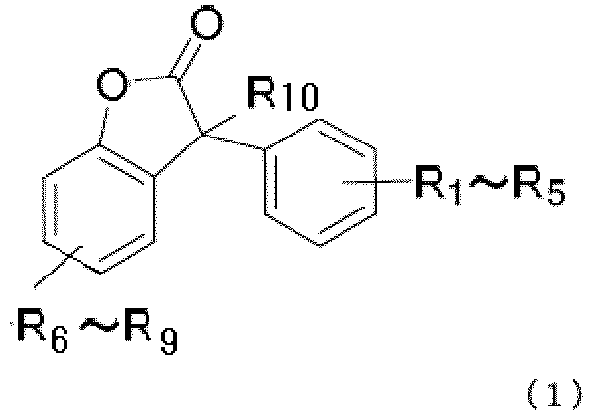
- (in General formula (1),
- R1-R5 each independently represent a hydrogen atom, an optionally substituted alkyl or alkoxy group having a total of 1-20 carbon atoms, or a structural formula of General formula (1-1) below, provided that at least any one of R1-R5 is a structural formula of General formula (1-1) below,
- R6-R9 each independently represent a hydrogen atom, or an optionally substituted alkyl or alkoxy group having a total of 1-20 carbon atoms, and
- R10 represents a hydrogen atom or an alkyl group having a total of 1-5 carbon atoms);

- (in General formula (1-1),
- R11-R18 each independently represent a hydrogen atom, or an optionally substituted alkyl or alkoxy group having a total of 1-20 carbon atoms,
- L is a moiety represented by General formula (L1) or (L2) below:

- (in Formula (L1),
- R19a and R19b each independently represent a hydrogen atom, or an alkyl or alkoxy group having a total of 1-20 carbon atoms, and
- n19 represents an integer from 1 to 12, and when n19 is an integer from 2 to 12, the plurality of R19a may be the same or different substituents and the plurality of R19b may be the same or different substituents,
- in Formula (L2),
- R19c, R19d, R19e, and R19f each independently represent a hydrogen atom, or an alkyl or alkoxy group having a total of 1-20 carbon atoms,
- in Formulae (L1) and (L2),
- * each represent the position of bonding with the benzene ring containing R1-R5 in Formula (1) above, and
- ** each represent the position of bonding with the benzene ring containing R11-R14 in Formula (1-1) above),
- R20 represents a hydrogen atom or an optionally substituted alkyl group having a total of 1-5 carbon atoms, and
- * represents the position of bonding with the benzene ring containing R1-R5 in Formula (1) above.)
- <25> A method for improving hue of a thermoplastic resin composition, the method comprising a step of adding a compounding agent represented by General formula (1) below to a thermoplastic resin:

- (in General formula (1),
- R1-R5 each independently represent a hydrogen atom, an optionally substituted alkyl or alkoxy group having a total of 1-20 carbon atoms, or a structural formula of General formula (1-1) below, provided that at least any one of R1-R5 is a structural formula of General formula (1-1) below,
- R6-R9 each independently represent a hydrogen atom, or an optionally substituted alkyl or alkoxy group having a total of 1-20 carbon atoms, and
- R10 represents a hydrogen atom or an alkyl group having a total of 1-5 carbon atoms);
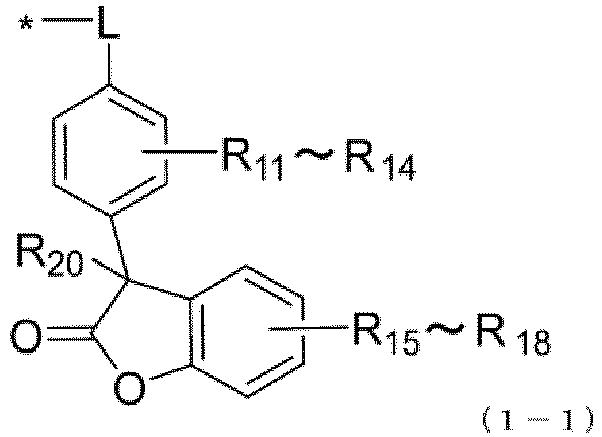
- (in General formula (1-1),
- R11-R18 each independently represent a hydrogen atom, or an optionally substituted alkyl or alkoxy group having a total of 1-20 carbon atoms,
- L is a moiety represented by General formula (L1) or (L2) below:

- (in Formula (L1),
- R19a and R19b each independently represent a hydrogen atom, or an alkyl or alkoxy group having a total of 1-20 carbon atoms, and
- n19 represents an integer from 1 to 12, and when n19 is an integer from 2 to 12, the plurality of R19a may be the same or different substituents and the plurality of R19b may be the same or different substituents,
- in Formula (L2),
- R19c, R19d, R19e, and R19f each independently represent a hydrogen atom, or an alkyl or alkoxy group having a total of 1-20 carbon atoms,
- in Formulae (L1) and (L2),
- * each represent the position of bonding with the benzene ring containing R1-R5 in Formula (1) above, and
- ** each represent the position of bonding with the benzene ring containing R11-R14 in Formula (1-1) above),
- R20 represents a hydrogen atom or an optionally substituted alkyl group having a total of 1-5 carbon atoms, and
- * represents the position of bonding with the benzene ring containing R1-R5 in Formula (1) above.)
- As described above, a thermoplastic resin composition of the present invention contains a predetermined compounding agent and can maintain transmittance, especially in the low-wavelength range, at a good level. For example, although addition of an antioxidant and a mold release agent to a conventional thermoplastic resin composition has been found to have a tendency of decreasing the transmittance, the decrease in the transmittance, especially in the low-wavelength range, can be prevented in the thermoplastic resin composition of the present invention even when additives, etc. are added. Such a thermoplastic resin composition is especially suitable as an optical material, etc.
- Hereinafter, components of the thermoplastic resin composition will be described.
- The thermoplastic resin composition contains a compounding agent represented by General formula (1). The compounding agent represented by General formula (1) is used to improve the transmittance of the thermoplastic resin composition, especially the transmittance value at a low wavelength.

- In General formula (1), R1-R5 each independently represent a hydrogen atom, an optionally substituted alkyl group having a total of 1-20 carbon atoms, or an alkoxy group having a total of 1-20 carbon atoms. R1-R5 are preferably a hydrogen atom, an optionally substituted alkyl group having a total of 1-10 carbon atoms, or an optionally substituted alkoxy group having a total of 1-10 carbon atoms, where the total number of the carbon atoms in each of the optionally substituted alkyl and alkoxy groups is more preferably 1-5 and still more preferably 1-3, and the alkyl group is, for example, a methyl group.
- Moreover, with respect to R1-R5 in General formula (1), preferably, two to four of them are hydrogen atoms and one to three of them are alkyl groups, more preferably, three of them are hydrogen atoms and two of them are alkyl groups.
- In General formula (1), R6-R9 each independently represent a hydrogen atom, an optionally substituted alkyl group having a total of 1-20 carbon atoms, or an optionally substituted alkoxy group having a total of 1-20 carbon atoms. R6-R9 are preferably a hydrogen atom, an optionally substituted alkyl group having a total of 1-10 carbon atoms, or an optionally substituted alkoxy group having a total of 1-10 carbon atoms, where the total number of the carbon atoms in each of the optionally substituted alkyl and alkoxy groups is more preferably 1-8 and still more preferably 1-5, and the alkyl group is, for example, a t-butyl group.
- Moreover, with respect to R6-R9 in General formula (1), preferably, one to three of them are hydrogen atoms and one to three of them are alkyl groups, more preferably, two of them are hydrogen atoms and two of them are alkyl groups.
- In General formula (1), R10 represents a hydrogen atom or an alkyl group having a total of 1-5 carbon atoms. R10 is preferably a hydrogen atom or an optionally substituted alkyl group having a total of 1-3 carbon atoms, where the total number of the carbon atoms in the optionally substituted alkyl group is more preferably 1 or 2. More preferably, R10 is a hydrogen atom.
- While the carbon atom bonded to R10 in General formula (1) is a chiral carbon, the compounding agent represented by General formula (1) may be racemic or optically active.
- As described above, at least one of R1-R5 in General formula (1) is a structural formula represented by General formula (1-1) below.

- In General formula (1-1), R11-R14 each independently represent a hydrogen atom, an optionally substituted alkyl group having a total of 1-20 carbon atoms, or an alkoxy group having a total of 1-20 carbon atoms. Among these substituents, R11-R14 are preferably a hydrogen atom, an optionally substituted alkyl group having a total of 1-10 carbon atoms, or an optionally substituted alkoxy group having a total of 1-10 carbon atoms, where the total number of the carbon atoms in each of the optionally substituted alkyl and alkoxy groups is more preferably 1-5 and still more preferably 1-3. More preferably, R11-R14 are hydrogen atoms.
- Of R11-R18 in General formula (1-1), R15-R18 are each preferably a hydrogen atom, an optionally substituted alkyl group having a total of 1-10 carbon atoms, or an optionally substituted alkoxy group having a total of 1-10 carbon atoms, where the total number of the carbon atoms in each of the optionally substituted alkyl and alkoxy groups is preferably 1-8 and more preferably 1-5, and the alkyl groups represented by R15-R18 are, for example, t-butyl groups.
- Moreover, with respect to R15-R18 in General formula (1), preferably, one to three of them are hydrogen atoms and one to three of them are alkyl groups, more preferably, two of them are hydrogen atoms and two of them are alkyl groups.
- In General formula (1-1), L is a moiety represented by General formula (L1) or (L2) below.

- In Formula (L1), R19a and R19b each independently represent a hydrogen atom, an alkyl or alkoxy group having a total of 1-20 carbon atoms. R19a and R19b are preferably a hydrogen atom, an optionally substituted alkyl group having a total of 1-5 carbon atoms, or an optionally substituted alkoxy group having a total of 1-5 carbon atoms. The total number of the carbon atoms in each of the optionally substituted alkyl and alkoxy groups is more preferably 1-3 and still more preferably 1 or 2. More preferably, R19a and R19b are hydrogen atoms.
- n19 represents an integer from 1 to 12, and when n19 is an integer from 2 to 12, the plurality of R19a may be the same or different substituents and the plurality of R19b may also be the same or different substituents, n19 is preferably 1-6, more preferably 1-4, and, for example, 2 or 3.
- In Formula (L2), R19c, R19d, R19e, and R19f each independently represent a hydrogen atom, or an alkyl or alkoxy group having a total of 1-20 carbon atoms. R19c, R19d, R19e, and R19f are preferably each independently a hydrogen atom, an optionally substituted alkyl group having a total of 1-5 carbon atoms, or an optionally substituted alkoxy group having a total of 1-5 carbon atoms. The total number of the carbon atoms in each of the optionally substituted alkyl and alkoxy groups is more preferably 1-3 and still more preferably 1 or 2. More preferably, R19c, R19d, R19e, and R19f are hydrogen atoms.
- In Formulae (L1) and (L2), * each independently represent the bonding position of L with the benzene ring containing R1-R5 in Formula (1). Accordingly, * in Formulae (L1) and (L2) each represent the same bonding position as that represented by * in Formula (1-1) and represent the bonding position at the terminal of Formula (1-1).
- In Formulae (L1) and (L2), ** each independently represent the bonding position of L with the benzene ring containing R11-R14 in Formula (1-1).
- In General formula (1-1), R20 represents a hydrogen atom or an alkyl group having a total of 1-5 carbon atoms. R20 is preferably a hydrogen atom or an optionally substituted alkyl group having a total of 1-3 carbon atoms, where the total number of the carbon atoms in the optionally substituted alkyl group is more preferably 1 or 2. More preferably, R20 is a hydrogen atom.
- While the carbon atom bonded to R20 in General formula (1) is a chiral carbon, the compounding agent containing the moiety represented by General formula (1-1) may be racemic or optically active.
- Preferably, one or two of R1-R5 in General formula (1) are represented by structural formulae of General formula (1-1) above, and more preferably, only one of R1-R5 is represented by a structural formula of General formula (1-1) above.
- The above substituents in General formulae (1) and (1-1) are, for example, any of a halogen, a cyano group, an alkenyl group, an alkynyl group, and an alkoxy group.
- Specific examples of the compounding agent represented by General formula (1) include a compound represented by Formula (12) below, and any of optically active forms and mixtures thereof (e.g. racemates, etc.)

- In the thermoplastic resin composition, the compounding agent is preferably contained in an amount of 1-2,000 ppm by weight based on the total weight of the thermoplastic resin composition. The content of the compounding agent in the thermoplastic resin composition is more preferably 10-1,000 ppm by weight, still more preferably 50-800 ppm by weight, particularly preferably 50-500 ppm by weight, and even more preferably 100-300 ppm by weight.
- In addition to the above-described compounding agent, the thermoplastic resin composition may further contain the following additives.
- The thermoplastic resin composition preferably contains an antioxidant.
- The antioxidant is preferably at least either one of phenolic antioxidant and phosphite-based antioxidant.
- Examples of the phenolic antioxidant include 1,3,5-tris(3,5-di-tert-butyl-4-hydroxyphenylmethyl)-2,4,6-trimethylbenzene, 1,3,5-tris(3,5-di-tert-butyl-4-hydroxybenzyl)-1,3,5-triazine-2,4,6 (1H,3H,5H)-trione, 4,4',4"-(1-methylpropanyl-3-ylidene)tris(6-tert-butyl-m-cresol), 6,6'-di-tert-butyl-4,4'-butylidene di-m-cresol, octadecyl 3-(3,5-di-tert-butyl-4-hydroxyphenyl)propionate, pentaerythritol-tetrakis[3-(3,5-di-tert-butyl-4-hydroxyphenyl)propionate], 3,9-bis{2-[3-(3-tert-butyl-4-hydroxy-5-methylphenyl)propionyloxy]-1,1-dimethylethyl}-2,4,8,10-tetraoxospiro[5.5]undecane, and pentaerythritol-tetrakis[3-(3,5-di-tert-butyl-4-hydroxyphenyl)propionate], where pentaerythritol-tetrakis[3-(3,5-di-tert-butyl-4-hydroxyphenyl)propionate] is preferable.
- Examples of the phosphite-based antioxidant include 2-ethylhexyl diphenyl phosphite, isodecyl diphenyl phosphite, triisodecyl phosphite, triphenyl phosphite, 3,9-bis(octadecyloxy)-2,4,8,10-tetraoxy-3,9 diphosphaspiro[5.5]undecane, 3,9-bis(2,6-di-tert-butyl-4-methylphenoxy)-2,4,8,10-tetraoxa-3,9-diphosphaspiro[5.5]undecane, 2,2'-methylenebis(4,6-di-tert-butylphenyl) 2-ethylhexyl phosphite, tris(2,4-di-tert-butylphenyl)phosphite, tris(nonylphenyl)phosphite, tetra-C12-15-alkyl(propane-2,2-diylbis(4,1-phenylene))bis(phosphite), and 3,9-bis(2,6-di-tert-butyl-4-methylphenoxy)-2,4,8,10-tetraoxa-3,9-diphosphaspiro[5.5]undecane, where 3,9-bis(2,6-di-tert-butyl-4-methylphenoxy)-2,4,8,10-tetraoxa-3,9-diphosphaspiro[5.5]undecane is preferable.
- Only one of the above-mentioned antioxidants or a mixture of two or more of them may be used as the antioxidant.
- The antioxidant is preferably contained in thermoplastic resin composition in an amount of 1-3,000 ppm by weight based on the total weight of the resin composition. The content of the antioxidant in the thermoplastic resin composition is more preferably 50-2,500 ppm by weight, still more preferably 100-2,000 ppm by weight, particularly preferably 150-1,500 ppm by weight, and even more preferably 200 ppm-1,200 ppm by weight.
- The thermoplastic resin composition preferably contains a mold release agent.
- Examples of the mold release agent include an ester compound, for example, a glycerol fatty acid ester such as a mono- or di-glyceride of a glycerol fatty acid, a glycol fatty acid ester such as propylene glycol fatty acid ester and sorbitan fatty acid ester, a higher alcohol fatty acid ester, and a full ester or mono-fatty acid ester of an aliphatic polyhydric alcohol and an aliphatic carboxylic acid. When an ester of an aliphatic polyhydric alcohol and an aliphatic carboxylic acid is used as the mold release agent, it may be any of a monoester, a full ester, or the like, for example, a monoester, which is not a full ester.
- Specific examples of the mold release agent include the following:
- sorbitan fatty acid esters such as sorbitan stearate, sorbitan laurate, sorbitan oleate, sorbitan trioleate, sorbitan tribehenate, sorbitan stearate, sorbitan tristearate, and sorbitan caprylate;
- propylene glycol fatty acid esters such as propylene glycol monostearate, propylene glycol monooleate, propylene glycol monobehenate, propylene glycol monolaurate, and propylene glycol monopalmitate;
- higher alcohol fatty acid esters such as stearyl stearate;
- glycerol fatty acid ester monoglycerides, including: monoglycerides such as glycerol monostearate, glycerol monohydroxystearate (e.g., glycerol mono-12-hydroxystearate), glycerol monooleate, glycerol monobehenate, glycerol monocaprylate, glycerol monocaprate, and glycerol monolaurate; and mono/di-glycerides such as glycerol mono/di-stearate, glycerol mono/di-stearate, glycerol mono/di-behenate, and glycerol mono/di-olate;
- acetylated monoglycerides of glycerol fatty acid esters such as glycerol diacetomonolaurate;
- organic acid monoglycerides of glycerol fatty acid esters such as a monoglyceride of citric acid fatty acid, a monoglyceride of succinic acid fatty acid, and a monoglyceride of diacetyl tartaric fatty acid; and
- polyglycerol fatty acid esters such as diglycerol stearate, diglycerol laurate, diglycerol oleate, diglycerol monostearate, diglycerol monolaurate, diglycerol monomyristate, diglycerol monooleate, tetraglycerol stearate, decaglycerol laurate, decaglycerol oleate, and polyglycerol polyricinoleate.
- In the thermoplastic resin composition, the mold release agent is preferably contained in an amount of 1-5,000 ppm by weight based on the total weight of the resin composition. The content of the mold release agent in the thermoplastic resin composition is more preferably 50-4,000 ppm by weight, still more preferably 100-3,500 ppm by weight, particularly preferably 500-13,000 ppm by weight, and even more preferably 1,000-2,500 ppm by weight.
- The thermoplastic resin composition preferably further contains a catalyst deactivator as an additive. The catalyst deactivator terminates the polymerization reaction by causing the loss of the activity of the catalyst used for the polymerization of the curable resin composition.
- As the catalyst deactivator, an ester such as butyl benzoate; an aromatic sulfonic acid such as p-toluenesulfonic acid; an aromatic sulfonic ester such as butyl p-toluenesulfonate or hexyl p-toluenesulfonate; a phosphoric acid such as phosphorous acid, phosphoric acid, or phosphonic acid; a phosphite ester such as triphenyl phosphite, monophenyl phosphite, diphenyl phosphite, diethyl phosphite, di-n-propyl phosphite, di-n-butyl phosphite, di-n-hexyl phosphite, dioctyl phosphite, or monooctyl phosphite; a phosphate such as triphenyl phosphate, diphenyl phosphate, monophenyl phosphate, dibutyl phosphate, dioctyl phosphate, or monooctyl phosphate; a phosphonic acid such as diphenyl phosphonic acid, dioctyl phosphonic acid, or dibutyl phosphonic acid; a phosphonic ester such as diethyl phenyl phosphonic acid; a phosphine such as triphenyl phosphine or bis(diphenyl phosphino)ethane; a boric acid such as boric acid or phenylboric acid; an aromatic sulfonate such as tetrabutylphosphonium salt with dodecylbenzenesulfonic acid; an organic halide such as stearic acid chloride, benzoyl chloride, or p-toluenesulfonate chloride; an alkyl sulfate such as dimethyl sulfate; or an organic halide such as benzyl chloride can suitably be used. From the viewpoints of the effect of the deactivator, the stability of the resin, and the like, tetrabutylphosphonium salt with dodecylbenzenesulfonic acid, p-toluene, or butyl sulfonate is particularly preferred. These deactivators are used at 0.01-50 times, preferably 0.3-20 times, the molar amount of the catalyst. If the amount is less than 0.01 times the molar amount of the catalyst, the deactivation effect will be inadequate, which is unfavorable. On the other hand, if the amount is greater than 50 times the molar amount of the catalyst, the heat resistance of the resin will be deteriorated and the molded article will easily be colored, which are undesirable.
- In the thermoplastic resin composition, the catalyst deactivator is preferably contained in an amount of 1-1,000 ppm by weight based on the total weight of the resin composition. The content of the catalyst deactivator in the thermoplastic resin composition is more preferably 3-500 ppm by weight, still more preferably 5-100 ppm by weight, and particularly preferably 10-50 ppm by weight.
- The catalyst deactivator may be added to the thermoplastic resin composition, preferably as a solution, for example, as an aqueous solution. The catalyst deactivator may be added to the thermoplastic resin composition as an alcohol solution of, for example, methanol or ethanol, or as a solution in an organic solvent such as a phenol solution.
- In addition to the above-described compounding agent, antioxidant, mold release agent, and catalyst deactivator, other additives may be added to the thermoplastic resin composition. Examples of the additives that may be contained in the thermoplastic resin composition include a heat stabilizer, a plasticizer, a filler, a UV absorber, an anti-rust agent, a dispersant, a defoaming agent, a leveling agent, a flame retardant, a lubricant, a dye, a pigment, a bluing agent, a nucleating agent, and a clarifying agent.
- The content of additives other than the compounding agent, antioxidant, mold release agent, and catalyst deactivator (hereinafter also referred to as "additional additives") in the thermoplastic resin composition is, but not limited to, preferably 10 ppm to 5.0% by weight, more preferably 100 ppm to 2.0% by weight, and still more preferably 1,000 ppm to 1.0% by weight.
- Since the additives mentioned above may adversely affect transmittance, they are preferably not added in excess and the total amount of them added is, for example, within the range mentioned above.
- The thermoplastic resin composition contains a thermoplastic resin.
- The thermoplastic resin is preferably any one or more of a polycarbonate resin, a polyester resin, a polyester carbonate resin, a cyclo-olefin-based resin, and an acrylic resin.
- The thermoplastic resin preferably contains a polycarbonate resin, a polyester resin, or a polyester carbonate resin, which has Structural unit (B) derived from a monomer represented by General formula (2) below.

- In General formula (2), Ra and Rb are each independently selected from the group consisting of a halogen atom, an optionally substituted alkyl group with 1-20 carbon atoms, an optionally substituted alkoxyl group with 1-20 carbon atoms, an optionally substituted cycloalkyl group with 5-20 carbon atoms, an optionally substituted cycloalkoxyl group with 5-20 carbon atoms, an optionally substituted aryl group with 6-20 carbon atoms, an optionally substituted heteroaryl group with 6-20 carbon atoms containing one or more heteroatoms selected from O, N, and S, an optionally substituted aryloxy group with 6-20 carbon atoms, and -C=C-Rh. Rh represents an optionally substituted aryl group with 6-20 carbon atoms or an optionally substituted heteroaryl group with 6-20 carbon atoms containing one or more heteroatoms selected from O, N, and S.
- Ra and Rb are preferably hydrogen atoms, optionally substituted aryl groups with 6-20 carbon atoms, or optionally substituted heteroaryl groups with 6-20 carbon atoms containing one or more heteroatoms selected from O, N, and S. They are more preferably hydrogen atoms or optionally substituted aryl groups with 6-20 carbon atoms, and still more preferably hydrogen atoms or optionally substituted aryl groups with 6-12 carbon atoms.
- In General formula (2), X represents a single bond or an optionally substituted fluorene group. X is preferably a single bond, or an optionally substituted fluorene group with a total of 12-20 carbon atoms.
- In General formula (2), A and B are each independently an optionally substituted alkylene group with 1-5 carbon atoms, and preferably an alkylene group with 2 or 3 carbon atoms.
- In General formula (2), m and n are each independently an integer from 0 to 6, preferably an integer from 0 to 3, and more preferably 0 or 1.
- In General formula (2), a and b are each independently an integer from 0 to 10, preferably an integer from 1 to 3, and more preferably 1 or 2.
- Examples of Structural unit (B) include those derived from BNE, DPBHBNA, or the like.

- The thermoplastic resin preferably contains a polycarbonate resin, a polyester resin, or a polyester carbonate resin, which has Structural unit (C) derived from a monomer represented by General formula (3) below.
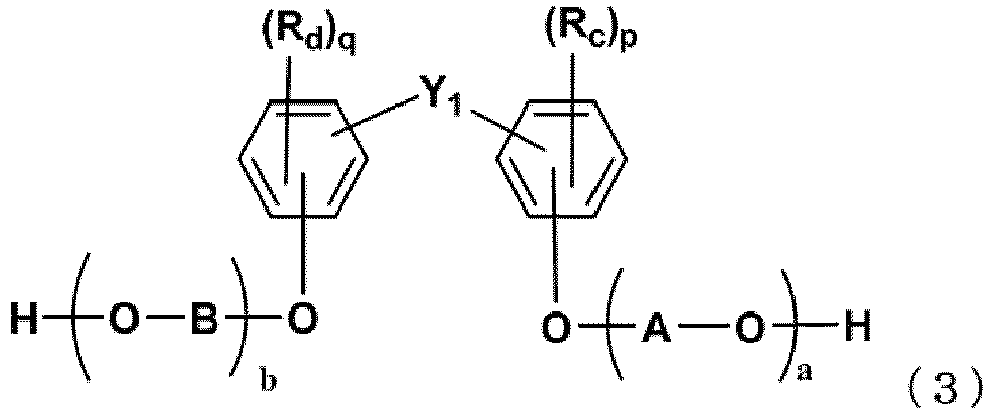
- In General formula (3), Re and Rd are each independently selected from the group consisting of a halogen atom, an optionally substituted alkyl group with 1-20 carbon atoms, an optionally substituted alkoxyl group with 1-20 carbon atoms, an optionally substituted cycloalkyl group with 5-20 carbon atoms, an optionally substituted cycloalkoxyl group with 5-20 carbon atoms, and an optionally substituted aryl group with 6-20 carbon atoms.
- Re and Rd are preferably hydrogen atoms, optionally substituted aryl groups with 6-20 carbon atoms, or optionally substituted heteroaryl groups with 6-20 carbon atoms containing one or more heteroatoms selected from O, N, and S. They are more preferably hydrogen atoms or optionally substituted aryl groups with 6-20 carbon atoms, and still more preferably hydrogen atoms or optionally substituted aryl groups with 6-12 carbon atoms.
- In General formula (3), Y1 is a single bond, an optionally substituted fluorene group, or any of the structural formulae represented by General formulae (4) to (9) below. Preferably, it is a single bond or a structural formula represented by General formula (4) below.

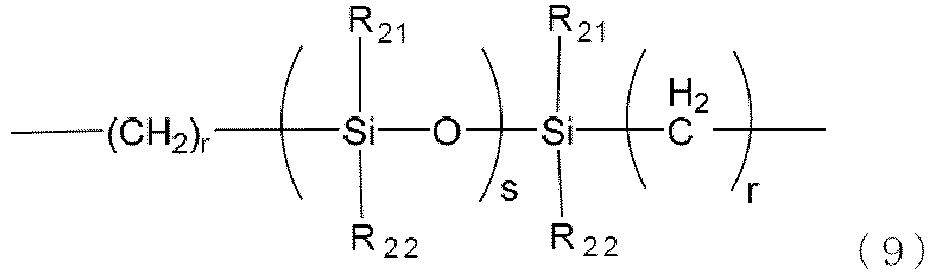
- In General formulae (4) and (9), R21 and R22 each independently represent a hydrogen atom, a halogen atom, an optionally substituted alkyl group with 1-20 carbon atoms, or an optionally substituted aryl group with 6-30 carbon atoms, or R21 and R22 are bonded together to form an optionally substituted carbon or heterocyclic ring having 1-20 carbon atoms.
- In General formulae (7) and (9), r and s each independently represent an integer from 0 to 5,000.
- In General formula (3), A and B are each independently an optionally substituted alkylene group with 1-5 carbon atoms, and preferably an alkylene group with 2 or 3 carbon atoms. In General formula (3), p and q are each independently an integer from 0 to 4, and preferably 0 or 1. In addition, in General formula (3) above, a and b are each independently an integer from 0 to 10, preferably an integer from 0 to 5, more preferably an integer from 0 to 2, and still more preferably, for example, 0 or 1.
- Specific examples of Structural unit (C) include those derived from BPEF (9,9-bis(4-(2-hydroxyethoxy)phenyl)fluorene), BPPEF (9,9-bis(4-(2-hydroxyethoxy)-3-phenylphenyl)fluorene), bisphenol A, bisphenol AP, bisphenol AF, bisphenol B, bisphenol BP, bisphenol C, bis(4-hydroxyphenyl)-2,2-dichloroethylene, bisphenol E, bisphenol F, bisphenol G, bisphenol M, bisphenol S, bisphenol P, bisphenol PH, bisphenol TMC, bisphenol P-AP (4,4'-(1-phenylethylidene)bisphenol), bisphenol P-CDE (4,4'-cyclododecylidenebisphenol), bisphenol P-HTG (4,4'-(3,3,5-trimethylcyclohexylidene)bisphenol)), bisphenol P-MIBK (4,4'-(1,3-dimethylbutylidene)bisphenol), bisphenol PEO-FL (bisphenoxyethanol fluorene), bisphenol P-3MZ (4-[1-(4-hydroxyphenyl)-3-methylcyclohexyl]phenol), bisphenol OC-FL (4,4'-[1-[4-[1-(4-hydroxyphenyl)-1-methylethyl]phenyl]ethylidene]bisphenol), bisphenol Z, BP-2EO (2,2'-[[1,1'-biphenyl]-4,4'-diylbis(oxy)bis-ethanol), S-BOC (4,4'-(1-methylethylidene)bis(2-methylphenol), and TrisP-HAP (4,4',4"-ethylidene trisphenol).

- The thermoplastic resin may be a polymer that contains Structural unit (B) but not Structural unit (C), a polymer that contains Structural unit (C) but not Structural unit (B), a copolymer having Structural units (B) and (C), a mixture of a polymer having only Structural unit (B) and a polymer having only Structural unit (C), or a combination thereof. Examples of the polymer that contains Structural unit (C) but not Structural unit (B) include those having at least any of the structural units represented by Formulae (I-1) to (I-3) below, and examples of the copolymer having Structural units (B) and (C) include those having at least any of the structural units represented by Formulae (II-1) to (II-4) below.


- (In Formula (I-1), m and n are each an integer from 1 to 10, preferably an integer from 1 to 5, and more preferably 1, and
- in formula (I-3), n is an integer from 1 to 10, preferably an integer from 1 to 5, and more preferably 1.)
- Although either a block copolymer in which the values of m and n are high (e.g., 100 or higher) or a random copolymer can be used as the polymer having multiple types of structural units, it is preferable to use a random copolymer, and it is more preferable to use a random copolymer in which the values of m and n are 1.


- Although either a block copolymer in which the values of m and n are high (e.g., 100 or higher) or a random copolymer can be used as the polymer having multiple types of structural units, it is preferable to use a random copolymer, and it is more preferable to use a random copolymer in which the values of m and n are 1. In the above copolymer, the mole ratio of Structural unit (B) to Structural unit (C) is preferably 1:99-99:1, more preferably 10:90-90:10, still more preferably 15:85-85:15, and particularly preferably 30:70-70:30. In the above mixture, the weight ratio of the polymer having only Structural unit (B) to the polymer having only Structural unit (C) is preferably 1:99-99:1, more preferably 10:90-90:10, still more preferably 15:85-85:15, and particularly preferably 30:70-70:30.
- The thermoplastic resin may be a cyclo-olefin-based resin or may contain a cyclo-olefin-based resin. Examples of the cyclo-olefin-based resin include those having the following structural units.


- In the above formulae, Xg each independently represent an alkylene group with 1-10 carbon atoms. Examples of the alkylene group with 1-10 carbon atoms include methylene, ethylene, propylene, isopropylene, butylene, isobutylene, sec-butylene, tert-butylene, and pentylene. Among them, methylene, ethylene, propylene, butylene, isobutylene, and sec-butylene are preferable, and methylene, ethylene, and propylene are more preferable.
- Rj, Rk, Rl, and Rm are each independently selected from a halogen atom, a substituted or unsubstituted alkyl group with 1-20 carbon atoms, a substituted or unsubstituted alkoxyl group with 1-20 carbon atoms, an optionally substituted cycloalkyl group with 5-20 carbon atoms, a substituted or unsubstituted cycloalkoxyl group with 5-20 carbon atoms, a substituted or unsubstituted aryl group with 6-20 carbon atoms, a substituted or unsubstituted heteroaryl group with 3-20 carbon atoms containing one or more heteroatoms selected from O, N, and S, a substituted or unsubstituted aryloxy group with 6-20 carbon atoms, and -C=C-Ri. Examples of Rj, Rk, Rl, and Rm above are the same as those of Xa, Xb, Xc, Xd, Xe, and Xf listed above.
- Note that Rj, Rk, Rl, and Rm may have substituents. Examples of these substituents include, but are not limited to, a halogen atom, an alkyl group with 1-10 carbon atoms, a cycloalkyl group with 5-10 carbon atoms, an alkoxy group with 1-10 carbon atoms, a cycloalkyloxy group with 5-10 carbon atoms, an alkyloxycarbonyl group with 2-10 carbon atoms, a cycloalkyloxycarbonyl group with 5-10 carbon atoms, an aryloxycarbonyl group with 7-15 carbon atoms, an alkylcarbonyloxy group with 2-10 atoms, a cycloalkylcarbonyloxy group with 5-10 carbon atoms, an arylcarbonyloxy group with 7-15 carbon atoms, a hydroxyalkylcarbonyl group with 2-10 carbon atoms, a glycidyloxycarbonyl group, a hydroxy group, a carboxy group, a cyano group, and an amide group with 1-10 carbon atoms.
- Examples of the alkyl group with 1-10 carbon atoms include a methyl group, an ethyl group, a propyl group, an isopropyl group, a butyl group, an isobutyl group, a sec-butyl group, a tert-butyl group, and a pentyl group.
- Examples of the cycloalkyl group with 5-10 carbon atoms include a cyclopentyl group, a cyclohexyl group, a cycloheptyl group, a bicyclo[2.2.1]heptyl group, and a bicyclo[2.2.2]octyl group.
- Examples of the alkoxy group with 1-10 carbon atoms include a methoxy group, an ethoxy group, a propyloxy group, an isopropyloxy group, a butoxy group, an isobutoxy group, a sec-butoxy group, a tert-butoxy group, and a pentyloxy group.
- Examples of the cycloalkyloxy group with 5-10 carbon atoms include a cyclopentyloxy group, a cyclohexyloxy group, a bicyclo[2.2.1]heptyloxy group, and a bicyclo[2.2.2]octyloxy group.
- Examples of the alkyloxycarbonyl group with 2-10 carbon atoms include a methyloxycarbonyl group, an ethyloxycarbonyl group, a propyloxycarbonyl group, an isopropyloxycarbonyl group, a butyloxycarbonyl group, an isobutyloxycarbonyl group, a sec-butyloxycarbonyl group, and a tert-butyloxycarbonyl group.
- Examples of the cycloalkyloxycarbonyl group with 5-10 carbon atoms include a cyclopentyloxycarbonyl group, a cyclohexyloxycarbonyl group, a bicyclo[2.2.1]heptyloxycarbonyl group, and a bicyclo[2.2.2]octyloxycarbonyl group.
- Examples of the aryloxycarbonyl group with 7-15 carbon atoms include a phenyloxycarbonyl group, a triloxycarbonyl group, a xylyloxycarbonyl group, a trimethylphenyloxycarbonyl group, a tetramethylphenyloxycarbonyl group, an ethylphenyloxycarbonyl group, an ethylmethylphenyloxycarbonyl group, a diethylphenyloxycarbonyl group, and a naphthyloxycarbonyl group.
- Examples of the alkylcarbonyloxy group with 2-10 carbon atoms include a methylcarbonyloxy group, an ethylcarbonyloxy group, a propylcarbonyloxy group, an isopropylcarbonyloxy group, and a butylcarbonyloxy group.
- Examples of the cycloalkylcarbonyloxy group with 5-10 carbons include a cyclopentylcarbonyloxy group, a cyclohexylcarbonyloxy group, a bicyclo[2.2.1]heptylcarbonyloxy group, and a bicyclo[2.2.2]octylcarbonyloxy group.
- Examples of the aryl carbonyloxy group with 7-15 carbon atoms include a phenylcarbonyloxy group, a tolylcarbonyloxy group, a xylylcarbonyloxy group, a trimethylphenylcarbonyloxy group, a tetramethylphenylcarbonyloxy group, an ethylphenylcarbonyloxy group, an ethylmethylphenylcarbonyloxy group, a diethylphenylcarbonyloxy group, and a naphthylcarbonyloxy group.
- Examples of the hydroxyalkyl carbonyl group with 2-10 carbon atoms include a hydroxymethylcarbonyl group, a hydroxyethylcarbonyl group, and a hydroxypropylcarbonyl group.
- Examples of the amide group with 1-10 carbon atoms include a methylaminocarbonyl group, an ethylaminocarbonyl group, a dimethylaminocarbonyl group, and an acetylamino group.
- The above substituents may be contained alone or in combination of two or more.
- Ri represents an aryl group with 6-20 carbon atoms or a heteroaryl group with 3-20 carbon atoms containing one or more heteroatoms selected from O, N, and S. This Ri is the same as described above.
- p each independently represent an integer of 0 or 1.
- q, r, and s are each independently an integer from 0 to 10, preferably an integer from 0 to 5, and more preferably an integer from 0 to 3.
- t represents an integer from 1 to 3, and is preferably 1 or 2.
- When q is 2 or higher and two Rj exist on adjacent carbon atoms, the two Rj may form a ring structure together. For example, if q is 2 and the two Rj are both substituted or unsubstituted alkyl groups, then General formula (20) may be Formula (20-1) below, and if q is 2 and the two Rj are a substituted or unsubstituted alkyl group and a substituted or unsubstituted cycloalkyl group, respectively, then General formula (20) may be Formula (20-2), (20-3), or (20-4) below.

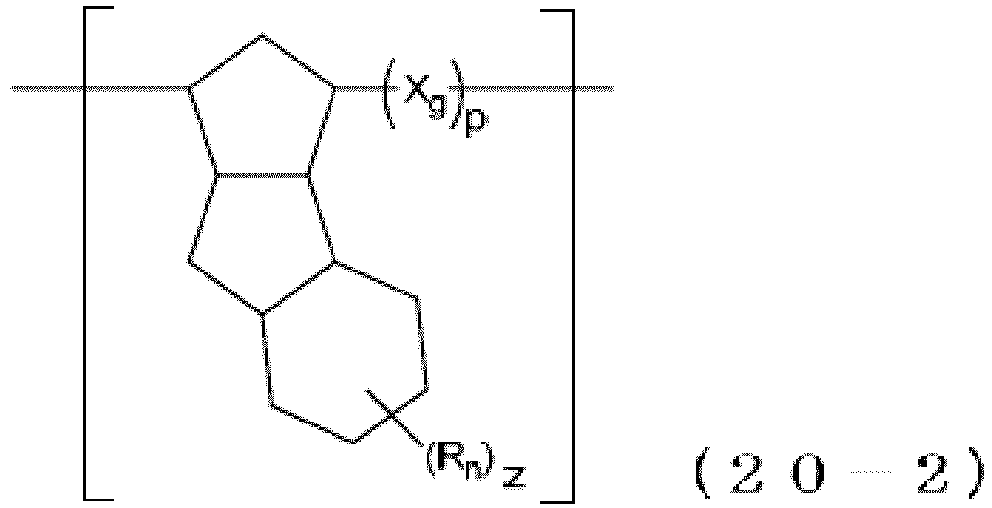


- In the above formulae, Xg and p are as described above.
- Rn represents the substituent mentioned above, where specific examples thereof include a halogen atom, an alkyl group with 1-10 carbon atoms, a cycloalkyl group with 5-10 carbon atoms, an alkoxy group with 1-10 carbon atoms, a cycloalkyloxy group with 5-10 carbon atoms, an alkyloxycarbonyl group with 2-10 carbon atoms, a cycloalkyloxycarbonyl group with 5-10 carbon atoms, an aryloxycarbonyl group with 7-15 carbon atoms, an alkylcarbonyloxy group with 2-10 carbon atoms, a cycloalkylcarbonyloxy group with 5-10 carbon atoms, an arylcarbonyloxy group with 7-15 carbon atoms, a hydroxyalkylcarbonyl group with 2-10 carbon atoms, a glycidyloxycarbonyl group, a hydroxy group, a carboxy group, a cyano group, and an amide group with 1-10 carbon atoms.
- While z is not particularly limited, it is preferably 0-6, more preferably 0-3, and still more preferably 0 or 1.
- u represents an integer from 1 to 3, preferably 1 or 2.
- In addition, when r is 2 or higher and two Rk exist on adjacent carbon atoms, the two Rk may form a ring structure together. For example, if r is 2 and the two Rk are both substituted or unsubstituted alkyl groups, then General formula (21) may be Formula (21-1) or (21-2) below, and if r is 2 and the two Rk are a substituted or unsubstituted alkyl group and a substituted or unsubstituted cycloalkyl group, respectively, then General formula (21) may be Formula (21-3) below.


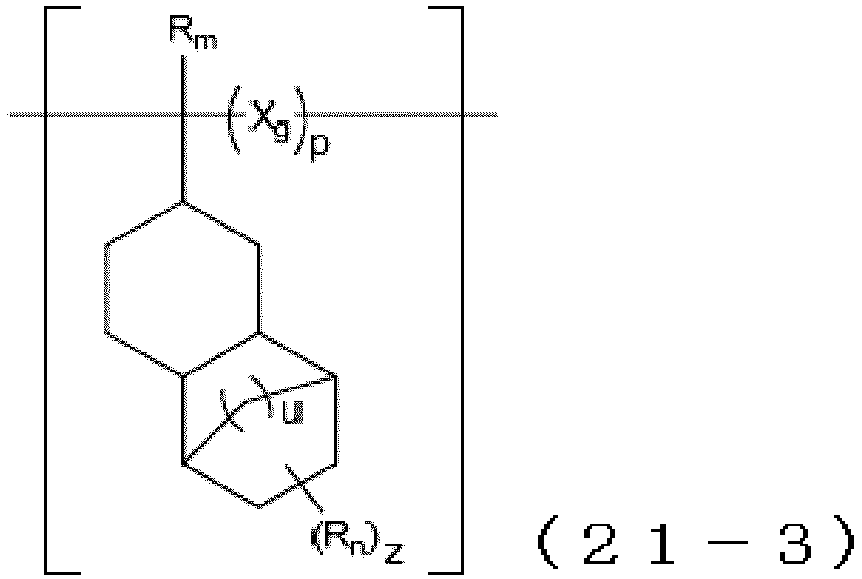
- In the above formulae, Xg, p, Rn, z, and u are as described above.
- Furthermore, when s is 2 or higher and two R1 exist on adjacent carbon atoms, the two R1 may form a ring structure together. For example, if s is 2 and the two R1 are both substituted or unsubstituted alkyl groups, then General formula (22) may be Formula (22-1) or (22-2) below, and if s is 2 and the two R1 are a substituted or unsubstituted alkyl group and a substituted or unsubstituted cycloalkyl group, respectively, then General formula (22) may be Formula (22-3) or (22-4) below.


- In the above formulae, Xg, p, Rn, z, and u are as described above.
- In Formulae (21-1) to (21-3), Rm represents a hydrogen atom or an alkyl group with 1-3 carbon atoms. Examples of the alkyl group with 1-3 carbon atoms include, but are not limited to, a methyl group, an ethyl group, a propyl group, and an isopropyl group.
- Specific examples of the cyclo-olefin-based resin include those containing at least one selected from the group consisting of the structural units represented by Formulae 1-8 below.


- The above-mentioned structural units may be contained in the cyclo-olefin-based resin alone or in a combination of two or more. In addition, the above-mentioned structural units may be combined with a structural unit of other cyclic polyolefin, or with a structural unit of other resin (polyolefin resin, polyester resin) or the like.
- While the weight (mass)-average molecular weight (Mw) of the cyclo-olefin-based resin is not particularly limited, it is preferably 1,000-3,000,000, more preferably 10,000-3,000,000, still more preferably 20,000-1,000,000, and particularly preferably 30,000-500,000.
- Other than the above-mentioned cyclo-olefin-based resin, a resin (polymer) having a structural unit containing an aliphatic ring may also be used as the thermoplastic resin. For example, a thermoplastic resin that has at least any of the following structural units may be used: specifically, a structural unit represented by Formula (23) below; and a monomer derived structural unit, such as, an isosorbide-derived structural unit, a pentacyclopentadecanedimethanol (PCPMD)-derived structural unit, a cyclohexanedimethanol-derived structural unit, and a spiroglycol-derived structural unit.

- In addition, a copolymer or a blend of either of the above-described cyclo-olefin-based resin or a resin having a structural unit containing an aliphatic ring and a structural unit represented by General formula (24) below may be used as the thermoplastic resin. Specific examples of such thermoplastic resin include copolymers or blends having the structural unit represented by General formula (23) above and the structural unit represented by General formula (24) below.

- The thermoplastic resin may contain an acrylic resin. Examples of the acrylic resin include, but are not particularly limited to, a homopolymer of a (meth)acrylic ester, such as polymethyl methacrylate (PMMA) and methyl methacrylate (MMA), a copolymer of PMMA or MMA with one or more other monomers, and also a mixture of several types of these resins.
- Specific examples of a preferable acrylic resin used as the thermoplastic resin include those containing a (meth)acrylic ester structural unit (a) represented by General formula (10) below (hereinafter also referred to as a "structural unit (a)") and an aliphatic vinyl structural unit (b) represented by General formula (11) below (hereinafter also referred to as a "structural unit (b)".)
- Herein, a "(meth)acrylic acid" comprises both methacrylic acid and acrylic acid.


- Structural unit (a) is a structural unit derived from a (meth)acrylic acid ester.
- In General formula (10) above, R31 is hydrogen or a methyl group.
- R32 is a hydrocarbon group having 1-18 carbon atoms, and may have a substituent selected from a hydroxyl group and an alkoxy group. Specific examples of R32 include alkyl groups such as a methyl group, an ethyl group, a butyl group, a lauryl group, a stearyl group, a cyclohexyl group, and an isobornyl group; hydroxyalkyl groups such as a 2-hydroxyethyl group, a 2-hydroxypropyl group, and a 2-hydroxy-2-methylpropyl group; alkoxyalkyl groups such as a 2-methoxyethyl group, a 2-ethoxyethyl group, and a 2-phenoxyethyl group; and aryl groups such as a benzyl group and a phenyl group. It may also be an organic group composed of a combination of one or more of these groups.
- The number of carbon atoms in an alkoxy group as the substituent is preferably 1-10, and more preferably 1-6. Specifically, examples of the alkoxy group include a methoxy group, an ethoxy group, and a phenoxy group.
- When a plurality of (meth)acrylic ester structural units (structural units (a)) exist in an acrylic resin, the plurality of R31 and R32 may be the same or different from each other. Among these, a (meth)acrylic ester structural unit in which R31 is a methyl group and R32 is a methyl and/or ethyl group is preferred, and a methacrylic ester structural unit in which R31 is a methyl group and R32 is a methyl group is more preferred.
- Structural unit (b) is a structural unit derived from an aliphatic vinyl compound.
- In General formula (11) above, R33 is hydrogen or a methyl group. Moreover, R34 is a cyclohexyl group or a cyclohexyl group with a substituent selected from a hydrocarbon group having 1-4 carbon atoms, a hydroxyl group, an alkoxy group, and a halogen atom.
- Examples of the hydrocarbon group as the substituent include alkyl groups such as a methyl group, an ethyl group, a propyl group, and a butyl group.
- The number of carbon atoms in the alkoxy group as the substituent is preferably 1-10, and more preferably 1-6. Specifically, examples of the alkoxy group include a methoxy group, an ethoxy group, and a phenoxy group.
- Examples of the halogen atom as the substituent include a fluorine atom, a chlorine atom, and a bromine atom, where a chlorine atom and a bromine atom are particularly preferred.
- When a plurality of structural units (b) exist in an acrylic resin, the plurality of R33 and R34 may be the same or different from each other. Among these, an aliphatic vinyl structural unit in which R33 is hydrogen or a methyl group and R34 is a cyclohexyl group is preferred, and an aliphatic vinyl structural unit in which R33 is hydrogen and R34 is a cyclohexyl group is more preferred.
- Preferably, the above-described acrylic resin that can be used in the thermoplastic resin consists mainly of the structural unit (a) and the structural unit (b). The total percentage of the structural unit (a) and structural unit (b) with respect to the total of all structural units of the acrylic resin is, for example, 85-100 mol%, preferably 90-100 mol%, more preferably 95-100 mol%, and still more preferably 98-100 mol%.
- In addition, the percentage of the structural unit (a) with respect to the total of all structural units of the acrylic resin is, for example, 55-80 mol%, preferably 56-79 mol%, more preferably 57-78 mol%, and still more preferably 58-77 mol%.
- In addition, the percentage of the structural unit (b) with respect to the total of all structural units of the acrylic resin is, for example, 10-45 mol%, preferably 11-44 mol%, more preferably 12-43 mol%, and still more preferably 13-42 mol%. If the percentage of the structural unit (b) with respect to the total of all structural units of the acrylic resin is less than 10%, the heat resistance of the acrylic resin may be deteriorated or the dimensional stability of the acrylic resin may be deteriorated in a humid environment, which is undesirable.
- The acrylic resin may contain a structural unit other than the structural units (a) and (b) to the extent where the optical properties are not impaired. Examples of such structural unit include, but are not limited to, structural units derived from acrylonitrile, acrylic acid, methacrylic acid, maleic anhydride, phenylmaleimide, and cyclohexylmaleimide.
- While the method for producing the acrylic resin is not particularly limited, it is, for example, preferably a method where a (meth)acrylic ester monomer is copolymerized with an aromatic vinyl monomer having at least one type of benzene ring skeleton and then the benzene ring is hydrogenated, or a method where a (meth)acrylic ester monomer is copolymerized with an aliphatic vinyl monomer having at least one type of cyclohexyl ring skeleton. The former method is particularly favorable.
- Examples of the (meth)acrylic acid ester monomer include, but are not particularly limited to, methyl (meth)acrylate, ethyl (meth)acrylate, butyl (meth)acrylate, lauryl (meth)acrylate, stearyl (meth)acrylate, cyclohexyl (meth)acrylate, isobornyl (meth)acrylate, (2-hydroxyethyl) (meth)acrylate, (2-hydroxypropyl) (meth)acrylate, (2-hydroxy-2-methylpropyl) (meth)acrylate, (2-methoxyethyl) (meth)acrylate, (2-ethoxyethyl) (meth)acrylate, (2-phenoxyethyl) (meth)acrylate, benzyl (meth)acrylate, and phenyl (meth)acrylate. Among these, methyl methacrylate is preferred.
- Specific examples of the aromatic vinyl monomer include styrene, α-methylstyrene, p-hydroxystyrene, alkoxystyrene, chlorostyrene, bromostyrene, and derivatives thereof. Among these, styrene and α-methylstyrene are preferred.
- Examples of the aliphatic vinyl monomer include vinylcyclohexane, isopropenylcyclohexane, and 1-propenyl-2-methylcyclohexane. Among these, vinylcyclohexane and isopropenylcyclohexane are preferred.
- A known method can be employed for the polymerization of the (meth)acrylic ester monomer and the aromatic vinyl monomer, the acrylic resin can be produced, for example, by bulk polymerization method, solution polymerization method, suspension polymerization method, or emulsion polymerization method. According to the solution polymerization method, polymerization is performed, for example, by a method where a monomer composition containing a solvent, a monomer, a chain transfer agent, and a polymerization initiator is continuously fed into a complete mixing tank to be polymerized continuously at 100-180°C.
- Examples of the solvent used for solution polymerization include hydrocarbon-based solvents such as toluene, xylene, cyclohexane, and methylcyclohexane; ester-based solvents such as ethyl acetate and methyl isobutyrate; ketone-based solvents such as acetone and methyl ethyl ketone; ether-based solvents such as tetrahydrofuran and dioxane; and alcohol-based solvents such as methanol and isopropanol.
- Hydrogenation reaction after the polymerization of the (meth)acrylic ester monomer and the aromatic vinyl monomer is carried out in a suitable solvent. The solvent used for this hydrogenation reaction may be the same as or different from the polymerization solvent described above. Examples of the solvent include hydrocarbon-based solvents such as cyclohexane and methylcyclohexane; ester-based solvents such as ethyl acetate and methyl isobutyrate; ketone-based solvents such as acetone and methyl ethyl ketone; ether-based solvents such as tetrahydrofuran and dioxane; and alcohol-based solvents such as methanol and isopropanol.
- The method of hydrogenation is not particularly limited and any known method can be used. For example, hydrogenation can be performed in a batch mode or a continuous flow mode at a hydrogen pressure of 3-30 MPa and a reaction temperature of 60-250°C. By setting the temperature to 60°C or higher, the reaction time will not be too long, and by setting the temperature to 250°C or lower, there is little chance of molecular chain cleavage or hydrogenation of the ester moiety.
- Examples of the catalyst used for the hydrogenation reaction include solid catalysts consisting of a metal such as nickel, palladium, platinum, cobalt, ruthenium, or rhodium, or an oxide, salt, or complex compound of such metal supported on a porous support such as carbon, alumina, silica, silica-alumina, or diatomite.
- In the hydrogenation reaction, 70% or more of the aromatic rings in the aromatic vinyl monomer is preferably hydrogenated. In other words, the percentage of unhydrogenated moieties of the aromatic rings in the aromatic vinyl structural unit is preferably less than 30%. If the percentage of the unhydrogenated moieties of the aromatic rings exceeds 30%, transparency may be deteriorated when used as the acrylic resin. The percentage of the unhydrogenated moieties of the aromatic rings is preferably less than 10%, more preferably less than 5%, and particularly preferably less than 1%. From the viewpoint of productivity, the percentage does not necessarily have to be 0%.
- Polymerization of the (meth)acrylic ester monomer and the aromatic vinyl monomer can be conducted by a known method such as a method described in Japanese Unexamined Patent Application Publication No. S63-3011 or S63-170475.
- The glass transition temperature of the acrylic resin is preferably in the range of 110-160°C, more preferably 115-150°C.
- In addition, one type of acrylic resin can be used alone or two or more types of acrylic resins can be used in combination.
- The weight (mass)-average molecular weight (Mw) of the thermoplastic resin in terms of polystyrene equivalent is, for example, 10,000-500,000, preferably 10,000-300,000, more preferably 15,000-100,000, and still more preferably 20,000-50,000.
- The range of the weight-average molecular weight (Mw) in terms of polystyrene equivalent mentioned above relates primarily to polycarbonate resins, polyester resins, and polyester carbonate resins.
- While the weight-average molecular weight (Mw) of the acrylic resin contained in a thermoplastic resin may be in the above-mentioned range in terms of polystyrene equivalent, it is preferably 100,000-200,000, and more preferably 110,000-170,000.
- A thermoplastic resin composition of the present invention containing the compounding agent can maintain transmittance (%) at a higher level than thermoplastic resin compositions without the compounding agent.
- For example, the value of transmittance (%) of the thermoplastic resin composition at a wavelength of 370-400 nm in accordance with JIS K7105 is higher, by 1.0 (%) or more, and preferably by 2.0 (%) or more, than that of a reference resin composition having the same composition but without the compounding agent. In other words, when the value of transmittance (%) of a reference resin composition without the compounding agent at a wavelength of 370-400 nm in accordance with JIS K7105 is compared with the value of transmittance (%) of the thermoplastic resin composition of the present invention at the same wavelength (i.e., wavelength of 370-400 nm in accordance with JIS K7105), the thermoplastic resin composition had higher transmittance value and a difference of 1.0 (%) or more, preferably 2.0 (%) or more, was realized between these values. The value of transmittance of the thermoplastic resin composition is higher, preferably by 3.0 (%) or more, and more preferably by 4.0 (%) or more, than the value of transmittance of the reference resin composition.
- The above-mentioned difference in the transmittance (%) values was also observed, for example, at a wavelength of 380 nm-400 nm in accordance with JIS K7105.
- Moreover, for example, the value of transmittance (%) of the thermoplastic resin composition at a wavelength of 370-400 nm in accordance with JIS K7105 is 1.1 times or more higher than that of a reference resin composition having the same composition but without the compounding agent. In other words, when the values of transmittance (%) of a reference resin composition without the compounding agent at a wavelength of 370-400 nm in accordance with JIS K7105 is compared with the value of transmittance (%) of the thermoplastic resin composition of the present invention at the same wavelength (i.e., wavelength of 370-400 nm in accordance with JIS K7105), the thermoplastic resin composition had higher transmittance value than that of the reference resin composition and the difference thereof was 1.1 times or more. The value of transmittance of the thermoplastic resin composition is preferably 1.3 times or more and more preferably 1.5 times or more higher than the value of transmittance of the reference resin composition.
- Addition of additives, such as a mold release agent, an antioxidant, and the like, to a thermoplastic resin composition of the present invention tends to decrease the transmittance value of the resulting thermoplastic resin composition. However, decrease in the transmittance value can be prevented or suppressed in the thermoplastic resin composition to which the above-mentioned compounding agent has been added.
- Moreover, a thermoplastic resin composition in one aspect of the present invention has a lower YI value than a reference thermoplastic resin composition having the same composition as said thermoplastic resin composition but without the compounding agent. Specifically, the YI value (e.g., YI value according to JIS K 7105) of the thermoplastic resin composition containing the above-described compounding agent can be 0.20 or more lower than the YI value of a thermoplastic resin composition having the same composition but without the compounding agent. The difference between these YI values can be, for example, 0.50 or more, 0.80 or more, 0.90 or more, 1.0 or more, or even 1.1 or more.
- The YI value (e.g., YI value according to JIS K 7105) of the thermoplastic resin composition containing the above-described compounding agent is preferably 1.2 or more lower than the YI value of a thermoplastic resin composition having the same composition but without the compounding agent. The difference between these YI values is more preferably 1.5 or more, 1.80 or more, or 2.0 or more, and still more preferably 2.2 or more, 2.5 or more, 2.7 or more, or even 3.0 or more.
- Moreover, the YI value (e.g., in accordance with JIS K 7105) of the thermoplastic resin composition containing the above-described compounding agent represented by General formula (1) is preferably 0.2 or more lower than the YI value of a thermoplastic resin composition that contains, as a compounding agent, the same amount of monomer that corresponds to the above-described compounding agent represented by General formula (1) (e.g., a compound that shares the same General formula (1) except that none of R1-R5 in General formula (1) contains the cyclic structure represented by General formula (1-1)). In addition, the difference between these YI values is more preferably 0.3 or more, 0.4 or more, or 0.5 or more, and still more preferably 0.6 or more, 0.7 or more, 0.8 or more, 0.9 or more, or even 1.0 or more.
- As described above, the thermoplastic resin composition of the present invention is suitable for applications like an optical material, because it can maintain high transmittance, realize improved color hue as indicated by a low YI value, etc. The thermoplastic resin composition of the present invention can suitably be used especially as an optical material.
- Furthermore, the thermoplastic resin composition of the present invention has high heat resistance and transparency, and is expected to have an effect of reducing the amount of volatile components. Among the thermoplastic resin compositions of the present invention, the effect of reducing the amount of volatile components at high temperatures has been confirmed especially in the polyester resin composition as will be described in detail below and thus the odor generated during heating can be suppressed. For this reason, the thermoplastic resin compositions of the present invention, mainly the polyester resin compositions, are useful, for example, as plastics for food containers and packaging.
- For example, a thermoplastic resin composition in one aspect of the present invention is as effective as or more effective than a reference thermoplastic resin composition having the same composition as said thermoplastic resin composition but without the compounding agent in suppressing volatile components. In other words, the thermoplastic resin composition can suppress the amount of volatile components that are generated under the predetermined conditions, including heating at 250°C for 5 minutes.
- Examples of the volatile component include formaldehyde, acetaldehyde, acetone, 2,3-butanedione, acetic acid, and formic acid.
- A method for producing a thermoplastic resin composition of the present invention includes a step of adding the above-described compounding agent to a thermoplastic resin. By the step of adding the compounding agent to a thermoplastic resin, the transmittance (especially the transmittance value at a low wavelength) of the thermoplastic resin can be maintained better than that of a thermoplastic resin to which the compounding agent is not added.
- A method for improving transmittance of a thermoplastic resin composition of the present invention includes a step of adding the above-described compounding agent to a thermoplastic resin. By the step of adding the compounding agent to a thermoplastic resin, the transmittance (especially transmittance value at a low wavelength) of the thermoplastic resin can be improved. Specifically, the transmittance value of a thermoplastic resin composition to which the compounding agent has been further added is improved compared to a thermoplastic resin to which an additive different from the compounding agent has been added.
- A method for improving the hue of a thermoplastic resin composition of the present invention includes a step of adding the above-described compounding agent to a thermoplastic resin. By the step of adding the compounding agent to a thermoplastic resin, the hue of the thermoplastic resin can be enhanced or improved, and the transparency of the thermoplastic resin can be increased.
- As described above, the YI value (e.g., value in accordance with JIS K 7105) of a thermoplastic resin composition containing the above-described compounding agent can be 0.2 or more lower than the YI value of a thermoplastic resin composition that shares the same components but that does not contain the compounding agent. Therefore, a thermoplastic resin composition containing the compounding agent tends to be superior in hue, with the yellowish coloration that usually occurs being suppressed. Specifically, addition of the compounding agent to a thermoplastic resin composition can lower the YI value of the thermoplastic resin composition, and the difference in the YI values between the presence and absence of the compounding agent can be, for example, 0.20 or more, 0.50 or more, 0.80 or more, 0.90 or more, 1.0 or more, or even 1.1 or more, as described above.
- When the above-mentioned compounding agent is added to a thermoplastic resin composition, the YI value (e.g., in accordance with JIS K 7105) of the thermoplastic resin composition is preferably 1.2 or more lower than the YI value of a thermoplastic resin composition having the same composition but without the compounding agent. The difference between these YI values is more preferably 1.5 or more, 1.80 or more, or 2.0 or more, and still more preferably 2.2 or more, 2.5 or more, 2.7 or more, or even 3.0 or more.
- Addition of the above-described compounding agent represented by General formula (1) to a thermoplastic resin composition can also make the YI value (e.g., in accordance with JIS K 7105) to be preferably 0.2 or more lower than the YI value of a thermoplastic resin composition that has been added with, as a compounding agent, the same amount of monomer that corresponds to the above-described compounding agent represented by General formula (1) (e.g., a compound that shares the same General formula (1) except that none of R1-R5 in General formula (1) contains the cyclic structure represented by General formula (1-1)). In addition, the difference between these YI values is more preferably 0.3 or more, 0.4 or more, or 0.5 or more, and still more preferably 0.6 or more, 0.7 or more, 0.8 or more, 0.9 or more, or even 1.0 or more.
- Furthermore, the step of adding the above-mentioned compounding agent to a thermoplastic resin can also reduce the haze value (e.g., haze value according to JIS K-7361 and JIS K-7136) of the thermoplastic resin. In other words, the haze value of the thermoplastic resin composition tends to be lower than that of a reference resin composition having the same composition as the thermoplastic resin composition but without the compounding agent. The difference between these haze values is, for example, 0.01 or more, 0.02 or more, 0.03 or more, 0.04 or more, or 0.05 or more.
- The thermoplastic resin composition of the present invention can be used in extrusion molding, blow molding, injection molding, and the like. Examples of the resulting molded article include extruded articles, hollow molded articles, precision parts, and thin injection molded products.
- The thermoplastic resin composition of the present invention can maintain a good transmittance value. Therefore, the thermoplastic resin compositions of the present invention are particularly suitable as optical materials, etc. Examples of the molded article that can be manufactured using such a thermoplastic resin composition include an optical lens, an optical film, a transparent conductive substrate used in a liquid crystal display, an organic EL display, a solar cell, etc., an optical disc, a liquid crystal panel, an optical card, a sheet, a film such as a retardation film, an optical fiber, a connector, a deposited plastic reflective mirror, a display, and a touch panel. These molded articles for optical use have high transmittance even if they contain additives added for various applications.
- Specific examples of the molded article that uses the thermoplastic resin of the present invention as an optical material or for an application in the related fields include optical media such as a compact disc, a digital video disc, a mini disc, and a magneto-optical disc, optical communication media such as an optical fiber, optical components such as a headlamp lens for cars, etc. and a lens for cameras, a siren light cover, a lighting lamp cover, an alternative to window glass for vehicles (e.g., trains and automobiles), an alternative to window glass for households, lighting components such as a sunroof and a greenhouse roof, lenses or cases for goggles, sunglasses, and eyeglasses, housings for office automation equipment such as a copier and a facsimile, housings for household appliances such as a television and a microwave oven, and electronic components such as a connector and an IC tray. Other examples include, but are not limited to, protective equipment such as a helmet, a protector, and a protective mask, household goods such as a baby bottle, a dish, and a tray, medical supplies such as a case for dialysis and a denture, and miscellaneous goods such as a packaging material, a writing tool, and stationery.
- Examples of particularly favorable molded articles that are obtained using the thermoplastic resin composition of the present invention include the following, which require high heat resistance and high transparency: specifically, a headlamp lens, a meter panel, a sunroof, etc. as automotive components, and an alternative to a glass window, and an outer panel part; various films such as a liquid crystal display, a light guide plate, an optical disc substrate, and a housing for a smartphone or other electronic device; and a construction material such as a transparent sheet.
- Even for molded articles that do not strictly require the excellent transparency of the thermoplastic resin composition of the present invention, use of a highly transparent resin composition as the raw material is found to be beneficial in making it easier to control the degree of coloring when using a coloring agent such as a pigment or dye.
- In addition, if necessary, the surface of the molded optical article may be provided with a coating layer, such as an anti-reflective layer or a hard coat layer. The anti-reflective layer may be either a single- or multi-layer, and it may be either organic or inorganic, preferably inorganic. Specifically, examples include oxides and fluorides such as silicon oxide, aluminum oxide, zirconium oxide, titanium oxide, cerium oxide, magnesium oxide, and magnesium fluoride.
- An optical lens manufactured using the thermoplastic resin composition of the present invention will have excellent transmittance and an optical lens manufactured using the polycarbonate resin of the present invention will have a high refractive index, a low Abbe number, and high moist heat resistance, and therefore it is extremely useful for use in telescopes, binoculars, television projectors, and in other fields where expensive high-refractive-index glass lenses have conventionally been used. If necessary, the optical lens is suitably used in the form of an aspheric lens. Since spherical aberration can be reduced to virtually zero with a single aspherical lens, there is no need to remove spherical aberration by combining multiple spherical lenses, which enables weight reduction and production cost reduction. Therefore, the aspherical lens is especially useful as a camera lens among other optical lenses.
- Optical lenses can be molded by any method, such as injection molding, compression molding, or inj ection-compression molding. According to the present invention, an aspheric lens with a high refractive index and low birefringence, which is technically difficult to produce from a glass lens, can be obtained more easily.
- To avoid contamination of the optical lens with foreign matter as much as possible, the molding environment obviously needs to be a low dust environment, which is preferably class 6 or better, and more preferably class 5 or better.
- An optical lens manufactured using the thermoplastic resin composition of the present invention can be obtained by injection molding the above-described polycarbonate copolymer of the present invention into a lens shape using an injection molding machine or an injection compression molding machine. Molding conditions for injection molding are not limited, but the molding temperature is preferably 180-280°C. In addition, the injection pressure is preferably 50-1,700 kg/cm2.
- To avoid contamination of the optical lens with foreign matter as much as possible, the molding environment obviously needs to be a low dust environment, which is preferably class 1000 or better, and more preferably class 100 or better.
- An optical lens containing the thermoplastic resin composition of the present invention may suitably be implemented in the form of an aspherical lens as necessary. Since spherical aberration can be reduced to virtually zero with a single aspherical lens, there is no need to remove spherical aberration by combining multiple spherical lenses, which enables weight reduction and production cost reduction. Therefore, the aspherical lens is especially useful as a camera lens among other optical lenses. The astigmatism of the aspheric lens is preferably 0-15 mλ, and more preferably 0-10 mλ.
- The thickness of the optical lens manufactured using the thermoplastic resin composition of the present invention can be set in a wide range depending on the application and is not particularly limited, but it is preferably 0.01-30 mm, and more preferably 0.1-15 mm. If necessary, the surface of the optical article of the present invention may be provided with a coating layer, such as an anti-reflective layer or hard coat layer. The anti-reflective layer may be either a single- or multi-layer, and it may be either organic or inorganic, preferably inorganic. Specifically, examples include oxides and fluorides such as silicon oxide, aluminum oxide, zirconium oxide, titanium oxide, cerium oxide, magnesium oxide, and magnesium fluoride. Among these, silicon oxide and zirconium oxide are preferable, and a combination of silicon oxide and zirconium oxide is more preferable. As to the anti-reflective layer, the combination of single/multi-layers, the composition and thickness thereof, and the like are not particularly limited, but it preferably has a two-layer or three-layer structure, particularly preferably a three-layer structure. The anti-reflective layer as a whole is preferably formed to have a thickness that is 0.00017-3.3% of the thickness of the optical lens, specifically 0.05-3 µm, and particularly preferably 1-2 µm.
- An optical film manufactured using the thermoplastic resin composition of the present invention has excellent transparency and thermal stability, and thus is suitable for use in a LCD substrate film, an optical memory card, etc.
- To avoid contamination of the optical film with foreign matter as much as possible, the molding environment obviously needs to be a low dust environment, which is preferably class 6 or better, and more preferably class 5 or better.
- Hereinafter, the present invention will be described in more detail. The present invention, however, is not limited to the following examples, and may be modified and carried out as desired without departing from the gist of the present invention.
- The evaluation methods employed in the examples and comparative examples using polycarbonate resins, which will be described below in detail, were as follows.
- In Example 1, Comparative example 1, Comparative example 2, and Reference example 1, which will be described in detail below, the transmittance was measured as follows. Pellets of a thermoplastic resin composition obtained by the following method were dried in a hot-air circulating dryer at 120°C for 5 hours, and then molded into a flat plate test piece that was 40 mm wide, 40 mm long, and 3 mm thick, using an injection molding machine (ROBOSHOT S-2000i30A manufactured by Fanuc Corporation) under the conditions of resin temperature of 260°C, mold temperature of 130°C, and molding cycle of 30 seconds. The transmittance (%) of the 3 mm-thick part of the flat plate test piece section was measured at wavelengths of 370 nm, 380 nm, and 400 nm using a spectrophotometer ("U-4100", manufactured by Hitachi High-Technologies Corporation) in accordance with JIS K7105.
- Furthermore, in Examples 2-5, Comparative example 3, and Comparative example 4, transmittance (%) was measured under the same conditions as in Example 1, etc. at wavelengths of 380 nm, 390 nm, and 400 nm while setting the resin temperature to 280°C and using a spectral haze meter (SH7000, manufactured by Nippon Denshoku Industries Co., Ltd.).
- The mass (weight)-average molecular weights of the resins and resin compositions were determined by gel permeation chromatography (GPC) and calculated in terms of standard polystyrene. The equipment, columns, and measurement conditions were as follows.
- ·GPC equipment: HLC-8420GPC, manufactured by Tosoh Corporation
- ·Columns: TSKgel SuperHM-M × 3 columns, manufactured by Tosoh Corporation, TSKgel guard column SuperH-H × 1 column, manufactured by Tosoh Corporation, and TSKgel SuperH-RC × 1 column, manufactured by Tosoh Corporation
- ·Detector: RI detector
- . Standard polystyrenes: Standard polystyrene kit PStQuick C, manufactured by Tosoh Corporation
- . Sample solution: 0.2 mass% tetrahydrofuran solution
- ·Eluent: tetrahydrofuran
- ·Flow rate of eluent: 0.6 mL/min
- ·Column temperature: 40°C
- The resin composition samples of the following examples and comparative examples, which were molded to have a thickness of 3 mm, were subjected to measurements according to JIS K-7361 and JIS K-7136.
- Measurement instrument: Spectral haze meter SH7000, manufactured by Nippon Denshoku Industries Co., Ltd.
- YI values of the samples molded to have a thickness of 3 mm were measured according to JIS K-7105 using a spectral haze meter.
- Instrument for measuring YI value: Spectral haze meter SH7000, manufactured by Nippon Denshoku Industries Co., Ltd.
- Sample molding: Samples were molded by injection molding. Molding conditions are shown below.
- Molding equipment: NP-7, manufactured by Nissei Plastic Industrial Co., Ltd.
- Cylinder temperature: 240°C
- Mold temperature: 40°C
- Mold: 3 mm disc
- (1-4a) YI value and YI increase rate (%)
- The YI increase rate (%) was calculated by the following equation based on the YI values before and after the weatherability test, which will be described in detail below.
YI increase rate (%) = (YI value after weatherability test-YI value before weatherability test(radiation time: 0 hours))/(YI value before weatherability test (radiation time: 0 hours)) × 100 - Lightfastness tests were conducted on the samples used for the YI value measurements described above, i.e., samples molded to have a thickness of 3 mm. The test conditions are shown below.
- Equipment: Atlas Weather-Ometer Ci4000, manufactured by Toyo Seiki Seisakusho, Ltd.
- Filter inside the lamp: Type S
- Filter outside the lamp: Type S
- Irradiance: 60W/m2 (300-400 nm)
- Black panel temperature: 63°C
- Humidity: 50%
- Operating conditions: Water was sprayed for 18 minutes out of 120 minutes
- Radiation time: 0 hours (no radiation), 400 hours, 800 hours
- The methods for evaluating polyester resins and polyester resin compositions, which will be described below in detail, employed in the examples were as follows.
- The percentages of a unit derived from a diol having a cyclic acetal skeleton and a unit derived from an alicyclic diol in the polyester resin were determined by 1H-NMR measurement. Measurement was performed using a measurement equipment Ascend TM500, manufactured by Bruker BioSpin K.K. Deuterated chloroform was used as the solvent.
- The glass transition temperature (Tg) of the polyester resin was measured using a differential scanning calorimeter (model: DSC/TA-50WS) manufactured by Shimadzu Corporation, with approximately 10 mg of sample placed in an unsealed aluminum container at a temperature increase rate of 20°C/min in a nitrogen gas flow (30 ml/min). The glass transition temperature was defined as the temperature at which the DSC curve changed by half of the difference between the baselines before and after the transition.
- The YI value was measured in accordance with JIS K-7105 using "ZE2000" manufactured by Nippon Denshoku Industries Co., Ltd.
- The amount of volatile component (%) was defined as the relative peak area value of the low molecular weight compound (volatile component) obtained by GC-MS (headspace) converted per unit weight of the sample, i.e., the relative peak area value of the volatile component in the example, etc. when the peak area value of the volatile component in Comparative example 5 or 8 (described below) corresponding to the example, etc. was set to 100%.
- Specifically, the evaluation was conducted as follows.
- 0.3 g of dried pellets were placed in a HS vial and sealed with a septum under air atmosphere. Immediately after heating at 250°C for 5 minutes in a block heater, the analysis was started using a headspace-GC-MS equipment. In the analysis, mass chromatograms were extracted with ions characteristic of each compound, and the peak area value per unit weight was obtained for each sample. The equipment and the measurement conditions were as follows.
- [HS]
- Agilent G1888
- Heating temperature and time: 250°C, 5 min. (external thermostat)
- +230°C, 1 min.
- Loop temperature: 240°C
- TR LINE temperature: 250°C
- Vial equilibration: 1 min., vial pressurization: 0.5 min. (15 psi)
- Loop fill: 0.2 min., loop equilibration: 0.2 min., injection: 0.1 min.
- GC Cycle: Analysis 35 min. + Equilibration 10 min.
- Carrier pressure: 16.5 psi
- [GC]
- Agilent 8890
- Column: DB-WAX (Φ0.25 mm × 60 × t0.5 µm)
- Oven temperature: 40°C for 5 min., then ramp at 10°C/min until 240°C (hold for 10 min.)
- Column flow: He 1.0 ml/min.
- Split ratio: 1/10
- Injection temperature: 240°C
- MSD transfer line: 240°C
- [MS]
- Agilent 5977B MSD
- Gain factor: 1
- Scan range: m/z = 29-700
- As raw materials, 20.86 kg (47.56 mol) of 9,9-bis[4-(2-hydroxyethoxy)-phenyl]fluorene (BPEF), 10.5 kg (49.02 mol) of diphenyl carbonate (DPC), and 16 milliliters of 2.5 × 10⁻² mol/liter aqueous sodium bicarbonate solution (4.0 × 10⁻⁴ mol, i.e., 8.4 × 10⁻⁶ mol per 1 mol of the total dihydroxy compound) were placed in a 50 L reactor equipped with a stirrer and a distillation unit and heated to 180°C in a nitrogen atmosphere at 760 mmHg. After 30 minutes of heating, complete dissolution of the raw materials was confirmed, and then the mixture was stirred for 120 minutes under the same conditions. The pressure was then reduced to 200 mmHg while the temperature was simultaneously increased to 200°C at a rate of 60°C/hr. During this, distillation of phenol as the byproduct was confirmed to have started. Thereafter, the temperature was maintained at 200°C for 20 minutes to allow the reaction to take place. The temperature was further increased to 230°C at a rate of 75°C/hr. Ten minutes after the end of the temperature increase, the pressure was reduced to 1 mmHg or less by spending 2 hours while maintaining this temperature. The temperature was then increased to 245°C at a rate of 60°C/hr and stirring was performed for another 40 minutes. At the end of the reaction, nitrogen was introduced into the reactor to recover normal pressure. The generated resin was taken out from the reactor while pelletizing it to obtain a thermoplastic resin, i.e., polycarbonate resin (PC 1: homopolymer resin of BPEF).

- Into 40 liters of 5 mass% aqueous sodium hydroxide solution, 3,634 g (15.92 mol) of 2,2-bis(4-hydroxyphenyl)propane and 30 g of hydrosulfite were dissolved. To this solution, 17 liters of dichloromethane was added while stirring and 2,100 g (21.23 mol) of phosgene was blown therein over 15 minutes while keeping the temperature at 15°C. After the phosgene blowing, 91.63 g (0.61 mol) of p-tert-butylphenol was added as a molecular weight regulator to the reaction solution, to which 10 liters of 5 mass% sodium hydroxide solution and 20 liters of dichloromethane were further added. The reaction solution was emulsified by vigorous stirring. Then, 20 milliliters of triethylamine was added, and the reaction solution was stirred at 20°C to 25°C for about 1 hour to allow the polymerization reaction to proceed. After the polymerization, the reaction solution was separated into an aqueous phase and an organic phase, and the organic phase was neutralized with phosphoric acid and then rinsed with water. The resulting polymer solution was dropped into warm water that was kept at 50°C, the solvent was removed by evaporation, and at the same time the solid was ground to obtain white powdery precipitate. The resulting precipitate was filtered and dried at 120°C for 24 hours to obtain polymer powder (thermoplastic resin, i.e., polycarbonate resin (PC2: bisphenol A-based PC resin)).
- Dimeric Compounding agent (A) represented by the following formula was synthesized as follows.
- 21.3 parts by mass of 2,4-di-tert-butylphenol (manufactured by Tokyo Chemical Industry Co., Ltd.), 10.4 parts by mass of glyoxylic acid monohydrate (manufactured by FUJIFELM Wako Pure Chemical Corporation), 0.051 parts by mass of p-toluenesulfonic acid monohydrate (manufactured by Tokyo Chemical Industry Co., Ltd.), and 40 parts by mass of 1,2-dichloroethane (manufactured by Tokyo Chemical Industry Co., Ltd.) were weighed into a flask.
- The flask with the weighed contents was then placed in an oil bath at 105°C, and heating was continued until the internal temperature reached 86°C while removing the distillate using a Dean-Stark tube and adding the same amount of 1,2-dichloroethane as the amount of the distillate.
- Subsequently, the oil bath was heated to 120°C to perform concentration until the amount of 1,2-dichloroethane remaining became less than 10 parts by mass. The reaction solution was then cooled to room temperature (23°C), and 100 parts by mass of hexane and 100 parts by mass of water were added to the reaction solution and stirred. Thereafter, the hexane layer was collected, and 100 parts by mass of saturated saline was added to the reaction mixture and stirred.
- Then, the hexane layer was collected, and 1 part by mass of magnesium sulfate (manufactured by FUJIFILM Wako Pure Chemical Corporation) was added to the reaction solution and allowed to dry for 1 hour.
- Subsequently, the magnesium sulfate was filtered off, and the hexane layer was concentrated to dryness using an evaporator to obtain 27.0 parts by mass of a brown viscous substance (1) containing the compound represented by Formula (1a) below.

- Next, 4.41 parts by mass of ethylene glycol diphenyl ether (manufactured by Tokyo Chemical Industry Co., Ltd.), 15.88 parts by mass of tin(IV) chloride pentahydrate (manufactured by Tokyo Chemical Industry Co., Ltd.), and 81 parts by mass of 1,2-dichloroethane (manufactured by Tokyo Chemical Industry Co., Ltd.) were weighed and added to the brown viscous substrate (1), and the resultant was refluxed for 4 hours using an oil bath at 105°C.
- After 40 parts by mass of 1,2-dichloroethane was removed, the reaction solution was cooled to room temperature (23°C), and 200 parts by mass of ethyl acetate and 200 parts by mass of water were added to the reaction solution.
- Subsequently, the ethyl acetate layer was collected, and 200 parts by mass of saturated saline was added to the reaction solution and stirred. The ethyl acetate layer was collected, and separation/purification was repeated with 200 parts by mass of saturated saline until the pH of the saturated saline layer became 6.
- Then, the ethyl acetate layer was collected, 1 part by mass of magnesium sulfate was added to the reaction solution, and the resultant was allowed to dry for 1 hour.
- Next, the magnesium sulfate was filtered through celite, and the ethyl acetate layer was concentrated to dryness using an evaporator to obtain 21 parts by mass of a brown viscous substance (2).
- The obtained brown viscous substance (2) was purified by column chromatography to obtain dimeric Compounding agent (A) represented by Formula (A) below.
- 1H-NMR (Nuclear Magnetic Resonance) data of the obtained dimeric Compounding agent (A) and its attribution are shown below.
- 1HNMR (CDCl3 = 7.26 ppm) δ (ppm) = 1.29 (18H,s), 1.43 (18H,s), 4.31 (4H,s), 4.78 (2H,s), 6.94 (4H,d), 7.04 (2H,s), 7.16 (4H,d), 7.32 (2H,s)

- PC1 obtained in Synthesis example 1, additives (mold release agent, antioxidant), and the compounding agent were mixed in the mass ratio shown in Table 1 below in a dry process using a tumbler, melt-kneaded using a twin-screw extruder (IPT type 35 mm corotating twin-screw extruder, LID = 38, manufactured by IPEC) at a cylinder temperature of 250°C, vent pressure of 25 Torr, and discharge rate of 20 kg/hour, and extruded as a strand to obtain a pelletized thermoplastic resin, i.e., polycarbonate resin composition. The YI value, transmittance, etc. of the obtained resin composition were measured and the results are shown in Table 1.
[Table 1] Example 1 Comparative example 1 Comparative example 2 Reference example 1 Resin PC1 PC1 PC1 PC1 Mold release agent S-100A 1,000 1,000 1,000 1,000 Antioxidant Phosphite-based PEP-36 200 200 0 0 [ppm] Phenolic AO-60 1,000 1,000 0 0 [ppm] Compounding agent [ppm] (A) Dimer 200 0 0 200 (B) Monomer 0 0 200 0 Physical properties YI 1.06 2.19 3.06 3.00 Haze 0.45 0.51 0.33 0.33 Total transmittance [%] 87.78 88.49 88.05 87.87 Spectral transmittance [%] 400 nm 84.52 82.32 78.79 77.58 380 nm 80.64 79.50 69.90 66.59 370 nm 76.81 76.92 64.56 60.10 Antioxidant AO-60:
Pentaerythritol-tetrakis[3-(3,5-di-tert-butyl-4-hydroxyphenyl)propionate] (AO-60, manufactured by ADEKA Corporation)
Antioxidant PEP-36:
3,9-Bis(2,6-di-tert-butyl-4-methylphenoxy)-2,4,8,10-tetraoxa-3,9-diphosphaspiro[5.5]undecane (PEP-36, manufactured by ADEKA Corporation)
Mold release agent S-100A:
Glycerol monostearate (S-100A, manufactured by Riken Vitamin Co., Ltd.)
Compounding agent (A) ((A) Dimer in the table): Compound shown below
Compounding agent (B) ((B) Monomer in the table): A commercial product manufactured by Tokyo Chemical Industry Co., Ltd., a mixture of compounds represented by the following formulae (mixture of 3,4-dimethyl compound and 2,4-dimethyl compound), was used.
- Pelletized thermoplastic resins, i.e., polycarbonate resin compositions, were obtained in almost the same manner as in Example 1, using PC2 obtained in Synthesis example 2 and the same raw materials as Example 1 in the mass ratios shown in Table 2. The YI values, transmittance, etc. of the obtained resin compositions were measured and the results are shown in Table 2.
- In Examples 2-5, Comparative example 3, and Comparative example 4, the same operations as in Example 1 were performed except that an antioxidant was used as an additive without a mold release agent, TEM-18SS manufactured by Shibaura Machine Co. Ltd. was employed as the twin-screw extruder, and the cylinder temperature and discharge rate were set to 280°C and 6 kg/hour, respectively, during melt-kneading.
[Table 2] Example 2 Example 3 Example 4 Example 5 Comparative example 3 Comparative example 4 Resin PC2 PC2 PC2 PC2 PC2 PC2 Mold release agent S-100A 0 0 0 0 0 0 Antioxidant Phosphite-based PEP-36 500 500 500 500 0 500 [ppm] Phenolic AO-60 1,000 0 0 0 0 1,000 [ppm] Compounding agent [ppm] (A) 200 200 1,000 50 0 0 Dimer (B) 0 0 0 0 0 0 Monomer Physical properties YI 0.01 -0.21 -2.49 0.56 1.76 1.20 Haze 0.15 0.22 0.13 0.14 0.28 0.17 Total transmittance [%] 88.88 88.68 86.39 89.59 89.78 90.06 Spectral transmittance [%] 400 nm 86.39 86.20 82.84 87.91 87.10 88.42 390 nm 84_28 83.84 78.21 86.79 86.20 87.96 380 nm 86.39 81.14 72.75 85.54 84.99 87.30 - The raw monomers listed in Table 3 below were fed into a 30 L polyester manufacturing apparatus equipped with a packed column-type distillation column, a partial condenser, a total condenser, a cold trap, a stirrer, a heating device, and a nitrogen inlet tube, and 0.005 mol% tetra-n-butoxytitanium and 0.02 mol% potassium acetate were added to the dicarboxylic acid component. The temperature was increased to 225°C in a nitrogen atmosphere to allow transesterification reaction. Once the reaction conversion rate of the dicarboxylic acid component reached 90% or higher, 0.025 mol% germanium dioxide and 0.05 mol% triethyl phosphate were added to the dicarboxylic acid component, and, gradually, the temperature was increased and the pressure was decreased, finally resulting in polycondensation at 280°C and 0.1 kPa or lower. The reaction was terminated once the melt viscosity reached an appropriate level, thereby synthesizing PEs-1 or PEs-2 polyester resin.
[Table 3] Production example 1 (PEs-1) Production example 2 (PEs-2) Monomer feed Dicarboxylic acid component (mol) DMT 0 49.8 NDCM 31.2 0 Diol component (mol) EG 35.9 89.6 SPG 13 23.3 CHDM 20.3 0 Evaluation results of polyester resin Percentage of unit derived from diol having cyclic acetal skeleton (mol%) 38.9 44.3 Percentage of unit derived from alicyclic diol (mol%) 53.3 0 Glass transition temperature (°C) 135 110 - The abbreviations in Table 3 are defined as follows.
- DMT: Dimethyl terephthalate
- NDCM: Dimethyl 2,6-naphthalenedicarboxylate
- EG: Ethylene glycol
- SPG: 3,9-Bis(1,1-dimethyl-2-hydroxyethyl)-2,4,8,10-tetraoxaspiro[5.5]undecane
- CHDM: 1,4-Cyclohexanedimethanol
- Using a twin-screw extruder (manufactured by Technobell, model: KZW15TW-30MG-NH (-700), screw diameter: 15 mmcp, L/D: 30), either polyester resin PEs-1 or PEs-2 synthesized in the above production example and an antioxidant were dry-blended in a predetermined ratio and the mixture was fed from the hopper. A strand was extruded under the following conditions: a cylinder temperature of 210-280°C, a die temperature of 280°C, a screw speed of 60 rpm, and a discharge rate of 1.4 kg/h. After cooling in the air, the strand was pelletized to obtain raw polyester resin pellets and pellets kneaded with additives. The kinds and amounts of the additives are shown in Tables 4 and 5.
- The additives used were as follows.
- Antioxidant Irganox 1330:
3,3',3",5,5',5"-Hexa-tert-butyl-α,α',α"-(mesitylene-2,4,6-triyl)tri-p-cresol (Irganox 1330, manufactured by BASF Japan Ltd.) - Antioxidant PEP-36:
3,9-Bis(2,6-di-tert-butyl-4-methylphenoxy)-2,4,8,10-tetraoxa-3,9-diphosphaspiro[5,5]undecane (PEP-36, manufactured by ADEKA Corporation) - Compounding agent (B) (monomer): Mixture represented by the following formulae (90:10 mixture of 3,4-dimethyl compound and 2,4-dimethyl compound; commercial product manufactured by Tokyo Chemical Industry Co., Ltd.)

- Compounding agent (A) (dimer): Mixture represented by the following formula
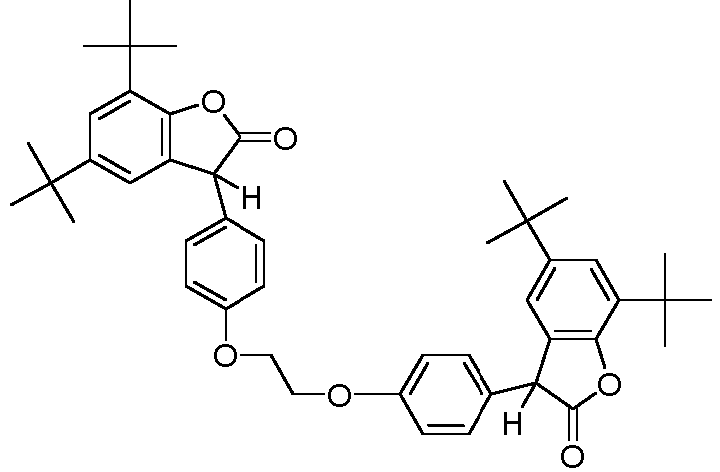
[Table 4] Example 6 Example 7 Comparative example 5 Comparative example 6 Comparative example 7 Resin PEs-1 PEs-1 PEs-1 PEs-1 PEs-1 Antioxidant Phosphite-based [ppm] PEP-36 5,000 5,000 5,000 5,000 0 Phenolic [ppm] Irganox 1330 0 3,000 0 3,000 0 Compounding agent [ppm] Compounding agent 1 (A), dimer 500 500 0 0 0 Compounding agent 2 (B), monomer 0 0 500 500 0 Physical property YI 11.5 16.0 13.6 16.2 17.8 Amount of volatile component (Peak area value converted per unit weight: Relative value (%) when Comparative Example 5 is set to 100%) Formaldehyde 99 125 100 125 1,509 Acetaldehyde 92 119 100 122 198 Acetone 98 99 100 108 3,1149 2,3-Butanedione 103 194 100 165 1,4511 Acetic acid 83 104 100 106 267 Formic acid 158 169 100 171 1,745 [Table 5] Example 8 Example 9 Comparative example 8 Comparative example 9 Comparative example 10 Resin PEs-2 PEs-2 PEs-2 PEs-2 PEs-2 Antioxidant Phosphite-based [ppm] PEP-36 5,000 5,000 5,000 5,000 0 Phenolic [ppm] Irganox 133U 0 3,000 0 3,000 0 Compounding agent [ppm] Compounding agent 1 (A), dimer 500 500 0 0 0 Compounding agent 2 (B), monomer 0 0 500 500 0 Physical property YI 7.6 7.3 10.2 9.2 16.2 Amount of volatile component (Peak area value converted per unit weight: Relative value (%) when Comparative Example 8 is set to 100%) Formaldehyde 101 110 100 108 9,160 Acetaldehyde 111 105 100 106 515 Acetone 100 95 100 100 17,112 2,3-Butanedione 93 97 100 91 1,387 Acetic acid 99 100 100 101 1,770 Formic acid 87 106 100 116 38,486 - In comparison with the polyester resin compositions according to Comparative examples 5-10, to which monomeric Compounding agent 2 has been added, the effects of reducing YI and reducing volatile components in the pellets after kneading were observed in the polyester resin compositions according to Examples 6-9, to which dimeric Compounding agent 1 has been added.
- Furthermore, the effects of reducing the amount of volatile components in these examples were almost the same as those in the comparative examples, confirming that addition of the compounding agent contributed to the reduction effect.
- Using a twin-screw extruder (manufactured by Shibaura Machine Co. Ltd., model: TEM-18SS), polypropylene (PP manufactured by Japan Polypropylene Corporation, MA3), a nucleating agent (manufactured by Yantai Zhichu New Materials Co., Ltd., 1,3:2,4 bis(3,4-dimethylbenzylidene)-D-sorbitol (abbreviated as DMDBS)), and Compounding agent 1 were dry-blended in the ratio shown in Table 6 below and the mixture was fed from the hopper. A strand was extruded under the following conditions and the strand was pelletized to obtain a thermoplastic resin composition (polypropylene resin composition): a cylinder temperature of 230°C, a screw speed of 300 rpm, and a discharge rate of 6.0 kg/h. The physical property of the obtained resin composition is shown in Table 6.
- The following compound, which corresponded to Compounding agent (A) in the above examples, was used as Compounding agent 1.
-

- A resin composition was obtained in the same manner as in Example 10, except that Compounding agent 1 was replaced with Compounding agent 2 described below. The physical property of the obtained resin composition is shown in Table 6.
- A resin composition was obtained in the same manner as in Example 10, except that Compounding agent 1 was not added. The physical property of the obtained resin composition is shown in Table 6.
- The following compound, which corresponded to Compounding agent (B) in the above examples, was used as Compounding agent 2.
- Compounding agent 2 (B) (monomer): Mixture represented by the following formulae (90:10 mixture of 3,4-dimethyl compound and 2,4-dimethyl compound; commercial product manufactured by Tokyo Chemical Industry Co., Ltd.)

- A resin composition was obtained in the same manner as in Example 10, except that the amount of Compounding agent 1 was changed to 500 ppm. The physical properties of the obtained resin composition are shown in Table 7.
- A resin composition was obtained in the same manner as in Example 11, except that Compounding agent 1 was replaced with Compounding agent 2. The physical properties of the obtained resin composition are shown in Table 7.
- A resin composition was obtained in the same manner as in Example 11, except that Compounding agent 1 was not added. The physical properties of the obtained resin composition are shown in Table 7.
[Table 6] Example 10 Comparative example 11 Comparative example 12 Resin PP PP PP Compounding agent [ppm] Compounding agent 1 (A), dimer 100 0 0 Compounding agent 2 (B), monomer 0 100 0 Nucleating agent [ppm] DMDBS 2,000 2,000 2,000 Physical property YI value 70.8 71.8 73.5 [Table 7] Example 11 Comparative example 13 Comparative example 14 Resin PP PP PP Compounding agent [ppm] Compounding agent 1 (A), dimer 500 0 0 Compounding agent 2 (B), monomer 0 500 0 Nucleating agent [ppm] DMDBS 2,000 2,000 2,000 Physical properties YI value Weatherability test: time 0 hours 70.9 70.9 73.5 Weatherability test: time 400 hours 75.1 75.5 78.1 Weatherability test: time 800 hours 76.1 76.8 79.8 YI increase rate [%] Weatherability test: time 0 hours 0 0 0 Weatherability, test: time 400 hours 5.7 6.5 6.3 Weatherability test: time 800 hours 8.2 8.3 8.6 - Not only in comparison with Comparative example 12 without a compounding agent but also in comparison with the polypropylene resin composition according to Comparative example 11, to which monomeric Compounding agent 2 has been added, the effects of reducing YI was observed in the injection molded article obtained from the polypropylene resin composition according to Example 10, to which dimeric Compounding agent 1 has been added.
- Furthermore, not only in comparison with Comparative example 14 without a compounding agent but also in comparison with the polypropylene resin composition according to Comparative example 13, to which monomeric Compounding agent 2 has been added, the effects of reducing YI was observed even after the weatherability test in the injection molded article obtained from the polypropylene resin composition according to Example 11, to which dimeric Compounding agent 1 has been added.
Claims (25)
- A thermoplastic resin composition comprising a compounding agent represented by General formula (1) below:
 (in General formula (1),R1-R5 each independently represent a hydrogen atom, an optionally substituted alkyl or alkoxy group having a total of 1-20 carbon atoms, or a structural formula of General formula (1-1) below, provided that at least any one of R1-R5 is a structural formula of General formula (1-1) below,R6-R9 each independently represent a hydrogen atom, or an optionally substituted alkyl or alkoxy group having a total of 1-20 carbon atoms, andR10 represents a hydrogen atom or an alkyl group having a total of 1-5 carbon atoms);
 (in General formula (1-1),R11-R18 each independently represent a hydrogen atom, or an optionally substituted alkyl or alkoxy group having a total of 1-20 carbon atoms,L is a moiety represented by General formula (L1) or (L2) below:
 (in Formula (L1),R19a and R19b each independently represent a hydrogen atom, or an alkyl or alkoxy group having a total of 1-20 carbon atoms, andn19 represents an integer from 1 to 12, and when n19 is an integer from 2 to 12, the plurality of R19a may be the same or different substituents and the plurality of R19b may be the same or different substituents,in Formula (L2),R19c, R19d, R19e, and R19f each independently represent a hydrogen atom, or an alkyl or alkoxy group having a total of 1-20 carbon atoms,in Formulae (L1) and (L2),* each represent the position of bonding with the benzene ring containing R1-R5 in Formula (1) above, and** each represent the position of bonding with the benzene ring containing R11-R14 in Formula (1-1) above),R20 represents a hydrogen atom or an optionally substituted alkyl group having a total of 1-5 carbon atoms, and* represents the position of bonding with the benzene ring containing R1-R5 in Formula (1) above.)
 - The thermoplastic resin composition according to claim 1, further comprising an antioxidant.
- The thermoplastic resin composition according to claim 2, wherein the antioxidant is a phenolic antioxidant and/or a phosphite-based antioxidant.
- The thermoplastic resin composition according to either one of claims 2 and 3, wherein the antioxidant is contained in an amount of 1-3,000 ppm by weight based on the total weight of the resin composition.
- The thermoplastic resin composition according to any one of claims 1 to 4, wherein the compounding agent is contained in an amount of 1-2,000 ppm by weight based on the total weight of the resin composition.
- The thermoplastic resin composition according to any one of claims 1 to 5, wherein the value of transmittance (%) at a wavelength of 370-400 nm in accordance with JIS K7105 is higher, by 2.0 (%) or more, than that of a reference resin composition having the same composition but without the compounding agent.
- The thermoplastic resin composition according to any one of claims 1 to 6, wherein the value of transmittance (%) at a wavelength of 370-400 nm in accordance with JIS K7105 is 1.1 times or more higher than that of a reference resin composition having the same composition but without the compounding agent.
- The thermoplastic resin composition according to any one of claims 1 to 7, wherein:the amount of a volatile component produced when heated at 250°C for 5 minutes is less than that of a reference resin composition having the same composition but without the compounding agent; andthe volatile component is any of formaldehyde, acetaldehyde, acetone, 2,3-butanedione, acetic acid, and formic acid.
- The thermoplastic resin composition according to any one of claims 1 to 8, wherein the YI value in accordance with JIS K7105 is 0.20 or more lower than that of a reference resin composition having the same composition but without the compounding agent.
- The thermoplastic resin composition according to any one of claims 1 to 9, wherein, in General formula (1) above,four of R1-R5 are hydrogen atoms, and one is a moiety represented by a structural formula of General formula (1-1) above,two of R6-R9 are hydrogen atoms and two are alkyl groups, andR10 is a hydrogen atom.
- The thermoplastic resin composition according to any one of claims 1 to 10, wherein, in General formulae (1) and (1-1) above, the substituent is any of a halogen, a cyano group, an alkenyl group, an alkynyl group, and an alkoxy group.
- The thermoplastic resin composition according to any one of claims 1 to 11, further comprising a thermoplastic resin, wherein the thermoplastic resin is selected from the group consisting of a polycarbonate resin, a polyester resin, a polyester carbonate resin, a cyclo-olefin-based resin, and an acrylic resin.
- The thermoplastic resin composition according to claim 12, wherein the thermoplastic resin is a polycarbonate resin, a polyester resin, or a polyester carbonate resin, which comprises Structural unit (B) derived from a monomer represented by General formula (2) below and/or Structural unit (C) derived from a monomer represented by General formula (3) below:
 (in General formula (2),Ra and Rb are each independently selected from the group consisting of a hydrogen atom, a halogen atom, an optionally substituted alkyl group with 1-20 carbon atoms, an optionally substituted alkoxyl group with 1-20 carbon atoms, an optionally substituted cycloalkyl group with 5-20 carbon atoms, an optionally substituted cycloalkoxyl group with 5-20 carbon atoms, an optionally substituted aryl group with 6-20 carbon atoms, an optionally substituted heteroaryl group with 6-20 carbon atoms containing one or more heteroatoms selected from O, N, and S, an optionally substituted aryloxy group with 6-20 carbon atoms, and -C≡C-Rh,Rh represents an optionally substituted aryl group with 6-20 carbon atoms or an optionally substituted heteroaryl group with 6-20 carbon atoms containing one or more heteroatoms selected from O, N, and S,X represents a single bond or an optionally substituted fluorene group,A and B each independently represent an optionally substituted alkylene group with 1-5 carbon atoms,m and n each independently represent an integer from 0 to 6, anda and b each independently represent an integer from 0 to 10);
 (in General formula (3),Rc and Rd are each independently selected from the group consisting of a hydrogen atom, a halogen atom, an optionally substituted alkyl group with 1-20 carbon atoms, an optionally substituted alkoxyl group with 1-20 carbon atoms, an optionally substituted cycloalkyl group with 5-20 carbon atoms, an optionally substituted cycloalkoxyl group with 5-20 carbon atoms, and an optionally substituted aryl group with 6-20 carbon atoms,Y1 is a single bond, an optionally substituted fluorene group, or any of the structural formulae represented by General formulae (4) to (9) below:
 (in General formulae (4)-(9),R21 and R22 each independently represent a hydrogen atom, a halogen atom, an optionally substituted alkyl group with 1-20 carbon atoms, or an optionally substituted aryl group with 6-30 carbon atoms, or R21 and R22 are bonded together to form an optionally substituted carbon or heterocyclic ring having 1-20 carbon atoms, andr and s each independently represent an integer from 0 to 5,000,A and B each independently represent an optionally substituted alkylene group with 1-5 carbon atoms,p and q each independently represent an integer from 0 to 4, anda and b each independently represent an integer from 0 to 10.)
 - The thermoplastic resin composition according to either one of claims 12 and 13, wherein the weight-average molecular weight (Mw) of the thermoplastic resin in terms of polystyrene equivalent is 10,000-300,000.
- The thermoplastic resin composition according to either one of claims 13 and 14, wherein, in General formulae (2) and (3), A and B each independently represent an alkylene group with 2 or 3 carbon atoms.
- The thermoplastic resin composition according to any one of claims 12 to 15, wherein the thermoplastic resin contains at least a structural unit derived from any one of BPEF, BNE, BNEF, and DPBHBNA.
- The thermoplastic resin composition according to any one of claims 1 to 16, further comprising a catalyst deactivator.
- The thermoplastic resin composition according to claim 17, wherein the catalyst deactivator comprises dodecylbenzene sulfonate.
- The thermoplastic resin composition according to any one of claims 1 to 18, further comprising a mold release agent.
- The thermoplastic resin composition according to claim 19, wherein the mold release agent is contained in an amount of 1-5,000 ppm by weight based on the total weight of the resin composition.
- A thermoplastic resin composition comprising a compounding agent represented by General formula (1) below to improve the value of transmittance (%) at a wavelength of 370 nm-400 nm:
 (in General formula (1),R1-R5 each independently represent a hydrogen atom, an optionally substituted alkyl or alkoxy group having a total of 1-20 carbon atoms, or a structural formula of General formula (1-1) below, provided that at least any one of R1-R5 is a structural formula of General formula (1-1) below,R6-R9 each independently represent a hydrogen atom, or an optionally substituted alkyl or alkoxy group having a total of 1-20 carbon atoms, andR10 represents a hydrogen atom or an alkyl group having a total of 1-5 carbon
 (in General formula (1-1),R11-R18 each independently represent a hydrogen atom, an optionally substituted alkyl or alkoxy group having a total of 1-20 carbon atoms,L is a moiety represented by General formula (L1) or (L2) below:
 (in Formula (L1),R19a and R19b each independently represent a hydrogen atom, or an alkyl or alkoxy group having a total of 1-20 carbon atoms, andn19 represents an integer from 1 to 12, and when n19 is an integer from 2 to 12, the plurality of R19a may be the same or different substituents and the plurality of R19b may be the same or different substituents,in Formula (L2),R19c, R19d, R19e, and R19f each independently represent a hydrogen atom, or an alkyl or alkoxy group having a total of 1-20 carbon atoms,in Formulae (L1) and (L2),* each represent the position of bonding with the benzene ring containing R1-R5 in Formula (1) above, and** each represent the position of bonding with the benzene ring containing R11-R14 in Formula (1-1) above),R20 represents a hydrogen atom or an optionally substituted alkyl group having a total of 1-5 carbon atoms, and* represents the position of bonding with the benzene ring containing R1-R5 in Formula (1) above.)
 - A molded article comprising the thermoplastic resin composition according to any one of claims 1 to 21.
- A method for producing a thermoplastic resin composition, the method comprising a step of adding a compounding agent represented by General formula (1) below to a thermoplastic resin:
 (in General formula (1),R1-R5 each independently represent a hydrogen atom, an optionally substituted alkyl or alkoxy group having a total of 1-20 carbon atoms, or a structural formula of General formula (1-1) below, provided that at least any one of R1-R5 is a structural formula of General formula (1-1) below,R6-R9 each independently represent a hydrogen atom, or an optionally substituted alkyl or alkoxy group having a total of 1-20 carbon atoms, andR10 represents a hydrogen atom or an alkyl group having a total of 1-5 carbon atoms);
 (in General formula (1-1),R11-R18 each independently represent a hydrogen atom, or an optionally substituted alkyl or alkoxy group having a total of 1-20 carbon atoms,L is a moiety represented by General formula (L1) or (L2) below:
 (in Formula (L1),R19a and R19b each independently represent a hydrogen atom, or an alkyl or alkoxy group having a total of 1-20 carbon atoms, andn19 represents an integer from 1 to 12, and when n19 is an integer from 2 to 12, the plurality of R19a may be the same or different substituents and the plurality of R19b may be the same or different substituents,in Formula (L2),R19c, R19d, R19e, and R19f each independently represent a hydrogen atom, or an alkyl or alkoxy group having a total of 1-20 carbon atoms,in Formulae (L1) and (L2),* each represent the position of bonding with the benzene ring containing R1-R5 in Formula (1) above, and** each represent the position of bonding with the benzene ring containing R11-R14 in Formula (1-1) above),R20 represents a hydrogen atom or an optionally substituted alkyl group having a total of 1-5 carbon atoms, and* represents the position of bonding with the benzene ring containing R1-R5 in Formula (1) above.)
 - A method for improving transmittance of a thermoplastic resin composition, the method comprising a step of adding a compounding agent represented by General formula (1) below to a thermoplastic resin:
 (in General formula (1),R1-R5 each independently represent a hydrogen atom, an optionally substituted alkyl or alkoxy group having a total of 1-20 carbon atoms, or a structural formula of General formula (1-1) below, provided that at least any one of R1-R5 is a structural formula of General formula (1-1) below,R6-R9 each independently represent a hydrogen atom, or an optionally substituted alkyl or alkoxy group having a total of 1-20 carbon atoms, andR10 represents a hydrogen atom or an alkyl group having a total of 1-5 carbon atoms);
 (in General formula (1-1),R11-R18 each independently represent a hydrogen atom, or an optionally substituted alkyl or alkoxy group having a total of 1-20 carbon atoms,L is a moiety represented by General formula (L1) or (L2) below:
 (in Formula (L1),R19a and R19b each independently represent a hydrogen atom, or an alkyl or alkoxy group having a total of 1-20 carbon atoms, andn19 represents an integer from 1 to 12, and when n19 is an integer from 2 to 12, the plurality of R19a may be the same or different substituents and the plurality of R19b may be the same or different substituents,in Formula (L2),R19c, R19d, R19e, and R19f each independently represent a hydrogen atom, or an alkyl or alkoxy group having a total of 1-20 carbon atoms,in Formulae (L1) and (L2),* each represent the position of bonding with the benzene ring containing R1-R5 in Formula (1) above, and** each represent the position of bonding with the benzene ring containing R11-R14 in Formula (1-1) above),R20 represents a hydrogen atom or an optionally substituted alkyl group having a total of 1-5 carbon atoms, and* represents the position of bonding with the benzene ring containing R1-R5 in Formula (1) above.)
 - A method for improving hue of a thermoplastic resin composition, the method comprising a step of adding a compounding agent represented by General formula (1) below to a thermoplastic resin:
 (in General formula (1),R1-R5 each independently represent a hydrogen atom, an optionally substituted alkyl or alkoxy group having a total of 1-20 carbon atoms, or a structural formula of General formula (1-1) below, provided that at least any one of R1-R5 is a structural formula of General formula (1-1) below,R6-R9 each independently represent a hydrogen atom, or an optionally substituted alkyl or alkoxy group having a total of 1-20 carbon atoms, andR10 represents a hydrogen atom or an alkyl group having a total of 1-5 carbon atoms);
 (in General formula (1-1),R11-R18 each independently represent a hydrogen atom, or an optionally substituted alkyl or alkoxy group having a total of 1-20 carbon atoms,L is a moiety represented by General formula (L1) or (L2) below:
 (in Formula (L1),R19a and R19b each independently represent a hydrogen atom, or an alkyl or alkoxy group having a total of 1-20 carbon atoms, andn19 represents an integer from 1 to 12, and when n19 is an integer from 2 to 12, the plurality of R19a may be the same or different substituents and the plurality of R19b may be the same or different substituents,in Formula (L2),R19c, R19d, R19e, and R19f each independently represent a hydrogen atom, or an alkyl or alkoxy group having a total of 1-20 carbon atoms,in Formulae (L1) and (L2),* each represent the position of bonding with the benzene ring containing R1-R5 in Formula (1) above, and** each represent the position of bonding with the benzene ring containing R11-R14 in Formula (1-1) above),R20 represents a hydrogen atom or an optionally substituted alkyl group having a total of 1-5 carbon atoms, and* represents the position of bonding with the benzene ring containing R1-R5 in Formula (1) above.)
Applications Claiming Priority (2)
| Application Number | Priority Date | Filing Date | Title |
|---|---|---|---|
| JP2021173347 | 2021-10-22 | ||
| PCT/JP2022/038889 WO2023068290A1 (en) | 2021-10-22 | 2022-10-19 | Thermoplastic resin composition, molded article, and method for producing and method for improving transmittance of thermoplastic resin composition |
Publications (2)
| Publication Number | Publication Date |
|---|---|
| EP4421130A1 true EP4421130A1 (en) | 2024-08-28 |
| EP4421130A4 EP4421130A4 (en) | 2025-03-12 |
Family
ID=86059151
Family Applications (1)
| Application Number | Title | Priority Date | Filing Date |
|---|---|---|---|
| EP22883594.8A Pending EP4421130A4 (en) | 2021-10-22 | 2022-10-19 | THERMOPLASTIC RESIN COMPOSITION, MOLDED ARTICLE, AND PRODUCTION METHOD AND METHOD FOR IMPROVING TRANSMITTANCE OF THERMOPLASTIC RESIN COMPOSITION |
Country Status (7)
| Country | Link |
|---|---|
| US (1) | US20250145796A1 (en) |
| EP (1) | EP4421130A4 (en) |
| JP (1) | JPWO2023068290A1 (en) |
| KR (1) | KR20240088675A (en) |
| CN (1) | CN117916325A (en) |
| TW (1) | TW202328345A (en) |
| WO (1) | WO2023068290A1 (en) |
Families Citing this family (1)
| Publication number | Priority date | Publication date | Assignee | Title |
|---|---|---|---|---|
| JP7731760B2 (en) * | 2021-10-22 | 2025-09-01 | 三菱瓦斯化学株式会社 | Resin sheet |
Family Cites Families (10)
| Publication number | Priority date | Publication date | Assignee | Title |
|---|---|---|---|---|
| BE881496A (en) * | 1979-02-05 | 1980-08-01 | Sandoz Sa | PROCESS FOR STABILIZING ORGANIC POLYMERIC MATERIALS |
| GB2044272B (en) * | 1979-02-05 | 1983-03-16 | Sandoz Ltd | Stabilising polymers |
| JPS633011A (en) | 1986-06-24 | 1988-01-08 | Hitachi Ltd | Transparent copolymer having low water-absorption |
| JPS63170475A (en) | 1987-01-07 | 1988-07-14 | Nissan Motor Co Ltd | Clear coating composition for topcoating |
| GB2252325A (en) * | 1991-01-31 | 1992-08-05 | Ciba Geigy Ag | Stabilised polyolefin |
| CH686306A5 (en) * | 1993-09-17 | 1996-02-29 | Ciba Geigy Ag | 3-aryl-benzofuranones as stabilizers. |
| TW270133B (en) * | 1993-09-17 | 1996-02-11 | Ciba Geigy | |
| BR9911586A (en) * | 1998-06-25 | 2001-03-20 | Ciba Sc Holding Ag | Process for the preparation of 3-aryl-benzenofuranones |
| TW593303B (en) * | 2001-09-11 | 2004-06-21 | Ciba Sc Holding Ag | Stabilization of synthetic polymers |
| JP4816230B2 (en) * | 2006-05-12 | 2011-11-16 | コニカミノルタオプト株式会社 | Polarizing plate protective film, manufacturing method of polarizing plate protective film, polarizing plate and liquid crystal display device |
-
2022
- 2022-10-19 WO PCT/JP2022/038889 patent/WO2023068290A1/en not_active Ceased
- 2022-10-19 TW TW111139616A patent/TW202328345A/en unknown
- 2022-10-19 CN CN202280060957.8A patent/CN117916325A/en active Pending
- 2022-10-19 EP EP22883594.8A patent/EP4421130A4/en active Pending
- 2022-10-19 US US18/702,031 patent/US20250145796A1/en active Pending
- 2022-10-19 JP JP2023554719A patent/JPWO2023068290A1/ja active Pending
- 2022-10-19 KR KR1020247004454A patent/KR20240088675A/en active Pending
Also Published As
| Publication number | Publication date |
|---|---|
| CN117916325A (en) | 2024-04-19 |
| TW202328345A (en) | 2023-07-16 |
| JPWO2023068290A1 (en) | 2023-04-27 |
| US20250145796A1 (en) | 2025-05-08 |
| WO2023068290A1 (en) | 2023-04-27 |
| KR20240088675A (en) | 2024-06-20 |
| EP4421130A4 (en) | 2025-03-12 |
Similar Documents
| Publication | Publication Date | Title |
|---|---|---|
| JP7255485B2 (en) | POLYCARBONATE RESIN, MANUFACTURING METHOD THEREOF, AND OPTICAL LENS | |
| JP7238952B2 (en) | Method for producing thermoplastic resin | |
| JP2025148475A (en) | Thermoplastic resin composition for optical materials, molded body, compounding agent, method for producing thermoplastic resin composition, and method for improving transmittance | |
| JPWO2018181157A1 (en) | Polycarbonate resin composition and optical lens using the same | |
| US20070106053A1 (en) | Polyester, moldings thereof, and process for production of the polyester | |
| TWI924887B (en) | Thermoplastic resin and optical lens containing the resin | |
| US20250145796A1 (en) | Thermoplastic resin composition, molded article, and method for producing and method for improving transmittance of thermoplastic resin composition | |
| EP4431542A1 (en) | Polyester carbonate resin, and optical lens and optical film which use same | |
| CN112867762B (en) | Thermoplastic resin composition and optical lens or film using the same | |
| WO2023085339A1 (en) | Thermoplastic resin and optical lens including same | |
| EP4640740A1 (en) | Thermoplastic resin and optical lens including same | |
| WO2025234377A1 (en) | Thermoplastic resin, resin composition containing same, and molded body | |
| KR20220161254A (en) | Resin composition and optical lens and optical film containing the same | |
| EP4711398A1 (en) | Thermoplastic resin and optical lens including same | |
| WO2023100778A1 (en) | Optical lens that contains thermoplastic resin | |
| KR20250133652A (en) | resin composition |
Legal Events
| Date | Code | Title | Description |
|---|---|---|---|
| STAA | Information on the status of an ep patent application or granted ep patent |
Free format text: STATUS: THE INTERNATIONAL PUBLICATION HAS BEEN MADE |
|
| PUAI | Public reference made under article 153(3) epc to a published international application that has entered the european phase |
Free format text: ORIGINAL CODE: 0009012 |
|
| STAA | Information on the status of an ep patent application or granted ep patent |
Free format text: STATUS: REQUEST FOR EXAMINATION WAS MADE |
|
| 17P | Request for examination filed |
Effective date: 20240513 |
|
| AK | Designated contracting states |
Kind code of ref document: A1 Designated state(s): AL AT BE BG CH CY CZ DE DK EE ES FI FR GB GR HR HU IE IS IT LI LT LU LV MC ME MK MT NL NO PL PT RO RS SE SI SK SM TR |
|
| DAV | Request for validation of the european patent (deleted) | ||
| DAX | Request for extension of the european patent (deleted) | ||
| REG | Reference to a national code |
Ref country code: DE Ref legal event code: R079 Free format text: PREVIOUS MAIN CLASS: C08L0101000000 Ipc: C08K0005000000 |
|
| A4 | Supplementary search report drawn up and despatched |
Effective date: 20250207 |
|
| RIC1 | Information provided on ipc code assigned before grant |
Ipc: C08G 64/30 20060101ALI20250203BHEP Ipc: C08G 64/06 20060101ALI20250203BHEP Ipc: C08G 63/199 20060101ALI20250203BHEP Ipc: C08G 63/189 20060101ALI20250203BHEP Ipc: C08G 63/183 20060101ALI20250203BHEP Ipc: C08L 101/00 20060101ALI20250203BHEP Ipc: C08L 69/00 20060101ALI20250203BHEP Ipc: C08L 67/00 20060101ALI20250203BHEP Ipc: C08L 45/00 20060101ALI20250203BHEP Ipc: C08L 33/06 20060101ALI20250203BHEP Ipc: C08K 5/51 20060101ALI20250203BHEP Ipc: C08K 5/1535 20060101ALI20250203BHEP Ipc: C08K 5/13 20060101ALI20250203BHEP Ipc: C08K 5/00 20060101AFI20250203BHEP |