EP4421081A1 - Isolated 7dsh analogues, synthesis and uses thereof - Google Patents
Isolated 7dsh analogues, synthesis and uses thereof Download PDFInfo
- Publication number
- EP4421081A1 EP4421081A1 EP23305231.5A EP23305231A EP4421081A1 EP 4421081 A1 EP4421081 A1 EP 4421081A1 EP 23305231 A EP23305231 A EP 23305231A EP 4421081 A1 EP4421081 A1 EP 4421081A1
- Authority
- EP
- European Patent Office
- Prior art keywords
- group
- compound
- groups
- benzyl
- alkyl
- Prior art date
- Legal status (The legal status is an assumption and is not a legal conclusion. Google has not performed a legal analysis and makes no representation as to the accuracy of the status listed.)
- Withdrawn
Links
Classifications
-
- C—CHEMISTRY; METALLURGY
- C07—ORGANIC CHEMISTRY
- C07H—SUGARS; DERIVATIVES THEREOF; NUCLEOSIDES; NUCLEOTIDES; NUCLEIC ACIDS
- C07H7/00—Compounds containing non-saccharide radicals linked to saccharide radicals by a carbon-to-carbon bond
-
- A—HUMAN NECESSITIES
- A01—AGRICULTURE; FORESTRY; ANIMAL HUSBANDRY; HUNTING; TRAPPING; FISHING
- A01N—PRESERVATION OF BODIES OF HUMANS OR ANIMALS OR PLANTS OR PARTS THEREOF; BIOCIDES, e.g. AS DISINFECTANTS, AS PESTICIDES OR AS HERBICIDES; PEST REPELLANTS OR ATTRACTANTS; PLANT GROWTH REGULATORS
- A01N43/00—Biocides, pest repellants or attractants, or plant growth regulators containing heterocyclic compounds
- A01N43/02—Biocides, pest repellants or attractants, or plant growth regulators containing heterocyclic compounds having rings with one or more oxygen or sulfur atoms as the only ring hetero atoms
- A01N43/04—Biocides, pest repellants or attractants, or plant growth regulators containing heterocyclic compounds having rings with one or more oxygen or sulfur atoms as the only ring hetero atoms with one hetero atom
- A01N43/06—Biocides, pest repellants or attractants, or plant growth regulators containing heterocyclic compounds having rings with one or more oxygen or sulfur atoms as the only ring hetero atoms with one hetero atom five-membered rings
- A01N43/08—Biocides, pest repellants or attractants, or plant growth regulators containing heterocyclic compounds having rings with one or more oxygen or sulfur atoms as the only ring hetero atoms with one hetero atom five-membered rings with oxygen as the ring hetero atom
-
- A—HUMAN NECESSITIES
- A01—AGRICULTURE; FORESTRY; ANIMAL HUSBANDRY; HUNTING; TRAPPING; FISHING
- A01N—PRESERVATION OF BODIES OF HUMANS OR ANIMALS OR PLANTS OR PARTS THEREOF; BIOCIDES, e.g. AS DISINFECTANTS, AS PESTICIDES OR AS HERBICIDES; PEST REPELLANTS OR ATTRACTANTS; PLANT GROWTH REGULATORS
- A01N43/00—Biocides, pest repellants or attractants, or plant growth regulators containing heterocyclic compounds
- A01N43/02—Biocides, pest repellants or attractants, or plant growth regulators containing heterocyclic compounds having rings with one or more oxygen or sulfur atoms as the only ring hetero atoms
- A01N43/04—Biocides, pest repellants or attractants, or plant growth regulators containing heterocyclic compounds having rings with one or more oxygen or sulfur atoms as the only ring hetero atoms with one hetero atom
- A01N43/14—Biocides, pest repellants or attractants, or plant growth regulators containing heterocyclic compounds having rings with one or more oxygen or sulfur atoms as the only ring hetero atoms with one hetero atom six-membered rings
- A01N43/16—Biocides, pest repellants or attractants, or plant growth regulators containing heterocyclic compounds having rings with one or more oxygen or sulfur atoms as the only ring hetero atoms with one hetero atom six-membered rings with oxygen as the ring hetero atom
-
- A—HUMAN NECESSITIES
- A01—AGRICULTURE; FORESTRY; ANIMAL HUSBANDRY; HUNTING; TRAPPING; FISHING
- A01P—BIOCIDAL, PEST REPELLANT, PEST ATTRACTANT OR PLANT GROWTH REGULATORY ACTIVITY OF CHEMICAL COMPOUNDS OR PREPARATIONS
- A01P1/00—Disinfectants; Antimicrobial compounds or mixtures thereof
-
- A—HUMAN NECESSITIES
- A01—AGRICULTURE; FORESTRY; ANIMAL HUSBANDRY; HUNTING; TRAPPING; FISHING
- A01P—BIOCIDAL, PEST REPELLANT, PEST ATTRACTANT OR PLANT GROWTH REGULATORY ACTIVITY OF CHEMICAL COMPOUNDS OR PREPARATIONS
- A01P13/00—Herbicides; Algicides
-
- A—HUMAN NECESSITIES
- A01—AGRICULTURE; FORESTRY; ANIMAL HUSBANDRY; HUNTING; TRAPPING; FISHING
- A01P—BIOCIDAL, PEST REPELLANT, PEST ATTRACTANT OR PLANT GROWTH REGULATORY ACTIVITY OF CHEMICAL COMPOUNDS OR PREPARATIONS
- A01P3/00—Fungicides
-
- C—CHEMISTRY; METALLURGY
- C07—ORGANIC CHEMISTRY
- C07H—SUGARS; DERIVATIVES THEREOF; NUCLEOSIDES; NUCLEOTIDES; NUCLEIC ACIDS
- C07H7/00—Compounds containing non-saccharide radicals linked to saccharide radicals by a carbon-to-carbon bond
- C07H7/02—Acyclic radicals
Definitions
- the present invention belongs to the field of biocidal compounds, and more specifically to the synthesis of biocidal compounds, such as herbicidal compounds.
- the present invention relates to new isolated 7dSh analogues compounds and their use thereof in an herbicidal composition, preferably in method for controlling one or more harmful plants and/or for regulating the growth of one or more plants or for use as an antimicrobial agent.
- the invention also relates to the method of synthesis of the new isolated 7dSh analogues compounds according to the invention.
- Glyphosate (IUPAC name: N-(phosphonomethyl)glycine) is a broad-spectrum systemic herbicide and crop desiccant. It is an organophosphorus compound, specifically a phosphonate, which acts by inhibiting the plant enzyme 5-enolpyruvylshikimate-3-phosphate synthase. It is used to kill weeds, especially annual broadleaf weeds and grasses that compete with crops. It was discovered to be an herbicide in 1970 was brought to market for agricultural use in 1974 under the trade name Roundup.
- Glyphosate was quickly adopted for agricultural weed control. In 2007, glyphosate was the most used herbicide in the United States' agricultural sector and the second-most used in home and garden, government and industry, and commercial applications.
- 7-deoxy-D-altro-2-heptulose or 7dSh is a rare sugar that has recently been reported as a good candidate as a substitute for glyphosate [3] .
- the quantities extracted are low, and the compound, to the knowledge of Applicants, has never been isolated in exploitable amounts: it remains today as a mixture of compounds comprising various sugars. Also, this method can only lead to one diastereomer, where the carbon in position 6 has a S conformation):
- Compound 7dSh was found to have very interesting herbicidal properties and antimicrobial activity.
- biocidal As used herein the terme “biocidal” is defined according to the definition provided by the Directive 98/8/EC of the European Union dated 16 February 1998. Among the biocidal compounds it can be referred to "bactericidal”, “virusidal”, “pesticidal” such as “insecticidal”, “fungicidal” or “herbicidal” compounds.
- isolated when applied to the compounds of the present invention, refers to such compounds that are (i) not in a cell or organism and the compounds are separated from at least some components with which they are associated in nature or when they are made, notably by biotechnological (e.g., bacterial or biocatalysis) means and/or (ii) produced, prepared or manufactured by the hand of man.
- an "isolated” compound refers to a compound isolated from a crude (chemical or biotechnological) reaction mixture following an affirmative act of isolation. The act of isolation involves separating the compound from the other known components of the crude reaction mixture, with some impurities, unknown side products and residual amounts of the other known components of the crude reaction mixture permitted to remain. Purification is an example of an affirmative act of isolation.
- antimicrobial activity refers to the ability of a compound to modify a function or metabolic process of a target microorganism, and relates more particularly to inhibition of growth of a microorganism.
- antimicrobial activity relates to the ability of the compound to kill at least one bacterial species.
- the term can be manifested as microbiocidal or microbiostatic inhibition of microbial growth.
- antimicrobial activity refers to "antibacterial activity” and/or "antifungal activity”.
- microorganism herein refers broadly to bacteria, fungi, viruses, and protozoa.
- the aim of the present invention is to provide a synthetic process for the preparation of 7dSh compound and its analogues that may solve all the problems listed above.
- the present invention thus deals with the 7dSh compound and its analogues in isolated form, their synthetic methods or process for their preparation and their applications, such as use in herbicidal composition or as an antimicrobial agent.
- the isolated compounds according to the invention present the advantage to be easily synthesised, in mild conditions and in yields that allow industrial production and application.
- the invention therefore relates to the synthesis of an isolated compound having the structure (V): and advantageaously the present invention relates to a process for the preparation of a biocidal compound comprising the steps of:
- R 2 is a benzyl protective group.
- the process according to the present invention comprises a supplementary! step e) performed before step c) and being according to the following: e) protecting the primary ICE group of intermediate (III) under suitable conditions to form intermediate (VI) : wherein R 4 represents a suitable primary alcohol protective group, such as a benzyl protective group, step c) consisting in deprotecting R 4 together with R 2 protecting group.
- R 4 represents a suitable primary alcohol protective group, such as a benzyl protective group
- step c) consisting in deprotecting R 4 together with R 2 protecting group.
- the compounds (I) is prepared preferably according to the following scheme comprising the steps of:
- R 2 and R 4 are benzyl protecting groups and step c) consisting of deprotecting the benzyl protective group to provide free -OH groups to form intermediate IV.
- R 1 represents one of the following groups selected among:
- step a) is a mild oxidation step, preferably a Dess Martin oxidation step, which is carried out by reacting intermediate (I) with Dess Martin periodinane.
- R 3 represents methyl, ethyl, isopropyl, n-butyl, isobutyl, cyclopentyl, cyclohexyl, allyl or-CH 2 -Ph; preferably methyl.
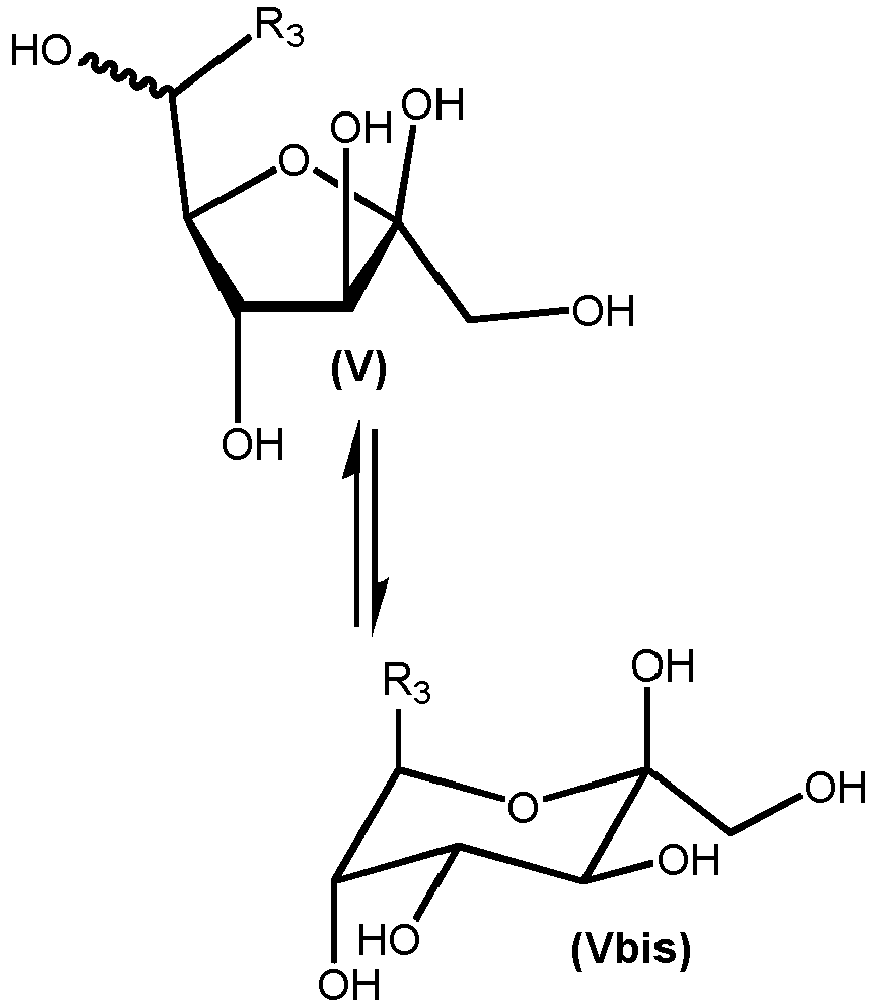
- the invention also relate to a Isolated compound obtained by the process described within the context of the present invention, and having one of the following formula (V) and (Vbis) : wherein R represents one chemical group selected among an ethyl, a n-propyl, an isopropyl, a n-butyl, an isobutyl, a cyclopentyl, a cyclohexyl, an allyl or-CH 2 -Ph.
- the invention relates to a biocidal composition, comprising an isolated compound according to the invention and/or salts thereof, and an agriculturally acceptable formulation auxiliary customary in crop protection.
- the agriculturally acceptable formulation auxiliary customary in crop protection may be chosen from surfactants, preservatives, salts, pH adjustment agents, biostimulants, bioprotectors.
- the biocidal composition according to the invention may further comprise one or more further agrochemically active substances, optionally selected from the group consisting of biocides, and being advantageously selected among insecticides, acaricides, nematicides, herbicides, fungicides, safeners, fertilizers and/or further growth regulators.
- biocides optionally selected from the group consisting of biocides, and being advantageously selected among insecticides, acaricides, nematicides, herbicides, fungicides, safeners, fertilizers and/or further growth regulators.
- the invention also relates to a method for controlling one or more harmful plants and/or for regulating the growth of one or more plants, comprising applying at least one of biocidally effective amount of the isolated compound according to the invention, and/or salts thereof, or the biocidal composition according to the invention to the plants, seeds of plants, soil in which or on which plants grow and/or an area under cultivation.
- the plant may be Arabidopsis, vine, tomato plant, rapeseed.
- the invention further relates to use of the compound according to the invention, and/or salts thereof, or the biocidal composition according to the invention as an antimicrobial agent, preferably as an antibacterial or antifungal agent.
- NMR spectra were recorded on a Bruker Avance III 400 spectrometer operating at 400.13 MHz for 1H, equipped with a BBFO probe with a Z-gradient coil and a GREAT 1/10 gradient unit or on a Bruker Avance III operating at 500.13 MHz for 1H equipped with 1H and 13C cryo-probe. All experiments were carried out at 25 °C, and references for chemical shifts are external. Coupling constants J were calculated in hertz (Hz).
- Proton and carbon NMR peaks were unambiguously assigned by COSY (double quantum filtered with gradient pulse for selection), HSQC (gradient echo-anti echo selection and shape pulse), and HMBC (echo-anti echo gradient selection, magnitude mode) correlation experiments as well as TOCSY.
- Multiplicity are annotated as s (singlet), d (doublet), t (triplet), m (multiplet), or o (overlapping signals).
- Steps 1-4 have already been performed in the literature, the aim of the present invention is to provide new synthetic route from step 5 to step 8; in one particular variant the synthetic pathway involve the alternative :
- the mild oxidation can be performed according to the Dess Martin oxidation, or according to the Swern oxidation: To a solution of DMSO (4.5 eq.) in dry dichloromethane (6 mL) was added chloride oxalyl (2.2 eq.) at -65 °C. The mixture was stirred for 40 min. The 3,4-di- O -benzyl-1,2- O -isopropylidene- ⁇ - D -fructofuranose (1 eq.) diluted into CH 2 Cl 2 (4 mL) was added to the mixture and the reaction was stirred for 1 h, allowed to reach room temperature. Triethylamine (0.5 mL) was added to buffer the reaction at basic pH.
- Benzylation step was performed as described for step 3 starting from 3,4-di-O-benzyl-1,2-O-isopropylidene-heptofuranose (4.15 g, 0.01 mol), benzyl bromide (2 mL, 0.017 mol), a 60% powder of NaH (860 mg, 0.014 mmol), in DMF (28 mL). After purification by flash chromatography eluting with (AcOEt/Cyclohexane, 50:50), the desired product was isolated in 45% yield (1.98 g).
- Steps 8' and 9' where performed according to protocols described above in point (7) and (8) to yield expected 7-deoxy-heptose in 100% yield (last step), while the step 8' provided 7-deoxy- 1,2 -O-isopropylidene-heptofuranose in 78% yield.
Landscapes
- Life Sciences & Earth Sciences (AREA)
- Chemical & Material Sciences (AREA)
- Engineering & Computer Science (AREA)
- Environmental Sciences (AREA)
- Wood Science & Technology (AREA)
- Plant Pathology (AREA)
- Pest Control & Pesticides (AREA)
- Zoology (AREA)
- Organic Chemistry (AREA)
- Health & Medical Sciences (AREA)
- General Health & Medical Sciences (AREA)
- General Chemical & Material Sciences (AREA)
- Chemical Kinetics & Catalysis (AREA)
- Biochemistry (AREA)
- Genetics & Genomics (AREA)
- Molecular Biology (AREA)
- Biotechnology (AREA)
- Agronomy & Crop Science (AREA)
- Dentistry (AREA)
- Microbiology (AREA)
- Mycology (AREA)
- Organic Low-Molecular-Weight Compounds And Preparation Thereof (AREA)
Abstract

Description
- The present invention belongs to the field of biocidal compounds, and more specifically to the synthesis of biocidal compounds, such as herbicidal compounds.
- More particularly, the present invention relates to new isolated 7dSh analogues compounds and their use thereof in an herbicidal composition, preferably in method for controlling one or more harmful plants and/or for regulating the growth of one or more plants or for use as an antimicrobial agent. The invention also relates to the method of synthesis of the new isolated 7dSh analogues compounds according to the invention.
- In the description below, references between [] refer to the list of references at the end of the examples.
- Glyphosate (IUPAC name: N-(phosphonomethyl)glycine) is a broad-spectrum systemic herbicide and crop desiccant. It is an organophosphorus compound, specifically a phosphonate, which acts by inhibiting the plant enzyme 5-enolpyruvylshikimate-3-phosphate synthase. It is used to kill weeds, especially annual broadleaf weeds and grasses that compete with crops. It was discovered to be an herbicide in 1970 was brought to market for agricultural use in 1974 under the trade name Roundup.
- Glyphosate was quickly adopted for agricultural weed control. In 2007, glyphosate was the most used herbicide in the United States' agricultural sector and the second-most used in home and garden, government and industry, and commercial applications.
- While glyphosate and formulations such as Roundup have been approved by regulatory bodies worldwide, concerns about their effects on humans and the environment persist and have grown as the global usage of glyphosate increases. A number of regulatory and scholarly reviews have evaluated the relative toxicity of glyphosate formulations as an herbicide composition [1-2].
- There is therefore a need to find alternative compound to the controversial glyphosate.
- 7-deoxy-D-altro-2-heptulose or 7dSh is a rare sugar that has recently been reported as a good candidate as a substitute for glyphosate [3]. Whether it was produced biotechnologically from Synechococcus elongatus or biocatalytically using S. elongatus transketolase, the quantities extracted are low, and the compound, to the knowledge of Applicants, has never been isolated in exploitable amounts: it remains today as a mixture of compounds comprising various sugars. Also, this method can only lead to one diastereomer, where the carbon in position 6 has a S conformation):

- Compound 7dSh was found to have very interesting herbicidal properties and antimicrobial activity.
- To date, except for the biocatalytic pathway mentioned above, no synthetic pathway has been identified at the present time for the 7dSh compound or its analogues.
- There is therefore a need to develop a process to obtain this compound and its analogues in an isolated form, and in large quantities that allow industrial production and application.
- As used herein the terme "biocidal" is defined according to the definition provided by the Directive 98/8/EC of the European Union dated 16 February 1998. Among the biocidal compounds it can be referred to "bactericidal", "virusidal", "pesticidal" such as "insecticidal", "fungicidal" or "herbicidal" compounds.
- As used herein, the term "isolated", when applied to the compounds of the present invention, refers to such compounds that are (i) not in a cell or organism and the compounds are separated from at least some components with which they are associated in nature or when they are made, notably by biotechnological (e.g., bacterial or biocatalysis) means and/or (ii) produced, prepared or manufactured by the hand of man. For example, an "isolated" compound refers to a compound isolated from a crude (chemical or biotechnological) reaction mixture following an affirmative act of isolation. The act of isolation involves separating the compound from the other known components of the crude reaction mixture, with some impurities, unknown side products and residual amounts of the other known components of the crude reaction mixture permitted to remain. Purification is an example of an affirmative act of isolation.
- As used herein, it is meant by "antimicrobial activity" refers to the ability of a compound to modify a function or metabolic process of a target microorganism, and relates more particularly to inhibition of growth of a microorganism. In aspects of the claimed compound or composition, antimicrobial activity relates to the ability of the compound to kill at least one bacterial species. The term can be manifested as microbiocidal or microbiostatic inhibition of microbial growth. Preferably, as used herein, antimicrobial activity refers to "antibacterial activity" and/or "antifungal activity".
- The term "microorganism" herein refers broadly to bacteria, fungi, viruses, and protozoa.
- The aim of the present invention is to provide a synthetic process for the preparation of 7dSh compound and its analogues that may solve all the problems listed above.
- The present invention thus deals with the 7dSh compound and its analogues in isolated form, their synthetic methods or process for their preparation and their applications, such as use in herbicidal composition or as an antimicrobial agent. The isolated compounds according to the invention present the advantage to be easily synthesised, in mild conditions and in yields that allow industrial production and application.
- The invention therefore relates to the synthesis of an isolated compound having the structure (V):

- a) oxidizing primary alcohol group of intermediate (I) wherein R2 represents a suitable secondary alcohol protective group, such as a benzyl protective group to form intermediate (II) according to the following scheme :

- b) alkylating the aldehyde moiety of intermediate (II) under suitable conditions to form intermediate (III) :

- c) removing the R2 protective groups to yield a compound having the structure (IV):

- d) removing the R1 protective groups to yield a compound having the structure (V):

- Advantageously, R2 is a benzyl protective group.
- Advantageously, the process according to the present invention comprises a supplementary! step e) performed before step c) and being according to the following:
e) protecting the primary alcool group of intermediate (III) under suitable conditions to form intermediate (VI) :
- The compounds (I) is prepared preferably according to the following scheme comprising the steps of:
- A1) acetalisation of D-fructose to form an intermediate having the structure :

- A2) protecting the primary OH moiety of intermediate (1) under suitable conditions to form intermediate (2) :

- A3) protecting the secondary OH moieties of intermediate (2) under suitable conditions to form intermediate (3) :

- A4) selectively deprotecting the -OR5 moiety of intermediate (3) under suitable conditions to form intermediate (I) :

- Advantageously, in the process according to the present invention R2 and R4 are benzyl protecting groups and step c) consisting of deprotecting the benzyl protective group to provide free -OH groups to form intermediate IV.
- Advantageously, in the process according to the present invention R1 represents one of the following groups selected among:

- Advantageously, in the process according to the present invention step a) is a mild oxidation step, preferably a Dess Martin oxidation step, which is carried out by reacting intermediate (I) with Dess Martin periodinane.
- Advantageously, in the process according to the present invention step b) is carried out by reacting intermediate (II) with R3Li or (R3)2ZnTi(OiPr)4 ; wherein R3 represents a cyclic or acyclic, substituted or unsubstituted, linear or branched C1-12alkyl, C1-12alkoxyl, C1-10alkyl-CH=CH2 or -CH2-Ph group.
- Advantageously, in the process according to the present invention R3 represents methyl, ethyl, isopropyl, n-butyl, isobutyl, cyclopentyl, cyclohexyl, allyl or-CH2-Ph; preferably methyl.
- The invention also relate to a Isolated compound obtained by the process described within the context of the present invention, and having one of the following formula (V) and (Vbis) :


- According to an another aspect, the invention relates to a biocidal composition, comprising an isolated compound according to the invention and/or salts thereof, and an agriculturally acceptable formulation auxiliary customary in crop protection.
- Advantageously, the agriculturally acceptable formulation auxiliary customary in crop protection may be chosen from surfactants, preservatives, salts, pH adjustment agents, biostimulants, bioprotectors.
- Advantageously, the biocidal composition according to the invention, may further comprise one or more further agrochemically active substances, optionally selected from the group consisting of biocides, and being advantageously selected among insecticides, acaricides, nematicides, herbicides, fungicides, safeners, fertilizers and/or further growth regulators.
- The invention also relates to a method for controlling one or more harmful plants and/or for regulating the growth of one or more plants, comprising applying at least one of biocidally effective amount of the isolated compound according to the invention, and/or salts thereof, or the biocidal composition according to the invention to the plants, seeds of plants, soil in which or on which plants grow and/or an area under cultivation. For example, the plant may be Arabidopsis, vine, tomato plant, rapeseed.
- The invention further relates to use of the compound according to the invention, and/or salts thereof, or the biocidal composition according to the invention as an antimicrobial agent, preferably as an antibacterial or antifungal agent.
- NMR spectra were recorded on a Bruker Avance III 400 spectrometer operating at 400.13 MHz for 1H, equipped with a BBFO probe with a Z-gradient coil and a GREAT 1/10 gradient unit or on a Bruker Avance III operating at 500.13 MHz for 1H equipped with 1H and 13C cryo-probe. All experiments were carried out at 25 °C, and references for chemical shifts are external. Coupling constants J were calculated in hertz (Hz). Proton and carbon NMR peaks were unambiguously assigned by COSY (double quantum filtered with gradient pulse for selection), HSQC (gradient echo-anti echo selection and shape pulse), and HMBC (echo-anti echo gradient selection, magnitude mode) correlation experiments as well as TOCSY. Multiplicity are annotated as s (singlet), d (doublet), t (triplet), m (multiplet), or o (overlapping signals).
-

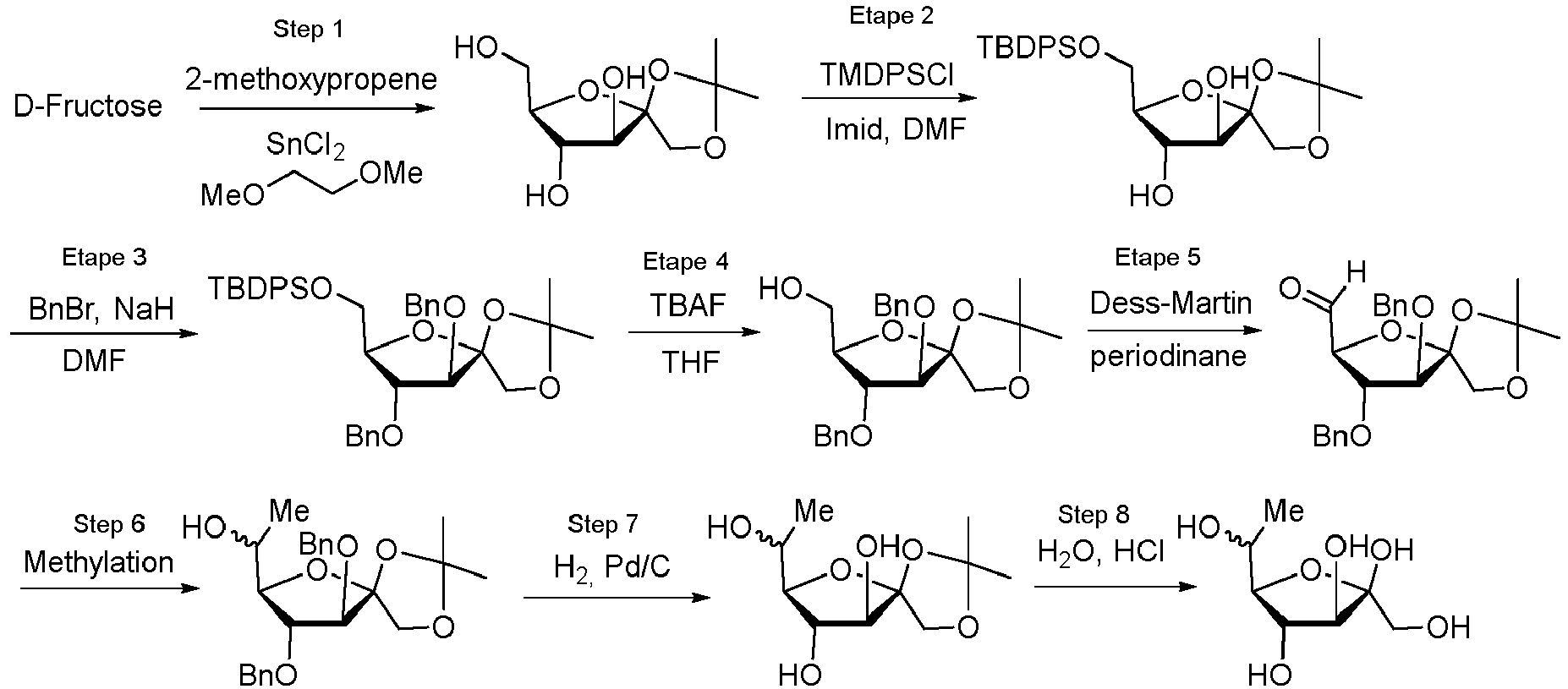
- Steps 1-4 have already been performed in the literature, the aim of the present invention is to provide new synthetic route from step 5 to step 8; in one particular variant the synthetic pathway involve the alternative :

-

- The preparation of 2-O-isopropylidene-β-D-fructofuranose was performed according to reference [5]:
A mixture of D-fructose (27 g, 0.15 mol, 1 eq.), 2-dimethoxypropene (50.2 mL, 0.53 mol, 3.5 eq.), and tin (II) chloride (160 mg, 0.84 mmol) suspended in 1,2-dimethoxyethane (1500 mL) was refluxed under inert atmosphere for 25 minutes. The reaction was terminated by the addition of pyridine (1.1 mL). Solvents were removed under reduced pressure. The crude was purified by column chromatography (CH2Cl2/MeOH 93:7 Rf = 0.21 then BuOH/NH4OH/MeOH 9:0.5:0.5 Rf = 0.38) to yield 7.1 g of product as an yellow oil. NMR showed around 15 % of impurities, removed in the next step. - 1H NMR (400 MHz, CDCl3) δ 4.25 (t, J = 7.4 Hz, 1H), 4.09 (2 dd, J = 9.4 Hz, 2H), 3.96 (d, J = 8.0 Hz, 1H), 3.92-3.84 (m, 1H), 3.72 (qd, 2H), 1.52 (s, 3H), 1.40 (s, 3H);
- 13C NMR (101 MHz, CDCl3) δ 111.92, 108.66, 81.27, 77.69, 75.06, 70.71, 62.24, 26.93, 25.94.
-

- The preparation of 6-O-tert-Butyldiphenylsilyl-1,2-O-isopropylidene-β-D-fructofuranose was performed according to reference [6]:
To solution of 1,2-O-isopropylidene-β-D-fructofuranose (3.5 g, 15.9 mmol, 1 eq.) and imidazole (1.6 g, 23.5 mmol, 1.5 eq.) in dry DMF (40 mL) was added TBDPSCI (4.55 mL, 17.4 mmol, 1.1 eq.). The reaction was stirred overnight at room temperature. The solvent was removed under reduced pressure. The residue was extracted with AcOEt (30 mL) and water (10 mL). The organic layer was dried (MgSO4), concentrated, and the resulting crude purified by column chromatography (toluene/AcOEt 8:2 Rf = 0.22) to obtain 1.46 g of the product as a white oil. - 1H NMR (400 MHz, CDCl3) δ 7.78-7.67 (m, 4H), 7.45-7.38 (m, 6H), 4.18 (dd, J = 7.7, 6.7, 0.8 Hz, 1H), 4.08 (2 dd, 2H), 3.97 (dd, J = 7.9, 0.8 Hz, 1H), 3.88-3.84 (m, 1H), 3.84-3.80 (m, 2H), 1.48 (s, 3H), 1.41 (s, 3H), 1.10 (s, 9H);
- 13C NMR (101 MHz, CDCl3) δ 135.7, 135.6, 133.4, 133.3, 129.9, 129.8, 127.8, 127.8, 111.4, 108.6, 80.7, 77.8, 77.0, 71.1, 64.7, 26.9, 26.6, 26.30, 19.4.
-

- To a solution of 6-O-tert-butyldiphenylsilyl-1,2-O-isopropylidene-β-D-fructofuranose (2.25 g, 5 mmol, 1 eq.) in DMF (20 mL) at 0 °C was added benzyl bromide (1.8 mL, 14.7 mmol, 3 eq.) and a suspension of NaH (720 mg, 10.8 mmol, 2.2 eq.) in DMF (2.5 mL). The mixture was stirred at room temperature for 4h. MeOH (10 mL) was added to stop the reaction. Solvents were evaporated and the residue was extracted with AcOEt (30 mL) and water (10 mL). The organic layer was dried (MgSO4) and concentrated. The crude was then purified by column chromatography (toluene to 50:1 toluene/AcOEt). The product was isolated as a white oil (2.25 g, 72 %).
- 1H NMR (400 MHz, CDCl3) δ 7.72-7.63 (m, 4H), 7.45-7.22 (m, 16H), 4.72 (s, 2H), 4.63 (2 dd, 2H,), 4.26 (dd, J = 6.3, 4.7 Hz, 1H), 4.07-4.01 (m, 1H), 3.97 (m, 3H), 3.80 (dd, J = 6.3, 3.7 Hz, 2H), 1.42 (s, 3H), 1.40 (s, 3H), 1.07 (s, 9H) ;
- 13C NMR (101 MHz, CDCl3) δ 137.9-127.6, 111.5, 109.0, 84.5, 83.3, 81.7, 72.5, 72.3, 71.6, 65.6, 27.0, 26.5, 26.5, 19.4.
-

- To a solution of 3,4-Di-O-benzyl-6-O-tert-butyldiphenylsilyl-1,2-O-isopropylidene-β-D-fructofuranose (900 mg, 1.4 mmol, 1 eq.) in THF (35 mL) was added TBAF (1 M in THF, 1.6 mL, 1.6 mmol, 1.1 eq.) at 0 °C. The reaction was stirred at room temperature for 3 h. The mixture was diluted in diethyl ether (30 mL) and washed with water (2×10 mL), dried (MgSO4) and concentrated. The crude was purified by flash chromatography (Cyclohexane/AcOEt 9:1). The product was isolated as a white oil (400 mg, 71 %).
- 1H NMR (400 MHz, CDCl3) δ 7.40-7.29 (m, 10H), 4.76 (s, 2H), 4.66 (dd, 2H), 4.42 (dd, J = 7.0, 5.6 Hz, 1H), 4.09-3.98 (m, 4H), 3.67 (dd, 2H), 1.55 (s, 3H), 1.48 (s, 3H) ;
- 13C NMR (101 MHz, CDCl3) δ 137.8-127.8, 111.7, 108.6, 83.2, 81.8, 81.8, 72.8, 72.3, 71.1, 63.5, 26.5, 26.1.
-

- The mild oxidation can be performed according to the Dess Martin oxidation, or according to the Swern oxidation:
To a solution of DMSO (4.5 eq.) in dry dichloromethane (6 mL) was added chloride oxalyl (2.2 eq.) at -65 °C. The mixture was stirred for 40 min. The 3,4-di-O-benzyl-1,2-O-isopropylidene-β-D-fructofuranose (1 eq.) diluted into CH2Cl2 (4 mL) was added to the mixture and the reaction was stirred for 1 h, allowed to reach room temperature. Triethylamine (0.5 mL) was added to buffer the reaction at basic pH. The reaction was quenched with an excess of trimethylamine (10 mL). Solvents were evaporated and the product was extracted with dichloromethane (10 mL), washed with brine (3x15 mL) and pure water (3x15 mL). The organic phase was dried with Na2SO4 and concentrated, then diluted in chloroform to extract a white solid. A chromatographic column flash (eluent: cyclohexane/toluene/AcOEt/MeOH (3.5:5:0.75:0.75 - Rf ~ 0.28) gave a product as a light-yellowish oil (125 mg). -
- -> 1H NMR (400 MHz, CDCl3), see figure 1; δ 9.80 (s, 1H, CHO), 7.47-7.13 (m, 10H, Ph), 4.73 (d, 1H, J= 11.4 Hz, CH2Ph), 4.71 (d, 1H, J= 12.0 Hz, CH2Ph), 4.67 (d, 1H, J= 12.1 Hz, CH2Ph), 4.57 (d, 1H, J= 11.8 Hz, CH2Ph), 4.36 (dd, 1H, J=3.7, 5.7 Hz), 4.28 (dd, 1H, J=1.1, 4.0 Hz), 4.14 (d, 1H, J=9.8 Hz), 4.01 (d, 1H, J=5.4 Hz, H-1), 3.99 (d, 1H, J=2.4 Hz, H-1'), 1.58 (s, 3H, CH3), 1.46 (s, 3H, CH3).
- -> 13C NMR (101 MHz, CDCl3), see figure 2; δ 202.44 (C=O), 137.16-127.62 (CH2Ph), 112.03 (C(CH3)2), 109.95 (C-2), 85.45 (C-5), 83.03 (C-3), 81.41 (C-4), 72.11 (CH2Ph), 72.02 (CH2Ph), 70.28 (C-1), 26.36 (CH3), 25.80(CH3).
-

- The preparation of 3,4-di-Q-benzyl-7 -deoxy-1,2-Q-isopropylidene-heptofuranose was performed according to reference [7]:
A solution of aldehyde (1 equiv.) in hexane (5 mL for 1 g) was added to a stirred solution of MeLi (2 equiv.) cooled at -70 °C. The mixture was allowed to warm at RT and stirred overnight. After washing with water, drying over MgSO4 and removal of the solvent, the crude product was purified by flash-chromatography (Cyclohexane/AcOEt). -
- -> 1H NMR (400 MHz, CDCl3), δ 7.35-7.21 (m, 10H, Ph), 4.75 (d, 1H, J= 11.4 Hz, CH2Ph), 4.72 (d, 1H, J=12.0 Hz, H-1'), 4.64 (d, 1H, H-1), 4.06 (d, 1H, J=12.0 Hz, CH2Ph), 4.02 (d, 1H, J= 11.8 Hz, CH2Ph), 4.42 (dd, 1H, J=5.6, 6.7 Hz, H-4), 4.07 (dd, 1H, J=1.1, 4.0 Hz, H-3), 3.85 (dd, 1H, J=3.2, 5.6 Hz, H-5), 3.98-3.93 (m, 1H, H-6), 1.50 (s, 3H, CCH3), 1.45 (s, 3H, CCH3), 1.15 (d, 1H, J=6.4 Hz, CH 3CH).
- -> 13C NMR (101 MHz, CDCl3): δ 137.16-127.62 (CH2Ph), 111.80 (C-2), 108.85 (C(CH3)2), 84.86 (C-5), 84.86 (C-5), 84.76 (C-3), 81.05 (C-4), 72.26 (CH2Ph), 71.63 (CH2Ph), 72.53 (C-1), 67.50 (C-6), 26.38 (C(CH3)2), 26.13 (C(CH3)2), 17.76 (CH3CH).
-

- The preparation of 7-deoxy-1,2-O-isopropylidene-heptofuranose was performed according to reference [8]:
A solution of dibenzylated intermediate (1 equiv.) 1.77 g, 3.73 mmol) in AcOH/AcOEt (1:1, 1 mL for 1 g) added of palladium(ii) acetate (0.1 equiv.) was stirred for 72 h under 1 atm of hydrogen. After completion of the deprotection, the solvents were removed by co-evaporation with MeOH (5×50 mL) and a chromatographic purification (CH2Cl2/MeOH) gave the desired product. -

- The preparation of 7-deoxy-heptose was performed according to reference [9]:
To a solution of the isopropylydene derivative (1 equiv.) in DCM (5 mL for 100 mg) were added 1 drop of water and TFA (5 equiv.). The mixture was stirred for 15 h at room temperature. Then the reaction was quenched by adding triethylamine, and the solvent was removed under reduced pressure. The resulting residue was chromatographically purified (cyclohexane/AcOEt) to afford the desired product. -

- Benzylation step was performed as described for step 3 starting from 3,4-di-O-benzyl-1,2-O-isopropylidene-heptofuranose (4.15 g, 0.01 mol), benzyl bromide (2 mL, 0.017 mol), a 60% powder of NaH (860 mg, 0.014 mmol), in DMF (28 mL). After purification by flash chromatography eluting with (AcOEt/Cyclohexane, 50:50), the desired product was isolated in 45% yield (1.98 g).
-
- -> 1H NMR (400 MHz, CDCl3), δ 7.47-7.21 (m, 15H, Ph), 4.71 (d, 1H, J= 11.2 Hz, CH2Ph), 4.71 (s, 2H, CH2Ph), 4.71 (d, 1H, J= 10.4 Hz, CH2Ph), 4.66 (d, 1H, J= 12.0 Hz, CH2Ph), 4.54 (d, 1H, J=12.0 Hz, CH2Ph), 4.50 (d, 1H, J= 11.2 Hz, CH2Ph), 4.26 (dd, 1H, J=4.0, 6.0 Hz, H-4), 4.09 (d, 1H, J=9.2 Hz, H-1), 4.03 (d, 1H, J=6.9 Hz, H-3), 3.98 (d, 1H, H-1'), 3.81 (dd, 1H, J=4.0, 8.0 Hz, H-5), 3.76-3.71 (m, AH, H-6), 1.54 (s, 3H, CH3), 1.50 (s, 3H, CH3), 1.34 (d, 1H, J=6.0 Hz, CH 3CH).
- -> 13C NMR (101 MHz, CDCl3): δ 137.58-127.47 (CH2Ph), 111.53 (C(CH3)2), 109.12 (C-2), 84.95 (C-4), 84.56 (C-5), 83.75 (C-3), 76.33 (C-6), 72.21 (CH2Ph), 72.10 (CH2Ph), 71.59 (C-1), 71.17 (CH2Ph), 26.40 (C(CH3)2), 26.36 (C(CH3)2), 16.18 (CH3CH).
- Steps 8' and 9' where performed according to protocols described above in point (7) and (8) to yield expected 7-deoxy-heptose in 100% yield (last step), while the step 8' provided 7-deoxy-1,2-O-isopropylidene-heptofuranose in 78% yield.
-
- [1] Defarge, N. ; Spiroux de Vendômois, J. ; Séralini, G. E. "Toxicity of formulants and heavy metals in glyphosate-based herbicides and other pesticides." Toxicology Reports, 2018, 5, 156-163.
- [2] Mesnage, R. ; Benbrook, C. ; Antoniou, M. N. "Insight into the confusion over surfactant co-formulants in glyphosate-based herbicides." Food and Chemical Toxicology, 2019, 128, 137-145.
- [3] Brilisauer, K., Rapp, J., Rath, P. et al. Cyanobacterial antimetabolite 7-deoxy-sedoheptulose blocks the shikimate pathway to inhibit the growth of prototrophic organisms. Nat Commun 10, 545, 2019. https://doi.org/10.1038/s41467-019-08476-8.
- [4] Greene's Protective Groups in Organic Synthesis, Print ISBN:9781118057483, Online ISBN:9781118905074, DOI10.1002/9781118905074
- [5]: Chittenden, G. F. "1,2-O-Isopropilydene-β-D-fructofuranose. A new acetal of D-fructose.", J. Chem. Soc., Chem. Commun. 1980, 641, 882-883 ;
- [6]: Rubio, E. M. et al. "Spacer-Mediated Synthesis of Contra-Thermodynamic Spiroacetals: Stereoselective Synthesis of C 2 -Symmetric Difructose Dianhydrides." J. Org. Chem. 2006, 71, 2257-2266 ;
- [7]: Nozaki N. et al. "Asymmetric synthesis by means of (-)-sparteine modified organometallic reagents" Tetrahedron 1971, 27, 905-913;
- [8]: Euzen R et al. "A Chemoenzymatic Approach for the Synthesis of Unnatural Disaccharides Containing D-Galacto- or D-Fucofuranosides" Eur. J. Org. Chem. 2005, 4860-4869 ;
- [9]: Favreau B. et al. "Synthesis of an Exhaustive Library of Naturally Occurring Galf-Manp and Galp-Manp Disaccharides. Toward Fingerprinting According to Ring Size by Advanced Mass Spectrometry-Based IM-MS and IRMPD J. Org. Chem. 2021 https://doi.org/10.1021/acs.joc.1c00250
Claims (13)
- Process for the preparation of a biocidal compound comprising the steps of:a) oxidizing primary alcohol group of intermediate (I) wherein R2 represents a suitable secondary alcohol protective group, such as a benzyl protective group to form intermediate (II) according to the following scheme :
 b) alkylating the aldehyde moiety of intermediate (II) under suitable conditions to form intermediate (III) :
 c) removing the R2 protective groups to yield a compound having the structure (IV):
 d) removing the R1 protective groups to yield a compound having the structure (V):
- Process according to claim 1, comprising a supplementary! step e) performed before step c) and being according to the following:
e) protecting the primary alcool group of intermediate (III) under suitable conditions to form intermediate (VI) :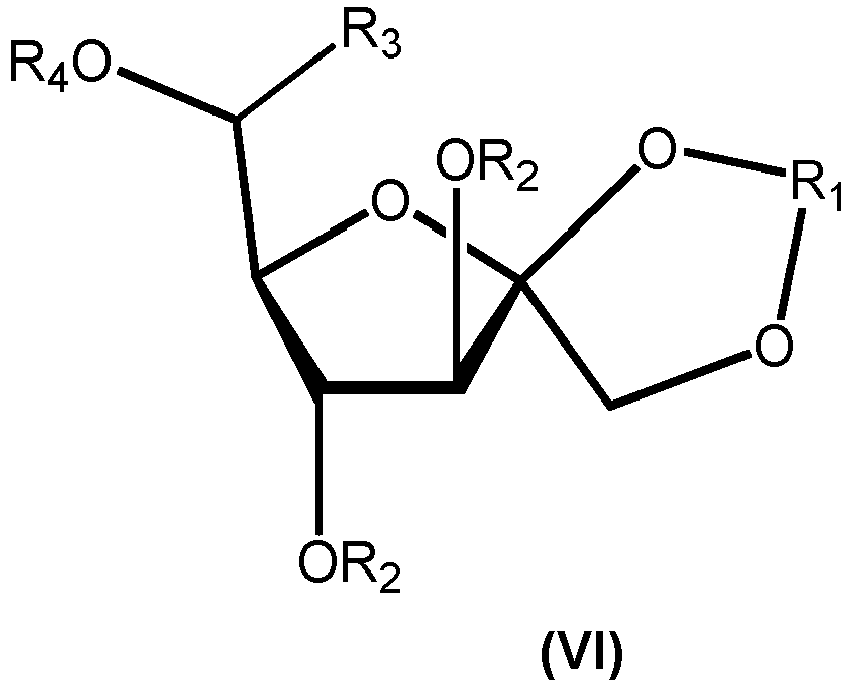
- Process according to claim 2, wherein R2 and R4 are benzyl protecting groups and step c) consists of deprotecting the benzyl protectives groups to provide free -OH groups to form intermediate IV.
- Process according to any of claims 1 to 3, wherein R1 represents one of the following groups selected among:

- Process according to any of claims 1 to 4, wherein step a) is a mild oxidation step, preferably a Dess Martin oxidation step, which is carried out by reacting intermediate (I) with Dess Martin periodinane.
- Process according to any of claims 1 to 5, wherein step b) is carried out by reacting intermediate (II) with R3Li or (R3)2ZnTi(OiPr)4; wherein R3 represents a cyclic or acyclic, substituted or unsubstituted, linear or branched C1-12alkyl, C1-12alkoxyl, C1-10alkyl-CH=CH2 or -CH2-Ph group.
- Process according to any of claims 1 to 6, wherein R3 represents methyl, ethyl, isopropyl, n-butyl, isobutyl, cyclopentyl, cyclohexyl, allyl or-CH2-Ph; preferably methyl.
- Isolated compound obtained by the method according to anyone of claims 1 to 7, and having one of the following formula (V) and (Vbis) :
- Isolated compound according to claim 8 and being selected among the following diastereoisomers:

- A biocidal composition, comprising an isolated compound according to any one of claims 8 or 9 and/or salts thereof, and an agriculturally acceptable formulation auxiliary customary in crop protection.
- Biocidal composition according to claim 10, further comprising one or more further agrochemically active substances, optionally selected from the group consisting of insecticides, acaricides, nematicides, herbicides, fungicides, safeners, fertilizers and/or further growth regulators.
- A herbicidal method for controlling one or more harmful plants and/or for regulating the growth of one or more plants, comprising applying at least one of biocidally effective amount of the compound according to any one of claims 8 or 9, and/or salts thereof, or the biocidal composition according to any one of claims 13 to 14 to the plants, seeds of plants, soil in which or on which plants grow and/or an area under cultivation.
- Use of the biocidal composition according to any one of claims 8 or 9 and/or salts thereof, and/or salts thereof, or the biocidal composition according to any one of claims 10 to 11 as an antimicrobial agent, preferably as an antibacterial or antifungal agent.
Priority Applications (1)
| Application Number | Priority Date | Filing Date | Title |
|---|---|---|---|
| EP23305231.5A EP4421081A1 (en) | 2023-02-22 | 2023-02-22 | Isolated 7dsh analogues, synthesis and uses thereof |
Applications Claiming Priority (1)
| Application Number | Priority Date | Filing Date | Title |
|---|---|---|---|
| EP23305231.5A EP4421081A1 (en) | 2023-02-22 | 2023-02-22 | Isolated 7dsh analogues, synthesis and uses thereof |
Publications (1)
| Publication Number | Publication Date |
|---|---|
| EP4421081A1 true EP4421081A1 (en) | 2024-08-28 |
Family
ID=85571331
Family Applications (1)
| Application Number | Title | Priority Date | Filing Date |
|---|---|---|---|
| EP23305231.5A Withdrawn EP4421081A1 (en) | 2023-02-22 | 2023-02-22 | Isolated 7dsh analogues, synthesis and uses thereof |
Country Status (1)
| Country | Link |
|---|---|
| EP (1) | EP4421081A1 (en) |
Citations (1)
| Publication number | Priority date | Publication date | Assignee | Title |
|---|---|---|---|---|
| US20200385416A1 (en) * | 2017-11-24 | 2020-12-10 | Eberhard Karls Universität Tübingen | Novel inhibitors of the shikimate pathway |
-
2023
- 2023-02-22 EP EP23305231.5A patent/EP4421081A1/en not_active Withdrawn
Patent Citations (1)
| Publication number | Priority date | Publication date | Assignee | Title |
|---|---|---|---|---|
| US20200385416A1 (en) * | 2017-11-24 | 2020-12-10 | Eberhard Karls Universität Tübingen | Novel inhibitors of the shikimate pathway |
Non-Patent Citations (10)
| Title |
|---|
| BRILISAUER, K.RAPP, J.RATH, P. ET AL.: "Cyanobacterial antimetabolite 7-deoxy-sedoheptulose blocks the shikimate pathway to inhibit the growth of prototrophic organisms", NAT COMMUN, vol. 10, 2019, pages 545, XP055559130, Retrieved from the Internet <URL:https://doi.org/10.1038/s41467-019-08476-8> DOI: 10.1038/s41467-019-08476-8 |
| CHITTENDEN, G. F.: "1,2-O-lsopropilydene-β-D-fructofuranose. A new acetal of D-fructose.", J. CHEM. SOC., CHEM. COMMUN., vol. 641, 1980, pages 882 - 883 |
| DEFARGE, N.SPIROUX DE VENDOMOIS, J.SERALINI, G. E: "Toxicity of formulants and heavy metals in glyphosate-based herbicides and other pesticides", TOXICOLOGY REPORTS, vol. 5, 2018, pages 156 - 163 |
| EUZEN R ET AL.: "A Chemoenzymatic Approach for the Synthesis of Unnatural Disaccharides Containing D-Galacto- or D-Fucofuranosides", EUR. J. ORG. CHEM., 2005, pages 4860 - 4869 |
| FAVREAU B ET AL.: "Synthesis of an Exhaustive Library of Naturally Occurring Galf-Manp and Galp-Manp Disaccharides. Toward Fingerprinting According to Ring Size by Advanced Mass Spectrometry-Based IM-MS and IRMPD", J. ORG. CHEM., 2021, Retrieved from the Internet <URL:https://doi.org/10.1021/acs.joc.1c00250> |
| GREENE'S PROTECTIVE GROUPS IN ORGANIC SYNTHESIS |
| MESNAGE, R.BENBROOK, C.ANTONIOU, M. N.: "Insight into the confusion over surfactant co-formulants in glyphosate-based herbicides", FOOD AND CHEMICAL TOXICOLOGY, vol. 128, 2019, pages 137 - 145 |
| NOZAKI N. ET AL.: "Asymmetric synthesis by means of (-)-sparteine modified organometallic reagents", TETRAHEDRON, vol. 27, 1971, pages 905 - 913 |
| RUBIO, E. M. ET AL.: "Spacer-Mediated Synthesis of Contra-Thermodynamic Spiroacetals: Stereoselective Synthesis of C 2 -Symmetric Difructose Dianhydrides", J. ORG. CHEM., vol. 71, 2006, pages 2257 - 2266, XP055723244, DOI: 10.1021/jo052184b |
| TOUFEILI IMAD A. ET AL: "C-methylation of sucrose: synthesis of 6- and 6'-C-methylsucrose", CARBOHYDRATE RESEARCH, vol. 148, no. 2, 1 May 1986 (1986-05-01), GB, pages 279 - 285, XP093066162, ISSN: 0008-6215, DOI: 10.1016/S0008-6215(00)90395-1 * |
Similar Documents
| Publication | Publication Date | Title |
|---|---|---|
| US4314069A (en) | Herbicidal compound, herbicidal composition containing the same, and method of use thereof | |
| EP0040350B1 (en) | Azole compounds, their preparation, their use in treating plants, and agents therefor | |
| US4147792A (en) | Fungicidal compositions | |
| EP0225739B1 (en) | 2-2-dimethyl-3-hydroxy-3-propargyl-4-(1,2,4-triazole-1-yl -butane derivatives as plant growth regulators | |
| US4871389A (en) | Heterocyclic compounds | |
| CS208796B2 (en) | Fungicide means and means for regulation of the plant's growth and method of making the active substances | |
| CA1077943A (en) | Acylated triazolyl-0, n-acetals and their use as fungicides | |
| EP0015639A2 (en) | Enantiomers of triazole compounds, a process for preparing them, their use as plant fungicides and growth regulating agents and compositions containing them | |
| EP0004315B1 (en) | 1.1-diphenylethene derivatives, process for their preparation and their use as microbicides | |
| AU606100B2 (en) | Pyrimidine derivatives | |
| EP0115470B1 (en) | Optically active n-(1'-methyl-2'-methoxymethyl)-n-chloracetyl-2,6-dimethylaniline as herbicide | |
| US4999043A (en) | Triazolylmethyl tert-butyl carbinol derivatives which have plant growth regulating properties | |
| KR840000739B1 (en) | Method for preparing substituted diphenyl ether | |
| GB2038326A (en) | Acylaniline derivatives | |
| US4319911A (en) | Triazolyl derivatives, their manufacture, and agents containing them for influencing plant growth | |
| US4895589A (en) | Heterocyclic compounds | |
| CH656133A5 (en) | HERBICIDE-ACTIVE DERIVATIVES OF 5-DESOXY-3-0-ARYLMETHYL- OR SUBSTITUTED ARYLMETHYL-1,2,0-ALKYL-IDENE-ALPHA-D-XYLOFURANOSES. | |
| US4534785A (en) | Herbicidal 5-deoxy-3-O-arylmethyl or substituted arylmethyl-1,2-O-ethylene-alpha-D-xylofuranose derivatives | |
| US4439225A (en) | Herbicidal cyano-tetrahydrofuranylmethyl ether and cyano-tetrahydropyranylmethyl ether derivatives | |
| US4521240A (en) | 5-C-Alkyl-3-O-arylmethyl or substituted arylmethyl-1,2-O-alkylidene-α- | |
| US4340765A (en) | 4-Phenoxy-2-butene derivatives as plant growth regulators | |
| US4920142A (en) | Fungicidal imidazole derivatives | |
| GB2041927A (en) | Enantiomers of triazole compounds | |
| US4742078A (en) | Pyran derivatives | |
| US4493936A (en) | 2-Cyano-tetrahydrofuran-5-methanols |
Legal Events
| Date | Code | Title | Description |
|---|---|---|---|
| PUAI | Public reference made under article 153(3) epc to a published international application that has entered the european phase |
Free format text: ORIGINAL CODE: 0009012 |
|
| STAA | Information on the status of an ep patent application or granted ep patent |
Free format text: STATUS: THE APPLICATION HAS BEEN PUBLISHED |
|
| AK | Designated contracting states |
Kind code of ref document: A1 Designated state(s): AL AT BE BG CH CY CZ DE DK EE ES FI FR GB GR HR HU IE IS IT LI LT LU LV MC ME MK MT NL NO PL PT RO RS SE SI SK SM TR |
|
| STAA | Information on the status of an ep patent application or granted ep patent |
Free format text: STATUS: REQUEST FOR EXAMINATION WAS MADE |
|
| 17P | Request for examination filed |
Effective date: 20250218 |
|
| STAA | Information on the status of an ep patent application or granted ep patent |
Free format text: STATUS: EXAMINATION IS IN PROGRESS |
|
| 17Q | First examination report despatched |
Effective date: 20250807 |
|
| STAA | Information on the status of an ep patent application or granted ep patent |
Free format text: STATUS: THE APPLICATION IS DEEMED TO BE WITHDRAWN |
|
| 18D | Application deemed to be withdrawn |
Effective date: 20251108 |