EP4421076A1 - Nitrogen-containing tetracyclic compound, preparation method therefor, and medical use thereof - Google Patents
Nitrogen-containing tetracyclic compound, preparation method therefor, and medical use thereof Download PDFInfo
- Publication number
- EP4421076A1 EP4421076A1 EP22882976.8A EP22882976A EP4421076A1 EP 4421076 A1 EP4421076 A1 EP 4421076A1 EP 22882976 A EP22882976 A EP 22882976A EP 4421076 A1 EP4421076 A1 EP 4421076A1
- Authority
- EP
- European Patent Office
- Prior art keywords
- general formula
- amino
- oxo
- group
- heterocyclyl
- Prior art date
- Legal status (The legal status is an assumption and is not a legal conclusion. Google has not performed a legal analysis and makes no representation as to the accuracy of the status listed.)
- Pending
Links
Classifications
-
- C—CHEMISTRY; METALLURGY
- C07—ORGANIC CHEMISTRY
- C07D—HETEROCYCLIC COMPOUNDS
- C07D487/00—Heterocyclic compounds containing nitrogen atoms as the only ring hetero atoms in the condensed system, not provided for by groups C07D451/00 - C07D477/00
- C07D487/12—Heterocyclic compounds containing nitrogen atoms as the only ring hetero atoms in the condensed system, not provided for by groups C07D451/00 - C07D477/00 in which the condensed system contains three hetero rings
- C07D487/14—Ortho-condensed systems
-
- C—CHEMISTRY; METALLURGY
- C07—ORGANIC CHEMISTRY
- C07D—HETEROCYCLIC COMPOUNDS
- C07D487/00—Heterocyclic compounds containing nitrogen atoms as the only ring hetero atoms in the condensed system, not provided for by groups C07D451/00 - C07D477/00
- C07D487/12—Heterocyclic compounds containing nitrogen atoms as the only ring hetero atoms in the condensed system, not provided for by groups C07D451/00 - C07D477/00 in which the condensed system contains three hetero rings
- C07D487/16—Peri-condensed systems
-
- A—HUMAN NECESSITIES
- A61—MEDICAL OR VETERINARY SCIENCE; HYGIENE
- A61K—PREPARATIONS FOR MEDICAL, DENTAL OR TOILETRY PURPOSES
- A61K31/00—Medicinal preparations containing organic active ingredients
- A61K31/33—Heterocyclic compounds
- A61K31/395—Heterocyclic compounds having nitrogen as a ring hetero atom, e.g. guanethidine or rifamycins
- A61K31/495—Heterocyclic compounds having nitrogen as a ring hetero atom, e.g. guanethidine or rifamycins having six-membered rings with two or more nitrogen atoms as the only ring heteroatoms, e.g. piperazine or tetrazines
- A61K31/4985—Pyrazines or piperazines ortho- or peri-condensed with heterocyclic ring systems
-
- A—HUMAN NECESSITIES
- A61—MEDICAL OR VETERINARY SCIENCE; HYGIENE
- A61K—PREPARATIONS FOR MEDICAL, DENTAL OR TOILETRY PURPOSES
- A61K31/00—Medicinal preparations containing organic active ingredients
- A61K31/33—Heterocyclic compounds
- A61K31/395—Heterocyclic compounds having nitrogen as a ring hetero atom, e.g. guanethidine or rifamycins
- A61K31/55—Heterocyclic compounds having nitrogen as a ring hetero atom, e.g. guanethidine or rifamycins having seven-membered rings, e.g. azelastine, pentylenetetrazole
- A61K31/551—Heterocyclic compounds having nitrogen as a ring hetero atom, e.g. guanethidine or rifamycins having seven-membered rings, e.g. azelastine, pentylenetetrazole having two nitrogen atoms, e.g. dilazep
-
- A—HUMAN NECESSITIES
- A61—MEDICAL OR VETERINARY SCIENCE; HYGIENE
- A61P—SPECIFIC THERAPEUTIC ACTIVITY OF CHEMICAL COMPOUNDS OR MEDICINAL PREPARATIONS
- A61P35/00—Antineoplastic agents
Definitions
- the present disclosure belongs to the field of pharmaceutics and relates to a nitrogen-containing tetracyclic compound, a preparation method therefor, and pharmaceutical use thereof. Specifically, the present disclosure relates to a nitrogen-containing tetracyclic compound represented by general formula (IM), a preparation method therefor, a pharmaceutical composition comprising the compound, use thereof as a therapeutic agent, in particular as a KRAS G12C inhibitor, and use thereof in the preparation of a medicament for treating and/or preventing tumors.
- IM general formula
- the RAS (rat sarcoma viral oncogene homolog) family belongs to the small GTPase superfamily and is widely expressed in various eukaryotes.
- RAS genes HRAS, KRAS, and NARS
- HRAS, KRAS4A, KARS4B, and NRAS highly related RAS small GTPases
- They act as binary switches for GDP-GTP regulation. They generally exist in two forms: a GDP (guanosine diphosphate)-bound form when in an inactive state and a GTP (guanosine triphosphate)-bound form when in an activated state.
- RAS proteins regulate multiple downstream pathways including RAF-MEK-ERK and PI3K/Akt/mTOR by switching between the two active states, thereby affecting cell growth, proliferation, and differentiation ( Nat Rev Cancer, 2007, 7, 295-308 ).
- the RAS genes exhibit high mutation rates in various tumors such as pancreatic cancer, colorectal cancer, and non-small cell lung cancer.
- Activated mutant RAS proteins promote abnormal signal transduction, thereby causing cancer development and progression, as well as resistance to targeted drugs.
- the KRAS mutation is the gene with the highest mutation rate among human oncogenes and accounts for 20-30% of all tumors.
- KRAS mutations are mainly point mutations, including mutations at amino acid positions 12, 13, and 61.
- the mutation of glycine at position 12 into cysteine (G12C) is the most common of them. This mutation is found in a significant proportion of lung cancers, especially non-small cell lung cancer (14%). In addition, it is expressed in some patients with colorectal cancer (4%) and pancreatic cancer (2%). In the U.S. cancer population, the incidence of this gene mutation is even higher than the combined incidence of ALK, RET, and TRK gene mutations.
- KRAS G12C small-molecule inhibitor ARS-1620 has been shown to effectively inhibit tumor growth in various KRAS G12C mutant tumor models, and even lead to complete tumor regression. Since KRAS G12C is a mutant protein in tumor cells, and the wild-type KRAS does not have this mutation site, it provides a perfect tumor-selective target ( Cell, 2018, 572, 578-589 ).
- KRAS G12C has drawn numerous renowned pharmaceutical companies around the world to the research and development of related new drugs. Although the fastest progressing small-molecule KRAS G12C inhibitor, Sotorasib (AMG510) by Amgen, was approved by the FDA on May 28, 2021, for patients with non-small cell lung cancer carrying the KRAS G12C mutation who have previously undergone at least one systemic treatment, Eli Lilly and Company's next-generation KRAS G12C inhibitor LY3537982 has been attracting even more interest. Eli Lilly and Company presented preclinical data on LY3537982 at the American Association for Cancer Research (AACR) Annual Meeting in April 2021.
- AACR American Association for Cancer Research
- Patent applications that disclose KRAS G12C inhibitors include WO2014152588A1 , WO2015054572A1 , WO2016164675A1 , WO2017087528A1 , WO2017201161A1 , WO2018119183A2 , WO2018206539A1 , WO2018217651A1 , WO2019099524A1 , WO2019215203A1 , WO2020081282A1 , WO2020178282A1 , WO2021118877A1 , and the like.
- the present disclosure aims to provide a compound represented by general formula (IM) or a pharmaceutically acceptable salt thereof: wherein:
- V is CR 5
- R 5 is as defined in general formula (IM).
- V is N.
- the compound represented by general formula (IM) or the pharmaceutically acceptable salt thereof is a compound represented by general formula (I) or a pharmaceutically acceptable salt thereof: wherein:
- Y is C(O).
- each R 2 is identical or different and is independently selected from the group consisting of a hydrogen atom, halogen, cyano, C 1-6 alkyl, C 1-6 alkoxy, hydroxy, and amino, wherein the C 1-6 alkyl is optionally substituted with one or more substituents selected from the group consisting of halogen and cyano; preferably, each R 2 is identical or different and is independently a hydrogen atom or C 1-6 alkyl; more preferably, each R 2 is identical or different and is independently a hydrogen atom or methyl; most preferably, R 2 is a hydrogen atom.
- s is 0, 1, or 2; preferably, s is 0 or 1; more preferably, s is 0.
- each R 2 is identical or different and is independently selected from the group consisting of halogen, cyano, C 1-6 alkyl, C 1-6 alkoxy, hydroxy, and amino, wherein the C 1-6 alkyl is optionally substituted with one or more substituents selected from the group consisting of halogen and cyano, and s is 0, 1, or 2; preferably, R 2 is C 1-6 alkyl, and s is 0 or 1; more preferably, R 2 is methyl, and s is 0 or 1.
- the compound represented by general formula (IM) or general formula (I) or the pharmaceutically acceptable salt thereof is a compound represented by general formula (II) or a pharmaceutically acceptable salt thereof: wherein: ring A, X, Z, R 1 , R 3 , R 4 , R 5 , R 6 , and t are as defined in general formula (I).
- ring A is 6- to 10-membered aryl or 5- to 10-membered heteroaryl; preferably, ring A is 5- to 10-membered heteroaryl; more preferably, ring A is 8- to 10-membered bicyclic heteroaryl containing in the ring 1, 2, or 3 heteroatoms selected from the group consisting of nitrogen, oxygen, and sulfur; most preferably, ring A is benzothienyl or benzothiazolyl.
- W is C(CN) or N; t is 0, 1, 2, or 3; and R 6 is as defined in general formula (I).
- R 1 is wherein R 11 , R 12 , R 13 , and R 14 are as defined in general formula (I); preferably, R 1 is wherein R 11 , R 12 , and R 13 are as defined in general formula (I).
- X is C(R a R b )-C(R c R d ), wherein R a , R b , R c , and R d are as defined in general formula (I).
- R a , R b , R c , and R d are identical or different and are each independently selected from the group consisting of a hydrogen atom, halogen, C 1-6 alkyl, and C 1-6 haloalkyl; preferably, R a , R b , R c , and R d are all hydrogen atoms.
- X is CH 2 or CH 2 -CH 2 ; preferably, X is CH 2 -CH 2 .
- the compound represented by general formula (IM), general formula (I), or general formula (II) or the pharmaceutically acceptable salt thereof is a compound represented by general formula (III) or a pharmaceutically acceptable salt thereof: wherein:
- the compound represented by general formula (IM), general formula (I), general formula (II), or general formula (III) or the pharmaceutically acceptable salt thereof is a compound represented by general formula (III-1) or a pharmaceutically acceptable salt thereof: wherein:
- the compound represented by general formula (IM), general formula (I), general formula (II), or general formula (III) or the pharmaceutically acceptable salt thereof is a compound represented by general formula (III-2) or a pharmaceutically acceptable salt thereof: wherein:
- the compound represented by general formula (IM), general formula (I), general formula (II), general formula (III), or general formula (III-1) or the pharmaceutically acceptable salt thereof is a compound represented by general formula (III-1-A) or a pharmaceutically acceptable salt thereof: wherein:
- the compound represented by general formula (IM), general formula (I), general formula (II), general formula (III), or general formula (III-1) or the pharmaceutically acceptable salt thereof is a compound represented by general formula (III-I-B) or a pharmaceutically acceptable salt thereof: wherein:
- the compound represented by general formula (IM), general formula (I), general formula (II), general formula (III), or general formula (III-2) or the pharmaceutically acceptable salt thereof is a compound represented by general formula (III-2-A) or a pharmaceutically acceptable salt thereof: wherein:
- the compound represented by general formula (IM), general formula (I), general formula (II), general formula (III), or general formula (III-2) or the pharmaceutically acceptable salt thereof is a compound represented by general formula (III-2-B) or a pharmaceutically acceptable salt thereof: wherein:
- W is C(CN).
- R 3 , R 4 , R 5 , and R 5a are identical or different and are each independently selected from the group consisting of a hydrogen atom, halogen, C 1-6 alkyl, and C 1-6 haloalkyl.
- R 3 is selected from the group consisting of a hydrogen atom, halogen, C 1-6 alkyl, and C 1-6 haloalkyl; preferably, R 3 is a hydrogen atom or halogen; more preferably, R 3 is a hydrogen atom or F; most preferably, R 3 is a hydrogen atom.
- R 4 is selected from the group consisting of a hydrogen atom, halogen, C 1-6 alkyl, and C 1-6 haloalkyl; preferably, R 4 is halogen; more preferably, R 4 is F.
- R 5 is selected from the group consisting of a hydrogen atom, halogen, C 1-6 alkyl, and C 1-6 haloalkyl; preferably, R 5 is selected from the group consisting of a hydrogen atom, halogen, and C 1-6 alkyl; more preferably, R 5 is halogen or C 1-6 alkyl; most preferably, R 5 is Cl or methyl.
- R 5 is selected from the group consisting of a hydrogen atom, F, Cl, and methyl.
- R 5a is selected from the group consisting of a hydrogen atom, halogen, C 1-6 alkyl, and C 1-6 haloalkyl; preferably, R 5a is a hydrogen atom or C 1-6 alkyl; more preferably, R 5a is a hydrogen atom or methyl.
- Z is CR 5a or N
- R 5a is selected from the group consisting of a hydrogen atom, halogen, C 1-6 alkyl, and C 1-6 haloalkyl; preferably, Z is CR 5a or N, and R 5a is a hydrogen atom or C 1-6 alkyl; more preferably, Z is N.
- each R 6 is identical or different and is independently selected from the group consisting of a hydrogen atom, halogen, cyano, -NH 2 , C 1-6 alkyl, and C 1-6 haloalkyl; preferably, each R 6 is identical or different and is independently selected from the group consisting of a hydrogen atom, halogen, cyano, and -NH 2 .
- each R 6 is identical or different and is independently selected from the group consisting of a hydrogen atom, halogen, cyano, -NH 2 , C 1-6 alkyl, and C 1-6 haloalkyl; preferably, each R 6 is identical or different and is independently a hydrogen atom or halogen; more preferably, each R 6 is identical or different and is independently a hydrogen atom or F.
- R 11 is selected from the group consisting of a hydrogen atom, halogen, and C 1-6 alkyl; preferably, R 11 is a hydrogen atom or halogen; more preferably, R 11 is a hydrogen atom or F.
- R 12 is selected from the group consisting of a hydrogen atom, halogen, and C 1-6 alkyl; preferably, R 12 is a hydrogen atom.
- R 13 is selected from the group consisting of a hydrogen atom, halogen, and C 1-6 alkyl; preferably, R 13 is a hydrogen atom.
- R 14 is selected from the group consisting of a hydrogen atom, halogen, and C 1-6 alkyl; preferably, R 14 is a hydrogen atom.
- t is 0, 1, 2, or 3.
- each R 6 is identical or different and is independently selected from the group consisting of halogen, cyano, -NH 2 , C 1-6 alkyl, and C 1-6 haloalkyl, and t is 0, 1, 2, or 3.
- t is 0 or 1.
- R 6 is halogen
- t is 0 or 1.
- R 6 is F
- t is 0 or 1.
- V is CR 5 or N;
- X is C(R a R b ) or C(R a R b )-C(R c R d );
- R a , R b , R c , and R d are identical or different and are each independently selected from the group consisting of a hydrogen atom, halogen, C 1-6 alkyl, and C 1-6 haloalkyl;
- Y is C(O);
- Z is CR 5a or N;
- ring A is 5- to 10-membered heteroaryl;
- R 1 is R 3 , R 4 , R 5 , and R 5a are identical or different and are each independently selected from the group consisting of a hydrogen atom, halogen, C 1-6 alkyl, and C 1-6 haloalkyl;
- R 2 is C 1-6 alkyl, and s is 0 or 1; each R 6 is identical or different and is independently selected from
- V is CR 5 or N;
- X is CH 2 or CH 2 -CH 2 ;
- Y is C(O);
- Z is CR 5a or N;
- R 5a is a hydrogen atom or C 1-6 alkyl;
- R 1 is R 3 is a hydrogen atom or halogen;
- R 4 is halogen;
- R 5 is selected from the group consisting of a hydrogen atom, halogen, and C 1-6 alkyl;
- R 2 is C 1-6 alkyl, and s is 0 or 1;
- W is C(CN) or N;
- each R 6 is identical or different and is independently selected from the group consisting of halogen, cyano, -NH 2 , C 1-6 alkyl, and C 1-6 haloalkyl, and t is 0, 1, 2, or 3;
- R 11 is selected from the group consisting of a hydrogen atom, halogen, and C 1-6 alkyl;
- R 12 is selected from the
- X is C(R a R b ) or C(R a R b )-C(R c R d );
- R a , R b , R c , and R d are identical or different and are each independently selected from the group consisting of a hydrogen atom, halogen, C 1-6 alkyl, and C 1-6 haloalkyl;
- Y is C(O);
- Z is CR 5a or N;
- ring A is 5- to 10-membered heteroaryl;
- R 1 is R 3 , R 4 , R 5 , and R 5a are identical or different and are each independently selected from the group consisting of a hydrogen atom, halogen, C 1-6 alkyl, and C 1-6 haloalkyl;
- R 2 is C 1-6 alkyl, and s is 0 or 1;
- each R 6 is identical or different and is independently selected from the group consisting of halogen
- X is C(R a R b ) or C(R a R b )-C(R c R d );
- R a , R b , R c , and R d are identical or different and are each independently selected from the group consisting of a hydrogen atom, halogen, C 1-6 alkyl, and C 1-6 haloalkyl;
- Y is C(O);
- Z is CR 5a or N;
- ring A is 5- to 10-membered heteroaryl;
- R 1 is R 3 , R 4 , R 5 , and R 5a are identical or different and are each independently selected from the group consisting of a hydrogen atom, halogen, C 1-6 alkyl, and C 1-6 haloalkyl;
- s is 0; each R 6 is identical or different and is independently selected from the group consisting of halogen, cyano, -NH 2 , C
- ring A is 8- to 10-membered bicyclic heteroaryl containing in the ring 1, 2, or 3 heteroatoms selected from the group consisting of nitrogen, oxygen, and sulfur;
- X is CH 2 or CH 2 -CH 2 ;
- Z is CR 5a or N;
- R 1 is R 3 , R 4 , R 5 , and R 5a are identical or different and are each independently selected from the group consisting of a hydrogen atom, halogen, C 1-6 alkyl, and C 1-6 haloalkyl; each R 6 is identical or different and is independently selected from the group consisting of halogen, cyano, -NH 2 , C 1-6 alkyl, and C 1-6 haloalkyl, and t is 0, 1, 2, or 3;
- R 11 is a hydrogen atom or halogen;
- R 12 is a hydrogen atom;
- R 13 is a hydrogen atom.
- W is C(CN) or N;
- Z is CR 5a or N;
- R 3 , R 4 , R 5 , and R 5a are identical or different and are each independently selected from the group consisting of a hydrogen atom, halogen, C 1-6 alkyl, and C 1-6 haloalkyl;
- R 11 is a hydrogen atom or halogen;
- R 12 is a hydrogen atom;
- R 13 is a hydrogen atom;
- R 6 is halogen, and
- t is 0 or 1.
- W is C(CN) or N;
- Z is CR 5a or N, and R 5a is a hydrogen atom or C 1-6 alkyl;
- R 3 is a hydrogen atom or halogen;
- R 4 is halogen;
- R 5 is selected from the group consisting of a hydrogen atom, halogen, and C 1-6 alkyl;
- R 11 is a hydrogen atom or halogen;
- R 12 is a hydrogen atom;
- R 13 is a hydrogen atom;
- R 6 is halogen, and t is 0 or 1.
- W is C(CN); Z is N; R 3 is a hydrogen atom; R 4 is halogen; R 5 is selected from the group consisting of a hydrogen atom, halogen, and C 1-6 alkyl; R 11 is a hydrogen atom or halogen; R 12 is a hydrogen atom; R 13 is a hydrogen atom; R 6 is halogen, and t is 0 or 1. Table A.
- Typical compounds of the present disclosure include, but are not limited to: Example No. Compound structure Name 4-(10-Acryloyl-2-fluoro-14-oxo-8,8 a ,9,10,11,12-h exahydro-7 H ,14 H -pyrazino[1',2':5,6][1,5]diazocin o[3,2,1- hi ]indazol-3-yl)-2-amino-7-fluorobenzo[ b ]thiophene-3-carbonitrile 1 4-(( S )-10-Acryloyl-2-fluoro-14-oxo-8,8 a ,9,10,11, 12-hexahydro-7 H ,14 H -pyrazino[1',2':5,6][1,5]dia zocino[3,2,1- hi ]indazol-3-yl)-2-amino-7-fluorobe nzo[ b ]thiophene-3-
- IMa a compound represented by general formula (IMa) or a salt thereof: wherein: ring A, V, X, Y, Z, R 2 , R 3 , R 4 , R 6 , s, and t are as defined in general formula (IM).
- Another aspect of the present disclosure relates to a compound represented by general formula (Ia) or a salt thereof: wherein: ring A, X, Y, Z, R 2 , R 3 , R 4 , R 5 , R 6 , s, and t are as defined in general formula (I).
- Another aspect of the present disclosure relates to a compound represented by general formula (IIa) or a salt thereof: wherein: ring A, X, Z, R 3 , R 4 , R 5 , R 6 , and t are as defined in general formula (II).
- Another aspect of the present disclosure relates to a compound represented by general formula (IIIa) or a salt thereof: wherein: W, Z, R 3 , R 4 , R 5 , R 6 , and t are as defined in general formula (III).
- Another aspect of the present disclosure relates to a compound represented by general formula (III-1a) or a salt thereof: wherein: W, Z, R 3 , R 4 , R 5 , R 6 , and t are as defined in general formula (III-1).
- Another aspect of the present disclosure relates to a compound represented by general formula (III-2a) or a salt thereof: wherein: W, Z, R 3 , R 4 , R 5 , R 6 , and t are as defined in general formula (III-2).
- Another aspect of the present disclosure relates to a compound represented by general formula (III-1-Aa) or a salt thereof: wherein: W, Z, R 3 , R 4 , R 5 , R 6 , and t are as defined in general formula (III-I-A).
- Another aspect of the present disclosure relates to a compound represented by general formula (III-1-Ba) or a salt thereof: wherein: W, Z, R 3 , R 4 , R 5 , R 6 , and t are as defined in general formula (III-1-B).
- Another aspect of the present disclosure relates to a compound represented by general formula (III-2-Aa) or a salt thereof: wherein: W, Z, R 3 , R 4 , R 5 , R 6 , and t are as defined in general formula (III-2-A).
- Another aspect of the present disclosure relates to a compound represented by general formula (III-2-Ba) or a salt thereof: wherein: W, Z, R 3 , R 4 , R 5 , R 6 , and t are as defined in general formula (III-2-B).
- Table B Typical intermediate compounds of the present disclosure include, but are not limited to: Compound No.
- Another aspect of the present disclosure relates to a compound represented by general formula (IMaa) or a salt thereof: wherein:
- Another aspect of the present disclosure relates to a compound represented by general formula (IMaa) or a salt thereof: wherein: is
- Another aspect of the present disclosure relates to a compound represented by general formula (Iaa) or a salt thereof: wherein:
- Another aspect of the present disclosure relates to a compound represented by general formula (Iaa) or a salt thereof: wherein: is
- Another aspect of the present disclosure relates to a compound represented by general formula (IIaa) or a salt thereof: wherein:
- Another aspect of the present disclosure relates to a compound represented by general formula (IIaa) or a salt thereof: wherein: is
- Another aspect of the present disclosure relates to a compound represented by general formula (IIIaa) or a salt thereof: wherein:
- Another aspect of the present disclosure relates to a compound represented by general formula (III-1aa) or a salt thereof: wherein:
- Another aspect of the present disclosure relates to a compound represented by general formula (III-2aa) or a salt thereof: wherein:
- Another aspect of the present disclosure relates to a method for preparing a compound represented by general formula (IM) or a pharmaceutically acceptable salt thereof, comprising: conducting a reaction of a compound represented by general formula (IMa) or a salt thereof with a compound of general formula (X) or a salt thereof to give the compound represented by general formula (IM) or the pharmaceutically acceptable salt thereof; wherein:
- Another aspect of the present disclosure relates to a method for preparing a compound represented by general formula (I) or a pharmaceutically acceptable salt thereof, comprising: conducting a reaction of a compound represented by general formula (Ia) or a salt thereof with a compound of general formula (X) or a salt thereof to give the compound represented by general formula (I) or the pharmaceutically acceptable salt thereof; wherein:
- Another aspect of the present disclosure relates to a method for preparing a compound represented by general formula (II) or a pharmaceutically acceptable salt thereof, comprising: conducting a reaction of a compound represented by general formula (IIa) or a salt thereof with a compound of general formula (X) or a salt thereof to give the compound represented by general formula (II) or the pharmaceutically acceptable salt thereof; wherein:
- Another aspect of the present disclosure relates to a method for preparing a compound represented by general formula (III) or a pharmaceutically acceptable salt thereof, comprising: conducting a reaction of a compound represented by general formula (IIIa) or a salt thereof with a compound of general formula (XI) or a salt thereof to give the compound represented by general formula (III) or the pharmaceutically acceptable salt thereof; wherein:
- Another aspect of the present disclosure relates to a method for preparing a compound represented by general formula (III-1) or a pharmaceutically acceptable salt thereof, comprising: conducting a reaction of a compound represented by general formula (III-1a) or a salt thereof with a compound of general formula (XI) or a salt thereof to give the compound represented by general formula (III-1) or the pharmaceutically acceptable salt thereof; wherein:
- Another aspect of the present disclosure relates to a method for preparing a compound represented by general formula (III-2) or a pharmaceutically acceptable salt thereof, comprising: conducting a reaction of a compound represented by general formula (III-2a) or a salt thereof with a compound of general formula (XI) or a salt thereof to give the compound represented by general formula (III-2) or the pharmaceutically acceptable salt thereof; wherein:
- Another aspect of the present disclosure relates to a method for preparing compounds represented by general formula (III-1-A) and general formula (III-1-B) or pharmaceutically acceptable salts thereof, comprising: resolving a compound represented by general formula (III-1) or a pharmaceutically acceptable salt thereof to give the compounds represented by general formula (III-1-A) and general formula (III-I-B) or the pharmaceutically acceptable salts thereof; wherein: W, Z, R 3 , R 4 , R 5 , R 6 , R 11 , R 12 , R 13 , and t are as defined in general formula (III-1).
- Another aspect of the present disclosure relates to a method for preparing compounds represented by general formula (III-2-A) and general formula (III-2-B) or pharmaceutically acceptable salts thereof, comprising: resolving a compound represented by general formula (III-2) or a pharmaceutically acceptable salt thereof to give the compounds represented by general formula (III-2-A) and general formula (III-2-B) or the pharmaceutically acceptable salts thereof; wherein: W, Z, R 3 , R 4 , R 5 , R 6 , R 11 , R 12 , R 13 , and t are as defined in general formula (III-2).
- Another aspect of the present disclosure relates to a method for preparing a compound represented by general formula (IMa) or a pharmaceutically acceptable salt thereof, comprising: removing R W2 from a compound represented by general formula (IMaa) or a salt thereof to give the compound represented by general formula (IMa) or the pharmaceutically acceptable salt thereof; wherein:
- Another aspect of the present disclosure relates to a method for preparing a compound represented by general formula (IMa) or a salt thereof, comprising: removing R W2 from a compound represented by general formula (IMaa) or a salt thereof to give the compound represented by general formula (IMa) or the salt thereof, wherein optionally, when a protecting group is present on the R 6 group, a step of removing the protecting group from the R 6 group is also included before, during, or after the deprotection reaction; wherein:
- Another aspect of the present disclosure relates to a method for preparing a compound represented by general formula (Ia) or a pharmaceutically acceptable salt thereof, comprising: removing R W2 from a compound represented by general formula (Iaa) or a salt thereof to give the compound represented by general formula (Ia) or the pharmaceutically acceptable salt thereof; wherein:
- Another aspect of the present disclosure relates to a method for preparing a compound represented by general formula (Ia) or a salt thereof, comprising: removing R W2 from a compound represented by general formula (Iaa) or a salt thereof to give the compound represented by general formula (Ia) or the salt thereof, wherein optionally, when a protecting group is present on the R 6 group, a step of removing the protecting group from the R 6 group is also included before, during, or after the deprotection reaction; wherein:
- Another aspect of the present disclosure relates to a method for preparing a compound represented by general formula (IIa) or a pharmaceutically acceptable salt thereof, comprising: removing R W2 from a compound represented by general formula (IIaa) or a salt thereof to give the compound represented by general formula (IIa) or the pharmaceutically acceptable salt thereof; wherein:
- Another aspect of the present disclosure relates to a method for preparing a compound represented by general formula (IIa) or a salt thereof, comprising: removing R W2 from a compound represented by general formula (IIaa) or a salt thereof to give the compound represented by general formula (IIa) or the salt thereof, wherein optionally, when a protecting group is present on the R 6 group, a step of removing the protecting group from the R 6 group is also included before, during, or after the deprotection reaction; wherein:
- Another aspect of the present disclosure relates to a method for preparing a compound represented by general formula (IIIa) or a pharmaceutically acceptable salt thereof, comprising: removing R W1 and R W2 from a compound represented by general formula (IIIaa) or a salt thereof to give the compound represented by general formula (IIIa) or the pharmaceutically acceptable salt thereof; wherein:
- Another aspect of the present disclosure relates to a method for preparing a compound represented by general formula (III-1a) or a pharmaceutically acceptable salt thereof, comprising: removing R W1 and R W2 from a compound represented by general formula (III-1aa) or a salt thereof to give the compound represented by general formula (III-1a) or the pharmaceutically acceptable salt thereof; wherein:
- Another aspect of the present disclosure relates to a method for preparing a compound represented by general formula (III-2a) or a pharmaceutically acceptable salt thereof, comprising: removing R W1 and R W2 from a compound represented by general formula (III-2aa) or a salt thereof to give the compound represented by general formula (III-2a) or the pharmaceutically acceptable salt thereof; wherein:
- Another aspect of the present disclosure relates to a pharmaceutical composition
- a pharmaceutical composition comprising the compound represented by general formula (IM), general formula (I), general formula (II), general formula (III), general formula (III-1), general formula (III-2), general formula (III-1-A), general formula (III-1-B), general formula (III-2-A), or general formula (III-2-B) of the present disclosure and a compound from Table A or a pharmaceutically acceptable salt thereof, and one or more pharmaceutically acceptable carriers, diluents, or excipients.
- the present disclosure further relates to use of the compound represented by general formula (IM), general formula (I), general formula (II), general formula (III), general formula (III-1), general formula (III-2), general formula (III-1-A), general formula (III-1-B), general formula (III-2-A), or general formula (III-2-B) and a compound from Table A or a pharmaceutically acceptable salt thereof or a pharmaceutical composition comprising same in the preparation of a medicament for inhibiting KRAS G12C.
- the present disclosure further relates to use of the compound represented by general formula (IM), general formula (I), general formula (II), general formula (III), general formula (III-1), general formula (III-2), general formula (III-1-A), general formula (III-1-B), general formula (III-2-A), or general formula (III-2-B) and a compound from Table A or a pharmaceutically acceptable salt thereof or a pharmaceutical composition comprising same in the preparation of a medicament for treating and/or preventing a KRAS G12C-mediated disease or disorder.
- the present disclosure further relates to use of the compound represented by general formula (IM), general formula (I), general formula (II), general formula (III), general formula (III-1), general formula (III-2), general formula (III-1-A), general formula (III-1-B), general formula (III-2-A), or general formula (III-2-B) and a compound from Table A or a pharmaceutically acceptable salt thereof or a pharmaceutical composition comprising same in the preparation of a medicament for treating and/or preventing a tumor.
- general formula (IM) general formula (IM), general formula (I), general formula (II), general formula (III), general formula (III-1), general formula (III-2), general formula (III-1-A), general formula (III-1-B), general formula (III-2-A), or general formula (III-2-B) and a compound from Table A or a pharmaceutically acceptable salt thereof or a pharmaceutical composition comprising same in the preparation of a medicament for treating and/or preventing a tumor.
- the present disclosure also relates to a method for inhibiting KRAS G12C, comprising administering to a patient in need thereof a therapeutically effective amount of the compound represented by general formula (IM), general formula (I), general formula (II), general formula (III), general formula (III-1), general formula (III-2), general formula (III-1-A), general formula (III-1-B), general formula (III-2-A), or general formula (III-2-B) and a compound from Table A or a pharmaceutically acceptable salt thereof, or a pharmaceutical composition comprising same.
- the present disclosure also relates to a method for treating and/or preventing a KRAS G12C-mediated disease or disorder, comprising administering to a patient in need thereof a therapeutically effective amount of the compound represented by general formula (IM), general formula (I), general formula (II), general formula (III), general formula (III-1), general formula (III-2), general formula (III-1-A), general formula (III-1-B), general formula (III-2-A), or general formula (III-2-B) and a compound from Table A or a pharmaceutically acceptable salt thereof, or a pharmaceutical composition comprising same.
- the present disclosure also relates to a method for treating and/or preventing a tumor, comprising administering to a patient in need thereof a therapeutically effective amount of the compound represented by general formula (IM), general formula (I), general formula (II), general formula (III), general formula (III-1), general formula (III-2), general formula (III-1-A), general formula (III-1-B), general formula (III-2-A), or general formula (III-2-B) and a compound from Table A or a pharmaceutically acceptable salt thereof, or a pharmaceutical composition comprising same.
- the present disclosure further relates to a compound represented by general formula (IM), general formula (I), general formula (II), general formula (III), general formula (III-1), general formula (III-2), general formula (III-1-A), general formula (III-1-B), general formula (III-2-A), or general formula (III-2-B) and a compound from Table A or a pharmaceutically acceptable salt thereof, or a pharmaceutical composition comprising same, for use as a medicament.
- the present disclosure further relates to a compound represented by general formula (IM), general formula (I), general formula (II), general formula (III), general formula (III-1), general formula (III-2), general formula (III-1-A), general formula (III-1-B), general formula (III-2-A), or general formula (III-2-B) and a compound from Table A or a pharmaceutically acceptable salt thereof, or a pharmaceutical composition comprising same, for use as a KRAS G12C inhibitor.
- IM general formula
- general formula (I) general formula (III), general formula (III), general formula (III-1), general formula (III-2), general formula (III-1-A), general formula (III-1-B), general formula (III-2-A), or general formula (III-2-B)
- a compound from Table A or a pharmaceutically acceptable salt thereof or a pharmaceutical composition comprising same, for use as a KRAS G12C inhibitor.
- the present disclosure further relates to a compound represented by general formula (IM), general formula (I), general formula (II), general formula (III), general formula (III-1), general formula (III-2), general formula (III-1-A), general formula (III-1-B), general formula (III-2-A), or general formula (III-2-B) and a compound from Table A or a pharmaceutically acceptable salt thereof, or a pharmaceutical composition comprising same, for use in treating and/or preventing a KRAS G12C-mediated disease or disorder.
- IM general formula
- general formula (I) general formula (II), general formula (III), general formula (III-1), general formula (III-2), general formula (III-1-A), general formula (III-1-B), general formula (III-2-A), or general formula (III-2-B)
- a compound from Table A or a pharmaceutically acceptable salt thereof or a pharmaceutical composition comprising same, for use in treating and/or preventing a KRAS G12C-mediated disease or disorder.
- the present disclosure further relates to a compound represented by general formula (IM), general formula (I), general formula (II), general formula (III), general formula (III-1), general formula (III-2), general formula (III-1-A), general formula (III-1-B), general formula (III-2-A), or general formula (III-2-B) and a compound from Table A or a pharmaceutically acceptable salt thereof, or a pharmaceutical composition comprising same, for use in treating and/or preventing a tumor.
- IM general formula
- general formula (I) general formula (III), general formula (III), general formula (III-1), general formula (III-2), general formula (III-1-A), general formula (III-1-B), general formula (III-2-A), or general formula (III-2-B)
- a compound from Table A or a pharmaceutically acceptable salt thereof or a pharmaceutical composition comprising same, for use in treating and/or preventing a tumor.
- the tumor described above in the present disclosure is preferably a cancer; further preferably, the cancer is selected from the group consisting of lung cancer (such as non-small cell lung cancer and small cell lung cancer), pancreatic cancer, cervical cancer, esophageal cancer (also known as esophageal carcinoma), endometrial cancer, ovarian cancer, cholangiocarcinoma, colorectal cancer (such as colon cancer and rectal cancer), liver cancer, breast cancer, prostate cancer, thyroid cancer, stomach cancer, urothelial cancer, testicular cancer, leukemia, skin cancer, squamous cell cancer, basal cell cancer, bladder cancer, head and neck cancer, kidney cancer, nasopharyngeal cancer, bone cancer, lymphoma, melanoma, sarcoma, peripheral neuroepithelioma, glioma (such as astrocytoma and glioblastoma), brain tumor, and myeloma; more preferably, the cancer is selected from the group consisting of
- the KRAS G12C-mediated disease or disorder described above in the present disclosure is preferably a tumor; further preferably, the tumor is a cancer; more preferably, the cancer is selected from the group consisting of lung cancer (such as non-small cell lung cancer and small cell lung cancer), pancreatic cancer, cervical cancer, esophageal cancer (also known as esophageal carcinoma), endometrial cancer, ovarian cancer, cholangiocarcinoma, colorectal cancer (such as colon cancer and rectal cancer), liver cancer, breast cancer, prostate cancer, thyroid cancer, stomach cancer, urothelial cancer, testicular cancer, leukemia, skin cancer, squamous cell cancer, basal cell cancer, bladder cancer, head and neck cancer, kidney cancer, nasopharyngeal cancer, bone cancer, lymphoma, melanoma, sarcoma, peripheral neuroepithelioma, glioma (such as astrocytoma and glioblastoma), brain tumor, and
- the active compound of the present disclosure is preferably in the form of a unit dose, or in the form of a single dose that can be self-administered by a patient.
- the unit dose of the compound or composition of the present disclosure may be expressed in the form of a tablet, capsule, cachet, vial, powder, granule, lozenge, suppository, regenerating powder, or liquid formulation.
- a suitable unit dose may be 0.1-1000 mg.
- the pharmaceutical composition of the present disclosure may comprise, in addition to the active compound, one or more auxiliary materials; the auxiliary materials may be selected from the group consisting of a filler (diluent), a binder, a wetting agent, a disintegrant, an excipient, and the like. Depending on the method of administration, the composition may comprise 0.1 to 99 wt.% of the active compound.
- the pharmaceutical composition comprising the active ingredient may be in a form suitable for oral administration, for example, in the form of a tablet, dragee, lozenge, aqueous or oil suspension, dispersible powder or granule, emulsion, hard or soft capsule, or syrup or elixir.
- An oral composition may be prepared by following any method known in the art for preparing pharmaceutical compositions, and such a composition may comprise one or more ingredients selected from the group consisting of a sweetener, a flavoring agent, a colorant, and a preservative, so as to provide a pharmaceutical formulation that is pleasing to the eye and palatable.
- the tablet comprises the active ingredient, and non-toxic pharmaceutically acceptable excipients that are used for mixing and are suitable for the preparation of the tablet.
- excipients may be an inert excipient, a granulating agent, a disintegrant, a binder, and a lubricant.
- These tablets may be uncoated or coated using known techniques that mask the taste of the drug or delay disintegration and absorption in the gastrointestinal tract, thereby providing a sustained-release effect over an extended period of time.
- An oral formulation may also be provided in the form of a soft gelatin capsule in which the active ingredient is mixed with an inert solid diluent or with a water-soluble carrier or oil vehicle.
- An aqueous suspension comprises the active substance and an excipient that is used for mixing and is suitable for the preparation of the aqueous suspension.
- an excipient is a suspending agent, a dispersant, or a wetting agent.
- the aqueous suspension may also comprise one or more preservatives, one or more colorants, one or more corrigents, and one or more sweeteners.
- An oil suspension may be formulated by suspending the active ingredient in a vegetable oil, or in a mineral oil.
- the oil suspension may comprise a thickening agent.
- the sweeteners and corrigents described above may be added to provide a palatable formulation.
- Antioxidants may also be added to preserve the compositions.
- the pharmaceutical composition of the present disclosure may also be in the form of an oil-in-water emulsion.
- the oil phase may be a vegetable oil or a mineral oil, or a mixture thereof.
- Suitable emulsifiers may be naturally occurring phospholipids, and the emulsion may also comprise a sweetener, a corrigent, a preservative, and an antioxidant.
- Such a formulation may also comprise a palliative, a preservative, a colorant, and an antioxidant.
- the pharmaceutical composition of the present disclosure may be in the form of a sterile injectable aqueous solution.
- Acceptable vehicles or solvents that can be used include water, Ringer's solution, and isotonic sodium chloride solution.
- a sterile injectable formulation may be a sterile injectable oil-in-water microemulsion in which an active ingredient is dissolved in an oil phase.
- the injection or microemulsion can be locally injected into the bloodstream of a patient in large quantities.
- a continuous intravenous delivery device may be used.
- An example of such a device is a Deltec CADD-PLUS. TM. 5400 intravenous injection pump.
- the pharmaceutical composition of the present disclosure may be in the form of a sterile injectable aqueous or oil suspension for intramuscular and subcutaneous administration.
- the suspension can be prepared according to the prior art using suitable dispersants or wetting agents and suspending agents.
- the sterile injectable formulation may also be a sterile injection or suspension prepared in a parenterally acceptable non-toxic diluent or solvent.
- a sterile fixed oil may be conventionally used as a solvent or a suspending medium. For this purpose, any blend fixed oil may be used.
- fatty acids may also be used to prepare injections.
- the compound of the present disclosure may be administered in the form of a suppository for rectal administration.
- a pharmaceutical composition can be prepared by mixing a drug with a suitable non-irritating excipient which is a solid at ambient temperature but a liquid in the rectum and therefore will melt in the rectum to release the drug.
- the dosage of the drug depends on a variety of factors, including, but not limited to, the activity of the particular compound used, the age of the patient, the body weight of the patient, the health condition of the patient, the behavior of the patient, the diet of the patient, the time of administration, the route of administration, the rate of excretion, the combination of drugs, the severity of the disease, and the like.
- the optimal treatment regimen such as the mode of administration, the daily dose of the compound, or the type of pharmaceutically acceptable salts, can be verified according to conventional treatment regimens.
- alkyl refers to a saturated straight-chain or branched-chain aliphatic hydrocarbon group having 1 to 20 (e.g., 1, 2, 3, 4, 5, 6, 7, 8, 9, 10, 11, 12, 13, 14, 15, 16, 17, 18, 19, or 20) carbon atoms (i.e., C 1-20 alkyl).
- the alkyl is preferably an alkyl group having 1 to 12 carbon atoms (i.e., C 1-12 alkyl), and more preferably an alkyl group having 1 to 6 carbon atoms (i.e., C 1-6 alkyl).
- Non-limiting examples include: methyl, ethyl, n-propyl, isopropyl, n-butyl, isobutyl, tert-butyl, sec-butyl, n-pentyl, 1,1-dimethylpropyl, 1,2-dimethylpropyl, 2,2-dimethylpropyl, 1-ethylpropyl, 2-methylbutyl, 3-methylbutyl, n-hexyl, 1-ethyl-2-methylpropyl, 1,1,2-trimethylpropyl, 1,1-dimethylbutyl, 1,2-dimethylbutyl, 2,2-dimethylbutyl, 1,3-dimethylbutyl, 2-ethylbutyl, 2-methylpentyl, 3-methylpentyl, 4-methylpentyl, 2,3-dimethylbutyl, n-heptyl, 2-methylhexyl, 3-methylhexyl, 4-methylhexyl, 5-methylhexyl
- Alkyl may be substituted or unsubstituted, and when it is substituted, it may be substituted at any accessible point of attachment, and the substituent is preferably selected from the group consisting of one or more of a deuterium atom, halogen, alkoxy, haloalkyl, haloalkoxy, cycloalkyloxy, heterocyclyloxy, hydroxy, hydroxyalkyl, cyano, amino, nitro, cycloalkyl, heterocyclyl, aryl, and heteroaryl.
- alkenyl refers to an alkyl group containing at least one carbon-carbon double bond in the molecule, wherein the alkyl group is as defined above, and it has 2 to 12 (e.g., 2, 3, 4, 5, 6, 7, 8, 9, 10, 11, or 12) carbon atoms (i.e., C 2-12 alkenyl).
- the alkenyl is preferably an alkenyl group having 2 to 6 carbon atoms (i.e., C 2-6 alkenyl).
- Non-limiting examples include: ethenyl, propenyl, isopropenyl, butenyl, and the like.
- Alkenyl may be substituted or unsubstituted, and when it is substituted, it may be substituted at any accessible point of attachment, and the substituent is preferably selected from the group consisting of one or more of a deuterium atom, alkoxy, halogen, haloalkyl, haloalkoxy, cycloalkyloxy, heterocyclyloxy, hydroxy, hydroxyalkyl, cyano, amino, nitro, cycloalkyl, heterocyclyl, aryl, and heteroaryl.
- alkynyl refers to an alkyl group containing at least one carbon-carbon triple bond in the molecule, wherein the alkyl group is as defined above, and it has 2 to 12 (e.g., 2, 3, 4, 5, 6, 7, 8, 9, 10, 11, or 12) carbon atoms (i.e., C 2-12 alkynyl).
- the alkynyl is preferably an alkynyl group having 2 to 6 carbon atoms (i.e., C 2-6 alkynyl).
- Non-limiting examples include: ethynyl, propynyl, butynyl, pentynyl, hexynyl, and the like.
- Alkynyl may be substituted or unsubstituted, and when it is substituted, it may be substituted at any accessible point of attachment, and the substituent is preferably selected from the group consisting of one or more of a deuterium atom, alkoxy, halogen, haloalkyl, haloalkoxy, cycloalkyloxy, heterocyclyloxy, hydroxy, hydroxyalkyl, cyano, amino, nitro, cycloalkyl, heterocyclyl, aryl, and heteroaryl.
- alkoxy refers to -O-(alkyl), wherein the alkyl is as defined above. Non-limiting examples include: methoxy, ethoxy, propoxy, butoxy, and the like. Alkoxy may be substituted or unsubstituted, and when it is substituted, it may be substituted at any accessible point of attachment, and the substituent is preferably selected from the group consisting of one or more of a deuterium atom, halogen, alkoxy, haloalkyl, haloalkoxy, cycloalkyloxy, heterocyclyloxy, hydroxy, hydroxyalkyl, cyano, amino, nitro, cycloalkyl, heterocyclyl, aryl, and heteroaryl.
- cycloalkyl refers to a saturated or partially unsaturated monocyclic all-carbon ring (i.e., monocyclic cycloalkyl) or polycyclic system (i.e., polycyclic cycloalkyl) having 3 to 20 (e.g., 3, 4, 5, 6, 7, 8, 9, 10, 11, 12, 13, 14, 15, 16, 17, 18, 19, or 20) ring atoms (i.e., 3- to 20-membered cycloalkyl).
- the cycloalkyl is preferably a cycloalkyl group having 3 to 12 ring atoms (i.e.,3- to 12-membered cycloalkyl), more preferably a cycloalkyl group having 3 to 8 ring atoms (i.e., 3- to 8-membered cycloalkyl), and most preferably a cycloalkyl group having 3 to 6 ring atoms (i.e., 3- to 6-membered cycloalkyl).
- Non-limiting examples of the monocyclic cycloalkyl include cyclopropyl, cyclobutyl, cyclopentyl, cyclopentenyl, cyclohexyl, cyclohexenyl, cyclohexadienyl, cycloheptyl, cycloheptatrienyl, cyclooctyl, and the like.
- the polycyclic cycloalkyl includes: spirocycloalkyl, fused cycloalkyl, and bridged cycloalkyl.
- spirocycloalkyl refers to a polycyclic system in which a carbon atom (referred to as a spiro atom) is shared between rings, which may contain in the rings one or more double bonds or may contain in the rings one or more heteroatoms selected from the group consisting of nitrogen, oxygen, and sulfur (the nitrogen may be optionally oxidized to form a nitrogen oxide; the sulfur may be optionally substituted with oxo to form a sulfoxide or sulfone, excluding -O-O-, -O-S-, or -S-S-), provided that at least one all-carbon ring is contained and the point of attachment is on the all-carbon ring; and which has 5 to 20 (e.g., 5, 6, 7, 8, 9, 10, 11, 12, 13, 14, 15, 16, 17, 18, 19, or 20) ring atoms (i.e., 5- to 20-membered spirocycloalkyl).
- the spirocycloalkyl is preferably a spirocycloalkyl group having 6 to 14 ring atoms (i.e., 6- to 14-membered spirocycloalkyl), and more preferably a spirocycloalkyl group having 7 to 10 ring atoms (i.e., 7- to 10-membered spirocycloalkyl).
- the spirocycloalkyl includes monospirocycloalkyl and polyspirocycloalkyl (e.g., bispirocycloalkyl), preferably monospirocycloalkyl or bispirocycloalkyl, and more preferably 3-membered/4-membered, 3-membered/5-membered, 3-membered/6-membered, 4-membered/4-membered, 4-membered/5-membered, 4-membered/6-membered, 5-membered/3-membered, 5-membered/4-membered, 5-membered/5-membered, 5-membered/6-membered, 5-membered/7-membered, 6-membered/3-membered, 6-membered/4-membered, 6-membered/5-membered, 6-membered/6-membered, 6-membered/7-membered, 7-membered/5-membered, or 7-membered/6-membered monos
- fused cycloalkyl refers to a polycyclic system in which two adjacent carbon atoms are shared between rings, which is formed by fusing a monocyclic cycloalkyl group with one or more monocyclic cycloalkyl groups, or fusing a monocyclic cycloalkyl group with one or more of a heterocyclyl group, an aryl group, or a heteroaryl group, wherein the point of attachment is on a monocyclic cycloalkyl group; and which may contain in the rings one or more double bonds and has 5 to 20 (e.g., 5, 6, 7, 8, 9, 10, 11, 12, 13, 14, 15, 16, 17, 18, 19, or 20) ring atoms (i.e., 5- to 20-membered fused cycloalkyl).
- the fused cycloalkyl is preferably a fused cycloalkyl group having 6 to 14 ring atoms (i.e., 6- to 14-membered fused cycloalkyl), and more preferably a fused cycloalkyl group having 7 to 10 ring atoms (i.e., 7- to 10-membered fused cycloalkyl).
- the fused cycloalkyl includes bicyclic fused cycloalkyl and polycyclic fused cycloalkyl (e.g., tricyclic fused cycloalkyl and tetracyclic fused cycloalkyl), preferably bicyclic fused cycloalkyl or tricyclic fused cycloalkyl, and more preferably 3-membered/4-membered, 3-membered/5-membered, 3-membered/6-membered, 4-membered/4-membered, 4-membered/5-membered, 4-membered/6-membered, 5-membered/3-membered, 5-membered/4-membered, 5-membered/5-membered, 5-membered/6-membered, 5-membered/7-membered, 6-membered/3-membered, 6-membered/4-membered, 6-membered/5-membered, 6-membered/6-membered, 6-membered/7-membere
- bridged cycloalkyl refers to an all-carbon polycyclic system in which two carbon atoms that are not directly connected are shared between rings, which may contain in the rings one or more double bonds and has 5 to 20 (e.g., 5, 6, 7, 8, 9, 10, 11, 12, 13, 14, 15, 16, 17, 18, 19, or 20) carbon atoms (i.e., 5- to 20-membered bridged cycloalkyl).
- the bridged cycloalkyl is preferably a bridged cycloalkyl group having 6 to 14 carbon atoms (i.e., 6- to 14-membered bridged cycloalkyl), and more preferably a bridged cycloalkyl group having 7 to 10 carbon atoms (i.e., 7- to 10-membered bridged cycloalkyl).
- the bridged cycloalkyl includes bicyclic bridged cycloalkyl and polycyclic bridged cycloalkyl (e.g., tricyclic bridged cycloalkyl and tetracyclic bridged cycloalkyl), preferably bicyclic bridged cycloalkyl or tricyclic bridged cycloalkyl.
- Non-limiting examples include: wherein the point of attachment may be at any position.
- Cycloalkyl may be substituted or unsubstituted, and when it is substituted, it may be substituted at any accessible point of attachment, and the substituent is preferably selected from the group consisting of one or more of a deuterium atom, halogen, alkyl, alkoxy, haloalkyl, haloalkoxy, cycloalkyloxy, heterocyclyloxy, hydroxy, hydroxyalkyl, oxo, cyano, amino, nitro, cycloalkyl, heterocyclyl, aryl, and heteroaryl.
- heterocyclyl refers to a saturated or partially unsaturated monocyclic heterocycle (i.e., monocyclic heterocyclyl) or polycyclic heterocyclic system (i.e., polycyclic heterocyclyl), which contains in the ring(s) at least one (e.g., 1, 2, 3, or 4) heteroatom selected from the group consisting of nitrogen, oxygen, and sulfur (the nitrogen may be optionally oxidized to form a nitrogen oxide; the sulfur may be optionally substituted with oxo to form a sulfoxide or sulfone, excluding -O-O-, -O-S-, or -S-S-) and has 3 to 20 (e.g., 3, 4, 5, 6, 7, 8, 9, 10, 11, 12, 13, 14, 15, 16, 17, 18, 19, or 20) ring atoms (i.e., 3- to 20-membered heterocyclyl).
- monocyclic heterocyclyl i.e., monocyclic heterocyclyl
- polycyclic heterocyclic system i.e
- the heterocyclyl is preferably a heterocyclyl group having 3 to 12 ring atoms (i.e., 3- to 12-membered heterocyclyl); further preferably a heterocyclyl group having 3 to 8 ring atoms (i.e., 3- to 8-membered heterocyclyl); more preferably a heterocyclyl group having 3 to 6 ring atoms (i.e., 3- to 6-membered heterocyclyl); and most preferably a heterocyclyl group having 5 or 6 ring atoms (i.e., 5- or 6-membered heterocyclyl).
- Non-limiting examples of the monocyclic heterocyclyl include: pyrrolidinyl, tetrahydropyranyl, 1,2,3,6-tetrahydropyridinyl, piperidinyl, piperazinyl, morpholinyl, thiomorpholinyl, homopiperazinyl, and the like.
- the polycyclic heterocyclyl includes spiroheterocyclyl, fused heterocyclyl, and bridged heterocyclyl.
- spiroheterocyclyl refers to a polycyclic heterocyclic system in which an atom (referred to as a spiro atom) is shared between rings, which may contain in the rings one or more double bonds and contains in the rings at least one (e.g., 1, 2, 3, or 4) heteroatoms selected from the group consisting of nitrogen, oxygen, and sulfur (the nitrogen may be optionally oxidized to form a nitrogen oxide; the sulfur may be optionally substituted with oxo to form a sulfoxide or sulfone, excluding -O-O-, -O-S-, or -S-S-), provided that at least one monocyclic heterocyclyl group is contained and the point of attachment is on the monocyclic heterocyclyl group; and which has 5 to 20 (e.g., 5, 6, 7, 8, 9, 10, 11, 12, 13, 14, 15, 16, 17, 18, 19, or 20) ring atoms (i.e., 5- to 20-membered spiroheterocyclyl
- the spiroheterocyclyl is preferably a spiroheterocyclyl group having 6 to 14 ring atoms (i.e., 6- to 14-membered spiroheterocyclyl), and more preferably a spiroheterocyclyl group having 7 to 10 ring atoms (i.e., 7- to 10-membered spiroheterocyclyl).
- the spiroheterocyclyl includes monospiroheterocyclyl and polyspiroheterocyclyl (e.g., bispiroheterocyclyl), preferably monospiroheterocyclyl or bispiroheterocyclyl, and more preferably 3-membered/4-membered, 3-membered/5-membered, 3-membered/6-membered, 4-membered/4-membered, 4-membered/5-membered, 4-membered/6-membered, 5-membered/3-membered, 5-membered/4-membered, 5-membered/5-membered, 5-membered/6-membered, 5-membered/7-membered, 6-membered/3-membered, 6-membered/4-membered, 6-membered/5-membered, 6-membered/6-membered, 6-membered/7-membered, 7-membered/5-membered, or 7-membered/6
- fused heterocyclyl refers to a polycyclic heterocyclic system in which two adjacent atoms are shared between rings, which may contain in the rings one or more double bonds and contains in the rings at least one (e.g., 1, 2, 3, or 4) heteroatoms selected from the group consisting of nitrogen, oxygen, and sulfur (the nitrogen may be optionally oxidized to form a nitrogen oxide; the sulfur may be optionally substituted with oxo to form a sulfoxide or sulfone, excluding -O-O-, -O-S-, or -S-S-); which is formed by fusing a monocyclic heterocyclyl group with one or more monocyclic heterocyclyl groups, or fusing a monocyclic heterocyclyl group with one or more of a cycloalkyl group, an aryl group, or a heteroaryl group, wherein the point of attachment is on a monocyclic heterocyclyl group; and which has 5 to 20 (e.g.,
- the fused heterocyclyl is preferably a fused heterocyclyl group having 6 to 14 ring atoms (i.e., 6- to 14-membered fused heterocyclyl), and more preferably a fused heterocyclyl group having 7 to 10 ring atoms (i.e., 7- to 10-membered fused heterocyclyl).
- the fused heterocyclyl includes bicyclic and polycyclic fused heterocyclyl (e.g., tricyclic fused heterocyclyl and tetracyclic fused heterocyclyl), preferably bicyclic fused heterocyclyl or tricyclic fused heterocyclyl, more preferably 3-membered/4-membered, 3-membered/5-membered, 3-membered/6-membered, 4-membered/4-membered, 4-membered/5-membered, 4-membered/6-membered, 5-membered/3-membered, 5-membered/4-membered, 5-membered/5-membered, 5-membered/6-membered, 5-membered/7-membered, 6-membered/3-membered, 6-membered/4-membered, 6-membered/5-membered, 6-membered/6-membered, 6-membered/7-membered, 7-membered/5-membered, or 7-membered/6-
- bridged heterocyclyl refers to a polycyclic heterocyclic system in which two atoms that are not directly connected are shared between rings, which may contain in the rings one or more double bonds and contains in the rings at least one (e.g., 1, 2, 3, or 4) heteroatoms selected from the group consisting of nitrogen, oxygen, and sulfur (the nitrogen may be optionally oxidized to form a nitrogen oxide; the sulfur may be optionally substituted with oxo to form a sulfoxide or sulfone, excluding -O-O-, -O-S-, or -S-S-); and which has 5 to 20 (e.g., 5, 6, 7, 8, 9, 10, 11, 12, 13, 14, 15, 16, 17, 18, 19, or 20) ring atoms (i.e., 5- to 20-membered bridged heterocyclyl).
- the bridged heterocyclyl is preferably a bridged heterocyclyl group having 6 to 14 ring atoms (i.e., 6- to 14-membered bridged heterocyclyl), and more preferably a bridged heterocyclyl group having 7 to 10 ring atoms (i.e., 7- to 10-membered bridged heterocyclyl).
- bridged heterocyclyl can be divided into bicyclic bridged heterocyclyl and polycyclic bridged heterocyclyl (e.g., tricyclic bridged heterocyclyl and tetracyclic bridged heterocyclyl), preferably bicyclic bridged heterocyclyl or tricyclic bridged heterocyclyl.
- Non-limiting examples include: and the like.
- Heterocyclyl may be substituted or unsubstituted, and when it is substituted, it may be substituted at any accessible point of attachment, and the substituent is preferably selected from the group consisting of one or more of a deuterium atom, halogen, alkyl, alkoxy, haloalkyl, haloalkoxy, cycloalkyloxy, heterocyclyloxy, hydroxy, hydroxyalkyl, oxo, cyano, amino, nitro, cycloalkyl, heterocyclyl, aryl, and heteroaryl.
- aryl refers to a monocyclic all-carbon aromatic ring (i.e., monocyclic aryl) or polycyclic aromatic ring system (i.e., polycyclic aryl) having a conjugated ⁇ -electron system, which has 6 to 14 (e.g., 6, 7, 8, 9, 10, 11, 12, 13, or 14) ring atoms (i.e., 6- to 14-membered aryl).
- the aryl is preferably an aryl group having 6 to 10 ring atoms (i.e., 6- to 10-membered aryl).
- An example of the monocyclic aryl is phenyl.
- Non-limiting examples of the polycyclic aryl include: naphthyl, anthryl, phenanthryl, and the like.
- the polycyclic aryl also includes those formed by fusing a phenyl group with one or more of a heterocyclyl group or a cycloalkyl group, or fusing a naphthyl group with one or more of a heterocyclyl group or a cycloalkyl group, wherein the point of attachment is on the phenyl group or the naphthyl group, and in such cases, the number of ring atoms continues to represent the number of ring atoms in the polycyclic aromatic ring system; non-limiting examples include: and the like.
- Aryl may be substituted or unsubstituted, and when it is substituted, it may be substituted at any accessible point of attachment, and the substituent is preferably selected from the group consisting of one or more of a deuterium atom, halogen, alkyl, alkoxy, haloalkyl, haloalkoxy, cycloalkyloxy, heterocyclyloxy, hydroxy, hydroxyalkyl, oxo, cyano, amino, nitro, cycloalkyl, heterocyclyl, aryl, and heteroaryl.
- heteroaryl refers to a monocyclic heteroaromatic ring (i.e., monocyclic heteroaryl) or polycyclic heteroaromatic ring system (i.e., polycyclic heteroaryl) having a conjugated ⁇ -electron system, which contains in the ring(s) at least one (e.g., 1, 2, 3, or 4) heteroatom selected from the group consisting of nitrogen, oxygen, and sulfur (the nitrogen may be optionally oxidized to form a nitrogen oxide; the sulfur may be optionally substituted with oxo to form a sulfoxide or sulfone, excluding -O-O-, -O-S-, or -S-S-) and has 5 to 14 (e.g., 5, 6, 7, 8, 9, 10, 11, 12, 13, or 14) ring atoms (i.e., 5- to 14-membered heteroaryl).
- the heteroaryl is preferably a heteroaryl group having 5 to 10 ring atoms (i.e., 5- to 10-membered heteroaryl), more preferably a monocyclic heteroaryl group having 5 or 6 ring atoms (i.e., 5- or 6-membered monocyclic heteroaryl) or a bicyclic heteroaryl group having 8 to 10 ring atoms (i.e., 8- to 10-membered bicyclic heteroaryl), and most preferably a 5- or 6-membered monocyclic heteroaryl group containing in the ring 1, 2, or 3 heteroatoms selected from the group consisting of nitrogen, oxygen, and sulfur or an 8- to 10-membered bicyclic heteroaryl group containing in the ring 1, 2, or 3 heteroatoms selected from the group consisting of nitrogen, oxygen, and sulfur.
- Non-limiting examples of the monocyclic heteroaryl include: furanyl, thienyl, thiazolyl, isothiazolyl, oxazolyl, isoxazolyl, oxadiazolyl, thiadiazolyl, imidazolyl, pyrazolyl, triazolyl, tetrazolyl, furazanyl, pyrrolyl, N-alkylpyrrolyl, pyridinyl, pyrimidinyl, pyridonyl, N-alkylpyridinone (e.g., ), pyrazinyl, pyridazinyl, and the like.
- Non-limiting examples of the polycyclic heteroaryl include: indolyl, indazolyl, quinolyl, isoquinolyl, quinoxalinyl, phthalazinyl, benzimidazolyl, benzothienyl, quinazolinyl, benzothiazolyl, carbazolyl, and the like.
- the polycyclic heteroaryl also includes those formed by fusing a monocyclic heteroaryl group with one or more aryl groups, wherein the point of attachment is on an aromatic ring, and in such cases, the number of ring atoms continues to represent the number of ring atoms in the polycyclic heteroaromatic ring system.
- the polycyclic heteroaryl also includes those formed by fusing a monocyclic heteroaryl group with one or more of a cycloalkyl group or a heterocyclyl group, wherein the point of attachment is on the monocyclic heteroaromatic ring, and in such cases, the number of ring atoms continues to represent the number of ring atoms in the polycyclic heteroaromatic ring system.
- Non-limiting examples include: and the like.
- Heteroaryl may be substituted or unsubstituted, and when it is substituted, it may be substituted at any accessible point of attachment, and the substituent is preferably selected from the group consisting of one or more of a deuterium atom, halogen, alkyl, alkoxy, haloalkyl, haloalkoxy, cycloalkyloxy, heterocyclyloxy, hydroxy, hydroxyalkyl, cyano, amino, nitro, cycloalkyl, heterocyclyl, aryl, and heteroaryl.
- amino protecting group refers to an easily removable group that is introduced onto an amino group in order for the amino group to remain unchanged when other parts of the molecule are involved in reactions.
- Non-limiting examples include: (trimethylsilyl)ethoxymethyl, tetrahydropyranyl, tert-butyloxycarbonyl (Boc), benzyloxycarbonyl (Cbz), fluorenylmethoxycarbonyl (Fmoc), allyloxycarbonyl (Alloc), trimethylsilylethoxycarbonyl (Teoc), methoxycarbonyl, ethoxycarbonyl, phthaloyl (Pht), p-toluenesulfonyl (Tos), trifluoroacetyl (Tfa), trityl (Trt), 2,4-dimethoxybenzyl (DMB), acetyl, benzyl, allyl, p-methoxybenzyl, and the like.
- hydroxy protecting group refers to an easily removable group that is introduced onto a hydroxy group to block or protect the hydroxy group so that reactions take place on other functional groups of the compound.
- Non-limiting examples include: trimethylsilyl (TMS), triethylsilyl (TES), triisopropylsilyl (TIPS), tert-butyldimethylsilyl (TBS), tert-butyldiphenylsilyl (TBDPS), methyl, tert-butyl, allyl, benzyl, methoxymethyl (MOM), ethoxyethyl, 2-tetrahydropyranyl (THP), formyl, acetyl, benzoyl, p-nitrobenzoyl, and the like.
- TMS trimethylsilyl
- TES triethylsilyl
- TIPS triisopropylsilyl
- TPS tert-butyldimethylsilyl
- TDPS ter
- cycloalkyloxy refers to cycloalkyl-O-, wherein the cycloalkyl is as defined above.
- heterocyclyloxy refers to heterocyclyl-O-, wherein the heterocyclyl is as defined above.
- aryloxy refers to aryl-O-, wherein the aryl is as defined above.
- heteroaryloxy refers to heteroaryl-O-, wherein the heteroaryl is as defined above.
- alkylthio refers to alkyl-S-, wherein the alkyl is as defined above.
- haloalkyl refers to an alkyl group substituted with one or more halogens, wherein the alkyl group is as defined above.
- haloalkoxy refers to an alkoxy group substituted with one or more halogens, wherein the alkoxy group is as defined above.
- deuterated alkyl refers to an alkyl group substituted with one or more deuterium atoms, wherein the alkyl is as defined above.
- hydroxyalkyl refers to an alkyl group substituted with one or more hydroxy groups, wherein the alkyl group is as defined above.
- halogen refers to fluorine, chlorine, bromine, or iodine.
- hydroxy refers to -OH.
- sulfhydryl refers to -SH.
- amino refers to -NH 2 .
- cyano refers to -CN.
- nitro refers to -NO 2 .
- carboxylate group refers to -C(O)O(alkyl), -C(O)O(cycloalkyl), (alkyl)C(O)O-, or (cycloalkyl)C(O)O-, wherein the alkyl and cycloalkyl are as defined above.
- stereoisomer refers to isomers that are structurally identical but differ in the arrangement of the atoms in space. It includes cis and trans (or Z and E ) isomers, (-)- and (+)-isomers, ( R )- and ( S )-enantiomers, diastereomers, ( D )- and ( L )-isomers, tautomers, atropisomers, conformers, and mixtures thereof (e.g., mixtures of racemates and diastereomers). Additional asymmetric atoms may be present in the substituents in the compounds of the present disclosure.
- Optically active (-)- and (+)-isomers, ( R )- and ( S )-enantiomers, and ( D )- and ( L )-isomers can be prepared by chiral synthesis, chiral reagents, or other conventional techniques.
- One isomer of a certain compound of the present disclosure may be prepared by asymmetric synthesis or with a chiral auxiliary, or, when the molecule contains a basic functional group (e.g., amino) or an acidic functional group (e.g., carboxyl), a diastereomeric salt is formed with an appropriate optically active acid or base, followed by diastereomeric resolution by conventional methods known in the art to give the pure isomer. Furthermore, separation of enantiomers and diastereomers is generally accomplished by chromatography.
- a basic functional group e.g., amino
- an acidic functional group e.g., carboxyl
- separation of enantiomers and diastereomers is generally accomplished by chromatography.
- a bond represents an unspecified configuration; that is, if chiral isomers exist in the chemical structures, the bond may be or both the configurations of and are included simultaneously. For all carbon-carbon double bonds, both Z - and E -forms are included, even if only one configuration is named.
- tautomer or tautomeric form refers to a structural isomer that exists in equilibrium and is readily converted from one isomeric form into another. It includes all possible tautomers; that is, it is present in the form of a single isomer or in the form of a mixture of the tautomers in any ratio. Non-limiting examples include: keto-enol, imine-enamine, lactam-lactim, and the like. An example of lactam-lactim in equilibrium is shown below:
- pyrazolyl is understood to include any of the following two structures or a mixture of the two tautomers:
- the compound of the present disclosure may include atropisomers.
- atropisomers refers to conformational stereoisomers that result from hindered or greatly slowed rotation about a single bond in a molecule (as a result of the steric interactions with other parts of the molecule and the asymmetry of the substituents at both ends of the single bond), which interconvert sufficiently slowly to allow separation and isolation under predetermined conditions.
- certain compounds of the present disclosure may exist in the form of a mixture of atropisomers (e.g., an equal ratio mixture, a mixture enriched in one atropisomer) or a purified atropisomer.
- Non-limiting examples include: and the like.
- the compounds of the present disclosure include all suitable isotopic derivatives of the compounds thereof.
- isotopic derivative refers to a compound in which at least one atom is replaced with an atom having the same atomic number but a different atomic mass.
- isotopes that can be incorporated into the compounds of the present disclosure include stable and radioactive isotopes of hydrogen, carbon, nitrogen, oxygen, phosphorus, sulfur, fluorine, chlorine, bromine, iodine, etc., such as 2 H (deuterium, D), 3 H (deuterium, T), 11 C, 13 C, 14 C, 15 N, 17 O, 18 O, 32 p, 33 p, 33 S, 34 S, 35 S, 36 S, 18 F, 36 Cl, 82 Br, 123 I, 124 I, 125 I, 129 I, and 131 I; deuterium is preferred.
- deuterated drugs Compared to non-deuterated drugs, deuterated drugs have the advantages of reduced toxic and side effects, increased drug stability, enhanced curative effect, prolonged biological half-lives, and the like. All isotopic variations of the compounds of the present disclosure, whether radioactive or not, are intended to be included within the scope of the present disclosure.
- Each available hydrogen atom linked to a carbon atom may be independently replaced with a deuterium atom, wherein replacement of deuterium may be partial or complete, and replacement of partial deuterium refers to replacement of at least one hydrogen atom with at least one deuterium atom.
- the position should be understood as deuterium with an abundance that is at least 1000 times greater than the natural abundance of deuterium (which is 0.015%) (i.e., at least 15% deuterium incorporation).
- the deuterium of the compounds in the examples with an abundance greater than the natural abundance of deuterium may be deuterium with an abundance that is at least 1000 times greater (i.e., at least 15% deuterium incorporation), at least 2000 times greater (i.e., at least 30% deuterium incorporation), at least 3000 times greater (i.e., at least 45% deuterium incorporation), at least 3340 times greater (i.e., at least 50.1% deuterium incorporation), at least 3500 times greater (i.e., at least 52.5% deuterium incorporation), at least 4000 times greater (i.e., at least 60% deuterium incorporation), at least 4500 times greater (i.e., at least 67.5% deuterium incorporation), at least 5000 times greater (i.e., at least 15% deuterium
- C 1-6 alkyl optionally substituted with halogen or cyano includes the instance where the alkyl is substituted with the halogen or cyano and the instance where it is not.
- substitution means that one or more, preferably 1-6, and more preferably 1-3, hydrogen atoms in the group are independently substituted with a corresponding number of substituents.
- substituents e.g., an olefin
- “Pharmaceutical composition” refers to a mixture containing one or more of the compounds or the pharmaceutically acceptable salts thereof described herein, and other chemical components, and other components, for example, pharmaceutically acceptable carriers and excipients.
- the pharmaceutical composition is intended to promote the administration to an organism, so as to facilitate the absorption of the active ingredient, thereby exerting biological activity.
- “Pharmaceutically acceptable salt” refers to a salt of a compound of the present disclosure, which may be selected from the group consisting of inorganic and organic salts. Such salts are safe and effective when used in the body of a mammal and possess the requisite biological activity. The salts may be prepared separately during the final separation and purification of the compound, or by reacting an appropriate group with an appropriate base or acid.
- Bases commonly used to form pharmaceutically acceptable salts include inorganic bases such as sodium hydroxide and potassium hydroxide, and organic bases such as ammonia. Acids commonly used to form pharmaceutically acceptable salts include inorganic acids and organic acids.
- the term "therapeutically effective amount” refers to an amount of the drug or agent sufficient to achieve, or at least partially achieve, the desired effect.
- the determination of the therapeutically effective amount varies from person to person. It depends on the age and general condition of the subject, as well as the specific active substance used. The appropriate therapeutically effective amount in an individual case can be determined by those skilled in the art through a conventional experiment.
- pharmaceutically acceptable means that those compounds, materials, compositions, and/or dosage forms that are, within the scope of reasonable medical judgment, suitable for use in contact with the tissues of patients without excessive toxicity, irritation, allergic reaction, or other problems or complications, and are commensurate with a reasonable benefit/risk ratio and effective for the intended use.
- pharmaceutically acceptable means that those compounds, materials, compositions, and/or dosage forms that are, within the scope of reasonable medical judgment, suitable for use in contact with the tissues of patients without excessive toxicity, irritation, allergic reaction, or other problems or complications, and are commensurate with a reasonable benefit/risk ratio and effective for the intended use.
- the singular forms “a”, “an” and “the” include plural references and vice versa, unless otherwise clearly defined in the context.
- a method for preparing the compound represented by general formula (IM) or the pharmaceutically acceptable salt thereof of the present disclosure which comprises the following step: conducting a reaction of a compound represented by general formula (IMa) or a salt thereof with a compound represented by general formula (X) or a salt thereof under alkaline conditions to give the compound represented by general formula (IM) or the pharmaceutically acceptable salt thereof; wherein:
- a method for preparing the compound represented by general formula (I) or the pharmaceutically acceptable salt thereof of the present disclosure which comprises the following step: conducting a reaction of a compound represented by general formula (Ia) or a salt thereof with a compound represented by general formula (X) or a salt thereof under alkaline conditions to give the compound represented by general formula (I) or the pharmaceutically acceptable salt thereof; wherein:
- a method for preparing the compound represented by general formula (II) or the pharmaceutically acceptable salt thereof of the present disclosure which comprises the following step: conducting a reaction of a compound represented by general formula (IIa) or a salt thereof with a compound represented by general formula (X) or a salt thereof under alkaline conditions to give the compound represented by general formula (II) or the pharmaceutically acceptable salt thereof; wherein:
- a method for preparing the compound represented by general formula (III) or the pharmaceutically acceptable salt thereof of the present disclosure which comprises the following step: conducting a reaction of a compound represented by general formula (IIIa) or a salt thereof with a compound represented by general formula (XI) or a salt thereof under alkaline conditions to give the compound represented by general formula (III) or the pharmaceutically acceptable salt thereof; wherein:
- a method for preparing the compound represented by general formula (III-1) or the pharmaceutically acceptable salt thereof of the present disclosure which comprises the following step: conducting a reaction of a compound represented by general formula (III-1a) or a salt thereof with a compound represented by general formula (XI) or a salt thereof under alkaline conditions to give the compound represented by general formula (III-1) or the pharmaceutically acceptable salt thereof; wherein:
- a method for preparing the compound represented by general formula (III-2) or the pharmaceutically acceptable salt thereof of the present disclosure which comprises the following step: conducting a reaction of a compound represented by general formula (III-2a) or a salt thereof with a compound represented by general formula (XI) or a salt thereof under alkaline conditions to give the compound represented by general formula (III-2) or the pharmaceutically acceptable salt thereof; wherein:
- a method for preparing the compounds represented by general formula (III-1-A) and general formula (III-1-B) or the pharmaceutically acceptable salts thereof of the present disclosure which comprises the following step: resolving a compound represented by general formula (III-1) or a pharmaceutically acceptable salt thereof by preparative high performance liquid chromatography to give the compounds represented by general formula (III-1-A) and general formula (III-1-B) or the pharmaceutically acceptable salts thereof; wherein: W, Z, R 3 , R 4 , R 5 , R 6 , R 11 , R 12 , R 13 , and t are as defined in general formula (III-1).
- a method for preparing the compounds represented by general formula (III-2-A) and general formula (III-2-B) or the pharmaceutically acceptable salts thereof of the present disclosure which comprises the following step: resolving a compound represented by general formula (III-2) or a pharmaceutically acceptable salt thereof by preparative high performance liquid chromatography to give the compounds represented by general formula (III-2-A) and general formula (III-2-B) or the pharmaceutically acceptable salts thereof; wherein: W, Z, R 3 , R 4 , R 5 , R 6 , R 11 , R 12 , R 13 , and t are as defined in general formula (III-2).
- a method for preparing the compound represented by general formula (IMa) or the pharmaceutically acceptable salt thereof of the present disclosure which comprises the following steps:
- a method for preparing the compound represented by general formula (Ia) or the pharmaceutically acceptable salt thereof of the present disclosure which comprises the following steps:
- a method for preparing the compound represented by general formula (Ia) or the salt thereof of the present disclosure which comprises the following steps:
- a method for preparing the compound represented by general formula (IIa) or the pharmaceutically acceptable salt thereof of the present disclosure which comprises the following steps:
- a method for preparing the compound represented by general formula (IIa) or the salt thereof of the present disclosure which comprises the following steps:
- a method for preparing the compound represented by general formula (IIIa) or the pharmaceutically acceptable salt thereof of the present disclosure which comprises the following steps:
- a method for preparing the compound represented by general formula (III-1a) or the pharmaceutically acceptable salt thereof of the present disclosure which comprises the following steps:
- a method for preparing the compound represented by general formula (III-2a) or the pharmaceutically acceptable salt thereof of the present disclosure which comprises the following steps:
- the Suzuki coupling reactions are preferably carried out in the presence of a base (e.g., potassium carbonate or cesium carbonate) and a metal catalyst (e.g., dichloro[bis(diphenylphosphinophenyl)ether]palladium(II) or dichloro[1,1'-bis(di-tert-butylphosphino)ferrocene]palladium(II)).
- a base e.g., potassium carbonate or cesium carbonate
- a metal catalyst e.g., dichloro[bis(diphenylphosphinophenyl)ether]palladium(II) or dichloro[1,1'-bis(di-tert-butylphosphino)ferrocene]palladium(II)
- bases that provide the alkaline conditions include organic bases and inorganic bases.
- the organic bases include, but are not limited to, triethylamine, N,N- diisopropylethylamine, n-butyllithium, lithium diisopropylamide, potassium acetate, sodium acetate, sodium ethoxide, sodium tert-butoxide, or potassium tert-butoxide; triethylamine is preferred.
- the inorganic bases include, but are not limited to, sodium hydride, potassium phosphate, sodium carbonate, potassium carbonate, anhydrous potassium carbonate, cesium carbonate, sodium hydroxide, lithium hydroxide monohydrate, lithium hydroxide, and potassium hydroxide; potassium carbonate or anhydrous potassium carbonate is preferred.
- acids that provide the acidic conditions include organic acids and inorganic acids.
- the organic acids include, but are not limited to, trifluoroacetic acid, formic acid, acetic acid, methanesulfonic acid, p-toluenesulfonic acid, Me 3 SiCl, and TMSOTf; trifluoroacetic acid is preferred.
- the inorganic acids include, but are not limited to, hydrogen chloride, a solution of hydrogen chloride in 1,4-dioxane, hydrochloric acid, sulfuric acid, nitric acid, and phosphoric acid.
- synthesis solutions are preferably carried out in solvents, including but not limited to: ethylene glycol dimethyl ether, acetic acid, methanol, ethanol, acetonitrile, n-butanol, toluene, tetrahydrofuran, dichloromethane, petroleum ether, ethyl acetate, n-hexane, dimethyl sulfoxide, 1,4-dioxane, water, N,N -dimethylacetamide, N,N -dimethylformamide, and mixtures thereof.
- solvents including but not limited to: ethylene glycol dimethyl ether, acetic acid, methanol, ethanol, acetonitrile, n-butanol, toluene, tetrahydrofuran, dichloromethane, petroleum ether, ethyl acetate, n-hexane, dimethyl sulfoxide, 1,4-dioxane, water, N,
- the structures of the compounds were determined by nuclear magnetic resonance (NMR) spectroscopy or/and mass spectrometry (MS). The NMR shifts ( ⁇ ) are given in 10 -6 (ppm).
- the NMR analyses were performed on a Bruker AVANCE-400 nuclear magnetic resonance instrument or Bruker AVANCE NEO 500M, with dimethyl sulfoxide-D6 (DMSO- d 6 ), chloroform-D (CDCl 3 ), and methanol-D4 (CD 3 OD) as solvents and tetramethylsilane (TMS) as an internal standard.
- DMSO- d 6 dimethyl sulfoxide-D6
- CDCl 3 chloroform-D
- CD 3 OD methanol-D4
- TMS tetramethylsilane
- MS analyses were performed on an Agilent 1200/1290 DAD-6110/6120 Quadrupole MS liquid chromatography-mass spectrometry system (manufacturer: Agilent; MS model: 6110/6120 Quadrupole MS); Waters ACQuity UPLC-QD/SQD (manufacturer: Waters; MS model: Waters ACQuity Qda Detector/Waters SQ Detector); and THERMO Ultimate 3000-Q Exactive (manufacturer: THERMO; MS model: THERMO Q Exactive).
- HPLC high performance liquid chromatography
- the thin-layer chromatography silica gel plates used were Yantai Huanghai HSGF254 or Qingdao GF254 silica gel plates.
- the silica gel plates used in the thin-layer chromatography (TLC) analyses had a layer thickness of 0.15 mm-0.2 mm, and those used in the thin-layer chromatography separations and purifications had a layer thickness of 0.4 mm-0.5 mm.
- silica gel column chromatography steps a 200-300 mesh silica gel (Huanghai, Yantai) was generally used as a carrier.
- the kinase mean inhibition rates and IC 50 values were measured using a NovoStar microplate reader (BMG, Germany).
- the known starting materials in the present disclosure may be synthesized by using or following methods known in the art, or may be purchased from companies such as ABCR GmbH & Co. KG, Acros Organics, Aldrich Chemical Company, Accela ChemBio Inc., and Chembee Chemicals.
- the reactions can all be performed in an argon atmosphere or a nitrogen atmosphere unless otherwise specified.
- the argon atmosphere or nitrogen atmosphere means that the reaction flask is connected to a balloon containing about 1 L of argon or nitrogen gas.
- the hydrogen atmosphere means that the reaction flask is connected to a balloon containing about 1 L of hydrogen gas.
- the pressurized hydrogenation reactions were performed using a Parr 3916EKX hydrogenator and a Qinglan QL-500 hydrogenator, or an HC2-SS hydrogenator.
- the hydrogenation reactions generally involved 3 cycles of vacuumization and hydrogen filling.
- the microwave reactions were performed using a CEM Discover-S 908860 microwave reactor.
- solutions refer to aqueous solutions unless otherwise specified.
- reaction temperature was room temperature, i.e., 20 °C-30 °C, unless otherwise specified.
- the monitoring of reaction progress in the examples was performed using thin-layer chromatography (TLC).
- TLC thin-layer chromatography
- the developing solvents used in the reactions, the eluent systems used in the column chromatography purifications and the developing solvent systems used in the thin-layer chromatography analyses include: A: a petroleum ether/ethyl acetate system, and B: a dichloromethane/methanol system.
- the volume ratio of the solvents was adjusted depending on the polarity of a compound, or by adding a small amount of a basic or acidic reagent such as triethylamine and acetic acid.
- the reaction mixture was cooled to room temperature, diluted with dichloromethane (50 mL), and washed with water (30 mL), saturated sodium carbonate solution (10 mL), and saturated sodium chloride solution (10 mL) in sequence.
- the organic phase was dried over anhydrous sodium sulfate and filtered. The filtrate was concentrated under reduced pressure to give a crude product of the title compound 1b (2.8 g). The product was directly used in the next step without purification.
- the crude product was purified by preparative high performance liquid chromatography (Waters-2545; column: YMC Triart-Exrs, 30 ⁇ 150 mm, 5 ⁇ m; mobile phase: aqueous phase (10 mmol/L ammonium bicarbonate) and acetonitrile; gradient ratio: acetonitrile 30%-45%; flow rate: 30 mL/min) to give the title compounds 1-P2 (5 mg, yield: 12.7%) and 1-P1 (3 mg, yield: 7.6%).
- HPLC analysis retention time: 1.12 min; purity: 99% (column: ACQUITY UPLC ® BEH, C18, 1.7 ⁇ m, 2.1 ⁇ 50 mm; mobile phase: water (10 mM ammonium bicarbonate), acetonitrile; gradient ratio: acetonitrile 10%-95%).
- the organic phase was concentrated under reduced pressure, and the residue was purified by high performance liquid chromatography (Waters-2545, column: SharpSil-T C18, 30 ⁇ 150 mm, 5 ⁇ m; mobile phase: aqueous phase (10 mmol/L ammonium bicarbonate) and acetonitrile; gradient ratio: acetonitrile 30%-45%; flow rate: 30 mL/min) to give the title compound 2 (30 mg, yield: 38.5%).
- the organic phase was concentrated under reduced pressure, and the residue was purified by high performance liquid chromatography (Waters-2545, column: SharpSil-T C18, 30 ⁇ 150 mm, 5 ⁇ m; mobile phase: aqueous phase (10 mmol/L ammonium bicarbonate) and acetonitrile; gradient ratio: acetonitrile 30%-45%; flow rate: 30 mL/min) to give the title compound 3 (10 mg, yield: 30.7%).
- Methyl 4-bromo-5-fluoro-2-methyl-1 H -indole-7-carboxylate 4a (350 mg, 1.22 mmol, prepared using the method disclosed in example 9.1 on pages 93-95 of the specification of the patent application " WO2018203302A1 ") was dissolved in a mixed solvent of 4 mL of tetrahydrofuran, 2 mL of methanol, and 2 mL of water, and lithium hydroxide (260 mg, 6.19 mmol) was added. The mixture was stirred at 40 °C for 1 h.
- the reaction mixture was concentrated under reduced pressure, and the residue was diluted with ethyl acetate and washed with water, saturated sodium carbonate solution, and saturated sodium chloride solution in sequence.
- the organic phase was dried over anhydrous sodium sulfate, and the drying agent was removed by filtration.
- the filtrate was concentrated under reduced pressure, and the residue was purified by silica gel column chromatography with eluent system A to give the title compound 4c (250 mg, yield: 42.5%).
- the title compound 5 (15 mg, yield: 40.4%) was obtained by using the synthesis scheme of Example 2 and replacing the starting material of step 6, acryloyl chloride, with 2-fluoroacryloyl chloride (prepared using the method disclosed in " Tetrahedron, 2016, vol. 72, 32, p. 4845-4853 ").
- a crude product of compound 6 i.e., 2-amino-7-fluoro-4-(( S )-2-fluoro-10-(2-fluoroacryloyl)-14-oxo-8,8 a ,9,10,11,12-hexahydro-7 H ,14 H -pyrazino[1',2':5,6][1,5]diaz ocino[3,2,1- hi ]indazol-3-yl)benzo[ b ]thiophene-3-carbonitrile (50 mg), was obtained by using the synthesis scheme of Example 1-P1 and 1-P2 and replacing the starting material of step 7, acryloyl chloride, with 2-fluoroacryloyl chloride.
- the crude product was purified by preparative high performance liquid chromatography (Waters-2545, column: YMC Triart-Exrs, 30 ⁇ 150 mm, 5 ⁇ m; mobile phase: aqueous phase (10 mmol/L ammonium bicarbonate) and acetonitrile; gradient ratio: acetonitrile 30%-45%; flow rate: 30 mL/min) to give the title compounds 6-P2 (10 mg, yield: 15.4%) and 6-P1 (2 mg, yield: 3.8%).
- the crude product was purified by preparative high performance liquid chromatography (Waters-2545; column: SharpSil-T C18, 30 ⁇ 150 mm, 5 ⁇ m; mobile phase: aqueous phase (10 mmol/L ammonium bicarbonate) and acetonitrile; gradient ratio: acetonitrile 30%-45%; flow rate: 30 mL/min) to give the title compounds 7-P2 (5 mg, yield: 15.1%) and 7-P1 (2 mg, yield: 6%).
- the reaction mixture was concentrated under reduced pressure, then diluted with ethyl acetate, and washed with water, saturated sodium carbonate solution, and saturated sodium chloride solution in sequence.
- the organic phase was dried over anhydrous sodium sulfate and filtered.
- the filtrate was concentrated under reduced pressure to give a crude product of the title compound 8b (1.5 g).
- the product was directly used in the next step without purification.
- the crude product was purified by preparative high performance liquid chromatography (Waters-2545; column: SharpSil-T C18, 30 ⁇ 150 mm, 5 ⁇ m; mobile phase: aqueous phase (10 mmol/L ammonium bicarbonate) and acetonitrile; gradient ratio: acetonitrile 30%-45%; flow rate: 30 mL/min) to give the title compounds 8-P2 (30 mg, yield: 38.3%) and 8-P1 (13 mg, yield: 16.6%).
- HPLC analysis retention time: 1.20 min; purity: 99% (column: ACQUITY UPLC ® BEH, C18, 1.7 ⁇ m, 2.1 ⁇ 50 mm; mobile phase: water (10 mM ammonium bicarbonate), acetonitrile; gradient ratio: acetonitrile 10%-95%).
- HPLC analysis retention time: 1.23 min; purity: 99% (column: ACQUITY UPLC ® BEH, C18, 1.7 ⁇ m, 2.1 ⁇ 50 mm; mobile phase: water (10 mM ammonium bicarbonate), acetonitrile; gradient ratio: acetonitrile 10%-95%).
- Methyl 2-amino-4-bromo-5-fluoro-3-iodobenzoate 9a (5 g, 13.37 mmol, prepared using the method disclosed in Intermediate 15 on page 103 of the specification of the patent application " WO2016020836A1 ") was dissolved in N,N -dimethylformamide (100 mL), and bis(triphenylphosphine)palladium(II) dichloride (1.87 g, 2.67 mmol) and tributyl(1-ethoxyvinyl)tin (5.79 g, 16.04 mmol, Shanghai Accela ChemBio) were added. The system was purged with nitrogen gas, and the mixture was left to react at 90 °C for 12 h.
- the reaction mixture was concentrated under reduced pressure, then diluted with ethyl acetate, and washed with water, saturated sodium carbonate solution, and saturated sodium chloride solution in sequence.
- the organic phase was dried over anhydrous sodium sulfate and filtered.
- the filtrate was concentrated under reduced pressure to give a crude product of the title compound 9e (1.2 g). The product was directly used in the next step without purification.
- the crude product was purified by preparative high performance liquid chromatography (Waters-2545; column: SharpSil-T C18, 30 ⁇ 150 mm, 5 ⁇ m; mobile phase: aqueous phase (10 mmol/L ammonium bicarbonate) and acetonitrile; gradient ratio: acetonitrile 30%-45%; flow rate: 30 mL/min) to give the title compounds 9-P2 (50 mg, yield: 31.9%) and 9-P1 (50 mg, yield: 31.9%).
- HPLC analysis retention time: 1.17 min; purity: 99% (column: ACQUITY UPLC ® BEH, C18, 1.7 ⁇ m, 2.1 ⁇ 50 mm; mobile phase: water (10 mM ammonium bicarbonate), acetonitrile; gradient ratio: acetonitrile 10%-95%).
- HPLC analysis retention time: 1.19 min; purity: 99% (column: ACQUITY UPLC ® BEH, C18, 1.7 ⁇ m, 2.1 ⁇ 50 mm; mobile phase: water (10 mM ammonium bicarbonate), acetonitrile; gradient ratio: acetonitrile 10%-95%).
- HPLC analysis retention time: 2.42 min; purity: 99% (column: HALO ® 90 ⁇ , C18, 2.7 ⁇ m, 3.0 ⁇ 30 mm; mobile phase: water (1 ⁇ trifluoroacetic acid), acetonitrile; gradient ratio: acetonitrile 10%-95%).
- HPLC analysis retention time: 2.45 min; purity: 92% (column: HALO ® 90 ⁇ , C18, 2.7 ⁇ m, 3.0 ⁇ 30 mm; mobile phase: water (1 ⁇ trifluoroacetic acid), acetonitrile; gradient ratio: acetonitrile 10%-95%).
- the reaction mixture was concentrated under reduced pressure, then diluted with ethyl acetate, and washed with water, saturated sodium carbonate solution, and saturated sodium chloride solution in sequence.
- the organic phase was dried over anhydrous sodium sulfate and filtered.
- the filtrate was concentrated under reduced pressure, and the residue was purified by preparative high performance liquid chromatography (Waters-2545, column: SharpSil-T C18, 30 ⁇ 150 mm, 5 ⁇ m; mobile phase: aqueous phase (10 mmol/L ammonium bicarbonate) and acetonitrile; gradient ratio: acetonitrile 35%-45%; flow rate: 30 mL/min) to give the title compound 14b (100 mg, yield: 10.1%).
- HPLC analysis retention time: 1.27 min; purity: 99% (column: ACQUITY UPLC ® BEH, C18, 1.7 ⁇ m, 2.1 ⁇ 50 mm; mobile phase: water (10 mM ammonium bicarbonate), acetonitrile; gradient ratio: acetonitrile 10%-95%).
- HPLC analysis retention time: 1.28 min; purity: 99% (column: ACQUITY UPLC ® BEH, C18, 1.7 ⁇ m, 2.1 ⁇ 50 mm; mobile phase: water (10 mM ammonium bicarbonate), acetonitrile; gradient ratio: acetonitrile 10%-95%).
- HPLC analysis retention time: 1.31 min; purity: 99% (column: ACQUITY UPLC ® BEH, C18, 1.7 ⁇ m, 2.1 ⁇ 50 mm; mobile phase: water (10 mM ammonium bicarbonate), acetonitrile; gradient ratio: acetonitrile 10%-95%).
- the crude product was purified by preparative high performance liquid chromatography (Waters-2545; column: YMC Triart-Exrs, 30 ⁇ 150 mm, 5 ⁇ m; mobile phase: aqueous phase (10 mmol/L ammonium bicarbonate) and acetonitrile; gradient ratio: acetonitrile 30%-45%; flow rate: 30 mL/min) to give the title compounds 17-P2 (50 mg, yield: 14.6%) and 17-P1 (50 mg, yield: 14.6%). Single-configuration compound (shorter retention time) 17-P2 (50 mg, yield: 14.6%) MS m/z (ESI): 571.2 [M+1].
- Preparative HPLC analysis retention time: 12.30 min; purity: 99% (SharpSil-T C18, 30 ⁇ 150 mm, 5 ⁇ m; mobile phase: aqueous phase (10 mmol/L ammonium bicarbonate) and acetonitrile; gradient ratio: acetonitrile 35%-45%; flow rate: 30 mL/min).
- Methyl 2-amino-4-bromo-5-fluorobenzoate 20a (4 g, 16.12 mmol, Shanghai Bide) was dissolved in acetic anhydride (20 mL), and the solution was left to react at 90 °C for 1 h. The reaction mixture was concentrated under reduced pressure, and the residue was dissolved in dichloromethane. The solution was washed with saturated sodium carbonate and dried over anhydrous sodium sulfate, and the drying agent was removed by filtration. The filtrate was concentrated under reduced pressure to give a crude product of the title compound 20b (6.5 g). The product was directly used in the next step without purification.
- HPLC analysis retention time: 1.455 min; purity: 99% (column: HALO ® 90 ⁇ , C18, 2.7 ⁇ m, 3.0 ⁇ 30 mm; mobile phase: water (5 mM ammonium acetate), acetonitrile; gradient ratio: acetonitrile 10%-95%).
- HPLC analysis retention time: 1.465 min; purity: 99% (column: HALO ® 90 ⁇ , C18, 2.7 ⁇ m, 3.0 ⁇ 30 mm; mobile phase: water (5 mM ammonium acetate), acetonitrile; gradient ratio: acetonitrile 10%-95%).
- test examples are not intended to limit the scope of the present disclosure.
- H358 cells (ATCC, CRL-5807) were cultured in RPMI1640 medium (Hyclone, SH30809.01) containing 10% fetal bovine serum (Corning, 35-076-CV) (i.e., complete medium).
- RPMI1640 medium Hyclone, SH30809.01
- 10% fetal bovine serum (Corning, 35-076-CV)
- H358 cells were seeded into a 96-well plate at a density of 1200 cells/well using complete medium, with 100 ⁇ L of cell suspension per well, and the plate was incubated overnight in a 37 °C, 5% CO 2 cell incubator.
- test compounds prepared in complete medium and serially diluted, were added at 10 ⁇ L/well.
- the final concentrations of the compounds were 9 concentration points obtained by a 5-fold serial dilution from 10 ⁇ M.
- a blank control containing 0.5% DMSO was set up. The plate was incubated for 120 h in a 37 °C, 5% CO 2 cell incubator.
- the 96-well cell plate was removed from the incubator, and CellTiter-Glo ® Luminescent Cell Viability Assay (Promega, G7573) was added at 50 ⁇ L/well. After 10 min of room temperature incubation, luminescence signals were measured using a multifunctional microplate reader (PerkinElmer, EnVision ® 2105).
- the IC 50 values for the inhibitory activity of the compounds were calculated using Graphpad Prism software. Table 1.
- the inhibitory activity of the compounds of the present disclosure against H358 cell proliferation Compound No. IC 50 (nM) 1-P2 0.93 1-P1 11.98 2 10.49 4 13.36 6-P2 5.73 6-P1 9.75 7-P2 0.74 8-P2 0.84 9-P2 0.52 10 0.8 11-P2 0.32 11-P1 2.25 13-P2 11.44 15-P2 4.21 15-P1 41.59 16-P2 8.00 17-P2 1.87 18-P2 9.57 19-P2 5.65 20-P2 7.90 20-P 1 4.94 Conclusion: The compounds of the present disclosure have inhibitory effects on H358 cell proliferation.
- Test Example 2 H358 Cell ERK Phosphorylation Inhibition Assay
- H358 cells ATCC, CRL-5807 were cultured in RPMI1640 medium (Hyclone, SH30809.01) containing 10% fetal bovine serum (Corning, 35-076-CV) (i.e., complete medium).
- RPMI1640 medium Hyclone, SH30809.01
- 10% fetal bovine serum Corning, 35-076-CV
- H358 cells were seeded into a 96-well plate at a density of 25,000 cells/well using complete medium, with 190 ⁇ L of cell suspension per well, and the plate was incubated overnight in a 37 °C, 5% CO 2 cell incubator.
- test compounds prepared in complete medium and serially diluted, were added at 10 ⁇ L/well.
- the final concentrations of the compounds were 9 concentration points obtained by a 6-fold serial dilution from 10 ⁇ M.
- a blank control containing 0.5% DMSO was set up. The plate was incubated for 3 h in a 37 °C, 5% CO 2 cell incubator. After 3 h, the 96-well cell culture plate was removed from the incubator, and the culture medium was pipetted off. PBS (Shanghai BasalMedia Technologies Co., Ltd., B320) was added at 200 ⁇ L/well for a single wash.
- lysis buffer (Cisbio, 64KL1FDF) containing a blocking agent (Cisbio, 64KB1AAC) was added at 50 ⁇ L/well.
- the plate was incubated on a shaker for 30 min at room temperature to lyse the cells. After lysis, the lysates were well mixed by pipetting, and 16 ⁇ L of lysate was transferred from each well to two HTRF 96-well assay plates (Cisbio, 66PL96100).
- a premixed phospho-ERK1/2 antibody solution (Cisbio, 64AERPEG) or 4 ⁇ L of a premixed total-ERK1/2 antibody solution (Cisbio, 64NRKPEG) was added to each of the plates.
- the plates were sealed with a plate sealer film, centrifuged for 1 min in a microplate centrifuge, and incubated overnight at room temperature in the dark.
- fluorescence values at an excitation wavelength of 337 nm and emission wavelengths of 665 nm and 620 nm were measured using a PHERAstar multifunctional microplate reader (BMG Labtech, PHERAstar FS).
- the IC 50 values for the inhibitory activity of the compounds were calculated using Graphpad Prism software, based on the compound concentration and the ratio of pERK/total ERK. Table 2.
- the inhibitory effects of the compounds of the present disclosure on ERK phosphorylation in H358 cells Compound No.
- MIA PaCa-2 cells (ATCC, CRL-1420) were cultured in DMEM/HIGH GLUCOSE medium (GE, SH30243.01) containing 10% fetal bovine serum (Corning, 35-076-CV) and 2.5% horse serum (Beyotime Biological Tech., C0262) (i.e., complete medium).
- MIA PaCa-2 cells were seeded into a 96-well plate at a density of 500 cells/well using complete medium, with 90 ⁇ L of cell suspension per well, and the plate was incubated overnight in a 37 °C, 5% CO 2 cell incubator.
- the test compounds prepared in complete medium and serially diluted, were added at 10 ⁇ L/well.
- the final concentrations of the compounds were 9 concentration points obtained by a 5-fold serial dilution from 10 ⁇ M.
- a blank control containing 0.5% DMSO was set up. The plate was incubated for 72 h in a 37 °C, 5% CO 2 cell incubator. On the fifth day, the 96-well cell plate was removed from the incubator, and CellTiter-Glo ® Luminescent Cell Viability Assay (Promega, G7573) was added at 50 ⁇ L/well. After 10 min of room temperature incubation, luminescence signals were measured using a multifunctional microplate reader (PerkinElmer, EnVision2015). The IC 50 values for the inhibitory activity of the compounds were calculated using Graphpad Prism software. Table 3.
- the inhibitory activity of the compounds of the present disclosure against MIA PaCa-2 cell proliferation Compound No. IC 50 (nM) 1-P2 0.40 1-P1 2.79 2 5.87 4 11.15 6-P2 5.39 6-P1 13.87 7-P2 0.28 8-P2 0.19 9-P2 0.37 10 0.94 11-P2 0.46 11-P1 2.71 12-P2 35.29 13-P2 20.54 14 39.58 15-P2 7.75 15-P1 56.84 16-P2 4.56 17-P2 1.88 18-P2 9.16 19-P2 4.90 20-P2 1.21 20-P1 1.66 Conclusion: The compounds of the present disclosure have inhibitory effects on MIA PaCa-2 cell proliferation.
Landscapes
- Health & Medical Sciences (AREA)
- Chemical & Material Sciences (AREA)
- Organic Chemistry (AREA)
- Medicinal Chemistry (AREA)
- Pharmacology & Pharmacy (AREA)
- Life Sciences & Earth Sciences (AREA)
- Animal Behavior & Ethology (AREA)
- General Health & Medical Sciences (AREA)
- Public Health (AREA)
- Veterinary Medicine (AREA)
- Epidemiology (AREA)
- General Chemical & Material Sciences (AREA)
- Nuclear Medicine, Radiotherapy & Molecular Imaging (AREA)
- Chemical Kinetics & Catalysis (AREA)
- Pharmaceuticals Containing Other Organic And Inorganic Compounds (AREA)
- Medicines That Contain Protein Lipid Enzymes And Other Medicines (AREA)
Abstract
Description
- The present disclosure belongs to the field of pharmaceutics and relates to a nitrogen-containing tetracyclic compound, a preparation method therefor, and pharmaceutical use thereof. Specifically, the present disclosure relates to a nitrogen-containing tetracyclic compound represented by general formula (IM), a preparation method therefor, a pharmaceutical composition comprising the compound, use thereof as a therapeutic agent, in particular as a KRAS G12C inhibitor, and use thereof in the preparation of a medicament for treating and/or preventing tumors.
- The RAS (rat sarcoma viral oncogene homolog) family belongs to the small GTPase superfamily and is widely expressed in various eukaryotes. There are three RAS genes (HRAS, KRAS, and NARS) in humans, which are expressed as four highly related RAS small GTPases (HRAS, KRAS4A, KARS4B, and NRAS). They act as binary switches for GDP-GTP regulation. They generally exist in two forms: a GDP (guanosine diphosphate)-bound form when in an inactive state and a GTP (guanosine triphosphate)-bound form when in an activated state. RAS proteins regulate multiple downstream pathways including RAF-MEK-ERK and PI3K/Akt/mTOR by switching between the two active states, thereby affecting cell growth, proliferation, and differentiation (Nat Rev Cancer, 2007, 7, 295-308). The RAS genes exhibit high mutation rates in various tumors such as pancreatic cancer, colorectal cancer, and non-small cell lung cancer. Activated mutant RAS proteins promote abnormal signal transduction, thereby causing cancer development and progression, as well as resistance to targeted drugs. The KRAS mutation is the gene with the highest mutation rate among human oncogenes and accounts for 20-30% of all tumors.
- In recent years, molecular biology has made significant progress in the study of the mutated forms of the KRAS protein and its signaling pathway. However, the development of related targeted drugs continues to be a formidable challenge. In terms of chemical drug development, the high affinity between KRAS and GTP, which is up to 60 pM, combined with the mM-level concentrations of GTP inside cells, necessitates that directly competing molecules must have exceptionally high compound affinity. To date, there has been no success in this area. In terms of biological drug development, antibody drugs penetrate cell membranes to target the KRAS protein, resulting in relatively low drug delivery efficiency. Therefore, many researchers have sought alternative routes, aiming to inhibit the activity of kinases such as RAF, MEK, and ERK in the downstream signaling pathways of KRAS, in hopes of inhibiting the KRAS pathway. While such compounds have shown some therapeutic effect, their inability to completely block the KRAS signal, along with significant target-related toxic and side effects, results in their poor efficacy against tumors with KRAS mutations. Therefore, the development of KRAS inhibitors with new mechanisms of action holds great clinical application value.
- KRAS mutations are mainly point mutations, including mutations at amino acid positions 12, 13, and 61. The mutation of glycine at position 12 into cysteine (G12C) is the most common of them. This mutation is found in a significant proportion of lung cancers, especially non-small cell lung cancer (14%). In addition, it is expressed in some patients with colorectal cancer (4%) and pancreatic cancer (2%). In the U.S. cancer population, the incidence of this gene mutation is even higher than the combined incidence of ALK, RET, and TRK gene mutations.
- Confronted by the challenges of KRAS protein druggability, Professor Kevan M. Shokat from the University of California, San Francisco, was the first to verify that certain special compounds can bind covalently to the KRAS G12C mutant protein. Further research revealed that these covalent compounds can bind to the cysteine at position 12 of the KRAS mutant protein and occupy a hydrophobic allosteric regulatory pocket in the switch-II regions. The bound KRAS G12C mutant is irreversibly locked in an inactive state, thereby disrupting the signaling pathways depending on that protein and the survival of cancer cells (Nature 2013, 503, 548-551). The KRAS G12C small-molecule inhibitor ARS-1620 has been shown to effectively inhibit tumor growth in various KRAS G12C mutant tumor models, and even lead to complete tumor regression. Since KRAS G12C is a mutant protein in tumor cells, and the wild-type KRAS does not have this mutation site, it provides a perfect tumor-selective target (Cell, 2018, 572, 578-589).
- KRAS G12C has drawn numerous renowned pharmaceutical companies around the world to the research and development of related new drugs. Although the fastest progressing small-molecule KRAS G12C inhibitor, Sotorasib (AMG510) by Amgen, was approved by the FDA on May 28, 2021, for patients with non-small cell lung cancer carrying the KRAS G12C mutation who have previously undergone at least one systemic treatment, Eli Lilly and Company's next-generation KRAS G12C inhibitor LY3537982 has been attracting even more interest. Eli Lilly and Company presented preclinical data on LY3537982 at the American Association for Cancer Research (AACR) Annual Meeting in April 2021. The data revealed that LY3537982 is over 10 times more effective than Sotorasib in inhibiting cellular activity, and it entered phase one clinical trials in July 2021. Thus, there is still a clinical need for KRAS G12C inhibitors that are highly selective, safe, and effective.
- Patent applications that disclose KRAS G12C inhibitors include
WO2014152588A1 ,WO2015054572A1 ,WO2016164675A1 ,WO2017087528A1 ,WO2017201161A1 ,WO2018119183A2 ,WO2018206539A1 ,WO2018217651A1 ,WO2019099524A1 ,WO2019215203A1 ,WO2020081282A1 ,WO2020178282A1 ,WO2021118877A1 , and the like. - The present disclosure aims to provide a compound represented by general formula (IM) or a pharmaceutically acceptable salt thereof:

- X is C(RaRb) or C(RaRb)-C(RcRd);
- Y is C(O) or CH2;
- Z is CR5a or N;
- V is CR5 or N;
- ring A is aryl or heteroaryl;
- Ra, Rb, Rc, and Rd are identical or different at each occurrence and are each independently selected from the group consisting of a hydrogen atom, halogen, alkyl, haloalkyl, hydroxyalkyl, alkoxy, haloalkoxy, alkenyl, alkynyl, hydroxy, and cyano;
- R1 is selected from the group consisting of cyano,

- each R2 is identical or different and is independently selected from the group consisting of a hydrogen atom, halogen, cyano, alkyl, alkoxy, hydroxy, and amino, wherein the alkyl and alkoxy are each independently optionally substituted with one or more substituents selected from the group consisting of halogen, cyano, amino, and hydroxy;
- R3, R4, R5, and R5a are identical or different and are each independently selected from the group consisting of a hydrogen atom, halogen, cyano, alkyl, alkenyl, alkynyl, -NR7aR7b, -C(O)R8, -OR8, -S(O)pR8, cycloalkyl, heterocyclyl, aryl and heteroaryl, wherein the alkyl, cycloalkyl, heterocyclyl, aryl, and heteroaryl are each independently optionally substituted with one or more substituents selected from the group consisting of halogen, alkyl, haloalkyl, cyano, -NR7cR7d, -OR8a, cycloalkyl, heterocyclyl, aryl, and heteroaryl;
- each R6 is identical or different and is independently selected from the group consisting of a hydrogen atom, halogen, cyano, alkyl, alkenyl, alkynyl, -NR9aR9b, -C(O)NR9aR9b, -C(O)R10, -C(O)OR10, -OC(O)R10, -OR10, -S(O)pR10, -S(O)pNR9aR9b, cycloalkyl, heterocyclyl, aryl, and heteroaryl, wherein the alkyl, cycloalkyl, heterocyclyl, aryl, and heteroaryl are each independently optionally substituted with one or more substituents selected from the group consisting of halogen, alkyl, haloalkyl, cyano, -NR9cR9d, -OR10a cycloalkyl, heterocyclyl, aryl, and heteroaryl;
- R11, R12, R13, and R14 are identical or different and are each independently selected from the group consisting of a hydrogen atom, halogen, alkyl, -NR15aR15b, -OR16, cyano, cycloalkyl, heterocyclyl, aryl, and heteroaryl, wherein the alkyl, cycloalkyl, heterocyclyl, aryl, and heteroaryl are each independently optionally substituted with one or more substituents selected from the group consisting of halogen, oxo, alkyl, haloalkyl, alkoxy, haloalkoxy, cyano, -NR15cR15d, hydroxy, hydroxyalkyl, cycloalkyl, heterocyclyl, aryl, and heteroaryl;
- R8, R8a, R10, R10a, and R16 are identical or different at each occurrence and are each independently selected from the group consisting of a hydrogen atom, alkyl, hydroxyalkyl, cycloalkyl, heterocyclyl, aryl, and heteroaryl, wherein the alkyl, cycloalkyl, heterocyclyl, aryl, and heteroaryl are each independently optionally substituted with one or more substituents selected from the group consisting of halogen, alkyl, alkenyl, alkynyl, oxo, alkoxy, haloalkyl, haloalkoxy, cyano, -NR17aR17b, hydroxy, cycloalkyl, heterocyclyl, aryl, and heteroaryl;
- R7a, R7b, R7c, R7d, R9a, R9b, R9c, R9d, R15a, R15b, R15c, R15d, R17a, and R17b are identical or different at each occurrence and are each independently selected from the group consisting of a hydrogen atom, alkyl, hydroxyalkyl, cycloalkyl, heterocyclyl, aryl, and heteroaryl, wherein the alkyl, cycloalkyl, heterocyclyl, aryl, and heteroaryl are each independently optionally substituted with one or more substituents selected from the group consisting of halogen, oxo, hydroxy, cyano, alkyl, alkoxy, haloalkyl, and haloalkoxy;
- or R7a and R7b, together with the nitrogen atom to which they are attached, form heterocyclyl, wherein the heterocyclyl is optionally substituted with one or more substituents selected from the group consisting of halogen, oxo, alkyl, alkoxy, haloalkyl, haloalkoxy, cyano, amino, nitro, hydroxy, hydroxyalkyl, cycloalkyl, heterocyclyl, aryl, and heteroaryl;
- or R7c and R7d, together with the nitrogen atom to which they are attached, form heterocyclyl, wherein the heterocyclyl is optionally substituted with one or more substituents selected from the group consisting of halogen, oxo, alkyl, alkoxy, haloalkyl, haloalkoxy, cyano, amino, nitro, hydroxy, hydroxyalkyl, cycloalkyl, heterocyclyl, aryl, and heteroaryl;
- or R9a and R9b, together with the nitrogen atom to which they are attached, form heterocyclyl, wherein the heterocyclyl is optionally substituted with one or more substituents selected from the group consisting of halogen, oxo, alkyl, alkoxy, haloalkyl, haloalkoxy, cyano, amino, nitro, hydroxy, hydroxyalkyl, cycloalkyl, heterocyclyl, aryl, and heteroaryl;
- or R9c and R9d, together with the nitrogen atom to which they are attached, form heterocyclyl, wherein the heterocyclyl is optionally substituted with one or more substituents selected from the group consisting of halogen, oxo, alkyl, alkoxy, haloalkyl, haloalkoxy, cyano, amino, nitro, hydroxy, hydroxyalkyl, cycloalkyl, heterocyclyl, aryl, and heteroaryl;
- or R15a and R15b, together with the nitrogen atom to which they are attached, form heterocyclyl, wherein the heterocyclyl is optionally substituted with one or more substituents selected from the group consisting of halogen, oxo, alkyl, alkoxy, haloalkyl, haloalkoxy, cyano, amino, nitro, hydroxy, hydroxyalkyl, cycloalkyl, heterocyclyl, aryl, and heteroaryl;
- or R15c and R15d, together with the nitrogen atom to which they are attached, form heterocyclyl, wherein the heterocyclyl is optionally substituted with one or more substituents selected from the group consisting of halogen, oxo, alkyl, alkoxy, haloalkyl, haloalkoxy, cyano, amino, nitro, hydroxy, hydroxyalkyl, cycloalkyl, heterocyclyl, aryl, and heteroaryl;
- or R17a and R17b, together with the nitrogen atom to which they are attached, form heterocyclyl, wherein the heterocyclyl is optionally substituted with one or more substituents selected from the group consisting of halogen, oxo, alkyl, alkoxy, haloalkyl, haloalkoxy, cyano, amino, nitro, hydroxy, hydroxyalkyl, cycloalkyl, heterocyclyl, aryl, and heteroaryl;
- s is 0, 1, 2, 3, 4, 5, or 6;
- t is 0, 1, 2, 3, 4, or 5; and
- p is 0, 1, or 2.
- In some embodiments of the present disclosure, in the compound represented by general formula (IM) or the pharmaceutically acceptable salt thereof, V is CR5, and R5 is as defined in general formula (IM).
- In some embodiments of the present disclosure, in the compound represented by general formula (IM) or the pharmaceutically acceptable salt thereof, V is N.
- In some embodiments of the present disclosure, the compound represented by general formula (IM) or the pharmaceutically acceptable salt thereof is a compound represented by general formula (I) or a pharmaceutically acceptable salt thereof:

- X is C(RaRb) or C(RaRb)-C(RcRd);
- Y is C(O) or CH2;
- Z is CR5a or N;
- ring A is aryl or heteroaryl;
- Ra, Rb, Rc, and Rd are identical or different at each occurrence and are each independently selected from the group consisting of a hydrogen atom, halogen, alkyl, haloalkyl, hydroxyalkyl, alkoxy, haloalkoxy, alkenyl, alkynyl, hydroxy, and cyano;
- R1 is selected from the group consisting of cyano,

- R3, R4, R5, and R5a are identical or different and are each independently selected from the group consisting of a hydrogen atom, halogen, cyano, alkyl, alkenyl, alkynyl, -NR7aR7b, -C(O)R8, -OR8, -S(O)pR8, cycloalkyl, heterocyclyl, aryl and heteroaryl, wherein the alkyl, cycloalkyl, heterocyclyl, aryl, and heteroaryl are each independently optionally substituted with one or more substituents selected from the group consisting of halogen, alkyl, haloalkyl, cyano, -NR7cR7d, -OR8a, cycloalkyl, heterocyclyl, aryl, and heteroaryl;
- each R6 is identical or different and is independently selected from the group consisting of a hydrogen atom, halogen, cyano, alkyl, alkenyl, alkynyl, -NR9aR9b, -C(O)NR9aR9b, -C(O)R10, -C(O)OR10, -OC(O)R10, -OR10, -S(O)pR10, -S(O)pNR9aR9b, cycloalkyl, heterocyclyl, aryl, and heteroaryl, wherein the alkyl, cycloalkyl, heterocyclyl, aryl, and heteroaryl are each independently optionally substituted with one or more substituents selected from the group consisting of halogen, alkyl, haloalkyl, cyano, -NR9cR9d, -OR10a, cycloalkyl, heterocyclyl, aryl, and heteroaryl;
- R11, R12, R13, and R14 are identical or different and are each independently selected from the group consisting of a hydrogen atom, halogen, alkyl, -NR15aR15b, -OR16, cyano, cycloalkyl, heterocyclyl, aryl, and heteroaryl, wherein the alkyl, cycloalkyl, heterocyclyl, aryl, and heteroaryl are each independently optionally substituted with one or more substituents selected from the group consisting of halogen, oxo, alkyl, haloalkyl, alkoxy, haloalkoxy, cyano, -NR15cR15d, hydroxy, hydroxyalkyl, cycloalkyl, heterocyclyl, aryl, and heteroaryl;
- R8, R8a, R10, R10a, and R16 are identical or different at each occurrence and are each independently selected from the group consisting of a hydrogen atom, alkyl, hydroxyalkyl, cycloalkyl, heterocyclyl, aryl, and heteroaryl, wherein the alkyl, cycloalkyl, heterocyclyl, aryl, and heteroaryl are each independently optionally substituted with one or more substituents selected from the group consisting of halogen, alkyl, alkenyl, alkynyl, oxo, alkoxy, haloalkyl, haloalkoxy, cyano, -NR17aR17b, hydroxy, cycloalkyl, heterocyclyl, aryl, and heteroaryl;
- R7a, R7b, R7c, R7d, R9a, R9b, R9c, R9d, R15a, R15b, R15c, R15d, R17a, and R17b are identical or different at each occurrence and are each independently selected from the group consisting of a hydrogen atom, alkyl, hydroxyalkyl, cycloalkyl, heterocyclyl, aryl, and heteroaryl, wherein the alkyl, cycloalkyl, heterocyclyl, aryl, and heteroaryl are each independently optionally substituted with one or more substituents selected from the group consisting of halogen, oxo, hydroxy, cyano, alkyl, alkoxy, haloalkyl, and haloalkoxy;
- or R7a and R7b, together with the nitrogen atom to which they are attached, form heterocyclyl, wherein the heterocyclyl is optionally substituted with one or more substituents selected from the group consisting of halogen, oxo, alkyl, alkoxy, haloalkyl, haloalkoxy, cyano, amino, nitro, hydroxy, hydroxyalkyl, cycloalkyl, heterocyclyl, aryl, and heteroaryl;
- or R7c and R7d, together with the nitrogen atom to which they are attached, form heterocyclyl, wherein the heterocyclyl is optionally substituted with one or more substituents selected from the group consisting of halogen, oxo, alkyl, alkoxy, haloalkyl, haloalkoxy, cyano, amino, nitro, hydroxy, hydroxyalkyl, cycloalkyl, heterocyclyl, aryl, and heteroaryl;
- or R9a and R9b, together with the nitrogen atom to which they are attached, form heterocyclyl, wherein the heterocyclyl is optionally substituted with one or more substituents selected from the group consisting of halogen, oxo, alkyl, alkoxy, haloalkyl, haloalkoxy, cyano, amino, nitro, hydroxy, hydroxyalkyl, cycloalkyl, heterocyclyl, aryl, and heteroaryl;
- or R9c and R9d, together with the nitrogen atom to which they are attached, form heterocyclyl, wherein the heterocyclyl is optionally substituted with one or more substituents selected from the group consisting of halogen, oxo, alkyl, alkoxy, haloalkyl, haloalkoxy, cyano, amino, nitro, hydroxy, hydroxyalkyl, cycloalkyl, heterocyclyl, aryl, and heteroaryl;
- or R15a and R15b, together with the nitrogen atom to which they are attached, form heterocyclyl, wherein the heterocyclyl is optionally substituted with one or more substituents selected from the group consisting of halogen, oxo, alkyl, alkoxy, haloalkyl, haloalkoxy, cyano, amino, nitro, hydroxy, hydroxyalkyl, cycloalkyl, heterocyclyl, aryl, and heteroaryl;
- or R15c and R15d, together with the nitrogen atom to which they are attached, form heterocyclyl, wherein the heterocyclyl is optionally substituted with one or more substituents selected from the group consisting of halogen, oxo, alkyl, alkoxy, haloalkyl, haloalkoxy, cyano, amino, nitro, hydroxy, hydroxyalkyl, cycloalkyl, heterocyclyl, aryl, and heteroaryl;
- or R17a and R17b, together with the nitrogen atom to which they are attached, form heterocyclyl, wherein the heterocyclyl is optionally substituted with one or more substituents selected from the group consisting of halogen, oxo, alkyl, alkoxy, haloalkyl, haloalkoxy, cyano, amino, nitro, hydroxy, hydroxyalkyl, cycloalkyl, heterocyclyl, aryl, and heteroaryl;
- s is 0, 1, 2, 3, 4, 5, or 6;
- t is 0, 1, 2, 3, 4, or 5; and
- p is 0, 1, or 2.
- In some embodiments of the present disclosure, in the compound represented by general formula (IM) or general formula (I) or the pharmaceutically acceptable salt thereof, Y is C(O).
- In some embodiments of the present disclosure, in the compound represented by general formula (IM) or general formula (I) or the pharmaceutically acceptable salt thereof, each R2 is identical or different and is independently selected from the group consisting of a hydrogen atom, halogen, cyano, C1-6 alkyl, C1-6 alkoxy, hydroxy, and amino, wherein the C1-6 alkyl is optionally substituted with one or more substituents selected from the group consisting of halogen and cyano; preferably, each R2 is identical or different and is independently a hydrogen atom or C1-6 alkyl; more preferably, each R2 is identical or different and is independently a hydrogen atom or methyl; most preferably, R2 is a hydrogen atom.
- In some embodiments of the present disclosure, in the compound represented by general formula (IM) or general formula (I) or the pharmaceutically acceptable salt thereof, s is 0, 1, or 2; preferably, s is 0 or 1; more preferably, s is 0.
- In some embodiments of the present disclosure, in the compound represented by general formula (IM) or general formula (I) or the pharmaceutically acceptable salt thereof, each R2 is identical or different and is independently selected from the group consisting of halogen, cyano, C1-6 alkyl, C1-6 alkoxy, hydroxy, and amino, wherein the C1-6 alkyl is optionally substituted with one or more substituents selected from the group consisting of halogen and cyano, and s is 0, 1, or 2; preferably, R2 is C1-6 alkyl, and s is 0 or 1; more preferably, R2 is methyl, and s is 0 or 1.
- In some embodiments of the present disclosure, the compound represented by general formula (IM) or general formula (I) or the pharmaceutically acceptable salt thereof is a compound represented by general formula (II) or a pharmaceutically acceptable salt thereof:
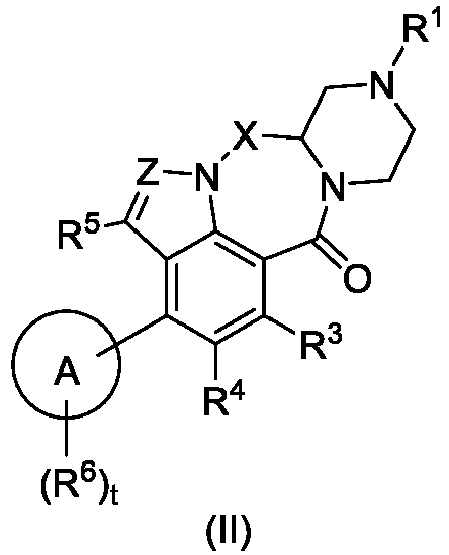
ring A, X, Z, R1, R3, R4, R5, R6, and t are as defined in general formula (I). - In some embodiments of the present disclosure, in the compound represented by general formula (IM), general formula (I), or general formula (II) or the pharmaceutically acceptable salt thereof, ring A is 6- to 10-membered aryl or 5- to 10-membered heteroaryl; preferably, ring A is 5- to 10-membered heteroaryl; more preferably, ring A is 8- to 10-membered bicyclic heteroaryl containing in the ring 1, 2, or 3 heteroatoms selected from the group consisting of nitrogen, oxygen, and sulfur; most preferably, ring A is benzothienyl or benzothiazolyl.
- In some embodiments of the present disclosure, in the compound represented by general formula (IM), general formula (I), or general formula (II) or the pharmaceutically acceptable salt thereof,


- In some embodiments of the present disclosure, in the compound represented by general formula (IM), general formula (I), or general formula (II) or the pharmaceutically acceptable salt thereof, R1 is


- In some embodiments of the present disclosure, in the compound represented by general formula (IM), general formula (I), or general formula (II) or the pharmaceutically acceptable salt thereof, X is C(RaRb)-C(RcRd), wherein Ra, Rb, Rc, and Rd are as defined in general formula (I).
- In some embodiments of the present disclosure, in the compound represented by general formula (IM), general formula (I), or general formula (II) or the pharmaceutically acceptable salt thereof, Ra, Rb, Rc, and Rd are identical or different and are each independently selected from the group consisting of a hydrogen atom, halogen, C1-6 alkyl, and C1-6 haloalkyl; preferably, Ra, Rb, Rc, and Rd are all hydrogen atoms.
- In some embodiments of the present disclosure, in the compound represented by general formula (IM), general formula (I), or general formula (II) or the pharmaceutically acceptable salt thereof, X is CH2 or CH2-CH2; preferably, X is CH2-CH2.
- In some embodiments of the present disclosure, the compound represented by general formula (IM), general formula (I), or general formula (II) or the pharmaceutically acceptable salt thereof is a compound represented by general formula (III) or a pharmaceutically acceptable salt thereof: wherein:
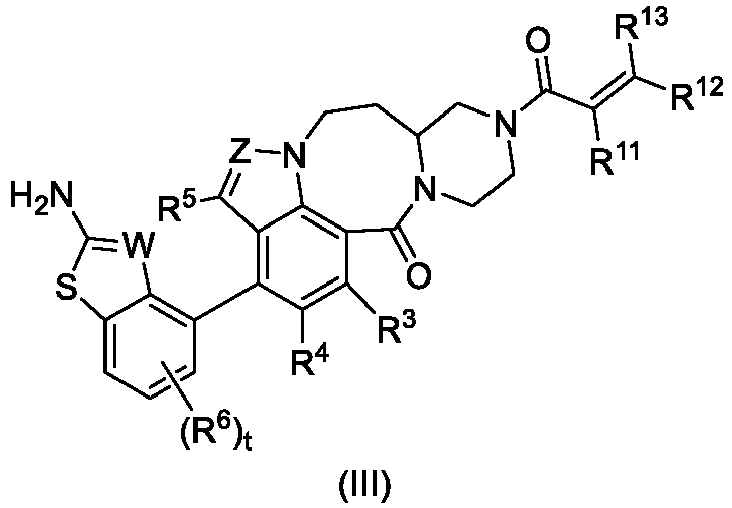
- W is C(CN) or N;
- t is 0, 1, 2, or 3;
- Z, R3, R4, R5, R6, R11, R12, and R13 are as defined in general formula (I).
- In some embodiments of the present disclosure, the compound represented by general formula (IM), general formula (I), general formula (II), or general formula (III) or the pharmaceutically acceptable salt thereof is a compound represented by general formula (III-1) or a pharmaceutically acceptable salt thereof: wherein:

- W is C(CN) or N;
- t is 0, 1, 2, or 3;
- Z, R3, R4, R5, R6, R11, R12, and R13 are as defined in general formula (I).
- In some embodiments of the present disclosure, the compound represented by general formula (IM), general formula (I), general formula (II), or general formula (III) or the pharmaceutically acceptable salt thereof is a compound represented by general formula (III-2) or a pharmaceutically acceptable salt thereof: wherein:

- W is C(CN) or N;
- t is 0, 1, 2, or 3;
- Z, R3, R4, R5, R6, R11, R12, and R13 are as defined in general formula (I).
- In some embodiments of the present disclosure, the compound represented by general formula (IM), general formula (I), general formula (II), general formula (III), or general formula (III-1) or the pharmaceutically acceptable salt thereof is a compound represented by general formula (III-1-A) or a pharmaceutically acceptable salt thereof: wherein:

- W is C(CN) or N;
- t is 0, 1, 2, or 3;
- Z, R3, R4, R5, R6, R11, R12, and R13 are as defined in general formula (I).
- In some embodiments of the present disclosure, the compound represented by general formula (IM), general formula (I), general formula (II), general formula (III), or general formula (III-1) or the pharmaceutically acceptable salt thereof is a compound represented by general formula (III-I-B) or a pharmaceutically acceptable salt thereof: wherein:

- W is C(CN) or N;
- t is 0, 1, 2, or 3;
- Z, R3, R4, R5, R6, R11, R12, and R13 are as defined in general formula (I).
- In some embodiments of the present disclosure, the compound represented by general formula (IM), general formula (I), general formula (II), general formula (III), or general formula (III-2) or the pharmaceutically acceptable salt thereof is a compound represented by general formula (III-2-A) or a pharmaceutically acceptable salt thereof:

- W is C(CN) or N;
- t is 0, 1, 2, or 3;
- Z, R3, R4, R5, R6, R11, R12, and R13 are as defined in general formula (I).
- In some embodiments of the present disclosure, the compound represented by general formula (IM), general formula (I), general formula (II), general formula (III), or general formula (III-2) or the pharmaceutically acceptable salt thereof is a compound represented by general formula (III-2-B) or a pharmaceutically acceptable salt thereof:

- W is C(CN) or N;
- t is 0, 1, 2, or 3;
- Z, R3, R4, R5, R6, R11, R12, and R13 are as defined in general formula (I).
- In some embodiments of the present disclosure, in the compound represented by general formula (III), general formula (III-1), general formula (III-2), general formula (III-1-A), general formula (III-1-B), general formula (III-2-A), or general formula (III-2-B) or the pharmaceutically acceptable salt thereof, W is C(CN).
- In some embodiments of the present disclosure, in the compound represented by general formula (IM), general formula (I), general formula (II), general formula (III), general formula (III-1), general formula (III-2), general formula (III-1-A),general formula (III-1-B), general formula (III-2-A), or general formula (III-2-B) or the pharmaceutically acceptable salt thereof, R3, R4, R5, and R5a are identical or different and are each independently selected from the group consisting of a hydrogen atom, halogen, C1-6 alkyl, and C1-6 haloalkyl.
- In some embodiments of the present disclosure, in the compound represented by general formula (IM), general formula (I), general formula (II), general formula (III), general formula (III-1), general formula (III-2), general formula (III-1-A),general formula (III-1-B), general formula (III-2-A), or general formula (III-2-B) or the pharmaceutically acceptable salt thereof, R3 is selected from the group consisting of a hydrogen atom, halogen, C1-6 alkyl, and C1-6 haloalkyl; preferably, R3 is a hydrogen atom or halogen; more preferably, R3 is a hydrogen atom or F; most preferably, R3 is a hydrogen atom.
- In some embodiments of the present disclosure, in the compound represented by general formula (IM), general formula (I), general formula (II), general formula (III), general formula (III-1), general formula (III-2), general formula (III-1-A),general formula (III-1-B), general formula (III-2-A), or general formula (III-2-B) or the pharmaceutically acceptable salt thereof, R4 is selected from the group consisting of a hydrogen atom, halogen, C1-6 alkyl, and C1-6 haloalkyl; preferably, R4 is halogen; more preferably, R4 is F.
- In some embodiments of the present disclosure, in the compound represented by general formula (IM), general formula (I), general formula (II), general formula (III), general formula (III-1), general formula (III-2), general formula (III-1-A),general formula (III-1-B), general formula (III-2-A), or general formula (III-2-B) or the pharmaceutically acceptable salt thereof, R5 is selected from the group consisting of a hydrogen atom, halogen, C1-6 alkyl, and C1-6 haloalkyl; preferably, R5 is selected from the group consisting of a hydrogen atom, halogen, and C1-6 alkyl; more preferably, R5 is halogen or C1-6 alkyl; most preferably, R5 is Cl or methyl.
- In some embodiments of the present disclosure, in the compound represented by general formula (IM), general formula (I), general formula (II), general formula (III), general formula (III-1), general formula (III-2), general formula (III-1-A),general formula (III-1-B), general formula (III-2-A), or general formula (III-2-B) or the pharmaceutically acceptable salt thereof, R5 is selected from the group consisting of a hydrogen atom, F, Cl, and methyl.
- In some embodiments of the present disclosure, in the compound represented by general formula (IM), general formula (I), general formula (II), general formula (III), general formula (III-1), general formula (III-2), general formula (III-1-A),general formula (III-1-B), general formula (III-2-A), or general formula (III-2-B) or the pharmaceutically acceptable salt thereof, R5a is selected from the group consisting of a hydrogen atom, halogen, C1-6 alkyl, and C1-6 haloalkyl; preferably, R5a is a hydrogen atom or C1-6 alkyl; more preferably, R5a is a hydrogen atom or methyl.
- In some embodiments of the present disclosure, in the compound represented by general formula (IM), general formula (I), general formula (II), general formula (III), general formula (III-1), general formula (III-2), general formula (III-1-A),general formula (III-1-B), general formula (III-2-A), or general formula (III-2-B) or the pharmaceutically acceptable salt thereof, Z is CR5a or N, and R5a is selected from the group consisting of a hydrogen atom, halogen, C1-6 alkyl, and C1-6 haloalkyl; preferably, Z is CR5a or N, and R5a is a hydrogen atom or C1-6 alkyl; more preferably, Z is N.
- In some embodiments of the present disclosure, in the compound represented by general formula (IM), general formula (I), or general formula (II) or the pharmaceutically acceptable salt thereof, each R6 is identical or different and is independently selected from the group consisting of a hydrogen atom, halogen, cyano, -NH2, C1-6 alkyl, and C1-6 haloalkyl; preferably, each R6 is identical or different and is independently selected from the group consisting of a hydrogen atom, halogen, cyano, and -NH2.
- In some embodiments of the present disclosure, in the compound represented by general formula (IM), general formula (III), general formula (III-1), general formula (III-2), general formula (III-1-A),general formula (III-1-B), general formula (III-2-A), or general formula (III-2-B) or the pharmaceutically acceptable salt thereof, each R6 is identical or different and is independently selected from the group consisting of a hydrogen atom, halogen, cyano, -NH2, C1-6 alkyl, and C1-6 haloalkyl; preferably, each R6 is identical or different and is independently a hydrogen atom or halogen; more preferably, each R6 is identical or different and is independently a hydrogen atom or F. In some embodiments of the present disclosure, in the compound represented by general formula (IM), general formula (I), general formula (II), general formula (III), general formula (III-1), general formula (III-2), general formula (III-1-A),general formula (III-1-B), general formula (III-2-A), or general formula (III-2-B) or the pharmaceutically acceptable salt thereof, R11 is selected from the group consisting of a hydrogen atom, halogen, and C1-6 alkyl; preferably, R11 is a hydrogen atom or halogen; more preferably, R11 is a hydrogen atom or F.
- In some embodiments of the present disclosure, in the compound represented by general formula (IM), general formula (I), general formula (II), general formula (III), general formula (III-1), general formula (III-2), general formula (III-1-A),general formula (III-1-B), general formula (III-2-A), or general formula (III-2-B) or the pharmaceutically acceptable salt thereof, R12 is selected from the group consisting of a hydrogen atom, halogen, and C1-6 alkyl; preferably, R12 is a hydrogen atom.
- In some embodiments of the present disclosure, in the compound represented by general formula (IM), general formula (I), general formula (II), general formula (III), general formula (III-1), general formula (III-2), general formula (III-1-A),general formula (III-1-B), general formula (III-2-A), or general formula (III-2-B) or the pharmaceutically acceptable salt thereof, R13 is selected from the group consisting of a hydrogen atom, halogen, and C1-6 alkyl; preferably, R13 is a hydrogen atom.
- In some embodiments of the present disclosure, in the compound represented by general formula (I), general formula (II), general formula (III), general formula (III-1), general formula (III-2), general formula (III-1-A),general formula (III-1-B), general formula (III-2-A), or general formula (III-2-B) or the pharmaceutically acceptable salt thereof, R14 is selected from the group consisting of a hydrogen atom, halogen, and C1-6 alkyl; preferably, R14 is a hydrogen atom.
- In some embodiments of the present disclosure, in the compound represented by general formula (IM), general formula (I), or general formula (II) or the pharmaceutically acceptable salt thereof, t is 0, 1, 2, or 3.
- In some embodiments of the present disclosure, in the compound represented by general formula (IM), general formula (I), or general formula (II) or the pharmaceutically acceptable salt thereof, each R6 is identical or different and is independently selected from the group consisting of halogen, cyano, -NH2, C1-6 alkyl, and C1-6 haloalkyl, and t is 0, 1, 2, or 3.
- In some embodiments of the present disclosure, in the compound represented by general formula (III), general formula (III-1), general formula (III-2), general formula (III-1-A), general formula (III-1-B), general formula (III-2-A), or general formula (III-2-B) or the pharmaceutically acceptable salt thereof, t is 0 or 1.
- In some embodiments of the present disclosure, in the compound represented by general formula (III), general formula (III-1), general formula (III-2), general formula (III-1-A), general formula (III-1-B), general formula (III-2-A), or general formula (III-2-B) or the pharmaceutically acceptable salt thereof, R6 is halogen, and t is 0 or 1.
- In some embodiments of the present disclosure, in the compound represented by general formula (III), general formula (III-1), general formula (III-2), general formula (III-1-A), general formula (III-1-B), general formula (III-2-A), or general formula (III-2-B) or the pharmaceutically acceptable salt thereof, R6 is F, and t is 0 or 1.
- In some embodiments of the present disclosure, in the compound represented by general formula (IM) or the pharmaceutically acceptable salt thereof, V is CR5 or N; X is C(RaRb) or C(RaRb)-C(RcRd); Ra, Rb, Rc, and Rd are identical or different and are each independently selected from the group consisting of a hydrogen atom, halogen, C1-6 alkyl, and C1-6 haloalkyl; Y is C(O); Z is CR5a or N; ring A is 5- to 10-membered heteroaryl; R1 is

- In some embodiments of the present disclosure, in the compound represented by general formula (IM) or the pharmaceutically acceptable salt thereof, V is CR5 or N; X is CH2 or CH2-CH2; Y is C(O); Z is CR5a or N; R5a is a hydrogen atom or C1-6 alkyl; R1 is

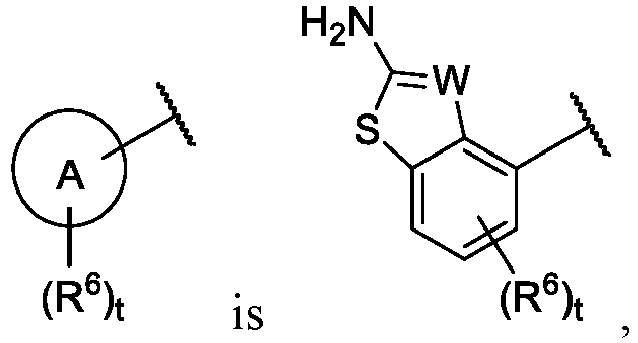
- In some embodiments of the present disclosure, in the compound represented by general formula (I) or the pharmaceutically acceptable salt thereof, X is C(RaRb) or C(RaRb)-C(RcRd); Ra, Rb, Rc, and Rd are identical or different and are each independently selected from the group consisting of a hydrogen atom, halogen, C1-6 alkyl, and C1-6 haloalkyl; Y is C(O); Z is CR5a or N; ring A is 5- to 10-membered heteroaryl; R1 is

- In some embodiments of the present disclosure, in the compound represented by general formula (I) or the pharmaceutically acceptable salt thereof, X is C(RaRb) or C(RaRb)-C(RcRd); Ra, Rb, Rc, and Rd are identical or different and are each independently selected from the group consisting of a hydrogen atom, halogen, C1-6 alkyl, and C1-6 haloalkyl; Y is C(O); Z is CR5a or N; ring A is 5- to 10-membered heteroaryl; R1 is

- In some embodiments of the present disclosure, in the compound represented by general formula (II) or the pharmaceutically acceptable salt thereof, ring A is 8- to 10-membered bicyclic heteroaryl containing in the ring 1, 2, or 3 heteroatoms selected from the group consisting of nitrogen, oxygen, and sulfur; X is CH2 or CH2-CH2; Z is CR5a or N; R1 is

- In some embodiments of the present disclosure, in the compound represented by general formula (III), general formula (III-1), general formula (III-2), general formula (III-1-A), general formula (III-1-B), general formula (III-2-A), or general formula (III-2-B) or the pharmaceutically acceptable salt thereof, W is C(CN) or N; Z is CR5a or N; R3, R4, R5, and R5a are identical or different and are each independently selected from the group consisting of a hydrogen atom, halogen, C1-6 alkyl, and C1-6 haloalkyl; R11 is a hydrogen atom or halogen; R12 is a hydrogen atom; R13 is a hydrogen atom; R6 is halogen, and t is 0 or 1.
- In some embodiments of the present disclosure, in the compound represented by general formula (III), general formula (III-1), general formula (III-2), general formula (III-1-A), general formula (III-1-B), general formula (III-2-A), or general formula (III-2-B) or the pharmaceutically acceptable salt thereof, W is C(CN) or N; Z is CR5a or N, and R5a is a hydrogen atom or C1-6 alkyl; R3 is a hydrogen atom or halogen; R4 is halogen; R5 is selected from the group consisting of a hydrogen atom, halogen, and C1-6 alkyl; R11 is a hydrogen atom or halogen; R12 is a hydrogen atom; R13 is a hydrogen atom; R6 is halogen, and t is 0 or 1.
- In some embodiments of the present disclosure, in the compound represented by general formula (III), general formula (III-1), general formula (III-2), general formula (III-1-A), general formula (III-1-B), general formula (III-2-A), or general formula (III-2-B) or the pharmaceutically acceptable salt thereof, W is C(CN); Z is N; R3 is a hydrogen atom; R4 is halogen; R5 is selected from the group consisting of a hydrogen atom, halogen, and C1-6 alkyl; R11 is a hydrogen atom or halogen; R12 is a hydrogen atom; R13 is a hydrogen atom; R6 is halogen, and t is 0 or 1.
Table A. Typical compounds of the present disclosure include, but are not limited to: Example No. Compound structure Name 
4-(10-Acryloyl-2-fluoro-14-oxo-8,8a,9,10,11,12-h exahydro-7H,14H-pyrazino[1',2':5,6][1,5]diazocin o[3,2,1-hi]indazol-3-yl)-2-amino-7-fluorobenzo[b ]thiophene-3-carbonitrile 1 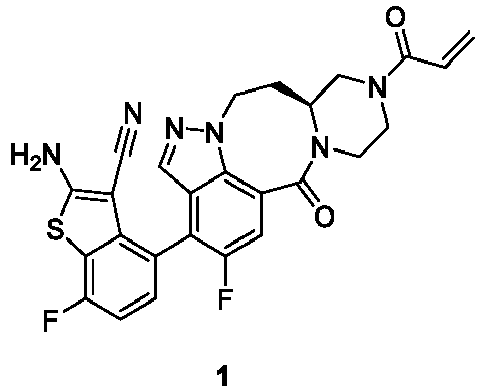
4-((S)-10-Acryloyl-2-fluoro-14-oxo-8,8a,9,10,11, 12-hexahydro-7H,14H-pyrazino[1',2':5,6][1,5]dia zocino[3,2,1-hi]indazol-3-yl)-2-amino-7-fluorobe nzo[b]thiophene-3-carbonitrile 1 1-P1 
(R)-4-((S)-10-Acryloyl-2-fluoro-14-oxo-8,8a,9,10, 11,12-hexahydro-7H,14H-pyrazino[1',2':5,6][1,5] diazocino[3,2,1-hi]indazol-3-yl)-2-amino-7-fluoro benzo[b]thiophene-3-carbonitrile 1-P1 1-P2 
(S)-4-((S)-10-Acryloyl-2-fluoro-14-oxo-8,8a,9,10, 11,12-hexahydro-7H,14H-pyrazino[1',2':5,6][1,5] diazocino[3,2,1-hi]indazol-3-yl)-2-amino-7-fluoro benzo[b]thiophene-3-carbonitrile 1-P2 12 
4-((R)-10-Acryloyl-2-fluoro-14-oxo-8,8a,9,10,11, 12-hexahydro-7H,14H-pyrazino[1',2':5,6][1,5]dia zocino[3,2,1-hi]indazol-3-yl)-2-amino-7-fluorobe nzo[b]thiophene-3-carbonitrile 12 12-P1 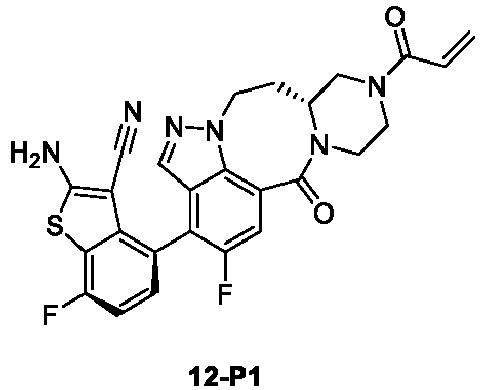
(R)-4-((R)-10-Acryloyl-2-fluoro-14-oxo-8,8a,9,10 ,11,12-hexahydro-7H,14H-pyrazino[1',2':5,6][1,5] diazocino[3,2,1-hi]indazol-3-yl)-2-amino-7-fluoro benzo[b]thiophene-3-carbonitrile 12-P1 12-P2 
(S)-4-((R)-10-Acryloyl-2-fluoro-14-oxo-8,8a,9,10, 11,12-hexahydro-7H,14H-pyrazino[1',2':5,6][1,5] diazocino[3,2,1-hi]indazol-3-yl)-2-amino-7-fluoro benzo[b]thiophene-3-carbonitrile 12-P2 
4-(10-Acryloyl-2-fluoro-14-oxo-8,8a,9,10,11,12-h exahydro-7H,14H-pyrazino[1',2':5,6][1,5]diazocin o[3,2,1-hi]indol-3-yl)-2-amino-7-fluorobenzo[b]th iophene-3-carbonitrile 2 
4-((S)-10-Acryloyl-2-fluoro-14-oxo-8,8a,9,10,11, 12-hexahydro-7H,14H-pyrazino[1',2':5,6][1,5]dia zocino[3,2,1-hi]indol-3-yl)-2-amino-7-fluorobenz o[b]thiophene-3-carbonitrile 2 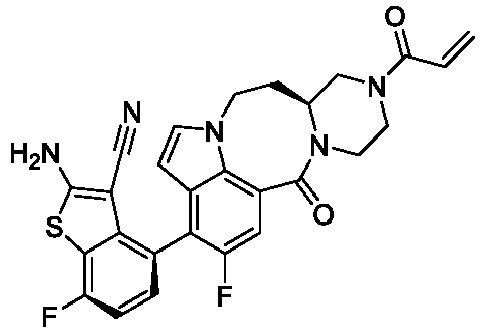
(R)-4-((S)-10-Acryloyl-2-fluoro-14-oxo-8,8a,9,10, 11,12-hexahydro-7H,14H-pyrazino[1',2':5,6][1,5] diazocino[3,2,1-hi]indol-3-yl)-2-amino-7-fluorobe nzo[b]thiophene-3-carbonitrile 
(S)-4-((S)-10-Acryloyl-2-fluoro-14-oxo-8,8a,9,10, 11,12-hexahydro-7H,14H-pyrazino[1',2':5,6][1,5] diazocino[3,2,1-hi]indol-3-yl)-2-amino-7-fluorobe nzo[b]thiophene-3-carbonitrile 
4-((R)-10-Acryloyl-2-fluoro-14-oxo-8,8a,9,10,11, 12-hexahydro-7H,14H-pyrazino[1',2':5,6][1,5]dia zocino[3,2,1-hi]indol-3-yl)-2-amino-7-fluorobenz o[b]thiophene-3-carbonitrile 
(R)-4-((R)-10-Acryloyl-2-fluoro-14-oxo-8,8a,9,10 ,11,12-hexahydro-7H,14H-pyrazino[1',2':5,6][1,5] diazocino[3,2,1-hi]indol-3-yl)-2-amino-7-fluorobe nzo[b]thiophene-3-carbonitrile 
(S)-4-((R)-10-Acryloyl-2-fluoro-14-oxo-8,8a,9,10, 11,12-hexahydro-7H,14H-pyrazino[1',2':5,6][1,5] diazocino[3,2,1-hi]indol-3-yl)-2-amino-7-fluorobe nzo[b]thiophene-3-carbonitrile 
10-Acryloyl-3-(2-amino-7-fluorobenzo[d]thiazol-4-yl)-2-fluoro-8,8a,9,10,11,12-hexahydro-7H,14H -pyrazino[1',2':5,6][1,5]diazocino[3,2,1-hi]indol-1 4-one 3 
(8aS)-10-Acryloyl-3-(-2-amino-7-fluorobenzo[d]t hiazol-4-yl)-2-fluoro-8,8a,9,10,11,12-hexahydro-7 H,14H-pyrazino[1',2':5,6][1,5]diazocino[3,2,1-hi]i ndol-14-one 3 
(S)-10-Acryloyl-3-((R)-2-amino-7-fluorobenzo[d]t hiazol-4-yl)-2-fluoro-8,8a,9,10,11,12-hexahydro-7 H,14H-pyrazino[1',2':5,6][1,5]diazocino[3,2,1-hi]i ndol-14-one 
(S)-10-Acryloyl-3-((S)-2-amino-7-fluorobenzo[d]t hiazol-4-yl)-2-fluoro-8,8a,9,10,11,12-hexahydro-7 H,14H-pyrazino[1',2':5,6][1,5]diazocino[3,2,1-hi]i ndol-14-one 
(8aR)-10-Acryloyl-3-(-2-amino-7-fluorobenzo[d]t hiazol-4-yl)-2-fluoro-8,8a,9,10,11,12-hexahydro-7 H,14H-pyrazino[1',2':5,6][1,5]diazocino[3,2,1-hi]i ndol-14-one 
(A)-10-Acryloyl-3-((A)-2-amino-7-fluorobenzo[d] thiazol-4-yl)-2-fluoro-8,8a,9,10,11,12-hexahydro-7H,14H-pyrazino[1',2':5,6][1,5]diazocino[3,2,1-hi ]indol-14-one 
(R)-10-Acryloyl-3-((S)-2-amino-7-fluorobenzo[d]t hiazol-4-yl)-2-fluoro-8,8a,9,10,11,12-hexahydro-7 H,14H-pyrazino[1',2':5,6][1,5]diazocino[3,2,1-hi]i ndol-14-one 
4-(10-Acryloyl-2-fluoro-5-methyl-14-oxo-8,8a,9, 10,11,12-hexahydro-7H,14H-pyrazino[1',2':5,6][1, 5]diazocino[3,2,1-hi]indol-3-yl)-2-amino-7-fluoro benzo[b]thiophene-3-carbonitrile 4 
4-((S)-10-Acryloyl-2-fluoro-5-methyl-14-oxo-8,8 a,9,10,11,12-hexahydro-7H,14H-pyrazino[1',2':5, 6][1,5]diazocino[3,2,1-hi]indol-3-yl)-2-amino-7-fl uorobenzo[b]thiophene-3-carbonitrile 4 
(R)-4-((S)-10-Acryloyl-2-fluoro-5-methyl-14-oxo-8,8a,9,10,11,12-hexahydro-7H,14H-pyrazino[1',2' :5,6][1,5]diazocino[3,2,1-hi]indol-3-yl)-2-amino-7 -fluorobenzo[b]thiophene-3-carbonitrile 
(S)-4-((S)-10-Acryloyl-2-fluoro-5-methyl-14-oxo-8,8a,9,10,11,12-hexahydro-7H,14H-pyrazino[1',2' :5,6][1,5]diazocino[3,2,1-hi]indol-3-yl)-2-amino-7 -fluorobenzo[b]thiophene-3-carbonitrile 
4-((R)-10-Acryloyl-2-fluoro-5-methyl-14-oxo-8, 8 a,9,10,11,12-hexahydro-7H,14H-pyrazino[1',2':5, 6][1,5]diazocino[3,2,1-hi]indol-3-yl)-2-amino-7-fl uorobenzo[b]thiophene-3-carbonitrile 
(R)-4-((R)-10-Acryloyl-2-fluoro-5-methyl-14-oxo -8,8a,9,10,11,12-hexahydro-7H,14H-pyrazino[1',2 ':5,6][1,5]diazocino[3,2,1-hi]indol-3-yl)-2-amino-7-fluorobenzo[b]thiophene-3-carbonitrile 
(S)-4-((R)-10-Acryloyl-2-fluoro-5-methyl-14-oxo-8,8a,9,10,11,12-hexahydro-7H,14H-pyrazino[1',2' :5,6][1,5]diazocino[3,2,1-hi]indol-3-yl)-2-amino-7 -fluorobenzo[b]thiophene-3-carbonitrile 
2-Amino-7-fluoro-4-(2-fluoro-10-(2-fluoroacryloy 1)-14-oxo-8,8a,9,10,11,12-hexahydro-7H,14H-pyr azino[1',2':5,6][1,5]diazocino[3,2,1-hi]indol-3-yl) benzo[b]thiophene-3-carbonitrile 5 
2-Amino-7-fluoro-4-((S)-2-fluoro-10-(2-fluoroacr yloyl)-14-oxo-8,8a,9,10,11,12-hexahydro-7H,14H -pyrazino[1',2':5,6][1,5]diazocino[3,2,1-hi]indol-3 -yl)benzo[b]thiophene-3-carbonitrile 5 
(R)-2-Amino-7-fluoro-4-((S)-2-fluoro-10-(2-fluor oacryloyl)-14-oxo-8,8a,9,10,11,12-hexahydro-7H, 14H-pyrazino[1',2':5,6][1,5]diazocino[3,2,1-hi]ind ol-3-yl)benzo[b]thiophene-3-carbonitrile 
(S)-2-Amino-7-fluoro-4-((S)-2-fluoro-10-(2-fluoro acryloyl)-14-oxo-8,8a,9,10,11,12-hexahydro-7H,1 4H-pyrazino[1',2':5,6][1,5]diazocino[3,2,1-hi]indo 1-3-yl)benzo[b]thiophene-3-carbonitrile 
2-Amino-7-fluoro-4-((R)-2-fluoro-10-(2-fluoroacr yloyl)-14-oxo-8,8a,9,10,11,12-hexahydro-7H,14H -pyrazino[1',2':5,6][1,5]diazocino[3,2,1-hi]indol-3 -yl)benzo[b]thiophene-3-carbonitrile 
(R)-2-Amino-7-fluoro-4-((R)-2-fluoro-10-(2-fluor oacryloyl)-14-oxo-8,8a,9,10,11,12-hexahydro-7H, 14H-pyrazino[1',2':5,6][1,5]diazocino[3,2,1-hi]ind ol-3-yl)benzo[b]thiophene-3-carbonitrile 
(S)-2-Amino-7-fluoro-4-((R)-2-fluoro-10-(2-fluor oacryloyl)-14-oxo-8,8a,9,10,11,12-hexahydro-7H, 14H-pyrazino[1',2':5,6][1,5]diazocino[3,2,1-hi]ind ol-3-yl)benzo[b]thiophene-3-carbonitrile 
2-Amino-7-fluoro-4-(2-fluoro-10-(2-fluoroacryloy 1)-14-oxo-8,8a,9,10,11,12-hexahydro-7H,14H-pyr azinof[1',2':5,6][1,5]diazocino[3,2,1-hi]indazol-3-y 1)benzo[b]thiophene-3-carbonitrile 6 
2-Amino-7-fluoro-4-((S)-2-fluoro-10-(2-fluoroacr yloyl)-14-oxo-8,8a,9,10,11,12-hexahydro-7H,14H -pyrazino[1',2':5,6][1,5]diazocino[3,2,1-hi]indazol -3-yl)benzo[b]thiophene-3-carbonitrile 6 6-P1 
(R)-2-Amino-7-fluoro-4-((S)-2-fluoro-10-(2-fluor oacryloyl)-14-oxo-8,8a,9,10,11,12-hexahydro-7H, 14H-pyrazino[1',2':5,6][1,5]diazocino[3,2,1-hi]ind azol-3-yl)benzo[b]thiophene-3-carbonitrile 6-P1 6-P2 
(S)-2-Amino-7-fluoro-4-((S)-2-fluoro-10-(2-fluoro acryloyl)-14-oxo-8,8a,9,10,11,12-hexahydro-7H,1 4H-pyrazino[1',2':5,6][1,5]diazocino[3,2,1-hi]inda zol-3-yl)benzo[b]thiophene-3-carbonitrile 6-P2 
2-Amino-7-fluoro-4-((R)-2-fluoro-10-(2-fluoroacr yloyl)-14-oxo-8,8a,9,10,11,12-hexahydro-7H,14H -pyrazino[1',2':5,6][1,5]diazocino[3,2,1-hi]indazol -3-yl)benzo[b]thiophene-3-carbonitrile 
(R)-2-Amino-7-fluoro-4-((R)-2-fluoro-10-(2-fluor oacryloyl)-14-oxo-8,8a,9,10,11,12-hexahydro-7H, 14H-pyrazino[1',2':5,6][1,5]diazocino[3,2,1-hi]ind azol-3-yl)benzo[b]thiophene-3-carbonitrile 
(S)-2-Amino-7-fluoro-4-((R)-2-fluoro-10-(2-fluor oacryloyl)-14-oxo-8,8a,9,10,11,12-hexahydro-7H, 14H-pyrazino[1',2':5,6][1,5]diazocino[3,2,1-hi]ind azol-3-yl)benzo[b]thiophene-3-carbonitrile 
4-(10-Acryloyl-4-fluoro-6-oxo-8,9,10,11,11a,12-h exahydro-6H-pyrazino[2',1':3,4][1,4]diazepino[6, 7,1-hi]indazol-3-yl)-2-amino-7-fluorobenzo[b]thi ophene-3-carbonitrile 14 
4-((R)-10-Acryloyl-4-fluoro-6-oxo-8,9,10,11,11a, 12-hexahydro-6H-pyrazino[2',1':3,4][1,4]diazepin o[6,7,1-hi]indazol-3-yl)-2-amino-7-fluorobenzo[b ]thiophene-3-carbonitrile 14 
4-((3R,11aR)-10-Acryloyl-4-fluoro-6-oxo-8,9,10,1 1,11a,12-hexahydro-6H-pyrazino[2',1':3,4][1,4]di azepino[6,7,1-hi]indazol-3-yl)-2-amino-7-fluorob enzo[b]thiophene-3-carbonitrile 
4-((3S,11aR)-10-Acryloyl-4-fluoro-6-oxo-8,9,10,1 1,11a,12-hexahydro-6H-pyrazino[2',1':3,4][1,4]di azepino[6,7,1-hi]indazol-3-yl)-2-amino-7-fluorob enzo[b]thiophene-3-carbonitrile 
4-((11aS)-10-Acryloyl-4-fluoro-6-oxo-8,9,10,11,1 1a,12-hexahydro-6H-pyrazino[2',1':3,4][1,4]diaze pino[6,7,1-hi]indazol-3-yl)-2-amino-7-fluorobenz o[b]thiophene-3-carbonitrile 
4-((3R,11aS)-10-Acryloyl-4-fluoro-6-oxo-8,9,10,1 1,11a,12-hexahydro-6H-pyrazino[2',1':3,4][1,4]di azepino[6,7,1-hi]indazol-3-yl)-2-amino-7-fluorob enzo[b]thiophene-3-carbonitrile 
4-((3S,11aS)-10-Acryloyl-4-fluoro-6-oxo-8,9,10,1 1,11a,12-hexahydro-6H-pyrazino[2',1':3,4][1,4]di azepino[6,7,1-hi]indazol-3-yl)-2-amino-7-fluorob enzo[b]thiophene-3-carbonitrile 
4-(10-Acryloyl-4-chloro-2-fluoro-14-oxo-8,8a,9,1 0,11,12-hexahydro-7H,14H-pyrazino[1',2':5][1,5] diazocino[3,2,1-hi]indazol-3-yl)-2-amino-7-fluoro benzo[b]thiophene-3-carbonitrile 7 
4-((S)-10-Acryloyl-4-chloro-2-fluoro-14-oxo-8,8a ,9,10,11,12-hexahydro-7H,14H-pyrazino[1',2':5][1 ,5]diazocino[3,2,1-hi]indazol-3-yl)-2-amino-7-flu orobenzo[b]thiophene-3-carbonitrile 7 7-P1 
(R)-4-((S)-10-Acryloyl-4-chloro-2-fluoro-14-oxo-8,8a,9,10,11,12-hexahydro-7H,14H-pyrazino[1',2' :5,6][1,5]diazocino[3,2,1-hi]indazol-3-yl)-2-amin o-7-fluorobenzo[b]thiophene-3-carbonitrile 7-P1 7-P2 
(S)-4-((S)-10-Acryloyl-4-chloro-2-fluoro-14-oxo-8,8a,9,10,11,12-hexahydro-7H,14H-pyrazino[1',2' :5,6][1,5]diazocino[3,2,1-hi]indazol-3-yl)-2-amin o-7-fluorobenzo[b]thiophene-3-carbonitrile 7-P2 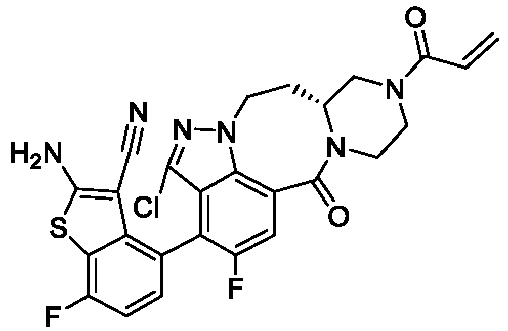
4-((R)-10-Acryloyl-4-chloro-2-fluoro-14-oxo-8,8a ,9,10,11,12-hexahydro-7H,14H-pyrazino[1',2':5][1 ,5]diazocino[3,2,1-hi]indazol-3-yl)-2-amino-7-flu orobenzo[b]thiophene-3-carbonitrile 
(R)-4-((R)-10-Acryloyl-4-chloro-2-fluoro-14-oxo-8,8a,9,10,11,12-hexahydro-7H,14H-pyrazino[1',2' :5,6][1,5]diazocino[3,2,1-hi]indazol-3-yl)-2-amin o-7-fluorobenzo[b]thiophene-3-carbonitrile 
(S)-4-((R)-10-Acryloyl-4-chloro-2-fluoro-14-oxo-8,8a,9,10,11,12-hexahydro-7H,14H-pyrazino[1',2' :5,6][1,5]diazocino[3,2,1-hi]indazol-3-yl)-2-amin o-7-fluorobenzo[b]thiophene-3-carbonitrile 
4-(10-Acryloyl-2,4-difluoro-14-oxo-8,8a,9,10,11, 12-hexahydro-7H,14H-pyrazino[1',2':5.6][1,5]dia zocino[3,2,1-hi]indazol-3-yl)-2-amino-7-fluorobe nzo[b]thiophene-3-carbonitrile 8 
4-((S)-10-Acryloyl-2,4-difluoro-14-oxo-8,8a,9,10, 11,12-hexahydro-7H,14H-pyrazino[1',2':5.6][1,5] diazocino[3,2,1-hi]indazol-3-yl)-2-amino-7-fluoro benzo[b]thiophene-3-carbonitrile 8 8-P1 
(R)-4-((S)-10-Acryloyl-2,4-difluoro-14-oxo-8,8a, 9,10,11,12-hexahydro-7H,14H-pyrazino[1',2':5][1, 5]diazocino[3,2,1-hi]indazol-3-yl)-2-amino-7-fluo robenzo[b]thiophene-3-carbonitrile 8-P1 8-P2 
(S)-4-((S)-10-Acryloyl-2,4-difluoro-14-oxo-8,8a,9 ,10,11,12-hexahydro-7H,14H-pyrazino[1',2':5][1,5 ]diazocino[3,2,1-hi]indazol-3-yl)-2-amino-7-fluor obenzo[b]thiophene-3-carbonitrile 8-P2 
4-((R)-10-Acryloyl-2,4-difluoro-14-oxo-8,8a,9,10 ,11,12-hexahydro-7H,14H-pyrazino[1',2':5.6][1,5] diazocino[3,2,1-hi]indazol-3-yl)-2-amino-7-fluoro benzo[b]thiophene-3-carbonitrile 
(R)-4-((R)-10-Acryloyl-2,4-difluoro-14-oxo-8,8a, 9,10,11,12-hexahydro-7H,14H-pyrazino[1',2':5][1, 5]diazocino[3,2,1-hi]indazol-3-yl)-2-amino-7-fluo robenzo[b]thiophene-3-carbonitrile 
(S)-4-((R)-10-Acryloyl-2,4-difluoro-14-oxo-8,8a, 9,10,11,12-hexahydro-7H,14H-pyrazino[1',2':5][1, 5]diazocino[3,2,1-hi]indazol-3-yl)-2-amino-7-fluo robenzo[b]thiophene-3-carbonitrile 
4-(10-Acryloyl-2-fluoro-4-methyl-14-oxo-8,8a,9, 10,11,12-hexahydro-7H,14H-pyrazino[1',2':5,6][1, 5]diazocino[3,2,1-hi]indazol-3-yl)-2-amino-7-fluo robenzo[b]thiophene-3-carbonitrile 9 
4-((S)-10-Acryloyl-2-fluoro-4-methyl-14-oxo-8,8 a,9,10,11,12-hexahydro-7H,14H-pyrazino[1',2':5, 6][1,5]diazocino[3,2,1-hi]indazol-3-yl)-2-amino-7 -fluorobenzo[b]thiophene-3-carbonitrile 9 9-P1 
(R)-4-((S)-10-Acryloyl-2-fluoro-4-methyl-14-oxo-8,8a,9,10,11,12-hexahydro-7H,14H-pyrazino[1',2' :5,6][1,5]diazocino[3,2,1-hi]indazol-3-yl)-2-amin o-7-fluorobenzo[b]thiophene-3-carbonitrile 9-P1 9-P2 
(S)-4-((S)-10-Acryloyl-2-fluoro-4-methyl-14-oxo-8,8a,9,10,11,12-hexahydro-7H,14H-pyrazino[1',2' :5,6][1,5]diazocino[3,2,1-hi]indazol-3-yl)-2-amin o-7-fluorobenzo[b]thiophene-3-carbonitrile 9-P2 
4-((R)-10-Acryloyl-2-fluoro-4-methyl-14-oxo-8,8 a,9,10,11,12-hexahydro-7H,14H-pyrazino[1',2':5, 6][1,5]diazocino[3,2,1-hi]indazol-3-yl)-2-amino-7 -fluorobenzo[b]thiophene-3-carbonitrile 
(R)-4-((R)-10-Acryloyl-2-fluoro-4-methyl-14-oxo -8,8a,9,10,11,12-hexahydro-7H,14H-pyrazino[1',2 ':5,6][1,5]diazocino[3,2,1-hi]indazol-3-yl)-2-amin o-7-fluorobenzo[b]thiophene-3-carbonitrile 
(S)-4-((R)-10-Acryloyl-2-fluoro-4-methyl-14-oxo-8,8a,9,10,11,12-hexahydro-7H,14H-pyrazino[1',2' :5,6][1,5]diazocino[3,2,1-hi]indazol-3-yl)-2-amin o-7-fluorobenzo[b]thiophene-3-carbonitrile 
4-(10-Acryloyl-2-fluoro-11-methyl-14-oxo-8,8a,9 ,10,11,12-hexahydro-7H,14H-pyrazino[1',2':5,6][1 ,5]diazocino[3,2,1-hi]indazol-3-yl)-2-amino-7-flu orobenzo[b]thiophene-3-carbonitrile 10 
4-((8aS,11R)-10-Acryloyl-2-fluoro-11-methyl-14-oxo-8,8a,9,10,11,12-hexahydro-7H,14H-pyrazino [1',2':5,6][1,5]diazocino[3,2,1-hi]indazol-3-yl)-2-a mino-7-fluorobenzo[b]thiophene-3-carbonitrile 10 
(R)-4-((8aS,11R)-10-Acryloyl-2-fluoro-11-methyl -14-oxo-8,8a,9,10,11,12-hexahydro-7H,14H-pyra zino[1',2':5,6][1,5]diazocino[3,2,1-hi]indazol-3-yl )-2-amino-7-fluorobenzo[b]thiophene-3-carbonitri le 
(S)-4-((8aS,11R)-10-Acryloyl-2-fluoro-11-methyl-14-oxo-8,8a,9,10,11,12-hexahydro-7H,14H-pyraz ino[1',2':5,6][1,5]diazocino[3,2,1-hi]indazol-3-yl)-2-amino-7-fluorobenzo[b]thiophene-3-carbonitrile 
4-((8aR,11R)-10-Acryloyl-2-fluoro-11-methyl-14-oxo-8,8a,9,10,11,12-hexahydro-7H,14H-pyrazino [1',2':5,6][1,5]diazocino[3,2,1-hi]indazol-3-yl)-2-a mino-7-fluorobenzo[b]thiophene-3-carbonitrile 
(R)-4-((8aR,11R)-10-Acryloyl-2-fluoro-11-methyl -14-oxo-8,8a,9,10,11,12-hexahydro-7H,14H-pyra zino[1',2':5,6][1,5]diazocino[3,2,1-hi]indazol-3-yl )-2-amino-7-fluorobenzo[b]thiophene-3-carbonitri le 
(S)-4-((8aR,11R)-10-Acryloyl-2-fluoro-11-methyl -14-oxo-8,8a,9,10,11,12-hexahydro-7H,14H-pyra zino[1',2':5,6][1,5]diazocino[3,2,1-hi]indazol-3-yl )-2-amino-7-fluorobenzo[b]thiophene-3-carbonitri le 
4-(10-Acryloyl-1,2-difluoro-14-oxo-8,8a,9,10,11, 12-hexahydro-7H,14H-pyrazino[1',2':5.6][1,5]dia zocino[3,2,1-hi]indazol-3-yl)-2-amino-7-fluorobe nzo[b]thiophene-3-carbonitrile 11 
4-((S)-10-Acryloyl-1,2-difluoro-14-oxo-8,8a,9,10, 11,12-hexahydro-7H,14H-pyrazino[1',2':5.6][1,5] diazocino[3,2,1-hi]indazol-3-yl)-2-amino-7-fluoro benzo[b]thiophene-3-carbonitrile 11 11-P1 
(R)-4-((S)-10-Acryloyl-1,2-difluoro-14-oxo-8,8a, 9,10,11,12-hexahydro-7H,14H-pyrazino[1',2':5.6][ 1,5]diazocino[3,2,1-hi]indazol-3-yl)-2-amino-7-fl uorobenzo[b]thiophene-3-carbonitrile 11-P1 11-P2 
(S)-4-((S)-10-Acryloyl-1,2-difluoro-14-oxo-8,8a,9 ,10,11,12-hexahydro-7H,14H-pyrazino[1',2':5.6][1 ,5]diazocino[3,2,1-hi]indazol-3-yl)-2-amino-7-flu orobenzo[b]thiophene-3-carbonitrile 11-P2 
4-((R)-10-Acryloyl-1,2-difluoro-14-oxo-8,8a,9,10 ,11,12-hexahydro-7H,14H-pyrazino[1',2':5.6][1,5] diazocino[3,2,1-hi]indazol-3-yl)-2-amino-7-fluoro benzo[b]thiophene-3-carbonitrile 
(R)-4-((R)-10-Acryloyl-1,2-difluoro-14-oxo-8,8a, 9,10,11,12-hexahydro-7H,14H-pyrazino[1',2':5.6][ 1,5]diazocino[3,2,1-hi]indazol-3-yl)-2-amino-7-fl uorobenzo[b]thiophene-3-carbonitrile 
(S)-4-((R)-10-Acryloyl-1,2-difluoro-14-oxo-8,8a, 9,10,11,12-hexahydro-7H,14H-pyrazino[1',2':5.6][ 1,5]diazocino[3,2,1-hi]indazol-3-yl)-2-amino-7-fl uorobenzo[b]thiophene-3-carbonitrile 
4-(10-Acryloyl-2,4-difluoro-14-oxo-8,8a,9,10,11, 12-hexahydro-7H,14H-pyrazino[1',2':5.6][1,5]dia zocino[3,2,1-hi]indol-3-yl)-2-amino-7-fluorobenz o[b]thiophene-3-carbonitrile 13 
4-((S)-10-Acryloyl-2,4-difluoro-14-oxo-8,8a,9,10, 11,12-hexahydro-7H,14H-pyrazino[1',2':5.6][1,5] diazocino[3,2,1-hi]indol-3-yl)-2-amino-7-fluorobe nzo[b]thiophene-3-carbonitrile 13 13-P1 
(R)-4-((S)-10-Acryloyl-2,4-difluoro-14-oxo-8,8a, 9,10,11,12-hexahydro-7H,14H-pyrazino[1',2':5.6][ 1,5]diazocino[3,2,1-hi]indol-3-yl)-2-amino-7-fluo robenzo[b]thiophene-3-carbonitrile 13-P1 13-P2 
(S)-4-((S)-10-Acryloyl-2,4-difluoro-14-oxo-8,8a,9 ,10,11,12-hexahydro-7H,14H-pyrazino[1',2':5.6][1 ,5]diazocino[3,2,1-hi]indol-3-yl)-2-amino-7-fluor obenzo[b]thiophene-3-carbonitrile 13-P2 
4-((R)-10-Acryloyl-2,4-difluoro-14-oxo-8,8a,9,10 ,11,12-hexahydro-7H,14H-pyrazino[1',2':5.6][1,5] diazocino[3,2,1-hi]indol-3-yl)-2-amino-7-fluorobe nzo[b]thiophene-3-carbonitrile 
(R)-4-((R)-10-Acryloyl-2,4-difluoro-14-oxo-8,8a, 9,10,11,12-hexahydro-7H,14H-pyrazino[1',2':5.6][ 1,5]diazocino[3,2,1-hi]indol-3-yl)-2-amino-7-fluo robenzo[b]thiophene-3-carbonitrile 
(S)-4-((R)-10-Acryloyl-2,4-difluoro-14-oxo-8,8a, 9,10,11,12-hexahydro-7H,14H-pyrazino[1',2':5.6][ 1,5]diazocino[3,2,1-hi]indol-3-yl)-2-amino-7-fluo robenzo[b]thiophene-3-carbonitrile 
2-Amino-7-fluoro-4-(2-fluoro-10-(2-fluoroacryloy 1)-4-methyl-14-oxo-8,8a,9,10,11,12-hexahydro-7 H,14H-pyrazino[1',2':5,6][1,5]diazocino[3,2,1-hi]i ndazol-3-yl)benzo[b]thiophene-3-carbonitrile 15 
2-Amino-7-fluoro-4-((S)-2-fluoro-10-(2-fluoroacr yloyl)-4-methyl-14-oxo-8,8a,9,10,11,12-hexahydr o-7H,14H-pyrazino[1',2':5,6][1,5]diazocino[3,2,1-hi]indazol-3-yl)benzo[b]thiophene-3-carbonitrile 15 15-P1 
(R)-2-Amino-7-fluoro-4-((S)-2-fluoro-10-(2-fluor oacryloyl)-4-methyl-14-oxo-8,8a,9,10,11,12-hexa hydro-7H,14H-pyrazino[1',2':5,6][1,5]diazocino[3 ,2,1-hi]indazol-3-yl)benzo[b]thiophene-3-carbonit rile 15-P1 15-P2 
(S)-2-Amino-7-fluoro-4-((S)-2-fluoro-10-(2-fluoro acryloyl)-4-methyl-14-oxo-8,8a,9,10,11,12-hexah ydro-7H,14H-pyrazino[1',2':5,6][1,5]diazocino[3, 2,1-hi]indazol-3-yl)benzo[b]thiophene-3-carbonitr ile 15-P2 
2-Amino-7-fluoro-4-((R)-2-fluoro-10-(2-fluoroacr yloyl)-4-methyl-14-oxo-8,8a,9,10,11,12-hexahydr o-7H,14H-pyrazino[1',2':5,6][1,5]diazocino[3,2,1-hi]indazol-3-yl)benzo[b]thiophene-3-carbonitrile 
(R)-2-Amino-7-fluoro-4-((R)-2-fluoro-10-(2-fluor oacryloyl)-4-methyl-14-oxo-8,8a,9,10,11,12-hexa hydro-7H,14H-pyrazino[1',2':5,6][1,5]diazocino[3 ,2,1-hi]indazol-3-yl)benzo[b]thiophene-3-carbonit rile 
(S)-2-Amino-7-fluoro-4-((R)-2-fluoro-10-(2-fluor oacryloyl)-4-methyl-14-oxo-8,8a,9,10,11,12-hexa hydro-7H,14H-pyrazino[1',2':5,6][1,5]diazocino[3 ,2,1-hi]indazol-3-yl)benzo[b]thiophene-3-carbonit rile 
2-Amino-4-(2,4-difluoro-10-(2-fluoroacryloyl)-14 -oxo-8,8a,9,10,11,12-hexahydro-7H,14H-pyrazin o[1',2':5,6][1,5]diazocino[3,2,1-hi]indazol-3-yl)-7-fluorobenzo[b]thiophene-3-carbonitrile 16 
2-Amino-4-((S)-2,4-difluoro-10-(2-fluoroacryloyl )-14-oxo-8,8a,9,10,11,12-hexahydro-7H,14H-pyra zino[1',2':5,6][1,5]diazocino[3,2,1-hi]indazol-3-yl )-7-fluorobenzo[b]thiophene-3-carbonitrile 16 16-P1 
(R)-2-Amino-4-((S)-2,4-difluoro-10-(2-fluoroacry loyl)-14-oxo-8,8a,9,10,11, 12-hexahydro-7H,14H-pyrazino[1',2':5,6][1,5]diazocino[3,2,1-hi]indazol-3-yl)-7-fluorobenzo[b]thiophene-3-carbonitrile 16-P1 16-P2 
(S)-2-Amino-4-((S)-2,4-difluoro-10-(2-fluoroacryl oyl)-14-oxo-8,8a,9,10,11,12-hexahydro-7H,14H-p yrazino[1',2':5,6][1,5]diazocino[3,2,1-hi]indazol-3 -yl)-7-fluorobenzo[b]thiophene-3-carbonitrile 16-P2 
2-Amino-4-((R)-2,4-difluoro-10-(2-fluoroacryloyl )-14-oxo-8,8a,9,10,11,12-hexahydro-7H,14H-pyra zino[1',2':5,6][1,5]diazocino[3,2,1-hi]indazol-3-yl )-7-fluorobenzo[b]thiophene-3-carbonitrile 
(R)-2-Amino-4-((R)-2,4-difluoro-10-(2-fluoroacry loyl)-14-oxo-8,8a,9,10,11,12-hexahydro-7H,14H-pyrazino[1',2':5,6][1,5]diazocino[3,2,1-hi]indazol-3-yl)-7-fluorobenzo[b]thiophene-3-carbonitrile 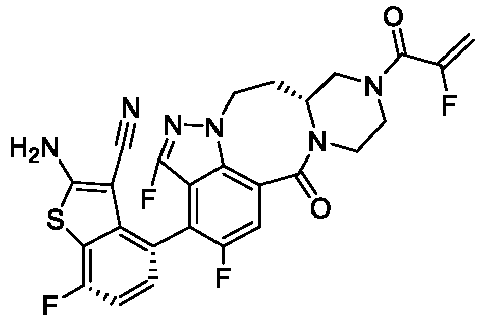
(S)-2-Amino-4-((R)-2,4-difluoro-10-(2-fluoroacry loyl)-14-oxo-8,8a,9,10,11,12-hexahydro-7H,14H-pyrazino[1',2':5,6][1,5]diazocino[3,2,1-hi]indazol-3-yl)-7-fluorobenzo[b]thiophene-3-carbonitrile 
2-Amino-4-(4-chloro-2-fluoro-10-(2-fluoroacrylo yl)-14-oxo-8,8a,9,10,11,12-hexahydro-7H,14H-py razino[1',2':5,6][1,5]diazocino[3,2,1-hi]indazol-3-yl)-7-fluorobenzo[b]thiophene-3-carbonitrile 17 
2-Amino-4-((S)-4-chloro-2-fluoro-10-(2-fluoroacr yloyl)-14-oxo-8,8a,9,10,11,12-hexahydro-7H,14H -pyrazino[1',2':5,6][1,5]diazocino[3,2,1-hi]indazol -3-yl)-7-fluorobenzo[b]thiophene-3-carbonitrile 17 17-P1 
(R)-2-Amino-4-((S)-4-chloro-2-fluoro-10-(2-fluor oacryloyl)-14-oxo-8,8a,9,10,11,12-hexahydro-7H, 14H-pyrazino[1',2':5,6][1,5]diazocino[3,2,1-hi]ind azol-3-yl)-7-fluorobenzo[b]thiophene-3-carbonitri le 17-P1 17-P2 
(S)-2-Amino-4-((S)-4-chloro-2-fluoro-10-(2-fluor oacryloyl)-14-oxo-8,8a,9,10,11,12-hexahydro-7H, 14H-pyrazino[1',2':5,6][1,5]diazocino[3,2,1-hi]ind azol-3-yl)-7-fluorobenzo[b]thiophene-3-carbonitri le 17-P2 
2-Amino-4-((R)-4-chloro-2-fluoro-10-(2-fluoroacr yloyl)-14-oxo-8,8a,9,10,11,12-hexahydro-7H,14H -pyrazino[1',2':5,6][1,5]diazocino[3,2,1-hi]indazol -3-yl)-7-fluorobenzo[b]thiophene-3-carbonitrile 
(R)-2-Amino-4-((R)-4-chloro-2-fluoro-10-(2-fluor oacryloyl)-14-oxo-8,8a,9,10,11,12-hexahydro-7H, 14H-pyrazino[1',2':5,6][1,5]diazocino[3,2,1-hi]ind azol-3-yl)-7-fluorobenzo[b]thiophene-3-carbonitri le 
(S)-2-Amino-4-((R)-4-chloro-2-fluoro-10-(2-fluor oacryloyl)-14-oxo-8,8a,9,10,11,12-hexahydro-7H, 14H-pyrazino[1',2':5,6][1,5]diazocino[3,2,1-hi]ind azol-3-yl)-7-fluorobenzo[b]thiophene-3-carbonitri le 
4-(10-Acryloyl-2-fluoro-4-methyl-14-oxo-8,8a,9, 10,11,12-hexahydro-7H,14H-pyrazino[1',2':5,6][1, 5]diazocino[3,2,1-hi]indol-3-yl)-2-amino-7-fluoro benzo[b]thiophene-3-carbonitrile 18 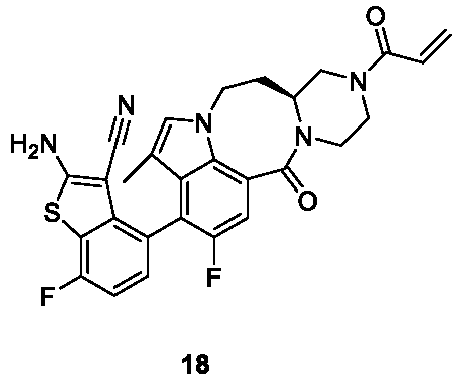
4-((S)-10-Acryloyl-2-fluoro-4-methyl-14-oxo-8,8 a,9,10,11,12-hexahydro-7H,14H-pyrazino[1',2':5, 6][1,5]diazocino[3,2,1-hi]indol-3-yl)-2-amino-7-fl uorobenzo[b]thiophene-3-carbonitrile 18 18-P1 
(R)-4-((S)-10-Acryloyl-2-fluoro-4-methyl-14-oxo-8,8a,9,10,11,12-hexahydro-7H,14H-pyrazino[1',2' :5,6][1,5]diazocino[3,2,1-hi]indol-3-yl)-2-amino-7 -fluorobenzo[b]thiophene-3-carbonitrile 18-P1 18-P2 
(S)-4-((S)-10-Acryloyl-2-fluoro-4-methyl-14-oxo-8,8a,9,10,11,12-hexahydro-7H,14H-pyrazino[1',2' :5,6][1,5]diazocino[3,2,1-hi]indol-3-yl)-2-amino-7 -fluorobenzo[b]thiophene-3-carbonitrile 18-P2 
4-((R)-10-Acryloyl-2-fluoro-4-methyl-14-oxo-8, 8 a,9,10,11,12-hexahydro-7H,14H-pyrazino[1',2':5, 6][1,5]diazocino[3,2,1-hi]indol-3-yl)-2-amino-7-fl uorobenzo[b]thiophene-3-carbonitrile 
(R)-4-((R)-10-Acryloyl-2-fluoro-4-methyl-14-oxo -8,8a,9,10,11,12-hexahydro-7H,14H-pyrazino[1',2 ':5,6][1,5]diazocino[3,2,1-hi]indol-3-yl)-2-amino-7-fluorobenzo[b]thiophene-3-carbonitrile 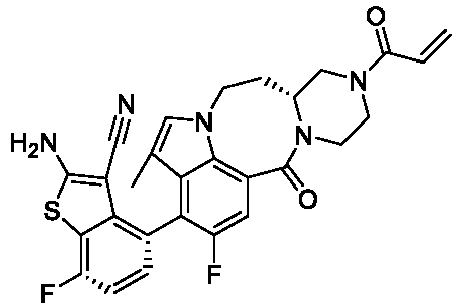
(S)-4-((R)-10-Acryloyl-2-fluoro-4-methyl-14-oxo-8,8a,9,10,11,12-hexahydro-7H,14H-pyrazino[1',2' :5,6][1,5]diazocino[3,2,1-hi]indol-3-yl)-2-amino-7 -fluorobenzo[b]thiophene-3-carbonitrile 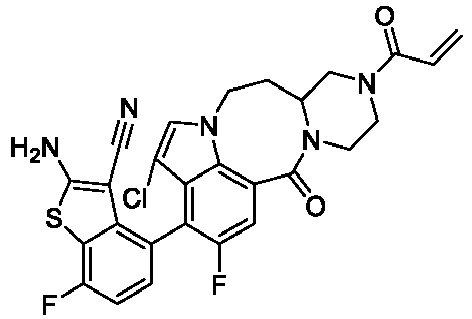
4-(10-Acryloyl-4-chloro-2-fluoro-14-oxo-8,8a,9,1 0,11,12-hexahydro-7H,14H-pyrazino[1',2':5.6][1,5 ]diazocino[3,2,1-hi]indol-3-yl)-2-amino-7-fluorob enzo[b]thiophene-3-carbonitrile 19 
4-((S)-10-Acryloyl-4-chloro-2-fluoro-14-oxo-8,8a ,9,10,11,12-hexahydro-7H,14H-pyrazino[1',2':5.6] [1,5]diazocino[3,2,1-hi]indol-3-yl)-2-amino-7-flu orobenzo[b]thiophene-3-carbonitrile 19 19-P1 
(R)-4-((S)-10-Acryloyl-4-chloro-2-fluoro-14-oxo-8,8a,9,10,11,12-hexahydro-7H,14H-pyrazino[1',2' :5,6][1,5]diazocino[3,2,1-hi]indol-3-yl)-2-amino-7 -fluorobenzo[b]thiophene-3-carbonitrile 19-P1 19-P2 
(S)-4-((S)-10-Acryloyl-4-chloro-2-fluoro-14-oxo-8,8a,9,10,11,12-hexahydro-7H,14H-pyrazino[1',2' :5,6][1,5]diazocino[3,2,1-hi]indol-3-yl)-2-amino-7 -fluorobenzo[b]thiophene-3-carbonitrile 19-P2 
4-((R)-10-Acryloyl-4-chloro-2-fluoro-14-oxo-8,8a ,9,10,11,12-hexahydro-7H,14H-pyrazino[1',2':5.6] [1,5]diazocino[3,2,1-hi]indol-3-yl)-2-amino-7-flu orobenzo[b]thiophene-3-carbonitrile 
(R)-4-((R)-10-Acryloyl-4-chloro-2-fluoro-14-oxo-8,8a,9,10,11,12-hexahydro-7H,14H-pyrazino[1',2' :5,6][1,5]diazocino[3,2,1-hi]indol-3-yl)-2-amino-7 -fluorobenzo[b]thiophene-3-carbonitrile 
(S)-4-((R)-10-Acryloyl-4-chloro-2-fluoro-14-oxo-8,8a,9,10,11,12-hexahydro-7H,14H-pyrazino[1',2' :5,6][1,5]diazocino[3,2,1-hi]indol-3-yl)-2-amino-7 -fluorobenzo[b]thiophene-3-carbonitrile 
4-(9-Acryloyl-2-fluoro-12-oxo-7,7a,8,9,10,11-hex ahydro-6H,12H-4,5,5a,9,11a-pentaazabenzo[5,6]c ycloocta[1,2,3-cd]inden-3-yl)-2-amino-7-fluorobe nzo[b]thiophene-3-carbonitrile 20 
4-((S)-9-Acryloyl-2-fluoro-12-oxo-7,7a,8,9,10,11-hexahydro-6H,12H-4,5,5a,9,11a-pentaazabenzo[5 ,6]cycloocta[1,2,3-cd]inden-3-yl)-2-amino-7-fluor obenzo[b]thiophene-3-carbonitrile 20 20-P1 
(R)-4-((S)-9-Acryloyl-2-fluoro-12-oxo-7,7a,8,9,10 ,11-hexahydro-6H,12H-4,5,5a,9,11a-pentaazaben zo[5,6]cycloocta[1,2,3-cd]inden-3-yl)-2-amino-7-fluorobenzo[b]thiophene-3-carbonitrile 20-P1 20-P2 
(S)-4-((S)-9-Acryloyl-2-fluoro-12-oxo-7,7a,8,9,10 ,11-hexahydro-6H,12H-4,5,5a,9,11a-pentaazaben zo[5,6]cycloocta[1,2,3-cd]inden-3-yl)-2-amino-7-fluorobenzo[b]thiophene-3-carbonitrile 20-P2 
4-((R)-9-Acryloyl-2-fluoro-12-oxo-7,7a,8,9,10,11 -hexahydro-6H,12H-4,5,5a,9,11a-pentaazabenzo[ 5,6]cycloocta[1,2,3-cd]inden-3-yl)-2-amino-7-flu orobenzo[b]thiophene-3-carbonitrile 
(R)-4-((R)-9-Acryloyl-2-fluoro-12-oxo-7,7a,8,9,1 0,11-hexahydro-6H,12H-4,5,5a,9,11a-pentaazabe nzo[5,6]cycloocta[1,2,3-cd]inden-3-yl)-2-amino-7 -fluorobenzo[b]thiophene-3-carbonitrile 
(S)-4-((R)-9-Acryloyl-2-fluoro-12-oxo-7,7a,8,9,10 ,11-hexahydro-6H,12H-4,5,5a,9,11a-pentaazaben zo[5,6]cycloocta[1,2,3-cd]inden-3-yl)-2-amino-7-fluorobenzo[b]thiophene-3-carbonitrile 
4-(9-Acryloyl-2-fluoro-12-oxo-7,7a,8,9,10,11-hex ahydro-6H,12H-4,5a,9,11a-tetraazabenzo[5,6]cycl oocta[1,2,3-cd]inden-3-yl)-2-amino-7-fluorobenzo [b]thiophene-3-carbonitrile 21 
4-((S)-9-Acryloyl-2-fluoro-12-oxo-7,7a,8,9,10,11-hexahydro-6H,12H-4,5a,9,1a-tetraazabenzo[5,6] cycloocta[1,2,3-cd]inden-3-yl)-2-amino-7-fluorob enzo[b]thiophene-3-carbonitrile 21 21-P1 
(R)-4-((S)-9-Acryloyl-2-fluoro-12-oxo-7,7a,8,9,10 ,11-hexahydro-6H,12H-4,5a,9,11a-tetraazabenzo[ 5,6]cycloocta[1,2,3-cd]inden-3-yl)-2-amino-7-flu orobenzo[b]thiophene-3-carbonitrile 21-P1 21-P2 
(S)-4-((S)-9-Acryloyl-2-fluoro-12-oxo-7,7a,8,9,10 ,11-hexahydro-6H,12H-4,5a,9,11a-tetraazabenzo[ 5,6]cycloocta[1,2,3-cd]inden-3-yl)-2-amino-7-flu orobenzo[b]thiophene-3-carbonitrile 21-P2 
4-((R)-9-Acryloyl-2-fluoro-12-oxo-7,7a,8,9, 10,11 -hexahydro-6H,12H-4,5a,9,11a-tetraazabenzo[5,6 ]cycloocta[1,2,3-cd]inden-3-yl)-2-amino-7-fluoro benzo[b]thiophene-3-carbonitrile 
(R)-4-((R)-9-Acryloyl-2-fluoro-12-oxo-7,7a,8,9,1 0,11-hexahydro-6H,12H-4,5a,9,11a-tetraazabenzo [5,6]cycloocta[1,2,3-cd]inden-3-yl)-2-amino-7-flu orobenzo[b]thiophene-3-carbonitrile 
(S)-4-((R)-9-Acryloyl-2-fluoro-12-oxo-7,7a,8,9,10 ,11-hexahydro-6H,12H-4,5a,9,11a-tetraazabenzo[ 5,6]cycloocta[1,2,3-cd]inden-3-yl)-2-amino-7-flu orobenzo[b]thiophene-3-carbonitrile - Another aspect of the present disclosure relates to a compound represented by general formula (IMa) or a salt thereof:

ring A, V, X, Y, Z, R2, R3, R4, R6, s, and t are as defined in general formula (IM). - Another aspect of the present disclosure relates to a compound represented by general formula (Ia) or a salt thereof:

ring A, X, Y, Z, R2, R3, R4, R5, R6, s, and t are as defined in general formula (I). - Another aspect of the present disclosure relates to a compound represented by general formula (IIa) or a salt thereof:

ring A, X, Z, R3, R4, R5, R6, and t are as defined in general formula (II). - Another aspect of the present disclosure relates to a compound represented by general formula (IIIa) or a salt thereof:

W, Z, R3, R4, R5, R6, and t are as defined in general formula (III). - Another aspect of the present disclosure relates to a compound represented by general formula (III-1a) or a salt thereof:

W, Z, R3, R4, R5, R6, and t are as defined in general formula (III-1). - Another aspect of the present disclosure relates to a compound represented by general formula (III-2a) or a salt thereof:

W, Z, R3, R4, R5, R6, and t are as defined in general formula (III-2). - Another aspect of the present disclosure relates to a compound represented by general formula (III-1-Aa) or a salt thereof:

W, Z, R3, R4, R5, R6, and t are as defined in general formula (III-I-A). - Another aspect of the present disclosure relates to a compound represented by general formula (III-1-Ba) or a salt thereof:

W, Z, R3, R4, R5, R6, and t are as defined in general formula (III-1-B). - Another aspect of the present disclosure relates to a compound represented by general formula (III-2-Aa) or a salt thereof:

W, Z, R3, R4, R5, R6, and t are as defined in general formula (III-2-A). - Another aspect of the present disclosure relates to a compound represented by general formula (III-2-Ba) or a salt thereof:

W, Z, R3, R4, R5, R6, and t are as defined in general formula (III-2-B).Table B. Typical intermediate compounds of the present disclosure include, but are not limited to: Compound No. Compound structure Name 
2-Amino-7-fluoro-4-(2-fluoro-14-oxo-8,8a, 9,10,11,12-hexahydro-7H,14H-pyrazino[1', 2':5,6][1,5]diazocino[3,2,1-hi]indazol-3-yl) benzo[b]thiophene-3-carbonitrile bis(2,2,2-trifluoroacetate) 
2-Amino-7-fluoro-4-(2-fluoro-14-oxo-8,8a, 9,10,11,12-hexahydro-7H,14H-pyrazino[1', 2':5,6][1,5]diazocino[3,2,1-hi]indazol-3-yl) benzo[b]thiophene-3-carbonitrile 1j 
2-Amino-7-fluoro-4-((S)-2-fluoro-14-oxo-8 ,8a,9,10,11,12-hexahydro-7H,14H-pyrazin o[1',2':5,6][1,5]diazocino[3,2,1-hi]indazol-3-yl)benzo[b]thiophene-3-carbonitrile bis(2,2,2-trifluoroacetate) Ij 
2-Amino-7-fluoro-4-((S)-2-fluoro-14-oxo-8 ,8a,9,10,11,12-hexahydro-7H,14H-pyrazin o[1',2':5,6][1,5]diazocino[3,2,1-hi]indazol-3-yl)benzo[b]thiophene-3-carbonitrile 
2-Amino-7-fluoro-4-((R)-2-fluoro-14-oxo-8,8a,9,10,11,12-hexahydro-7H,14H-pyrazi no[1',2':5,6][1,5]diazocino[3,2,1-hi]indazol -3-yl)benzo[b]thiophene-3-carbonitrile bis(2,2,2-trifluoroacetate) 
2-Amino-7-fluoro-4-((R)-2-fluoro-14-oxo-8,8a,9,10,11,12-hexahydro-7H,14H-pyrazi no[1',2':5,6][1,5]diazocino[3,2,1-hi]indazol -3-yl)benzo[b]thiophene-3-carbonitrile 
2-Amino-7-fluoro-4-(2-fluoro-14-oxo-8,8a, 9,10,11,12-hexahydro-7H,14H-pyrazino[1', 2':5,6][1,5]diazocino[3,2,1-hi]indol-3-yl)be nzo[b]thiophene-3-carbonitrile bis(2,2,2-trifluoroacetate) 
2-Amino-7-fluoro-4-(2-fluoro-14-oxo-8,8a, 9,10,11,12-hexahydro-7H,14H-pyrazino[1', 2':5,6][1,5]diazocino[3,2,1-hi]indol-3-yl)be nzo[b]thiophene-3-carbonitrile 2f 
2-Amino-7-fluoro-4-((S)-2-fluoro-14-oxo-8 ,8a,9,10,11,12-hexahydro-7H,14H-pyrazin o[1',2':5,6][1,5]diazocino[3,2,1-hi]indol-3-yl)benzo[b]thiophene-3-carbonitrile bis(2,2,2-trifluoroacetate) 2f 
2-Amino-7-fluoro-4-((S)-2-fluoro-14-oxo-8 ,8a,9,10,11,12-hexahydro-7H,14H-pyrazin o[1',2':5,6][1,5]diazocino[3,2,1-hi]indol-3-yl)benzo[b]thiophene-3-carbonitrile 
2-Amino-7-fluoro-4-((R)-2-fluoro-14-oxo-8,8a,9,10,11,12-hexahydro-7H,14H-pyrazi no[1',2':5,6][1,5]diazocino[3,2,1-hi]indol-3 -yl)benzo[b]thiophene-3-carbonitrile bis(2,2,2-trifluoroacetate) 
2-Amino-7-fluoro-4-((R)-2-fluoro-14-oxo-8,8a,9,10,11,12-hexahydro-7H,14H-pyrazi no[1',2':5,6][1,5]diazocino[3,2,1-hi]indol-3 -yl)benzo[b]thiophene-3-carbonitrile 
3-(2-Amino-7-fluorobenzo[d]thiazol-4-yl)-2-fluoro-8,8a,9,10,11,12-hexahydro-7H,14 H-pyrazino[1',2':5,6][1,5]diazocino[3,2,1-h i]indol-14-one bis(2,2,2-trifluoroacetate) 
3-(2-Amino-7-fluorobenzo[d]thiazol-4-yl)-2-fluoro-8,8a,9,10,11,12-hexahydro-7H,14 H-pyrazino[1',2':5,6][1,5]diazocino[3,2,1-h i]indol-14-one 3c 
(8aS)-3-(2-Amino-7-fluorobenzo[d]thiazol-4-yl)-2-fluoro-8,8a,9,10,11,12-hexahydro-7 H,14H-pyrazino[1',2':5,6][1,5]diazocino[3, 2,1-hi]indol-14-one bis(2,2,2-trifluoroacetate) 3c 
(8aS)-3-(2-Amino-7-fluorobenzo[d]thiazol-4-yl)-2-fluoro-8,8a,9,10,11,12-hexahydro-7 H,14H-pyrazino[1',2':5,6][1,5]diazocino[3, 2,1-hi]indol-14-one 
(8aR)-3-(2-Amino-7-fluorobenzo[d]thiazol -4-yl)-2-fluoro-8,8a,9,10,11,12-hexahydro-7H,14H-pyrazino[1',2':5,6][1,5]diazocino[3 ,2,1-hi]indol-14-one bis(2,2,2-trifluoroacetate) 
(8aR)-3-(2-Amino-7-fluorobenzo[d]thiazol -4-yl)-2-fluoro-8,8a,9,10,11,12-hexahydro-7H,14H-pyrazino[1',2':5,6][1,5]diazocino[3 ,2,1-hi]indol-14-one 
2-Amino-7-fluoro-4-(2-fluoro-5-methyl-14 -oxo-8,8a,9,10,11,12-hexahydro-7H,14H-p yrazino[1',2':5,6][1,5]diazocino[3,2,1-hi]in dol-3-yl)benzo[b]thiophene-3-carbonitrile bis(2,2,2-trifluoroacetate) 
2-Amino-7-fluoro-4-(2-fluoro-5-methyl-14 -oxo-8,8a,9,10,11,12-hexahydro-7H,14H-p yrazino[1',2':5,6][1,5]diazocino[3,2,1-hi]in dol-3-yl)benzo[b]thiophene-3-carbonitrile 4f 
2-Amino-7-fluoro-4-((S)-2-fluoro-5-methyl -14-oxo-8,8a,9,10,11,12-hexahydro-7H,14 H-pyrazino[1',2':5,6][1,5]diazocino[3,2,1-h i]indol-3-yl)benzo[b]thiophene-3-carbonitri le bis(2,2,2-trifluoroacetate) 4f 
2-Amino-7-fluoro-4-((S)-2-fluoro-5-methyl -14-oxo-8,8a,9,10,11,12-hexahydro-7H,14 H-pyrazino[1',2':5,6][1,5]diazocino[3,2,1-h i]indol-3-yl)benzo[b]thiophene-3-carbonitri le 
2-Amino-7-fluoro-4-((R)-2-fluoro-5-methyl -14-oxo-8,8a,9,10,11,12-hexahydro-7H,14 H-pyrazino[1',2':5,6][1,5]diazocino[3,2,1-h i]indol-3-yl)benzo[b]thiophene-3-carbonitri le bis(2,2,2-trifluoroacetate) 
2-Amino-7-fluoro-4-((R)-2-fluoro-5-methyl -14-oxo-8,8a,9,10,11,12-hexahydro-7H,14 H-pyrazino[1',2':5,6][1,5]diazocino[3,2,1-h i]indol-3-yl)benzo[b]thiophene-3-carbonitri le 
2-Amino-7-fluoro-4-(4-fluoro-6-oxo-8,9,10 ,11,11a,12-hexahydro-6H-pyrazino[2',1':3, 4][1,4]diazepino[6,7,1-hi]indazol-3-yl)benz o[b]thiophene-3-carbonitrile bis(2,2,2-trifluoroacetate) 
2-Amino-7-fluoro-4-(4-fluoro-6-oxo-8,9,10 ,11,11a,12-hexahydro-6H-pyrazino[2',1':3,4 ][1,4]diazepino[6,7,1-hi]indazol-3-yl)benzo [b]thiophene-3-carbonitrile 
2-Amino-7-fluoro-4-((11aR)-4-fluoro-6-ox o-8,9,10,11,11a,12-hexahydro-6H-pyrazino [2',1':3,4][1,4]diazepino[6,7,1-hi]indazol-3-yl)benzo[b]thiophene-3-carbonitrile bis(2,2,2-trifluoroacetate) 
2-Amino-7-fluoro-4-((11aR)-4-fluoro-6-ox o-8,9,10,11,11a,12-hexahydro-6H-pyrazino [2',1':3,4][1,4]diazepino[6,7,1-hi]indazol-3-yl)benzo[b]thiophene-3-carbonitrile 
2-Amino-7-fluoro-4-((11aS)-4-fluoro-6-oxo -8,9,10,11,11a,12-hexahydro-6H-pyrazino[ 2',1':3,4][1,4]diazepino[6,7,1-hi]indazol-3-yl)benzo[b]thiophene-3-carbonitrile bis(2,2,2-trifluoroacetate) 
2-Amino-7-fluoro-4-((11aS)-4-fluoro-6-ox o-8,9,10,11,11a,12-hexahydro-6H-pyrazino [2',1':3,4][1,4]diazepino[6,7,1-hi]indazol-3-yl)benzo[b]thiophene-3-carbonitrile 
2-Amino-4-(4-chloro-2-fluoro-14-oxo-8,8a ,9,10,11,12-hexahydro-7H,14H-pyrazino[1' ,2':5,6][1,5]diazocino[3,2,1-hi]indazol-3-yl )-7-fluorobenzo[b]thiophene-3-carbonitrile bis(2,2,2-trifluoroacetate) 
2-Amino-4-(4-chloro-2-fluoro-14-oxo-8,8a ,9,10,11,12-hexahydro-7H,14H-pyrazino[1' ,2':5,6][1,5]diazocino[3,2,1-hi]indazol-3-yl )-7-fluorobenzo[b]thiophene-3-carbonitrile 7c 
2-Amino-4-((S)-4-chloro-2-fluoro-14-oxo-8,8a,9,10,11,12-hexahydro-7H,14H-pyrazi no[1',2':5,6][1,5]diazocino[3,2,1-hi]indazol -3-yl)-7-fluorobenzo[b]thiophene-3-carboni trile bis(2,2,2-trifluoroacetate) 7c 
2-Amino-4-((S)-4-chloro-2-fluoro-14-oxo-8,8a,9,10,11,12-hexahydro-7H,14H-pyrazi no[1',2':5,6][1,5]diazocino[3,2,1-hi]indazol -3-yl)-7-fluorobenzo[b]thiophene-3-carboni trile 
2-Amino-4-((R)-4-chloro-2-fluoro-14-oxo-8,8a,9,10,11,12-hexahydro-7H,14H-pyrazi no[1',2':5,6][1,5]diazocino[3,2,1-hi]indazol -3-yl)-7-fluorobenzo[b]thiophene-3-carboni trile bis(2,2,2-trifluoroacetate) 
2-Amino-4-((R)-4-chloro-2-fluoro-14-oxo-8,8a,9,10,11,12-hexahydro-7H,14H-pyrazi no[1',2':5,6][1,5]diazocino[3,2,1-hi]indazol -3-yl)-7-fluorobenzo[b]thiophene-3-carboni trile 
2-Amino-4-(2,4-difluoro-14-oxo-8,8a,9,10, 11,12-hexahydro-7H,14H-pyrazino[1',2':5, 6][1,5]diazocino[3,2,1-hi]indazol-3-yl)-7-fl uorobenzo[b]thiophene-3-carbonitrile bis(2,2,2-trifluoroacetate) 
2-Amino-4-(2,4-difluoro-14-oxo-8,8a,9,10, 11,12-hexahydro-7H,14H-pyrazino[1',2':5, 6][1,5]diazocino[3,2,1-hi]indazol-3-yl)-7-fl uorobenzo[b]thiophene-3-carbonitrile 8e 
2-Amino-4-((S)-2,4-difluoro-14-oxo-8,8a,9 ,10,11,12-hexahydro-7H,14H-pyrazino[1',2' :5,6][1,5]diazocino[3,2,1-hi]indazol-3-yl)-7 -fluorobenzo[b]thiophene-3-carbonitrile bis(2,2,2-trifluoroacetate) 8e 
2-Amino-4-((S)-2,4-difluoro-14-oxo-8,8a,9 ,10,11,12-hexahydro-7H,14H-pyrazino[1',2' :5,6][1,5]diazocino[3,2,1-hi]indazol-3-yl)-7 -fluorobenzo[b]thiophene-3-carbonitrile 
2-Amino-4-((R)-2,4-difluoro-14-oxo-8,8a,9 ,10,11,12-hexahydro-7H,14H-pyrazino[1',2' :5,6][1,5]diazocino[3,2,1-hi]indazol-3-yl)-7 -fluorobenzo[b]thiophene-3-carbonitrile bis(2,2,2-trifluoroacetate) 
2-Amino-4-((R)-2,4-difluoro-14-oxo-8,8a,9 ,10,11,12-hexahydro-7H,14H-pyrazino[1',2' :5,6][1,5]diazocino[3,2,1-hi]indazol-3-yl)-7 -fluorobenzo[b]thiophene-3-carbonitrile 
2-Amino-7-fluoro-4-(2-fluoro-4-methyl-14 -oxo-8,8a,9,10,11,12-hexahydro-7H,14H-p yrazino[1',2':5,6][1,5]diazocino[3,2,1-hi]in dazol-3-yl)benzo[b]thiophene-3-carbonitril e bis(2,2,2-trifluoroacetate) 
2-Amino-7-fluoro-4-(2-fluoro-4-methyl-14 -oxo-8,8a,9,10,11,12-hexahydro-7H,14H-p yrazino[1',2':5,6][1,5]diazocino[3,2,1-hi]in dazol-3-yl)benzo[b]thiophene-3-carbonitril e 9h 
2-Amino-7-fluoro-4-((S)-2-fluoro-4-methyl -14-oxo-8,8a,9,10,11,12-hexahydro-7H,14 H-pyrazino[1',2':5,6][1,5]diazocino[3,2,1-h i]indazol-3-yl)benzo[b]thiophene-3-carboni trile bis(2,2,2-trifluoroacetate) 9h 
2-Amino-7-fluoro-4-((S)-2-fluoro-4-methyl -14-oxo-8,8a,9,10,11,12-hexahydro-7H,14 H-pyrazino[1',2':5,6][1,5]diazocino[3,2,1-h i]indazol-3-yl)benzo[b]thiophene-3-carboni trile 
2-Amino-7-fluoro-4-((R)-2-fluoro-4-methyl -14-oxo-8,8a,9,10,11,12-hexahydro-7H,14 H-pyrazino[1',2':5,6][1,5]diazocino[3,2,1-h i]indazol-3-yl)benzo[b]thiophene-3-carboni trile bis(2,2,2-trifluoroacetate) 
2-Amino-7-fluoro-4-((R)-2-fluoro-4-methyl -14-oxo-8,8a,9,10,11,12-hexahydro-7H,14 H-pyrazino[1',2':5,6][1,5]diazocino[3,2,1-h i]indazol-3-yl)benzo[b]thiophene-3-carboni trile 
2-Amino-7-fluoro-4-(2-fluoro-11-methyl-1 4-oxo-8,8a,9,10,11,12-hexahydro-7H,14H-pyrazino[1',2':5,6][1,5]diazocino[3,2,1-hi]i ndazol-3-yl)-benzo[b]thiophene-3-carbonitr ile bis(2,2,2-trifluoroacetate) 
2-Amino-7-fluoro-4-(2-fluoro-11-methyl-1 4-oxo-8,8a,9,10,11,12-hexahydro-7H,14H-pyrazino[1',2':5,6][1,5]diazocino[3,2,1-hi]i ndazol-3-yl)-benzo[b]thiophene-3-carbonitr ile 
2-Amino-7-fluoro-4-((8aS,11R)-2-fluoro-1 1-methyl-14-oxo-8,8a,9,10,11,12-hexahydr o-7H,14H-pyrazino[1',2':5,6][1,5]diazocino [3,2,1-hi]indazol-3-yl)-benzo[b]thiophene-3-carbonitrile bis(2,2,2-trifluoroacetate) 
2-Amino-7-fluoro-4-((8aS,11R)-2-fluoro-1 1-methyl-14-oxo-8,8a,9,10,11,12-hexahydr o-7H,14H-pyrazino[1',2':5,6][1,5]diazocino [3,2,1-hi]indazol-3-yl)-benzo[b]thiophene-3-carbonitrile 
2-Amino-7-fluoro-4-((8aR,11R)-2-fluoro-1 1-methyl-14-oxo-8,8a,9,10,11,12-hexahydr o-7H,14H-pyrazino[1',2':5,6][1,5]diazocino [3,2,1-hi]indazol-3-yl)-benzo[b]thiophene-3-carbonitrile bis(2,2,2-trifluoroacetate) 
2-Amino-7-fluoro-4-((8aR,11R)-2-fluoro-1 1-methyl-14-oxo-8,8a,9,10,11,12-hexahydr o-7H,14H-pyrazino[1',2':5,6][1,5]diazocino [3,2,1-hi]indazol-3-yl)-benzo[b]thiophene-3-carbonitrile 
2-Amino-4-(1,2-difluoro-14-oxo-8,8a,9,10, 11,12-hexahydro-7H,14H-pyrazino[1',2':5, 6][1,5]diazocino[3,2,1-hi]indazol-3-yl)-7-fl uorobenzo[b]thiophene-3-carbonitrile bis(2,2,2-trifluoroacetate) 
2-Amino-4-(1,2-difluoro-14-oxo-8,8a,9,10, 11,12-hexahydro-7H,14H-pyrazino[1',2':5, 6][1,5]diazocino[3,2,1-hi]indazol-3-yl)-7-fl uorobenzo[b]thiophene-3-carbonitrile 
2-Amino-4-((S)-1,2-difluoro-14-oxo-8,8a,9 ,10,11,12-hexahydro-7H,14H-pyrazino[1',2' :5,6][1,5]diazocino[3,2,1-hi]indazol-3-yl)-7 -fluorobenzo[b]thiophene-3-carbonitrile bis(2,2,2-trifluoroacetate) 
2-Amino-4-((S)-1,2-difluoro-14-oxo-8,8a,9 ,10,11,12-hexahydro-7H,14H-pyrazino[1',2' :5,6][1,5]diazocino[3,2,1-hi]indazol-3-yl)-7 -fluorobenzo[b]thiophene-3-carbonitrile 
2-Amino-4-((R)-1,2-difluoro-14-oxo-8,8a,9 ,10,11,12-hexahydro-7H,14H-pyrazino[1',2' :5,6][1,5]diazocino[3,2,1-hi]indazol-3-yl)-7 -fluorobenzo[b]thiophene-3-carbonitrile bis(2,2,2-trifluoroacetate) 
2-Amino-4-((R)-1,2-difluoro-14-oxo-8,8a,9 ,10,11,12-hexahydro-7H,14H-pyrazino[1',2' :5,6][1,5]diazocino[3,2,1-hi]indazol-3-yl)-7 -fluorobenzo[b]thiophene-3-carbonitrile 
2-Amino-4-(2,4-difluoro-14-oxo-8,8a,9,10, 11,12-hexahydro-7H,14H-pyrazino[1',2':5, 6][1,5]diazocino[3,2,1-hi]indol-3-yl)-7-fluo robenzo[b]thiophene-3-carbonitrile bis(2,2,2-trifluoroacetate) 
2-Amino-4-(2,4-difluoro-14-oxo-8,8a,9,10, 11,12-hexahydro-7H,14H-pyrazino[1',2':5, 6][1,5]diazocino[3,2,1-hi]indol-3-yl)-7-fluo robenzo[b]thiophene-3-carbonitrile 
2-Amino-4-((S)-2,4-difluoro-14-oxo-8,8a,9 ,10,11,12-hexahydro-7H,14H-pyrazino[1',2' :5,6][1,5]diazocino[3,2,1-hi]indol-3-yl)-7-fl uorobenzo[b]thiophene-3-carbonitrile bis(2,2,2-trifluoroacetate) 
2-Amino-4-((S)-2,4-difluoro-14-oxo-8,8a,9 ,10,11,12-hexahydro-7H,14H-pyrazino[1',2' :5,6][1,5]diazocino[3,2,1-hi]indol-3-yl)-7-fl uorobenzo[b]thiophene-3-carbonitrile 
2-Amino-4-((R)-2,4-difluoro-14-oxo-8,8a,9 ,10,11,12-hexahydro-7H,14H-pyrazino[1',2' :5,6][1,5]diazocino[3,2,1-hi]indol-3-yl)-7-fl uorobenzo[b]thiophene-3-carbonitrile bis(2,2,2-trifluoroacetate) 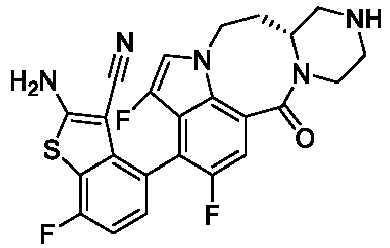
2-Amino-4-((R)-2,4-difluoro-14-oxo-8,8a,9 ,10,11,12-hexahydro-7H,14H-pyrazino[1',2' :5,6][1,5]diazocino[3,2,1-hi]indol-3-yl)-7-fl uorobenzo[b]thiophene-3-carbonitrile 
2-Amino-7-fluoro-4-(2-fluoro-4-methyl-14 -oxo-8,8a,9,10,11,12-hexahydro-7H,14H-p yrazino[1',2':5,6][1,5]diazocino[3,2,1-hi]in dol-3-yl)benzo[b]thiophene-3-carbonitrile bis(2,2,2-trifluoroacetate) 
2-Amino-7-fluoro-4-(2-fluoro-4-methyl-14 -oxo-8,8a,9,10,11,12-hexahydro-7H,14H-p yrazino[1',2':5,6][1,5]diazocino[3,2,1-hi]in dol-3-yl)benzo[b]thiophene-3-carbonitrile 
2-Amino-7-fluoro-4-((S)-2-fluoro-4-methyl -14-oxo-8,8a,9,10,11,12-hexahydro-7H,14 H-pyrazino[1',2':5,6][1,5]diazocino[3,2,1-h i]indol-3-yl)benzo[b]thiophene-3-carbonitri le bis(2,2,2-trifluoroacetate) 
2-Amino-7-fluoro-4-((S)-2-fluoro-4-methyl -14-oxo-8,8a,9,10,11,12-hexahydro-7H,14 H-pyrazino[1',2':5,6][1,5]diazocino[3,2,1-h i]indol-3-yl)benzo[b]thiophene-3-carbonitri le 
2-Amino-7-fluoro-4-((R)-2-fluoro-4-methyl -14-oxo-8,8a,9,10,11,12-hexahydro-7H,14 H-pyrazino[1',2':5,6][1,5]diazocino[3,2,1-h i]indol-3-yl)benzo[b]thiophene-3-carbonitri le bis(2,2,2-trifluoroacetate) 
2-Amino-7-fluoro-4-((R)-2-fluoro-4-methyl -14-oxo-8,8a,9,10,11,12-hexahydro-7H,14 H-pyrazino[1',2':5,6][1,5]diazocino[3,2,1-h i]indol-3-yl)benzo[b]thiophene-3-carbonitri le 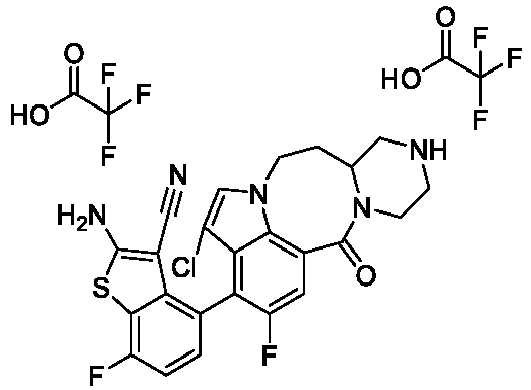
2-Amino-4-(4-chloro-2-fluoro-14-oxo-8,8a ,9,10,11,12-hexahydro-7H,14H-pyrazino[1' ,2':5,6][1,5]diazocino[3,2,1-hi]indol-3-yl)-7 -fluorobenzo[b]thiophene-3-carbonitrile bis(2,2,2-trifluoroacetate) 
2-Amino-4-(4-chloro-2-fluoro-14-oxo-8,8a ,9,10,11,12-hexahydro-7H,14H-pyrazino[1' ,2':5,6][1,5]diazocino[3,2,1-hi]indol-3-yl)-7 -fluorobenzo[b]thiophene-3-carbonitrile 
2-Amino-4-((S)-4-chloro-2-fluoro-14-oxo-8,8a,9,10,11,12-hexahydro-7H,14H-pyrazi no[1',2':5,6][1,5]diazocino[3,2,1-hi]indol-3 -yl)-7-fluorobenzo[b]thiophene-3-carbonitr ile bis(2,2,2-trifluoroacetate) 
2-Amino-4-((S)-4-chloro-2-fluoro-14-oxo-8,8a,9,10,11,12-hexahydro-7H,14H-pyrazi no[1',2':5,6][1,5]diazocino[3,2,1-hi]indol-3 -yl)-7-fluorobenzo[b]thiophene-3-carbonitr ile 
2-Amino-4-((R)-4-chloro-2-fluoro-14-oxo-8,8a,9,10,11,12-hexahydro-7H,14H-pyrazi no[1',2':5,6][1,5]diazocino[3,2,1-hi]indol-3 -yl)-7-fluorobenzo[b]thiophene-3-carbonitr ile bis(2,2,2-trifluoroacetate) 
2-Amino-4-((R)-4-chloro-2-fluoro-14-oxo-8,8a,9,10,11,12-hexahydro-7H,14H-pyrazi no[1',2':5,6][1,5]diazocino[3,2,1-hi]indol-3 -yl)-7-fluorobenzo[b]thiophene-3-carbonitr ile 
2-Amino-7-fluoro-4-(2-fluoro-12-oxo-7,7α, 8,9,10,11-hexahydro-6H,12H-4,5,5a,9,11a-pentaazabenzo[5,6]cycloocta[1,2,3-cd]inde n-3-yl)benzo[b]thiophene-3-carbonitrile bis(2,2,2-trifluoroacetate) 
2-Amino-7-fluoro-4-(2-fluoro-12-oxo-7,7a, 8,9,10,11-hexahydro-6H,12H-4,5,5a,9,11a-pentaazabenzo[5,6]cycloocta[1,2,3-cd]inde n-3-yl)benzo[b]thiophene-3-carbonitrile 
2-Amino-7-fluoro-4-((S)-2-fluoro-12-oxo-7 ,7a,8,9,10,11-hexahydro-6H,12H-4,5,5a,9, 11a-pentaazabenzo[5,6]cycloocta[1,2,3-cd] inden-3-yl)benzo[b]thiophene-3-carbonitril e bis(2,2,2-trifluoroacetate) 
2-Amino-7-fluoro-4-((S)-2-fluoro-12-oxo-7 ,7a,8,9,10,11-hexahydro-6H,12H-4,5,5a,9, 11a-pentaazabenzo[5,6]cycloocta[1,2,3-cd] inden-3-yl)benzo[b]thiophene-3-carbonitril e 
2-Amino-7-fluoro-4-((R)-2-fluoro-12-oxo-7,7a,8,9,10,11-hexahydro-6H,12H-4,5,5a,9 ,11a-pentaazabenzo[5,6]cycloocta[1,2,3-cd ]inden-3-yl)benzo[b]thiophene-3-carbonitri le bis(2,2,2-trifluoroacetate) 
2-Amino-7-fluoro-4-((R)-2-fluoro-12-oxo-7,7a,8,9,10,11-hexahydro-6H,12H-4,5,5a,9 ,11a-pentaazabenzo[5,6]cycloocta[1,2,3-cd ]inden-3-yl)benzo[b]thiophene-3-carbonitri le 
2-Amino-7-4-(2-fluoro-12-oxo-7,7a,8,9,10, 11-hexahydro-6H,12H-4,5a,9,11a-tetraazab enzo[5,6]cycloocta[1,2,3-cd]inden-3-yl)-be nzo[b]thiophene-3-carbonitrile bis(2,2,2-trifluoroacetate) 
2-Amino-7-4-(2-fluoro-12-oxo-7,7a,8,9,10, 11-hexahydro-6H,12H-4,5a,9,11a-tetraazab enzo[5,6]cycloocta[1,2,3-cd]inden-3-yl)-be nzo[b]thiophene-3-carbonitrile 
2-Amino-7-4-((S)-2-fluoro-12-oxo-7,7a,8,9 ,10,11-hexahydro-6H,12H-4,5a,9,11a-tetra azabenzo[5,6]cycloocta[1,2,3-cd]inden-3-yl )-benzo[b]thiophene-3-carbonitrile bis(2,2,2-trifluoroacetate) 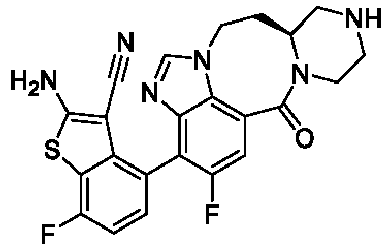
2-Amino-7-4-((S)-2-fluoro-12-oxo-7,7a,8,9 ,10,11-hexahydro-6H,12H-4,5a,9,11a-tetra azabenzo[5,6]cycloocta[1,2,3-cd]inden-3-yl )-benzo[b]thiophene-3-carbonitrile 
2-Amino-7-4-((R)-2-fluoro-12-oxo-7,7a,8, 9,10,11-hexahydro-6H,12H-4,5a,9,11a-tetr aazabenzo[5,6]cycloocta[1,2,3-cd]inden-3-yl)-benzo[b]thiophene-3-carbonitrile bis(2,2,2-trifluoroacetate) 
2-Amino-7-4-((R)-2-fluoro-12-oxo-7,7a,8, 9,10,11-hexahydro-6H,12H-4,5a,9,11a-tetr aazabenzo[5,6]cycloocta[1,2,3-cd]inden-3-yl)-benzo[b]thiophene-3-carbonitrile - The compound represented by general formula (IMa), general formula (Ia), general formula (IIa), general formula (IIIa), general formula (III-1a), general formula (III-2a), general formula (III-1-Aa), general formula (III-1-Ba), general formula (III-2-Aa), or general formula (III-2-Ba) or the salt thereof is disclosed herein, wherein the salt is preferably a bis(2,2,2-trifluoroacetate).
- Another aspect of the present disclosure relates to a compound represented by general formula (IMaa) or a salt thereof:
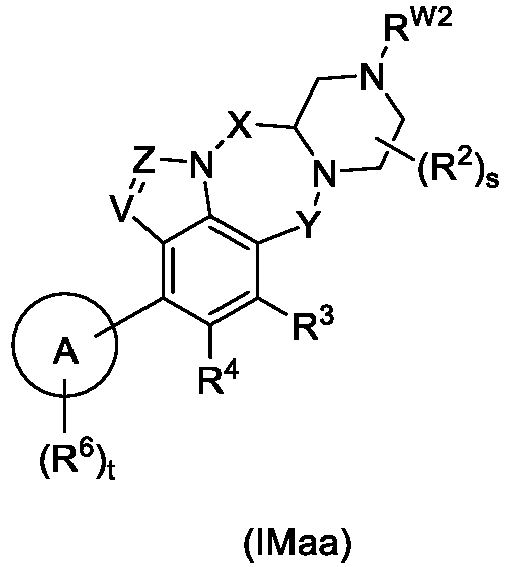
- RW2 is an amino protecting group; preferably, RW2 is tert-butyloxycarbonyl;
- ring A, V, X, Y, Z, R2, R3, R4, R6, s, and t are as defined in general formula (IMa).
- Another aspect of the present disclosure relates to a compound represented by general formula (IMaa) or a salt thereof:


- RW1 and RW2 are identical or different and are each independently an amino protecting group; preferably, RW1 and RW2 are both tert-butyloxycarbonyl;
- t is 0, 1, 2, or 3;
- V, X, Y, Z, R2, R3, R4, R6, and s are as defined in general formula (IMa).
- Another aspect of the present disclosure relates to a compound represented by general formula (Iaa) or a salt thereof:

- RW2 is an amino protecting group; preferably, RW2 is tert-butyloxycarbonyl;
- ring A, X, Y, Z, R2, R3, R4, R5, R6, s, and t are as defined in general formula (Ia).
- Another aspect of the present disclosure relates to a compound represented by general formula (Iaa) or a salt thereof:


- RW1 and RW2 are identical or different and are each independently an amino protecting group; preferably, RW1 and RW2 are both tert-butyloxycarbonyl;
- t is 0, 1, 2, or 3;
- X, Y, Z, R2, R3, R4, R5, R6, and s are as defined in general formula (Ia).
- Another aspect of the present disclosure relates to a compound represented by general formula (IIaa) or a salt thereof:

- RW2 is an amino protecting group; preferably, RW2 is tert-butyloxycarbonyl;
- ring A, X, Z, R3, R4, R5, R6, and t are as defined in general formula (IIa).
- Another aspect of the present disclosure relates to a compound represented by general formula (IIaa) or a salt thereof:
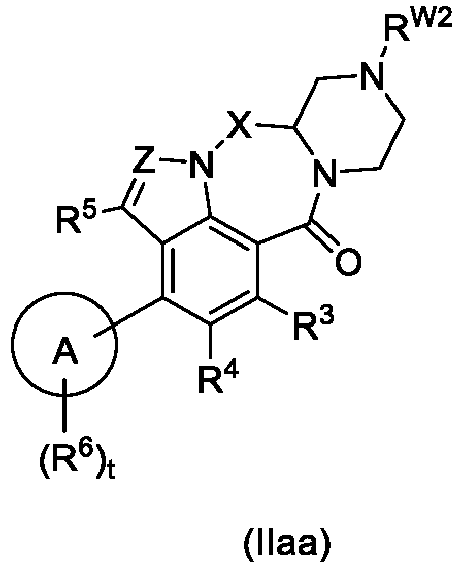


- RW1 and RW2 are identical or different and are each independently an amino protecting group; preferably, RW1 and RW2 are both tert-butyloxycarbonyl;
- t is 0, 1, 2, or 3;
- X, Z, R3, R4, R5, and R6 are as defined in general formula (IIa).
- Another aspect of the present disclosure relates to a compound represented by general formula (IIIaa) or a salt thereof:

- RW1 and RW2 are identical or different and are each independently an amino protecting group; preferably, RW1 and RW2 are both tert-butyloxycarbonyl;
- W, Z, R3, R4, R5, R6, and t are as defined in general formula (IIIa).
- Another aspect of the present disclosure relates to a compound represented by general formula (III-1aa) or a salt thereof:

- RW1 and RW2 are identical or different and are each independently an amino protecting group; preferably, RW1 and RW2 are both tert-butyloxycarbonyl;
- W, Z, R3, R4, R5, R6, and t are as defined in general formula (III-1a).
- Another aspect of the present disclosure relates to a compound represented by general formula (III-2aa) or a salt thereof:

- RW1 and RW2 are identical or different and are each independently an amino protecting group; preferably, RW1 and RW2 are both tert-butyloxycarbonyl;
- W, Z, R3, R4, R5, R6, and t are as defined in general formula (III-2a).
- Another aspect of the present disclosure relates to a method for preparing a compound represented by general formula (IM) or a pharmaceutically acceptable salt thereof, comprising:

- L is halogen; preferably, L is Cl;
- R1 is

- ring A, V, X, Y, Z, R2, R3, R4, R6, R11, R12, R13, R14, s, and t are as defined in general formula (IM).
- Another aspect of the present disclosure relates to a method for preparing a compound represented by general formula (I) or a pharmaceutically acceptable salt thereof, comprising:

- L is halogen; preferably, L is Cl;
- R1 is

- ring A, X, Y, Z, R2, R3, R4, R5, R6, R11, R12, R13, R14, s, and t are as defined in general formula (I).
- Another aspect of the present disclosure relates to a method for preparing a compound represented by general formula (II) or a pharmaceutically acceptable salt thereof, comprising:

- L is halogen; preferably, L is Cl;
- R1 is

- Another aspect of the present disclosure relates to a method for preparing a compound represented by general formula (III) or a pharmaceutically acceptable salt thereof, comprising:

- L is halogen; preferably, L is Cl;
- W, Z, R3, R4, R5, R6, R11, R12, R13, and t are as defined in general formula (III).
- Another aspect of the present disclosure relates to a method for preparing a compound represented by general formula (III-1) or a pharmaceutically acceptable salt thereof, comprising:

- L is halogen; preferably, L is Cl;
- W, Z, R3, R4, R5, R6, R11, R12, R13, and t are as defined in general formula (III-1).
- Another aspect of the present disclosure relates to a method for preparing a compound represented by general formula (III-2) or a pharmaceutically acceptable salt thereof, comprising:

- L is halogen; preferably, L is Cl;
- W, Z, R3, R4, R5, R6, R11, R12, R13, and t are as defined in general formula (III-2).
- Another aspect of the present disclosure relates to a method for preparing compounds represented by general formula (III-1-A) and general formula (III-1-B) or pharmaceutically acceptable salts thereof, comprising:

W, Z, R3, R4, R5, R6, R11, R12, R13, and t are as defined in general formula (III-1). - Another aspect of the present disclosure relates to a method for preparing compounds represented by general formula (III-2-A) and general formula (III-2-B) or pharmaceutically acceptable salts thereof, comprising:

W, Z, R3, R4, R5, R6, R11, R12, R13, and t are as defined in general formula (III-2). - Another aspect of the present disclosure relates to a method for preparing a compound represented by general formula (IMa) or a pharmaceutically acceptable salt thereof, comprising:

wherein: - RW2 is an amino protecting group; preferably, RW2 is tert-butyloxycarbonyl;
- ring A, V, X, Y, Z, R2, R3, R4, R6, s, and t are as defined in general formula (IMa).
- Another aspect of the present disclosure relates to a method for preparing a compound represented by general formula (IMa) or a salt thereof, comprising:

wherein: - RW2 is an amino protecting group; preferably, RW2 is tert-butyloxycarbonyl;
- ring A, V, X, Y, Z, R2, R3, R4, R6, s, and t are as defined in general formula (IMa).
- Another aspect of the present disclosure relates to a method for preparing a compound represented by general formula (Ia) or a pharmaceutically acceptable salt thereof, comprising:

wherein: - RW2 is an amino protecting group; preferably, RW2 is tert-butyloxycarbonyl;
- ring A, X, Y, Z, R2, R3, R4, R5, R6, s, and t are as defined in general formula (Ia).
- Another aspect of the present disclosure relates to a method for preparing a compound represented by general formula (Ia) or a salt thereof, comprising:

wherein: - RW2 is an amino protecting group; preferably, RW2 is tert-butyloxycarbonyl;
- ring A, X, Y, Z, R2, R3, R4, R5, R6, s, and t are as defined in general formula (Ia).
- Another aspect of the present disclosure relates to a method for preparing a compound represented by general formula (IIa) or a pharmaceutically acceptable salt thereof, comprising:

wherein: - RW2 is an amino protecting group; preferably, RW2 is tert-butyloxycarbonyl;
- ring A, X, Z, R3, R4, R5, R6, and t are as defined in general formula (IIa).
- Another aspect of the present disclosure relates to a method for preparing a compound represented by general formula (IIa) or a salt thereof, comprising:

- RW2 is an amino protecting group; preferably, RW2 is tert-butyloxycarbonyl;
- ring A, X, Z, R3, R4, R5, R6, and t are as defined in general formula (IIa).
- Another aspect of the present disclosure relates to a method for preparing a compound represented by general formula (IIIa) or a pharmaceutically acceptable salt thereof, comprising:
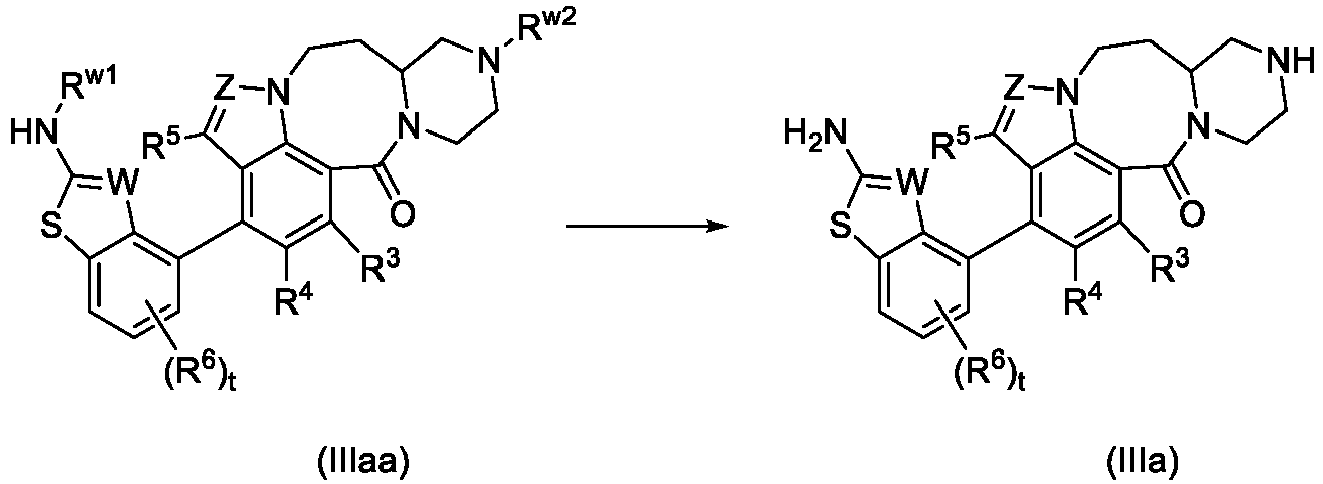
- RW1 and RW2 are both amino protecting groups; preferably, RW1 and RW2 are both tert-butyloxycarbonyl;
- W, Z, R3, R4, R5, R6, and t are as defined in general formula (IIIa).
- Another aspect of the present disclosure relates to a method for preparing a compound represented by general formula (III-1a) or a pharmaceutically acceptable salt thereof, comprising:

- RW1 and RW2 are both amino protecting groups; preferably, RW1 and RW2 are both tert-butyloxycarbonyl;
- W, Z, R3, R4, R5, R6, and t are as defined in general formula (III-1a).
- Another aspect of the present disclosure relates to a method for preparing a compound represented by general formula (III-2a) or a pharmaceutically acceptable salt thereof, comprising:

- RW1 and RW2 are both amino protecting groups; preferably, RW1 and RW2 are both tert-butyloxycarbonyl;
- W, Z, R3, R4, R5, R6, and t are as defined in general formula (III-2a).
- Another aspect of the present disclosure relates to a pharmaceutical composition comprising the compound represented by general formula (IM), general formula (I), general formula (II), general formula (III), general formula (III-1), general formula (III-2), general formula (III-1-A), general formula (III-1-B), general formula (III-2-A), or general formula (III-2-B) of the present disclosure and a compound from Table A or a pharmaceutically acceptable salt thereof, and one or more pharmaceutically acceptable carriers, diluents, or excipients.
- The present disclosure further relates to use of the compound represented by general formula (IM), general formula (I), general formula (II), general formula (III), general formula (III-1), general formula (III-2), general formula (III-1-A), general formula (III-1-B), general formula (III-2-A), or general formula (III-2-B) and a compound from Table A or a pharmaceutically acceptable salt thereof or a pharmaceutical composition comprising same in the preparation of a medicament for inhibiting KRAS G12C.
- The present disclosure further relates to use of the compound represented by general formula (IM), general formula (I), general formula (II), general formula (III), general formula (III-1), general formula (III-2), general formula (III-1-A), general formula (III-1-B), general formula (III-2-A), or general formula (III-2-B) and a compound from Table A or a pharmaceutically acceptable salt thereof or a pharmaceutical composition comprising same in the preparation of a medicament for treating and/or preventing a KRAS G12C-mediated disease or disorder.
- The present disclosure further relates to use of the compound represented by general formula (IM), general formula (I), general formula (II), general formula (III), general formula (III-1), general formula (III-2), general formula (III-1-A), general formula (III-1-B), general formula (III-2-A), or general formula (III-2-B) and a compound from Table A or a pharmaceutically acceptable salt thereof or a pharmaceutical composition comprising same in the preparation of a medicament for treating and/or preventing a tumor.
- The present disclosure also relates to a method for inhibiting KRAS G12C, comprising administering to a patient in need thereof a therapeutically effective amount of the compound represented by general formula (IM), general formula (I), general formula (II), general formula (III), general formula (III-1), general formula (III-2), general formula (III-1-A), general formula (III-1-B), general formula (III-2-A), or general formula (III-2-B) and a compound from Table A or a pharmaceutically acceptable salt thereof, or a pharmaceutical composition comprising same.
- The present disclosure also relates to a method for treating and/or preventing a KRAS G12C-mediated disease or disorder, comprising administering to a patient in need thereof a therapeutically effective amount of the compound represented by general formula (IM), general formula (I), general formula (II), general formula (III), general formula (III-1), general formula (III-2), general formula (III-1-A), general formula (III-1-B), general formula (III-2-A), or general formula (III-2-B) and a compound from Table A or a pharmaceutically acceptable salt thereof, or a pharmaceutical composition comprising same.
- The present disclosure also relates to a method for treating and/or preventing a tumor, comprising administering to a patient in need thereof a therapeutically effective amount of the compound represented by general formula (IM), general formula (I), general formula (II), general formula (III), general formula (III-1), general formula (III-2), general formula (III-1-A), general formula (III-1-B), general formula (III-2-A), or general formula (III-2-B) and a compound from Table A or a pharmaceutically acceptable salt thereof, or a pharmaceutical composition comprising same.
- The present disclosure further relates to a compound represented by general formula (IM), general formula (I), general formula (II), general formula (III), general formula (III-1), general formula (III-2), general formula (III-1-A), general formula (III-1-B), general formula (III-2-A), or general formula (III-2-B) and a compound from Table A or a pharmaceutically acceptable salt thereof, or a pharmaceutical composition comprising same, for use as a medicament.
- The present disclosure further relates to a compound represented by general formula (IM), general formula (I), general formula (II), general formula (III), general formula (III-1), general formula (III-2), general formula (III-1-A), general formula (III-1-B), general formula (III-2-A), or general formula (III-2-B) and a compound from Table A or a pharmaceutically acceptable salt thereof, or a pharmaceutical composition comprising same, for use as a KRAS G12C inhibitor.
- The present disclosure further relates to a compound represented by general formula (IM), general formula (I), general formula (II), general formula (III), general formula (III-1), general formula (III-2), general formula (III-1-A), general formula (III-1-B), general formula (III-2-A), or general formula (III-2-B) and a compound from Table A or a pharmaceutically acceptable salt thereof, or a pharmaceutical composition comprising same, for use in treating and/or preventing a KRAS G12C-mediated disease or disorder. The present disclosure further relates to a compound represented by general formula (IM), general formula (I), general formula (II), general formula (III), general formula (III-1), general formula (III-2), general formula (III-1-A), general formula (III-1-B), general formula (III-2-A), or general formula (III-2-B) and a compound from Table A or a pharmaceutically acceptable salt thereof, or a pharmaceutical composition comprising same, for use in treating and/or preventing a tumor.
- The tumor described above in the present disclosure is preferably a cancer; further preferably, the cancer is selected from the group consisting of lung cancer (such as non-small cell lung cancer and small cell lung cancer), pancreatic cancer, cervical cancer, esophageal cancer (also known as esophageal carcinoma), endometrial cancer, ovarian cancer, cholangiocarcinoma, colorectal cancer (such as colon cancer and rectal cancer), liver cancer, breast cancer, prostate cancer, thyroid cancer, stomach cancer, urothelial cancer, testicular cancer, leukemia, skin cancer, squamous cell cancer, basal cell cancer, bladder cancer, head and neck cancer, kidney cancer, nasopharyngeal cancer, bone cancer, lymphoma, melanoma, sarcoma, peripheral neuroepithelioma, glioma (such as astrocytoma and glioblastoma), brain tumor, and myeloma; more preferably, the cancer is selected from the group consisting of lung cancer, pancreatic cancer, cervical cancer, esophageal cancer, endometrial cancer, ovarian cancer, cholangiocarcinoma, and colorectal cancer.
- The KRAS G12C-mediated disease or disorder described above in the present disclosure is preferably a tumor; further preferably, the tumor is a cancer; more preferably, the cancer is selected from the group consisting of lung cancer (such as non-small cell lung cancer and small cell lung cancer), pancreatic cancer, cervical cancer, esophageal cancer (also known as esophageal carcinoma), endometrial cancer, ovarian cancer, cholangiocarcinoma, colorectal cancer (such as colon cancer and rectal cancer), liver cancer, breast cancer, prostate cancer, thyroid cancer, stomach cancer, urothelial cancer, testicular cancer, leukemia, skin cancer, squamous cell cancer, basal cell cancer, bladder cancer, head and neck cancer, kidney cancer, nasopharyngeal cancer, bone cancer, lymphoma, melanoma, sarcoma, peripheral neuroepithelioma, glioma (such as astrocytoma and glioblastoma), brain tumor, and myeloma; most preferably, the cancer is selected from the group consisting of lung cancer, pancreatic cancer, cervical cancer, esophageal cancer, endometrial cancer, ovarian cancer, cholangiocarcinoma, and colorectal cancer.
- As a general guide, the active compound of the present disclosure is preferably in the form of a unit dose, or in the form of a single dose that can be self-administered by a patient. The unit dose of the compound or composition of the present disclosure may be expressed in the form of a tablet, capsule, cachet, vial, powder, granule, lozenge, suppository, regenerating powder, or liquid formulation. A suitable unit dose may be 0.1-1000 mg.
- The pharmaceutical composition of the present disclosure may comprise, in addition to the active compound, one or more auxiliary materials; the auxiliary materials may be selected from the group consisting of a filler (diluent), a binder, a wetting agent, a disintegrant, an excipient, and the like. Depending on the method of administration, the composition may comprise 0.1 to 99 wt.% of the active compound.
- The pharmaceutical composition comprising the active ingredient may be in a form suitable for oral administration, for example, in the form of a tablet, dragee, lozenge, aqueous or oil suspension, dispersible powder or granule, emulsion, hard or soft capsule, or syrup or elixir. An oral composition may be prepared by following any method known in the art for preparing pharmaceutical compositions, and such a composition may comprise one or more ingredients selected from the group consisting of a sweetener, a flavoring agent, a colorant, and a preservative, so as to provide a pharmaceutical formulation that is pleasing to the eye and palatable. The tablet comprises the active ingredient, and non-toxic pharmaceutically acceptable excipients that are used for mixing and are suitable for the preparation of the tablet. These excipients may be an inert excipient, a granulating agent, a disintegrant, a binder, and a lubricant. These tablets may be uncoated or coated using known techniques that mask the taste of the drug or delay disintegration and absorption in the gastrointestinal tract, thereby providing a sustained-release effect over an extended period of time.
- An oral formulation may also be provided in the form of a soft gelatin capsule in which the active ingredient is mixed with an inert solid diluent or with a water-soluble carrier or oil vehicle.
- An aqueous suspension comprises the active substance and an excipient that is used for mixing and is suitable for the preparation of the aqueous suspension. Such an excipient is a suspending agent, a dispersant, or a wetting agent. The aqueous suspension may also comprise one or more preservatives, one or more colorants, one or more corrigents, and one or more sweeteners.
- An oil suspension may be formulated by suspending the active ingredient in a vegetable oil, or in a mineral oil. The oil suspension may comprise a thickening agent. The sweeteners and corrigents described above may be added to provide a palatable formulation. Antioxidants may also be added to preserve the compositions.
- The pharmaceutical composition of the present disclosure may also be in the form of an oil-in-water emulsion. The oil phase may be a vegetable oil or a mineral oil, or a mixture thereof. Suitable emulsifiers may be naturally occurring phospholipids, and the emulsion may also comprise a sweetener, a corrigent, a preservative, and an antioxidant. Such a formulation may also comprise a palliative, a preservative, a colorant, and an antioxidant.
- The pharmaceutical composition of the present disclosure may be in the form of a sterile injectable aqueous solution. Acceptable vehicles or solvents that can be used include water, Ringer's solution, and isotonic sodium chloride solution. A sterile injectable formulation may be a sterile injectable oil-in-water microemulsion in which an active ingredient is dissolved in an oil phase. The injection or microemulsion can be locally injected into the bloodstream of a patient in large quantities. Alternatively, it may be desirable to administer the solution and microemulsion in such a way as to maintain a constant circulating concentration of the compound of the present disclosure. To maintain such a constant concentration, a continuous intravenous delivery device may be used. An example of such a device is a Deltec CADD-PLUS. TM. 5400 intravenous injection pump.
- The pharmaceutical composition of the present disclosure may be in the form of a sterile injectable aqueous or oil suspension for intramuscular and subcutaneous administration. The suspension can be prepared according to the prior art using suitable dispersants or wetting agents and suspending agents. The sterile injectable formulation may also be a sterile injection or suspension prepared in a parenterally acceptable non-toxic diluent or solvent. In addition, a sterile fixed oil may be conventionally used as a solvent or a suspending medium. For this purpose, any blend fixed oil may be used. In addition, fatty acids may also be used to prepare injections.
- The compound of the present disclosure may be administered in the form of a suppository for rectal administration. Such a pharmaceutical composition can be prepared by mixing a drug with a suitable non-irritating excipient which is a solid at ambient temperature but a liquid in the rectum and therefore will melt in the rectum to release the drug.
- As is well known to those skilled in the art, the dosage of the drug depends on a variety of factors, including, but not limited to, the activity of the particular compound used, the age of the patient, the body weight of the patient, the health condition of the patient, the behavior of the patient, the diet of the patient, the time of administration, the route of administration, the rate of excretion, the combination of drugs, the severity of the disease, and the like. In addition, the optimal treatment regimen, such as the mode of administration, the daily dose of the compound, or the type of pharmaceutically acceptable salts, can be verified according to conventional treatment regimens.
- Unless otherwise stated, the terms used in the specification and claims have the following meanings.
- The term "alkyl" refers to a saturated straight-chain or branched-chain aliphatic hydrocarbon group having 1 to 20 (e.g., 1, 2, 3, 4, 5, 6, 7, 8, 9, 10, 11, 12, 13, 14, 15, 16, 17, 18, 19, or 20) carbon atoms (i.e., C1-20 alkyl). The alkyl is preferably an alkyl group having 1 to 12 carbon atoms (i.e., C1-12 alkyl), and more preferably an alkyl group having 1 to 6 carbon atoms (i.e., C1-6 alkyl). Non-limiting examples include: methyl, ethyl, n-propyl, isopropyl, n-butyl, isobutyl, tert-butyl, sec-butyl, n-pentyl, 1,1-dimethylpropyl, 1,2-dimethylpropyl, 2,2-dimethylpropyl, 1-ethylpropyl, 2-methylbutyl, 3-methylbutyl, n-hexyl, 1-ethyl-2-methylpropyl, 1,1,2-trimethylpropyl, 1,1-dimethylbutyl, 1,2-dimethylbutyl, 2,2-dimethylbutyl, 1,3-dimethylbutyl, 2-ethylbutyl, 2-methylpentyl, 3-methylpentyl, 4-methylpentyl, 2,3-dimethylbutyl, n-heptyl, 2-methylhexyl, 3-methylhexyl, 4-methylhexyl, 5-methylhexyl, 2,3-dimethylpentyl, 2,4-dimethylpentyl, 2,2-dimethylpentyl, 3,3-dimethylpentyl, 2-ethylpentyl, 3-ethylpentyl, n-octyl, 2,3-dimethylhexyl, 2,4-dimethylhexyl, 2,5-dimethylhexyl, 2,2-dimethylhexyl, 3,3-dimethylhexyl, 4,4-dimethylhexyl, 2-ethylhexyl, 3-ethylhexyl, 4-ethylhexyl, 2-methyl-2-ethylpentyl, 2-methyl-3-ethylpentyl, n-nonyl, 2-methyl-2-ethylhexyl, 2-methyl-3-ethylhexyl, 2,2-diethylpentyl, n-decyl, 3,3-diethylhexyl, 2,2-diethylhexyl, various branched-chain isomers thereof, and the like. Alkyl may be substituted or unsubstituted, and when it is substituted, it may be substituted at any accessible point of attachment, and the substituent is preferably selected from the group consisting of one or more of a deuterium atom, halogen, alkoxy, haloalkyl, haloalkoxy, cycloalkyloxy, heterocyclyloxy, hydroxy, hydroxyalkyl, cyano, amino, nitro, cycloalkyl, heterocyclyl, aryl, and heteroaryl.
- The term "alkenyl" refers to an alkyl group containing at least one carbon-carbon double bond in the molecule, wherein the alkyl group is as defined above, and it has 2 to 12 (e.g., 2, 3, 4, 5, 6, 7, 8, 9, 10, 11, or 12) carbon atoms (i.e., C2-12 alkenyl). The alkenyl is preferably an alkenyl group having 2 to 6 carbon atoms (i.e., C2-6 alkenyl). Non-limiting examples include: ethenyl, propenyl, isopropenyl, butenyl, and the like. Alkenyl may be substituted or unsubstituted, and when it is substituted, it may be substituted at any accessible point of attachment, and the substituent is preferably selected from the group consisting of one or more of a deuterium atom, alkoxy, halogen, haloalkyl, haloalkoxy, cycloalkyloxy, heterocyclyloxy, hydroxy, hydroxyalkyl, cyano, amino, nitro, cycloalkyl, heterocyclyl, aryl, and heteroaryl.
- The term "alkynyl" refers to an alkyl group containing at least one carbon-carbon triple bond in the molecule, wherein the alkyl group is as defined above, and it has 2 to 12 (e.g., 2, 3, 4, 5, 6, 7, 8, 9, 10, 11, or 12) carbon atoms (i.e., C2-12 alkynyl). The alkynyl is preferably an alkynyl group having 2 to 6 carbon atoms (i.e., C2-6 alkynyl). Non-limiting examples include: ethynyl, propynyl, butynyl, pentynyl, hexynyl, and the like. Alkynyl may be substituted or unsubstituted, and when it is substituted, it may be substituted at any accessible point of attachment, and the substituent is preferably selected from the group consisting of one or more of a deuterium atom, alkoxy, halogen, haloalkyl, haloalkoxy, cycloalkyloxy, heterocyclyloxy, hydroxy, hydroxyalkyl, cyano, amino, nitro, cycloalkyl, heterocyclyl, aryl, and heteroaryl.
- The term "alkoxy" refers to -O-(alkyl), wherein the alkyl is as defined above. Non-limiting examples include: methoxy, ethoxy, propoxy, butoxy, and the like. Alkoxy may be substituted or unsubstituted, and when it is substituted, it may be substituted at any accessible point of attachment, and the substituent is preferably selected from the group consisting of one or more of a deuterium atom, halogen, alkoxy, haloalkyl, haloalkoxy, cycloalkyloxy, heterocyclyloxy, hydroxy, hydroxyalkyl, cyano, amino, nitro, cycloalkyl, heterocyclyl, aryl, and heteroaryl.
- The term "cycloalkyl" refers to a saturated or partially unsaturated monocyclic all-carbon ring (i.e., monocyclic cycloalkyl) or polycyclic system (i.e., polycyclic cycloalkyl) having 3 to 20 (e.g., 3, 4, 5, 6, 7, 8, 9, 10, 11, 12, 13, 14, 15, 16, 17, 18, 19, or 20) ring atoms (i.e., 3- to 20-membered cycloalkyl). The cycloalkyl is preferably a cycloalkyl group having 3 to 12 ring atoms (i.e.,3- to 12-membered cycloalkyl), more preferably a cycloalkyl group having 3 to 8 ring atoms (i.e., 3- to 8-membered cycloalkyl), and most preferably a cycloalkyl group having 3 to 6 ring atoms (i.e., 3- to 6-membered cycloalkyl).
- Non-limiting examples of the monocyclic cycloalkyl include cyclopropyl, cyclobutyl, cyclopentyl, cyclopentenyl, cyclohexyl, cyclohexenyl, cyclohexadienyl, cycloheptyl, cycloheptatrienyl, cyclooctyl, and the like.
- The polycyclic cycloalkyl includes: spirocycloalkyl, fused cycloalkyl, and bridged cycloalkyl.
- The term "spirocycloalkyl" refers to a polycyclic system in which a carbon atom (referred to as a spiro atom) is shared between rings, which may contain in the rings one or more double bonds or may contain in the rings one or more heteroatoms selected from the group consisting of nitrogen, oxygen, and sulfur (the nitrogen may be optionally oxidized to form a nitrogen oxide; the sulfur may be optionally substituted with oxo to form a sulfoxide or sulfone, excluding -O-O-, -O-S-, or -S-S-), provided that at least one all-carbon ring is contained and the point of attachment is on the all-carbon ring; and which has 5 to 20 (e.g., 5, 6, 7, 8, 9, 10, 11, 12, 13, 14, 15, 16, 17, 18, 19, or 20) ring atoms (i.e., 5- to 20-membered spirocycloalkyl). The spirocycloalkyl is preferably a spirocycloalkyl group having 6 to 14 ring atoms (i.e., 6- to 14-membered spirocycloalkyl), and more preferably a spirocycloalkyl group having 7 to 10 ring atoms (i.e., 7- to 10-membered spirocycloalkyl). The spirocycloalkyl includes monospirocycloalkyl and polyspirocycloalkyl (e.g., bispirocycloalkyl), preferably monospirocycloalkyl or bispirocycloalkyl, and more preferably 3-membered/4-membered, 3-membered/5-membered, 3-membered/6-membered, 4-membered/4-membered, 4-membered/5-membered, 4-membered/6-membered, 5-membered/3-membered, 5-membered/4-membered, 5-membered/5-membered, 5-membered/6-membered, 5-membered/7-membered, 6-membered/3-membered, 6-membered/4-membered, 6-membered/5-membered, 6-membered/6-membered, 6-membered/7-membered, 7-membered/5-membered, or 7-membered/6-membered monospirocycloalkyl. Non-limiting examples include:

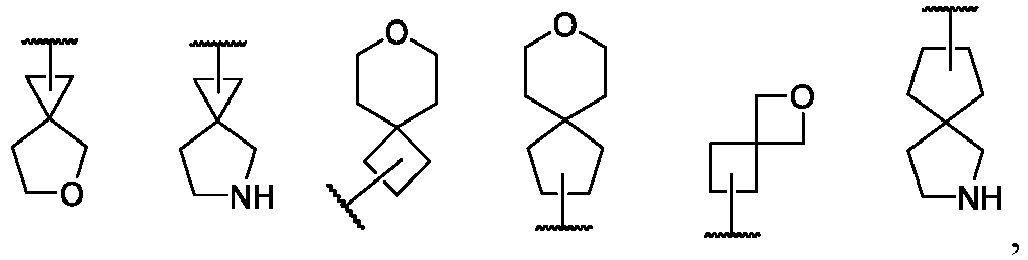
- The term "fused cycloalkyl" refers to a polycyclic system in which two adjacent carbon atoms are shared between rings, which is formed by fusing a monocyclic cycloalkyl group with one or more monocyclic cycloalkyl groups, or fusing a monocyclic cycloalkyl group with one or more of a heterocyclyl group, an aryl group, or a heteroaryl group, wherein the point of attachment is on a monocyclic cycloalkyl group; and which may contain in the rings one or more double bonds and has 5 to 20 (e.g., 5, 6, 7, 8, 9, 10, 11, 12, 13, 14, 15, 16, 17, 18, 19, or 20) ring atoms (i.e., 5- to 20-membered fused cycloalkyl). The fused cycloalkyl is preferably a fused cycloalkyl group having 6 to 14 ring atoms (i.e., 6- to 14-membered fused cycloalkyl), and more preferably a fused cycloalkyl group having 7 to 10 ring atoms (i.e., 7- to 10-membered fused cycloalkyl). The fused cycloalkyl includes bicyclic fused cycloalkyl and polycyclic fused cycloalkyl (e.g., tricyclic fused cycloalkyl and tetracyclic fused cycloalkyl), preferably bicyclic fused cycloalkyl or tricyclic fused cycloalkyl, and more preferably 3-membered/4-membered, 3-membered/5-membered, 3-membered/6-membered, 4-membered/4-membered, 4-membered/5-membered, 4-membered/6-membered, 5-membered/3-membered, 5-membered/4-membered, 5-membered/5-membered, 5-membered/6-membered, 5-membered/7-membered, 6-membered/3-membered, 6-membered/4-membered, 6-membered/5-membered, 6-membered/6-membered, 6-membered/7-membered, 7-membered/5-membered, or 7-membered/6-membered bicyclic fused cycloalkyl. Non-limiting examples include:


- The term "bridged cycloalkyl" refers to an all-carbon polycyclic system in which two carbon atoms that are not directly connected are shared between rings, which may contain in the rings one or more double bonds and has 5 to 20 (e.g., 5, 6, 7, 8, 9, 10, 11, 12, 13, 14, 15, 16, 17, 18, 19, or 20) carbon atoms (i.e., 5- to 20-membered bridged cycloalkyl). The bridged cycloalkyl is preferably a bridged cycloalkyl group having 6 to 14 carbon atoms (i.e., 6- to 14-membered bridged cycloalkyl), and more preferably a bridged cycloalkyl group having 7 to 10 carbon atoms (i.e., 7- to 10-membered bridged cycloalkyl). The bridged cycloalkyl includes bicyclic bridged cycloalkyl and polycyclic bridged cycloalkyl (e.g., tricyclic bridged cycloalkyl and tetracyclic bridged cycloalkyl), preferably bicyclic bridged cycloalkyl or tricyclic bridged cycloalkyl. Non-limiting examples include:

- Cycloalkyl may be substituted or unsubstituted, and when it is substituted, it may be substituted at any accessible point of attachment, and the substituent is preferably selected from the group consisting of one or more of a deuterium atom, halogen, alkyl, alkoxy, haloalkyl, haloalkoxy, cycloalkyloxy, heterocyclyloxy, hydroxy, hydroxyalkyl, oxo, cyano, amino, nitro, cycloalkyl, heterocyclyl, aryl, and heteroaryl.
- The term "heterocyclyl" refers to a saturated or partially unsaturated monocyclic heterocycle (i.e., monocyclic heterocyclyl) or polycyclic heterocyclic system (i.e., polycyclic heterocyclyl), which contains in the ring(s) at least one (e.g., 1, 2, 3, or 4) heteroatom selected from the group consisting of nitrogen, oxygen, and sulfur (the nitrogen may be optionally oxidized to form a nitrogen oxide; the sulfur may be optionally substituted with oxo to form a sulfoxide or sulfone, excluding -O-O-, -O-S-, or -S-S-) and has 3 to 20 (e.g., 3, 4, 5, 6, 7, 8, 9, 10, 11, 12, 13, 14, 15, 16, 17, 18, 19, or 20) ring atoms (i.e., 3- to 20-membered heterocyclyl). The heterocyclyl is preferably a heterocyclyl group having 3 to 12 ring atoms (i.e., 3- to 12-membered heterocyclyl); further preferably a heterocyclyl group having 3 to 8 ring atoms (i.e., 3- to 8-membered heterocyclyl); more preferably a heterocyclyl group having 3 to 6 ring atoms (i.e., 3- to 6-membered heterocyclyl); and most preferably a heterocyclyl group having 5 or 6 ring atoms (i.e., 5- or 6-membered heterocyclyl).
- Non-limiting examples of the monocyclic heterocyclyl include: pyrrolidinyl, tetrahydropyranyl, 1,2,3,6-tetrahydropyridinyl, piperidinyl, piperazinyl, morpholinyl, thiomorpholinyl, homopiperazinyl, and the like.
- The polycyclic heterocyclyl includes spiroheterocyclyl, fused heterocyclyl, and bridged heterocyclyl.
- The term "spiroheterocyclyl" refers to a polycyclic heterocyclic system in which an atom (referred to as a spiro atom) is shared between rings, which may contain in the rings one or more double bonds and contains in the rings at least one (e.g., 1, 2, 3, or 4) heteroatoms selected from the group consisting of nitrogen, oxygen, and sulfur (the nitrogen may be optionally oxidized to form a nitrogen oxide; the sulfur may be optionally substituted with oxo to form a sulfoxide or sulfone, excluding -O-O-, -O-S-, or -S-S-), provided that at least one monocyclic heterocyclyl group is contained and the point of attachment is on the monocyclic heterocyclyl group; and which has 5 to 20 (e.g., 5, 6, 7, 8, 9, 10, 11, 12, 13, 14, 15, 16, 17, 18, 19, or 20) ring atoms (i.e., 5- to 20-membered spiroheterocyclyl). The spiroheterocyclyl is preferably a spiroheterocyclyl group having 6 to 14 ring atoms (i.e., 6- to 14-membered spiroheterocyclyl), and more preferably a spiroheterocyclyl group having 7 to 10 ring atoms (i.e., 7- to 10-membered spiroheterocyclyl). The spiroheterocyclyl includes monospiroheterocyclyl and polyspiroheterocyclyl (e.g., bispiroheterocyclyl), preferably monospiroheterocyclyl or bispiroheterocyclyl, and more preferably 3-membered/4-membered, 3-membered/5-membered, 3-membered/6-membered, 4-membered/4-membered, 4-membered/5-membered, 4-membered/6-membered, 5-membered/3-membered, 5-membered/4-membered, 5-membered/5-membered, 5-membered/6-membered, 5-membered/7-membered, 6-membered/3-membered, 6-membered/4-membered, 6-membered/5-membered, 6-membered/6-membered, 6-membered/7-membered, 7-membered/5-membered, or 7-membered/6-membered monospiroheterocyclyl. Non-limiting examples include:

- The term "fused heterocyclyl" refers to a polycyclic heterocyclic system in which two adjacent atoms are shared between rings, which may contain in the rings one or more double bonds and contains in the rings at least one (e.g., 1, 2, 3, or 4) heteroatoms selected from the group consisting of nitrogen, oxygen, and sulfur (the nitrogen may be optionally oxidized to form a nitrogen oxide; the sulfur may be optionally substituted with oxo to form a sulfoxide or sulfone, excluding -O-O-, -O-S-, or -S-S-); which is formed by fusing a monocyclic heterocyclyl group with one or more monocyclic heterocyclyl groups, or fusing a monocyclic heterocyclyl group with one or more of a cycloalkyl group, an aryl group, or a heteroaryl group, wherein the point of attachment is on a monocyclic heterocyclyl group; and which has 5 to 20 (e.g., 5, 6, 7, 8, 9, 10, 11, 12, 13, 14, 15, 16, 17, 18, 19, or 20) ring atoms (i.e., 5- to 20-membered fused heterocyclyl). The fused heterocyclyl is preferably a fused heterocyclyl group having 6 to 14 ring atoms (i.e., 6- to 14-membered fused heterocyclyl), and more preferably a fused heterocyclyl group having 7 to 10 ring atoms (i.e., 7- to 10-membered fused heterocyclyl). The fused heterocyclyl includes bicyclic and polycyclic fused heterocyclyl (e.g., tricyclic fused heterocyclyl and tetracyclic fused heterocyclyl), preferably bicyclic fused heterocyclyl or tricyclic fused heterocyclyl, more preferably 3-membered/4-membered, 3-membered/5-membered, 3-membered/6-membered, 4-membered/4-membered, 4-membered/5-membered, 4-membered/6-membered, 5-membered/3-membered, 5-membered/4-membered, 5-membered/5-membered, 5-membered/6-membered, 5-membered/7-membered, 6-membered/3-membered, 6-membered/4-membered, 6-membered/5-membered, 6-membered/6-membered, 6-membered/7-membered, 7-membered/5-membered, or 7-membered/6-membered bicyclic fused heterocyclyl. Non-limiting examples include:


- The term "bridged heterocyclyl" refers to a polycyclic heterocyclic system in which two atoms that are not directly connected are shared between rings, which may contain in the rings one or more double bonds and contains in the rings at least one (e.g., 1, 2, 3, or 4) heteroatoms selected from the group consisting of nitrogen, oxygen, and sulfur (the nitrogen may be optionally oxidized to form a nitrogen oxide; the sulfur may be optionally substituted with oxo to form a sulfoxide or sulfone, excluding -O-O-, -O-S-, or -S-S-); and which has 5 to 20 (e.g., 5, 6, 7, 8, 9, 10, 11, 12, 13, 14, 15, 16, 17, 18, 19, or 20) ring atoms (i.e., 5- to 20-membered bridged heterocyclyl). The bridged heterocyclyl is preferably a bridged heterocyclyl group having 6 to 14 ring atoms (i.e., 6- to 14-membered bridged heterocyclyl), and more preferably a bridged heterocyclyl group having 7 to 10 ring atoms (i.e., 7- to 10-membered bridged heterocyclyl). According to the number of constituent rings, bridged heterocyclyl can be divided into bicyclic bridged heterocyclyl and polycyclic bridged heterocyclyl (e.g., tricyclic bridged heterocyclyl and tetracyclic bridged heterocyclyl), preferably bicyclic bridged heterocyclyl or tricyclic bridged heterocyclyl. Non-limiting examples include:

- Heterocyclyl may be substituted or unsubstituted, and when it is substituted, it may be substituted at any accessible point of attachment, and the substituent is preferably selected from the group consisting of one or more of a deuterium atom, halogen, alkyl, alkoxy, haloalkyl, haloalkoxy, cycloalkyloxy, heterocyclyloxy, hydroxy, hydroxyalkyl, oxo, cyano, amino, nitro, cycloalkyl, heterocyclyl, aryl, and heteroaryl.
- The term "aryl" refers to a monocyclic all-carbon aromatic ring (i.e., monocyclic aryl) or polycyclic aromatic ring system (i.e., polycyclic aryl) having a conjugated π-electron system, which has 6 to 14 (e.g., 6, 7, 8, 9, 10, 11, 12, 13, or 14) ring atoms (i.e., 6- to 14-membered aryl). The aryl is preferably an aryl group having 6 to 10 ring atoms (i.e., 6- to 10-membered aryl). An example of the monocyclic aryl is phenyl. Non-limiting examples of the polycyclic aryl include: naphthyl, anthryl, phenanthryl, and the like. The polycyclic aryl also includes those formed by fusing a phenyl group with one or more of a heterocyclyl group or a cycloalkyl group, or fusing a naphthyl group with one or more of a heterocyclyl group or a cycloalkyl group, wherein the point of attachment is on the phenyl group or the naphthyl group, and in such cases, the number of ring atoms continues to represent the number of ring atoms in the polycyclic aromatic ring system; non-limiting examples include:

- Aryl may be substituted or unsubstituted, and when it is substituted, it may be substituted at any accessible point of attachment, and the substituent is preferably selected from the group consisting of one or more of a deuterium atom, halogen, alkyl, alkoxy, haloalkyl, haloalkoxy, cycloalkyloxy, heterocyclyloxy, hydroxy, hydroxyalkyl, oxo, cyano, amino, nitro, cycloalkyl, heterocyclyl, aryl, and heteroaryl.
- The term "heteroaryl" refers to a monocyclic heteroaromatic ring (i.e., monocyclic heteroaryl) or polycyclic heteroaromatic ring system (i.e., polycyclic heteroaryl) having a conjugated π-electron system, which contains in the ring(s) at least one (e.g., 1, 2, 3, or 4) heteroatom selected from the group consisting of nitrogen, oxygen, and sulfur (the nitrogen may be optionally oxidized to form a nitrogen oxide; the sulfur may be optionally substituted with oxo to form a sulfoxide or sulfone, excluding -O-O-, -O-S-, or -S-S-) and has 5 to 14 (e.g., 5, 6, 7, 8, 9, 10, 11, 12, 13, or 14) ring atoms (i.e., 5- to 14-membered heteroaryl). The heteroaryl is preferably a heteroaryl group having 5 to 10 ring atoms (i.e., 5- to 10-membered heteroaryl), more preferably a monocyclic heteroaryl group having 5 or 6 ring atoms (i.e., 5- or 6-membered monocyclic heteroaryl) or a bicyclic heteroaryl group having 8 to 10 ring atoms (i.e., 8- to 10-membered bicyclic heteroaryl), and most preferably a 5- or 6-membered monocyclic heteroaryl group containing in the ring 1, 2, or 3 heteroatoms selected from the group consisting of nitrogen, oxygen, and sulfur or an 8- to 10-membered bicyclic heteroaryl group containing in the ring 1, 2, or 3 heteroatoms selected from the group consisting of nitrogen, oxygen, and sulfur.
- Non-limiting examples of the monocyclic heteroaryl include: furanyl, thienyl, thiazolyl, isothiazolyl, oxazolyl, isoxazolyl, oxadiazolyl, thiadiazolyl, imidazolyl, pyrazolyl, triazolyl, tetrazolyl, furazanyl, pyrrolyl, N-alkylpyrrolyl, pyridinyl, pyrimidinyl, pyridonyl, N-alkylpyridinone (e.g.,

- Non-limiting examples of the polycyclic heteroaryl include: indolyl, indazolyl, quinolyl, isoquinolyl, quinoxalinyl, phthalazinyl, benzimidazolyl, benzothienyl, quinazolinyl, benzothiazolyl, carbazolyl, and the like. The polycyclic heteroaryl also includes those formed by fusing a monocyclic heteroaryl group with one or more aryl groups, wherein the point of attachment is on an aromatic ring, and in such cases, the number of ring atoms continues to represent the number of ring atoms in the polycyclic heteroaromatic ring system. The polycyclic heteroaryl also includes those formed by fusing a monocyclic heteroaryl group with one or more of a cycloalkyl group or a heterocyclyl group, wherein the point of attachment is on the monocyclic heteroaromatic ring, and in such cases, the number of ring atoms continues to represent the number of ring atoms in the polycyclic heteroaromatic ring system. Non-limiting examples include:



- Heteroaryl may be substituted or unsubstituted, and when it is substituted, it may be substituted at any accessible point of attachment, and the substituent is preferably selected from the group consisting of one or more of a deuterium atom, halogen, alkyl, alkoxy, haloalkyl, haloalkoxy, cycloalkyloxy, heterocyclyloxy, hydroxy, hydroxyalkyl, cyano, amino, nitro, cycloalkyl, heterocyclyl, aryl, and heteroaryl.
- The term "amino protecting group" refers to an easily removable group that is introduced onto an amino group in order for the amino group to remain unchanged when other parts of the molecule are involved in reactions. Non-limiting examples include: (trimethylsilyl)ethoxymethyl, tetrahydropyranyl, tert-butyloxycarbonyl (Boc), benzyloxycarbonyl (Cbz), fluorenylmethoxycarbonyl (Fmoc), allyloxycarbonyl (Alloc), trimethylsilylethoxycarbonyl (Teoc), methoxycarbonyl, ethoxycarbonyl, phthaloyl (Pht), p-toluenesulfonyl (Tos), trifluoroacetyl (Tfa), trityl (Trt), 2,4-dimethoxybenzyl (DMB), acetyl, benzyl, allyl, p-methoxybenzyl, and the like.
- The term "hydroxy protecting group" refers to an easily removable group that is introduced onto a hydroxy group to block or protect the hydroxy group so that reactions take place on other functional groups of the compound. Non-limiting examples include: trimethylsilyl (TMS), triethylsilyl (TES), triisopropylsilyl (TIPS), tert-butyldimethylsilyl (TBS), tert-butyldiphenylsilyl (TBDPS), methyl, tert-butyl, allyl, benzyl, methoxymethyl (MOM), ethoxyethyl, 2-tetrahydropyranyl (THP), formyl, acetyl, benzoyl, p-nitrobenzoyl, and the like.
- The term "cycloalkyloxy" refers to cycloalkyl-O-, wherein the cycloalkyl is as defined above.
- The term "heterocyclyloxy" refers to heterocyclyl-O-, wherein the heterocyclyl is as defined above.
- The term "aryloxy" refers to aryl-O-, wherein the aryl is as defined above.
- The term "heteroaryloxy" refers to heteroaryl-O-, wherein the heteroaryl is as defined above.
- The term "alkylthio" refers to alkyl-S-, wherein the alkyl is as defined above.
- The term "haloalkyl" refers to an alkyl group substituted with one or more halogens, wherein the alkyl group is as defined above.
- The term "haloalkoxy" refers to an alkoxy group substituted with one or more halogens, wherein the alkoxy group is as defined above.
- The term "deuterated alkyl" refers to an alkyl group substituted with one or more deuterium atoms, wherein the alkyl is as defined above.
- The term "hydroxyalkyl" refers to an alkyl group substituted with one or more hydroxy groups, wherein the alkyl group is as defined above.
- The term "halogen" refers to fluorine, chlorine, bromine, or iodine.
- The term "hydroxy" refers to -OH.
- The term "sulfhydryl" refers to -SH.
- The term "amino" refers to -NH2.
- The term "cyano" refers to -CN.
- The term "nitro" refers to -NO2.
- The term "oxo" refers to "=O".
- The term "carbonyl" refers to C=O.
- The term "carboxyl" refers to -C(O)OH.
- The term "carboxylate group" refers to -C(O)O(alkyl), -C(O)O(cycloalkyl), (alkyl)C(O)O-, or (cycloalkyl)C(O)O-, wherein the alkyl and cycloalkyl are as defined above.
- The compounds of the present disclosure may exist in specific stereoisomeric forms. The term "stereoisomer" refers to isomers that are structurally identical but differ in the arrangement of the atoms in space. It includes cis and trans (or Z and E) isomers, (-)- and (+)-isomers, (R)- and (S)-enantiomers, diastereomers, (D)- and (L)-isomers, tautomers, atropisomers, conformers, and mixtures thereof (e.g., mixtures of racemates and diastereomers). Additional asymmetric atoms may be present in the substituents in the compounds of the present disclosure. All such stereoisomers and mixtures thereof are included within the scope of the present disclosure. Optically active (-)- and (+)-isomers, (R)- and (S)-enantiomers, and (D)- and (L)-isomers can be prepared by chiral synthesis, chiral reagents, or other conventional techniques. One isomer of a certain compound of the present disclosure may be prepared by asymmetric synthesis or with a chiral auxiliary, or, when the molecule contains a basic functional group (e.g., amino) or an acidic functional group (e.g., carboxyl), a diastereomeric salt is formed with an appropriate optically active acid or base, followed by diastereomeric resolution by conventional methods known in the art to give the pure isomer. Furthermore, separation of enantiomers and diastereomers is generally accomplished by chromatography.
- In the chemical structures of the compounds of the present disclosure, a bond


- The compounds of the present disclosure may also exist in different tautomeric forms, and all such forms are included within the scope of the present disclosure. The term "tautomer" or "tautomeric form" refers to a structural isomer that exists in equilibrium and is readily converted from one isomeric form into another. It includes all possible tautomers; that is, it is present in the form of a single isomer or in the form of a mixture of the tautomers in any ratio. Non-limiting examples include: keto-enol, imine-enamine, lactam-lactim, and the like. An example of lactam-lactim in equilibrium is shown below:

- For example, reference to pyrazolyl is understood to include any of the following two structures or a mixture of the two tautomers:

- All tautomeric forms fall within the scope of the present disclosure, and the nomenclature of the compounds does not exclude any tautomer.
- The compound of the present disclosure may include atropisomers. The term "atropisomers" refers to conformational stereoisomers that result from hindered or greatly slowed rotation about a single bond in a molecule (as a result of the steric interactions with other parts of the molecule and the asymmetry of the substituents at both ends of the single bond), which interconvert sufficiently slowly to allow separation and isolation under predetermined conditions. For example, certain compounds of the present disclosure may exist in the form of a mixture of atropisomers (e.g., an equal ratio mixture, a mixture enriched in one atropisomer) or a purified atropisomer.
- Non-limiting examples include:

- The compounds of the present disclosure include all suitable isotopic derivatives of the compounds thereof. The term "isotopic derivative" refers to a compound in which at least one atom is replaced with an atom having the same atomic number but a different atomic mass. Examples of isotopes that can be incorporated into the compounds of the present disclosure include stable and radioactive isotopes of hydrogen, carbon, nitrogen, oxygen, phosphorus, sulfur, fluorine, chlorine, bromine, iodine, etc., such as 2H (deuterium, D), 3H (deuterium, T), 11C, 13C, 14C, 15N, 17O, 18O, 32p, 33p, 33S, 34S, 35S, 36S, 18F, 36Cl, 82Br, 123I, 124I, 125I, 129I, and 131I; deuterium is preferred.
- Compared to non-deuterated drugs, deuterated drugs have the advantages of reduced toxic and side effects, increased drug stability, enhanced curative effect, prolonged biological half-lives, and the like. All isotopic variations of the compounds of the present disclosure, whether radioactive or not, are intended to be included within the scope of the present disclosure. Each available hydrogen atom linked to a carbon atom may be independently replaced with a deuterium atom, wherein replacement of deuterium may be partial or complete, and replacement of partial deuterium refers to replacement of at least one hydrogen atom with at least one deuterium atom.
- When a position is specifically assigned deuterium (D), the position should be understood as deuterium with an abundance that is at least 1000 times greater than the natural abundance of deuterium (which is 0.015%) (i.e., at least 15% deuterium incorporation). The deuterium of the compounds in the examples with an abundance greater than the natural abundance of deuterium may be deuterium with an abundance that is at least 1000 times greater (i.e., at least 15% deuterium incorporation), at least 2000 times greater (i.e., at least 30% deuterium incorporation), at least 3000 times greater (i.e., at least 45% deuterium incorporation), at least 3340 times greater (i.e., at least 50.1% deuterium incorporation), at least 3500 times greater (i.e., at least 52.5% deuterium incorporation), at least 4000 times greater (i.e., at least 60% deuterium incorporation), at least 4500 times greater (i.e., at least 67.5% deuterium incorporation), at least 5000 times greater (i.e., at least 75% deuterium incorporation), at least 5500 times greater (i.e., at least 82.5% deuterium incorporation), at least 6000 times greater (i.e., at least 90% deuterium incorporation), at least 6333.3 times greater (i.e., at least 95% deuterium incorporation), at least 6466.7 times greater (i.e., at least 97% deuterium incorporation), at least 6600 times greater (i.e., at least 99% deuterium incorporation), or at least 6633.3 times greater (i.e., at least 99.5% deuterium incorporation), or deuterium with a higher abundance.
- "Optionally" or "optional" means that the subsequently described event or circumstance may, but does not necessarily, occur; it includes both the instance where the event or circumstance occurs and the instance where it does not. For example, "C1-6 alkyl optionally substituted with halogen or cyano" includes the instance where the alkyl is substituted with the halogen or cyano and the instance where it is not.
- "Substitution" or "substituted" means that one or more, preferably 1-6, and more preferably 1-3, hydrogen atoms in the group are independently substituted with a corresponding number of substituents. Those skilled in the art can determine (experimentally or theoretically) possible or impossible substitutions without undue effort. For example, it may be unstable when an amino or hydroxy group having free hydrogen binds to a carbon atom having an unsaturated bond (e.g., an olefin).
- "Pharmaceutical composition" refers to a mixture containing one or more of the compounds or the pharmaceutically acceptable salts thereof described herein, and other chemical components, and other components, for example, pharmaceutically acceptable carriers and excipients. The pharmaceutical composition is intended to promote the administration to an organism, so as to facilitate the absorption of the active ingredient, thereby exerting biological activity.
- "Pharmaceutically acceptable salt" refers to a salt of a compound of the present disclosure, which may be selected from the group consisting of inorganic and organic salts. Such salts are safe and effective when used in the body of a mammal and possess the requisite biological activity. The salts may be prepared separately during the final separation and purification of the compound, or by reacting an appropriate group with an appropriate base or acid. Bases commonly used to form pharmaceutically acceptable salts include inorganic bases such as sodium hydroxide and potassium hydroxide, and organic bases such as ammonia. Acids commonly used to form pharmaceutically acceptable salts include inorganic acids and organic acids.
- For drugs or pharmacologically active agents, the term "therapeutically effective amount" refers to an amount of the drug or agent sufficient to achieve, or at least partially achieve, the desired effect. The determination of the therapeutically effective amount varies from person to person. It depends on the age and general condition of the subject, as well as the specific active substance used. The appropriate therapeutically effective amount in an individual case can be determined by those skilled in the art through a conventional experiment.
- The term "pharmaceutically acceptable" as used herein means that those compounds, materials, compositions, and/or dosage forms that are, within the scope of reasonable medical judgment, suitable for use in contact with the tissues of patients without excessive toxicity, irritation, allergic reaction, or other problems or complications, and are commensurate with a reasonable benefit/risk ratio and effective for the intended use. As used herein, the singular forms "a", "an" and "the" include plural references and vice versa, unless otherwise clearly defined in the context.
- When the term "about" is applied to parameters such as pH, concentration, and temperature, it means that the parameter may vary by ±10%, and sometimes more preferably within ±5%. As will be understood by those skilled in the art, when the parameters are not critical, the numbers are generally given for illustrative purposes only and are not intended to be limiting.
- To achieve the purposes of the present disclosure, the following technical solutions are adopted in the present disclosure:
- A method for preparing the compound represented by general formula (IM) or the pharmaceutically acceptable salt thereof of the present disclosure, which comprises the following step:

- L is halogen; preferably, L is Cl;
- R1 is

- ring A, V, X, Y, Z, R2, R3, R4, R6, R11, R12, R13, R14, s, and t are as defined in general formula (IM).
- A method for preparing the compound represented by general formula (I) or the pharmaceutically acceptable salt thereof of the present disclosure, which comprises the following step:

- L is halogen; preferably, L is Cl;
- R1 is

- ring A, X, Y, Z, R2, R3, R4, R5, R6, R11, R12, R13, R14, s, and t are as defined in general formula (I).
- A method for preparing the compound represented by general formula (II) or the pharmaceutically acceptable salt thereof of the present disclosure, which comprises the following step:

- L is halogen; preferably, L is Cl;
- R1 is

- A method for preparing the compound represented by general formula (III) or the pharmaceutically acceptable salt thereof of the present disclosure, which comprises the following step:

- L is halogen; preferably, L is Cl;
- W, Z, R3, R4, R5, R6, R11, R12, R13, and t are as defined in general formula (III).
- A method for preparing the compound represented by general formula (III-1) or the pharmaceutically acceptable salt thereof of the present disclosure, which comprises the following step:

- L is halogen; preferably, L is Cl;
- W, Z, R3, R4, R5, R6, R11, R12, R13, and t are as defined in general formula (III-1).
- A method for preparing the compound represented by general formula (III-2) or the pharmaceutically acceptable salt thereof of the present disclosure, which comprises the following step:

- L is halogen; preferably, L is Cl;
- W, Z, R3, R4, R5, R6, R11, R12, R13, and t are as defined in general formula (III-2).
- A method for preparing the compounds represented by general formula (III-1-A) and general formula (III-1-B) or the pharmaceutically acceptable salts thereof of the present disclosure, which comprises the following step:

W, Z, R3, R4, R5, R6, R11, R12, R13, and t are as defined in general formula (III-1). - A method for preparing the compounds represented by general formula (III-2-A) and general formula (III-2-B) or the pharmaceutically acceptable salts thereof of the present disclosure, which comprises the following step:

W, Z, R3, R4, R5, R6, R11, R12, R13, and t are as defined in general formula (III-2). - A method for preparing the compound represented by general formula (IMa) or the pharmaceutically acceptable salt thereof of the present disclosure, which comprises the following steps:

- (a) conducting a Suzuki coupling reaction of a compound represented by general formula (IMaaa) or a salt thereof with a compound represented by general formula (Iaab) or a salt thereof to give a compound represented by general formula (IMaa) or a salt thereof; and
- (b) removing RW2 from the compound represented by general formula (IMaa) or the salt thereof under acidic conditions to give the compound represented by general formula (IMa) or the pharmaceutically acceptable salt thereof;
wherein:- RL is halogen; preferably, RL is Br;
- RW2 is an amino protecting group; preferably, RW2 is tert-butyloxycarbonyl;
- RX is selected from the group consisting of

- and R is a hydrogen atom or C1-6 alkyl;
- ring A, V, X, Y, Z, R2, R3, R4, R6, s, and t are as defined in general formula (IMa).
- A method for preparing the compound represented by general formula (IMa) or the salt thereof of the present disclosure, which comprises the following steps:

- (a) conducting a Suzuki coupling reaction of a compound represented by general formula (IMaaa) or a salt thereof with a compound represented by general formula (Iaab) or a salt thereof to give a compound represented by general formula (IMaa) or a salt thereof; and
- (b) removing RW2 from the compound represented by general formula (IMaa) or the salt thereof under acidic conditions to give the compound represented by general formula (IMa) or the salt thereof, wherein optionally, when a protecting group is present on the R6 group, a step of removing the protecting group from the R6 group under acidic conditions is also included before, during, or after the deprotection reaction;
wherein:- RL is halogen; preferably, RL is Br;
- RW2 is an amino protecting group; preferably, RW2 is tert-butyloxycarbonyl;
- RX is selected from the group consisting of and R is a hydrogen atom or C1-6 alkyl;

- ring A, V, X, Y, Z, R2, R3, R4, R6, s, and t are as defined in general formula (IMa).
- A method for preparing the compound represented by general formula (Ia) or the pharmaceutically acceptable salt thereof of the present disclosure, which comprises the following steps:

- (a) conducting a Suzuki coupling reaction of a compound represented by general formula (Iaaa) or a salt thereof with a compound represented by general formula (Iaab) or a salt thereof to give a compound represented by general formula (Iaa) or a pharmaceutically acceptable salt thereof; and
- (b) removing RW2 from the compound represented by general formula (Iaa) or the salt thereof under acidic conditions to give the compound represented by general formula (Ia) or the pharmaceutically acceptable salt thereof;
wherein:- RL is halogen; preferably, RL is Br;
- RW2 is an amino protecting group; preferably, RW2 is tert-butyloxycarbonyl;
- RX is selected from the group consisting of

- and R is a hydrogen atom or C1-6 alkyl;
- ring A, X, Y, Z, R2, R3, R4, R5, R6, s, and t are as defined in general formula (Ia).
- A method for preparing the compound represented by general formula (Ia) or the salt thereof of the present disclosure, which comprises the following steps:

- (a) conducting a Suzuki coupling reaction of a compound represented by general formula (Iaaa) or a salt thereof with a compound represented by general formula (Iaab) or a salt thereof to give a compound represented by general formula (Iaa) or a salt thereof; and
- (b) removing RW2 from the compound represented by general formula (Iaa) or the salt thereof under acidic conditions to give the compound represented by general formula (Ia) or the salt thereof, wherein optionally, when a protecting group is present on the R6 group, a step of removing the protecting group from the R6 group under acidic conditions is also included before, during, or after the deprotection reaction;
wherein:- RL is halogen; preferably, RL is Br;
- RW2 is an amino protecting group; preferably, RW2 is tert-butyloxycarbonyl;
- RX is selected from the group consisting of

- and R is a hydrogen atom or C1-6 alkyl;
- ring A, X, Y, Z, R2, R3, R4, R5, R6, s, and t are as defined in general formula (Ia).
- A method for preparing the compound represented by general formula (IIa) or the pharmaceutically acceptable salt thereof of the present disclosure, which comprises the following steps:

- (a) conducting a Suzuki coupling reaction of a compound represented by general formula (IIaaa) or a salt thereof with a compound represented by general formula (Iaab) or a salt thereof to give a compound represented by general formula (IIaa) or a pharmaceutically acceptable salt thereof; and
- (b) removing RW2 from the compound represented by general formula (IIaa) or the salt thereof under acidic conditions to give the compound represented by general formula (IIa) or the pharmaceutically acceptable salt thereof;
wherein:- RL is halogen; preferably, RL is Br;
- RW2 is an amino protecting group; preferably, RW2 is tert-butyloxycarbonyl;
- RX is selected from the group consisting of

- and R is a hydrogen atom or C1-6 alkyl;
- ring A, X, Z, R3, R4, R5, R6, and t are as defined in general formula (IIa).
- A method for preparing the compound represented by general formula (IIa) or the salt thereof of the present disclosure, which comprises the following steps:

- (a) conducting a Suzuki coupling reaction of a compound represented by general formula (IIaaa) or a salt thereof with a compound represented by general formula (Iaab) or a salt thereof to give a compound represented by general formula (IIaa) or a salt thereof; and
- (b) removing RW2 from the compound represented by general formula (IIaa) or the salt thereof under acidic conditions to give the compound represented by general formula (IIa) or the salt thereof, wherein optionally, when a protecting group is present on the R6 group, a step of removing the protecting group from the R6 group under acidic conditions is also included before, during, or after the deprotection reaction;
wherein:- RL is halogen; preferably, RL is Br;
- RW2 is an amino protecting group; preferably, RW2 is tert-butyloxycarbonyl;
- RX is selected from the group consisting of

- and R is a hydrogen atom or C1-6 alkyl;
- ring A, X, Z, R3, R4, R5, R6, and t are as defined in general formula (IIa).
- A method for preparing the compound represented by general formula (IIIa) or the pharmaceutically acceptable salt thereof of the present disclosure, which comprises the following steps:

- (a) conducting a Suzuki coupling reaction of a compound represented by general formula (IIIaaa) or a salt thereof with a compound represented by general formula (IIIaab) or a salt thereof to give a compound represented by general formula (IIIaa) or a pharmaceutically acceptable salt thereof; and
- (b) removing RW1 and RW2 from the compound represented by general formula (IIIaa) or the salt thereof under acidic conditions to give the compound represented by general formula (IIIa) or the pharmaceutically acceptable salt thereof;
wherein:- RL is halogen; preferably, RL is Br;
- RW1 and RW2 are both amino protecting groups; preferably, RW1 and RW2 are both tert-butyloxycarbonyl;
- RX is selected from the group consisting of

- and R is a hydrogen atom or C1-6 alkyl;
- W, Z, R3, R4, R5, R6, and t are as defined in general formula (IIIa).
- A method for preparing the compound represented by general formula (III-1a) or the pharmaceutically acceptable salt thereof of the present disclosure, which comprises the following steps:

- (a) conducting a Suzuki coupling reaction of a compound represented by general formula (III-1aaa) or a salt thereof with a compound represented by general formula (IIIaab) or a salt thereof to give a compound represented by general formula (III-1aa) or a pharmaceutically acceptable salt thereof; and
- (b) removing RW1 and RW2 from the compound represented by general formula (III-1aa) or the salt thereof under acidic conditions to give the compound represented by general formula (III-1a) or the pharmaceutically acceptable salt thereof;
wherein:- RL is halogen; preferably, RL is Br;
- RW1 and RW2 are both amino protecting groups; preferably, RW1 and RW2 are both tert-butyloxycarbonyl;
- RX is selected from the group consisting of
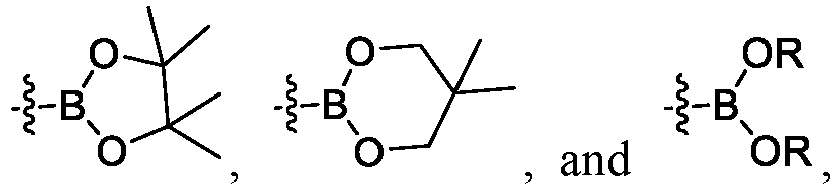
- and R is a hydrogen atom or C1-6 alkyl;
- W, Z, R3, R4, R5, R6, and t are as defined in general formula (III-1a).
- A method for preparing the compound represented by general formula (III-2a) or the pharmaceutically acceptable salt thereof of the present disclosure, which comprises the following steps:

- (a) conducting a Suzuki coupling reaction of a compound represented by general formula (III-2aaa) or a salt thereof with a compound represented by general formula (IIIaab) or a salt thereof to give a compound represented by general formula (III-2aa) or a pharmaceutically acceptable salt thereof; and
- (b) removing RW1 and RW2 from the compound represented by general formula (III-2aa) or the salt thereof under acidic conditions to give the compound represented by general formula (III-2a) or the pharmaceutically acceptable salt thereof;
wherein:- RL is halogen; preferably, RL is Br;
- RW1 and RW2 are both amino protecting groups; preferably, RW1 and RW2 are both tert-butyloxycarbonyl;
- RX is selected from the group consisting of

- and R is a hydrogen atom or C1-6 alkyl;
- W, Z, R3, R4, R5, R6, and t are as defined in general formula (III-2a).
- In the above synthesis solutions, the Suzuki coupling reactions are preferably carried out in the presence of a base (e.g., potassium carbonate or cesium carbonate) and a metal catalyst
(e.g., dichloro[bis(diphenylphosphinophenyl)ether]palladium(II) or dichloro[1,1'-bis(di-tert-butylphosphino)ferrocene]palladium(II)). - In the above synthesis solutions, bases that provide the alkaline conditions include organic bases and inorganic bases. The organic bases include,
but are not limited to, triethylamine, N,N-diisopropylethylamine, n-butyllithium, lithium diisopropylamide, potassium acetate, sodium acetate, sodium ethoxide, sodium tert-butoxide, or potassium tert-butoxide; triethylamine is preferred. The inorganic bases include, but are not limited to, sodium hydride, potassium phosphate, sodium carbonate, potassium carbonate, anhydrous potassium carbonate, cesium carbonate, sodium hydroxide, lithium hydroxide monohydrate, lithium hydroxide, and potassium hydroxide; potassium carbonate or anhydrous potassium carbonate is preferred. - In the above synthesis solutions, acids that provide the acidic conditions include organic acids and inorganic acids. The organic acids include,
but are not limited to, trifluoroacetic acid, formic acid, acetic acid, methanesulfonic acid, p-toluenesulfonic acid, Me3SiCl, and TMSOTf; trifluoroacetic acid is preferred. The inorganic acids include, but are not limited to, hydrogen chloride, a solution of hydrogen chloride in 1,4-dioxane, hydrochloric acid, sulfuric acid, nitric acid, and phosphoric acid. - The above synthesis solutions are preferably carried out in solvents, including but not limited to: ethylene glycol dimethyl ether, acetic acid, methanol, ethanol, acetonitrile, n-butanol, toluene, tetrahydrofuran, dichloromethane, petroleum ether, ethyl acetate, n-hexane, dimethyl sulfoxide, 1,4-dioxane, water, N,N-dimethylacetamide, N,N-dimethylformamide, and mixtures thereof.
- The present disclosure is further described below with reference to examples; however, these examples are not intended to limit the scope of the present disclosure.
- The structures of the compounds were determined by nuclear magnetic resonance (NMR) spectroscopy or/and mass spectrometry (MS). The NMR shifts (δ) are given in 10-6 (ppm). The NMR analyses were performed on a Bruker AVANCE-400 nuclear magnetic resonance instrument or Bruker AVANCE NEO 500M, with dimethyl sulfoxide-D6 (DMSO-d6 ), chloroform-D (CDCl3), and methanol-D4 (CD3OD) as solvents and tetramethylsilane (TMS) as an internal standard.
- The MS analyses were performed on an Agilent 1200/1290 DAD-6110/6120 Quadrupole MS liquid chromatography-mass spectrometry system (manufacturer: Agilent; MS model: 6110/6120 Quadrupole MS); Waters ACQuity UPLC-QD/SQD (manufacturer: Waters; MS model: Waters ACQuity Qda Detector/Waters SQ Detector); and THERMO Ultimate 3000-Q Exactive (manufacturer: THERMO; MS model: THERMO Q Exactive).
- The high performance liquid chromatography (HPLC) analyses were performed on Agilent HPLC 1200DAD, Agilent HPLC 1200VWD, and Waters HPLC e2695-2489 high performance liquid chromatographs.
- The chiral HPLC analyses were performed on an Agilent 1260 DAD high performance liquid chromatograph.
- The preparative high performance liquid chromatography steps were performed on Waters 2545-2767, Waters 2767-SQ Detecor2, Shimadzu LC-20AP, and Gilson GX-281 preparative chromatographs.
- The preparative chiral chromatography steps were performed on a Shimadzu LC-20AP preparative chromatograph.
- The CombiFlash preparative flash chromatograph used was Combiflash Rf200 (TELEDYNE ISCO).
- The thin-layer chromatography silica gel plates used were Yantai Huanghai HSGF254 or Qingdao GF254 silica gel plates. The silica gel plates used in the thin-layer chromatography (TLC) analyses had a layer thickness of 0.15 mm-0.2 mm, and those used in the thin-layer chromatography separations and purifications had a layer thickness of 0.4 mm-0.5 mm.
- In the silica gel column chromatography steps, a 200-300 mesh silica gel (Huanghai, Yantai) was generally used as a carrier.
- The kinase mean inhibition rates and IC50 values were measured using a NovoStar microplate reader (BMG, Germany).
- The known starting materials in the present disclosure may be synthesized by using or following methods known in the art, or may be purchased from companies such as ABCR GmbH & Co. KG, Acros Organics, Aldrich Chemical Company, Accela ChemBio Inc., and Chembee Chemicals.
- In the examples, the reactions can all be performed in an argon atmosphere or a nitrogen atmosphere unless otherwise specified.
- The argon atmosphere or nitrogen atmosphere means that the reaction flask is connected to a balloon containing about 1 L of argon or nitrogen gas.
- The hydrogen atmosphere means that the reaction flask is connected to a balloon containing about 1 L of hydrogen gas.
- The pressurized hydrogenation reactions were performed using a Parr 3916EKX hydrogenator and a Qinglan QL-500 hydrogenator, or an HC2-SS hydrogenator.
- The hydrogenation reactions generally involved 3 cycles of vacuumization and hydrogen filling.
- The microwave reactions were performed using a CEM Discover-S 908860 microwave reactor.
- In the examples, the solutions refer to aqueous solutions unless otherwise specified.
- In the examples, the reaction temperature was room temperature, i.e., 20 °C-30 °C, unless otherwise specified.
- The monitoring of reaction progress in the examples was performed using thin-layer chromatography (TLC). The developing solvents used in the reactions, the eluent systems used in the column chromatography purifications and the developing solvent systems used in the thin-layer chromatography analyses include: A: a petroleum ether/ethyl acetate system, and B: a dichloromethane/methanol system. The volume ratio of the solvents was adjusted depending on the polarity of a compound, or by adding a small amount of a basic or acidic reagent such as triethylamine and acetic acid.
-

- Methyl 2-amino-4-bromo-5-fluoro-3-methylbenzoate 1a (2.7 g, 10.3 mmol, prepared using the method disclosed in step (iv) on page 103 of the specification of the patent application "
WO2016020836A1 ") was dissolved in chloroform (50 mL), and acetic anhydride (3.16 g, 30.9 mmol) was added. After the mixture was stirred for 90 min with the temperature maintained at below 40 °C, potassium acetate (302 mg, 3.08 mmol) and tert-butyl nitrite (2.12 g, 20.6 mmol) were added. The mixture was refluxed for 14 h. The reaction mixture was cooled to room temperature, diluted with dichloromethane (50 mL), and washed with water (30 mL), saturated sodium carbonate solution (10 mL), and saturated sodium chloride solution (10 mL) in sequence. The organic phase was dried over anhydrous sodium sulfate and filtered. The filtrate was concentrated under reduced pressure to give a crude product of the title compound 1b (2.8 g). The product was directly used in the next step without purification. - MS m/z (ESI): 272.9 [M+1].
- The crude product of compound 1b (2.8 g, 10.25 mmol) was dissolved in a mixed solvent of tetrahydrofuran (20 mL), methanol (10 mL), and water (10 mL), and lithium hydroxide (2.15 g, 51.26 mmol) was added. The mixture was stirred at 40 °C for 1 h. The reaction mixture was concentrated under reduced pressure to remove most of the solvent. Water was added, and extraction was performed with ethyl acetate (150 mL × 6). The organic phases were combined, washed with dilute hydrochloric acid and saturated sodium chloride solution in sequence, and dried over anhydrous sodium sulfate, and the drying agent was removed by filtration. The filtrate was concentrated under reduced pressure to give a crude product of compound 1c (1.4 g). The product was directly used in the next step without purification.
- MS m/z (ESI): 259.0 [M+1].
- The crude product of compound 1c (600 mg, 2.32 mmol) and tert-butyl (S)-3-(2-hydroxyethyl)piperazine-1-carboxylate 1d (586 mg, 2.54 mmol, prepared using the method disclosed in preparation 65 on page 80 of the specification of the patent application "
WO2021118877A1 ") were dissolved in 30 mL of N,N-dimethylformamide, and N,N-diisopropylethylamine (898 mg, 6.95 mmol) and 2-(7-azabenzotriazole)-N,N,N',N'-tetramethyluronium hexafluorophosphate (1.05 g, 2.78 mmol) were added under an ice bath. The mixture was stirred for 1 h. The reaction mixture was concentrated under reduced pressure, then diluted with ethyl acetate, and washed with water, saturated sodium carbonate solution, and saturated sodium chloride solution in sequence. The organic phase was dried over anhydrous sodium sulfate and filtered. The filtrate was concentrated under reduced pressure, and the residue was purified by silica gel column chromatography with eluent system A to give the title compound 1f (600 mg, yield: 54.9%). - MS m/z (ESI): 415.2 [M-55].
- Compound 1f (600 mg, 1.27 mmol) was dissolved in 36 mL of tetrahydrofuran in a nitrogen atmosphere, and triphenylphosphine (667 mg, 2.54 mmol) and diethyl azodicarboxylate (514 mg, 2.54 mmol) were sequentially added under an ice bath. The mixture was stirred for 30 min with the temperature maintained. The reaction mixture was quenched with saturated ammonium chloride solution and extracted with ethyl acetate (15 mL × 2). The organic phases were combined, washed with saturated sodium chloride solution, dried over anhydrous sodium sulfate, and filtered. The filtrate was concentrated under reduced pressure, and the residue was purified by silica gel column chromatography with eluent system A to give the title compound 1g (577 mg, yield: 99.9%).
- MS m/z (ESI): 397.2 [M-55].
- Compound 1g (80 mg, 0.17 mmol) and tert-butyl (3-cyano-4-(5,5-dimethyl-1,3,2-dioxaborinan-2-yl)-7-fluorobenzo[b]thiophen-2-yl)carb amate 1h (107 mg, 0.26 mmol, prepared using the method disclosed in preparation 15 on page 50 of the specification of the patent application "
WO2021118877A1 ") were dissolved in 2 mL of toluene, and dichloro[bis(diphenylphosphinophenyl)ether]palladium(II) (18 mg, 0.025 mmol, Shanghai Titan) and cesium carbonate (115 mg, 0.35 mmol) were added. The system was purged with nitrogen gas, and the mixture was stirred at 105 °C for 6 h. The reaction mixture was cooled to room temperature and then filtered. The filtrate was concentrated under reduced pressure, and the residue was purified by silica gel column chromatography with eluent system A to give the title compound 1i (50 mg, yield: 42.6%). - MS m/z (ESI): 665.0 [M+1].
- Compound 1i (50 mg, 0.075 mmol) was dissolved in 1 mL of dichloromethane, and 1 mL of trifluoroacetic acid was added at 0 °C. The mixture was stirred for 2 h. The reaction mixture was concentrated under reduced pressure to give a crude product of the title compound 1j (52 mg). The product was directly used in the next step without purification.
- MS m/z (ESI): 465.4 [M+1].
- Compound 1j (52 mg, 0.075 mmol) was suspended in 2 mL of ethyl acetate, 1 mL of tetrahydrofuran, and 2 mL of water, and anhydrous potassium carbonate (52 mg, 0.37 mmol) was added. Acryloyl chloride (7 mg, 0.077 mmol) was added under an ice bath. After 5 min of reaction, extraction was performed with ethyl acetate (5 mL × 2). The organic phases were combined and concentrated under reduced pressure to give a crude product of compound 1, i.e.,4-((S)-10-acryloyl-2-fluoro-14-oxo-8,8a,9,10,11,12-hexahydro-7H,14H-pyrazino[1',2':5,6][1,5]diazocino[3,2,1-hi]indazol-3-yl)-2-amino-7-f luorobenzo[b]thiophene-3-carbonitrile (39 mg). The crude product was purified by preparative high performance liquid chromatography (Waters-2545; column: YMC Triart-Exrs, 30 × 150 mm, 5 µm; mobile phase: aqueous phase (10 mmol/L ammonium bicarbonate) and acetonitrile; gradient ratio: acetonitrile 30%-45%; flow rate: 30 mL/min) to give the title compounds 1-P2 (5 mg, yield: 12.7%) and 1-P1 (3 mg, yield: 7.6%).
- Single-configuration compound (shorter retention time) 1-P2 (5 mg, yield: 12.7%)
- MS m/z (ESI): 519.3 [M+1].
- HPLC analysis: retention time: 1.12 min; purity: 99% (column: ACQUITY UPLC® BEH, C18, 1.7 µm, 2.1 × 50 mm; mobile phase: water (10 mM ammonium bicarbonate), acetonitrile; gradient ratio: acetonitrile 10%-95%).
- 1H NMR (500 MHz, CD3OD): δ 7.70 (s, 1H), 7.66 (d, 1H), 7.30 (s, 1H), 7.08 (dd, 1H), 6.82 (dt, 1H), 6.34-6.25 (m, 1H), 5.83 (t, 1H), 4.75 (d, 3H), 4.49-4.19 (m, 2H), 4.16-3.93 (m, 1H), 3.57-3.44 (m, 1H), 3.22-3.06 (m, 2H), 2.25 (dd, 1H), 2.06-1.92 (m, 1H).
- Single-configuration compound (longer retention time) 1-P1 (3 mg, yield: 7.6%)
- MS m/z (ESI): 519.5 [M+1].
- LCMS analysis: retention time: 1.13 min; purity: 99% (column: ACQUITY UPLC® BEH, C18, 1.7 µm, 2.1 × 50 mm; mobile phase: water (10 mM ammonium bicarbonate), acetonitrile; gradient ratio: acetonitrile 10%-95%).
- 1H NMR (500 MHz, CD3OD): δ 7.65 (s, 1H), 7.61 (d, 1H), 7.38 (dd, 1H), 7.13-6.99 (m, 1H), 6.95-6.68 (m, 1H), 6.35-6.28 (m, 1H), 5.84 (d, 1H), 4.75 (d, 4H), 4.39-4.23 (m, 1H), 4.16-3.98 (m, 1H), 3.25-2.95 (m, 3H), 2.24 (d, 1H), 1.94 (d, 1H).
-


- 4-Bromo-5-fluoro-1H-indole-7-carboxylic acid 2a (180 mg, 0.69 mmol, prepared using the method disclosed in paragraph [0152] on page 22 of the specification of the patent application "
US20190300526A1 ") and compound 1d (160 mg, 0.69 mmol) were dissolved in 3 mL of N,N-dimethylformamide, and N,N-diisopropylethylamine (270 mg, 2.0 mmol) and 2-(7-azabenzotriazole)-N,N,N',N'-tetramethyluronium hexafluorophosphate (318 mg, 0.83 mmol) were added under an ice bath. The mixture was stirred for 1 h. The reaction mixture was concentrated under reduced pressure, and the residue was purified by silica gel column chromatography with eluent system A to give the title compound 2b (328 mg, yield: 99.9%). - MS m/z (ESI): 469.9 [M+1].
- Compound 2b (328 mg, 0.69 mmol) was dissolved in 5 mL of dichloromethane, and N,N-diisopropylethylamine (216 mg, 1.67 mmol) was added. Methanesulfonyl chloride (119 mg, 1.04 mmol) was added under an ice bath, and the mixture was stirred for 2 h. Water was added to the reaction mixture, and extraction was performed with dichloromethane (5 mL × 3). The organic phases were combined, washed with saturated sodium chloride solution, and dried over anhydrous sodium sulfate, and the drying agent was removed by filtration. The filtrate was concentrated under reduced pressure to give a crude product of the title compound 2c (382 mg). The product was directly used in the next step without purification.
- MS m/z (ESI): 392.3 [M-55].
- The crude product of compound 2c (382 mg, 0.69 mmol) was dissolved in 5 mL of N,N-dimethylformamide, and sodium hydride (53 mg, 1.38 mmol, 60% pure) was added. The mixture was stirred for 1 h. The reaction mixture was quenched with saturated ammonium chloride solution and extracted with ethyl acetate (5 mL × 3). The organic phases were combined, washed with saturated sodium chloride solution, and dried over anhydrous sodium sulfate, and the drying agent was removed by filtration. The liquid was concentrated under reduced pressure, and the residue was purified by silica gel column chromatography with eluent system A to give the title compound 2d (160 mg, yield: 50.7%).
- MS m/z (ESI): 452.0 [M+1].
- Compound 2d (80 mg, 0.17 mmol) and compound 1h (105 mg, 0.26 mmol) were dissolved in 2 mL of toluene, and dichloro[bis(diphenylphosphinophenyl)ether]palladium(II) (20 mg, 0.027 mmol) and cesium carbonate (115 mg, 0.35 mmol, Shanghai Accela ChemBio) were added. The system was purged with nitrogen gas, and the mixture was heated to 105 °C and stirred for 6 h. The reaction mixture was filtered. The filtrate was concentrated under reduced pressure, and the residue was purified by silica gel column chromatography with eluent system A to give the title compound 2e (100 mg, yield: 85%).
- MS m/z (ESI): 664.0 [M+1].
- Compound 2e (100 mg, 0.15 mmol) was dissolved in 1 mL of dichloromethane, and 1 mL of trifluoroacetic acid was added at 0 °C. The mixture was stirred for 2 h. The reaction mixture was concentrated under reduced pressure to give a crude product of the title compound 2f (104 mg). The product was directly used in the next step without purification.
- MS m/z (ESI): 464.0 [M+1].
- Compound 2f (104 mg, 0.15 mmol) was suspended in a mixed solvent of 2 mL of ethyl acetate, 1 mL of tetrahydrofuran, and 2 mL of water, and anhydrous potassium carbonate (85 mg, 0.65 mmol) was added. Acryloyl chloride (13 mg, 0.14 mmol) was added under an ice bath. The mixture was left to react for 5 min with the temperature maintained. The reaction mixture was extracted with ethyl acetate (5 mL × 3). The organic phase was concentrated under reduced pressure, and the residue was purified by high performance liquid chromatography (Waters-2545, column: SharpSil-T C18, 30 × 150 mm, 5 µm; mobile phase: aqueous phase (10 mmol/L ammonium bicarbonate) and acetonitrile; gradient ratio: acetonitrile 30%-45%; flow rate: 30 mL/min) to give the title compound 2 (30 mg, yield: 38.5%).
- MS m/z (ESI): 518.0 [M+1].
- 1H NMR (500 MHz, CD3OD): δ 7.37-7.24 (m, 2H), 7.17 (d, 1H), 7.01 (t, 1H), 6.80 (ddd, 1H), 6.29 (dd, 1H), 6.11 (d, 1H), 5.82 (dd, 1H), 4.72 (d, 2H), 4.36 (d, 2H), 4.15-4.00 (m, 2H), 3.46 (d, 1H), 3.06 (dd, 2H), 2.26-2.13 (m, 1H), 1.86 (d, 1H).
-

- Compound 2d (30 mg, 0.07 mmol) and (2-((tert-butoxycarbonyl)amino)-7-fluorobenzo[d]thiazol-4-yl)boronic acid 3a (31 mg, 0.1 mmol, prepared using the method disclosed in preparation 25 on pages 56-57 of the specification of the patent application "
WO2021118877A1 ") were dissolved in 1 mL of dioxane and 0.3 mL of water, and dichloro[1,1'-bis(di-tert-butylphosphino)ferrocene]palladium(II) (4 mg, 0.006 mmol, Shanghai Titan) and potassium carbonate (14 mg, 0.1 mmol) were added. The system was purged with nitrogen gas, and the mixture was heated to 80 °C and stirred for 1 h. The reaction mixture was cooled to room temperature and then filtered. The filtrate was concentrated under reduced pressure, and the residue was purified by silica gel column chromatography with eluent system A to give the title compound 3b (42 mg, yield: 98.9%). - MS m/z (ESI): 640.0 [M+1].
- Compound 3b (42 mg, 0.065 mmol) was dissolved in 1 mL of dichloromethane, and 1 mL of trifluoroacetic acid was added at 0 °C. The mixture was stirred for 2 h. The reaction mixture was concentrated under reduced pressure to give a crude product of the title compound 3c (50 mg). The product was directly used in the next step without purification.
- MS m/z (ESI): 440.4 [M+1].
- The crude product of compound 3c (50 mg, 0.075 mmol) was dissolved in 1 mL of dichloromethane, and triethylamine (36 mg, 0.35 mmol) was added at -78 °C. Acryloyl chloride (6 mg, 0.07 mmol) was added, and the mixture was left to react for 1 h. Extraction was performed with dichloromethane (5 mL × 2). The organic phase was concentrated under reduced pressure, and the residue was purified by high performance liquid chromatography (Waters-2545, column: SharpSil-T C18, 30 × 150 mm, 5 µm; mobile phase: aqueous phase (10 mmol/L ammonium bicarbonate) and acetonitrile; gradient ratio: acetonitrile 30%-45%; flow rate: 30 mL/min) to give the title compound 3 (10 mg, yield: 30.7%).
- MS m/z (ESI): 494.3 [M+1].
- 1H NMR (500 MHz, CD3OD): δ 7.39-7.23 (m, 3H), 7.00 (q, 1H), 6.97-6.68 (m, 1H), 6.30 (d, 1H), 6.21-6.10 (m, 1H), 5.83 (t, 1H), 4.73 (d, 2H), 4.38 (q, 2H), 4.24-3.97 (m, 2H), 3.49 (d, 1H), 3.03 (d, 2H), 2.21 (t, 1H), 1.88 (s, 1H).
-

- Methyl 4-bromo-5-fluoro-2-methyl-1H-indole-7-carboxylate 4a (350 mg, 1.22 mmol, prepared using the method disclosed in example 9.1 on pages 93-95 of the specification of the patent application "
WO2018203302A1 ") was dissolved in a mixed solvent of 4 mL of tetrahydrofuran, 2 mL of methanol, and 2 mL of water, and lithium hydroxide (260 mg, 6.19 mmol) was added. The mixture was stirred at 40 °C for 1 h. The reaction mixture was concentrated under reduced pressure to remove most of the solvent, made slightly acidic with 6 M hydrochloric acid, and then extracted with ethyl acetate (10 mL × 3). The organic phases were combined, washed with saturated sodium chloride solution, dried over anhydrous sodium sulfate, and filtered. The filtrate was concentrated under reduced pressure to give a crude product of the title compound 4b (300 mg). - MS m/z (ESI): 272.0 [M+1].
- The crude product of compound 4b (330 mg, 1.21 mmol) and compound 1d (307 mg, 1.33 mmol) were dissolved in 6 mL of N,N-dimethylformamide, and N,N-diisopropylethylamine (470 mg, 3.64 mmol) and 2-(7-azabenzotriazole)-N,N,N',N'-tetramethyluronium hexafluorophosphate (553 g, 1.45 mmol) were added under an ice bath. The reaction mixture was stirred for 1 h. The reaction mixture was concentrated under reduced pressure, and the residue was diluted with ethyl acetate and washed with water, saturated sodium carbonate solution, and saturated sodium chloride solution in sequence. The organic phase was dried over anhydrous sodium sulfate, and the drying agent was removed by filtration. The filtrate was concentrated under reduced pressure, and the residue was purified by silica gel column chromatography with eluent system A to give the title compound 4c (250 mg, yield: 42.5%).
- MS m/z (ESI): 484.2 [M+1].
- Compound 4c (249 mg, 0.51 mmol) was dissolved in 5 mL of tetrahydrofuran in a nitrogen atmosphere, and triphenylphosphine (269 mg, 1.02 mmol) and diethyl azodicarboxylate (207 mg, 1.02 mmol) were sequentially added under an ice bath. The mixture was stirred for 1 h. The reaction mixture was quenched with saturated ammonium chloride and extracted with ethyl acetate (10 mL × 3). The organic phases were combined, washed with saturated sodium chloride solution, and dried over anhydrous sodium sulfate, and the drying agent was removed by filtration. The filtrate was concentrated under reduced pressure, and the residue was purified by silica gel column chromatography with eluent system A to give the title compound 4d (80 mg, yield: 33.3%).
- MS m/z (ESI): 410.2 [M-55].
- Compound 4d (32 mg, 0.07 mmol) and compound 1h (41 mg, 0.1 mmol) were dissolved in 1 mL of toluene, and dichloro[bis(diphenylphosphinophenyl)ether]palladium(II) (8 mg, 0.011 mmol) and cesium carbonate (44 mg, 0.0.13 mmol, Shanghai Accela ChemBio) were added. The system was purged with nitrogen gas, and the mixture was heated to 105 °C and stirred for 10 h. The reaction mixture was cooled to room temperature and then filtered. The filtrate was concentrated under reduced pressure to give a crude product of the title compound 4e (40 mg). The product was directly used in the next step without purification.
- MS m/z (ESI): 678.6 [M+1].
- Compound 4e (40 mg, 0.059 mmol) was dissolved in 0.5 mL of dichloromethane, and 0.5 mL of trifluoroacetic acid was added at 0 °C. The mixture was stirred for 2 h. The reaction mixture was concentrated under reduced pressure to give a crude product of the title compound 4f (41.5 mg). The product was directly used in the next step without purification.
- MS m/z (ESI): 478.4 [M+1].
- Compound 4f (41.5 mg, 0.059 mmol) was suspended in a mixed solvent of 2 mL of ethyl acetate, 1 mL of tetrahydrofuran, and 2 mL of water, and anhydrous potassium carbonate (40 mg, 0.29 mmol) was added. Acryloyl chloride (6 mg, 0.066 mmol) was added under an ice bath. The mixture was left to react for 5 min. The reaction mixture was extracted with ethyl acetate (5 mL × 2). The organic phase was concentrated under reduced pressure, and the residue was purified by high performance liquid chromatography (Waters-2545, column: SharpSil-T C18, 30 × 150 mm, 5 µm; mobile phase: aqueous phase (10 mmol/L ammonium bicarbonate) and acetonitrile; gradient ratio: acetonitrile 30%-45%; flow rate: 30 mL/min) to give the title compound 4 (5 mg, yield: 15.8%).
- MS m/z (ESI): 532.3 [M+1].
- 1H NMR (500 MHz, CD3OD): δ 7.22 (d, 2H), 7.02 (t, 1H), 6.93-6.69 (m, 1H), 6.30 (d, 1H), 5.92 (s, 1H), 5.87-5.75 (m, 1H), 4.71 (d, 2H), 4.37 (q, 2H), 4.17-3.83 (m, 2H), 3.47 (s, 1H), 3.20-2.91 (m, 2H), 2.41 (d, 3H), 2.05 (d, 1H), 1.79 (s, 1H).
-

- The title compound 5 (15 mg, yield: 40.4%) was obtained by using the synthesis scheme of Example 2 and replacing the starting material of step 6, acryloyl chloride, with 2-fluoroacryloyl chloride (prepared using the method disclosed in "Tetrahedron, 2016, vol. 72, 32, p. 4845-4853").
- MS m/z (ESI): 536.1 [M+1].
- 1H NMR (500 MHz, CD3OD): δ 7.36-7.26 (m, 2H), 7.21 (dd, 1H), 7.03 (t, 1H), 6.12 (d, 1H), 5.38-5.25 (m, 2H), 4.75 (d,2H), 4.45-4.20 (m, 2H), 4.20-4.03 (m, 2H), 3.47 (d, 1H), 3.12 (t, 2H), 2.24 (d, 1H), 1.88 (t, 1H).
-

- A crude product of compound 6, i.e., 2-amino-7-fluoro-4-((S)-2-fluoro-10-(2-fluoroacryloyl)-14-oxo-8,8a,9,10,11,12-hexahydro-7H,14H-pyrazino[1',2':5,6][1,5]diaz ocino[3,2,1-hi]indazol-3-yl)benzo[b]thiophene-3-carbonitrile (50 mg), was obtained by using the synthesis scheme of Example 1-P1 and 1-P2 and replacing the starting material of step 7, acryloyl chloride, with 2-fluoroacryloyl chloride. The crude product was purified by preparative high performance liquid chromatography (Waters-2545, column: YMC Triart-Exrs, 30 × 150 mm, 5 µm; mobile phase: aqueous phase (10 mmol/L ammonium bicarbonate) and acetonitrile; gradient ratio: acetonitrile 30%-45%; flow rate: 30 mL/min) to give the title compounds 6-P2 (10 mg, yield: 15.4%) and 6-P1 (2 mg, yield: 3.8%).
- Single-configuration compound (shorter retention time) 6-P2 (10 mg, yield: 15.4%)
- (MS m/z (ESI): 537.2M+1].
- Preparative HPLC analysis: retention time: 11.7 min; purity: 99% (Waters-2545, column: YMC Triart-Exrs, Prep 30 × 150 mm, 5 µm; C18, mobile phase: aqueous phase (10 mmol/L ammonium bicarbonate) and acetonitrile; gradient ratio: acetonitrile 34%-45%; flow rate: 30 mL/min)
- 1H NMR (500 MHz, CD3OD): δ 7.70 (d, 1H), 7.66 (dd,1H), 7.29 (dd, 1H), 7.12-7.04 (m, 1H), 5.38-5.26 (m, 2H), 4.80-4.66 (m, 3H), 4.40-4.18 (m, 2H), 4.10 (s, 1H), 3.41 (s, 1H), 3.19 (td,2H), 2.33 (s, 1H), 1.96 (ddd,1H).
- Single-configuration compound (longer retention time) 6-P1 (2 mg, yield: 3.8%)
- MS m/z (ESI): 537.2 [M+1].
- Preparative HPLC analysis: retention time: 12.1 min; purity: 99% (Waters-2545, column: YMC Triart-Exrs, Prep 30 × 150 mm, 5 µm; C18, mobile phase: aqueous phase (10 mmol/L ammonium bicarbonate) and acetonitrile; gradient ratio: acetonitrile 34%-45%; flow rate: 30 mL/min)
- 1H NMR (500 MHz, CD3OD): δ 7.65 (d,1H), 7.61 (d,1H), 7.38 (dd,1H), 7.14-7.04 (m, 1H), 5.32 (s, 2H), 4.76 (s, 3H), 4.33 (t, 2H), 4.11 (s, 1H), 3.47 (s, 1H), 3.20 (d, 2H), 2.33 (s, 1H), 1.99-1.87 (m, 1H).
-


- Compound 1g (630 mg, 1.38 mmol) was dissolved in acetonitrile (6 mL), and N-chlorosuccinimide (278 mg, 2.08 mmol) was added. The mixture was heated to 60 °C and left to react for 0.5 h, and a solid precipitated. An additional amount of N-Chlorosuccinimide (100 mg, 0.75 mmol) was added, and the mixture was left to react for another 20 min. The reaction mixture was cooled to room temperature. Saturated sodium bicarbonate solution was added, and extraction was performed with ethyl acetate (10 mL × 3). The organic phases were combined and dried over anhydrous sodium sulfate, and the drying agent was removed by filtration. The filtrate was concentrated under reduced pressure, and the residue was purified by silica gel column chromatography with eluent system A to give the title compound 7a (380 mg, yield: 56%).
- MS m/z (ESI): 487.1 [M+1].
- Compound 7a (150 mg, 0.31 mmol) and compound 1h (186 mg, 0.46 mmol) were dissolved in 5 mL of toluene, and dichloro[bis(diphenylphosphinophenyl)ether]palladium(II) (43 mg, 0.06 mmol) and cesium carbonate (300 mg, 0.92 mmol) were added. The system was purged with nitrogen gas, and the mixture was stirred at 105 °C for 6 h. The reaction mixture was cooled to room temperature and then filtered. The filtrate was concentrated under reduced pressure, and the residue was purified by silica gel column chromatography with eluent system A to give the title compound 7b (40 mg, yield: 18.6%).
- MS m/z (ESI): 699.2 [M+1].
- Compound 7b (40 mg, 57.21 µmol) was dissolved in 1 mL of dichloromethane, and 1 mL of trifluoroacetic acid was added at 0 °C. The mixture was stirred for 2 h. The reaction mixture was concentrated under reduced pressure to give a crude product of the title compound 7c (41 mg). The product was directly used in the next step without purification.
- MS m/z (ESI): 499.2 [M+1].
- The crude product of compound 7c (41 mg, 56.4 µmol) was suspended in 2 mL of ethyl acetate, 1 mL of tetrahydrofuran, and 2 mL of water, and anhydrous potassium carbonate (24 mg, 173.6 µmol) was added. Acryloyl chloride (5.4 mg, 59.6 µmol) was added under an ice bath. After 5 min of reaction, extraction was performed with ethyl acetate (5 mL × 2). The organic phases were combined and concentrated under reduced pressure to give a crude product of compound 7, i.e., 4-((S)-10-acryloyl-4-chloro-2-fluoro-14-oxo-8,8a,9,10,11,12-hexahydro-7H,14H-pyrazi no[1',2':5][1,5]diazocino[3,2,1-hi]indazol-3-yl)-2-amino-7-fluorobenzo[b]thiophene-3-c arbonitrile (39 mg). The crude product was purified by preparative high performance liquid chromatography (Waters-2545; column: SharpSil-T C18, 30 × 150 mm, 5 µm; mobile phase: aqueous phase (10 mmol/L ammonium bicarbonate) and acetonitrile; gradient ratio: acetonitrile 30%-45%; flow rate: 30 mL/min) to give the title compounds 7-P2 (5 mg, yield: 15.1%) and 7-P1 (2 mg, yield: 6%).
- Single-configuration compound (shorter retention time) 7-P2 (5 mg, yield: 15.1%)
- MS m/z (ESI): 553.2 [M+1].
- HPLC analysis: retention time: 2.21 min; purity: 99% (column: ACQUITY UPLC® BEH, C18, 1.7 µm, 2.1 × 50 mm; mobile phase: water (10 mM ammonium bicarbonate), acetonitrile; gradient ratio: acetonitrile 10%-95%).
- 1H NMR (500 MHz, CD3OD): δ 7.67 (d, 1H), 7.20 (t, 1H), 7.02 (dd, 1H), 6.87 (dd, 1H), 6.72-6.28 (m, 1H), 5.81 (t, 1H), 4.74-4.67 (m, 1H), 4.66-4.56 (m, 1H), 4.41 (d, 1H), 4.30 (d, -1H), 4.12-4.00 (m, 1H), 3.96 (d, 1H), 3.49 (d, 1H), 3.09 (dd, 2H), 2.26-2.16 (m, 1H), 1.94 (s, 1H).
- Single-configuration compound (longer retention time) 7-P1 (2 mg, yield: 6%)
- MS m/z (ESI): 553.2 [M+1].
- HPLC analysis: retention time: 2.29 min; purity: 95% (column: ACQUITY UPLC® BEH, C18, 1.7 µm, 2.1 × 50 mm; mobile phase: water (10 mM ammonium bicarbonate), acetonitrile; gradient ratio: acetonitrile 10%-95%).
- 1H NMR (500 MHz, CD3OD): δ 7.65 (d, 1H), 7.20 (t, 1H), 7.00 (dd, 1H), 6.85 (dd, 1H), 6.70-6.26 (m, 1H), 5.81 (t, 1H), 4.73-4.65 (m, 1H), 4.66-4.56 (m, 1H), 4.39 (d, 1H), 4.30 (d, 1H), 4.10-4.00 (m, 1H), 3.92 (d, 1H), 3.49 (d, 1H), 3.12 (dd, 2H), 2.24-2.16 (m, 1H), 1.92 (s, 1H).
-

- Compound 1c (1 g, 3.86 mmol) was dissolved in N,N-dimethylformamide (15 mL), and 1-chloromethyl-4-fluoro-1,4-diazabicyclo[2.2.2]octane bis(tetrafluoroborate) (6.83 g, 19.3 mmol, Shanghai Bide) was added. The mixture was microwaved at 100 °C for 6 h. The reaction mixture was cooled to room temperature and poured into ice water, and a solid precipitated. The solid was collected by filtration and dried to give a crude product of the title compound 8a (950 mg, yield: 88.8%). The product was directly used in the next step without purification.
- MS m/z (ESI): 275.1 [M-1].
- The crude product of compound 8a (900 mg, 3.24 mmol) and compound 1d (897 mg, 3.89 mmol) were dissolved in 30 mL of N,N-dimethylformamide, and N,N-diisopropylethylamine (1.62 g, 12.5 mmol) and 2-(7-azabenzotriazole)-N,N,N',N'-tetramethyluronium hexafluorophosphate (1.48 g, 3.89 mmol) were added under an ice bath. The mixture was stirred for 3 h. The reaction mixture was concentrated under reduced pressure, then diluted with ethyl acetate, and washed with water, saturated sodium carbonate solution, and saturated sodium chloride solution in sequence. The organic phase was dried over anhydrous sodium sulfate and filtered. The filtrate was concentrated under reduced pressure to give a crude product of the title compound 8b (1.5 g). The product was directly used in the next step without purification.
- MS m/z (ESI): 433.2 [M-55].
- The crude product of compound 8b (1.3 g, 2.65 mmol) was dissolved in 20 mL of tetrahydrofuran in a nitrogen atmosphere, and triphenylphosphine (1.39 g, 5.3 mmol) and diethyl azodicarboxylate (1.07 g, 5.3 mmol) were sequentially added under an ice bath. The mixture was stirred for 30 min with the temperature maintained. The reaction mixture was quenched with saturated ammonium chloride solution and extracted with ethyl acetate (15 mL × 2). The organic phases were combined, washed with saturated sodium chloride solution, dried over anhydrous sodium sulfate, and filtered. The filtrate was concentrated under reduced pressure, and the residue was purified by silica gel column chromatography with eluent system A to give the title compound 8c (200 mg, yield: 15.9%).
- MS m/z (ESI): 415.2 [M-55].
- Compound 8c (80 mg, 169.7451 µmol) and compound 1h (137 mg, 338.8 µmol) were dissolved in 2 mL of toluene, and dichloro[bis(diphenylphosphinophenyl)ether]palladium(II) (36 mg, 50.34 µmol) and cesium carbonate (165 mg, 506.4 µmol) were added. The system was purged with nitrogen gas, and the mixture was stirred at 105 °C for 6 h. The reaction mixture was cooled to room temperature and then filtered. The filtrate was concentrated under reduced pressure, and the residue was purified by silica gel column chromatography with eluent system B to give the title compound 8d (100 mg, yield: 86.2%).
- MS m/z (ESI): 683.2 [M+1].
- Compound 8d (100 mg, 146.4 µmol) was dissolved in 1 mL of dichloromethane, and 1 mL of trifluoroacetic acid was added at 0 °C. The mixture was stirred for 2 h. The reaction mixture was concentrated under reduced pressure to give a crude product of the title compound 8e (100 mg). The product was directly used in the next step without purification.
- MS m/z (ESI): 483.2 [M+1].
- The crude product of compound 8e (100 mg, 140 µmol) was suspended in 2 mL of ethyl acetate, 1 mL of tetrahydrofuran, and 2 mL of water, and anhydrous potassium carbonate (100 mg, 723 µmol) was added. Acryloyl chloride (14 mg, 154 µmol) was added under an ice bath. After 5 min of reaction, extraction was performed with ethyl acetate (5 mL × 2). The organic phases were combined and concentrated under reduced pressure to give a crude product of compound 8, i.e., 4-((S)-10-acryloyl-2,4-difluoro-14-oxo-8,8a,9,10,11,12-hexahydro-7H,14H-pyrazino[1', 2':5,6][1,5]diazocino[3,2,1-hi]indazol-3-yl)-2-amino-7-fluorobenzo[b]thiophene-3-carb onitrile (70 mg). The crude product was purified by preparative high performance liquid chromatography (Waters-2545; column: SharpSil-T C18, 30 × 150 mm, 5 µm; mobile phase: aqueous phase (10 mmol/L ammonium bicarbonate) and acetonitrile; gradient ratio: acetonitrile 30%-45%; flow rate: 30 mL/min) to give the title compounds 8-P2 (30 mg, yield: 38.3%) and 8-P1 (13 mg, yield: 16.6%).
- Single-configuration compound (shorter retention time) 8-P2 (30 mg, yield: 38.3%) MS m/z (ESI): 537.2 [M+1].
- HPLC analysis: retention time: 1.20 min; purity: 99% (column: ACQUITY UPLC® BEH, C18, 1.7 µm, 2.1 × 50 mm; mobile phase: water (10 mM ammonium bicarbonate), acetonitrile; gradient ratio: acetonitrile 10%-95%).
- 1H NMR (500 MHz, CD3OD): δ 7.69 (d, 1H), 7.27 (d, 1H), 7.04 (dd, 1H), 6.96-6.70 (m, 1H), 6.30 (dd, 1H), 5.83 (t, 1H), 4.72 (d, 2H), 4.51-4.25 (m, 3H), 4.11 (s, 1H), 3.57-3.39 (m, 1H), 3.13 (dt, 2H), 2.20 (dd, 1H), 1.96 (s, 1H).
- Single-configuration compound (longer retention time) 8-P1 (13 mg, yield: 16.6%) MS m/z (ESI): 537.2 [M+1].
- HPLC analysis: retention time: 1.23 min; purity: 99% (column: ACQUITY UPLC® BEH, C18, 1.7 µm, 2.1 × 50 mm; mobile phase: water (10 mM ammonium bicarbonate), acetonitrile; gradient ratio: acetonitrile 10%-95%).
- 1H NMR (500 MHz, CD3OD): δ 7.64 (d, 1H), 7.36 (dt, 1H), 7.06 (t, 1H), 6.81 (dt, 1H), 6.30 (dd, 1H), 5.84 (d, 1H), 4.72 (d, 2H), 4.49-4.23 (m, 3H), 4.12 (s, 1H), 3.51 (d, 1H), 3.08 (dd, 2H), 2.26-2.18 (m, 1H), 1.92 (s, 1H).
-

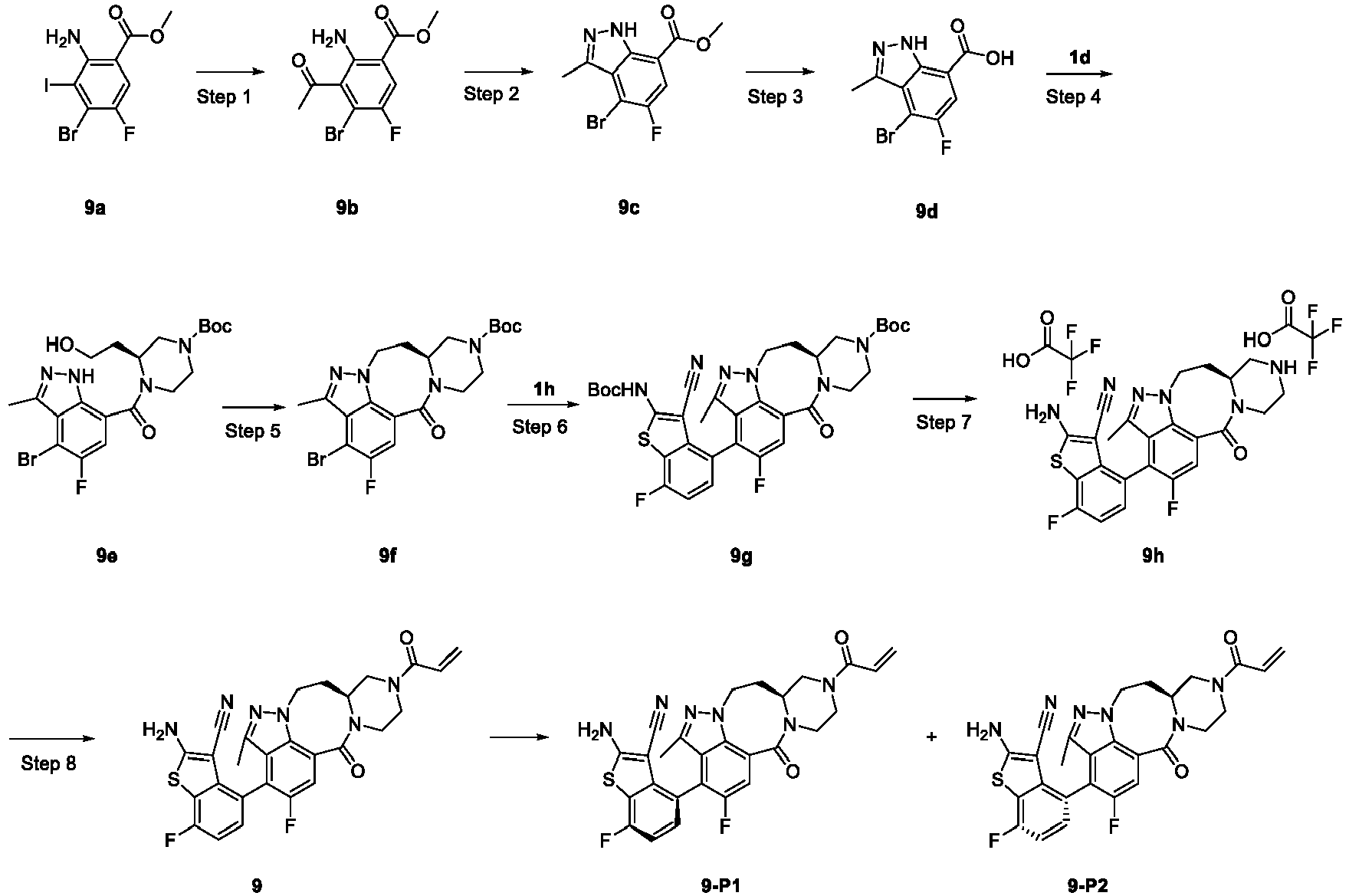
- Methyl 2-amino-4-bromo-5-fluoro-3-iodobenzoate 9a (5 g, 13.37 mmol, prepared using the method disclosed in Intermediate 15 on page 103 of the specification of the patent application "
WO2016020836A1 ") was dissolved in N,N-dimethylformamide (100 mL), and bis(triphenylphosphine)palladium(II) dichloride (1.87 g, 2.67 mmol) and tributyl(1-ethoxyvinyl)tin (5.79 g, 16.04 mmol, Shanghai Accela ChemBio) were added. The system was purged with nitrogen gas, and the mixture was left to react at 90 °C for 12 h. The reaction mixture was cooled to room temperature, and 10% aqueous potassium fluoride was added. The mixture was stirred for 30 min and filtered, and the filtrate was separated. The organic phase was stirred with 10 mL of concentrated hydrochloric acid for 16 h, made neutral with saturated sodium carbonate solution, and extracted with ethyl acetate (50 mL × 3). The organic phases were combined and dried over anhydrous sodium sulfate, and the drying agent was removed by filtration. The filtrate was concentrated under reduced pressure, and the residue was purified by silica gel column chromatography with eluent system A to give the title compound 9b (1.8 g, yield: 46.4%). - MS m/z (ESI): 289.9 [M+1].
- Compound 9b (1 g, 3.44 mmol) was dissolved in concentrated hydrochloric acid (5 mL), and a solution of sodium nitrite (261 mg, 3.78 mmol) in water (2 mL) was added dropwise under an ice bath. After the mixture was stirred for 1 h with the temperature maintained, a solution of stannous chloride dihydrate (1.71 g, 7.58 mmol) in hydrochloric acid (2 mL) was added dropwise. The mixture was stirred for another 30 min, and the pH was adjusted to 8 with saturated potassium carbonate solution. Extraction was performed with ethyl acetate (30 mL × 3). The organic phases were combined and dried over anhydrous sodium sulfate, and the drying agent was removed by filtration. The filtrate was concentrated under reduced pressure, and the residue was purified by silica gel column chromatography with eluent system A to give the title compound 9c (760 mg, yield: 76.7%).
- MS m/z (ESI): 286.9 [M+1].
- The crude product of compound 9c (760 mg, 2.6 mmol) was dissolved in a mixed solvent of tetrahydrofuran (5 mL), methanol (5 mL), and water (5 mL), and lithium hydroxide (555 mg, 13.2 mmol) was added. The mixture was stirred at 40 °C for 1 h. The reaction mixture was concentrated under reduced pressure to remove most of the solvent. Water was added, and extraction was performed with ethyl acetate (150 mL × 6). The organic phases were combined, washed with dilute hydrochloric acid and saturated sodium chloride solution in sequence, and dried over anhydrous sodium sulfate, and the drying agent was removed by filtration. The filtrate was concentrated under reduced pressure to give a crude product of compound 9d (722 mg). The product was directly used in the next step without purification.
- MS m/z (ESI): 270.9 [M-1].
- The crude product of compound 9d (722 mg, 2.64 mmol) and compound 1d (730 mg, 3.16 mmol) were dissolved in 10 mL of N,N-dimethylformamide, and N,N-diisopropylethylamine (720 mg, 5.5 mmol) and 2-(7-azabenzotriazole)-N,N,N',N'-tetramethyluronium hexafluorophosphate (1.2 g, 3.17 mmol) were added under an ice bath. The mixture was stirred for 1 h. The reaction mixture was concentrated under reduced pressure, then diluted with ethyl acetate, and washed with water, saturated sodium carbonate solution, and saturated sodium chloride solution in sequence. The organic phase was dried over anhydrous sodium sulfate and filtered. The filtrate was concentrated under reduced pressure to give a crude product of the title compound 9e (1.2 g). The product was directly used in the next step without purification.
- MS m/z (ESI): 429.2 [M-55].
- The crude product of compound 9e (1.28 g, 2.63 mmol) was dissolved in 50 mL of tetrahydrofuran in a nitrogen atmosphere, and triphenylphosphine (1.38 g, 5.26 mmol) and diethyl azodicarboxylate (1.06 g, 5.26 mmol) were sequentially added under an ice bath. The mixture was stirred for 30 min with the temperature maintained. The reaction mixture was quenched with saturated ammonium chloride solution and extracted with ethyl acetate (20 mL × 2). The organic phases were combined, washed with saturated sodium chloride solution, dried over anhydrous sodium sulfate, and filtered. The filtrate was concentrated under reduced pressure, and the residue was purified by silica gel column chromatography with eluent system A to give the title compound 9f (650 mg, yield: 52.7%).
- MS m/z (ESI): 411.2 [M-55].
- The crude product of compound 9f (210 mg, 449.36 µmol) and compound 1h (363 mg, 897 µmol) were dissolved in 10 mL of toluene, and dichloro[bis(diphenylphosphinophenyl)ether]palladium(II) (96 mg, 134.2 µmol) and cesium carbonate (439 mg, 1.34 mmol) were added. The system was purged with nitrogen gas, and the mixture was stirred at 105 °C for 6 h. The reaction mixture was cooled to room temperature and then filtered. The filtrate was concentrated under reduced pressure, and the residue was purified by silica gel column chromatography with eluent system A to give the title compound 9g (200 mg, yield: 65.6%).
- MS m/z (ESI): 679.2 [M+1].
- Compound 9g (200 mg, 294.6 µmol) was dissolved in 2 mL of dichloromethane, and 2 mL of trifluoroacetic acid was added at 0 °C. The mixture was stirred for 2 h. The reaction mixture was concentrated under reduced pressure to give a crude product of the title compound 9h (200 mg). The product was directly used in the next step without purification.
- MS m/z (ESI): 479.2 [M+1].
- Compound 9h (200 mg, 283.2 µmol) was suspended in 2 mL of ethyl acetate, 1 mL of tetrahydrofuran, and 2 mL of water, and anhydrous potassium carbonate (202 mg, 1.46 mmol) was added. Acryloyl chloride (29 mg, 320.4 µmol) was added under an ice bath. After 5 min of reaction, extraction was performed with ethyl acetate (5 mL × 2). The organic phases were combined and concentrated under reduced pressure to give a crude product of compound 9, i.e., 4-((S)-10-acryloyl-2-fluoro-4-methyl-14-oxo-8,8a,9,10,11,12-hexahydro-7H,14H-pyrazino[1',2':5,6][1,5]diazocino[3,2,1-hi]indazol-3-yl)-2-amino-7-f luorobenzo[b]thiophene-3-carbonitrile (160 mg). The crude product was purified by preparative high performance liquid chromatography (Waters-2545; column: SharpSil-T C18, 30 × 150 mm, 5 µm; mobile phase: aqueous phase (10 mmol/L ammonium bicarbonate) and acetonitrile; gradient ratio: acetonitrile 30%-45%; flow rate: 30 mL/min) to give the title compounds 9-P2 (50 mg, yield: 31.9%) and 9-P1 (50 mg, yield: 31.9%).
- Single-configuration compound (shorter retention time) 9-P2 (50 mg, yield: 31.9%) MS m/z (ESI): 533.2 [M+1].
- HPLC analysis: retention time: 1.17 min; purity: 99% (column: ACQUITY UPLC® BEH, C18, 1.7 µm, 2.1 × 50 mm; mobile phase: water (10 mM ammonium bicarbonate), acetonitrile; gradient ratio: acetonitrile 10%-95%).
- 1H NMR (500 MHz, CD3OD): δ 7.61 (d, 1H), 7.21 (t, 1H), 7.06 (dd, 1H), 6.81 (ddd, 1H), 6.30 (d, 1H), 5.83 (t, 1H), 4.80-4.51 (m, 3H), 4.47-4.18 (m, 2H), 4.05 (t, 1H), 3.44 (dd, 1H), 3.19-2.87 (m, 2H), 2.32-2.15 (m, 1H), 1.85 (s, 4H).
- Single-configuration compound (longer retention time) 9-P1 (50 mg, yield: 31.9%) MS m/z (ESI): 533.2 [M+1].
- HPLC analysis: retention time: 1.19 min; purity: 99% (column: ACQUITY UPLC® BEH, C18, 1.7 µm, 2.1 × 50 mm; mobile phase: water (10 mM ammonium bicarbonate), acetonitrile; gradient ratio: acetonitrile 10%-95%).
- 1H NMR (500 MHz, CD3OD): δ 7.56 (d, 1H), 7.34 (dd, 1H), 7.08 (dd, 1H), 6.96-6.65 (m, 1H), 6.29 (dd, 1H), 5.82 (t, 1H), 4.67 (dd, 3H), 4.40-4.27 (m, 1H), 4.26-4.01 (m, 2H), 3.48 (d, 1H), 3.18-2.90 (m, 2H), 2.22 (d, 1H), 1.81 (s, 4H).
-

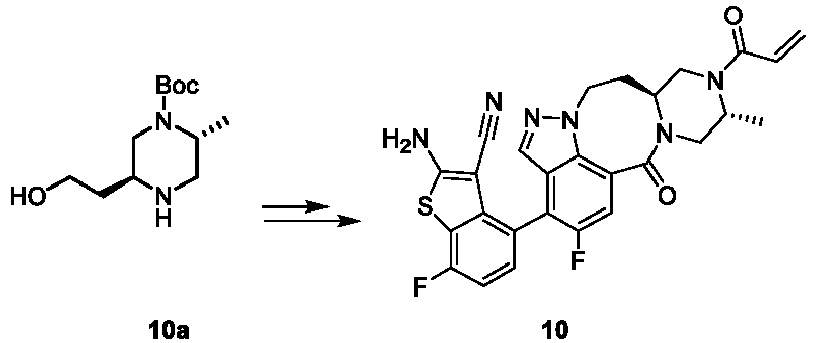
- The title compound 10 (72 mg, yield: 62.2%) was obtained by using the synthesis scheme of Example 1-P1 and 1-P2 and replacing the starting material of step 3, compound 1d, with tert-butyl (2R,5S)-5-(2-hydroxyethyl)-2-methylpiperazine-1-carboxylate 10a (prepared using the method disclosed in preparation 67 on page 80 of the specification of the patent application "
WO2021118877A1 "). - MS m/z (ESI): 533.2 [M+1].
- 1H NMR (500 MHz, CD3OD): δ 7.73-7.64 (m, 2H), 7.30 (td, 1H), 7.08 (ddd, 1H), 6.80 (ddd, 1H), 6.27 (ddd, 1H), 5.81 (ddd, 1H), 4.74 (dt, 1H), 4.62-4.55 (m, 2H), 4.31 (td, 1H), 4.15-4.00 (m, 1H), 3.82-3.61 (m, 1H), 3.24 (ddd, 2H), 2.34 (dt, 1H), 2.02-1.85 (m, 1H), 1.37 (dd, 3H).
-

- Compound 1g (500 mg, 1.10 mmol) was dissolved in tetrahydrofuran (6 mL), and a 2 M solution of lithium diisopropylamide in tetrahydrofuran (896 µL) was added at -78 °C. The mixture was left to react for 40 min with the temperature maintained, and N-fluorobenzenesulfonimide (417 mg, 1.32 mmol, Shanghai Accela ChemBio) was added. The mixture was stirred for 20 min. Then the reaction mixture was quenched with saturated ammonium chloride solution and extracted with ethyl acetate (15 mL × 3). The organic phases were combined and dried over anhydrous sodium sulfate, and the drying agent was removed by filtration. The filtrate was concentrated under reduced pressure, and the residue was purified by silica gel column chromatography with eluent system A to give the title compound 11a (400 mg, yield: 76.9%).
- MS m/z (ESI): 471.1 [M+1].
- Subsequently, the title compounds 11-P2 (30 mg, yield: 33.3%) and 11-P1 (8 mg, yield: 8.9%) were obtained by using the synthesis scheme of Example 1-P1 and 1-P2 and replacing the starting material of step 5, compound 1g, with compound 11a. Single-configuration compound (shorter retention time) 11-P2 (30 mg, yield: 33.3%) MS m/z (ESI): 537.2 [M+1].
- HPLC analysis: retention time: 2.05 min; purity: 96% (column: ACQUITY UPLC® BEH, C18, 1.7 µm, 2.1 × 50 mm; mobile phase: water (10 mM ammonium bicarbonate), acetonitrile; gradient ratio: acetonitrile 10%-95%).
- 1H NMR (500 MHz, CD3OD): δ 7.70 (d, 1H), 7.48-7.26 (m, 1H), 7.10 (q, 1H), 6.99-6.63 (m, 1H), 6.30 (d, 1H), 5.84 (d, 1H), 4.72 (d, 2H), 4.42 (dd, 1H), 4.29-3.90 (m, 2H), 3.45 (d, 2H), 3.04 (d, 2H), 2.42-2.15 (m, 1H), 1.93 (s, 1H).
- Single-configuration compound (longer retention time) 11-P1 (8 mg, yield: 8.9%)
- MS m/z (ESI): 537.2 [M+1].
- HPLC analysis: retention time: 2.10 min; purity: 97% (column: ACQUITY UPLC® BEH, C18, 1.7 µm, 2.1 × 50 mm; mobile phase: water (10 mM ammonium bicarbonate), acetonitrile; gradient ratio: acetonitrile 10%-95%).
- 1H NMR (500 MHz, CD3OD): δ 7.66 (s, 1H), 7.41 (dd, 1H), 7.11 (t, 1H), 6.94-6.65 (m, 1H), 6.30 (dd, 1H), 5.84 (d, 1H), 4.73-4.70 (m, 2H), 4.37 (d, 1H), 4.17 (d, 2H), 3.36 (d, 2H), 3.16-3.03 (m, 2H), 2.30-2.21 (m, 2H).
-

- The title compounds 12-P2 (5 mg, yield: 9.7%) and 12-P1 (1.5 mg, yield: 2.9%) were obtained by using the synthesis scheme of Example 1-P1 and 1-P2 and replacing the starting material of step 3, compound 1d, with tert-butyl (R)-3-(2-hydroxyethyl)piperazine-1-carboxylate 12a (prepared using the method disclosed in "Tetrahedron Letters, 2018, 59(21), 2030-2033").
- Single-configuration compound (shorter retention time) 12-P2 (5 mg, yield: 9.7%)
- MS m/z (ESI): 519.2 [M+1].
- HPLC analysis: retention time: 2.42 min; purity: 99% (column: HALO® 90 Å, C18, 2.7 µm, 3.0 × 30 mm; mobile phase: water (1 ‰ trifluoroacetic acid), acetonitrile; gradient ratio: acetonitrile 10%-95%).
- 1H NMR (500 MHz, CD3OD): δ 7.70 (s, 1H), 7.66 (d, 1H), 7.31 (s, 1H), 7.08 (d, 1H), 6.82 (d, 1H), 6.30 (dd, 1H), 5.83 (t, 1H), 4.75 (d, 3H), 4.33 (d, 2H), 4.04 (d, 1H), 3.51 (d, 1H), 3.12 (dd, 2H), 2.29 (s, 1H), 2.05 (t, 1H).
- Single-configuration compound (longer retention time) 12-P1 (1.5 mg, yield: 2.9%) MS m/z (ESI): 519.2 [M+1].
- HPLC analysis: retention time: 2.45 min; purity: 92% (column: HALO® 90 Å, C18, 2.7 µm, 3.0 × 30 mm; mobile phase: water (1 ‰ trifluoroacetic acid), acetonitrile; gradient ratio: acetonitrile 10%-95%).
- 1H NMR (500 MHz, CD3OD): δ 7.65 (s, 1H), 7.60 (d, 1H), 7.38 (ddd, 1H), 7.13-7.05 (m, 1H), 6.92-6.75 (m, 1H), 6.30 (dt, 1H), 5.83 (t, 1H), 4.82-4.69 (m, 3H), 4.37 (d, 2H), 4.10 (s, 1H), 3.51 (d, 1H), 3.10 (dd, 2H), 2.26 (d, 1H), 2.05 (d, 1H).
-

- Compound 2d (300 mg, 0.66 mmol) was dissolved in acetonitrile (6 mL), and 1-chloromethyl-4-fluoro-1,4-diazabicyclo[2.2.2]octane bis(tetrafluoroborate) (211 mg, 0.59 mmol) was added under an ice bath. The mixture was stirred for 6 h. Saturated sodium bicarbonate solution was added to the reaction mixture, and extraction was performed with ethyl acetate (10 mL × 3). The organic phases were combined and dried over anhydrous sodium sulfate, and the drying agent was removed by filtration. The filtrate was concentrated under reduced pressure, and the residue was purified by preparative high performance liquid chromatography (Waters-2545, column: SharpSil-T C18, 30 × 150 mm, 5 µm; mobile phase: aqueous phase (10 mmol/L ammonium bicarbonate) and acetonitrile; gradient ratio: acetonitrile 30%-45%; flow rate: 30 mL/min) to give the title compound 13a (68 mg, yield: 21.8%).
- MS m/z (ESI): 470.1 [M+1].
- Subsequently, the title compounds 13-P2 (5 mg, yield: 6.4%) and 13-P1 (5 mg, yield: 6.4%) were obtained by using the synthesis scheme of Example 1-P1 and 1-P2 and replacing the starting material of step 5, compound 1g, with compound 13a. Single-configuration compound (shorter retention time) 13-P2 (5 mg, yield: 6.4%)
- MS m/z (ESI): 536.2 [M+1].
- Preparative HPLC analysis: retention time: 15.17 min; purity: 99% (SharpSil-T C18, 50 × 250 mm, 5 µm; mobile phase: aqueous phase (10 mmol/L ammonium bicarbonate) and acetonitrile; gradient ratio: acetonitrile 35%-42%; flow rate: 80 mL/min).
- 1H NMR (500 MHz, CD3OD): δ 7.35 (d, 2H), 7.22 (s, 1H), 7.00 (dd, 1H), 6.87 (d, 1H), 6.29 (d, 1H), 5.82 (s, 1H), 4.70 (d, 2H), 4.37 (d, 1H), 4.23 (d, 1H), 4.06 (s, 2H), 3.51 (s, 1H), 3.07 (s, 2H), 2.21 (t, 1H), 2.05 (d, 1H).
- Single-configuration compound (longer retention time) 13-P1 (5 mg, yield: 6.4%)
- MS m/z (ESI): 536.2 [M+1].
- Preparative HPLC analysis: retention time: 16.02 min; purity: 99% (SharpSil-T C18, 50 × 250 mm, 5 µm; mobile phase: aqueous phase (10 mmol/L ammonium bicarbonate) and acetonitrile; gradient ratio: acetonitrile 35%-42%; flow rate: 80 mL/min).
- 1H NMR (500 MHz, CD3OD): δ 7.34-7.26 (m, 2H), 7.20 (d, 1H), 7.01 (dd, 1H), 6.80 (dd, 1H), 6.29 (dd, 1H), 5.82 (t, 1H), 4.70 (t, 2H), 4.35 (dd, 1H), 4.25 (s, 1H), 4.22-4.13 (m, 1H), 4.01 (s, 1H), 3.50 (s, 1H), 3.06 (dt, 2H), 2.24-2.15 (m, 1H), 2.05 (d, 1H).
-

- The crude product of compound 1c (560 mg, 2.16 mmol) and tert-butyl (R)-3-(hydroxymethyl)piperazine-1-carboxylate 14a (514 mg, 2.37 mmol, Shanghai Accela ChemBio) were dissolved in 10 mL of N,N-dimethylformamide, and N,N-diisopropylethylamine (838 mg, 6.48 mmol) and 2-(7-azabenzotriazole)-N,N,N',N'-tetramethyluronium hexafluorophosphate (986 mg, 2.59 mmol) were added under an ice bath. The mixture was stirred for 1 h. The reaction mixture was concentrated under reduced pressure, then diluted with ethyl acetate, and washed with water, saturated sodium carbonate solution, and saturated sodium chloride solution in sequence. The organic phase was dried over anhydrous sodium sulfate and filtered. The filtrate was concentrated under reduced pressure, and the residue was purified by preparative high performance liquid chromatography (Waters-2545, column: SharpSil-T C18, 30 × 150 mm, 5 µm; mobile phase: aqueous phase (10 mmol/L ammonium bicarbonate) and acetonitrile; gradient ratio: acetonitrile 35%-45%; flow rate: 30 mL/min) to give the title compound 14b (100 mg, yield: 10.1%).
- MS m/z (ESI): 457.2 [M+1].
- Compound 14b (250 mg, 546 µmol) and triethylamine (166 mg, 1.6 mmol) were dissolved in 5 mL of dichloromethane, and methanesulfonyl chloride (187 mg, 1.6 mmol) was added under an ice bath. The mixture was stirred for 2 h. The reaction mixture was quenched with a small amount of water and concentrated under reduced pressure, and the residue was dissolved in 5 mL of N,N-dimethylformamide. Potassium carbonate (226 mg, 1.6 mmol) was added, and the mixture was stirred at 80 °C for 1 h. The reaction mixture was cooled to room temperature and then filtered. The filtrate was concentrated under reduced pressure, and the residue was purified by silica gel column chromatography with eluent system B to give the title compound 14c (30 mg, yield: 12.4%).
- MS m/z (ESI): 439.29 [M+1].
- Subsequently, the title compound 14 (5 mg, yield: 17.8%) was obtained by using the synthesis scheme of Example 1-P1 and 1-P2 and replacing the starting material of step 5, compound 1g, with compound 14c.
- MS m/z (ESI): 505.2 [M+1].
- 1H NMR (500 MHz, CD3OD): δ 8.05 (d, 1H), 7.75 (s, 1H), 7.31 (d, 1H), 7.07 (t, 1H), 6.78 (ddd, 1H), 6.35-6.25 (m, 1H), 5.82 (dd, 1H), 4.79 (s, 1H), 4.77-4.73 (m, 1H), 4.73-4.65 (m, 1H), 4.51 (t, 1H), 4.41 (ddd, 1H), 4.14 (ddd, 1H), 4.02-3.96 (m, 1H), 2.19 (t, 1H), 2.03 (d, 1H).
-

- The title compounds 15-P2 (50 mg, yield: 24.9%) and 15-P1 (50 mg, yield: 24.9%) were obtained by using the synthesis scheme of Example 9-P1 and 9-P2 and replacing the starting material of step 8, acryloyl chloride, with 2-fluoroacryloyl chloride. Single-configuration compound (shorter retention time) 15-P2 (50 mg, yield: 24.9%) MS m/z (ESI): 551.3 [M+1].
- HPLC analysis: retention time: 1.27 min; purity: 99% (column: ACQUITY UPLC® BEH, C18, 1.7 µm, 2.1 × 50 mm; mobile phase: water (10 mM ammonium bicarbonate), acetonitrile; gradient ratio: acetonitrile 10%-95%).
- Single-configuration compound (longer retention time) 15-P1 (50 mg, yield: 24.9%) MS m/z (ESI): 551.3 [M+1].
- HPLC analysis: retention time: 1.28 min; purity: 99% (column: ACQUITY UPLC®BEH, C18, 1.7 µm, 2.1 × 50 mm; mobile phase: water (10 mM ammonium bicarbonate), acetonitrile; gradient ratio: acetonitrile 10%-95%).
- 1H NMR (500 MHz, CD3OD): δ 7.56 (d, 1H), 7.35 (dd, 1H), 7.08 (dd, 1H), 5.42-5.22 (m, 2H), 4.80-4.71 (m, 1H), 4.69-4.59 (m, 1H), 4.37-3.98 (m, 3H), 3.55-3.36 (m, 1H), 3.15 (td, 2H), 2.32-2.02 (m, 2H), 1.95-1.76 (m, 4H).
-

- The title compounds 16-P2 (40 mg, yield: 24.7%) and 16-P1 (10 mg, yield: 6.1%) were obtained by using the synthesis scheme of Example 8-P1 and 8-P2 and replacing the starting material of step 6, acryloyl chloride, with 2-fluoroacryloyl chloride. Single-configuration compound (shorter retention time) 16-P2 (40 mg, yield: 24.7%) MS m/z (ESI): 555.3 [M+1].
- HPLC analysis: retention time: 1.31 min; purity: 99% (column: ACQUITY UPLC® BEH, C18, 1.7 µm, 2.1 × 50 mm; mobile phase: water (10 mM ammonium bicarbonate), acetonitrile; gradient ratio: acetonitrile 10%-95%).
- 1H NMR (500 MHz, CD3OD): δ 7.69 (d, 1H), 7.27 (dd, 1H), 7.04 (dd, 1H), 5.42-5.22 (m, 2H), 4.79-4.70 (m, 1H), 4.60 (s, 1H), 4.50 (ddd, 1H), 4.39-3.88 (m, 3H), 3.64-3.35 (m, 1H), 3.29-2.87 (m, 2H), 2.35-2.18 (m, 1H), 2.02-1.89 (m, 1H). Single-configuration compound (longer retention time) 16-P1 (10 mg, yield: 6.1%) MS m/z (ESI): 555.3 [M+1].
- HPLC analysis: retention time: 1.33 min; purity: 96% (column: ACQUITY UPLC® BEH, C18, 1.7 µm, 2.1 × 50 mm; mobile phase: water (10 mM ammonium bicarbonate), acetonitrile; gradient ratio: acetonitrile 10%-95%).
- 1H NMR (500 MHz, CD3OD): δ 7.64 (d, 1H), 7.36 (dd, 1H), 7.06 (dd, 1H), 5.41-5.27 (m, 2H), 4.74 (d, 1H), 4.68-4.43 (m, 2H), 4.37-3.97 (m, 3H), 3.55-3.35 (m, 1H), 3.24-2.87 (m, 2H), 2.41-2.13 (m, 1H), 2.00-1.78 (m, 1H).
-

- Compound 7c (299 mg, 599.2 µmol) was suspended in 2 mL of ethyl acetate, 1 mL of tetrahydrofuran, and 2 mL of water, and anhydrous potassium carbonate (414 mg, 2.99 mmol) was added. 2-Fluoroacryloyl chloride (322 mg, 2.98 mmol) was added under an ice bath. After 5 min of reaction, extraction was performed with ethyl acetate (5 mL × 2). The organic phases were combined and concentrated under reduced pressure to give a crude product of compound 17, i.e., 2-amino-4-((S)-4-chloro-2-fluoro-10-(2-fluoroacryloyl)-14-oxo-8,8a,9,10,11,12-hexahy dro-7H,14H-pyrazino[1',2':5,6][1,5]diazocino[3,2,1-hi]indazol-3-yl)-7-fluorobenzo[b]th iophene-3-carbonitrile (340 mg). The crude product was purified by preparative high performance liquid chromatography (Waters-2545; column: YMC Triart-Exrs, 30 × 150 mm, 5 µm; mobile phase: aqueous phase (10 mmol/L ammonium bicarbonate) and acetonitrile; gradient ratio: acetonitrile 30%-45%; flow rate: 30 mL/min) to give the title compounds 17-P2 (50 mg, yield: 14.6%) and 17-P1 (50 mg, yield: 14.6%). Single-configuration compound (shorter retention time) 17-P2 (50 mg, yield: 14.6%) MS m/z (ESI): 571.2 [M+1].
- HPLC analysis: retention time: 2.42 min; purity: 99% (column: ACQUITY UPLC® BEH, C18, 1.7 µm, 2.1 × 50 mm; mobile phase: water (10 mM ammonium bicarbonate), acetonitrile; gradient ratio: acetonitrile 10%-95%).
- 1H NMR (500 MHz, CD3OD): δ 7.67 (d, 1H), 7.19 (dd, 1H), 7.02 (dd, 1H), 5.35 (t, 1H), 5.26 (s, 1H), 4.73 (dt, 2H), 4.64 (ddd, 2H), 4.30 (ddd, 2H), 4.09 (s, 1H), 3.20-3.10 (m, 2H), 2.07-1.89 (m, 2H).
- Single-configuration compound (longer retention time) 17-P1 (50 mg, yield: 14.6%) MS m/z (ESI): 571.2 [M+1].
- HPLC analysis: retention time: 2.47 min; purity: 99% (column: ACQUITY UPLC® BEH, C18, 1.7 µm, 2.1 × 50 mm; mobile phase: water (10 mM ammonium bicarbonate), acetonitrile; gradient ratio: acetonitrile 10%-95%).
- 1H NMR (500 MHz, CD3OD): δ 7.63 (d, 1H), 7.31 (dd, 1H), 7.04 (dd, 1H), 5.35 (d, 1H), 5.25 (d, 1H), 4.72 (dt, 2H), 4.64 (ddd, 2H), 4.27 (ddd, 2H), 4.10 (s, 1H), 3.19-3.10 (m, 2H), 1.95-1.83 (m, 2H).
-


- Compound 18a (2.1 g, 7.95 mmol, Shanghai Bide) was dissolved in anhydrous tetrahydrofuran (15 mL), and a 0.5 M solution of 1-propenylmagnesium bromide in tetrahydrofuran (40 mL, Sigma-Aldrich) was added in a nitrogen atmosphere at -40 °C. The mixture was warmed to room temperature and left to react for 5 h. The reaction mixture was quenched with saturated ammonium chloride solution and extracted with ethyl acetate (30 mL × 3). The organic phases were combined and dried over anhydrous sodium sulfate, and the drying agent was removed by filtration. The filtrate was concentrated under reduced pressure, and the residue was purified by silica gel column chromatography with eluent system A to give the title compound 18b (200 mg, yield: 8.7%).
- MS m/z (ESI): 285.9 [M+1].
- Subsequently, the title compounds 18-P2 (3 mg, yield: 5.5%) and 18-P1 (10 mg, yield: 18.3%) were obtained by using the synthesis scheme of Example 1-P1 and 1-P2 and replacing the starting material of step 2, 1b, with compound 18b.
- Single-configuration compound (shorter retention time) 18-P2 (3 mg, yield: 5.5%)
- MS m/z (ESI): 532.3 [M+1].
- Preparative HPLC analysis: retention time: 12.30 min; purity: 99% (SharpSil-T C18, 30 × 150 mm, 5 µm; mobile phase: aqueous phase (10 mmol/L ammonium bicarbonate) and acetonitrile; gradient ratio: acetonitrile 35%-45%; flow rate: 30 mL/min).
- 1H NMR (500 MHz, CD3OD): δ 7.27 (d, 1H), 7.13 (s, 1H), 7.05-6.96 (m, 2H), 6.81 (ddd, 1H), 6.29 (d, 1H), 5.86-5.78 (m, 1H), 4.74-4.68 (m, 1H), 4.45-4.22 (m, 2H), 4.02 (dq, 3H), 3.14-2.90 (m, 2H), 2.24-2.02 (m, 2H), 1.83 (s, 1H), 1.58-1.55 (m, 3H). Single-configuration compound (longer retention time) 18-P1 (10 mg, yield: 18.3%) MS m/z (ESI): 532.3 [M+1].
- Preparative LCMS analysis: retention time: 12.87 min; purity: 99% (SharpSil-T C18, 30 × 150 mm, 5 µm; mobile phase: aqueous phase (10 mmol/L ammonium bicarbonate) and acetonitrile; gradient ratio: acetonitrile 35%-45%; flow rate: 30 mL/min).
- 1H NMR (500 MHz, CD3OD): δ 7.29 (dd, 1H), 7.20 (d, 1H), 7.07-7.00 (m, 2H), 6.93-6.67 (m, 1H), 6.29 (dd, 1H), 5.82 (dd, 1H), 4.70 (d, 1H), 4.38-4.13 (m, 3H), 4.0-3.86 (m, 2H), 3.12-2.90 (m, 2H), 2.18-2.12 (m, 1H), 2.07-2.04 (m, 1H), 1.79 (d, 1H), 1.52 (s, 3H).
-

- The title compounds 19-P2 (5 mg, yield: 50%) and 19-P1 (5 mg, yield: 50%) (5 mg, 5 mg, yield: 50%, 50%) were obtained by using the synthesis scheme of Example 7-P1 and 7-P2 and replacing the starting material of step 1, 1g, with compound 2d. Single-configuration compound (shorter retention time) 19-P2 (5 mg, yield: 50%)
- MS m/z (ESI): 552.3 [M+1].
- Preparative HPLC analysis: retention time: 12.30 min; purity: 99% (column: Welch Xtimate Phenyl-hexyl, 30 × 150 mm, 5 µm; mobile phase: aqueous phase (10 mmol/L ammonium bicarbonate) and acetonitrile; gradient ratio: acetonitrile 40%-55%; flow rate: 30 mL/min).
- 1H NMR (500 MHz, CD3OD): δ 7.38-7.35 (m, 2H), 7.16 (s, 1H), 6.99 (dd, 1H), 6.92-6.70 (m, 1H), 6.29 (d, 1H), 5.88-5.78 (m, 1H), 4.70 (d, 1H), 4.45-4.30 (m, 2H), 4.12-3.94 (m, 2H), 3.52-3.46 (m, 1H), 3.15-2.92 (m, 2H), 2.27-2.15 (m, 1H), 1.93-1.83 (m, 1H), 0.96-0.88 (m, 1H).
- Single-configuration compound (longer retention time) 19-P1 (5 mg, yield: 50%)
- MS m/z (ESI): 552.3 [M+1].
- Preparative HPLC analysis: retention time: 12.83 min; purity: 99% (column: Welch Xtimate Phenyl-hexyl, 30 × 150 mm, 5 µm; mobile phase: aqueous phase (10 mmol/L ammonium bicarbonate) and acetonitrile; gradient ratio: acetonitrile 40%-55%; flow rate: 30 mL/min).
- 1H NMR (500 MHz, CD3OD): δ 7.35 (s, 1H), 7.34-7.25 (m, 2H), 7.01 (dd, 1H), 6.93-6.67 (m, 1H), 6.29 (dd, 1H), 5.82 (t, 1H), 4.69 (dd, 1H), 4.40-4.25 (m, 2H), 4.16 (d, 1H), 4.02 (s, 1H), 3.56-3.43 (m, 1H), 3.16-2.91 (m, 2H), 2.26-2.02 (m, 1H), 1.93-1.83 (m, 1H), 0.92 (t, 1H).
-

- Methyl 2-amino-4-bromo-5-fluorobenzoate 20a (4 g, 16.12 mmol, Shanghai Bide) was dissolved in acetic anhydride (20 mL), and the solution was left to react at 90 °C for 1 h. The reaction mixture was concentrated under reduced pressure, and the residue was dissolved in dichloromethane. The solution was washed with saturated sodium carbonate and dried over anhydrous sodium sulfate, and the drying agent was removed by filtration. The filtrate was concentrated under reduced pressure to give a crude product of the title compound 20b (6.5 g). The product was directly used in the next step without purification.
- MS m/z (ESI): 289.9 [M+1].
- The crude product of compound 20b (6 g, 20.68 mmol) was dissolved in concentrated sulfuric acid (30 mL), and nitric acid (15 mL) was added dropwise under an ice bath. The mixture was left to react for 1 h with the temperature maintained. The reaction mixture was poured into ice water and extracted with dichloromethane (10 mL × 3). The organic phases were combined, washed with saturated sodium bicarbonate solution, and dried over anhydrous sodium sulfate, and the drying agent was removed by filtration. The filtrate was concentrated under reduced pressure to give a crude product of the title compound 20c (1.5 g). The product was directly used in the next step without purification.
- MS m/z (ESI): 334.9 [M+1].
- The crude product of compound 20c (3.2 g, 9.5 mmol) was dissolved in ethanol (32 mL), and hydrochloric acid (32 mL) was added. The mixture was left to react at 80 °C for 3 h. The reaction mixture was concentrated under reduced pressure. Saturated sodium bicarbonate solution (20 mL) was added, and extraction was performed with dichloromethane (20 mL × 3). The organic phases were combined and dried over anhydrous sodium sulfate, and the drying agent was removed by filtration. The filtrate was concentrated under reduced pressure to give a crude product of the title compound 20d (6.5 g). The product was directly used in the next step without purification.
- MS m/z (ESI): 292.9 [M+1].
- The crude product of compound 20d (500 mg, 1.7 mmol) was dissolved in ethanol (25 mL) and water (5 mL), and ammonium chloride (910 mg, 17.01 mmol) and iron powder (500 mg, 8.9 mmol) were added. The mixture was left to react at 60 °C for 1 h. The reaction mixture was concentrated under reduced pressure, and the residue was purified by silica gel column chromatography with eluent system B to give the title compound 20e (400 mg, yield: 89.1%).
- MS m/z (ESI): 262.9 [M+1].
- The crude product of compound 20e (600 mg, 2.28 mmol) was dissolved in glacial acetic acid (6 mL), and sodium nitrite (188 mg, 2.72 mmol) was added. The mixture was left to react for 30 min. The reaction mixture was filtered, and the filter cake was washed with water and dried to give a crude product of the title compound 20f (600 mg). The product was directly used in the next step without purification.
- MS m/z (ESI): 273.9 [M+1].
- Subsequently, the title compounds 20-P2 (6 mg, yield: 27.4%) and 20-P1 (5 mg, yield: 22.8%) were obtained by using the synthesis scheme of Example 1-P1 and 1-P2 and replacing the starting material of step 2, compound 1b, with compound 20f. Single-configuration compound (shorter retention time) 20-P2 (6 mg, yield: 27.4%) MS m/z (ESI): 519.2 [M+1].
- HPLC analysis: retention time: 1.531 min; purity: 99% (column: HALO® 90 Å, C18, 2.7 µm, 3.0 × 30 mm; mobile phase: water (5 mM ammonium acetate), acetonitrile; gradient ratio: acetonitrile 10%-95%).
- 1H NMR (500 MHz, CDCl3): δ 7.92-7.83 (m, 1H), 7.45 (s, 1H), 7.09 (br, 1H), 6.43 (d, 1H), 5.84 (br, 1H), 5.32-5.28 (m, 3H), 4.91 (br, 1H), 4.47 (br, 1H), 4.10 (br, 1H), 3.06 (br, 1H), 2.24 (br, 1H), 2.04 (br, 2H), 1.65 (br, 1H), 0.90 (t, 1H).
- Single-configuration compound (longer retention time) 20-P1 (5 mg, yield: 22.8%) MS m/z (ESI): 519.2 [M+1].
- HPLC analysis: retention time: 1.545 min; purity: 99% (column: HALO® 90 Å, C18, 2.7 µm, 3.0 × 30 mm; mobile phase: water (5 mM ammonium acetate), acetonitrile; gradient ratio: acetonitrile 10%-95%).
- 1H NMR (500 MHz, CDCl3): δ 7.85 (d, 1H), 7.53-7.48 (m, 1H), 7.19-7.04 (m, 1H), 6.73-6.35 (m, 2H), 5.82 (br, 1H), 5.33-5.11 (m, 3H), 4.87 (br, 1H), 4.56-4.34 (m, 1H), 4.22-3.98 (m, 1H), 3.52-2.87 (m, 2H), 2.39 (br, 1H), 2.10-1.95 (m, 1H), 0.90 (t, 1H).
-

- Compound 20e (500 mg, 1.9 mmol) was dissolved in triethyl orthoformate (5 mL), and 4-p-toluenesulfonic acid (98.1 mg, 569.6 µmol) was added. The mixture was stirred for 5 min, and a large amount of solid precipitated. Saturated aqueous sodium bicarbonate was added to the reaction mixture, and extraction was performed with ethyl acetate (10 mL × 3). The organic phases were combined and dried over anhydrous sodium sulfate, and the drying agent was removed by filtration. The filtrate was concentrated under reduced pressure to give a crude product of the title compound 21a (500 mg). The product was directly used in the next step without purification.
- MS m/z (ESI): 272.9 [M+1].
- Subsequently, the title compounds 21-P2 (3 mg, yield: 38.3%) and 21-P1 (2 mg, yield: 25.5%) were obtained by using the synthesis scheme of Example 1-P1 and 1-P2 and replacing the starting material of step 2, compound 1b, with compound 21a. Single-configuration compound (shorter retention time) 21-P2 (3 mg, yield: 38.3%) MS m/z (ESI): 519.2 [M+1].
- HPLC analysis: retention time: 1.455 min; purity: 99% (column: HALO® 90 Å, C18, 2.7 µm, 3.0 × 30 mm; mobile phase: water (5 mM ammonium acetate), acetonitrile; gradient ratio: acetonitrile 10%-95%).
- 1H NMR (500 MHz, DMSO-d6 ): δ 8.26 (s, 1H), 7.36 (d, 1H), 7.14 (t, 1H), 6.87 (s, 1H), 6.66 (s, 1H), 6.18 (d, 1H), 6.05 (s, 2H), 5.74 (d, 1H), 4.58 (d, 2H), 4.24 (s, 1H), 3.92 (d, 2H), 3.63 (s, 2H), 2.86 (s, 2H), 2.15 (s, 1H), 2.01 (s, 1H).
- Single-configuration compound (longer retention time) 21-P1 (2 mg, yield: 25.5%) MS m/z (ESI): 519.2 [M+1].
- HPLC analysis: retention time: 1.465 min; purity: 99% (column: HALO® 90 Å, C18, 2.7 µm, 3.0 × 30 mm; mobile phase: water (5 mM ammonium acetate), acetonitrile; gradient ratio: acetonitrile 10%-95%).
- The present disclosure is further described and explained below with reference to test examples. However, these test examples are not intended to limit the scope of the present disclosure.
- The inhibitory activity of the compounds of the present disclosure against H358 cell proliferation was measured. Below is a brief description of the experimental method: H358 cells (ATCC, CRL-5807) were cultured in RPMI1640 medium (Hyclone, SH30809.01) containing 10% fetal bovine serum (Corning, 35-076-CV) (i.e., complete medium). On the first day of the experiment, H358 cells were seeded into a 96-well plate at a density of 1200 cells/well using complete medium, with 100 µL of cell suspension per well, and the plate was incubated overnight in a 37 °C, 5% CO2 cell incubator. On the second day, the test compounds, prepared in complete medium and serially diluted, were added at 10 µL/well. The final concentrations of the compounds were 9 concentration points obtained by a 5-fold serial dilution from 10 µM. A blank control containing 0.5% DMSO was set up. The plate was incubated for 120 h in a 37 °C, 5% CO2 cell incubator. On the seventh day, the 96-well cell plate was removed from the incubator, and CellTiter-Glo® Luminescent Cell Viability Assay (Promega, G7573) was added at 50 µL/well. After 10 min of room temperature incubation, luminescence signals were measured using a multifunctional microplate reader (PerkinElmer, EnVision® 2105). The IC50 values for the inhibitory activity of the compounds were calculated using Graphpad Prism software.
Table 1. The inhibitory activity of the compounds of the present disclosure against H358 cell proliferation Compound No. IC50 (nM) 1-P2 0.93 1-P1 11.98 2 10.49 4 13.36 6-P2 5.73 6-P1 9.75 7-P2 0.74 8-P2 0.84 9-P2 0.52 10 0.8 11-P2 0.32 11-P1 2.25 13-P2 11.44 15-P2 4.21 15-P1 41.59 16-P2 8.00 17-P2 1.87 18-P2 9.57 19-P2 5.65 20-P2 7.90 20-P 1 4.94 Conclusion: The compounds of the present disclosure have inhibitory effects on H358 cell proliferation. - The inhibitory effects of the compounds of the present disclosure on ERK phosphorylation in H358 cells were measured. Below is a brief description of the experimental method:
H358 cells (ATCC, CRL-5807) were cultured in RPMI1640 medium (Hyclone, SH30809.01) containing 10% fetal bovine serum (Corning, 35-076-CV) (i.e., complete medium). On the first day of the experiment, H358 cells were seeded into a 96-well plate at a density of 25,000 cells/well using complete medium, with 190 µL of cell suspension per well, and the plate was incubated overnight in a 37 °C, 5% CO2 cell incubator. On the second day, the test compounds, prepared in complete medium and serially diluted, were added at 10 µL/well. The final concentrations of the compounds were 9 concentration points obtained by a 6-fold serial dilution from 10 µM. A blank control containing 0.5% DMSO was set up. The plate was incubated for 3 h in a 37 °C, 5% CO2 cell incubator. After 3 h, the 96-well cell culture plate was removed from the incubator, and the culture medium was pipetted off. PBS (Shanghai BasalMedia Technologies Co., Ltd., B320) was added at 200 µL/well for a single wash. PBS was pipetted off, and lysis buffer (Cisbio, 64KL1FDF) containing a blocking agent (Cisbio, 64KB1AAC) was added at 50 µL/well. The plate was incubated on a shaker for 30 min at room temperature to lyse the cells. After lysis, the lysates were well mixed by pipetting, and 16 µL of lysate was transferred from each well to two HTRF 96-well assay plates (Cisbio, 66PL96100). Subsequently, 4 µL of a premixed phospho-ERK1/2 antibody solution (Cisbio, 64AERPEG) or 4 µL of a premixed total-ERK1/2 antibody solution (Cisbio, 64NRKPEG) was added to each of the plates. The plates were sealed with a plate sealer film, centrifuged for 1 min in a microplate centrifuge, and incubated overnight at room temperature in the dark. On the third day, fluorescence values at an excitation wavelength of 337 nm and emission wavelengths of 665 nm and 620 nm were measured using a PHERAstar multifunctional microplate reader (BMG Labtech, PHERAstar FS). The IC50 values for the inhibitory activity of the compounds were calculated using Graphpad Prism software, based on the compound concentration and the ratio of pERK/total ERK.Table 2. The inhibitory effects of the compounds of the present disclosure on ERK phosphorylation in H358 cells Compound No. IC50 (nM) 1-P2 0.07 1-P1 1.33 2 0.28 3 23.74 4 1.16 5 36.21 6-P2 0.35 6-P1 1.45 7-P2 0.13 8-P2 0.16 9-P2 0.06 9-P1 32.55 10 0.15 11-P2 0.09 11-P1 7.67 12-P2 11.32 13-P2 0.76 14 1.35 15-P2 3.94 15-P1 19.71 16-P2 1.06 17-P2 2.0 18-P2 1.09 19-P2 0.97 20-P2 0.88 20-P1 3.67 Conclusion: The compounds of the present disclosure have inhibitory effects on ERK phosphorylation in H358 cells. - The inhibitory activity of the compounds of the present disclosure against MIA PaCa-2 cell proliferation was measured. Below is a brief description of the experimental method:
- MIA PaCa-2 cells (ATCC, CRL-1420) were cultured in DMEM/HIGH GLUCOSE medium (GE, SH30243.01) containing 10% fetal bovine serum (Corning, 35-076-CV) and 2.5% horse serum (Beyotime Biological Tech., C0262) (i.e., complete medium). On the first day of the experiment, MIA PaCa-2 cells were seeded into a 96-well plate at a density of 500 cells/well using complete medium, with 90 µL of cell suspension per well, and the plate was incubated overnight in a 37 °C, 5% CO2 cell incubator. On the second day, the test compounds, prepared in complete medium and serially diluted, were added at 10 µL/well. The final concentrations of the compounds were 9 concentration points obtained by a 5-fold serial dilution from 10 µM. A blank control containing 0.5% DMSO was set up. The plate was incubated for 72 h in a 37 °C, 5% CO2 cell incubator. On the fifth day, the 96-well cell plate was removed from the incubator, and CellTiter-Glo® Luminescent Cell Viability Assay (Promega, G7573) was added at 50 µL/well. After 10 min of room temperature incubation, luminescence signals were measured using a multifunctional microplate reader (PerkinElmer, EnVision2015). The IC50 values for the inhibitory activity of the compounds were calculated using Graphpad Prism software.
Table 3. The inhibitory activity of the compounds of the present disclosure against MIA PaCa-2 cell proliferation Compound No. IC50 (nM) 1-P2 0.40 1-P1 2.79 2 5.87 4 11.15 6-P2 5.39 6-P1 13.87 7-P2 0.28 8-P2 0.19 9-P2 0.37 10 0.94 11-P2 0.46 11-P1 2.71 12-P2 35.29 13-P2 20.54 14 39.58 15-P2 7.75 15-P1 56.84 16-P2 4.56 17-P2 1.88 18-P2 9.16 19-P2 4.90 20-P2 1.21 20-P1 1.66 Conclusion: The compounds of the present disclosure have inhibitory effects on MIA PaCa-2 cell proliferation.
| Compound No. | Compound structure | Name |
 | tert-Butyl | |
| 3-(2-((tert-butoxycarbonyl)amino)-3-cya no-7-fluorobenzo[b]thiophen-4-yl)-2-flu oro-14-oxo-7,8,8a,9,11,12-hexahydro-10 H,14H-pyrazino[1',2':5,6][1,5]diazocino[ 3,2,1-hi]indazole-10-carboxylate | ||
| 1i |  | tert-Butyl |
| (8aS)-3-(2-((tert-butoxycarbonyl)amino)-3-cyano-7-fluorobenzo[b]thiophen-4-yl)-2-fluoro-14-oxo-7,8,8a,9,11,12-hexahydr o-10H,14H-pyrazino[1',2':5,6][1,5]diazo cino[3,2,1-hi]indazole-10-carboxylate 1i | ||
 | tert-Butyl | |
| (8aR)-3-(2-((tert-butoxycarbonyl)amino) -3-cyano-7-fluorobenzo[b]thiophen-4-yl) -2-fluoro-14-oxo-7,8,8a,9,11,12-hexahyd ro-10H,14H-pyrazino[1',2':5,6][1,5]diazo cino[3,2,1-hi]indazole-10-carboxylate | ||
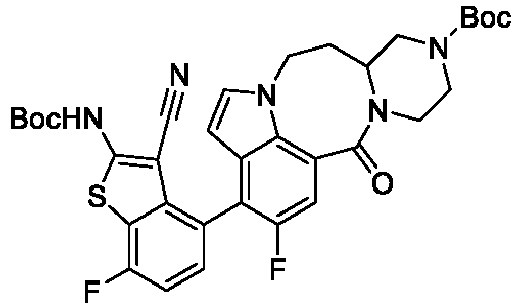 | tert-Butyl | |
| 3-(2-((tert-butoxycarbonyl)amino)-3-cya no-7-fluorobenzo[b]thiophen-4-yl)-2-flu oro-14-oxo-7,8,8a,9,11,12-hexahydro-10 H,14H-pyrazino[1',2':5,6][1,5]diazocino[ 3,2,1-hi]indole-10-carboxylate | ||
| 2e |  | tert-Butyl |
| (8aS)-3-(2-((tert-butoxycarbonyl)amino)-3-cyano-7-fluorobenzo[b]thiophen-4-yl)-2-fluoro-14-oxo-7,8,8a,9,11,12-hexahydr o-10H,14H-pyrazino[1',2':5,6][1,5]diazo cino[3,2,1-hi]indole-10-carboxylate 2e | ||
 | tert-Butyl | |
| (8aR)-3-(2-((tert-butoxycarbonyl)amino) -3-cyano-7-fluorobenzo[b]thiophen-4-yl) -2-fluoro-14-oxo-7,8,8a,9,11,12-hexahyd ro-10H,14H-pyrazino[1',2':5,6][1,5]diazo cino[3,2,1-hi]indole-10-carboxylate | ||
 | tert-Butyl | |
| 3-(2-((tert-butoxycarbonyl)amino)-7-fluo robenzo[d]thiazol-4-yl)-2-fluoro-14-oxo-7,8,8a,9,11,12-hexahydro-10H,14H-pyra zino[1',2':5,6][1,5]diazocino[3,2,1-hi]ind ole-10-carboxylate | ||
| 3b |  | tert-Butyl |
| (8aS)-3-(2-((tert-butoxycarbonyl)amino)-7-fluorobenzo[d]thiazol-4-yl)-2-fluoro-1 4-oxo-7,8,8a,9,11,12-hexahydro-10H,14 H-pyrazino[1',2':5,6][1,5]diazocino[3,2,1 -hi]indole-10-carboxylate 3b | ||
 | tert-Butyl | |
| (8aR)-3-(2-((tert-butoxycarbonyl)amino) -7-fluorobenzo[d]thiazol-4-yl)-2-fluoro-1 4-oxo-7,8,8a,9,11,12-hexahydro-10H,14 H-pyrazino[1',2':5,6][1,5]diazocino[3,2,1 -hi]indole-10-carboxylate | ||
 | tert-Butyl | |
| 3-(2-((tert-butoxycarbonyl)amino)-3-cya no-7-fluorobenzo[b]thiophen-4-yl)-2-flu oro-5-methyl-14-oxo-7,8,8α,9,11,12-hex ahydro-10H,14H-pyrazino[1',2':5,6][1,5] diazocino[3,2,1-hi]indole-10-carboxylate | ||
| 4e |  | tert-Butyl |
| (8aS)-3-(2-((tert-butoxycarbonyl)amino)-3-cyano-7-fluorobenzo[b]thiophen-4-yl)-2-fluoro-5-methyl-14-oxo-7,8,8a,9,11,12 -hexahydro-10H,14H-pyrazino[1',2':5,6][ 1,5]diazocino[3,2,1-hi]indole-10-carboxy late 4e | ||
 | tert-Butyl | |
| (8aR)-3-(2-((tert-butoxycarbonyl)amino) -3-cyano-7-fluorobenzo[b]thiophen-4-yl) -2-fluoro-5-methyl-14-oxo-7,8,8a,9,11,1 2-hexahydro-10H,14H-pyrazino[1',2':5,6 ][1,5]diazocino[3,2,1-hi]indole-10-carbo xylate | ||
 | tert-Butyl | |
| 3-(2-((tert-butoxycarbonyl)amino)-3-cya no-7-fluorobenzo[b]thiophen-4-yl)-2-flu oro-14-oxo-7,8,8a,9,11,12-hexahydro-10 H,14H-pyrazino[1',2':5,6][1,5]diazocino[ 3,2,1-hi]indole-10-carboxylate | ||
 | tert-Butyl | |
| (8aS)-3-(2-((tert-butoxycarbonyl)amino)-3-cyano-7-fluorobenzo[b]thiophen-4-yl)-2-fluoro-14-oxo-7,8,8a,9,11,12-hexahydr o-10H,14H-pyrazino[1',2':5,6] [1,5]diazo cino[3,2,1-hi]indole-10-carboxylate | ||
 | tert-Butyl | |
| (8aR)-3-(2-((tert-butoxycarbonyl)amino) -3-cyano-7-fluorobenzo[b]thiophen-4-yl) -2-fluoro-14-oxo-7,8,8a,9,11,12-hexahyd ro-10H,14H-pyrazino[1',2':5,6][1,5]diazo cino[3,2,1-hi]indole-10-carboxylate | ||
 | tert-Butyl | |
| 3-(2-((tert-butoxycarbonyl)amino)-3-cya no-7-fluorobenzo[b]thiophen-4-yl)-2-flu oro-14-oxo-7,8,8a,9,11,12-hexahydro-10 H,14H-pyrazino[1',2':5,6][1,5]diazocino[ 3,2,1-hi]indazole-10-carboxylate | ||
 | tert-Butyl | |
| (8aS)-3-(2-((tert-butoxycarbonyl)amino)-3-cyano-7-fluorobenzo[b]thiophen-4-yl)-2-fluoro-14-oxo-7,8,8a,9,11,12-hexahydr o-10H,14H-pyrazino[1',2':5,6][1,5]diazo cino[3,2,1-hi]indazole-10-carboxylate | ||
 | tert-Butyl | |
| (8aR)-3-(2-((tert-butoxycarbonyl)amino) -3-cyano-7-fluorobenzo[b]thiophen-4-yl) -2-fluoro-14-oxo-7,8,8a,9,11,12-hexahyd ro-10H,14H-pyrazino[1',2':5,6][1,5]diazo cino[3,2,1-hi]indazole-10-carboxylate | ||
 | tert-Butyl | |
| 3-(2-((tert-butoxycarbonyl)amino)-3-cya no-7-fluorobenzo[b]thiophen-4-yl)-4-chl oro-2-fluoro-14-oxo-7,8,8a,9,11,12-hexahydro-10H,14H-pyrazino[1',2':5,6][1,5]d iazocino[3,2,1-hi]indazole-10-carboxylat e | ||
 | tert-Butyl | |
| (8aR)-3-(2-((tert-butoxycarbonyl)amino) -3-cyano-7-fluorobenzo[b]thiophen-4-yl) -4-chloro-2-fluoro-14-oxo-7,8,8a,9,11,12 -hexahydro-10H,14H-pyrazino[1',2':5,6][ 1,5]diazocino[3,2,1-hi]indazole-10-carbo xylate | ||
| 7b |  | tert-Butyl |
| (8aS)-3-(2-((tert-butoxycarbonyl)amino)-3-cyano-7-fluorobenzo[b]thiophen-4-yl)-4-chloro-2-fluoro-14-oxo-7,8,8a,9,11,12-hexahydro-10H,14H-pyrazino[1',2':5,6][ 1,5]diazocino[3,2,1-hi]indazole-10-carbo xylate 7b | ||
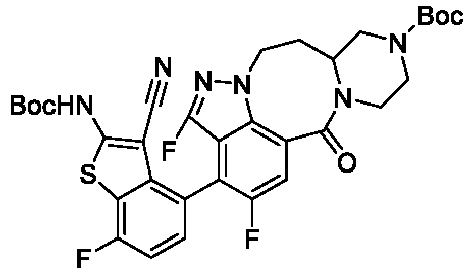 | tert-Butyl | |
| 3-(2-((tert-butoxycarbonyl)amino)-3-cya no-7-fluorobenzo[b]thiophen-4-yl)-2,4-di fluoro-14-oxo-7,8,8a,9,11,12-hexahydro-10H,14H-pyrazino[1,2:5,6][1,5]diazocin o[3,2,1-hi]indazole-10-carboxylate | ||
 | tert-Butyl | |
| (8aR)-3-(2-((tert-butoxycarbonyl)amino) -3-cyano-7-fluorobenzo[b]thiophen-4-yl) -2,4-difluoro-14-oxo-7,8,8a,9,11,12-hexa hydro-10H,14H-pyrazino[1,2:5,6][1,5]di azocino[3,2,1-hi]indazole-10-carboxylate | ||
| 8d |  | tert-Butyl |
| (8aS)-3-(2-((tert-butoxycarbonyl)amino)-3-cyano-7-fluorobenzo[b]thiophen-4-yl)-2,4-difluoro-14-oxo-7,8,8a,9,11,12-hexa hydro-10H,14H-pyrazino[1,2:5,6][1,5]di azocino[3,2,1-hi]indazole-10-carboxylate 8d | ||
 | tert-Butyl | |
| 3-(2-((tert-butoxycarbonyl)amino)-3-cya no-7-fluorobenzo[b]thiophen-4-yl)-2-flu oro-4-methyl-14-oxo-7,8,8a,9,11,12-hexahydro-10H,14H-pyrazino[1',2':5,6][1,5] diazocino[3,2,1-hi]indazole-10-carboxyla te | ||
 | tert-Butyl | |
| (8aR)-3-(2-((tert-butoxycarbonyl)amino) -3-cyano-7-fluorobenzo[b]thiophen-4-yl) -2-fluoro-4-methyl-14-oxo-7,8,8a,9,11,1 2-hexahydro-10H,14H-pyrazino[1',2':5,6 ][1,5]diazocino[3,2,1-hi]indazole-10-car boxylate | ||
| 9g |  | tert-Butyl |
| (8aS)-3-(2-((tert-butoxycarbonyl)amino)-3-cyano-7-fluorobenzo[b]thiophen-4-yl)-2-fluoro-4-methyl-14-oxo-7,8,8a,9,11,12 -hexahydro-10H,14H-pyrazino[1',2':5,6][ 1,5]diazocino[3,2,1-hi]indazole-10-carbo xylate 9g | ||
 | tert-Butyl | |
| 3-(2-((tert-butoxycarbonyl)amino)-3-cya no-7-fluorobenzo[b]thiophen-4-yl)-2-flu oro-11-methyl-14-oxo-7,8,8a,9,11,12-he xahydro-10H,14H-pyrazino[1',2':5,6][1,5 ]diazocino[3,2,1-hi]indazole-10-carboxyl ate | ||
 | tert-Butyl | |
| (8aS,11R)-3-(2-((tert-butoxycarbonyl)am ino)-3-cyano-7-fluorobenzo[b]thiophen-4 -yl)-2-fluoro-11-methyl-14-oxo-7,8,8a,9, 11,12-hexahydro-10H,14H-pyrazino[1',2' :5,6][1,5]diazocino[3,2,1-hi]indazole-10-carboxylate | ||
 | tert-Butyl | |
| (8aR,11R)-3-(2-((tert-butoxycarbonyl)am ino)-3-cyano-7-fluorobenzo[b]thiophen-4 -yl)-2-fluoro-11-methyl-14-oxo-7,8,8a,9, 11,12-hexahydro-10H,14H-pyrazino[1',2' :5,6][1,5]diazocino[3,2,1-hi]indazole-10-carboxylate | ||
 | tert-Butyl | |
| 3-(2-((tert-butoxycarbonyl)amino)-3-cya no-7-fluorobenzo[b]thiophen-4-yl)-1,2-di fluoro-14-oxo-7,8,8a,9,11,12-hexahydro-10H,14H-pyrazino[1',2':5,6][1,5]diazocin o[3,2,1-hi]indazole-10-carboxylate | ||
 | tert-Butyl | |
| (8aS)-3-(2-((tert-butoxycarbonyl)amino)-3-cyano-7-fluorobenzo[b]thiophen-4-yl)-1,2-difluoro-14-oxo-7,8,8a,9,11,12-hexa hydro-10H,14H-pyrazino[1',2':5,6][1,5]d iazocino[3,2,1-hi]indazole-10-carboxylat e | ||
 | tert-Butyl | |
| (8aR)-3-(2-((tert-butoxycarbonyl)amino) -3-cyano-7-fluorobenzo[b]thiophen-4-yl) -1,2-difluoro-14-oxo-7,8,8a,9,11,12-hexa hydro-10H,14H-pyrazino[1',2':5,6][1,5]d iazocino[3,2,1-hi]indazole-10-carboxylat e | ||
 | tert-Butyl | |
| 3-(2-((tert-butoxycarbonyl)amino)-3-cya no-7-fluorobenzo[b]thiophen-4-yl)-2,4-di fluoro-14-oxo-7,8,8a,9,11,12-hexahydro-10H,14H-pyrazino[1',2':5,6][1,5]diazocin o[3,2,1-hi]indole-10-carboxylate | ||
 | tert-Butyl | |
| (8aS)-3-(2-((tert-butoxycarbonyl)amino)-3-cyano-7-fluorobenzo[b]thiophen-4-yl)-2,4-difluoro-14-oxo-7,8,8a,9,11,12-hexa hydro-10H,14H-pyrazino[1',2':5,6][1,5]d iazocino[3,2,1-hi]indole-10-carboxylate | ||
 | tert-Butyl | |
| (8aR)-3-(2-((tert-butoxycarbonyl)amino) -3-cyano-7-fluorobenzo[b]thiophen-4-yl) -2,4-difluoro-14-oxo-7,8,8a,9,11,12-hexa hydro-10H,14H-pyrazino[1',2':5,6][1,5]d iazocino[3,2,1-hi]indole-10-carboxylate | ||
 | tert-Butyl | |
| 3-(2-((tert-butoxycarbonyl)amino)-3-cya no-7-fluorobenzo[b]thiophen-4-yl)-4-flu oro-6-oxo-8,9,11a,12-tetrahydro-6H-pyra zino[2',1':3,4][1,4]diazepino[6,7,1-hi]ind azole-10(11H)-carboxylate | ||
 | tert-Butyl | |
| (11aR)-3-(2-((tert-butoxycarbonyl)amino )-3-cyano-7-fluorobenzo[b]thiophen-4-yl )-4-fluoro-6-oxo-8,9,11a,12-tetrahydro-6 H-pyrazino[2',1':3,4][1,4]diazepino[6,7,1 -hi]indazole-10(11H)-carboxylate | ||
 | tert-Butyl | |
| (11aS)-3-(2-((tert-butoxycarbonyl)amino )-3-cyano-7-fluorobenzo[b]thiophen-4-yl )-4-fluoro-6-oxo-8,9,11a,12-tetrahydro-6 H-pyrazino[2',1':3,4][1,4]diazepino[6,7,1 -hi]indazole-10(11H)-carboxylate | ||
 | tert-Butyl | |
| 3-(2-((tert-butoxycarbonyl)amino)-3-cya no-7-fluorobenzo[b]thiophen-4-yl)-2-flu oro-4-methyl-14-oxo-7,8,8a,9,11,12-hex ahydro-10H,14H-pyrazino[1',2':5,6][1,5] diazocino[3,2,1-hi]indole-10-carboxylate | ||
 | tert-Butyl | |
| (8aS)-3-(2-((tert-butoxycarbonyl)amino)-3-cyano-7-fluorobenzo[b]thiophen-4-yl)-2-fluoro-4-methyl-14-oxo-7,8,8a,9,11,12 -hexahydro-10H,14H-pyrazino[1',2':5,6][ 1,5]diazocino[3,2,1-hi]indole-10-carboxy late | ||
 | tert-Butyl | |
| (8aR)-3-(2-((tert-butoxycarbonyl)amino) -3-cyano-7-fluorobenzo[b]thiophen-4-yl) -2-fluoro-4-methyl-14-oxo-7,8,8a,9,11,1 2-hexahydro-10H,14H-pyrazino[1',2':5,6 ][1,5]diazocino[3,2,1-hi]indole-10-carbo xylate | ||
 | tert-Butyl | |
| 3-(2-((tert-butoxycarbonyl)amino)-3-cya no-7-fluorobenzo[b]thiophen-4-yl)-4-chl oro-2-fluoro-14-oxo-7,8,8a,9,11,12-hexa hydro-10H,14H-pyrazino[1',2':5,6][1,5]d iazocino[3,2,1-hi]indole-10-carboxylate | ||
 | tert-Butyl | |
| (8aS)-3-(2-((tert-butoxycarbonyl)amino)-3-cyano-7-fluorobenzo[b]thiophen-4-yl)-4-chloro-2-fluoro-14-oxo-7,8,8a,9,11,12-hexahydro-10H,14H-pyrazino[1',2':5,6][ 1,5]diazocino[3,2,1-hi]indole-10-carboxy late | ||
 | tert-Butyl | |
| (8aR)-3-(2-((tert-butoxycarbonyl)amino) -3-cyano-7-fluorobenzo[b]thiophen-4-yl) -4-chloro-2-fluoro-14-oxo-7,8,8a,9,11,12 -hexahydro-10H,14H-pyrazino[1',2':5,6][ 1,5]diazocino[3,2,1-hi]indole-10-carboxy late | ||
 | tert-Butyl | |
| 3-(2-((tert-butoxycarbonyl)amino)-3-cya no-7-fluorobenzo[b]thiophen-4-yl)-2-flu oro-12-oxo-6,7,7a,8,10,11-hexahydro-9H ,12H-4,5,5a,9,11a-pentaazabenzo[5,6]cy cloocta[1,2,3-cd]indene-9-carboxylate | ||
 | tert-Butyl | |
| (7aS)-3-(2-((tert-butoxycarbonyl)amino)-3-cyano-7-fluorobenzo[b]thiophen-4-yl)-2-fluoro-12-oxo-6,7,7a,8,10,11-hexahydr o-9H,12H-4,5,5a,9,11a-pentaazabenzo[5, 6]cycloocta[1,2,3-cd]indene-9-carboxylat e | ||
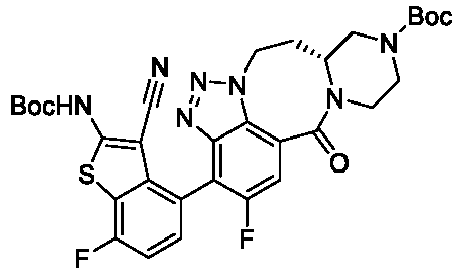 | tert-Butyl | |
| (7aR)-3-(2-((tert-butoxycarbonyl)amino) -3-cyano-7-fluorobenzo[b]thiophen-4-yl) -2-fluoro-12-oxo-6,7,7a,8,10,11-hexahyd ro-9H,12H-4,5,5a,9,11a-pentaazabenzo[ 5,6]cycloocta[1,2,3-cd]indene-9-carboxy late | ||
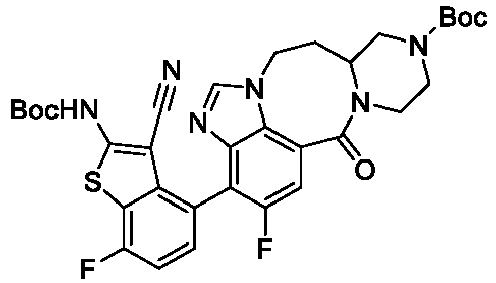 | tert-Butyl | |
| 3-(2-((tert-butoxycarbonyl)amino)-3-cya no-7-fluorobenzo[b]thiophen-4-yl)-2-flu oro-12-oxo-6,7,7a,8,10,11-hexahydro-9H ,12H-4,5a,9,11a-tetraazabenzo[5,6]cyclo octa[1,2,3 -cd]indene-9-carboxylate | ||
 | tert-Butyl | |
| (7aS)-3-(2-((tert-butoxycarbonyl)amino)-3-cyano-7-fluorobenzo[b]thiophen-4-yl)-2-fluoro-12-oxo-6,7,7a,8,10,11-hexahydr o-9H,12H-4,5a,9,11a-tetraazabenzo[5,6] cycloocta[1,2,3-cd]indene-9-carboxylate | ||
 | tert-Butyl | |
| (7aR)-3-(2-((tert-butoxycarbonyl)amino) -3-cyano-7-fluorobenzo[b]thiophen-4-yl) -2-fluoro-12-oxo-6,7,7a,8,10,11-hexahyd ro-9H,12H-4,5a,9,11a-tetraazabenzo[5,6] cycloocta[1,2,3-cd]indene-9-carboxylate |
Claims (22)
- A compound represented by general formula (IM) or a pharmaceutically acceptable salt thereof:
 X is C(RaRb) or C(RaRb)-C(RcRd);Y is C(O) or CH2;Z is CR5a or N;V is CR5 or N;ring A is aryl or heteroaryl;Ra, Rb, Rc, and Rd are identical or different at each occurrence and are each independently selected from the group consisting of a hydrogen atom, halogen, alkyl, haloalkyl, hydroxyalkyl, alkoxy, haloalkoxy, alkenyl, alkynyl, hydroxy, and cyano;R1 is selected from the group consisting of cyano,
 each R2 is identical or different and is independently selected from the group consisting of a hydrogen atom, halogen, cyano, alkyl, alkoxy, hydroxy, and amino, wherein the alkyl and alkoxy are each independently optionally substituted with one or more substituents selected from the group consisting of halogen, cyano, amino, and hydroxy;R3, R4, R5, and R5a are identical or different and are each independently selected from the group consisting of a hydrogen atom, halogen, cyano, alkyl, alkenyl, alkynyl, -NR7aR7b, -C(O)R8, -OR8, -S(O)pR8, cycloalkyl, heterocyclyl, aryl and heteroaryl, wherein the alkyl, cycloalkyl, heterocyclyl, aryl, and heteroaryl are each independently optionally substituted with one or more substituents selected from the group consisting of halogen, alkyl, haloalkyl, cyano, -NR7cR7d, -OR8a, cycloalkyl, heterocyclyl, aryl, and heteroaryl;each R6 is identical or different and is independently selected from the group consisting of a hydrogen atom, halogen, cyano, alkyl, alkenyl, alkynyl, -NR9aR9b, -C(O)NR9aR9b, -C(O)R10, -C(O)OR10, -OC(O)R10, -OR10, -S(O)pR10, -S(O)pNR9aR9b, cycloalkyl, heterocyclyl, aryl, and heteroaryl, wherein the alkyl, cycloalkyl, heterocyclyl, aryl, and heteroaryl are each independently optionally substituted with one or more substituents selected from the group consisting of halogen, alkyl, haloalkyl, cyano, -NR9cR9d, -OR10a, cycloalkyl, heterocyclyl, aryl, and heteroaryl;R11, R12, R13, and R14 are identical or different and are each independently selected from the group consisting of a hydrogen atom, halogen, alkyl, -NR15aR15b, -OR16, cyano, cycloalkyl, heterocyclyl, aryl, and heteroaryl, wherein the alkyl, cycloalkyl, heterocyclyl, aryl, and heteroaryl are each independently optionally substituted with one or more substituents selected from the group consisting of halogen, oxo, alkyl, haloalkyl, alkoxy, haloalkoxy, cyano, -NR15cR15d, hydroxy, hydroxyalkyl, cycloalkyl, heterocyclyl, aryl, and heteroaryl;R8, R8a, R10, R10a, and R16 are identical or different at each occurrence and are each independently selected from the group consisting of a hydrogen atom, alkyl, hydroxyalkyl, cycloalkyl, heterocyclyl, aryl, and heteroaryl, wherein the alkyl, cycloalkyl, heterocyclyl, aryl, and heteroaryl are each independently optionally substituted with one or more substituents selected from the group consisting of halogen, alkyl, alkenyl, alkynyl, oxo, alkoxy, haloalkyl, haloalkoxy, cyano, -NR17aR17b, hydroxy, cycloalkyl, heterocyclyl, aryl, and heteroaryl;R7a, R7b, R7c, R7d, R9a, R9b, R9c, R9d, R15a, R15b, R15c, R15d, R17a, and R17b are identical or different at each occurrence and are each independently selected from the group consisting of a hydrogen atom, alkyl, hydroxyalkyl, cycloalkyl, heterocyclyl, aryl, and heteroaryl, wherein the alkyl, cycloalkyl, heterocyclyl, aryl, and heteroaryl are each independently optionally substituted with one or more substituents selected from the group consisting of halogen, oxo, hydroxy, cyano, alkyl, alkoxy, haloalkyl, and haloalkoxy;or R7a and R7b, together with the nitrogen atom to which they are attached, form heterocyclyl, wherein the heterocyclyl is optionally substituted with one or more substituents selected from the group consisting of halogen, oxo, alkyl, alkoxy, haloalkyl, haloalkoxy, cyano, amino, nitro, hydroxy, hydroxyalkyl, cycloalkyl, heterocyclyl, aryl, and heteroaryl;or R7c and R7d, together with the nitrogen atom to which they are attached, form heterocyclyl, wherein the heterocyclyl is optionally substituted with one or more substituents selected from the group consisting of halogen, oxo, alkyl, alkoxy, haloalkyl, haloalkoxy, cyano, amino, nitro, hydroxy, hydroxyalkyl, cycloalkyl, heterocyclyl, aryl, and heteroaryl;or R9a and R9b, together with the nitrogen atom to which they are attached, form heterocyclyl, wherein the heterocyclyl is optionally substituted with one or more substituents selected from the group consisting of halogen, oxo, alkyl, alkoxy, haloalkyl, haloalkoxy, cyano, amino, nitro, hydroxy, hydroxyalkyl, cycloalkyl, heterocyclyl, aryl, and heteroaryl;or R9c and R9d, together with the nitrogen atom to which they are attached, form heterocyclyl, wherein the heterocyclyl is optionally substituted with one or more substituents selected from the group consisting of halogen, oxo, alkyl, alkoxy, haloalkyl, haloalkoxy, cyano, amino, nitro, hydroxy, hydroxyalkyl, cycloalkyl, heterocyclyl, aryl, and heteroaryl;or R15a and R15b, together with the nitrogen atom to which they are attached, form heterocyclyl, wherein the heterocyclyl is optionally substituted with one or more substituents selected from the group consisting of halogen, oxo, alkyl, alkoxy, haloalkyl, haloalkoxy, cyano, amino, nitro, hydroxy, hydroxyalkyl, cycloalkyl, heterocyclyl, aryl, and heteroaryl;or R15c and R15d, together with the nitrogen atom to which they are attached, form heterocyclyl, wherein the heterocyclyl is optionally substituted with one or more substituents selected from the group consisting of halogen, oxo, alkyl, alkoxy, haloalkyl, haloalkoxy, cyano, amino, nitro, hydroxy, hydroxyalkyl, cycloalkyl, heterocyclyl, aryl, and heteroaryl;or R17a and R17b, together with the nitrogen atom to which they are attached, form heterocyclyl, wherein the heterocyclyl is optionally substituted with one or more substituents selected from the group consisting of halogen, oxo, alkyl, alkoxy, haloalkyl, haloalkoxy, cyano, amino, nitro, hydroxy, hydroxyalkyl, cycloalkyl, heterocyclyl, aryl, and heteroaryl;s is 0, 1, 2, 3, 4, 5, or 6;t is 0, 1, 2, 3, 4, or 5; andp is 0, 1, or 2.
 - The compound represented by general formula (IM) or the pharmaceutically acceptable salt thereof according to claim 1, being a compound represented by general formula (I) or a pharmaceutically acceptable salt thereof:

ring A, X, Y, Z, R1, R2, R3, R4, R5, R6, s, and t are as defined in claim 1. - The compound represented by general formula (IM) or the pharmaceutically acceptable salt thereof according to claim 1 or 2, wherein Y is C(O).
- The compound represented by general formula (IM) or the pharmaceutically acceptable salt thereof according to any of claims 1 to 3, wherein s is 0 or 1.
- The compound represented by general formula (IM) or the pharmaceutically acceptable salt thereof according to any of claims 1 to 4, being a compound represented by general formula (II) or a pharmaceutically acceptable salt thereof:

ring A, X, Z, R1, R3, R4, R5, R6, and t are as defined in claim 1. - The compound represented by general formula (IM) or the pharmaceutically acceptable salt thereof according to any of claims 1 to 5, wherein ring A is 8- to 10-membered bicyclic heteroaryl containing in the ring 1, 2, or 3 heteroatoms selected from the group consisting of nitrogen, oxygen, and sulfur.
- The compound represented by general formula (IM) or the pharmaceutically acceptable salt thereof according to any of claims 1 to 6, wherein R1 is

- The compound represented by general formula (IM) or the pharmaceutically acceptable salt thereof according to any of claims 1 to 7, wherein X is CH2 or CH2-CH2; preferably, X is CH2-CH2.
- The compound represented by general formula (IM) or the pharmaceutically acceptable salt thereof according to any of claims 1 to 8, being a compound represented by general formula (III) or a pharmaceutically acceptable salt thereof:
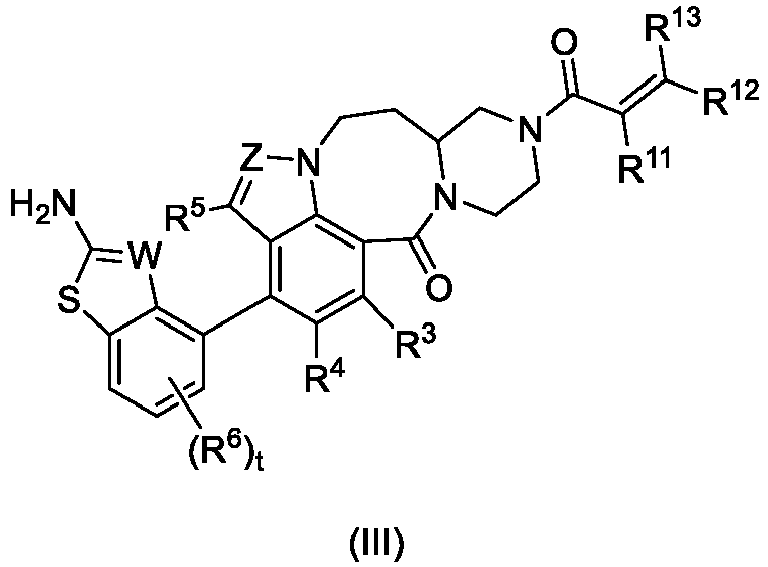 W is C(CN) or N;t is 0, 1, 2, or 3;Z, R3, R4, R5, R6, R11, R12, and R13 are as defined in claim 1.
 - The compound represented by general formula (IM) or the pharmaceutically acceptable salt thereof according to any of claims 1 to 9, wherein R3, R4, R5, and R5a are identical or different and are each independently selected from the group consisting of a hydrogen atom, halogen, C1-6 alkyl, and C1-6 haloalkyl.
- The compound represented by general formula (IM) or the pharmaceutically acceptable salt thereof according to any of claims 1 to 10, wherein each R6 is identical or different and is independently selected from the group consisting of halogen, cyano, -NH2, C1-6 alkyl, and C1-6 haloalkyl, and t is 0, 1, 2, or 3.
- The compound represented by general formula (IM) or the pharmaceutically acceptable salt thereof according to any of claims 1 to 11, wherein R11 is a hydrogen atom or halogen.
- The compound represented by general formula (IM) or the pharmaceutically acceptable salt thereof according to any of claims 1 to 12, wherein R12 is a hydrogen atom.
- The compound represented by general formula (IM) or the pharmaceutically acceptable salt thereof according to any of claims 1 to 13, wherein R13 is a hydrogen atom.
- The compound represented by general formula (IM) or the pharmaceutically acceptable salt thereof according to any of claims 1 to 14, being selected from the group consisting of the following compounds:


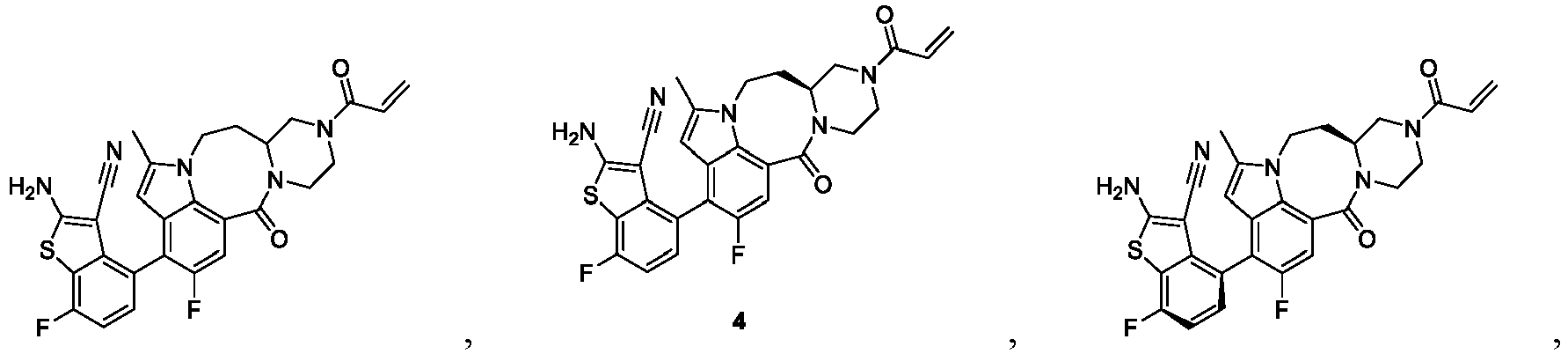


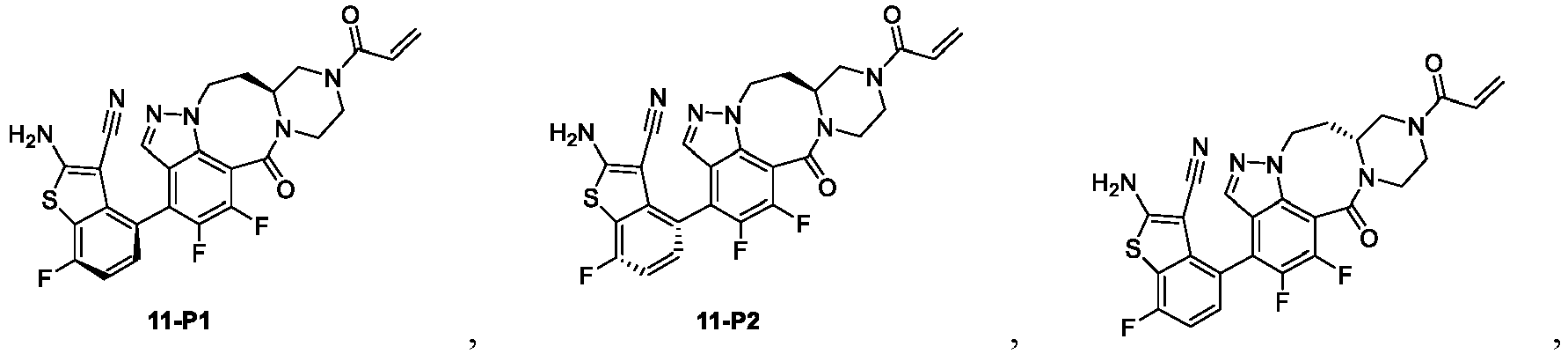


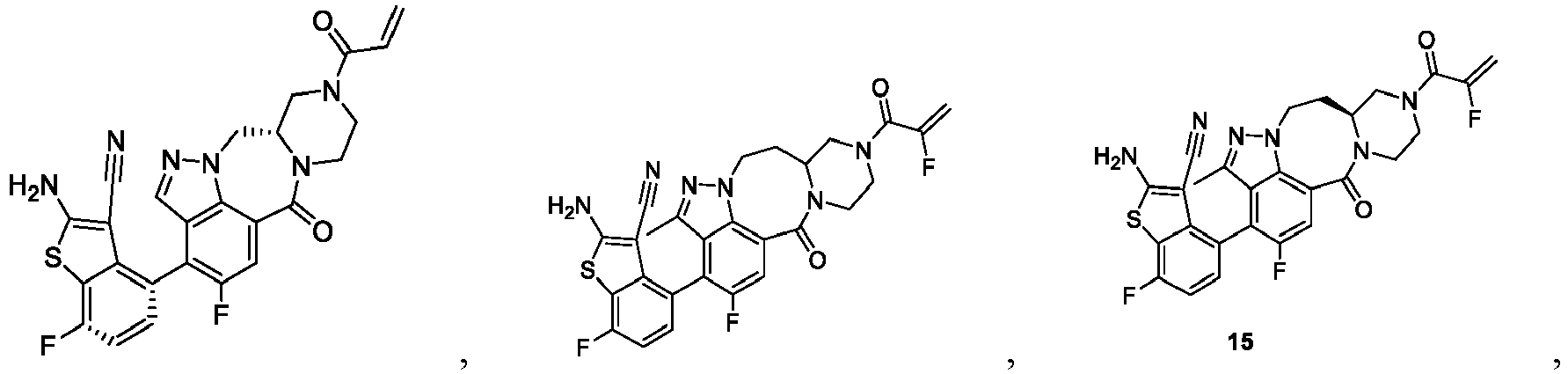





- A compound represented by general formula (IMa) or a salt thereof:

ring A, V, X, Y, Z, R2, R3, R4, R6, s, and t are as defined in claim 1. - A compound or a salt thereof, being selected from the group consisting of the following compounds:


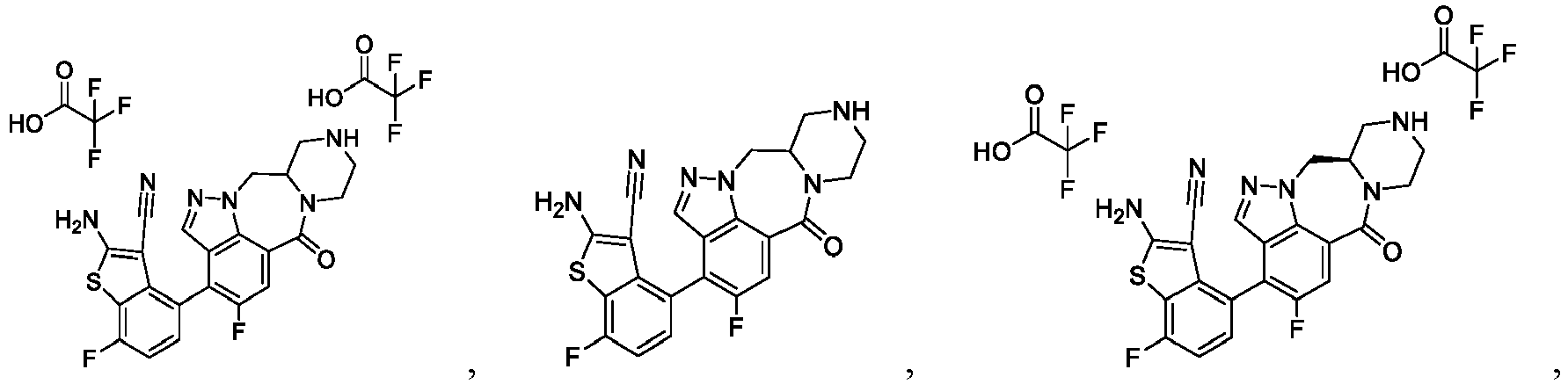





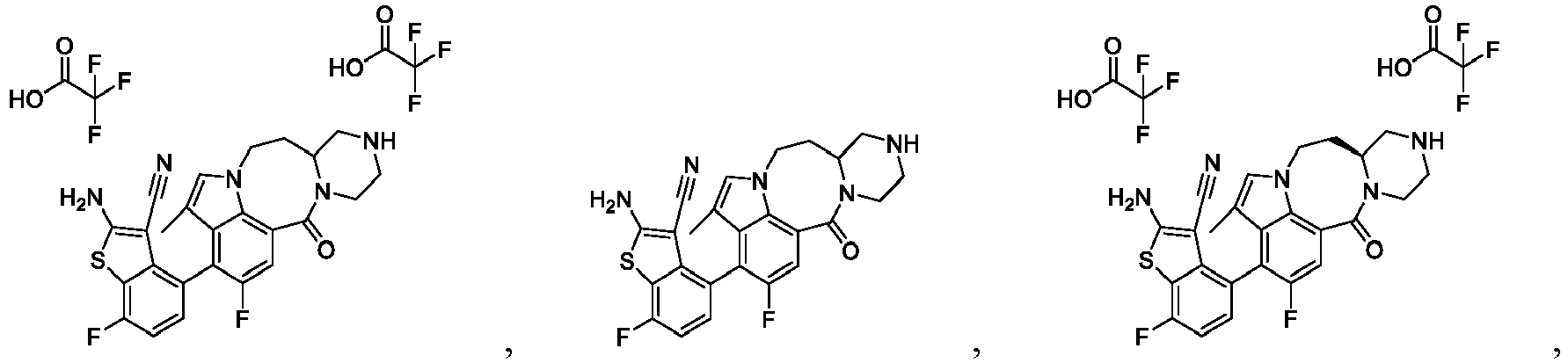








- A method for preparing a compound represented by general formula (IM) or a pharmaceutically acceptable salt thereof, comprising:
 L is halogen; preferably, L is Cl;R1 is
- A pharmaceutical composition, wherein the pharmaceutical composition comprises the compound represented by general formula (IM) or the pharmaceutically acceptable salt thereof according to any of claims 1 to 15, and one or more pharmaceutically acceptable carriers, diluents, or excipients.
- Use of the compound represented by general formula (IM) or the pharmaceutically acceptable salt thereof according to any of claims 1 to 15 or the pharmaceutical composition according to claim 19 in the preparation of a medicament for inhibiting KRAS G12C.
- Use of the compound represented by general formula (IM) or the pharmaceutically acceptable salt thereof according to any of claims 1 to 15 or the pharmaceutical composition according to claim 19 in the preparation of a medicament for treating and/or preventing a tumor.
- The use according to claim 21, wherein the tumor is a cancer; preferably, the cancer is selected from the group consisting of lung cancer, pancreatic cancer, cervical cancer, esophageal cancer, endometrial cancer, ovarian cancer, cholangiocarcinoma, colorectal cancer, liver cancer, breast cancer, prostate cancer, thyroid cancer, stomach cancer, urothelial cancer, testicular cancer, leukemia, skin cancer, squamous cell cancer, basal cell cancer, bladder cancer, head and neck cancer, kidney cancer, nasopharyngeal cancer, bone cancer, lymphoma, melanoma, sarcoma, peripheral neuroepithelioma, glioma, brain tumor, and myeloma; more preferably, the cancer is selected from the group consisting of lung cancer, pancreatic cancer, cervical cancer, esophageal cancer, endometrial cancer, ovarian cancer, cholangiocarcinoma, and colorectal cancer.
Applications Claiming Priority (5)
| Application Number | Priority Date | Filing Date | Title |
|---|---|---|---|
| CN202111231664 | 2021-10-22 | ||
| CN202111536255 | 2021-12-15 | ||
| CN202210166912 | 2022-02-23 | ||
| CN202210382949 | 2022-04-12 | ||
| PCT/CN2022/126650 WO2023066371A1 (en) | 2021-10-22 | 2022-10-21 | Nitrogen-containing tetracyclic compound, preparation method therefor, and medical use thereof |
Publications (2)
| Publication Number | Publication Date |
|---|---|
| EP4421076A1 true EP4421076A1 (en) | 2024-08-28 |
| EP4421076A4 EP4421076A4 (en) | 2025-03-12 |
Family
ID=86057951
Family Applications (1)
| Application Number | Title | Priority Date | Filing Date |
|---|---|---|---|
| EP22882976.8A Pending EP4421076A4 (en) | 2021-10-22 | 2022-10-21 | Nitrogen-containing tetracyclic compound, manufacturing process therefor and medical use thereof |
Country Status (10)
| Country | Link |
|---|---|
| US (1) | US20250122211A1 (en) |
| EP (1) | EP4421076A4 (en) |
| JP (1) | JP2024539228A (en) |
| KR (1) | KR20240089594A (en) |
| CN (1) | CN118176193A (en) |
| AU (1) | AU2022371727A1 (en) |
| CA (1) | CA3234517A1 (en) |
| MX (1) | MX2024004846A (en) |
| TW (1) | TW202322819A (en) |
| WO (1) | WO2023066371A1 (en) |
Families Citing this family (33)
| Publication number | Priority date | Publication date | Assignee | Title |
|---|---|---|---|---|
| CA3243798A1 (en) | 2022-02-09 | 2023-08-17 | Quanta Therapeutics, Inc. | Kras modulators and uses thereof |
| WO2023230190A1 (en) | 2022-05-25 | 2023-11-30 | Quanta Therapeutics, Inc. | Pyrimidine based modulators and uses thereof |
| EP4680609A1 (en) | 2023-03-15 | 2026-01-21 | Quanta Therapeutics, Inc. | Kras modulators and uses thereof |
| CN121487738A (en) | 2023-03-30 | 2026-02-06 | 锐新医药公司 | Compositions for inducing RAS GTP hydrolysis and their uses |
| KR20250174948A (en) * | 2023-04-21 | 2025-12-15 | 지앙수 헨그루이 파마슈티컬스 컴퍼니 리미티드 | Crystal form of nitrogen-containing tetracyclic compound and method for preparing same |
| KR20260019479A (en) | 2023-05-04 | 2026-02-10 | 레볼루션 메디슨즈, 인크. | Combination therapy for RAS-related diseases or disorders |
| CN121889155A (en) | 2023-08-07 | 2026-04-17 | 锐新医药公司 | RMC-6291 for the treatment of RAS protein-related diseases or disorders |
| US20250109147A1 (en) | 2023-09-08 | 2025-04-03 | Gilead Sciences, Inc. | Kras g12d modulating compounds |
| AU2024360465A1 (en) | 2023-10-12 | 2026-04-09 | Revolution Medicines, Inc. | Macrocyclic ras inhibitors |
| WO2025171296A1 (en) | 2024-02-09 | 2025-08-14 | Revolution Medicines, Inc. | Ras inhibitors |
| WO2025240847A1 (en) | 2024-05-17 | 2025-11-20 | Revolution Medicines, Inc. | Ras inhibitors |
| WO2025247783A1 (en) | 2024-05-29 | 2025-12-04 | Syngenta Crop Protection Ag | Pesticidally active dihydro-benzoxazinone compounds |
| US20250375445A1 (en) | 2024-06-07 | 2025-12-11 | Revolution Medicines, Inc. | Methods of treating a ras protein-related disease or disorder |
| WO2025265060A1 (en) | 2024-06-21 | 2025-12-26 | Revolution Medicines, Inc. | Therapeutic compositions and methods for managing treatment-related effects |
| WO2026006747A1 (en) | 2024-06-28 | 2026-01-02 | Revolution Medicines, Inc. | Ras inhibitors |
| WO2026015796A1 (en) | 2024-07-12 | 2026-01-15 | Revolution Medicines, Inc. | Methods of treating a ras related disease or disorder |
| WO2026015801A1 (en) | 2024-07-12 | 2026-01-15 | Revolution Medicines, Inc. | Methods of treating a ras related disease or disorder |
| WO2026015825A1 (en) | 2024-07-12 | 2026-01-15 | Revolution Medicines, Inc. | Use of ras inhibitor for treating pancreatic cancer |
| WO2026015790A1 (en) | 2024-07-12 | 2026-01-15 | Revolution Medicines, Inc. | Methods of treating a ras related disease or disorder |
| WO2026035945A1 (en) | 2024-08-07 | 2026-02-12 | Tesseract Medicines Us, Llc | Covalent-induced drug conjugates targeting kras and comprising a topoisomerase payload |
| TW202615038A (en) | 2024-08-07 | 2026-04-16 | 美商太斯萊特醫藥美國有限責任公司 | Kras-targeting covalent-induced drug conjugates comprising a topoisomerase payload |
| WO2026050446A1 (en) | 2024-08-29 | 2026-03-05 | Revolution Medicines, Inc. | Ras inhibitors |
| WO2026064520A1 (en) | 2024-09-19 | 2026-03-26 | Tesseract Medicines Us, Llc | Covalent-induced drug conjugates targeting kras and comprising a tubulin inhibitor payload |
| WO2026064527A1 (en) | 2024-09-19 | 2026-03-26 | Tesseract Medicines Us, Llc | Kras-targeting covalent-induced drug conjugates comprising a tubulin inhibitor payload |
| WO2026072904A2 (en) | 2024-09-26 | 2026-04-02 | Revolution Medicines, Inc. | Compositions and methods for treating lung cancer |
| WO2026090116A2 (en) | 2024-10-21 | 2026-04-30 | Revolution Medicines, Inc. | Ras inhibitors |
| WO2026090245A1 (en) | 2024-10-22 | 2026-04-30 | Revolution Medicines, Inc. | Use of ras inhibitors for treating cancer |
| US20260108528A1 (en) | 2024-10-22 | 2026-04-23 | Revolution Medicines, Inc. | Methods of treating a ras protein-related disease or disorder |
| WO2026106912A1 (en) | 2024-11-12 | 2026-05-21 | Revolution Medicines, Inc. | Ras inhibitors |
| WO2026112260A1 (en) | 2024-11-21 | 2026-05-28 | Revolution Medicines, Inc. | Ras inhibitors |
| WO2026122764A2 (en) | 2024-12-06 | 2026-06-11 | Revolution Medicines, Inc. | Ras inhibitors |
| WO2026128688A2 (en) | 2024-12-13 | 2026-06-18 | Revolution Medicines, Inc. | Ras inhibitors |
| WO2026161839A1 (en) | 2025-01-27 | 2026-07-30 | Revolution Medicines, Inc. | Ras inhibitors |
Family Cites Families (21)
| Publication number | Priority date | Publication date | Assignee | Title |
|---|---|---|---|---|
| TW201524952A (en) | 2013-03-15 | 2015-07-01 | Araxes Pharma Llc | Covalent inhibitors of KRAS G12C |
| MX380928B (en) | 2013-10-10 | 2025-03-12 | Araxes Pharma Llc | KRAS G12C INHIBITORS. |
| US10160726B2 (en) | 2014-08-06 | 2018-12-25 | Novartis Ag | Quinolone derivatives as antibacterials |
| AU2016245864C1 (en) | 2015-04-10 | 2021-09-09 | Araxes Pharma Llc | Substituted quinazoline compounds and methods of use thereof |
| KR102932353B1 (en) | 2015-11-16 | 2026-02-27 | 아락세스 파마 엘엘씨 | 2-substituted quinazoline compounds comprising a substituted heterocyclic group and methods of use thereof |
| ES2863873T3 (en) | 2016-05-18 | 2021-10-11 | Mirati Therapeutics Inc | KRAS G12C inhibitors |
| CR20190338A (en) | 2016-12-22 | 2019-09-09 | Amgen Inc | KRAS G12C INHIBITORS AND METHODS FOR THEIR USE |
| AR111658A1 (en) | 2017-05-05 | 2019-08-07 | Novartis Ag | 2-TRICYCLINAL CHINOLINONES AS ANTIBACTERIAL AGENTS |
| WO2018206539A1 (en) | 2017-05-11 | 2018-11-15 | Astrazeneca Ab | Heteroaryl compounds that inhibit g12c mutant ras proteins |
| UA127968C2 (en) | 2017-05-22 | 2024-02-28 | Емджен Інк. | Kras g12c inhibitors and methods of using the same |
| CA3082579A1 (en) | 2017-11-15 | 2019-05-23 | Mirati Therapeutics, Inc. | Kras g12c inhibitors |
| ES2993034T3 (en) | 2018-04-02 | 2024-12-20 | Chemocentryx Inc | Prodrugs of fused-bicyclic c5ar antagonists |
| TW202012415A (en) * | 2018-05-08 | 2020-04-01 | 瑞典商阿斯特捷利康公司 | Chemical compounds |
| AR116604A1 (en) | 2018-10-15 | 2021-05-26 | Lilly Co Eli | KRAS G12C INHIBITORS |
| ES3010507T3 (en) | 2019-03-05 | 2025-04-03 | Astrazeneca Ab | Fused tricyclic compounds useful as anticancer agents |
| EP3964516A4 (en) * | 2019-04-28 | 2023-01-11 | Genfleet Therapeutics (Shanghai) Inc. | OXAAZAQUINAZOLINE-7(8H)-KETONE COMPOUND, METHOD FOR PREPARATION AND PHARMACEUTICAL APPLICATION |
| WO2021000885A1 (en) * | 2019-07-01 | 2021-01-07 | 江苏恒瑞医药股份有限公司 | Quinazoline derivatives, preparation process and medical use thereof |
| IL290276B2 (en) * | 2019-08-02 | 2026-05-01 | Shanghai Jemincare Pharmaceuticals Co Ltd | Tetracyclic Compound, Preparation Method and Use Thereof |
| CN112390818B (en) * | 2019-08-12 | 2023-08-22 | 劲方医药科技(上海)有限公司 | Substituted heteroaromatic ring dihydropyrimidinone derivatives, its preparation method and medical application |
| CN112745335B (en) * | 2019-10-30 | 2024-08-30 | 武汉誉祥医药科技有限公司 | Tri-heterocyclic compound and application thereof |
| CR20220258A (en) | 2019-12-11 | 2022-07-03 | Lilly Co Eli | Kras g12c inhibitors |
-
2022
- 2022-10-21 KR KR1020247015632A patent/KR20240089594A/en active Pending
- 2022-10-21 WO PCT/CN2022/126650 patent/WO2023066371A1/en not_active Ceased
- 2022-10-21 US US18/703,712 patent/US20250122211A1/en active Pending
- 2022-10-21 TW TW111140088A patent/TW202322819A/en unknown
- 2022-10-21 MX MX2024004846A patent/MX2024004846A/en unknown
- 2022-10-21 AU AU2022371727A patent/AU2022371727A1/en active Pending
- 2022-10-21 CN CN202280066572.2A patent/CN118176193A/en active Pending
- 2022-10-21 JP JP2024523948A patent/JP2024539228A/en active Pending
- 2022-10-21 EP EP22882976.8A patent/EP4421076A4/en active Pending
- 2022-10-21 CA CA3234517A patent/CA3234517A1/en active Pending
Also Published As
| Publication number | Publication date |
|---|---|
| CA3234517A1 (en) | 2023-04-27 |
| WO2023066371A1 (en) | 2023-04-27 |
| MX2024004846A (en) | 2024-05-03 |
| AU2022371727A1 (en) | 2024-05-02 |
| TW202322819A (en) | 2023-06-16 |
| US20250122211A1 (en) | 2025-04-17 |
| JP2024539228A (en) | 2024-10-28 |
| EP4421076A4 (en) | 2025-03-12 |
| CN118176193A (en) | 2024-06-11 |
| KR20240089594A (en) | 2024-06-20 |
Similar Documents
| Publication | Publication Date | Title |
|---|---|---|
| US20250122211A1 (en) | Nitrogen-containing tetracyclic compound, preparation method therefor, and medical use thereof | |
| CN118176198A (en) | Nitrogen-containing tetracyclic compound, preparation method thereof and application thereof in medicine | |
| EP4563580A1 (en) | Fused ring compound, preparation method therefor and medicinal application thereof | |
| CN116199703A (en) | Fused tetracyclic heterocyclic compound, preparation method thereof and application thereof in medicine | |
| EP4361157A1 (en) | Fused tetracyclic compound, preparation method therefor and application thereof in medicine | |
| EP4667458A1 (en) | Pharmaceutical composition for treatment of cancer, comprising sos1 inhibitor and anticancer drug | |
| EP2483277B1 (en) | Benzoxepin pi3k inhibitor compounds and methods of use | |
| AU2010299816C1 (en) | Benzoxazepin PI3K inhibitor compounds and methods of use | |
| EP2900657B1 (en) | Cyclic ether pyrazol-4-yl-heterocyclyl-carboxamide compounds and methods of use | |
| CN115385937A (en) | Pyrimido-cycloalkyl compounds, preparation method and medical application thereof | |
| CN116217592A (en) | Nitrogen-containing tricyclic compound, its preparation method and its application in medicine | |
| CN117486901A (en) | Fused piperidine compounds, their preparation methods and their applications in medicine | |
| WO2024235225A1 (en) | Substituted pyrimidine-fused ring inhibitor, and preparation method therefor and use thereof | |
| EP3055315B1 (en) | Thiazolopyrimidinones as modulators of nmda receptor activity | |
| CN120230123A (en) | Condensed ring compound, preparation method thereof and application thereof in medicine | |
| EP4349836A1 (en) | Nitrogen-containing heterocyclic compound, preparation method therefor, and application thereof in medicines | |
| CN120365289A (en) | Condensed ring compound, preparation method and medical application thereof | |
| CN113387962A (en) | Pyrazolo [3,4-d ] pyrimidine-3-one derivative, pharmaceutical composition and application thereof | |
| CN115594695A (en) | Macrocyclic compound, preparation method and medical application thereof | |
| EP4501925A1 (en) | Nitrogen-containing heterocyclic compound, preparation method therefor, and pharmaceutical application thereof | |
| EP3978498A1 (en) | Substituted fused bicyclic derivative, preparation method therefor, and application thereof in medicines | |
| CN116829556A (en) | Fused azatricyclic derivatives, their preparation methods and their applications in medicine | |
| AU2024319888A1 (en) | Heteroaryl compound, preparation method therefor, and use thereof in medicine | |
| CN113912608B (en) | Pyrimidopyrimidinone derivatives, their preparation method and their application in medicine | |
| CN115368380A (en) | TRK macrocyclic compound of pyrazole-substituted pyrazolopyrimidine, pharmaceutical composition and application thereof |
Legal Events
| Date | Code | Title | Description |
|---|---|---|---|
| STAA | Information on the status of an ep patent application or granted ep patent |
Free format text: STATUS: THE INTERNATIONAL PUBLICATION HAS BEEN MADE |
|
| PUAI | Public reference made under article 153(3) epc to a published international application that has entered the european phase |
Free format text: ORIGINAL CODE: 0009012 |
|
| STAA | Information on the status of an ep patent application or granted ep patent |
Free format text: STATUS: REQUEST FOR EXAMINATION WAS MADE |
|
| 17P | Request for examination filed |
Effective date: 20240513 |
|
| AK | Designated contracting states |
Kind code of ref document: A1 Designated state(s): AL AT BE BG CH CY CZ DE DK EE ES FI FR GB GR HR HU IE IS IT LI LT LU LV MC ME MK MT NL NO PL PT RO RS SE SI SK SM TR |
|
| DAV | Request for validation of the european patent (deleted) | ||
| DAX | Request for extension of the european patent (deleted) | ||
| A4 | Supplementary search report drawn up and despatched |
Effective date: 20250211 |
|
| RIC1 | Information provided on ipc code assigned before grant |
Ipc: C07D 487/16 20060101ALI20250205BHEP Ipc: A61P 35/00 20060101ALI20250205BHEP Ipc: A61K 31/4985 20060101ALI20250205BHEP Ipc: C07D 487/14 20060101ALI20250205BHEP Ipc: C07D 487/12 20060101ALI20250205BHEP Ipc: C07D 471/14 20060101ALI20250205BHEP Ipc: C07D 471/12 20060101AFI20250205BHEP |
|
| GRAP | Despatch of communication of intention to grant a patent |
Free format text: ORIGINAL CODE: EPIDOSNIGR1 |
|
| STAA | Information on the status of an ep patent application or granted ep patent |
Free format text: STATUS: GRANT OF PATENT IS INTENDED |