EP4420805A1 - Method for assessing fracture in press-formed part, and method for determining fracture countermeasure in press-formed part - Google Patents
Method for assessing fracture in press-formed part, and method for determining fracture countermeasure in press-formed part Download PDFInfo
- Publication number
- EP4420805A1 EP4420805A1 EP22910452.6A EP22910452A EP4420805A1 EP 4420805 A1 EP4420805 A1 EP 4420805A1 EP 22910452 A EP22910452 A EP 22910452A EP 4420805 A1 EP4420805 A1 EP 4420805A1
- Authority
- EP
- European Patent Office
- Prior art keywords
- fracture
- press
- forming
- formed part
- occurrence
- Prior art date
- Legal status (The legal status is an assumption and is not a legal conclusion. Google has not performed a legal analysis and makes no representation as to the accuracy of the status listed.)
- Pending
Links
- 238000000034 method Methods 0.000 title claims abstract description 131
- 238000012360 testing method Methods 0.000 claims abstract description 124
- 239000002184 metal Substances 0.000 claims description 51
- 238000005452 bending Methods 0.000 claims description 36
- 230000014759 maintenance of location Effects 0.000 claims description 14
- 239000011347 resin Substances 0.000 description 17
- 229920005989 resin Polymers 0.000 description 17
- 230000000717 retained effect Effects 0.000 description 4
- 230000000694 effects Effects 0.000 description 3
- 239000000463 material Substances 0.000 description 3
- 238000012545 processing Methods 0.000 description 3
- 125000006850 spacer group Chemical group 0.000 description 3
- 230000000007 visual effect Effects 0.000 description 3
- 229910000831 Steel Inorganic materials 0.000 description 2
- 238000005520 cutting process Methods 0.000 description 2
- 238000013461 design Methods 0.000 description 2
- 239000010959 steel Substances 0.000 description 2
- 241001648319 Toronia toru Species 0.000 description 1
- 238000004458 analytical method Methods 0.000 description 1
- 238000005336 cracking Methods 0.000 description 1
- 230000007547 defect Effects 0.000 description 1
- 238000005516 engineering process Methods 0.000 description 1
- 238000011156 evaluation Methods 0.000 description 1
- 238000002474 experimental method Methods 0.000 description 1
- 238000004519 manufacturing process Methods 0.000 description 1
- 230000007246 mechanism Effects 0.000 description 1
- 238000010008 shearing Methods 0.000 description 1
- 230000001629 suppression Effects 0.000 description 1
- 230000001960 triggered effect Effects 0.000 description 1
- 230000037303 wrinkles Effects 0.000 description 1
Images

Classifications
-
- G—PHYSICS
- G01—MEASURING; TESTING
- G01N—INVESTIGATING OR ANALYSING MATERIALS BY DETERMINING THEIR CHEMICAL OR PHYSICAL PROPERTIES
- G01N3/00—Investigating strength properties of solid materials by application of mechanical stress
- G01N3/20—Investigating strength properties of solid materials by application of mechanical stress by applying steady bending forces
-
- B—PERFORMING OPERATIONS; TRANSPORTING
- B23—MACHINE TOOLS; METAL-WORKING NOT OTHERWISE PROVIDED FOR
- B23Q—DETAILS, COMPONENTS, OR ACCESSORIES FOR MACHINE TOOLS, e.g. ARRANGEMENTS FOR COPYING OR CONTROLLING; MACHINE TOOLS IN GENERAL CHARACTERISED BY THE CONSTRUCTION OF PARTICULAR DETAILS OR COMPONENTS; COMBINATIONS OR ASSOCIATIONS OF METAL-WORKING MACHINES, NOT DIRECTED TO A PARTICULAR RESULT
- B23Q15/00—Automatic control or regulation of feed movement, cutting velocity or position of tool or work
- B23Q15/007—Automatic control or regulation of feed movement, cutting velocity or position of tool or work while the tool acts upon the workpiece
- B23Q15/12—Adaptive control, i.e. adjusting itself to have a performance which is optimum according to a preassigned criterion
-
- G—PHYSICS
- G01—MEASURING; TESTING
- G01N—INVESTIGATING OR ANALYSING MATERIALS BY DETERMINING THEIR CHEMICAL OR PHYSICAL PROPERTIES
- G01N3/00—Investigating strength properties of solid materials by application of mechanical stress
- G01N3/28—Investigating ductility, e.g. suitability of sheet metal for deep-drawing or spinning
-
- B—PERFORMING OPERATIONS; TRANSPORTING
- B21—MECHANICAL METAL-WORKING WITHOUT ESSENTIALLY REMOVING MATERIAL; PUNCHING METAL
- B21D—WORKING OR PROCESSING OF SHEET METAL OR METAL TUBES, RODS OR PROFILES WITHOUT ESSENTIALLY REMOVING MATERIAL; PUNCHING METAL
- B21D22/00—Shaping without cutting, by stamping, spinning, or deep-drawing
-
- B—PERFORMING OPERATIONS; TRANSPORTING
- B21—MECHANICAL METAL-WORKING WITHOUT ESSENTIALLY REMOVING MATERIAL; PUNCHING METAL
- B21D—WORKING OR PROCESSING OF SHEET METAL OR METAL TUBES, RODS OR PROFILES WITHOUT ESSENTIALLY REMOVING MATERIAL; PUNCHING METAL
- B21D22/00—Shaping without cutting, by stamping, spinning, or deep-drawing
- B21D22/02—Stamping using rigid devices or tools
-
- B—PERFORMING OPERATIONS; TRANSPORTING
- B21—MECHANICAL METAL-WORKING WITHOUT ESSENTIALLY REMOVING MATERIAL; PUNCHING METAL
- B21D—WORKING OR PROCESSING OF SHEET METAL OR METAL TUBES, RODS OR PROFILES WITHOUT ESSENTIALLY REMOVING MATERIAL; PUNCHING METAL
- B21D5/00—Bending sheet metal along straight lines, e.g. to form simple curves
-
- G—PHYSICS
- G01—MEASURING; TESTING
- G01N—INVESTIGATING OR ANALYSING MATERIALS BY DETERMINING THEIR CHEMICAL OR PHYSICAL PROPERTIES
- G01N2203/00—Investigating strength properties of solid materials by application of mechanical stress
- G01N2203/0014—Type of force applied
- G01N2203/0023—Bending
-
- G—PHYSICS
- G01—MEASURING; TESTING
- G01N—INVESTIGATING OR ANALYSING MATERIALS BY DETERMINING THEIR CHEMICAL OR PHYSICAL PROPERTIES
- G01N2203/00—Investigating strength properties of solid materials by application of mechanical stress
- G01N2203/0058—Kind of property studied
- G01N2203/006—Crack, flaws, fracture or rupture
- G01N2203/0062—Crack or flaws
- G01N2203/0064—Initiation of crack
-
- G—PHYSICS
- G01—MEASURING; TESTING
- G01N—INVESTIGATING OR ANALYSING MATERIALS BY DETERMINING THEIR CHEMICAL OR PHYSICAL PROPERTIES
- G01N2203/00—Investigating strength properties of solid materials by application of mechanical stress
- G01N2203/0058—Kind of property studied
- G01N2203/006—Crack, flaws, fracture or rupture
- G01N2203/0067—Fracture or rupture
-
- G—PHYSICS
- G01—MEASURING; TESTING
- G01N—INVESTIGATING OR ANALYSING MATERIALS BY DETERMINING THEIR CHEMICAL OR PHYSICAL PROPERTIES
- G01N2203/00—Investigating strength properties of solid materials by application of mechanical stress
- G01N2203/02—Details not specific for a particular testing method
- G01N2203/026—Specifications of the specimen
- G01N2203/0262—Shape of the specimen
- G01N2203/0278—Thin specimens
- G01N2203/0282—Two dimensional, e.g. tapes, webs, sheets, strips, disks or membranes
-
- G—PHYSICS
- G01—MEASURING; TESTING
- G01N—INVESTIGATING OR ANALYSING MATERIALS BY DETERMINING THEIR CHEMICAL OR PHYSICAL PROPERTIES
- G01N2203/00—Investigating strength properties of solid materials by application of mechanical stress
- G01N2203/02—Details not specific for a particular testing method
- G01N2203/06—Indicating or recording means; Sensing means
- G01N2203/0641—Indicating or recording means; Sensing means using optical, X-ray, ultraviolet, infrared or similar detectors
-
- G—PHYSICS
- G01—MEASURING; TESTING
- G01N—INVESTIGATING OR ANALYSING MATERIALS BY DETERMINING THEIR CHEMICAL OR PHYSICAL PROPERTIES
- G01N2203/00—Investigating strength properties of solid materials by application of mechanical stress
- G01N2203/02—Details not specific for a particular testing method
- G01N2203/06—Indicating or recording means; Sensing means
- G01N2203/0641—Indicating or recording means; Sensing means using optical, X-ray, ultraviolet, infrared or similar detectors
- G01N2203/0647—Image analysis
Definitions
- the present invention relates to a press formed part fracture determination method, which is a method of determining a fracture occurring in a press formed part in which a fracture has occurred or is predicted to occur by press forming of a metal sheet, and a press formed part fracture countermeasure decision method, which is a method of deciding a countermeasure for a fracture of a press formed part based on the fracture determination.
- Patent Literature 1 discloses a method of evaluating a bending inner fracture on a bend inner side at the time of unbending deformation after bending deformation of a metal sheet material, and a technique of predicting occurrence of such a bending inner fracture.
- Patent Literature 2 discloses a technique of evaluating bending cracking at a sheared edge when a target press formed component is manufactured by performing press forming on a metal sheet subjected to shearing.
- a fracture of a size of several millimeters occurring during press forming is caused by a microscopic crack (hereinafter, referred to as a micro crack) of a size of several tens of micrometers arising at a portion where the fracture occurs in a press formed part.
- a micro crack a microscopic crack
- FIG. 6 illustrates a press formed part 21 obtained by bending a metal sheet 11.
- Case (1) being a case where a fracture occurs in a bent portion 23 that is bent during press forming
- Case (2) being a case where a fracture occurs in the bent portion 23 during springback of the press formed part 21 after die release of the part from a press-forming die after press forming.
- the fracture during the press forming in Case (1) is caused by a micro crack occurring on a surface of the bent portion 23 on the bend inner side as illustrated in FIG. 7 when strain generated in the bent portion 23 during the bend forming of the metal sheet 11 exceeds a fracture limit value.
- the fracture during springback in Case (2) occurs in a manner such that an action of strong compressive stress generated on the surface of the bent portion 23 on the bend inner side during the press forming brings about the brittleness of the metal sheet, and an initial defect of the metal sheet or a micro crack that has occurred in the bent portion 23 during the press forming leads to the occurrence of the fracture, triggered by the reversal of the compressive stress to the tensile stress due to the springback.
- the fracture during the press forming and the fracture during the springback have different occurrence mechanisms, it is also necessary to take different countermeasures to suppress the fracture that has occurred in the press formed part.
- Patent Literature 1 and Patent Literature 2 have no ways to determine whether the micro crack leading to a fracture has occurred during press forming or during springback. Therefore, when it is determined, for example, that a fracture has occurred due to occurrence of a micro crack during press forming even though a fracture has occurred during springback, there has been difficulty in taking an effective fracture countermeasure, specifically, a countermeasure for suppressing the fracture that has occurred in the press formed part.
- a press formed part fracture determination method decides a countermeasure for a fracture occurring in a press formed part in which a fracture has occurred or a fracture is predicted to occur by press forming of a metal sheet, and includes: a stress state reproduction test process of reproducing, by press forming of a test piece of the metal sheet, a stress state in a press forming process of a fracture occurrence portion where a fracture has occurred or a fracture is predicted to occur, in the press formed part, and determining occurrence/non-occurrence of a micro crack in a stress state reproduction portion of the test piece; and a fracture determination process of determining, when it is determined that a micro crack has occurred in the stress state reproduction portion of the test piece in the stress state reproduction test process, that there is a fracture that has occurred in the press formed part in the press forming process, and determining, when it is determined that there is no occurrence of a micro crack in the stress state reproduction portion of the test piece, that there is a fracture that has occurred in springback of the press formed part
- the stress state reproduction test process may include: a stress state reproduction press forming step of reproducing a stress state of the fracture occurrence portion in the press formed part by performing press forming of the test piece; and a micro crack occurrence/non-occurrence determination step of determining occurrence/non-occurrence of a micro crack in the stress state reproduction portion of the test piece
- the stress state reproduction press forming step may include: a forming load application step of, using a press-forming die including a punch, a die, a forming load application portion that applies a forming load to the punch or the die, and a forming load retention portion that retains a forming state in which the forming load is being applied, pushing the punch toward the die by the forming load application portion in a state where the test piece is disposed between the punch and the die, and reproducing a stress state of the fracture occurrence portion of the press formed part on the test piece; and a forming state retention step of retaining, by the forming load retention portion, a forming state in which a stress
- the press formed part may include a bent portion formed by bending the metal sheet, and the bent portion may be the fracture occurrence portion.
- a press formed part fracture countermeasure decision method decides a fracture countermeasure to be taken for a press formed part in which a fracture has occurred or a fracture is predicted to occur by press forming of a metal sheet, the decision made by using the press formed part fracture determination method according to the present invention, and includes a fracture countermeasure decision process of deciding, when it is determined, in the fracture determination process, that there is a fracture in a press forming process of the press formed part, a countermeasure for suppressing occurrence of a micro crack at the fracture occurrence portion in the press forming process of the press formed part as a countermeasure for a fracture of the press formed part, and deciding, when it is determined that there is a fracture of the press formed part in springback after press forming, a countermeasure for suppressing the springback of the press formed part after press forming as a countermeasure for the fracture of the press formed part.
- the fracture occurring in the press formed part can be distinguished and determined as to whether the fracture is a fracture occurring in a press forming process or a fracture occurring at the time of springback after press forming. This makes it possible to decide a fracture countermeasure to be taken to effectively suppress the occurrence of fractures in the press formed part.
- a fracture countermeasure to be taken to effectively suppress the occurrence of fractures in the press formed part.
- by preliminarily deciding a fracture countermeasure for a portion where there is a risk of occurrence of fractures in the press formed part at a design stage of the press formed part it is possible to efficiently improve the performance of the press formed part.
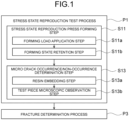
- a press formed part fracture determination method is a method as a basis for deciding a countermeasure for a fracture occurring in a press formed part in which a fracture has occurred by press forming of a metal sheet, and includes a stress state reproduction test process P1 and a fracture determination process P3 as illustrated in FIG. 1 .
- a press formed part 21 includes a bent portion 23 formed by bending a metal sheet 11 using a press-forming die 1 and where a fracture occurs in the bent portion 23.
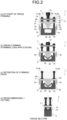
- the stress state in the press forming process of the bent portion 23, which is the fracture occurrence portion in the press formed part 21, is reproduced as an example by performing press forming of a test piece 31 of the metal sheet as illustrated in FIG. 2 .
- the stress state reproduction test process P1 determines occurrence/non-occurrence of a micro crack in a stress state reproduction portion 33 of the test piece 31.
- the stress state reproduction test process P1 includes a stress state reproduction press forming step S11 and a micro crack occurrence/non-occurrence determination step S13.
- the stress state reproduction press forming step S11 is a step of reproducing the stress state of the bent portion 23, which is a fracture occurrence portion in the press formed part 21, by performing press forming of the test piece 31, and includes a forming load application step S11a and a forming state retention step S11b as illustrated in FIG. 1 .
- the forming load application step S11a uses the press-forming die 1 including: a punch 3; a die 5; a forming load application portion 7 that applies a forming load to the punch 3; and a forming load retention portion 9 that retains a forming state in which the forming load is being applied.
- the forming load application step S11a applies a forming load to the punch 3 to perform press forming of the test piece 31, and reproduces the stress state of the bent portion 23, which is a fracture occurrence portion of the press formed part 21, on the test piece 31.
- the forming load application step S11a performs V-shaped free bend forming on the test piece 31 using the press-forming die 1, thereby forming a stress state reproduction portion 33 reproducing the stress state of the bent portion 23 of the press formed part 21.
- the forming load application portion 7 includes a bolt for forming 7a, a support plate 7b, and a bolt for supporting 7c.
- the support plate 7b has, on its center, a threaded screw hole 7d to be engaged with the bolt for forming 7a, and has, at its four corners, through holes 7e through which the bolts for supporting 7c are to be inserted.
- the forming load retention portion 9 includes a fixing nut 9a, a bolt for supporting 9b, and a spacer 9c.
- the bolt for supporting 9b is a similar to the bolt for supporting 7c of the forming load application portion 7.
- the punch 3 includes: a work portion 3a being a protruding portion making a V-shaped protrusion in a press forming direction; and a punch base portion 3b that comes in contact with the bolt for forming 7a and receives a forming load.
- the curvature of a tip rounded portion 3c of the work portion 3a is the curvature of a bending portion 53 for forming the bent portion 23 of the press formed part 21 in a press-forming die 51 used for the press forming of the press formed part 21.
- the bending angle at which the test piece 31 is bent into a V shape is set by preliminarily deciding the pushing amount of the punch 3, which is equivalent to the bending angle of the bent portion 23 of the press formed part 21, by a preliminary test or numerical analysis, and inserting, between the punch 3 and the die 5, a spacer 9c having a length that actualizes the pushing amount.
- the die 5 includes: a shoulder portion 5a that supports the test piece 31; a recess 5b that allows the punch 3 and the test piece 31 to escape; and a die base 5c to which the bolt for supporting 7c of the forming load application portion 7 is fixed.
- the bending radius of the shoulder portion 5a which is not to be particularly limited, is to be preferably decided to be equal to or larger than the thickness of the test piece 31 so as not to cause galling of press die.
- the depth of the recess 5b is to be preferably decided so as not to allow the test piece 31 to come into contact with a bottom 5d after the punch 3 is pushed by a predetermined pushing amount.
- the forming load application step S11a first disposes the test piece 31 between the punch 3 and the die 5, and then applies a forming load to the punch 3 by the bolt for forming 7a to push the punch 3 into the recess 5b of the die 5. Subsequently, the forming load application step S11a performs V-shaped free bend forming of the test piece 31 to form a stress state reproduction portion 33 reproducing the stress state of the bent portion 23 of the press formed part 21.
- the forming state retention step S11b retains, by the forming load application portion 7, the test piece 31 in the formed state reproducing the stress state of the bent portion 23 of the press formed part 21 in the forming load application step S11a.
- the fixing nut 9a is tightened. This operation achieves retention of a forming state where the stress state of the bent portion 23 of the press formed part 21 is reproduced in the stress state reproduction portion 33.
- the micro crack occurrence/non-occurrence determination step S13 is a step of determining occurrence/non-occurrence of a micro crack in the stress state reproduction portion 33 of the test piece 31.
- the micro crack occurrence/non-occurrence determination step S13 includes a resin embedding step S13a and a test piece microscopic observation step S13b.
- the resin embedding step S13a fills a gap 35 between the test piece 31 retained in the forming state reproducing the stress state of the bent portion 23 of the press formed part 21 in the stress state reproduction press forming step S11, and the punch 3 and the die 5, with a resin, and then, embeds the test piece 31 in a resin 37.
- An example of the resin 37 in which the test piece 31 is to be embedded in the resin embedding step S13a can be a conductive resin. Observation can be performed without using a conductive resin. However, observation of a crack of several tens of ⁇ m is desirably performed by using an electron microscope, and it is necessary to use a conductive resin when observing with an electron microscope.
- the test piece microscopic observation step S13b is a step of performing microscopic observation of the stress state reproduction portion 33 of the test piece 31 and determining occurrence/non-occurrence of a micro crack.
- the test piece 31 embedded in the resin 37 in the resin embedding step S13a is cut to expose a cross section of the stress state reproduction portion 33 of the test piece 31, and the exposed cross section is polished before microscopic observation is performed. With this procedure, the test piece 31 can be easily cut to allow its cross section to be observed.
- the fracture determination process P3 determines that fracture has occurred in the press formed part 21 in the press forming process. In contrast, when it is determined that there is no occurrence of a micro crack in the stress state reproduction portion 33 of the test piece 31, the fracture determination process P3 determines that the fracture of the press formed part 21 occurred in the springback after the press forming.
- the press formed part fracture determination method makes a determination regarding the press formed part 21 in which a fracture has occurred by press forming of a metal sheet, specifically reproduces the stress state of the bent portion 23, which is a fracture occurrence portion, by performing press forming of the test piece 31, and determines occurrence/non-occurrence of a micro crack in the stress state reproduction portion 33 of the test piece 31. This makes it possible to distinguish and determine as to whether the fracture is a fracture occurring in a press forming process or a fracture occurring at the time of springback after press forming.
- a forming load is applied to the punch 3.
- a forming load is applied to the die 5 to move the die 5 to the punch 3 side, thereby performing press forming of the test piece 31.
- the first embodiment includes the micro crack occurrence/non-occurrence determination step S13 in which the test piece 31 retained in the forming state is embedded in the resin 37 (S13a), the test piece 31 embedded in the resin 37 is cut to expose the cross section of the stress state reproduction portion 33 of the test piece 31, and the exposed cross section is polished and then undergoes microscopic observation (S13b), thereby determining occurrence/non-occurrence of a micro crack in the stress state reproduction portion 33.
- the press formed part fracture determination method according to the present invention may be a method of observing a cross section by cutting the test piece 31 without embedding the test piece 31 retained in the forming state in a resin, or may be a method of observing a side surface of the stress state reproduction portion 33 without cutting the test piece 31 when a micro crack has occurred on the side surface of the test piece 31.
- the press formed part fracture determination method according to the present invention may be any method as long as a stress state when a fracture occurs in the bent portion 23, which is a fracture occurrence portion of the press formed part 21, is reproduced on the stress state reproduction portion 33 of the test piece 31. Therefore, the method is not limited to retention of the forming state of the test piece 31 at the forming bottom dead center of the press-forming die 1, but it is also allowable to retain the forming state during forming.
- the press formed part fracture determination method according to the present invention is not limited to a method in which V-shaped free bend forming is performed on the test piece 31 using the press-forming die 1 as in the stress state reproduction test process P1 of the present embodiment described above.
- the press forming method of the test piece is not limited as long as it is possible to reproduce the stress state of the fracture occurrence portion of the press formed part in which fracture has occurred or fracture is predicted to occur.
- a press formed part fracture countermeasure decision method uses the press formed part fracture determination method according to the first embodiment described above to decide a fracture countermeasure to be taken on a press formed part in which a fracture has occurred by press forming of a metal sheet.
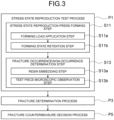
- the press formed part fracture countermeasure decision method includes a fracture countermeasure decision process P5.
- the fracture countermeasure decision process P5 decides, as a fracture countermeasure for the press formed part 21, a countermeasure for suppressing occurrence of a micro crack in the bent portion 23 which is a fracture occurrence portion in the press forming process of the press formed part 21.
- the fracture countermeasure decision process P5 decides a countermeasure for suppressing the springback of the press formed part 21 after the press forming, as a countermeasure for the fracture of the press formed part 21.
- the fracture countermeasure decision process P5 decides the fracture countermeasure according to the fracture determination in the fracture determination process P3 based on the occurrence/non-occurrence determination of the micro crack of the test piece 31 in the test piece microscopic observation step S13b.
- the countermeasure for suppressing the occurrence of micro cracks in the press forming process is not particularly limited.
- the strain or stress of a press formed part during press forming can be defined as a reference, and press forming can be performed so as to generate the strain or stress defined as the reference.
- the countermeasure for suppressing the springback after the press forming is not particularly limited.
- a countermeasure such as applying a tensile force at the time of bending or after bending or applying a compressive force at the time of bending or after bending
- a countermeasure such as using a reverse bent phenomenon occurring in a clearance of a tool (press-forming die), changing tension of a vertical wall in a forming process, or applying a compressive stress in a sheet thickness direction at the forming bottom dead center, referred to as bottoming.
- the press formed part fracture countermeasure decision method makes a determination regarding the press formed part 21 in which fracture has occurred by press forming of a metal sheet so as to distinguish and determine as to whether the fracture is a fracture occurring in a press forming process or a fracture occurring at the time of springback after press forming. This makes it possible to decide a fracture countermeasure to be taken to effectively suppress the occurrence of fractures in the press formed part.
- the press formed part 21 has the bent portion 23 formed by bending a metal sheet, and the technique is applicable to a case where a fracture occurs in the bent portion 23.
- the present invention is not limited to the bent portion formed by bending.
- a fracture countermeasure for suppressing the occurrence of a fracture in a press formed part For example, a tensile load is generated also in drawing, having a possibility of occurrence of bending inner fracture even with a lower risk of occurrence of fracture than the case of a bent portion in bending. Therefore, the present invention is applicable to a bent portion formed by drawing.
- the first embodiment and the second embodiment described above are described to be applied to a case where a fracture occurs in a press formed part obtained by actually performing press forming of a metal sheet.
- the present invention may be a technique of determining presence/absence of a micro crack in a test piece reproducing a stress state of a fracture occurrence portion in a press formed part predicted to have a fracture by a press forming fracture prediction method (Patent Literature 1 or the like) so as to determine the occurrence of the fracture by distinguishing the fracture due to press forming and the fracture due to springback, and may further be a technique of deciding a fracture countermeasure for the press formed part according to the determination.
- Patent Literature 1 press forming fracture prediction method
- the above is a technique of determining, in the stress state reproduction test process, the occurrence of fracture in the press forming process and the occurrence of fracture due to the springback after the press forming to be distinguished from each other based on occurrence/non-occurrence of a micro crack in the stress state reproduction portion of the test piece reproducing the stress state.
- the fracture determination process may be a process in which, when it is determined that there is no occurrence of a micro crack in the stress state reproduction portion 33 of the test piece 31 retaining the forming state, the forming load application step S11a of reproducing the stress state of the bent portion 23 of the press formed part 21 in the test piece 31 is performed again, unloading of the forming load is performed without retaining the forming state of the test piece 31 in which the stress state is reproduced so as to allow the test piece 31 to undergo springback, and occurrence/non-occurrence of the micro crack is determined by performing microscopic observation of the cross section or the side surface of the stress state reproduction portion 33.
- the fracture is determined to be a fracture that occurred in the springback of the press formed part 21 after the press forming.
- the technique may include a fracture countermeasure decision process that includes decision of a fracture countermeasure to be applied to the press formed part 21 having an occurrence of a fracture or predicted to have an occurrence of a fracture by press forming of a metal sheet by using the other aspect of the press formed part fracture determination method according to the first embodiment.
- the fracture countermeasure decision process is a process of deciding a countermeasure for a fracture of a press formed part, based on the fracture determination in the fracture determination process in the other aspect of the press formed part fracture determination method according to the
- press forming of the test piece 31 is performed, as illustrated in FIG. 2 , so as to reproduce the stress state in the press forming process of the bent portion 23 which is the fracture occurrence portion of the press formed part 21 (S11), and then a determination of occurrence/non-occurrence of a micro crack in the stress state reproduction portion 33 of the test piece 31 is performed (S13).
- a countermeasure for suppressing the occurrence of the micro crack in the bent portion 23, which is the fracture occurrence portion in the press forming process of the press formed part 21, is decided as a fracture countermeasure for the press formed part 21 (S93).
- press forming was performed on a press formed part 41 as illustrated in FIG. 5 using two types of metal sheets (metal sheet A and metal sheet B) having different tensile strengths as test materials.
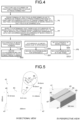
- the press formed part 41 has a substantially U-shaped cross section including a top portion 43 and a pair of side wall portions 47 continuous from both ends of the top portion 43 via bent portions 45, including a bent recess 49 formed in the top portion 43.
- the metal sheet A and the metal sheet B were bent in the first forming step to form a bent recess 49 on each sheet.
- the metal sheet A and the metal sheet B each having the bent recess 49 were bent to form the bent portions 45.
- the bent recess 49 had a bending radius of 3 mm and a bending angle of 90°.
- the bent portion 45 had a bending radius of 10 mm and a bending angle of 90°.
- press forming specifically, V-shaped free bend forming
- V-shaped free bend forming was performed on the test piece 31 of each of the metal sheet A and the metal sheet B so as to reproduce the stress state of the bent recess 49, which is the fracture occurrence portion in the press formed part 41.
- the radius of curvature of a tip rounded portion 3c of the punch 3 of the press-forming die 1 was set to 3 mm, and the length of the spacer 9c was set so that the bending angle of the test piece 31 after the bending was 90 degrees. Subsequently, the cross section of the test piece 31 was observed visually or microscopically for each of the test piece 31 in which the forming state after the bending was retained and the test piece 31 which was taken out of the press-forming die 1 without retaining the forming state so as to undergo springback, and occurrence/non-occurrence of a fracture was determined on each case.
- Tables 1 and 2 illustrate the determination results on occurrence/non-occurrence of a micro crack in the test piece 31 of each of the metal sheet A and the metal sheet B.
- FIG. 7 illustrates a schematic view of a micro crack that occurred in the test piece 31 of the metal sheet A.
- the micro crack occurred at the bottom of the irregularity on the surface on the bend inner side of the stress state reproduction portion 33 in the state at the forming bottom dead center. Accordingly, for the press formed part 41 using the metal sheet A, a countermeasure for suppressing the occurrence of micro cracks in the press forming process was decided as a countermeasure for the occurrence of fractures.
- the bending radius of the bent recess 49 of the press formed part 41 was to be changed from 3 mm to 4 mm.
- press forming of the press formed part 41 was successfully performed without causing a fracture in the bent recess 49.
- the present Example took a countermeasure in which the bent portion 45 of the press formed part 41 is bent to form the top portion 43 and the side wall portion 47, and then, as described in Non Patent Literature 1, in order to apply a tensile force at the time of bending, the bent recess 49 is formed by stretch-expand forming on the top portion 43 (the bent recess 49 is bent while restricting the flow of the material of the top portion 43).
- a tensile force it is possible to suppress the occurrence of buckling and wrinkles on the surface on the bend inner side, leading to suppression of occurrence of micro cracks.
- the bent recess 49 is formed by tensile bending to which a tensile force is applied in the forming process.
- press forming of the press formed part 41 was successfully performed without causing occurrence of a fracture in the bent recess 49.
- a press formed part fracture determination method capable of determining whether a fracture has occurred during press forming of a metal sheet or has occurred during springback in a press formed part in which the fracture has occurred or is predicted to occur by press forming of the metal sheet.
- a press formed part fracture countermeasure decision method capable of deciding a fracture countermeasure to be taken for suppressing a fracture in the press formed part based on a determination result.
Landscapes
- Analytical Chemistry (AREA)
- Physics & Mathematics (AREA)
- Health & Medical Sciences (AREA)
- Life Sciences & Earth Sciences (AREA)
- Chemical & Material Sciences (AREA)
- Biochemistry (AREA)
- General Health & Medical Sciences (AREA)
- General Physics & Mathematics (AREA)
- Immunology (AREA)
- Pathology (AREA)
- Mechanical Engineering (AREA)
- Engineering & Computer Science (AREA)
- Shaping Metal By Deep-Drawing, Or The Like (AREA)
Abstract
Description
- The present invention relates to a press formed part fracture determination method, which is a method of determining a fracture occurring in a press formed part in which a fracture has occurred or is predicted to occur by press forming of a metal sheet, and a press formed part fracture countermeasure decision method, which is a method of deciding a countermeasure for a fracture of a press formed part based on the fracture determination. Background
- A fracture having a size of several millimeters occurring in a press formed part obtained by press forming of a metal sheet not only deteriorates the appearance of the press formed part, but also can lead to a brittle fracture or a fatigue fracture. Therefore, it is desirable to have no such fractures. In order to prevent fractures of a press formed part, techniques related to prediction and evaluation of occurrence of fracture during press forming have been proposed. For example,
Patent Literature 1 discloses a method of evaluating a bending inner fracture on a bend inner side at the time of unbending deformation after bending deformation of a metal sheet material, and a technique of predicting occurrence of such a bending inner fracture. Patent Literature 2 discloses a technique of evaluating bending cracking at a sheared edge when a target press formed component is manufactured by performing press forming on a metal sheet subjected to shearing. -
- Patent Literature 1:
JP 5900751 B2 - Patent Literature 2:
WO 2020/174841 A -
- Non Patent Literature 1: Tetsuo NAKA, Hideaki MURAKAMI, Tomoaki HASHIMOTO, Effect of Stretching Force for Spring Back of High Strength Steel Sheets under Bending, Memoirs of the Yuge National College of Maritime Technology, No. 34 (2012), p. 1
- Non Patent Literature 2: Toru YOSHIDA, Tomohisa KATAYAMA, Koji HASHIMOTO, Yukihisa KURIYAMA, Shape Control Techniques for High Strength Steel in Sheet Metal Forming, Shinnittetsu giho (Nippon Steel Technical Report), No. 378 (2003), 9.25
- In typical cases, a fracture of a size of several millimeters occurring during press forming is caused by a microscopic crack (hereinafter, referred to as a micro crack) of a size of several tens of micrometers arising at a portion where the fracture occurs in a press formed part. In order to take a countermeasure to suppress or prevent the occurrence of fractures, there is a need to grasp the occurrence of micro cracks during press forming (bending).
-
FIG. 6 illustrates a press formedpart 21 obtained by bending ametal sheet 11. As a result of intensive studies on fractures that occur during press forming, the inventors have found that the occurrence of fractures is divided into Case (1) being a case where a fracture occurs in abent portion 23 that is bent during press forming and Case (2) being a case where a fracture occurs in thebent portion 23 during springback of the press formedpart 21 after die release of the part from a press-forming die after press forming. In addition, the fracture during the press forming in Case (1) is caused by a micro crack occurring on a surface of thebent portion 23 on the bend inner side as illustrated inFIG. 7 when strain generated in thebent portion 23 during the bend forming of themetal sheet 11 exceeds a fracture limit value. In contrast, the fracture during springback in Case (2) occurs in a manner such that an action of strong compressive stress generated on the surface of thebent portion 23 on the bend inner side during the press forming brings about the brittleness of the metal sheet, and an initial defect of the metal sheet or a micro crack that has occurred in thebent portion 23 during the press forming leads to the occurrence of the fracture, triggered by the reversal of the compressive stress to the tensile stress due to the springback. In this manner, since the fracture during the press forming and the fracture during the springback have different occurrence mechanisms, it is also necessary to take different countermeasures to suppress the fracture that has occurred in the press formed part. - However, the techniques disclosed in
Patent Literature 1 and Patent Literature 2 have no ways to determine whether the micro crack leading to a fracture has occurred during press forming or during springback. Therefore, when it is determined, for example, that a fracture has occurred due to occurrence of a micro crack during press forming even though a fracture has occurred during springback, there has been difficulty in taking an effective fracture countermeasure, specifically, a countermeasure for suppressing the fracture that has occurred in the press formed part. - The present invention has been made to solve the above problems, and one object of the present invention is to provide a press formed part fracture determination method capable of determining whether a fracture has occurred during press forming of a metal sheet or has occurred during springback of a press formed part in which the fracture has occurred or is predicted to occur by press forming of the metal sheet. Another object of the present invention is to provide a press formed part fracture countermeasure decision method capable of deciding a fracture countermeasure to be taken for suppressing a fracture in the press formed part based on a determination result.
- A press formed part fracture determination method according to the present invention decides a countermeasure for a fracture occurring in a press formed part in which a fracture has occurred or a fracture is predicted to occur by press forming of a metal sheet, and includes: a stress state reproduction test process of reproducing, by press forming of a test piece of the metal sheet, a stress state in a press forming process of a fracture occurrence portion where a fracture has occurred or a fracture is predicted to occur, in the press formed part, and determining occurrence/non-occurrence of a micro crack in a stress state reproduction portion of the test piece; and a fracture determination process of determining, when it is determined that a micro crack has occurred in the stress state reproduction portion of the test piece in the stress state reproduction test process, that there is a fracture that has occurred in the press formed part in the press forming process, and determining, when it is determined that there is no occurrence of a micro crack in the stress state reproduction portion of the test piece, that there is a fracture that has occurred in springback of the press formed part after press forming.
- The stress state reproduction test process may include: a stress state reproduction press forming step of reproducing a stress state of the fracture occurrence portion in the press formed part by performing press forming of the test piece; and a micro crack occurrence/non-occurrence determination step of determining occurrence/non-occurrence of a micro crack in the stress state reproduction portion of the test piece, the stress state reproduction press forming step may include: a forming load application step of, using a press-forming die including a punch, a die, a forming load application portion that applies a forming load to the punch or the die, and a forming load retention portion that retains a forming state in which the forming load is being applied, pushing the punch toward the die by the forming load application portion in a state where the test piece is disposed between the punch and the die, and reproducing a stress state of the fracture occurrence portion of the press formed part on the test piece; and a forming state retention step of retaining, by the forming load retention portion, a forming state in which a stress state of the fracture occurrence portion has been reproduced by applying the forming load to the test piece in the forming load application step, and the micro crack occurrence/non-occurrence determination step may include a test piece microscopic observation step of determining occurrence/non-occurrence of a micro crack by performing microscopic observation of a cross section or a side surface of the stress state reproduction portion in the test piece retaining the forming state.
- The press formed part may include a bent portion formed by bending the metal sheet, and the bent portion may be the fracture occurrence portion.
- A press formed part fracture countermeasure decision method according to the present invention decides a fracture countermeasure to be taken for a press formed part in which a fracture has occurred or a fracture is predicted to occur by press forming of a metal sheet, the decision made by using the press formed part fracture determination method according to the present invention, and includes a fracture countermeasure decision process of deciding, when it is determined, in the fracture determination process, that there is a fracture in a press forming process of the press formed part, a countermeasure for suppressing occurrence of a micro crack at the fracture occurrence portion in the press forming process of the press formed part as a countermeasure for a fracture of the press formed part, and deciding, when it is determined that there is a fracture of the press formed part in springback after press forming, a countermeasure for suppressing the springback of the press formed part after press forming as a countermeasure for the fracture of the press formed part. Advantageous Effects of Invention
- In the present invention, the fracture occurring in the press formed part can be distinguished and determined as to whether the fracture is a fracture occurring in a press forming process or a fracture occurring at the time of springback after press forming. This makes it possible to decide a fracture countermeasure to be taken to effectively suppress the occurrence of fractures in the press formed part. In addition, according to the present invention, by preliminarily deciding a fracture countermeasure for a portion where there is a risk of occurrence of fractures in the press formed part at a design stage of the press formed part, it is possible to efficiently improve the performance of the press formed part.
-
-
FIG. 1 is a flowchart illustrating a flow of processing of a press formed part fracture determination method according to a first embodiment of the present invention. -
FIG. 2 is a view illustrating a step of reproducing a stress state of a press formed part having a fracture by conducting press forming of a test piece in a press formed part fracture countermeasure determination method according to the first embodiment of the present invention. -
FIG. 3 is a flowchart illustrating a flow of processing of a press formed part fracture countermeasure decision method according to a second embodiment of the present invention. -
FIG. 4 is a flowchart illustrating a flow of processing of a press formed part fracture countermeasure decision method according to another aspect of the second embodiment of the present invention. -
FIG. 5 is a view illustrating a press formed part as a forming target in Examples. -
FIG. 6 is a view illustrating a fracture occurring in a press formed part applicable in the present invention (including: ((a) Before press forming; (b) During press forming; and (c) After springback). -
FIG. 7 is a view illustrating a micro crack occurring in a bent portion of a press formed part obtained by bending. - A press formed part fracture determination method according to a first embodiment of the present invention is a method as a basis for deciding a countermeasure for a fracture occurring in a press formed part in which a fracture has occurred by press forming of a metal sheet, and includes a stress state reproduction test process P1 and a fracture determination process P3 as illustrated in
FIG. 1 . As illustrated inFIG. 6 , the following will describe a case where a press formedpart 21 includes abent portion 23 formed by bending ametal sheet 11 using a press-formingdie 1 and where a fracture occurs in thebent portion 23. - In the stress state reproduction test process P1, the stress state in the press forming process of the
bent portion 23, which is the fracture occurrence portion in the press formedpart 21, is reproduced as an example by performing press forming of atest piece 31 of the metal sheet as illustrated inFIG. 2 . The stress state reproduction test process P1 determines occurrence/non-occurrence of a micro crack in a stressstate reproduction portion 33 of thetest piece 31. - In the present embodiment, as illustrated in
FIG. 1 , the stress state reproduction test process P1 includes a stress state reproduction press forming step S11 and a micro crack occurrence/non-occurrence determination step S13. - The stress state reproduction press forming step S11 is a step of reproducing the stress state of the
bent portion 23, which is a fracture occurrence portion in the press formedpart 21, by performing press forming of thetest piece 31, and includes a forming load application step S11a and a forming state retention step S11b as illustrated inFIG. 1 . - As illustrated in
FIG. 2 , the forming load application step S11a uses the press-formingdie 1 including: apunch 3; adie 5; a forming load application portion 7 that applies a forming load to thepunch 3; and a formingload retention portion 9 that retains a forming state in which the forming load is being applied. The forming load application step S11a applies a forming load to thepunch 3 to perform press forming of thetest piece 31, and reproduces the stress state of thebent portion 23, which is a fracture occurrence portion of the press formedpart 21, on thetest piece 31. - In the present embodiment, as illustrated in
FIGS. 2(a) to 2(b) , the forming load application step S11a performs V-shaped free bend forming on thetest piece 31 using the press-formingdie 1, thereby forming a stressstate reproduction portion 33 reproducing the stress state of thebent portion 23 of the press formedpart 21. - As illustrated in
FIG. 2(a) , the forming load application portion 7 includes a bolt for forming 7a, asupport plate 7b, and a bolt for supporting 7c. Thesupport plate 7b has, on its center, a threadedscrew hole 7d to be engaged with the bolt for forming 7a, and has, at its four corners, throughholes 7e through which the bolts for supporting 7c are to be inserted. - As illustrated in
FIG. 2(a) , the formingload retention portion 9 includes afixing nut 9a, a bolt for supporting 9b, and aspacer 9c. The bolt for supporting 9b is a similar to the bolt for supporting 7c of the forming load application portion 7. - as illustrated in
fig. 2(a) , thepunch 3 includes: awork portion 3a being a protruding portion making a V-shaped protrusion in a press forming direction; and apunch base portion 3b that comes in contact with the bolt for forming 7a and receives a forming load. As illustrated inFIG. 6 , the curvature of a tiprounded portion 3c of thework portion 3a is the curvature of abending portion 53 for forming thebent portion 23 of the press formedpart 21 in a press-formingdie 51 used for the press forming of the press formedpart 21. - In addition, the bending angle at which the
test piece 31 is bent into a V shape is set by preliminarily deciding the pushing amount of thepunch 3, which is equivalent to the bending angle of thebent portion 23 of the press formedpart 21, by a preliminary test or numerical analysis, and inserting, between thepunch 3 and thedie 5, aspacer 9c having a length that actualizes the pushing amount. - As illustrated in
FIG. 2(a) , the die 5 includes: ashoulder portion 5a that supports thetest piece 31; arecess 5b that allows thepunch 3 and thetest piece 31 to escape; and adie base 5c to which the bolt for supporting 7c of the forming load application portion 7 is fixed. - The bending radius of the
shoulder portion 5a, which is not to be particularly limited, is to be preferably decided to be equal to or larger than the thickness of thetest piece 31 so as not to cause galling of press die. The depth of therecess 5b is to be preferably decided so as not to allow thetest piece 31 to come into contact with a bottom 5d after thepunch 3 is pushed by a predetermined pushing amount. - In the present embodiment, the forming load application step S11a first disposes the
test piece 31 between thepunch 3 and thedie 5, and then applies a forming load to thepunch 3 by the bolt for forming 7a to push thepunch 3 into therecess 5b of thedie 5. Subsequently, the forming load application step S11a performs V-shaped free bend forming of thetest piece 31 to form a stressstate reproduction portion 33 reproducing the stress state of thebent portion 23 of the press formedpart 21. - As illustrated in
FIG. 2(c) , the forming state retention step S11b retains, by the forming load application portion 7, thetest piece 31 in the formed state reproducing the stress state of thebent portion 23 of the press formedpart 21 in the forming load application step S11a. - In the present embodiment, as illustrated in
FIG. 2(c) , after bending is performed onto thetest piece 31 to a predetermined bending angle in the forming load application step S11a, the fixingnut 9a is tightened. This operation achieves retention of a forming state where the stress state of thebent portion 23 of the press formedpart 21 is reproduced in the stressstate reproduction portion 33. - The micro crack occurrence/non-occurrence determination step S13 is a step of determining occurrence/non-occurrence of a micro crack in the stress
state reproduction portion 33 of thetest piece 31. In the present embodiment, as illustrated inFIG. 1 , the micro crack occurrence/non-occurrence determination step S13 includes a resin embedding step S13a and a test piece microscopic observation step S13b. - As illustrated in
FIG. 2(d) , the resin embedding step S13a fills agap 35 between thetest piece 31 retained in the forming state reproducing the stress state of thebent portion 23 of the press formedpart 21 in the stress state reproduction press forming step S11, and thepunch 3 and thedie 5, with a resin, and then, embeds thetest piece 31 in aresin 37. - An example of the
resin 37 in which thetest piece 31 is to be embedded in the resin embedding step S13a can be a conductive resin. Observation can be performed without using a conductive resin. However, observation of a crack of several tens of µm is desirably performed by using an electron microscope, and it is necessary to use a conductive resin when observing with an electron microscope. - The test piece microscopic observation step S13b is a step of performing microscopic observation of the stress
state reproduction portion 33 of thetest piece 31 and determining occurrence/non-occurrence of a micro crack. - In the present embodiment, the
test piece 31 embedded in theresin 37 in the resin embedding step S13a is cut to expose a cross section of the stressstate reproduction portion 33 of thetest piece 31, and the exposed cross section is polished before microscopic observation is performed. With this procedure, thetest piece 31 can be easily cut to allow its cross section to be observed. - When it is determined in the stress state reproduction test process P1 that a micro crack has occurred in the stress
state reproduction portion 33 of thetest piece 31, the fracture determination process P3 determines that fracture has occurred in the press formedpart 21 in the press forming process. In contrast, when it is determined that there is no occurrence of a micro crack in the stressstate reproduction portion 33 of thetest piece 31, the fracture determination process P3 determines that the fracture of the press formedpart 21 occurred in the springback after the press forming. - In this manner, the press formed part fracture determination method according to the first embodiment makes a determination regarding the press formed
part 21 in which a fracture has occurred by press forming of a metal sheet, specifically reproduces the stress state of thebent portion 23, which is a fracture occurrence portion, by performing press forming of thetest piece 31, and determines occurrence/non-occurrence of a micro crack in the stressstate reproduction portion 33 of thetest piece 31. This makes it possible to distinguish and determine as to whether the fracture is a fracture occurring in a press forming process or a fracture occurring at the time of springback after press forming. - In the above description, a forming load is applied to the
punch 3. In the present invention, however, it is also allowable to provide a forming load application portion that applies a forming load to thedie 5. In this case, a forming load is applied to thedie 5 to move thedie 5 to thepunch 3 side, thereby performing press forming of thetest piece 31. - In addition, the first embodiment includes the micro crack occurrence/non-occurrence determination step S13 in which the
test piece 31 retained in the forming state is embedded in the resin 37 (S13a), thetest piece 31 embedded in theresin 37 is cut to expose the cross section of the stressstate reproduction portion 33 of thetest piece 31, and the exposed cross section is polished and then undergoes microscopic observation (S13b), thereby determining occurrence/non-occurrence of a micro crack in the stressstate reproduction portion 33. - Note that the press formed part fracture determination method according to the present invention may be a method of observing a cross section by cutting the
test piece 31 without embedding thetest piece 31 retained in the forming state in a resin, or may be a method of observing a side surface of the stressstate reproduction portion 33 without cutting thetest piece 31 when a micro crack has occurred on the side surface of thetest piece 31. - In addition, the press formed part fracture determination method according to the present invention may be any method as long as a stress state when a fracture occurs in the
bent portion 23, which is a fracture occurrence portion of the press formedpart 21, is reproduced on the stressstate reproduction portion 33 of thetest piece 31. Therefore, the method is not limited to retention of the forming state of thetest piece 31 at the forming bottom dead center of the press-formingdie 1, but it is also allowable to retain the forming state during forming. - The press formed part fracture determination method according to the present invention is not limited to a method in which V-shaped free bend forming is performed on the
test piece 31 using the press-formingdie 1 as in the stress state reproduction test process P1 of the present embodiment described above. The press forming method of the test piece is not limited as long as it is possible to reproduce the stress state of the fracture occurrence portion of the press formed part in which fracture has occurred or fracture is predicted to occur. - A press formed part fracture countermeasure decision method according to a second embodiment of the present invention uses the press formed part fracture determination method according to the first embodiment described above to decide a fracture countermeasure to be taken on a press formed part in which a fracture has occurred by press forming of a metal sheet. As illustrated in
FIG. 3 , the press formed part fracture countermeasure decision method according to the second embodiment of the present invention includes a fracture countermeasure decision process P5. Hereinafter, similarly to the first embodiment described above, a case where a fracture occurs in thebent portion 23 of the press formedpart 21 illustrated inFIG. 6 will be described. - When it is determined in the fracture determination process P3 that the fracture has occurred in the press forming process of the press formed
part 21, the fracture countermeasure decision process P5 decides, as a fracture countermeasure for the press formedpart 21, a countermeasure for suppressing occurrence of a micro crack in thebent portion 23 which is a fracture occurrence portion in the press forming process of the press formedpart 21. In contrast, when it is determined in the fracture determination process P3 that the fracture has occurred in the springback of the press formedpart 21 after the press forming, the fracture countermeasure decision process P5 decides a countermeasure for suppressing the springback of the press formedpart 21 after the press forming, as a countermeasure for the fracture of the press formedpart 21. - In the second embodiment, as illustrated in
FIG. 3 , the fracture countermeasure decision process P5 decides the fracture countermeasure according to the fracture determination in the fracture determination process P3 based on the occurrence/non-occurrence determination of the micro crack of thetest piece 31 in the test piece microscopic observation step S13b. - The countermeasure for suppressing the occurrence of micro cracks in the press forming process is not particularly limited. For example, as described in
Patent Literature 1, the strain or stress of a press formed part during press forming can be defined as a reference, and press forming can be performed so as to generate the strain or stress defined as the reference. - The countermeasure for suppressing the springback after the press forming is not particularly limited. For example, it is possible to apply, as described in
Non Patent Literature 1, a countermeasure such as applying a tensile force at the time of bending or after bending or applying a compressive force at the time of bending or after bending, and possible to apply, as described in Non Patent Literature 2, a countermeasure such as using a reverse bent phenomenon occurring in a clearance of a tool (press-forming die), changing tension of a vertical wall in a forming process, or applying a compressive stress in a sheet thickness direction at the forming bottom dead center, referred to as bottoming. - It should be noted, as a countermeasure to suppress the springback, that it is not preferable to take a countermeasure to suppress the springback of the entire press formed part in combination with a spring-go or the like around the fracture occurrence portion of the press formed part. This is because the fracture occurring at the fracture occurrence portion due to the springback is caused only by the local springback at the fracture occurrence portion, and the springback at the fracture occurrence portion will not necessarily be suppressed even with a countermeasure for suppressing the springback of the entire press formed part.
- As described above, the press formed part fracture countermeasure decision method according to the second embodiment makes a determination regarding the press formed
part 21 in which fracture has occurred by press forming of a metal sheet so as to distinguish and determine as to whether the fracture is a fracture occurring in a press forming process or a fracture occurring at the time of springback after press forming. This makes it possible to decide a fracture countermeasure to be taken to effectively suppress the occurrence of fractures in the press formed part. - In the second embodiment, the press formed
part 21 has the bentportion 23 formed by bending a metal sheet, and the technique is applicable to a case where a fracture occurs in thebent portion 23. However, the present invention is not limited to the bent portion formed by bending. As for the occurrence of a fracture in a portion formed by another forming method, by reproducing a stress state of the portion and determining occurrence/non-occurrence of a micro crack, it is also possible to appropriately decide a fracture countermeasure for suppressing the occurrence of a fracture in a press formed part. For example, a tensile load is generated also in drawing, having a possibility of occurrence of bending inner fracture even with a lower risk of occurrence of fracture than the case of a bent portion in bending. Therefore, the present invention is applicable to a bent portion formed by drawing. - The first embodiment and the second embodiment described above are described to be applied to a case where a fracture occurs in a press formed part obtained by actually performing press forming of a metal sheet.
- However, the present invention may be a technique of determining presence/absence of a micro crack in a test piece reproducing a stress state of a fracture occurrence portion in a press formed part predicted to have a fracture by a press forming fracture prediction method (
Patent Literature 1 or the like) so as to determine the occurrence of the fracture by distinguishing the fracture due to press forming and the fracture due to springback, and may further be a technique of deciding a fracture countermeasure for the press formed part according to the determination. - In addition, the above is a technique of determining, in the stress state reproduction test process, the occurrence of fracture in the press forming process and the occurrence of fracture due to the springback after the press forming to be distinguished from each other based on occurrence/non-occurrence of a micro crack in the stress state reproduction portion of the test piece reproducing the stress state.
- As another aspect of the press formed part fracture determination method according to the first embodiment, the fracture determination process may be a process in which, when it is determined that there is no occurrence of a micro crack in the stress
state reproduction portion 33 of thetest piece 31 retaining the forming state, the forming load application step S11a of reproducing the stress state of thebent portion 23 of the press formedpart 21 in thetest piece 31 is performed again, unloading of the forming load is performed without retaining the forming state of thetest piece 31 in which the stress state is reproduced so as to allow thetest piece 31 to undergo springback, and occurrence/non-occurrence of the micro crack is determined by performing microscopic observation of the cross section or the side surface of the stressstate reproduction portion 33. - In the other aspect of the press formed part fracture determination method according to the first embodiment, when it is determined that there is occurrence of a micro crack in the stress
state reproduction portion 33 of thetest piece 31 undergoing springback, the fracture is determined to be a fracture that occurred in the springback of the press formedpart 21 after the press forming. In contrast, in a case where it is determined that there is no occurrence of a micro crack, it is determined, in the other aspect, that there is no fracture in the press forming process of the press formedpart 21 or in the springback after the press forming. - Furthermore, as another aspect of the press formed part fracture countermeasure decision method according to the second embodiment, the technique may include a fracture countermeasure decision process that includes decision of a fracture countermeasure to be applied to the press formed
part 21 having an occurrence of a fracture or predicted to have an occurrence of a fracture by press forming of a metal sheet by using the other aspect of the press formed part fracture determination method according to the first embodiment. Specifically, the fracture countermeasure decision process is a process of deciding a countermeasure for a fracture of a press formed part, based on the fracture determination in the fracture determination process in the other aspect of the press formed part fracture determination method according to the - A specific procedure of the other aspect of the press formed part fracture countermeasure decision method according to the second embodiment will be described with reference to
FIG. 4 . - As an initial step in the other aspect, similarly to the stress state reproduction test process P1 of the first embodiment described above, press forming of the
test piece 31 is performed, as illustrated inFIG. 2 , so as to reproduce the stress state in the press forming process of thebent portion 23 which is the fracture occurrence portion of the press formed part 21 (S11), and then a determination of occurrence/non-occurrence of a micro crack in the stressstate reproduction portion 33 of thetest piece 31 is performed (S13). - As a next step of the other aspect, when there is no occurrence of a micro crack in the stress
state reproduction portion 33 of the test piece 31 (S71), thetest piece 31 reproducing the stress state undergoes springback (S73), and then a determination of the presence/absence of a micro crack in the stressstate reproduction portion 33 of thetest piece 31 by the springback is performed (S75). - In order to determine occurrence/non-occurrence of a micro crack in the stress
state reproduction portion 33 of thetest piece 31 due to the springback of thetest piece 31, a procedure is to be taken, as illustrated inFIG. 2 , in which, after press forming of thetest piece 31, the bolt for forming 7a is loosened without retaining the forming state so as to allow thetest piece 31 to springback, and then thetest piece 31 is taken out to observe the stressstate reproduction portion 33. At this time, thetest piece 31 may be embedded in theresin 37. When a micro crack is observed in the stressstate reproduction portion 33, it is determined to have an occurrence of a fracture due to springback. In contrast, when no micro crack is observed in the stressstate reproduction portion 33 of thespringback test piece 31, it is determined to have no occurrence of fracture in thebent portion 23 of the press formedpart 21. - When the stress
state reproduction portion 33 of thetest piece 31 reproducing the stress state is determined to have an occurrence of a micro crack, and this micro crack is determined as a fracture in the press forming process of the press formed part 21 (S91), a countermeasure for suppressing the occurrence of the micro crack in thebent portion 23, which is the fracture occurrence portion in the press forming process of the press formedpart 21, is decided as a fracture countermeasure for the press formed part 21 (S93). - In contrast, when the
test piece 31 undergoing springback has a micro crack and this micro crack is determined to be a fracture of the press formedpart 21 during the springback after the press forming (S95), a countermeasure for suppressing the springback of the press formedpart 21 after the press forming is decided as a fracture countermeasure for the press formed part 21 (S97). - Furthermore, when the
bent portion 23 of the press formedpart 21 is predicted to have an occurrence of fracture, but it is determined that there is no fracture in the press forming process of the press formedpart 21 or at the springback after the press forming (S99), it is considered that no fracture occurs in thebent portion 23 of the press formedpart 21, and thus it is decided that nothing is to be performed as a fracture countermeasure (S101). - In this manner, by performing preliminary decision of the fracture countermeasure for the fracture occurrence portion where the fracture is predicted to occur in the press formed part at the design stage before manufacturing the press formed part, it is possible to efficiently improve the performance of the press formed part.
- An experiment performed for confirming operational effects of the present invention will be described below. In the present Example, press forming was performed on a press formed
part 41 as illustrated inFIG. 5 using two types of metal sheets (metal sheet A and metal sheet B) having different tensile strengths as test materials. The press formedpart 41 has a substantially U-shaped cross section including atop portion 43 and a pair ofside wall portions 47 continuous from both ends of thetop portion 43 viabent portions 45, including abent recess 49 formed in thetop portion 43. As a step of forming the press formedpart 41, first, the metal sheet A and the metal sheet B were bent in the first forming step to form abent recess 49 on each sheet. Subsequently, in the second forming step, the metal sheet A and the metal sheet B each having thebent recess 49 were bent to form thebent portions 45. Thebent recess 49 had a bending radius of 3 mm and a bending angle of 90°. Thebent portion 45 had a bending radius of 10 mm and a bending angle of 90°. When occurrence/non-occurrence of a fracture in the press formedpart 41 was checked, a fracture had occurred at the bend inner side of thebent recess 49. - Correspondingly, using the press-forming
die 1 illustrated inFIG. 2 , press forming, specifically, V-shaped free bend forming, was performed on thetest piece 31 of each of the metal sheet A and the metal sheet B so as to reproduce the stress state of thebent recess 49, which is the fracture occurrence portion in the press formedpart 41. - The radius of curvature of a tip rounded
portion 3c of thepunch 3 of the press-formingdie 1 was set to 3 mm, and the length of thespacer 9c was set so that the bending angle of thetest piece 31 after the bending was 90 degrees. Subsequently, the cross section of thetest piece 31 was observed visually or microscopically for each of thetest piece 31 in which the forming state after the bending was retained and thetest piece 31 which was taken out of the press-formingdie 1 without retaining the forming state so as to undergo springback, and occurrence/non-occurrence of a fracture was determined on each case. - When occurrence of a micro crack was observed in the
test piece 31 retaining the forming state, it was determined that a fracture occurred during press forming. In contrast, when no micro crack was observed in thetest piece 31 retaining the forming state and occurrence of a micro crack was observed only in thetest piece 31 after springback, it was determined that a fracture occurred by the springback. - When a micro crack having a length of 50 µm or more was observed in both the
test piece 31 retaining the forming state and thetest piece 31 that has undergone springback, it was determined that a micro crack had occurred. Tables 1 and 2 illustrate the determination results on occurrence/non-occurrence of a micro crack in thetest piece 31 of each of the metal sheet A and the metal sheet B.Table 1 Metal sheet A Visual observation Microscopic observation During press forming (at forming bottom dead center) ○ × After springback ○ × (○:Absence of micro crack, ×:Presence of micro crack) Table 2 Metal sheet B Visual observation Microscopic observation During press forming (at forming bottom dead center) ○ ○ After springback ○ × (○:Absence of micro crack, ×:Presence of micro crack) - As illustrated in Table 1, regarding the
test piece 31 of the metal sheet A, no micro crack was visually observed, but occurrence of a micro crack was confirmed by microscopic observation. Based on this, it was determined that a micro crack occurred in thetest piece 31 of the metal sheet A during press forming.FIG. 7 illustrates a schematic view of a micro crack that occurred in thetest piece 31 of the metal sheet A. The micro crack occurred at the bottom of the irregularity on the surface on the bend inner side of the stressstate reproduction portion 33 in the state at the forming bottom dead center. Accordingly, for the press formedpart 41 using the metal sheet A, a countermeasure for suppressing the occurrence of micro cracks in the press forming process was decided as a countermeasure for the occurrence of fractures. - Therefore, in the present Example, as a countermeasure for the occurrence of fractures in the press formed
part 41 using the metal sheet A, the bending radius of thebent recess 49 of the press formedpart 41 was to be changed from 3 mm to 4 mm. As a result, by alleviating the strain generated on the bend inner side of thebent recess 49, press forming of the press formedpart 41 was successfully performed without causing a fracture in thebent recess 49. - On the other hand, as illustrated in Table 2, regarding the
test piece 31 of the metal sheet B, no micro crack was observed in the stressstate reproduction portion 33 in visual observation or microscopic observation in a state of retaining the forming state. However, in a microscopic observation of the stressstate reproduction portion 33 of thetest piece 31 subjected to springback, occurrence of a micro crack was observed at the bend inner side of the stress state reproduction portion 33 (refer toFIG. 7 ). Accordingly, for the press formedpart 41 using the metal sheet B, a countermeasure for suppressing springback was decided as a countermeasure for the occurrence of fracture. - Correspondingly, the present Example took a countermeasure in which the
bent portion 45 of the press formedpart 41 is bent to form thetop portion 43 and theside wall portion 47, and then, as described inNon Patent Literature 1, in order to apply a tensile force at the time of bending, thebent recess 49 is formed by stretch-expand forming on the top portion 43 (thebent recess 49 is bent while restricting the flow of the material of the top portion 43). By applying a tensile force, it is possible to suppress the occurrence of buckling and wrinkles on the surface on the bend inner side, leading to suppression of occurrence of micro cracks. With this countermeasure, thebent recess 49 is formed by tensile bending to which a tensile force is applied in the forming process. As a result, press forming of the press formedpart 41 was successfully performed without causing occurrence of a fracture in thebent recess 49. - According to the present invention, it is possible to provide a press formed part fracture determination method capable of determining whether a fracture has occurred during press forming of a metal sheet or has occurred during springback in a press formed part in which the fracture has occurred or is predicted to occur by press forming of the metal sheet. In addition, according to the present invention, it is possible to provide a press formed part fracture countermeasure decision method capable of deciding a fracture countermeasure to be taken for suppressing a fracture in the press formed part based on a determination result.
-
- 1
- PRESS-FORMING DIE
- 3
- PUNCH
- 3a
- WORK PORTION
- 3b
- PUNCH BASE PORTION
- 3c
- TIP ROUNDED PORTION
- 5
- DIE
- 5a
- SHOULDER PORTION
- 5b
- RECESS
- 5c
- DIE BASE
- 5d
- BOTTOM
- 7
- FORMING LOAD APPLICATION PORTION
- 7a
- BOLT FOR FORMING
- 7b
- SUPPORT PLATE
- 7c
- BOLT FOR SUPPORTING
- 7d
- THREADED SCREW HOLE
- 7e
- THROUGH HOLE
- 9
- FORMING LOAD RETENTION PORTION
- 9a
- FIXING NUT
- 9b
- BOLT FOR SUPPORTING
- 9c
- SPACER
- 11
- METAL SHEET
- 21
- PRESS FORMED PART
- 23
- BENT PORTION
- 31
- TEST PIECE
- 33
- STRESS STATE REPRODUCTION PORTION
- 35
- GAP
- 37
- RESIN
- 41
- PRESS FORMED PART
- 43
- TOP PORTION
- 45
- BENT PORTION
- 47
- SIDE WALL PORTION
- 49
- BENT RECESS
- 51
- PRESS-FORMING DIE
- 53
- BENDING PORTION
Claims (4)
- A press formed part fracture determination method for deciding a countermeasure for a fracture occurring in a press formed part in which a fracture has occurred or a fracture is predicted to occur by press forming of a metal sheet, the method comprising:a stress state reproduction test process of reproducing, by press forming of a test piece of the metal sheet, a stress state in a press forming process of a fracture occurrence portion where a fracture has occurred or a fracture is predicted to occur, in the press formed part, and determining occurrence/non-occurrence of a micro crack in a stress state reproduction portion of the test piece; anda fracture determination process of determining, when it is determined that a micro crack has occurred in the stress state reproduction portion of the test piece in the stress state reproduction test process, that there is a fracture that has occurred in the press formed part in the press forming process, and determining, when it is determined that there is no occurrence of a micro crack in the stress state reproduction portion of the test piece, that there is a fracture that has occurred in springback of the press formed part after press forming.
- The press formed part fracture determination method according to claim 1, whereinthe stress state reproduction test process includes: a stress state reproduction press forming step of reproducing a stress state of the fracture occurrence portion in the press formed part by performing press forming of the test piece; and a micro crack occurrence/non-occurrence determination step of determining occurrence/non-occurrence of a micro crack in the stress state reproduction portion of the test piece,the stress state reproduction press forming step includes:a forming load application step of, using a press-forming die including a punch, a die, a forming load application portion that applies a forming load to the punch or the die, and a forming load retention portion that retains a forming state in which the forming load is being applied, pushing the punch toward the die by the forming load application portion in a state where the test piece is disposed between the punch and the die, and reproducing a stress state of the fracture occurrence portion of the press formed part on the test piece; anda forming state retention step of retaining, by the forming load retention portion, a forming state in which a stress state of the fracture occurrence portion has been reproduced by applying the forming load to the test piece in the forming load application step, andthe micro crack occurrence/non-occurrence determination step includes a test piece microscopic observation step of determining occurrence/non-occurrence of a micro crack by performing microscopic observation of a cross section or a side surface of the stress state reproduction portion in the test piece retaining the forming state.
- The press formed part fracture determination method according to claim 1 or 2, wherein the press formed part includes a bent portion formed by bending the metal sheet, and the bent portion is the fracture occurrence portion.
- A press formed part fracture countermeasure decision method of deciding a fracture countermeasure to be taken for a press formed part in which a fracture has occurred or a fracture is predicted to occur by press forming of a metal sheet, the decision made by using the press formed part fracture determination method according to any one of claims 1 to 3, the press formed part fracture countermeasure decision method comprising
a fracture countermeasure decision process of deciding, when it is determined, in the fracture determination process, that there is a fracture in a press forming process of the press formed part, a countermeasure for suppressing occurrence of a micro crack at the fracture occurrence portion in the press forming process of the press formed part as a countermeasure for a fracture of the press formed part, and deciding, when it is determined that there is a fracture of the press formed part in springback after press forming, a countermeasure for suppressing the springback of the press formed part after press forming as a countermeasure for the fracture of the press formed part.
Applications Claiming Priority (2)
| Application Number | Priority Date | Filing Date | Title |
|---|---|---|---|
| JP2021210128A JP7243803B1 (en) | 2021-12-24 | 2021-12-24 | Method for determining cracks in press-formed products and method for determining countermeasures against cracks in press-formed products |
| PCT/JP2022/031206 WO2023119724A1 (en) | 2021-12-24 | 2022-08-18 | Method for assessing fracture in press-formed part, and method for determining fracture countermeasure in press-formed part |
Publications (2)
| Publication Number | Publication Date |
|---|---|
| EP4420805A1 true EP4420805A1 (en) | 2024-08-28 |
| EP4420805A4 EP4420805A4 (en) | 2025-02-12 |
Family
ID=85685025
Family Applications (1)
| Application Number | Title | Priority Date | Filing Date |
|---|---|---|---|
| EP22910452.6A Pending EP4420805A4 (en) | 2021-12-24 | 2022-08-18 | METHOD FOR EVALUATING A BREAKAGE IN A PRESS-FORMED PART, AND METHOD FOR DETERMINING A BREAKAGE COUNTERMEASURE IN A PRESS-FORMED PART |
Country Status (7)
| Country | Link |
|---|---|
| US (1) | US20250001539A1 (en) |
| EP (1) | EP4420805A4 (en) |
| JP (1) | JP7243803B1 (en) |
| KR (1) | KR20240104146A (en) |
| CN (1) | CN118369168A (en) |
| MX (1) | MX2024007073A (en) |
| WO (1) | WO2023119724A1 (en) |
Families Citing this family (2)
| Publication number | Priority date | Publication date | Assignee | Title |
|---|---|---|---|---|
| CN113453818B (en) * | 2019-02-26 | 2023-11-28 | 杰富意钢铁株式会社 | Bending crack evaluation method, system therefor and manufacturing method of stamped formed parts |
| JP7648021B1 (en) * | 2024-03-19 | 2025-03-18 | Jfeスチール株式会社 | Bending performance evaluation method |
Family Cites Families (7)
| Publication number | Priority date | Publication date | Assignee | Title |
|---|---|---|---|---|
| JPS5311273B2 (en) * | 1973-12-27 | 1978-04-20 | ||
| JPS59751U (en) | 1982-06-25 | 1984-01-06 | 株式会社静幸産業 | Sheet gas flow valve |
| JP5900751B2 (en) * | 2013-08-30 | 2016-04-06 | Jfeスチール株式会社 | Evaluation method and prediction method of bending inner crack |
| JP6766365B2 (en) * | 2015-03-11 | 2020-10-14 | 日本製鉄株式会社 | Bending resistance evaluation device and evaluation method for metal plates |
| RU2706398C1 (en) | 2016-01-26 | 2019-11-18 | Ниппон Стил Корпорейшн | Press and method of pressed article manufacturing |
| JP6870670B2 (en) * | 2018-09-13 | 2021-05-12 | Jfeスチール株式会社 | Deformation limit evaluation method, crack prediction method and press die design method |
| CN113453818B (en) | 2019-02-26 | 2023-11-28 | 杰富意钢铁株式会社 | Bending crack evaluation method, system therefor and manufacturing method of stamped formed parts |
-
2021
- 2021-12-24 JP JP2021210128A patent/JP7243803B1/en active Active
-
2022
- 2022-08-18 CN CN202280082917.3A patent/CN118369168A/en active Pending
- 2022-08-18 US US18/709,081 patent/US20250001539A1/en active Pending
- 2022-08-18 EP EP22910452.6A patent/EP4420805A4/en active Pending
- 2022-08-18 WO PCT/JP2022/031206 patent/WO2023119724A1/en not_active Ceased
- 2022-08-18 KR KR1020247018706A patent/KR20240104146A/en active Pending
- 2022-08-18 MX MX2024007073A patent/MX2024007073A/en unknown
Also Published As
| Publication number | Publication date |
|---|---|
| WO2023119724A1 (en) | 2023-06-29 |
| JP7243803B1 (en) | 2023-03-22 |
| CN118369168A (en) | 2024-07-19 |
| JP2023094682A (en) | 2023-07-06 |
| KR20240104146A (en) | 2024-07-04 |
| EP4420805A4 (en) | 2025-02-12 |
| MX2024007073A (en) | 2024-06-21 |
| US20250001539A1 (en) | 2025-01-02 |
Similar Documents
| Publication | Publication Date | Title |
|---|---|---|
| CN111163875B (en) | Evaluation method of deformation limit, fracture prediction method and design method of stamping die | |
| EP3231527B1 (en) | Blank, die assembly and method for producing a blank | |
| US20250001539A1 (en) | Press formed part fracture determination method and press formed part fracture countermeasure decision method | |
| EP3674009A1 (en) | Deformation limit evaluation method for sheared surface of metallic sheet, crack prediction method, and press die designing method | |
| JP7318602B2 (en) | METHOD FOR MANUFACTURE OF TEST SPECIMEN AND METHOD FOR EVALUATION OF DELAYED FRACTURE CHARACTERISTICS OF HIGH-STRENGTH STEEL STEEL | |
| CN110740821A (en) | Evaluation method of deformation limit of metal plate in shearing plane, crack prediction method and design method of stamping metal die | |
| Sahli et al. | Modelling and numerical simulation of steel sheet fine blanking process | |
| JP2010107297A (en) | Method for evaluating delayed fracture characteristic of steel sheet and stress application jig | |
| JP7338573B2 (en) | Shearing blade, shearing mold, shearing method for metal plate, and method for manufacturing pressed parts | |
| EP3932578B1 (en) | Method for evaluating bending crack, system for evaluating bending crack, and method for manufacturing press-formed component | |
| JP2015036147A (en) | Punch for burring processing and burring processing method | |
| Hagiwara et al. | Very high-cycle fatigue and high-cycle fatigue of minor boron-modified Ti–6Al–4V alloy | |
| US12365020B2 (en) | Method for producing blank, method for producing press-formed part, method for judging shape, program for judging shape, apparatus for producing blank, and blank | |
| CN101717902B (en) | Method and system for improving compression plasticity of amorphous alloy | |
| JP4510572B2 (en) | Manufacturing method for automotive parts having punched end faces with excellent fatigue characteristics | |
| CN201716222U (en) | Sample preparation die for unidirectional tensile test of sheet metal | |
| Hirota et al. | Experimental and numerical study on blanking process with negative clearance | |
| JP7156340B2 (en) | Metal plate bending method | |
| JP7541657B1 (en) | Method for evaluating delayed fracture, method for predicting delayed fracture, method for manufacturing press-molded product, and program | |
| KR20250006162A (en) | Method for evaluating delayed fracture characteristics of molded parts, and method for manufacturing molded parts | |
| JP2022011536A (en) | Metal plate shearing method, press component manufacturing method, metal plate, and metal plate shearing metal mold | |
| JP7183036B2 (en) | Punching method for punched material and punching die for punched material | |
| JP6729174B2 (en) | Shearing method | |
| Ou et al. | Investigation on the blanking properties of thin multi-layer electrode of lithium-ion battery | |
| JP2024124746A (en) | Evaluation method for ductile fracture limit of steel plate |
Legal Events
| Date | Code | Title | Description |
|---|---|---|---|
| STAA | Information on the status of an ep patent application or granted ep patent |
Free format text: STATUS: THE INTERNATIONAL PUBLICATION HAS BEEN MADE |
|
| PUAI | Public reference made under article 153(3) epc to a published international application that has entered the european phase |
Free format text: ORIGINAL CODE: 0009012 |
|
| STAA | Information on the status of an ep patent application or granted ep patent |
Free format text: STATUS: REQUEST FOR EXAMINATION WAS MADE |
|
| 17P | Request for examination filed |
Effective date: 20240523 |
|
| AK | Designated contracting states |
Kind code of ref document: A1 Designated state(s): AL AT BE BG CH CY CZ DE DK EE ES FI FR GB GR HR HU IE IS IT LI LT LU LV MC MK MT NL NO PL PT RO RS SE SI SK SM TR |
|
| REG | Reference to a national code |
Ref country code: DE Ref legal event code: R079 Free format text: PREVIOUS MAIN CLASS: B21D0022000000 Ipc: G01N0003200000 |
|
| A4 | Supplementary search report drawn up and despatched |
Effective date: 20250114 |
|
| RIC1 | Information provided on ipc code assigned before grant |
Ipc: B21D 5/00 20060101ALI20250108BHEP Ipc: B21D 22/00 20060101ALI20250108BHEP Ipc: B21D 22/20 20060101ALI20250108BHEP Ipc: B21D 22/02 20060101ALI20250108BHEP Ipc: G01N 3/28 20060101ALI20250108BHEP Ipc: G01N 3/20 20060101AFI20250108BHEP |
|
| DAV | Request for validation of the european patent (deleted) | ||
| DAX | Request for extension of the european patent (deleted) |