EP4420146B1 - Gel electrolyte for use in an energy storage device and supercapacitor cell - Google Patents
Gel electrolyte for use in an energy storage device and supercapacitor cell Download PDFInfo
- Publication number
- EP4420146B1 EP4420146B1 EP22817828.1A EP22817828A EP4420146B1 EP 4420146 B1 EP4420146 B1 EP 4420146B1 EP 22817828 A EP22817828 A EP 22817828A EP 4420146 B1 EP4420146 B1 EP 4420146B1
- Authority
- EP
- European Patent Office
- Prior art keywords
- gel electrolyte
- energy storage
- phosphoric acid
- nonionic surfactant
- supercapacitor
- Prior art date
- Legal status (The legal status is an assumption and is not a legal conclusion. Google has not performed a legal analysis and makes no representation as to the accuracy of the status listed.)
- Active
Links
Images
Classifications
-
- H—ELECTRICITY
- H01—ELECTRIC ELEMENTS
- H01G—CAPACITORS; CAPACITORS, RECTIFIERS, DETECTORS, SWITCHING DEVICES, LIGHT-SENSITIVE OR TEMPERATURE-SENSITIVE DEVICES OF THE ELECTROLYTIC TYPE
- H01G11/00—Hybrid capacitors, i.e. capacitors having different positive and negative electrodes; Electric double-layer [EDL] capacitors; Processes for the manufacture thereof or of parts thereof
- H01G11/54—Electrolytes
- H01G11/56—Solid electrolytes, e.g. gels; Additives therein
-
- H—ELECTRICITY
- H01—ELECTRIC ELEMENTS
- H01M—PROCESSES OR MEANS, e.g. BATTERIES, FOR THE DIRECT CONVERSION OF CHEMICAL ENERGY INTO ELECTRICAL ENERGY
- H01M10/00—Secondary cells; Manufacture thereof
- H01M10/05—Accumulators with non-aqueous electrolyte
- H01M10/056—Accumulators with non-aqueous electrolyte characterised by the materials used as electrolytes, e.g. mixed inorganic/organic electrolytes
-
- H—ELECTRICITY
- H01—ELECTRIC ELEMENTS
- H01G—CAPACITORS; CAPACITORS, RECTIFIERS, DETECTORS, SWITCHING DEVICES, LIGHT-SENSITIVE OR TEMPERATURE-SENSITIVE DEVICES OF THE ELECTROLYTIC TYPE
- H01G11/00—Hybrid capacitors, i.e. capacitors having different positive and negative electrodes; Electric double-layer [EDL] capacitors; Processes for the manufacture thereof or of parts thereof
- H01G11/84—Processes for the manufacture of hybrid or EDL capacitors, or components thereof
-
- Y—GENERAL TAGGING OF NEW TECHNOLOGICAL DEVELOPMENTS; GENERAL TAGGING OF CROSS-SECTIONAL TECHNOLOGIES SPANNING OVER SEVERAL SECTIONS OF THE IPC; TECHNICAL SUBJECTS COVERED BY FORMER USPC CROSS-REFERENCE ART COLLECTIONS [XRACs] AND DIGESTS
- Y02—TECHNOLOGIES OR APPLICATIONS FOR MITIGATION OR ADAPTATION AGAINST CLIMATE CHANGE
- Y02E—REDUCTION OF GREENHOUSE GAS [GHG] EMISSIONS, RELATED TO ENERGY GENERATION, TRANSMISSION OR DISTRIBUTION
- Y02E60/00—Enabling technologies; Technologies with a potential or indirect contribution to GHG emissions mitigation
- Y02E60/13—Energy storage using capacitors
Definitions
- the invention relates to gel electrolytes for use in energy storage devices.
- the invention relates to production of an electrolyte with optimized conductivity for preparation of high energy storage supercapacitors.
- Supercapacitors alternatively known as ultracapacitors, electrical double layer capacitors or electrochemical capacitors, are energy storage devices that have considerably more specific capacitance than conventional capacitors.
- Supercapacitors are pretty widely used in areas such as consumer electronics, automotive, and aerospace.
- the global supercapacitor market which is 487.45 million USD wide in 2019, is expected to reach 1.570,75 billion USD in 2025.
- the choice of electrolytes has vital importance to obtain a good performance for supercapacitors.
- Concentrated acid such as H 2 SO 4 or concentrated base such as KOH can be used alone or inside a hydrogel. Porous and conductive structure is necessary for high ion diffusivity.
- Phosphoric acid H 3 PO 4 .H 2 O, PA
- PA concentrated PA
- PA can form highly ordered mesostructured liquid crystal gels (LC) at a certain mole ratio with non-ionic surfactants lauryl ether (LE) (C 58 H 118 O 24 ) and the LCs have a potential to be used as an electrolyte.
- L lauryl ether
- JP 2006 236837 A discloses a gel electrolyte for use in an energy storage device comprising liquid crystal produced from phosphoric acid and non ionic surfactant.
- thermally reduced graphene oxide is used as electrode, and gel electrolytes are prepared by using PA and non-ionic surfactants lauryl ether (LE) in different molar ratios. Electrochemical performances of the supercapacitor cell were evaluated on the basis of capacitive properties. In this manner, cyclic voltammetry, electrochemical impedance spectroscopy and galvanostatic charge and discharge tests were carried out.
- the present invention aims to overcome common problems of conventional supercapacitors with the liquid electrolyte such as unoptimized interface resistance, high corrosion rate, easy degradation of electrodes, manufacturing difficulties, low potential range and self-discharge and with the organic electrolytes such as low thermal stability and high volatility.
- This invention describes a supercapacitor with advantages of a more controlled ion diffusivity with optimized interface resistance, high ionic conductivity, low Corrosion Rate (Electrode Protection), low operating viscosity, low volatility, high thermal stability and easy manufacturing.
- the chemicals used in this invention belong to class of green chemistry.
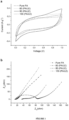
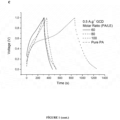
- Figure 1 a) Cyclic voltamograms, b) electrochemical impedance spectra and c) galvanostatic charge and discharge curves of 60, 80, 100 and pure phosphoric acid electrolytes.
- the present invention is defined by the features of claim 1 and relates to a gel electrolyte for use in an energy storage device comprising liquid crystal produced from acidic solution and surfactant.
- surfactant is a nonionic surfactant, more preferably nonionic lauryl ether surfactant.
- the electrolyte comprises phosphoric acid and nonionic surfactant, wherein the molar ratio of phosphoric acid to nonionic surfactant is 50 to 120.
- the supercapacitor works at the best performance within this range of molar ratio because of the ideal viscosity and the ionic conductivity.
- the LE used particularly in this invention is a lauryl ether, C 12 E 10 .
- any nonionic surfactant can function as the template of mesostructured LC gel.
- the molar ratio of PA to nonionic surfactant needs to be optimized depending on the type of the nonionic surfactant.
- the LC gel electrolyte offers more controlled ion diffusivity with optimized interface resistance, high ionic conductivity, low corrosion rate (Electrode Protection), low operating viscosity, low volatility, high thermal stability and easy manufacturing.
- Phosphoric acid H 3 PO 4 .H 2 O, PA
- Phosphoric acid can provide high specific capacitance compared to commonly used electrolytes such as H 2 SO 4 and KOH.
- Phosphoric acid can form highly ordered mesostructured liquid crystal gels (LC) with non-ionic surfactant lauryl ether (LE) and the LCs have been shown to be promising to be used as an electrolyte.
- gel electrolytes were prepared by using phosphoric acid (PA) and nonionic surfactant lauryl ether (LE) at different molar ratios.
- PA and LE are used to form liquid crystal gels at different molar ratios and proved to offer high specific capacity, Cg, at around 1200 F/g under the test conditions of 0.1 A/g with the combination of high surface area symmetric electrodes.
- the LE is brought to its melting point in an oven and then, it is mixed with the PA at a desired amount. Then, the mixture is let to be homogenized at 80 °C for 15 minutes.
- Liquid crystals are a state of matter which has properties between those of conventional liquids and those of solid crystals. For instance, a liquid crystal may flow like a liquid, but its molecules may be oriented in a crystal-like way.
- the LC gel electrolyte offers more controlled ion diffusivity with optimized interface resistance, high ionic conductivity, low corrosion rate (Electrode Protection), low operating viscosity, low volatility, high thermal stability, and easy manufacturing.
- the supercapacitor of this invention is prepared through confining the LC gel electrolyte between two electrodes.
- a separator membrane made of cellulose is also inserted between the electrodes with the LC gel electrolyte.
- the electrodes do not necessarily have to be symmetric. It can also be made of asymmetric supercapacitor.
- the molar ratio of phosphoric acid and nonionic surfactant in the liquid crystal is optimized. Appropriate amount was determined and successfully used in energy storage system.
- Various gel electrolytes were prepared by mixing appropriate amount of phosphoric acid and nonionic surfactant. In this context, 60, 80, 100 mole ratio phosphoric acid to nonionic surfactant were studied. The viscosity of the solution in this mole ratio range allowed us to prepare high performance supercapacitor. At mole ratios below 60, the viscosity of the gel was too high to be processed as a supercapacitor electrolyte. In addition, charge transfer resistance of the supercapacitor was too high and these test cells could not be operated as supercapacitor.
- the supercapacitor works at the best performance within 50-120 range of molar ratio because of the ideal viscosity and the ionic conductivity.
- the LE used particularly in this invention is a lauryl ether, C12E10. However, any nonionic surfactant can function as the template of the LC gel mesostructured.
- the molar ratio of PA to LE needs to be optimized depending on the type of the LE
Landscapes
- Chemical & Material Sciences (AREA)
- Engineering & Computer Science (AREA)
- Chemical Kinetics & Catalysis (AREA)
- Electrochemistry (AREA)
- Power Engineering (AREA)
- Inorganic Chemistry (AREA)
- Manufacturing & Machinery (AREA)
- General Chemical & Material Sciences (AREA)
- Microelectronics & Electronic Packaging (AREA)
- Electric Double-Layer Capacitors Or The Like (AREA)
Description
- The invention relates to gel electrolytes for use in energy storage devices. In particular, the invention relates to production of an electrolyte with optimized conductivity for preparation of high energy storage supercapacitors.
- Supercapacitors, alternatively known as ultracapacitors, electrical double layer capacitors or electrochemical capacitors, are energy storage devices that have considerably more specific capacitance than conventional capacitors.
- Supercapacitors are pretty widely used in areas such as consumer electronics, automotive, and aerospace. The global supercapacitor market, which is 487.45 million USD wide in 2019, is expected to reach 1.570,75 billion USD in 2025. The choice of electrolytes has vital importance to obtain a good performance for supercapacitors. Concentrated acid such as H2SO4 or concentrated base such as KOH can be used alone or inside a hydrogel. Porous and conductive structure is necessary for high ion diffusivity. Phosphoric acid (H3PO4.H2O, PA) provides high proton conductivity and high specific capacitance, with the combination of reduced graphene oxide symmetric electrode, compared to commonly used electrolytes such as H2SO4 and KOH. In meanwhile there is no application with concentrated PA (higher than 3 M) as an electrolyte. Furthermore, it needs to be confined in a matrix to sustain a high ion conductivity in a supercapacitor. PA can form highly ordered mesostructured liquid crystal gels (LC) at a certain mole ratio with non-ionic surfactants lauryl ether (LE) (C58H118O24) and the LCs have a potential to be used as an electrolyte.
- Ömer Daǧ et al. in the publication "Highly Proton Conductive Phosphoric Acid-Nonionic Surfactant Lyotropic Liquid Crystalline Mesophases and Application in Graphene Optical Modulators", ACS NANO, 17-10-2014, showed that PA and nonionic surfactant (LE, C12H25(OCH2CH2)10OH, C12E10) molecules self-assemble into PANS_LLCMs and display high proton conductivity. The content of the PANS_LLCM can be as high 75% H3PO4. 3 H2O and 25% 10-lauryl ether (LE, C12H25(OCH2CH2)10OH, C12E10), and the mesophase follows the usual LLC trend, bicontinuous cubic (V1)_normal hexagonal (H1)_micelle cubic (I1), by increasing the PA concentration in the media. However, this study has been carried out for its use only in optical modulator applications. Optical modulators are systems used to modulate the beam of light. Although they are similar in structure to supercapacitors, they are not used for energy storage. In that study, the molar ratio of phosphoric acid (PA) to lauryl ether (LE), in which the liquid crystal phase is formed, is between 1-20, and the mole ratio is not exceeded 20.
- Therefore, gels are not suitable for use in supercapacitors (energy storage systems) because of their viscosities and ionic conductivities obtained at these mole ratios.
JP 2006 236837 A - In the present invention, thermally reduced graphene oxide is used as electrode, and gel electrolytes are prepared by using PA and non-ionic surfactants lauryl ether (LE) in different molar ratios. Electrochemical performances of the supercapacitor cell were evaluated on the basis of capacitive properties. In this manner, cyclic voltammetry, electrochemical impedance spectroscopy and galvanostatic charge and discharge tests were carried out.
- The present invention aims to overcome common problems of conventional supercapacitors with the liquid electrolyte such as unoptimized interface resistance, high corrosion rate, easy degradation of electrodes, manufacturing difficulties, low potential range and self-discharge and with the organic electrolytes such as low thermal stability and high volatility.
- This invention describes a supercapacitor with advantages of a more controlled ion diffusivity with optimized interface resistance, high ionic conductivity, low Corrosion Rate (Electrode Protection), low operating viscosity, low volatility, high thermal stability and easy manufacturing. In addition, the chemicals used in this invention belong to class of green chemistry.
-
Figure 1 : a) Cyclic voltamograms, b) electrochemical impedance spectra and c) galvanostatic charge and discharge curves of 60, 80, 100 and pure phosphoric acid electrolytes. - The present invention is defined by the features of claim 1 and relates to a gel electrolyte for use in an energy storage device comprising liquid crystal produced from acidic solution and surfactant. Preferably, surfactant is a nonionic surfactant, more preferably nonionic lauryl ether surfactant.
- The electrolyte comprises phosphoric acid and nonionic surfactant, wherein the molar ratio of phosphoric acid to nonionic surfactant is 50 to 120. The supercapacitor works at the best performance within this range of molar ratio because of the ideal viscosity and the ionic conductivity. The LE used particularly in this invention is a lauryl ether, C12E10. However, any nonionic surfactant can function as the template of mesostructured LC gel. The molar ratio of PA to nonionic surfactant needs to be optimized depending on the type of the nonionic surfactant.
- The LC gel electrolyte offers more controlled ion diffusivity with optimized interface resistance, high ionic conductivity, low corrosion rate (Electrode Protection), low operating viscosity, low volatility, high thermal stability and easy manufacturing.
- The electrolyte type plays an important role in the performance of energy storage systems. Phosphoric acid (H3PO4.H2O, PA) can provide high specific capacitance compared to commonly used electrolytes such as H2SO4 and KOH. However, it needs to be confined in a matrix to supplement high ion conductivity through hydrogen bonding, which provides hydrogen hopping, in an energy storage system. Phosphoric acid can form highly ordered mesostructured liquid crystal gels (LC) with non-ionic surfactant lauryl ether (LE) and the LCs have been shown to be promising to be used as an electrolyte.
- In this invention gel electrolytes were prepared by using phosphoric acid (PA) and nonionic surfactant lauryl ether (LE) at different molar ratios. PA and LE are used to form liquid crystal gels at different molar ratios and proved to offer high specific capacity, Cg, at around 1200 F/g under the test conditions of 0.1 A/g with the combination of high surface area symmetric electrodes. In particular, first of all, the LE is brought to its melting point in an oven and then, it is mixed with the PA at a desired amount. Then, the mixture is let to be homogenized at 80 °C for 15 minutes.
- Liquid crystals are a state of matter which has properties between those of conventional liquids and those of solid crystals. For instance, a liquid crystal may flow like a liquid, but its molecules may be oriented in a crystal-like way. The LC gel electrolyte offers more controlled ion diffusivity with optimized interface resistance, high ionic conductivity, low corrosion rate (Electrode Protection), low operating viscosity, low volatility, high thermal stability, and easy manufacturing.
- The supercapacitor of this invention is prepared through confining the LC gel electrolyte between two electrodes. A separator membrane made of cellulose is also inserted between the electrodes with the LC gel electrolyte. The electrodes do not necessarily have to be symmetric. It can also be made of asymmetric supercapacitor.
- In this invention, the molar ratio of phosphoric acid and nonionic surfactant in the liquid crystal is optimized. Appropriate amount was determined and successfully used in energy storage system. Various gel electrolytes were prepared by mixing appropriate amount of phosphoric acid and nonionic surfactant. In this context, 60, 80, 100 mole ratio phosphoric acid to nonionic surfactant were studied. The viscosity of the solution in this mole ratio range allowed us to prepare high performance supercapacitor. At mole ratios below 60, the viscosity of the gel was too high to be processed as a supercapacitor electrolyte. In addition, charge transfer resistance of the supercapacitor was too high and these test cells could not be operated as supercapacitor. The supercapacitor works at the best performance within 50-120 range of molar ratio because of the ideal viscosity and the ionic conductivity. The LE used particularly in this invention is a lauryl ether, C12E10. However, any nonionic surfactant can function as the template of the LC gel mesostructured. The molar ratio of PA to LE needs to be optimized depending on the type of the LE
- For the first time in the literature cyclic voltammetry, electrochemical impedance spectroscopy and galvanostatic charge and discharge tests were conducted for this novel gel electrolyte. As seen in cyclic voltammograms (
Figure 1a ) highest specific capacitance was obtained with the mole ratio of 80. As seen in electrochemical impedance spectrum (Figure 1b ) of supercapacitor cells, the highest charge transfer resistance was obtained in 60 mole ratio. And the lowest charge transfer resistance was obtained in pure phosphoric acid. Optimized charge transfer resistance is needed to provide better control of ions mobility towards electrodes. - As indicated in
Figure 1c highest specific discharge capacitance was obtained in 80 mole ratio around 1000-1300 F.g-1. Such a high value of specific capacitance is not common in this class of materials.
Claims (5)
- A gel electrolyte for use in an energy storage device comprising liquid crystal produced from phosphoric acid and nonionic surfactant characterized in that the molar ratio of phosphoric acid to nonionic surfactant is 50 to 120.
- The gel electrolyte of Claim 1, wherein the molar ratio of phosphoric acid to nonionic surfactant is above 60.
- The gel electrolyte of Claim 1, wherein the nonionic surfactant is a lauryl ether.
- The gel electrolyte of Claim 2, wherein the molar ratio of phosphoric acid to lauryl ether is 80.
- A supercapacitor cell comprising a gel electrolyte according to any one of claims 1 to 4.
Applications Claiming Priority (2)
| Application Number | Priority Date | Filing Date | Title |
|---|---|---|---|
| TR202116436 | 2021-10-21 | ||
| PCT/TR2022/051106 WO2023069051A1 (en) | 2021-10-21 | 2022-10-10 | Gel electrolyte for use in an energy storage device and supercapacitor cell |
Publications (2)
| Publication Number | Publication Date |
|---|---|
| EP4420146A1 EP4420146A1 (en) | 2024-08-28 |
| EP4420146B1 true EP4420146B1 (en) | 2025-02-12 |
Family
ID=92075744
Family Applications (1)
| Application Number | Title | Priority Date | Filing Date |
|---|---|---|---|
| EP22817828.1A Active EP4420146B1 (en) | 2021-10-21 | 2022-10-10 | Gel electrolyte for use in an energy storage device and supercapacitor cell |
Country Status (1)
| Country | Link |
|---|---|
| EP (1) | EP4420146B1 (en) |
-
2022
- 2022-10-10 EP EP22817828.1A patent/EP4420146B1/en active Active
Also Published As
| Publication number | Publication date |
|---|---|
| EP4420146A1 (en) | 2024-08-28 |
Similar Documents
| Publication | Publication Date | Title |
|---|---|---|
| Song et al. | Synergistic design of a N, O co-doped honeycomb carbon electrode and an ionogel electrolyte enabling all-solid-state supercapacitors with an ultrahigh energy density | |
| Anouti et al. | A pyrrolidinium nitrate protic ionic liquid-based electrolyte for very low-temperature electrical double-layer capacitors | |
| Dubal et al. | A high voltage solid state symmetric supercapacitor based on graphene–polyoxometalate hybrid electrodes with a hydroquinone doped hybrid gel-electrolyte | |
| Balducci et al. | High temperature carbon–carbon supercapacitor using ionic liquid as electrolyte | |
| Chen et al. | Effect of different gel electrolytes on graphene-based solid-state supercapacitors | |
| Huang et al. | Ionic liquid electrolytes with various constituent ions for graphene-based supercapacitors | |
| Zhang et al. | Temperature-dependent structure and performance evolution of “water-in-salt” electrolyte for supercapacitor | |
| Huang et al. | Laser fabrication of all-solid-state microsupercapacitors with ultrahigh energy and power based on hierarchical pore carbon | |
| CN108766775B (en) | A kind of preparation method and applications of ultralow temperature high capacity supercapacitor | |
| Coromina et al. | Bridging the performance gap between electric double-layer capacitors and batteries with high-energy/high-power carbon nanotube-based electrodes | |
| Le et al. | A new redox phloroglucinol additive incorporated gel polymer electrolyte for flexible symmetrical solid-state supercapacitors | |
| US20120262127A1 (en) | Flow ultracapacitor | |
| Demarconnay et al. | Optimizing the performance of supercapacitors based on carbon electrodes and protic ionic liquids as electrolytes | |
| Nègre et al. | Solvent-free electrolytes for electrical double layer capacitors | |
| US20110013344A1 (en) | Polarizable electrode for capacitor and electric double layer capacitor having the same | |
| Galek et al. | Peculiar role of the electrolyte viscosity in the electrochemical capacitor performance | |
| Ortega et al. | LiFePO4/mesoporous carbon hybrid supercapacitor based on LiTFSI/imidazolium ionic liquid electrolyte | |
| Ding et al. | Amino acids assisted to improve the voltage window of deep eutectic electrolyte formed by ethylene glycol and tetra methyl ammonium chloride | |
| Xiao et al. | Unlocking the effect of chain length and terminal group on ethylene glycol ether family toward advanced aqueous electrolytes | |
| Devaki et al. | Ionic liquids/ionic liquid crystals for safe and sustainable energy storage systems | |
| US12531191B2 (en) | Gel electrolyte for use in an energy storage device and supercapacitor cell | |
| EP3479389B1 (en) | A supercapacitor and a method for expanding the voltage range of an aqueous electrolyte supercapacitor | |
| Ruan et al. | Lyotropic Lamellar Nanostructures Enabled High‐Voltage Windows, Efficient Charge Transport, and Thermally Safe Solid‐State Electrolytes for Lithium‐Ion Batteries | |
| Tian et al. | A low-cost dilute aqueous hybrid electrolyte for low-temperature supercapacitors | |
| EP4420146B1 (en) | Gel electrolyte for use in an energy storage device and supercapacitor cell |
Legal Events
| Date | Code | Title | Description |
|---|---|---|---|
| STAA | Information on the status of an ep patent application or granted ep patent |
Free format text: STATUS: UNKNOWN |
|
| STAA | Information on the status of an ep patent application or granted ep patent |
Free format text: STATUS: THE INTERNATIONAL PUBLICATION HAS BEEN MADE |
|
| PUAI | Public reference made under article 153(3) epc to a published international application that has entered the european phase |
Free format text: ORIGINAL CODE: 0009012 |
|
| STAA | Information on the status of an ep patent application or granted ep patent |
Free format text: STATUS: REQUEST FOR EXAMINATION WAS MADE |
|
| 17P | Request for examination filed |
Effective date: 20240502 |
|
| AK | Designated contracting states |
Kind code of ref document: A1 Designated state(s): AL AT BE BG CH CY CZ DE DK EE ES FI FR GB GR HR HU IE IS IT LI LT LU LV MC ME MK MT NL NO PL PT RO RS SE SI SK SM TR |
|
| GRAP | Despatch of communication of intention to grant a patent |
Free format text: ORIGINAL CODE: EPIDOSNIGR1 |
|
| STAA | Information on the status of an ep patent application or granted ep patent |
Free format text: STATUS: GRANT OF PATENT IS INTENDED |
|
| RIC1 | Information provided on ipc code assigned before grant |
Ipc: H01G 11/84 20130101ALN20241112BHEP Ipc: H01M 10/056 20100101ALI20241112BHEP Ipc: H01G 11/56 20130101AFI20241112BHEP |
|
| GRAS | Grant fee paid |
Free format text: ORIGINAL CODE: EPIDOSNIGR3 |
|
| DAV | Request for validation of the european patent (deleted) | ||
| DAX | Request for extension of the european patent (deleted) | ||
| INTG | Intention to grant announced |
Effective date: 20241125 |
|
| RIC1 | Information provided on ipc code assigned before grant |
Ipc: H01G 11/84 20130101ALN20241118BHEP Ipc: H01M 10/056 20100101ALI20241118BHEP Ipc: H01G 11/56 20130101AFI20241118BHEP |
|
| GRAA | (expected) grant |
Free format text: ORIGINAL CODE: 0009210 |
|
| STAA | Information on the status of an ep patent application or granted ep patent |
Free format text: STATUS: THE PATENT HAS BEEN GRANTED |
|
| AK | Designated contracting states |
Kind code of ref document: B1 Designated state(s): AL AT BE BG CH CY CZ DE DK EE ES FI FR GB GR HR HU IE IS IT LI LT LU LV MC ME MK MT NL NO PL PT RO RS SE SI SK SM TR |
|
| REG | Reference to a national code |
Ref country code: GB Ref legal event code: FG4D |
|
| REG | Reference to a national code |
Ref country code: CH Ref legal event code: EP |
|
| REG | Reference to a national code |
Ref country code: DE Ref legal event code: R096 Ref document number: 602022010625 Country of ref document: DE |
|
| REG | Reference to a national code |
Ref country code: IE Ref legal event code: FG4D |
|
| REG | Reference to a national code |
Ref country code: NL Ref legal event code: MP Effective date: 20250212 |
|
| PG25 | Lapsed in a contracting state [announced via postgrant information from national office to epo] |
Ref country code: RS Free format text: LAPSE BECAUSE OF FAILURE TO SUBMIT A TRANSLATION OF THE DESCRIPTION OR TO PAY THE FEE WITHIN THE PRESCRIBED TIME-LIMIT Effective date: 20250512 |
|
| PG25 | Lapsed in a contracting state [announced via postgrant information from national office to epo] |
Ref country code: FI Free format text: LAPSE BECAUSE OF FAILURE TO SUBMIT A TRANSLATION OF THE DESCRIPTION OR TO PAY THE FEE WITHIN THE PRESCRIBED TIME-LIMIT Effective date: 20250212 |
|
| PG25 | Lapsed in a contracting state [announced via postgrant information from national office to epo] |
Ref country code: PL Free format text: LAPSE BECAUSE OF FAILURE TO SUBMIT A TRANSLATION OF THE DESCRIPTION OR TO PAY THE FEE WITHIN THE PRESCRIBED TIME-LIMIT Effective date: 20250212 |
|
| PG25 | Lapsed in a contracting state [announced via postgrant information from national office to epo] |
Ref country code: ES Free format text: LAPSE BECAUSE OF FAILURE TO SUBMIT A TRANSLATION OF THE DESCRIPTION OR TO PAY THE FEE WITHIN THE PRESCRIBED TIME-LIMIT Effective date: 20250212 |
|
| REG | Reference to a national code |
Ref country code: LT Ref legal event code: MG9D |
|
| PG25 | Lapsed in a contracting state [announced via postgrant information from national office to epo] |
Ref country code: IS Free format text: LAPSE BECAUSE OF FAILURE TO SUBMIT A TRANSLATION OF THE DESCRIPTION OR TO PAY THE FEE WITHIN THE PRESCRIBED TIME-LIMIT Effective date: 20250612 Ref country code: NO Free format text: LAPSE BECAUSE OF FAILURE TO SUBMIT A TRANSLATION OF THE DESCRIPTION OR TO PAY THE FEE WITHIN THE PRESCRIBED TIME-LIMIT Effective date: 20250512 |
|
| PG25 | Lapsed in a contracting state [announced via postgrant information from national office to epo] |
Ref country code: NL Free format text: LAPSE BECAUSE OF FAILURE TO SUBMIT A TRANSLATION OF THE DESCRIPTION OR TO PAY THE FEE WITHIN THE PRESCRIBED TIME-LIMIT Effective date: 20250212 |
|
| PG25 | Lapsed in a contracting state [announced via postgrant information from national office to epo] |
Ref country code: HR Free format text: LAPSE BECAUSE OF FAILURE TO SUBMIT A TRANSLATION OF THE DESCRIPTION OR TO PAY THE FEE WITHIN THE PRESCRIBED TIME-LIMIT Effective date: 20250212 |
|
| PG25 | Lapsed in a contracting state [announced via postgrant information from national office to epo] |
Ref country code: LV Free format text: LAPSE BECAUSE OF FAILURE TO SUBMIT A TRANSLATION OF THE DESCRIPTION OR TO PAY THE FEE WITHIN THE PRESCRIBED TIME-LIMIT Effective date: 20250212 Ref country code: PT Free format text: LAPSE BECAUSE OF FAILURE TO SUBMIT A TRANSLATION OF THE DESCRIPTION OR TO PAY THE FEE WITHIN THE PRESCRIBED TIME-LIMIT Effective date: 20250612 |
|
| PG25 | Lapsed in a contracting state [announced via postgrant information from national office to epo] |
Ref country code: GR Free format text: LAPSE BECAUSE OF FAILURE TO SUBMIT A TRANSLATION OF THE DESCRIPTION OR TO PAY THE FEE WITHIN THE PRESCRIBED TIME-LIMIT Effective date: 20250513 Ref country code: BG Free format text: LAPSE BECAUSE OF FAILURE TO SUBMIT A TRANSLATION OF THE DESCRIPTION OR TO PAY THE FEE WITHIN THE PRESCRIBED TIME-LIMIT Effective date: 20250212 |
|
| PG25 | Lapsed in a contracting state [announced via postgrant information from national office to epo] |
Ref country code: SE Free format text: LAPSE BECAUSE OF FAILURE TO SUBMIT A TRANSLATION OF THE DESCRIPTION OR TO PAY THE FEE WITHIN THE PRESCRIBED TIME-LIMIT Effective date: 20250212 |
|
| PG25 | Lapsed in a contracting state [announced via postgrant information from national office to epo] |
Ref country code: SM Free format text: LAPSE BECAUSE OF FAILURE TO SUBMIT A TRANSLATION OF THE DESCRIPTION OR TO PAY THE FEE WITHIN THE PRESCRIBED TIME-LIMIT Effective date: 20250212 |
|
| PG25 | Lapsed in a contracting state [announced via postgrant information from national office to epo] |
Ref country code: DK Free format text: LAPSE BECAUSE OF FAILURE TO SUBMIT A TRANSLATION OF THE DESCRIPTION OR TO PAY THE FEE WITHIN THE PRESCRIBED TIME-LIMIT Effective date: 20250212 |
|
| PG25 | Lapsed in a contracting state [announced via postgrant information from national office to epo] |
Ref country code: AT Free format text: LAPSE BECAUSE OF FAILURE TO SUBMIT A TRANSLATION OF THE DESCRIPTION OR TO PAY THE FEE WITHIN THE PRESCRIBED TIME-LIMIT Effective date: 20250212 |
|
| PG25 | Lapsed in a contracting state [announced via postgrant information from national office to epo] |
Ref country code: EE Free format text: LAPSE BECAUSE OF FAILURE TO SUBMIT A TRANSLATION OF THE DESCRIPTION OR TO PAY THE FEE WITHIN THE PRESCRIBED TIME-LIMIT Effective date: 20250212 Ref country code: CZ Free format text: LAPSE BECAUSE OF FAILURE TO SUBMIT A TRANSLATION OF THE DESCRIPTION OR TO PAY THE FEE WITHIN THE PRESCRIBED TIME-LIMIT Effective date: 20250212 |
|
| PG25 | Lapsed in a contracting state [announced via postgrant information from national office to epo] |
Ref country code: RO Free format text: LAPSE BECAUSE OF FAILURE TO SUBMIT A TRANSLATION OF THE DESCRIPTION OR TO PAY THE FEE WITHIN THE PRESCRIBED TIME-LIMIT Effective date: 20250212 |
|
| PG25 | Lapsed in a contracting state [announced via postgrant information from national office to epo] |
Ref country code: SK Free format text: LAPSE BECAUSE OF FAILURE TO SUBMIT A TRANSLATION OF THE DESCRIPTION OR TO PAY THE FEE WITHIN THE PRESCRIBED TIME-LIMIT Effective date: 20250212 |
|
| REG | Reference to a national code |
Ref country code: DE Ref legal event code: R097 Ref document number: 602022010625 Country of ref document: DE |
|
| PLBE | No opposition filed within time limit |
Free format text: ORIGINAL CODE: 0009261 |
|
| STAA | Information on the status of an ep patent application or granted ep patent |
Free format text: STATUS: NO OPPOSITION FILED WITHIN TIME LIMIT |
|
| PGFP | Annual fee paid to national office [announced via postgrant information from national office to epo] |
Ref country code: DE Payment date: 20251027 Year of fee payment: 4 |
|
| PGFP | Annual fee paid to national office [announced via postgrant information from national office to epo] |
Ref country code: IT Payment date: 20251031 Year of fee payment: 4 |
|
| PGFP | Annual fee paid to national office [announced via postgrant information from national office to epo] |
Ref country code: FR Payment date: 20251027 Year of fee payment: 4 |
|
| 26N | No opposition filed |
Effective date: 20251113 |