EP4418372B1 - Aqueous battery - Google Patents
Aqueous battery Download PDFInfo
- Publication number
- EP4418372B1 EP4418372B1 EP24157677.6A EP24157677A EP4418372B1 EP 4418372 B1 EP4418372 B1 EP 4418372B1 EP 24157677 A EP24157677 A EP 24157677A EP 4418372 B1 EP4418372 B1 EP 4418372B1
- Authority
- EP
- European Patent Office
- Prior art keywords
- electrolyte solution
- aqueous electrolyte
- separator
- aqueous
- potassium
- Prior art date
- Legal status (The legal status is an assumption and is not a legal conclusion. Google has not performed a legal analysis and makes no representation as to the accuracy of the status listed.)
- Active
Links
Images




Classifications
-
- H—ELECTRICITY
- H01—ELECTRIC ELEMENTS
- H01M—PROCESSES OR MEANS, e.g. BATTERIES, FOR THE DIRECT CONVERSION OF CHEMICAL ENERGY INTO ELECTRICAL ENERGY
- H01M6/00—Primary cells; Manufacture thereof
- H01M6/04—Cells with aqueous electrolyte
- H01M6/045—Cells with aqueous electrolyte characterised by aqueous electrolyte
-
- H—ELECTRICITY
- H01—ELECTRIC ELEMENTS
- H01M—PROCESSES OR MEANS, e.g. BATTERIES, FOR THE DIRECT CONVERSION OF CHEMICAL ENERGY INTO ELECTRICAL ENERGY
- H01M10/00—Secondary cells; Manufacture thereof
- H01M10/36—Accumulators not provided for in groups H01M10/05-H01M10/34
-
- H—ELECTRICITY
- H01—ELECTRIC ELEMENTS
- H01M—PROCESSES OR MEANS, e.g. BATTERIES, FOR THE DIRECT CONVERSION OF CHEMICAL ENERGY INTO ELECTRICAL ENERGY
- H01M10/00—Secondary cells; Manufacture thereof
- H01M10/42—Methods or arrangements for servicing or maintenance of secondary cells or secondary half-cells
- H01M10/4235—Safety or regulating additives or arrangements in electrodes, separators or electrolyte
-
- H—ELECTRICITY
- H01—ELECTRIC ELEMENTS
- H01M—PROCESSES OR MEANS, e.g. BATTERIES, FOR THE DIRECT CONVERSION OF CHEMICAL ENERGY INTO ELECTRICAL ENERGY
- H01M10/00—Secondary cells; Manufacture thereof
- H01M10/24—Alkaline accumulators
- H01M10/26—Selection of materials as electrolytes
-
- H—ELECTRICITY
- H01—ELECTRIC ELEMENTS
- H01M—PROCESSES OR MEANS, e.g. BATTERIES, FOR THE DIRECT CONVERSION OF CHEMICAL ENERGY INTO ELECTRICAL ENERGY
- H01M50/00—Constructional details or processes of manufacture of the non-active parts of electrochemical cells other than fuel cells, e.g. hybrid cells
- H01M50/40—Separators; Membranes; Diaphragms; Spacing elements inside cells
- H01M50/489—Separators, membranes, diaphragms or spacing elements inside the cells, characterised by their physical properties, e.g. swelling degree, hydrophilicity or shut down properties
- H01M50/491—Porosity
-
- H—ELECTRICITY
- H01—ELECTRIC ELEMENTS
- H01M—PROCESSES OR MEANS, e.g. BATTERIES, FOR THE DIRECT CONVERSION OF CHEMICAL ENERGY INTO ELECTRICAL ENERGY
- H01M2300/00—Electrolytes
- H01M2300/0002—Aqueous electrolytes
-
- H—ELECTRICITY
- H01—ELECTRIC ELEMENTS
- H01M—PROCESSES OR MEANS, e.g. BATTERIES, FOR THE DIRECT CONVERSION OF CHEMICAL ENERGY INTO ELECTRICAL ENERGY
- H01M2300/00—Electrolytes
- H01M2300/0002—Aqueous electrolytes
- H01M2300/0005—Acid electrolytes
- H01M2300/0008—Phosphoric acid-based
-
- H—ELECTRICITY
- H01—ELECTRIC ELEMENTS
- H01M—PROCESSES OR MEANS, e.g. BATTERIES, FOR THE DIRECT CONVERSION OF CHEMICAL ENERGY INTO ELECTRICAL ENERGY
- H01M2300/00—Electrolytes
- H01M2300/0002—Aqueous electrolytes
- H01M2300/0014—Alkaline electrolytes
-
- Y—GENERAL TAGGING OF NEW TECHNOLOGICAL DEVELOPMENTS; GENERAL TAGGING OF CROSS-SECTIONAL TECHNOLOGIES SPANNING OVER SEVERAL SECTIONS OF THE IPC; TECHNICAL SUBJECTS COVERED BY FORMER USPC CROSS-REFERENCE ART COLLECTIONS [XRACs] AND DIGESTS
- Y02—TECHNOLOGIES OR APPLICATIONS FOR MITIGATION OR ADAPTATION AGAINST CLIMATE CHANGE
- Y02E—REDUCTION OF GREENHOUSE GAS [GHG] EMISSIONS, RELATED TO ENERGY GENERATION, TRANSMISSION OR DISTRIBUTION
- Y02E60/00—Enabling technologies; Technologies with a potential or indirect contribution to GHG emissions mitigation
- Y02E60/10—Energy storage using batteries
Definitions
- the present application discloses an aqueous battery including an aqueous electrolyte solution.
- the positive electrode active material layer 11 contains a positive electrode active material.
- the positive electrode active material layer 11 can be impregnated with the aqueous electrolyte solution 20.
- the positive electrode active material layer 11 may contain, in addition to the positive electrode active material, various additives and/or the like such as a conductive aid and/or a binder.
- the content of each component in the positive electrode active material layer 11 may be appropriately determined according to the objective battery performance.
- the content of the positive electrode active material may be 40% by mass or more, 50% by mass or more, 60% by mass or more, or 70% by mass or more, and may be 100% by mass or less or 90% by mass or less, based on 100% by mass of the entire positive electrode active material layer 11 (total solid content).
- carrier ion may be, for example, a proton (H + ), a hydroxide ion (OH - ), a potassium ion (K + ), or another cation or anion. Only one positive electrode active material may be used alone, or two or more thereof may be used in combination.
- the positive electrode current collector 12 When the positive electrode current collector 12 is composed of a plurality of metal foils, the positive electrode current collector may have some layer between the plurality of metal foils.
- the thickness of the positive electrode current collector 12 is not particularly limited, and may be, for example, 0.1 ⁇ m or more or 1 ⁇ m or more, and may be 1 mm or less or 100 ⁇ m or less.
- the aqueous electrolyte solution 20 contains water and a potassium salt dissolved in the water.
- the aqueous electrolyte solution 20 may be held between the positive electrode 10 and the negative electrode 40 by the separator 30.
- the aqueous electrolyte solution 20 may be in contact with the above-mentioned positive electrode current collector 12, may be included in the above-mentioned positive electrode active material layer 11, may be in contact with the below-mentioned negative electrode current collector 42, or may be included in the below-mentioned negative electrode active material layer 41.
- the aqueous electrolyte solution 20 contains a potassium salt dissolved in water.
- the potassium salt may be any salt capable of being dissolved in water.
- the potassium salt may be at least one selected from KPF 6 , KBF 4 , K 2 SO 4 , KNO 3 , CH 3 COOK, (CF 3 SO 2 ) 2 NK, KCF 3 SO 3 , (FSO 2 ) 2 NK, K 2 HPO 4 , KH 2 PO 4 , KPO 3 , K 4 P 2 O 7 , K 5 P 3 O 10 , K 6 P 4 O 13 , K 7 P 5 O 16 , (KPO 3 )n, and the like.
- the performance of the aqueous battery 100 is further easily enhanced when the potassium salt includes a phosphoric acid salt or an acetic acid salt, particularly, a phosphoric acid salt, further particularly a polyphosphoric acid salt, in particular, a pyrophosphoric acid salt (potassium pyrophosphate, K 4 P 2 O 7 ).
- the potassium salt includes a phosphoric acid salt or an acetic acid salt, particularly, a phosphoric acid salt, further particularly a polyphosphoric acid salt, in particular, a pyrophosphoric acid salt (potassium pyrophosphate, K 4 P 2 O 7 ).
- the potassium salt in the aqueous electrolyte solution 20 may dissociate into potassium ions and anions.
- potassium ions may completely dissociate from anions, or may form aggregates (associations), for example, in close proximity to anions.
- "potassium pyrophosphate dissolved in water" in the aqueous electrolyte solution 20 may be present as ions such as K + , P 2 O 7 4- , KP 2 O 7 3- , K 2 P 2 O 7 2- , and K 3 P 2 O 7 - , or aggregates (associations) of these ions.
- the components and concentration in the aqueous electrolyte solution 20 are determined so that "aqueous electrolyte solution 20 has no freezing point at -60°C or higher". According to the inventors' new findings, in order to achieve the conditions that "aqueous electrolyte solution 20 has no freezing point at -60°C or higher", the concentration of the potassium salt in the aqueous electrolyte solution 20 should be higher than ever before.
- the freezing point of the aqueous electrolyte solution 20 decreases as the concentration of the potassium salt in water increases, and when the concentration of the potassium salt in the aqueous electrolyte solution 20 reaches a certain level or more, the freezing point substantially disappears. Namely, when the concentration of the potassium salt in the aqueous electrolyte solution 20 is in a certain level or more, the aqueous electrolyte solution 20 has no freezing point at -60°C or higher.
- the concentration of the potassium salt per 1 kg of water in the aqueous electrolyte solution 20 may be, for example, 2.5 mol or more, 3.0 mol or more, 3.5 mol or more, or 4.0 mol or more.
- the upper limit of the concentration is not particularly limited.
- the concentration of the potassium salt per 1 kg of water may be 7.0 mol or less or 6.0 mol or less.
- the freezing point of the aqueous electrolyte solution decreases as the concentration of the potassium salt in water increases, and when the concentration of the potassium salt in the aqueous electrolyte solution reaches a certain level or more, the freezing point substantially disappears.
- the concentration of the potassium salt in the aqueous electrolyte solution 20 is higher, the potential window of the aqueous electrolyte solution 20 more easily expands.
- the concentration is higher, elution of the current collector into the aqueous electrolyte solution 20 is more easily suppressed. Meanwhile, as the concentration is lower, the viscosity of the aqueous electrolyte solution 20 is smaller.
- the aqueous electrolyte solution 20 may be, for example, one containing the potassium salt dissolved at a concentration of 2.5 mol or more and 7.0 mol or less, 3.0 mol or more and 7.0 mol or less, 3.5 mol or more and 7.0 mol or less, or 4.0 mol or more and 7.0 mol or less per 1 kg of the water.
- the aqueous electrolyte solution 20 may contain water and potassium pyrophosphate dissolved at a certain concentration or more per 1 kg of the water.
- the concentration of the potassium pyrophosphate may be, for example, 2.5 mol or more, 3.0 mol or more, 3.5 mol or more, or 4.0 mol or more per 1 kg of the water.
- the upper limit of the concentration of the potassium pyrophosphate in the aqueous electrolyte solution 20 is not particularly limited, and if the concentration is excessively high, the viscosity of the aqueous electrolyte solution 20 may increase excessively.
- the concentration of the potassium pyrophosphate may be 7.0 mol or less or 6.0 mol or less per 1 kg of the water.
- the aqueous electrolyte solution 20 contains water and the potassium pyrophosphate dissolved at a concentration of 4.0 mol or more per 1 kg of the water, not only the aqueous electrolyte solution 20 has no freezing point at -60°C or higher, but also the performance of the aqueous battery 100 is further enhanced.
- the aqueous electrolyte solution 20 contains the potassium pyrophosphate dissolved in the water, not only the potassium pyrophosphate, but also other electrolytes may be contained.
- the potassium pyrophosphate may account for 50 mol% or more and 100 mol% or less, 70 mol% or more and 100 mol% or less, or 90 mol% or more and 100 mol% or less, and other electrolytes may account for 0 mol% or more and 50 mol% or less, 0 mol% or more and 30 mol% or less, or 0 mol% or more and 10 mol% or less, of the total amount of electrolytes (100 mol%) dissolved in the aqueous electrolyte solution 20.
- the aqueous electrolyte solution 20 contains water and potassium ions, and the molar ratio (H 2 O/K) of the water to the potassium ions is 3.5 or less and the aqueous electrolyte solution 20 contains the water and potassium pyrophosphate dissolved in the water, the aqueous electrolyte solution 20 easily has no freezing point at -60°C or higher.
- “potassium ions” are those at least partially derived from the potassium pyrophosphate.
- “potassium ions” may form aggregates (associations), for example, in close proximity to anions.
- the molar ratio of the water to the potassium ions in the aqueous electrolyte solution 20 may be easily specified by measuring the amount of the water and the amount of K dissolved and present in the water.
- Ions, aggregates (associations), and the like contained in the aqueous electrolyte solution 20 can be converted into the potassium salt, thereby specifying "concentration of potassium salt dissolved in water".
- the aqueous electrolyte solution 20 may contain more potassium ions than the concentration which can be converted as the potassium salt.
- a potassium compound (for example, KOH) other than the potassium salt is dissolved together with the potassium salt in the aqueous electrolyte solution 20
- the aqueous electrolyte solution 20 may contain more potassium ions than the concentration which can be converted as the potassium salt.
- the aqueous electrolyte solution 20 may contain more anions than the concentration which can be converted as the potassium salt. In other words, it is not necessary for the entire anions contained in the aqueous electrolyte solution 20 to be converted as "dissolved potassium salt".
- the aqueous electrolyte solution 20 contains pyrophosphate ions (it may be P 2 O 7 4- and it may be present in a state of being linked to cations as mentioned above, such as KP 2 O 7 3- , K 2 P 2 O 7 2- , K 3 P 2 O 7 - , etc.) as anions and also pyrophosphate ion sources (for example, H 4 P 2 O 7 , etc.) other than K 4 P 2 O 7 are dissolved together with K 4 P 2 O 7 in the aqueous electrolyte solution 20, the aqueous electrolyte solution 20 may contain more pyrophosphate ions than the concentration which can be converted as potassium pyrophosphate.
- potassium ion sources for example, KOH
- anion sources for example, H 4 P 2 O 7
- the aqueous electrolyte solution 20 may contain a plurality of kinds of cations and a plurality of kinds of anions.
- the aqueous electrolyte solution 20 may include not only potassium ions protons and/or hydroxide ions as carrier ions and phosphate ions as anions, but also other cations and anions.
- alkali metal ions other than potassium ions, and alkaline earth metal ions, transition metal ions, and the like may be contained.
- the aqueous electrolyte solution 20 may contain an acid, a hydroxide and the like for pH adjustment.
- the aqueous electrolyte solution 20 may contain various additives.
- the pH of the aqueous electrolyte solution 20 is not particularly limited. However, if the pH is too high, the potential window on the oxidation side of the aqueous electrolyte solution 20 may be narrow. In this respect, the pH of the aqueous electrolyte solution 20 may be 3 or more and 14 or less. The pH may be 4 or more, 5 or more, 6 or more, or 7 or more, and may be 13 or less, or 12 or less.
- the aqueous electrolyte solution 20 has no freezing point at -60°C or higher. This means that H 2 O molecules cannot form a network of crystallization with each other in the aqueous electrolyte solution 20, namely, few freezable free H 2 O molecules are present in the aqueous electrolyte solution 20.
- the aqueous electrolyte solution 20 which contains few freezable free H 2 O molecules, is used in the aqueous battery 100, elution of the current collector into the aqueous electrolyte solution 20 can be suppressed.
- the aqueous electrolyte solution 20 has no freezing point at -60°C, it is also possible to use the aqueous battery 100 even at extremely low temperature.
- the aqueous battery 100 appropriately operates even in cold district.
- the aqueous electrolyte solution 20 may have no freezing point at -80°C or higher, no freezing point at -100°C or higher, or no freezing point at -120°C or higher.
- concentration of the potassium salt in the aqueous electrolyte solution 20 it is effective to, as mentioned above, allow the concentration of the potassium salt in the aqueous electrolyte solution 20 to be a high concentration (for example, dissolve the potassium salt (in particular, potassium pyrophosphate) at a high concentration of 4.0 mol or more per 1 kg of water, etc.).
- the concentration of the potassium salt in the aqueous electrolyte solution 20 to be a high concentration (for example, dissolve the potassium salt (in particular, potassium pyrophosphate) at a high concentration of 4.0 mol or more per 1 kg of water, etc.).
- DSC differential scanning calorimetry
- the crystallization peak temperature (freezing point temperature) is not confirmed at - 60°C or higher when the aqueous electrolyte solution is measured under the above conditions, the aqueous electrolyte solution is considered to have "no freezing point at -60°C or higher".
- the aqueous electrolyte solution is considered to "not involve salt precipitation when cooled from 0°C to -60°C".
- the viscosity of the aqueous electrolyte solution 20 is too high, the ionic conductivity of the aqueous electrolyte solution 20 may deteriorate. Meanwhile, if an electrolyte is dissolved at high concentration in the aqueous electrolyte solution 20, the aqueous electrolyte solution 20 may have a certain level or more of the viscosity. In this respect, the aqueous electrolyte solution 20 may have a viscosity of 10 mPa ⁇ s or more and 600 mPa ⁇ s or less at 20°C.
- the viscosity may be 15 mPa ⁇ s or more, 20 mPa ⁇ s or more, 30 mPa ⁇ s or more, or 40 mPa ⁇ s or more, and may be 500 mPa ⁇ s or less, 400 mPa ⁇ s or less, 300 mPa ⁇ s or less, 250 mPa ⁇ s or less, or 200 mPa ⁇ s or less.
- the aqueous battery 100 includes a separator 30.
- the separator 30 is provided between the positive electrode 10 and the negative electrode 40.
- the separator 30 retains the above-mentioned aqueous electrolyte solution 20.
- the aqueous electrolyte solution 20 has no freezing point at -60°C or higher. This means that H 2 O molecules cannot form a network of crystallization with each other in the aqueous electrolyte solution 20, namely, few freezable free H 2 O molecules are present in the aqueous electrolyte solution 20. More specifically, it is considered that an anion network structure called Water-in-salt is formed in the aqueous electrolyte solution 20 and a network of H 2 O molecules disappears.
- the affinity with the separator, of the aqueous electrolyte solution 20 having no freezing point at -60°C or higher is largely different from that of a conventional aqueous electrolyte solution having a freezing point at -60°C or higher.
- the aqueous electrolyte solution 20 is poor in wettability to a conventional separator including a nonwoven fabric or a porous film, and hardly penetrates into such a conventional separator. Namely, when an aqueous battery is formed with such a conventional separator together with the aqueous electrolyte solution 20, no ionic conduction path between a positive electrode and a negative electrode may be appropriately formed.
- the separator 30 used in the aqueous battery 100 of the present disclosure is one high in affinity with the aqueous electrolyte solution 20.
- an anion network structure called Water-in-salt is formed in the aqueous electrolyte solution 20. Therefore, it is important for increasing the affinity of the separator 30 with the aqueous electrolyte solution 20 that the separator 30 has "anionphilicity". Specifically, it is important for at least one element constituting the separator 30 to be the same in type as at least one element constituting the anion of the potassium salt dissolved in the aqueous electrolyte solution 20.
- element(s) constituting the separator 30 include(s) the same type of element as at least one element constituting the anion of the potassium salt dissolved in the aqueous electrolyte solution 20.
- the separator 30 high in affinity with the anion of the potassium salt dissolved in the aqueous electrolyte solution 20 is thus used in the aqueous battery 100, and therefore the wettability of the aqueous electrolyte solution 20 to the separator 30 is improved, the aqueous electrolyte solution 20 can be allowed to appropriately penetrate into the separator 30, and the ionic conduction path between the positive electrode 10 and the negative electrode 40 is appropriately easily ensured.
- element which is the same in type as at least one element constituting the anion of the potassium salt (hereinafter, sometimes referred to as "element X") among the element(s) constituting the separator 30 may be present in the surface (front surface) of the separator 30, may be present in the inside of the separator 30, or may be present in both the surface and the inside.
- the element X may be present in only one face of the separator 30 (for example, facing the positive electrode 10), may be present in only other face of the separator 30 (for example, facing the negative electrode 40), or may be present in both one face and other face thereof. In particular, when the element X is present in both one face and other face of the separator 30, much higher performance is easily obtained.
- the type of the element X depends on the type of the anion of the potassium salt.
- the element X may be at least one element among P, S, and O.
- the element X may be at least one element other than H and O.
- the element X may be at least one element other than H and O, and one of or both H and O, in addition to the element X, may be contained as element(s) constituting the separator.
- the separator 30 may be one having a phosphorus-containing group or an oxygen-containing group, or may be, for example, one having a phosphoric acid group or a hydroxyl group. In one embodiment, the separator 30 has, for example, a phosphorus-containing group.
- the phosphoric acid group as the phosphorus-containing group may have, for example, hydrogen substituted by other substituent, as in, for example, an alkylphosphoric acid ester group.
- the phosphoric acid group may be a polyphosphoric acid group or a pyrophosphoric acid group.
- the separator 30 may be one having a sulfur-containing group or an oxygen-containing group, or may be, for example, one having at least one functional group selected from a sulfo group, a sulfonyl group, a sulfuric acid group and a hydroxyl group.
- the separator 30 has, for example, a sulfur-containing group.
- the sulfur-containing group may have, for example, hydrogen substituted by other substituent, as in, for example, an alkylsulfuric acid ester group.
- the separator 30 may contain C, H and O. Specifically, the separator 30 may contain a carboxyl group.
- the element X in the separator 30 may be contained in a substance attached to a base material constituting the separator 30.
- the separator 30 may include a base material and an affinity substance attached to the base material, and at least one element constituting the affinity substance may be the same in type as at least one element constituting the anion of the potassium salt.
- the affinity substance can also be said to be a substance relatively enhancing the wettability of the aqueous electrolyte solution 20 to the separator 30 (relatively decreasing the contact angle of the aqueous electrolyte solution 20 to the separator 30).
- the affinity of the affinity substance with the aqueous electrolyte solution 20 is higher than the affinity of the base material with the aqueous electrolyte solution 20.
- the base material may be, for example, a nonwoven fabric or a porous film.
- the nonwoven fabric may include, for example, at least one of cellulose, a resin, and glass.
- the nonwoven fabric includes cellulose.
- the porous film may be one not only containing at least one polymer compound selected from polyethylene (PE), polypropylene (PP), polyester, polyamide, and the like, but also having a plurality of voids.
- the porous film includes one of or both polyethylene and polypropylene.
- the base material may have a monolayer structure or may have a multilayer structure.
- Examples of the base material of the multilayer structure can include a base material of a two-layer structure of PE/PP, or a base material of a three-layer structure of PP/PE/PP or PE/PP/PE.
- the base material may be any one as long as it has a shape capable of forming the separator 30, and may be, for example, one having a thickness of 5 ⁇ m or more and 1 mm or less.
- the base material may be one adopted as a separator in a conventional aqueous battery.
- the separator 30 may be one in which the affinity substance is attached to a conventional separator.
- the affinity substance is a substance having affinity with the aqueous electrolyte solution 20.
- at least one element constituting the affinity substance is the same in type as at least one element constituting the anion of the potassium salt.
- the element(s) constituting the affinity substance depend(s) on the type of the anion of the potassium salt.
- the affinity substance may contain one of or both P and O.
- the affinity substance may be one having a phosphorus-containing group or an oxygen-containing group, or may be, for example, one having a phosphoric acid group or a hydroxyl group.
- the affinity substance has, for example, a phosphorus-containing group.
- the phosphoric acid group may have, for example, some hydrogen substituted by other substituent, as in, for example, an alkylphosphoric acid ester group.
- the phosphoric acid group may be a polyphosphoric acid group (for example, pyrophosphoric acid group).
- the affinity substance may contain S.
- the affinity substance may be one having a sulfur-containing group or an oxygen-containing group, or may be, for example, one having at least one functional group selected from a sulfo group, a sulfonyl group, a sulfuric acid group and a hydroxyl group.
- the affinity substance has, for example, a sulfur-containing group.
- the sulfur-containing group may have, for example, some hydrogen substituted by other substituent, as in, for example, an alkylsulfuric acid ester group.
- the affinity substance may contain a carboxyl group.
- the affinity substance may be any one as long as it can keep the state of being attached to the base material in the aqueous battery 100, and may be an inorganic substance or may be an organic substance.
- the affinity substance may contain an inorganic compound having P as a constituent element.
- the affinity substance may contain a salt (phosphoric acid salt of alkaline earth metal) of at least one alkaline earth metal selected from magnesium, calcium, strontium and barium, and phosphoric acid.
- the phosphoric acid salt of alkaline earth metal may be a polyphosphoric acid salt, or may be a pyrophosphoric acid salt.
- the affinity of the separator 30 with the aqueous electrolyte solution 20 can be further appropriately enhanced.
- the affinity substance may contain an organic compound having P as a constituent element.
- the affinity substance may be an organic phosphoric acid ester.
- the organic phosphoric acid ester may be an alkylphosphoric acid ester.
- the alkylphosphoric acid ester may be a monoalkylphosphoric acid ester, may be a dialkylphosphoric acid ester, or may be a mixture thereof.
- the affinity of the separator 30 with the aqueous electrolyte solution 20 can be further appropriately enhanced.
- the alkyl group constituting the alkylphosphoric acid ester may be linear or branched.
- the affinity substance contains 2-ethylhexyl phosphate, the affinity of the separator 30 with the aqueous electrolyte solution 20 is further easily increased.
- the affinity substance may be dispersed and present in one of or both the front surface and the inside of the base material, or may be present on the front surface of the base material, in a layered manner. In particular, when the affinity substance is present in both the front and rear surfaces of the base material, more excellent performance is easily exhibited.
- the amount of the affinity substance attached to the base material is not particularly limited, and may be any amount as long as voids are kept at a level allowing for penetration of the aqueous electrolyte solution 20 into the separator 30.
- the method for attaching the affinity substance to the base material is not particularly limited.
- the affinity substance may be attached to the base material by bringing the affinity substance into contact with the base material.
- the affinity substance may be attached to the base material by coating the base material with a slurry or solution containing the affinity substance or immersing the base material in a slurry or solution containing the affinity substance, to bring the affinity substance into contact with the base material, and then drying them.
- the separator 30 is not limited to one including the base material and the affinity substance.
- the entire separator 30 may be constituted from the affinity substance. It is, however, noted that when the separator 30 includes the base material and the affinity substance, not only the backbone of the separator 30 as a whole is easily kept by the base material and the separator 30 is excellent in ease of handling, but also a conventionally known separator may be used as the base material and thus the cost is low.
- the negative electrode 40 any known negative electrode for an aqueous battery.
- the negative electrode 40 may include a negative electrode active material layer 41 and a negative electrode current collector 42.
- the negative electrode active material layer 41 contains a negative electrode active material.
- the negative electrode active material layer 41 can be impregnated with the aqueous electrolyte solution 20.
- the negative electrode active material layer 41 may contain, in addition to the negative electrode active material, various additives such as a conductive aid and/or a binder.
- the content of each component in the negative electrode active material layer 41 may be appropriately determined according to the objective battery performance.
- the content of the negative electrode active material may be 40% by mass or more, 50% by mass or more, 60% by mass or more, or 70% by mass or more, and may be 100% by mass or less or 90% by mass or less, based on 100% by mass of the entire negative electrode active material layer 41 (entire solid content).
- the shape of the negative electrode active material layer 41 is not particularly limited, and may be, for example, a sheet-shaped negative electrode active material layer having an approximately flat surface.
- the thickness of the negative electrode active material layer 41 is not particularly limited, and may be, for example, 0.1 ⁇ m or more, 1 ⁇ m or more, or 10 ⁇ m or more, and may be 2 mm or less, 1 mm or less, or 500 ⁇ m or less.
- the negative electrode active material any substance capable of functioning as the negative electrode active material of the aqueous battery.
- the negative electrode active material has a lower charge-discharge potential than that of the above-mentioned positive electrode active material, and can be appropriately selected in consideration of the carrier ions and the potential window of the above-mentioned aqueous electrolyte solution 20.
- the negative electrode active material may be potassium-transition metal composite oxide; titanium oxide; metal sulfides such as Mo 6 S 8 ; elemental sulfur; KTi 2 (PO 4 ) 3 ; NASICON-type compounds; WO 3 , and the like.
- the negative electrode active material may be a hydrogen storage alloy.
- the negative electrode active material may be an inorganic compound having a crystalline structure belonging to space group I23.
- the inorganic compound having a crystalline structure belonging to space group I23 may contain, for example, an element A and an element M and O.
- the element A is at least one of Bi and La
- the element M is at least one of Bi, Mn, Fe, Co and Ni
- both the element A and the element M may be Bi.
- the negative electrode active material may be one which inserts and deinserts carrier ions by intercalation, or which inserts and deinserts carrier ions by a conversion reaction or an alloying reaction. Only one negative electrode active material may be used alone, or two or more thereof may be used in combination.
- the shape of the negative electrode active material may be any shape capable of functioning as the negative electrode active material of the battery.
- the negative electrode active material may be in the form of particles.
- the negative electrode active material may be a solid material, a hollow material, a material with voids, or a porous material.
- the negative electrode active material may be a primary particle, or a secondary particle obtained by agglomeration of a plurality of primary particles.
- the mean particle diameter D50 of the negative electrode active material may be, for example, 1 nm or more, 5 nm or more, or 10 nm or more, and may be 500 ⁇ m or less, 100 ⁇ m or less, 50 ⁇ m or less, or 30 ⁇ m or less.
- Examples of the conductive aid which can be contained in the negative electrode active material layer 41 include carbon materials such as vapor-phase-grown carbon fiber (VGCF), acetylene black (AB), Ketjen black (KB), carbon nanotube (CNT) and carbon nanofiber (CNF); and metal materials such as nickel, titanium, aluminum, stainless steel and the like which are slightly insoluble (poorly soluble) in an electrolyte solution.
- the conductive aid may be, for example, in the form of particles or fibers, and the size thereof is not particularly limited. Only one conductive aid may be used alone, or two or more thereof may be used in combination.
- binder which can be contained in the negative electrode active material layer 41 butadiene rubber (BR)-based binders, butylene rubber (IIR)-based binders, acrylate-butadiene rubber (ABR)-based binders, styrene-butadiene rubber (SBR)-based binders, polyvinylidene fluoride (PVdF)-based binders, polytetrafluoroethylene (PTFE)-based binders, polyimide (PI)-based binders and the like. Only one binder may be used alone, or two or more thereof may be used in combination.
- BR butadiene rubber
- IIR acrylate-butadiene rubber
- SBR styrene-butadiene rubber
- PVdF polyvinylidene fluoride
- PTFE polytetrafluoroethylene
- PI polyimide
- the negative electrode 40 may include a negative electrode current collector 42 in contact with the negative electrode active material layer 41.
- the negative electrode current collector 42 may be in contact with the aqueous electrolyte solution 20. It is possible to use, as the negative electrode current collector 42, any material capable of functioning as the negative electrode current collector of the aqueous battery.
- the negative electrode current collector 42 may be in the form of foil, plate, mesh, perforated metal and foam.
- the negative electrode current collector 42 may be formed of a metal foil or a metal mesh. In particular, the metal foil is excellent in ease of handling or the like.
- the negative electrode current collector 42 may be composed of a plurality of foils.
- the metal material constituting the negative electrode current collector 42 examples include those containing at least one element selected from the group consisting of Cu, Ni, Al, V, Au, Pt, Mg, Fe, Ti, Pb, Co, Cr, Zn, Ge, In, Sn, and Zr.
- the negative electrode current collector 42 preferably contains at least one selected from the group consisting of Al, Ti, Pb, Zn, Sn, Mg, Zr and In, and preferably contains Al.
- the negative electrode current collector 42 may be one in which the above metal is plated or vapor-deposited on a metal foil or a base material.
- the negative electrode current collector 42 may have some layer between the plurality of metal foils.
- the thickness of the negative electrode current collector 42 is not particularly limited, and may be, for example, 0.1 ⁇ m or more or 1 ⁇ m or more, and may be 1 mm or less or 100 ⁇ m or less.
- both the positive electrode current collector 12 and negative electrode current collector 42 may contain Al.
- a current collector containing Al may be used as a bipolar current collector which serves as both the positive electrode current collector 12 and the negative electrode current collector 42.
- the positive electrode 10 and the negative electrode 40 may share one current collector.
- FIG. 2 shows an example of a bipolar structure. As shown in FIG.
- the aqueous battery 100 may have a bipolar structure, and a positive electrode active material layer 11 may be formed on one side of an Al-containing current collector 50 (bipolar current collector which functions as both the positive electrode current collector 12 and negative electrode current collector 42) and a negative electrode active material layer 41 may be formed on the other side of the current collector 50.
- the Al-containing current collector 50 may not have liquid permeability, that is, the aqueous electrolyte solution 20 may not permeate from the positive electrode active material layer 11 to the negative electrode active material layer 41 via the current collector 50 and vice versa.
- the aqueous battery 100 may include, for example, a known structure as that of a battery, in addition to the above structure.
- the aqueous battery 100 may include, in addition to the above structure, a terminal, a battery case, and the like.
- the aqueous battery 100 may be a primary battery or may be a secondary battery.
- the aqueous battery 100 may be an aqueous proton battery with protons and/or hydroxide ions as carrier ions, or may be an aqueous potassium ion battery with potassium ions as carrier ions.
- Other structures are obvious to those skilled in the art who refer to the present application, and are therefore explanation will be omitted here.
- the method for producing the aqueous battery 100 of the present disclosure is not particularly limited, and is, for example, as follows.
- the aqueous battery 100 of the present disclosure includes an aqueous electrolyte solution 20 having no freezing point at -60°C or higher, and thus elution of a current collector into the aqueous electrolyte solution 20 is easily suppressed and the aqueous battery can be appropriately operated even at extremely low temperature in cold district.
- the aqueous battery 100 of the present disclosure includes a separator 30 high in affinity with the aqueous electrolyte solution 20, and thus the aqueous electrolyte solution 20 appropriately penetrates into the separator 30 and an ionic conduction path between a positive electrode 10 and a negative electrode 40 is appropriately easily ensured.
- the technology of the present disclosure also has an aspect as an ionic conductor including an aqueous electrolyte solution and a separator.
- the ionic conductor of the present disclosure has an aqueous electrolyte solution and a separator retaining the aqueous electrolyte solution, the aqueous electrolyte solution contains water and a potassium salt dissolved in the water, the aqueous electrolyte solution has no freezing point at -60°C or higher, and the element constituting the separator contains an element which is the same in type as at least one of elements constituting the anion of the potassium salt.
- the details of the separator and the aqueous electrolyte solution are as mentioned above.
- the technology of the present disclosure also has an aspect as a method for both suppressing elution of metal from the current collector into the aqueous electrolyte solution and ensuring an ionic conduction path between positive and negative electrodes in the aqueous battery.
- the method of the present disclosure is characterized by using an aqueous electrolyte solution which satisfies the following requirements (1) and (2) and using a separator which satisfies the following requirement (3), in the aqueous battery.
- the details of the aqueous electrolyte solution and the separator, and other structures of the battery are as mentioned above.
- an aqueous battery is obtained in which both suppression of elution of metal from the current collector into the aqueous electrolyte solution and securement of an ionic conduction path between positive and negative electrodes are achieved.
- Such an aqueous battery can be suitably used, for example, in at least one vehicle selected from a hybrid electric vehicle (HEV), a plug in hybrid electric vehicle (PHEV) and a battery electric vehicle (BEV).
- HEV hybrid electric vehicle
- PHEV plug in hybrid electric vehicle
- BEV battery electric vehicle
- the technology of the present disclosure also has an aspect as a vehicle having an aqueous battery, wherein the aqueous battery includes a positive electrode, an aqueous electrolyte solution, a separator and a negative electrode, the aqueous electrolyte solution contains water and a potassium salt dissolved in the water, the aqueous electrolyte solution has no freezing point at -60°C or higher, and at least one element constituting the separator is the same in type as at least one element constituting the anion of the potassium salt.
- the aqueous battery includes a positive electrode, an aqueous electrolyte solution, a separator and a negative electrode, the aqueous electrolyte solution contains water and a potassium salt dissolved in the water, the aqueous electrolyte solution has no freezing point at -60°C or higher, and at least one element constituting the separator is the same in type as at least one element constituting the anion of the potassium salt.
- the detail of the aqueous battery is
- An aqueous battery using an aqueous electrolyte solution is needed to be suppressed in elution of a metal current collector into the aqueous electrolyte solution.
- An aqueous electrolyte solution allowing for suppression of elution of Al in the case of an Al foil as a metal current collector has been examined as below.
- the Al foil is merely one example of the current collector. Even when other current collector than the Al foil is used, various effects described below, by the aqueous electrolyte solution, can be expected.
- K 4 P 2 O 7 was dissolved in 1 kg of pure water at a predetermined concentration (0.5 to 5 mol) to obtain an aqueous electrolyte solution for evaluation.
- an electrochemical cell (VM4, manufactured by EC FRONTIER CO., LTD) an Al foil was used for a working electrode, Pt mesh was used for a counter electrode, Ag/AgCl was used for a reference electrode, and the above aqueous electrolyte solution was used as an electrolyte solution.
- VM4 manufactured by EC FRONTIER CO., LTD
- an Al foil was used for a working electrode
- Pt mesh was used for a counter electrode
- Ag/AgCl was used for a reference electrode
- the above aqueous electrolyte solution was used as an electrolyte solution.
- a constant current was applied to an electrochemical cell at 25°C for 30 minutes under the following conditions (1-1) or (1-2).
- a constant electric potential was applied to the electrochemical cell at 25°C for 30 minutes under the following conditions (2-1) or (2-2). Tests were carried out for each of current and potential on the oxidation side, and current and potential on the reduction side.
- a potential-pH diagram shows that a standard electrode potential of Al in the aqueous electrolyte solution at pH 11 is about -2.3 V (vs. SHE), so that there is a possibility that Al is eluted (corroded) just by immersing the Al foil in the aqueous electrolyte solution, and it is considered that elution is accelerated by application of a small oxidation current.
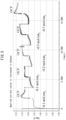
- FIG. 3 shows a time-potential curve when a 0.5 m aqueous electrolyte solution is used and a constant current on the oxidation side is applied.
- the dissolved Al ions are once dissolved and diffused using H 2 O and OH - as ligands, and then gradually solidified by interacting with P 2 O 7 ions, leading to precipitation of solids in the aqueous electrolyte solution.
- the solid is deposited and precipitated in the aqueous electrolyte solution, and elution of Al into the electrolyte solution has progressed.
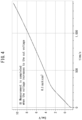
- FIG. 4 shows a time-potential curve when a 5 m aqueous electrolyte solution was used and a constant current on the oxidation side was applied.
- FIG. 5 shows a time-potential curve when a 1 m aqueous electrolyte solution was used and a constant current on the reduction side was applied.
- FIG. 6 shows a time-potential curve when a 5 m aqueous electrolyte solution is used and a constant current is applied on the reduction side.
- the passive film is considered to have higher solubility in the strong base region than in the neutral region, but if the passive film is dense, dissolution of the passive film is considered to be suppressed.
- the electrolyte solution at a concentration of 4.0 mol/kg or more on both the oxidation and reduction sides, it is also considered that a dense passive film is formed on the surface of the Al foil.
- a 5 mol/kg K 2 P 2 O 7 aqueous solution was prepared as the aqueous electrolyte solution.
- An Al foil was prepared as a positive electrode current collector.
- Spinel-type Li-Mn oxide LiMn 2 O 4 , a part of Li can be replaced by K by ion exchange during charging and discharging
- acetylene black as a conductive aid
- PVDF and CMC as binders
- the positive electrode is that in which a positive electrode active material layer containing a positive electrode active material and etc. is formed on the surface of the Al foil as a positive electrode current collector.
- an electrochemical cell (VM4, manufactured by EC FRONTIER CO., LTD)
- the above positive electrode was used as the working electrode
- the above aqueous electrolyte solution was used as the electrolyte solution
- Pt mesh was used as the counter electrode
- Ag/AgCl was used as the reference electrode to fabricate an evaluation cell.
- the evaluation cell thus formed was charged and discharged at 0.1 mA for 1 hour for charging and at -0.1 mA for discharging under the conditions of a cut potential of -0.4 V vs.
- K 4 P 2 O 7 was dissolved in 1 kg of pure water at a predetermined concentration (0.5 to 7 mol) to obtain an aqueous electrolyte solution for evaluation.
- the crystallization peak temperature (freezing point temperature) and glass transition temperature of each aqueous electrolyte solution were confirmed by differential scanning calorimetry (DSC). Note that the DSC sweep rate was set at 5°C/min for both descending temperature and ascending temperature, and the sweep range was set as follows: temperature descending to -120°C from room temperature, followed by temperature ascending to 40°C.
- the atmosphere in DSC was an atmosphere of Ar, and the pressure was equal to the atmospheric pressure. However, since a sealed aluminum container was used for the evaluation, the atmosphere inside the container was the sealed atmosphere under atmospheric pressure.
- FIG. 8A shows the relationship between the concentration and the crystallization peak temperature (freezing point) of an aqueous electrolyte solution.
- FIG. 8B shows the relationship between the concentration and the crystallization peak intensity of an aqueous electrolyte solution.
- FIG. 9 shows the relationship between the concentration and the glass transition temperature of an aqueous electrolyte solution.
- aqueous electrolyte solution in which a potassium salt is dissolved has no freezing point at -60°C or higher
- the eluted metal from the current collector can react with anions derived from the potassium salt, and the network of H 2 O molecules and OH - required for the eluted metal to diffuse in the solution is absent, and that the above two conditions, that is:
- Each aqueous electrolyte solution was cooled from 0°C to -60°C, and the presence or absence of salt precipitation was checked by DSC. As a result, no peaks originating from salt precipitation were observed in any of the aqueous electrolyte solution concentrations.
- aqueous electrolyte solution for aqueous lithium ion batteries a highly concentrated lithium imide salt solution known as an aqueous electrolyte solution for aqueous lithium ion batteries
- a highly concentrated sodium imide salt solution known as an aqueous electrolyte solution for aqueous sodium ion batteries
- precipitate salt when the temperature drops from room temperature by several degrees, and there is concern that the precipitated salt may inhibit battery reaction.
- the aqueous electrolyte solution for aqueous batteries in this example can be used in various environments as a stable electrolyte solution that does not freeze at extremely low temperatures and does not cause salt precipitation, as mentioned above.
- FIG. 10 shows the relationship between the concentration and viscosity of the aqueous electrolyte solution.
- viscosity increases rapidly when the concentration of K 4 P 2 O 7 in the aqueous electrolyte solution is 4.0 mol/kg or more.
- concentration of K 4 P 2 O 7 is 7.0 mol/kg or less, the viscosity does not increase excessively and is suitable.
- FIG. 11 shows the relationship between the concentration of K 4 P 2 O 7 in the aqueous electrolyte solution and the contact angle of the aqueous electrolyte solution on the surface of the cellulose-based nonwoven fabric. The contact angle shown in FIG.
- FIG. 11 is the contact angle after a lapse of 10 minutes from dropping of the aqueous electrolyte solution onto the surface of the cellulose-based nonwoven fabric. As shown in FIG. 11 , it can be seen that the aqueous electrolyte solution does not penetrate into the cellulose-based nonwoven fabric and the aqueous electrolyte solution is repelled on the surface of the cellulose-based nonwoven fabric when the concentration of K 4 P 2 O 7 in the aqueous electrolyte solution is 4.0 mol/kg or more.
- the aqueous electrolyte solution has no freezing point at -60°C or higher. Namely, freezable free H 2 O molecules are decreased. More specifically, it is considered that an anion network structure called Water-in-salt is formed in the aqueous electrolyte solution and a network of H 2 O molecules disappears. Namely, it can be said that the aqueous electrolyte solution having no freezing point at -60°C or higher is largely different from an aqueous electrolyte solution having a freezing point at -60°C or higher in terms of properties and is largely different therefrom in terms of affinity with a separator. As shown in FIG. 11 , it is difficult to allow the aqueous electrolyte solution having no freezing point at -60°C or higher to appropriately penetrate into a conventionally common separator for aqueous batteries.
- an increase in affinity of a separator with a network structure of anions contained in an aqueous electrolyte solution is important for allowing the aqueous electrolyte solution to penetrate into the separator. According to this consideration, various substances were each attached onto a conventional separator and then the wettability of the aqueous electrolyte solution to the separator was observed.
- the aqueous electrolyte solution here used was an aqueous solution containing K 4 P 2 O 7 at a concentration of 5 mol/kg.
- a cellulose-based nonwoven fabric for aqueous batteries was prepared as a separator according to Comparative Example 1.
- the aqueous electrolyte solution was dropped onto the surface of the separator, and the contact angle was measured based on the shape of a droplet on the surface of the separator, with a contact angle meter.
- the contact angle was measured both immediately after dropping (within 30 seconds) and after a lapse of 10 minutes from dropping. The results are shown in Table 1 below.
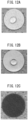
- the state of the droplet after a lapse of 10 minutes from dropping is shown in FIG. 12A .
- a separator according to Comparative Example 2 was obtained by coating the cellulose-based nonwoven fabric according to Comparative Example 1, with a strontium fluoride (SrF 2 ) powder.
- the aqueous electrolyte solution was dropped onto the surface of the separator and the contact angle of the droplet was measured in the same manner as in Comparative Example 1. The results are shown in Table 1 below.
- the state of the droplet after a lapse of 10 minutes from dropping is shown in FIG. 12B .
- a separator according to Example 1 was obtained by coating the cellulose-based nonwoven fabric according to Comparative Example 1, with a magnesium pyrophosphate (Mg 2 P 2 O 7 ) powder.
- the aqueous electrolyte solution was dropped onto the surface of the separator and the contact angle of the droplet was measured in the same manner as in Comparative Example 1. The results are shown in Table 1 below.
- the state of the droplet after a lapse of 10 minutes from dropping is shown in FIG. 12C .
- a separator according to Example 2 was obtained by coating the cellulose-based nonwoven fabric according to Comparative Example 1, with a magnesium hydroxide (Mg(OH) 2 ) powder.
- the aqueous electrolyte solution was dropped onto the surface of the separator and the contact angle of the droplet was measured in the same manner as in Comparative Example 1. The results are shown in Table 1 below.
- a separator according to Example 3 was obtained by coating the cellulose-based nonwoven fabric according to Comparative Example 1, with a titanium oxide (TiO 2 ) powder.
- the aqueous electrolyte solution was dropped onto the surface of the separator and the contact angle of the droplet was measured in the same manner as in Comparative Example 1. The results are shown in Table 1 below.
- a separator according to Example 4 was obtained by coating the cellulose-based nonwoven fabric according to Comparative Example 1, with a zirconium hydroxide (Zr(OH) 4 ) powder.
- the aqueous electrolyte solution was dropped onto the surface of the separator and the contact angle of the droplet was measured in the same manner as in Comparative Example 1. The results are shown in Table 1 below.
- a phosphoric acid ester-based surfactant (manufactured by Tokyo Chemical Industry Co., Ltd., mixture of phosphoric acid 2-ethylhexyl monoester and diester) was added to ethanol at a concentration of 1% by weight, thereby providing a treatment liquid.
- the cellulose-based nonwoven fabric according to Comparative Example 1 was brought into contact with the resulting treatment liquid and then dried to allow the surfactant to be attached to the nonwoven fabric, thereby providing a separator according to Example 5.
- the aqueous electrolyte solution was dropped onto the surface of the separator and the contact angle of the droplet was measured in the same manner as in Comparative Example 1. The results are shown in Table 1 below.
- a porous film made of polypropylene was prepared as a separator according to Comparative Example 3.
- the aqueous electrolyte solution was dropped onto the surface of the separator and the contact angle of the droplet was measured in the same manner as in Comparative Example 1. The results are shown in Table 1 below.
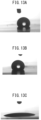
- the state of the droplet after a lapse of 10 minutes from dropping is shown in FIG. 13A .
- a fluorine-based surfactant was added to ethanol at a concentration of 1% by weight, thereby providing a treatment liquid.
- the same porous film made of polypropylene as that in Comparative Example 3 was immersed in the resulting treatment liquid for 5 minutes. After immersion, washing with ultrapure water and then air drying were carried out, and a separator according to Comparative Example 4 was obtained.
- the aqueous electrolyte solution was dropped onto the surface of the separator and the contact angle of the droplet was measured in the same manner as in Comparative Example 1. The results are shown in Table 1 below.
- the state of the droplet after a lapse of 10 minutes from dropping is shown in FIG. 13B .
- a separator according to Example 6 was obtained by treating a porous film made of polypropylene in the same manner as in Comparative Example 4 except that a phosphoric acid ester-based surfactant (manufactured by Tokyo Chemical Industry Co., Ltd., a mixture of phosphoric acid 2-ethylhexyl monoester and diester) was added to ethanol at a concentration of 1% by weight, thereby providing a treatment liquid.
- aqueous electrolyte solution was dropped onto the surface of the separator and the contact angle of the droplet was measured in the same manner as in Comparative Example 1. The results are shown in Table 1 below.
- the state of the droplet after a lapse of 10 minutes from dropping is shown in FIG. 13C .
- a separator according to Example 7 was obtained by coating the porous film made of polypropylene according to Comparative Example 3, with a magnesium pyrophosphate (Mg 2 P 2 O 7 ) powder.
- the aqueous electrolyte solution was dropped onto the surface of the separator and the contact angle of the droplet was measured in the same manner as in Comparative Example 1. The results are shown in Table 1 below.
- a separator according to Example 8 was obtained by coating the porous film made of polypropylene according to Comparative Example 3, with a calcium pyrophosphate (Ca 2 P 2 O 7 ) powder.
- the aqueous electrolyte solution was dropped onto the surface of the separator and the contact angle of the droplet was measured in the same manner as in Comparative Example 1. The results are shown in Table 1 below.
- a separator according to Example 9 was obtained by coating the porous film made of polypropylene according to Comparative Example 3, with a strontium titanate (SrTiO 3 ) powder.
- the aqueous electrolyte solution was dropped onto the surface of the separator and the contact angle of the droplet was measured in the same manner as in Comparative Example 1. The results are shown in Table 1 below.
- a separator according to Example 10 was obtained by coating the porous film made of polypropylene according to Comparative Example 3, with a calcium sulfate (CaSO 4 ) powder.
- the aqueous electrolyte solution was dropped onto the surface of the separator and the contact angle of the droplet was measured in the same manner as in Comparative Example 1. The results are shown in Table 1 below.
- Table 1 shows the measurement results of the contact angle of the aqueous electrolyte solution on the separator surface in each of Examples and Comparative Examples above.
- Table 1 Type of separator Treatment substance Contact angle (immediately after dropping) Contact angle (after 10 minutes) Comparative Example 1 Nonwoven fabric None 125° 117° Comparative Example 2 Nonwoven fabric SrF2 132° 113° Example 1 Nonwoven fabric Mg 2 P 2 O 7 86° 0° Example 2 Nonwoven fabric Mg(OH)2 135° 0° Example 3 Nonwoven fabric TiO2 138° 0° Example 4 Nonwoven fabric Zr(OH)4 108° 0° Example 5 Nonwoven fabric Phosphoric acid ester-based surfactant 0° 0° Comparative Example 3 PP film None 128° 123° Comparative Example 4 PP film Fluorine-based surfactant 138° 129° Example 6 PP film Phosphoric acid ester-based surfactant 45° 30°
- Example 7 PP film Mg 2 P 2 O 7
- a separator satisfying the following requirement can allow the aqueous electrolyte solution to easily penetrate into the inside of the separator.
- At least one element constituting the separator is the same in type as at least one element constituting the anion of the potassium salt dissolved in the aqueous electrolyte solution.
- the inventors have carried out the same experiment with various treatment substances other than those in Examples and Comparative Examples.
- the aqueous electrolyte solution can be allowed to gradually penetrate into the inside of the separator.
- the aqueous electrolyte solution can be allowed to penetrate into the separator also in Comparative Example 2 above, although a long time is taken.
- the treatment substance in Comparative Example 2 can be used as long as time requirements in aqueous battery production are small.
- the contact angle ⁇ 1 of a droplet after a lapse of 10 minutes from dropping of the aqueous electrolyte solution onto the separator is less than 115° and the ratio ⁇ 1 / ⁇ 2 of the contact angle ⁇ 1 after a lapse of 10 minutes to the contact angle ⁇ 2 immediately after dropping (within 30 seconds) is 0.90 or less.
- the separator satisfying the above-mentioned requirement (C) allows the following requirement (D-2) to be easily satisfied and allows the aqueous electrolyte solution to penetrate into the separator in a short time.
- D-2) The contact angle ⁇ 1 after a lapse of 10 minutes from dropping of the aqueous electrolyte solution onto the separator is 0°.
- a Ni foil was used for each of a working electrode and a counter electrode, an aqueous solution of 1, 3 or 5 mol/kg K 2 P 2 O 7 was used as an electrolyte solution, and any of the following (I) to (III) was used as a separator in an electrochemical cell (SB8, manufactured by EC FRONTIER CO., LTD.).
- the resistance of the electrochemical cell was measured at a temperature of 25°C in a voltage range of ⁇ 10 mV and a frequency range of 1-1 MHz. The same experiment was carried out with the changes in type of the separator and in concentration of the aqueous electrolyte solution. Table 2 below shows the type of the separator, the concentration of the aqueous electrolyte solution, and the resistance value of the electrochemical cell.
Landscapes
- Chemical & Material Sciences (AREA)
- Chemical Kinetics & Catalysis (AREA)
- Electrochemistry (AREA)
- General Chemical & Material Sciences (AREA)
- Engineering & Computer Science (AREA)
- Manufacturing & Machinery (AREA)
- Secondary Cells (AREA)
Description
- The present application discloses an aqueous battery including an aqueous electrolyte solution.
-
-
PTL 1 discloses an aqueous electrolyte solution for aqueous batteries, which includes water and potassium pyrophosphate dissolved at a concentration of 2 mol or more per 1 kg of the water. -
Ptl 2 discloses aqueous battery comprising an aqueous electrolyte solution comprising K4P2O7 and a separator selected from e.g. cellophane, polyvinylchloride, acrylonitrile, and microporous polypropylene. -
- If an aqueous electrolyte solution contains a potassium salt at a high concentration, various advantageous effects such as an expansion of a potential window can be exerted. Meanwhile, according to the inventors' new knowledge, an aqueous electrolyte solution, if contains a potassium salt at a high concentration, is deteriorated in wettability of the aqueous electrolyte solution to a separator and thus is difficult to penetrate into the separator.
- The present application discloses, as the aforementioned solution to problem, a plurality of aspects below.
- An aqueous battery including a positive electrode, an aqueous electrolyte solution, a separator, and a negative electrode, wherein
- the aqueous electrolyte solution contains water and a potassium salt dissolved in the water,
- the aqueous electrolyte solution has no freezing point at -60°C or higher, and
- at least one element constituting the separator is the same in type as at least one element constituting an anion of the potassium salt.
- The aqueous battery according to
aspect 1, wherein - the potassium salt includes a phosphoric acid salt (phosphate), and
- the separator has a phosphoric acid group or a hydroxyl group.
- The aqueous battery according to
aspect 2, wherein
the potassium salt includes a pyrophosphoric acid salt. - The aqueous battery according to any one of
aspects 1 to 3, wherein - the separator includes a base material and an affinity substance attached to the base material, the base material is a nonwoven fabric or a porous film, and
- at least one element constituting the affinity substance is the same in type as at least one element constituting an anion of the potassium salt.
- The aqueous battery according to
aspect 4, wherein - the potassium salt includes a phosphoric acid salt, and
- the affinity substance has a phosphoric acid group or a hydroxyl group.
- The aqueous battery according to aspect 5, wherein
the affinity substance includes magnesium phosphate. - The aqueous battery according to
aspect 5 or 6, wherein
the affinity substance includes a phosphoric acid ester. - The aqueous battery according to any one of
aspects 1 to 7, wherein
the aqueous electrolyte solution includes the potassium salt dissolved at a concentration of 4.0 mol or more and 7.0 mol or less per 1 kg of the water. - The aqueous battery according to any one of
aspects 1 to 8, wherein - the aqueous electrolyte solution contains the water and potassium ions,
- a molar ratio (H2O/K) of the water to the potassium ions is 3.5 or less, and
- the aqueous electrolyte solution contains the water and potassium pyrophosphate dissolved in the water.
- The aqueous battery according to any one of
aspects 1 to 9, wherein
a pH of the aqueous electrolyte solution is 3 or more and 13 or less. - The aqueous battery according to any one of
aspects 1 to 10, wherein
the aqueous electrolyte solution does not involve salt precipitation when cooled from 0°C to - 60°C. - The aqueous battery according to any one of
aspects 1 to 11, wherein
a viscosity at 20°C of the aqueous electrolyte solution is 10 mPa·s or more and 600 mPa·s or less. - In the aqueous battery of the present disclosure, wettability of the aqueous electrolyte solution to the separator is improved, and the aqueous electrolyte solution appropriately penetrates into the separator. As a result, an ionic conduction path between the positive electrode and the negative electrode is appropriately kept, and battery performance is enhanced.
-
-
FIG. 1 schematically shows an example of a structure of an aqueous battery. -
FIG. 2 schematically shows an example of a structure of an aqueous battery. -
FIG. 3 shows a time-potential curve when a 0.5 m aqueous electrolyte solution is used in an electrochemical cell and a constant current on the oxidation side is applied. -
FIG. 4 shows a time-potential curve when a 5.0 m aqueous electrolyte solution is used in an electrochemical cell and a constant current on the oxidation side is applied. -
FIG. 5 shows a time-potential curve when a 1.0 m aqueous electrolyte solution is used in an electrochemical cell and a constant current on the reduction side is applied. -
FIG. 6 shows a time-potential curve when a 5.0 m aqueous electrolyte solution is used in an electrochemical cell and a constant current on the reduction side is applied. -
FIG. 7 shows a charge-discharge curve of a cell for evaluation. -
FIG. 8A is a graph showing the relationship between the concentration and the crystallization peak temperature (freezing point) of an aqueous electrolyte solution. -
FIG. 8B is a graph showing the relationship between the concentration and the crystallization peak intensity of an aqueous electrolyte solution. -
FIG. 9 is a graph showing the relationship between the concentration and the glass transition temperature of an aqueous electrolyte solution. -
FIG. 10 is a graph showing the relationship between the concentration and the viscosity of an aqueous electrolyte solution. -
FIG. 11 shows the relationship between the concentration of K4P2O7 in an aqueous electrolyte solution and the contact angle of the aqueous electrolyte solution on the surface of a cellulose-based nonwoven fabric. -
FIG. 12A shows the state of a droplet after a lapse of 10 minutes from dropping of an aqueous electrolyte solution on the surface of a separator in Comparative Example 1. -
FIG. 12B shows the state of a droplet after a lapse of 10 minutes from dropping of an aqueous electrolyte solution on the surface of a separator in Comparative Example 2. -
FIG. 12C shows the state of a droplet after a lapse of 10 minutes from dropping of an aqueous electrolyte solution on the surface of a separator in Example 1. -
FIG. 13A shows the state of a droplet after a lapse of 10 minutes from dropping of an aqueous electrolyte solution on the surface of a separator in Comparative Example 3. -
FIG. 13B shows the state of a droplet after a lapse of 10 minutes from dropping of an aqueous electrolyte solution on the surface of a separator in Comparative Example 4. -
FIG. 13C shows the state of a droplet after a lapse of 10 minutes from dropping of an aqueous electrolyte solution on the surface of a separator in Example 6. -
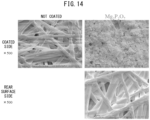
FIG. 14 shows SEM images of respective separators according to Comparative Example 1 and Example 1. - The aqueous battery according to the embodiment will be described below with reference to the drawings, but the technology of the present disclosure is not limited to the following embodiments.
FIG. 1 schematically shows a structure of anaqueous battery 100 according to one embodiment. As shown inFIG. 1 , theaqueous battery 100 includes apositive electrode 10, anaqueous electrolyte solution 20, aseparator 30, and anegative electrode 40. Theaqueous electrolyte solution 20 contains water and a potassium salt dissolved in the water. Theaqueous electrolyte solution 20 has no freezing point at -60°C or higher. At least one element constituting theseparator 30 is the same in type as at least one element constituting the anion of the potassium salt. - It is possible to use, as the
positive electrode 10, any known positive electrode for an aqueous battery. As shown inFIG. 1 , thepositive electrode 10 may include a positive electrodeactive material layer 11 and a positive electrodecurrent collector 12. - The positive electrode
active material layer 11 contains a positive electrode active material. The positive electrodeactive material layer 11 can be impregnated with theaqueous electrolyte solution 20. The positive electrodeactive material layer 11 may contain, in addition to the positive electrode active material, various additives and/or the like such as a conductive aid and/or a binder. The content of each component in the positive electrodeactive material layer 11 may be appropriately determined according to the objective battery performance. For example, the content of the positive electrode active material may be 40% by mass or more, 50% by mass or more, 60% by mass or more, or 70% by mass or more, and may be 100% by mass or less or 90% by mass or less, based on 100% by mass of the entire positive electrode active material layer 11 (total solid content). The shape of the positive electrodeactive material layer 11 is not particularly limited, and the positive electrode active material layer may be, for example, a sheet-shaped positive electrode active material layer having an approximately flat surface. The thickness of the positive electrodeactive material layer 11 is not particularly limited, and may be, for example, 0.1 µm or more, 1 µm or more, or 10 µm or more, and may be 2 mm or less, 1 mm or less, or 500 µm or less. - Any substance capable of functioning as the positive electrode active material of the aqueous battery can be used as the positive electrode active material. The charge-discharge potential of the positive electrode active material is higher than that of the below-mentioned negative electrode active material. The type of the positive electrode active material can be appropriately selected in consideration of the type of carrier ions and the potential window and the like of the
aqueous electrolyte solution 20. The positive electrode active material may be one which inserts and deinserts carrier ions by intercalation, or which inserts and deinserts carrier ions by a conversion reaction or an alloying reaction. The "carrier ion" may be, for example, a proton (H+), a hydroxide ion (OH-), a potassium ion (K+), or another cation or anion. Only one positive electrode active material may be used alone, or two or more thereof may be used in combination. - The positive electrode active material may be hydroxides or oxides such as Ni(OH)2 being a layered nickel hydroxide compound (e.g.,
JPA 2023-154313 JPA 2023-132287 - The shape of the positive electrode active material may be any shape capable of functioning as the positive electrode active material of the battery. For example, the positive electrode active material may be in the form of particles. The positive electrode active material may be a solid material, a hollow material, a material with voids, or a porous material. The positive electrode active material may be a primary particle, or a secondary particle obtained by agglomeration of a plurality of primary particles. The mean particle diameter D50 of the positive electrode active material may be, for example, 1 nm or more, 5 nm or more, or 10 nm or more, and may be 500 µm or less, 100 µm or less, 50 µm or less, or 30 µm or less. The mean particle diameter D50 in the present application is the particle diameter (median diameter) at 50% of the integrated value in the volume-based particle diameter distribution determined by the laser diffraction and scattering method.
- Examples of the conductive aid which can be included in the positive electrode
active material layer 11 include carbon materials such as vapor-phase-grown carbon fiber (VGCF), acetylene black (AB), Ketjen black (KB), carbon nanotube (CNT) and carbon nanofiber (CNF); and metal materials such as nickel, titanium, aluminum, stainless steel and the like which are slightly insoluble (poorly soluble) in an aqueous electrolyte solution. The conductive aid may be, for example, in the form of particles or fibers, and the size thereof is not particularly limited. Only one conductive aid may be used alone, or two or more thereof may be used in combination. - Examples of the binder which can be included in the positive electrode
active material layer 11 include butadiene rubber (BR)-based binders, butylene rubber (IIR)-based binders, acrylate-butadiene rubber (ABR)-based binders, styrene-butadiene rubber (SBR)-based binders, polyvinylidene fluoride (PVdF)-based binders, polytetrafluoroethylene (PTFE)-based binders, polyimide (PI)-based binders and the like. Only one binder may be used alone, or two or more thereof may be used in combination. - As shown in
FIG. 1 , thepositive electrode 10 may include a positive electrodecurrent collector 12 in contact with the positive electrodeactive material layer 11. The positive electrodecurrent collector 12 may be in contact with theaqueous electrolyte solution 20. It is possible to use, as the positive electrodecurrent collector 12, any material capable of functioning as the positive electrode current collector of the aqueous battery. The positive electrodecurrent collector 12 may be in the form of foil, plate, mesh, perforated metal and foam. The positive electrodecurrent collector 12 may be formed of a metal foil or a metal mesh. In particular, the metal foil is excellent in ease of handling or the like. The positive electrodecurrent collector 12 may be composed of a plurality of foils. Examples of the metal material constituting the positive electrodecurrent collector 12 include those containing at least one element selected from the group consisting of Cu, Ni, Al, V, Au, Pt, Mg, Fe, Ti, Pb, Co, Cr, Zn, Ge, In, Sn, and Zr. In particular, the positive electrodecurrent collector 12 preferably contains Al. In theaqueous battery 100, even when the positive electrodecurrent collector 12 contains Al, the Al hardly elutes into theaqueous electrolyte solution 20. The positive electrodecurrent collector 12 may be one in which the above metal is plated or vapor-deposited on a metal foil or a base material. When the positive electrodecurrent collector 12 is composed of a plurality of metal foils, the positive electrode current collector may have some layer between the plurality of metal foils. The thickness of the positive electrodecurrent collector 12 is not particularly limited, and may be, for example, 0.1 µm or more or 1 µm or more, and may be 1 mm or less or 100 µm or less. - The
aqueous electrolyte solution 20 contains water and a potassium salt dissolved in the water. Theaqueous electrolyte solution 20 may be held between thepositive electrode 10 and thenegative electrode 40 by theseparator 30. Theaqueous electrolyte solution 20 may be in contact with the above-mentioned positive electrodecurrent collector 12, may be included in the above-mentioned positive electrodeactive material layer 11, may be in contact with the below-mentioned negative electrodecurrent collector 42, or may be included in the below-mentioned negative electrodeactive material layer 41. - The
aqueous electrolyte solution 20 contains water as a solvent. The solvent contains water as a main component. Namely, water accounts for 50 mol% or more and 100 mol% or less of the total amount of solvent constituting the aqueous electrolyte solution 20 (100 mol%). Water may account for 70 mol% or more, 90 mol% or more, or 95 mol% or more of the total amount of the solvent. Meanwhile, the upper limit of the proportion of water in the solvent is not particularly limited. The solvent may be composed only of water (100 mol% water). - The
aqueous electrolyte solution 20 may contain, in addition to water, solvents other than water, for example, from the viewpoint of forming solid electrolyte interphase (SEI) on the surface of the active material. Examples of solvents other than water include one or more organic solvents selected from ethers, carbonates, nitriles, alcohols, ketones, amines, amides, sulfur compounds and hydrocarbons. The solvents other than water may account for 50 mol% or less, 30 mol% or less, 10 mol% or less, or 5 mol% or less of the total amount of solvents constituting the aqueous electrolyte solution 20 (100 mol%). - The
aqueous electrolyte solution 20 contains a potassium salt dissolved in water. The potassium salt may be any salt capable of being dissolved in water. For example, the potassium salt may be at least one selected from KPF6, KBF4, K2SO4, KNO3, CH3COOK, (CF3SO2)2NK, KCF3SO3, (FSO2)2NK, K2HPO4, KH2PO4, KPO3, K4P2O7, K5P3O10, K6P4O13, K7P5O16, (KPO3)n, and the like. According to the inventors' new findings, the performance of theaqueous battery 100 is further easily enhanced when the potassium salt includes a phosphoric acid salt or an acetic acid salt, particularly, a phosphoric acid salt, further particularly a polyphosphoric acid salt, in particular, a pyrophosphoric acid salt (potassium pyrophosphate, K4P2O7). - The potassium salt in the
aqueous electrolyte solution 20 may dissociate into potassium ions and anions. In theaqueous electrolyte solution 20, potassium ions may completely dissociate from anions, or may form aggregates (associations), for example, in close proximity to anions. For example, when theaqueous electrolyte solution 20 contains potassium pyrophosphate dissolved in water, "potassium pyrophosphate dissolved in water" in theaqueous electrolyte solution 20 may be present as ions such as K+, P2O7 4-, KP2O7 3-, K2P2O7 2-, and K3P2O7 -, or aggregates (associations) of these ions. - In the
aqueous battery 100, the components and concentration in theaqueous electrolyte solution 20 are determined so that "aqueous electrolyte solution 20 has no freezing point at -60°C or higher". According to the inventors' new findings, in order to achieve the conditions that "aqueous electrolyte solution 20 has no freezing point at -60°C or higher", the concentration of the potassium salt in theaqueous electrolyte solution 20 should be higher than ever before. For example, according to the inventors' new knowledge, when the freezing point is adjusted by dissolving only the potassium salt in water in theaqueous electrolyte solution 20, the freezing point of theaqueous electrolyte solution 20 decreases as the concentration of the potassium salt in water increases, and when the concentration of the potassium salt in theaqueous electrolyte solution 20 reaches a certain level or more, the freezing point substantially disappears. Namely, when the concentration of the potassium salt in theaqueous electrolyte solution 20 is in a certain level or more, theaqueous electrolyte solution 20 has no freezing point at -60°C or higher. For example, when theaqueous electrolyte solution 20 contains the potassium salt dissolved at a concentration of 4.0 mol or more per 1 kg of water,aqueous electrolyte solution 20 easily has no freezing point at -60°C or higher. However, when a plurality of kinds of the potassium salts is dissolved in theaqueous electrolyte solution 20 or when other components are dissolved together with the potassium salt in water, the minimum concentration of the potassium salt at which the freezing point of the aqueous electrolyte solution disappears may be less than 4.0 mol. In this respect, the concentration of the potassium salt per 1 kg of water in theaqueous electrolyte solution 20 may be, for example, 2.5 mol or more, 3.0 mol or more, 3.5 mol or more, or 4.0 mol or more. The upper limit of the concentration is not particularly limited. For example, the concentration of the potassium salt per 1 kg of water may be 7.0 mol or less or 6.0 mol or less. - As mentioned above, in the
aqueous electrolyte solution 20, the freezing point of the aqueous electrolyte solution decreases as the concentration of the potassium salt in water increases, and when the concentration of the potassium salt in the aqueous electrolyte solution reaches a certain level or more, the freezing point substantially disappears. According to the inventors' new findings, as the concentration of the potassium salt in theaqueous electrolyte solution 20 is higher, the potential window of theaqueous electrolyte solution 20 more easily expands. As the concentration is higher, elution of the current collector into theaqueous electrolyte solution 20 is more easily suppressed. Meanwhile, as the concentration is lower, the viscosity of theaqueous electrolyte solution 20 is smaller. In consideration of these, theaqueous electrolyte solution 20 may be, for example, one containing the potassium salt dissolved at a concentration of 2.5 mol or more and 7.0 mol or less, 3.0 mol or more and 7.0 mol or less, 3.5 mol or more and 7.0 mol or less, or 4.0 mol or more and 7.0 mol or less per 1 kg of the water. - In one embodiment, the
aqueous electrolyte solution 20 may contain water and potassium pyrophosphate dissolved at a certain concentration or more per 1 kg of the water. The concentration of the potassium pyrophosphate may be, for example, 2.5 mol or more, 3.0 mol or more, 3.5 mol or more, or 4.0 mol or more per 1 kg of the water. The upper limit of the concentration of the potassium pyrophosphate in theaqueous electrolyte solution 20 is not particularly limited, and if the concentration is excessively high, the viscosity of theaqueous electrolyte solution 20 may increase excessively. In this respect, the concentration of the potassium pyrophosphate may be 7.0 mol or less or 6.0 mol or less per 1 kg of the water. According to the inventors' new knowledge, when theaqueous electrolyte solution 20 contains water and the potassium pyrophosphate dissolved at a concentration of 4.0 mol or more per 1 kg of the water, not only theaqueous electrolyte solution 20 has no freezing point at -60°C or higher, but also the performance of theaqueous battery 100 is further enhanced. When theaqueous electrolyte solution 20 contains the potassium pyrophosphate dissolved in the water, not only the potassium pyrophosphate, but also other electrolytes may be contained. In this case, the potassium pyrophosphate may account for 50 mol% or more and 100 mol% or less, 70 mol% or more and 100 mol% or less, or 90 mol% or more and 100 mol% or less, and other electrolytes may account for 0 mol% or more and 50 mol% or less, 0 mol% or more and 30 mol% or less, or 0 mol% or more and 10 mol% or less, of the total amount of electrolytes (100 mol%) dissolved in theaqueous electrolyte solution 20. - According to the inventors' new findings, also when the
aqueous electrolyte solution 20 contains water and potassium ions, and the molar ratio (H2O/K) of the water to the potassium ions is 3.5 or less and theaqueous electrolyte solution 20 contains the water and potassium pyrophosphate dissolved in the water, theaqueous electrolyte solution 20 easily has no freezing point at -60°C or higher. Here, "potassium ions" are those at least partially derived from the potassium pyrophosphate. As mentioned above, "potassium ions" may form aggregates (associations), for example, in close proximity to anions. The molar ratio of the water to the potassium ions in theaqueous electrolyte solution 20 may be easily specified by measuring the amount of the water and the amount of K dissolved and present in the water. - Ions, aggregates (associations), and the like contained in the
aqueous electrolyte solution 20 can be converted into the potassium salt, thereby specifying "concentration of potassium salt dissolved in water". Here, theaqueous electrolyte solution 20 may contain more potassium ions than the concentration which can be converted as the potassium salt. In other words, it is not necessary for the entire potassium ions contained in theaqueous electrolyte solution 20 to be converted as "dissolved potassium salt". For example, when a potassium compound (for example, KOH) other than the potassium salt is dissolved together with the potassium salt in theaqueous electrolyte solution 20, theaqueous electrolyte solution 20 may contain more potassium ions than the concentration which can be converted as the potassium salt. Theaqueous electrolyte solution 20 may contain more anions than the concentration which can be converted as the potassium salt. In other words, it is not necessary for the entire anions contained in theaqueous electrolyte solution 20 to be converted as "dissolved potassium salt". For example, when theaqueous electrolyte solution 20 contains pyrophosphate ions (it may be P2O7 4- and it may be present in a state of being linked to cations as mentioned above, such as KP2O7 3-, K2P2O7 2-, K3P2O7 -, etc.) as anions and also pyrophosphate ion sources (for example, H4P2O7, etc.) other than K4P2O7 are dissolved together with K4P2O7 in theaqueous electrolyte solution 20, theaqueous electrolyte solution 20 may contain more pyrophosphate ions than the concentration which can be converted as potassium pyrophosphate. Meanwhile, also when potassium ion sources (for example, KOH) other than the potassium salt and anion sources (for example, H4P2O7) other than the potassium salt are dissolved in water and dissociate into potassium ions and anions in theaqueous electrolyte solution 20, the potassium ions and anions are converted as "potassium salt dissolved in water". - The
aqueous electrolyte solution 20 may contain a plurality of kinds of cations and a plurality of kinds of anions. For example, theaqueous electrolyte solution 20 may include not only potassium ions protons and/or hydroxide ions as carrier ions and phosphate ions as anions, but also other cations and anions. For example, alkali metal ions other than potassium ions, and alkaline earth metal ions, transition metal ions, and the like may be contained. Theaqueous electrolyte solution 20 may contain an acid, a hydroxide and the like for pH adjustment. Theaqueous electrolyte solution 20 may contain various additives. - The pH of the
aqueous electrolyte solution 20 is not particularly limited. However, if the pH is too high, the potential window on the oxidation side of theaqueous electrolyte solution 20 may be narrow. In this respect, the pH of theaqueous electrolyte solution 20 may be 3 or more and 14 or less. The pH may be 4 or more, 5 or more, 6 or more, or 7 or more, and may be 13 or less, or 12 or less. - As mentioned above, the
aqueous electrolyte solution 20 has no freezing point at -60°C or higher. This means that H2O molecules cannot form a network of crystallization with each other in theaqueous electrolyte solution 20, namely, few freezable free H2O molecules are present in theaqueous electrolyte solution 20. When theaqueous electrolyte solution 20, which contains few freezable free H2O molecules, is used in theaqueous battery 100, elution of the current collector into theaqueous electrolyte solution 20 can be suppressed. When theaqueous electrolyte solution 20 has no freezing point at -60°C, it is also possible to use theaqueous battery 100 even at extremely low temperature. Namely, theaqueous battery 100 appropriately operates even in cold district. Theaqueous electrolyte solution 20 may have no freezing point at -80°C or higher, no freezing point at -100°C or higher, or no freezing point at -120°C or higher. In order to achieve the conditions that "aqueous electrolyte solution 20 has no freezing point - 60°C or higher", it is effective to, as mentioned above, allow the concentration of the potassium salt in theaqueous electrolyte solution 20 to be a high concentration (for example, dissolve the potassium salt (in particular, potassium pyrophosphate) at a high concentration of 4.0 mol or more per 1 kg of water, etc.). As far as the present inventor has confirmed, the same effect can be ensured even when theaqueous electrolyte solution 20 has no freezing point at - 40°C or higher. - The presence or absence of "freezing point" of the
aqueous electrolyte solution 20 is confirmed by differential scanning calorimetry (DSC). Note that the DSC sweep rate is set at 5°C/min for both descending temperature and ascending temperature, and the sweep range is set as follows: temperature descending to -120°C from room temperature, followed by temperature ascending to 40°C. The atmosphere in DSC is an atmosphere of inert gas such as Ar, and the pressure is equal to the atmospheric pressure. However, since a sealed aluminum container is used for the evaluation, the atmosphere inside the container is the sealed atmosphere under atmospheric pressure. If the crystallization peak temperature (freezing point temperature) is not confirmed at - 60°C or higher when the aqueous electrolyte solution is measured under the above conditions, the aqueous electrolyte solution is considered to have "no freezing point at -60°C or higher". - It is preferable that the
aqueous electrolyte solution 20 does not involve salt precipitation when cooled from 0°C to -60°C. Thus, when theaqueous electrolyte solution 20 does not involve salt precipitation due to temperature change, it becomes possible to perform stable ionic conduction even at low temperature. For example, theaqueous battery 100 can be used even at extremely low temperature in cold district. Theaqueous electrolyte solution 20 may include water and potassium pyrophosphate dissolved in the water, as mentioned above. Here, according to the inventors' new findings, the saturation solubility of potassium pyrophosphate in water has low temperature dependence and scarcely changes at low temperature of 0°C or lower. In this respect, even if potassium pyrophosphate is dissolved in theaqueous electrolyte solution 20 at 0°C at high concentration (for example, high concentration of 4.0 mol or more per 1 kg of water) and theaqueous electrolyte solution 20 is cooled from 0°C to -60°C, precipitation of potassium pyrophosphate does not substantially occur in theaqueous electrolyte solution 20. Herein, "presence or absence of precipitation of salt" in the case of cooling from 0°C to -60°C can be determined by, for example, DSC. Namely, when differential heat due to salt precipitation or crystallization is not exhibited in cooling of the aqueous electrolyte solution from 0°C to -60°C, the aqueous electrolyte solution is considered to "not involve salt precipitation when cooled from 0°C to -60°C". - If the viscosity of the
aqueous electrolyte solution 20 is too high, the ionic conductivity of theaqueous electrolyte solution 20 may deteriorate. Meanwhile, if an electrolyte is dissolved at high concentration in theaqueous electrolyte solution 20, theaqueous electrolyte solution 20 may have a certain level or more of the viscosity. In this respect, theaqueous electrolyte solution 20 may have a viscosity of 10 mPa·s or more and 600 mPa·s or less at 20°C. The viscosity may be 15 mPa·s or more, 20 mPa·s or more, 30 mPa·s or more, or 40 mPa·s or more, and may be 500 mPa·s or less, 400 mPa·s or less, 300 mPa·s or less, 250 mPa·s or less, or 200 mPa·s or less. - The
aqueous battery 100 includes aseparator 30. Theseparator 30 is provided between thepositive electrode 10 and thenegative electrode 40. Theseparator 30 retains the above-mentionedaqueous electrolyte solution 20. - As mentioned above, the
aqueous electrolyte solution 20 has no freezing point at -60°C or higher. This means that H2O molecules cannot form a network of crystallization with each other in theaqueous electrolyte solution 20, namely, few freezable free H2O molecules are present in theaqueous electrolyte solution 20. More specifically, it is considered that an anion network structure called Water-in-salt is formed in theaqueous electrolyte solution 20 and a network of H2O molecules disappears. According to the inventors' new findings, the affinity with the separator, of theaqueous electrolyte solution 20 having no freezing point at -60°C or higher, is largely different from that of a conventional aqueous electrolyte solution having a freezing point at -60°C or higher. Specifically, theaqueous electrolyte solution 20 is poor in wettability to a conventional separator including a nonwoven fabric or a porous film, and hardly penetrates into such a conventional separator. Namely, when an aqueous battery is formed with such a conventional separator together with theaqueous electrolyte solution 20, no ionic conduction path between a positive electrode and a negative electrode may be appropriately formed. - In order to solve the above problems, the
separator 30 used in theaqueous battery 100 of the present disclosure is one high in affinity with theaqueous electrolyte solution 20. As mentioned above, it is considered that an anion network structure called Water-in-salt is formed in theaqueous electrolyte solution 20. Therefore, it is important for increasing the affinity of theseparator 30 with theaqueous electrolyte solution 20 that theseparator 30 has "anionphilicity". Specifically, it is important for at least one element constituting theseparator 30 to be the same in type as at least one element constituting the anion of the potassium salt dissolved in theaqueous electrolyte solution 20. In other words, element(s) constituting theseparator 30 include(s) the same type of element as at least one element constituting the anion of the potassium salt dissolved in theaqueous electrolyte solution 20. Theseparator 30 high in affinity with the anion of the potassium salt dissolved in theaqueous electrolyte solution 20 is thus used in theaqueous battery 100, and therefore the wettability of theaqueous electrolyte solution 20 to theseparator 30 is improved, theaqueous electrolyte solution 20 can be allowed to appropriately penetrate into theseparator 30, and the ionic conduction path between thepositive electrode 10 and thenegative electrode 40 is appropriately easily ensured. - "Element which is the same in type as at least one element constituting the anion of the potassium salt" (hereinafter, sometimes referred to as "element X") among the element(s) constituting the
separator 30 may be present in the surface (front surface) of theseparator 30, may be present in the inside of theseparator 30, or may be present in both the surface and the inside. The element X may be present in only one face of the separator 30 (for example, facing the positive electrode 10), may be present in only other face of the separator 30 (for example, facing the negative electrode 40), or may be present in both one face and other face thereof. In particular, when the element X is present in both one face and other face of theseparator 30, much higher performance is easily obtained. - The type of the element X depends on the type of the anion of the potassium salt. For example, the element X may be at least one element among P, S, and O. Alternatively, the element X may be at least one element other than H and O. Alternatively, the element X may be at least one element other than H and O, and one of or both H and O, in addition to the element X, may be contained as element(s) constituting the separator.
- For example, when the potassium salt dissolved in the
aqueous electrolyte solution 20 contains the above-mentioned phosphoric acid salt (preferably pyrophosphoric acid salt), one of or both P and O may be contained as element(s) constituting theseparator 30. Specifically, theseparator 30 may be one having a phosphorus-containing group or an oxygen-containing group, or may be, for example, one having a phosphoric acid group or a hydroxyl group. In one embodiment, theseparator 30 has, for example, a phosphorus-containing group. The phosphoric acid group as the phosphorus-containing group may have, for example, hydrogen substituted by other substituent, as in, for example, an alkylphosphoric acid ester group. The phosphoric acid group may be a polyphosphoric acid group or a pyrophosphoric acid group. - Alternatively, when the potassium salt dissolved in the
aqueous electrolyte solution 20 contains a sulfuric acid salt, one of or both S and O may be contained as element(s) constituting theseparator 30. Specifically, theseparator 30 may be one having a sulfur-containing group or an oxygen-containing group, or may be, for example, one having at least one functional group selected from a sulfo group, a sulfonyl group, a sulfuric acid group and a hydroxyl group. In one embodiment, theseparator 30 has, for example, a sulfur-containing group. The sulfur-containing group may have, for example, hydrogen substituted by other substituent, as in, for example, an alkylsulfuric acid ester group. Alternatively, when the potassium salt dissolved in theaqueous electrolyte solution 20 includes a carboxylic acid salt such as an acetic acid salt, theseparator 30 may contain C, H and O. Specifically, theseparator 30 may contain a carboxyl group. - The element X in the
separator 30 may be contained in a substance attached to a base material constituting theseparator 30. In other words, theseparator 30 may include a base material and an affinity substance attached to the base material, and at least one element constituting the affinity substance may be the same in type as at least one element constituting the anion of the potassium salt. The affinity substance can also be said to be a substance relatively enhancing the wettability of theaqueous electrolyte solution 20 to the separator 30 (relatively decreasing the contact angle of theaqueous electrolyte solution 20 to the separator 30). In other words, the affinity of the affinity substance with theaqueous electrolyte solution 20 is higher than the affinity of the base material with theaqueous electrolyte solution 20. - When the
separator 30 includes a base material and an affinity substance attached to the base material, the base material may be, for example, a nonwoven fabric or a porous film. The nonwoven fabric may include, for example, at least one of cellulose, a resin, and glass. In one embodiment, the nonwoven fabric includes cellulose. The porous film may be one not only containing at least one polymer compound selected from polyethylene (PE), polypropylene (PP), polyester, polyamide, and the like, but also having a plurality of voids. In one embodiment, the porous film includes one of or both polyethylene and polypropylene. The base material may have a monolayer structure or may have a multilayer structure. Examples of the base material of the multilayer structure can include a base material of a two-layer structure of PE/PP, or a base material of a three-layer structure of PP/PE/PP or PE/PP/PE. The base material may be any one as long as it has a shape capable of forming theseparator 30, and may be, for example, one having a thickness of 5 µm or more and 1 mm or less. The base material may be one adopted as a separator in a conventional aqueous battery. In other words, theseparator 30 may be one in which the affinity substance is attached to a conventional separator. - The affinity substance is a substance having affinity with the
aqueous electrolyte solution 20. Specifically, at least one element constituting the affinity substance is the same in type as at least one element constituting the anion of the potassium salt. The element(s) constituting the affinity substance depend(s) on the type of the anion of the potassium salt. - For example, when the potassium salt dissolved in the
aqueous electrolyte solution 20 contains a phosphoric acid salt, the affinity substance may contain one of or both P and O. Specifically, the affinity substance may be one having a phosphorus-containing group or an oxygen-containing group, or may be, for example, one having a phosphoric acid group or a hydroxyl group. In one embodiment, the affinity substance has, for example, a phosphorus-containing group. The phosphoric acid group may have, for example, some hydrogen substituted by other substituent, as in, for example, an alkylphosphoric acid ester group. The phosphoric acid group may be a polyphosphoric acid group (for example, pyrophosphoric acid group). - Alternatively, when the potassium salt dissolved in the
aqueous electrolyte solution 20 contains a sulfuric acid salt, the affinity substance may contain S. Specifically, the affinity substance may be one having a sulfur-containing group or an oxygen-containing group, or may be, for example, one having at least one functional group selected from a sulfo group, a sulfonyl group, a sulfuric acid group and a hydroxyl group. In one embodiment, the affinity substance has, for example, a sulfur-containing group. The sulfur-containing group may have, for example, some hydrogen substituted by other substituent, as in, for example, an alkylsulfuric acid ester group. Alternatively, when the potassium salt dissolved in theaqueous electrolyte solution 20 includes a carboxylic acid salt, the affinity substance may contain a carboxyl group. - The affinity substance may be any one as long as it can keep the state of being attached to the base material in the
aqueous battery 100, and may be an inorganic substance or may be an organic substance. - For example, when the potassium salt dissolved in the
aqueous electrolyte solution 20 contains a phosphoric acid salt, the affinity substance may contain an inorganic compound having P as a constituent element. For example, the affinity substance may contain a salt (phosphoric acid salt of alkaline earth metal) of at least one alkaline earth metal selected from magnesium, calcium, strontium and barium, and phosphoric acid. The phosphoric acid salt of alkaline earth metal may be a polyphosphoric acid salt, or may be a pyrophosphoric acid salt. According to the inventors' new findings, when the potassium salt dissolved in theaqueous electrolyte solution 20 contains a phosphoric acid salt and the affinity substance contains magnesium phosphate, particularly magnesium polyphosphate, further particularly magnesium pyrophosphate, the affinity of theseparator 30 with theaqueous electrolyte solution 20 can be further appropriately enhanced. - Alternatively, when the potassium salt dissolved in the
aqueous electrolyte solution 20 contains a phosphoric acid salt, the affinity substance may contain an organic compound having P as a constituent element. For example, the affinity substance may be an organic phosphoric acid ester. The organic phosphoric acid ester may be an alkylphosphoric acid ester. The alkylphosphoric acid ester may be a monoalkylphosphoric acid ester, may be a dialkylphosphoric acid ester, or may be a mixture thereof. According to the inventors' new findings, when the potassium salt dissolved in theaqueous electrolyte solution 20 contains a phosphoric acid salt and the affinity substance contains a phosphoric acid ester, particularly an alkylphosphoric acid ester, further particularly an alkylphosphoric acid ester having 1 to 10 carbon atoms, the affinity of theseparator 30 with theaqueous electrolyte solution 20 can be further appropriately enhanced. The alkyl group constituting the alkylphosphoric acid ester may be linear or branched. For example, when the affinity substance contains 2-ethylhexyl phosphate, the affinity of theseparator 30 with theaqueous electrolyte solution 20 is further easily increased. - The affinity substance, for example, may be dispersed and present in one of or both the front surface and the inside of the base material, or may be present on the front surface of the base material, in a layered manner. In particular, when the affinity substance is present in both the front and rear surfaces of the base material, more excellent performance is easily exhibited. The amount of the affinity substance attached to the base material is not particularly limited, and may be any amount as long as voids are kept at a level allowing for penetration of the
aqueous electrolyte solution 20 into theseparator 30. The method for attaching the affinity substance to the base material is not particularly limited. For example, the affinity substance may be attached to the base material by bringing the affinity substance into contact with the base material. More specifically, the affinity substance may be attached to the base material by coating the base material with a slurry or solution containing the affinity substance or immersing the base material in a slurry or solution containing the affinity substance, to bring the affinity substance into contact with the base material, and then drying them. - The
separator 30 is not limited to one including the base material and the affinity substance. Theentire separator 30 may be constituted from the affinity substance. It is, however, noted that when theseparator 30 includes the base material and the affinity substance, not only the backbone of theseparator 30 as a whole is easily kept by the base material and theseparator 30 is excellent in ease of handling, but also a conventionally known separator may be used as the base material and thus the cost is low. - It is possible to use, as the
negative electrode 40, any known negative electrode for an aqueous battery. As shown inFIG. 1 , thenegative electrode 40 may include a negative electrodeactive material layer 41 and a negative electrodecurrent collector 42. - The negative electrode
active material layer 41 contains a negative electrode active material. The negative electrodeactive material layer 41 can be impregnated with theaqueous electrolyte solution 20. The negative electrodeactive material layer 41 may contain, in addition to the negative electrode active material, various additives such as a conductive aid and/or a binder. The content of each component in the negative electrodeactive material layer 41 may be appropriately determined according to the objective battery performance. For example, the content of the negative electrode active material may be 40% by mass or more, 50% by mass or more, 60% by mass or more, or 70% by mass or more, and may be 100% by mass or less or 90% by mass or less, based on 100% by mass of the entire negative electrode active material layer 41 (entire solid content). The shape of the negative electrodeactive material layer 41 is not particularly limited, and may be, for example, a sheet-shaped negative electrode active material layer having an approximately flat surface. The thickness of the negative electrodeactive material layer 41 is not particularly limited, and may be, for example, 0.1 µm or more, 1 µm or more, or 10 µm or more, and may be 2 mm or less, 1 mm or less, or 500 µm or less. - It is possible to use, as the negative electrode active material, any substance capable of functioning as the negative electrode active material of the aqueous battery. The negative electrode active material has a lower charge-discharge potential than that of the above-mentioned positive electrode active material, and can be appropriately selected in consideration of the carrier ions and the potential window of the above-mentioned
aqueous electrolyte solution 20. For example, the negative electrode active material may be potassium-transition metal composite oxide; titanium oxide; metal sulfides such as Mo6S8; elemental sulfur; KTi2(PO4)3; NASICON-type compounds; WO3, and the like. The negative electrode active material may be a hydrogen storage alloy. The negative electrode active material may be an inorganic compound having a crystalline structure belonging to space group I23. The inorganic compound having a crystalline structure belonging to space group I23 may contain, for example, an element A and an element M and O. Here, the element A is at least one of Bi and La, the element M is at least one of Bi, Mn, Fe, Co and Ni, both the element A and the element M may be Bi. The negative electrode active material may be one which inserts and deinserts carrier ions by intercalation, or which inserts and deinserts carrier ions by a conversion reaction or an alloying reaction. Only one negative electrode active material may be used alone, or two or more thereof may be used in combination. - The shape of the negative electrode active material may be any shape capable of functioning as the negative electrode active material of the battery. For example, the negative electrode active material may be in the form of particles. The negative electrode active material may be a solid material, a hollow material, a material with voids, or a porous material. The negative electrode active material may be a primary particle, or a secondary particle obtained by agglomeration of a plurality of primary particles. The mean particle diameter D50 of the negative electrode active material may be, for example, 1 nm or more, 5 nm or more, or 10 nm or more, and may be 500 µm or less, 100 µm or less, 50 µm or less, or 30 µm or less.
- Examples of the conductive aid which can be contained in the negative electrode
active material layer 41 include carbon materials such as vapor-phase-grown carbon fiber (VGCF), acetylene black (AB), Ketjen black (KB), carbon nanotube (CNT) and carbon nanofiber (CNF); and metal materials such as nickel, titanium, aluminum, stainless steel and the like which are slightly insoluble (poorly soluble) in an electrolyte solution. The conductive aid may be, for example, in the form of particles or fibers, and the size thereof is not particularly limited. Only one conductive aid may be used alone, or two or more thereof may be used in combination. - Examples of the binder which can be contained in the negative electrode
active material layer 41 butadiene rubber (BR)-based binders, butylene rubber (IIR)-based binders, acrylate-butadiene rubber (ABR)-based binders, styrene-butadiene rubber (SBR)-based binders, polyvinylidene fluoride (PVdF)-based binders, polytetrafluoroethylene (PTFE)-based binders, polyimide (PI)-based binders and the like. Only one binder may be used alone, or two or more thereof may be used in combination. - As shown in
FIG. 1 , thenegative electrode 40 may include a negative electrodecurrent collector 42 in contact with the negative electrodeactive material layer 41. The negative electrodecurrent collector 42 may be in contact with theaqueous electrolyte solution 20. It is possible to use, as the negative electrodecurrent collector 42, any material capable of functioning as the negative electrode current collector of the aqueous battery. The negative electrodecurrent collector 42 may be in the form of foil, plate, mesh, perforated metal and foam. The negative electrodecurrent collector 42 may be formed of a metal foil or a metal mesh. In particular, the metal foil is excellent in ease of handling or the like. The negative electrodecurrent collector 42 may be composed of a plurality of foils. Examples of the metal material constituting the negative electrodecurrent collector 42 include those containing at least one element selected from the group consisting of Cu, Ni, Al, V, Au, Pt, Mg, Fe, Ti, Pb, Co, Cr, Zn, Ge, In, Sn, and Zr. In particular, the negative electrodecurrent collector 42 preferably contains at least one selected from the group consisting of Al, Ti, Pb, Zn, Sn, Mg, Zr and In, and preferably contains Al. All of Al, Ti, Pb, Zn, Sn, Mg, Zr and In have low work function, and even if the negative electrodecurrent collector 42 comes into contact with theaqueous electrolyte solution 20 on the reduction potential, it is considered to be difficult for theaqueous electrolyte solution 20 to undergo electrolysis. The negative electrodecurrent collector 42 may be one in which the above metal is plated or vapor-deposited on a metal foil or a base material. When the negative electrodecurrent collector 42 is composed of a plurality of metal foils, the negative electrode current collector may have some layer between the plurality of metal foils. The thickness of the negative electrodecurrent collector 42 is not particularly limited, and may be, for example, 0.1 µm or more or 1 µm or more, and may be 1 mm or less or 100 µm or less. - As mentioned above, in the
aqueous battery 100, both the positive electrodecurrent collector 12 and negative electrodecurrent collector 42 may contain Al. In this respect, in theaqueous battery 100, a current collector containing Al may be used as a bipolar current collector which serves as both the positive electrodecurrent collector 12 and the negative electrodecurrent collector 42. Namely, thepositive electrode 10 and thenegative electrode 40 may share one current collector.FIG. 2 shows an example of a bipolar structure. As shown inFIG. 2 , theaqueous battery 100 may have a bipolar structure, and a positive electrodeactive material layer 11 may be formed on one side of an Al-containing current collector 50 (bipolar current collector which functions as both the positive electrodecurrent collector 12 and negative electrode current collector 42) and a negative electrodeactive material layer 41 may be formed on the other side of thecurrent collector 50. In this case, the Al-containingcurrent collector 50 may not have liquid permeability, that is, theaqueous electrolyte solution 20 may not permeate from the positive electrodeactive material layer 11 to the negative electrodeactive material layer 41 via thecurrent collector 50 and vice versa. - The
aqueous battery 100 may include, for example, a known structure as that of a battery, in addition to the above structure. Theaqueous battery 100 may include, in addition to the above structure, a terminal, a battery case, and the like. Theaqueous battery 100 may be a primary battery or may be a secondary battery. Theaqueous battery 100 may be an aqueous proton battery with protons and/or hydroxide ions as carrier ions, or may be an aqueous potassium ion battery with potassium ions as carrier ions. Other structures are obvious to those skilled in the art who refer to the present application, and are therefore explanation will be omitted here. - The method for producing the
aqueous battery 100 of the present disclosure is not particularly limited, and is, for example, as follows. - (1) The
positive electrode 10 is produced, for example, as follows. A positive electrode active material and etc. constituting the positive electrodeactive material layer 11 are dispersed in a solvent to obtain a positive electrode mixture paste (slurry). The solvent used in this case is not particularly limited, and water and various organic solvents can be used. Using a doctor blade or the like, the positive electrode mixture paste (slurry) is applied on the surface of the positive electrodecurrent collector 12, and then dried to form a positive electrodeactive material layer 11 on the surface of the positive electrodecurrent collector 12, thus obtaining apositive electrode 10. It is possible to use, as the coating method, an electrostatic coating method, a dip coating method, a spray coating method and the like, including a doctor blade method. - (2) The
aqueous electrolyte solution 20 can be produced, for example, by mixing water with a potassium salt. The mixing method is not particularly limited, and any known mixing method can be used. By simply filling a container with water and a potassium salt, followed by standing, they are mixed with each other to finally obtain anaqueous electrolyte solution 20. - (3) The
separator 30 can be produced, for example, by attaching a predetermined affinity substance to a base material such as a nonwoven fabric or a porous film. For example, an affinity substance can be attached to a base material by coating the base material with a solution or slurry containing the affinity substance, or immersing the base material in a solution containing the affinity substance. - (4) The
negative electrode 40 is produced, for example, as follows. A negative electrode active material and etc. constituting the negative electrodeactive material layer 41 are dispersed in a solvent to obtain a negative electrode mixture paste (slurry). The solvent used in this case is not particularly limited, and water and various organic solvents can be used. Using a doctor blade or the like, the negative electrode mixture paste (slurry) is applied on the surface of the negative electrodecurrent collector 42, and then dried to form a negative electrodeactive material layer 41 on the surface of the negative electrodecurrent collector 42, thus obtaining anegative electrode 40. It is possible to use, as the coating method, an electrostatic coating method, a dip coating method, a spray coating method and the like, including a doctor blade method. - (5) The
positive electrode 10, theaqueous electrolyte solution 20, theseparator 30 and thenegative electrode 40 are housed in a battery case to obtain anaqueous battery 100. For example, theseparator 30 is sandwiched between thepositive electrode 10 and thenegative electrode 40 to obtain a laminate including the positive electrodecurrent collector 12, the positive electrodeactive material layer 11, theseparator 30, the negative electrodeactive material layer 41 and the negative electrodecurrent collector 42 in this order. Other members such as terminal are attached to the laminate as necessary. The laminate is housed in a battery case and the battery case is filled with theaqueous electrolyte solution 20, and the laminate and the electrolyte solution are sealed in the battery case so that the laminate is immersed in theaqueous electrolyte solution 20 to obtain anaqueous battery 100. - As mentioned above, the
aqueous battery 100 of the present disclosure includes anaqueous electrolyte solution 20 having no freezing point at -60°C or higher, and thus elution of a current collector into theaqueous electrolyte solution 20 is easily suppressed and the aqueous battery can be appropriately operated even at extremely low temperature in cold district. Theaqueous battery 100 of the present disclosure includes aseparator 30 high in affinity with theaqueous electrolyte solution 20, and thus theaqueous electrolyte solution 20 appropriately penetrates into theseparator 30 and an ionic conduction path between apositive electrode 10 and anegative electrode 40 is appropriately easily ensured. - The technology of the present disclosure also has an aspect as an ionic conductor including an aqueous electrolyte solution and a separator. Namely, the ionic conductor of the present disclosure has an aqueous electrolyte solution and a separator retaining the aqueous electrolyte solution, the aqueous electrolyte solution contains water and a potassium salt dissolved in the water, the aqueous electrolyte solution has no freezing point at -60°C or higher, and the element constituting the separator contains an element which is the same in type as at least one of elements constituting the anion of the potassium salt. The details of the separator and the aqueous electrolyte solution are as mentioned above.
- The technology of the present disclosure also has an aspect as a method for both suppressing elution of metal from the current collector into the aqueous electrolyte solution and ensuring an ionic conduction path between positive and negative electrodes in the aqueous battery. Namely, the method of the present disclosure is characterized by using an aqueous electrolyte solution which satisfies the following requirements (1) and (2) and using a separator which satisfies the following requirement (3), in the aqueous battery. The details of the aqueous electrolyte solution and the separator, and other structures of the battery are as mentioned above.
- (1) The aqueous electrolyte solution includes water and a potassium salt dissolved in the water.
- (2) The aqueous electrolyte solution has no freezing point at -60°C or higher.
- (3) At least one element constituting the separator is the same in type as at least one element constituting the anion of the potassium salt.
- As mentioned above, according to the technology of the present disclosure, an aqueous battery is obtained in which both suppression of elution of metal from the current collector into the aqueous electrolyte solution and securement of an ionic conduction path between positive and negative electrodes are achieved. Such an aqueous battery can be suitably used, for example, in at least one vehicle selected from a hybrid electric vehicle (HEV), a plug in hybrid electric vehicle (PHEV) and a battery electric vehicle (BEV). Namely, the technology of the present disclosure also has an aspect as a vehicle having an aqueous battery, wherein the aqueous battery includes a positive electrode, an aqueous electrolyte solution, a separator and a negative electrode, the aqueous electrolyte solution contains water and a potassium salt dissolved in the water, the aqueous electrolyte solution has no freezing point at -60°C or higher, and at least one element constituting the separator is the same in type as at least one element constituting the anion of the potassium salt. The detail of the aqueous battery is as mentioned above.
- Hereinafter, the technology of the present disclosure will be described in more detail by way of Examples, but the technology of the present disclosure is not limited to the following Examples.
- An aqueous battery using an aqueous electrolyte solution is needed to be suppressed in elution of a metal current collector into the aqueous electrolyte solution. An aqueous electrolyte solution allowing for suppression of elution of Al in the case of an Al foil as a metal current collector has been examined as below. The Al foil is merely one example of the current collector. Even when other current collector than the Al foil is used, various effects described below, by the aqueous electrolyte solution, can be expected.
- K4P2O7 was dissolved in 1 kg of pure water at a predetermined concentration (0.5 to 5 mol) to obtain an aqueous electrolyte solution for evaluation.
- In an electrochemical cell (VM4, manufactured by EC FRONTIER CO., LTD), an Al foil was used for a working electrode, Pt mesh was used for a counter electrode, Ag/AgCl was used for a reference electrode, and the above aqueous electrolyte solution was used as an electrolyte solution.
- A constant current was applied to an electrochemical cell at 25°C for 30 minutes under the following conditions (1-1) or (1-2). A constant electric potential was applied to the electrochemical cell at 25°C for 30 minutes under the following conditions (2-1) or (2-2). Tests were carried out for each of current and potential on the oxidation side, and current and potential on the reduction side.
- (1-1) Constant current: 0.1-0.1-0.2-0.3-0.5 mA/cm2, for 30 minutes each.
- (2-1) Constant voltage: 1.0→1.1→1.2→1.4→1.6 V (vs. Ag/AgCl), for 30 minutes each
- (1-2) Constant current: -0.1→-0.1→-0.2→-0.3→-0.5 mA/cm2, for 30 minutes each
- (2-2) Constant voltage: -1.3→-1.4→-1.5→-1.7→-1.9 V (vs. Ag/AgCl), for 30 minutes each
- When an oxidation current was applied in an electrochemical cell using a 0.5 mol/kg K4P2O7 aqueous electrolyte solution, an Al foil of an electrode (positive electrode) on the oxidation side disappeared and the electrolyte solution was transformed into a white gel. A potential-pH diagram shows that a standard electrode potential of Al in the aqueous electrolyte solution at
pH 11 is about -2.3 V (vs. SHE), so that there is a possibility that Al is eluted (corroded) just by immersing the Al foil in the aqueous electrolyte solution, and it is considered that elution is accelerated by application of a small oxidation current. In fact, as a result of application of the oxidation current using the Al foil, the evaluation surface in contact with the electrolyte solution disappeared completely, which indicates that the protective layer of Al by its original oxide film did not function at all and elution progressed. Main cause of the white gel-like appearance of the electrolyte solution after the evaluation is that eluted Al ions interacted with P2O7 ions in the electrolyte solution to precipitate as Al4(P2O7)3. This suggested that when Al ions interact with P2O7 ions, a compound with very low solubility is produced and precipitated as a solid.FIG. 3 shows a time-potential curve when a 0.5 m aqueous electrolyte solution is used and a constant current on the oxidation side is applied. - When an oxidation current was applied in an electrochemical cell using a 5 mol/kg K4P2O7 aqueous electrolyte solution, the potential continued to increase with time and reached the cut voltage of the device, causing the evaluation to be interrupted. It is considered that the overvoltage increased due to the passivation of the Al foil surface and gradual electrochemical insulation of the solid-liquid interface. Looking at the Al foil after evaluation, the evaluated surface retained its metallic luster and the aqueous electrolyte solution showed no change at all from the initial state, thus confirming that the state was very different from that in the case of the 0.5 m electrolyte solution. As mentioned above, it has been confirmed that when Al and P2O7 ions interact with each other, solid precipitates with very low solubility are generated. In this respect, in the dilute solution such as the above 0.5 m electrolyte solution, it is considered that the dissolved Al ions are once dissolved and diffused using H2O and OH- as ligands, and then gradually solidified by interacting with P2O7 ions, leading to precipitation of solids in the aqueous electrolyte solution. As a result, the solid is deposited and precipitated in the aqueous electrolyte solution, and elution of Al into the electrolyte solution has progressed. In contrast, in the case of the 5 m electrolyte solution, the concentration of P2O7 ions in the electrolyte solution was very high, and the discoloration of pH test paper immersed in the electrolyte solution after the below-mentioned evaluation on the reduction side was also slow. Therefore, it is considered that the diffusion action via H2O and OH- is scarcely exerted, and Al ions eluted from the Al foil promptly interact with P2O7 ions before diffusing far away. Therefore, it is considered that the solid is precipitated near the surface of the Al foil, and the solid adheres to the surface of the Al foil to form a passive film (protective film) such as Al4(P2O7)3, leading to suppression of continuous elution of Al.
FIG. 4 shows a time-potential curve when a 5 m aqueous electrolyte solution was used and a constant current on the oxidation side was applied. - In an ordinary aqueous electrolyte solution, when a reducing current flows, hydrogen gas is generated and the pH of the electrolyte solution increases, as shown in the following formula. Therefore, when an Al foil made of amphoteric metal is used in the electrode (negative electrode) on the reduction side, as the electrolyte solution becomes a strong base with an increase in pH, Al is eluted from the Al foil into the electrolyte solution and thus the Al foil eventually disappears. In fact, when a reducing current was applied in an electrochemical cell using a 1 mol/kg K4P2O7 aqueous electrolyte solution, the Al foil on the electrode (negative electrode) on the reduction side disappeared and the electrolyte solution was transformed into a white gel-like state. This is considered to be due to elution of Al from the Al foil into the electrolyte solution and precipitation of Al4(P2O7)3 in the electrolyte solution, similar to the case where the oxidation current is applied in the 0.5 m electrolyte solution.
FIG. 5 shows a time-potential curve when a 1 m aqueous electrolyte solution was used and a constant current on the reduction side was applied.
2H2O + 2e- → H2 + 2OH-
- In the 5 mol/kg K4P2O7 aqueous electrolyte solution, Al was not eluted after application of the electric current and retained its original shape, and no change was observed in the electrolyte solution. When a pH test paper was immersed in the electrolyte solution after evaluation, the color did not change immediately after immersion, but gradually changed to purple after a few minutes, indicating pH 14. This suggests that when the electrolyte of the aqueous electrolyte solution is mainly composed of K4P2O7, the electrolyte solution differs from ordinary aqueous solutions in elementary properties, and the diffusion of H2O and OH- in the solution is very slow, and that Al foil is not eluted even in the presence of such a strong base because a passive film such as Al4(P2O7)3 was formed on the surface of the Al foil, similar to the evaluation results on the oxidation side mentioned above.
FIG. 6 shows a time-potential curve when a 5 m aqueous electrolyte solution is used and a constant current is applied on the reduction side. - Comparing the presence or absence of elution of the Al foil into the K4P2O7 aqueous electrolyte solution at each concentration, pitting due to elution of Al was not observed in the electrochemical cell using the aqueous electrolyte solution at a concentration of 4.0 mol/kg or more, where the overvoltage clearly increased on the oxidation side. For the reduction side, slight expansion of the potential (expansion of the potential window) was observed in response to an increase in concentration, but extreme increase in overvoltage did not occur as in the oxidation side. For the reduction side, pitting due to elution of Al was observed in the electrolyte solution at a concentration of a 3 mol/kg or less, but not observed in the electrolyte solution at a concentration of a 4.0 mol/kg or more. On the oxidation side, the Al elution reaction occurred in a neutral to weakly basic solution of
pH 11, whereas, on the reduction side, the Al elution reaction occurred after a local increase in pH after the hydrogen generation reaction, resulting in a reaction system with a different pH at the interface between the Al foil and the electrolyte solution. The passive film is considered to have higher solubility in the strong base region than in the neutral region, but if the passive film is dense, dissolution of the passive film is considered to be suppressed. In the electrolyte solution at a concentration of 4.0 mol/kg or more on both the oxidation and reduction sides, it is also considered that a dense passive film is formed on the surface of the Al foil. - In each electrochemical cell, when a constant voltage on the oxidation side was applied, the current increased linearly as the applied potential was increased in the electrochemical cell using a low-concentration aqueous electrolyte solution at a concentration of 3.0 mol/kg or less, whereas, in the electrochemical cell using a high-concentration aqueous electrolyte solution of 4.0 mol/kg or more, the current increased linearly as the applied voltage was increased. In the electrochemical cells with high-concentration aqueous electrolyte solution at a concentration of 4.0 mol/kg or more, the current saturated at 1.1 V (vs. Ag/AgCl). This indicates that the current changes in accordance with the normal Ohm's law on the low concentration side, whereas a resistive layer (the passive film mentioned above) is formed on the surface of the Al foil on the high concentration side.
- In each electrochemical cell, when a constant voltage on the reduction side was applied, the current value increased as the applied potential became lower, but the limit of evaluation was - 1.7 V (vs. Ag/AgCl) in the electrochemical cell using an electrolyte solution at a concentration of less than 5 mol/kg. In the electrochemical cell using an electrolyte solution at a concentration of 5 mol/kg, the limit of evaluation was -1.9 V (vs. Ag/AgCl), however, despite the current value of 300 mA/cm2, the surface of the Al foil was only slightly discolored, and no pitting or alteration due to corrosion could be observed. Unlike the oxidation side, no extreme increase in resistance on the Al foil surface was observed on the reduction side, suggesting that the passive film does not become thicker. However, when a high concentration electrolyte solution (for example, high concentration electrolyte solution at a concentration of 4.0 mol/kg or more) was used, it is considered that a passive film sufficient to suppress elution of Al ions was formed in the equilibrium state during potential application, because P2O7 ions were present in sufficient activity during elution of Al ions.
- A 5 mol/kg K2P2O7 aqueous solution was prepared as the aqueous electrolyte solution. An Al foil was prepared as a positive electrode current collector. Spinel-type Li-Mn oxide (LiMn2O4, a part of Li can be replaced by K by ion exchange during charging and discharging) as a positive electrode active material, acetylene black as a conductive aid, and PVDF and CMC as binders were mixed with each other in a mass ratio of 85:10:4.5:0.5 to fabricate a positive electrode active material mixture. Using a doctor blade, the positive electrode active material mixture was uniformly applied to the surface of the Al foil and then dried to obtain a positive electrode for evaluation. Namely, the positive electrode is that in which a positive electrode active material layer containing a positive electrode active material and etc. is formed on the surface of the Al foil as a positive electrode current collector. In an electrochemical cell (VM4, manufactured by EC FRONTIER CO., LTD), the above positive electrode was used as the working electrode, the above aqueous electrolyte solution was used as the electrolyte solution, Pt mesh was used as the counter electrode, and Ag/AgCl was used as the reference electrode to fabricate an evaluation cell. The evaluation cell thus formed was charged and discharged at 0.1 mA for 1 hour for charging and at -0.1 mA for discharging under the conditions of a cut potential of -0.4 V vs. Ag/AgCl, thus obtaining a charge-discharge curve. The results are shown in
FIG. 7 . As shown inFIG. 7 , it can be confirmed that sufficient conductivity is ensured between the active material and the Al foil when charging/discharging is performed after coating and forming the electrode, and that a passive film is difficult to form between the solid and the solid, such as between the active material and the Al foil. Namely, in the aqueous battery, it is considered that the adverse effect due to formation of the passive film is not substantially exerted. - As is apparent from above results, when an aqueous electrolyte solution in which K2P2O7 is dissolved is used as the electrolyte, it is possible to perform charging and discharge of the active material while suppressing elution of a current collector at the oxidation and reduction potentials if the concentration of K2P2O7 is a high concentration equal to or more a certain concentration.
- In the above, an examination was made of the case where only K2P2O7 is dissolved in pure water as an electrolyte in an aqueous electrolyte solution. As a result, it has been found that when the concentration of K2P2O7 is a high concentration of 4.0 mol/kg or more, elution of a current collector at the oxidation and reduction potentials is suppressed by the formation of a passive film on the surface of the current collector. However, such a concentration of "4.0 mol/kg" is not necessarily the minimum concentration required to suppress elution of the current collector. For example, if other electrolyte and/or any additive are/is dissolved together with K2P2O7 in the aqueous electrolyte solution, there is a possibility that elution of the current collector at the oxidation and reduction potentials can be suppressed even if the concentration of K2P2O7 is less than 4.0 mol/kg. Namely, if two conditions:
- (1) Metal ions eluted from the current collector into the aqueous electrolyte solution interact with anions (for example, P2O7 ions) derived from a potassium salt and are precipitated as an insoluble compound, and
- (2) The insoluble compound is precipitated in the vicinity of the current collector and adheres to the surface of the current collector to form a passive film (the eluted metal does not diffuse far from the current collector via H2O and OH-);
- K4P2O7 was dissolved in 1 kg of pure water at a predetermined concentration (0.5 to 7 mol) to obtain an aqueous electrolyte solution for evaluation.
- The crystallization peak temperature (freezing point temperature) and glass transition temperature of each aqueous electrolyte solution were confirmed by differential scanning calorimetry (DSC). Note that the DSC sweep rate was set at 5°C/min for both descending temperature and ascending temperature, and the sweep range was set as follows: temperature descending to -120°C from room temperature, followed by temperature ascending to 40°C. The atmosphere in DSC was an atmosphere of Ar, and the pressure was equal to the atmospheric pressure. However, since a sealed aluminum container was used for the evaluation, the atmosphere inside the container was the sealed atmosphere under atmospheric pressure.
FIG. 8A shows the relationship between the concentration and the crystallization peak temperature (freezing point) of an aqueous electrolyte solution.FIG. 8B shows the relationship between the concentration and the crystallization peak intensity of an aqueous electrolyte solution.FIG. 9 shows the relationship between the concentration and the glass transition temperature of an aqueous electrolyte solution. - As is apparent from the results shown in
FIG. 8A and FIG. 8B , when the concentration of K4P2O7 in the aqueous electrolyte solution is 4.0 mol/kg or more, there is no crystallization peak in DSC, that is, the aqueous electrolyte solution has no freezing point at -60°C or higher. As is apparent from the results shown inFIG. 9 , the glass transition temperature changes specifically when the concentration of K4P2O7 in the aqueous electrolyte solution is around 4.0 mol/kg. - These results suggest that when the concentration of K4P2O7 in the aqueous electrolyte solution is 4.0 mol/kg or more, the solution structure (clusters, networks, etc.) is significantly changed due to the disappearance of interactions between H2O molecules. For example, it is thought that H2O molecules are surrounded by ions and aggregates (associations) derived from K4P2O7, and the network (in particular, network derived from anions) derived from K4P2O7 becomes stronger, and H2O molecules can no longer form a crystallization network with each other.
- In other words, if "aqueous electrolyte solution in which a potassium salt is dissolved has no freezing point at -60°C or higher", it can be said that the eluted metal from the current collector can react with anions derived from the potassium salt, and the network of H2O molecules and OH- required for the eluted metal to diffuse in the solution is absent, and that the above two conditions, that is:
- (1) Metal ions eluted from the current collector into the aqueous electrolyte solution interact with anions (for example, P2O7 ions) derived from the potassium salt and are precipitated as an insoluble compound; and
- (2) The insoluble compound is precipitated in the vicinity of the current collector and adheres to the surface of the current collector to form a passive film (the eluted metal does not disuse far from the current collector via H2O and OH-)
- Each aqueous electrolyte solution was cooled from 0°C to -60°C, and the presence or absence of salt precipitation was checked by DSC. As a result, no peaks originating from salt precipitation were observed in any of the aqueous electrolyte solution concentrations.
- Among conventional highly concentrated aqueous electrolyte solutions, there are those in which the amount of dissolvable electrolyte varies greatly depending on temperature, and salts are easily precipitated by temperature changes. For example, a highly concentrated lithium imide salt solution known as an aqueous electrolyte solution for aqueous lithium ion batteries, and a highly concentrated sodium imide salt solution known as an aqueous electrolyte solution for aqueous sodium ion batteries, precipitate salt when the temperature drops from room temperature by several degrees, and there is concern that the precipitated salt may inhibit battery reaction. In contrast, the aqueous electrolyte solution for aqueous batteries in this example can be used in various environments as a stable electrolyte solution that does not freeze at extremely low temperatures and does not cause salt precipitation, as mentioned above.
- The viscosity of each aqueous electrolyte solution at 20°C was confirmed. The viscosity was measured using a laboratory vibration viscometer (MODEL VM-10A-L, VM-10A-M, SEKONIC).
FIG. 10 shows the relationship between the concentration and viscosity of the aqueous electrolyte solution. As shown inFIG. 10 , viscosity increases rapidly when the concentration of K4P2O7 in the aqueous electrolyte solution is 4.0 mol/kg or more. For example, from the viewpoint of suppressing deterioration of the ionic conductivity, the smaller the viscosity of the aqueous electrolyte solution, the better. For example, if the concentration of K4P2O7 is 7.0 mol/kg or less, the viscosity does not increase excessively and is suitable. - From the above results, it can be said that when an aqueous battery is formed, it is possible to suppress elution of metal from the current collector into the aqueous electrolyte solution at the oxidation and reduction potentials if the aqueous electrolyte solution meets the following requirements (A) and (B).
- (A) The aqueous electrolyte solution contains water and a potassium salt dissolved in the water.
- (B) The aqueous electrolyte solution has no freezing point at -60°C or higher.
- It is necessary for constituting an aqueous battery with the aqueous electrolyte solution to examine a separator to be combined with the aqueous electrolyte solution. The inventors have observed the presence or absence of penetration of the aqueous electrolyte solution (aqueous solution of K4P2O7) into a cellulose-based nonwoven fabric as a common separator for aqueous batteries in dropping of the aqueous electrolyte solution into the cellulose-based nonwoven fabric.
FIG. 11 shows the relationship between the concentration of K4P2O7 in the aqueous electrolyte solution and the contact angle of the aqueous electrolyte solution on the surface of the cellulose-based nonwoven fabric. The contact angle shown inFIG. 11 is the contact angle after a lapse of 10 minutes from dropping of the aqueous electrolyte solution onto the surface of the cellulose-based nonwoven fabric. As shown inFIG. 11 , it can be seen that the aqueous electrolyte solution does not penetrate into the cellulose-based nonwoven fabric and the aqueous electrolyte solution is repelled on the surface of the cellulose-based nonwoven fabric when the concentration of K4P2O7 in the aqueous electrolyte solution is 4.0 mol/kg or more. - As mentioned above, when the concentration of K4P2O7 in the aqueous electrolyte solution is 4.0 mol/kg or more, the aqueous electrolyte solution has no freezing point at -60°C or higher. Namely, freezable free H2O molecules are decreased. More specifically, it is considered that an anion network structure called Water-in-salt is formed in the aqueous electrolyte solution and a network of H2O molecules disappears. Namely, it can be said that the aqueous electrolyte solution having no freezing point at -60°C or higher is largely different from an aqueous electrolyte solution having a freezing point at -60°C or higher in terms of properties and is largely different therefrom in terms of affinity with a separator. As shown in
FIG. 11 , it is difficult to allow the aqueous electrolyte solution having no freezing point at -60°C or higher to appropriately penetrate into a conventionally common separator for aqueous batteries. - It is considered that an increase in affinity of a separator with a network structure of anions contained in an aqueous electrolyte solution is important for allowing the aqueous electrolyte solution to penetrate into the separator. According to this consideration, various substances were each attached onto a conventional separator and then the wettability of the aqueous electrolyte solution to the separator was observed. The aqueous electrolyte solution here used was an aqueous solution containing K4P2O7 at a concentration of 5 mol/kg.
- A cellulose-based nonwoven fabric for aqueous batteries was prepared as a separator according to Comparative Example 1. The aqueous electrolyte solution was dropped onto the surface of the separator, and the contact angle was measured based on the shape of a droplet on the surface of the separator, with a contact angle meter. The contact angle was measured both immediately after dropping (within 30 seconds) and after a lapse of 10 minutes from dropping. The results are shown in Table 1 below. The state of the droplet after a lapse of 10 minutes from dropping is shown in
FIG. 12A . - A separator according to Comparative Example 2 was obtained by coating the cellulose-based nonwoven fabric according to Comparative Example 1, with a strontium fluoride (SrF2) powder. The aqueous electrolyte solution was dropped onto the surface of the separator and the contact angle of the droplet was measured in the same manner as in Comparative Example 1. The results are shown in Table 1 below. The state of the droplet after a lapse of 10 minutes from dropping is shown in
FIG. 12B . - A separator according to Example 1 was obtained by coating the cellulose-based nonwoven fabric according to Comparative Example 1, with a magnesium pyrophosphate (Mg2P2O7) powder. The aqueous electrolyte solution was dropped onto the surface of the separator and the contact angle of the droplet was measured in the same manner as in Comparative Example 1. The results are shown in Table 1 below. The state of the droplet after a lapse of 10 minutes from dropping is shown in
FIG. 12C . - A separator according to Example 2 was obtained by coating the cellulose-based nonwoven fabric according to Comparative Example 1, with a magnesium hydroxide (Mg(OH)2) powder. The aqueous electrolyte solution was dropped onto the surface of the separator and the contact angle of the droplet was measured in the same manner as in Comparative Example 1. The results are shown in Table 1 below.
- A separator according to Example 3 was obtained by coating the cellulose-based nonwoven fabric according to Comparative Example 1, with a titanium oxide (TiO2) powder. The aqueous electrolyte solution was dropped onto the surface of the separator and the contact angle of the droplet was measured in the same manner as in Comparative Example 1. The results are shown in Table 1 below.
- A separator according to Example 4 was obtained by coating the cellulose-based nonwoven fabric according to Comparative Example 1, with a zirconium hydroxide (Zr(OH)4) powder. The aqueous electrolyte solution was dropped onto the surface of the separator and the contact angle of the droplet was measured in the same manner as in Comparative Example 1. The results are shown in Table 1 below.
- A phosphoric acid ester-based surfactant (manufactured by Tokyo Chemical Industry Co., Ltd., mixture of phosphoric acid 2-ethylhexyl monoester and diester) was added to ethanol at a concentration of 1% by weight, thereby providing a treatment liquid. The cellulose-based nonwoven fabric according to Comparative Example 1 was brought into contact with the resulting treatment liquid and then dried to allow the surfactant to be attached to the nonwoven fabric, thereby providing a separator according to Example 5. The aqueous electrolyte solution was dropped onto the surface of the separator and the contact angle of the droplet was measured in the same manner as in Comparative Example 1. The results are shown in Table 1 below.
- A porous film made of polypropylene was prepared as a separator according to Comparative Example 3. The aqueous electrolyte solution was dropped onto the surface of the separator and the contact angle of the droplet was measured in the same manner as in Comparative Example 1. The results are shown in Table 1 below. The state of the droplet after a lapse of 10 minutes from dropping is shown in
FIG. 13A . - A fluorine-based surfactant was added to ethanol at a concentration of 1% by weight, thereby providing a treatment liquid. The same porous film made of polypropylene as that in Comparative Example 3 was immersed in the resulting treatment liquid for 5 minutes. After immersion, washing with ultrapure water and then air drying were carried out, and a separator according to Comparative Example 4 was obtained. The aqueous electrolyte solution was dropped onto the surface of the separator and the contact angle of the droplet was measured in the same manner as in Comparative Example 1. The results are shown in Table 1 below. The state of the droplet after a lapse of 10 minutes from dropping is shown in
FIG. 13B . - A separator according to Example 6 was obtained by treating a porous film made of polypropylene in the same manner as in Comparative Example 4 except that a phosphoric acid ester-based surfactant (manufactured by Tokyo Chemical Industry Co., Ltd., a mixture of phosphoric acid 2-ethylhexyl monoester and diester) was added to ethanol at a concentration of 1% by weight, thereby providing a treatment liquid. The aqueous electrolyte solution was dropped onto the surface of the separator and the contact angle of the droplet was measured in the same manner as in Comparative Example 1. The results are shown in Table 1 below. The state of the droplet after a lapse of 10 minutes from dropping is shown in
FIG. 13C . - A separator according to Example 7 was obtained by coating the porous film made of polypropylene according to Comparative Example 3, with a magnesium pyrophosphate (Mg2P2O7) powder. The aqueous electrolyte solution was dropped onto the surface of the separator and the contact angle of the droplet was measured in the same manner as in Comparative Example 1. The results are shown in Table 1 below.
- A separator according to Example 8 was obtained by coating the porous film made of polypropylene according to Comparative Example 3, with a calcium pyrophosphate (Ca2P2O7) powder. The aqueous electrolyte solution was dropped onto the surface of the separator and the contact angle of the droplet was measured in the same manner as in Comparative Example 1. The results are shown in Table 1 below.
- A separator according to Example 9 was obtained by coating the porous film made of polypropylene according to Comparative Example 3, with a strontium titanate (SrTiO3) powder. The aqueous electrolyte solution was dropped onto the surface of the separator and the contact angle of the droplet was measured in the same manner as in Comparative Example 1. The results are shown in Table 1 below.
- A separator according to Example 10 was obtained by coating the porous film made of polypropylene according to Comparative Example 3, with a calcium sulfate (CaSO4) powder. The aqueous electrolyte solution was dropped onto the surface of the separator and the contact angle of the droplet was measured in the same manner as in Comparative Example 1. The results are shown in Table 1 below.
- Table 1 below shows the measurement results of the contact angle of the aqueous electrolyte solution on the separator surface in each of Examples and Comparative Examples above.
Table 1 Type of separator Treatment substance Contact angle (immediately after dropping) Contact angle (after 10 minutes) Comparative Example 1 Nonwoven fabric None 125° 117° Comparative Example 2 Nonwoven fabric SrF2 132° 113° Example 1 Nonwoven fabric Mg2P2O7 86° 0° Example 2 Nonwoven fabric Mg(OH)2 135° 0° Example 3 Nonwoven fabric TiO2 138° 0° Example 4 Nonwoven fabric Zr(OH)4 108° 0° Example 5 Nonwoven fabric Phosphoric acid ester-based surfactant 0° 0° Comparative Example 3 PP film None 128° 123° Comparative Example 4 PP film Fluorine-based surfactant 138° 129° Example 6 PP film Phosphoric acid ester-based surfactant 45° 30° Example 7 PP film Mg2P2O7 86° 0° Example 8 PP film Ca2P2O7 125° 0° Example 9 PP film SrTiO3 140° 0° Example 10 PP film CaSO4 100° 76° - It can be said from the results shown in Table 1,
FIGS. 12A to C andFIGS. 13A to C that a separator satisfying the following requirement (C) can allow the aqueous electrolyte solution to easily penetrate into the inside of the separator.
(C) At least one element constituting the separator is the same in type as at least one element constituting the anion of the potassium salt dissolved in the aqueous electrolyte solution. - The inventors have carried out the same experiment with various treatment substances other than those in Examples and Comparative Examples. As a result, it has been found that when the following requirement (D-1) is satisfied, the aqueous electrolyte solution can be allowed to gradually penetrate into the inside of the separator. Namely, it can be said that the aqueous electrolyte solution can be allowed to penetrate into the separator also in Comparative Example 2 above, although a long time is taken. Namely, the treatment substance in Comparative Example 2 can be used as long as time requirements in aqueous battery production are small.
(D-1) The contact angle θ1 of a droplet after a lapse of 10 minutes from dropping of the aqueous electrolyte solution onto the separator is less than 115° and the ratio θ1/θ2 of the contact angle θ1 after a lapse of 10 minutes to the contact angle θ2 immediately after dropping (within 30 seconds) is 0.90 or less. - It can be here said that the separator satisfying the above-mentioned requirement (C) allows the following requirement (D-2) to be easily satisfied and allows the aqueous electrolyte solution to penetrate into the separator in a short time.
(D-2) The contact angle θ1 after a lapse of 10 minutes from dropping of the aqueous electrolyte solution onto the separator is 0°. - Properties of the respective surfaces of the separator according to Comparative Example 1 and the separator according to Example 1 were observed with SEM. The results are shown in
FIG. 14 . As shown inFIG. 14 , the Mg2P2O7 powder was deposited on the surface coated with Mg2P2O7, of the separator according to Example 1. It was found that fine voids through which the aqueous electrolyte solution was permeable were also present in the surface coated with Mg2P2O7, of the separator according to Example 1. - A Ni foil was used for each of a working electrode and a counter electrode, an aqueous solution of 1, 3 or 5 mol/kg K2P2O7 was used as an electrolyte solution, and any of the following (I) to (III) was used as a separator in an electrochemical cell (SB8, manufactured by EC FRONTIER CO., LTD.).
- (I) Cellulose-based nonwoven fabric
- (II) Cellulose-based nonwoven fabric with one surface coated with Mg2P2O7
- (III) Cellulose-based nonwoven fabric with both surfaces with Mg2P2O7
- The resistance of the electrochemical cell was measured at a temperature of 25°C in a voltage range of ±10 mV and a frequency range of 1-1 MHz. The same experiment was carried out with the changes in type of the separator and in concentration of the aqueous electrolyte solution. Table 2 below shows the type of the separator, the concentration of the aqueous electrolyte solution, and the resistance value of the electrochemical cell.
Table 2 Type of separator Concentration of electrolyte solution mol/kg Resistance value Ω Comparative Example A (I) 1 3.87 Comparative Example B (I) 3 3.61 Comparative Example C (I) 5 Unmeasurable Comparative Example D (II) 1 Unmeasurable Comparative Example E (II) 3 Unmeasurable Example A (II) 5 11.04 Example B (III) 5 8.9 - It can be said from the foregoing results that when an aqueous electrolyte solution satisfying the following requirements (A) and (B) is used in an aqueous battery, a separator satisfying the following requirement (C) is combined to improve the wettability of the aqueous electrolyte solution to the separator, allow the aqueous electrolyte solution to appropriately penetrate into the inside of the separator, and ensure an ionic conduction path between a positive electrode and a negative electrode.
- (A) The aqueous electrolyte solution contains water and a potassium salt dissolved in the water.
- (B) The aqueous electrolyte solution has no freezing point at -60°C or higher.
- (C) At least one element constituting the separator is the same in type as at least one element constituting the anion of the potassium salt dissolved in the aqueous electrolyte solution.
- In order to observe performances of the aqueous electrolyte solution and the separator in Examples above, a simple electrochemical cell was formed and evaluated. Needless to say, when an aqueous battery is formed with the aqueous electrolyte solution and the separator, appropriate positive electrode and negative electrode may be combined depending on the potential window and the like of the aqueous electrolyte solution.
-
- 10 positive electrode
- 11 positive electrode active material layer
- 12 positive electrode current collector
- 20 aqueous electrolyte solution
- 30 separator
- 40 negative electrode
- 41 negative electrode active material layer
- 42 negative electrode current collector
- 100 aqueous battery
Claims (12)
- An aqueous battery comprising a positive electrode, an aqueous electrolyte solution, a separator and a negative electrode, whereinthe aqueous electrolyte solution contains water and a potassium salt dissolved in the water, the aqueous electrolyte solution has no freezing point at -60°C or higher, andat least one element constituting the separator is the same in type as at least one element constituting an anion of the potassium salt.
- The aqueous battery according to claim 1, whereinthe potassium salt comprises a phosphoric acid salt, andthe separator has a phosphoric acid group or a hydroxyl group.
- The aqueous battery according to claim 2, wherein
the potassium salt comprises a pyrophosphoric acid salt. - The aqueous battery according to any one of claims 1 to 3, whereinthe separator comprises a base material and an affinity substance attached to the base material, the base material is a nonwoven fabric or a porous film, andat least one element constituting the affinity substance is the same in type as at least one element constituting an anion of the potassium salt.
- The aqueous battery according to claim 4, whereinthe potassium salt comprises a phosphoric acid salt, andthe affinity substance has a phosphoric acid group or a hydroxyl group.
- The aqueous battery according to claim 5, wherein
the affinity substance comprises magnesium phosphate. - The aqueous battery according to claim 5 or 6, wherein
the affinity substance comprises a phosphoric acid ester. - The aqueous battery according to any one of claims 1 to 7, wherein
the aqueous electrolyte solution comprises the potassium salt dissolved at a concentration of 4.0 mol or more and 7.0 mol or less per 1 kg of the water. - The aqueous battery according to any one of claims 1 to 8, whereinthe aqueous electrolyte solution contains the water and potassium ions,a molar ratio (H2O/K) of the water to the potassium ions is 3.5 or less, andthe aqueous electrolyte solution contains the water and potassium pyrophosphate dissolved in the water.
- The aqueous battery according to any one of claims 1 to 9, wherein
a pH of the aqueous electrolyte solution is 3 or more and 13 or less. - The aqueous battery according to any one of claims 1 to 10, wherein
the aqueous electrolyte solution does not involve salt precipitation when cooled from 0°C to - 60°C. - The aqueous battery according to any one of claims 1 to 11, wherein
a viscosity at 20°C of the aqueous electrolyte solution is 10 mPa·s or more and 600 mPa·s or less.
Applications Claiming Priority (2)
| Application Number | Priority Date | Filing Date | Title |
|---|---|---|---|
| JP2023020813 | 2023-02-14 | ||
| JP2024014987A JP2024115529A (en) | 2023-02-14 | 2024-02-02 | Water-based batteries |
Publications (2)
| Publication Number | Publication Date |
|---|---|
| EP4418372A1 EP4418372A1 (en) | 2024-08-21 |
| EP4418372B1 true EP4418372B1 (en) | 2025-06-25 |
Family
ID=89941293
Family Applications (1)
| Application Number | Title | Priority Date | Filing Date |
|---|---|---|---|
| EP24157677.6A Active EP4418372B1 (en) | 2023-02-14 | 2024-02-14 | Aqueous battery |
Country Status (3)
| Country | Link |
|---|---|
| US (1) | US20240274892A1 (en) |
| EP (1) | EP4418372B1 (en) |
| KR (1) | KR20240126834A (en) |
Family Cites Families (3)
| Publication number | Priority date | Publication date | Assignee | Title |
|---|---|---|---|---|
| US7625672B2 (en) * | 2005-10-28 | 2009-12-01 | The Gillette Company | Zinc/air cell |
| JP6922855B2 (en) | 2018-06-18 | 2021-08-18 | トヨタ自動車株式会社 | Water-based electrolyte and water-based potassium ion battery |
| JP6849124B1 (en) * | 2020-03-26 | 2021-03-24 | 住友大阪セメント株式会社 | Positive electrode material for lithium ion secondary batteries, positive electrode for lithium ion secondary batteries, lithium ion secondary batteries |
-
2024
- 2024-02-12 US US18/439,440 patent/US20240274892A1/en active Pending
- 2024-02-13 KR KR1020240020313A patent/KR20240126834A/en active Pending
- 2024-02-14 EP EP24157677.6A patent/EP4418372B1/en active Active
Also Published As
| Publication number | Publication date |
|---|---|
| KR20240126834A (en) | 2024-08-21 |
| US20240274892A1 (en) | 2024-08-15 |
| EP4418372A1 (en) | 2024-08-21 |
Similar Documents
| Publication | Publication Date | Title |
|---|---|---|
| Deyab et al. | Polyaniline/Zn-phthalocyanines nanocomposite for protecting zinc electrode in Zn-air battery | |
| US9269997B2 (en) | Rechargeable alkali metal-air battery | |
| KR20200039742A (en) | Lithium ion secondary battery | |
| Paolella et al. | A platinum nanolayer on lithium metal as an interfacial barrier to shuttle effect in Li-S batteries | |
| CN109509922A (en) | Aquo-lithium ion secondary cell | |
| Choi et al. | Dendrite-suppressing separator with high thermal stability by rod-like ZnO coating for lithium batteries | |
| US20190089008A1 (en) | Aqueous lithium ion secondary battery | |
| JP2017124951A (en) | Water barrier sodium ion conductive film and sodium battery | |
| Liu et al. | CoP@ C with chemisorption-catalysis effect toward lithium polysulfides as multifunctional interlayer for high-performance lithium-sulfur batteries | |
| JP2021150147A (en) | Negative electrode for lithium ion secondary battery and the lithium ion secondary battery with the same | |
| EP4333131A1 (en) | Aqueous potassium ion battery | |
| JP2024115529A (en) | Water-based batteries | |
| EP4418372B1 (en) | Aqueous battery | |
| US20170018828A1 (en) | Electrolyte for metal-air batteries, and metal-air battery | |
| Chen et al. | Enhancing the performance of metallic lithium anode in batteries through water-resistant and air-stable coating | |
| EP4604257A1 (en) | Aqueous battery | |
| CN118507862A (en) | Water-based battery | |
| WO2024030448A1 (en) | Delocalized lithium ion flux by solid-state electrolyte composites coupled with 3d porous nanostructures for highly stable lithium metal batteries | |
| EP4391113A1 (en) | Aqueous battery | |
| JP2009277509A (en) | Anode for non-aqueous electrolyte secondary battery | |
| EP4246640A1 (en) | Lithium ion conducting material and lithium ion secondary battery | |
| WO2025110129A1 (en) | Aqueous battery | |
| US20250329726A1 (en) | Aqueous battery | |
| US20250112232A1 (en) | Cathode active material and aqueous battery | |
| EP4648163A1 (en) | Lithium-ion conductive material, lithium-ion secondary battery, and method for producing lithium-ion conductive material |
Legal Events
| Date | Code | Title | Description |
|---|---|---|---|
| PUAI | Public reference made under article 153(3) epc to a published international application that has entered the european phase |
Free format text: ORIGINAL CODE: 0009012 |
|
| STAA | Information on the status of an ep patent application or granted ep patent |
Free format text: STATUS: REQUEST FOR EXAMINATION WAS MADE |
|
| 17P | Request for examination filed |
Effective date: 20240228 |
|
| AK | Designated contracting states |
Kind code of ref document: A1 Designated state(s): AL AT BE BG CH CY CZ DE DK EE ES FI FR GB GR HR HU IE IS IT LI LT LU LV MC ME MK MT NL NO PL PT RO RS SE SI SK SM TR |
|
| GRAP | Despatch of communication of intention to grant a patent |
Free format text: ORIGINAL CODE: EPIDOSNIGR1 |
|
| STAA | Information on the status of an ep patent application or granted ep patent |
Free format text: STATUS: GRANT OF PATENT IS INTENDED |
|
| RIC1 | Information provided on ipc code assigned before grant |
Ipc: H01M 6/04 20060101AFI20250107BHEP |
|
| INTG | Intention to grant announced |
Effective date: 20250129 |
|
| GRAS | Grant fee paid |
Free format text: ORIGINAL CODE: EPIDOSNIGR3 |
|
| GRAA | (expected) grant |
Free format text: ORIGINAL CODE: 0009210 |
|
| STAA | Information on the status of an ep patent application or granted ep patent |
Free format text: STATUS: THE PATENT HAS BEEN GRANTED |
|
| P01 | Opt-out of the competence of the unified patent court (upc) registered |
Free format text: CASE NUMBER: APP_20540/2025 Effective date: 20250430 |
|
| AK | Designated contracting states |
Kind code of ref document: B1 Designated state(s): AL AT BE BG CH CY CZ DE DK EE ES FI FR GB GR HR HU IE IS IT LI LT LU LV MC ME MK MT NL NO PL PT RO RS SE SI SK SM TR |
|
| REG | Reference to a national code |
Ref country code: GB Ref legal event code: FG4D |
|
| REG | Reference to a national code |
Ref country code: CH Ref legal event code: EP |
|
| REG | Reference to a national code |
Ref country code: DE Ref legal event code: R096 Ref document number: 602024000226 Country of ref document: DE |
|
| REG | Reference to a national code |
Ref country code: CH Ref legal event code: EP |
|
| REG | Reference to a national code |
Ref country code: IE Ref legal event code: FG4D |
|
| PG25 | Lapsed in a contracting state [announced via postgrant information from national office to epo] |
Ref country code: FI Free format text: LAPSE BECAUSE OF FAILURE TO SUBMIT A TRANSLATION OF THE DESCRIPTION OR TO PAY THE FEE WITHIN THE PRESCRIBED TIME-LIMIT Effective date: 20250625 |
|
| REG | Reference to a national code |
Ref country code: LT Ref legal event code: MG9D |
|
| PG25 | Lapsed in a contracting state [announced via postgrant information from national office to epo] |
Ref country code: GR Free format text: LAPSE BECAUSE OF FAILURE TO SUBMIT A TRANSLATION OF THE DESCRIPTION OR TO PAY THE FEE WITHIN THE PRESCRIBED TIME-LIMIT Effective date: 20250926 Ref country code: NO Free format text: LAPSE BECAUSE OF FAILURE TO SUBMIT A TRANSLATION OF THE DESCRIPTION OR TO PAY THE FEE WITHIN THE PRESCRIBED TIME-LIMIT Effective date: 20250925 |
|
| PG25 | Lapsed in a contracting state [announced via postgrant information from national office to epo] |
Ref country code: BG Free format text: LAPSE BECAUSE OF FAILURE TO SUBMIT A TRANSLATION OF THE DESCRIPTION OR TO PAY THE FEE WITHIN THE PRESCRIBED TIME-LIMIT Effective date: 20250625 |
|
| PG25 | Lapsed in a contracting state [announced via postgrant information from national office to epo] |
Ref country code: HR Free format text: LAPSE BECAUSE OF FAILURE TO SUBMIT A TRANSLATION OF THE DESCRIPTION OR TO PAY THE FEE WITHIN THE PRESCRIBED TIME-LIMIT Effective date: 20250625 |
|
| PG25 | Lapsed in a contracting state [announced via postgrant information from national office to epo] |
Ref country code: RS Free format text: LAPSE BECAUSE OF FAILURE TO SUBMIT A TRANSLATION OF THE DESCRIPTION OR TO PAY THE FEE WITHIN THE PRESCRIBED TIME-LIMIT Effective date: 20250925 |
|
| PG25 | Lapsed in a contracting state [announced via postgrant information from national office to epo] |
Ref country code: LV Free format text: LAPSE BECAUSE OF FAILURE TO SUBMIT A TRANSLATION OF THE DESCRIPTION OR TO PAY THE FEE WITHIN THE PRESCRIBED TIME-LIMIT Effective date: 20250625 |
|
| REG | Reference to a national code |
Ref country code: NL Ref legal event code: MP Effective date: 20250625 |
|
| PG25 | Lapsed in a contracting state [announced via postgrant information from national office to epo] |
Ref country code: NL Free format text: LAPSE BECAUSE OF FAILURE TO SUBMIT A TRANSLATION OF THE DESCRIPTION OR TO PAY THE FEE WITHIN THE PRESCRIBED TIME-LIMIT Effective date: 20250625 |
|
| PG25 | Lapsed in a contracting state [announced via postgrant information from national office to epo] |
Ref country code: PT Free format text: LAPSE BECAUSE OF FAILURE TO SUBMIT A TRANSLATION OF THE DESCRIPTION OR TO PAY THE FEE WITHIN THE PRESCRIBED TIME-LIMIT Effective date: 20251027 |
|
| REG | Reference to a national code |
Ref country code: AT Ref legal event code: MK05 Ref document number: 1807517 Country of ref document: AT Kind code of ref document: T Effective date: 20250625 |
|
| PG25 | Lapsed in a contracting state [announced via postgrant information from national office to epo] |
Ref country code: IS Free format text: LAPSE BECAUSE OF FAILURE TO SUBMIT A TRANSLATION OF THE DESCRIPTION OR TO PAY THE FEE WITHIN THE PRESCRIBED TIME-LIMIT Effective date: 20251025 |
|
| PG25 | Lapsed in a contracting state [announced via postgrant information from national office to epo] |
Ref country code: AT Free format text: LAPSE BECAUSE OF FAILURE TO SUBMIT A TRANSLATION OF THE DESCRIPTION OR TO PAY THE FEE WITHIN THE PRESCRIBED TIME-LIMIT Effective date: 20250625 Ref country code: SM Free format text: LAPSE BECAUSE OF FAILURE TO SUBMIT A TRANSLATION OF THE DESCRIPTION OR TO PAY THE FEE WITHIN THE PRESCRIBED TIME-LIMIT Effective date: 20250625 |
|
| PGFP | Annual fee paid to national office [announced via postgrant information from national office to epo] |
Ref country code: FR Payment date: 20251231 Year of fee payment: 3 |
|
| PG25 | Lapsed in a contracting state [announced via postgrant information from national office to epo] |
Ref country code: CZ Free format text: LAPSE BECAUSE OF FAILURE TO SUBMIT A TRANSLATION OF THE DESCRIPTION OR TO PAY THE FEE WITHIN THE PRESCRIBED TIME-LIMIT Effective date: 20250625 |
|
| PG25 | Lapsed in a contracting state [announced via postgrant information from national office to epo] |
Ref country code: PL Free format text: LAPSE BECAUSE OF FAILURE TO SUBMIT A TRANSLATION OF THE DESCRIPTION OR TO PAY THE FEE WITHIN THE PRESCRIBED TIME-LIMIT Effective date: 20250625 |
|
| PG25 | Lapsed in a contracting state [announced via postgrant information from national office to epo] |
Ref country code: EE Free format text: LAPSE BECAUSE OF FAILURE TO SUBMIT A TRANSLATION OF THE DESCRIPTION OR TO PAY THE FEE WITHIN THE PRESCRIBED TIME-LIMIT Effective date: 20250625 |
|
| PG25 | Lapsed in a contracting state [announced via postgrant information from national office to epo] |
Ref country code: SK Free format text: LAPSE BECAUSE OF FAILURE TO SUBMIT A TRANSLATION OF THE DESCRIPTION OR TO PAY THE FEE WITHIN THE PRESCRIBED TIME-LIMIT Effective date: 20250625 |
|
| PG25 | Lapsed in a contracting state [announced via postgrant information from national office to epo] |
Ref country code: ES Free format text: LAPSE BECAUSE OF FAILURE TO SUBMIT A TRANSLATION OF THE DESCRIPTION OR TO PAY THE FEE WITHIN THE PRESCRIBED TIME-LIMIT Effective date: 20250625 |
|
| PG25 | Lapsed in a contracting state [announced via postgrant information from national office to epo] |
Ref country code: DK Free format text: LAPSE BECAUSE OF FAILURE TO SUBMIT A TRANSLATION OF THE DESCRIPTION OR TO PAY THE FEE WITHIN THE PRESCRIBED TIME-LIMIT Effective date: 20250625 |
|
| PGFP | Annual fee paid to national office [announced via postgrant information from national office to epo] |
Ref country code: DE Payment date: 20251230 Year of fee payment: 3 |
|
| PG25 | Lapsed in a contracting state [announced via postgrant information from national office to epo] |
Ref country code: IT Free format text: LAPSE BECAUSE OF FAILURE TO SUBMIT A TRANSLATION OF THE DESCRIPTION OR TO PAY THE FEE WITHIN THE PRESCRIBED TIME-LIMIT Effective date: 20250625 |
|
| PLBE | No opposition filed within time limit |
Free format text: ORIGINAL CODE: 0009261 |
|
| STAA | Information on the status of an ep patent application or granted ep patent |
Free format text: STATUS: NO OPPOSITION FILED WITHIN TIME LIMIT |