EP4418277A1 - Fitness plan information generation method, apparatus and system - Google Patents
Fitness plan information generation method, apparatus and system Download PDFInfo
- Publication number
- EP4418277A1 EP4418277A1 EP22880208.8A EP22880208A EP4418277A1 EP 4418277 A1 EP4418277 A1 EP 4418277A1 EP 22880208 A EP22880208 A EP 22880208A EP 4418277 A1 EP4418277 A1 EP 4418277A1
- Authority
- EP
- European Patent Office
- Prior art keywords
- human body
- body model
- current
- user
- information
- Prior art date
- Legal status (The legal status is an assumption and is not a legal conclusion. Google has not performed a legal analysis and makes no representation as to the accuracy of the status listed.)
- Pending
Links
Images




Classifications
-
- G—PHYSICS
- G16—INFORMATION AND COMMUNICATION TECHNOLOGY [ICT] SPECIALLY ADAPTED FOR SPECIFIC APPLICATION FIELDS
- G16H—HEALTHCARE INFORMATICS, i.e. INFORMATION AND COMMUNICATION TECHNOLOGY [ICT] SPECIALLY ADAPTED FOR THE HANDLING OR PROCESSING OF MEDICAL OR HEALTHCARE DATA
- G16H20/00—ICT specially adapted for therapies or health-improving plans, e.g. for handling prescriptions, for steering therapy or for monitoring patient compliance
- G16H20/30—ICT specially adapted for therapies or health-improving plans, e.g. for handling prescriptions, for steering therapy or for monitoring patient compliance relating to physical therapies or activities, e.g. physiotherapy, acupressure or exercising
-
- G—PHYSICS
- G16—INFORMATION AND COMMUNICATION TECHNOLOGY [ICT] SPECIALLY ADAPTED FOR SPECIFIC APPLICATION FIELDS
- G16H—HEALTHCARE INFORMATICS, i.e. INFORMATION AND COMMUNICATION TECHNOLOGY [ICT] SPECIALLY ADAPTED FOR THE HANDLING OR PROCESSING OF MEDICAL OR HEALTHCARE DATA
- G16H50/00—ICT specially adapted for medical diagnosis, medical simulation or medical data mining; ICT specially adapted for detecting, monitoring or modelling epidemics or pandemics
-
- G—PHYSICS
- G16—INFORMATION AND COMMUNICATION TECHNOLOGY [ICT] SPECIALLY ADAPTED FOR SPECIFIC APPLICATION FIELDS
- G16H—HEALTHCARE INFORMATICS, i.e. INFORMATION AND COMMUNICATION TECHNOLOGY [ICT] SPECIALLY ADAPTED FOR THE HANDLING OR PROCESSING OF MEDICAL OR HEALTHCARE DATA
- G16H50/00—ICT specially adapted for medical diagnosis, medical simulation or medical data mining; ICT specially adapted for detecting, monitoring or modelling epidemics or pandemics
- G16H50/20—ICT specially adapted for medical diagnosis, medical simulation or medical data mining; ICT specially adapted for detecting, monitoring or modelling epidemics or pandemics for computer-aided diagnosis, e.g. based on medical expert systems
-
- G—PHYSICS
- G16—INFORMATION AND COMMUNICATION TECHNOLOGY [ICT] SPECIALLY ADAPTED FOR SPECIFIC APPLICATION FIELDS
- G16H—HEALTHCARE INFORMATICS, i.e. INFORMATION AND COMMUNICATION TECHNOLOGY [ICT] SPECIALLY ADAPTED FOR THE HANDLING OR PROCESSING OF MEDICAL OR HEALTHCARE DATA
- G16H50/00—ICT specially adapted for medical diagnosis, medical simulation or medical data mining; ICT specially adapted for detecting, monitoring or modelling epidemics or pandemics
- G16H50/50—ICT specially adapted for medical diagnosis, medical simulation or medical data mining; ICT specially adapted for detecting, monitoring or modelling epidemics or pandemics for simulation or modelling of medical disorders
-
- G—PHYSICS
- G16—INFORMATION AND COMMUNICATION TECHNOLOGY [ICT] SPECIALLY ADAPTED FOR SPECIFIC APPLICATION FIELDS
- G16H—HEALTHCARE INFORMATICS, i.e. INFORMATION AND COMMUNICATION TECHNOLOGY [ICT] SPECIALLY ADAPTED FOR THE HANDLING OR PROCESSING OF MEDICAL OR HEALTHCARE DATA
- G16H50/00—ICT specially adapted for medical diagnosis, medical simulation or medical data mining; ICT specially adapted for detecting, monitoring or modelling epidemics or pandemics
- G16H50/70—ICT specially adapted for medical diagnosis, medical simulation or medical data mining; ICT specially adapted for detecting, monitoring or modelling epidemics or pandemics for mining of medical data, e.g. analysing previous cases of other patients
Definitions
- This disclosure relates to the field of computer technology, in particular to a generation method of fitness regimen information, a generation apparatus of fitness regimen information, a generation system of fitness regimen information and a non-transitory computer-readable storage medium.
- application software determines a user's current body shape and an expected body shape from some fixed types of body shape based on the user's input to recommend a fitness regimen.
- a generation method of fitness regimen information comprising: generating a current human body model of a user; generating a target human body model of the user based on an adjustment of the user to the current human body model; generating the user's fitness regimen information based on differences between the current human body model and the target human body model.
- generating a target human body model of the user based on an adjustment of the user to the current human body model comprises: generating the target human body model of the user based on an adjustment of the user to a plurality of parts of the current human body model.
- the current human body model comprises a plurality of current muscle modules distributed on the current human body model
- generating a target human body model of the user based on an adjustment of the user to the current human body model comprises: generating a target human body model based on an adjustment of the user to the current muscle modules.
- generating a target human body model based on an adjustment of the user to the current muscle modules comprises: determining a shape change of a current muscle module based on the adjustment of the user to this current muscle module; determining a shape change of a related current muscle module of this current muscle module based on the shape change of this muscle module; generating the target human body model based on the shape change of this current muscle module and the shape change of the related current muscle module.
- generating the current human body model of the user comprises: generating the current human body model of the user based on current physiological feature information of the user.
- generating the current human body model of the user based on current physiological feature information of the user comprises: generating at least one candidate human body model based on the current physiological feature information; generating the current human body model based on an adjustment of the user to the candidate human body model.
- generating the current human body model based on an adjustment of the user to the candidate human body model comprises: generating the current human body model based on an adjustment of the user to a plurality of parts of the candidate human body model.
- generating at least one candidate human body model based on the current physiological feature information comprises: generating the candidate human body model based on the current physiological feature information using a machine learning model; the generation method further comprises: determining the current human body model as an annotation result of the current physiological feature information to generate training data; training the machine learning model using the training data.
- the current physiological feature information comprises first current physiological feature information which does not comprise body fat percentage (BFP) information of the user and second current physiological feature information which comprises BFP information of the user; and generating the current human body model of the user based on current physiological feature information of the user comprises: generating at least one candidate human body model based on the first current physiological feature information; generating the current human body model based on the candidate human body model and the second current physiological feature information.
- BFP body fat percentage
- the candidate human body model comprises a plurality of candidate human body models
- the second current physiological feature information comprises whole BFP information of the user
- generating the current human body model based on the candidate human body model and the second current physiological feature information comprises: selecting the current human body model from the plurality of candidate human body models based on the whole BFP information.
- the second current physiological feature information comprises partial BFP information of the user, and generating the current human body model based on the candidate human body model and the second current physiological feature information comprises: adjusting a body part corresponding to the partial BFP information of the candidate human body model based on the partial BFP information to generate the current human body model.
- generating the current human body model of the user based on current physiological feature information of the user comprises: generating at least one candidate human body model based on the current physiological feature information; determining body length ratio information of the user based on image information of the user; adjusting the candidate human body model based on the body length ratio information to generate the current human body model.
- the current human body model comprises a plurality of current muscle modules distributed on the current human body model
- the target human body model comprises a plurality of target muscle modules distributed on the target human body model
- generating the user's fitness regimen information based on differences between the current human body model and the target human body model comprises: generating the user's fitness regimen information based on a shape difference between a current muscle module and a corresponding target muscle module.
- generating the user's fitness regimen information based on differences between the current human body model and the target human body model comprises: determining target physiological feature information of the user based on the target human body model; generating the user's fitness regimen information based on differences between the current physiological feature information corresponding to the current human body model and the target physiological feature information.
- determining target physiological feature information of the user based on the target human body model comprises: searching for a comparable human body model which matches the target human body model in a digital human body database based on a partial shape of the target human body model; determining target physiological feature information of the user based on physiological feature information of the comparable human body model.
- the current physiological feature information comprises BFP information of the user, which is obtained by a body fat measurement device associated with the user.
- the BFP information comprises partial BFP information of the user obtained by: determining a start point and a target point on a body of the user base on a body part corresponding to the partial BFP information; determining impedance between the start point and the target point using a body fat measurement device; determining the partial BFP information based on the impedance.
- the generation method further comprises: determining at least one of the current physiological feature information or the current human body model as state information before training; in response to a training based on the fitness regimen information being completed by the user, determining at least one of physiological feature information after training of the user or a human body model after training as state information after training; pushing differences between the state information after training and the state information before training to the user.
- At least two of the current human body model, the human body model after training or a future human body model are overlapped and displayed to present the differences between at least two of the current human body model, the human body model after training or a future human body model, wherein the future human body model is predicted based on the state information before training.
- a change of a physiological feature of the user over time is determined based on at least two of the current physiological feature information, the physiological feature information after training or future physiological feature information, wherein the future physiological feature information is predicted based on the state information before training; a change curve is generated based on the change of the physiological feature over time to present differences between at least two of the current physiological feature information, the physiological feature information after training or future physiological feature information.
- At least two of the current human body model, the human body model after training, or a future human body model are displayed by overlapping with each other, wherein the future human body model is predicted based on the state information before training.
- the change curve and a result of the overlapping display are present to the user; in response to a selection of the user for a time point on the change curve, the current human body model, the human body model after training or the future human body model corresponding to the time point is highlighted, and/or in response to a selection of the user for the current human body model, the human body model after training or the future human body model, a time point on the change curve corresponding to the current human body model, the human body model after training or the future human body model is highlighted.
- the generation method further comprises: determining at least one of the current physiological feature information or the current human body model as state information before training; predicting, based on the state information before training, future state information of the user after a preset period of time, wherein the future state information comprises at least one of the future physiological feature information or the future human body model of the user; pushing the future state information to the user.
- predicting future state information of the user after a preset period of time based on the state information before training comprises: predicting a shape of a future muscle module of the future human body model, based on a shape of a current muscle module of the current human body model using a big data technology.
- a generation apparatus of fitness regimen information comprising: a model generation unit for generating a current human body model of a user, and generating a target human body model of the user based on an adjustment of the user to the current human body model; a regimen generation unit for generating the user's fitness regimen information based on differences between the current human body model and the target human body model.
- the generation apparatus further comprises: a determination unit for determining at least one of the current physiological feature information or the current human body model as state information before training, and determining, in response to a training based on the fitness regimen information being completed by the user, at least one of physiological feature information after training of the user or a human body model after training as state information after training; a push unit for pushing differences between the state information after training and the state information before training to the user.
- the generation apparatus further comprises: a determination unit for determining at least one of the current physiological feature information or the current human body model as state information before training; a prediction unit for predicting, based on the state information before training, future state information of the user after a preset period of time, wherein the future state information comprises the future physiological feature information or the future human body model of the user.
- the model generation unit generates a candidate human body model based on the current physiological feature information using a machine learning model; the generation apparatus further comprises: a training unit for determining the current human body model as an annotation result of the current physiological feature information to generate training data, and training a machine learning model using the training data.
- a generation system of fitness regimen information comprising: A generation apparatus of fitness regimen information for implementing the fitness regimen information generation method according to any one of the above embodiments; a physiological feature measurement device for obtaining current physiological features of the user.
- a generation apparatus of fitness regimen information comprising: a memory; a processor coupled to the memory, the processor configured to, based on instructions stored in the memory, carry out the fitness regimen information generation method according to any one of the above embodiments.
- a non-transitory computer readable storage medium having stored thereon a computer program that, when executed by a processor, implements the fitness regimen information generation method according to any one of the above embodiments.
- the fitness regimen recommendations based on some fixed types of body shape results in inaccurate descriptions of users' current and target body shapes. Inaccurate descriptions which may result in inaccurate fitness regimens that lack relevancy.
- the technical solution of the present disclosure constructs a human body model (such as a digital human body model, a three-dimensional human body model, etc.) for a specified user; With the help of the constructed human body model, the user's current body shape, post-training body shape, and expected body shape can be accurately described.
- a human body model such as a digital human body model, a three-dimensional human body model, etc.
- FIG. 1 shows a flowchart of a generation method of fitness regimen information according to some embodiments of the present disclosure.
- a current human body model of a user is generated.
- a current human body model can be generated for a user based on current physiological feature information of the user.
- the current physiological feature information of the user obtained by the system may comprise gender, age, height, weight, body fat percentage, etc.
- the current physiological feature information may be obtained by requesting input from the user or from a user-associated device.
- the user-associated device may be a user-associated body fat measurement device (such as a body fat scale) that can provide current physiological feature information such as body weight and body fat percentage.
- a three-dimensional human body model is generated as the user's current human body model.
- the current physiological feature information comprises first current physiological feature information and second current physiological feature information.
- the first current physiological feature information does not comprise BFP information of the user, while the second current physiological feature information comprises BFP information of the user.
- At least one candidate human body model is generated based on the first current physiological feature information.
- the current human body model is generated based on the at least one candidate human body model and the second current physiological feature information.
- the system generates at least one candidate human body model based on the first current physiological feature information such as height, weight, and BWH; the system adjusts the at least one candidate human body model based on the second current physiological feature information such as BFP.
- the user can adjust a 3D human body model by dragging its adjustment curve to generate a current human body model which matches the user's current body shape.
- At least one candidate human body model is generated based on the current physiological feature information using a machine learning model; the current human body model is determined as an annotation result of the current physiological feature information to generate training data; and the machine learning model is trained using the training data.
- the current human body model adjusted by the user can be used as training data for the machine learning model, and a more accurate current human body model can be generated by expanding the training samples and continuously optimizing the machine learning model.
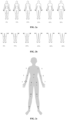
- FIGS. 2a-2b show schematic diagrams of a method for generating a current human body model according to some embodiments of the present disclosure.
- the at least one candidate human body model comprises a plurality of candidate human body models
- the second current physiological feature information comprises whole BFP information of the user.
- a current human body model is selected from the plurality of candidate human body models based on the whole BFP information.
- the whole BFP information can be directly measured and obtained through a device such as a body fat scale, or directly obtained from a medical examination report. That is to say, the whole BFP information can be easily obtained, and it is more convenient to build a human body model based on the whole BFP information.
- a plurality of candidate human body models can be generated based on the first current physiological feature information such as height and weight. Because the volume of fat is three times that of muscle for the same weight, the lower the BFP, the thinner the user will be. Therefore, a body shape of the user cannot be determined solely based on the first physiological feature information, such as height and weight.
- a current human body model which matches the whole BFP information is selected from the candidate human body models based on the whole BFP information, that is, a candidate human body model that best matches the whole BFP information among the candidate human body models. For example, if the user has a BFP of 20%, a candidate human body model with a BFP of 20% will be selected as the current human body model.
- FIG. 2a shows current human body models with different BFP values.
- the system can also directly generate a current human body model based on the first current physiological feature information such as height and weight entered by the user, and the second current physiological feature information such as whole BFP.
- the second current physiological feature information comprises partial BFP information of the user.
- a body part corresponding to the partial BFP information of the candidate human body model is adjusted based on the partial BFP information to generate the current human body model.
- the human body model created based on partial BFP information can more accurately describe the user's current body shape at the level of body part granularity, thereby improving the relevancy and accuracy of the generated fitness regimen information.
- the BFP obtained by the system is partial BFPs of a plurality of parts of the human body.
- the partial BFPs comprise an upper body BFP, and the upper body structure of the candidate human body model can be adjusted based on the upper body BFP;
- the partial BFPs comprise a lower body BFP that can be used to adjust the lower body structure.
- FIG. 2b shows current human body models with different lower body BFPs.
- the current physiological feature information comprises BFP information of the user, which is obtained by a body fat measurement device associated with the user.
- the BFP information comprises partial BFP information of the user that is obtained by: determining a start point and a target point on a body of the user base on a body part corresponding to the partial BFP information; determining impedance between the start point and the target point using a body fat measurement device; determining the partial BFP information based on the impedance.
- FIG. 2c shows a schematic diagram of a method for generating a current human body model according to some embodiments of the present disclosure.
- partial BFP information such as left upper limb fat, left skeletal muscle, right upper limb fat, right skeletal muscle, and abdominal fat is obtained using a body fat measurement device; and a body part corresponding to the partial BFP information of the human body model is adjusted based on the partial BFP information.
- the impedance between a start point and a target point can be measured, and the BFP of a part between the start point and the target point can be calculated based on the impedance, thereby measuring the BFP of each body part.
- an external device can be used to measure the BFPs of a plurality of parts of a body of the user.
- the external device may be a wearable device with a body fat measuring function.
- measurement point 1 is the start point
- measurement point 2 is the target point
- the part between the start point and the target point corresponds to the right forearm of the human body
- measurement point 2 is the start point
- measurement point 3 is the target point
- the part between the start point and the target point corresponds to the right upper arm of the human body
- measurement point 1 is the start point
- measurement point 3 is the target point
- the part between the start point and the target point corresponds to the right arm of the human body.
- a candidate human body model is generated based on the current physiological feature information; the candidate human body model is adjusted by the user to generate the current human body model. For example, the user can fine tune the generated human body model to generate a current human body model which matches the user's current body shape.
- Body length ratio is an important factor in the construction of a digital or three-dimensional human body model. For example, some people have longer upper bodies and shorter lower bodies, or shorter upper bodies and longer lower bodies. Therefore, the body length ratio factor can be considered to generate a digital or 3D human body model as the current human body model.
- a candidate human body model is generated based on the current physiological feature information; body length ratio information of the user is determined based on image information of the user; and the candidate human body model is adjusted based on the body length ratio information to generate the current human body model.
- physiological feature information such as the user's height, weight, chest circumference, waist circumference and flat or partial photos of the user are obtained.
- a photo of a part that the user wishes to strengthen is obtained as a basis for generating the current human body model.
- the system can obtain image information of the user, such as full or half body photos, videos, etc.
- the users' photos and videos can be analyzed to calculate the proportions of the head, upper body, and lower body of the human body.
- proportion adjustment is performed on the candidate human body model to generate the current human body model, so that the current human body model can match a body of the user's body length ratio. For example, if the upper part of the human body is long, the waist of the body model will be long.
- a target human body model is generated for the user based on an adjustment of the user to the current human body model.
- the target human body model is generated for the user based on an adjustment of the user to a plurality of parts of the current human body model.
- the parts may be the chest, the abdomen, the arms, the thighs, the calves, etc.; the user adjustments may comprise shape adjustments to these parts, such as adjusting the size of these parts by dragging operation or clicking on adjustment buttons; the user adjustments may also comprise adjustments to subcutaneous tissues such as muscle and fat in these areas.
- a target human body model is generated for the user based on the user's dragging operations on the current human body model or clicks on adjustment buttons.
- the user can perform operates on the current human body model to change the current human body model, and generate the target human body model.
- the operation can be as simple as clicking a plus or minus button to adjust any part of the current human body model; it may also be a direct drag and drop on any part of the current human body model to expand or shrink that part.
- the system can provide a plurality of recommended human body models, and the user can select a target human body model from the recommended human body models. The user can make further adjustments to the selected recommended human body model to generate the target human body model.
- the user first selects needs such as the body parts they want to focus on or the effects they want to achieve. For example, the selection can be performed via a menu. Then the system generates a recommended human body model based on the user's needs.
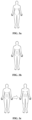
- FIGS. 3a-3b show schematic diagrams of a method for generating a target human body model according to some embodiments of the present disclosure.
- FIG. 3a shows the current human body model of a user. As shown in FIG. 2b , an adjustment to the abdomen is made on the current human body model by, for example, drawing three abdominal lines, to generate the user's target human body model.
- the current human body model comprises a plurality of current muscle modules distributed on the current human body model.
- a target human body model is generated based on an adjustment of the user to the current muscle modules.
- the current human body model is a digital 3D human body model that can show the distribution of muscles over the entire body.
- the user can adjust the shape of each of the current muscle modules to generate the shape of a target muscle model, thereby generating the target human body model.
- a shape change of any current muscle module is determined based on the adjustment of the user to the current muscle module; Shape changes of related current muscle modules of the current muscle module are determined based on the shape change of the current muscle module; the target human body model is generated based on the shape change of the current muscle module and the shape change of the related current muscle module.
- a muscle module on a human body model can correspond to a body part where the muscle module is located; an adjustment to a muscle module may comprise adjustments to subcutaneous tissues such as muscle and fat on a corresponding part of the human body.
- This fitness goal can comprise the specific target shape of target training parts, thereby improving the accuracy of the fitness regimen information.
- FIG. 3c show a schematic diagram of a method for generating a target human body model according to some embodiments of the present disclosure.
- some adaptive modifications can be made because the effect of training may comprise changes in some surrounding body parts of a body part, rather than only in the body part. For example, if the user has drawn three abdominal lines on the abdomen of the current human body model, adjustments can be made to related parts such as the chest, legs, and arms based on the adjustment to the abdomen.
- step 130 fitness regimen information is generated for the user based on differences between the current human body model and the target human body model.
- the current human body model comprises a plurality of current muscle modules distributed on the current human body model
- the target human body model comprises a plurality of target muscle modules distributed on the target human body model.
- Fitness regimen information is generated for the user based on a shape difference between a current muscle module and a corresponding target muscle module.
- different and more accurate fitness regimen information can be generated based on the target muscle shape that the user wants to achieve. For example, to increase chest circumference by 10cm, different fitness regimen information can be generated for different chest muscle shapes according to the target muscle model. Thus, targeted fitness regimens can be generated based on the user's target muscle shape.
- target physiological feature information of the user is determined based on the target human body model; fitness regimen information is generated for the user based on differences between the current physiological feature information and the target physiological feature information.
- a comparable human body model matching the target human body model can be searched in a digital human body database based on a partial shape of the target human body model; and target physiological feature information of the user is determined based on physiological feature information of the comparable human body model.
- body parts which the user want to work out and target improvement values can be obtained, and then recommended fitness regimen information can be generated.
- FIG. 4a shows a schematic diagram of the generation method of fitness regimen information according to some embodiments of the present disclosure.
- the user's current BFP is 30%, and the expected target human body model matches the abdomen part of a candidate human body model with a BFP of 15%. It may be determined that the user needs to reduce the abdominal BFP from 30% to 150 or less; fitness regimen information is then generated with the goal of reducing BFP by 15%.
- the system can generate a digital human body model or 3D model of the user as a human body model after training.
- step 110 can be repeated, and the system judges the effectiveness of the training based on the initially generated pre-training human body model (i.e. the current human body model) and the human body model after training after a period of training.
- the initially generated pre-training human body model i.e. the current human body model
- the human body model after training after a period of training.
- the system can generate new fitness regimen information based on the post-training model after a period of training and a newly generated target human body model.
- At least one of the current physiological feature information or the current human body model is determined as state information before training; in response to a training based on the fitness regimen information being completed by the user, at least one of physiological feature information after training of the user or a human body model after training is determined as state information after training; and differences between the state information after training and the state information before training are pushed to the user.
- At least two of the current human body model, the human body model after training or a future human body model are overlapped and displayed to present the differences between at least two of the current human body model, the human body model after training or the future human body model, wherein the future human body model is predicted based on the state information before training.
- a change of a physiological feature of the user over time is determined based on at least two of the current physiological feature information, the physiological feature information after training or future physiological feature information, wherein the future physiological feature information is predicted based on the state information before training; a change curve is generated based on the change of the physiological feature over time to present differences between at least two of the current physiological feature information, the physiological feature information after training or the future physiological feature information.
- FIGS. 4b and 4c show schematic diagrams of the generation method of fitness regimen information according to some embodiments of the present disclosure.
- At least two of the current human body model, the human body model after training, or a future human body model are displayed by overlapping with each other, wherein the future human body model is predicted based on the state information before training; and a change curve and an overlapping display result are present to the user.
- the human body model denoted by the dotted lines is the current human body model
- the human body model denoted by the thick lines is the post-training human body model
- the human body model denoted by the thin lines is the future human body model, corresponding to three time points on the change curve below, respectively.
- the current human body model, the human body model after training or the future human body model corresponding to the time point is highlighted, and/or in response to a selection of the user for the current human body model, the human body model after training or the future human body model, a time point on the change curve corresponding to the current human body model, the human body model after training or the future human body model is highlighted.
- the user moves the mouse to the third time point on the change curve, the future human body model corresponding to that time point is then highlighted.
- the user moves the mouse to the second time point on the change curve, the human body model after training corresponding to that time point is highlighted.
- the user can be presented with comparative results before and after training, making the experience more fun and interactive, and increasing the user's confidence in fitness training.
- At least one of the current physiological feature information or the current human body model is determined as state information before training.
- Future state information of the user after a preset period of time is predicted based on the state information before training.
- the future state information comprises at least one of the future physiological feature information or the future human body model of the user. The future state information is then pushed to the user.
- the current human body model, the human body model after training and the future human body model are overlapped and displayed to present differences between the current human body model, the human body model after training and the future human body model.
- a shape of a future muscle module of the future human body model is predicted, based on a shape of a current muscle module of the current human body model using a big data technology.
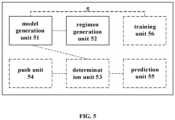
- FIG. 5 shows a schematic diagram of A generation apparatus of fitness regimen information according to some embodiments of the present disclosure.
- the apparatus 5 for generating the fitness regimen information comprises a model generation unit 51 and a regimen generation unit 52.
- the model generation unit 51 is used for generating a current human body model of a user, and generating a target human body model of the user based on an adjustment of the user to the current human body model. For example, the model generation unit 51 generates a current human body model for a user based on current physiological feature information of the user.
- the regimen generation unit 52 generates the user's fitness regimen information based on differences between the current human body model and the target human body model.
- the generation apparatus 5 further comprises a determination unit 53 for determining at least one of the current physiological feature information or the current human body model as state information before training; determining, in response to a training based on the fitness regimen information being completed by the user, at least one of physiological feature information after training of the user or a human body model after training as state information after training.
- the generation apparatus 5 further comprises a push unit 54 for pushing differences between the state information after training and the state information before training to the user.
- the determination unit 53 determines at least one of the current physiological feature information or the current human body model as state information before training.
- the generation apparatus 5 further comprises a prediction unit 55 for predicting, based on the state information before training, future state information of the user after a preset period of time, wherein the future state information comprises the future physiological feature information or the future human body model of the user.
- the current physiological feature information comprises first current physiological feature information which does not comprise body fat percentage (BFP) information of the user and second current physiological feature information which comprises BFP information of the user.
- the model generation unit 51 is used for generating at least one candidate human body model based on the first current physiological feature information; generating the current human body model based on the candidate human body model and the second current physiological feature information.
- the candidate human body model comprises a plurality of candidate human body models
- the second current physiological feature information comprises whole BFP information of the user.
- the current human body model is selected from the candidate human body models based on the whole BFP information.
- the second current physiological feature information is partial BFP information of the user.
- the model generation unit 51 is used for adjusting a body part corresponding to the partial BFP information of the candidate human body model based on the partial BFP information to generate the current human body model.
- the model generation unit 51 is used for generating at least one candidate human body model based on the current physiological feature information; generating the current human body model based on an adjustment of the user to the candidate human body model.
- the model generation unit 51 is used for generating at least one candidate human body model based on the current physiological feature information; determining body length ratio information of the user based on image information of the user; and adjusting the candidate human body model based on the body length ratio information to generate the current human body model.
- the current human body model comprises a plurality of current muscle modules distributed on the current human body model.
- the model generation unit 51 is used for generating a target human body model based on an adjustment of the user to the current muscle modules.
- the model generation unit 51 is used for determining a shape change of a current muscle module based on the adjustment of the user to the current muscle module; determining a shape change of a related current muscle module of the current muscle module based on the shape change of the current muscle module; and generating the target human body model based on the shape change of the current muscle module and the shape change of the related current muscle module.
- the model generation unit 51 is used for generating the target human body model of the user based on the user's drag-and-drop operations on the current human body model or clicks on adjustment buttons.
- the regimen generation unit 52 is used for generating the fitness regimen information for the user based on a shape difference between a current muscle module and a corresponding target muscle module.
- the current human body model comprises a plurality of current muscle modules distributed on the current human body model
- the target human body model comprises a plurality of target muscle modules distributed on the target human body model.
- the regimen generation unit 52 is used for determining target physiological feature information of the user based on the target human body model; generating the fitness regimen information for the user based on differences between the current physiological feature information and the target physiological feature information.
- the regimen generation unit 52 is used for searching a digital human body database for a comparable human body model which matches the target human body model based on a partial shape of the target human body model; determining target physiological feature information of the user based on physiological feature information of the comparable human body model.
- the current physiological feature information comprises BFP information of the user, which is obtained by a body fat measurement device associated with the user.
- the BFP information comprises partial BFP information of the user obtained by: determining a start point and a target point on a body of the user base on a body part corresponding to the partial BFP information; determining impedance between the start point and the target point using a body fat measurement device; determining the partial BFP information based on the impedance.
- the determination unit 53 is used for determining a change of a physiological feature of the user over time based on the current physiological feature information and the physiological feature information after training; the push unit 54 is used for generating a change curve based on the change of the physiological feature over time to present differences between the current physiological feature information and the physiological feature information after training.
- the determination unit 53 is used for determining at least one of the current physiological feature information or the current human body model as state information before training;
- the prediction unit 55 is used for predicting, based on the state information before training, future state information of the user after a preset period of time, wherein the future state information comprises at least one of future physiological feature information or a future human body model of the user;
- the push unit 54 is used for pushing the future state information to the user.
- the prediction unit 55 is used for predicting a shape of a future muscle module of the future human body model, based on a shape of a current muscle module of the current human body model using a big data technology.
- the model generation unit 51 is used for generating at least one candidate human body model based on the current physiological feature information using a machine learning model.
- the generation apparatus 5 further comprises a training unit 56 for determining the current human body model as an annotation result of the current physiological feature information to generate training data, and training a machine learning model using the training data.
- the generation apparatus 5 further comprises a push unit 54.
- the push unit 54 is used for displaying at least two of the current human body model, the human body model after training or the future human body model overlappingly to present differences between at least two of the current human body model, the human body model after training or the future human body model, wherein the future human body model is predicted based on the state information before training.
- the push unit 54 is used for determining a change of a physiological feature of the user over time based on at least two of the current physiological feature information, the physiological feature information after training or future physiological feature information, wherein the future physiological feature information is predicted based on the state information before training; generating a change curve based on the change of the physiological feature over time to present differences between at least two of the current physiological feature information, the physiological feature information after training or future physiological feature information.
- the push unit 54 is used for displaying at least two of the current human body model, the human body model after training, or a future human body model overlappingly, wherein the future human body model is predicted based on the state information before training; presenting the change curve and a result of the overlapping display to the user; in response to a selection of the user for a time point on the change curve, highlighting the current human body model, the human body model after training or the future human body model corresponding to the time point, and/or in response to a selection of the user for the current human body model, the human body model after training or the future human body model, highlighting a time point on the change curve corresponding to the current human body model, the human body model after training or the future human body model.
- FIG. 6 shows a block diagram of the generation apparatus of fitness regimen information according to other embodiments of the present disclosure.
- the apparatus 6 for generating the fitness regimen information of this embodiment comprises: a memory 61 and a processor 62 coupled to the memory 61, the processor 62 configured to, based on instructions stored in the memory 61, carry out the generation method of fitness regimen information according to any one of the embodiments of the present disclosure.
- the memory 51 may comprise, for example, system memory, a fixed non-transitory storage medium, or the like.
- the system memory stores, for example, an operating system, applications, a boot loader, a database, and other programs.
- FIG. 7 shows a block diagram of the generation apparatus of fitness regimen information according to further embodiments of the present disclosure.
- the apparatus 7 for generating the fitness regimen information of this embodiment comprises: a memory 710 and a processor 720 coupled to the memory 710, the processor 720 configured to, based on instructions stored in the memory 710, carry out the generation method of fitness regimen information according to any one of the embodiments of the present disclosure.
- the memory 710 may comprise, for example, system memory, a fixed non-transitory storage medium, or the like.
- the system memory stores, for example, an operating system, application programs, a boot loader, and other programs.
- the apparatus 7 for generating the fitness regimen information may further comprise an input-output interface 730, a network interface 740, a storage interface 750, and the like. These interfaces 730, 740, 750, the memory 710 and the processor 720 may be connected through a bus 760, for example.
- the input-output interface 730 provides a connection interface for input-output devices such as a display, a mouse, a keyboard, a touch screen, a microphone, a loudspeaker, etc.
- the network interface 740 provides a connection interface for various networked devices.
- the storage interface 750 provides a connection interface for external storage devices such as an SD card and a USB flash disk.
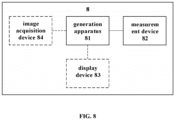
- FIG. 8 shows a block diagram of a generation system of fitness regimen information according to some embodiments of the present disclosure.
- the system 8 for generating the fitness regimen information comprises: an apparatus 81 for generating the fitness regimen information according to any one of the above embodiments, the apparatus 81 implementing the generation method of fitness regimen information according to any one of the above embodiments; a physiological feature measurement device 82 for obtaining current physiological features of the user.
- the physiological feature measurement device 82 comprises at least one of a weight measurement device, a height measurement device, or a body fat measurement device.
- the generation system 8 further comprises a display device for displaying the user's current and target human body models.
- the generation system 8 further comprises an image acquisition device 84 for acquiring image information of the user.
- embodiments of the present disclosure may be provided as a method, a system, or a computer program product. Therefore, embodiments of the present disclosure can take the form of an entirely hardware embodiment, an entirely software embodiment or an embodiment containing both hardware and software elements. Moreover, the present disclosure may take the form of a computer program product embodied on one or more computer-usable non-transitory storage media (comprising but not limited to disk storage, CD-ROM, optical memory, etc.) having computer-usable program code embodied therein.
- computer-usable non-transitory storage media comprising but not limited to disk storage, CD-ROM, optical memory, etc.
- the method and system of the present disclosure may be implemented in many ways.
- the method and system of the present disclosure may be implemented by software, hardware, firmware, or any combination of software, hardware, and firmware.
- the above sequence of steps of the method is merely for the purpose of illustration, and the steps of the method of the present disclosure are not limited to the above-described specific order unless otherwise specified.
- the present disclosure may also be implemented as programs recorded in a recording medium, which comprise machine-readable instructions for implementing the method according to the present disclosure.
- the present disclosure also covers a recording medium storing programs for executing the method according to the present disclosure.
Landscapes
- Health & Medical Sciences (AREA)
- Engineering & Computer Science (AREA)
- Medical Informatics (AREA)
- Public Health (AREA)
- General Health & Medical Sciences (AREA)
- Primary Health Care (AREA)
- Epidemiology (AREA)
- Biomedical Technology (AREA)
- Data Mining & Analysis (AREA)
- Databases & Information Systems (AREA)
- Pathology (AREA)
- Life Sciences & Earth Sciences (AREA)
- Biophysics (AREA)
- Physical Education & Sports Medicine (AREA)
- Measuring And Recording Apparatus For Diagnosis (AREA)
- Measurement Of The Respiration, Hearing Ability, Form, And Blood Characteristics Of Living Organisms (AREA)
- Instructional Devices (AREA)
Abstract
Description
- The present disclosure is based on and claims priority of
Chinese application for invention No. 202111204326.2, filed on Oct. 15, 2021 - This disclosure relates to the field of computer technology, in particular to a generation method of fitness regimen information, a generation apparatus of fitness regimen information, a generation system of fitness regimen information and a non-transitory computer-readable storage medium.
- In related technologies, application software determines a user's current body shape and an expected body shape from some fixed types of body shape based on the user's input to recommend a fitness regimen.
- According to some embodiments of the present disclosure, there is provided a generation method of fitness regimen information, comprising: generating a current human body model of a user; generating a target human body model of the user based on an adjustment of the user to the current human body model; generating the user's fitness regimen information based on differences between the current human body model and the target human body model.
- In some embodiments, generating a target human body model of the user based on an adjustment of the user to the current human body model comprises: generating the target human body model of the user based on an adjustment of the user to a plurality of parts of the current human body model.
- In some embodiments, the current human body model comprises a plurality of current muscle modules distributed on the current human body model, and generating a target human body model of the user based on an adjustment of the user to the current human body model comprises: generating a target human body model based on an adjustment of the user to the current muscle modules.
- In some embodiments, generating a target human body model based on an adjustment of the user to the current muscle modules comprises: determining a shape change of a current muscle module based on the adjustment of the user to this current muscle module; determining a shape change of a related current muscle module of this current muscle module based on the shape change of this muscle module; generating the target human body model based on the shape change of this current muscle module and the shape change of the related current muscle module.
- In some embodiments, generating the current human body model of the user comprises: generating the current human body model of the user based on current physiological feature information of the user.
- In some embodiments, generating the current human body model of the user based on current physiological feature information of the user comprises: generating at least one candidate human body model based on the current physiological feature information; generating the current human body model based on an adjustment of the user to the candidate human body model.
- In some embodiments, generating the current human body model based on an adjustment of the user to the candidate human body model comprises: generating the current human body model based on an adjustment of the user to a plurality of parts of the candidate human body model.
- In some embodiments, generating at least one candidate human body model based on the current physiological feature information comprises: generating the candidate human body model based on the current physiological feature information using a machine learning model; the generation method further comprises: determining the current human body model as an annotation result of the current physiological feature information to generate training data; training the machine learning model using the training data.
- In some embodiments, the current physiological feature information comprises first current physiological feature information which does not comprise body fat percentage (BFP) information of the user and second current physiological feature information which comprises BFP information of the user; and generating the current human body model of the user based on current physiological feature information of the user comprises: generating at least one candidate human body model based on the first current physiological feature information; generating the current human body model based on the candidate human body model and the second current physiological feature information.
- In some embodiments, the candidate human body model comprises a plurality of candidate human body models, and the second current physiological feature information comprises whole BFP information of the user, wherein generating the current human body model based on the candidate human body model and the second current physiological feature information comprises: selecting the current human body model from the plurality of candidate human body models based on the whole BFP information.
- In some embodiments, the second current physiological feature information comprises partial BFP information of the user, and generating the current human body model based on the candidate human body model and the second current physiological feature information comprises: adjusting a body part corresponding to the partial BFP information of the candidate human body model based on the partial BFP information to generate the current human body model.
- In some embodiments, generating the current human body model of the user based on current physiological feature information of the user comprises: generating at least one candidate human body model based on the current physiological feature information; determining body length ratio information of the user based on image information of the user; adjusting the candidate human body model based on the body length ratio information to generate the current human body model.
- In some embodiments, the current human body model comprises a plurality of current muscle modules distributed on the current human body model, the target human body model comprises a plurality of target muscle modules distributed on the target human body model, and generating the user's fitness regimen information based on differences between the current human body model and the target human body model comprises: generating the user's fitness regimen information based on a shape difference between a current muscle module and a corresponding target muscle module.
- In some embodiments, generating the user's fitness regimen information based on differences between the current human body model and the target human body model comprises: determining target physiological feature information of the user based on the target human body model; generating the user's fitness regimen information based on differences between the current physiological feature information corresponding to the current human body model and the target physiological feature information.
- In some embodiments, determining target physiological feature information of the user based on the target human body model comprises: searching for a comparable human body model which matches the target human body model in a digital human body database based on a partial shape of the target human body model; determining target physiological feature information of the user based on physiological feature information of the comparable human body model.
- In some embodiments, the current physiological feature information comprises BFP information of the user, which is obtained by a body fat measurement device associated with the user.
- In some embodiments, the BFP information comprises partial BFP information of the user obtained by: determining a start point and a target point on a body of the user base on a body part corresponding to the partial BFP information; determining impedance between the start point and the target point using a body fat measurement device; determining the partial BFP information based on the impedance.
- In some embodiments, the generation method further comprises: determining at least one of the current physiological feature information or the current human body model as state information before training; in response to a training based on the fitness regimen information being completed by the user, determining at least one of physiological feature information after training of the user or a human body model after training as state information after training; pushing differences between the state information after training and the state information before training to the user.
- In some embodiments, at least two of the current human body model, the human body model after training or a future human body model are overlapped and displayed to present the differences between at least two of the current human body model, the human body model after training or a future human body model, wherein the future human body model is predicted based on the state information before training.
- In some embodiments, a change of a physiological feature of the user over time is determined based on at least two of the current physiological feature information, the physiological feature information after training or future physiological feature information, wherein the future physiological feature information is predicted based on the state information before training; a change curve is generated based on the change of the physiological feature over time to present differences between at least two of the current physiological feature information, the physiological feature information after training or future physiological feature information.
- In some embodiments, at least two of the current human body model, the human body model after training, or a future human body model are displayed by overlapping with each other, wherein the future human body model is predicted based on the state information before training. the change curve and a result of the overlapping display are present to the user; in response to a selection of the user for a time point on the change curve, the current human body model, the human body model after training or the future human body model corresponding to the time point is highlighted, and/or in response to a selection of the user for the current human body model, the human body model after training or the future human body model, a time point on the change curve corresponding to the current human body model, the human body model after training or the future human body model is highlighted.
- In some embodiments, the generation method further comprises: determining at least one of the current physiological feature information or the current human body model as state information before training; predicting, based on the state information before training, future state information of the user after a preset period of time, wherein the future state information comprises at least one of the future physiological feature information or the future human body model of the user; pushing the future state information to the user.
- In some embodiments, predicting future state information of the user after a preset period of time based on the state information before training comprises: predicting a shape of a future muscle module of the future human body model, based on a shape of a current muscle module of the current human body model using a big data technology.
- According to some other embodiments of the present disclosure, there is provided A generation apparatus of fitness regimen information, comprising: a model generation unit for generating a current human body model of a user, and generating a target human body model of the user based on an adjustment of the user to the current human body model; a regimen generation unit for generating the user's fitness regimen information based on differences between the current human body model and the target human body model.
- In some embodiments, the generation apparatus further comprises: a determination unit for determining at least one of the current physiological feature information or the current human body model as state information before training, and determining, in response to a training based on the fitness regimen information being completed by the user, at least one of physiological feature information after training of the user or a human body model after training as state information after training; a push unit for pushing differences between the state information after training and the state information before training to the user.
- In some embodiments, the generation apparatus further comprises: a determination unit for determining at least one of the current physiological feature information or the current human body model as state information before training; a prediction unit for predicting, based on the state information before training, future state information of the user after a preset period of time, wherein the future state information comprises the future physiological feature information or the future human body model of the user.
- In some embodiments, the model generation unit generates a candidate human body model based on the current physiological feature information using a machine learning model; the generation apparatus further comprises: a training unit for determining the current human body model as an annotation result of the current physiological feature information to generate training data, and training a machine learning model using the training data.
- According to still other embodiments of the present disclosure, there is provided a generation system of fitness regimen information, comprising: A generation apparatus of fitness regimen information for implementing the fitness regimen information generation method according to any one of the above embodiments; a physiological feature measurement device for obtaining current physiological features of the user.
- According to still other embodiments of the present disclosure, there is provided A generation apparatus of fitness regimen information, comprising: a memory; a processor coupled to the memory, the processor configured to, based on instructions stored in the memory, carry out the fitness regimen information generation method according to any one of the above embodiments.
- According to still other embodiments of the present disclosure, there is provided a non-transitory computer readable storage medium having stored thereon a computer program that, when executed by a processor, implements the fitness regimen information generation method according to any one of the above embodiments.
- The accompanying drawings, which are incorporated in and constitute a portion of this specification, illustrate embodiments of the present disclosure and, together with the description, serve to explain the principles of the present disclosure.
- The present disclosure will be more clearly understood from the following detailed description with reference to the accompanying drawings, in which:
-
FIG. 1 shows a flowchart of a generation method of fitness regimen information according to some embodiments of the present disclosure; -
FIGS. 2a-2c show schematic diagrams of a method for generating a current human body model according to some embodiments of the present disclosure; -
FIGS. 3a-3c show schematic diagrams of a method for generating a target human body model according to some embodiments of the present disclosure; -
FIGS. 4a-4c show schematic diagrams of the generation method of fitness regimen information according to some embodiments of the present disclosure; -
FIG. 5 shows a schematic diagram of a generation apparatus of fitness regimen information according to some embodiments of the present disclosure; -
FIG. 6 shows a block diagram of the generation apparatus of fitness regimen information according to other embodiments of the present disclosure; -
FIG. 7 shows a block diagram of the generation apparatus of fitness regimen information according to further embodiments of the present disclosure; -
FIG. 8 shows a block diagram of a generation system of fitness regimen information according to some embodiments of the present disclosure. - Various exemplary embodiments of the present disclosure will now be described in detail with reference to the accompanying drawings. Notice that, unless otherwise specified, the relative arrangement, numerical expressions and numerical values of the components and steps set forth in these examples do not limit the scope of the invention.
- At the same time, it should be understood that, for ease of description, the dimensions of the plurality of parts shown in the drawings are not drawn to actual proportions.
- The following description of at least one exemplary embodiment is in fact merely illustrative and is in no way intended as a limitation to the invention, its application or use.
- Techniques, methods, and apparatus known to those of ordinary skill in the relevant art may not be discussed in detail, but where appropriate, these techniques, methods, and apparatuses should be considered as part of the specification.
- Of all the examples shown and discussed herein, any specific value should be construed as merely illustrative and not as a limitation. Thus, other examples of exemplary embodiments may have different values.
- Notice that, similar reference numerals and letters are denoted by the like in the accompanying drawings, and therefore, once an item is defined in a drawing, there is no need for further discussion in the accompanying drawings.
- As mentioned above, the fitness regimen recommendations based on some fixed types of body shape results in inaccurate descriptions of users' current and target body shapes. Inaccurate descriptions which may result in inaccurate fitness regimens that lack relevancy.
- In response to the above technical problems, the technical solution of the present disclosure constructs a human body model (such as a digital human body model, a three-dimensional human body model, etc.) for a specified user; With the help of the constructed human body model, the user's current body shape, post-training body shape, and expected body shape can be accurately described.
- This allows personalized processing for different users to improve the relevance and accuracy of fitness regimens. In this way, precise training effects can be achieved and the enthusiasm for training and the user experience can be improved. For example, the technical solution of the present disclosure can be realized through the following embodiments.
-
FIG. 1 shows a flowchart of a generation method of fitness regimen information according to some embodiments of the present disclosure. - As shown in
FIG. 1 , instep 110, a current human body model of a user is generated. For example, a current human body model can be generated for a user based on current physiological feature information of the user. The current physiological feature information of the user obtained by the system may comprise gender, age, height, weight, body fat percentage, etc. - In some embodiments, the current physiological feature information may be obtained by requesting input from the user or from a user-associated device. For example, the user-associated device may be a user-associated body fat measurement device (such as a body fat scale) that can provide current physiological feature information such as body weight and body fat percentage.
- In some embodiments, based on the obtained current physiological feature information, a three-dimensional human body model is generated as the user's current human body model.
- In some embodiments, the current physiological feature information comprises first current physiological feature information and second current physiological feature information. The first current physiological feature information does not comprise BFP information of the user, while the second current physiological feature information comprises BFP information of the user. At least one candidate human body model is generated based on the first current physiological feature information. The current human body model is generated based on the at least one candidate human body model and the second current physiological feature information.
- For example, the system generates at least one candidate human body model based on the first current physiological feature information such as height, weight, and BWH; the system adjusts the at least one candidate human body model based on the second current physiological feature information such as BFP. The user can adjust a 3D human body model by dragging its adjustment curve to generate a current human body model which matches the user's current body shape.
- In some embodiments, at least one candidate human body model is generated based on the current physiological feature information using a machine learning model; the current human body model is determined as an annotation result of the current physiological feature information to generate training data; and the machine learning model is trained using the training data.
- In this way, the current human body model adjusted by the user can be used as training data for the machine learning model, and a more accurate current human body model can be generated by expanding the training samples and continuously optimizing the machine learning model.
-
FIGS. 2a-2b show schematic diagrams of a method for generating a current human body model according to some embodiments of the present disclosure. - As shown in
FIG. 2a , in some embodiments, the at least one candidate human body model comprises a plurality of candidate human body models, and the second current physiological feature information comprises whole BFP information of the user. A current human body model is selected from the plurality of candidate human body models based on the whole BFP information. - For example, the whole BFP information can be directly measured and obtained through a device such as a body fat scale, or directly obtained from a medical examination report. That is to say, the whole BFP information can be easily obtained, and it is more convenient to build a human body model based on the whole BFP information.
- For example, a plurality of candidate human body models can be generated based on the first current physiological feature information such as height and weight. Because the volume of fat is three times that of muscle for the same weight, the lower the BFP, the thinner the user will be. Therefore, a body shape of the user cannot be determined solely based on the first physiological feature information, such as height and weight.
- When the BFP obtained by the system is whole BFP information, a current human body model which matches the whole BFP information is selected from the candidate human body models based on the whole BFP information, that is, a candidate human body model that best matches the whole BFP information among the candidate human body models. For example, if the user has a BFP of 20%, a candidate human body model with a BFP of 20% will be selected as the current human body model.
FIG. 2a shows current human body models with different BFP values. - In some embodiments, the system can also directly generate a current human body model based on the first current physiological feature information such as height and weight entered by the user, and the second current physiological feature information such as whole BFP.
- As shown in
FIG. 2b , in some embodiments, the second current physiological feature information comprises partial BFP information of the user. A body part corresponding to the partial BFP information of the candidate human body model is adjusted based on the partial BFP information to generate the current human body model. - The human body model created based on partial BFP information can more accurately describe the user's current body shape at the level of body part granularity, thereby improving the relevancy and accuracy of the generated fitness regimen information.
- For example, the BFP obtained by the system is partial BFPs of a plurality of parts of the human body. For example, the partial BFPs comprise an upper body BFP, and the upper body structure of the candidate human body model can be adjusted based on the upper body BFP; The partial BFPs comprise a lower body BFP that can be used to adjust the lower body structure.
FIG. 2b shows current human body models with different lower body BFPs. - In some embodiments, the current physiological feature information comprises BFP information of the user, which is obtained by a body fat measurement device associated with the user.
- For example, the BFP information comprises partial BFP information of the user that is obtained by: determining a start point and a target point on a body of the user base on a body part corresponding to the partial BFP information; determining impedance between the start point and the target point using a body fat measurement device; determining the partial BFP information based on the impedance.
-
FIG. 2c shows a schematic diagram of a method for generating a current human body model according to some embodiments of the present disclosure. - As shown in
FIG. 2c , partial BFP information such as left upper limb fat, left skeletal muscle, right upper limb fat, right skeletal muscle, and abdominal fat is obtained using a body fat measurement device; and a body part corresponding to the partial BFP information of the human body model is adjusted based on the partial BFP information. - In some embodiments, the impedance between a start point and a target point can be measured, and the BFP of a part between the start point and the target point can be calculated based on the impedance, thereby measuring the BFP of each body part.
- For example, an external device can be used to measure the BFPs of a plurality of parts of a body of the user. The external device may be a wearable device with a body fat measuring function.
- For example,
measurement point 1 is the start point,measurement point 2 is the target point, and the part between the start point and the target point corresponds to the right forearm of the human body;measurement point 2 is the start point,measurement point 3 is the target point, and the part between the start point and the target point corresponds to the right upper arm of the human body;measurement point 1 is the start point,measurement point 3 is the target point, and the part between the start point and the target point corresponds to the right arm of the human body. - In some embodiments, a candidate human body model is generated based on the current physiological feature information; the candidate human body model is adjusted by the user to generate the current human body model. For example, the user can fine tune the generated human body model to generate a current human body model which matches the user's current body shape.
- Body length ratio is an important factor in the construction of a digital or three-dimensional human body model. For example, some people have longer upper bodies and shorter lower bodies, or shorter upper bodies and longer lower bodies. Therefore, the body length ratio factor can be considered to generate a digital or 3D human body model as the current human body model.
- In some embodiments, a candidate human body model is generated based on the current physiological feature information; body length ratio information of the user is determined based on image information of the user; and the candidate human body model is adjusted based on the body length ratio information to generate the current human body model.
- For example, physiological feature information such as the user's height, weight, chest circumference, waist circumference and flat or partial photos of the user are obtained. A photo of a part that the user wishes to strengthen is obtained as a basis for generating the current human body model.
- In some embodiments, the system can obtain image information of the user, such as full or half body photos, videos, etc. The users' photos and videos can be analyzed to calculate the proportions of the head, upper body, and lower body of the human body. Based on the calculation result, proportion adjustment is performed on the candidate human body model to generate the current human body model, so that the current human body model can match a body of the user's body length ratio. For example, if the upper part of the human body is long, the waist of the body model will be long.
- For example, the navel is used as a boundary between the upper and lower body. If Full body length : Lower body length = Lower body length : upper body length = 1:1.618 is satisfied, the body length ratio of the human body conforms to the golden ratio.
- In
step 120, a target human body model is generated for the user based on an adjustment of the user to the current human body model. For example, the target human body model is generated for the user based on an adjustment of the user to a plurality of parts of the current human body model. - For example, the parts may be the chest, the abdomen, the arms, the thighs, the calves, etc.; the user adjustments may comprise shape adjustments to these parts, such as adjusting the size of these parts by dragging operation or clicking on adjustment buttons; the user adjustments may also comprise adjustments to subcutaneous tissues such as muscle and fat in these areas.
- In some embodiments, a target human body model is generated for the user based on the user's dragging operations on the current human body model or clicks on adjustment buttons.
- For example, the user can perform operates on the current human body model to change the current human body model, and generate the target human body model. The operation can be as simple as clicking a plus or minus button to adjust any part of the current human body model; it may also be a direct drag and drop on any part of the current human body model to expand or shrink that part.
- The system can provide a plurality of recommended human body models, and the user can select a target human body model from the recommended human body models. The user can make further adjustments to the selected recommended human body model to generate the target human body model.
- The user first selects needs such as the body parts they want to focus on or the effects they want to achieve. For example, the selection can be performed via a menu. Then the system generates a recommended human body model based on the user's needs.
-
FIGS. 3a-3b show schematic diagrams of a method for generating a target human body model according to some embodiments of the present disclosure. -
FIG. 3a shows the current human body model of a user. As shown inFIG. 2b , an adjustment to the abdomen is made on the current human body model by, for example, drawing three abdominal lines, to generate the user's target human body model. - In some embodiments, the current human body model comprises a plurality of current muscle modules distributed on the current human body model. A target human body model is generated based on an adjustment of the user to the current muscle modules.
- For example, the current human body model is a digital 3D human body model that can show the distribution of muscles over the entire body. The user can adjust the shape of each of the current muscle modules to generate the shape of a target muscle model, thereby generating the target human body model.
- In some embodiments, a shape change of any current muscle module is determined based on the adjustment of the user to the current muscle module; Shape changes of related current muscle modules of the current muscle module are determined based on the shape change of the current muscle module; the target human body model is generated based on the shape change of the current muscle module and the shape change of the related current muscle module.
- For example, a muscle module on a human body model can correspond to a body part where the muscle module is located; an adjustment to a muscle module may comprise adjustments to subcutaneous tissues such as muscle and fat on a corresponding part of the human body.
- This allows the user to accurately describe the desired fitness goal without the need for professional knowledge of human muscle or fitness. This fitness goal can comprise the specific target shape of target training parts, thereby improving the accuracy of the fitness regimen information.
-
FIG. 3c show a schematic diagram of a method for generating a target human body model according to some embodiments of the present disclosure. - As shown in
FIG. 3c , some adaptive modifications can be made because the effect of training may comprise changes in some surrounding body parts of a body part, rather than only in the body part. For example, if the user has drawn three abdominal lines on the abdomen of the current human body model, adjustments can be made to related parts such as the chest, legs, and arms based on the adjustment to the abdomen. - In
step 130, fitness regimen information is generated for the user based on differences between the current human body model and the target human body model. - In some embodiments, the current human body model comprises a plurality of current muscle modules distributed on the current human body model, and the target human body model comprises a plurality of target muscle modules distributed on the target human body model. Fitness regimen information is generated for the user based on a shape difference between a current muscle module and a corresponding target muscle module.
- In this way, different and more accurate fitness regimen information can be generated based on the target muscle shape that the user wants to achieve. For example, to increase chest circumference by 10cm, different fitness regimen information can be generated for different chest muscle shapes according to the target muscle model. Thus, targeted fitness regimens can be generated based on the user's target muscle shape.
- In some embodiments, target physiological feature information of the user is determined based on the target human body model; fitness regimen information is generated for the user based on differences between the current physiological feature information and the target physiological feature information.
- For example, a comparable human body model matching the target human body model can be searched in a digital human body database based on a partial shape of the target human body model; and target physiological feature information of the user is determined based on physiological feature information of the comparable human body model.
- For example, based on the differences between the current human body model and a target human body shape, body parts which the user want to work out and target improvement values can be obtained, and then recommended fitness regimen information can be generated.
-
FIG. 4a shows a schematic diagram of the generation method of fitness regimen information according to some embodiments of the present disclosure. - As shown in
FIG. 4a , the user's current BFP is 30%, and the expected target human body model matches the abdomen part of a candidate human body model with a BFP of 15%. It may be determined that the user needs to reduce the abdominal BFP from 30% to 150 or less; fitness regimen information is then generated with the goal of reducing BFP by 15%. - In some embodiments, after the user trains for a period of time based on the fitness regimen information, the system can generate a digital human body model or 3D model of the user as a human body model after training.
- For example, step 110 can be repeated, and the system judges the effectiveness of the training based on the initially generated pre-training human body model (i.e. the current human body model) and the human body model after training after a period of training.
- For example, the system can generate new fitness regimen information based on the post-training model after a period of training and a newly generated target human body model.
- In some embodiments, at least one of the current physiological feature information or the current human body model is determined as state information before training; in response to a training based on the fitness regimen information being completed by the user, at least one of physiological feature information after training of the user or a human body model after training is determined as state information after training; and differences between the state information after training and the state information before training are pushed to the user.
- For example, at least two of the current human body model, the human body model after training or a future human body model are overlapped and displayed to present the differences between at least two of the current human body model, the human body model after training or the future human body model, wherein the future human body model is predicted based on the state information before training.
- For example, a change of a physiological feature of the user over time is determined based on at least two of the current physiological feature information, the physiological feature information after training or future physiological feature information, wherein the future physiological feature information is predicted based on the state information before training; a change curve is generated based on the change of the physiological feature over time to present differences between at least two of the current physiological feature information, the physiological feature information after training or the future physiological feature information.
-
FIGS. 4b and4c show schematic diagrams of the generation method of fitness regimen information according to some embodiments of the present disclosure. - As shown in
FIGS. 4b and4c , at least two of the current human body model, the human body model after training, or a future human body model are displayed by overlapping with each other, wherein the future human body model is predicted based on the state information before training; and a change curve and an overlapping display result are present to the user. - For example, in
FIGS. 4b and4c , the human body model denoted by the dotted lines is the current human body model, the human body model denoted by the thick lines is the post-training human body model, and the human body model denoted by the thin lines is the future human body model, corresponding to three time points on the change curve below, respectively. - In response to a selection of the user for a time point on the change curve, the current human body model, the human body model after training or the future human body model corresponding to the time point is highlighted, and/or in response to a selection of the user for the current human body model, the human body model after training or the future human body model, a time point on the change curve corresponding to the current human body model, the human body model after training or the future human body model is highlighted.
- For example, in
FIG. 4b , the user moves the mouse to the third time point on the change curve, the future human body model corresponding to that time point is then highlighted. InFIG. 4c , the user moves the mouse to the second time point on the change curve, the human body model after training corresponding to that time point is highlighted. - For example, when the user moves the mouse to a body model, a time point corresponding to that body model in the change curve below is highlighted.
- In this way, the user can be presented with comparative results before and after training, making the experience more fun and interactive, and increasing the user's confidence in fitness training.
- In some embodiments, at least one of the current physiological feature information or the current human body model is determined as state information before training. Future state information of the user after a preset period of time is predicted based on the state information before training. The future state information comprises at least one of the future physiological feature information or the future human body model of the user. The future state information is then pushed to the user.
- For example, the current human body model, the human body model after training and the future human body model are overlapped and displayed to present differences between the current human body model, the human body model after training and the future human body model.
- For example, a shape of a future muscle module of the future human body model is predicted, based on a shape of a current muscle module of the current human body model using a big data technology.
-
FIG. 5 shows a schematic diagram of A generation apparatus of fitness regimen information according to some embodiments of the present disclosure. - As shown in
FIG. 5 , theapparatus 5 for generating the fitness regimen information comprises amodel generation unit 51 and aregimen generation unit 52. - The
model generation unit 51 is used for generating a current human body model of a user, and generating a target human body model of the user based on an adjustment of the user to the current human body model. For example, themodel generation unit 51 generates a current human body model for a user based on current physiological feature information of the user. - The
regimen generation unit 52 generates the user's fitness regimen information based on differences between the current human body model and the target human body model. - In some embodiments, the
generation apparatus 5 further comprises adetermination unit 53 for determining at least one of the current physiological feature information or the current human body model as state information before training; determining, in response to a training based on the fitness regimen information being completed by the user, at least one of physiological feature information after training of the user or a human body model after training as state information after training. - The
generation apparatus 5 further comprises a push unit 54 for pushing differences between the state information after training and the state information before training to the user. - In some embodiments, the
determination unit 53 determines at least one of the current physiological feature information or the current human body model as state information before training. Thegeneration apparatus 5 further comprises aprediction unit 55 for predicting, based on the state information before training, future state information of the user after a preset period of time, wherein the future state information comprises the future physiological feature information or the future human body model of the user. - In some embodiments, the current physiological feature information comprises first current physiological feature information which does not comprise body fat percentage (BFP) information of the user and second current physiological feature information which comprises BFP information of the user. The
model generation unit 51 is used for generating at least one candidate human body model based on the first current physiological feature information; generating the current human body model based on the candidate human body model and the second current physiological feature information. - In some embodiments, the candidate human body model comprises a plurality of candidate human body models, and the second current physiological feature information comprises whole BFP information of the user. In some embodiments, the current human body model is selected from the candidate human body models based on the whole BFP information.
- In some embodiments, the second current physiological feature information is partial BFP information of the user. The
model generation unit 51 is used for adjusting a body part corresponding to the partial BFP information of the candidate human body model based on the partial BFP information to generate the current human body model. - The
model generation unit 51 is used for generating at least one candidate human body model based on the current physiological feature information; generating the current human body model based on an adjustment of the user to the candidate human body model. - The
model generation unit 51 is used for generating at least one candidate human body model based on the current physiological feature information; determining body length ratio information of the user based on image information of the user; and adjusting the candidate human body model based on the body length ratio information to generate the current human body model. - In some embodiments, the current human body model comprises a plurality of current muscle modules distributed on the current human body model. The
model generation unit 51 is used for generating a target human body model based on an adjustment of the user to the current muscle modules. - The
model generation unit 51 is used for determining a shape change of a current muscle module based on the adjustment of the user to the current muscle module; determining a shape change of a related current muscle module of the current muscle module based on the shape change of the current muscle module; and generating the target human body model based on the shape change of the current muscle module and the shape change of the related current muscle module. - In some embodiments, the
model generation unit 51 is used for generating the target human body model of the user based on the user's drag-and-drop operations on the current human body model or clicks on adjustment buttons. - In some embodiments, the
regimen generation unit 52 is used for generating the fitness regimen information for the user based on a shape difference between a current muscle module and a corresponding target muscle module. The current human body model comprises a plurality of current muscle modules distributed on the current human body model, and the target human body model comprises a plurality of target muscle modules distributed on the target human body model. - In some embodiments, the
regimen generation unit 52 is used for determining target physiological feature information of the user based on the target human body model; generating the fitness regimen information for the user based on differences between the current physiological feature information and the target physiological feature information. - In some embodiments, the
regimen generation unit 52 is used for searching a digital human body database for a comparable human body model which matches the target human body model based on a partial shape of the target human body model; determining target physiological feature information of the user based on physiological feature information of the comparable human body model. - In some embodiments, the current physiological feature information comprises BFP information of the user, which is obtained by a body fat measurement device associated with the user.
- In some embodiments, the BFP information comprises partial BFP information of the user obtained by: determining a start point and a target point on a body of the user base on a body part corresponding to the partial BFP information; determining impedance between the start point and the target point using a body fat measurement device; determining the partial BFP information based on the impedance.
- In some embodiments, the
determination unit 53 is used for determining a change of a physiological feature of the user over time based on the current physiological feature information and the physiological feature information after training; the push unit 54 is used for generating a change curve based on the change of the physiological feature over time to present differences between the current physiological feature information and the physiological feature information after training. - In some embodiments, the
determination unit 53 is used for determining at least one of the current physiological feature information or the current human body model as state information before training; theprediction unit 55 is used for predicting, based on the state information before training, future state information of the user after a preset period of time, wherein the future state information comprises at least one of future physiological feature information or a future human body model of the user; the push unit 54 is used for pushing the future state information to the user. - The
prediction unit 55 is used for predicting a shape of a future muscle module of the future human body model, based on a shape of a current muscle module of the current human body model using a big data technology. - In some embodiments, the
model generation unit 51 is used for generating at least one candidate human body model based on the current physiological feature information using a machine learning model. Thegeneration apparatus 5 further comprises atraining unit 56 for determining the current human body model as an annotation result of the current physiological feature information to generate training data, and training a machine learning model using the training data. - In some embodiments, the
generation apparatus 5 further comprises a push unit 54. The push unit 54 is used for displaying at least two of the current human body model, the human body model after training or the future human body model overlappingly to present differences between at least two of the current human body model, the human body model after training or the future human body model, wherein the future human body model is predicted based on the state information before training. - In some embodiments, the push unit 54 is used for determining a change of a physiological feature of the user over time based on at least two of the current physiological feature information, the physiological feature information after training or future physiological feature information, wherein the future physiological feature information is predicted based on the state information before training; generating a change curve based on the change of the physiological feature over time to present differences between at least two of the current physiological feature information, the physiological feature information after training or future physiological feature information.
- In some embodiments, the push unit 54 is used for displaying at least two of the current human body model, the human body model after training, or a future human body model overlappingly, wherein the future human body model is predicted based on the state information before training; presenting the change curve and a result of the overlapping display to the user; in response to a selection of the user for a time point on the change curve, highlighting the current human body model, the human body model after training or the future human body model corresponding to the time point, and/or in response to a selection of the user for the current human body model, the human body model after training or the future human body model, highlighting a time point on the change curve corresponding to the current human body model, the human body model after training or the future human body model.
-
FIG. 6 shows a block diagram of the generation apparatus of fitness regimen information according to other embodiments of the present disclosure. - As shown in
FIG. 6 , theapparatus 6 for generating the fitness regimen information of this embodiment comprises: amemory 61 and aprocessor 62 coupled to thememory 61, theprocessor 62 configured to, based on instructions stored in thememory 61, carry out the generation method of fitness regimen information according to any one of the embodiments of the present disclosure. - Wherein, the
memory 51 may comprise, for example, system memory, a fixed non-transitory storage medium, or the like. The system memory stores, for example, an operating system, applications, a boot loader, a database, and other programs. -
FIG. 7 shows a block diagram of the generation apparatus of fitness regimen information according to further embodiments of the present disclosure. - As shown in
FIG. 7 , theapparatus 7 for generating the fitness regimen information of this embodiment comprises: amemory 710 and aprocessor 720 coupled to thememory 710, theprocessor 720 configured to, based on instructions stored in thememory 710, carry out the generation method of fitness regimen information according to any one of the embodiments of the present disclosure. - The
memory 710 may comprise, for example, system memory, a fixed non-transitory storage medium, or the like. The system memory stores, for example, an operating system, application programs, a boot loader, and other programs. - The
apparatus 7 for generating the fitness regimen information may further comprise an input-output interface 730, anetwork interface 740, astorage interface 750, and the like. Theseinterfaces memory 710 and theprocessor 720 may be connected through abus 760, for example. Wherein, the input-output interface 730 provides a connection interface for input-output devices such as a display, a mouse, a keyboard, a touch screen, a microphone, a loudspeaker, etc. Thenetwork interface 740 provides a connection interface for various networked devices. Thestorage interface 750 provides a connection interface for external storage devices such as an SD card and a USB flash disk. -
FIG. 8 shows a block diagram of a generation system of fitness regimen information according to some embodiments of the present disclosure. - As shown in
FIG. 8 , thesystem 8 for generating the fitness regimen information comprises: an apparatus 81 for generating the fitness regimen information according to any one of the above embodiments, the apparatus 81 implementing the generation method of fitness regimen information according to any one of the above embodiments; a physiologicalfeature measurement device 82 for obtaining current physiological features of the user. - In some embodiments, the physiological
feature measurement device 82 comprises at least one of a weight measurement device, a height measurement device, or a body fat measurement device. - In some embodiments, the
generation system 8 further comprises a display device for displaying the user's current and target human body models. - In some embodiments, the
generation system 8 further comprises animage acquisition device 84 for acquiring image information of the user. - Those skilled in the art should understand that the embodiments of the present disclosure may be provided as a method, a system, or a computer program product. Therefore, embodiments of the present disclosure can take the form of an entirely hardware embodiment, an entirely software embodiment or an embodiment containing both hardware and software elements. Moreover, the present disclosure may take the form of a computer program product embodied on one or more computer-usable non-transitory storage media (comprising but not limited to disk storage, CD-ROM, optical memory, etc.) having computer-usable program code embodied therein.
- Heretofore, the method, apparatus and generation system of fitness regimen information and the non-transitory computer-readable storage medium according to the present disclosure have been described in detail. In order to avoid obscuring the concepts of the present disclosure, some details known in the art are not described. Based on the above description, those skilled in the art can understand how to implement the technical solutions disclosed herein.
- The method and system of the present disclosure may be implemented in many ways. For example, the method and system of the present disclosure may be implemented by software, hardware, firmware, or any combination of software, hardware, and firmware. The above sequence of steps of the method is merely for the purpose of illustration, and the steps of the method of the present disclosure are not limited to the above-described specific order unless otherwise specified. In addition, in some embodiments, the present disclosure may also be implemented as programs recorded in a recording medium, which comprise machine-readable instructions for implementing the method according to the present disclosure. Thus, the present disclosure also covers a recording medium storing programs for executing the method according to the present disclosure.
Although some specific embodiments of the present disclosure have been described in detail by way of example, those skilled in the art should understand that the above examples are only for the purpose of illustration and are not intended to limit the scope of the present disclosure. It should be understood by those skilled in the art that the above embodiments may be modified without departing from the scope and spirit of the present disclosure. The scope of the disclosure is defined by the following claims.
Claims (33)
- A generation method of fitness regimen information, comprising:generating a current human body model of a user;generating a target human body model of the user based on an adjustment of the user to the current human body model; andgenerating the fitness regimen information for the user based on differences between the current human body model and the target human body model.
- The generation method according to claim 1, wherein the generating the target human body model of the user based on the adjustment of the user to the current human body model comprises:
generating the target human body model of the user based on the adjustment of the user to a plurality of parts of the current human body model. - The generation method according to claim 2, wherein the current human body model comprises a plurality of current muscle modules distributed on the current human body model;
the generating the target human body model of the user based on the adjustment of the user to the plurality of parts of the current human body model comprises:
generating the target human body model based on the adjustment of the user to the plurality of current muscle modules. - The generation method according to claim 3, wherein the generating the target human body model based on the adjustment of the user to the plurality of current muscle modules comprises:determining a shape change of a current muscle module based on the adjustment of the user to the current muscle module;determining a shape change of a related current muscle module of the current muscle module based on the shape change of the current muscle module; andgenerating the target human body model based on the shape change of the current muscle module and the shape change of the related current muscle module.
- The generation method according to any one of claims 1 to 4, wherein the generating the current human body model of the user comprises:
generating the current human body model of the user based on current physiological feature information of the user. - The generation method according to claim 5, wherein the generating the current human body model of the user based on the current physiological feature information of the user comprises:generating at least one candidate human body model based on the current physiological feature information; andgenerating the current human body model based on an adjustment of the user to the candidate human body model.
- The generation method according to claim 6, wherein the generating the current human body model based on the adjustment of the user to the candidate human body model comprises:
generating the current human body model based on the adjustment of the user to a plurality of parts of the candidate human body model. - The generation method according to claim 6, wherein the generating the candidate human body model based on the current physiological feature information comprises:generating the candidate human body model based on the current physiological feature information using a machine learning model;the generation method further comprises:determining the current human body model as an annotation result of the current physiological feature information to generate training data; andtraining the machine learning model using the training data.
- The generation method according to claim 5, wherein the current physiological feature information comprises first current physiological feature information which does not comprise body fat percentage (BFP) information of the user and second current physiological feature information which comprises the BFP information of the user,
the generating the current human body model of the user based on the current physiological feature information of the user comprises:generating at least one candidate human body model based on the first current physiological feature information; andgenerating the current human body model based on the candidate human body model and the second current physiological feature information. - The generation method according to claim 9, wherein the candidate human body model comprises a plurality of candidate human body models, and the second current physiological feature information comprises whole BFP information of the user,
the generating the current human body model based on the candidate human body model and the second current physiological feature information comprises:
selecting the current human body model from the plurality of candidate human body models based on the whole BFP information. - The generation method according to claim 9, wherein the second current physiological feature information comprises partial BFP information of the user,
the generating the current human body model based on the at least one candidate human body model and the second current physiological feature information comprises:
adjusting a body part corresponding to the partial BFP information of the least one candidate human body model based on the partial BFP information to generate the current human body model. - The generation method according to claim 5, wherein the generating the current human body model of the user based on the current physiological feature information of the user comprises:generating at least one candidate human body model based on the current physiological feature information;determining body length ratio information of the user based on image information of the user; andadjusting the at least one candidate human body model based on the body length ratio information to generate the current human body model.
- The generation method according to any one of claims 1 to 4, wherein the current human body model comprises a plurality of current muscle modules distributed on the current human body model, and the target human body model comprises a plurality of target muscle modules distributed on the target human body model,
the generating the fitness regimen information for the user based on the differences between the current human body model and the target human body model comprises:
generating the fitness regimen information for the user based on a shape difference between a current muscle module and a corresponding target muscle module. - The generation method according to any one of claims 1 to 4, wherein the generating the fitness regimen information for the user based on the differences between the current human body model and the target human body model comprises:determining target physiological feature information of the user based on the target human body model; andgenerating the fitness regimen information for the user based on differences between current physiological feature information corresponding to the current human body model and the target physiological feature information.
- The generation method according to claim 14, wherein the determining the target physiological feature information of the user based on the target human body model comprises:searching for a comparable human body model which matches the target human body model in a digital human body database based on a partial shape of the target human body model; anddetermining the target physiological feature information of the user based on physiological feature information of the comparable human body model.
- The generation method according to claim 5, wherein the current physiological feature information comprises BFP information of the user, which is obtained by a body fat measurement device associated with the user.
- The generation method according to claim 16, wherein the BFP information comprises partial BFP information of the user obtained by:determining a start point and a target point on a body of the user base on a body part corresponding to the partial BFP information;determining impedance between the start point and the target point using the body fat measurement device; anddetermining the partial BFP information based on the impedance.
- The generation method according to claim 5, further comprising:determining at least one of the current physiological feature information or the current human body model as state information before training;determining, in response to a training based on the fitness regimen information being completed by the user, at least one of physiological feature information after training of the user or a human body model after training as state information after training; andpushing differences between the state information after training and the state information before training to the user.
- The generation method according to claim 18, further comprising:
displaying at least two of the current human body model, the human body model after training or a future human body model overlappingly to present differences between at least two of the current human body model, the human body model after training or the future human body model, wherein the future human body model is predicted based on the state information before training. - The generation method according to claim 18, further comprising:determining a change of a physiological feature of the user over time based on at least two of the current physiological feature information, the physiological feature information after training or future physiological feature information, wherein the future physiological feature information is predicted based on the state information before training; andgenerating a change curve based on the change of the physiological feature over time to present the differences between at least two of the current physiological feature information, the physiological feature information after training or future physiological feature information.
- The generation method according to claim 20, further comprising:displaying at least two of the current human body model, the human body model after training, or a future human body model overlappingly, wherein the future human body model is predicted based on the state information before training;presenting the change curve and a result of the overlapping display to the user; andhighlighting the current human body model, the human body model after training or the future human body model corresponding to a time point, in response to a selection of the user for the time point on the change curve, and/or highlighting a time point on the change curve corresponding to the current human body model, the human body model after training or the future human body model, in response to a selection of the user for the current human body model, the human body model after training or the future human body model.
- The generation method according to claim 5, further comprising:determining at least one of the current physiological feature information or the current human body model as state information before training;predicting, based on the state information before training, future state information of the user after a preset period of time, wherein the future state information comprises at least one of the future physiological feature information or the future human body model of the user; andpushing the future state information to the user.
- The generation method according to claim 22, wherein the predicting, based on the state information before training, future state information of the user after the preset period of time comprises:
predicting a shape of a future muscle module of the future human body model, based on a shape of a current muscle module of the current human body model using a big data technology. - A generation apparatus of fitness regimen information, comprising:a model generation unit for generating a current human body model of a user, and generating a target human body model of the user based on an adjustment of the user to the current human body model; anda regimen generation unit for generating the fitness regimen information for the user based on differences between the current human body model and the target human body model.
- The generation apparatus according to claim 24, further comprising:a determination unit for determining at least one of the current physiological feature information or the current human body model as state information before training, and determining, in response to a training based on the fitness regimen information being completed by the user, at least one of physiological feature information after training of the user or a human body model after training as state information after training; anda push unit for pushing differences between the state information after training and the state information before training to the user.
- The generation apparatus according to claim 24, further comprising:a determination unit for determining the current physiological feature information or the current human body model as state information before training; anda prediction unit for predicting, based on the state information before training, future state information of the user after a preset period of time, wherein the future state information comprises the future physiological feature information or the future human body model of the user.
- The generation apparatus according to claim 24, wherein the model generation unit is used for generating the at least one candidate human body model based on the current physiological feature information using a machine learning model;
the generation apparatus further comprises:
a training unit for determining the current human body model as an annotation result of the current physiological feature information to generate training data, and training a machine learning model using the training data. - A generation apparatus of fitness regimen information, comprising:a memory; anda processor coupled to the memory, the processor configured to, based on instructions stored in the memory, carry out a generation method of fitness regimen information according to any one of claims 1 to 23.
- A generation system of fitness regimen information, comprising:a generation apparatus of fitness regimen information according to any one of claims 24 to 28;a physiological feature measurement device for obtaining a current physiological feature of a user.
- The generation system according to claim 29, wherein the physiological feature measurement device comprises at least one of a weight measurement device, a height measurement device, or a body fat measurement device.
- The generation system according to claim 29, further comprising:
a display device for displaying a current human body model and a target human body model of the user. - The generation system according to claim 29, further comprising:
an image acquisition device for acquiring image information of the user. - A non-transitory computer-readable storage medium stored thereon a computer program that, when executed by a processor, implements a generation method of fitness regimen information according to any one of claims 1 to 23.
Applications Claiming Priority (2)
| Application Number | Priority Date | Filing Date | Title |
|---|---|---|---|
| CN202111204326.2A CN113643789B (en) | 2021-10-15 | 2021-10-15 | Method, device and system for generating fitness scheme information |
| PCT/CN2022/123934 WO2023061269A1 (en) | 2021-10-15 | 2022-10-09 | Fitness plan information generation method, apparatus and system |
Publications (2)
| Publication Number | Publication Date |
|---|---|
| EP4418277A1 true EP4418277A1 (en) | 2024-08-21 |
| EP4418277A4 EP4418277A4 (en) | 2025-10-29 |
Family
ID=78427111
Family Applications (1)
| Application Number | Title | Priority Date | Filing Date |
|---|---|---|---|
| EP22880208.8A Pending EP4418277A4 (en) | 2021-10-15 | 2022-10-09 | METHOD, DEVICE AND SYSTEM FOR GENERATING FITNESS PLAN INFORMATION |
Country Status (4)
| Country | Link |
|---|---|
| US (1) | US20240412843A1 (en) |
| EP (1) | EP4418277A4 (en) |
| CN (2) | CN114639461A (en) |
| WO (1) | WO2023061269A1 (en) |
Families Citing this family (4)
| Publication number | Priority date | Publication date | Assignee | Title |
|---|---|---|---|---|
| CN114639461A (en) * | 2021-10-15 | 2022-06-17 | 北京京东方技术开发有限公司 | Method, device and system for generating fitness scheme information |
| CN114327168B (en) * | 2021-12-30 | 2024-08-20 | 京东方科技集团股份有限公司 | Manikin processing method and device, electronic equipment and storage medium |
| CN114707073A (en) * | 2022-04-29 | 2022-07-05 | 浙江运动家体育发展有限公司 | Personalized fitness information pushing method and system based on user offline behavior |
| CN117275675B (en) * | 2023-11-16 | 2024-03-26 | 北京无疆脑智科技有限公司 | Training scheme generation method, device, electronic equipment and storage medium |
Family Cites Families (19)
| Publication number | Priority date | Publication date | Assignee | Title |
|---|---|---|---|---|
| US7809153B2 (en) * | 2000-04-27 | 2010-10-05 | Inter-Images Partners, Lp | System and method for assessment of health risks and visualization of weight loss and muscle gain |
| GB0306734D0 (en) * | 2003-03-24 | 2003-04-30 | Hd Sports Ltd | A computerised system fr devising a training scheme for a sports person |
| WO2008015565A2 (en) * | 2006-08-04 | 2008-02-07 | Auckland Uniservices Limited | Biophysical virtual model database and applications |
| TWI396572B (en) * | 2009-12-22 | 2013-05-21 | Univ Nat Chiao Tung | Gymnastic system |
| CN106552412B (en) * | 2015-09-30 | 2019-03-26 | 捷荣科技集团有限公司 | Auxiliary fitness method and system based on human body model self-correction |
| US11179601B2 (en) * | 2016-11-18 | 2021-11-23 | MAD Apparel, Inc. | Training program customization using sensor-equipped athletic garments |
| CN107335205A (en) * | 2017-06-22 | 2017-11-10 | 北京卡路里信息技术有限公司 | Body-building course recommends method, apparatus, storage medium and processor |
| TWI665572B (en) * | 2017-12-27 | 2019-07-11 | 晶翔機電股份有限公司 | Method and system of planning fitness courses |
| CN108846892B (en) * | 2018-06-05 | 2022-10-11 | 陈宸 | Human body model determining method and device |
| CN109621332A (en) * | 2018-12-29 | 2019-04-16 | 北京卡路里信息技术有限公司 | A kind of attribute determining method, device, equipment and the storage medium of body-building movement |
| CN110289072A (en) * | 2019-05-10 | 2019-09-27 | 咪咕互动娱乐有限公司 | Body-building scheme generation method and device, electronic equipment and readable storage medium |
| EP3984001A4 (en) * | 2019-06-14 | 2023-06-14 | The Regents of the University of California | DEEP LEARNING OF A BIOMIMETIC SENSOR-MOTOR CONTROL FOR BIOMECHANICAL MODEL ANIMATION |
| US11069131B2 (en) * | 2019-09-26 | 2021-07-20 | Amazon Technologies, Inc. | Predictive personalized three-dimensional body models |
| CN112837427B (en) * | 2019-11-25 | 2025-03-28 | 京东方科技集团股份有限公司 | Processing method, device, system and storage medium of variable human body model |
| CN111292826A (en) * | 2020-02-28 | 2020-06-16 | 四川极云之行科技有限公司 | Intelligent fitness management method and system |
| CN111640483B (en) * | 2020-06-09 | 2022-10-28 | 南京邮电大学 | Fitness program recommendation method based on AKC model |
| CN111986775A (en) * | 2020-08-03 | 2020-11-24 | 深圳追一科技有限公司 | Digital human fitness coach guidance method, device, electronic device and storage medium |
| CN112365954A (en) * | 2020-10-26 | 2021-02-12 | 埃欧健身管理(上海)有限公司 | Method and equipment for dynamically adjusting fitness scheme |
| CN114639461A (en) * | 2021-10-15 | 2022-06-17 | 北京京东方技术开发有限公司 | Method, device and system for generating fitness scheme information |
-
2021
- 2021-10-15 CN CN202210287062.XA patent/CN114639461A/en active Pending
- 2021-10-15 CN CN202111204326.2A patent/CN113643789B/en active Active
-
2022
- 2022-10-09 EP EP22880208.8A patent/EP4418277A4/en active Pending
- 2022-10-09 US US18/700,973 patent/US20240412843A1/en active Pending
- 2022-10-09 WO PCT/CN2022/123934 patent/WO2023061269A1/en not_active Ceased
Also Published As
| Publication number | Publication date |
|---|---|
| CN114639461A (en) | 2022-06-17 |
| EP4418277A4 (en) | 2025-10-29 |
| CN113643789A (en) | 2021-11-12 |
| CN113643789B (en) | 2022-04-01 |
| US20240412843A1 (en) | 2024-12-12 |
| WO2023061269A1 (en) | 2023-04-20 |
Similar Documents
| Publication | Publication Date | Title |
|---|---|---|
| EP4418277A1 (en) | Fitness plan information generation method, apparatus and system | |
| US20210049353A1 (en) | Ai-based physical function assessment system | |
| US8878922B2 (en) | Video image information processing apparatus and video image information processing method | |
| US12141923B2 (en) | Health management system, and human body information display method and human body model generation method applied to same | |
| CN113241148B (en) | Fitness scheme generation method and device, terminal equipment and storage medium | |
| JP2018500698A (en) | Translation information providing method and system | |
| CN105302295B (en) | A kind of virtual reality interactive device with 3D camera assemblies | |
| CN109223034A (en) | Ultrasonic imaging method and supersonic imaging apparatus | |
| US20210369140A1 (en) | Body shape data acquisition system, body shape data acquisition program, and computer-readable non-transitory storage medium | |
| CN110200623A (en) | Method for displaying parameters, device, terminal device and the medium of electrocardiogram | |
| CN114627544B (en) | Method and device for monitoring Internet user experience | |
| US20190053788A1 (en) | Method and ultrasound apparatus for providing annotation related information | |
| CN108829239A (en) | Control method, device and the terminal of terminal | |
| CN115615427A (en) | Ultrasonic probe navigation method, device, equipment and medium | |
| WO2022174544A1 (en) | Action comparison method, apparatus, electronic device, storage medium, computer program product and computer program | |
| JP2020092944A (en) | User operation evaluation system and computer program | |
| CN108550384B (en) | Method and device for pushing information | |
| Bhowmick et al. | Design and evaluation of AMAZE: A multi-finger approach to select small and distant objects in dense virtual environments | |
| JP2020108823A (en) | Information processing device, information processing method, and program | |
| JP6577150B2 (en) | Human body model display system, human body model display method, communication terminal device, and computer program | |
| US20220328159A1 (en) | Range of motion determination | |
| US20220277134A1 (en) | Document creation support apparatus, method, and program | |
| CN115223234B (en) | A method and related equipment for pose recognition | |
| Liu | Analysis of gender differences in speech and hand gesture coordination for the design of multimodal interface systems | |
| Peschel et al. | Cloud-based Infrastructure for Interactive Analysis of RNFLT Data |
Legal Events
| Date | Code | Title | Description |
|---|---|---|---|
| STAA | Information on the status of an ep patent application or granted ep patent |
Free format text: STATUS: THE INTERNATIONAL PUBLICATION HAS BEEN MADE |
|
| PUAI | Public reference made under article 153(3) epc to a published international application that has entered the european phase |
Free format text: ORIGINAL CODE: 0009012 |
|
| STAA | Information on the status of an ep patent application or granted ep patent |
Free format text: STATUS: REQUEST FOR EXAMINATION WAS MADE |
|
| 17P | Request for examination filed |
Effective date: 20240515 |
|
| AK | Designated contracting states |
Kind code of ref document: A1 Designated state(s): AL AT BE BG CH CY CZ DE DK EE ES FI FR GB GR HR HU IE IS IT LI LT LU LV MC ME MK MT NL NO PL PT RO RS SE SI SK SM TR |
|
| DAV | Request for validation of the european patent (deleted) | ||
| DAX | Request for extension of the european patent (deleted) | ||
| A4 | Supplementary search report drawn up and despatched |
Effective date: 20250925 |
|
| RIC1 | Information provided on ipc code assigned before grant |
Ipc: G16H 20/30 20180101AFI20250919BHEP Ipc: G16H 50/00 20180101ALI20250919BHEP Ipc: G16H 50/20 20180101ALI20250919BHEP Ipc: G16H 50/70 20180101ALI20250919BHEP |