EP4418215A1 - Method for training a domain-adapted neural network, and associated device - Google Patents
Method for training a domain-adapted neural network, and associated device Download PDFInfo
- Publication number
- EP4418215A1 EP4418215A1 EP23157035.9A EP23157035A EP4418215A1 EP 4418215 A1 EP4418215 A1 EP 4418215A1 EP 23157035 A EP23157035 A EP 23157035A EP 4418215 A1 EP4418215 A1 EP 4418215A1
- Authority
- EP
- European Patent Office
- Prior art keywords
- image
- stylized
- neural network
- source
- target image
- Prior art date
- Legal status (The legal status is an assumption and is not a legal conclusion. Google has not performed a legal analysis and makes no representation as to the accuracy of the status listed.)
- Granted
Links
Images



Classifications
-
- G—PHYSICS
- G06—COMPUTING OR CALCULATING; COUNTING
- G06V—IMAGE OR VIDEO RECOGNITION OR UNDERSTANDING
- G06V10/00—Arrangements for image or video recognition or understanding
- G06V10/70—Arrangements for image or video recognition or understanding using pattern recognition or machine learning
- G06V10/82—Arrangements for image or video recognition or understanding using pattern recognition or machine learning using neural networks
Definitions
- the present disclosure is related to the field of computer vision. More precisely, the present disclosure relates to neural networks that may be able to generate a semantic segmentation of images belonging to different domains.
- Machine learning techniques typically require a huge amount of labeled data associated to a given domain to obtain reliable performances.
- the collection and annotation of a large dataset corresponding to a new domain is extremely expensive, time-consuming and error-prone.
- sufficient training data is not available.
- a model trained on a dataset of a domain provides poor results when tested on data of another domain, due to "domain shift".
- Domain adaptation is a learning task that addresses that issue, by considering the case of a model trained with samples of one or more domains (named “source domains”), and then configured to apply a task on samples of a different but related domain (named "target domain”).
- the aim of domain adaptation is to address the shift between the source and target domains, which typically degrades the performance of learning models, by providing a model initially trained on samples of a given domain but then adapted to process samples of another domain which is related to the given domain.
- Domain adaptation is typically considered as a particular type of transfer learning in which the data distribution of source and target domains are different but the label space in the source domain and target domain are the same.
- UDA Unsupervised Domain Application
- Semantic segmentation is defined as the task of assigning, to each pixel of an input image, a label representing its semantic content.
- an initial supervised training on the source domain is adapted to the target one by means of an unsupervised learning strategy aiming at achieving reliable performance also on the target domain for which no labels are available.
- the present invention first provides a computer-implemented method for training a domain adapted neural network to generate a semantic segmentation of an image, the method comprising:
- the method described above therefore proposes a method for training a neural network with labelled images belonging to a given domain (named "source domain”) as well as unlabeled images belonging to another domain (and named "target domain”).
- source domain labelled images belonging to a given domain
- target domain unlabeled images belonging to another domain
- the source image and the at least one stylized source image are labelled, but the target image and the at least one stylized target image are unlabeled.
- Training the neural network is however performed under the condition that the source image and the at least one stylized source image input to the neural network show the same scene under the same viewpoint, and that the at least one target image and the at least one stylized target image show another single scene under the same viewpoint.
- viewpoint corresponds to the viewpoint with respect to the camera used to acquire the image of a scene.
- the source and target images differ in their content and style, i.e., they represent scenes captured with different lighting and/or weather conditions.
- the source image belongs to a source domain composed of scene images captured during under normal conditions (e.g., at daytime, when the sky is a clear blue sky, at around 20 000 lux), and the at least one target image belongs to a target domain composed of batches of scene images captured under adverse conditions (e.g., at nighttime when the illuminance is inferior to 1 lux or when the weather is foggy).
- normal conditions are defined as the combination of daytime and clear weather, with no precipitation or snow cover on the ground, i.e. leading to a good visibility.
- adverse conditions include “bad weather” possibly with precipitation and/or snow covering on the ground, and/or an unfavorable luminosity, i.e., leading to a poor visibility.
- the at least one stylized source image is generated by mapping style of the target image onto the source image.
- the source image and the at least one stylized source image have similar structural contents
- the at least one stylized source image has the style of an image belonging to the target domain.
- only style information is leveraged from the target image to generate the at least one stylized source image.
- the training will then strive to reduce the distance between the features extracted from the source image and the at least one stylized source image, and since both images have a similar structural content, the neural network will be encouraged to generate feature representations which are invariant to the style of these input images.
- the at least one stylized target image is generated by mapping style of the source image onto the target image.
- the target image and the at least one stylized target image have similar structural contents
- the at least one stylized target image has the style of an image belonging to the source domain.
- only style information is leveraged from the source image to generate the at least one stylized target image.
- the training will also strive to reduce the distance between the features extracted from the target and those of the at least one stylized target image, and since both images have a similar structural content, the neural network will be encouraged to generate feature representations which are invariant to the style of these input images.
- the neural network is trained to generate a semantic segmentation of an input image.
- the aim of semantic segmentation is to assign to each pixel of the input image a label representing its semantic content.
- Semantic segmentation differs from image classification in that in image classification, a single label is assigned to the whole scene. That label denotes the pre-dominant object in the scene.
- Semantic segmentation also differs from object detection in that, in object detection, the objects are identified by means of a bounding box and a label is assigned to each box.
- a semantic segmentation of an input image results in an image clustered into regions corresponding to various objects and structures which are labeled with a category representing their semantic content.
- the "category" of an object can be referred to as the type or the class of an object, in a manner which is usually done by the person skilled in the art in the field of object detection or semantic segmentation.
- the category can be selected from a list of categories of objects typically present in a scene observed on a street.
- the categories can be chosen in the list comprising car, pedestrian, cyclist, bus, truck, etc. Categories may also be defined more precisely (for example, for cars, it is possible to consider sedans, compact cars, etc.).
- Training the neural network can be performed iteratively.
- a plurality of source images and a plurality of target images represent different scenes, each with different structural content.
- a plurality of stylized source images and stylized target images are then generated, and the training step is iteratively applied.
- the neural network is trained by minimizing a loss function penalizing differences between features extracted from images. These differences can be expressed as a distance, and after a plurality of distances are calculated (in the case of batch training), the stochastic gradient descent may be used or any other suitable training algorithm or variant of the stochastic gradient descent.
- the stochastic gradient descent can be used to adapt the weights of the neural network.
- the training method according to the invention comprises minimizing a loss function, and, for example, and back-propagating this loss.
- the labelled source image and the at least one unlabeled target image are captured under different lighting and/or weather conditions.
- the at least one stylized source image is generated by applying a stylization method on the source image, the stylization method preserving a structural content of the source image, the at least one stylized source image having a style of an image belonging to the target domain.
- the at least one stylized target image is generated by applying a stylization method on the target image, the stylization method preserving a structural content of the target image, the at least one stylized target image having a style of an image belonging to the source domain.
- the neural network comprises an encoder configured for generating intermediate features, and the step of minimizing the loss function encourages the encoder to generate intermediate features invariant to lighting and/or weather conditions.
- labels of the source image are used as ground truth for supervising a semantic segmentation prediction of the source image.
- the neural network further comprises a decoder configured to parse the generated features into "semantic classes” or “categories”.
- category can be referred to as the type or the class of an object, in a manner which is usually done by the person skilled in the art in the field of object detection or semantic segmentation.
- the loss function corresponds to a sum of:
- the method further comprises generating the at least one stylized source image by applying a stylization method on the source image, and generating the at least one stylized target image by applying the stylization method on the target image.
- applying the stylization method on the source image comprises:
- the present invention also concerns a neural network trained by the method according to the invention.
- the present invention concerns an electronic device comprising at least one processor and a memory having stored thereon a program for implementing the method described above.
- the present invention concerns a computer-implemented method for generating a semantic segmentation of an input image, the method comprising:
- generating a semantic segmentation of the input image aims at assigning, to each pixel of the input image, a label representing its semantic content.
- the present invention concerns an electronic device comprising at least one processor and a memory having stored thereon a program for implementing the method for generating a semantic segmentation described above.
- the present invention concerns a system comprising the electronic device configured for implementing the method for training a neural network and the electronic device configured for implementing the method for generating a semantic segmentation of an input image.
- Embodiments of the present invention also extend to programs which, when run on a computer or processor, cause the computer or processor to carry out the methods described above or which, when loaded into a programmable device, cause that device to become the device described above.
- the program may be provided by itself, or carried by a carrier medium.
- the carrier medium may be a storage or recording medium, or it may be a transmission medium such as a signal.
- a program embodying the present invention may be transitory or non-transitory.
- Figure 1 illustrates a particular implementation of an electronic device 10A configured for implementing the method for training a neural network.
- Figure 2 illustrates a particular implementation of an electronic device 10B configured for generating a semantic segmentation of an input image.
- the rest of the description is aimed more specifically at a training of a neural network to provide a semantic segmentation of input images.
- the invention remains applicable whatever the nature of the neural network considered (convolutional, perceptron, auto-encoder, recurrent, etc.), in particular for any deep neural network.
- images also named “input images”
- semantic segmentation model no limitation is attached to the kind or content of images (also named “input images”) that may be input to the semantic segmentation model
- semantic segmentation that may be output based on the input images (i.e. the nature of the classes or "categories” is not a limiting factor of the invention.
- these images may include, for example, images of urban scenes having pixel-level semantic annotations captured by an autonomous vehicle.
- semantic segmentation is still a challenging and complex task in automatic visual understanding, if compared with simpler problems like image classification or object detection: as a matter of fact, in image classification, a single label is assigned to the whole input image that refers to a pre-dominant object in the scene captured by that input image; in object detection, the objects are identified by means of a 2D bounding box and a label is assigned to each box. On the contrary, in semantic segmentation, each pixel of the input image is assigned to a label corresponding to its semantic content.
- the electronic device 10A is configured to train the neural network (F), so as to be able to improve the accuracy of semantic segmentation of images.
- the trained neural network is then used as an input of an electronic device 10B implementing a method for generating a semantic segmentation of an input image. Said method is referred to as “semantic segmentation method” hereafter.
- improvement the accuracy of semantic segmentation reference is made here to obtaining semantic segmentation results that are more accurate than if the neural network is not improved (or "adapted" according to the invention.
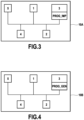
- Figure 3 illustrates an example of the hardware architecture of the electronic device 10A illustrated by Figure 1 .
- the electronic device 10A has the hardware architecture of a computer. As shown in Figure 3 , the electronic device 10A comprises a processor 1. Although illustrated as a single processor 1, two or more processors can be used according to particular needs, desires, or particular implementations of the electronic device 10A. Generally, the processor 1 executes instructions and manipulates data to perform the operations of the electronic device 10A and any algorithms, methods, functions, processes, flows, and procedures as described in the present disclosure.
- the electronic device 10A also comprises communication means 5 which are used by the electronic device 10A for communicating with another electronic device that is communicatively linked to that electronic device 10A, for example for connecting a database storing a plurality of labelled source images and a plurality of target images, where each source image of the plurality is associated to at least one target image.
- the communication means 5 are operable to communicate with a radio network and comprise logic encoded in software, hardware, or a combination of software and hardware. More specifically, the communication means 5 can comprise software supporting one or more communication protocols associated with communications such that the radio network or interface's hardware is operable to communicate physical signals within and outside of the illustrated electronic device.
- the electronic device 10A also comprises a random access memory 2, a read-only memory 3, and a non-volatile memory 4.
- the non-volatile memory 4 of the electronic device 10A stores a computer program PROG_IMP conforming to the invention, containing instructions for carrying out the method for training a neural network according to the invention.
- the program PROG_IMP defines functional modules of the electronic device 10A, which are based on or control the aforementioned elements 1 to 5 of the electronic device 10A, and which comprise in particular:
- the different functional modules described above can be part of a single electronic device (10A), or can be distributed in a plurality of electronic devices belonging to a system.
- Figure 4 illustrates an example of the hardware architecture of the electronic device 10B illustrated by Figure 2 .
- the electronic device 10B has the hardware architecture of a computer. As shown in Figure 4 , the electronic device 10B comprises a processor 1. Although illustrated as a single processor 1, two or more processors can be used according to particular needs, desires, or particular implementations of the electronic device 10B. Generally, the processor 1 executes instructions and manipulates data to perform the operations of the electronic device 10B and any algorithms, methods, functions, processes, flows, and procedures as described in the present disclosure.
- the electronic device 10B also comprises communication means 5 which are used by the electronic device 10B for communicating with another electronic device that is communicatively linked to that electronic device 10B, for example for connecting the electronic device 10A to receive the neural network once trained according to the method for training a neural network previously mentioned.
- the communication means 5 are operable to communicate with a radio network and comprise logic encoded in software, hardware, or a combination of software and hardware. More specifically, the communication means 5 can comprise software supporting one or more communication protocols associated with communications such that the radio network or interface's hardware is operable to communicate physical signals within and outside of the illustrated system.
- the electronic device 10B also comprises a random access memory 2, a read-only memory 3, and a non-volatile memory 4.
- the non-volatile memory 4 of the electronic device 10B stores a computer program PROG_GEN conforming to the invention, containing instructions for carrying out the method for generating a semantic segmentation of an input image according to the invention.
- the program PROG_GEN defines functional modules of the electronic device 10B, which are based on or control the aforementioned elements 1 to 5 of the electronic device 10A, and which comprise in particular:
- the different functional modules described above can be part of a single electronic device (10B), or can be distributed in a plurality of electronic devices belonging to a system.
- Figure 5 illustrates a functional representation of the electronic device 10A illustrated by Figure 1 .
- the electronic device 10A implements a method for training a neural network to process images belonging to several related domains. Accordingly, the electronic device 10A learns representations by penalizing differences between encoded features of pairs of images of a same scene, one of the images of the pair being a "stylized version" of the other one.
- the electronic device 10A is configured to align features that are extracted from the two images with a feature invariance loss that penalizes differences between two feature maps.
- the intuition is that the encoder of the semantic segmentation network should output features that are invariant to the style of the scene, so that the decoder can subsequently produce identical outputs for different versions of a same scene, as the ground-truth semantics of these versions are also identical.
- a labelled source image I S belonging to a source domain and a unlabelled target image I T belonging to a target domain are input to the neural network F.
- the labelled source image I S and the target image I T represent different scenes, each being captured under different lighting and/or weather conditions.
- labelled source image it is referred to an image having pixels associated to a label representing their semantic content.
- a labelled source image can refer to an image where each pixel of that image is associated to a label.
- a "stylization function" g is applied on the source image I S that also takes into input the target image I T , so as to generate a stylized source image I S ⁇ T . That "stylization function" g is also applied on the target image I T , by further taking as input the source image I S , so as to generate a stylized target image I T ⁇ S .
- the stylized source image I S ⁇ T and the stylized target image I T ⁇ S are then also input to the neural network F.
- the stylization function g applied on the source image I S allows generating a stylized source image I S ⁇ T so that the source image I S and the stylized source image I S ⁇ T have similar structural contents, and the at least one stylized source image has the style of an image belonging to the target domain. In other words, that stylization method preserves the structural content of the source image I S .
- the stylization function g applied on the target image I T allows generating a stylized target image I T ⁇ S so that the target image I T and the stylized target image I T ⁇ S have similar structural contents, and the stylized target image I T ⁇ S has the style of an image belonging to the source domain.
- a representation backbone also named “encoder” ⁇ , then generates "feature representations” ⁇ ( I S ), ⁇ ( I T ), ⁇ ( I S ⁇ T ), and ⁇ ( I T ⁇ S ) from the images I S , I T , I S ⁇ T , and I T ⁇ S .
- These feature representations are sometimes referred to as "feature maps”.
- the encoder should be a fully convolutional encoder. In that case, a representation ⁇ (.) ⁇ R D ⁇ M ⁇ N is generated that corresponds to the output of a bottleneck layer, where D corresponds to the channel dimension of the feature map (i.e., the number of channels), and M and N the two spatial dimensions of the feature map (i.e. the numbers of rows and columns of the feature map, respectively).
- the neural network is trained so as to be able to improve the accuracy of semantic segmentation of images belonging to another domain by minimizing a feature invariance loss that penalizes differences between the source image I S and the stylized source image I S ⁇ T .
- the features ⁇ ( I S ) and ⁇ ( I S ⁇ T ) are fed into a feature invariance loss module L INV , which generates a feature invariance loss named L INV F I S I S ⁇ T . Since the source image I S and the stylized source image I S ⁇ T have similar structural contents but only differ in their style, minimizing the function L INV encourages the encoder ⁇ to generate feature representations which are independent of the style of an input image. In a practical manner, this may be implemented by minimizing a distance between features ⁇ ( I S ) and ⁇ ( I S ⁇ T ).
- the neural network is also trained by minimizing a feature invariance loss L INV that penalizes differences between the target image I T and the stylized target image I T ⁇ S .
- the features ⁇ ( I T ) and ⁇ ( I T ⁇ S ) are fed into the feature invariance loss module L INV , which generates a feature invariance loss named L INV F I T I T ⁇ S .
- L INV F I T I T ⁇ S Since the target image I T and the stylized target image I T ⁇ S have similar structural contents but only differ in their style, minimizing the function L INV encourages the encoder ⁇ to generate feature representations which are independent of the style of an input image. In a practical manner, this may be implemented by minimizing a distance between features ⁇ ( I T ) and ⁇ ( I T ⁇ S ) .
- the features ⁇ ( I S ) resulting from a processing (or encoding) of the source image I S and the features ⁇ ( I T ) resulting from a processing (or encoding) of the source image I T are then fed to a shared decoder ⁇ .
- This decoder ⁇ is configured to compute softmax predictions and respective cross-entropy losses.
- the decoder ⁇ generates a softmax output F(I S ) associated to the source image I S , which is fed into a cross-entropy loss module L CE .
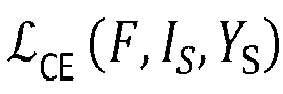
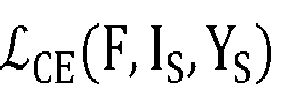
- This cross-entropy loss module L CE is configured to generate a cross entropy loss L CE F I S Y S , with Y S the set of labels of the source image I S .
- the decoder ⁇ generates a softmax output F(I T ) associated to the target image I T , which is fed into the cross-entropy loss module L CE .
- This cross-entropy loss module L CE is configured to generate a cross entropy loss L F I T Y ⁇ t , with ⁇ t a set of pseudo-labels of the target image I T .
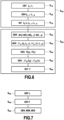
- Figure 6 is a flowchart of a method for training a neural network, according to a particular implementation of the invention.
- the method for training a neural network comprises a step S100 of obtaining at least one labelled source image (I s ) belonging to a source domain; obtaining at least one unlabeled target image (I T ) belonging to a target domain different from the source domain; obtaining at least one stylized source image (I S ⁇ T ); and obtaining at least one stylized target image (I T ⁇ S ).
- This step may be implemented by the module MOD_OB_IMG of the electronic device 10A.
- This step S100 comprises the sub-steps S110 of obtaining at least one source image (I s ) and at least one unlabeled target image (I T ).
- a plurality of source images (I s ) and target images (I T ) are obtained, but for the sake of simplicity, is then considered the case where only one source image (I s ) and one target image (I T ) are obtained.
- Each of the source image (I s ) and the target image (I T ) may be obtained by accessing a database D' storing a dataset comprising a plurality of sets of images, each set comprising one or several source images I S and one or several target images I T .
- the source images (I s ) and the target images (I T ) represent different scenes captured under different lighting and/or weather conditions.
- the electronic device 10A and the database D' may be connected using a wired or wireless connection, via a telecommunication network.
- Step S100 further comprises a sub-step S120 of generating a stylized version of the source image (I s ) and of the target image (I T ).
- the aim of that sub-step S120 is to generate a stylized version of a given image belonging to a given domain, so that the given image and the stylized image have similar structural contents, and the stylized image has the style of an image belonging to a domain different from the given domain.
- the two domains are "aligned" at the level of pixels, and the semantics of the given image is preserved when generating the stylized image.
- the semantic annotation of the given image can be used as a ground truth to supervise prediction of the semantic segmentation of the stylized image.
- a light-weight shallow mapping is applied to generate a stylized version of an image.
- a "light-weight shallow mapping” offers the advantage of performing the stylization (e.g., that step S120) on the fly, and does not introduce unnecessary additional complexity to the overall architecture.
- the stylization mapping function g which is used to generate I S ⁇ T and I T ⁇ S is the same.
- a Fourier Domain Adaptation (FDA) based method is applied.
- FDA-based method reduces the discrepancy between the source and target distributions by swapping the low frequency spectrum of one with the other.
- F P I S with F ⁇ 1 an inverse Fourier Transform, M ⁇ a mask, F A I T a target image amplitude, F A I S a source image amplitude, and F P I S a source image phase.
- the electronic devices 10A implements the following steps:
- the modified spectral representation of I S (with its phase component unaltered) is mapped back to the image I S ⁇ T , the structural content of which is the same as I S but that gets the style of an image belonging to the target domain.
- a main difference with the FDA-based methods of the art is that in the method for training a neural network of the invention, both images belonging to the source and to the target domain are processed, so as to promote invariance of the features generated by the neural network (F) across the two domains, and thus better align the two domains at the level of features, which improves domain adaptation.
- Step S100 further comprises a sub-step S130 of inputting the labelled source image (I S ), the target image (I T ), the stylized source image (I S ⁇ T ); and the stylized target image (I T ⁇ S ) onto the trained neural network (F).
- the method for training a neural network further comprises a step S200 of training the neural network (F) by minimizing a loss function ( L CISS ) penalizing differences between features ( ⁇ ( I S )) generated from the labelled source image (I s ) and features ( ⁇ ( I S ⁇ T )) generated from the at least one stylized source image ( I S ⁇ T ) , and/or the loss function ( L CISS ) penalizing differences between features ( ⁇ ( I T )) generated from the at least one target image ( I T ) and features ( ⁇ (I T ⁇ S )) generated from the at least one stylized target image ( I T ⁇ S ) .
- This step may be implemented by the module MOD_IMP of the electronic device 10A.
- step S200 comprises sub-steps S220, S230, S240, and S250.
- the neural network (F) consists of an encoder and a decoder.
- the neural network (F) generates feature maps, also named “representations” ⁇ ( I S ), ⁇ ( I T ), ⁇ (I S ⁇ T ) , and ⁇ ( I T ⁇ S ) from the images I S , I T , I S ⁇ T , and I T ⁇ S .
- the encoder should be a fully convolutional encoder.
- a representation ⁇ . ⁇ R D ⁇ M ⁇ N is generated that corresponds to the output of a bottleneck layer, where D corresponds to the channel dimension of the feature map (i.e., the number of channels), and M and N the two spatial dimensions of the feature map (i.e. the numbers of rows and columns of the feature map, respectively).
- the feature representations generated at sub-step S220 should ideally be invariant to the specific style or visual condition of the input image, allowing the decoder to focus on parsing these features into output semantic classes and to not have to further abstract from the specific style of the input image.
- the neural network (F) is trained by minimizing a feature invariance loss function L INV . penalizing differences between features generated from a given image and features generated from a stylized version of that given image.
- F ⁇ ⁇ ⁇ .
- a feature invariance loss function is applied to the pairs of images ( I S , I S ⁇ T ) and ( I T , I T ⁇ S ) in order to align features from each pair, and the feature invariance losses L INV F I S I S ⁇ T and L INV F I T I T ⁇ S are computed.
- the method for training a neural network (F) then comprises a step S240 of generating a softmax output F ( I S ) associated to the source image I S and a softmax output F ( I T ) associated to the target image I T .
- the softmax output F(I S ) is fed into a cross-entropy loss module L CE that generates a cross-entropy loss L CE F I S Y S
- the softmax output F(I T ) is also fed into the cross-entropy loss module L CE that generates a cross entropy loss L CE F I T Y ⁇ T , with ⁇ t a set of pseudo-labels of the target image I T .
- pseudo-labels of the target image I T are determined by applying a teacher-student self-training framework of DAFormer [12], with confidence-weighted pseudo-labels.
- L CISS L CE F I s Y s + L CE F I t Y ⁇ t + ⁇ s L inv F I s I s ⁇ t + ⁇ t L inv F I t I t ⁇ s , where ⁇ s and ⁇ t are tunable hyperparameters.
- the neural network (F) is trained by minimizing that resulting loss function L CISS .
- the stochastic gradient descent may be used or any other suitable training algorithm or variant of the stochastic gradient descent.
- the stochastic gradient descent can be used to adapt the weights of the neural network.
- the training method according to the invention comprises minimizing that loss function L CISS , and, for example, back-propagating this loss.
- Figure 7 is a flowchart of a method for generating a semantic segmentation of an input image, according to a particular implementation of the invention. This method is implemented by the electronic device 10B illustrated by Figure 2 .
- the method for generating a semantic segmentation of an input image comprises a first step S300 of obtaining an input image.
- This input image may belong to the target domain, i.e., this input image may represent a scene captured under adverse conditions.
- the method for generating a semantic segmentation of an input image further comprises a step S400 of obtaining a trained neural network (F) generated by performing the method for training a neural network previously described. This step may be implemented by the module MOD_OB_F of the electronic device 10B.
- "obtaining a trained neural network” comprises applying, by this electronic device 10B, the method for training a neural network previously described.
- the electronic device 10A implements the method for training a neural network, and generates a domain-adapted neural network, e.g., a neural network achieving reliable performance also on images captured under adverse conditions.
- the step of "obtaining a trained neural network” then comprises “receiving, by the electronic device 10B, a trained neural network generated by the electronic device 10A".
- the electronic device 10A and the electronic device 10B may be connected using a wired or wireless connection, via a telecommunication network.
- the method for generating a semantic segmentation of an input image further comprises a step S500 of generating a semantic segmentation of the input image using the neural network (F) obtained at step S400.
- This step may be implemented by the module MOD_GEN of the electronic device 10B.
- Figure 8 illustrates qualitative results obtained with the electronic device (10A) of Figure 1 , for a "normal-to-adverse domain adaptation" scenario, using the Cityscapes dataset and the Adverse Conditions Dataset with Correspondences (ACDC).
- the default implementation of the method for training a neural network is based on HRDA [13].
- the semantic segmentation network comprises an MiT-B5 encoder from SegFormer [42] and a context-aware feature fusion decoder [12].
- the method was also implemented with a DeepLabv2 [3] architecture involving a ResNet-101 backbone [9], in order to compare directly to several earlier UDA methods which use this architecture.
- the experiments focus on the setting of domain adaptation and generalization from normal to adverse visual conditions, as the method for training a neural network is tailored for condition-level domain shifts that affect the style and texture of objects in the scene, and not for structural-level shifts as in a typical synthetic-to-real scenario.
- Cityscapes [6] was used as the labelled source-domain set in the experiments.
- Cityscapes is a large dataset of urban driving scenes, captured in several cities of central Europe under normal conditions and containing high-quality pixel-level semantic annotations for a set of 19 common classes in driving scenes. It consists of a training set with 2975 images, a validation set with 500 images, and a test set with 1525 images.
- source images were sampled only from the training set of Cityscapes.
- ACDC [31] was used as the unlabelled target-domain set which models the adverse-condition domain for normal-to-adverse UDA.
- ACDC consists of 4006 images of driving scenes distributed evenly among four common adverse conditions, i.e., night, fog, rain, and snow. It features high-quality semantic annotations for the same set of 19 classes as Cityscapes. Its training, validation and test set contain 1600, 406 and 2000 images respectively.
- BDD100K [44] was used as a target set for domain generalization.
- a zero-shot testing was first performed on the validation set of the 10000-image semantic segmentation subset of BDD100K, which includes 1000 images captured under variable visual conditions.
- BDD100K-night [30] a split of BDD100K with 87 nighttime images with accurate segmentation labels, was used.
- Cityscapes serves as the source domain and the entire ACDC including all four adverse conditions serves as the target domain.
- the method of the invention significantly outperforms all competing methods, both domain adaptation and domain generalization ones, with a margin of 4% in the main mIoU metric from the second-best method. Moreover, the method of the invention achieves the best IoU in 11 out of 19 individual classes, excelling in classes that are crucial for driving perception, such as road, sidewalk, and car. Focusing on the methods that use a DeepLabv2 architecture, CISS-DeepLabv2 also has the top performance among them, showing that the benefit of our method is general across different UDA architectures.
- Figure 8 illustrates Qualitative results on Cityscapes ⁇ ACDC, e.g., qualitative results provided by a neural network trained with the method of the invention, with the Cityscapes dataset as the source domain and the ACDC dataset as the target domain, and then tested/validated on the ACDC dataset.
- Column A includes four different images belonging to the ACDC dataset, column B corresponds to their ground-truth annotations, column C corresponds to semantic segmentation results when applying the HRDA method, and column D corresponds to the results when applying the method for training a neural network of the invention.
- the method of the invention accurately captures sky, road, and sidewalk, whereas HRDA misclassifies both sidewalk and sky as road.
- the method of the invention successfully segments one of the two very dark pedestrians on the left sidewalk and detects the two motorcycles close to them, while HRDA completely mistakes the pedestrians for vegetation and the motorcycles for cars.
- HRDA incorrectly segments the green reflections of two traffic lights on the road as traffic light, while the method of the invention correctly assigns them to road and also segments the right sidewalk much more precisely.
Landscapes
- Engineering & Computer Science (AREA)
- Evolutionary Computation (AREA)
- Theoretical Computer Science (AREA)
- Databases & Information Systems (AREA)
- Computer Vision & Pattern Recognition (AREA)
- Computing Systems (AREA)
- Artificial Intelligence (AREA)
- General Health & Medical Sciences (AREA)
- Medical Informatics (AREA)
- Software Systems (AREA)
- Health & Medical Sciences (AREA)
- Physics & Mathematics (AREA)
- General Physics & Mathematics (AREA)
- Multimedia (AREA)
- Image Analysis (AREA)
Abstract
Description
- The present disclosure is related to the field of computer vision. More precisely, the present disclosure relates to neural networks that may be able to generate a semantic segmentation of images belonging to different domains.
- Machine learning techniques typically require a huge amount of labeled data associated to a given domain to obtain reliable performances. However, the collection and annotation of a large dataset corresponding to a new domain is extremely expensive, time-consuming and error-prone. Furthermore, in some domains, sufficient training data is not available. Finally, a model trained on a dataset of a domain provides poor results when tested on data of another domain, due to "domain shift".
- However, it often happens that a large amount of data is available for another domain that is related to the considered one. Hence, it would be advantageous to adapt a learning model trained on samples of a domain to apply a task on samples of another domain.
- Domain adaptation (DA) is a learning task that addresses that issue, by considering the case of a model trained with samples of one or more domains (named "source domains"), and then configured to apply a task on samples of a different but related domain (named "target domain"). The aim of domain adaptation is to address the shift between the source and target domains, which typically degrades the performance of learning models, by providing a model initially trained on samples of a given domain but then adapted to process samples of another domain which is related to the given domain. Domain adaptation is typically considered as a particular type of transfer learning in which the data distribution of source and target domains are different but the label space in the source domain and target domain are the same.
- Adapting a model to process samples of a target domain by only considering samples from the source domain leads to poor performances, even when a small domain shift exists. To cope with this, Unsupervised Domain Application (UDA) techniques process labeled samples from the source domain and unlabeled samples from the target one. UDA techniques are especially useful for semantic segmentation, where the learning models require a huge amount of manually labeled data, which is expensive to obtain since a per-pixel labeling is needed. Semantic segmentation is defined as the task of assigning, to each pixel of an input image, a label representing its semantic content. Typically, an initial supervised training on the source domain is adapted to the target one by means of an unsupervised learning strategy aiming at achieving reliable performance also on the target domain for which no labels are available.
- These techniques are particularly adapted to bridge the gap between these synthetic data and real world data. As a matter of fact, computer graphics field generates a large amount of annotated synthetic data that may be used for training a model at the end dedicated to process real-world data. UDA techniques then allow bypassing the time-consuming and highly expensive manual labeling required for real-world training data.
- However, most feature-level adaptation methods, which are validated on synthetic-to-real adaptations, provide marginal gains in normal-to-adverse condition-level adaptations.
- There is thus a room for improvement in the field of semantic segmentation models trained with data representing normal conditions, but intended for processing data representing adverse conditions.
- To this end, the present invention first provides a computer-implemented method for training a domain adapted neural network to generate a semantic segmentation of an image, the method comprising:
- inputting at least one labelled source image belonging to a source domain; at least one unlabeled target image belonging to a target domain different from the source domain; at least one stylized source image; and at least one stylized target image into the neural network (F); and,
- training the neural network by minimizing a loss function penalizing differences between features generated from the at least one labelled source image and features generated from the at least one stylized source image, and/or the loss function penalizing differences between features generated from the at least one target image and features generated from the at least one stylized target image.
- The method described above therefore proposes a method for training a neural network with labelled images belonging to a given domain (named "source domain") as well as unlabeled images belonging to another domain (and named "target domain"). The source image and the at least one stylized source image are labelled, but the target image and the at least one stylized target image are unlabeled.
- Training the neural network is however performed under the condition that the source image and the at least one stylized source image input to the neural network show the same scene under the same viewpoint, and that the at least one target image and the at least one stylized target image show another single scene under the same viewpoint.
- In the present description, "viewpoint" corresponds to the viewpoint with respect to the camera used to acquire the image of a scene.
- The source and target images differ in their content and style, i.e., they represent scenes captured with different lighting and/or weather conditions. In an example, the source image belongs to a source domain composed of scene images captured during under normal conditions (e.g., at daytime, when the sky is a clear blue sky, at around 20 000 lux), and the at least one target image belongs to a target domain composed of batches of scene images captured under adverse conditions (e.g., at nighttime when the illuminance is inferior to 1 lux or when the weather is foggy).
- In the present description, "normal conditions" are defined as the combination of daytime and clear weather, with no precipitation or snow cover on the ground, i.e. leading to a good visibility. On the contrary, "adverse conditions" include "bad weather" possibly with precipitation and/or snow covering on the ground, and/or an unfavorable luminosity, i.e., leading to a poor visibility.
- As further detailed hereafter, the at least one stylized source image is generated by mapping style of the target image onto the source image. In this way, the source image and the at least one stylized source image have similar structural contents, and the at least one stylized source image has the style of an image belonging to the target domain. In other words, in the above method, only style information is leveraged from the target image to generate the at least one stylized source image. The training will then strive to reduce the distance between the features extracted from the source image and the at least one stylized source image, and since both images have a similar structural content, the neural network will be encouraged to generate feature representations which are invariant to the style of these input images.
- Similarly, the at least one stylized target image is generated by mapping style of the source image onto the target image. In this way, the target image and the at least one stylized target image have similar structural contents, and the at least one stylized target image has the style of an image belonging to the source domain. In other words, in the above method, only style information is leveraged from the source image to generate the at least one stylized target image. The training will also strive to reduce the distance between the features extracted from the target and those of the at least one stylized target image, and since both images have a similar structural content, the neural network will be encouraged to generate feature representations which are invariant to the style of these input images.
- The neural network is trained to generate a semantic segmentation of an input image. The aim of semantic segmentation is to assign to each pixel of the input image a label representing its semantic content. Semantic segmentation differs from image classification in that in image classification, a single label is assigned to the whole scene. That label denotes the pre-dominant object in the scene. Semantic segmentation also differs from object detection in that, in object detection, the objects are identified by means of a bounding box and a label is assigned to each box.
- A semantic segmentation of an input image results in an image clustered into regions corresponding to various objects and structures which are labeled with a category representing their semantic content.
- The "category" of an object can be referred to as the type or the class of an object, in a manner which is usually done by the person skilled in the art in the field of object detection or semantic segmentation. By way of example, the category can be selected from a list of categories of objects typically present in a scene observed on a street. For example, the categories can be chosen in the list comprising car, pedestrian, cyclist, bus, truck, etc. Categories may also be defined more precisely (for example, for cars, it is possible to consider sedans, compact cars, etc.).
- Training the neural network can be performed iteratively. In that case, a plurality of source images and a plurality of target images represent different scenes, each with different structural content. A plurality of stylized source images and stylized target images are then generated, and the training step is iteratively applied.
- The neural network is trained by minimizing a loss function penalizing differences between features extracted from images. These differences can be expressed as a distance, and after a plurality of distances are calculated (in the case of batch training), the stochastic gradient descent may be used or any other suitable training algorithm or variant of the stochastic gradient descent. The stochastic gradient descent can be used to adapt the weights of the neural network. The training method according to the invention comprises minimizing a loss function, and, for example, and back-propagating this loss.
- In particular implementations, the labelled source image and the at least one unlabeled target image are captured under different lighting and/or weather conditions.
- In particular implementations, the at least one stylized source image is generated by applying a stylization method on the source image, the stylization method preserving a structural content of the source image, the at least one stylized source image having a style of an image belonging to the target domain.
- In particular implementations, the at least one stylized target image is generated by applying a stylization method on the target image, the stylization method preserving a structural content of the target image, the at least one stylized target image having a style of an image belonging to the source domain.
- In particular implementations, the neural network comprises an encoder configured for generating intermediate features, and the step of minimizing the loss function encourages the encoder to generate intermediate features invariant to lighting and/or weather conditions.
- In particular implementations, labels of the source image are used as ground truth for supervising a semantic segmentation prediction of the source image.
- In particular implementations, the neural network further comprises a decoder configured to parse the generated features into "semantic classes" or "categories".
- As already mentioned, the notion of "category" can be referred to as the type or the class of an object, in a manner which is usually done by the person skilled in the art in the field of object detection or semantic segmentation.
- In particular implementations, the loss function corresponds to a sum of:
- a first feature invariance loss penalizing the differences between features generated from the at least one labelled source image and features generated from the at least one stylized source image, said least one stylized source image comprising the same structural content as the aforementioned labelled source image,
- a second feature invariance loss penalizing the differences between features generated from the at least one target image and features generated from the at least one stylized target image, said at least one stylized target image comprising the same structural content as the aforementioned target image,
- a cross-entropy loss
- a cross-entropy loss

- In particular implementations, the first and second feature invariance losses are defined as


- In particular implementations, the method further comprises generating the at least one stylized source image by applying a stylization method on the source image, and generating the at least one stylized target image by applying the stylization method on the target image.
- In particular implementations, applying the stylization method on the source image comprises:
- applying a Fourier Transform on the source image to obtain a source image phase FP (IS) and a source image amplitude FA (IS);
- applying a Fourier Transform on the at least one target image to obtain a target image amplitude FA (IT);
- replacing a low-frequency part of the source image amplitude FA (IS) by a low-frequency part of the target image amplitude FA (IT); and,
- generating the at least one stylized source image by applying an inverse Fourier Transform F -1 so that

- The present invention also concerns a neural network trained by the method according to the invention.
- According to a third aspect, the present invention concerns an electronic device comprising at least one processor and a memory having stored thereon a program for implementing the method described above.
- According to a fourth aspect, the present invention concerns a computer-implemented method for generating a semantic segmentation of an input image, the method comprising:
- obtaining a neural network trained by performing the method for training a neural network described above; and,
- generating a semantic segmentation of the input image using the obtained neural network.
- As already mentioned, generating a semantic segmentation of the input image aims at assigning, to each pixel of the input image, a label representing its semantic content.
- According to a fifth aspect, the present invention concerns an electronic device comprising at least one processor and a memory having stored thereon a program for implementing the method for generating a semantic segmentation described above.
- According to a sixth aspect, the present invention concerns a system comprising the electronic device configured for implementing the method for training a neural network and the electronic device configured for implementing the method for generating a semantic segmentation of an input image.
- Embodiments of the present invention also extend to programs which, when run on a computer or processor, cause the computer or processor to carry out the methods described above or which, when loaded into a programmable device, cause that device to become the device described above. The program may be provided by itself, or carried by a carrier medium. The carrier medium may be a storage or recording medium, or it may be a transmission medium such as a signal. A program embodying the present invention may be transitory or non-transitory.
- Features, advantages, and technical and industrial significance of exemplary embodiments of the invention will be described below with reference to the accompanying drawings, in which like signs denote like elements, and wherein:
-
Figure 1 illustrates a particular implementation of an electronic device (10A) configured for implementing the method for training a neural network; -
Figure 2 illustrates a particular implementation of an electronic device (10B) configured for generating a semantic segmentation of an input image; -
Figure 3 illustrates an example of the hardware architecture of the electronic device (10A) illustrated byFigure 1 ; -
Figure 4 illustrates an example of the hardware architecture of the electronic device (10B) illustrated byFigure 2 ; -
Figure 5 illustrates a functional representation of the electronic device (10A) illustrated byFigure 1 ; -
Figure 6 is a flowchart of a method for training a neural network, according to a particular implementation of the invention; -
Figure 7 is a flowchart of a method for generating a semantic segmentation of an input image, according to a particular implementation of the invention; and, -
Figure 8 illustrates qualitative results obtained with the electronic device (10A) ofFigure 1 , for a "normal-to-adverse domain adaptation" scenario, using the Cityscapes dataset and the Adverse Conditions Dataset with Correspondences (ACDC). - For the purpose of the invention, it is to be understood that the specific devices and processes illustrated in the attached drawings, and described in the following specification, are simply exemplary embodiments or aspects of the disclosed subject matter. Hence, specific dimensions and other physical characteristics related to the embodiments or aspects disclosed herein are not to be considered as limiting unless otherwise indicated.
- No aspect, component, element, module, entity, step, function, instruction, and/or the like used herein should be construed as critical or essential unless explicitly described as such. Also, as used herein, the articles "a" and "an" are intended to include one or more items and may be used interchangeably with "one or more" and "at least one". Where only one item is intended, the term "one" or similar language is used. Also, as used herein, the terms "has," "have," "having," or the like are intended to be open-ended terms. Further, the phrase "based on" is intended to mean "based at least partially on" unless explicitly stated otherwise.
-
Figure 1 illustrates a particular implementation of anelectronic device 10A configured for implementing the method for training a neural network. -
Figure 2 illustrates a particular implementation of anelectronic device 10B configured for generating a semantic segmentation of an input image. - The rest of the description is aimed more specifically at a training of a neural network to provide a semantic segmentation of input images. The invention remains applicable whatever the nature of the neural network considered (convolutional, perceptron, auto-encoder, recurrent, etc.), in particular for any deep neural network.
- In addition, no limitation is attached to the kind or content of images (also named "input images") that may be input to the semantic segmentation model, and no limitation is attached to the kind of semantic segmentation that may be output based on the input images (i.e. the nature of the classes or "categories" is not a limiting factor of the invention. Specifically, these images may include, for example, images of urban scenes having pixel-level semantic annotations captured by an autonomous vehicle.
- For the records, semantic segmentation is still a challenging and complex task in automatic visual understanding, if compared with simpler problems like image classification or object detection: as a matter of fact, in image classification, a single label is assigned to the whole input image that refers to a pre-dominant object in the scene captured by that input image; in object detection, the objects are identified by means of a 2D bounding box and a label is assigned to each box. On the contrary, in semantic segmentation, each pixel of the input image is assigned to a label corresponding to its semantic content.
- The
electronic device 10A is configured to train the neural network (F), so as to be able to improve the accuracy of semantic segmentation of images. The trained neural network is then used as an input of anelectronic device 10B implementing a method for generating a semantic segmentation of an input image. Said method is referred to as "semantic segmentation method" hereafter. By "improving the accuracy of semantic segmentation", reference is made here to obtaining semantic segmentation results that are more accurate than if the neural network is not improved (or "adapted") according to the invention. -
Figure 3 illustrates an example of the hardware architecture of theelectronic device 10A illustrated byFigure 1 . - The
electronic device 10A has the hardware architecture of a computer. As shown inFigure 3 , theelectronic device 10A comprises aprocessor 1. Although illustrated as asingle processor 1, two or more processors can be used according to particular needs, desires, or particular implementations of theelectronic device 10A. Generally, theprocessor 1 executes instructions and manipulates data to perform the operations of theelectronic device 10A and any algorithms, methods, functions, processes, flows, and procedures as described in the present disclosure. - The
electronic device 10A also comprises communication means 5 which are used by theelectronic device 10A for communicating with another electronic device that is communicatively linked to thatelectronic device 10A, for example for connecting a database storing a plurality of labelled source images and a plurality of target images, where each source image of the plurality is associated to at least one target image. Generally, the communication means 5 are operable to communicate with a radio network and comprise logic encoded in software, hardware, or a combination of software and hardware. More specifically, the communication means 5 can comprise software supporting one or more communication protocols associated with communications such that the radio network or interface's hardware is operable to communicate physical signals within and outside of the illustrated electronic device. - Although illustrated as a single communication means 5 in
Figure 3 , two or more communication means can be used according to particular needs, desires, or particular implementations of the system. Theelectronic device 10A also comprises arandom access memory 2, a read-only memory 3, and anon-volatile memory 4. - The
non-volatile memory 4 of theelectronic device 10A stores a computer program PROG_IMP conforming to the invention, containing instructions for carrying out the method for training a neural network according to the invention. - The program PROG_IMP defines functional modules of the
electronic device 10A, which are based on or control theaforementioned elements 1 to 5 of theelectronic device 10A, and which comprise in particular: - a module MOD_OB_IMG configured for inputting at least one labelled source image (Is) belonging to a source domain; at least one unlabeled target image (IT) belonging to a target domain different from the source domain; at least one stylized source image (IS→T); and at least one stylized target image (IT→S) into the neural network (F); and,
- a module MOD_IMP configured for training a neural network (F) by minimizing a loss function (


- The different functional modules described above can be part of a single electronic device (10A), or can be distributed in a plurality of electronic devices belonging to a system.
-
Figure 4 illustrates an example of the hardware architecture of theelectronic device 10B illustrated byFigure 2 . - The
electronic device 10B has the hardware architecture of a computer. As shown inFigure 4 , theelectronic device 10B comprises aprocessor 1. Although illustrated as asingle processor 1, two or more processors can be used according to particular needs, desires, or particular implementations of theelectronic device 10B. Generally, theprocessor 1 executes instructions and manipulates data to perform the operations of theelectronic device 10B and any algorithms, methods, functions, processes, flows, and procedures as described in the present disclosure. - The
electronic device 10B also comprises communication means 5 which are used by theelectronic device 10B for communicating with another electronic device that is communicatively linked to thatelectronic device 10B, for example for connecting theelectronic device 10A to receive the neural network once trained according to the method for training a neural network previously mentioned. - Generally, the communication means 5 are operable to communicate with a radio network and comprise logic encoded in software, hardware, or a combination of software and hardware. More specifically, the communication means 5 can comprise software supporting one or more communication protocols associated with communications such that the radio network or interface's hardware is operable to communicate physical signals within and outside of the illustrated system.
- Although illustrated as a single communication means 5 in
Figure 4 , two or more communication means can be used according to particular needs, desires, or particular implementations of theelectronic device 10B. Theelectronic device 10B also comprises arandom access memory 2, a read-only memory 3, and anon-volatile memory 4. - The
non-volatile memory 4 of theelectronic device 10B stores a computer program PROG_GEN conforming to the invention, containing instructions for carrying out the method for generating a semantic segmentation of an input image according to the invention. - The program PROG_GEN defines functional modules of the
electronic device 10B, which are based on or control theaforementioned elements 1 to 5 of theelectronic device 10A, and which comprise in particular: - a module MOD_OB_F configured for obtaining a neural network (F) generated by performing the method for training a neural network (F) according to the invention; and,
- a module MOD_GEN configured for generating a semantic segmentation of the input image using the obtained neural network (F).
- The different functional modules described above can be part of a single electronic device (10B), or can be distributed in a plurality of electronic devices belonging to a system.
-
Figure 5 illustrates a functional representation of theelectronic device 10A illustrated byFigure 1 . - As already mentioned, the
electronic device 10A implements a method for training a neural network to process images belonging to several related domains. Accordingly, theelectronic device 10A learns representations by penalizing differences between encoded features of pairs of images of a same scene, one of the images of the pair being a "stylized version" of the other one. - More precisely, the
electronic device 10A is configured to align features that are extracted from the two images with a feature invariance loss that penalizes differences between two feature maps. The intuition is that the encoder of the semantic segmentation network should output features that are invariant to the style of the scene, so that the decoder can subsequently produce identical outputs for different versions of a same scene, as the ground-truth semantics of these versions are also identical. - To that end, as illustrated by
Figure 5 , a labelled source image IS belonging to a source domain and a unlabelled target image IT belonging to a target domain are input to the neural network F. The labelled source image IS and the target image IT represent different scenes, each being captured under different lighting and/or weather conditions. By "labelled source image", it is referred to an image having pixels associated to a label representing their semantic content. In a particular case, a labelled source image can refer to an image where each pixel of that image is associated to a label. - A "stylization function" g is applied on the source image IS that also takes into input the target image IT, so as to generate a stylized source image IS→T. That "stylization function" g is also applied on the target image IT, by further taking as input the source image IS, so as to generate a stylized target image IT→S. The stylized source image IS→T and the stylized target image IT→S are then also input to the neural network F.
- As further described below, the stylization function g applied on the source image IS allows generating a stylized source image IS→T so that the source image IS and the stylized source image IS→T have similar structural contents, and the at least one stylized source image has the style of an image belonging to the target domain. In other words, that stylization method preserves the structural content of the source image IS. In a similar way, the stylization function g applied on the target image IT allows generating a stylized target image IT→S so that the target image IT and the stylized target image IT→S have similar structural contents, and the stylized target image IT→S has the style of an image belonging to the source domain.
- A representation backbone, also named "encoder" ϕ, then generates "feature representations" ϕ(IS ), ϕ(IT ), ϕ(IS→T ), and ϕ(IT→S ) from the images IS, IT, IS→T, and IT→S. These feature representations are sometimes referred to as "feature maps". The encoder should be a fully convolutional encoder. In that case, a representation ϕ(.) ∈

- The neural network is trained so as to be able to improve the accuracy of semantic segmentation of images belonging to another domain by minimizing a feature invariance loss that penalizes differences between the source image IS and the stylized source image IS→T. To that end, the features ϕ(IS ) and ϕ(IS→T ) are fed into a feature invariance loss module


- The neural network is also trained by minimizing a feature invariance loss LINV that penalizes differences between the target image IT and the stylized target image IT→S. To that end, the features ϕ(IT ) and ϕ(IT→S ) are fed into the feature invariance loss module


- The features ϕ(IS ) resulting from a processing (or encoding) of the source image IS and the features ϕ(IT ) resulting from a processing (or encoding) of the source image IT are then fed to a shared decoder ω. This decoder ω is configured to compute softmax predictions and respective cross-entropy losses.
- More precisely, the decoder ω generates a softmax output F(IS) associated to the source image IS, which is fed into a cross-entropy loss module LCE. This cross-entropy loss module


- Further details concerning the feature invariance loss LINV (.) and the cross entropy loss LCE (.) are provided in the following.
-
Figure 6 is a flowchart of a method for training a neural network, according to a particular implementation of the invention. - The method for training a neural network comprises a step S100 of obtaining at least one labelled source image (Is) belonging to a source domain; obtaining at least one unlabeled target image (IT) belonging to a target domain different from the source domain; obtaining at least one stylized source image (IS→T); and obtaining at least one stylized target image (IT→S). This step may be implemented by the module MOD_OB_IMG of the
electronic device 10A. - This step S100 comprises the sub-steps S110 of obtaining at least one source image (Is) and at least one unlabeled target image (IT). Typically, a plurality of source images (Is) and target images (IT) are obtained, but for the sake of simplicity, is then considered the case where only one source image (Is) and one target image (IT) are obtained.
- Each of the source image (Is) and the target image (IT) may be obtained by accessing a database D' storing a dataset comprising a plurality of sets of images, each set comprising one or several source images IS and one or several target images IT. The source images (Is) and the target images (IT) represent different scenes captured under different lighting and/or weather conditions. The
electronic device 10A and the database D' may be connected using a wired or wireless connection, via a telecommunication network. - Step S100 further comprises a sub-step S120 of generating a stylized version of the source image (Is) and of the target image (IT).
- More precisely, the aim of that sub-step S120 is to generate a stylized version of a given image belonging to a given domain, so that the given image and the stylized image have similar structural contents, and the stylized image has the style of an image belonging to a domain different from the given domain. In that way, the two domains are "aligned" at the level of pixels, and the semantics of the given image is preserved when generating the stylized image. Thus, the semantic annotation of the given image can be used as a ground truth to supervise prediction of the semantic segmentation of the stylized image.
- In particular implementations, a light-weight shallow mapping is applied to generate a stylized version of an image. A "light-weight shallow mapping" offers the advantage of performing the stylization (e.g., that step S120) on the fly, and does not introduce unnecessary additional complexity to the overall architecture.
- More formally, the stylized source image IS→T may be computed as


- The stylization mapping function g which is used to generate IS→T and IT→S is the same.
- Although the method of the invention is agnostic to the exact mapping g that is used for stylization, in particular implementations, a Fourier Domain Adaptation (FDA) based method is applied. An FDA-based method reduces the discrepancy between the source and target distributions by swapping the low frequency spectrum of one with the other. To generate the stylized source image IS→T with the FDA-based method, the
electronic devices 10A implements


- More precisely, the
electronic devices 10A implements the following steps: - - applying a Fourier Transform () on the source image (Is) to obtain a source image phase


- - applying a Fourier Transform () on the target image (IT) to obtain a target image amplitude


- - replacing the low-frequency part of the source image amplitude


- - generating the at least one stylized source image (IS→T) by applying an inverse Fourier Transform


- Then, the modified spectral representation of IS (with its phase component unaltered) is mapped back to the image IS→T, the structural content of which is the same as IS but that gets the style of an image belonging to the target domain.
- The person skilled in the art can consult the article "Fourier Domain Adaptation for Semantic Segmentation" by Yanchao Yang and Stefano Soatto, In IEEE/CVF Conference on Computer Vision and Pattern Recognition, June 2020 for further details concerning the FDA-based method.
- A main difference with the FDA-based methods of the art is that in the method for training a neural network of the invention, both images belonging to the source and to the target domain are processed, so as to promote invariance of the features generated by the neural network (F) across the two domains, and thus better align the two domains at the level of features, which improves domain adaptation.
- Step S100 further comprises a sub-step S130 of inputting the labelled source image (IS), the target image (IT), the stylized source image (IS→T); and the stylized target image (IT→S) onto the trained neural network (F).
- The method for training a neural network further comprises a step S200 of training the neural network (F) by minimizing a loss function (


electronic device 10A. - More precisely, step S200 comprises sub-steps S220, S230, S240, and S250. As already mentioned, the neural network (F) consists of an encoder and a decoder. At sub-step S220, the neural network (F) generates feature maps, also named "representations" ϕ(IS ), ϕ(IT ), ϕ(IS→T ), and ϕ(IT→S ) from the images IS, IT, IS→T, and IT→S.
- The encoder should be a fully convolutional encoder. In that case, a representation

- At sub-step S230, feature invariance losses


- The use of specific feature invariance losses rather than a typical cross-entropy loss offers the advantage of imposing a stronger constraint on the neural network (F), regarding the shared semantic content between Is and Is→t, and respectively between It and It→s.
- The feature representations generated at sub-step S220 should ideally be invariant to the specific style or visual condition of the input image, allowing the decoder to focus on parsing these features into output semantic classes and to not have to further abstract from the specific style of the input image.
- Thus, the neural network (F) is trained by minimizing a feature invariance loss function

- More formally, let us consider F as a composition of an encoder ϕ and a decoder ω, then F = ω ∘ ϕ. Let I and I' two input images of the same dimensions, and ϕ(I), ϕ(I') the features generated by the encoder so that

- The feature invariance loss can be expressed as:

- Going back to step S230, a feature invariance loss function is applied to the pairs of images (IS , IS→T ) and (IT, IT→S ) in order to align features from each pair, and the feature invariance losses


- The method for training a neural network (F) then comprises a step S240 of generating a softmax output F(IS ) associated to the source image IS and a softmax output F(IT ) associated to the target image IT.
- At step S250, the softmax output F(IS) is fed into a cross-entropy loss module


- In a particular implementation, pseudo-labels of the target image IT are determined by applying a teacher-student self-training framework of DAFormer [12], with confidence-weighted pseudo-labels.
- More formally, if the semantic labels Y are one-hot-encoded in a C × H × W tensor, then the cross-entropy loss


- The two resulting feature invariance losses




- At step S260, the neural network (F) is trained by minimizing that resulting loss function


-
Figure 7 is a flowchart of a method for generating a semantic segmentation of an input image, according to a particular implementation of the invention. This method is implemented by theelectronic device 10B illustrated byFigure 2 . - As shown on
Figure 7 , the method for generating a semantic segmentation of an input image comprises a first step S300 of obtaining an input image. This input image may belong to the target domain, i.e., this input image may represent a scene captured under adverse conditions. - The method for generating a semantic segmentation of an input image further comprises a step S400 of obtaining a trained neural network (F) generated by performing the method for training a neural network previously described. This step may be implemented by the module MOD_OB_F of the
electronic device 10B. - In particular implementations, "obtaining a trained neural network" comprises applying, by this
electronic device 10B, the method for training a neural network previously described. - In a variant, the
electronic device 10A implements the method for training a neural network, and generates a domain-adapted neural network, e.g., a neural network achieving reliable performance also on images captured under adverse conditions. And the step of "obtaining a trained neural network" then comprises "receiving, by theelectronic device 10B, a trained neural network generated by theelectronic device 10A". In that case, theelectronic device 10A and theelectronic device 10B may be connected using a wired or wireless connection, via a telecommunication network. - The method for generating a semantic segmentation of an input image further comprises a step S500 of generating a semantic segmentation of the input image using the neural network (F) obtained at step S400. This step may be implemented by the module MOD_GEN of the
electronic device 10B. -
Figure 8 illustrates qualitative results obtained with the electronic device (10A) ofFigure 1 , for a "normal-to-adverse domain adaptation" scenario, using the Cityscapes dataset and the Adverse Conditions Dataset with Correspondences (ACDC). - The default implementation of the method for training a neural network is based on HRDA [13]. The semantic segmentation network comprises an MiT-B5 encoder from SegFormer [42] and a context-aware feature fusion decoder [12].
- The method was also implemented with a DeepLabv2 [3] architecture involving a ResNet-101 backbone [9], in order to compare directly to several earlier UDA methods which use this architecture. For the default HRDA-based implementation, the teacher-student self-training framework of DAFormer [12] with confidence-weighted pseudolabels, rare class sampling, and target data augmentation following DACS [34] were followed, and the AdamW optimizer [21] was used with a learning rate of 6 × 10⁻⁵ for the encoder and 6 × 10⁻⁴ for the decoder, a linear learning rate warmup, and mini-batches of size B = 2, training on two Titan RTX GPUs, each of which processes one of the two samples of each mini-batch.
- The default configuration and parameters of HRDA were applied regarding its multi-resolution setup. In the application of the FDA-based method for stylizing an image, β = 0.01 was used as the bandwidth parameter of the low-frequency band of the Fourier spectrum. We set the default values of the weights of the feature invariance losses in to λs = 200 and λt = 100 for the default HRDA-based implementation of CISS and to λs = λt = 10 for the alternative DeepLabv2-based implementation.
- The experiments focus on the setting of domain adaptation and generalization from normal to adverse visual conditions, as the method for training a neural network is tailored for condition-level domain shifts that affect the style and texture of objects in the scene, and not for structural-level shifts as in a typical synthetic-to-real scenario.
- The dataset Cityscapes [6] was used as the labelled source-domain set in the experiments. Cityscapes is a large dataset of urban driving scenes, captured in several cities of central Europe under normal conditions and containing high-quality pixel-level semantic annotations for a set of 19 common classes in driving scenes. It consists of a training set with 2975 images, a validation set with 500 images, and a test set with 1525 images. When training UDA methods in our experiments, source images were sampled only from the training set of Cityscapes. In addition, the dataset ACDC [31] was used as the unlabelled target-domain set which models the adverse-condition domain for normal-to-adverse UDA. ACDC consists of 4006 images of driving scenes distributed evenly among four common adverse conditions, i.e., night, fog, rain, and snow. It features high-quality semantic annotations for the same set of 19 classes as Cityscapes. Its training, validation and test set contain 1600, 406 and 2000 images respectively.
- Finally, BDD100K [44] was used as a target set for domain generalization. In particular, a zero-shot testing was first performed on the validation set of the 10000-image semantic segmentation subset of BDD100K, which includes 1000 images captured under variable visual conditions. And then BDD100K-night [30], a split of BDD100K with 87 nighttime images with accurate segmentation labels, was used.
- Comparison of state-of-the-art unsupervised domain adaptation and generalization methods on Cityscapes → ACDC.
- Cityscapes serves as the source domain and the entire ACDC including all four adverse conditions serves as the target domain.
- The method of the invention, CISS, significantly outperforms all competing methods, both domain adaptation and domain generalization ones, with a margin of 4% in the main mIoU metric from the second-best method. Moreover, the method of the invention achieves the best IoU in 11 out of 19 individual classes, excelling in classes that are crucial for driving perception, such as road, sidewalk, and car. Focusing on the methods that use a DeepLabv2 architecture, CISS-DeepLabv2 also has the top performance among them, showing that the benefit of our method is general across different UDA architectures.
-
Figure 8 illustrates Qualitative results on Cityscapes → ACDC, e.g., qualitative results provided by a neural network trained with the method of the invention, with the Cityscapes dataset as the source domain and the ACDC dataset as the target domain, and then tested/validated on the ACDC dataset. - Column A includes four different images belonging to the ACDC dataset, column B corresponds to their ground-truth annotations, column C corresponds to semantic segmentation results when applying the HRDA method, and column D corresponds to the results when applying the method for training a neural network of the invention.
- On the top snowy image, the method of the invention accurately captures sky, road, and sidewalk, whereas HRDA misclassifies both sidewalk and sky as road. On the nighttime image of the second row, the method of the invention successfully segments one of the two very dark pedestrians on the left sidewalk and detects the two motorcycles close to them, while HRDA completely mistakes the pedestrians for vegetation and the motorcycles for cars. On the bottom rainy image, HRDA incorrectly segments the green reflections of two traffic lights on the road as traffic light, while the method of the invention correctly assigns them to road and also segments the right sidewalk much more precisely.
-
- [3] Chen & Al., DeepLab: Semantic image segmentation with deep convolutional nets, atrous convolution, and fully connected CRFs. IEEE Transactions on Pattern Analysis and Machine Intelligence, 40(4):834-848, 2018.
- [6] Cordts & Al., The Cityscapes dataset for semantic urban scene understanding. In The IEEE Conference on Computer Vision and Pattern Recognition (CVPR), 2016.
- [9] He & Al., Deep residual learning for image recognition. In The IEEE Conference on Computer Vision and Pattern Recognition (CVPR), June 2016.
- [12] Hoyer & Al., DAFormer: Improving network architectures and training strategies for domain-adaptive semantic segmentation. In Proceedings of the IEEE/CVF Conference on Computer Vision and Pattern Recognition (CVPR), 2022.
- [13] Hoyer & Al., HRDA: Context-aware high-resolution domain-adaptive semantic segmentation. In The European Conference on Computer Vision (ECCV), 2022
- [21] Loshchilov & Al., Decoupled weight decay regularization. In ICLR, 2018.
- [30] Sakaridis & Al., Map-guided curriculum domain adaptation and uncertainty-aware evaluation for semantic nighttime image segmentation. IEEE Transactions on Pattern Analysis and Machine Intelligence, 2020
- [34] Tranheden & Al., DACS: Domain adaptation via crossdomain mixed sampling. In Proceedings of the IEEE/CVF Winter Conference on Applications of Computer Vision (WACV), 2021.
- [42] Xie & Al., SegFormer: Simple and efficient design for semantic segmentation with transformers. In Advances in Neural Information Processing Systems, 2021.
- [44] Yu & Al., BDD100K: A diverse driving dataset for heterogeneous multitask learning. In IEEE/CVF Conference on Computer Vision and Pattern Recognition (CVPR), June 2020.
Claims (17)
- A computer-implemented method for training a neural network (F), the method comprising:- inputting (S130) at least one labelled source image (Is) belonging to a source domain; at least one unlabeled target image (IT) belonging to a target domain different from the source domain; at least one stylized source image (IS→T); and at least one stylized target image (IT→S) into the neural network (F); and,- training (S200) the neural network (F) by minimizing a loss function (

- The method of Claim 1, wherein the at least one labelled source image (Is) and the at least one unlabeled target image (IT) are captured under different lighting and/or weather conditions.
- The method of Claim 1 or 2, wherein the at least one stylized source image (IS→T) is generated by applying a stylization method on the source image (IS), the stylization method preserving a structural content of the source image (IS), the at least one stylized source image (IS→T) having a style of an image belonging to the target domain.
- The method of one of Claims 1 to 3, wherein the at least one stylized target image (IT→S) is generated by applying a stylization method on the target image (IT), the stylization method preserving a structural content of the target image (IT), the at least one stylized target image (IT→S) having a style of an image belonging to the source domain.
- The method of one of Claims 1 to 4, wherein the neural network (F) comprises an encoder (ϕ) configured for generating intermediate features, wherein minimizing the loss function (

- The method of one of Claims 1 to 5, wherein the loss function (
 - a first feature invariance loss penalizing the differences between features (ϕ(IS )) generated from the at least one labelled source image (IS ) and features (ϕ(IS→T )) generated from the at least one stylized source image (IS→T ),- a second feature invariance loss penalizing the differences between features (ϕ(IT )) generated from the at least one target image (IT ) and features (ϕ(IT→S )) generated from the at least one stylized target image (IT→S ),- a cross-entropy loss
 - a cross-entropy loss
- The method of Claim 6, wherein the first and second feature invariance losses are defined as


- The method of one of Claims 1 to 7, further comprising generating (S120) the at least one stylized source image (IS→T) by applying a stylization method on the source image (IS), and generating (S120) the at least one stylized target image (IT→S) by applying the stylization method on the target image (IT).
- The method of Claim 8, wherein applying the stylization method on the source image (Is) comprises:- applying a Fourier Transform (F) on the source image (Is) to obtain a source image phase FP (IS) and a source image amplitude FA (IS);- applying a Fourier Transform (F) on the at least one target image (IT) to obtain a target image amplitude FA (IT);- replacing a low-frequency part of the source image amplitude FA (IS) by a low-frequency part of the target image amplitude FA (IT); and,- generating the at least one stylized source image (IS→T) by applying an inverse Fourier Transform F -1 so that

- A neural network trained by the method according to any one of Claims 1 to 9.
- An electronic device (10A) comprising at least one processor (1) and a memory (3) having stored thereon a program (PROG_IMP) for implementing the method for training a neural network according to one of Claims 1 to 9.
- A computer program (PROG_IMP) which on execution by an electronic device (10A) causes the electronic device to execute the method for training a neural network according to one of Claims 1 to 9.
- A recording medium readable by a computer and having recorded thereon a computer program including instructions for executing the method for training a neural network according to one of Claims 1 to 9.
- A computer-implemented method for generating a semantic segmentation of an input image, the method comprising:- obtaining (S400) aneural network (F) trained by performing the method of one of Claims 1 to 9; and,- generating (S500) a semantic segmentation of the input image using the obtained neural network (F).
- An electronic device (10B) comprising at least one processor (1) and a memory (3) having stored thereon a program (PROG_GEN) for implementing the method for generating a semantic segmentation of an input image according to Claim 14.
- A computer program (PROG_GEN) which on execution by an electronic device (10B) causes the electronic device (10B) to execute the method for generating a semantic segmentation of an input image according to Claim 14.
- A recording medium readable by a computer and having recorded thereon a computer program including instructions for executing the method for generating a semantic segmentation of an input image according to Claim 14.
Priority Applications (2)
| Application Number | Priority Date | Filing Date | Title |
|---|---|---|---|
| EP23157035.9A EP4418215B1 (en) | 2023-02-16 | 2023-02-16 | Method for training a domain-adapted neural network, and associated device |
| JP2024021893A JP7791225B2 (en) | 2023-02-16 | 2024-02-16 | Method for training a domain-adaptive neural network and associated device |
Applications Claiming Priority (1)
| Application Number | Priority Date | Filing Date | Title |
|---|---|---|---|
| EP23157035.9A EP4418215B1 (en) | 2023-02-16 | 2023-02-16 | Method for training a domain-adapted neural network, and associated device |
Publications (2)
| Publication Number | Publication Date |
|---|---|
| EP4418215A1 true EP4418215A1 (en) | 2024-08-21 |
| EP4418215B1 EP4418215B1 (en) | 2026-01-14 |
Family
ID=85278064
Family Applications (1)
| Application Number | Title | Priority Date | Filing Date |
|---|---|---|---|
| EP23157035.9A Active EP4418215B1 (en) | 2023-02-16 | 2023-02-16 | Method for training a domain-adapted neural network, and associated device |
Country Status (2)
| Country | Link |
|---|---|
| EP (1) | EP4418215B1 (en) |
| JP (1) | JP7791225B2 (en) |
Citations (2)
| Publication number | Priority date | Publication date | Assignee | Title |
|---|---|---|---|---|
| US20180373999A1 (en) * | 2017-06-26 | 2018-12-27 | Konica Minolta Laboratory U.S.A., Inc. | Targeted data augmentation using neural style transfer |
| CN115393365A (en) * | 2021-05-24 | 2022-11-25 | 中移(成都)信息通信科技有限公司 | Image processing method, device, equipment and storage medium |
Family Cites Families (5)
| Publication number | Priority date | Publication date | Assignee | Title |
|---|---|---|---|---|
| CN114139676B (en) * | 2020-09-02 | 2025-10-03 | 富士通株式会社 | Training Methods for Domain-Adaptive Neural Networks |
| JP7423500B2 (en) * | 2020-12-09 | 2024-01-29 | 株式会社東芝 | Information processing devices, information processing methods, programs, and vehicle control systems |
| JP7485226B2 (en) * | 2021-01-12 | 2024-05-16 | 日本電気株式会社 | Training device, classification device, training method, classification method, and program |
| CN113326848B (en) * | 2021-06-17 | 2023-04-18 | 中山大学 | Semi-supervised domain adaptive method, system, equipment and storage medium |
| CN113657267B (en) * | 2021-08-17 | 2024-01-12 | 中国科学院长春光学精密机械与物理研究所 | A semi-supervised pedestrian re-identification method and device |
-
2023
- 2023-02-16 EP EP23157035.9A patent/EP4418215B1/en active Active
-
2024
- 2024-02-16 JP JP2024021893A patent/JP7791225B2/en active Active
Patent Citations (2)
| Publication number | Priority date | Publication date | Assignee | Title |
|---|---|---|---|---|
| US20180373999A1 (en) * | 2017-06-26 | 2018-12-27 | Konica Minolta Laboratory U.S.A., Inc. | Targeted data augmentation using neural style transfer |
| CN115393365A (en) * | 2021-05-24 | 2022-11-25 | 中移(成都)信息通信科技有限公司 | Image processing method, device, equipment and storage medium |
Non-Patent Citations (11)
| Title |
|---|
| CHENAL: "DeepLab: Semantic image segmentation with deep convolutional nets, atrous convolution, and fully connected CRFs", IEEE TRANSACTIONS ON PATTERN ANALYSIS AND MACHINE INTELLIGENCE, vol. 40, no. 4, 2018, pages 834 - 848 |
| CORDTSAL: "The Cityscapes dataset for semantic urban scene understanding", THE IEEE CONFERENCE ON COMPUTER VISION AND PATTERN RECOGNITION (CVPR, 2016 |
| HEAL: "Deep residual learning for image recognition", THE IEEE CONFERENCE ON COMPUTER VISION AND PATTERN RECOGNITION (CVPR, June 2016 (2016-06-01) |
| HOYERAL: "DAFormer: Improving network architectures and training strategies for domain-adaptive semantic segmentation", PROCEEDINGS OF THE IEEE/CVF CONFERENCE ON COMPUTER VISION AND PATTERN RECOGNITION (CVPR, 2022 |
| HOYERAL: "HRDA: Context-aware high-resolution domain-adaptive semantic segmentation", THE EUROPEAN CONFERENCE ON COMPUTER VISION (ECCV, 2022 |
| LOSHCHILOVAL: "Decoupled weight decay regularization", ICLR, 2018 |
| SAKARIDISAL: "Map-guided curriculum domain adaptation and uncertainty-aware evaluation for semantic nighttime image segmentation", IEEE TRANSACTIONS ON PATTERN ANALYSIS AND MACHINE INTELLIGENCE, 2020 |
| TRANHEDENAL: "DACS: Domain adaptation via crossdomain mixed sampling", PROCEEDINGS OF THE IEEE/CVF WINTER CONFERENCE ON APPLICATIONS OF COMPUTER VISION (WACV, 2021 |
| XIEAL: "SegFormer: Simple and efficient design for semantic segmentation with transformers", ADVANCES IN NEURAL INFORMATION PROCESSING SYSTEMS, 2021 |
| YANCHAO YANGSTEFANO SOATTO: "Fourier Domain Adaptation for Semantic Segmentation", IEEE/CVF CONFERENCE ON COMPUTER VISION AND PATTERN RECOGNITION, June 2020 (2020-06-01) |
| YUAL: "BDD100K: A diverse driving dataset for heterogeneous multitask learning", IEEE/CVF CONFERENCE ON COMPUTER VISION AND PATTERN RECOGNITION (CVPR, June 2020 (2020-06-01) |
Also Published As
| Publication number | Publication date |
|---|---|
| JP2024117086A (en) | 2024-08-28 |
| JP7791225B2 (en) | 2025-12-23 |
| EP4418215B1 (en) | 2026-01-14 |
Similar Documents
| Publication | Publication Date | Title |
|---|---|---|
| Hoyer et al. | Domain adaptive and generalizable network architectures and training strategies for semantic image segmentation | |
| CN116912485B (en) | A scene semantic segmentation method based on feature fusion of thermal images and visible light images | |
| Wan et al. | A novel neural network model for traffic sign detection and recognition under extreme conditions | |
| CN115457521B (en) | Lightweight driver attention prediction method and device based on multi-layer spatiotemporal fusion | |
| CN106372577A (en) | Deep learning-based traffic sign automatic identifying and marking method | |
| Wen et al. | YOFIR: High precise infrared object detection algorithm based on YOLO and FasterNet | |
| US20220156528A1 (en) | Distance-based boundary aware semantic segmentation | |
| CN114596548B (en) | Target detection method, device, computer equipment and computer readable storage medium | |
| CN109993806A (en) | A kind of color identification method, device and electronic equipment | |
| CN108520238A (en) | A kind of scene prediction method of the night vision image based on depth prediction coding network | |
| CN120431316A (en) | A multimodal image target detection method based on heterogeneity-aware attention fusion network | |
| CN114155496B (en) | A multi-task collaborative recognition method for vehicle attributes based on self-attention | |
| Luo et al. | Nighttime thermal infrared image colorization with feedback-based object appearance learning | |
| CN120339997A (en) | A small target vehicle detection method and related equipment | |
| CN117079249B (en) | Target detection model training method based on graph representation domain adaptation | |
| CN119251785A (en) | Target detection method, device, equipment and storage medium | |
| Chan et al. | Raw camera data object detectors: an optimisation for automotive processing and transmission | |
| CN118115841A (en) | A low-light target detection method based on improved YOLOv8 and a loading and running device | |
| Luo et al. | Memory-guided collaborative attention for nighttime thermal infrared image colorization | |
| CN114463772B (en) | Deep learning-based traffic sign detection and identification method and system | |
| EP4418215B1 (en) | Method for training a domain-adapted neural network, and associated device | |
| CN114882449A (en) | Car-Det network model-based vehicle detection method and device | |
| Xie et al. | SRIF: cross-modal image fusion for smoke removal in autonomous driving perception | |
| CN119832211A (en) | Aerial scene infrared small target detection method, electronic equipment and storage medium | |
| CN120088756A (en) | Traffic cone detection method for driverless cars based on dark channel defogging and improved YOLOv8 |
Legal Events
| Date | Code | Title | Description |
|---|---|---|---|
| PUAI | Public reference made under article 153(3) epc to a published international application that has entered the european phase |
Free format text: ORIGINAL CODE: 0009012 |
|
| STAA | Information on the status of an ep patent application or granted ep patent |
Free format text: STATUS: REQUEST FOR EXAMINATION WAS MADE |
|
| 17P | Request for examination filed |
Effective date: 20230216 |
|
| AK | Designated contracting states |
Kind code of ref document: A1 Designated state(s): AL AT BE BG CH CY CZ DE DK EE ES FI FR GB GR HR HU IE IS IT LI LT LU LV MC ME MK MT NL NO PL PT RO RS SE SI SK SM TR |
|
| GRAP | Despatch of communication of intention to grant a patent |
Free format text: ORIGINAL CODE: EPIDOSNIGR1 |
|
| STAA | Information on the status of an ep patent application or granted ep patent |
Free format text: STATUS: GRANT OF PATENT IS INTENDED |
|
| INTG | Intention to grant announced |
Effective date: 20250911 |
|
| GRAS | Grant fee paid |
Free format text: ORIGINAL CODE: EPIDOSNIGR3 |
|
| GRAA | (expected) grant |
Free format text: ORIGINAL CODE: 0009210 |
|
| STAA | Information on the status of an ep patent application or granted ep patent |
Free format text: STATUS: THE PATENT HAS BEEN GRANTED |
|
| AK | Designated contracting states |
Kind code of ref document: B1 Designated state(s): AL AT BE BG CH CY CZ DE DK EE ES FI FR GB GR HR HU IE IS IT LI LT LU LV MC ME MK MT NL NO PL PT RO RS SE SI SK SM TR |
|
| REG | Reference to a national code |
Ref country code: CH Ref legal event code: F10 Free format text: ST27 STATUS EVENT CODE: U-0-0-F10-F00 (AS PROVIDED BY THE NATIONAL OFFICE) Effective date: 20260114 Ref country code: GB Ref legal event code: FG4D |
|
| REG | Reference to a national code |
Ref country code: DE Ref legal event code: R096 Ref document number: 602023010581 Country of ref document: DE |
|
| REG | Reference to a national code |
Ref country code: IE Ref legal event code: FG4D |
|
| PGFP | Annual fee paid to national office [announced via postgrant information from national office to epo] |
Ref country code: DE Payment date: 20260218 Year of fee payment: 4 |
|
| PGFP | Annual fee paid to national office [announced via postgrant information from national office to epo] |
Ref country code: AT Payment date: 20260301 Year of fee payment: 4 |
|
| REG | Reference to a national code |
Ref country code: NL Ref legal event code: MP Effective date: 20260114 |
|
| PG25 | Lapsed in a contracting state [announced via postgrant information from national office to epo] |
Ref country code: NL Free format text: LAPSE BECAUSE OF FAILURE TO SUBMIT A TRANSLATION OF THE DESCRIPTION OR TO PAY THE FEE WITHIN THE PRESCRIBED TIME-LIMIT Effective date: 20260114 |
|
| REG | Reference to a national code |
Ref country code: AT Ref legal event code: MK05 Ref document number: 1877619 Country of ref document: AT Kind code of ref document: T Effective date: 20260114 |
|
| PG25 | Lapsed in a contracting state [announced via postgrant information from national office to epo] |
Ref country code: RS Free format text: LAPSE BECAUSE OF FAILURE TO SUBMIT A TRANSLATION OF THE DESCRIPTION OR TO PAY THE FEE WITHIN THE PRESCRIBED TIME-LIMIT Effective date: 20260414 |
|
| PG25 | Lapsed in a contracting state [announced via postgrant information from national office to epo] |
Ref country code: ES Free format text: LAPSE BECAUSE OF FAILURE TO SUBMIT A TRANSLATION OF THE DESCRIPTION OR TO PAY THE FEE WITHIN THE PRESCRIBED TIME-LIMIT Effective date: 20260114 |
|
| PG25 | Lapsed in a contracting state [announced via postgrant information from national office to epo] |
Ref country code: PL Free format text: LAPSE BECAUSE OF FAILURE TO SUBMIT A TRANSLATION OF THE DESCRIPTION OR TO PAY THE FEE WITHIN THE PRESCRIBED TIME-LIMIT Effective date: 20260114 |
|
| PG25 | Lapsed in a contracting state [announced via postgrant information from national office to epo] |
Ref country code: GR Free format text: LAPSE BECAUSE OF FAILURE TO SUBMIT A TRANSLATION OF THE DESCRIPTION OR TO PAY THE FEE WITHIN THE PRESCRIBED TIME-LIMIT Effective date: 20260415 |
|
| REG | Reference to a national code |
Ref country code: LT Ref legal event code: MG9D |
|
| PG25 | Lapsed in a contracting state [announced via postgrant information from national office to epo] |
Ref country code: LT Free format text: LAPSE BECAUSE OF FAILURE TO SUBMIT A TRANSLATION OF THE DESCRIPTION OR TO PAY THE FEE WITHIN THE PRESCRIBED TIME-LIMIT Effective date: 20260114 |
|
| PG25 | Lapsed in a contracting state [announced via postgrant information from national office to epo] |
Ref country code: NO Free format text: LAPSE BECAUSE OF FAILURE TO SUBMIT A TRANSLATION OF THE DESCRIPTION OR TO PAY THE FEE WITHIN THE PRESCRIBED TIME-LIMIT Effective date: 20260414 |
|
| PG25 | Lapsed in a contracting state [announced via postgrant information from national office to epo] |
Ref country code: SE Free format text: LAPSE BECAUSE OF FAILURE TO SUBMIT A TRANSLATION OF THE DESCRIPTION OR TO PAY THE FEE WITHIN THE PRESCRIBED TIME-LIMIT Effective date: 20260114 Ref country code: AT Free format text: LAPSE BECAUSE OF FAILURE TO SUBMIT A TRANSLATION OF THE DESCRIPTION OR TO PAY THE FEE WITHIN THE PRESCRIBED TIME-LIMIT Effective date: 20260114 Ref country code: FI Free format text: LAPSE BECAUSE OF FAILURE TO SUBMIT A TRANSLATION OF THE DESCRIPTION OR TO PAY THE FEE WITHIN THE PRESCRIBED TIME-LIMIT Effective date: 20260114 |
|
| PG25 | Lapsed in a contracting state [announced via postgrant information from national office to epo] |
Ref country code: HR Free format text: LAPSE BECAUSE OF FAILURE TO SUBMIT A TRANSLATION OF THE DESCRIPTION OR TO PAY THE FEE WITHIN THE PRESCRIBED TIME-LIMIT Effective date: 20260114 |
|
| PG25 | Lapsed in a contracting state [announced via postgrant information from national office to epo] |
Ref country code: PT Free format text: LAPSE BECAUSE OF FAILURE TO SUBMIT A TRANSLATION OF THE DESCRIPTION OR TO PAY THE FEE WITHIN THE PRESCRIBED TIME-LIMIT Effective date: 20260514 Ref country code: IS Free format text: LAPSE BECAUSE OF FAILURE TO SUBMIT A TRANSLATION OF THE DESCRIPTION OR TO PAY THE FEE WITHIN THE PRESCRIBED TIME-LIMIT Effective date: 20260514 |
|
| PG25 | Lapsed in a contracting state [announced via postgrant information from national office to epo] |
Ref country code: LV Free format text: LAPSE BECAUSE OF FAILURE TO SUBMIT A TRANSLATION OF THE DESCRIPTION OR TO PAY THE FEE WITHIN THE PRESCRIBED TIME-LIMIT Effective date: 20260114 |
|
| PG25 | Lapsed in a contracting state [announced via postgrant information from national office to epo] |
Ref country code: BG Free format text: LAPSE BECAUSE OF FAILURE TO SUBMIT A TRANSLATION OF THE DESCRIPTION OR TO PAY THE FEE WITHIN THE PRESCRIBED TIME-LIMIT Effective date: 20260114 |