EP4417186A1 - Ultraviolet absorbing powder, cosmetic containing ultraviolet absorbing powder, dispersion, mixed powder, and method for manufacturing ultraviolet absorbing powder - Google Patents
Ultraviolet absorbing powder, cosmetic containing ultraviolet absorbing powder, dispersion, mixed powder, and method for manufacturing ultraviolet absorbing powder Download PDFInfo
- Publication number
- EP4417186A1 EP4417186A1 EP22880886.1A EP22880886A EP4417186A1 EP 4417186 A1 EP4417186 A1 EP 4417186A1 EP 22880886 A EP22880886 A EP 22880886A EP 4417186 A1 EP4417186 A1 EP 4417186A1
- Authority
- EP
- European Patent Office
- Prior art keywords
- powder
- particles
- ultraviolet absorbing
- compound
- cosmetic
- Prior art date
- Legal status (The legal status is an assumption and is not a legal conclusion. Google has not performed a legal analysis and makes no representation as to the accuracy of the status listed.)
- Pending
Links
- 239000000843 powder Substances 0.000 title claims abstract description 221
- 239000002537 cosmetic Substances 0.000 title claims abstract description 125
- 238000004519 manufacturing process Methods 0.000 title claims abstract description 31
- 239000006185 dispersion Substances 0.000 title claims description 31
- 239000011812 mixed powder Substances 0.000 title claims description 13
- 238000000034 method Methods 0.000 title description 8
- 239000002245 particle Substances 0.000 claims abstract description 143
- 150000001875 compounds Chemical class 0.000 claims abstract description 98
- 125000003545 alkoxy group Chemical group 0.000 claims abstract description 10
- 238000010298 pulverizing process Methods 0.000 claims description 57
- 239000007788 liquid Substances 0.000 claims description 46
- 239000000049 pigment Substances 0.000 claims description 35
- 239000004606 Fillers/Extenders Substances 0.000 claims description 33
- 230000000475 sunscreen effect Effects 0.000 claims description 3
- 239000000516 sunscreening agent Substances 0.000 claims description 3
- 238000010521 absorption reaction Methods 0.000 abstract description 26
- 239000002609 medium Substances 0.000 description 45
- 230000000052 comparative effect Effects 0.000 description 35
- 239000002994 raw material Substances 0.000 description 24
- VYPSYNLAJGMNEJ-UHFFFAOYSA-N Silicium dioxide Chemical compound O=[Si]=O VYPSYNLAJGMNEJ-UHFFFAOYSA-N 0.000 description 23
- 239000003921 oil Substances 0.000 description 20
- 235000019198 oils Nutrition 0.000 description 20
- 238000011282 treatment Methods 0.000 description 20
- TZCXTZWJZNENPQ-UHFFFAOYSA-L barium sulfate Chemical compound [Ba+2].[O-]S([O-])(=O)=O TZCXTZWJZNENPQ-UHFFFAOYSA-L 0.000 description 16
- 239000010419 fine particle Substances 0.000 description 15
- -1 polysiloxane Polymers 0.000 description 15
- 229940008099 dimethicone Drugs 0.000 description 14
- 239000004205 dimethyl polysiloxane Substances 0.000 description 14
- 235000013870 dimethyl polysiloxane Nutrition 0.000 description 14
- 239000000203 mixture Substances 0.000 description 14
- 229920000435 poly(dimethylsiloxane) Polymers 0.000 description 14
- 229920001296 polysiloxane Polymers 0.000 description 12
- 239000006071 cream Substances 0.000 description 11
- 239000000377 silicon dioxide Substances 0.000 description 11
- LCGLNKUTAGEVQW-UHFFFAOYSA-N Dimethyl ether Chemical compound COC LCGLNKUTAGEVQW-UHFFFAOYSA-N 0.000 description 10
- XLOMVQKBTHCTTD-UHFFFAOYSA-N Zinc monoxide Chemical compound [Zn]=O XLOMVQKBTHCTTD-UHFFFAOYSA-N 0.000 description 10
- 239000000499 gel Substances 0.000 description 10
- 230000000694 effects Effects 0.000 description 9
- 239000002674 ointment Substances 0.000 description 9
- 229940125904 compound 1 Drugs 0.000 description 8
- 239000002002 slurry Substances 0.000 description 8
- LFQSCWFLJHTTHZ-UHFFFAOYSA-N Ethanol Chemical compound CCO LFQSCWFLJHTTHZ-UHFFFAOYSA-N 0.000 description 7
- YBGZDTIWKVFICR-JLHYYAGUSA-N Octyl 4-methoxycinnamic acid Chemical compound CCCCC(CC)COC(=O)\C=C\C1=CC=C(OC)C=C1 YBGZDTIWKVFICR-JLHYYAGUSA-N 0.000 description 7
- 239000006097 ultraviolet radiation absorber Substances 0.000 description 7
- PEDCQBHIVMGVHV-UHFFFAOYSA-N Glycerine Chemical compound OCC(O)CO PEDCQBHIVMGVHV-UHFFFAOYSA-N 0.000 description 6
- GWEVSGVZZGPLCZ-UHFFFAOYSA-N Titan oxide Chemical compound O=[Ti]=O GWEVSGVZZGPLCZ-UHFFFAOYSA-N 0.000 description 6
- 238000002835 absorbance Methods 0.000 description 6
- 239000002738 chelating agent Substances 0.000 description 6
- KRKNYBCHXYNGOX-UHFFFAOYSA-N citric acid Chemical compound OC(=O)CC(O)(C(O)=O)CC(O)=O KRKNYBCHXYNGOX-UHFFFAOYSA-N 0.000 description 6
- 238000009826 distribution Methods 0.000 description 6
- 238000011156 evaluation Methods 0.000 description 6
- 230000001747 exhibiting effect Effects 0.000 description 6
- 238000002156 mixing Methods 0.000 description 6
- WPYMKLBDIGXBTP-UHFFFAOYSA-N benzoic acid Chemical compound OC(=O)C1=CC=CC=C1 WPYMKLBDIGXBTP-UHFFFAOYSA-N 0.000 description 5
- 239000011347 resin Substances 0.000 description 5
- 229920005989 resin Polymers 0.000 description 5
- 229960005196 titanium dioxide Drugs 0.000 description 5
- OGIDPMRJRNCKJF-UHFFFAOYSA-N titanium oxide Inorganic materials [Ti]=O OGIDPMRJRNCKJF-UHFFFAOYSA-N 0.000 description 5
- 239000000341 volatile oil Substances 0.000 description 5
- 239000011787 zinc oxide Substances 0.000 description 5
- XDOFQFKRPWOURC-UHFFFAOYSA-N 16-methylheptadecanoic acid Chemical compound CC(C)CCCCCCCCCCCCCCC(O)=O XDOFQFKRPWOURC-UHFFFAOYSA-N 0.000 description 4
- XEEYBQQBJWHFJM-UHFFFAOYSA-N Iron Chemical compound [Fe] XEEYBQQBJWHFJM-UHFFFAOYSA-N 0.000 description 4
- UQSXHKLRYXJYBZ-UHFFFAOYSA-N Iron oxide Chemical compound [Fe]=O UQSXHKLRYXJYBZ-UHFFFAOYSA-N 0.000 description 4
- 239000000654 additive Substances 0.000 description 4
- 230000000996 additive effect Effects 0.000 description 4
- 239000003086 colorant Substances 0.000 description 4
- 235000014113 dietary fatty acids Nutrition 0.000 description 4
- 239000000194 fatty acid Substances 0.000 description 4
- 229930195729 fatty acid Natural products 0.000 description 4
- 239000010445 mica Substances 0.000 description 4
- 229910052618 mica group Inorganic materials 0.000 description 4
- 239000000346 nonvolatile oil Substances 0.000 description 4
- 229960001679 octinoxate Drugs 0.000 description 4
- 230000003287 optical effect Effects 0.000 description 4
- 229920003229 poly(methyl methacrylate) Polymers 0.000 description 4
- 239000004926 polymethyl methacrylate Substances 0.000 description 4
- 239000002904 solvent Substances 0.000 description 4
- PRAKJMSDJKAYCZ-UHFFFAOYSA-N squalane Chemical compound CC(C)CCCC(C)CCCC(C)CCCCC(C)CCCC(C)CCCC(C)C PRAKJMSDJKAYCZ-UHFFFAOYSA-N 0.000 description 4
- XMSXQFUHVRWGNA-UHFFFAOYSA-N Decamethylcyclopentasiloxane Chemical compound C[Si]1(C)O[Si](C)(C)O[Si](C)(C)O[Si](C)(C)O[Si](C)(C)O1 XMSXQFUHVRWGNA-UHFFFAOYSA-N 0.000 description 3
- 239000004909 Moisturizer Substances 0.000 description 3
- 239000006096 absorbing agent Substances 0.000 description 3
- 238000000862 absorption spectrum Methods 0.000 description 3
- XVAMCHGMPYWHNL-UHFFFAOYSA-N bemotrizinol Chemical compound OC1=CC(OCC(CC)CCCC)=CC=C1C1=NC(C=2C=CC(OC)=CC=2)=NC(C=2C(=CC(OCC(CC)CCCC)=CC=2)O)=N1 XVAMCHGMPYWHNL-UHFFFAOYSA-N 0.000 description 3
- 239000003795 chemical substances by application Substances 0.000 description 3
- 229940031569 diisopropyl sebacate Drugs 0.000 description 3
- XFKBBSZEQRFVSL-UHFFFAOYSA-N dipropan-2-yl decanedioate Chemical compound CC(C)OC(=O)CCCCCCCCC(=O)OC(C)C XFKBBSZEQRFVSL-UHFFFAOYSA-N 0.000 description 3
- 235000011187 glycerol Nutrition 0.000 description 3
- 230000001333 moisturizer Effects 0.000 description 3
- 229910052628 phlogopite Inorganic materials 0.000 description 3
- 239000003755 preservative agent Substances 0.000 description 3
- 229920002379 silicone rubber Polymers 0.000 description 3
- 239000004945 silicone rubber Substances 0.000 description 3
- 238000003860 storage Methods 0.000 description 3
- 239000000126 substance Substances 0.000 description 3
- 239000000454 talc Substances 0.000 description 3
- 229910052623 talc Inorganic materials 0.000 description 3
- 239000002562 thickening agent Substances 0.000 description 3
- SCRSFLUHMDMRFP-UHFFFAOYSA-N trimethyl-(methyl-octyl-trimethylsilyloxysilyl)oxysilane Chemical compound CCCCCCCC[Si](C)(O[Si](C)(C)C)O[Si](C)(C)C SCRSFLUHMDMRFP-UHFFFAOYSA-N 0.000 description 3
- XLYOFNOQVPJJNP-UHFFFAOYSA-N water Substances O XLYOFNOQVPJJNP-UHFFFAOYSA-N 0.000 description 3
- PUPZLCDOIYMWBV-UHFFFAOYSA-N (+/-)-1,3-Butanediol Chemical compound CC(O)CCO PUPZLCDOIYMWBV-UHFFFAOYSA-N 0.000 description 2
- JNAYPSWVMNJOPQ-UHFFFAOYSA-N 2,3-bis(16-methylheptadecanoyloxy)propyl 16-methylheptadecanoate Chemical compound CC(C)CCCCCCCCCCCCCCC(=O)OCC(OC(=O)CCCCCCCCCCCCCCC(C)C)COC(=O)CCCCCCCCCCCCCCC(C)C JNAYPSWVMNJOPQ-UHFFFAOYSA-N 0.000 description 2
- JGUMTYWKIBJSTN-UHFFFAOYSA-N 2-ethylhexyl 4-[[4,6-bis[4-(2-ethylhexoxycarbonyl)anilino]-1,3,5-triazin-2-yl]amino]benzoate Chemical compound C1=CC(C(=O)OCC(CC)CCCC)=CC=C1NC1=NC(NC=2C=CC(=CC=2)C(=O)OCC(CC)CCCC)=NC(NC=2C=CC(=CC=2)C(=O)OCC(CC)CCCC)=N1 JGUMTYWKIBJSTN-UHFFFAOYSA-N 0.000 description 2
- BANXPJUEBPWEOT-UHFFFAOYSA-N 2-methyl-Pentadecane Chemical compound CCCCCCCCCCCCCC(C)C BANXPJUEBPWEOT-UHFFFAOYSA-N 0.000 description 2
- 239000005995 Aluminium silicate Substances 0.000 description 2
- VTYYLEPIZMXCLO-UHFFFAOYSA-L Calcium carbonate Chemical compound [Ca+2].[O-]C([O-])=O VTYYLEPIZMXCLO-UHFFFAOYSA-L 0.000 description 2
- 229920001353 Dextrin Polymers 0.000 description 2
- 239000004375 Dextrin Substances 0.000 description 2
- 229920002125 Sokalan® Polymers 0.000 description 2
- RTAQQCXQSZGOHL-UHFFFAOYSA-N Titanium Chemical compound [Ti] RTAQQCXQSZGOHL-UHFFFAOYSA-N 0.000 description 2
- OOHTWBUKWQKKEE-UHFFFAOYSA-N [6-(diethylamino)-6-hydroxy-7-oxo-7-phenylheptyl] benzoate Chemical compound C=1C=CC=CC=1C(=O)C(O)(N(CC)CC)CCCCCOC(=O)C1=CC=CC=C1 OOHTWBUKWQKKEE-UHFFFAOYSA-N 0.000 description 2
- 238000010306 acid treatment Methods 0.000 description 2
- 239000012190 activator Substances 0.000 description 2
- 235000012211 aluminium silicate Nutrition 0.000 description 2
- 239000011324 bead Substances 0.000 description 2
- 238000009835 boiling Methods 0.000 description 2
- 239000004359 castor oil Substances 0.000 description 2
- 235000019438 castor oil Nutrition 0.000 description 2
- 229920006037 cross link polymer Polymers 0.000 description 2
- 235000019425 dextrin Nutrition 0.000 description 2
- 229960001630 diethylamino hydroxybenzoyl hexyl benzoate Drugs 0.000 description 2
- 229940102552 disteardimonium hectorite Drugs 0.000 description 2
- ZEMPKEQAKRGZGQ-XOQCFJPHSA-N glycerol triricinoleate Natural products CCCCCC[C@@H](O)CC=CCCCCCCCC(=O)OC[C@@H](COC(=O)CCCCCCCC=CC[C@@H](O)CCCCCC)OC(=O)CCCCCCCC=CC[C@H](O)CCCCCC ZEMPKEQAKRGZGQ-XOQCFJPHSA-N 0.000 description 2
- JEGUKCSWCFPDGT-UHFFFAOYSA-N h2o hydrate Chemical compound O.O JEGUKCSWCFPDGT-UHFFFAOYSA-N 0.000 description 2
- 229910052742 iron Inorganic materials 0.000 description 2
- NLYAJNPCOHFWQQ-UHFFFAOYSA-N kaolin Chemical compound O.O.O=[Al]O[Si](=O)O[Si](=O)O[Al]=O NLYAJNPCOHFWQQ-UHFFFAOYSA-N 0.000 description 2
- 229940057995 liquid paraffin Drugs 0.000 description 2
- 238000000691 measurement method Methods 0.000 description 2
- 229910052751 metal Inorganic materials 0.000 description 2
- 239000002184 metal Substances 0.000 description 2
- JXTPJDDICSTXJX-UHFFFAOYSA-N n-Triacontane Natural products CCCCCCCCCCCCCCCCCCCCCCCCCCCCCC JXTPJDDICSTXJX-UHFFFAOYSA-N 0.000 description 2
- FMJSMJQBSVNSBF-UHFFFAOYSA-N octocrylene Chemical group C=1C=CC=CC=1C(=C(C#N)C(=O)OCC(CC)CCCC)C1=CC=CC=C1 FMJSMJQBSVNSBF-UHFFFAOYSA-N 0.000 description 2
- 229960000601 octocrylene Drugs 0.000 description 2
- 229940088608 peg-9 polydimethylsiloxyethyl dimethicone Drugs 0.000 description 2
- 238000006116 polymerization reaction Methods 0.000 description 2
- 230000002335 preservative effect Effects 0.000 description 2
- 229910000077 silane Inorganic materials 0.000 description 2
- 229920002050 silicone resin Polymers 0.000 description 2
- 239000000344 soap Substances 0.000 description 2
- 239000001509 sodium citrate Substances 0.000 description 2
- NLJMYIDDQXHKNR-UHFFFAOYSA-K sodium citrate Chemical compound O.O.[Na+].[Na+].[Na+].[O-]C(=O)CC(O)(CC([O-])=O)C([O-])=O NLJMYIDDQXHKNR-UHFFFAOYSA-K 0.000 description 2
- 229940032094 squalane Drugs 0.000 description 2
- 239000003381 stabilizer Substances 0.000 description 2
- 239000004094 surface-active agent Substances 0.000 description 2
- 229920002803 thermoplastic polyurethane Polymers 0.000 description 2
- 239000010936 titanium Substances 0.000 description 2
- 229910052719 titanium Inorganic materials 0.000 description 2
- 238000001132 ultrasonic dispersion Methods 0.000 description 2
- JNYAEWCLZODPBN-JGWLITMVSA-N (2r,3r,4s)-2-[(1r)-1,2-dihydroxyethyl]oxolane-3,4-diol Chemical compound OC[C@@H](O)[C@H]1OC[C@H](O)[C@H]1O JNYAEWCLZODPBN-JGWLITMVSA-N 0.000 description 1
- 229940058015 1,3-butylene glycol Drugs 0.000 description 1
- 229940043268 2,2,4,4,6,8,8-heptamethylnonane Drugs 0.000 description 1
- DGSZGZSCHSQXFV-UHFFFAOYSA-N 2,3-bis(2-ethylhexanoyloxy)propyl 2-ethylhexanoate Chemical compound CCCCC(CC)C(=O)OCC(OC(=O)C(CC)CCCC)COC(=O)C(CC)CCCC DGSZGZSCHSQXFV-UHFFFAOYSA-N 0.000 description 1
- XHZPRMZZQOIPDS-UHFFFAOYSA-N 2-Methyl-2-[(1-oxo-2-propenyl)amino]-1-propanesulfonic acid Chemical compound OS(=O)(=O)CC(C)(C)NC(=O)C=C XHZPRMZZQOIPDS-UHFFFAOYSA-N 0.000 description 1
- GTJOHISYCKPIMT-UHFFFAOYSA-N 2-methylundecane Chemical compound CCCCCCCCCC(C)C GTJOHISYCKPIMT-UHFFFAOYSA-N 0.000 description 1
- WHNPOQXWAMXPTA-UHFFFAOYSA-N 3-methylbut-2-enamide Chemical compound CC(C)=CC(N)=O WHNPOQXWAMXPTA-UHFFFAOYSA-N 0.000 description 1
- HIQIXEFWDLTDED-UHFFFAOYSA-N 4-hydroxy-1-piperidin-4-ylpyrrolidin-2-one Chemical compound O=C1CC(O)CN1C1CCNCC1 HIQIXEFWDLTDED-UHFFFAOYSA-N 0.000 description 1
- NIXOWILDQLNWCW-UHFFFAOYSA-N Acrylic acid Chemical compound OC(=O)C=C NIXOWILDQLNWCW-UHFFFAOYSA-N 0.000 description 1
- 239000004925 Acrylic resin Substances 0.000 description 1
- 229920000178 Acrylic resin Polymers 0.000 description 1
- 229910052582 BN Inorganic materials 0.000 description 1
- PZNSFCLAULLKQX-UHFFFAOYSA-N Boron nitride Chemical compound N#B PZNSFCLAULLKQX-UHFFFAOYSA-N 0.000 description 1
- 239000004215 Carbon black (E152) Substances 0.000 description 1
- UFHFLCQGNIYNRP-UHFFFAOYSA-N Hydrogen Chemical compound [H][H] UFHFLCQGNIYNRP-UHFFFAOYSA-N 0.000 description 1
- 206010061218 Inflammation Diseases 0.000 description 1
- SGVYKUFIHHTIFL-UHFFFAOYSA-N Isobutylhexyl Natural products CCCCCCCC(C)C SGVYKUFIHHTIFL-UHFFFAOYSA-N 0.000 description 1
- 239000004166 Lanolin Substances 0.000 description 1
- FYYHWMGAXLPEAU-UHFFFAOYSA-N Magnesium Chemical compound [Mg] FYYHWMGAXLPEAU-UHFFFAOYSA-N 0.000 description 1
- 239000004677 Nylon Substances 0.000 description 1
- 206010051246 Photodermatosis Diseases 0.000 description 1
- 239000006087 Silane Coupling Agent Substances 0.000 description 1
- 229920002472 Starch Polymers 0.000 description 1
- 229930006000 Sucrose Natural products 0.000 description 1
- 206010042496 Sunburn Diseases 0.000 description 1
- ZJCCRDAZUWHFQH-UHFFFAOYSA-N Trimethylolpropane Chemical compound CCC(CO)(CO)CO ZJCCRDAZUWHFQH-UHFFFAOYSA-N 0.000 description 1
- 230000006750 UV protection Effects 0.000 description 1
- CMPDPBDUZTUXAD-UHFFFAOYSA-N [3-hydroxy-2-(16-methylheptadecanoyloxy)propyl] 16-methylheptadecanoate Chemical compound CC(C)CCCCCCCCCCCCCCC(=O)OCC(CO)OC(=O)CCCCCCCCCCCCCCC(C)C CMPDPBDUZTUXAD-UHFFFAOYSA-N 0.000 description 1
- RJDOZRNNYVAULJ-UHFFFAOYSA-L [O--].[O--].[O--].[O--].[O--].[O--].[O--].[O--].[O--].[O--].[F-].[F-].[Mg++].[Mg++].[Mg++].[Al+3].[Si+4].[Si+4].[Si+4].[K+] Chemical compound [O--].[O--].[O--].[O--].[O--].[O--].[O--].[O--].[O--].[O--].[F-].[F-].[Mg++].[Mg++].[Mg++].[Al+3].[Si+4].[Si+4].[Si+4].[K+] RJDOZRNNYVAULJ-UHFFFAOYSA-L 0.000 description 1
- YFCGDEUVHLPRCZ-UHFFFAOYSA-N [dimethyl(trimethylsilyloxy)silyl]oxy-dimethyl-trimethylsilyloxysilane Chemical compound C[Si](C)(C)O[Si](C)(C)O[Si](C)(C)O[Si](C)(C)C YFCGDEUVHLPRCZ-UHFFFAOYSA-N 0.000 description 1
- 150000001252 acrylic acid derivatives Chemical class 0.000 description 1
- 239000004480 active ingredient Substances 0.000 description 1
- 150000001298 alcohols Chemical class 0.000 description 1
- 150000001336 alkenes Chemical class 0.000 description 1
- 125000005250 alkyl acrylate group Chemical group 0.000 description 1
- JECUDTNJDOAEOR-UHFFFAOYSA-K aluminum;16-methylheptadecanoate Chemical compound [Al+3].CC(C)CCCCCCCCCCCCCCC([O-])=O.CC(C)CCCCCCCCCCCCCCC([O-])=O.CC(C)CCCCCCCCCCCCCCC([O-])=O JECUDTNJDOAEOR-UHFFFAOYSA-K 0.000 description 1
- 150000001413 amino acids Chemical class 0.000 description 1
- 230000001166 anti-perspirative effect Effects 0.000 description 1
- 239000003963 antioxidant agent Substances 0.000 description 1
- 239000003213 antiperspirant Substances 0.000 description 1
- 239000012736 aqueous medium Substances 0.000 description 1
- HGKOWIQVWAQWDS-UHFFFAOYSA-N bis(16-methylheptadecyl) 2-hydroxybutanedioate Chemical compound CC(C)CCCCCCCCCCCCCCCOC(=O)CC(O)C(=O)OCCCCCCCCCCCCCCCC(C)C HGKOWIQVWAQWDS-UHFFFAOYSA-N 0.000 description 1
- 235000019437 butane-1,3-diol Nutrition 0.000 description 1
- 229910000019 calcium carbonate Inorganic materials 0.000 description 1
- 229960001631 carbomer Drugs 0.000 description 1
- 229960001777 castor oil Drugs 0.000 description 1
- 229910000420 cerium oxide Inorganic materials 0.000 description 1
- 239000002826 coolant Substances 0.000 description 1
- 238000001816 cooling Methods 0.000 description 1
- 239000007822 coupling agent Substances 0.000 description 1
- 125000004122 cyclic group Chemical group 0.000 description 1
- 229940086555 cyclomethicone Drugs 0.000 description 1
- 239000000645 desinfectant Substances 0.000 description 1
- 238000007865 diluting Methods 0.000 description 1
- 229940082337 dimethicone 20 Drugs 0.000 description 1
- KPUWHANPEXNPJT-UHFFFAOYSA-N disiloxane Chemical class [SiH3]O[SiH3] KPUWHANPEXNPJT-UHFFFAOYSA-N 0.000 description 1
- FBZANXDWQAVSTQ-UHFFFAOYSA-N dodecamethylpentasiloxane Chemical compound C[Si](C)(C)O[Si](C)(C)O[Si](C)(C)O[Si](C)(C)O[Si](C)(C)C FBZANXDWQAVSTQ-UHFFFAOYSA-N 0.000 description 1
- 229940087203 dodecamethylpentasiloxane Drugs 0.000 description 1
- 239000002552 dosage form Substances 0.000 description 1
- 229940079593 drug Drugs 0.000 description 1
- 239000003814 drug Substances 0.000 description 1
- 239000000975 dye Substances 0.000 description 1
- 238000004945 emulsification Methods 0.000 description 1
- 239000000839 emulsion Substances 0.000 description 1
- 125000001301 ethoxy group Chemical group [H]C([H])([H])C([H])([H])O* 0.000 description 1
- 239000000284 extract Substances 0.000 description 1
- 150000004665 fatty acids Chemical class 0.000 description 1
- 150000002222 fluorine compounds Chemical class 0.000 description 1
- 239000003205 fragrance Substances 0.000 description 1
- 239000011521 glass Substances 0.000 description 1
- 238000010438 heat treatment Methods 0.000 description 1
- XJNUECKWDBNFJV-UHFFFAOYSA-N hexadecyl 2-ethylhexanoate Chemical compound CCCCCCCCCCCCCCCCOC(=O)C(CC)CCCC XJNUECKWDBNFJV-UHFFFAOYSA-N 0.000 description 1
- UQEAIHBTYFGYIE-UHFFFAOYSA-N hexamethyldisiloxane Chemical compound C[Si](C)(C)O[Si](C)(C)C UQEAIHBTYFGYIE-UHFFFAOYSA-N 0.000 description 1
- 229930195733 hydrocarbon Natural products 0.000 description 1
- 150000002430 hydrocarbons Chemical class 0.000 description 1
- 229920006007 hydrogenated polyisobutylene Polymers 0.000 description 1
- 230000004054 inflammatory process Effects 0.000 description 1
- 150000002484 inorganic compounds Chemical class 0.000 description 1
- 229910010272 inorganic material Inorganic materials 0.000 description 1
- 239000001023 inorganic pigment Substances 0.000 description 1
- WTFXARWRTYJXII-UHFFFAOYSA-N iron(2+);iron(3+);oxygen(2-) Chemical compound [O-2].[O-2].[O-2].[O-2].[Fe+2].[Fe+3].[Fe+3] WTFXARWRTYJXII-UHFFFAOYSA-N 0.000 description 1
- SZVJSHCCFOBDDC-UHFFFAOYSA-N iron(II,III) oxide Inorganic materials O=[Fe]O[Fe]O[Fe]=O SZVJSHCCFOBDDC-UHFFFAOYSA-N 0.000 description 1
- JEIPFZHSYJVQDO-UHFFFAOYSA-N iron(III) oxide Inorganic materials O=[Fe]O[Fe]=O JEIPFZHSYJVQDO-UHFFFAOYSA-N 0.000 description 1
- VKPSKYDESGTTFR-UHFFFAOYSA-N isododecane Natural products CC(C)(C)CC(C)CC(C)(C)C VKPSKYDESGTTFR-UHFFFAOYSA-N 0.000 description 1
- KUVMKLCGXIYSNH-UHFFFAOYSA-N isopentadecane Natural products CCCCCCCCCCCCC(C)C KUVMKLCGXIYSNH-UHFFFAOYSA-N 0.000 description 1
- 229940119170 jojoba wax Drugs 0.000 description 1
- 229940039717 lanolin Drugs 0.000 description 1
- 235000019388 lanolin Nutrition 0.000 description 1
- 229910052749 magnesium Inorganic materials 0.000 description 1
- 239000011777 magnesium Substances 0.000 description 1
- ZLNQQNXFFQJAID-UHFFFAOYSA-L magnesium carbonate Chemical compound [Mg+2].[O-]C([O-])=O ZLNQQNXFFQJAID-UHFFFAOYSA-L 0.000 description 1
- 239000001095 magnesium carbonate Substances 0.000 description 1
- 229910000021 magnesium carbonate Inorganic materials 0.000 description 1
- 125000000956 methoxy group Chemical group [H]C([H])([H])O* 0.000 description 1
- 229920005615 natural polymer Polymers 0.000 description 1
- 229920001778 nylon Polymers 0.000 description 1
- 239000007764 o/w emulsion Substances 0.000 description 1
- HMMGMWAXVFQUOA-UHFFFAOYSA-N octamethylcyclotetrasiloxane Chemical compound C[Si]1(C)O[Si](C)(C)O[Si](C)(C)O[Si](C)(C)O1 HMMGMWAXVFQUOA-UHFFFAOYSA-N 0.000 description 1
- JRZJOMJEPLMPRA-UHFFFAOYSA-N olefin Natural products CCCCCCCC=C JRZJOMJEPLMPRA-UHFFFAOYSA-N 0.000 description 1
- 239000004006 olive oil Substances 0.000 description 1
- 235000008390 olive oil Nutrition 0.000 description 1
- BMMGVYCKOGBVEV-UHFFFAOYSA-N oxo(oxoceriooxy)cerium Chemical compound [Ce]=O.O=[Ce]=O BMMGVYCKOGBVEV-UHFFFAOYSA-N 0.000 description 1
- 239000003973 paint Substances 0.000 description 1
- 230000008845 photoaging Effects 0.000 description 1
- 238000009832 plasma treatment Methods 0.000 description 1
- 239000004584 polyacrylic acid Substances 0.000 description 1
- 229920001083 polybutene Polymers 0.000 description 1
- 229920000642 polymer Polymers 0.000 description 1
- 238000009725 powder blending Methods 0.000 description 1
- 239000011164 primary particle Substances 0.000 description 1
- 239000004576 sand Substances 0.000 description 1
- 238000001878 scanning electron micrograph Methods 0.000 description 1
- 238000007790 scraping Methods 0.000 description 1
- 239000003352 sequestering agent Substances 0.000 description 1
- 229910052710 silicon Inorganic materials 0.000 description 1
- 239000010703 silicon Substances 0.000 description 1
- 229920002545 silicone oil Polymers 0.000 description 1
- 239000011734 sodium Substances 0.000 description 1
- 239000008107 starch Substances 0.000 description 1
- 235000019698 starch Nutrition 0.000 description 1
- 238000003756 stirring Methods 0.000 description 1
- 239000005720 sucrose Substances 0.000 description 1
- 230000001629 suppression Effects 0.000 description 1
- 239000012756 surface treatment agent Substances 0.000 description 1
- 229920001059 synthetic polymer Polymers 0.000 description 1
- ZQTYRTSKQFQYPQ-UHFFFAOYSA-N trisiloxane Chemical compound [SiH3]O[SiH2]O[SiH3] ZQTYRTSKQFQYPQ-UHFFFAOYSA-N 0.000 description 1
- 239000007762 w/o emulsion Substances 0.000 description 1
Images



Classifications
-
- A—HUMAN NECESSITIES
- A61—MEDICAL OR VETERINARY SCIENCE; HYGIENE
- A61K—PREPARATIONS FOR MEDICAL, DENTAL OR TOILETRY PURPOSES
- A61K8/00—Cosmetics or similar toiletry preparations
- A61K8/02—Cosmetics or similar toiletry preparations characterised by special physical form
- A61K8/0241—Containing particulates characterized by their shape and/or structure
-
- A—HUMAN NECESSITIES
- A61—MEDICAL OR VETERINARY SCIENCE; HYGIENE
- A61K—PREPARATIONS FOR MEDICAL, DENTAL OR TOILETRY PURPOSES
- A61K8/00—Cosmetics or similar toiletry preparations
- A61K8/18—Cosmetics or similar toiletry preparations characterised by the composition
- A61K8/30—Cosmetics or similar toiletry preparations characterised by the composition containing organic compounds
- A61K8/33—Cosmetics or similar toiletry preparations characterised by the composition containing organic compounds containing oxygen
- A61K8/37—Esters of carboxylic acids
-
- A—HUMAN NECESSITIES
- A61—MEDICAL OR VETERINARY SCIENCE; HYGIENE
- A61Q—SPECIFIC USE OF COSMETICS OR SIMILAR TOILETRY PREPARATIONS
- A61Q17/00—Barrier preparations; Preparations brought into direct contact with the skin for affording protection against external influences, e.g. sunlight, X-rays or other harmful rays, corrosive materials, bacteria or insect stings
- A61Q17/04—Topical preparations for affording protection against sunlight or other radiation; Topical sun tanning preparations
-
- A—HUMAN NECESSITIES
- A61—MEDICAL OR VETERINARY SCIENCE; HYGIENE
- A61K—PREPARATIONS FOR MEDICAL, DENTAL OR TOILETRY PURPOSES
- A61K2800/00—Properties of cosmetic compositions or active ingredients thereof or formulation aids used therein and process related aspects
- A61K2800/40—Chemical, physico-chemical or functional or structural properties of particular ingredients
- A61K2800/41—Particular ingredients further characterized by their size
- A61K2800/412—Microsized, i.e. having sizes between 0.1 and 100 microns
Definitions
- the present invention relates to an ultraviolet absorbing powder, a cosmetic, a dispersion, and a mixed powder comprising an ultraviolet absorbing powder, and a production method for an ultraviolet absorbing powder.
- UVB region wavelength 290 to 320 nm
- UVA region wavelength 320 to 400 nm
- UVA region wavelength 320 to 400 nm
- the ultraviolet absorber disclosed in Patent Literature 1 has absorption ability in both the UVA region and the UVB region, has an ultraviolet suppression effect in a wide range of wavelengths, has a previously unseen property: the ultraviolet absorption capability thereof increases in the UVA and UVB regions with the passage of time of ultraviolet irradiation, and further, has excellent solubility.
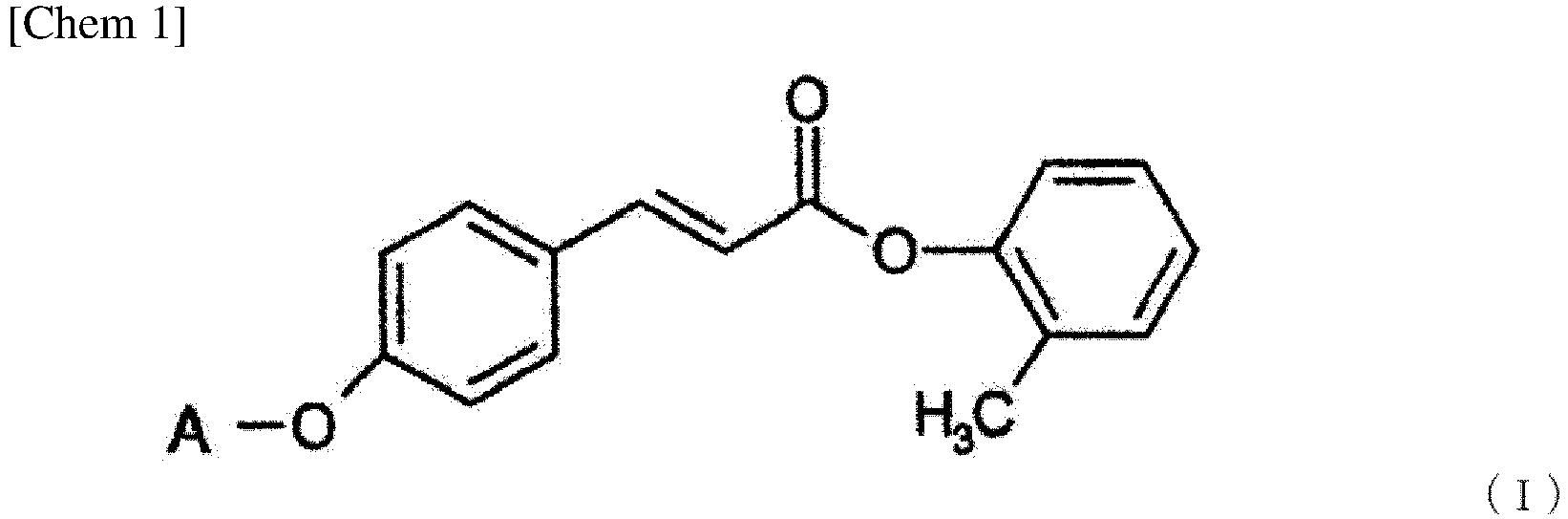
- the ultraviolet absorber of Patent Literature 1 contains, as an active ingredient, a compound represented by general formula I: [Chem 1] where -OA represents an alkoxy group.
- Patent Literature 1 the compound represented by general formula I above is blended into an ointment or into a liquid medium as-is, and exhibits ultraviolet absorption ability in the UVA and UVB regions.
- Patent Literature 1 still has room for improvement in terms of ultraviolet absorption ability in the UVA and UVB regions.
- the preset invention aims to improve the situation described above, and an object thereof is to provide an ultraviolet absorbing powder having further improved ultraviolet absorption ability in the UVA and UVB regions, a cosmetic comprising the ultraviolet absorbing powder, and a production method for this ultraviolet absorbing powder.
- the present invention which can achieve the object described above, is as follows.
- a cosmetic comprising an ultraviolet absorbing powder, wherein the ultraviolet absorbing powder is composed of particles of a compound I having a structure of formula (I) below:
- the cosmetic according to Aspect 1 or 2 comprising a liquid medium, wherein the ultraviolet absorbing powder is dispersed or settled in the liquid medium.
- the cosmetic according to Aspect 1 or 2 which is a powder cosmetic.
- the cosmetic according to Aspect 5 further comprising an additional powder other than the ultraviolet absorbing powder.
- a dispersion comprising a liquid medium, and wherein the powder according to Aspect 9 is dispersed or settled in the liquid medium.
- a mixed powder comprising:
- a production method for an ultraviolet absorbing powder comprising pulverizing particles of a compound I having a structure of formula (I) below: [Chem 4] where -OA represents an alkoxy group.
- an ultraviolet absorbing powder having further improved ultraviolet absorption ability in the UVA and UVB regions, a cosmetic comprising an ultraviolet absorbing powder, and a production method for this ultraviolet absorbing powder.
- One aspect of the present invention relates to a cosmetic.
- the cosmetic of the present invention is:
- the cosmetic of the present invention has high ultraviolet absorption ability in the UVA and UVB regions by comprising a specific ultraviolet absorbing powder with a specific particle diameter distribution, it can suitably be used as a sunscreen cosmetic.
- -OA represents an alkoxy group, and more specific examples thereof include, but are not limited to, a methoxy group and an ethoxy group.
- the chemical structure of the compound I constituting the ultraviolet absorbing powder included in the cosmetic of the present invention may be the same as the structure of the compound disclosed in Patent Literature 1.
- particles of the compound I having a longest diameter exceeding 500 ⁇ m may be 1.0 or less per 100 particles of the compound I.
- the ultraviolet absorbing powder of the present invention can be defined as an aggregate in which particles of the compound I having a longest diameter exceeding 500 ⁇ m are 1.0 or less per 100 particles of the compound I.
- longest diameter means the longest diameter of a particle when observed with an optical microscope, and thus, for example, if a particle observed with an optical microscope is circular, the diameter corresponds to the longest diameter, and if a particle observed with the optical microscope is rectangular, the length of the diagonal corresponds to the longest diameter.
- the method for measuring the "average particle diameter" regarding the ultraviolet absorbing powder of the present invention is not particularly limited, and for example, the following method (i) or (ii) may be used.
- the "average diameter particle” can be determined as a volume-based particle diameter, i.e., the volume average particle diameter (D50), as measured using a laser diffraction/scattering particle diameter distribution measuring device (MT3300EXII; manufactured by Microtrac Bell) by adding the powder to a suitable solvent and then performing ultrasonic dispersion for one minute using an ultrasonic homogenizer (US-150T; manufactured by NISSEI Corporation).
- D50 volume average particle diameter
- the "average diameter particle” can be determined by diluting the powder with an appropriate solvent, capturing a photograph using a microscope (BX51, manufactured by Olympus Corporation), measuring the diameter of approximately 100 randomly selected particles in the photograph obtained in this manner, and calculating the average value.
- the "average particle diameter" of a powder other than the ultraviolet absorbing powder of the present invention may be determined as, for example, the average value of the circle equivalent diameter equivalent of the projected area of the primary particles in the SEM image.
- the number of particles of the compound I having a longest diameter exceeding 500 ⁇ m be few.
- the number of particles of the compound I having a longest diameter exceeding 500 ⁇ m may be, per 100 particles of the compound I, 1.0 or less, 0.9 or less, 0.8 or less, 0.7 or less, 0.6 or less, 0.5 or less, 0.4 or less, 0.3 or less, 0.2 or less, or 0.1 or less.
- the lower limit of the number of particles of the compound I having a longest diameter exceeding 500 ⁇ m is not particularly limited, and may be, per 100 particles of the compound I, 0.001 or more or 0.005 or more.
- the number of particles of the compound I having the longest diameter described above may be, per 100 particles of the compound I, 1.0 or less, 0.9 or less, 0.8 or less, 0.7 or less, 0.6 or less, 0.5 or less, 0.4 or less, 0.3 or less, 0.2 or less, or 0.1 or less.
- the lower limit of the number of particles of the compound I having the particle diameter described above is not particularly limited, and may be, for example, per 100 particles of the compound I, 0.001 or more or 0.005 or more.
- the average particle diameter of the ultraviolet absorbing powder of the present invention may be 350 ⁇ m or less, 300 ⁇ m or less, 250 ⁇ m or less, 220 ⁇ m or less, 200 ⁇ m or less, 150 ⁇ m or less, or 100 ⁇ m or less, and may be 1.0 ⁇ m or more, 5.0 ⁇ m or more, or 10 ⁇ m or more.
- a cosmetic "comprising an ultraviolet absorbing powder” means that the cosmetic comprises the ultraviolet absorbing powder in powder form.
- the form of the cosmetic of the present invention is not particularly limited, and the cosmetic of the present invention may be, for example, a cream cosmetic, a gel cosmetic, a liquid cosmetic, or a powder-based powder cosmetic.
- the cream cosmetic, gel cosmetic, and liquid cosmetic include, but are not limited to, oil-in-water emulsion cosmetics, water-in-oil emulsion cosmetics, and oil content-based oil cosmetics.
- the cosmetic of the present invention contains an ointment or a medium, in particular, a cream, gel or liquid medium, and the ultraviolet absorbing powder may be dispersed or settled in the medium.
- the term “medium” refers to an ointment, cream, gel, liquid, etc., in which the ultraviolet absorbing powder is dispersed or settled.
- “ointment” refers to an oil-based product
- cream refers to an emulsion-based product of a mixture of water and oil.
- the cosmetic of the present invention is an ointment cosmetic, a cream cosmetic, a gel cosmetic, or a liquid cosmetic
- the content of the medium is not particularly limited, and may be, for example, 10 to 99% by mass relative to the total amount of the cosmetic.
- the solubility of the ultraviolet absorbing powder of the present invention in such a medium may be 40 mg/ml or less, and more specifically, may be, for example, 30 mg/ml or less, 20 mg/ml or less, 10 mg/ml or less, 5.0 mg/ml or less, 1.0 mg/ml or less, 0.5 mg/ml or less, 0.1 mg/ml or less, or approximately 0 mg/ml.
- this medium is preferably nonvolatile in order to stabilize the cosmetic composition.
- the cosmetic of the present invention contains a liquid medium, and the ultraviolet absorbing powder is dispersed or settled in the liquid medium, and in particular, the liquid medium is nonvolatile, and the solubility of the ultraviolet absorbing powder in the liquid medium is 40 mg/ml or less.
- the cosmetic of the present invention is a liquid cosmetic and the ultraviolet absorbing powder is settled in the liquid medium
- the cosmetic of the present invention may be a shaken cosmetic in which the cosmetic is shaken to disperse the ultraviolet absorbing powder in the liquid medium prior to use.
- the cosmetic of the present invention can be produced by, for example, mixing the components including the medium described above, and dispersing the ultraviolet absorbing agent of the present invention therein. Furthermore, in a state prior to production, i.e., in a state prior to pulverizing the powder of the compound I, the ultraviolet absorbing powder of the present invention may be mixed with an additional powder, they may be pulverized together, and the pulverized powder may then be mixed with the components including the medium and dispersed.
- dispersion devices examples include media dispersion devices such as bead mills, sand mills, ball mills, and paint shakers, high-speed stirrers such as homogenizers and dispersers, and media-less dispersion devices such as high-pressure dispersion machines and ultrasonic dispersion machines.
- media dispersion devices such as bead mills, sand mills, ball mills, and paint shakers
- high-speed stirrers such as homogenizers and dispersers
- media-less dispersion devices such as high-pressure dispersion machines and ultrasonic dispersion machines.
- the dispersing may be performed such that the temperature of a dispersion is 10 °C to 40 °C.
- the medium when the cosmetic of the present invention is an ointment cosmetic, a cream cosmetic, a gel cosmetic, or a liquid cosmetic, the medium, and in particular, the cream, gel, or liquid medium, may be an aqueous medium or an oil-based medium. These media may be volatile or nonvolatile.
- the medium include, but are not limited to, low polarity oil contents for example, hydrocarbon oils such as liquid paraffin, tetraisobutane, hydrogenated polydecene, olefin oligomers, isododecane, isohexadecane, squalane, and hydrogenated polyisobutene, and silicone oils such as cyclopentasiloxane, trisiloxane, caprylyl methicone, dimethicone 0.5 cst to 200 cst (silicone KF-96A-6T, etc.), amino-modified polysiloxane, polyether-modified polysiloxane, alkyl-modified polysiloxane, phenyl-modified siloxane, and fluorine-modified polysiloxane.
- hydrocarbon oils such as liquid paraffin, tetraisobutane, hydrogenated polydecene, olefin oligomers, is
- the polarity of the medium is not limited as long as the ultraviolet absorbing powder of the present invention is not easily dissolved therein.
- the medium may be a polar oil which is used as an ultraviolet absorber in cosmetics, and it may be, for example, octocrylene, bisethylhexyloxyphenol methoxyphenyl triazine, diethylaminohydroxybenzoylhexyl benzoate, ethylhexyl triazone, ethylhexyl methoxycinnamate, or 2-ethylhexyl 4-methoxycinnamate.
- the medium may also be an oil content which is used as a nonvolatile or volatile oil in cosmetics.
- nonvolatile oil content refers to oil content having a boiling point of 260 °C or higher under normal pressure.
- examples of the nonvolatile oil content include, but are not limited to, nonvolatile dimethicone, caprylyl methicone, liquid paraffin, squalane, castor oil, olive oil, jojoba oil, glyceryl diisostearate, trimethylolpropane tri2-ethyl isostearate, isopropyl myristate, cetyl 2-ethylhexanoate, glyceryl triisostearate, 2-heptyl undecyl palmitate, methylpolysiloxane (degree of polymerization 4 or higher), polybutene, glyceryl triisostearate, diisostearyl malate, and lanolin. Two or more of these nonvolatile oil contents may be arbitrarily selected and combined.
- volatile oil content means an oil content having a boiling point of lower than 260 °C under normal pressure.
- volatile oil content which can be used in the present invention include chain polysiloxanes (degree of polymerization 4 or more) such as decamethyltetrasiloxane, hexamethyldisiloxane, and dodecamethylpentasiloxane, cyclic polysiloxanes (4 to 6 silicon atoms) such as octamethylcyclotetrasiloxane and decamethylcyclopentasiloxane, and light liquid isoparaffins such as ShellSol (Shell Chemical) and Isopar (Esso Chemical). Two or more of these volatile oil contents may be arbitrarily selected and used in combination.
- examples of powders that can be used in addition to the ultraviolet absorber powder of the present invention include, but are not limited to, ultraviolet scattering powders and usability powders.
- the ultraviolet scattering powder is not particularly limited, and may be a powder of, for example, at least one selected from the group consisting of titanium oxide, zinc oxide, iron oxide, and cerium oxide.
- the ultraviolet scattering powder may be subjected to a hydrophobization treatment.
- the hydrophobization treatment may be performed using a known surface treatment agent for hydrophobization, such as a fluorine compound treatment, silicone treatment, silicone resin treatment, pendant treatment, silane coupling agent treatment, titanium coupling agent treatment, oil treatment, N-acylated lysine treatment, polyacrylic acid treatment, metal soap treatment, amino acid treatment, inorganic compound treatment, plasma treatment, mechanochemical treatment, silane compound treatment, and silazane compound treatment.
- a treatment with silicone or a silicone resin, treatment with a silane compound or silazane compound, and treatment with a metal soap such as aluminum isostearate are preferable.
- the average particle diameter of the ultraviolet scattering powder is not particularly limited, and may be, for example, 5 nm or more, 10 nm or more, or 15 nm or more, and may be 200 nm or less, 100 nm or less, or 50 nm or less.
- the content thereof is not particularly limited, and may be, for example, relative to the total amount of the cosmetic, 0.1% by mass or more, 0.5% by mass, 1.0% by mass or more, or 5.0% by mass or more, and may be 35% by mass or less, 30% by mass or less, 25% by mass or less, 20% by mass or less, 10% by mass, or 8.0% by mass or less.
- usability powder refers to any powder that has the function of adjusting the usability of a cosmetic, such as the feel (for example, dry feel, smooth feel, or moist feel).
- the usability powder is not particularly limited, and may be, for example, at least one powder selected from the group consisting of an extender pigment, resin powder, silica powder, cellulose powder, and starch powder. Further, these powders may be subjected to a hydrophobization treatment.
- an extender pigment is an inorganic pigment which is generally used to maintain the dosage form of a cosmetic, and by incorporating an extender pigment, the usability (spreadability, adhesion), gloss, color tone, etc., of the cosmetic can be adjusted. Further, when the cosmetic of the present invention is a powder cosmetic, by including an extender pigment, the storage stability of the cosmetic can be improved. Furthermore, the extender pigment can also be pulverized along with the compound I described above.
- the extender pigment include, but are not limited to, barium sulfate powders, boron nitride powders, talc, kaolin, mica, synthetic mica, synthetic phlogopite iron, sericite, magnesium carbonate, calcium carbonate, talc/silica/titanium oxide composites, and fatty acid magnesium.
- the cosmetic of the present invention may contain a combination of two or more extender pigments. Among these, it is preferable to use one or more selected from talc, kaolin, mica, and synthetic phlogopite iron.
- the average particle diameter of the extender pigment is not particularly limited, and may be, for example, 5 nm or more, 10 nm or more, or 15 nm or more, and may be 200 nm or less, 100 nm or less, or 50 nm or less.
- the content thereof is not particularly limited, and may be, relative to the total amount of the cosmetic, for example, 1.0% by mass or more, 2.0% by mass or more, 5.0% by mass or more, or 10% by mass or more, and may be 80% by mass or less, 70% by mass or less, 60% by mass or less, 50% by mass or less, 40% by mass or less, 30% by mass or less, 20% by mass or less, or 10% by mass or less.
- the resin powder is not particularly limited, and examples thereof include, but are not limited to, urethane resin powders, nylon powders, and crosslinked acrylic resin (PMMA resin) powders. Further, the resin powder may be spherical.
- the silica powder is not particularly limited, and examples thereof include, but are not limited to, powders of silica itself, hydrous silica powders, and silica silicone rubber powders. Further, the silica powder may be spherical.
- the content thereof is not particularly limited, and it may be, relative to the total amount of the cosmetic, for example, 1.0% by mass or more, 5.0% by mass or more, 8.0% by mass or more, 10% by mass or more, 20% by mass or more, or 30% by mass or more, and may be 80% by mass or less, 70% by mass or less, 60% by mass or less, 50% by mass or less, 40% by mass or less, 35% by mass or less, or 30% by mass or less.
- the cosmetic of the present invention may further include additional components such as surfactants, moisturizers, higher alcohols, sequestering agents, natural and synthetic polymers, water-soluble and oil-soluble polymers, various extracts, colorants such as organic dyes, preservatives, antioxidants, pigments, thickeners, chelating agents, pH adjusters, fragrances, cooling agents, antiperspirants, disinfectants, skin activators, other drugs, and various powders, but the additional components are not limited thereto.
- additional components such as surfactants, moisturizers, higher alcohols, sequestering agents, natural and synthetic polymers, water-soluble and oil-soluble polymers, various extracts, colorants such as organic dyes, preservatives, antioxidants, pigments, thickeners, chelating agents, pH adjusters, fragrances, cooling agents, antiperspirants, disinfectants, skin activators, other drugs, and various powders, but the additional components are not limited thereto.
- the cosmetic of the present invention may further contain, in addition to the above-mentioned components, any aqueous components which can be used in the field of cosmetics.
- the cosmetic of the present invention may be a powder cosmetic.
- the cosmetic of the present invention may contain only the ultraviolet absorbing powder of the present invention, and optionally may further contain an additional powder other than the ultraviolet absorbing powder of the present invention, or optionally may further contain additive components such as various oil contents (volatile oil contents or nonvolatile contents), coloring agents, or stabilizers.
- the cosmetic of the present invention may be produced by, for example, pulverizing the particles of the compound I to obtain an ultraviolet absorbing powder, then mixing with an additional powder the ultraviolet absorbing powder of the present invention obtained by the pulverizing, or may be produced by pulverizing the particles of the compound I along with additional particles.
- the cosmetic of the present invention can contain additional components in addition to the ultraviolet absorbing powder of the present invention.
- additional components include the components described above as the medium, powder component, and additional additive components.
- the medium, powder component, and additional additive components can be used in the amounts described above within appropriate ranges for a powder cosmetic.
- the cosmetic of the present invention contains a component described above as the medium, and in particular, a component described above as an oil content
- the content thereof is not particularly limited, and may be, relative to the total amount of the cosmetic, for example, 1.0% by mass or more, 2.0% by mass or more, 3.0% by mass or more, 4.0% by mass or more, or 5.0% by mass or more, and may be 20% by mass or less or 10% by mass or less.
- the present invention relates to an ultraviolet absorbing powder, a dispersion, and a mixed powder.
- the ultraviolet absorbing powder of the present invention is an ultraviolet absorbing powder composed of particles of the compound I described above, in which particles of the compound I having a longest diameter exceeding 500 ⁇ m are 1.0 or less per 100 particles of the compound I.
- the dispersion of the present invention comprises a liquid medium, and the powder of the present invention is dispersed or settled in the liquid medium. Furthermore, the mixed powder of the present invention comprises the powder of the present invention and an additional powder other than the powder of the present invention, such as an extender pigment.
- the present invention relates to a production method for an ultraviolet absorbing powder.
- the production method for an ultraviolet absorbing powder of the present invention comprises pulverizing particles of the compound I described above.
- the pulverizing may be such that particles of the compound I having a longest diameter exceeding 500 ⁇ m are 1.0 or less per 100 particles of the compound I.
- the number of particles of the compound I having a longest diameter exceeding 500 ⁇ m be few.
- the number of particles of the compound I having a longest diameter exceeding 500 ⁇ m, per 100 particles of the compound I may be 1.0 or less, 0.9 or less, 0.8 or less, 0.7 or less, 0.6 or less, 0.5 or less, 0.4 or less, 0.3 or less, 0.2 or less, or 0.1 or less.
- the lower limit of the number of particles of the compound I having a longest diameter exceeding 500 ⁇ m is not particularly limited, and may be, per 100 particles of the compound I, 0.001 or more or 0.005 or more.
- the number of particles of the compound I having a longest diameter as described above, per 100 particles of the compound I may be 1.0 or less, 0.9 or less, 0.8 or less, 0.7 or less, 0.6 or less, 0.5 or less, 0.4 or less, 0.3 or less, 0.2 or less, or 0.1 or less.
- the lower limit of the number of particles of the compound I having a longest diameter as described above is not particularly limited, and may be, per 100 particles of the compound I, for example, 0.001 or more or 0.005 or more.
- the average particle diameter of the ultraviolet absorbing powder obtained by this production method may be 350 ⁇ m or less, 300 ⁇ m or less, 250 ⁇ m or less, 220 ⁇ m or less, 200 ⁇ m or less, 150 ⁇ m or less, or 100 ⁇ m or less, and may be 1.0 ⁇ m or more, 5.0 ⁇ m or more, or 10 ⁇ m or more.
- the pulverizing may be wet pulverization, dry pulverization, or a combination of wet pulverization and dry pulverization.
- the pulverizing may be performed using a wet pulverizer.
- a wet pulverizer for example, a colorant dispersion device such as a roller mill may be used.
- the roller mill may comprise, for example, three rollers: a feed roller, an intermediate roller, and a finishing roller, which rotate at a low speed, a medium speed, and a high speed, respectively.
- the rotational speeds of the rollers are not particularly limited, and may be appropriately set in accordance with the amount of raw material of the ultraviolet absorbing powder (for example, particles of the compound I, etc.) used, the required diameter of the particles of the ultraviolet powder, etc.
- the pulverizing may be performed after the particles of the compound I described above are dispersed in a liquid medium.
- the amount of particles of the compound I dispersed in the liquid medium is not particularly limited, and may be, relative to the total amount of the liquid medium and the particles of the compound I, for example, 10% by mass or more, 15% by mass or more, or 20% by mass or more, and may be 50% by mass or less, 40% by mass or less, 30% by mass or less, or 20% by mass or less.
- the pulverizing may be performed using a dry pulverizer.
- a dry pulverizer an Agi-Homo Mixer, an atomizer, or the like may be used, and from the viewpoint of increasing pulverizing efficiency, it is preferable that an atomizer be used.
- An Agi-Homo Mixer referred to also as a "vacuum emulsification device” may comprise a stirring tank, a homomixer, an inner surface scraping mechanism, and a heating/cooling device.
- a stirring tank When pulverizing, the turbine blades of the stator are rotated at high speed, whereby the raw material of ultraviolet absorbing powder is constantly suctioned from the bottom, in the manner of a pump, and circulated and stirred inside the tank.
- An atomizer referred to also as a "powder pulverizing device” has a pulverizing chamber, and the pulverizing chamber may comprise therein, for example, a lining plate, a screen, a hammer, or a hammer plate.
- the raw material of ultraviolet absorbing powder is supplied to the pulverizing chamber by, for example, a hopper, and through the action of a hammer rotating at high speed, is pulverized due to collision with the lining plate, mutual collision, and friction.
- particles of the compound I may be pulverized along with additional particles other than particles of the compound I.
- the additional particles are not particularly limited, and from the viewpoint of improving usability and storage stability, it is preferable that an extender pigment be included.
- the types of the extender pigment are as described above.
- the shape of the additional particles added in addition to particles of the compound I when pulverizing is not particularly limited, and may be, for example, plate-like or scale-like.
- the amount of additional particles to be added is not particularly limited, and for example, the ratio of the weight of the additional particles to the weight of the particles of the compound I (additional particles/particles of the compound I) may be 0.1 or more, 0.2 or more, 0.5 or more, or 0.8 or more, and may be 10.0 or less, 8.0 or less, 5.0 or less, 3.0 or less, 2.0 or less, 1.5 or less, or 1.2 or less. This ratio may be, for example, 1.0.
- the pulverization time is not particularly limited, and can be appropriately set in accordance with the type of pulverizing used (for example, wet pulverizing or dry pulverizing), the pulverizing device used, the amount of raw material of the ultraviolet absorbing powder used, etc.
- the pulverization time when performing dry pulverization using an Agi-Homo Mixer, from the viewpoint of making the size of the particles of the compound I small and uniform, the pulverization time may be, for example, 1 minute or longer, 5 minutes or longer, 10 minutes or longer, 20 minutes or longer, 30 minutes or longer, 45 minutes or longer, or 60 minutes or longer, and from the viewpoint of maintaining efficiency and stability of the obtained particles, the pulverization time may be, for example, 60 minutes or less, 45 minutes or less, or 30 minutes or less.
- the raw material powder of compound 1 represented by the following structural formula (hereinafter simply referred to as "raw material powder") was pulverized, and in the obtained ultraviolet absorbing powder of each Example, particles having a longest diameter exceeding 500 ⁇ m was set so as to be 1.0 or less per 100 particles.
- Example 1 pulverizing was performed for 1 minute (Example 1), 10 minutes (Example 2), 30 minutes (Example 3), and 60 minutes (Example 4) in an Agi-Homo Mixer.
- Example 5 pulverizing was performed using an atomizer.
- Example 6 particles of the raw material compound were dispersed in nonvolatile dimethicone such that the particles were 40% by mass, and pulverizing was performed with a roller mill.
- Example 6 The obtained ultraviolet absorbing powders of Examples 1 to 5 were dispersed in nonvolatile dimethicone such that the ultraviolet absorbing powder was 40% by mass. Since Example 6 was obtained as an ultraviolet absorbing powder dispersed in nonvolatile dimethicone, it was used as-is as a dispersion liquid. The dispersion liquid of each Example was observed with an optical microscope. The respective results are shown in FIGS. 2 to 7 ( FIG. 2 : Example 1; FIG. 3 : Example 2; FIG. 4 : Example 3; FIG. 5 : Example 4; FIG. 6 : Example 5; and FIG. 7 : Example 6) and shown in Table 1. Table 1 also shows the longest diameter of the largest particles observed in each of the Examples and Comparative Examples.
- the raw material powder was directly dispersed in nonvolatile dimethicone without being pulverized such that the raw material powder was 40% by mass.
- the obtained dispersion liquid was observed under a microscope in the same manner as in the above Examples, and the results are shown in FIG. 1 and Table 1.
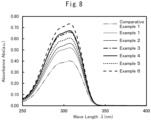
- the nonvolatile dimethicone dispersions containing 40% by mass of the ultraviolet absorbing powders of Examples 1 to 6 and Comparative Example 1 were diluted 5000 times, placed in a 1 cm glass cell, and ultraviolet absorption spectra were measured. The results are shown in FIG. 8 .
- Examples 1 to 6 had significantly improved ultraviolet absorption ability in the UVA region (wavelength 320 to 400 nm) and UVB region (wavelength 290 to 320 nm).
- a part of the obtained ultraviolet absorbing powder was diluted in an appropriate solvent (the solvent is not particularly limited and is preferably one that does not dissolve the ultraviolet absorbing powder).
- a photograph was then captured using a microscope (BX51, manufactured by Olympus Corporation), and the particle diameter of a part of the particles arbitrarily selected in the photograph obtained in such a manner was measured.
- the obtained particle diameter distribution is shown in Table 2.
- Example 12 UV absorbing powder raw material Compound 1 5.0 parts by mass Liquid medium Silicone KF56 - 2.5 2.5 - 5.0 5.0 Silicone KF-96A-6T - 2.5 2.5 - 5.0 5.0 Additional powder Plate-like barium sulfate (extender pigment) - - - 5.0 5.0 Total (parts by mass) 5.0 10 10 10 20 20 Production method Pulverization method Dry Wet Dry and wet Drv Wet Dry and wet Pulverizing device Atomizer Roller mill Atomizer and roller mill Atomizer Roller mill Atomizer and roller mill Product Whether there are 1.0 or more particles having longest diameter exceeding 500 ⁇ m per 100 particles Absent Absent Absent Absent Absent Absent Form Mixed powder 1 Dispersion (slurry) 1 Dispersion (slurry) 2 Mixed powder 2 Dispersion (slurry) 3 Dispersion (slurry) 4 Particle diameter distribution ( ⁇ m) 75 to 120 60 to 100 50 to 100 80 to 150 60 to 100 50 to 80
- Comparative Example 2 the raw material powder was added to a liquid medium as-is without being pulverized, and dispersed using an Agi-Homo Mixer, and the ultraviolet absorption ability thereof was evaluated. The results are shown in FIG. 9 .
- Comparative Example 3 the ultraviolet absorption ability was evaluated in the same manner as Comparative Example 2, except that raw material powder was not added. The results are shown in FIG. 9 .
- Example 11 Comparative Example 2 Comparative Example 3 Products of Table 2 or compound having ultraviolet absorption ability Form Mixed powder 1 Dispersion (slurry) 1 Dispersion (slurry) 2 Mixed powder 2 Dispersion (slurry) 3 Dispersion (slurry) 4 Raw material powder - Blending amount (mass%) 5.0 10 10 10 20 20 5.0 - Liquid medium Phenyl-modifie d nonvolatile silicone 5.0 2.5 2.5 5.0 - - 5.0 5.0 Nonvolatile dimethicone 5.0 2.5 2.5 5.0 - - 5.0 5.0 Additional powder Plate-like barium sulfate (extender pigment) 5.0 5.0 5.0 - - - 5.0 5.0 Additional components Additional components Additional components Additional components Balance Balance Balance Balance Balance Balance Balance Balance Balance Balance Balance Total (% by mass) 100 Particle diameter distribution of powder ( ⁇ m) 75 to 120 60 to 100 50 to 100 80 to 150 60 to 100 50 to 80 300 to 800 -
- the ultraviolet absorbing powders of Examples 7 to 12 had significantly improved ultraviolet absorption ability in the UVA region (wavelength 320 to 400 nm) and UVB region (wavelength 290 to 320 nm).
- the cosmetics (liquid cosmetics: oil-based) of Examples 13 to 16 and Comparative Examples 4 and 5 were produced based on the compositions shown in Table 4 below.
- the obtained cosmetics were evaluated for ultraviolet absorption ability and feeling upon use based on the following criteria.
- Comparative Examples 4 and 5 the raw material powder was blended as-is without being pulverized. Furthermore, in Examples 13 and 15, the raw material powder was pulverized and blended as the ultraviolet absorbing powder. In Examples 14 and 16, the raw material powder and an extender pigment (hydrophobically treated barium sulfate) were pulverized together and then blended.
- an extender pigment hydrophobically treated barium sulfate
- the cosmetics (liquid cosmetics: water-based) of Examples 17 and 18 and Comparative Example 6 were produced based on the compositions shown in Table 5 below.
- the obtained cosmetics were evaluated for ultraviolet absorption ability and feeling upon use in the same manner as described above.
- Example 6 the raw material powder was blended as-is without being pulverized. Furthermore, in Example 17, the raw material powder was pulverized and blended as the ultraviolet absorbing powder. Furthermore, in Example 18, the raw material powder and an extender pigment (hydrophobized barium sulfate) were pulverized together and then blended.
- an extender pigment hydrophobized barium sulfate
- the cosmetics (powder cosmetics) of Examples 19 and 20 and Comparative Example 7 were produced based on the compositions shown in Table 6 below.
- the obtained cosmetics were evaluated for ultraviolet absorption ability and feeling upon use in the same manner as described above.
- Example 7 the raw material powder was blended as-is without being pulverized. Furthermore, in Example 19, the raw material powder was pulverized and blended as the ultraviolet absorbing powder. Furthermore, in Example 20, the raw material powder and hydrophobized barium sulfate, which is an extender pigment, were pulverized together and then blended.
Landscapes
- Health & Medical Sciences (AREA)
- Life Sciences & Earth Sciences (AREA)
- Animal Behavior & Ethology (AREA)
- General Health & Medical Sciences (AREA)
- Public Health (AREA)
- Veterinary Medicine (AREA)
- Birds (AREA)
- Epidemiology (AREA)
- Dermatology (AREA)
- Emergency Medicine (AREA)
- Cosmetics (AREA)
Abstract
Description
- The present invention relates to an ultraviolet absorbing powder, a cosmetic, a dispersion, and a mixed powder comprising an ultraviolet absorbing powder, and a production method for an ultraviolet absorbing powder.
- Protecting the skin from ultraviolet rays is an important issue in skin care and body care. In addition to medium-wavelength ultraviolet rays (UVB region: wavelength 290 to 320 nm), which are known to cause sunburn and inflammation, long-wavelength ultraviolet rays (UVA region:
wavelength 320 to 400 nm) are known to have an effect on the skin (photoaging, etc.). - Conventional cosmetics for ultraviolet protection often contain 2-ethylhexyl p-methoxycinnamate as an ultraviolet absorber. Though 2-ethylhexyl p-methoxycinnamate has the effect of absorbing ultraviolet rays in the UVB region, there is a need for an ultraviolet absorber having better ultraviolet absorption ability in the UVA region.
- In connection thereto, the ultraviolet absorber disclosed in
Patent Literature 1 has absorption ability in both the UVA region and the UVB region, has an ultraviolet suppression effect in a wide range of wavelengths, has a previously unseen property: the ultraviolet absorption capability thereof increases in the UVA and UVB regions with the passage of time of ultraviolet irradiation, and further, has excellent solubility. - More specifically, the ultraviolet absorber of
Patent Literature 1 contains, as an active ingredient, a compound represented by general formula I:
[Chem 1]
- [PTL 1]
WO 2009/041098 - In
Patent Literature 1, the compound represented by general formula I above is blended into an ointment or into a liquid medium as-is, and exhibits ultraviolet absorption ability in the UVA and UVB regions. - However, the ultraviolet absorber of
Patent Literature 1 still has room for improvement in terms of ultraviolet absorption ability in the UVA and UVB regions. - The preset invention aims to improve the situation described above, and an object thereof is to provide an ultraviolet absorbing powder having further improved ultraviolet absorption ability in the UVA and UVB regions, a cosmetic comprising the ultraviolet absorbing powder, and a production method for this ultraviolet absorbing powder.
- The present invention, which can achieve the object described above, is as follows.
- A cosmetic, comprising an ultraviolet absorbing powder,
wherein the ultraviolet absorbing powder is composed of particles of a compound I having a structure of formula (I) below: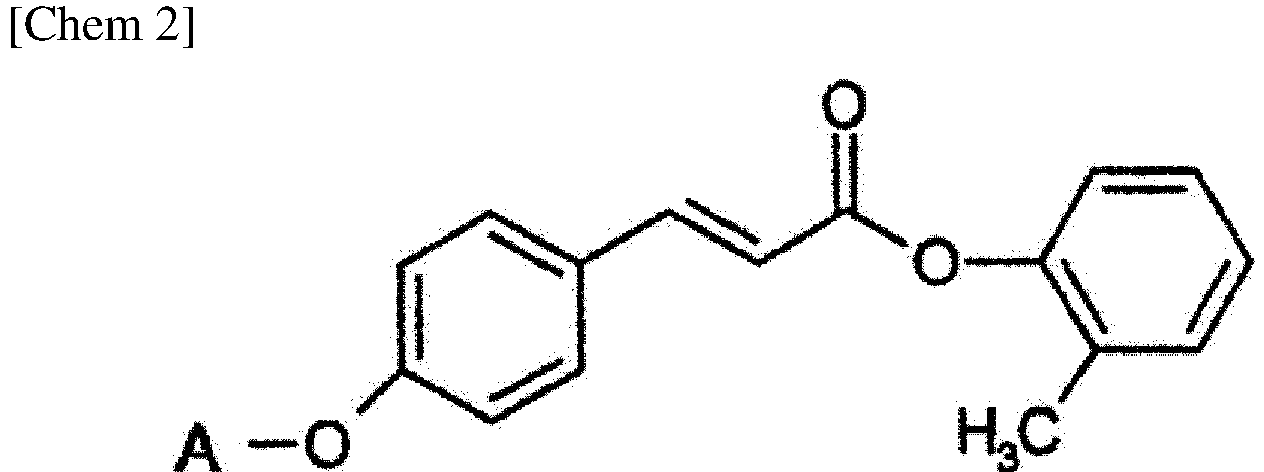
- where -OA represents an alkoxy group, and(I)
- wherein in the ultraviolet absorbing powder, particles of the compound I having a longest diameter exceeding 500 µm are 1.0 or less per 100 particles of the compound I.
- The cosmetic according to
Aspect 1, wherein an average particle diameter of the ultraviolet absorbing powder is 350 µm or less. - The cosmetic according to
Aspect
wherein the ultraviolet absorbing powder is dispersed or settled in the liquid medium. - The cosmetic according to
Aspect 3, wherein the liquid medium is nonvolatile, and a solubility of the ultraviolet absorbing powder in the liquid medium is 40 mg/ml or less. - The cosmetic according to
Aspect - The cosmetic according to
Aspect 5, further comprising an additional powder other than the ultraviolet absorbing powder. - The cosmetic according to
Aspect 6, wherein the additional powder contains an extender pigment. - The cosmetic according to any one of
Aspects 1 to 7, which is a sunscreen cosmetic. - An ultraviolet absorbing powder composed of particles of a compound I having a structure of formula (I) below:
[Chem 3]
- where -OA represents an alkoxy group, and
- wherein particles of the compound I having a longest diameter exceeding 500 µm are 1.0 or less per 100 particles of the compound I.
- A dispersion, comprising a liquid medium, and
wherein the powder according toAspect 9 is dispersed or settled in the liquid medium. - A mixed powder, comprising:
- the powder according to
Aspect 9, and - an additional powder other than the powder according to
Aspect 9. - The powder according to Aspect 11, wherein the additional powder contains an extender pigment.
- A production method for an ultraviolet absorbing powder, comprising pulverizing particles of a compound I having a structure of formula (I) below:
[Chem 4]
- The production method according to Aspect 13, wherein the pulverizing is such that particles of the compound I having a longest diameter exceeding 500 µm are 1.0 or less per 100 particles of the compound I.
- The production method according to Aspect 13 or 14, wherein the pulverizing is performed using a wet pulverizer.
- The production method according to Aspect 15, wherein a roller mill is used as the wet pulverizer.
- The production method according to Aspect 15 or 16, wherein the pulverizing is performed after dispersing the particles of the compound I in a liquid medium.
- The production method according to Aspect 13 or 14, wherein the pulverizing is performed using a dry pulverizer.
- The production method according to Aspect 18, wherein the pulverizing is performed along with additional particles other than the particles of the compound I.
- The production method according to Aspect 19, wherein the additional particles comprise an extender pigment.
- According to the present invention, there can be provided an ultraviolet absorbing powder having further improved ultraviolet absorption ability in the UVA and UVB regions, a cosmetic comprising an ultraviolet absorbing powder, and a production method for this ultraviolet absorbing powder.
-
-
FIG. 1 is a microscopic observation image of the raw material powder of Comparative Example 1. -
FIG. 2 is a microscopic observation image of the ultraviolet absorbing powder of Example 1. -
FIG. 3 is a microscopic observation image of the ultraviolet absorbing powder of Example 2. -
FIG. 4 is a microscopic observation image of the ultraviolet absorbing powder of Example 3. -
FIG. 5 is a microscopic observation image of the ultraviolet absorbing powder of Example 4. -
FIG. 6 is a microscopic observation image of the ultraviolet absorbing powder of Example 5. -
FIG. 7 is a microscopic observation image of Example 6. -
FIG. 8 is a view showing the ultraviolet absorption spectra of the ultraviolet absorbing powders of Examples 1 to 6 and Comparative Example 1. -
FIG. 9 is a view showing the ultraviolet absorption spectra of the compositions of Examples 7 to 12 and Comparative Examples 2 and 3. - The embodiments of the present invention will be described below. Note that the present invention is not limited to the following embodiments, and various changes can be made within the scope of the spirit of the invention.
- One aspect of the present invention relates to a cosmetic.
- The cosmetic of the present invention is:
- a cosmetic, comprising an ultraviolet absorbing powder, wherein
- the ultraviolet absorbing powder is composed of particles of a compound I having a structure of formula (I) below:
- where -OA represents an alkoxy group, and
- wherein in the ultraviolet absorbing powder, particles of the compound I having a longest diameter exceeding 500 µm are 1.0 or less per 100 particles of the compound I.
- Since the cosmetic of the present invention has high ultraviolet absorption ability in the UVA and UVB regions by comprising a specific ultraviolet absorbing powder with a specific particle diameter distribution, it can suitably be used as a sunscreen cosmetic.
- In formula (I), -OA represents an alkoxy group, and more specific examples thereof include, but are not limited to, a methoxy group and an ethoxy group.
- The chemical structure of the compound I constituting the ultraviolet absorbing powder included in the cosmetic of the present invention (hereinafter also simply referred to as the "ultraviolet absorbing powder of the present invention") may be the same as the structure of the compound disclosed in
Patent Literature 1. - Regarding such compound I, the present inventors have discovered that by:
- (i) reducing the particle diameter of the powder of the compound I to a specific size, and
- (ii) blending the powder of the compound I having a reduced particle diameter into a cosmetic in a powder state,
- Regarding the degree of smallness of the particle diameter of the powder of the compound I, particles of the compound I having a longest diameter exceeding 500 µm may be 1.0 or less per 100 particles of the compound I. Thus, the ultraviolet absorbing powder of the present invention can be defined as an aggregate in which particles of the compound I having a longest diameter exceeding 500 µm are 1.0 or less per 100 particles of the compound I.
- Note that in the present invention, "longest diameter" means the longest diameter of a particle when observed with an optical microscope, and thus, for example, if a particle observed with an optical microscope is circular, the diameter corresponds to the longest diameter, and if a particle observed with the optical microscope is rectangular, the length of the diagonal corresponds to the longest diameter.
- Furthermore, in the present invention, the method for measuring the "average particle diameter" regarding the ultraviolet absorbing powder of the present invention is not particularly limited, and for example, the following method (i) or (ii) may be used.
- The "average diameter particle" can be determined as a volume-based particle diameter, i.e., the volume average particle diameter (D50), as measured using a laser diffraction/scattering particle diameter distribution measuring device (MT3300EXII; manufactured by Microtrac Bell) by adding the powder to a suitable solvent and then performing ultrasonic dispersion for one minute using an ultrasonic homogenizer (US-150T; manufactured by NISSEI Corporation).
- The "average diameter particle" can be determined by diluting the powder with an appropriate solvent, capturing a photograph using a microscope (BX51, manufactured by Olympus Corporation), measuring the diameter of approximately 100 randomly selected particles in the photograph obtained in this manner, and calculating the average value.
- Furthermore, the "average particle diameter" of a powder other than the ultraviolet absorbing powder of the present invention, such as an ultraviolet scattering powder or extender pigment, may be determined as, for example, the average value of the circle equivalent diameter equivalent of the projected area of the primary particles in the SEM image.
- From the viewpoint of exhibiting the effects of the present invention, it is preferable that the number of particles of the compound I having a longest diameter exceeding 500 µm be few. For example, in the ultraviolet absorbing powder of the present invention, the number of particles of the compound I having a longest diameter exceeding 500 µm may be, per 100 particles of the compound I, 1.0 or less, 0.9 or less, 0.8 or less, 0.7 or less, 0.6 or less, 0.5 or less, 0.4 or less, 0.3 or less, 0.2 or less, or 0.1 or less. Furthermore, the lower limit of the number of particles of the compound I having a longest diameter exceeding 500 µm is not particularly limited, and may be, per 100 particles of the compound I, 0.001 or more or 0.005 or more.
- Furthermore, from the viewpoint of further exhibiting the effects of the present invention, in the ultraviolet absorbing powder of the present invention,
- (i) the number of particles of the compound I having a longest diameter exceeding 400 µm may be 1.0 or less per 100 particles of the compound I,
- (ii) the number of particles of the compound I having a longest diameter exceeding 300 µm may be 1.0 or less per 100 particles of the compound I,
- (iii) the number of particles of the compound I having a longest diameter exceeding 200 µm may be 1.0 or less per 100 particles of the compound I, or
- (iv) the number of particles of the compound I having a longest diameter exceeding 100 µm may be 1.0 or less per 100 particles of the compound I.
- Furthermore, from the viewpoint of exhibiting the effects of the present invention, in any of the above cases (i) to (iv), the number of particles of the compound I having the longest diameter described above may be, per 100 particles of the compound I, 1.0 or less, 0.9 or less, 0.8 or less, 0.7 or less, 0.6 or less, 0.5 or less, 0.4 or less, 0.3 or less, 0.2 or less, or 0.1 or less. Furthermore, the lower limit of the number of particles of the compound I having the particle diameter described above is not particularly limited, and may be, for example, per 100 particles of the compound I, 0.001 or more or 0.005 or more.
- The average particle diameter of the ultraviolet absorbing powder of the present invention may be 350 µm or less, 300 µm or less, 250 µm or less, 220 µm or less, 200 µm or less, 150 µm or less, or 100 µm or less, and may be 1.0 µm or more, 5.0 µm or more, or 10 µm or more.
- Regarding the present invention, the phrase a cosmetic "comprising an ultraviolet absorbing powder" means that the cosmetic comprises the ultraviolet absorbing powder in powder form.
- The form of the cosmetic of the present invention is not particularly limited, and the cosmetic of the present invention may be, for example, a cream cosmetic, a gel cosmetic, a liquid cosmetic, or a powder-based powder cosmetic. Examples of the cream cosmetic, gel cosmetic, and liquid cosmetic include, but are not limited to, oil-in-water emulsion cosmetics, water-in-oil emulsion cosmetics, and oil content-based oil cosmetics.
- In the case of an ointment cosmetic, a cream cosmetic, a gel cosmetic, or a liquid cosmetic, the cosmetic of the present invention contains an ointment or a medium, in particular, a cream, gel or liquid medium, and the ultraviolet absorbing powder may be dispersed or settled in the medium. In the present invention, the term "medium" refers to an ointment, cream, gel, liquid, etc., in which the ultraviolet absorbing powder is dispersed or settled. Furthermore, "ointment" refers to an oil-based product, and "cream" refers to an emulsion-based product of a mixture of water and oil.
- When the cosmetic of the present invention is an ointment cosmetic, a cream cosmetic, a gel cosmetic, or a liquid cosmetic, the content of the medium is not particularly limited, and may be, for example, 10 to 99% by mass relative to the total amount of the cosmetic.
- In the cosmetic of the present invention, when the ultraviolet absorbing powder of the present invention is dispersed or settled in a medium, it is preferable that the solubility of the ultraviolet absorbing powder of the present invention in such a medium be low. Thus, the solubility of the ultraviolet absorbing powder of the present invention in such a medium may be 40 mg/ml or less, and more specifically, may be, for example, 30 mg/ml or less, 20 mg/ml or less, 10 mg/ml or less, 5.0 mg/ml or less, 1.0 mg/ml or less, 0.5 mg/ml or less, 0.1 mg/ml or less, or approximately 0 mg/ml.
- Note that this medium is preferably nonvolatile in order to stabilize the cosmetic composition.
- In one aspect, the cosmetic of the present invention contains a liquid medium, and the ultraviolet absorbing powder is dispersed or settled in the liquid medium, and in particular, the liquid medium is nonvolatile, and the solubility of the ultraviolet absorbing powder in the liquid medium is 40 mg/ml or less.
- When the cosmetic of the present invention is a liquid cosmetic and the ultraviolet absorbing powder is settled in the liquid medium, the cosmetic of the present invention may be a shaken cosmetic in which the cosmetic is shaken to disperse the ultraviolet absorbing powder in the liquid medium prior to use.
- In the case of an ointment cosmetic, a cream cosmetic, a gel cosmetic, or a liquid cosmetic, the cosmetic of the present invention can be produced by, for example, mixing the components including the medium described above, and dispersing the ultraviolet absorbing agent of the present invention therein. Furthermore, in a state prior to production, i.e., in a state prior to pulverizing the powder of the compound I, the ultraviolet absorbing powder of the present invention may be mixed with an additional powder, they may be pulverized together, and the pulverized powder may then be mixed with the components including the medium and dispersed.
- Examples of dispersion devices include media dispersion devices such as bead mills, sand mills, ball mills, and paint shakers, high-speed stirrers such as homogenizers and dispersers, and media-less dispersion devices such as high-pressure dispersion machines and ultrasonic dispersion machines. There are both horizontal and vertical bead mills, and either type may be used. Generally, the lower the temperature of a dispersion at the time of dispersion, the better the storage stability of a dispersion composition can be obtained. For example, the dispersing may be performed such that the temperature of a dispersion is 10 °C to 40 °C.
- When the cosmetic of the present invention is an ointment cosmetic, a cream cosmetic, a gel cosmetic, or a liquid cosmetic, the medium, and in particular, the cream, gel, or liquid medium, may be an aqueous medium or an oil-based medium. These media may be volatile or nonvolatile.
- Specific examples of the medium include, but are not limited to, low polarity oil contents for example, hydrocarbon oils such as liquid paraffin, tetraisobutane, hydrogenated polydecene, olefin oligomers, isododecane, isohexadecane, squalane, and hydrogenated polyisobutene, and silicone oils such as cyclopentasiloxane, trisiloxane, caprylyl methicone, dimethicone 0.5 cst to 200 cst (silicone KF-96A-6T, etc.), amino-modified polysiloxane, polyether-modified polysiloxane, alkyl-modified polysiloxane, phenyl-modified siloxane, and fluorine-modified polysiloxane.
- Furthermore, the polarity of the medium is not limited as long as the ultraviolet absorbing powder of the present invention is not easily dissolved therein. The medium may be a polar oil which is used as an ultraviolet absorber in cosmetics, and it may be, for example, octocrylene, bisethylhexyloxyphenol methoxyphenyl triazine, diethylaminohydroxybenzoylhexyl benzoate, ethylhexyl triazone, ethylhexyl methoxycinnamate, or 2-ethylhexyl 4-methoxycinnamate.
- The medium may also be an oil content which is used as a nonvolatile or volatile oil in cosmetics.
- In the present invention, "nonvolatile oil content" refers to oil content having a boiling point of 260 °C or higher under normal pressure. Examples of the nonvolatile oil content include, but are not limited to, nonvolatile dimethicone, caprylyl methicone, liquid paraffin, squalane, castor oil, olive oil, jojoba oil, glyceryl diisostearate, trimethylolpropane tri2-ethyl isostearate, isopropyl myristate, cetyl 2-ethylhexanoate, glyceryl triisostearate, 2-heptyl undecyl palmitate, methylpolysiloxane (degree of
polymerization 4 or higher), polybutene, glyceryl triisostearate, diisostearyl malate, and lanolin. Two or more of these nonvolatile oil contents may be arbitrarily selected and combined. - In the present invention, "volatile oil content" means an oil content having a boiling point of lower than 260 °C under normal pressure. Examples of the volatile oil content which can be used in the present invention include chain polysiloxanes (degree of
polymerization 4 or more) such as decamethyltetrasiloxane, hexamethyldisiloxane, and dodecamethylpentasiloxane, cyclic polysiloxanes (4 to 6 silicon atoms) such as octamethylcyclotetrasiloxane and decamethylcyclopentasiloxane, and light liquid isoparaffins such as ShellSol (Shell Chemical) and Isopar (Esso Chemical). Two or more of these volatile oil contents may be arbitrarily selected and used in combination. - In the cosmetic of the present invention, examples of powders that can be used in addition to the ultraviolet absorber powder of the present invention include, but are not limited to, ultraviolet scattering powders and usability powders.
- The ultraviolet scattering powder is not particularly limited, and may be a powder of, for example, at least one selected from the group consisting of titanium oxide, zinc oxide, iron oxide, and cerium oxide.
- Furthermore, the ultraviolet scattering powder may be subjected to a hydrophobization treatment. The hydrophobization treatment may be performed using a known surface treatment agent for hydrophobization, such as a fluorine compound treatment, silicone treatment, silicone resin treatment, pendant treatment, silane coupling agent treatment, titanium coupling agent treatment, oil treatment, N-acylated lysine treatment, polyacrylic acid treatment, metal soap treatment, amino acid treatment, inorganic compound treatment, plasma treatment, mechanochemical treatment, silane compound treatment, and silazane compound treatment. Among these treatments, from the viewpoint of dispersion stability, etc., a treatment with silicone or a silicone resin, treatment with a silane compound or silazane compound, and treatment with a metal soap such as aluminum isostearate are preferable.
- The average particle diameter of the ultraviolet scattering powder is not particularly limited, and may be, for example, 5 nm or more, 10 nm or more, or 15 nm or more, and may be 200 nm or less, 100 nm or less, or 50 nm or less.
- When the cosmetic of the present invention contains an ultraviolet scattering powder, the content thereof is not particularly limited, and may be, for example, relative to the total amount of the cosmetic, 0.1% by mass or more, 0.5% by mass, 1.0% by mass or more, or 5.0% by mass or more, and may be 35% by mass or less, 30% by mass or less, 25% by mass or less, 20% by mass or less, 10% by mass, or 8.0% by mass or less.
- In the present invention, "usability powder" refers to any powder that has the function of adjusting the usability of a cosmetic, such as the feel (for example, dry feel, smooth feel, or moist feel).
- In the present invention, the usability powder is not particularly limited, and may be, for example, at least one powder selected from the group consisting of an extender pigment, resin powder, silica powder, cellulose powder, and starch powder. Further, these powders may be subjected to a hydrophobization treatment.
- In the present invention, an extender pigment is an inorganic pigment which is generally used to maintain the dosage form of a cosmetic, and by incorporating an extender pigment, the usability (spreadability, adhesion), gloss, color tone, etc., of the cosmetic can be adjusted. Further, when the cosmetic of the present invention is a powder cosmetic, by including an extender pigment, the storage stability of the cosmetic can be improved. Furthermore, the extender pigment can also be pulverized along with the compound I described above.
- Specific examples of the extender pigment include, but are not limited to, barium sulfate powders, boron nitride powders, talc, kaolin, mica, synthetic mica, synthetic phlogopite iron, sericite, magnesium carbonate, calcium carbonate, talc/silica/titanium oxide composites, and fatty acid magnesium. Furthermore, the cosmetic of the present invention may contain a combination of two or more extender pigments. Among these, it is preferable to use one or more selected from talc, kaolin, mica, and synthetic phlogopite iron.
- The average particle diameter of the extender pigment is not particularly limited, and may be, for example, 5 nm or more, 10 nm or more, or 15 nm or more, and may be 200 nm or less, 100 nm or less, or 50 nm or less.
- When the cosmetic of the present invention contains an extender pigment, the content thereof is not particularly limited, and may be, relative to the total amount of the cosmetic, for example, 1.0% by mass or more, 2.0% by mass or more, 5.0% by mass or more, or 10% by mass or more, and may be 80% by mass or less, 70% by mass or less, 60% by mass or less, 50% by mass or less, 40% by mass or less, 30% by mass or less, 20% by mass or less, or 10% by mass or less.
- In the present invention, the resin powder is not particularly limited, and examples thereof include, but are not limited to, urethane resin powders, nylon powders, and crosslinked acrylic resin (PMMA resin) powders. Further, the resin powder may be spherical.
- In the invention, the silica powder is not particularly limited, and examples thereof include, but are not limited to, powders of silica itself, hydrous silica powders, and silica silicone rubber powders. Further, the silica powder may be spherical.
- In the present invention, when a usability powder is included, the content thereof is not particularly limited, and it may be, relative to the total amount of the cosmetic, for example, 1.0% by mass or more, 5.0% by mass or more, 8.0% by mass or more, 10% by mass or more, 20% by mass or more, or 30% by mass or more, and may be 80% by mass or less, 70% by mass or less, 60% by mass or less, 50% by mass or less, 40% by mass or less, 35% by mass or less, or 30% by mass or less.
- The cosmetic of the present invention may further include additional components such as surfactants, moisturizers, higher alcohols, sequestering agents, natural and synthetic polymers, water-soluble and oil-soluble polymers, various extracts, colorants such as organic dyes, preservatives, antioxidants, pigments, thickeners, chelating agents, pH adjusters, fragrances, cooling agents, antiperspirants, disinfectants, skin activators, other drugs, and various powders, but the additional components are not limited thereto.
- Further, the cosmetic of the present invention may further contain, in addition to the above-mentioned components, any aqueous components which can be used in the field of cosmetics.
- The cosmetic of the present invention may be a powder cosmetic.
- In the case of a powder cosmetic, the cosmetic of the present invention may contain only the ultraviolet absorbing powder of the present invention, and optionally may further contain an additional powder other than the ultraviolet absorbing powder of the present invention, or optionally may further contain additive components such as various oil contents (volatile oil contents or nonvolatile contents), coloring agents, or stabilizers.
- In the case of a powder cosmetic, the cosmetic of the present invention may be produced by, for example, pulverizing the particles of the compound I to obtain an ultraviolet absorbing powder, then mixing with an additional powder the ultraviolet absorbing powder of the present invention obtained by the pulverizing, or may be produced by pulverizing the particles of the compound I along with additional particles.
- In the case of a powder cosmetic, the cosmetic of the present invention can contain additional components in addition to the ultraviolet absorbing powder of the present invention. Examples of these components include the components described above as the medium, powder component, and additional additive components.
- The medium, powder component, and additional additive components can be used in the amounts described above within appropriate ranges for a powder cosmetic. In particular, when the cosmetic of the present invention contains a component described above as the medium, and in particular, a component described above as an oil content, the content thereof is not particularly limited, and may be, relative to the total amount of the cosmetic, for example, 1.0% by mass or more, 2.0% by mass or more, 3.0% by mass or more, 4.0% by mass or more, or 5.0% by mass or more, and may be 20% by mass or less or 10% by mass or less.
- In one aspect, the present invention relates to an ultraviolet absorbing powder, a dispersion, and a mixed powder.
- The ultraviolet absorbing powder of the present invention is an ultraviolet absorbing powder composed of particles of the compound I described above, in which particles of the compound I having a longest diameter exceeding 500 µm are 1.0 or less per 100 particles of the compound I.
- The dispersion of the present invention comprises a liquid medium, and the powder of the present invention is dispersed or settled in the liquid medium. Furthermore, the mixed powder of the present invention comprises the powder of the present invention and an additional powder other than the powder of the present invention, such as an extender pigment.
- Regarding the details of the ultraviolet absorbing powder, dispersion, and mixed powder of the present invention, refer to the descriptions above regarding the cosmetic of the present invention.
- In one aspect, the present invention relates to a production method for an ultraviolet absorbing powder.
- The production method for an ultraviolet absorbing powder of the present invention comprises pulverizing particles of the compound I described above.
- In this production method, the pulverizing may be such that particles of the compound I having a longest diameter exceeding 500 µm are 1.0 or less per 100 particles of the compound I.
- From the viewpoint of exhibiting the effects of the present invention, it is preferable that the number of particles of the compound I having a longest diameter exceeding 500 µm be few. For example, in the ultraviolet absorbing powder obtained by this production method, the number of particles of the compound I having a longest diameter exceeding 500 µm, per 100 particles of the compound I, may be 1.0 or less, 0.9 or less, 0.8 or less, 0.7 or less, 0.6 or less, 0.5 or less, 0.4 or less, 0.3 or less, 0.2 or less, or 0.1 or less. Furthermore, the lower limit of the number of particles of the compound I having a longest diameter exceeding 500 µm is not particularly limited, and may be, per 100 particles of the compound I, 0.001 or more or 0.005 or more.
- Furthermore, from the viewpoint of further exhibiting the effects of the present invention, in the ultraviolet absorbing powder obtained by this production method,
- (i) the number of particles of the compound I having a longest diameter exceeding 400 µm may be 1.0 or less per 100 particles of the compound I,
- (ii) the number of particles of the compound I having a longest diameter exceeding 300 µm may be 1.0 or less per 100 particles of the compound I,
- (iii) the number of particles of the compound I having a longest diameter exceeding 200 µm may be 1.0 or less per 100 particles of the compound I, or
- (iv) the number of particles of the compound I having a longest diameter exceeding 100 µm may be 1.0 or less per 100 particles of the compound I.
- Further, from the viewpoint of exhibiting the effects of the present invention, in any of the above cases (i) to (iv), the number of particles of the compound I having a longest diameter as described above, per 100 particles of the compound I, may be 1.0 or less, 0.9 or less, 0.8 or less, 0.7 or less, 0.6 or less, 0.5 or less, 0.4 or less, 0.3 or less, 0.2 or less, or 0.1 or less. Furthermore, the lower limit of the number of particles of the compound I having a longest diameter as described above is not particularly limited, and may be, per 100 particles of the compound I, for example, 0.001 or more or 0.005 or more.
- The average particle diameter of the ultraviolet absorbing powder obtained by this production method may be 350 µm or less, 300 µm or less, 250 µm or less, 220 µm or less, 200 µm or less, 150 µm or less, or 100 µm or less, and may be 1.0 µm or more, 5.0 µm or more, or 10 µm or more.
- Furthermore, the pulverizing may be wet pulverization, dry pulverization, or a combination of wet pulverization and dry pulverization.
- In the case of wet pulverization, the pulverizing may be performed using a wet pulverizer. As the wet pulverizer, for example, a colorant dispersion device such as a roller mill may be used. The roller mill may comprise, for example, three rollers: a feed roller, an intermediate roller, and a finishing roller, which rotate at a low speed, a medium speed, and a high speed, respectively. The rotational speeds of the rollers are not particularly limited, and may be appropriately set in accordance with the amount of raw material of the ultraviolet absorbing powder (for example, particles of the compound I, etc.) used, the required diameter of the particles of the ultraviolet powder, etc.
- In the case of wet pulverization, the pulverizing may be performed after the particles of the compound I described above are dispersed in a liquid medium. In this case, the amount of particles of the compound I dispersed in the liquid medium is not particularly limited, and may be, relative to the total amount of the liquid medium and the particles of the compound I, for example, 10% by mass or more, 15% by mass or more, or 20% by mass or more, and may be 50% by mass or less, 40% by mass or less, 30% by mass or less, or 20% by mass or less.
- In the case of dry pulverization, the pulverizing may be performed using a dry pulverizer. As the dry pulverizer, an Agi-Homo Mixer, an atomizer, or the like may be used, and from the viewpoint of increasing pulverizing efficiency, it is preferable that an atomizer be used.
- An Agi-Homo Mixer referred to also as a "vacuum emulsification device" may comprise a stirring tank, a homomixer, an inner surface scraping mechanism, and a heating/cooling device. When pulverizing, the turbine blades of the stator are rotated at high speed, whereby the raw material of ultraviolet absorbing powder is constantly suctioned from the bottom, in the manner of a pump, and circulated and stirred inside the tank.
- An atomizer referred to also as a "powder pulverizing device" has a pulverizing chamber, and the pulverizing chamber may comprise therein, for example, a lining plate, a screen, a hammer, or a hammer plate. When pulverizing, the raw material of ultraviolet absorbing powder is supplied to the pulverizing chamber by, for example, a hopper, and through the action of a hammer rotating at high speed, is pulverized due to collision with the lining plate, mutual collision, and friction.
- In the case of dry pulverization, particles of the compound I may be pulverized along with additional particles other than particles of the compound I. The additional particles are not particularly limited, and from the viewpoint of improving usability and storage stability, it is preferable that an extender pigment be included. The types of the extender pigment are as described above.
- The shape of the additional particles added in addition to particles of the compound I when pulverizing is not particularly limited, and may be, for example, plate-like or scale-like. Further, the amount of additional particles to be added is not particularly limited, and for example, the ratio of the weight of the additional particles to the weight of the particles of the compound I (additional particles/particles of the compound I) may be 0.1 or more, 0.2 or more, 0.5 or more, or 0.8 or more, and may be 10.0 or less, 8.0 or less, 5.0 or less, 3.0 or less, 2.0 or less, 1.5 or less, or 1.2 or less. This ratio may be, for example, 1.0.
- The pulverization time is not particularly limited, and can be appropriately set in accordance with the type of pulverizing used (for example, wet pulverizing or dry pulverizing), the pulverizing device used, the amount of raw material of the ultraviolet absorbing powder used, etc. For example, when performing dry pulverization using an Agi-Homo Mixer, from the viewpoint of making the size of the particles of the compound I small and uniform, the pulverization time may be, for example, 1 minute or longer, 5 minutes or longer, 10 minutes or longer, 20 minutes or longer, 30 minutes or longer, 45 minutes or longer, or 60 minutes or longer, and from the viewpoint of maintaining efficiency and stability of the obtained particles, the pulverization time may be, for example, 60 minutes or less, 45 minutes or less, or 30 minutes or less.
- The present invention will be described in more detail with reference to Examples below, but the present invention is not limited thereto.
- In Examples 1 to 6, the raw material powder of
compound 1 represented by the following structural formula (hereinafter simply referred to as "raw material powder") was pulverized, and in the obtained ultraviolet absorbing powder of each Example, particles having a longest diameter exceeding 500 µm was set so as to be 1.0 or less per 100 particles.

- Note that in Examples 1 to 4, pulverizing was performed for 1 minute (Example 1), 10 minutes (Example 2), 30 minutes (Example 3), and 60 minutes (Example 4) in an Agi-Homo Mixer. In Example 5, pulverizing was performed using an atomizer. In Example 6, particles of the raw material compound were dispersed in nonvolatile dimethicone such that the particles were 40% by mass, and pulverizing was performed with a roller mill.
- The obtained ultraviolet absorbing powders of Examples 1 to 5 were dispersed in nonvolatile dimethicone such that the ultraviolet absorbing powder was 40% by mass. Since Example 6 was obtained as an ultraviolet absorbing powder dispersed in nonvolatile dimethicone, it was used as-is as a dispersion liquid. The dispersion liquid of each Example was observed with an optical microscope. The respective results are shown in
FIGS. 2 to 7 (FIG. 2 : Example 1;FIG. 3 : Example 2;FIG. 4 : Example 3;FIG. 5 : Example 4;FIG. 6 : Example 5; andFIG. 7 : Example 6) and shown in Table 1. Table 1 also shows the longest diameter of the largest particles observed in each of the Examples and Comparative Examples. - The raw material powder was directly dispersed in nonvolatile dimethicone without being pulverized such that the raw material powder was 40% by mass. The obtained dispersion liquid was observed under a microscope in the same manner as in the above Examples, and the results are shown in
FIG. 1 and Table 1. - [Table 1]
(Table 1: Observation results of UV absorbing powders of Example 1 to 6 and raw material powder of Comparative Example 1) Example 1 Example 2 Example 3 Example 4 Example 5 Example 6 Comparative Example 1 Whether there are 1.0 or more particles having longest diameter exceeding 500 µm per 100 particles Absent Absent Absent Absent Absent Absent Present Whether there are 1.0 or more particles having longest diameter exceeding 400 µm per 100 particles Absent Absent Absent Absent Absent Absent Present Whether there are 1.0 or more particles having longest diameter exceeding 300 µm per 100 particles Present Absent Absent Absent Absent Absent Present Whether there are 1.0 or more particles having longest diameter exceeding 200 µm per 100 particles Present Absent Absent Absent Absent Absent Present Longest diameter of largest particles (µm) (number of fine particles (50 µm or less)) Approx. 400 (few fine particles) Approx. 600 (many fine particles) Approx. 350 (many fine particles) Approx. 200 (many fine particles) Approx. 100 (many fine particles) Approx. 100 (many fine particles) Approx. 750 (few fine particles) - The nonvolatile dimethicone dispersions containing 40% by mass of the ultraviolet absorbing powders of Examples 1 to 6 and Comparative Example 1 were diluted 5000 times, placed in a 1 cm glass cell, and ultraviolet absorption spectra were measured. The results are shown in
FIG. 8 . - As is clear from the results in
FIG. 8 , as compared to Comparative Example 1, Examples 1 to 6 had significantly improved ultraviolet absorption ability in the UVA region (wavelength 320 to 400 nm) and UVB region (wavelength 290 to 320 nm). - Based on the compositions and production methods shown in Table 2 below, dispersions (Examples 8, 9, 11 and 12) and mixed powders (Examples 7 and 10) containing the ultraviolet absorbing powders of Examples 7 to 12 were prepared.
- Note that in Examples 9 and 12, a combination of dry pulverization and wet pulverization was performed, and in both Examples, dry pulverization was performed first and then wet pulverization was performed.
- In order to determine the average particle diameter of the obtained powder, a part of the obtained ultraviolet absorbing powder was diluted in an appropriate solvent (the solvent is not particularly limited and is preferably one that does not dissolve the ultraviolet absorbing powder). A photograph was then captured using a microscope (BX51, manufactured by Olympus Corporation), and the particle diameter of a part of the particles arbitrarily selected in the photograph obtained in such a manner was measured. The obtained particle diameter distribution is shown in Table 2.
- [Table 2]
(Table 2) Example 7 Example 8 Example 9 Example 10 Example 11 Example 12 UV absorbing powder raw material Compound 1 5.0 parts by mass Liquid medium Silicone KF56 - 2.5 2.5 - 5.0 5.0 Silicone KF-96A-6T - 2.5 2.5 - 5.0 5.0 Additional powder Plate-like barium sulfate (extender pigment) - - - 5.0 5.0 5.0 Total (parts by mass) 5.0 10 10 10 20 20 Production method Pulverization method Dry Wet Dry and wet Drv Wet Dry and wet Pulverizing device Atomizer Roller mill Atomizer and roller mill Atomizer Roller mill Atomizer and roller mill Product Whether there are 1.0 or more particles having longest diameter exceeding 500 µm per 100 particles Absent Absent Absent Absent Absent Absent Form Mixed powder 1Dispersion (slurry) 1 Dispersion (slurry) 2 Mixed powder 2Dispersion (slurry) 3 Dispersion (slurry) 4 Particle diameter distribution (µm) 75 to 120 60 to 100 50 to 100 80 to 150 60 to 100 50 to 80 - Next, based on the compositions shown in Table 3, the products of Examples 7 to 12 obtained as described above were dispersed, and the ultraviolet absorption ability of the obtained compositions was evaluated. The results are shown in
FIG. 9 . - Note that in Comparative Example 2, the raw material powder was added to a liquid medium as-is without being pulverized, and dispersed using an Agi-Homo Mixer, and the ultraviolet absorption ability thereof was evaluated. The results are shown in
FIG. 9 . - In Comparative Example 3, the ultraviolet absorption ability was evaluated in the same manner as Comparative Example 2, except that raw material powder was not added. The results are shown in
FIG. 9 . - Furthermore, the average particle diameter of the powder of each prepared composition was determined in the same manner as described above. The obtained particle diameter distribution is shown in Table 3.
- [Table 3]
(Table 3) Example 7 Example 8 Example 9 Example 10 Example 11 Example 12 Comparative Example 2 Comparative Example 3 Products of Table 2 or compound having ultraviolet absorption ability Form Mixed powder 1Dispersion (slurry) 1 Dispersion (slurry) 2 Mixed powder 2Dispersion (slurry) 3 Dispersion (slurry) 4 Raw material powder - Blending amount (mass%) 5.0 10 10 10 20 20 5.0 - Liquid medium Phenyl-modifie d nonvolatile silicone 5.0 2.5 2.5 5.0 - - 5.0 5.0 Nonvolatile dimethicone 5.0 2.5 2.5 5.0 - - 5.0 5.0 Additional powder Plate-like barium sulfate (extender pigment) 5.0 5.0 5.0 - - - 5.0 5.0 Additional components Additional components Balance Balance Balance Balance Balance Balance Balance Balance Total (% by mass) 100 Particle diameter distribution of powder (µm) 75 to 120 60 to 100 50 to 100 80 to 150 60 to 100 50 to 80 300 to 800 - - The "additional components" of Table 3 above are as follows:
Water balance Ethanol 10% by mass PEG/PPG-9/2 dimethyl ether 0.5% by mass PEG/PPG-14/7 dimethyl ether 0.5% by mass Glycerin 1.0% by mass Disteardimonium hectorite 0.5% by mass Dextrin fatty acid ester 1.0% by mass PEG-9 polydimethylsiloxyethyl dimethicone 2.0% by mass Diisopropyl sebacate 2.0% by mass Nonvolatile dimethicone 5.0% by mass Volatile dimethicone 12% by mass Hydrophobized fine particle titanium oxide 9.0% by mass Hydrophobized fine particle zinc oxide 18% by mass Spherical silicone rubber powder 3.0% by mass Spherical cross-linked PMMA powder 1.0% by mass Spherical silica 3.0% by mass Chelating agent appropriate amount (Total: 100% by mass) - As is clear from the results of
FIG. 9 , as compared to Comparative Example 2, the ultraviolet absorbing powders of Examples 7 to 12 had significantly improved ultraviolet absorption ability in the UVA region (wavelength 320 to 400 nm) and UVB region (wavelength 290 to 320 nm). - The cosmetics (liquid cosmetics: oil-based) of Examples 13 to 16 and Comparative Examples 4 and 5 were produced based on the compositions shown in Table 4 below. The obtained cosmetics were evaluated for ultraviolet absorption ability and feeling upon use based on the following criteria.
- Note that in Comparative Examples 4 and 5, the raw material powder was blended as-is without being pulverized. Furthermore, in Examples 13 and 15, the raw material powder was pulverized and blended as the ultraviolet absorbing powder. In Examples 14 and 16, the raw material powder and an extender pigment (hydrophobically treated barium sulfate) were pulverized together and then blended.
- The UV absorption of the cosmetics of each Example and Comparative Example was measured, and the UV absorption improvement rate of Examples 13 and 14 was determined using the absorbance at 300 nm of Comparative Example 4 as a baseline (100%). Furthermore, the ultraviolet absorption improvement rates of Examples 15 and 16 were determined using Comparative Example 5 as a baseline (100%). The results are shown in Table 4.
- A comprehensive evaluation was conducted by three expert panelists to determine whether or not a coarse feeling could be experienced, the feeling upon use of the cosmetic of each Example and Comparative Example was evaluated based on the following criteria, and the obtained results are shown in Table 4.
- the case in which a smooth finish with no coarse feeling presumably due to the powder was experienced is evaluated as "A";
- the case in which a dry feeling upon use with no coarse feeling presumably due to the powder was experienced is evaluated as "B"; and
- the case in which a coarse feeling presumably due to the powder with no suitability for use was experienced is evaluated as "C."
- [Table 4]
(Table 4) Composition Comparative Example 4 Example 13 Example 14 Comparative Example 5 Example 15 Example 16 Water Water Balance Balance Balance Balance Balance Remainder Alcohol Ethanol 10 10 10 10 10 10 Moisturizer PEG/PPG-9/2 dimethyl ether 0.5 0.5 0.5 0.5 0.5 0.5 PEG/PPG-14/7 dimethyl ether 0.5 0.5 0.5 0.5 0.5 0.5 Glycerin 1.0 1.0 1.0 1.0 10 1.0 Thickener Disteardimonium hectorite 0.5 0.5 0.5 0.5 0.5 0.5 Dextrin fatty acid ester 1.0 1.0 1.0 1.0 1.0 1.0 Activator PEG-9 polydimethylsiloxyethyl dimethicone 2.0 2.0 2.0 2.0 2.0 2.0 Oil content Diisopropyl sebacate 2.0 2.0 2.0 2.0 2.0 2.0 Nonvolatile dimethicone 10 10 10 10 10 10 Volatile dimethicone 20 20 20 20 20 20 Isostearic acid 1.0 1.0 1.0 1.0 1.0 1.0 UV absorber Octocrylene - - - 2.0 2.0 2.0 Bisethylhexyloxyphenolmethoxyp henyltriazine - - - 1.0 1.0 1.0 Diethylaminohydroxybenzoylhex yl benzoate - - - 1.0 1.0 1.0 Ethylhexyltriazone - - - 1.0 1.0 1.0 Ethylhexyl methoxycinnamate - - - 5.0 5.0 5.0 Compound 1 5.0 5.0 5.0 5.0 5.0 5.0 Compound 1 blending method Normally added without pulverizi ng Pulverized and b lended Pulverized with extender pigment and blended Normally added without pulverizi ng Pulverized and b lended Pulverized with extender pigment and blended UV scattering agent Hydrophobized fine particle tita nium oxide 12 12 12 4.0 4.0 4.0 Hydrophobized fine particle zin c oxide 20 20 20 10 10 10 Usability pow der Spherical silicone rubber powde r 3.0 3.0 3.0 3.0 3.0 3.0 Hydrophobized barium sulfate p owder (extender pigment) - - 5.0 - - 5.0 Spherical cross-linked PMMA p owder 1.0 1.0 1.0 1.0 1.0 1.0 Spherical silica 3.0 3.0 3.0 3.0 3.0 3.0 Chelating age nt Chelating agent Appropriate amt Appropriate amt Appropriate amt Appropriate amt Appropriate amt Appropriate amt Total (mass%) 100 100 100 100 100 100 Evaluation Absorbance improvement rate ( 300 nm) 100% (baseline) 125% 130% 100% (baseline) 130% 140% Feeling upon use C B A C B A - The cosmetics (liquid cosmetics: water-based) of Examples 17 and 18 and Comparative Example 6 were produced based on the compositions shown in Table 5 below. The obtained cosmetics were evaluated for ultraviolet absorption ability and feeling upon use in the same manner as described above.
- Note that in Comparative Example 6, the raw material powder was blended as-is without being pulverized. Furthermore, in Example 17, the raw material powder was pulverized and blended as the ultraviolet absorbing powder. Furthermore, in Example 18, the raw material powder and an extender pigment (hydrophobized barium sulfate) were pulverized together and then blended.
- Furthermore, the ultraviolet absorption improvement rates of Examples 17 and 18 were determined using the absorbance at 300 nm of Comparative Example 6 as a baseline (100%). The results are shown in Table 5.
- [Table 5]
(Table 5) Composition Comparative Example 6 Example 17 Example 18 Water Water Balance Balance Balance Moisturizer Glycerin 4.0 4.0 4.0 1,3-butylene glycol 7.0 7.0 7.0 PEG/PPG-9/2 dimethyl ether 5.0 5.0 5.0 Thickener Succinoglycan 0.3 0.3 0.3 Sucrose fatty acid ester 3.0 3.0 3.0 Carbomer 0.1 0.1 0.1 (Acrylates/alkyl acrylate (C10-30)) cross polymer 0.1 0.1 0.1 (Dimethylacrylamide/acryloyldimethyltaurine Na) crosspolymer 0.3 0.3 0.3 Surfactant PEG-60 hydrogenated castor oil 2.0 2.0 2.0 Oil content Diisopropyl sebacate 2.0 2.0 2.0 Nonvolatile dimethicone 5.0 5.0 5.0 Cyclomethicone 12 12 12 Triethylhexanoin 2.0 2.0 2.0 Isostearic acid 1.0 1.0 1.0 Sorbitan sesquiisostearate 0.5 0.5 0.5 UV scattering agent Dimethicone treated silica coated fine particle zinc oxide 10 10 10 UV absorber Ethylhexyl methoxycinnamate 5.0 5.0 5.0 Diethylaminohydroxybenzoylhexyl benzoate 1.0 1.0 1.0 Bisethylhexyloxyphenolmethoxyphenyltriazine 1.0 1.0 1.0 Compound 1 5.0 5.0 5.0 Compound 1 blending method Normally added Pulverized and blended Pulverized with extender pigment and blended Usability powder Spherical urethane resin powder 3.0 3.0 3.0 Hydrophobized barium sulfate powder (extender pigment) - - 5.0 Chelating agent Citric acid Appropriate amt Appropriate amt Appropriate amt Sodium citrate Appropriate amt Appropriate amt Appropriate amt Chelating agent Appropriate amt Appropriate amt Appropriate amt Preservative Appropriate amt Appropriate amt Appropriate amt Addition method Normally added without pulverizing Pulverized and blended Pulverized with powder and blended Total (100% by mass) 100 100 100 Evaluation Absorbance improvement rate (300 nm) 100% (baseline) 110% 120% Feeling upon use C B A - The cosmetics (powder cosmetics) of Examples 19 and 20 and Comparative Example 7 were produced based on the compositions shown in Table 6 below. The obtained cosmetics were evaluated for ultraviolet absorption ability and feeling upon use in the same manner as described above.
- Note that in Comparative Example 7, the raw material powder was blended as-is without being pulverized. Furthermore, in Example 19, the raw material powder was pulverized and blended as the ultraviolet absorbing powder. Furthermore, in Example 20, the raw material powder and hydrophobized barium sulfate, which is an extender pigment, were pulverized together and then blended.
- Furthermore, the ultraviolet absorption improvement rates of Examples 19 and 20 were determined using the absorbance at 300 nm of Comparative Example 7 as a baseline (100%). The results are shown in Table 6.
- [Table 6]
(Table 6) Composition Comparative Example 7 Example 19 Example 20 UV scattering agent Hydrophobized fine particle zinc oxide 5.0 5.0 5.0 Hydrophobized fine particle titanium oxide 5.0 5.0 5.0 UV absorbing powder Compound 1 5.0 5.0 5.0 Compound 1 blending methodNormally added without pulverizing Pulverized and blended Pulverized with extender pigment and blended Usability powder PMMA resin powder 7.0 7.0 7.0 silica 2.0 2.0 2.0 Mica (extender pigment) 15 15 15 Synthetic phlogopite (extender pigment) 8.0 8.0 8.0 Hydrophobized barium sulfate powder (extender pigment) - - 5.0 Oil content Nonvolatile dimethicone 5.0 5.0 5.0 Oil content Caprylyl methicone 1.0 1.0 1.0 UV absorbing oil Ethylhexyl methoxycinnamate 5.0 5.0 5.0 Colorant Hydrophobized pigment- grade titanium oxide 10 10 10 Hydrophobized pigment grade zinc oxide 2.0 2.0 2.0 Red iron oxide 0.2 0.2 0.2 Yellow iron oxide 1.5 1.5 1.5 Black iron oxide 0.2 0.2 0.2 Mica titanium 2.0 2.0 2.0 Stabilizer Citric acid Appropriate amt Appropriate amt Appropriate amt Sodium citrate Appropriate amt Appropriate amt Appropriate amt chelating agent Appropriate amt Appropriate amt Appropriate amt Preservative Appropriate amt Appropriate amt Appropriate amt Total (100% by mass) 100 100 100 Evaluation Absorbance improvement rate (300 nm) 100% (baseline) 120% 130% Feeling upon use C B A
Claims (20)
- A cosmetic, comprising an ultraviolet absorbing powder,wherein the ultraviolet absorbing powder is composed of particles of a compound I having a structure of formula (I) below:
 where -OA represents an alkoxy group, andwherein in the ultraviolet absorbing powder, particles of the compound I having a longest diameter exceeding 500 µm are 1.0 or less per 100 particles of the compound I.
 - The cosmetic according to claim 1, wherein an average particle diameter of the ultraviolet absorbing powder is 350 µm or less.
- The cosmetic according to claim 1 or 2, comprising a liquid medium,
wherein the ultraviolet absorbing powder is dispersed or settled in the liquid medium. - The cosmetic according to claim 3, wherein the liquid medium is nonvolatile, and a solubility of the ultraviolet absorbing powder in the liquid medium is 40 mg/ml or less.
- The cosmetic according to claim 1 or 2, which is a powder cosmetic.
- The cosmetic according to claim 5, further comprising an additional powder other than the ultraviolet absorbing powder.
- The cosmetic according to claim 6, wherein the additional powder contains an extender pigment.
- The cosmetic according to any one of claims 1 to 7, which is a sunscreen cosmetic.
- An ultraviolet absorbing powder composed of particles of a compound I having a structure of formula (I) below:
 where -OA represents an alkoxy group, andparticles of the compound I having a longest diameter exceeding 500 µm are 1.0 or less per 100 particles of the compound I.
 - A dispersion, comprising a liquid medium, and
wherein the powder according to claim 9 is dispersed or settled in the liquid medium. - A mixed powder, comprising:the powder according to claim 9, andan additional powder other than the powder according to claim 9.
- The powder according to claim 11, wherein the additional powder contains an extender pigment.
- A production method for an ultraviolet absorbing powder, comprising pulverizing particles of a compound I having a structure of formula (I) below:
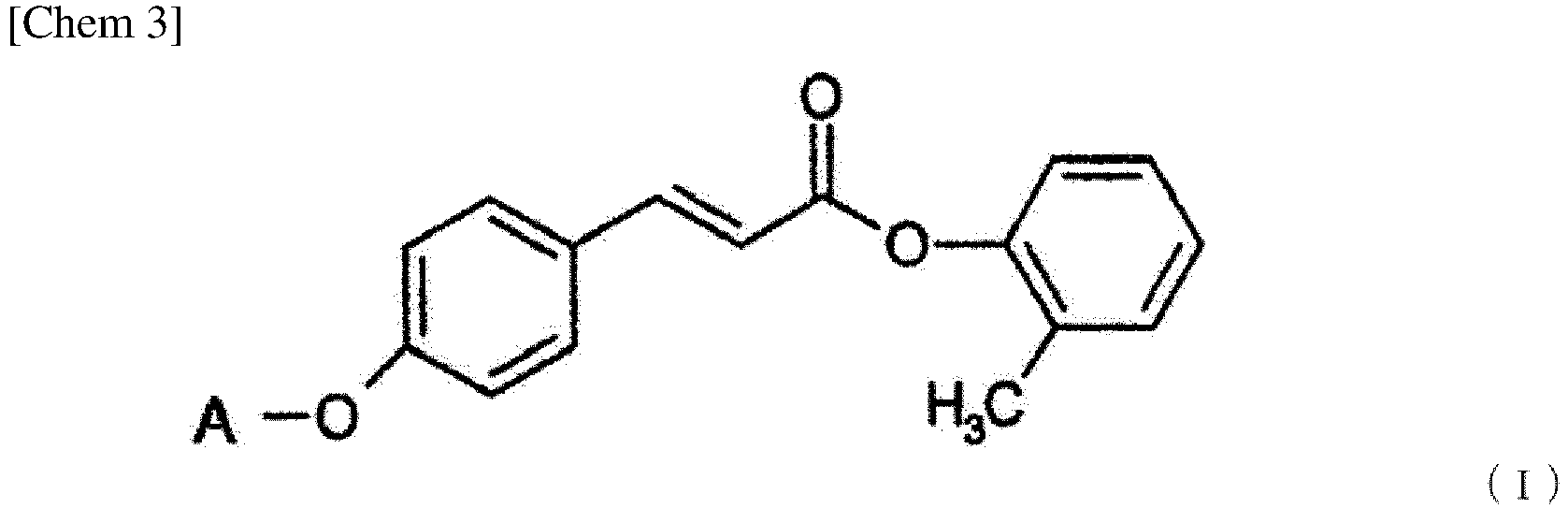
- The production method according to claim 13, wherein the pulverizing is such that particles of the compound I having a longest diameter exceeding 500 µm are 1.0 or less per 100 particles of the compound I.
- The production method according to claim 13 or 14, wherein the pulverizing is performed using a wet pulverizer.
- The production method according to claim 15, wherein a roller mill is used as the wet pulverizer.
- The production method according to claim 15 or 16, wherein the pulverizing is performed after dispersing the particles of the compound I in a liquid medium.
- The production method according to claim 13 or 14, wherein the pulverizing is performed using a dry pulverizer.
- The production method according to claim 18, wherein the pulverizing is performed along with additional particles other than the particles of the compound I.
- The production method according to claim 19, wherein the additional particles comprise an extender pigment.
Applications Claiming Priority (2)
| Application Number | Priority Date | Filing Date | Title |
|---|---|---|---|
| JP2021168432 | 2021-10-13 | ||
| PCT/JP2022/037291 WO2023063190A1 (en) | 2021-10-13 | 2022-10-05 | Ultraviolet absorbing powder, cosmetic containing ultraviolet absorbing powder, dispersion, mixed powder, and method for manufacturing ultraviolet absorbing powder |
Publications (2)
| Publication Number | Publication Date |
|---|---|
| EP4417186A1 true EP4417186A1 (en) | 2024-08-21 |
| EP4417186A4 EP4417186A4 (en) | 2025-02-12 |
Family
ID=85988622
Family Applications (1)
| Application Number | Title | Priority Date | Filing Date |
|---|---|---|---|
| EP22880886.1A Pending EP4417186A4 (en) | 2021-10-13 | 2022-10-05 | UV-ABSORBING POWDER, COSMETIC WITH UV-ABSORBING POWDER, DISPERSION, MIXED POWDER AND METHOD FOR PRODUCING UV-ABSORBING POWDER |
Country Status (4)
| Country | Link |
|---|---|
| EP (1) | EP4417186A4 (en) |
| JP (1) | JPWO2023063190A1 (en) |
| CN (1) | CN117999059A (en) |
| WO (1) | WO2023063190A1 (en) |
Families Citing this family (1)
| Publication number | Priority date | Publication date | Assignee | Title |
|---|---|---|---|---|
| CN122270259A (en) * | 2023-12-15 | 2026-06-23 | 株式会社资生堂 | Cosmetic composition |
Family Cites Families (8)
| Publication number | Priority date | Publication date | Assignee | Title |
|---|---|---|---|---|
| FR2827510B1 (en) * | 2001-07-18 | 2005-07-01 | Oreal | INSOLUBLE ORGANIC UV FILTERS OF THE ARYL VINYLENE KETONE TYPE AND THEIR USE IN COSMETICS |
| ATE479665T1 (en) * | 2003-01-20 | 2010-09-15 | Basf Se | TRIAZINE DERIVATIVES AS UV ABSORBERS |
| WO2009040917A1 (en) * | 2007-09-27 | 2009-04-02 | Lead Chemical Co. , Ltd. | Ultraviolet absorber |
| BR112016023485B1 (en) * | 2014-04-11 | 2020-12-22 | Basf Se | cosmetic makeup |
| ES3010209T3 (en) * | 2014-07-25 | 2025-04-01 | Basf Se | Sunscreen formulations optimized for the formation of vitamin d |
| ES2837012T3 (en) * | 2016-10-11 | 2021-06-29 | Dsm Ip Assets Bv | Preparation of nano-sized UV absorbers |
| US20220151896A1 (en) * | 2019-03-15 | 2022-05-19 | Basf Se | Efficient sunscreen compositions with diethylamino hydroxybenzoyl hexyl benzoate and organic particulate uv filter |
| CN113573689B (en) * | 2019-03-15 | 2025-04-15 | 巴斯夫欧洲公司 | Sunscreen composition comprising butyl methoxydibenzoylmethane, a triazine derivative and a light stabilizer |
-
2022
- 2022-10-05 CN CN202280062068.5A patent/CN117999059A/en active Pending
- 2022-10-05 EP EP22880886.1A patent/EP4417186A4/en active Pending
- 2022-10-05 JP JP2023554444A patent/JPWO2023063190A1/ja active Pending
- 2022-10-05 WO PCT/JP2022/037291 patent/WO2023063190A1/en not_active Ceased
Also Published As
| Publication number | Publication date |
|---|---|
| EP4417186A4 (en) | 2025-02-12 |
| WO2023063190A1 (en) | 2023-04-20 |
| JPWO2023063190A1 (en) | 2023-04-20 |
| CN117999059A (en) | 2024-05-07 |
Similar Documents
| Publication | Publication Date | Title |
|---|---|---|
| CN102300549B (en) | Water-in-oil-type emulsion sunscreen cosmetic | |
| CN101940537B (en) | Oil-in-water emulsion exhibiting a ph ranging from 3 to 5.5 | |
| EP2868701B1 (en) | Aqueous dispersion comprising silicone elastomer particles, a silicone elastomer particle and a cosmetic | |
| EP2939653A1 (en) | Composition comprising microcapsules containing particles with a high wet point | |
| EP3223775B1 (en) | Hydroalcoholic or aqueous gel of synthetic phyllosilicates as a thickening, mattifying and/or application homogenising agent | |
| JP5649051B2 (en) | Fine particle metal oxide dispersion composition | |
| BR112015024958B1 (en) | COMPOSITION, COSMETIC PROCESSES AND USES OF A COMPOSITION | |
| FR2982147A1 (en) | OIL-CONTINUOUS PHASE COMPOSITION CONTAINING AT LEAST ONE LIPOPHILIC ORGANIC UV FILTER AND HYDROPHOBIC SILICA AEROGEL PARTICLES. | |
| US20180289610A1 (en) | Sunscreen cosmetic | |
| EP3162356B1 (en) | Effervescent sunscreen composition | |
| KR102919511B1 (en) | Organopolysiloxane and cosmetics containing the same | |
| WO2020017346A1 (en) | Dispersion, method for producing same, and cosmetic | |
| WO2023026999A1 (en) | Powder-containing composition | |
| JP2023098745A (en) | emulsified cosmetic | |
| JP2017155006A (en) | Composite particle, cosmetic composition, and method for producing composite particle | |
| JP7687347B2 (en) | Slurry-like dispersion, cosmetic preparation and method for producing same | |
| KR102715221B1 (en) | Make-up cosmetic composition comprising scoria powder | |
| EP1974717B1 (en) | Dispersion of fine titanium oxide particles and cosmetic preparation containing the same | |
| EP4461763A1 (en) | (poly)glycerin group- and polyoxyalkylene group-containing organopolysiloxane, treated hydrophobic powder, dispersion, and cosmetic | |
| KR20180079449A (en) | A cosmetic composition comprising at least one powder having a low thermal conductivity | |
| WO2022239649A1 (en) | Water-breaking makeup cosmetic | |
| WO2023063190A1 (en) | Ultraviolet absorbing powder, cosmetic containing ultraviolet absorbing powder, dispersion, mixed powder, and method for manufacturing ultraviolet absorbing powder | |
| WO2024143260A1 (en) | Sunscreen cosmetic | |
| FR2882651A1 (en) | Filtering fluid composition, useful e.g. for the preparation of a skin care product and skin make-up product, comprises a wetting agent, a hydrophilic gelling agent and an emulsifying surface-active agent | |
| KR20240156598A (en) | Hydrophobic cellulose nanofibers, dispersion of the hydrophobic cellulose nanofibers, and cosmetics |
Legal Events
| Date | Code | Title | Description |
|---|---|---|---|
| STAA | Information on the status of an ep patent application or granted ep patent |
Free format text: STATUS: THE INTERNATIONAL PUBLICATION HAS BEEN MADE |
|
| PUAI | Public reference made under article 153(3) epc to a published international application that has entered the european phase |
Free format text: ORIGINAL CODE: 0009012 |
|
| STAA | Information on the status of an ep patent application or granted ep patent |
Free format text: STATUS: REQUEST FOR EXAMINATION WAS MADE |
|
| 17P | Request for examination filed |
Effective date: 20240313 |
|
| AK | Designated contracting states |
Kind code of ref document: A1 Designated state(s): AL AT BE BG CH CY CZ DE DK EE ES FI FR GB GR HR HU IE IS IT LI LT LU LV MC ME MK MT NL NO PL PT RO RS SE SI SK SM TR |
|
| DAV | Request for validation of the european patent (deleted) | ||
| DAX | Request for extension of the european patent (deleted) | ||
| A4 | Supplementary search report drawn up and despatched |
Effective date: 20250114 |
|
| RIC1 | Information provided on ipc code assigned before grant |
Ipc: C09K 3/00 20060101ALI20250108BHEP Ipc: A61Q 17/04 20060101ALI20250108BHEP Ipc: A61K 8/02 20060101ALI20250108BHEP Ipc: A61K 8/37 20060101AFI20250108BHEP |