EP4415667B1 - Printed nonwoven web with microdot bond pattern - Google Patents
Printed nonwoven web with microdot bond pattern Download PDFInfo
- Publication number
- EP4415667B1 EP4415667B1 EP23707956.1A EP23707956A EP4415667B1 EP 4415667 B1 EP4415667 B1 EP 4415667B1 EP 23707956 A EP23707956 A EP 23707956A EP 4415667 B1 EP4415667 B1 EP 4415667B1
- Authority
- EP
- European Patent Office
- Prior art keywords
- bonding points
- nonwoven web
- smaller
- printed
- pattern
- Prior art date
- Legal status (The legal status is an assumption and is not a legal conclusion. Google has not performed a legal analysis and makes no representation as to the accuracy of the status listed.)
- Active
Links
Images



Classifications
-
- A—HUMAN NECESSITIES
- A61—MEDICAL OR VETERINARY SCIENCE; HYGIENE
- A61F—FILTERS IMPLANTABLE INTO BLOOD VESSELS; PROSTHESES; DEVICES PROVIDING PATENCY TO, OR PREVENTING COLLAPSING OF, TUBULAR STRUCTURES OF THE BODY, e.g. STENTS; ORTHOPAEDIC, NURSING OR CONTRACEPTIVE DEVICES; FOMENTATION; TREATMENT OR PROTECTION OF EYES OR EARS; BANDAGES, DRESSINGS OR ABSORBENT PADS; FIRST-AID KITS
- A61F13/00—Bandages or dressings; Absorbent pads
- A61F13/15—Absorbent pads, e.g. sanitary towels, swabs or tampons for external or internal application to the body; Supporting or fastening means therefor; Tampon applicators
- A61F13/15577—Apparatus or processes for manufacturing
- A61F13/15707—Mechanical treatment, e.g. notching, twisting, compressing, shaping
- A61F13/15731—Treating webs, e.g. for giving them a fibrelike appearance, e.g. by embossing
-
- A—HUMAN NECESSITIES
- A61—MEDICAL OR VETERINARY SCIENCE; HYGIENE
- A61F—FILTERS IMPLANTABLE INTO BLOOD VESSELS; PROSTHESES; DEVICES PROVIDING PATENCY TO, OR PREVENTING COLLAPSING OF, TUBULAR STRUCTURES OF THE BODY, e.g. STENTS; ORTHOPAEDIC, NURSING OR CONTRACEPTIVE DEVICES; FOMENTATION; TREATMENT OR PROTECTION OF EYES OR EARS; BANDAGES, DRESSINGS OR ABSORBENT PADS; FIRST-AID KITS
- A61F13/00—Bandages or dressings; Absorbent pads
- A61F13/15—Absorbent pads, e.g. sanitary towels, swabs or tampons for external or internal application to the body; Supporting or fastening means therefor; Tampon applicators
- A61F13/15203—Properties of the article, e.g. stiffness or absorbency
-
- B—PERFORMING OPERATIONS; TRANSPORTING
- B41—PRINTING; LINING MACHINES; TYPEWRITERS; STAMPS
- B41M—PRINTING, DUPLICATING, MARKING, OR COPYING PROCESSES; COLOUR PRINTING
- B41M3/00—Printing processes to produce particular kinds of printed work, e.g. patterns
-
- D—TEXTILES; PAPER
- D04—BRAIDING; LACE-MAKING; KNITTING; TRIMMINGS; NON-WOVEN FABRICS
- D04H—MAKING TEXTILE FABRICS, e.g. FROM FIBRES OR FILAMENTARY MATERIAL; FABRICS MADE BY SUCH PROCESSES OR APPARATUS, e.g. FELTS, NON-WOVEN FABRICS; COTTON-WOOL; WADDING ; NON-WOVEN FABRICS FROM STAPLE FIBRES, FILAMENTS OR YARNS, BONDED WITH AT LEAST ONE WEB-LIKE MATERIAL DURING THEIR CONSOLIDATION
- D04H3/00—Non-woven fabrics formed wholly or mainly of yarns or like filamentary material of substantial length
- D04H3/08—Non-woven fabrics formed wholly or mainly of yarns or like filamentary material of substantial length characterised by the method of strengthening or consolidating
- D04H3/14—Non-woven fabrics formed wholly or mainly of yarns or like filamentary material of substantial length characterised by the method of strengthening or consolidating with bonds between thermoplastic yarns or filaments produced by welding
-
- D—TEXTILES; PAPER
- D04—BRAIDING; LACE-MAKING; KNITTING; TRIMMINGS; NON-WOVEN FABRICS
- D04H—MAKING TEXTILE FABRICS, e.g. FROM FIBRES OR FILAMENTARY MATERIAL; FABRICS MADE BY SUCH PROCESSES OR APPARATUS, e.g. FELTS, NON-WOVEN FABRICS; COTTON-WOOL; WADDING ; NON-WOVEN FABRICS FROM STAPLE FIBRES, FILAMENTS OR YARNS, BONDED WITH AT LEAST ONE WEB-LIKE MATERIAL DURING THEIR CONSOLIDATION
- D04H3/00—Non-woven fabrics formed wholly or mainly of yarns or like filamentary material of substantial length
- D04H3/08—Non-woven fabrics formed wholly or mainly of yarns or like filamentary material of substantial length characterised by the method of strengthening or consolidating
- D04H3/16—Non-woven fabrics formed wholly or mainly of yarns or like filamentary material of substantial length characterised by the method of strengthening or consolidating with bonds between thermoplastic filaments produced in association with filament formation, e.g. immediately following extrusion
-
- A—HUMAN NECESSITIES
- A61—MEDICAL OR VETERINARY SCIENCE; HYGIENE
- A61F—FILTERS IMPLANTABLE INTO BLOOD VESSELS; PROSTHESES; DEVICES PROVIDING PATENCY TO, OR PREVENTING COLLAPSING OF, TUBULAR STRUCTURES OF THE BODY, e.g. STENTS; ORTHOPAEDIC, NURSING OR CONTRACEPTIVE DEVICES; FOMENTATION; TREATMENT OR PROTECTION OF EYES OR EARS; BANDAGES, DRESSINGS OR ABSORBENT PADS; FIRST-AID KITS
- A61F13/00—Bandages or dressings; Absorbent pads
- A61F13/15—Absorbent pads, e.g. sanitary towels, swabs or tampons for external or internal application to the body; Supporting or fastening means therefor; Tampon applicators
- A61F13/15203—Properties of the article, e.g. stiffness or absorbency
- A61F2013/15243—Properties of the article, e.g. stiffness or absorbency printed or coloured, e.g. to match skin
Definitions
- the invention relates to nonwoven webs comprising a pattern of fusion-embossed bonding points on at least one of its surfaces and being printed on the same surface.
- the invention further relates to a method for making such nonwoven webs, and to uses for such nonwoven webs.
- Hygiene industry uses nonwoven webs as materials for making products such as baby diapers or adult incontinence products on a large scale.
- Webs comprising or consisting of spunbonded nonwoven material and bonded by calender embossing have become industry standard for many applications. Examples comprise US 2014/0072767 A1 . These webs not only have desirable product characteristics, they can also be economically produced at high line speeds.
- the materials must be printed with texts, graphical patterns or images. Most typically, printing these materials is facilitated by flexographic ink printing, where the nonwoven web is fed to a flexographic printing unit at high translation speed and where ink is transferred from a print roll directly to the surface of the web.
- US 2007/049889 A1 discloses a method for printing on surfaces of nonwoven webs.
- the present invention aims to improve image quality for prints on calender-bonded nonwoven webs without detriment to production efficiency and economy.
- the invention proposes a printed nonwoven web comprising a pattern of fusion-embossed bonding points, wherein the nonwoven web is ink-printed on the surface showing the patter of bonding points, wherein the pattern of bonding points fulfils the following conditions: (a) the number of bonding points on the surface is greater than 70/cm 2 , preferably greater than 75/cm 2 ; (b) the average area size of the individual bonding points is smaller 1.5 mm 2 , preferably smaller than 1.35 mm 2 ; and (c) the average distance between bonding points, from centre to centre, is smaller than 1.5 mm, preferably smaller than 1.3 mm.
- the bonding pattern is homogenous over the entire surface of the fabric.
- the conditions are representative of using more and smaller bonding points than previously used in the art.
- the smaller bonding points lead to a surface with a more uniform appearance. This is especially advantageous for subsequent printing as it makes the print appear more uniform.
- the reason for this is that wherever a part of the printed design includes a bonding point, that area will appear to be slightly differently coloured than the unbonded printed surface due to the differences in smoothness and opacity. With the smaller bonding points and a higher density bonding pattern this becomes less pronounced, so that the printed design looks better.
- the bond area defined as fraction of the total area of the surface that is occupied by the bonding points, is smaller than 18%, preferably smaller than 15%, more preferably than 12%, and yet more preferably smaller than 11%.
- the smaller the overall bond area the smaller the overall area with slightly difference colouring. Hence, and overall smaller bond area can also contribute to better print quality.
- the respective printed nonwoven webs can be produced by a method, wherein a nonwoven web is bonded by calender embossing to form a nonwoven web comprising a pattern of fusion-embossed bonding points fulfilling the above conditions on at least one of its surfaces, and wherein the nonwoven web is ink-printed on the surface showing the patter of bonding points.
- the ink printing is flexographic ink printing.
- the nonwoven web is typically passed run across the surface of a print roll.
- the print roll comprises an exchangeable cylindrical sleeve folded around a core cylinder.
- the sleeve comprises a mirrored master of the required image as a positive 3D relief.
- Ink is transferred from an ink reservoir to the print roll from an anilox roll, which has surface cells for dosing the ink. Doctor blades scrape off excessive ink from outside the cells.
- the print roll comprises a mirrored master of the required image as a positive 3D relief.
- the ink printing can also be ink jet printing.
- This printing method may not allow the same line speeds as flexographic printing, but is more flexible in terms of individualization or changes.
- Digital prints can be realized with ink jet printing.
- the ink can be a water- or solvent-based ink and the surface can be dried after ink application.
- the ink can be a UV-curable ink that contains reactive monomers and/or oligomers, pigments and photoinitiators, in which the surface can be irradiated with UV light after the ink application.
- UV-curable inks can be advantageous from a standpoint of increased adhesion and reduced VOC emission.
- the inventively configured bonding point pattern can be operated in a large range of print resolutions.
- the contact areas on the print roller are typically dotted and the dots are arranged in lines.
- the line screen as expressed in lines per cm, is representative for print resolution.
- the line screen can be between 15 L/cm and 50 L/cm. Print resolutions of greater than about 30 L/cm could be used to obtain superior print quality.
- the nonwoven web is a spunbonded or spunmelt nonwoven material.
- the material is formed from polyolefin fibers.
- Suitable polyolefins comprise, for example, polypropylene (PP), polyethylene (PP), or copolymers comprising propylene- or ethylene-based copolymers (co-PP; co-PE).
- PP polypropylene
- PP polyethylene
- co-PE copolymers comprising propylene- or ethylene-based copolymers
- a spunbonded nonwoven material may be combined with additional same or different spunbonded (S) layers and/or meltblown (M) layers to obtain multiple layer webs of SS, SMS or similar types.
- bonding comprises ultrasonic bonding, where ultrasonic vibrations are introduced into the embossing projections and the fibers are fused together by ultrasonic fusion.
- Other embodiments use thermal bonding where the embossing projections are heated and the fibers are fused together by thermal fusion.
- the method steps of nonwoven material formation by fiber laydown and bonding on the one hand and by printing on the nonwoven on the other hand are preferably carried out inline.
- an offline setting where a prefabricated nonwoven material is printed separately can be used.
- the line speed for nonwoven material formation and printing is preferably at least 100 meters per minute, more preferably greater than 150 meters per minute, and even more preferably greater than 200 meters per minute.
- the printed nonwoven webs of the invention can be used in hygiene articles such as baby diapers, sanitary napkins, or adult incontinence products.
- the nonwoven webs can also be used in medical applications such as gowns, face masks, nursing pads, or bed sheets.
- the nonwoven webs can be used in household products like wipes and cleaning towels.
- the quality of the print gets very close to what can be achieved for other nonwoven types bonded without creating bonding points, like on air through carded, since the bond pattern becomes less pronounced.
- the bonding dots are so small that they do not interfere with the quality of the print.
- production efficiency and product quality remains high.
- the calander bonded nonwovens have better physical properties than nonwovens bonded by other methods like air through bonding.
- FIG. 1 An exemplary machine setup for making printed nonwoven web 10 according to the invention is shown in Figure 1 .
- the setup comprises a conveyor belt and two spunbonding machines 20, 22 arranged in line on the conveyor belt.
- a molten thermoplastic polymer is extruded through the holes of a die.
- the extruded fiber strands are then quenched and drawn / stretched to form endless fibers, which are then laid onto the conveyor belt or, in case of the second laydown, on the first web that has been previously deposited thereon.
- Each of the spunbonding machines 20, 22 is followed by a pair of pre-compaction rollers 21, 23 for pre-compacting the respective webs.
- the pre-compacted web is then bonded by calander-embossing in a bonding unit 25, where a fabric is run over the surface of a calander roll having a pattern of embossing projections on its surface.
- Thermal heat or ultrasonic energy is introduced into the projections by a source of thermal or ultrasonic energy and the web is fusion bonded at the respective locations to obtain a pattern of bonding points that corresponds to the pattern of projections on the calander roll surface.
- the bonding is followed by a printing step in printing unit 30, which will be described in more detail in the following.
- the product web is finally collected on the product roll 40.
- Figure 2 shows a flexographic printing unit 31 comprising a manifold for transferring ink onto the surface of an anilox roll 34.
- the manifold comprises an ink reservoir 32 and doctor blades acting as retaining and scrap blades.
- the surface of the anilox roll 34 comprises cells that enable dosing the ink to be transferred to the print roll 36.
- the surface of the print roll 36 comprises a positive mirrored master of the required image as a 3D relief.
- the print roll 36 transfers ink to the nonwoven web 10 while it is pressed against the print roll 36 by a counter-rotating impression drum 37.
- multiple units 31 comprising manifolds 33, anvil rolls 34 and print rolls 36 are arranged around a common impression drum 37 for multi-color printing in a printing unit 30.
- a drying or curing unit 38 follows inline.
- Figure 4 shows a pattern of embossing projections on the surface of a calander roll, that has been used for producing webs of the generic kind in the past. It comprises elliptically shaped embossing projections 26 that have different lengths d1 and widths d2.
- the bond area is approx. 0,25 mm 2 .
- the distances a and b between the projections 26 are greater 1.5 and greater 2.5, respectively, and are such that the number of projections per area is approx. 50 and the bonding area, meaning the fraction of the total surface area occupied by the flat projection surfaces, is approx. 18%.
- Figure 5 shows a pattern that is according to the invention. It is symmetrical and comprises circular embossing projections of a diameter d that is 0.4 mm.
- the bond area is hence approx. 0.125 mm 2 .
- the examples compare the print quality on inventive microdot material and standard bonded nonwoven materials. All tests were carried out on the same 17 g/m 2 polypropylene three-layer spundbond (SSS) standard nonwoven material. The samples in the comparative tests were bonded using a bond pattern as in Figure 4 . The samples in the inventive tests were bonded using a bond pattern as in Figure 5 .
- SSS polypropylene three-layer spundbond
- the samples all contained exactly the same print image and were printed, by flexographic ink printing, under exactly the same conditions (screen, sleeves, inks used, press, etc.).
- the measurement procedure was as follows: In the first step, the exactly identical areas of the print samples to be compared are glued onto a white sheet of paper and scanned with a scanner (min. 300dpi resolution) as a PDF.The PDFs are then each opened in the software Adobe Photoshop 2023 and adjusted exactly to the area to be measured, before being converted to grayscale. Then, a gradation step is applied to separate the darker uneven areas from the even ones. The pixels are displayed in black after the gradation curve has been applied. For this purpose, a fixed sensitivity is set so that color tones with different brightness values can be measured. For the sensitivity setting, the L-value of the darkest shade of the area to be measured is determined using a measuring device (X-Rite Exact). The default sensitivity value (input value) with an L value of 75 is 48. If the L value deviates from +1, the sensitivity value decreases by 2. If the L value deviates from -1, the sensitivity value increases by 2.
- the histogram it can be read off how many deviating black pixels are present in the print area, and the values can be compared between the two types of materials.
Landscapes
- Engineering & Computer Science (AREA)
- Health & Medical Sciences (AREA)
- Textile Engineering (AREA)
- Animal Behavior & Ethology (AREA)
- Public Health (AREA)
- Heart & Thoracic Surgery (AREA)
- Vascular Medicine (AREA)
- Life Sciences & Earth Sciences (AREA)
- Epidemiology (AREA)
- General Health & Medical Sciences (AREA)
- Biomedical Technology (AREA)
- Veterinary Medicine (AREA)
- Mechanical Engineering (AREA)
- Manufacturing & Machinery (AREA)
- Treatment Of Fiber Materials (AREA)
- Nonwoven Fabrics (AREA)
- Printing Methods (AREA)
- Ink Jet (AREA)
Description
- The invention relates to nonwoven webs comprising a pattern of fusion-embossed bonding points on at least one of its surfaces and being printed on the same surface. The invention further relates to a method for making such nonwoven webs, and to uses for such nonwoven webs.
- Hygiene industry uses nonwoven webs as materials for making products such as baby diapers or adult incontinence products on a large scale. Webs comprising or consisting of spunbonded nonwoven material and bonded by calender embossing have become industry standard for many applications. Examples comprise
US 2014/0072767 A1 . These webs not only have desirable product characteristics, they can also be economically produced at high line speeds. Depending on the type of application, the materials must be printed with texts, graphical patterns or images. Most typically, printing these materials is facilitated by flexographic ink printing, where the nonwoven web is fed to a flexographic printing unit at high translation speed and where ink is transferred from a print roll directly to the surface of the web.US 2007/049889 A1 discloses a method for printing on surfaces of nonwoven webs. - The image quality when ink-printing a calender-bonded nonwoven web comprising a pattern of fusion-embossed bonding points on its printed surface is limited, however. The reason is that the bonding points take on a higher color intensity and contrast than the remaining parts of the fabric, which makes the print appear pixelated and inhomogeneous.
- The present invention aims to improve image quality for prints on calender-bonded nonwoven webs without detriment to production efficiency and economy.
- Against this background the invention proposes a printed nonwoven web comprising a pattern of fusion-embossed bonding points, wherein the nonwoven web is ink-printed on the surface showing the patter of bonding points, wherein the pattern of bonding points fulfils the following conditions: (a) the number of bonding points on the surface is greater than 70/cm2, preferably greater than 75/cm2; (b) the average area size of the individual bonding points is smaller 1.5 mm2, preferably smaller than 1.35 mm2; and (c) the average distance between bonding points, from centre to centre, is smaller than 1.5 mm, preferably smaller than 1.3 mm. The bonding pattern is homogenous over the entire surface of the fabric.
- The conditions are representative of using more and smaller bonding points than previously used in the art. The smaller bonding points lead to a surface with a more uniform appearance. This is especially advantageous for subsequent printing as it makes the print appear more uniform. The reason for this is that wherever a part of the printed design includes a bonding point, that area will appear to be slightly differently coloured than the unbonded printed surface due to the differences in smoothness and opacity. With the smaller bonding points and a higher density bonding pattern this becomes less pronounced, so that the printed design looks better.
- In one embodiment, the bond area, defined as fraction of the total area of the surface that is occupied by the bonding points, is smaller than 18%, preferably smaller than 15%, more preferably than 12%, and yet more preferably smaller than 11%. The smaller the overall bond area, the smaller the overall area with slightly difference colouring. Hence, and overall smaller bond area can also contribute to better print quality.
- The respective printed nonwoven webs can be produced by a method, wherein a nonwoven web is bonded by calender embossing to form a nonwoven web comprising a pattern of fusion-embossed bonding points fulfilling the above conditions on at least one of its surfaces, and wherein the nonwoven web is ink-printed on the surface showing the patter of bonding points.
- Preferably, the ink printing is flexographic ink printing. In a flexographic ink printing unit, the nonwoven web is typically passed run across the surface of a print roll. The print roll comprises an exchangeable cylindrical sleeve folded around a core cylinder. The sleeve comprises a mirrored master of the required image as a positive 3D relief. Ink is transferred from an ink reservoir to the print roll from an anilox roll, which has surface cells for dosing the ink. Doctor blades scrape off excessive ink from outside the cells. The print roll comprises a mirrored master of the required image as a positive 3D relief.
- Alternatively, the ink printing can also be ink jet printing. This printing method may not allow the same line speeds as flexographic printing, but is more flexible in terms of individualization or changes. Digital prints can be realized with ink jet printing.
- The ink can be a water- or solvent-based ink and the surface can be dried after ink application. Alternatively, the ink can be a UV-curable ink that contains reactive monomers and/or oligomers, pigments and photoinitiators, in which the surface can be irradiated with UV light after the ink application. UV-curable inks can be advantageous from a standpoint of increased adhesion and reduced VOC emission.
- The inventively configured bonding point pattern can be operated in a large range of print resolutions. Specifically, the contact areas on the print roller are typically dotted and the dots are arranged in lines. The line screen, as expressed in lines per cm, is representative for print resolution. In one embodiment, the line screen can be between 15 L/cm and 50 L/cm. Print resolutions of greater than about 30 L/cm could be used to obtain superior print quality.
- In one embodiment, the nonwoven web is a spunbonded or spunmelt nonwoven material. Preferably, the material is formed from polyolefin fibers. Suitable polyolefins comprise, for example, polypropylene (PP), polyethylene (PP), or copolymers comprising propylene- or ethylene-based copolymers (co-PP; co-PE). A spunbonded nonwoven material may be combined with additional same or different spunbonded (S) layers and/or meltblown (M) layers to obtain multiple layer webs of SS, SMS or similar types.
- During bonding the material is run across the surface of a calender roll having embossing projections on the surface that fulfil the conditions laid out above. In a preferred embodiment, bonding comprises ultrasonic bonding, where ultrasonic vibrations are introduced into the embossing projections and the fibers are fused together by ultrasonic fusion. Other embodiments use thermal bonding where the embossing projections are heated and the fibers are fused together by thermal fusion.
- For optimum production efficiency, the method steps of nonwoven material formation by fiber laydown and bonding on the one hand and by printing on the nonwoven on the other hand are preferably carried out inline. Alternatively, for greater flexibility, an offline setting where a prefabricated nonwoven material is printed separately can be used.
- In general, the line speed for nonwoven material formation and printing, be it together in an inline setting or separately in an offline setting, is preferably at least 100 meters per minute, more preferably greater than 150 meters per minute, and even more preferably greater than 200 meters per minute.
- The printed nonwoven webs of the invention can be used in hygiene articles such as baby diapers, sanitary napkins, or adult incontinence products. Alternatively, the nonwoven webs can also be used in medical applications such as gowns, face masks, nursing pads, or bed sheets. Further, the nonwoven webs can be used in household products like wipes and cleaning towels.
- By reducing the distance between the bonding points, the quality of the print gets very close to what can be achieved for other nonwoven types bonded without creating bonding points, like on air through carded, since the bond pattern becomes less pronounced. The bonding dots are so small that they do not interfere with the quality of the print. At the same time, production efficiency and product quality remains high. Specifically, the calander bonded nonwovens have better physical properties than nonwovens bonded by other methods like air through bonding.
- Further details and advantages of the invention will become apparent from the figures and examples described in the following. The figures show:
- Figure 1:
- a schematic setup of a production line for making printed nonwoven webs according to the invention;
- Figure 2:
- an illustration showing the principle of flexographic ink printing;
- Figure 3:
- a typical flexographic ink printing layout used in nonwoven printing;
- Figure 4:
- a bonding pattern as used in the prior art; and
- Figure 5:
- a bonding pattern according to the invention.
- An exemplary machine setup for making printed
nonwoven web 10 according to the invention is shown inFigure 1 . - The setup comprises a conveyor belt and two
spunbonding machines spunbonding machines pre-compaction rollers - The pre-compacted web is then bonded by calander-embossing in a
bonding unit 25, where a fabric is run over the surface of a calander roll having a pattern of embossing projections on its surface. Thermal heat or ultrasonic energy is introduced into the projections by a source of thermal or ultrasonic energy and the web is fusion bonded at the respective locations to obtain a pattern of bonding points that corresponds to the pattern of projections on the calander roll surface. - The bonding is followed by a printing step in printing
unit 30, which will be described in more detail in the following. The product web is finally collected on theproduct roll 40. -
Figure 2 shows aflexographic printing unit 31 comprising a manifold for transferring ink onto the surface of ananilox roll 34. The manifold comprises anink reservoir 32 and doctor blades acting as retaining and scrap blades. The surface of the anilox roll 34 comprises cells that enable dosing the ink to be transferred to theprint roll 36. The surface of theprint roll 36 comprises a positive mirrored master of the required image as a 3D relief. Theprint roll 36 transfers ink to thenonwoven web 10 while it is pressed against theprint roll 36 by acounter-rotating impression drum 37. - As shown in
Figure 3 ,multiple units 31 comprising manifolds 33, anvil rolls 34 and print rolls 36 are arranged around acommon impression drum 37 for multi-color printing in aprinting unit 30. A drying or curingunit 38 follows inline. -
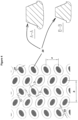
Figure 4 shows a pattern of embossing projections on the surface of a calander roll, that has been used for producing webs of the generic kind in the past. It comprises elliptically shapedembossing projections 26 that have different lengths d1 and widths d2. The bond area is approx. 0,25 mm2. The distances a and b between theprojections 26 are greater 1.5 and greater 2.5, respectively, and are such that the number of projections per area is approx. 50 and the bonding area, meaning the fraction of the total surface area occupied by the flat projection surfaces, is approx. 18%. -
Figure 5 shows a pattern that is according to the invention. It is symmetrical and comprises circular embossing projections of a diameter d that is 0.4 mm. The bond area is hence approx. 0.125 mm2. The pitch a (=b) between the bonding points is 1.12 mm. This results in a number of bonding points per area of 80/cm2 and a total bonding area of 10%. - The examples compare the print quality on inventive microdot material and standard bonded nonwoven materials. All tests were carried out on the same 17 g/m2 polypropylene three-layer spundbond (SSS) standard nonwoven material. The samples in the comparative tests were bonded using a bond pattern as in
Figure 4 . The samples in the inventive tests were bonded using a bond pattern as inFigure 5 . - The samples all contained exactly the same print image and were printed, by flexographic ink printing, under exactly the same conditions (screen, sleeves, inks used, press, etc.).
- The measurement procedure was as follows: In the first step, the exactly identical areas of the print samples to be compared are glued onto a white sheet of paper and scanned with a scanner (min. 300dpi resolution) as a PDF.The PDFs are then each opened in the software Adobe Photoshop 2023 and adjusted exactly to the area to be measured, before being converted to grayscale. Then, a gradation step is applied to separate the darker uneven areas from the even ones. The pixels are displayed in black after the gradation curve has been applied. For this purpose, a fixed sensitivity is set so that color tones with different brightness values can be measured. For the sensitivity setting, the L-value of the darkest shade of the area to be measured is determined using a measuring device (X-Rite Exact). The default sensitivity value (input value) with an L value of 75 is 48. If the L value deviates from +1, the sensitivity value decreases by 2. If the L value deviates from -1, the sensitivity value increases by 2.
- Finally, with the help of the histogram, it can be read off how many deviating black pixels are present in the print area, and the values can be compared between the two types of materials.
- In all pressure ranges with an L value below 85, the inventive materials have less deviation than the comparative materials. This has been found for four different pictures P1-P4 that are print designs used in the absorbent hygiene industry. The results are shown in Table 1 below.
Table 1 Picture P1 P2 P3 P4 Total printed pixels 7.777.244 11.331.414 1.471.901 6.436.458 Black pixels comparative sample 89.520 290.296 18.090 124.389 Ratio of black pixels in comparative sample 1,2% 2,6% 1,2% 1,9% Black pixels inventive sample 40.370 13.825 11.800 62.425 Ratio of black pixels in inventive sample 0,5% 0,1% 0,8% 1,0% Sensitivity 48 72 58 48 Total pixels 10.164.610 11.331.414 8.076.819 8.958.048 Darkest L Value 75 63 70 75 - It has been found for a number of different solid single color prints (rectangular). Corresponding results are given in Table 2 below.
Table 2 Color M100 C100 K100 MY100 Total printed pixels 254.000 254.000 254.000 254.000 Black pixels comparative sample 9.390 14.821 6.327 5.880 Ratio of black pixels in comparative sample 3,7% 5,8% 2,6% 2,3% Black pixels inventive sample 3.771 7.088 3.760 2.439 Ratio of black pixels in inventive sample 1,5% 2,8% 1,5% 1.0% Sensitivity 44 46 48 48 L Value 77 76 75 75 Table 2 (cntd.) Color YC100 CM100 P2593 100 Total printed pixels 254.000 254.000 254.000 Black pixels comparative sample 7.660 10.412 10.612 Ratio of black pixels in comparative sample 3,1% 4,1% 4,2% Black pixels inventive sample 4.670 4.579 3.020 Ratio of black pixels in inventive sample 1,8% 1,8% 1,2% Sensitivity 50 66 54 L Value 74 66 72
Claims (11)
- A printed nonwoven web (10) comprising a pattern of fusion-embossed bonding points, wherein the nonwoven web (10) is ink-printed on the surface showing the pattern of bonding points,
characterized in that
the pattern of bonding points is homogenous over the entire surface of the fabric and fulfils the following conditions:(a) the number of bonding points on the surface is greater than 70/cm2, preferably greater than 75/cm2;(b) the average area size of the individual bonding points is smaller than 1.5 mm2, preferably smaller than 1.35 mm2; and(c) the average distance between bonding points, from centre to centre, is smaller than 1.5 mm, preferably smaller than 1.3 mm. - The printed nonwoven web according to claim 1, wherein the bond area, defined as fraction of the total area of the surface that is occupied by the bonding points, is smaller than 18%, preferably smaller than 15%, more preferably than 12%, and yet more preferably smaller than 11%.
- The printed nonwoven web according to any preceding claim, wherein the web (10) is a spunbonded or spunmelt nonwoven web.
- A method for making a printed nonwoven web (10), wherein a nonwoven web is bonded by calender embossing to form a nonwoven web comprising a pattern of fusion-embossed bonding points, and wherein the nonwoven web is ink-printed on the surface showing the pattern of bonding points,
characterized in that
the pattern of bonding points is homogenous over the entire surface of the fabric and fulfils the following conditions:(a) the number of bonding points on the surface is greater than 70/cm2, preferably greater than 75/cm2;(b) the average area size of the individual bonding points is smaller than 1.5 mm2, preferably smaller than 1.35 mm2; and(c) the average distance between bonding points, from centre to centre, is smaller than 1.5 mm, preferably smaller than 1.3 mm. - The method according to claim 4, wherein the bond area, defined as fraction of the total area of the surface that is occupied by the bonding points, is smaller than 18%, preferably smaller than 15%, more preferably than 12%, and yet more preferably smaller than 11%.
- The method according to claim 4 or 5, wherein the ink printing is flexographic ink printing.
- The method according to claim 6, wherein the line screen is between 15 L/cm and 50 L/cm.
- The method according to claim 4 or 5, wherein the ink printing is ink jet printing.
- The method according to any one of claims 4 to 8, wherein the web (10) is a spunbonded nonwoven web.
- The method according to any one of claims 4 to 9, wherein the calender embossing comprises ultrasonic embossing.
- Use of a printed nonwoven web (10) according to any preceding claim for the manufacture of hygiene articles, preferably for the manufacture of diapers.
Applications Claiming Priority (2)
| Application Number | Priority Date | Filing Date | Title |
|---|---|---|---|
| EP22159685 | 2022-03-02 | ||
| PCT/EP2023/055260 WO2023166106A1 (en) | 2022-03-02 | 2023-03-02 | Printed nonwoven web with microdot bond pattern |
Publications (3)
| Publication Number | Publication Date |
|---|---|
| EP4415667A1 EP4415667A1 (en) | 2024-08-21 |
| EP4415667C0 EP4415667C0 (en) | 2025-02-19 |
| EP4415667B1 true EP4415667B1 (en) | 2025-02-19 |
Family
ID=80625298
Family Applications (1)
| Application Number | Title | Priority Date | Filing Date |
|---|---|---|---|
| EP23707956.1A Active EP4415667B1 (en) | 2022-03-02 | 2023-03-02 | Printed nonwoven web with microdot bond pattern |
Country Status (10)
| Country | Link |
|---|---|
| US (1) | US20250057702A1 (en) |
| EP (1) | EP4415667B1 (en) |
| JP (1) | JP7751123B2 (en) |
| KR (1) | KR102854430B1 (en) |
| CN (1) | CN118434393A (en) |
| ES (1) | ES3029169T3 (en) |
| MX (1) | MX2024008175A (en) |
| MY (1) | MY207351A (en) |
| PL (1) | PL4415667T3 (en) |
| WO (1) | WO2023166106A1 (en) |
Families Citing this family (1)
| Publication number | Priority date | Publication date | Assignee | Title |
|---|---|---|---|---|
| EP4726093A1 (en) | 2024-10-10 | 2026-04-15 | Fibertex Personal Care A/S | Printing hydrophilic areas on nonwoven materials |
Family Cites Families (11)
| Publication number | Priority date | Publication date | Assignee | Title |
|---|---|---|---|---|
| JP3087350B2 (en) * | 1991-05-20 | 2000-09-11 | 王子製紙株式会社 | Printing sheet |
| JPH11286862A (en) * | 1998-04-06 | 1999-10-19 | Oji Paper Co Ltd | Spunbonded nonwoven fabric for clothing and method for producing the same |
| EP1656254B1 (en) * | 2003-08-22 | 2012-02-01 | Kimberly-Clark Worldwide, Inc. | Microporous breathable elastic film laminates |
| US20070049889A1 (en) | 2005-08-31 | 2007-03-01 | Larson Todd C | Printed absorbent articles |
| DE602007002977D1 (en) * | 2007-02-22 | 2009-12-10 | Albis Spa | ELASTIC LAYER AND ABSORBENT PULP LAYER, METHOD AND CONTINUOUS SYSTEM FOR THE MANUFACTURE OF THIS COMPOSITE |
| JP2017113226A (en) * | 2015-12-24 | 2017-06-29 | 花王株式会社 | Top sheet for absorbent articles |
| US10655257B2 (en) * | 2017-01-31 | 2020-05-19 | The Procter & Gamble Company | Shaped nonwoven |
| JP6981048B2 (en) * | 2017-05-30 | 2021-12-15 | コニカミノルタ株式会社 | Wallpaper making equipment |
| CN111212939B (en) * | 2017-10-17 | 2022-08-02 | 东丽株式会社 | Spun-bonded non-woven fabric |
| WO2020038730A1 (en) * | 2018-08-20 | 2020-02-27 | Fibertex Personal Care A/S | Process for producing printed nonwoven webs |
| JP2021187160A (en) * | 2020-05-27 | 2021-12-13 | 旭化成アドバンス株式会社 | Nonwoven fabric clean paper |
-
2023
- 2023-03-02 EP EP23707956.1A patent/EP4415667B1/en active Active
- 2023-03-02 PL PL23707956.1T patent/PL4415667T3/en unknown
- 2023-03-02 CN CN202380015263.7A patent/CN118434393A/en active Pending
- 2023-03-02 MY MYPI2024003165A patent/MY207351A/en unknown
- 2023-03-02 US US18/723,479 patent/US20250057702A1/en active Pending
- 2023-03-02 KR KR1020247031151A patent/KR102854430B1/en active Active
- 2023-03-02 WO PCT/EP2023/055260 patent/WO2023166106A1/en not_active Ceased
- 2023-03-02 ES ES23707956T patent/ES3029169T3/en active Active
- 2023-03-02 JP JP2024544961A patent/JP7751123B2/en active Active
- 2023-03-02 MX MX2024008175A patent/MX2024008175A/en unknown
Also Published As
| Publication number | Publication date |
|---|---|
| JP7751123B2 (en) | 2025-10-07 |
| MY207351A (en) | 2025-02-21 |
| EP4415667C0 (en) | 2025-02-19 |
| JP2025503259A (en) | 2025-01-30 |
| US20250057702A1 (en) | 2025-02-20 |
| PL4415667T3 (en) | 2025-04-28 |
| WO2023166106A1 (en) | 2023-09-07 |
| KR102854430B1 (en) | 2025-09-04 |
| EP4415667A1 (en) | 2024-08-21 |
| CN118434393A (en) | 2024-08-02 |
| ES3029169T3 (en) | 2025-06-23 |
| MX2024008175A (en) | 2024-07-19 |
| KR20240145043A (en) | 2024-10-04 |
Similar Documents
| Publication | Publication Date | Title |
|---|---|---|
| US5339730A (en) | Method for printing-embossing paper sheets | |
| EP2288505B1 (en) | Method and apparatus for application of cold foil material onto a sheet material in a processing machine | |
| CN206383650U (en) | A kind of flexo, gravure and the online combined printing device of silk-screen | |
| MX2012002667A (en) | Apparatus for applying indicia having a large color gamut on web substrates. | |
| JP2020508237A (en) | Printing machine with in-line casting device for duplication and formation of micro-optical structures | |
| CN1822805A (en) | Absorbent article with ink jet image | |
| EP3624747B1 (en) | Method and apparatus for drying inks printed on heat sensitive absorbent article components | |
| MX2012002669A (en) | Apparatus for applying indicia having a large color gamut on web substrates. | |
| DE19826974C2 (en) | embosser | |
| DE102011087685A1 (en) | System and method for ink jet printing a protective layer in different halftones with gloss compensation | |
| US20250057702A1 (en) | Printed nonwoven web with microdot bond pattern | |
| EP2382095B1 (en) | Operation of a cold foil apparatus by a printing press | |
| MX2012002673A (en) | Apparatus for applying indicia having a large color gamut on web substrates. | |
| WO2007073833A1 (en) | Overprintable embossing coating | |
| CN108909155B (en) | Combined printing machine for producing safety documents | |
| CN105346205A (en) | Photogravure wire connection printing press and printing method | |
| BR112024011222B1 (en) | PRINTED NON-WOVEN BLANKET WITH MICRODOTS BONDING PATTERN | |
| US20080035272A1 (en) | Direct printed loop fabric | |
| CN105346204A (en) | Flexographic plate wiring printer and printing method thereof | |
| MX2012002659A (en) | Apparatus for applying indicia having a large color gamut on web substrates. | |
| MX2012002670A (en) | Apparatus for applying indicia having a large color gamut on web substrates. | |
| EP1674260B1 (en) | Transfer process | |
| DE102005027815A1 (en) | Method for applying foil pattern onto print sheet has the sheet prepared with an adhesive pattern prior to pressing and with the foil pattern secured to the non prepared areas of the sheet | |
| DE102010028545A1 (en) | Method for image coating of printed sheet, involves transferring imaging layer within adhesive layer by replacing film in transfer gap, conducting web out of coating module after displacement of gap, and supplying web to winding-up roller | |
| GB2078173A (en) | Method of making colour patterns on material |
Legal Events
| Date | Code | Title | Description |
|---|---|---|---|
| STAA | Information on the status of an ep patent application or granted ep patent |
Free format text: STATUS: UNKNOWN |
|
| STAA | Information on the status of an ep patent application or granted ep patent |
Free format text: STATUS: THE INTERNATIONAL PUBLICATION HAS BEEN MADE |
|
| PUAI | Public reference made under article 153(3) epc to a published international application that has entered the european phase |
Free format text: ORIGINAL CODE: 0009012 |
|
| STAA | Information on the status of an ep patent application or granted ep patent |
Free format text: STATUS: REQUEST FOR EXAMINATION WAS MADE |
|
| 17P | Request for examination filed |
Effective date: 20240513 |
|
| AK | Designated contracting states |
Kind code of ref document: A1 Designated state(s): AL AT BE BG CH CY CZ DE DK EE ES FI FR GB GR HR HU IE IS IT LI LT LU LV MC ME MK MT NL NO PL PT RO RS SE SI SK SM TR |
|
| GRAP | Despatch of communication of intention to grant a patent |
Free format text: ORIGINAL CODE: EPIDOSNIGR1 |
|
| STAA | Information on the status of an ep patent application or granted ep patent |
Free format text: STATUS: GRANT OF PATENT IS INTENDED |
|
| DAV | Request for validation of the european patent (deleted) | ||
| DAX | Request for extension of the european patent (deleted) | ||
| INTG | Intention to grant announced |
Effective date: 20240927 |
|
| GRAS | Grant fee paid |
Free format text: ORIGINAL CODE: EPIDOSNIGR3 |
|
| GRAA | (expected) grant |
Free format text: ORIGINAL CODE: 0009210 |
|
| STAA | Information on the status of an ep patent application or granted ep patent |
Free format text: STATUS: THE PATENT HAS BEEN GRANTED |
|
| AK | Designated contracting states |
Kind code of ref document: B1 Designated state(s): AL AT BE BG CH CY CZ DE DK EE ES FI FR GB GR HR HU IE IS IT LI LT LU LV MC ME MK MT NL NO PL PT RO RS SE SI SK SM TR |
|
| REG | Reference to a national code |
Ref country code: GB Ref legal event code: FG4D |
|
| REG | Reference to a national code |
Ref country code: CH Ref legal event code: EP |
|
| REG | Reference to a national code |
Ref country code: IE Ref legal event code: FG4D |
|
| REG | Reference to a national code |
Ref country code: DE Ref legal event code: R096 Ref document number: 602023002126 Country of ref document: DE |
|
| U01 | Request for unitary effect filed |
Effective date: 20250221 |
|
| U07 | Unitary effect registered |
Designated state(s): AT BE BG DE DK EE FI FR IT LT LU LV MT NL PT RO SE SI Effective date: 20250228 |
|
| U20 | Renewal fee for the european patent with unitary effect paid |
Year of fee payment: 3 Effective date: 20250404 |
|
| REG | Reference to a national code |
Ref country code: ES Ref legal event code: FG2A Ref document number: 3029169 Country of ref document: ES Kind code of ref document: T3 Effective date: 20250623 |
|
| PG25 | Lapsed in a contracting state [announced via postgrant information from national office to epo] |
Ref country code: RS Free format text: LAPSE BECAUSE OF FAILURE TO SUBMIT A TRANSLATION OF THE DESCRIPTION OR TO PAY THE FEE WITHIN THE PRESCRIBED TIME-LIMIT Effective date: 20250519 |
|
| PGFP | Annual fee paid to national office [announced via postgrant information from national office to epo] |
Ref country code: ES Payment date: 20250404 Year of fee payment: 3 |
|
| PG25 | Lapsed in a contracting state [announced via postgrant information from national office to epo] |
Ref country code: IS Free format text: LAPSE BECAUSE OF FAILURE TO SUBMIT A TRANSLATION OF THE DESCRIPTION OR TO PAY THE FEE WITHIN THE PRESCRIBED TIME-LIMIT Effective date: 20250619 Ref country code: NO Free format text: LAPSE BECAUSE OF FAILURE TO SUBMIT A TRANSLATION OF THE DESCRIPTION OR TO PAY THE FEE WITHIN THE PRESCRIBED TIME-LIMIT Effective date: 20250519 |
|
| PG25 | Lapsed in a contracting state [announced via postgrant information from national office to epo] |
Ref country code: HR Free format text: LAPSE BECAUSE OF FAILURE TO SUBMIT A TRANSLATION OF THE DESCRIPTION OR TO PAY THE FEE WITHIN THE PRESCRIBED TIME-LIMIT Effective date: 20250219 |
|
| PG25 | Lapsed in a contracting state [announced via postgrant information from national office to epo] |
Ref country code: GR Free format text: LAPSE BECAUSE OF FAILURE TO SUBMIT A TRANSLATION OF THE DESCRIPTION OR TO PAY THE FEE WITHIN THE PRESCRIBED TIME-LIMIT Effective date: 20250520 |
|
| PG25 | Lapsed in a contracting state [announced via postgrant information from national office to epo] |
Ref country code: SM Free format text: LAPSE BECAUSE OF FAILURE TO SUBMIT A TRANSLATION OF THE DESCRIPTION OR TO PAY THE FEE WITHIN THE PRESCRIBED TIME-LIMIT Effective date: 20250219 |
|
| PG25 | Lapsed in a contracting state [announced via postgrant information from national office to epo] |
Ref country code: SK Free format text: LAPSE BECAUSE OF FAILURE TO SUBMIT A TRANSLATION OF THE DESCRIPTION OR TO PAY THE FEE WITHIN THE PRESCRIBED TIME-LIMIT Effective date: 20250219 |
|
| U1N | Appointed representative for the unitary patent procedure changed after the registration of the unitary effect |
Representative=s name: LORENZ SEIDLER GOSSEL PART. MBB; DE |
|
| PG25 | Lapsed in a contracting state [announced via postgrant information from national office to epo] |
Ref country code: MC Free format text: LAPSE BECAUSE OF FAILURE TO SUBMIT A TRANSLATION OF THE DESCRIPTION OR TO PAY THE FEE WITHIN THE PRESCRIBED TIME-LIMIT Effective date: 20250219 |
|
| PLBE | No opposition filed within time limit |
Free format text: ORIGINAL CODE: 0009261 |
|
| STAA | Information on the status of an ep patent application or granted ep patent |
Free format text: STATUS: NO OPPOSITION FILED WITHIN TIME LIMIT |
|
| REG | Reference to a national code |
Ref country code: CH Ref legal event code: L10 Free format text: ST27 STATUS EVENT CODE: U-0-0-L10-L00 (AS PROVIDED BY THE NATIONAL OFFICE) Effective date: 20251231 |
|
| 26N | No opposition filed |
Effective date: 20251120 |
|
| REG | Reference to a national code |
Ref country code: CH Ref legal event code: U11 Free format text: ST27 STATUS EVENT CODE: U-0-0-U10-U11 (AS PROVIDED BY THE NATIONAL OFFICE) Effective date: 20260401 |
|
| PGFP | Annual fee paid to national office [announced via postgrant information from national office to epo] |
Ref country code: IE Payment date: 20260326 Year of fee payment: 4 |
|
| PGFP | Annual fee paid to national office [announced via postgrant information from national office to epo] |
Ref country code: TR Payment date: 20260226 Year of fee payment: 4 |
|
| PGFP | Annual fee paid to national office [announced via postgrant information from national office to epo] |
Ref country code: CZ Payment date: 20260225 Year of fee payment: 4 |
|
| PGFP | Annual fee paid to national office [announced via postgrant information from national office to epo] |
Ref country code: PL Payment date: 20260223 Year of fee payment: 4 |
|
| U20 | Renewal fee for the european patent with unitary effect paid |
Year of fee payment: 4 Effective date: 20260323 |