EP4415154B1 - End cover assembly, energy-storage device, and electricity-consumption device - Google Patents
End cover assembly, energy-storage device, and electricity-consumption device Download PDFInfo
- Publication number
- EP4415154B1 EP4415154B1 EP23218199.0A EP23218199A EP4415154B1 EP 4415154 B1 EP4415154 B1 EP 4415154B1 EP 23218199 A EP23218199 A EP 23218199A EP 4415154 B1 EP4415154 B1 EP 4415154B1
- Authority
- EP
- European Patent Office
- Prior art keywords
- protrusion portion
- protrusion
- isolation member
- hole
- main body
- Prior art date
- Legal status (The legal status is an assumption and is not a legal conclusion. Google has not performed a legal analysis and makes no representation as to the accuracy of the status listed.)
- Active
Links
Images


Classifications
-
- H—ELECTRICITY
- H01—ELECTRIC ELEMENTS
- H01M—PROCESSES OR MEANS, e.g. BATTERIES, FOR THE DIRECT CONVERSION OF CHEMICAL ENERGY INTO ELECTRICAL ENERGY
- H01M50/00—Constructional details or processes of manufacture of the non-active parts of electrochemical cells other than fuel cells, e.g. hybrid cells
- H01M50/50—Current conducting connections for cells or batteries
- H01M50/572—Means for preventing undesired use or discharge
- H01M50/584—Means for preventing undesired use or discharge for preventing incorrect connections inside or outside the batteries
- H01M50/59—Means for preventing undesired use or discharge for preventing incorrect connections inside or outside the batteries characterised by the protection means
- H01M50/593—Spacers; Insulating plates
-
- H—ELECTRICITY
- H01—ELECTRIC ELEMENTS
- H01M—PROCESSES OR MEANS, e.g. BATTERIES, FOR THE DIRECT CONVERSION OF CHEMICAL ENERGY INTO ELECTRICAL ENERGY
- H01M10/00—Secondary cells; Manufacture thereof
- H01M10/05—Accumulators with non-aqueous electrolyte
- H01M10/058—Construction or manufacture
-
- H—ELECTRICITY
- H01—ELECTRIC ELEMENTS
- H01M—PROCESSES OR MEANS, e.g. BATTERIES, FOR THE DIRECT CONVERSION OF CHEMICAL ENERGY INTO ELECTRICAL ENERGY
- H01M50/00—Constructional details or processes of manufacture of the non-active parts of electrochemical cells other than fuel cells, e.g. hybrid cells
- H01M50/10—Primary casings; Jackets or wrappings
- H01M50/147—Lids or covers
- H01M50/148—Lids or covers characterised by their shape
- H01M50/15—Lids or covers characterised by their shape for prismatic or rectangular cells
-
- H—ELECTRICITY
- H01—ELECTRIC ELEMENTS
- H01M—PROCESSES OR MEANS, e.g. BATTERIES, FOR THE DIRECT CONVERSION OF CHEMICAL ENERGY INTO ELECTRICAL ENERGY
- H01M50/00—Constructional details or processes of manufacture of the non-active parts of electrochemical cells other than fuel cells, e.g. hybrid cells
- H01M50/10—Primary casings; Jackets or wrappings
- H01M50/172—Arrangements of electric connectors penetrating the casing
- H01M50/174—Arrangements of electric connectors penetrating the casing adapted for the shape of the cells
- H01M50/176—Arrangements of electric connectors penetrating the casing adapted for the shape of the cells for prismatic or rectangular cells
-
- H—ELECTRICITY
- H01—ELECTRIC ELEMENTS
- H01M—PROCESSES OR MEANS, e.g. BATTERIES, FOR THE DIRECT CONVERSION OF CHEMICAL ENERGY INTO ELECTRICAL ENERGY
- H01M50/00—Constructional details or processes of manufacture of the non-active parts of electrochemical cells other than fuel cells, e.g. hybrid cells
- H01M50/10—Primary casings; Jackets or wrappings
- H01M50/183—Sealing members
- H01M50/184—Sealing members characterised by their shape or structure
-
- H—ELECTRICITY
- H01—ELECTRIC ELEMENTS
- H01M—PROCESSES OR MEANS, e.g. BATTERIES, FOR THE DIRECT CONVERSION OF CHEMICAL ENERGY INTO ELECTRICAL ENERGY
- H01M50/00—Constructional details or processes of manufacture of the non-active parts of electrochemical cells other than fuel cells, e.g. hybrid cells
- H01M50/10—Primary casings; Jackets or wrappings
- H01M50/183—Sealing members
- H01M50/186—Sealing members characterised by the disposition of the sealing members
-
- H—ELECTRICITY
- H01—ELECTRIC ELEMENTS
- H01M—PROCESSES OR MEANS, e.g. BATTERIES, FOR THE DIRECT CONVERSION OF CHEMICAL ENERGY INTO ELECTRICAL ENERGY
- H01M50/00—Constructional details or processes of manufacture of the non-active parts of electrochemical cells other than fuel cells, e.g. hybrid cells
- H01M50/50—Current conducting connections for cells or batteries
- H01M50/543—Terminals
- H01M50/552—Terminals characterised by their shape
- H01M50/553—Terminals adapted for prismatic, pouch or rectangular cells
-
- H—ELECTRICITY
- H01—ELECTRIC ELEMENTS
- H01M—PROCESSES OR MEANS, e.g. BATTERIES, FOR THE DIRECT CONVERSION OF CHEMICAL ENERGY INTO ELECTRICAL ENERGY
- H01M50/00—Constructional details or processes of manufacture of the non-active parts of electrochemical cells other than fuel cells, e.g. hybrid cells
- H01M50/50—Current conducting connections for cells or batteries
- H01M50/543—Terminals
- H01M50/547—Terminals characterised by the disposition of the terminals on the cells
- H01M50/55—Terminals characterised by the disposition of the terminals on the cells on the same side of the cell
-
- Y—GENERAL TAGGING OF NEW TECHNOLOGICAL DEVELOPMENTS; GENERAL TAGGING OF CROSS-SECTIONAL TECHNOLOGIES SPANNING OVER SEVERAL SECTIONS OF THE IPC; TECHNICAL SUBJECTS COVERED BY FORMER USPC CROSS-REFERENCE ART COLLECTIONS [XRACs] AND DIGESTS
- Y02—TECHNOLOGIES OR APPLICATIONS FOR MITIGATION OR ADAPTATION AGAINST CLIMATE CHANGE
- Y02E—REDUCTION OF GREENHOUSE GAS [GHG] EMISSIONS, RELATED TO ENERGY GENERATION, TRANSMISSION OR DISTRIBUTION
- Y02E60/00—Enabling technologies; Technologies with a potential or indirect contribution to GHG emissions mitigation
- Y02E60/10—Energy storage using batteries
Definitions
- This disclosure relates to the technical field of energy-storage devices, and in particular to an end cover assembly, an energy-storage device, and an electricity-consumption device.
- An energy-storage device may include a housing, an end cover assembly, and a jelly roll inside the housing.
- the end cover assembly may include an isolation sheet, a top cover, a conductive block, and a terminal post.
- the isolation sheet may be a sheet-like member with a through hole defined at the middle of the isolation sheet. Dimensions of mass-produced components such as the isolation sheet may have an error range, and the through hole at the middle of the isolation sheet may be generally bigger than the terminal post.
- CN213692205U discloses a lithium ion battery top cover, which comprises a top cover sheet, a riveting block and a pole.
- the top cover sheet and the riveting block are respectively provided with a pole hole suitable for the insertion of the pole, and an upper plastic sheet is arranged between the top cover sheet and the riveting block.
- One of the upper plastic sheet and the riveting block is provided with an upper bulge, and the other one of the upper plastic sheet and the riveting block is provided with an upper groove matched with the upper bulge.
- One of the upper plastic sheet and the top cover sheet is provided with a lower protrusion, and the other one is provided with a lower groove matched with the lower protrusion for insertion.
- An end cover assembly, an energy-storage device, and an electricity-consumption device are provided in the present invention, which aims to provide high assembly efficiency.
- an end cover assembly applicable to an energy-storage device.
- the end cover assembly includes an isolation member, multiple first protrusion portions, multiple second protrusion portions, a conductive block, a top cover, and a terminal post.
- a main body of the isolation member has a first surface and a second surface opposite the first surface, and the isolation member defines a through hole penetrating through both the first surface and the second surface.
- Each of the multiple first protrusion portions is positioned on the first surface, spaced apart from the through hole, and provided with at least one first elongated protrusion on an outer peripheral wall of each of the multiple first protrusion portions.
- Each of the first protrusion portions is cylindrical, and the first elongated protrusion extends, along an axis of the first protrusion portion, from the first surface to a position of the first protrusion portion that is below a surface of the first protrusion portion away from the first surface, and has a chamfered end close to the surface of the first protrusion portion away from the first surface.
- Each of the multiple second protrusion portions is positioned on the second surface, spaced apart from the through hole, and provided with at least one second elongated protrusion on an outer peripheral wall of each of the multiple second protrusion portions.
- Each of the plurality of second protrusion portions is cylindrical, and the second elongated protrusion extends, along an axis of the second protrusion portion, from the second surface to a position of the second protrusion portion that is below a surface of the second protrusion portion away from the second surface, and has a chamfered end close to the surface of the second protrusion portion away from the second surface.
- the conductive block defines multiple first blind holes on a surface of the conductive block close to the first surface and an assembly hole, and each of the multiple first blind holes fits one of the multiple first protrusion portions.
- the top cover defines multiple second blind holes on a surface of the top cover close to the second surface and a mounting hole, and each of the multiple second blind holes fits one of the multiple second protrusion portions.
- the terminal post includes a post body. The post body passes through the mounting hole, the through hole, and the assembly hole sequentially, and is fixedly connected to a surface of the conductive block away from the first surface. Each of the multiple first protrusion portions is inserted into one of the multiple first blind holes, and each of the multiple second protrusion portions is inserted into one of the multiple second blind holes.
- the isolation member is provided with the multiple first protrusion portions on the first surface of the isolation member, each first protrusion portion is provided with at least one first elongated protrusion on the outer peripheral wall of each first protrusion portion, the conductive block defines the multiple first blind holes on the surface of the conductive block close to the first surface, and each first blind hole corresponds to and fits one first protrusion portion.
- each first blind hole fits one first protrusion portion, and the first elongated protrusion on the outer peripheral wall of each first protrusion portion can efficiently prevent rotation of the isolation member relative to the conductive block.
- the isolation member is provided with the multiple second protrusion portions on the second surface of the isolation member, and each second protrusion portion is provided with at least one second elongated protrusion on the outer peripheral wall of each second protrusion portion.
- the top cover defines the multiple second blind holes on the surface of the top cover close to the second surface, and each second blind hole corresponds to and fits one second protrusion portion.
- Each second blind hole fits one second protrusion portion, and the second elongated protrusion on the outer peripheral wall of each second protrusion portion can efficiently prevent rotation of the isolation member relative to the top cover.
- the isolation member is sandwiched between the top cover and the conductive block, each first protrusion portion on the first surface fits one first blind hole on the conductive block to limit the position of the first protrusion portion, and each second protrusion portion on the second surface fits one second blind hole on the top cover to limit the position of the second protrusion portion.
- the isolation member can be positioned to avoid dislocation, and rotation of the conductive block relative to the top cover can be avoided, such that torsion-withstanding of the energy-storage device can be improved, and the energy-storage device can be protected from damage during the subsequent module assembly of the energy-storage device.
- the depth D1 of the first blind hole is greater than the height H1 of the first protrusion portion, so that during assembling the first protrusion portion into a corresponding first blind hole, the first protrusion portion can be fully inserted into the corresponding first blind hole, and thus it can be ensured that warping of the isolation member can be avoided during assembling the isolation member with the conductive block.
- the ratio of the height H1 of the first protrusion portion to the depth D1 of the first blind hole is less than 0.45, the first protrusion portion inserted into the first blind hole occupies a small part of the first blind hole, resulting in poor stability of the connection between the first protrusion portion and the first blind hole.
- the ratio of the height H1 of the first protrusion portion to the depth D1 of the first blind hole is greater than 0.95, the first protrusion portion cannot be fully inserted into the first blind hole, and thus the first protrusion portion is prone to warping.
- the depth D2 of the second blind hole is greater than the height H2 of the second protrusion portion, so that during assembling the second protrusion portion into a corresponding second blind hole, the second protrusion portion can be fully inserted into the corresponding second blind hole, and thus it can be ensured that warping of the isolation member can be avoided during assembling the isolation member with the top cover.
- the ratio of the height H2 of the second protrusion portion to the depth D2 of the second blind hole is less than 0.45, the second protrusion portion inserted into the second blind hole occupies a small part of the second blind hole, resulting in poor stability of the connection between the second protrusion portion and the second blind hole.
- the ratio of the height H2 of the second protrusion portion to the depth D2 of the second blind hole is greater than 0.95, the second protrusion portion cannot be fully inserted into the second blind hole, and thus the second protrusion portion is prone to warping.
- the ratio of the height H1 of the first protrusion portion to the depth D1 of the first blind hole may be equal to or not equal to the ratio of the height H2 of the second protrusion portion to the depth D2 of the second blind hole, which is not limited in the present disclosure.
- the height H1 at which the first protrusion portion protrudes in the height direction from the main body of the isolation member satisfies: 0.42mm ⁇ H1 ⁇ 1.85mm
- the height H2 at which the second protrusion portion protrudes in the height direction from the main body of the isolation member satisfies: 0.42mm ⁇ H2 ⁇ 1.85mm
- the height H1 of the first protrusion portion is not too large and a depth D1 of the first blind hole is also not too large, thereby shortening production time and reducing production cost. Furthermore, it can be ensured that the height H1 of the first protrusion portion is not too small and the depth D1 of the first blind hole is also not too small, thereby avoiding poor stability between the isolation member and the conductive block that are assembled together.
- the first protrusion portion and the second protrusion portion may be the same in structure and shape, and the first blind hole and the second blind hole may be the same in structure and shape.
- a distance H3 between a center of the first protrusion portion and a center of the through hole satisfies: 5.5mm ⁇ H3 ⁇ 9.5mm
- a distance H4 between a center of the second protrusion portion and the center of the through hole satisfies: 5.5mm ⁇ H4 ⁇ 9.5mm.
- the distance H3 between the center of the first protrusion portion and the center of the first through hole is a distance between the center of the axis of the first protrusion portion and the center of the axis of the first through hole.
- the minimum value of the distance H3 between the center of the first protrusion portion and the center of the first through hole is 5.5mm to ensure a sufficient distance between the first protrusion portion and the first through hole.
- the maximum value of the distance H3 between the center of the first protrusion portion and the center of the first through hole is 9.5mm, so that the first protrusion portion is not positioned beyond an edge of the isolation member, and thus torsion-withstanding achieved by fitting between the first protrusion portion and the first blind hole may not be weakened.
- the distance H4 between the center of the second protrusion portion and the center of the first through hole is a distance between the center of the axis of the second protrusion portion and the center of the axis of the first through hole.
- the minimum value of the distance H4 between the center of the second protrusion portion and the center of the first through hole is 5.5mm to ensure a sufficient distance between the second protrusion portion and the first through hole.
- the maximum value of the distance H4 between the center of the second protrusion portion and the center of the first through hole is 9.5mm, so that the second protrusion portion is not positioned beyond an edge of the isolation member, and thus torsion-withstanding achieved by fitting between the second protrusion portion and the second blind hole may not be weakened.
- the distance H3 between the center of the first protrusion portion and the center of the first through hole may be 7.74mm to ensure a sufficient distance between the first protrusion portion and the first through hole, and thus interference of the first protrusion portion to the first through hole may be avoided, and it may be ensured that the first protrusion portion may not be positioned beyond the edge of the isolation member, thereby improving torsion-withstanding achieved by fitting between the first protrusion portion and the first blind hole.
- the distance H4 between the center of the second protrusion portion and the center of the first through hole may be 7.74mm to ensure a sufficient distance between the second protrusion portion and the first through hole, and thus interference of the second protrusion portion to the first through hole may be avoided, and it may be ensured that the second protrusion portion may not be positioned beyond the edge of the isolation member, thereby improving torsion-withstanding achieved by fitting between the second protrusion portion and the second blind hole.
- the distance H3 between the center of the first protrusion portion and the center of the first through hole may be not equal to the distance H4 between the center of the second protrusion portion and the center of the first through hole, as long as the distance H3 satisfies 5.5mm ⁇ H3 ⁇ 9.5mm and the distance H4 satisfies 5.5mm ⁇ H4 ⁇ 9.5mm.
- a thickness H5 of the main body of the isolation member satisfies: 0.35mm ⁇ H5 ⁇ 4.25mm.
- the minimum value of the thickness H5 of the main body of the isolation member is 0.35mm, so that the structural strength of the isolation member may not be too low, and there may be a sufficient electrical isolation distance between the conductive block and the top cover to avoid creepage short circuit.
- the maximum value of the thickness H5 of the main body of the isolation member is 4.25mm, so that the thickness H5 of the main body of the isolation member may not be too large, and the isolation member that is relatively brittle is not prone to be crushed by the conductive block during assembling the isolation member with the conductive block.
- the thickness H5 of the main body of the isolation member may be 0.7 mm. In this case, it can be ensured that the structural strength of the isolation member may meet the requirement, and that there may be a sufficient electrical isolation distance between the conductive block and the top cover to avoid creepage short circuit, thereby ensuring safety usage of the energy-storage device.
- each of the multiple first protrusion portions is cylindrical, and each of the multiple second protrusion portions is cylindrical.
- the first elongated protrusion extends, along an axis of the first protrusion portion, from the first surface to a position of the first protrusion portion that is below a surface of the first protrusion portion away from the first surface, and has a chamfered end close to the surface of the first protrusion portion away from the first surface.
- the second elongated protrusion extends, along an axis of the second protrusion portion, from the second surface to a position of the second protrusion portion that is below a surface of the second protrusion portion away from the second surface, and has a chamfered end close to the surface of the second protrusion portion away from the second surface.
- first elongated protrusions there are multiple first elongated protrusions and multiple second elongated protrusions.
- the multiple first elongated protrusions are evenly spaced apart from each other on the outer peripheral wall of the first protrusion portion in a circumferential direction of the first protrusion portion
- the multiple second elongated protrusions are evenly spaced apart from each other on the outer peripheral wall of the second protrusion portion in a circumferential direction of the second protrusion portion.
- positions of the multiple first protrusion portions are all staggered from positions of the multiple second protrusion portion on a plane perpendicular to an axis of the through hole.
- the main body of the isolation member may be rectangular. There may be two first protrusion portions, and the two first protrusion portions are diagonally positioned on the first surface. There may be two second protrusion portions, and the two second protrusion portions are diagonally positioned on the second surface.
- the main body of the isolation member may be rectangular.
- the main body of the isolation member may define a first notch at one of two opposite sides of the main body in a length direction of the main body and a second notch at the other of the two opposite sides of the main body in the length direction of the main body.
- a width D3 of the first notch in a width direction of the main body of the isolation member satisfies: 3mm ⁇ D3 ⁇ 8mm.
- a width D4 of the second notch in the width direction of the main body of the isolation member is less than D3, and the width D4 of the second notch in the width direction of the main body of the isolation member satisfies: 1.5mm ⁇ D4 ⁇ 5.5mm.
- the isolation member is a resistive member made of conductive plastic.
- the isolation member made of conductive plastic has low production cost, high strength, and relatively good toughness, so that the isolation member can withstand large torque impact without being broken.
- a weakly conductive connection (where a resistivity ranges from 10 ⁇ 3 ohms ( ⁇ )/square (sq) to 10 ⁇ 10 ⁇ /sq) may be formed between the top cover and the conductive block to make the housing and a positive electrode of the energy-storage device be at the same potential, so that electrochemical corrosion of the housing of the energy-storage device can be avoided, and accordingly the service life of the energy-storage device can be prolonged.
- the isolation member has a resistivity ranging from 10 ⁇ 3 ⁇ /sq to 10 ⁇ 10 ⁇ /sq.
- the housing and the positive electrode of the energy-storage device may be at the same potential, and thus electrochemical corrosion of the housing of the energy-storage device can be avoided, and accordingly the service life of the energy-storage device can be prolonged.
- an energy-storage device in the present disclosure.
- the energy-storage device includes a housing and the end cover assembly of the first aspect.
- the end cover assembly is mounted at a top side of the housing.
- the isolation member is provided with the multiple first protrusion portions on the first surface of the isolation member, each first protrusion portion is provided with at least one first elongated protrusion on the outer peripheral wall of each first protrusion portion, the conductive block defines the multiple first blind holes on the surface of the conductive block close to the first surface, and each first blind hole corresponds to and fits one first protrusion portion.
- each first blind hole fits one first protrusion portion, and the first elongated protrusion on the outer peripheral wall of each first protrusion portion can efficiently prevent rotation of the isolation member relative to the conductive block.
- the isolation member is provided with the multiple second protrusion portions on the second surface of the isolation member, and each second protrusion portion is provided with at least one second elongated protrusion on the outer peripheral wall of each second protrusion portion.
- the top cover defines the multiple second blind holes on the surface of the top cover close to the second surface, and each second blind hole corresponds to and fits one second protrusion portion.
- Each second blind hole fits one second protrusion portion, and the second elongated protrusion on the outer peripheral wall of each second protrusion portion can efficiently prevent rotation of the isolation member relative to the top cover.
- the isolation member is sandwiched between the top cover and the conductive block, each first protrusion portion on the first surface fits one first blind hole on the conductive block to limit the position of the first protrusion portion, and each second protrusion portion on the second surface fits one second blind hole on the top cover to limit the position of the second protrusion portion.
- the isolation member can be positioned to avoid dislocation, and rotation of the conductive block relative to the top cover can be avoided, such that torsion-withstanding of the energy-storage device can be improved, and the energy-storage device can be protected from damage during the subsequent module assembly of the energy-storage device.
- an electricity-consumption device in the present disclosure.
- the electricity-consumption device includes the energy-storage device of the second aspect, and the energy-storage device is configured to power the electricity-consumption device.
- the isolation member is provided with the multiple first protrusion portions on the first surface of the isolation member, each first protrusion portion is provided with at least one first elongated protrusion on the outer peripheral wall of each first protrusion portion, the conductive block defines the multiple first blind holes on the surface of the conductive block close to the first surface, and each first blind hole corresponds to and fits one first protrusion portion.
- each first blind hole fits one first protrusion portion, and the first elongated protrusion on the outer peripheral wall of each first protrusion portion can efficiently prevent rotation of the isolation member relative to the conductive block.
- the isolation member is provided with the multiple second protrusion portions on the second surface of the isolation member, and each second protrusion portion is provided with at least one second elongated protrusion on the outer peripheral wall of each second protrusion portion.
- the top cover defines the multiple second blind holes on the surface of the top cover close to the second surface, and each second blind hole corresponds to and fits one second protrusion portion.
- Each second blind hole fits one second protrusion portion, and the second elongated protrusion on the outer peripheral wall of each second protrusion portion can efficiently prevent rotation of the isolation member relative to the top cover.
- the isolation member is sandwiched between the top cover and the conductive block, each first protrusion portion on the first surface fits one first blind hole on the conductive block to limit the position of the first protrusion portion, and each second protrusion portion on the second surface fits one second blind hole on the top cover to limit the position of the second protrusion portion.
- the isolation member can be positioned to avoid dislocation, and rotation of the conductive block relative to the top cover can be avoided, such that torsion-withstanding of the energy-storage device can be improved, and the energy-storage device can be protected from damage during the subsequent module assembly of the energy-storage device.
- connection and “coupling” in the present disclosure include direct connection (coupling) and indirect connection (coupling) unless stated otherwise.
- an energy-storage device 100 is provided in the present disclosure.
- the energy-storage device 100 includes a housing 30 and an end cover assembly 10 provided in embodiments of the present disclosure.
- the end cover assembly 10 is mounted at a top side of the housing 30.
- the end cover assembly 10 provided in embodiments of the present disclosure includes an isolation member 11, multiple first protrusion portions 12, multiple second protrusion portions 13, a conductive block 15, a top cover 17, and a terminal post 19.
- a main body 111 of the isolation member 11 has a first surface 113 and a second surface 115 opposite the first surface 113, and the isolation member 11 defines a through hole 117 penetrating through both the first surface 113 and the second surface 115.
- Each of the multiple first protrusion portions 12 is positioned on the first surface 113, spaced apart from the through hole 117, and provided with at least one first elongated protrusion 121 on an outer peripheral wall of each of the multiple first protrusion portions 12.
- Each of the multiple second protrusion portions 13 is positioned on the second surface 115, spaced apart from the through hole 117, and provided with at least one second elongated protrusion 131 on an outer peripheral wall of each of the multiple second protrusion portion 13.
- the conductive block 15 defines an assembly hole 151.
- the conductive block 15 further defines multiple first blind holes 153 on a surface of the conductive block 15 close to the first surface 113, and each of the multiple first blind holes 153 fits one of the multiple first protrusion portions 12.
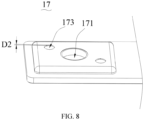
- the top cover 17 defines a mounting hole 171.
- the top cover 17 further defines multiple second blind holes 173 on a surface of the top cover 17 close to the second surface 115, and each of the multiple second blind holes 173 fits one of the multiple second protrusion portions 13.
- the terminal post 19 includes a post body 191.
- the post body 191 passes through the mounting hole 171, the through hole 117, and the assembly hole 151 sequentially, and is fixedly connected to a surface of the conductive block 15 away from the first surface 113.
- Each of the multiple first protrusion portions 12 is inserted into one of the multiple first blind holes 153, and each of the multiple second protrusion portions 13 is inserted into one of the multiple second blind holes 173.
- the isolation member 11 is provided with the multiple first protrusion portions 12 on the first surface 113 of the isolation member 11, each first protrusion portion 12 is provided with at least one first elongated protrusion 121 on the outer peripheral wall of each first protrusion portion 12, the conductive block 15 defines the multiple first blind holes 153 on the surface of the conductive block 15 facing the first surface 113, and each first blind hole 153 corresponds to and fits one first protrusion portion 12.
- each first blind hole 153 fits one first protrusion portion 12, and the first elongated protrusion 121 on the outer peripheral wall of each first protrusion portion 12 may efficiently prevent rotation of the isolation member 11 relative to the conductive block 15.
- the isolation member 11 is provided with the multiple second protrusion portions 13 on the second surface 13 of the isolation member 11, and each second protrusion portion 13 is provided with at least one second elongated protrusion 131 on the outer peripheral wall of each second protrusion portion 13.
- the top cover 17 defines the multiple second blind holes 173 on the surface of the top cover 17 facing the second surface 115, and each second blind hole 173 corresponds to and fits one second protrusion portion 13.
- each second blind hole 173 fits one second protrusion portion 13, and the second elongated protrusion 131 on the outer peripheral wall of each second protrusion portion 13 may efficiently prevent rotation of the isolation member 11 relative to the top cover 17.
- the isolation member 11 is sandwiched between the top cover 17 and the conductive block 15, each first protrusion portion 12 on the first surface 113 fits one first blind hole 153 on the conductive block 15 to limit the position of the first protrusion portion 12, and each second protrusion portion 13 on the second surface 115 fits one second blind hole 173 on the top cover 17 to limit the position of the second protrusion portion 13.
- the isolation member 11 can be positioned to avoid dislocation, and rotation of the conductive block 15 relative to the top cover 17 can be avoided, such that torsion-withstanding of the energy-storage device 100 can be improved, and the energy-storage device 100 can be protected from damage during subsequent module assembly of the energy-storage device 100.
- the energy-storage device 100 may include, but is not limited to, a battery, a battery module, a battery pack, a battery system, a battery cabinet, a containerized energy-storage device, or the like.
- the energy-storage device 100 may be a prismatic battery or a cylindrical battery.
- the energy-storage device 100 may further include an electrode assembly 20 accommodated in the housing 30.
- the housing 30 defines an opening 31, and the end cover assembly 10 is mounted at a side of the housing 30 where the opening 31 is positioned to cover the opening 31 of the housing 30.
- the depth D1 of the first blind hole 153 is greater than the height H1 of the first protrusion portion 12.
- the first protrusion portion 12 can be fully inserted into the corresponding first blind hole 153, and thus it can be ensured that warping of the isolation member 11 can be avoided during assembling the isolation member 11 with the conductive block 15.
- the ratio of the height H1 of the first protrusion portion 12 to the depth D1 of the first blind hole 153 is less than 0.45, the first protrusion portion 12 inserted into the first blind hole 153 occupies a small part of the first blind hole 153, resulting in poor stability of the connection between the first protrusion portion 12 and the first blind hole 153.
- the ratio of the height H1 of the first protrusion portion 12 to the depth D1 of the first blind hole 153 is greater than 0.95, the first protrusion portion 12 cannot be fully inserted into the first blind hole 153, and thus the first protrusion portion 12 is prone to warping.
- the second protrusion portion 13 can be fully inserted into the corresponding second blind hole 173, and thus it can be ensured that warping of the isolation member 11 can be avoided during assembling the isolation member 11 with the top cover 17.
- the ratio of the height H2 of the second protrusion portion 13 to the depth D2 of the second blind hole 173 is less than 0.45, the second protrusion portion 13 inserted into the second blind hole 173 occupies a small part of the second blind hole 173, resulting in poor stability of the connection between the second protrusion portion 13 and the second blind hole 173.
- the ratio of the height H2 of the second protrusion portion 13 to the depth D2 of the second blind hole 173 is greater than 0.95, the second protrusion portion 13 cannot be fully inserted into the second blind hole 173, and thus the second protrusion portion 13 is prone to warping.
- the ratio of the height H1 of the first protrusion portion 12 to the depth D1 of the first blind hole 153 may be equal to or not equal to the ratio of the height H2 of the second protrusion portion 13 to the depth D2 of the second blind hole 173, which is not limited in the present disclosure.
- the height H1 at which the first protrusion portion 12 protrudes in the height direction from the main body 111 of the isolation member 11 satisfies: 0.42mm ⁇ H1 ⁇ 1.85mm
- the height H2 at which the second protrusion portion 13 protrudes in the height direction from the main body 111 of the isolation member 11 satisfies: 0.42mm ⁇ H1 ⁇ 1.85mm.
- the width D4 of the second notch 119 may not be too small, and thus it can be ensured that during pressing of the conductive block 15, with aid of the second notch 119, torsion stress on the isolation member 11 caused by dislocation of the first protrusion portion 12 and dislocation of the second protrusion portion 13 can be released to avoid fracture of the isolation member 11.
- each first blind hole 153 fits one first protrusion portion 12, and the first elongated protrusion 121 on the outer peripheral wall of each first protrusion portion 12 can efficiently prevent rotation of the isolation member 11 relative to the conductive block 15.
- the isolation member 11 is provided with multiple second protrusion portion 13 on the second surface 13 of the isolation member 11, and each second protrusion portion 13 is provided with at least one second elongated protrusion 131 on the outer peripheral wall of each second protrusion portion 13.
- the top cover 17 defines the multiple second blind holes 173 on the surface of the top cover 17 facing the second surface 115, and each second blind hole 173 corresponds to and fits one second protrusion portion 13.
- each second blind hole 173 fits one second protrusion portion 13, and the second elongated protrusion 131 on the outer peripheral wall of the second protrusion portion 13 can efficiently prevent rotation of the isolation member 11 relative to the top cover 17.
- the isolation member 11 is sandwiched between the top cover 17 and the conductive block 15, each first protrusion portion 12 on the first surface 113 fits one first blind hole 153 on the conductive block 15 to limit the position of the first protrusion portion 12, and each second protrusion portion 13 on the second surface 115 fits one second blind hole 173 on the top cover 17 to limit the position of the second protrusion portion 13.
- the isolation member 11 can be positioned to avoid dislocation, and rotation of the conductive block 15 relative to the top cover 17 can be avoided, such that torsion-withstanding of the energy-storage device 100 can be improved, and the energy-storage device 100 can be protected from damage during subsequent module assembly of the energy-storage device 100.
Landscapes
- Chemical & Material Sciences (AREA)
- Chemical Kinetics & Catalysis (AREA)
- Electrochemistry (AREA)
- General Chemical & Material Sciences (AREA)
- Engineering & Computer Science (AREA)
- Manufacturing & Machinery (AREA)
- Connection Of Batteries Or Terminals (AREA)
Description
- This disclosure relates to the technical field of energy-storage devices, and in particular to an end cover assembly, an energy-storage device, and an electricity-consumption device.
- An energy-storage device (for example, a secondary battery) may include a housing, an end cover assembly, and a jelly roll inside the housing. The end cover assembly may include an isolation sheet, a top cover, a conductive block, and a terminal post. The isolation sheet may be a sheet-like member with a through hole defined at the middle of the isolation sheet. Dimensions of mass-produced components such as the isolation sheet may have an error range, and the through hole at the middle of the isolation sheet may be generally bigger than the terminal post. In the subsequent assembly process, there may be a gap between the terminal post and the isolation sheet after the terminal post is inserted into the through hole of the isolation sheet, and thus the isolation sheet may be prone to dislocation. In this case, manual adjustment may be needed, resulting in extremely low assembly efficiency, thereby increasing the cost of the secondary battery.
-
CN213692205U discloses a lithium ion battery top cover, which comprises a top cover sheet, a riveting block and a pole. The top cover sheet and the riveting block are respectively provided with a pole hole suitable for the insertion of the pole, and an upper plastic sheet is arranged between the top cover sheet and the riveting block. One of the upper plastic sheet and the riveting block is provided with an upper bulge, and the other one of the upper plastic sheet and the riveting block is provided with an upper groove matched with the upper bulge. One of the upper plastic sheet and the top cover sheet is provided with a lower protrusion, and the other one is provided with a lower groove matched with the lower protrusion for insertion. - The present invention is defined in the appended claims. An end cover assembly, an energy-storage device, and an electricity-consumption device are provided in the present invention, which aims to provide high assembly efficiency.
- In a first aspect, there is provided an end cover assembly applicable to an energy-storage device. The end cover assembly includes an isolation member, multiple first protrusion portions, multiple second protrusion portions, a conductive block, a top cover, and a terminal post. A main body of the isolation member has a first surface and a second surface opposite the first surface, and the isolation member defines a through hole penetrating through both the first surface and the second surface. Each of the multiple first protrusion portions is positioned on the first surface, spaced apart from the through hole, and provided with at least one first elongated protrusion on an outer peripheral wall of each of the multiple first protrusion portions. Each of the first protrusion portions is cylindrical, and the first elongated protrusion extends, along an axis of the first protrusion portion, from the first surface to a position of the first protrusion portion that is below a surface of the first protrusion portion away from the first surface, and has a chamfered end close to the surface of the first protrusion portion away from the first surface. Each of the multiple second protrusion portions is positioned on the second surface, spaced apart from the through hole, and provided with at least one second elongated protrusion on an outer peripheral wall of each of the multiple second protrusion portions. Each of the plurality of second protrusion portions is cylindrical, and the second elongated protrusion extends, along an axis of the second protrusion portion, from the second surface to a position of the second protrusion portion that is below a surface of the second protrusion portion away from the second surface, and has a chamfered end close to the surface of the second protrusion portion away from the second surface. The conductive block defines multiple first blind holes on a surface of the conductive block close to the first surface and an assembly hole, and each of the multiple first blind holes fits one of the multiple first protrusion portions. The top cover defines multiple second blind holes on a surface of the top cover close to the second surface and a mounting hole, and each of the multiple second blind holes fits one of the multiple second protrusion portions. The terminal post includes a post body. The post body passes through the mounting hole, the through hole, and the assembly hole sequentially, and is fixedly connected to a surface of the conductive block away from the first surface. Each of the multiple first protrusion portions is inserted into one of the multiple first blind holes, and each of the multiple second protrusion portions is inserted into one of the multiple second blind holes.
- In the end cover assembly in the present disclosure, the isolation member is provided with the multiple first protrusion portions on the first surface of the isolation member, each first protrusion portion is provided with at least one first elongated protrusion on the outer peripheral wall of each first protrusion portion, the conductive block defines the multiple first blind holes on the surface of the conductive block close to the first surface, and each first blind hole corresponds to and fits one first protrusion portion. During assembling the isolation member with the conductive block, with aid of the guidance of the first elongated protrusion on the outer peripheral wall of the first protrusion portion, it may be easy to align the first protrusion portion with and insert the first protrusion portion into a corresponding first blind hole on the conductive block, thereby improving the efficiency of assembling the isolation member with the conductive block. Each first blind hole fits one first protrusion portion, and the first elongated protrusion on the outer peripheral wall of each first protrusion portion can efficiently prevent rotation of the isolation member relative to the conductive block. The isolation member is provided with the multiple second protrusion portions on the second surface of the isolation member, and each second protrusion portion is provided with at least one second elongated protrusion on the outer peripheral wall of each second protrusion portion. The top cover defines the multiple second blind holes on the surface of the top cover close to the second surface, and each second blind hole corresponds to and fits one second protrusion portion. During assembling the isolation member with the top cover, with aid of the guidance of the second elongated protrusion on the outer peripheral wall of the second protrusion portion, it may be easy to align the second protrusion portion with and insert the second protrusion portion into a corresponding second blind hole on the top cover, thereby improving the efficiency of assembling the isolation member with the top cover. Each second blind hole fits one second protrusion portion, and the second elongated protrusion on the outer peripheral wall of each second protrusion portion can efficiently prevent rotation of the isolation member relative to the top cover. The isolation member is sandwiched between the top cover and the conductive block, each first protrusion portion on the first surface fits one first blind hole on the conductive block to limit the position of the first protrusion portion, and each second protrusion portion on the second surface fits one second blind hole on the top cover to limit the position of the second protrusion portion. In this way, the isolation member can be positioned to avoid dislocation, and rotation of the conductive block relative to the top cover can be avoided, such that torsion-withstanding of the energy-storage device can be improved, and the energy-storage device can be protected from damage during the subsequent module assembly of the energy-storage device.
- In a possible embodiment, a ratio of a height H1 at which the first protrusion portion protrudes in a height direction from the main body of the isolation member to a depth D1 of the first blind hole satisfies H1:D1=0.45 ~ 0.95, and a ratio of a height H2 at which the second protrusion portion protrudes in the height direction from the main body of the isolation member to a depth D2 of the second blind hole satisfies H2:D2=0.45 ~ 0.95.
- It can be seen that, the depth D1 of the first blind hole is greater than the height H1 of the first protrusion portion, so that during assembling the first protrusion portion into a corresponding first blind hole, the first protrusion portion can be fully inserted into the corresponding first blind hole, and thus it can be ensured that warping of the isolation member can be avoided during assembling the isolation member with the conductive block. When the ratio of the height H1 of the first protrusion portion to the depth D1 of the first blind hole is less than 0.45, the first protrusion portion inserted into the first blind hole occupies a small part of the first blind hole, resulting in poor stability of the connection between the first protrusion portion and the first blind hole. When the ratio of the height H1 of the first protrusion portion to the depth D1 of the first blind hole is greater than 0.95, the first protrusion portion cannot be fully inserted into the first blind hole, and thus the first protrusion portion is prone to warping. In the present disclosure, the ratio of the height H1 of the first protrusion portion to the depth D1 of the first blind hole satisfies H1:D1=0.45 ~ 0.95, such that the stability of the connection between the isolation member and the conductive block can meet the requirement, and warping of the isolation member can be avoided during assembling the isolation member with the conductive block. Similarly, the depth D2 of the second blind hole is greater than the height H2 of the second protrusion portion, so that during assembling the second protrusion portion into a corresponding second blind hole, the second protrusion portion can be fully inserted into the corresponding second blind hole, and thus it can be ensured that warping of the isolation member can be avoided during assembling the isolation member with the top cover. When the ratio of the height H2 of the second protrusion portion to the depth D2 of the second blind hole is less than 0.45, the second protrusion portion inserted into the second blind hole occupies a small part of the second blind hole, resulting in poor stability of the connection between the second protrusion portion and the second blind hole. When the ratio of the height H2 of the second protrusion portion to the depth D2 of the second blind hole is greater than 0.95, the second protrusion portion cannot be fully inserted into the second blind hole, and thus the second protrusion portion is prone to warping. In the present disclosure, the ratio of the height H2 of the second protrusion portion to the depth D2 of the second blind hole satisfies H2:D2=0.45 ~ 0.95, such that the stability of the connection between the isolation member and the top cover can meet the requirement, and warping of the isolation member can be avoided during assembling the isolation member with the top cover. It may be understood that the ratio of the height H1 of the first protrusion portion to the depth D1 of the first blind hole may be equal to or not equal to the ratio of the height H2 of the second protrusion portion to the depth D2 of the second blind hole, which is not limited in the present disclosure.
- In a possible embodiment, the height H1 at which the first protrusion portion protrudes in the height direction from the main body of the isolation member satisfies: 0.42mm ≤ H1 ≤ 1.85mm, and the height H2 at which the second protrusion portion protrudes in the height direction from the main body of the isolation member satisfies: 0.42mm ≤ H2 ≤ 1.85mm.
- It can be seen that, the height H1 of the first protrusion portion is greater than or equal to 0.42mm and less than or equal to 1.85mm, for example, the height H1 of the first protrusion portion may be 0.68mm, and the ratio of the height H1 of the first protrusion portion to the depth D1 of the first blind hole satisfies H1:D1=0.45 ~ 0.95. In this case, it can be ensured that the first protrusion portion can be fully inserted into the first blind hole, thereby ensuring that warping of the isolation member can be avoided during assembling the isolation member with the conductive block. In addition, it can be ensured that the height H1 of the first protrusion portion is not too large and a depth D1 of the first blind hole is also not too large, thereby shortening production time and reducing production cost. Furthermore, it can be ensured that the height H1 of the first protrusion portion is not too small and the depth D1 of the first blind hole is also not too small, thereby avoiding poor stability between the isolation member and the conductive block that are assembled together. The height H2 of the second protrusion portion is greater than or equal to 0.42mm and less than or equal to 1.85mm, for example, the height H2 of the second protrusion portion may be 0.68mm, and the ratio of the height H2 of the second protrusion portion to the depth D2 of the second blind hole satisfies H2:D2=0.45 ~ 0.95. In this case, it can be ensured that the second protrusion portion can be fully inserted into the second blind hole, thereby ensuring that warping of the isolation member can be avoided during assembling the isolation member with the top cover. In addition, it can be ensured that the height H2 of the second protrusion portion is not too large and a depth D2 of the second blind hole is also not too large, thereby shortening production time and reducing production cost. Furthermore, it can be ensured that the height H2 of the second protrusion portion is not too small and the depth D2 of the corresponding second blind hole is also not too small, thereby avoiding poor stability between the isolation member and the top cover that are assembled together. In embodiments of the present disclosure, the first protrusion portion and the second protrusion portion may be the same in structure and shape, and the first blind hole and the second blind hole may be the same in structure and shape. It may be understood that, in the case where the height H1 of the first protrusion portion and the height H2 of the second protrusion portion may both be greater than or equal to 0.42mm and less than or equal to 1. 85mm, the ratio of the height H1 of the first protrusion portion to the depth D1 of the first blind hole satisfies H1:D1=0.45 ~ 0.95, and the ratio of the height H2 of the second protrusion portion to the depth D2 of the second blind hole satisfies H2:D2=0.45 ~ 0.95, the height H1 of the first protrusion portion may be not equal to the height H2 of the second protrusion portion, correspondingly, the depth D1 of the first blind hole may be not equal to the depth D2 of the second blind hole; or the height H1 of the first protrusion portion may be equal to the height H2 of the second protrusion portion, correspondingly, the depth D1 of the first blind hole may be equal to the depth D2 of the second blind hole.
- In a possible embodiment, a distance H3 between a center of the first protrusion portion and a center of the through hole satisfies: 5.5mm ≤ H3 ≤ 9.5mm, and a distance H4 between a center of the second protrusion portion and the center of the through hole satisfies: 5.5mm ≤ H4 ≤ 9.5mm.
- It can be seen that, the distance H3 between the center of the first protrusion portion and the center of the first through hole is a distance between the center of the axis of the first protrusion portion and the center of the axis of the first through hole. The minimum value of the distance H3 between the center of the first protrusion portion and the center of the first through hole is 5.5mm to ensure a sufficient distance between the first protrusion portion and the first through hole. The maximum value of the distance H3 between the center of the first protrusion portion and the center of the first through hole is 9.5mm, so that the first protrusion portion is not positioned beyond an edge of the isolation member, and thus torsion-withstanding achieved by fitting between the first protrusion portion and the first blind hole may not be weakened. The distance H4 between the center of the second protrusion portion and the center of the first through hole is a distance between the center of the axis of the second protrusion portion and the center of the axis of the first through hole. The minimum value of the distance H4 between the center of the second protrusion portion and the center of the first through hole is 5.5mm to ensure a sufficient distance between the second protrusion portion and the first through hole. The maximum value of the distance H4 between the center of the second protrusion portion and the center of the first through hole is 9.5mm, so that the second protrusion portion is not positioned beyond an edge of the isolation member, and thus torsion-withstanding achieved by fitting between the second protrusion portion and the second blind hole may not be weakened. In an embodiment, the distance H3 between the center of the first protrusion portion and the center of the first through hole may be 7.74mm to ensure a sufficient distance between the first protrusion portion and the first through hole, and thus interference of the first protrusion portion to the first through hole may be avoided, and it may be ensured that the first protrusion portion may not be positioned beyond the edge of the isolation member, thereby improving torsion-withstanding achieved by fitting between the first protrusion portion and the first blind hole. The distance H4 between the center of the second protrusion portion and the center of the first through hole may be 7.74mm to ensure a sufficient distance between the second protrusion portion and the first through hole, and thus interference of the second protrusion portion to the first through hole may be avoided, and it may be ensured that the second protrusion portion may not be positioned beyond the edge of the isolation member, thereby improving torsion-withstanding achieved by fitting between the second protrusion portion and the second blind hole. It may be understood that the distance H3 between the center of the first protrusion portion and the center of the first through hole may be not equal to the distance H4 between the center of the second protrusion portion and the center of the first through hole, as long as the distance H3 satisfies 5.5mm≤H3≤9.5mm and the distance H4 satisfies 5.5mm≤ H4≤9.5mm.
- In a possible embodiment, a thickness H5 of the main body of the isolation member satisfies: 0.35mm ≤ H5 ≤ 4.25mm.
- It can be seen that, the minimum value of the thickness H5 of the main body of the isolation member is 0.35mm, so that the structural strength of the isolation member may not be too low, and there may be a sufficient electrical isolation distance between the conductive block and the top cover to avoid creepage short circuit. The maximum value of the thickness H5 of the main body of the isolation member is 4.25mm, so that the thickness H5 of the main body of the isolation member may not be too large, and the isolation member that is relatively brittle is not prone to be crushed by the conductive block during assembling the isolation member with the conductive block. In an embodiment, the thickness H5 of the main body of the isolation member may be 0.7 mm. In this case, it can be ensured that the structural strength of the isolation member may meet the requirement, and that there may be a sufficient electrical isolation distance between the conductive block and the top cover to avoid creepage short circuit, thereby ensuring safety usage of the energy-storage device.
- In a possible embodiment, a ratio of a diameter R1 of the through hole to a diameter R2 of the post body satisfies R1:R2 = 1.01 ~ 1.45.
- In a possible embodiment, each of the multiple first protrusion portions is cylindrical, and each of the multiple second protrusion portions is cylindrical. The first elongated protrusion extends, along an axis of the first protrusion portion, from the first surface to a position of the first protrusion portion that is below a surface of the first protrusion portion away from the first surface, and has a chamfered end close to the surface of the first protrusion portion away from the first surface. The second elongated protrusion extends, along an axis of the second protrusion portion, from the second surface to a position of the second protrusion portion that is below a surface of the second protrusion portion away from the second surface, and has a chamfered end close to the surface of the second protrusion portion away from the second surface.
- In embodiments of the invention, there are multiple first elongated protrusions and multiple second elongated protrusions. The multiple first elongated protrusions are evenly spaced apart from each other on the outer peripheral wall of the first protrusion portion in a circumferential direction of the first protrusion portion, and the multiple second elongated protrusions are evenly spaced apart from each other on the outer peripheral wall of the second protrusion portion in a circumferential direction of the second protrusion portion.
- In a possible embodiment, positions of the multiple first protrusion portions are all staggered from positions of the multiple second protrusion portion on a plane perpendicular to an axis of the through hole.
- In a possible embodiment, the main body of the isolation member may be rectangular. There may be two first protrusion portions, and the two first protrusion portions are diagonally positioned on the first surface. There may be two second protrusion portions, and the two second protrusion portions are diagonally positioned on the second surface.
- In a possible embodiment, the main body of the isolation member may be rectangular. The main body of the isolation member may define a first notch at one of two opposite sides of the main body in a length direction of the main body and a second notch at the other of the two opposite sides of the main body in the length direction of the main body.
- It can be seen that, during pressing of the conductive block, with aid of the first notch and the second notch respectively defined at the two opposite sides of the isolation member in the length direction of the isolation member, torsion stress on the isolation member caused by dislocation of the first protrusion portion can be released to avoid facture of the isolation member. Parts of the isolation member at the first notch and the second notch may be prone to breakage, and thus in the case where the isolation member is broken, it can be ensured that the first protrusion may be still in the first blind hole and that the second protrusion may be still in the second blind hole, avoiding displacement of the isolation member.
- In a possible embodiment, a width D3 of the first notch in a width direction of the main body of the isolation member satisfies: 3mm ≤ D3 ≤ 8mm.
- In a possible embodiment, a width D4 of the second notch in the width direction of the main body of the isolation member is less than D3, and the width D4 of the second notch in the width direction of the main body of the isolation member satisfies: 1.5mm ≤ D4 ≤ 5.5mm.
- In a possible embodiment, the isolation member is a resistive member made of conductive plastic.
- It can be seen that, the isolation member made of conductive plastic has low production cost, high strength, and relatively good toughness, so that the isolation member can withstand large torque impact without being broken. In this case, with aid of the isolation member, a weakly conductive connection (where a resistivity ranges from 10^3 ohms (Ω)/square (sq) to 10^10 Ω/sq) may be formed between the top cover and the conductive block to make the housing and a positive electrode of the energy-storage device be at the same potential, so that electrochemical corrosion of the housing of the energy-storage device can be avoided, and accordingly the service life of the energy-storage device can be prolonged.
- In a possible embodiment, the isolation member has a resistivity ranging from 10^3 Ω/sq to 10^10 Ω/sq.
- It can be seen that, in the case where the resistivity of the isolation member ranges from 10^3 Ω/sq to 10^10 Ω/sq, the housing and the positive electrode of the energy-storage device may be at the same potential, and thus electrochemical corrosion of the housing of the energy-storage device can be avoided, and accordingly the service life of the energy-storage device can be prolonged.
- In a second aspect, an energy-storage device is provided in the present disclosure. The energy-storage device includes a housing and the end cover assembly of the first aspect. The end cover assembly is mounted at a top side of the housing.
- In the energy-storage device in the present disclosure, the isolation member is provided with the multiple first protrusion portions on the first surface of the isolation member, each first protrusion portion is provided with at least one first elongated protrusion on the outer peripheral wall of each first protrusion portion, the conductive block defines the multiple first blind holes on the surface of the conductive block close to the first surface, and each first blind hole corresponds to and fits one first protrusion portion. During assembling the isolation member with the conductive block, with aid of the guidance of the first elongated protrusion on the outer peripheral wall of the first protrusion portion, it may be easy to align the first protrusion portion with and insert the first protrusion portion into a corresponding first blind hole on the conductive block, thereby improving the efficiency of assembling the isolation member with the conductive block. Each first blind hole fits one first protrusion portion, and the first elongated protrusion on the outer peripheral wall of each first protrusion portion can efficiently prevent rotation of the isolation member relative to the conductive block. The isolation member is provided with the multiple second protrusion portions on the second surface of the isolation member, and each second protrusion portion is provided with at least one second elongated protrusion on the outer peripheral wall of each second protrusion portion. The top cover defines the multiple second blind holes on the surface of the top cover close to the second surface, and each second blind hole corresponds to and fits one second protrusion portion. During assembling the isolation member with the top cover, with aid of the guidance of the second elongated protrusion on the outer peripheral wall of the second protrusion portion, it may be easy to align the second protrusion portion with and insert the second protrusion portion into a corresponding second blind hole on the top cover, thereby improving the efficiency of assembling the isolation member with the top cover. Each second blind hole fits one second protrusion portion, and the second elongated protrusion on the outer peripheral wall of each second protrusion portion can efficiently prevent rotation of the isolation member relative to the top cover. The isolation member is sandwiched between the top cover and the conductive block, each first protrusion portion on the first surface fits one first blind hole on the conductive block to limit the position of the first protrusion portion, and each second protrusion portion on the second surface fits one second blind hole on the top cover to limit the position of the second protrusion portion. In this way, the isolation member can be positioned to avoid dislocation, and rotation of the conductive block relative to the top cover can be avoided, such that torsion-withstanding of the energy-storage device can be improved, and the energy-storage device can be protected from damage during the subsequent module assembly of the energy-storage device.
- In a third aspect, an electricity-consumption device is provided in the present disclosure. The electricity-consumption device includes the energy-storage device of the second aspect, and the energy-storage device is configured to power the electricity-consumption device.
- In the electricity-consumption device in the present disclosure, the isolation member is provided with the multiple first protrusion portions on the first surface of the isolation member, each first protrusion portion is provided with at least one first elongated protrusion on the outer peripheral wall of each first protrusion portion, the conductive block defines the multiple first blind holes on the surface of the conductive block close to the first surface, and each first blind hole corresponds to and fits one first protrusion portion. During assembling the isolation member with the conductive block, with aid of the guidance of the first elongated protrusion on the outer peripheral wall of the first protrusion portion, it may be easy to align the first protrusion portion with and insert the first protrusion portion into a corresponding first blind hole on the conductive block, thereby improving the efficiency of assembling the isolation member with the conductive block. Each first blind hole fits one first protrusion portion, and the first elongated protrusion on the outer peripheral wall of each first protrusion portion can efficiently prevent rotation of the isolation member relative to the conductive block. The isolation member is provided with the multiple second protrusion portions on the second surface of the isolation member, and each second protrusion portion is provided with at least one second elongated protrusion on the outer peripheral wall of each second protrusion portion. The top cover defines the multiple second blind holes on the surface of the top cover close to the second surface, and each second blind hole corresponds to and fits one second protrusion portion. During assembling the isolation member with the top cover, with aid of the guidance of the second elongated protrusion on the outer peripheral wall of the second protrusion portion, it may be easy to align the second protrusion portion with and insert the second protrusion portion into a corresponding second blind hole on the top cover, thereby improving the efficiency of assembling the isolation member with the top cover. Each second blind hole fits one second protrusion portion, and the second elongated protrusion on the outer peripheral wall of each second protrusion portion can efficiently prevent rotation of the isolation member relative to the top cover. The isolation member is sandwiched between the top cover and the conductive block, each first protrusion portion on the first surface fits one first blind hole on the conductive block to limit the position of the first protrusion portion, and each second protrusion portion on the second surface fits one second blind hole on the top cover to limit the position of the second protrusion portion. In this way, the isolation member can be positioned to avoid dislocation, and rotation of the conductive block relative to the top cover can be avoided, such that torsion-withstanding of the energy-storage device can be improved, and the energy-storage device can be protected from damage during the subsequent module assembly of the energy-storage device.
- In order to describe technical solutions in embodiments of the present disclosure more clearly, the following will give a brief introduction to the accompanying drawings required for describing embodiments.
-
FIG. 1 is a schematic perspective structural view of an energy-storage device provided in embodiments of the present disclosure. -
FIG. 2 is an exploded schematic perspective structural view of an energy-storage device provided in embodiments of the present disclosure. -
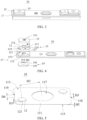
FIG. 3 is a schematic perspective structural view of an end cover assembly provided in embodiments of the present disclosure. -
FIG. 4 is an exploded schematic perspective structural view of an end cover assembly provided in embodiments of the present disclosure. -
FIG. 5 is a schematic perspective structural view of an isolation member in an end cover assembly provided in embodiments of the present disclosure. -
FIG. 6 is a schematic perspective structural view of a conductive block in an end cover assembly provided in embodiments of the present disclosure, viewed from one direction. -
FIG. 7 is a schematic perspective structural view of a conductive block in an end cover assembly provided in embodiments of the present disclosure, viewed from another direction. -
FIG. 8 is a schematic perspective structural view illustrating part of a top cover in an end cover assembly provided in embodiments of the present disclosure. - Reference signs: 100-energy-storage device, 10-end cover assembly, 11-isolation member, 111-main body, 113-first surface, 115-second surface, 117- through hole, 118-first notch, 119-second notch, 12-first protrusion portion, 121-first elongated protrusion, 13-second protrusion portion, 131-second elongated protrusion, 15-conductive block, 151-assembly hole, 153-first blind hole, 17-top cover, 171-mounting hole, 173-second blind hole, 19-terminal post, 191-post body, 193-flange portion, 20-electrode assembly, 30-housing, 31-opening.
- The following will clearly and completely describe technical solutions of embodiments of the present disclosure with reference to the accompanying drawings. Apparently, embodiments described herein are merely some of, rather than all the embodiments of the present disclosure. Based on the embodiments of the present disclosure, all other embodiments obtained by those of ordinary skill in the art without creative effort shall fall in the scope of protection of the present disclosure.
- The following embodiments are illustrated with reference to the accompanying drawings to illustrate specific embodiments that can be implemented in the present disclosure. Directional terms such as "on", "upper", "under", "below", "beneath", "front", "back", "left", "right", "in", "inside", "out", "outside", "side", and the like in the present disclosure, only refer to the directions in the accompanying drawings. Therefore, directional terms are only used to better and clearly illustrate and understand the present disclosure, rather than explicitly or implicitly indicate that apparatuses or components referred to herein must have a certain orientation or be configured or operated in a certain orientation, and therefore the directional terms used herein cannot be understood as limitation to the present disclosure.
- In addition, serial numbers assigned to components herein, such as "first", "second", or the like, are only used to distinguish described objects, rather than describing a particular order or technical feature. The terms "connection" and "coupling" in the present disclosure include direct connection (coupling) and indirect connection (coupling) unless stated otherwise.
- As illustrated in
FIG. 1, FIG. 2 , andFIG. 3 , an energy-storage device 100 is provided in the present disclosure. The energy-storage device 100 includes ahousing 30 and anend cover assembly 10 provided in embodiments of the present disclosure. Theend cover assembly 10 is mounted at a top side of thehousing 30. As illustrated inFIG. 4, FIG. 5 ,FIG. 6, and FIG. 7 , theend cover assembly 10 provided in embodiments of the present disclosure includes anisolation member 11, multiplefirst protrusion portions 12, multiplesecond protrusion portions 13, aconductive block 15, atop cover 17, and aterminal post 19. Amain body 111 of theisolation member 11 has afirst surface 113 and asecond surface 115 opposite thefirst surface 113, and theisolation member 11 defines a throughhole 117 penetrating through both thefirst surface 113 and thesecond surface 115. Each of the multiplefirst protrusion portions 12 is positioned on thefirst surface 113, spaced apart from the throughhole 117, and provided with at least one firstelongated protrusion 121 on an outer peripheral wall of each of the multiplefirst protrusion portions 12. Each of the multiplesecond protrusion portions 13 is positioned on thesecond surface 115, spaced apart from the throughhole 117, and provided with at least one secondelongated protrusion 131 on an outer peripheral wall of each of the multiplesecond protrusion portion 13. Theconductive block 15 defines anassembly hole 151. Theconductive block 15 further defines multiple firstblind holes 153 on a surface of theconductive block 15 close to thefirst surface 113, and each of the multiple firstblind holes 153 fits one of the multiplefirst protrusion portions 12. Thetop cover 17 defines a mountinghole 171. Thetop cover 17 further defines multiple secondblind holes 173 on a surface of thetop cover 17 close to thesecond surface 115, and each of the multiple secondblind holes 173 fits one of the multiplesecond protrusion portions 13. Theterminal post 19 includes apost body 191. Thepost body 191 passes through the mountinghole 171, the throughhole 117, and theassembly hole 151 sequentially, and is fixedly connected to a surface of theconductive block 15 away from thefirst surface 113. Each of the multiplefirst protrusion portions 12 is inserted into one of the multiple firstblind holes 153, and each of the multiplesecond protrusion portions 13 is inserted into one of the multiple secondblind holes 173. - In the
end cover assembly 10 and the energy-storage device 100 in the present disclosure, theisolation member 11 is provided with the multiplefirst protrusion portions 12 on thefirst surface 113 of theisolation member 11, eachfirst protrusion portion 12 is provided with at least one firstelongated protrusion 121 on the outer peripheral wall of eachfirst protrusion portion 12, theconductive block 15 defines the multiple firstblind holes 153 on the surface of theconductive block 15 facing thefirst surface 113, and each firstblind hole 153 corresponds to and fits onefirst protrusion portion 12. During assembling theisolation member 11 with theconductive block 15, with aid of the guidance of the firstelongated protrusion 121 on the outer peripheral wall of thefirst protrusion portion 12, it may be easy to align thefirst protrusion portion 12 with and insert thefirst protrusion portion 12 into a corresponding firstblind hole 153 on theconductive block 15, thereby improving the efficiency of assembling theisolation member 11 with theconductive block 15. Each firstblind hole 153 fits onefirst protrusion portion 12, and the firstelongated protrusion 121 on the outer peripheral wall of eachfirst protrusion portion 12 may efficiently prevent rotation of theisolation member 11 relative to theconductive block 15. Theisolation member 11 is provided with the multiplesecond protrusion portions 13 on thesecond surface 13 of theisolation member 11, and eachsecond protrusion portion 13 is provided with at least one secondelongated protrusion 131 on the outer peripheral wall of eachsecond protrusion portion 13. Thetop cover 17 defines the multiple secondblind holes 173 on the surface of thetop cover 17 facing thesecond surface 115, and each secondblind hole 173 corresponds to and fits onesecond protrusion portion 13. During assembling theisolation member 11 with thetop cover 17, with aid of the guidance of the secondelongated protrusion 131 on the outer peripheral wall of thesecond protrusion portion 13, it may be easy to align thesecond protrusion portion 13 with and insert thesecond protrusion portion 13 into a corresponding secondblind hole 173 on thetop cover 17, thereby improving the efficiency of assembling theisolation member 11 with thetop cover 17. Each secondblind hole 173 fits onesecond protrusion portion 13, and the secondelongated protrusion 131 on the outer peripheral wall of eachsecond protrusion portion 13 may efficiently prevent rotation of theisolation member 11 relative to thetop cover 17. Theisolation member 11 is sandwiched between thetop cover 17 and theconductive block 15, eachfirst protrusion portion 12 on thefirst surface 113 fits one firstblind hole 153 on theconductive block 15 to limit the position of thefirst protrusion portion 12, and eachsecond protrusion portion 13 on thesecond surface 115 fits one secondblind hole 173 on thetop cover 17 to limit the position of thesecond protrusion portion 13. In this way, theisolation member 11 can be positioned to avoid dislocation, and rotation of theconductive block 15 relative to thetop cover 17 can be avoided, such that torsion-withstanding of the energy-storage device 100 can be improved, and the energy-storage device 100 can be protected from damage during subsequent module assembly of the energy-storage device 100. - It may be noted that the multiple
first protrusion portions 12 are the same in shape and structure, the multiplesecond protrusion portions 13 are the same in shape and structure, the multiple firstblind holes 153 are the same in shape and structure, and the multiple secondblind holes 173 are the same in shape and structure. It may be further noted that thefirst protrusion portion 12 and thesecond protrusion portion 13 may be the same in structure and shape, and the firstblind hole 153 and the secondblind hole 173 may be the same in structure and shape. Each firstblind hole 153 has at least one portion each fitting one of the at least one firstelongated protrusion 121, such that the firstelongated protrusion 121 can be inserted into the firstblind hole 153 to prevent rotation of theisolation member 11. Each secondblind hole 173 has at least one portion each fitting one of the at least one secondelongated protrusion 131, such that the secondelongated protrusion 131 can be inserted into the secondblind hole 173 to prevent rotation of theisolation member 11. - It may be understood that the energy-
storage device 100 may include, but is not limited to, a battery, a battery module, a battery pack, a battery system, a battery cabinet, a containerized energy-storage device, or the like. In the case where the energy-storage device 100 is a battery, the energy-storage device 100 may be a prismatic battery or a cylindrical battery. - As illustrated in
FIG. 2 , the energy-storage device 100 may further include anelectrode assembly 20 accommodated in thehousing 30. Thehousing 30 defines anopening 31, and theend cover assembly 10 is mounted at a side of thehousing 30 where theopening 31 is positioned to cover theopening 31 of thehousing 30. - As illustrated in
FIG.5 ,FIG. 6 ,FIG. 7 , andFIG. 8 , in a possible embodiment, a ratio of a height H1 at which thefirst protrusion portion 12 protrudes in a height direction from themain body 111 of the isolation member 11 (i.e., the height H1 of the first protrusion 12) to a depth D1 of the firstblind hole 153 satisfies H1:D1=0.45 ~ 0.95, and a ratio of a height H2 at which thesecond protrusion portion 13 protrudes in the height direction from themain body 111 of the isolation member 11 (i.e., the height H2 of the second protrusion 13) to a depth D2 of the secondblind hole 173 satisfies H2:D2=0.45 ~ 0.95. - It can be seen that, the depth D1 of the first
blind hole 153 is greater than the height H1 of thefirst protrusion portion 12. In this case, during assembling thefirst protrusion portion 12 into a corresponding firstblind hole 153, thefirst protrusion portion 12 can be fully inserted into the corresponding firstblind hole 153, and thus it can be ensured that warping of theisolation member 11 can be avoided during assembling theisolation member 11 with theconductive block 15. When the ratio of the height H1 of thefirst protrusion portion 12 to the depth D1 of the firstblind hole 153 is less than 0.45, thefirst protrusion portion 12 inserted into the firstblind hole 153 occupies a small part of the firstblind hole 153, resulting in poor stability of the connection between thefirst protrusion portion 12 and the firstblind hole 153. When the ratio of the height H1 of thefirst protrusion portion 12 to the depth D1 of the firstblind hole 153 is greater than 0.95, thefirst protrusion portion 12 cannot be fully inserted into the firstblind hole 153, and thus thefirst protrusion portion 12 is prone to warping. In the present disclosure, the ratio of the height H1 of thefirst protrusion portion 12 to the depth D1 of the firstblind hole 153 satisfies H1:D1=0.45 ~ 0.95, such that the stability of the connection between theisolation member 11 and theconductive block 15 can meet the requirement, and warping of theisolation member 11 can be avoided during assembling theisolation member 11 with theconductive block 15. Similarly, the depth D2 of the secondblind hole 173 is greater than the height H2 of thesecond protrusion portion 13. In this case, during assembling thesecond protrusion portion 13 into a corresponding secondblind hole 173, thesecond protrusion portion 13 can be fully inserted into the corresponding secondblind hole 173, and thus it can be ensured that warping of theisolation member 11 can be avoided during assembling theisolation member 11 with thetop cover 17. When the ratio of the height H2 of thesecond protrusion portion 13 to the depth D2 of the secondblind hole 173 is less than 0.45, thesecond protrusion portion 13 inserted into the secondblind hole 173 occupies a small part of the secondblind hole 173, resulting in poor stability of the connection between thesecond protrusion portion 13 and the secondblind hole 173. When the ratio of the height H2 of thesecond protrusion portion 13 to the depth D2 of the secondblind hole 173 is greater than 0.95, thesecond protrusion portion 13 cannot be fully inserted into the secondblind hole 173, and thus thesecond protrusion portion 13 is prone to warping. In the present disclosure, the ratio of the height H2 of thesecond protrusion portion 13 to the depth D2 of the secondblind hole 173 satisfies H2:D2=0.45 ~ 0.95, such that the stability of the connection between theisolation member 11 and thetop cover 17 can meet the requirement, and warping of theisolation member 11 can be avoided during assembling theisolation member 11 with thetop cover 17. It may be understood that the ratio of the height H1 of thefirst protrusion portion 12 to the depth D1 of the firstblind hole 153 may be equal to or not equal to the ratio of the height H2 of thesecond protrusion portion 13 to the depth D2 of the secondblind hole 173, which is not limited in the present disclosure. - As illustrated in
FIG. 5 ,FIG. 6, and FIG. 7 , further, the height H1 at which thefirst protrusion portion 12 protrudes in the height direction from themain body 111 of theisolation member 11 satisfies: 0.42mm ≤ H1 ≤ 1.85mm, and the height H2 at which thesecond protrusion portion 13 protrudes in the height direction from themain body 111 of theisolation member 11 satisfies: 0.42mm ≤ H1 ≤ 1.85mm. - It can be seen that, the height H1 of the
first protrusion portion 12 is greater than or equal to 0.42mm and less than or equal to 1.85mm, for example, the height H1 of thefirst protrusion portion 12 may be 0.68mm, and the ratio of the height H1 of thefirst protrusion portion 12 to the depth D1 of the firstblind hole 153 satisfies H1:D1=0.45 ~ 0.95. In this case, it can be ensured that thefirst protrusion portion 12 of theisolation member 11 can be fully inserted into the firstblind hole 153, thereby ensuring that warping of theisolation member 11 can be avoided during assembling theisolation member 11 with theconductive block 15. In addition, it can be ensured that the height H1 of thefirst protrusion portion 12 is not too large and the depth D1 of the firstblind hole 153 is also not too large, thereby shortening production time and reducing production cost. Furthermore, it can be ensured that the height H1 of thefirst protrusion portion 12 is not too small and the depth D1 of the firstblind hole 153 is also not too small, thereby avoiding poor stability between theisolation member 11 and theconductive block 15 that are assembled together. The height H2 of thesecond protrusion portion 13 is greater than or equal to 0.42mm and less than or equal to 1.85mm, for example, the height H2 of thesecond protrusion portion 13 may be 0.68mm, and the ratio of the height H2 of thesecond protrusion portion 13 to the depth D2 of the secondblind hole 173 satisfies H2:D2=0.45 ~ 0.95. In this case, it can be ensured that thesecond protrusion portion 13 can be fully inserted into the secondblind hole 173, thereby ensuring that warping of theisolation member 11 can be avoided during assembling theisolation member 11 with thetop cover 17. In addition, it can be ensured that the height H2 of thesecond protrusion portion 13 is not too large and the depth D2 of the secondblind hole 173 is also not too large, thereby shortening production time and reducing production cost. Furthermore, it can be ensured that the height H2 of thesecond protrusion portion 13 is not too small and the depth D2 of the corresponding secondblind hole 173 is also not too small, thereby avoiding poor stability between theisolation member 11 and thetop cover 17 that are assembled together. It may be understood that, in the case where the height H1 of thefirst protrusion portion 12 and the height H2 of thesecond protrusion portion 13 may both be greater than or equal to 0.42mm and less than or equal to 1.85mm, the ratio of the height H1 of thefirst protrusion portion 12 to the depth D1 of the firstblind hole 153 satisfies H1:D1=0.45 ~ 0.95, and the ratio of the height H2 of thesecond protrusion portion 13 to the depth D2 of the secondblind hole 173 satisfies H2:D2=0.45 ~ 0.95, the height H1 of thefirst protrusion portion 12 may be not equal to the height H2 of thesecond protrusion portion 13, correspondingly, the depth D1 of the firstblind hole 153 may be not equal to the depth D2 of the secondblind hole 173; or the height H1 of thefirst protrusion portion 12 may be equal to the height H2 of thesecond protrusion portion 13, correspondingly, the depth D1 of the firstblind hole 153 may be equal to the depth D2 of the secondblind hole 173. - As illustrated in
FIG. 5 andFIG. 6 , a distance H3 between a center of thefirst protrusion portion 12 and a center of the throughhole 117 satisfies: 5.5mm ≤ H3 ≤ 9.5mm, and a distance H4 between a center of thesecond protrusion portion 13 and the center of the throughhole 117 satisfies: 5.5mm ≤ H4 ≤ 9.5mm. - It can be seen that, the distance H3 between the center of the
first protrusion portion 12 and the center of the throughhole 117 is a distance between the center of the axis of thefirst protrusion portion 12 and the center of the axis of the throughhole 117. The minimum value of the distance H3 between the center of thefirst protrusion portion 12 and the center of the throughhole 117 is 5.5mm to ensure a sufficient distance between thefirst protrusion portion 12 and the throughhole 117. The maximum value of the distance H3 between the center of thefirst protrusion portion 12 and the center of the first throughhole 117 is 9.5mm, so that thefirst protrusion portion 12 is not positioned beyond an edge of theisolation member 11, and thus torsion-withstanding achieved by fitting between thefirst protrusion portion 12 and the firstblind hole 153 may not be weakened. The distance H4 between the center of thesecond protrusion portion 13 and the center of the throughhole 117 is a distance between the center of the axis of thesecond protrusion portion 13 and the center of the axis of the throughhole 117. The minimum value of the distance H4 between the center of thesecond protrusion portion 13 and the center of the throughhole 117 is 5.5mm to ensure a sufficient distance between thesecond protrusion portion 13 and the throughhole 117. The maximum value of the distance H4 between the center of thesecond protrusion portion 13 and the center of the throughhole 117 is 9.5mm, so that thesecond protrusion portion 13 is not positioned beyond the edge of theisolation member 11, and thus torsion-withstanding achieved by fitting between thesecond protrusion portion 13 and the secondblind hole 173 may not be weakened. In an embodiment, the distance H3 between the center of thefirst protrusion portion 12 and the center of the throughhole 117 may be 7.74mm to ensure a sufficient distance between thefirst protrusion portion 12 and the throughhole 117, and thus interference of thefirst protrusion portion 12 to the throughhole 117 may be avoided, and it may be ensured that thefirst protrusion portion 12 may not be positioned beyond the edge of theisolation member 11, thereby improving torsion-withstanding achieved by fitting between thefirst protrusion portion 12 and the firstblind hole 153. The distance H4 between the center of thesecond protrusion portion 13 and the center of the throughhole 117 may be 7.74mm to ensure a sufficient distance between thesecond protrusion portion 13 and the throughhole 117, and thus interference of thesecond protrusion portion 13 to the throughhole 117 may be avoided, and it may be ensured that thesecond protrusion portion 13 may not be positioned beyond the edge of theisolation member 11, thereby improving torsion-withstanding achieved by fitting between thesecond protrusion portion 13 and the secondblind hole 173. It may be understood that the distance H3 between the center of thefirst protrusion portion 12 and the center of the throughhole 117 may be not equal to the distance H4 between the center of thesecond protrusion portion 13 and the center of the throughhole 117, as long as the distance H3 satisfies 5.5mm≤H3≤9.5mm and the distance H4 satisfies 5.5mm≤H4≤9.5mm. - As illustrated in
FIG. 4 and FIG. 5 , in a possible embodiment, a thickness H5 of themain body 111 of theisolation member 11 satisfies: 0.35mm ≤ H5 ≤ 4.25mm. - It can be seen that, the minimum value of the thickness H5 of the
main body 111 of theisolation member 11 is 0.35mm, so that the structural strength of theisolation member 11 may not be too low, and there may be a sufficient electrical isolation distance between theconductive block 15 and thetop cover 17 to avoid creepage short circuit. The maximum value of the thickness H5 of themain body 111 of theisolation member 11 is 4.25mm, so that the thickness H5 of themain body 111 of theisolation member 11 may not be too large, and theisolation member 11 that is relatively brittle is not prone to be crushed by theconductive block 15 during assembling theisolation member 11 with theconductive block 15. In an embodiment, the thickness H5 of themain body 111 of theisolation member 11 may be 0.7 mm. In this case, it can be ensured that the structural strength of theisolation member 11 may meet the requirement, and that there may be a sufficient electrical isolation distance between theconductive block 15 and thetop cover 17 to avoid creepage short circuit, thereby ensuring safety usage of the energy-storage device 100. - As illustrated in
FIG. 4 , in a possible embodiment, a ratio of a diameter R1 of the throughhole 117 to a diameter R2 of thepost body 191 satisfies R1:R2 = 1.01 ~ 1.45. - It can be seen that, the minimum value of the ratio of the diameter R1 of the through
hole 117 to the diameter R2 of thepost body 191 is 1.01, so that it can be ensured that thepost body 191 of theterminal post 19 may not be interfered by theisolation member 11 during assembly of theend cover assembly 10, and thus the precision requirement for assembly may be lowered. The maximum value of the ratio of the diameter R1 of the throughhole 117 to the diameter R2 of thepost body 191 is 1.45, so that the throughhole 117 may not be too large, and thus the structural strength of theisolation member 11 may not be too low and accordingly torsion-withstanding of theend cover assembly 10 may not be weakened. - In a possible embodiment, positions of the multiple
first protrusion portions 12 are all staggered from positions of the multiplesecond protrusion portion 13 on a plane perpendicular to the axis of the throughhole 117. - It can be seen that, on the projection plane perpendicular to the axis of the through
hole 117, the positions of the multiplefirst protrusion portions 12 on thefirst surface 113 are all staggered from the positions of the multiplesecond protrusion portion 13 on thesecond surface 115, so that the projection of eachfirst protrusion portion 12 in the thickness direction of theisolation member 11 does not overlap the projection of anysecond protrusion portion 13 in the thickness direction of theisolation member 11. In this case, even if thefirst protrusion portion 12 cannot be fully inserted into the firstblind hole 153 and thesecond protrusion portion 13 cannot be fully inserted into the secondblind hole 173, in the thickness direction of theisolation member 11, a gap between thefirst protrusion portion 12 and a top wall of the firstblind hole 153 is not aligned with a gap between thesecond protrusion portion 13 and a top wall of the secondblind hole 173, and thus warping of thefirst protrusion portion 12 can be avoided in the case where thefirst protrusion portion 12 cannot be fully inserted into the firstblind hole 153 and warping of thesecond protrusion portion 13 can be avoided in the case where thesecond protrusion portion 13 cannot be fully inserted into the secondblind hole 173, and accordingly the precision requirement for assembling thefirst protrusion portion 12 into the firstblind hole 153 and the precision requirement for assembling thesecond protrusion portion 13 into the secondblind hole 173 may be lowered. - As illustrated in
FIG. 4, FIG. 5 , andFIG. 6 , further, themain body 111 of theisolation member 11 may be rectangular. There may be twofirst protrusion portions 12, and the twofirst protrusion portions 12 are diagonally positioned on thefirst surface 113. There may be twosecond protrusion portions 13, and the twosecond protrusion portions 13 are diagonally positioned on thesecond surface 115. - It can be seen that, the
main body 111 of theisolation member 11 is rectangular, the twofirst protrusion portions 12 on thefirst surface 113 are positioned on one diagonal of theisolation member 11, the twosecond protrusion portions 13 on thesecond surface 115 are positioned on another diagonal of theisolation member 11, and on the projection plane perpendicular to the axis of the throughhole 117, the twofirst protrusion portions 12 and the twosecond protrusion portions 13 are evenly distributed around the throughhole 117. In this case, theisolation member 11 may be subject to uniform force to avoid rotation, thereby improving torsion-withstanding of theisolation member 11. In addition, the twofirst protrusion portions 12 are positioned on one diagonal of theisolation member 11, and the twosecond protrusion portions 13 are positioned on another diagonal of theisolation member 11, so that the twofirst protrusion portions 12 and the twosecond protrusion portions 13 can be positioned as far away as possible from the throughhole 117. In this way, during riveting theconductive block 15, thetop cover 17, and theterminal post 19 together, in the case where theisolation member 11 is pressed by theconductive block 15 and slightly deforms, thefirst protrusion portion 12 and thesecond protrusion portion 13 may not be damaged, and thus rotation of theisolation member 11 can be avoided, and further thefirst protrusion portion 12 and the second protrusion portion may not interfere the throughhole 117. - Further, the
isolation member 11 is a resistive member made of conductive plastic. It can be seen that, theisolation member 11 made of conductive plastic has low production cost, high strength, and relatively good toughness, so that theisolation member 11 can withstand large torque impact without being broken. In addition, with aid of theisolation member 11, a weakly conductive connection (where a resistivity ranges from 10^3 ohms (Ω)/square (sq) to 10^10 Ω/sq) may be formed between thetop cover 17 and theconductive block 15 to make thehousing 30 and a positive electrode of the energy-storage device 100 be at the same potential, so that electrochemical corrosion of thehousing 30 of the energy-storage device 100 can be avoided, and accordingly the service life of the energy-storage device 100 can be prolonged. - Further, the
isolation member 11 has a resistivity ranging from 10^3 Ω/sq to 10^10 Ω/sq. It can be seen that, in the case where the resistivity of theisolation member 11 ranges from 10^3 Ω/sq to 10^10 Ω/sq, thehousing 30 and the positive electrode of the energy-storage device 100 may be at the same potential, and thus electrochemical corrosion of thehousing 30 of the energy-storage device 100 can be avoided, and accordingly the service life of the energy-storage device 100 can be prolonged. - Further, each of the multiple
first protrusion portions 12 is cylindrical, and each of the multiplesecond protrusion portions 13 is cylindrical. The firstelongated protrusion 121 extends, along an axis of thefirst protrusion portion 12, from thefirst surface 113 to the position of thefirst protrusion portion 12 that is below a surface of thefirst protrusion portion 12 away from thefirst surface 113, and the end of the firstelongated protrusion 121 below the surface of thefirst protrusion portion 12 away from thefirst surface 113 is a chamfered end. The secondelongated protrusion 131 extends, along an axis of thesecond protrusion portion 13, from thesecond surface 115 to the position of thesecond protrusion portion 13 that is below a surface of thesecond protrusion portion 13 away from thesecond surface 115, and has a chamfered end close to the surface of thesecond protrusion portion 13 away from thesecond surface 115. - It can be seen that, the first
elongated protrusion 121 extends, along the axis of thefirst protrusion portion 12, from thefirst surface 113 to the position of thefirst protrusion portion 12 that is below the surface of thefirst protrusion portion 12 away from thefirst surface 113, and has a chamfered end close to the surface of thefirst protrusion portion 12 away from thefirst surface 113. During inserting thefirst protrusion portion 12 into the firstblind hole 153, with aid of the chamfered end of the firstelongated protrusion 121, it can be guided to insert thefirst protrusion portion 12 by abutting an inclined surface of the chamfered end against the sidewall of the firstblind hole 153. In this case, thefirst protrusion portion 12 can be inserted into the firstblind hole 153 smoothly, the guiding effect of the firstelongated protrusion 121 may be further strengthened, and thefirst protrusion portion 12 can be accurately inserted into the firstblind hole 153 to fit thefirst protrusion portion 12 with the firstblind hole 153, thereby improving the efficiency of assembling theconductive block 15 with theisolation member 11. Similarly, the secondelongated protrusion 131 extends, along the axis of thesecond protrusion portion 13, from thesecond surface 115 to the position of thesecond protrusion portion 13 that is below the surface of thesecond protrusion portion 13 away from thesecond surface 115, and has a chamfered end (which has the same structure as the chamfered end of the first protrusion portion 12) close to the surface of thesecond protrusion portion 13 away from thesecond surface 115. During inserting thesecond protrusion portion 13 into the secondblind hole 173, with aid of the chamfered end of the secondelongated protrusion 131, it can be guided to insert thesecond protrusion portion 13 by abutting an inclined surface of the chamfered end against the sidewall of the secondblind hole 173. In this case, thesecond protrusion portion 13 can be inserted into the secondblind hole 173 smoothly, the guiding effect of the secondelongated protrusion 131 may be further strengthened, and thesecond protrusion portion 13 can be accurately inserted into the secondblind hole 173 to fit thefirst protrusion portion 12 with the firstblind hole 153, thereby improving the efficiency of assembling thetop cover 17 with theisolation member 11. It may be understood that the structure of the firstelongated protrusion 121 may be the same as the structure of the secondelongated protrusion 131. - As illustrated in
FIG. 5 andFIG. 6 , there may be multiple firstelongated protrusions 121 and multiple secondelongated protrusions 131. The multiple firstelongated protrusions 121 may be evenly spaced apart from each other on the outer peripheral wall of thefirst protrusion portion 12 in a circumferential direction of thefirst protrusion portion 12, and the multiple secondelongated protrusions 131 may be evenly spaced apart from each other on the outer peripheral wall of thesecond protrusion portion 13 in a circumferential direction of thesecond protrusion portion 13. - It can be seen that, the multiple first
elongated protrusions 121 are positioned on the outer peripheral wall of thefirst protrusion portion 12, and theconductive block 15 may be assembled with theisolation member 11 under the guidance of the multiple firstelongated protrusions 121, and thus the guiding effect of the multiple firstelongated protrusions 121 may be further strengthened. In addition, the energy-storage device 100 may be subject to impact during assembly or use, and theconductive block 15 may be subject to a torsion force in a radial direction perpendicular to the axis of theterminal post 19. In this case, the firstelongated protrusion 121 may serve as a sacrifice body for first buffering of impact, and thus breakage of thefirst protrusion portion 12 and rotation of theisolation member 11 can be avoided, thereby further improving the safety performance of the energy-storage device 100 and prolonging the service life of the energy-storage device 100. Similarly, the multiple secondelongated protrusions 131 are positioned on the outer peripheral wall of thesecond protrusion portion 13, and thetop cover 17 may be assembled with theisolation member 11 under the guidance of the multiple secondelongated protrusions 131, and thus the guiding effect of the multiple secondelongated protrusions 131 may be further strengthened. In addition, the energy-storage device 100 may be subject to impact during assembly or use, and thetop cover 17 may be subject to a torsion force in a radial direction perpendicular to the axis of theterminal post 19. In this case, the secondelongated protrusion 131 may serve as a sacrifice body for first buffering of impact, and thus breakage of thesecond protrusion portion 13 and rotation of theisolation member 11 can be avoided, thereby further improving the safety performance of the energy-storage device 100 and prolonging service life of the energy-storage device 100. In an embodiment, there may be four firstelongated protrusions 121 and four secondelongated protrusions 131. Each two adjacent firstelongated protrusions 121 are positioned with a right angle defined therebetween in a circumferential direction of the outer peripheral wall of thefirst protrusion portion 12. Each two adjacent secondelongated protrusions 131 are positioned with a right angle defined therebetween in a circumferential direction of the outer peripheral wall of thesecond protrusion portion 13. - In addition, as illustrated in
FIG. 5 , themain body 111 of theisolation member 11 may be rectangular. Themain body 111 of theisolation member 11 may define afirst notch 118 at one of two opposite sides of themain body 111 in a length direction of themain body 111 and asecond notch 119 at the other of the two opposite sides of themain body 111 in the length direction of themain body 111. - It can be seen that, during pressing of the
conductive block 15, with aid of thefirst notch 118 and thesecond notch 119 respectively defined at the two opposite sides of theisolation member 11 in the length direction of the isolation member 1, torsion stress on theisolation member 11 caused by dislocation of thefirst protrusion portion 12 can be released to avoid facture of theisolation member 11. Parts of theisolation member 11 at thefirst notch 118 and thesecond notch 119 may be prone to breakage, and thus in the case where theisolation member 11 is broken, it can be ensured that thefirst protrusion portion 12 may be still in the firstblind hole 153 on theconductive block 15 and that thesecond protrusion portion 13 may be still in the secondblind hole 173 on thetop cover 17, thereby avoiding displacement of theisolation member 11. - In a possible embodiment, a width D3 of the
first notch 118 in a width direction of themain body 111 of theisolation member 11 satisfies: 3mm ≤ D3 ≤ 8mm. - It can be seen that, the minimum value of the width D3 of the
first notch 118 in the width direction of themain body 111 of theisolation member 11 is 3mm. In this case, the width D3 of thefirst notch 118 may not be too small, and thus it can be ensured that during pressing of theconductive block 15, with aid of thefirst notch 118, torsion stress on theisolation member 11 caused by dislocation of thefirst protrusion portion 12 and dislocation of thesecond protrusion portion 13 can be released to avoid fracture of theisolation member 11. In addition, in the case where the width D3 of thefirst notch 118 is less than 3mm, part of theisolation member 11 at thefirst notch 118 may not be prone to breakage, and thus when torsion stress on theisolation member 11 is too large, themain body 111 of theisolation member 11 may be broken directly, thefirst protrusion portion 12 may be disengaged from the firstblind hole 153 on theconductive block 15, and thesecond protrusion portion 13 may be disengaged from the secondblind hole 173 on thetop cover 17, resulting in displacement of theisolation member 11. The maximum value of the width D3 of thefirst notch 118 is 8mm, so that the width D3 of thefirst notch 118 may not be too large, and thus arrangement of both thefirst protrusion portion 12 and thesecond protrusion portion 13 may not be affected, and the structure strength of both thefirst protrusion portion 12 and thesecond protrusion portion 13 may not be reduced. In an embodiment, the width D3 of thefirst notch 118 may be 5mm. In this case, the width D3 of thefirst notch 118 is within a suitable range, and thus during pressing of theconductive block 15, with aid of thefirst notch 118, torsion stress on theisolation member 11 caused by dislocation of thefirst protrusion portion 12 and dislocation of thesecond protrusion portion 13 can be released to avoid fracture of theisolation member 11. In addition, part of theisolation member 11 at thefirst notch 118 is prone to breakage, and thus in the case where theisolation member 11 is broken, it can be ensured that thefirst protrusion portion 12 may be still in the firstblind hole 153 on theconductive block 15 and that thesecond protrusion portion 13 may be still in the secondblind hole 173 on thetop cover 17, avoiding displacement of theisolation member 11. - In a possible embodiment, a width D4 of the
second notch 119 in the width direction of themain body 111 of theisolation member 11 is less than D3, and the width D4 of thesecond notch 119 in the width direction of themain body 111 of theisolation member 11 satisfies: 1.5mm ≤ D4 ≤ 5.5mm. - It can be seen that, the width D4 of the
second notch 119 in the width direction of themain body 111 of theisolation member 11 is less than the width D3 of thefirst notch 118, and thesecond notch 119 is further away from an explosion-proof valve in theend cover assembly 10 than thefirst notch 118 after theend cover assembly 10 is assembled. In this case, when pressure inside the energy-storage device 100 is too high, the pressure can be partially released through thesecond notch 119 to ensure the usage safety of the energy-storage device 100. Similarly, the minimum value of the width D4 of thesecond notch 119 in the width direction of themain body 111 of theisolation member 11 is 1.5mm. In this case, the width D4 of thesecond notch 119 may not be too small, and thus it can be ensured that during pressing of theconductive block 15, with aid of thesecond notch 119, torsion stress on theisolation member 11 caused by dislocation of thefirst protrusion portion 12 and dislocation of thesecond protrusion portion 13 can be released to avoid fracture of theisolation member 11. In addition, in the case where the width D4 of thesecond notch 119 is less than 1.5mm, part of theisolation member 11 at thesecond notch 119 may not be prone to breakage, and thus when torsion stress on theisolation member 11 is too large, themain body 111 of theisolation member 11 may be broken directly, thefirst protrusion portion 12 may be disengaged from the firstblind hole 153 on theconductive block 15, and thesecond protrusion portion 13 may be disengaged from the secondblind hole 173 on thetop cover 17, resulting in displacement of theisolation member 11. The maximum value of the width D4 of thesecond notch 119 is 5.5mm. In this case, the width D4 of thesecond notch 119 may not be too large, and thus arrangement of both thefirst protrusion portion 12 and thesecond protrusion portion 13 may not be affected, and the structure strength of both thefirst protrusion portion 12 thesecond protrusion portion 13 may not be reduced. In an embodiment, the width D4 of thesecond notch 119 may be 3.5mm. In this case, the width D4 of thesecond notch 119 is within a suitable range, and thus during pressing of theconductive block 15, with aid of thesecond notch 119, torsion stress on theisolation member 11 caused by dislocation of thefirst protrusion portion 12 and dislocation of thesecond protrusion portion 13 can be released to avoid fracture of theisolation member 11. In addition, part of theisolation member 11 at thesecond notch 119 is prone to breakage, and thus in the case where theisolation member 11 is broken, it can be ensured that thefirst protrusion portion 12 may be still in the firstblind hole 153 on theconductive block 15 and that thesecond protrusion portion 13 may be still in the secondblind hole 173 on thetop cover 17, thereby avoiding displacement of theisolation member 11. - As illustrated in
FIG. 4 , in a possible embodiment, theterminal post 19 may further include aflange portion 193, and thepost body 191 may be positioned on theflange portion 193. Thepost body 191 passes through the mountinghole 171, the throughhole 117, and theassembly hole 151 sequentially, and is fixedly connected to a surface of theconductive block 15 away from thefirst surface 113. Theflange portion 193 abuts against a side of thetop cover 17 away from theisolation member 11. - An electricity-consumption device is further provided in embodiments of the present disclosure. The electricity-consumption device includes the energy-
storage device 100 provided in any of the above embodiments, and the energy-storage device 100 is configured to power the electricity-consumption device. Technical solutions of the embodiments of the present disclosure are all applicable to various electricity-consumption devices with the energy-storage device 100, for example, an electromobile, an electric toy, an electric tool, an electric vehicle, a ship and a spacecraft, a mobile phone, a portable device, a personal digital assistant (PDA), a notebook computer, or the like. - In the electricity-consumption device in the present disclosure, the
isolation member 11 is provided with the multiplefirst protrusion portions 12 on thefirst surface 113 of theisolation member 11, eachfirst protrusion portion 12 is provided with at least one firstelongated protrusion 121 on the outer peripheral wall of thefirst protrusion portion 12, theconductive block 15 defines the multiple firstblind holes 153 on the surface of theconductive block 15 facing thefirst surface 113, and each firstblind hole 153 corresponds to and fits onefirst protrusion portion 12. During assembling theisolation member 11 with theconductive block 15, with aid of the guidance of the firstelongated protrusion 121 on the outer peripheral wall of thefirst protrusion portion 12, it may be easy to align thefirst protrusion portion 12 with and insert thefirst protrusion portion 12 into a corresponding firstblind hole 153 on theconductive block 15, thereby improving the efficiency of assembling theisolation member 11 with theconductive block 15. Each firstblind hole 153 fits onefirst protrusion portion 12, and the firstelongated protrusion 121 on the outer peripheral wall of eachfirst protrusion portion 12 can efficiently prevent rotation of theisolation member 11 relative to theconductive block 15. Theisolation member 11 is provided with multiplesecond protrusion portion 13 on thesecond surface 13 of theisolation member 11, and eachsecond protrusion portion 13 is provided with at least one secondelongated protrusion 131 on the outer peripheral wall of eachsecond protrusion portion 13. Thetop cover 17 defines the multiple secondblind holes 173 on the surface of thetop cover 17 facing thesecond surface 115, and each secondblind hole 173 corresponds to and fits onesecond protrusion portion 13. During assembling theisolation member 11 with thetop cover 17, with aid of guidance of the secondelongated protrusion 131 on the outer peripheral wall of thesecond protrusion portion 13, it may be easy to align thesecond protrusion portion 13 with and insert thesecond protrusion portion 13 into the secondblind hole 173, thereby improving the efficiency of assembling theisolation member 11 with thetop cover 17. Each secondblind hole 173 fits onesecond protrusion portion 13, and the secondelongated protrusion 131 on the outer peripheral wall of thesecond protrusion portion 13 can efficiently prevent rotation of theisolation member 11 relative to thetop cover 17. Theisolation member 11 is sandwiched between thetop cover 17 and theconductive block 15, eachfirst protrusion portion 12 on thefirst surface 113 fits one firstblind hole 153 on theconductive block 15 to limit the position of thefirst protrusion portion 12, and eachsecond protrusion portion 13 on thesecond surface 115 fits one secondblind hole 173 on thetop cover 17 to limit the position of thesecond protrusion portion 13. In this way, theisolation member 11 can be positioned to avoid dislocation, and rotation of theconductive block 15 relative to thetop cover 17 can be avoided, such that torsion-withstanding of the energy-storage device 100 can be improved, and the energy-storage device 100 can be protected from damage during subsequent module assembly of the energy-storage device 100.
Claims (13)
- An end cover assembly, applicable to an energy-storage device (100) and comprising:an isolation member (11), wherein a main body (111) of the isolation member (11) has a first surface (113) and a second surface (115) opposite the first surface (113), and the isolation member (11) defines a first through hole (117) penetrating through both the first surface (113) and the second surface (115);a plurality of first protrusion portions (12) positioned on the first surface (113), wherein each of the plurality of first protrusion portions (12) is spaced apart from the first through hole (117), and provided with at least one first elongated protrusion (121) on an outer peripheral wall of each of the plurality of first protrusion portions (12), each of the plurality of first protrusion portions (12) is cylindrical, and the first elongated protrusion (121) extends, along an axis of the first protrusion portion (12), from the first surface (113) to a position of the first protrusion portion (12) that is below a surface of the first protrusion portion (12) away from the first surface (113), and has a chamfered end close to the surface of the first protrusion portion (12) away from the first surface (113), wherein the at least one first elongated protrusion (121) is implemented as a plurality of first elongated protrusions (121), and the plurality of first elongated protrusions (121) are evenly spaced apart from each other on the outer peripheral wall of the first protrusion portion (12) in a circumferential direction of the first protrusion portion (12);a plurality of second protrusion portions (13) positioned on the second surface (115), wherein each of the plurality of second protrusion portions (13) is spaced apart from the first through hole (117), and provided with at least one second elongated protrusion (131) on an outer peripheral wall of each of the plurality of second protrusion portion (13), each of the plurality of second protrusion portions (13) is cylindrical, and the second elongated protrusion (131) extends, along an axis of the second protrusion portion (13), from the second surface (115) to a position of the second protrusion portion (13) that is below a surface of the second protrusion portion (13) away from the second surface (115), and has a chamfered end close to the surface of the second protrusion portion (13) away from the second surface (115), wherein the at least one second elongated protrusion (131) is implemented as a plurality of second elongated protrusions (131), and the plurality of second elongated protrusions (131) are evenly spaced apart from each other on the outer peripheral wall of the second protrusion portion (13) in a circumferential direction of the second protrusion portion (13);a conductive block (15) defining a plurality of first blind holes (153) on a surface of the conductive block (15) close to the first surface (113) and defining an assembly hole (151), wherein each of the plurality of first blind holes (153) fits one of the plurality of first protrusion portions (12), and each of the plurality of first protrusion portions (12) is inserted into one of the plurality of first blind holes (153);a top cover (17) defining a plurality of second blind holes (173) on a surface of the top cover (17) close to the second surface (115) and defining a mounting hole (171), wherein each of the plurality of second blind holes (173) fits one of the plurality of second protrusion portions (13), and each of the plurality of second protrusion portions (13) is inserted into one of the plurality of second blind holes (173); anda terminal post (19) comprising a post body (191), wherein the post body (191) passes through the mounting hole (171), the through hole (117), and the assembly hole (151) sequentially, and is fixedly connected to a surface of the conductive block (15) away from the first surface (113).
- The end cover assembly (10) of claim 1, wherein a ratio of a height H1 at which the first protrusion portion (12) protrudes in a height direction from the main body (111) of the isolation member (11) to a depth D1 of the first blind hole (153) satisfies H1:D1=0.45 ~ 0.95, and a ratio of a height H2 at which the second protrusion portion (13) protrudes in the height direction from the main body (111) of the isolation member (11) to a depth D2 of the second blind hole (173) satisfies H2:D2=0.45 ~ 0.95.
- The end cover assembly (10) of claim 2, wherein the height H1 at which the first protrusion portion (12) protrudes in the height direction from the main body (111) of the isolation member (11) satisfies: 0.42mm ≤ H1 ≤ 1.85mm, and the height H2 at which the second protrusion portion (13) protrudes in the height direction from the main body (111) of the isolation member (11) satisfies: 0.42mm ≤ H2 ≤ 1.85mm.
- The end cover assembly (10) of any one of claims 1 to 3, wherein a distance H3 between a center of the first protrusion portion (12) and a center of the through hole (117) satisfies: 5.5mm ≤ H3 ≤ 9.5mm, and a distance H4 between a center of the second protrusion portion (13) and the center of the through hole (117) satisfies: 5.5mm ≤ H4 ≤ 9.5mm.
- The end cover assembly (10) of any one of claims 1 to 4, wherein a thickness H5 of the main body (111) of the isolation member (11) satisfies: 0.35mm ≤ H5 ≤ 4.25mm.
- The end cover assembly (10) of any one of claims 1 to 5, wherein a ratio of a diameter R1 of the through hole (117) to a diameter R2 of the post body (191) satisfies R1:R2 = 1.01 ~ 1.45.
- The end cover assembly (10) of any one of claims 1 to 6, wherein positions of the plurality of first protrusion portions (12) are all staggered from positions of the plurality of second protrusion portions (13) on a plane perpendicular to an axis of the through hole (117).
- The end cover assembly (10) of claim 7, wherein the main body (111) of the isolation member (11) is rectangular; the plurality of first protrusion portions (12) are implemented as two first protrusion portions (12), and the two first protrusion portions (12) are diagonally positioned on the first surface (113); and the plurality of second protrusion portions (13) are implemented as two second protrusion portions (13), and the two second protrusion portions (13) are diagonally positioned on the second surface (115).
- The end cover assembly (10) of claim 7 or claim 8, wherein the main body (111) of the isolation member (11) is rectangular, and defines a first notch (118) at one of two opposite sides of the main body (111) in a length direction of the main body (111) and a second notch (119) at the other of the two opposite sides of the main body (111) in the length direction of the main body (111).
- The end cover assembly (10) of claim 9, wherein a width D3 of the first notch (118) in a width direction of the main body (111) of the isolation member (11) satisfies: 3mm ≤ D3 ≤ 8mm.
- The end cover assembly (10) of claim 10, wherein a width D4 of the second notch (119) in the width direction of the main body (111) of the isolation member (11) is less than the width D3, and the width D4 of the second notch (119) in the width direction of the main body (111) of the isolation member (11) satisfies: 1.5mm ≤ D4 ≤ 5.5mm.
- An energy-storage device (100) comprising a housing (30) and the end cover assembly (10) of any one of claims 1 to 11, the end cover assembly (10) being mounted at a top side of the housing (30).
- An electricity-consumption device comprising the energy-storage device (100) of claim 12, the energy-storage device (100) being configured to power the electricity-consumption device.
Applications Claiming Priority (1)
| Application Number | Priority Date | Filing Date | Title |
|---|---|---|---|
| CN202310091044.9A CN116014317B (en) | 2023-02-09 | 2023-02-09 | End cover assembly, energy storage device and electric equipment |
Publications (2)
| Publication Number | Publication Date |
|---|---|
| EP4415154A1 EP4415154A1 (en) | 2024-08-14 |
| EP4415154B1 true EP4415154B1 (en) | 2025-05-07 |
Family
ID=86033556
Family Applications (1)
| Application Number | Title | Priority Date | Filing Date |
|---|---|---|---|
| EP23218199.0A Active EP4415154B1 (en) | 2023-02-09 | 2023-12-19 | End cover assembly, energy-storage device, and electricity-consumption device |
Country Status (4)
| Country | Link |
|---|---|
| US (1) | US12046762B1 (en) |
| EP (1) | EP4415154B1 (en) |
| CN (1) | CN116014317B (en) |
| HU (1) | HUE071828T2 (en) |
Families Citing this family (3)
| Publication number | Priority date | Publication date | Assignee | Title |
|---|---|---|---|---|
| WO2024243936A1 (en) * | 2023-05-31 | 2024-12-05 | 深圳海辰储能控制技术有限公司 | End cover component, energy storage apparatus, energy storage system and electrical device |
| CN116780127A (en) * | 2023-08-16 | 2023-09-19 | 深圳海辰储能控制技术有限公司 | Lower plastic, end cover components, energy storage device and electrical equipment |
| CN117996309B (en) * | 2024-03-29 | 2024-06-21 | 蜂巢能源科技股份有限公司 | Battery cover plate assembly, battery and power device |
Family Cites Families (25)
| Publication number | Priority date | Publication date | Assignee | Title |
|---|---|---|---|---|
| US7059816B2 (en) * | 2001-11-09 | 2006-06-13 | Textron Inc. | Nut plate |
| US9246140B2 (en) * | 2009-07-09 | 2016-01-26 | Samsung Sdi Co., Ltd. | Rechargeable battery with a cap assembly having a first tab located outside of the case |
| FR2974157B1 (en) * | 2011-04-18 | 2014-02-14 | Bollhoff Otalu Sa | INSERT FOR THERMOPLASTIC SUPPORT AND METHOD FOR ASSEMBLING THE INSERT WITH THE SUPPORT |
| JP2012248487A (en) * | 2011-05-31 | 2012-12-13 | Mitsubishi Heavy Ind Ltd | Electrical appliance |
| CN206397884U (en) | 2016-12-28 | 2017-08-11 | 天津市精一紧固件有限公司 | A kind of anti-rotation is located by connecting screwed pipe |
| US10434952B2 (en) * | 2017-07-10 | 2019-10-08 | Bombardier Recreational Products Inc. | Anchor for removably attaching a component to a frame member and method for using same |
| CN207183329U (en) * | 2017-07-28 | 2018-04-03 | 深圳市欣迪盟新能源科技股份有限公司 | Battery cover board and battery |
| CN207338516U (en) | 2017-10-18 | 2018-05-08 | 宁德时代新能源科技股份有限公司 | Secondary cell cap assembly and secondary cell |
| CN111106304B9 (en) | 2018-10-30 | 2021-06-11 | 宁德时代新能源科技股份有限公司 | Secondary battery |
| CN109546018B (en) * | 2018-11-27 | 2021-09-17 | 欣旺达电子股份有限公司 | Battery top cover and power battery using same |
| DE102019207681A1 (en) * | 2019-05-24 | 2020-11-26 | Arnold Umformtechnik Gmbh & Co. Kg | Connecting element |
| CN210110860U (en) * | 2019-09-11 | 2020-02-21 | 宁德时代新能源科技股份有限公司 | Top cover assembly and secondary battery |
| CN212366065U (en) * | 2020-04-26 | 2021-01-15 | 东莞塔菲尔新能源科技有限公司 | Battery top cap assembly structure |
| CN111785864A (en) * | 2020-06-06 | 2020-10-16 | 山东圣阳电源股份有限公司 | Square aluminum shell lithium battery and battery cover plate thereof |
| KR20220054130A (en) * | 2020-10-23 | 2022-05-02 | 삼성에스디아이 주식회사 | Secondary battery |
| CN213692205U (en) * | 2020-12-30 | 2021-07-13 | 蜂巢能源科技有限公司 | Li-Ion Battery Top Cover and Li-Ion Battery |
| CN112993494A (en) | 2021-04-16 | 2021-06-18 | 湖北亿纬动力有限公司 | Battery top cap and battery |
| CN113381104B (en) * | 2021-06-03 | 2024-09-03 | 格力钛新能源股份有限公司 | Cover plate assembly for battery and battery device |
| CN113488730A (en) * | 2021-06-25 | 2021-10-08 | 山东圣阳电源股份有限公司 | Square aluminum shell lithium ion battery and battery cover plate thereof |
| CN113488731A (en) * | 2021-06-26 | 2021-10-08 | 山东圣阳电源股份有限公司 | Square aluminum shell lithium iron phosphate battery and battery cover plate thereof |
| CN215816083U (en) * | 2021-09-23 | 2022-02-11 | 厦门海辰新能源科技有限公司 | A top cap subassembly, battery and energy memory for battery |
| CN216120511U (en) | 2021-10-28 | 2022-03-22 | 蜂巢能源科技有限公司 | Cover plate assembly for battery cell and battery cell with cover plate assembly |
| CN216389541U (en) * | 2021-11-30 | 2022-04-26 | 江苏天合储能有限公司 | Battery top cap subassembly and battery |
| CN114927812A (en) * | 2022-06-13 | 2022-08-19 | 宁波震裕汽车部件有限公司 | Cladding formula structure and battery top cap subassembly of battery top cap |
| CN115621667A (en) * | 2022-11-11 | 2023-01-17 | 厦门海辰储能科技股份有限公司 | Energy storage device and electrical equipment |
-
2023
- 2023-02-09 CN CN202310091044.9A patent/CN116014317B/en active Active
- 2023-12-14 US US18/539,938 patent/US12046762B1/en active Active
- 2023-12-19 EP EP23218199.0A patent/EP4415154B1/en active Active
- 2023-12-19 HU HUE23218199A patent/HUE071828T2/en unknown
Also Published As
| Publication number | Publication date |
|---|---|
| US20240274932A1 (en) | 2024-08-15 |
| HUE071828T2 (en) | 2025-09-28 |
| EP4415154A1 (en) | 2024-08-14 |
| CN116014317A (en) | 2023-04-25 |
| US12046762B1 (en) | 2024-07-23 |
| CN116014317B (en) | 2023-06-27 |
Similar Documents
| Publication | Publication Date | Title |
|---|---|---|
| EP4415154B1 (en) | End cover assembly, energy-storage device, and electricity-consumption device | |
| EP4415132B1 (en) | End cover assembly, energy storage apparatus, and electricity-consumption device | |
| EP3512001B1 (en) | Secondary battery and vehicle | |
| EP2076930B1 (en) | Secondary battery pack | |
| US9694449B2 (en) | Welding jig for secondary battery | |
| KR101462681B1 (en) | battery | |
| EP2143158B1 (en) | Polarity protection for multiple batteries | |
| US8237409B2 (en) | Protection circuit module of secondary battery and secondary battery using the same | |
| US12463388B2 (en) | Position assurance apparatus, connector assembly, battery, and power consumption device | |
| CN115764180B (en) | Energy storage device and electric equipment | |
| EP1760804A1 (en) | No-welding contact type secondary battery | |
| US9406979B2 (en) | Secondary battery | |
| KR102735368B1 (en) | Battery Unit, Feed-Through Assembly, and Electronic Device | |
| US12136745B1 (en) | Connecting structure, battery module, energy storage apparatus, and electronic device | |
| KR20150009371A (en) | Rechargeable battery | |
| US8920964B2 (en) | Rechargeable battery | |
| US9159965B2 (en) | Battery pack | |
| WO2024164250A1 (en) | End cover assembly, energy storage apparatus, and electric device | |
| US20040202927A1 (en) | Cell spacer for a battery pack | |
| US20130143106A1 (en) | Lithium ion battery | |
| CN116799380B (en) | Battery monomer and electric equipment | |
| US20260038734A1 (en) | Power adapter | |
| US20250253499A1 (en) | Battery | |
| US11824288B2 (en) | Cable connection device | |
| CN112736336A (en) | Battery cover plate assembly, power battery, battery module and automobile |
Legal Events
| Date | Code | Title | Description |
|---|---|---|---|
| PUAI | Public reference made under article 153(3) epc to a published international application that has entered the european phase |
Free format text: ORIGINAL CODE: 0009012 |
|
| STAA | Information on the status of an ep patent application or granted ep patent |
Free format text: STATUS: THE APPLICATION HAS BEEN PUBLISHED |
|
| AK | Designated contracting states |
Kind code of ref document: A1 Designated state(s): AL AT BE BG CH CY CZ DE DK EE ES FI FR GB GR HR HU IE IS IT LI LT LU LV MC ME MK MT NL NO PL PT RO RS SE SI SK SM TR |
|
| STAA | Information on the status of an ep patent application or granted ep patent |
Free format text: STATUS: REQUEST FOR EXAMINATION WAS MADE |
|
| 17P | Request for examination filed |
Effective date: 20241014 |
|
| RBV | Designated contracting states (corrected) |
Designated state(s): AL AT BE BG CH CY CZ DE DK EE ES FI FR GB GR HR HU IE IS IT LI LT LU LV MC ME MK MT NL NO PL PT RO RS SE SI SK SM TR |
|
| GRAP | Despatch of communication of intention to grant a patent |
Free format text: ORIGINAL CODE: EPIDOSNIGR1 |
|
| STAA | Information on the status of an ep patent application or granted ep patent |
Free format text: STATUS: GRANT OF PATENT IS INTENDED |
|
| INTG | Intention to grant announced |
Effective date: 20250130 |
|
| GRAS | Grant fee paid |
Free format text: ORIGINAL CODE: EPIDOSNIGR3 |
|
| GRAA | (expected) grant |
Free format text: ORIGINAL CODE: 0009210 |
|
| STAA | Information on the status of an ep patent application or granted ep patent |
Free format text: STATUS: THE PATENT HAS BEEN GRANTED |
|
| RAP1 | Party data changed (applicant data changed or rights of an application transferred) |
Owner name: HITHIUM TECH HK LIMITED |
|
| AK | Designated contracting states |
Kind code of ref document: B1 Designated state(s): AL AT BE BG CH CY CZ DE DK EE ES FI FR GB GR HR HU IE IS IT LI LT LU LV MC ME MK MT NL NO PL PT RO RS SE SI SK SM TR |
|
| REG | Reference to a national code |
Ref country code: GB Ref legal event code: FG4D |
|
| REG | Reference to a national code |
Ref country code: CH Ref legal event code: EP |
|
| REG | Reference to a national code |
Ref country code: DE Ref legal event code: R096 Ref document number: 602023003367 Country of ref document: DE |
|
| REG | Reference to a national code |
Ref country code: IE Ref legal event code: FG4D |
|
| REG | Reference to a national code |
Ref country code: NL Ref legal event code: MP Effective date: 20250507 |
|
| REG | Reference to a national code |
Ref country code: HU Ref legal event code: AG4A Ref document number: E071828 Country of ref document: HU |
|
| PG25 | Lapsed in a contracting state [announced via postgrant information from national office to epo] |
Ref country code: ES Free format text: LAPSE BECAUSE OF FAILURE TO SUBMIT A TRANSLATION OF THE DESCRIPTION OR TO PAY THE FEE WITHIN THE PRESCRIBED TIME-LIMIT Effective date: 20250507 Ref country code: FI Free format text: LAPSE BECAUSE OF FAILURE TO SUBMIT A TRANSLATION OF THE DESCRIPTION OR TO PAY THE FEE WITHIN THE PRESCRIBED TIME-LIMIT Effective date: 20250507 Ref country code: PT Free format text: LAPSE BECAUSE OF FAILURE TO SUBMIT A TRANSLATION OF THE DESCRIPTION OR TO PAY THE FEE WITHIN THE PRESCRIBED TIME-LIMIT Effective date: 20250908 |
|
| REG | Reference to a national code |
Ref country code: LT Ref legal event code: MG9D |
|
| PG25 | Lapsed in a contracting state [announced via postgrant information from national office to epo] |
Ref country code: NO Free format text: LAPSE BECAUSE OF FAILURE TO SUBMIT A TRANSLATION OF THE DESCRIPTION OR TO PAY THE FEE WITHIN THE PRESCRIBED TIME-LIMIT Effective date: 20250807 Ref country code: GR Free format text: LAPSE BECAUSE OF FAILURE TO SUBMIT A TRANSLATION OF THE DESCRIPTION OR TO PAY THE FEE WITHIN THE PRESCRIBED TIME-LIMIT Effective date: 20250808 |
|
| PG25 | Lapsed in a contracting state [announced via postgrant information from national office to epo] |
Ref country code: NL Free format text: LAPSE BECAUSE OF FAILURE TO SUBMIT A TRANSLATION OF THE DESCRIPTION OR TO PAY THE FEE WITHIN THE PRESCRIBED TIME-LIMIT Effective date: 20250507 Ref country code: PL Free format text: LAPSE BECAUSE OF FAILURE TO SUBMIT A TRANSLATION OF THE DESCRIPTION OR TO PAY THE FEE WITHIN THE PRESCRIBED TIME-LIMIT Effective date: 20250507 |
|
| REG | Reference to a national code |
Ref country code: AT Ref legal event code: MK05 Ref document number: 1793543 Country of ref document: AT Kind code of ref document: T Effective date: 20250507 |
|
| PG25 | Lapsed in a contracting state [announced via postgrant information from national office to epo] |
Ref country code: BG Free format text: LAPSE BECAUSE OF FAILURE TO SUBMIT A TRANSLATION OF THE DESCRIPTION OR TO PAY THE FEE WITHIN THE PRESCRIBED TIME-LIMIT Effective date: 20250507 |
|
| PG25 | Lapsed in a contracting state [announced via postgrant information from national office to epo] |
Ref country code: HR Free format text: LAPSE BECAUSE OF FAILURE TO SUBMIT A TRANSLATION OF THE DESCRIPTION OR TO PAY THE FEE WITHIN THE PRESCRIBED TIME-LIMIT Effective date: 20250507 |
|
| PG25 | Lapsed in a contracting state [announced via postgrant information from national office to epo] |
Ref country code: AT Free format text: LAPSE BECAUSE OF FAILURE TO SUBMIT A TRANSLATION OF THE DESCRIPTION OR TO PAY THE FEE WITHIN THE PRESCRIBED TIME-LIMIT Effective date: 20250507 |
|
| PG25 | Lapsed in a contracting state [announced via postgrant information from national office to epo] |
Ref country code: RS Free format text: LAPSE BECAUSE OF FAILURE TO SUBMIT A TRANSLATION OF THE DESCRIPTION OR TO PAY THE FEE WITHIN THE PRESCRIBED TIME-LIMIT Effective date: 20250807 |
|
| PG25 | Lapsed in a contracting state [announced via postgrant information from national office to epo] |
Ref country code: IS Free format text: LAPSE BECAUSE OF FAILURE TO SUBMIT A TRANSLATION OF THE DESCRIPTION OR TO PAY THE FEE WITHIN THE PRESCRIBED TIME-LIMIT Effective date: 20250907 |
|
| PG25 | Lapsed in a contracting state [announced via postgrant information from national office to epo] |
Ref country code: LV Free format text: LAPSE BECAUSE OF FAILURE TO SUBMIT A TRANSLATION OF THE DESCRIPTION OR TO PAY THE FEE WITHIN THE PRESCRIBED TIME-LIMIT Effective date: 20250507 |
|
| PG25 | Lapsed in a contracting state [announced via postgrant information from national office to epo] |
Ref country code: DK Free format text: LAPSE BECAUSE OF FAILURE TO SUBMIT A TRANSLATION OF THE DESCRIPTION OR TO PAY THE FEE WITHIN THE PRESCRIBED TIME-LIMIT Effective date: 20250507 Ref country code: SM Free format text: LAPSE BECAUSE OF FAILURE TO SUBMIT A TRANSLATION OF THE DESCRIPTION OR TO PAY THE FEE WITHIN THE PRESCRIBED TIME-LIMIT Effective date: 20250507 |
|
| PGFP | Annual fee paid to national office [announced via postgrant information from national office to epo] |
Ref country code: HU Payment date: 20251124 Year of fee payment: 3 Ref country code: FR Payment date: 20251230 Year of fee payment: 3 |
|
| PG25 | Lapsed in a contracting state [announced via postgrant information from national office to epo] |
Ref country code: CZ Free format text: LAPSE BECAUSE OF FAILURE TO SUBMIT A TRANSLATION OF THE DESCRIPTION OR TO PAY THE FEE WITHIN THE PRESCRIBED TIME-LIMIT Effective date: 20250507 |
|
| PG25 | Lapsed in a contracting state [announced via postgrant information from national office to epo] |
Ref country code: EE Free format text: LAPSE BECAUSE OF FAILURE TO SUBMIT A TRANSLATION OF THE DESCRIPTION OR TO PAY THE FEE WITHIN THE PRESCRIBED TIME-LIMIT Effective date: 20250507 |
|
| PG25 | Lapsed in a contracting state [announced via postgrant information from national office to epo] |
Ref country code: SK Free format text: LAPSE BECAUSE OF FAILURE TO SUBMIT A TRANSLATION OF THE DESCRIPTION OR TO PAY THE FEE WITHIN THE PRESCRIBED TIME-LIMIT Effective date: 20250507 |
|
| REG | Reference to a national code |
Ref country code: DE Ref legal event code: R097 Ref document number: 602023003367 Country of ref document: DE |
|
| PG25 | Lapsed in a contracting state [announced via postgrant information from national office to epo] |
Ref country code: RO Free format text: LAPSE BECAUSE OF FAILURE TO SUBMIT A TRANSLATION OF THE DESCRIPTION OR TO PAY THE FEE WITHIN THE PRESCRIBED TIME-LIMIT Effective date: 20250507 |
|
| PLBE | No opposition filed within time limit |
Free format text: ORIGINAL CODE: 0009261 |
|
| STAA | Information on the status of an ep patent application or granted ep patent |
Free format text: STATUS: NO OPPOSITION FILED WITHIN TIME LIMIT |
|
| REG | Reference to a national code |
Ref country code: CH Ref legal event code: L10 Free format text: ST27 STATUS EVENT CODE: U-0-0-L10-L00 (AS PROVIDED BY THE NATIONAL OFFICE) Effective date: 20260318 |
|
| P01 | Opt-out of the competence of the unified patent court (upc) registered |
Free format text: CASE NUMBER: UPC_APP_0006088_4415154/2026 Effective date: 20260219 |
|
| PGFP | Annual fee paid to national office [announced via postgrant information from national office to epo] |
Ref country code: DE Payment date: 20251231 Year of fee payment: 3 |
|
| 26N | No opposition filed |
Effective date: 20260210 |
|
| PGFP | Annual fee paid to national office [announced via postgrant information from national office to epo] |
Ref country code: IT Payment date: 20251231 Year of fee payment: 3 |