EP4415148A2 - Battery module manufacturing method and battery module - Google Patents
Battery module manufacturing method and battery module Download PDFInfo
- Publication number
- EP4415148A2 EP4415148A2 EP24156034.1A EP24156034A EP4415148A2 EP 4415148 A2 EP4415148 A2 EP 4415148A2 EP 24156034 A EP24156034 A EP 24156034A EP 4415148 A2 EP4415148 A2 EP 4415148A2
- Authority
- EP
- European Patent Office
- Prior art keywords
- weld bead
- bus bar
- battery module
- electrode tab
- cross
- Prior art date
- Legal status (The legal status is an assumption and is not a legal conclusion. Google has not performed a legal analysis and makes no representation as to the accuracy of the status listed.)
- Pending
Links
Images






Classifications
-
- H—ELECTRICITY
- H01—ELECTRIC ELEMENTS
- H01M—PROCESSES OR MEANS, e.g. BATTERIES, FOR THE DIRECT CONVERSION OF CHEMICAL ENERGY INTO ELECTRICAL ENERGY
- H01M50/00—Constructional details or processes of manufacture of the non-active parts of electrochemical cells other than fuel cells, e.g. hybrid cells
- H01M50/50—Current conducting connections for cells or batteries
- H01M50/531—Electrode connections inside a battery casing
- H01M50/534—Electrode connections inside a battery casing characterised by the material of the leads or tabs
-
- B—PERFORMING OPERATIONS; TRANSPORTING
- B23—MACHINE TOOLS; METAL-WORKING NOT OTHERWISE PROVIDED FOR
- B23K—SOLDERING OR UNSOLDERING; WELDING; CLADDING OR PLATING BY SOLDERING OR WELDING; CUTTING BY APPLYING HEAT LOCALLY, e.g. FLAME CUTTING; WORKING BY LASER BEAM
- B23K26/00—Working by laser beam, e.g. welding, cutting or boring
- B23K26/20—Bonding
- B23K26/21—Bonding by welding
-
- H—ELECTRICITY
- H01—ELECTRIC ELEMENTS
- H01M—PROCESSES OR MEANS, e.g. BATTERIES, FOR THE DIRECT CONVERSION OF CHEMICAL ENERGY INTO ELECTRICAL ENERGY
- H01M50/00—Constructional details or processes of manufacture of the non-active parts of electrochemical cells other than fuel cells, e.g. hybrid cells
- H01M50/50—Current conducting connections for cells or batteries
- H01M50/543—Terminals
- H01M50/564—Terminals characterised by their manufacturing process
- H01M50/566—Terminals characterised by their manufacturing process by welding, soldering or brazing
-
- B—PERFORMING OPERATIONS; TRANSPORTING
- B23—MACHINE TOOLS; METAL-WORKING NOT OTHERWISE PROVIDED FOR
- B23K—SOLDERING OR UNSOLDERING; WELDING; CLADDING OR PLATING BY SOLDERING OR WELDING; CUTTING BY APPLYING HEAT LOCALLY, e.g. FLAME CUTTING; WORKING BY LASER BEAM
- B23K35/00—Rods, electrodes, materials, or media, for use in soldering, welding, or cutting
- B23K35/02—Rods, electrodes, materials, or media, for use in soldering, welding, or cutting characterised by mechanical features, e.g. shape
- B23K35/0255—Rods, electrodes, materials, or media, for use in soldering, welding, or cutting characterised by mechanical features, e.g. shape for use in welding
- B23K35/0261—Rods, electrodes or wires
-
- B—PERFORMING OPERATIONS; TRANSPORTING
- B23—MACHINE TOOLS; METAL-WORKING NOT OTHERWISE PROVIDED FOR
- B23K—SOLDERING OR UNSOLDERING; WELDING; CLADDING OR PLATING BY SOLDERING OR WELDING; CUTTING BY APPLYING HEAT LOCALLY, e.g. FLAME CUTTING; WORKING BY LASER BEAM
- B23K35/00—Rods, electrodes, materials, or media, for use in soldering, welding, or cutting
- B23K35/22—Rods, electrodes, materials, or media, for use in soldering, welding, or cutting characterised by the composition or nature of the material
- B23K35/24—Selection of soldering or welding materials proper
- B23K35/28—Selection of soldering or welding materials proper with the principal constituent melting at less than 950°C
- B23K35/286—Al as the principal constituent
-
- H—ELECTRICITY
- H01—ELECTRIC ELEMENTS
- H01M—PROCESSES OR MEANS, e.g. BATTERIES, FOR THE DIRECT CONVERSION OF CHEMICAL ENERGY INTO ELECTRICAL ENERGY
- H01M10/00—Secondary cells; Manufacture thereof
- H01M10/04—Construction or manufacture in general
- H01M10/0404—Machines for assembling batteries
-
- H—ELECTRICITY
- H01—ELECTRIC ELEMENTS
- H01M—PROCESSES OR MEANS, e.g. BATTERIES, FOR THE DIRECT CONVERSION OF CHEMICAL ENERGY INTO ELECTRICAL ENERGY
- H01M10/00—Secondary cells; Manufacture thereof
- H01M10/05—Accumulators with non-aqueous electrolyte
- H01M10/052—Li-accumulators
-
- H—ELECTRICITY
- H01—ELECTRIC ELEMENTS
- H01M—PROCESSES OR MEANS, e.g. BATTERIES, FOR THE DIRECT CONVERSION OF CHEMICAL ENERGY INTO ELECTRICAL ENERGY
- H01M10/00—Secondary cells; Manufacture thereof
- H01M10/05—Accumulators with non-aqueous electrolyte
- H01M10/058—Construction or manufacture
-
- H—ELECTRICITY
- H01—ELECTRIC ELEMENTS
- H01M—PROCESSES OR MEANS, e.g. BATTERIES, FOR THE DIRECT CONVERSION OF CHEMICAL ENERGY INTO ELECTRICAL ENERGY
- H01M50/00—Constructional details or processes of manufacture of the non-active parts of electrochemical cells other than fuel cells, e.g. hybrid cells
- H01M50/20—Mountings; Secondary casings or frames; Racks, modules or packs; Suspension devices; Shock absorbers; Transport or carrying devices; Holders
- H01M50/258—Modular batteries; Casings provided with means for assembling
-
- H—ELECTRICITY
- H01—ELECTRIC ELEMENTS
- H01M—PROCESSES OR MEANS, e.g. BATTERIES, FOR THE DIRECT CONVERSION OF CHEMICAL ENERGY INTO ELECTRICAL ENERGY
- H01M50/00—Constructional details or processes of manufacture of the non-active parts of electrochemical cells other than fuel cells, e.g. hybrid cells
- H01M50/50—Current conducting connections for cells or batteries
- H01M50/502—Interconnectors for connecting terminals of adjacent batteries; Interconnectors for connecting cells outside a battery casing
- H01M50/503—Interconnectors for connecting terminals of adjacent batteries; Interconnectors for connecting cells outside a battery casing characterised by the shape of the interconnectors
-
- H—ELECTRICITY
- H01—ELECTRIC ELEMENTS
- H01M—PROCESSES OR MEANS, e.g. BATTERIES, FOR THE DIRECT CONVERSION OF CHEMICAL ENERGY INTO ELECTRICAL ENERGY
- H01M50/00—Constructional details or processes of manufacture of the non-active parts of electrochemical cells other than fuel cells, e.g. hybrid cells
- H01M50/50—Current conducting connections for cells or batteries
- H01M50/502—Interconnectors for connecting terminals of adjacent batteries; Interconnectors for connecting cells outside a battery casing
- H01M50/505—Interconnectors for connecting terminals of adjacent batteries; Interconnectors for connecting cells outside a battery casing comprising a single busbar
-
- H—ELECTRICITY
- H01—ELECTRIC ELEMENTS
- H01M—PROCESSES OR MEANS, e.g. BATTERIES, FOR THE DIRECT CONVERSION OF CHEMICAL ENERGY INTO ELECTRICAL ENERGY
- H01M50/00—Constructional details or processes of manufacture of the non-active parts of electrochemical cells other than fuel cells, e.g. hybrid cells
- H01M50/50—Current conducting connections for cells or batteries
- H01M50/502—Interconnectors for connecting terminals of adjacent batteries; Interconnectors for connecting cells outside a battery casing
- H01M50/507—Interconnectors for connecting terminals of adjacent batteries; Interconnectors for connecting cells outside a battery casing comprising an arrangement of two or more busbars within a container structure, e.g. busbar modules
-
- H—ELECTRICITY
- H01—ELECTRIC ELEMENTS
- H01M—PROCESSES OR MEANS, e.g. BATTERIES, FOR THE DIRECT CONVERSION OF CHEMICAL ENERGY INTO ELECTRICAL ENERGY
- H01M50/00—Constructional details or processes of manufacture of the non-active parts of electrochemical cells other than fuel cells, e.g. hybrid cells
- H01M50/50—Current conducting connections for cells or batteries
- H01M50/502—Interconnectors for connecting terminals of adjacent batteries; Interconnectors for connecting cells outside a battery casing
- H01M50/514—Methods for interconnecting adjacent batteries or cells
- H01M50/516—Methods for interconnecting adjacent batteries or cells by welding, soldering or brazing
-
- H—ELECTRICITY
- H01—ELECTRIC ELEMENTS
- H01M—PROCESSES OR MEANS, e.g. BATTERIES, FOR THE DIRECT CONVERSION OF CHEMICAL ENERGY INTO ELECTRICAL ENERGY
- H01M50/00—Constructional details or processes of manufacture of the non-active parts of electrochemical cells other than fuel cells, e.g. hybrid cells
- H01M50/50—Current conducting connections for cells or batteries
- H01M50/502—Interconnectors for connecting terminals of adjacent batteries; Interconnectors for connecting cells outside a battery casing
- H01M50/521—Interconnectors for connecting terminals of adjacent batteries; Interconnectors for connecting cells outside a battery casing characterised by the material
-
- H—ELECTRICITY
- H01—ELECTRIC ELEMENTS
- H01M—PROCESSES OR MEANS, e.g. BATTERIES, FOR THE DIRECT CONVERSION OF CHEMICAL ENERGY INTO ELECTRICAL ENERGY
- H01M50/00—Constructional details or processes of manufacture of the non-active parts of electrochemical cells other than fuel cells, e.g. hybrid cells
- H01M50/50—Current conducting connections for cells or batteries
- H01M50/543—Terminals
- H01M50/552—Terminals characterised by their shape
- H01M50/553—Terminals adapted for prismatic, pouch or rectangular cells
-
- H—ELECTRICITY
- H01—ELECTRIC ELEMENTS
- H01M—PROCESSES OR MEANS, e.g. BATTERIES, FOR THE DIRECT CONVERSION OF CHEMICAL ENERGY INTO ELECTRICAL ENERGY
- H01M50/00—Constructional details or processes of manufacture of the non-active parts of electrochemical cells other than fuel cells, e.g. hybrid cells
- H01M50/50—Current conducting connections for cells or batteries
- H01M50/543—Terminals
- H01M50/562—Terminals characterised by the material
-
- H—ELECTRICITY
- H01—ELECTRIC ELEMENTS
- H01M—PROCESSES OR MEANS, e.g. BATTERIES, FOR THE DIRECT CONVERSION OF CHEMICAL ENERGY INTO ELECTRICAL ENERGY
- H01M50/00—Constructional details or processes of manufacture of the non-active parts of electrochemical cells other than fuel cells, e.g. hybrid cells
- H01M50/50—Current conducting connections for cells or batteries
- H01M50/502—Interconnectors for connecting terminals of adjacent batteries; Interconnectors for connecting cells outside a battery casing
- H01M50/521—Interconnectors for connecting terminals of adjacent batteries; Interconnectors for connecting cells outside a battery casing characterised by the material
- H01M50/522—Inorganic material
-
- Y—GENERAL TAGGING OF NEW TECHNOLOGICAL DEVELOPMENTS; GENERAL TAGGING OF CROSS-SECTIONAL TECHNOLOGIES SPANNING OVER SEVERAL SECTIONS OF THE IPC; TECHNICAL SUBJECTS COVERED BY FORMER USPC CROSS-REFERENCE ART COLLECTIONS [XRACs] AND DIGESTS
- Y02—TECHNOLOGIES OR APPLICATIONS FOR MITIGATION OR ADAPTATION AGAINST CLIMATE CHANGE
- Y02E—REDUCTION OF GREENHOUSE GAS [GHG] EMISSIONS, RELATED TO ENERGY GENERATION, TRANSMISSION OR DISTRIBUTION
- Y02E60/00—Enabling technologies; Technologies with a potential or indirect contribution to GHG emissions mitigation
- Y02E60/10—Energy storage using batteries
Definitions
- Embodiments of the present disclosure relate to a battery module manufacturing method and a battery module.
- the resistance of individuals cells is non-uniform due to differences in electrode tab length for each cell specification within a module, which is likely to have a negative impact on long-term durability.
- a battery module manufacturing method and a battery module that can improve process efficiency by providing a degree of freedom for cell tap management can be provided.
- Embodiments of the present disclosure may provide a battery module manufacturing method and a battery module that can improve process efficiency by providing a degree of freedom for cell tab management.
- a battery module manufacturing method includes: a step of inserting each of electrode tabs of a plurality of battery cells into a plurality of holes included in a bus bar; and a step of bonding the electrode tabs to the bus bar by irradiating laser underfeeding of a wire, wherein the bus bar may electrically connect the electrode tabs of the plurality of battery cells to each other.
- the present invention relates to a method for manufacturing a battery module, the method comprising the steps of: (a) providing a plurality of battery cells, each battery cell having an electrode tab; (b) providing a bus bar including a plurality of holes; (c) inserting each one of the electrode tabs into a respective one of the plurality of holes; and bonding the electrode tabs to the bus bar by irradiating laser under feeding of a wire, such that the bus bar electrically connects the electrode tabs of the plurality of battery cells to each other.
- a battery module may include: a plurality of battery cells, each including an electrode tab; and a bus bar including a plurality of holes into which the electrode tabs are each inserted, and connected to the electrode tabs to electrically connect the plurality of battery cells to each other, wherein the electrode tabs inserted into the holes and the bus bars are joined with each other by a weld bead, wherein the weld bead is formed using a separate wire that is distinguished from the electrode tab as a base material, and wherein the width of the weld bead based on a weld bead cross-section in the thickness direction of the bus bar may be 7 times or more the thickness of the electrode tab.
- each one of the electrode tabs may be inserted into a respective one of the plurality of holes.
- a battery module manufacturing method and a battery module that can improve process efficiency may be provided by providing a degree of freedom for cell tap management.
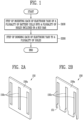
- FIG. 1 is a flowchart for explaining a battery module manufacturing method according to an embodiment of the present invention.
- a battery module manufacturing method may include Step S100 of inserting each of electrode tabs of a plurality of battery cells into a plurality of holes included in a bus bar.
- Battery cells may each include one or more electrode tabs.
- a bus bar may include a plate, and a plurality of holes may be formed on the plate.
- the shape of a bus bar will be described in more detail in FIGS. 2 to 4 below.
- electrode tabs may protrude to the other side of the plate. Step S100 will be described in more detail in FIGS. 5 and 6 below.
- a battery module manufacturing method may include Step S200 of bonding each of electrode tabs to a plurality of holes.
- Step S200 may be performed by irradiating laser under feeding of a wire. Step S200 will be described in more detail in FIGS. 7 to 10 below.
- a weld bead joining electrode tabs and a busbar may be formed by irradiating laser under feeding of a wire.
- a weld bead may be formed using a wire as a base material. A weld bead will be described in more detail in FIGS. 11 to 15 below.
- a battery module on which Step S200 is performed may be a battery module that has previously been welded. That is, Step S200 may be performed again on a battery module having a previously welded area formed in at least a part thereof. For example, when welding was previously performed at electrode tabs of a battery module but defects were generated, re-welding may be performed through Step S200.
- Previously performed welding may have been performed, for example, by irradiating laser to electrode tabs and busbars, but is not limited to a specific type of welding. Previously performed welding may be performed without feeding a wire or under feeding of a wire.
- FIG. 2A and FIG. 2B are diagrams for explaining a bus bar of a battery module according to embodiments of the present invention.
- a bus bar 150 may be configured to include a plate 150a and a hole 150c formed on the plate.
- a plate may include a plurality of holes 150c capable of accommodating each of a plurality of electrode tabs, and each hole 150c may have a shape and a size corresponding to a cross-section of an electrode tab so that an end of the electrode tab may be inserted into the hole 150c.
- each hole 150c may include an insertion portion 151 with one side open so that an electrode tab may be slidably inserted. More specifically, an insertion portion may have a tapered shape that widens toward an open side so that an electrode tab may be easily slidably inserted into a hole 150c, but the shape of an insertion portion 151 is not limited thereto.
- an electrode tab may be inserted into a hole 150c of a plate 150a in a protruding direction of the electrode tab, and when one end of a hole 150c is open as shown in FIG. 2B , an electrode tab may be inserted into a hole 150c of a plate 150a in an erection direction (width direction) of the electrode tab through an insertion portion 151.
- one or more holes 150c may be formed one a plate 150a, and electrode tabs inserted into each hole 150c may be welded to electrically connect a plurality of welded battery cells.
- one or more holes 150c may be formed one the plate 150a to correspond to the number of battery cells to be connected. Therefore, to electrically connect battery cells, regardless of the number of battery cells to be connected, battery cells may be electrically connected without changing the shape of the electrode tab.
- a plate 150a forming a bus bar 150 may include one or more holes 150c having a predetermined spacing, and electrode tabs inserted through the holes 150c may be welded to electrically connect a plurality of battery cells. At this time, since electrode tabs may be inserted and welded in each hole 150c, a plurality of welded battery cells may be electrically connected through a bus bar 150.
- the hole 150c may be formed in a slit shape.
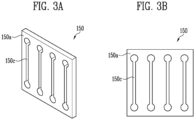
- FIG. 3A and FIG. 3B are diagrams for explaining a bus bar of a battery module according to another embodiment of the present invention.
- a bus bar 150 may include a plate 150a and a hole 150c formed on the plate.
- FIG. 3A is a perspective diagram of a bus bar 150
- FIG. 3B is a floor diagram of a bus bar 150.
- a hole 150c may be formed in the shape of a slit, and in one embodiment, an end of a slit may have a wider width than the central portion of the slit.
- an electrode tab may be easily inserted into a plate 150a in a diagonal direction.
- FIG. 4A and FIG. 4B and FIG. 5A and FIG. 5B are diagrams for explaining bus bars of a battery module according to yet other embodiments of the present invention.
- a plate 150a may include a protrusion portion 150b formed around a position where a hole 150c is formed. That is, a protrusion portion 150b may be formed at a bus bar 150 according to an embodiment of the present invention. This protrusion portion 150b may be formed at a position where a hole 150c is formed to play a role of guiding an electrode tab to be inserted into a hole 150c. Therefore, a plate 150a may include a plurality of holes 150c formed in predetermined spacings and include a protrusion portion 150b formed around a position where a hole 150c is formed. Electrode tabs inserted into holes 150c may be welded to electrically connect a plurality of battery cells.
- the direction of a protrusion portion may be formed opposite to that shown in FIG. 4A .
- a shape such as shown in FIG. 4A may be more preferable.
- a plate 150a may include a tab connection portion 151a.
- a tab connection portion 151a may be formed by protruding from an outer circumferential surface of each hole 150c in a direction in which an electrode tab 120 protrudes, and later during electrical connection of battery cells by laser welding, may be electrically connected with a bus bar, as an electrode tab comes into contact with a tab connection portion 151a by a wire melted by laser.
- a concave groove 151b may be formed around a hole 150c on an opposite surface of a tab connection portion 151a to guide an electrode tab 120 to be inserted into the hole 150c.
- connection portion may be formed opposite to that shown in FIG. 5A .
- a shape such as shown in FIG. 5A may be more preferable.
- FIG. 6 is a cross-sectional diagram for explaining a shape in which electrode tabs are connected to a bus bar in a battery module according to an embodiment of the present invention.
- an electrode tab 120 of a battery cell 110 may be inserted into a hole 150c formed on a plate 150a of a bus bar 150.
- An electrode tab 120 may be inserted into a hole 150c on one side of a plate 150a and protrude to the other side of the plate 150a.
- an electrode tab 120 may be inserted into a hole 150c on one side of a plate 150a, but the electrode tab 120 may not protrude to the other side of the plate 150a. That is, one end of an electrode tab 120 in an insertion direction may be positioned within a hole 150c, or may be positioned on a same side as the other side of a plate 150a.
- FIG. 7 is a perspective diagram for explaining a shape in which electrode tabs are connected to a bus bar in a battery module according to an embodiment of the present invention.
- a battery module 100 may include a plurality of battery cells 110 and electrode tabs 120 drawn out from battery cells 110. Electrode tabs 120 of each battery cell 110 may be electrically connected by a bus bar 150.
- Electrode tabs 120 of battery cells 110 may penetrate holes of a bus bar 150.
- each battery cell 110 may include a cathode, an anode, and a separator disposed therebetween.
- a cathode and an anode may each include a current collector and an active material layer disposed on a current collector.
- a cathode may include a cathode current collector and a cathode active material layer
- an anode may include an anode current collector and an anode active material layer.
- a current collector may include a known conductive material to an extent that it does not cause a chemical reaction within a lithium secondary battery.
- a current collector may include any one of stainless steel, nickel (Ni), aluminum (Al), titanium (Ti), copper (Cu), and alloys thereof, and may be provided in various forms such as a film, a sheet, a foil or the like.
- An active material layer include an active material.
- a cathode active material layer may include a cathode active material
- an anode active material layer may include an anode active material.
- a cathode active material may be a material which lithium (Li) ions may be inserted into and extracted from.
- a cathode active material may be a lithium metal oxide.
- a cathode active material may be one of a lithium manganese-based oxide, a lithium nickel-based oxide, a lithium cobalt-based oxide, a lithium nickel manganese-based oxide, a lithium nickel cobalt manganese-based oxide, a lithium nickel cobalt aluminum-based oxide, a lithium iron phosphate-based compound, a lithium manganese phosphate-based compound, a lithium cobalt phosphate-based compound, and a lithium vanadium phosphate-based compound, but is not necessarily limited to a specific example.
- An anode active material may be a material which lithium ions may be absorbed into and extracted from.
- an anode active material may be any one of carbon-based materials, such as crystalline carbon, amorphous carbon, carbon composite, and carbon fiber, a lithium alloy, silicon (Si), and tin (Sn).
- an anode active material may be natural graphite or artificial graphite, but is not limited to a specific example.
- a cathode and an anode may each further include a binder and a conductive material.
- a binder may mediate joining between a current collector and an active material layer to improve mechanical stability.
- a binder may be an organic binder or an aqueous binder, and may be used with a thickener such as carboxymethyl cellulose (CMC).
- an organic binder may be any one of vinylidene fluoride-hexafluoropropylene copolymer (PVDF-co-HFP), polyvinylidene fluoride (PVDF), polyacrylonitrile, and polymethyl methacrylate, and an aqueous binder may be styrene-butadiene rubber (SBR), but is not necessarily limited thereto.
- a conductive material may improve electrical conductivity of lithium secondary batteries.
- a conductive material may include a metal-based material.
- a conductive material may include a typical carbon-based conductive material.
- a conductive material may include any one of graphite, carbon black, graphene, and carbon nanotubes.
- a conductive material may include carbon nanotubes.
- a separator may be disposed between a cathode and an anode.
- a separator may be configured to prevent electrical short-circuiting between a cathode and an anode and to generate a flow of ions.
- a separator may include a porous polymer film or a porous non-woven fabric.
- a porous polymer film may be configured to be a single layer or multiple layers including a polyolefin-based polymer such as an ethylene polymer, a propylene polymer, an ethylene/butene copolymer, an ethylene/hexene copolymer, and an ethylene/methacrylate copolymer.
- a porous nonwoven fabric may include high-melting point glass fibers and polyethylene terephthalate fibers.
- a separator may be a highly heat-resistant separator (CCS; Ceramic Coated Separator) including ceramic.
- Each battery cell 110 may include one or more electrode tabs 120 protruding in one direction.
- a battery cell 110 may be a pouch-type battery cell.
- a pouch-type battery cell may be a battery cell in which an electrode assembly including a cathode, an anode, and a separator disposed therebetween is impregnated with an electrolyte (electrolyte solution) and sealed in a pouch.
- a pouch may have a multilayer film structure in which a metal film, such as an aluminum film, is interposed between an outer layer film and an inner layer film, but is not limited thereto.
- electrode tabs of each of a plurality of pouch-type battery cells 110 stacked in one direction are inserted and welded into each hole of a bus bar so that a plurality of pouch-type battery cells 110 may be electrically connected to each other.
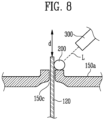
- FIGS. 8 to 11 are diagrams for explaining a step of bonding electrode tabs to holes in a battery module manufacturing method of according to embodiments of the present invention.
- laser L may be irradiated by a welding system 300.
- a wire 200 may be provided around a protruding electrode tab 120.
- a wire may be disposed on a plate 150a as shown in FIGS. 8 to 10 , and a wire 200 may be fed through a separate device as shown in FIG. 11 .
- a wire 200 may be fed through a feeding portion included in a welding system 300.
- a wire 200 may be positioned on one side of an electrode tab 120, and at this time, laser L irradiated by a welding system 300 may be obliquely irradiated with respect to a central axis in a longitudinal direction d of an electrode tab 120 that is inserted to a hole 150c and protruding. Accordingly, when laser L is irradiated perpendicularly to an end surface of an electrode tab 120, the possibility that laser L may be irradiated directly to a battery cell due to an error during welding and lead to an accident may be minimized. In addition, as laser L is obliquely irradiated, a welding process of an end surface of an electrode tab 120 may be visually confirmed, making possible improvement of quality and production speed of battery modules.
- wires 200 may be positioned on a plurality of sides of an electrode tab 120.
- laser L irradiated by a welding system 300 may be irradiated in parallel with a longitudinal direction d central axis of an electrode tab that is inserted into a hole 150c and protruding, as shown in FIG. 9 , or it may be obliquely irradiated, as shown in FIG. 10 .
- a hole 150c of a bus bar may be blocked by tightly contacting a wire to an electrode tab 120 in order to prevent laser L from being directly irradiated to a battery cell.
- a wire 200 may be fed through a separate device.
- laser L irradiated by a welding system 300 may be irradiated in parallel with a longitudinal direction d central axis of an electrode tab 120 that is inserted into a hole 150c and protruding, or it may be obliquely irradiated.
- a wire 200 is a type of filler material, and a wire 200 may be melted by irradiating laser onto a wire 200. A molten wire may be cooled again to join an electrode tab 120 with a plate 150a.
- a wire 200 may include a same material as an electrode tab 120.
- a wire 200 and an electrode tab 120 are made of a same material, it may be easy to bond a weld bead formed from a wire 200 to an electrode tab 120.
- this may be desirable in the sense that generation of intermetallic compounds that cause cracks may be prevented, and thus weldability may be improved.
- additives that may improve weldability may be added during welding. Additives may be included in a wire or separately fed from a wire.
- an electrode tab 120 and a wire 200 may include a material different from a bus bar, and more specifically, a plate 150a.
- an electrode tab 120 may include aluminum (Al), and a plate 150a may include copper (Cu).
- an electrode tab 120 may include copper (Cu), and a plate 150a may include aluminum (Al).
- an electrode tab 120 or a plate 150a may be made of aluminum with a purity of 90% or more, and specifically, made of aluminum with a purity of 95% or more, 99% or more or 99.5% or more.
- an electrode tab 120 or a plate 150a may be made of industrial pure aluminum, and commercial products such as Al1000 series (UNS #) such as Al1050, AI1100, or Al1200 may be used.
- an electrode tab 120 or a plate 150a may be made of copper with a purity of 98% or more, 99% or more, or 99.3% or more.
- an electrode tab 120 or a plate 150a may be made of industrial pure copper, and commercial products such as C10100 to C13000 series (UNS #) such as C11000, C10100, C10200, C12500, or the like may be used.
- an electrode tab 120 and a wire 200 may include a same material as a bus bar, and more specifically, a plate 150a.
- FIG. 12 is a diagram for explaining a welding system used in a step of bonding electrode tabs to holes in the battery module manufacturing method of according to one embodiment of the present invention.
- a welding system 300 may include a light irradiation portion 310 irradiating laser to a battery module 100 and a feeding portion 320 feeding a wire 200, which is a filler material.
- a wire feeding rate, laser power, laser irradiation pattern, and the like may be appropriately selected according to the shape and quality of a weld bead to be formed through a wire.
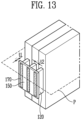
- FIG. 13 is a perspective diagram for explaining a shape in which a weld bead is formed in a battery module according to one embodiment of the present invention.
- a weld bead 170 may be formed on a plate of a bus bar 150.
- a weld bead 170 may be formed using a wire fed during laser welding as a base material. As described above, a wire may be fed separately from an electrode tab 120. In one embodiment, a part of a weld bead 170 may be derived from an electrode tab 120. In addition, in one embodiment, a portion of the weld bead 170 may be derived from a plate of a bus bar 150.
- a weld bead 170 may be formed using a wire as a first base material for welding and a plate as a second base material for welding.
- a surface plating layer may be formed on a wire, which is a first base material (welding base material), and/or a plate, which is a second base material. That is, a wire and/or a plate may include a surface plating layer, and in particular, an electrode tab, of which electro/chemical stability to an electrolyte solution must be ensured, may include a surface plating layer.
- a surface plating layer to ensure electrical/chemical stability to an electrolyte solution may include Ni, Sn, Si, Mg, Fe, Mn, Zn, Cr, Li, Ca, or alloys thereof.
- a dilution rate of a surface plating layer itself may also be calculated through an analysis of a weight percent (wt%) of a weld bead including a first base material, a second base material, and a plating component.
- Composition components of a welding metal (weld bead) throughout welding may be quantified by EDS (Energy Dispersive Spectroscopy) with respect to various process factors.
- t1 may refer to a thickness direction of a bus bar 150, and more specifically, a thickness direction of a plate included in a bus bar 150.
- a plate 150a may preferably have a thickness of 0.5 mm or more, and for example, a plate 150a may have a thickness of 0.5 mm to 10 mm, 1 mm to 8 mm, or 1 mm to 6 mm, but it is not necessarily limited thereto.
- t2 may refer to a thickness direction of an electrode tab 120.
- An electrode tab 120 may be configured to penetrate a hole in a direction perpendicular to a surface of a plate 150a.
- the thickness of an electrode tab 120 may preferably be 0.2 mm or more, and more preferably 0.2 to 1.0 mm.
- a weld bead 170 with more desirable physical properties may be formed.
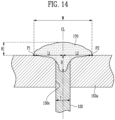
- FIG. 14 is a cross-sectional diagram for explaining a shape in which a weld bead is formed in a battery module according to one embodiment of the present invention.
- a weld bead 170 formed by heating and melting a wire with laser may join an electrode tab 120 that penetrates a hole 150c of a plate 150a with a plate 150a.
- FIG. 14 may show a cross-section of a weld bead 170 in a thickness direction of a plate 150a.
- a cross-section of a weld bead 170 in a thickness direction of a plate 150a may refer to a cross-section cut by an imaginary plane parallel to a thickness direction of a plate 150a (an imaginary plane with an in-plane thickness direction) and a cross-section that is cut to minimize the area of a weld bead 170.
- an imaginary plane parallel to a thickness direction of a plate 150a an imaginary plane with an in-plane thickness direction
- a imaginary plane P forming a cut cross-section of a weld bead 170 may refer to an imaginary plane that is parallel to a thickness direction t1 of a plate 150a and at the same time, parallel to a thickness direction t2 of an electrode tab, and a cross-section of a weld bead 170 may refer to a cross-section cut by the imaginary plane P described above.
- a weld bead may have a width (W) and a height (H) that satisfy Equations 1 and 2 below. 0 ⁇ W ⁇ 9 T
- Equation 1 W is a width of a weld bead 170 based on a cross-section of a weld bead in a thickness direction of the plate, and T is a thickness of the electrode tab. 0 ⁇ H ⁇ 4.5 T
- Equation 2 H is a height of a weld bead 170 based on a cross-section of a weld bead in a thickness direction of the plate, and T is the thickness of the electrode tab.
- the unit of T may be mm.
- Equations 1 and 2 described above may be of particular importance when a wire and a plate 150a are made of different materials (metal materials). That is, in welding of dissimilar materials, when a width W of a weld bead 170 is more than 9T, formation of an intermetallic compound between dissimilar materials may be induced.
- a width W may be 7T or more, 7.2T or more, or 7.5T or more. That is, by using a wire, which is a separate filler metal, an upper limit of a width W may be increased compared to a case where a wire is not used.
- a height (H) of a weld bead 170 is more than 4.5T, a penetration depth may be lowered, thereby causing a problem in which interfacial bond strength between different materials is weakened.
- a height (H) may be 3T or more, 3.2T or more, or 3.5T or more. That is, by using a wire, which is a separate filler material, an upper limit of a height H may be increased compared to a case where a wire is not used.
- Equation 1 shows a morphological parameter that significantly affects a dilution rate between welding base materials in a weld beading
- Equation 2 shows a morphological parameter that significantly affects a shape of a weld bead itself.
- a weld bead may include: a cover portion having a convex shape covering a hole on one of two opposing surfaces in a thickness direction of a plate 150a, based on a cross-section of a weld bead 170 in a thickness direction of a plate 150a; and a pillar portion charged into a hole.
- a molten metal derived from welding base materials is cooled during welding to form a weld bead 170, not only composition of a weld bead 170 but also a shape of a weld bead itself, including a cover portion and a pillar portion, affects mechanical properties of a welded area.
- Equation 2 shows a morphological parameter that affects a shape of a weld beading itself.
- a height H of a weld bead is more than 4.5T, a length of a pillar portion of a weld bead 170 may be shorter, thereby causing a problem of lowering interfacial bond strength.
- a weld bead width W may be 2T to 8T, more advantageously 3T to 7T, and a height H may be 0.5T to 3T, more advantageously 0.5T to 2T.
- width and height of a weld bead 170 are satisfied, it may have improved tensile strength and low contact resistance, thereby exhibiting excellent welding characteristics.
- a weld bead 170 satisfies such width and height, even when specific welding conditions, for example, specific welding conditions such as a heat gradient state caused during welding or a laser irradiation method during welding, are changed, constant welding quality (improved welding strength, excellent electrical characteristics of a welded area, etc.) may be stably and reproducibly secured.
- a weld bead 170 may directly affect a cross-sectional area of a weld bead 170. Accordingly, in another embodiment, while an electrode tab 120 and a plate 150a inserted into a hole 150c are joined to each other by a weld bead 170, a weld bead 170 may satisfy Equation 3 below. 0 ⁇ A ⁇ 40.5 T 2
- Equation 3 A is a cross-sectional area of a weld bead 170 based on a cross-section of a weld bead in a thickness direction of the plate, and T is a thickness of the electrode tab.
- a weld bead 170 may have a cross-sectional area A of 40.5T 2 (mm 2 ) or less.
- a cross-sectional area exceeds 40.5T 2 , various types of problems may occur, such as increased generation of intermetallic compounds (IMC), decreased weld strength, and crack generation in a welded area.
- IMC intermetallic compounds
- a cross-sectional area of a weld bead 170 may satisfy 1T 2 to 24T 2 , more advantageously 1T 2 to 21T 2 .
- a cross-sectional area (A) may be 21T 2 or more, 25T 2 or more, or 30T 2 or more. That is, by using a wire, which is a separate filler material, an upper limit of a cross-sectional area A may be increased compared to a case where a wire is not used.
- a weld bead 170 may satisfy Equations 1 and 2 described above, and it may further satisfy Equation 3, and independently, it may satisfy Equation 3 and at the same time, it may further satisfy Equation 1, Equation 2, or Equations 1 and 2.
- the width W of a weld bead 170 described above may be a width of a cover portion based on a cross section of a weld bead 170.
- a width W of a weld bead 170 may mean, on a weld bead cross-section in a thickness direction of a plate, with both ends in a thickness direction of an electrode tab of a weld bead 170 in contact with a plate 150a as boundary points P1, P2, a distance between two boundary points P1, P2 on the left and right.
- a width of a bead may be defined as a shortest distance between two boundary points. Accordingly, a thickness direction t2 of an electrode tab may be defined as a width direction of a cross-section of a weld bead 170.
- a height H of a weld bead 170 may be a maximum height of a cover portion based on a cross-section of a weld bead 170.
- a height H of a bead may be, on a cross-section of a weld bead in a thickness direction of a plate, a distance (shortest distance) between an imaginary line connecting two boundary points P1, P2 on the left and right and a highest point of a cover portion.
- FIG. 14 an example shown in FIG. 14 is a case where boundary points P1, P2 on the left and right are positioned at a same height, and thus a width of a bead is simply illustrated as shown in FIG. 14
- a height of a weld bead 170 may be defined as a shortest distance between an imaginary line connecting two boundary points and a highest point of a cover portion.
- a weld bead 170 may further satisfy Equation 4. 0.4 T ⁇ D ⁇ 4 T
- Equation 4 D is a penetration depth of the weld bead into a hole based on a cross-section of a weld bead in a thickness direction of a plate, and T is a thickness of the electrode tab.
- a penetration depth D may be a distance (shortest distance) between an imaginary line connecting two boundary points P1, P2 on the left and right and a lowest point of a weld bead 170 positioned inside a hole.
- a penetration depth may correspond to a length of a pillar portion.
- a penetration depth may be a factor related to mechanical properties due to a shape of a weld bead 170 itself and to a dilution rate of a plate 150a.
- a penetration depth D may be 2T or more, 2.3T or more, or 3T or more. That is, by using a wire, which is a separate filler material, an upper limit of a penetration depth D may be increased compared to a case where a wire is not used.
- a weld bead 170 may be left-right symmetrical or left-right asymmetrical with respect to a center line CL of a hole 150c.
- a center line of the hole 150c may be the same as a center line of the electrode tab 120 inserted into the hole 150c.
- left-right asymmetry may mean that a ratio of L1 and L2 is 1:1 to 1:3.
- a left-right asymmetric structure may be mainly affected by laser irradiation direction, and this asymmetric structure may be exhibited when laser is obliquely irradiated. It is known that a left-right asymmetric structure of a weld bead 170 is not advantageous to mechanical properties of a welded area.
- a ratio of L1 and L2 may be 1:1 to 1:1.2. That is, by using a wire, which is a separate filler material, left-right symmetry of a weld bead 170 may be improved compared to a case where a wire is not used.
- FIGS. 15 to 17 are images showing weld beads formed in a battery module according to embodiments of the present invention.
- a plate surface in contact with a weld bead is formed to be inclined downward in a longitudinal direction toward an outer circumference of a weld bead.
- a plate surface bonded to a formed weld bead may be configured to be inclined downward from a center of a hole toward an outer circumference of a weld bead so that a shape of a weld bead may be formed to be smooth, thereby preventing deterioration of welding strength due to rough shapes such as notches.
Landscapes
- Chemical & Material Sciences (AREA)
- Chemical Kinetics & Catalysis (AREA)
- Electrochemistry (AREA)
- General Chemical & Material Sciences (AREA)
- Engineering & Computer Science (AREA)
- Manufacturing & Machinery (AREA)
- Mechanical Engineering (AREA)
- Physics & Mathematics (AREA)
- Optics & Photonics (AREA)
- Plasma & Fusion (AREA)
- Connection Of Batteries Or Terminals (AREA)
Abstract
Description
- Embodiments of the present disclosure relate to a battery module manufacturing method and a battery module.
- Recently, the requirements for high-capacity, high-output secondary batteries are increasing, and there is a need to develop secondary batteries that require high energy density, high performance, and a high level of reliability corresponding to these requirements.
- In particular, in the cell-to-cell electrical connection method that requires a high level of reliability, various methods such as ultrasonic welding, laser welding, and mechanical (bolt/nut) joining are used, but laser welding is used as the most universal bonding method in order to respond to increasing energy density requirements.
- As a method of such laser welding, lap welding of a single or multiple electrode tabs and a bus bar is generally used. However, this method not only has limitations in that there is a large variation in tensile strength after welding and a high possibility of welding defects such as weak welding depending on the pressurization conditions, but also requires bending and cutting of electrode tabs of multiple specifications within a unit module for welding, causing an increase of processes and a rise of management cost.
- In addition, the resistance of individuals cells is non-uniform due to differences in electrode tab length for each cell specification within a module, which is likely to have a negative impact on long-term durability. In particular, there have been difficulties in securing stable welding quality (tensile strength, electrical resistance, etc.) in welding of dissimilar materials of AI electrode tabs and bus bars.
- Furthermore, there has also been a limitation that a weldable range is limited depending on the volume of a cell tab upon welding.
- According to the present disclosure to solve this problem, a battery module manufacturing method and a battery module that can improve process efficiency by providing a degree of freedom for cell tap management can be provided.
- Embodiments of the present disclosure may provide a battery module manufacturing method and a battery module that can improve process efficiency by providing a degree of freedom for cell tab management.
- A battery module manufacturing method according to an embodiment of the present invention includes: a step of inserting each of electrode tabs of a plurality of battery cells into a plurality of holes included in a bus bar; and a step of bonding the electrode tabs to the bus bar by irradiating laser underfeeding of a wire, wherein the bus bar may electrically connect the electrode tabs of the plurality of battery cells to each other. In other words, the present invention relates to a method for manufacturing a battery module, the method comprising the steps of: (a) providing a plurality of battery cells, each battery cell having an electrode tab; (b) providing a bus bar including a plurality of holes; (c) inserting each one of the electrode tabs into a respective one of the plurality of holes; and bonding the electrode tabs to the bus bar by irradiating laser under feeding of a wire, such that the bus bar electrically connects the electrode tabs of the plurality of battery cells to each other.
- A battery module according to an embodiment of the present invention may include: a plurality of battery cells, each including an electrode tab; and a bus bar including a plurality of holes into which the electrode tabs are each inserted, and connected to the electrode tabs to electrically connect the plurality of battery cells to each other, wherein the electrode tabs inserted into the holes and the bus bars are joined with each other by a weld bead, wherein the weld bead is formed using a separate wire that is distinguished from the electrode tab as a base material, and wherein the width of the weld bead based on a weld bead cross-section in the thickness direction of the bus bar may be 7 times or more the thickness of the electrode tab. In an exemplary embodiment, each one of the electrode tabs may be inserted into a respective one of the plurality of holes.
- According to the present disclosure, a battery module manufacturing method and a battery module that can improve process efficiency may be provided by providing a degree of freedom for cell tap management.
-
-
FIG. 1 is a flowchart for explaining a battery module manufacturing method according to an embodiment of the present invention. -
FIG. 2A and FIG. 2B are diagrams for explaining a bus bar of a battery module according to embodiments of the present invention. -
FIG. 3A and FIG. 3B are diagrams for explaining a bus bar of a battery module according to another embodiment of the present invention. -
FIG. 4A and FIG. 4B andFIG. 5A and FIG. 5B are diagrams for explaining bus bars of a battery module according to yet other embodiments of the present invention. -
FIG. 6 is a cross-sectional diagram for explaining a shape in which electrode tabs are connected to a bus bar in a battery module according to an embodiment of the present invention. -
FIG. 7 is a perspective diagram for explaining a shape in which electrode tabs are connected to a bus bar in a battery module according to an embodiment of the present invention. -
FIGS. 8 to 11 are diagrams for explaining a step of bonding electrode tabs to holes in a battery module manufacturing method of according to embodiments of the present invention. -
FIG. 12 is a diagram for explaining a welding system used in a step of bonding electrode tabs to holes in a battery module manufacturing method of according to one embodiment of the present invention. -
FIG. 13 is a perspective diagram for explaining a shape in which a weld bead is formed in a battery module according to one embodiment of the present invention. -
FIG. 14 is a cross-sectional diagram for explaining a shape in which a weld bead is formed in a battery module according to one embodiment of the present invention. -
FIGS. 15 to 17 are images showing weld beads formed in a battery module according to embodiments of the present invention. -
FIG. 1 is a flowchart for explaining a battery module manufacturing method according to an embodiment of the present invention. - Referring to
FIG. 1 , a battery module manufacturing method according to one embodiment of the present invention may include Step S100 of inserting each of electrode tabs of a plurality of battery cells into a plurality of holes included in a bus bar. - Battery cells may each include one or more electrode tabs.
- A bus bar may include a plate, and a plurality of holes may be formed on the plate. The shape of a bus bar will be described in more detail in
FIGS. 2 to 4 below. - In an embodiment, by inserting electrode tabs into a plurality of holes on one side of a bus bar, more specifically, on one side of a plate, electrode tabs may protrude to the other side of the plate. Step S100 will be described in more detail in
FIGS. 5 and6 below. - In addition, a battery module manufacturing method according to one embodiment of the present invention may include Step S200 of bonding each of electrode tabs to a plurality of holes.
- Step S200 may be performed by irradiating laser under feeding of a wire. Step S200 will be described in more detail in
FIGS. 7 to 10 below. - A weld bead joining electrode tabs and a busbar may be formed by irradiating laser under feeding of a wire. A weld bead may be formed using a wire as a base material. A weld bead will be described in more detail in
FIGS. 11 to 15 below. - In one embodiment, a battery module on which Step S200 is performed may be a battery module that has previously been welded. That is, Step S200 may be performed again on a battery module having a previously welded area formed in at least a part thereof. For example, when welding was previously performed at electrode tabs of a battery module but defects were generated, re-welding may be performed through Step S200. Previously performed welding may have been performed, for example, by irradiating laser to electrode tabs and busbars, but is not limited to a specific type of welding. Previously performed welding may be performed without feeding a wire or under feeding of a wire.
-
FIG. 2A and FIG. 2B are diagrams for explaining a bus bar of a battery module according to embodiments of the present invention. - Referring to
FIG. 2A , abus bar 150 may be configured to include aplate 150a and ahole 150c formed on the plate. At this time, a plate may include a plurality ofholes 150c capable of accommodating each of a plurality of electrode tabs, and eachhole 150c may have a shape and a size corresponding to a cross-section of an electrode tab so that an end of the electrode tab may be inserted into thehole 150c. - Referring to
FIG. 2B , eachhole 150c may include aninsertion portion 151 with one side open so that an electrode tab may be slidably inserted. More specifically, an insertion portion may have a tapered shape that widens toward an open side so that an electrode tab may be easily slidably inserted into ahole 150c, but the shape of aninsertion portion 151 is not limited thereto. When both ends of ahole 150c are blocked as shown inFIG. 2A , an electrode tab may be inserted into ahole 150c of aplate 150a in a protruding direction of the electrode tab, and when one end of ahole 150c is open as shown inFIG. 2B , an electrode tab may be inserted into ahole 150c of aplate 150a in an erection direction (width direction) of the electrode tab through aninsertion portion 151. - In the present disclosure, one or
more holes 150c may be formed one aplate 150a, and electrode tabs inserted into eachhole 150c may be welded to electrically connect a plurality of welded battery cells. - In an embodiment, one or
more holes 150c may be formed one theplate 150a to correspond to the number of battery cells to be connected. Therefore, to electrically connect battery cells, regardless of the number of battery cells to be connected, battery cells may be electrically connected without changing the shape of the electrode tab. Aplate 150a forming abus bar 150 may include one ormore holes 150c having a predetermined spacing, and electrode tabs inserted through theholes 150c may be welded to electrically connect a plurality of battery cells. At this time, since electrode tabs may be inserted and welded in eachhole 150c, a plurality of welded battery cells may be electrically connected through abus bar 150. In an embodiment, thehole 150c may be formed in a slit shape. -
FIG. 3A and FIG. 3B are diagrams for explaining a bus bar of a battery module according to another embodiment of the present invention. - Referring to
FIG. 3A and FIG. 3B , abus bar 150 may include aplate 150a and ahole 150c formed on the plate.FIG. 3A is a perspective diagram of abus bar 150, andFIG. 3B is a floor diagram of abus bar 150. Ahole 150c may be formed in the shape of a slit, and in one embodiment, an end of a slit may have a wider width than the central portion of the slit. - Accordingly, an electrode tab may be easily inserted into a
plate 150a in a diagonal direction. -
FIG. 4A and FIG. 4B andFIG. 5A and FIG. 5B are diagrams for explaining bus bars of a battery module according to yet other embodiments of the present invention. - Referring to
FIG. 4A , aplate 150a may include aprotrusion portion 150b formed around a position where ahole 150c is formed. That is, aprotrusion portion 150b may be formed at abus bar 150 according to an embodiment of the present invention. Thisprotrusion portion 150b may be formed at a position where ahole 150c is formed to play a role of guiding an electrode tab to be inserted into ahole 150c. Therefore, aplate 150a may include a plurality ofholes 150c formed in predetermined spacings and include aprotrusion portion 150b formed around a position where ahole 150c is formed. Electrode tabs inserted intoholes 150c may be welded to electrically connect a plurality of battery cells. - In another embodiment, as shown in
FIG. 4B , the direction of a protrusion portion may be formed opposite to that shown inFIG. 4A . - However, in the sense that an electrode tab may be more easily inserted, a shape such as shown in
FIG. 4A may be more preferable. - Referring to
FIG. 5A , aplate 150a may include atab connection portion 151a. Atab connection portion 151a may be formed by protruding from an outer circumferential surface of eachhole 150c in a direction in which anelectrode tab 120 protrudes, and later during electrical connection of battery cells by laser welding, may be electrically connected with a bus bar, as an electrode tab comes into contact with atab connection portion 151a by a wire melted by laser. Here, aconcave groove 151b may be formed around ahole 150c on an opposite surface of atab connection portion 151a to guide anelectrode tab 120 to be inserted into thehole 150c. - In another embodiment, as shown in
FIG. 5B , the direction of a connection portion may be formed opposite to that shown inFIG. 5A . - However, in the sense that an electrode tab may be more easily inserted, a shape such as shown in
FIG. 5A may be more preferable. -
FIG. 6 is a cross-sectional diagram for explaining a shape in which electrode tabs are connected to a bus bar in a battery module according to an embodiment of the present invention. - Referring to
FIG. 6 , anelectrode tab 120 of abattery cell 110 may be inserted into ahole 150c formed on aplate 150a of abus bar 150. Anelectrode tab 120 may be inserted into ahole 150c on one side of aplate 150a and protrude to the other side of theplate 150a. - In another embodiment, an
electrode tab 120 may be inserted into ahole 150c on one side of aplate 150a, but theelectrode tab 120 may not protrude to the other side of theplate 150a. That is, one end of anelectrode tab 120 in an insertion direction may be positioned within ahole 150c, or may be positioned on a same side as the other side of aplate 150a. -
FIG. 7 is a perspective diagram for explaining a shape in which electrode tabs are connected to a bus bar in a battery module according to an embodiment of the present invention. - Referring to
FIG. 7 , abattery module 100 may include a plurality ofbattery cells 110 andelectrode tabs 120 drawn out frombattery cells 110.Electrode tabs 120 of eachbattery cell 110 may be electrically connected by abus bar 150. -
Electrode tabs 120 ofbattery cells 110 may penetrate holes of abus bar 150. - In an embodiment, each
battery cell 110 may include a cathode, an anode, and a separator disposed therebetween. In an embodiment, a cathode and an anode may each include a current collector and an active material layer disposed on a current collector. For example, a cathode may include a cathode current collector and a cathode active material layer, and an anode may include an anode current collector and an anode active material layer. - A current collector may include a known conductive material to an extent that it does not cause a chemical reaction within a lithium secondary battery. For example, a current collector may include any one of stainless steel, nickel (Ni), aluminum (Al), titanium (Ti), copper (Cu), and alloys thereof, and may be provided in various forms such as a film, a sheet, a foil or the like.
- An active material layer include an active material. For example, a cathode active material layer may include a cathode active material, and an anode active material layer may include an anode active material.
- A cathode active material may be a material which lithium (Li) ions may be inserted into and extracted from. A cathode active material may be a lithium metal oxide. For example, a cathode active material may be one of a lithium manganese-based oxide, a lithium nickel-based oxide, a lithium cobalt-based oxide, a lithium nickel manganese-based oxide, a lithium nickel cobalt manganese-based oxide, a lithium nickel cobalt aluminum-based oxide, a lithium iron phosphate-based compound, a lithium manganese phosphate-based compound, a lithium cobalt phosphate-based compound, and a lithium vanadium phosphate-based compound, but is not necessarily limited to a specific example.
- An anode active material may be a material which lithium ions may be absorbed into and extracted from. For example, an anode active material may be any one of carbon-based materials, such as crystalline carbon, amorphous carbon, carbon composite, and carbon fiber, a lithium alloy, silicon (Si), and tin (Sn). Depending on an embodiment, an anode active material may be natural graphite or artificial graphite, but is not limited to a specific example.
- A cathode and an anode may each further include a binder and a conductive material.
- A binder may mediate joining between a current collector and an active material layer to improve mechanical stability. According to an embodiment, a binder may be an organic binder or an aqueous binder, and may be used with a thickener such as carboxymethyl cellulose (CMC). According to an embodiment, an organic binder may be any one of vinylidene fluoride-hexafluoropropylene copolymer (PVDF-co-HFP), polyvinylidene fluoride (PVDF), polyacrylonitrile, and polymethyl methacrylate, and an aqueous binder may be styrene-butadiene rubber (SBR), but is not necessarily limited thereto.
- A conductive material may improve electrical conductivity of lithium secondary batteries. A conductive material may include a metal-based material. According to an embodiment, a conductive material may include a typical carbon-based conductive material. For example, a conductive material may include any one of graphite, carbon black, graphene, and carbon nanotubes. Preferably, a conductive material may include carbon nanotubes.
- A separator may be disposed between a cathode and an anode. A separator may be configured to prevent electrical short-circuiting between a cathode and an anode and to generate a flow of ions.
- According to an embodiment, a separator may include a porous polymer film or a porous non-woven fabric. Here, a porous polymer film may be configured to be a single layer or multiple layers including a polyolefin-based polymer such as an ethylene polymer, a propylene polymer, an ethylene/butene copolymer, an ethylene/hexene copolymer, and an ethylene/methacrylate copolymer. A porous nonwoven fabric may include high-melting point glass fibers and polyethylene terephthalate fibers. However, it is not limited thereto, and depending on an embodiment, a separator may be a highly heat-resistant separator (CCS; Ceramic Coated Separator) including ceramic.
- Each
battery cell 110 may include one ormore electrode tabs 120 protruding in one direction. - In one specific example, a
battery cell 110 may be a pouch-type battery cell. A pouch-type battery cell may be a battery cell in which an electrode assembly including a cathode, an anode, and a separator disposed therebetween is impregnated with an electrolyte (electrolyte solution) and sealed in a pouch. A pouch may have a multilayer film structure in which a metal film, such as an aluminum film, is interposed between an outer layer film and an inner layer film, but is not limited thereto. In abattery module 100 according to one specific example, electrode tabs of each of a plurality of pouch-type battery cells 110 stacked in one direction are inserted and welded into each hole of a bus bar so that a plurality of pouch-type battery cells 110 may be electrically connected to each other. -
FIGS. 8 to 11 are diagrams for explaining a step of bonding electrode tabs to holes in a battery module manufacturing method of according to embodiments of the present invention. - Referring to
FIGS. 8 to 11 , laser L may be irradiated by awelding system 300. - In addition, a
wire 200 may be provided around a protrudingelectrode tab 120. A wire may be disposed on aplate 150a as shown inFIGS. 8 to 10 , and awire 200 may be fed through a separate device as shown inFIG. 11 . In one embodiment, awire 200 may be fed through a feeding portion included in awelding system 300. - Referring to
FIG. 8 , awire 200 may be positioned on one side of anelectrode tab 120, and at this time, laser L irradiated by awelding system 300 may be obliquely irradiated with respect to a central axis in a longitudinal direction d of anelectrode tab 120 that is inserted to ahole 150c and protruding. Accordingly, when laser L is irradiated perpendicularly to an end surface of anelectrode tab 120, the possibility that laser L may be irradiated directly to a battery cell due to an error during welding and lead to an accident may be minimized. In addition, as laser L is obliquely irradiated, a welding process of an end surface of anelectrode tab 120 may be visually confirmed, making possible improvement of quality and production speed of battery modules. - Referring to
FIGS. 9 and10 ,wires 200 may be positioned on a plurality of sides of anelectrode tab 120. In this case, laser L irradiated by awelding system 300 may be irradiated in parallel with a longitudinal direction d central axis of an electrode tab that is inserted into ahole 150c and protruding, as shown inFIG. 9 , or it may be obliquely irradiated, as shown inFIG. 10 . When laser L is irradiated in parallel with a longitudinal direction d central axis of anelectrode tab 120, as shown inFIG. 9 , ahole 150c of a bus bar may be blocked by tightly contacting a wire to anelectrode tab 120 in order to prevent laser L from being directly irradiated to a battery cell. - Referring to
FIG. 11 , awire 200 may be fed through a separate device. In this case as well, laser L irradiated by awelding system 300 may be irradiated in parallel with a longitudinal direction d central axis of anelectrode tab 120 that is inserted into ahole 150c and protruding, or it may be obliquely irradiated. - A
wire 200 is a type of filler material, and awire 200 may be melted by irradiating laser onto awire 200. A molten wire may be cooled again to join anelectrode tab 120 with aplate 150a. - In an embodiment, a
wire 200 may include a same material as anelectrode tab 120. When awire 200 and anelectrode tab 120 are made of a same material, it may be easy to bond a weld bead formed from awire 200 to anelectrode tab 120. When awire 200 and anelectrode tab 120 are made of a same material, this may be desirable in the sense that generation of intermetallic compounds that cause cracks may be prevented, and thus weldability may be improved. In addition, additives that may improve weldability may be added during welding. Additives may be included in a wire or separately fed from a wire. - In addition, in one embodiment, an
electrode tab 120 and awire 200 may include a material different from a bus bar, and more specifically, aplate 150a. For example, anelectrode tab 120 may include aluminum (Al), and aplate 150a may include copper (Cu). Alternatively, anelectrode tab 120 may include copper (Cu), and aplate 150a may include aluminum (Al). For example, when anelectrode tab 120 or aplate 150a includes aluminum (Al), anelectrode tab 120 or aplate 150a may be made of aluminum with a purity of 90% or more, and specifically, made of aluminum with a purity of 95% or more, 99% or more or 99.5% or more. For example, anelectrode tab 120 or aplate 150a may be made of industrial pure aluminum, and commercial products such as Al1000 series (UNS #) such as Al1050, AI1100, or Al1200 may be used. In addition, for example, when anelectrode tab 120 or aplate 150a includes copper (Cu), anelectrode tab 120 or aplate 150a may be made of copper with a purity of 98% or more, 99% or more, or 99.3% or more. For example, anelectrode tab 120 or aplate 150a may be made of industrial pure copper, and commercial products such as C10100 to C13000 series (UNS #) such as C11000, C10100, C10200, C12500, or the like may be used. - In another embodiment, an
electrode tab 120 and awire 200 may include a same material as a bus bar, and more specifically, aplate 150a. -
FIG. 12 is a diagram for explaining a welding system used in a step of bonding electrode tabs to holes in the battery module manufacturing method of according to one embodiment of the present invention. - Referring to
FIG. 12 , awelding system 300 may include alight irradiation portion 310 irradiating laser to abattery module 100 and a feeding portion 320 feeding awire 200, which is a filler material. A wire feeding rate, laser power, laser irradiation pattern, and the like may be appropriately selected according to the shape and quality of a weld bead to be formed through a wire. -
FIG. 13 is a perspective diagram for explaining a shape in which a weld bead is formed in a battery module according to one embodiment of the present invention. - Referring to
FIG. 13 , by laser welding an electrode tab penetrating a hole formed on a plate of abus bar 150 and a plate, aweld bead 170 may be formed on a plate of abus bar 150. - In an embodiment, a
weld bead 170 may be formed using a wire fed during laser welding as a base material. As described above, a wire may be fed separately from anelectrode tab 120. In one embodiment, a part of aweld bead 170 may be derived from anelectrode tab 120. In addition, in one embodiment, a portion of theweld bead 170 may be derived from a plate of abus bar 150. - For example, a
weld bead 170 may be formed using a wire as a first base material for welding and a plate as a second base material for welding. At this time, a surface plating layer may be formed on a wire, which is a first base material (welding base material), and/or a plate, which is a second base material. That is, a wire and/or a plate may include a surface plating layer, and in particular, an electrode tab, of which electro/chemical stability to an electrolyte solution must be ensured, may include a surface plating layer. As is known, a surface plating layer to ensure electrical/chemical stability to an electrolyte solution may include Ni, Sn, Si, Mg, Fe, Mn, Zn, Cr, Li, Ca, or alloys thereof. Of course, when a surface plating layer is present on an electrode tab and/or a plate, a dilution rate of a surface plating layer itself may also be calculated through an analysis of a weight percent (wt%) of a weld bead including a first base material, a second base material, and a plating component. Composition components of a welding metal (weld bead) throughout welding may be quantified by EDS (Energy Dispersive Spectroscopy) with respect to various process factors. - In
FIG. 13 , t1 may refer to a thickness direction of abus bar 150, and more specifically, a thickness direction of a plate included in abus bar 150. In one embodiment, aplate 150a may preferably have a thickness of 0.5 mm or more, and for example, aplate 150a may have a thickness of 0.5 mm to 10 mm, 1 mm to 8 mm, or 1 mm to 6 mm, but it is not necessarily limited thereto. - In
FIG. 13 , t2 may refer to a thickness direction of anelectrode tab 120. Anelectrode tab 120 may be configured to penetrate a hole in a direction perpendicular to a surface of aplate 150a. The thickness of anelectrode tab 120 may preferably be 0.2 mm or more, and more preferably 0.2 to 1.0 mm. When anelectrode tab 120 has a thickness of 0.2 mm or more, aweld bead 170 with more desirable physical properties may be formed. -
FIG. 14 is a cross-sectional diagram for explaining a shape in which a weld bead is formed in a battery module according to one embodiment of the present invention. - Referring to
FIGS. 13 and14 , aweld bead 170 formed by heating and melting a wire with laser may join anelectrode tab 120 that penetrates ahole 150c of aplate 150a with aplate 150a. - Here,
FIG. 14 may show a cross-section of aweld bead 170 in a thickness direction of aplate 150a. Specifically, a cross-section of aweld bead 170 in a thickness direction of aplate 150a may refer to a cross-section cut by an imaginary plane parallel to a thickness direction of aplate 150a (an imaginary plane with an in-plane thickness direction) and a cross-section that is cut to minimize the area of aweld bead 170. As a practical example, as shown inFIG. 13 , a imaginary plane P forming a cut cross-section of aweld bead 170 may refer to an imaginary plane that is parallel to a thickness direction t1 of aplate 150a and at the same time, parallel to a thickness direction t2 of an electrode tab, and a cross-section of aweld bead 170 may refer to a cross-section cut by the imaginary plane P described above. - In an embodiment, a weld bead may have a width (W) and a height (H) that satisfy Equations 1 and 2 below.

- In Equation 1, W is a width of a
weld bead 170 based on a cross-section of a weld bead in a thickness direction of the plate, and T is a thickness of the electrode tab.
- In Equation 2, H is a height of a
weld bead 170 based on a cross-section of a weld bead in a thickness direction of the plate, and T is the thickness of the electrode tab. - Here, the unit of T may be mm.
- Equations 1 and 2 described above may be of particular importance when a wire and a
plate 150a are made of different materials (metal materials). That is, in welding of dissimilar materials, when a width W of aweld bead 170 is more than 9T, formation of an intermetallic compound between dissimilar materials may be induced. As a more practical example, when an electrode tab is made of aluminum and a plate (bus bar) is made of copper, if a width of aweld bead 170 is more than 9T, the amount of melting of a Cu plate (bus bar) may increase, thereby causing formation of an intermetallic compound at an interface and thus causing deterioration in the quality of a welded area, such as microcracks within the welded area and an increase of resistance. In one embodiment, a width W may be 7T or more, 7.2T or more, or 7.5T or more. That is, by using a wire, which is a separate filler metal, an upper limit of a width W may be increased compared to a case where a wire is not used. - In addition, when a height (H) of a
weld bead 170 is more than 4.5T, a penetration depth may be lowered, thereby causing a problem in which interfacial bond strength between different materials is weakened. In one embodiment, a height (H) may be 3T or more, 3.2T or more, or 3.5T or more. That is, by using a wire, which is a separate filler material, an upper limit of a height H may be increased compared to a case where a wire is not used. Equation 1 shows a morphological parameter that significantly affects a dilution rate between welding base materials in a weld beading, and Equation 2 shows a morphological parameter that significantly affects a shape of a weld bead itself. - In detail, a weld bead may include: a cover portion having a convex shape covering a hole on one of two opposing surfaces in a thickness direction of a
plate 150a, based on a cross-section of aweld bead 170 in a thickness direction of aplate 150a; and a pillar portion charged into a hole. When a molten metal derived from welding base materials is cooled during welding to form aweld bead 170, not only composition of aweld bead 170 but also a shape of a weld bead itself, including a cover portion and a pillar portion, affects mechanical properties of a welded area. Equation 2 shows a morphological parameter that affects a shape of a weld beading itself. When a height H of a weld bead is more than 4.5T, a length of a pillar portion of aweld bead 170 may be shorter, thereby causing a problem of lowering interfacial bond strength. - Advantageously, to ensure stable welding quality, a weld bead width W may be 2T to 8T, more advantageously 3T to 7T, and a height H may be 0.5T to 3T, more advantageously 0.5T to 2T. When such width and height of a
weld bead 170 are satisfied, it may have improved tensile strength and low contact resistance, thereby exhibiting excellent welding characteristics. Furthermore, when aweld bead 170 satisfies such width and height, even when specific welding conditions, for example, specific welding conditions such as a heat gradient state caused during welding or a laser irradiation method during welding, are changed, constant welding quality (improved welding strength, excellent electrical characteristics of a welded area, etc.) may be stably and reproducibly secured. - The width and height of a
weld bead 170 described above may directly affect a cross-sectional area of aweld bead 170. Accordingly, in another embodiment, while anelectrode tab 120 and aplate 150a inserted into ahole 150c are joined to each other by aweld bead 170, aweld bead 170 may satisfy Equation 3 below.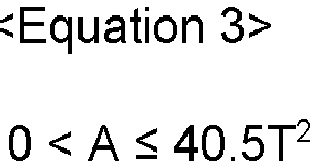
- In Equation 3, A is a cross-sectional area of a
weld bead 170 based on a cross-section of a weld bead in a thickness direction of the plate, and T is a thickness of the electrode tab. - A
weld bead 170 may have a cross-sectional area A of 40.5T2 (mm2) or less. When a cross-sectional area exceeds 40.5T2, various types of problems may occur, such as increased generation of intermetallic compounds (IMC), decreased weld strength, and crack generation in a welded area. More preferably, based on a cross-section of a weld bead, a cross-sectional area of aweld bead 170 may satisfy 1T2 to 24T2, more advantageously 1T2 to 21T2. When such a weld bead cross-sectional area is satisfied, it may have improved tensile strength and low contact resistance, thereby exhibiting excellent welding characteristics, and it may exhibit constant welding characteristics without being substantially affected by specific welding conditions. In one embodiment, a cross-sectional area (A) may be 21T2 or more, 25T2 or more, or 30T2 or more. That is, by using a wire, which is a separate filler material, an upper limit of a cross-sectional area A may be increased compared to a case where a wire is not used. - A
weld bead 170 may satisfy Equations 1 and 2 described above, and it may further satisfy Equation 3, and independently, it may satisfy Equation 3 and at the same time, it may further satisfy Equation 1, Equation 2, or Equations 1 and 2. - The width W of a
weld bead 170 described above may be a width of a cover portion based on a cross section of aweld bead 170. Specifically, a width W of aweld bead 170 may mean, on a weld bead cross-section in a thickness direction of a plate, with both ends in a thickness direction of an electrode tab of aweld bead 170 in contact with aplate 150a as boundary points P1, P2, a distance between two boundary points P1, P2 on the left and right. At this time, an example illustrated inFIG. 14 is a case where two boundary points P1, P2 on the left and right are positioned at a same height, and thus a width of a bead is illustrated as shown inFIG. 14 . When two boundary points P1, P2 on the left and right are not positioned at a same height, a width of a bead may be defined as a shortest distance between two boundary points. Accordingly, a thickness direction t2 of an electrode tab may be defined as a width direction of a cross-section of aweld bead 170. - A height H of a
weld bead 170 may be a maximum height of a cover portion based on a cross-section of aweld bead 170. Specifically, a height H of a bead may be, on a cross-section of a weld bead in a thickness direction of a plate, a distance (shortest distance) between an imaginary line connecting two boundary points P1, P2 on the left and right and a highest point of a cover portion. At this time, an example shown inFIG. 14 is a case where boundary points P1, P2 on the left and right are positioned at a same height, and thus a width of a bead is simply illustrated as shown inFIG. 14 , and a height of aweld bead 170 may be defined as a shortest distance between an imaginary line connecting two boundary points and a highest point of a cover portion. - In one embodiment, a
weld bead 170 may further satisfy Equation 4.
- In Equation 4, D is a penetration depth of the weld bead into a hole based on a cross-section of a weld bead in a thickness direction of a plate, and T is a thickness of the electrode tab.
- In detail, a penetration depth D may be a distance (shortest distance) between an imaginary line connecting two boundary points P1, P2 on the left and right and a lowest point of a
weld bead 170 positioned inside a hole. A penetration depth may correspond to a length of a pillar portion. A penetration depth may be a factor related to mechanical properties due to a shape of aweld bead 170 itself and to a dilution rate of aplate 150a. When a penetration depth satisfies a penetration depth of 0.4T to 4T, preferably 0.4T to 3.0T, and more preferably 0.5T to 2.0T, a dilution rate of aplate 150a may controlled to 5% or less, and thus mechanical properties may be improved by a shape of aweld bead 170. In one embodiment, a penetration depth D may be 2T or more, 2.3T or more, or 3T or more. That is, by using a wire, which is a separate filler material, an upper limit of a penetration depth D may be increased compared to a case where a wire is not used. - In one specific example, on a cross-section of a
weld bead 170 in a thickness direction of aplate 150a, aweld bead 170 may be left-right symmetrical or left-right asymmetrical with respect to a center line CL of ahole 150c. At this time, as anelectrode tab 120 is inserted into ahole 150c, a center line of thehole 150c may be the same as a center line of theelectrode tab 120 inserted into thehole 150c. Referring toFIG. 14 , when shortest distances between two boundary points P1, P2 on the left and right and a center line of a hole are set to be L1 and L2, and if L1 and L2 are different, a longer length is set to be L2, left-right asymmetry may mean that a ratio of L1 and L2 is 1:1 to 1:3. A left-right asymmetric structure may be mainly affected by laser irradiation direction, and this asymmetric structure may be exhibited when laser is obliquely irradiated. It is known that a left-right asymmetric structure of aweld bead 170 is not advantageous to mechanical properties of a welded area. However, according to one embodiment of the present invention, when parameters of a bead width, bead height, or cross-sectional area of a bead are satisfied, mechanical properties (weld strength) of a welded area are significantly affected by a asymmetric structure of aweld bead 170. That is, even when it has a left-right or left-right symmetrical structure, it may exhibit welding properties with substantially constant, uniform, and improved mechanical properties. In one embodiment, a ratio of L1 and L2 may be 1:1 to 1:1.2. That is, by using a wire, which is a separate filler material, left-right symmetry of aweld bead 170 may be improved compared to a case where a wire is not used. -
FIGS. 15 to 17 are images showing weld beads formed in a battery module according to embodiments of the present invention. - Referring to
FIGS. 15 to 17 , welding beads of different shapes were formed by welding plates into which each electrode tab was inserted. At this time, it can be seen that a plate surface in contact with a weld bead is formed to be inclined downward in a longitudinal direction toward an outer circumference of a weld bead. In this way, a plate surface bonded to a formed weld bead may be configured to be inclined downward from a center of a hole toward an outer circumference of a weld bead so that a shape of a weld bead may be formed to be smooth, thereby preventing deterioration of welding strength due to rough shapes such as notches. - The width W, height H, penetration depth D, shortest distances between boundary points and a center line of a hole L1, L2, and L1:L2 values shown in
FIGS. 15 to 17 were measured and are shown in Table 1 below.[Table 1] W H D L1 L2 L1:L2 FIG. 15 3.12 mm 0.91 mm 1.47 mm 1.29 mm 1.82 mm 1:1.41 7.80T 2.27T 3.67T 3.23T 4.56T FIG.16 2.31 mm 0.87 mm 1.13 mm 1.11 mm 1.20 mm 1:1.08 5.77T 2.17T 2.82T 2.78T 2.99T FIG.17 2.68 mm 0.93 mm 1.32 mm 1.14 mm 1.54 mm 1:1.36 6.69T 2.33T 3.31T 2.84T 3.85T
Claims (15)
- A battery module manufacturing method comprising:a step of inserting each of electrode tabs of a plurality of battery cells into a plurality of holes included in a bus bar; anda step of bonding the electrode tabs to the bus bar by irradiating laser under feeding of a wire,wherein the bus bar electrically connects the electrode tabs of the plurality of battery cells to each other.
- The battery module manufacturing method according to claim 1, wherein in the step of bonding the electrode tabs to the bus bar, a weld bead joining the electrode tabs and the bus bar is formed.
- The battery module manufacturing method according to claim 2, wherein the weld bead is formed using a wire as a base material.
- The battery module manufacturing method according to any one of claims 2 or 3, wherein the weld bead satisfies Equations 1 and 2 below:


- The battery module manufacturing method according to claim 4, wherein the W is 2T to 8T, and the H is 0.5T to 3T.
- The battery module manufacturing method according to any one of claims 2 to 5, wherein the weld bead satisfies Equation 3 below:

- The battery module manufacturing method according to claim 6, wherein the A is 1T2 to 24T2.
- The battery module manufacturing method according to any one of claims 2 to 7, wherein the weld bead satisfies Equation 4 below:
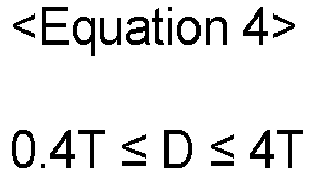
- The battery module manufacturing method according to any one of claims 1 to 8, wherein the wire includes a same material as the electrode tab and/or wherein the bus bar includes a different material from the electrode tab.
- The battery module manufacturing method according to any of one of claims 1s to 9, wherein the wire and the electrode tab include aluminum, and the bus bar includes copper.
- The battery module manufacturing method according to any one of claim 1 to 10, wherein a thickness of the electrode tab is 0.2 mm or more, and/or wherein a thickness of the bus bar is 0.5 mm or more.
- The battery module manufacturing method according to claim 2, wherein, on a cross-section of a weld bead in a thickness direction of the bus bar, the weld bead is left-right asymmetrical based on a center line of a hole.
- The battery module manufacturing method according to claim 12, on a cross-section of a weld bead in a thickness direction of the bus bar, the ratio of L1 and L2, which are shortest distances from a center line of a hole to both ends of the weld bead in contact with the bus bar in a width direction, is 1:1 to 1:3.
- A battery module comprising:a plurality of battery cells, each including an electrode tab; anda bus bar including a plurality of holes into which the electrode tabs are each inserted, and connected to the electrode tabs to electrically connect the plurality of battery cells to each other,wherein the electrode tabs inserted into the holes and the bus bars are joined with each other by a weld bead,wherein the weld bead is formed using a separate wire that is distinguished from the electrode tab as a base material, andwherein the width of the weld bead based on a weld bead cross-section in the thickness direction of the bus bar may be 7 times or more than a thickness of the electrode tab.
- The battery module according to claim 14, wherein a height of a weld bead, based on a cross-section of a weld bead in a thickness direction of the bus bar, is triple or more than the thickness of the electrode tab, and/or wherein a cross-sectional area of a weld bead, based on a cross-section of a weld bead in a thickness direction of the bus bar, is 21 times or more than a square of the thickness of the electrode tab.
Applications Claiming Priority (1)
| Application Number | Priority Date | Filing Date | Title |
|---|---|---|---|
| KR1020230018247A KR20240125336A (en) | 2023-02-10 | 2023-02-10 | Battery module manufacturing method and battery module |
Publications (2)
| Publication Number | Publication Date |
|---|---|
| EP4415148A2 true EP4415148A2 (en) | 2024-08-14 |
| EP4415148A3 EP4415148A3 (en) | 2025-01-29 |
Family
ID=89853354
Family Applications (1)
| Application Number | Title | Priority Date | Filing Date |
|---|---|---|---|
| EP24156034.1A Pending EP4415148A3 (en) | 2023-02-10 | 2024-02-06 | Battery module manufacturing method and battery module |
Country Status (4)
| Country | Link |
|---|---|
| US (1) | US20240283105A1 (en) |
| EP (1) | EP4415148A3 (en) |
| KR (1) | KR20240125336A (en) |
| CN (1) | CN118486903A (en) |
Family Cites Families (2)
| Publication number | Priority date | Publication date | Assignee | Title |
|---|---|---|---|---|
| KR20110055255A (en) * | 2009-11-19 | 2011-05-25 | 에스비리모티브 주식회사 | Bus bar and battery module with same |
| US12603393B2 (en) * | 2019-11-20 | 2026-04-14 | Sk On Co., Ltd. | Battery module |
-
2023
- 2023-02-10 KR KR1020230018247A patent/KR20240125336A/en active Pending
-
2024
- 2024-02-05 CN CN202410160343.8A patent/CN118486903A/en active Pending
- 2024-02-06 EP EP24156034.1A patent/EP4415148A3/en active Pending
- 2024-02-07 US US18/434,826 patent/US20240283105A1/en active Pending
Also Published As
| Publication number | Publication date |
|---|---|
| EP4415148A3 (en) | 2025-01-29 |
| CN118486903A (en) | 2024-08-13 |
| KR20240125336A (en) | 2024-08-19 |
| US20240283105A1 (en) | 2024-08-22 |
Similar Documents
| Publication | Publication Date | Title |
|---|---|---|
| KR100842493B1 (en) | Method for welding thin plates of different metal, joined body of thin plates of different metal, electric device, and electric device assembly | |
| US9559347B2 (en) | Negative electrode terminal for battery and method for producing negative electrode terminal for battery | |
| US9017871B2 (en) | Negative-electrode terminal for cell | |
| US12603394B2 (en) | Battery module | |
| EP1921696A1 (en) | Battery pack and method for welding cells | |
| KR102817987B1 (en) | Battery Module | |
| JP3578303B2 (en) | Method for producing electrode of sealed prismatic battery | |
| US20230344087A1 (en) | Busbar and battery pack including the same | |
| KR102829145B1 (en) | Method for manufacturing cylindrical secondary battery | |
| DE102012215661B4 (en) | Laser welded connection and electrochemical device | |
| EP4415148A2 (en) | Battery module manufacturing method and battery module | |
| JP5546997B2 (en) | Welding method, battery manufacturing method, and battery | |
| DE102022124854A1 (en) | METAL-POLYMER HYBRID CURRENT COLLECTOR FOR A BATTERY ELECTRODE AND METHOD OF PRODUCTION THEREOF | |
| JP4586008B2 (en) | Battery pack and manufacturing method thereof | |
| JP2023136007A (en) | Manufacturing method of conjugant, conjugant, battery module, and battery pack | |
| JP6108545B2 (en) | Square secondary battery and battery pack | |
| US20250149746A1 (en) | Battery module and method for manufacturing the same | |
| EP4414116A1 (en) | Weld bead and secondary battery module including the same | |
| JP7661984B2 (en) | Battery manufacturing method and battery | |
| EP4382240A1 (en) | Secondary battery module | |
| WO2026083817A1 (en) | Battery case, battery, and method for manufacturing battery case | |
| JP2026070684A (en) | Battery case, battery, and method for manufacturing a battery case |
Legal Events
| Date | Code | Title | Description |
|---|---|---|---|
| PUAI | Public reference made under article 153(3) epc to a published international application that has entered the european phase |
Free format text: ORIGINAL CODE: 0009012 |
|
| STAA | Information on the status of an ep patent application or granted ep patent |
Free format text: STATUS: REQUEST FOR EXAMINATION WAS MADE |
|
| 17P | Request for examination filed |
Effective date: 20240206 |
|
| AK | Designated contracting states |
Kind code of ref document: A2 Designated state(s): AL AT BE BG CH CY CZ DE DK EE ES FI FR GB GR HR HU IE IS IT LI LT LU LV MC ME MK MT NL NO PL PT RO RS SE SI SK SM TR |
|
| PUAL | Search report despatched |
Free format text: ORIGINAL CODE: 0009013 |
|
| AK | Designated contracting states |
Kind code of ref document: A3 Designated state(s): AL AT BE BG CH CY CZ DE DK EE ES FI FR GB GR HR HU IE IS IT LI LT LU LV MC ME MK MT NL NO PL PT RO RS SE SI SK SM TR |
|
| RIC1 | Information provided on ipc code assigned before grant |
Ipc: B23K 35/02 20060101ALI20241223BHEP Ipc: B23K 35/00 20060101ALI20241223BHEP Ipc: H01M 50/516 20210101AFI20241223BHEP |